Article

Two-Carrier Description of Cuprate Superconductors from NMR

Felix Bloch Institute for Solid State Physics, University of Leipzig, Linnéstr. 5, 04103 Leipzig, Germany
*
Author to whom correspondence should be addressed.
Condens. Matter 2026, 11(1), 5; https://doi.org/10.3390/condmat11010005
Submission received: 8 January 2026 / Revised: 1 February 2026 / Accepted: 2 February 2026 / Published: 5 February 2026
(This article belongs to the Special Issue Superstripes Physics, 4th Edition)

Abstract

Cuprates currently hold the record for the highest temperature superconductivity at ambient pressure, but the microscopic understanding of these materials remains elusive. Here, we utilize nuclear magnetic resonance (NMR) data of planar oxygen and copper from essentially all hole-doped cuprates to provide a universal phenomenology relating the NMR spin shifts, which measure the electronic spin polarization at a given nucleus, with the superconducting dome and maximum critical temperature. There appear to be two separate contributions to the spin shift in planar copper, only one of which is seen at the oxygen site, and we associate them with two different types of carriers. Upon disentangling these two components, their relative size is shown to correlate not only with the doping dependence of the superconducting dome but also with the variation in maximum superconducting critical temperature, T c , max , between different families. One of these components is independent of family and resides in the hybridized planar orbitals of Cu and O. The second component, in contrast, is predominately isotropic and encodes the differences between the families. It is thus related to the charge transfer gap and planar hole sharing. Our findings offer universal insight which should prove useful in the continuing development of a comprehensive theory of the cuprates, as well as an indication of how it may be possible to engineer materials with higher critical temperatures.

1. Introduction

Since the discovery of cuprates’ high-temperature superconductivity [1], condensed matter physics has struggled with the understanding of these complex materials. Described in the common phase diagram as a function of doping, the parent insulator evolves from its antiferromagnetic phase into a pseudogap and superconducting phase, and eventually into what is believed to be a metallic phase that does not superconduct. Unlike classical superconductors, for which a gap opens in a metallic density of states only at the critical temperature of superconductivity ( T c ) as the temperature is lowered, the still mysterious pseudogap phase shows lost states already far above T c . The maximum critical temperature, T c , max , observed atop the superconducting dome, is of great interest in the field but does not follow from the simple phase diagram. Rather, it depends on the material family [2], and the apical oxygen distance to the planar copper correlates with T c , max [3,4,5], which can involve the rather large Cu 4 s orbital. It was also shown that the same family dependence was reflected in the sharing of the inherent hole between planar Cu ( n d ) and O ( n p ), which can be determined from the quadrupole splitting measured with nuclear magnetic resonance (NMR) at the planar nuclei [6,7]. In fact, the empirical relation, T c , max 200 K · 2 n p , was found for the hole-doped cuprates [8], where T c , max is nearly proportional to the planar O 2 p σ hole content at optimal doping (while n d + 2 n p 1 + x , as expected from chemistry). Recent progress with advanced computations (DMFT) endorse these findings [9,10]. Furthermore, the relation was also shown to explain the old conundrum of how pressure could increase T c , max beyond what could be achieved by chemical doping: in such a case, pressure also changes the sharing of the hole between planar Cu and O accordingly [11]. One then wonders whether this intriguingly simple dependence of T c , max on n p and n d , and the family dependence in general, has a related signature in the magnetic NMR data, which influenced the field profoundly early on [12].
Here, we uncover a new universal scaling between the magnetic axial shift of planar Cu and the magnetic shift of planar O, and an additional magnetic shift on planar Cu that is essentially absent on planar O. The magnetic shift contribution common to both nuclei is assigned to planar carriers, given the involved hyperfine couplings, while a second spin component determines the family-dependent remainder of the Cu shift and is assigned to interplanar carriers. Importantly, both spin components apparently act together to set T c and the superconducting dome, as well as T c , max . While the focus here is on the shifts, nuclear relaxation seems to follow the same scenario, although its detailed understanding requires more involved theory.
This simple new scenario across all hole-doped cuprate families shows that the understanding of cuprate superconductivity needs a broader view. A sole focus on the generic phase diagram or certain cuprate families is insufficient, as we already know from the importance of the planar charge sharing between Cu and O.

2. NMR Shifts

We begin with a short review of the cuprate shifts, specifically, of the CuO2 plane.
A material in a magnetic field, B 0 , responds with an electronic spin polarization, S z , given by the uniform electronic spin susceptibility, γ e S z = χ B 0 . In the case of isotropic spin, this causes a relative NMR frequency shift, the spin shift,
K α ( T ) = A α · χ ( T ) ,
where A α is the anisotropic hyperfine constant for that particular ion. In ordinary metals, χ ( T ) is proportional to the density of electronic states (DOS) near the Fermi surface, selected by the Fermi function at temperature T. This is the positive and temperature-independent Pauli susceptibility resulting in a metal’s Knight shift. If such a material becomes superconducting at a critical temperature T c , the shift begins to decrease and vanishes towards low temperatures for spin singlet pairing [13,14]. It is important to note that χ ( T ) in (1) leads to proportional changes in the shifts at all nuclei; only their sizes due to the respective hyperfine constants differ. For more complicated hyperfine scenarios, e.g., even in metals with more than one band, this proportionality can be lost if more than one spin component is present [15].

2.1. Brief Review of Planar Cuprate Shifts

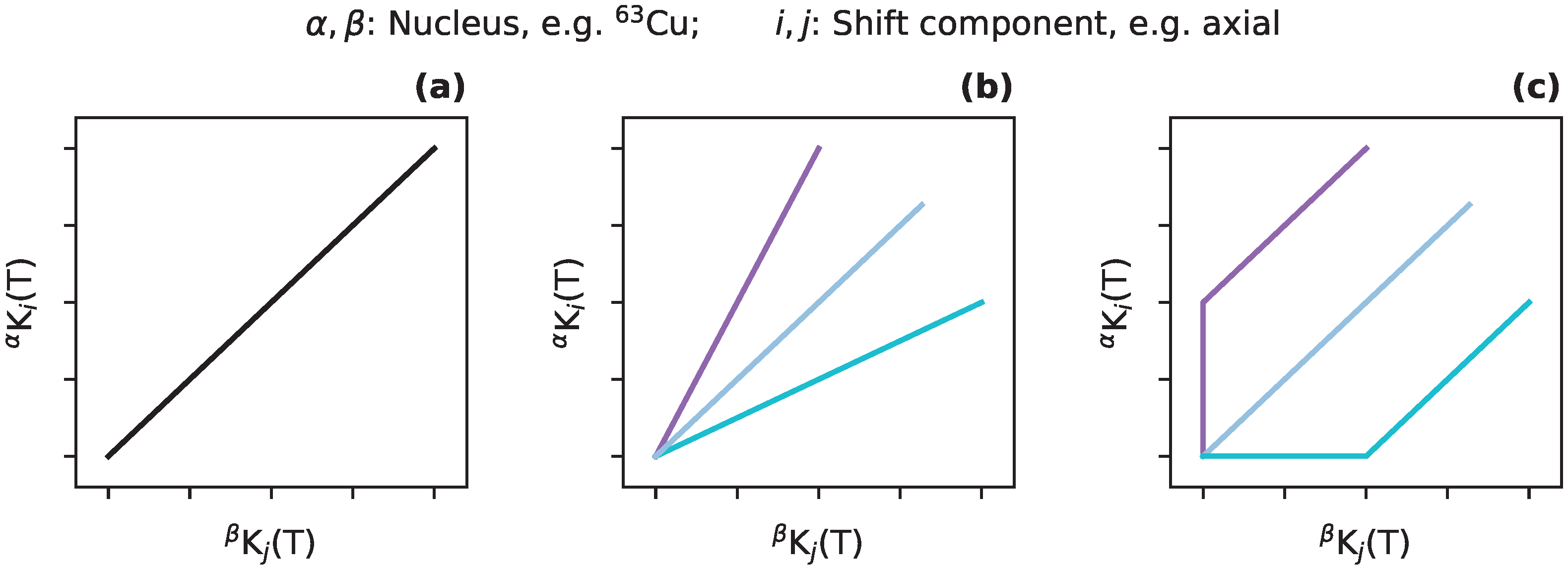
Early tests of Equation (1) for the cuprates were performed on two materials, YBa2Cu3O6.63 and YBa2Cu4O8 [16,17]. Since the temperature dependence of the planar Cu shift, 63K⊥(T) (the magnetic field lies in the CuO2 plane), is rather similar to that of planar O, 17Kα(T) (all field directions), a single component view appeared appropriate (cf. Figure 1a). However, the hyperfine scenario for Cu had to be more complex since the shift with the field along the crystal c-axis was found to be rather temperature-independent, ΔT63K ≈ 0, above and below T c for these materials. In a single band view, one then concluded that 63Kα = (Aα + 4B)χ with A 4 B , ( A | A | on general grounds [18]), and 17Kα = 2Cαχ (O is situated between two Cu atoms, each Cu atom is surrounded by four Cu neighbors) [12]. When some other materials showed a temperature-dependent K 63 , it was ascribed to variations in the hyperfine constant B [19] (cf. Figure 1b). Additionally, uncertainties remained due to the often-large shift distributions, in particular at low temperatures, as well as the lack of the precise knowledge of the Meissner fraction [20].
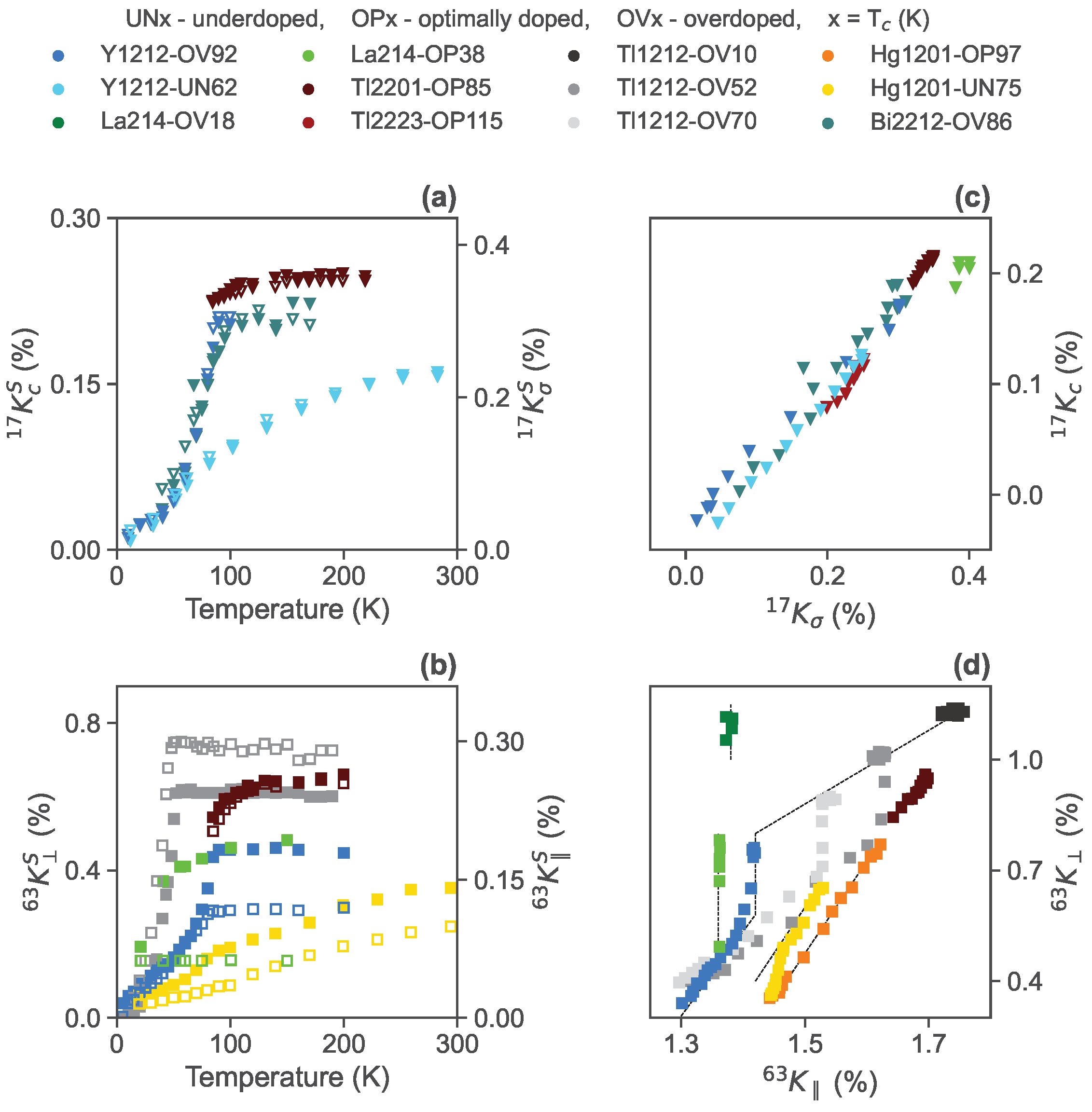
Later it was shown that La1.85Sr0.15CuO4 could not be understood in such simple terms [21]. More evidence came from experiments on other systems over the years [22,23]. Finally, a thorough analysis of all planar Cu data available in the literature [24] showed that even the temperature dependence of the shifts observed at the same Cu nucleus, but different directions of the field, Δ T K 63 and Δ T K 63 , were in general not proportional to each other. However, one observes only three different ratios Δ T K 63 / Δ T K 63 in given temperature intervals. This observation has important consequences. For one thing, the abrupt changes in slope cannot be understood with a single spin component. Additionally, the limited number of slopes observed places universal restrictions on the Cu hyperfine scenario, in contrast with the assumptions mentioned above. Examples of shifts are shown in Figure 2.
Surprisingly, the planar 17O shifts (and relaxation) are rather simple, as a recent literature overview showed [25]. They are essentially independent of family, and their higher temperature behavior is explained with a temperature-independent but doping-dependent pseudogap at the Fermi level in an otherwise universal electronic density of states. In other words, the planar O data can be understood with just two parameters: a pseudogap (with a size set by doping only) and a single electronic spin component.
In a recent summary, this apparent shift dichotomy between Cu and O across all materials was discussed [26].

2.2. New Universal Scaling Law

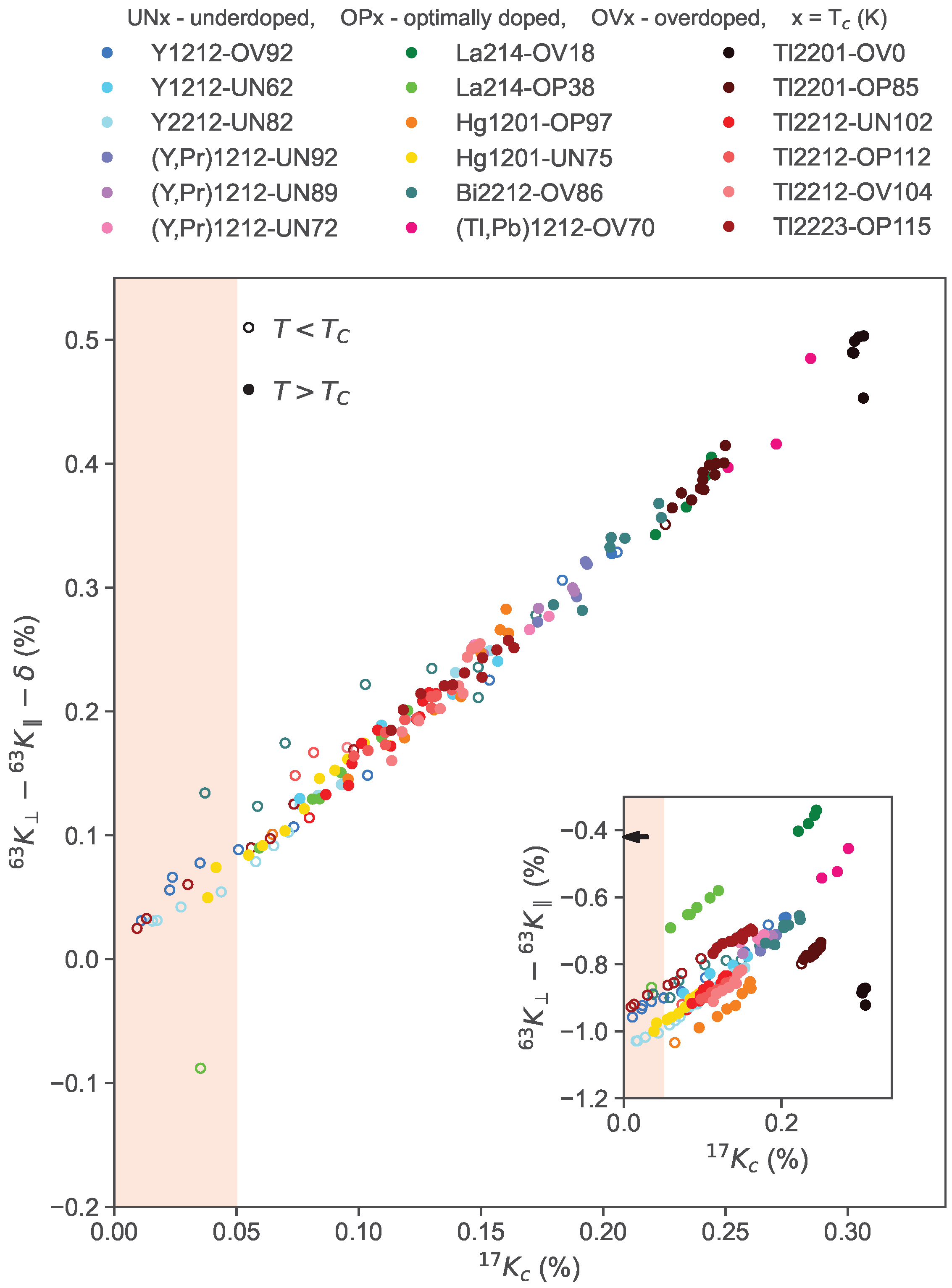
While searching for a simple phenomenology in the cuprate shifts, we uncovered an unexpectedly robust property that reveals itself in Figure 3 and is described by
K 63 ax ( T ) K 63 ( T ) K 63 ( T ) 1.6 · K 17 c ( T ) + δ ,
wherein δ is a temperature-independent but family-dependent offset. This means that the Cu axial shift, i.e., the difference of the shifts with magnetic field in the plane and perpendicular to it (the shift tensor is in-plane symmetric) has the same temperature dependence as that of planar O (for any direction of the field, cf. Figure 2). The universal proportionality constant of about 1.6 applies to K 17 c , the most often measured direction. Relation (2) resolves the mystery of the missing scaling of the bare shifts, as there is obviously another family- and temperature-dependent shift of planar Cu that is not present on planar O. For almost all cuprates, this second component is isotropic. La1.85Sr0.15CuO4 is special in that the violation of Equation (2) at lower temperatures in Figure 3 is due to an additional axial rather than isotropic shift component.
Note that the shifts from the literature are rather reliable; varying line widths and sample sources do not seem to matter. Relation (2) holds whether the shifts become temperature-dependent at T c (overdoped materials) or already at much larger temperatures in the presence of the pseudogap. One concludes that this is the action of a single temperature-dependent electronic spin component, while the remainder of the Cu shift is attributed to a second electronic spin component not seen by the O nucleus.
For La2−xSrxCuO4, and YBa2Cu3O6+y above about 80 K, we note that K 63 is largely temperature-independent ( Δ T K 63 0 ), i.e., the temperature dependence patterns of K 63 ax and K 63 are the same. Note that these materials defined the old picture. Below 80 K, K 63 of YBa2Cu3O6+y suddenly becomes temperature-dependent but shows no change in slope in Figure 3 due to the isotropic origin.
The temperature-independent offset δ is dominated by K 63 for most systems, as one can see already with Figure 2, but it also has small contributions from K 63 (minor variations also originate in the planar O shifts). One would expect it to be given by the orbital shift contributions. This is addressed further below.
To conclude, it is the planar Cu axial shift and the planar O shift that show single-component behavior across all cuprates. It is predominantly planar Cu that is affected by another temperature-dependent spin component. This is an overarching, very robust scenario based on all available data in the literature.

3. Two-Component Scenario

Since it is not clear how one should describe the shifts in this more complicated situation, we establish a simple phenomenology that carries the essential relations in terms of two independent carriers. We ascribe the straight lines in Figure 3 to an electronic spin component given by χ PC ( T ) . It sets the Cu axial shift, K 63 ax ( T ) = K 63 ( T ) K 63 ( T ) and is the sole term for the planar O shift, e.g., K 17 c (T). We introduce a new hyperfine coefficient, R α , for planar Cu. For planar O, we keep the old coefficient, 2 C α . We then have
K 63 ax ( T ) = ( R R ) · χ PC ( T )
K 17 c ( T ) = 2 C c · χ PC ( T ) .
In view of Figure 3, we write
K 63 ax ( T ) = R R 2 C c K 17 c ( T ) + δ ,
where R , R , and C c are the corresponding effective, anisotropic, hyperfine coefficients, and δ is the temperature-independent offset (note that for La2−xSrxCuO4 this is only the low-temperature offset). Then,
R R 2 C c 1.6 ( ± 0.2 ) .
Clearly, since χ PC drives the planar Cu axial and the planar O temperature-dependent shifts, independent of family, it is due to spin from expected planar carriers (PCs). In fact, based on the known contributions from the hyperfine coefficients [12,18], χ PC ( T ) is readily assigned to the intrinsic hole in the 3 d ( x 2 y 2 ) orbital that is hybridized with planar O. One is inclined to use the established hyperfine coefficients for it, i.e., for planar Cu, R α = ( A α + 4 B ) , with A 4 B , to make sure K 63 is temperature-independent for La2−xSrxCuO4 and YBa2Cu3O6+y (at higher temperatures). The additional shift component on planar Cu we attribute to a second susceptibility, χ IC , and write
K 63 α ( T ) = R α χ PC ( T ) + S α χ IC ( T ) .
The hyperfine coefficient S α is isotropic for most cuprates and axial for La2−xSrxCuO4. S α was not uncovered with first principle cluster calculations that focused only on the planar structure [18], but band-structure calculations point to such contributions [4]. The label IC reminds us of the interplanar nature of this spin component. With R 0 , the contribution S χ IC can be determined directly from K 63 .
S χ IC ( T ) K 63 ( T ) + ( δ K L 63 )
δ is defined by (5), and K L 63 0.30 % comes from the estimated orbital shift contributions to the copper shifts (see further down for more details).
While the set of data in Figure 3 is convincingly large, there are much more planar Cu data available for which K c 17 was not measured due to the necessary isotope exchange. We focus now on what one can learn from these additional planar Cu shifts. A collection of all literature 63Cu shifts was published recently, and a convenient way of looking at the many sets of data (from 19 families) is a plot of K 63 ( T ) vs. K 63 ( T ) [24] (c.f. Figure 1). A few examples are included in Figure 2d. Most interesting is the fact that such a plot consists of a set of straight line segments. This means that, as a function of temperature or doping, changes in both shifts, Δ K 63 and Δ K 63 , are related to each other, with only three different slopes
Δ K 63 / Δ K 63 = σ i , σ 1 , 2 , 3 , 5 2 , 1 .
Thus, at certain points in temperature (or doping), one finds rather sudden changes between those slopes. It should be stressed that the different slopes cannot be due to sudden changes in the hyperfine coefficients, since we do not observe any discontinuities in the shifts themselves. Additionally, the spin susceptibility is isotropic, i.e., it is generally independent of the direction of the magnetic field (as seen from the scaling of the planar oxygen shifts in all field directions). Comparing the three slopes with the two components in (7), and using A | A | , one concludes,
σ 1 Δ χ IC 0
σ 2 Δ χ IC 8 B 3 S Δ χ PC
σ 3 Δ χ PC 0 .
Thus, the three slopes in (9) are simply the result of the independent behavior of the two spin components. If only one of the components is temperature-dependent, we find slope σ 1 or σ 3 . If both change together, it occurs with the unique ratio σ 2 . Note that switching between these slopes can occur near T c (overdoped samples), as well as temperatures comparable to the size of the pseudogap. Furthermore, such changes occur at presently unforeseen temperatures. The slope σ 2 (11) might suggest that S = 8 B / 3 , but that is not necessarily the case due to the unknown relative size of the susceptibilities.
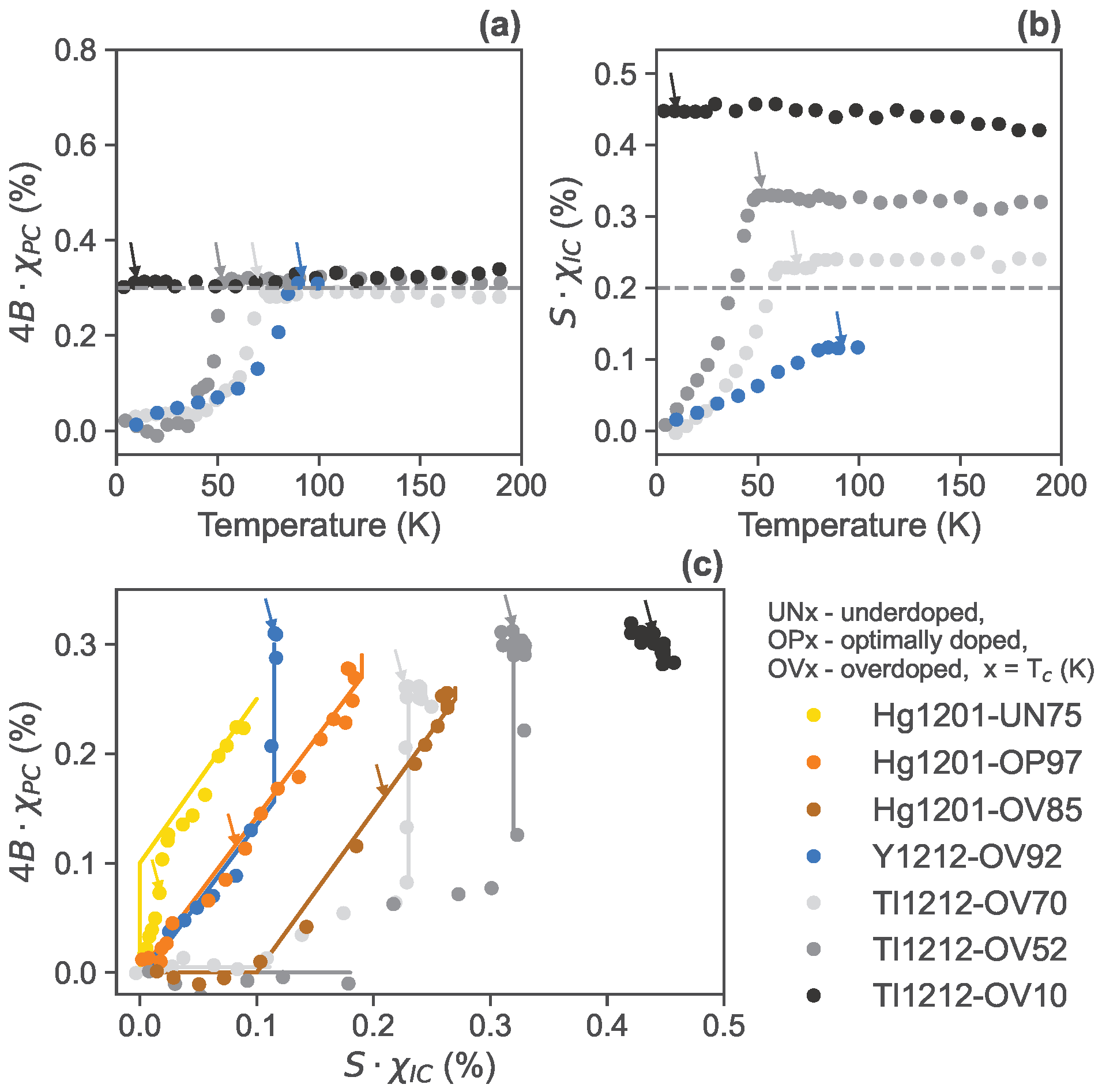
For overdoped materials (see, e.g., Hg1201-OV85, Tl1212-OV70, Figure 4), the shifts typically consist of two temperature-independent (metal-like) components. At the bulk T c , condensation begins with χ PC , while χ IC can follow immediately or join at lower temperatures. There may be two different condensation temperatures, with T c IC T c PC (we observed differences up to about 15 degrees). Upon lowering the temperature further, another change in slope to σ 3 indicates that Δ χ PC 0 , while χ IC continues to decrease. Again, this reminds one of different condensation behaviors (similar to different pairing scenarios).
Interestingly, optimal doping seems to demand that σ 2 (11) holds down to the lowest temperature (see, e.g., Hg1201-OP97, Y1212-OV92, Figure 4). Once σ 2 is assumed, there is no switch to σ 1 or σ 3 at lower temperatures, i.e., χ IC shows the same condensation behavior as χ PC . Note that even for optimal doping, it is always χ PC that first becomes temperature-dependent, and χ IC follows only at lower temperatures.
For underdoped samples (see, e.g., Hg1201-UN75, Figure 4), it is not clear from the data exactly how χ IC is affected by the pseudogap. However, as long as σ 2 (11) holds, both components have the same temperature dependence. In underdoped samples, this slope is typically observed up to the highest temperatures. At lower temperatures, there is a change to slope σ 1 ( Δ χ IC 0 ), which is the opposite behavior compared to the overdoped samples.
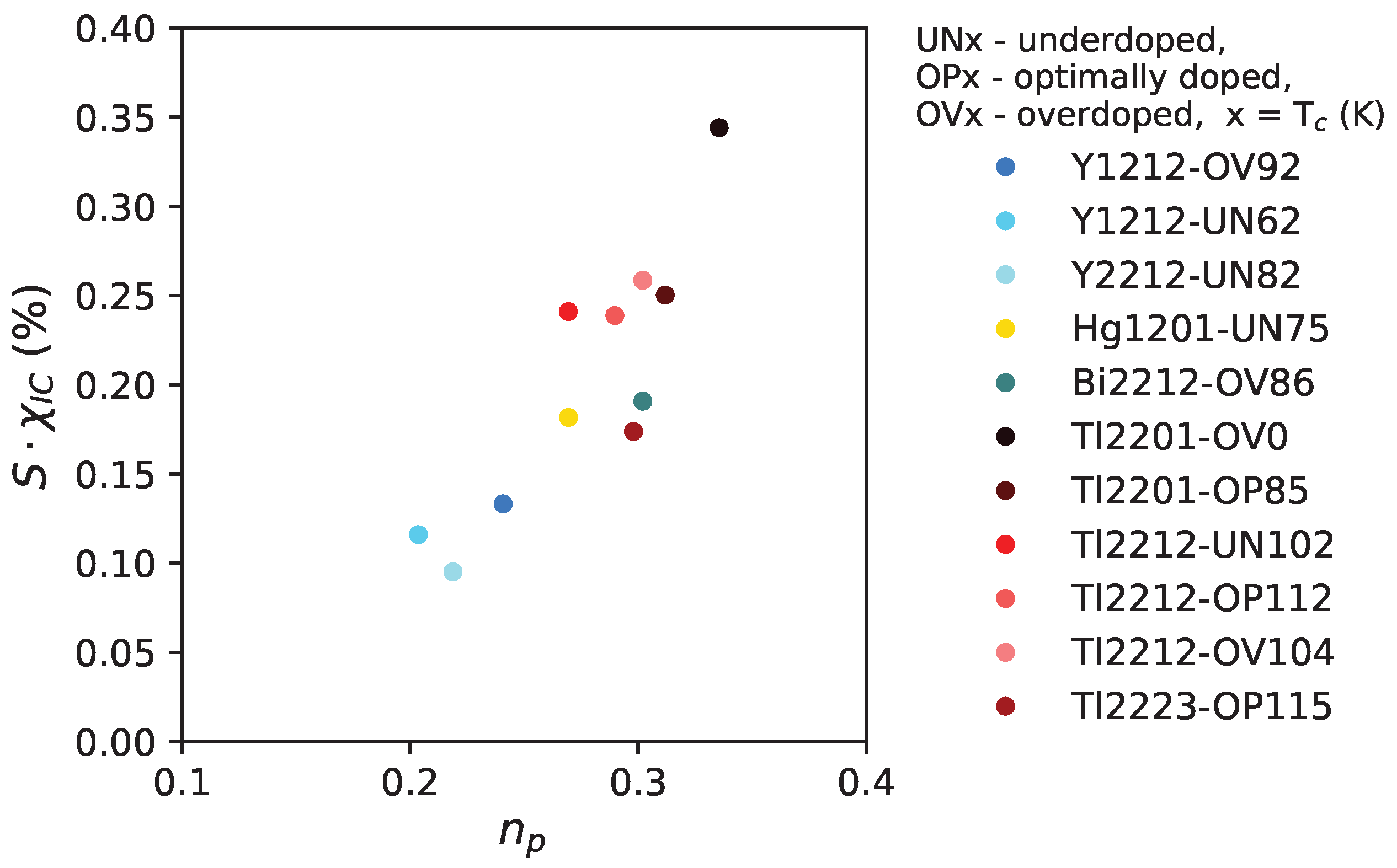
It is clear from Figure 4b that χ IC grows with doping, even beyond the closing of the pseudogap. χ PC , on the other hand, apart from the effect of the pseudogap, stays relatively fixed, independent of doping or family (see Figure 4a). Due to the doping dependence of χ IC , the measured spin shift in underdoped samples is typically dominated by χ PC , while for overdoped samples it is χ IC . Additionally, there is a family dependence in χ IC . At optimal doping it appears that some families have a much larger χ IC than others. Families with a high T c , max also have a large χ IC , while those families with a lower T c , max have a smaller χ IC (see Figure 5).
With this information we can inspect La2−xSrxCuO4 again. This system lacks an isotropic spin shift on copper but behaves similarly in terms of the planar carriers. In fact, the large positive offset in Figure 3 begins to disappear near T c , while the low-temperature shift is similar to that of all the other systems ( K 63 ( T 0 ) 0.35 % ). From the overall phenomenology it then appears that, in addition to χ PC , La2−xSrxCuO4 also has χ IC with constant DOS above about T c ; however, the associated hyperfine constant has predominantly axial symmetry. It also does not affect planar O significantly and begins to disappear only at lower temperature. This is behind the observation in La2−xSrxCuO4 that the planar Cu shift drops while the shift of planar O has already vanished below T c [21].
  • Note on orbital shift contributions:
The planar O orbital shift is small and in agreement with first-principle calculations [28]. Uncertainties do not interfere with the spin shift analysis. This is different for planar Cu with a hole in the 3 d ( x 2 y 2 ) orbital [29]. Due to the hybridization with planar O, the isolated ion orbital shift anisotropy is greatly reduced from a factor of approximately 4 to 2.4 [28], a value that is rather reliable.
Experimentally, K 63 ( T ) reaches a nearly common low-temperature value of about 0.35 to 0.40%, and first-principle calculations reported later that K 63 L 0.30 % [28]. For K 63 , the situation is very different. There is no common low-temperature shift for the cuprates, and the same first-principle calculations predict K 63 L = 0.72 % [28], in stark disagreement with even the La2−xSrxCuO4 temperature-independent shift of ∼1.3%. Uncertainties from large line widths, the Meissner fraction, and a finite carrier lifetime may explain the small differences for K 63 L but not for K 63 L .
Since an orbital shift pair of K 63 L = 0.30 % and K 63 L = 0.72 % is reasonable, we indicated this value with an arrow at the ordinate in Figure 3, i.e., we defined the difference as Λ 63 K 63 L K 63 L = 0.42 % . The temperature-independent offset δ in Figure 3 is defined by (5) and thus contains that orbital shift. δ mainly changes between families; although there is perhaps a small doping dependence (see, e.g., Tl2201, Figure 3).
This temperature-independent shift δ with its large anisotropy defies its identification as an orbital shift (electron-doped materials that are very similar in chemistry are much closer to the first-principle calculations). Furthermore, the presence of new s-like states should not contribute to orbital moments, although δ , in particular with the axis parallel to the field, has a similar family dependence to the spin shift χ IC .

4. Discussion and Conclusions

The newly discovered, very robust scaling between the planar Cu axial shift and planar O shift in essentially all cuprates resolves the long-standing NMR shift conundrum, i.e., the missing scaling between the bare Cu and O (and other) shifts. It shows that the family-independent planar O shift that is generic to the cuprates is present in full extent (with respect to the hyperfine coefficients) as a Cu axial shift. In addition, most cuprates are found to have an additional planar Cu isotropic shift. In La2−xSrxCuO4, the second contribution is axial, which is not unexpected given the relevance of the 3 d 3 z 2 r 2 orbital and the apical oxygen 2 p z [4,30,31].
This scaling can be interpreted by two temperature-dependent spin susceptibilities, χ PC ( T ) and χ IC ( T ) . It appears that χ PC ( T ) is a family-independent property of the CuO2 plane, i.e., it only depends on doping, with the corresponding spin polarization arising from hybridized Cu 3 d ( x 2 y 2 ) and O 2 p σ orbitals. At higher doping levels, χ PC ( T ) becomes temperature- and doping-independent (metal-like) and changes only at T c . For lower doping levels, i.e., in the presence of the pseudogap, χ PC already decreases at a higher temperature. Since this behavior is similar for all cuprates, χ PC is not affected by the family-dependent sharing of charge between Cu and O in the plane that sets T c , max [8,32]. The second electronic spin from χ IC ( T ) , on the other hand, is strongly family-dependent. It sets the additional shift at planar Cu and is isotropic for most materials (except La2−xSrxCuO4). Unlike χ PC , which saturates to a similar high-temperature value, independent of doping, χ IC grows with doping even after the pseudogap is closed. χ IC is also metal-like and affected by a pseudogap (it is not certain from the data whether it is the same pseudogap as that seen by χ PC ).
Both susceptibilities can drop (from carrier condensation) rapidly at certain temperatures, apparently independently. Above optimal doping, condensation begins with χ PC at T c , and χ IC joins the condensation at slightly lower temperatures, up to about 15 degrees. This may explain the not-so-sharp transition into the superconducting state often ascribed to inhomogeneity. Below T c , it appears that χ PC drops more rapidly than χ IC , perhaps pointing to different gap symmetries [33].
Interestingly, the superconducting dome relates to the match or mismatch of the two susceptibilities. At optimal doping, both fall together to the lowest temperature with an apparent single-component behavior, while for under- or overdoped samples, one of the two susceptibilities is depleted earlier. The family-dependent highest transition temperature, T c , max , which occurs at optimal doping, seems to be related to the two components. It appears as if optimally doped samples with a high amount of χ IC also have a high T c , max . This can be seen from the relation to the planar oxygen hole content n p (see Figure 5. Note that a similar observation has been explained previously in a different framework [34]), which is known to correlate with T c , max [8]. As such, χ IC is also reminiscent of the correlation between T c , max and the apical oxygen distance, which relates to the involvement of the copper 4s orbital [4]. For a high T c , it is also favorable if χ IC is matched to χ PC according to (11). If this phenomenology holds, a larger planar χ PC might be necessary for cuprates with much higher T c . In other words, T c , max of the cuprates seems ultimately set by the CuO2 plane, which may explain why the cuprate’s T c , max is somehow limited currently.
It was noted before [25,35] that χ PC (in planar O) explains Loram’s specific heat in terms of the temperature dependence [35,36]. Given that χ IC is rather close in its temperature dependence, in particular in the pseudogap regime, where both spin components decrease together, they probably cannot be separated in terms of specific heat. The increase in χ IC on the overdoped side may be behind the increase in DOS reported with specific heat data [36,37]. Nuclear relaxation of planar O is in agreement with the specific heat [25], and both components seem to be involved in setting the Cu relaxation, as the anisotropy decreases with doping as expected from the growth of χ IC . In addition, La2−xSrxCuO4 has a significantly larger relaxation when the field is in the CuO2 plane, likely due to the additional axial term.
The thermal excitations leading to χ PC , IC appear metallic [38] even in the underdoped region of the phase diagram. However, even at rather high doping levels ( x 0.3 ), the response is still not what is expected from simple classical metals [39,40]. Stripe-like correlations seem to be ubiquitous for χ PC [39,41], which points to the role of lattice degrees of freedom in the susceptibility [42,43]. The isotope effect for planar O might not be surprising in this scenario [44]. It may also be possible that a phase separation between two components is the reason for the ubiquitous inhomogeneity observed in the cuprates [45].
The two carriers remind one of a two-band scenario [30,44,46], which would readily explain differences in the critical temperature T c between the two components as well as the importance of the doping- and family-dependent density of states of the carriers for superconductivity. Two condensation temperatures can be observed in the absence of a strong inter-band scattering [46]. Two carriers may also be required in loop current scenarios [47,48].
With the identification of χ PC , IC , the presence of an additional temperature-independent shift offset δ becomes more obvious. It varies between the different samples and is not in agreement with simple orbital-shift scenarios [6,28]. This offset is found to be correlated with χ IC and to the oxygen hole content n p (and thus T c , max [8]), which makes an identification as orbital shift questionable. If δ was caused by spin, it would require a negative spin polarization [24]. For now, the origin of δ remains to be investigated further.
To conclude, we described a magnetic shift scenario of planar Cu and O that carried a universal doping-dependent and family-independent component, as well as a second, family- and doping-dependent component. The interplay of the condensation of the two associated carriers described the superconducting dome, i.e., T c as a function of doping, but it also correlated with T c , max . While not all details are understood, the new scenario resembles what is now well established in terms of the sharing of charge between planar Cu and O. There, the family dependence is predominantly set by the sharing of the parent hole between Cu and O (i.e., by the charge transfer gap), which also determines the properties of the ICs. Rather independent of this, doping decreases the size of a temperature-independent pseudogap, in a universal density of states. While the magnetic response of the PCs saturates, that of the ICs increases with doping even after the pseudogap is fully closed. The condensation behavior of both carriers is linked but differs distinctly. Clearly, both components are essential to cuprate superconductivity. It remains to be seen whether the described phenomenology can flow from a single fluid of correlated electrons, or whether two bands are necessary.

Author Contributions

D.B. and J.H. contributed nearly equally to data analysis and led the preparation of the manuscript; J.N. was involved in early data analysis; A.L. was involved in data analysis and writing the manuscript; D.B. and S.T. contributed new measurements on La2−xSrxCuO4. All authors have read and agreed to the published version of the manuscript.

Funding

Funding of the research came from Leipzig University, including the Open Access Publishing Fund of Leipzig University.

Data Availability Statement

All used data will be made available to enable reproduction of the results.

Acknowledgments

We acknowledge discussions with Boris Fine, Andreas Poeppl, and help from Crina Berbecariu (Leipzig) with finalization of the manuscript, and financial support from Leipzig University.

Conflicts of Interest

The authors declare no conflicts of interest.

Appendix A

The data are extracted from the different references given in Table A1. Since the temperatures for the measured shifts at copper and oxygen sites are generally not the same, they had to be interpolated in the scaling plots. For the individual samples, the process was to first choose a temperature range such that no shift extrapolation was necessary. The temperatures from the data set with the least number of points in that range were then used for interpolation of the other sets, in the interest of minimizing the resulting interpolation error.
Fits to the interpolated data in the inset of Figure 3 resulted in a slope p = 1.6 ( 2 ) , which was the mean value of data with the best linear fits ( χ 2 / ν < 0.01 % ) above T c . Only values above T c were used, since La2−xSrxCuO4 seemed to fail below, but generally, the behavior was temperature-independent.
The oxygen hole content n p in Figure 5 was estimated from experimental oxygen quadrupole frequencies ν Q , σ 17 [7,32].
n p = ν Q , σ 17 0.39   M Hz 2.45   M Hz
Table A1. Data references. The table lists the original references of the Cu shifts (ref K 63 ) and the oxygen shifts (ref K 17 ) for all shown samples. B 0 values are read from the field sweep spectra, when they are not directly available from the text of the references. The column K 63 corr. (%) is the correction for different sample references: 0.15% is used for an assumed reference to CuCl or CuSO4; 0.38% is used for an explicitly stated reference to metallic Cu. The measurements of K 63 in the marked references (*) are partly adjusted to our own measurements in La2−xSrxCuO4 crystals and expanded to some additional temperatures. Also shown are the reference of the oxygen quadrupole frequencies in B 0 σ used for the calculation of n p (ref ν Q , σ 17 ).
SpeciesRef K 63 , T c , B 0 Ref K 17 , T c , B 0 K 63 Corr. (%)Ref ν Q , σ 17
Y1212-OV92[49], 92 K , 7.4 T[50], 93 K , 8.6 T0.15[51]
Y1212-UN62[16], 62 K , 6 T to 7 T[16], 62 K , 6 T to 7 T0.15[52]
Y2212-UN82[17], 82 K , 9 T[53], 81 K , 11.3 T0.15[54]
(Y,Pr)1212-UN92[55], 92 K , 7.4 T[56], 92 K , 7.5 T0.15-
(Y,Pr)1212-UN89[55], 89 K , 7.4 T[56], 87 K , 7.5 T0.15-
(Y,Pr)1212-UN72[55], 72 K , 7.4 T[56], 72 K , 7.5 T0.15-
La0201-OV18[57] *, 18 K , 11 T[58], 18 K , 11 T0.15[58]
La0201-OP38[57] *, 38 K , 11 T[21], 38 K , 11.7 T0.15[58]
Tl2201-OP85[59], 85 K , 11 T[59], 85 K , 11 T0.15[59]
Tl2201-OV0[60], 0 K , 11.4 T[59], 0 K , 11 T0.15[59]
Tl2212-UN102[61], 102 K , 9 T[61], 102 K , 9 T0.38[61]
Tl2212-UN112[61], 112 K , 9 T[61], 112 K , 9 T0.38[61]
Tl2212-OV104[61], 104 K , 9 T[61], 104 K , 9 T0.38[61]
Tl2223-OP115[62], 115 K , 11 T[62], 115 K , 11 T0.15[62]
(Tl,Pb)1212-OV70[63], 70 K , 8 T[64], 65 K , 7 T/ 12 T0.15-
Tl1212-OV10[65], 10 K , 11 T-0.15-
Tl1212-OV52[65], 52 K , 11 T-0.15-
Tl1212-OV70[65], 70 K , 11 T-0.15-
Hg1201-OV85[23], 85 K , 11.75 T-0-
Hg1201-OP97[23], 97 K , 11.75 T[66], 95.7   K , 7.5 T0-
Hg1201-UN75[23], 74 K , 11.75 T[66], 75 K , 7.5 T0
Bi2212-OV86[67], 86 K , 11 T[68], 82 K , 9 T0.15[68]

References

  1. Bednorz, J.G.; Müller, K.A. Possible High Tc Superconductivity in the Ba-La-Cu-O System. Z. Phys. B Condens. Matter 1986, 193, 189–193. [Google Scholar] [CrossRef]
  2. Uemura, Y.J.; Luke, G.M.; Sternlieb, B.J.; Brewer, J.H.; Carolan, J.F.; Hardy, W.N.; Kadono, R.; Kempton, J.R.; Kiefl, R.F.; Kreitzman, S.R.; et al. Universal Correlations between Tc and ns/m* (Carrier Density over Effective Mass) in High-Tc Cuprate Superconductors. Phys. Rev. Lett. 1989, 62, 2317. [Google Scholar] [CrossRef] [PubMed]
  3. Ohta, Y.; Tohyama, T.; Maekawa, S. Apex oxygen and critical temperature in copper oxide superconductors: Universal correlation with the stability of local singlets. Phys. Rev. B 1991, 43, 2968–2982. [Google Scholar] [CrossRef] [PubMed]
  4. Pavarini, E.; Dasgupta, I.; Saha-Dasgupta, T.; Jepsen, O.; Andersen, O.K. Band-Structure Trend in Hole-Doped Cuprates and Correlation with Tc,max. Phys. Rev. Lett. 2001, 87, 047003. [Google Scholar] [CrossRef]
  5. O’Mahony, S.M.; Ren, W.; Chen, W.; Chong, Y.X.; Liu, X.; Eisaki, H.; Uchida, S.; Hamidian, M.H.; Davis, J.C. On the electron pairing mechanism of copper-oxide high temperature superconductors. Proc. Natl. Acad. Sci. USA 2022, 119, e2207449119. [Google Scholar] [CrossRef]
  6. Zheng, G.q.; Kitaoka, Y.; Ishida, K.; Asayama, K. Local Hole Distribution in the CuO2 Plane of High-Tc Cu-Oxides Studied by Cu and Oxygen NQR/NMR. J. Phys. Soc. Jpn. 1995, 64, 2524–2532. [Google Scholar] [CrossRef]
  7. Haase, J.; Sushkov, O.P.; Horsch, P.; Williams, G.V.M. Planar Cu and O hole densities in high-Tc cuprates determined with NMR. Phys. Rev. B 2004, 69, 94504. [Google Scholar] [CrossRef]
  8. Rybicki, D.; Jurkutat, M.; Reichardt, S.; Kapusta, C.; Haase, J. Perspective on the phase diagram of cuprate high-temperature superconductors. Nat. Commun. 2016, 7, 11413. [Google Scholar] [CrossRef]
  9. Kowalski, N.; Dash, S.S.; Sémon, P.; Sénéchal, D.; Tremblay, A.M. Oxygen hole content, charge-transfer gap, covalency, and cuprate superconductivity. Proc. Natl. Acad. Sci. USA 2021, 118, e2106476118. [Google Scholar] [CrossRef]
  10. Bacq-Labreuil, B.; Lacasse, B.; Tremblay, A.M.S.; Sénéchal, D.; Haule, K. Toward an Ab Initio Theory of High-Temperature Superconductors: A Study of Multilayer Cuprates. Phys. Rev. X 2025, 15, 021071. [Google Scholar] [CrossRef]
  11. Jurkutat, M.; Kattinger, C.; Tsankov, S.; Reznicek, R.; Erb, A.; Haase, J. How pressure enhances the critical temperature for high temperature superconductivity in YBa2Cu3O6+y. Proc. Natl. Acad. Sci. USA 2023, 120, e2215458120. [Google Scholar] [CrossRef] [PubMed]
  12. Slichter, C.P. Magnetic Resonance Studies of High Temperature Superconductors. In Handbook of High-Temperature Superconductivity; Schrieffer, J.R., Brooks, J.S., Eds.; Springer: New York, NY, USA, 2007; pp. 215–256. [Google Scholar] [CrossRef]
  13. Yosida, K. Paramagnetic Susceptibility in Superconductors. Phys. Rev. 1958, 110, 769–770. [Google Scholar] [CrossRef]
  14. Schrieffer, J.R. Theory of Superconductivity; CRC Press: Boca Raton, FL, USA, 2018. [Google Scholar]
  15. Carter, G.S.; Bennett, L.H.; Kahan, D.J. Metallic Shifts in NMR, a Review of Theory and Comprehensive Critical Data Compilation of Metallic Materials; Pergamon Press: Oxford, UK; New York, NY, USA; Toronto, ON, Canada; Sydney, Australia; Paris, France; Frankfurt, Germany, 1977; Volume 20. [Google Scholar]
  16. Takigawa, M.; Reyes, A.P.; Hammel, P.C.; Thompson, J.D.; Heffner, R.H.; Fisk, Z.; Ott, K.C. Cu and O NMR studies of the magnetic properties of YBa2Cu3O6.63 (Tc=62K). Phys. Rev. B 1991, 43, 247–257. [Google Scholar] [CrossRef] [PubMed]
  17. Bankay, M.; Mali, M.; Roos, J.; Brinkmann, D. Single-spin fluid, spin gap, and d-wave pairing in YBa2Cu4O8: A NMR and NQR study. Phys. Rev. B 1994, 50, 6416–6425. [Google Scholar] [CrossRef]
  18. Hüsser, P.; Suter, H.U.; Stoll, E.P.; Meier, P.F. First-principles calculations of hyperfine interactions in La2CuO4. Phys. Rev. B 2000, 61, 1567–1579. [Google Scholar] [CrossRef]
  19. Kitaoka, Y.; Fujiwara, K.; Ishida, K.; Asayama, K.; Shimakawa, Y.; Manako, T.; Kubo, Y. Spin dynamics in heavily-doped high-Tc superconductors Tl2Ba2CuO6+y with a single CuO2 layer studied by 63Cu and 205Tl NMR. Phys. C Supercond. 1991, 179, 107–118. [Google Scholar] [CrossRef]
  20. Barrett, S.E.; Durand, D.J.; Pennington, C.H.; Slichter, C.P.; Friedmann, T.A.; Rice, J.P.; Ginsberg, D.M. 63Cu Knight shifts in the superconducting state of YBa2Cu3O7−δ (Tc = 90 K). Phys. Rev. B 1990, 41, 6283–6296. [Google Scholar] [CrossRef]
  21. Haase, J.; Slichter, C.P.; Williams, G.V.M. Evidence for two electronic components in high-temperature superconductivity from NMR. J. Phys. Condens. Matter 2009, 21, 455702. [Google Scholar] [CrossRef]
  22. Haase, J.; Rybicki, D.; Slichter, C.P.; Greven, M.; Yu, G.; Li, Y.; Zhao, X. Two-component uniform spin susceptibility of superconducting HgBa2CuO4+δ single crystals measured using 63Cu and 199Hg nuclear magnetic resonance. Phys. Rev. B 2012, 85, 104517. [Google Scholar] [CrossRef]
  23. Rybicki, D.; Kohlrautz, J.; Haase, J.; Greven, M.; Zhao, X.; Chan, M.K.; Dorow, C.J.; Veit, M.J. Electronic spin susceptibilities and superconductivity in HgBa2CuO4+δ from nuclear magnetic resonance. Phys. Rev. B 2015, 92, 081115(R). [Google Scholar] [CrossRef]
  24. Haase, J.; Jurkutat, M.; Kohlrautz, J. Contrasting Phenomenology of NMR Shifts in Cuprate Superconductors. Condens. Matter 2017, 2, 16. [Google Scholar] [CrossRef]
  25. Nachtigal, J.; Avramovska, M.; Erb, A.; Pavićević, D.; Guehne, R.; Haase, J. Temperature-Independent Cuprate Pseudogap from Planar Oxygen NMR. Condens. Matter 2020, 5, 66. [Google Scholar] [CrossRef]
  26. Avramovska, M.; Nachtigal, J.; Tsankov, S.; Haase, J. Planar Cu and O NMR and the Pseudogap of Cuprate Superconductors. Condens. Matter 2022, 7, 21. [Google Scholar] [CrossRef]
  27. Avramovska, M.; Nachtigal, J.; Haase, J. Temperature independent pseudogap from 17O and 89Y NMR and the single component picture. J. Supercond. Nov. Magn. 2022, 35, 1761–1767. [Google Scholar] [CrossRef]
  28. Renold, S.; Heine, T.; Weber, J.; Meier, P.F. Nuclear magnetic resonance chemical shifts and paramagnetic field modifications in La2CuO4. Phys. Rev. B 2003, 67, 024501. [Google Scholar] [CrossRef]
  29. Pennington, C.H.; Durand, D.J.; Slichter, C.P.; Rice, J.P.; Bukowski, E.D.; Ginsberg, D.M. Static and dynamic Cu NMR tensors of YBa2Cu3O7−δ. Phys. Rev. B 1989, 39, 2902–2905. [Google Scholar] [CrossRef]
  30. Matt, C.E.; Sutter, D.; Cook, A.M.; Sassa, Y.; Månsson, M.; Tjernberg, O.; Das, L.; Horio, M.; Destraz, D.; Fatuzzo, C.G.; et al. Direct observation of orbital hybridisation in a cuprate superconductor. Nat. Commun. 2018, 9, 972. [Google Scholar] [CrossRef]
  31. Chen, C.T.; Tjeng, L.H.; Kwo, J.; Kao, H.L.; Rudolf, P.; Sette, F.; Fleming, R.M. Out-of-plane orbital characters of intrinsic and doped holes in La2−xSrxCuO4. Phys. Rev. Lett. 1992, 68, 2543–2546. [Google Scholar] [CrossRef]
  32. Jurkutat, M.; Rybicki, D.; Sushkov, O.P.; Williams, G.V.M.; Erb, A.; Haase, J. Distribution of electrons and holes in cuprate superconductors as determined from 17O and 63Cu nuclear magnetic resonance. Phys. Rev. B 2014, 90, 140504(R). [Google Scholar] [CrossRef]
  33. Müller, K.A. Possible coexistence of s- and d-wave condensates in copper oxide superconductors. Nature 1995, 377, 133–135. [Google Scholar] [CrossRef]
  34. Asayama, K.; Kitaoka, Y.; Zheng, G.q.; Ishida, K. NMR studies of high Tc superconductors. Prog. Nucl. Magn. Reson. Spectrosc. 1996, 28, 221–253. [Google Scholar] [CrossRef]
  35. Tallon, J.L.; Storey, J.G. Thermodynamics of the pseudogap in cuprates. Front. Phys. 2022, 10, 1030616. [Google Scholar] [CrossRef]
  36. Loram, J.W.; Mirza, K.A.; Cooper, J.R.; Tallon, J.L. Specific Heat Evidence on the Normal State Pseudogap. J. Phys. Chem. Solids 1998, 59, 2091–2094. [Google Scholar] [CrossRef]
  37. Michon, B.; Girod, C.; Badoux, S.; Kačmarčík, J.; Ma, Q.; Dragomir, M.; Dabkowska, H.A.; Gaulin, B.D.; Zhou, J.S.; Pyon, S.; et al. Thermodynamic signatures of quantum criticality in cuprate superconductors. Nature 2019, 567, 218–222. [Google Scholar] [CrossRef] [PubMed]
  38. Barišić, N.; Chan, M.K.; Veit, M.J.; Dorow, C.J.; Ge, Y.; Li, Y.; Tabis, W.; Tang, Y.; Yu, G.; Zhao, X.; et al. Evidence for a universal Fermi-liquid scattering rate throughout the phase diagram of the copper-oxide superconductors. New J. Phys. 2019, 21, 113007. [Google Scholar] [CrossRef]
  39. Bandur, D.; Lee, A.; Tsankov, S.; Erb, A.; Haase, J. Stripe-like correlations in the cuprates from oxygen NMR. Phys. C Supercond. Its Appl. 2025, 633, 1354722. [Google Scholar] [CrossRef]
  40. Li, Q.; Huang, H.Y.; Ren, T.; Weschke, E.; Ju, L.; Zou, C.; Zhang, S.; Qiu, Q.; Liu, J.; Ding, S.; et al. Prevailing Charge Order in Overdoped La2−xSrxCuO4 beyond the Superconducting Dome. Phys. Rev. Lett. 2023, 131, 116002. [Google Scholar] [CrossRef]
  41. Tranquada, J.M.; Sternlieb, B.J.; Axe, J.D.; Nakamura, Y.; Uchida, S. Evidence for stripe correlations of spins and holes in copper oxide superconductors. Nature 1995, 375, 561–563. [Google Scholar] [CrossRef]
  42. Keller, H.; Bussmann-Holder, A.; Müller, K.A. Jahn-Teller physics and high-Tc superconductivity. Mater. Today 2008, 11, 38–46. [Google Scholar] [CrossRef]
  43. Bianconi, A.; Saini, N.L.; Lanzara, A.; Missori, M.; Rossetti, T.; Oyanagi, H.; Yamaguchi, H.; Oka, K.; Ito, T. Determination of the Local Lattice Distortions in the CuO2 Plane of La1.85Sr0.15CuO4. Phys. Rev. Lett. 1996, 76, 3412–3415. [Google Scholar] [CrossRef]
  44. Bussmann-Holder, A.; Keller, H. Multiband Superconductivity, Polarons, Jahn-Teller Polarons, Heterogeneity, and High-Temperature Superconductivity. Condens. Matter 2024, 9, 56. [Google Scholar] [CrossRef]
  45. Gor’kov, L.P. Inherent Inhomogeneity in Two-Component Model for Cuprates. J. Supercond. 2001, 14, 365–369. [Google Scholar] [CrossRef]
  46. Suhl, H.; Matthias, B.T.; Walker, L.R. Bardeen-Cooper-Schrieffer Theory of Superconductivity in the Case of Overlapping Bands. Phys. Rev. Lett. 1959, 3, 552–554. [Google Scholar] [CrossRef]
  47. Weber, C.; Giamarchi, T.; Varma, C.M. Phase Diagram of a Three-Orbital Model for High-Tc Cuprate Superconductors. Phys. Rev. Lett. 2014, 112, 117001. [Google Scholar] [CrossRef] [PubMed]
  48. Bourges, P.; Bounoua, D.; Sidis, Y. Loop currents in quantum matter. Comptes Rendus Phys. 2022, 22, 7–31. [Google Scholar] [CrossRef]
  49. Takigawa, M.; Hammel, P.C.; Heffner, R.H.; Fisk, Z. Spin susceptibility in superconducting YBa2Cu3O7 from 63Cu Knight shift. Phys. Rev. B 1989, 39, 7371–7374. [Google Scholar] [CrossRef]
  50. Takigawa, M.; Hammel, P.C.; Heffner, R.H.; Fisk, Z.; Ott, K.C.; Thompson, J.D. 17O NMR study of YBa2Cu3O7−d. Phys. C Supercond. Its Appl. 1989, 162–164, 853–856. [Google Scholar] [CrossRef]
  51. Takigawa, M.; Hammel, P.C.; Heffner, R.H.; Fisk, Z.; Ott, K.C.; Thompson, J.D. 17O NMR study of local spin susceptibility in aligned YBa2Cu3O7 powder. Phys. Rev. Lett. 1989, 63, 1865–1868. [Google Scholar] [CrossRef]
  52. Yoshinari, Y.; Yasuoka, H.; Ueda, Y.; Koga, K.i.; Kosuge, K. NMR Studies of 17O in the Normal State of YBa2Cu3O6+X. J. Phys. Soc. Jpn. 1990, 59, 3698–3711. [Google Scholar] [CrossRef]
  53. Tomeno, I.; Machi, T.; Tai, K.; Koshizuka, N.; Kambe, S.; Hayashi, A.; Ueda, Y.; Yasuoka, H. NMR study of spin dynamics at planar oxygen and copper sites in YBa2Cu4O8. Phys. Rev. B 1994, 49, 15327–15334. [Google Scholar] [CrossRef]
  54. Mangelschots, I.; Mali, M.; Roos, J.; Brinkmann, D.; Rusiecki, S.; Karpinski, J.; Kaldis, E. 17O NMR study in aligned YBa2Cu4O8 powder. Physica C 1992, 194, 277. [Google Scholar] [CrossRef]
  55. Reyes, A.P.; MacLaughlin, D.E.; Takigawa, M.; Hammel, P.C.; Heffner, R.H.; Thompson, J.D.; Crow, J.E. 63Cu NMR and hole depletion in the normal state of yttrium-rich Y1−xPrxBa2Cu3O7. Phys. Rev. B 1991, 43, 2989–3001. [Google Scholar] [CrossRef] [PubMed]
  56. MacFarlane, W.A.; Bobroff, J.; Mendels, P.; Cyrot, L.; Alloul, H.; Blanchard, N.; Collin, G.; Marucco, J.F. Planar 17O NMR study of PryY1−yBa2Cu3O6+x. Phys. Rev. B 2002, 66, 024508. [Google Scholar] [CrossRef]
  57. Ohsugi, S.; Kitaoka, Y.; Ishida, K.; Zheng, G.q.; Asayama, K. Cu NMR and NQR Studies of High-Tc Superconductor La2−xSrxCuO4. J. Phys. Soc. Jpn. 1994, 63, 700. [Google Scholar] [CrossRef]
  58. Zheng, G.Q.; Kuse, T.; Kitaoka, Y.; Ishida, K.; Ohsugi, S.; Asayama, K.; Yamada, Y. 17O NMR study of La2−xSrxCuO4 in the lightly and heavily doped regions. Phys. C Supercond. 1993, 208, 339–346. [Google Scholar] [CrossRef]
  59. Kambe, S.; Yasuoka, H.; Hayashi, A.; Ueda, Y. NMR study of the spin dynamics in Tl2Ba2CuOy (Tc = 85 K). Phys. Rev. B 1993, 47, 2825. [Google Scholar] [CrossRef]
  60. Fujiwara, K.; Kitaoka, Y.; Ishida, K.; Asayama, K.; Shimakawa, Y.; Manako, T.; Kubo, Y. NMR and NQR studies of superconductivity in heavily doped Tl2Ba2CuO6+y with a single CuO2 plane. Phys. C Supercond. 1991, 184, 207–219. [Google Scholar] [CrossRef]
  61. Gerashchenko, A.P.; Piskunov, Y.V.; Mikhalev, K.; Ananyev, A.; Okuluva, K.; Verkhovskii, S.; Yakubovskii, A.; Shustov, L.; Trokiner, A. The 63Cu and 17O NMR studies of spin susceptibility in differently doped Tl2Ba2CaCu2O8−δ compounds. Phys. C 1999, 328, 163–176. [Google Scholar] [CrossRef]
  62. Zheng, G.q.; Kitaoka, Y.; Asayama, K.; Hamada, K.; Yamauchi, H.; Tanaka, S. NMR study of local hole distribution, spin fluctuation and superconductivity in Tl2Ba2Ca2Cu3O10. Phys. C Supercond. 1996, 260, 197–210. [Google Scholar] [CrossRef]
  63. Bogdanovich, A.M.; Zhdanov, Y.I.; Mikhalyov, K.N.; Lavrentjev, V.V.; Aleksashin, B.A.; Verkovskij, S.V.; Winzek, N.; Gergen, P.; Gross, J.; Mehring, M.; et al. Spin susceptibility and doping dependence in Tl0.5Pb0.5Sr2 Ca1−xYxCu2O7−d around the metal-insulator transition 63,65Cu, 207Pb and 205Tl NMR and spin-lattice relaxation. Phys. C Supercond. 1993, 215, 253–264. [Google Scholar] [CrossRef]
  64. Bellot, P.V.; Trokiner, A.; Zhdonov, Y.; Yakubovskii, A.; Shustov, L.; Verkhovskii, S.; Zagoulaev, S.; Monod, P. Magnetic properties of (Tl1−xPbx)Sr2CaCu2O7 High-Tc oxide studied by 17O NMR and SQUID: From overdoped superconductor to strongly overdoped metal. Phys. C Supercond. 1997, 282–287, 1357–1358. [Google Scholar] [CrossRef]
  65. Magishi, K.; Kitaoka, Y.; Zheng, G.q.; Asayama, K.; Kondo, T.; Shimakawa, Y.; Manako, T.; Kubo, Y. Magnetic excitation and superconductivity in overdoped TlSr2CaCu2O7−δ: A 63Cu NMR study. Phys. Rev. B 1996, 54, 10131–10142. [Google Scholar] [CrossRef]
  66. Bobroff, J.; Alloul, H.; Mendels, P.; Viallet, V.; Marucco, J.F.; Colson, D. 17O NMR Evidence for a Pseudogap in the Monolayer HgBa2CuO4+δ. Phys. Rev. Lett. 1997, 78, 3757. [Google Scholar] [CrossRef]
  67. Ishida, K.; Kitaoka, Y.; Asayama, K.; Kadowaki, K.; Mochiku, T. Cu NMR Study in Single Crystal Bi2Sr2CaCu2O8 -Observation of Gapless Superconductivity-. J. Phys. Soc. Jpn. 1994, 63, 1104–1113. [Google Scholar] [CrossRef]
  68. Crocker, J.; Dioguardi, A.P.; apRoberts Warren, N.; Shockley, A.C.; Grafe, H.J.; Xu, Z.; Wen, J.; Gu, G.; Curro, N.J. NMR studies of pseudogap and electronic inhomogeneity in Bi2Sr2Ca Cu2O8+d. Phys. Rev. B 2011, 84, 224502. [Google Scholar] [CrossRef]
Figure 1. The NMR spin shift K i ( T ) is proportional to the electronic spin susceptibility χ ( T ) in accordance with K i ( T ) = A i · χ ( T ) , cf. (1), where A i is the associated temperature-independent hyperfine constant describing the coupling between the electron and nuclear spins ( H i = I A i S ). (a) A plot of shift K i α ( T ) versus shift K j β ( T ) with temperature as an implicit parameter. For different materials (indicated by three different colors), lines fall on top of each other in the case where the relevant hyperfine constants are material-independent. This was initially proposed for the cuprate shifts based upon a few early studies [16,17] but was found to fail as additional materials were investigated. (b) Material-dependent temperature dependencies of any two spin shifts remain proportional to each other so long as they result from the same spin susceptibility. The ratio of the relevant hyperfine constants is the proportionality factor. This scenario has been previously proposed to explain the aforementioned disparate behavior of the shifts in various cuprates [19]. However, the temperature dependencies of, e.g., the spin shifts at planar Cu actually follow the sketch shown in (c). The abrupt changes in slope between the two shifts as a function of temperature are evidence of the action of two susceptibilities. Note that abrupt changes in the hyperfine constants would result in discontinuities in the temperature dependence of individual shifts, which are not observed.
Condensedmatter 11 00005 g001
Figure 2. Typical examples of temperature-dependent planar shifts. (a) Oxygen spins part of the shift for two directions of the external field: perpendicular to the p σ bond along the crystal c-direction ( K 17 c S , full symbols), and along the p σ bond ( K 17 σ S , open symbols). The shifts are nearly proportional to each other as can be seen in (c). This points to single-component behavior at planar oxygen. The situation is very different for planar Cu (b). There, the temperature-dependence of the in-plane spin part of the shift ( K 63 S , full symbols) and that along the crystal c-axis ( K 63 S , open symbols) are rather different. This points to a failure of the single-component behavior at planar copper. However, one observes nearly straight line segments with 3 different slopes (d) as indicated by the thin lines [24]. Temperature-independent shift offsets have been subtracted in (a,b) as indicated by the superscript S (spin part of the shift). Note that (c,d) contain temperature as an implicit parameter and no offset has been subtracted.
Condensedmatter 11 00005 g002
Figure 3. Total planar Cu axial shift plotted against the shift of planar O. The small orbital shift for O was removed [27] and for planar Cu temperature-independent offsets δ was subtracted (the inset shows the data with the offsets). For a given doping and family, the Cu axial shift is proportional to the planar O shift. Note that the relation holds above and below T c , full and open circles respectively. More data in the red shaded, low-temperature region would be desirable. The low-temperature vertical drop for La1.85Sr0.15CuO4 is due to a change in the axial shift and not dictated by a change in δ . The arrow in the inset denotes the assumed orbital shift anisotropy Λ 63 = 0.42 % [28].
Condensedmatter 11 00005 g003
Figure 4. Examples of extracted spin components for a few slightly underdoped and overdoped cuprates (arrows denote bulk T c , 4 B · χ PC K ax 63 and S · χ IC = K 63 ). Temperature-independent shift offsets have been subtracted. (a) χ PC has the same high temperature value; the dashed line indicates this metallic shift. Note that χ PC is rather material- and doping-independent (at higher temperatures), and we observe a rather sharp drop at T c (overdoped). (b) χ IC shows a different temperature dependence; the dashed line indicates the metallic shift for an isotropic DOS matched to that of the PC according to (11). χ IC grows with doping; its condensation can occur at lower temperatures and the drop is less rapid. (c) Both spin components from (a,b) plotted against each other. At condensation, either only PCs condense (vertical slope), or PCs and ICs condense together (slanted slope). If one of the carriers is fully condensed, the other can continue, leading to sudden changes in slopes: vertical (lower doping) or horizontal (higher doping). At optimal doping, both carriers disappear together at a fixed rate.
Condensedmatter 11 00005 g004
Figure 5. High-temperature value of the extracted isotropic spin component of the interplanar carriers S · χ IC according to (8) vs. the oxygen hole content n p , which has been shown to correlate with the family-dependent T c , max [8] (for determination of n p from experimental oxygen quadrupole frequencies, see Appendix A). La2−xSrxCuO4 is missing due to the uncertainty in the additional axial contribution. The uncertainty in y-axis of this figure is roughly below 15%, and in the x-axis, below 10%.
Condensedmatter 11 00005 g005
Disclaimer/Publisher’s Note: The statements, opinions and data contained in all publications are solely those of the individual author(s) and contributor(s) and not of MDPI and/or the editor(s). MDPI and/or the editor(s) disclaim responsibility for any injury to people or property resulting from any ideas, methods, instructions or products referred to in the content.