
Article

Daily Ageing and Population Dynamics of Gambusia holbrooki in Arid-Zone Spring Ecosystems: Consequences for Management and Control

1
Institute for Marine and Antarctic Studies, University of Tasmania Hobart, Hobart, TAS 7001, Australia
2
Bush Heritage Australia, Melbourne, VIC 3008, Australia
3
Australian Wildlife Conservancy, Subiaco, WA 6008, Australia
4
Harry Butler Institute, Murdoch University, Perth, WA 6150, Australia
5
Inland Fisheries Service Tasmania, New Norfolk, TAS 7140, Australia
*
Author to whom correspondence should be addressed.
Fishes 2026, 11(6), 354; https://doi.org/10.3390/fishes11060354 (registering DOI)

Submission received: 11 May 2026 / Revised: 4 June 2026 / Accepted: 10 June 2026 / Published: 15 June 2026

Abstract

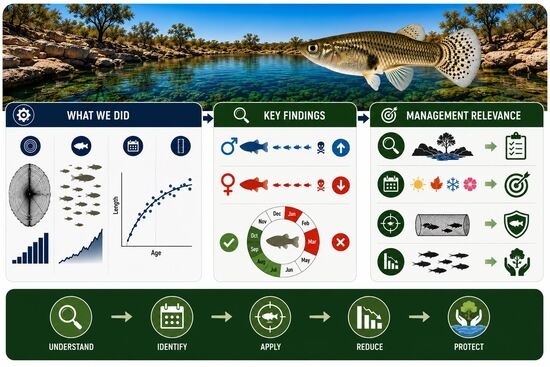
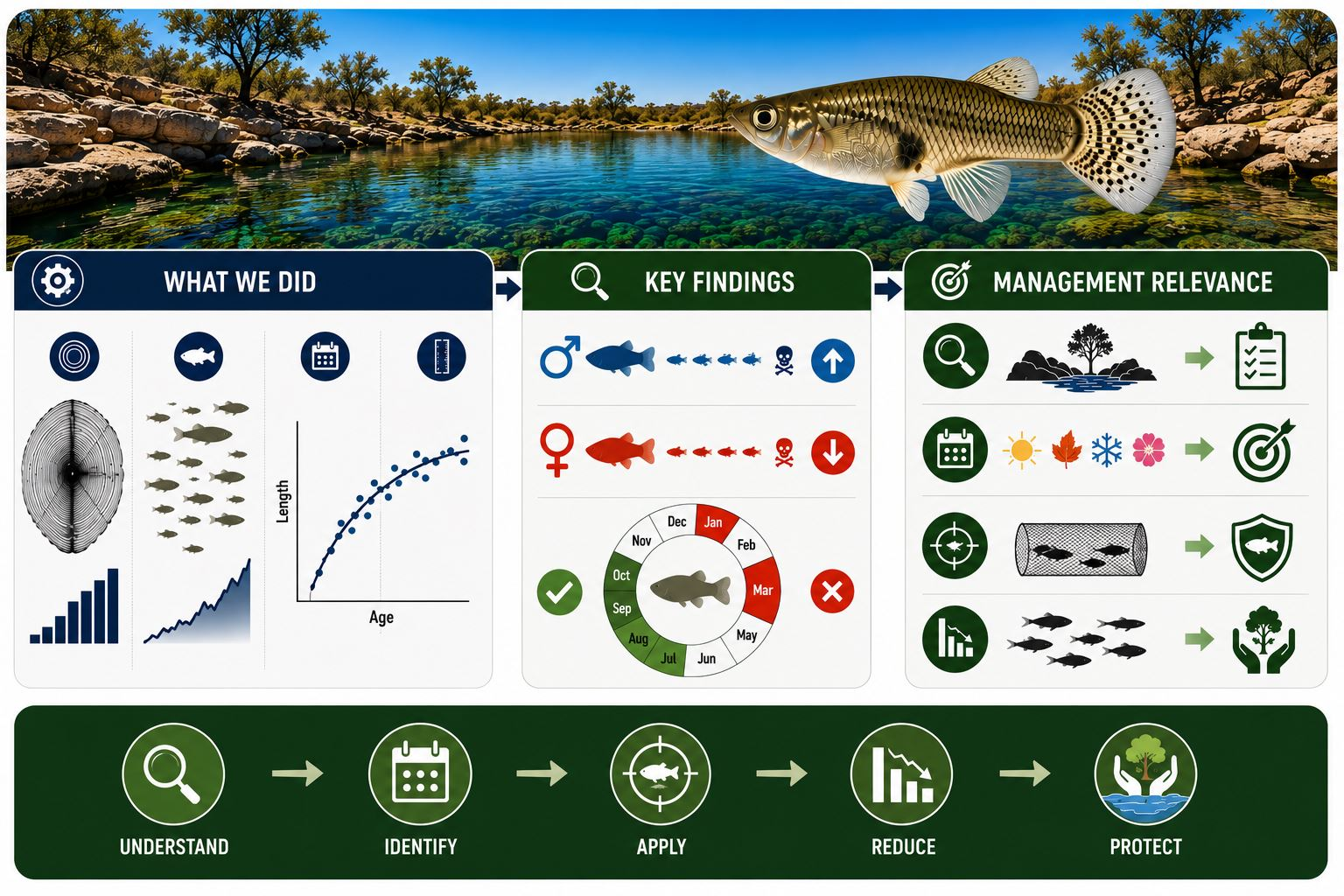
This study investigates the population dynamics and seasonal reproductive patterns of Gambusia holbrooki, an invasive fish threatening biodiversity within arid springs of the Edgbaston Spring complex in Queensland, Australia. Using daily aging techniques, we uncover critical life history traits that inform targeted species management. Our findings reveal marked sex-specific mortality rates, with males exhibiting higher mortality than females, a pattern consistent with findings from Tasmania. Reproductive activity peaks were observed between September and November, but persisted throughout the year, excluding January and April of 2020, likely due to elevated water temperatures during these months. Growth modeling identified the power function as the best fit for describing G. holbrooki growth trajectories. These insights highlight the importance of seasonally informed control strategies to mitigate the ecological impact of this pest species. The study provides essential data to support conservation efforts and guide effective management of invasive fish in fragile arid spring ecosystems.
Key Contribution: This study provides the first detailed daily age-based assessment of Gambusia holbrooki population dynamics in arid-zone springs, identifying critical seasonal windows for more effective invasive fish control.

1. Introduction

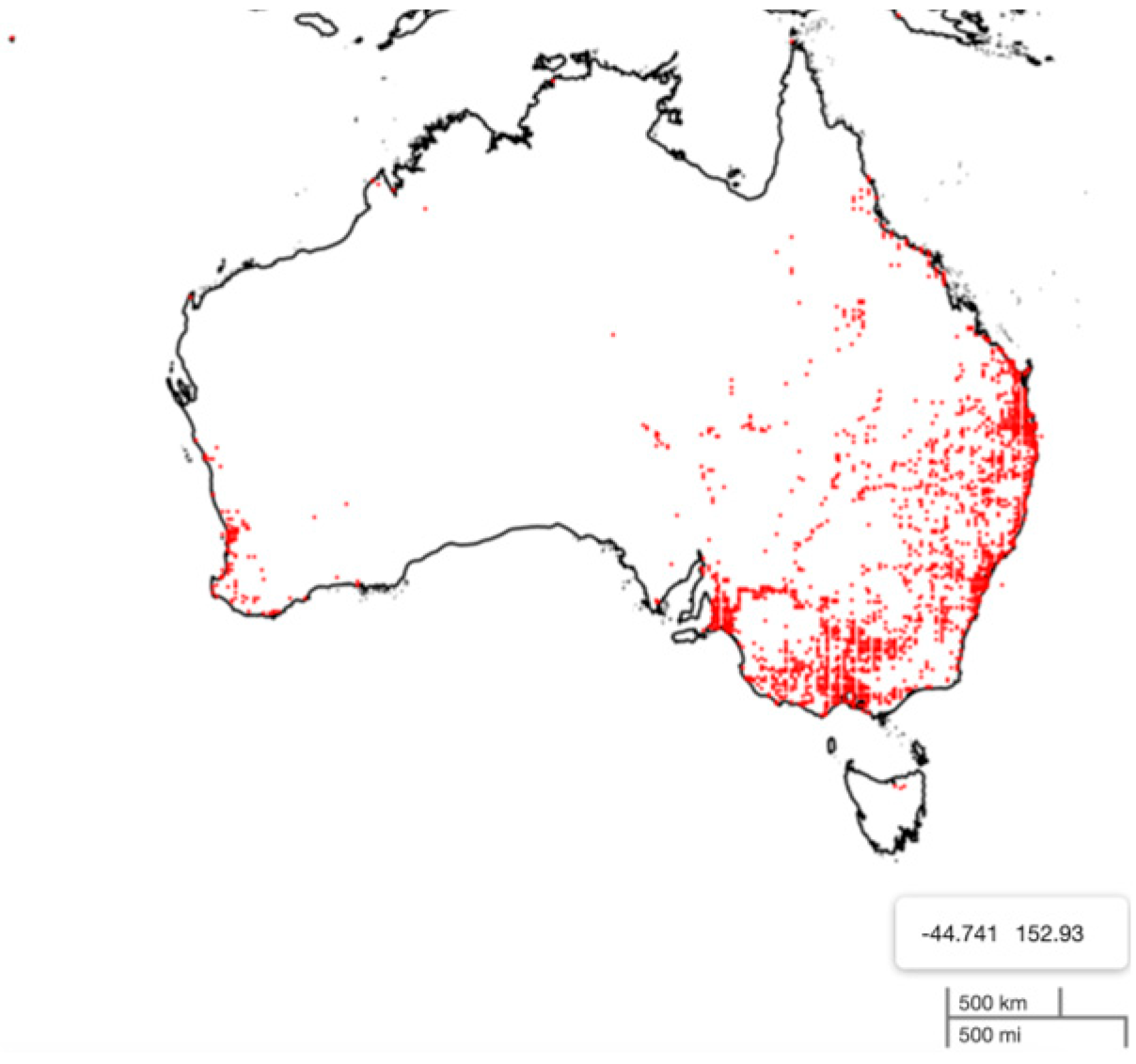
The eastern mosquito fish, Gambusia holbrooki (Family Poeciliidae), is a small but highly invasive freshwater fish now distributed across multiple continents. Native to North and Central America, this species has been translocated globally through human activities [1,2] and is listed among the world’s 100 worst invasive species [3]. Its ecological success stems from exceptional adaptability and robust survival capabilities that enable rapid establishment in novel environments [4]. In Australia, G. holbrooki has become one of the most widespread (Figure 1) pest fishes, posing a challenge for control efforts, particularly at a large scale [5,6]. As an opportunistic predator of small crustaceans, amphibians, fish, insects and their eggs and larvae [5], it imposes substantial predation pressure on native fauna. Such impacts have contributed to a decline in about 15 frog species, including native green and golden frogs, and approximately 20 fish species [7,8,9].
Growth and age data provide critical insight into population processes such as recruitment, longevity, mortality, and fluctuations, which are essential for informed invasive species management [6,11]. Age structure also underpins predictions of future growth rates [12] and recruitment patterns [6]. Although seldom undertaken, G. holbrooki management responses are typically adaptive and fragmented, with continuous local interventions yielding relative success [13]. However, the effectiveness of such approaches ultimately depends on understanding population dynamics in relation to species biology and environmental factors [6]. Population dynamics are shaped by both genetics and environment [14].
A variety of methods exist for estimating fish age, including mark–recapture [15], chemical tagging [16], and radiochemical dating [17]. However, most estimates rely on interpretation of growth increments (annuli) in calcified structures, with otolith analysis being the most accurate and widely used method [6,18]. For small-bodied, short-lived species, however, annual rings provide limited resolution and can be inadequate for capturing fine-scale population dynamics. In these situations, daily age validation, performed in captivity, has produced robust results across fish taxa [17,19,20], though this method was rarely considered feasible in wild populations [21]. More recently, it has been demonstrated that daily rings on otoliths offer a practical and precise solution for inferring population parameters in small, short-lived species such as G. holbrooki [6] and multiple freshwater fish species [21,22] in their natural habitats.
Growth of G. holbrooki has been investigated using length–frequency analyses to infer cohort-based growth patterns [23,24,25]; age–length approaches, where ages derived from scales or otoliths are used to generate age–length data [6,22,25,26,27]; and length–weight and life-history analyses, which link growth patterns to population structure and environmental conditions [26]. Growth models derived from age data are necessary for quantifying life-history traits such as asymptotic size and growth rates [28], with the Von Bertalanffy Growth Model (VBGM) [29] being the most widely applied model. More recently, information theoretic (IT) approaches using Akaike’s Information Criterion (AIC/AICc) have been adopted to identify best-fit models, where the model with the lowest AIC represents the optimal balance between fit and complexity [28,30]. For G. holbrooki, power models have often provided the best statistical fit, while VBGM remains useful for estimating biologically meaningful growth parameters [31]. However, simpler approaches such as length–weight regressions and annual age-based models may mask rapid, sex-specific and environment-dependent variation, particularly in short-lived species such as Gambusia [32]. Empirical studies of Gambusia holbrooki [33] and G. affinis [34] further demonstrate pronounced sexual dimorphism, rapid juvenile growth, and strong temperature- and resource-dependent responses, with substantial spatial and temporal variability in growth patterns across populations [27,35,36]. These findings highlight the need for integrative, sex-specific and model-based approaches to accurately characterize growth dynamics and test broader life-history hypotheses [37,38] that are tied to local environmental drivers.
Within Australia, the Edgbaston Springs in central Queensland represent an ecologically unique groundwater-fed wetland complex supporting highly restricted endemic fauna [39]. Two fish species occur exclusively within these artesian spring-fed wetlands [40,41,42]. The presence of G. holbrooki poses a severe threat to both the Edgbaston Goby (Chlamydogobius squamigenus) and Red-finned Blue-eye (Scaturiginichthys vermeilipinnis). Edgbaston Goby is listed as vulnerable under Australian national legislation (the Environment Protection and Biodiversity Conservation Act), endangered under Queensland’s state legislation (Nature Conservation Act 1992), and critically endangered on the IUCN Red List, while the Red-finned Blue-eye, Australia’s smallest freshwater fish, is listed as endangered under both national and state legislations. Both species are considered at imminent risk of extinction without effective management interventions [43,44], with Red-finned Blue-eye being 1 of 22 Australian freshwater fish species considered most at risk of extinction within two decades [45]. The management of G. holbrooki has been a focus of conservation efforts of these endemic species, especially eradication from springs [46] and subsequent population translocation [47] with varying degrees of success.
To design effective control strategies for invasive fishes, it is vital to characterize key demographic processes such as age, growth, recruitment and diet [6]. Yet, such parameters remain unresolved for G. holbrooki populations at Edgbaston Springs. This study aimed to establish the daily age structure across two artesian springs on the reserve, providing baseline information to inform management and conservation of this ecologically significant system. Importantly, insights gained from demographic profiling here are directly relevant for informing targeted, evidence-based control strategies for G. holbrooki in other invaded freshwater ecosystems.

2. Materials and Methods

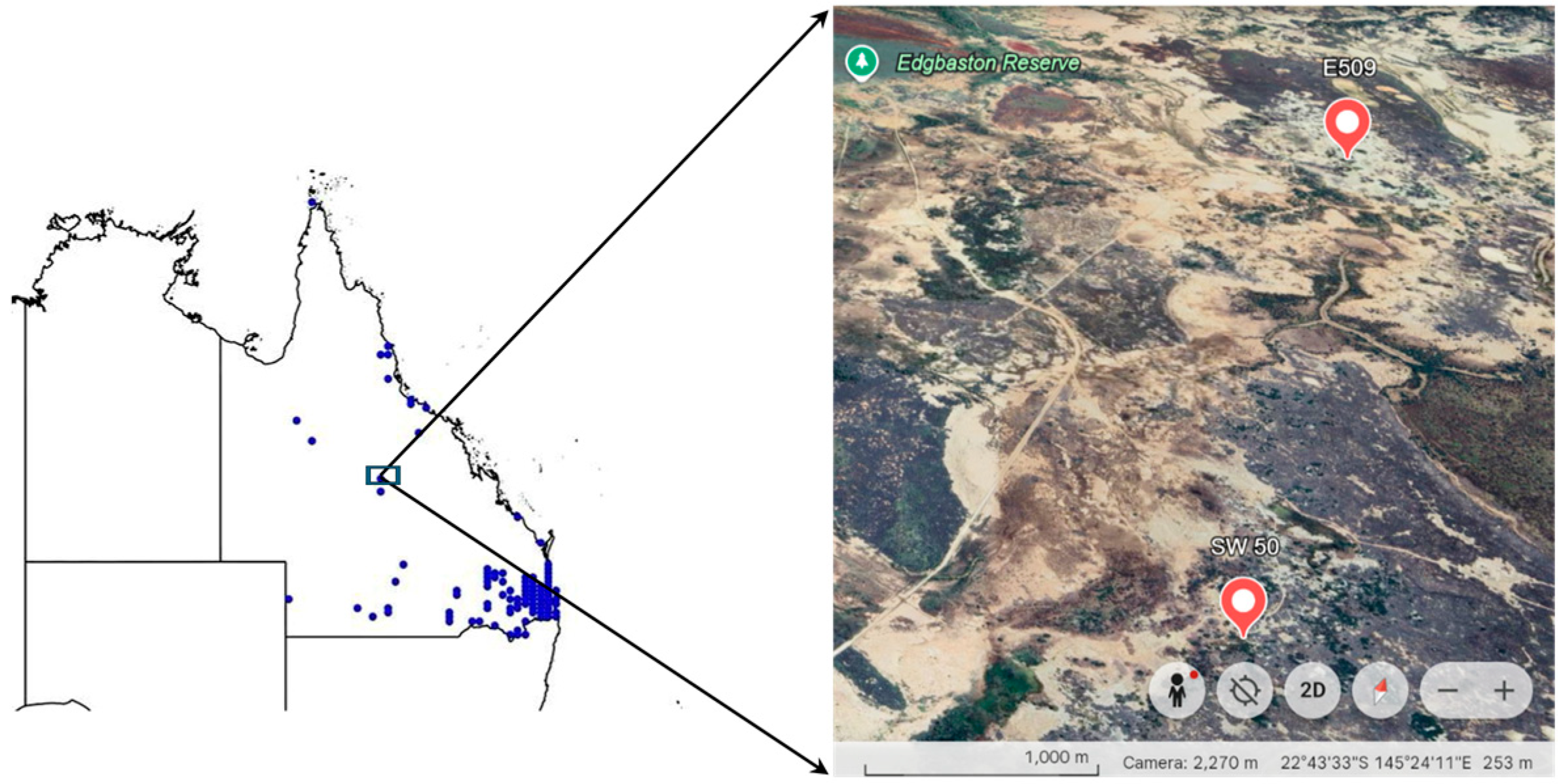
Two distinct springs, SW50 and E509 (Figure 2), characterized by the coexistence of G. holbrooki and native species [48], were targeted for the study. The sampling process encompassed both the springs across four time points. A total of 493 G. holbrooki specimens were collected from the sites in October 2020 (n = 179), January (n = 103), February (n = 98) and March (n = 113) 2021 using a scoop net (~2 mm mesh size). The sex, total length and total weight of each individual were recorded. Efforts were made to extract all three types of otoliths (sagitta, lapillus and asteriscus) from both sides of the fish. However, only sagitta (hereafter otolith) were used for further age analysis as these were successfully removed from all sampled fish. Of the 493 collected, 188 fish were randomly sampled for daily age estimation. Post-otolith extraction, the fish were archived in a 30% ethanol solution.
Processing of otoliths and visualization of the daily rings were performed as previously described in this species [6], with minor modifications. Briefly, the extracted otoliths were mounted on slides and allowed to air-dry. A 2000 μm grit sandpaper was employed for the initial grinding of the otoliths. Following the grinding process, the otoliths were rinsed with water to eliminate any contaminants. A set of lapping films with grit sizes of 9 μm, 3 μm, and 1 μm was used for the final polishing of otoliths until the desired clarity was achieved.
Under a compound microscope, equipped with a built-in camera (Leica Microsystems, Sydney, Australia, 2018), images of polished otoliths were captured using transmitted light at multiple magnifications (4×, 10× and 40×. The images were analyzed using LAS V 3.0 software to measure the length and width of the otoliths. The images were later utilized to visualize and count the growth increments. The rings were read as closely as possible to the rostrum axis, which exposes the largest growth axis of the otoliths [31]. Otoliths were read twice blindly, i.e., without prior knowledge of fish data (including sex, total length, and total weight), to account for bias.

2.1. Data Analysis

Several analyses were conducted to investigate the population structure of G. holbrooki at Edgbaston Reserve. Initially, male and female data were analyzed separately for the two different springs. As no statistically significant differences between total length and age were observed for both male and female populations across the two springs, data from the springs was pooled separately for males, females and the combined (males and females) population for subsequent analyses. Independent t-tests were employed to determine whether the total length and total weight of the combined population depended on sex. Frequency distributions of total length, total weight, and the number of increment counts were generated to analyze population structure. These analyses were performed individually for the combined, male, and female data sets using the Shapiro–Wilk test. One-way ANOVA and chi-square tests were employed to assess significant differences among the populations/groups. Additionally, differences in total length and total weight of the otoliths, and the number of increment counts were compared for all processed samples (n = 188) stratified by capture interval. Sex ratios were computed for samples from different time intervals and locations using the chi-square test against an expected sex ratio of 1:1. Bias between estimated and known ages for both reader 1 and reader 2 was calculated and tested statistically using a paired t-test. The relationships between fish size and otolith measurements, i.e., length and width of the otoliths, were investigated using scatter plots.

2.2. Validation of Fish Age

The daily age increment analysis was first calibrated by randomly re-analyzing 10 archived otoliths (sagitta) from a previous study [31] for G. holbrooki of known age. The recounts were compared with the original age data [31] for accuracy and precision. Specifically, each sample was examined twice by two different readers, and the average percentage error (APE) between the two increment counts was calculated [5,50]. Subsequently, the same approach was used to process and interpret the age of fish sampled from Edgbaston Springs:
A P E = 100 % × 1 R × X i j X j / X j
where
  • R is the number of times the otolith was examined;
  • X i j is the ith age determination of the jth fish;
  • X j is the mean determined age of the jth fish.
If A P E exceeded 10%, increment counts were excluded from the analyses as recommended [5,51,52]. Reader errors between the two reader counts were also estimated using Equation (1).
E r r o r = K n o w n   a g e N u m b e r   o f   g r o w t h   i n c r e m e n t s
Linear regression analyses were employed to determine the relationship between the number of growth increments examined by two readers and the known age:
N u m b e r   o f   g r o w t h   i n c r e m e n t s = a × K n o w n   A g e + b
where a and b are estimable parameters, estimated using the Ordinary Least Squares method (OLS).
Growth models were employed to analyze the total length-at-age data of the wild G. holbrooki population. Specifically, the power model and Von Bertalanffy Growth Model (VBGM) were utilized, as they were previously determined to be the best fit for G. holbrooki populations [31]. The model equations are as follows:
VBGM [29]:
L t   =   L ( 1 e K t t 0 )
Power [53]:
L t = a + b t
In these equations,
L t represents the total length at age t (in millimeters) (Equations (4) and (5)).
L is the asymptotic total length (in millimeters) (Equation (4)).
t denotes the age at time t (in days) (Equations (4) and (5)).
t 0 signifies the hypothetical age at which the fish has zero total length (in days) (Equation (4)).
K represents the growth coefficient determining the rate at which L is reached (in days−1) (Equation (4)).
a and b are estimable parameters of the power model (Equation (5)).
The growth model was fitted accordingly, and the Akaike Information Criterion (AIC) was calculated using R (Ver 4.2.3). Troubleshooting for any errors followed the procedure outlined by Paine et al. [54]. The power model was used to capture the overall growth trajectory of the population, while VBGM was used to estimate the asymptotic length and growth coefficient.
Additionally, the date of birth was back-calculated based on the estimated age of each aged fish. The frequency distribution of fish born each month at Edgbaston Reserve was plotted with an overlay of air temperature (BOM, Armac station close to Edgbaston [55]) and photoperiod (Geoscience Australia [56]) data for the period and compared with the wild population data from Tamar Island Wetland Reserve. The growth rate (i.e., growth of fish per day) was computed using the total length-to-age data.
To estimate the natural mortality rate ( M ), Pauly’s estimator [57], a commonly used method in fisheries science, was employed. This method was favored due to the absence of catch data for G. holbrooki. The equation for Pauly’s estimator is as follows:
Z = M + F
Z is the total mortality rate, M is the natural mortality rate, and F is the fishing mortality rate.
As there was no fishing mortality rate data available for G. holbrooki, the value for the natural mortality rate ( M ) was considered equal to the total mortality rate ( Z ). The calculation of the natural mortality rate ( M ) involved considering the VBGM parameters ( K , L ) and the water temperature of the capture site. The stable, ambient water temperature of the springs (T = 24 °C) [58] was used to estimate mortality rates as follows:
M = e 0.0152 0.279 L n + 0.6543 L n K + 0.463 L n T

3. Results

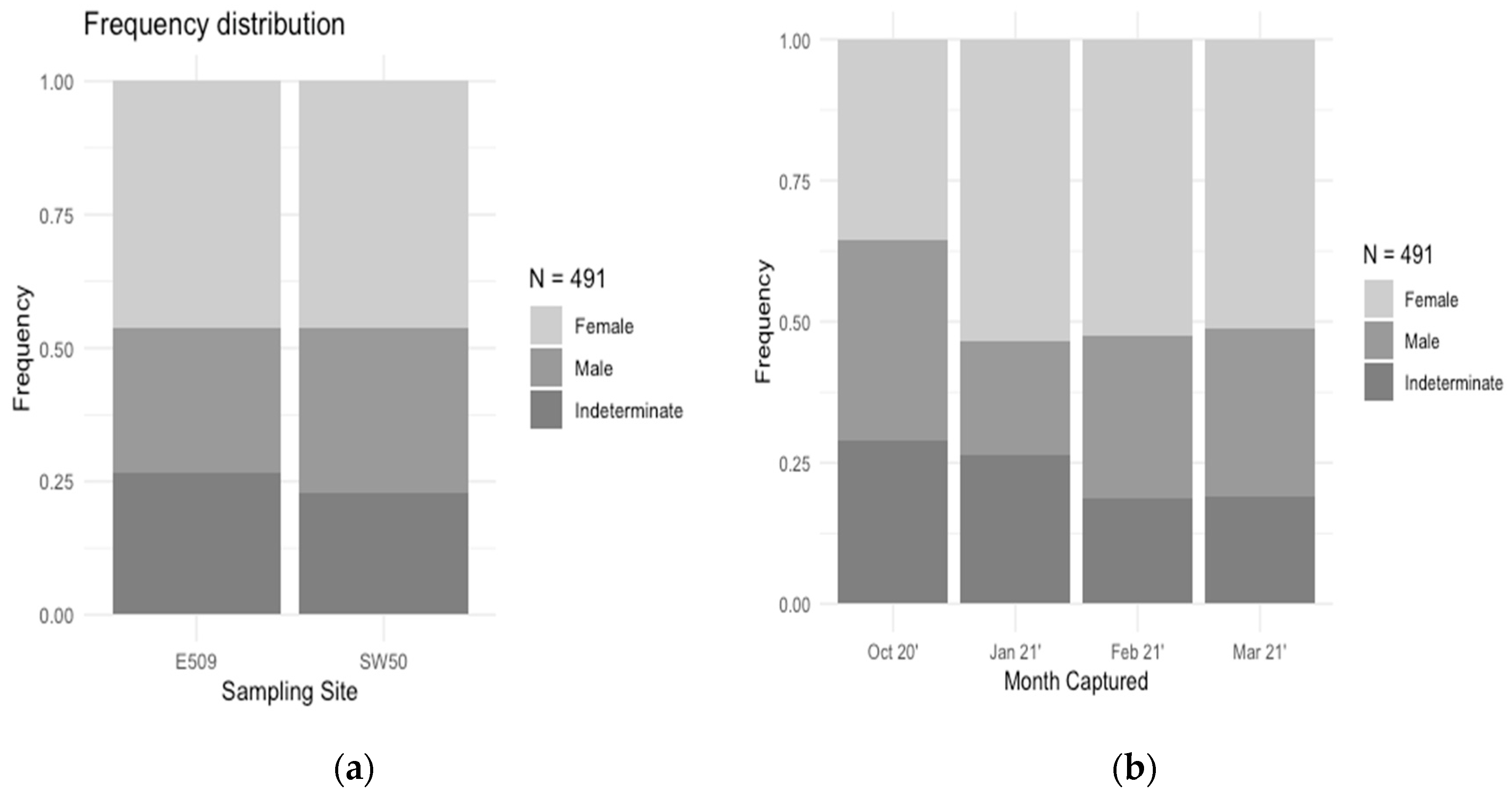
Out of 493 captured fish, 188 samples were randomly subsampled and successfully aged. Sex ratio differed between sampling sites and the months of capture (p < 2.2 × 10¹⁶). In both springs, the number of females was generally greater than that of males or immature fish (Figure 3). However, the number of males dominated during October and March in the spring SW50. Chi-square tests (p < 0.05) revealed that the population sex ratio was significantly different from the expected ratio of 1:1 at both sampling sites and at all four different sampling times.
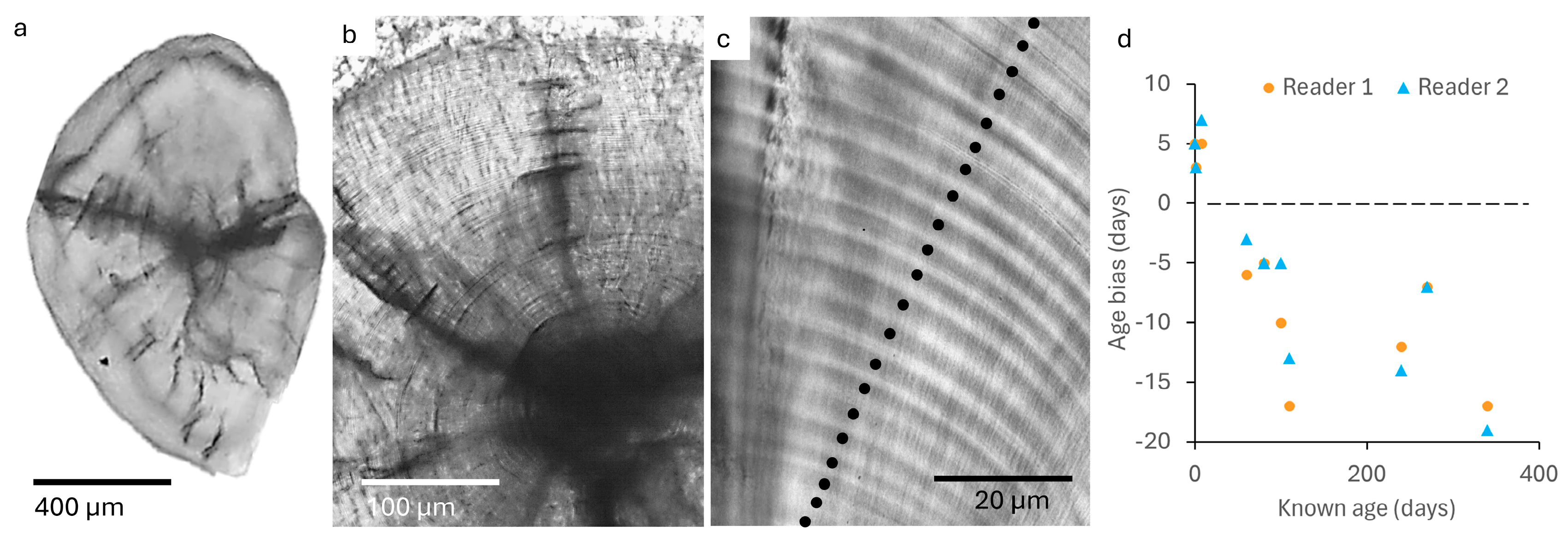
All processed sagitta (N = 188) were aged successfully and representative micrographs of a processed sagitta are presented (Figure 4a–c). The accuracy of the increment counts, compared to a random subset sample (n = 10) of known-age fish from a previous study [6], results in an absolute percentage error (APE) ranging from 0% to 3%. Both readers showed a tendency to overestimate the ages of the younger individuals and slightly underestimate older fish (Figure 4d). However, paired t-tests detected no significant differences between estimated and known ages for either reader 1 (t = −1.75, df = 9, p = 0.115) or reader 2 (t = −1.08, df = 9, p = 0.310). The mean age estimation bias was low, with differences of −4.6 and −3.6 days for readers 1 and 2, respectively. The mean absolute error was 8.2 days for reader 1 and 9.6 days for reader 2, indicating high aging accuracy. A strong positive linear relationship was also observed between the known ages and increment counts, with reader 1 and reader 2 achieving R2 values of 0.9985 and 0.9907, respectively (Figure S1).

3.1. Growth Modeling

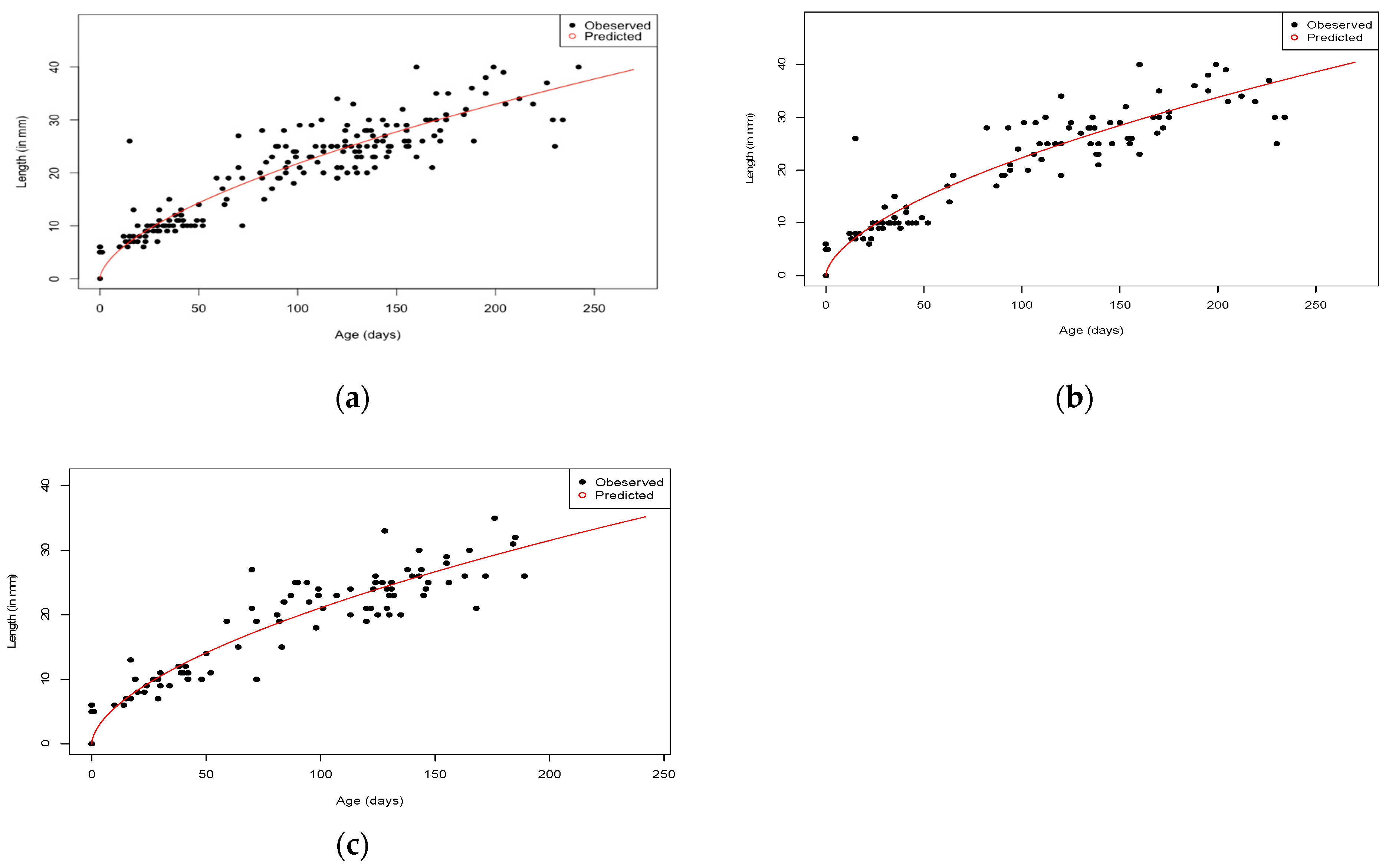
The males and females were distinguishable at approximately 10–11 mm, by which time males had developed a gonopodium. The females had a significantly higher average total length and weight than those of males at all sites and sampling points (p < 0.01). The VBGM estimated an asymptotic length of approximately 62 mm for the combined population, while it estimated 55 mm and 46 mm for female- and male-only data, respectively (Table S1). The growth model for combined data (Figure 5a) exhibited a close fit to the observed data, emphasizing a positive correlation between age and length. The initial phase (first 50 days) was marked by rapid growth, followed by gradual deceleration, indicating a reduced growth rate as the G. holbrooki ages, where the species reaches its maximum length between 150 and 250 days.
The female (Figure 5b) and male (Figure 5c) growth curves confirm the model’s ability to capture the overall growth trend effectively. For both males and females, the growth slowed significantly after the early rapid growth phase. For females, this deceleration occurred around 150 days, whereas for males, it was slightly earlier, at around 120 days. Despite slight variability in individual growth rates, the predicted values align well with the observed data, underscoring the model’s robustness and reliability in describing the G. holbrooki growth dynamics. The estimated mortality rates were 0.0472 day−1 and 0.04 day−1 for males and females respectively.

3.2. Birth Frequency

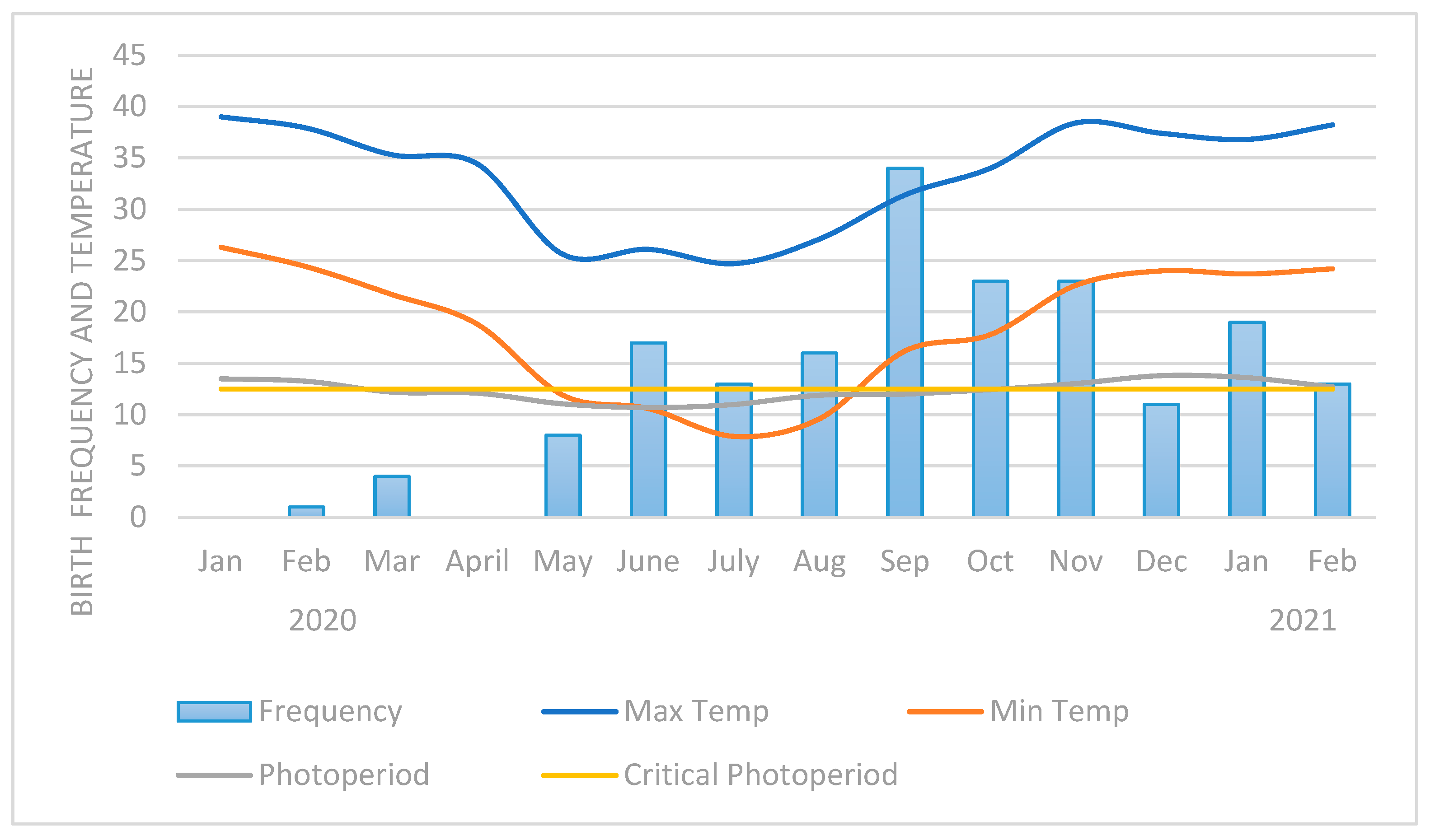
Birth frequency of G. holbrooki at Edgbaston showed clear temporal fluctuations over the annual cycle from January 2020 to February 2021 (Figure 6). Recruitment was poor in the late summer/early autumn months in 2020, with no births detected in January or April, and very low birth frequencies observed in February and March. Recruitment began increasing from May, with frequencies steadily rising throughout the cooler months. A pronounced primary peak in births occurred in September, reaching the highest monthly frequency recorded during the study. Elevated birth rates were sustained into October and November 2020, before gradually declining in the summer months of December and following January, where the average maximum temperatures (37.4 °C and 36.8 °C respectively) were below those of the previous December 2020 (40.4 °C) and January 2021 (39 °C). The highest birth frequencies coincided with moderate daily temperatures, specifically in months where maximum temperatures were neither at their summer highs nor winter lows. The recruitment peak in September aligned with both a rise from the minimum winter temperature and not quite reaching annual highs, suggesting that intermediate temperature ranges are most conducive to reproduction. Very low recruitment occurred during periods of temperature extremes—highs in January–February (peak summer, >37.9 °C) and lows in June–July (winter, <15 °C minimums). Photoperiods (hours of daylight) closely tracked seasonal trends, with the longest days in December–January and the shortest days in June–July. Notably, the main recruitment peak (September–November) occurred as photoperiod values increased and reached or slightly exceeded the species’ reported “critical photoperiod” threshold of 12.5 h [59]. Only sporadic and low-level recruitment occurred when the photoperiod was below this threshold (April–July). Most high birth frequency months corresponded to periods when daily photoperiod equaled or surpassed the critical threshold line. The months with near-zero birth frequencies (January, February and April 2020) aligned with extreme summer heat (January–February, despite maximum photoperiod), and photoperiod values falling below the critical threshold (April–May).

4. Discussion

The protection of ecosystems from invasive species is an urgent priority for the conservation of biodiversity and maintenance of societal and economic benefits [40]. The Edgbaston Spring complex is a biodiversity hotspot containing unique endemic species [60], yet it is under severe threat from the invasive mosquitofish G. holbrooki. Expanding on earlier research at Edgbaston [43,46,48], the present study provides the first detailed daily aging analysis of G. holbrooki, generating critical new knowledge of its population dynamics that directly informs and strengthens ongoing management and control strategies.
Consistent with previous reports [5,8,9], females outnumbered males in both springs. However, the size distribution differed markedly from those reported in Tasmania [5]. The Edgbaston population exhibited a broader size range, with males more frequently exceeding 26 mm and females reaching up to ~50 mm, showing a symmetrical distribution with a peak at ~27 mm. In contrast, Tasmanian males peaked sharply around 24 mm, and females were left-skewed with few large individuals [31]. These patterns may reflect latitudinal variations [61] and habitat-specific effects, as habitat temperature and other environmental factors strongly influence the growth and body size of G. holbrooki [35,61,62].
Sagitta was the most reliable primary structure for age determination as it could be successfully extracted from all specimens. Other otolith types (lapillus and asteriscus) were harder to retrieve, though they displayed clearer daily rings without sub-daily interference. Similar difficulties in extracting lapillus and asteriscus have been documented previously in this species [6]. However, further development of automated, high-throughput processing and analysis protocols for these otolith types may enhance aging efficiency and support large-scale monitoring and eradication programs.
At Edgbaston, total fish length positively correlated with sagitta length, and sagitta length correlated with sagitta width. This is consistent with earlier G. holbrooki studies in temperate regions [6] and with other teleost fish species such as Centropomus nigrescens [63]. Differences in correlation strength between Edgbaston and Tasmanian populations may be shaped by geographic, environmental, genetic, and ecological factors [64,65]. Similar differences in strength of correlation have been observed in other teleosts such as Terapon jarbua [64] and Boops boops [66].
Age validation using known-age fish revealed a strong linear relationship between daily ring counts and true age for the current reader (reader 1), but a weaker correlation was found with a previous reader’s (reader 2) counts [31], in line with reader-dependent variability described by ICES [67]. The observed daily age range for wild Edgbaston fish (10–270 days) aligns with previous otolith [6] and scale-based [35] estimates, with most individuals living ≤1 year [25,35]. Interestingly, the maximum lifespan here (~270 days) exceeds that reported for Tasmania [6], contradicting expectations of shorter lifespans in warmer tropical climates due to accelerated metabolism [68,69]. Possible explanations include Edgbaston’s stable year-round temperatures, extended growing season, reduced environmental stress, and its location at the intersection of arid, tropical, and subtropical zones [70], which together may create favorable conditions for sustained reproduction. This supports the view that G. holbrooki life-history traits have high plasticity and are shaped by local selection, rather than strictly following latitudinal trends [33,71,72]. Consequently, future monitoring could aim for year-round sampling across multiple springs to enhance accuracy.

4.1. Growth and Mortality

Modeling fish population growth to predict life-history traits such as growth, mortality and recruitment is critical for fisheries management [28] as well as the control of pest fish populations [6]. Earlier studies with annual age data relied on von Bertalanffy, Somer’s, and Gaschutz’s models [5,25,37], but daily aging work shows that the power function provides the best fit for G. holbrooki [6]. In this study, the power model offered the highest explanatory power for both sexes, whereas the Tasmanian population fitted best to the von Bertalanffy model for males [6]. The estimated asymptotic total lengths of 46 mm and 55 mm, with growth rates of 0.0124 day−1 and 0.0058 day−1 for males and females, respectively, are in the range reported elsewhere, with minor differences. For instance, in France [35], asymptotic total lengths for G. holbrooki were 57.7 mm and 25 mm, and in Turkey [5], they were 66.2 mm and 33.1 mm for females and males, respectively. In Tasmania, Nguyen et al. [6] reported relatively lower asymptotic total lengths of 40 mm and 25 mm for females and males, respectively. The differences may be attributed to landscape- [35,62,73] and latitude-driven [25,37], demographic plasticity or the method of age estimation used [6]. Although the power model provided the best statistical fit to the data, it consistently underestimated asymptotic length, with predictions constrained to a range of observed sample sizes. By contrast, the VBGM extrapolated beyond the sampled range, predicting larger maximum lengths. As a result, long-term demographic projections, particularly for older age classes, may be less robust than those generated using the VBGM, which incorporates an explicit asymptotic growth parameter. Similar discrepancies, where simple growth models underestimate asymptotic size relative to VBGM predictions, have been reported in other fish populations [53].
A relatively higher natural mortality rate for males (0.0473 day−1) compared to females (0.04 day−1) mirrors the findings in Tasmanian populations, where mortality rates were 0.16 and 0.035 day−1 for males and females, respectively [31]. In contrast, females (0.0084 day−1) exhibited a slightly higher mortality rate than that of males (0.0075 day−1) in Portuguese populations [37]. Disparities in mortality rates among different studies may reflect both methodological variations [6] and site-specific habitat differences [35,62,73]. At birth, males and females occur roughly in equal proportions [23,74], yet persistent female-biased sex ratios characterize natural populations of G. holbrooki [6,8,68]. This gender imbalance likely results from the observed higher male mortality rate, which, coupled with rapid reproductive output under favorable conditions [7], strongly influences population structure and turnover.
Our study shows that G. holbrooki at Edgbaston exhibit high growth and mortality rates, attain relatively large asymptotic lengths and typically live up to approximately nine months. Although this is a brief life span, it is compensated for by accelerated growth and early sexual maturity. This fast-paced life history, i.e., characterized by rapid maturation, high reproductive output, and short generation times, is a fundamental factor underlying the species’ exceptional invasive capacity [6,68,75]. Such flexible life history strategies enable G. holbrooki to thrive and expand across variable habitats [6,76]. These demographic traits have important implications for management: adult removal alone may be insufficient to suppress population growth if recruitment continues unabated. Our findings highlight the need for more proactive and targeted management approaches that account for high juvenile recruitment and the ability of this species to rapidly rebound, even with a limited life span.

4.2. Recruitment Patterns and Environmental Controls

A notable finding of this study is the double recruitment peak at Edgbaston. A major peak occurred in September–November with a secondary peak, differing from a single peak (November–January), reported in Tasmania [6]. Complete cessation of breeding in January and March 2020 may be attributed to higher temperatures (>37.9) in the preceding months. Overall, the results confirm that G. holbrooki reproduction is concentrated in the warmer months. However, the Edgbaston populations exhibit a more prolonged breeding season, with evidence of inter-annual variability. Reproduction appeared to cease when temperatures fell below 15 °C or rose above 37.9 °C, indicating that both thermal extremes constrain reproductive activity. The critical photoperiod for G. holbrooki reproduction is approximately 12.5 h of light [59] and the observed peaks at Edgbaston occurred within photoperiods of 10.7 to 13 h. This supports the hypothesis that light cycles regulate reproductive timing, metabolic activity, and potentially longevity. These findings align with experimental evidence showing that photoperiod can entrain the biological rhythms, favoring extended reproductive phases and reduced mortality during early stages [77,78].
Reproductive activity was minimal to absent during summer and autumn, with recruitment increasing during late winter and early spring. Breeding occurred nevertheless except in January and April 2020. Although the lack of detected births during January and April 2020 is likely associated with thermal stress, the potential influence of spatial and temporal sampling limitations cannot be completely ruled out. Future high-frequency monitoring across multiple springs and seasons could help validate these patterns and improve confidence in the inferred reproductive dynamics. The Edgbaston Springs lie at the intersection of arid, tropical and subtropical climate zones, with a mean annual temperature of 21 °C and seasonal average of 27 °C in summer, 22 °C in autumn, 15 °C in winter, and 22 °C in spring. High summer temperatures therefore appear to be limited at this site. This contrasts sharply with Tasmania, where reproduction ceases in late autumn and winter due to low temperatures [6]. These observations illustrate that G. holbrooki recruitment is suppressed under both extremes of heat and cold. Interestingly, despite differing climate regimes, the reproduction at Edgbaston occurred within a similar temperature window (15–22 °C) to that reported in Tasmania (14–20 °C) [6]. These ranges were also broadly consistent with those observed in Western Australia (15–16 °C) [79], though the closer match between Edgbaston and Tasmania suggests site-specific differences in population dynamics.
The broad climatic tolerance of G. holbrooki underpins its invasiveness and capacity for range expansion [80]. Climate strongly influences its life history, particularly its metabolic rates and reproductive cycle, with warmer conditions accelerating gonadal development, allowing females to produce multiple broods [68]. In temperate regions, reproduction is typically restricted to spring and summer [6]; however, in warmer environments, breeding can extend across most of the year [81], consistent with observation at Edgbaston.

5. Implications for Management

Collectively, these insights have important management implications. Our data suggest that summer–autumn may be optimal for targeted eradication, when recruitment is lowest. At Edgbaston, G. holbrooki control measures, including manual removal, rotenone application and exclusion fencing, have achieved increasing success. Nevertheless, re-incursions continue to occur, highlighting the urgent need for coordinated management at larger landscape scales and for elimination of residual individuals persisting in treated springs, even at very low densities. Knowledge of breeding phenology allows interventions—such as trapping, netting, or biological control—to be timed when populations are most vulnerable. In warmer regions, more frequent control efforts may be required to suppress recruitment. Furthermore, integrating climate forecasts into invasion management strategies will be critical for anticipating risks under future warming scenarios and prioritizing resources where such strategies will be most effective.
We propose combining physical removal with innovative genetic strategies, such as the Trojan chromosome approach [82], to skew population sex ratios towards one sex or the other and reduce reproductive output [13]. Integrating these methods during low-recruitment periods could improve outcomes. Furthermore, regular monitoring of environmental drivers, especially temperature and photoperiod, can refine the timing of interventions.
In addition to these physical approaches, genetic control methods, such as the Trojan Y chromosome strategy, offer a promising alternative. This strategy involves introducing YY males into the population, which produce only male offspring. Over time, this skews the sex ratio towards males, reducing the reproductive potential of the population. By combining physical removal methods with genetic control strategies, we can enhance the effectiveness of eradication efforts. The integration of these approaches, particularly during periods of low recruitment, provides a comprehensive framework for managing and potentially eradicating G. holbrooki populations.
Future work should assess the relative efficiency of removal versus genetic control, and whether these integrated approaches can achieve lasting reductions in invasive G. holbrooki populations. Advancing aging techniques toward rapid, non-invasive, and high-throughput approaches would enable greater sampling density, thereby improving accuracy and facilitating the management of this pest at a continental scale. The present study offers a model for site-specific, seasonally optimized, multi-modal pest management.

Supplementary Materials

The following supporting information can be downloaded at https://www.mdpi.com/article/10.3390/fishes11060354/s1. Figure S1: Correlation between Known age (grey), and those counted by reader 1 (blue) and reader 2 (orange). dpb; days post birth. Table S1: Growth parameter outputs from VBGM and Power models with corresponding AICc, ΔAICc and AICc Weights associated with combined and sex specific data sets.

Author Contributions

Conceptualization, R.R.S., J.G.P. and P.K.; methodology, R.R.S. and J.G.P.; formal analysis, R.R.S., J.G.P. and K.T.; data curation, R.R.S. and J.G.P.; writing—original draft preparation, R.R.S.; writing—review and editing, J.G.P., D.M.G., P.K. and K.T.; supervision and project administration, J.G.P.; funding acquisition, J.G.P. and P.K. All authors have read and agreed to the published version of the manuscript.

Funding

This research was funded by Bush Heritage Australia.

Institutional Review Board Statement

The research was approved by Animal Ethics Committee, University of Tasmania, Australia, approval code: A0017759 and approval date: 25 March 2019.

Data Availability Statement

All raw data will be made available on request.

Acknowledgments

We extend our sincere gratitude to Lisettee Robertson for her laboratory support and the Ministry of Social Justice and Empowerment, Government of India, which provided a postgraduate scholarship to R.S.

Conflicts of Interest

The authors declare no conflicts of interest.

References

  1. Holloman, K.A.; Dallas, C.E.; Brisbin, I.L.; Jagoe, C.H. Spatial and Temporal Patterns of Radiocesium Contamination in Mosquitofish, Gambusia holbrooki (Girard, 1859), Inhabiting a Nuclear Reactor Cooling Reservoir. J. Environ. Radioact. 1997, 35, 243–259. [Google Scholar] [CrossRef]
  2. Macdonald, J.I.; Tonkin, Z.D.; Ramsay, D.S.L.; Kaus, A.K.; King, A.K.; Crook, D.A. Do invasive eastern gambusia (Gambusia holbrooki) shape wetland fish assemblage structure in south-eastern Australia? Mar. Freshw. Res. 2012, 63, 659. [Google Scholar] [CrossRef]
  3. IUCN. Global Invasive Species Database, 2021. 2000. Available online: http://www.iucngisd.org/gisd/search (accessed on 9 June 2026).
  4. Gkenas, C.; Kodde, A.; Ribeiro, F.; Magalhães, M.F. Warming affects the feeding success of invader and native fish in Iberian streams. Aquat. Ecol. 2021, 56, 319–324. [Google Scholar] [CrossRef]
  5. Erguden, S.A. Age, growth, sex ratio and diet of easrtern mosquitofish Gambusia holbrooki Girard, 1859 in Seyhan Dam Lake (Adana/Turkey). Iran. J. Fish. Sci. 2013, 12, 204–218. [Google Scholar]
  6. Nguyen, H.; Bell, J.D.; Patil, J.G. Daily ageing to delineate population dynamics of the invasive fish Gambusia holbrooki: Implications for management control. Biol. Invasions 2021, 23, 2261–2270. [Google Scholar] [CrossRef]
  7. Davies, P.E. An Assessment of the Risks of Gambusia Infestation in Tasmania. Report to NRM North, Tasmania; University of Tasmania: Hobart, Australia, 2012. [Google Scholar]
  8. Lynch, K.A. Ecology, Population Genetics and Risk Assessment of the Exotic Mosquitofish, Gambusia holbrooki, in Tasmania. Ph.D. Thesis, University of Tasmania, Hobart, Australia, 2008. [Google Scholar]
  9. Pyke, G.H. Plague minnow or mosquito fish? A review of the biology and impacts of introduced gambusia species. Annu. Rev. Ecol. Evol. Syst. 2008, 39, 171–191. [Google Scholar] [CrossRef]
  10. Atlas of Living Australia. 2025. Available online: https://spatial.ala.org.au/?q=lsid:urn:lsid:biodiversity.org.au:afd.taxon:e96c4568-a10f-4ea9-a741-a551b1f22bc1 (accessed on 9 June 2026).
  11. Khan, S.; Khan, M.A. Importance of Age and Growth studies in Fisheries Management. In Proceedings of the Conference: Next Generation Sciences: Vision 2020 & Beyond; Maharshi Dayanand University (MDU): Rohtak, India, 2014. [Google Scholar]
  12. Horiuchi, S.; Preston, S.H. Age-specific growth rates: The legacy of past population dynamics. Demography 1988, 25, 429–441. [Google Scholar] [CrossRef]
  13. Patil, J.G. An Adaptive Genetic Management Plan for Eradication of Gambusia holbrooki from Tasmania, Australia; Tasmania, I.F.S., Ed.; Inland Fisheries Service Tasmania: New Norfolk, Australia, 2012. [Google Scholar]
  14. Fowler, C.F. Population dynamics: Species traits and environmental influence. Dev. Mar. Biol. 1995, 4, 403–412. [Google Scholar]
  15. Das, M. Age Determination and Longevity in Fishes. Gerontology 1994, 40, 70–96. [Google Scholar] [CrossRef] [PubMed]
  16. Wells, R.J.D.; Kohin, S.; Dewar, H.; Spear, N. Application of Chemical Tags to Obtain Life History Information of Sharks. In Proceedings of the 65th Gulf and Caribbean Fisheries Institute; Gulf and Caribbean Fisheries Institute: Marathon, FL, USA, 2013; Volume 65, pp. 140–141. [Google Scholar]
  17. Goldman, K.J.; Cailliet, G.M. Age Determination and Validation in Chondrichthyan Fishes. In Biology of Sharks and Their Relatives; CRC Press: Boca Raton, FL, USA, 2004; pp. 399–447. [Google Scholar]
  18. Proctor, C.; Robertson, S.; Jatmiko, I.; Clear, N. An Introductory Manual to Fish Ageing Using Otoliths; Australian Centre for International Agricultural Research (ACIAR): Canberra, Australia, 2021; 41p. Available online: https://www.aciar.gov.au/sites/default/files/2021-03/Introductory-Manual-to-Fish-Ageing-Using-Otoliths_English.pdf (accessed on 9 June 2026).
  19. Campana, S.E. Accuracy, precision and quality control in age determination, including a review of the use and abuse of age validation methods. J. Fish. Biol. 2001, 59, 197–242. [Google Scholar] [CrossRef]
  20. Song, Z.; Fu, Z.; Li, J.; Yue, B. Validation of daily otolith increments in larval and juvenile Chinese sucker, Myxocyprinus asiaticus. Environ. Biol. Fishes 2008, 82, 165–171. [Google Scholar] [CrossRef]
  21. Stocks, J.R.; Davis, S.; Anderson, M.J.; Asmus, M.W.; Cheshire, K.J.; van der Meulen, D.E.; Gilligan, D.M. Fish and flows: Abiotic drivers influence the recruitment response of a freshwater fish community throughout a regulated lotic system of the Murray-Darling Basin, Australia. Aquat. Conserv. Mar. Freshw. Ecosyst. 2021, 31, 3228–3247. [Google Scholar] [CrossRef]
  22. Stocks, J.R.; Scott, K.F.; Gilligan, D.M. Daily age determination and growth rates of freshwater fish throughout a regulated lotic system of the Murray-Darling Basin Australia. J. Appl. Ichthyol. 2019, 35, 457–464. [Google Scholar] [CrossRef]
  23. Krumholtz, L.A. Reproduction in the western Mosquitofish, Gambusia affinis affinis (Baird & Girard), and Its Use in Mosquito Control. Ecol. Monogr. 1948, 18, 1–43. [Google Scholar] [CrossRef]
  24. Keane, J.P.; Neira, F.J. First record of mosquitofish, Gambusia holbrooki, in Tasmania, Australia: Stock structure and reproductive biology. N. Z. J. Mar. Freshw. Res. 2004, 38, 857–867. [Google Scholar] [CrossRef]
  25. Carmona-Catot, G.; Santos, A.F.G.N.; Tedesco, P.A.; Garcia-Berthou, E. Quantifying seasonality along a latitudinal gradient: From stream temperature to growth of invasive mosquitofish. Ecosphere 2014, 5, art134. [Google Scholar] [CrossRef]
  26. Patimar, R.; Ghorbani, M.; Gol-Mohammadi, A.; Azimi-Glugahi, H. Life history pattern of mosquitofish Gambusia holbrooki (Girard, 1859) in the Tajan River (Southern Caspian Sea to Iran). Chin. J. Oceanol. Limnol. 2011, 29, 167–173. [Google Scholar] [CrossRef]
  27. Cheng, Y.; Xiong, W.; Tao, J.; He, D.; Chen, K.; Chen, Y. Life-history traits of the invasive mosquitofish (Gambusia affinis Baird and Girard, 1853) in the central Yangtze River, China. BioInvasions Rec. 2018, 7, 309–318. [Google Scholar] [CrossRef]
  28. Flinn, S.A.; Midway, S.R. Trends in Growth Modeling in Fisheries Science. Fishes 2021, 6, 1. [Google Scholar] [CrossRef]
  29. Vonbertalanffy, L. Quantitative Laws in Metabolism and Growth. Q. Rev. Biol. 1957, 32, 217–231. [Google Scholar] [CrossRef]
  30. Yanagihara, H.; Kamo, K.; Imori, S.; Satoh, K. Bias-corrected AIC for selecting variables in multinominal logistic regression models. Linear Algebra Its Appl. 2012, 436, 4329–4341. [Google Scholar] [CrossRef]
  31. Nguyen, H. Daily Ageing for Estimating Key Population Parameters of the Pest Fish Gambusia holbrooki in Tasmania. Master’s Thesis, University of Tasmania, Hobart, Australia, 2018. [Google Scholar]
  32. Stamps, J.A.; Mangel, M.; Phillips, J.A. A New Look at Relationships between Size at Maturity and Asymptotic Size. Am. Nat. 1998, 152, 470–479. [Google Scholar] [CrossRef]
  33. Beaudouin, R.; Ginot, V.; Monod, G. Growth characteristics of eastern mosquitofish Gambusia holbrooki in a northern habitat (Brittany, France). J. Fish. Biol. 2008, 73, 2468–2484. [Google Scholar] [CrossRef]
  34. Vondracek, B.; Wurtsbaugh, W.A.; Cech, J.J., Jr. Growth and reproduction of the mosquitofish, Gambusia affinis, in relation to temperature and ration level: Consequences for life history. Environ. Biol. Fishes 1988, 21, 45–57. [Google Scholar] [CrossRef]
  35. Batts, L.; Minto, C.; Gerritsen, H.; Brophy, D. Estimating growth parameters and growth variability from length frequency data using hierarchical mixture models. ICES J. Mar. Sci. 2019, 76, 2150–2163. [Google Scholar] [CrossRef]
  36. Cabral, J.A.; Marques, J.C. Life history, population dynamics and production of Eastern mosquitofish, Gambusia holbrooki (Pisces, Poeciliidae), in rice fields of the lower Mondego River Valley, western Portugal. Acta Oecol. 1999, 20, 607–620. [Google Scholar] [CrossRef]
  37. Garcia, C.B.; Duarte, L.O. Length-based estimates of growth parameters and mortality rates of fish populations of the Caribbean Sea. J. Appl. Ichthyol. 2006, 22, 193–200. [Google Scholar] [CrossRef]
  38. Wood, Z.T.; Palkovacs, E.P.; Kinnison, M.T. Inconsistent evolution and growth-survival tradeoffs in Gambusia affinis. Proc. R. Soc. B 2022, 289, 20212072. [Google Scholar] [CrossRef] [PubMed]
  39. Rossini, R.A.; Fensham, R.J.; Stewart-Koster, B.; Gotch, T.; Kennard, M.J. Biogeographical patterns of endemic diversity and its conservation in Australia’s artesian desert springs. Divers. Distrib. 2018, 24, 1199–1216. [Google Scholar] [CrossRef]
  40. Faulks, L.K.; Kerezsy, A.; Unmack, P.J.; Johnson, J.B.; Hughes, J.M. Going, going, gone? Loss of genetic diversity in two critically endangered Australian freshwater fishes, Scaturiginichthys vermeilipinnis and Chlamydogobius squamigenus, from Great Artesian Basin springs at Edgbaston, Queensland, Australia. Aquat. Conserv. Mar. Freshw. Ecosyst. 2016, 27, 39–50. [Google Scholar] [CrossRef]
  41. Kerezsy, A. The Distibution of the Endangered Fish Edgbaston Goby, Chalmydogobius squamigenus, and Recommendations for Management. Proc. R. Soc. Qld. 2020, 126, 129–141. [Google Scholar] [CrossRef]
  42. Ponder, W.; Vial, M.; Jefferys, E.; Beechey, D. The Aquatic Macroinvertebrates in the Springs on Edgbaston Station, Queensland; Australian Museum: Sydney, Australia, 2010. [Google Scholar]
  43. Nicol, S.; Haynes, T.B.; Fensham, R.; Kerezsy, A. Quantifying the impact of Gambusia holbrooki on the extinction risk of the critically endangered red-finned blueeye. Ecosphere 2015, 6, 41. [Google Scholar] [CrossRef]
  44. Nicol, S.; Rossini, R.; Kerezsy, A. Arid Springs: The Hidden Evolutionary Cradles of Outback Australia. 2017. Available online: https://www.csiro.au/en/news/all/articles/2017/june/arid-springs-hidden-evolutionary-cradles-outback-australia (accessed on 9 June 2026).
  45. Lintermans, M.; Geyle, H.M.; Beatty, S.; Brown, C.; Ebner, B.C.; Freeman, R.; Hammer, M.P.; Humphreys, W.F.; Kennard, M.J.; Kern, P.; et al. Big trouble for little fish: Identifying Australian freshwater fishes in imminent risk of extinction. Pac. Conserv. Biol. 2020, 26, 365–377. [Google Scholar] [CrossRef]
  46. Kerezsy, A.; Fensham, R. Conservation of the endangered red-finned blue-eye, Scaturiginichthys vermeilipinnis, and control of alien eastern gambusia, Gambusia holbrooki, in a spring wetland complex. Mar. Freshw. Res. 2013, 64, 851–863. [Google Scholar] [CrossRef]
  47. Kern, P. (Bush Heritage Australia). Personal communication, 2025.
  48. Kerezsy, A. Gambusia Control in Spring Wetlands; South Australian Arid Lands Natural Resources Management Board: Port Augusta, Australia, 2009. [Google Scholar]
  49. Google Earth. 2025. Available online: https://earthview.withgoogle.com/queensland-australia-1908 (accessed on 9 June 2026).
  50. Beamish, R.J.; Fournier, D.D.A. A method for comparing the precision of a set of age determinations. Can. J. Fish. Aquat. Sci. 1981, 38, 982–983. [Google Scholar] [CrossRef]
  51. Huang, Y.; Chen, F.; Tang, W.; Lai, Z.; Li, X. Validation of daily increment deposition and early growth of mud carp Cirrhinus molitorella. J. Fish. Biol. 2017, 90, 1517–1532. [Google Scholar] [CrossRef]
  52. ICES. Workshop on Micro Increment Daily Growth in European Anchovy and Sardine (WKMIAS), Mazara del Vallo, Italy, 21–25 October 2013; ICES: Copenhagen, Denmark, 2014. [Google Scholar]
  53. Katsanevakis, S.; Maravelias, C.D. Modelling fish growth: Multi-model inference as a better alternative to a priori using von Bertalanffy equation. Fish. Fish. 2008, 9, 178–187. [Google Scholar] [CrossRef]
  54. Paine, C.E.T.; Marthews, T.R.; Vogt, D.R.; Purves, D.; Rees, M.; Hector, A.; Turnbull, L.A. How to fit nonlinear plant growth models and calculate growth rates: An update for ecologists. Methods Ecol. Evol. 2012, 3, 245–256. [Google Scholar] [CrossRef]
  55. BOM. Climate Data Online, Bureau of Meteorology, Government of Australia. 2020. Available online: https://www.bom.gov.au/climate/data/stations (accessed on 9 June 2026).
  56. Geoscience Australia. Sunrise and Sunset Times in Australia. 2020. Available online: http://www.ga.gov.au/geodesy/astro/sunrise.jsp (accessed on 9 June 2026).
  57. Pauly, D. On the interrelationships between natural mortality, growth parameters, and mean environmental temperature in 175 fish stocks. ICES J. Mar. Sci. 1980, 39, 175–192. [Google Scholar] [CrossRef]
  58. Gilligan, D. (Bush Heritage Australia). Personal communication, 2025.
  59. Clough, N. Conserving Edgbaston’s Endangered Endemic Spring Fauna Through Improved Understanding of the Ecology of the Invasive Eastern Gambusia (G. holbrooki). Bachelor’s Thesis, University of Canberra, Canberra, Australia, 2015. [Google Scholar]
  60. Fensham, R.J.; Ponder, W.F.; Souza, V.; Stevens, L.E. Extraordinary concentrations of local endemism associated with arid-land springs. Front. Environ. Sci. 2023, 11, 1143378. [Google Scholar] [CrossRef]
  61. Kurtul, I.; Tarkan, S.A.; Sari, H.M.; Britton, J.R. Climatic and geographic variation as a diver of phenotypic divergence in reproductive characters and body sizes of invasive Gambusia holbrooki. Aquat. Sci. 2022, 84, 29. [Google Scholar] [CrossRef]
  62. Meffe, G.K. Plasticity of Life-History Characteristics in Eastern Mosquitofish (Gambusia holbrooki: Poeiliidae) in Response to Thermal stress. Copeia 1992, 1, 94–102. [Google Scholar] [CrossRef]
  63. Gallardo-Gabello, M.; Espino-Barr, E.; Puente-Gómez, M.; Garcia-Boa, A. Age Analysis of Centropomus nigrescens by Otoliths Sagitta, Asteriscus and Lapillus in Mexican Central Pacific. Int. J. Dev. Res. 2017, 7, 16499–16507. [Google Scholar]
  64. Chanthran, S.S.D.; Lim, P.E.; Poong, S.W.; Du, J.; Loh, K.H. Relationships between sagittal otolith size and body size of Terapon jarbua (Teleostei, Terapontidae) in Malaysian waters. J. Oceanol. Limnol. 2021, 39, 372–381. [Google Scholar] [CrossRef]
  65. Mejri, M.; Trojette, M.; Allaya, H.; Ben Faleh, A.; Jmil, I.; Chalh, A.; Quignard, J.P.; Trabelsi, M. Use of otolith shape to differentiate two lagoon populations of Pagellus erythrinus (Actinopterygii: Perciformes: Sparidae) in Tunisian waters. Acta Ichthyol. Piscat. 2018, 48, 153–161. [Google Scholar] [CrossRef]
  66. Labidi, B.M.; Mejri, M.; Shahin, A.A.A.B.; Quignard, J.P.; Trabelsi, M.; Ben Faleh, A. Otolith fluctuating asymmetry in Boops boops (Actinopterygii, Sparidae) from two marine stations (Bizerte and Kelibia) in Tunisian Waters. J. Mar. Biol. Assoc. U. K. 2020, 100, 1135–1146. [Google Scholar] [CrossRef]
  67. ICES. Handbook of Fish Age Estimation Protocols and Validation Methods; ICES Cooperative Research Reports, No. 346; ICES: Copenhagen, Denmark, 2019. [Google Scholar]
  68. Pyke, G.H. A review of the biology of Gambusia affinis and G. holbrooki. Rev. Fish. Biol. Fish. 2005, 15, 339–365. [Google Scholar] [CrossRef]
  69. Riesch, R.; Martin, R.A.; Diamond, S.E.; Jourdan, J.; Plath, M.; Langerhans, R.B. Thermal regime drives a latitudinal gradient in morphology and life history in a livebearing fish. Biol. J. Linn. Soc. 2018, 125, 126–141. [Google Scholar] [CrossRef]
  70. Kern, P.L.; Kutt, A.S. Birds of Edgbaston Reserve, central-western Queensland, including notes on significant and threatened species. Aust. Field Ornithol. 2021, 68, 66–77. [Google Scholar] [CrossRef]
  71. Alcaraz, C.; Garcia-Berthou, E. Life history variation of invasive mosquitofish (Gambusia holbrooki) along a salinity gradient. Biol. Conserv. 2007, 139, 83–92. [Google Scholar] [CrossRef]
  72. Rehage, J.; Sih, A. Dispersal Behavior, Boldness, and the Link to Invasiveness: A Comparison of Four Gambusia Species. Biol. Invasions 2004, 6, 379–391. [Google Scholar] [CrossRef]
  73. Eltaeeb, E.; Elbaraasi, H. Populations Structure of Mosquitofish Gambusia affinis (Bairs and Girard; 1853) in four Different Lakes in Benghazi, Libya. Int. J. Environ. Sci. Nat. Resour. 2019, 20, 103–110. [Google Scholar]
  74. Haynes, J.L.; Cashner, R.C. Life history and population dynamics of the western mosquitofish: A comparison of natural and introduced populations. J. Fish. Biol. 1995, 46, 1026–1041. [Google Scholar] [CrossRef]
  75. Gkenas, C.; Okionomou, A.; Economou, A.; Kiosse, F.; Leonardos, L. Life history pattern and feeding habits of the invasive mosquitofish, Gambusia holbrooki, in Lake Pamvotis (NW Greece). J. Biol. Res. 2012, 17, 121–136. [Google Scholar]
  76. Jessop, A.; Michalopoulou, A.; Coonan, C.; Mazzai, L.; O’Brien, E.S.; Brady, G.; Davison, C.; Gourlay, W.; Henderson, E.; Lornie, A.; et al. Invasive traits of freshwater fish database (ITOFF). bioRxiv 2023. [Google Scholar] [CrossRef]
  77. Lo’pez-Olmeda, J.F.; Madrid, J.A.; Sa’nchez-Va’zquez, F.J. Light and Temperature cycles as Zeitgebers of Zabrafish (Danio rerio) circadian activity rhythms. Chronobiol. Int. 2006, 23, 537–550. [Google Scholar] [CrossRef]
  78. Sánchez-Vázquez, F.J.; López-Olmeda, J.F.; Vera, L.M.; Migaud, H.; López-Patiñ, M.A.; Míguez, J.M. Environmental Cycles, Melatonin, and Circardian Control of Stress Response in Fish. Front. Endocrinol. 2019, 10, 279. [Google Scholar] [CrossRef]
  79. Pen, L.J.; Potter, I.C. Reproduction, growth and diet of Gambusia holbrooki (Girard) in a temperate Australian river. Aquat. Conserv. Mar. Freshw. Ecosyst. 1991, 1, 159–172. [Google Scholar] [CrossRef]
  80. Jourdan, J.; Riesch, R.; Cunze, S. Off to new shores: Climate niche expansion in invasive mosquitofish (Gambusia spp.). Ecol. Evol. 2021, 11, 18369–18400. [Google Scholar] [CrossRef]
  81. Milton, D.A.; Arthington, A.H. Reproductive biology of Gambusia affinis holbrooki Baird and Girard, Xiphophorus helleri (Gunther) and X. maculatus (Heckel) (Pisces; Poeciliidae) in Queensland, Australia. J. Fish. Biol. 1983, 23, 23–41. [Google Scholar] [CrossRef]
  82. Gutierrez, J.B.; Teem, J.L. A model describing the effect of sex-reversed YY fish in an established wild population: The use of a Trojan Y chromosome to cause extinction of an introduced exotic species. J. Theor. Biol. 2006, 241, 33–41. [Google Scholar] [CrossRef]
Figure 1. Distribution map of Gambusia holbrooki in Australia. Red dots represent records of presence. Source: Atlas of Living Australia (2026) [10].
Fishes 11 00354 g001
Figure 2. Sampling sites (Springs E509 and SW50) at Edgbaston Reserve, Queensland, Australia. Inset map sourced from Google Maps, Ver 10.108 [49].
Fishes 11 00354 g002
Figure 3. Cumulative (a) and monthly (b) sex ratio of G. holbrooki at the two sampling sites.
Fishes 11 00354 g003
Figure 4. Photomicrographs of processed otoliths of Gambusia holbrooki at 4× (a), 10× (b) and 40× (c) magnifications, and an age-bias plot comparing age estimates from reader 1 and reader 2 against known ages (d). Daily growth rings are marked by black dots and were counted radially from the core to the periphery ((c); bottom left to top right). In panel (d), the horizontal dashed line represents zero bias; positive values indicate age overestimation, and negative values indicate age underestimation.
Fishes 11 00354 g004
Figure 5. Scatter plots of total length (mm) against estimated age (days) for (a) combined, (b) female and (c) male fish data with fitted power curves indicated in red.
Fishes 11 00354 g005
Figure 6. Frequency of individuals born in each month based on determined otolith age, with overlay of air temperature (BOM, Armac station close to Edgbaston [55]) and photoperiod (Geoscience Australia [56]) data for the period.
Fishes 11 00354 g006
Disclaimer/Publisher’s Note: The statements, opinions and data contained in all publications are solely those of the individual author(s) and contributor(s) and not of MDPI and/or the editor(s). MDPI and/or the editor(s) disclaim responsibility for any injury to people or property resulting from any ideas, methods, instructions or products referred to in the content.