Article

Measurement and Analysis of Influencing Factors of Green Total Factor Productivity in Mariculture: Empirical Evidence from China


1
Institute of Agricultural Science and Technology Information, Shanghai Academy of Agricultural Sciences, Shanghai 201403, China
2
College of Mathematical Sciences, Tongji University, Shanghai 200092, China
3
College of Economics and Management, Shanghai Ocean University, Shanghai 201306, China
*
Authors to whom correspondence should be addressed.
These authors contributed equally to this work.
Fishes 2026, 11(6), 346; https://doi.org/10.3390/fishes11060346 (registering DOI)
Submission received: 12 April 2026 / Revised: 5 June 2026 / Accepted: 6 June 2026 / Published: 10 June 2026
(This article belongs to the Section Fishery Economics, Policy, and Management)

Abstract

Enhancing mariculture’s green total factor productivity (GTFP) is essential to balance industrial growth with ecology, safeguard global food security, and meet UN Sustainable Development Goal 14 amid mounting marine stress. As a global leading mariculture producer, China provides a typical research sample. This study constructs a mariculture GTFP measurement index system, estimates GTFP in China’s coastal provinces via the global Super-SBM model, identifies root causes of efficiency loss, and explores influencing factors and spatial spillover effects using a spatial econometric model. The results show that the overall mariculture GTFP of China’s coastal provinces exhibits a fluctuating upward trend with significant regional heterogeneity, specifically presenting a distribution pattern of “the highest in the South China Sea Region, followed by the East China Sea Region, and the lowest in the Yellow Sea and Bohai Sea Region”. Meanwhile, mariculture GTFP shows significant positive spatial autocorrelation, with distinct High-High and Low-Low agglomeration characteristics. Excessive resource consumption and undesirable output discharge are the core drivers of efficiency loss. For direct effects, industrial scale, industrial structure, fishermen’s income, transportation accessibility, internet development, technology adoption, and environmental regulation significantly boost local GTFP, while fishery disasters exert a significant negative impact. For spatial spillovers, industrial scale, industrial structure, and internet development show significant positive effects, while fishermen’s income and urbanization present negative effects. Based on these findings, this study proposes targeted multi-stakeholder optimization paths, providing decision support for China’s mariculture green development and replicable experience for global coastal countries.
Key Contribution: This study reconstructs a rigorous and scientifically sound measurement framework for mariculture green total factor productivity (GTFP) by comprehensively incorporating pollutant discharge, carbon sinks, and carbon emissions. It innovatively applies spatial econometric approaches to empirically examine the driving factors of mariculture GTFP and quantitatively identifies their direct effects and spatial spillover effects, thereby addressing the inadequacies of existing research in the spatial dimension of mariculture green development.

1. Introduction

Aligned with global efforts to advance SDG 2 (Zero Hunger) and SDG 14 (Life Below Water), mariculture is recognized as a vital pathway to alleviate wild fishery depletion, stabilize seafood supplies, and provide high-quality animal protein [1]. According to The State of World Fisheries and Aquaculture 2024, released by the Food and Agriculture Organization of the United Nations (FAO), global aquaculture produced more seafood than capture fisheries for the first time in recorded history in 2022. Of the total aquaculture output, 38% of seafood production comes from mariculture.
However, the rapid and extensive expansion of global mariculture has triggered increasingly acute challenges, including aggravated marine ecological degradation, widening regional development imbalances, and deepening conflicts between production growth and environmental carrying capacity. Balancing resource conservation, environmental protection, and economic performance of mariculture, and accelerating its green and low-carbon transition, are thus core prerequisites for unlocking the long-term sustainable development of the global mariculture [2].
Rigorous assessment of mariculture sustainability is a prerequisite for formulating evidence-based transition policies. Several dominant methodological frameworks are currently employed in sustainability evaluation. First, the single-indicator approach, typified by pollutant emissions per unit output. While computationally straightforward, it fails to accurately and comprehensively capture the multidimensional synergies and trade-offs across economic, social, and environmental dimensions [3]. Second, the comprehensive indicator system approach, as exemplified by the European Commission’s 2021 Sustainability Criteria for the Blue Economy, which establishes a four-dimensional (environmental, economic, social, and governance) evaluation framework comprising 44 harmonized common indicators. This approach offers broader coverage but may involve some subjectivity in weighing each indicator, which may vary across regions and scales [4,5]. Third, the Life Cycle Assessment (LCA) method, which quantifies the cradle-to-grave environmental impacts of products and production systems [6,7]. However, it requires a large amount of data, which is frequently inferred from areas other than those under study. In contrast, green total factor productivity (GTFP) integrates resource consumption and environmental externalities into the conventional productivity analysis framework [8]. It simultaneously captures both economic outputs and ecological costs, striking a balance between comprehensiveness and objectivity, and has emerged as the core academic metric for evaluating industrial sustainable development [9,10]. For mariculture specifically, GTFP captures the dynamic interplay between resource constraints, environmental emissions, and economic growth. Consequently, improving GTFP is widely recognized as the fundamental pathway to address the inherent tension between industrial expansion and environmental carrying capacity [11].
Existing research on mariculture GTFP still has three key limitations. First, the measurement indicator system is incomplete; most studies focus on conventional inputs (labor, aquaculture area, capital) and ignore core inputs (seedling) and the dual carbon source-sink attributes of mariculture, leading to biased measurement results [8,12]. Second, relatively few studies have investigated the influencing factors of mariculture GTFP by employing spatial econometric models, which may lead to empirical results deviating from reality. Third, the widely used traditional DEA-Malmquist method has inherent defects in cross-period comparability and effective decision-making unit ranking, and the cumulative index-based GTFP characterization may cause estimation bias [13].
China has ranked as the world’s largest mariculture producer; this long-standing leading position has not only firmly safeguarded China’s domestic food security, but also made a substantial contribution to the stability of the global aquatic product market and the livelihoods of millions of fishery practitioners worldwide. Accordingly, China’s exploration and practice in mariculture development provide critical empirical insights and a replicable reference framework for other major mariculture-producing countries around the world. Given its pivotal role and global representativeness, this study selects China as a focal case to empirically investigate.
This study makes three marginal contributions to address the above gaps. First, this study optimizes the mariculture GTFP evaluation index system by incorporating seedling input, nitrogen and phosphorus pollution, carbon emissions, and carbon sinks, to achieve more scientific and accurate measurements. Second, the global Super-SBM model is adopted to measure GTFP, which solves the defects of traditional methods and improves the accuracy of estimation. Third, this study systematically examines the spatial patterns, spatial spillover effects, and influencing factors of China’s mariculture GTFP, to reveal its evolution law and driving mechanism. The findings of this study not only provide targeted implications for China’s mariculture sustainable development but also offer a replicable analytical framework and practical reference for other countries to evaluate and promote the sustainable development of mariculture.

2. Theoretical Analysis

2.1. Economic Growth, Externalities, and GTFP in Mariculture

Economic growth is the cornerstone of human economic welfare, and productivity growth is widely recognized as the core driver of sustained economic expansion. Productivity theory, originating from classical economics, has evolved along a clear path: single-factor productivity theory, total factor productivity (TFP) theory, and green total factor productivity (GTFP) theory [14,15]. Adam Smith, the founder of classical economics, established a productivity-centered economic growth framework, elaborating how labor division, capital accumulation, and trade affect labor productivity and long-term growth, which laid the theoretical foundation for subsequent productivity research [16]. Formalized later, TFP measures the ratio of total output to combined factor inputs in production, and has become a core tool for analyzing the sources of economic growth [17].
The theory of externalities was first proposed by Alfred Marshall, defined as the unpriced non-market impacts of one economic agent’s activities on others, divided into positive (favorable spillover effects) and negative (adverse spillover effects) externalities. The rapid development of the global mariculture industry has delivered substantial economic growth, but also exacerbated the contradiction between economic expansion and ecological carrying capacity, with its dual externalities attracting increasing academic attention. For positive externalities, mariculture drives regional economic growth, stabilizes high-quality seafood supply to support global food security, and shellfish and algae farming provide significant carbon sinks to mitigate climate change. For negative externalities, extensive mariculture expansion may cause overexploitation of marine space and water resources, while improper use of feeds and fishery drugs will discharge pollutants, leading to water eutrophication and marine ecological degradation.
Traditional TFP frameworks have been widely questioned for ignoring resource consumption and environmental externalities, leading to systematic overestimation of the sustainability of economic growth. To address this gap, scholars have integrated resource and environmental constraints into the TFP framework to re-examine drivers of economic growth [18,19] and formalized the concept of GTFP, which measures input-output efficiency accounting for resource depletion and environmental pollution. As a core indicator of green and sustainable development, GTFP expands the analytical boundary of traditional productivity theory [20,21]. For mariculture, improving GTFP is the core pathway to alleviate resource constraints, mitigate negative externalities, and achieve green development, making the optimization of supporting institutional arrangements a key issue for global academic research and industrial practice.

2.2. Theoretical Basis of Spatial Effects of Mariculture GTFP

The improvement of mariculture GTFP is driven by a combination of multi-dimensional factors. Based on the New Economic Geography (NEG) theory, production factors such as capital, labor, and technology have significant cross-regional mobility, and economic activities between geographically adjacent regions present obvious spatial correlation rather than independent distribution. In recent years, with the deepening of regional economic integration in global coastal areas, the inter-regional flow of mariculture production factors has accelerated, and industrial linkages and technical exchanges between adjacent regions have become increasingly close. Traditional panel econometric models, ignoring spatial correlation, will lead to biased estimation results, so it is necessary to systematically incorporate spatial effects into the analysis of mariculture GTFP’s influencing factors [22].
In line with the standard analytical framework of spatial econometrics, the spatial effects of mariculture GTFP can be categorized into direct effects and spatial spillover effects (also referred to as indirect effects). Specifically, direct effects cover two core components: first, the direct impact of local influencing factors on the mariculture GTFP within the region; second, the feedback effect, which means local influencing factors are transmitted to geographically adjacent regions through core spatial spillover mechanisms including production factor flow, technology spillover, and policy diffusion, exerting a significant impact on the mariculture GTFP of neighboring regions, which in turn generates a reverse feedback effect on the mariculture GTFP of the original local region. In contrast, spatial spillover effects are defined as the impact of changes in influencing factors in geographically adjacent regions on the mariculture GTFP of the local region.

2.3. Theoretical Analysis of Influencing Factors of Mariculture GTFP

There is no unified theoretical framework for selecting the mariculture GTFP’s influencing factors in existing studies. Combined with the industry’s production characteristics, this study identifies core influencing factors from four dimensions of economy, society, technology, and environment based on classical economic theories, with corresponding theoretical hypotheses as follows.

2.3.1. Economic Factors

The green development of mariculture is highly coupled with regional economic development and productivity improvement [23]. Based on industrial organization theory, this study selects three core economic factors: industry scale, industrial structure, and fishers’ income. For industry scale, large-scale operation represented by specialized farms and cooperatives can exert a scale economy effect, accelerate the application of eco-friendly farming technologies, reduce unit resource consumption, and disperse farming risks [24], so this study hypothesizes that mariculture industry scale exerts a positive impact on GTFP. For the industrial structure, mariculture has dual environmental attributes: it generates nitrogen and phosphorus pollutants through feed and drug inputs, which also has a significant carbon sink function, so the net effect of industrial structure adjustment on GTFP needs to be empirically tested. For fishers’ income, higher income enables fishers to invest in green farming technologies and optimize production management, which effectively improves mariculture GTFP; therefore, this study hypothesizes a positive association between fishers’ income and mariculture GTFP.

2.3.2. Social Factors

The green development of mariculture is also deeply affected by social factors that change the regional production environment and factor allocation efficiency. This study focuses on urbanization level, transport accessibility, and internet development. For urbanization level, it has two-way impacts: it may cause labor outflow from aquaculture and reduce production input, while also expanding market demand for high-quality aquatic products and attracting capital investment in infrastructure and technological upgrading, so its net effect needs empirical verification. For transport accessibility, based on transaction cost theory, convenient transportation reduces the cross-regional flow cost of production factors, accelerates technology diffusion and experience exchange, and promotes optimal resource allocation, so this study hypothesizes that transport accessibility exerts a positive impact on mariculture GTFP. For internet development, it effectively reduces information asymmetry, helps fishers obtain technical knowledge and market information efficiently, and improves farming management efficiency, so this study hypothesizes a positive association between internet development and mariculture GTFP.

2.3.3. Technological Factors

Based on endogenous growth theory, technological progress is the core driver of sustained productivity growth and green development. This study selects three core technological factors: technical infrastructure, technical training, and green technology adoption. For technical infrastructure, professional facilities such as aquatic breeding stations and disease control centers provide stable technical support for farming production, improve efficiency, and reduce environmental risks, so this study hypothesizes that technical infrastructure exerts a positive impact on mariculture GTFP. For technical training, targeted training helps fishers master standardized green farming techniques and reduce resource waste and pollutant emissions, so this study hypothesizes a positive association between technical training and mariculture GTFP. For green technology adoption, a higher willingness to adopt eco-friendly technologies accelerates the popularization of low-carbon production models, improves production efficiency, and reduces environmental externalities, so this study hypothesizes that green technology adoption exerts a positive impact on mariculture GTFP.

2.3.4. Environmental Factors

Mariculture production is highly dependent on the marine ecological environment and deeply affected by environmental factors [25]. Based on Porter’s hypothesis and environmental regulation theory, this study selects three core environmental factors: fishery disasters, fishers’ green production behavior, and environmental regulation. For fishery disasters, mariculture is vulnerable to natural disasters such as typhoons and disease outbreaks, which cause direct production losses and reduce input-output efficiency, so this study hypothesizes that fishery disasters exert a negative impact on mariculture GTFP. For fishers’ green production behavior, irregular use of fishery drugs is a key source of marine pollution [26], so this study adopts the intensity of fishery drug use to measure fishers’ non-green production behavior, and hypothesizes that it exerts a negative impact on mariculture GTFP. For environmental regulation, as a core institutional tool to constrain pollution emissions, it can standardize production behavior and force technological innovation and green transformation of the industry, so this study hypothesizes that environmental regulation exerts a positive impact on mariculture GTFP.

3. Indicator Design and Research Methodology

3.1. Indicator Design

3.1.1. Design of the Evaluation Indicator System

Based on the aforementioned theoretical analysis, and in consideration of the development characteristics of the mariculture industry and data availability, this study scientifically constructs a measurement index system for the GTFP of the mariculture industry, with specific indicators detailed in Table 1. For input indicators, this study selects five core production factors: labor input, mariculture area, seedling input, fixed assets, and intermediate consumption [27]. Specifically, the intermediate consumption of the mariculture industry is converted based on the total intermediate consumption of the fishery sector, and deflated to constant 2006 comparable prices using the agricultural production materials price index to eliminate the interference of price fluctuations. For output indicators, the system is divided into desired outputs and non-desired outputs in line with the core connotation of GTFP. Desired outputs include the gross output value of mariculture and the carbon sink volume of mariculture, of which the gross output value of mariculture is deflated to comparable prices for the corresponding period using the producer price index for mariculture products. Non-desired outputs include the standardized pollution load generated by mariculture (including nitrogen (N), phosphorus (P), and chemical oxygen demand (COD)) and carbon emissions generated during mariculture production.
For the above indicators, the data of input indicators are mainly sourced from the annual issues of China Fishery Statistical Yearbook, China Rural Statistical Yearbook, and statistical materials of China’s provincial-level regions over the sample period. Missing values for partial indicators are supplemented using the interpolation method. Desired output indicators include the gross output value of mariculture and the carbon sink volume of mariculture. Among them, the data on the gross mariculture output value are obtained from the annual issues of the China Fishery Statistical Yearbook. For the estimation of mariculture carbon sink volume, shellfish and algae farming in mariculture requires no bait input during the production process, and generates a large amount of removable carbon sink through direct carbon sequestration, making them the core sources of the mariculture carbon sink. Therefore, the mariculture carbon sink volume estimated in this study is mainly derived from the mariculture of shellfish and algae [28]. This study calculates the mariculture carbon sink volume of China and its provincial-level regions using the physical quantity assessment method, with the specific calculation formula detailed in Table 2. Combined with relevant literature and existing research results, this study collates the data, including dry-wet coefficient, mass proportion, and carbon content ratio of China’s farmed mariculture shellfish and algae species [29,30], with the results presented in Table 3.
Non-desired output indicators include the standardized pollution load and carbon emissions from mariculture. Due to differences in pollutant evaluation standards for different aquaculture species, the pollutant generation amounts of individual species cannot be simply summed up using a unified scale. To convert to a uniform standard, this paper combines the equivalent standard pollution load method and the pollutant generation coefficient method to convert different types of pollutant generation amounts (including N, P, and COD) into the mass of medium required for dilution to meet the evaluation standard (i.e., equivalent standard pollution load), as detailed in the following formulas [31].
E u , n = i , j Y i , n w i , j , n q i , j , n
w i , j , n = x j , n y i , j / j x j , n y i , j
E n = u E u , n / P u
In the above equations, E n represents the equivalent standard pollution load of mariculture in province n; E u , n represents the generation amount of pollutant u (u = N, P, COD) from mariculture in province n; P u represents the standard pollutant concentration for Class III water quality in GB 3838-2002 [32] (1 mg/L for N, 0.2 mg/L for P, and 20 mg/L for COD); Y i , n represents the production of aquaculture species i in province n; w i , j , n represents the proportion of production of aquaculture species i obtained using aquaculture mode j in province n; q i , j , n represents the pollutant generation coefficient of aquaculture species i using aquaculture mode j in province n. Since specific data on the production proportion of different aquaculture species using various aquaculture modes in different provinces and years are unavailable, this paper estimates these values based on the proportion of production from each aquaculture mode in the total aquaculture production of each province from the annual China Fishery Statistical Yearbook [33]. Here, x j , n represents the proportion of production from aquaculture mode j in the total aquaculture production of province n. In addition, y i , j is a dummy variable that takes the value of 1 if aquaculture species i can be cultured using aquaculture mode j, and 0 otherwise. The above data are mainly derived from the China Fishery Statistical Yearbook, the Handbook of Pollutant Generation and Discharge Coefficients for Aquaculture Industry in the First National Pollution Source Census, and other sources.
Carbon emissions from mariculture mainly come from two sources: first, direct carbon emissions from energy combustion, which are characterized in this paper by the carbon emissions generated from the combustion of diesel consumed by fishing vessels for aquaculture; second, indirect carbon emissions from electricity use. Most aquaculture modes mainly rely on natural resources such as water (land) areas and have relatively low energy dependence, while pond aquaculture and industrial aquaculture have high energy dependence. Therefore, this part mainly refers to the indirect carbon emissions generated from aeration and electrification during pond aquaculture and industrial aquaculture processes [34]. The calculation formula is as follows:
C = P α θ 1 γ + ( Q β + S η ) θ 2 γ
In the above equation, C represents the carbon emissions from mariculture; P represents the power of mariculture fishing vessels; α represents the fuel consumption coefficient of aquaculture fishing vessels, which is determined as 0.225 tons per kilowatt with reference to the Reference Standard for Calculating Oil Consumption for Domestic Motorized Fishing Vessel Oil Price Subsidies; Q and S represent the production of pond aquaculture and industrial aquaculture, respectively; β and η represent the electricity consumption coefficients per unit output of pond aquaculture and industrial aquaculture, respectively, which are determined as 0.37 kWh/kg and 8.66 kWh/kg based on the research results of Xu Hao et al. [35]. θ 1 and θ 2 represent the energy consumption conversion coefficients of diesel and electricity, which are determined as 1.4571 kg standard coal per kg and 0.1229 kg standard coal per kWh, respectively, in conjunction with the China Energy Statistical Yearbook. γ is the carbon emission coefficient, which is 2.493 kg per kg standard coal [36].

3.1.2. Indicator Design for Influencing Factors

Based on the aforementioned theoretical analysis, and in accordance with the core principles of representativeness, availability and continuity for indicator selection, this study constructs an indicator system for the influencing factors of GTFP in the mariculture industry from four dimensions: economy, society, technology, and environment, as detailed in Table 4. The relevant data are mainly sourced from the annual issues of China Statistical Yearbook, China Fishery Statistical Yearbook, and China Environmental Statistical Yearbook over the sample period. Missing values for partial indicators are supplemented using the interpolation method.

3.2. Research Methods

3.2.1. Global Super-SBM Model

Data Envelopment Analysis (DEA) is a mainstream efficiency measurement method, including radial models (e.g., CCR, BCC) and non-radial Slacks-Based Measure (SBM) models. Radial models fail to incorporate slack improvement into efficiency calculation, while standard SBM models cannot distinguish effective Decision-Making Units (DMUs) with an efficiency score of 1. To address these limitations, the Super-SBM model was developed [37,38]. However, the traditional cross-section-based Super-SBM generates time-varying production frontiers, leading to incomparable intertemporal efficiency scores. To accurately capture the dynamic characteristics of mariculture GTFP, eliminate interference from short-term input-output fluctuations, and fit the core connotation of GTFP, this study adopts the global Super-SBM model, which constructs a unified production frontier with all input-output data over the full sample period. To measure efficiency from both input and output dimensions simultaneously, a non-oriented form of this model is employed, with the specific formula detailed below [39].
θ = min 1 + 1 m i = 1 m s i x i o t 1 1 q + h ( r = 1 q s r + y r o t + k = 1 h s k b k o t )
s . t . x i o t t = 1 T j = 1 , j o n λ j t x i j t s i , i = 1 , 2 , m ; y r o t t = 1 T j = 1 , j o n λ j t y r j t + s r + , r = 1 , 2 , q ; b k o t t = 1 T j = 1 , j o n λ j t b k j t s k , k = 1 , 2 , h ; λ j t 0 ( j ) , s i 0 ( j ) , s r + 0 ( j ) , s k 0 ( j )
In the above equation, θ* denotes the efficiency score. x, y, and b represent input, desired output, and undesired output, respectively. i, r, and k indicate the number of input, desired output, and undesired output variables, respectively. S i , S r + and S k are the slack variables of input, desired output, and undesired output, which correspond to input excess, shortage of desired output, and excess of undesired output, respectively. t denotes the year, λ is the weight variable.

3.2.2. Spatial Autocorrelation Test

The Global Moran’s I, the standard indicator for global spatial autocorrelation analysis, is adopted to test the overall spatial agglomeration pattern of mariculture GTFP across China’s provinces. The calculation formulas are specified in Equations (7) and (8):
G M I = i = 1 n j = 1 n W i j ( S i S ¯ ) ( S j S ¯ ) X 2 i = 1 n j = 1 n W i j
X 2 = 1 n i = 1 n ( S i S ¯ ) 2
where GMI is the Global Moran’s Index, S i and S j denote mariculture GTFP of province i and j, n is the number of sample provinces, and W i j is the contiguity spatial weight matrix (set to 1 for adjacent provinces and 0 otherwise, with Hainan and Guangdong defined as adjacent regions). A GMI value greater than 0, less than 0, and close to 0 indicates positive spatial correlation, negative spatial correlation, and no spatial correlation of provincial mariculture GTFP, respectively. The significance of the index is tested by the Z I statistic, as shown in Equations (9)–(11).
Z I = I E [ I ] V [ I ]
E [ I ] = 1 / ( 1 n )
V [ I ] = E [ I 2 ] E [ I ] 2
The Global Moran’s I can only characterize the overall spatial distribution of mariculture GTFP across China’s provinces, but it fails to capture the spatial heterogeneity of local regions. To address this limitation, this study employs the Local Moran’s I to examine the local agglomeration or dispersion effects of mariculture GTFP, with calculation formulas specified in Equations (12) and (13).
L M I = S i S ¯ X 2 j = 1 n W i j ( S j S ¯ )
L M I i = j = 1 n W i j Z i Z j
In the above equations, all symbols in Equation (12) share consistent definitions with those for the Global Moran’s Index. L M I i denotes the local spatial correlation coefficient of province i, while W i j , Z i , and Z j represent the standardized values of the original spatial weight matrix and mariculture GTFP, respectively. Four local agglomeration patterns are identified based on the values of L M I i and Z i : High-High (H-H) and Low-Low (L-L) agglomeration when L M I i and Z i have the same sign, and High-Low (H-L) and Low-High (L-H) agglomeration when the two have opposite signs [40].

3.2.3. Spatial Econometric Models

Three mainstream spatial econometric models are widely adopted in existing academic research: the Spatial Lag Model (SLM), Spatial Error Model (SEM), and Spatial Durbin Model (SDM), which are specified as follows. The Spatial Lag Model, also known as the Spatial Autoregressive Model, is constructed by incorporating the spatially lagged dependent variable into a standard regression econometric model. This model indicates that the mariculture green total factor productivity (GTFP) of a given province is affected not only by core exogenous variables, but also by the mariculture GTFP of geographically neighboring provinces. If the constructed SLM is correctly specified and passes the significance test, it verifies a significant spatial interaction effect of inter-provincial mariculture GTFP. The specific formula is shown in Equation (14).
Y = ρ W Y + X β + φ
The Spatial Error Model assumes that spatial effects exist in the unobservable random error term, and examines the degree of impact of non-negligible error shocks to the dependent variable in neighboring provinces on the indicator value of the local province. The specific formulas are shown in Equations (15) and (16).
Y = X β + ε
ε = θ W ε + μ
The Spatial Durbin Model simultaneously incorporates the lag terms of both independent and dependent variables into the analytical framework. The specific formula is shown in Equation (17).
Y = ρ W Y + X β + W X γ + δ
In the above formulas of spatial econometric models, Y denotes the mariculture GTFP, X is the vector of independent variables, β is the vector of parameters to be estimated, ρ is the spatial autoregressive coefficient, W is the spatial weight matrix, and γ is the coefficient of the spatially lagged explanatory variable. φ , ε , μ , and δ are random disturbance terms. Among the three models above, both the SLM and SEM can be regarded as special forms of the SDM. The SDM comprehensively considers the lag effect of the dependent variable and the spatial transmission effect of the random error term, while also capturing exogenous spatial interaction effects. With a more comprehensive analytical framework, the SDM has been widely applied in related academic research.

4. Results and Analysis

4.1. Analysis of Estimated Mariculture GTFP Results in China

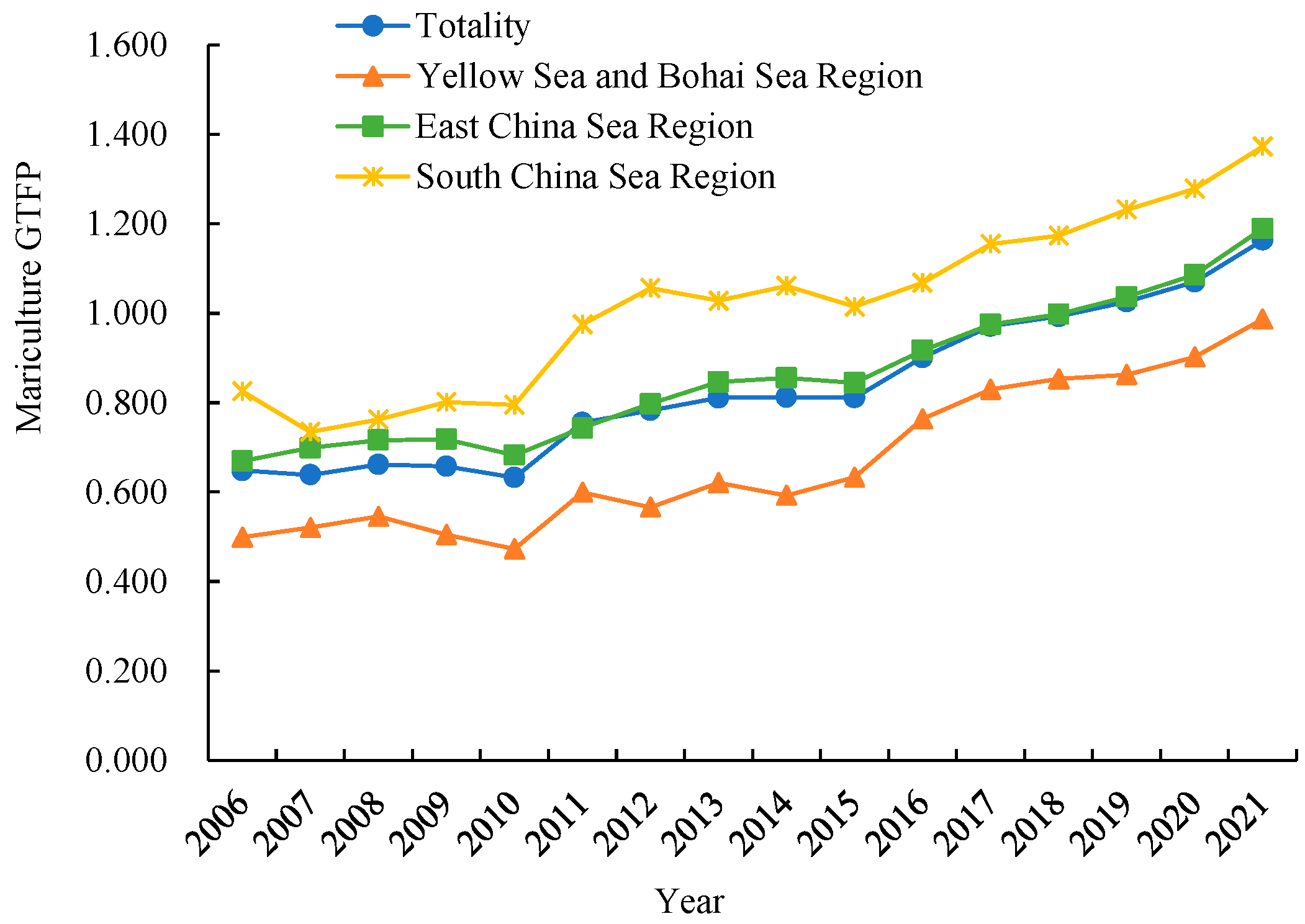
Based on the provincial-level panel data of China’s mariculture industry spanning 2006–2021, this study employs the global Super-SBM model, incorporating undesirable outputs to estimate the mariculture GTFP since the 11th Five-Year Plan period, with detailed results presented in Figure 1.
At the national level, the average mariculture GTFP across China’s provinces exhibits an overall fluctuating upward trend during 2006–2021. Starting from 0.648 in 2006, it declined to a trough of 0.632 in 2010, exceeded the efficiency threshold of 1 in 2019, and reached a peak of 1.163 in 2021. This trend, to some extent, demonstrates that, under the effective formulation and proactive implementation of national green development guidelines and regional supportive policies, China’s mariculture industry has achieved tangible progress in green development.
At the regional level, the average mariculture GTFP values for the Yellow Sea and Bohai Sea Region, East China Sea Region, and South China Sea Region over 2006–2021 are 0.672, 0.861, and 1.021, respectively, presenting a clear distribution pattern of “highest in the South China Sea Region, followed by the East China Sea Region, and lowest in the Yellow Sea and Bohai Sea Region”, which reflects notable disparities in mariculture GTFP across different sea areas. Calculated from the annual China Fishery Statistical Yearbook, the mariculture output value per unit area for the three regions during 2006–2021 is 80,900 yuan per hectare, 205,400 yuan per hectare, and 236,000 yuan per hectare, respectively. Evidently, the South China Sea Region ranks first in both mariculture GTFP and output value per unit area among the three sea areas. Endowed with a favorable ecological environment and abundant mariculture resources (e.g., shallow seas and tidal flats), this region has placed greater emphasis on coordinating economic growth, resource conservation, and environmental protection throughout its mariculture development. The East China Sea Region ranks second in both indicators. To achieve better synergy between “economic growth” and “green development” in mariculture production, this region needs to reduce resource consumption and mitigate negative environmental impacts while promoting mariculture economic expansion. The Yellow Sea and Bohai Sea Region lags behind the other two regions in both mariculture GTFP and output value per unit area. Despite its long-standing mariculture history and large production scale, this region has long relied on an extensive growth model characterized by increasing factor inputs and expanding farming areas to drive mariculture economic growth. Insufficient resource allocation efficiency, limited production management expertise, and weak intensity of resource conservation, intensive utilization, and environmental protection have collectively contributed to its relatively low mariculture GTFP.
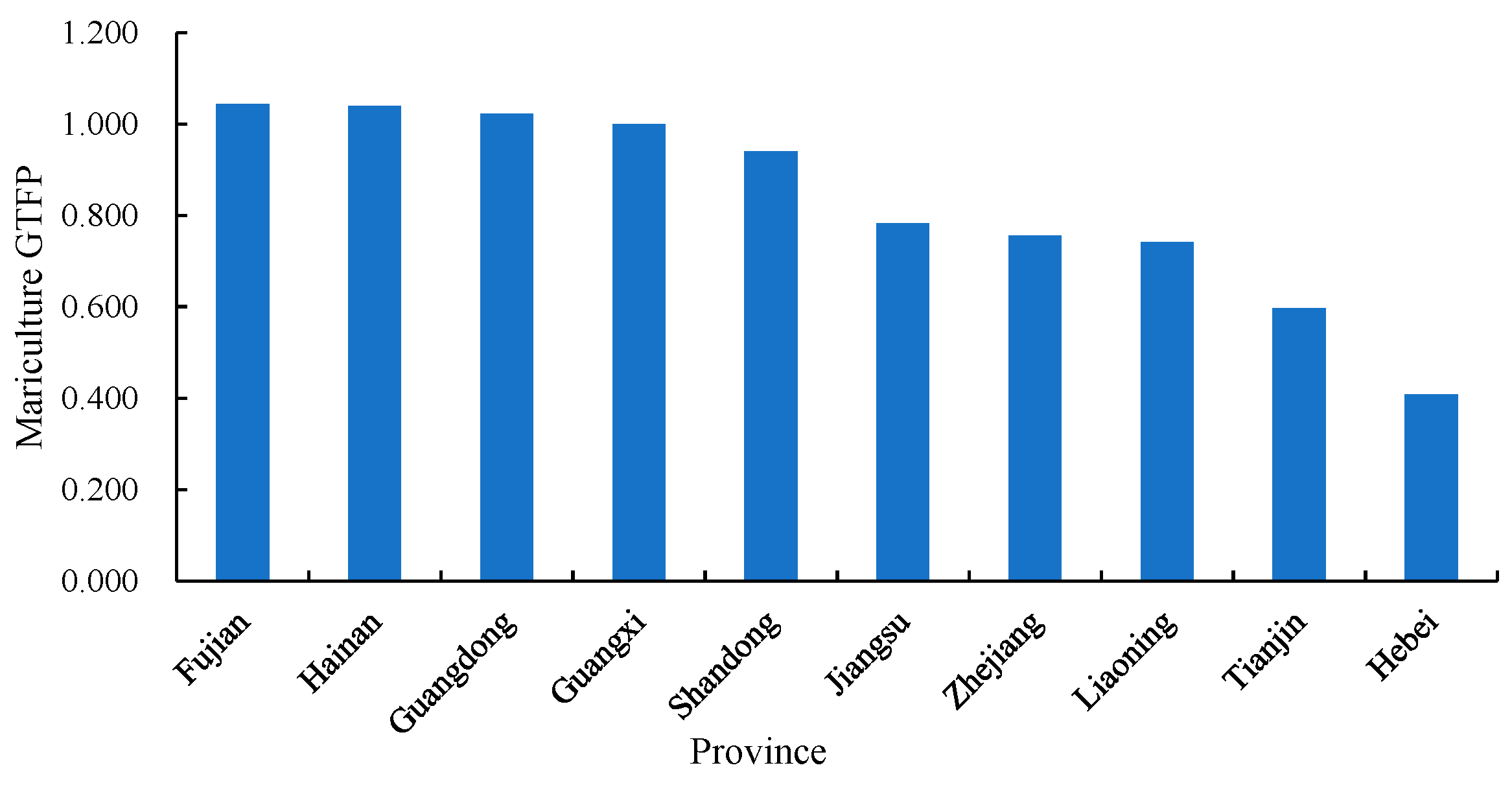
At the provincial level, the estimation results of the average mariculture GTFP for China’s coastal provinces during 2006–2021 are presented in Figure 2. According to the average mariculture GTFP level, this study classifies the sample provinces into three categories. The first is the leading type, with an average mariculture GTFP ranging from 1.000 to 1.043, mainly covering four provinces: Fujian, Hainan, Guangdong, and Guangxi. The mariculture GTFP of these provinces is in a relatively leading position. While achieving economic growth in mariculture, they have actively implemented the green development concept, making them the best practitioners of green mariculture production. The second is the moderate type, with an average mariculture GTFP ranging from 0.742 to 0.940, including four provinces: Shandong, Jiangsu, Zhejiang, and Liaoning. There is a notable gap between these provinces and the leading-type ones, with considerable room for improvement in their mariculture GTFP. The third is the lagging type, with an average mariculture GTFP ranging from 0.409 to 0.597, including two provincial-level regions: Tianjin and Hebei. Their overall mariculture GTFP level is relatively low. In the future, it is critical for them to better coordinate the relationship between mariculture economic development, resource conservation, and environmental protection, reduce resource depletion and negative environmental impacts in mariculture production, upgrade farming modes, optimize cultured species, and promote the transformation and upgrading of the mariculture industry towards green development.
The regional distribution of the three types of mariculture GTFP is detailed in Table 5. Notably, all three provinces in the South China Sea Region fall into the leading type, accounting for 75.00% of all leading-type provinces. Among the provinces in the East China Sea Region, Fujian Province is classified as the leading type. According to the 2022 China Fishery Statistical Yearbook, Fujian’s mariculture output reached 5.4372 million tons in 2021, ranking first in China and accounting for 24.59% of the country’s total mariculture output. The data indicate that while achieving rapid development in the mariculture industry, the province has balanced effective resource conservation and environmental protection and governance, making it a representative benchmark for the green development of China’s mariculture industry. Jiangsu and Zhejiang are both economically developed provinces in China, with favorable socioeconomic conditions, relatively complete infrastructure, robust resident demand for mariculture products, and considerable market development potential. However, both provinces are classified as the moderate type in terms of mariculture GTFP, leaving significant room for them to catch up with leading provinces in the future. Among the provinces in the Yellow Sea and Bohai Sea Region, Shandong and Liaoning fall into the moderate type. Both are major mariculture provinces with output ranking among the top in China. While boosting the economic performance and output of mariculture, they need to further accelerate the optimization and adjustment of mariculture modes and cultured species, and mitigate pollution to the aquatic ecological environment caused by farming activities. Tianjin and Hebei belong to the lagging type, with substantial room for improvement in their mariculture GTFP. The above analysis demonstrates that there is a significant regional imbalance in mariculture GTFP during the sample period, making it particularly critical to promote the coordinated regional green development of the mariculture industry.

4.2. Analysis of the Causes of GTFP Loss in China’s Mariculture Industry

The above analysis presents the estimation results of mariculture GTFP at the national, regional, and provincial levels, yet it cannot identify the underlying causes of mariculture GTFP loss across provinces.
In the global Super-SBM model, the input-output redundancy rate (deficiency rate) refers to the ratio of the slack variable of each input or output indicator to its corresponding input-output value. A higher ratio indicates a greater marginal impact of the indicator on mariculture GTFP loss, which can effectively reveal the core drivers of GTFP loss in the mariculture industry. On this basis, this study estimates the redundancy rate and deficiency rate of input-output indicators for China’s mariculture GTFP during 2006–2021, with detailed results presented in Table 6. This study further analyzes the causes of mariculture GTFP loss based on the estimation results, with a view to clarifying the direction and potential for mariculture GTFP improvement in each province, and providing a scientific basis for formulating targeted policy recommendations.
From the national perspective, the top five drivers of mariculture green total factor productivity (GTFP) loss during the sample period are, in order: mariculture fishing vessel power, mariculture fry, mariculture carbon emissions, mariculture area, and mariculture intermediate consumption. The deficiency rate of desired outputs is consistently low, indicating that input and undesirable output redundancy are the core causes of GTFP loss. China’s mariculture growth still relies heavily on factor input expansion and scale enlargement, with persistent issues of excessive resource consumption and aquatic ecological damage that cannot be overlooked. For input indicators, the average redundancy rates of fishing vessel power (25.6%), fry (24.6%), and farming area (18.3%) rank the highest. Specifically, excessive fishing vessel deployment relative to economic output calls for strengthened scientific management and rational utilization. Low-quality fry has caused slow growth, poor disease resistance, and frequent disease outbreaks, necessitating targeted R&D on improved breeding and disease control. Irrational use of farming space requires improved intensive resource utilization and conservation. For output indicators, the average redundancy rates of mariculture carbon emissions and standardized pollution load are 21.0% and 8.1%, respectively, while the deficiency rates of mariculture output value and carbon sink are 1.3% and 7.4%. Despite the strong carbon sink function of mariculture, its pollutant and carbon emissions remain non-negligible. Under China’s “Dual Carbon” goals, accelerating mariculture transformation is critical to reduce farming-related pollution and achieve low-carbon development.
Significant heterogeneity exists in the drivers of GTFP loss across the three sea regions. For the Yellow Sea and Bohai Sea Region, the top three input redundancy rates match the national pattern: fishing vessel power, fry, and farming area. According to the 2022 China Fishery Statistical Yearbook, the region’s 26,800 mariculture vessels (593,100 kW total power) accounted for 40.13% of the national vessel quantity and 54.97% of total power in 2021. The non-standard operation of mariculture fishing vessels and irrational resource inputs have driven the region’s highest redundancy rates of standardized pollution load (18.6%) and carbon emissions (33.1%) among the three regions. To lift GTFP, local provinces need to optimize farming modes, reduce over-reliance on fishing vessels, improve resource allocation and management, and mitigate ecological pollution. For the East China Sea Region, the top input redundancy drivers are fry, fishing vessel power, and farming area, with carbon emissions as the leading undesirable output redundancy source. Strong seafood demand in the economically developed provinces of Jiangsu and Zhejiang has incentivized producers to expand scale and increase factor inputs. In 2021, Jiangsu’s mariculture area reached 171,100 hectares, ranking top nationwide, but its redundancy rates of farming area and intermediate consumption hit 35.4% and 25.7%, respectively, indicating inefficient space utilization and waste of feed and fuel inputs. Jiangsu needs to rationalize farming scale, transform production modes, and reduce resource consumption, as well as pollutant and carbon emissions. Zhejiang’s 20.1% fry redundancy rate calls for improved fry utilization efficiency to reduce waste from diseases, pollution, and irrational farming. By contrast, Fujian shows low redundancy and deficiency rates across all indicators, with a sound overall mariculture development performance. For the South China Sea Region, the core GTFP loss drivers are fishing vessel power (23.3%), fry (19.6%), farming area (11.8%), carbon emissions (10.1%), and carbon sink deficiency (7.3%). With the highest mariculture GTFP among the three regions, it can further lift efficiency by optimizing fishing vessel management, advancing high-quality fry R&D and promotion, while maintaining its sound development momentum. In addition, the late-starting, small-scale shellfish and algae mariculture in Guangxi and Hainan has great potential to enhance the industry’s carbon sink function through scientific planning and farming.

4.3. Spatial Autocorrelation Analysis of Mariculture GTFP in China

4.3.1. Global Spatial Autocorrelation Analysis

Using Stata 18.0 software (StataCorp LLC, College Station, TX, USA), this study calculated the Global Moran’s I of mariculture GTFP across China’s provinces during 2006–2021, with the specific results presented in Table 7.
Based on the data in Table 7, in terms of the value and statistical significance of the Global Moran’s I, the Global Moran’s I of China’s mariculture GTFP was consistently greater than 0.250 and passed the statistical significance test throughout the study period. This indicates that China’s mariculture GTFP has significant spatial autocorrelation characteristics at the overall level. Specifically, mariculture GTFP across provinces does not exhibit a random spatial distribution, but presents a positive spatial correlation featured by High-High (H-H) and Low-Low (L-L) agglomeration. In terms of the dynamic changes of the Global Moran’s I, the index showed an overall fluctuating upward trend during the sample period, rising from 0.572 in 2006 to 0.800 in 2021. This demonstrates that the diffusion of mariculture technologies and the exchange of farming experience among provinces have increased continuously, the degree of spatial linkage has become increasingly close, and the spatial correlation of mariculture GTFP has strengthened continuously over the sample period.
The above analysis demonstrates that mariculture production activities are highly correlated with resource endowments and geographical location. On the one hand, provinces with outstanding resource endowments tend to have more obvious advantages in promoting the large-scale, branded, and standardized development of the industry. They are equipped with a relatively complete infrastructure and equipment required for production, and usually take the lead in the learning and application of new knowledge and technologies. On the other hand, adjacent regions generally have a higher degree of convergence in terms of farmed species, farming modes, and mariculture technologies. With the spread of farming experience, the diffusion of mariculture technologies, and the continuous improvement of the modern aquaculture extension and service system, the spatial correlation between adjacent or geographically close regions will become more pronounced.
Although the results of the Global Moran’s I confirm the overall positive spatial correlation of China’s mariculture GTFP, its limitation lies in the failure to effectively capture the heterogeneity of local regions. Specifically, it cannot fully identify which provinces present a high-value advantageous agglomeration of mariculture GTFP, which present a low-value disadvantageous agglomeration, and which show a development pattern of High-Low (H-L) or Low-High (L-H) agglomeration. Therefore, this study conducts further tests and analysis on the local spatial correlation of mariculture GTFP.

4.3.2. Local Spatial Autocorrelation Analysis

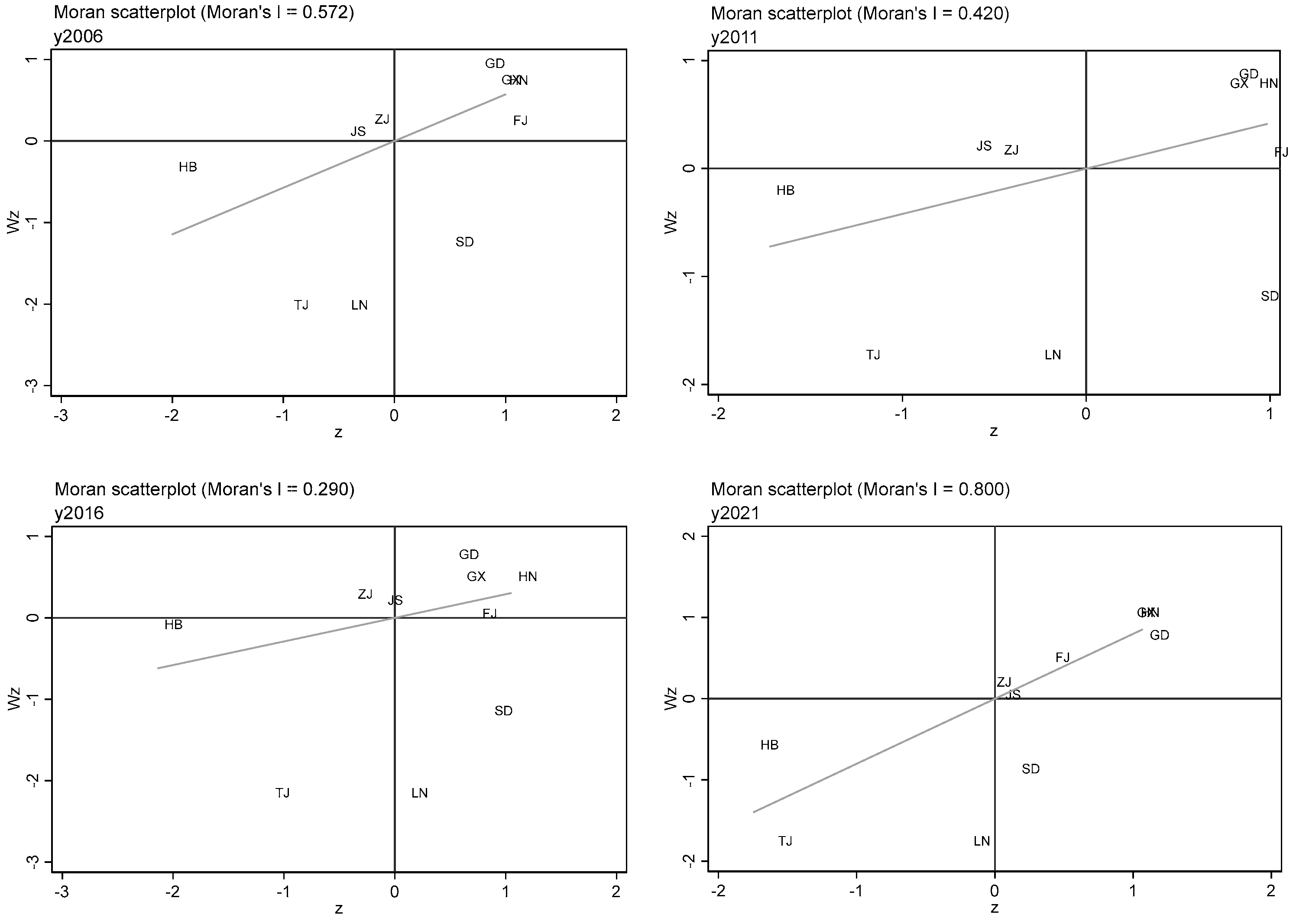
To further clarify the spatial correlation characteristics of mariculture GTFP across China’s provinces during 2006–2021, this study selects representative years (2006, 2011, 2016, and 2021) and plots the Local Moran scatter plots of mariculture GTFP. In these representative years, the agglomeration areas with positive spatial correlation of mariculture GTFP are the High-High (H-H) agglomeration in the first quadrant and the Low-Low (L-L) agglomeration in the third quadrant. The former indicates that provinces with high mariculture GTFP are geographically adjacent to other high-GTFP provinces, presenting an advantageous agglomeration pattern; the latter indicates that provinces with low mariculture GTFP are adjacent to other low-GTFP provinces, showing a disadvantageous agglomeration pattern.
The test results of the local spatial correlation of mariculture GTFP are presented in Figure 3 and Table 8. Overall, 7 provinces were located in the first and third quadrants of the Moran scatter plots in both 2006 and 2011, accounting for 70% of the total sample provinces in each year. In 2016 and 2021, the number of provinces in the first and third quadrants was 6 and 8, accounting for 60% and 80% of the total sample, respectively. It can be seen that the number of provinces in the first and third quadrants is far greater than that in the second and fourth quadrants in all representative years, which further confirms the previous conclusion that China’s mariculture GTFP has significant positive spatial correlation.
At the provincial level, Fujian, Guangdong, Guangxi, and Hainan consistently fell into the High-High (H-H) agglomeration area (the first quadrant) in all representative years. These provinces are mainly distributed in the South China Sea Region, which is fully consistent with the previous estimation results of mariculture GTFP. Endowed with favorable mariculture resource endowments and developed regional economies, these provinces have facilitated the modernized and large-scale development of the mariculture industry, and can play a strong leading and exemplary role in the mariculture development of neighboring provinces. Zhejiang consistently remained in the Low-High (L-H) agglomeration area (the second quadrant) in the representative years, with its mariculture GTFP lower than that of the adjacent Fujian Province. To elevate its mariculture GTFP, Zhejiang needs to align with its regional endowments, learn from the advanced development experience of neighboring provinces, and explore a more appropriate green development path for the mariculture industry. Tianjin and Hebei have long been located in the Low-Low (L-L) agglomeration area (the third quadrant). Geographically, these provincial-level regions are situated in the Yellow Sea and Bohai Sea Region, with relatively low mariculture GTFP and a weak radiation and diffusion effect on surrounding provinces. Shandong has consistently fallen into the High-Low (H-L) agglomeration area (the fourth quadrant). Combined with the previous analysis, Shandong’s mariculture GTFP is at the moderate level. As a major mariculture province in China, Shandong needs to further standardize mariculture production, conduct overall planning for the spatial layout of mariculture, reduce unregulated pollution discharge, elevate its mariculture GTFP, and strengthen its spillover and leading effects on neighboring provinces.

4.4. Spatial Effect Analysis of Mariculture GTFP in China

4.4.1. Selection of Spatial Econometric Model

As stated previously, mainstream spatial econometric models primarily include the Spatial Lag Model (SLM), Spatial Error Model (SEM), and Spatial Durbin Model (SDM). Panel data models can be further divided into fixed effects (FE) and random effects (RE) specifications, among which fixed effects cover individual fixed effects, time fixed effects, and two-way fixed effects. Therefore, prior to conducting an empirical analysis of the factors influencing mariculture GTFP, it is necessary to first identify an appropriate spatial econometric model [41].
First, this study employed Stata 18.0 software (StataCorp LLC, College Station, TX, USA) to conduct the Lagrange Multiplier (LM) test and Robust LM test on the sample data, with the results presented in Table 9. As shown in the table, Moran’s I statistic of mariculture GTFP is 2.034 and passes the statistical significance test. Thus, the null hypothesis of no spatial effects is rejected, indicating that China’s mariculture GTFP has significant spatial correlation, which necessitates the construction of a spatial econometric model for further analysis. Combined with the statistics and their significance levels, both the LM-err and LM-lag statistics for mariculture GTFP are statistically significant at the 1% level. Further comparison of the significance levels of the Robust LM-err and Robust LM-lag statistics shows that both are also significant at the 1% level. Overall, the SDM is the most appropriate method for the empirical analysis in this study.
Subsequently, the Hausman test was used to determine whether a fixed effects or random effects model should be adopted. The results of the Hausman test indicate that the fixed effects model yields more accurate estimates. Therefore, with the SDM as the initial model, the Likelihood Ratio (LR) test was further applied to select among the individual fixed effects, time fixed effects, and two-way fixed effects specifications. According to the LR test results in Table 10, the null hypotheses (adopting only individual fixed effects or only time fixed effects) are rejected, and the two-way fixed effects model should be selected. Finally, the Wald test and LR test were conducted to verify whether the constructed SDM would degenerate into the SLM or SEM. The results of both tests confirm that the SDM cannot be degenerated into the other two models. Taken together, this study adopts the two-way fixed effects Spatial Durbin Model to conduct empirical research and analysis on the factors influencing China’s mariculture GTFP.

4.4.2. Results and Analysis of the Spatial Econometric Model

The estimation results of the spatial econometric model are presented in Table 11. As shown in the table, the spatial autoregressive coefficient ρ (rho) of mariculture GTFP is 0.249 and passes the statistical significance test. This indicates that China’s mariculture GTFP exhibits significant spatial correlation, which further verifies the existence of spatial spillover effects. Therefore, this study analyzes the Direct Effect, Indirect Effect, and Total Effect of each explanatory variable. Specifically, the Direct Effect refers to the impact of a given variable on the mariculture GTFP of the local province, while the Indirect Effect represents the impact of the same variable in neighboring provinces on the local mariculture GTFP [42].
The direct effect estimation results show that Industrial Scale (SCALE), Industrial Structure (STR), Fishermen’s Income (INC), Transportation Accessibility (TRAN), Internet Development Level (NET), Technology Adoption (TAD), and Environmental Regulation (ER) have significant positive impacts on mariculture GTFP. Regions with larger mariculture scale attract more labor and capital inputs, while large-scale operators adopt advanced technologies more efficiently, accelerating local technology diffusion, reducing resource consumption, and lifting GTFP. For STR, China Fishery Statistical Yearbook data shows the share of mariculture output in total fishery output rose from 22.62% (2006) to 28.38% (2021), a 25.46% increase, confirming industrial structure optimization significantly boosts mariculture GTFP. Higher INC stimulates fishermen’s production enthusiasm, and drives voluntary aquatic ecological protection to secure sustainable returns via accumulated experience, upgraded equipment, and improved technologies for green mariculture development. TRAN shortens aquatic product transportation cycles and facilitates fishermen’s communication, accelerating experience and technology diffusion to lift GTFP. Higher NET enables convenient online information sharing of fishery knowledge, technologies, and management experience, solving production bottlenecks and improving farming efficiency. For TAD, China’s active promotion of green mariculture modes (industrial re-circulating aquaculture, engineered pond aquaculture, deep-water cage aquaculture) means higher green technology adoption and pollution and resource consumption reduction, lifting local GTFP. ER, as an important government regulatory tool to standardize production behaviors, reduces pollution emissions and advances green development, and also exerts a statistically significant positive effect on mariculture GTFP. Fishery Disaster Loss (DIS) exerts a significant negative impact on local mariculture GTFP. Typhoons, floods, diseases, pollution, and other disasters disrupt production, reduce output and damage infrastructure, and cause aquatic pollution, lowering desired output and hindering green development.
This study further analyzes the indirect effect (spatial spillover effect) of mariculture GTFP, which includes two opposing forces: the demonstration effect and siphon effect. Results in Table 11 show that SCALE, STR, INC, Urbanization Level (URB), and NET have significant spatial spillover effects, indicating that cross-regional coordinated development of green mariculture is essential for China’s ecological civilization construction, rather than relying solely on local efforts. Specifically, SCALE, STR, and NET present a significant positive demonstration effect. Local policies for scale expansion and structural optimization, along with advanced technologies and management experience, can spill over to neighboring regions, guiding local fishermen to upgrade equipment and technologies for GTFP improvement. Higher NET also facilitates knowledge and experience sharing between local and neighboring fishermen, supporting timely adjustment of farming modes and technologies to lift GTFP. In contrast, INC and URB generate a significant negative siphon effect: regions with higher income and urbanization levels continuously attract production factors such as talents, capital, and technology from neighboring areas by leveraging more complete infrastructure, public service systems, and employment opportunities. This siphons off the core production resources of marine aquaculture in surrounding regions and significantly inhibits their GTFP growth. This spatial siphon effect exerts a particularly prominent impact on the rural labor force. As the urbanization process continuously absorbs the rural working-age population, the number of employees engaged in marine aquaculture in neighboring areas has been declining. This not only leads to prominent labor shortages but also further exacerbates the contradictions of labor force aging and skill gaps, ultimately constraining the long-term GTFP growth of mariculture in surrounding regions.
Notably, Technical Infrastructure (INF), Fishermen Technical Training (TRA), and Fishery Drug Use Intensity (FDM) have no statistically significant effects on mariculture GTFP. Regarding INF, the lack of a significant promoting effect stems from three main factors. First, there is an insufficient supply of professional operation and maintenance personnel. Aquatic technology extension facilities require ongoing professional management, yet the number of national extension staff declined from 43,642 (2006) to 29,579 (2021) (China Fishery Statistical Yearbook), undermining facility operational efficiency and service sustainability. Second, low practical application effectiveness. Field surveys show that severe equipment obsolescence and low automation levels fail to meet modern green and precision aquaculture demands. Poor geographical alignment with core production areas also limits resource coverage and technology transfer. Third, inadequate incentive and assessment systems. Public welfare-oriented extension institutions lack quantitative metrics for extension outcomes, environmental performance, and stakeholder satisfaction, reducing staff motivation and technology transformation impetus. These interacting factors collectively weaken INF’s potential positive impact. With respect to TRA, its promoting effect is similarly constrained by two key issues. First, a structural mismatch between training supply and stakeholder needs. Training remains focused on traditional technologies, with severe shortages in green aquaculture areas such as energy conservation and emission reduction, intelligent disease control, and precision feeding. Second, limited technology adoption capacity among small-scale farmers. Low educational levels lead to poor mastery and application of new technologies, hindering the effective implementation of advanced practices. Concerning FDM, the absence of a significant negative effect primarily reflects improvements from strengthened fishery regulation. China’s increasingly sophisticated drug regulations have effectively curbed illegal and irregular drug use, while rational, compliant drug use reduces disease incidence and mortality, avoiding significant negative impacts on GTFP. Notably, FDM data are regional aggregates from the China Fishery Statistical Yearbook, which may mask micro-level variations across aquaculture models and farm sizes. Thus, non-standard drug use in some regions or by individual entities cannot be entirely ruled out.

4.4.3. Endogeneity and Robustness Tests

Endogeneity issues may arise from reverse causality between certain influencing factors and mariculture GTFP, as well as unobservable factors affecting mariculture GTFP. The GMM model (Gaussian Mixture Model) effectively addresses endogeneity problems by introducing the one-period lag of the dependent variable [43]. Therefore, this paper employs the Spatial Durbin GMM model to conduct endogeneity tests, with the results presented in Table 12. It can be observed that after incorporating the one-period lag of mariculture GTFP into the model, the signs and significance levels of the coefficients for the influencing factors remain substantially unchanged, which consistently supports the core conclusions of this study. Meanwhile, the regression coefficient of the one-period lagged mariculture GTFP is significantly positive at the 1% level, indicating that China’s mariculture GTFP is in a stage of steady growth, and the green development of the mariculture industry demonstrates strong sustainability.
When conducting empirical tests using the spatial econometric model, the specification of the spatial weight matrix exerts a substantial impact on the regression results. In the aforementioned regression analysis, this study employed the contiguity spatial weight matrix, which is widely adopted in the existing literature. To further verify the robustness of the empirical results, this study replaces the original matrix with the geographic distance spatial weight matrix and conducts the robustness test of the spatial econometric model accordingly. The results are presented in Table 13. It can be observed that after the replacement of the spatial weight matrix, the sign and significance level of the coefficients of the core indicators in the model are generally consistent with the results in Table 11, which confirms that the research conclusions of this study are robust.

5. Research Conclusions and Global Implications for Sustainable Mariculture Development

5.1. Research Conclusions

This study integrates economic growth, productivity, and spatial autocorrelation theories to construct an indicator system for measuring China’s mariculture GTFP and its influencing factors. Using the global Super-SBM model, it measures China’s mariculture GTFP since the 11th Five-Year Plan, identifies drivers of efficiency loss, and analyzes GTFP’s influencing factors and spatial spillover effects via spatial econometric models. The main conclusions are as follows:
First, the average mariculture GTFP of China’s coastal provinces shows an overall fluctuating upward trend with clear regional heterogeneity, presenting a pattern of “the highest in the South China Sea Region, followed by the East China Sea Region, and the lowest in the Yellow Sea and Bohai Sea Region”. Specifically, the average provincial mariculture GTFP rose from 0.648 to 1.163 during the sample period, with average values of 0.672, 0.861, and 1.021 for the Yellow Sea and Bohai Sea, East China Sea, and South China Sea regions, respectively.
Second, China’s mariculture GTFP loss is mainly driven by excessive resource consumption and undesirable outputs. Among input indicators, the average redundancy rates are highest for mariculture fishing vessels (25.6%), farmed fry (24.6%), and farming area (18.3%); for undesirable outputs, the top redundancy rates are for carbon emissions (21.0%) and standardized pollution load (8.1%).
Third, China’s mariculture GTFP exhibits significant positive spatial autocorrelation, with a non-random spatial distribution characterized by High-High (H-H) and Low-Low (L-L) agglomeration: high-GTFP provinces are adjacent to other high-GTFP provinces, while low-GTFP provinces are mostly surrounded by low-GTFP neighbors.
Fourth, factors influencing mariculture GTFP differ significantly in impact direction and magnitude. Industrial scale, industrial structure, and internet development level boost local mariculture GTFP with positive spatial spillover effects. Fishermen’s income promotes local GTFP but generates negative spillovers. Urbanization level has a significant negative spillover effect on neighboring regions’ GTFP. Transportation accessibility, technology adoption, and environmental regulation significantly promote local GTFP, while fishery disaster loss has a significant negative local impact. Technical infrastructure, technical training, and fishery drug use show no statistically significant effects on mariculture GTFP.

5.2. Global Replicable Experience for Sustainable Mariculture

5.2.1. Government and Global Fishery Governance Perspective

First, implement differentiated, region-specific sustainable development strategies to narrow mariculture development gaps. For developing regions with weak industrial foundations, focus should be placed on addressing development bottlenecks, scientific resource allocation, and standardized production capacity building. For mature mariculture economies, prioritize refined management, green technology R&D, and model innovation to lead global green transformation.
Second, optimize industrial support policies to advance scaled, intensive mariculture and unlock positive spatial spillover effects. As confirmed by this study, industrial scale significantly boosts local and neighboring mariculture GTFP. Governments should introduce targeted support for diversified operators (family fish farms, cooperatives, leading enterprises), strengthen capacity building in operation management and standardized production, and drive industrial chain integration to reduce negative externalities, resource depletion, and ecological pressure.
Third, establish a dual-track mechanism for globally coordinated fishery risk protection and green low-carbon incentives. Given the significant negative impact of fishery disasters on mariculture GTFP, countries should deepen multilateral cooperation through the Food and Agriculture Organization (FAO), expand the coverage of policy-based fishery insurance, and enhance the overall risk resilience of the industry. Meanwhile, improve the green financial support system: on the one hand, increase fiscal subsidies for eco-friendly farming models such as industrial recirculating aquaculture to guide the industry’s transition to green production; on the other hand, in response to the prominent problems of high power redundancy and high carbon emission intensity of mariculture fishing vessels, establish specialized retrofitting funds to promote energy-saving upgrades of old fishing vessels and popularize green power technologies, thereby reducing carbon emissions from mariculture activities at the source.

5.2.2. Industrial and Market Operator Perspective

First, accelerate global collaborative innovation and cross-border diffusion of green mariculture technologies to address GTFP losses caused by excessive resource consumption and undesirable outputs. Industry stakeholders, research institutions, and industry associations should strengthen international cooperation on core technologies, including improved breed cultivation, eco-friendly feed, disease prevention and control, and tailwater treatment. Meanwhile, we should accelerate the establishment and improvement of a green development standard system for the aquaculture industry, refine relevant standards for input management, pollutant discharge, and other key links, comprehensively implement green standardized production, and promote resource conservation and ecological environmental protection.
Second, deepen cross-regional industrial cooperation to amplify positive spatial spillovers and promote coordinated global development. Amid significant regional gaps in mariculture GTFP, operators should accelerate the application of green technology achievements, build cross-border industry–university–research cooperation platforms, and provide technical assistance to underdeveloped regions to narrow development gaps.
Third, improve technology extension infrastructure and targeted capacity building for practitioners. While technical infrastructure and training show insignificant effects in the empirical results, targeted investment can unlock their positive potential for GTFP improvement. Stakeholders should invest in technology demonstration bases and training venues, and deliver needs-based practical training with post-training feedback mechanisms to promote the uptake of green technologies.

5.2.3. Public and Consumer Market Perspective

First, enhance public awareness of green fishery development and guide sustainable consumption patterns. Multi-channel and multi-form publicity and education initiatives should be implemented to raise social consensus on the importance of aquatic ecosystem protection and green fishery development, and disseminate knowledge on the ecological, nutritional, and social values of sustainable aquatic products. Meanwhile, consumers should be guided to prioritize certified green and high-quality aquatic products, thereby forcing the green transformation of fishery production modes through market demand pull. In addition, a public participation team should be cultivated that is enthusiastic about disseminating fishery knowledge, supports green aquatic product consumption, and actively participates in modern fishery development, to foster a favorable social atmosphere where the whole society supports sustainable mariculture development.
Second, promote the construction of sustainable aquatic product certification systems and brand cultivation to increase industrial added value and aquaculture practitioners’ income. As confirmed by the empirical results of this study, higher fishermen’s income has a significant promoting effect on local mariculture GTFP. Therefore, on the basis of actively aligning with international certification standards such as those of the Global Seafood Alliance (GSA), we should accelerate the establishment and improvement of a sustainable aquatic product certification system. Meanwhile, efforts should be made to cultivate competitive regional characteristics, sustainable aquatic product brands, and geographical indication products. By increasing product added value, we can effectively raise the income of aquaculture practitioners, thereby forming a virtuous cycle of “income improvement-technology adoption-GTFP growth”.
Third, carry out diversified science popularization to guide sustainable consumption and expand market demand for eco-friendly aquatic products. Popularize the nutritional value, sustainable production background, and consumption knowledge of aquatic products via global online and offline channels. Meanwhile, strengthen R&D of convenient, safe, and nutritious processed aquatic products to meet diversified consumer demand, expand market scale, and drive mariculture output value growth.

Author Contributions

Conceptualization, L.P. (Lewei Peng) and Y.M.; Methodology, L.P. (Lewei Peng) and Y.M.; Data curation, L.P. (Linhua Peng) and Z.Y.; Writing—original draft, L.P. (Lewei Peng) and Z.Y.; Writing—review and editing, L.P. (Linhua Peng) and L.Z. All authors have read and agreed to the published version of the manuscript.

Funding

This research was funded by the Shanghai Academy of Agricultural Sciences 2025–2026 Open Competition Project for Key Tasks (grant number BS25019) and the Earmarked Fund for China Agriculture Research System (grant number CARS-47).

Institutional Review Board Statement

Not applicable.

Data Availability Statement

The original contributions presented in this study are included in the article. Further inquiries can be directed to the corresponding authors.

Conflicts of Interest

The authors declare no conflicts of interest.

References

  1. Pei, R.S.; Zhang, H.Z.; Liu, Z.F.; Yu, C.; Zhang, Y.X.; Mu, Y.T. Evaluating the Green Development Level of Marine Molluscan Shellfish Aquaculture Industry and Analyzing Obstacle Factors That Hinder Its Improvement: The Case of China. Aquaculture 2025, 606, 742603. [Google Scholar] [CrossRef]
  2. Schoor, M.; Arenas-Salazar, A.P.; Parra-Pacheco, B.; Garcia-Trejo, J.F.; Torres-Pacheco, I.; Guevara-Gonzalez, R.G.; Rico-Garcia, E. Horticultural Irrigation Systems and Aquacultural Water Usage: A Perspective for the Use of Aquaponics to Generate a Sustainable Water Footprint. Agriculture 2024, 14, 925. [Google Scholar] [CrossRef]
  3. Romero, J.A.; Halpern, B.S.; Tuholske, C.; Arriaga, J.A.; Brault, J.M. Nitrogen discharge in the Gulf of California from wastewater, agriculture, livestock, and aquaculture. Water Pract. Technol. 2026, 21, 1205–1221. [Google Scholar] [CrossRef]
  4. European Commission. Sustainability Criteria for the Blue Economy; Publications Office of the European Union: Luxembourg, 2021. [Google Scholar]
  5. Yu, S.; Mu, Y.T. Evaluation of Green Development in Mariculture: The Case of Chinese Oyster Aquaculture. Aquaculture 2023, 576, 739838. [Google Scholar] [CrossRef]
  6. Jiang, T.; Wu, K.N.; Hu, Y.C.; Song, G.B.; Sun, W.W.; Liu, G.Y.; Yu, Z.Y.; Cao, L.; Li, S.B. Integrating Hybrid Life Cycle Assessment to Quantify Carbon Footprint in Mariculture: Overcoming Truncation Errors and Unveiling Macroeconomic Drivers. Environ. Impact Assess. Rev. 2026, 119, 108359. [Google Scholar] [CrossRef]
  7. Pries, M.; Zeug, W.; Thrän, D. Holistic and Integrated Life Cycle Sustainability Assessment of Community Supported Agriculture: A Case Study of School Catering in Leipzig, Germany. Clean. Responsible Consum. 2026, 20, 100372. [Google Scholar] [CrossRef]
  8. Sharma, H.; Padhi, B.; Sharif, A.; Bashir, M.F. Striving Towards Green Total Factor Productivity: A Bibliometric and Systematic Literature Review for Future Research Agenda. J. Environ. Manag. 2025, 377, 124639. [Google Scholar] [CrossRef]
  9. Sharma, H.; Padhi, B. Transiting Towards Green Productivity: Evidence from Indian Organized Manufacturing Industries. J. Environ. Manag. 2025, 373, 123662. [Google Scholar] [CrossRef]
  10. Yang, Z.Y.; Peng, L.W.; Yan, Z.F. Dynamic Evolution and Convergence Analysis of Green Development Level in China’s Freshwater Aquaculture Industry—From the Perspective of Green Total Factor Productivity. J. Agrotech. Econ. 2023, 12, 57–77. [Google Scholar] [CrossRef]
  11. Dai, G.L.; Lv, X.Y.; Sun, J.K.; Gao, X.Y. Impact of Marine Industrial Synergistic Agglomeration on Marine Green Total Factor Productivity—Evidence from China’s Coastal Areas. Reg. Stud. Mar. Sci. 2025, 90, 104469. [Google Scholar] [CrossRef]
  12. Wang, P.; Ji, J. Research on China’s Mariculture Efficiency Evaluation and Influencing Factors with Undesirable Outputs—An Empirical Analysis of China’s Ten Coastal Regions. Aquac. Int. 2017, 25, 1521–1530. [Google Scholar] [CrossRef]
  13. Ren, W.H.; Zeng, Q. Is the Green Technological Progress Bias of Mariculture Suitable for Its Factor Endowment? ——Empirical Results from 10 Coastal Provinces and Cities in China. Mar. Policy 2021, 124, 104338. [Google Scholar] [CrossRef]
  14. Balezentis, T.; Blancard, S.; Shen, Z.Y.; Streimikiene, D. Analysis of environmental total factor productivity evolution in European agricultural sector. Decis. Sci. 2021, 52, 483–511. [Google Scholar] [CrossRef]
  15. Zhang, J.X.; Lu, G.Y.; Skitmore, M.; Ballesteros-Pérez, P. A critical review of the current research mainstreams and the influencing factors of green total factor productivity. Environ. Sci. Pollut. Res. 2021, 28, 35392–35405. [Google Scholar] [CrossRef]
  16. Khudari, M.; Al Hashimi, N.; Harun, N.H. Asymmetric impacts of global competitiveness and foreign direct investment on green total factor productivity in Oman. Discov. Sustain. 2026, 7, 602. [Google Scholar] [CrossRef]
  17. Comin, D.; Quintana, J.; Schmitz, T.; Trigari, A. Revisiting productivity dynamics in Europe: A new measure of utilization-adjusted TFP growth. J. Eur. Econ. Assoc. 2025, 23, 1598–1633. [Google Scholar] [CrossRef]
  18. Ahmed, E.M. Green TFP intensity impact on sustainable East Asian productivity growth. Econ. Anal. Policy 2012, 42, 67–78. [Google Scholar] [CrossRef]
  19. Shen, Z.Y.; Kerstens, K.; Balezentis, T. An environmental Luenberger-Hicks-Moorsteen total factor productivity indicator: Empirical analysis considering undesirable outputs either as inputs or outputs, and attention for infeasibilities. Ann. Oper. Res. 2025, 347, 241–263. [Google Scholar] [CrossRef]
  20. Kumar, S. Environmentally Sensitive Productivity Growth: A Global Analysis Using Malmquist-Luenberger Index. Ecol. Econ. 2006, 56, 280–293. [Google Scholar] [CrossRef]
  21. Liu, W.; Zhao, J.; Wang, A.L.; Wang, H.J.; Zhang, D.Y.; Xue, Z. The Evolutionary Trends, Regional Differences, and Influencing Factors of Agricultural Green Total Factor Productivity in the Beijing–Tianjin–Hebei Region. Agriculture 2026, 16, 171. [Google Scholar] [CrossRef]
  22. Ottinger, M.; Clauss, K.; Kuenzer, C. Aquaculture: Relevance, distribution, impacts and spatial assessments—A review. Ocean Coast. Manag. 2016, 119, 244–266. [Google Scholar] [CrossRef]
  23. Peng, L.W.; Yan, Z.F.; Yang, Z.Y. Evaluation of China’s Fishery Modernization Development Level and Obstacle Factors from the Perspective of New Development Concept. Trans. Oceanol. Limnol. 2022, 44, 166–175. [Google Scholar] [CrossRef]
  24. Septiani, B.A.; Setiawan, M.; Lansink, A.G.J.M.O.; Purnagunawan, R.M. Market power, economies of scale and total factor productivity (TFP) growth: Empirical evidence from the Indonesian food and beverage industry. Br. Food J. 2026, 128, 296–314. [Google Scholar] [CrossRef]
  25. Ray, N.E.; Bonaglia, S.; Cavan, E.L.; Sampaio, F.G.; Gephart, J.A.; Hillman, J.R.; Hornborg, S.; Paradis, S.; Petrik, C.M.; Tiano, J.; et al. Biogeochemical consequences of marine fisheries and aquaculture. Nat. Rev. Earth Environ. 2025, 6, 163–177. [Google Scholar] [CrossRef]
  26. Love, D.C.; Fry, J.P.; Cabello, F.; Good, C.M.; Lunestad, B.T. Veterinary drug use in United States net pen salmon aquaculture: Implications for drug use policy. Aquaculture 2020, 518, 734820. [Google Scholar] [CrossRef]
  27. Guo, W.; Dong, S.S.; Qian, J.R.; Lyu, K.Y. Measuring the green total factor productivity in Chinese aquaculture: A Zofio index decomposition. Fishes 2022, 7, 269. [Google Scholar] [CrossRef]
  28. Pacifico, A.M.; Brigolin, D.; Mulazzani, L.; Semeraro, M.; Malorgio, G. Managing marine aquaculture by assessing its contribution to ecosystem services provision: The case of Mediterranean mussel, Mytilus galloprovincialis. Ocean Coast. Manag. 2024, 259, 107456. [Google Scholar] [CrossRef]
  29. Li, J.; Zhang, J.B.; Hu, Y.H.; Ni, C.J. What is the impact of industrial structure adjustment on the ecological efficiency of marine carbon sink fishery: Evidence from coastal provinces in China? Thalassas 2025, 41, 217. [Google Scholar] [CrossRef]
  30. Xiang, A.; Chuai, X.W.; Li, J.S. Current Status and Capacity Assessment of Blue Carbon in China’s Coastal Provinces. Res. Sci. 2022, 44, 1138–1154. Available online: https://www.resci.cn/CN/10.18402/resci.2022.06.04 (accessed on 5 June 2026). [CrossRef]
  31. Hussain, F.; Ahmed, S.; Naqvi, S.M.Z.A.; Awais, M.; Zhang, Y.Y.; Zhang, H.; Raghavan, V.; Zang, Y.H.; Zhao, G.Q.; Hu, J.D. Agricultural non-point source pollution: Comprehensive analysis of sources and assessment methods. Agriculture 2025, 15, 531. [Google Scholar] [CrossRef]
  32. Environmental Quality Standard for Surface Water; State Environmental Protection Administration: Beijing, China, 2002.
  33. Drizo, A.; Shaikh, M.O. An assessment of approaches and techniques for estimating water pollution releases from aquaculture production facilities. Mar. Pollut. Bull. 2023, 196, 115661. [Google Scholar] [CrossRef]
  34. Xia, Z.Y.; Hu, D.M. Accounting for carbon emissions from fisheries in China and analyzing the decoupling effect. Fishes 2025, 10, 79. [Google Scholar] [CrossRef]
  35. Xu, H.; Zhang, Z.L.; Zhang, J.H.; Liu, H.; Zhao, P.; Shi, R.; Wang, J.; He, Y.P. Research and Development Suggestions on Energy Conservation and Emission Reduction in China’s Fishery Industry. J. Fish. China 2011, 35, 472–480. Available online: https://www.china-fishery.com/scxuebao/article/issue/2011_35_3 (accessed on 5 June 2026).
  36. Zong, H.M.; Yuan, X.T.; Wang, L.J.; Yu, L.M.; Hu, Y.Y.; Huo, C.L.; Zhang, Z.F. Preliminary Assessment of Nitrogen and Phosphorus Output from Mariculture in China. Mar. Environ. Sci. 2017, 36, 336–342. [Google Scholar] [CrossRef]
  37. Tone, K. A Slacks-Based Measure of Super-Efficiency in Data Envelopment Analysis. Eur. J. Oper. Res. 2002, 143, 32–41. [Google Scholar] [CrossRef]
  38. Tan, D.J.; Cheng, J.J.; Yu, J.; Wang, Q.; Chen, X.N. Spatiotemporal Evolution and Influencing Factors of Carbon Emission Efficiency of Apple Production in China from 2003 to 2022. Agriculture 2025, 15, 1680. [Google Scholar] [CrossRef]
  39. Xiao, Y. Research on Green Industrial Transformation of Resource-Based Cities. Doctoral Dissertation, China University of Geosciences, Wuhan, China, 2019. [Google Scholar] [CrossRef]
  40. Santos, L.D.; Vieira, A.C. Tourism and regional development: A spatial econometric model for Portugal at municipal level. Port. Econ. J. 2020, 19, 285–299. [Google Scholar] [CrossRef]
  41. Bibi, F.; Jamil, M. Trade and environmental quality: A spatial econometric approach. Environ. Dev. Sustain. 2025, 27, 18251–18273. [Google Scholar] [CrossRef]
  42. Carral, C.F.; Bockarjova, M.; van den Homberg, M.; Osei, F.; Kerle, N. Spatial econometric modeling of socioeconomic vulnerability and flood impact: Towards a risk-layering approach in southern Malawi. Int. J. Disaster Risk Reduct. 2025, 121, 105433. [Google Scholar] [CrossRef]
  43. Li, Y.; Zhou, H.M. Spatial Effect and Heterogeneity of Green Finance Development on Industrial Structure Transformation and Upgrading: An Explanation Based on Spatial Durbin Model. J. Southwest Univ. Nat. Sci. Ed. 2023, 45, 164–174. [Google Scholar] [CrossRef]
Figure 1. Estimation results of mariculture GTFP in China and its three sea regions, 2006–2021.
Fishes 11 00346 g001
Figure 2. Estimation results of mariculture GTFP in China’s coastal provinces, 2006–2021.
Fishes 11 00346 g002
Figure 3. Moran scatter plots of mariculture GTFP in China for representative years.Notes: HB: Hebei; TJ: Tianjin; LN: Liaoning; JS: Jiangsu; ZJ: Zhejiang; FJ: Fujian; SD: Shandong; GD: Guangdong; GX: Guangxi; HN: Hainan.
Fishes 11 00346 g003
Table 1. Measurement index system of green total factor productivity (GTFP) in the mariculture industry.
IndicatorVariableVariable DescriptionUnit
InputLaborNumber of professional practitioners in mariculturePerson
Aquaculture AreaMariculture areaHectare
Seedling InputQuantity of marine fish seedlingsTen Thousand Tail
Fixed AssetsTotal power of mariculture fishing vesselsKilowatt
Intermediate
Consumption
Mariculture intermediate consumption = Total fishery intermediate consumption × Gross mariculture output value/Total fishery output valueTen Thousand Yuan
OutputDesired OutputGross mariculture output valueTen Thousand Yuan
Mariculture carbon sink
volume
Ton
Non-desired OutputEquivalent standard pollution load of maricultureCubic Meter
Mariculture carbon
emissions
Ton
Table 2. Calculation Formulas for mariculture carbon sink volume.
CategoryCalculation Formula for Mariculture Carbon Sink Volume
Marine ShellfishSoft tissue carbon sink = Shellfish yield × Dry-wet coefficient × Soft tissue mass proportion × Soft tissue carbon sink coefficient
Shell carbon sink = Shellfish yield × Dry-wet coefficient × Shell mass proportion × Shell carbon sink coefficient
Total carbon sink of marine shellfish = Soft tissue carbon sink + Shell carbon sink
Marine AlgaeCarbon sink of marine algae = Algae yield × Dry-wet coefficient × Algae carbon sink coefficient
Total Mariculture Carbon SinkTotal mariculture carbon sink = Total carbon sink of marine shellfish + Carbon sink of marine algae
Table 3. Calculation Coefficients for Mariculture Carbon Sink Volume (Unit: %).
CategorySpeciesDry-Wet CoefficientMass ProportionCarbon Content Ratio
Soft TissueShellSoft TissueShell
Marine ShellfishOyster65.106.1493.8645.9812.68
Mussel75.288.4791.5344.4011.76
Scallop63.8914.3585.6542.8411.40
Clam52.551.9898.0244.9011.52
Razor Clam70.483.2696.7444.9913.24
Other Shellfish64.2111.4188.5942.8211.45
Marine AlgaeKelp20.00100.000.0031.200.00
Laver20.00100.000.0041.960.00
Gracilaria20.00100.000.0020.600.00
Wakame20.00100.000.0028.810.00
Gelidium20.00100.000.0026.370.00
Other Algae20.00100.000.0030.360.00
Table 4. Indicator system of influencing factors for mariculture GTFP.
Influencing FactorVariable NameVariable
Symbol
Variable DescriptionUnitExpected Impact
Economic FactorsIndustrial ScaleSCALETotal mariculture output value/Number of professional mariculture practitionersTen Thousand Yuan/PersonPositive
Industrial
Structure
STRMariculture output value/Total fishery output value%To be verified by empirical test
Fishermen’s
Income
INCPer capita net income of fishersYuanPositive
Social
Factors
Urbanization LevelURBUrban population/Total population%To be verified by empirical test
Transportation AccessibilityTRANHighway mileage/Administrative areaKilometer/Square KilometerPositive
Internet Development LevelNETInternet penetration rate%Positive
Technological FactorsTechnical
Infrastructure
INFNumber of aquatic technology extension institutions/Total mariculture areaInstitutions per HectarePositive
Technical
Training
TRANumber of fishers receiving technical training/Number of professional mariculture practitioners%Positive
Technology
Adoption
TADIndustrialized mariculture output/Total mariculture output%Positive
Environmental FactorsFishery Disaster LossDISAffected mariculture area/Total mariculture area%Negative
Fishery Drug Use IntensityFDMOutput value of fishery drugs/Total mariculture output value%Negative
Environmental
Regulation
ERInvestment in environmental pollution treatment/GDP%Positive
Table 5. Regional distribution of the three types of mariculture GTFP.
TypeYellow Sea and Bohai Sea
Region
East China Sea
Region
South China Sea
Region
Leading TypeFujianHainan, Guangdong, Guangxi
Moderate TypeShandong, LiaoningJiangsu, Zhejiang
Lagging TypeTianjin, Hebei
Table 6. Redundancy and shortage of input-output indicators for mariculture GTFP (2006–2021).
RegionInput Redundancy RateDeficiency Rate of Desired OutputRedundancy Rate of Undesirable Output
Number of Professional PractitionersMariculture AreaMariculture FryTotal Power of Fishing VesselsIntermediate Consumption of MaricultureFarming Output ValueMariculture Carbon SinkEquivalent Standard Pollution Load of MaricultureMariculture Carbon Emissions
Tianjin0.1140.1110.1230.1640.1150.0120.2460.1710.135
Hebei0.0470.4430.4690.5540.3390.0210.0630.3670.721
Liaoning0.0030.3350.3970.3290.0290.0270.0550.0700.287
Jiangsu0.0170.3540.2630.2840.2570.0100.1420.0160.328
Zhejiang0.0240.1540.2010.1560.0890.0200.0080.0150.081
Fujian0.0030.0120.0950.1070.0180.0060.0020.0030.063
Shandong0.0050.0690.3240.2710.1160.0060.0040.1370.182
Guangdong0.0390.1220.1720.2900.1400.0080.0200.0080.062
Guangxi0.0450.0330.2500.2480.0040.0110.0030.0210.046
Hainan0.0290.2000.1650.1590.1080.0050.1950.0020.196
Yellow Sea and Bohai Sea Region0.0420.2400.3280.3300.1500.0160.0920.1860.331
East China Sea Region0.0150.1740.1860.1820.1210.0120.0510.0110.157
South China Sea Region0.0370.1180.1960.2330.0840.0080.0730.0100.101
National0.0320.1830.2460.2560.1210.0130.0740.0810.210
Table 7. Test results of global spatial correlation of mariculture GTFP in China.
YearMariculture GTFP
Moran’s IZ Valuep Value
20060.572 ***2.3150.010
20070.388 **1.8320.033
20080.319 *1.5370.062
20090.495 **1.9660.025
20100.487 **1.9770.024
20110.420 **1.7060.044
20120.756 ***2.8340.002
20130.633 ***2.4910.006
20140.698 ***2.6620.004
20150.645 ***2.5320.006
20160.290 *1.4290.077
20170.368 **1.7290.042
20180.484 **2.0750.019
20190.666 ***2.6840.004
20200.782 ***2.9880.001
20210.800 ***3.0720.001
Note: ***, **, and * denote statistical significance at the 1%, 5%, and 10% levels, respectively.
Table 8. Local spatial agglomeration of mariculture GTFP in China for representative years.
YearHigh-High (H-H) Agglomeration AreaLow-High (L-H) Agglomeration AreaLow-Low (L-L) Agglomeration AreaHigh-Low (H-L) Agglomeration Area
2006Fujian, Guangdong,
Guangxi, Hainan
Jiangsu, ZhejiangTianjin, Hebei, LiaoningShandong
2011Fujian, Guangdong,
Guangxi, Hainan
Jiangsu, ZhejiangTianjin, Hebei, LiaoningShandong
2016Fujian, Guangdong,
Guangxi, Hainan
Jiangsu, ZhejiangTianjin, HebeiLiaoning, Shandong
2021Jiangsu, Fujian, Guangdong, Guangxi, HainanZhejiangTianjin, Hebei, LiaoningShandong
Table 9. Spatial effect test for panel data econometric model.
Test MethodMariculture GTFP
Statisticp-Value
Moran’s I2.0340.042
LM-err11.0520.001
Robust LM-err8.1130.004
LM-lag9.9650.002
Robust LM-lag7.0260.008
Table 10. Comparison and selection of spatial econometric models.
Test TypeNull HypothesisMariculture GTFP
Statisticp-Value
LR TestIndividual fixed effects are preferred25.950.004
LR TestTime fixed effects are
preferred
78.400.000
Wald TestThe SDM can be degenerated into the SLM84.930.000
Wald TestThe SDM can be degenerated into the SEM54.850.000
LR TestThe SDM can be degenerated into the SLM65.600.000
LR TestThe SDM can be degenerated into the SEM47.690.000
Table 11. Regression results of the spatial econometric model.
VariableMariculture GTFP
Direct EffectIndirect EffectTotal Effect
SCALE0.092 ***0.151 **0.242 ***
 (0.032)(0.067)(0.089)
STR0.446 **1.195 ***1.641 ***
 (0.220)(0.326)(0.456)
INC0.566 ***−0.166 ***0.400 ***
 (0.027)(0.060)(0.076)
URB0.333−1.162 ***−0.829 *
 (0.212)(0.281)(0.430)
TRAN0.212 ***−0.0400.172
 (0.059)(0.183)(0.213)
NET0.009 ***0.012 **0.021 ***
 (0.003)(0.006)(0.008)
INF0.009−0.018−0.009
 (0.009)(0.018)(0.023)
TRA0.0040.0050.009
 (0.003)(0.004)(0.006)
TAD0.031 ***0.0120.043 ***
 (0.005)(0.010)(0.013)
DIS−0.035 **−0.046−0.081 *
 (0.015)(0.033)(0.043)
FDM0.0080.0370.045
 (0.008)(0.023)(0.028)
ER0.055 ***0.0460.101 **
 (0.015)(0.032)(0.041)
rho0.249 ***0.249 ***0.249 ***
 (0.080)(0.080)(0.080)
sigma2_e0.001 ***0.001 ***0.001 ***
 (0.000)(0.000)(0.000)
Observations160160160
R20.6460.6460.646
Note: Standard errors are in parentheses. ***, **, and * denote statistical significance at the 1%, 5%, and 10% levels, respectively.
Table 12. Endogeneity test results for mariculture GTFP.
VariableMariculture GTFP
Direct EffectIndirect EffectTotal Effect
L1. GTFP0.236 ***0.197 **0.433 ***
 (0.040)(0.083)(0.106)
SCALE0.100 ***0.150 **0.250 ***
 (0.030)(0.061)(0.078)
STR0.3430.724 *1.068 **
 (0.239)(0.391)(0.529)
INC0.539 ***−0.171 ***0.368 ***
 (0.025)(0.056)(0.069)
URB0.332 *−0.815 ***−0.483
 (0.191)(0.306)(0.436)
TRAN0.163 ***−0.0030.160
 (0.054)(0.156)(0.180)
NET0.0040.010 *0.014 **
 (0.003)(0.005)(0.007)
INF0.005−0.020−0.015
 (0.008)(0.017)(0.022)
TRA0.0040.006 **0.010 *
 (0.003)(0.003)(0.005)
TAD0.022 ***0.0100.032 **
 (0.005)(0.010)(0.013)
DIS−0.0180.0230.005
 (0.015)(0.034)(0.043)
FDM0.0090.044 **0.054 **
 (0.008)(0.019)(0.023)
ER0.034 **0.0380.071 *
 (0.015)(0.027)(0.037)
Note: Standard errors are in parentheses. ***, **, and * denote statistical significance at the 1%, 5%, and 10% levels, respectively.
Table 13. Robustness test results for mariculture GTFP (geographic distance spatial weight matrix).
VariableMariculture GTFP
Direct EffectIndirect EffectTotal Effect
SCALE0.087 ***0.151 ***0.238 ***
 (0.031)(0.058)(0.078)
STR0.722 ***1.348 ***2.070 ***
 (0.178)(0.321)(0.436)
INC0.551 ***−0.173 ***0.378 ***
 (0.028)(0.043)(0.058)
URB0.014−1.263 ***−1.249 ***
 (0.162)(0.247)(0.354)
TRAN0.262 ***0.2320.493 **
 (0.062)(0.183)(0.215)
NET0.010 ***0.010 **0.020 ***
 (0.003)(0.005)(0.007)
INF0.005−0.023−0.018
 (0.009)(0.014)(0.020)
TRA0.005 *0.0030.008
 (0.003)(0.003)(0.005)
TAD0.030 ***0.019 *0.049 ***
 (0.005)(0.010)(0.011)
DIS−0.039 ***−0.035−0.075 **
 (0.015)(0.027)(0.035)
FDM0.0050.0280.033
 (0.008)(0.020)(0.024)
ER0.057 ***0.0290.086 **
 (0.015)(0.027)(0.036)
Note: Standard errors are in parentheses. ***, **, and * denote statistical significance at the 1%, 5%, and 10% levels, respectively.
Disclaimer/Publisher’s Note: The statements, opinions and data contained in all publications are solely those of the individual author(s) and contributor(s) and not of MDPI and/or the editor(s). MDPI and/or the editor(s) disclaim responsibility for any injury to people or property resulting from any ideas, methods, instructions or products referred to in the content.