
Article

Perceived Temporal Shifts in Mediterranean Chondrichthyans: Insights from Fishers’ Ecological Knowledge in Italian Waters

by
Francesco Luigi Leonetti
1,*,†,
Gianni Giglio
1,
Massimiliano Bottaro
2,3 and
Emilio Sperone
1
1
Department of Biology, Ecology and Earth Sciences (DiBEST), University of Calabria, Arcavacata di Rende, 87036 Cosenza, Italy
2
Department of Integrative Marine Ecology (EMI), Genoa Marine Centre (GMC), Stazione Zoologica Anton Dohrn, Italian National Institute for Marine Biology, Ecology and Biotechnology, 16100 Genova, Italy
3
Triton ETS, Marine Research and Conservation, 00195 Rome, Italy
*
Author to whom correspondence should be addressed.
This study was part of the Ph.D. project of F.L.L.
Fishes 2026, 11(6), 345; https://doi.org/10.3390/fishes11060345 (registering DOI)
Submission received: 5 May 2026 / Revised: 5 June 2026 / Accepted: 8 June 2026 / Published: 10 June 2026
(This article belongs to the Section Fishery Economics, Policy, and Management)

Abstract

Chondrichthyans are among the most threatened vertebrate groups worldwide, yet their ecology and long-term trajectories remain poorly understood in data-limited regions such as the Mediterranean Sea. This study used Local Ecological Knowledge (LEK) provided by fishers to investigate perception-based temporal changes in the reported composition of chondrichthyan taxa across Italian waters. A total of 57 semi-structured interviews were conducted across multiple Geographical Sub-Areas, collecting information on reported taxon occurrence, perceived abundance trends, and temporal contrasts between earlier and more recent phases of fishers’ careers. Overall, 35 taxa were reported. The number of taxa reported was significantly higher for the present than for the past. Rather than indicating a real increase in biodiversity, this pattern is more plausibly interpreted as a shift in ecological perception, potentially influenced by shifting baselines, changes in detectability, evolving fishing practices, and improved taxonomic awareness. Taxon-level analyses showed contrasting patterns, with some taxa increasing in reporting frequency, whereas others, such as Squatina squatina, declined markedly in contemporary reports. Anecdotal recollections of large catches and large individuals were consistent with fishers’ perceptions of historically more frequent encounters and body sizes, although these accounts should be interpreted as qualitative evidence. Several frequently reported taxa are currently classified as threatened, highlighting a mismatch between perceived commonness and conservation status. These findings show that LEK primarily reflects ecological perception and memory and should therefore be integrated with conventional data sources to support chondrichthyan conservation in the Mediterranean Sea.
Key Contribution: This study shows that the apparent increase in chondrichthyan taxa reported by fishers reflects a perception shift rather than a real biodiversity gain, driven by shifting baselines, detectability changes and evolving fishing practices. It highlights the need to account explicitly for memory- and detectability-related biases when interpreting Local Ecological Knowledge in historical reconstructions of ecological change.

1. Introduction

Chondrichthyans, including sharks, skates, rays and chimeras, play a key ecological role in marine ecosystems, yet many aspects of their biology and ecology remain poorly understood, particularly in data-limited regions such as the Mediterranean Sea. Their generally low abundance compared to other marine taxa (e.g., teleost fishes), together with their elusive behaviour, makes them difficult to observe and study directly in the wild [1,2]. Therefore, published information on several ecological and behavioural aspects of these species, such as spatial use across life stages, movement patterns, mating behaviour, and feeding ecology, remains limited [3]. These knowledge gaps are particularly evident in the Mediterranean Sea, where available information on the ecology and behaviour of many species is still scarce [4,5,6]. Improving our understanding of species life history traits and ecological dynamics is therefore essential for developing effective management and conservation strategies [7,8,9]. This need is particularly urgent in the Mediterranean region, where several chondrichthyan populations have experienced severe declines due to historical fishing pressure and habitat degradation [10,11,12]. In recent years, alternative approaches have been increasingly explored to complement traditional scientific data in wildlife research. One such approach involves the collection of ecological information from non-academic stakeholders who interact directly with natural resources. In this context, Local Ecological Knowledge (LEK), defined as the cumulative knowledge acquired by people through long-term observation and direct interaction with their environment, has become increasingly recognized as a valuable source of ecological information [13,14,15,16]. However, it is important to recognize that LEK reflects perception and ecological memory rather than direct measurements of ecological conditions, and is therefore shaped by individual experience, cognitive processes and observational context. In marine ecosystems, LEK studies most commonly involve professional fishers, whose daily activities provide opportunities to observe species occurrence, relative abundance and perceived changes in populations over time [17,18,19,20,21,22,23,24,25,26]. For some species, fishers’ knowledge can also provide insights into habitat preferences, feeding behaviour, reproductive seasonality and other aspects of species ecology [27,28,29,30,31]. Fishing practices are often closely linked to the behavioural traits of target species, and fishers frequently adapt their fishing activities according to species movements, seasonal aggregations and spatial distribution patterns [28]. At the same time, variations in fishing practices, gear use and spatial effort may influence species detectability, thereby shaping how fishers perceive species occurrence and diversity over time. Considering that many chondrichthyans are either targeted or frequently caught as bycatch across a wide range of fishing gears (e.g., trawls, longlines and gillnets), fishers represent a potentially valuable source of ecological observations. In many regions, landing statistics and fisheries-dependent data remain among the most accessible sources of information on these species [32,33,34]. Consequently, experienced fishers can contribute substantially to improving knowledge on the occurrence and ecology of chondrichthyans. Despite its growing use, LEK-based approaches also present several limitations that must be carefully considered. Information obtained through interviews may be affected by recall bias, selective memory and differences in individual perception and the progressive shifting of ecological baselines, which can influence how past ecological conditions are remembered and reported [35]. In addition, fishers’ recollections may focus disproportionately on particularly conspicuous, economically important or charismatic species, potentially underrepresenting less noticeable taxa. For these reasons, LEK data are most effectively interpreted as complementary to conventional scientific surveys [36] rather than as direct substitutes for them. These aspects highlight that LEK data should be interpreted as representations of perceived ecological change rather than direct proxies of biodiversity trends.
Beyond its scientific value, involving fishers in ecological research may also support participatory and co-management approaches [30,37], particularly when fishers recognize the ecological role and conservation relevance of chondrichthyans. In this context, the present study investigates fishers’ ecological knowledge of chondrichthyan taxa in Italian waters by analyzing interview-based information on perceived occurrence, retrospective temporal contrasts, and reporting patterns in fishing grounds. Specifically, the study aims to (i) document the diversity of taxa reported by fishers, (ii) evaluate temporal shifts in reported occurrence between earlier and more recent phases of fishers’ careers, and (iii) explore how ecological memory and perception shape the reported composition of chondrichthyan assemblages over time.

2. Materials and Methods

2.1. Data Collection and Study Area

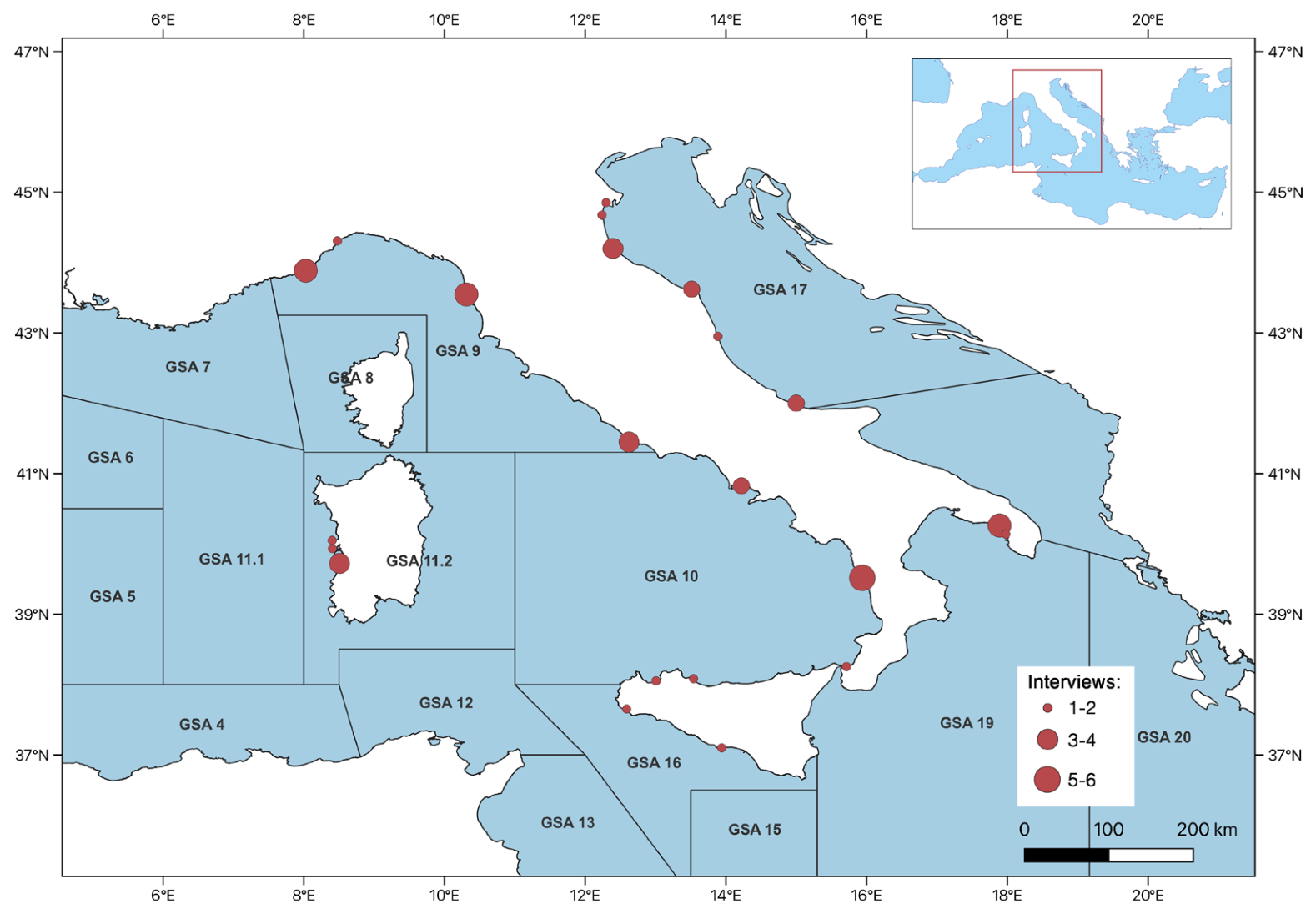
Data were collected through fisher interviews conducted in several strategic fishing ports across the Italian peninsula and the major islands of Sardinia and Sicily, with the aim of documenting fishers’ perceptions and ecological memory of chondrichthyan species. A total of 57 interviews were carried out across 22 fishing communities located in eleven Italian regions between 19 June 2020 and 18 November 2021. (Figure 1, Table 1). The number of interviews conducted at each site depended on the fishers’ availability and willingness to participate. The surveyed fishing communities fall within six Geographical Sub-Areas (GSAs) of the Mediterranean Sea as defined by the General Fisheries Commission for the Mediterranean (Resolution GFCM/33/2009/2; FAO, 1990–2021), namely GSA 9 (Ligurian and northern Tyrrhenian Sea), GSA 10 (central-southern Tyrrhenian Sea), GSA 11 (Sardinian waters), GSA 16 (southern Sicilian waters), GSA 17 (northern Adriatic Sea) and GSA 19 (western Ionian Sea) (Figure 1). In Sardinia, fishers operate across both GSA 11.1 and GSA 11.2, which are hereafter collectively referred to as GSA 11. Following previously published LEK studies on Mediterranean fisheries [17,18,19,25], a semi-structured questionnaire was developed to collect perception-based ecological information on chondrichthyan species reported by fishers during their fishing activities. To facilitate accurate species recognition, the questionnaire was accompanied by identification sheets illustrating the main shark, skate, and ray species occurring in the Mediterranean Sea. However, despite the use of visual aids, species identification remained dependent on fishers’ recognition abilities and may be subject to misidentification, particularly among morphologically similar taxa. The questionnaire consisted of 14 questions organized into three main thematic sections. The first section collected information on the fisher and fishing activity, including gear type, years of fishing experience, main fishing grounds, and number of fishing days per year. The second section focused on fishers’ reported encounters with chondrichthyan species and included questions on the most frequently captured species in the past and present, perceived size of captured individuals, catch frequency, seasonal patterns, and the condition of animals when landed (alive or dead). The final section addressed fishers’ perceptions of temporal changes in chondrichthyan catches, asking respondents whether catches were perceived as stable, increased, or decreased during their fishing careers, and inviting them to recall particularly memorable catches in terms of number of individuals or size. To facilitate comparison among responses, interviewers used a standardized legend to help fishers quantify catch frequency according to their fishing practices. All interviews were conducted directly at fishing ports or landing sites and were carried out in person. No personal data were collected from informants, and this component of the study did not require ethical approval.

2.2. Statistical Analyses

All statistical analyses were performed using RStudio software (version 2025.05.1+513) and the tidyverse suite for data manipulation and visualization. To characterize the study population, we calculated the mean, standard deviation, and range (minimum and maximum) of fishers’ professional experience (expressed as years of activity) and fishing effort (average days per year). The technological breadth of the sample was assessed by calculating the prevalence of different fishing gears (e.g., trawls, longlines, and entangling nets). Given the multi-gear nature of the fleet, these categories were treated as non-mutually exclusive variables to reflect the versatility of the respondents’ observations. To evaluate perceived changes in chondrichthyan species richness, we compared the number of species mentioned for two temporal categories: Past and Present. The Past category refers to the earlier phase of fishers’ careers, approximately corresponding to the first half of their fishing activity, whereas Present refers to the most recent phase at the time of the interview. These temporal categories therefore reflect perceived changes reconstructed through fishers’ experience rather than quantitatively measured temporal trends. These temporal categories were reconstructed from fishers’ recollections and were not associated with fixed calendar years. Consequently, the historical reference period varied among respondents according to the duration and timing of their fishing careers. This approach follows common practices in Local Ecological Knowledge studies, where long-term ecological changes are reconstructed using the experiential timeline of resource users [13,17]. Given that the interviewed fishers had an average fishing experience of 38.4 ± 11.7 years, these categories broadly reflect ecological conditions perceived by fishers across different phases of their careers. One interview was retained for the characterization of the surveyed population but excluded from species-based and temporal analyses because no species records were available for either temporal period; therefore, these analyses were performed on 56 interviews. Given the non-normal distribution of the richness data (verified via Shapiro–Wilk test), a Wilcoxon signed-rank test was employed. This non-parametric paired test was chosen to account for the dependent nature of the data, as each interviewee provided observations for both time periods (past and present). A faunistic inventory of reported taxa was compiled to document the taxonomic composition of the reports, following common approaches used in LEK-based fisheries studies [19,20]. For analytical purposes, records reported as Raja spp. and records identified to species level within the genus Raja were pooled and treated as Raja spp. To identify dominant taxa and assess their relative prominence within fishers’ ecological memory, we generated a frequency-based ranking of all species cited. For a subset of key indicator taxa (e.g., Squatina squatina, Prionace glauca, Raja spp.), we assessed the significance of reporting shifts using the McNemar test, which is specifically suited for paired binary data (presence/absence of a species within individual fishers’ reports). The geographical distribution of the records was analyzed by aggregating species richness and citation frequencies across Geographical Sub-Areas (GSAs) to identify potential regional hotspots and spatial patterns in ecological memory. Finally, to investigate the general perception of population trends, a Chi-square goodness-of-fit test was applied to the Decline (Yes/No) responses to determine if the distribution of opinions deviated significantly from an even split (50/50). Overall, all variables derived from interviews were treated as perception-based indicators, reflecting fishers’ subjective experiences and ecological memory rather than direct measurements of ecological conditions or biodiversity trends.

3. Results

3.1. Profile of the Interviewed Fishers

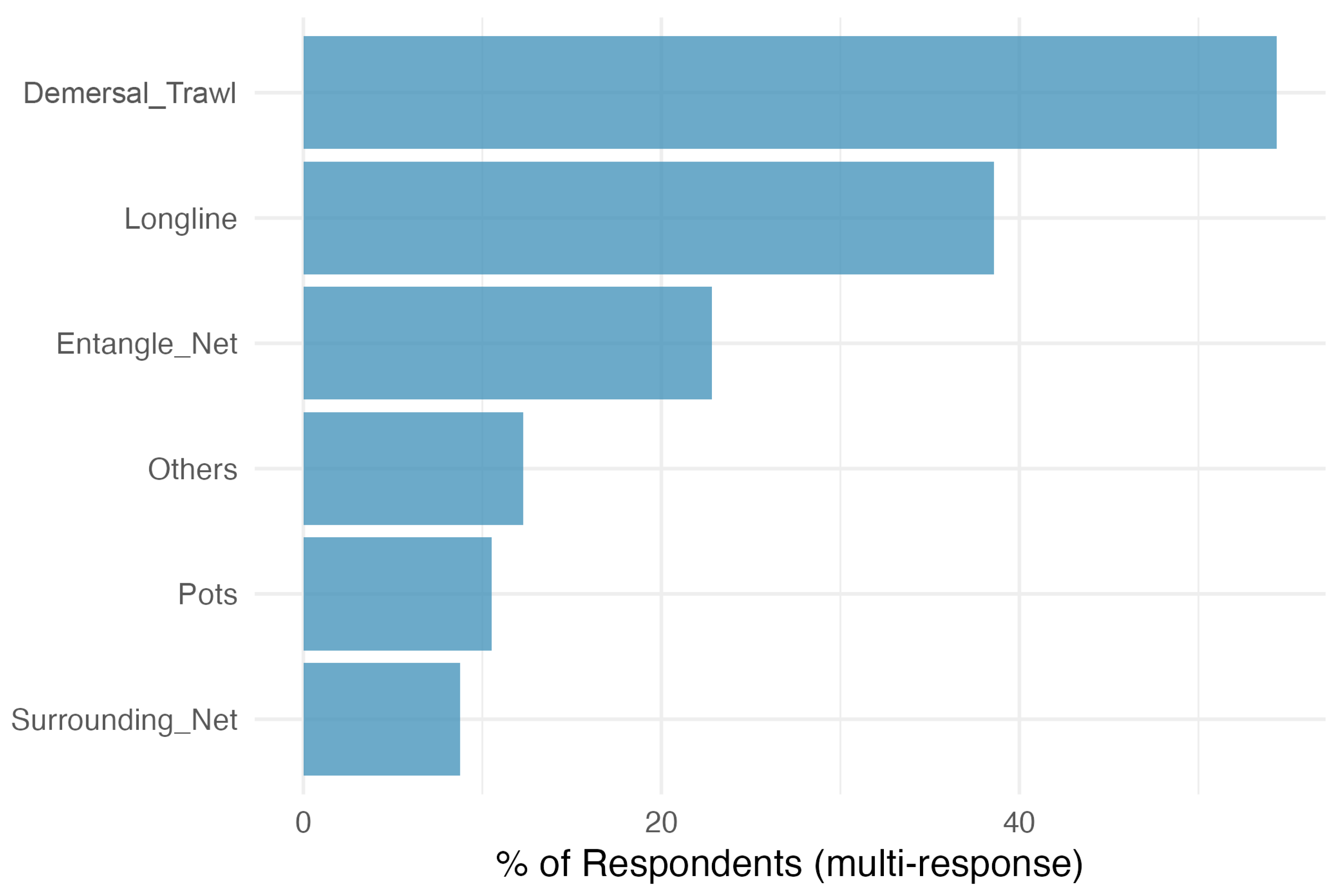
The surveyed population (N = 57) consisted of professional fishers with extensive ecological experience, with a mean fishing activity of 38.4 ± 11.7 (12–60) years. On average, respondents spent 169.2 ± 50.8 (100–300) days per year at sea. The fleet was primarily composed of vessels using demersal trawls (54.4% of respondents) and longlines (38.6%), followed by entangling nets (22.8%) (Figure 2). Because several fishers reported using multiple fishing gears, the sample represents a broad range of fishing strategies and habitats, increasing the likelihood of reporting encounters with different elasmobranch taxa.

3.2. Faunistic Composition

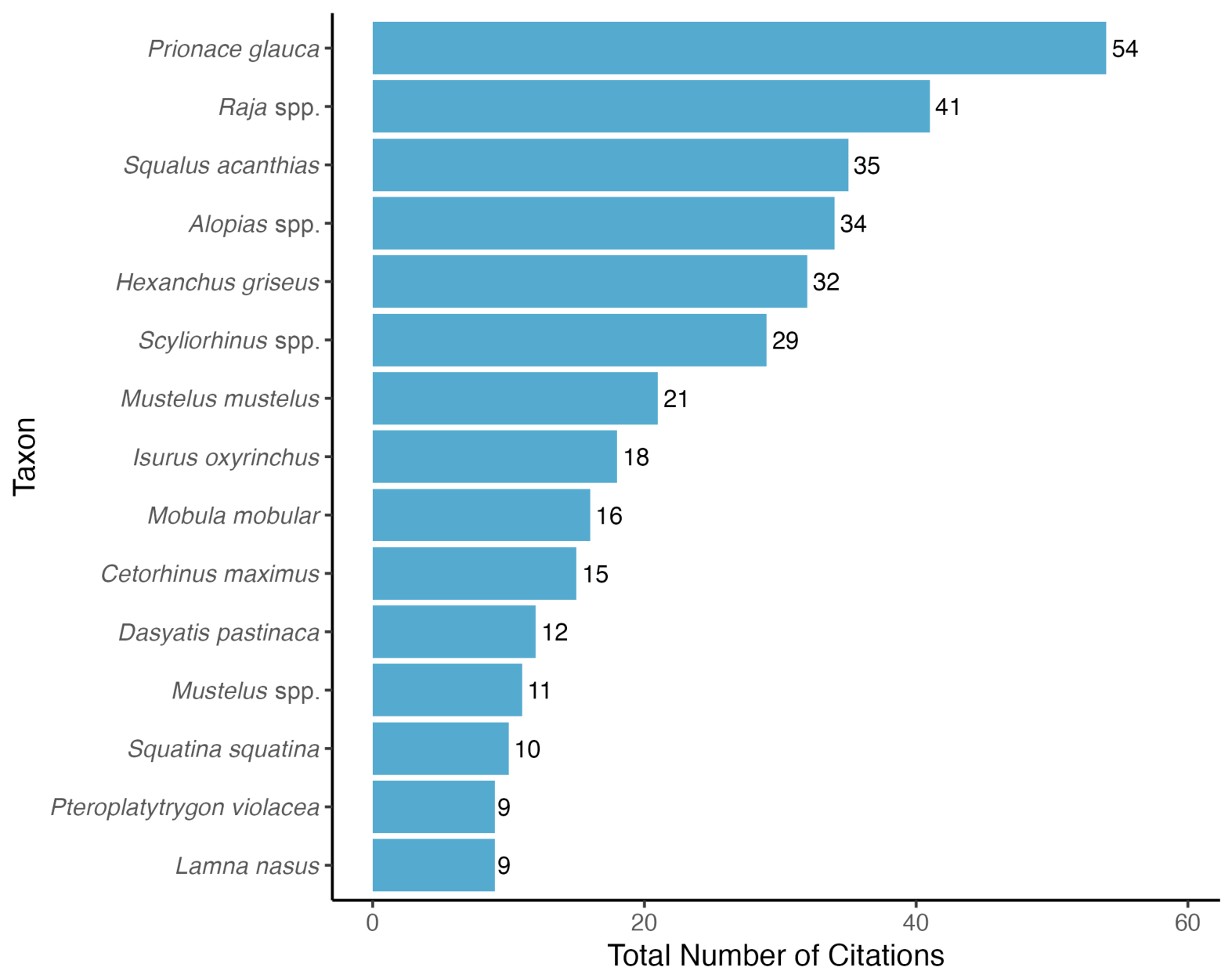
A total of 35 chondrichthyan taxa were reported by fishers across both temporal periods (Table 2), reflecting the broad taxonomic knowledge held by the local fishing community. These records represent the reference dataset used for subsequent analyses of perceived temporal changes in species richness and reporting patterns. The ranking of taxa based on the total number of citations highlights a small group of species that dominate fishers’ ecological memory in terms of citation frequency (Figure 3). The blue shark Prionace glauca was the most frequently reported taxon overall (n = 54), followed by Raja spp. (n = 41) and the spiny dogfish Squalus acanthias (n = 35). Other commonly reported taxa included Alopias spp. (n = 34) and the bluntnose sixgill shark Hexanchus griseus (n = 32). In contrast, taxa typically associated with historical presence, such as the angel shark Squatina squatina were reported less frequently (n = 10). Figure 3 shows the 15 taxa with the highest number of total citations.
In addition to the temporal comparison, the spatial distribution of reported taxa across Geographical Sub-Areas (GSAs) is summarized in Table A1. Reports of chondrichthyans were obtained across all sampled GSAs. The highest reported taxonomic richness was recorded in GSA 9 and GSA 17 (22 taxa each), followed by GSA 10 (18 taxa), GSA 16 (16 taxa), GSA 11 (14 taxa) and GSA 19 (13 taxa). Several taxa were reported across multiple GSAs, including Prionace glauca, Raja spp. and Alopias spp., which occurred in all sampled areas according to fishers’ reports. Conversely, some taxa were reported exclusively in a single GSA, such as Chimaera monstrosa, Heptranchias perlo and Somniosus rostratus in GSA 16, Carcharhinus plumbeus in GSA 11 and Galeus melastomus in GSA 9.

3.3. Temporal Changes in Perceived Species Richness and Reporting Patterns

When asked about general trends in chondrichthyan occurrence and catches, responses were heterogeneous among interviewees: 59.3% (n = 32) of fishers reported a perceived decline, while 40.7% (n = 22) did not perceive such a trend. A Chi-square goodness-of-fit test indicated that this distribution did not differ significantly from an even split (χ2 = 1.85, df = 1, p = 0.174).
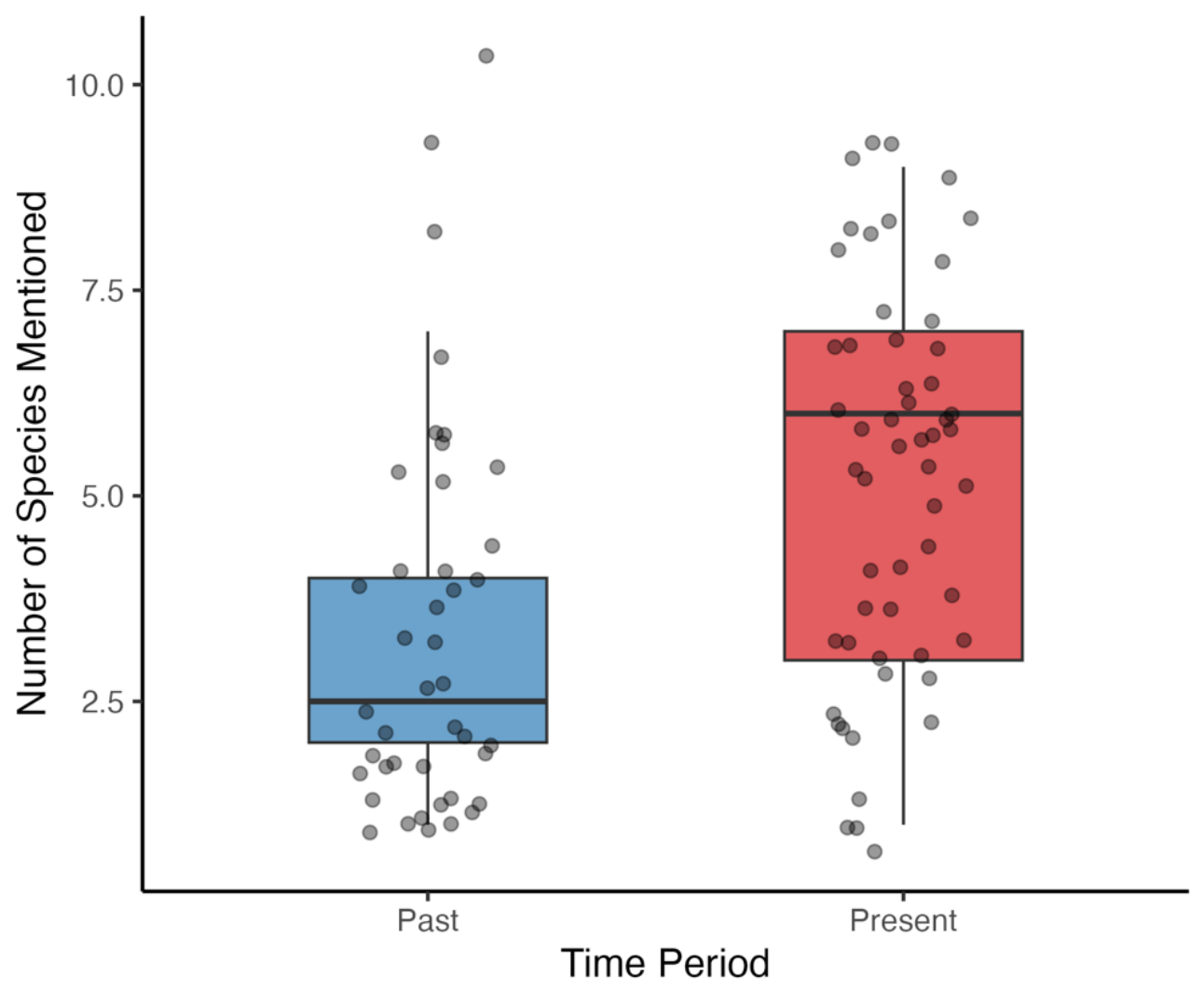
The analysis of interview data (n = 56, after excluding one interview without species records for either temporal period) indicated a significant temporal shift in the number of species reported by fishers (Wilcoxon signed-rank test: V = 129.5, p < 0.001). The average number of species reported for the present period (5.04 ± 2.42 SD) was more than twice the number reported for the historical period (2.48 ± 2.46 SD) (Figure 4).
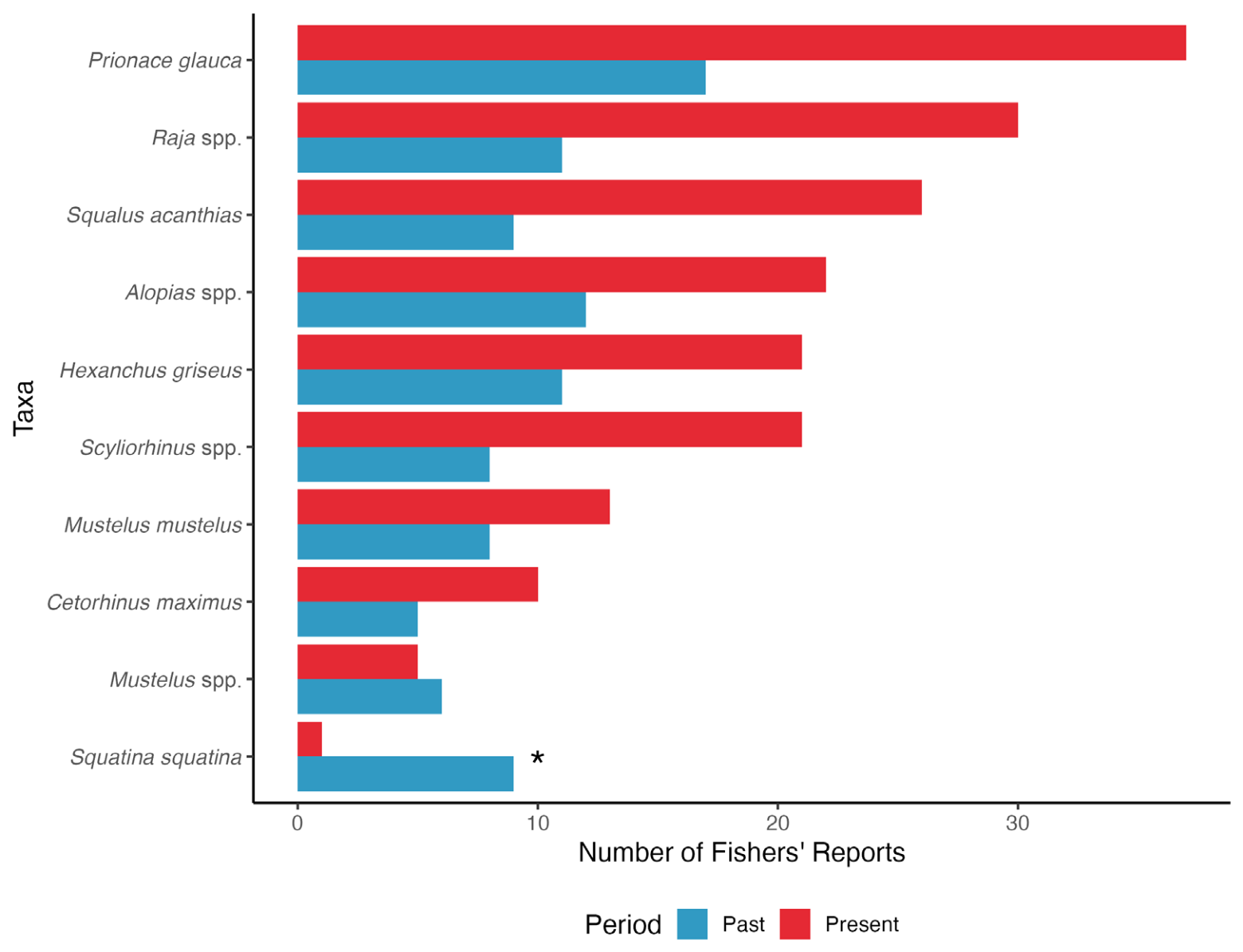
Significant shifts in reporting frequencies were also identified for several key taxa (McNemar test, p < 0.05). The most striking result concerns the angel shark (Squatina squatina), which was reported by 16% of fishers for the historical period (n = 9) but was almost absent from contemporary accounts (n = 1), indicating a statistically significant decrease in reporting frequency (p = 0.026). In contrast, several commonly reported species showed a marked increase in reporting frequency, including Prionace glauca and Raja spp., whose citations more than doubled compared to the historical period (Figure 5).
Taken together, these results indicate a marked shift in fishers’ reporting patterns and ecological memory between the two retrospective periods considered.

4. Discussion

The present study provides novel insights into fishers’ perceptions of long-term changes in the occurrence and reported composition of chondrichthyan taxa in Italian waters by integrating ecological knowledge with quantitative analyses of reporting patterns. Overall, the results highlight a marked shift in the composition of fishers’ ecological memory between historical and contemporary periods, suggesting substantial shifts in the perceived composition of chondrichthyan communities over time. These mechanisms are not mutually exclusive and cannot be disentangled quantitatively with the present dataset. Accordingly, the observed increase in the number of taxa reported in the present should be interpreted primarily as a perception-based shift rather than as evidence of a real increase in biodiversity.
One of the most striking findings is the apparent increase in the number of species reported in the present compared to the past. At first glance, this pattern may appear inconsistent with the well-documented decline of chondrichthyan populations in the Mediterranean Sea [10]. However, this apparent contradiction is best interpreted as a shift in perception rather than a real increase in biodiversity. Several non-mutually exclusive mechanisms may explain this pattern. First, the shifting baseline syndrome [38] may lead fishers to normalize progressively depleted conditions, thereby compressing their perception of past biodiversity. Second, changes in detectability may play a key role, as technological advancements (e.g., improved gear efficiency, navigation systems and fishing strategies) have increased the probability of encountering and recognizing a wider range of species. Third, changes in fishing practices and spatial effort over time may have expanded the range of habitats exploited, exposing fishers to taxa that were previously less frequently encountered. Finally, increased taxonomic awareness, facilitated by identification guides, regulatory frameworks and interactions with scientific communities, may have improved species recognition compared to the past.
As a result, fishers’ recollections of the past tend to be dominated by particularly abundant or memorable species, whereas contemporary observations reflect a broader but more fragmented set of encounters. Similar patterns have been described in other LEK-based studies [17,20,24]. The species-level analyses further support this interpretation. While some taxa showed increased reporting frequencies in the present (e.g., Prionace glauca, Raja spp.), others exhibited clear declines, most notably Squatina squatina, which was almost absent from contemporary accounts. This pattern is consistent with the broader decline of angel sharks in the Mediterranean, where they are now considered among the most threatened elasmobranchs due to historical overexploitation and habitat degradation [10,39]. The contrasting trends observed among taxa suggest that current assemblages may be increasingly dominated by species that are either more resilient to fishing pressure or more frequently encountered as bycatch.
Importantly, several of the taxa most frequently reported by fishers in the present are currently classified as threatened in the Mediterranean Sea, including Prionace glauca (Critically Endangered), Squalus acanthias (Endangered) and Alopias spp. (Endangered). This apparent mismatch between perceived commonness and conservation status represents a key finding of this study. Rather than indicating healthy populations, the frequent reporting of these species likely reflects their continued, but reduced, presence within heavily exploited ecosystems. In other words, these taxa may represent residual populations that persist despite long-term declines, a pattern that has been widely documented for Mediterranean chondrichthyans [10].
This interpretation is further supported by the anecdotal information provided by fishers regarding their best catches, defined as the highest number of individuals captured in a single fishing day and the largest specimens observed. These accounts, reported across different Geographical Sub-Areas (GSAs), suggest historically high numbers of captured individuals and the occurrence of very large specimens. For instance, in GSA 9, fishers recalled catches of approximately 90 Scyliorhinus spp., 50 Mustelus spp. and up to 100 Prionace glauca, alongside large specimens such as Hexanchus griseus reaching ~6 m, Carcharodon carcharias of ~3 m and 220 kg, and Alopias spp. of ~300 kg. In GSA 10, reports included up to 200 Scyliorhinus spp., 200 Mustelus spp. and 100 Squalus acanthias, as well as large pelagic species such as Cetorhinus maximus (~10 m), Carcharodon carcharias (~5 m) and Alopias spp. (~500 kg). Notably, in GSA 11, fishers also reported the occurrence of Carcharodon carcharias (~500 kg), together with abundant Squalus acanthias. In GSA 16 and GSA 17, fishers described extremely high catches, including up to 1000 kg of Mustelus spp., 1000 individuals of Raja spp., and up to 5000 individuals of Squalus acanthias, alongside large-bodied predators such as Hexanchus griseus (~4 m), Prionace glauca (~3 m) and Alopias spp. (~4 m). Although inherently qualitative, these accounts provide useful insights into past ecological baselines and are consistent with fishers’ perceptions of historically more frequent encounters and larger individuals; however, they should not be interpreted as standardized estimates of historical population size [40,41].
The spatial patterns observed across GSAs further reinforce the complexity of these dynamics. However, they should also be interpreted in light of uneven interview effort among areas and potential differences in fishing practices, target assemblages, and habitats used by respondents.
Despite its strengths, the LEK approach also presents several limitations that must be acknowledged. Information derived from interviews is subject to recall bias, shifting baselines, and individual perception, which may influence how past conditions are remembered and reported [35,38,42]. In addition, fishers may disproportionately report species that are more conspicuous, economically relevant, or problematic for fishing activities, potentially underrepresenting less noticeable taxa. Species misidentification cannot be excluded, particularly for morphologically similar taxa or species with low commercial relevance. For example, records attributed to Rhinobatos rhinobatos may have included occasional confusion with Glaucostegus cemiculus, given the morphological similarity between these taxa and the retrospective nature of interview-based data collection. Furthermore, the opportunistic nature of the sampling design and the heterogeneity of fishing gears and fishing grounds among respondents may also have influenced species detectability and reporting patterns. Moreover, the multi-gear nature of many fishing activities prevented the attribution of species reports to specific fishing gears. Because interview responses were based on long-term recollections rather than gear-specific catch records, it was not possible to reliably reconstruct historical species–gear associations or evaluate potential changes in gear use through time. Consequently, gear selectivity remains an additional source of uncertainty when interpreting perceived temporal changes. In addition, because fishers entered the profession in different decades, the historical reference period represented by the “Past” category was not identical among respondents. Consequently, temporal comparisons should be interpreted as contrasts between perceived historical and contemporary conditions rather than standardized comparisons among fixed time periods. Moreover, the findings reflect the ecological perceptions of fishers operating in Italian waters and should not be directly extrapolated to the entire Mediterranean basin, where ecological conditions, fishing pressure, species distributions and historical baselines may differ substantially among regions. These limitations highlight the importance of integrating LEK with independent data sources, such as fisheries statistics, scientific surveys, and conservation assessments, to obtain a more comprehensive understanding of ecological change.
When interpreted within this broader framework, the results of this study are consistent with existing evidence indicating long-term declines of chondrichthyan populations in the Mediterranean Sea, driven primarily by fishing pressure, bycatch and habitat degradation [10,11,43]. The persistence of threatened species in fishers’ accounts should therefore not be interpreted as a sign of recovery, but rather as an indication of the last detectable components of populations that have undergone significant reductions.
Overall, this study demonstrates that fishers’ ecological knowledge can provide valuable insights into historical baselines and contemporary reporting patterns in data-poor systems. However, the integration of LEK with conservation science also reveals that apparent stability, or even increases, in perceived species richness may mask underlying declines and compositional shifts. Explicitly accounting for perception-based biases will therefore be essential for interpreting long-term ecological change and for supporting effective conservation and management strategies for chondrichthyans in Italian waters and, more broadly, for Mediterranean populations when interpreted alongside region-specific ecological information.

5. Conclusions

Fishers’ ecological knowledge provided valuable insights into perceived long-term changes in Mediterranean chondrichthyan communities and highlighted substantial shifts in reporting patterns between historical and contemporary periods. The apparent increase in the number of taxa reported in the present is unlikely to reflect a real increase in biodiversity, but rather a perception-based shift influenced by processes such as shifting baselines, changes in detectability, evolving fishing practices, and improved taxonomic awareness. At the same time, the decline of historically important taxa, together with anecdotal recollections of exceptionally large catches and individuals, remains consistent with the broader historical depletion of Mediterranean chondrichthyan populations. These findings emphasize the importance of interpreting LEK within its socio-ecological and cognitive context and support its use as a complementary tool for reconstructing ecological change in data-poor marine systems.

Author Contributions

Conceptualization, M.B. and E.S.; methodology, F.L.L., M.B., and E.S.; formal analysis, F.L.L.; investigation, F.L.L., G.G. and E.S.; resources, M.B. and E.S.; data curation, F.L.L. and G.G.; writing—original draft preparation, F.L.L.; writing—review and editing, F.L.L., G.G., M.B. and E.S.; supervision, M.B. and E.S.; funding acquisition, M.B. and E.S. All authors have read and agreed to the published version of the manuscript.

Funding

F.L.L. was supported by a Ph.D. grant co-funded by the University of Calabria and the Stazione Zoologica Anton Dohrn.

Institutional Review Board Statement

Not applicable.

Informed Consent Statement

All fishermen involved in the survey were informed about the aims and procedures of the study prior to the interviews, and verbal informed consent was obtained from all participants before data collection. No written informed consent form was used, as the survey did not involve sensitive personal data, and no personal or identifiable information was recorded during the interviews. Participation was entirely voluntary and anonymous.

Data Availability Statement

The data that support the findings of this study are available from the corresponding author (F.L.L.) upon reasonable request.

Acknowledgments

The authors are very grateful to all fishermen who contributed to the present work. This study was part of the Ph.D. project of F.L.L. This research was also partially supported and carried out in the framework of the LIFE ELIFE Project-Elasmobranchs Low-Impact Fishing Experience (LIFE18 NAT/IT/000846), funded by the contribution of the LIFE financial instrument of the European Community. It does not necessarily reflect the European Commission’s views and in no way anticipates future policy. This support is greatly acknowledged. GenAI tools were only used to support language editing and text refinement. The authors have reviewed and edited the output and take full responsibility for the content of this publication.

Conflicts of Interest

The authors declare no conflicts of interest.

Appendix A

Table A1. Number of fishers reporting each elasmobranch taxon across the sampled Geographical Sub-Areas (GSAs) based on interview data.
TaxonGSA
91011161719
Aetomylaeus bovinus201010
Alopias spp.1054282
Alopias vulpinus000010
Carcharhinus plumbeus002000
Carcharodon carcharias121010
Cetorhinus maximus230181
Chimaera monstrosa000100
Dasyatis pastinaca422020
Etmopterus spinax010000
Galeorhinus galeus021100
Galeus melastomus200000
Heptranchias perlo000100
Hexanchus griseus1180241
Isurus oxyrinchus680101
Lamna nasus220023
Mobula mobular640123
Mustelus asterias100020
Mustelus mustelus7000100
Mustelus punctulatus000010
Mustelus spp.060310
Myliobatis aquila003001
Prionace glauca10104285
Pteroplatytrygon violacea100051
Raja clavata000021
Raja spp.1343462
Rhinobatos rhinobatos110203
Scyliorhinus canicula203030
Scyliorhinus spp.5111150
Scyliorhinus stellaris600010
Somniosus rostratus000100
Sphyrna spp.010000
Squalus acanthias881380
Squatina squatina141310
Torpedo spp.102002

References

  1. Chin, A.; Pecl, G. Citizen Science in Shark and Ray Research and Conservation: Strengths, Opportunities, Considerations and Pitfalls; Carrier, J.C., Heithaus, M.R., Simpfendorfer, C.A., Eds.; CRC Press: Boca Raton, FL, USA, 2018; pp. 299–317. ISBN 978-1-138-03292-7. [Google Scholar]
  2. Bargnesi, F.; Lucrezi, S.; Ferretti, F. Opportunities from Citizen Science for Shark Conservation, with a Focus on the Mediterranean Sea. Eur. Zool. J. 2020, 87, 20–34. [Google Scholar]
  3. Heupel, M.R.; Papastamatiou, Y.P.; Espinoza, M.; Green, M.E.; Simpfendorfer, C.A. Reef Shark Science—Key Questions and Future Directions. Front. Mar. Sci. 2019, 6, 12. [Google Scholar]
  4. Abudaya, M.; Ulman, A.; Salah, J.; Fernando, D.; Wor, C.; Notarbartolo di Sciara, G. Speak of the Devil Ray (Mobula mobular) Fishery in Gaza. Rev. Fish Biol. Fish. 2018, 28, 229–239. [Google Scholar] [CrossRef]
  5. Barash, A.; Pickholtz, R.; Pickholtz, E.; Blaustein, L.; Rilov, G. Seasonal Aggregations of Sharks near Coastal Power Plants in Israel: An Emerging Phenomenon. Mar. Ecol. Prog. Ser. 2018, 590, 145–154. [Google Scholar] [CrossRef]
  6. Chaikin, S.; Belmaker, J.; Barash, A. Coastal Breeding Aggregations of Threatened Stingrays and Guitarfish in the Levant. Aquat. Conserv. Mar. Freshw. Ecosyst. 2020, 30, 1160–1171. [Google Scholar] [CrossRef]
  7. Jacoby, D.; Croft, D.; Sims, D. Social Behaviour in Sharks and Rays: Analysis, Patterns and Implications for Conservation. Fish Fish. 2011, 13, 399–417. [Google Scholar] [CrossRef]
  8. Chapman, D.; Feldheim, K.; Papastamatiou, Y.; Hueter, R. There and Back Again: A Review of Residency and Return Migrations in Sharks, with Implications for Population Structure and Management. Annu. Rev. Mar. Sci. 2014, 7, 547–570. [Google Scholar]
  9. Braccini, M.; Aires-da-Silva, A.; Taylor, I. Incorporating Movement in the Modelling of Shark and Ray Population Dynamics: Approaches and Management Implications. Rev. Fish Biol. Fish. 2015, 26, 13–24. [Google Scholar] [CrossRef]
  10. Dulvy, N.K.; Pacoureau, N.; Rigby, C.L.; Pollom, R.A.; Jabado, R.W.; Ebert, D.A.; Finucci, B.; Pollock, C.M.; Cheok, J.; Derrick, D.H.; et al. Overfishing Drives over One-Third of All Sharks and Rays toward a Global Extinction Crisis. Curr. Biol. 2021, 31, 4773–4787.e8. [Google Scholar] [CrossRef]
  11. Ferretti, F.; Osio, G.; Jenkins, C.; Rosenberg, A.; Lotze, H. Long-Term Change in a Meso-Predator Community in Response to Prolonged and Heterogeneous Human Impact. Sci. Rep. 2013, 31, 1057. [Google Scholar]
  12. Leonetti, F.L.; Sperone, E.; Travaglini, A.; Mojetta, A.; Signore, M.; Psomadakis, P.; Dinkel, T.; Bottaro, M. Filling the Gap and Improving Conservation: How IUCN Red Lists and Historical Scientific Data Can Shed More Light on Threatened Sharks in the Italian Seas. Diversity 2020, 12, 389. [Google Scholar] [CrossRef]
  13. Huntington, H. Using Traditional Ecological Knowledge in Science: Methods and Applications. Ecol. Appl. 2000, 10, 1270–1274. [Google Scholar] [CrossRef]
  14. Anadón, J.; Giménez, A.; Ballestar, R.; Pérez Ibarra, I. Evaluation of Local Ecological Knowledge as a Method for Collecting Extensive Data on Animal Abundance. Conserv. Biol. J. Soc. Conserv. Biol. 2009, 23, 617–625. [Google Scholar] [CrossRef]
  15. Albuquerque, U.; Ludwig, D.; Feitosa, I.; Moura, J.; Gonçalves, P.; Henriques da Silva, R.; Silva, T.; Gonçalves-Souza, T.; Ferreira Júnior, W. Integrating Traditional Ecological Knowledge into Academic Research at Local and Global Scales. Reg. Environ. Change 2021, 21, 45. [Google Scholar] [CrossRef]
  16. Leonetti, F.L.; Giglio, G.; Valerioti, C.; Gatto, R.; Corti, C.; Sperone, E. Hermann’s Tortoise in Calabria: Filling Key Knowledge Gaps in a Western Mediterranean Evolutionary Hotspot. Curr. Zool. 2026, zoag006. [Google Scholar] [CrossRef]
  17. Azzurro, E.; Moschella, P.; Maynou, F. Tracking Signals of Change in Mediterranean Fish Diversity Based on Local Ecological Knowledge. PLoS ONE 2011, 6, e24885. [Google Scholar] [CrossRef]
  18. Azzurro, E.; Sbragaglia, V.; Cerri, J.; Bariche, M.; Bolognini, L.; Ben Souissi, J.; Busoni, G.; Coco, S.; Chryssanthi, A.; Fanelli, E.; et al. Climate Change, Biological Invasions, and the Shifting Distribution of Mediterranean Fishes: A Large-Scale Survey Based on Local Ecological Knowledge. Glob. Change Biol. 2019, 25, 2779–2792. [Google Scholar] [CrossRef] [PubMed]
  19. Maynou, F.; Sbrana, M.; Sartor, P.; Maravelias, C.; Kavadas, S.; Damalas, D.; Cartes, J.E.; Osio, G. Estimating Trends of Population Decline in Long-Lived Marine Species in the Mediterranean Sea Based on Fishers’ Perceptions. PLoS ONE 2011, 6, e21818. [Google Scholar] [CrossRef]
  20. Fortibuoni, T.; Borme, D.; Franceschini, G.; Giovanardi, O.; Raicevich, S. Common, Rare or Extirpated? Shifting Baselines for Common Angelshark, Squatina squatina (Elasmobranchii:Squatinidae), in the Northern Adriatic Sea (Mediterranean Sea). Hydrobiologia 2016, 772, 247–259. [Google Scholar] [CrossRef]
  21. Bastari, A.; Beccacece, J.; Ferretti, F.; Micheli, F.; Cerrano, C. Local Ecological Knowledge Indicates Temporal Trends of Benthic Invertebrates Species of the Adriatic Sea. Front. Mar. Sci. 2017, 4, 157. [Google Scholar] [CrossRef]
  22. Peñaherrera-Palma, C.; van Putten, I.; Karpievitch, Y.V.; Frusher, S.; Llerena-Martillo, Y.; Hearn, A.R.; Semmens, J.M. Evaluating Abundance Trends of Iconic Species Using Local Ecological Knowledge. Biol. Conserv. 2018, 225, 197–207. [Google Scholar] [CrossRef]
  23. Taylor, S.M.; Braccini, J.M.; Bruce, B.D.; McAuley, R.B. Reconstructing Western Australian White Shark (Carcharodon carcharias) Catches Based on Interviews with Fishers. Mar. Freshw. Res. 2017, 69, 366–375. [Google Scholar] [CrossRef]
  24. Colloca, F.; Carrozzi, V.; Simonetti, A.; Di Lorenzo, M. Using Local Ecological Knowledge of Fishers to Reconstruct Abundance Trends of Elasmobranch Populations in the Strait of Sicily. Front. Mar. Sci. 2020, 7, 508. [Google Scholar] [CrossRef]
  25. Barbato, M.; Barría, C.; Bellodi, A.; Bonanomi, S.; Borme, D.; Ćetković, I.; Colloca, F.; Colmenero, A.; Crocetta, F.; De Carlo, F.; et al. The Use of Fishers’ Local Ecological Knowledge to Reconstruct Fish Behavioural Traits and Fishers’ Perception of the Conservation Relevance of Elasmobranchs in the Mediterranean Sea. Mediterr. Mar. Sci. 2021, 22, 603–622. [Google Scholar] [CrossRef]
  26. Maggio, T.; Perzia, P.; Falautano, M.; Visconti, G.; Castriota, L. From LEK to LAB: The Case of the Blue Crab Portunus Segnis in the Pelagie Islands Marine Protected Area, Central Mediterranean Sea. Ocean Coast. Manag. 2022, 219, 106043. [Google Scholar] [CrossRef]
  27. Colin, P.; Sadovy, Y.; Domeier, M. Manual for the Study and Conservation of Reef Fish Spawning Aggregations; Society for the Conservation of Reef Fish Aggregations Special Publication: Fallbrook, CA, USA, 2003; Volume 1. [Google Scholar]
  28. Moreno, G.; Dagorn, L.; Sancho, G.; Itano, D. Fish Behaviour from Fishers’ Knowledge: The Case Study of Tropical Tuna around Drifting Fish Aggregating Devices (DFADs). Can. J. Fish. Aquat. Sci. 2007, 64, 1517–1528. [Google Scholar] [CrossRef]
  29. Gerhardinger, L.; Hostim-Silva, M.; Medeiros, R.; Matarezi, J.; Bertoncini, Á.; Freitas, M.; Ferreira, B. Fishers’ Resource Mapping and Goliath Grouper Epinephelus itajara (Serranidae) Conservation in Brazil. Neotrop. Ichthyol. 2009, 7, 93–102. [Google Scholar] [CrossRef]
  30. Begossi, A. Local Knowledge and Training towards Management. Environ. Dev. Sustain. 2008, 10, 591–603. [Google Scholar] [CrossRef]
  31. Begossi, A.; Salyvonchyk, S.; Glamuzina, B.; de Souza, S.P.; Lopes, P.F.M.; Priolli, R.H.G.; do Prado, D.O.; Ramires, M.; Clauzet, M.; Zapelini, C.; et al. Fishers and Groupers (Epinephelus marginatus and E. morio) in the Coast of Brazil: Integrating Information for Conservation. J. Ethnobiol. Ethnomed. 2019, 15, 53. [Google Scholar] [CrossRef]
  32. Casey, J.M.; Myers, R.A. Near Extinction of a Large, Widely Distributed Fish. Science 1998, 281, 690–692. [Google Scholar] [CrossRef] [PubMed]
  33. Morgan, A.; Burgess, G. Fishery-Dependent Sampling: Total Catch, Effort and Catch Composition. Manag. Tech. Elasmobranch Fish. 2005, 474, 182–200. [Google Scholar]
  34. Carpentieri, P.; Nastasi, A.; Sessa, M.; Srour, A. Incidental Catch of Vulnerable Species in Mediterranean and Black Sea Fisheries—A Review; FAO: Rome, Italy, 2021; ISBN 978-92-5-134631-0. [Google Scholar]
  35. Hind, E.J. A Review of the Past, the Present, and the Future of Fishers’ Knowledge Research: A Challenge to Established Fisheries Science. ICES J. Mar. Sci. 2015, 72, 341–358. [Google Scholar] [CrossRef]
  36. Leonetti, F.L.; Bottaro, M.; Giglio, G.; Sperone, E. Studying Chondrichthyans Using Baited Remote Underwater Video Systems: A Review. Animals 2024, 14, 1875. [Google Scholar] [CrossRef]
  37. Berkström, C.; Papadopoulos, M.; Jiddawi, N.; Nordlund, L. Fishers’ Local Ecological Knowledge (LEK) on Connectivity and Seascape Management. Front. Mar. Sci. 2019, 6, 130. [Google Scholar] [CrossRef]
  38. Pauly, D. Anecdotes and the Shifting Baseline Syndrome of Fisheries. Trends Ecol. Evol. 1995, 10, 430. [Google Scholar] [CrossRef] [PubMed]
  39. Dulvy, N.; Allen, D.; Ralph, G.; Walls, R. The Conservation Status of Sharks, Rays and Chimaeras in the Mediterranean Sea; IUCN: Gland, Switzerland, 2016. [Google Scholar]
  40. McClenachan, L.; Cooper, A.B.; McKenzie, M.G.; Drew, J.A. The Importance of Surprising Results and Best Practices in Historical Ecology. BioScience 2015, 65, 932–939. [Google Scholar] [CrossRef]
  41. Sáenz-Arroyo, A.; Roberts, C.; Torre, J.; Cariño, M.; Enriquez Andrade, R. Rapidly Shifting Environmental Baselines among Fishers of the Gulf of California. Proc. Biol. Sci. 2005, 272, 1957–1962. [Google Scholar]
  42. Johannes, R.; Freeman, M.; Hamilton, R. Ignore Fishers’ Knowledge and Miss the Boat. Fish Fish. 2008, 1, 257–271. [Google Scholar]
  43. Colloca, F.; Enea, M.; Ragonese, S.; Di Lorenzo, M. A Century of Fishery Data Documenting the Collapse of Smooth-Hounds (Mustelus spp.) in the Mediterranean Sea. Aquat. Conserv. Mar. Freshw. Ecosyst. 2017, 27, 1145–1155. [Google Scholar]
Figure 1. Geographic distribution of fisher interviews conducted across Italian fishing harbours. Circle size indicates the number of interviews conducted at each location. The inset shows the position of the study area within the Mediterranean Sea, with the red frame indicating the extent of the main map.
Fishes 11 00345 g001
Figure 2. Composition of fishing gears used by the interviewed fishers. Percentages represent the proportion of respondents reporting each gear type; multiple responses were allowed.
Fishes 11 00345 g002
Figure 3. Ranking of the 15 most frequently reported elasmobranch taxa based on the total number of citations provided by fishers across both temporal periods (Past and Present). Bars indicate the cumulative number of reports per taxon.
Fishes 11 00345 g003
Figure 4. Comparison of perceived elasmobranch species richness between Past and Present periods. Boxplots represent the number of taxa reported by each interviewee, showing median, interquartile range (IQR), and whiskers extending to 1.5 × IQR. Individual reports are displayed as jittered points.
Fishes 11 00345 g004
Figure 5. Number of fishers reporting selected elasmobranch taxa in the Past (blue) and Present (red) periods. The asterisk indicates a significant change in reporting frequency (Squatina squatina, McNemar test, p = 0.026).
Fishes 11 00345 g005
Table 1. Distribution of Fisher interviews across Italian fishing harbours included in the study. The table reports the number of interviews conducted in each harbour and the corresponding Italian region.
Italian RegionHarbourNumber of Interviews
SardegnaMarceddì4
SardegnaSu Pallosu1
SardegnaCabras1
PugliaPorto Cesareo5
PugliaSanta Caterina di Nardò1
CampaniaMergellina3
LazioAnzio4
MarcheAncona3
MarcheSan Benedetto del Tronto2
MoliseTermoli3
ToscanaLivorno5
CalabriaCetraro6
CalabriaScilla1
SiciliaLicata2
SiciliaMazara del Vallo2
SiciliaBalestrate1
SiciliaPorticello1
Emilia-RomagnaCesenatico4
Emilia-RomagnaPorto Garibaldi1
Emilia-RomagnaGoro1
LiguriaImperia5
LiguriaSavona1
Table 2. Number of interviewed fishers reporting each elasmobranch taxon in the historical (“Past”) and contemporary (“Present”) periods based on interview data (n = 56). Taxa are ordered by decreasing overall reporting frequency.
TaxonPastPresent
Prionace glauca (Linnaeus, 1758)1737
Raja spp. (Linnaeus, 1758)1130
Squalus acanthias (Linnaeus, 1758)926
Alopias spp. (Rafinesque, 1810)1222
Hexanchus griseus (Bonnaterre, 1788)1121
Scyliorhinus spp. (Blainville, 1816)821
Isurus oxyrinchus (Rafinesque, 1810)315
Mustelus mustelus (Linnaeus, 1758)813
Mobula mobular (Bonnaterre, 1788)313
Cetorhinus maximus (Gunnerus, 1765)510
Dasyatis Pastinaca (Linnaeus, 1758)210
Scyliorhinus canicular (Linnaeus, 1758)18
Scyliorhinus stellaris (Linnaeus, 1758)27
Pteroplatytrygon violacea (Bonaparte, 1832)36
Mustelus spp. (Linck, 1790)65
Lamna nasus (Bonnaterre, 1788)45
Torpedo spp. (Duméril, 1806)45
Rhinobatos rhinobatos (Linnaeus, 1758)54
Myliobatis aquila (Linnaeus, 1758)23
Aetomylaeus bovinus (Geoffroy Saint-Hilaire, 1817)13
Galeorhinus galeus (Linnaeus, 1758)13
Mustelus asterias (Cloquet, 1821)13
Raja clavate (Linnaeus, 1758)13
Carcharodon carcharias (Linnaeus, 1758)32
Galeus melastomus (Rafinesque, 1810)12
Squatina squatina (Linnaeus, 1758)91
Mustelus punctulatus (Risso, 1827)11
Alopias vulpinus (Bonnaterre, 1788)01
Chimaera monstrosa (Linnaeus, 1758)01
Etmopterus spinax (Linnaeus, 1758)01
Carcharhinus plumbeus (Nardo, 1827)20
Heptranchias perlo (Bonnaterre, 1788)10
Somniosus rostratus (Risso, 1827)10
Sphyrna spp. (Rafinesque, 1810)10
Disclaimer/Publisher’s Note: The statements, opinions and data contained in all publications are solely those of the individual author(s) and contributor(s) and not of MDPI and/or the editor(s). MDPI and/or the editor(s) disclaim responsibility for any injury to people or property resulting from any ideas, methods, instructions or products referred to in the content.