Article

Biochemical Properties of Collagen from Four Flatfish Species in Cold Area: In Relation to Physiological Temperature and Amino Acid Composition


Faculty of Agriculture and Marine Science, Kochi University, Monobe 200, Nankoku 783-8502, Kochi, Japan
*
Author to whom correspondence should be addressed.
Fishes 2026, 11(5), 287; https://doi.org/10.3390/fishes11050287
Submission received: 7 April 2026 / Revised: 6 May 2026 / Accepted: 7 May 2026 / Published: 12 May 2026
(This article belongs to the Section Processing and Comprehensive Utilization of Fishery Products)

Abstract

Collagen (ASC) was purified from four flatfish species (Greenland halibut, blackfin flounder, stone flounder, and slime flounder) collected from a cold area in Japan to investigate their biochemical properties. Sodium dodecyl sulfate–polyacrylamide gel electrophoresis pattern, Fourier transform infrared spectroscopy, and circular dichroism analysis revealed the typical structure of type I collagen. The denaturation temperature (Td) of ASC positively correlated with the physiological temperature (Tp) using previously reported data, which were obtained from fish (a total of 32 species). In this study, the lowest hydroxyproline (Hyp)/Pro/imino acid (Pro + Hyp) content was observed in Greenland halibut ASC (Tp is lowest), whereas the highest Ser content was observed in slime flounder ASC (Tp is highest). Using the data obtained from a previous study, a positive/negative correlation could be found between Td and Hyp/Ser, which is consistent with our previous reports. The Pro content in the present data followed the pattern of Hyp but exceeded the value predicted from Td by approximately 30 residues. These results may suggest that the collagen extracted from four flatfish in the cold area adopted decreasing imino acid content and increasing serine content for their adaptation.
Key Contribution: The undenatured ASCs from four flatfish revealed a positive correlation between Tp and Td, which is supported by the contribution of amino acids, thereby highlighting a conserved mechanism of thermal adaptation in fish collagen. Notably, Pro content exceeded Td-based predictions by approximately 30 residues, indicating a distinctive feature of flounder collagen, which may represent a novel aspect of cold adaptation.

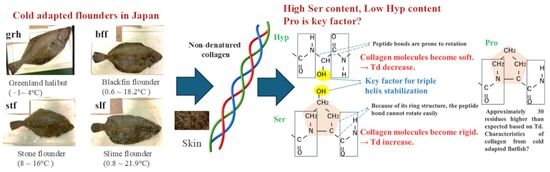
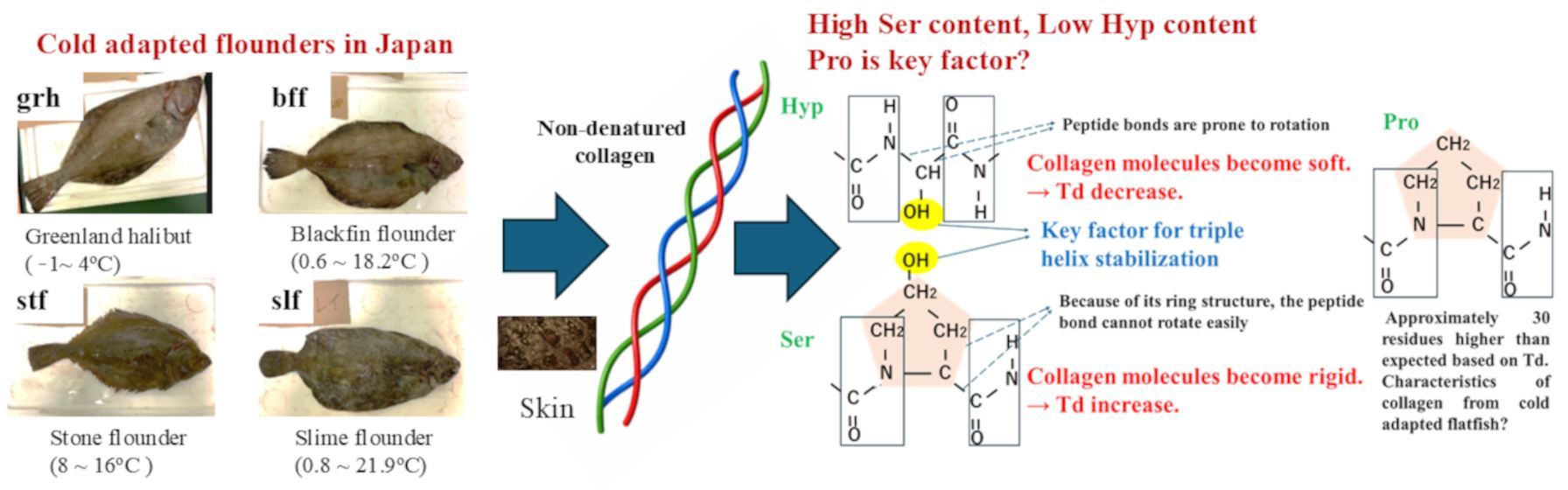
Graphical Abstract

1. Introduction

The flatfish order Pleuronectiformes is an important fishery resource, of which the most distinctive feature is its body asymmetry, with both eyes located on the same side in adults. It evolved from a bilaterally symmetrical ray-finned fish ancestor (a group closely related to Perciformes) [1,2]. In addition, many species within this group inhabit low-temperature waters. Discussions regarding adaptations to low temperatures have focused on metabolism, cell membrane fluidity, and the presence of antifreeze proteins, but many aspects remain unclear [3,4,5,6].
Collagen is the most abundant fibrous protein in vertebrates, accounting for approximately 30% of total protein content, and is widely used in medical, food, and cosmetic applications [7]. In recent years, fish-derived collagen has attracted increasing attention as an alternative source, particularly following concerns over diseases associated with terrestrial livestock [8]. Structurally, collagen is characterized by a triple-helix conformation composed of repeating Gly–X–Y (GXY) sequences, which constitute about 96% of the molecule. In type I procollagen, the triple-helical domain is typically described as (GXY)338, indicating 338 continuous repeats [9,10]. Although the X and Y positions can be occupied by various amino acids, they are most commonly proline (Pro) and its post-translationally modified form, 4-hydroxyproline (Hyp), in vertebrates [9]. In our previous studies, the denaturation temperature (Td) of acid-soluble collagen (ASC) obtained from 14 species suggested a positive correlation with Pro and Hyp contents, as well as a negative correlation with serine (Ser) content [11,12,13].
Pro and Hyp have a ring structure that restricts the rotation of the polypeptide backbone, thereby stiffening and stabilizing the collagen structure [10,12,14]. The hydroxyl group of Hyp also contributes to the stability of the triple-helix structure [10,14]. Serine also contains a hydroxyl group; however, compared with the conformationally restricted imino ring of proline and hydroxyproline, it allows greater rotational freedom around the Cα–N and Cα–C bonds of the peptide backbone [12,13,15]. In general, proteins from poikilothermic organisms such as fish can be more sensitive to fluctuations in physiological temperature (Tp), partly because water has a higher heat capacity than air [16,17]. Therefore, an increase in serine content might confer flexibility to fish collagen inhabiting low-temperature environments while maintaining hydrogen bonds within the triple-helix structure due to its non-cyclic structure although there remains much room for investigation for a universal mechanism for the adaptation [12,13,15].
However, likely due to the difficulty of isolating collagen from cold-adapted fish in its native form, there are surprisingly few reports on collagen from fish that inhabit cold waters. We have successfully purified collagen from cold-water fish, such as cod, in its native, undenatured state [12,13]. Consequently, a significant gap in scientific knowledge exists: despite the scientific and industrial importance of cold-water flatfish, there is a severe lack of information regarding collagen. By elucidating this, we can investigate the cold-adaptive strategies of this molecule. In this study, collagen was isolated from four flatfish species mainly collected from cold-water areas in Japan to analyze their biochemical properties relating to amino acid composition.

2. Materials and Methods

2.1. Samples

Greenland halibut (Reinhardtius hippoglossoides; total length, 58 cm; body weight, 2.3 kg), stone flounder (Kareius bicoloratus; total length, 42 cm; body weight, 0.9 kg), and slime flounder (Microstomus achne; total length, 39 cm; body weight, 0.74 kg) were purchased from a commercial retailer in Hakodate (Hokkaido), while blackfin flounder (Glyptocephalus stelleri; total length, 44 cm; body weight, 0.7 kg) was also purchased in Hamasaka (Hyogo Prefecture; Table 1). The samples were transported to the laboratory with a temperature maintained under 4 °C within 24 h. The fish were immediately dissected at 4 °C, and the skin was stored at −80 °C until use. All samples were purchased from commercial suppliers. No live animals were involved in this study, and ethical approval was not required.

2.2. Extraction and Purification of ASC

The extraction and purification of ASC were performed following our previously described protocol [11,12]. Briefly, skin samples (5 g) were treated with 0.1 M sodium hydroxide (FUJIFILM Wako Pure Chemical, Osaka, Japan) for 24 h to eliminate non-collagenous proteins and lipids. After thorough neutralization, the residues were extracted with 0.5 M acetic acid (FUJIFILM Wako Pure Chemical, Osaka, Japan) for 72 h under continuous stirring. The resulting supernatant was subjected to salting-out by adding NaCl (FUJIFILM Wako Pure Chemical, Osaka, Japan) to a final concentration of 0.9 M. The precipitated collagen was collected, redissolved in 0.5 M acetic acid, and subsequently dialyzed against 0.1 M acetic acid followed by distilled water. The final product was obtained by freeze-drying and designated as ASC. All procedures were conducted in a room maintained at 5 °C, and any equipment (e.g., centrifuges (Hitachi, Tokyo, Japan)) that needed to be removed from the room was kept on ice during transfer to maintain temperature conditions. The samples extracted from Greenland halibut, blackfin flounder, stone flounder, and slime flounder are abbreviated as grhASC, bffASC, stfASC, and slfASC, respectively.

2.3. Sodium Dodecyl Sulfate–Polyacrylamide Gel Electrophoresis (SDS–PAGE)

SDS–PAGE was carried out according to the method described by Laemmli (1970) [18] using E-T520L e-PAGEL (ATTO Corporation, Tokyo, Japan; 5–20% gradient gel). Samples (10 μg) and a molecular weight marker were loaded onto the gel and electrophoresed at a constant voltage of 200 V. After separation, protein bands were visualized by staining with Coomassie Brilliant Blue R-250 (Sigma-Aldrich, St. Louis, MO, USA). The molecular weights of the proteins were estimated by comparison with a standard molecular weight marker (TEFCO Co., Ltd., Koto, Japan).

2.4. Fourier Transform Infrared (FTIR) Spectrum Analysis

Freeze-dried collagen samples were compressed into pellets using a hydraulic press (MP-1, JASCO Corporation, Hachioji, Japan). FT-IR measurements were then performed in triplicate with an FT-IR-6100 spectrometer equipped with an infrared microscope (IRT-3000, JASCO Corporation, Japan). Spectra were recorded over the range of 1000–4000 cm−1, with potassium bromide used as the beam splitter. Each measurement was performed in triplicate, and the spectrum shown was the average of those measurements.

2.5. Amino Acid Analysis

After hydrolyzing in vacuo using 6 M HCl at 110 °C for 24 h in evacuated tubes, the samples were analyzed using an amino acid analyzer (L-8500A, HITACHI, Tokyo, Japan).

2.6. Circular Dichroism (CD) Spectrum Analysis and Determination of Td

CD spectra of collagen samples were recorded using a J-720 spectropolarimeter (JASCO Corporation, Japan) with collagen solutions prepared at 0.1 mg/mL in 10 mM HCl. The presence of the triple-helix structure was confirmed by a characteristic positive peak at 221 nm. Thermal denaturation was monitored by increasing the temperature from 15 to 42 °C at a rate of 1 °C/min, while ellipticity was measured at 221 nm. The denaturation temperature (Td) was defined as the midpoint of the thermal transition. The ratio of positive to negative peak intensities (Rpn), calculated from the signals at 221 nm and approximately 200 nm, was used to evaluate the triple-helical conformation [19]. Each measurement was performed in triplicate, and the spectrum shown was the average of those measurements.

2.7. Data Analysis

For the correlation analysis, the data was analyzed separately using the existing data (covering a total of 32 fish species) and the data obtained in this study (covering 4 fish species). The data used in correlation analysis are summarized in Supplementary Table S1. Tp was cited from FishBase (https://www.fishbase.se/search.php, accessed on 1 February 2026), whereas Td and amino acid content were cited from previous reports [12,13]. The correlation coefficient was calculated using R 4.5.2.

3. Results

3.1. Purification and Recovery Rates of Collagen

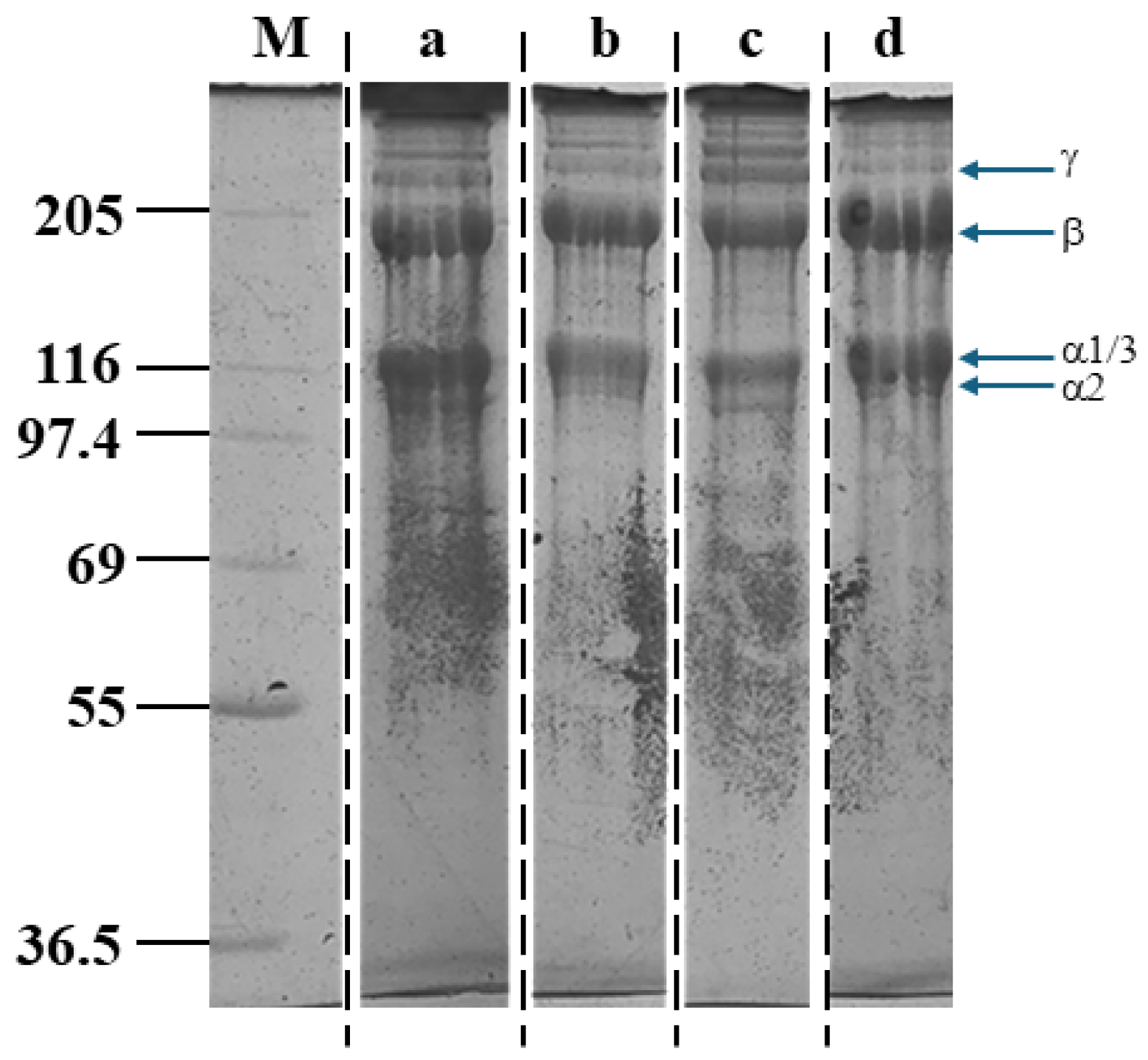
The yields of ASC obtained from the four species are presented in Table 1. SDS–PAGE analysis showed two α-chains (α1 and α2) along with their cross-linked components, including β-dimers and γ-trimers (Figure 1). The molecular weights of these subunits were approximately 120 kDa for the α1 chain, 110 kDa for the α2 chain, and 212 kDa for the β-dimers. These banding patterns are characteristic of fish collagen.

3.2. FTIR Analysis

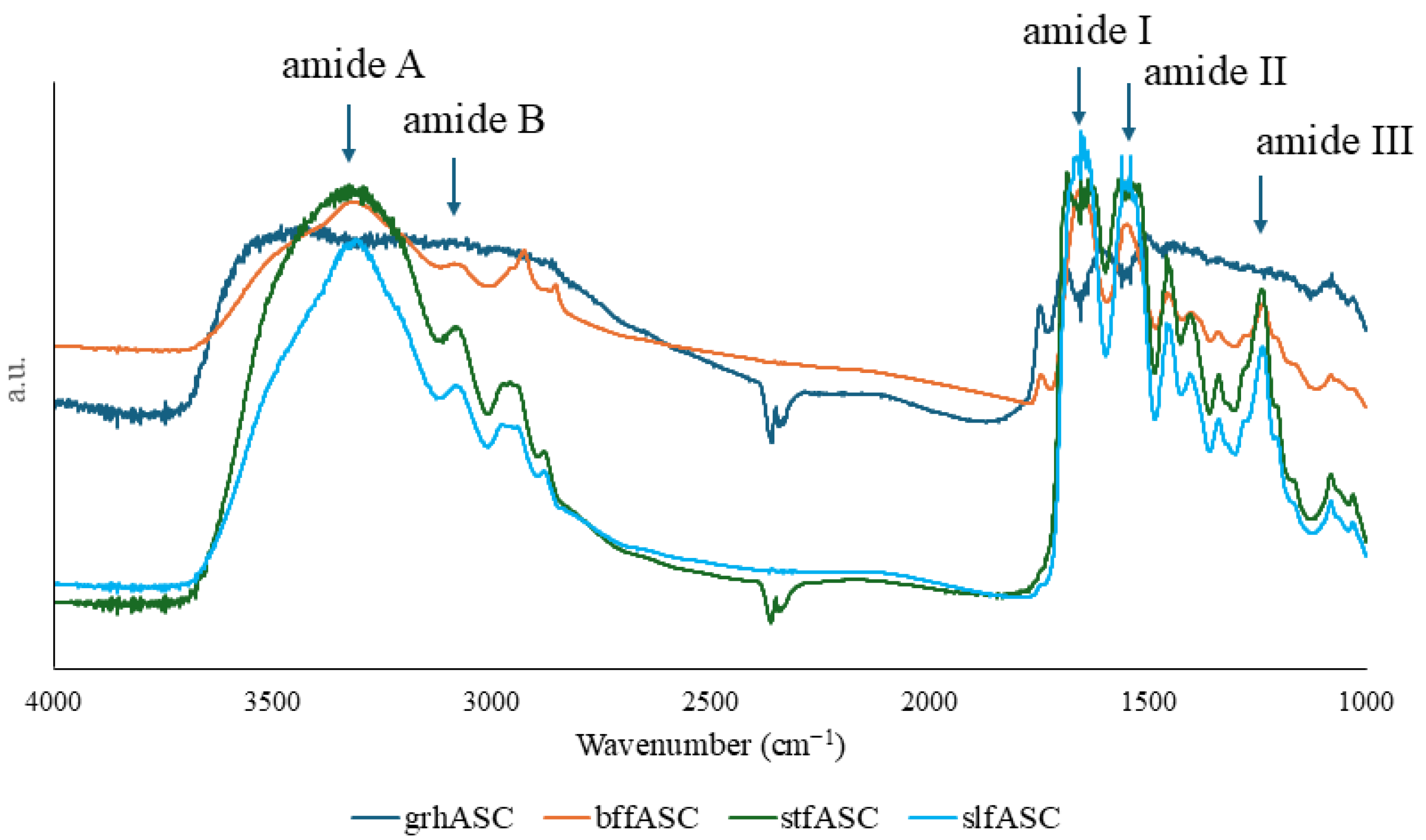
The FTIR spectra of all fish-skin ASCs exhibited characteristic absorption bands corresponding to type I collagen (Figure 2) [11,12]. These included the amide A band (~3325 cm−1), attributed to N–H stretching involved in hydrogen bonding; the amide B band (~3076 cm−1), associated with asymmetrical CH2 stretching; the amide I band (~1647 cm−1), arising from C=O stretching coupled with hydrogen bonding and COO groups; the amide II band (~1541 cm−1), related to N–H bending coupled with C–N stretching; and the amide III band (~1236 cm−1), corresponding to N–H bending and C–N stretching vibrations.

3.3. Amino Acid Analysis

The amino acid composition of the ASCs extracted from four flatfish skin samples showed that Gly (Table 2) was the most abundant amino acid (about one-third), which reflects (GXY)338 repeats in the molecule. The lowest Hyp (64.4)/Pro (119.8)/Pro + Hyp (184.2) content was observed in grhASC (Tp is lowest), whereas the highest Hyp (70.7)/Pro (130.9)/Pro + Hyp (201.6) content was observed in slfASC (Tp is highest). By contrast, the ASC Ser residue (53.6) for slfASC (Tp is highest) was the lowest, whereas that for stfASC was the highest (65.6). The hydroxylation rate of Pro was 34.38–36.11% for ASCs, but no clear difference could be observed between fish species and molecular species.

3.4. CD Analysis

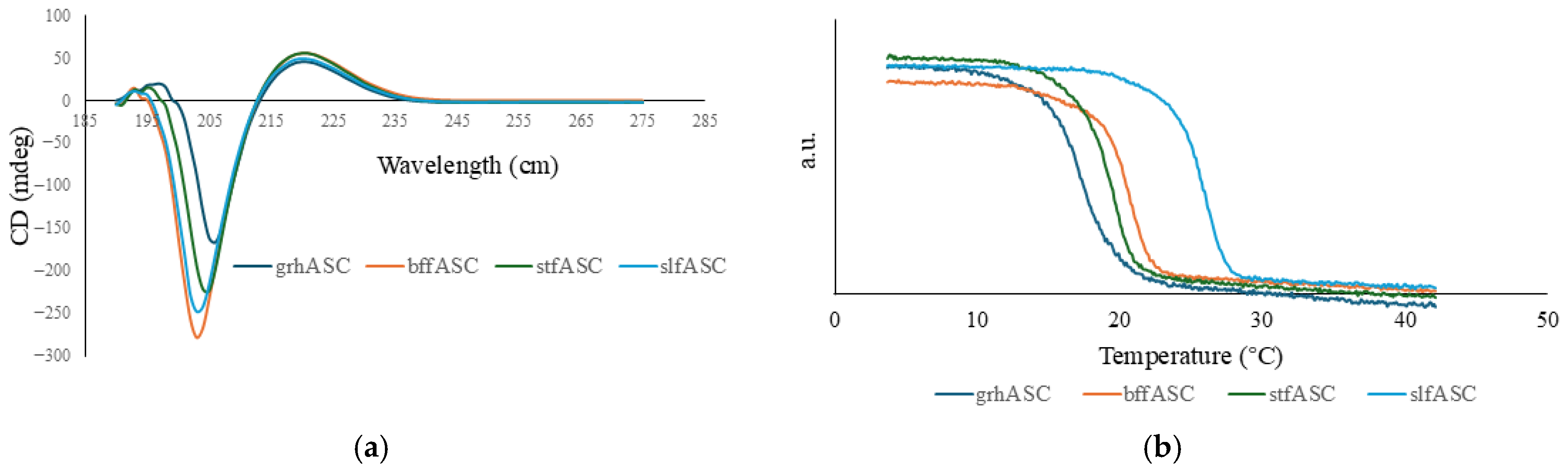
The CD spectra of ASCs are shown in Figure 3a. All samples exhibited a characteristic CD spectrum with a peak of 221 nm. No clear difference could be observed in peak height at 221 nm of ASCs, whereas some variance could be observed in the profile around 190–210 nm. The Rpn of the spectrum was as follows: grhASC, 0.27; bffASC, 0.20; stfASC, 0.25; and slfASC, 0.20. Figure 3b shows the temperature dependence of peak height at 221 nm. Using the melting curve, the Td of grhASC, bffASC, stfASC, and slfASC was calculated to be 16.4 °C, 18.2 °C, 17.4 °C, and 23.6 °C, respectively.

3.5. Correlation Analysis

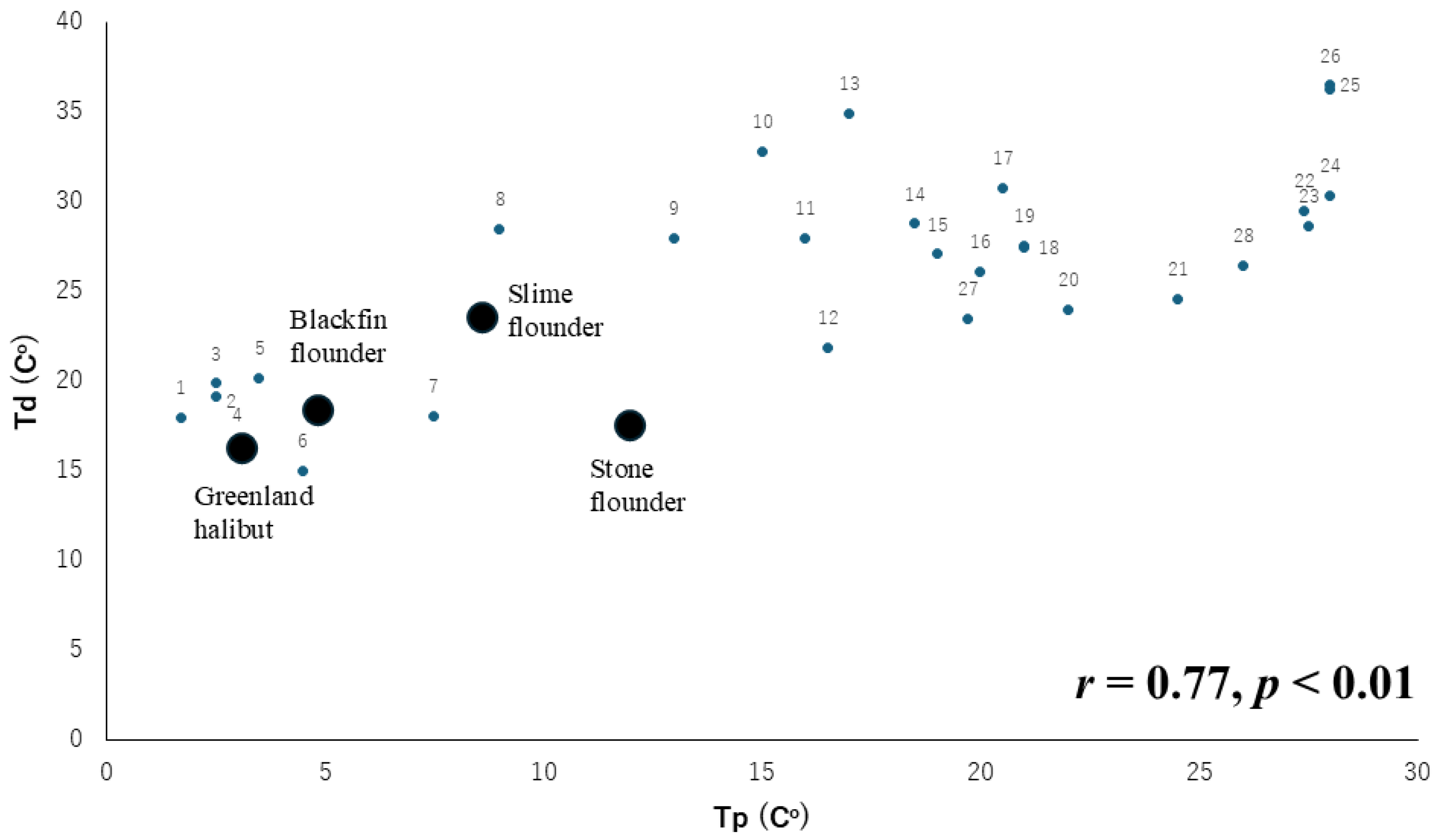
By using present data (4 data points; large closed circle with black) and previous reports (28 data points; numbered circle with blue), the correlation between Tp and Td revealed a high correlation (r = 0.77, p < 0.01; Figure 4). Within the analysis of present data, flatfish collagen basically followed this trend except for stfASC.
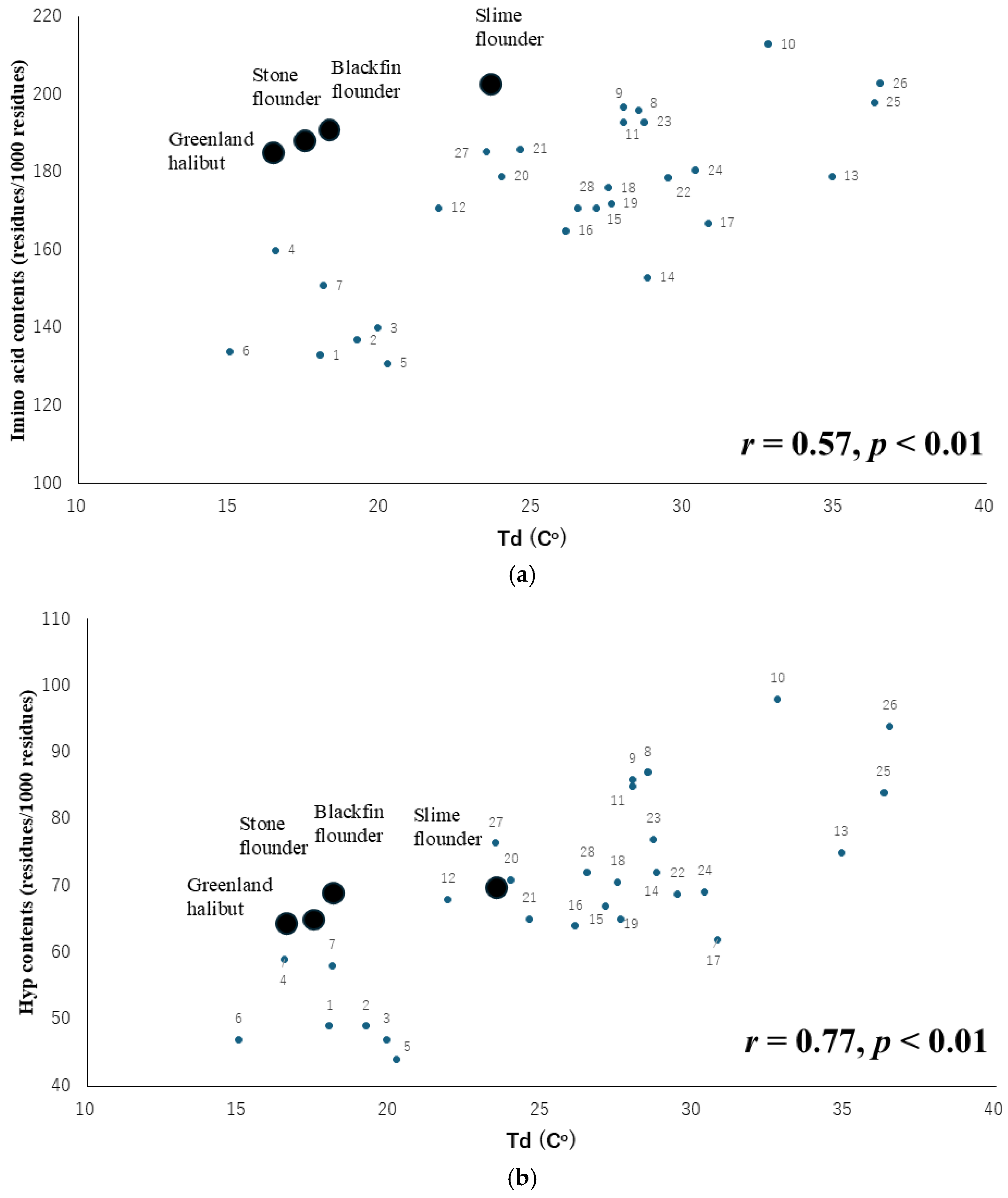
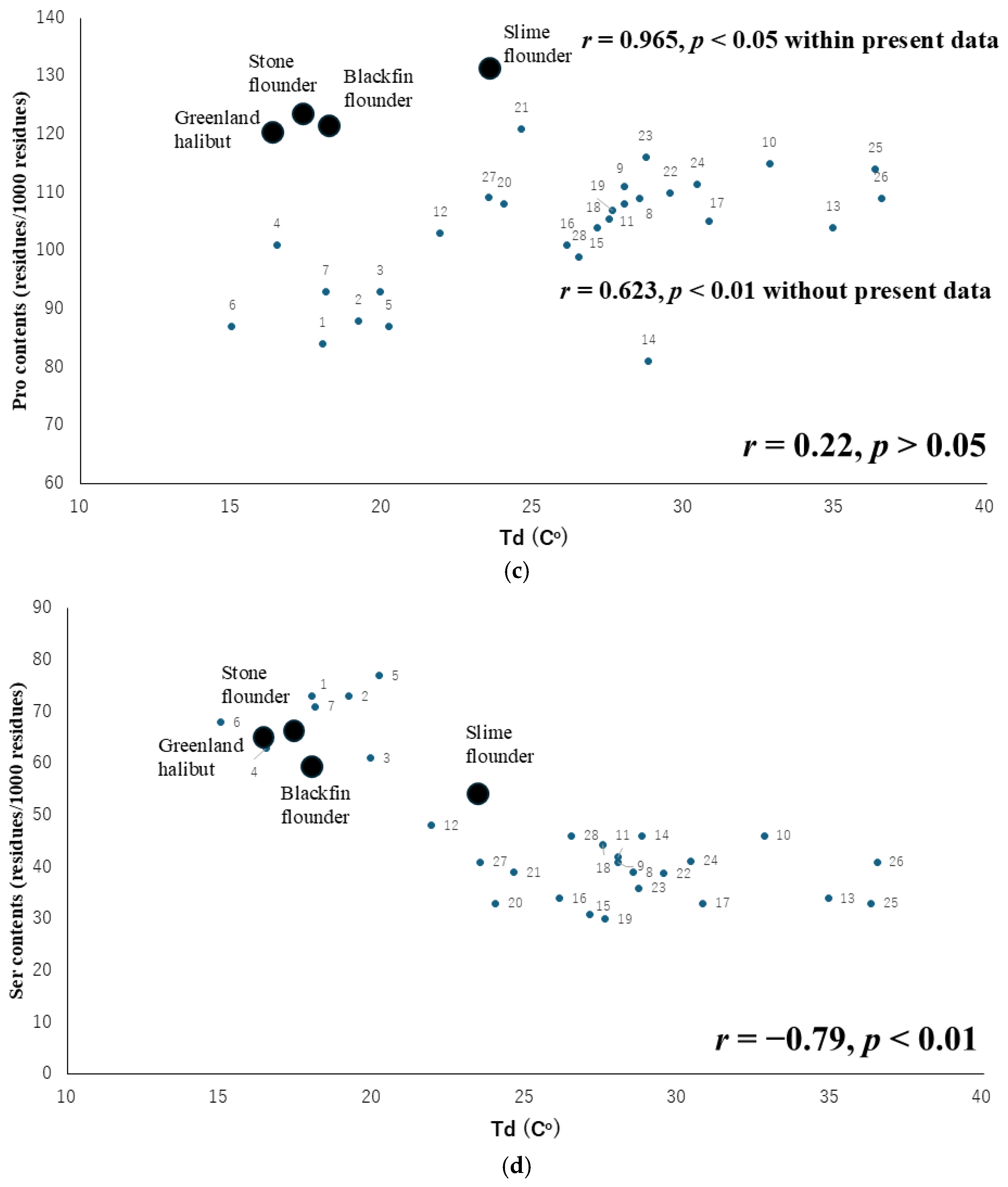
In the analysis between Td and imino acids (Pro + Hyp) for all available data of fish (32 species), a positive correlation was observed (r = 0.57, p < 0.01; Figure 5a). When Pro and Hyp imino acids are analyzed separately, a highly positive correlation in the analysis between Td and Hyp can be found (r = 0.77, p < 0.01; Figure 5b). However, the positive correlation between Pro and Td disappears (r = 0.22, p > 0.05; Figure 5c) because the Pro content for the present study was about 20–30 higher than those derived from the Td of other fish species. In the analysis between Td and Ser, a highly negative correlation could be observed within the total data (r = −0.79, p < 0.01; Figure 5d).
When considering the four species analyzed in this study separately from the other 28 species, the present data obtained from flatfish from a cold area were consistent with the abovementioned results, where the correlation coefficient was calculated to be 0.99 (p < 0.01) for Td and imino acid and 0.96 (p < 0.05) for Td and Pro (Figure 5a,c). Notably, in the analysis of Pro and Td, for which no correlation was found in the all available data (r = 0.22, p > 0.05; Figure 5c), an extremely high correlation was observed even with this small dataset (Figure 5c). In addition, a clear correlation could also be observed in the 28 datasets (r = 0.623, p < 0.01; Figure 5c) other than the four examined in this study. A clear trend was also evident in the comparison between Td and Hyp, as well as between Td and Ser, although no statistically significant differences were found (Figure 5b,d).
The existing data from ridged-eye flounder (27 in Figure 4 and Figure 5) and fivespot flounder (28 in Figure 4 and Figure 5), of which Tp is higher than that of the four species in the present study, did not follow these trends. Although these data may indicate a characteristic adaptation of flatfish collagen, the data for these flounders (or one of these two) might be outliers [12]. At this stage, whether the collagen molecules of flounder raised in warm and cold seas exhibit different adaptations remains to be elucidated. To determine whether these results are exceptional, increasing the number of samples analyzed in the future is essential, particularly those from species not raised at low temperatures. At the very least, the four types of cold-adapted flatfish collagen tested in this study follow the rules that we identified.
Analysis using data from all 32 fish species revealed a clear correlation between the Pro hydroxylation rate (%) and Td (r = 0.71, p < 0.01; Supplementary Table S1). However, based on the results for the four fish species included in this study, no evident difference in hydroxylation rate was found, and this trend was not observed in correlation analysis.

4. Discussion

Low-temperature adaptation of proteins in ectothermic animals, including fish, has been studied in enzymes and other globular proteins, where increased structural flexibility compensates for reduced molecular motion [16,20,21,22]. By contrast, collagen, a fibrous protein, has been primarily understood through classical studies, where thermal stability is strongly correlated with imino acid content. Early works in the 1960s showed that reduced proline and hydroxyproline content can lower triple-helix stability in cold-water species, although experimental limitations caused by collagen’s susceptibility to denaturation have constrained detailed mechanistic studies [15,23,24]. In addition, our previous studies revealed that the replacement of Hyp with Ser enhances flexibility in the collagen triple helix, while preserving stability through hydrogen bonding by the seryl hydroxyl group, particularly in collagen from cold-water fish [12,13]. Consequently, cold-adapted collagen display globally reduced structural rigidity, leading to softer fibrils that are suitable for low-temperature environments by using this amino acid composition appropriately [12,13]. The significance of this study may lie in the fact that it can extend this concept to the collagen found in cold-region flatfish.
Accordingly, type I collagen was isolated from four flatfish species inhabiting in cold regions of Japan to investigate the cold adaptation mechanism of collagen in flatfish. The SDS–PAGE, FTIR, and CD results indicated that the sample contained no contaminants and exhibited the typical structure of native collagen, including a triple-helix structure [11,12]. Purifying collagen in an undenatured state from fish with Tp below 15 °C is quite difficult [12,13]. The CD results with a clear peak at 221 nm confirmed the integrity of the collagen used in the subsequent experiments.
In the isolation step, pepsin-soluble collagen (PSC) was either not extracted at all or only in very small amounts, regardless of the fish species [12]. The authors purified collagen from 20 to 30 species of fish, including unpublished data. In some cases, ASC could be purified, but PSC could not be obtained; these results have been obtained with a certain degree of reproducibility [11,12,13]. ASC represents collagen with low intermolecular cross-linking, whereas PSC is obtained by enzymatic cleavage of telopeptide regions, which increases solubility without disrupting the triple-helix structure [25,26]. These cross-linkings generally decrease the solubility of collagen [27,28]. Given that ASC dissolves almost completely and PSC cannot be obtained, these cold-water fish, including flatfish, likely possess low levels of intermolecular cross-linking. Although quantifying pyridinoline is the standard method for measuring cross-linking levels, to the best of our knowledge, no reports correlating this substance with habitat water temperature have been found [29].
In the correlation analysis using the abovementioned 32 fish species, Tp and Td showed a high correlation using all available data of fish species, including the present data (r = 0.77, p < 0.01; Figure 4), which were consistent with our previous reports [12,13]. Analysis of the four types of collagen purified in this study suggested a correlation between their Tp and Td except for the data in stone flounder. However, based on the results of subsequent amino acid analysis, the Td value determined in this experiment is considered to be reasonable. The Tp value was taken from a database (https://grokipedia.com/page/stone_flounder, accessed on 1 February 2026), but this value or perhaps the ecology of the stone flounder may be unique.
Td correlated with Pro and Hyp, whereas Td was inversely correlated with Ser, consistent with our previous reports [12,13]. This finding can be explained by the robustness and stability that the cyclic structures of Pro and Hyp impart to the polypeptide chain, the stability of the triple helix formed by the OH groups of Hyp, and the flexibility of the Ser residue and the role of its OH group in the triple helix [10,12]. Hyp in collagen molecules is expressed by the post-translational modification of Pro by prolyl 4-hydroxylase; therefore, imino acid content reflects the number of Pro residues coded in the genomes [30]. In Rigby and our previous studies, Ser content in fish collagen showed a negative correlation with Td [12,13,15]. Hydroxyl groups in Ser residues (along with those in Hyp) can confer greater rotational freedom around the Cα–N and Cα–C bonds within the peptide backbone compared with the more conformationally restricted cyclic residues Pro and Hyp. This increased flexibility may facilitate the maintenance of hydrogen bonding within the triple helix, thereby contributing to collagen stability even under low-temperature (cold-water) conditions [12,13]. The present results in the entire fish analysis, including flatfish, followed these results except for the correlation analysis of Td-Pro. The significance of the OH group on Hyp lies in the stabilization of the triple-helix structure through steric effects, van der Waals interactions, and hydration [10,31]. Compared with Hyp, although the OH group on Ser has not yet been thoroughly examined since our previous report, it is reasonable to assume at this stage that it maintains the triple-helix structure while preserving the flexibility of the polypeptide chain.
The abovementioned findings are mainly explanations for analyses using data from the entire fish (32 species), including the present study. If we focus solely on the data in the present study, Td shows correlation trends among imino acids, Hyp, and Ser, which can expand the patterns observed in the entire fish dataset to flatfish; however, some discrepancies are evident. When considering only Pro versus Td in cold-water flatfish, a positive correlation was observed (r = 0.965, p < 0.05; Figure 5c). Notably, a clear correlation was also evident in the remaining 28 datasets beyond the four analyzed in this study (r = 0.623, p < 0.01; Figure 5c). One possible explanation for this observation might be that while the role of Pro in cold flat fish diverges at some point, it still maintains a link to temperature. In other words, the function of Pro within the collagen molecule might differ slightly in cold-water flatfish compared with other fish species. Biochemically, Pro functions to structurally stiffen the backbone of each individual subunit. This characteristic is clearly distinct from Hyp and Ser, which possess OH groups and function to thermodynamically stabilize the triple-helix structure. Therefore, the collagen from the cold-water flounder examined in this study may exhibit a higher degree of this function (structural rigidity required at Tp) than that required in other fish. However, the physiological significance derived from this biochemical implication remains to be discussed, and it must be left as a topic for future research such as model peptide/recombinant systems, as described below.
Moreover, the correlation analysis has several uncertainties. Of the 32 fish species used in the analysis, 18 were analyzed by our group using exactly the same method [11,12,13]. One factor that should be considered is that amino acid composition analysis was performed on only one sample per species in this study. However, the analysis was conducted rigorously using well-established methods, and the margin of error is considered to be extremely small (less than 1%). Td measurements using CD melting curves were performed at least three times following preliminary tests (Figure 3), and the margin of error can likewise be considered very small. The remaining species are based on data reported by various researchers [32,33,34,35,36,37,38]. Thus, particular attention should be paid to the methods used to measure Td, as they include CD, DSC, and viscosity-based methods [32,33,34,35,36,37,38].
In our previous study, the Rpn value (a criterion for estimating triple-helical conformations) was effective, showing a significantly positive correlation with Tp/Td/Pro/Hyp and a negative correlation with Ser using 10 fish ASCs [12,19]. However, the ASCs from the flatfish used in the present study and ridged-eye flounder (Rpn of 0.26 in our previous study) did not follow these results. This difference might be due to the high negative value of around 200 nm because the positive value from the present study is almost the same. The negative band at 190–210 nm reflects polyproline II-like backbone conformations in single chains, whereas the positive band near 221 nm corresponds to the fully formed triple-helical structure [10,31,39]. Compared with the fish studied thus far, the key factor in the temperature adaptation of flatfish collagen might not be the robustness of the triple-helix structure but rather the stability of single chains, which reflects the negative band. The Rpn value is fundamentally based on the integrity of the triple-helix structure as determined by Pro and Hyp contents, so it may not apply to flatfish, where the amount of Pro is unusual (Figure 5c) [19]. Furthermore, Rpn cannot be directly used as a measure of flatfish collagen in the same way as it is for those of other fish species in this study.
The results obtained in this study, especially on the function of the Pro residues in flatfish, can be directly verified through several methods. One approach is to expand the range of fish species to improve analytical accuracy. Using genomic data is one option; however, this approach does not include information on Hyp, a post-translational modification. Another approach would be to clarify these characteristics using the synthetic peptides and recombinant system designed based on the results obtained in this study [10]. Model peptides consisting of approximately 30 residues with a high Pro content could be studied. No recombinant system of full-length collagen has been established primarily because of its high molecular weight and the presence of post-translational modifications [10]. However, recombinant proteins can be used for short sequences of the collagen subunit of around 200 amino acids, mimicking the results obtained with flatfish [40,41].

5. Conclusions

ASCs were isolated from four flatfish from a cold area, and a positive correlation was found between Tp and Td, which was supported by the positive/negative correlation between Td and Hyp/Ser. These findings are consistent with previous reports. Pro content in the present data may follow the pattern of Hyp but exceeds the value predicted from Td by approximately 30 residues, which can be a characteristic point of cold-adapted flatfish collagen. It is estimated that there are approximately 700 species of flatfish, but the sample size in this study is too small to determine the details of their adaptive mechanisms. Given the current limited data, increasing the number of species analyzed and conducting analyses using a standardized methodology remain important challenges. Thus, genome-based analysis can be considered to be highly useful. Furthermore, analyzing biochemical data obtained through the establishment of model peptides and recombinant systems is a promising approach for the future.

Supplementary Materials

The following supporting information can be downloaded at: https://www.mdpi.com/article/10.3390/fishes11050287/s1, Table S1: Summary of the data for correlation analysis.

Author Contributions

Conceptualization: K.A.; Methodology: T.S. and K.A.; Investigation: T.S. and K.A.; Formal analysis: K.A.; Writing—original draft: K.A.; Writing—review & editing: K.A.; Supervision: K.M.; Funding acquisition: K.A.; Project Administration: K.A. All authors have read and agreed to the published version of the manuscript.

Funding

This work was partially supported by JSPS KAKENHI (grant no. 24K01852).

Institutional Review Board Statement

Since this study used fish purchased for food purposes, no specific ethical procedures were required.

Data Availability Statement

The original contributions presented in this study are included in the article. Further inquiries can be directed to the corresponding author.

Acknowledgments

The authors gratefully thank Yuto Sato, Takuya Matsuzaki, and Kenji Shimizu of the Center for Advanced Marine Core Research, Kochi University, for the FTIR measurements. This work was partly supported by the Core-Facility at Okayama University (CFPOU 598).

Conflicts of Interest

The authors declare no conflict of interest.

References

  1. Friedman, M. The evolutionary origin of flatfish asymmetry. Nature 2008, 454, 209–212. [Google Scholar] [CrossRef] [Scilit] [PubMed]
  2. Kartavtsev, Y.P.; Sharina, S.N.; Saitoh, K.; Imoto, J.M.; Hanzawa, N.; Redin, A.D. Phylogenetic relationships of Russian far eastern flatfish (Pleuronectiformes, Pleuronectidae) based on two mitochondrial gene sequences, Co-1 and Cyt-b, with inferences in order phylogeny using complete mitogenome data. Mitochondrial DNA Part A 2016, 27, 667–678. [Google Scholar] [CrossRef] [Scilit] [PubMed]
  3. Duthie, G.G. The respiratory metabolism of temperature-adapted flatfish at rest and during swimming activity and the use of anaerobic metabolism at moderate swimming speeds. J. Exp. Biol. 1982, 97, 359–373. [Google Scholar] [CrossRef] [Scilit] [PubMed]
  4. Jorov, A.; Zhorov, B.S.; Yang, D.S. Theoretical study of interaction of winter flounder antifreeze protein with ice. Protein Sci. 2004, 13, 1524–1537. [Google Scholar] [CrossRef] [Scilit] [PubMed]
  5. Mejri, S.C.; Tremblay, R.; Audet, C.; Wills, P.S.; Riche, M. Essential Fatty Acid Requirements in Tropical and Cold-Water Marine Fish Larvae and Juveniles. Front. Mar. Sci. 2021, 8, 680003. [Google Scholar] [CrossRef] [Scilit]
  6. Seibel, B.A. The thermodynamic opportunities hypothesis: Metabolic temperature insensitivity across flatfish species. Sci. Adv. 2026, 12, eadz0425. [Google Scholar] [CrossRef] [Scilit] [PubMed]
  7. Irastorza, A.; Zarandona, I.; Andonegi, M.; Guerrero, P.; de la Caba, K. The versatility of collagen and chitosan: From food to biomedical applications. Food Hydrocoll. 2021, 116, 106633. [Google Scholar] [CrossRef] [Scilit]
  8. Jafari, H.; Lista, A.; Siekapen, M.M.; Ghaffari-Bohlouli, P.; Nie, L.; Alimoradi, H.; Shavandi, A. Fish Collagen: Extraction, Characterization, and Applications for Biomaterials Engineering. Polymers 2020, 12, 2230. [Google Scholar] [CrossRef] [Scilit] [PubMed]
  9. Gelse, K.; Poschl, E.; Aigner, T. Collagens--structure, function, and biosynthesis. Adv. Drug Deliv. Rev. 2003, 55, 1531–1546. [Google Scholar] [CrossRef] [Scilit] [PubMed]
  10. Shoulders, M.D.; Raines, R.T. Collagen structure and stability. Annu. Rev. Biochem. 2009, 78, 929–958. [Google Scholar] [CrossRef] [Scilit] [PubMed]
  11. Akita, M.; Kono, T.; Lloyd, K.; Mitsui, T.; Morioka, K.; Adachi, K. Biochemical study of type I collagen purified from skin of warm sea teleost Mahi mahi (Coryphaena hippurus), with a focus on thermal and physical stability. J. Food Biochem. 2019, 43, e13013. [Google Scholar] [CrossRef] [Scilit] [PubMed]
  12. Akita, M.; Nishikawa, Y.; Shigenobu, Y.; Ambe, D.; Morita, T.; Morioka, K.; Adachi, K. Correlation of proline, hydroxyproline and serine content, denaturation temperature and circular dichroism analysis of type I collagen with the physiological temperature of marine teleosts. Food Chem. 2020, 329, 126775. [Google Scholar] [CrossRef] [Scilit] [PubMed]
  13. Oue, H.; Miki, S.; Shigenobu, Y.; Morita, T.; Morioka, K.; Adachi, K. Relationship between fish skin shrinkage and a fish’s physiological temperature according to movie analysis. Fish. Sci. 2026, 92, 717–724. [Google Scholar] [CrossRef] [Scilit]
  14. Burjanadze, T.V. New analysis of the phylogenetic change of collagen thermostability. Biopolymers 2000, 53, 523–528. [Google Scholar] [CrossRef] [Scilit]
  15. Rigby, B.J. Correlation between serine and thermal stability of collagen. Nature 1967, 214, 87–88. [Google Scholar] [CrossRef] [Scilit] [PubMed]
  16. Somero, G.N. Protein adaptations to temperature and pressure: Complementary roles of adaptive changes in amino acid sequence and internal milieu. Comp. Biochem. Physiol. B Biochem. Mol. Biol. 2003, 136, 577–591. [Google Scholar] [CrossRef] [Scilit] [PubMed]
  17. Fields, P.A.; Dong, Y.; Meng, X.; Somero, G.N. Adaptations of protein structure and function to temperature: There is more than one way to ‘skin a cat’. J. Exp. Biol. 2015, 218, 1801–1811. [Google Scholar] [CrossRef] [Scilit] [PubMed]
  18. Laemmli, U.K. Cleavage of structural proteins during the assembly of the head of bacteriophage T4. Nature 1970, 227, 680–685. [Google Scholar] [CrossRef] [Scilit] [PubMed]
  19. Feng, Y.; Melacini, G.; Taulane, J.P.; Goodman, M. Collagen-based structures containing the peptoid residue N-isobutylglycine (Nleu): Synthesis and biophysical studies of Gly-Pro-Nleu sequences by circular dichroism, ultraviolet absorbance, and optical rotation. Biopolymers 1998, 39, 859–872. [Google Scholar] [CrossRef]
  20. Fields, P.A. Review: Protein function at thermal extremes: Balancing stability and flexibility. Comp. Biochem. Physiol. A Mol. Integr. Physiol. 2001, 129, 417–431. [Google Scholar] [CrossRef] [Scilit] [PubMed]
  21. Fields, P.A.; Houseman, D.E. Decreases in activation energy and substrate affinity in cold-adapted A4-lactate dehydrogenase: Evidence from the Antarctic notothenioid fish Chaenocephalus aceratus. Mol. Biol. Evol. 2004, 21, 2246–2255. [Google Scholar] [CrossRef] [Scilit] [PubMed]
  22. Dong, Y.W.; Liao, M.L.; Meng, X.L.; Somero, G.N. Structural flexibility and protein adaptation to temperature: Molecular dynamics analysis of malate dehydrogenases of marine molluscs. Proc. Natl. Acad. Sci. USA 2018, 115, 1274–1279. [Google Scholar] [CrossRef] [Scilit] [PubMed]
  23. Piez, K.A. The Relation Between Amino Acid Composition and Denaturation of Vertebrate Collagens. J. Am. Chem. Soc. 1960, 82, 247. [Google Scholar] [CrossRef] [Scilit]
  24. Rigby, B.J. Amino-acid composition and thermal stability of the skin collagen of the Antarctic ice-fish. Nature 1968, 219, 166–167. [Google Scholar] [CrossRef] [Scilit] [PubMed]
  25. Ogawa, M.; Moody, M.W.; Portier, R.J.; Bell, J.; Schexnayder, M.A.; Losso, J.N. Biochemical Properties of Black Drum and Sheepshead Seabream Skin Collagen. J. Agric. Food Chem. 2003, 51, 8088–8092. [Google Scholar] [CrossRef] [Scilit] [PubMed]
  26. Kittiphattanabawon, P.; Benjakul, S.; Visessanguan, W.; Nagai, T.; Tanaka, M. Characterisation of acid-soluble collagen from skin and bone of bigeye snapper (Priacanthus tayenus). Food Chem. 2005, 89, 363–372. [Google Scholar] [CrossRef] [Scilit]
  27. Burghagen, M. Collagen. In Food Chemistry; Springer: Berlin/Heidelberg, Germany, 1999; pp. 540–547. [Google Scholar]
  28. Foegeding, E.; Lanier, T.; Hultin, H. Characteristics of Edible Muscle Tissue. In Food Chemistry; Marcel Dekker, Inc.: New York, NY, USA, 1996. [Google Scholar]
  29. Ando, M.; Nakagishi, Y.; Yoshida, K.; Nakao, M.; Nakagawa, T.; Makinodan, Y.; Tsukamasa, Y.; Kawasaki, K.-i. Pyridinoline concentrations in muscular and skin collagen of fish and relationship between collagen solubility and pyridinoline concentration in fish muscular collagen. Fish. Sci. 2006, 72, 1104–1108. [Google Scholar] [CrossRef] [Scilit]
  30. Pihlajaniemi, T.; Myllyla, R.; Kivirikko, K.I. Prolyl 4-hydroxylase and its role in collagen synthesis. J. Hepatol. 1991, 13, S2–S7. [Google Scholar] [CrossRef] [Scilit] [PubMed]
  31. Engel, J.; Bächinger, H.P. Structure, Stability and Folding of the Collagen Triple Helix. In Collagen; Springer: Berlin/Heidelberg, Germany, 2005; pp. 7–33. [Google Scholar]
  32. Nagai, T.; Araki, Y.; Suzuki, N. Collagen of the skin of ocellate puffer fish (Takifugu rubripes). Food Chem. 2002, 78, 173–177. [Google Scholar] [CrossRef] [Scilit]
  33. Nagai, T.; Izumi, M.; Ishii, M. Fish scale collagen. Preparation and partial characterization. Int. J. Food Sci. Technol. 2004, 39, 239–244. [Google Scholar] [CrossRef] [Scilit]
  34. Saito, M.; Takenouchi, Y.; Kunisaki, N.; Kimura, S. Complete primary structure of rainbow trout type I collagen consisting of alpha1(I)alpha2(I)alpha3(I) heterotrimers. Eur. J. Biochem. 2001, 268, 2817–2827. [Google Scholar] [CrossRef] [Scilit] [PubMed]
  35. Hwang, J.-H.; Mizuta, S.; Yokoyama, Y.; Yoshinaka, R. Purification and characterization of molecular species of collagen in the skin of skate (Raja kenojei). Food Chem. 2007, 100, 921–925. [Google Scholar] [CrossRef] [Scilit]
  36. Minh Thuy, L.T.; Okazaki, E.; Osako, K. Isolation and characterization of acid-soluble collagen from the scales of marine fishes from Japan and Vietnam. Food Chem. 2014, 149, 264–270. [Google Scholar] [CrossRef] [Scilit]
  37. Wang, H.; Liang, Y.; Wang, H.; Zhang, H.; Wang, M.; Liu, L. Physical-Chemical Properties of Collagens from Skin, Scale, and Bone of Grass Carp (Ctenopharyngodon idellus). J. Aquat. Food Prod. Technol. 2014, 23, 264–277. [Google Scholar] [CrossRef] [Scilit]
  38. Huang, Y.-R.; Shiau, C.-Y.; Chen, H.-H.; Huang, B.-C. Isolation and characterization of acid and pepsin-solubilized collagens from the skin of balloon fish (Diodon holocanthus). Food Hydrocoll. 2011, 25, 1507–1513. [Google Scholar] [CrossRef] [Scilit]
  39. Woody, R.W. Circular dichroism spectrum of peptides in the poly(Pro)II conformation. J. Am. Chem. Soc. 2009, 131, 8234–8245. [Google Scholar] [CrossRef] [Scilit] [PubMed]
  40. He, H.; Ye, M.; Cui, G.; Xiao, J. Recombinant collagen in regenerative medicine: Expression strategies, structural design, and translational applications. Mater. Today Bio 2025, 35, 102452. [Google Scholar] [CrossRef] [Scilit] [PubMed]
  41. Wang, T.; Lew, J.; Premkumar, J.; Poh, C.L.; Win Naing, M. Production of recombinant collagen: State of the art and challenges. Eng. Biol. 2017, 1, 18–23. [Google Scholar] [CrossRef] [Scilit]
Figure 1. SDS–PAGE patterns of ASCs. Electrophoresis was performed under reducing conditions. Lane M indicates the molecular weight marker. (a) grhASC, (b) bffASC, (c) stfASC, (d) slfASC.
Fishes 11 00287 g001
Figure 2. FTIR spectra of ASCs. The horizontal and vertical axes represent wavenumber and arbitrary units, respectively. All ASC samples exhibited characteristic absorption bands of type I collagen, including amide A, amide B, amide I, amide II, and amide III.
Fishes 11 00287 g002
Figure 3. CD spectra of ASCs. (a) The horizontal and vertical axes represent wavelength and molar ellipticity, respectively. (b) The horizontal and vertical axes represent temperature and molar ellipticity, respectively.
Fishes 11 00287 g003
Figure 4. Correlation analysis between Tp and Td. The horizontal and vertical axes indicate Tp and Td, respectively. The numbers assigned to the symbols are as follows: 1, Pacific grenadier; 2, giant grenadier; 3, deep-water arrowtooth eel; 4, Alaska pollock; 5, scaly wolf eelpout; 6, Pacific cod; 7, Okhotsk Atka mackerel; 8, red seabream; 9, Japanese sardine; 10, Russian sturgeon; 11, Japanese sea bass; 12, rainbow trout; 13, double-lined fusilier; 14, ocellate spot skate; 15, flathead mullet; 16, horse mackerel; 17, large yellow croaker; 18, blue mackerel; 19, lizardfish; 20, porcupinefish; 21, grass carp; 22, common dolphinfish; 23, bigeye snapper; 24, roughear scad; 25, Nile tilapia; 26, brownbanded bamboo shark; 27, ridged-eye flounder; 28, fivespot flounder.
Fishes 11 00287 g004
Figure 5. Correlation analysis between Td and amino acids. The horizontal axes represent Td. The vertical axes indicate imino acids (a), Hyp (b), Pro (c), and Ser (d), respectively. The numbers and fish species indicated on the symbols are the same as those shown in Figure 4.
Fishes 11 00287 g005aFishes 11 00287 g005b
Table 1. Summary of the samples.
Fish NameScientific NamePhysiological Temperature (Tp) #Abbreviation of Sample NameYield (%)
Greenland halibutReinhardtius hippoglossoides−1–4 °C (mean 3 °C)grhASC23.5
Blackfin flounderGlyptocephalus stelleri0.6–18.2 °C with a mean of 4.8 °CbffASC10.8
Stone flounderKareius bicoloratus8–16 °C (mean 12.0 °C)stfASC10.8
Slime flounderMicrostomus achne0.8–21.9, with a mean 8.6 °CslfASC10.8
# Tps were cited from Fishbase (https://www.fishbase.se/search.php (accessed on 1 February 2026), and https://grokipedia.com/page/stone_flounder (accessed on 1 February 2026)).
Table 2. Amino acid composition of Flatfish ASCs.
AspThrSerGluGlyAlaValCysMet
grhASC47.225.463.873.4318.1113.417.50.213.5
bffASC50.622.758.569.5322.2115.718.30.113.0
stfASC48.721.665.671.1316.1117.115.80.112.8
slfASC49.526.753.670.6311.3120.919.00.19.9
IleLeuTyrPheLysHylysHisArgHypProPro + HypPercentage of hydroxylation (%)
grhASC8.924.33.415.127.45.46.152.764.4119.8184.234.98
bffASC10.621.73.213.826.95.25.952.168.6121.4190.036.12
stfASC9.923.23.514.826.85.96.653.064.4122.9187.434.39
slfASC8.519.73.113.727.16.06.052.570.7130.9201.635.06
Disclaimer/Publisher’s Note: The statements, opinions and data contained in all publications are solely those of the individual author(s) and contributor(s) and not of MDPI and/or the editor(s). MDPI and/or the editor(s) disclaim responsibility for any injury to people or property resulting from any ideas, methods, instructions or products referred to in the content.