
Article

Anthropogenic Particle Ingestion in Atlantic Chub Mackerel (Scomber colias Gmelin, 1789) from the Saronikos Gulf: Occurrence, Characteristics, and Biological Associations

by
Niki Milatou
*,
Odysseas Papadopoulos-Michalas
and
Persefoni Megalofonou
Department of Biology, National and Kapodistrian University of Athens, Panepistimiopolis, Ilissia, 15784 Athens, Greece
*
Author to whom correspondence should be addressed.
Fishes 2026, 11(5), 272; https://doi.org/10.3390/fishes11050272

Submission received: 26 March 2026 / Revised: 29 April 2026 / Accepted: 30 April 2026 / Published: 4 May 2026
(This article belongs to the Special Issue Plastics in Fish and Shellfish)

Abstract

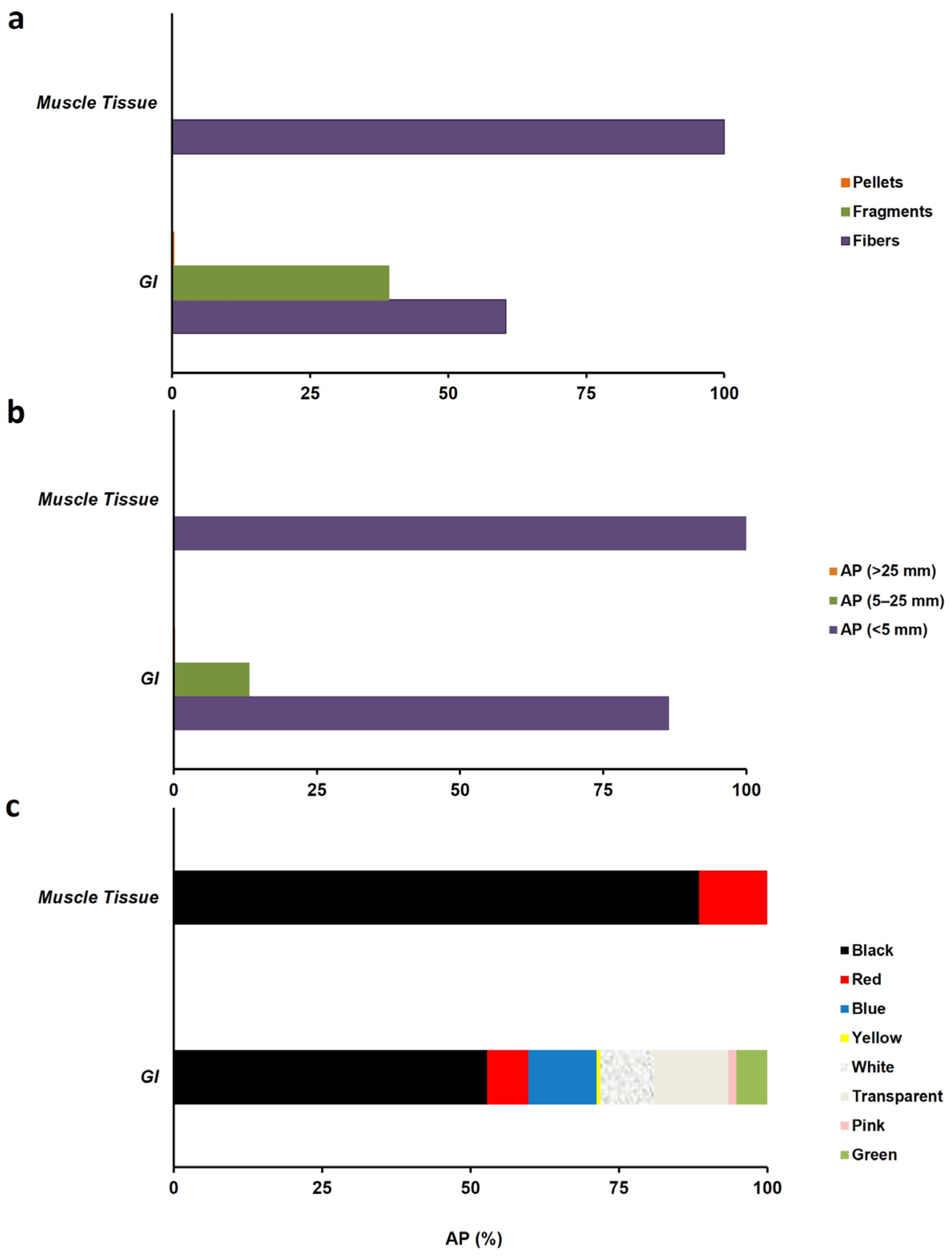
Marine anthropogenic particle pollution is a major environmental concern due to its persistence and widespread distribution. Microplastics are widely recognized as a subset of anthropogenic particles originating from synthetic polymers. This study examines the occurrence, characteristics, and biological associations of anthropogenic particles ingested by Atlantic chub mackerel from the Saronikos Gulf. A total of 179 specimens were analyzed for anthropogenic particles in the gastrointestinal tract, while muscle tissue was examined in 51 individuals. Anthropogenic particles were detected in the gastrointestinal tract of 74% of individuals and were also present in muscle tissue in 41% of the analyzed specimens. Fibers were the dominant particle type, representing approximately 60% of the identified particles, followed by fragments at 40%. The majority of particles were micro-sized (<5 mm), although meso- and macro-sized particles were also recorded. Black-colored particles predominated, accounting for approximately 53% of the total. No significant differences in anthropogenic particle abundance were observed between sexes, and no consistent seasonal patterns were detected, except for higher occurrence in early autumn compared to winter, although this result should be interpreted with caution due to uneven sample sizes among sampling periods. No statistically significant correlations were found between anthropogenic particle abundance in the gastrointestinal tract or muscle tissue and fish size, condition factor, or stomach fullness. Overall, the findings highlight this species as a suitable bioindicator for monitoring anthropogenic particle pollution and provide baseline information for future assessments in the Saronikos Gulf. Particle identification was based on visual characterization without spectroscopic confirmation; therefore, the detected particles are considered anthropogenic and their polymer composition could not be definitively confirmed.
Keywords: anthropogenic particle ingestion; pelagic fish; Scomber colias; bioindicator; Saronikos Gulf; Mediterranean Sea anthropogenic particle ingestion; pelagic fish; Scomber colias; bioindicator; Saronikos Gulf; Mediterranean Sea