
Assessing the Impact of Climate Change on the Distribution of Portunus trituberculatus in Zhoushan Fishing Ground by Using the Maximum Entropy Method (MaxEnt)


Abstract
1. Introduction
2. Materials and Methods
2.1. Data Sources
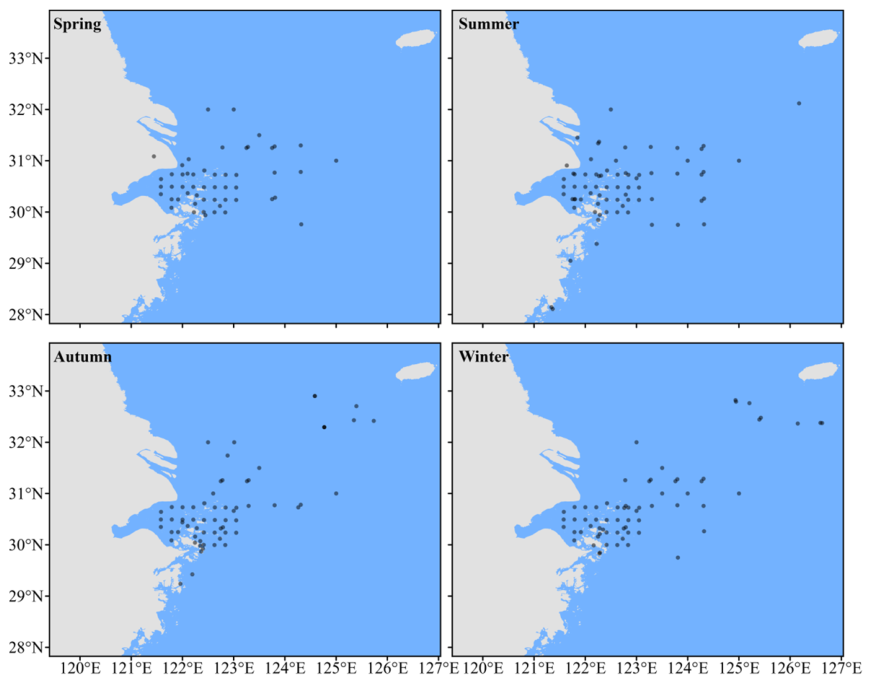
2.1.1. Occurrence Data of P. trituberculatus and Spatial Extent
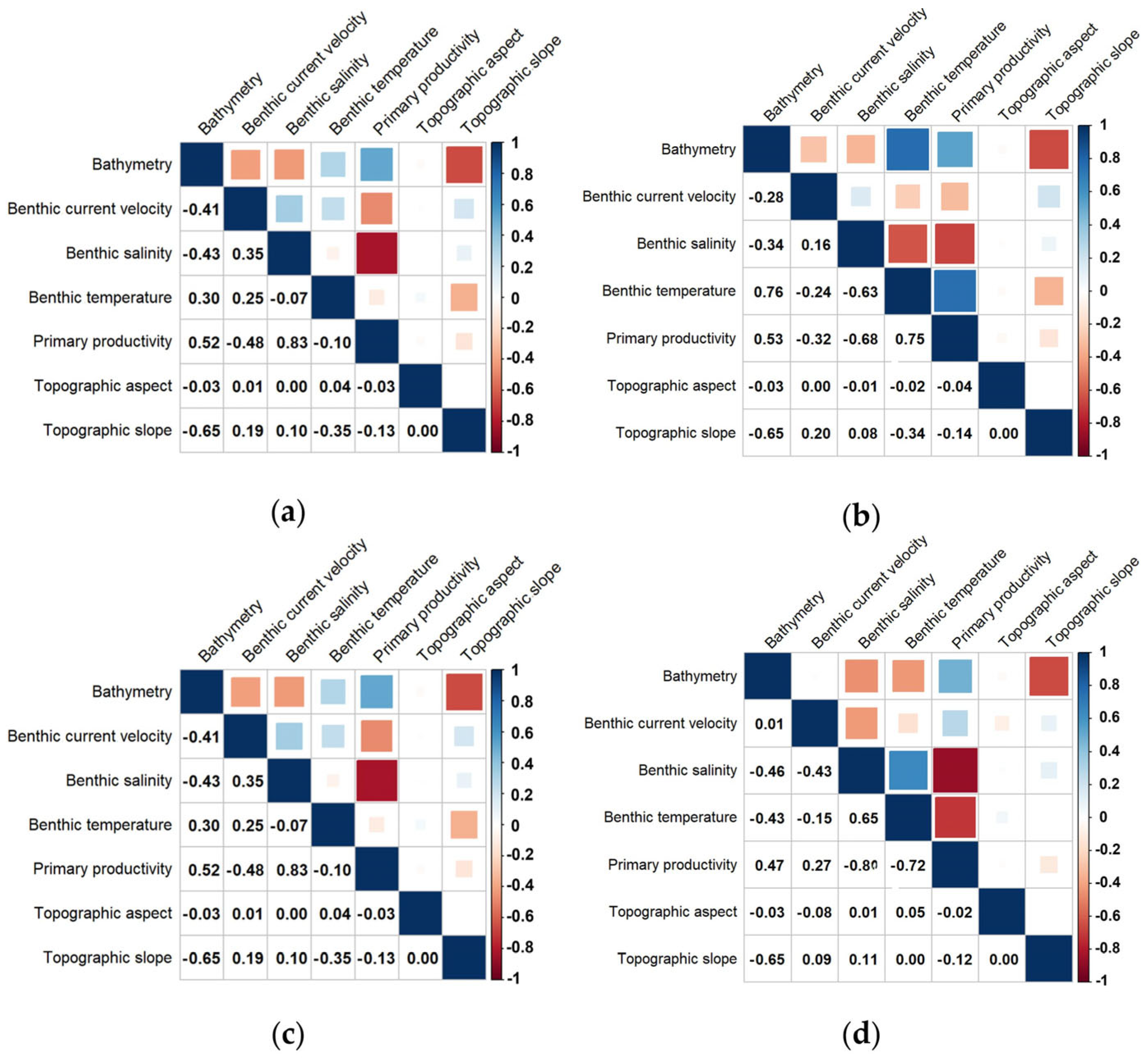
2.1.2. Sources of Environmental Data
2.2. Model Construction
3. Results
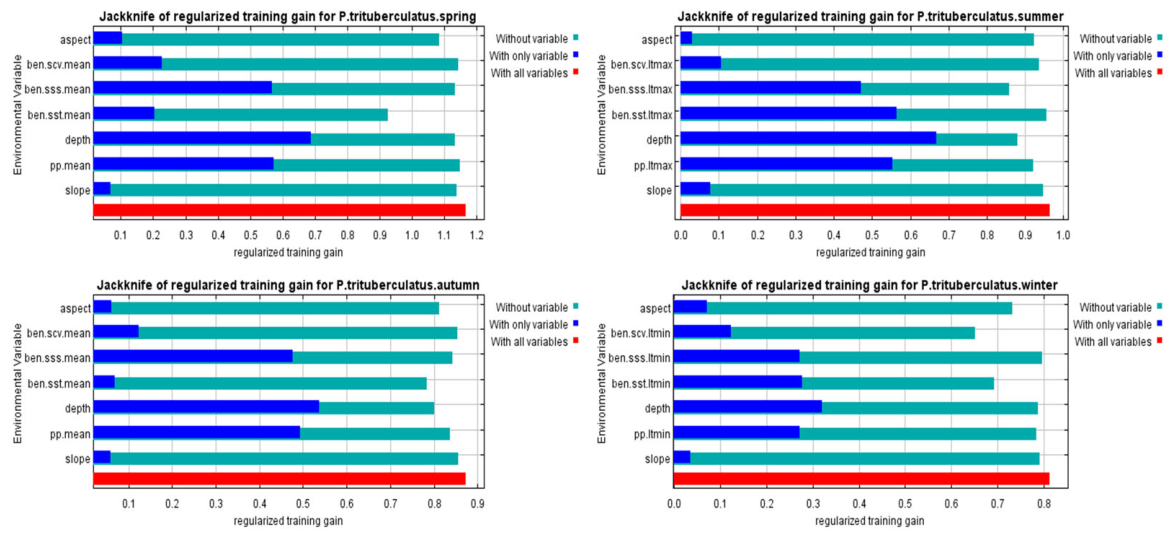
3.1. Evaluation of the Model’s Predictive Performance and Variable Importance
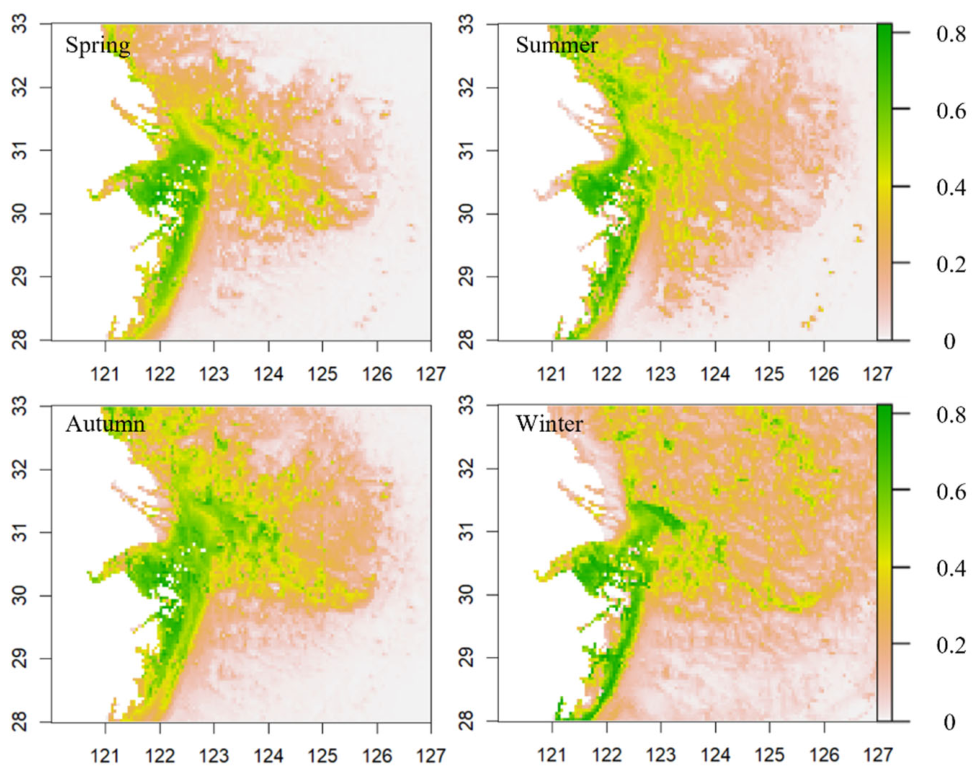
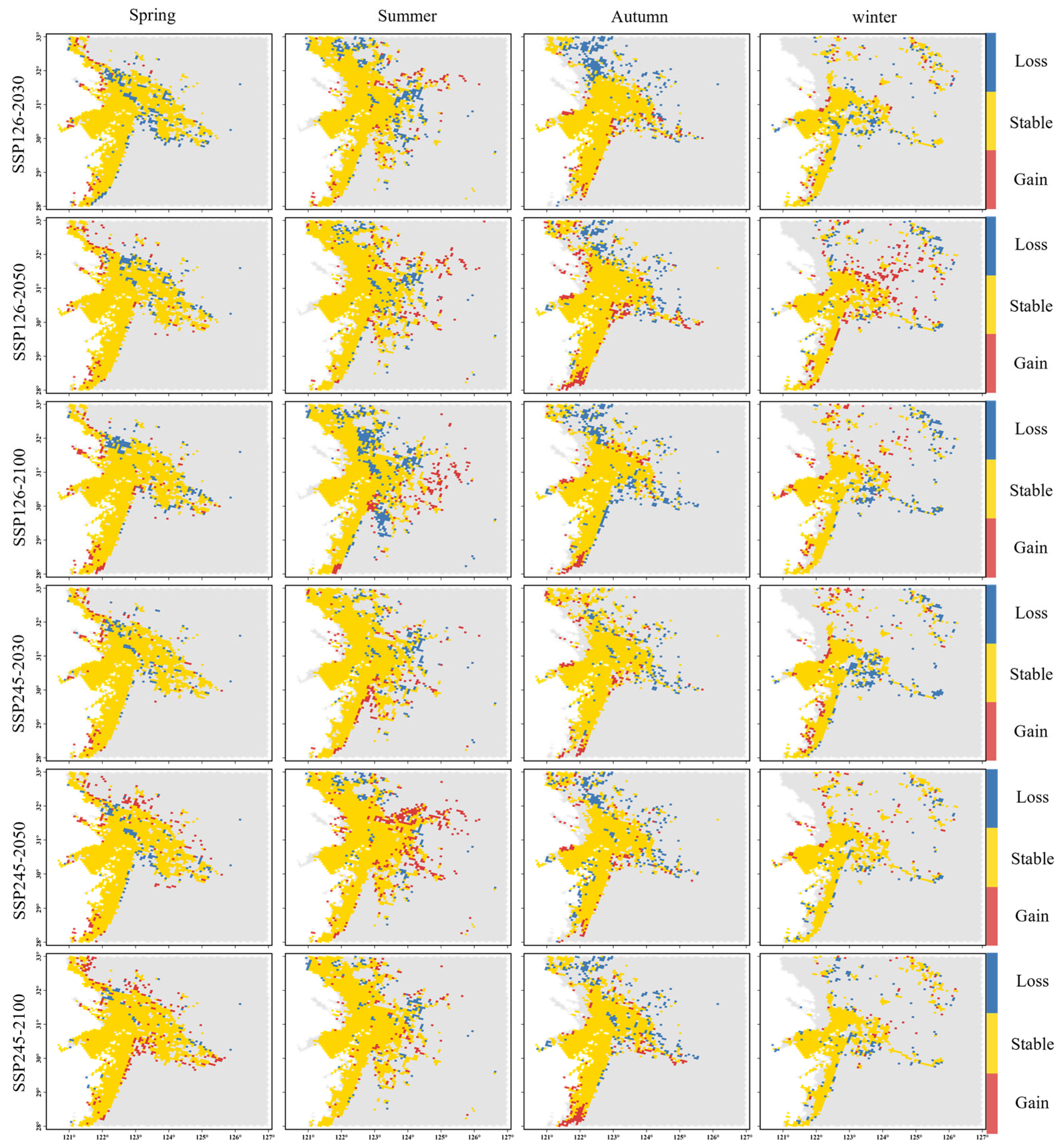
3.2. Current and Future Distributions
4. Discussion
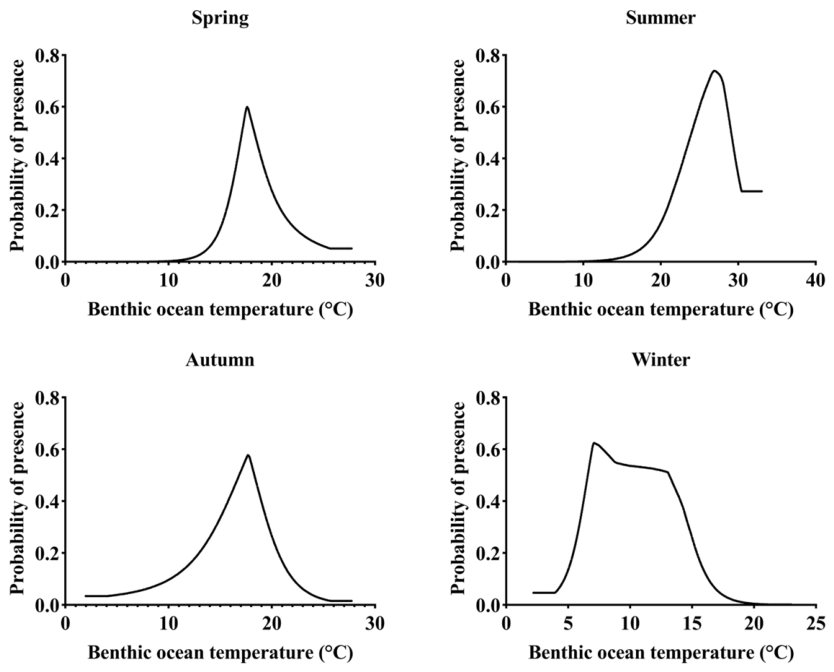
4.1. Habitat Preferences
4.2. Future Predicted Distribution of P. trituberculatus
4.3. Implication for Fishery Management
4.4. Limitations of the Study
5. Conclusions
Author Contributions
Funding
Institutional Review Board Statement
Data Availability Statement
Acknowledgments
Conflicts of Interest
References
- Doney, S.C.; Ruckelshaus, M.; Duffy, J.E.; Barry, J.P.; Chan, F.; English, C.A.; Galindo, H.M.; Grebmeier, J.M.; Hollowed, A.B.; Knowlton, N. Climate change impacts on marine ecosystems. Annu. Rev. Mar. Sci. 2012, 4, 11–37. [Google Scholar] [CrossRef]
- Johnson, C.R.; Banks, S.C.; Barrett, N.S.; Cazassus, F.; Dunstan, P.K.; Edgar, G.J.; Frusher, S.D.; Gardner, C.; Haddon, M.; Helidoniotis, F. Climate change cascades: Shifts in oceanography, species’ ranges and subtidal marine community dynamics in eastern Tasmania. J. Exp. Mar. Biol. Ecol. 2011, 400, 17–32. [Google Scholar] [CrossRef]
- Smallwood, P.A.; Trapnell, D.W. Species distribution modeling reveals recent shifts in suitable habitat for six North American Cypripedium spp. (Orchidaceae). Diversity 2022, 14, 694. [Google Scholar] [CrossRef]
- Séférian, R.; Berthet, S.; Yool, A.; Palmiéri, J.; Bopp, L.; Tagliabue, A.; Kwiatkowski, L.; Aumont, O.; Christian, J.; Dunne, J. Tracking improvement in simulated marine biogeochemistry between CMIP5 and CMIP6. Curr. Clim. Change Rep. 2020, 6, 95–119. [Google Scholar] [CrossRef]
- Kwiatkowski, L.; Torres, O.; Bopp, L.; Aumont, O.; Chamberlain, M.; Christian, J.R.; Dunne, J.P.; Gehlen, M.; Ilyina, T.; John, J.G. Twenty-first century ocean warming, acidification, deoxygenation, and upper-ocean nutrient and primary production decline from CMIP6 model projections. Biogeosciences 2020, 17, 3439–3470. [Google Scholar] [CrossRef]
- Yang, Z.; Feng, G.; Shao, J.; Yang, G.; Zhang, T.; Zhao, F.; Geng, Z.; Li, X.; Tan, Q. Spatial-temporal distribution of resources and the relationship between environmental factors of Portulus trituberculus in the Yangtze River Estuary. Mar. Environ. Res. 2025, 210, 107275. [Google Scholar] [CrossRef] [PubMed]
- Yao, Y.; Zhang, S.; Gao, S.; Lu, J.; Fu, G. Release capacity of Portunus trituberculatus enhancement in coastal waters: A case study in the marine ranching area of Haizhou bay. Estuar. Coast. Shelf Sci. 2024, 299, 108684. [Google Scholar] [CrossRef]
- Panhwar, S.; Dong, Z.; Zhenghua, L.; Rashid, S.; Zhouting, H.; Ai, G.; Ping, W. Population dynamics and fishery of swimming crab, Portunus trituberculatus in the Zhejiang fishing area, East China Sea. J. Anim. Plant Sci. 2018, 26, 1641–1647. [Google Scholar]
- Xu, G.; Zhang, H.; Zhou, Y. Spatiotemporal distribution and fishing ground driving mechanism of swimming crab Portunus trituberculatus in Hangzhou Bay and its adjacent waters. Sci. Rep. 2025, 15, 22429. [Google Scholar] [CrossRef]
- Liu, X.Y.; Han, X.L.; Han, Z.Q. Effects of climate change on the potential habitat distribution of swimming crab Portunus trituberculatus under the species distribution model. J. Oceanol. Limnol. 2022, 40, 1556–1565. [Google Scholar] [CrossRef]
- Mengesha, H.A. Conducting and Analyzing Openmodeller and Maximum Entropy Model Software for Species Distribution Modeling using Arc GIS. J. Biol. Agric. Hydrol. 2017, 7, 58. [Google Scholar]
- Brown, K.; Puschendorf, R. Future climate-driven habitat loss and range shift of the Critically Endangered whitefin swellshark (Cephaloscyllium albipinnum). PeerJ 2025, 13, e18787. [Google Scholar] [CrossRef]
- Li, X.; Wang, J.; Liu, Y.; Wang, Y. Spatial and Temporal Distribution of Portunus trituberculatus in the Northern East China Sea based on Different Modelling Approaches. Indian J. Anim. Res. 2021, 55, 1364–1370. [Google Scholar] [CrossRef]
- Assis, J.; Fernández Bejarano, S.J.; Salazar, V.W.; Schepers, L.; Gouvêa, L.; Fragkopoulou, E.; Leclercq, F.; Vanhoorne, B.; Tyberghein, L.; Serrão, E.A. Bio-ORACLE v3. 0. Pushing marine data layers to the CMIP6 Earth System Models of climate change research. Glob. Ecol. Biogeogr. 2024, 33, e13813. [Google Scholar] [CrossRef]
- Chen, J.; Shao, X.; Li, F.; Zhang, X. Habitat distribution and driving mechanisms of Portunus trituberculatus across different life history stages in the Southern Bohai Sea. Mar. Environ. Res. 2025, 210, 107347. [Google Scholar] [CrossRef]
- Masson-Delmotte, V.; Zhai, P.; Pirani, A.; Connors, S.L.; Péan, C.; Berger, S.; Caud, N.; Chen, Y.; Goldfarb, L.; Gomis, M.I.; et al. Climate Change 2021—The Physical Science Basis; Cambridge University Press: Cambridge, UK, 2023. [Google Scholar]
- Burgess, M.G.; Becker, S.L.; Langendorf, R.E.; Fredston, A.; Brooks, C.M. Climate change scenarios in fisheries and aquatic conservation research. ICES J. Mar. Sci. 2023, 80, 1163–1178. [Google Scholar] [CrossRef]
- Luther, J.E.; Fournier, R.A.; van Lier, O.R.; Bujold, M. Extending ALS-based mapping of forest attributes with medium resolution satellite and environmental data. Remote Sens. 2019, 11, 1092. [Google Scholar] [CrossRef]
- Giovanelli, J.G.; de Siqueira, M.F.; Haddad, C.F.; Alexandrino, J. Modeling a spatially restricted distribution in the Neotropics: How the size of calibration area affects the performance of five presence-only methods. Ecol. Model. 2010, 221, 215–224. [Google Scholar] [CrossRef]
- Alabia, I.D.; Saitoh, S.-I.; Igarashi, H.; Ishikawa, Y.; Usui, N.; Kamachi, M.; Awaji, T.; Seito, M. Ensemble squid habitat model using three-dimensional ocean data. ICES J. Mar. Sci. 2016, 73, 1863–1874. [Google Scholar] [CrossRef]
- Wang, L.; Kerr, L.A.; Record, N.R.; Bridger, E.; Tupper, B.; Mills, K.E.; Armstrong, E.M.; Pershing, A.J. Modeling marine pelagic fish species spatiotemporal distributions utilizing a maximum entropy approach. Fish. Oceanogr. 2018, 27, 571–586. [Google Scholar] [CrossRef]
- Guillera-Arroita, G.; Lahoz-Monfort, J.J.; Elith, J. Maxent is not a presence–absence method: A comment on Thibaud et al. Methods Ecol. Evol. 2014, 5, 1192–1197. [Google Scholar] [CrossRef]
- Barbet-Massin, M.; Jiguet, F.; Albert, C.; Thuiller, W. Selecting pseudo-absences for species distribution models: How, where and how many? Methods Ecol. Evol. 2012, 3, 327–338. [Google Scholar] [CrossRef]
- Phillips, S.J.; Anderson, R.P.; Schapire, R.E. Maximum entropy modeling of species geographic distributions. Ecol. Model. 2006, 190, 231–259. [Google Scholar] [CrossRef]
- Merckx, B.; Steyaert, M.; Vanreusel, A.; Vincx, M.; Vanaverbeke, J. Null models reveal preferential sampling, spatial autocorrelation and overfitting in habitat suitability modelling. Ecol. Model. 2011, 222, 588–597. [Google Scholar] [CrossRef]
- Elith, J.; Graham, C.H.; Anderson, R.P.; Dudík, M.; Ferrier, S.; Guisan, A.; Hijmans, R.J.; Huettmann, F.; Leathwick, J.R.; Lehmann, A.; et al. Novel methods improve prediction of species’ distributions from occurrence data. Ecography 2006, 29, 129–151. [Google Scholar] [CrossRef]
- Mobaraki, A.; Erfani, M.; Abtin, E.; Ataie, F. Assessing habitat suitability of the mugger crocodile using maximum entropy. Environ. Sci. 2018, 16, 47–62. [Google Scholar]
- Spencer, D.M.; Brown, I.W.; Doubell, M.J.; Brown, C.J.; Redondo Rodriguez, A.; Lee, S.Y.; Zhang, H.; Lemckert, C.J. Bottom boundary layer cooling and wind-driven upwelling enhance the catchability of spanner crab (Ranina ranina) in South-East Queensland, Australia. Fish. Oceanogr. 2019, 28, 317–326. [Google Scholar] [CrossRef]
- Spencer, D.M.; Brown, I.W.; Doubell, M.J.; McGarvey, R.; Lee, S.Y.; Lemckert, C.J. Bottom currents affect spanner crab catch rates in southern Queensland, Australia. Mar. Coast. Fish. 2019, 11, 248–257. [Google Scholar] [CrossRef]
- Luan, J.; Zhang, C.; Xu, B.; Xue, Y.; Ren, Y. Modelling the spatial distribution of three Portunidae crabs in Haizhou Bay, China. PLoS ONE 2018, 13, e0207457. [Google Scholar] [CrossRef]
- Spencer, D.M.; Doubell, M.J.; Brown, I.W.; Rodriguez, A.R.; Lee, S.Y.; Lemckert, C.J. Environmental indices for spanner crab (Ranina ranina) catch rates depend on regional oceanographic features. Estuar. Coast. Shelf Sci. 2019, 228, 106361. [Google Scholar] [CrossRef]
- Brown, C.; Fulton, E.; Hobday, A.; Matear, R.; Possingham, H.P.; Bulman, C.; Christensen, V.; Forrest, R.; Gehrke, P.; Gribble, N. Effects of climate-driven primary production change on marine food webs: Implications for fisheries and conservation. Glob. Change Biol. 2010, 16, 1194–1212. [Google Scholar] [CrossRef]
- Chou, W.-R.; Lai, S.-H.; Fang, L.-S. Benthic crustacean communities in waters of southwestern Taiwan and their relationships to environmental characteristics. Acta Zool. Taiwanica 1999, 10, 25–33. [Google Scholar]
- Naimullah, M.; Lan, K.-W.; Mammel, M.; Chen, L.-C.; Wu, Y.-L.; Hsiao, P.-Y.; Liang, T.-Y.; Fazhan, H.; WaiHo, K. Effect of climate change on habitat suitability and recruitment dynamics of swimming crabs in the Taiwan Strait. Mar. Freshw. Res. 2024, 75, MF24002. [Google Scholar] [CrossRef]
- Chaudhary, C.; Richardson, A.J.; Schoeman, D.S.; Costello, M.J. Global warming is causing a more pronounced dip in marine species richness around the equator. Proc. Natl. Acad. Sci. USA 2021, 118, e2015094118. [Google Scholar] [CrossRef] [PubMed]
- Simões, M.V.; Saeedi, H.; Cobos, M.E.; Brandt, A. Environmental matching reveals non-uniform range-shift patterns in benthic marine Crustacea. Clim. Change 2021, 168, 31. [Google Scholar] [CrossRef]
- Yue, L.; Wang, Y.; Xian, W.; Zhang, H. Genetic diversity and population structure of Portunus trituberculatus in released and wild populations based on microsatellite DNA markers from the Yangtze estuary. Diversity 2022, 14, 374. [Google Scholar] [CrossRef]
- Araújo, M.B.; New, M. Ensemble forecasting of species distributions. Trends Ecol. Evol. 2007, 22, 42–47. [Google Scholar] [CrossRef] [PubMed]
- Parker, W.S. Ensemble modeling, uncertainty and robust predictions. Wiley Interdiscip. Rev. Clim. Change 2013, 4, 213–223. [Google Scholar] [CrossRef]
- Kaky, E.; Nolan, V.; Alatawi, A.; Gilbert, F. A comparison between Ensemble and MaxEnt species distribution modelling approaches for conservation: A case study with Egyptian medicinal plants. Ecol. Inform. 2020, 60, 101150. [Google Scholar] [CrossRef]



| Season | Training AUC | Test AUC | AUC Standard Deviation | Training TSS | Test TSS |
|---|---|---|---|---|---|
| Spring | 0.93 | 0.91 | 0.03 | 0.82 | 0.78 |
| Summer | 0.90 | 0.86 | 0.03 | 0.77 | 0.72 |
| Autumn | 0.91 | 0.87 | 0.04 | 0.79 | 0.74 |
| Winter | 0.89 | 0.83 | 0.05 | 0.75 | 0.69 |
| Environmental Variables | Spring | Summer | Autumn | Winter |
|---|---|---|---|---|
| Benthic temperature | 22.1 | 2.3 | 11.4 | 17.9 |
| Benthic salinity | 6.8 | 11.7 | 13.4 | 6.2 |
| Benthic current velocity | 1.5 | 4.4 | 3 | 24.5 |
| Primary productivity | 38 | 43.6 | 44.4 | 32.3 |
| Bathymetry | 21.1 | 32.8 | 19.2 | 7 |
| Topographic slope | 2.6 | 1.8 | 1.7 | 3 |
| Topographic aspect | 7.9 | 3.4 | 6.8 | 9 |
| Species Range Change (%) | Spring | Summer | Autumn | Winter |
|---|---|---|---|---|
| SSP126-2030 | 6.98 | −3.56 | −6.43 | −23.03 |
| SSP126-2050 | 18.60 | 0.55 | −5.43 | 8.82 |
| SSP126-2100 | 28.42 | −11.77 | −11.73 | −18.96 |
| SSP245-2030 | 15.63 | −5.29 | −0.67 | −8.06 |
| SSP245-2050 | 5.43 | 23.63 | −16.35 | −34.50 |
| SSP245-2100 | 46.90 | 15.51 | −13.47 | −29.76 |
| Spring | Summer | Autumn | Winter | |
|---|---|---|---|---|
| SSP126-2030 | −0.006 | −0.073 | −0.235 | −0.060 |
| SSP126-2050 | −0.009 | −0.043 | −0.169 | −0.038 |
| SSP126-2100 | −0.070 | −0.141 | −0.165 | −0.057 |
| SSP245-2030 | −0.014 | −0.081 | −0.047 | −0.060 |
| SSP245-2050 | 0.020 | −0.047 | −0.119 | 0.042 |
| SSP245-2100 | 0.018 | −0.043 | −0.218 | −0.021 |
Disclaimer/Publisher’s Note: The statements, opinions and data contained in all publications are solely those of the individual author(s) and contributor(s) and not of MDPI and/or the editor(s). MDPI and/or the editor(s) disclaim responsibility for any injury to people or property resulting from any ideas, methods, instructions or products referred to in the content. |
© 2026 by the authors. Licensee MDPI, Basel, Switzerland. This article is an open access article distributed under the terms and conditions of the Creative Commons Attribution (CC BY) license.
Share and Cite
Zhan, B.; Han, Z. Assessing the Impact of Climate Change on the Distribution of Portunus trituberculatus in Zhoushan Fishing Ground by Using the Maximum Entropy Method (MaxEnt). Fishes 2026, 11, 260. https://doi.org/10.3390/fishes11050260
Zhan B, Han Z. Assessing the Impact of Climate Change on the Distribution of Portunus trituberculatus in Zhoushan Fishing Ground by Using the Maximum Entropy Method (MaxEnt). Fishes. 2026; 11(5):260. https://doi.org/10.3390/fishes11050260
Chicago/Turabian StyleZhan, Bo, and Zhiqiang Han. 2026. "Assessing the Impact of Climate Change on the Distribution of Portunus trituberculatus in Zhoushan Fishing Ground by Using the Maximum Entropy Method (MaxEnt)" Fishes 11, no. 5: 260. https://doi.org/10.3390/fishes11050260
APA StyleZhan, B., & Han, Z. (2026). Assessing the Impact of Climate Change on the Distribution of Portunus trituberculatus in Zhoushan Fishing Ground by Using the Maximum Entropy Method (MaxEnt). Fishes, 11(5), 260. https://doi.org/10.3390/fishes11050260