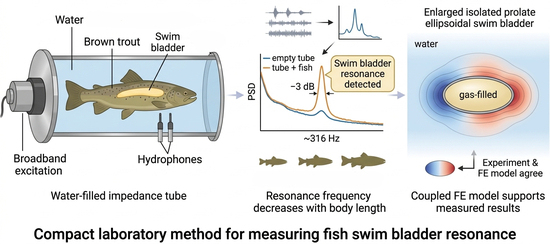
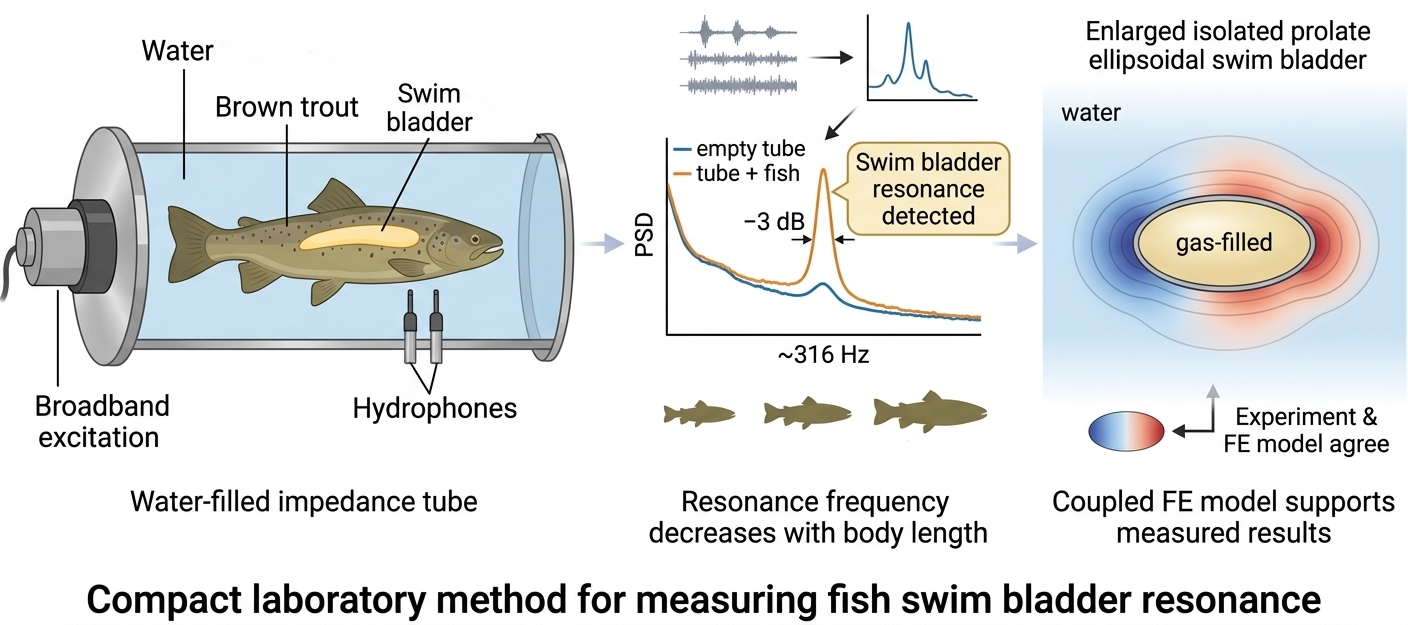
1. Introduction
Aquatic environments contain a wide range of biologically, geophysically, and anthropogenically generated sounds, and many animals use acoustic cues to support behaviours such as habitat selection, predator avoidance, and social interactions [
1,
2,
3,
4,
5]. For fishes, the relevant acoustic information includes both sound pressure and particle motion components, and the relationship between these two depends strongly on the propagation range and environment [
4,
6,
7]. This makes the mechanistic understanding of how external sound fields are coupled into internal particle motions for fish inner ears particularly important when interpreting responses measured in the laboratory or in the field.
Fish hearing is commonly described as sound stimuli reaching the inner ear through direct and indirect pathways [
8,
9]. All teleosts can detect sound with their otolith end organs through the direct pathway, where the sensory hair cells respond to particle motion through a vibration difference, due to inertial lag because of dense calcareous otoliths responding more slowly to sound stimuli than surrounding soft tissues. Some teleost species can also sense sound through the indirect pathway, where a gas-filled cavity contributes by locally converting acoustic pressure fluctuations into additional motion that can stimulate the inner ear [
10,
11,
12]. In teleosts with a swim bladder, or other gas-filled chambers, pressure-driven compression and expansion of the gas volume can drive oscillation of the bladder wall and act as a secondary source of particle motion near the sensory epithelia; when anatomical coupling is present (e.g., Weberian ossicles in otophysans), this contribution can be more effective [
6,
13,
14,
15]. These concepts motivate quantitative characterisation of swim bladder resonance properties because they constrain how the bladder responds to pressure excitation and, in turn, what motion this may induce locally [
9,
16,
17,
18]. Accordingly, quantifying swim bladder resonance metrics is a necessary precursor to more ambitious questions, such as how swim bladder resonance varies with fish size and morphology, how it changes with environmental loading (e.g., depth and pressure), and how it may be altered by pathology or damage. These questions are increasingly relevant in freshwater and near-shore settings, where fish behaviour and deterrence are of practical concern (e.g., guiding fish passage at barriers, mitigating entrainment, and reducing ecological impacts of infrastructure).
Despite this motivation, direct measurements of swim bladder resonance properties remain limited. Field-based methods, such as ring hydrophone (i.e., a circular hydrophone geometry used on the cylindrical fish cage to measure the re-radiated sound field from the swim bladder and isolate its resonance signatures in open water) arrangements and related open-water scattering measurements, can resolve the resonance re-radiation, but are logistically demanding and sensitive to boundary effects, such as surface reflections, requiring deep water and careful deployment [
19,
20,
21]. Laboratory approaches have included ultrasound-based measurements of bladder wall motion (e.g., NIVAMS), but these typically require anaesthesia and precise positioning, and are difficult to reproduce without specialised apparatus [
6]. More recent CT-informed modelling has enabled detailed prediction of swim bladder mechanics and pressure sensitivity, but it is not a direct measurement technique and often relies on imaging conditions that are difficult to achieve on unanaesthetised, freely behaving fish [
22,
23].
In parallel, there has been renewed interest in developing compact, closed experimental systems for measuring resonance of free and/or encapsulated bubbles, motivated by both fundamental bubble acoustics and applied noise control concepts. Water-filled tubes and small tanks have been used to measure bubble resonance through controlled excitation and pressure recording [
24,
25,
26], and analogous strategies have been applied to tethered encapsulated bubbles and arrays for underwater noise abatement [
27,
28]. These studies demonstrate that, with careful experimental design, sub-wavelength gas cavities can be characterised in confined laboratory geometries, but they also highlight an important complication: the resonance of the bubble can couple with, and modify, the host cavity response, so robust identification benefits from an analysis framework that separates the driven system dynamics from the bubble characteristics.
Building on previous laboratory studies that measured free and encapsulated bubble resonance in water-filled tubes and small tanks, a repeatable experimental procedure was developed and reported for identifying the resonance response of an encapsulated gas cavity in a fully water-filled stainless-steel impedance tube, using inflated latex balloons as surrogate swim bladders [
29]. That study established the feasibility of detecting and quantifying a cavity resonance peak in this bounded, driven configuration using power spectral analysis, and it clarified practical requirements for repeatability (notably complete water filling and control of unintended air pockets). The present paper advances the same measurement concept from surrogates to biological swim bladders by applying the impedance tube protocol to recently euthanised brown trout (
Salmo trutta). This intermediate step retains a naturally inflated swim bladder over a short post mortem window while permitting post-test dissection to confirm inflation state and gross morphology, thereby providing a controlled route to evaluate whether the resonance features for the swim bladder, as a damped organ surrounded by soft tissues, remain detectable through this method. To support interpretation under the experimental loading, the measured resonance features are further examined using coupled finite element (FE) modelling.
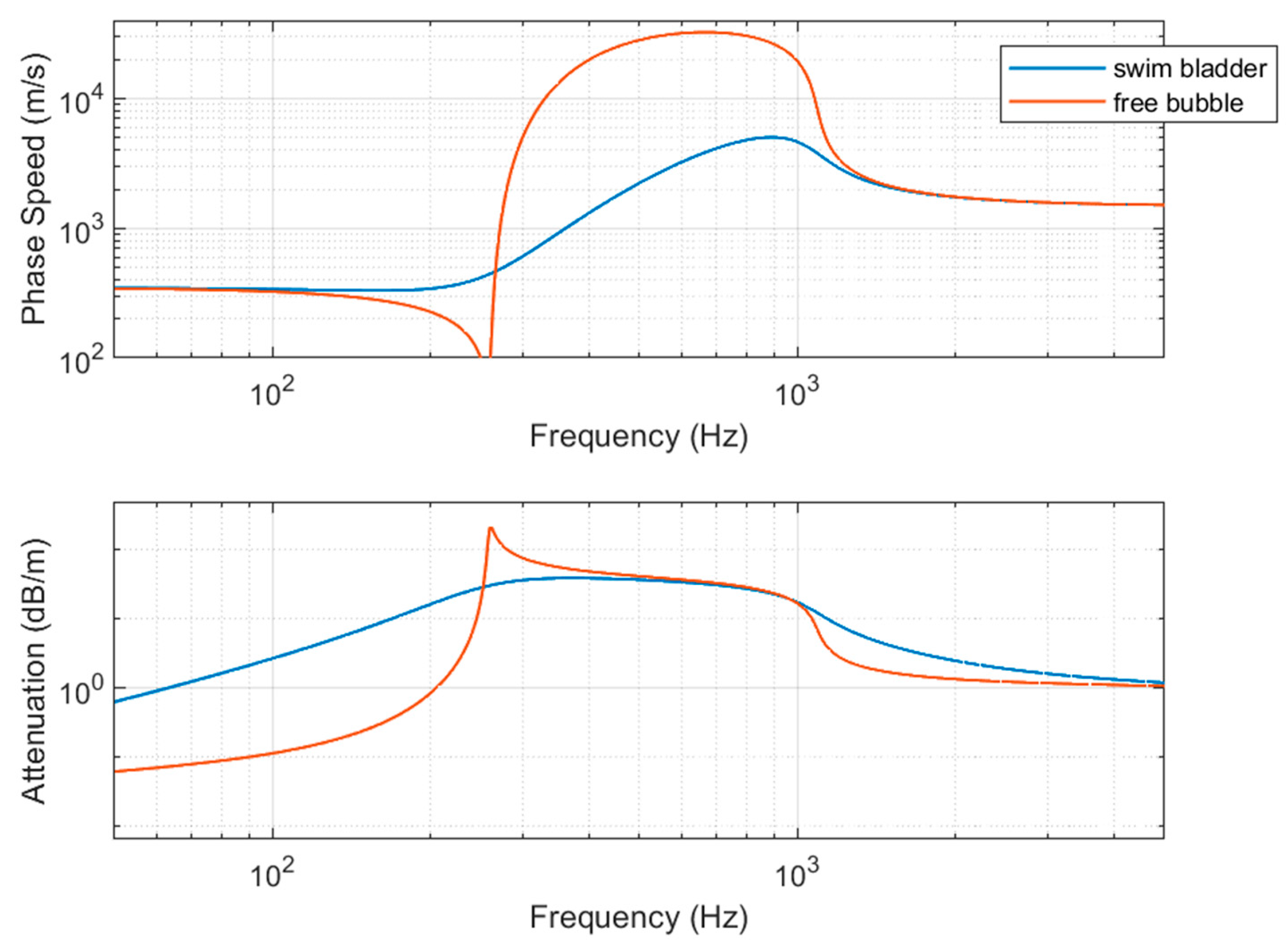
Swim bladder resonance is often introduced by analogy with the resonance of a free bubble in water, for which the natural frequency decreases with increasing bubble radius and increases with hydrostatic pressure [
30,
31]. In this framework, the gas acts as a compressible spring, and the surrounding water provides inertia, yielding a sub-wavelength monopole-like response with omnidirectional radiation. In practice, this implies strong near-field pressure gradients and associated particle motion in the vicinity of the oscillating cavity, which are the mechanical quantities most directly relevant to otolithic stimulation and to any bladder-to-ear coupling pathways. For a swim bladder, the same physical picture is useful but incomplete: the gas is bounded by an elastic bladder wall, the cavity is typically elongated and may be chambered, and the surrounding soft tissue introduces additional stiffness and damping. Classical modelling studies therefore treat the swim bladder as an encapsulated gas cavity whose resonance depends on cavity geometry, wall compliance, and environmental loading [
16,
32,
33,
34]. The implication for measurement is that resonance frequency is not determined by size alone, and the quality factor is expected to be substantially lower than for an unbounded bubble, due to viscoelastic and tissue losses.
From a sensory perspective, the relevance of resonance is twofold. First, a resonant gas cavity can amplify local particle motion and pressure gradients in its vicinity, which may be detected directly by otolithic organs. Second, in species with mechanical coupling between the bladder and inner ear, bladder motion can be transmitted efficiently to the sensory epithelia, improving pressure sensitivity and extending the upper frequency limit of hearing [
18]. These mechanisms motivate explicit measurement of resonance metrics in laboratory and management contexts, including fishery passages where acoustic deterrence may be deployed. Resonance metrics may also be relevant when selecting exposure frequencies in applied contexts, but the present study reports mechanical characterisation only.
A persistent difficulty is that many environments of interest, like rivers, channels, and shallow reservoirs, do not permit classical far-field measurement paradigms at the frequencies relevant to swim bladder resonance. Limited depth and complex boundaries promote strong multipath effects and reverberation, and the relationship between acoustic pressure and particle motion can vary substantially over short spatial scales. In addition, shallow-water waveguide effects introduce frequency-dependent propagation constraints: for some species and size classes, swim bladder resonance frequencies may fall below the low-frequency cut-off of the environment, so efficient propagation to far-field ranges is not guaranteed even before considering interference and boundary losses. Here, ‘low-frequency cut-off’ refers to the shallow-water waveguide constraints where, below a certain geometry-dependent frequency, efficient propagation of low-order modes is limited, and the sound fields can become strongly range-limited. These constraints help explain why resonance-specific measurements have historically relied on open-water experiments in deep sea lochs or quarries, where surface reflection artefacts can be controlled and propagation more closely approximates free-field conditions [
19,
20]. In contrast, compact laboratory methods that resolve resonance properties under controlled conditions can provide a repeatable baseline and enable systematic exploration of factors such as size, shape, inflation state, and wall mechanical properties. The work reported here adopts that approach using a pre-existing stainless-steel, water-filled impedance tube that met the practical requirements for controlled excitation and repeatable hydrophone measurements, allowing method development and validation without the logistical constraints of open-water deployments.
It is also important to clarify the scope of the present study with respect to animal handling. The experiments reported here are not non-invasive: resonance properties are estimated from recently euthanised fish, and the protocol is designed to preserve natural swim bladder inflation for a limited post mortem window while enabling immediate verification by dissection. The value of this intermediate stage is methodological: it tests whether resonance features of a damped biological cavity can be detected reliably in a compact, bounded system, and whether the extracted metrics are sufficiently robust to support interpretation and modelling. These outcomes provide an experimentally grounded foundation for subsequent development of truly non-invasive measurements on live, free-swimming fish in a dedicated test chamber, which is treated separately and will build directly on the procedures and validation reported in this paper.
2. Materials and Methods
2.1. Impedance Tube Configuration
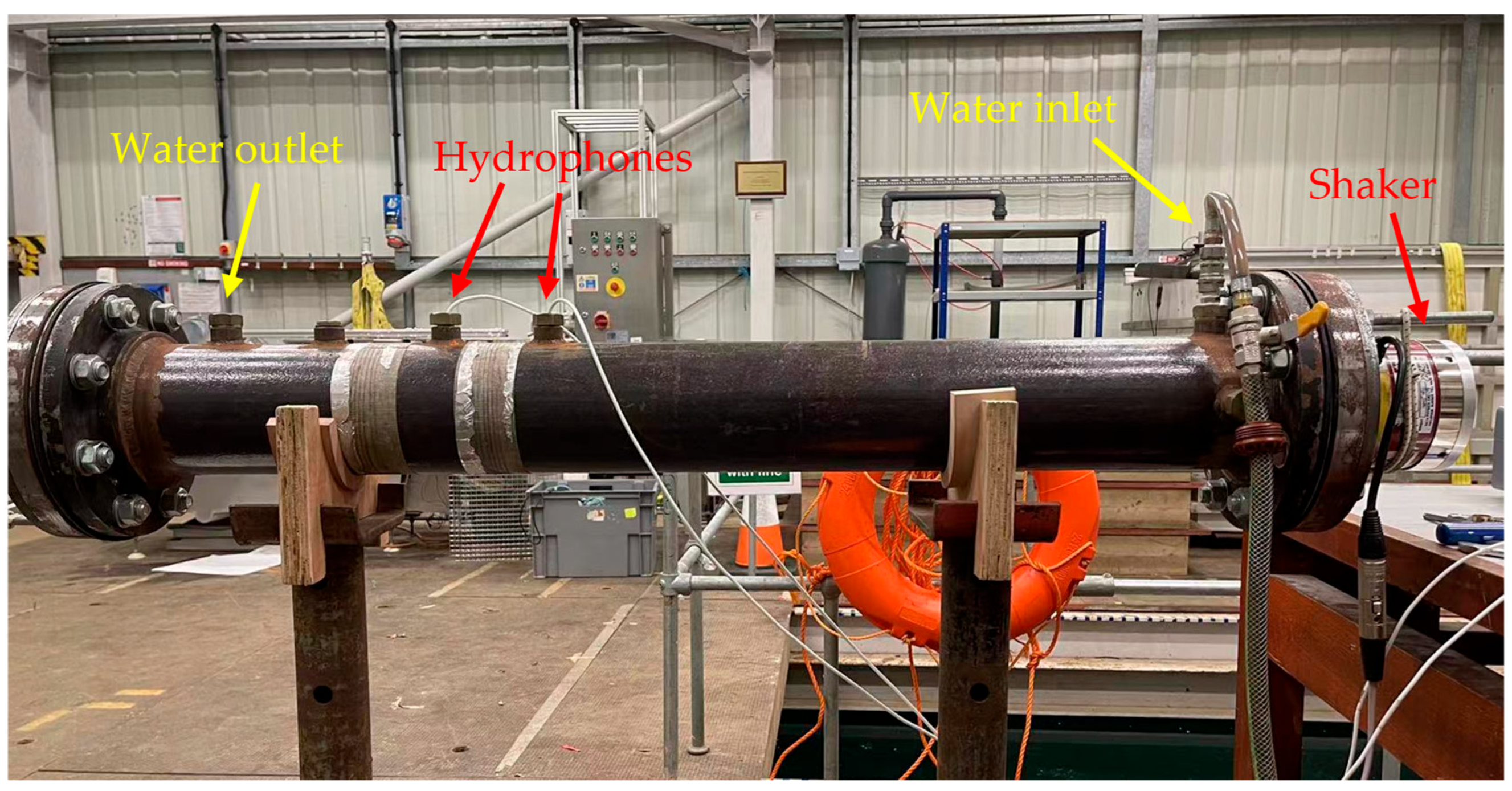
A 1 m long stainless-steel tube (inner diameter 0.10 m, wall thickness 1 cm) was used as a closed, fully water-filled test container. Each end was sealed with a 2 mm thick stainless-steel plate, and the plates were clamped to the tube flange using eight M10 bolts and a 2.5 cm thick removable steel lid [
29]. An inertial shaker was mounted to one end plate to inject broadband vibration into the water column. The tube and lid incorporated machined ports to accommodate the shaker and wall-mounted hydrophones, as well as to facilitate filling (
Figure 1). Prior to every run, the assembly was filled to eliminate trapped air, because residual pockets can introduce spurious resonances and degrade measurement repeatability.
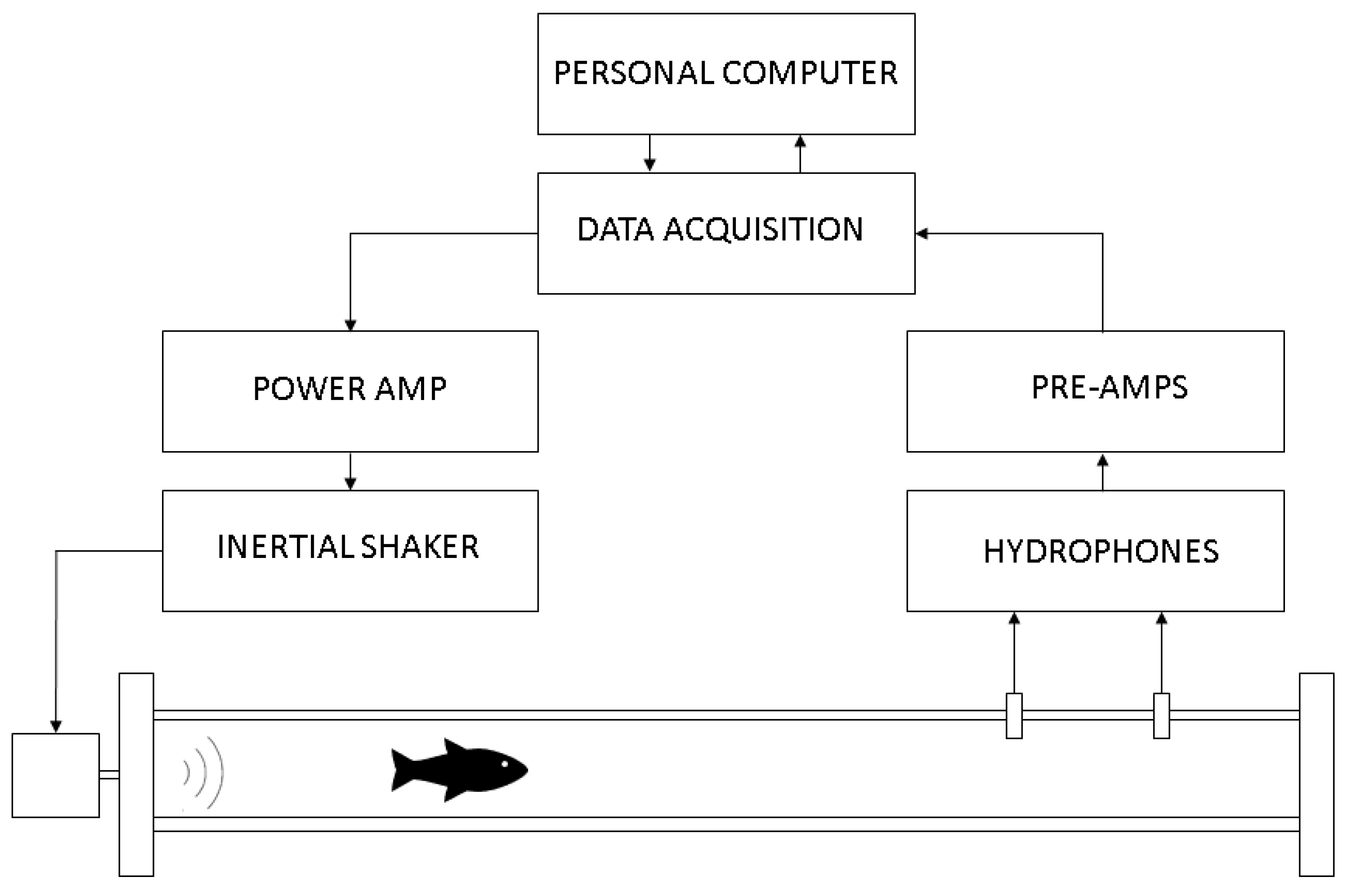
The experimental configuration is shown in
Figure 2. A Data Physics (Riverside, USA) GW-IV45 inertial shaker (mechanical resonance frequency 30 Hz, inertial mass 4.2 kg) was mounted to an end plate providing broadband excitation. A band-limited pseudorandom white noise signal was generated in MATLAB (The MathWorks, Inc., Natick, USA) R2020a and delivered via a National Instruments (Austin, USA) USB-6361 Data Acquisition and a Data Physics PA30E power amplifier (driving voltage 3 V). Two Brüel & Kjær (Virum, Denmark) 8103 hydrophones (−211 dB re 1 V/µPa), mounted through the tube wall near the upper surface, recorded acoustic pressure signals inside the tube. The hydrophones were positioned at approximately 0.10 m and 0.20 m from the end plate opposite the shaker, providing two pressure channels for consistency checking and for mitigating localised features. Acoustic signals were recorded at a sampling frequency of 4 kHz for a 100 s excitation period.
2.2. Targets and Specimen Preparation
Prior work established the impedance tube protocol using inflated latex balloons as surrogate encapsulated gas cavities [
29]. The present study focuses on recently euthanised brown trout to evaluate the method on biologically realistic swim bladders while enabling immediate post-test verification of inflation state and geometry. Brown trout specimens (
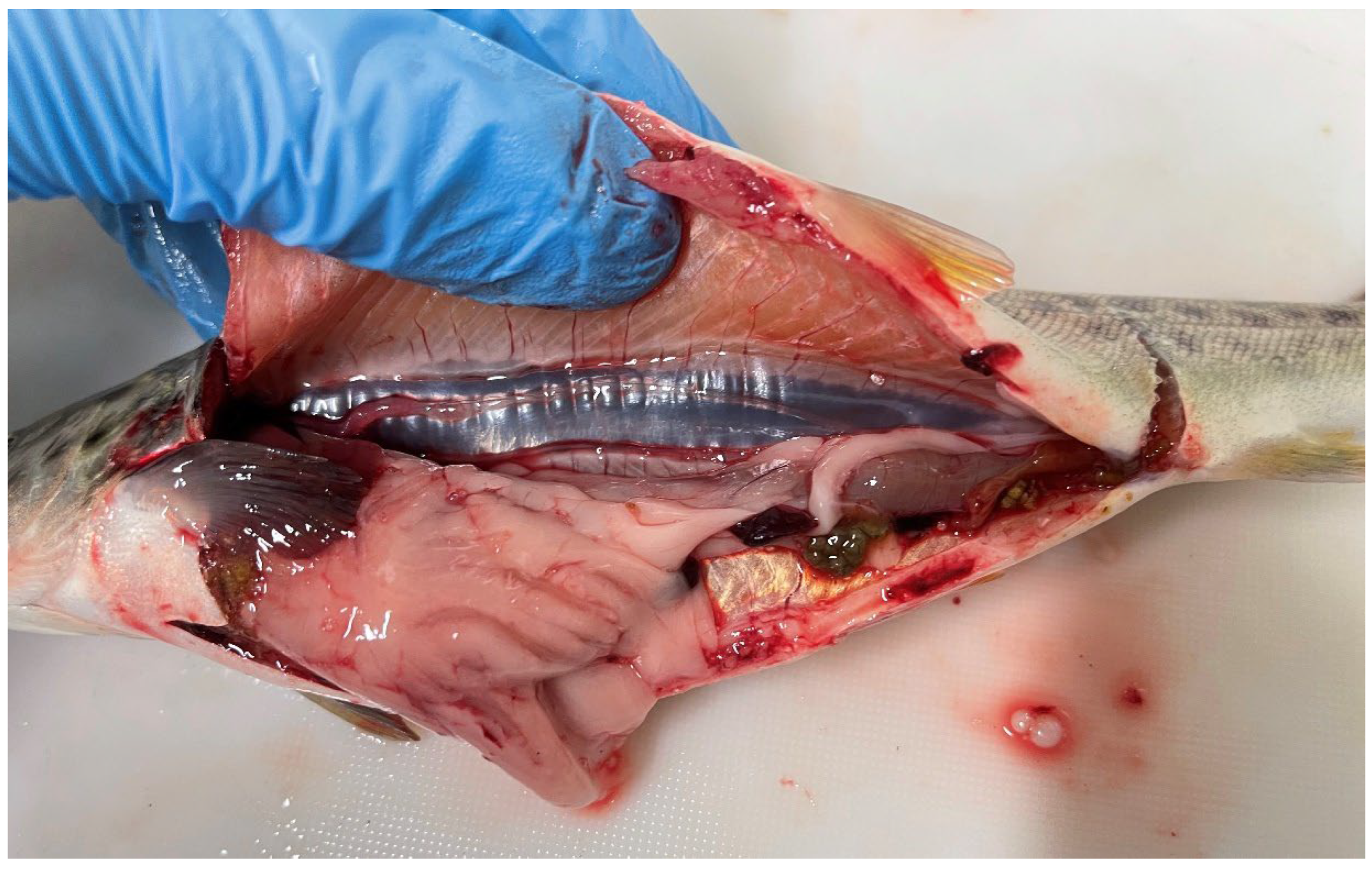
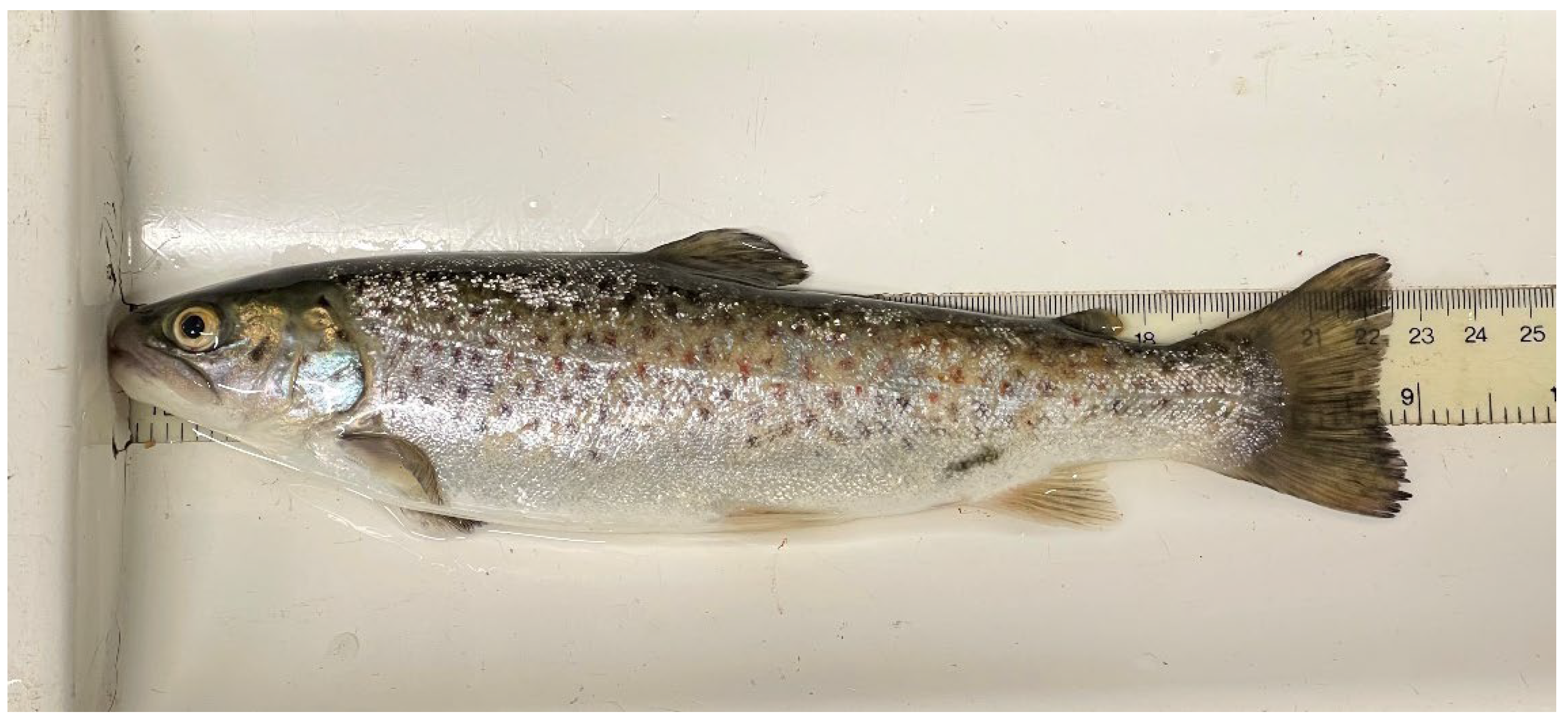
n = 18) were obtained from a separate approved study at the International Centre for Ecohydraulics Research (University of Southampton, UK). Fish were euthanised by overdose of 2-phenoxyethanol, followed by destruction of the brain in accordance with Schedule 1 of the Animals (Scientific Procedures) Act 1986, under the approval of the University of Southampton’s Animal Welfare and Ethical Review Board (ERGO ID: 87876.A1). Because post mortem changes may lead to swim bladder deflation, measurements were conducted within approximately 30 min of euthanasia. Fork length was measured for each specimen (mean 22.1 ± 2.1 cm; range 11.0–23.9 cm) before being positioned into the impedance tube (
Figure 3). Immediately after each measurement, the swim bladder was exposed by dissection and removal of organs obstructing direct vision and measurement to confirm swim bladder intactness and inflation. The semi-major and semi-minor dimensions were measured by a calliper to estimate eccentricity for the prolate ellipsoid approximation (
Figure 4).
2.3. Spectral Estimation and Resonance Properties
For each trial, the system response was characterised in the frequency domain using power spectral density (PSD) and cross-spectral estimates computed from the recorded time series. Spectra were estimated using Welch’s method with Hann windowing, 50% overlap, and 1024-sample segments. Welch’s method was selected because segment averaging reduces the variance of the spectral estimator and improves robustness to broadband noise for long, approximately stationary records under pseudorandom excitation. The shaker drive signal, , was saved concurrently with the recorded hydrophone pressure signals, . All channels were sampled synchronously at = 4 kHz for a record duration = 100 s, providing sufficient averaging to stabilise the spectral estimates in the resonance band of interest.
The time series were partitioned into segments of samples (segment duration s), Hann-windowed, and averaged with 50% overlap. For each channel pair, the one-sided auto-spectral densities, and , and the cross-power spectral density, , were computed from the discrete Fourier transforms of the windowed segments, and then averaged over all segments. The hydrophone pressure PSD, , was used as the primary representation of the system frequency response in this paper because it provides a direct and reproducible depiction of the frequency content of the measured acoustic field under a standardised drive condition. Cross-spectral quantities were used to support quality control, rather than for reporting; specifically, and the magnitude-squared coherence, , were inspected to confirm that spectral features in the resonance band were causally associated with the applied excitation, rather than incidental noise or transient handling artefacts.
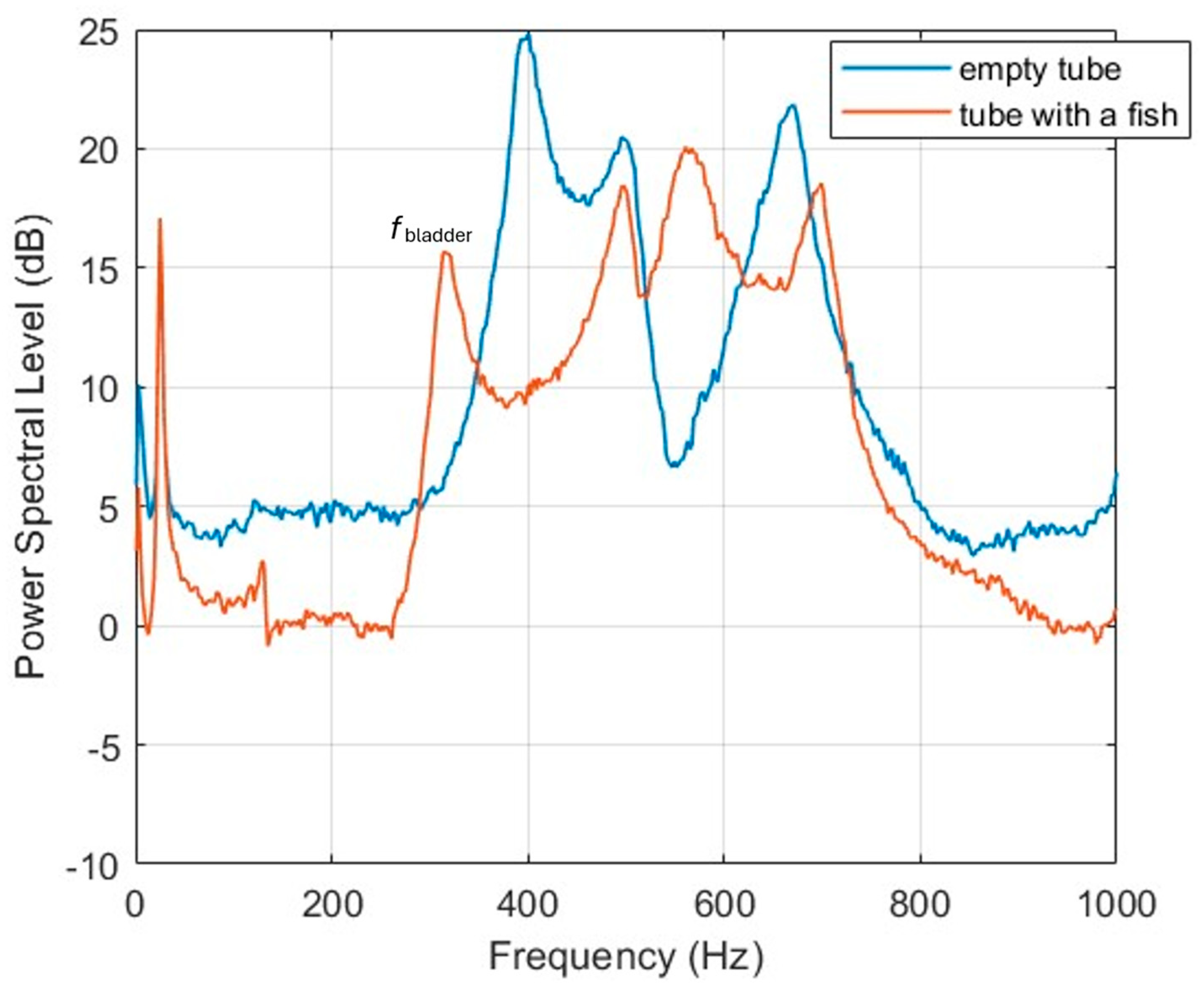
Before bubble resonance peak extraction, the empty-tube baseline spectrum was acquired repeatedly under the same acquisition settings and used as the steady reference state for that setting. The fish-present spectrum was then compared directly against the baseline to identify inclusion-associated changes. Where two hydrophones were available, spectra were computed independently for each hydrophone. Agreement between channels in peak frequency and peak prominence was used as an internal consistency check that the observed feature reflected a global response of the coupled tube–fish system, rather than a localised pressure anomaly at a single sensor.
To provide a quantitative indicator that the tube filling procedure yielded a consistent ‘empty-tube’ reference state, the empty-tube baseline spectrum was re-acquired before each specimen measurement. Baseline repeatability was summarised over 200 to 800 Hz by the median absolute difference (in dB) between the current baseline PSD and a reference baseline run under the same acquisition settings. Across trials, the baseline median absolute difference was typically ≤1 dB, with no narrowband emergent peaks indicative of unintended trapped air. In addition, when two hydrophones were available, baseline spectra agreed closely in shape over the same band, and fish-present peak frequencies extracted from the two hydrophones were required to agree within ±5 Hz for a trial to be considered internally consistent, otherwise the specimen was repositioned and/or the tube refill procedure repeated.
Resonance frequency, , was defined operationally as the frequency of the dominant swim bladder-related peak in the PSD of the recorded signal that (i) was absent in the empty-tube baseline, (ii) occurred within the expected frequency band for trout swim bladders under the present setting, and (iii) was repeatable across short repeated acquisitions within the same specimen where available. Peak identification was performed on PSD with consistent handling of bandwidth, using a local maximum criterion within a bounded search interval set to exclude prominent fixed cavity peaks that were present in the baseline.
The resonance sharpness was quantified via a quality factor, , computed using the conventional −3 dB bandwidth definition, where is the full width at half power of the peak (i.e., the frequency interval where the PSD drops to one-half of its peak amplitude, corresponding to −3 dB on a log scale). Because the observed peaks occur in a bounded cavity with nearby cavity-related spectral features (the empty-tube baseline), is interpreted here as an operational descriptor of peak breadth under the present experimental loading, rather than as a direct estimate of a single intrinsic material damping parameter of the swim bladder wall.
To quantify extraction repeatability, and were computed independently for each hydrophone and compared; a trial was considered internally consistent if the two estimates of agreed within a pre-specified tolerance (e.g., ±5 Hz), and if the half-power crossings were well defined on both channels. If a peak was clearly present in one channel, but ambiguous in the other due to local interference, the specimen was re-measured after repositioning or refilling checks, and the more consistent acquisition was retained for analysis.
Although the tube is spatially bounded, was extracted independently from two hydrophones at different axial locations, and agreement between channels was used as an internal consistency check. When the peak was ambiguous in one channel, the specimen was repositioned and the acquisition repeated. These steps were intended to reduce sensitivity to local pressure anomalies and to ensure that the extracted reflects a consistent coupled response of the container–specimen system.
2.4. Summary of Numerical Modelling Strategy
FE modelling was used to verify the physical interpretation of the measured resonance features and to examine how a gas-filled swim bladder responds under acoustic excitation. All simulations were performed in COMSOL Multiphysics (version 6.1, Stockholm, Sweden) using 3D object interface. The model was formulated as a coupled acoustic–structure interaction problem in the frequency domain, with the surrounding water and the swim bladder gas represented using the Pressure Acoustics, Frequency Domain module, and the swim bladder wall represented as a thin elastic layer using Structural Mechanics (Shell) module. The shell formulation was selected because it allows wall thickness, elastic properties, and damping to be prescribed directly at the fluid–wall boundary and avoids the need to explicitly mesh a very thin solid domain, while still capturing the dominant wall compliance effects relevant to resonance. Acoustic–Mechanic coupling was implemented via Acoustic–Structure Boundary multiphysics coupling, ensuring that acoustic pressure loads drive wall deformation and that wall motion, in turn, modifies the acoustic fields in the adjacent fluid domains.
To approximate free-field excitation for interpreting the natural resonance of an encapsulated gas cavity, the swim bladder was embedded at the centre of a spherical water domain (radius 0.5 m). The excitation was implemented as a monopole source in the water domain positioned 0.20 m below the swim bladder. A harmonic volume flow rate was prescribed for the monopole (0.0001 m
3/s), and frequency domain solutions were computed from 10 Hz to 1000 Hz in 10 Hz increments. The governing acoustic field in the fluid was solved using the inhomogeneous wave equation in the frequency domain following Equation (1) [
35,
36]:
where
and
represent the static density and sound speed of the medium, respectively.
p represents the dynamic sound pressure after the source is induced to radiate sounds, and
ρ is the resulting variable density in the medium. The initial sound source
is given as a point source in the following form:
where
has the following form:
and
gives the volume flow rate from the source at
, which was set to 0.0001 m
3/s.
To couple the interaction between the fluid and solid media, the pressure continuity condition should satisfy , where is the pressure load on the boundary, p is the pressure, and is the normal vector. To reduce reflections at the model boundary, the exterior field was treated using an outgoing wave (radiation) condition consistent with spherical spreading. In addition, a perfectly matched layer (PML) surrounded the outer edge of the water domain so that outward-propagating waves were absorbed, approximating an unbounded medium.
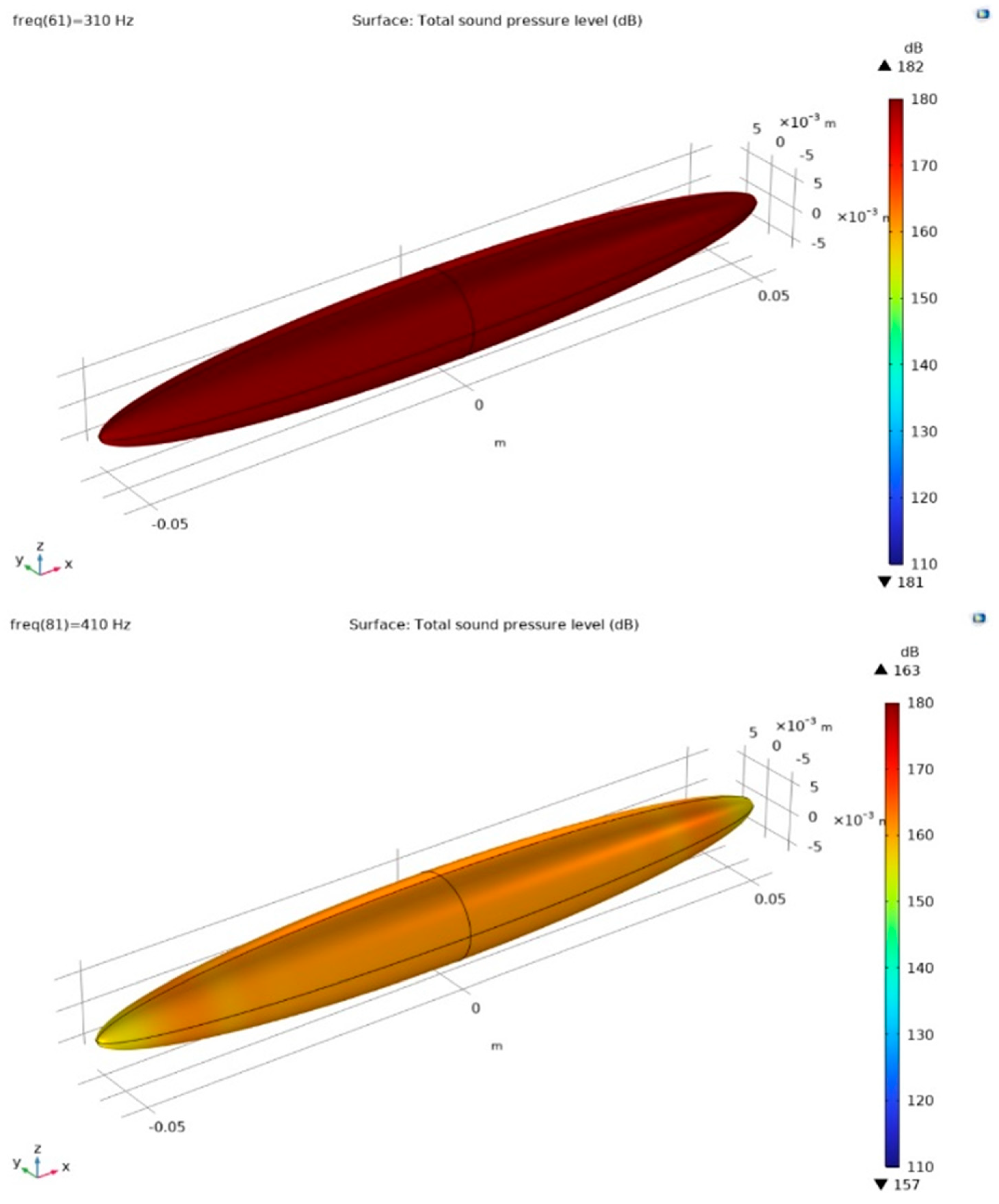
The swim bladder was represented as an air-filled prolate ellipsoid to capture the first-order effect of elongation while retaining a tractable parameterisation. The semi-major and semi-minor axes were set from post-test measurements (example parameter set:
cm,
cm; eccentricity
), which correspond to an equivalent spherical radius
cm for volume-matched comparison. Water was assigned density 1000 kg/m
3 and sound speed 1480 m/s; the gas domain was assigned density 1.204 kg/m
3 and sound speed 343 m/s. The swim bladder wall was modelled as a linear elastic shell with density 1050 kg/m
3, Young’s modulus 2 MPa, and Poisson’s ratio 0.45, consistent with recent modelling studies [
23]. Wall thickness was set to 0.1 mm, and structural losses were represented using an isotropic loss factor (structural damping) of 0.18. These parameters were not tuned to fit individual measurements; rather, they were chosen to be biologically plausible and sufficient to test whether the observed peak frequencies and peak breadths were consistent with a compliant walled gas cavity.
The model was discretised using a free tetrahedral mesh with physics-controlled refinement. Mesh density was chosen so that element size in the acoustic domains was well below the shortest wavelength over the frequency range of interest. Convergence was verified by checking stability of the predicted resonance peak location under mesh refinement. Model outputs were extracted at the scanning frequencies as sound pressure and the wall displacement at the swim bladder wall to confirm that the dominant spectral feature corresponded to a bladder wall oscillation mode. Results from the FE model were used to support attribution of the experimentally observed peaks to simulated swim bladder resonance and to provide qualitative guidance on the influence of wall compliance and loading assumptions under the present experimental conditions.
The FE model in this study is a free-field verification model, intended to test whether the observed dominant spectral peak is consistent with a compliant walled gas cavity resonance, and to inspect the associated bladder wall motion and local acoustic field. It does not include the impedance tube geometry, end-plate forcing, hydrophone ports, or specimen–wall proximity conditions. Consequently, the model is not used to predict spatial pressure distributions in the empty tube or in the tube with fish present, nor to reproduce tube mode shapes; those container-specific fields would require a dedicated tube geometry in acoustic–structure coupling model and are reserved for future work.
5. Conclusions
This study demonstrates that swim bladder resonance properties in recently euthanised brown trout can be identified reproducibly in a compact, fully water-filled impedance tube using PSD-based analysis under controlled broadband excitation. Relative to the empty-tube baseline, fish-present measurements consistently show an additional dominant peak attributable to a resonant gas-filled inclusion and systematic modification of surrounding tube spectral features, consistent with coupled cavity-inclusion dynamics.
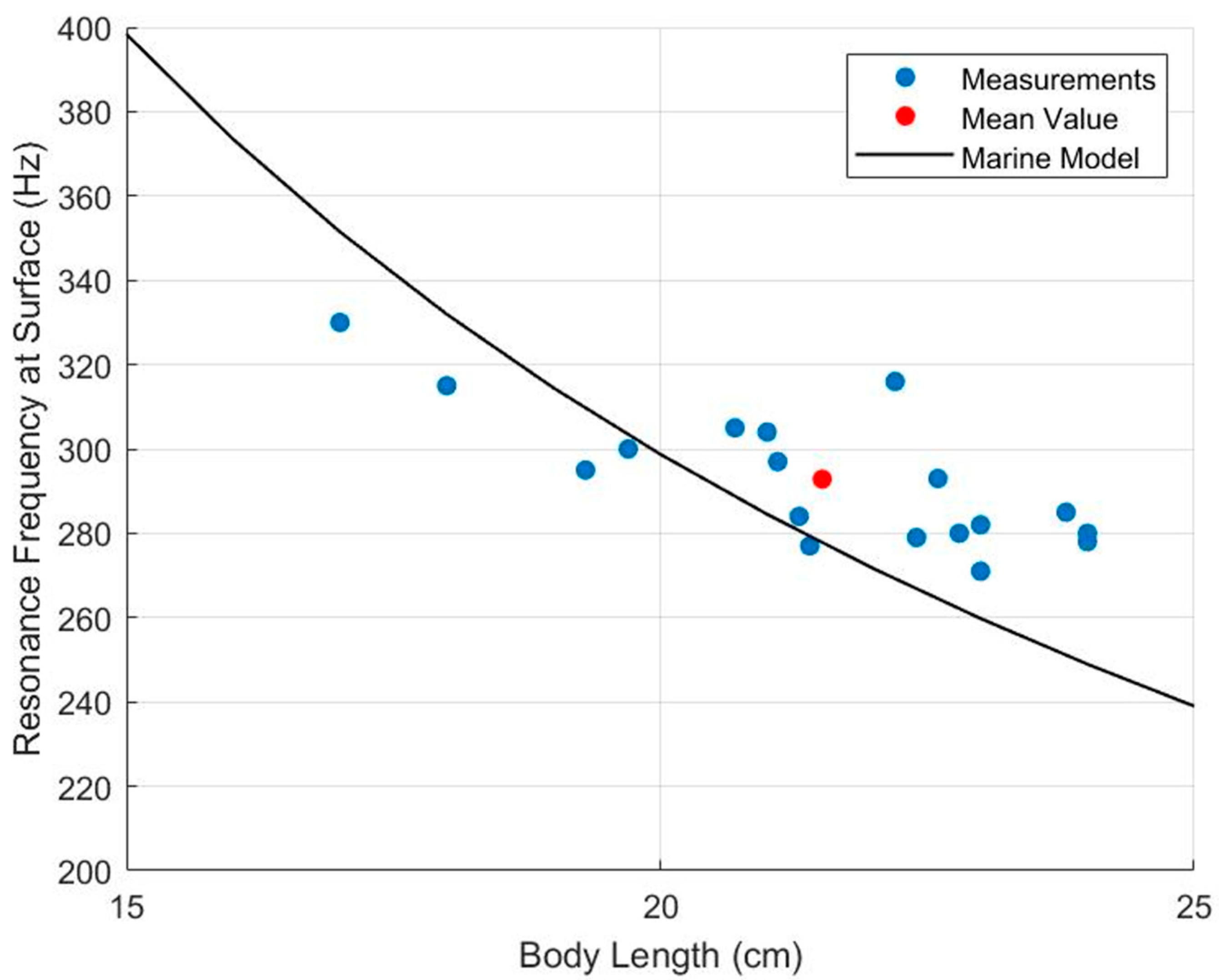
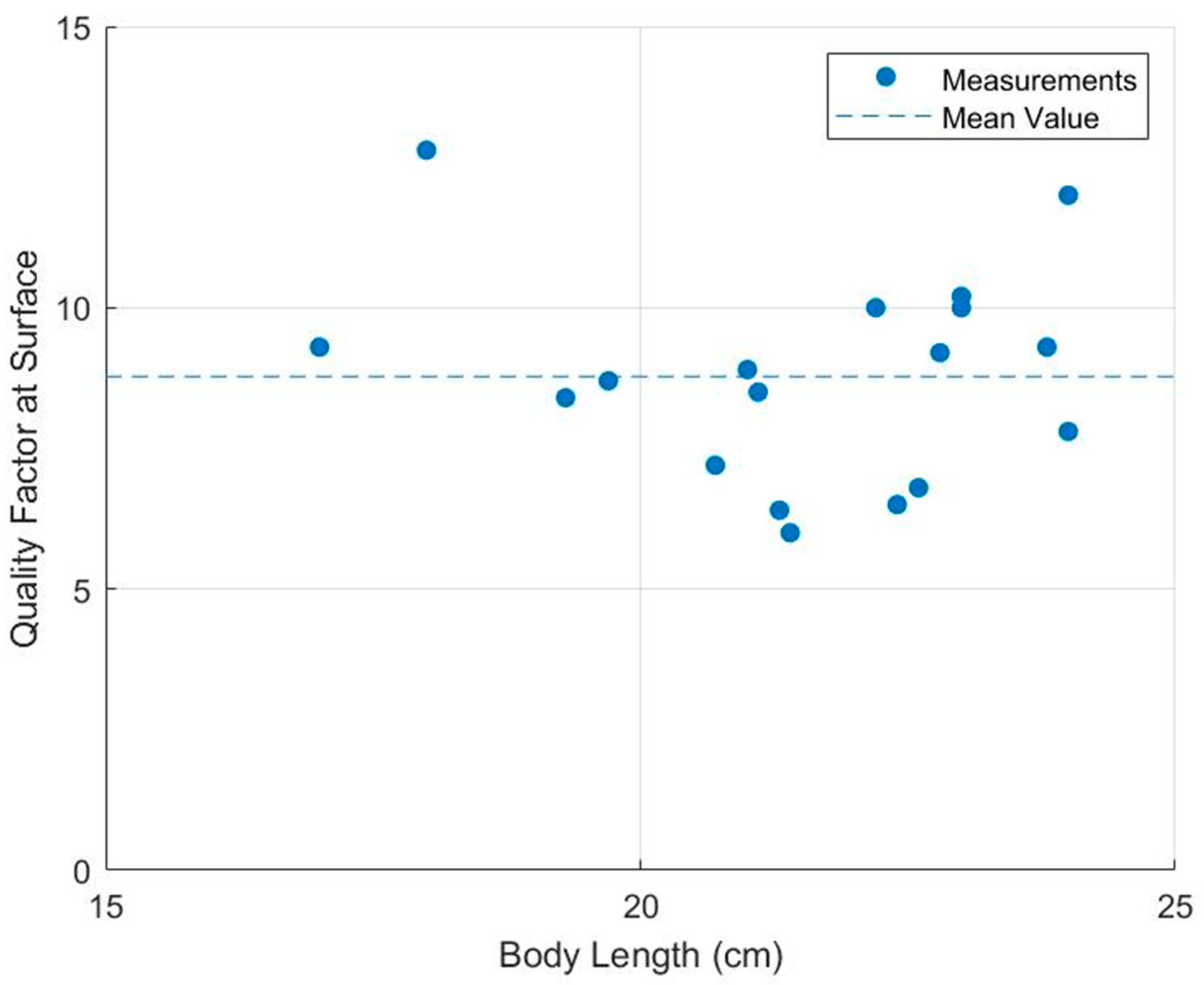
Across 18 specimens, the extracted resonance frequency decreases with body length and is reasonably described by an inverse-length relationship, while the operational quality factor shows no clear size dependence over the measured range. These trends support the interpretation that fish size primarily controls the gas volume which sets , whereas damping is governed more by tissue losses and experimental loading.
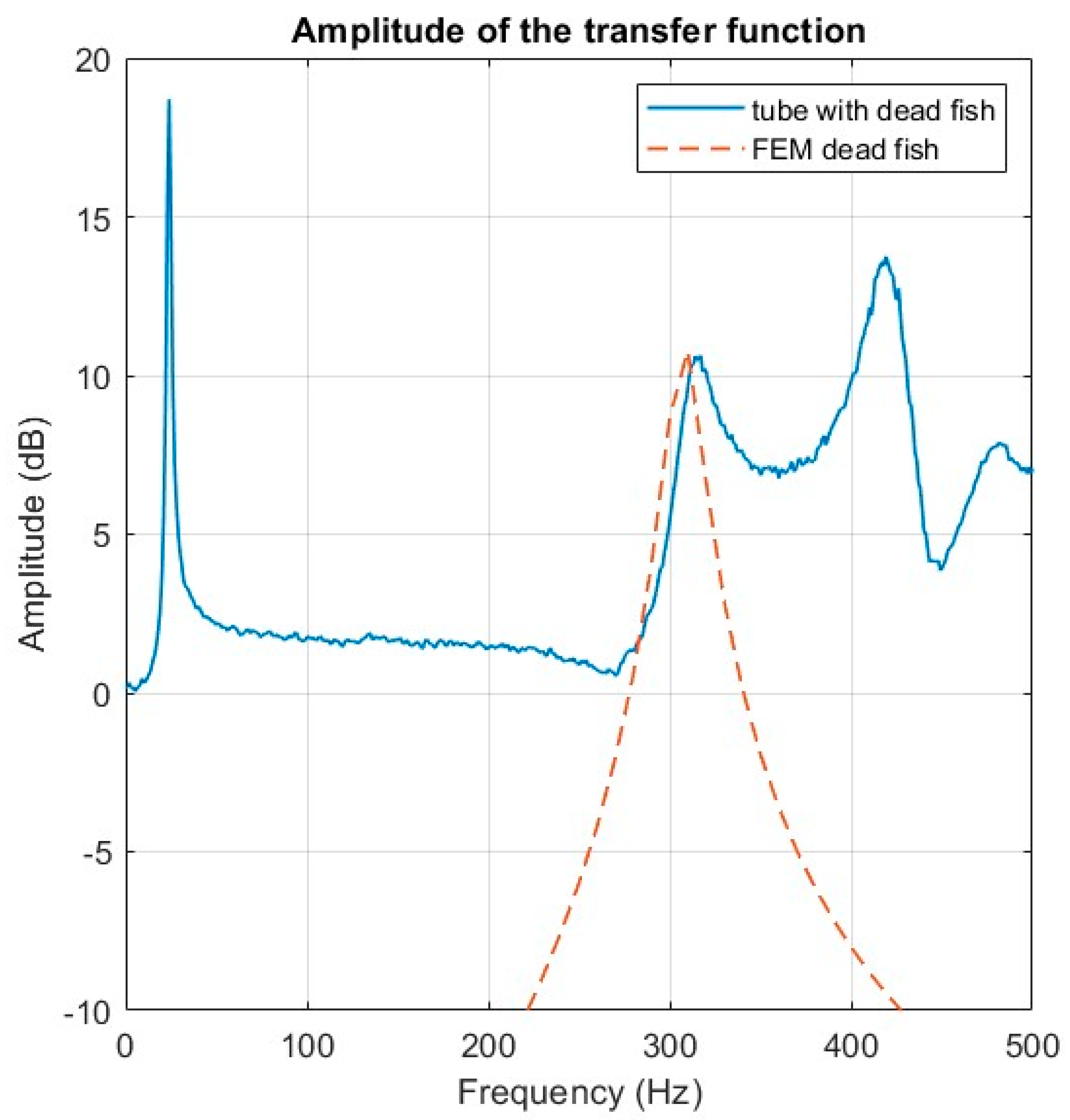
Coupled acoustic–structure FE simulations reproduce the principal resonance band and peak character for a representative specimen and provide mechanistic support for attributing the measured peak to swim bladder resonance. The remaining differences in peak breadth are consistent with additional biological and contact-related damping mechanisms not explicitly represented in the simplified ellipsoidal model.
The present study establishes a repeatable laboratory protocol for resonance identification under controlled boundary and filling conditions. The current stainless-steel tube system is a laboratory prototype and is not intended as a field-deployable instrument in its present form. However, the approach could, in principle, be translated to a portable closed-container implementation, provided that future engineering development addresses practical requirements including reliable filling, robust sealing, repeatable transducer mounting, stable excitation and power, and mitigation of ambient vibration and acoustic interference in real sites. Such a portable implementation could support non-invasive comparative measurements of resonance properties across individuals or timepoints, for example, in studies assessing whether swim bladder condition (including potential pathological states) is associated with measurable changes in the resonance band.
Overall, the results provide a calibrated methodological basis and an interpretation framework for subsequent studies that aim to refine modelling with specimen-specific geometry and more efficient experimental protocol, as well as connect resonance-informed mechanical properties to hearing-relevant hypotheses and behavioural responses under laboratory and, ultimately, field-relevant conditions.