
Article

A Case Study of Coilia nasus: Is There a Difference in Microchemical Signatures Between Left and Right Fish Sagittae?

1
College of Fisheries, Nanjing Agricultural University, Wuxi 214081, China
2
Fishery Microchemistry Laboratory, Freshwater Fisheries Research Center, Chinese Academy of Fishery Sciences, Wuxi 214081, China
*
Author to whom correspondence should be addressed.
Fishes 2026, 11(3), 146; https://doi.org/10.3390/fishes11030146
Submission received: 22 December 2025 / Revised: 27 February 2026 / Accepted: 27 February 2026 / Published: 2 March 2026
(This article belongs to the Special Issue Application of Otoliths in Fish Ecology and Fisheries)

Abstract

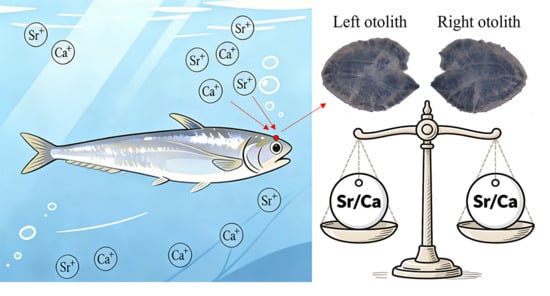
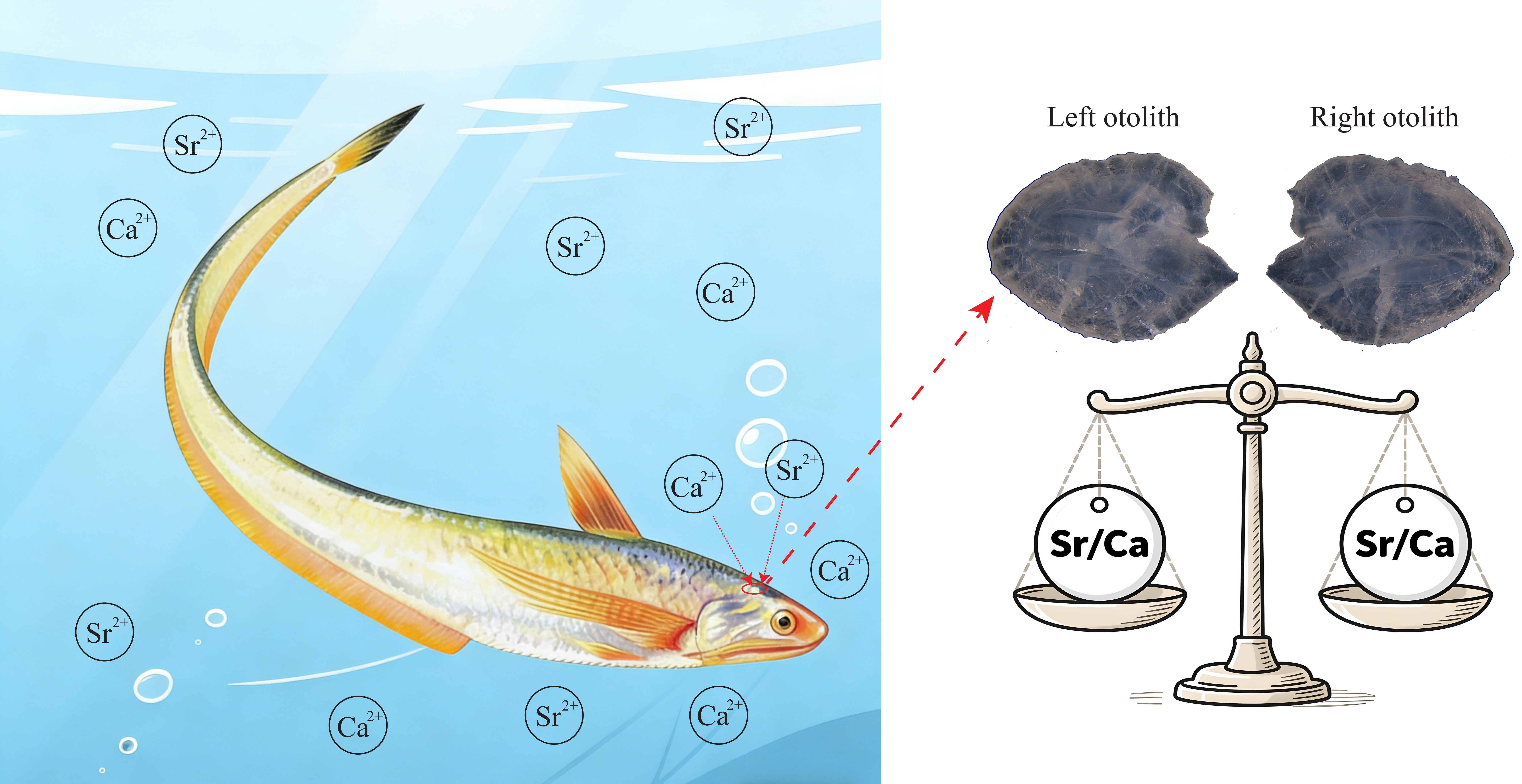
Owing to the asynchronous deposition of trace elements between paired left and right otoliths within individual fish, researchers must consciously and uniformly use only single otoliths (especially the left one) for microchemical studies. To ensure reliability of unilateral otolith data for inferring the same habitat experiences of individual fish, this study focused on Coilia nasus as a representative case to validate whether the microchemical composition was consistent between left and right sagittal otoliths. Electron probe microanalysis was employed to determine microchemical profiles of Sr and Ca in both otoliths of 20 wild C. nasus specimens of the same age. At the individual level, Sr/Ca ratios in corresponding micro-regions (e.g., core and edge) of bilateral otoliths showed highly significant positive correlations, with approximately 92.59% of paired comparisons showing no significant differences at equivalent life-history stages, demonstrating that microchemical signals recorded by either otolith are highly consistent in both spatial distribution and elemental concentration levels. This study provides evidence of fundamental concordance in microchemical composition between bilateral otoliths within an individual, providing critical references on the methodological foundation for reliably using either the left or right otolith in future studies on otolith microchemistry of fish population connectivity, migration characteristics, and life history reconstruction.
Key Contribution: In this study, the consistency of microchemical profiles between the left and right sagittae within individual fish was systematically investigated using a representative species of Coilia nasus and an electron probe microanalysis approach. The results validated the notion that unilateral otolith analysis yields reliable data for life history reconstruction. Microchemical data interpretation is not subject to systematic errors stemming from unaccounted-for side-to-side variations.

Graphical Abstract

1. Introduction

Fish otoliths are three pairs of calcified structures located in the inner ear (sagitta, asteriscus, and lapillus), and are primarily composed of calcium carbonate and a minor organic matrix [1]. Their formation begins at the larval stage and continues throughout the lifespan of the fish, with deposition of new calcium layers occurring at an approximate daily rhythm. This continuous growth makes otoliths unique “natural archives” that record individuals’ lifetime experiences [2]. The core applications of otolith microchemistry lie in decoding individual environmental histories and revealing the spatial structure of populations [3]. By analyzing sequential variations in key elemental ratios (e.g., Sr/Ca) across otolith growth increments, it is possible to reconstruct life-history events with high precision, such as age in days and years after hatching [4,5], trace migration pathways starting from the natal origin and movements between habitats with different salinity [6,7], and identify habitats utilized during the lifetime of the fish (e.g., spawning, nursery, and overwintering grounds) [4,8]. More importantly, by comparing the spatial heterogeneity or similarity of chemical signatures in the otolith core or specific life stages among multiple individuals within a population, the degree of connectivity between different geographic populations can be quantitatively assessed (e.g., different riverine or estuarine groups) [6,9], and quantify source proportions and mixing rates within fishery stocks. and quantify source proportions and mixing rates within fishery stocks [10,11,12]. This information serves as an indispensable scientific cornerstone for identifying distinct conservation units based on ecological criteria, conducting accurate stock assessments, and formulating targeted management strategies (e.g., establishing protected areas, setting scientific quotas) [13,14,15].
In otolith research, particularly when using strontium/calcium (Sr/Ca) ratios to infer habitat histories, electron probe microanalysis (EPMA) and laser ablation inductively coupled plasma mass spectrometry (LA-ICP-MS) have matured into pivotal technical approaches [16,17], particularly when using Sr/Ca ratios to infer habitat histories of diadromous species [18,19]. The former spans various fields, including fish ecology, resource conservation, and management. For biominerals like otoliths with complex growth structures, EPMA mapping should not be considered optional, but rather a standard procedure complementary to line transect analysis. It functions not only as a tool for verifying the validity of transect data, but also, more critically, as a prerequisite for scientifically planning an analytical path and ensuring that the acquired data genuinely reflect the specimen’s life history processes. However, a crucial and often tacitly assumed premise underpins the widespread application and interpretation of otolith microchemistry for deciphering individual life histories or population structures, that is, whether the deposition of trace elements is strictly synchronous and homogeneous between paired left and right otoliths within an individual fish. This worry enables researchers to conveniently collect and analyze only a single otolith (either left or right) and treat its record as a complete and unbiased account of the individual’s experience. Nevertheless, growing biological clues suggest that such bilateral homogeneity may not be universally guaranteed [20,21,22]. Although practical considerations, including sample availability and analytical costs, have often driven this convention, it risks overlooking biologically meaningful lateral variations or introducing systematic bias [23]. Indeed, limited evidence suggests that environmental stressors induce bilateral asymmetry in otolith mass [24], morphology [25] and elemental chemistry [26], while intrinsic growth and developmental mechanisms (such as gravity-related growth bias) may also drive bilateral asymmetry in otoliths [26,27]. To date, it remains unclear whether the left and right otoliths are morphologically consistent [28,29,30]. Such inconsistencies could manifest as microchemical differences. Therefore, the possibility of significant disparities in the microchemical composition between the left and right otoliths (i.e., asymmetry) represents a potential issue that cannot be overlooked, challenging the foundational reliability of research conclusions.
The tapertail anchovy, Coilia nasus (order Clupeiformes, family Engraulidae), is a flagship diadromous migratory species in the Yangtze River conservation initiative. It inhabits broad geographical and salinity ranges across the western and northwestern Pacific regions [31,32,33]. Using C. nasus as a model, the present study aims to systematically test the hypothesis that the microchemical signatures (i.e., Sr/Ca ratio profiles and Sr spatial patterns) of left and right sagittal otoliths are fundamentally consistent, and the unilateral otolith can reliably reflect fish life history characteristics.
The primary focus of this study is not to estimate population parameters but to conduct a methodological validation through within-individual, paired comparisons (i.e., bilateral otolith symmetry). This constitutes a repeated-measures design where the statistical unit is the paired measurement within a single fish. For studies aiming to test intra-individual consistency or methodological foundations, a limited sample size is recognized as sufficient, as demonstrated by Lord et al. [34], who successfully addressed a core methodological question regarding otolith reliability by analyzing only three pairs of fish otoliths. Accordingly, our study of 20 individuals provides 20 paired data points for robustly assessing bilateral consistency. The unanimous observation of the key ecological pattern (Sr/Ca shift) across all individuals reinforces that our sample size and design are appropriate for testing the specific hypotheses regarding individual life-history patterns and methodological assumptions.
This study addresses a fundamental yet underexplored question in otolith microchemistry, namely, the consistency of microchemical signatures of elements between the left and right sagittae within individual fish. The results are hoped to provide critical references/theoretical bases for refining technical protocols in otolith-based research.

2. Materials and Methods

2.1. Study Area and Field Sampling

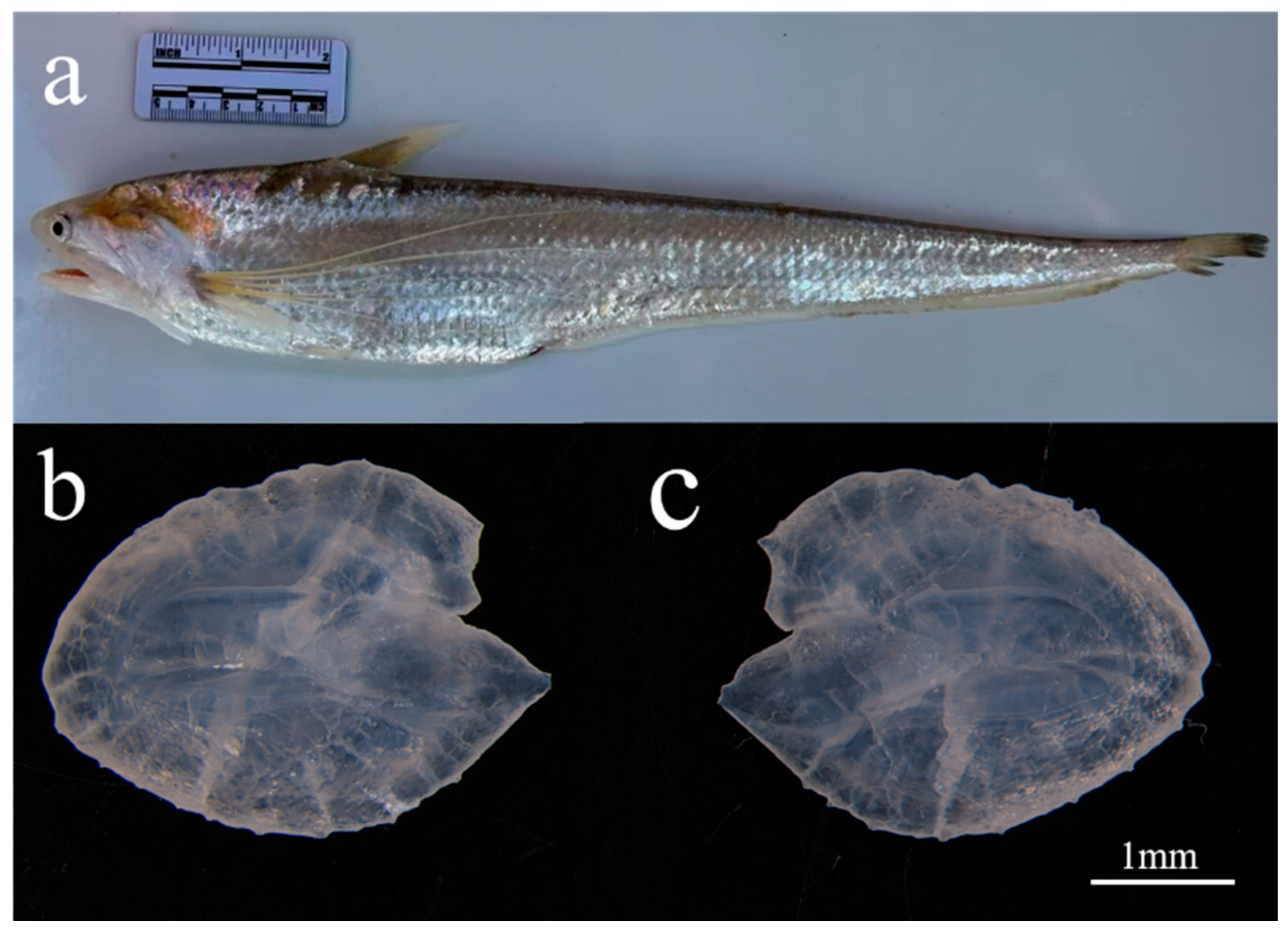
Specimens of C. nasus used in this experiment were collected from Poyang Lake in June 2019 (Figure 1) under the auspices of a provincial survey project. All samples underwent comprehensive biometric measurements (Table 1) and gonadal staging, confirming, based on morphometric ratios, that all individuals belonged to the long-jaw ecophenotype (Figure 2).
After thawing, sagittal otoliths were extracted from each specimen, cleaned, and air-dried, and only those that were intact were used for microchemical analysis. Sample preparation followed the protocols used in our laboratory [35]. Briefly, otoliths were embedded in epoxy resin (Epofix, Struers, Ballerup, Denmark) using FixiForm molds (Struers, Ballerup, Denmark) and cured in an oven at 37 °C. The embedded otoliths were mounted on glass slides, and excess resin was trimmed. They were initially ground using a grinding machine (Discoplan-TS, Struers, Ballerup, Denmark) until the primordium was exposed, followed by fine polishing to remove scratches from the surface. After polishing, the otoliths were rinsed with deionized water, ultrasonically cleaned in Milli-Q water for 5 min, dried, and finally carbon-coated (36 A, 25 s) using a vacuum coater (JEE-420; JEOL, Tokyo, Japan).

2.2. Otolith Microchemical Analysis

Microchemical analysis mainly followed the methodology described by Jiang et al. [35] and Yang et al. [36]. Calcite (CaCO3) and strontium titanate (SrTiO3) were used as calibration standards. Quantitative line transect analysis was performed using an electron probe microanalyzer (EPMA; JXA-8100, JEOL Ltd., Tokyo, Japan). A straight transect was defined from the otolith core to the most distal edge. The Sr/Ca ratio was expressed as the standardized value of strontium concentration divided by the calcium concentration multiplied by 1000 (i.e., Sr/Ca × 1000), as per conventional norms. X-ray intensity mapping analysis of both elements was conducted in the sagittal plane passing through the core of the same bilateral sagittal otoliths for the aforementioned line transect analysis using the same EPMA. The detailed instrumental operating parameters are listed in Table 2.
Based on EPMA technology, Yang et al. [36] established criteria for identifying Sr/Ca values and Sr content surface distribution maps corresponding to different salinity habitats. The Sr/Ca values associated with freshwater, brackish estuarine, and seawater habitats were <3, 3–7, and >7, respectively. In the Sr content surface distribution maps, the color gradations correspond to blue, green, yellow, and red.
Following the microchemical analysis, the otoliths were repolished, etched with a 5% EDTA solution, and cleaned. The annual increments were examined under a microscope (BX51; Olympus Corporation, Tokyo, Japan).
Precision (RSD%): The RSD was 0.37% for Sr and 0.22% for Ca, demonstrating excellent analytical reproducibility. Limit of Detection (LOD): Under our operating conditions, the LOD was ~380 µg/g for Sr and ~92 µg/g for Ca.

2.3. Data Analysis

Data obtained from the quantitative line transect analysis were imported into Microsoft Excel 2016 for computation and graphical presentation of Sr/Ca ratio vs. time in life/distance from the core. The sequential t-test analysis of regime shifts (STARS) algorithm, following the methodology of Khumbanyiwa et al. [37], was applied to detect significant shifts in the Sr and Ca microchemical profiles.
For each individual, the Sr/Ca values between the left and right otoliths within each stage were compared using Mann–Whitney U test, with the significance level set at p < 0.05.

3. Results

3.1. Quantitative Line Transect Analysis

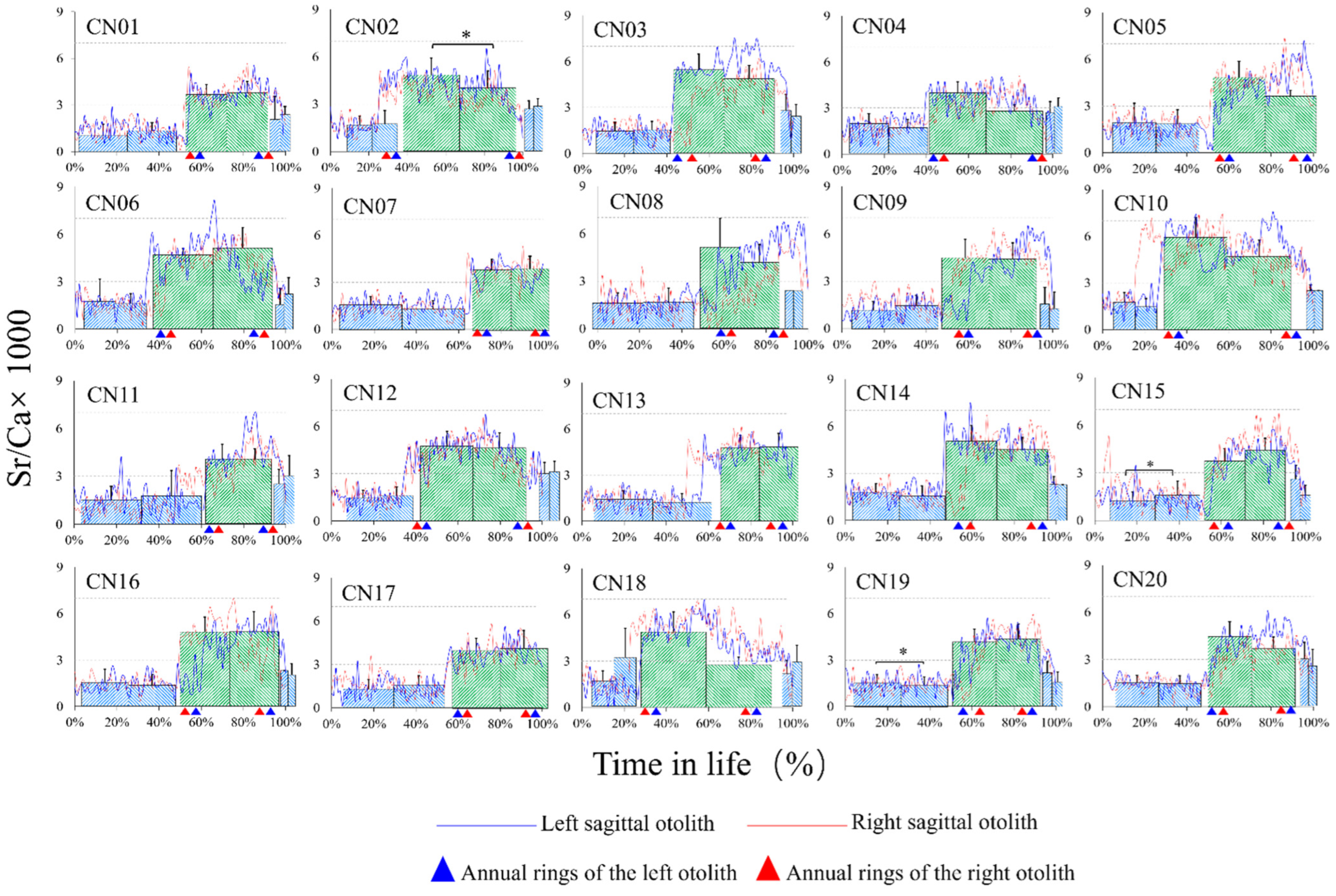
The variations in the Sr/Ca ratios in the left and right otoliths for all the specimens are presented in Figure 3. Based on quantitative line transect analysis of the otoliths, the Sr/Ca ratios and their regime shifts revealed a triphasic pattern from the core to the edge, characterized by an initial low-value phase, followed by an increase and subsequent decline (Figure 3). Paired left and right otoliths from the same individual exhibited remarkably synchronized Sr/Ca profiles along the entire transect (0–100%), with closely aligned critical inflection points (e.g., initiation of rapid increases or decreases) and comparable fluctuation amplitudes (e.g., peak height, trough depth). Both otoliths consistently recorded identical environmental events, such as abrupt salinity changes, temperature fluctuations, and habitat migrations, during the early developmental stages near the primordium and later adult phases characterized by high-frequency variability. For instance, both otoliths of Specimen CN05 showed a pronounced Sr/Ca peak between 40% and 60% from the core. The consistency in both the magnitude and duration of this peak indicated fully synchronized physiological responses that influenced elemental incorporation bilaterally.
To assess whether there were significant differences in Sr/Ca values between the left and right otoliths at specific life history stages (e.g., freshwater and brackish water stages), we divided the profile of each otolith into distinct phases based on the regime shift points identified by the STARS algorithm (Figure 3). The Sr/Ca values for each individual within each phase were then subjected to a Mann–Whitney U test. Among the total of 56 paired comparisons conducted across phases, 52 (92.59%) showed no statistically significant difference between the left and right otoliths (p > 0.05). Significant differences were observed only in specific phases of four individuals (CN02, CN08, CN15, CN19) (p < 0.05), but the absolute magnitude of these differences was considerably smaller than the variation observed between different habitat stages.
According to the results of the linear transect analysis of Sr/Ca values from the otolith core to the edge, the Sr/Ca values of all C. nasus specimens remained consistently low (1.04 ± 0.74–1.82 ± 0.62, corresponding to the region before the first annulus) from the otolith core up to a distance of 65% of the radius, representing the first stage. In the subsequent stage, the Sr/Ca values exceeded 3.0. During the second stage, the Sr/Ca values of CN05, CN07, CN13, and CN17 began to increase, gradually exceeding 3.0 (3.62 ± 0.66–4.74 ± 0.87, corresponding to the region from near the first annulus to after the second annulus), and remained stable thereafter. For the remaining 16 individuals, in addition to the low values observed in the first stage, there were also high-value stages where Sr/Ca values exceeded 3.0, after which the Sr/Ca values began to decline and eventually fell below 3.0 (corresponding to the region from near the first annulus to after the second annulus). In this study, the left and right otoliths of all C. nasus specimens reflected the same life history stages (Figure 3).

3.2. Elemental Mapping

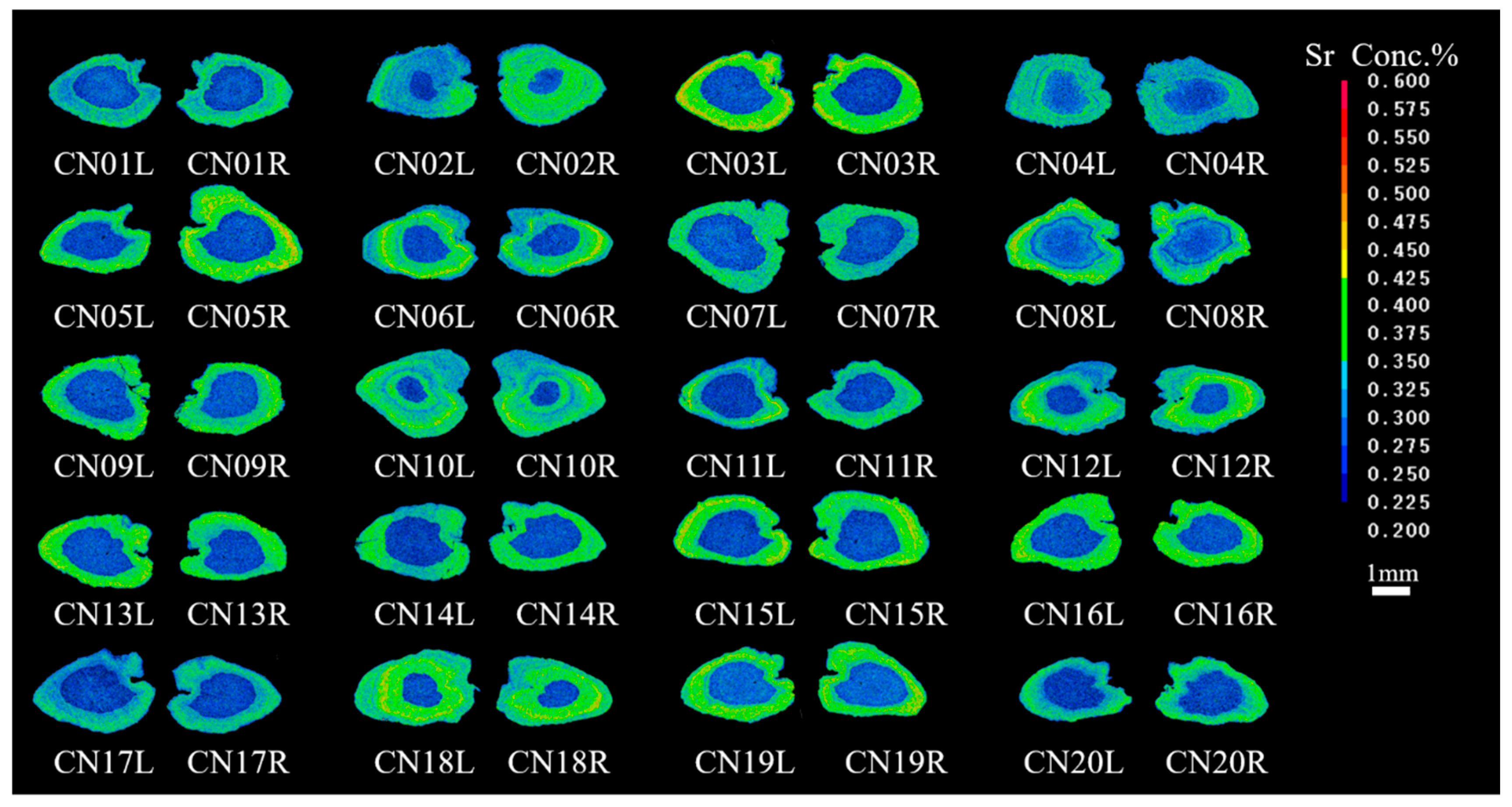
The two-dimensional Sr distribution maps on the sagittal plane of C. nasus otoliths effectively reflect the life history characteristics of the individuals (Figure 4). The results showed concentric blue zones (low Sr concentrations) from the core to the mid-region and surrounding yellow-green annuli (high Sr concentrations) in both the left and right otoliths, indicating that both otoliths can reveal the characteristics of the species living in estuarine brackish water, followed by freshwater habitats. These elemental mapping findings corroborated the results obtained from the line transect analysis. For paired otoliths from the same individual (e.g., CN01L & CN01R, CN05L & CN05R), the spatial patterns of Sr enrichment (yellow-red high-value areas) and depletion (blue low-value areas) were highly consistent. Even in individuals with slight morphological asymmetries between left and right otoliths (e.g., CN07L & CN07R, CN18L & CN18R), the “zonal” or “patchy” distribution features of Sr still showed bilateral correspondence, demonstrating synchronous environmental signal recording in bilateral otoliths.

4. Discussion

Our findings lend support to our hypothesis that the microchemical signatures of Sr/Ca ratio profiles and Sr spatial distribution are fundamentally consistent between the left and right sagittae of individual Coilia nasus, and the unilateral otolith can reliably reflect the species’ actual life-history characteristics. The results of the present study could reveal a striking congruence in the ecological life-history interpretation derived from otolith pairs of the same individual. Two-dimensional elemental mapping revealed subtle bilateral asymmetry in absolute strontium (Sr) counts/concentrations within paired otoliths from certain specimens (e.g., CN02, CN14, CN17, CN20; Figure 4). This asymmetry likely originates from inherent microscale variations in biomineralization processes, such as natural differences in crystal growth kinetics or organic matrix incorporation between left and right otoliths. However, the central conclusion of “fundamental consistency” in this study is not predicated on pixel-by-pixel equivalence of absolute element counts, but rather on the pronounced synchrony observed in Sr/Ca ratio profiles derived from line-scan transects (e.g., Figure 3). Normalization against the otolith calcium matrix renders the Sr/Ca ratio a more robust proxy for ambient Sr/Ca than absolute concentrations [1]. Critically, despite visual asymmetries in absolute Sr distribution, the Sr/Ca profiles extracted along the longest axis of bilateral otoliths exhibit highly synchronized patterns in capturing key life-history transitions, such as the timing of shifts from freshwater to brackish/marine habitats. These findings indicate that while localized variations in elemental accumulation may arise from microscale biomineralization heterogeneity, the physiological and environmental mechanisms governing relative elemental incorporation are tightly coordinated between the left and right otoliths. This bilateral coherence ensures that life-history inferences based on elemental ratios remain reliable and reproducible. Elemental mapping revealed nearly identical spatial distributions of Sr-enriched domains (e.g., positions of high-value patches and core-to-margin gradients) along the longest otolith axis, indicating conserved spatial patterning during elemental deposition. Sr/Ca chronologies derived from line transects further affirmed the synchronicity in temporal fluctuations, including the alignment of key inflection points (e.g., peaks and troughs) and amplitude variations, indicative of a coordinated physiological response to environmental cues across life stages. This bilateral coherence likely stems from shared regulatory mechanisms and endolymph chemistry governing element uptake and crystallization, thereby validating the reliability of single-sided otolith usage for inferring the migratory history of this species [1]. Notably, although gross morphological asymmetries may arise under severe perturbations (e.g., extreme pollution, physical trauma, or intense electromagnetic fields) [38,39,40], the specimens examined in the present study likely experienced relatively stable environmental regimes, permitting symmetrical microchemical expression. This further implies that chemical composition exhibits greater phenotypic stability than macroscopic otolith traits [41,42].
By integrating two-dimensional mapping and quantitative line-scan data, this study confirmed that life-history information retrieved along the longest sagittal axis was highly reproducible between the left and right otoliths. Most individuals exhibited tightly matched Sr/Ca profiles, which successfully captured the characteristic anadromous migration of this species. From the results of the two-dimensional mapping analysis, in specimens CN02 and CN14, if a shorter scanning transect were selected for analysis, the left and right otoliths may reflect different life histories (e.g., the left otoliths of CN02 and CN14 appear predominantly bluish along the shorter axis, differing from the blue-to-green transition observed on the right side). This discrepancy may be attributed to microscale crystallographic variations or stochastic physiological noise that occurs during element incorporation. In CN02, the left-right asymmetry is more pronounced, and we believe that this asymmetry may stem from growth anomalies in the otolith itself. During the biomineralization process of fish otoliths, local variations in crystal structure or growth rate may occur, and such abnormalities can directly affect the incorporation efficiency of trace elements, leading to deviations in the strontium-to-calcium (Sr/Ca) ratio recorded in specific areas [43]. This precisely explains the observed phenomenon in the left otolith of CN02, where peripheral areas outside the core region in the elemental mapping appear bluish (indicating lower Sr content). These spatial distribution characteristics collectively point toward a heterogeneous growth anomaly. Therefore, the asymmetry is more likely to reflect intrinsic variations in the individual’s biomineralization process rather than signals from its external environmental experience. In future research, incorporating crystallographic analytical methods could be employed to further analyze and confirm this deduction. However, along the longest axis, the life histories reflected by both left and right otoliths remain consistent. Given that the primary growth axis naturally integrates the most complete sequence of environmental exposure, we propose standardizing microchemical sampling along the longest otolith diameter. This approach would reduce artifacts from bilateral structural variations and enhance cross-study comparability in otolith-based ecological research.
In fish ecology, the Sr/Ca ratio in otoliths has been widely validated as an effective environmental tracer, typically exhibiting a positive correlation with ambient salinity. Consequently, it is routinely employed to reconstruct life-history trajectories, particularly to identify diadromous shuttling behaviors between freshwater and marine habitats [3,6].
Through a comparative analysis of bilateral otoliths from the same set of specimens, this study identified statistically significant differences in Sr/Ca ratios between the left and right otoliths at the corresponding life stages in some individuals. This finding highlights an important aspect of the intra-individual variability in otolith chemistry. Several hypotheses may explain these discrepancies. One potential explanation is the intrinsic asymmetry in biomineralization, where subtle differences in crystal growth kinetics or proteinaceous matrix composition between the otolith sides may alter trace element incorporation into the crystalline lattice [44].
The present study found that although the Sr/Ca ratio profiles extracted from line-scan results of the left and right otoliths exhibited a highly synchronous pattern in revealing major life-history stages (e.g., the transition from freshwater to brackish/marine habitats), on a micro-scale the curves of some individuals were not perfectly parallel, and the positions of their inflection points showed slight misalignments along the X-axis time in life/distance from the core. This spatial discrepancy likely stems from two combined technical factors: first, although morphological length parameters of left and right otoliths are generally consistent [20,26], the uncontrollability during the embedding and polishing processes has led to inconsistencies in the final microchemical analysis results from both sides [26], so that even when scanning strictly along their respective longest axes, the two transects are not fully coincident along line transects from the core to the edge in the sagittal plane of bilateral sagittal otoliths; second, for individuals that are not perfectly symmetrical, the spatial orientation of the “longest axis” determined from the two-dimensional outline may differ subtly between left and right otoliths, meaning that the growth chronologies represented by the two scan lines are not strictly synchronized in absolute temporal coordinates.
However, it is crucial to emphasize that the spatial offset of inflection points caused by these technical factors does not imply that the left and right otoliths recorded habitat-shift events at different times. The temporal anchoring of otolith chemical records ultimately requires calibration against annuli. In this study, the Sr/Ca ratio stages recorded at corresponding annuli of the left and right otoliths (e.g., the shift from typical low freshwater values to elevated brackish-water values) were consistent, jointly confirming the same core life-history events. Therefore, the synchronous response of bilateral profiles to environmental signals in their overall trends constitutes the foundation supporting the conclusion of “fundamental consistency,” rather than complete spatial overlap of inflection points at the micro-scale. This interpretation aligns with the classic exposition by Campana [1], who argued that otolith elemental ratios (such as Sr/Ca) are more robust environmental proxies than absolute elemental concentrations due to their normalization against the calcium matrix. The present study further confirms that even when absolute elemental distribution maps (e.g., strontium elemental mapping) may show visual asymmetry, life-history reconstructions based on ratios (Sr/Ca) maintain high comparability and reliability between bilateral otoliths. This reinforces the methodological rationale for using a single otolith for life-history inference, provided that the analysis is based on calibrated, environmentally sensitive chemical ratios.
Notably, despite the observation of absolute differences in the Sr/Ca values, these did not alter the inferred overall life history trajectory. Critically, all specimens exhibited highly consistent stage-transition patterns between paired otoliths, as reflected in the parallel Sr/Ca fluctuation curves. This demonstrates that although systematic offsets in total element uptake may exist, temporal phasing and directional responses to environmental variation remain fully synchronized. Thus, qualitative conclusions regarding life-history events (e.g., occurrence of migration or timing of habitat shifts) remain robust, regardless of which otolith is analyzed. However, when constructing precise quantitative models to relate Sr/Ca ratios to environmental parameters (e.g., salinity), such side-specific differences must be acknowledged. Direct pooling of data from different otolith sides without accounting for this lateral effect could introduce model error.
Therefore, although unilateral otolith analysis reliably reveals major life-stage transitions, caution is warranted in fine-scale numerical interpretations unless sidedness is explicitly accounted for.

5. Conclusions

This study systematically integrated elemental mapping and quantitative line-scanning analyses to unequivocally establish a fundamental bilateral consistency in the microchemical signatures, specifically the Sr spatial distribution and Sr/Ca chronological profiles of the sagittal otoliths of C. nasus. Our results validate the underlying assumption that unilateral otolith analysis yields reliable data for life history reconstruction. The conventional practice of randomly selecting or interchangeably utilizing a single otolith, as seen in previous studies, is methodologically valid for this species; data interpretation was not subject to systematic errors stemming from unaccounted-for side-to-side variations. These findings provide critical methodological support for the well-established interpretations of otolith microchemistry regarding migration routes and habitat transitions, thereby reinforcing the comparability and credibility of historical datasets and contemporary investigations.
For C. nasus and phylogenetically related taxa sharing similar physiological regulation mechanisms, the selective use of a single otolith for microchemical assessment is scientifically justified for C. nasus and other phylogenetically related taxa that share similar physiological regulatory mechanisms. It is not necessary to combine bilateral specimens or conduct redundant duplicate measurements based solely on presumed lateral discrepancies. This approach reduces specimen use by 50%, which is a critical advantage for studies on endangered species, while simultaneously lowering analytical costs and minimizing data redundancy, thereby significantly improving research efficiency. In summary, this study strengthens the theoretical basis of otolith microchemistry at the methodological level and clarifies the scientific validity and practicality of single-otolith analysis. Establishing a standardized protocol applicable to C. nasus and ecologically comparable fishes also contributes significantly to providing critical references for advancing methodological rigor in aquatic ecology and fishery conservation studies using otolith microchemical approaches.

Author Contributions

Conceptualization: C.D., T.J. and J.Y.; Data curation: C.D. and T.J.; Formal analysis: C.D. and T.J.; Funding acquisition: T.J. and J.Y.; Project administration: T.J. and J.Y.; Visualization: C.D. and T.J.; Writing—original draft: C.D. and T.J.; Writing—review and editing: J.Y.; Supervision: J.Y. All authors have read and agreed to the published version of the manuscript.

Funding

This research was funded by an important habitat survey project for Coilia nasus in the Key Water Areas of Jiangxi Province (NY2022-C0901) and the National Key Research and Development Program (2022YFF0608203).

Institutional Review Board Statement

All otolith samples for this study were from dead wild fish and not from experimental living fish; therefore, ethical approval was not needed.

Informed Consent Statement

Not applicable.

Data Availability Statement

Data supporting the findings of this study are available from the corresponding author upon request.

Acknowledgments

We thank Liu Jiahao for help with sampling.

Conflicts of Interest

The authors declare no conflicts of interest.

References

  1. Campana, S.E. Chemistry and composition of fish otoliths: Pathways, mechanisms and applications. Mar. Ecol. Prog. Ser. 1999, 188, 263–297. [Google Scholar] [CrossRef]
  2. Avigliano, E.; Velasco, G.; Volpedo, A.V. Use of lapillus otolith microchemistry as an indicator of the habitat of Genidens barbus from different estuarine environments in the southwestern Atlantic Ocean. Environ. Biol. Fish. 2015, 98, 1623–1632. [Google Scholar] [CrossRef]
  3. Pracheil, B.M.; Hogan, J.D.; Lyons, J.; McIntyre, P.B. Using hard-part microchemistry to advance conservation and management of North American freshwater fishes. Fisheries 2014, 39, 451–465. [Google Scholar] [CrossRef]
  4. Goto, A.; Kuroki, M.; Shirai, K.; Morita, K. Diverse migration patterns of anadromous white-spotted charr Salvelinus leucomaenis revealed from otolith microchemistry. Ichthyol. Res. 2024, 71, 508–521. [Google Scholar] [CrossRef]
  5. Widdrington, J.B.; Reis-Santos, P.; Macdonald, J.I.; Nicol, S.J.; Gillanders, B.M. Otolith-derived chemical chronologies reveal distinct patterns in physiology and environmental life histories of deep-sea snappers. Mar. Environ. Res. 2025, 212, 107493. [Google Scholar] [CrossRef]
  6. Song, C.; Yu, W.; Liu, R.; Xie, J.; Li, F.; Zhao, F.; Zhuang, P. Otolith microchemistry reveals the diversity of migration patterns and spawning ground distribution of Coilia nasus from the Yangtze River Estuary. Fishes 2024, 9, 402. [Google Scholar] [CrossRef]
  7. Andersson, M.; Jonsson, B.; Calles, O.; Greenberg, L. Assessing movements between freshwater and saltwater by brown trout (Salmo trutta L.) based on otolith microchemistry. Animals 2024, 14, 2116. [Google Scholar] [CrossRef] [PubMed]
  8. Song, D.; Xiong, Y.; Jiang, T.; Yang, J.; Zhong, X.; Tang, J.; Kang, Z. Evaluation of spawning and natal-site fidelity of Larimichthys polyactis in the Southern Yellow Sea using otolith microchemistry. Front. Mar. Sci. 2022, 8, 820492. [Google Scholar] [CrossRef]
  9. Jiang, T.; Liu, H.; Lu, M.; Chen, T.; Yang, J. A possible connectivity among estuarine tapertail anchovy (Coilia nasus) populations in the Yangtze River, Yellow Sea, and Poyang Lake. Estuar. Coast. 2016, 39, 1762–1768. [Google Scholar] [CrossRef]
  10. Lee, B.; Skeljo, F.; Randhawa, H.S.; Brownscombe, W.; Arkhipkin, A. Early life-history patterns in Patagonian toothfish Dissostichus eleginoides from the Patagonian Shelf. Mar. Ecol. Prog. Ser. 2024, 726, 131–148. [Google Scholar] [CrossRef]
  11. Stewart, K.P.; McMahon, T.E.; Koel, T.M.; Humston, R. Use of otolith microchemistry to identify subbasin natal origin and use by invasive lake trout in Yellowstone Lake. Hydrobiologia 2021, 848, 2473–2481. [Google Scholar] [CrossRef]
  12. Zitek, A.; Oehm, J.; Schober, M.; Tchaikovsky, A.; Irrgeher, J.; Retzmann, A.; Thalinger, B.; Traugott, M.; Prohaska, T. Evaluating 87Sr/86Sr and Sr/Ca ratios in otoliths of different European freshwater fish species as fishery management tool in an Alpine foreland with limited geological variability. Fish. Res. 2023, 260, 106586. [Google Scholar] [CrossRef]
  13. Tanner, S.E.; Reis-Santos, P.; Cabral, H.N. Otolith chemistry in stock delineation: A brief overview, current challenges and future prospects. Fish. Res. 2016, 173, 206–213. [Google Scholar] [CrossRef]
  14. De Lima, D.E.; Pessanha, A.L.; Azevedo, R.; Almeida, A.; Correia, A.T. Otolith shape and chemistry as tools for investigating the population connectivity of the white mullet (Mugil curema) on the Atlantic north-eastern Brazilian coast. Reg. Stud. Mar. Sci. 2025, 90, 104468. [Google Scholar] [CrossRef]
  15. Wang, V.H.; White, J.W.; Arnott, S.A.; Scharf, F.S. Population connectivity of southern flounder in the US South Atlantic revealed by otolith chemical analysis. Mar. Ecol. Prog. Ser. 2018, 596, 165–179. [Google Scholar] [CrossRef]
  16. Callicó Fortunato, R.; González-Castro, M.; Reguera Galán, A.; García Alonso, I.; Kunert, C.; Benedito Durà, V.; Volpedo, A. Identification of potential fish stocks and lifetime movement patterns of Mugil liza Valenciennes 1836 in the southwestern Atlantic Ocean. Fish. Res. 2017, 193, 164–172. [Google Scholar] [CrossRef]
  17. Xiong, Y.; Yang, J.; Jiang, T.; Liu, H.; Zhong, X. Temporal stability in the otolith Sr:Ca ratio of the yellow croaker, Larimichthys polyactis (Actinopterygii, Perciformes, Sciaenidae), from the southern Yellow Sea. Acta Ichthyol. Piscat. 2021, 51, 59–65. [Google Scholar] [CrossRef]
  18. Walther, B.D.; Limburg, K.E. The use of otolith chemistry to characterize diadromous migrations. J. Fish Biol. 2012, 81, 796–825. [Google Scholar] [CrossRef] [PubMed]
  19. Yang, J.; Jiang, T.; Liu, H. Are there habitat salinity markers of the Sr:Ca ratio in the otolith of wild diadromous fishes? A literature survey. Ichthyol. Res. 2011, 58, 291–294. [Google Scholar] [CrossRef]
  20. Mahé, K.; MacKenzie, K.; Ider, D.; Massaro, A.; Hamed, O.; Jurado-Ruzafa, A.; Gonçalves, P.; Anastasopoulou, A.; Jadaud, A.; Mytilineou, C.; et al. Directional bilateral asymmetry in fish otolith: A potential tool to evaluate stock boundaries? Symmetry 2021, 13, 987. [Google Scholar] [CrossRef]
  21. Mahé, K.; Ider, D.; Massaro, A.; Hamed, O.; Jurado-Ruzafa, A.; Gonçalves, P.; Anastasopoulou, A.; Jadaud, A.; Mytilineou, C.; Elleboode, R.; et al. Directional bilateral asymmetry in otolith morphology may affect fish stock discrimination based on otolith shape analysis. ICES J. Mar. Sci. 2019, 76, 232–243. [Google Scholar] [CrossRef]
  22. Mille, T.; Mahé, K.; Villanueva, M.C.; De Pontual, H.; Ernande, B. Sagittal otolith morphogenesis asymmetry in marine fishes. J. Fish Biol. 2015, 87, 646–663. [Google Scholar] [CrossRef]
  23. Loher, T.; Wischniowski, S.; Martin, G.B. Elemental chemistry of left and right sagittal otoliths in a marine fish (Hippoglossus stenolepis) displaying cranial asymmetry. J. Fish Biol. 2008, 73, 870–887. [Google Scholar] [CrossRef]
  24. Jawad, L.A.; Abdulsamad, S.M.S.; Al-Nusear, A.N.B.; Waryani, B.; Rutkayová, J. Otolith mass asymmetry in three sparid fish species collected from the Iraqi waters. Mar. Pollut. Bull. 2021, 173, 112968. [Google Scholar] [CrossRef]
  25. Fey, D.P.; Greszkiewicz, M.; Jakubowska, M.; Lejk, A.M.; Otremba, Z.; Andrulewicz, E.; Urban-Malinga, B. Otolith fluctuating asymmetry in larval trout, Oncorhynchus mykiss Walbaum, as an indication of organism bilateral instability affected by static and alternating magnetic fields. Sci. Total Environ. 2020, 707, 135489. [Google Scholar] [CrossRef]
  26. Morat, F.; Blamart, D.; Candaudap, F.; Letourneur, Y. Differences in elemental chemistry and C-O stable isotope composition between left and right otoliths of a flatfish, the common sole Solea solea. Vie Milieu 2013, 63, 169–179. [Google Scholar]
  27. Gao, Y.W.; Petersen, J. Isotopic differences between the left and right side otoliths of flatfish indicating growth rather than environment. Fish. Aquac. J. 2015, 6, 1000125. [Google Scholar] [CrossRef]
  28. He, Z.; Luo, M.; Cui, W.; Zhou, Y.; He, T. Use left or right otolith for shape analysis in Schizothorax grahami? Fish. Res. 2025, 283, 107295. [Google Scholar] [CrossRef]
  29. Osman, Y.A.A.; Mahé, K.; El-Mahdy, S.M.; Mohammad, A.S.; Mehanna, S.F. Relationship between body and otolith morphological characteristics of Sabre squirrelfish (Sargocentron spiniferum) from the southern Red Sea: Difference between Right and Left Otoliths. Oceans 2021, 2, 624–633. [Google Scholar] [CrossRef]
  30. Wiadnya, D.G.R.; Khamidah, N.; Paricahya, A.F.; Anam, M.C.; Kusuma, W.E. Asymmetrical individual both left and right otoliths of Tuna Scombrini collected from the Java Sea. IOP Conf. Ser. Earth Environ. Sci. 2024, 1328, 012002. [Google Scholar] [CrossRef]
  31. Hu, Y.; Jiang, T.; Liu, H.; Chen, X.; Yang, J. Otolith microchemistry reveals life history and habitat use of Coilia nasus from the Dayang River of China. Fishes 2022, 7, 306. [Google Scholar] [CrossRef]
  32. Li, Y.; Chen, J.; Feng, G.; Yang, J.; Zhao, F.; Shen, C.; Song, C.; Jiang, T. Otolith microchemistry assessment: Evidence of migratory Coilia nasus of Yangtze River living in the Shengsi Sea area. Fishes 2022, 7, 172. [Google Scholar] [CrossRef]
  33. Wang, S.; Xiong, Y.; Zhang, H.; Song, D.; Wang, Y.; Ge, H.; Zhang, C.; Liang, L.; Zhong, X. Recovery of Coilia nasus resources after implementation of the 10-year fishing ban in the Yangtze River: Implied from the Yangtze River Estuary and its adjacent sea areas. Front. Mar. Sci. 2024, 11, 1474996. [Google Scholar] [CrossRef]
  34. Lord, C.; Berland, S.; Haÿ, V.; Medjoubi, K.; Keith, P. Twin Peaks: Interrogating otolith pairs to see whether they keep their stories straight. Crystals 2024, 14, 705. [Google Scholar] [CrossRef]
  35. Jiang, T.; Zhou, X.Q.; Liu, H.; Liu, H.; Yang, J. Two microchemistry patterns in otoliths of Coilia nasus from Poyang Lake, China. J. Fish. China 2013, 37, 239–244. [Google Scholar] [CrossRef]
  36. Yang, J.; Arai, T.; Liu, H.; Miyazaki, N.; Tsukamoto, K. Reconstructing habitat use of Coilia mystus and Coilia ectenes of the Yangtze River estuary, and of Coilia ectenes of Taihu Lake, based on otolith strontium and calcium. J. Fish Biol. 2006, 69, 1120–1135. [Google Scholar] [CrossRef]
  37. Khumbanyiwa, D.D.; Li, M.; Jiang, T.; Liu, H.; Yang, J. Unraveling habitat use of Coilia nasus from Qiantang River of China by otolith microchemistry. Reg. Stud. Mar. Sci. 2018, 18, 122–128. [Google Scholar]
  38. Mahé, K.; Gourtay, C.; Defruit, G.B.; Chantre, C.; de Pontual, H.; Amara, R.; Claireaux, G.; Audet, C.; Zambonino-Infante, J.L.; Ernande, B. Do environmental conditions (temperature and food composition) affect otolith shape during fish early-juvenile phase? An experimental approach applied to European seabass (Dicentrarchus labrax). J. Exp. Mar. Biol. Ecol. 2019, 521, 151239. [Google Scholar] [CrossRef]
  39. Vandenbussche, P.S.P.; Spennato, G.; Pierson, P.M. Juvenile Oblada melanura (L. 1758) otolith shape variation as an early environmental indicator. Ecol. Indic. 2019, 104, 289–295. [Google Scholar] [CrossRef]
  40. Mirasole, A.; Gillanders, B.M.; Reis-Santos, P.; Grassa, F.; Capasso, G.; Scopelliti, G.; Mazzola, A.; Vizzini, S. The influence of high pCO2 on otolith shape, chemical and carbon isotope composition of six coastal fish species in a Mediterranean shallow CO2 vent. Mar. Biol. 2017, 164, 191. [Google Scholar] [CrossRef]
  41. Tan, M.; Kelaher, B.P.; Adler, L.; Champion, C.; Hall, K.C. Otolith oxygen isotopes inform dispersal and movement patterns for eastern school (Sillago flindersi) and stout (Sillago robusta) whiting along the east coast of Australia. Fish. Res. 2025, 288, 107419. [Google Scholar] [CrossRef]
  42. Tuset, V.M.; Otero-Ferrer, J.L.; Siliprandi, C.; Manjabacas, A.; Marti-Puig, P.; Lombarte, A. Paradox of otolith shape indices: Routine but overestimated use. Can. J. Fish. Aquat. Sci. 2021, 78, 681–692. [Google Scholar] [CrossRef]
  43. Lewis, L.S.; Huang, J.L.; Willmes, M.; Fichman, R.A.; Hung, T.C.; Ellison, L.T.; Stevenson, T.A.; Teh, S.J.; Hammock, B.G.; Schultz, A.A.; et al. Visual, spectral, and microchemical quantification of crystalline anomalies in otoliths of wild and cultured delta smelt. Sci. Rep. 2022, 12, 20751. [Google Scholar] [CrossRef]
  44. Thomas, O.R.B.; Swearer, S.E.; Kapp, E.A.; Peng, P.; Tonkin-Hill, G.Q.; Papenfuss, A.; Roberts, A.; Bernard, P.; Roberts, B.R. The inner ear proteome of fish. FEBS J. 2019, 286, 66–81. [Google Scholar] [CrossRef] [PubMed]
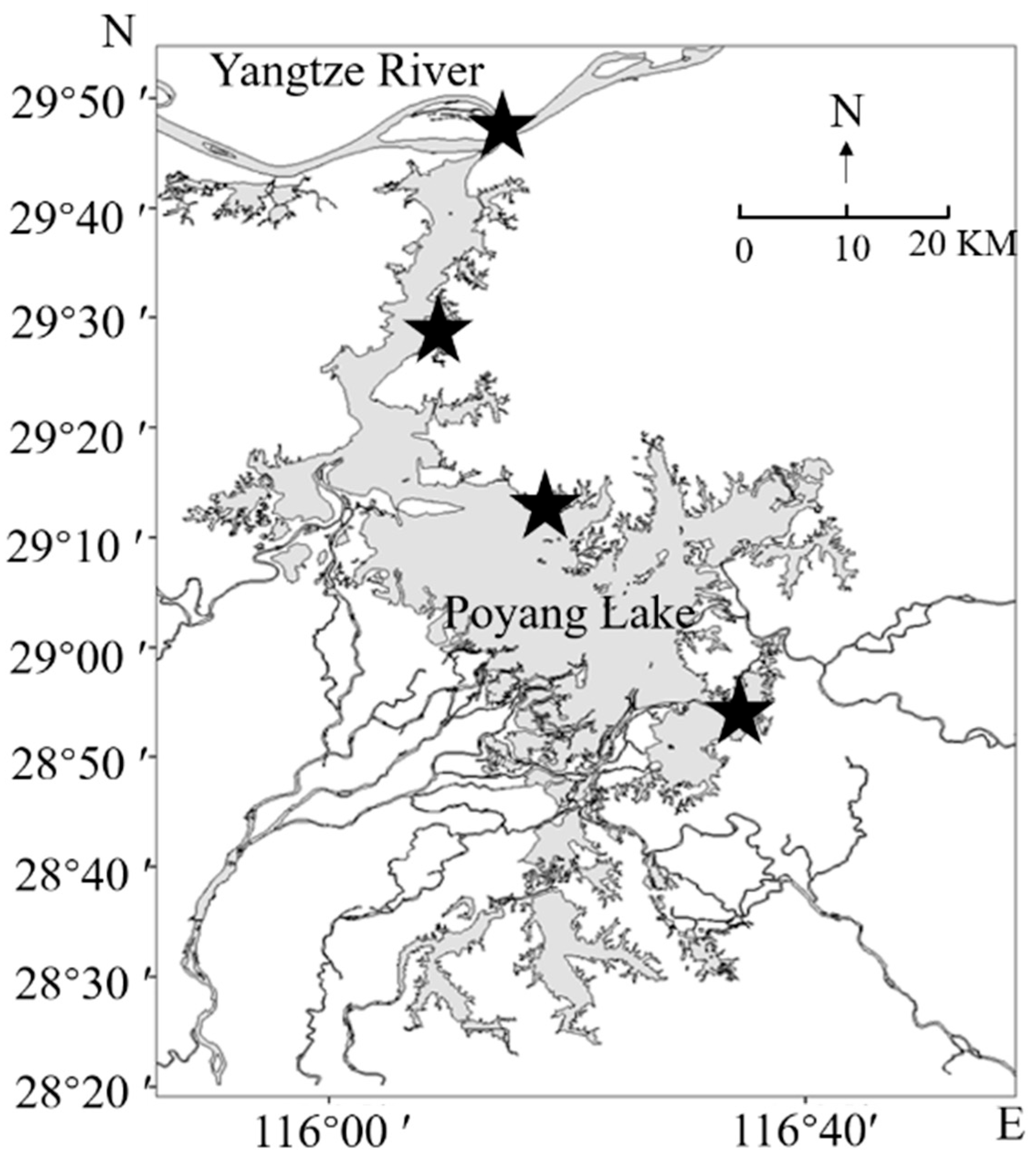
Figure 1. Sampling sites of Coilia nasus in Poyang Lake, China (★).
Fishes 11 00146 g001
Figure 2. Coilia nasus fish (a) and its left (b) and right (c) sagittae.
Fishes 11 00146 g002
Figure 3. Variation in Sr/Ca ratios along the quantitative line transect from the core (Corresponding to 0% of Time in Life) to the edge (Corresponding to 100% of Time in Life) for left (blue) and right (red) otoliths. Different bar charts represent different stages: the blue color indicates the freshwater stage, and the green color represents the brackish water stage. Colored bars denote distinct life-history stages; bar widths are schematic. *, p < 0.05.
Fishes 11 00146 g003
Figure 4. Comparative visualization of Sr mapping patterns in the sagittal plane passing through core of bilateral sagittal otoliths of Coilia nasus.
Fishes 11 00146 g004
Table 1. Biological information of Coilia nasus in the present study.
Specimen IDTotal Length (mm)Standard Length (mm)Body Weight (g)Maxilla-to-Head RatioMaturity StageAge *
CN0127124943.61.16♂42+
CN0229226751.11.15♂52+
CN03251229361.14♂42+
CN0427324535.31.18♂42+
CN0527826343.11.13♂42+
CN0625524137.51.19♂32+
CN0726124539.11.14♂32+
CN0826624640.41.17♂42+
CN0925324833.61.14♂42+
CN1025922333.50.96♂32+
CN1130428374.71.18♀42+
CN1222522545.81.26♀52+
CN13321318109.31.17♀52+
CN1427424349.11.19♀42+
CN1528225755.31.12♀52+
CN1629127255.71.06♀42+
CN1729827365.11.21♀42+
CN1833231288.61.12♀42+
CN1926424347.91.25♀32+
CN2031128861.51.02♀32+
* Age was determined by counting the otolith annuli.
Table 2. Analytical parameters for EPMA.
Analyzed ItemAcceleration Voltage (kV)Beam Current (A)Beam Spot Diameter (µm)Dwell Time (s)Partition
(µm)
Quantitative analysis
along line transects
152.0 × 10−851510
Mapping analysis155.0 × 10−750.038 × 8
Disclaimer/Publisher’s Note: The statements, opinions and data contained in all publications are solely those of the individual author(s) and contributor(s) and not of MDPI and/or the editor(s). MDPI and/or the editor(s) disclaim responsibility for any injury to people or property resulting from any ideas, methods, instructions or products referred to in the content.