
The Feeding Habits and Length–Weight Relationships of the Invasive Black Bullhead Ameiurus melas (Rafinesque, 1820) in the Gruža Reservoir, Central Serbia
 , , , and
Abstract
1. Introduction
2. Materials and Methods
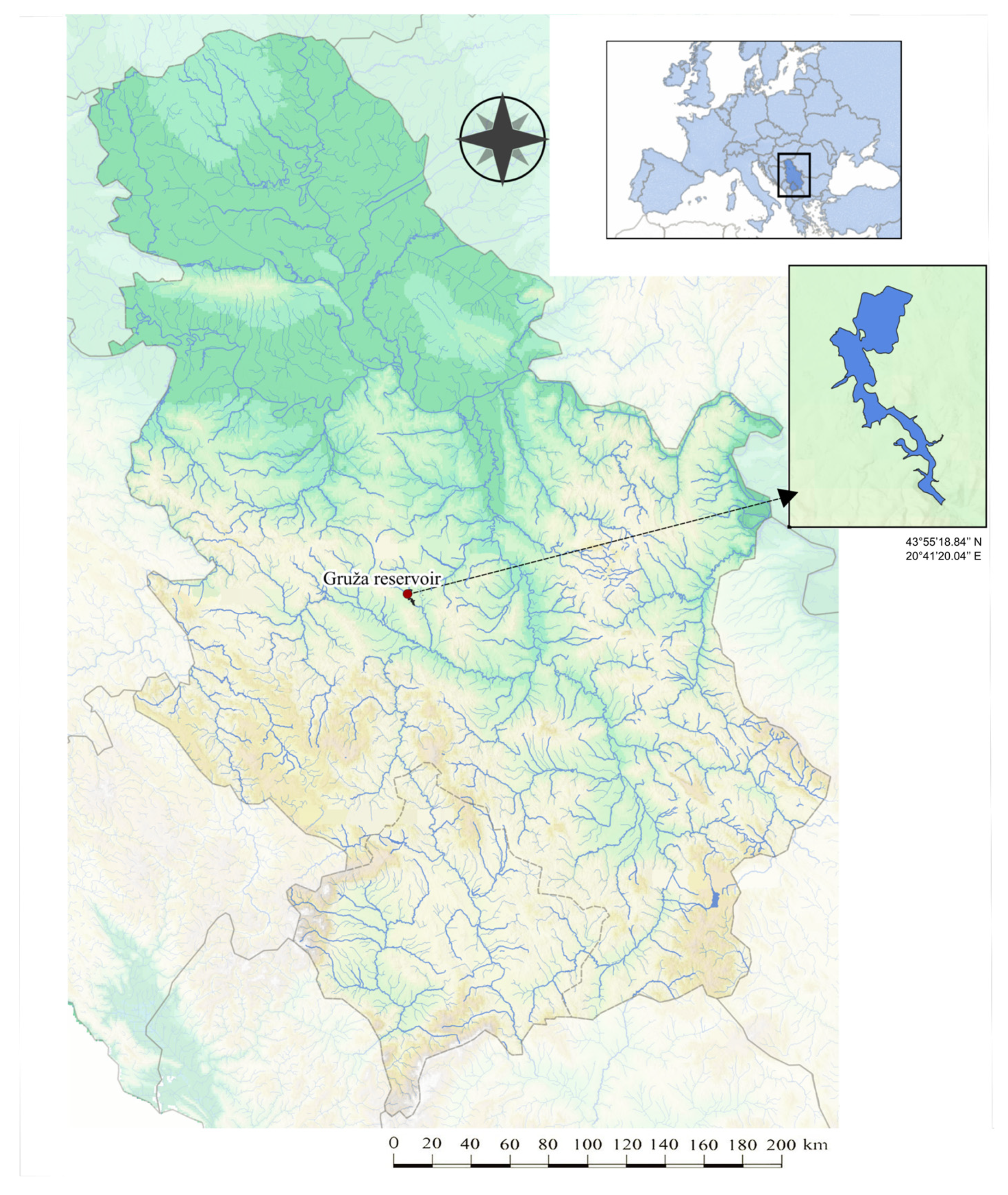
2.1. Study Area and Fish Sampling
2.2. Digestive Tract Content Analysis
2.3. Length–Weight Relationship and Condition Factor
2.4. Statistical Analysis
3. Results
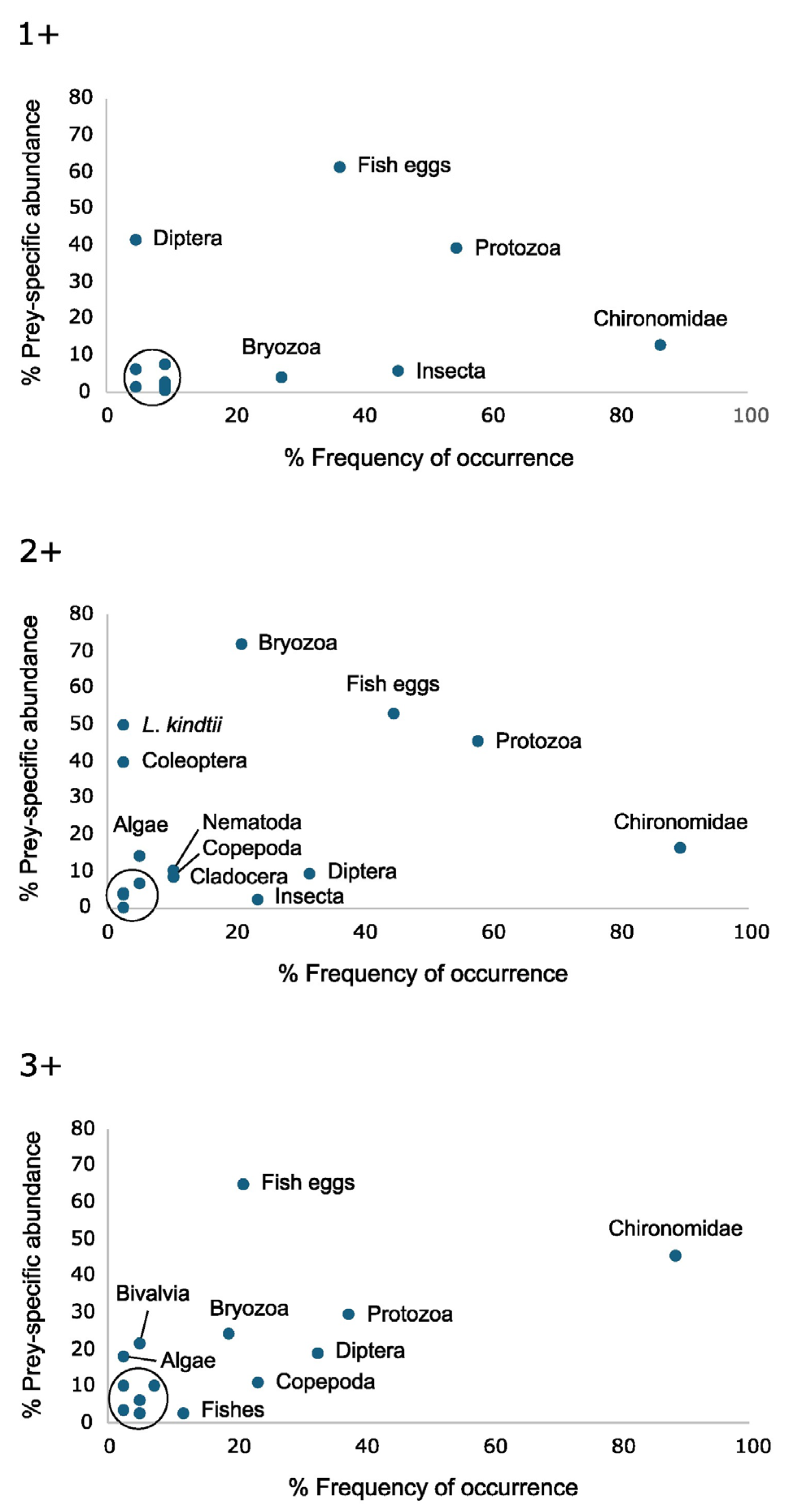
3.1. Diet Composition
3.2. Results of Length–Weight Relationships and Condition Factor
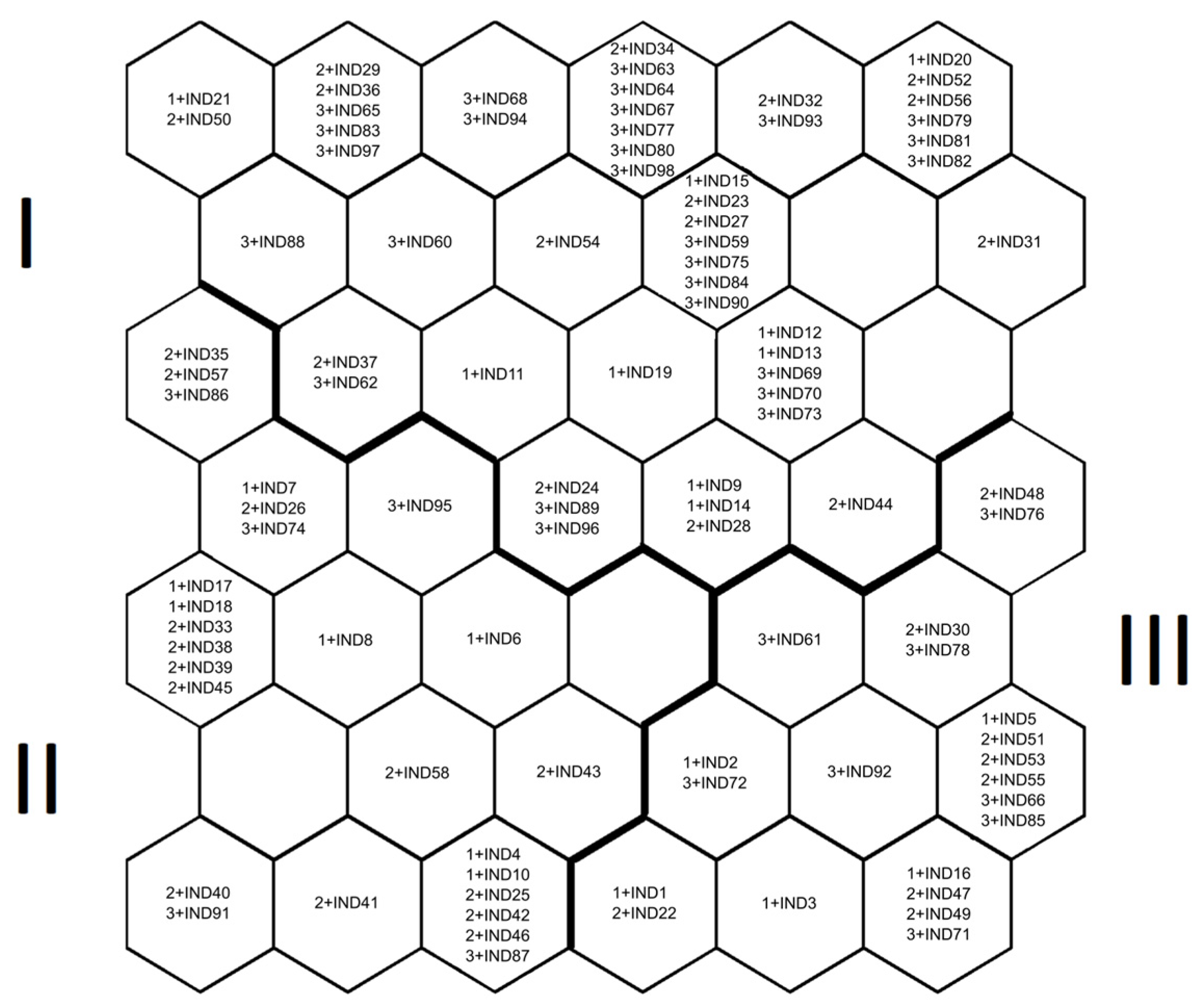
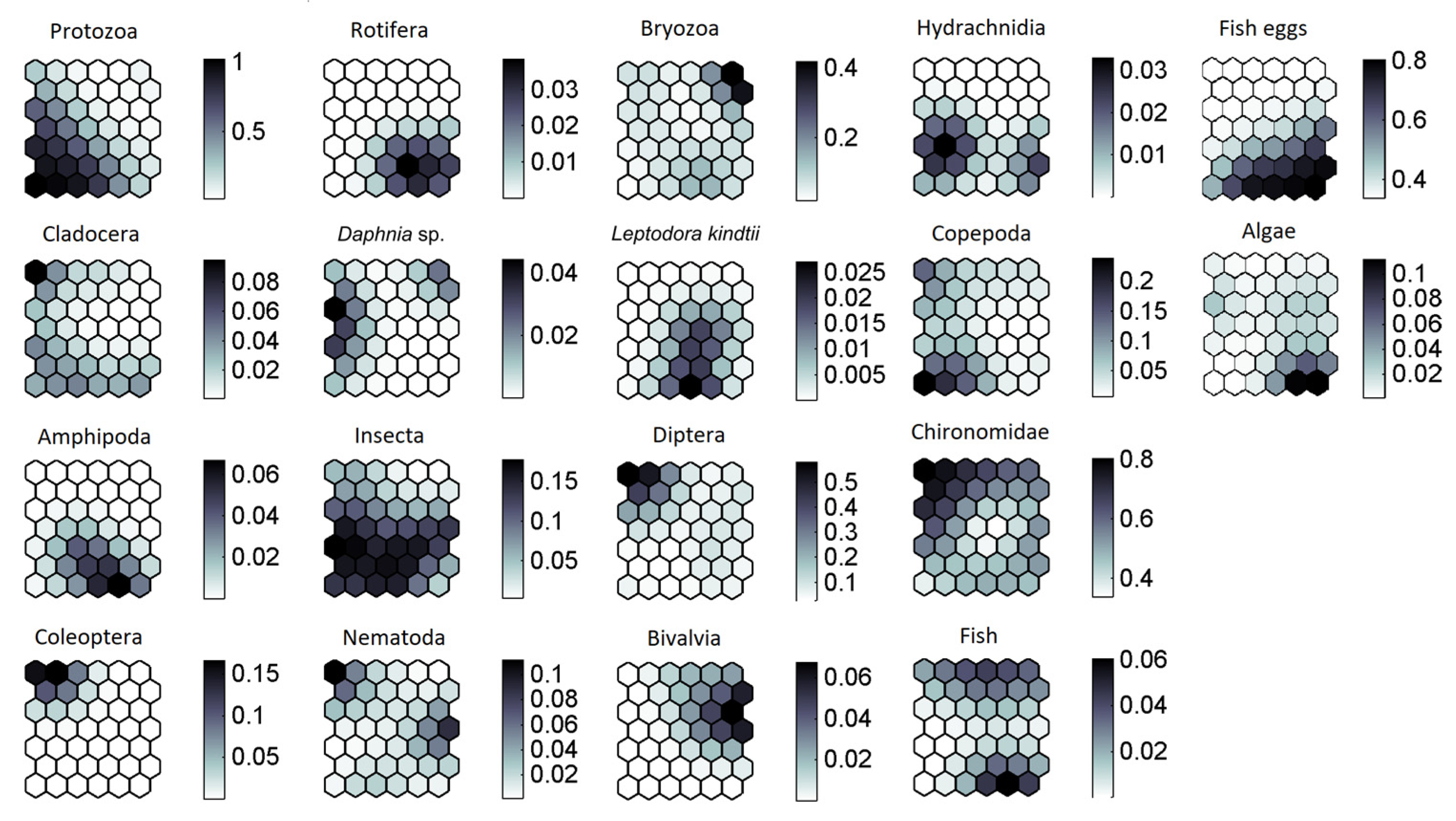
3.3. Results of Statistical Analysis
4. Discussion
4.1. Feeding Ecology and Ontogenetic Dietary Shifts
4.2. Growth Patterns and Length–Weight Relationships
4.3. Ecological Implications for Native Communities and Reservoir Functioning
5. Conclusions
Author Contributions
Funding
Institutional Review Board Statement
Data Availability Statement
Acknowledgments
Conflicts of Interest
References
- Havel, J.E.; Kovalenko, K.E.; Magela Thomaz, S.; Amalfitano, S.; Kats, L.B. Aquatic invasive species: Challenges for the future. Hydrobiologia 2015, 750, 147–170. [Google Scholar] [CrossRef]
- Tonella, L.H.; Fugi, R.; Vitorino, O.B.; Suzuki, H.I.; Gomes, L.C.; Agostinho, A.A. Importance of feeding strategies on the long-term success of fish invasions. Hydrobiologia 2018, 817, 239–252. [Google Scholar] [CrossRef]
- Sanders, N.J.; Gotelli, N.J.; Heller, N.E.; Gordon, D.M. Community disassembly by an invasive species. Proc. Natl. Acad. Sci. USA 2003, 100, 2474–2477. [Google Scholar] [CrossRef]
- Mujaju, C.; Mudada, N.; Chikwenhere, G.P. Invasive alien species in Zimbabwe (Southern Africa). In Invasive Alien Species: Observations and Issues from Around the World; Pullaiah, T., Ielmini, M.R., Eds.; Wiley-Blackwell: Oxford, UK, 2021; pp. 330–361. [Google Scholar] [CrossRef]
- Santos, G.S.; Ribeiro, F.; Pereira, E.; Silva, A.F.; Almeida, P.R.; Ribeiro, D.; Quintella, B.R. Behaviour of the apex predator European catfish (Silurus glanis) on a recently invaded reservoir. Ecol. Freshw. Fish 2024, 34, e12817. [Google Scholar] [CrossRef]
- Ghia, D.; Fea, G.; Murtas, A.; Ventimiglia, M.; Bo, T.; Basso, A.; Pretto, T.; Sacchi, R.; Ercoli, F. Better alone than in bad company: Trophic ecology of co-occurring invasive and native crayfish. Ecol. Evol. 2025, 13, e71385. [Google Scholar] [CrossRef]
- Rabitsch, W.; Genovesi, P.; Scalera, R.; Biała, K.; Josefsson, M.; Essl, F. Developing and testing alien species indicators for Europe. J. Nat. Conserv. 2016, 29, 89–96. [Google Scholar] [CrossRef]
- Jaćimović, M.; Višnjić-Jeftić, Ž. Factors threatening fish species in Serbia. In Red Book of Fauna of Serbia V—Fishes; Hegediš, A., Krpo-Ćetković, J., Eds.; Faculty of Biology, University of Belgrade: Belgrade, Serbia; Institute for Nature Conservation of Serbia: Belgrade, Serbia; Institute for Multidisciplinary Research, University of Belgrade: Belgrade, Serbia, 2024; pp. 93–127. [Google Scholar]
- Lenhardt, M.; Marković, G.; Hegediš, A.; Maletin, S.; Ćirković, M.; Marković, Z. Non-native and translocated fish species in Serbia and their impact on the native ichthyofauna. Rev. Fish Biol. Fish. 2011, 21, 407–421. [Google Scholar] [CrossRef]
- Piria, M.; Simonović, P.; Kalogianni, E.; Vardakas, L.; Koutsikos, N.; Zanella, D.; Ristovska, M.; Apostolou, A.; Adrović, A.; Mrdak, D.; et al. Alien freshwater fish species in the Balkans–Vectors and pathways of introduction. Fish Fish. 2017, 19, 138–169. [Google Scholar] [CrossRef]
- Copp, G.H.; Bianco, P.G.; Bogutskaya, N.G.; Erős, T.; Falka, I.; Ferreira, M.T.; Fox, M.G.; Freyhof, J.; Gozlan, R.E.; Grabowska, J.; et al. To be, or not to be, a non-native freshwater fish? J. Appl. Ichthyol. 2005, 21, 242–262. [Google Scholar] [CrossRef]
- Simić, V.; Simić, S.; Petrović, A.; Radojković, N.; Veličković, T.; Matejić, B.; Vlajković, M. Program Upravljanja Ribarskim Područjem “Velika Morava 1” (2017–2026); Prirodno-Matematički Fakultet, Univerzitet u Kragujevcu: Kragujevac, Serbia, 2017. (In Serbian) [Google Scholar]
- Simić, V.; Miljanović, B.; Petrović, A.; Radenković, M.; Stojković Piperac, M.; Veličković, T.; Jakovljević, M.; Simić, S. Inland fisheries in Serbia: Historical aspect, fish resources, management, and conservation. In Ecological Sustainability of Fish Resources of Inland Waters of the Western Balkans; Simić, V., Simić, S., Pešić, V., Eds.; Springer: Cham, Switzerland, 2024; pp. 113–200. [Google Scholar] [CrossRef]
- Kottelat, M.; Freyhof, J. Handbook of European Freshwater Fishes; Kottelat, Cornol, and Freyhof: Berlin, Germany, 2007; 646p. [Google Scholar]
- Ribeiro, F.; Elvira, B.; Collares-Pereira, M.J.; Moyle, P.B. Life-history traits of non-native fishes in Iberian watersheds across several invasion stages: A first approach. Biol. Invasions 2008, 10, 89–102. [Google Scholar] [CrossRef]
- Kostić, J.; Đorđević Aleksić, J.; Višnjić Jeftić, Ž.; Nikolić, D.; Marković, Z.; Kračun Kolarević, M.; Tasić, A.; Jaćimović, M. Aliens among us: Sensitivity of the invasive alien fish black bullhead Ameiurus melas as a bioindicator of pollution and its safety for human consumption. Toxics 2024, 12, 849. [Google Scholar] [CrossRef] [PubMed]
- Declerck, S.; Louette, G.; Bie, T.; Meester, L. Patterns of diet overlap between populations of non-indigenous and native fishes in shallow ponds. J. Fish Biol. 2002, 61, 1182–1197. [Google Scholar] [CrossRef]
- Jaćimović, M.; Krpo-Ćetković, J.; Skorić, S.; Smederevac-Lalić, M.; Hegediš, A. Seasonal feeding habits and ontogenetic diet shift of black bullhead (Ameiurus melas) in Lake Sava (Serbia). Arch. Biol. Sci. 2021, 73, 513–521. [Google Scholar] [CrossRef]
- Gerkin, S.D. Feeding Ecology of Fish; Academic Press: San Diego, CA, USA, 1994; 416p. [Google Scholar]
- Winemiller, K.O.; Polis, G.A. Food webs: What can they tell us about the world? In Food Webs: Integration of Patterns and Dynamics; Polis, G.A., Winemiller, K.O., Eds.; Chapman & Hall: New York, NY, USA, 1996; pp. 1–22. [Google Scholar]
- Agostinho, A.A.; Suzuki, H.I.; Fugi, R.; Alves, D.C.; Tonella, L.H.; Espindola, L.A. Ecological and life history traits of Hemiodus orthonops in the invasion process: Looking for clues at home. Hydrobiologia 2015, 746, 415–430. [Google Scholar] [CrossRef]
- Froese, R. Cube law, condition factor and weight-length relationships: History, meta-analysis and recommendations. J. Appl. Ichthyol. 2006, 22, 241–253. [Google Scholar] [CrossRef]
- Petrarkis, G.; Stergiou, K.I. Weight-length relationship for 33 fish species in Greek waters. Fish. Res. 1995, 21, 465–469. [Google Scholar] [CrossRef]
- Fulton, W.T. The rate of growth of fishes. In 22nd Annual Report of the Fishery Board of Scotland; H.M. Stationery Off: Norwich, UK, 1904; Volume 3, pp. 141–241. [Google Scholar]
- Kuriakose, S. Estimation of length–weight relationship in fishes. In Summer School on Advanced Methods for Fish Stock Assessment and Fisheries Management; CMFRI: Kochi, Japan, 2017; pp. 215–220. [Google Scholar]
- Pavlović, M.; Simonović, P.; Stojković, M.; Simić, V. Analysis of diet of piscivorous fishes in Bovan, Gruža and Šumarice reservoir, Serbia. Iran. J. Fish. Sci. 2015, 14, 908–923. [Google Scholar]
- Radenković, M. Feeding and Importance of Predatory Fish Species in Maintenance of Ecosystem Stability in Reservoirs. Ph.D. Thesis, University of Kragujevac, Kragujevac, Serbia, 2019. (In Serbian) [Google Scholar]
- Radenković, M.; Milošković, A.; Kojadinović, N.; Đuretanović, S.; Veličković, T.; Jakovljević, M.; Simić, V. Diet composition and feeding habits of common bleak (Alburnus alburnus L.) in the Gruža and Gazivode reservoirs. In Proceedings of the 2nd International Conference on Chemo and Bioinformatics ICCBIKG2023, Kragujevac, Serbia, 28–29 September 2023; pp. 292–295. [Google Scholar]
- Radenković, M.; Milošković, A.; Stojković Piperac, M.; Veličković, T.; Curtean-Bănăduc, A.; Bănăduc, D.; Simić, V. Feeding patterns of fish in relation to the trophic status of reservoirs: A case study of Rutilus rutilus (Linnaeus, 1758) in five fishing waters in Serbia. Fishes 2024, 9, 21. [Google Scholar] [CrossRef]
- Ranković, V.; Radulović, J.; Radojević, I.; Ostojić, A.; Čomić, L. Neural network modeling of dissolved oxygen in the Gruža reservoir, Serbia. Ecol. Model. 2010, 221, 1239–1244. [Google Scholar] [CrossRef]
- Simić, S.; Đorđević, N.; Tokodi, N.; Backović Drobac, D.; Marinović, Z. Eutrophication of fishing waters and the influence of cyanobacterial occurrence and blooming on fish resources: Case studies in Serbia. In Ecological Sustainability of Fish Resources of Inland Waters of the Western Balkans; Simić, V., Simić, S., Pešić, V., Eds.; Springer: Cham, Switzerland, 2024; pp. 455–504. [Google Scholar] [CrossRef]
- Radenković, M.; Zorić, K.; Petrović, A. Invasive macroinvertebrate and fish species and their impact on fish resources: A case study on fishing waters of Serbia. In Ecological Sustainability of Fish Resources of Inland Waters of the Western Balkans; Simić, V., Simić, S., Pešić, V., Eds.; Springer: Cham, Switzerland, 2024; pp. 529–546. [Google Scholar] [CrossRef]
- Law on the Protection and Sustainable Use of Fish Stocks of the Republic of Serbia. In “Official Gazette of RS”, Nos. 128/2014 and 95/2018; Public Enterprise Official Gazette: Belgrade, Serbia, 2018.
- Bhattacharya, C.G. A simple method of resolution of a distribution into Gaussian components. Biometrics 1967, 23, 115–135. [Google Scholar] [CrossRef] [PubMed]
- Jaćimović, M. Population Dynamic and Ecotoxicology of the Black Bullhead (Ameiurus melas Rafinesque, 1820) in Sava Lake. Ph.D. Thesis, Faculty of Biology, University of Belgrade, Belgrade, Serbia, 2015. (In Serbian) [Google Scholar]
- Hickley, P.; North, R.; Muchiri, S.M.; Harper, D.M. The diet of largemouth bass, Micropterus salmoides, in Lake Naivasha, Kenya. J. Fish Biol. 1994, 44, 607–619. [Google Scholar] [CrossRef]
- Lorenzoni, M.; Corboli, N.; Dörr, A.J.M.; Giovinazzo, G.; Selvi, S.; Mearelli, M. Diet of Micropterus salmoides Lac. and Esox lucius L. in Lake Trasimeno (Umbria, Italy) and their diet overlap. Bull. Fr. Peche Piscic. 2002, 365–366, 537–547. [Google Scholar] [CrossRef]
- Hyslop, E.J. Stomach content analysis: A review methods and their application. J. Fish Biol. 1980, 17, 411–429. [Google Scholar] [CrossRef]
- Costello, M.J. Predator feeding strategy and prey importance: A new graphical analysis. J. Fish Biol. 1990, 36, 261–263. [Google Scholar] [CrossRef]
- Amundsen, P.A.; Gabler, H.M.; Staldvik, F.J. A new graphical approach to graphical analysis of feeding strategy from stomach contents data-modification of the Costello (1990) method. J. Fish Biol. 1996, 48, 607–614. [Google Scholar] [CrossRef]
- Levins, R. Evolution in Changing Environments, 1st ed.; Princeton University Press: Princeton, NJ, USA, 1968; pp. 1–132. [Google Scholar]
- Hurlbert, S.H. The measurement of niche overlap and some relatives. Ecology 1978, 59, 67–77. [Google Scholar] [CrossRef]
- Le Cren, E.D. The length–weight relationship and seasonal cycle in gonad weight and condition in perch (Perca fluviatilis). J. Anim. Ecol. 1951, 20, 201–219. [Google Scholar] [CrossRef]
- Ricker, E. Linear regression in fishery research. J. Fish. Res. Board. Can. 1973, 30, 409–434. [Google Scholar] [CrossRef]
- Pauly, D. Some Simple Methods for the Assessment of Tropical Fish Stock; FAO Fisheries Technical Paper; FAO: Rome, Italy, 1983; p. 52.
- Dukowska, M.; Grzybkowska, M.; Kruk, A.; Szczerkowska-Majchrzak, E. Food niche partitioning between perch and ruffe: Combined use of a self-organizing map and IndVal index for analysing fish diet. Ecol. Model. 2013, 265, 221–229. [Google Scholar] [CrossRef]
- Kohonen, T. Self-organizing formation of topologically correct feature maps. Biol. Cybern. 1982, 43, 59–69. [Google Scholar] [CrossRef]
- Lek, S.; Guégan, J.F. Artificial neural networks as a tool in ecological modelling, an introduction. Ecol. Model. 1999, 120, 65–73. [Google Scholar] [CrossRef]
- Park, Y.S.; Tison, J.; Lek, S.; Giraudel, J.L.; Coste, M.; Delmas, F. Application of a self-organizing map to select representative species in multivariate analysis: A case study determining diatom distribution pattern across France. Ecol. Inform. 2006, 1, 247–257. [Google Scholar] [CrossRef]
- Penczak, T.; Głowacki, Ł.; Kruk, A.; Galicka, W. Implementation of a self-organizing map for investigation of impoundment impact on fish assemblages in a large, lowland river: Long-term study. Ecol. Model. 2012, 227, 64–71. [Google Scholar] [CrossRef]
- Stojković, M.; Simić, V.; Milošević, D.; Mančev, D.; Penczak, T. Visualization of fish community distribution patterns using the self-organizing map: A case study of the Morava River system (Serbia). Ecol. Model. 2013, 248, 20–29. [Google Scholar] [CrossRef]
- Kohonen, T. Self-Organizing Maps, 3rd ed.; Springer: Berlin/Heidelberg, Germany, 2001; 502p. [Google Scholar] [CrossRef]
- Jain, A.K.; Dubes, R.C. Algorithms for Clustering Data; Prentice Hall: Hoboken, NJ, USA, 1988; 334p. [Google Scholar]
- Céréghino, R.; Park, Y.S. Review of the Self-Organizing Map (SOM) approach in water resources. Environ. Model. Soft. 2009, 24, 945–947. [Google Scholar] [CrossRef]
- Vesanto, J.; Himberg, J.; Alhoniemi, E.; Parhankangas, J. Som Tool-Box for Matlab 5; Report A57; Neural Network Reseach Centre, Helsinki University of Technology: Helsinki, Finland, 2000; 60p. [Google Scholar]
- Park, Y.S.; Céréghino, R.; Compin, A.; Lek, S. Applications of artificial neural networks for patterning and predicting aquatic insect species richness in running waters. Ecol. Model. 2003, 160, 265–280. [Google Scholar] [CrossRef]
- Lek, S.; Scardi, M.; Verdonschot, P.F.M.; Descy, J.P.; Park, Y.S. Modelling Community Structure in Freshwater Ecosystems; Springer: Berlin/Heidelberg, Germany, 2005; 518p. [Google Scholar] [CrossRef]
- Dufrêne, M.; Legendre, P. Species assemblages and indicator species: The need for a flexible asymmetrical approach. Ecol. Monogr. 1997, 67, 345–366. [Google Scholar] [CrossRef]
- McCune, B.; Mefford, M.S. PC-ORD: Multivariate Analysis of Ecological Data, version 6.06; MjM Software Design: Gleneden Beach, OR, USA, 2011. [Google Scholar]
- García-Berthou, E. The characteristics of invasive fishes: What has been learned so far? J. Fish Biol. 2007, 71, 33–55. [Google Scholar] [CrossRef]
- Vander Zanden, M.J.; Casselman, J.M.; Rasmussen, J.B. Stable isotope evidence for the food web consequences of species invasions in lakes. Nature 1999, 401, 464–467. [Google Scholar] [CrossRef]
- Frankiewicz, P.; Frankiewicz-Woytal, A. Two different feeding tactics of young-of-the-year perch, Perca fluviatilis L., inhabiting the littoral zone of the lowland Sulejow Reservoir (Central Poland). Ecohydrol. Hydrobiol. 2012, 12, 35–41. [Google Scholar] [CrossRef]
- Valentine, S.A.; Whitledge, G.W. Spatial and ontogenetic patterns in the trophic ecology of two predatory fishes in large river. Ecol. Freshw. Fish 2025, 34, e12814. [Google Scholar] [CrossRef]
- Leunda, P.M.; Oscoz, J.; Elvira, B.; Agorreta, A.; Perea, S.; Miranda, R. Feeding habits of the exotic black bullhead Ameiurus melas (Rafinesque) in the Iberian Peninsula: First evidence of direct predation on native fish species. J. Fish Biol. 2008, 73, 96–114. [Google Scholar] [CrossRef]
- Czeglédi, I.; Specziár, A.; Preiszner, B.; Boros, G.; Bánó, B.; Mozsár, A.; Takács, P.; Erős, T. Stable isotope analysis reveals diet niche partitioning between native species and the invasive black bullhead (Ameiurus melas Rafinesque, 1820). NeoBiota 2024, 94, 57–77. [Google Scholar] [CrossRef]
- Baker, R.; Buckland, A.; Sheaves, M. Fish gut content analysis: Robust measures of diet composition. Fish Fish. 2014, 15, 170–177. [Google Scholar] [CrossRef]
- Snow, R.A.; Porta, M.J.; Robison, A.L. Seasonal diet composition of black bullhead (Ameiurus melas) in Lake Carl Etling, Oklahoma. Proc. Okla. Acad. Sci. 2017, 97, 54–60. [Google Scholar]
- Ruiz-Navaro, A.; Britton, J.R.; Jackson, M.C.; Davies, G.D.; Sheath, D. Reproductive ecology and diet of a persistent Ameiurus melas (Rafinesque, 1820) population in the UK. J. Appl. Ichthyol. 2015, 31, 201–203. [Google Scholar] [CrossRef]
- Marszał, L.; Grzybkowska, M.; Penczak, T.; Galicka, W. Diet and feeding of dominant fish populations in the impounded Warta River, Poland. Pol. Arch. Hydrobiol. 1996, 43, 185–202. [Google Scholar]
- Marszał, L.; Grzybkowska, M.; Kostrzewa, J.; Kruk, A. Food resource partitioning between spined loach (Cobitis taenia L.) and golden loach (Sabanejewia aurata (Fil.)) in a lowland stream. Sci. Annu. Pol. Angling Assoc. 1998, 11, 51–64, (In Polish with English summary). [Google Scholar]
- Giraudel, J.L.; Lek, S. A comparison of self-organizing map algorithm and some conventional statistical methods for ecological community ordination. Ecol. Model. 2001, 146, 329–339. [Google Scholar] [CrossRef]
- Kruk, A.; Lek, S.; Park, Y.S.; Penczak, T. Fish assemblages in the large lowland Narew River system (Poland): Application of the self-organizing map algorithm. Ecol. Model. 2007, 203, 45–61. [Google Scholar] [CrossRef]
- Chon, T.S. Self-organizing maps applied to ecological sciences. Ecol. Inform. 2011, 6, 50–61. [Google Scholar] [CrossRef]
- Dukowska, M.; Kruk, A.; Grzybkowska, M. Diet overlap between two cyprinids: Eurytopic roach and rheophilic dace in tailwater submersed macrophyte patches. Ecol. Inform. 2014, 24, 112–123. [Google Scholar] [CrossRef]
- Wootton, R.J. Ecology of Teleost Fishes, 2nd ed.; Kuwer Academic Publishers: Dordrecht, The Netherlands, 1998. [Google Scholar]
- Pouilly, M.; Barrera, S.; Rosales, C. Changes of taxonomic and trophic structure of fish assemblages along an environmental gradient in the Upper Beni watershed (Bolivia). J. Fish Biol. 2006, 68, 137–156. [Google Scholar] [CrossRef]
- Pedicillo, G.; Bicchi, A.; Angeli, V.; Carosi, A.; Viali, P.; Lorenzoni, M. Growth of black bullhead Ameiurus melas (Rafinesque, 1820) in Corbara Reservoir (Umbria-Italy). Knowl. Manag. Aquat. Ecosyst. 2008, 389, 5. [Google Scholar] [CrossRef]
- Varga, J.; Fazekas, D.L.; Halasi-Kovács, B.; Józsa, V.; Tóth, F.; Nyeste, K.; Mozsár, A. Fecundity, growth and body condition of invasive black bullhead (Ameiurus melas) in eutrophic oxbow lakes of River-Körös (Hungary). BioInvas. Rec. 2024, 13, 515–527. [Google Scholar] [CrossRef]
- Copp, G.H.; Tarkan, A.S.; Masson, G.; Godard, M.J.; Koščo, J.; Kováč, V.; Novomeská, A.; Miranda, R.; Cucherousset, J.; Pedicillo, G.; et al. A review of growth and life-history traits of native and non-native European populations of black bullhead Ameiurus melas. Rev. Fish Biol. Fish. 2006, 26, 441–469. [Google Scholar] [CrossRef]
- Ricker, W.E. Computation and interpretation of biological statistics of fish population. Bull. Fish. Res. Board Can. 1975, 191, 1–382. [Google Scholar]
- Bednar, G.E.; Patil, A.R.; Murray, S.M.; Grieshop, C.M.; Merchen, N.R.; Fahey, G.C., Jr. Starch and fiber fractions in selected food and feed ingredients affect their small intestinal digestibility and fermentability and their large bowel fermentability in vitro in a canine model. J. Nutr. 2001, 131, 276–286. [Google Scholar] [CrossRef]
- Svihus, B.; Uhlen, A.K.; Harstad, O.M. Effect of starch granule structure, associated components and processing on nutritive value of cereal starch: A review. Anim. Feed. Sci. Technol. 2005, 122, 303–320. [Google Scholar] [CrossRef]
- Jaćimović, M.; Stanković, M.; Trbović, D.; Nikolić, D.; Smederevac Lalić, M.; Marković, Z. Can we turn harmful invasive non-native fish species into a valuable food resource? Fishes 2025, 10, 207. [Google Scholar] [CrossRef]
- Simonović, P.; Tošić, A.; Vassilev, M.; Apostolou, A.; Mrdak, D.; Ristovska, M.; Kostov, V.; Nikolić, V.; Škraba, D.; Vilizzi, L.; et al. Risk assessment of non-native fishes in the Balkans Region using FISK, the invasiveness screening tool for non-native freshwater fishes. Medit. Mar. Sci. 2013, 14/2, 369–376. [Google Scholar] [CrossRef]
- Piria, M.; Povž, M.; Vilizzi, L.; Zanella, D.; Simonović, P.; Copp, G.H. Risk screening of non-native freshwater fishes in Croatia and Slovenia using the Fish Invasiveness Screening Kit. Fish. Manag. Ecol. 2016, 23, 21–31. [Google Scholar] [CrossRef]
- Radočaj, T.; Špelić, I.; Vilizzi, L.; Povž, M.; Piria, M. Identifying threats from introduced and translocated non-native freshwater fishes in Croatia and Slovenia under current and future climatic conditions. Glob. Ecol. Conserv. 2021, 27, e01520. [Google Scholar] [CrossRef]
- Tokeshi, M. Species interactions and community structure. In The Chironomida; Armitage, P.D., Crauston, P.S., Pinder, L.C.V., Eds.; Springer: Dordrecht, The Netherlands, 1995. [Google Scholar] [CrossRef]
- Covich, A.P.; Palmer, M.A.; Crowl, T.A. The role of benthic invertebrate species in freshwater ecosystems: Zoobenthic species influence energy flows and nutrient cycling. BioScience 1999, 49, 119–127. [Google Scholar] [CrossRef]
- Drenner, R.W.; Hambright, D.K. Piscivores, trophic cascades, and lake management. Sci. World J. 2002, 2, 284–307. [Google Scholar] [CrossRef] [PubMed]



| 1+ | 2+ | 3+ | |||||||
|---|---|---|---|---|---|---|---|---|---|
| %FO | %N | %PV | %FO | %N | %PV | %FO | %N | %PV | |
| Protozoa | 54.54 | 30.65 | 33.99 | 57.89 | 26.84 | 31.16 | 37.21 | 15.11 | 13.86 |
| Rotifera | 9.09 | 0.25 | 0.11 | ||||||
| Bryozoa | 27.27 | 1.89 | 1.48 | 21.05 | 18.62 | 13.03 | 18.61 | 5.86 | 3.8 |
| Hydrachnidia | 9.09 | 0.25 | 0.11 | ||||||
| Cladocera | 10.52 | 0.59 | 0.29 | 2.33 | 0.11 | 0.02 | |||
| Daphnia sp. | 2.63 | 0.03 | 0.007 | 4.65 | 0.33 | 0.11 | |||
| Leptodora kindtii | 4.54 | 0.08 | 0.03 | 2.63 | 0.03 | 0.007 | |||
| Copepoda | 9.09 | 0.16 | 0.07 | 10.52 | 0.53 | 0.26 | 23.25 | 6.43 | 4.66 |
| Amphipoda | 9.09 | 0.49 | 0.22 | 2.63 | 0.03 | 0.007 | |||
| Insecta | 45.45 | 2.14 | 2.16 | 23.68 | 0.52 | 0.38 | 6.97 | 0.79 | 0.31 |
| Diptera | 4.54 | 3.12 | 0.99 | 31.57 | 3.19 | 2.73 | 32.55 | 8.68 | 7.45 |
| Chironomidae | 86.36 | 12.16 | 16.97 | 89.47 | 14.86 | 21.45 | 88.37 | 38.22 | 54.06 |
| Coleoptera | 2.63 | 5.41 | 1.34 | 2.33 | 1.13 | 0.25 | |||
| Nematoda | 9.09 | 0.16 | 0.07 | 10.52 | 0.21 | 0.11 | 4.65 | 0.23 | 0.07 |
| Bivalvia | 5.26 | 0.07 | 0.02 | 4.65 | 0.9 | 0.29 | |||
| Fishes | 9.09 | 0.16 | 0.7 | 2.63 | 0.03 | 0.007 | 11.63 | 0.56 | 0.29 |
| Fish roe | 36.36 | 48.15 | 43.59 | 44.73 | 28.38 | 28.96 | 20.93 | 21.42 | 14.74 |
| Algae | 4.54 | 0.33 | 0.11 | 5.26 | 0.63 | 0.22 | 2.33 | 0.23 | 0.05 |
| Detritus | 90.91 | 100 | 97.67 | ||||||
| Age Group | n | a | b | SE(b) | r2 | K | SE(K) |
|---|---|---|---|---|---|---|---|
| 1+ | 22 | 0.005 | 2.660 | 0.428 | 0.758 | 1.185 | 0.071 |
| 2+ | 38 | 0.002 | 2.791 | 0.749 | 0.393 | 1.238 | 0.185 |
| 3+ | 43 | 0.006 | 2.868 | 0.342 | 0.689 | 1.199 | 0.116 |
| Total sample | 103 | 0.009 | 2.660 | 0.117 | 0.875 | 1.209 | 0.016 |
| Fish Diet Group | I | II | III | ||||||
|---|---|---|---|---|---|---|---|---|---|
| %FO | %N | IndVal | %FO | %N | IndVal | %FO | %N | IndVal | |
| Protozoa | 24 | 1 | 0 | 100 | 94 | 94 | 52 | 5 | 3 |
| Rotifera | 0 | 0 | 0 | 0 | 0 | 0 | 10 | 100 | 10 |
| Bryozoa | 24 | 91 | 21 | 15 | 1 | 0 | 29 | 8 | 2 |
| Hydrachnidia | 0 | 0 | 0 | 4 | 62 | 2 | 5 | 38 | 2 |
| Cladocera | 4 | 38 | 1 | 8 | 44 | 3 | 5 | 18 | 1 |
| Daphnia sp. | 2 | 15 | 0 | 8 | 85 | 7 | 0 | 0 | 0 |
| Leptodora kindtii | 2 | 29 | 1 | 0 | 0 | 0 | 5 | 71 | 3 |
| Copepoda | 16 | 10 | 2 | 27 | 88 | 24 | 5 | 2 | 0 |
| Amphipoda | 0 | 0 | 0 | 8 | 24 | 2 | 5 | 76 | 4 |
| Insecta | 12 | 14 | 2 | 38 | 53 | 21 | 29 | 33 | 9 |
| Diptera | 35 | 86 | 30 | 23 | 5 | 1 | 14 | 9 | 1 |
| Chironomidae | 94 | 43 | 40 | 92 | 25 | 23 | 90 | 33 | 29 |
| Coleoptera | 4 | 100 | 4 | 0 | 0 | 0 | 0 | 0 | 0 |
| Nematoda | 10 | 39 | 4 | 4 | 13 | 0 | 10 | 48 | 5 |
| Bivalvia | 6 | 79 | 5 | 0 | 0 | 0 | 5 | 21 | 1 |
| Fishes | 10 | 41 | 4 | 0 | 0 | 0 | 14 | 59 | 8 |
| Fish eggs | 4 | 0 | 0 | 42 | 32 | 14 | 100 | 68 | 68 |
| Algae | 2 | 4 | 0 | 4 | 4 | 0 | 10 | 93 | 9 |
Disclaimer/Publisher’s Note: The statements, opinions and data contained in all publications are solely those of the individual author(s) and contributor(s) and not of MDPI and/or the editor(s). MDPI and/or the editor(s) disclaim responsibility for any injury to people or property resulting from any ideas, methods, instructions or products referred to in the content. |
© 2026 by the authors. Licensee MDPI, Basel, Switzerland. This article is an open access article distributed under the terms and conditions of the Creative Commons Attribution (CC BY) license.
Share and Cite
Radenković, M.; Kojadinović, N.; Milošković, A.; Veličković, T.; Piperac, M.S.; Cvetković, A.; Simić, V. The Feeding Habits and Length–Weight Relationships of the Invasive Black Bullhead Ameiurus melas (Rafinesque, 1820) in the Gruža Reservoir, Central Serbia. Fishes 2026, 11, 144. https://doi.org/10.3390/fishes11030144
Radenković M, Kojadinović N, Milošković A, Veličković T, Piperac MS, Cvetković A, Simić V. The Feeding Habits and Length–Weight Relationships of the Invasive Black Bullhead Ameiurus melas (Rafinesque, 1820) in the Gruža Reservoir, Central Serbia. Fishes. 2026; 11(3):144. https://doi.org/10.3390/fishes11030144
Chicago/Turabian StyleRadenković, Milena, Nataša Kojadinović, Aleksandra Milošković, Tijana Veličković, Milica Stojković Piperac, Aleksa Cvetković, and Vladica Simić. 2026. "The Feeding Habits and Length–Weight Relationships of the Invasive Black Bullhead Ameiurus melas (Rafinesque, 1820) in the Gruža Reservoir, Central Serbia" Fishes 11, no. 3: 144. https://doi.org/10.3390/fishes11030144
APA StyleRadenković, M., Kojadinović, N., Milošković, A., Veličković, T., Piperac, M. S., Cvetković, A., & Simić, V. (2026). The Feeding Habits and Length–Weight Relationships of the Invasive Black Bullhead Ameiurus melas (Rafinesque, 1820) in the Gruža Reservoir, Central Serbia. Fishes, 11(3), 144. https://doi.org/10.3390/fishes11030144