
Article

Multiplex PCR Assay for the Rapid and Accurate Identification of Three Chionoecetes Species
1
Biotechnology Research Division, National Institute of Fisheries Science, Busan 46083, Republic of Korea
2
Dokdo Fisheries Research Center, East Sea Fisheries Research Institute, National Institute of Fisheries Science, Samho-ro 229, Buk-gu, Pohang 37709, Republic of Korea
*
Author to whom correspondence should be addressed.
Fishes 2026, 11(3), 129; https://doi.org/10.3390/fishes11030129
Submission received: 28 January 2026 / Revised: 19 February 2026 / Accepted: 21 February 2026 / Published: 24 February 2026

Abstract

In this study, a multiplex PCR assay was developed for the rapid and accurate identification of three Chionoecetes species (Chionoecetes bairdi, C. opilio, and C. japonicus) available in global seafood markets. The morphological similarity between imported female C. bairdi from Japan and native C. opilio in Korea complicates visual discrimination and raises concerns over potential mislabeling. To address this issue, mitochondrial cytochrome c oxidase subunit I (COI) gene sequences were analyzed to identify species-specific SNPs, and primers were designed accordingly. Singleplex PCR confirmed species-specific amplification among the three target species, and the optimal annealing temperature was determined. The multiplex PCR simultaneously amplified distinct fragments of 598 bp (C. bairdi), 401 bp (C. opilio), and 194 bp (C. japonicus), with no nonspecific amplification or primer–dimer formation. Sensitivity testing revealed a detection limit of 0.01 ng/µL for all three species, defined as the lowest DNA concentration at which species-specific bands were consistently observed in at least two out of three replicates. These results demonstrate that the developed multiplex PCR is a reliable, rapid, and cost-effective tool for accurate species identification, supporting sustainable resource management, preventing seafood fraud, and ensuring safe distribution in both Korea and global seafood markets.
Key Contribution: Development of species-specific genetic markers for three Chionoecetes species.

1. Introduction

The genus Chionoecetes (snow crabs) belongs to the phylum Arthropoda, subphylum Crustacea, order Decapoda, and family Oregoniidae, and is distributed across a wide bathymetric range from continental shelf to slope and bathyal zones in the North Pacific [1]. Seven species have been reported within this genus. Among them, Chionoecetes bairdi occurs primarily on the continental shelves of the eastern North Pacific, particularly in the Bering Sea and the Gulf of Alaska, where it supports important commercial fisheries [2,3]. C. opilio inhabits continental shelf and upper slope environments and is widely distributed throughout the North Pacific, including the Bering Sea and the Sea of Okhotsk [4,5]. In contrast, C. japonicus is typically associated with deeper continental slope habitats and is mainly reported to be in the East Sea and adjacent waters [6]. Other species, including C. tanneri, C. angulatus, C. pacificus, and C. elongatus, are generally reported from deeper slope environments of the North Pacific region [7,8]. These Chionoecetes species constitute valuable commercial resources and major commodities in the international seafood market, highlighting the need for effective management measures to ensure their sustainable use [5].
For C. opilio resources in Korea, systematic catch control began with the pilot introduction of the Total Allowable Catch (TAC) system in 1999 and its full implementation in 2002 for coastal gillnet and pot fisheries [9]. Despite TAC adoption, catches in Korea peaked at 4817 tons in 2007 but have steadily declined, resulting in unmet demand, averaging about 2184 tons annually between 2018 and 2023 [10,11]. This decline is mainly attributed to historical overfishing, illegal harvest, removal of immature and spawning individuals, and the long-term effects of ocean warming and changes in the food web. To mitigate these declines, recent amendments to Korean fisheries regulations prohibit the capture and sale of individuals with a carapace length below 9 cm or female snow crabs, as part of strengthened resource conservation measures [12].
As a result of strengthened domestic conservation regulations and continuing resource limitations, the supply of C. opilio in Korea remains constrained. To compensate for this shortfall, female C. bairdi products harvested in Japan—where the capture and commercial distribution of female snow crabs are legally permitted—have been imported into the Korean market following quarantine and safety inspections [13,14]. Although these imports comply with existing food safety and inspection regulations, female C. bairdi are morphologically very similar to C. opilio, making visual discrimination extremely difficult. Given that imported products are generally traded at lower prices, there is a considerable risk of unintentional mixing or fraudulent substitution during distribution, particularly in online and processed seafood markets.
Conventional species identification of snow crabs has relied largely on morphological characteristics. However, morphological identification becomes unreliable for closely related species or for specimens that have been processed, frozen, or partially damaged. These limitations highlight the need for more objective and reliable species identification methods.
Molecular techniques can identify target species quickly and accurately and therefore have great potential as countermeasures against species misidentification based on morphological classification [15]. Among various molecular approaches, multiplex polymerase chain reaction (PCR) based on single-nucleotide polymorphisms (SNPs) in mitochondrial DNA (mtDNA) has been widely developed as a powerful tool for the rapid and accurate identification of fish and other marine species [16]. Multiplex PCR assays are particularly advantageous in food science because they can distinguish species even after intensive processing, such as drying, canning, or fileting [17].
Mitochondrial DNA is especially suitable for species identification due to its high copy number, maternal inheritance, and relatively rapid evolutionary rate [18,19]. Compared with other molecular methods, Random Amplified Polymorphic DNA (RAPD) suffers from poor reproducibility, and PCR–restriction fragment length polymorphism (PCR-RFLP) analysis is limited by its dependence on restriction enzyme recognition sites [20,21,22]. In contrast, multiplex PCR using species-specific primers enables simultaneous detection of multiple target species with high specificity and accuracy [23,24].
Previous molecular studies on Chionoecetes have reported triplex PCR assays for C. opilio and C. japonicus, as well as ultrafast real-time PCR assays targeting C. japonicus, C. opilio, and Paralithodes camtschaticus [25,26]. However, no study has yet addressed the identification of Japanese female C. bairdi products imported into Korea.
In this study, the mitochondrial cytochrome c oxidase subunit I (COI) gene was analyzed to investigate phylogenetic relationships among three Chionoecetes species (C. bairdi, C. opilio, and C. japonicus) currently distributed in the Korean market. Based on species-specific sequence variation, diagnostic primers were designed, and optimal multiplex PCR conditions were established for the simultaneous identification of the three species. The results of this study are expected to provide a reliable molecular tool for species authentication in the snow crab trade and to contribute to consumer protection, fair seafood distribution, and effective fisheries resource management at both national and international levels.

2. Materials and Methods

2.1. Sample Collection and DNA Extraction

Muscle tissue samples of three Chionoecetes species (C. bairdi, C. opilio, and C. japonicus) were obtained from the Marine Biological Resource Bank at the National Institute of Fisheries Science, Busan, Korea (Table 1). Approximately 20 mg of each tissue sample was placed in a microcentrifuge tube, and genomic DNA was extracted using the DNeasy Blood and Tissue Kit (QIAGEN, Hilden, Germany) according to the manufacturer’s instructions. Briefly, 180 μL of ATL buffer and 20 μL of Proteinase K were added, and the mixture was incubated at 56 °C for 8 h for complete lysis. After incubation, 200 μL of AL buffer and 200 μL of 99% ethanol were added and thoroughly mixed. The lysate was transferred to a DNeasy spin column and centrifuged at 6000× g for 1 min. Sequential washes were performed with 500 μL of Wash Buffer 1 (AW1) and Wash Buffer 2 (AW2), followed by centrifugation at 6000× g for 1 min and 14,000× g for 3 min, respectively. Columns were allowed to air-dry at room temperature to remove residual ethanol, and genomic DNA was eluted using 100 μL of AE buffer. DNA integrity was evaluated by 2.0% agarose gel electrophoresis (E-Graph Gel Documentation System, ATTO Corporation, Tokyo, Japan). DNA concentration was measured with a NanoPhotometer N60 Touch (Implen GmbH, Munich, Germany), and purity was assessed using the A260/A280 ratio. Only DNA samples with ratios between 1.8 and 2.0 were used. The extracted DNA was stored at −20 °C until subsequent analyses.

2.2. COI Amplification, Sequencing, and Genetic Analysis

The mitochondrial cytochrome c oxidase subunit I (COI) gene was amplified with the universal primers LCO1490 and HCO2198 (Table 2). Each PCR was carried out in a 20 μL reaction mixture containing 10 μL of Solg™ h-Taq PCR Smart Mix (SolGent Co., Ltd., Daejeon, Republic of Korea), 1 μL of each primer, 1 μL of template DNA, and nuclease-free water. Genomic DNA was normalized to 40 ng/µL prior to COI amplification to ensure consistent template input across samples. PCR amplification was performed on a Veriti™ 96-Well Fast Thermal Cycler (Applied Biosystems, Foster City, CA, USA) under the following conditions: an initial denaturation at 95 °C for 11 min; 35 cycles of denaturation at 95 °C for 50 s, annealing at 54 °C for 50 s, and extension at 72 °C for 1 min; and a final extension at 72 °C for 7 min. PCR products were verified on 2.0% agarose gels using a 1 kb Plus DNA ladder (Invitrogen, Carlsbad, CA, USA), purified with a QIAquick PCR Purification Kit (QIAGEN, Hilden, Germany), quantified using a NanoPhotometer N60 Touch (Implen GmbH), and sequenced using the BigDye Terminator v3.1 Cycle Sequencing Kit (Thermo Fisher Scientific, Waltham, MA, USA) and analyzed on an ABI 3730XL DNA Analyzer (Applied Biosystems, Waltham, MA, USA).
The obtained sequences were assembled into consensus sequences using SeqMan Pro 17 (Lasergene 17, DNASTAR, Madison, WI, USA) and BioEdit v7.2 (Ibis Biosciences, Carlsbad, CA, USA). Species identity was confirmed by comparing consensus sequences with GenBank references via the NCBI BLAST web service, with ≥98% identity as the threshold. Polymorphism analyses, including haplotype number, polymorphic sites, haplotype diversity (Hd), and nucleotide diversity (Pi), were performed using DnaSP v5.10.01 (University of Barcelona, Spain).

2.3. Species-Specific Primer Design and Singleplex PCR

Consensus COI sequences of the three species were aligned with GenBank references (C. bairdi, OP429109.2; C. opilio, MT335860.1; C. japonicus, MT750295.1) to identify species-specific single-nucleotide polymorphisms (SNPs). Forward primers were designed based on 3′-end SNPs to generate distinct PCR products (Figure 1).
Singleplex PCR was performed to evaluate primer specificity and optimal annealing temperatures. Reactions (20 μL) contained 10 μL Solg™ h-Taq PCR Smart Mix, 1.5 μL of each species-specific forward primer, 1.5 μL universal reverse primer, 1 μL template DNA, and nuclease-free water. PCR cycling conditions were initial denaturation at 95 °C for 11 min, 35 cycles of 95 °C for 50 s, annealing at the optimized temperature (determined by a 10-step gradient PCR from 47 °C to 65 °C) for 50 s, and extension at 72 °C for 1 min; and a final extension at 72 °C for 7 min. Amplified products were visualized on 2.0% agarose gels using a 1 kb Plus DNA ladder for size estimation.

2.4. Multiplex PCR Optimization

Multiplex PCR was performed to simultaneously identify the three species using three species-specific forward primers (CB_181F, CO_377F, and CJ_583F) and one universal reverse primer (Chi_756R) (Table 2). Each 20 μL reaction contained 10 μL Solg™ h-Taq PCR Smart Mix, 0.5 μL of each forward primer (total 1.5 μL), 1.5 μL reverse primer, 1 μL template DNA, and nuclease-free water. Cycling conditions were initial denaturation at 95 °C for 11 min, 35 cycles of 95 °C for 50 s, optimized annealing temperature for 50 s (determined by a 4-step gradient PCR from 60 °C to 63 °C), and extension at 72 °C for 1 min; and a final extension at 72 °C for 7 min. PCR products were analyzed on 2.0% agarose gels, and fragment sizes were estimated using a 1 kb Plus DNA ladder. The slightly higher optimal annealing temperature required for multiplex PCR (62 °C), compared with that for singleplex reactions (60 °C), is likely attributable to primer competition and altered effective primer concentrations when multiple primer sets are combined in a single reaction.

2.5. Primer Sensitivity Testing

The sensitivity of the primers was evaluated by serially diluting genomic DNA from each species to final concentrations of 10, 1, 0.1, and 0.01 ng/µL under optimized multiplex PCR conditions. Each dilution was tested in triplicate, and PCR products were analyzed on 2.0% agarose gels to determine amplification performance.
The limit of detection (LoD) was defined as the lowest DNA concentration at which species-specific bands were consistently detected in at least two out of three independent replicates. This criterion was adopted to ensure analytical reproducibility while accounting for minor stochastic variation commonly observed at very low template concentrations.
In addition, to simulate potential market scenarios involving mixed-species products, equal amounts of genomic DNA from the three Chionoecetes species were combined and subjected to multiplex PCR analysis under the same conditions.

3. Results

3.1. Mitochondrial COI Gene Variation Among Chionoecetes Species

The mitochondrial COI gene region (598 bp) of three Chionoecetes species (C. bairdi, C. opilio, and C. japonicus) was amplified, and species identity was confirmed by comparison with reference sequences in NCBI GenBank. The obtained sequences showed over 99% sequence identity with reference COI sequences of C. bairdi, C. opilio, and C. japonicus. DNA sequence polymorphism analysis using DnaSP v5.10.01 revealed 43 haplotypes in 276 individuals of C. bairdi, 21 haplotypes in 213 individuals of C. opilio, and 7 haplotypes in 61 individuals of C. japonicus. Within each species, a single haplotype predominated, accounting for approximately 63% of C. bairdi (n = 173) individuals, and 80% of C. opilio (n = 166) and C. japonicus (n = 49). No haplotypes were shared among species, indicating clear interspecific genetic differentiation. Haplotype diversity (Hd) and nucleotide diversity (Pi) were 0.597 and 0.00146 for C. bairdi, 0.387 and 0.00100 for C. opilio, and 0.352 and 0.00064 for C. japonicus (Table 3), suggesting higher intraspecific genetic diversity and a more complex population structure in C. bairdi.

3.2. Species-Specific Primer Design and Validation

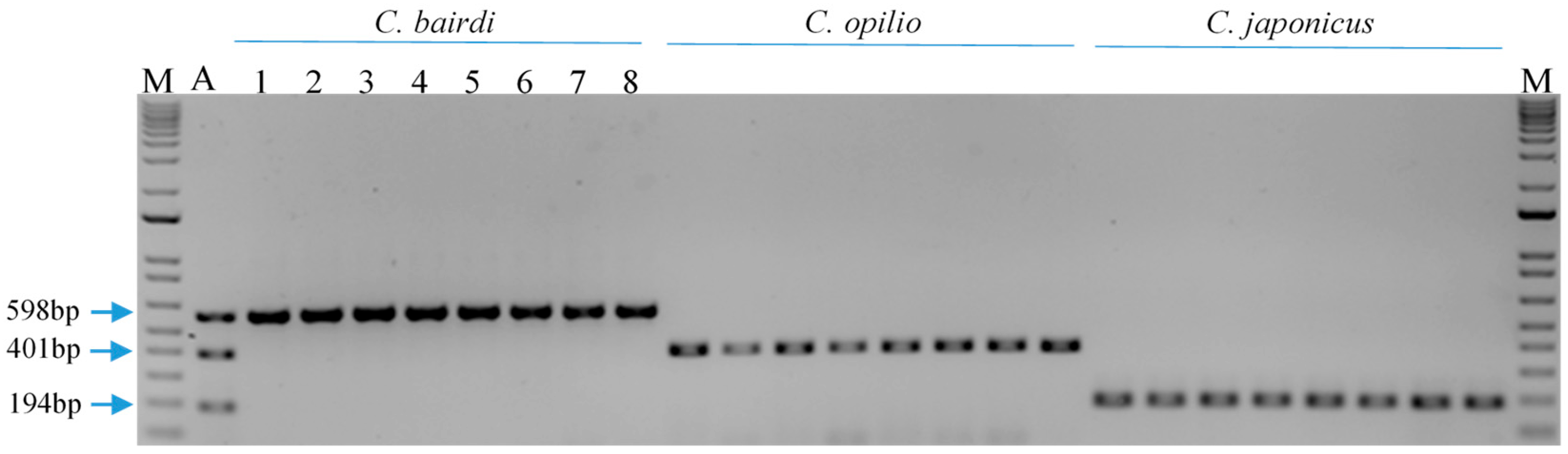
To design species-specific primers, consensus COI sequences of three Chionoecetes species (C. bairdi, C. opilio, and C. japonicus) were aligned with complete reference sequences from GenBank (C. bairdi, OP429109.2; C. opilio, MT335860.1; C. japonicus, MT750295.1) to identify diagnostic SNP sites. Species-specific SNPs were detected at positions 181 (C. bairdi), 377 (C. opilio), and 583 (C. japonicus), with no intraspecific variation observed across all analyzed individuals, indicating high diagnostic reliability (Figure 1). Using these diagnostic sites, three species-specific forward primers (CB_181F, CO_377F, and CJ_583F) and a universal reverse primer (Chi_756R) were designed (Table 2). When applied in PCR, these primer sets produced distinct amplicons of 598 bp (C. bairdi), 401 bp (C. opilio), and 194 bp (C. japonicus), both in single-template and mixed-template reactions (Figure 2). The optimal annealing temperature was determined to be 60 °C using gradient PCR (47–65 °C), which resulted in consistent, species-specific amplification. Amplicons were visualized on 2.0% agarose gels, and their sizes matched the expected lengths. No cross-reactivity was observed among the three species, confirming the high specificity of the primers. These results demonstrate that the designed primers enable accurate discrimination among the three Chionoecetes species and provide a rapid and reliable molecular tool for market sample authentication.

3.3. Specificity and Sensitivity of Multiplex PCR

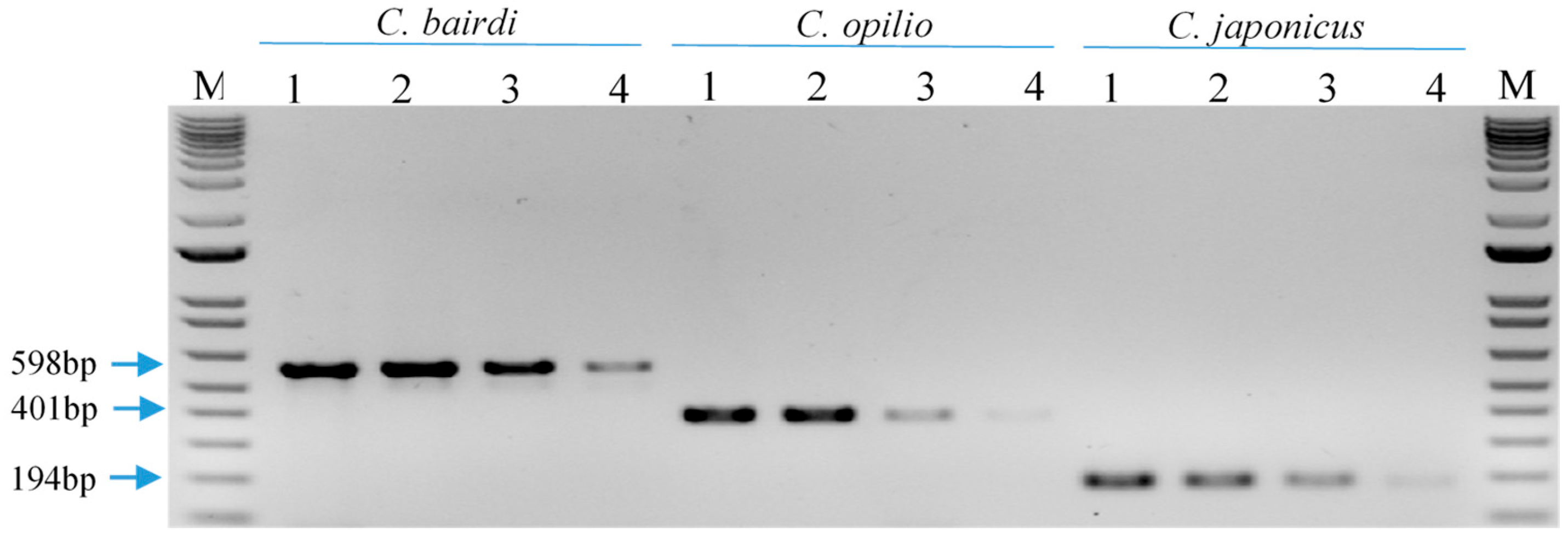
The multiplex PCR simultaneously amplified distinct fragments of 598 bp (C. bairdi), 401 bp (C. opilio), and 194 bp (C. japonicus), with no evidence of nonspecific amplification or primer–dimer formation. The optimal annealing temperature was determined to be 62 °C, which yielded consistent, species-specific amplification. To evaluate assay sensitivity, genomic DNA from each species was serially diluted to 10, 1, 0.1, and 0.01 ng/µL, and PCR was performed in triplicate under identical conditions. Under optimized conditions, the multiplex PCR assay consistently detected each target species down to a DNA concentration of 0.01 ng/µL. Species-specific amplicons were observed in at least two out of three independent replicates at this concentration, which was therefore defined as the limit of detection (LoD) (Figure 3).
Moreover, when genomic DNA from the three species was combined in equal proportions, all expected fragments were simultaneously amplified, demonstrating that the assay is robust under mixed-template conditions representative of potential market adulteration.

4. Discussion

In this study, a multiplex PCR assay targeting species-specific variations was developed and applied to identify three Chionoecetes species (C. bairdi, C. opilio, and C. japonicus). This assay enabled the rapid and accurate simultaneous identification of these morphologically similar species, which are otherwise difficult to distinguish using conventional methods.
The higher genetic diversity observed in C. bairdi likely reflects its broader geographic origin and mixed market sources compared with the other two species. Although non-target crustacean species were not included in the present analysis, no nonspecific amplification or unexpected bands were observed among the three target Chionoecetes species under optimized conditions. These results indicate that the primer sets exhibit high analytical specificity within the tested species. Nevertheless, additional validation against non-target crab species, including other commercially distributed brachyuran crabs and closely related taxa, will be necessary to fully assess potential cross-reactivity and to confirm the robustness of the assay under broader market conditions.
Previous methods such as RAPD-PCR and PCR-RFLP have been reported for species identification; however, these approaches often involve multiple analytical steps and are less suitable for high-throughput simultaneous multi-species identification [20,21,22]. In contrast, the multiplex PCR approach used in this study can be performed with standard laboratory equipment, including a conventional PCR thermocycler and a gel documentation system, and it eliminates the need for restriction enzymes. It also allows multiple species to be detected in a single reaction, thereby offering greater cost- and time-efficiency [27,28].
In addition, earlier studies on Chionoecetes have included triplex PCR assays for C. opilio and C. japonicus, as well as ultrafast real-time PCR assays for C. japonicus, C. opilio, and Paralithodes camtschaticus [25,26]. However, no study has previously addressed the detection of C. bairdi, which is commonly imported into the Korean seafood market. The present study fills this gap by designing and validating species-specific primers that enable the simultaneous identification of all three commercially important Chionoecetes species.
Overall, the successful application of multiplex PCR in this study demonstrates its potential as a practical tool for the accurate labeling of Chionoecetes species, contributing to the establishment of sound distribution practices and ensuring seafood safety in Korea and global seafood markets.

5. Conclusions

The multiplex PCR assay developed in this study enables reliable discrimination of three Chionoecetes species with high specificity and sensitivity. This assay reduces the risk of species misidentification arising from morphological similarity and allows rapid and accurate species authentication in a single PCR. Overall, the proposed method provides a cost-effective and efficient tool for supporting sustainable snow crab resource management, preventing seafood fraud, and ensuring safe and transparent distribution in Korea and global markets. Further validation using processed seafood products and complex mixed-species samples will be required to fully confirm its applicability under commercial conditions.

Author Contributions

Conceptualization, H.S.J.; methodology, H.S.J. and C.M.D.; investigation, C.M.D. and H.J.P.; validation, E.S.N., J.-H.K. and I.J.H.; formal analysis, C.M.D. and H.J.P.; resources, S.-H.L.; writing—original draft preparation, C.M.D. and H.S.J.; writing—review and editing, H.S.J.; supervision, H.S.J.; project administration, E.S.N.; funding acquisition, E.S.N. All authors have read and agreed to the published version of the manuscript.

Funding

This work was supported by a grant from the National Institute of Fisheries Science, Republic of Korea (no. R2026018).

Institutional Review Board Statement

The research was conducted on invertebrate species (crabs) using commercial samples purchased from fish markets. Archived samples stored in our institution’s specimen repository. As no procedures were performed on live vertebrate animals, this study is exempt from ethical review according to our institutional guidelines.

Informed Consent Statement

Not applicable.

Data Availability Statement

The datasets generated during and/or analyzed during the current study are available from the corresponding author on reasonable request.

Conflicts of Interest

The authors declare no conflicts of interest.

References

  1. World Register of Marine Species (WoRMS). Chionoecetes Krøyer, 1838. Available online: https://www.marinespecies.org/aphia.php?p=taxdetails&id=106898 (accessed on 15 January 2026).
  2. Stevens, B.G. Biology and fishery of Tanner crab (Chionoecetes bairdi) in Alaska waters. Fish. Bull. 2002, 100, 1–16. [Google Scholar]
  3. Stevens, B.G.; Swiney, K.M. Hatchery, distribution and biology of Tanner crab (Chionoecetes bairdi) in Alaska waters. Fish. Bull. 2007, 105, 79–97. [Google Scholar]
  4. Yosho, I.; Hayashi, I. The bathymetric distribution of Chionoecetes opilio and Chionoecetes japonicus (Majidae: Brachyura) in the western and northern areas of the Sea of Japan. Bull. Jpn. Sea Natl. Fish. Res. Inst. 1994, 44, 59–71. [Google Scholar]
  5. FAO. Snow crab (Chionoecetes opilio). In FAO Species Catalogue for Fishery Purposes; FAO: Rome, Italy, 2013; Available online: https://www.fao.org/fishery/ (accessed on 15 January 2026).
  6. Yosho, I.; Hirose, T.; Shirai, S. Bathymetric distribution of beni-zuwai crab Chionoecetes japonicus in the northern part of the Sea of Japan. Fish. Sci. 2009, 75, 1417–1429. [Google Scholar] [CrossRef] [Scilit]
  7. Somerton, D.A. Contribution to the life history of the grooved Tanner crab, Chionoecetes tanneri. Fish. Bull. 1981, 79, 259–269. [Google Scholar]
  8. Butler, T.H. Shrimps of the Pacific Coast of Canada; Canadian Bulletin of Fisheries and Aquatic Sciences 202; Government of Canada, Department Of Fisheries and Oceans: Ottawa, ON, Canada, 1980.
  9. Foreign Agricultural Service. Fishery Products Annual—Republic of Korea; GAIN Report; U.S. Department of Agriculture, Foreign Agricultural Service: Washington, DC, USA, 2002. Available online: https://gain.fas.usda.gov (accessed on 28 August 2025).
  10. Kang, S.K. Economic valuation of the creation project of snow crab spawning and habitat ground. J. Fish. Bus. Adm. 2020, 51, 19–45. [Google Scholar] [CrossRef] [Scilit]
  11. Korean Statistical Information Service (KOSIS). Summary Table of Fishery Production Trend (Fishery Production Trend Survey). Available online: https://kosis.kr/statHtml/statHtml.do?conn_path=I2&language=en&orgId=101&tblId=DT_1EW0001 (accessed on 15 January 2026).
  12. National Law Information Center. Enforcement Decree of the Fisheries Resources Management Act (Korea) [sigan 2025.12.30.; Presidential Decree No. 35943, 30 December 2025]. Available online: https://www.law.go.kr/lsLinkProc.do?chrClsCd=010202&datClsCd=010102&gubun=admRul&joNo=000600001&lsId=41456&lsNm=%EC%88%98%EC%82%B0%EC%9E%90%EC%9B%90%EA%B4%80%EB%A6%AC%EB%B2%95%EC%8B%9C%ED%96%89%EB%A0%B9&mode=10 (accessed on 15 January 2026).
  13. Ministry of Food and Drug Safety (MFDS). Import Inspection Regulations for Seafood Products; Ministry of Food and Drug Safety: Seoul, Republic of Korea, 2024. Available online: https://www.mfds.go.kr (accessed on 28 August 2025).
  14. National Law Information Center. Food Sanitation Laws; Government of the Republic of Korea: Seoul, Republic of Korea. Available online: https://www.law.go.kr (accessed on 28 August 2025).
  15. Do, T.D.; Wong, L.L. Investigation of seafood mislabeling in Asia: A review of the literature and mitigation strategies. J. Agric. Food Res. 2025, 22, 101702. [Google Scholar] [CrossRef] [Scilit]
  16. Kim, E.M.; Dong, C.M.; Lee, M.N.; Noh, J.K.; Noh, E.S.; Nam, B.H.; Kim, Y.O.; Jung, H.S. Development of multiplex species-specific PCR for the simultaneous identification of three closely related species in the genera Misgurnus and Paramisgurnus. Aquac. Rep. 2022, 24, 101144. [Google Scholar] [CrossRef] [Scilit]
  17. Zuo, T.; Li, Z.; Lv, Y.; Duan, G.; Wang, C.; Tang, Q. Rapid identification of sea cucumber species with multiplex-PCR. Food Control 2012, 26, 58–62. [Google Scholar] [CrossRef] [Scilit]
  18. DiMauro, S. Mitochondrial DNA medicine. Biosci. Rep. 2007, 27, 5–9. [Google Scholar] [CrossRef] [Scilit] [PubMed]
  19. Galtier, N.; Nabholz, B.; Glémin, S.; Hurst, G.D.D. Mitochondrial DNA as a marker of molecular diversity: A reappraisal. Mol. Ecol. 2009, 18, 4541–4550. [Google Scholar] [CrossRef] [Scilit] [PubMed]
  20. Kwon, G.H.; Lee, H.A.; Park, J.Y.; Kim, J.S.; Lim, J.; Park, C.S.; Kwon, D.Y.; Kim, Y.S.; Kim, J.H. Development of a RAPD-PCR method for identification of Bacillus species isolated from Cheonggukjang. Int. J. Food Microbiol. 2009, 129, 282–287. [Google Scholar] [CrossRef] [Scilit] [PubMed]
  21. Aranishi, F.; Okimoto, T.; Izumi, S. Identification of gadoid species (Pisces, Gadidae) by PCR-RFLP analysis. J. Appl. Genet. 2005, 46, 69–73. [Google Scholar] [PubMed]
  22. Guan, F.; Jin, Y.T.; Zhao, J.; Xu, A.C.; Luo, Y.Y. A PCR method that can be further developed into PCR-RFLP assay for eight animal species identification. J. Anal. Methods Chem. 2018, 2018, 5890140. [Google Scholar] [CrossRef] [Scilit] [PubMed]
  23. Fahmi, M.R.; Solihin, D.D.; Soewardi, K.; Pouyaud, L.; Shao, Z.; Berrebi, P. A novel semi-multiplex PCR assay for identification of tropical eels of genus Anguilla in Indonesian water. Fish. Sci. 2013, 79, 185–191. [Google Scholar] [CrossRef] [Scilit]
  24. Rocha-Olivares, A.; Chávez-González, J.P. Molecular identification of dolphinfish species (genus Coryphaena) using multiplex haplotype-specific PCR of mitochondrial DNA. Ichthyol. Res. 2008, 55, 389–393. [Google Scholar] [CrossRef] [Scilit]
  25. Kang, T.S. Rapid and simple identification of two closely related snow crabs (Chionoecetes opilio and C. japonicus) by direct triplex PCR. LWT–Food Sci. Technol. 2019, 99, 562–567. [Google Scholar] [CrossRef] [Scilit]
  26. Lim, H.S.; Park, E.J.; Lee, J.H.; Kim, H.S.; Mun, J.E. Ultrafast PCR assay for identification of three king crabs—Chionoecetes japonicus, Chionoecetes opilio, and Paralithodes camtschaticus. Food Sci. Biotechnol. 2025, 34, 1055–1062. [Google Scholar] [CrossRef] [Scilit] [PubMed]
  27. Asensio Gil, L. PCR-based methods for fish and fishery products authentication. Trends Food Sci. Technol. 2007, 18, 558–566. [Google Scholar] [CrossRef] [Scilit]
  28. Lee, G.Y.; Suh, S.M.; Lee, Y.M.; Kim, H.Y. Multiplex PCR assay for simultaneous identification of five types of tuna (Katsuwonus pelamis, Thunnus alalonga, T. albacares, T. obesus and T. thynnus). Foods 2022, 11, 280. [Google Scholar] [CrossRef] [Scilit] [PubMed]
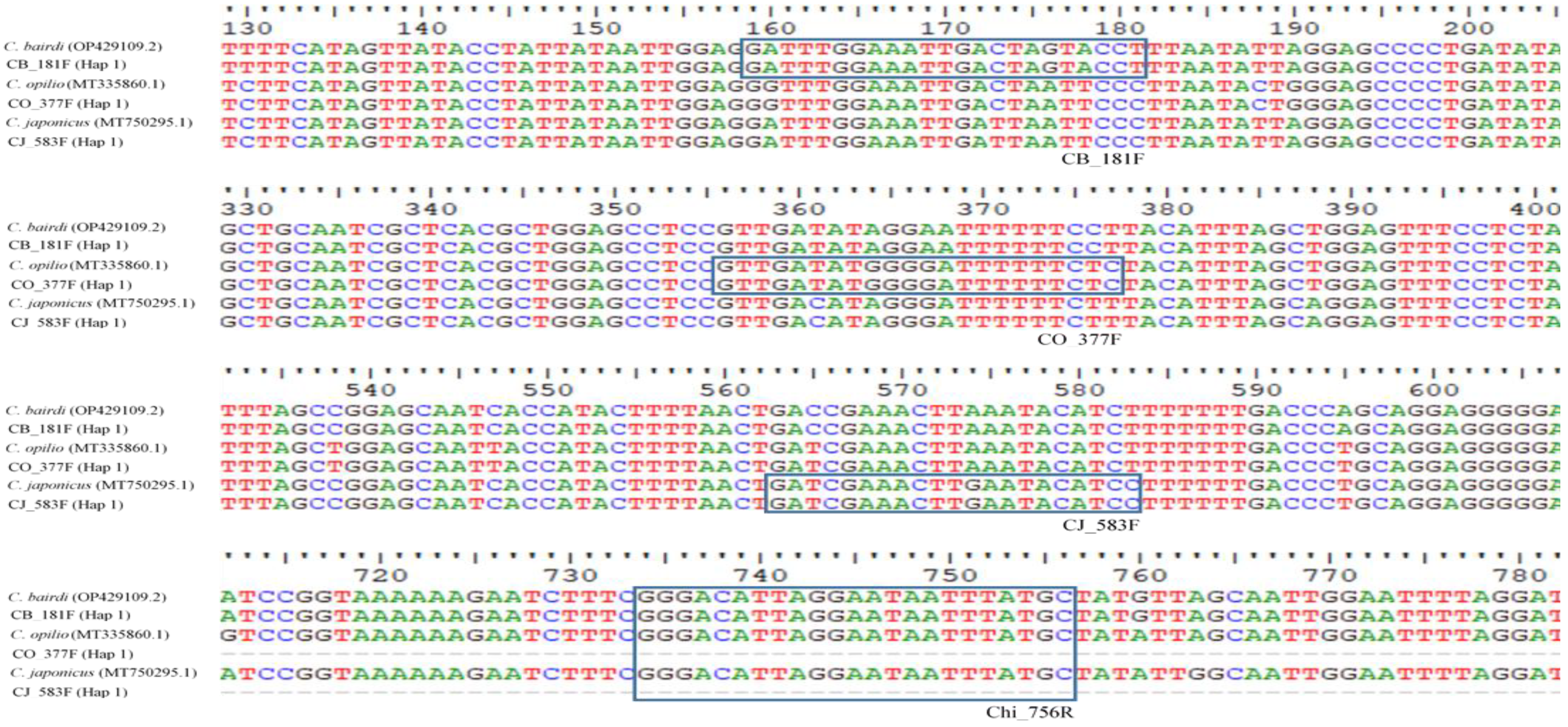
Figure 1. Nucleotide alignment of the COI gene sequences from three Chionoecetes species used for species-specific marker design.
Fishes 11 00129 g001
Figure 2. Species identification of Chionoecetes using multiplex PCR with species-specific primers. Lane designations: (A) mixed-template sample containing equal amounts of genomic DNA from C. bairdi, C. opilio, and C. japonicus; (M) 1 kb Plus DNA ladder (Invitrogen, Carlsbad, CA, USA).
Fishes 11 00129 g002
Figure 3. Sensitivity analysis for the detection of three Chionoecetes species using species-specific primer sets. Genomic DNA from a representative individual of each species was serially diluted 10-fold from 10 ng/µL to 0.01 ng/µL and amplified under optimized multiplex PCR conditions. Each dilution was tested in triplicate, and the limit of detection (LoD) was defined as the lowest concentration at which species-specific bands were detected in at least two of three replicates. Lane designations: (M) 1 kb Plus DNA ladder (Invitrogen, Carlsbad, CA, USA); (1) 10 ng/µL; (2) 1 ng/µL; (3) 0.1 ng/µL; (4) 0.01 ng/µL.
Fishes 11 00129 g003
Table 1. Specimens of the three Chionoecetes species used in this study.
No.Scientific NameSample LocationCollection DatesSample Size (n)Specimen Accession Number
1Chionoecetes bairdiJapan2024.12 276NIFS-AR-25005257-25005532
2Chionoecetes opilioKorea2025.0198213NIFS-AR-25005539-25005636
Russia2025.0439NIFS-AR-25005680-25005718
Japan2025.0576NIFS-AR-25005719-25005794
3Chionoecetes japonicusKorea2025.02 61NIFS-AR-25005569-25005599
Table 2. Primer sequences and expected product sizes for PCR amplification of the three Chionoecetes species.
PrimerSequence (5′→3′) Product Size (bp)Target Species
Universal COI primers (annealing temperature: 54 °C)
LCO1490GGT CAA CAA ATC ATA AAG ATA TTG G598C. bairdi, C. opilio,
HCO2198TAA ACT TCA GGG TGA CCA AAA AAT CAand C. japonicus
Species-specific primers (annealing temperature: 60 °C)
CB_181F GAT TTG GAA ATT GAC TAG TAC CT598C. bairdi
CO_377FGTT GAT ATG GGG ATT TTT TCT C401C. opilio
CJ_583FGAT CGA AAC TTG AAT ACA TCC 194C. japonicus
Chi_756RGCA TAA ATT ATT CCT AAT GTC CC
Table 3. Genetic diversity of the COI gene region in populations of three Chionoecetes species.
Species
C. bairdiC.opilioC. japonicus
Total Number of individuals (N)27621361
Number of polymorphic sites36206
Number of haplotypes (H)43217
Haplotype diversity (Hd)0.5970.3870.352
Nucleotide diversity (Pi)0.001460.001000.00064
Disclaimer/Publisher’s Note: The statements, opinions and data contained in all publications are solely those of the individual author(s) and contributor(s) and not of MDPI and/or the editor(s). MDPI and/or the editor(s) disclaim responsibility for any injury to people or property resulting from any ideas, methods, instructions or products referred to in the content.