
Communication

Transcriptional Responses to Chronic Thermal Stress in Chum Salmon (Oncorhynchus keta) Smolt

1
Department of Integrative Biological Sciences & Industry, College of Life Science, Sejong University, Seoul 05006, Republic of Korea
2
Department of Medical Science, Soonchunhyang University, Asan 31548, Republic of Korea
3
Department of Aquatic Life Medicine, Gangneung-Wonju National University, Gangneung 25457, Republic of Korea
*
Authors to whom correspondence should be addressed.
These authors equally contributed to this work.
Fishes 2026, 11(2), 95; https://doi.org/10.3390/fishes11020095

Submission received: 15 January 2026 / Revised: 26 January 2026 / Accepted: 2 February 2026 / Published: 4 February 2026
(This article belongs to the Special Issue Stress Responses in Fish)

Abstract

Understanding the chronic thermal acclimation capacity of chum salmon (Oncorhynchus keta) is essential for predicting species resilience and developing mitigation strategies under ocean warming. We investigated the upper limit of chronic thermal acclimation and its underlying molecular mechanisms in chum salmon smolts exposed to four constant temperatures (10, 14, 18, and 22 °C) for 6 weeks. Transcriptional responses of genes related to cellular stress protection, endocrine feedback regulation, antioxidant defense, metabolic regulation (AMPKα and mTOR), and protein degradation were quantified in the liver, skeletal muscle, and brain. Chronic exposure to elevated temperature elicited tissue-specific molecular responses, with the most pronounced effects observed at 22 °C. At this temperature, all tissues showed marked induction of heat shock proteins and ubiquitin, accompanied by suppression of antioxidant defenses, glucocorticoid receptor signaling, and AMPKα–mTOR-mediated metabolic regulation, particularly in the liver and muscle. These responses were consistent with previously reported impairments in growth performance, lipid reserves, and hematological indices from the same growth trial. In contrast, smolts maintained at 18 °C exhibited molecular signatures indicative of effective physiological compensation without severe cellular stress. Collectively, these results indicate that chum salmon smolts can acclimate to chronic warming up to 18 °C, whereas exposure to 22 °C exceeds their acclimation capacity and induces a tertiary stress response.
Key Contribution: This study defines the upper limit of chronic thermal acclimation in chum salmon smolts by linking tissue-specific transcriptional responses to growth and physiological performance. We demonstrate that smolts can effectively acclimate to chronic warming up to 18 °C, whereas exposure to 22 °C exceeds their acclimation capacity and induces a tertiary stress response characterized by disrupted metabolic regulation and cellular stress defenses. These findings provide mechanistic insight into the vulnerability of juvenile chum salmon to ocean warming.

1. Introduction

The Republic of Korea represents the southern boundary of the spawning distribution of chum salmon (Oncorhynchus keta) in the Northwest Pacific [1,2]. However, sea surface temperatures in this region have increased at rates two to three times higher than the global average rate, driven by intensified regional oceanographic processes [3,4]. This rapid warming poses a critical challenge to the persistence of southern chum salmon populations and to the feasibility of sustainable salmon aquaculture under future climate scenarios [2].
In the context of global climate warming, a substantial body of literature has examined the effects of elevated temperature on salmonids [5,6,7]. Reported temperature-related effects include thermal tolerance [8], growth performance [9,10,11], metabolic regulation [12], stress physiology [13,14,15], antioxidant responses [16,17,18,19,20,21], and immune function [22]. However, much of this literature has focused on acute thermal stress, thereby primarily characterizing short-term physiological responses [5,13,14,23,24,25,26]. Classic work by Brett [5] demonstrated that the upper incipient lethal temperature (UILT; defined as the temperature causing 50% mortality during a 7-day acute exposure) for juvenile chum salmon was approximately 23.8 °C, and that behavioral avoidance occurred at temperatures above 15 °C. Similarly, Palmisano [13] showed that acute exposure to 21.6 °C induced cellular stress responses without eliciting an endocrine stress response in juvenile Chinook salmon (Oncorhynchus tshawytscha). While such studies provide critical benchmarks for thermal limits and cellular responses, they offer limited insight into the consequences of sustained exposure to elevated temperatures.
In contrast, studies employing chronic or long-term thermal exposures provide more ecologically relevant information on fitness- and survival-related traits at both individual and population levels, including growth and osmoregulatory capacity, under warming conditions. For example, chronic exposure to 17–20 °C did not impair growth but did reduce hypo-osmoregulatory performance, whereas exposure to 21–24 °C significantly compromised both growth and osmoregulatory capacity in juvenile Chinook salmon [9]. Likewise, prolonged exposure to 20 °C significantly reduced growth and body energy reserves in brown trout (Salmo trutta), with potential consequences for population fitness [11]. Despite these advances, comparatively little information is available on the physiological consequences of prolonged exposure to elevated temperatures in chum salmon, highlighting a critical gap in our understanding of how ongoing marine warming may affect this species.
Several long-term studies have demonstrated that fish can acclimate to suboptimal temperatures through physiological and cellular adjustments, but only up to a species-specific threshold [8,11,14,18,27]. The upper limit of chronic thermal acclimation can be defined as the highest temperature at which physiological performance, such as growth and osmoregulation, can be maintained via compensatory physiological and molecular mechanisms [28,29]. Beyond this limit, sustained thermal exposure triggers a shift from secondary to tertiary stress responses, characterized by reduced energy reserves, osmotic and ionic homeostasis, immune competence, and ultimately decreased growth and survivorship [28,30].
Despite the high vulnerability of chum salmon, particularly populations at the southern margin of their distribution, to ongoing ocean warming, information on the chronic thermal biology of this species, including its capacity for chronic thermal acclimation, remains limited [7,31,32]. Early work by Brett [5] demonstrated, based on acute thermal tolerance experiments, that juvenile chum salmon exhibited the lowest upper thermal tolerance among Pacific salmon, with an UILT of approximately 23.8 °C. In contrast, the ecological preferendum of chum salmon has been reported to range between 9 and 13 °C [33,34], while peak growth has been observed at higher temperatures (16–19 °C) in short-term growth trials of approximately 10 days [35,36]. However, these findings have not been evaluated under long-term, integrative experimental conditions. Accordingly, in this study, chum salmon smolts were exposed to four constant temperatures (optimal: 10 and 14 °C; elevated: 18 and 22 °C) for 6 weeks to assess their capacity for chronic thermal acclimation and to elucidate the physiological and molecular mechanisms that define the upper limits of thermal tolerance. Transcriptional responses of genes involved in cellular stress protection (heat shock proteins, HSPs), endocrine regulation of cortisol signaling, antioxidant defense, cellular energy and anabolic regulation (AMP-activated protein, AMPKα and mechanistic target of rapamycin, mTOR signaling), and protein degradation pathways were quantified in three metabolically and functionally distinct tissues (liver, skeletal muscle, and brain).
Our results, integrated with previously reported data on growth performance, body composition, and hematological parameters obtained from the same growth trial (Table A2; [32]), were used to evaluate the capacity for chronic thermal acclimation and to better understand its underlying mechanisms. By characterizing chronic cellular and molecular responses to sustained thermal exposure, this study provides mechanistic insight into the constraints on thermal acclimation capacity in chum salmon and offers a physiological framework to inform conservation and aquaculture strategies under ongoing marine warming.

2. Materials and Methods

2.1. Fish Rearing and Seawater Acclimation

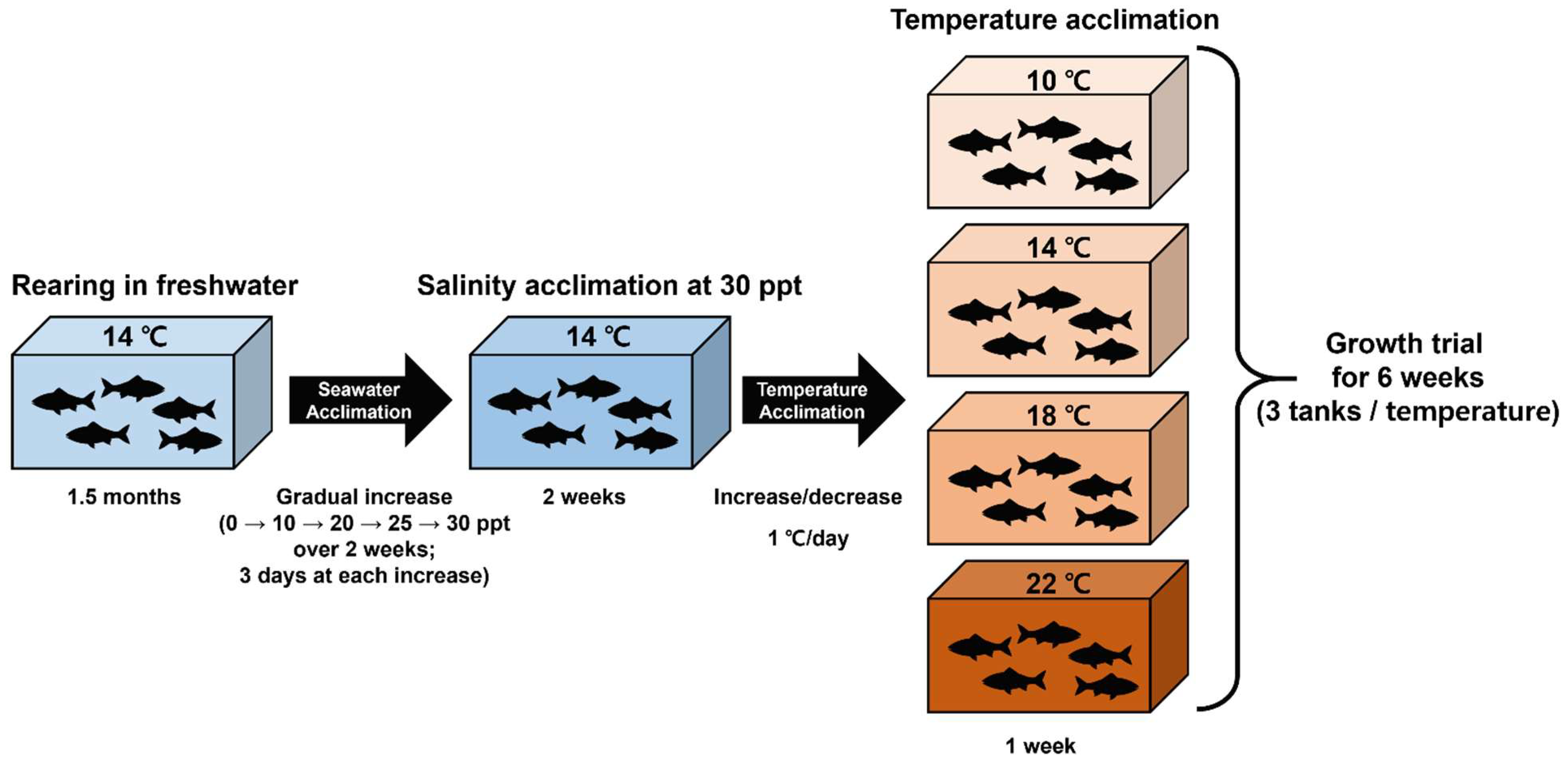
Approximately 300 juvenile chum salmon (approximately 2 months post-hatch) were transported to an indoor facility at Sejong University, Seoul. Following initial acclimation, 240 healthy individuals of similar size were selected and distributed into 12 recirculating rearing tanks (300 L; environmental conditions: ~14 °C, 9.0 mg O2/L, photoperiod: 12L/12D). Fish were reared for 1.5 months and fed a commercial trout pellet (crude protein: 51%; crude lipid: 12%; crude fiber: 3%; crude ash: 9%) twice daily at a feeding rate of 3–5% of body weight (BW). Subsequently, the fish were gradually acclimated to seawater (30 ppt) over a period of 2 weeks using a modified method established [37] (Figure 1).

2.2. Experimental Design and Sampling Procedure

Four temperature treatments (10, 14, 18, and 22 °C) were randomly assigned to 12 tanks containing seawater-acclimated chum salmon (mean BW 7.0 g), with three replicate tanks per temperature (completely randomized design). Tank temperatures were adjusted at a rate of 1 °C per 12 h using aquarium heaters or chillers with temperature controllers until target treatment temperatures were reached. After a 1-week acclimation, the fish were reared under constant-temperature conditions for 6 weeks (Table A1). Water temperature was monitored twice daily using a multiparameter water quality meter (HI9829, Hanna Instruments, Inc., Smithfield, RI, USA) and verified with a glass thermometer. Total ammonia, nitrite, and nitrate were measured weekly using commercial assay kits (Tetra Spectrum Brands, LLC, Blacksburg, VA, USA). The fish were fed a commercial diet (crude protein, 46.6%; crude lipid, 11.9%; crude fiber, 1.4%; and crude ash, 15.2%) at 3% BW per day. Fork length and BW were measured at 0, 3, and 6 weeks (20, 8, and 12 fish from each tank, respectively). Three fish per tank were randomly sampled at 3 and 6 weeks, euthanized with MS-222, and tissues (liver, muscle, and brain) were collected, snap-frozen on dry ice, and stored at −80 °C.

2.3. mRNA Quantification Procedure

Total RNA was extracted from the liver, muscle, and brain tissues using the phenol-chloroform method (TRIzol, Invitrogen, Carlsbad, CA, USA). RNA concentration and purity (A260/280 and A260/230 ratios) were assessed using a NanoDrop spectrophotometer (Thermo Fisher Scientific, Wilmington, DE, USA). cDNA was synthesized from 1 μg of total RNA using a reverse transcription kit (Qiagen, Hilden, Germany) in a T100 thermal cycler (Bio-Rad Laboratories, Inc., Hercules, CA, USA). The relative mRNA level of each target gene was quantified by quantitative reverse transcription PCR using the QuantiNova SYBR Green PCR kit (Qiagen, Hilden, Germany) in a Bio-Rad C1000 thermal cycler with a CFX96 optical reaction module (Bio-Rad Laboratories, Inc., Hercules, CA, USA). Synthesized cDNA was diluted 4-fold with DNase/RNase-free water and used as a template in a total reaction volume of 20 μL. All reactions were performed in duplicate. The cycling conditions were 95 °C for 2 min, followed by 40 cycles of 95 °C for 5 s and 60 °C for 10 s. Relative mRNA level was calculated relative to that of β-actin (reference gene) using the 2-ΔΔCt method. The primer information is provided in Table 1. β-actin was selected as the reference gene based on its stable expression across experimental temperature groups [32].

2.4. Data Analysis

The results were analyzed using two-way analysis of variance (ANOVA) in SPSS software (version 21; IBM SPSS Statistics, Armonk, NY, USA) to evaluate the effects of temperature, time, and their interaction at a significant level of p < 0.05. When a significant interaction was detected, data were analyzed separately at each sampling time point using one-way ANOVA, followed by pairwise comparisons using Duncan’s multiple range test. Three fish (technical replicates) from each tank were individually analyzed for mRNA expression, and the resulting values were averaged to obtain a mean value per tank. Each tank was treated as an experimental unit (n) for statistical analysis, with three replicate tanks per treatment. All data are presented as mean ± standard error of the mean (n = 3 tanks).

3. Results

3.1. Temperature-Dependent Induction of Cellular Stress Responses (HSP70, HSP90 & Ubiquitin)

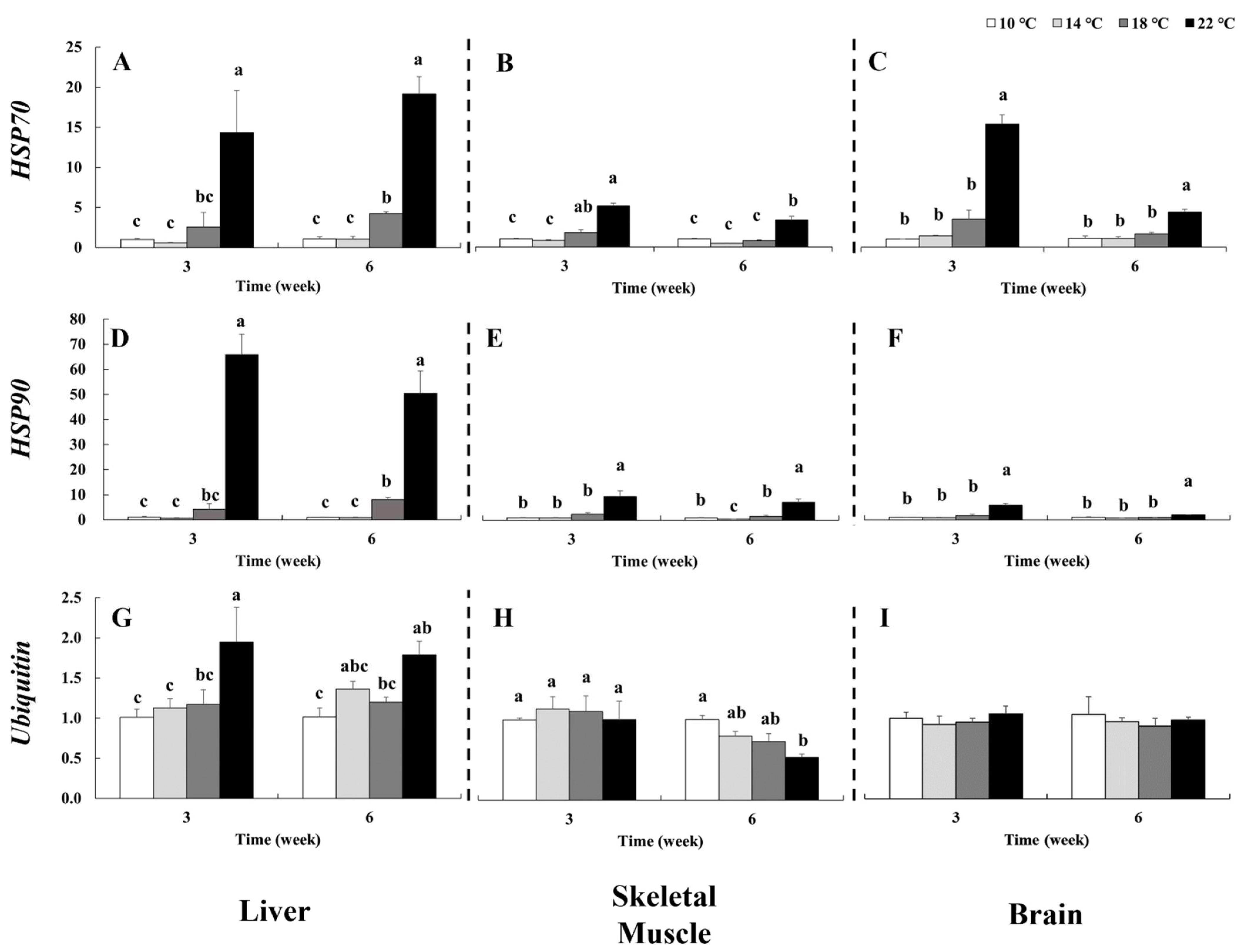
HSP70 and HSP90 expression patterns were previously reported [37] and are presented here to provide an integrated comparison with other tissues. Chronic exposure to elevated temperatures (18 and/or 22 °C) significantly induced HSP70 and HSP90 mRNA expression across tissues, with the strongest and most consistent upregulation observed at 22 °C (Figure 2A–F). In the liver, both HSP70 and HSP90 mRNA levels were significantly elevated at 18 and 22 °C after 6 weeks, with temperature being the primary explanatory factor (2W ANOVA, temperature: p-values < 0.001; Figure 2A,D). In skeletal muscle, HSP70 and HSP90 mRNA levels were markedly increased at 22 °C (2W ANOVA, temperature: p-values < 0.001; Figure 2B,E), whereas time-dependent effects were minimal. In the brain, both genes exhibited strong temperature- and time-dependent induction, with significantly higher expression at 22 °C compared to all other temperatures at both sampling points (2W ANOVA, temperature: p-values < 0.001). Hepatic ubiquitin mRNA levels were significantly elevated at 22 °C, particularly at week 3 (2W ANOVA, temperature: p-value = 0.002), whereas muscle ubiquitin expression was primarily influenced by time rather than temperature (2W ANOVA, time: p-value 0.005; Figure 2G,H). No significant effects of temperature or time were detected in brain ubiquitin expression (Figure 2G–I), suggesting tissue-specific activation of protein degradation pathways under chronic thermal stress.

3.2. Suppression of Glucocorticoid Signaling Under Chronic Thermal Stress (GR1, GR2 & HSD11β)

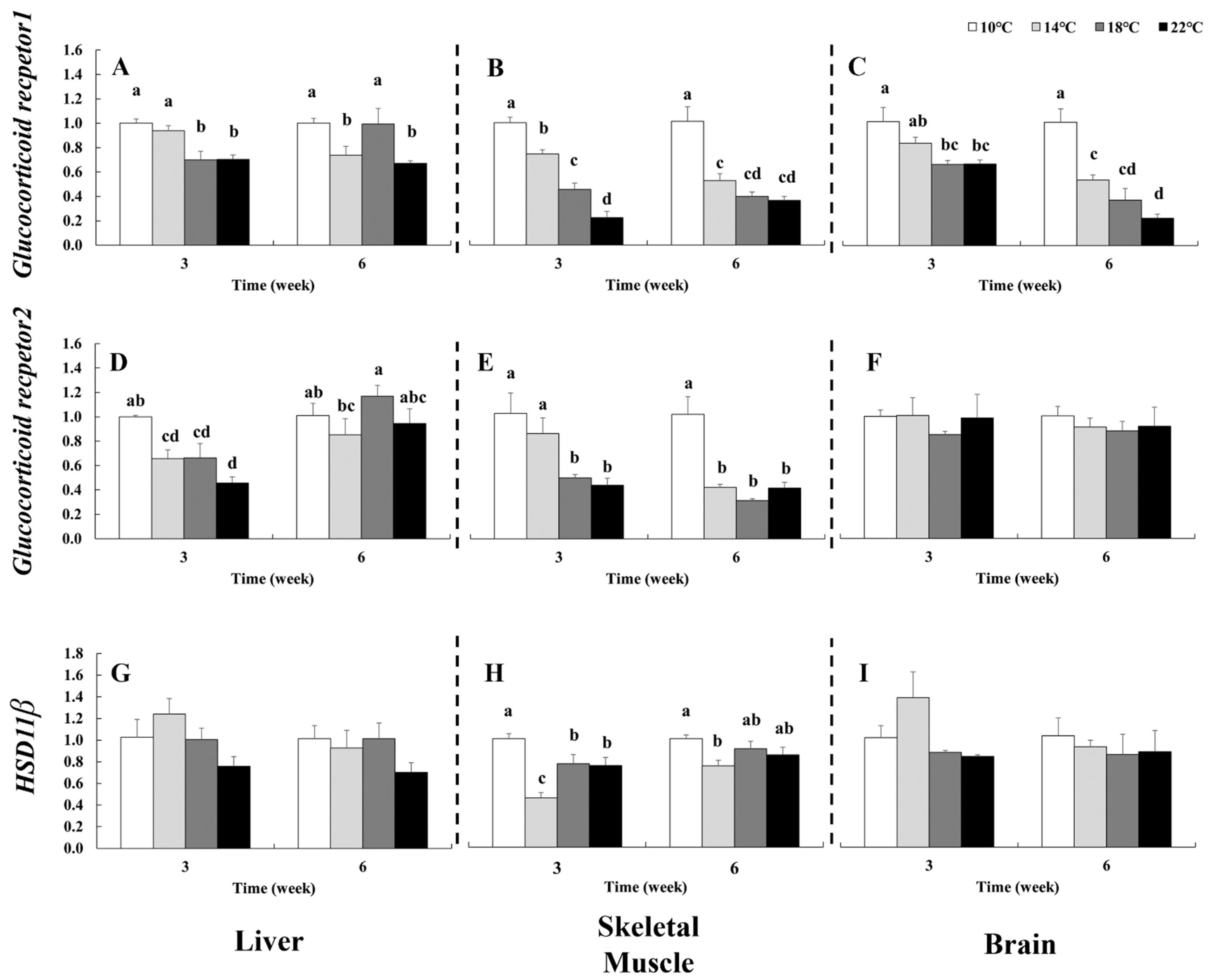
Chronic exposure to elevated temperatures resulted in a consistent downregulation of glucocorticoid receptor (GR) transcripts across tissues, particularly at 18 and 22 °C (Figure 3A–F). Hepatic GR1 and GR2 mRNA levels were significantly reduced at elevated temperatures, although the magnitude and temporal patterns differed between receptor isoforms (2W ANOVA, temperature: p-values = 0.002 and 0.019; Figure 3A,D). In skeletal muscle, both GR1 and GR2 exhibited pronounced temperature-dependent decreases, with the lowest expression observed at 22 °C at both time points (2W ANOVA, temperature: p-values < 0.001; Figure 3B,E). Similarly, brain GR1 expression declined progressively with increasing temperature (2W ANOVA, temperature: p-value < 0.001), whereas GR2 expression remained unaffected (Figure 3C,F). 11β-hydroxysteroid dehydrogenase (HSD11β) mRNA expression showed limited temperature sensitivity, with no significant changes detected in liver or brain tissues. In contrast, muscle HSD11β expression was significantly influenced by both temperature and time (2W ANOVA, temperature: p-value < 0.001, time: p-value = 0.008), indicating tissue-specific modulation of local cortisol metabolism during prolonged thermal exposure (Figure 3G–I).

3.3. Altered Antioxidant Defense Capacity Under Elevated Temperatures (SOD, Catalase & GPx)

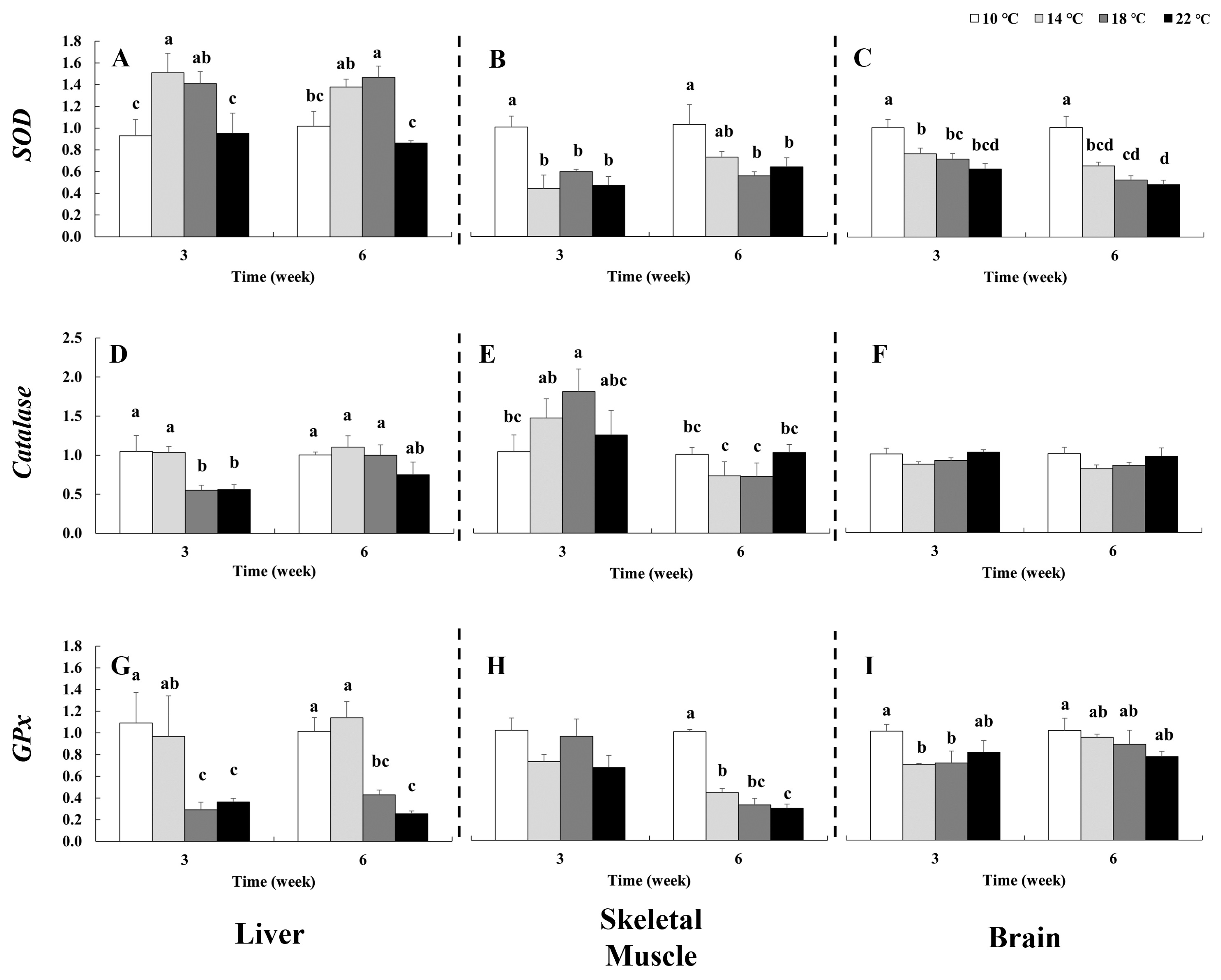
Antioxidant gene expression exhibited clear tissue- and temperature-specific patterns, reflecting differential oxidative stress regulation under chronic warming (Figure 4A–I). In the liver, Superoxide dismutase (SOD) expression peaked at intermediate elevated temperatures (14–18 °C), whereas Glutathione peroxidase (GPx) mRNA levels were significantly suppressed at 18 and 22 °C (2W ANOVA, temperature: p-values < 0.001; Figure 4A,D,G), suggesting reduced antioxidant capacity at higher temperatures. In skeletal muscle, SOD and GPx expression declined progressively with increasing temperature (2W ANOVA, temperature: p-values < 0.001 each; GPx interaction: p-value 0.022), particularly at 22 °C, while catalase showed a transient increase at 18 °C at week 3 (2W ANOVA, time: p-value 0.003; Figure 4B,E,H). In the brain, SOD expression was consistently lower at elevated temperatures, whereas catalase remained unchanged. Brain GPx expression displayed a non-linear response, with higher levels at 10 and 22 °C at week 3 (2W ANOVA, temperature: p-value 0.047; Figure 4C,F,I), indicating complex regulation of oxidative stress responses in neural tissue.

3.4. Temperature-Mediated Disruption of Anabolic–Catabolic Signaling Balance (AMPKα & mTOR)

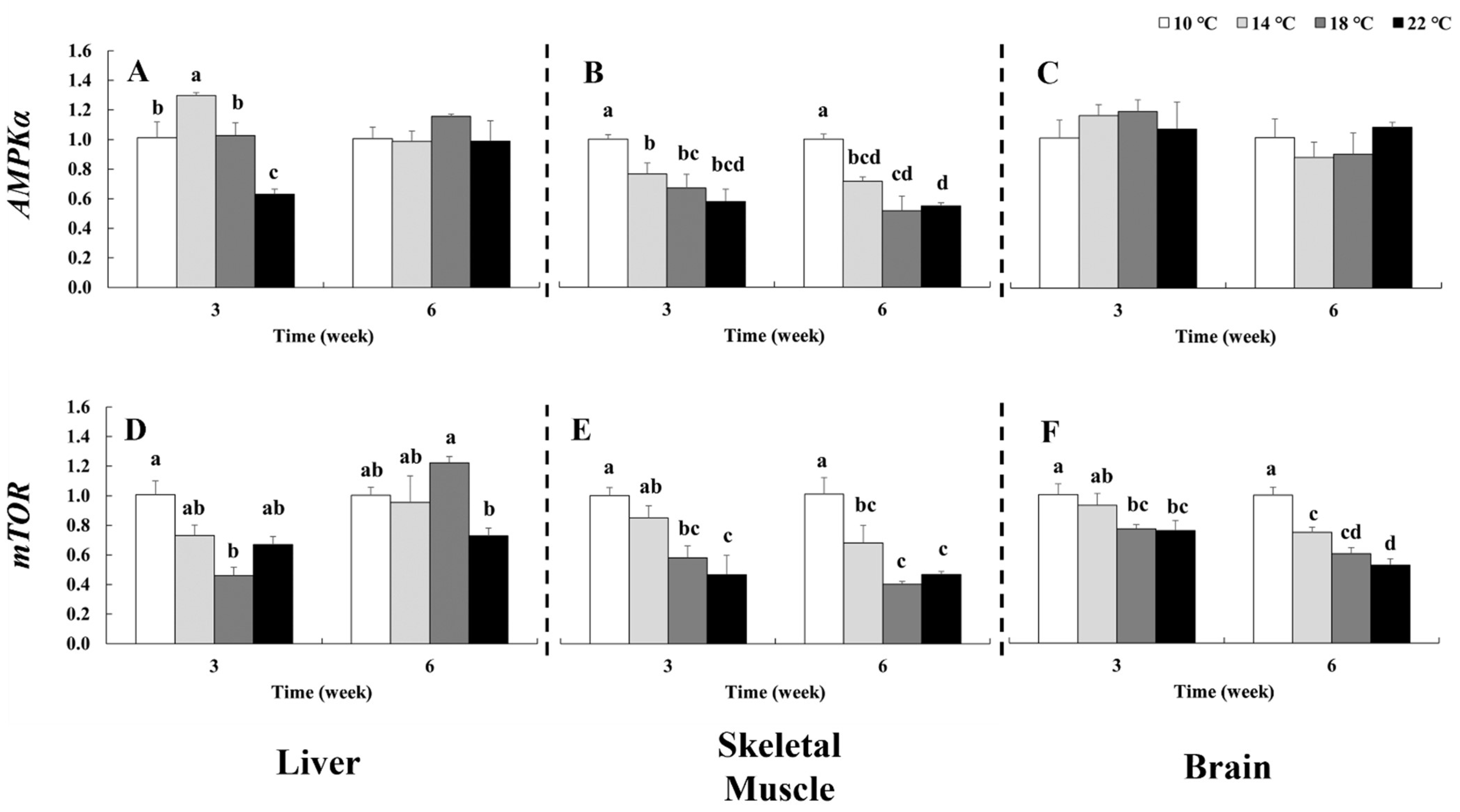
Genes associated with cellular energy sensing and anabolic regulation exhibited marked temperature-dependent suppression, particularly at 22 °C (Figure 5A–F). In the liver, AMPKα expression was highest at 14 °C and significantly reduced at 22 °C at week 3 (Figure 5A), while hepatic mTOR expression was significantly downregulated at 22 °C after 6 weeks (2W ANOVA, interaction: p-values 0.006 and 0.002; Figure 5D), indicating impaired anabolic signaling under chronic thermal stress. In skeletal muscle, both AMPKα and mTOR mRNA levels declined monotonically with increasing temperature at both sampling points (2W ANOVA, temperature: p-values < 0.001; Figure 5B,E), demonstrating a coordinated disruption of metabolic regulation. In the brain, AMPKα expression remained stable across temperatures; however, mTOR expression decreased significantly with increasing temperature (2W ANOVA, temperature: p-value < 0.001; Figure 5C,F), highlighting tissue-specific vulnerability of anabolic pathways to chronic warming.

4. Discussion

The present study demonstrates that chum salmon smolts exhibit a capacity for thermal acclimation up to 18 °C, beyond which exposure to 22 °C is consistent with a transition toward a tertiary stress–like response. This interpretation is supported by coordinated temperature-dependent changes in (1) HSP expression, (2) ubiquitin-mediated protein degradation, (3) antioxidant defense capacity, and (4) cellular energy and anabolic signaling (AMPKα and mTOR). These responses were most pronounced in the liver, while consistent patterns were also observed in the skeletal muscle and brain tissues. The progressive downregulation of genes associated with glucocorticoid signaling, antioxidant defense, and metabolic regulation at elevated temperatures suggests constrained stress regulation and reduced metabolic scope at the transcriptional level under chronic warming. We further integrated these molecular responses with previously reported changes in growth performance, lipid reserves, and red blood cell (RBC) indices observed in the same growth trial (Table A2; [32]) to elucidate a more integrative physiological mechanisms underlying chronic thermal acclimation in chum salmon smolts. Collectively, these findings support the concept that 22 °C represents a biologically stressful condition that exceeds the upper limit of chronic thermal acclimation for this species.
It should be emphasized that the present study is based on mRNA expression analyses of a selected set of genes. Because transcriptional changes do not necessarily translate directly into protein abundance, enzyme activity, or signaling pathway activation due to post-transcriptional and post-translational regulation [49,50], the results should be interpreted as transcriptional indicators associated with cellular stress, metabolic regulation, and antioxidant capacity rather than direct functional measurements. Accordingly, references to altered signaling pathways or physiological processes in this discussion reflect regulatory trends inferred from gene expression patterns. Further studies incorporating protein-level analyses, enzymatic assays, and direct pathway activity measurements will be required to fully resolve the functional consequences of chronic thermal exposure.

4.1. Heat Shock Protein Induction as a Marker of Chronic Thermal Stress Severity

HSPs are highly conserved molecular chaperones that maintain cellular homeostasis by promoting protein folding, preventing aggregation, and facilitating degradation of damaged proteins [29,51,52]. Among these, the inducible forms of HSP70 and HSP90 are major chaperones that protect cells from proteotoxicity caused by various stressors including thermal stress [52]. The present findings show significant upregulation of HSP70 and HSP90 mRNA expression in chum salmon, which is consistent with previous results reported in salmonids exposed to elevated temperatures [11,13,26,53,54]. The upregulation of HSP70 and/or HSP90 in multiple tissues, including the muscle and liver, has been reported in Chinook salmon exposed to acute temperature elevations [13,54]. Both studies demonstrated pronounced tissue-specific differences in the magnitude of the heat shock response. Bowen [54] identified the liver as the most heat-sensitive tissue, whereas Palmisano [13] reported greater sensitivity in the muscle and brain. This discrepancy may reflect differences in the life stages of salmon and the experimental procedure (e.g., acclimation temperature). In contrast to acute HSP upregulation, Marcoli [21] reported downregulations of HSP90 mRNA levels in the liver, spleen, and gill of Chinook salmon subjected to chronic exposure to combined elevated temperature (20 °C) and hypoxia, which was attributed to energy deprivation and metabolic depression resulting from energy reallocation toward essential maintenance processes under prolonged stress. Considering that the heat shock response is a critical emergency mechanism for coping with thermal stress [29,51,52], the direction and magnitude of HSP regulation likely depend on the exposure duration, presence of additional stressors, and stress severity.
In the present study, HSP70 and HSP90 mRNA expression in liver increased at both 18 and 22 °C, whereas expression in muscle and brain increased only at 22 °C. HSP90 expression at 22 °C was ~7-fold higher in the liver than in the muscle and brain, indicating greater sensitivity of liver to heat stress. Moreover, hepatic HSP70 and HSP90 mRNA expressions increased by ~4-fold and ~10-fold, respectively, from 18 °C to 22 °C, indicating substantially greater thermal stress at 22 °C. Accordingly, the marked elevations in HSP70 and HSP90 mRNA levels at 22 °C suggest a possible metabolic burden on the liver, and potentially on whole-body metabolism, given its central metabolic role in fish [54]. The persistence of this heat shock response during the 6 weeks supports this interpretation and is consistent with physiological alterations observed under chronic thermal stress, including the previously reported reductions in growth, body lipid content, and RBC indices obtained from the same growth trial (Table A2; [32]).

4.2. Downregulation of Glucocorticoid Receptors Under Prolonged Thermal Exposure

GRs are ligand-activated transcription factors that mediate cortisol signaling and negative feedback regulation within the hypothalamic–pituitary–interrenal (HPI) axis [55]. Teleost fish possess two GR isoforms, GR1 and GR2, which are widely expressed across tissues and differ in ligand affinity. GR2 exhibiting higher cortisol sensitive than GR1 in species such as rainbow trout (Oncorhynchus mykiss) [56]. Through mediating cortisol actions and feedback regulation, GRs play a vital role in the HPI axis during stress responses [57,58].
Acute stress typically elicits rapid increases in plasma cortisol, followed by GR-mediated negative feedback that restores homeostasis [28,59,60]. Consistent with this mechanism, Benítez-Dorta [61] demonstrated that acute thermal stress in the Senegalese sole (Solea senegalensis) induces a rapid elevation in plasma cortisol, accompanied by transient upregulation of GR1 and GR2 mRNA in the liver and brain, which subsequently returns to basal levels, indicating a time-dependent GR response to thermal stress. In contrast, chronic stress is frequently associated with GR downregulation. For example, prolonged stress decrease GR1 and GR2 transcript levels in specific brain regions of the Atlantic salmon (Salmo salar) [59]. Similarly, Terova [62] reported persistently elevated plasma cortisol levels coupled with downregulated hepatic GR mRNA expression in sea bass (Dicentrarchus labrax) under chronically high stocking density, which is likely a protective mechanism against prolonged cortisol exposure. Similarly, Shrimpton and Randall [63] demonstrated that chronically elevated plasma cortisol levels decreased gill sensitivity to cortisol by decreasing the GR concentration in coho salmon (Oncorhynchus kisutch), even after plasma cortisol levels had returned to basal values.
In agreement with these observations, the present study documented a general downregulation of GR1 and GR2 mRNA across tissues at elevated temperatures, particularly in the skeletal muscle and brain. This pattern suggests reduced transcriptional sensitivity to cortisol signaling under prolonged thermal exposure, which may represent a compensatory response to sustained glucocorticoid stimulation [59,60]. Such transcriptional downregulation is consistent with a constrained regulatory state often associated with chronic stress.

4.3. Impairment of Antioxidant Defense Under Chronic Warming

In the present study, antioxidant enzyme mRNA expression generally decreased at elevated temperatures across tissues (with the exception of hepatic SOD at 18 °C), a pattern that contrasts with some previous reports of increased antioxidant enzyme activity or gene expression at elevated temperatures in teleosts [19,20]. In ectothermic aquatic animals, acute or moderate increases in temperature can accelerate overall metabolic processes, leading to elevated reactive oxygen species (ROS) production as a result of enhanced metabolism and, subsequently, reactive upregulation of antioxidant enzyme activity [16,64].
However, other studies have reported decreased antioxidant enzyme activity or mRNA levels in fish exposed to elevated temperatures [17,18,21], consistent with the present findings. Two mechanisms have been proposed to explain these effects. First, prolonged temperature elevations induce ectothermic animals to opt out of demanding conditions by entering a state of metabolic depression [64,65]. Such temperature-induced metabolic depression has been reported in teleosts including white sucker (Catostomus commersoni) and rainbow trout [65,66], and is accompanied by decreased ROS production and decreased antioxidant enzyme activity or gene expression in Atlantic salmon and Chinook salmon [18,21]. Alternatively, the decreased expression of antioxidant enzymes may reflect oxidative damage and compromised antioxidant capacity under conditions of excessive ROS production. For example, Topal [46] reported that the suppression of SOD, catalase, and GPx mRNA expression in the brain of rainbow trout following acute exposure to elevated temperatures (20 and 25 °C), attributing this response to oxidative stress, overwhelming antioxidant defenses. Taken together, SOD and GPx in the liver peaked at 18 °C and 14 °C, respectively, before declining at 22 °C, whereas both transcripts in muscle and brain decreased with increasing temperature. Regardless of the underlying mechanisms, the coordinated decline in antioxidant gene expression at 22 °C across multiple tissues indicates a reduced transcriptional capacity associated with antioxidant defense, supporting the classification of this temperature as exceeding the chronic acclimation capacity for chum salmon smolts.

4.4. Suppression of AMPKα and mTOR Signaling Pathway

AMPKα is a master energy sensor and metabolic regulator that maintains cellular energy homeostasis by promoting ATP-generating processes and suppressing ATP-consuming pathways in response to changes in intracellular ATP and AMP levels [67]. In aquatic animals, both activation and transcriptional upregulation of AMPKα have been reported under acute stress conditions in rainbow trout [68]. However, Dai [69] demonstrated that although metabolic stress (e.g., metformin) activates AMPKα, thereby suppressing both heat shock factor 1 (HSF1) activation and the induction of HSPs, proteotoxic stress, such as heat shock, can inactivate AMPKα, leading to HSF1 activation and subsequent HSP induction. Similarly, Sappal [65] reported that warm acclimation (20 °C) in rainbow trout suppressed hepatic AMPKα mRNA expression and activity of ATP-producing enzyme. These findings are consistent with our observations of reduced AMPKα mRNA expression in the liver and skeletal muscle at elevated temperatures and support the conclusion of Dai [69] that heat shock-induced AMPKα inactivation facilitates HSP production to protect cells. Taken together, our results suggest that the decreased AMPKα mRNA expression observed at chronically elevated temperatures in both liver (at week 3) and muscle tissues may be triggered by heat shock-mediated HSF1 activation and HSP induction. This interpretation is further supported by metabolic depression–characterized by the decreased phosphocreatine, ATP, and glycogen levels–reported in steelhead trout (Oncorhynchus mykiss) chronically exposed to elevated temperature (20 °C [12]). Overall, the decreased AMPKα mRNA expression in liver and muscle suggests downregulation of transcripts associated with catabolic energy regulation under elevated temperatures, potentially reflecting a shift in cellular priorities toward stress-related processes such as HSP induction.
mTOR is a central metabolic sensor in phosphatidylinositol 3-kinase-protein kinase B-mTOR (PI3K/AKT/mTOR pathway) signaling pathway that integrates nutrient availability, energy status, and growth factor signals to regulate ribosome biogenesis, protein synthesis, and cell growth [70]. Stress, particularly chronic stress, can suppress mTOR activity, thereby inhibiting anabolic metabolism, inducing autophagy, and conserving resources under adverse conditions [71]. Accordingly, previous studies have reported stress-induced modulation of genes associated with the mTOR signaling pathway in teleosts [18,53,72]. Acute heat stress upregulates the components of the PI3K/AKT/mTOR pathway, including PI3K and AKT to prioritize cellular maintenance and survival during an acute thermal challenge [72]. In contrast, chronic thermal exposure is associated with the suppression of mTOR signaling. For example, Pandey [53] reported downregulation of mTOR gene expression in rainbow trout chronically exposed to 22 °C, reflecting an adaptive reallocation of resources towards stress-coping mechanisms. Similarly, Olsvik [18] observed decreased mTOR mRNA levels in Atlantic salmon exposed to elevated temperatures (19 °C), together with depressed growth and hepatic metabolic activity. Consistent with these findings, the present study detected the downregulation of mTOR mRNA in the liver, muscle, and brain, indicating reduced transcription of genes associated with anabolic regulation. This pattern may reflect a reallocation of cellular resources away from anabolic processes under prolonged thermal challenge.

4.5. Enhanced Ubiquitin-Mediated Protein Degradation Above the Upper Thermal Acclimation Limit

Elevated temperatures can cause irreversible protein denaturation that cannot be rescued by molecular chaperones [30]. Such irreversibly denatured proteins are subsequently removed through proteolytic ubiquitin–proteasome pathways, which involve covalent tagging of target proteins with multiple ubiquitin molecules (ubiquitination), followed by recognition and degradation by the 26S proteasome [73]. In the present study, the increased ubiquitin mRNA expression at 22 °C in the liver is consistent with elevated transcriptional demand for protein turnover mechanisms under thermal stress. The concurrent upregulation of HSPs and ubiquitin transcripts at 22 °C suggests intensified proteostasis-related transcriptional responses, likely reflecting the need to manage thermally damaged proteins under stressful conditions. Notably, Logan and Somero [30] reported that ubiquitination-related genes are upregulated at temperatures exceeding those that trigger HSP upregulation. In the present study, the concurrent upregulation of HSPs and ubiquitin transcripts at 22 °C indicates heightened protein turnover and degradation, likely reflecting the need to eliminate irreversibly damaged proteins under stressful thermal conditions [72].

5. Conclusions

This study demonstrates that chronic exposure to elevated temperatures elicits distinct, tissue-specific transcriptional responses in chum salmon smolts, reflecting differential regulation of cellular stress responses, metabolic signaling, and antioxidant defense. In the liver, reduced mTOR expression closely paralleled the decline in growth performance and whole-body lipid reserves observed in the same growth trial, indicating that hepatic mTOR signaling plays a central role in coordinating systemic growth under chronic thermal challenge. In skeletal muscle, the concurrent downregulation of AMPKα and mTOR, together with previously reported reductions in RBC indices, suggests suppression of both catabolic and anabolic processes, consistent with reduced metabolic scope or metabolic depression at elevated temperature. This response likely reflects the strategic reallocation of limited energetic resources toward essential cytoprotective mechanisms, such as HSP-mediated protein homeostasis, at the expense of growth-related anabolic processes.
At 18 °C, relatively moderate HSP expression, sustained GR1 and GR2, stable ubiquitin levels, and elevated antioxidant and metabolic gene expression in the liver indicate effective physiological compensation and thermal acclimation. In contrast, exposure to 22 °C was characterized by pronounced induction of HSPs and ubiquitin, coupled with downregulation of GRs, antioxidant enzymes, and mTOR, consistent with the onset of a tertiary stress response involving heightened cellular stress, compromised antioxidant capacity, and constrained energy and anabolic metabolism. These molecular signatures are further supported by concomitant impairments in growth performance, body composition, and hematological parameters.
Collectively, these findings indicate that chum salmon smolts can acclimate to elevated temperatures up to 18 °C, whereas exposure to higher temperatures (22 °C) exceeds their thermal acclimation capacity and induces tertiary stress responses. These results provide a mechanistic framework for defining the upper limits of chronic thermal acclimation in chum salmon and highlight the vulnerability of southern populations under ongoing climate warming. Further studies incorporating additional environmental stressors and longer exposure durations are warranted to refine predictions of thermal resilience in chum salmon.

Author Contributions

Conceptualization, J.-W.L. and Y.C.K.; Methodology, E.-Y.Y. and J.-W.L.; Validation, E.-Y.Y.; Formal analysis, Y.C.K. and J.-W.L.; Investigation, J.K., Y.G. and K.K.; Data curation, J.K., Y.G., K.K. and E.-Y.Y.; writing—original draft preparation, J.K., J.-W.L. and K.K.; writing—review and editing, E.-Y.Y., Y.C.K. and J.-W.L.; supervision, E.-Y.Y. and J.-W.L.; funding acquisition, J.-W.L. All authors have read and agreed to the published version of the manuscript.

Funding

This study was supported by National Research Foundation of Korea (NRF) funded by Ministry of Science and ICT (MSIT) of Republic of Korea (Grant number: RS-2025-16072708), the Regional Innovation System & Education (RISE) program through the Gangwon RISE Center, funded by the Ministry of Education (MOE) and the Gangwon State, Republic of Korea (2025-RISE-10-004), and the Soonchunhyang University Research Fund.

Institutional Review Board Statement

All experimental procedures are observed by animal experiment protocol approved by the Sejong University Animal Care and Use Committee (approval number: SJ-20230412 and approval date: 27 January 2023).

Data Availability Statement

All data supporting the findings of this study are included in the article. Further inquiries can be directed to the corresponding author.

Acknowledgments

All authors declare that AI-assisted technologies are only used for language improvement.

Conflicts of Interest

The authors declare no conflicts of interest.

Abbreviations

The following abbreviations are used in this manuscript:
UILTUpper incipient lethal temperature
AMPKαAMP-activated protein kinase α
mTORmechanistic target of rapamycin
HSD11β11-β hydroxysteroid dehydrogenase
HPIhypothalamic–pituitary–interrenal
SODCu/Zn Superoxide dismutase
GPxGlutathione peroxidase
ANOVAAnalysis of variance
DMRDuncan’s multiple range
ROSReactive oxygen species
RBCRed blood cell
HSF1Heat shock factor 1

Appendix A

Table A1. Summary of experimental water parameters and photoperiod conditions during the 6-week growth trial.
ParameterTemperature (°C)
10141822
Water temperature (°C)10.70 ± 0.0914.23 ± 0.0618.29 ± 0.0321.77 ± 0.08
Dissolved oxygen (mg/L)11.03 ± 0.109.81 ± 0.098.70 ± 0.068.24 ± 0.05
pH8.03 ± 0.017.99 ± 0.018.08 ± 0.018.08 ± 0.01
Conductivity (mS/cm)311.98 ± 30.04389.05 ± 31.65317.68 ± 33.60318.03 ± 31.73
Photoperiod (L:D)12:1212:1212:1212:12
Total-NH3/NH4+ (mg/L) *Not detectedNot detectedNot detectedNot detected
NO2 (mg/L) **Not detectedNot detectedNot detectedNot detected
NO3 (mg/L)13.54 ± 1.0419.79 ± 3.2518.75 ± 3.2619.79 ± 3.25
Data are presented as mean ± standard error (n = 3 tanks). * Detection limit: 0.25 mg/L; ** Detection limit: 0.3 mg/L.
Table A2. Growth performance of chum salmon (Oncorhynchus keta) during the 6-week growth trial.
ParameterWeeksTemperature (°C)
10141822
Body weight (g)06.75 ± 0.186.91 ± 0.306.99 ± 0.177.40 ± 0.11
312.74 ± 0.5112.01 ± 0.3212.24 ± 0.66 12.83 ± 0.17
615.71 ± 0.26 b16.82 ± 0.91 ab17.79 ± 0.36 a16.94 ± 0.41 ab
Fork length (cm)09.45 ± 0.119.41 ± 0.169.57 ± 0.089.64 ± 0.08
311.58 ± 0.16 c11.18 ± 0.06 d11.14 ± 0.21 d11.10 ± 0.10 d
612.27 ± 0.02 ab12.38 ± 0.19 a12.21 ± 0.10 ab11.83 ± 0.02 bc
Specific growth rate (%bw/d)31.38 ± 0.14 bc1.21 ± 0.13 c1.21 ± 0.06 c1.19 ± 0.01 c
61.10 ± 0.18 c1.86 ± 0.26 ab2.09 ± 0.20 a1.54 ± 0.20 bc
Condition Factor30.81 ± 0.01 e0.85 ± 0.01 cde0.87 ± 0.00 bcd0.92 ± 0.01 b
60.82 ± 0.01 de0.88 ± 0.02 bcd0.91 ± 0.04 bc1.01 ± 0.02 a
Hepatosomatic index31.40 ± 0.04 cd1.50 ± 0.07 bcd1.57 ± 0.07 abc1.32 ± 0.08 d
61.56 ± 0.06 abc1.76 ± 0.03 a1.79 ± 0.02 a1.64 ± 0.13 ab
Data are presented as mean ± standard error (n = 3 tanks) [32]. Twenty, eight, and twelve fish from each tank were measured for fork length and BW at 0, 3, and 6 weeks, respectively. Different letters indicate significant differences (p < 0.05) among treatments at each time point (when the interaction was significant) or both time points (otherwise) as determined by two-way repeated measures ANOVA and Duncan’s multiple range test.

References

  1. Augerot, X. Atlas of Pacific Salmon: The First Map-Based Status Assessment of Salmon in the North Pacific; University of California Press: Berkeley, CA, USA, 2005. [Google Scholar]
  2. Kim, B.-S.; Jung, H.K.; Park, J.W.; Kim, J.K.; Lee, C.I. Temporal distribution shifts of chum salmon (Oncorhynchus keta) with sea surface temperature changes at their southern limit in the North Pacific. PLoS ONE 2025, 20, e0317917. [Google Scholar] [CrossRef]
  3. IPCC. Summary for Policymakers. In IPCC Special Report on the Ocean and Cryosphere in a Changing Climate; Pörtner, H.-O., Roberts, D.C., Masson-Delmotte, V., Zhai, P., Tignor, M., Poloczanska, E., Mintenbeck, K., Alegría, A., Nicolai, M., Okem, A., et al., Eds.; Cambridge University Press: Cambridge, UK; New York, NY, USA, 2019; pp. 3–35. [Google Scholar] [CrossRef]
  4. Pak, G.; Lee, K.-J.; Lee, S.-W.; Jin, H.; Park, J.-H. Quantification of the extremely intensified East Korea Warm Current in the summer of 2021: Offshore and coastal variabilities. Front. Mar. Sci. 2023, 10, 1252302. [Google Scholar] [CrossRef]
  5. Brett, J.R. Temperature tolerance in young Pacific salmon, genus Oncorhynchus. J. Fish. Res. Board Can. 1952, 9, 265–323. [Google Scholar] [CrossRef]
  6. Sullivan, K.; Martin, D.J.; Cardwell, R.D.; Toll, J.E.; Duke, S. An Analysis of the Effects of Temperature on Salmonids of the Pacific Northwest with Implications for Selecting Temperature Criteria; Sustainable Ecosystems Institute: Portland, OR, USA, 2000. [Google Scholar]
  7. Mayer, N.; Hinch, S.G.; Eliason, E.J. Thermal tolerance in Pacific salmon: A systematic review of species, populations, life stages and methodologies. Fish Fish. 2024, 25, 283–302. [Google Scholar] [CrossRef]
  8. Brett, J.R. Some principles of the thermal requirements of fishes. Q. Rev. Biol. 1956, 31, 75–87. [Google Scholar] [CrossRef]
  9. Marine, K.R.; Cech, J.J., Jr. Effects of high water temperature on growth, smoltification, and predator avoidance in juvenile Sacramento River Chinook salmon. N. Am. J. Fish. Manag. 2004, 24, 198–210. [Google Scholar] [CrossRef]
  10. Lee, J.-W.; Balasubramanian, B. Impacts of temperature on the growth, feed utilization, stress, and hemato-immune responses of cherry salmon (Oncorhynchus masou). Animals 2023, 13, 3870. [Google Scholar] [CrossRef]
  11. Hampuwo, B.; Duenser, A.; Lahnsteiner, F. Effects of elevated temperature on gene expression, energy metabolism, and physiology in brown trout, Salmo trutta. Conserv. Physiol. 2025, 13, coaf025. [Google Scholar] [CrossRef]
  12. Viant, M.R.; Werner, I.; Rosenblum, E.S.; Gantner, A.S.; Tjeerdema, R.S.; Johnson, M.L. Correlation between head-shock protein induction and reduced metabolic condition in juvenile steelhead trout (Oncorhynchus mykiss) chronically exposed to elevated temperature. Fish Physiol. Biochem. 2003, 29, 159–171. [Google Scholar] [CrossRef]
  13. Palmisano, A.N.; Winton, J.R.; Dickhoff, W.W. Tissue-specific induction of HSP90 mRNA and plasma cortisol response in Chinook salmon following heat shock, seawater challenge, and handling challenge. Mar. Biotechnol. 2000, 2, 329–338. [Google Scholar] [CrossRef]
  14. Vargas-Chacoff, L.; Regish, A.M.; Weinstock, A.; McCormick, S.D. Effects of elevated temperature on osmoregulation and stress responses in Atlantic salmon Salmo salar smolts in fresh water and seawater. J. Fish Biol. 2018, 93, 550–559. [Google Scholar] [CrossRef]
  15. Korus, J.; Filgueira, R.; Grand, J. Influence of temperature on the behaviour and physiology of Atlantic salmon (Salmo salar) on a commercial farm. Aquaculture 2024, 589, 740978. [Google Scholar] [CrossRef]
  16. Lushchak, V.I. Environmentally induced oxidative stress in aquatic animals. Aquat. Toxicol. 2011, 101, 13–30. [Google Scholar] [CrossRef]
  17. Clotfelter, E.D.; Lapidus, S.J.H.; Brown, A.C. The effects of temperature and dissolved oxygenon antioxidant defences and oxidative damage in the fathead minnow Pimephales promelas. J. Fish Biol. 2013, 82, 1086–1092. [Google Scholar] [CrossRef]
  18. Olsvik, P.A.; Vikesa, V.; Lie, K.K.; Hevrøy, E.M. Transcriptional responses to temperature and low oxygen stress in Atlantic salmon studied with next-generation sequencing technology. BMC Genom. 2013, 14, 817. [Google Scholar] [CrossRef]
  19. Roychowdhury, P.; Aftabuddin, M.; Pati, M.K. Thermal stress–induced oxidative damages in the liver and associated death in fish, Labeo rohita. Fish Physiol. Biochem. 2021, 47, 21–32. [Google Scholar] [CrossRef] [PubMed]
  20. Chang, C.-H.; Mayer, M.; Rivera-Ingraham, G.; Blondeau-Bidet, E.; Wu, W.-Y.; Lorin-Nebel, C.; Lee, T.-H. Effects of temperature and salinity on antioxidant responses in livers of temperate (Dicentrarchus labrax) and tropical (Chanos Chanos) marine euryhaline fish. J. Therm. Biol. 2021, 99, 103016. [Google Scholar] [CrossRef]
  21. Marcoli, R.; Symonds, J.E.; Walker, S.P.; Battershill, C.N.; Bird, S. Characterising the Physiological Responses of Chinook Salmon (Oncorhynchus tshawytscha) Subjected to Heat and Oxygen Stress. Biology 2023, 12, 1342. [Google Scholar] [CrossRef] [PubMed]
  22. Zanuzzo, F.S.; Beemelmanns, A.; Hall, J.R.; Rise, M.L.; Gamperl, A.K. The innate immune response of Atlantic salmon (Salmo salar) at high temperature and moderate Hypoxia. Front. Immunol. 2020, 11, 1009. [Google Scholar] [CrossRef] [PubMed]
  23. Richter, A.; Kolmes, S.A. Maximum temperature limits for Chinook, Coho, and Chum Salmon, and steelhead trout in the Pacific Northwest. Rev. Fish. Sci. 2005, 13, 23–49. [Google Scholar] [CrossRef]
  24. Chen, Z.; Devlin, R.H.; Farrell, A.P. Upper thermal tolerance of wild-type, domesticated and growth hormone-transgenic coho salmon Oncorhynchus kisutch. J. Fish Biol. 2015, 87, 763–773. [Google Scholar] [CrossRef]
  25. Li, Y.; Li, S.; Wu, H. Ubiquitination-proteasome system (UPS) and autophagy two main protein degradation machineries in response to cell stress. Cells 2022, 11, 851. [Google Scholar] [CrossRef]
  26. Von Biela, V.R.; Regish, A.M.; Bowen, L.; Stanek, A.E.; Waters, S.; Carey, M.P.; Zimmerman, C.E.; Gerken, J.; Rinella, D.; McCormick, S.D. Differential heat shock protein responses in two species of Pacific salmon and their utility in identifying heat stress. Conserv. Physiol. 2023, 11, coad092. [Google Scholar] [CrossRef]
  27. Stitt, B.C.; Burness, G.; Burgomaster, K.A.; Currie, S.; McDermid, J.L.; Wilson, C.C. Intraspecific variation in thermal tolerance and acclimation capacity in brook trout (Salvelinus fontinalis): Physiological implications for climate change. Physiol. Biochem. Zool. 2014, 87, 15–29. [Google Scholar] [CrossRef] [PubMed]
  28. Moyle, P.B.; Cech, J.J., Jr. Fishes: An Introduction to Ichthyology, 5th ed.; Prentice-Hall: New Jersey, NY, USA, 2004. [Google Scholar]
  29. Alfonso, S.; Gesto, M.; Sadoul, B. Temperature increase and its effects on fish stress physiology in the context of global warming. J. Fish Biol. 2021, 98, 1496–1508. [Google Scholar] [CrossRef]
  30. Logan, C.A.; Somero, G.N. Effects of thermal acclimation on transcriptional responses to acute heat stress in the eurythermal fish Gillichthys mirabilis (Cooper). Am. J. Physiol. Regul. Integr. Comp. Physiol. 2011, 300, R1373–R1383. [Google Scholar] [CrossRef] [PubMed]
  31. Abe, T.K.; Kitagawa, T.; Makiguchi, Y.; Sato, K. Chum salmon migrating upriver adjust to environmental temperatures through metabolic compensation. J. Exp. Biol. 2019, 222, jeb186189. [Google Scholar] [CrossRef]
  32. Balasubramanian, B.; Kim, K.; Kim, J.; Hwang, D.; Yun, E.-Y.; Kim, Y.C.; Lee, J.-W. Chronic Thermal Effects on Growth, Osmoregulation, and Stress Physiology in Chum Salmon (Oncorhynchus keta) Smolt. Fishes 2025, 10, 616. [Google Scholar] [CrossRef]
  33. Irie, T. Ecological studies on the migration of juvenile chum salmon, Oncorhynchus keta, during early ocean life. Bull. Seikai Natl. Fish. Res. Inst. 1990, 68, 1–143. [Google Scholar]
  34. Kitada, S.; Kishino, H. Life-stage specific effects of ocean temperatures on the hatchery Chum salmon. bioRxiv 2023. [Google Scholar] [CrossRef]
  35. Kurita, Y.; Saito, T.; Aritaki, M. Growth and feeding habit of Chum salmon fry/juveniles in the Sanriku coastal waters, and their ecological interaction with herring larvae/juveniles. FRA Salmon Res. Rep. 2010, 4, 9–11. (In Japanese) [Google Scholar]
  36. Torao, M. Effect of water temperature on the feed intake, growth, and feeding efficiency of juvenile Oncorhynchus keta after seawater transfer. Aquacult. Sci. 2022, 70, 97–106. [Google Scholar]
  37. Lee, M.; Lee, B.; Kim, K.; Yoon, M.; Lee, J.-W. Differential effects of two seawater transfer regimes on the hypoosmoregulatory adaptation, hormonal response, feed efficiency, and growth performance of juvenile steelhead trout. Aquac. Rep. 2022, 22, 101004. [Google Scholar] [CrossRef]
  38. Kim, N.N.; Choi, Y.J.; Lim, S.; Jeong, M.; Jin, D.-H.; Choi, C.Y. Effect of salinity changes on olfactory memory-related genes and hormones in adult chum salmon Oncorhynchus keta. Comp. Biochem. Physiol. A 2015, 187, 40–47. [Google Scholar] [CrossRef]
  39. Blair, S.D.; Glover, C.N. Acute exposure of larval rainbow trout (Oncorhynchus mykiss) to elevated temperature limits HSP70b expression and influences future thermotolerance. Hydrobiologia 2019, 837, 177–187. [Google Scholar] [CrossRef]
  40. Akbarzadeh, A.; Ming, T.J.; Schulze, A.D.; Kaukinen, K.H.; Li, S.; Günther, O.P.; Houde, A.L.S.; Miller, K.M. Developing molecular classifiers to detect environmental stressors, smolt stages and morbidity in coho salmon, Oncorhynchus kisutch. Sci. Total Environ. 2024, 951, 175626. [Google Scholar] [CrossRef] [PubMed]
  41. Zhang, F.; Teng, Z.; Wang, L.; Wang, L.; Huang, T.; Zhang, X. Dietary Selenium Deficiency and Excess Accelerate Ubiquitin-Mediated Protein Degradation in the Muscle of Rainbow Trout (Oncorhynchus mykiss) via Akt/FoxO3a and NF-κB Signaling Pathways. Biol. Trace Elem. Res. 2021, 200, 1361–1375. [Google Scholar] [CrossRef]
  42. Wong, M.; Nobata, S. Enhanced osmoregulatory ability marks the smoltification period in developing chum salmon (Oncorhynchus keta). Comp. Biochem. Physiol. A 2019, 238, 110565. [Google Scholar] [CrossRef] [PubMed]
  43. Milla, S.; Jalabert, B.; Rime, H.; Prunet, P.; Bobe, J. Hydration of rainbow trout oocyte during meiotic maturation and in vitro regulation by 17,20β-dihydroxy-4-pregnen-3-one and cortisol. J. Exp. Biol. 2006, 209, 1147–1156. [Google Scholar] [CrossRef] [PubMed]
  44. Roberts, A.P.; Oris, J.T.; Stubblefield, W.A. Gene expression in caged juvenile Coho Salmon (Oncorhynchys kisutch) exposed to the waters of Prince William Sound, Alaska. Mar. Pollut. Bull. 2006, 52, 1527–1532. [Google Scholar] [CrossRef]
  45. Wischhusen, P.; Parailloux, M.; Geraert, P.; Briens, M.; Bueno, M.; Mounicou, S.; Bouyssière, B.; Prabhu, P.A.J.; Kaushik, S.J.; Fauconneau, B.; et al. Effect of dietary selenium in rainbow trout (Oncorhynchus mykiss) broodstock on antioxidant status, its parental transfer and oxidative status in the progeny. Aquaculture 2019, 507, 126–138. [Google Scholar] [CrossRef]
  46. Topal, A.; Özdemir, S.; Arslan, H.; Çomaklı, S. How does elevated water temperature affect fish brain? (A neurophysiological and experimental study: Assessment of brain derived neurotrophic factor, cFOS, apoptotic genes, heat shock genes, ER-stress genes and oxidative stress genes). Fish Shellfish. Immunol. 2021, 115, 198–204. [Google Scholar] [CrossRef] [PubMed]
  47. Craig, P.M.; Moon, T.W. Fasted zebrafish mimic genetic and physiological responses in mammals: A model for obesity and diabetes? Zebrafish 2011, 8, 109–117. [Google Scholar] [CrossRef] [PubMed]
  48. Yu, H.; Shan, L.; Li, L.; Zhang, Q.; Liu, D. Effect of dietary lipid levels on the anti-oxidant responses, initial immunity, and mTOR signaling in the liver of coho salmon (Oncorhynchus kisutch). Aquac. Rep. 2022, 23, 101090. [Google Scholar] [CrossRef]
  49. Lund, S.G.; Caissie, R.A.D.; Cunjak, M.M.; Vijayan, B.L. Tufts The effects of environmental heat stress on heat shock mRNA and protein expression in Miramich Atlantic salmon (Salmo salar) parr. Can. J. Fish. Aquat. Sci. 2002, 59, 1553–1562. [Google Scholar] [CrossRef]
  50. Maier, T.; Guell, L.M. Serrano, Correlation of mRNA and protein in complex biological samples. FEBS Lett. 2009, 583, 3966–3973. [Google Scholar] [CrossRef]
  51. Fink, A.L. Chaperone-mediated protein folding. Physiol. Rev. 1999, 79, 425–449. [Google Scholar] [CrossRef]
  52. Basu, N.; Todgham, A.; Ackerman, P.; Bibeau, M.; Nakano, K.; Schulte, P.; Iwama, G.K. Heat shock protein genes and their functional significance in fish. Gene 2002, 295, 173–183. [Google Scholar] [CrossRef]
  53. Pandey, A.; Rajesh, M.; Baral, P.; Sarma, D.; Tripathi, P.H.; Akhtar, M.S.; Ciji, A.; Dubey, M.K.; Pande, V.; Sharma, P.; et al. Concurrent changes in thermal tolerance thresholds and cellular heat stress response reveals novel molecular signatures and markers of high temperature acclimation in rainbow trout. J. Therm. Biol. 2021, 102, 103124. [Google Scholar] [CrossRef]
  54. Bowen, L.; von Biela, V.R.; McCormick, S.D.; Regish, A.M.; Waters, S.C.; Durbin-Johnson, B.; Britton, M.; Settles, M.L.; Donnelly, D.S.; Laske, S.M.; et al. Transcriptomic response to elevated water temperatures in adult migrating Yukon River Chinook salmon (Oncorhynchus tshawytscha). Conserv. Physiol. 2020, 8, coaa084. [Google Scholar] [CrossRef]
  55. Bury, N.R. The evolution, structure and function of the ray finned fish (Actinopterygii) glucocorticoid receptors. Gen. Comp. Endocrinol. 2017, 251, 4–11. [Google Scholar] [CrossRef][Green Version]
  56. Prunet, P.; Sturm, A.; Milla, S. Multiple corticosteroid receptors in fish: From old ideas to new concepts. Gen. Comp. Endocrinol. 2006, 147, 17–23. [Google Scholar] [CrossRef]
  57. Boone, A.N.; Vijayan, M.M. Glucocorticoid-mediated attenuation of the HSP70 response in trout hepatocytes involves the proteasome. Am. J. Physiol. Regul. Integr. Comp. Physiol. 2002, 283, R680–R687. [Google Scholar] [CrossRef] [PubMed]
  58. Grad, I.; Picard, D. The glucocorticoid responses are shaped by molecular chaperones. Mol. Cell. Endocrinol. 2007, 275, 2–12. [Google Scholar] [CrossRef] [PubMed]
  59. Madaro, A.; Olsen, R.E.; Kristiansen, T.S.; Ebbesson, L.O.E.; Nilsen, T.O.; Flik, G.; Gorissen, M. Stress in Atlantic salmon: Response to unpredictable chronic stress. J. Exp. Biol. 2015, 218, 2538–2550. [Google Scholar] [CrossRef] [PubMed]
  60. Opinion, A.G.R.; Vanhomwegen, M.; De Boeck, G.; Aerts, J. Long-term stress induced cortisol downregulation, growth reduction and cardiac remodeling in Atlantic salmon. J. Exp. Biol. 2023, 226, jeb246504. [Google Scholar] [CrossRef] [PubMed]
  61. Benítez-Dorta, V.; Caballero, M.J.; Betancor, M.B.; Manchado, M.; Tort, L.; Torrecillas, S.; Zamorano, M.J.; Izquierdo, M.; Montero, D. Effects of thermal stress on the expression of glucocorticoid receptor complex linked genes in Senegalese sole (Solea senegalensis): Acute and adaptive stress responses. Gen. Comp. Endocrinol. 2017, 252, 173–185. [Google Scholar] [CrossRef]
  62. Terova, G.; Gornati, R.; Rimoldi, S.; Bernardini, G.; Saroglia, M. Quantification of a glucocorticoid receptor in sea bass (Dicentrarchus labrax, L.) reared at high stocking density. Gene 2005, 357, 144–151. [Google Scholar] [CrossRef]
  63. Shrimpton, J.M.; Randall, D.J. Downregulation of corticosteroid receptors in gills of coho salmon due to stress and cortisol treatment. Am. J. Physiol. 1994, 267, 432–438. [Google Scholar] [CrossRef]
  64. Guderley, H.; St-Pierre, J. Going with the flow or life in the fast lane: Contrasting mitochondrial responses to thermal change. J. Exp. Biol. 2002, 205, 2237–2249. [Google Scholar] [CrossRef]
  65. Sappal, R.; Fast, M.; Purcell, S.; MacDonal, N.; Stevens, D.; Kibenge, F.; Siah, A.; Kamunde, C. Copper and hypoxia modulate transcriptional and mitochondrial functional-biochemical responses in warm acclimated rainbow trout (Oncorhynchus mykiss). Environ. Pollut. 2016, 211, 291–306. [Google Scholar] [CrossRef]
  66. Hardewig, I.; Van Dijk, P.L.M.; Leary, S.C.; Moyes, C.D. Temporal changes in enzyme activity and mRNA levels during thermal challenge in white sucker. J. Fish Biol. 2000, 56, 196–207. [Google Scholar] [CrossRef]
  67. Hardie, D.G. AMP-activated protein kinase: An energy sensor that regulates all aspects of cell function. Genes Dev. 2011, 25, 1895–1908. [Google Scholar] [CrossRef]
  68. Gilmour, K.M.; Craig, P.M.; Dhillon, R.S.; Lau, G.Y.; Richards, J.G. Regulation of energy metabolism during social interactions in rainbow trout: A role for AMP-activated protein kinase. Am. J. Physiol. Regul. Integr. Comp. Physiol. 2017, 313, R549–R559. [Google Scholar] [CrossRef]
  69. Dai, S.; Tang, Z.; Cao, J.; Zhou, W.; Li, H.; Sampson, S.; Dai, C. Suppression of the HSF1-mediated proteotoxic stress response by the metabolic stress sensor AMPK. EMBO J. 2015, 34, 275–293. [Google Scholar] [CrossRef] [PubMed]
  70. Saxton, R.A.; Sabatinim, D.M. TOR Signaling in Growth, Metabolism, and Disease. Cell 2017, 168, 960–976. [Google Scholar] [CrossRef] [PubMed]
  71. Heberle, A.M.; Prentzell, M.T.; van Eunen, K.; Bakker, B.M.; Grellscheid, S.N.; Thedieck, K. Molecular mechanisms of mTOR regulation by stress. Mol. Cell. Oncol. 2015, 2, e970489. [Google Scholar] [CrossRef]
  72. Chen, Y.; Guan, W.; Wang, M.L.; Lin, X.Y. PI3K-AKT/mTOR Signaling in Psychiatric Disorders: A Valuable Target to Stimulate or Suppress? Int. J. Neuropsychopharmacol. 2024, 27, pyae010. [Google Scholar] [CrossRef] [PubMed]
  73. Li, Q.-Q.; Zhang, L.; Wang, H.-Y.; Niu, S.-F.; Wu, R.-X.; Tang, B.-G.; Wang, Q.-H.; Liang, Z.-B.; Liang, Y.-S. Transcriptomic response of the liver tissue in Trachinotus ovatus to acute heat stress. Animals 2023, 13, 2053. [Google Scholar] [CrossRef]
Figure 1. Schematic overview of the experimental design for the chum salmon (Oncorhynchus keta) study, illustrating the seawater transfer and subsequent temperature acclimation procedures prior to the 6-week growth trial.
Fishes 11 00095 g001
Figure 2. Relative mRNA expression of heat shock proteins (HSPs) and ubiquitin in the liver, skeletal muscle and brain of chum salmon (Oncorhynchus keta) after exposure to 10, 14, 18 and 22 °C for 3 and 6 weeks. Error bars represent the standard error of the mean (n = 3 tanks). Different letters denote significant differences among temperatures and exposure duration, as determined by two-way ANOVA followed by Duncan’s multiple range test. Panels (AI) show gene-specific expression profiles.
Fishes 11 00095 g002
Figure 3. Relative mRNA expression of glucocorticoid receptors and 11-β hydroxysteroid dehydrogenase 2 (HSD11β) in the liver, skeletal muscle and brain of chum salmon (Oncorhynchus keta) after exposure to 10, 14, 18 and 22 °C for 3 and 6 weeks. Error bars represent the standard error of the mean (n = 3 tanks). Different letters denote significant differences among temperatures and exposure duration, as determined by two-way ANOVA followed by Duncan’s multiple range test. Panels (AI) show gene-specific expression profiles.
Fishes 11 00095 g003
Figure 4. Relative mRNA expression of Cu/Zn Superoxide dismutase (SOD), catalase, and glutathione peroxidase (GPx) in the liver, skeletal muscle and brain of chum salmon (Oncorhynchus keta) after exposure to 10, 14, 18 and 22 °C for 3 and 6 weeks. Error bars represent the standard error of the mean (n = 3 tanks). Different letters denote significant differences among temperatures and exposure duration, as determined by two-way ANOVA followed by Duncan’s multiple range test. Panels (AI) show gene-specific expression profiles.
Fishes 11 00095 g004
Figure 5. Relative mRNA expression of AMP-activated protein kinase α (AMPKα) and mechanistic target of rapamycin (mTOR) in the liver, skeletal muscle and brain of chum salmon (Oncorhynchus keta) after exposure to 10, 14, 18 and 22 °C for 3 and 6 weeks. Error bars represent the standard error of the mean (n = 3 tanks). Different letters denote significant differences among temperatures and exposure duration, as determined by two-way ANOVA followed by Duncan’s multiple range test. Panels (AF) show gene-specific expression profiles.
Fishes 11 00095 g005
Table 1. Primers used for qPCR analysis in this study.
Gene NamesAccession NumberOligo Sequences (5′ to 3′)Reference
β-actinAB032464F: ATCTGGCATCACACCTTCTA[38]
R: CTTCTCCCTGTTGGCTTTG
HSP70XM_035755459.2F: GTTGTAGCGATGAGACAAGATAGTAGCC[39]
R: CCTAAATAGCACTGAGCCATAAAAATGT
HSP90XM_035775220.2 F: CTTTGAGAACAAGAAGAAGAAGAAC [40]
R: CACACCCTTAATGAAGTTGAGGTAC
UbiquitinXM_035776959.2F: GTGAAGACGTTGACGGGGAA[41]
R: GGGTGGACTCTTTCTGGATGT
GR1MK990540F: AATGAAAGGGCCTGCACCC[42]
R: GCCTCTGGCTCAATGGCTTTA
GR2MK990542F: ATGGAGCTTCTGGAATGCAAGG[42]
R: ACCATGCTTGGAGGTAGAACTGG
HSD11βXM_052513703.1F: AAGGGACGCATCGTCACAATCT[43]
R: AACAGGTTGAGAGCTGCCTTGG
SODXM_035767823.2F: GGGAGCCCTGGTACACACTA[44]
R: CGAGTCAAAGCCCTCAGAAC
CatalaseXM_035746928.2F: TGATGTCACACAGGTGCGTA[45]
R: GTGGGCTCAGTGTTGTTGAG
GPxXM_035742816.2 F: AATGTGGCGTCACTCTGAGG [46]
R: CAATTCTCCTGATGGCCAAA
AMPKαXM_035772525.2F: ATCTTCTTCACGCCCCAGTA[47]
R: GGGAGCTCATCTTTGAACCA
mTORXM_035740983.2F: GCAACAGCGACAGCGAGGTAG[48]
R: TGGAGAGGGAGATTGAGCGGAAG
HSP70: heat shock protein 70α; HSP90: heat shock protein 90α; GR: glucocorticoid receptor; HSD11β: 11-β hydroxysteroid dehydrogenase 2; SOD: Cu/Zn Superoxide dismutase; GPx: glutathione peroxidase; AMPKα: AMP-activated protein kinase α; mTOR: mammalian target of rapamycin.
Disclaimer/Publisher’s Note: The statements, opinions and data contained in all publications are solely those of the individual author(s) and contributor(s) and not of MDPI and/or the editor(s). MDPI and/or the editor(s) disclaim responsibility for any injury to people or property resulting from any ideas, methods, instructions or products referred to in the content.