Article

Habitat-Driven Population Parameters Insights for European Eel Anguilla anguilla (Linnaeus, 1758) in Croatian Waters

1
Department of Applied Ecology, University of Dubrovnik, Branitelja Dubrovnika 41, 20000 Dubrovnik, Croatia
2
Hellenic Centre for Marine Research, 46.7 km Athens-Sounion Avenue, 19013 Anavyssos, Greece
3
Institute of Oceanography and Fisheries, Ivana Meštrovića 63, 21000 Split, Croatia
4
Oikon-Institute of Applied Ecology, Trg Senjskih Uskoka, 10020 Zagreb, Croatia
5
Ministry of Agriculture, Forestry and Fisheries, Directorate of Fisheries, Grada Vukovara 78, 10000 Zagreb, Croatia
*
Author to whom correspondence should be addressed.
Fishes 2026, 11(2), 125; https://doi.org/10.3390/fishes11020125
Submission received: 12 January 2026 / Revised: 11 February 2026 / Accepted: 18 February 2026 / Published: 23 February 2026
(This article belongs to the Special Issue Life in Layers: Age and Growth of Fishes)

Abstract

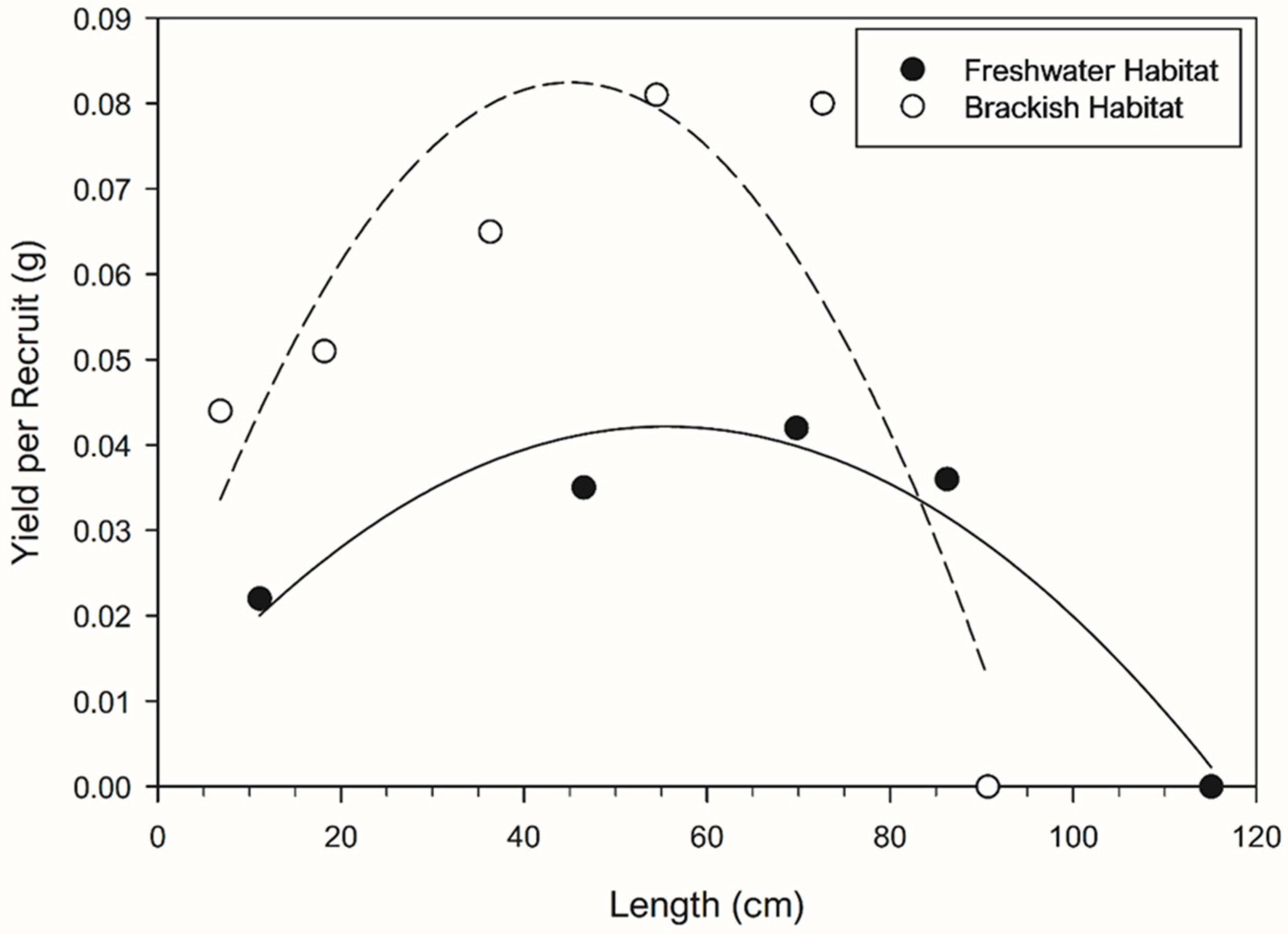
Key parameters were estimated separately for the European eel, Anguilla anguilla (Linnaeus, 1758) subpopulations across freshwater and brackish environments within the Eastern Adriatic Eel Management Unit (EMU: EA). Between 2023 and 2024, European eel sampling was carried out at 23 locations along the Croatian coast (N = 678). Ages ranged from 1 to 13 years in freshwater and 1 to 8 years in brackish waters. The population structure was dominated by undifferentiated (42.8%) in freshwater and females (46.3%) in brackish habitats. Eels in freshwater exhibited a significantly higher b-coefficient in their length–weight relationship and better condition. Based on the otolith annuli patterns, age classes 3 to 5 predominated in both groups. A slightly longer asymptotic length and lower growth rate were found for the freshwater group compared to a shorter length and higher growth rate in the brackish habitat. Natural mortality was estimated at 0.174 ± 0.09 year−1 and 0.191 ± 0.133 year−1 for brackish and freshwater habitats, respectively. Total mortality was higher in freshwater (0.86 year−1) in comparison with the brackish (0.83 year−1) habitat. According to obtained results, more than 50% of eels aged three years are under exploitation. The maximum Yield per Recruit (Y/R) was 0.082 g/recruit in brackish at Lc = 44.88 cm, and a current Lc is 19.4 cm in the samples. In freshwater, Y/R peaked at 0.042 g/recruit at Lc = 55.49 and a current Lc 11.1 cm. It is recommended, following a precautionary approach to management, that the current fishing practices change in order to increase the minimum landing size (MLS), at least to 45 cm (above the current official MLS of 35 cm), to increase the fishing yield, and directly enhance population resilience. Findings emphasise the need for sustainable eel management policies considering different subpopulation parameters along the freshwater/brackish gradient at a small spatial scale when proposing and implementing stock management measures.
Key Contribution: Previous works revealed that Mediterranean coastal habitats form a significant part of the European eel range, and that recovery of its global stock may rely heavily on efforts from Southern European and North African countries, making it crucial to understand eel biology and population dynamics to ensure the success of the EU conservation plan in these areas. The implementation of general recommendations in Croatia is complex due to socioeconomic and historical reasons and thus requires additional investigation. In the present study, we try to comprehensively ascertain the structure of the endangered Anguilla anguilla population in the Eastern Adriatic Sea by estimating key population parameters—including age, growth, condition factor, natural and total mortality, exploitation ratio and Yield per Recruit across freshwater/brackish environments in Croatian waters.

1. Introduction

Studies published in the last two decades highlight the critical conservation status of the European eel, Anguilla anguilla (Linnaeus, 1758) [1,2] and evaluate management strategies across Europe [3,4,5,6,7]. The European eel population has declined significantly since the 1970s, prompting conservation efforts across EU member states [3,6,7]. However, fewer than 50% of current management plans achieve their goals, indicating a need for more ecological and behavioural information [1,5].
European eel management strategies vary across EU member states, reflecting the complex nature of eel conservation. Key elements include improving connectivity and assisting elver migration across barriers, river restoration to increase habitat, and enhancing lacustrine environments for larger eels [8]. However, northern and southern regions face different challenges in eel population recovery [3]. Despite these regional differences in management approaches, genetic studies comparing maturing silver eels from southern and northern Europe have found no significant genetic differentiation, supporting the panmixia hypothesis for European eels [9,10]. This genetic homogeneity underscores the importance of coordinated conservation efforts across the species range. Also, there is a crucial need for developing effective management plans that balance conservation and fishery goals [11]. However, Ref. [1] advises a complete cessation of fishing, which is consistent with the fishery management objective of achieving Maximum Sustainable Yield (MSY).
Evaluating the influence of fisheries, predation and migration barriers on the population dynamics of the European eel requires a large set of data, including migration, restocking, natural and fishing mortality, predation, and hydropower impacts. Mathematical modelling has been proposed to assess potential spawning stocks and develop effective management plans, considering both conservation and fishery goals [3,5,12,13,14,15,16,17] covering the von Bertalanffy Growth Function (VBGF) applications, age-structured models, environmental influences and functional morphology. Additionally, region-specific strategies considering ecological, environmental, and socioeconomic factors are necessary for effective conservation [7]. To assess models used in management decisions, continuous system-specific time-series data are essential [16]. Unfortunately, data for most management units, especially in southern Europe, including the Eastern Adriatic coast, are unavailable or incomplete. Also, data for different habitats considering ontogenetic changes are often lacking, although there are indications of different strategies and population characteristics depending on habitat type. Survival rates vary between river systems, influenced by factors such as population density, water quality, and sex ratios [18].
Age as a key parameter for assessing natural and fishing mortality was identified by [19]. However, age estimation in European eels is complicated by phenotypic plasticity, longevity (>15 years; [20,21], stress-related rings in older individuals [22], and habitat-dependent annuli formation are influenced by environmental factors such as temperature, salinity, and food availability [23]. Also, recent studies revealed that eels in small estuaries had population dynamics parameters similar to those previously reported in larger habitats [24], highlighting that small estuaries contribute significantly to the eel population and, therefore, play an essential role in conservation strategies for European eels. Mediterranean coastal habitats form a significant part of the European eel range. The recovery of its global stock may rely heavily on efforts from Southern European and North African countries, making it crucial to understand eel biology and population dynamics to ensure the success of the EU conservation plan in these areas [25].
The Eastern Adriatic coast of Croatia has several characteristics which distinguish it from other Mediterranean coasts, including a dominant rocky nature, short canyon-type inflowing rivers, and only a few small estuaries. Eel passage in some rivers is blocked by large waterfalls, and all rivers are subjected to anthropogenic changes, notably dam construction, stream bank stabilisation, water reservoir establishment, and significant water diversion for communal and agricultural purposes, especially during summer [26]. Recent studies highlight the critical decline of European eel populations in several Croatian coastal and river ecosystems [27]. While some Montenegrin waters appear suitable for eels, Croatian rivers show declining eel conditions related to habitat loss and anthropogenic impacts [26,28,29,30,31]. The officially reported commercial silver eel catches in Croatia, mainly executed in the Neretva estuary, were usually less than 1 tonnes/year in the last decade in comparison with historical catches of 100 tonnes in the 1930s, while the yellow eel fishery was mainly executed by a recreational fishery with an estimated catch of up to 2 tonnes in 2022 [32]. Following this situation and recommendations by the General Fisheries Commission for the Mediterranean (GFCM), Croatia banned eel recreational fisheries since September 2023.
Evidently, the published data about eels for the Adriatic Sea is limited and non-comprehensive, while the implementation of general recommendations is complex due to socioeconomic and historical reasons and thus requires additional investigation. The aims of this study were to ascertain the structure of the endangered A. anguilla subpopulations in the Eastern Adriatic Sea by estimating key population parameters—including age, growth, condition factor, natural and total mortality, exploitation ratio and Yield per Recruit across two distinct habitat types in Croatian inland waters. These habitats include typical freshwater riverine environments and brackish/estuarine areas. Growth was analysed using various growth models, with the best-fit model selected according to Akaike’s Information Criterion (AIC) for each habitat type and sampling group. The main goal is to gather essential data to support the development of a management plan or to inform further management measures in Croatia.

2. Materials and Methods

2.1. Study Area, Sampling and Data Collection

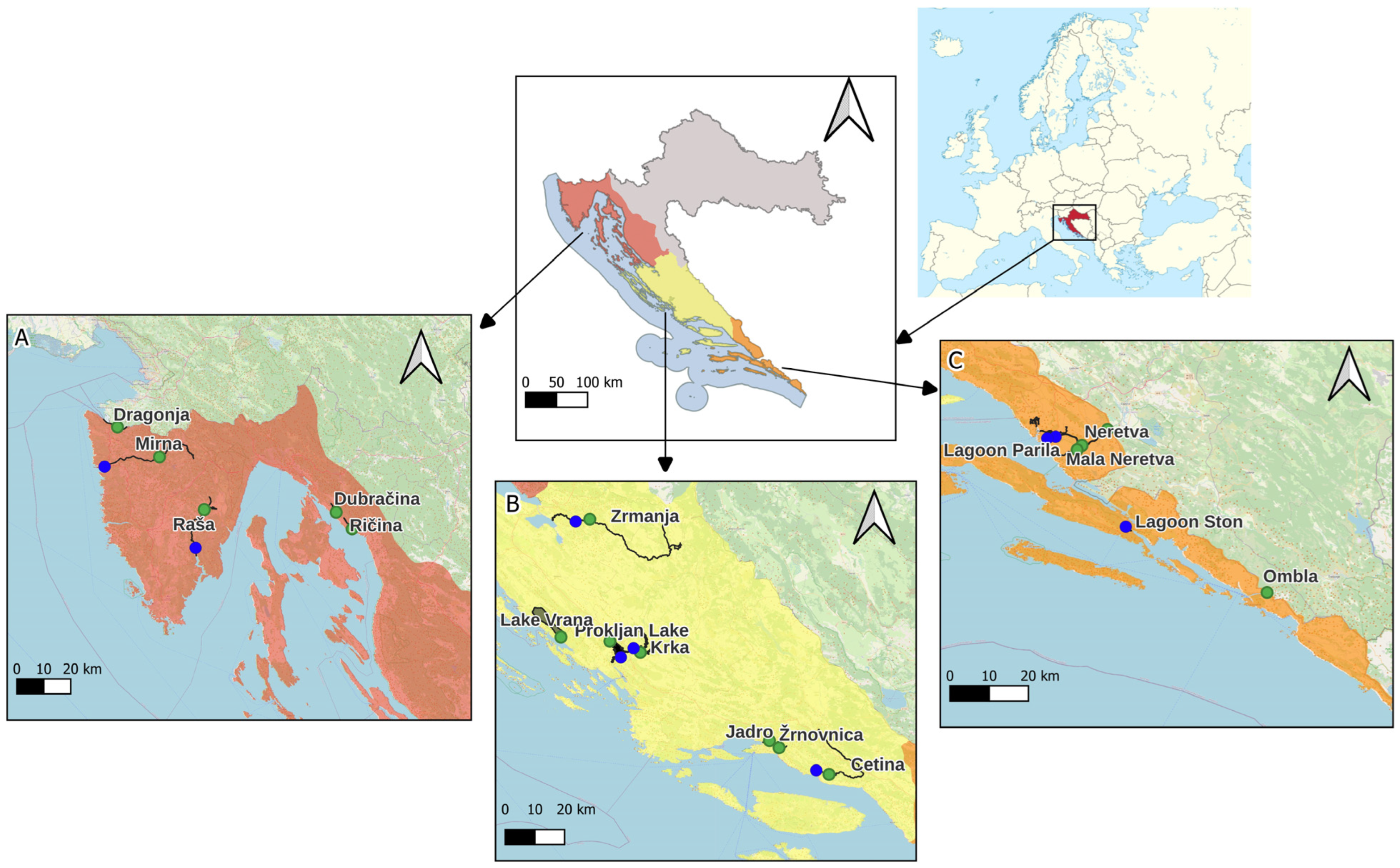
Eel sampling was conducted seasonally (March, June, September, December) at 23 sampling locations from September 2023 to July 2024, along Croatia’s west coast (estuaries and rivers; Figure 1). The selected locations include bigger (Mirna, Raša, Zrmanja, Krka, Cetina and Neretva) and smaller (Dragonja, Dubračina, Ričina, Jadro, Žrnovnica, Mala Neretva and Ombla) rivers. The bigger rivers were sampled at two sites, typical freshwater and brackish ones. The smaller rivers had just freshwater sites for sampling. Additionally, eels were also investigated in Lake Vrana and Lake Prokljan, as two historically important habitats for eels and in two lagoons (Parila and Ston), as typical brackish habitats (Table S1).
Eel sampling in freshwater sites was executed by an electrofishing device (Susan 1030SMP, ~2.4 kW, Shenzhen Qinda Electronics Co., Ltd.; Shenzen, China) on a georeferenced 100 m length × 4 m width walking or boat pathway with single-pass per location. The sampling in brackish water was executed using simple modernised traditional eel traps without wings and with 4 mm mesh size of the final part. At each brackish site, five traps were deployed for the 48 h. The total weight (W) and total length (TL) were measured. After the field measurements, all eels were frozen for further analysis. After dissection, sex determination was executed according to the ICES manual [19].

2.2. Age Reading

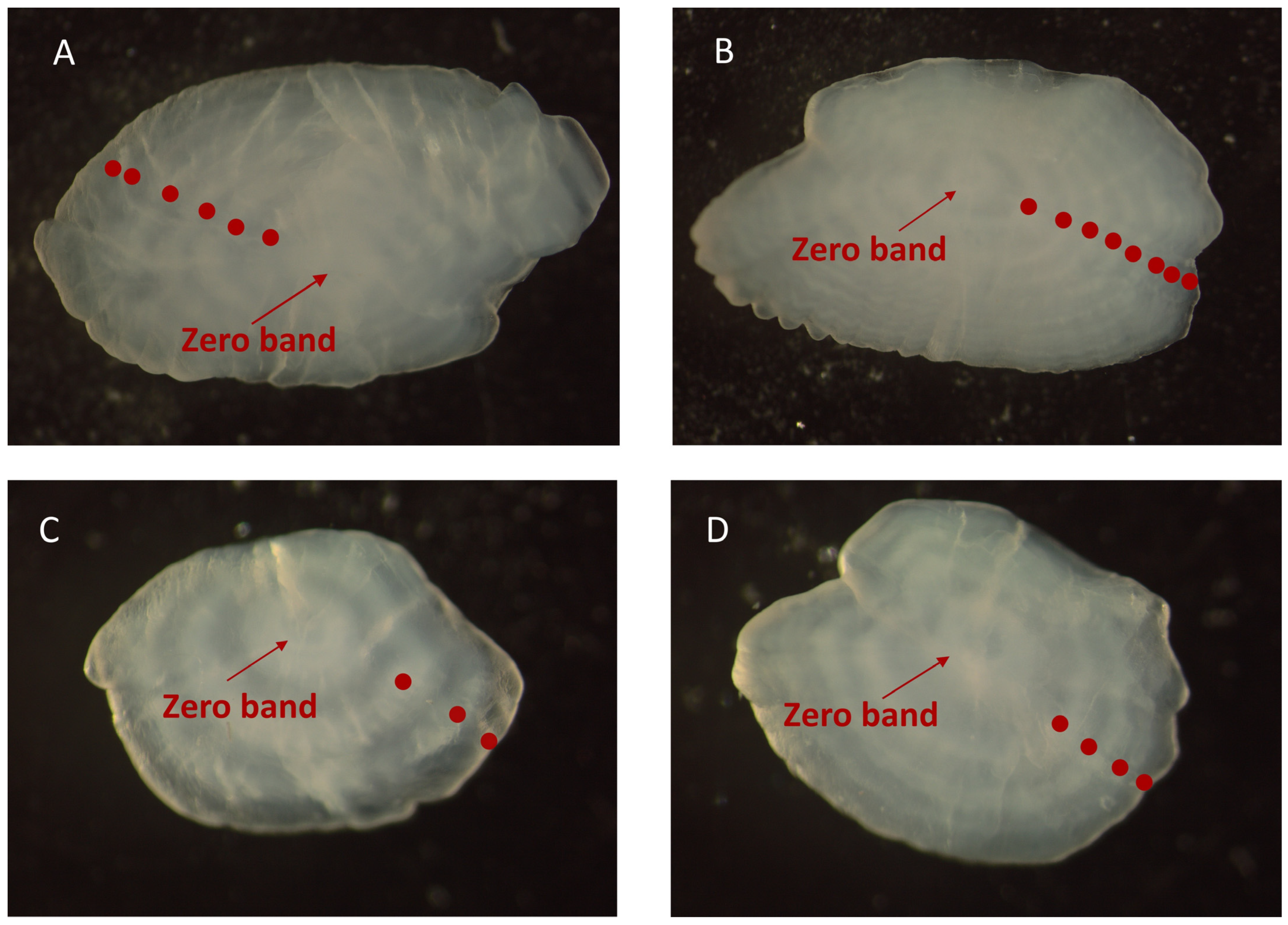
Age classification of the specimens was based on sagittal otolith readings, which were extracted, ground, and polished, as described in the report of the ICES workshop on age reading of European and American eels [19]. Three readers (co-authors LG, SG, and BG) participated in otolith age reading using both a microscope and digital images. After individual readings, the ages were compared and finalised by group decision when initial readings differed. False rings were handled based on protocol proposed by ICES [19]. Age reading examples are presented in Figure 2.

2.3. Data Analysis

2.3.1. Length-Frequency Distribution and Length–Weight Relationship

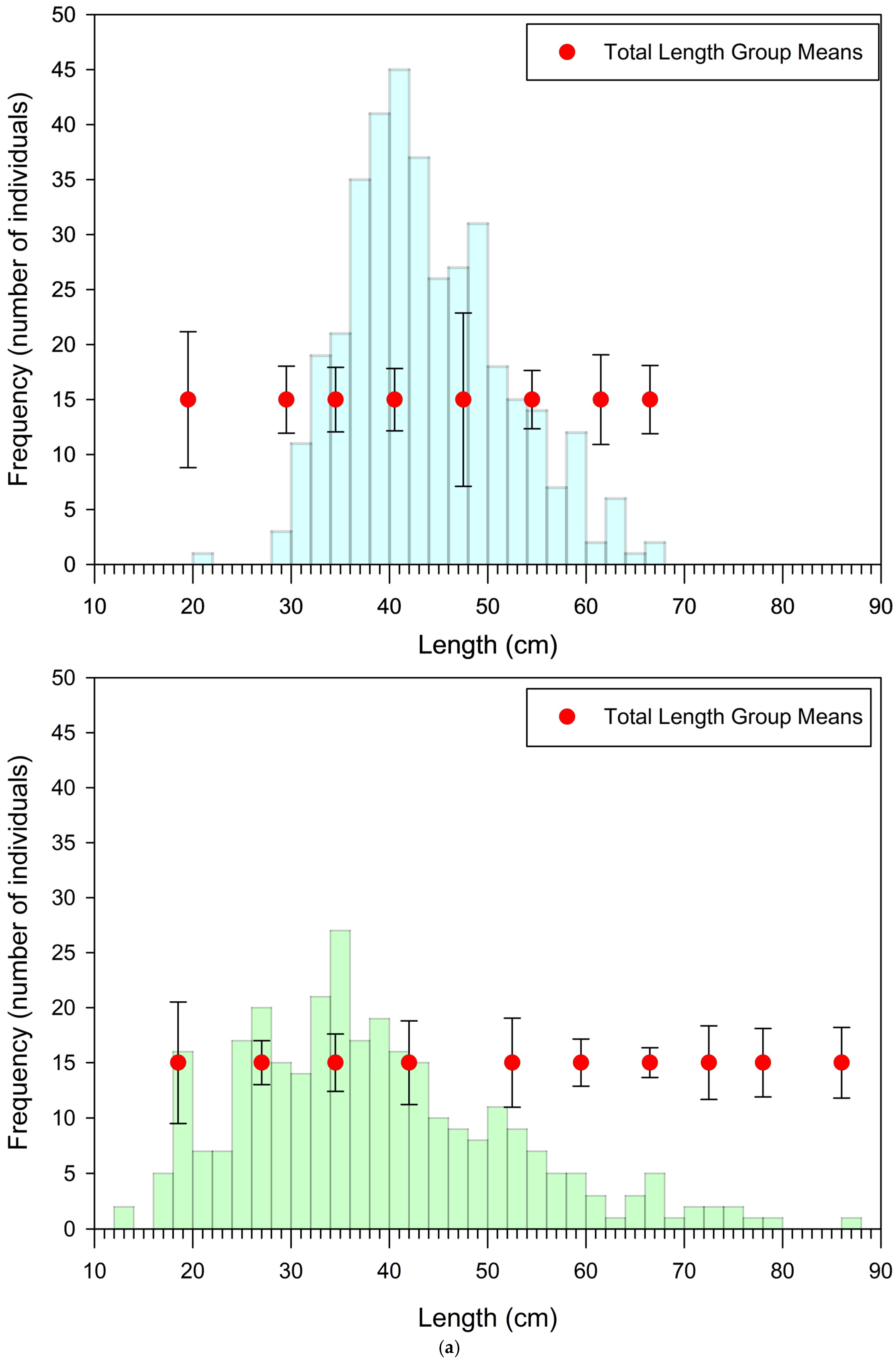
Length–weight relationships for the eels were calculated based on the power model [33]: W e i g h t = a T o t a l   L e n g t h b , for both habitats separately based on the raw measurements of the samples, where a, the intercept of the power function; b, allometric exponent of the regression. The length-frequency structure of the samples is illustrated in Figure 3 for the freshwater and brackish habitats, separately.

2.3.2. Growth Modelling

Growth was estimated based on the von Bertalanffy growth function (VBGF), the logistic and the Gompertz models [34,35,36,37,38] based on the average total length of the specimens at each age group:
V B G F : L t = L 1 e K ( a g e t 0 ) G o m p e r t z : L e e m n ( a g e ) L o g i s t i c : L 1 + m e n ( a g e )
where Lt, the theoretical length at age t (cm); L∞, the asymptotic length (cm); K, the growth coefficient (year−1); t, the age (years); t0, the theoretical age at zero length (years); e, the base of the natural logarithm, m, the growth rate coefficients; and n, the age at the inflection point when the growth rate is maximal. The best model to describe eel growth based on the samples was selected using the Akaike criterion [39,40]. We selected to study eel growth using 3 typical growth models [24] since the specimens in the samples do not cover the whole life cycle of the species in the study area but only a part of the population (undifferentiated and yellow eels before silvering). Therefore, estimations of L∞, K and t0 which will be used in the next stage of estimations (mortality, etc.) need to be calculated with the minimum possible confidence error.

2.3.3. Mortality Modelling and Y/R

Natural mortality-at-age (M) was estimated based on the allometric model using weight-at-age values (i.e., weights corresponding to each age class), which relates to mortality and specimen weight (M-W equation):
N a t u r a l   M o r t a l i t y   ( year 1 ) = μ 1 Total   W e i g h t   ( g ) b 1 ,
where μ1 is the natural mortality rate at 1 g weight: b1, the allometric scaling factor and weight, the individual weight-at-age in g. To estimate the coefficients μ1 and b1 for the above equation, we used as natural mortality reference, the Jensen invariant MREF = 1.5 K (were K is the VBGF growth coefficient) and as weight reference, WREF, the maximum weight of the individuals in the samples per habitat [41,42]. With the MREF and WREF values known, the equations of natural mortality vs weight were solved using a linear programming algorithm [43,44] to estimate μ1 and b1 coefficients.
The M-W equation is nonlinear, and therefore to be analysed by linear programming, the raw data were log-transformed so the equation became
ln M R E F = ln μ 1 + b 1 ln W R E F
This equation was fed to the linear programming software Eureka (version 2.1; https://archive.org/details/eureka-solver-v2.1, accessed on 24 April 2025) with the constraints: −0.5 < b1 < 0 and 0 < μ1 < 4.1 year−1 [45]. Optimum μ1 and b1 values are obtained through the minimization of the absolute errors in log space of the M-W equation (iterations within the software):
min α , β = i = 1 n z i α β u 1 ,   where   z i = lnM REF ,   u 1 = ln ( W REF ) ,   α = ln μ 1 ,   β = b 1
Applying the model to the M-W equation, the variables are the log intercept (lnμ1), the slope (b1) and the residual variables ri+ and ri which are set automatically during each iteration, to satisfy the constraints and minimise the objective. The constraints for the linear programming procedure then become
z i α β ( u 1 ) = r i + r i r i + ,   r i 0 α < ln 4.1 = 1.411 0.5 < β < 0
Average mortality per habitat was estimated using the complete dataset from the samples, using the final model and the individual specimen weight to estimate natural mortality per individual.
Total mortality (Z) was assumed to be constant and was estimated based on the Length-Converted Catch Curve method [46]. Finally, Fishing mortality (F) per age class was estimated using formula: F a t a g e = Z M a t a g e year−1, while the Exploitation ratio (E) was estimated as [47]
E a t a g e = M a t a g e Z   year 1
Yield per Recruit (Y/R) analysis was performed based on the Beverton–Holt model in order to examine potential scenarios for the management of the local eel population in relation to fishing pressure [48] for each habitat. The model was run several times varying Lc between the length at first catch, which equals to the smallest individual in the samples and the L∞. The maximum Y/R was estimated at each run. The values of Y/R were correlated with the Lc values and fitted to a simple 2-degree polynomial model:
Y / R = x + y L c + z L c 2 ,
where Lc is the length at first capture in cm and x, y, z, regression coefficients for the dome-shaped Y/R model.
The regression equation was then maximised using a simplex linear programming algorithm [43,44] to estimate its maximum (Y/Rmax) and the corresponding optimum Lc. The main management guideline that was derived from this analysis is that the eel fishing method (gear configuration and materials as well as the use of gears) so that the minimum landing size, which corresponds to these results, need to increase from the current (around 11 cm) so that the Y/R remains at maximum levels.

2.4. Statistical Analysis and Software

Comparison between samples was carried out using standard or non-parametric tests following normality testing based on the Shapiro–Wilk W test [49]. In the case of non-normality, the Kolmogorov–Smirnov test was used to compare 2 samples and the Kruskal–Wallis test with L multiple range testing for multiple sample comparisons was performed. In the other cases, a t-test was performed [50].
Population dynamics analysis was performed using FISAT II (version 1.2.2 [47]). Statistical analysis was performed using the open-source software JAMOVI Desktop (version 2.7.13; https://www.jamovi.org, accessed on 24 April 2025), PAST (version 5.03; https://www.nhm.uio.no, accessed on 24 April 2025) and various routines in R language (version 4.2.2; https://cran.r-project.org). The difference in data distribution between the two groups was tested by a paired t-test, Wilcoxon Ranked sign test and 2-way ANOVA. Equation modelling was carried out using the CurveExpert software (version 2.6.57.3. www.curveexpert.net/, accessed on 24 April 2025). The exponents (slopes) of the length–weight relationships per habitat were compared using a t-test [51]:
t t e s t = b a b b S E b a 2 + S E b b 2 , where ba and bb, are the 2 slopes. Finally, all average values are reported with their respective standard deviation in the form of average ± SD.

3. Results

In total, 678 eels were collected over the sampling period from 23 sampling sites (304 at freshwater and 374 at brackish sites). The freshwater samples were composed of 130 undifferentiated (42.8%) individuals; 79 (26.0%) male and 95 (31.2%) female specimens. The brackish group samples were composed of 72 (19.2%) undifferentiated individuals; 129 (34.5%) males and 173 (46.3%) females.

3.1. Population Structure

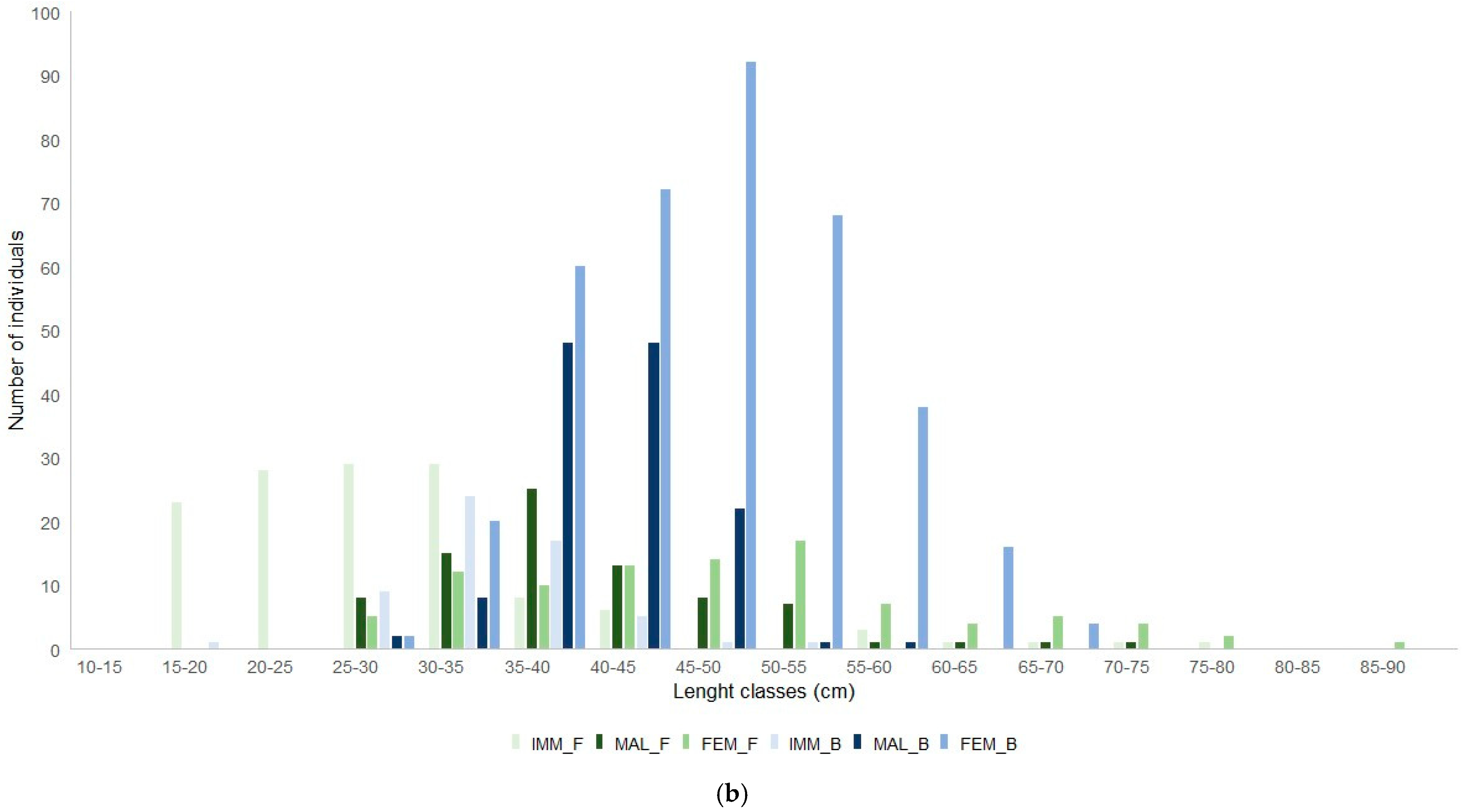
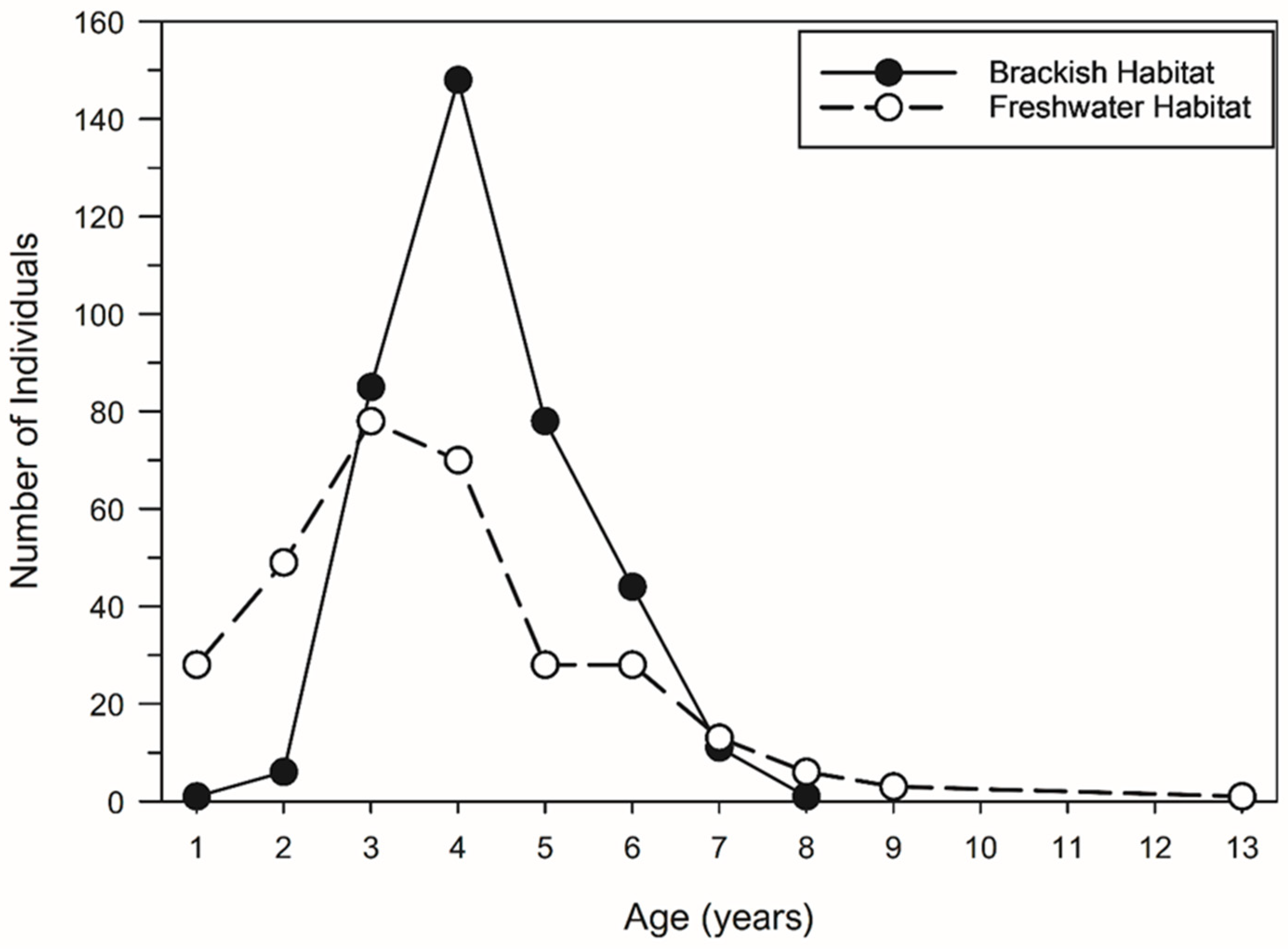
The population structure in terms of length-frequency distribution between freshwater and brackish sites together with the average total length at age (red points) are presented in Figure 3a. The total length range for eels in the freshwater group was from 11.1 to 87.5 cm (mean 37.36 ± 13.56 cm) while eels in the brackish group ranged in total length from 19.4 to 67.5 cm (mean 42.81 ± 7.82 cm). Although age distribution for both habitats exhibits a main mode between 2 and 6 years of age (Figure 4). There is a difference in the abundance per length class in each group with mode of 35 cm in the freshwater samples and 41 cm in the brackish samples. According to the total length classes means, a total of 10 and 8 length groups were formed in freshwater and brackish environments, respectively. The distributions of the freshwater and brackish samples were found significantly different (Kolmogorov–Smirnov test D = 4.73, p < 0). In freshwater and brackish groups, the eels ranged in weight from 4.8 to 1750.4 g (mean 143.72 ± 197.15 g), and from 15.2 to 553.5 g (mean 165.99 ± 100.47 g), respectively. The population sexual structure shows that eel stock from freshwater and brackish groups are composed dominantly by undifferentiated and female individuals, respectively (Figure 3b). In the freshwater samples, undifferentiated specimens ranged in total length from 11.1 to 66.6 cm (mean 28.02 ± 9.39), males ranged from 25.3 to 45.0 cm (mean 36.2 ± 5.01) and females ranged from 27.2 to 86.2 cm (mean 48.85 ± 12.21). Total length distribution differs between sexes in the brackish group with undifferentiated specimens ranged from 19.4 to 52.1 cm (mean 34.45 ± 4.91), males ranged from 29.2 to 45.6 cm (mean 39.26 ± 3.24) and females ranged from 27.9 to 66.3 cm (mean 46.945 ± 7.38). LSD multiple range test showed that the total length distribution between males in freshwater and brackish habitat samples are homogenous groups. The same was obtained for females in both habitats. However, male and female total length distributions within habitats are statistically different (Kolmogorov–Smirnov 2 tailed test D = 0.355, p < 0.0001 for the freshwater habitat; Kolmogorov–Smirnov 2 tailed test D = 0.427, p < 0.0001 for the brackish habitat).
The total age range for eels in the freshwater sample was from 1 to 13 years, while eels in the brackish sample ranged in age from 1 to 8 years. A predominance of age classes 3 to 5 was observed in both freshwater (50.7%) and brackish (73.0%) habitats. Testing the total length per age distributions in the freshwater and brackish habitat samples, showed that there is no statistical difference and therefore it can be assumed that both eel groups belong to the same subpopulation (Kolmogorov–Smirnov test, D = 0.63, p = 0.82). Accordingly, no statistical evidence of differences in length–at–age distributions between habitats was found.

3.2. Length–Weight Relationship

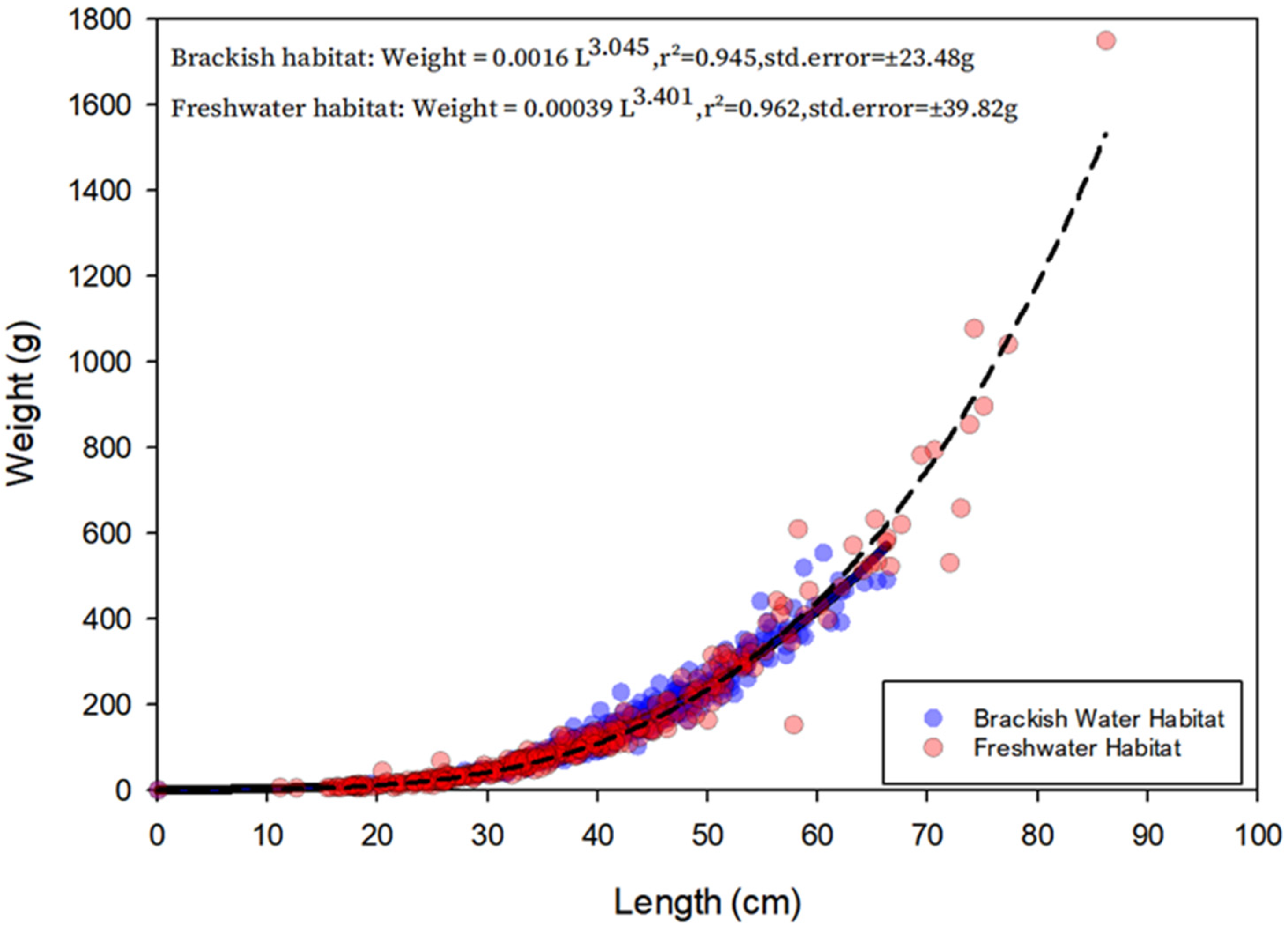
The data on the length-weight relationships following the power model are summarised in Table 1. The equations are illustrated in Figure 5. The length–weight relationship for the brackish sample was described by following parameters a = 0.0016 ± 0.0002 and b = 3.045 ± 0.039 (N = 304; R2 = 0.945; Standard Error = ±23.48 g) and for the freshwater sample, a = 0.0004 ± 0.00007 and b = 3.401 ± 0.041 (N = 374; R2 = 0.962; Standard Error = ±39.82 g). A t-test revealed a significant difference between the exponent values for the freshwater and brackish habitats (t-test = 1149.2; d.f. = 678; p < 0.0001). Females exhibit a higher exponent in freshwater (3.328) than in brackish (3.061) habitat, while males exhibit a higher exponent in brackish (3.038) than in freshwater (2.985) habitat. Comparison of the coefficients a and b of the male equations between the brackish and freshwater habitats showed no statistically significant difference (t-test for a = −0.4205, p = 0.675; t-test for b = 0.317, p = 0.752). The comparison of the coefficients of the female equations between the brackish and freshwater habitats showed a statistically significant difference (t-test for a = −3.112, p = 0.0021; t-test for b = 3.425, p = 0.0007).

3.3. Growth

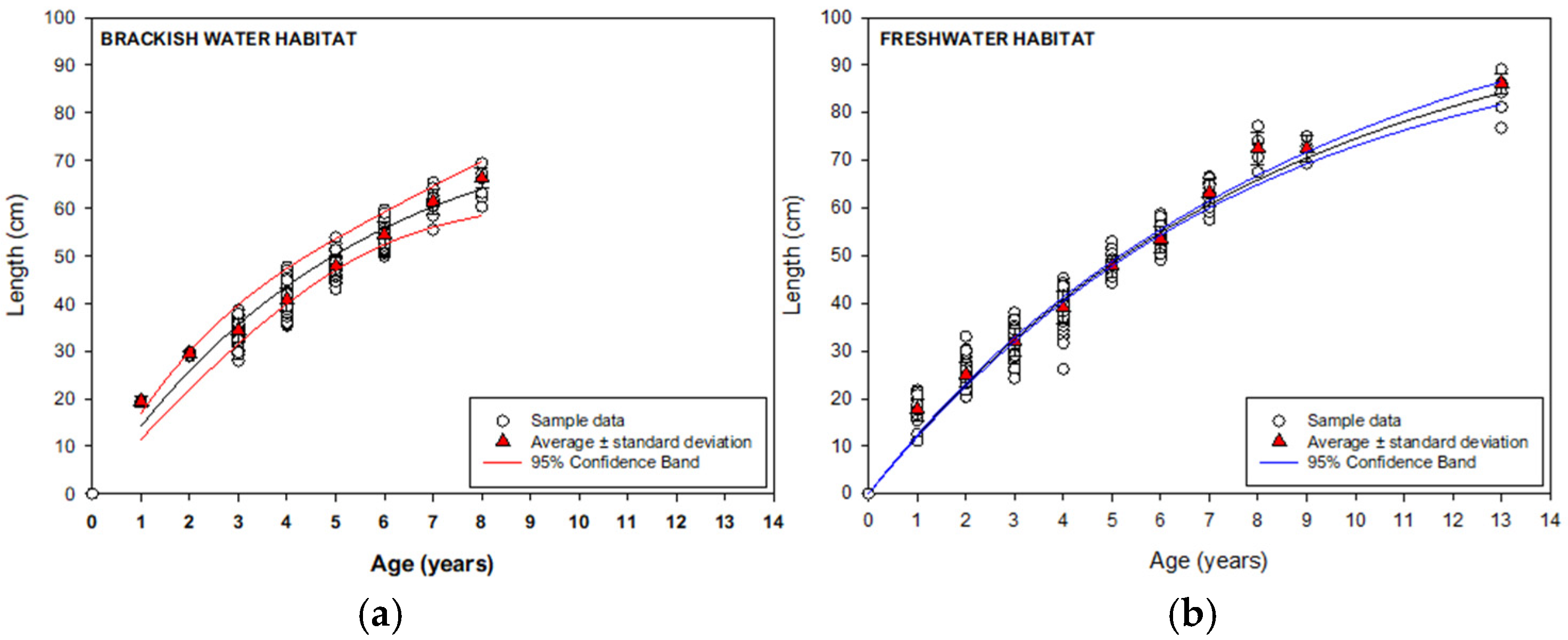
The growth equations are summarised in Table 2. The data show that the best equation to describe growth is the VBGF for both habitats based on the Akaike criterion (Table 2) following the exclusion of some problematic raw data. Correlation coefficients show a very high correlation for all models (r2 > 0.9). The differences in the model variables between habitats are owed to the limited ages found in the brackish (up to eight age groups) in relation to the freshwater habitat (up to 13 age groups). The growth curves of the eel were presented in Figure 6. According to the VBGF curve data, the maximum length (L∞) in freshwater and brackish environments is estimated at 116.27 ± 11.96 cm and 90.76 ± 15.05 cm, respectively. Growth parameter k was 0.107 ± 0.02 for the freshwater and 0.151 ± 0.04 for the brackish group. Thus, a slightly longer asymptotic length and lower growth rate were found for the freshwater group compared to a shorter length and higher growth rate in the brackish group.

3.4. Natural Mortality

The results on natural mortality-at-age are summarised in Table 3. Weights correspond to each age class. The natural mortality equations for each habitat are
M F R E S H = 0.996 W e i g h t 0.378 M B R A C K = 0.993 W e i g h t 0.392
The similarity of the coefficients (constant: two tailed t-test t = 0.17, d.f. = 676, p = 0.86; exponent: two tailed t-test t = 0.14, d.f. = 676, p = 0.88) allows the elaboration of the overall population natural mortality as
M O V E R A L L = 0.994 W e i g h t 0.385
The values of the allometric exponent, b1, in the above equations are between −0.392 and −0.378, while the values of μ1 are in range from 0.993 to 0.996.
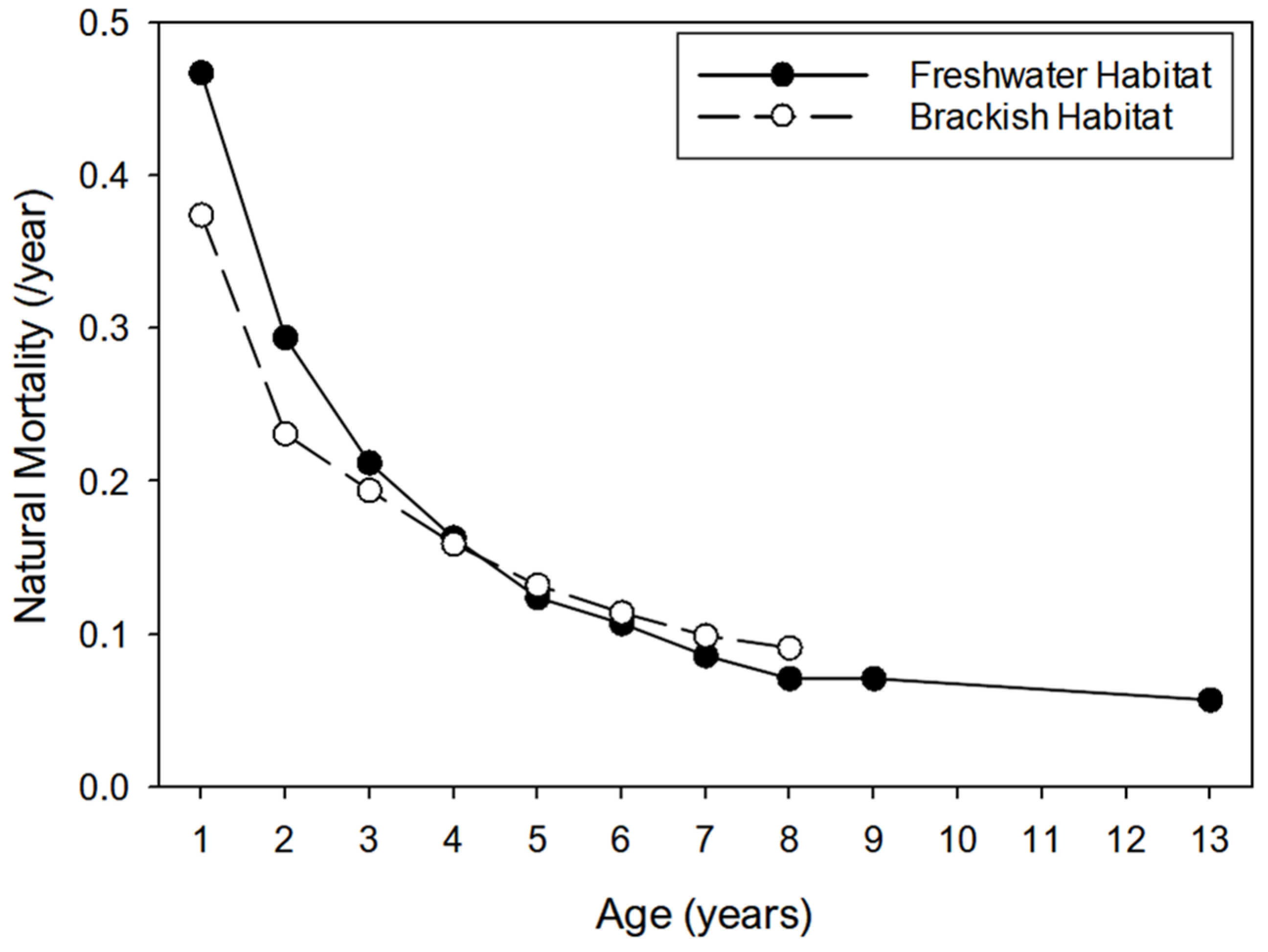
Average natural mortality, M, per habitat was estimated at 0.174 ± 0.09 per year (weight range 40–560 g) for the brackish water group and = 0.191 ± 0.133 per year (weight range 20–1750 g) for the freshwater group. Overall, M was found 0.182 ± 0.01 per year. Natural mortality relations with age per habitat are illustrated in Figure 7.

3.5. Total Mortality, Exploitation Ratio and Yield per Recruit (Y/R)

Total mortality for the brackish habitat was found 0.83 ± 0.21 year−1 and for the freshwater habitat, 0.86 ± 0.34 year−1. The average values of fishing mortality were estimated 0.656 ± 0.09 per year and 0.669 ± 0.12 per year, for the freshwater and brackish water groups, respectively. The average exploitation rate for freshwater and brackish habitats was found and 78.9% and 80.7%, respectively.
The values of fishing mortality-at-age and exploitation ratio-at-age are summarised in Table 3. According to obtained results, more than 50% of eels aged three years are under exploitation.
The models for the correlation between length at first capture, Lc, and yield per recruit, Y/R, for each habitat are (Figure 8).
Y / R FRESHWATER = 0.008 + 0.001 [ L c ] 0.00001 [ L c 2 ] , r 2 = 0.967 , std . error = ± 0.006   g / recruit Y / R BRACKISH = 0.016 + 0.003 [ L c ] 0.00003 [ L c 2 ] , r 2 = 0.871 , std . error = ± 0.019   g / recruit
The maximum Y/R for the freshwater habitat was found to be 0.042 g/recruit at Lc = 55.49 cm when the current Lc from the samples is 11.1 cm. The maximum Y/R for the brackish habitat was found 0.082 g/recruit at Lc = 44.88 cm when the current Lc from the samples is 19.48 cm. It is obvious that the current fishing method for the fish samples used in the target area should change to increase MLS above the current official level of 35 cm [26]. Precautionary advice would be to increase MLS at levels equal to the optimum Lc estimated for a maximum Y/R, i.e., to 45 cm to increase the yield and directly contribute to the local population’s resilience.

4. Discussion

Following recruitment declines of the European eel since the 1980s, various recovery measures have been implemented, including Council Regulation (EC) No 1100/2007, banning eel fishing in EU countries like Ireland, Slovenia and Malta, but also in Norway as a non-EU country, including alongside seasonal restrictions across European waters. Commercial and traditional fisheries have collapsed by over 90% compared to pristine biomass levels across Europe, with the Eastern Adriatic coast reflecting similar declines [26,52]. While recommendations and measures are given at a general level, considering the panmixia hypothesis for European eels [9], they are mostly based on local population studies for eels from rivers in Northern or Central Europe, while population data are insufficient or non-existent for different habitats in southern and southeastern European regions, including Croatia. The question arises as to how realistic it is to expect the implementation of all recommendations and the effectiveness of measures in EU waters if not all ecological components of eel or fishing characteristics within different regions are known and therefore not considered when creating policies.
The size distribution of European eels varies significantly across a broad latitudinal range and diverse water environments [17]. Our results revealed that in brackish, estuarine habitats, eels were within a narrower length and weight range but were generally longer and heavier, while eels of a wider length and weight range, but lower mean values, were present in freshwater habitats. These results are in line with previously reported observations that larger eels, in terms of length and weight, tend to occupy deeper areas with stronger river flow, while smaller ones may be found in shallower zones associated with wider stretches with abundant cover [53], since freshwater habitat features strongly influence the size distribution of eels inhabiting them [54]. Similarly, longer and heavier individuals of uniform range have been identified in estuarine waters [24,29]. However, length–weight differences in catch structure can arise due to sampling selectivity without clear biological meaning. Electrofishing, as the primary method for freshwater eel sampling, is more selective for larger eels due to depth limitation and thus can affect eel sample structure. Moreover, [54] reports that sampling methods used in coastal and estuarine waters are commonly less selective for larger eels since “drop-trap” sampling shows that small eels are also present in coastal waters. In our study, larger individuals were not more frequently present in samples from freshwater environments, which means that they certainly did not have a higher catch coefficient compared to brackish ones. Further on, the population structure in the Eastern Adriatic EMU was dominated by undifferentiated individuals and larger females in both brackish and freshwater habitats. Females of A. anguilla are usually larger than males of a similar age and attain a greater body size [12,55,56], so presented results confirm previous results for the population consisting mostly of resident females and yellow- and silvering individuals in the Mediterranean lagoon [25]. However, there were no differences between either females or males within the investigated environments, indicating their homogeneity at the wider level regardless of the type of environment.
Length–weight relationships in European eels are crucial for understanding their growth patterns, biomass estimation and population health, making them essential for fishery management and conservation. The condition factor (CF) varies across habitats and seasons, reflecting different ecological conditions [53]. The allometric growth exponent (b-coefficients), which can indicate fish growth trends across habitats, is available for a large number of different European eel subpopulations [57]. In the present study, eels, both females and males, in brackish water show a positive b-coefficient of 3.045, but are significantly lower when compared to 3.401 obtained for eels in freshwater. Females show higher b-coefficients in freshwater (3.328 vs. 3.061), while males in brackish water show higher b-coefficients (3.038 vs. 2.985). However, females have higher b-coefficient in comparison with males. Several authors provide evidence of life-history variability across sexes in eels, including differences in migration timing and condition. Namely, male silver eels typically migrate earlier in the season and at a smaller size than females, which can affect their energy reserves and overall condition [52,58,59]. In the present study, sex-specific differences in b-coefficients were significant in freshwater eels but not in brackish, likely reflecting habitat-dependent sexual segregation, with larger and faster-growing females predominating in freshwater. In contrast, brackish habitats were dominated by smaller males with a narrower size range, reducing both biological divergence and statistical power to detect sex effects. Generally, these b results are similar to those described for European eels in brackish and freshwater habitats further south in Europe [18,25,60], and higher than in high latitudes [61] showing the effect of decreasing optimal conditions for eel growth, with decreasing water temperature range and time of the growing season in higher latitudes [62,63,64]. However, usually across Mediterranean brackish ecosystems, mostly lagoons, b-coefficients for eels range from 3.223 to 3.470 [24,65,66,67], suggesting good habitat quality (density, food availability or pollution) positively influences growth rates. Higher values of b-coefficient in freshwater environments suggest that, in our case, prevail superior trophic conditions inland compared to the coast. Poorer trophic conditions in Parila lagoon (brackish site of Neretva River) are possibly linked to habitat degradation and advanced competition of eel and invasive blue crab (Callinectes sapidus Rathbun, 1896) [29,68] that has significantly impacted the composition and structure of estuarine communities in recent years [69]. Interestingly, in the brackish group, there were no differences in the b-coefficient between males and females, while in the freshwater group the differences between sexes were significant, with females having a clearly higher value.
Understanding the age distribution of eels in various habitats is crucial for stock assessments, but this data is often lacking or fragmented. Efforts like the ICES Working Group on Eels (WGEEL) aim to address these gaps by compiling and analysing data across the species’ range. In the present study, we observed a fairly narrow age distribution for Adriatic Sea European eels (predominance of 3–5 age classes in both environments), similar to [25], which could be explained by exploitation effects (age truncation and growth compensation)), high underlying habitat productivity [69,70], or both [70]. European eels display a wide range of ages that vary by habitat type and regional context [71]. In freshwater, several studies report age ranges beginning near 1 year and extending to 15 years [72,73,74]. In brackish and estuarine habitats, the findings are more variable. Some papers describe narrow age spans of 0.5–4.5 years in the North African lagoons context [71], whereas [24] reported ages between 4 and 21 years in small French estuaries, while [75] noted ages from 2 years to beyond 25 years. Several studies also note that eels in warmer or estuarine conditions exhibit earlier silvering and faster growth relative to populations in freshwater [62,76]. The traditional view of long-lived eels with low growth rates does not fit the picture of Mediterranean eel populations [25]. Certainly, differences in methodologies, from otolith increment counting with validation through mark-recapture to length-based inference, help explain part of this heterogeneity in reported results.
The study of growth based on three different models showed that the age data are best described with the VBGF model, which is a common growth model used to explain eel growth [24,76,77]. Recently, different approaches, such as otolith biochronology, direct age-length regressions, or habitat-specific comparative analyses, have been used to fit better the different habitats that the species uses during its life cycle and the different environmental conditions [78,79]. However, the preference for the von Bertalanffy Growth Function (VBGF) over Gompertz or logistic models in eel management is primarily due to its mathematical compatibility with standardised Yield per Recruit and mortality models, rather than a lack of biological fit, while otolith-based chronologies and other approaches provide a better ecological context.
Most of the available studies on eel age and growth (see Table S2) have been conducted in freshwater habitats at higher latitudes [56,80,81] (papers cited in Table S2), and less is known about the population dynamics in brackish systems (estuaries and coastal lagoons) in southern areas [55]. The present study of the growth analysis of eels from brackish and freshwater habitats provides the first results for the Eastern Adriatic. The values of the L∞ show that the eels can grow larger in the freshwater habitat than in the brackish habitat. In addition, growth coefficients (K, year−1) indicate that they grow faster in the brackish than in freshwater habitats (ANOVA test, p < 0.001), confirming previous reports that estuaries and lagoons along the Mediterranean coasts support higher growth rates compared to river habitats and probably offer more favourable conditions to support eel growth [24,57,61,73,82,83,84]. This is possibly owed to the higher temperatures (in this study, we measured a temperature difference of almost 1.6 OC for the freshwater habitat, which is also statistically significant; ANOVA test, p < 0.05) and the higher productivity of estuaries and coastal lagoons and the lower osmoregulation costs [85] in relation to the freshwater habitats. Growth coefficients estimated in this study belong to the higher range values of studies (Table S2). According to Table S2, the values of the K coefficient range between 0.013 and 0.123 year−1 for freshwater habitats and between 0.058 and 1.095 year−1 for brackish habitats. Reported values below 0.04 year−1 are not considered without further research, since based on those, the species’ longevity exceeds 100 years (based on the 3/K rule [86]) and, in some cases, reaches 230 years (K values of 0.013 year−1). However, we believe that our findings require further investigation of this specific population as they are based on samples containing individuals aged up to 13 years, while the growth coefficient (K) from the VBGF growth equation, suggests a life span of up to 28 years for the freshwater habitat group, and up to 20 years for the brackish habitat group. Data on European eel longevity show that an upper acceptable age limit for the longevity of the European eel is 30–32 years, which is in accordance with our data [87]. Combining these facts, i.e., the small number of age groups in the samples and the similarity between the longevity estimates based on our data with those estimated based on radiocarbon techniques [87], we can conclude that the growth curve of this eel population reaches its senescence phase early during its life cycle and therefore, samples with individuals up to 13–15 years of age are enough to allow the estimation of the growth equation coefficients with increased accuracy.
Even though tag–recapture studies have not been conducted in the study area, it is difficult to assess whether the local Croatian population can inhabit equally freshwater and brackish habitats as in other cases where populations of eels have been found to inhabit estuarine for their whole life cycle [24,79,88,89], instead of mixed strategies [90]. We may speculate that, in our case, both habitats can be inhabited by the specific population due to their similarities in the growth-performance indicators, which we calculated at 3.16 and 3.09 for freshwater and brackish habitats, even though we cannot discard the possibility that the brackish habitats are intermediate for this population during its migration towards freshwater habitats. In any case, this further underlines the importance of estuaries for European eels in the Southern European and Mediterranean areas [24,54,73,79,91].
Studies estimating natural mortality in eels reveal that demographic models integrating body mass, temperature, and stock density principles are widely used [12]. According to this concept, the average natural mortality was found to be lower in the brackish (0.174 year−1) than the freshwater (0.191 year−1) habitat. Estimated mortality rates (−0.392 and −0.378) fall within the values (from −0.25 to −0.46 per year; [45]) for the European eel [92,93]. In particular, [45] concluded that an appropriate value for the European eel, as derived from 15 different stock studies, is −0.46. Other studies provided estimates of 0.31–0.78 year−1 for river or lake populations, with mortality varying by factors such as age, size, density and migration risks [12]. The values of μ1 (0.993–0.996) also fall within the value range of 0.2–4.1 per year [45]. In addition, based on the nomographs presented by [45], and the average temperature of 15.9 °C, the eel stock under study can be considered as a low-density stock for both sexes. The negative effect of eutrophication processes in coastal lagoons and estuaries to the survival and growth of eels in terms of density was highlighted by [25] because while fishing pressure keeps density low, high eutrophication can significantly increase the density and consequently affect natural mortality.
While natural mortality, linked to habitat loss and contamination, plays a role, fishing pressure remains the dominant threat [94]. In the present study, mean total mortality was higher in freshwater (0.86 year−1) in comparison with brackish (0.83 year−1) habitats. However, the calculated exploitation ratio of 78.9% and 80.7% estimated for freshwater and brackish, respectively, reveals high fishing pressure in both habitats, with more than 50% of eels aged three years under exploitation. European eel populations face severe fishing-induced mortality, contributing significantly to their decline across European ecosystems [95,96]. Silver eel migration mortality reaches 22–26% in the Netherlands and up to 60% in a Danish fjord [97]. Across various ecosystems, fishing mortality often exceeds sustainable limits, particularly during migration [98], whereas regulated areas like Baltic coastal waters pre-2009 saw more controlled impacts [4].
The Y/R analysis revealed that the current Lc values for both brackish (19.40 cm) and freshwater (11.10 cm) habitats in Croatia are much lower than the estimated minimum landing size (44.880 cm versus 55.489 cm). It is obvious that the current fishing method in the fishing area should change in order to increase the official MLS from 35 cm to equal or above 45 cm. All Y/R analyses performed by ICES groups following analysis by [3] show exploitation rates far above sustainable levels, leading to the recommendation of zero catch across all life stages in all habitats and fisheries to meet the EU’s goal of 40% spawning stock biomass escapement [17]. Obviously, continued overfishing may lead to long-term depletion of eel stocks, and full recovery may take centuries [99]. Data on recreational and illegal fisheries remain inconsistent despite declining commercial fisheries pressure [100]. Habitat restoration efforts aim to improve coastal lagoons and water quality, particularly in the Mediterranean, while ICES continue to recommend zero catch for all life stages and habitats to reduce human-induced mortality.

5. Conclusions

It is clear from the present study that there are differences in population parameters between eels living in brackish/freshwater environments in the EMU: EA, and that they fall within the range obtained for other similar areas, especially lagoons and estuaries of the Mediterranean Sea. High values of natural- and fishing mortality and exploitation rates were determined, and the Y/R analysis indicates that an increase in the minimum landing size should be discussed to enhance the local population’s resilience and, indirectly, increase the fishing yields for fishers. These results underscore the importance of balancing ecological sustainability with economic considerations in the near future when formulating eel management policies. The Croatian government banned recreational eel fishing across coastal and riverine areas in 2023, while long-term management measures in the EMU: EA, particularly in the Neretva Estuary and Prokljan Lake, as key traditional fishing grounds, have to be further discussed and measures based on stakeholder consensus implemented. Integrated assessments, such as those in the Baltic Sea, could improve stock management, while freshwater protected areas have shown increased silver eel production compared to exploited zones. Our research confirms and highlights again the need for catchment-scale approaches, considering habitat connectivity and diversity. For sure, long-term recovery relies on continued monitoring and adaptive management across diverse ecosystems, from coastal marshes to inland waterways. However, given the European eel’s critically endangered status with no signs of recovery, if no measurable improvement occurs within the next three–five years, urgent management measures may be necessary, including a full moratorium on eel fishing in Croatia. Our results can definitely serve as a base for the development of a management plan or to inform further management measures.

Supplementary Materials

The following supporting information can be downloaded at https://www.mdpi.com/article/10.3390/fishes11020125/s1, Table S1: The sampling locations with additional information related to water and habitat characteristics; Table S2: Literature review of published data on the growth of European eel, Anguilla anguilla. References [101,102,103,104,105,106] are cited in the Supplementary Materials.

Author Contributions

All authors were thoroughly involved in each step of the workflow. Namely, S.M.-S. and B.G. were responsible for writing, review and editing, methodology, investigation, formal analysis, conceptualization, supervision, resources and funding acquisition. L.G. and S.G. were involved in sampling, investigation and formal analysis. A.C. was involved in writing—original draft, methodology, formal analysis and conceptualization. M.K. and M.M. were responsible for field research and editing. M.P. was involved in review, editing and conceptualization. All authors have read and agreed to the published version of the manuscript.

Funding

The data collected in this monitoring programme is part of an ongoing study “Monitoring of eel in inland waters as part of the National Plan for Collection of Data in Fisheries of the Republic of Croatia” in the framework of HRV DCF (Ministry of Agriculture, Forestry and Fisheries of Croatia, supported by the EU-DCF). Also, this work was supported by the project PRIMOS, co-financed by the European Union—NextGenerationEU.

Institutional Review Board Statement

All the fish samples were deceased before collection from local fishers. At the field, we do only basic measurements (total length, weight), we ice the samples, upon arrival at the institute we freeze them and then they are thawed if necessary, at the moment when individual parameters (otoliths) are analysed because it is not possible to do it all at the field due to inadequacy. Organisms are iced and frozen to prevent tissue decay.

Informed Consent Statement

Not applicable.

Data Availability Statement

Data are available from the corresponding author on a reasonable request.

Acknowledgments

The authors express their gratitude to local fishers for help in collecting the material. Sampling of material complies with the current Croatian laws.

Conflicts of Interest

The authors declare that the research was conducted in the absence of any commercial or financial relationships that could be construed as a potential conflict of interest.

References

  1. ICES. Workshop for the Technical Evaluation of EU Member States’ Eel Regulation Progress Reports for Submission in 2024/2025 (WKEMP4). In ICES Scientific Reports; ICES: Copenhagen, Denmark, 2025. [Google Scholar] [CrossRef]
  2. IUCN. The IUCN Red List of Threatened Species. Version 2025-1. 2025. Available online: https://www.iucnredlist.org (accessed on 24 April 2025).
  3. Bevacqua, D.; Melià, P.; Crivelli, A.J.; Gatto, M.; De Leo, G.A. Multi-objective assessment of conservation measures for the European eel (Anguilla anguilla): An application to the Camargue lagoons. ICES J. Mar. Sci. 2007, 64, 1483–1490. [Google Scholar] [CrossRef]
  4. Dekker, W.; Sjöberg, N. Assessment of the fishing impact on the silver eel stock in the Baltic using survival analysis. Can. J. Fish. Aquat. Sci. 2013, 70, 1673–1684. [Google Scholar] [CrossRef]
  5. De Meyer, J.; Verhelst, P.; Adriaens, D. Saving the European Eel: How morphological research can help in effective conservation management. Integr. Comp. Biol. 2020, 60, 467–475. [Google Scholar] [CrossRef]
  6. van Gemert, R.; Holliland, P.; Karlsson, K.; Sjöberg, N.; Säterberg, T. Assessment of the Eel Stock in Sweden, Spring 2024; Fifth Post-Evaluation of the Swedish Eel Management; Aqua Reports 2024:5; Swedish University of Agricultural Sciences (SLU): Uppsala, Sweden, 2024. [Google Scholar] [CrossRef]
  7. Altın, A.; Ayyıldız, H. Assessing the status and management of European eel, Anguilla anguilla (Linnaeus 1758) fisheries in Turkey: Trends, challenges, and conservation strategies (2019–2023). Mar. Life Sci. 2024, 6, 58–63. [Google Scholar] [CrossRef]
  8. Harwood, A.J.; Perrow, M.R.; Sayer, C.D.; Piper, A.T.; Berridge, R.J.; Patmore, I.R.; Emson, D.; Cooper, G. Catchment-Scale Distribution, Abundance, Habitat Use, and Movements of European Eel (Anguilla anguilla L.) in a Small UK River: Implications for Conservation Management. Aquat. Conserv. Mar. Freshw. Ecosyst. 2022, 32, 797–816. [Google Scholar] [CrossRef]
  9. Palm, S.; Dannewitz, J.; Prestegaard, T.; Wickström, H. Panmixia in European eel revisited: No genetic difference between maturing adults from southern and northern Europe. Heredity 2009, 103, 82–89. [Google Scholar] [CrossRef] [PubMed]
  10. Faulks, L.; Daryani, A.; Hakoyama, H. Panmixia in Anguilla eels: A meta-analysis. Fish Fish. 2025, 26, 895–908. [Google Scholar] [CrossRef]
  11. Bevacqua, D.; De Leo, G.A.; Gatto, M.; Melià, P. Size selectivity of fyke nets for European eel Anguilla anguilla. Fish Biol. 2009, 74, 2178–2186. [Google Scholar] [CrossRef]
  12. De Leo, G.A.; Gatto, M. A size and age-structured model of the European eel (Anguilla anguilla L.). Can. J. Fish. Aquat. Sci. 1995, 52, 1351–1367. [Google Scholar] [CrossRef]
  13. Tesch, F.W. The Eel, 3rd ed.; Blackwell Science: Oxford, UK, 2003. [Google Scholar]
  14. De Leo, G.; Melià, P.; Gatto, M.; Crivelli, A.J. Eel population modeling and its application to conservation management. Am. Fish. Soc. Symp. 2009, 58, 327–345. [Google Scholar]
  15. Oeberst, R.; Fladung, E. German Eel Model (GEM II) for describing eel, Anguilla anguilla (L.), stock dynamics in the river Elbe system. Inf. Fish. Res. 2012, 59, 9–17. [Google Scholar] [CrossRef]
  16. Prigge, E.; Marohn, L.; Oeberst, R.; Hanel, R. Model prediction vs. reality—Testing the predictions of a European eel (Anguilla anguilla) stock dynamics model against the in-situ observation of silver eel escapement in compliance with the European eel regulation. ICES J. Mar. Sci. 2013, 70, 309–318. [Google Scholar] [CrossRef]
  17. ICES. Joint EIFAAC/ICES/GFCM Working Group on Eels (WGEEL). In ICES Scientific Reports; ICES: Copenhagen, Denmark, 2024. [Google Scholar] [CrossRef]
  18. Boulenger, C.; Acou, A.; Trancart, T.; Crivelli, A.J.; Feunteun, E. Length-weight relationships of the silver European eel, Anguilla anguilla (Linnaeus, 1758), across its geographic range. J. Appl. Ichthyol. 2015, 31, 427–430. [Google Scholar] [CrossRef]
  19. ICES. Manual for the Ageing of Atlantic Eel—Otolith preparation methodologies, age interpretation and image storage. In Proceedings of the ICES Workshop on Age Reading for European and American Eel, Bordeaux, France, 20–24 April 2009; International Council for Exploration of the Sea: Copenhagen, Denmark, 2009; 59p. [Google Scholar]
  20. Marohn, L.; Jakob, E.; Hanel, R. Implications of facultative catadromy in Anguilla anguilla. Does individual migratory behaviour influence eel spawner quality? J. Sea Res. 2013, 77, 100–106. [Google Scholar] [CrossRef]
  21. Simon, J. Age and growth of European eels (Anguilla anguilla) in the Elbe River system in Germany. Fish. Res. 2015, 164, 278–285. [Google Scholar] [CrossRef]
  22. Berg, R. Age determination of eels, Anguilla anguilla (L.): Comparison of field data with otolith ring patterns. J. Fish Biol. 1985, 26, 537–544. [Google Scholar] [CrossRef]
  23. Campana, S.E.; Thorrold, S.R. Otoliths, increments, and elements: Keys to a comprehensive understanding of fish populations? Can. J. Fish. Aquat. Sci. 2001, 58, 30–38. [Google Scholar] [CrossRef]
  24. Denis, J.; Mahé, K.; Amara, R. Abundance and growth of the European eels (Anguilla anguilla Linnaeus, 1758) in small estuarine habitats from the Eastern English Channel. Fishes 2022, 7, 213. [Google Scholar] [CrossRef]
  25. Barcala, E.; Romero, D.; Bulto, C.; Boza, C.; Peñalver, J.; María-Dolores, E.; Muñoz, P. An endangered species living in an endangered ecosystem: Population structure and growth of European eel Anguilla anguilla in a Mediterranean coastal lagoon. Reg. Stud. Mar. Sci. 2022, 50, 102163. [Google Scholar] [CrossRef]
  26. Glamuzina, B.; Kresonja, M.; Mrakovčić, M.; Kušan, V.; Dobroslavić, T.; Bartulović, V.; Grđan, S.; Glamuzina, L.; Pavličević, J. Monitoring Eel on Inland Waters as Part of the National Plan for Data Collection in Fisheries of the Republic of Croatia; 2-. Interim Report; Oikon and the University of Dubrovnik: Dubrovnik, Croatia, 2024; 102p. (In Croatian) [Google Scholar]
  27. Piria, M.; Tomljanović, T. Habitat Matters: Exploring the Preferences of the European Eel (Anguilla anguilla) in Short Karstic Lotic Ecosystems. Aquat. Conserv. Mar. Freshw. Ecosyst. 2025, 35, e70239. [Google Scholar] [CrossRef]
  28. Piria, M.; Milošević, D.; Šprem, N.; Mrdak, D.; Tomljanović, T.; Matulić, D.; Treer, T. Condition of European eel from the Adriatic basin of Croatia and Montenegro. In Proceedings of the 51st Croatian and 11th International Symposium on Agriculture, Opatija, Croatia, 15–18 February 2016; pp. 269–273. [Google Scholar]
  29. Glamuzina, L.; Pećarević, M.; Dobroslavić, T.; Tomšić, S.; Glamuzina, B. The study of European eel, Anguilla anguilla in the River Neretva estuary (Eastern Adriatic Sea, Croatia) using traditional fishery gear. Acta Adriat. 2022, 63, 35–44. [Google Scholar] [CrossRef]
  30. Gavrilović, A.; Barić, O.; Radočaj, T.; Kapetanović, D.; Vardić Smrzlić, I.; Iveša, N.; Špelić, I.; Tomljanović, T.; Matulić, D.; Piria, M. The state of the European eel, Anguilla anguilla (Linnaeus, 1758) population in the Neretva delta area. In Proceedings of the 58th Croatian & 18th International Symposium on Agriculture, Dubrovnik, Croatia, 11–17 February 2023; Carović-Stanko, K., Širić, I., Eds.; Agronomski Fakultet Sveučilišta u Zagrebu: Zagreb, Croatia, 2023; p. 147. [Google Scholar]
  31. Glamuzina, B.; Kresonja, M.; Mrakovčić, M.; Bartulović, V.; Pavličević, J. Monitoring of eel in inland waters as part of the National Plan for data collection in the fisheries of the Republic of Croatia. In Expert Basis for Determining Reference Values on the Conservation Status of the European Eel; Oikon and University of Dubrovnik: Dubrovnik, Croatia, 2023; 76p. (In Croatian) [Google Scholar]
  32. Glamuzina, B. The historical trends and recent status of European eel, Anguilla anguilla fishery in the Neretva Estuary (Eastern Adriatic, Croatia). Naše More 2024, 71, 139–148. [Google Scholar] [CrossRef]
  33. Froese, R. Cube law, condition factor and weight-length relationships: History, meta-analysis and recommendations. J. Appl. Ichthyol. 2006, 22, 241–253. [Google Scholar] [CrossRef]
  34. Gompertz, B. On the nature of the function expressive of the law of human mortality, and on a new mode of determining the value of life contingencies. Philos. Trans. R. Soc. Lond. 1825, 115, 513–583. [Google Scholar]
  35. Tjørve, K.M.C.; Tjørve, E. The use of Gompertz models in growth analyses, and new Gompertz-model approach: An addition to the Unified-Richards family. PLoS ONE 2017, 12, e0178691. [Google Scholar] [CrossRef]
  36. Bertalanffy, L.v. A quantitative theory of organic growth: Inquiries on growth laws II. Hum. Biol. 1938, 10, 181–213. [Google Scholar]
  37. Bertalanffy, L.v. Problems of organic growth. Nature 1949, 163, 156–158. [Google Scholar] [CrossRef]
  38. Feller, W. On the logistic law of growth and its empirical verifications in biology. Acta Biotheor. 1940, 5, 51–66. [Google Scholar] [CrossRef]
  39. Akaike, H. A new look at the statistical model identification. IEEE Trans. Autom. Control 1974, 19, 716–723. [Google Scholar] [CrossRef]
  40. Parzen, E.; Tanabe, K.; Kitagawa, G. Selected Papers of Hirotugu Akaike; Springer Science + Business Media: New York, NY, USA, 1998; 431p. [Google Scholar] [CrossRef]
  41. Then, A.Y.; Hoenig, J.M.; Hall, N.G.; Hewitt, D.A. Evaluating the predictive performance of empirical estimators of natural mortality rate using information on over 200 fish species. ICES J. Mar. Sci. 2015, 72, 82–92. [Google Scholar] [CrossRef]
  42. Maunder, M.N.; Hamel, O.S.; Lee, H.-H.; Piner, K.R.; Cope, J.M.; Punt, A.E.; Ianelli, J.N.; Castillo-Jordán, C.; Kapur, M.S.; Methot, R.D. A review of estimation methods for natural mortality and their performance in the context of fishery stock assessment. Fish. Res. 2023, 257, 106489. [Google Scholar] [CrossRef]
  43. Murty, K.G. Linear Programming; John Wiley & Sons: New York, NY, USA, 1983; 333p. [Google Scholar]
  44. Murty, K.G. Linear Complementarity, Linear Programming and Nonlinear Programming; Internet edition; Katta G. Murty: Ann Arbor, MI, USA, 1997; 660p. [Google Scholar]
  45. Bevacqua, D.; Melià, P.; De Leo, G.A.; Gatto, M. Intra-specific scaling of natural mortality in fish: The paradigmatic case of the European eel. Oecologia 2011, 165, 333–339. [Google Scholar] [CrossRef] [PubMed]
  46. Pauly, D. Length converted catch curves and the seasonal growth of fish. Fishbyte 1990, 3, 33–38. [Google Scholar]
  47. Gayanilo, F.C., Jr.; Sparre, P.; Pauly, D. FAO-ICLARM Stock Assessment Tools II (FiSAT II) User Guide; Computerised Information Series: Fisheries No. 8; WorldFish Centre: Penang, Malaysia; FAO: Rome, Italy, 2005; 168p. [Google Scholar]
  48. Beverton, R.; Holt, S.J. On the Dynamics of Exploited Fish Populations; Fish and Fisheries No. 11; Springer Science and Business Media: Dordrecht, The Netherlands, 1993; 540p. [Google Scholar] [CrossRef]
  49. Shapiro, S.S.; Wilk, M.B. An Analysis of Variance Test for Normality (Complete Samples). Biometrika 1965, 52, 591–611. [Google Scholar] [CrossRef]
  50. Dodge, Y. The Concise Encyclopedia of Statistics; Springer Science + Business Media, LLC: New York, NY, USA, 2008. [Google Scholar]
  51. Das, B.K.; Jha, D.N.; Sahu, S.K.; Yadav, A.K.; Raman, R.K.; Kartikeyan, M. Analysis and Interpretation of Weight-Length Data of Fish. In Concept Building in Fisheries Data Analysis; Das, K.B., Jha, D.N., Sahu, S.K., Yadav, A.K., Raman, R., Kartikeyan, M., Eds.; Springer: Singapore, 2023; pp. 161–171. [Google Scholar] [CrossRef]
  52. ICES. Report of the Joint EIFAAC/ICES/GFCM Working Group on Eels (WGEEL). In ICES Scientific Reports; ICES: Copenhagen, Denmark, 2023; Volume 5, 175p. [Google Scholar] [CrossRef]
  53. Bašić, T.; Aislabie, L.; Ives, M.; Fronkova, L.; Piper, A.; Walker, A.M. Spatial and temporal behavioural patterns of the European eel Anguilla anguilla in a lacustrine environment. Aquat. Sci. 2019, 81, 73. [Google Scholar] [CrossRef]
  54. Domingos, I. Factors determining length distribution and abundance of the European eel, Anguilla anguilla, in the River Mondego (Portugal). Freshw. Biol. 2006, 51, 2265–2281. [Google Scholar] [CrossRef]
  55. ICES. Report of the ICES Study Group on Anguillid Eels in Saline Waters (SGAESAW9); ICES CM/DFC:06; ICES: Copenhagen, Denmark, 2009; 183p. [Google Scholar]
  56. Vøllestad, L.A. Geographic-variation in age and length at metamorphosis of maturing European Eel—Environmental-effects and phenotypic plasticity. J. Anim. Ecol. 1992, 61, 41–48. [Google Scholar] [CrossRef]
  57. Daverat, F.; Beaulaton, L.; Poole, R.; Lambert, P.; Wickström, H.; Andersson, J.; Aprahamian, M.; Hizem, B.; Elie, P.; Yalçın-Özdilek, S.; et al. One century of eel growth: Changes and implications. Ecol. Freshwat. Fish 2012, 21, 325−336. [Google Scholar] [CrossRef]
  58. Froese, R.; Pauly, D. (Eds.) Length-Weight Relationship Table for Anguilla anguilla; FishBase: Paris, France, 2025. [Google Scholar]
  59. Barry, J. The Foraging Specialisms, Movement and Migratory Behaviour of the European Eel. Ph.D. Thesis, University of Glasgow, Glasgow, Scotland, UK, 2015. [Google Scholar]
  60. Teichert, N.; Bourillon, B.; Suzuki, K.; Acou, A.; Carpentier, A.; Kzroki, M.; Righton, D.; Trancart, T.; Virag, L.-S.; Walker, A.; et al. Biogeographical snapshot of life-history traits of European silver eels: Insights from otolith microchemistry. Aquat. Sci. 2023, 85, 39. [Google Scholar] [CrossRef]
  61. Melià, P.; Devacqua, D.; Crivelli, A.J.; de Leo, G.A.; Panfili, J.; Gatto, M. Age and growth of Anguilla anguilla in the Camargue lagoons. J. Fish Biol. 2006, 68, 876–890. [Google Scholar] [CrossRef]
  62. Piria, M.; Šprem, N.; Tomljanović, T.; Slišković, M.; Jelić Mrčelić, G.; Treer, T. Length weight relationships of the European eel Anguilla anguilla (Linnaeus, 1758) from six karst catchments of the Adriatic basin, Croatia. Croat. J. Fish. 2014, 72, 32–35. [Google Scholar] [CrossRef]
  63. Fernéndez-Delgado, C.; Hernando, J.A.; Herrera, M.; Bellido, M. Age and growth of yellow eels, Anguilla anguilla, in the Estuary of the Guadalquivir River (South-West Spain). J. Fish Biol. 1989, 34, 561–570. [Google Scholar] [CrossRef]
  64. Tesch, F.W. Anguilla anguilla (Linnaeus 1758). In The Freshwater Fishes of Europe. Vol. 2. Clupeidae, Anguillidae; Hoestlandt, H., Ed.; AULA-Verlag Wiesbaden: Wiebelsheim, Germany, 1991; pp. 389–437. [Google Scholar]
  65. Panfili, J.; Ximénès, M.-C.; Crivelli, A.J. Sources of variation in growth of the European eel (Anguilla anguilla) estimated from otoliths. Can. J. Fish. Aquat. Sci. 1994, 51, 506–515. [Google Scholar] [CrossRef]
  66. Bessa, R.; Pestana, G. Contribuicao para o estudo da enguia europeia Anguilla anguilla L. em Portugal. Relat. Act. Aquar. Vasco Gama Lisb. 1981, 11, 1–21. [Google Scholar]
  67. Koutrakis, E.T.; Tsikliras, A.C. Length weight relationships of fishes from three northern Aegean estuarine systems (Greece). J. Appl. Ichthyol. 2003, 19, 258–260. [Google Scholar] [CrossRef]
  68. Castaldelli, G.; Aschonitis, V.; Lanzoni, M.; Gelli, F.; Ross, R.; Fano, E.A. An update of the length–weight and length–age relationships of the European eel (Anguilla anguilla, Linnaeus 1758) in the Comacchio Lagoon, northeast Adriatic Sea, Italy. J. Appl. Ichthyol. 2014, 30, 558–559. [Google Scholar] [CrossRef]
  69. Mancinelli, G.; Glamuzina, B.; Petrić, M.; Carrozzo, L.; Glamuzina, L.; Zotti, M.; Raho, D.; Vizzini, S. The trophic position of the Atlantic blue crab Callinectes sapidus Rathbun 1896 in the food web of Parila Lagoon (South Eastern Adriatic, Croatia): A first assessment using stable isotopes. Mediterr. Mar. Sci. 2016, 17, 634–643. [Google Scholar] [CrossRef]
  70. Glamuzina, L.; Conides, A.; Mancinelli, G.; Glamuzina, B. Comparison of Traditional and Locally Novel Fishing Gear for the Exploitation of the Invasive Atlantic Blue Crab in the Eastern Adriatic Sea. J. Mar. Sci. Eng. 2021, 9, 1019. [Google Scholar] [CrossRef]
  71. Fenske, K.H.; Secor, D.H.; Wilberg, M.J. Demographics and parasitism of American eels in the Chesapeake Bay, USA. Trans. Am. Fish. Soc. 2010, 139, 1699–1710. [Google Scholar] [CrossRef]
  72. Tahri, M.; Panfili, J. 13-year population survey of the critically endangered European eel in the southern Mediterranean region (Algeria). J. Fish Biol. 2023, 102, 1492–1502. [Google Scholar] [CrossRef]
  73. Daverat, F.; Tomás, J. Tactics and Demographic Attributes in the European Eel Anguilla anguilla in the Gironde Watershed, SW France. Mar. Ecol. Prog. Ser. 2006, 307, 247–257. [Google Scholar] [CrossRef]
  74. Simon, J. Age, growth, and condition of European eel (Anguilla anguilla) from six lakes in the River Havel system (Germany). ICES J. Mar. Sci. 2007, 64, 1414–1422. [Google Scholar] [CrossRef]
  75. Panfili, J.; Boulenger, C.; Musseau, C.; Crivelli, A. Extreme variability in European Eel growth revealed by an extended mark and recapture experiment in southern France and implications for management. Can. J. Fish. Aquat. Sci. 2022, 79, 631–641. [Google Scholar] [CrossRef]
  76. Denis, J.; Mahé, K.; Amara, R. Relationship between habitat use and individual condition of European eels (Anguilla anguilla) in small estuarine systems. Estuar. Coast. Shelf Sci. 2023, 280, 108215. [Google Scholar] [CrossRef]
  77. Correia, M.J.; Domingos, I.; De Leo, G.A.; Costa, J.L. A comparative analysis of European eel’s somatic growth in the coastal lagoon Santo André (Portugal) with growth in other estuaries and freshwater habitats. Environ. Biol. Fish. 2021, 104, 837–850. [Google Scholar] [CrossRef]
  78. Bevacqua, D.; Melià, P.; Gatto, M.; De Leo, G.A. A global viability assessment of the European eel. Glob. Change Biol. 2015, 21, 3323–3335. [Google Scholar] [CrossRef]
  79. Vaughan, L.; Brophy, D.; O’Toole, C.; Graham, C.; Maoiléidigh, N.Ó.; Poole, R. Growth rates in a European eel Anguilla anguilla (L., 1758) population show a complex relationship with temperature over a seven-decade otolith biochronology. ICES J. Mar. Sci. 2021, 78, 994–1009. [Google Scholar] [CrossRef]
  80. Moriarty, C. Age determination and growth rate of eels, Anguilla anguilla (L.). Fish Biol. 1983, 23, 257–264. [Google Scholar] [CrossRef]
  81. Aprahamian, M.W.; Walker, A.M.; Williams, B.; Bark, A.; Knights, B. On the application of models of European eel (Anguilla anguilla) production and escapement to the development of Eel Management Plans: The River Severn. ICES J. Mar. Sci. 2007, 64, 1472–1482. [Google Scholar] [CrossRef]
  82. Simon, J.; Ubl, C.; Dorow, M. Growth of European eel Anguilla anguilla along the southern Baltic coast of Germany and implication for the eel management. Environ. Biol. Fish. 2013, 96, 1073–1086. [Google Scholar] [CrossRef]
  83. Melià, P.; Crivelli, A.J.; Durif, C.; Poole, R.; Bevacqua, D. A simplified method to estimate body growth parameters of the European eel Anguilla anguilla. J. Fish Biol. 2014, 85, 978–984. [Google Scholar] [CrossRef] [PubMed]
  84. Patey, G.; Couillard, C.M.; Drouineau, H.; Verreault, G.; Pierron, F.; Lambert, P.; Baudrimont, M.; Couture, P. Early Back-Calculated size-at-age of Atlantic yellow eels sampled along ecological gradients in the Gironde and St. Lawrence hydrographical systems. Can. J. Fish. Aquat. Sci. 2018, 75, 1270–1279. [Google Scholar] [CrossRef]
  85. Tzeng, W.N.; Iizuka, Y.; Shiao, J.C.; Yamada, Y.; Oka, H.P. Identification and growth rates comparison of divergent migratory contingents of Japanese eel (Anguilla japonica). Aquaculture 2003, 216, 77–86. [Google Scholar] [CrossRef]
  86. Pauly, D. On the interrelations between natural mortality, growth parameters and mean environmental temperature in 175 fish stocks. ICES J. Mar. Sci. 1980, 39, 175–192. [Google Scholar] [CrossRef]
  87. Andrews, A.H.; Welte, C.; Mihaljevic, M.; Durif, C.M.F. Bomb radiocarbon dating and age estimation of European eel (Anguilla anguilla) of Norway. Radiocarbon 2025, 67, 235–250. [Google Scholar] [CrossRef]
  88. Denis, J.; Rabhi, K.; Le Loc’h, F.; Ben Rais Lasram, F.; Boutin, K.; Kazour, M.; Diop, M.; Gruselle, M.C.; Amara, R. Role of estuarine habitats for the feeding ecology of the European eel (Anguilla anguilla L.). PLoS ONE 2022, 17, e0270348. [Google Scholar] [CrossRef]
  89. Boardman, R.M.; Pinder, A.C.; Piper, A.T.; Gutmann Roberts, C.; Wright, R.M.; Britton, J.R. Variability in the duration and timing of the estuarine to freshwater transition of critically endangered European eel Anguilla anguilla. Aquat. Sci. 2024, 86, 18. [Google Scholar] [CrossRef]
  90. Cresci, A. A comprehensive hypothesis on the migration of European glass eels (Anguilla anguilla). Biol. Rev. 2020, 95, 1273–1286. [Google Scholar] [CrossRef]
  91. Costa, J.L.; Domingos, I.; Assis, C.A.; Almeida, P.R.; Moreira, F.; Feunteun, E.; Costa, M.J. Comparative ecology of the European eel, Anguilla anguilla (L., 1758), in a large Iberian river. Environ. Biol. Fish. 2008, 81, 421–434. [Google Scholar] [CrossRef]
  92. Lorenzen, K. The relationship between body weight and natural mortality in juvenile and adult fish: A comparison of natural ecosystems and aquaculture. J. Fish Biol. 1996, 49, 627–642. [Google Scholar] [CrossRef]
  93. McCoy, M.W.; Gillooly, J.F. Predicting natural mortality rates of plants and animals. Ecol. Lett. 2008, 11, 710–716. [Google Scholar] [CrossRef]
  94. Lobón-Cervià, J.; Iglesias, T. Long-term numerical changes and regulation in a river stock of European eel Anguilla anguilla. Freshw. Biol. 2008, 53, 1832–1844. [Google Scholar] [CrossRef]
  95. Bru, N.; Prouzet, P.; Lejeune, M. Daily and seasonal estimates of the recruitment and biomass of glass eels runs (Anguilla anguilla) and exploitation rates in the Adour open estuary (Southwestern France). Aquat. Living Res. 2009, 22, 509–523. [Google Scholar] [CrossRef]
  96. Aalto, E.; Capoccioni, F.; Terradez Mas, J.; Schiavina, M.; Leone, C.; De Leo, G.; Ciccotti, E. Quantifying 60 years of declining European eel (Anguilla anguilla L., 1758) fishery yields in Mediterranean coastal lagoons. ICES J. Mar. Sci. 2016, 73, 101–110. [Google Scholar] [CrossRef]
  97. Winter, H.V.; Jansen, H.M.; Bruijs, M.C.M. Assessing the impact of hydropower and fisheries on downstream migrating silver eel, Anguilla anguilla, by telemetry in the River Meuse. Ecol. Freshw. Fish 2006, 15, 221–228. [Google Scholar] [CrossRef]
  98. Aarestrup, K.; Thorstad, E.; Koed, A.; Svendsen, J.; Jepsen, N.; Pedersen, M.; Økland, F. Survival and progression rates of large European silver eel Anguilla anguilla in late freshwater and early marine phases. Aquat. Biol. 2010, 9, 263–270. [Google Scholar] [CrossRef]
  99. Åström, M.; Dekker, W. When will the eel recover? A full life-cycle model. ICES J. Mar. Sci. 2007, 64, 1491–1498. [Google Scholar] [CrossRef]
  100. OSPAR Commission. Status Assessment 2022—European Eel (Anguilla anguilla). Biodiversity Committee Assessment. 2022. Available online: https://oap.ospar.org/en/ospar-assessments/committee-assessments/biodiversity-committee/status-assesments/european-eel/ (accessed on 13 April 2025).
  101. Mann, R.H.K.; Blackburn, J.H. The biology of the eel Anguilla anguilla (L.) in an English chalk stream and interactions with juvenile trout Salmo trutta L. and Salmo salar L. Hydrobiologia 1991, 218, 65–76. [Google Scholar] [CrossRef]
  102. Poole, W.R.; Reynolds, J.D. Growth rate and age at migration of Anguilla anguilla. J. Fish Biol. 1996, 48, 633–642. [Google Scholar] [CrossRef]
  103. Campillo, A. Les Pêcheries Françaises de Méditeranée: Synthèse des Connaissances; Institut Francais de Recherche pour l’Exploitation de la Mer: Plouzané, France, 1992; 206p. [Google Scholar]
  104. Rossi, R.; Carrieri, A.; Franzoi, P.; Cavallini, G.; Gnes, A. A study of eel (Anguilla anguilla L.) population dynamics in the Comacchio lagoons (Italy) by mark-recapture method. Oebalia XIV 1988, 14, 1–14. [Google Scholar]
  105. Ardizzone, G.D.; Corsi, F. Eel population structure, dynamics and fishing yield in a coastal lagoon of central Italy. Oebalia 1985, 11, 547–560. [Google Scholar]
  106. Bahrioğlu, E. Bio-Ecological Characteristics of European Eel (Anguilla anguilla L.) Population in Sarıçay Basin (Milas, Muğla). Ph.D. Thesis, Isparta University of Applied Sciences, Isparta, Turkey, 2023. (In Turkish) [Google Scholar]
Figure 1. Map of the European Eel Management Unit (EMU) Eastern Adriatic and three Eel River Basins (ERB) ((A): ERB Istria-Velebit; (B): ERB Dalmatia; (C): ERB Neretva) on the Eastern Adriatic coast (Croatia) with marked freshwater (green dots) and brackish (blue dots) sampling locations.
Fishes 11 00125 g001
Figure 2. Selected otoliths of European eel, Anguilla anguilla from the Eastern Adriatic coast (Croatia) ((A,B) freshwater, Neretva River; (C,D) brackish, Parila lagoon with growth rings marked (red dots)).
Fishes 11 00125 g002
Figure 3. The population structure of European eel, Anguilla anguilla based on (a) total length classes (cm) and mean length groups (±standard deviation; red circles) with (b) sex distribution across length classes of the individuals sampled from freshwater (green) and brackish (blue) sites at the Eastern Adriatic coast.
Fishes 11 00125 g003aFishes 11 00125 g003b
Figure 4. The age frequency distribution of European eel, Anguilla anguilla in freshwater and brackish habitats along Eastern Adriatic coast (Croatia).
Fishes 11 00125 g004
Figure 5. Length–weight relationship of European eel, Anguilla anguilla stock in the Eastern Adriatic area, Croatia for freshwater and brackish habitat.
Fishes 11 00125 g005
Figure 6. Growth curves of European eel, Anguilla anguilla in EMU Eastern Adriatic, Croatia based on the VBGF growth model for (a) brackish and (b) freshwater habitats.
Fishes 11 00125 g006
Figure 7. Relation between natural mortality-at-age (Bevacqua model) of the eel, Anguilla anguilla from freshwater and brackish habitats (the Eastern Adriatic coast).
Fishes 11 00125 g007
Figure 8. Relationship between the Y/R (g/recruit) levels and the length-at-first-capture (Lc, cm) per habitat type, for the European eel, Anguilla anguilla, in Croatian estuaries.
Fishes 11 00125 g008
Table 1. Summary of the length–weight relationships for the eel per habitat.
ModelHabitat
FreshwaterBrackish
Overalla = 0.0004, b = 3.401, r2 = 0.956,
std.error = ±39.82 g
a = 0.0016, b = 3.045, r2 = 0.946,
std.error = ±23.48 g
Malesa = 0.0013, b = 2.985, r2 = 0.921,
std.error = ±30.34 g
a = 0.0016, b = 3.038, r2 = 0.859,
std.error = ±19.43 g
Femalesa = 0.0005, b = 3.328, r2 = 0.974,
std.error = ±59.82 g
a = 0.0015, b = 3.061, r2 = 0.955,
std.error = ±28.25 g
Table 2. Estimated growth equations parameters for European eel, Anguilla anguilla Management Unit (EMU) Eastern Adriatic for freshwater and brackish groups.
HabitatFreshwaterBrackish
Model
VBGF L t = L 1 e K ( a g e t 0 ) L∞ = 116.24 ± 11.96 cm, Κ = 0.107 ± 0.02,
to = −0.171 ± 0.19, r2 = 0.995
Akaike = 25.48 (*)
L∞ = 90.755 ± 15.05 cm, K = 0.151 ± 0.04,
to = −0.243 ± 0.21, r2 = 0.992
Akaike = 21.523 (*)
Gompertz L t = L e e m n ( a g e ) L∞ = 92.25 ± 5.89 cm, m = 0.905 ± 0.09, n = 0.270 ± 0.04, r2 = 0.992
Akaike = 30.92
L∞ = 72.96 ± 9.4 cm, m = 0.798 ± 0.14, n = 0.359 ± 0.09, r2 = 0.983
Akaike = 29.33
Logistic L t = L 1 + m e n ( a g e ) L∞ = 86.52 ± 5.12 cm, m = 7.11 ± 1.44, n = 0.431 ± 0.06, r2 = 0.996
Akaike = 35.27
L∞ = 68.021 ± 7.64 cm, m = 5.674 ± 1.77, to = 0.557 ± 0.14, r2 = 0.976
Akaike = 32.42
(*) best growth equation per habitat based on Akaike criterion.
Table 3. Summary of the results on mortality-at-age data for the European eel Anguilla anguilla (Z: total mortality; M: natural mortality; F: fishing mortality; E: exploitation rate).
AgeFreshwaterBrackish
ZMFEZMFE
10.8600.4670.39347.40%0.8300.3740.45654.9%
20.8600.2940.56668.18%0.8300.2310.59972.1%
30.8600.2120.64878.03%0.8300.1940.63676.7%
40.8600.1630.69784.02%0.8300.1590.67180.8%
50.8600.1240.73688.64%0.8300.1320.69884.1%
60.8600.1070.75390.71%0.8300.1140.71686.3%
70.8600.0860.77493.29%0.8300.0990.73188.0%
80.8600.0710.78995.02%0.8300.0910.73989.0%
90.8600.0710.78995.01%
10
11
12
Disclaimer/Publisher’s Note: The statements, opinions and data contained in all publications are solely those of the individual author(s) and contributor(s) and not of MDPI and/or the editor(s). MDPI and/or the editor(s) disclaim responsibility for any injury to people or property resulting from any ideas, methods, instructions or products referred to in the content.