


The Differentiated Role of Government Support in Fostering Innovation: Evidence from Smallholder Aquaculture in China

Abstract
1. Introduction
- (1)
- How do direct government funding and indirect technical support differentially influence the multi-dimensional innovation behavior of smallholder aquaculture farmers in China?
- (2)
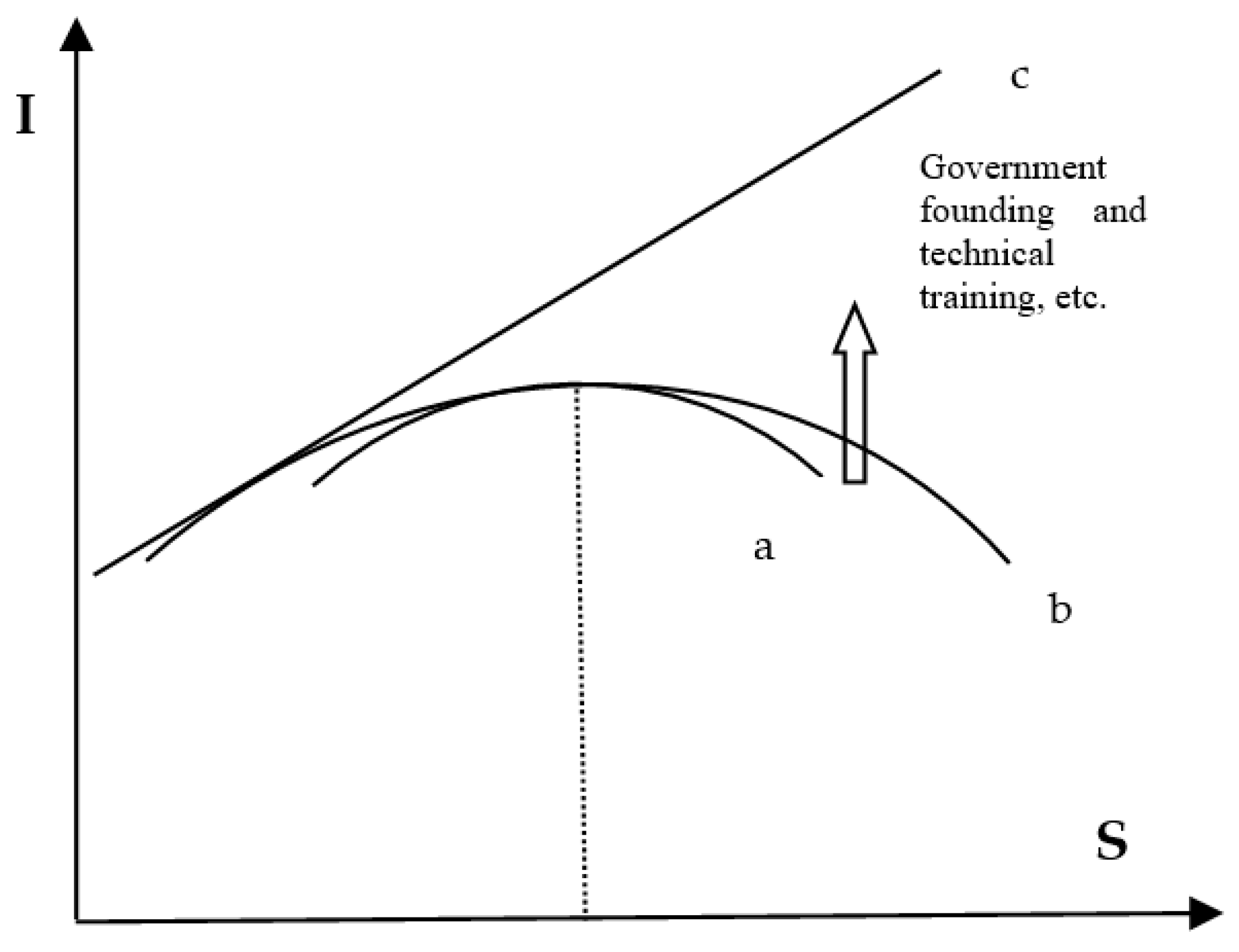
- What is the nature of the relationship between production scale and innovation, and is it moderated by government support?
- (3)
- How does the level of industrial organization relate to farmer innovation capacity?
2. Theoretical Framework and Research Hypotheses
2.1. Conceptualizing and Measuring Innovation in Smallholder Aquaculture
- (1)
- Infrastructure Upgrading: Represented by the implementation of standard pond renovation. This reflects foundational, capital-intensive investments that enable higher-level innovations, linking to theories of physical capital accumulation as a precursor to technological change.
- (2)
- Machinery and Equipment Upgrading: Captured by the frequency of upgrades to automated equipment (e.g., feeders, aerators). This dimension captures process innovation aimed at saving labor and improving efficiency, a core focus of technology adoption literature [29].
- (3)
- Use of Innovative Inputs: Measured by the frequency of using non-traditional inputs like probiotics and Chinese herbal medicines. This represents product/input innovation aimed at reducing environmental and health risks, addressing a critical sustainability challenge.
- (4)
- Tailwater Treatment Technology Innovation: Indicated by the number of adopted treatment technologies (e.g., constructed wetlands). This reflects environmental innovation driven by regulatory pressures and sustainability norms, a growing area of focus in aquaculture research [30].
- (5)
- Aquaculture Model Innovation: Represented by the adoption of innovative systems (e.g., recirculating aquaculture systems (RASs); integrated rice-fish farming). This signifies a transformative shift in the production paradigm, embodying systemic innovation.
2.2. Production Scale, Innovation, and the Moderating Role of Government Support
2.3. The Role of Industrial Organization as an Innovation Catalyst
3. Data and Methodology
3.1. Data Source, Sample Characteristics, and Survey Instrument
3.2. Variable Definition and Measurement
3.2.1. Dependent Variable: Multidimensional Innovation
- (1)
- Standardization: Positive indicators are standardized as: .
- (2)
- Calculation of Proportion: The proportion of farmer i for indicator j is: .
- (3)
- Calculation of Information Entropy: Entropy for indicator j is: , where .
- (4)
- Calculation of Differentiation Coefficient and Weight: The differentiation coefficient is . The weight for indicator j is: .
- (5)
- Composite Score: The comprehensive innovation index for farmer i is: .
3.2.2. Core Independent Variables
- (1)
- Production Scale: Primarily measured by the total aquaculture area (in mu). For robustness checks, aquaculture output (in 10,000 jin) and sales revenue (in CNY 10,000) are used as alternative scale proxies.
- (2)
- Direct Government Support: Represented by the total amount of government funding (in CNY 10,000) received by the farmer in the past three years. A binary variable indicating whether any funding was received is used in specific model specifications.
- (3)
- Indirect Government Support: Captured by multiple variables. Long-term Support is the total number of technical training sessions attended in the past two years. We also disaggregate Short-term Support into training from research institutes and from extension stations within the past year.
- (4)
- Industrial Organization Level: A count variable indicating the breadth of a farmer’s linkages with various entities, including family farms, cooperatives, leading enterprises, processing enterprises, and e-commerce platforms.
3.2.3. Control Variables
3.3. Empirical Strategy
3.3.1. OLS Regression for the Comprehensive Innovation Index
- denotes the comprehensive innovation index for farmer
- is measured by the aquaculture area (in mu). For robustness, we also utilize aquaculture output and sales revenue as alternative scale proxies;
- represents the amount of government funding received;
- is captured by the frequency of long-term technical training;
- indicates the level of industrial organization;
- is a vector of control variables, including education level, years of experience, and the number of highly educated staff;
- is the idiosyncratic error term.
3.3.2. Count Data Models for Individual Innovation Indicators
- The Negative Binomial (Nbreg) model is preferred when over-dispersion (variance > mean) is present, which is tested via the significance of the over-dispersion parameter α;
- For variables with excess zeros (e.g., Aquaculture Model Innovation), we compared the Akaike (AIC) and Bayesian (BIC) information criteria of the Poisson and Zero-Inflated Poisson (ZIP) models to select the best fit, following the recommendation of Wilson, who demonstrates the limitations of the Vuong test for this purpose [40].
3.3.3. Logit Model for Binary Innovation Indicator
4. Results
4.1. Determinants of the Comprehensive Innovation Level
4.2. Testing the Scale-Innovation Relationship and Moderating Effects
4.3. Robustness Checks: Heterogeneous Effects Across Innovation Types
4.4. Heterogeneity Analysis: Regional Disparities
4.5. The Critical Role of Training Perception and Feedback
5. Discussion
5.1. Interpretation of Key Findings and Comparative Perspectives
5.2. Policy Implications
- Implement Differentiated and Sequenced Funding Strategies. Direct subsidies should be strategically focused and regionally tailored. They can effectively catalyze basic asset upgrading (e.g., machinery) but should be gradually coupled with or transitioned towards mechanisms that incentivize more complex innovations (e.g., performance-based grants for model transformation or tailwater treatment), particularly in the eastern region. In central and western regions, where the efficacy of pure cash transfers is low, policies should prioritize building the preconditions (e.g., through training and organizational development) for future financial interventions to be effective.
- Prioritize High-Quality, Demand-Driven Capacity Building. Policy must treat technical training as a long-term strategic investment in human capital. Programs must be co-designed with farmers, incorporate their feedback loops, and focus demonstrably on relevance and practical utility to generate high perceived value and, consequently, greater impact. The western region, showing the highest potential marginal returns, should be a priority for such intensive, high-quality training initiatives.
- Foster Scale and Organization through Institutional Innovation. Policies should facilitate responsible land transfer and the development of diverse, farmer-centric cooperative models to enable economies of scale. Concurrently, creating an enabling environment for the growth of and participation in robust industrial organizations is crucial. These organizations act as indispensable intermediaries for disseminating innovation and integrating smallholders into modern value chains.
5.3. Limitations and Future Research
6. Conclusions
Author Contributions
Funding
Institutional Review Board Statement
Data Availability Statement
Conflicts of Interest
Appendix A

| Variable | Infrastructure Upgrading | Use of Innov. Drugs | Aquac. Model Innov. | Mach. and Equip. Upgrading | Tailwater Treat. Innov. |
|---|---|---|---|---|---|
| (Logit) | (Nbreg) | (Possion) | (Possion) | (Possion) | |
| Aquaculture Area | 0.252 *** | 0.0534 | 0.101 ** | 0.0294 | 0.0207 |
| (0.0842) | (0.0535) | (0.0418) | (0.0225) | (0.0324) | |
| Long-term Indirect Support | 0.0988 * | 0.134 *** | 0.0655 ** | 0.0580 *** | 0.0609 *** |
| (0.0586) | (0.0396) | (0.0294) | (0.0155) | (0.0226) | |
| Direct Government Funding | 0.707 (0.504) | −0.557 * (0.301) | 0.297 (0.205) | 0.297 *** (0.111) | 0.159 (0.169) |
| Level of Industrial Organization | 0.256 * (0.137) | −0.00166 (0.0890) | 0.172 *** (0.0553) | 0.0267 (0.0330) | 0.107 ** (0.0461) |
| Over-dispersion Parameter | 0.680 *** (0.0813) | ||||
| Control Variables | Yes | Yes | Yes | Yes | Yes |
| Constant | −2.418 *** | 1.971 *** | −2.300 *** | 0.246 | −0.477 ** |
| (0.589) | (0.402) | (0.335) | (0.165) | (0.241) | |
| Observations | 336 | 336 | 336 | 336 | 336 |
References
- FAO. The State of World Fisheries and Aquaculture 2022; FAO: Rome, Italy, 2022. [Google Scholar]
- Naylor, R.L.; Hardy, R.W.; Buschmann, A.H.; Bush, S.R.; Cao, L.; Klinger, D.H.; Little, D.C.; Lubchenco, J.; Shumway, S.E.; Troell, M. A 20-year retrospective review of global aquaculture. Nature 2021, 591, 551–563. [Google Scholar] [CrossRef] [PubMed]
- Joffre, O.M.; Joffre, F.M.; Kura, K.L.; Sinh, P.S. Characteristics and Performance of Fisheries Co-Management in Asia; WorldFish: Penang, Malaysia, 2019. [Google Scholar]
- Kumar, G.; Engle, C.R. Technological advances that led to growth of shrimp, salmon, and tilapia farming. Rev. Fish. Sci. Aquac. 2016, 24, 136–152. [Google Scholar] [CrossRef]
- Suri, S.; Sharma, S. Institutional drivers of sustainable aquaculture innovations in India. Aquac. Econ. Manag. 2021, 26, 123–145. [Google Scholar]
- Zhang, W.B.; Ma, X.Z. China’s aquaculture development trends since 2000 and future directions. J. Shanghai Ocean. Univ. 2020, 29, 661–674. [Google Scholar]
- Liu, Y.F.; Zhang, H.; Kong, C.; Gu, R.; Xi, Y.; Yang, G.; Zhang, K.; Sheng, X. Pollution characteristics and risk assessment of pesticides and veterinary drugs in aquaculture environment. J. Agro-Environ. Sci. 2022, 41, 2055–2063. [Google Scholar]
- Jin, Y.; Zhou, J.H. Government Inspections, Supply Chain Traceability and Source Supervision of Aquatic Food Safety. Issues Agric. Econ. 2025, 09, 87–104. [Google Scholar]
- Zhang, H.P.; Qu, T.T. Innovation of agricultural modernization and agricultural family management mode. Economist 2014, 8, 83–89. [Google Scholar]
- Montoro-Sánchez, Á.; Úbeda-García, M. Public funding for product, process and organizational innovation. Serv. Ind. J. 2010, 30, 133–147. [Google Scholar]
- Fu, Z.Q.; Li, J.B.; Meng, Q.G. Thoughts on the new model of agricultural technology extension. Guangdong Agric. Sci. 2011, 22, 185–188. [Google Scholar]
- Spielman, D.J.; Ekboir, J.; Davis, K. The art and science of innovation systems inquiry. Technol. Soc. 2009, 31, 399–405. [Google Scholar] [CrossRef]
- Anderson, J.R.; Feder, G. Agricultural Extension: Good Intentions and Hard Realities. World Bank Res. Obs. 2004, 19, 41–60. [Google Scholar] [CrossRef]
- Ragasa, C.; Gina, C.; Madhur, G.; Paul, D. Effectiveness of agricultural extension delivery models. IFPRI Discuss. Pap. 2016, 01536. [Google Scholar] [CrossRef]
- Mankiw, N.G. Principles of Economics; Peking University Press: Beijing, China, 1999. [Google Scholar]
- Steven, J.; Venturelli, P.; Twardek, W.M.; Lennox, R.J.; Brownscombe, J.W.; Skov, C.; Hyder, K.; Suski, C.D.; Diggles, B.K.; Arlinghaus, R.; et al. Technological innovation in the recreational fishing sector. Rev. Fish Biol. Fish. 2021, 31, 253–288. [Google Scholar] [CrossRef]
- Zheng, Y.Y.; Luo, J.L. Research on factors influencing technological innovation in farmers’ cooperatives. Forum Sci. Technol. China 2020, 3, 148–156. [Google Scholar]
- Feng, W.L.; Cao, J.L. Pilot experience and suggestions of aquaculture insurance. Chin. Financ. 2025, 2, 54–55. [Google Scholar]
- Cheng, J.; Ye, W.; Luo, H.; Song, W.; Li, W. Current situation and SWOT analysis of the development of mussel industry in Shengsi. Chin. Fish. Econ. 2022, 40, 57–66. [Google Scholar]
- Li, Z. The Green Development of Agriculture in China: Innovation and Evolution. CABI Databases 2023, 2, 2–16. [Google Scholar]
- Liu, B.; Tang, C.; Zhou, G.; Yi, C. Evolution Characteristics of Rural Innovation Policy. Econ. Geogr. 2024, 44, 3. [Google Scholar]
- Belton, B.; Little, D.C.; Zhang, W.; Edwards, P. Farming fish in the sea: Not a cure for global poverty. Nature 2018, 560, 389–391. [Google Scholar]
- Dam Lam, R.; Danh, L.T.; Khiem, N.T.; Speelman, S. Adoption of integrated multi-trophic aquaculture in Vietnam. Aquac. Int. 2022, 30, 2031–2050. [Google Scholar]
- Bjerke, L.; Johansson, S. Innovation in agriculture: An analysis of Swedish firms. Food Policy 2022, 1, 22–69. [Google Scholar]
- Alston, J.M.; Pardey, P.G. The economics of agricultural innovation. In Handbook of Agricultural Economics; Elsevier: Amsterdam, The Netherlands, 2021; Volume 5, pp. 3895–3980. [Google Scholar]
- Barrett, C.B.; Benton, T.G.; Cooper, K.A.; Fanzo, J.; Gandhi, R.; Herrero, M.; James, S.; Kahn, M.; Mason-D’croz, D.; Mathys, A.; et al. Bundling innovations to transform agri-food systems. Nat. Sustain. 2022, 5, 974–976. [Google Scholar] [CrossRef]
- Klerkx, L.; van Mierlo, B.; Leeuwis, C. Evolution of systems approaches to agricultural innovation. In Farming Systems Research into the 21st Century; Springer: Dordrecht, The Netherlands, 2012; pp. 457–483. [Google Scholar]
- Schumpeter, J.A. The Theory of Economic Development; Harvard University Press: Cambridge, MA, USA, 1934. [Google Scholar]
- Feder, G.; Just, R.E.; Zilberman, D. Adoption of Agricultural Innovations in Developing Countries: A Survey. Econ. Dev. Cult. Change 1985, 33, 255–298. [Google Scholar] [CrossRef]
- Ahmed, N.; Thompson, S. The blue dimensions of aquaculture: A global synthesis. Sci. Total Environ. 2019, 652, 851–861. [Google Scholar] [CrossRef] [PubMed]
- Shrieves, R.E. Market structure and innovation: A new perspective. J. Ind. Econ. 1978, 26, 329–347. [Google Scholar] [CrossRef]
- Zhou, L.A.; Luo, K. Firm Size and Innovation: Evidence from China’s Province-level Data. China Econ. Q. 2005, 4, 623–638. [Google Scholar]
- Deconinck, K. New Evidence on Concentration in Seed Markets. Glob. Food Secur. 2019, 23, 135–138. [Google Scholar] [CrossRef]
- Wang, A.E.; Bao, Y.Z. Review of Agricultural Industrial Organization and Performance. J. Huazhong Agric. Univ. 2014, 4, 70–75. [Google Scholar]
- Ma, Y.H. The impact of farmers’ participation in agricultural industrial organizations. Feed Res. 2024, 47, 182–185. [Google Scholar]
- Granovetter, M. Economic Action and Social Structure: The Problem of Embeddedness. Am. J. Sociol. 1985, 91, 481–510. [Google Scholar] [CrossRef]
- Ministry of Agriculture and Rural Affairs, PRC. National Agricultural Technology System Construction Plan; China Agriculture Press: Beijing, China, 2007. [Google Scholar]
- Singleton, R.A.; Straits, B.C. Approaches to Social Research; Oxford University Press: New York, NY, USA, 2017. [Google Scholar]
- Zou, Z.-H.; Yun, Y.; Sun, J.-N. Entropy method for determination of weight of evaluating indicators. J. Environ. Sci. 2006, 18, 1020–1023. [Google Scholar] [CrossRef] [PubMed]
- Cameron, A.C.; Trivedi, P.K. Regression Analysis of Count Data; Cambridge University Press: Cambridge, UK, 2013. [Google Scholar]
- Pan, D.; Zhang, N. The role of agricultural training on fertilizer use knowledge. Ecol. Econ. 2018, 148, 77–91. [Google Scholar] [CrossRef]
- Duflo, E.; Kremer, M.; Robinson, J. Nudging Farmers to Use Fertilizer: Theory and Experimental Evidence from Kenya. Am. Econ. Rev. 2011, 101, 2350–2390. [Google Scholar] [CrossRef]
- Birkhaeuser, D.; Evenson, R.E.; Feder, G. The economic impact of agricultural extension: A review. Econ. Dev. Cult. Change 1991, 39, 607–650. [Google Scholar] [CrossRef]
- Rogers, E.M. Diffusion of Innovations; Free Press: New York, NY, USA, 2003. [Google Scholar]
- Joffre, O.M.; Klerkx, L.; Dickson, M.; Verdegem, M. How is innovation in aquaculture conceptualized and managed? Aquaculture 2017, 470, 129–148. [Google Scholar] [CrossRef]
- Béné, C.; Arthur, R.; Norbury, H.; Allison, E.H.; Beveridge, M.; Bush, S.; Campling, L.; Leschen, W.; Little, D.; Squires, D.; et al. Contribution of Fisheries and Aquaculture to Food Security and Poverty Reduction. World Dev. 2016, 79, 177–196. [Google Scholar] [CrossRef]
- Davis, K.E. Extension in sub-Saharan Africa: Overview and assessment. J. Int. Agric. Ext. Educ. 2008, 15, 15–28. [Google Scholar]
- Barrett, C.B.; Carter, M.R.; Timmer, C.P. A Century-Long Perspective on Agricultural Development. Am. J. Agric. Econ. 2010, 92, 447–468. [Google Scholar] [CrossRef]
- Bijman, J.; Hanisch, M. Support for Farmers’ Cooperatives; European Commission: Brussels, Belgium, 2012. [Google Scholar]
| Province | Sample Size | Province | Sample Size |
|---|---|---|---|
| Anhui | 24 | Zhejiang | 9 |
| Fujian | 10 | Hubei | 53 |
| Guangdong | 8 | Hunan | 27 |
| Guangxi | 36 | Jiangsu | 39 |
| Guizhou | 16 | Jiangxi | 12 |
| Hainan | 30 | Sichuan | 31 |
| Hebei | 10 | Shanghai | 13 |
| Henan | 10 | Tibet | 7 |
| Variable | Definition/Measurement | Sample Size | Mean | Std. Dev. |
|---|---|---|---|---|
| Comprehensive Innovation Level | Calculated based on Entropy Method (dimensionless) | 336 | 0.236 | 0.156 |
| Use of Innovative Drugs | Frequency of use (times) | 336 | 20.805 | 44.782 |
| Aquaculture Model Innovation | Number of adopted aquaculture models (count) | 336 | 0.711 | 0.816 |
| Infrastructure Upgrading | 0 = No, 1 = Yes | 336 | 0.592 | 0.492 |
| Machinery and Equipment Upgrading | Frequency of equipment upgrades (count) | 336 | 2.586 | 1.342 |
| Tailwater Treatment Innovation | Number of adopted tailwater treatment technologies (count) | 336 | 1.223 | 1.008 |
| Direct Government Funding | Amount of government funding in past 3 years (CNY 10,000) | 336 | 43.274 | 551.494 |
| Indirect Support (Long-term) | Training sessions attended in past 2 years (times) | 336 | 3.461 | 2.231 |
| Indirect Support (Short-term): Research Inst. | Training sessions from research institutes in the past year (times) | 336 | 0.970 | 3.006 |
| Indirect Support (Short-term): Ext. Stations | Training sessions from extension stations in the past year (times) | 336 | 1.833 | 7.564 |
| Aquaculture Area | Aquaculture area (mu) | 336 | 442.005 | 1405.196 |
| Aquaculture Output | Aquaculture output (JIN 10,000) | 336 | 56.768 | 116.564 |
| Sales Revenue | Sales revenue (CNY 10,000) | 336 | 758.830 | 1966.985 |
| Education Level | Primary = 1; Junior High = 2; Senior High = 3; College = 4; Bachelor+ = 5 | 336 | 3.190 | 1.111 |
| Years of Aquaculture | Years engaged in aquaculture (years) | 336 | 14.270 | 9.983 |
| Number of Highly Educated Staff | Number of staff with college degree or above (persons) | 336 | 1.393 | 4.865 |
| Region | Western = 0; Central = 1; Eastern = 2 | 336 | - | - |
| Production Type | Individual = 1; Family Farm = 2; Cooperative = 3; Enterprise = 4 | 336 | - | - |
| Training Willingness | Number of desired training types (count) | 336 | 2.970 | 1.941 |
| Training Evaluation | 1 = Very Poor; 2 = Poor; 3 = Average; 4 = Good; 5 = Excellent | 336 | 3.244 | 1.101 |
| Industrial Organization Level | Level of organization with agribusinesses, etc., (count) | 336 | 1.324 | 1.081 |
| Variable | Comprehensive Innovation Level (OLS) | ||||
|---|---|---|---|---|---|
| (1) | (2) | (3) | (4) | (5) | |
| Education Level | 0.0392 *** | 0.0299 *** | 0.0332 *** | 0.0323 *** | 0.0255 *** |
| (0.00740) | (0.00719) | (0.00727) | (0.00721) | (0.00712) | |
| Years of Aquaculture | 0.000665 | 0.000437 | 0.000810 | 0.000681 | 0.000844 |
| (0.000814) | (0.000777) | (0.000797) | (0.000792) | (0.000767) | |
| Number of Highly Educated Staff | 0.00336 ** | 0.00262 | 0.00252 | 0.00152 | 0.00178 |
| (0.00168) | (0.00162) | (0.00173) | (0.00176) | (0.00166) | |
| Aquaculture Area | 0.0216 *** | 0.0172 *** | 0.0159 *** | 0.0154 *** | |
| (0.00518) | (0.00507) | (0.00516) | (0.00512) | ||
| Direct Government Funding | 8.47 × 10⁻⁶ | −1.12 × 10⁻⁵ | −8.30 × 10⁻⁶ | 0.0699 ** | 0.0320 |
| (1.45 × 10⁻⁵) | (1.42 × 10⁻⁵) | (1.44 × 10⁻⁵) | (0.0314) | (0.0277) | |
| Indirect Support (Short-term): Research Inst. | −0.000401 | −0.00257 | |||
| (0.00304) | (0.00317) | ||||
| Indirect Support (Short-term): Ext. Stations | −0.00118 | −0.00160 | |||
| (0.00112) | (0.00113) | ||||
| Level of Industrial Organization | 0.0286 *** | 0.0375 *** | 0.0360 *** | 0.0235 *** | |
| (0.00799) | (0.00785) | (0.00757) | (0.00766) | ||
| Long-term Indirect Support | 0.0132 *** | 0.0118 *** | |||
| (0.00362) | (0.00352) | ||||
| Family Farm | 0.0581 ** | ||||
| (0.0245) | |||||
| Cooperative | 0.0571 ** | ||||
| (0.0235) | |||||
| Enterprise | 0.0941 *** | ||||
| (0.0183) | |||||
| Constant | −0.00411 | −0.0326 | −0.00563 | 0.000504 | 0.0157 |
| (0.0366) | (0.0355) | (0.0355) | (0.0354) | (0.0292) | |
| Observations | 336 | 336 | 336 | 336 | 336 |
| R-squared | 0.159 | 0.246 | 0.218 | 0.229 | 0.284 |
| Variable | Comprehensive Innovation Level (OLS) | |||
|---|---|---|---|---|
| (1) | (2) | (3) | (4) | |
| Aquaculture Area | 0.0133 (0.0218) | 0.0152 (0.0220) | ||
| Aquaculture Area Squared | 0.000393 (0.00213) | 0.000642 (0.00222) | ||
| Output | 0.00321 | |||
| (0.0183) | ||||
| Output Squared | 0.00259 | |||
| (0.00283) | ||||
| Revenue | 0.0260 | |||
| (0.0244) | ||||
| Revenue Squared | 0.000125 | |||
| (0.00220) | ||||
| Area Sq. and Indirect Support Interaction | −0.000123 | |||
| (0.000224) | ||||
| Area Sq. and Direct Funding Interaction | 9.11 × 10⁻⁷ | |||
| (4.13 × 10⁻⁶) | ||||
| Long-term Indirect Support | 0.0132 *** (0.00363) | 0.0117 *** (0.00363) | 0.0123 *** (0.00351) | 0.0160 *** (0.00613) |
| Direct Government Funding | −1.11 × 10⁻⁵ | −1.43 × 10⁻⁵ | −1.42 × 10⁻⁵ | −3.61 × 10⁻⁵ |
| (1.42 × 10⁻⁵) | (1.41 × 10⁻⁵) | (1.38 × 10⁻⁵) | (0.000116) | |
| Level of Industrial Organization | 0.0286 *** | 0.0327 *** | 0.0283 *** | 0.0286 *** |
| (0.00800) | (0.00780) | (0.00765) | (0.00805) | |
| Control Variables | Yes | Yes | Yes | Yes |
| Constant | −0.0240 | 0.0108 | −0.0846 | −0.0402 |
| (0.0586) | (0.0409) | (0.0716) | (0.0646) | |
| Observations | 336 | 336 | 336 | 336 |
| R-squared | 0.246 | 0.251 | 0.289 | 0.247 |
| Variable | Comprehensive Innovation Level (OLS) | ||
|---|---|---|---|
| West | Central | East | |
| Aquaculture Area | 0.0192 ** | 0.0260 *** | 0.0150 |
| (0.00883) | (0.00922) | (0.00964) | |
| Direct Government Funding | −0.0128 | 0.0592 | 0.0790 ** |
| (0.0463) | (0.0947) | (0.0372) | |
| Level of Industrial Organization | 0.0144 | 0.0427 *** | 0.0211 * |
| (0.0148) | (0.0150) | (0.0122) | |
| Long-term Indirect Support | 0.0226 *** | 0.00913 | 0.0128 ** |
| (0.00695) | (0.00565) | (0.00636) | |
| Control Variables | Yes | Yes | Yes |
| Constant | −0.0411 | −0.0592 | 0.0239 |
| (0.0690) | (0.0647) | (0.0567) | |
| Observations | 90 | 126 | 120 |
| R-squared | 0.321 | 0.261 | 0.329 |
| Variable | Comprehensive Innovation Level (OLS) | ||
|---|---|---|---|
| (1) | (2) | (3) | |
| Aquaculture Area | 0.0171 *** | 0.0165 *** | 0.0153 *** |
| (0.00505) | (0.00514) | (0.00509) | |
| Direct Government Funding | 0.0475 * | 0.0482 * | 0.0388 |
| (0.0280) | (0.0285) | (0.0284) | |
| Actual Training/Guidance Frequency | 0.0132 *** | ||
| (0.00360) | |||
| Willingness to Participate | 0.00648 | ||
| (0.00398) | |||
| Ex post Evaluation of Training/Guidance | 0.0173 ** | ||
| (0.00695) | |||
| Level of Industrial Organization | 0.0264 *** | 0.0339 *** | 0.0352 *** |
| (0.00780) | (0.00759) | (0.00746) | |
| Constant | −0.0287 | −0.0204 | −0.0498 |
| (0.0355) | (0.0369) | (0.0399) | |
| Observations | 336 | 336 | 336 |
| R-squared | 0.251 | 0.226 | 0.234 |
Disclaimer/Publisher’s Note: The statements, opinions and data contained in all publications are solely those of the individual author(s) and contributor(s) and not of MDPI and/or the editor(s). MDPI and/or the editor(s) disclaim responsibility for any injury to people or property resulting from any ideas, methods, instructions or products referred to in the content. |
© 2025 by the authors. Licensee MDPI, Basel, Switzerland. This article is an open access article distributed under the terms and conditions of the Creative Commons Attribution (CC BY) license.
Share and Cite
Xu, Z.; Zhao, P. The Differentiated Role of Government Support in Fostering Innovation: Evidence from Smallholder Aquaculture in China. Fishes 2026, 11, 6. https://doi.org/10.3390/fishes11010006
Xu Z, Zhao P. The Differentiated Role of Government Support in Fostering Innovation: Evidence from Smallholder Aquaculture in China. Fishes. 2026; 11(1):6. https://doi.org/10.3390/fishes11010006
Chicago/Turabian StyleXu, Zhong, and Peng Zhao. 2026. "The Differentiated Role of Government Support in Fostering Innovation: Evidence from Smallholder Aquaculture in China" Fishes 11, no. 1: 6. https://doi.org/10.3390/fishes11010006
APA StyleXu, Z., & Zhao, P. (2026). The Differentiated Role of Government Support in Fostering Innovation: Evidence from Smallholder Aquaculture in China. Fishes, 11(1), 6. https://doi.org/10.3390/fishes11010006

