


Abstract
China is a major global marine fishing country, and exploring the sustainable development potential of its marine fisheries is critical to the global fisheries sector’s Blue Transformation. Based on sustainable development connotations, this study adopts the GM(1,1) model and entropy weight-TOPSIS model to predict and evaluate the marine fisheries’ sustainable development potential from 2021 to 2030, building an evaluation framework spanning economic, social, and resource-environmental dimensions. The results show an overall upward trend in the sustainable development potential during the period, with a notable 2022 trough driven by the COVID-19 pandemic, policy transitions, and complex international conditions. As adverse factors ease and long-term policies advance, the potential will continue to improve steadily. Finally, targeted policy recommendations are proposed, focusing on industrial transformation, technological innovation, resource-environment conservation, and factor guarantee to facilitate the sector’s sustainable development and Blue Transformation.
Keywords:
marine fisheries; sustainable development potential; entropy weight-TOPSIS; influencing factors; policy recommendations Key Contribution:
This study develops a contextually tailored, globally aligned evaluation framework and an integrated GM(1,1)-entropy weight-TOPSIS method to assess China’s marine fisheries sustainable development potential (2021–2030), quantifies dynamic drivers including emerging factors, and provides actionable policy recommendations for advancing global fisheries Blue Transformation.
1. Introduction
Since the adoption of Transforming our World: The 2030 Agenda for Sustainable Development at the United Nations Ocean Conference in 2015, the concept of sustainable development has been widely applied across various industries, and the awareness of sustainable development among governments and the public has gradually increased. Economic, social, and environmental pillars have gradually become the core framework of sustainable development [1,2]. Rather than replacing these three pillars, factors such as management and culture—proposed by some scholars [3]—act as critical sub-components to supplement them: management (e.g., fishery regulatory systems, cross-sector coordination mechanisms) enhances the implementation efficiency of the three pillars, while culture (e.g., local fishing community traditions, sustainable development awareness) strengthens their social adaptability. These supplementary perspectives have been widely accepted in academia, driving continuous deepening of sustainable development research. In addition, this study emphasizes that scientific and technological innovation further empowers the three pillars—for instance, China’s independently developed, fully submersible, deep-sea intelligent aquaculture equipment has boosted mariculture productivity by 30% while reducing environmental impact [4], demonstrating tech’s role in advancing marine fisheries sustainability.
The sustainable development of marine fisheries is a key focus of global concern, closely tied to SDG14 (“Life Below Water”)—the United Nations’ goal to conserve and sustainably use the oceans, seas, and marine resources for sustainable development. Achieving SDG 14 is critical to safeguarding global socio-economic health and human well-being, as marine fisheries provide high-quality protein for billions and support livelihoods worldwide.
Marine fisheries are a fundamental industrial sector in the socio-economic development of various countries. Though there is currently no internationally unified definition and standard for “sustainable fisheries” and “sustainable marine fisheries”, the issue of sustainable development in fisheries has received widespread attention from the international community. Developed, developing, and less developed countries have all realized that seafood is an important agricultural product and a significant source of high-quality animal protein [5]. The current and future development of marine fisheries faces many challenges, including the decline and depletion of fishing resources, global climate warming and abnormal increase in seawater temperature caused by the El Niño phenomenon, ocean acidification, ecological environmental pollution, labor shortage, aging infrastructure, and the impact of emergencies [6,7,8]. Many countries and regions are actively addressing these challenges. For example, the National Oceanic and Atmospheric Administration (NOAA) of the United States released the first version of the National Seafood Strategy in August 2023, focusing on sustainably managing marine fisheries and responsibly producing seafood. The European Commission is committed to building an “Energy Transition Partnership for EU Fisheries and Aquaculture” as a key action to promote the energy transition of fishing and aquaculture industries, aiming to bring together all stakeholders to achieve net-zero carbon emissions in fisheries and aquaculture by 2050. China has also integrated the concept of green and low-carbon development into the development mode of the marine economy and taken actions, such as carrying out the construction of marine ranching. By 2023, China had created 169 national-level marine ranching demonstration zones, which generate nearly 178.1 billion yuan in ecological benefits annually [4]. The fully submersible deep-sea intelligent fishery breeding equipment independently developed by China has been put into operation, and new technologies and models for green breeding in deep and open seas are increasing [4].
Meanwhile, human demand for high-quality and healthy seafood is continuously growing, and per capita seafood consumption is steadily increasing. However, the proportion of marine fisheries’ stocks within the biologically sustainable range around the globe is declining, marking a drop from 90% in 1974 to 62.3% in 2021 [9,10]. According to expert estimates, China’s seafood consumption demand in 2035 is expected to exceed the national apparent consumption in 2023 by approximately 14.5 million tons [11]. Recently, scholars have pointed out that current fishery resource assessment models overestimate the sustainability of global fisheries and that natural mortality rates and population replenishment relationships have a significant impact on the accuracy of assessment results [12]. Since 2021, the FAO has been promoting the “Blue Transformation” initiative—anchored in three core components outlined in its recent documents [10]: (1) Sustainable production intensification (e.g., optimizing aquaculture efficiency and reducing capture fisheries overexploitation), (2) Equitable benefit distribution (ensuring small-scale fishermen and coastal communities access to markets and livelihood support), and (3) Ecosystem resilience enhancement (mitigating fisheries’ environmental impact and adapting to climate change). This initiative aims to maximize the aquatic food system’s contribution to food security, nutrition improvement, and poverty reduction, in line with the “2030 Agenda for Sustainable Development.” The supporting “Blue Transformation Roadmap” further operationalizes these three components, targeting sustainable growth in fisheries and aquaculture while advancing the equitable sharing of benefits and environmental protection.
How much food can the ocean sustainably provide in the future? Some scholars have superimposed the supply curve on the demand scenario and predicted that the amount of food provided by the ocean may increase by 21–44 million tons by 2050, equivalent to approximately 12–25% of the additional meat required to feed 9.8 billion people by 2050 [13]. However, the growth of seafood is influenced by various factors, and there are still many uncertainties and instabilities.
China is the world’s largest fishing country, and its aquaculture production is also in a leading position globally. Its marine fishing output and mariculture production rank among the top in the world. The Blue Transformation of China’s marine fisheries has a positive impact on achieving the goals of SDG14 and the sustainable development of global fisheries. This study aims to explore several key issues regarding the sustainable development trend of China’s marine fisheries. Firstly, we construct an evaluation system for China’s marine fisheries’ sustainable development potential across economic, social, and resource-environmental dimensions. To cover the 2021–2030 study period, we use two complementary models with distinct roles: the GM(1,1) model (a gray forecasting tool) to predict the 2024–2030 time-series data of core evaluation indicators (e.g., marine aquaculture area, number of fisheries patents)—supplementing the observed 2021–2023 data—and the entropy weight-TOPSIS method (an objective evaluation tool with entropy weight for indicator weighting) to calculate the comprehensive sustainable development potential index for the entire 2021–2030 period. Secondly, combined with domestic and international situations, we analyze the impact of various factor changes on the sustainable development potential of marine fisheries. Finally, based on the prediction results, analysis of influencing factors, as well as China’s local fisheries policies, international fisheries policies, and related actions, we innovatively propose development recommendations for achieving Blue Transformation and sustainable development of China’s marine fisheries. By exploring these research issues, we aim to provide new insights and tailored Chinese development ideas and solutions for the “Blue Transformation” and sustainable development of global fisheries and also offer references and insights for the development of fisheries in other countries.
2. Overall Development of China’s Marine Fisheries
China has continuously improved its marine governance level and strengthened the sustainable utilization of fishery resources. Since the implementation of the system of summer moratorium of marine fishing in 1995, China has continuously extended the fishing moratorium period and expanded the scope of the moratorium, controlled the intensity of marine fishing, and protected and restored fishery resources. Since 2003, China has successively implemented the total management system of marine fisheries resources, the fishing license system, and the “dual control” system of the number of marine fishing boats and their powers and explored the implementation of fishing quota management by species and region, promoted the increase in marine product production, and carried out the construction of national-level marine ranching. China has continued to improve the marine environment and provide favorable guarantees for the development of marine fisheries. According to data from the Ministry of Ecology and Environment of China, in 2023, the proportion of excellent water quality in China’s coastal waters reached 85%, which marks a record high, an increase of 13.7 percentage points compared to 2018, and “six consecutive years of growth”. Since 2021, 24 typical marine ecosystems have eliminated the “unhealthy” conditions.
According to the statistics and reports from the UN Food and Agriculture Organization (FAO), China continued to maintain its position as a major producer in 2022 and produced 36% of the total output; China’s fishing output accounted for about 14.3% of the global total, while its aquaculture output accounted for about 60% of the global total. China is also the world’s second largest importer of aquatic products, with its imports accounting for about 12% of the global total, second only to 17% of the United States [10].
According to China’s official statistics, in 2023, China’s total aquatic product output reached 71.1617 million tons, registering a year-on-year increase of 3.64%. The ratio of marine product output to freshwater product output stood at 50.4:49.6, with marine product output slightly exceeding that of freshwater product [14]. In the first three quarters of 2024, marine fishing output amounted to 6.4117 million tons, marking a year-on-year growth of 1.62%, while marine aquaculture output reached 18.1511 million tons, registering a year-on-year growth of 5.67% [15]. Rabobank predicts that China’s seafood consumption will increase by 5.5 million tons by 2030. Calculated at the prices of 2023, China’s fishery output value amounted to 1.595735 trillion yuan, comprising 261.831 billion yuan from marine fishing and 488.548 billion yuan from marine aquaculture. Regarding the income of fishermen, a survey on the income and expenditure of nearly 10,000 fishermen’s families in China revealed that the per capita net income of Chinese fishermen in 2023 was 25,777.21 yuan, marking a year-on-year growth of 4.72%. In terms of factor input, the national aquaculture area in 2023 reached 7624.60 thousand hectares, of which the marine aquaculture area reached 2214.87 thousand hectares, marking a year-on-year growth of 6.77%. From the international perspective, pond aquaculture in most coastal countries is more than three times the size of marine aquaculture. However, the difference in scale between marine aquaculture and pond aquaculture in China is relatively small, and the vast onshore pond aquaculture space can accommodate marine fish. Additionally, the development of saline-alkali land and facility fisheries is rapidly advancing [16].
3. Evaluation of the Potential for Sustainable Development of China’s Marine Fisheries
3.1. Data Sources
Based on the actual development of China’s marine fisheries and the availability of relevant data, this paper collects and sorts the indicator data required for evaluating the sustainable development potential of China’s fisheries from 2015 to 2023. In accordance with the definition of sustainable development, the sustainable development potential of China’s marine fisheries is regarded as a comprehensive systematic project, divided into three subsystems: economy, society, and resource environment. This study prioritizes the use of official statistics and survey data. The economic subsystem includes two secondary indicators of economic output of marine fisheries and marine fisheries industry structure. The social subsystem includes four secondary indicators of construction of social well-being in marine fisheries, innovation capability in marine fisheries science, construction of marine fisheries infrastructure and degree of regulatory improvement of fisheries. The resource and environment subsystem includes two secondary indicators of fishery environment and fishery resources. A total of three primary indicators, eight secondary indicators, and 23 tertiary indicators. The data on the marine aquaculture area, proportion of aquaculture and fishing of seafood, patents obtained, theses published, funds for technology promotion, number of aquaculture technology promotion institutions, number of technical promotion personnel, number of motorized fishing boats owned at the end of the year, the year-end ownership of offshore fishing vessels, number of deep-sea fishing vessels owned at the end of the year, economic losses caused by fishery disasters, affected aquaculture area, and loss of aquatic products are sourced from the China Fishery Statistical Yearbook over the years. The data on the number of national-level aquatic seed farms, number of relevant policy documents, fishery law enforcement agencies, production of marine fish fry, and number of marine ranching sites are sourced from the Bulletin of Marine Ecology and Environment Status of China. The growth rate of total output value of marine aquaculture, growth rate of total output value of marine fishing, growth rate of fishery economic output, growth rate of per capita net income of fishermen, population growth rate of fishery employees, and growth rate of the fishing population are manually calculated based on the annual China Fishery Statistical Yearbook. A small amount of missing data was completed using interpolation methods.
3.2. Research Methodology
3.2.1. GM(1,1)
This paper employs this model to predict the trend of changes in the evaluation index system for sustainable development of marine fisheries from 2024 to 2030. The reason for choosing the GM(1,1) model for trend prediction is mainly determined by the data characteristics of this study. The GM(1,1) model, as the core prediction method of gray system theory, has the core advantage of handling small sample problems. The evaluation of sustainable development in marine fisheries is a complex system involving multiple dimensions such as ecology, economy, and society. Long-term, continuous, and high-quality monitoring data for some key indicators are often difficult to obtain, and the sample size is limited. In this case, traditional models such as ARIMA, VAR, etc., have high requirements for sample size and may find it difficult to obtain robust prediction results. The GM(1,1) model only requires a small amount of data to capture the main development trends [17]. The calculation process is as follows:
- (1)
- Let the original sequences be , and perform an accumulation to generate a new sequence , where ;
- (2)
- Generate the mean sequence: , where is the weight. Generally, the mean sequence is ;
- (3)
- Establish a gray differential equation: ;
- (4)
- The corresponding GM(1,1) white differential equation is: where are the undetermined parameters. The above equation can be written in matrix form as:where ;
- (5)
- The estimated values of the parameter matrix can be determined using the least squares method: , from which the estimated values of the parameters are obtained, which is put into the white equation to yield the general solution of the sequence :
- (6)
- Reduce to the original sequence, and obtain the prediction function:
3.2.2. Entropy Weight-TOPSIS Method
In terms of the evaluation methodology, this study adopts a comprehensive assessment model that integrates the entropy-weight method with the TOPSIS approach, with the aim of objectively and accurately measuring the comprehensive potential of sustainable development in the marine fishery sector. The entropy-weight method, as an objective weighting technique, derives its weights entirely from the information entropy of the sample data. By automatically determining the relative importance of each indicator based on the degree of dispersion in their values, this method minimizes biases introduced by subjective judgment and thus ensures the objectivity of the evaluation foundation [18]. Building on this, the TOPSIS method ranks each evaluation year according to its relative closeness to the positive and negative ideal solutions. Its conceptual clarity allows for a straightforward representation of the gap between each year’s sustainability level and the optimal or worst possible states, thereby enabling effective differentiation and ordering of sustainable development potential across years [7,19]. The specific steps are as follows:
- (1)
- Normalization processing
Due to the different dimensions and units of various indicators, it is necessary to perform normalization processing on them. This paper chooses min-max normalization processing, and the calculation formula is as follows:
where represents the value after min-max normalization, with its value falling within the interval [0, 1]; represents the value of indicator i in year j; and represent the minimum and maximum values of the i-th indicator across all years, rather than within a single year. The use of global normalization ensures comparability across different years, allowing the evaluation results to capture the true temporal variation in each indicator. Although some TOPSIS applications normalize data based on the “current evaluation year,” such an approach applies different standards across years and thereby weakens the reliability of temporal comparisons. Therefore, this study adopts a global normalization strategy to maintain consistency throughout the analysis period.
- (2)
- Entropy weight method.
To enhance the objectivity of the research, the entropy weight method is adopted to calculate the weight of each indicator. The calculation formula is as follows:
where represents non-negative translation; represents contribution degree; represents entropy value; represents difference coefficient; and represents weight.
- (3)
- TOPSIS method
The TOPSIS method is used to calculate the sustainable development potential index of marine fisheries. The calculation formula is as follows:
where represents the normalized decision matrix, and represent the positive and negative ideal solutions, respectively; and represent the optimal and worst distances, respectively; represents the sustainable development potential index of marine fisheries, which ranges from 0 to 1. A value closer to 1 indicates a higher level of sustainability potential.
3.3. Indicator System
“China’s Agenda 21” proposes the goal of establishing a “sustainable economic system and social system and maintaining sustainable use of resources and environmental infrastructure compatible with it”. Therefore, this paper builds an evaluation index system for the sustainable development potential of China’s marine fisheries from three subsystems: economy, society, and resource environment (Table 1). Specifically, economic sustainability reflects the efficient use of fishery resources, ensuring that fishery activities can continuously and steadily contribute to economic growth. It is primarily assessed through indicators related to marine fishery economic output and industrial structure, including five indicators such as the growth rate of the total output value of marine aquaculture and the growth rate of the total output value of marine fishing. Social sustainability refers to improving human well-being without exceeding the carrying capacity of ecosystems. It is evaluated through indicators of social welfare development, technological innovation capacity, infrastructure construction, and regulatory soundness in the marine fishery sector, encompassing thirteen indicators such as the growth rate of per capita net income of fishermen and the population growth rate of fishery employees. Resource environment sustainability requires that socioeconomic development aligns with the carrying capacity of natural resources and ecosystems. It is assessed through indicators related to marine fishery resources and environmental conditions, including four indicators such as economic losses caused by fishery disasters and affected aquaculture area. Collectively, these indicators align closely with the United Nations SDG 14, echo the “Blue Transformation” initiative advocated by the FAO, and correspond to global fishery sustainability frameworks that emphasize ecological protection, harvest management, and industrial development, thereby ensuring the coordinated advancement of economic, social, and environmental sustainability. Indicator weights were calculated using the entropy weight method.
Table 1.
Evaluation index system for sustainable development potential of marine fisheries.
3.4. Results
3.4.1. Indicator Weight Analysis
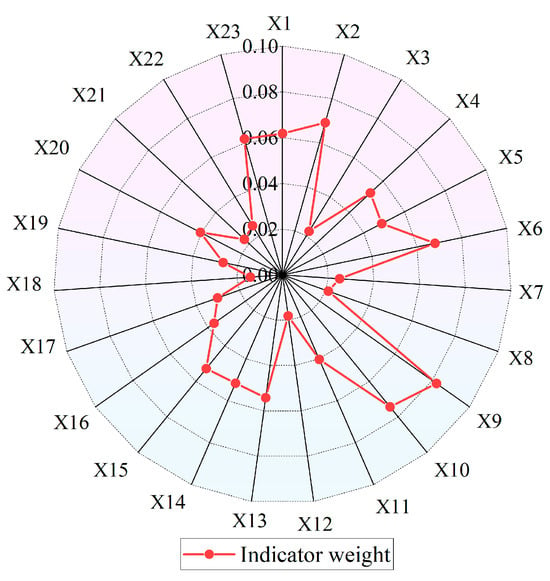
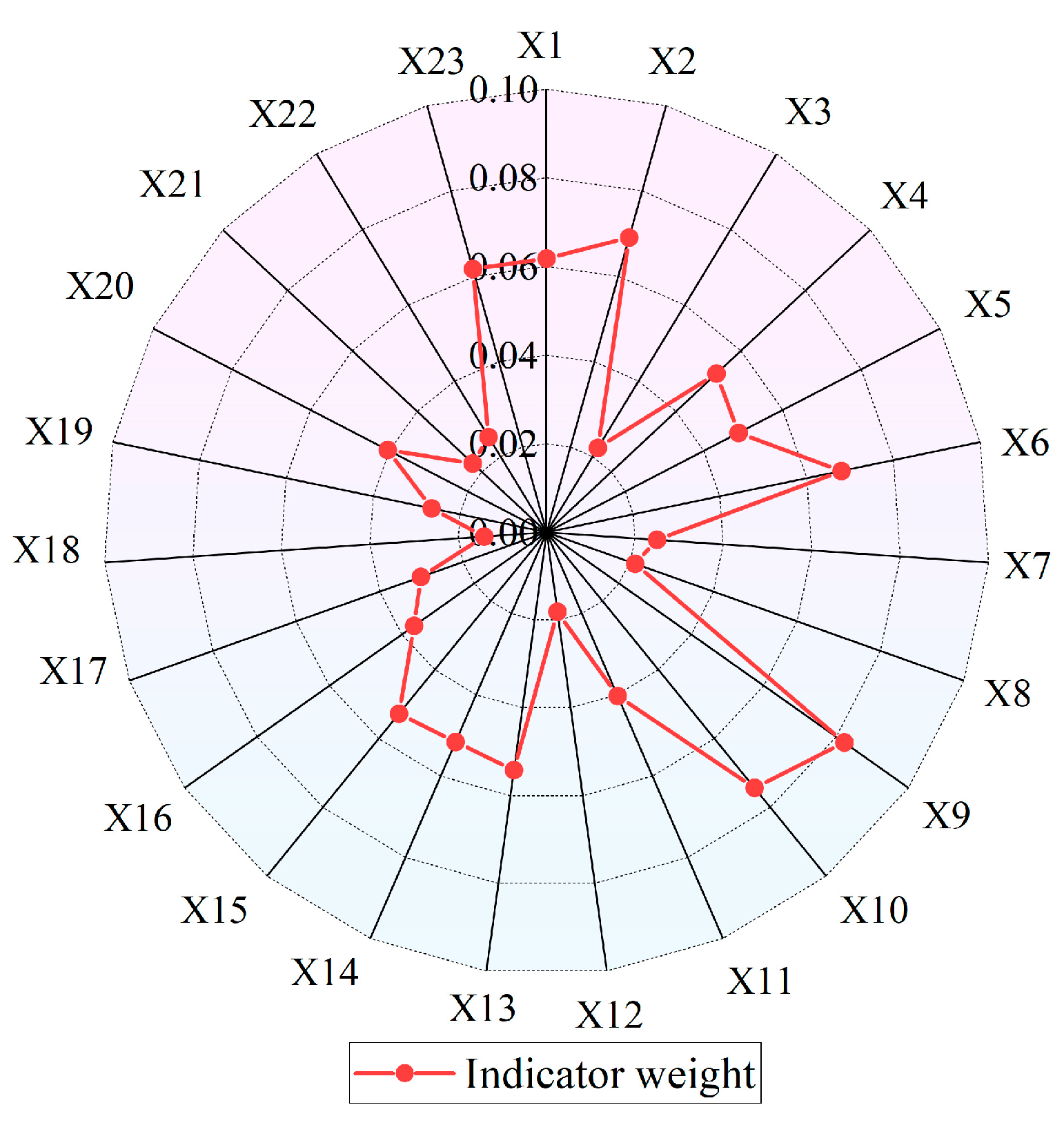
Indicator weights were calculated using the entropy weight method, and the results are presented in Figure 1. The results indicate substantial heterogeneity in the contribution of different indicators to the overall system information. Among them, Patents obtained (X9) and Theses published (X10) exhibit relatively high weights, at 0.0823 and 0.0744, respectively, indicating that technological innovation and knowledge output show substantial variability and information content during the study period and constitute key driving forces for the development of the fishery. In addition, the weights of the Growth rate of total output value of marine aquaculture (X1), Growth rate of total output value of marine fishing (X2), Growth rate of per capita net income of fishermen (X6), and Number of marine ranching sites (X23) are also relatively high, indicating that industrial growth vitality, improvements in fishermen’s income, and the development of marine ranching exert significant influences on the sustainable development of fisheries. By contrast, indicators such as the Number of aquaculture technology promotion institutions (X12), Fishery law enforcement agencies (X18), and several population- and disaster-related indicators (e.g., Population growth rate of fishery employees (X7), Growth rate of the fishing population (X8), and Loss of aquatic products (X21)) display relatively low weights, reflecting limited variability during the sample period and a weaker discriminative capacity in the composite evaluation. Overall, indicators related to economic development and technological innovation occupy a dominant position within the evaluation system, whereas management- and safeguard-related indicators primarily function as foundational support components.
Figure 1.
Indicator weighting results.
3.4.2. Evaluation Results Analysis
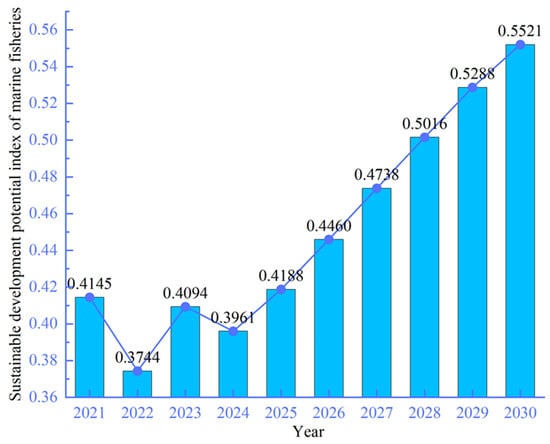
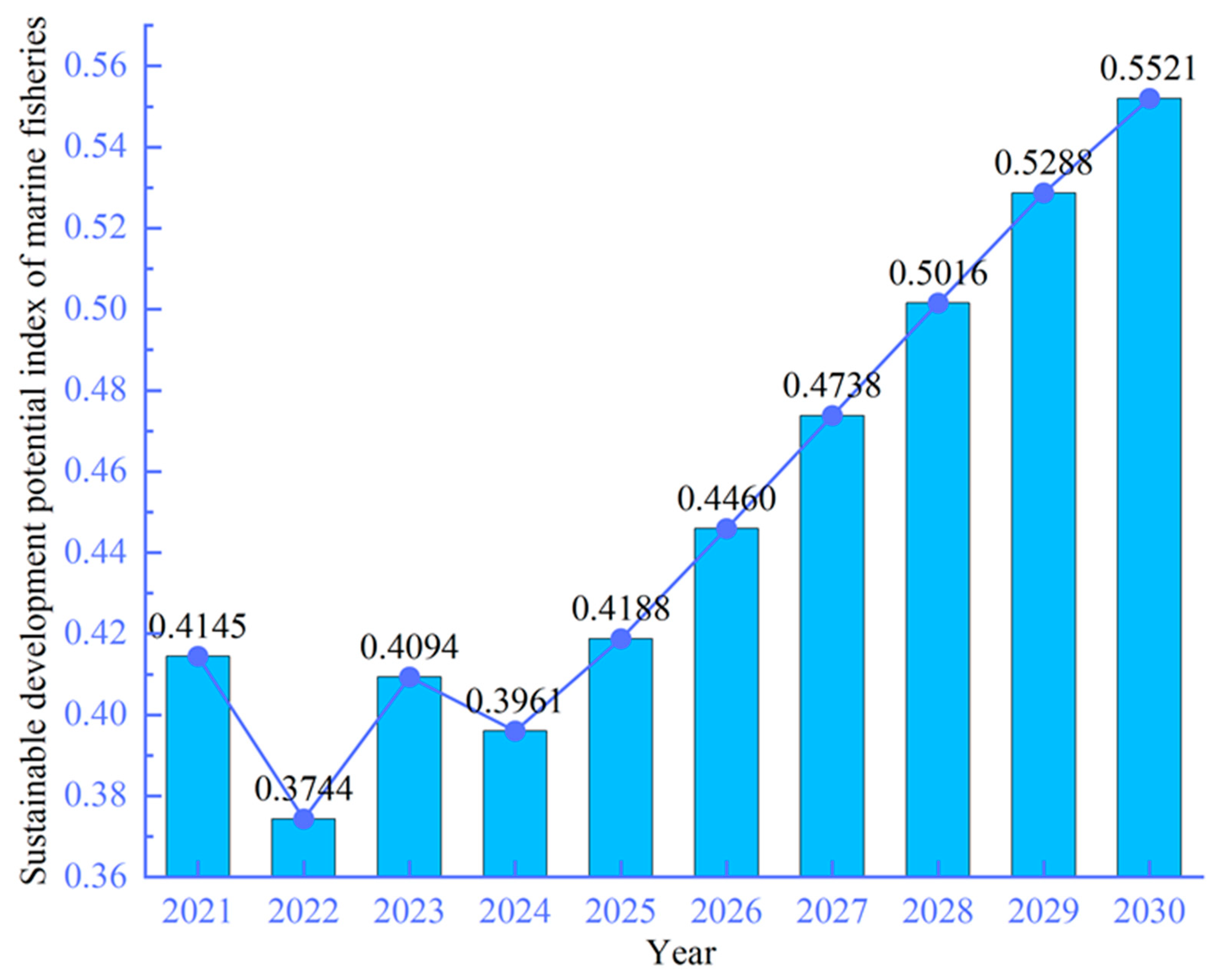
This paper first predicts the evaluation index system for the sustainable development potential of China’s marine industry from 2024 to 2030 using the GM(1,1) method and then calculates the sustainable development potential of China’s marine fisheries from 2015 to 2030 using the entropy weight-TOPSIS method, with a focus on analyzing the sustainable development potential of China’s marine fisheries from 2021 to 2030 (Figure 2). The reason for choosing the period from 2021 to 2030 as the analysis timeframe is that this period coincides with the implementation of the “United Nations Decade of Ocean Science for Sustainable Development” (2021–2030), during which period the global efforts are concentrated on promoting marine science to support sustainable development, including in the field of marine fisheries. Against this backdrop, analyzing the sustainable development potential of China’s marine fisheries during this period can better explore the current status, challenges, and opportunities and provide a scientific basis and constructive countermeasure suggestions for future marine fisheries management and protection.
Figure 2.
Sustainable development potential of China’s marine fisheries.
As shown in Figure 2, the sustainable development potential of China’s marine fisheries exhibits an overall fluctuating upward trend during the period 2021–2030. It is noteworthy that the sustainable development potential of marine fisheries reached its lowest level in 2022, at only 0.3744, which may be attributed to adverse factors such as external shocks and structural adjustments. However, as these unfavorable factors gradually diminish and long-term national strategic planning and related policies continue to be implemented, the sustainable development potential of China’s marine fisheries is projected to increase steadily during 2024–2030, reaching 0.5221 by 2030. This growth is primarily attributable to the deepening of supply-side structural reforms in marine fisheries, continuous improvements in technological innovation capacity, and the accelerated promotion of modern marine ranching and green aquaculture models, which have enhanced resource-use efficiency while effectively alleviating ecological pressures. Meanwhile, sustained strengthening of fisheries support policies and industrial investment has facilitated simultaneous improvements in both the scale and quality of the fisheries economy. By 2030, the output value of marine aquaculture is expected to reach RMB 1149.1 billion, while the output value of marine fishing is projected to attain RMB 337.2 billion, with the total growth rate of the fishery economy reaching 4.7%. These figures further confirm that, driven jointly by structural adjustments, technological innovation, and policy guidance, China’s marine fisheries are advancing toward a more sustainable and high-quality development stage.
3.5. Discussion
3.5.1. Temporal Variation Analysis
The results indicate that China’s marine fishery sustainable development potential reached its lowest level in 2022, which may be attributed to the following factors:
- (1)
- Impact of the COVID-19 pandemic. In 2022, the COVID-19 pandemic was severe in China and globally, exerting a significant impact on economic and social activities. According to the China Fishery Statistical Yearbook (2023) [20], the growth rate of the total fishery economic output, the growth rate of per capita net income of fishermen, and the production of marine seedlings all decreased significantly in 2022, indicating that the COVID-19 pandemic exerted a noticeable impact on all three subsystems. At the same time, many marine-related scientific research activities, project implementation, and policy execution were hindered to varying degrees during the pandemic, resulting in a slowdown in the sustainable development process of marine fisheries.
- (2)
- The lag and complexity of policy implementation. A transmission delay often exists between macro-level strategies and micro-level effectiveness. During the initial stage of policy transition and the intensive rollout of multiple initiatives, several transitional phenomena may arise. These include uneven implementation capacities across localities, delays in the matching of fiscal support in certain domains, short-term adjustments in resource allocation, and major engineering projects remaining in planning or early construction phases without yet generating measurable benefits. Such “transition frictions” may pose short-term challenges to the coordination and stability of industrial operations, thereby temporarily influencing the comprehensive assessment of sustainable development potential.
- (3)
- Complex international situations. In 2022, the international situation was complex and volatile, complicated by the Russia-Ukraine conflict, intensified geopolitical tensions, and global supply chain disruptions [21]. The superposition of multiple crises also affected the development of marine fisheries, especially in the fields of offshore fishing and marine transportation. These impacts will ultimately fall on the production, processing, and sales links of marine fisheries.
- (4)
- Industrial synergy. The integration of marine fisheries with other related industries, such as tourism, food processing, and biotechnology, is deepening. In 2022, due to the impact of the COVID-19 pandemic, socio-economic activities decreased, and opportunities for cross-border integration, development, and cooperation also decreased accordingly. This is not conducive to the optimization and upgrading of industrial development models, thereby reducing the overall competitiveness and sustainable development potential of marine fisheries [22].
3.5.2. Methodological Limitations
The GM(1,1) model and entropy weight-TOPSIS method provide a feasible framework for this study, but their inherent limitations may affect result interpretation.
The GM(1,1) model, as a core tool of gray system theory, is widely used for small-sample prediction, but its applicability is constrained by two key factors in this study. First, sensitivity to small-sample data quality is a prominent limitation. The model uses 9 years of data (2015–2023), and outliers (e.g., the 2022 fishery economic growth rate dropping to 1.2%) led to a 7.3% initial deviation in the 2023 prediction. We mitigated this by smoothing missing data through interpolation. Second, the model’s assumption of linear exponential growth fails to account for non-linear shocks in marine fisheries development. The model assumes exponential growth and cannot capture non-linear shocks (e.g., disruptive deep-sea aquaculture technologies). Thus, 2024–2030 predictions are trend-oriented—we note a potential 5–8% upward adjustment of the 2030 potential index (0.552) if major technological breakthroughs occur. To mitigate these impacts, the study emphasizes that the 2024–2030 prediction results should be interpreted as trend-oriented references rather than precise numerical forecasts. Additionally, a “technology correction scenario” is added in the Section 3.5: if major technological breakthroughs occur in the future, the 2030 sustainable development potential index (currently predicted at 0.552) could be adjusted upward by 5–8%.
The entropy weight-TOPSIS method ensures the objectivity of weight assignment and the clarity of evaluation logic, but it also faces two critical limitations in practical application. First, entropy weight over-reliance on data variability may lead to irrational weight allocation. Entropy weights over-rely on data dispersion. For example, the 2023 marine ranching number (affected by stricter certification) saw its weight rise from 0.0617 to 0.0723 irrationally. We verified robustness by comparing entropy weights with the coefficient of variation method (core indicator weight difference < 3%). Second, compensability between indicators may mask critical systemic weaknesses. TOPSIS allows cross-indicator compensation. In 2022, resource environment subsystem improvement (15% lower disaster losses) offset economic/social declines, making the comprehensive index (0.374) 0.02 higher than the economic subsystem score. We addressed this by decomposing subsystem scores separately in results analysis.
4. Facing 2030: Key Influencing Factors for the Sustainable Development of China’s Marine Fisheries
Many coastal countries and regions, including China, have high hopes for the development of the fishing industry and aspire to enhance its contribution to regional economy and employment. However, the development of the fishing economy is influenced by many factors—broadly categorized into objective and subjective factors in the long run—and their impacts are reflected in the sustainable development potential index: for example, objective factors like the 2022 COVID-19 pandemic and Russia-Ukraine conflict dragged the index to 0.374, while subjective factors such as the “14th Five-Year Plan” policy drove the 2023 index rebound to 0.415. Objective factors include global and local resource endowments, the macroeconomic environment, technological advancements, climate change, natural disasters, and emergencies. Subjective factors cover marine fisheries management, policy support, financial support, knowledge reserves and professional qualities of fishermen, and international cooperation. Here, we will select several key factors for detailed analysis and explanation.
4.1. Macroeconomic Environment
The marine fisheries economy is one of the traditional industries within China’s national economic system. Looking ahead, both global macroeconomic conditions and China’s domestic economic environment will exert varying degrees of influence on the development of China’s marine fisheries. At the global level, a favorable economic and trade environment is generally associated with stronger seafood demand. As incomes rise and consumption structures upgrade in some countries, demand for aquatic products may increase and become more diversified, which can generate spillover effects on seafood production, processing, and sales not only within exporting countries but also across interconnected regional markets.
From a domestic perspective, China’s macroeconomic environment is likely to play an even more pronounced role in shaping the development trajectory of marine fisheries. Sustained economic growth contributes to the stabilization of market expectations, the expansion of consumption demand, and the improvement of investment conditions, all of which are important for the steady operation of the fisheries sector. According to the International Monetary Fund’s projections for 2024, China is expected to become the largest contributor to global economic growth over the next five years, accounting for approximately 21.7%, exceeding the combined contribution of all G7 countries. China’s economic growth rate is projected to reach 5% in 2024 and 4.5% in 2025.
Economic recovery and sustained improvement provide a relatively stable external environment for the development of marine fisheries. A sound macroeconomic context can support the continuous expansion of domestic seafood consumption, enhance the resilience of fisheries-related enterprises, and reduce uncertainty faced by producers and market participants. At the same time, positive economic performance increases the government’s fiscal capacity, creating favorable conditions for fiscal expenditure, tax support, and investment in infrastructure and public services related to marine fisheries. These factors collectively contribute to improving market opportunities and development conditions for the marine fisheries sector, thereby exerting a supportive influence on its sustainable development potential.
4.2. Technological Progress
The development of various fields in marine fisheries, such as fishing vessel manufacturing, aquaculture models and fishing technology innovations, seedling cultivation, seafood processing and sales, all rely on the support of science and technology. The development, progress, and support of science and technology are key to enhancing the sustainable development level of marine fisheries. In 2023, China proposed a new concept related to science and technology, namely “new quality productive forces”. On 5 March 2024, “new quality productive forces” was written into the government work report for the first time. Currently, China’s fisheries management authorities and numerous scholars are exploring what the new quality productive forces of marine fisheries are and how to develop them. Coastal provinces and cities such as Shandong, Guangdong, Jiangsu, and Hainan are also actively exploring how science and technology can support the sustainable development of regional marine fisheries. Looking ahead, the speed of technological progress may exceed our expectations. The ability of science and technology to empower the transformation and sustainable development of China’s marine fisheries industry is expected to continue to strengthen, which is a strong positive factor for the sustainable development of marine fisheries. However, some technologies—especially artificial intelligence (AI) and disruptive technologies—may bring specific risks to marine fisheries (e.g., AI resource assessment models biased by incomplete small-scale fishing data could lead to overfishing; high-cost AI aquaculture equipment may widen the income gap among fishermen), requiring advance risk prediction and response.
4.3. Management and Policy Support
Management and policy serve as the compass for industrial development. The healthy and orderly development of marine fisheries is inseparable from scientific policy guidance and advanced management methods. Unsustainable practices, regulatory barriers, and improper incentive measures may hinder seafood production. Fisheries management can facilitate the recovery and reconstruction of overexploited populations. The future development of China’s marine fisheries will be influenced by international policies and actions, such as the FAO’s “Blue Transformation Roadmap,” “Sustainable Aquaculture Industry Guidelines,” and “Port State Measures Agreement,” among others. These provide directions for countries to achieve sustainable growth, promote equitable benefits, reverse environmental degradation, and combat IUU. China has also joined the “Port State Measures Agreement,” implementing strict supervision and cracking down on violations. By developing alternative aquaculture production (e.g., integrated multi-trophic aquaculture, deep-sea cage aquaculture), China is expected to achieve a shift from fish biomass decrease to biomass recovery. The “United Nations Framework Convention on Climate Change,” the “Convention on Biological Diversity,” the BBNJ international agreement negotiations, and the ongoing global plastic convention will also have some impact on the development of marine fisheries. From China’s perspective, support for fisheries management and policy has been continuously increasing. Previously, a series of documents have been released, including the Fisheries Law of the People’s Republic of China, Implementation Plan for the ‘Five Major Actions’ for Promoting Green and Healthy Aquaculture Technology in 2024, Opinions on Accelerating the Development of Deep-Sea Aquaculture, Opinions on Promoting High-Quality Development of Deep-Sea Fisheries in the ‘14th Five-Year Plan’ Period, and National Fisheries Development Plan for the ‘14th Five-Year Plan’ Period. It is expected that around 2026, China will release the national fisheries development plan for the “15th Five-Year Plan” period, providing clearer guidance on the direction and focus of marine fisheries development. In addition, coastal areas often release development plans, guidance opinions, and management regulations for fisheries and sub-sectors in their regions. For example, at the end of 2024, Guangdong Province released China’s first comprehensive industrial development plan for marine fisheries, i.e., the Guangdong Province Modern Marine Ranch Development Master Plan (2024–2035), and the Shandong Provincial Department of Agriculture and Rural Affairs issued the Shandong Provincial Leisure Fisheries Management Measures.
4.4. Strength of Financial Support
The main actors in marine fisheries include large and medium-sized fishing enterprises, small and micro enterprises, and individual operators. Although these entities differ significantly in scale, production modes, and market orientation, their development universally depends on continuous financial support, with the required funding scale and financing channels varying across actors. In this sense, finance can be regarded as the lifeblood of sustainable development in marine fisheries, as it underpins investment in production capacity, technological upgrading, infrastructure construction, and risk management.
In recent years, the sources of funding for the development of China’s marine fisheries have become increasingly diversified. These sources include central government agricultural industry development funds, commercial bank loans, corporate financing through initial public offerings, and various specialized industry funds. Among them, agricultural industry development funds provided by the central government play a particularly important role in supporting key areas of the sector. Such funds offer targeted financial support for projects including the renovation and upgrading of offshore fishing vessels and onboard facilities, the deployment of gravity-type deepwater net cages and truss-type large-scale aquaculture equipment, the construction of primary seafood processing and cold storage facilities, pilot programs for green and circular development in fisheries, and the development of national-level coastal fishing port economic zones.
Despite the diversification of financing channels, the financial characteristics of China’s marine fisheries remain distinctive. The sector is generally associated with relatively high operational risks, pronounced heterogeneity across subsectors, limited availability of effective collateral, and a strong dependence on policy guidance and public support. These features often constrain access to commercial finance, particularly for small-scale operators and emerging business models. As a result, the continuity and adequacy of financial support play a critical role in determining whether marine fisheries can successfully advance green transformation, improve production efficiency, and enhance long-term sustainability. Consequently, the ability of the sector to secure sufficient and stable financial resources will remain a key factor influencing the sustainable development of marine fisheries in the future.
4.5. Impact of Emergencies
Recent years have witnessed a growing frequency of emergency events, which have affected various industries worldwide to differing degrees, with some impacts proving to be long-lasting rather than merely short-term. Marine fisheries, as a sector highly dependent on natural conditions, labor availability, logistics systems, and market stability, are particularly vulnerable to such external shocks. Emergencies often disrupt multiple links along the fisheries value chain simultaneously, including production, processing, transportation, and consumption, thereby amplifying their overall influence on sustainable development.
The COVID-19 pandemic represents a prominent example of how emergencies can exert substantial negative effects on marine fisheries. The pandemic disrupted fishing operations, aquaculture management, processing activities, and international trade, leading to supply chain interruptions and reduced market demand. In some regions, prolonged restrictions resulted in the suspension or closure of fishery-related enterprises, while employment opportunities declined sharply, placing considerable pressure on fishermen’s livelihoods and enterprise survival. Although economic activities gradually recovered after the pandemic, its impacts on market confidence, labor structure, and industrial resilience have extended beyond the immediate crisis period.
In addition to public health emergencies, environmental incidents may also generate significant and persistent effects on marine fisheries. From August 2023 to November 2024, the Fukushima nuclear power plant in Japan discharged nuclear-contaminated wastewater ten times, with a cumulative discharge of approximately 78,300 tons. This event raised widespread concerns in China and other countries regarding the potential safety and quality of seafood products. Even in the absence of confirmed large-scale contamination, heightened public risk perception has influenced consumer behavior, with some consumers believing that seafood from global waters may be unsafe. Such perception-driven responses can suppress market demand, affect price formation, and increase reputational risks for marine fishery products.
Geopolitical and regional security crises further compound uncertainty in the development of marine fisheries. Events such as the Red Sea crisis, the Russia–Ukraine conflict, and the Israel–Palestine conflict may disrupt international shipping routes, increase transportation and insurance costs, and alter global trade patterns. These changes can indirectly affect seafood production, sales, and trade in China and worldwide by increasing operational costs and reducing market accessibility.
Overall, emergencies are characterized by high unpredictability, and their negative and positive impacts are often difficult to quantify and forecast in advance. While some emergencies may stimulate adaptive responses or structural adjustments within the industry, they more commonly introduce instability and risk. As such, emergencies constitute an important external factor influencing the sustainable development trajectory of marine fisheries, particularly by increasing uncertainty and vulnerability in the short to medium term.
5. Conclusions and Recommendations
5.1. Main Conclusions
Through the above research, the following conclusions are drawn: Firstly, China currently places a high emphasis on the sustainable development of marine fisheries, and the overall operation of the marine fisheries economy is stable and plays an important role in the global fishing and aquaculture sectors. Secondly, according to the index assessment results, the sustainable development level of China’s marine fisheries was the lowest in 2022, and it has shown a rising trend year by year from 2021 to 2030. The potential for sustainable development of China’s marine fisheries is enormous, especially in the field of marine aquaculture. Thirdly, from the perspective of influencing factors, there are many factors that affect sustainable development, but the role of technology may become increasingly important. Policy and management, continuous financial support, and improvements in fishing equipment and facilities are also important guarantees for the sustainable development of marine fisheries.
5.2. Policy Recommendations
The sustainable development of marine fisheries is a highly coupled and coordinated system involving multiple elements, such as humans, marine resources, ecological environment, technology, and management. It requires a systematic approach to addressing this issue. Based on the assessment results and analysis of influencing factors, the following recommendations are proposed for China to promote the sustainable development of marine fisheries and make more contributions to the development of the global fisheries economy:
Firstly, from an economic perspective, efforts should be made to continuously optimize the industrial structure of marine fisheries. Although China’s marine fisheries economy has made significant contributions in terms of industry and output value, there is still considerable room for optimization and development of the marine fisheries industrial structure. China is recommended to vigorously promote the green and healthy development of the mariculture industry in the coming years, stabilize offshore aquaculture, advance deep-sea aquaculture, and promote mature, advanced, and green sustainable aquaculture models; develop offshore and deep-sea fishing in a reasonable and orderly manner, continuously improve various fishing moratorium systems, accelerate the renovation and transformation of marine fishing vessels, develop resource-friendly fishing, reduce destructive fishing methods such as trawling, adhere to the implementation of independent fishing moratoriums and transfer supervision on the high seas, and crack down on illegal fishing; develop recreational fisheries, encourage all regions to create regional recreational fisheries brands based on their geographical advantages and traditional characteristics, build different types of recreational fisheries bases, provide guidance for fishermen to switch to other industries and employment, support the inheritance of marine fisheries culture, and promote the integrated development of marine fisheries with tourism, offshore wind power, and other industries.
Secondly, from a technological perspective, efforts should be made to enhance the technological and modernization level of marine fisheries. China’s fisheries industry has been making active innovations in areas such as resource protection and utilization, aquaculture industry innovation, transformation of aquaculture models, and improvement of informatization and intelligence levels. However, compared with the needs of sustainable industrial development, there is still a certain gap in China’s fisheries technological innovation capabilities. It is recommended that in the coming years, technological innovation should be taken as an important support for the sustainable development of marine fisheries, and the construction of a technological innovation support system should be strengthened. China should encourage basic research innovation in fisheries, increase efforts in breeding excellent seawater varieties and tackling practical technical problems, improve the output rate per unit of water body, resource utilization rate, and labor productivity; strengthen the research, development, and promotion of new technologies and equipment; and focus on breaking through key technologies, developing core equipment, strengthening technical services, accelerating the cultivation of new business forms, and forming new quality productive forces in fisheries.
Thirdly, from the perspective of resources and environment, as marine fisheries still fall under resource-dependent industries, and there are still issues such as extensive production models and unsustainable development models in the industry’s development, efforts shall be made to place equal emphasis on ecological protection and resource conservation in the future. China is recommended to reduce high-density, high-pollution, and resource-environmentally destructive production models in the coming years and develop resource-saving, integrated planting and breeding, three-dimensional ecological, and environmentally friendly production models to achieve harmony and unity between production and ecology [11]. The fishing industry should also adhere to the goal orientation of “matching to the carrying capacity of resources and environment”, exerting efforts in both fishing intensity control and output control to promote the sustainable use of fishery resources [11]. At the same time, marine ecological restoration and environmental governance can be further strengthened, and resource conservation activities such as enhancement and releasing can be carried out. The calculation, implementation, and evaluation of enhancement and releasing tasks should be normalized, and aquatic biological marker releasing and tracking survey monitoring should be carried out to strengthen the evaluation of releasing effects, promote the recovery of fishery resources, purify the fishery water environment, and protect aquatic biodiversity.
Fourthly, from the perspective of factor guarantee, institutional innovation, fishing governance according to law, financial support, and a professional workforce are all indispensable for sustainable development of the marine fisheries. The marine fisheries administration authorities should play an important role in factor guarantees, such as revising and formulating relevant policies, regulations, and strategic plans based on economic development trends and market supply and demand changes and strengthening special guidance and policy system guarantees for the development of marine fisheries. In December 2024, the draft revision of the Fisheries Law of China was submitted to the 13th meeting of the Standing Committee of the 14th National People’s Congress for deliberation, aiming to better coordinate the development of aquaculture, fishing, and the proliferation and protection of fishery resources; promote the quality improvement and efficiency enhancement of the fisheries industry; and promote green development. Roadshows are held to facilitate the docking between financial institutions such as banks, leasing, funds, insurance, and fishery-related enterprises. Through roadshows, marine fisheries enterprises can introduce their development situation and financing needs, communicate with financial institutions on enterprise development prospects, operating income, etc., encourage and support financial institutions to innovate financing support models, and provide more high-quality marine-related financial services. In addition, marine fisheries community-level enterprises can join forces with other institutions, such as colleges and universities, educational and training institutions, specialized fishery research institutions, law enforcement agencies, public welfare organizations, etc., to build a professional fishery talent team and enhance fishery-related knowledge and skills.
Author Contributions
Conceptualization, Y.Z., F.Z. and Y.L.; methodology, Z.W.; validation, X.W.; formal analysis, F.Z. and X.F.; data curation, R.G.; writing—original draft preparation, Y.Z.; writing—review and editing, Y.L. and F.Z. All authors have read and agreed to the published version of the manuscript.
Funding
This work was supported by the Project of Chinese Academy of Fishery Sciences “Research on the Development Strategy of Bluefin Tuna Based on International Experience” [grant number 2023A005], the National Natural Science Foundation of China “Research on the Bioeconomic Laws of Major Mariculture Models of Marine Fish in China from the Perspective of Green Development” [grant number 72573107] and the Big Data Analysis and Decision Making Team Fund [grant number 2020TD85].
Institutional Review Board Statement
Not applicable.
Data Availability Statement
The original contributions presented in this study are included in the article. Further inquiries can be directed to the corresponding authors.
Conflicts of Interest
The authors declare no conflicts of interest.
References
- Pang, Z. The United Nations Sustainable Development Goals and Their Implications for Global Ocean Governance. Frontiers 2022, 11, 78–88. [Google Scholar] [CrossRef]
- Cheng, N. Research on the Evaluation System of Sustainable Development of China’s Marine Economy under the Background of the New Normal. Study Explor. 2017, 39, 116–122. [Google Scholar]
- Okazaki, R.; Glenk, K.; Makino, M. Perceptions of “sustainable fisheries” in the UK and Japan using best-worst scaling. Mar. Policy 2024, 170, 106400. [Google Scholar] [CrossRef] [Scilit]
- The State Council Information Office of the People’s Republic of China. Marine Eco-Environmental Protection in China [White Paper]; The State Council Information Office of the People’s Republic of China: Beijing, China, 2024. [Google Scholar]
- Gatto, A.; Sadik-Zada, E.R.; Özbek, S.; Kieu, H.; Nguyen, H.N.T. Deep-sea fisheries as resilient bioeconomic systems for food and nutrition security and sustainable development. Resour. Conserv. Recycl. 2023, 197, 106907. [Google Scholar] [CrossRef] [Scilit]
- Free, C.M.; Cabral, R.B.; Froehlich, H.E.; Battista, W.; Ojea, E.; O’Reilly, E.; Palardy, J.E.; García Molinos, J.; Siegel, K.J.; Arnason, R.; et al. Expanding ocean food production under climate change. Nature 2022, 605, 490–496. [Google Scholar] [CrossRef] [Scilit] [PubMed]
- Wang, C.; Ai, H. Case Analysis, Institutional Review, and China’s Response to Marine Fisheries Disputes in the Context of Climate Change. China Soft Sci. 2024, 39, 12–20. [Google Scholar]
- Wu, Q.; Liu, Y.; Liu, M. How to Sustain the “Blue Granary”: Current Status, Challenges, and Countermeasures of Food Security under Marine Nuclear Pollution. Issues Agric. Econ. 2024, 45, 119–130. [Google Scholar] [CrossRef]
- FAO. The State of World Fisheries and Aquaculture 2022: Towards Sustainable and Resilient Aquatic Food Systems; FAO: Rome, Italy, 2022. [Google Scholar] [CrossRef] [Scilit]
- FAO. The State of World Fisheries and Aquaculture 2024. Blue Transformation in Action; FAO: Rome, Italy, 2024. [Google Scholar] [CrossRef] [Scilit]
- Liu, X. Embracing a Broad Perspective on Food and Ushering in a New Chapter of Obtaining Food from Rivers, Lakes, and Seas. China Fishery News, 29 November 2024.
- Edgar, G.J.; Bates, A.E.; Krueck, N.C.; Baker, S.C.; Stuart-Smith, R.D.; Brown, C.J. Stock assessment models overstate sustainability of the world’s fisheries. Science 2024, 385, 860–865. [Google Scholar] [CrossRef] [Scilit] [PubMed]
- Costello, C.; Cao, L.; Gelcich, S.; Cisneros-Mata, M.Á.; Free, C.M.; Froehlich, H.E.; Golden, C.D.; Ishimura, G.; Maier, J.; Macadam-Somer, I.; et al. The future of food from the sea. Nature 2020, 588, 95–100. [Google Scholar] [CrossRef] [Scilit] [PubMed]
- Ministry of Agriculture and Rural Affairs. Statistical Bulletin of China’s Fisheries Economy in 2023; Ministry of Agriculture and Rural Affairs of the People’s Republic of China: Beijing, China, 2023. [Google Scholar]
- People’s Daily Online. Providing strong support for the supply of “vegetables basket” products. The national fishery economy developed steadily in the first three quarters. People’s Daily Online, 5 November 2024.
- Liu, Y.; Yang, X.; Wang, Z.; Liu, B.; Zhang, J.; Liu, X.; Meng, D.; Gao, K.; Zeng, X.; Yu, G.; et al. Mapping the fine spatial distribution of global offshore surface seawater mariculture using remote sensing big data. Int. J. Digit. Earth 2024, 17, 2402418. [Google Scholar] [CrossRef] [Scilit]
- Deng, J. Control problems of grey systems. Syst. Control Lett. 1982, 1, 288–294. [Google Scholar] [CrossRef] [Scilit]
- Shannon, C.E. A mathematical theory of communication. Bell Syst. Tech. J. 1948, 27, 379–423. [Google Scholar] [CrossRef] [Scilit]
- Du, T.; Xie, X.; Liang, H.; Huang, A.; Han, Q. Comprehensive Evaluation and Spatial Analysis of County-Level Economy in Chongqing Based on Entropy Weight TOPSIS and GIS. Econ. Geogr. 2014, 34, 40–47. [Google Scholar] [CrossRef]
- National Bureau of Statistics of China. China Statistical Yearbook 2023; China Statistics Press: Beijing, China, 2023. [Google Scholar]
- Feng, F.; Jia, N.Y.; Lin, F.Q. Quantifying the impact of Russia-Ukraine crisis on food security and trade pattern: Evidence from a structural general equilibrium trade model. China Agric. Econ. Rev. 2023, 15, 241–258. [Google Scholar] [CrossRef] [Scilit]
- Mawia, C.M.; Mudege, N.N.; Keagan, K. Gendered predictors of the impact of COVID-19 on cross-border fish trade in Zambia and Malawi. J. Agribus. Dev. Emerg. Econ. 2024, 14, 888–901. [Google Scholar] [CrossRef] [Scilit]

Disclaimer/Publisher’s Note: The statements, opinions and data contained in all publications are solely those of the individual author(s) and contributor(s) and not of MDPI and/or the editor(s). MDPI and/or the editor(s) disclaim responsibility for any injury to people or property resulting from any ideas, methods, instructions or products referred to in the content. |
© 2025 by the authors. Licensee MDPI, Basel, Switzerland. This article is an open access article distributed under the terms and conditions of the Creative Commons Attribution (CC BY) license.