Article

Fertilization Effects on Nitrogen and Phosphorus Budgets in Tambaqui (Colossoma macropomum) Pond Grow-Out Systems


by
Adriana Ferreira Lima
1,2,* and
Wagner Cotroni Valenti
2
1
Fisheries and Aquaculture Center, Brazilian Agricultural Research Corporation—EMBRAPA, Palmas 77008-900, TO, Brazil
2
Aquaculture Center—CAUNESP, UNESP—São Paulo State University, Jaboticabal 14884-900, SP, Brazil
*
Author to whom correspondence should be addressed.
Submission received: 24 October 2025 / Revised: 1 December 2025 / Accepted: 19 December 2025 / Published: 22 December 2025
(This article belongs to the Section Sustainable Aquaculture)

Abstract

This study quantified nitrogen (N) and phosphorus (P) budgets in tambaqui (Colossoma macropomum) cultured for 10 months in fertilized and unfertilized ponds in a tropical region. Juveniles (94 ± 15 g) were stocked at 0.55 fish m−2 in 600-m2 ponds, with four replicates per treatment. Inputs consisted of water, feed, fish, and fertilizer, whereas outputs included harvested fish, sediment, and outlet water. Feed and inlet water were the primary sources of nutrients in the pond systems, while outlet water and fish biomass represented the major nutrient outputs. Total N input was higher in fertilized ponds, whereas total P input was similar between treatments. Feed contributed a larger proportion of total N and P in unfertilized ponds than in fertilized ponds. In fertilized ponds, fertilizer accounted for 19% of total N and 6% of total P. Total N and P outputs did not differ between treatments, although N output showed high variability due to sediment accumulation. Fish recovered 15–20% of N and 22% of P inputs. Greater N use efficiency was observed in unfertilized ponds. Overall, fertilization did not improve nutrient recovery or total nutrient output but reduced feed inputs, suggesting that fertilizer, particularly nitrogen, should be carefully evaluated regarding its environmental and economic relevance in tambaqui pond culture.
Key Contribution: Fertilization increased nitrogen inputs and reduced feed use but did not enhance nutrient recovery or total nutrient output.

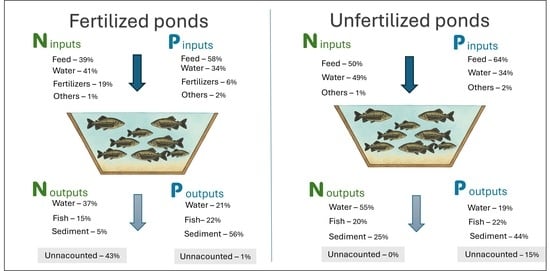
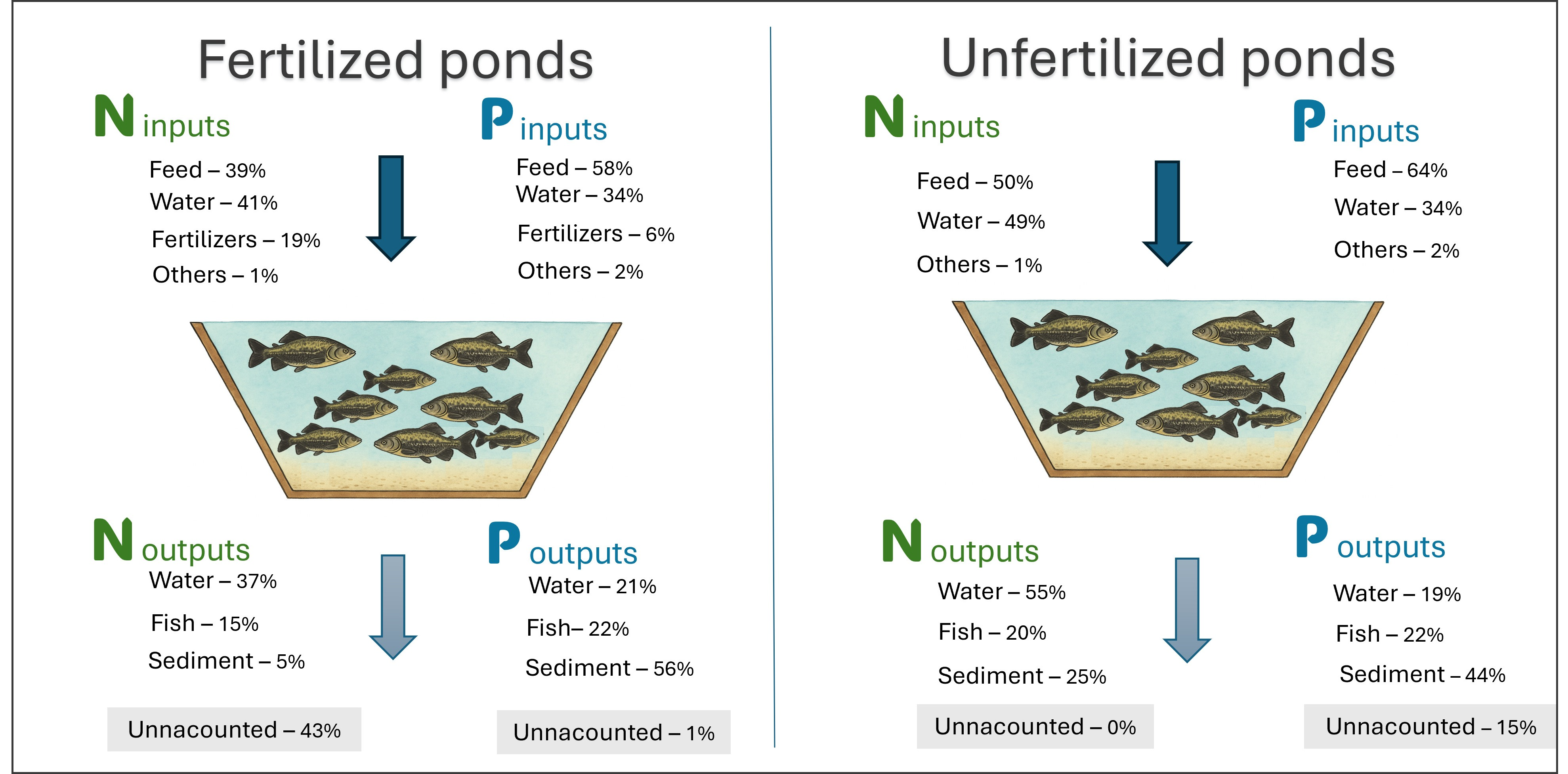
Graphical Abstract

1. Introduction

Aquaculture production systems have evolved from extensive to intensive approaches, with increasing inputs of high-quality feed and water [1]. Consequently, waste loads have risen proportionally. In general, only a small fraction of the nutrients supplied through feed in aquaculture systems is assimilated by fish, whereas the unutilized nutrients are either retained in pond sediments or released in effluents [2,3,4,5,6,7]. Nitrogen and phosphorus represent the main nutrient wastes of fish farming and can cause serious environmental impacts [8]. Thus, a key challenge for sustainable aquaculture is to maximize fish yields with minimal input while increasing the recovery of nutrients supplied through feed and fertilizers.
Nutrient addition is commonly practiced to increase fish yields in pond systems. In extensive systems without feed supplementation, fertilization promotes natural productivity and increases the availability of live food, benefiting species such as Nile tilapia (Oreochromis niloticus), sunfish (Lepomis microlophus), and carp (Cirrhinus mrigala), leading to higher yields [9,10,11,12]. Currently, aquaculture increasingly relies on formulated diets, which have become the primary nutrient source and the main contributors to feed-based cultures to nutrient-rich effluents [2,3,4,5,13,14,15]. In semi-intensive and intensive systems where formulated feed is supplied, the fertilization effects are less consistent. Studies with tambaqui (Colossoma macropomum) and Nile tilapia have shown no improvement in growth performance when fertilization is combined with commercial feed, likely because of limited changes in plankton communities and the predominance of nutrients originating from feed rather than fertilizers [16,17,18]. Since uneaten feed and fish waste are already major contributors to nutrient loading and eutrophic effluents [2,3,4,5,10,11,12], determining whether fertilizer inputs truly enhance nutrient use efficiency is essential. Clarifying the real benefits of fertilization in feed-based culture systems is therefore critical to avoid unnecessary nutrient use and discharge into the environment. Understanding and managing nutrient flows among pond ecological compartments is essential for optimizing nutrient utilization and preventing the loss of added nutrients [5].
Fertilization contributes only a small fraction of nutrients in shrimp and prawn feed-based culture. For instance, fertilization accounted for 2% of nitrogen and less than 1% of phosphorus in Penaeus monodon closed culture [15], 2.5% of nitrogen and 1% of phosphorus in Macrobrachium rosenbergii [7], and 4% of nitrogen and 1.21% of phosphorus in shrimp ponds in M. rosenbergii shrimp ponds [14]. In contrast, its contribution to fish monoculture can be higher. For example, in Osphronemus goramy pond monoculture, fertilization accounted for 34.4% of nitrogen and 38.8% of phosphorus inputs [19]. In multitrophic production systems, the contribution of fertilizers is similar to that observed in shrimp culture. For instance, in tilapia (Oreochromis niloticus) and Amazon River prawn (Macrobrachium amazonicum) multitrophic culture, fertilizers accounted for 0.4% of nitrogen and 5.7% of phosphorus input [4,5], and in Indian major carps (Catla catla, Labeo rohita, and Cirrhinus mrigala) and giant river prawn (Macrobrachium rosenbergii) multitrophic culture, fertilizers accounted for 1.23% of nitrogen and 1.84% of phosphorus inputs [13]. However, no scientific information is available on the effects of fertilization on nitrogen and phosphorus inputs, nutrient recovery in harvested biomass, and nutrient release in effluents in fish feed-based monoculture.
Aquaculture production in Brazil reached about 970,000 t in 2024, with tambaqui (Colossoma macropomum) currently being the main native species used for fish farming [20,21]. This species is native to many South American countries and is also farmed in Colombia, Peru, Venezuela, as well as in Panama and Honduras in Central America and even in Asian countries [22]. Tambaqui is a low-trophic species that adapts easily to captivity, exhibits a low feed conversion ratio (approximately 1.7), grows rapidly, and has well-established seed production technology [17,23]. In Brazil, tambaqui is produced in earthen ponds on small, medium, and large farms, with low water renewal and the use of commercial diets [21,24]. The main production systems involve either the direct stocking of juveniles for 12 months or a 3-month nursery phase followed by a 10-month grow-out period [21]. Ponds are generally fertilized to enhance plankton development, as tambaqui can utilize natural foods, mainly zooplankton, throughout its life cycle [24,25]. Since feed represents the major cost in fishpond production and is the primary contributor to eutrophic effluents [1], reducing feed use could both lower production costs and mitigate negative environmental impacts. Lima et al. [25] observed a reduction in the feed conversion ratio when tambaqui was produced in fertilized ponds. However, this practice increases production costs by about 8%. Despite these findings, the pathway of nutrients added through fertilization across different ecological compartments remains poorly understood.
Two studies have assessed nutrient budgets in tambaqui production in a subtropical region during the initial six months of culture, using ponds filled with nutrient-rich water but lacking fertilization management [2,3]. However, most of the dietary input in ponds occurs during the final months of the production cycle [26]. Moreover, nutrient dynamics in tropical pond systems may differ from those in subtropical regions, but this has not yet been investigated. Therefore, the main objective of this study was to evaluate the effects of fertilization on nitrogen and phosphorus recovery in harvested biomass and on their release to the environment through effluents in the monoculture of tambaqui in tropical earthen ponds. Nitrogen and phosphorus budgets were assessed throughout the entire grow-out of tambaqui in both fertilized and unfertilized ponds.

2. Materials and Methods

The study was conducted in eight earthen ponds, each roughly 600 m2 in area and 1.3 m deep, located at the Experimental Aquaculture Center, Embrapa, Brazil (10°8′1.33″ S, 48°19′9.86″ W). The experimental design was completely randomized, with four replicates per treatment. The factor tested was fertilization, with two levels: fertilized ponds (Fert) and unfertilized ponds (NoFert). All ponds were drained, disinfected with quicklime (100 g m−2) and limed 24 h later (100 g m−2). Initial and biweekly fertilizations were applied only in Fert ponds. The type and dose of fertilizer applied were those commonly adopted by tambaqui commercial producers. The Fert treatment included the addition of 5 g m−2 of urea, 3 g m−2 of triple superphosphate, and 10 g m−2 of rice bran before the experiment began, and biweekly thereafter until the eighth month. This management resulted in an input of 2.45 g m−2 of nitrogen (N) and 0.8 g m−2 of phosphorus (P), corresponding to an N:P mass ratio of 3:1 applied every two weeks. The inlet water was sourced from a local dam. The average concentrations of total nitrogen and total phosphorus in inlet water were 5.8 mg L−1 and 0.43 mg L−1, respectively. Ponds received water to compensate for seepage and evaporation, as well as to provide a daily water renewal of about 3% of their total volume. After ponds were filled, tambaqui juveniles with an average body weight of 93.8 ± 15.0 g and total length of 17.6 ± 0.8 cm were stocked at a density of 0.55 fish m−2 (330 fish per pond). The fish were obtained from a commercial farm located in the state of Tocantins, Brazil (11°01′55″ S, 48°35′14″ W). The experiment lasted 10 months (304 days), from March 2019 to January 2020.
Fish were fed a commercial extruded diet for omnivorous species (Laguna Omnivorous, Socil, Descalvado, São Paulo, Brazil) twice daily, at 09:00 and 15:00 h, six days a week, as described in Table 1. Feeding continued until the fish stopped eating or until the daily ration specified in Table 1, based on the feeding rate, was reached. The actual amount of feed distributed was recorded to calculate the total feed input to each pond. Every two weeks, 30 fish were randomly sampled from each pond and weighed to adjust the feeding rate. After weighing, the fish were returned to their respective ponds.

2.1. Pond Water Quality

Total nitrogen, total phosphorus, and chlorophyll-a in the culture water were measured monthly. Total nitrogen was determined using the distillation/titration method APHA [28], while total phosphorus and chlorophyll-a concentrations were quantified by spectrophotometry (APHA [28]). Total nitrogen showed no differences between treatments, whereas phosphorus and chlorophyll-a concentrations were higher in Fert ponds (Table 2). A detailed description of water quality variables in these experimental systems is provided in Lima et al. [29]. Overall, the main pond water quality variables monitored during the experiment remained within the recommendations described by Boyd [30] for general freshwater aquaculture pond systems.

2.2. Harvest

At the end of the experiment, the ponds were drained, and all fish were counted. Twenty individuals from each pond were randomly sampled and weighed to estimate survival, mean individual mass, and yield. No significant differences in final mean individual mass, survival, or yield were observed between treatments (p > 0.05). Overall, tambaqui reached a final mean mass of approximately 1663 ± 81 g, with 93 ± 4% survival and a yield of 6.18 ± 0.25 t ha−1 over a 10-month period. The feed conversion ratio (total feed supplied/total weight gain) was significantly lower in fertilized ponds (2.04 ± 0.04) compared to NoFert ponds (2.22 ± 0.08). A detailed description of production performance in these systems can be found in Lima et al. [25], which provides a full description of production performance for this experiment.

2.3. Nitrogen and Phosphorus Budget

We analyzed the key ecological compartments associated with the inputs and outputs of nitrogen (N) and phosphorus (P). The unaccounted portion (UN) was estimated as the difference between the total input of nitrogen (TNin) and phosphorus (TPin) and their respective total outputs (TNout and TPout). The equations applied were:
T N i n   o r   T P i n = I W P + I R W + C D + S F + I F ,
T N o u t   o r   T P o u t = O W P + O R W + H F + O S ,
( T N i n   o r   T P i n ) ( T N o u t   o r   T P o u t ) = U N
in these equations, IWP (inlet water for pond filling), IRW (inlet renovation water), CD (commercial diet), SF (stocked fish), and IF (input fertilizer) represent the nitrogen or phosphorus contents of the input compartments, while OWP (outlet water from pond drainage), ORW (outlet renovation water), HF (harvested fish), and OS (sediment output) represent the nitrogen or phosphorus contents of the output compartments.
Mortality was not included among the outputs due to the small number of dead fish removed during production (17 ± 10 fish per pond). The nitrogen and phosphorus use efficiency of the commercial diet (feed nitrogen conversion—FNC and feed phosphorus conversion—FPC) was calculated as the ratio of total nitrogen or phosphorus in harvested biomass to the nitrogen and phosphorus supplied through feed. The overall efficiency of nitrogen and phosphorus use (nitrogen use efficiency—NUE; phosphorus use efficiency—PUE) was calculated as the ratio of nitrogen and phosphorus in harvested biomass to the total nitrogen or phosphorus inputs.
Nitrogen and phosphorus inputs from inlet water and outputs through outlet water were calculated by multiplying total nitrogen or phosphorus concentrations by the corresponding inlet and outlet water volumes. Nutrient concentrations in the inlet water were measured once per month, including the sampling performed at pond filling. Concentrations in the outlet water were also measured monthly and once more at harvest. All analyses followed the procedures described in the pond water quality section (distillation/titration for total nitrogen; spectrophotometry for total phosphorus). Total nitrogen values included all forms of bound nitrogen (inorganic + organic) but excluded molecular nitrogen (N2). The inlet water volume was defined as the total amount of water used to fill the ponds, water added to compensate for evaporation and seepage, renovation water, and rainwater inputs. Evaporation was estimated based on meteorological data (INMET [31]) combined with pond surface area. Total daily water loss was determined by measuring changes in pond water level over 24 h without adding water. Seepage was estimated as the difference between total water loss and evaporation. Rainfall at the experimental site was recorded with a pluviometer and used to estimate pond rainwater inputs. Effluent volume was calculated as the difference between total inlet water volume and the volume lost through seepage and evaporation.
Nitrogen and phosphorus inputs from the commercial diet, fertilizers (triple superphosphate and rice bran), and stocked fish were calculated by multiplying the mean nitrogen (AOAC [32]; Nx6.25; method 988.05) and phosphorus (AOAC [32]; method MA-107 R3) concentrations in diet, fertilizers, and fish samples by the total amount of diet and fertilizer applied or the biomass of fish stocked, respectively. The same procedures were used to determine nitrogen and phosphorus output in harvested fish. Nitrogen input from urea fertilizer was calculated based on its nitrogen content of 45% [33].
The output of nitrogen and phosphorus into pond sediments was determined as follows. Soil samples were collected before the experiment and on the harvest day, immediately prior to pond draining, using a 3 L Van Veen dredge (170 × 210 mm). Three cores (10–15 cm depth) from each pond were combined into a composite sample. Samples were dried in a forced-air recirculation oven at 45 °C for 72 h, and a subsample was collected for analysis. Nutrient concentrations in the initial and final soil samples were measured to calculate nutrient accumulation over the study period. Soil analysis for nitrogen and phosphorus in resin was performed as described by Raij [34]. Sediment volume in each pond was estimated by assuming a 15 cm depth, which corresponds to the layer where nutrients typically accumulate [35]. Total sediment mass was calculated using the bulk density of each sample, and nutrient mass in the sediment was obtained by multiplying the nutrient concentration by the total sediment mass, following the procedures described by Adhikari et al. [7] and Sahu et al. [13]. Raw values of sediment nutrient concentrations and bulk density used to calculate sediment mass are provided in Supplementary Table S1. Changes in nutrient mass between the initial and final samples were interpreted as nutrient incorporation or loss in the soil [6,7,13].

2.4. Data Analysis

Data normality (Shapiro–Wilk test) and homogeneity of variances (Bartlett test) were evaluated, and Box–Cox transformation [36] was applied when assumptions were not met. Water quality parameters were analyzed using repeated measures ANOVA, with treatment, month (time), and their interactions included as fixed effects. When significant treatment effects were detected, means were compared by using Tukey’s test. Differences in nutrient retention, nutrient recovery, and input/output compartments were analyzed using Student’s t-test. Correlations between feed consumption and fluctuations in nitrogen and phosphorus levels in the sediment were assessed using Pearson’s correlation coefficient. All statistical analyses were performed in R 4.2.3 [37], with significance set at α = 0.05. Data are presented as means ± standard deviations.

3. Results

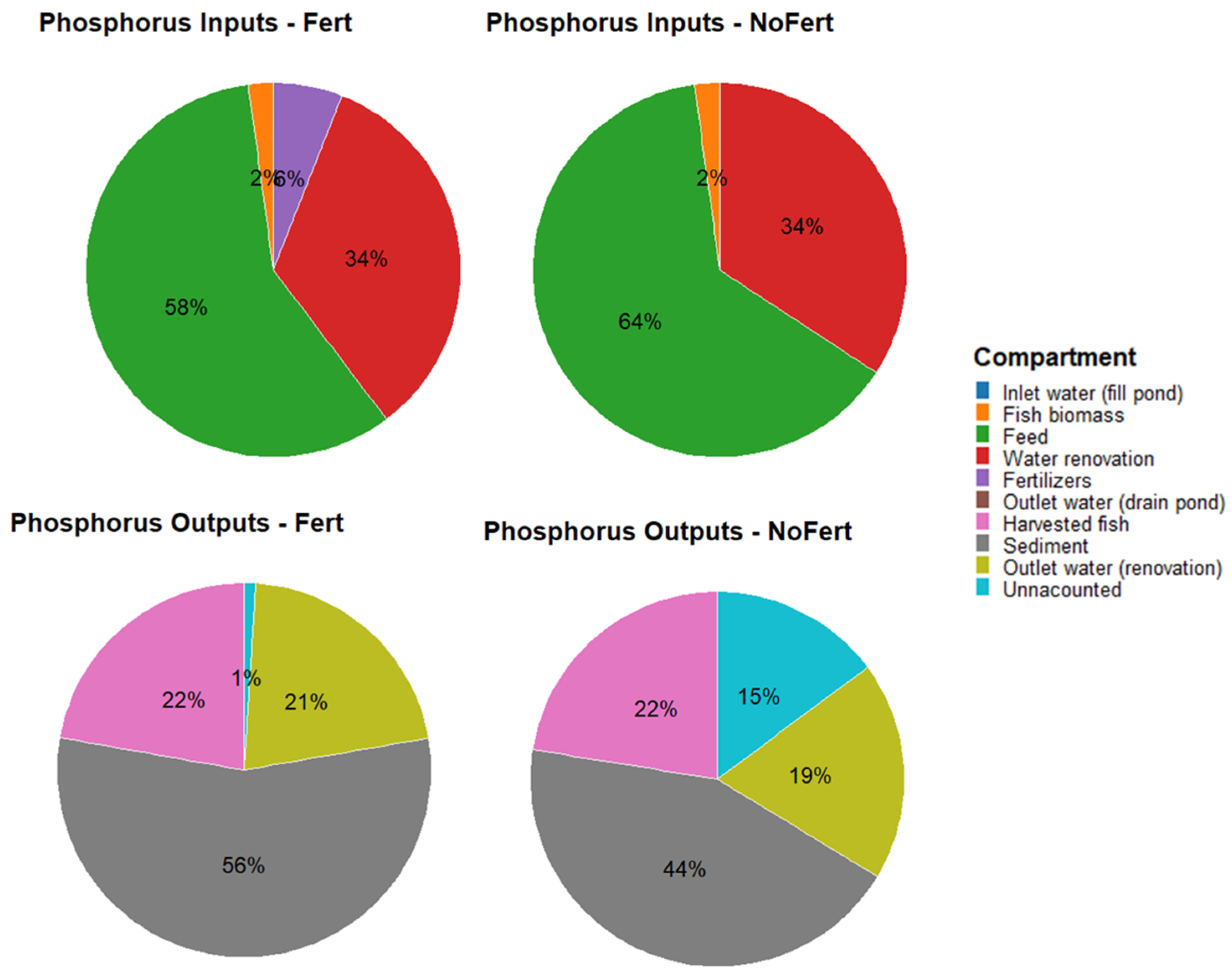
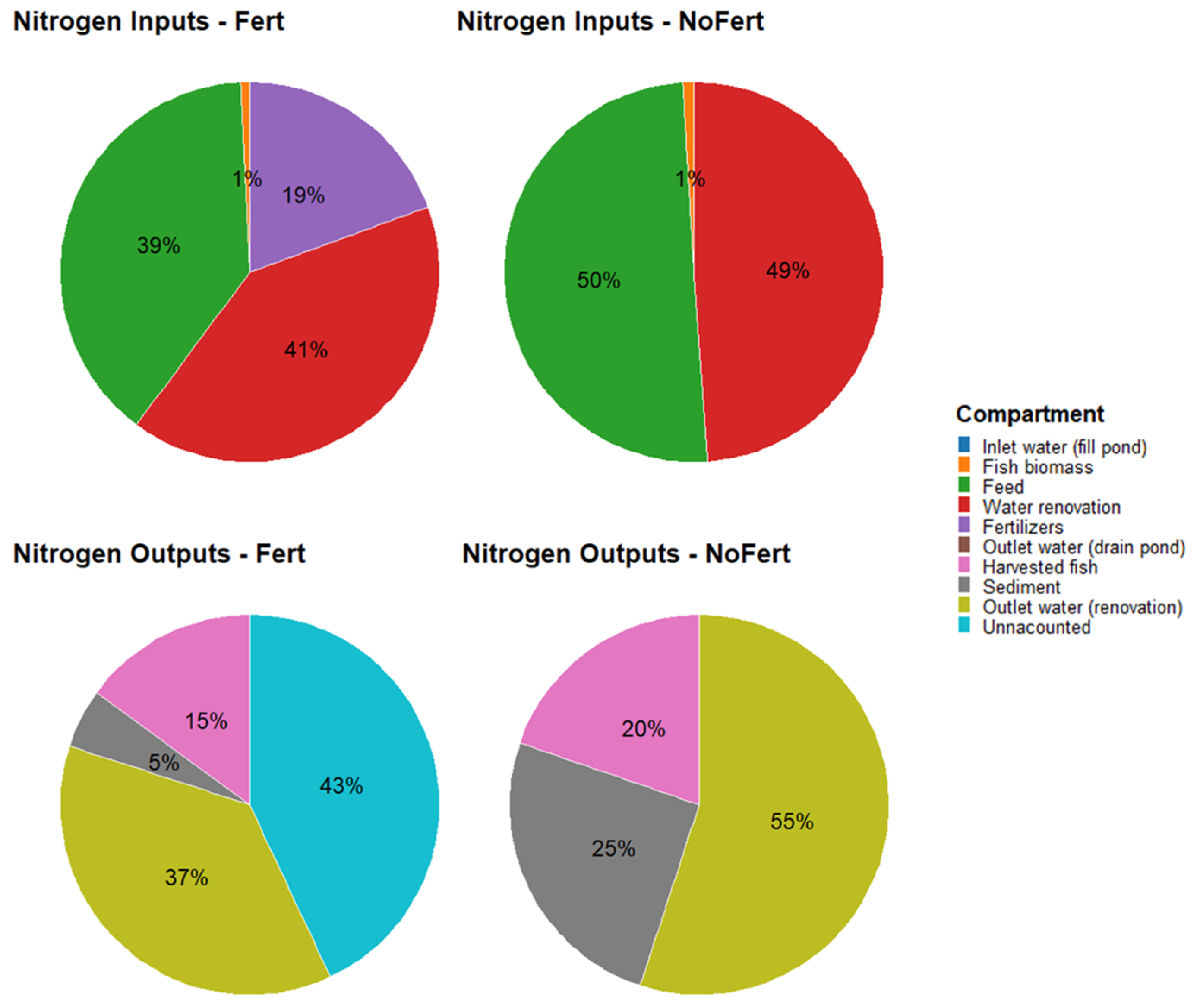
Nitrogen and phosphorus contents for each ecological compartment were converted into kg ha−1 and expressed as percentage flows of inputs and outputs. The detailed nutrient budgets are presented in Table 3 and Table 4, while Figure 1 and Figure 2 show the percentage distribution of nitrogen and phosphorus across the different input and output compartments. Positive unaccounted values indicate that part of the nutrient input was not recovered in the measured compartments, while negative values indicate the opposite. For calculating the percentage contribution of each output compartment, the absolute value of the negative unaccounted balance was incorporated into the total output, ensuring that all components could be expressed as positive values. Feed was the primary source of both nutrients in the system. Nitrogen and phosphorus inputs from the diet were significantly higher in unfertilized ponds than in fertilized ponds. Water exchange contributed amounts of nitrogen similar to those supplied by feed and was the second-largest contributor to phosphorus inputs. Stocked animals contributed approximately 1% of N and 2% of P, whereas fertilizers accounted for 19% of N and 6% of P in fertilized ponds. Consequently, total N input was significantly higher in fertilized ponds, while total P input did not differ significantly between treatments.
Nitrogen retained in environmental outputs, including water (OWP + ORW) and sediment (OS), ranged from approximately 42 to 80%, whereas phosphorus outputs to the environment ranged from 63 to 77% (Figure 1 and Figure 2). No significant correlations were observed between feed consumption and fluctuations in N and P levels in the sediment (p > 0.05). Nutrient retention in harvested fish accounted for approximately 15–20% of N and 22% of P. Nutrient outputs in the sediment exhibited high variability, resulting in considerable variation in N output and unaccounted nutrient values. Consequently, no significant differences were detected in unaccounted N and P or in total nutrient outputs between treatments.
Unfertilized ponds exhibited higher total nitrogen use efficiency (Table 5). However, no significant differences were observed between treatments in feed nitrogen and phosphorus conversion, or in total phosphorus use efficiency (Table 5).

4. Discussion

Nitrogen and phosphorus budgets revealed that feed was the main source of both nutrients in tambaqui production, followed by water exchange, while fertilizers contributed 19% of N and 6% of P in fertilized ponds. As a result of fertilization, total N input was significantly higher in fertilized ponds; however, total P input did not differ significantly between treatments. Despite the higher nutrient inputs, no significant differences were observed in total outputs or in the unaccounted N and P fractions. Nitrogen and phosphorus retained in fish biomass represented 15–20% and 22% of total inputs, respectively, while environmental outputs (water and sediment) accounted for up to 80% of N and 77% of P.
In fed aquaculture systems, formulated diets are the main source of nutrients and play a major role in sustaining high fish productivity [1]. In tambaqui production ponds, nitrogen and phosphorus inputs mainly come from the commercial diet, accounting for 39% of N and 58% of P in fertilized ponds and 50% of N and 64% of P in unfertilized ponds, respectively. Harvested biomass recovered 43% of dietary nitrogen and 39% of dietary phosphorus in fertilized ponds, compared with 39% and 35% in unfertilized ponds. The higher nutrient recovery observed in fertilized ponds may be attributed to greater ingestion and assimilation of natural food by tambaqui, as this species actively consumes these resources in aquaculture ponds [25], thereby reducing nitrogen and phosphorus input from the diet. However, the lower nutrient input from the diet in fertilized ponds was insufficient to offset the additional nitrogen added through fertilization, resulting in a higher total nitrogen input and lower nutrient use efficiency. In general, a positive correlation between feed and nutrient loading has been reported in aquaculture systems without fertilization management [26]. However, when fertilizers are applied, this relation may change. For example, fertilizer accounts for 34% of nitrogen and 39% of phosphorus inputs in semi-intensive giant gourami (Osphronemus goramy) production [19], whereas in the present study it contributed 19% of nitrogen and 6% of phosphorus inputs. In contrast, total phosphorus input was unaffected by fertilization, indicating that the reduction in dietary phosphorus input was offset by fertilizer application. For nitrogen, however, fertilizer addition exceeded the amount required to offset the lower dietary contribution, resulting in a higher total nitrogen input and, consequently, reduced nitrogen use efficiency. This pattern may reflect the distinct roles of fertilizers as nutrient sources in freshwater systems, where phosphorus is often the limiting nutrient.
Inlet water was the second-largest contributor to nitrogen and phosphorus inputs in tambaqui production (~41–49% and ~34%, respectively), likely due to its relatively high nitrogen (5.77 ± 3.09 mg L−1) and phosphorus (0.43 ± 0.48 mg L−1) concentrations. Similarly, Flickinger et al. (2019, 2020) [2,3] reported substantial contributions of inflow water to nitrogen (23–58%) and phosphorus (21–37%) inputs in monoculture and integrated systems producing tambaqui and Amazon River prawn, even without water exchange, using hypereutrophic water (2.2 ± 0.6 mg L−1 N and 0.10 ± 0.04 mg L−1 P). Consistently, Belmudes et al. [38] found a notable contribution of inflow water to nitrogen inputs (20–30%) during yellowtail lambari (Astyanax lacustris) monoculture, integrated culture with Amazon River prawn, and integrated culture with prawn and curimba (Prochilodus lineatus) over a 60-day production period in ponds. By contrast, Pouil et al. [19] reported lower inlet water concentrations of nitrogen (2.0 ± 0.4 mg L−1) and phosphorus (0.012 ± 0.019 mg L−1) and, consequently, a lower percentage contribution (3–10%). These findings indicate that the contribution of inlet water to nutrient inputs in pond systems depends on the quality of the water supply.
Sediment has been identified as the primary sink of nitrogen and phosphorus in previous nutrient budget studies [4,5,13,19,39]. This pattern was observed in the present study for phosphorus (44–56%), but outlet water was the main compartment of nitrogen output (37–55%); sediment was even lower than harvested biomass in fertilized ponds. Given the higher total nitrogen input in fertilized ponds, greater accumulation of this nutrient in the sediment was expected. The reduction in nitrogen load in the sediment (−104 ± 712 kg ha−1) in fertilized ponds is unexpected, and the underlying causes should be investigated. No significant differences in nitrogen and phosphorus sediment accumulation were observed between fertilized and unfertilized ponds. This is probably due to the high variability in sediment among the ponds in both treatments, which reduces the power of the t-test. This high variability suggests that multiple factors may influence nitrogen and phosphorus accumulation in the sediment, such as decomposition of organic matter, seepage into deeper layers and denitrification, which releases N2 gas into the atmosphere. This variability may also be related to intrinsic sediment properties that affect nutrient retention and mobility. The soil in the study area is classified as Plinthosol [40], characterized by low uniformity and high variability in fine-earth texture [41]. These characteristics influence water movement in the sediment, with some areas favoring infiltration and nutrient loss, while others exhibit reduced percolation and greater nutrient retention.
Flickinger et al. [3] observed that nearly 50% of nitrogen was lost via denitrification in tambaqui monoculture ponds. Although gas emissions were not measured in this study, they may account for part of the unaccounted nitrogen and help explain the reduction in nitrogen in fertilized pond sediments. Fertilization increased the amount of natural food in fertilized ponds [25], i.e., the transformation of nutrients into living organisms that later contribute to the sediment upon their death. These processes may have been responsible for the increases in carbon concentrations in the sediment, previously described for this same experiment [29]. This elevated carbon availability can accelerate denitrification, reduce nitrogen accumulation, and enhance its release as N2 gas [42]. Additionally, bioturbation caused by manual fertilizer distribution, performed by walking through the ponds, and by fish sampling, likely promoted sediment resuspension, thereby enhancing organic matter degradation [43], preventing gas bubble accumulation [44], and further accelerating denitrification. As bioturbation occurred more frequently in fertilized ponds, it may have contributed to higher N2 liberation. Together, these processes may contribute to the large variability observed in sediment accumulation of nitrogen and phosphorus in fertilized and unfertilized ponds.
The harvested biomass assimilated 22% of the phosphorus input and 15–20% of the nitrogen input, with no significant differences between treatments, indicating similar efficiency in phosphorus and nitrogen uptake. These results highlight the low recovery efficiency of both nutrients in tambaqui monoculture, regardless of fertilizer use. Most of the nitrogen not retained in fish biomass was released into the environment through outlet water (37–55%). A similar pattern was observed for phosphorus (19–21%). Comparable findings have been reported in the literature. For example, Flickinger et al. [2,3] documented low nutrient recovery efficiency in tambaqui production, with assimilation rates of 21% for nitrogen and 13% for phosphorus in fish biomass. Likewise, Osti et al. [26] reported that Nile tilapia in earthen ponds recovered a higher proportion of phosphorus (46%) compared to nitrogen (26%). The limited efficiency of nitrogen and phosphorus retention in tambaqui monoculture raises concerns about the use of this production model. It also underscores the potential benefits of adopting more efficient systems, such as integrated multitrophic aquaculture, which has been shown to improve nutrient recovery compared with monoculture of this species [2,3,45,46].
Although nutrient recovery in harvested biomass was low, this does not imply poor environmental sustainability, which depends on many other factors. Despite limited conversion of dietary nutrients into fish biomass, effluent nutrient exports were minimal, indicating strong internal retention and recycling. The low water exchange combined with nutrient recycling by plankton and the ability of tambaqui to assimilate natural food are important characteristics that increase the sustainability of the system. Similar patterns have been reported for semi-intensive tropical pond systems with limited water exchange [2,3,15,39]. Additionally, life cycle assessment studies have shown that semi-intensive pond systems consistently exhibit lower eutrophication impacts than intensive aquaculture [47].
Imbalances are common in mass balance analyses, resulting from combined effects of methodological limitations and the omission of certain ecological compartments [5]. In the present study, nitrogen exchange with the atmosphere and loss by seepage in the soil were not measured and may have contributed to the unaccounted nitrogen fraction [39]. Denitrification, which converts nitrate into N2 gas under anaerobic conditions at the pond bottom, is a major pathway of nitrogen loss to the atmosphere. This process can be particularly intense in freshwater ponds. For example, Flickinger et al. [3] reported that denitrification accounted for 48% (~325 kg ha−1) of nitrogen output in tambaqui monoculture ponds filled with hypereutrophic water over a 6-month production cycle in a subtropical region. In our study, the high proportion of unaccounted nitrogen in fertilized ponds (43%) is likely to be linked to gaseous losses via denitrification. The denitrification process in pond sediments is regulated by the availability of organic carbon [48]. Since fertilized ponds generally support greater plankton production, which increases organic carbon deposition in the sediment, this condition may have favored denitrification. In contrast, no unaccounted nitrogen was detected in the unfertilized ponds, possibly due to the lower nitrogen inputs and the consequent reduction in denitrification. More recently, Belmudes et al. [38] reported a nitrogen unaccounted fraction of 32% in lambari (Astyanax lacustris) monoculture. In their study, seepage represented 28% of total nitrogen output, confirming it as a relevant pathway of nitrogen loss. This pathway is likely relevant not only to nitrogen but also to phosphorus, which exhibited a high unaccounted portion (15%) in unfertilized ponds. High unaccounted nutrient fractions are common in pond-based aquaculture, with previous studies frequently reporting 30–50% for nitrogen and 15–30% for phosphorus due to gaseous losses, seepage, and analytical variability [2,3,38,49]. Thus, the magnitude of the unaccounted fractions observed here is consistent with values reported for similar semi-intensive systems.

5. Conclusions

This study confirmed the inefficiency of nutrient recovery as fish biomass in monocultures. Although pond fertilization can boost natural food and reduce feed inputs, it has a limited effect on nutrient assimilation by fish. On the other hand, the results indicated that tambaqui culture can retain nitrogen and phosphorus within ponds, generating effluent nutrient loads similar to those of the inlet water. Nitrogen fertilization increased total nutrient inputs without improving recovery efficiency, indicating limited benefits and raising concerns about the environmental and economic sustainability of this practice in fed tambaqui aquaculture. These findings suggest that fertilization strategies should be reconsidered and optimized to avoid unnecessary nutrient loading. Fertilization may be effective particularly when nutrient-poor source water is used.
The high variability observed in the sediment compartment highlights the complexity of the factors acting in the biogeochemical processes at the pond bottom, which should be investigated. Future studies should focus on identifying the drivers of sediment nutrient dynamics and evaluating alternative management strategies to enhance nutrient use efficiency and minimize environmental losses.

Supplementary Materials

The following supporting information can be downloaded at: https://www.mdpi.com/article/10.3390/fishes11010005/s1, Table S1: Initial and final sediment nitrogen and phosphorus concentrations and bulk density in fertilized (Fert) and unfertilized (NoFert) tambaqui (Colossoma macropomum) ponds over a 10-month grow-out period.

Author Contributions

Conceptualization and Methodology, A.F.L. and W.C.V.; Formal Analysis, Investigation, Resources, and Data Curation, A.F.L.; Writing—Original Draft Preparation, A.F.L.; Writing—Review and Editing, W.C.V.; Funding Acquisition, A.F.L. All authors have read and agreed to the published version of the manuscript.

Funding

This work was part of the BRS Aqua Program and was supported by the Brazilian Development Bank—Technologic Fund (BNDES-Funtec, Contract 16.2.0225.1), the Ministry of Agriculture, Livestock and Food Supply (MAPA, Process 00350.000111/2014-50), and the Brazilian Agricultural Research Corporation (EMBRAPA, Grant number 21.17.02.001.05.00), in partnership with the Brazilian National Council for Scientific and Technological Development (CNPq, Process 421502/2017-7).

Institutional Review Board Statement

All procedures used in this study were approved by the Ethics Committee on the Use of Animals (CEUA) of the EMBRAPA FISHERIES AND AQUACULTURE (protocol no. 42/2018 and approval date: 29 October 2018).

Informed Consent Statement

Not applicable.

Data Availability Statement

Data is contained within the article and Supplementary Material.

Conflicts of Interest

The authors declare no conflicts of interest.

References

  1. Boyd, C.E.; D’Abramo, L.R.; Glencross, B.D.; Huyben, D.C.; Juarez, L.M.; Lockwood, G.S.; McNevin, A.A.; Tacon, A.G.J.; Teletchea, F.; Tomasso, J.R.; et al. Achieving Sustainable Aquaculture: Historical and Current Perspectives and Future Needs and Challenges. J. World Aquac. Soc. 2020, 51, 578–633. [Google Scholar] [CrossRef]
  2. Flickinger, D.L.; Dantas, D.P.; Proença, D.C.; David, F.S.; Valenti, W.C. Phosphorus in the Culture of the Amazon River Prawn (Macrobrachium amazonicum) and Tambaqui (Colossoma macropomum) Farmed in Monoculture and in Integrated Multitrophic Systems. J. World Aquac. Soc. 2020, 51, 1002–1023. [Google Scholar] [CrossRef]
  3. Flickinger, D.L.; Costa, G.A.; Dantas, D.P.; Moraes-Valenti, P.; Valenti, W.C. The Budget of Nitrogen in the Grow-out of the Amazon River Prawn (Macrobrachium amazonicum Heller) and Tambaqui (Colossoma macropomum Cuvier) Farmed in Monoculture and in Integrated Multitrophic Aquaculture Systems. Aquac. Res. 2019, 50, 3444–3461. [Google Scholar] [CrossRef]
  4. David, F.S.; Proença, D.C.; Valenti, W.C. Nitrogen Budget in Integrated Aquaculture Systems with Nile Tilapia and Amazon River Prawn. Aquac. Int. 2017, 25, 1733–1746. [Google Scholar] [CrossRef]
  5. David, F.S.; Proença, D.C.; Valenti, W.C. Phosphorus Budget in Integrated Multitrophic Aquaculture Systems with Nile Tilapia, Oreochromis niloticus, and Amazon River Prawn, Macrobrachium amazonicum. J. World Aquac. Soc. 2017, 48, 402–414. [Google Scholar] [CrossRef]
  6. Zhang, X.; Davidson, E.A.; Zou, T.; Lassaletta, L.; Quan, Z.; Li, T.; Zhang, W. Quantifying Nutrient Budgets for Sustainable Nutrient Management. Glob. Biogeochem. Cycles 2020, 34, e2018GB006060. [Google Scholar] [CrossRef]
  7. Adhikari, S.; Sahu, B.C.; Mahapatra, A.S.; Dey, L. Nutrient Budgets and Effluent Characteristics in Giant Freshwater Prawn (Macrobrachium rosenbergii) Culture Ponds. Bull. Environ. Contam. Toxicol. 2014, 92, 509–513. [Google Scholar] [CrossRef] [PubMed]
  8. Turcios, A.E.; Papenbrock, J. Sustainable Treatment of Aquaculture Effluents-What Can We Learn from the Past for the Future? Sustainability 2014, 6, 836–856. [Google Scholar] [CrossRef]
  9. Boyd, C.E. Comparison of 5 Fertilization Programs for Fish Ponds. Trans. Am. Fish. Soc. 1981, 110, 541–545. [Google Scholar] [CrossRef]
  10. Knud-Hansen, C.F.; Batterson, T.R.; McNabb, C.D.; Harahat, I.S.; Sumantadinata, K.; Eidman, H.M. Nitrogen Input, Primary Productivity and Fish Yield in Fertilized Freshwater Ponds in Indonesia. Aquaculture 1991, 94, 49–63. [Google Scholar] [CrossRef]
  11. Garg, S.K.; Bhatnagar, A. Effect of Fertilization Frequency on Pond Productivity and Fish Biomass in Still Water Ponds Stocked with Cirrhinus mrigala (Ham.). Aquac. Res. 2000, 31, 409–414. [Google Scholar] [CrossRef]
  12. Garg, S.K.; Bhatnagar, A. Effect of Different Doses of Organic Fertilizer (Cow Dung) on Pond Productivity and Fish Biomass in Stillwater Ponds. J. Appl. Ichthyol. 1999, 15, 10–18. [Google Scholar] [CrossRef]
  13. Sahu, B.C.; Adhikari, S.; Mahapatra, A.S.; Dey, L. Nitrogen, Phosphorus, and Carbon Budgets in Polyculture Ponds of Indian Major Carps and Giant Freshwater Prawn in Orissa State, India. J. Appl. Aquac. 2015, 27, 365–376. [Google Scholar] [CrossRef]
  14. Sahu, B.C.; Adhikari, S.; Mahapatra, A.S.; Dey, L. Carbon, Nitrogen, and Phosphorus Budget in Scampi (Macrobrachium rosenbergii) Culture Ponds. Environ. Monit. Assess. 2013, 185, 10157–10166. [Google Scholar] [CrossRef]
  15. Thakur, D.P.; Lin, C.K. Water Quality and Nutrient Budget in Closed Shrimp (Penaeus monodon) Culture Systems. Aquac. Eng. 2003, 27, 159. [Google Scholar] [CrossRef]
  16. Duodu, C.; Boateng, D.; Edziyie, R. Effect of Pond Fertilization on Productivity of Tilapia Pond Culture in Ghana. J. Fish. Coast. Manag. 2020, 2, 56–64. [Google Scholar] [CrossRef]
  17. Gomes, L.C.; Silva, C.R. Impact of Pond Management on Tambaqui, Colossoma macropomum (Cuvier), Production during Growth-out Phase. Aquac. Res. 2009, 40, 825–832. [Google Scholar] [CrossRef]
  18. Silva, A.M.D.; Gomes, L.C.; Roubach, R. Growth, Yield, Water and Effluent Quality in Ponds with Different Management during Tambaqui Juvenile Production. Pesqui. Agropecuária Bras. 2007, 42, 733–740. [Google Scholar] [CrossRef]
  19. Pouil, S.; Samsudin, R.; Slembrouck, J.; Sihabuddin, A.; Sundari, G.; Khazaidan, K.; Kristanto, A.H.; Pantjara, B.; Caruso, D. Nutrient Budgets in a Small-Scale Freshwater Fish Pond System in Indonesia. Aquaculture 2019, 504, 267–274. [Google Scholar] [CrossRef]
  20. Peixe BR (Associação Brasileira da Piscicultura). Anuário Peixe BR da Piscicultura 2025: Mapa da Piscicultura No Brasil; Associação Brasileira da Piscicultura—Peixe BR: Brasília, Brazil, 2025. [Google Scholar]
  21. Valenti, W.C.; Barros, H.P.; Moraes-Valenti, P.; Bueno, G.W.; Cavalli, R.O. Aquaculture in Brazil: Past, Present and Future. Aquac. Rep. 2021, 19, 100611. [Google Scholar] [CrossRef]
  22. Hilsdorf, A.W.S.; Hallerman, E.; Valladão, G.M.R.; Zaminhan-Hassemer, M.; Hashimoto, D.T.; Dairiki, J.K.; Takahashi, L.S.; Albergaria, F.C.; Gomes, M.E.d.S.; Venturieri, R.L.L.; et al. The Farming and Husbandry of Colossoma macropomum: From Amazonian Waters to Sustainable Production. Rev. Aquac. 2022, 14, 993–1027. [Google Scholar] [CrossRef]
  23. Woynárovich, A.; Van Anrooy, R. Field Guide to the Culture of Tambaqui Colossoma macropomum, Cuvier, 1816; Food and Agriculture Organization of the United Nations: Rome, Italy, 2019; Volume 624 de FAO Fisheries and Aquaculture Technical Paper; ISBN 978-92-5-131242-1. [Google Scholar]
  24. Valladão, G.M.R.; Gallani, S.U.; Pilarski, F. South American Fish for Continental Aquaculture. Rev. Aquac. 2018, 10, 351–369. [Google Scholar] [CrossRef]
  25. Lima, A.F.; dos Reis, A.G.P.; Costa, V.E.; Valenti, W.C. Natural Food Intake and Its Contribution to Tambaqui Growth in Fertilized and Unfertilized Ponds. Fishes 2024, 9, 139. [Google Scholar] [CrossRef]
  26. Osti, J.A.S.; Moraes, M.A.B.; Carmo, C.F.; Mercante, C.T.J. Fluxo de Nitrogênio e Fósforo Na Produção de Tilápia-Do-Nilo (Oreochromis Niloticus) a Partir Da Aplicação de Indicadores Ambientais. Braz. J. Biol. 2018, 78, 25–31. [Google Scholar] [CrossRef]
  27. Oliveira, A.C.B.; Miranda, E.C.; Correia, R. Exigências Nutricionais e Alimentação Do Tambaqui. In Nutriaqua: Nutrição e Alimentação de Especies de Interesse Para a Aquicultura Brasileira; Fracalossi, D., Cyrino, J.E.P., Eds.; Sociedade Brasileira de Aquicultura e Biologia Aquática: Florianópolis, Brazil, 2013; p. 375. [Google Scholar]
  28. APHA. Standard Methods for the Examination of Water and Waste Water, 23rd ed.; American Public Health Association: Washington, DC, USA, 2017. [Google Scholar]
  29. Lima, A.F.; Maciel-Honda, P.O. Implications of Pond Fertilization on Fish Performance, Health, Effluent, and Sediment Quality in Tambaqui Aquaculture. Aquat. Living Resour. 2025, 38, 17. [Google Scholar] [CrossRef]
  30. Boyd, C.E. Water Quality: An Introduction, 3rd ed.; Springer: Berlin/Heidelberg, Germany, 2020; ISBN 9783030233341. [Google Scholar]
  31. INMET—Instituto Nacional de Meteorologia Mapa de Estações Meteorológicas e Dados Pluviométricos. Available online: https://mapas.inmet.gov.br/ (accessed on 22 October 2025).
  32. AOAC (Association of Official Analytical Chemists). Official Methods of Analysis of AOAC International; AOAC International: Gaithersburg, MD, USA, 2005. [Google Scholar]
  33. Boyd, C.E.; Lichtkoppler, F. Water Quality Management in Pond Fish Culture (Research and Development Series), 1st ed.; Boyd, C.E., Lichtkoppler, F., Eds.; Auburn University: Auburn, AL, USA, 1979; Volume 22. [Google Scholar]
  34. van Raij, B.; Cantarella, H.; Quaggio, J.A.; Andrade, J.C. Análise Química Para Avaliação Da Fertilidade de Solos Tropicais; Instituto Agronômico: Campinas, Brazil, 2001; ISBN 85-85564-05-9. [Google Scholar]
  35. Munsiri, P.; Boyd, C.E.; Hajek, B.F. Physical and Chemical Characteristics of Bottom Soil Profiles in Ponds at Auburn, Alabama, USA and a Proposed System for Describing Pond Soil Horizons. J. World Aquac. Soc. 1995, 26, 346–377. [Google Scholar] [CrossRef]
  36. Box, G.E.P.; Cox, D.R. An Analysis of Transformation. J. R. Stat. Soc. 1964, 26, 211–243. [Google Scholar] [CrossRef]
  37. R Core Team. A Language and Environment for Statistical Computing. Available online: https://www.r-project.org/ (accessed on 9 April 2024).
  38. Belmudes, D.; Boaratti, A.Z.; Mantoan, P.V.L.; Marques, A.M.; Ferreira, J.R.C.; Moraes-Valenti, P.; Flickinger, D.L.; Valenti, W.C. Nitrogen Budget in Yellow-Tail Lambari Monoculture and Integrated Aquaculture. Fishes 2025, 10, 480. [Google Scholar] [CrossRef]
  39. Nhan, D.K.; Verdegem, M.C.J.; Milstein, A.; Verreth, J.A.V. Water and Nutrient Budgets of Ponds in Integrated Agriculture-Aquaculture Systems in the Mekong Delta, Vietnam. Aquac. Res. 2008, 39, 1216–1228. [Google Scholar] [CrossRef]
  40. IBGE—Instituto Brasileiro de Geografia e Estatística. Pedologia Do Estado Do Tocantins. Available online: https://geoftp.ibge.gov.br/informacoes_ambientais/pedologia/mapas/unidades_da_federacao/to_pedologia.pdf (accessed on 22 October 2025).
  41. Campos, D.S.d.; Brizzi, R.R.; Almeida, R.E.M.; Vidal-Torrado, P. Plintossolos Pétricos Do Tocantins. In Compêndio de Solos do Brasil; Fontana, A., Loss, A., Pedron, F.d.A., Eds.; Sociedade Brasileira de Ciência do Solo: Santa Maria, CA, USA, 2025; Volume 2, pp. 146–170. [Google Scholar]
  42. Fleischer, S.; Gustafson, A.; Joelsson, A.; Pansar, J.; Stibe, L. Nitrogen Removal in Created Ponds. Ambio 1994, 23, 349–357. [Google Scholar]
  43. Joyni, M.J.; Kurup, B.M.; Avnimelech, Y. Bioturbation as a Possible Means for Increasing Production and Improving Pond Soil Characteristics in Shrimp-Fish Brackish Water Ponds. Aquaculture 2011, 318, 464–470. [Google Scholar] [CrossRef]
  44. Oliveira Junior, E.S.; Temmink, R.J.M.; Buhler, B.F.; Souza, R.M.; Resende, N.; Spanings, T.; Muniz, C.C.; Lamers, L.P.M.; Kosten, S. Benthivorous Fish Bioturbation Reduces Methane Emissions, but Increases Total Greenhouse Gas Emissions. Freshw. Biol. 2019, 64, 197–207. [Google Scholar] [CrossRef]
  45. Boyd, C.E. Guidelines for Aquaculture Effluent Management at the Farm-Level. Aquaculture 2003, 226, 101–112. [Google Scholar] [CrossRef]
  46. Lima, A.F.; Aubin, J.; Valenti, W.C. Reducing Environmental Impacts in Tambaqui Aquaculture: A Life Cycle Assessment of Integrated Multitrophic Aquaculture with Curimba. Aquaculture 2026, 612, 743144. [Google Scholar] [CrossRef]
  47. Yacout, D.M.M.; Soliman, N.F.; Yacout, M.M. Comparative Life Cycle Assessment (LCA) of Tilapia in Two Production Systems: Semi-Intensive and Intensive. Int. J. Life Cycle Assess. 2016, 21, 806–819. [Google Scholar] [CrossRef]
  48. Liu, X.; Gao, M.; Wang, J.; Gu, Z.; Cheng, G.F. Characteristics of Denitrification and Anammox in the Sediment of an Aquaculture Pond. Front. Environ. Sci. 2022, 10, 1023835. [Google Scholar] [CrossRef]
  49. Barbosa, A.P.D.; Kosten, S.; Muniz, C.C.; Oliveira-Junior, E.S. From Feed to Fish—Nutrients’ Fate in Aquaculture Systems. Appl. Sci. 2024, 14, 6056. [Google Scholar] [CrossRef]
Figure 1. Percentage distribution of nitrogen inputs and outputs in tambaqui Colossoma macropomum production in fertilized (Fert) and unfertilized (NoFert) ponds over 10 months. Percentages (%) indicate the contribution of each nitrogen input and output component relative to the total nitrogen inputs and total nitrogen outputs, respectively.
Fishes 11 00005 g001
Figure 2. Percentage distribution of phosphorus inputs and outputs in tambaqui Colossoma macropomum production in fertilized (Fert) and unfertilized (NoFert) ponds for 10 months. Percentages (%) indicate the contribution of each phosphorus input and output component relative to the total phosphorus inputs and total nitrogen outputs, respectively.
Fishes 11 00005 g002
Table 1. Feed management for tambaqui Colossoma macropomum during a 10-month pond grow-out. The feed rate was used to calculate the maximum daily quantity of diet supplied. Adapted from Oliveira et al. [27].
Fish Weight (g)Crude Protein
(%)
Pellet Size
(mm)
Feed Rate
(% Body Weight Day−1)
Number of Daily Meals
60–2003244.52
200–5003263.52
500–7003262.52
700–28102.52
Table 2. Total nitrogen, phosphorus, and chlorophyll-a in tambaqui (Colossoma macropomum) cultured in fertilized (Fert) and unfertilized (NoFert) ponds over a 10-month grow-out period. Different letters in the same row indicate significant differences (p < 0.05). Treat = treatment.
Water ParametersFertNoFertp-Values
TreatTimeTreat × Time
Total Nitrogen (mg L−1)5.72 ± 2.995.83 ± 3.320.9481<0.00010.0241
Total Phosphorus (µg L−1)390 ± 230 a330 ± 220 b0.04240.00010.7673
Chlorophyll-a (µg L−1)17.06 ± 16.48 a10.71 ± 8.29 b0.00230.00010.0396
Table 3. Mean values (±SD) of nitrogen load in each pond compartment for the nitrogen budget of tambaqui Colossoma macropomum production in fertilized (Fert) and unfertilized (NoFert) ponds over 10 months. Different letters within the same row indicate significant differences according to Student’s t-test (p < 0.05). TNin = total nitrogen input; TNout = total nitrogen output; UN = unaccounted nitrogen fraction.
Ecological Compartments Nitrogen (kg ha−1)
FertNoFertp-Value
TNin
Commercial diet700 ± 25 b752 ± 12 a0.010
Inlet water (fill ponds)0.070.07-
Inlet water (renovation)732732 -
Stocked fish1414 -
Fertilizers349 --
Total inputs1795 ± 25 a1498 ± 12 b<0.001
TNout
Outlet water (drain pond)0.05 ± 0.040.04 ± 0.020.705
Outlet water (renovation)742 ± 141826 ± 670.323
Harvested fish301 ± 34296 ± 190.809
Sediment−104 ± 712378 ± 6430.353
Total outputs938 ± 6321500 ± 6840.273
UN
Inputs–Outputs857 ± 620−2 ± 6800.146
Table 4. Mean values (±SD) of phosphorus load in each pond compartment for the phosphorus budget of tambaqui Colossoma macropomum production in fertilized (Fert) and unfertilized (NoFert) ponds over 10 months. Different letters within the same row indicate significant differences according to Student’s t-test (p < 0.05). TPin = total phosphorus input; TPout = total phosphorus output; UN = unaccounted phosphorus fraction.
Ecological Compartments Phosphorus (kg ha−1)
FertNoFertp-Value
TPin
Commercial diet144 ± 6 b156 ± 5 a0.027
Inlet water (fill ponds)0.0030.003-
Inlet water (renovation)5252-
Stocked fish55-
Fertilizers15--
Total inputs248 ± 6245 ± 50.350
TPout
Outlet water (drain pond)0.003 ± 0.0020.002 ± 0.0010.474
Outlet water (renovation)53 ± 1146 ± 50.282
Harvested fish56 ± 655 ± 30.860
Sediment143 ± 105107 ± 790.847
Total outputs252 ± 108208 ± 790.340
UN
Inputs–Outputs−4 ± 11336 ± 750.534
Table 5. Feed conversion and nutrient use efficiencies (mean ± SD) of nitrogen and phosphorus accumulated in the harvested biomass of tambaqui (Colossoma macropomum) reared in fertilized (Fert) and unfertilized (NoFert) ponds over 10 months. Different letters within the same row indicate significant differences according to Student’s t-test (p < 0.05).
Treatments
FertNoFertp-Value
Feed nitrogen conversion—FNC (%)43 ± 440 ± 30.3271
Total nitrogen use efficiency—NUE (%)17 ± 2 b20 ± 1 a0.0272
Feed phosphorus conversion—FPC (%)38 ± 435 ± 20.2043
Total phosphorus use efficiency—PUE (%)26 ± 326 ± 10.9214
Disclaimer/Publisher’s Note: The statements, opinions and data contained in all publications are solely those of the individual author(s) and contributor(s) and not of MDPI and/or the editor(s). MDPI and/or the editor(s) disclaim responsibility for any injury to people or property resulting from any ideas, methods, instructions or products referred to in the content.