


Abstract
The Atlantic horse mackerel (Trachurus trachurus) and the Mediterranean horse mackerel (T. mediterraneus) are two commercially important species whose biological traits remain insufficiently studied in the Central Mediterranean Sea. This study examines their age, growth pattern, and, for the first time, otolith morphology in both species in the Eastern Ionian Sea. The intercept of the weight–length relationship was a = 0.00599 (95% CI = 0.0050–0.0072) for T. trachurus and a = 0.00801 (95% CI = 0.0072–0.0089) for T. mediterraneus, and the slope was b = 3.121 (95% CI: 3.058–3.183) and b = 2.994 (95% CI: 2.957–3.031), respectively. Age was estimated by counting annual growth increments, visible as alternating opaque and clear bands along the axis of the left sagittal otolith from the core to the posterior margin. Von Bertalanffy growth parameters were estimated as L∞ = 34.65 cm, k = 0.31 year−1, and t0= −1.11 years for T. trachurus and L∞ = 35.98 cm, k = 0.23 year−1, and to = −1.60 years for T. mediterraneus. Otolith morphometrics showed significantly higher values (ANOVA, p-value < 0.05) in T. mediterraneus for all morphometric variables, except one, indicating larger and wider otoliths than those of T. trachurus, which can be a tool to distinguish the two species. A strong correlation was observed between the total length of the body and otolith metrics in both species. This study enhanced our scientific knowledge on the studied species’ life history traits and provides information for further ecological and stock assessment studies.
Keywords:
Von Bertalanffy parameters; otolith morphometrics; weight–length relationship; Atlantic horse mackerel; Mediterranean horse mackerel; Ionian Sea Key Contribution:
This study provides information on the age, growth, and otolith morphometrics of T. trachurus and T. mediterraneus in the Central Mediterranean Sea. It shows significant differences in the otolith characteristics of the two species.
1. Introduction
Knowledge of fish age, growth patterns, and length–weight relationship is fundamental in fisheries biology, population dynamics, and for effective stock assessment [1,2,3]. These parameters not only support the development of robust models for estimating biomass and evaluating fish condition [4] but also facilitate the monitoring of seasonal growth fluctuations and the comparison of morphological and life-history traits across species and geographic regions [5]. Such data are critical for the management of both targeted and discarded species, as the absence of biological information can lead to inaccurate stock evaluations and suboptimal fisheries policies [6].
Knowledge on otolith morphometrics enhances the biological resolution of stock assessments by enabling species and stock discrimination, age validation, and the detection of growth patterns that may be obscured in traditional analyses [7,8]. By capturing subtle shape variations influenced by genetic and environmental factors, otolith morphometric analysis is non-invasive to the otolith, as it does not require destructive techniques in the processing of their integrity, and it is a cost-effective method for identifying population structure and assessing phenotypic plasticity across spatial and temporal scales [9,10]. This approach is particularly valuable in heterogeneous stock fisheries and data-limited contexts, where standard methods may fail to resolve biologically significant differences [11].
The Atlantic horse mackerel Trachurus trachurus [12] and the Mediterranean horse mackerel Trachurus mediterraneus [13] are semi-pelagic species that belong to the family Carangidae with commercial interest worldwide [14]. T. trachurus occurs in the Eastern Atlantic (from Norway to South Africa) and the Mediterranean Sea. It inhabits mainly coastal areas with sandy substrate ranging from a few meters to 600 m maximum depth, described as a benthopelagic, opportunistic predator feeding mainly on small pelagic fishes, crustaceans, and other nekto-benthic invertebrates over soft-sediment continental shelf habitats [15]. The minimum and maximum total lengths of the species are recorded at 8.5 and 70.0 cm [16], respectively, while sexual maturity is reached at approximately 22.9 cm (L50) [16]. T. mediterraneus occurs in the Eastern Atlantic (from the Bay of Biscay to Mauritania), Mediterranean, Marmara, and Black Sea, as well as the western part of the Azov Sea [16]. It inhabits mainly waters from a few meters to 100 m with maximum depth distribution at 500 m [16], characterized as a flexible, opportunistic predator that adjusts its diet to locally abundant prey, including small fishes, crustaceans, and zooplankton [17]. Minimum and maximum recorded lengths are 4.0 cm total length [18] and 60 cm fork length [16], with sexual maturity occurring at 20.0 cm total length (L50) [16], although specimens of both species with smaller sizes have been collected during scientific surveys (as in the present study). Adults of T. mediterraneus are rarely found near the seafloor, indicating a more active pelagic presence [16]. Both species form schools [16] and constitute commercially important small pelagic resources in the Eastern Ionian Sea (E. Ionian Sea), where they are mainly caught with pelagic trawls and purse seines and their landings reach several thousand tons annually [18,19,20,21,22].
Although several studies have investigated the weight–length relationship (WLR), age, and growth of T. trachurus and T. mediterraneus in various areas of the Mediterranean and Black Sea [19,23,24,25,26,27,28,29,30,31,32,33,34,35,36,37,38,39,40], similar studies for these species in the Ionian Sea remain scarce, with [30] providing the only available work to date on the age and growth of T. trachurus in the area of the Ionian Sea. Studies on T. mediterraneus are limited to the Black Sea, where seven otolith characters were examined [36], and the relationship of three otolith characters with body length was reported [37,38]. Moreover, four otolith characters for both species were studied in the Western Mediterranean and the Eastern Atlantic [39]. No comparable data exist for the species in the study area.
Both species often co-occur in Mediterranean fisheries. Their external morphology is highly similar, particularly during early life stages, which makes visual identification difficult and prone to error [40]. Otoliths, however, provide species-specific morphological features and growth marks that can be used as reliable taxonomic characters. For this reason, otolith morphology has been widely applied to distinguish between cryptic or closely related fish species, offering a robust alternative to external traits [36,37,38,39,41]. Clarifying these differences is essential for accurate age and growth studies, stock assessment, and fisheries management.
The E. Ionian Sea presents strong vertical stratification, where warm surface waters overlay cooler intermediate layers [42]. Seasonal thermoclines regulate temperature and oxygen, directly influencing metabolic rates and growth patterns of fish populations [43]. At greater depths, stable low temperatures and high hydrostatic pressure create habitats that slow growth and extend lifespan, typical of deep-sea species [44]. Limited nutrient inputs and circulation of Levantine Intermediate Water further constrain productivity, shaping food availability and thus the biological performance of fish communities [45].
This study presents updated data (samples collected during 2021) on the age and growth pattern of T. trachurus after the only existing study by [30] in the E. Ionian Sea while offering—for the first time in the area—data on the age and growth pattern of T. mediterraneus and a detailed otolith morphometric analysis for both species to enhance stock assessment, support stock identification, and contribute to sustainable fisheries management in the study area.
2. Materials and Methods
2.1. Study Area and Sampling Procedures
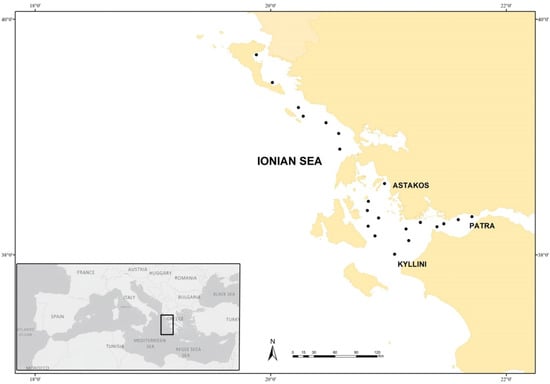
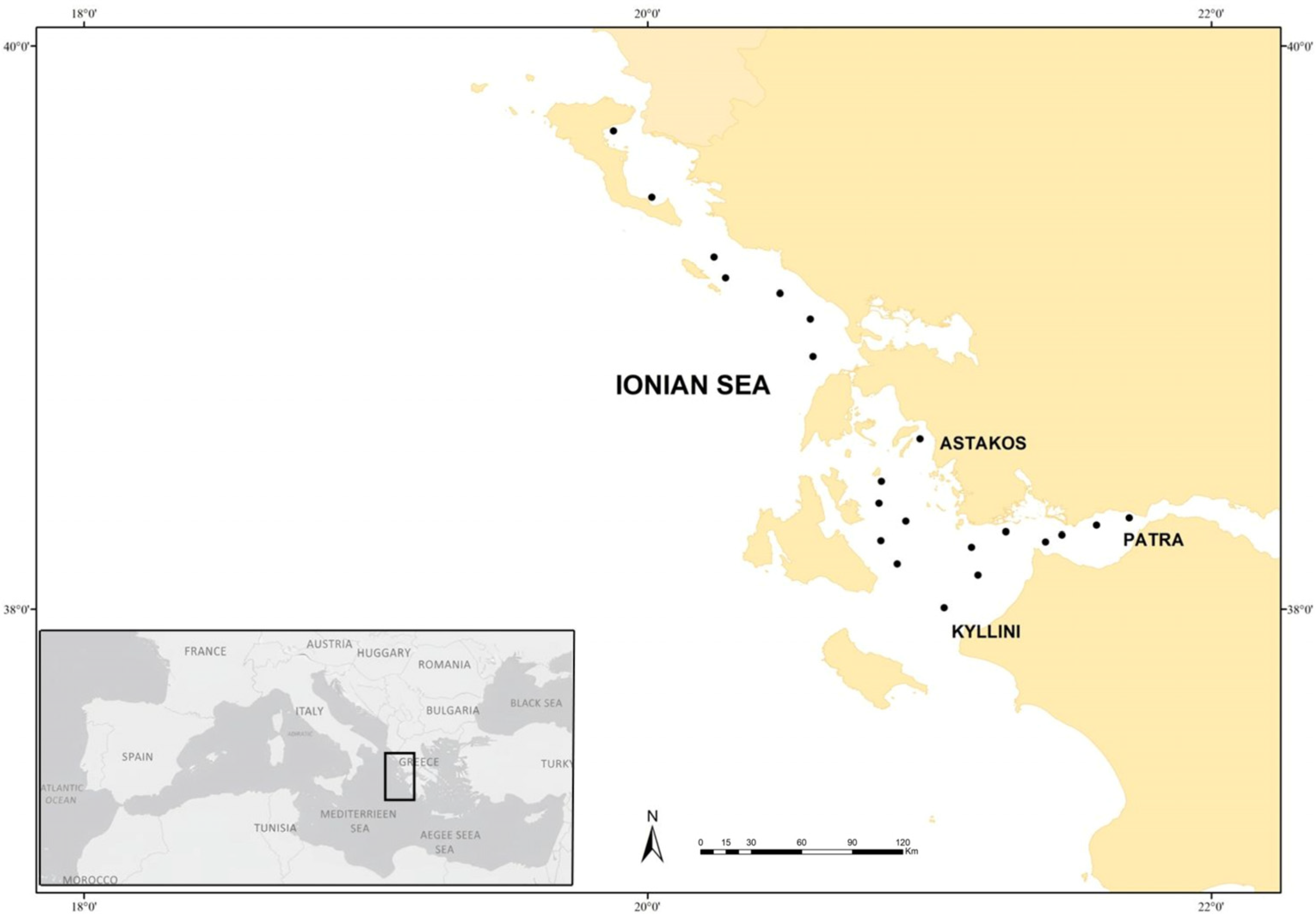
Specimens of T. trachurus (N = 200) and T. mediterraneus (N = 310) were sampled in the E. Ionian Sea (Figure 1) during 2021 in the framework of the Greek National Fisheries Data Collection Program of the Hellenic Centre for Marine Research and Institute of Fisheries Research within the framework of the EU Data Collection Regulation (EU 2017/1004). The program, co-financed by the EU and the Greek government, provides standardized biological and fisheries data (e.g., length, weight, age, otoliths) for stock assessment and management purposes for all European countries. All samples examined for the present study were collected as dead individuals in the fishing market due to fishing practices. They were kept frozen for a period before being analyzed in the laboratory for the collection of biological data.
Figure 1.
Map of the sampling area in the E. Ionian Sea.
The total length (TL) and total weight (TW) of each individual were measured with precision to the nearest 0.01 mm with a tape measure and 0.01 g with a scale. Sagittal otoliths were carefully removed, rinsed with water to eliminate residual organic material, and subsequently stored in a dry state. For imaging, each left otolith was placed in a glass Petri dish filled with water for observation with a stereoscope. A digital camera (SONY ExwaveHAD COLOR VIDEO) (Sony Corporation, Tokyo, Japan) was connected to a stereoscope (Wild Heer-brugg M420 Makroskop 1.25×) (Wild Heerbrugg AG, Heerbrugg, Switzerland) and a computer monitor. Each left otolith was observed under reflecting light against a black background. A digital Image-Pro Plus (Version 6.0.0. 260) software (Media Cybernetics, Rockville, MD, USA) system was used to acquire calibrated digital images of the otoliths at 8.0× and 10.0× magnification in T. trachurus and T. mediterraneus, respectively. The same software was used for age reading and otolith measurements as well.
Age estimation was based on counting annual growth increments, identified as a sequence of opaque and clear bands across the axis of the left sagittal otolith, extending from the core to the posterior margin [46]. Three independent readers conducted the initial reading, and in cases of disagreement, a second round of evaluation was performed to reach consensus or to exclude the otolith if no agreement could be achieved. In total, 200 otoliths of T. trachurus and 200 of T. mediterraneus were examined for age determination and morphometric measurements. To standardize age calculations, the birth date for T. trachurus was set to 1 January, while for T. mediterraneus it was set to 1 July, following internationally accepted protocols commonly applied in fish ageing bibliography [46].
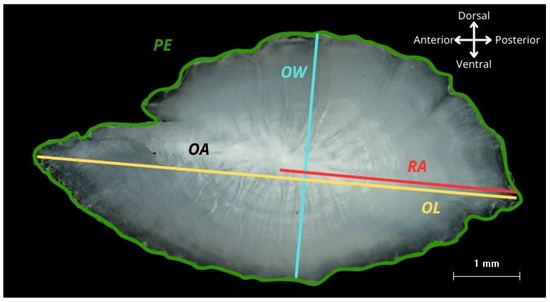
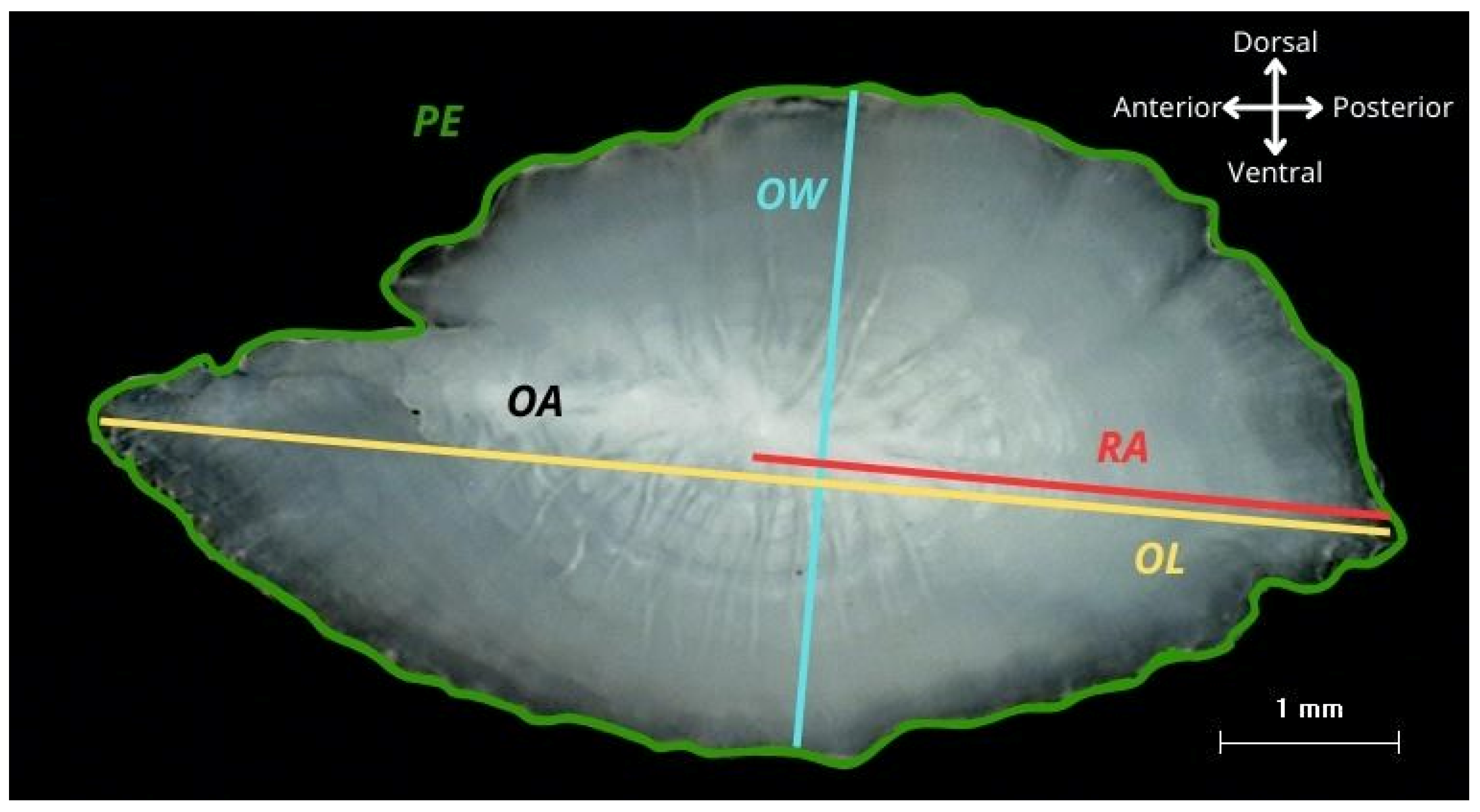
Otolith measurements were taken from the left sagittal otoliths of both species, focusing on the following five morphometric variables, as shown in Figure 2: otolith area (OA, mm2), otolith length (OL, mm), otolith width (OW, mm), radius (RA, mm), and perimeter (PE, mm). Five shape descriptors were also studied: (i) roundness (RD), which represents the ratio between the actual otolith area and that of a circle with the same diameter, with higher values indicating a more circular shape [47], taking a minimum value of 1 [48]; (ii) circularity (CI), which reflects the complexity of the otolith’s outline [49], with a minimum value of 4π [48]; (iii) form factor (FF), defined as 4 × OA/PE2, which ranges from 0 to 1, where 1 indicates a perfectly circular outline; (iv) rectangularity (RC), calculated as OA/(OL × OW), which assesses how closely the otolith resembles close to a rectangular outline, with 1 representing a perfect square; and (v) ellipticity (EL), given by (OL − OW)/(OL + OW), which indicates how elliptical the shape is, with values near 0 suggesting a more circular form [49].
Figure 2.
Morphometric measurements of the left otolith of Trachurus mediterraneus that were analyzed: RA: radius (mm); OL: otolith length (mm); OW: otolith width (mm); OA: otolith area (mm2); PE: perimeter (mm).
2.2. Data Analysis
2.2.1. Growth
The total length frequency distribution for each species was based on 1 cm interval classes. The relationship between weight and length (WLR) was determined using the formula TW = αTLb, where TW represents total weight in grams, TL is the total length in centimeters, α is the regression intercept, and b is the slope derived by log-transforming the data and applying ordinary least squares regression. The confidence intervals (CI) of the parameters a and b are also shown. To test whether growth was isometric, positive, or negative allometric (H0: b = 3, b > 3, or b < 3, respectively), a Student’s t-test was applied for each species.
An age–length key was developed for each species using age data obtained from otolith readings. The von Bertalanffy growth function [50] was applied to estimate growth parameters, expressed by the equation Lt = L∞ (1 − e−k(t−to)), where Lt is the expected length at age t (in cm), L∞ represents the theoretical maximum length (in cm), k is the growth coefficient, and to is the hypothetical age at which the fish’s length would be zero. For the evaluation and comparison of growth parameters between the two examined species and with published data, the growth performance index Φ′ was computed using the following formula: Φ′ (Φ′ = logk + 2logL∞) [51].
2.2.2. Otolith Morphometry
Mean values (±standard error), with minimum and maximum measurements of the otolith morphometric traits (RA, OL, OW, OA, PE, RD, CI, FF, RC, and EL) were calculated by species. The statistical package Statgraphics was applied for all the statistical analyses. Analysis of variance (ANOVA) was conducted with species as the single fixed factor to test for differences in otolith morphometric variables between the two species, using a significance level of α = 0.05.
Exponential regression was applied to assess the relationship between otolith morphometric variables and TL in each species: y = AxB, where y represents the otolith morphometric variable, x is the total length in millimeters, A is the intercept, and B is the slope of the regression. For the variables with a statistically significant relationship with length, the slopes (B) of the two species were compared using ANCOVA analysis (with the level of statistical significance set at α = 0.05).
3. Results
3.1. Growth
3.1.1. Length Distribution
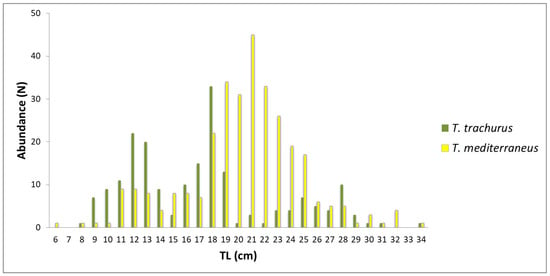
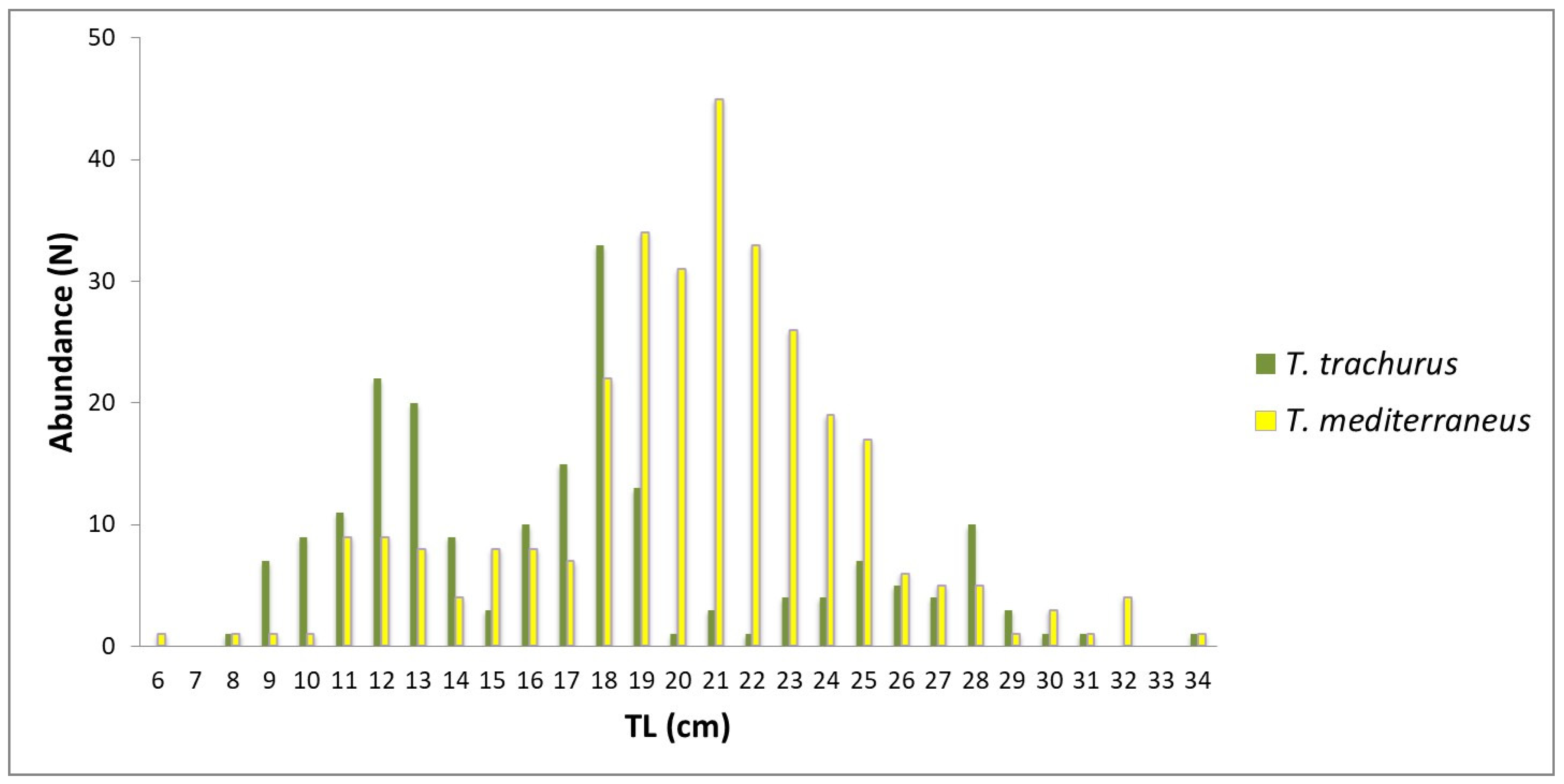
The length frequency distribution of both species is presented in Figure 3. The size of T. trachurus ranged from 6.1 to 34.2 cm TL; that of T. mediterraneus ranged from 6.6 to 34.4 cm TL (Figure 3).
Figure 3.
Length frequency distribution (TL, cm) of Trachurus trachurus (green) and Trachurus mediterraneus (yellow) in the E. Ionian Sea. N: number of individuals.
3.1.2. Weight–Length Relationship
The total weight (TW) values varied from 1.5 to 317.5 g in T. trachurus; in T. mediterraneus, these values ranged from 2.6 to 392.5 g. For the sample size examined, WLR for T. trachurus was TW = 0.00599 × TL3.121 (R2 = 98%) (95% a: CI = 0.0050–0.0072, b: 3.058–3.183); for T. mediterraneus WLR was TW = 0.00801 × TL2.994 (R2 = 99%) (95% a: CI = 0.0072–0.0089, b: 2.957–3.031). Results of the t-test demonstrated that b exceeded the value of 3 at a statistically significant level in T. trachurus (t-test = 3.80, p-value < 0.01), while no statistically significant difference was observed for T. mediterraneus (t-test = −0.31, p-value = 0.76).
3.1.3. Age Structure and Growth Analysis
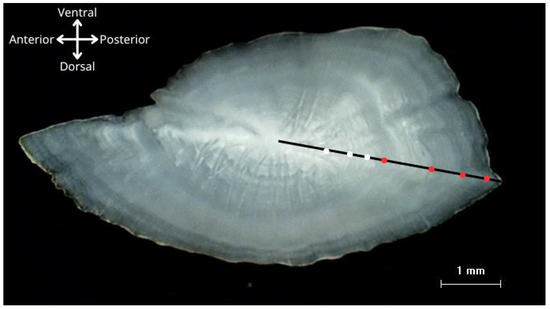
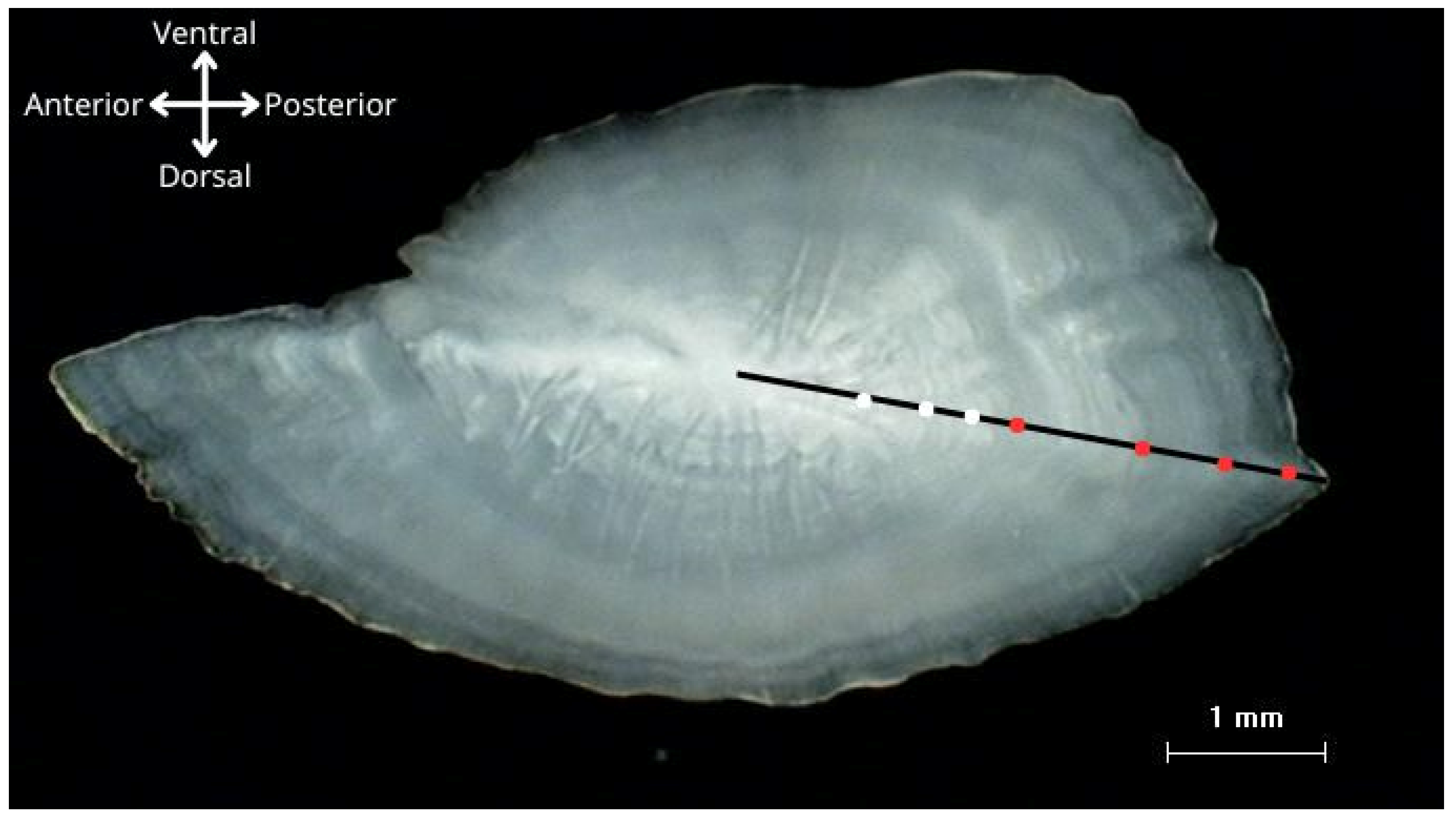
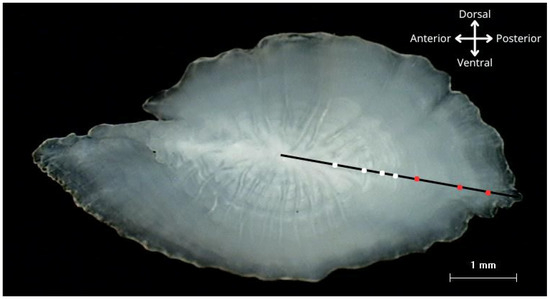
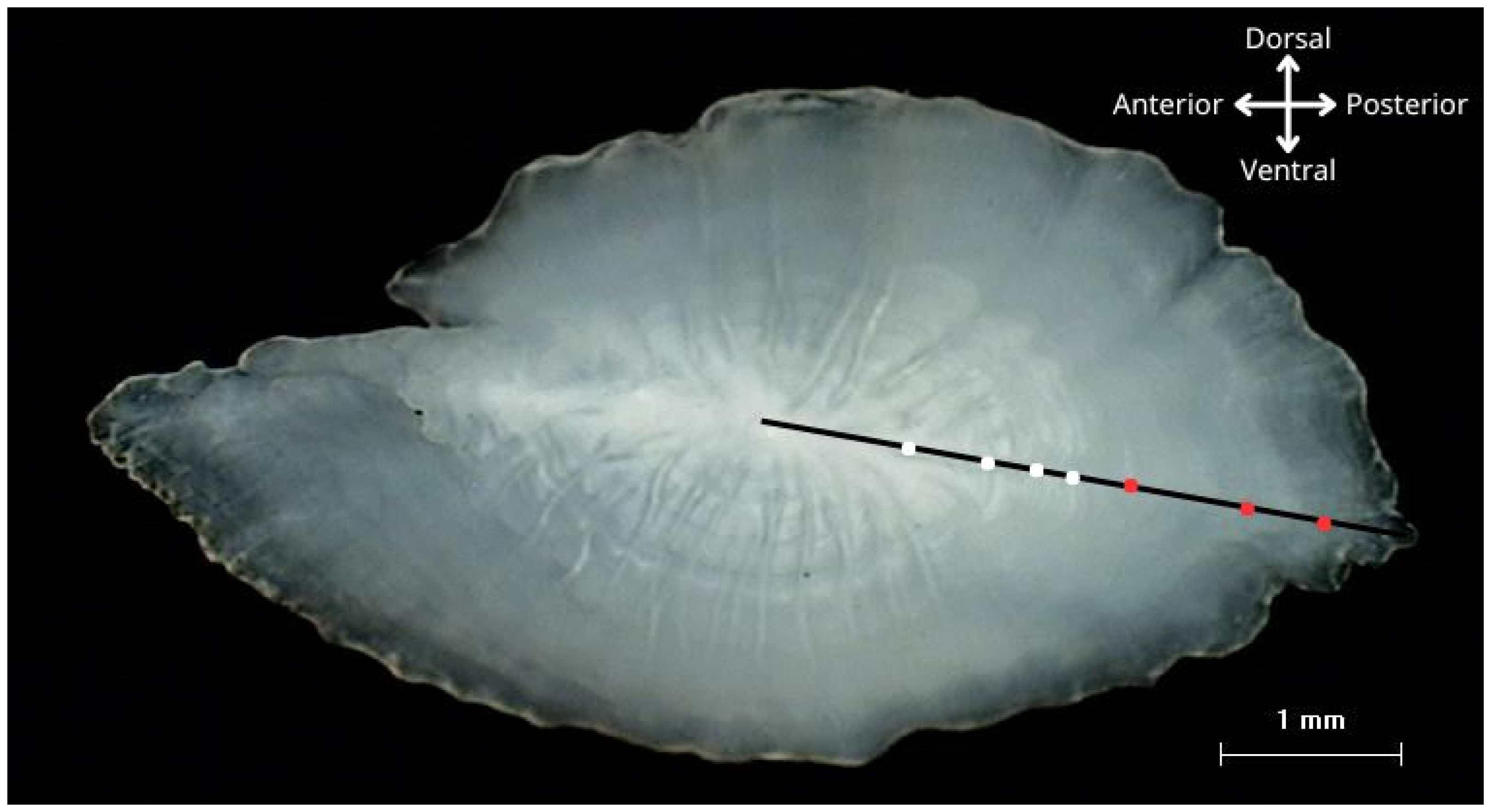
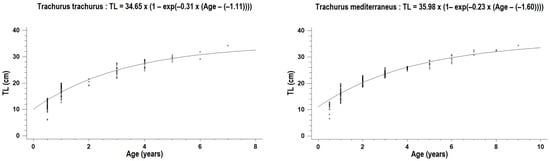
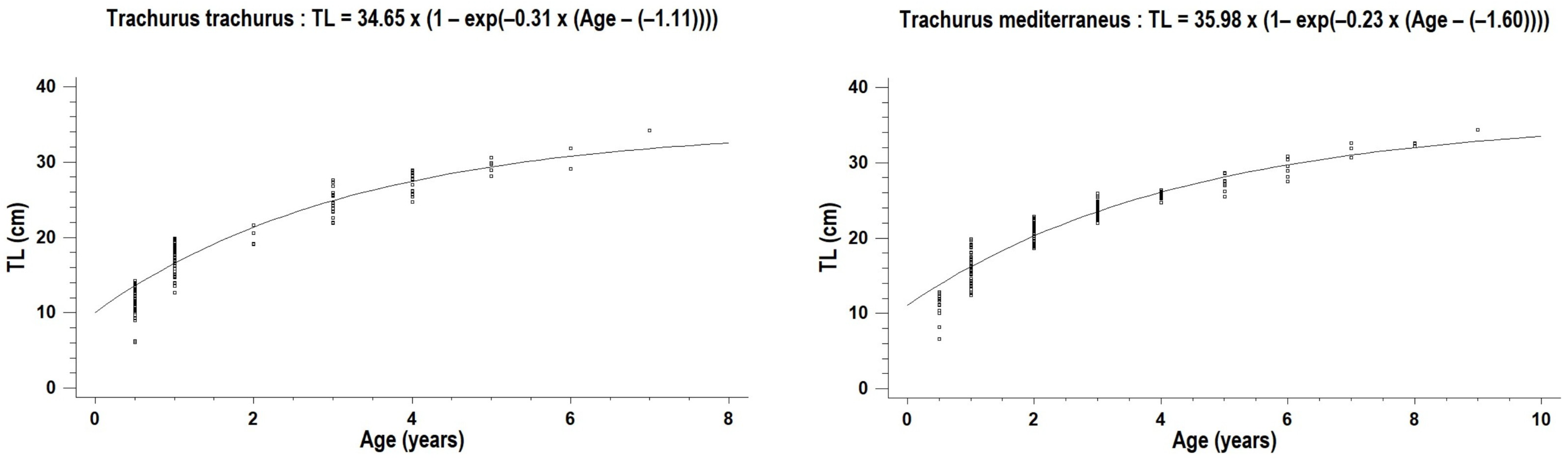
Otolith readings revealed eight age groups (ranging from 0+ to 7) in T. trachurus, and ten age groups (from 0+ to 9) in T. mediterraneus. In both species, sometimes false rings were observed surrounding the first annual ring of the otolith, which appears as a clear translucent band after a central, mostly opaque area, including thin opaque and translucent rings (see Figure 4 and Figure 5). Age–length keys are provided in Table 1 for each species. Most of the individuals, 41.5% of T. trachurus and 26.5% of T. mediterranmeus, were classified in age group one. Table 2 outlines the von Bertalanffy growth parameters and the growth performance index Φ′ for each species, with corresponding growth curves shown in Figure 6. Results indicate that T. mediterraneus has more age groups than T. trachurus in the same length range and lower k.
Figure 4.
Otolith of Trachurus trachurus with four annual rings (red dots) and false rings (white dots); total length 25.7 cm; date of capture 1 February 2021.
Figure 5.
Otolith of Trachurus mediterraneus with three annual rings (red dots) and false rings (white dots); total length 23.2 cm; date of capture 21 March 2021.
Table 1.
Age–length key of Trachurus trachurus and Trachurus mediterraneus from E. Ionian Sea [TL: total length (cm); N: total number of individuals].
Table 2.
Von Bertalanffy growth parameters of Trachurus trachurus and Trachurus mediterraneus in the E. Ionian Sea (N: total number of individuals; L∞: the mean theoretical asymptotic length in cm; k: a growth rate parameter in year−1; t0: the theoretical age at zero length in years; S.E: standard error; Φ′: the growth performance index).
Figure 6.
Growth curves based on the von Bertalanffy model for Trachurus trachurus (left) and Trachurus mediterraneus (right).
3.2. Otolith Morphometrics
The mean (±standard error), minimum, and maximum values of the morphometric measurements RA, OL, OW, OA, PE, RD, CI, FF, RC, and EL based on measurements of the left otolith of each species are presented in Table 3. Analysis of variance revealed statistically significant differences across the majority of variables between the two species (p-value < 0.05), except for RC (p-value > 0.05) (Table 3).
Table 3.
Mean (±standard error), minimum, and maximum (in parenthesis) values of the otolith morphometric variables: RA (radius, mm), OL (otolith length, mm), OW (otolith width, mm), OA (otolith area, mm2), PE (perimeter, mm), RD (roundness), CI (circularity), FF (form factor), RC (rectangularity), and EL (ellipticity) of Trachurus trachurus and Trachurus mediterraneus for the E. Ionian Sea. The p-values (ANOVA) for comparisons of otolith morphometric variables between species are presented, too.
For both species, statistically significant correlations (p-value < 0.05) were observed between TL and almost all otolith variables, with the exception of RC (Table 4). ANCOVA revealed no significant differences between species in the slope B of the regressions (p-value > 0.05) (Table 4).
Table 4.
Parameters of the exponential regression of the total length (TL) of Trachurus trachurus and Trachurus mediterraneus with the otolith morphometric variables: RA, radius (mm); OL, otolith length (mm); OW, otolith width (mm); OA, otolith area (mm2); PE, perimeter (mm); RD, roundness; CI, circularity; FF, form factor; RC, rectangularity; EL, ellipticity. A, intercept; B, slope; R2, coefficient of determination; r, correlation coefficient. The p-values of the regressions and the p-values of the comparison of the slope B of the regression lines between the two species (ANCOVA) are also shown.
4. Discussion
T. trachurus and T. mediterraneus are commercially important and widely distributed species. Limited research on their biology has been published for these species in the central Mediterranean in recent years. This work provides updated information on WLR, age, and growth for both species in the E. Ionian Sea and a detailed study on their otolith morphology conducted for the first time for T. trachurus in the central Mediterranean.
The examination of the size frequency distribution showed that the dominant size for T. trachurus was at 18 cm TL, while in T. mediterraneus, the dominant size was at 21 cm TL. The WLR analysis indicated that the value of b was significantly higher than 3 in T. trachurus, indicating that the species has growth that tends toward positive allometry, whereas no significant difference from 3 was observed in T. mediterraneus, based on the sampled population and the size range examined. The value of slope b of the present study was consistent with the values reported in previous studies for various regions, including the Mediterranean Coast of Morocco, the Black Sea, and the Aegean Sea. This indicates a broadly similar growth in weight pattern among populations (Table 5). In T. mediterraneus, the b of the WLR was found to fall within the range of values mentioned in the published literature. Higher b values have been reported in the Black Sea and the Aegean Sea (Table 6), suggesting regional variability in growth patterns. However, the higher b values in these cases seemed to be associated with a sample of individuals of quite lower body size (Table 6). Variability in WLR parameters is commonly attributed to a range of biological and methodological factors, including genetic differences, habitat conditions, length distribution of specimens, sample size, preservation techniques, ambient temperature, feeding habits, sex, maturity stage, sampling season, growth rates, and age [52,53,54].
In the current study, individuals of the first age class of T. trachurus ranged in length from 12.0 to 19.9 cm, which aligns well with several previous findings for the Mediterranean and Black Sea [23,29,30]. Similarly, the first age class of T. mediterraneus ranged from 12.0 to 19.9 cm in length in our work. Our results are quite close to those mentioned by [25,31,33,34] for the Black Sea. Any variation in first age–length between studies is most plausibly explained by environmental or methodological differences, since fish growth and age–length variation are shaped by temperature-driven metabolism [55], nutrient availability [56], oxygen and stratification [42], hydrostatic pressure at depth [43], and the combined impacts of fishing pressure and climate change [57,58]. Accurate identification of the first age is critically important, as it forms the basis for reliable age estimation and precise interpretation of otolith growth patterns. In the two studied species, however, this process is particularly challenging due to the presence of false juvenile rings, which seem like true annuli, often leading to misinterpretation. This problem is more evident in older specimens, where otolith thickening reduces ring visibility and complicates age determination [22,23,59]. Otolith microstructure and daily ring analysis may clarify age identification inconsistencies in the species studied.
In this study, T. mediterraneus showed a slightly lower k than T. trachurus, suggesting that it attains its asymptotic size with a slower growth rate than the latter species. Regarding T. trachurus, the highest k values were reported in the Aegean and Ionian Seas than in other Mediterranean and Black Sea areas (Table 5), possibly due to different environmental or ecological conditions. It is, however, worth mentioning that with the exception of a few cases, most areas showed similar Φ′ value, ranging between 2.4 and 2.6. Regarding T. mediterraneus, quite a high L∞ and low k accompanied by quite a high Φ value were reported for the Western Mediterranean; the opposite was observed for the Black Sea, with some exceptionally low values of k in some cases, indicating high variability in this region (Table 6). Based on the recent literature, L∞, k, and Φ′ were quite close in the Aegean and the Ionian Seas, their values ranging between those of the Western Mediterranean and those of the Black Sea (Table 6). The higher Φ′ values reflect areas where the species exhibits relatively strong growth performance, possibly linked to regional habitat factors or population-specific traits. This variability may be influenced by environmental factors such as temperature, food availability, and fishing pressure, as well as differences in sample size ranges, life history traits, and analytical methods [60,61]. Regional discrepancies in growth dynamics and age structure have been widely documented in fish population studies [62].
Table 5.
Growth parameters of Trachurus trachurus from different study areas (TL Range: minimum–maximum total length in cm; α: intercept and b: slope of the weight–length relationship; N: number of age groups; L∞: mean theoretical asymptotic length in cm; k: growth rate in year−1; t0: theoretical age at zero length in years; Φ′: growth performance index).
Table 6.
Growth parameters of Trachurus meditarraneus from different study areas (TL Range: minimum–maximum total length in cm; α: intercept and b: slope of the weight–length relationship; N: number of age groups; L∞: mean theoretical asymptotic length in cm; k: growth rate in year−1; t0: theoretical age at zero length in years; Φ′: growth performance index).
Although previous studies have selectively examined otolith morphometric traits in T. mediterraneus and have provided only limited data for T. trachurus—mostly restricted to specific regions and a single study by [39]—the present work constitutes the first systematic analysis of otolith morphometric and shape characters for both species in the Central Mediterranean Sea. Otolith morphometric variables revealed significant differences (ANOVA, p-value < 0.05) between the two species, with T. mediterraneus presenting higher values than T. trachurus for RA, OL, OW, OA, and PE, indicating larger and wider otoliths for the former species.
Otolith shape characteristics are closely linked to ecological adaptations, feeding behavior, and sensory processing efficiency [14,70]. T. mediterraneus exhibited larger otolith dimensions (OL, OW, OA, PE) and slightly more circular shape (lower EL, lower CI) compared to T. trachurus, which may indicate enhanced auditory sensitivity consistent with functional interpretations of otolith morphology and spatial orientation, potentially reflecting a more active presence in pelagic habitats with greater swimming capabilities and flexible adaptation to varying environmental conditions [70,71]. In contrast, T. trachurus showed smaller otolith dimensions and higher EL, suggesting a morphological structure more consistent with slightly more benthopelagic tendencies [70,71]. This clearly reflects the differences in behavior between the two congeneric species, describing the former as more pelagic than the latter, which exhibits more benthopelagic habits [16].
The relationship between the otolith characters and body length did not present differences between the two species, reflecting similar developmental processes governing their otolith growth. Our study coincides with the findings of [38,39], who also found a high correlation in the relationships between OL and OW with TL in T. mediterraneus.
In summary, the present findings provide important information on age, growth, and otolith morphometrics, necessary in fisheries management and species identification. Furthermore, our results offer valuable information on the behavioral features of the two species, which can support future research concerning their physiological traits. Further investigation on the otolith microstructure may also resolve discrepancies in age identification of the two examined species across various geographic regions and establish links to site-specific environmental factors. Such studies could further elucidate the influence of habitat variability on growth patterns, enhance the accuracy of age estimation techniques, and contribute to more robust stock assessment and management adapted to regional population dynamics.
5. Conclusions
This study focuses on the age, growth, and otolith morphometry of T. trachurus and T. mediterraneus in the E. Ionian Sea. T. trachurus showed a relatively higher growth rate than T. meditarraneus, which exhibits larger and longer otoliths than those of T. trachurus.
Author Contributions
V.N.: conceptualization, data curation, formal analysis, investigation, methodology, resources, software, supervision, validation, visualization, writing—original draft, writing—review and editing; C.M.: conceptualization, data curation, formal analysis, investigation, methodology, resources, supervision, validation, visualization, writing—review and editing, funding acquisition, project administration; V.X.: investigation, software; A.A.: conceptualization, data curation, formal analysis, investigation, methodology, resources, supervision, validation, visualization, writing—review and editing, funding acquisition, project administration. All authors have read and agreed to the published version of the manuscript.
Funding
This research received no external funding.
Institutional Review Board Statement
Ethical review and approval were not required for the animal study because no ethics committee was available when the present study was performed. Additionally, all individuals were dead when they were captured. In general, the procedure followed for sample collection and elaboration was the common procedure used in fisheries and aging studies.
Data Availability Statement
The original contributions presented in this study are included in the article. Further inquiries can be directed to the corresponding author.
Acknowledgments
The present work was carried out based on samples collected by the Hellenic Centre for Marine Research in the framework of the National Fisheries Data Collection Program 2020–2021 (funded by the Fisheries and Maritime Operational Program 2014–2020 of the Greek Ministry of Agricultural Development and Food and the European Maritime and Fisheries Fund).
Conflicts of Interest
The authors declare no conflicts of interest.
References
- Mansor, M.I.; Abd Hamid, M.; Mohd Nor, S.A. Length–Weight Relationship and Condition Factor; Study Material; Asutosh College: Kolkata, India, 2010. [Google Scholar]
- Chen, X.; Liu, B.; Fang, Z. Age and growth of fish. In Biology of Fishery Resources; Springer: Singapore, 2022; pp. 71–111. [Google Scholar]
- Vieira, A.R. Assessment of age and growth in fishes. Fishes 2023, 8, 479. [Google Scholar] [CrossRef] [Scilit]
- Froese, R. Cube law, condition factor and weight-length relationships: History, meta-analysis and recommendations. J. Appl. Ichthyol. 2006, 24, 241–253. [Google Scholar] [CrossRef] [Scilit]
- Richter, H.; Lückstädt, C.; Focken, U.; Becker, K. An improved procedure to assess fish condition on the basis of length-weight relationships. Arch. Fish. Mar. Res. 2000, 48, 255–264. [Google Scholar]
- FAO. The State of Mediterranean and Black Sea Fisheries; General Fisheries Commission for the Mediterranean: Rome, Italy, 2020; p. 172. [CrossRef] [Scilit]
- Williams, A.J.; Newman, S.J.; Wakefield, C.B.; Bunel, M.; Halafihi, T.; Kaltavara, J.; Nicol, S.J. Evaluating the performance of otolith morphometrics in deriving age compositions and mortality rates for assessment of data-poor tropical fisheries. ICES J. Mar. Sci. 2015, 72, 2098–2109. [Google Scholar] [CrossRef] [Scilit]
- Paladin, A.; Ugrin, N.; Matić-Skoko, S.; Dragičević, B.; Dulčić, J. Age, growth, and validation of otolith morphometrics as predictors of age in the Blackspot Seabream, Pagellus bogaraveo, from the Eastern Adriatic Sea. Fishes 2023, 8, 301. [Google Scholar] [CrossRef] [Scilit]
- Ferri, J. Otoliths and Their Applications in Fishery Science. Fishes 2023, 8, 35. [Google Scholar] [CrossRef] [Scilit]
- Afanasyev, P.K.; Orlov, A.M.; Rolsky, A.Y. Otolith shape analysis as a tool for species identification and studying the population structure of different fish species. Biol. Bull. 2017, 44, 952–959. [Google Scholar] [CrossRef] [Scilit]
- Park, J.M.; Kang, M.G.; Kim, J.H.; Jawad, L.A.; Majeed, S. Otolith morphology as a tool for stock discrimination of three rockfish species in the East Sea of Korea. Front. Mar. Sci. 2023, 10, 1301178. [Google Scholar] [CrossRef] [Scilit]
- Linnaeus, C. Systema Naturae per Regna Tria Naturae, Secundum Classes, Ordines, Genera, Species, Cum Characteribus, Differentiis, Synonymis, Locis, 10th ed.; Salvii: Holmiae, Sweden, 1758. [Google Scholar]
- Steindachner, F. Ichthyologische Beiträge (VIII). Sitzungsber. Akad. Wiss. Wien 1868, 57, 517–574. [Google Scholar]
- Fischer, W.; Schneider, M.; Bauchot, M.-L. (Eds.) Fishes FAO D’identification des Espèces Pour les Besoins de la Pêche. Méditerranée et Mer Noire, Zone de Pêche 37; Revision 1; Volume II, Vertébrés; FAO, CEE: Rome, Italy, 1987; pp. 761–1529.
- Lloris, D. A world overview of species of interest to fisheries. Chapter: Dicentrarchus labrax. In FIGIS Species Fact Sheets. Species Identification and Data Programme-SIDP; FAO-FIGIS: Rome, Italy, 2002; p. 3. [Google Scholar]
- Froese, R.; Pauly, D.; FishBase. World Wide Web Electronic Publication. 2025. Available online: www.fishbase.org (accessed on 5 April 2025).
- Betti, F. Opportunistic feeding behaviour of Trachurus mediterraneus. Mar. Biodivers. 2024, 54, 50. [Google Scholar] [CrossRef] [Scilit]
- El Achi, N.; Tsikliras, A.C.; Moutopoulos, D.K. Small pelagic fisheries and gear selectivity in the Eastern Ionian Sea. Mediterr. Mar. Sci. 2021, 22, 451–463. [Google Scholar]
- Vasapollo, C. Morphometric analysis revealed two different Mediterranean horse mackerel (Trachurus mediterraneus) stocks in the Adriatic Sea. PeerJ 2025, 13, e18765. [Google Scholar] [CrossRef] [Scilit] [PubMed]
- Moutopoulos, D.K.; Stergiou, K.I. Spatial disentangling of Greek commercial fisheries landings by gear. J. Appl. Ichthyol. 2012, 28, 19–27. [Google Scholar]
- European Commission. Fish Commercial Names—Trachurus trachurus; European Commission: Brussels, Belgium, 2020.
- FAO. Horse Mackerel Fisheries Overview; Food and Agriculture Organization of the United Nations: Rome, Italy, 2021.
- Karlou-Riga, C.; Sinis, A. Age and growth of horse mackerel Trachurus trachurus (L.) in the Gulf of Saronikos (Greece). Fish. Res. 1997, 32, 157–171. [Google Scholar] [CrossRef] [Scilit]
- Karlou-Riga, C. Otolith morphology and age and growth of Trachurus mediterraneus (Steindachner) in the Eastern Mediterranean. Fish. Res. 2000, 46, 69–82. [Google Scholar] [CrossRef] [Scilit]
- Raykov, V.S.; Yankova, M.H. Growth dynamics and mortality estimation of the horse mackerel (Trachurus mediterraneus ponticus Aleev) migrating along the Bulgarian Black Sea coast. In Proceedings of the 1st Biannual Scientific Conference: The Black Sea Ecosystem 2005 and Beyond, Istanbul, Turkey, 8–10 May 2006. [Google Scholar]
- Şahin, C.; Kasapoğlu, N.; Gözler, A.M.; Kalaycı, F.; Hacımurtazaoğlu, N.; Mutlu, C. Age, growth, and gonadosomatic index (GSI) of Mediterranean horse mackerel (Trachurus mediterraneus Steindachner, 1868) in the Eastern Black Sea. Turk. J. Zool. 2009, 33, 5. [Google Scholar] [CrossRef] [Scilit]
- Yankova, M.H.; Raykov, V.S.; Gerdzhikov, D.B.; Frateva, P.B. Growth and length-weight relationships of the horse mackerel, Trachurus mediterraneus ponticus (Aleev, 1956), off the Bulgarian Black Sea coast. Turk. J. Zool. 2010, 34, 9. [Google Scholar] [CrossRef] [Scilit]
- Aydın, M.; Karadurmuş, U. Age, growth, length-weight relationship and reproduction of the Atlantic horse mackerel (Trachurus trachurus Linnaeus, 1758) in Ordu (Black Sea). Ordu Univ. J. Sci. Technol. 2012, 2, 68–77. [Google Scholar]
- Kerkich, M.; Aksissou, M.; Casal, A.H.J. Age and growth of the horse mackerel Trachurus trachurus (Linnaeus, 1758) catches in the Bay of M’diq (Mediterranean coast of Morocco). Eng. Sci. Technol. Int. J. 2013, 3, 708–714. [Google Scholar]
- Dimitriadis, I.; Panora, D.; Sioulas, A.; Anastasopoulou, A.; Fytilakos, I. Age and growth of Atlantic horse mackerel (Trachurus trachurus) in Aegean and Ionia Seas. In Proceedings of the 16th Hellenic Conference of Ichthyologists, Kavala, Greece, 6–9 October 2016; pp. 53–56. [Google Scholar]
- Kasapoğlu, N. Age, growth, and mortality of exploited stocks: Anchovy, sprat, Mediterranean horse mackerel, whiting, and red mullet in the southeastern Black Sea. Aquat. Sci. Eng. 2018, 33, 39–49. [Google Scholar] [CrossRef] [Scilit]
- Sioulas, T.; Touloumis, K.; Sapounidis, A.; Batjakas, I.; Koutrakis, M.; Kallianiotis, A. Age and growth of Mediterranean horse mackerel (Trachurus mediterraneus) during the years 2016–2018 in the Thracian Sea (North Aegean Sea). In Proceedings of the 17th Panhellenic Conference of Ichthyologists, Heraklion, Greece, 31 October–3 November 2019. [Google Scholar]
- Kutsyn, D.N. Life history of Mediterranean horse mackerel Trachurus mediterraneus (Carangidae) from Crimea (Black Sea). J. Ichthyol. 2021, 61, 196–205. [Google Scholar] [CrossRef] [Scilit]
- Melnikova, E.B.; Kuzminova, N.S.; Melnikov, A.V. Recent variations in the size and age structure of the population of the horse mackerel Trachurus mediterraneus (Steindachner, 1868) on the Southwestern Shelf of Crimea. Russ. J. Mar. Biol. 2023, 49, 382–390. [Google Scholar] [CrossRef] [Scilit]
- Samsun, S. Growth and mortality rates of Mediterranean horse mackerel (Trachurus mediterraneus Steindachner, 1868) catches in the southeastern coast of the Black Sea. preprint 2023. [Google Scholar] [CrossRef] [Scilit]
- Atilgan, E.; Başçınar, N.S. Age and some ring characteristics and morphometric analyses of Mediterranean horse mackerel’s otoliths (Trachurus mediterraneus Steindachner, 1868) in the Black Sea. Araşt. Bul. 2015, 4, 3–12. [Google Scholar]
- Bostanci, D. Otolith characteristics and some population parameters of Mediterranean horse mackerel, Trachurus mediterraneus (Steindachner, 1868). Fırat Univ. J. Sci. 2009, 21, 53–60. [Google Scholar]
- Kasapoglu, N.; Duzgunes, E. The relationship between somatic growth and otolith dimensions of Mediterranean horse mackerel (Trachurus mediterraneus) from the Black Sea. J. Appl. Ichthyol. 2013, 29, 230–233. [Google Scholar] [CrossRef] [Scilit]
- Tuset, V.M.; Lombarte, A.; Assis, C.A. Otolith atlas for the western Mediterranean, north and central eastern Atlantic. Sci. Mar. 2008, 72, 7–198. [Google Scholar] [CrossRef] [Scilit]
- Nasri, H.; Kasmi, K.; Abdellaoui, S.; Omari, A.; Slimani, D.; Melhaoui, R.; Chafi, A.; Chaabane, K. Study of the growth of Trachurus trachurus (Linnaeus, 1758) fished on the eastern coast of the Moroccan Mediterranean. E3S Web Conf. 2024, 527, 01018. [Google Scholar] [CrossRef] [Scilit]
- Campana, S.E. Otolith science entering the 21st century. Mar. Freshw. Res. 2004, 55, 637–654. [Google Scholar] [CrossRef] [Scilit]
- Siokou-Frangou, I.; Gotsis-Skretas, O.; Christou, E.D.; Pagou, K. Plankton Characteristics in the Aegean, Ionian and NW Levantine Seas; National Centre for Marine Research: Athens, Greece, 1999.
- Fountoulakis, R.P. Oceanographic and Acoustical Survey of the East Ionian Sea; Naval Postgraduate School: Monterey, CA, USA, 1990. [Google Scholar]
- Zonn, I.S. (Ed.) The Ionian Sea Encyclopedia; Encyclopedia of Seas (EOS); Springer: Cham, Switzerland, 2022. [Google Scholar]
- Adamopoulou, A.; Zeri, C.; Garaventa, F.; Gambardella, C.; Ioakeimidis, C.; Pitta, E. Distribution patterns of floating microplastics in open and coastal waters of the Eastern Mediterranean Sea (Ionian, Aegean, and Levantine Seas). Front. Mar. Sci. 2021, 8, 699000. [Google Scholar] [CrossRef] [Scilit]
- ICES. Workshop 4 on age reading of Horse Mackerel, Mediterranean Horse Mackerel, and Blue Jack Mackerel (T. trachurus, T. mediterraneus, T. picturatus) (WKARHOM4). ICES Sci. Rep. 2023, 5, 107. [Google Scholar] [CrossRef]
- Ponton, D. Is geometric morphometrics efficient for comparing otolith shape of different fish species? J. Morphol. 2006, 267, 750–757. [Google Scholar] [CrossRef] [Scilit]
- Pothin, K.; Gonzalez-Salas, C.; Chabanet, P.; Lecomte-Finiger, R. Distinction between Mulloidichthys flavolineatus juveniles from Reunion Island and Mauritius Island (south-west Indian Ocean) based on otolith morphometrics. J. Fish Biol. 2006, 69, 38–53. [Google Scholar] [CrossRef] [Scilit]
- Tuset, V.M.; Lozano, I.J.; González, J.A.; Pertusa, J.F.; García-Díaz, M.M. Shape indices to identify regional differences in otolith morphology of comber, Serranus cabrilla (L., 1758). J. Appl. Ichthyol. 2003, 19, 88–93. [Google Scholar] [CrossRef] [Scilit]
- Von Bertalanffy, L. A quantitative theory of organic growth (inquiries on growth laws II). Hum. Biol. 1938, 10, 181–213. [Google Scholar]
- Pauly, D.; Munro, J.L. Once more on the comparison of growth in fish and invertebrates. Fishbyte WorldFish Cent. 1984, 2, 1–21. [Google Scholar]
- Das, B.K.; Jha, D.N.; Sahu, S.K.; Yadav, A.K.; Raman, R.K.; Kartikeyan, M. Analysis and Interpretation of Weight-Length Data of Fish. In Concept Building in Fisheries Data Analysis; Springer: Singapore, 2022. [Google Scholar]
- Dikou, A. Weight–length relationship in fish populations reflects environmental regulation on growth. Hydrobiologia 2023, 850, 335–346. [Google Scholar]
- Li, Y.; Feng, M.; Huang, L.; Zhang, P.; Wang, H.; Zhang, J.; Tian, Y.; Xu, J. Weight–Length Relationship Analysis Revealing the Impacts of Multiple Factors on Body Shape of Fish in China. Fishes 2023, 8, 269. [Google Scholar] [CrossRef] [Scilit]
- Shapiro Goldberg, D.; van Rijn, I.; Kiflawi, M.; Belmaker, J. Decreases in length at maturation of Mediterranean fishes associated with higher sea temperatures. ICES J. Mar. Sci. 2019, 76, 946–959. [Google Scholar] [CrossRef] [Scilit]
- Orizar, I.D.S.; Repetti, S.I.; Lewandowska, A.M. Phytoplankton stoichiometry along the salinity gradient under limited nutrient and light supply. J. Plankton Res. 2024, 46, 387–397. [Google Scholar] [CrossRef] [Scilit]
- Legaki, A.; Chatzispyrou, A.; Damalas, D.; Sgardeli, V.; Lefkaditou, E.; Anastasopoulou, A.; Mytilineou, C. Decline in size-at-maturity of European hake in relation to environmental regimes: A case in the Eastern Ionian Sea. Animals 2024, 14, 61. [Google Scholar] [CrossRef] [Scilit] [PubMed]
- Papantoniou, G.; Sgardeli, V.; Vassilopoulou, V.; Tsagarakis, K. Investigating the potential impacts and interactive effects of climate warming and multi-gear fishing on the Eastern Ionian Sea ecosystem using EwE and ecological indicators. Front. Mar. Sci. 2025, 12, 1621603. [Google Scholar] [CrossRef] [Scilit]
- ICES. Workshop on Age Reading of Horse Mackerel, Mediterranean Horse Mackerel and Blue Jack Mackerel (Trachurus trachurus, T. mediterraneus, T. picturatus) (WKARHOM3). In Proceedings of the ICES CM 2018/EOSG:28, Livorno, Italy, 5–9 November 2018; ICES: Copenhagen, Denmark, 2018. 186p. [Google Scholar]
- Canosa, L.F.; Bertucci, J.I. The effect of environmental stressors on growth in fish and its endocrine control. Front. Endocrinol. 2023, 14, 1109461. [Google Scholar] [CrossRef] [Scilit]
- Sardi, A.E.; Moreira, J.M.; Omingo, L.; Cousin, X.; Bégout, M.-L.; Manchado, M.; Marn, N. Simulating the Effects of Temperature and Food Availability on True Soles (Solea spp.) Early-Life History Traits: A Tool for Understanding Fish Recruitment in Future Climate Change Scenarios. Fishes 2023, 8, 68. [Google Scholar] [CrossRef] [Scilit]
- Watson, A.S.; Hickford, M.J.H.; Schiel, D.R. Interacting effects of density and temperature on fish growth rates in freshwater protected populations. Proc. R. Soc. B 2022, 289, 20211982. [Google Scholar]
- Šantić, M.; Jardas, I.; Pallaoro, A. Age, growth and mortality rate of horse mackerel Trachurus trachurus (L.) living in the eastern central Adriatic. Period. Biol. 2002, 104, 165–173. [Google Scholar]
- Basilone, G.; Ferreri, R.; Aronica, S.; Bonanno, A.; Genovese, S.; Rumolo, P.; Carbonara, P.; Barra, M. Growth variability in Atlantic horse mackerel Trachurus trachurus (Linnaeus, 1758) across the central Mediterranean Sea: Contrasting latitudinal gradient and different ecosystems. Front. Mar. Sci. 2023, 10, 1161552. [Google Scholar] [CrossRef] [Scilit]
- Rodríguez-Castañeda, J.C.; Ventero, A.; García-Márquez, M.G.; Iglesias, M. Spatial and temporal analysis (2009–2020) of the biological parameters, abundance and distribution of Trachurus mediterraneus (Steindachner, 1868) in the Western Mediterranean. Fish. Res. 2022, 256, 106483. [Google Scholar] [CrossRef] [Scilit]
- Yankova, M. A study on the growth of horse mackerel (Trachurus mediterraneus Aleev, 1956) from Bulgarian waters of the Black Sea using length frequency analysis. J. Black Sea/Mediterr. Environ. 2013, 19, 111–120. [Google Scholar]
- Petrakis, G.; Stergiou, K.I. Weight-length relationship for 33 species in Greek waters. Fish. Res. 1995, 21, 465–469. [Google Scholar]
- Tzikas, Z.; Ambrosiadis, I.; Soultos, N.; Georgakis, S. Seasonal size distribution, condition status and muscle yield of Mediterranean horse mackerel Trachurus mediterraneus from the North Aegean Sea, Greece. Fish. Sci. 2007, 73, 453–462. [Google Scholar] [CrossRef] [Scilit]
- Karachle, P.K.; Stergiou, K.I. Length-length and length-weight relationships of several fish species from the North Aegean Sea (Greece). J. Biol. Res. 2008, 10, 149–157. [Google Scholar]
- Hüssy, K. Otolith shape in juvenile cod (Gadus morhua): Ontogenetic and environmental effects. J. Exp. Mar. Biol. Ecol. 2008, 364, 35–41. [Google Scholar] [CrossRef] [Scilit]
- Assis, I.O.; da Silva, V.E.L.; Souto-Vieira, D. Ecomorphological patterns in otoliths of tropical fishes: Assessing trophic groups and depth strata preference by shape. Environ. Biol. Fishes 2020, 103, 349–361. [Google Scholar] [CrossRef] [Scilit]

Disclaimer/Publisher’s Note: The statements, opinions and data contained in all publications are solely those of the individual author(s) and contributor(s) and not of MDPI and/or the editor(s). MDPI and/or the editor(s) disclaim responsibility for any injury to people or property resulting from any ideas, methods, instructions or products referred to in the content. |
© 2026 by the authors. Licensee MDPI, Basel, Switzerland. This article is an open access article distributed under the terms and conditions of the Creative Commons Attribution (CC BY) license.