

Participatory Monitoring Tool to Assess the Sustainability of Tilapia (Oreochromis niloticus) Fish Farming in West Africa

 , , , and
Abstract
1. Introduction
2. Materials and Methods
2.1. Dimension, Principles, and Indicators
- Environmental (7 indicators): Water management, waste handling, production efficiency, chemical usage, etc.
- Social (7 indicators): Labour conditions, gender inclusion, local market linkages, etc.
- Economic (5 indicators): Funding and Autonomy, Sales strategy, Diversity of farm products, Job-producing efficiency (ton per job), and Risk prevention and management system.
2.2. Sustainability Scoring System
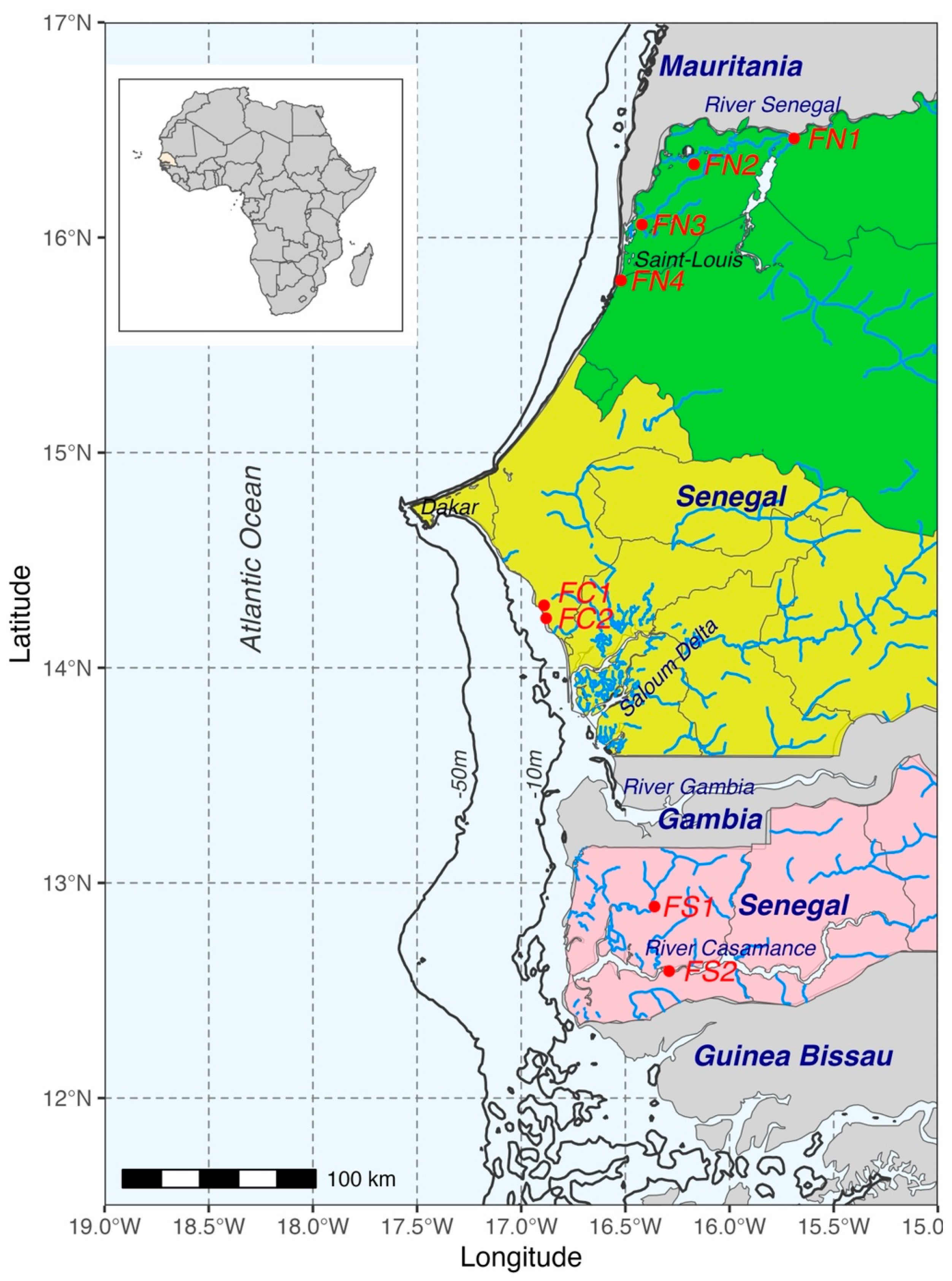
2.3. Farm Selection
2.4. Surveys
2.5. Farm Sustainable Assessment
3. Results
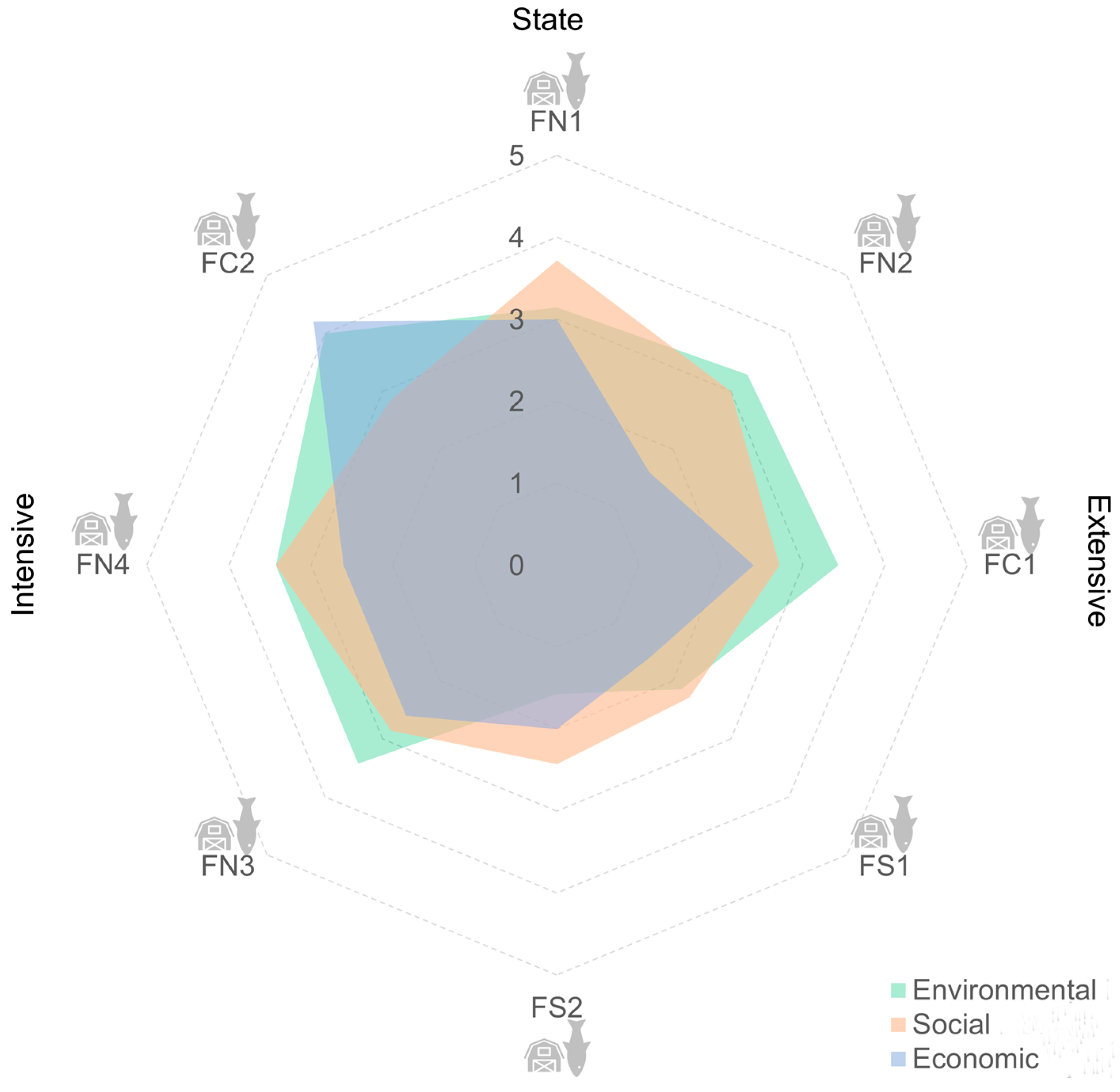
3.1. Farm-Level Sustainability Assessment
3.2. Sustainability Performance Across Ownership Categories and Production Systems
4. Discussion
5. Conclusions
Author Contributions
Funding
Institutional Review Board Statement
Data Availability Statement
Acknowledgments
Conflicts of Interest
Abbreviations
| ANA | Agence Nationale de l’Aquaculture |
| ANIDA | Agence Nationale d’Insertion et de Développement Agricole |
| AMS | Automate Monitoring System |
| CRODT | Centre de Recherches Océanographiques de Dakar-Thiaroye |
| FN | Farms in the North |
| FNRAA | Fonds national de recherches agricoles et agro-alimentaires |
| FC | Farms in the central region |
| FS | Farms in the South |
| ISRA | Institut Sénégalais de Recherches Agricoles |
| IRD | Institut de Recherche pour le Développement |
| ITACA | Improving the Productivity of Tilapia Farms and Hatcheries in Africa |
| SRFC | Sub-Regional Fisheries Commission |
References
- FAO. The State of World Fisheries and Aquaculture 2020; FAO Fisheries Department: Rome, Italy, 2020. [Google Scholar]
- Tacon, A.G.; Metian, M.; Parsons, G.J.; Shumway, S.E. A Global Aquaculture and Aquafeed Production Update: 2010 to 2023. Rev. Fish. Sci. Aquac. 2025, 1–10. [Google Scholar] [CrossRef]
- Ndebele-Murisa, M.; Mubaya, C.P.; Dekesa, C.H.; Samundengo, A.; Kapute, F.; Yossa, R. Sustainability of Aqua Feeds in Africa: A Narrative Review. Sustainability 2024, 16, 10323. [Google Scholar] [CrossRef]
- Aguilar-Manjarrez, J.; Nath, S.S. A Strategic Reassessment of Fish Farming Potential in Africa; CIFA Technical Paper, No. 32; 0379-5616-CIFA/T32; FAO: Rome, Italy, 1998; 170p, Available online: https://www.fao.org/4/w8522e/w8522e.pdf (accessed on 2 April 2024).
- NEPAD. The NEPAD Agency Fisheries and Aquaculture Programme. 2015–2020. Available online: https://www.nepad.org/publication/nepad-agency-fisheries-and-aquaculture-programme (accessed on 15 January 2018).
- ANSD. Situation Economique et Social du Sénégal, Edition 2017–2018; Agence Nationale de la Statistique et de la Démographie: Dakar, Senegal, 2020. [Google Scholar]
- Diallo, A.; Diouf, P.S.; Ngom, M.; Ndiaye, V. L’Aquaculture (Pisciculture et Crevetticulture) Dans la Vallée du Fleuve Sénégal: Potentialité et Perspective. 2003. Available online: https://www.sidalc.net/search/Record/dig-aquadocs-1834-2222 (accessed on 22 April 2024).
- Diadhiou, H.D.; Deme, M.; Mbaye, A.; Brehmer, P. Le développement de l’Aquaculture au Sénégal: Potentialités, production et difficultés. In Book of Abstract ICAWA; Sub-Regional Fisheries Commission: Dakar, Senegal, 2015; p. 113. [Google Scholar]
- Ndiaye, W.N.; Diadhiou, H.D.; Nguer, A.T.; Niane, A.; Brehmer, P. Which technical and economic model of aquaculture is adapted to the Senegalese context? In Proceedings of the International Conference ICAWA 2016, Dakar, Senegal, 13–15 December 2016; SRFC/CSRP. pp. 131–132. Available online: https://www.documentation.ird.fr/hor/fdi:010072146 (accessed on 2 April 2024).
- Folorunso, E.A.; Rahman, M.A.; Sarfo, I.; Darko, G.; Olowe, O.S. Catfish farming: A sustainability study at Eriwe fish farming village in southwest Nigeria. Aquac. Int. 2021, 29, 827–843. [Google Scholar] [CrossRef]
- Baldé, B.S.; Fall, M.; Kantoussan, J.; Sow, F.N.; Diouf, M.; Brehmer, P. Fish-length-based indicators for improved management of the sardinella fisheries in Senegal. Reg. Stud. Mar. Sci. 2019, 31, 100801. [Google Scholar] [CrossRef]
- Diankha, O.; Ba, A.; Brehmer, P.; Brochier, T.; Sow, B.A.; Thiaw, M.; Demarcq, H. Contrasted optimal environmental windows for both sardinella species in Senegalese waters. Fish. Oceanogr. 2018, 27, 351–365. [Google Scholar] [CrossRef]
- Ndiaye, W.N.; Brehmer, P.; Deschamps, M.H.; Corréa, M.; Diédhou, F.; Kantoussan, J.; Vandenberg, G.W. West African context call for rapid implementation of insect meal for fishmeal substitution. J. Insects Food Feed 2022, 8, S137. [Google Scholar]
- Deme, E.H.B.; Ricard, D.; Brehmer, P. Dynamics and mutations in the artisanal Senegalese fisheries management. From centralised resources management to participatory and sustainable dynamics. Norois 2019, 252, 55–72. [Google Scholar] [CrossRef]
- Ba, K.; Thiaw, M.; Lazar, N.; Sarr, A.; Brochier, T.; Ndiaye, I.; Brehmer, P. Resilience of key biological parameters of the Senegalese flat sardinella to overfishing and climate change. PLoS ONE 2016, 11, e0156143. [Google Scholar] [CrossRef]
- Ba, A.; Chaboud, C.; Brehmer, P.; Schmidt, J.O. Are subsidies still relevant in West African artisanal small pelagic fishery? Insights from long run bioeconomic scenarios. Mar. Policy 2022, 146, 105294. [Google Scholar] [CrossRef]
- Brummett, R.E.; Lazard, J.; Moehl, J. African aquaculture: Realising the potential. Food Policy 2008, 33, 371–385. [Google Scholar] [CrossRef]
- Brummett, R.E.; Williams, M.J. The evolution of aquaculture in African rural and economic development. Ecol. Econ. 2000, 33, 193–203. [Google Scholar] [CrossRef]
- Verceles, L.; Talaue-McManus, L.; Aliño, P. Participatory monitoring and feedback system: An important entry towards sustainable aquaculture in Bolinao, Northern Philippines. Sci. Diliman 2000, 12, 78–87. [Google Scholar]
- Bueno, P.B. Indicators of sustainable small-scale aquaculture development. In Measuring the Contribution of Small-Scale Aquaculture: An Assessment; FAO Fisheries and Aquaculture Technical Paper; FAO: Rome, Italy, 2009; Volume 534, pp. 145–160. [Google Scholar]
- Bell, S.; Morse, S. Sustainability Indicators: Measuring the Immeasurable? 2nd ed.; Earthscan: London, UK, 2012; 251p. [Google Scholar]
- Ahimin, A.O.; Mikissa, J.B.; Johnson, S.; N’Guessan Kouamé, F.; Kamanzi, K. Implementing principles, criteria and indicators for sustainable forest management in Gabon. J. Sustain. For. 2019, 38, 46–53. [Google Scholar] [CrossRef]
- Brehmer, P.; Do Chi, T.; Laugier, T.; Galgani, F.; Laloë, F.; Darnaude, A.M.; Fiandrino, A.; Mouillot, D. Field investigations and multi-indicators for shallow water lagoon management: Perspective for societal benefit. Aquat. Conserv. Mar. Freshw. Ecosyst. 2011, 21, 728–742. [Google Scholar] [CrossRef]
- Singh, R.K.; Murty, H.R.; Gupta, S.K.; Dikshit, A.K. An overview of sustainability assessment methodologies. Ecol. Indic. 2009, 9, 189–212. [Google Scholar] [CrossRef]
- Kapetsky, J.M.A. Strategic Assessment of Warm-Water Fish Farming Potential in Africa; FAO: Rome, Italy, 1994; No. 27. [Google Scholar]
- Lazard, J.; Rey-Valette, H.; Aubin, J.; Mathé, S.; Chia, E.; Caruso, D.; Clément, O. Evaluation of aquaculture system sustainability: A methodology and comparative approaches. In Recent Advances in Fish Farms; IntechOpen: London, UK, 2011; pp. 1–24. [Google Scholar] [CrossRef]
- Chia, E.; Rey-Valette, H.; Lazard, J.; Clément, O.; Mathé, S. Évaluer la durabilité des systèmes et des territoires aquacoles: Proposition méthodologique. Cah. Agric. 2009, 18, 211–219. [Google Scholar] [CrossRef]
- Rey-Valette, H.; Clément, O.; Mathé, S.; Lazard, J.; Chia, E. Guide to the Co-Construction of Sustainable Development Indicators in Aquaculture; Cirad; Ifremer; INRA, IRD, Université Montpellier 1; Diffusion Cirad-Montpellier: Montpellier, France, 2008; 144p, Available online: https://agritrop.cirad.fr/548450/ (accessed on 18 April 2024).
- Rey-Valette, H.; Clément, O.; Mathé, S.; Lazard, J.; Chia, E. Quelques postulats relatifs aux indicateurs de développement durable: L’exemple de l’aquaculture. Nat. Sci. Sociétés 2010, 18, 253–265. [Google Scholar] [CrossRef]
- Marchand, F.; Debruyne, L.; Triste, L.; Gerrard, C.; Padel, S.; Lauwers, L. Key characteristics for tool choice in indicator-based sustainability assessment at farm level. Ecol. Soc. 2014, 19, 46–56. [Google Scholar] [CrossRef]
- De Olde, E.M.; Oudshoorn, F.W.; Sørensen, C.A.; Bokkers, E.A.; De Boer, I.J. Assessing sustainability at farm-level: Lessons learned from a comparison of tools in practice. Ecol. Indic. 2016, 66, 391–404. [Google Scholar] [CrossRef]
- Sheikh, M.M.; Riar, T.S.; Pervez, A.K. Integrated Farming Systems: A Review of Farmers Friendly Approaches. Asian J. Agric. Ext. Econ. Sociol. 2021, 39, 88–99. [Google Scholar] [CrossRef]
- Aguado, S.H.; Segado, I.S.; Pitcher, T.J. Towards sustainable fisheries: A multi-criteria participatory approach to assessing indicators of sustainable fishing communities: A case study from Cartagena (Spain). Mar. Policy 2016, 65, 97–106. [Google Scholar] [CrossRef]
- Rey-Valette, H.; Laloë, F.; Le Fur, J. Introduction to the key issue concerning the use of sustainable development indicators. Int. J. Sustain. Dev. 2007, 10, 4–13. [Google Scholar] [CrossRef]
- Efole Ewoukem, T.; Mikolasek, O.; Aubin, J.; Tomedi Eyango, M.; Pouomogne, V.; Ombredane, D. Sustainability of fish pond culture in rural farming systems of Central and Western Cameroon. Int. J. Agric. Sustain. 2017, 15, 208–222. [Google Scholar] [CrossRef]
- Consensus—Sustainable Aquaculture in Europe. Defining Indicators for Sustainable Aquaculture Development in Europe: A Multi-Stakeholder Workshop Held in Ostende (Belgium), November 21–23, 2005, CONSENSUS, European Aquaculture Society. 2006. Available online: http://www.euraquaculture.info/files/CONSENSUS_Workshop.pdf (accessed on 4 March 2023).
- Rey-Valette, H.; Damart, S.; Roussel, S. A multicriteria participation-based methodology for selecting sustainable development indicators: An incentive tool for concerted decision making beyond the diagnosis framework. Int. J. Sustain. Dev. 2007, 10, 122–138. [Google Scholar] [CrossRef]
- Mbaye, A.A.; Lefèvre, F.G.; Sarr, A.; Sambou, C.; Gueye, A.; Gueye, F.; Sarr, K.Y.; Araba, A.C.; Gaye, C.A.B.; Dieng, M. A Situational Analysis of Small-Scale Fisheries in Senegal: From Vulnerability to Viability—Challenges and Opportunities for Fisheries Governance; V2V Working Paper 2022-2; V2V Global Partnership; University of Waterloo: Waterloo, ON, Canada, 2022. [Google Scholar]
- Lancker, E.; Nijkamp, P. A policy scenario analysis of sustainable agricultural development options: A case study for Nepal. Impact Assess. Proj. Apprais. 2000, 18, 111–124. [Google Scholar] [CrossRef]
- Opiyo, M.A.; Marijani, E.; Muendo, P.; Odede, R.; Leschen, W.; Charo-Karisa, H. A review of aquaculture production and health management practices of farmed fish in Kenya. Int. J. Vet. Sci. Med. 2018, 6, 141–148. [Google Scholar] [CrossRef] [PubMed]
- Lee, T.C.; Pu’ad, N.M.; Alipal, J.; Muhamad, M.S.; Basri, H.; Idris, M.I.; Abdullah, H.Z. Tilapia wastes to valuable materials: A brief review of biomedical, wastewater treatment, and biofuel applications. Mater. Today Proc. 2022, 57, 1389–1395. [Google Scholar] [CrossRef]
- Nol, P.; Rocke, T.E.; Gross, K.; Yuill, T.M. Prevalence of neurotoxic Clostridium botulinum type C in the gastrointestinal tracts of tilapia (Oreochromis mossambicus) in the Salton Sea. J. Wildl. Dis. 2004, 40, 414–419. [Google Scholar] [CrossRef]
- Ndiaye, N.A.; Maiguizo-Diagne, H.; Diadhiou, H.D.; Ndiaye, W.N.; Diedhiou, F.; Cournac, L.; Brehmer, P. Methanogenic and fertilising potential of aquaculture waste: Towards freshwater farms energy self-sufficiency in the framework of blue growth. Rev. Aquac. 2020, 12, 1435–1444. [Google Scholar] [CrossRef]
- N’Souvi, K.; Sun, C.; Zhang, H.; Broohm, D.A.; Okey, M.K.N. Fisheries and aquaculture in Togo: Overview, performance, fisheries policy, challenges and comparative study with Ghana, Mali, Niger and Senegal fisheries and aquaculture. Mar. Policy 2021, 132, 104681. [Google Scholar] [CrossRef]
- Asiedu, B.; Nunoo, F.K. Alternative livelihoods: A tool for sustainable fisheries management in Ghana. Int. J. Fish. Aquat. Sci. 2013, 2, 21–28. [Google Scholar]
- Senghor, M.L.; Diadhiou, H.D.; Sylla, K.B.; Ndiaye, W.; Fall, M. Effect of the 17 alpha Methyl testosterone hormone on market-size tilapia (Oreochromis niloticus) and evolution of the environment of the breeding environment. Int. J. Vet. Sci. Agric. Res. 2019, 1, 29–40. [Google Scholar]
- Hoq, M.E.; Das, G.B.; Uddin, M.S. Integration of fish farming with poultry: Effects of chicken manure in polyculture of carps and freshwater prawn. Indian J. Fish. 1999, 46, 237–243. [Google Scholar]
- Gilles, S.; Lacroix, G.; Corbin, D.; Bâ, N.; Luna, C.I.; Nandjui, J.; Lazzaro, X. Mutualism between euryhaline tilapia Sarotherodon melanotheron heudelotii and Chlorella sp.—Implications for nano-algal production in warmwater phytoplankton-based recirculating systems. Aquac. Eng. 2008, 39, 113–121. [Google Scholar] [CrossRef]
- Wilde, N.D.; Gilles, S. Production of marine tilapia in a closed circuit in green water: The Integral Recycling Aquaculture System (SARI). Aquac. Compend. 2010, 109409. [Google Scholar] [CrossRef]
- Ayinde, O.E.; Ibrahim, H.K.; Salami, M.F.; Ajibola, L.E. Effect of vertical integration on multidimensional well being of fish farmers in lagos state fish hub, Nigeria. Agric. Trop. Subtrop. 2017, 50, 81–87. [Google Scholar] [CrossRef]
- TAC/CGIAR. A Technical Advisory Committee of the Consultative Group on International Agriculture Research. Sustainable Agricultural Production: Implications for International Agricultural Research; The World Bank: Washington, DC, USA, 1989. [Google Scholar]
- Barreteau, O.; Bots, P.; Daniell, K.; Etienne, M.; Perez, P.; Barnaud, C.; Trebuil, G. Participatory approaches. In Simulating Social Complexity. Understanding Complex Systems; Edmonds, B., Meyer, R., Eds.; Springer: Berlin/Heidelberg, Germany, 2013; pp. 197–234. [Google Scholar] [CrossRef]
- Roque, A.; Wutich, A.; Quimby, B.; Porter, S.; Zheng, M.; Hossain, M.J.; Brewis, A. Participatory approaches in water research: A review. Wiley Interdiscip. Rev. Water 2022, 9, e1577. [Google Scholar] [CrossRef]
- Andalecio, M.N. Multi-criteria decision models for management of tropical coastal fisheries. A review. Agron. Sustain. Dev. 2010, 30, 557–580. [Google Scholar] [CrossRef]
- Chary, K.; Brigolin, D.; Callier, M.D. Farm-scale models in fish aquaculture—An overview of methods and applications. Rev. Aquac. 2022, 14, 2122–2157. [Google Scholar] [CrossRef]



| Dimension | Principle | Indicators |
|---|---|---|
| Environmental | Ensure the efficient use of natural resources | Water management |
| Production per surface | ||
| Waste management | ||
| Level of integration with other products | ||
| Protect biodiversity and respect animal well-being | Use of hormones, antibiotics, and chemicals | |
| Use of non-indigenous species | ||
| Number of escape events/year | ||
| Social | Strengthen the integration of aquaculture in local development | Number of direct workers |
| Workers with aquaculture qualification | ||
| Average salary | ||
| Contribute to community development and poverty alleviation | Number of occupational accidents | |
| Daily hours worked/national legislation | ||
| Presence of women workers | ||
| Contribute to food security and healthy nutritional needs | Rate of production commercialised in local markets | |
| Economic | Strengthen financial management of enterprises | Funding and autonomy |
| Diversity of farm products | ||
| Job-producing efficiency | ||
| Sales strategy | ||
| Strengthen risk assessment and crisis management capabilities | Risk prevention and management system |
| Caption | Least Sustainable | Unsustainable | Moderately Sustainable | Sustainable | Most Sustainable |
|---|---|---|---|---|---|
| Scales 1 | 1 | 2 | 3 | 4 | 5 |
| Environmental indicators | |||||
| Water management 2 | 50% of staff trained | 100% of staff trained | 2 + use of 2 sensors | 2 + use of 3 sensors | 4 + AMS |
| Level of integration with other products | 1 sp. produce | 2 sp. produced | 3 sp. produce | 3 sp. + Use effluents for crops | 4 sp. + farmed land animals |
| Waste management | Effluents untreated | Mechanical filtration of effluent | Settling ponds | Concrete wetlands, including crops | Settling ponds and wetlands |
| Production per surface (tons ha−1) | 0–3 | 3–5 | 5–8 | 8–12 | <12 |
| Use of hormones, antibiotics, and chemicals | 5 | 4 | 3 | 2 | 1 |
| Use of non-indigenous species | 4 | 3 | 2 | 1 | 0 |
| Number of escape events/year | 4 | 3 | 3 | 1 | 0 |
| Social indicators | |||||
| Number of direct workers | <3 | 3 to 5 | 5 to 8 | 8 to 10 | >10 |
| Workers specialised in qualification (%) | <20 | 20–40 | 40–60 | 60–80 | 80–100 |
| Average salary (in SMIG) 3 | <2 | 2–3 | 3–4 | 5–5 | >5 |
| Number of occupational accidents (Year−1) | >20 | 15–20 | 20–30 | 30–40 | <50 |
| Daily hours worked/national legislation | <1.5 | 1.5–1.3 | 1.3–1.2 | 1.2–1.1 | 1.1–1.0 |
| Presence of women workers (%) | 0 | 1–20 | 21–40 | 41–50 | >50 |
| Rate of production commercialised in local markets (%) | 0–20 | 20–40 | 40–60 | 60–80 | 80–100 |
| Economic indicators | |||||
| Funding and Autonomy 4 | 100% funding from the state | 50% funding from the state | Own funding | 3 + produce fingerlings | 4 + supply own feed |
| Sales strategy | no sales strategy | sale at farm | 2 + sales at the local market | 2 + sales at restaurants | 3 + sales according to market demand |
| Diversity of farm products | 1 | 2 | 3 | 4 | >4 |
| Job-producing efficiency (ton per job) | <0.5 | 0.5–1 | 1–2.5 | 2.5–5 | >5 |
| Risk prevention and management system | Not existing | Existing but has expired | Existing, but no proof of its application | Existing and properly applied | 4 + renew regularly |
| ID Farms | Area | Location Type | System | Owner | Owner Origin |
|---|---|---|---|---|---|
| FN1 | Urban | Inland | Intensive, aerated static ponds and raceways | State | National |
| FN2 | Rural | Inland | Extensive aerated static ponds | Family | National |
| FN3 | Urban | Inland | Intensive aerated static ponds | Private | National |
| FN4 | Rural | Costal | Intensive, aerated tanks and inshore-sheltered cages | Village association | National |
| FC1 | Rural | Inland | Extensive, minimal exchange ponds | Private | National |
| FC2 | Urban | Costal | Intensive, inshore-sheltered cages | Private | Foreigner |
| FS1 | Rural | Inland | Extensive, ponds | Private | National |
| FS2 | Urban | Inland | Extensive, ponds | Private | National |
| Farm | FN1 | FN2 | FN3 | FN4 | FC1 | FC2 | FS1 | FS2 |
|---|---|---|---|---|---|---|---|---|
| Environmental Indicators | ||||||||
| Water management | 4 | 1 | 2 | 3 | 1 | 4 | 1 | 1 |
| Level of integration with other products | 2 | 3 | 4 | 4 | 4 | 5 | 2 | 1 |
| Waste management | 2 | 3 | 3 | 1 | 3 | 1 | 1 | 1 |
| Production per surface | 3 | 1 | 1 | 1 | 1 | 5 | 1 | 1 |
| Use of hormones, antibiotics, and chemicals | 3 | 5 | 5 | 5 | 5 | 4 | 1 | 1 |
| Use of non-indigenous species | 3 | 5 | 4 | 5 | 5 | 4 | 4 | 1 |
| Number of escape events/year | 5 | 5 | 5 | 5 | 5 | 5 | 5 | 5 |
| Subtotal | 22 | 23 | 24 | 24 | 24 | 28 | 15 | 11 |
| Rank | 6 | 5 | 2 | 2 ex | 2 ex | 1 | 7 | 8 |
| Social indicators | ||||||||
| Number of direct workers | 2 | 2 | 2 | 2 | 1 | 3 | 2 | 2 |
| Workers with aquaculture qualification | 5 | 4 | 2 | 2 | 1 | 3 | 1 | 1 |
| Average Salary | 2 | 1 | 1 | 2 | 1 | 2 | 1 | 1 |
| Number of occupational accidents | 5 | 5 | 5 | 5 | 5 | 5 | 5 | 4 |
| Daily hours worked/national legislation | 5 | 3 | 4 | 5 | 5 | 1 | 1 | 3 |
| Presence of women workers | 2 | 1 | 1 | 3 | 1 | 1 | 1 | 1 |
| Rate of production | 5 | 5 | 5 | 5 | 5 | 5 | 5 | 5 |
| Subtotal | 26 | 21 | 20 | 24 | 19 | 20 | 16 | 17 |
| Rank | 1 | 3 | 4 ex | 2 | 6 | 4 | 8 | 7 |
| Economic indicators | ||||||||
| Funding and autonomy | 1 | 1 | 3 | 2 | 2 | 5 | 1 | 3 |
| Sales strategy | 3 | 3 | 3 | 3 | 3 | 5 | 2 | 2 |
| Diversity of farm products | 3 | 2 | 5 | 3 | 5 | 3 | 1 | 1 |
| Job-producing efficiency | 3 | 1 | 1 | 1 | 1 | 4 | 3 | 1 |
| Risk prevention and management system | 5 | 1 | 1 | 4 | 1 | 4 | 1 | 3 |
| Sub-total | 15 | 8 | 13 | 13 | 12 | 21 | 8 | 10 |
| Rank | 2 | 7 | 3 | 3 ex | 5 | 1 | 7 ex | 6 |
| Total | 63 | 52 | 57 | 61 | 55 | 69 | 39 | 38 |
| Total ranking | 2 | 6 | 4 | 3 | 5 | 1 | 7 | 8 |
Disclaimer/Publisher’s Note: The statements, opinions and data contained in all publications are solely those of the individual author(s) and contributor(s) and not of MDPI and/or the editor(s). MDPI and/or the editor(s) disclaim responsibility for any injury to people or property resulting from any ideas, methods, instructions or products referred to in the content. |
© 2026 by the authors. Licensee MDPI, Basel, Switzerland. This article is an open access article distributed under the terms and conditions of the Creative Commons Attribution (CC BY) license.
Share and Cite
Ndiaye, W.N.; Brehmer, P.; Mbaye, A.; Diedhiou, F.; Ba, K.; Diadhiou, H.D. Participatory Monitoring Tool to Assess the Sustainability of Tilapia (Oreochromis niloticus) Fish Farming in West Africa. Fishes 2026, 11, 27. https://doi.org/10.3390/fishes11010027
Ndiaye WN, Brehmer P, Mbaye A, Diedhiou F, Ba K, Diadhiou HD. Participatory Monitoring Tool to Assess the Sustainability of Tilapia (Oreochromis niloticus) Fish Farming in West Africa. Fishes. 2026; 11(1):27. https://doi.org/10.3390/fishes11010027
Chicago/Turabian StyleNdiaye, Waly Ndianco, Patrice Brehmer, Adama Mbaye, Fulgence Diedhiou, Kamarel Ba, and Hamet Diaw Diadhiou. 2026. "Participatory Monitoring Tool to Assess the Sustainability of Tilapia (Oreochromis niloticus) Fish Farming in West Africa" Fishes 11, no. 1: 27. https://doi.org/10.3390/fishes11010027
APA StyleNdiaye, W. N., Brehmer, P., Mbaye, A., Diedhiou, F., Ba, K., & Diadhiou, H. D. (2026). Participatory Monitoring Tool to Assess the Sustainability of Tilapia (Oreochromis niloticus) Fish Farming in West Africa. Fishes, 11(1), 27. https://doi.org/10.3390/fishes11010027