Next Article in Journal
Participatory Monitoring Tool to Assess the Sustainability of Tilapia (Oreochromis niloticus) Fish Farming in West Africa
Previous Article in Journal
Ultrastructural, Osmoregulation, Physiological Metabolism, and Antioxidative Response of Red Tilapia (Oreochromis spp.) Under Acute Alkaline Stress
Previous Article in Special Issue
Extremely Low Sample Size Allows Age and Growth Estimation in a Rare and Threatened Shark
error_outline You can access the new MDPI.com website here. Explore and share your feedback with us.
 
 
Article

Reproductive Biology of the Speckled Smooth-Hound Shark Mustelus mento (Carcharhiniformes: Triakidae) from the Southeastern Pacific


by
Krishna Tapia
1,2,
Angel Mancilla
1,2,
Leandro Brizuela
1,2,
Carolina Vargas-Caro
1,2 and
Carlos Bustamante
1,2,*
1
CHALLWA, Laboratorio de Biología Pesquera, Instituto de Ciencias Naturales Alexander von Humboldt, Facultad de Ciencias del Mar y de Recursos Biológicos, Universidad de Antofagasta, Antofagasta 1240000, Chile
2
Programa de Conservación de Tiburones, Facultad de Ciencias del Mar y de Recursos Biológicos, Universidad de Antofagasta, Antofagasta 1240000, Chile
*
Author to whom correspondence should be addressed.
Fishes 2026, 11(1), 28; https://doi.org/10.3390/fishes11010028
Submission received: 4 December 2025 / Revised: 29 December 2025 / Accepted: 31 December 2025 / Published: 3 January 2026
(This article belongs to the Special Issue Biology and Conservation of Elasmobranchs)

Abstract

The speckled smooth-hound Mustelus mento is an endemic coastal shark from the southeastern Pacific, currently listed as “Critically Endangered” due to intense fishing pressure and the absence of species-specific management across its distribution range. Between November 2021 and October 2023, 925 individuals were examined from artisanal landings in northern Chile to describe their reproductive biology and embryonic development characteristics. The total length ranged from 27.6–159.3 cm in females and 14.2–165.0 cm in males, with a sex ratio of 1:1.2, which was slightly biased towards females. The estimated size at 50% maturity was 53.6 cm for females and 48.7 cm for males, with 70.6% of females and 66.0% of males caught below these thresholds, indicating a predominance of immature individuals in landings. Nine gravid females (106–139 cm) contained 71 embryos, which were classified into five developmental stages (encapsulated ovum, early organogenesis, fin differentiation, pigmentation and growth, and pre-partum) based on their external morphology and yolk sac reduction. The litter size ranged from 4 to 12 embryos, and the estimated size at birth was 13–14 cm in length. Embryos were recorded only during the summer months, suggesting a seasonal reproductive cycle with parturition in the early autumn. The persistent yolk sac connection throughout development and the absence of placental structures confirm that M. mento exhibits aplacental viviparity. These results document the first population-level description of the reproductive biology of M. mento, redefine its reproductive mode, and provide baseline information essential for implementing species-specific management and conservation measures in Chilean waters.
Key Contribution: This study provides the first population-level description of the reproductive biology of speckled smooth-hound (Mustelus mento), confirming yolk sac (aplacental) viviparity and highlighting its low reproductive capacity and vulnerability to coastal fisheries.

1. Introduction

Sharks of the genus Mustelus are taxonomically complex and remain poorly understood despite their ecological importance and high susceptibility to overexploitation in coastal fisheries [1,2]. Among them, the speckled smooth-hound Mustelus mento is endemic to the southeastern Pacific and currently assessed as “Critically Endangered” on the IUCN Red List [3]. Despite decades of fishing pressure along the coasts of Chile and Peru [4,5,6], no study has documented the reproductive biology or life-history traits of M. mento, which are essential for the effective conservation and fishery management of coastal sharks [7].
The global decline in sharks is closely tied to their K-selected life histories, which are characterized by slow growth, late maturity, low fecundity, and extended gestation periods [8]. These traits render shark populations highly vulnerable to overfishing, particularly in coastal ecosystems where artisanal and industrial fleets overlap with reproductive and nursery grounds [9,10]. In Chile, 16% of chondrichthyan species are formally recognized as threatened, whereas another 26% lack sufficient data for assessment [6]. Such information gaps are particularly severe for small coastal sharks, which are among the species most exposed to fishing pressure and habitat degradation.
Coastal shark assemblages are largely dominated by species of the order Carcharhiniformes, whose demersal habits and proximity to shorelines make them especially vulnerable to intensive exploitation on continental shelves worldwide [10,11,12]. Within this order, the family Triakidae is one of the most diverse and ecologically significant groups, comprising nine genera and more than 45 species distributed globally in temperate and tropical waters [13,14]. Among these, smooth-hounds (Mustelus spp.) constitute the most speciose lineage, comprising 27 valid species that inhabit continental shelves across all major ocean basins [15]. Despite their abundance in coastal ecosystems and fisheries, the taxonomy of Mustelus remains challenging because of morphological conservatism and unresolved phylogenetic relationships among species [16,17]. This uncertainty has hindered the development of species-specific management measures because morphologically similar species often differ markedly in life history traits and reproductive strategies.
Comparative studies have shown that Mustelus species exhibit remarkable reproductive diversity, encompassing two major evolutionary clades: one placentally viviparous and the other exhibiting yolk sac viviparity without a placental connection [18,19]. This diversity extends to fecundity, size at maturity, and reproductive cycles, which may vary geographically, even within the same species [7,20]. Recent discoveries, including facultative parthenogenesis in M. mustelus [21], further illustrate the evolutionary plasticity of the genus and highlight how incomplete knowledge of its reproductive biology limits effective conservation and fisheries management.
Only two Mustelus species have been recorded in the southeastern Pacific: the humpback smooth-hound (M. whitneyi) and speckled smooth-hound (M. mento). The latter is endemic to the region, occurring from northern Peru to south-central Chile [3,22]. M. mento is a slender triakid shark with molariform, low-cusped teeth and a distinctive pattern of white dorsal spots [13]. Despite its restricted distribution and “Critically Endangered” status in Chilean waters [23], M. mento continues to be landed by artisanal fleets along the Chilean coast, either incidentally or as a secondary target species in coastal gillnet fisheries.
In northern Chile, M. mento is mainly caught in a small-scale coastal gillnet fishery that operates inside San Jorge Bay (Antofagasta) at depths of 25–35 m over sandy and muddy bottoms. Although the nets are set primarily for rocky-reef teleosts such as Sarda chiliensis, Paralabrax humeralis, Aplodactylus punctatus, and Paralichthys adspersus, elasmobranchs routinely dominate the landed biomass, accounting for approximately 60–75% of the annual landings of this fleet [5]. Fishing effort is opportunistic but peaks during the austral spring and summer when weather conditions are more favorable and the catch rates of both teleosts and sharks increase. Within this fishery, smooth-hounds are regularly retained as a secondary target or bycatch and landed under the commercial category “tollo”, which aggregates multiple species, including M. whitneyi, Triakis maculata, and Galeorhinus galeus, masking species-specific trends in exploitation and hindering effective conservation measures [3,4,5,6]. This lack of disaggregated data, coupled with the absence of biological and reproductive information, has prevented a realistic assessment of the population status of M. mento throughout its distribution range.
Reproductive parameters have been described for M. whitneyi in Peru [4], M. schmitti in Argentina [24], and several congeners in other regions (for example M. antarcticus [7], M. asterias [25], M. canis [26], M. henlei [27], M. higmani [28]). However, no data is available for M. mento. This represents a critical knowledge gap because reproductive mode, size at maturity, and fecundity are key determinants of a population’s productivity, resilience, and potential for recovery under fishing pressure. Here, we present the first comprehensive description of the size and sex structure, size at maturity, and embryonic development of Mustelus mento from northern Chile based on a two-year survey of artisanal landings. Our findings fill this knowledge gap and provide a biological basis for species-specific management and regional conservation strategies in the Southeast Pacific.

2. Materials and Methods

2.1. Study Area and Sampling

Between November 2021 and October 2023, M. mento specimens were obtained from artisanal landings at the main fishing terminal in Antofagasta (23°39′ S, 70°24′ W), northern Chile. Catches originated from coastal gillnet operations within San Jorge Bay at depths of 25–35 m over sandy and muddy bottoms. The study area is strongly influenced by the northern Chilean upwelling system, with seasonal sea surface temperatures ranging between 16 and 22 °C and marked productivity gradients along the coast [29].
Each specimen was measured for total length (LT, cm; from the tip of the snout to the posterior apex of the caudal fin) and sexed based on the presence or absence of claspers. In males, the internal clasper length (LCI, cm) was measured using a digital caliper (±0.1 cm). All individuals were processed immediately after landing to avoid tissue degradation. Sampling was opportunistic, depending on fish availability in the landings, and only fresh individuals were considered to prevent duplication from the same vessel trip. This study complied with Chilean animal welfare legislation and institutional ethical standards (Universidad de Antofagasta Ethics Committee, permit No. 362/2022).

2.2. Sex Structure and Size Distribution

The overall sex ratio was tested against the expected 1:1 proportion using the chi-square (χ2) goodness-of-fit test. The Shapiro–Wilk test was used to assess the normality of LT distributions by sex, and differences between male and female length distributions were evaluated using a two-sample Kolmogorov–Smirnov test, following standard procedures [30]. Seasonal variation in abundance was examined by pooling monthly data across both sampling years to identify potential reproductive aggregations.

2.3. Reproductive Maturity

Sexual maturity stages were determined macroscopically following criteria adapted from Stehmann [31] and ICES [32] for viviparous elasmobranchs. Four maturity stages were recognized: I = immature, II = developing, III = capable to reproduce, and IV = spawning capable/pregnancy. Classification was based on external and internal morphological criteria, including the development of reproductive organs and associated ducts. In females, the analysis included ovary morphology (size, presence, and color of oocytes), uterine development, and the presence of embryos or uterine folds were analyzed. In males, testis size and lobulation, as well as the condition of the epididymis and seminal vesicles, were examined to assess spermatogenic activity [26]. For statistical analyses, stages I–II were considered immature (0) and stages III–IV were mature (1), providing a binary response for maturity classification. The size at 50% maturity (L50) for each sex was estimated by fitting a generalized linear model (GLM) with binomial error distribution and logit link to the proportion of mature individuals per 5 cm LT class. The model has the form:
l o g i t   P L = ln P   ( L ) 1 P ( L ) = α +   β   L  
where P(L) is the probability that an individual of length L is mature, and α and β are the intercept and slope, respectively. Ninety-five percent confidence intervals for the fitted curves were obtained from the GLM using the standard errors of the predictions on the logit scale. In males, the relationship between total length (LT) and internal clasper length (LCI) was described using a three-parameter logistic model to visually identify the inflection point corresponding to the morphological threshold of maturity [7].

2.4. Embryonic Development

All gravid females were dissected to record their uterine content. For each female, the number of embryos in the left and right uterus was counted separately, and the total litter size was calculated as the sum of the embryos in both uteri. Each embryo was measured (LT ± 0.1 cm) using a digital caliper and weighed (±0.01 g) on an analytical balance. The yolk sac diameter and weight were also recorded. Relationships between embryo LT, total weight, yolk sac diameter, and yolk sac weight were evaluated using Pearson’s correlations. Embryo sex ratios were tested using the χ2 test, as described above.
Embryos were classified into five developmental stages (E0–E4) based on external morphology, fin development, body pigmentation, yolk sac reduction, and uterine egg capsule condition, following published staging schemes for elasmobranchs [33,34], and criteria adapted for viviparous Mustelus species [28,35].
The length at birth was inferred by comparing the maximum LT of embryos recorded in utero with the minimum LT of free-swimming juveniles captured in artisanal landings, following the criteria proposed by Conrath & Musick [26] and González-Pestana et al. [4]. During dissection, each embryo was examined within its uterine egg capsule. The capsules were characterized based on their size, transparency, and texture. Particular attention was given to the presence or absence of a placental stalk or villiform projections as diagnostic features for characterizing the type of maternal–embryonic relationship [35].

2.5. Statistical Analysis

All analyses were performed using R v.4.3.1 [36]. Graphs and model regressions were produced using the ggplot2 and car packages. Descriptive statistics are presented as mean ± standard deviation (SD), and differences were considered significant at p < 0.05.

3. Results

3.1. Sex Structure and Size Distribution

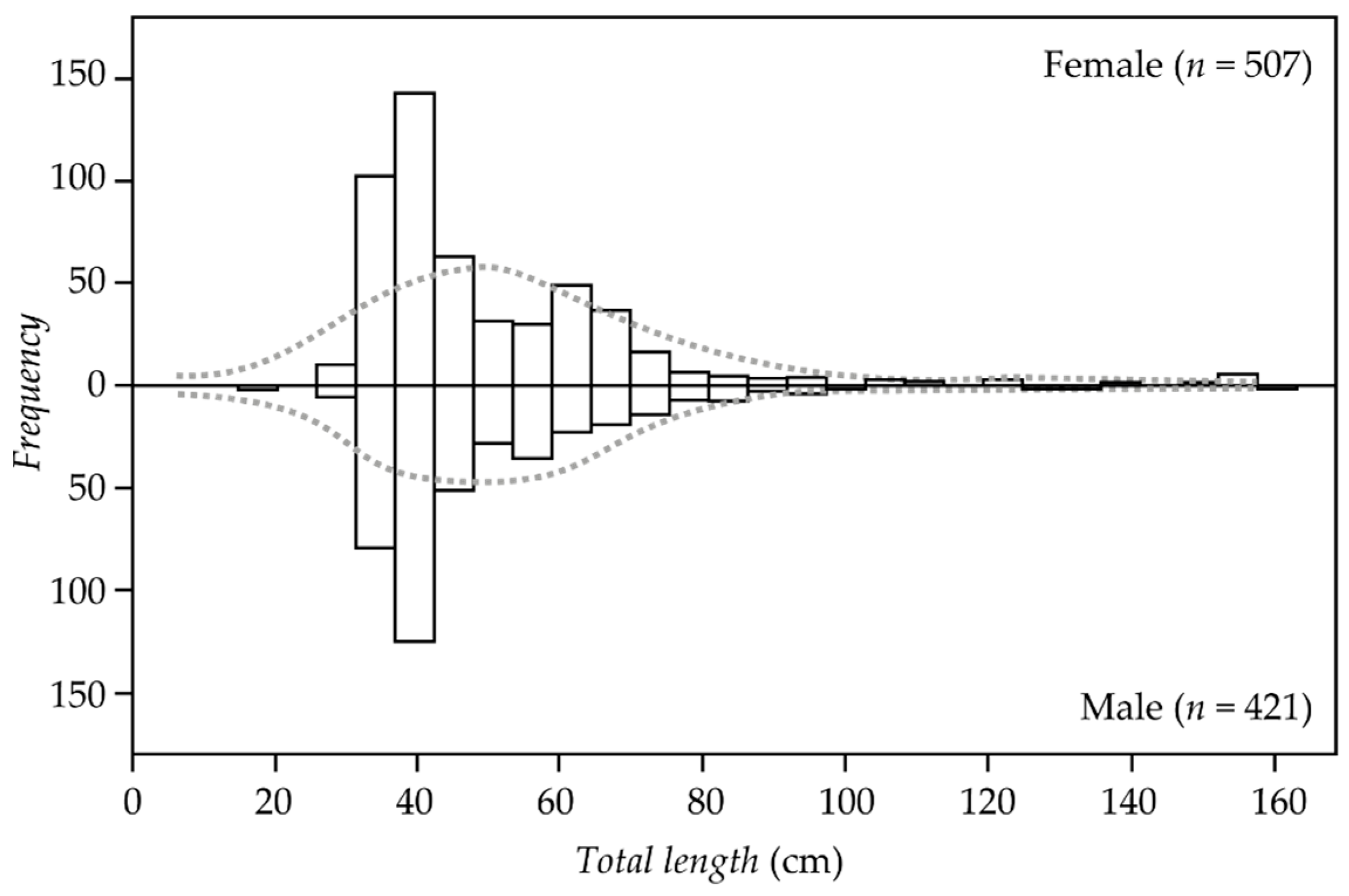
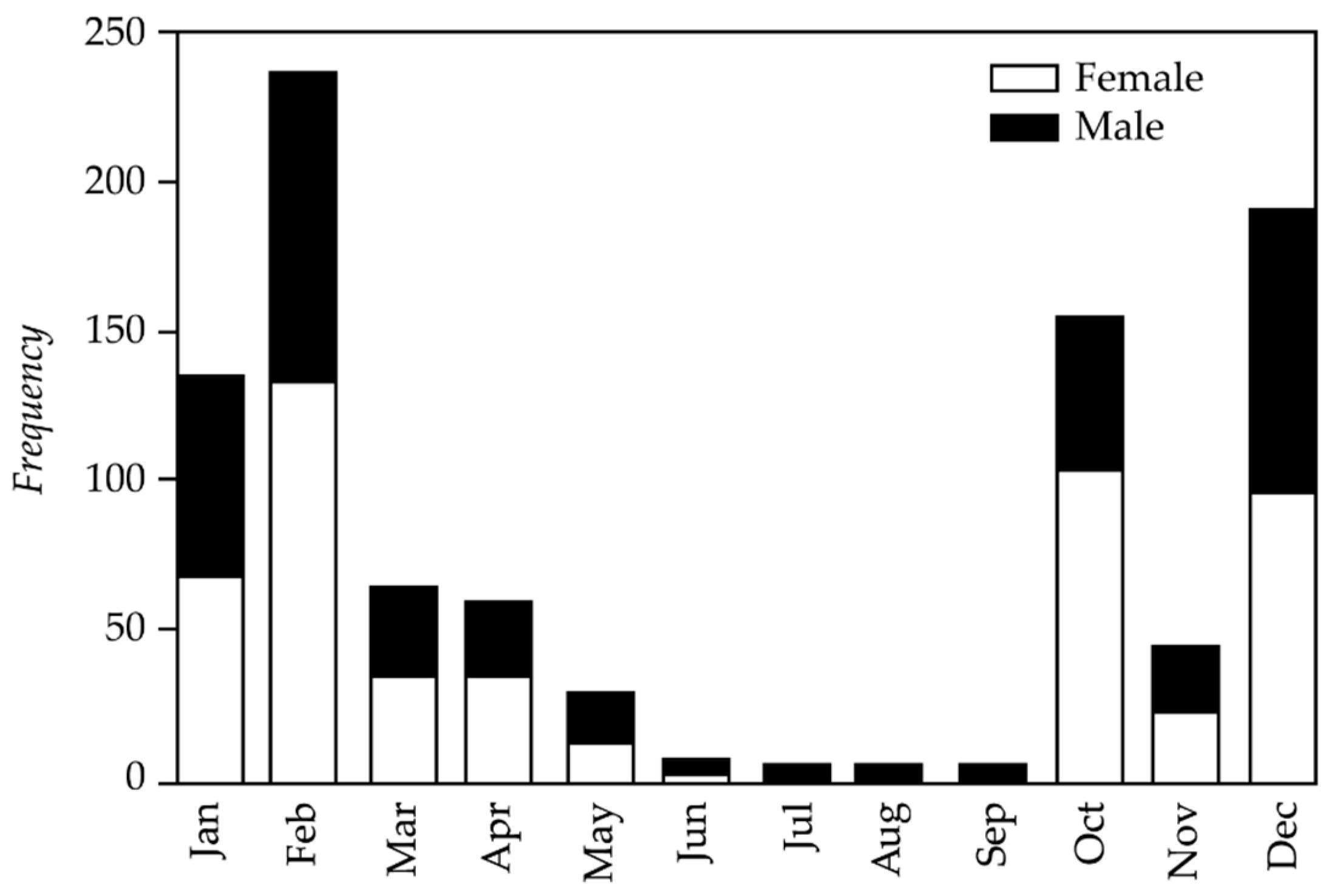
From artisanal landings recorded between November 2021 and October 2023, 925 individuals of Mustelus mento were analyzed, comprising 505 females and 420 males. The overall sex ratio (F:M = 1.20:1) showed a slight but significant bias towards females (χ2 = 7.79, df = 1, p < 0.05). The total length of females ranged from 27.6 to 159.3 cm LT (mean ± SD = 49.6 ± 20.1 cm), whereas that of males ranged from 14.2 to 165.0 cm LT (mean ± SD = 49.3 ± 19.5 cm). The size distributions for both sexes deviated from normality (females: W = 0.738, p < 0.05; males: W = 0.766, p < 0.05). Two modal groups were identified in the overall size–frequency distribution: one between 30.9 and 36.5 cm LT and the other between 36.5 and 42.1 cm LT (Figure 1). No significant differences were detected between the size frequency distributions of males and females (W = 1.133, p > 0.05). Individuals of both sexes were observed more frequently during the summer months (December–February), with much lower numbers observed during winter and early spring. A temporary predominance of females was observed in October, whereas no significant sex bias was detected in the remaining months (χ2, p > 0.05; Figure 2).

3.2. Reproductive Maturity

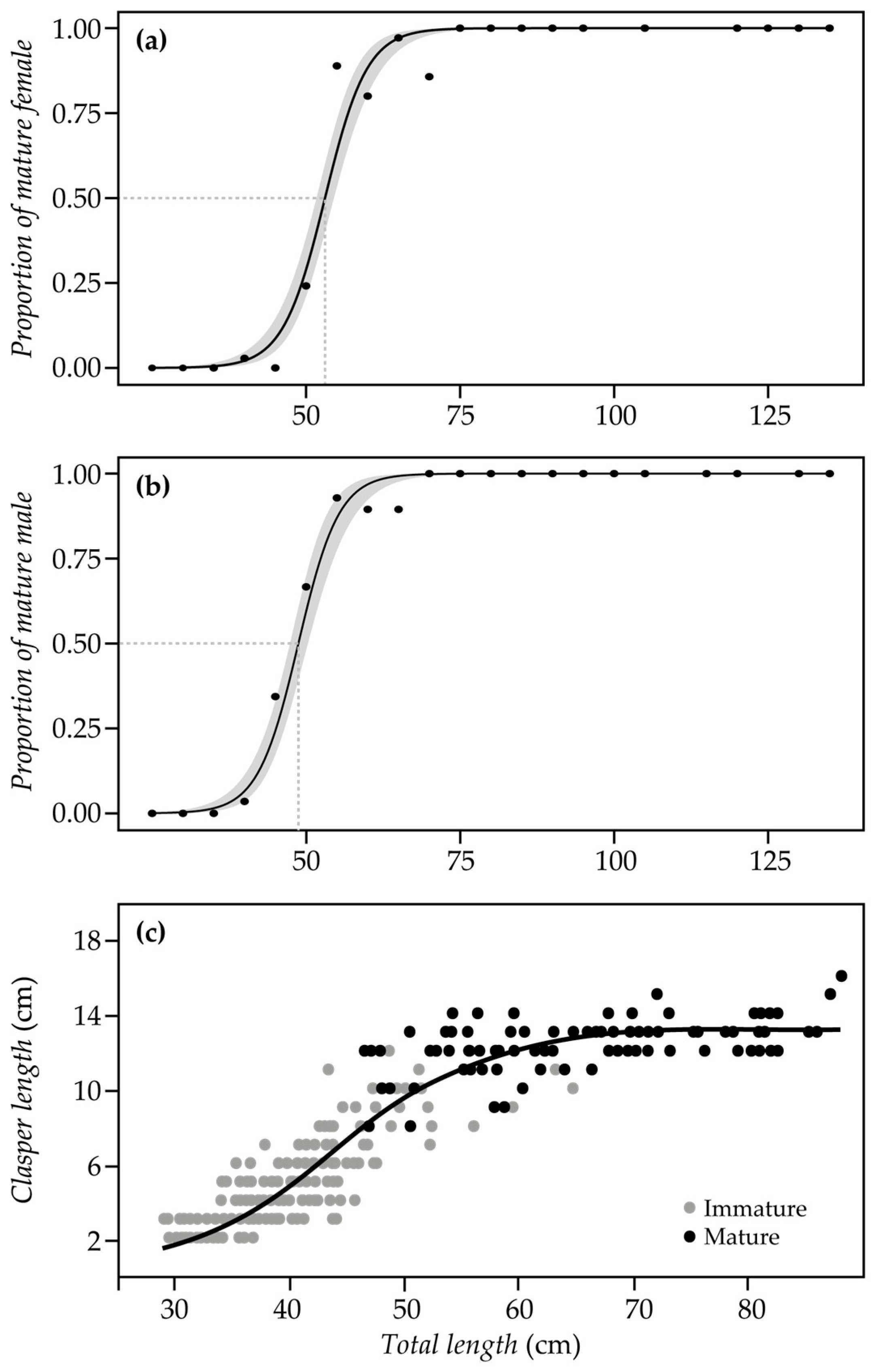
Of all the females analyzed, 70.6% (n = 358) were immature (stages I–II), and 29.4% (n = 147) were mature (stages III–IV). The largest immature female measured 67.0 cm LT, whereas the smallest mature female measured 41.3 cm LT. According to the GLM, the estimated size at 50% maturity (L50) for females was 53.6 cm LT (Figure 3a). Among males, 66.3% (n = 278) were immature (stages I–II), and 33.7% (n = 142) were mature (stages III–IV). The largest immature male measured 65.2 cm LT, and the smallest mature male measured 41.3 cm LT. The GML estimated L50 for males was 48.7 cm LT (Figure 3b). Internal clasper length (LCI) was recorded for 348 males, of which 92.9% (n = 254) were immature (stages I and II) and 7.1% (n = 93) were mature (stages III and IV). The LCI ranged from 2.0 to 16.0 cm (6.0 ± 3.97 cm). The relationship between LCI and LT followed a sigmoidal pattern, showing a rapid increase in clasper length between 40 and 55 cm LT, after which growth stabilized, marking the morphological threshold for sexual maturity (Figure 3c).

3.3. Embryonic Development

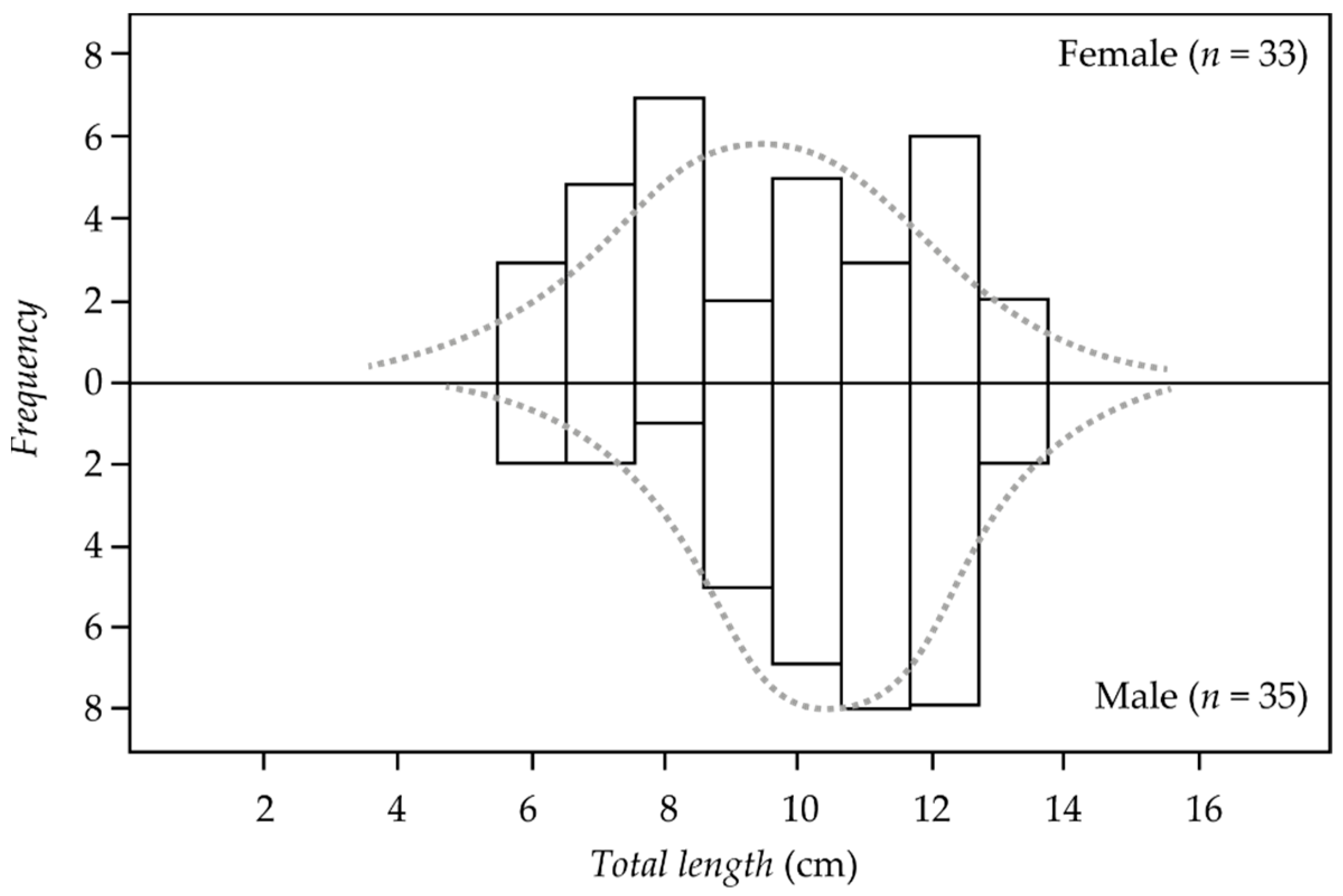
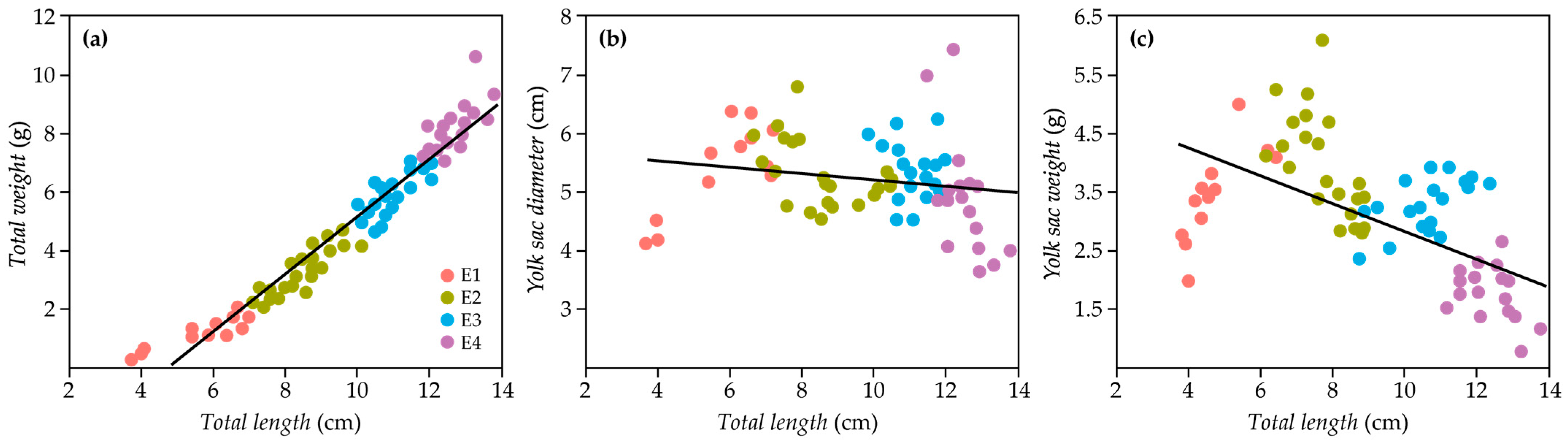
Nine gravid females were recorded, all captured during the austral summer months (January to March) of 2022–2023. The smallest gravid female measured 106 cm LT and the largest 139 cm LT. A total of 71 embryos were recovered from these females, of which 68 were sexed (35 males and 33 females). The sex ratio of embryos (1:1.06) did not differ significantly from that of the parity (χ2 = 0.029, df = 1, p > 0.05). The total length of embryos ranged from 3.7 to 13.9 cm LT (9.72 ± 2.48 cm) and the total weight ranged from 0.37 to 10.62 g (4.06 ± 2.98 g). Female embryos followed a normal distribution (W = 0.948, p > 0.05), whereas males did not (W = 0.917, p < 0.05), showing a modal group between 10.0 and 12.8 cm LT (Figure 4). A strong positive correlation was detected between embryo total length and total weight (r2 = 0.93, p < 0.05), indicating an approximately isometric growth pattern throughout embryonic development (Figure 5a). The yolk sac diameter ranged from 2.18 to 7.26 cm (4.27 ± 1.00 cm) and showed no significant correlation with embryo length (r2 = 0.03, p = 0.357; Figure 5b). In contrast, yolk sac weights varied from 0.66 to 6.10 g (2.67 ± 1.58 g) and were negatively correlated with embryo length (r2 = 0.30, p < 0.05), reflecting progressive yolk absorption during embryonic growth (Figure 5c).
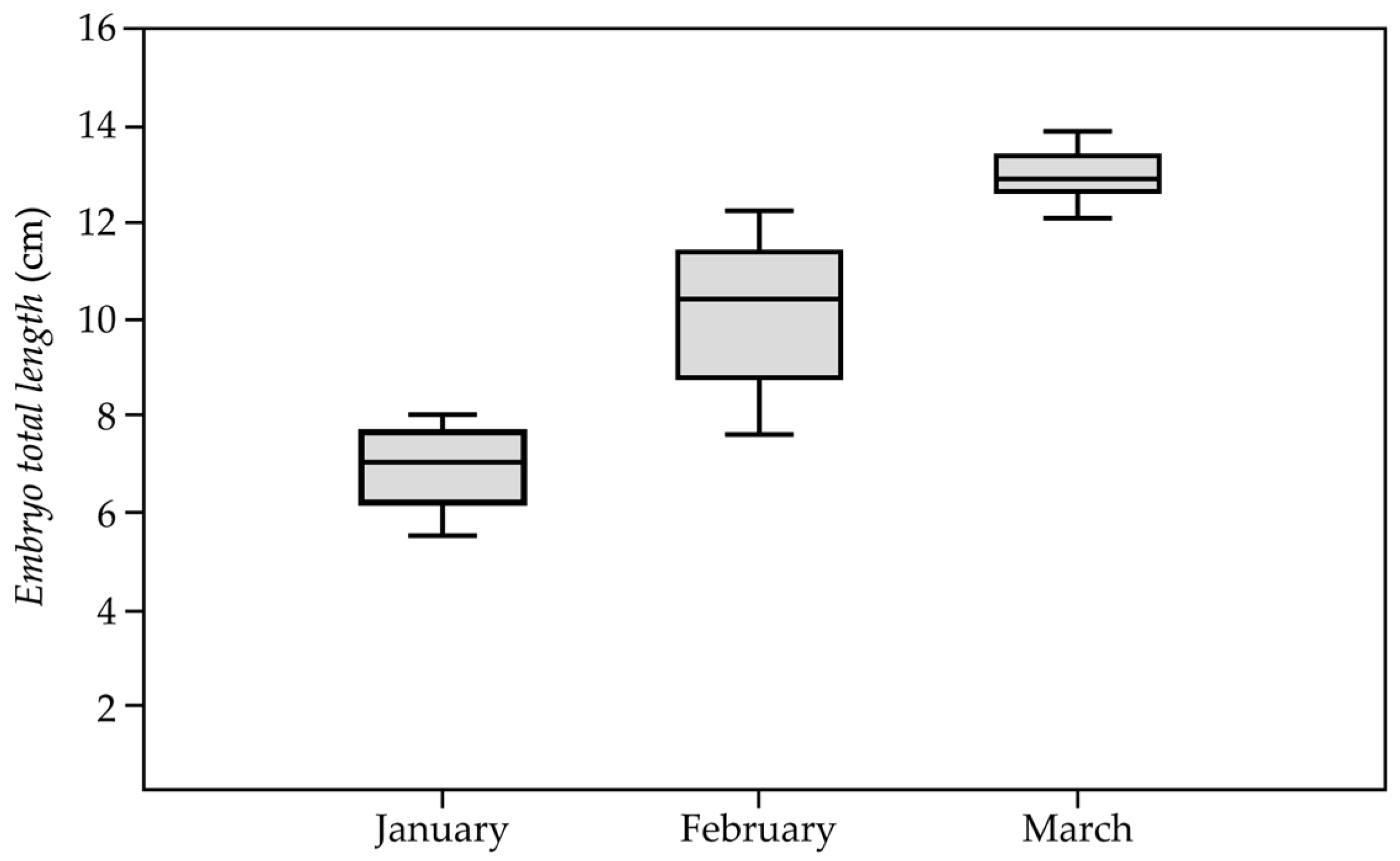
Litter sizes ranged from 4 to 12 embryos, with no significant correlation between female LT and fecundity (r2 = 0.11, p = 0.147). The embryos were evenly distributed between the uteri, with a mean of 4.0 ± 1.4 embryos in the left uterus and 3.9 ± 1.4 embryos in the right uterus. A paired t-test detected no significant difference between the uterine horns (t-test = 0.5547, p = 0.594), indicating a largely symmetrical allocation of the litter between the left and right uterine horns. Embryos were present throughout the summer months, with the smallest embryos (mean LT = 6.79 ± 0.83 cm) recorded in January and the largest (mean LT = 12.97 ± 0.60 cm) recorded in March, suggesting an average monthly growth of approximately 3 cm (Figure 6). The highest number of gravid females and embryos were recorded in February. The estimated length at birth was approximately 13–14 cm LT, based on the largest embryos measured in utero (13.9 cm LT) and the smallest free-swimming juveniles captured during the landings (14.2 cm LT).
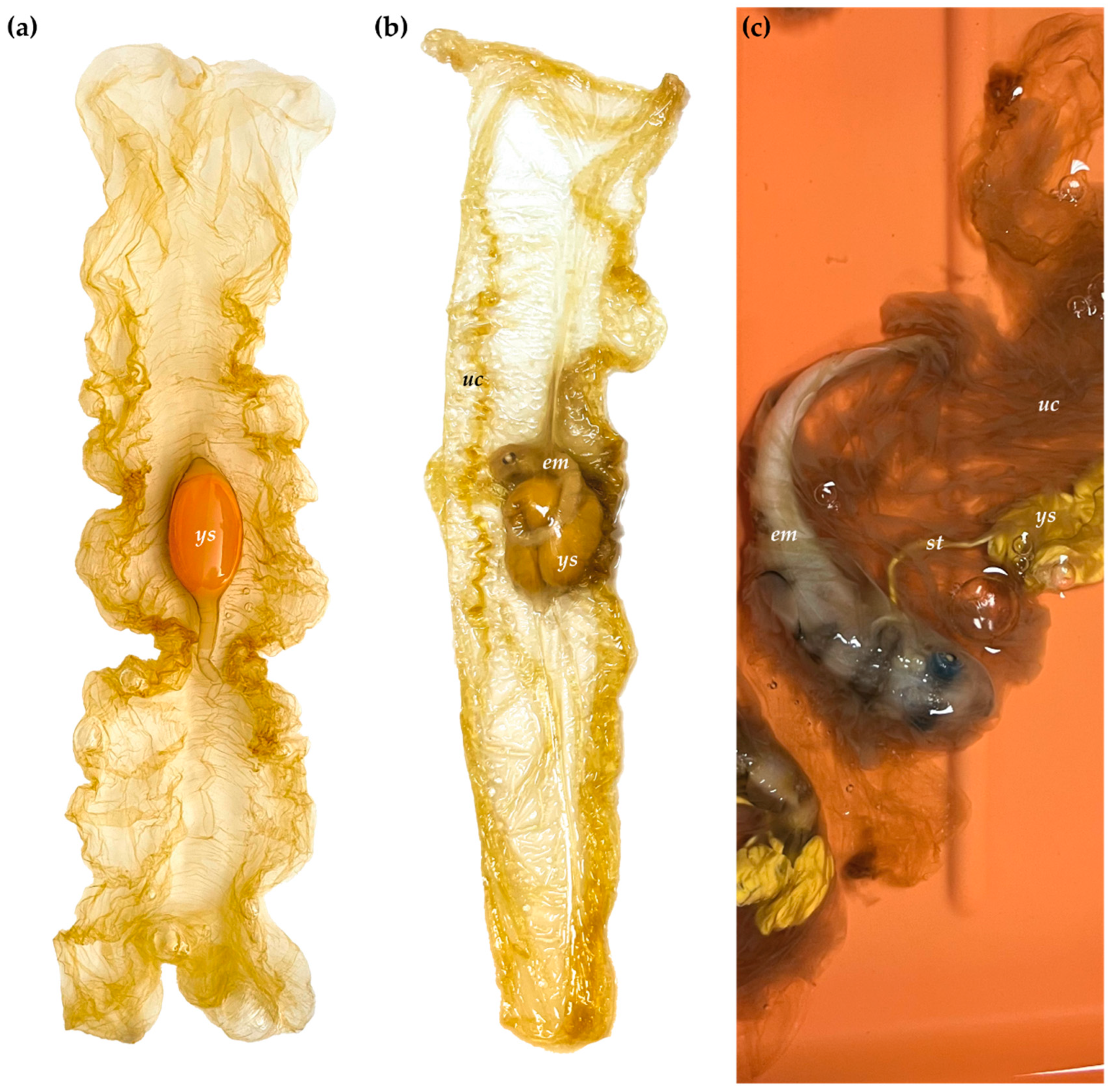
Each embryo was enclosed within a thin, transparent uterine egg capsule, approximately two to three times the embryo’s body length, and was often folded or twisted within the uterus throughout all developmental stages (Figure 7). The yolk sac remained externally connected to the embryo via a short stalk, with no evidence of placental structures or villiform projections, confirming that M. mento exhibits yolk sac (aplacental) viviparity.
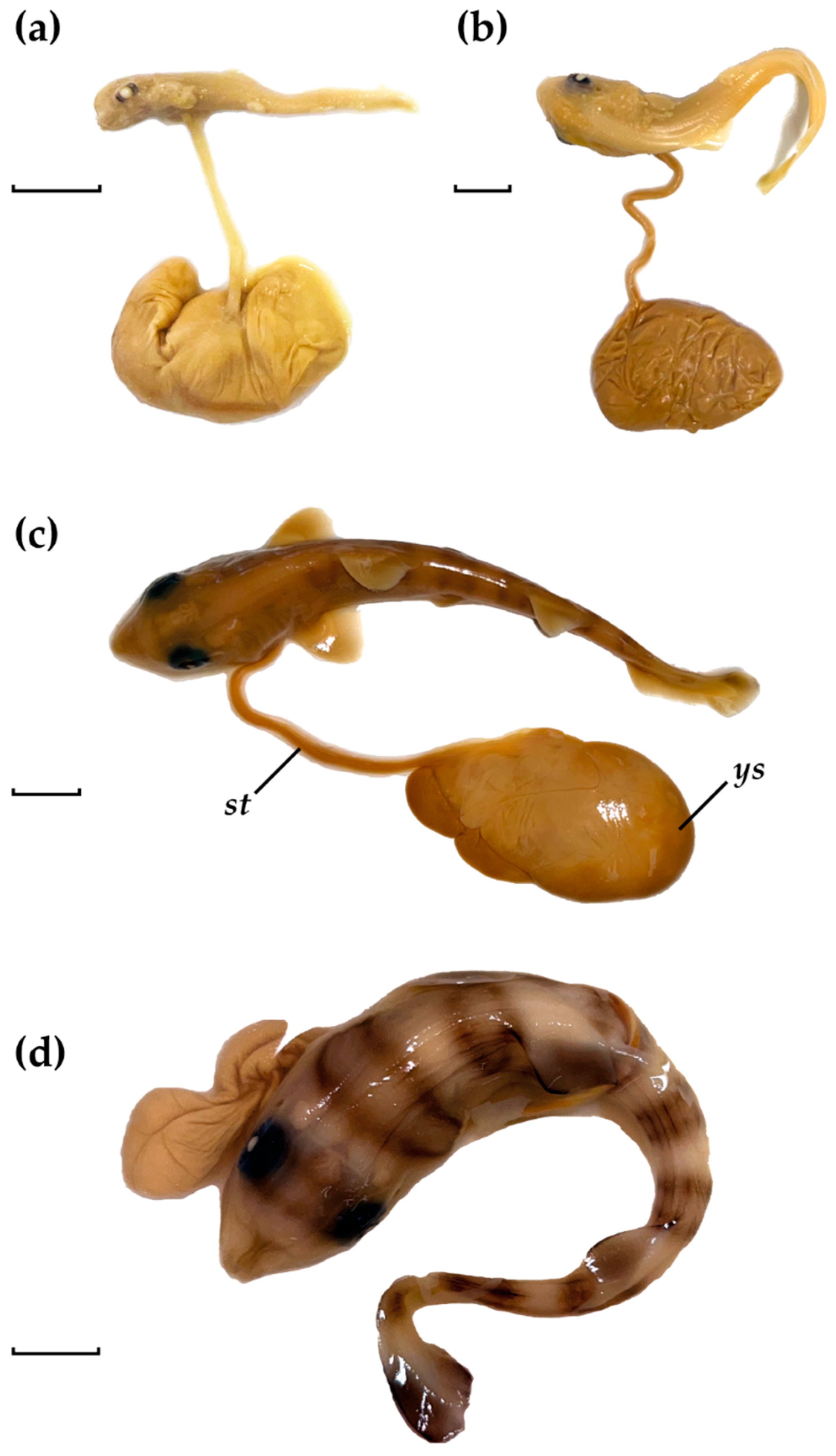
Five embryonic stages (E0–E4) were identified based on external morphology, pigmentation, fin development, and yolk sac reduction (Figure 7 and Figure 8). Stage E0 corresponds to a fertilized ovum enclosed in a thin, transparent egg capsule in which the embryonic germinal area is already visible, but the organ primordia are not yet differentiated (Figure 7a). Because E0 was only incidentally observed, quantitative analyses focused on embryos at stages E1–E4. Of the 71 embryos assigned to these stages, 18.3% (n = 13) corresponded to stage E1, 31.0% (n = 22) to stage E2, 26.8% (n = 19) to stage E3, and 23.9% (n = 17) to stage E4. No full-term embryos were observed, as none had completely absorbed the yolk sac, suggesting that additional late-stage phases may occur before parturition. At all stages (E0–E4), M. mento embryos were enclosed within a delicate, transparent uterine egg capsule (tertiary egg envelope) approximately two to three times the body length of the embryo (Figure 7a–c). As development progresses, this capsule persists as a protective envelope that becomes increasingly folded within the uterus as the embryo grows, whereas the yolk sac progressively decreases in size and becomes more vascularized. Throughout all stages examined, the yolk sac remained externally connected to the embryo via a yolk stalk, and no placental stalks or villiform projections were observed, confirming that M. mento exhibits yolk sac (aplacental) viviparity.
At the “Encapsulated ovum” (E0) stage, the fertilized oocyte is surrounded by a thin, elastic egg capsule that occupies most of the uterine lumen (Figure 7a). Inside the capsule, a single large homogeneous yolk mass was present, and the embryo was represented only by a small pale germinal disc located at one pole of the yolk mass. The capsule wall is smooth and semitransparent, with fine superficial vessels, and functions as an additional mechanical and osmotic barrier between the embryo–yolk complex and uterine environment. As development advances towards E1, the embryo elongates within the capsule and protrudes from the yolk mass while remaining attached to it by a narrow external yolk sac stalk (Figure 7b).
Embryos at the “Early Organogenesis” (E1) stage exhibited a translucent body with a large rounded cephalic region and a short, blunt snout (Figure 8a). The eyes were prominent with incipient dark pigmentation, and long, filamentous external gills arose from the spiracles and open gill slits, forming a dense tuft around the branchial region, indicating the active development of the respiratory apparatus. Paired fins are still poorly defined, appearing only as low fin folds along the lateral margins of the body, whereas somite segmentation remains clearly visible along the trunk. The external yolk sac is large, ovoid, and laterally flattened, with a conspicuous network of radiating blood vessels, and slightly exceeds or approximates the embryo’s body length, representing the main energy reserve at this stage of development. At the “Fin Differentiation” (E2) stage, the body axis was clearly elongated, with marked cranio–caudal differentiation and complete caudal flexure (Figure 8b). The pectoral, dorsal, anal, and caudal fin folds were externally visible as low, continuous ridges along the body margins, although their distal edges remained soft and rounded. The head was more defined, the snout was extended anteriorly, and the eyes were enlarged with more evident dark pigmentation. External gill filaments were still present but were shorter and less tufted than those in E1 and were partially covered by a developing opercular fold. The skin was smooth and translucent with no evident chromatophore pattern. The external yolk sac is large, ovoid, and strongly vascularized, representing approximately 60–70% of the total length of the embryo. Embryos at the “Pigmentation and Growth” (E3) stage are no longer tightly constrained by the capsule, which persists only as a thin, folded membrane around the embryo. The body axis was fully elongated and robust. The pectoral, dorsal, anal, and caudal fins were broad and clearly delimited, with distinct free margins and evident cartilaginous support at their bases (Figure 8c). The head becomes proportionally narrower, the snout elongates anteriorly, and the eyes are large and uniformly dark, with a discernible iris. Pigmentation is well developed on the dorsal surface and fins, forming discrete patches and diffuse longitudinal bands that outline species-specific color patterns. The external yolk sac was reduced to approximately half of the embryo’s body length, ovoid, and strongly vascularized, and the yolk stalk appeared shorter and thicker. Overall body proportions at this stage closely resembled those of free-swimming juveniles, although the yolk sac remained externally attached. At the “Pre-partum” (E4) stage, embryos exhibited fully developed fins with rigid margins and a well-defined pigmentation pattern of dark dorsal bands and fin edges shaded deep brown or black (Figure 8d). The eyes are completely pigmented, the snout is elongated and pointed, and dermal chromatophores are densely distributed on the dorsal and lateral surfaces. The trunk is robust, and the caudal fin has an asymmetrical heterocercal shape, which is typical of both juveniles and adults. The external yolk sac is vestigial, representing less than 10% of the embryo’s total length, but remains externally connected to the abdominal region by a short stalk.

4. Discussion

This study provides the first comprehensive description of the reproductive biology and embryonic development of speckled smooth-hound (M. mento) from northern Chile, a species previously known only from scattered taxonomic and fisheries records. Our results reveal key aspects of its life history, including a relatively early size at maturity, moderate fecundity, and yolk sac (aplacental) viviparity, which challenge the previous assumptions of placental reproduction for this species [13,14]. By documenting the absence of placental stalks or villiform projections in late-term embryos, our findings redefine the reproductive mode of M. mento, confirm its placement within the aplacental viviparous clade of Mustelus [25,28,37], and provide essential biological information for the conservation assessment of this threatened, endemic shark species.

4.1. Population Structure and Seasonal Distribution

The observed bimodal size distribution, together with the predominance of females during late spring and summer, indicates a likely pattern of reproductive segregation in M. mento. Such seasonal structuring has been reported for M. antarcticus in southern Australia [7] and M. henlei in the Gulf of California [38], where mature females migrate to shallow coastal areas to give birth and use these habitats as nursery grounds. The increased abundance of gravid females in summer in San Jorge Bay coincided with warmer surface waters and increased productivity driven by coastal upwelling. This suggests that the bay serves as a reproductive and/or nursery area for M. mento during summer. Similar environment-driven reproductive migrations and localized nursery grounds have been described for M. manazo [20] and M. schmitti [24], reinforcing the hypothesis that M. mento may follow a seasonal cycle linked to coastal temperature and prey availability. Identifying and characterizing such reproductive or nursery areas is critical for the conservation of coastal sharks, as these habitats provide essential conditions for embryonic development, parturition, and early juvenile survival [10,39]. Protecting these sites from intense fishing and habitat degradation enhances recruitment success and is recognized as one of the most effective spatial measures for sustaining vulnerable shark populations [7,12].
Although our data were obtained from a single artisanal landing site, the same core group of gillnet vessels operated in San Jorge Bay during both years using similar gear. Fishing effort likely increases during the austral spring–summer owing to more favorable weather and higher expected catch rates of coastal finfish and sharks. Therefore, the higher frequency of gravid females observed in summer probably reflects both a genuine seasonal peak in reproductive activity and, to some extent, seasonal variation in the fishing effort. Nevertheless, the consistent seasonal pattern across years, together with the presence of gravid females and embryos at multiple developmental stages, strongly supports the role of San Jorge Bay as a key reproductive and potential nursery habitat for M. mento [10,39].

4.2. Size at Maturity and Sexual Dimorphism

The estimated lengths at 50% maturity (L50 = 53.6 cm LT for females and 48.7 cm LT for males) were considerably smaller than those previously reported for M. mento (86–90 cm and 65–75 cm LT, respectively [13,14]). However, these earlier estimates were likely inferred from isolated specimens or generalized morphometric descriptions, rather than population-level analyses. The present estimates, based on a large sample and formal modelling, represent the first statistically derived maturity parameters for M. mento and probably provide a more realistic picture of its reproductive schedule. The sigmoidal increase in internal clasper length between approximately 50 and 55 cm LT is consistent with the onset of clasper maturity but does not necessarily agree with the internal maturation of the testes and ducts used to define L50. Similar slight offsets between gonadal and clasper-based maturity indicators have been reported in other triakids [7,26], indicating that functional copulatory capability requires not only spermatogenesis but also full calcification and rotation capacity of the claspers. However, it should also be noted that this maturity assessment does not resolve pregnancy and regressing/regenerating phases in detail. Nevertheless, the broad distinction between immature (stages I–II) and mature (stages III–IV) individuals is clear-cut and should not bias our estimates of L50, which are primarily driven by the onset of gonadal development [32]. Compared with congeners, the size at maturity of M. mento is relatively small but is broadly consistent with other small-bodied Mustelus species. In the southwestern Atlantic, males and females of M. schmitti reach maturity at approximately 59 and 72 cm TL, respectively [24]. In the southwestern Atlantic, M. schmitti males and females reach maturity at approximately 59 and 72 cm TL, respectively [24]. In the northeast Atlantic, the length at 50% maturity for M. asterias has been estimated to be 78 cm TL for males and 87 cm TL for females [25]. In the north-west Atlantic, M. canis matures at approximately 85 cm TL in males and 102 cm TL in females [26], whereas off north-western Mexico, M. henlei shows lengths at maturity of 63.5 cm TL for males and 65.8 cm TL for females [27]. In this context, the L50 values estimated for M. mento (48.7 cm TL for males and 53.6 cm TL for females) place this species toward the lower end of the maturity size spectrum within the genus, which is consistent with its relatively small adult size. As in many triakids, males mature at smaller sizes than females, a trend that reflects sexual dimorphism in reproductive investment, whereby females require greater energetic allocation for oocyte production, gestation, and provisioning [19]. In our sample, 70.6% of females and 66.0% of males were below their respective L50 values, indicating that most individuals caught in artisanal landings were still immature. This has direct implications for population dynamics: size-selective fishing that targets individuals below the female L50 threshold can bias the population sex and age structure, reduce spawning biomass, and compromise reproductive capacity. Although comparatively early maturity may confer some demographic resilience relative to larger, later-maturing Mustelus, when combined with moderate fecundity and a restricted coastal distribution, it still implies a limited scope for sustained fishing mortality.

4.3. Fecundity and Embryonic Development

In a comparative context, M. mento can be considered moderately fecund, with litters of 4–12 embryos, similar to M. whitneyi (6–18 embryos [4]) and M. manazo (2–13 embryos [20]), but substantially lower than that in larger species, such as M. antarcticus, which can produce up to 57 embryos [7]. Embryos were distributed symmetrically between the uteri, with no consistent dominance of either uterus, a pattern also reported for several other Mustelus species (e.g., M. canis [26] and M. higmani [28]). The presence of gravid females exclusively during the austral summer and the absence of full-term embryos suggest an annual reproductive cycle, with gestation lasting close to one year, consistent with estimates for M. antarcticus [7], M. higmani [28], and M. henlei [38].
Embryonic morphology indicates that M. mento develops through five distinct stages (E0–E4), from encapsulated ovum to pre-partum embryo, characterized by progressive fin differentiation, pigmentation, and yolk sac absorption. The smallest embryos corresponded to the E1–E2 stages with voluminous external yolk sacs, whereas E4 embryos closely resembled free-swimming juveniles but still retained a small external yolk sac. The estimated length at birth (13–14 cm LT) is small relative to the maximum adult size but is broadly comparable to the newborn sizes reported for other aplacental Mustelus species, such as M. schmitti (~15 cm) [24] and M. asterias (~16–18 cm) [25]. The continuous presence of an external yolk sac and the absence of placental connections throughout all stages confirm that M. mento exhibits yolk sac (aplacental) viviparity and firmly places the species within the non-placental lineage of Mustelus [16,37]. Yolk sac viviparity is considered the basal reproductive condition within Mustelus, from which placental viviparity evolved through progressive histotrophic specialization and the development of placental analogs [19,40]. The persistence of this ancestral reproductive condition in M. mento contributes to our understanding of evolutionary variability in maternal–embryonic relationships within Mustelus and highlights the functional divergence of physiological and nutritional pathways among closely related species.

4.4. Ecological and Conservation Implications

The reproductive characteristics of M. mento, including low fecundity, protracted gestation, and restricted coastal distribution, are typical of elasmobranchs with low intrinsic rates of population increase and limited capacity for demographic compensation under fishing mortality [41,42]. In northern Chile, M. mento inhabits shallow coastal habitats that are intensively fished by artisanal gillnet fleets targeting mixed coastal fish assemblages, where sharks and rays constitute a recurrent component of the catch and smooth-hounds (M. mento and M. whitneyi) are routinely retained and landed under the generic “tollo” category [6]. This spatial overlap with a year-round gillnet fishery, combined with the tendency of M. mento to aggregate in coastal nursery areas, may result in high effective exposure to fishing mortality and high vulnerability to overexploitation and slow recovery from depletion [11,12]. The persistent misidentification of M. mento in official fishery statistics, where landings are reported under the aggregated category “tollos” together with M. whitneyi, Galeorhinus galeus, and Triakis maculata, has precluded the generation of species-specific data on abundance, fishing effort, and reproductive condition [3,6]. This lack of taxonomic resolution hampers the detection of population trends and the formulation of effective management strategies for this species. The relatively small size at maturity and moderate fecundity observed here further suggest a limited capacity for demographic recovery, with population growth being strongly dependent on the survival of mature females.
Regional regulations may provide pragmatic benchmarks for management in the southeastern Pacific. In Peru, a minimum legal landing size of 60 cm TL has been established for M. mento and M. whitneyi, with a 20% tolerance for juveniles (R.M. No. 209-2001-PE and Annex I; updated 2024–2025). Although regulations based solely on minimum catch size may have a limited conservation impact when landings are aggregated among species, they provide a baseline that should be adopted and enforced in Chile. Aligning the national management frameworks across the region would improve consistency and support the transboundary assessments. Based on our estimates of size at sexual maturity (female L50 = 53.6 cm TL) and the inferred timing of parturition (early autumn), a minimum landing size above female L50 (e.g., 56–60 cm TL) would protect a greater proportion of mature females and help to maintain reproductive output. However, we could not robustly estimate size at maternity (owing to the limited number of gravid females and the macroscopic staging resolution), and the present recommendation should be viewed as a precautionary and conservative approximation. Furthermore, species-specific recording and identification of Mustelus landings should replace generic categories to allow accurate population assessments. Seasonal protection of coastal areas in northern Chile during the austral summer (December–March), when gravid females and early-stage embryos are most frequent, and in early autumn, when parturition is likely to occur, would help safeguard reproductive aggregations and potential nursery grounds that are critical for the renewal of the population. Comparable management frameworks have been successfully implemented for congeneric species in other regions. In Australia, M. antarcticus (gummy shark) is managed under the Southern and Eastern Scalefish and Shark Fishery through total allowable catches, individual transferable quotas, and gear restrictions designed to maintain sustainable yields and protect breeding females [43]. In the United States, M. canis (smooth dogfish) is regulated under the Highly Migratory Species Fishery Management Plan, which sets annual catch limits and reporting requirements to prevent overfishing [44,45]. In European waters, M. asterias (starry smooth-hound) is managed through spatially and temporally controlled catch limits under the European Union’s multiannual plan for demersal stocks, coordinated by the International Council for the Exploration of the Sea [46]. These frameworks illustrate that species-specific quotas, combined with spatial and temporal closures, offer effective approaches for balancing the exploitation and conservation of slow-growing coastal sharks in the long term.
The reproductive and demographic patterns identified for M. mento provide a robust biological foundation for developing species-specific conservation measures in its native range in Chile. Given it listing as “Critically Endangered” by both the IUCN Red List and the Chilean Ministry of the Environment [3,23], these traits are particularly concerning. The combination of early maturity, moderate fecundity, and yolk sac viviparity is characteristic of K-selected elasmobranchs, with relatively low intrinsic rates of population increase and strong dependence on juvenile and adult female survival [41,43,47,48]. These life-history traits justify the implementation of a precautionary management framework that integrates minimum landing sizes above the size at first maturity, species-level catch reporting, and seasonal protection of reproductive habitats. Such measures are consistent with demographic analyses showing that shark population growth is most sensitive to the survival of juveniles and mature females; therefore, management should prioritize the protection of these life stages and their critical habitats [39,49]. The adoption of these strategies, harmonized with existing regulations in Peru and informed by international best practices for congeneric species (e.g., quota-based and spatially explicit management frameworks), would enhance regional coherence in shark conservation policies and contribute to the long-term sustainability of coastal fisheries in the southeastern Pacific, in line with the cooperative, regionally coordinated approaches promoted by the FAO IPOA–Sharks and broader regional fisheries governance frameworks [50]. In addition to its intrinsic conservation value, M. mento is a useful focal taxon for management and monitoring in northern Chile. As an “umbrella species”, protecting the coastal habitats and seasonal windows that sustain reproduction and early life stages of this endemic shark (e.g., nursery and pupping areas subject to intense gillnet effort) would also reduce the exposure of other sympatric coastal elasmobranchs captured in the same fishery and habitats (e.g., M. whitneyi, Triakis maculata, and Galeorhinus galeus) [51,52]. As a “sentinel species”, its restricted distribution, threatened status, and high susceptibility to gillnet mortality make trends in its size structure, maturity composition, and seasonal occurrence particularly informative as early indicators of fishery impacts in coastal shark assemblages [53]. Accordingly, management measures designed around M. mento (such as size limits above female L50, seasonal protection of reproductive habitats, and species-specific catch reporting) are likely to deliver measurable co-benefits for other co-occurring coastal elasmobranchs while providing an operational framework for tracking the effectiveness of conservation interventions over time [54]. Future efforts to integrate biological, ecological, and socio-fisheries data will be essential to translate these recommendations into effective conservation outcomes across the region.

Author Contributions

Conceptualization, C.B. and C.V.-C.; methodology, K.T., C.B. and C.V.-C.; formal analysis, K.T., A.M. and L.B.; writing—original draft preparation, K.T., A.M. and L.B.; writing—review and editing, C.B. and C.V.-C.; funding acquisition, C.B. All authors have read and agreed to the published version of the manuscript.

Funding

This research was funded by Agencia Nacional de Investigación y Desarrollo de Chile (ANID FONDECYT), grant number 11220358. The APC was funded by Vicerrectoría de Investigación, Innovación y Postgrado of Universidad de Antofagasta.

Institutional Review Board Statement

The study was conducted in accordance with the Declaration of Helsinki and approved by the Institutional Ethics Committee of Universidad de Antofagasta (protocol N°362 of 18 March 2022).

Informed Consent Statement

Not applicable.

Data Availability Statement

The datasets generated and/or analyzed during the current study are contained within the article.

Acknowledgments

The authors acknowledge R. Pedrero, D. Soto, K. Núñez, M. Indurain, and A. Osses for their contributions during the initial sampling stage of this project. We extend special thanks to the fishers from “Caleta Antofagasta”, whose active participation made this work possible, and to the staff of the “Programa de Conservación de Tiburones” for their assistance with specimen sorting and sampling.

Conflicts of Interest

The authors declare no conflicts of interest. The funders had no role in the design of the study; in the collection, analyses, or interpretation of data; in the writing of the manuscript; or in the decision to publish the results.

References

  1. Simpfendorfer, C.A.; Heupel, M.R.; Kendal, D. Complex Human-Shark Conflicts Confound Conservation Action. Front. Conserv. Sci. 2021, 2, 692767. [Google Scholar] [CrossRef]
  2. Heemstra, P.C. A review of the smooth-hound sharks (genus Mustelus, family Triakidae) of the western Atlantic Ocean, with descriptions of two new species and a new subspecies. Bull. Mar. Sci. 1997, 60, 894–928. [Google Scholar]
  3. Dulvy, N.K.; Acuña, E.; Bustamante, C.; Concha, F.; Herman, K.; Velez-Zuazo, X. Mustelus mento (Amended Version of 2020 Assessment). 2021. Available online: https://www.iucnredlist.org/species/63128/203720849 (accessed on 2 December 2025). [CrossRef]
  4. Gonzalez-Pestana, A.; Alfaro-Shigueto, J.; Mangel, J.C. Aspects of reproductive biology of the humpback smooth-hound shark (Mustelus whitneyi) off northern Peru. Mar. Freshw. Res. 2019, 70, 1185–1188. [Google Scholar] [CrossRef]
  5. Bustamante, C.; Acuña, E.; Tapia-Jopia, C.; Vargas-Caro, C. Actualización del Plan de Acción Nacional Para la Conservación y Manejo de Tiburones de Chile; Universidad de Antofagasta: Antofagasta, Chile, 2023; pp. 211–232. [Google Scholar]
  6. Bustamante, C.; Acuña, E.; Vargas-Caro, C. Regional Overviews: Chile. In The Global Status of Sharks, Rays, and Chimaeras; Jabado, R.W., Morata, A.Z.A., Bennett, R.H., Finucci, B., Ellis, J.R., Fowler, S.L., Grant, M.I., Barbosa Martins, A.P., Sinclair, S.L., Eds.; IUCN: Gland, Switzerland, 2024; pp. 457–468. [Google Scholar] [CrossRef]
  7. Walker, T.I. Spatial and temporal variation in the reproductive biology of gummy shark (Mustelus antarcticus) harvested off southern Australia. Mar. Freshw. Res. 2007, 58, 67–80. [Google Scholar] [CrossRef]
  8. Dedman, S.; Moxley, J.H.; Papastamatiou, Y.P.; Braccini, M.; Caselle, J.E.; Chapman, D.D.; Cinner, J.E.; Dillon, E.M.; Dulvy, N.K.; Dunn, R.E.; et al. Ecological roles and importance of sharks in the Anthropocene Ocean. Science 2024, 385, eadl2362. [Google Scholar] [CrossRef] [PubMed]
  9. Dulvy, N.K.; Pacoureau, N.; Rigby, C.L.; Pollom, R.A.; Jabado, R.W.; Ebert, D.A.; Finucci, B.; Pollock, C.M.; Cheok, J.; Derrick, D.H.; et al. Overfishing drives over one-third of all sharks and rays toward a global extinction crisis. Curr. Biol. 2021, 31, 4773–4787. [Google Scholar] [CrossRef]
  10. Heupel, M.R.; Carlson, J.K.; Simpfendorfer, C.A. Shark nursery areas: Concepts, definition, characterization and assumptions. Mar. Ecol. Prog. Ser. 2007, 337, 287–297. [Google Scholar] [CrossRef]
  11. Stevens, J.D.; Bonfil, R.; Dulvy, N.K.; Walker, P.A. The effects of fishing on sharks, rays and chimaeras (Chondrichthyans), and the implications for marine ecosystems. ICES J. Mar. Sci. 2000, 57, 476–494. [Google Scholar] [CrossRef]
  12. Dulvy, N.K.; Fowler, S.L.; Musick, J.A.; Cavanagh, R.D.; Kyne, P.M.; Harrison, L.R.; Carlson, J.K.; Davidson, L.N.K.; Fordham, S.V.; Francis, M.P.; et al. Extinction risk and conservation of the world’s sharks and rays. eLife 2014, 3, e00590. [Google Scholar] [CrossRef]
  13. Compagno, L.J.V. Sharks of the World: An Annotated and Illustrated Catalogue of Shark Species Known to Date; FAO: Rome, Italy, 1984; Volume 125, pp. 1–655.
  14. Ebert, D.A.; Dando, M.; Fowler, S. Sharks of the World: A Complete Guide; Wild Nature Press: Plymouth, UK, 2021. [Google Scholar]
  15. Weigmann, S. Annotated checklist of the living sharks, batoids and chimaeras (Chondrichthyes) of the world, with a focus on biogeographical diversity. J. Fish Biol. 2016, 88, 837–1037. [Google Scholar] [CrossRef]
  16. López, J.A.; Ryburn, J.A.; Fedrigo, O.; Naylor, G.J. Phylogeny of sharks of the family Triakidae (Carcharhiniformes) and its implications for the evolution of carcharhiniform placental viviparity. Mol. Phylogenetics Evol. 2006, 40, 50–60. [Google Scholar] [CrossRef]
  17. Naylor, G.J.; Caira, J.N.; Jensen, K.; Rosana, K.A.; White, W.T.; Last, P.R. A DNA sequence-based approach to the identification of shark and ray species and its implications for global elasmobranch diversity and parasitology. Bull. Am. Mus. Nat. Hist. 2012, 367, 1–262. [Google Scholar] [CrossRef]
  18. Blackburn, D.G. Convergent evolution of viviparity, matrotrophy, and specializations for fetal nutrition in reptiles and other vertebrates. Am. Zool. 1992, 32, 313–321. [Google Scholar] [CrossRef]
  19. Musick, J.A.; Ellis, J. Reproductive evolution of chondrichthyans. In Reproductive Biology and Phylogeny of Chondrichthyans; Hamlett, W.S., Ed.; Science Publishers Inc.: Enfield, NH, USA, 2005; pp. 45–79. [Google Scholar]
  20. Yamaguchi, A.; Taniuchi, T.; Shimizu, M. Geographic variations in reproductive parameters of the starspotted dogfish, Mustelus manazo, from five localities in Japan and in Taiwan. Environ. Biol. Fishes 2000, 57, 221–233. [Google Scholar] [CrossRef]
  21. Esposito, G.; Meletiadis, A.; Sciuto, S.; Prearo, M.; Gagliardi, F.; Corrias, I.; Pira, A.; Dondo, A.; Briguglio, P.; Ghittino, C.; et al. First report of recurrent parthenogenesis as an adaptive reproductive strategy in the endangered common smooth-hound shark Mustelus mustelus. Sci. Rep. 2024, 14, 17171. [Google Scholar] [CrossRef] [PubMed]
  22. Bustamante, C.; Vargas-Caro, C.; Bennett, M.B. Not all fish are equal: Functional biodiversity of cartilaginous fishes (Elasmobranchii and Holocephali) in Chile. J. Fish Biol. 2014, 85, 1617–1633. [Google Scholar] [CrossRef]
  23. Ministerio del Medio Ambiente (MMA). Aprueba y oficializa clasificación de especies según estado de conservación, decimoctavo proceso. D. O. Chile 2023, 4367, 1–5. Available online: https://bcn.cl/3gnpp (accessed on 2 December 2025).
  24. Chiaramonte, G.E.; Pettovello, A.D. The biology of the narrownose smooth-hound shark Mustelus schmitti in Patagonia, Argentina. J. Fish Biol. 2000, 57, 930–942. [Google Scholar] [CrossRef]
  25. Farrell, E.D.; Mariani, S.; Clarke, M.W. Reproductive biology of the starry smooth-hound shark Mustelus asterias: Geographic variation and implications for sustainable exploitation. J. Fish Biol. 2010, 77, 1505–1525. [Google Scholar] [CrossRef]
  26. Conrath, C.L.; Musick, J.A. Reproductive biology of the smooth dogfish Mustelus canis in the northwest Atlantic Ocean. J. Fish Biol. 2002, 60, 172–188. [Google Scholar] [CrossRef]
  27. Soto-López, K.; Ochoa-Báez, R.I.; Tovar-Ávila, J.; Galván-Magaña, F. Reproductive biology of the brown smooth-hound shark, Mustelus henlei (Chondrichthyes: Triakidae), off northwestern Mexico based on macroscopic and histological analyses. Cienc. Mar. 2018, 44, 125–139. [Google Scholar] [CrossRef]
  28. Macías-Cuyare, M.; Tavares, R.; Oddone, M.C. Reproductive biology and placentotrophic embryonic development of the smalleye smooth-hound shark, Mustelus higmani, from southeastern Caribbean. J. Mar. Biol. Assoc. U.K. 2020, 100, 1337–1347. [Google Scholar] [CrossRef]
  29. Thiel, M.; Macaya, E.C.; Acuña, E.; Arntz, W.E.; Bastias, H.; Brokordt, K.; Camus, P.A.; Castilla, J.C.; Castro, L.R.; Cortés, M.; et al. The Humboldt Current System of northern and central Chile: Oceanographic processes, ecological interactions and socioeconomic feedback. Oceanogr. Mar. Biol. 2007, 45, 195–344. [Google Scholar] [CrossRef]
  30. Sokal, R.R.; Rohlf, F.J. Introduction to Biostatistics, 2nd ed.; W.H. Freeman Press: New York, NY, USA, 1987. [Google Scholar]
  31. Stehmann, M.F.W. Proposal of a maturity stages scale for oviparous and viviparous cartilaginous fishes (Pisces, Chondrichthyes). Arch. Fish. Mar. Res. 2002, 50, 23–48. [Google Scholar]
  32. ICES. Report of the Workshop on Sexual Maturity Staging of Elasmobranches (WKMSEL), 11–15 October 2010, Valetta, Malta; International Council for the Exploration of the Sea (ICES): Copenhagen, Denmark, 2010. [CrossRef]
  33. Hernández, S.; Lamilla, J.; Dupré, E.; Stotz, W. Desarrollo embrionario de la pintarroja común Schroederichthys chilensis (Guichenot, 1848) (Chondrichthyes: Scyliorhinidae). Gayana 2005, 69, 184–190. [Google Scholar] [CrossRef]
  34. Onimaru, K.; Motone, F.; Kiyatake, I.; Nishida, K.; Kuraku, S. A staging table for the embryonic development of the brown banded bamboo shark (Chiloscyllium punctatum). Dev. Dynam. 2018, 247, 712–723. [Google Scholar] [CrossRef] [PubMed]
  35. Byrum, S.R.; Frazier, B.S.; Grubbs, R.D.; Naylor, G.J.; Fraser, G.J. Embryonic development in the bonnethead (Sphyrna tiburo), a viviparous hammerhead shark. Dev. Dynam. 2024, 253, 351–362. [Google Scholar] [CrossRef]
  36. R Core Team. R: A Language and Environment for Statistical Computing; R Foundation for Statistical Computing: Vienna, Austria, 2024. [Google Scholar]
  37. Boomer, J.; Harcourt, R.; Francis, M.; Stow, A. Genetic divergence, speciation and biogeography of Mustelus (sharks) in the central Indo-Pacific and Australasia. Mol. Phylogenetics Evol. 2012, 64, 697–703. [Google Scholar] [CrossRef] [PubMed]
  38. Pérez-Jiménez, J.C.; Sosa-Nishizaki, O. Reproductive biology of the brown smoothhound shark Mustelus henlei in the Gulf of California, Mexico. J. Fish Biol. 2008, 73, 782–792. [Google Scholar] [CrossRef]
  39. Kinney, M.J.; Simpfendorfer, C.A. Reassessing the value of nursery areas to shark conservation and management. Conserv. Lett. 2009, 2, 53–60. [Google Scholar] [CrossRef]
  40. Hamlett, W.C.; Koob, T.J. Female reproductive system. In Sharks, Skates, and Rays: The Biology of Elasmobranch Fishes; Hamlett, W.C., Ed.; Johns Hopkins University Press: Baltimore, MD, USA, 1999; pp. 398–443. [Google Scholar]
  41. Frisk, M.G.; Miller, T.J.; Fogarty, M.J. Life histories and vulnerability to exploitation of elasmobranchs: Inferences from elasticity, perturbation and phylogenetic analyses. J. Northw. Atl. Fish. Sci. 2005, 35, 27–49. [Google Scholar] [CrossRef]
  42. Pardo, S.A.; Kindsvater, H.K.; Reynolds, J.D.; Dulvy, N.K. Maximum intrinsic rate of population increase in sharks, rays and chimaeras: The importance of survival to maturity. Can. J. Fish. Aquat. Sci. 2016, 73, 1159–1167. [Google Scholar] [CrossRef]
  43. AFMA. Southern and Eastern Scalefish and Shark Fishery (SESSF); Australian Fisheries Management Authority: Canberra, Australia, 2024; pp. 1–174.
  44. Department of Commerce (DOC). Atlantic Highly Migratory Species; Smoothhound Shark and Atlantic Shark Management Measures. National Marine Fisheries Service, National Oceanic and Atmospheric Administration. Fed. Regist. 2015, 80, 73128–73146. [Google Scholar]
  45. Department of Commerce (DOC). Final Atlantic Shark Fishery Review. National Marine Fisheries Service, National Oceanic and Atmospheric Administration. Fed. Regist. 2023, 89, 16944–16945. [Google Scholar]
  46. ICES. Smooth-hound (Mustelus spp.) in subareas 1–10, 12, and 14 (Northeast Atlantic and adjacent waters). In Report of the ICES Advisory Committee, 2023; ICES Advice 2023, sdv.27.nea; ICES: Copenhagen, Denmark, 2023; pp. 1–17. [Google Scholar]
  47. Simpfendorfer, C.A. Demographic models: Life tables, matrix models and rebound potential. In Management Techniques for Elasmobranch Fisheries; Musick, J.A., Bonfil, R., Eds.; FAO Fisheries Technical Paper: Roma, Italy, 2005; pp. 143–153. [Google Scholar]
  48. Adams, K.R.; Fetterplace, L.C.; Davis, A.R.; Taylor, M.D.; Knott, N.A. Sharks, rays and abortion: The prevalence of capture-induced parturition and the associated risk for conservation. Biol. Conserv. 2018, 217, 11–27. [Google Scholar] [CrossRef]
  49. Cortés, E. Incorporating uncertainty into demographic modeling: Application to shark populations and their conservation. Conserv. Biol. 2002, 16, 1048–1062. [Google Scholar] [CrossRef]
  50. FAO. International Plan of Action for the Conservation and Management of Sharks (IPOA–Sharks); Food and Agriculture Organization of the United Nations: Rome, Italy, 1999.
  51. Osgood, G.J.; McCord, M.E.; Baum, J.K. Chondrichthyans as an umbrella species-complex for conserving South African biodiversity. Afr. J. Mar. Sci. 2020, 42, 81–93. [Google Scholar] [CrossRef]
  52. López, M.; Clavel-Henry, M.; Bahamon, N.; Vigo, M.; Balcells, M.; Sánchez-Márquez, A.; Navarro, J.; Company, J.B. Identifying Spatial Patterns of Egg Nursery Habitat for a Demersal Shark in the Northwestern Mediterranean Sea: Conservation and Management Implications. Divers. Distrib. 2025, 31, e70004. [Google Scholar] [CrossRef]
  53. Hazen, E.L.; Abrahms, B.; Brodie, S.; Carroll, G.; Jacox, M.G.; Savoca, M.S.; Scales, K.L.; Sydeman, W.J.; Bograd, S.J. Marine top predators as climate and ecosystem sentinels. Front. Ecol. Environ. 2019, 17, 565–574. [Google Scholar] [CrossRef]
  54. Du, J.; Ding, L.; Su, S.; Hu, W.; Wang, Y.; Loh, K.-H.; Yang, S.; Chen, M.; Roeroe, K.A.; Songploy, S.; et al. Setting conservation priorities for marine sharks in China: The value of integrating ecological, socioeconomic and threat data. Front. Mar. Sci. 2022, 9, 933291. [Google Scholar] [CrossRef]
Figure 1. Size–frequency distribution of Mustelus mento from artisanal landings in Antofagasta, northern Chile (2021–2023). Dashed lines indicate the fitted normal curves for females and males.
Fishes 11 00028 g001
Figure 2. Seasonal variation in the monthly abundance of male and female Mustelus mento from artisanal landings in Antofagasta, northern Chile (2021–2023).
Fishes 11 00028 g002
Figure 3. Reproductive maturity of Mustelus mento off northern Chile. Adjusted maturity models describing the proportion of mature (a) females and (b) males as a function of total length (LT); shaded areas indicate the 95% confidence intervals of the fitted curves; and (c) the relationship between internal clasper length and LT. The dotted gray lines in (a,b) indicate the estimated length at which 50% of the individuals are mature (L50). In (c), the gray and black circles represent immature (stages I–II) and mature (stages III–IV) males, respectively.
Fishes 11 00028 g003
Figure 4. Size–frequency distribution of male and female embryos of Mustelus mento obtained from gravid females landed in Antofagasta, northern Chile (2021–2023). Dashed lines indicate the fitted normal curves for each sex.
Fishes 11 00028 g004
Figure 5. Relationships between embryo total length and (a) total weight, (b) yolk sac diameter, and (c) yolk sac weight in Mustelus mento from northern Chile. Symbols indicate embryonic stages (E1–E4). The solid lines represent the fitted linear models using all stages combined.
Fishes 11 00028 g005
Figure 6. Temporal variation (by month) in the total length (cm) of Mustelus mento embryos from northern Chile.
Fishes 11 00028 g006
Figure 7. Uterine egg capsules of Mustelus mento from northern Chile, illustrating capsule morphology and persistence across development. Representative stages are shown as (a) “Encapsulated ovum” (E0), (b) “Early Organogenesis” (E1), and (c) “Pre-partum” (E4). The positions of the yolk sac (ys), embryo (em), uterine egg capsule (uc), and yolk sac stalk (st) are indicated in each panel.
Fishes 11 00028 g007
Figure 8. Embryonic developmental stages of Mustelus mento from northern Chile, illustrating the progression of external morphology during growth: (a) E1 “Early Organogenesis”; (b) E2 “Fin Differentiation”; (c) E3 “Pigmentation and Growth”; and (d) E4 “Pre-partum”. Scale bar = 2 cm in all panels.
Fishes 11 00028 g008
Disclaimer/Publisher’s Note: The statements, opinions and data contained in all publications are solely those of the individual author(s) and contributor(s) and not of MDPI and/or the editor(s). MDPI and/or the editor(s) disclaim responsibility for any injury to people or property resulting from any ideas, methods, instructions or products referred to in the content.