


Abstract
This study presents updated biological and stock assessment information for two coral groupers, Plectropomus areolatus and Plectropomus marisrubri, in the Eastern Red Sea. A large sample collected from nine landing sites provided new estimates of growth, maturity, mortality, and exploitation, derived from otolith ageing, length–weight relationships, and yield-per-recruit and spawning potential ratio analyses. The two species showed distinct life-history patterns, with P. areolatus maturing earlier and exhibiting faster growth. Both species were found to be overexploited under current fishing pressure, with spawning biomass reduced well below commonly used sustainability thresholds. These results indicate that reductions in fishing mortality are required to rebuild reproductive capacity, particularly for P. areolatus. Management actions, such as increasing hook selectivity and enforcing minimum landing sizes, are supported by the observed maturity schedules. Seasonal protection of spawning periods is consistent with the low spawning potential ratios. This study provides the first recent age-based assessment for these two species in the region, offering a biological basis for species-specific management planning in the Eastern Red Sea.
Key Contribution:
This study provides the first comparative life-history and stock assessment data for Plectropomus areolatus and Plectropomus marisrubri in the Eastern Red Sea, offering a scientific basis for species-specific fisheries management in the region. The findings indicate that P. areolatus requires a 30% reduction in fishing mortality, whereas P. marisrubri needs only a modest 3% reduction to rebuild spawning capacity, underscoring the importance of species-specific management interventions.
1. Introduction
The Red Sea is a semi-enclosed tropical basin characterized by strong latitudinal gradients in temperature and salinity, its oligotrophic nature, and coral reef assemblages with high levels of endemism [1,2]. These coral reef ecosystems support diverse fish communities but are increasingly threatened by coastal development, pollution, climate change, and overfishing [3,4]. Artisanal and commercial fisheries targeting coral reef-associated species have expanded in recent decades, raising concerns regarding the sustainability of exploited stocks and the resilience of reef ecosystems [5].
Fisheries in the Red Sea are predominantly small-scale and operate using a range of vessels and gears, including handlines, gillnets, traps, and localized spearfishing [6,7,8,9]. Groupers (Epinephelidae) are among the most valuable components of these fisheries and are primarily harvested with handlines and traps [10]. Their high market value, especially in Saudi Arabia, contributes to considerable fishing pressure on reef habitats [11]. Annual reported landings of groupers in the Red Sea have varied widely, typically ranging between two and eight thousand tonnes, with artisanal fisheries accounting for the majority of this catch [5,12]. Fishing effort is often concentrated on reef slopes and aggregation sites, where predictable temporal and spatial patterns increase the vulnerability of groupers to overexploitation [13].
Two species are of particular regional importance. The Red Sea endemic Plectropomus marisrubri inhabits coral reef habitats ranging from shallow areas to depths exceeding 100 m, exhibits protogynous hermaphroditism, and forms spawning aggregations [14,15]. The species is listed as Vulnerable on the IUCN Red List due to documented declines along the coasts of Saudi Arabia, Eritrea, and Sudan [15]. Its high market value further intensifies fishing pressure [11]. Plectropomus areolatus is distributed across the Red Sea and the Indo-Pacific, is also a protogynous hermaphrodite, and forms large, predictable spawning aggregations [16,17]. It is likewise classified as Vulnerable. Individuals in the Red Sea are generally smaller and mature at an earlier age than those in other regions, likely reflecting spatial differences in habitat productivity and fishing intensity [18]. Both species have experienced fluctuations in landings in recent years, including sharp declines between 2016 and 2019, followed by a partial recovery [5]. These patterns underscore their sensitivity to exploitation and the necessity for ongoing monitoring.
Although groupers contribute substantially to fishery revenue in Saudi Arabia, recent observations of small and undersized individuals of high-value species indicate that many reefs are already experiencing overfishing [11]. Targeting of spawning aggregations further elevates the risk of recruitment impairment in both P. areolatus and P. marisrubri [13,17]. Despite this concern, biological and stock assessment information for these species in the Red Sea remains limited. Existing studies, including those by [18] on selected life-history traits and [19] on mortality and exploitation, are more than a decade old. No recent, large-sample, age-based assessments incorporating yield-per-recruit or spawning potential ratio analyses are available for the Eastern Red Sea, despite clear evidence of spatial gradients in fishing pressure and life-history characteristics.
Understanding growth, maturation, mortality, and exploitation levels is essential for evaluating sustainability in protogynous groupers, where the removal of larger individuals can alter population structure and reduce reproductive output. Updated biological information is therefore necessary for developing effective management strategies. The objective of this study is to provide new estimates of population parameters, describe the fishery biology, and evaluate the stock status of P. areolatus and P. marisrubri across nine major landing sites in the Eastern Red Sea. Due to the limited number of individuals potentially undergoing sex transition, it was not possible to infer size- or age-related sex change patterns. These individuals were excluded from analyses following a conservative approach that reduces potential bias in growth and mortality estimation [20]. Although this limitation restricts the evaluation of sex-specific dynamics, it does not compromise the overall robustness of the stock assessment or the management recommendations developed for the sustainable exploitation of coral reef groupers in the Red Sea.
2. Materials and Methods
2.1. Biological Data Collection
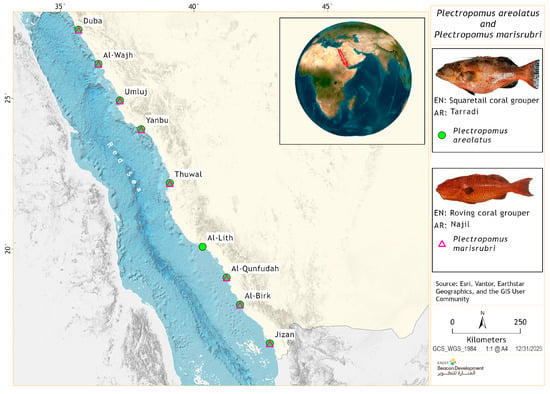
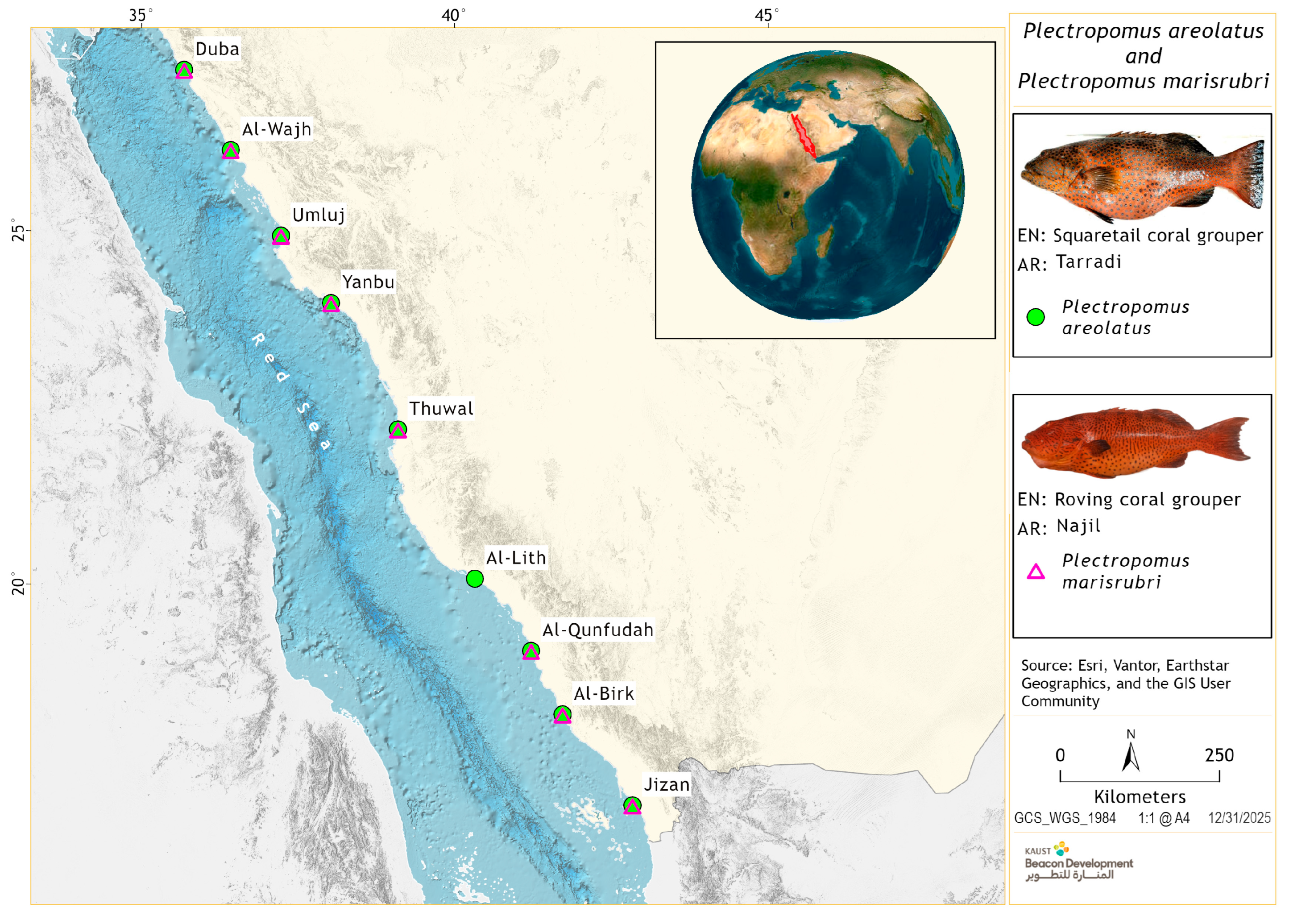
Coral grouper species were collected monthly from January 2022 to December 2023 at nine landing sites along the Eastern Red Sea coastline (Figure 1, Supplementary Table S1). For both species, the handline was the primary fishing gear, accounting for 94–97% of the total number of sampled fish. Trap fishing was used to a lesser extent (6% and 3%), while spearfishing was negligible, representing only 0.2% of the catch for P. marisrubri.
Figure 1.
Sampling ports where P. areolatus and P. marisrubri specimens were collected between 2022 and 2023 along the Saudi Arabian Red Sea coast.
Over the study period, 3197 P. areolatus specimens and 1248 P. marisrubri specimens were measured at the landing sites from the commercial fisheries. For each specimen, total length (TL) was measured to the nearest mm, and total weight (W) was recorded to the nearest g using an electronic balance. A total of 1590 and 644 individuals were randomly collected for further analysis and dissected for maturation examination of P. areolatus and P. marisrubri, respectively.
2.2. Otolith Extraction and Reading
In total, 150 P. areolatus specimens and 112 P. marisrubri specimens were aged using otoliths. Samples used for ageing were chosen randomly to represent the full-length range of each species rather than specific geographic origins. Sagittae were removed, cleaned in distilled water and ethanol, and stored in a dry state. The core, or nucleus, of the otolith was marked using a fine-tipped marker under a dissecting microscope and then embedded in clear resin with the concave side up. A thin section was cut transversely through the nucleus using a Leica EM TXP microsystem. The otolith section was approximately 400~500 µm in thickness. To mount the otolith sections on glass slides, the sections were arranged on the slides with a small amount of clear casting of CrystalBond™ 509 mounting adhesive (Aremco Products Inc., New York, NY, USA). Each otolith was assigned a unique code and read “blind” to reduce bias. Sections were smeared in immersion oil prior to examination to reduce scatter and improve the contrast of alternating translucent and opaque zones. The sections were read under a Leica M205 C Stereomicroscope (Leica Microsystems, Heerbrugg, Switzerland) at 40× magnification, with reflected light and a black background. Annuli were counted from the nucleus to the proximal surface of the sagitta along the ventral margin of the sulcus acusticus. Image enhancement for growth band reading was performed using the LASX software (Leica) version 3.7.4. Three independent age readings were conducted, and an age was assigned only if two or more readings agreed. To quantify precision, a subset of 20% of otoliths was re-read. The average percent error (APE) between readers was 5.9%, and the coefficient of variation (CV) was 1.6% and 4.1%, respectively, for P. areolatus and P. marisrubri, indicating good to excellent consistency in age determinations [21] (Supplementary Table S2). Regarding age bias, no systematic bias was detected among readers across age classes, including the oldest individuals. While a small proportion of otoliths from larger specimens showed reduced clarity at the margins, these remained interpretable and were included in the analysis. The number of unreadable otoliths was negligible (<10%). After determining the age of each fish, the remaining samples were categorized by age. Age frequency and percentage of samples in each age category were determined.
2.3. Maturity
Sex and maturity stage were determined by dissecting each specimen to expose the body cavity, followed by a macroscopic examination of the gonads under standardized lighting conditions to ensure consistent observations. Maturity assessment was based on Nikolsky gonadal development scale [22], in which individuals at stage II, characterized by ovaries or testes occupying approximately one-third of the body cavity, were considered mature [23]. Maturity data were treated as binary (0 = immature, 1 = mature). The median TL at first sexual maturity (TL50), defined as the TL at which 50% of individuals in the population attain sexual maturity, was estimated using logistic regression analysis [24] by modeling the relationship between TL and the binary maturity status:
where P is the probability that an individual is mature at a given TL, and a and b are model parameters. A generalized linear model with a binomial error distribution and a logit link function [24] was applied to estimate these parameters. Once the parameter values were obtained, TL50, corresponding to the inflection point of the logistic curve, was calculated as:
Uncertainty in the TL50 estimate is difficult to quantify because the standard error of the ratio between parameters a and b cannot be directly derived [25,26]. To overcome this limitation, nonparametric confidence intervals (CIs) for TL50 were obtained through 5000 bootstrap iterations using the bias-corrected and accelerated (BCa) bootstrap approach [26,27].
2.4. Length-Weight Relationship
The relationship between W and TL was described using the allometric function [28], where a denotes the intercept (condition factor), and b represents the allometric scaling exponent characterizing the rate at which W changes with TL. Assuming a multiplicative error structure, both parameters were estimated through linear regression of log-transformed W and TL values [28]. Length-weight measurements of 1590 P. areolatus specimens and 640 P. marisrubri specimens were used in this analysis.
2.5. Growth Model
Growth parameters were estimated by fitting the von Bertalanffy Growth Model [29] to observed length-at-age data derived from otolith readings, following the equation:
where is the predicted total length at age t, is the asymptotic total length, K is the growth coefficient, and is the hypothetical age at zero TL. Nonlinear regression [30] was applied to estimate parameters for each species dataset, assuming independent and normally distributed residuals. The normality of residuals was verified using quantile–quantile plots and the Shapiro–Wilk test, while homogeneity of variances was assessed via F-tests [30] (Supplementary Figure S1; Supplementary Table S3).
2.6. Mortality Rates
The total mortality rate (Z) was estimated using the classical exponential decay model, which assumes a constant decline in cohort abundance through time [28,31]:
where Nt denotes the number of individuals at age t, and N0 represents the initial population size. Assuming a multiplicative error term, the model was linearized through a natural logarithmic transformation to facilitate parameter estimation by linear regression [28,31]. Otolith readings were used to assign all sampled individuals to discrete age classes. Based on these age assignments, the average number of individuals in each age class was calculated per year. The dependent variable Nt was then derived by scaling the average annual age frequency to the total annual landings of the species in the Red Sea, using official statistics provided by the Ministry of Environment, Water and Agriculture (MEWA) and FAO [5,12]. Age groups showing an initial increase in abundance, corresponding to incomplete recruitment, were excluded from the regression.
Natural mortality (M) was estimated following recommendations [28,32,33], by using three independent empirical estimators, the first two proposed by Hamel and Cope [34] and the third by Then et al. [35]:
where tmax is the observed maximum age, and and are von Bertalanffy growth parameters. These estimators capture different biological correlates of natural mortality, including longevity, growth rate, and asymptotic size. Comparative evaluations indicate that no single estimator consistently performs across species or data conditions, and that combining multiple estimators reduces estimator-specific bias and improves robustness [32,33,34]. For this reason, the arithmetic mean of the three estimators was adopted as the baseline M value for each species.
Because Z represents the sum of M and fishing mortality, fishing mortality (F) was computed as .
2.7. Stock Evaluation
A preliminary stock assessment for both species along the Eastern Red Sea coast was conducted using yield-per-recruit and spawning potential ratio analyses, together with exploitation rate estimation. Spawning potential ratio, introduced by Goodyear [36], expresses the spawning biomass-per-recruit at a given F relative to the unfished condition (F = 0). This indicator complements the classical yield- and biomass-per-recruit models of Thompson and Bell [37] and Beverton and Holt [38], extending them to account for the spawning fraction of the stock [36]. Both yield-per-recruit and spawning potential ratio analyses assume equilibrium conditions, where recruitment, growth, and mortality remain constant, and fishing pressure has been stable for a long enough period for all age classes to experience similar exploitation.
The Thompson and Bell model [37,39] was applied to estimate yield-per-recruit and spawning potential ratio for both coral grouper stocks under the prevailing fishing regime. The input data comprised age-specific abundances, mean weights for each age class, and the previously estimated average M value. Fishing selectivity was assumed to be knife-edge, with full selectivity for all modeled age classes. Within the per-recruit framework, this is equivalent to assuming that all age classes are equally vulnerable to fishing, so that fishing mortality at age is constant (Ft = F). This assumption reflects the absence of detailed gear-specific selectivity information and the fact that the fishery targets a broad size range of coral groupers using handlines and traps. Under this assumption, selectivity at age is St = 1 for all ages; therefore, Ft = F × St = F. The proportion of mature individuals at each age was estimated using logistic regression, from which the corresponding spawning stock biomass was derived. After characterizing the current population state, simulation analyses were conducted to predict the effects of varying fishing effort on yield and reproductive output. The F array, used as a proxy for fishing effort, ranged from 0 to 1 year−1 in increments of 0.01. Predicted catch, yield-per-recruit, biomass-per-recruit, and spawning biomass-per-recruit were computed for each scenario and expressed in weight (g).
The yield-per-recruit curve provides two widely used reference points: Fmax, the F value that maximizes yield and acts as a limit reference point (LRP) indicating unsustainable exploitation when exceeded [40], and F0.1, a more conservative target reference point (TRP) defined as the F producing a slope equal to 10% of the initial slope of the yield-per-recruit curve [28]. The latter is often preferred as it supports long-term sustainability and stable stock productivity [40,41,42]. Yield-per-recruit analysis primarily addresses growth overfishing, while spawning potential ratio analysis quantifies reproductive depletion and the potential for recruitment overfishing [28,43]. A 40% spawning potential ratio threshold (F40%) is commonly adopted as a TRP to prevent recruitment impairment [36,44,45], whereas a 30% level (F30%) serves as the LRP, marking heightened risk of recruitment failure.
The exploitation rate (E) was computed as the ratio of F to Z. An E value of 0.5 is generally regarded as the upper sustainable limit, reflecting the condition F ≤ M, beyond which the risk of stock depletion increases.
All computations, statistical analyses, and graphical visualizations were conducted using R software version 4.5.0 [46].
3. Results
3.1. Life History Traits
Of the 1590 P. areolatus and 643 P. marisrubri specimens dissected, 1091 and 417 were identified as females, 474 and 210 as males, and 25 and 16 as sexually immature individuals, respectively. TL measurements (n = 3197 and 1248) ranged from 21.0 to 67.2 cm and 22.5 to 99.4 cm, while W measurements (n = 1590 and 643) varied from 120 to 4471 g and 127 to 12,350 g.
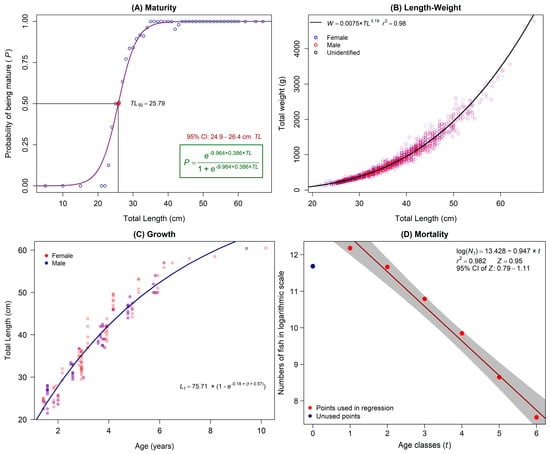
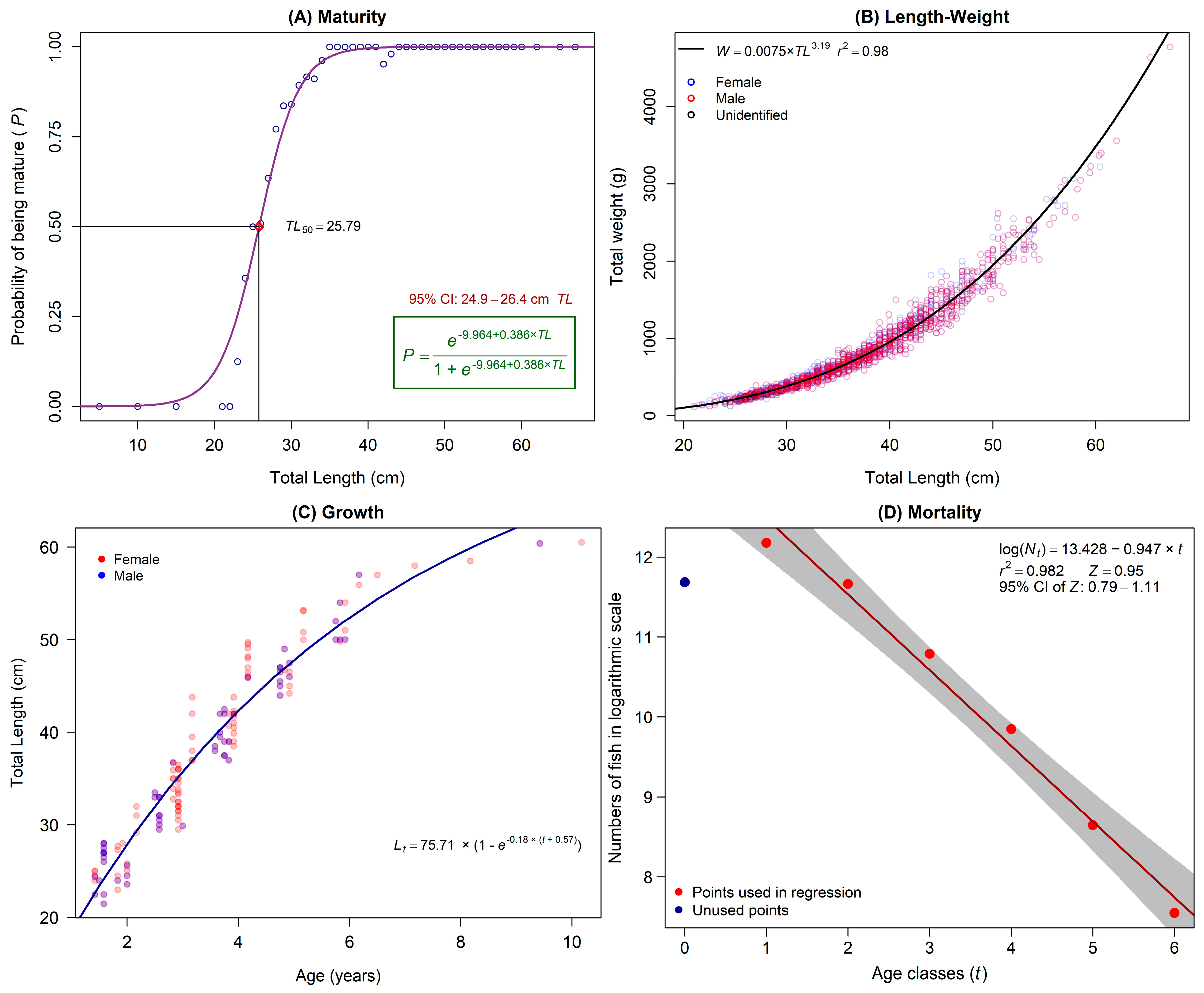
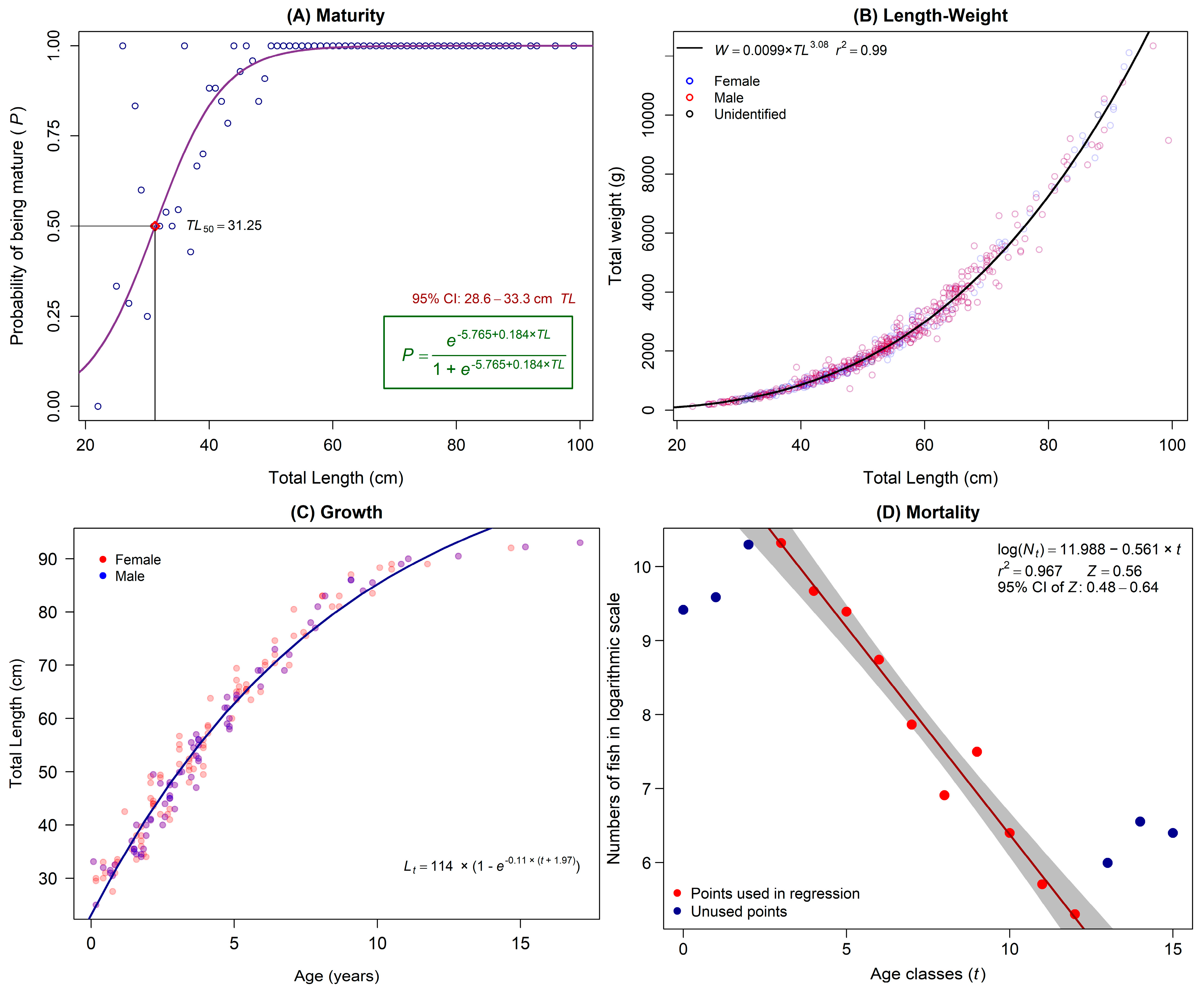
The TL50 (95% BCa CI) was estimated at 25.8 cm (24.9–26.4 cm) for P. areolatus and 31.2 cm (28.6–33.2 cm) (Figure 2) for P. marisrubri (Figure 3).
Figure 2.
(A) The estimated median TL at first maturity (TL50); (B) TL-W relationships; (C) observed TL-at-age data with the fitted von Bertalanffy growth curve; and (D) linearized catch curve analysis for estimating the total mortality rate (Z) for P. areolatus from the Eastern Red Sea.
Figure 3.
(A) The estimated median TL at first maturity (TL50); (B) TL-W relationships; (C) observed TL-at-age data with the fitted von Bertalanffy growth curve; and (D) linearized catch curve analysis for estimating the total mortality rate (Z) for P. marisrubri from the Eastern Red Sea.
The length-weight relationship estimations for a (95% CI) and b (95% CI) values were 0.0075 (0.0070–0.0084) and 3.19 (3.15–3.20) for P. areolatus (Figure 2), and 0.0099 (0.0090–0.0113) and 3.08 (3.05–3.11) for P. marisrubri (Figure 3), both indicating positive allometric growth. Otolith readings indicated that the youngest individuals were at 0+ age (21.0 cm TL for P. areolatus; 22.5 cm for P. marisrubri), and the oldest were 10 and 15 years old, reaching 67.2 cm and 99.4 cm TL, respectively. The von Bertalanffy growth parameters were TL∞ = 75.71 cm, K = 0.18 year−1, t0 = −0.57 years for P. areolatus (Figure 2), and TL∞ = 114.0 cm, K = 0.11 year−1, t0 = −1.97 years for P. marisrubri (Figure 3).
The Z estimates (95% CI) derived from the linearized exponential decay model were 0.95 (0.79–1.11) year−1 for P. areolatus (Figure 2), and 0.56 (0.48–0.64) year−1 for P. marisrubri (Figure 3), with coefficients of determination (r2) of 0.98 and 0.97. The initial ascending Nt values, representing age groups that had not yet been fully recruited to the fishery, were excluded from the analysis. In addition, older age classes with few individuals, specifically age classes 7–10 for P. areolatus and 13–15 for P. marisrubri, were also omitted to avoid bias in the estimation of Z. M estimates from tmax-based, K-based, and K–TL∞ methods were 0.54, 0.28, and 0.28 year−1 for P. areolatus, and 0.36, 0.17, and 0.23 year−1 for P. marisrubri. The corresponding mean (±SD) M values were 0.37 (±0.15) and 0.24 (±0.09) year−1, resulting in F values of 0.58 and 0.32 year−1, respectively.
3.2. Stock Status
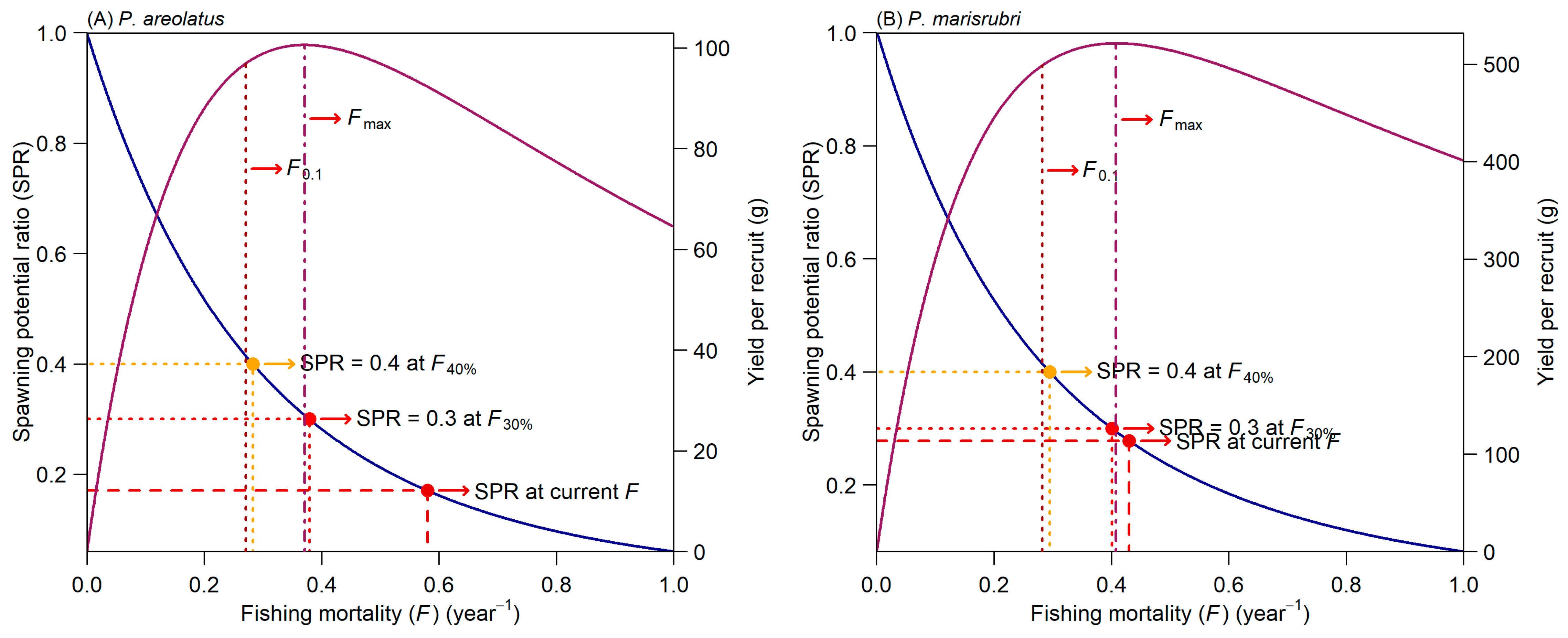
The results of the Thompson and Bell yield-per-recruit and spawning potential ratio analyses for P. areolatus, based on equilibrium conditions, are presented in Figure 4. The estimated Fmax, which is the limit reference point, was 0.37 year−1, corresponding to a peak yield-per-recruit value of almost 100 g. Beyond this level, the yield per recruit declined consistently. The more conservative target reference point, F0.1, was estimated at 0.27 year−1. The current F value of 0.58 year−1 exceeds both F0.1 and Fmax. At this F level, the spawning stock biomass corresponds to approximately 17% of its unexploited level. Additionally, the F associated with the spawning potential ratio-based target reference point (F40%) was computed as 0.28 year−1. The current F estimate is much higher than F40%, indicating that the stock is overexploited above the target reference point.
Figure 4.
Relationship between spawning stock biomass-per-recruit (dark blue line, corresponding to the left spawning potential ratio axis) and total yield-per-recruit (dark red line, corresponding to the right Y-axis) as a function of F for (A) P. areolatus and (B) P. marisrubri. The spawning potential ratio (%) and yield-per-recruit (g) levels were estimated using the Thompson and Bell yield-per-recruit analysis for P. areolatus and P. marisrubri, respectively. The figure also illustrates the spawning potential ratio values corresponding to the current F and various biological reference points, including Fmax, F0.1, F40%, and F30%.
For P. marisrubri; the estimated Fmax, the limit reference point, was 0.41 year−1, corresponding to a peak yield-per-recruit value of around 521 g. Beyond this level, the yield-per-recruit declined gradually. The more conservative target reference point, F0.1, was estimated at 0.28 year−1. The current F value of 0.33 year−1 exceeds F0.1 but is lower than Fmax. At this F level, the spawning stock biomass corresponds to approximately 36% of its unexploited level. Additionally, the F associated with the spawning potential ratio-based target reference point (F40%) was computed as 0.30 year−1. The current F is much higher than F40%, indicating that the stock is overexploited above the target reference point (Figure 4).
The exploitation (E) levels, representing the proportion of total mortality attributable to fishing, exceeded the limit reference point of 0.5 for both P. areolatus (E = 0.61) and P. marisrubri (E = 0.59).
4. Discussion
Groupers are among the most commercially valuable reef fishes, making them particularly vulnerable to intense fishing pressure and limited regulatory control [47]. Effective and sustainable management of these species requires a sound understanding of their life-history traits and population dynamics at regional scales [11]. Yet, for the Eastern Red Sea, detailed biological data remain sparse, even though its coral reef ecosystems support a large number of artisanal fishers. The fisheries targeting P. areolatus and P. marisrubri are especially important in this region, but information on their population biology and exploitation status has been largely unavailable. The present study addresses this gap by providing the first detailed assessment of both species in the Eastern Red Sea, including their key life-history parameters, stock status indicators, and biological characteristics that form a basis for comparison with other regional and global studies. The species differed substantially in their life-history traits and population dynamics, and these contrasts have direct implications for fishing vulnerability and management needs.
The ranges of TL measurements for both species observed in the present study are comparable to those reported in previous studies from the Red Sea [18,19] (Table 1). For P. areolatus, TL measurements in other regions worldwide were also comparable [48,49]. The b value estimated from the TL-W relationship in this study indicates a positive allometric growth pattern for both species in the Eastern Red Sea. Our b estimate for P. areolatus is compatible with the b value reported from the Torres Strait [48] (Table 1). However, there was no previous study on the length-weight relationship for P. marisrubri.
Table 1.
Estimates of population parameters for P. areolatus and P. marisrubri in previous studies. FL denotes fork length.
Considering previous studies, growth parameters for P. areolatus exhibit significant variations among regions, particularly between different parts of the Red Sea. The TL∞ ranges from 59.9 cm on the Eastern Red Sea coast [18] to 88.7 cm on the western coast [19], which is more compatible with our results (Table 1), while K varied markedly from 0.14 year−1 to 0.33 year−1 across these same regions. Other studies from the Pacific Ocean determined considerably lower or higher estimates for these parameters as well. In Pohnpei, Micronesia, P. areolatus exhibited the lowest TL∞ value recorded and the highest K [49], indicating a faster-growing but smaller-bodied population. In contrast, the growth parameters of the P. areolatus population from the Torres Strait, Australia [48], are very similar to our findings, suggesting a slow growth rate. Although these differences highlight region-specific environmental conditions and exploitation pressures that shape growth patterns, life-history traits linked to reproductive aggregation behaviour may also influence growth variation across regions [49].
A clearer contrast emerges when comparing the two species within the present study. P. areolatus reached smaller asymptotic lengths and matured earlier, indicating a faster life-history strategy. P. marisrubri reached a larger TL∞ and matured later. This pattern aligns with classic life-history theory, which posits that faster-growing, early-maturing species also experience higher natural mortality [38]. These intrinsic differences help explain the large contrast in Z estimates between the species. A species with faster growth and smaller maximum size tends to have lower survivorship at older ages, contributing to a higher total mortality, whereas a slow-growing species with larger maximum size usually exhibits lower total mortality. The higher total mortality observed for P. areolatus in this study is consistent with these biological expectations and with earlier findings in the Red Sea [19].
While there are relatively few studies available on P. marisrubri, the reported growth parameters still show notable variation across the Red Sea. The TL∞ reported in previous studies ranges from 78.1 cm on the Eastern coast [18] to 116.8 cm along the Sudanese coast [19], with our findings aligning more closely with the latter (Table 1). The parameter K also varies considerably, ranging from 0.11 year−1 in our study to 0.40 year−1 in [18], which suggests a high potential for sampling bias due to the fishing methods employed.
The minimum maturity size for P. areolatus in the Eastern Red Sea coast was reported as 32 cm at age 1, while it was 50 cm at age 3 for P. marisrubri [18]. We recorded the lowest TL50 for both species. In the present study, TL50 and corresponding age (t50) were estimated at 25.5 cm and 1.9 years for P. areolatus, and 31.2 cm and 1.0 year for P. marisrubri, respectively. These results suggest differences in the evaluation methods and age-length relationships between our study and previous assessments (Table 1). Lower TL50 values may indicate either methodological differences or fishing-induced truncation of length distributions, a phenomenon widely documented in exploited fish populations [50]. It should be noted that the use of macroscopic gonadal staging in the present study may not fully capture functional maturity, which is more accurately determined through histological analyses. Unfortunately, histological assessments were not feasible in the present study, and maturity classification therefore relied on external gonadal characteristics. In particular, classifying individuals with Nikolsky Stage II [23] as mature may introduce some bias and result in slightly lower TL50 estimates than those derived from histologically validated criteria. Consequently, the TL50 values reported here should be interpreted with caution and viewed as approximations, pending further studies that incorporate histological assessments.
The two species were distributed along the Saudi Arabian Red Sea coast, with no distinct north–south segregation. However, differences were observed during the sampling campaigns. P. areolatus was more widely and densely represented, particularly in central and southern ports such as Al-Qunfudah and Umluj, while P. marisrubri exhibited lower sample sizes across most sites. In locations where both species co-occurred, such as Yanbu, Thuwal, and Al-Qunfudah, P. areolatus consistently outnumbered P. marisrubri. This may reflect differences in catchability, behaviour, microhabitat preferences, or fishing pressure, patterns previously documented for coral groupers [16,48].
The estimated values of Z did not differ significantly between species, which may be related to similarities in lifespan and growth rate between species. The estimate of Z for P. areolatus (0.95) was markedly higher than the studies from the Pacific Ocean but very similar to the Sudanese coast [19] (Table 1). The E estimates for the two species were found to be higher than the limit reference point of 0.5 for both species. The E is based on the fact that sustainable yield is optimized when the F is roughly equal to M [51].
Based on the yield-per-recruit estimates from the Thompson and Bell analysis for P. areolatus, the current fishing pattern substantially exceeds Fmax, indicating the stock is experiencing growth overfishing. This condition implies that individuals are being harvested at a rate that prevents them from reaching their maximum growth potential, leading to reduced yield and diminished long-term productivity of the stock. The analysis further indicates that the yield-per-recruit-based limit reference point Fmax could be achieved at an F-factor of 0.37, representing a fishing effort nearly 21% lower than the current level. Notably, even with this reduction in effort, the corresponding yield-per-recruit value is estimated at 100 g, higher than the current yield-per-recruit of 82 g. This highlights the potential for optimizing yield while easing fishing pressure. The more precautionary target reference point F0.1 is associated with an F-factor of 0.27, corresponding to a 31% reduction in fishing effort. At this level, the expected yield-per-recruit is 95 g, which is higher than the current yield, offering the benefit of improved reproductive sustainability. If growth overfishing persists, further increases in fishing pressure will likely lead to recruitment overfishing, where the reproductive capacity of the population is impaired. The results of the spawning potential ratio analysis provide strong evidence that recruitment overfishing may already be occurring, as the current fishing pattern reduces the spawning stock biomass to approximately 17% of its unexploited level, which is much below the limit reference point (Figure 4). Spawning potential ratio values below 0.3 are considered indicative of a high risk of recruitment overfishing [52]. Given that the current spawning potential ratio is below this critical threshold, there is justified concern regarding the long-term sustainability of the stock if current exploitation levels persist. Without effective management intervention to reduce fishing pressure, the stock may experience further declines in reproductive capacity, threatening its ability to replenish and maintain stable yields. For P. marisrubri, its current F (0.33 year−1) falls between its estimated F0.1 and Fmax. These findings suggest that growth overfishing is occurring, but the stock is not at high risk. Although the fishery remains within safe biological limits, the current spawning potential ratio and associated F values show the stock is overexploited. Any significant increase in future fishing effort, and consequently in F, could elevate the risk of recruitment overfishing.
Methodological considerations are important for interpreting these patterns. Age-based assessments provide a strong basis for growth and mortality estimates; however, the absence of spatial stratification limits the ability to examine geographic variability. Catch curve methods require stable recruitment and representative age composition, assumptions that may be imperfect in multispecies reef fisheries. Coral reefs in the Saudi Arabian Red Sea are renowned for their high structural complexity, supporting a diverse range of reef morphologies, including fringing, patch, and offshore platform reefs that extend up to 100 km from shore [53]. The highest coral diversity and cover have been reported in regions such as Al Wajh, Yanbu, and the Farasan Banks. These reef habitats, especially in shallow reef zones, provide critical shelter and feeding grounds for coral-associated fishes like Plectropomus spp. [18]. The Red Sea spans a broad latitudinal range, characterized by pronounced gradients in sea temperature that may impact growth rates and body size in P. marisrubri and P. areolatus, consistent with temperature-related patterns observed in other fish taxa [54]. Sampling for this study was conducted at nine principal fishing ports along the Eastern Red Sea coast (Figure 1), as part of a MEWA fisheries assessment programme that also included additional target species. The design did not employ stratified sampling by latitude or port, and otoliths were obtained and processed without systematic spatial or temporal replication. Consequently, otolith counts per port were inadequate for reliable spatial or latitudinal analyses. Future assessments should incorporate stratified spatial–temporal sampling schemes to examine environmental influences on growth variability in greater detail.
In the Red Sea, handline fishing was the predominant method used for capturing both species. Although it is regarded as one of the most traditional and low-impact fishing techniques, it remains a highly effective method for capturing groupers [55]. Growth overfishing is a very common, unsustainable practice characterized by immature fish within the catch [56]. Regulating hook size plays a key role in maintaining selectivity, reducing the likelihood of landing undersized or immature individuals below the minimum legal size. Nonetheless, ensuring compliance with minimum legal size in small-scale, multispecies reef fisheries is difficult, particularly within artisanal sectors where monitoring capacity is limited. Such circumstances may contribute to overexploitation of higher-trophic-level species, consistent with the “fishing down the marine food web” pattern reported for the Red Sea [57]. Alongside minimum legal size enforcement, complementary management measures, such as seasonal closures during spawning periods, catch and effort limitations, and continuous stock monitoring, are needed to strengthen the sustainability of reef-associated grouper fisheries [11,58,59].
5. Conclusions
This study presents life history traits, mortality rates, stock assessments, and fishery characteristics of two important coral grouper species, P. aerolatus and P. marisrubri, in the waters of the Saudi Arabian Red Sea. The findings demonstrate that the two species differ markedly in their life-history traits, mortality patterns, and vulnerability to fishing. P. areolatus exhibits a faster life-history strategy, characterised by smaller asymptotic size, earlier maturation, and higher total mortality. P. marisrubri shows slower growth, later maturation, and a lower total mortality. These contrasts help explain why both species show similar exploitation rates despite only one species requiring substantial reductions in total mortality. Faster-growing species with higher turnover can sustain higher natural mortality, but they also become more rapidly depleted when fishing mortality increases relative to their reproductive capacity.
Across both species, reference points derived from yield-per-recruit analyses indicate that current F exceeds levels that would maximise long-term yield and maintain reproductive capacity. For P. areolatus, the stock is already experiencing both growth overfishing and recruitment impairment, while P. marisrubri is in a less depleted but still overexploited state. These results suggest that management targets should prioritise reducing fishing mortality to levels at or below F0.1, where yield gains and improved reproductive output can be achieved simultaneously.
The comparative life-history findings emphasise that species with slow growth and late maturation require more conservative harvest strategies, while species with faster life histories may show more rapid responses to management intervention but are also more vulnerable to sustained high exploitation. The combined evidence demonstrates that effective management of Red Sea coral groupers must be species-specific, anchored in biological reference points, and supported by controls that limit effort, protect spawning periods, and ensure that individuals reach maturity before capture.
Together, these results provide a biological foundation for rebuilding coral grouper stocks in the Eastern Red Sea and highlight the importance of integrating life-history variation into future monitoring and fisheries management strategies.
Supplementary Materials
The following supporting information can be downloaded at: https://www.mdpi.com/article/10.3390/fishes11010029/s1, Figure S1: Normal quantile-quantile (Q-Q) and residual plots used to assess model assumptions for P. areolatus; Figure S2: Normal quantile-quantile (Q-Q) and residual plots used to assess model assumptions for P. marisrubri; Table S1: Number of fish sampled per month at each port; Table S2: Summary of ageing precision metrics for both species, including the average percent error (APE) and the coefficient of variation (CV); Table S3: Shapiro-Wilk normality test statistics (W) and associated p-values for both species.
Author Contributions
Conceptualization, E.M.T. and M.D.; methodology, E.M.T. and M.D.; validation, E.M.T.; formal analysis, G.B.M.P., R.G.S., Z.O. and E.M.T.; investigation, G.B.M.P., R.G.S. and E.M.T.; resources, M.D.; data curation, G.B.M.P., R.G.S., Z.O. and E.M.T.; writing—original draft preparation, G.B.M.P., R.G.S., Z.O. and E.M.T.; writing—review and editing, G.B.M.P., R.G.S., Z.O., E.M.T. and M.D.; visualization, G.B.M.P., R.G.S., Z.O. and E.M.T.; supervision, M.D.; project administration, M.D.; funding acquisition, M.D. All authors have read and agreed to the published version of the manuscript.
Funding
This study was funded by the Ministry of Environment, Water, and Agriculture of Saudi Arabia under grant number 83092.
Institutional Review Board Statement
This study was based on fish specimens obtained from commercial catches and purchased at local fish markets. All measurements and analyses were conducted on these samples post-capture. No live specimens were involved in this research, and no experiments were conducted on animals.
Informed Consent Statement
Not applicable.
Data Availability Statement
The data presented in this study are available on reasonable request from the corresponding author.
Acknowledgments
The authors thank the Ministry of Environment, Water, and Agriculture of Saudi Arabia for funding this research project on the assessment of major fish stocks in the Red Sea waters of the Kingdom. They are also grateful to their colleagues at the KAUST KBD Fisheries Program for their assistance and support during the fieldwork, as well as to Nazli Demirel for her help in preparing the manuscript.
Conflicts of Interest
The authors declare no conflicts of interest.
References
- Sheppard, C.; Price, A.; Roberts, C. Marine Ecology of the Arabian Region: Patterns and Processes in Extreme Tropical Environments, 1st ed.; Academic Press: Toronto, ON, Canada, 1992; 359p. [Google Scholar]
- PERSGA. State of the Marine Environment; Report for the Red Sea and Gulf of Aden; PERSGA: Jeddah, Saudi Arabia, 2006; Available online: https://www.cbd.int/doc/meetings/mar/ebsaws-2015-02/other/ebsaws-2015-02-persga-submission1-en.pdf (accessed on 30 September 2025).
- Burke, L.; Reytar, K.; Spalding, M.; Perry, A. Reefs at Risk Revisited; World Resources Institute: Washington, DC, USA, 2011; ISBN 978-1-56973-762-0. [Google Scholar]
- Riegl, B.M.; Berumen, M.; Bruckner, A. Coral population trajectories, increased disturbance and management intervention: A sensitivity analysis. Ecol. Evol. 2013, 3, 1050–1064. [Google Scholar] [CrossRef] [Scilit]
- Alshaikhi, A.; Alshaye, K.; Ageely, O.; Samarali, R.; Alharbi, B.; Alhafedh, Y.; Almohsen, I.; Guemes, P. Fisheries Statistics: Saudi Arabia 2016–2021; Booklet: Riyadh, Saudi Arabia; FAO: Rome, Italy, 2023; 21p. [Google Scholar] [CrossRef] [Scilit]
- MAW. Fisheries of Saudi Arabia, 1998; Ministry of Agriculture and Water, Department of Marine Fisheries: Riyadh, Saudi Arabia, 2000.
- Kedidi, S.M.; Abushusha, T.; Allam, K. Biology and Stock Assessment of the Redspot Emperor Lethrinus lentjan from Waters Adjacent to Tuwwal, Saudi Arabia; Project for the Development of Fisheries in the Areas of the Red Sea and Gulf of Aden, FAO/UNDP RAB/81/002/15; FAO: Cairo, Egypt, 1984; 21p, Available online: https://openknowledge.fao.org/server/api/core/bitstreams/cb7ada03-0db3-4d13-9baf-f8286a65a5ce/content (accessed on 30 September 2025).
- Sakurai, T. Fisheries of Saudi Arabia; Report of Japan International Cooperation Agency (JICA); Ministry of Agriculture and Water, Department of Marine Fisheries: Riyadh, Saudi Arabia, 1998; 48p.
- Tesfamichael, D.; Pitcher, T.J. Multidisciplinary Evaluation of the Sustainability of Red Sea Fisheries Using Rapfish. Fish. Res. 2006, 78, 227–235. [Google Scholar] [CrossRef] [Scilit]
- Tesfamichael, D.; Pauly, D. The Red Sea Ecosystem and Fisheries; Springer: Berlin/Heidelberg, Germany, 2016; Volume 7, ISBN 978-94-017-7433-8. [Google Scholar]
- Shellem, C.T.; Ellis, J.I.; Coker, D.J.; Berumen, M.L. Red Sea fish market assessments indicate high species diversity and potential overexploitation. Fish. Res. 2021, 239, 105922. [Google Scholar] [CrossRef] [Scilit]
- FAO. FishStatJ, v4.04.00. Software for Fishery and Aquaculture Statistical Time Series. FAO Fisheries and Aquaculture Division: Rome, Italy, 2024. Available online: https://www.fao.org/fishery/en/statistics/software/FishStatJ (accessed on 30 September 2025).
- Sadovy, Y.; Domeier, M.L. Are aggregation fisheries sustainable Reef fish fisheries as a case study. Coral Reefs 2005, 24, 254–262. [Google Scholar] [CrossRef] [Scilit]
- Ma, K.Y.; Craig, M.T.; Choat, J.H.; van Herwerden, L. The historical biogeography of groupers: Clade diversification patterns and processes. Mol. Phylogenet. Evol. 2016, 100, 21–30. [Google Scholar] [CrossRef] [Scilit]
- Choat, J.H.; Gaspar, A.L.; Samoilys, M.; Myers, R. Plectropomus marisrubri. IUCN Red List of Threatened Species. 2018. e.T118360372A118360410. Available online: https://www.iucnredlist.org/species/118360372/118360410 (accessed on 30 October 2025). [CrossRef] [Scilit]
- Frisch, A.J.; Cameron, D.S.; Pratchett, M.S.; Williamson, D.H.; Ashley, J.; Williams, A.J.; Reynolds, A.D.; Hoey, A.S.; Rizzari, J.R.; Evans, L.; et al. Key aspects of the biology, fisheries and management of Coral grouper. Rev. Fish Biol. Fish. 2016, 26, 303–325. [Google Scholar] [CrossRef] [Scilit]
- Rhodes, K.L.; Tupper, M.H. The vulnerability of reproductively active squaretail coralgrouper (Plectropomus areolatus) to fishing. Fish. Bull. 2008, 106, 194–203. [Google Scholar]
- DesRosiers, N.J.D. Growth and Maturation of Plectropomus spp. in the Saudi Arabian Red Sea. Master’s Thesis, King Abdullah University of Science and Technology, Thuwal, Saudi Arabia, 2011. Available online: http://hdl.handle.net/10754/209394 (accessed on 6 December 2025).
- Elamin, E. Stock Assessment and Population Dynamics of Plectropomus pessuliferus and Plectropomus areolatus in the Sudanese Red Sea Coast; Universiti Malaysia: Terengganu, Malaysia, 2012. [Google Scholar]
- Provost, M.M.; Jensen, O.P. The impacts of fishing on hermaphroditic and treatment of sex change in stock assessments. Fisheries 2015, 40, 536–545. [Google Scholar] [CrossRef] [Scilit]
- Campana, S.E. Accuracy, precision and quality control in age determination, including a review of the use and abuse of age validation methods. J. Fish Biol. 2001, 59, 197–242. [Google Scholar] [CrossRef]
- Nikolsky, G.V. The Ecology of Fishes; Academic Press: London, UK, 1976; ISBN 978-0125197502. [Google Scholar]
- Kadengal, S.T.; Okba, Z.; Muthu Palani, G.B.; Charles, S.K.; Adam, A.M.S.; Boulila, N.; Tıraşın, E.M.; Dimech, M. Population dynamics and fishery biology of the yellow-edged lyretail grouper Variola louti (Forsskål, 1775) along the eastern coast of the Red Sea. Front. Mar. Sci. 2025, 12, 1582582. [Google Scholar] [CrossRef] [Scilit]
- Agresti, A. An Introduction to Categorical Data Analysis, 3rd ed.; Wiley: Hoboken, NJ, USA, 2019; p. 375. [Google Scholar]
- Roa, R.; Ernst, B.; Tapia, F. Estimation of size at sexual maturity: An evaluation of analytical and resampling procedures. Fish. Bull. 1999, 97, 570–580. [Google Scholar]
- Aydın, C.M.; Tıraşın, E.M. Information on the deep-water giant red shrimp Aristaeomorpha foliacea (Risso, 1827) (Crustacea, Decapoda, Aristeidae) population in Antalya Bay (Eastern Mediterranean Sea, South of Turkey) based on the MEDITS protocol. Reg. Stud. Mar. Sci. 2023, 60, 102885. [Google Scholar] [CrossRef] [Scilit]
- Efron, B.; Tibshirani, R.J. An Introduction to the Bootstrap; Chapman and Hall/CRC: New York, NY, USA, 1993; p. 436. Available online: https://doi.org/10.1201/9780429246593 (accessed on 1 September 2025).
- Quinn, T.J.; Deriso, R.B. Quantitative Fish Dynamics; Oxford University Press: New York, NY, USA, 1999; p. 542. [Google Scholar]
- von Bertalanffy, L. A quantitative theory of organic growth (inquiries on growth laws II). Hum. Biol. 1938, 10, 181–213. [Google Scholar]
- Ritz, C.; Streibig, J.C. Nonlinear Regression with R; Springer: New York, NY, USA, 2008; p. 144. [Google Scholar]
- Sparre, P.; Venema, S.C. Introduction to Tropical Fish Stock Assessment; FAO Fisheries Technical Papers, No. 306/1, Rev. 2 (Part 1); FAO: Rome, Italy, 1998; Available online: https://openknowledge.fao.org/handle/20.500.14283/w5449e (accessed on 20 January 2025).
- Kenchington, T.J. Natural mortality estimators for information-limited fisheries. Fish Fish. 2014, 15, 533–562. [Google Scholar] [CrossRef] [Scilit]
- Maunder, M.N.; Hamel, O.S.; Lee, H.H.; Piner, K.R.; Cope, J.M.; Punt, A.E.; Ianelli, J.N.; Castillo-Jordán, C.; Kapur, M.S.; Methot, R.D. A review of estimation methods for natural mortality and their performance in the context of fishery stock assessment. Fish. Res. 2023, 261, 106489. [Google Scholar] [CrossRef] [Scilit]
- Hamel, O.S.; Cope, J.M. Development and considerations for application of a longevity-based prior for the natural mortality rate. Fish. Res. 2022, 256, 106477. [Google Scholar] [CrossRef] [Scilit]
- Then, A.Y.; Hoenig, J.M.; Hall, N.G.; Hewitt, D.A.; Jardim, E. Evaluating the predictive performance of empirical estimators of natural mortality rate using information on over 200 fish species. ICES J. Mar. Sci. 2015, 72, 82–92. [Google Scholar] [CrossRef] [Scilit]
- Goodyear, C.P. Spawning stock biomass per recruit in fisheries management: Foundation and current use. Can. Spec. Publ. Fish. Aquat. Sci. 1993, 120, 67–82. [Google Scholar]
- Thompson, W.F.; Bell, F.H. Biological statistics of the Pacific halibut fishery. (2) Effects of changes in intensity upon total yield and yield per unit of gear. Int. Fish. Comm. Rep. 1934, 8, 1–49. [Google Scholar]
- Beverton, R.J.H.; Holt, S.J. On the Dynamics of Exploited Fish Populations; Fishery Investigations, Series 2; H.M. Stationery Office: London, UK, 1957; Volume 19, pp. 1–533. [Google Scholar]
- Gabriel, W.L.; Mace, P.M. A review of biological reference points in the context of the precautionary approach. In Proceedings of the Fifth National NMFS Stock Assessment Workshop: Providing Scientific Advice to Implement the Precautionary Approach Under the Magnuson-Stevens Fishery Conservation and Management Act, Key Largo, FL, USA, 24–26 February 1998; NOAA Tech Memo NMFS-F/SPO-40. pp. 34–45. [Google Scholar]
- Caddy, J.F.; Mahon, R. Reference Points for Fisheries Management; FAO Fisheries Technical Paper No. 347; FAO: Rome, Italy, 1995; Available online: https://openknowledge.fao.org/handle/20.500.14283/v8400e (accessed on 30 September 2025).
- Prager, M.H.; Porch, C.E.; Shertzer, K.W.; Caddy, J.F. Targets and limits for management of fisheries: A simple probability-based approach. N. Am. J. Fish. Manag. 2003, 23, 349–361. [Google Scholar] [CrossRef] [Scilit]
- Haddon, M. Modelling and Quantitative Methods in Fisheries, 2nd ed.; CRC Press: Boca Raton, FL, USA, 2011; p. 465. [Google Scholar] [CrossRef] [Scilit]
- Mace, P.M.; Sissenwine, M.P. How much spawning per recruit is enough? Can. Spec. Publ. Fish. Aquat. Sci. 1993, 120, 110–118. [Google Scholar]
- Mace, P.M. Relationships between common biological reference points used as thresholds and targets of fisheries management strategies. Can. J. Fish. Aquat. Sci. 1994, 51, 110–122. [Google Scholar] [CrossRef] [Scilit]
- Clark, W.G. F35% revisited ten years later. N. Am. J. Fish. Manag. 2002, 22, 251–257. [Google Scholar] [CrossRef] [Scilit]
- R Core Team. R: A Language and Environment for Statistical Computing, Version 4.5.0; R Foundation for Statistical Computing: Vienna, Austria, 2025; Available online: https://www.R-project.org/ (accessed on 30 September 2025).
- Sadovy de Mitcheson, Y.S.; Craig, M.T.; Bertoncini, A.A.; Carpenter, K.E.; Cheung, W.W.L.; Choat, J.H. Fishing groupers towards extinction: A global assessment of threats and extinction risks in a billion dollar fishery. Fish. Fish. 2013, 14, 119–136. [Google Scholar] [CrossRef] [Scilit]
- Williams, A.J.; Currey, L.M.; Begg, G.A.; Murchie, C.D.; Ballagh, A.C. Population biology of coral trout species in eastern Torres Strait: Implications for fishery management. Cont. Shelf Res. 2008, 28, 2129–2142. [Google Scholar] [CrossRef] [Scilit]
- Rhodes, K.L.; Taylor, B.M.; Wichilmel, C.B.; Joseph, E.; Hamilton, R.J.; Almany, G.R. Reproductive biology of squaretail coralgrouper Plectropomus areolatus using age-based techniques. J. Fish Biol. 2013, 82, 1333–1350. [Google Scholar] [CrossRef] [Scilit]
- Sharpe, D.M.T.; Hendry, A.P. Life history change in commercially exploited fish stocks: An analysis of trends across studies. Evol. Appl. 2009, 2, 260–275. [Google Scholar] [CrossRef] [Scilit]
- Gulland, J.A. The Fish Resources of the Oceans; FAO: Rome, Italy; Fishing News Books: Surrey, UK, 1971; ISBN 978-0852380550. [Google Scholar]
- Walters, C.J.; Martell, S.J.D. Fisheries Ecology and Management; Princeton University Press: Princeton, NJ, USA, 2004; p. 399. ISBN 978-0-691-11545-1. [Google Scholar]
- Bruckner, A.W.; Dempsey, A.C. The Status, Threats, and Resilience of Reef-Building Corals of the Saudi Arabian Red Sea. In The Red Sea: The Formation, Morphology, Oceanography and Environment of a Young Ocean Basin; Rasul, N.M.A., Stewart, I.C.F., Eds.; Springer: Berlin/Heidelberg, Germany, 2015; pp. 471–486. ISBN 978-3-662-45201-1. [Google Scholar]
- Ahti, P.A.; Kuparinen, A.; Uusi-Heikkilä, S. Size does matter—The eco-evolutionary effects of changing body size in fish. Environ. Rev. 2020, 28, 311–324. [Google Scholar] [CrossRef] [Scilit]
- Huliselan, N.V.; Wawo, M.; Tuapattinaja, M.A. Present status of grouper fisheries at waters of Kotania Bay, Western Seram District Maluku Province. IOP Conf. Ser. Earth Environ. Sci. 2017, 89, 012002. [Google Scholar] [CrossRef] [Scilit]
- Diekert, F.K. Growth Overfishing: The Race to Fish Extends to the Dimension of Size. Environ. Resour. Econ. 2012, 52, 549–572. [Google Scholar] [CrossRef] [Scilit]
- Pauly, D.; Christensen, V.; Dalsgaard, J.; Froese, R.; Torres, F. Fishing down marine food webs. Science 1998, 279, 860–863. [Google Scholar] [CrossRef] [Scilit] [PubMed]
- Nair, R.; Samoilys, M.; Cabanban, A.S. Variola louti. IUCN Red List. Threat. Species 2018, e.T132738A100572909. Available online: https://www.iucnredlist.org/species/132738/100572909 (accessed on 30 October 2025). [CrossRef] [Scilit]
- Yıldız, T.; Ulman, A.; Demirel, N. A comparison of market landings during fish spawning seasons to better understand the effectiveness of the temporal fishery closure in Turkey. Ocean Coast. Manag. 2020, 198, 105353. [Google Scholar] [CrossRef] [Scilit]

Disclaimer/Publisher’s Note: The statements, opinions and data contained in all publications are solely those of the individual author(s) and contributor(s) and not of MDPI and/or the editor(s). MDPI and/or the editor(s) disclaim responsibility for any injury to people or property resulting from any ideas, methods, instructions or products referred to in the content. |
© 2026 by the authors. Licensee MDPI, Basel, Switzerland. This article is an open access article distributed under the terms and conditions of the Creative Commons Attribution (CC BY) license.