
Multidimensional Framework of Post-Disaster Resilience in South-Pearl Aquaculture in Guangdong, China: A Grounded Theory Study


Abstract
1. Introduction
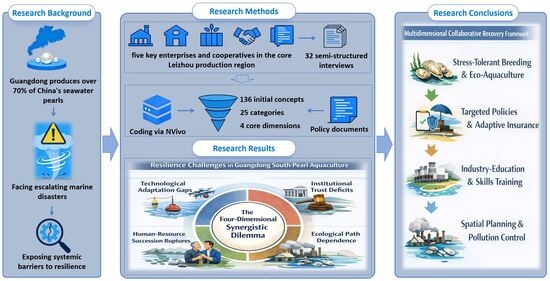
2. Research Design and Methodology: A Grounded Theory Approach
2.1. Research Design
2.1.1. Methodological Approach and Case Selection
2.1.2. Data Collection
2.2. Data Coding and Category Refinement
2.2.1. Open Coding
2.2.2. Axial Coding
2.2.3. Selective Coding
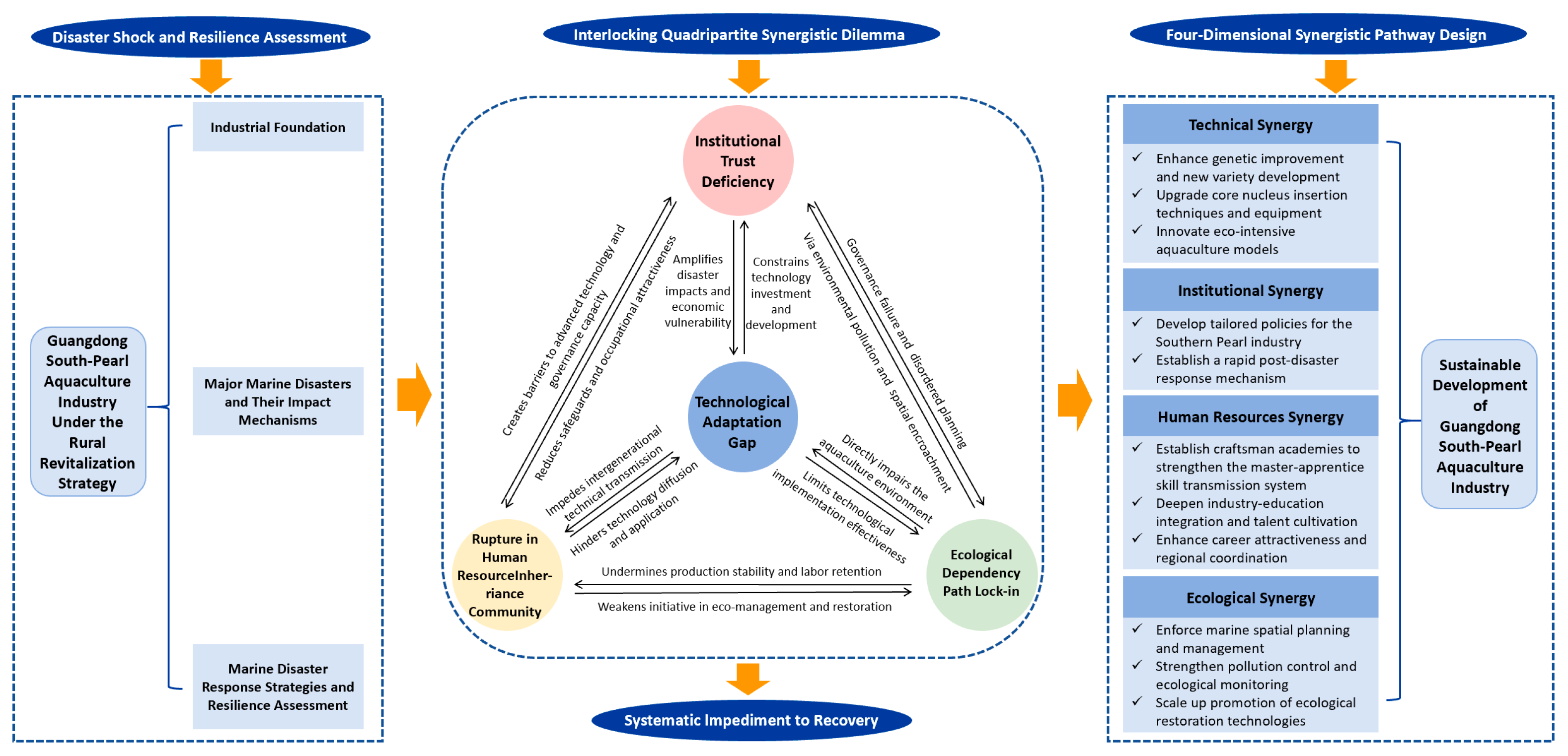
2.3. Theoretical Model Development: The Four-Dimensional Synergistic Dilemma Framework
2.4. Verification of Theoretical Saturation and Practical Applicability
3. Results Part I: Disaster Impacts and Industrial Resilience Assessment
3.1. Industrial Foundation of Guangdong South-Pearl Aquaculture
3.1.1. Geographical Distribution and Cluster Characteristics
3.1.2. Production Scale and Output Volatility
3.1.3. Technological Status and Innovation Capacity
3.2. Principal Marine Disasters and Their Impact Mechanisms
3.3. Current Response Strategies and the Identified “Resilience Gap”
4. Results Part II: A Four-Dimensional Diagnostic Framework of Resilience Challenges
4.1. Vulnerabilities in Techno-Ecological Resilience: Adaptive Gaps and Lagging Stress-Tolerant Technologies
4.2. Disconnect in Institutional Governance Resilience: Trust Deficits and Protection Gaps
4.3. Disruption of Community Human Resource Resilience: Succession Crisis and Industry-Education Misalignment
4.4. Path Dependency in Ecological Spatial Resilience: Planning Disarray and Cumulative Pollution Effects
5. Discussion: Toward a Multidimensional Collaborative Recovery Framework Through the Lens of Rural Revitalization
5.1. Rebuilding Techno-Ecological Resilience: Developing Stress-Tolerant Varieties and Advancing Ecological Models
5.2. Consolidating Institutional Governance Resilience
5.3. Restoring Community Human Resource Resilience: Craftsman Skill Transmission and Enhanced Industry-Education Integration
5.4. Strengthening Ecological Spatial Resilience: Integrated Spatial Planning and Pollution Governance
6. Conclusions
Author Contributions
Funding
Institutional Review Board Statement
Informed Consent Statement
Data Availability Statement
Acknowledgments
Conflicts of Interest
Appendix A. (Redacted Version)
- Research Content
- 2.
- Participation Details
- 3.
- Potential Impacts
- 4.
- Your Rights
- 5.
- Data Use Authorization
- 6.
- Consent Confirmation
Appendix B
- What specific disaster events has your operation experienced in recent years, and what were the immediate impacts?
- What were your most critical response measures following these disasters?
- How has the recovery process progressed over time, and what factors influenced this progression?
- What have been the most significant challenges throughout the response and recovery phases?
- What types of support were most and least effective in facilitating recovery?
- Based on your experiences, what should be prioritized to improve future disaster resilience?
References
- Kuang, Y.P.; Peng, Y.; Li, S.S. The Multiple Logics, Basic Characteristics, and Realization Paths of China’s Agricultural and Rural Modernization in the New Era. Chin. Rur. Econ. 2024, 40, 2–22. [Google Scholar] [CrossRef]
- Dakos, V.; Kéfi, S. Ecological resilience: What to measure and how. Environ. Res. Lett. 2022, 17, 043003. [Google Scholar] [CrossRef]
- Preiser, R.; Biggs, R.; De Vos, A.; Folke, C. Social-ecological systems as complex adaptive systems: Organizing principles for advancing research methods and approaches. Ecol. Soc. 2018, 23, 46. [Google Scholar] [CrossRef]
- Folke, C. Resilience (Republished). Ecol. Soc. 2016, 21, 44. [Google Scholar] [CrossRef]
- Folke, C. Resilience: The emergence of a perspective for social–ecological systems analyses. Glob. Environ. Chang. 2006, 16, 253–267. [Google Scholar] [CrossRef]
- Li, T.; Dong, Y.X.; Liu, Z.H. A review of social-ecological system resilience: Mechanism, assessment and management. Sci. Total Environ. 2020, 723, 138113. [Google Scholar] [CrossRef]
- Fisheries and Fishery Administration Bureau of the Ministry of Agriculture and Rural Affairs; National Fisheries Technology Extension Center; China Society of Fisheries. China Fishery Statistical Yearbook 2025; China Agriculture Press: Beijing, China, 2025; p. 28. [Google Scholar]
- Chen, K.; Zhang, L.H.; Yao, Z.H.; Liao, Y.S.; Deng, Y.W.; Wang, Q.H. Comparison of production traits between the black shell color breeding line F5 and the control population of Pinctada fucata martensii. J. Fish. Sci. China 2023, 30, 1293–1300. [Google Scholar]
- Johnston, W.; Hine, D.; Southgate, P.C. Overview of the Development and Modern Landscape of Marine Pearl Culture in the South Pacific. J. Shellfish Res. 2019, 38, 499–518. [Google Scholar] [CrossRef]
- Johnston, B.; Kishore, P.; Vuibeqa, G.B.; Hine, D.; Southgate, P.C. Economic assessment of community-based pearl oyster spat collection and mabé pearl production in the western Pacific. Aquaculture 2020, 514, 734505. [Google Scholar] [CrossRef]
- Alleway, H. An Environmental, Social, and Governance Assessment of Marine Pearl Farming. Gems Gemol. 2023, 59, 404–405. [Google Scholar]
- Olsson, L.; Jerneck, A.; Thoren, H.; Persson, J.; O’Byrne, D. Why resilience is unappealing to social science: Theoretical and empirical investigations of the scientific use of resilience. Sci. Adv. 2015, 1, e1400217. [Google Scholar] [CrossRef] [PubMed]
- Ky, C.-L.; Demmer, J.; Blay, C.; Lo, C. Age-dependence of cultured pearl grade and colour in the black-lipped pearl oyster Pinctada margaritifera. Aquac. Res. 2017, 48, 955–968. [Google Scholar] [CrossRef]
- Adzigbli, L.; Wang, Z.M.; Lai, Z.X.; Li, J.H.; Deng, Y.W. Sex determination in pearl oyster: A mini review. Aquac. Rep. 2019, 15, 100214. [Google Scholar] [CrossRef]
- Ky, C.-L.; Nakasai, S.; Parrad, S.; Broustal, F.; Devaux, D.; Louis, P. Variation in cultured pearl quality traits in relation to position of saibo cutting on the mantle of black-lipped pearl oyster Pinctada margaritifera. Aquaculture 2018, 493, 85–92. [Google Scholar] [CrossRef]
- Zenger, K.R.; Khatkar, M.S.; Jones, D.B.; Khalilisamani, N.; Jerry, D.R.; Raadsma, H.W. Genomic Selection in Aquaculture: Application, Limitations and Opportunities with Special Reference to Marine Shrimp and Pearl Oysters. Front. Genet. 2019, 9, 00693. [Google Scholar] [CrossRef]
- McDougall, C.; Aguilera, F.; Shokoohmand, A.; Moase, P.; Degnan, B.M. Pearl Sac Gene Expression Profiles Associated with Pearl Attributes in the Silver-Lip Pearl Oyster, Pinctada maxima. Front. Genet. 2021, 11, 597459. [Google Scholar] [CrossRef]
- Gueguen, Y.; Gaertner-Mazouni, N.; Lo, C.; Le Moullac, G. Integrated management of pearl culture in French Polynesia in the context of global change: Synopsis of existing results. Estuar. Coast. Shelf Sci. 2016, 182, 229–234. [Google Scholar] [CrossRef]
- Gardon, T.; Le Luyer, J.; Le Moullac, G.; Soyez, C.; Lagarde, F.; Dehaut, A.; Paul-Pont, I.; Huvet, A. Pearl Farming Micro-Nanoplastics Affect Oyster Physiology and Pearl Quality. Environ. Sci. Technol. 2024, 58, 207–218. [Google Scholar] [CrossRef]
- He, G.X.; Liu, X.L.; Xu, Y.; Liang, J.; Deng, Y.W.; Zhang, Y.H.; Zhao, L.Q. Repeated exposure to simulated marine heatwaves enhances the thermal tolerance in pearl oysters. Aquat. Toxicol. 2021, 239, 105959. [Google Scholar] [CrossRef] [PubMed]
- Cuif, J.-P.; Fougerouse, A.; Lo, C.; Dauphin, Y. Formation of the Outer Shell Layer in Pinctada margaritifera: Structural and Biochemical Evidence for a Sequential Development of the Calcite Units. Minerals 2023, 13, 1301. [Google Scholar] [CrossRef]
- Andréfouët, S.; Bouchet, N.; Bruyère, O.; Basset, C.; Bionaz, O.; Bourgeois, B.; Le Gendre, R.; Liao, V.; Marcellino, R.; Trophime, T.; et al. Decline and Status of Natural Pearl Oyster (Pinctada margaritifera) Stocks in Two French Polynesia Black Pearl Farming Lagoons. Mar. Pollut. Bull. 2026, 222, 118852. [Google Scholar] [CrossRef]
- Gradel, A.; Benestan, L.; Legrand, T.; Le Luyer, J.; Planes, S.; Reisser, C.M.O. Combining population genomics, larval dispersal modelling and graph theory to reveal connectivity patterns of the black-lipped pearl oyster in French Polynesia. Sci. Rep. 2025, 15, 24611. [Google Scholar] [CrossRef]
- Wu, W.G.; Zhang, J.H.; Liu, Y.; Zhao, Y.X.; Zhang, K.Y.; Wang, L.L. Analysis of the Effectiveness of the Polyculture of Shellfish and Algae and Influencing Factors in the Xuejiadao Sea Cage Aquaculture Area. Prog. Fish. Sci. 2022, 43, 146–155. [Google Scholar] [CrossRef]
- Li, N.; Hu, C.K.; Wang, K.; Du, J.; He, J.; Wu, J.H. Research Progress on Prevention and Control Technology of Mariculture Wastewater: A Review. Fish. Sci. 2023, 42, 911–920. [Google Scholar] [CrossRef]
- Guest, G.; Bunce, A.; Johnson, L. How Many Interviews Are Enough? An Experiment with Data Saturation and Variability. Field Methods 2006, 18, 59–82. [Google Scholar] [CrossRef]
- Creswell, J.W. Qualitative Inquiry and Research Design: Choosing Among Five Traditions; Sage Publications: Thousand Oaks, CA, USA, 1998. [Google Scholar]
- Boyd, C.O. Philosophical Foundations of Qualitative Research; Jones & Bartlett Learning: Burlington, MA, USA, 1993; pp. 66–93. [Google Scholar]
- Wei, L.; Zhang, W.; Lin, C.H. Multidimensional Characteristics of Design-Based Engineering Learning: A Grounded Theory Study. Sustainability 2023, 15, 3389. [Google Scholar] [CrossRef]
- Wang, Q.H.; Liu, Y.; Zheng, Z.; Deng, Y.W.; Jiao, Y.; Du, X.D. Adaptive response of pearl oyster Pinctada fucata martensii to low water temperature stress. Fish Shellfish Immunol. 2018, 78, 310–315. [Google Scholar] [CrossRef]
- Li, J.H.; Liang, F.L.; Deng, Y.W.; Fu, S.; Wang, Q.H. Method for Improving the Metamorphosis Attachment Rate of Eyed Larvae of Pinctada Martensii. China Patent CN108849658B, 30 March 2021. [Google Scholar]
- Huang, R.T.; Yang, C.Y.; Zhang, J.B.; Yin, S.X.; Deng, Y.W. Method for Improving the Yield of Pearl Oyster Seedling. China Patent CN113475439B, 16 December 2022. [Google Scholar]
- Wang, Q.H.; Deng, Y.W.; Huang, R.L.; Jiao, Y.; Du, X.D. Preoperative Treatment Method for Pearl Nucleation of Pinctada Martensii. China Patent CN103329831B, 24 December 2014. [Google Scholar]
- Wang, Q.H.; Deng, Y.W.; Li, L.E.; Zheng, Z.; Du, X.D.; Zhang, J.W. Breeding Method and Device for Cleaning Pearl Oysters and Cage Attachments Using Rabbitfish. China Patent CN107509671B, 2 October 2020. [Google Scholar]
- Liang, F.L.; Deng, Y.W.; Wang, Q.H. Staged Low-Specific-Gravity Seawater Cultivation Method for Pearl Oysters of Pinctada Martensii. China Patent CN112931328B, 18 March 2022. [Google Scholar]
- Hou, L.; Gu, Z.F.; Wang, A.M.; Dong, W.W.; Tang, D. The Influences of Simulated Typhoon to Two Kinds of Oxidative Stress Genes’ Expression of Pinctad amartensii. Genom. Appl. Biol. 2016, 35, 1123–1128. [Google Scholar] [CrossRef]
- Xu, Y.; Zhang, Y.H.; Liang, J.; He, G.X.; Liu, X.L.; Zheng, Z.; Le, D.Q.; Deng, Y.W.; Zhao, L.Q. Impacts of marine heatwaves on pearl oysters are alleviated following repeated exposure. Mar. Pollut. Bull. 2021, 173, 112932. [Google Scholar] [CrossRef]
- He, G.X.; Liu, X.L.; Xu, Y.; Liu, Y.; Masanja, F.; Deng, Y.W.; Zhao, L.Q. Metabolic dysfunctions in pearl oysters following recurrent marine heatwaves. Mar. Environ. Res. 2024, 200, 106641. [Google Scholar] [CrossRef]
- Biessy, L.; Pearman, J.K.; Mertens, K.N.; Réveillon, D.; Savar, V.; Hess, P.; Hampton, H.; Thompson, L.; Lebrun, L.; Terre-Terrillon, A.; et al. Sudden peak in tetrodotoxin in French oysters during the summer of 2021: Source investigation using microscopy, metabarcoding and droplet digital PCR. Toxicon 2024, 243, 107721. [Google Scholar] [CrossRef]
- Liang, F.L.; Deng, Y.W. Influences of antibiotics and season on nucleus retention, pearl formation and pearl oyster survival in Pinctada martensii aquaculture. Trans. Oceanol. Limnol. 2022, 44, 50–56. [Google Scholar] [CrossRef]
- Dong, S.L.; Dong, Y.W.; Huang, L.Y.; Tian, X.L.; Han, L.M.; Li, D.H.; Cao, L. Toward offshore aquaculture in China: Opportunities, challenges and development strategies. J. Fish. China 2023, 47, 039601. [Google Scholar] [CrossRef]
- Nie, P.; He, Y.; Liu, F.; Mi, C.; Cai, C. Livestock and Aquaculture IoT Systems. In Agricultural Internet of Things; He, Y., Nie, P., Zhang, Q., Liu, F., Eds.; Springer International Publishing: Cham, Switzerland, 2021; pp. 335–371. [Google Scholar]
- Andréfouët, S.; Bruyère, O.; Le Gendre, R.; Sangare, N.; Monaco, C.J.; Thomas, Y.; Lo-Yat, A. Comparison of in situ Black-Lipped Oyster Spat Collection and Larval Dispersal Modelling Results in Semi-Closed Pearl-Farming Lagoons of the Tuamotu Archipelago. Mar. Pollut. Bull. 2024, 206, 116779. [Google Scholar] [CrossRef] [PubMed]
- Takeuchi, T.; Suzuki, Y.; Watabe, S.; Nagai, K.; Masaoka, T.; Fujie, M.; Kawamitsu, M.; Satoh, N.; Myers, E.W. A high-quality, haplotype-phased genome reconstruction reveals unexpected haplotype diversity in a pearl oyster. DNA Res. 2022, 29, 1–13. [Google Scholar] [CrossRef] [PubMed]
- Chhotray, V. A supercyclone, landscapes of ‘emptiness’ and shrimp aquaculture: The lesser-known trajectories of disaster recovery in coastal Odisha, India. World Dev. 2022, 153, 105823. [Google Scholar] [CrossRef]
- Shelton, C.; White, C.S.; Forster, J.; Conlon, S.; Engelhard, G.H.; Pinnegar, J.K. Disaster risk in Caribbean fisheries: How vulnerability is shaped and how it can be reduced in Dominica and Antigua and Barbuda. Mar. Policy 2024, 160, 105951. [Google Scholar] [CrossRef]
- Vlachopoulou, E.I.; Mizuta, D.D. Shellfish aquaculture and resilience: Leadership experiences from Kesennuma Bay, Japan. Mar. Policy 2018, 92, 111–119. [Google Scholar] [CrossRef]
- Masanja, F.; Luo, X.; Jiang, X.Y.; Xu, Y.; Mkuye, R.; Zhao, L.Q. Environmental and social framework to protect marine bivalves under extreme weather events. Sci. Total Environ. 2024, 946, 174471. [Google Scholar] [CrossRef]



| Case ID | Organization Type | Scale | Primary Industry Segment(s) | Recent Major Disaster Experience |
|---|---|---|---|---|
| C1 | Integrated Enterprise | Large | Hatchery, Cultivation, Nucleus Implantation, Processing, Marketing | Typhoon, Marine Heatwave, Harmful Algal Bloom |
| C2 | Cooperative | Medium | Cultivation, Nucleus Implantation | Typhoon, Marine Heatwave, Harmful Algal Bloom |
| C3 | Family Farm | Small | Cultivation | Marine Heatwave, Typhoon |
| C4 | Enterprise | Medium | Cultivation, Nucleus Implantation, Processing, Marketing | Typhoon, Extreme Temperature |
| C5 | Cooperative | Large | Hatchery, Cultivation | Typhoon, Harmful Algal Bloom, Marine Heatwave |
| Characteristic | Category | Number | Percentage (%) |
|---|---|---|---|
| Role | Manager/Owner | 7 | 21.9 |
| Technician (Total) | 22 | 68.8 | |
| Hatchery | 4 | ||
| Shell Prying and Plugging Worker | 2 | ||
| Tissue Sectioner | 3 | ||
| Nucleus Implanter | 4 | ||
| Cultivation Worker | 6 | ||
| Processing Worker | 3 | ||
| Domain Expert | 3 | 9.3 | |
| Gender | Male | 14 | 43.8 |
| Female | 18 | 56.2 | |
| Age | Under 30 years | 3 | 9.4 |
| 30–39 years | 8 | 25 | |
| 40–49 years | 15 | 46.9 | |
| 50 years and above | 6 | 18.7 |
| Raw Data Statements | Initial Concepts | Initial Categories |
|---|---|---|
| But the death rate after nucleus insertion is just so high, survival rate is low, and they get sick easily too. | a12 High nucleus implantation mortality and disease incidence | A5 Deficiency in stress-resistant germplasm resources |
| The government never specifically said this area is for pearls, this one for scallops or fish. There’s no proper marine zoning—they just said this area is for fishing, no details at all. | a22 Extensive government planning lacking detailed management | A7 Disordered marine spatial planning and management |
| Even moving to inner waters can’t guarantee 100% reduction in losses. | a1 Inadequate effectiveness of risk avoidance strategies | A1 Limitations of disaster coping strategies |
| Now our company provides spat that we hatch to farmers for free, but some of them still won’t take it—they don’t even have to pay for it. | a46 Enterprises offering pre-production support | A18 Leading enterprises pioneering industrialized linkage models |
| We trained eight tissue section workers before—after a whole year of training when they finally learned the skill, only one stayed, the other seven all left. | a30 Specific case illustrating high personnel attrition rate | A10 Inefficiency in human capital investment |
| The workers doing nucleus implantation now are all in their 50 s, wearing glasses. They’re quite old. | a27 Severe aging of core technical staff | A11 Risk of discontinuity in technical knowledge transmission |
| Later that policy I bought for several years was gone, now there’s just no insurance, nothing. | a91 Unsustainability or absence of policy-based insurance mechanisms | A23 Absence of historical experience and current insurance safeguards |
| If there’s losses, they don’t bear them—the losses all go to the company, the company takes all the losses. | a50 Enterprises assuming primary production and market risks | A18 Leading enterprises pioneering industrialized linkage models |
| Core Category | Sub-Category | Core Category |
|---|---|---|
| Technological Adaptation Gap | Germplasm and Technological Bottlenecks | A5 Deficiency in Stress-Resistant Germplasm Resources |
| A6 Proactive Efforts in Germplasm Technology Advancement | ||
| Equipment and Information Gaps | A1 Limitations of Disaster Coping Strategies | |
| A2 Deficiencies in Disaster Early Warning and Information Support | ||
| Institutional Trust Deficiency | Suspended Policy Safeguards | A4 Low Economic Viability of Pre-disaster Preventive Measures |
| A14 Fragility and High Entry Barriers in Industry Development | ||
| A15 Significant Industry Volatility Driven by Market Fluctuations | ||
| A21 Manifestation of Positive Economic Returns | ||
| A22 Perceived Disparity in Policy Support | ||
| A23 Absence of Historical Experience and Current Insurance Safeguards | ||
| A25 Historical Market Failures and Quality Crises in the Industry | ||
| Diminished Industrial Organization and Governance | A8 Low Degree of Industrial Organization | |
| A16 Pressing Need for Industrial Scaling | ||
| A17 Need for Industrialization-Led Development Models | ||
| A18 Leading Enterprises Pioneering Industrialized Linkage Models | ||
| A19 Challenges to the Sustainability and Replicability of Effective Models | ||
| Rupture in Human Resource Inheritance Community | Crisis in Technical Knowledge Transmission | A10 Inefficiency in Human Capital Investment |
| A11 Risk of Discontinuity in Technical Knowledge Transmission | ||
| Breakdown of Occupational Appeal System | A12 Weak Overall Occupational Appeal | |
| A13 Reactive Human Resource Adaptation Strategies | ||
| Ecological Dependency Path Lock-in | Ecological Resource Limitations | A3 Constraints in Ecological Resources and Space |
| A20 Lingering Impact of Major Disasters and Challenges in Recovery | ||
| Environmental Quality Degradation and Planning Disorder | A7 Disordered Marine Spatial Planning and Management | |
| A9 Persistent Deterioration of Farming Environment Quality | ||
| Value Addition and Industrial Chain Extension | Diversification and Branding Strategies | A24 Strategy for Industrial Chain Extension and Value Addition |
| Region | Guangdong | Guangxi | National |
|---|---|---|---|
| Invention Patents (Applied/Authorized) | 125/69 | 100/33 | 612/231 |
| Utility Model Patents | 33 | 11 | 143 |
| Total | 227 | 144 | 986 |
| Type | Policy/Measure | Specific Content and Relevance to South-Pearl Industry |
|---|---|---|
| Scientific Support and Information Services | Guidelines for Application of Research and Application Projects for the Monitoring, Forecasting and Early Warning System of Modern Marine Pasture Aquaculture Environment in Guangdong Province (First Batch) (Yue Nongnong Han [2024] No. 1447) | Enhances big data support for coastal prefectures to conduct scientific marine aquaculture, optimize farming layouts, effectively mitigate extreme weather impacts, and establish financial insurance indicators. |
| Guangdong Province Marine Disaster Prevention and Mitigation Plan (2018–2025) | Improves early warning and response systems for marine disasters, including typhoons and harmful algal blooms, addressing disaster prevention requirements in pearl farming zones. | |
| Technical Guidance for Aquaculture Disaster Relief and Production Restoration after Typhoons | Offers technical guidance concerning post-disaster water quality management, juvenile restocking, and disease prevention and control. | |
| Funding Support and Fiscal Subsidies | Guangdong Province Plan for Promoting Agricultural and Rural Modernization during the ‘14th Five-Year Plan’ Period (Yue Fu [2021] No. 39) | Offers fiscal subsidies for constructing modern aquaculture facilities and supports pearl farming enterprises in obtaining provincial-level leading agricultural enterprise status. |
| Policy Measures for Supporting the Construction of Provincial-Level Modern Agricultural Industrial Parks (Yue Ban Han [2019] No. 289) | Allocates provincial fiscal support, prioritizing the development of the integrated Liusha Pearl incubation, farming, and processing industrial base in Leizhou City. | |
| Guangdong Province Implementation Scheme for Subsidizing Deep-Sea and Offshore Aquaculture Facilities and Equipment | Provides specific subsidies for facilities and equipment like deep-water cages, facilitating the extension of pearl farming to offshore/deep-sea areas and improving disaster resilience. | |
| Technological Equipment Modernization and Informatization | Opinions from the General Office of the Guangdong Provincial People’s Government on Accelerating the High-Quality Development of Modern Fisheries | Promotes upgrades in fishing technology and equipment, develops facility-based fisheries, and enhances the mechanization and intelligence level of pearl farming. |
| System for Emergency Agricultural Machinery Reserve and Deployment for Agricultural Disaster Prevention and Mitigation (Yue Nongnong Gui [2024] No. 9) | Establishes an emergency agricultural machinery reserve system, giving priority to meeting post-disaster production restoration needs in marine aquaculture. | |
| Spatial Planning and Resource Management | Guangdong Province Aquaculture Water Area and Tidal Flat Plan (2021–2030) Zhanjiang City Aquaculture Water Area and Tidal Flat Plan (2018–2030) | Optimizes the spatial arrangement of pearl farming zones, demarcates specific marine pearl cultivation areas, and enhances ecological environment conservation. |
| Leizhou City South-Pearl Industry Development Plan (2019–2025) Guangdong Province Modern Agricultural Leizhou Pearl Industrial Park Overall Plan Opinions on Accelerating the Revitalization of the South- Pearl Industry | Designates Liusha Bay as the core cultivation zone and optimizes pearl farming distribution. Supports establishing the integrated Liusha Pearl incubation, farming, and processing industrial base, amalgamating pearl aquaculture, processing, and cultural tourism resources to foster integrated whole-industry-chain development. | |
| Financial Services and Credit Support | Implementation Plan for Financial Support to the ‘Hundreds of Counties, Thousands of Towns, and Tens of Thousands of Villages High-Quality Development Project’ to Promote Coordinated Urban-Rural and Regional Development | Offers dedicated credit services and establishes a comprehensive financial safeguard system for the entire pearl aquaculture chain (e.g., low-interest loans, insurance linkages). |
| 2023 Guangdong Action Plan for Financial Support to High-Quality Economic Development, Guangdong Implementation Plan for Modern Marine Pasture Construction, Guangdong Province Marine Pasture Industry Research and Credit Strategy Recommendations, Zhanjiang City Several Measures for Financial Support to the High-Quality Development of the Aquatic Products Industry | Implements the “Finance + Ocean” initiative, directs banking institutions to enhance credit support for the marine economy, and explores diverse collateralized and pledged loan services for the pearl farming sector. | |
| Risk Guarantee and Insurance Services | Guangdong Province Policy-Oriented Aquaculture Insurance Implementation Plan (Trial) (2019) | Indemnifies losses to deep-water cage farming facilities and cultured stocks in the south-pearl industry arising from wind disasters, harmful algal blooms, low temperatures, torrential rain, floods, lightning, falling aerial objects, and diseases. |
| Guangdong Province Policy Agricultural Insurance Implementation Plan (2024–2026) (Yue Cai Jin [2023] No. 35) | Encourages local initiatives to introduce innovative agricultural insurance products covering yield, price, revenue, index-based parameters, and “insurance + futures”, and promotes the development of insurance products tailored for south-pearl farming, such as those based on wave height in modern marine pastures, harmful algal blooms, and price indices. | |
| Policy-Based Deep-Water Cage Typhoon Index Insurance | Features an index-based compensation scheme designed specifically for typhoon disasters, enabling swift reimbursement for losses to pearl farming infrastructure. | |
| Shellfish National Geographical Indication Infringement Loss Insurance | Pioneered the first geographical indication infringement insurance for shellfish in China, enhancing brand protection for “Liusha South-Pearl” and reducing rights enforcement costs. |
| Type | Policy/Measure | Key Policy Directions | Implementing Agencies | Funding Sources | Evaluation Framework |
|---|---|---|---|---|---|
| Scientific Support and Information Services | Guangdong Modern Marine Ranch Environmental Monitoring and Early Warning System Project Guidelines | Develop big data monitoring systems for marine environments in core pearl production areas like Liusha Bay, enhance disaster warning response protocols, provide science-based recovery guidance. | Provincial Department of Agriculture and Rural Affairs (leading), with Provincial Meteorological Bureau and Department of Natural Resources; technical support from Guangdong Ocean University and Chinese Academy of Sciences’ South China Sea Institute Provincial Department of Agriculture and Rural Affairs (leading), Provincial Aquatic Technology Promotion Center (implementation), with university and research institution support | Provincial fisheries special funds, central government aquaculture funds, local government matching funds | Monitoring coverage rates, warning accuracy, recovery guidance implementation, independent third-party assessment |
| Technical Guidance for Typhoon Post-Disaster Aquaculture Recovery | Formulate species-specific technical protocols for pearl oysters addressing salinity shock mitigation, stress mortality prevention, and pearl sac rehabilitation. | Provincial technology extension funds, county training budgets, industry co-funding | Post-disaster mortality rates, recovery success rates, training coverage, effectiveness evaluation | ||
| Technological Equipment Modernization | Guidelines for Promoting Modern Fisheries Quality Development | Accelerate adoption of storm-resistant deep-water cages (with enhanced subsidies), automated nucleus implantation systems, and robotic farming equipment to reduce infrastructure damage during typhoons. | Provincial Department of Agriculture and Rural Affairs (leading), with Provincial Finance Department and Market Regulatory Bureau; implementation by equipment suppliers and farming enterprises | Equipment purchase subsidies, green loans, local government matching funds | Equipment adoption rates, infrastructure damage rates, subsidy utilization efficiency, safety compliance checks |
| Spatial Planning and Ecological Management | Guangdong Aquaculture Zoning Plan | Designate priority zones for south-pearl eco-aquaculture, restrict industrial project proximity, mitigate compounded pollution-disaster risks. | Provincial Department of Natural Resources (leading), with Department of Ecology and Environment and Department of Agriculture and Rural Affairs; oversight by marine enforcement agencies | Ecological governance funds, ecological compensation mechanisms, environmental compliance funds | Zoning implementation compliance, water quality standards achievement, pollution source management, enforcement reporting |
| Risk Guarantee and Insurance Services | Guangdong Policy Agricultural Insurance Implementation Scheme | Pioneer China’s first policy insurance for pearl oysters, enabling rapid claims when typhoon/harmful algal bloom mortality exceeds thresholds. | Provincial Department of Agriculture and Rural Affairs (leading), with Provincial Finance Department; regulated by National Financial Regulatory Administration; delivered by insurers | Provincial premium subsidies, farmer premiums, catastrophe risk reserves | Insurance participation rates, trigger accuracy, average claim processing time, indemnity adequacy |
| Guangdong Policy Aquaculture Insurance Implementation Plan | Introduce “pearl farming weather index insurance” with 48 h parametric triggers for specific conditions (e.g., storm waves, low salinity), ensuring 72 h post-disaster payouts. | Provincial Department of Agriculture and Rural Affairs (leading), with Provincial Finance Department and financial regulators; implementation by insurers | Provincial premium subsidies, reinsurance support | Parametric trigger accuracy, 72 h payout compliance, basis risk management, participant satisfaction | |
| Policy Deep-Water Cage Typhoon Index Insurance | Develop graduated payout structure for typhoons exceeding Force 8. | Oversight by financial regulators, delivery by insurers, technical support from Provincial Meteorological Bureau | Provincial premium subsidies, reinsurance, catastrophe reserves | Claims processing efficiency, payout accuracy, equipment coverage rates, premium rate assessment | |
| Financial Support and Industry Upgrading | Measures for Supporting Provincial Modern Agricultural Industrial Parks | Enhance investment in Liusha Pearl Industrial Park with disaster-resilient infrastructure, including rapid hatchery recovery facilities and pearl quality testing laboratories. | Provincial Department of Agriculture and Rural Affairs (leading), with Provincial Finance Department; implementation by Zhanjiang government and park administration Provincial Department of Agriculture and Rural Affairs (leading), with Department of Natural Resources; monitored by marine enforcement agencies | Provincial industrial park funds, local government matching funds, private investment | Hatchery recovery time, emergency spat supply capacity, testing capability enhancement, production value assessment |
| Guangdong Deep-Sea Aquaculture Facility Subsidy Program | Provide incentives for relocating pearl farms to designated offshore zones with lower disaster risks. | Facility purchase/retrofit subsidies, relocation grants, green financing | Offshore relocation rates, risk exposure reduction, equipment compliance, demonstration impact assessment |
Disclaimer/Publisher’s Note: The statements, opinions and data contained in all publications are solely those of the individual author(s) and contributor(s) and not of MDPI and/or the editor(s). MDPI and/or the editor(s) disclaim responsibility for any injury to people or property resulting from any ideas, methods, instructions or products referred to in the content. |
© 2025 by the authors. Licensee MDPI, Basel, Switzerland. This article is an open access article distributed under the terms and conditions of the Creative Commons Attribution (CC BY) license (https://creativecommons.org/licenses/by/4.0/).
Share and Cite
Zhu, T.; Xu, R.; Liao, Y.; Du, J.; Wang, Q. Multidimensional Framework of Post-Disaster Resilience in South-Pearl Aquaculture in Guangdong, China: A Grounded Theory Study. Fishes 2025, 10, 642. https://doi.org/10.3390/fishes10120642
Zhu T, Xu R, Liao Y, Du J, Wang Q. Multidimensional Framework of Post-Disaster Resilience in South-Pearl Aquaculture in Guangdong, China: A Grounded Theory Study. Fishes. 2025; 10(12):642. https://doi.org/10.3390/fishes10120642
Chicago/Turabian StyleZhu, Taohong, Runa Xu, Yongshan Liao, Jun Du, and Qingheng Wang. 2025. "Multidimensional Framework of Post-Disaster Resilience in South-Pearl Aquaculture in Guangdong, China: A Grounded Theory Study" Fishes 10, no. 12: 642. https://doi.org/10.3390/fishes10120642
APA StyleZhu, T., Xu, R., Liao, Y., Du, J., & Wang, Q. (2025). Multidimensional Framework of Post-Disaster Resilience in South-Pearl Aquaculture in Guangdong, China: A Grounded Theory Study. Fishes, 10(12), 642. https://doi.org/10.3390/fishes10120642