
Article

Chronic Thermal Effects on Growth, Osmoregulation, and Stress Physiology in Chum Salmon (Oncorhynchus keta) Smolt


1
Department of Food Science and Biotechnology, College of Life Science, Sejong University, Seoul 05006, Republic of Korea
2
Department of Medical Science, Soonchunhyang University, Asan 31538, Republic of Korea
3
Department of Integrative Biological Sciences & Industry, College of Life Science, Sejong University, Seoul 05006, Republic of Korea
4
Department of Aquatic Life Medicine, Gangneung-Wonju National University, Gangneung 25457, Republic of Korea
*
Authors to whom correspondence should be addressed.
These authors equally contributed to this work.
Fishes 2025, 10(12), 616; https://doi.org/10.3390/fishes10120616 (registering DOI)
Submission received: 22 October 2025 / Revised: 20 November 2025 / Accepted: 26 November 2025 / Published: 1 December 2025
(This article belongs to the Special Issue Stress Physiology in Aquatic Animals)

Abstract

Chum salmon (Oncorhynchus keta) is undergoing aquaculture development in the Republic of Korea (ROK). Understanding its thermal biology, including the identification of optimal and suboptimal temperature ranges, is essential for sustainable aquaculture, particularly in a warming marine environment. In this study, we aimed to assess the optimal temperature range and high-temperature effects in chum salmon smolt reared at 10, 14, 18, and 22 °C for 6 weeks. Specifically, we evaluated growth performance, osmoregulatory capacity, health indicators, and endocrine and cellular stress responses after 3 and 6 weeks of exposure. After 6 weeks, the growth performance peaked at 18 °C, whereas both growth and body lipid reserve significantly declined at 22 °C despite sustained appetite. Growth was also significantly lower at 10 °C. Plasma osmolality and ion concentration did not change with increasing temperature. While hematocrit (Hct) and red blood cell count (RBCC) significantly decreased at 18 °C and 22 °C, hemoglobin concentration did not change significantly. The typical endocrine stress response was not observed; rather, cortisol levels decreased at 22 °C, whereas hepatic Heat Shock Protein (HSP)70 and HSP90 mRNA expressions were significantly upregulated at both 18 °C and 22 °C, with the markedly higher induction at 22 °C. These findings collectively indicate the onset of cellular stress at temperatures of 18 °C or higher. Despite the peak growth performance and competent osmoregulation performance at 18 °C, the concurrent induction of heat shock responses and decreases in Hct and RBCC suggest that the physiological optimum lies below 18 °C. Taken together, these findings suggest that maintaining rearing temperatures above 10 °C and below 18 °C is advisable to promote growth while minimizing cellular stress in aquaculture settings.
Key Contribution: This study is the first to experimentally define the cellular thermal stress threshold in juvenile chum salmon. The induction of cellular stress responses and concurrent reductions in certain hematological indices at 18 °C, despite peak growth performance, suggest that the physiological optimum lies below this temperature.

1. Introduction

Chum salmon (Oncorhynchus keta) aquaculture has attracted considerable attention in the Republic of Korea (ROK) [1,2]. The import of Atlantic salmon (Salmo salar) has increased steadily over the past two decades [3], affecting the domestic market for fish cultured in the ROK [4]. However, commercial aquaculture of Atlantic salmon is prohibited in Korean waters because it has been designated as a harmful foreign species by the Ministry of the Environment [5]. Considering these circumstances, there is increasing interest in developing chum salmon as a viable alternative aquaculture species. This initiative aims to reduce dependence on imported Atlantic salmon and enhance domestic production. To develop and achieve a successful chum salmon aquaculture industry, understanding the species-specific environmental requirements at each ontogenetic life stage is crucial for optimal growth and minimal physiological stress.
Chum salmon have the widest range of spawning distribution among Pacific salmon, from California in the east to the ROK and Japan in the west, with genetically differentiated local populations [6,7]. Unlike other salmon, chum salmon fry migrate downstream towards the ocean immediately after emerging from gravel and spend their first spring and summer in coastal waters [8]. In the early marine life stage, juvenile chum salmon below the critical size experience high mortality [8,9]. Water temperature is a key environmental factor in the growth and survival of juvenile chum salmon [10]. The coastal waters of the ROK, representing the southernmost edge of Asian populations, have undergone unprecedented warming of surface seawater temperatures in recent decades owing to climate change [8,11,12]. Consequently, increasing temperatures in these waters are likely to have a considerably greater impact on juvenile chum salmon at the early marine stage than on other populations in the northern regions, including some parts of Japan.
Limited information is available on the effects of increased temperatures on juvenile chum salmon, particularly during the early marine life stages [13]. Brett [14] reported that juvenile chum salmon avoided temperatures above 15 °C and had the lowest tolerance to increased temperatures among five Pacific salmon species, with upper incipient lethal temperatures ranging from 23.7 to 23.8 °C. Similarly, Hicks [15] concluded that the upper lethal temperatures of juvenile chum salmon are between 22.1 and 23.7 °C. On the other hand, previous studies have identified the optimal temperature for juvenile chum salmon in coastal waters as 9–13 °C [2,16]. Another laboratory behavior study further reported that juvenile Pacific salmon, including chum salmon, prefer temperatures between 11 and 14 °C [14]. In contrast, laboratory growth trials (up to 10 days) have reported that the temperature range for peak growth in juvenile chum salmon is between 16 and 19 °C [17,18]. These findings reveal a discrepancy: although juvenile chum salmon reportedly achieve optimal growth at temperatures between 16 and 19 °C in controlled environments, they prefer cooler temperatures between 9 and 14 °C and actively avoid temperatures exceeding 15 °C in natural or behavioral settings. In addition, the findings reported by Kurita [17] and Torao [18] warrant further investigation under long-term experimental conditions incorporating additional physiological biomarkers. These limitations underscore a critical knowledge gap concerning the long-term effects of elevated temperatures on chum salmon smolt during their early marine life stages.
Although juvenile chum salmon exhibited maximal growth at temperatures above 15 °C in laboratory experiments [17,18], they behaviorally avoided such temperatures in natural habitats and behavioral studies [14,16], suggesting that temperatures above 15 °C may induce thermal stress in this species. Exposure to elevated temperatures induces notable cellular stress responses, including increased production of heat shock proteins (HSPs) in other salmonids, such as Chinook salmon (Oncorhynchus tshawytscha), coho salmon (Oncorhynchus kisutch) [19], brook trout (Salvelinus fontinalis) [20], and Atlantic salmon [21]. Individual-level stress responses, such as plasma cortisol, have also been reported in brook trout [20] and Atlantic salmon [22].
Elevated temperatures have been reported to impair osmoregulatory function in fish through stress-induced endocrine alterations, changes in membrane permeability, and modulation of enzyme activities in osmoregulatory tissues, including the Na+/K+-ATPase (NKA) activity in gills [22,23,24]. In salmon, plasma cortisol plays a central role in hypo-osmoregulation by promoting chloride cell proliferation and NKA activity during seawater acclimatization [25,26]. However, temperatures above a certain range are known to suppress gill NKA activity, impair hypo-osmoregulatory capacity, and accelerate desmoltification in salmonids [27,28,29,30]. Despite these findings in other salmonids, the effects of temperatures above 15 °C on the osmoregulatory performance and stress responses in chum salmon smolts have not been studied yet, particularly under aquaculture conditions aimed at maximizing growth.
Although elevated temperatures are known to impair growth performance and osmoregulatory function and induce stress in salmonids [22,29,30], data on the long-term thermal stress physiology of chum salmon are scarce [13]. To address this knowledge gap, this study aimed to determine the proximate optimal temperature range and evaluate the physiological responses of chum salmon smolts to elevated temperatures (>15 °C). We assessed growth performance, hypo-osmoregulatory capacity, red blood cell (RBC) indices, and cellular and endocrine stress responses in fish reared at 10, 14, 18, and 22 °C for 6 weeks. We hypothesized that rearing temperatures above 15 °C would induce endocrine and cellular stress responses, leading to reduced growth performance, altered hematological parameters, and impaired osmoregulatory function. The findings are expected to provide critical insights into the thermal stress physiology of chum salmon smolts and support the development of sustainable aquaculture strategies under warming marine conditions.

2. Materials and Methods

2.1. Rearing and Seawater Acclimation

Namdae-chun (river) chum salmon juvenile (1.4 g average weight; 90-day post-hatch) were transported from the East Sea Aquatic Living Resources Center, Korea Fisheries Resources Agency (FIRA), Yangyang, Korea, in aerated hatchery water to Sejong University, Seoul. After arrival, the fish were randomly allocated to twelve 300-L, rectangular rearing tanks (145 × 45 × 45 cm) using nets. Each rearing tank had a separate recirculating system (rearing aquarium + physical filter + biological filter + sump unit) with a thermal controller and additional aeration. Approximately 10% of the water was replenished daily with chlorine-free, filtered tap water during the process of siphoning out the feces and uneaten feed. Fish were reared for one and a half months using a commercial feed containing 51% protein, 12% lipid, 3% fiber, and 9% ash in rearing conditions, which included a temperature of 14 °C ± 0.5, dissolved oxygen levels of ≥8.0 mg/L, and a 12L:12D photoperiod. The salinity of the freshwater tanks was gradually increased in four stages (freshwater → 10 ppt → 20 ppt → 25 ppt → 30 ppt) until it reached 30 ppt, with an acclimatization period of 3–4 days after each increase, following the protocol of Lee [31]. In each tank, salinity was increased by draining a portion of the existing water and replacing it with pre-dissolved stock saltwater, and this process was repeated until 30 ppt was achieved. An additional 2 weeks were then allowed for full acclimatization. Salinity adjustments were made by adding water containing dissolved formulated sea salt (Aquarium Sea Salt; Blue Treasure, Qingdao, China).

2.2. Experimental Design and Sampling Procedure

Seawater-acclimated fish (240 individuals; average 7.0 g) were randomly dispensed into 12 tanks (120 × 45 × 45 cm, rectangular glass rearing tanks). Then, four temperatures (10, 14, 18, and 22 °C) were randomly assigned to the 12 tanks, which resulted in three replicate tanks per temperature treatment (completely randomized design). Thereafter, fish in each tank underwent controlled temperature adjustments (1 °C per day) to reach the specified treatment temperature, using heating bars or aquarium chillers (DBA075, DAEIL, Busan, Republic of Korea) with thermal controllers (KE-6422H, Sewon OKE, Seoul, Republic of Korea) in an air-conditioned room. After all temperature changes were completed, the fish were allowed to acclimatize for a week before the 6-week growth experiment. The growth trial was conducted between 15 June and 30 July 2023 (6 weeks) under a constant photoperiod (12L:12D) using LED light (approximately 92 Lux) (Table 1). We selected 10, 14, 18, and 22 °C to capture a biologically relevant thermal gradient. The 10 °C represents a lower coastal (ecological) baseline within the reported optimal coastal temperature range for juvenile chum salmon (9–13 °C) and was therefore treated as the principal reference/control. The 14 °C served as an intermediate temperature, corresponding to the behavioral preference reported in previous laboratory studies, while 18 and 22 °C represent elevated temperatures (>15 °C) used to evaluate long-term thermal stress responses.
The fish were fed a commercial extruded pellet containing 46.6% protein, 11.9% fat, 1.4% fiber, and 15.2% ash twice a day (09:00 and 17:00) at 3% of their body weight (BW) per day. At each feeding, half of the daily ration was provided, followed by a 30 min observation period. After 30 min, the uneaten pellets were removed from the tank. Water temperature was monitored twice daily using a portable water quality meter (Hi9829; Hanna Instruments, Inc., Smithfield, RI, USA), and the measurements were cross-verified using a mercury thermometer. Total ammonia and ammonium ion, nitrate, and nitrite were checked weekly by test kits (Test NH3/NH4+ Kit; Test NO2 kit; Test NO3, Tetra Spectrum Brands, LLC, Blacksburg, VA, USA). The water quality parameters were maintained within acceptable limits, as outlined in Table 1.
Feeding was withheld for 24 h before each sampling session. At the beginning of the growth trial, the fork length and weight of all fish were individually measured, and no blood or tissue sampling was conducted at this time. After 3 weeks, eight fish from each tank were randomly captured, anesthetized in buffered tricaine methanesulfonate solution (200 mg/L, Sigma-Aldrich, St. Louis, MO, USA), and individually measured for fork length (FL) and weight. The feed ration (3% of BW per day) was adjusted based on the BW measured at week 3. Subsequently, three out of the eight fish were randomly selected, and blood was collected from the caudal vein using a disposable syringe and needle (1 mL syringe and 26 G needle, Koreavaccine Co., Seoul, Republic of Korea). The collected blood was transferred into an ice-cold heparin tube (BC Vacutainer® Lithium heparin tube, Franklin Lakes, NJ, USA). Whole blood collected from each fish was divided into two aliquots: one smaller portion for hematocrit (Hct), red blood cell count (RBCC), and hemoglobin concentration (Hb), and the other larger portion for plasma separation. The larger portion of blood was centrifuged at 12,000× g at 4 °C for 10 min, and the supernatant was removed, immediately frozen on crushed dry ice, and then stored at −80 °C for later use. After blood collection, 4–6 gill filaments from the second gill arch of the left-hand side of the same three fish were removed, placed into an ice-cold SEI buffer (250 mM sucrose, 10 mM Na2EDTA, 50 mM imidazole, and pH 7.3), instantly frozen using crushed dry ice, and then stored at −80 °C for later NKA activity analysis. From the same three fish, liver was surgically removed, placed into a 1.5 mL tube, instantly frozen in crushed dry ice, and stored at −80 °C for later use. After 6 weeks, all sampling numbers and procedures were the same as those used after 3 weeks, except that the length and weight of the remaining 12 fish from each tank were determined.
The growth parameters were determined as follows:
Specific growth rate (SGR) = 100 × [ln(final BW) − ln (initial BW)]/d
Condition factor (CF) = 100 × BW (g)/body length3 (cm3),
Hepatosomatic index (HSI) = 100 × liver weight (g)/fish BW (g).

2.3. Proximate Analysis of the Entire Body

The proximate composition of the entire body (nine fish per treatment) was determined based on the methods of the AOAC [32,33].

2.4. Determination of RBC Indices, Plasma Osmolality, and Plasma Na+ and Cl Concentrations

The Hct, RBCC, and Hb concentration of whole blood were immediately determined after the blood collection based on the method described by Lee [30,33].
Plasma osmolality was determined using a vapor pressure osmometer (Vapro5600; Wescor Inc., South Logan, UT, USA). Plasma Na+ and Cl concentrations were determined using a blood chemistry analyzer with Na+ and Cl determination cartridges (Dri CHEM NX700; Fujifilm, Tokyo, Japan) [31]. All blood and plasma parameters were analyzed in duplicate, except for five subsampling counts of each duplicate sample for the RBCC.

2.5. Determination of Gill Na+/K+-ATPase Activity

Gill NKA activity was determined according to the protocol described by McCormick [34]. After the frozen gill sample in SEI buffer from the −80 °C freezer was thawed on ice, the sample was homogenized in SEID buffer (0.5 g sodium deoxycholate in 100 mL SEI) on ice for 20 s using a tissue homogenizer (Power Masher II, Nippon Inc., Tokyo, Japan). The homogenate was centrifuged at 5000× g at 4 °C for 10 min, and only the supernatant was used for the activity determination. The pellet was resuspended and used for protein assay (BCA protein assay; Pierce, Thermo Scientific, Rockford, IL, USA). Briefly, after the ouabain-sensitive hydrolysis of adenosine triphosphate, the oxidation of nicotinamide adenine dinucleotide hydrate (NADH) by pyruvate kinase and lactate dehydrogenase was directly measured by a microplate reader at 340 nm and 25 °C. More detailed procedures used in this study have been described by Lee [31]. The NKA activity was presented as µM of ADP per mg of protein per hour. The chemicals used in the determination were all purchased from Sigma-Aldrich (St. Louis, MO, USA). All samples were analyzed in duplicate.

2.6. Determination of Plasma Cortisol Level

Plasma cortisol concentrations were determined using an enzyme-linked immunosorbent assay (ELISA) kit (Cat # ADI-900-071, Enzo Cortisol ELISA Assay Kit, Enzo Life Sciences Inc., Farmingdale, NY, USA). Both free and protein-bound forms in the plasma were analyzed in this assay. This kit is a competitive immunoassay that uses a monoclonal antibody against cortisol. The generated color was measured using a microplate reader at 405 nm. Optical density was used to calculate the cortisol concentration in each sample using a standard curve. Three fish from each tank were individually sampled (= nine fish/treatment), and each sample was analyzed in duplicate.

2.7. Determination of Hepatic HSP70 and HSP90 mRNA Levels

Total RNA was isolated from liver tissue using TRIzol® Reagent (Invitrogen, Carlsbad, CA, USA). Subsequently, cDNA was synthesized with the Quantinova® reverse transcription kit (Qiagen, Hilden, Germany). The transcripts of liver HSP70 and 90 were analyzed using the Quantinova® SYBR Green PCR kit (Qiagen, Hilden, Germany) in a Bio-Rad C1000 thermal cycler with CFX96 optical reaction module (Bio-Rad Laboratories, Inc., Hercules, CA, USA). ꞵ-actin was used as an endogenous control, and relative gene expression levels were analyzed using the 2−ΔΔCt method. Primers for ꞵ-actin (forward: 5′-ATCTGGCATCACACCTTCTA-3,’ reverse: 5′-CTTCTCCCTGTTGGCTTTG-3′; Accession number: AB032464; [35]), Hsp70 (forward: 5′-GTTGTAGCGATGAGACA-AGATAGTAGCC-3,’ reverse: 5′-CCTAAATAGCACTGAGCCATAAAAATGT-3′; Accession number: XM_035755459.2; [36]), and Hsp90 (forward: 5′-CTTTGAGAA-CAAGAAGAAGAAGAAC-3,’ reverse: 5′-CACACCCTTAATGAAGTTGAGGTAC-3′; Accession number: XM_035775220.2; [37]) were used for cDNA amplification.

2.8. Data Analysis

The results were analyzed using two-way analysis of variance (ANOVA) to determine the effects of temperature and time on body composition, RBC indices, plasma cortisol concentration, plasma osmolality, Na+ and Cl concentrations, gill NKA activities, and hepatic HSP mRNA levels, except for growth parameters, which were analyzed using two-way repeated measures ANOVA [38]. All statistical analyses were performed using IBM SPSS Statistics 21 (IBM SPSS Inc., New York, NY, USA). All results were evaluated for independence of errors, normal distribution, and homogeneity of variance using a software package. When the main factors in the ANOVA had significant effects, a pairwise test (post hoc) was performed to examine the difference between groups using Duncan’s Multiple Range (DMR) test. For a significant interaction between the main factors, a pairwise test was separately performed for each sampling time point. All data were presented as the mean ± standard error of the mean unless noted otherwise. The significance level was set at p < 0.05.

3. Results

3.1. Survival

No mortalities were observed throughout the duration of the study.

3.2. Growth Performance

Time significantly affected body weight (two-way repeated measures ANOVA; temperature: p = 0.418; time: p = 0.006), with a significant interaction (p = 0.042; Figure 1A). After 6 weeks, the final BW of chum salmon reared at 18 °C was significantly higher than that at 10 °C (one-way ANOVA; p = 0.039; DMR). This lower BW at 10 °C coincided with lower feed consumption, evidenced by uneaten pellets on the bottom of these tanks. Time had a significant effect on fork length (two-way repeated measures ANOVA, p = 0.002; Figure 1B). After 6 weeks, the FL of chum salmon reared at 22 °C was significantly lower than that at 14 °C (one-way ANOVA; p < 0.001; DMR). Temperature significantly affected SGR (two-way repeated measures ANOVA, p = 0.009; Figure 1C). After 6 weeks, SGR of chum salmon reared at 14 and 18 °C were significantly higher than that at 10 °C, and SGR at 18 °C was significantly higher than that at 22 °C (one-way ANOVA; p = 0.005; DMR).
Temperature and time significantly affected CF (two-way repeated measures ANOVA, temperature: p = 0.006; time: p = 0.005; Figure 1D). CF significantly increased with increasing temperature at weeks 3 and 6 (DMR: p < 0.001). Temperature significantly affected HSI (two-way ANOVA, temperature: p = 0.028; time: p < 0.001; Figure 1E).

3.3. Proximate Composition of the Entire Body

Temperature and time significantly affected lipid content (two-way ANOVA, temperature: p = 0.005; time: p < 0.001; interaction: p = 0.313; Table 2). While the lipid content of chum salmon reared at 22 °C was significantly lower than that at the other temperatures at week 3, the lipid content of fish reared at 22 °C was significantly lower than that at 18 °C at week 6 (DMR test, p < 0.001). Time significantly affected the moisture content of the whole body (two-way ANOVA, temperature: p = 0.771; time: p < 0.001; interaction: p = 0.062; Table 2). At week 6, the moisture content at 14 °C was significantly lower than that at 18 °C (DMR: p < 0.001). However, temperature and time had no significant effect on protein content (two-way ANOVA; temperature: p = 0.288; time: p = 0.568) and ash content (two-way ANOVA; temperature: p = 0.096; time: p = 0.193; Table 2). Despite no statistical significance, the ash content of fish at 22 °C was higher than that at the other temperatures in weeks 3 and 6.

3.4. Red Blood Cell Indices

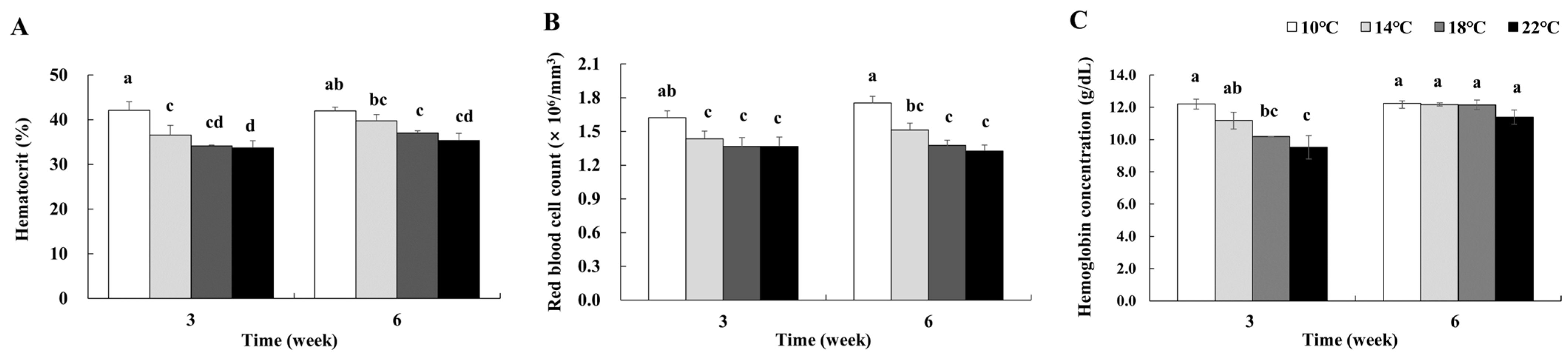
Temperature significantly affected Hct (two-way ANOVA, temperature: p < 0.001; time: p = 0.237; interaction: p = 0.616; Figure 2A). At week 3, the Hct of chum salmon reared at 22 °C was significantly lower than that at 10 and 14 °C, and the Hct of chum salmon reared at 18 °C was significantly lower than that at 10 °C (DMR test, p < 0.001). At week 6, the Hct of chum salmon reared at 18 and 22 °C were significantly lower than that at 10 °C (DMR test, p < 0.001). Temperature significantly affected the RBCC (two-way ANOVA, temperature: p < 0.001; time: p = 0.354; interaction: p = 0.643; Figure 2B). At weeks 3 and 6, RBCC in chum reared at 14, 18, and 22 °C were significantly decreased compared to that at 10 °C (DMR test, p < 0.001). Temperature and time significantly affected the Hb concentration (two-way ANOVA, temperature: p = 0.001; time < 0.001; interaction = 0.064; Figure 2C). While Hb concentrations of chum salmon reared at 22 °C were significantly decreased compared to those at 10 and 14 °C at week 3, Hb concentrations were not affected by water temperatures at week 6 (DMR, p = 0.025).
Nine fish from each treatment were individually analyzed in duplicate for RBC indices and subsequent assays, including plasma cortisol concentrations, HSP mRNA levels, plasma osmolality and ion concentrations, and gill NKA activity.

3.5. Plasma Osmolality, Na+ and Cl Concentrations, and Gill Na+/K+-ATPase Activity

Time significantly affected plasma osmolality (two-way ANOVA, temperature: p = 0.941; time: p < 0.001; interaction: p = 0.320; Table 3). Plasma osmolality at all four temperatures was significantly lower at week 6 than at week 3 (DMR test: p < 0.001). However, temperature had no significant effect on Na+ and Cl concentrations (two-way ANOVA; Na+: p = 0.642; Cl: p = 0.726; Table 3).
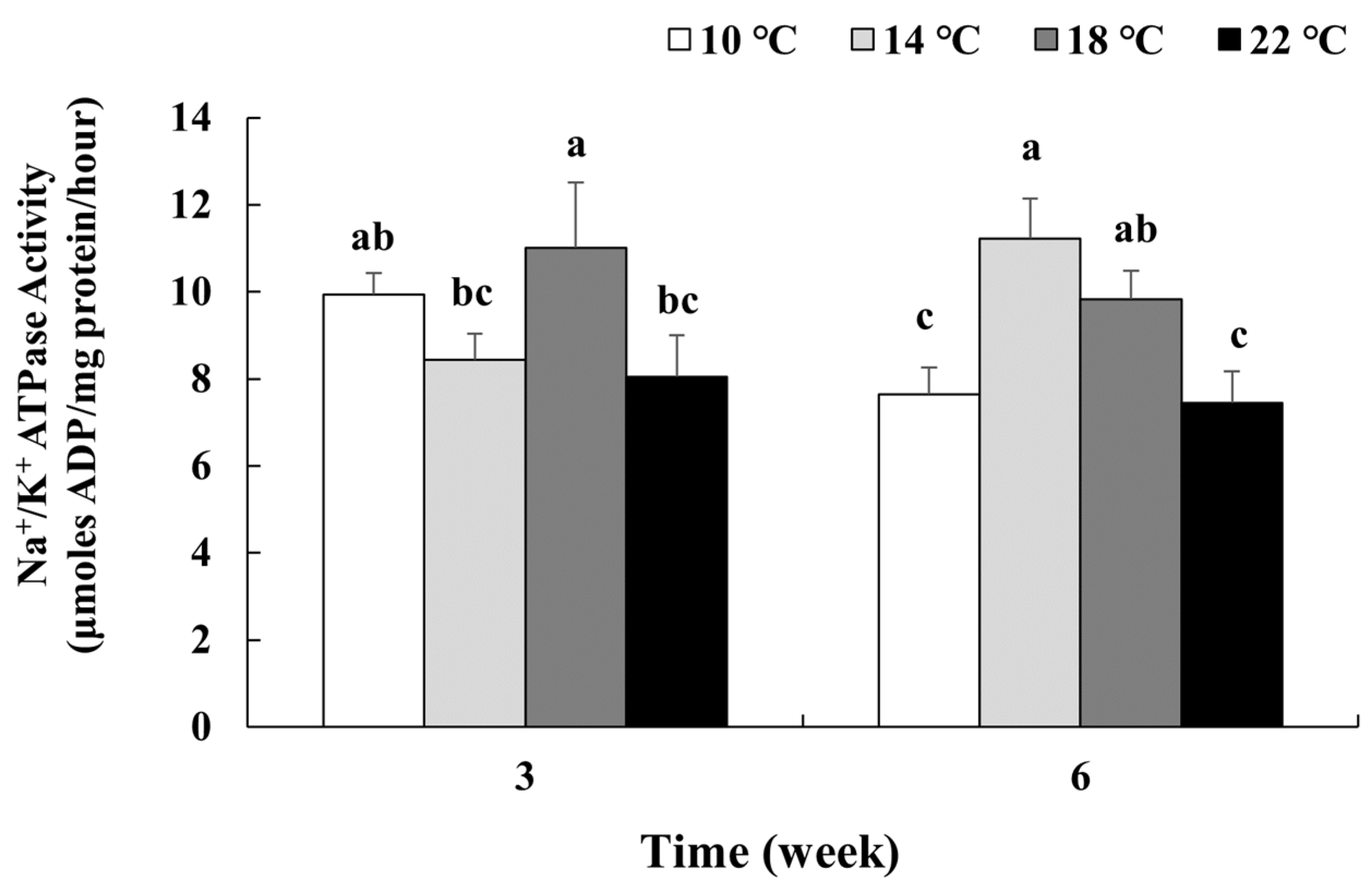
Temperature significantly affected gill NKA activity (two-way ANOVA, temperature: p = 0.008; time: p = 0.366; interaction: p = 0.018; Figure 3). Data on NKA activity were analyzed separately at each time point because of the significant interaction. Gill NKA activities of chum salmon reared at 10 and 22 °C were significantly lower than those at 14 and 18 °C (DMR test: p < 0.001). In addition, NKA activities in chum salmon after SEAWATER acclimation were significantly increased compared to those (4.06 ± 0.26 µmoles ADP/mg protein/hr) in freshwater before seawater acclimation (One-way ANOVA, p < 0.001, nine fish).

3.6. Plasma Cortisol Concentration and Hepatic Hsp70 and Hsp90 mRNA Levels

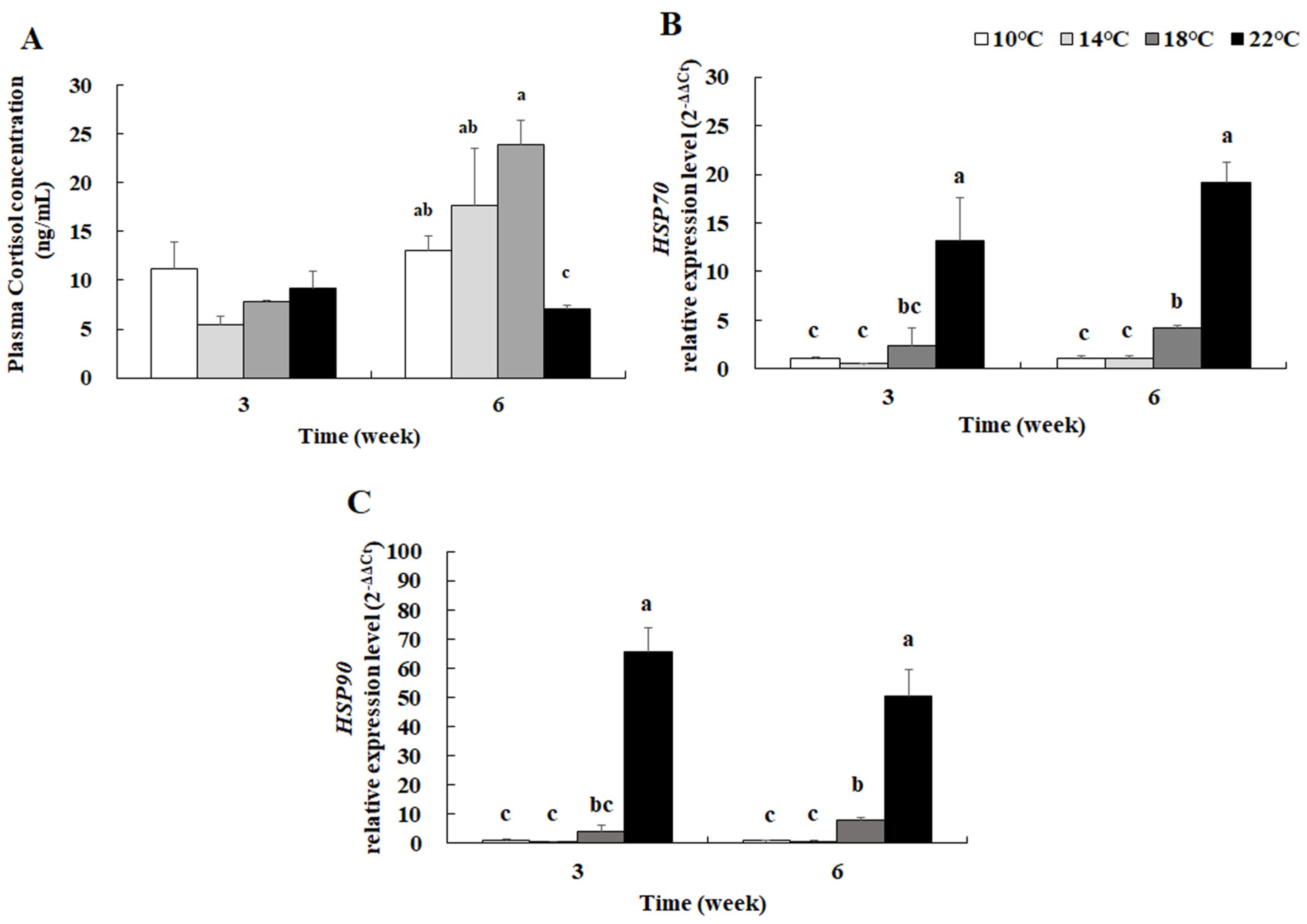
Time significantly affected plasma cortisol concentration, with a significant interaction (two-way ANOVA; temperature: p = 0.073; time: p = 0.002; interaction: p = 0.011; Figure 4A). Therefore, the effect of temperature was analyzed separately at each time point. At week 6, temperature significantly affected the plasma cortisol concentration, and the cortisol concentration at 22 °C was significantly lower than that at the other temperatures (one-way ANOVA; p = 0.039; DMR test).
Temperature had a significant effect on hepatic HSP70 mRNA levels (two-way ANOVA; temperature: p < 0.001; time: p = 0.513; interaction: p = 0.967; Figure 4B). At weeks 3 and 6, the hepatic HSP70 mRNA level of chum salmon reared at 22 °C was significantly higher than that at the other temperatures (one-way ANOVA; p < 0.001). At week 6, the HSP70 mRNA level at 18 °C was significantly higher than that at 10 °C and 14 °C. Temperature significantly affected hepatic HSP90 mRNA levels (two-way ANOVA; temperature: p < 0.001; time: p = 0.704; interaction: p = 0.290; Figure 4C). At weeks 3 and 6, the hepatic HSP90 mRNA level of chum salmon reared at 22 °C was significantly higher than those at the other temperatures (one-way ANOVA; p < 0.001). At week 6, the HSP90 mRNA level at 18 °C was also significantly higher than those at 10 and 14 °C (DMR test).

4. Discussion

Our results suggest that the physiological optimum for chum salmon smolts lies above 10 °C and below 18 °C. This interpretation is based on the following observations: (1) chum salmon smolts exhibited decreased growth at both 10 and 22 °C, along with decreased lipid content at 22 °C; (2) Hct and RBCC decreased at both 18 and 22 °C; and (3) hepatic HSP70 and HSP90 mRNA expression were upregulated at both temperatures, with much higher induction at 22 °C, even though the peak growth performance occurred at 18 °C. The typical endocrine stress response was not observed, and osmoregulation ability was sustained up to 22 °C. Detailed discussions of each parameter, including the endocrine stress response and osmoregulation, are presented in the following sections below.
In this study, both 10 °C and 14 °C were used as reference temperatures representing the ecologically and behaviorally preferred thermal range for juvenile chum salmon, as the physiological optimum during the early marine life stage has not yet been sufficiently established.

4.1. Temperature Effects on Growth Parameters and Proximate Composition

Our results on growth performance indicate that seawater-acclimated juvenile chum salmon can sustain relatively high growth rates at elevated water temperatures up to 22 °C, even though the growth rate significantly decreased at 22 °C compared to that at 18 °C. Additionally, the chum salmon reared at 22 °C did not show any apparent rejection of feed or abnormality in feeding response (which was evidenced by systematic observation for 30 min after feeding) under our fixed rate regime (3% BW per day). Our results are consistent with those of Kurita [17], who reported that juvenile chum salmon that fed frozen krill to satiation exhibited peak growth rates between 17 and 19 °C and decreased growth rates at 22 °C. In contrast, Torao [18] reported that seawater-transferred, juvenile chum salmon (average weight: 1.10–1.22 g; acclimation temperature: 8.5 °C) fed frozen Artemia to satiation exhibited temperatures for peak growth and feed intake at 16 and 18 °C, respectively, in the 10-day growth trial. These results are not consistent with our results, because the peak growth rate was observed at 18 °C, and the rejection of feed was not observed at temperatures up to 22 °C in the present study. The discrepancy can be attributed to the differences in feed ration and type and/or initial acclimation temperature (8.5 °C in Torao [18]; 14 °C in the present study). The temperature for peak growth decreases at each lower ratio in salmonids [39,40,41]. However, because chum salmon in the present study had a lower feeding rate than that in Torao [18] but showed a higher temperature for peak growth, the discrepancy does not appear to be due to the ration difference. Furthermore, although threshold temperature limits can be modified by initial acclimation temperatures in salmonids [14,15,42], there is no evidence that optimal growth temperatures are affected by initial acclimation temperatures [43]. Jonsson [43] observed no correlation between the temperatures for maximum growth and thermal conditions of their native rivers in juvenile Atlantic salmon from five Norwegian rivers, indicating that the initial acclimation temperature did not modify the peak growth temperature. Therefore, the discrepancy in temperature for peak growth between Torao [18] and the present study may be attributed to differences in thermal accommodation capacity between populations [44].
In a temperature tolerance test, juvenile chum salmon avoided temperatures above 15 °C and were unable to endure constant temperatures above 23 °C [14], with upper lethal temperatures of 22.6 and 23.1 °C observed after acclimation at 10 and 15 °C, respectively [45]. This result on upper lethal temperatures does not appear to be consistent with our results because we did not observe any mortalities or any apparent abnormalities in the chum salmon reared at 22 °C. In addition, chum salmon in the present study maintained a relatively high growth rate (SGR) at 22 °C, and the growth rate was higher than that reported by Torao [18] at the same temperature, even though the chum salmon in the present study were fed (3% BW) less than that in Torao [18]. Considering the results on mortality, growth rate, feeding and feeding behavior, and condition factor at 22 °C, Korean chum salmon from Namdae River may have a higher tolerance to and a greater capacity to sustain growth at high temperatures compared to other chum salmon populations in more northern regions, including some parts of Japan or Canada. Chum salmon populations in the ROK form the southernmost boundary of the Asian chum salmon populations [1,7]. Haplotype-based genetic lineages exist in ROK populations independent of those in Japan [6,46,47]. Furthermore, differences in the thermal physiological performance of salmon populations at different latitudes have been reported [13,29,44,48]. Differences in tolerance and physiological responses to increased temperatures among different chum populations warrant further investigation.

4.2. RBC Indices

Significant decreases in Hct and RBCC at high temperatures have also been reported in previous studies on juvenile Atlantic halibut (Hippoglossus hippoglossus L.) [49] and brook trout [20], which reported that thermal stress can impair hematological status. Similarly, the decreases in Hct and RBCC observed in the present study may be associated with stress responses, as reflected by the elevated hepatic HSP70 and HSP90 mRNA levels at 18 and 22 °C and the increased plasma cortisol levels at 14 and 18 °C, although the latter was not statistically significant due to high individual variation.
Nevertheless, other physiological mechanisms may also account for the decreased Hct and RBCC at high temperatures. One possible explanation is an energy deficit. Increased temperature elevates the metabolic rates of poikilothermic animals, such as fish [39,50]. In the present study, juvenile chum salmon were fed at 3% of BW per day, which was below satiation. Under these conditions, the fish likely experienced an energy shortage at high temperatures, particularly at 22 °C, which could have suppressed erythropoiesis. This interpretation is supported by the reduced growth rate and lower body lipid content observed at 22 °C.
Despite the decreases in Hct and RBCC, no significant change in Hb concentration at the highest temperature (22 °C) at week 6 suggested an adaptive mechanism for maintaining oxygen transport under thermal stress. A variety of fish possess multiple Hb isoforms and can modify the relative abundance and composition of the isoforms to optimize oxygen transport and to maintain protein stability across different temperatures [23,51]. Thus, the decreased Hct and RBCC but sustained Hb level at 22 °C may reflect compensatory changes in Hb isoform composition as an adaptive response to chronic exposure to elevated temperatures.

4.3. Osmoregulation

Data on the osmoregulation parameters (plasma osmolality, Na+ and Cl concentrations, and whole-body moisture content) indicated that increased temperatures up to 22 °C did not impair the hypo-osmoregulatory capacity of juvenile chum salmon. This result is consistent with Chadwick and McCormick [20], who reported no relationship between temperature (up to 24 °C) and plasma Cl. In addition, NKA activity levels determined in seawater-acclimated chum salmon were significantly higher than those in freshwater-reared fish in the present study. These levels were consistent with those of Iwata [52].

4.4. Plasma Cortisol Concentration and Hepatic HSP mRNA Levels

A significant decrease in plasma cortisol levels observed at 22 °C in the present study is consistent with findings in previous studies [53,54,55]. These studies attributed the decrease to a glucocorticoid feedback mechanism in the hypothalamus–pituitary–interrenal (HPI) axis, which is activated following prolonged exposure to stress [53,54]. Cortisol levels typically rise sharply in response to thermal changes but subsequently abate over time, indicating a physiological adaptation to mitigate the adverse effects of chronic stress responses [53,54,55]. In contrast, the elevated—but not statistically significant—cortisol concentrations observed at 14 and 18 °C are likely due to high inter-individual variability in stress responsiveness at these temperatures, which was documented in previous studies in salmonids [29,56]. The elevated cortisol levels observed in certain individuals may reflect different sensitivities to thermal stress, particularly at 18 °C.
Increased levels of hepatic HSP70 and HSP90 mRNAs in juvenile chum salmon reared at 18 and 22 °C indicate thermal stress. To the best of our knowledge, this is the first study on the upper HSP induction threshold temperature for chum salmon, which is 18 °C. Vargas-Chacoff [22] reported that the gill HSP70 production level of seawater-acclimated Atlantic salmon increased following acute exposure to 24 °C. HSPs are a family of stress proteins produced by fish cells in response to various stressors, including temperature increases and salinity changes [57]. HSP70 and HSP90 are highly conserved in vertebrates and are upregulated in the cellular response to thermal stress in fishes [19,22,57,58], to help maintain protein homeostasis by assisting proper protein folding, preventing misfolding, removing denatured proteins, remodeling specific proteins, or maturation of signaling proteins, such as glucocorticoid receptors. In addition, enhanced synthesis of HSP70 and 90 confers increased thermal tolerance to increased temperatures in fish [57,59,60]. Although HSP70 and HSP90 collaborate in cellular functions such as stress adaptation and protein remodeling [61], they also have different cellular functions and temporal expression patterns, particularly in response to stressors such as heat stress. Although the production of HSP70 proteins is transiently enhanced during acute stress, certain forms of HSP90 are strongly associated with long-term thermal acclimation for protein stabilization and cellular adaptation [19,60,62]. Threshold temperatures for the induction of enhanced HSP production differ among fish species [38,59]. Upper threshold induction temperatures for HSP70 and HSP70 mRNA have been reported in salmonids, including steelhead trout (Oncorhynchus mykiss) (20 °C [60]), Atlantic salmon (between 22 and 25 °C [21,62]), brook trout (between 21 and 22 °C [20,58,63]), and Chinook (21 °C) and coho salmon (23 °C [19]). In Chinook salmon, HSP90 mRNA levels increase at 19 °C and above, while in coho salmon, they increase at 21 °C and above [19]. The HSP threshold induction temperature (18 °C) for juvenile chum salmon, which was determined in this study, is consistent with that reported for Chinook salmon [19]. The continuous, high levels of HSP responses at the elevated temperature (22 °C) can reportedly induce metabolic disturbance by occupying much of the protein synthesis machinery and decreasing other vital protein expression for normal function [62]. Additionally, such chronic stress causes energy substrate reallocation from normal functions to stress-related responses, which can lead to negative effects in fish, including retarded growth, body energy reserves, reproduction, and immune competence [64]. As described in a previous study [19,21], the HSP mRNA results presented here provide an important reference for understanding the cellular heat responses. However, caution is required when interpreting the mRNA results, because mRNA levels do not necessarily reflect protein expression due to the complex post-transcriptional regulation.
In addition, although the dissolved oxygen (DO) concentration at 22 °C (8.24 mg/L) was lower than that at 10 °C (11.03 mg/L), this level is generally above reported hypoxic thresholds for growth and routine aerobic metabolism in salmonids [65,66,67]. Furthermore, this D.O. level observed at 22 °C is well above the critical oxygen threshold experimentally measured for Atlantic salmon at 22 °C (4.59 mg/L), below which fish cannot maintain routine metabolic rate [66]. Therefore, the 8.24 mg/L observed at 22 °C is unlikely by itself to cause adverse hypoxic effects. However, since the relatively lower oxygen availability at 22 °C may have interacted with the elevated temperature to affect growth and other physiological processes, this potential synergistic effect should be considered when interpreting the results determined in the present study.

5. Conclusions

The decreased growth performance, lipid content, and increased cellular stress responses in chum salmon smolt reared at 22 °C indicate that this temperature is suboptimal. Notably, cellular stress responses were substantially higher at 22 °C than at 18 °C. Further, although peak growth performance and competent osmoregulatory performance were evident at 18 °C, the elevated cellular stress responses and the decreased Hct and RBCC suggest that the physiological optimum lies below 18 °C. Moreover, decreased growth was observed in fish reared at 10 °C.
Taken together, these findings suggest that maintaining rearing temperatures above 10 °C and below 18 °C is advisable to promote growth while minimizing cellular stress in aquaculture settings. To the best of our knowledge, this is the first study to identify a thermal cellular stress threshold in juvenile chum salmon. These results help bridge a critical knowledge gap regarding the physiological and cellular thermal tolerance of juvenile chum salmon, particularly during the early marine life stage. Further studies incorporating protein-level quantification of HSPs and additional biomarkers are warranted to achieve a more comprehensive and definite understanding of thermal sensitivity in this species.

Author Contributions

Conceptualization, Y.C.K. and J.-W.L.; methodology, J.-W.L. and K.K.; software, K.K.; validation, K.K., Y.C.K. and J.-W.L.; formal analysis, K.K. and J.K.; investigation, B.B., J.K., D.H. and E.-Y.Y.; resources, Y.C.K. and J.-W.L.; data curation, B.B. and J.K.; writing—original draft preparation, B.B., K.K. and J.-W.L.; writing—review and editing, E.-Y.Y., Y.C.K. and J.-W.L.; visualization, K.K.; supervision, Y.C.K. and J.-W.L.; project administration, J.-W.L. All authors have read and agreed to the published version of the manuscript.

Funding

This study was financially supported by the National Research Foundation of Korea (grant number: RS-2025-16072708). This study was also financially supported by the National Research Foundation of Korea (grant number: RS-2022-NR069144) and by the Soonchunhyang University Research Fund (to Prof. K. Kim).

Institutional Review Board Statement

All experimental procedures are based on the animal experiment protocol approved by the Sejong University Animal Care and Use Committee (approval number: SJ-20230412 and approval date: 27 January 2023).

Data Availability Statement

The original contributions presented in this study are included in the article. Further inquiries can be directed to the corresponding authors.

Acknowledgments

All authors declare that AI-assisted technologies are only used for language improvement.

Conflicts of Interest

The authors declare no conflicts of interest.

Appendix A

Table A1. Body weight and fork length of chum salmon during the 6-week experimental period, including initial data.
ParameterWeeksTemperature (°C)
10141822
Body weight (g)06.75 ± 0.186.91 ± 0.306.99 ± 0.177.40 ± 0.11
312.74 ± 0.5112.01 ± 0.3212.24 ± 0.66 12.83 ± 0.17
615.71 ± 0.26 b16.82 ± 0.91 ab17.79 ± 0.36 a16.94 ± 0.41 ab
Fork length (cm)09.45 ± 0.119.41 ± 0.169.57 ± 0.089.64 ± 0.08
311.58 ± 0.16 c11.18 ± 0.06 d11.14 ± 0.21 d11.10 ± 0.10 d
612.27 ± 0.02 ab12.38 ± 0.19 a12.21 ± 0.10 ab11.83 ± 0.02 bc
Data are presented as mean ± standard error. Different letters denote significant differences (p < 0.05) among treatments as determined by two-way repeated measures ANOVA and Duncan’s multiple-range test.

References

  1. Hong, D.; Joo, G.-J.; Jung, E.; Gim, J.-S.; Seong, K.B.; Kim, D.-H.; Lineman, M.J.M.; Kim, H.-W.; Jo, H. The spatial distribution and morphological characteristics of chum salmon (Oncorhynchus keta) in South Korea. Fishes 2022, 7, 27. [Google Scholar] [CrossRef]
  2. Kitada, S.; Kishino, H. Life-stage specific effects of ocean temperatures on the hatchery chum salmon. BioRxiv 2023, preprint. [Google Scholar] [CrossRef]
  3. OMRC (Overseas Market Research Center). Seafood Trade Statistics; KMI: Seoul, Republic of Korea, 2024; Available online: https://www.kfishinfo.co.kr/fisheryStatistics/domesticExImTrend.do (accessed on 12 February 2025).
  4. Kim, B.T. An analysis of the impact of FTA Tariff elimination on the export price of Norwegian fresh and chilled salmon to Korea. J. Fish. Bus. Adm. 2018, 49, 37–48, (In Korean with English abstract). [Google Scholar] [CrossRef]
  5. MOE, Ministry of Environment, Republic of Korea. Available online: https://www.korea.kr/news/policyNewsView.do?newsId=156338199&utm_source (accessed on 22 August 2025).
  6. Jang, J.E.; Kim, J.K.; Yoon, S.-M.; Lee, H.-G.; Lee, W.-O.; Kang, J.H.; Lee, H.J. Low genetic diversity, local-scale structure, and distinct genetic integrity of Korean chum salmon (Oncorhynchus keta) at the species range margin suggest a priority for conservation efforts. Evol. Appl. 2022, 15, 2142–2157. [Google Scholar] [CrossRef]
  7. Augerot, X. Atlas of Pacific Salmon: The First Map-Based Status Assessment of Salmon in the North Pacific; University of California Press: Berkeley, CA, USA, 2005. [Google Scholar]
  8. Farley , E.V., Jr.; Yasumiishi, E.M.; Murphy, J.M.; Strasburger, W.; Sewall, F.; Howard, K.; Garcia, S.; Moss, J.H. Critical periods in the marine life history of juvenile western Alaska chum salmon in a changing climate. Mar. Ecol. Prog. Ser. 2024, 726, 149–160. [Google Scholar] [CrossRef]
  9. Pearcy, W.G. Ocean Ecology of the North Pacific Salmonids; University of Washington Press: Seattle, WA, USA, 1992. [Google Scholar]
  10. Honda, K.; Shirai, K.; Komatsu, S.; Saito, T. Sea-entry conditions of juvenile chum salmon Oncorhynchus keta that improve post-sea-entry survival: A case study of the 2012 brood-year stock released from the Kushiro River, eastern Hokkaido, Japan. Fish. Sci. 2020, 86, 783–792. [Google Scholar] [CrossRef]
  11. Yamada, K.; Yoo, J.-T. Spatial relationship between distribution of common minke whale (Balaenoptera acutorostrata) and satellite sea surface temperature observed in the East Sea Korea in May from 2003 to 2020. J. Korean Soc. Fish. Ocean. Technol. 2022, 58, 281–287. [Google Scholar] [CrossRef]
  12. Pak, G.; Lee, K.-J.; Lee, S.-W.; Jin, H.; Park, J.-H. Quantification of the extremely intensified East Korea Warm Current in the summer of 2021: Offshore and coastal variabilities. Front. Mar. Sci. 2023, 10, 1252302. [Google Scholar] [CrossRef]
  13. Mayer, N.; Hinch, S.G.; Eliason, E.J. Thermal tolerance in Pacific salmon: A systematic review of species, populations, life stages and methodologies. Fish Fish. 2023, 25, 283–302. [Google Scholar] [CrossRef]
  14. Brett, J.R. Temperature tolerance in young Pacific salmon, genus Oncorhynchus. J. Fish. Board Can. 1952, 9, 265–323. [Google Scholar] [CrossRef]
  15. Hicks, M. Evaluating Standards for Protecting Aquatic Life in Washington’s Surface Water Quality Standards: Temperature Criteria. Draft Discussion Paper and Literature Summary; Water Quality Program, Washington State Department of Ecology, Watershed Management Section: Olympia, WA, USA, 2002. [Google Scholar]
  16. Irie, T. Ecological studies on the migration of juvenile chum salmon, Oncorhynchus keta, during early ocean life. Bull. Seikai Natl. Fish. Res. Inst. 1990, 68, 1–143. [Google Scholar]
  17. Kurita, Y.; Saito, T.; Aritaki, M. Growth and feeding habit of chum salmon fry/juveniles in the Sanriku coastal waters, and their ecological interaction with herring larvae/juveniles. FRA salmon Res. Rep. 2010, 4, 9–11. (In Japanese) [Google Scholar]
  18. Torao, M. Effect of water temperature on the feed intake, growth, and feeding efficiency of juvenile Oncorhynchus keta after seawater transfer. Aquacult. Sci. 2022, 70, 97–106. [Google Scholar]
  19. Von Biela, V.R.; Regish, A.M.; Bowen, L.; Stanek, A.E.; Waters, S.; Carey, M.P.; Zimmerman, C.E.; Gerken, J.; Rinella, D.; McCormick, S.D. Differential heat shock protein responses in two species of Pacific salmon and their utility in identifying heat stress. Conserv. Physiol. 2023, 11, coad092. [Google Scholar] [CrossRef]
  20. Chadwick, J.G.; McCormick, S.D. Upper thermal limits of growth in brook trout and their relationship to stress physiology. J. Exp. Biol. 2017, 220, 3976–3987. [Google Scholar] [CrossRef]
  21. Lund, S.G.; Caissie, D.; Cunjak, R.A.; Vijayan, M.M.; Tufts, B.L. The effects of environmental heat stress on heat-shock mRNA and protein expression in Miramichi Atlantic salmon (Salmo salar) parr. Can. J. Fish. Aquat. Sci. 2002, 59, 1553–1562. [Google Scholar] [CrossRef]
  22. Vargas-Chacoff, L.; Regish, A.M.; Weinstock, A.; McCormick, S.D. Effects of elevated temperature on osmoregulation and stress responses in Atlantic salmon Salmo salar smolts in fresh water and seawater. J. Fish Biol. 2018, 93, 550–559. [Google Scholar] [CrossRef]
  23. Moyle, P.B.; Cech, J.J., Jr. Fishes: An Introduction to Ichthyology, 5th ed.; Prentice-Hall: New Jersey, NY, USA, 2004. [Google Scholar]
  24. Vargas-Chacoff, L.; Arjona, F.J.; Ruiz-Jarabo, I.; García-Lopez, A.; Flik, G.; Mancera, J.M. Water temperature affects osmoregulatory responses in gilthead sea bream (Sparus aurata L.). J. Therm. Biol. 2020, 88, 102526. [Google Scholar] [CrossRef]
  25. McCormick, S.D. Hormonal control of gill Na+/K+-ATPase and chloride cell function. Fish Physiol. 1995, 14, 285–315. [Google Scholar]
  26. Mommsen, T.P.; Vijayan, M.M.; Moon, T.W. Cortisol in teleosts: Dynamics, mechanisms of action, and metabolic regulation. Rev. Fish Biol. Fish. 1999, 9, 211–268. [Google Scholar] [CrossRef]
  27. Wedemeyer, G.A.; Saunders, R.L.; Clarke, W.C. Environmental factors affecting smoltification and early marine survival of anadromous salmonids. Mar. Fish. Rev. 1980, 42, 1–14. [Google Scholar]
  28. McCullough, D.A. A Review and Synthesis of Effects of Alterations to the Water Temperature Regime on Freshwater Life Stages of Salmonids, with Special Reference to Oncorhynchus tshawytscha; U.S. Environmental Protection Agency, Region 10: Seattle, WA, USA, 1999.
  29. Marine, K.R.; Cech, J.J., Jr. Effects of high water temperature on growth, smoltification, and predator avoidance in juvenile Sacramento river Chinook salmon. N. Am. J. Fish. Manag. 2004, 24, 198–210. [Google Scholar]
  30. Lee, J.-W.; Balasubramanian, B. Impacts of temperature on the growth, feed utilization, stress, and hemato-immune responses of cherry salmon (Oncorhynchus masou). Animals 2023, 13, 3870. [Google Scholar] [CrossRef] [PubMed]
  31. Lee, M.; Lee, B.; Kim, K.; Yoon, M.; Lee, J.-W. Differential effects of two seawater transfer regimes on the hypoosmoregulatory adaptation, hormonal response, feed efficiency, and growth performance of juvenile steelhead trout. Aquac. Rep. 2022, 22, 101004. [Google Scholar] [CrossRef]
  32. AOAC International. Official Methods of Analysis, 16th ed.; Association of Official Analytical Chemists: Washington, DC, USA, 1995. [Google Scholar]
  33. Lee, J.; Hong, S.; Sun, J.-H.; Moon, J.-K.; Boo, K.-H.; Lee, S.-M.; Lee, J.-W. Toxicity of dietary selenomethionine in juvenile steelhead trout, Oncorhynchus mykiss: Tissue burden, growth performance, body composition, hematological parameters, and liver histopathology. Chemosphere 2019, 226, 755–765. [Google Scholar] [CrossRef]
  34. McCormick, S.D. Methods for nonlethal gill biopsy and measurement of Na+, K+-ATPase activity. Can. J. Fish. Aquat. Sci. 1993, 50, 656–658. [Google Scholar] [CrossRef]
  35. Kim, N.N.; Choi, Y.J.; Lim, S.; Jeong, M.; Jin, D.-H.; Choi, C.Y. Effect of salinity changes on olfactory memory-related genes and hormones in adult chum salmon Oncorhynchus keta. Comp. Biochem. Physiol. A 2015, 187, 40–47. [Google Scholar]
  36. Blair, S.D.; Glover, C.N. Acute exposure of larval rainbow trout (Oncorhynchus mykiss) to elevated temperature limits hsp70b expression and influences future thermotolerance. Hydrobiologia 2019, 837, 177–187. [Google Scholar]
  37. Akbarzadeh, A.; Ming, T.J.; Schulze, A.D.; Kaukinen, K.H.; Li, S.; Günther, O.P.; Houde, A.L.S.; Miller, K.M. Developing molecular classifiers to detect environmental stressors, smolt stages and morbidity in coho salmon, Oncorhynchus kisutch. Sci. Total Environ. 2024, 951, 175626. [Google Scholar] [PubMed]
  38. Weiss, N.A. Introductory Statistics, 9th ed.; Pearson: Boston, MA, USA, 2012. [Google Scholar]
  39. Brett, J.R.; Shelbourn, J.E.; Shoop, C.T. Growth rate and body composition of fingerling sockeye salmon, Oncorhynchus nerka, in relation to temperature and ration size. J. Fish. Board Can. 1969, 26, 2363–2394. [Google Scholar] [CrossRef]
  40. Elliott, J.M. The effects of temperature and ration size on the growth and energetics of salmonids in captivity. Comp. Biochem. Physiol. B 1982, 73, 81–91. [Google Scholar] [CrossRef]
  41. Lino, Y.; Kitagawa, T.; Abe, T.K.; Nagasaka, T.; Shimizu, Y.; Ota, K.; Kawashima, T.; Kawamura, T. Effect of food amount and temperature on growth rate and aerobic scope of juvenile chum salmon. Fish. Sci. 2022, 88, 397–409. [Google Scholar] [CrossRef]
  42. Dietz, T.J.; Somero, G.N. Species- and tissue-specific synthesis patterns for heat-shock proteins HSP70 and HSP90 in several marine teleost fishes. Physiol. Zool. 1993, 66, 863–880. [Google Scholar] [CrossRef]
  43. Jonsson, B.; Forseth, T.; Jensen, A.J.; Naesje, T.F. Thermal performance of juvenile Atlantic salmon, Salmo salar L. Funct. Ecol. 2001, 15, 701–711. [Google Scholar]
  44. Eliason, E.J.; Clark, T.D.; Hague, M.J.; Hanson, L.M.; Gallagher, Z.S.; Jeffries, K.M.; Gale, M.K.; Patterson, D.A.; Hinch, S.G.; Farrell, A.P. Differences in thermal tolerance among sockeye salmon populations. Science 2011, 332, 109–112. [Google Scholar] [CrossRef]
  45. Brett, J.R. Some principles of the thermal requirements of fishes. Q. Rev. Biol. 1956, 31, 75–87. [Google Scholar] [CrossRef]
  46. Jung, W.; Lee, Y.-H.; Kim, S.; Jin, D.-H.; Seong, K.B. Genetic identification of the north Pacific chum salmon. J. Kor. Fish. Soc. 2003, 36, 578–585. [Google Scholar]
  47. Kim, G.E.; Kim, C.G.; Lee, Y.H. Genetic similarity-dissimilarity among Korea Chum salmons of each stream and their relationship with Japan salmons. Sea 2007, 12, 94–101. [Google Scholar]
  48. Myrick, C.A.; Cech, J.J., Jr. Temperature Effects on Oncorhynchus tshawytscha and Oncorhynchus mykiss: A Review Focusing on California’s Central Valley Populations; Technical Publication 01-1; California Water and Environmental Modeling Forum: Sacramento, CA, USA, 2002. [Google Scholar]
  49. Langston, A.L.; Hoare, R.; Stefansson, M.; Fitzgerald, R.; Wergeland, H.; Mulcahy, M. The effect of temperature on non-specific defence parameters of three strains of juvenile Atlantic halibut (Hippoglossus hippoglossus L.). Fish Shellfish Immunol. 2002, 12, 61–76. [Google Scholar] [CrossRef] [PubMed]
  50. Jobling, M. Temperature and growth: Modulation of growth rate via temperature change. In Global Warming: Implications for Freshwater and Marine Fish; Society for Experimental Biology Seminar Series, 61; Wood, C.M., McDonald, D.G., Eds.; Cambridge University Press: Cambridge, UK, 1996; pp. 225–253. [Google Scholar]
  51. Pan, Y.K.; Ern, R.; Morrison, P.R.; Brauner, C.J.; Esbaugh, A.J. Acclimation to prolonged hypoxia alters hemoglobin isoform expression and increases hemoglobin oxygen affinity and aerobic performance in a marine fish. Sci. Rep. 2017, 7, 7834. [Google Scholar] [CrossRef]
  52. Iwata, M.; Kinoshita, K.; Moriyama, S.; Kurosawa, T.; Iguma, K.; Chiba, H.; Ojima, D.; Yoshinaga, T.; Arai, T. Chum salmon fry grow faster in seawater, exhibit greater activity of the GH/IGF axis, higher Na+, K+-ATPase activity, and greater gill chloride cell development. Aquaculture 2012, 362, 101–108. [Google Scholar] [CrossRef]
  53. Madaro, A.; Olsen, R.E.; Kristiansen, T.S.; Ebbesson, L.O.E.; Nilsen, T.O.; Flik, G.; Gorissen, M. Stress in Atlantic salmon: Response to unpredictable chronic stress. J. Exp. Biol. 2015, 218, 2538–2550. [Google Scholar] [CrossRef] [PubMed]
  54. Tang, P.A.; Gharbi, N.; Nilsen, T.O.; Gorissen, M.; Stefansson, S.O.; Ebbesson, L.O.E. Increased thermal challenges differentially modulate neural plasticity and stress responses in post-smolt Salmo salar. Front. Mar. Sci. 2022, 9, 926136. [Google Scholar] [CrossRef]
  55. Opinion, A.G.R.; Vanhomwegen, M.; De Boeck, G.; Aerts, J. Long-term stress induced cortisol downregulation, growth reduction and cardiac remodeling in Salmo salar. J. Exp. Biol. 2023, 226, 24. [Google Scholar] [CrossRef]
  56. McCormick, S.D. Smolt physiology and endocrinology. In Euryhaline Fishes; McCormick, S.D., Farrell, A.P., Brauner, C., Eds.; Academic Press: Waltham, MA, USA, 2013; pp. 199–251. [Google Scholar]
  57. Basu, N.; Todgham, A.E.; Ackerman, P.A.; Bibeau, M.R.; Nakano, K.; Schulte, P.M.; Iwama, G.K. Heat shock protein genes and their functional significance in fish. Gene 2002, 295, 173–183. [Google Scholar] [CrossRef]
  58. Chadwick, J.G.; Nislow, K.H.; McCormick, S.D. Thermal onset of cellular and endocrine stress responses correspond to ecological limits in brook trout, an iconic cold-water fish. Conserv. Physiol. 2015, 3, cov017. [Google Scholar] [CrossRef]
  59. Hightower, L.E.; Norris, C.E.; DiIorio, P.J.; Fielding, E. Heat shock responses of closely related species of tropical and desert fish. Am. Zool. 1999, 39, 877–888. [Google Scholar] [CrossRef]
  60. Kaur, A.; Ali, S.; Brraich, O.S.; Siva, C.; Pandey, P.K. State of thermal tolerance in an endangered himalayan fish Tor putitora revealed by expression modulation in environmental stress related genes. Sci. Rep. 2025, 15, 5025. [Google Scholar] [CrossRef]
  61. Genest, O.; Wickner, S.; Doyle, S.M. Hsp90 and Hsp70 chaperones: Collaborators in protein remodeling. J. Biol. Chem. 2019, 294, 2109–2120. [Google Scholar] [CrossRef] [PubMed]
  62. Viant, M.R.; Werner, I.; Rosenblum, E.S.; Gantner, A.S.; Tjeerdema, R.S.; Johnson, M.L. Correlation between heat-shock protein induction and reduced metabolic condition in juvenile steelhead trout (Oncorhynchus mykiss) chronically exposed to elevated temperature. Fish Physiol. Biochem. 2003, 29, 159–171. [Google Scholar] [CrossRef]
  63. Lund, S.G.; Lund, E.A.M.E.A.; Tufts, B.L. Red blood cell Hsp 70 mRNA and protein as bioindicators of temperature stress in the brook trout (Salvelinus fontinalis). Can. J. Fish. Aquat. Sci. 2003, 60, 460–470. [Google Scholar] [CrossRef]
  64. Alfonso, S.; Gesto, M.; Sadoul, B. Temperature increase and its effects on fish stress physiology in the context of global warming. J. Fish Biol. 2021, 98, 1496–1508. [Google Scholar] [CrossRef] [PubMed]
  65. Carter, K. The Effects of Dissolved Oxygen on Steelhead Trout, Coho Salmon, and Chinook Salmon Biology and Function by Life Stage; Technical Report; California Regional Water Quality Control Board North Coast Region: Santa Rosa, CA, USA, 2005. [Google Scholar]
  66. Barnes, R.K.; King, H.; Carter, C.G. Hypoxia tolerance and oxygen regulation in Atlantic salmon, Salmo salar from a Tasmanian population. Aquaculture 2011, 318, 397–401. [Google Scholar] [CrossRef]
  67. Alver, M.O.; Føre, M.; Alfredsen, J.A. Predicting oxygen levels in Atlantic salmon (Salmo salar) sea cages. Aquaculture 2022, 548, 737720. [Google Scholar] [CrossRef]
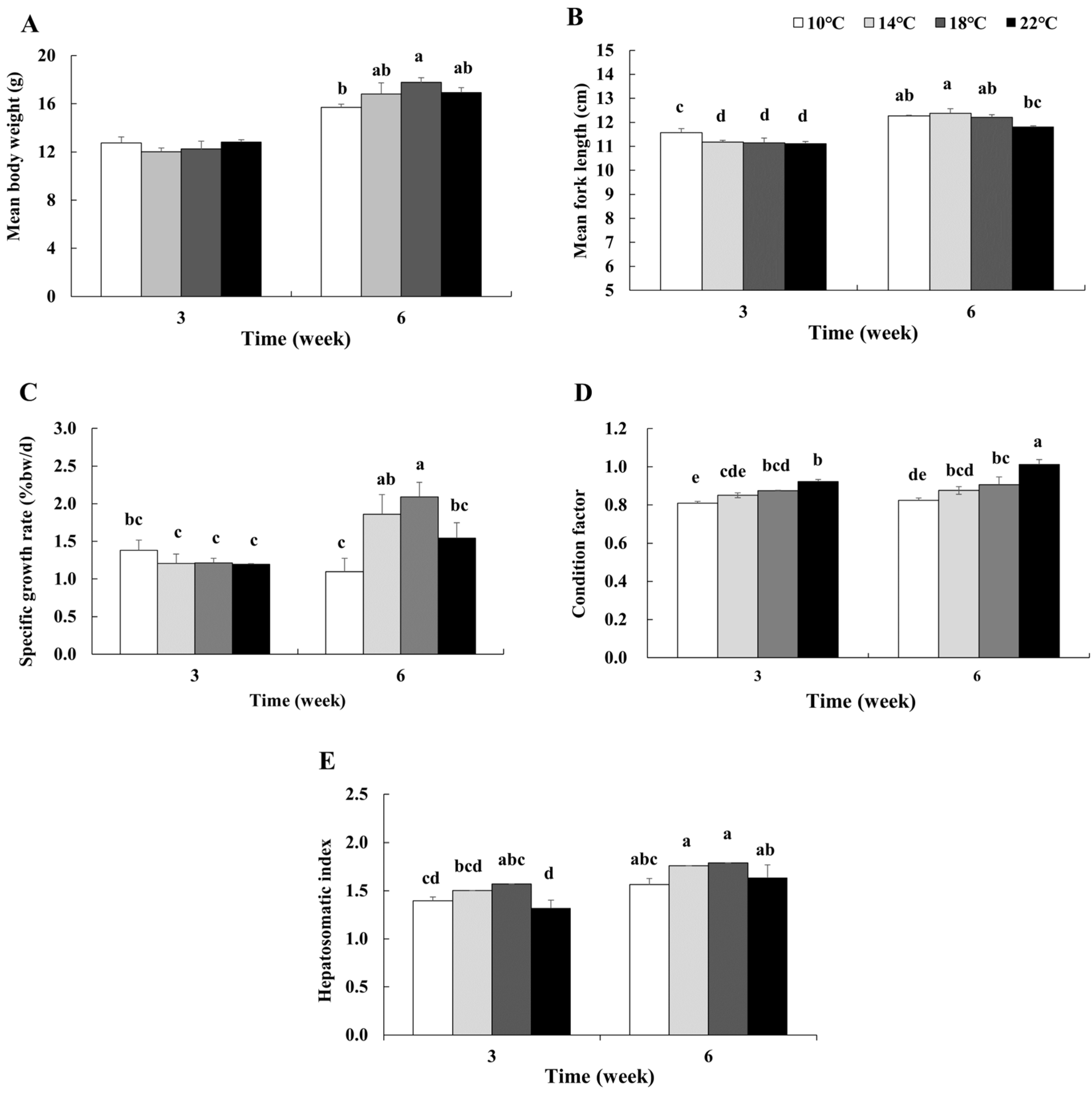
Figure 1. Growth performance of chum salmon smolt reared at constant four temperatures (10, 14, 18, and 22 °C) for 6 weeks:(A) mean body weight; (B) mean fork length; (C) specific growth rate; (D) condition factor; (E) hepatosomatic index. The vertical error bar denotes a standard error of the mean (8–12 fish/tank). Different letters indicate significant differences (p < 0.05) among treatments at each time point (when the interaction was significant) or both time points (otherwise) as determined by two-way repeated measures ANOVA and Duncan’s multiple-range test. Note: Body weight and fork length data for all sampling time points are also provided in Appendix A.
Fishes 10 00616 g001
Figure 2. Red blood cell (RBC) indices of chum salmon smolt reared at constant four temperatures (10, 14, 18, and 22 °C) for 6 weeks: (A) hematocrit; (B) RBC count; (C) hemoglobin concentration. The vertical error bar denotes a standard error of the mean (9 fish/treatment), and different letters denote significant differences (p < 0.05) among treatments at each time point (when the interaction was significant) or both time points (otherwise) as determined by two-way ANOVA and Duncan’s multiple-range test.
Fishes 10 00616 g002
Figure 3. Na+/K+-ATPase activity of chum salmon smolt reared at constant four temperatures (10, 14, 18, and 22 °C) for 6 weeks. The vertical error bar denotes a standard error of the mean (9 fish/treatment), and different letters indicate significant differences (p < 0.05) among treatments at both time points, as determined by two-way ANOVA and Duncan’s multiple-range test.
Fishes 10 00616 g003
Figure 4. Plasma cortisol concentration and hepatic HSP70 and HSP90 relative expression of chum salmon smolt reared at constant four temperatures (10, 14, 18, and 22 °C) for 6 weeks: (A) plasma cortisol concentration; (B) HSP70 relative expression level; (C) HSP90 relative expression level. The vertical error bar denotes a standard error of the mean (9 fish/treatment), and different letters denote significant differences (p < 0.05) among treatments at both time points as determined by two-way ANOVA and Duncan’s multiple-range test.
Fishes 10 00616 g004
Table 1. Experimental water parameters and photoperiod.
ParameterTemperature Group
10 °C14 °C18 °C22 °C
Water temperature (°C)10.70 ± 0.0914.23 ± 0.0618.29 ± 0.0321.77 ± 0.08
Photoperiod (L:D)12:1212:1212:1212:12
Dissolved oxygen (mg/L)11.03 ± 0.109.81 ± 0.098.70 ± 0.068.24 ± 0.05
pH8.03 ± 0.017.99 ± 0.018.08 ± 0.018.08 ± 0.01
Conductivity (mS/cm)311.98 ± 30.04389.05 ± 31.65317.68 ± 33.60318.03 ± 31.73
Total ammonia (mg/L) Not detectedNot detectedNot detectedNot detected
Nitrite (mg/L) Not detectedNot detectedNot detectedNot detected
Nitrate (mg/L)13.54 ± 1.0419.79 ± 3.2518.75 ± 3.2619.79 ± 3.25
Data are presented as mean ± standard error. Detection limit: 0.25 mg/L. Detection limit: 0.3 mg/L.
Table 2. The whole body proximate composition of chum salmon reared at four temperatures for 6 weeks.
ParameterTime (Week)Temperature
10 °C14 °C18 °C22 °C
Moisture (%)377.30 ± 0.07 ab77.36 ± 0.24 a76.93 ± 0.33 abc77.41 ± 0.15 a
676.13 ± 0.09 de75.96 ± 0.30 e76.67 ± 0.03 bcd76.31 ± 0.20 cde
Crude protein (%)316.23 ± 0.0916.40 ± 0.2916.67 ± 0.5016.73 ± 0.20
616.7 ± 0.1116.58 ± 0.3316.66 ± 0.1616.65 ± 0.12
Crude lipid (%)34.12 ± 0.07 bcd4.00 ± 0.34 cd3.76 ± 0.37 d3.0 ± 0.04 e
64.70 ± 0.08 abc4.73 ± 0.20 ab5.10 ± 0.20 a4.13 ± 0.02 bcd
Crude ash (%)32.17 ± 0.072.31 ± 0.092.46 ± 0.122.51 ± 0.07
62.26 ± 0.022.3 ± 0.062.23 ± 0.032.38 ± 0.03
Data are presented as mean ± standard error. Different letters denote significant differences (p < 0.05) among treatments at both time points as determined by two-way ANOVA and Duncan’s multiple-range test (9 fish/treatment).
Table 3. Plasma osmolality and Na+ and Cl concentrations of chum salmon reared at four temperatures for 6 weeks.
ParameterTime (Week)Temperature
10 °C14 °C18 °C22 °C
Osmolality (mmol/kg)3331 ± 3.61 a332 ± 5.28 a328 ± 2.33 a325 ± 2.79 a
6311 ± 5.39 b306 ± 1.06 b309 ± 3.23 b313 ± 3.44 b
Na+ (mEq/L)3159 ± 2.91162 ± 2.12162 ± 1.13162 ± 0.33
6163 ± 1.39163 ± 0.68162 ± 1.64161 ± 1.26
Cl (mEq/L)3132 ± 2.72136 ± 2.19134 ± 1.47136 ± 0.56
6133 ± 0.24132 ± 1.06132 ± 0.80132 ± 0.51
Data are represented as mean ± standard error. Different letters denote significant differences (p < 0.05) among treatments at both time points as determined by two-way ANOVA and Duncan’s multiple-range test (9 fish/treatment).
Disclaimer/Publisher’s Note: The statements, opinions and data contained in all publications are solely those of the individual author(s) and contributor(s) and not of MDPI and/or the editor(s). MDPI and/or the editor(s) disclaim responsibility for any injury to people or property resulting from any ideas, methods, instructions or products referred to in the content.