1. Introduction
The common carp,
Cyprinus carpio (Linnaeus, 1758), constitutes a key species within both aquatic ecosystems [
1] and the fisheries sector [
2,
3,
4], with substantial ecological and economic significance. Globally, the common carp ranks among the top ten aquatic species by production volume, reaching approximately 4 million tonnes annually in 2022, with the vast majority originating from aquaculture rather than capture fisheries [
5]. In Romania, wild carp catches totaled 261 tonnes in 2023, while aquaculture production reached 3060 tonnes, with an estimated market value of 1.405 million USD (according to FishstatJ v4.04.11—April 2025).
This emphasizes the growing contribution of aquaculture to sustaining carp production and reducing fishing pressure on natural populations. The development of carp farming thus represents a critical component of sustainable fisheries management, ensuring both resource conservation and socio-economic resilience in freshwater ecosystems.
The Danube River, as Europe’s principal watercourse, provides a critical habitat for this species. However, in recent years, carp populations have been increasingly influenced by multiple anthropogenic pressures and climate change [
6,
7,
8]. As many other fish stocks [
9], overfishing, alterations in habitat structure and quality [
10,
11] and the effects of climatic variability [
12,
13] on the Danube ecosystem have contributed to pronounced fluctuations in carp population dynamics [
14]. Consequently, continuous monitoring of stock status is essential to inform effective conservation strategies and ensure sustainable fisheries management [
15,
16].
As a highly dynamic ecosystem, the Danube exhibits considerable hydrological variability, which directly affects the life cycle of common carp. River hydrology, including seasonal flow regimes, water levels and temperatures, and current velocities, affects reproductive success and the availability of trophic resources [
17,
18,
19,
20]. These factors ultimately shape the structure, abundance, metabolism and dynamics of carp populations [
14].
Understanding species life histories, population dynamics, and the sustainability of fisheries relies heavily on the study of fish growth [
9]. Growth is closely linked to life-history traits, including natural mortality, fecundity, and age at first maturity, which determines a species’ response to exploitation [
21].
The objective of this study is to evaluate the temporal variation in population structure, growth, and mortality of common carp in the Danube River during 2019–2024, to support sustainable management. Quantitative indicators of growth, mortality, and exploitation will be estimated using validated population models and standard fisheries assessment methods, including length-based analyses and the von Bertalanffy growth model. These approaches ensure methodological and statistical rigor.
By focusing on these indicators, the study aims to provide a comprehensive assessment of population dynamics and evaluate the sustainability of current fishing pressures. This includes an examination of the interplay between natural growth and mortality rates, anthropogenic impacts through fishing, and their implications for stock resilience. By integrating these biological and fishery metrics, the study seeks to contribute to the body of knowledge supporting adaptive management strategies and conservation efforts for the Danube common carp fishery.
2. Materials and Methods
2.1. Data Collection
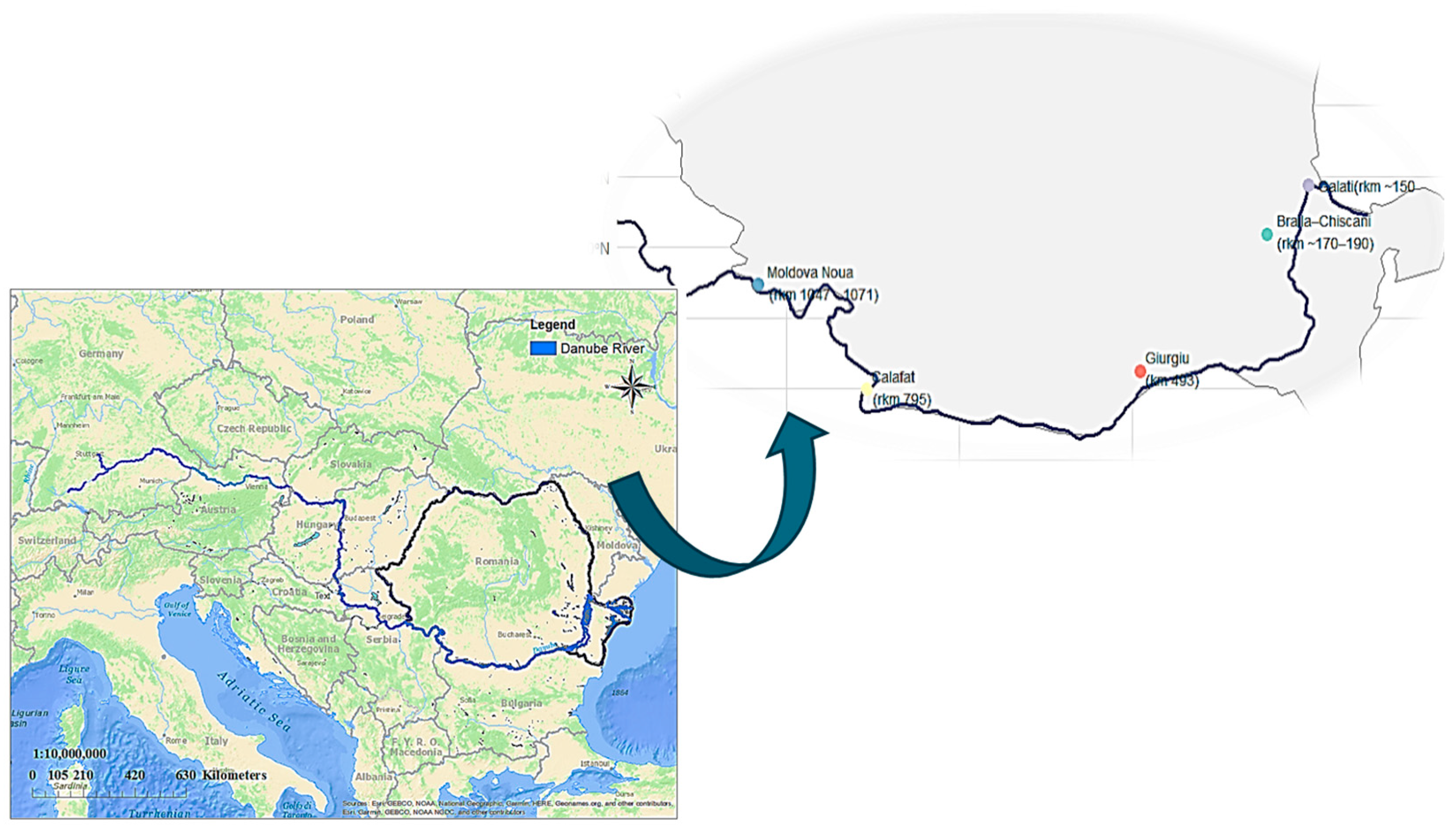
Sampling was carried out seasonally, once per season, across six years, between 2019 and 2024, covering spring, summer, and autumn periods to capture variability in fish activity and hydrological conditions. Surveys were performed annually during comparable climatic periods, typically between April and October, to ensure temporal consistency across years. Sampling was conducted at five locations (
Figure 1) along the Romanian stretch of the Danube River: between Baziaș and Moldova Veche (rkm 1047–1071, Iron Gates dam sector), Calafat (rkm 795, mid-upper reach), Giurgiu (km 493, mid-lower reach), Brăila–Chiscani (rkm ~170–190, Small Brăila Island Wetland Complex), and Galați (rkm ~150, Siret/Prut River influence).
At each site, three and five hauls were performed per sampling event, depending on local hydrological conditions. Both fixed and drift gillnets (one of each) were used simultaneously, with comparable effort for each gear type to ensure consistent catchability and data representativeness across years. Nets were deployed for approximately 12 h, typically from late afternoon to early morning, to standardize fishing effort and maximize comparability among sites.
The fishing equipment complied with regulatory standards and to ensure sustainable sampling in accordance with Order No. 342/2008 [
22], which establishes a minimum legal capture size of 40 cm for common carp. Fixed gillnets had total lengths ranging from 100 to 200 m, vertical heights between 2.5 and 3.5 m, and mesh sizes of 40–60 mm (knot to knot). Drift gillnets exhibited similar specifications, with lengths between 150 and 200 m, heights from 2.5 to 4.0 m, and mesh sizes ranging from 40 to 80 mm (knot to knot).
The following parameters were recorded for each sampled individual: total length (TL, cm) and total weight (TW, kg). The number of specimens examined was expressed as No. Ex. The sex of each specimen was determined based on macroscopic gonad inspection and denoted as F (female) and M (male). The sex ratio was calculated annually, expressing the number of females relative to the number of males (e.g., 1:1, 2:1). Minimum (min), maximum (max), and mean (mean) values were computed for each variable.
Length–frequency data for 2019–2024 were compiled to characterize the population structure of common carp in the Danube. Data for the 2021–2024 period were obtained from a previously published study by Stroe et al. [
14], in which the present author participated as co-author. These datasets include capture records from the same sampling sites used in the current research. For this study, the 2021–2024 data were reprocessed and integrated with newly collected records from 2019 to 2020, to extend the temporal scope to 2019–2024. This integration allowed a broader analysis of population dynamics and stock assessment trends beyond the scope of the original publication. The length-class distribution was subsequently used to estimate growth and mortality parameters in the FISAT II software (version 1.2.2). Length-frequency distributions were constructed using continuous 5 cm length classes (30–35, 35–40, 40–45 cm), ensuring that no gaps occurred between intervals.
2.2. Comparative Analysis of TAC—Reported Catch
The comparative analysis of the Total Allowable Catch (TAC) and the reported fish catches for the period 2015–2024 was conducted based on official capture data provided by the National Agency for Fisheries and Aquaculture (ANPA) (
www.anpa.ro; accessed on 20 September 2025) for the Romanian sector of the Danube River. TAC values were extracted from the official orders of the Ministry of Environment: Order No. 386/391/2015 [
23], Order No. 284/613/2016 [
24], Order No. 13/142/2017 [
25], Order No. 546/352/2018 [
26], Order No. 243/354/2019 [
27], Order No. 124/1.159/2020 [
28], Order No. 99/814/2021 [
29], Order No. 42/558/2022 [
30], Order No. 45/539/2023 [
31], Order No. 75/874/2024 [
32].
2.3. Stock Assessment and Its Temporal Dynamics
The von Bertalanffy growth function [
33] was applied, as it is considered consistent with the observed growth patterns of most fish species. Growth parameters were estimated using length-frequency data, without separation by sex, due to the limited number of individuals available for each category. The analysis was performed using aggregated annual datasets, and parameter estimation was not differentiated by fishing season to ensure data robustness and comparability across years.
The asymptotic length (L∞; cm), growth coefficient (k; year
−1), and the growth performance index (Φ′) were calculated. The growth performance index (Φ′) represents a measure of individual fish growth efficiency and is computed using the following formula: Φ′ = log10(K) + 2 log10(L∞) [
34]. The length-frequency approach was preferred due to the high temporal and spatial variability of fishing catches and the difficulty of obtaining age data from otolith readings in the field.
Estimating growth parameters provides insight into how individuals or populations increase in size or weight relative to environmental conditions and food availability. This information is valuable for assessing ecosystem health and stability. It also supports predictions of how environmental changes may affect biodiversity and helps guide sustainable fisheries management [
21].
Mortality rates are key parameters for describing the negative aspects of fish population dynamics [
35]. Stock losses can result from natural causes (natural mortality, M) or fishing (fishing mortality, F).
The annual total mortality rate (Z; year
−1) was estimated using length-based catch curves [
36] in FISAT II. Natural mortality (M; year
−1) was calculated according to Pauly’s empirical formula [
37]. Annual mean water temperature (T, °C) was obtained from data provided by the National Institute of Hydrology and Water Management (I.N.H.G.A.) [
38]. Fishing mortality (F; year
−1) was derived from the relationship: F = Z − M [
39].
The exploitation rate (E) was calculated as E = F/Z and reflects the intensity of fishing pressure. Quantifying the impact of factors leading to fish mortality is essential for stock assessment and fisheries management [
40].
The ratio between natural mortality (M) and the growth coefficient (K) was calculated as an indicator of population resilience. Higher M/K values denote fast-growing, short-lived populations. In contrast, lower ratios indicate slower-growing, long-lived individuals [
37,
41].
The length at first maturity (L
50) was estimated as the total length at which 50% of individuals in the population are mature. This parameter provides insight into the reproductive structure of the stock [
42,
43]. It is essential for evaluating the sustainability of fishing practices and the adequacy of minimum catch-size regulations [
44].
2.4. Statistical Analysis
Statistical analyses were performed using XLSTAT 2024.4.0 and R software version 4.4.2. Graphical representations were produced using RStudio 2025.09.1 version, with the ggplot2 package and specific data processing functions, including age estimation from von Bertalanffy growth parameters and logarithmic transformation of frequencies for Length-Converted Catch Curve (LCCC) visualization, with ages derived exclusively from length data using the equation age = t0 − (1/K) × ln(1 − L/L∞), as no otolith or scale readings were collected. In the LCCC plots, the x-axis represents ages mathematically estimated from length data using the von Bertalanffy–based LCCC transformation, as no direct age readings were available.
A map illustrating the sampling sites along the Romanian sector of the Danube River was produced in RStudio using the ggplot2, sf, and rnaturalearth packages. The map was generated from publicly available geospatial datasets, and site coordinates were georeferenced based on field sampling locations to ensure accurate spatial representation.
All datasets were tested for normality using the Shapiro–Wilk test to ensure the validity of subsequent statistical analyses. Potential outliers that could distort parameters such as the mean and standard deviation [
45], were detected using the Grubbs test. The influence of sample size was also considered, as smaller samples often fail to reject the null hypothesis, whereas larger samples may do so even for minor deviations from normality [
46,
47]. The null hypothesis (H
0) assumed that the data followed a normal distribution, while the alternative hypothesis (H
a) assumed non-normality.
For datasets that did not meet normality assumptions (e.g., length distributions), non-parametric methods were applied. Specifically, the Kruskal–Wallis test was used to assess differences in individual total lengths and length distributions among years [
48,
49].
As the sex ratio data followed a normal distribution, the Chi-squared Goodness-of-Fit test was used to compare observed and expected proportions [
50,
51,
52]. For population dynamics variables, the Pearson correlation coefficient was calculated, providing insight into the strength and direction of associations between them, to further examine potential relationships between parameters. In addition, Spearman’s rank correlation was applied to evaluate potential monotonic temporal trends in selected parameters (e.g., L∞).
Significance levels (p < 0.05) were computed for all correlation coefficients. Given the small dataset (n = 6 years) and limited number of variables, no adjustment for multiple comparisons was applied.
3. Results
Between 2019 and 2024, a total of 2646 specimens of common carp were collected, corresponding to a total biomass of 8658.29 kg. Morphometric characteristics of the sampled individuals, categorized by year, are summarized in
Table 1, with mean values, standard deviations, and ranges for each parameter.
Shapiro–Wilk tests indicated significant deviations from normality for all years in both individual total lengths and length-class frequencies (p < 0.0001), which justified the use of non-parametric analyses. The Kruskal–Wallis test applied to individual lengths revealed highly significant interannual differences (χ2 = 221.321, df = 5, p < 0.0001), but no differences were observed when testing length-class frequencies (χ2 = 0.370 < χ2crit = 9.49, df = 5, p-value = 0.9961). These results indicate that although individual body sizes varied significantly over years, the overall shape of the length–frequency distribution remained relatively stable, suggesting consistent cohort structure and balanced recruitment across the study period.
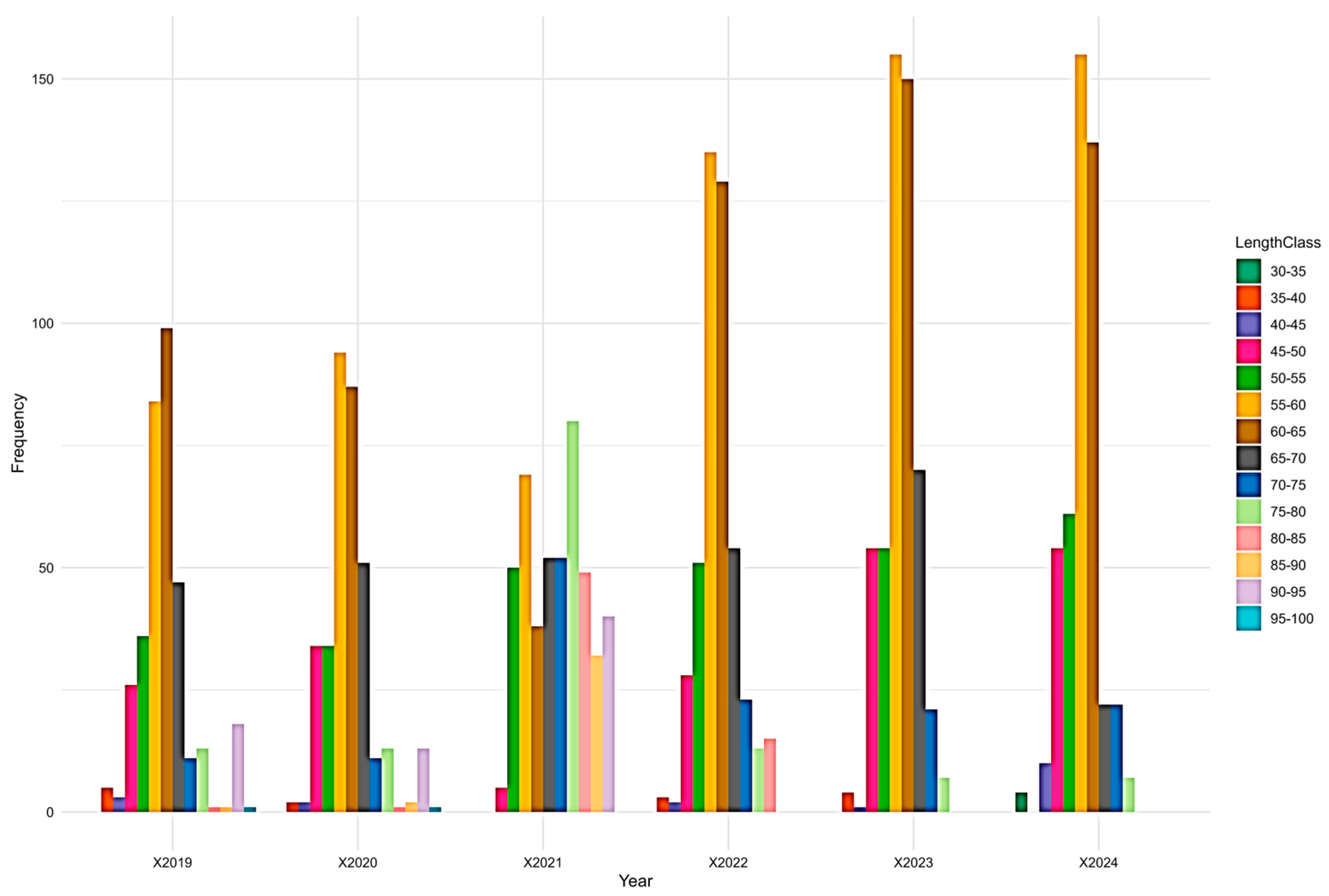
Length distributions displayed notable interannual variation. Younger size classes (35–44 cm) remained relatively stable, reflecting continuous recruitment. Medium size classes (45–64 cm) dominated throughout the study, with a gradual increase in abundance, particularly in 2022–2024. Large individuals (>70 cm) peaked in 2021 but declined in subsequent years. This pattern indicates potential selective removal through fishing or natural cohort progression, as shown in
Figure 2.
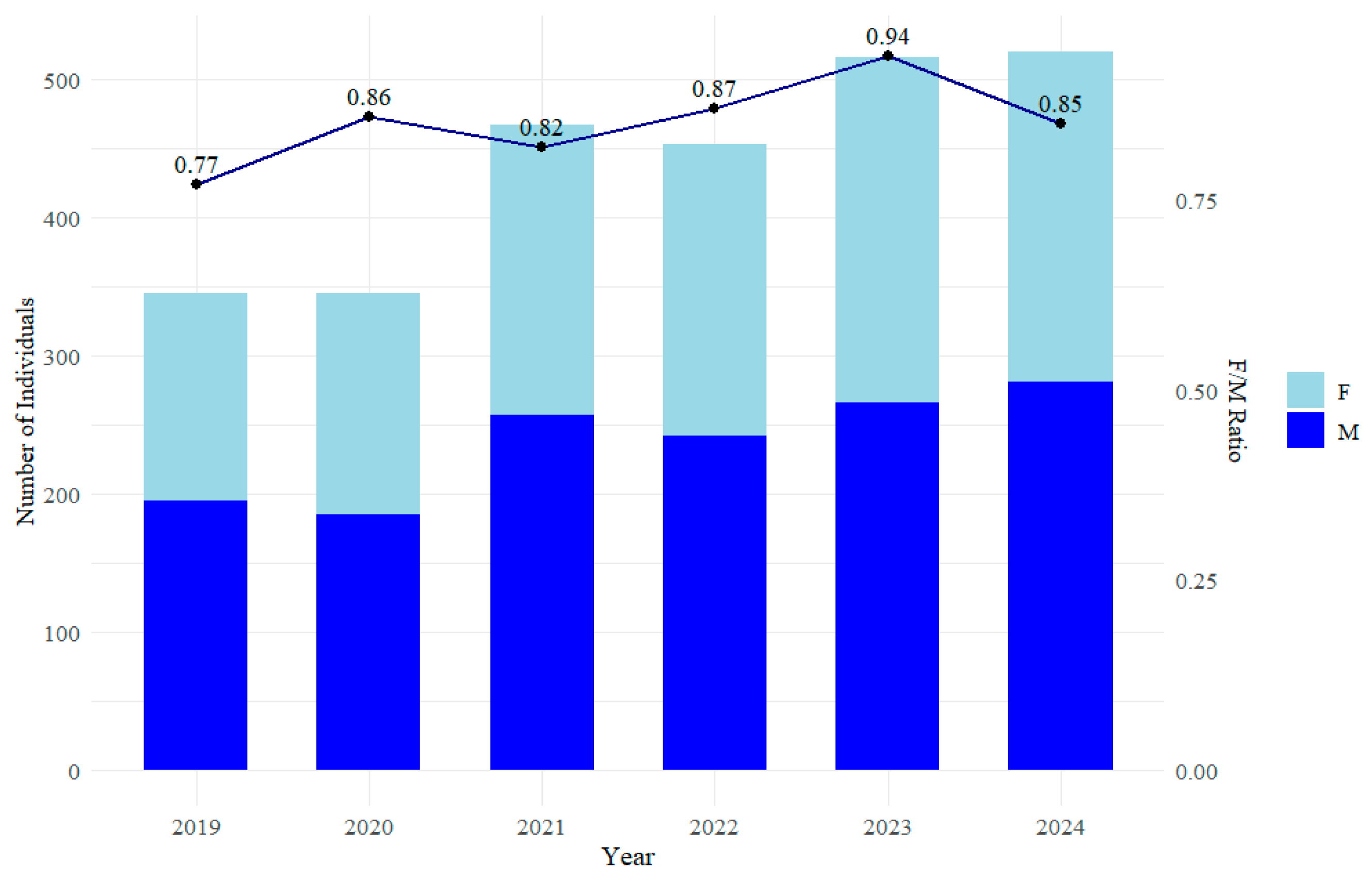
Sex composition varied over the study period. The number of females ranged from 150 in 2019 to 250 in 2023, while males varied from 185 in 2020 to 281 in 2024. Female-to-male ratios fluctuated between 0.77 in 2019 and 0.94 in 2023 (
Figure 3).
Chi-squared tests for sex ratio revealed statistically significant deviations from the expected 1:1 ratio in 2019 (χ2 = 5.87, p = 0.015) and 2021 (χ2 = 4.73, p = 0.030). In contrast, the sex ratios in 2020, 2022, 2023, and 2024 did not differ significantly from equality (p > 0.05). This indicates a relatively consistent pattern across years.
3.1. Stock Assessment and Its Temporal Dynamics
The estimated growth and mortality parameters revealed interannual fluctuations. These variations indicate changing environmental and fishing pressures along the Danube River. The temperature regime between 2019 and 2024 remained relatively stable, fluctuating narrowly between 14 °C and 15 °C. A slight decrease to 14 °C was observed in 2021 (
Table 2).
The integrated analysis of growth and mortality parameters for the period 2019–2024 revealed moderate interannual variability (
Table 2). The studied population showed considerable year-to-year variation in both growth and mortality.
The asymptotic length (L∞) ranged from 78.75 cm in 2023–2024 to 99.75 cm in 2019–2020. This indicates a gradual interannual decline in estimated asymptotic length. This temporal decrease was statistically supported by a strong and significant negative Spearman trend (ρ = −0.97, p = 0.003). The growth coefficient (K) varied between 0.41 year−1 in 2023 and 1.50 year−1 in 2022, suggesting fluctuations in individual growth rates likely linked to environmental conditions.
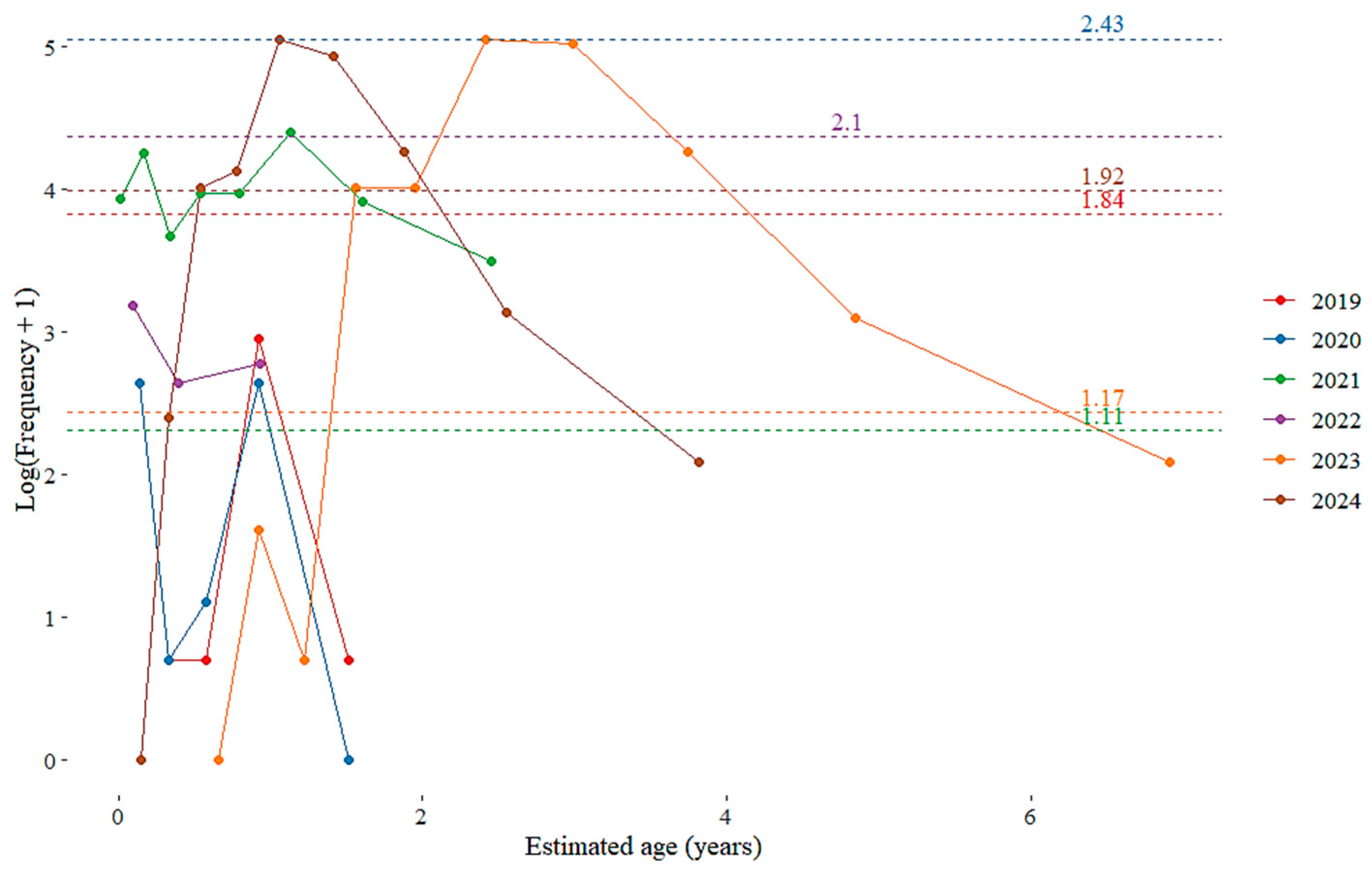
Total mortality (Z) ranged from 1.11 year−1 in 2021 to 2.43 year−1 in 2020. Natural mortality (M) remained relatively stable, between 0.57 and 1.31 year−1. In contrast, fishing mortality (F) showed substantial variation, increasing from 0.21 year−1 in 2021 to 1.35 year−1 in 2020. This corresponds to the highest exploitation rate (E = 0.56).
The growth performance index (Φ) ranged between 3.41 and 4.08. Higher values in 2019–2020 and 2022 reflect more favorable growth conditions during those years. The length at first capture (L50) fluctuated between 39.33 cm in 2019 and 60.14 cm in 2021, as a possible effect of selectivity imposed by the different mesh sizes used during sampling. The M/K ratio remained mostly below 1.0, except in 2023–2024, when it exceeded unity (1.18–1.39).
Integrated Length-Converted Catch Curves (
Figure 4) illustrate age class distributions, with zigzag curves representing observed frequencies and dashed lines indicating total mortality (Z) per year.
3.2. Interdependencies Between Fish Stock Variables
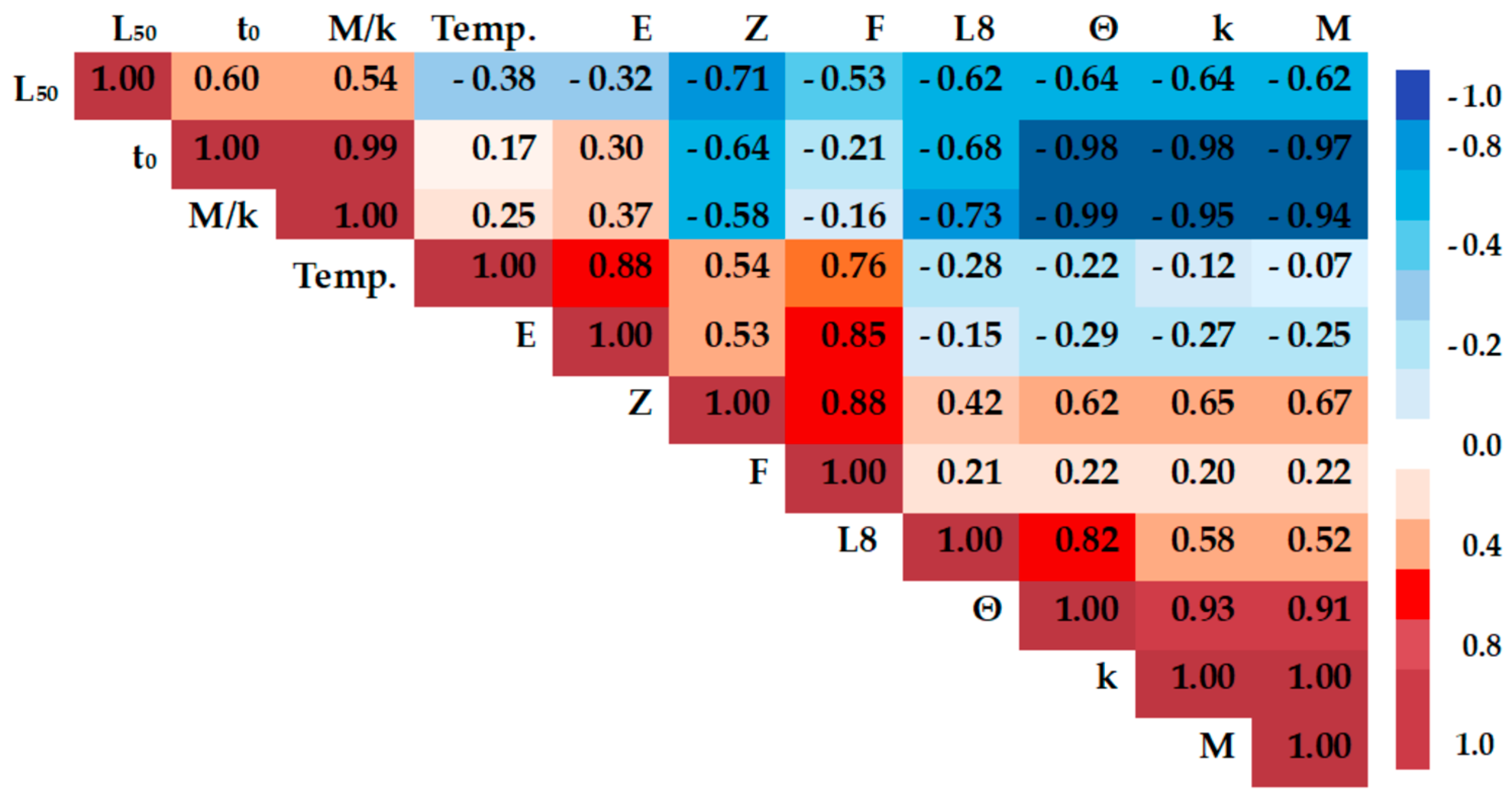
As illustrated in
Figure 5, the correlation analysis reveals notable relationships among the stock’s biological parameters and water temperature. Strong positive correlations are observed between water temperature and exploitation rate E = 0.883 as well as fishing mortality F = 0.759. Growth parameters show strong interdependencies, with K strongly negatively correlated with t0 (−0.979) and natural mortality M (−0.973), and L∞ positively correlated with K (0.581). Derived indicators also reflect pronounced relationships, particularly M/K with K (−0.946) and Φ with K (0.933). All correlation coefficients were tested for statistical significance (
p < 0.05) using the Pearson method, and no correction for multiple testing was applied due to the limited number of comparisons. Overall, the analysis confirms the expected relationships among growth, mortality, and exploitation parameters.
3.3. Comparative Analysis of TAC—Reported Catch
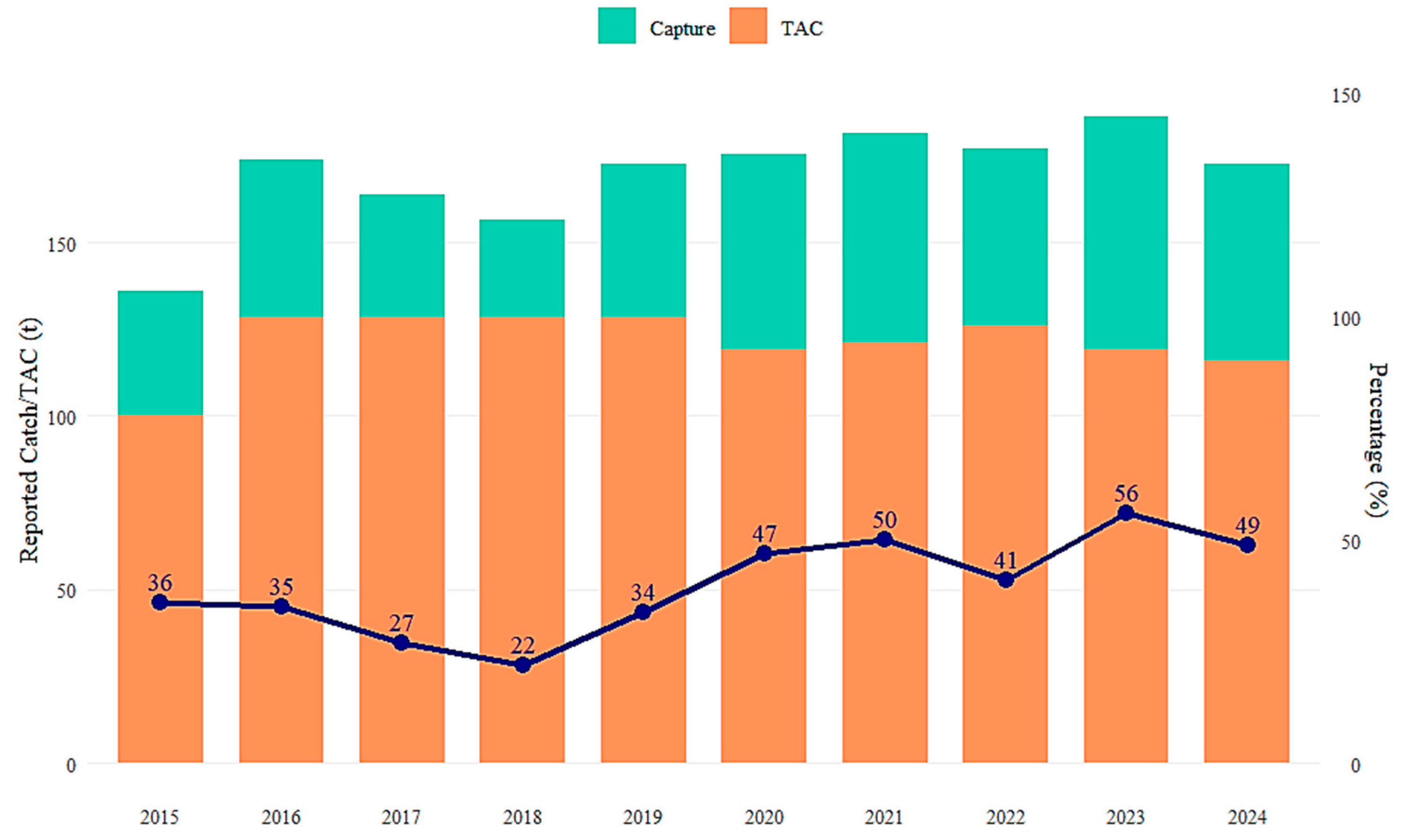
A comparative analysis of the Total Allowable Catch (TAC) and reported fish catches in Romania between 2015 and 2024 illustrates the trends in resource exploitation and compliance with sustainability regulations. The data presented in
Figure 6 indicate a fluctuating pattern in reported carp catches, with substantial inter-annual variation. Although the TAC was maintained relatively stable, actual catches often remained well below permitted limits, raising questions regarding the efficiency of fishery exploitation and the factors influencing these outcomes, considering also the percentage achievement of TAC across the study period. Only in two years were TAC achievement rates equal to or greater than 50% (2021—50% and 2023—56%).
4. Discussion
The results obtained for the 2019–2024 period indicate significant fluctuations in the abundance and structure of common carp populations in the Danube. These changes were likely influenced by both hydrological variability and anthropogenic pressures. The observed interannual variability in total length reflects a heterogeneous population structure, characterized by coexisting cohorts of different ages and sizes.
Years with higher mean lengths, such as 2021, corresponded to a larger proportion of mature individuals. These patterns were likely supported by favorable environmental conditions and moderate hydrological regimes. In contrast, years with lower mean lengths (e.g., 2023–2024) indicate stronger recruitment and higher abundances of younger fish. However, part of the observed size structure may also reflect the selectivity of the fishing gear used, as different mesh sizes influence the probability of capturing certain length classes [
35].
Lower body lengths have been reported for the Bulgarian section of the Danube, ranging from 20 to 44 cm at Kudelin and 33 to 56 cm at Koshava. [
53]. The higher lengths observed in the Romanian sector suggest more robust growth and lower mortality of large cohorts compared to the Bulgarian populations. This could indicate more effective fisheries management or a reduced impact of commercial fishing. However, these comparisons should be interpreted with caution, as the estimates are model-derived and may vary depending on the underlying length–frequency structure and sampling effort. This introduces an inherent degree of statistical uncertainty.
Length-class dynamics suggest a fluctuating balance between recruitment and survival of mature cohorts. Peaks in large individuals, particularly in 2021, enhance population resilience. Subsequent declines likely reflect cumulative fishing pressure or environmental constraints on growth. The stability of young and medium size classes indicates ongoing recruitment and survival of sub-adults. This underscores the need for adaptive management to maintain balanced age and size structures under variable ecological and anthropogenic pressures.
Sex ratio variations may result from environmental factors, selective fishing, or reproductive dynamics. Significant male-biased ratios observed in 2019 and 2021 may suggest possible selective removal of females or differential survival between sexes. However, these patterns could also reflect natural variability or sampling-related factors, as no specific data on fishing selectivity or maturity stages were available. Near-balanced ratios in other years suggest stable population dynamics, higher than the F/M ratio of 0.66 reported in other studies [
54].
4.1. Temperature Trends in the Danube River (2019–2024)
The ambient temperature of the aquatic environment is a fundamental driver of metabolic and physiological processes in fish. It determines the rates of food consumption, growth, and survival. The mean temperature stability observed throughout the years suggests limited thermal variability. Such conditions traditionally support steady metabolic rates and favor the growth of temperate freshwater species such as common carp. However, even if annual mean values remain stable, sub-seasonal extremes—such as summer peaks or winter minima—can have disproportionate effects on the metabolic performance [
55,
56,
57,
58] and growth dynamics of carp populations, as sustained also by Pearson et al. [
59].
4.2. Growth Dynamics of Common Carp over the Years
The interannual variation in growth and mortality parameters may reflect the influence of both environmental factors and fishing pressure on population dynamics. The decline in L∞ and the increase in M/K ratios during the last two years (2023–2024) indicate a shift toward smaller, faster-growing individuals [
60]. Such patterns represent a compensatory response to elevated exploitation and environmental stress [
61]. The significant negative Spearman correlation for L∞ confirms a consistent interannual decline in the estimated asymptotic length. However, because L∞ is a model-derived parameter, this trend reflects changes in growth estimations rather than demonstrated reductions in maximum realized size within the population.
Ecologically, such reductions in L∞ may derive from increased fishing pressure that preferentially removes larger individuals, habitat degradation limiting growth potential, or changing resource availability. Similar interpretations linking decreased L∞ and elevated M/K ratios to fishing selectivity and habitat stress have been proposed in previous length-based analyses [
60].
Comparable analyses from the northern part of the Small Brăila Island Natural Park (rkm 170–196) showed a lower growth coefficient (K = 0.16 year
−1) and a similar asymptotic length (L∞ = 84.7 cm) [
62]. In the Danube Delta lakes were reported a lower L∞ (≈86 cm) and reduced growth performance compared to the present study, where L∞ values ranged from 78.75 to 99.75 cm [
63]. These differences may be linked to distinct hydrological and ecological conditions.
From a fisheries management perspective, a shrinking maximum size may diminish stock reproductive capacity, reduce catch quality, and indicate unsustainable harvest levels. This decline should be interpreted with caution, as it may indicate changes in age and size structure with potential implications for stock resilience and productivity.
High K values in 2019–2022 indicate favorable growth conditions, possibly associated with improved food availability, as temperature showed little influence. However, the subsequent decrease in K and Φ in 2023–2024 could suggest reduced growth performance, potentially linked to density-dependent factors or habitat degradation.
High K values were recorded for Lake Arekit (Ethiopia) [
54] and moderate ones for Merdja Sidi Abed Dam (Algeria) [
64], both lower than those found in the present study. These differences likely reflect contrasting hydrological regimes and fishing pressures, with riverine populations showing faster growth and higher turnover, while lacustrine populations maintain more stable demographic structures.
The growth coefficient K showed strong negative correlations with t
0 and M, indicating an earlier effective onset of growth and reduced natural mortality in fast-growing fish, consistent with established cyprinid life-history patterns [
61]. K was also moderately positively correlated with L∞, suggesting that years with higher growth rates were associated with favorable trophic and environmental conditions, enabling fish to reach larger maximum sizes. Although length-based estimates are sensitive to bin structure and data resolution [
65], the observed relationships remain biologically meaningful, as also reflected by the strong positive correlation between Φ′ and K, which indicates enhanced overall growth performance in years with rapid somatic development.
This methodological sensitivity is also emphasized in life-history ratio frameworks, where M/K variability reflects both biological and analytical factors [
60].
4.3. Mortality Components and Their Temporal Variability
The variation in total and fishing mortality indicates changes in fishing effort and selectivity over time. The elevated exploitation rates (E > 0.5) in 2020 and 2024 point to periods of intense fishing activity. These conditions may have affected the population’s size structure and recruitment success, similar to the findings of Fatemi et al. [
66] for the Caspian Sea carp population. In contrast, at the Merdja Sidi abed dam in Algeria, the exploitation rate was lower [
64].
Conversely, the low F and E values in 2021 correspond to reduced fishing pressure. This situation favored higher survival and the presence of larger individuals, as reflected by the highest L
50 value (60.14 cm). A similar pattern of reduced fishing pressure was reported for Lake Arekit’s carp population, indicated by a low E value of 0.38 [
54].
Variation in L50 may be attributed to selective fishing practices that target smaller individuals [
67,
68], environmental influences limiting growth, or genetic responses to fishing-induced selection [
69]. Changes in maturity size critically affect the reproductive potential by altering the spawning stock biomass [
70]. In turn, it influences recruitment and population sustainability. Monitoring these shifts provides essential feedback for managing size-selective mortality and maintaining a balanced age and size structure within the stock.
Although temperature variation during the study period was slight, the strong positive correlations between temperature and both exploitation rate (E) and fishing mortality (F) suggest that even modest thermal differences may influence exploitation dynamics. Warmer water is known to increase activity levels and metabolic rates in cyprinids [
71], which can enhance encounter rates with fishing gear and thus increase catchability. While our dataset cannot confirm the specific mechanism involved, the observed correlations are consistent with these well-documented temperature-related behavioral responses.
Alternatively, fishing effort may adapt seasonally to temperature-driven changes in catchability [
19,
72]. These complex interactions highlight the need to consider temperature as a modulating factor within broader mortality frameworks.
A rising M/K ratio, an important indicator of population turnover [
60], suggests mortality rates approaching or exceeding growth rates [
61]. These signals increased vulnerability in population dynamics. Values around unity or greater suggest that mortality is sufficiently high relative to growth to potentially destabilize stock renewal processes.
Comparing these ratios to literature values for common carp and similar species confirms that fluctuations within this range merit attention for their implications on population health and sustainability. Hordyk et al. [
60] emphasized that variations in the M/K ratio can reflect differences in life-history strategies, fishing pressure, and population turnover across species, supporting its use as an indicator of demographic resilience. Breck [
73] found in analyses of body composition and population turnover that common carp and comparably sized cyprinids regulate growth and mortality parameters.
This reinforces the idea that M/K ratios near or above 1.0 deserve attention due to their link with population health dynamics [
61]. In the present study, M/K values fall within the biologically realistic interval (0.5–2.0) for most exploited fish populations [
60]. FAO [
74] consistently cite the importance of monitoring M/K in the 0.8–1.3 zone for informed management decisions, though often without species-specific tabulation. Therefore, understanding M/K dynamics facilitates early identification of population stress and enables timely interventions to bolster stock stability.
The M/K ratio was strongly negatively correlated with K, indicating that faster-growing individuals experience a lower relative mortality. These relationships between growth and mortality parameters are consistent with the Beverton–Holt life-history invariants described by Jensen [
75], who demonstrated that natural mortality (M) is approximately 1.5 K and that L∞ and K are inversely related through bioenergetic constraints. This emphasizes the close link between growth efficiency and mortality dynamics within the population. In this context, the strong negative K–M/K relationship indicates that growth performance plays a dominant role in shaping survival trade-offs, reinforcing the functional coupling between growth trajectories and mortality schedules in the population.
Overall, the results highlight a dynamic balance between growth and mortality processes, with periodic shifts observed across years, reflecting natural interannual variability in population parameters. Sustained monitoring of these parameters is crucial to assess long-term stock resilience and to guide adaptive management strategies aimed at maintaining sustainable exploitation levels.
Estimates of L∞, K and related mortality indices are known to depend on the chosen length-class width in length-frequency analyses. Consequently, even using the same raw data, binning at 2 cm versus 3 cm yields different point estimates. Although formal rules such as Sturges’ formula can be used to determine class number and width, in this study the binning scheme was selected to maximize biological interpretability and ensure consistency with previous datasets and published studies. Therefore, our interpretations refer to model-based values conditional on the selected binning scheme [
76,
77,
78].
4.4. Maturity and Reproductive Dynamics
The relationship between exploitation rate (E) and the length at 50% maturity (L
50) reveals critical insights into reproductive potential and stock replenishment. Consequently, exploitation at smaller sizes may imply a potential risk of harvesting individuals before they reach reproductive competence, consistent with life-history trade-offs [
75], where increased mortality and exploitation tend to select for earlier maturation and faster growth. This pattern could threaten future recruitment by reducing spawning biomass and affect future recruitment [
42,
44]. Periods with high E and low L
50 may be associated with a greater likelihood of recruitment overfishing, as reported in studies linking fishing pressure, size-at-maturity, and reproductive dynamics [
60,
61]. This highlights the potential need for regulatory measures such as minimum size limits or temporal fishing closures to protect immature fish, to prevent recruitment overfishing and to ensure long-term population resilience [
74].
4.5. Temporal Evolution of Population Dynamics (2019–2024)
The comprehensive evaluation of growth and mortality parameters over six years suggests a dynamic population trajectory, characterized by a declining maximum size (L∞), fluctuating growth rates (K and Φ), variable natural and fishing mortalities (M, F, Z), and changing exploitation rates (E). Years such as 2020 and 2024 showed relatively higher fishing mortality and exploitation, coinciding with reductions in growth performance indices. Certain years exhibited improvements in natural mortality rates suggesting the influence of ecological variability.
Overall, these trends point to complex interactions between biological processes and human-induced pressures. These dynamics should be interpreted cautiously given the limited temporal scope and sampling resolution to effectively guide management decisions. The observed exploitation rates throughout the study period may represent alternating intervals of sustainable harvest and potential overexploitation, as no established benchmarks for sustainability exist for this specific fishery.
Our results indicate consistently higher values for all examined parameters across each year compared to those reported for the Caspian Sea [
66]. However, this contrast should be viewed as indicative rather than directly comparable, given the distinct ecological, climatic, and hydrological contexts of the two systems.
4.6. Reported Catch vs. Total Allowable Catch
Reported catches related to TAC suggest that factors beyond regulatory limits, including hydrological variability, habitat changes, and enforcement efficiency, may influence fishery outcomes [
79]. The underachievement of TAC in most years indicates the need for adaptive management strategies that account for both ecological variability and anthropogenic pressures.
A comparison with findings from a previous study [
16], which considered both the Danube River and the Danube Delta, revealed that reported catches substantially exceeded the Total Allowable Catch (TAC) at the combined scale. In contrast, the present analysis, focused exclusively on the Romanian section of the Danube River, indicates that reported catches generally remain below the annual TAC. This discrepancy may suggest that overexploitation is primarily concentrated in the Danube Delta and that fisheries operating in the main river channel have not fully achieved their permitted quotas. These results may highlight spatial differences in fishing pressure and compliance with regulatory limits within the broader Danube aquatic system.
This issue is not specific to common carp. A similar pattern has been reported for
Alosa immaculata, where reported catches in the Danube River failed to reach the allocated quotas in most of the analyzed years [
80]. These findings could suggest that underachievement of fishing quotas in the main river channel may be a broader phenomenon affecting multiple commercially important species.
Although regulations exist to set limits on annual catches and to protect specific species, their enforcement and effective fisheries monitoring remain insufficient in many areas [
8,
80]. An increase in reported fish catches does not necessarily indicate an actual rise in fisheries production but may instead result from improvements in monitoring and reporting systems [
74,
81]. Conversely, a decrease in reported catches does not always imply reduced fishing activity but may reflect deficiencies or inconsistencies in data collection.
In this context, illegal, unreported, and unregulated (IUU) fishing has become a significant issue, undermining conservation efforts and sustainable management of fishery resources. IUU fishing not only decreases the number of available fish but also erodes confidence in management processes and catch reporting [
80,
82].
At a broader conservation level,
C. carpio is currently categorized as Least Concern (LC) on the IUCN Red List [
83]. However, within the Danube River, the species remains listed as Critically Endangered (CR) [
84]. This regional classification, based on data collected nearly three decades ago, may no longer accurately represent the current status of carp populations. Considering the ecological transformations and management interventions that have occurred since then, the present findings emphasize the need for a re-evaluation of the species’ conservation status within the Danube basin. Updated monitoring programs and modern stock assessment approaches are essential to ensure that conservation priorities align with present-day ecological realities and the objectives of sustainable fisheries management.
In recent decades, the fisheries sector has become increasingly market-driven [
85,
86], and Romania has been compelled to identify new strategies to meet the growing demand for fish products. Sustainable fisheries management must account for the impacts of fishing activities on aquatic ecosystems, the conservation of biodiversity, and the need to adapt to climate change. In this context, Romania has implemented policies and strategies aimed at balancing the increasing demand for fish products with the protection of natural resources.
In this context, aquaculture plays a complementary role in ensuring sustainable fish supply, particularly for common carp, which remains the dominant cultured species in Romania. According to recent national statistics, carp farming accounted for over 70% of total aquaculture output in 2023, producing approximately 3000 tonnes annually (FishStatJ). This sector thus could alleviate fishing pressure on wild stocks and contributes to the long-term sustainability of carp populations in natural ecosystems [
86].
Overall, the observed temporal evolution of stock parameters could suggest a gradual shift towards a younger population with faster turnover. If maintained, this trend could compromise the long-term resilience of the stock under sustained fishing pressure.
4.7. Research Gaps and Data Limitations
Existing literature reveals a significant paucity of studies addressing the population dynamics of common carp within the Danube River basin. Comprehensive analyses encompassing both growth parameters and mortality rates are notably scarce, with few long-term datasets available [
16,
62,
87]. This lack of data hinders effective fisheries management and conservation efforts in the region [
80].
Limitations inherent in the available datasets, including potential measurement biases and environmental variability that are not fully captured, restrict absolute certainty in trend interpretations. Parameter estimates are affected by model assumptions and sample variability. These factors reduce the accuracy of annual and cross-study comparisons [
65].
Uncertainties also remain regarding the relative contributions of ecological versus anthropogenic drivers, as well as the exact genetic and phenotypic responses to fishing pressure. These gaps warrant multidisciplinary research approaches encompassing ecology, genetics, and socioeconomics to better elucidate stock dynamics in the Danube basin.
Reported catch data in the Danube region are collected through a combination of official fisheries logbooks, commercial and artisanal fisheries surveys, and governmental catch reporting systems. These methods are susceptible to biases including underreporting and misreporting due to regulatory avoidance or operational difficulties [
82]. Coordination among riparian countries varies in rigor and standardization, complicating data harmonization. Agencies utilize statistical estimation techniques to approximate total catches where direct reporting is deficient. Despite these efforts, catch data limitations continue to constrain reliable stock assessment and necessitate supplementary approaches such as independent biological surveys and remote monitoring [
82].
In addition, illegal, unreported, and unregulated (IUU) fishing presents challenges to enforcement and undermines the integrity of reported catch and mortality data [
87]. In response, strategies including enhanced surveillance, electronic monitoring, and community-based stewardship aim to improve compliance and data transparency. Evaluations of governance structures could highlight both successes and ongoing gaps in enforcement effectiveness, essential for sustainable fisheries management.
Sustained monitoring employing enhanced stock assessment tools that integrate environmental variability, growth parameters, and exploitation metrics is necessary to refine understanding and management efficacy [
88,
89]. Long-term frameworks should combine biological data with stakeholder engagement to ensure adaptive and participatory fishery governance. Research efforts should prioritize elucidating recruitment processes, fishery-induced evolutionary effects, and the socio-economic dimensions influencing fishing practices to support holistic sustainability strategies
5. Conclusions
Between 2019 and 2024, the studied common carp population in the Romanian Danube exhibited moderate temporal variability but maintained overall structural stability. Medium-sized individuals dominated catches, while the decline of large fish after 2021 could suggest selective fishing or cohort turnover. Length-converted catch analyses confirmed overlapping cohorts and the influence of total mortality on population dynamics.
Sex ratios fluctuated slightly, showing a male predominance, with deviations likely linked to hydrological and reproductive factors. Von Bertalanffy parameters and exploitation rates may indicate variable resilience but, generally, sustainable exploitation, as annual catches remained below the Total Allowable Catch (TAC).
Overall, continuous recruitment and moderate fishing pressure supported population stability. The results highlight the importance of adaptive, ecosystem-based management that considers environmental variability, mortality patterns, and reproductive dynamics to ensure the long-term sustainability of common carp stocks in the Lower Danube.
Author Contributions
Conceptualization, A.D., C.G.N. and M.D.S.; methodology, A.D. and M.D.S.; validation, A.D., C.G.N. and M.D.S.; formal analysis, A.D. and M.P.M.; investigation, A.D., M.D.S. and F.M.D.; resources, A.D., M.D.S. and F.M.D.; data curation, A.D.; writing—original draft preparation, A.D. and F.M.D.; writing—review and editing, C.G.N., L.V. and M.P.M.; visualization, L.V. and M.P.M.; supervision, C.G.N.; funding acquisition, A.D. and C.G.N. All authors have read and agreed to the published version of the manuscript.
Funding
This research work was carried out with the support of the Faculty of Animal Productions Engineering and Management, University of Agronomic Sciences and Veterinary Medicine of Bucharest, and is part of the elaboration of the doctoral thesis.
Institutional Review Board Statement
All sampling activities were conducted in accordance with the principles of animal welfare and with Directive 2010/63/EU of the European Parliament and of the Council (22 September 2010) on the protection of animals used for scientific purposes. The Bioethics Commission, constituted by Decision no. 52/16.03.2023 at the Research and Development Institute for Aquatic Ecology, Fishing and Aquaculture, Galati, supervised the measurement activities.
Informed Consent Statement
Not applicable.
Data Availability Statement
The original contributions presented in this study are included in the article. Further inquiries can be directed to the corresponding authors.
Conflicts of Interest
The authors declare no conflicts of interest.
References
- Piria, M.; Tomljanović, T.; Treer, T.; Safner, R.; Aničić, I.; Matulić, D.; Vilizzi, L. The common carp Cyprinus carpio in Croatia (Danube and Adriatic basins): A historical review. Aquac. Int. 2016, 24, 1527–1541. [Google Scholar] [CrossRef]
- Weber, M.J.; Brown, M.L. Effects of common carp on aquatic ecosystems 80 years after “carp as a dominant”: Ecological insights for fisheries management. Rev. Fish. Sci. 2009, 17, 524–537. [Google Scholar] [CrossRef]
- Vilizzi, L. The common carp, Cyprinus carpio, in the Mediterranean region: Origin, distribution, economic benefits, impacts and management. Fish. Manag. Ecol. 2012, 19, 93–110. [Google Scholar] [CrossRef]
- Anin, I.A.; Radu, D.; Hassan, A.A.M.; Maftei, M.; Costaiche, G.; Nicolae, C.G. The efficiency of carp growing in floating cages through raring and lotting. AgroLife Sci. J. 2023, 12, 9–14. [Google Scholar] [CrossRef]
- FAO. Fisheries and Aquaculture in Numbers. Trade 2022. In The State of World Fisheries and Aquaculture; FAO: Rome, Italy, 2024; Available online: https://openknowledge.fao.org/server/api/core/bitstreams/1273bc36-339b-43d2-8163-af4d805f2ad2/content/sofia/2024/fisheries-aquaculture-numbers.html (accessed on 10 November 2025).
- Stagl, J.C.; Hattermann, F.F. Impacts of Climate Change on the Hydrological Regime of the Danube River and Its Tributaries Using an Ensemble of Climate Scenarios. Water 2015, 7, 6139–6172. [Google Scholar] [CrossRef]
- Ziv, G.; Baran, E.; Nam, S.; Rodríguez-Iturbe, I.; Levin, S.A. Trading-off fish biodiversity, food security, and hydropower in the Mekong River Basin. Proc. Natl. Acad. Sci. USA 2012, 109, 5609–5614. [Google Scholar] [CrossRef]
- Gebremedhin, S.; Bruneel, S.; Getahun, A.; Anteneh, W.; Goethals, P. Scientific methods to understand fish population dynamics and support sustainable fisheries management. Water 2021, 13, 574. [Google Scholar] [CrossRef]
- Gebremedhin, S.; Getahun, A.; Anteneh, W.; Bruneel, S.; Goethals, P. A drivers-pressure-state-impact-responses framework to support the sustainability of fish and fisheries in Lake Tana, Ethiopia. Sustainability 2018, 10, 2957. [Google Scholar] [CrossRef]
- Arlinghaus, R.; Mehner, T.; Cowx, G.I. Reconciling traditional inland fisheries management and sustainability in industrialized countries, with emphasis on Europe. Fish Fish. 2002, 3, 261–316. [Google Scholar] [CrossRef]
- Karjalainen, J.; Marjomäki, T. Sustainability in fisheries management. Univ. Hels. Dep. For. Ecol. Publ. 2005, 34, 249–267. [Google Scholar]
- Dervis, K. The Millennium Development Goals: Where Africa stands. In Summit; Newsdesk Communications Ltd.: London, UK, 2007; p. 154. Available online: https://citeseerx.ist.psu.edu/document?repid=rep1&type=pdf&doi=39e21c0cf81eb88aeadf1ff28bc32675b3f7fa76 (accessed on 12 December 2024).
- Orr, J.A.; Macaulay, S.J.; Mordente, A.; Burgess, B.; Albini, D.; Hunn, J.G.; Restrepo-Sulez, K.; Wilson, R.O.; Schechner, A.; Robertson, A.M.; et al. Studying interactions among anthropogenic stressors in freshwater ecosystems: A systematic review of 2396 multiple-stressor experiments. Ecol. Lett. 2024, 27, e14463. [Google Scholar] [CrossRef]
- Stroe, M.; Dobre, A.; Dima, F.M.; Dediu, L.; Macoveiu (Dobre), A.N.; Rochard, E. Effects of Climate Change on Cyprinus carpio (Linnaeus, 1758) in the Danube River (2021–2024): Analysis of Sex Ratios, Condition and Length-Class Distribution. Sci. Pap. Ser. D Anim. Sci. 2025, 68, 789–800. [Google Scholar]
- Haidvogl, G.; Lajus, D.; Pont, D.; Schmid, M.; Jungwirth, M.; Lajus, J. Typology of historical sources and the reconstruction of long-term historical changes of riverine fish: A case study of the Austrian Danube and northern Russian rivers. Ecol. Freshw. Fish 2014, 23, 498–515. [Google Scholar] [CrossRef]
- Dobre, A.; Stroe, M.D.; Crețu, M.; Lăcătuș, M.F.; Dima, F.M. Fish Biodiversity and Stock Assessment in the Danube River: Insights from Km 169–197. Bull. Univ. Agric. Sci. Vet. Med. Cluj-Napoca Anim. Sci. Biotechnol. 2025, 82, 16–29. [Google Scholar] [CrossRef] [PubMed]
- Halls, A.S.; Welcomme, R.L. Dynamics of river fish populations in response to hydrological conditions: A simulation study. River Res. Applic. 2004, 20, 985–1000. [Google Scholar] [CrossRef]
- Tedesco, P.A.; Hugueny, B.; Oberdorff, T.; Dürr, H.H.; Mérigoux, S.; de Mérona, B. River hydrological seasonality influences life history strategies of tropical riverine fishes. Oecologia 2008, 156, 691–702. [Google Scholar] [CrossRef] [PubMed]
- Rijnsdorp, A.D.; Peck, M.A.; Engelhard, G.H.; Möllmann, C.; Pinnegar, J.K. Resolving the effect of climate change on fish populations. ICES J. Mar. Sci. 2009, 66, 1570–1583. [Google Scholar] [CrossRef]
- Rohlenová, K.; Morand, S.; Hyršl, P.; Tolarová, S.; Flajšhans, M.; Šimková, A. Are fish immune systems really affected by parasites? An immunoecological study of common carp (Cyprinus carpio). Parasites Vectors 2011, 4, 120. [Google Scholar] [CrossRef]
- Wagaw, S.; Enawgaw, Y.; Wendimu, I. Population Dynamics of the Common Carp (Cyprinus carpio L. 1758) Stock in Lake Arekit, Ethiopia: Implications for Management and Conservation. J. Appl. Ichthyol. 2024, 2024, 9940938. [Google Scholar] [CrossRef]
- Ministry of Agriculture and Rural Development. Order No. 342/2008 Regarding the Minimum Individual Dimensions of Living Aquatic Resources in the Public Domain of the State, by Species, That Can Be Captured from the Aquatic Environment. Official Gazette No. 410/2.06.2008. Available online: https://legislatie.just.ro/Public/DetaliiDocumentAfis/268545 (accessed on 3 March 2025).
- Ministry of Agriculture and Rural Development. Order No. 386/391/2015 on the Approval of Measures for Regulating Fishing Effort and Allocated Fishing Quotas for 2015, by Species and Zones. Official Gazette No. 165/10.03.2015. Available online: https://legislatie.just.ro/Public/DetaliiDocument/166893 (accessed on 20 February 2025).
- Ministry of Agriculture and Rural Development. Order No. 284/613/2016 on the Approval of Measures for Regulating Fishing Effort and Allocated Fishing Quotas for 2016, by Species and Zones. Official Gazette Part I, No. 280/13.04.2016. Available online: https://legislatie.just.ro/Public/DetaliiDocument/182931 (accessed on 20 February 2025).
- Ministry of Agriculture and Rural Development. Order No. 13/142/2017 on the Approval of Measures for Regulating Fishing Effort and Allocated Fishing Quotas for 2017, by Species and Zones. Official Gazette Part I, No. 141/24.02.2017. Available online: https://legislatie.just.ro/Public/DetaliiDocument/194337 (accessed on 20 February 2025).
- Ministry of Agriculture and Rural Development. Order No. 546/352/2018 on the Approval of Measures for Regulating Fishing Effort and Allocated Fishing Quotas for 2018, by Species and Zones. Official Gazette No. 375/02.05.2018. Available online: https://legislatie.just.ro/public/DetaliiDocument/200247 (accessed on 20 February 2025).
- Ministry of Agriculture and Rural Development. Order No. 243/354/2019 on the Approval of Measures for Regulating Fishing Effort and Allocated Fishing Quotas for 2019, by Species and Zones. Official Gazette Part I, No. 375/14.05.2019. Available online: https://legislatie.just.ro/Public/DetaliiDocument/213911 (accessed on 20 February 2025).
- Ministry of Agriculture and Rural Development. Order No. 124/1.159/2020 on the Approval of Measures for Regulating Fishing Effort and Allocated Fishing Quotas for 2020, by Species and Zones. Official Gazette No. 485/09.06.2020. Available online: https://legislatie.just.ro/public/DetaliiDocument/226619 (accessed on 20 February 2025).
- Ministry of Agriculture and Rural Development. Order No. 99/814/2021 on the Approval of Measures for Regulating Fishing Effort and Allocated Fishing Quotas for 2021, by Species and Zones. Official Gazette No. 559/31.05.2021. Available online: https://legislatie.just.ro/public/DetaliiDocument/242929 (accessed on 20 February 2025).
- Ministry of Agriculture and Rural Development. Order No. 42/558/2022 on the Approval of Measures for Regulating Fishing Effort and Allocated Fishing Quotas for 2022, by Species and Zones. Official Gazette No. 558/2022. Available online: https://legislatie.just.ro/public/DetaliiDocument/252614 (accessed on 20 February 2025).
- Ministry of Agriculture and Rural Development. Order No. 45/539/2023 on the Approval of Measures for Regulating Fishing Effort and Allocated Fishing Quotas for 2023, by Species and Zones. Official Gazette No. 539/2023. Available online: https://legislatie.just.ro/Public/DetaliiDocumentAfis/265413 (accessed on 20 February 2025).
- Ministry of Agriculture and Rural Development. Order No. 75/874/2024 on the Approval of Measures for Regulating Fishing Effort and Allocated Fishing Quotas for 2024, by Species and Zones. Official Gazette No. 399/2024. Available online: https://legislatie.just.ro/Public/DetaliiDocumentAfis/282331 (accessed on 20 February 2025).
- von Bertalanffy, L.A. Quantitative Theory of Organic Growth (Inquiries on Growth Laws. II). Hum. Biol. 1938, 10, 181–213. [Google Scholar]
- Munro, J.L.; Pauly, D. A Simple Method for Comparing Growth of Fishes and Invertebrates. ICLARM Fishbyte 1983, 1, 5–6. [Google Scholar]
- Năvodaru, I. The Estimation of the Fish and Fisheries Stocks; Dobrogea Publishing House: Constanța, Romania, 2008. [Google Scholar]
- Ricker, W.E. Computation and interpretation of biological statistics of fish populations. Fish. Res. Board Can. Bull. 1975, 191, 1–382. [Google Scholar]
- Pauly, D. On the interrelationships between natural mortality, growth parameters, and mean environmental temperature in 175 fish stocks. ICES J. Mar. Sci. 1980, 39, 175–192. [Google Scholar] [CrossRef]
- National Institute of Hydrology and Water Management (I.N.H.G.A.). Available online: https://www.hidro.ro/bulletin_type/diagnoza-si-prognoza-pentru-dunare/ (accessed on 15 August 2025).
- Gulland, J.A. The Fish Resources of the Ocean; Fishing News Books: London, UK, 1971. [Google Scholar]
- Santos, R.; Peixoto, U.I.; Medeiros-Leal, W.; Novoa-Pabon, A.; Pinho, M. Growth Parameters and Mortality Rates Estimated for Seven Data-Deficient Fishes from the Azores Based on Length-Frequency Data. Life 2022, 12, 778. [Google Scholar] [CrossRef] [PubMed]
- Beverton, R.J.H.; Holt, S.J. On the dynamics of exploited fish populations. Fish. Investig. 1957, 19, 1–533. [Google Scholar]
- Bagenal, T.B.; Tesch, F.W. Methods for Assessment of Fish Production in Fresh Waters, 3rd ed.; Blackwell Scientific Publications: Oxford, UK, 1978. [Google Scholar]
- Wheeler, J.; Purchase, C.; Macdonald, P.; Fill, R.; Jacks, L.; Wang, H.; Ye, C. Temporal changes in maturation, mean length-at-age, and condition of spring-spawning Atlantic herring (Clupea harengus) in Newfoundland waters. ICES J. Mar. Sci. 2009, 66, 1800–1807. [Google Scholar] [CrossRef]
- Sparre, P.; Venema, S.C. Introduction to Tropical Fish Stock Assessment. Part 1: Manual; FAO Fisheries Technical Paper No. 306. Rev. 2; FAO: Rome, Italy, 1998. [Google Scholar]
- Campello, R.J.G.B.; Moulavi, D.; Zimek, A.; Sander, J. Hierarchical Density Estimates for Data Clustering, Visualization, and Outlier Detection. ACM Trans. Knowl. Discov. Data 2015, 10, 1–51. [Google Scholar] [CrossRef]
- Öztuna, D.; Elhan, A.H.; Tuccar, E. Investigation of four different normality tests in terms of Type I error rate and power under different distributions. Turk. J. Med. Sci. 2006, 36, 171–176. [Google Scholar]
- Demir, S. Comparison of normality tests in terms of sample sizes under different skewness and Kurtosis coefficients. Int. J. Assess. Tools Educ. 2022, 9, 397–409. [Google Scholar] [CrossRef]
- Siegel, S.; Castellan, N.J. Nonparametric Statistics for the Behavioral Sciences, 2nd ed.; McGraw–Hill: New York, NY, USA, 1988. [Google Scholar]
- Corder, G.W.; Foreman, D.I. Nonparametric Statistics for Non-Statisticians; John Wiley & Sons Inc.: Hoboken, NJ, USA, 2009. [Google Scholar]
- Berk, R.H.; Jones, D.H. Goodness-of-fit test statistics that dominate the Kolmogorov statistics. Z. Für Wahrscheinlichkeitstheorie Und Verwandte Geb. 1979, 47, 47–59. [Google Scholar] [CrossRef]
- Pearson, K.X. On the criterion that a given system of deviations from the probable in the case of a correlated system of variables is such that it can be reasonably supposed to have arisen from random sampling. Lond. Edinb. Dublin Philos. Mag. J. Sci. 1900, 50, 157–175. [Google Scholar] [CrossRef]
- Rashid, R. Length-Weight Relationship of Common Carp (Cyprinus carpio L., 1758) from Taqtaq Region of Little Zab River, Northern Iraq. Turk. J. For. Sci. 2018, 13, 69–72. [Google Scholar]
- Zaharieva, R.; Zaharieva, P.; Kirin, D. Parasite diversity of Cyprinus carpio Linnaeus 1758 from the Danube River, Bulgaria. Croat. J. Fish. 2025, 83, 21–28. [Google Scholar] [CrossRef]
- Wagaw, S.; Enawgaw, Y.; Wendimu, I.; Weldemichael, H. Seasonal Feeding Activity and Ontogenetic Dietary Shifts of the Common Carp (Cyprinus carpio) in Lake Arekit, a Small, Eutrophic Lake in Ethiopia. Aquac. Fish Fish. 2024, 4, 2307667. [Google Scholar] [CrossRef]
- Bowden, T.J. Modulation of the immune system of fish by their environment. Fish Shellfish Immunol. 2008, 25, 373–383. [Google Scholar] [CrossRef]
- Munteanu, G.; Bogatu, D. Treatise on Ichthyopathology; Excelsior Art Publishing House: Timişoara, Romania, 2008. [Google Scholar]
- Jutfelt, F. Metabolic adaptation to warm water in fish. Funct. Ecol. 2020, 34, 1138–1141. [Google Scholar] [CrossRef]
- Volkoff, H.; Rønnestad, I. Effects of temperature on feeding and digestive processes in fish. Temperature 2020, 7, 307–320. [Google Scholar] [CrossRef] [PubMed]
- Pearson, J.B.; Bellmore, J.R.; Dunham, J.B. Controlling Invasive Fish in Fluctuating Environments: Model Analysis of Common Carp (Cyprinus carpio) in a Shallow Lake. Ecosphere 2022, 13, e3985. [Google Scholar] [CrossRef]
- Hordyk, A.; Ono, K.; Sainsbury, K.; Loneragan, N.; Prince, J. Some explorations of the life history ratios to describe length composition, spawning-per-recruit, and the spawning potential ratio. ICES J. Mar. Sci. 2015, 72, 204–216. [Google Scholar] [CrossRef]
- Allen, M.S.; Hightower, J.E. Fish Population Dynamics: Mortality, Growth, and Recruitment. In Fisheries Techniques, 3rd ed.; Zale, A.V., Parrish, D.L., Sutton, T.M., Eds.; American Fisheries Society: Bethesda, MD, USA, 2011; pp. 43–79. [Google Scholar]
- Gheorghe, D.C.; Răzlog, G.P.; Cristea, V.; Enache, I. The growth characteristics of common carp (Cyprinus carpio) in the northern part of the Small Island of Brăila Natural Park. Aquac. Aquar. Conserv. Legis. 2011, 4, 154–158. [Google Scholar]
- Stroe, M.D.; Crețu, M.; Ibǎnescu, D.C.; Stanciu, S.S.; Patriche, N. Estimation of growth parameters and mortality rate for common carp and Prussian carp from Danube Delta. Sci. Pap. Ser. D Anim. Sci. 2022, 65, 432–436. [Google Scholar]
- Lotfi, B.T.; Talet, A.B. Age, Growth and Mortality of the Common Carp (Cyprinus carpio) Population in Merdja Sidi Abed Dam, Algeria. Omni-Akuatika 2019, 15, 39–46. [Google Scholar] [CrossRef]
- McDonald, R.R.; Keith, D.M.; Sameoto, J.A.; Hutchings, J.A.; Flemming, J.M. Incorporating intra-annual variability in fisheries abundance data to better capture population dynamics. Fish. Res. 2022, 246, 106152. [Google Scholar] [CrossRef]
- Fatemi, S.M.; Kaymaram, F.; Jamili, S.H.A.H.L.A.; Taghavi Motlagh, S.A.; Ghasemi, S. Estimation of Growth Parameters and Mortality Rate of Common Carp (Cyprinus carpio, Linnaeus 1758) Population in the Southern Caspian Sea. Iran. J. Fish. Sci. 2009, 8, 127–140. [Google Scholar]
- Law, R. Fishing, selection, and phenotypic evolution. ICES J. Mar. Sci. 2000, 57, 659–668. [Google Scholar] [CrossRef]
- Heino, M.; Dieckmann, U. Detecting fisheries-induced life-history evolution: An overview of the reaction norm approach. Bull. Mar. Sci. 2008, 83, 69–93. [Google Scholar]
- Sharpe, D.M.T.; Hendry, A.P. Life history change in commercially exploited fish stocks: An analysis of trends across studies. Evol. Appl. 2009, 2, 260–275. [Google Scholar] [CrossRef]
- Rochet, M.J. Short-term effects of fishing on life history traits of fishes. ICES J. Mar. Sci. 1998, 55, 371–391. [Google Scholar] [CrossRef]
- Pörtner, H.O.; Peck, M.A. Climate change effects on fishes and fisheries: Towards a cause-and-effect understanding. J. Fish Biol. 2010, 77, 1745–1779. [Google Scholar] [CrossRef]
- Breck, J.E. Enhancing Bioenergetics Models to Account for Dynamic Changes in Fish Body Composition and Energy Density. Trans. Am. Fish. Soc. 2008, 137, 360–375. [Google Scholar] [CrossRef]
- FAO. The State of World Fisheries and Aquaculture 2018—Meeting the Sustainable Development Goals; Food and Agriculture Organization of the United Nations: Rome, Italy, 2018. [Google Scholar] [CrossRef]
- Jensen, A.L. Origin of the relation between K and Linf and synthesis of relations among life history parameters. Can. J. Fish. Aquat. Sci. 1997, 54, 987–989. [Google Scholar] [CrossRef]
- Pauly, D.; Morgan, G.R. Length-Based Methods in Fisheries Research; ICLARM Conference Proceedings 13; International Center for Living Aquatic Resources Management: Manila, Philippines; Kuwait Institute for Scientific Research: Safat, Kuwait, 1987. [Google Scholar]
- Gayanilo, F.C.; Sparre, P.; Pauly, D. FAO–ICLARM Stock Assessment Tools II (FiSAT II), Revised Version; FAO Computerized Information Series (Fisheries) No. 8; FAO: Rome, Italy, 2005. [Google Scholar]
- Haddon, M. Modelling and Quantitative Methods in Fisheries, 2nd ed.; CRC Press: Boca Raton, FL, USA, 2011. [Google Scholar] [CrossRef]
- Leonov, C.M.; Stroe, M.D.; Vidu, L.; Tapaloaga, P.; Nicolae, C.G. Research State of Alosa immaculata (Bennett, 1835) Stocks from the Romanian Sector of the Danube—Short Overview. Sci. Pap. Ser. D Anim. Sci. 2022, 65, 612–618. [Google Scholar]
- FAO. Fishery and Aquaculture Country Profiles—The Republic of Romania; Food and Agriculture Organization of the United Nations: Rome, Italy, 2021; Available online: https://www.fao.org/fishery/en/facp/rou. (accessed on 20 November 2025).
- Balaci, K.; Stroe, M.D.; Dobre, A.; Marin, M.; Popa, D.; Nicolae, C.G. Analysis of the Main Causes That May Contribute to the Decline of Some Economic Value Fish Stocks in the Danube River. Sci. Pap. Ser. D Anim. Sci. 2024, 67, 611–617. [Google Scholar]
- Balaci, K.; Stroe, M.D.; Dobre, A.; Vidu, L.; Nikolov, G.Y.; Nicolae, C.G. The Importance of Commercial Fisheries in the Romanian Part of the Danube River, Evolution and Challenges. Sci. Pap. Ser. D Anim. Sci. 2025, 68, 833–841. [Google Scholar]
- Ford, M. Cyprinus carpio. The IUCN Red List of Threatened Species; IUCN: Gland, Switzerland, 2024; p. e.T6181A3107721. [Google Scholar]
- Kottelat, M. Cyprinus carpio (River Danube Subpopulation). In The IUCN Red List of Threatened Species; IUCN: Gland, Switzerland, 1996; p. e.T6180A12556019. [Google Scholar]
- National Agency for Fisheries and Aquaculture (ANPA). Fish and Fishery Products Consumption in Romania: Quantitative Research Report; National Agency for Fisheries and Aquaculture: Bucharest, Romania, 2021; Available online: https://www.anpa.ro/wp-content/uploads/2011/07/Fish-consumption_Romania-RO_FINAL_27.10.2021.pdf (accessed on 15 November 2025).
- Dobre, A.; Dediu, L.; Stroe, D.M.; Crețu, M.; Dima, F.M. Advancing the Sustainability of Aquaculture Through Ecosystem Services Monetization. Sci. Pap. Ser. D Anim. Sci. 2024, 67, 651–662. [Google Scholar]
- Stroe, M.D.; Dobre, A.; Crețu, M.; Tenciu, M.; Dima, F.M.; Patriche, N. Overall Effects of Climate Change on Economically Valuable Fish Populations in the Danube River. Sci. Pap. Ser. D Anim. Sci. 2024, 67, 799–811. [Google Scholar]
- European Court of Auditors. EU Action to Combat Illegal Fishing Control Systems in Place but Weakened by Uneven Checks and Sanctions by Member States 2022. Special Report; European Court of Auditors: Luxembourg, 2022; Available online: https://www.eca.europa.eu/lists/ecadocuments/sr22_20/sr_illegal_fishing_en.pdf (accessed on 15 November 2025).
- ICPDR (International Commission for the Protection of the Danube River). Danube River Basin Management Plan—Update 2021; ICPDR: Vienna, Austria, 2021; Available online: https://www.icpdr.org/sites/default/files/nodes/documents/danube_river_basin_managament_plan_-_update_2021_full_text.pdf (accessed on 20 November 2025).
- FAO. The State of World Fisheries and Aquaculture 2024—Blue Transformation in Action; FAO: Rome, Italy, 2024. [Google Scholar] [CrossRef]
| Disclaimer/Publisher’s Note: The statements, opinions and data contained in all publications are solely those of the individual author(s) and contributor(s) and not of MDPI and/or the editor(s). MDPI and/or the editor(s) disclaim responsibility for any injury to people or property resulting from any ideas, methods, instructions or products referred to in the content. |
© 2025 by the authors. Licensee MDPI, Basel, Switzerland. This article is an open access article distributed under the terms and conditions of the Creative Commons Attribution (CC BY) license (https://creativecommons.org/licenses/by/4.0/).




 ,
,