
Article

Comparative Analyses Reveal Potential Genetic Variations in Hypoxia- and Mitochondria-Related Genes Among Six Strains of Common Carp Cyprinus carpio

1
Key Laboratory of Freshwater Aquatic Genetic Resources Certificated by the Ministry of Agriculture and Rural Affairs, National Demonstration Center for Experimental Fisheries Science, Shanghai Engineering Research Center of Aquaculture, Shanghai Ocean University, Shanghai 201306, China
2
Department of Aquaculture, Faculty of Aquatic and Fisheries Sciences, Kafrelsheikh University, Kafrelsheikh 33516, Egypt
*
Authors to whom correspondence should be addressed.
Fishes 2025, 10(10), 509; https://doi.org/10.3390/fishes10100509
Submission received: 3 August 2025 / Revised: 3 October 2025 / Accepted: 7 October 2025 / Published: 9 October 2025
(This article belongs to the Section Genetics and Biotechnology)

Abstract

The ability of common carp to withstand both short-term and long-term oxygen deprivation has been well documented; however, the potential genetic mechanisms behind common carp’s hypoxia response remain unclear. Therefore, to understand the possible genetic foundation of their response to hypoxia, comparative genomic analyses were conducted among six common carp varieties: Color, Songpu, European, Yellow, Mirror, and Hebao common carps. We identified 118 single-copy orthologous positively selected genes (PSGs) (dN/dS > 1) in all common carps under study, with GO functions directly related to the cellular responses to hypoxia in Color and European common carp PSGs, such as oxygen transport activity, oxygen binding activity, respiratory burst activity, and superoxide anion production. The Bayes Empirical Bayes (BEB) technique identified possible amino acid substitutions in mitochondrial and hypoxic genes under positive selection. Exonic and intronic structural variations (SVs) were discovered in the CYGB2 hypoxia-related gene of Color and European common carps, as well as in several mitochondrial genes, including MRPL20, MRPL32, NSUN3, GUF1, TMEM17B, PDE12, ACAD6, and COX10 of Color, European, Songpu, Yellow, and Hebao common carps. Moreover, Color common carp and Songpu common carp were found to share the greatest percentage of collinear genes (49.8%), with seven Songpu common carp chromosomes (chr A2, chr A9, chr A13, chr B13, chr B15, chr B2, and chr B12) showing distinct translocation events with the corresponding chromosomes of Color common carp. Additionally, we found 570 translocation sites that contained 3572 translocation-related genes in Color common carp, some of which are directly relevant to mitochondrial and hypoxic GO functions and KEGG pathways. Our results offer strong genome-wide evidence of the possible evolutionary response of Cyprinus carpio to hypoxia, providing important insights into the potential molecular mechanisms that explain their survival in hypoxic environments and guiding future research into carp hypoxia tolerance.
Key Contribution: Each common carp strain possesses distinct hypoxia-related genomic characteristics, including genes associated with hypoxia and mitochondria under positive selection, structural variations (SVs), enriched biological functions related to hypoxia and mitochondria, and supporting the strains’ adaptability and response to low oxygen levels.

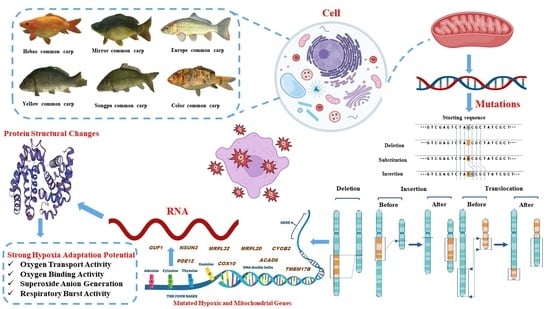
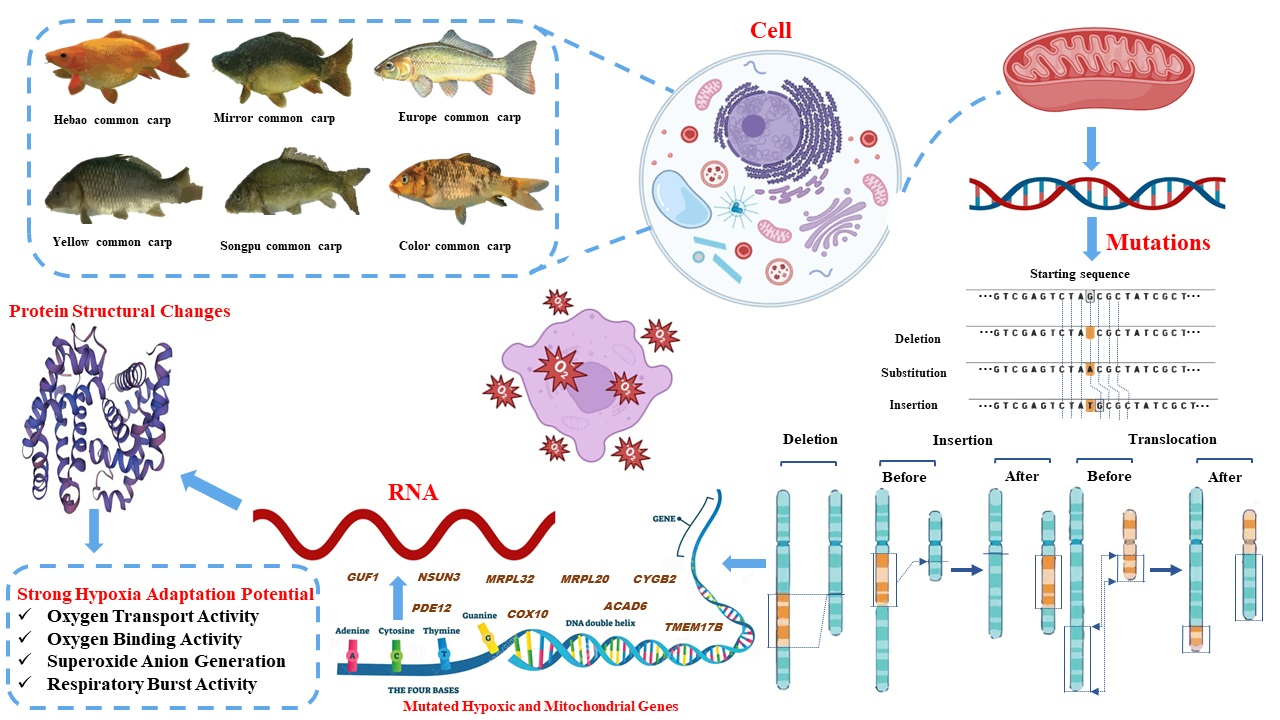
Graphical Abstract

1. Introduction

Environmental variations substantially influence genome structures within species, leading to genetic divergence, new gene functions, robust ecological adaptation, increased biodiversity, evolutionary resilience, and speciation [1]. This phenomenon is best expressed by aquatic species, where habitat-specific selective pressures generate genetic diversity, leading to specialized traits that enhance survival within particular ecological niches and promote the formation of new species [2].
Common carp Cyprinus carpio is an evolutionary allotetraploid cyprinid and among the earliest domesticated fishes, with a history of aquaculture in China spanning 8000 years [3]. Globally, common carp is a major farmed fish, representing approximately 7.7% (around 4.4 million tons) of the global freshwater aquaculture production [4]. Additionally, carp’s adaptability to various environments, stemming from its diverse subspecies and wide habitat range [5], makes it ideal for studying its response to environmental stressors as the observed variations illuminate the influence of habitat stressors on genetic and phenotypic expression, thus offering crucial insights into adaptive processes and aquaculture [6].
Hypoxia, characterized by low oxygen levels, significantly affects organisms and biodiversity by disrupting the gene and protein equilibrium essential for vital processes [7]. It compromises mitochondrial energy production by impairing oxidative phosphorylation and the availability of O2, leading to reduced energy levels and potential cellular health issues [8]. However, beneficial mutations in genes related to hypoxic and mitochondrial functions can further improve the organism’s capacity to adapt to hypoxia by reducing mitochondrial dysfunction and the risk of cellular damage, ultimately increasing the organism’s chances of surviving hypoxic environments [9]. Consequently, many fish species have developed a variety of molecular-level adaptive mechanisms to improve oxygen transport and utilization, including structural variations (SVs) that involve gene deletions, insertions, and translocations [10]. These SVs can drive positive selection signatures in genes related to hypoxia and mitochondria [11], resulting in functional changes that improve oxygen uptake, cellular survival, and energy production in low-oxygen environments [12]. Common carp has evolved a number of molecular responses against hypoxic stress, including structural variation and modifications in gene expression [13]. In addition, it is essential to study multiple strains of common carp because different strains of common carp may show varied adaptive reactions to hypoxia, expressing genetic variation within the species. Furthermore, the adaptive features shown in these strains are significantly shaped by the environmental factors of the collecting sites, including seasonal variations and water oxygen levels [14].
Generally, it is well documented that common carp can use a variety of measures to cope with both temporary and permanent hypoxia in their natural habitat [15]. These adaptations include preserving a steady level of muscle glycogen, liver CS, and muscle ATP [15], in addition to promoting heme binding activities and iron ion binding [13]. According to a prior study by Suo et al. [13], a comparative transcriptome analysis of Hebao common carp, Songpu common carp, and their hybrid F1 population under acute hypoxia treatment studied numerous genes related to hypoxia response, and their differential regulation mechanisms included cellular stress and immune responses. In addition, Cyprinus carpio’s ability to adapt to hypoxia was revealed to be significantly regulated by HIF1α [16]. Although comparative whole-genome analysis of other Cyprinidae species, such as Gymnocypris przewalskii, has demonstrated the presence of positively selected genes (PSGs) linked to hypoxia, including EPAS1 and HIF1α [17], the potential molecular mechanisms behind the common carp’s hypoxia response remain unclear due to insufficient research into genetic variations among carp strains.
Scientists often compare the genomes of amphibians, fish, reptiles, mammals, and birds to determine the significant genomic changes [18]. Therefore, comparative genomic analysis is the best method for identifying and studying possible genes related to mitochondria and hypoxia in the different common carp strains, providing insights into the potential genetic foundation of their response to hypoxia.
Consequently, the present study employed integrated genetic techniques to discover the genome-wide evolution potential linked to hypoxia response by conducting comparative genomic analyses using previously published whole-genome data of six common carp Cyprinus carpio strains: Color common carp, Songpu common carp, European common carp, Yellow common carp, Mirror common carp, and Hebao common carp. We focused on genes associated with mitochondria and hypoxia that exhibited structural changes and positive selection signs, in addition to identifying the related GO functions and KEGG pathways. Using six common carp strains with varied genetics and environments helped us analyze carp responses to hypoxia, allowing for a comprehensive analysis of adaptive responses in Cyprinus carpio. Our study is expected to provide compelling genome-wide evidence for Cyprinus carpio’s potential evolutionary response to hypoxia, offering insights into the possible molecular mechanisms enabling survival in adverse environments, paving the way for future research on common carp’s hypoxia tolerance and its physiological impacts.

2. Materials and Methods

2.1. Gene Family Analysis

The genomic data of Color common carp, Songpu common carp, European common carp, Hebao common carp, Yellow common carp, Mirror common carp, and Zebrafish (outgroup) were obtained from the National Center for Biotechnology Information (NCBI), with accession numbers listed in Table S1. SubPhaser1.2.6 [19] was used for chromosomal characteristics identification and classification. The protein sequences obtained from the seven genomes under study were used to perform multiple alignments using Orthofinder2.5.4 [20], with the identified gene family file as the input file. The six common carp genomes under study were analyzed for gene presence/absence variations (PAVs). To identify significantly (p ≤ 0.05) expanded or contracted gene families, Café4.2 [21] was employed. Gene annotation of the significantly expanded gene families was carried out using EggNOG-mapper2.1.12 [22] and the DIAMOND aligner [23] with default parameters, including --max-target-seqs/-k 25 and --matrix BLOSUM62. Gene Ontology (GO) and Kyoto Encyclopedia of Genes and Genomes (KEGG) pathway enrichments were analyzed and visualized using ClusterProfiler4.8.3 [24], with the significance established by the adjusted p-value ≤ 0.05.

2.2. Phylogenetic Tree Construction

Single-copy orthologous gene families obtained from Orthofinder results were implemented to create the phylogenetic tree. Clustalw2.1 [25] was used to align the protein sequences of each family, translatorx1.1 [26] was used to back-transcribe the matching CDS alignments from the corresponding protein alignments, and finally, Gblocks0.91b [27] was used to eliminate poorly aligned regions. The resulting CDS alignments of each family were used for subsequent phylogenomic analysis. For phylogenetic tree construction, the CDS alignments of each family were concatenated to create a matrix of supergenes. PAUP4.0a was used to determine the best substitution model [28]. MrBayes3.22 was used to generate a Bayesian tree with the F81+G model (sub-model of GTR+G) [29].

2.3. Positive Selection Analysis

Using the one-to-one orthologs identified by Orthofinder, the potential PSGs and the probabilities of sites under positive selection were tested using the branch-site model of CODEML in PAML4.10.7 [30]. The significance was tested using a chi-square test, with p ≤ 0.05 and p ≤ 0.01 being considered significant and highly significant, respectively. We set each common carp strain separately as a foreground branch and the others as background branches. EggNOG-mapper2.1.12 was used to functionally annotate the significantly over-represented GO-enriched terms of these PSGs, and ClusterProfiler4.8.3 was used to visualize the results. The CODEML software in PAML4.10.7 developed an F3x4 codon frequency model and the free-ratio model to estimate the branch-specific selection based on the CDS alignments of every single-copy orthologous gene family. Then, each terminal branch’s dN/dS values were obtained and plotted [31]. Significant likelihood ratio tests (LRTs) were used to identify positive selection, and the Bayes Empirical Bayes (BEB) approach was used to identify sites that were subjected to positive selection. The posterior probabilities of each of the foreground branch’s positively selected sites were assessed, with a focus on those with a high posterior probability (Pr(ω > 1) > 95% or 99%) [32].

2.4. Genome Collinearity Analysis

Syntenic gene pairs were detected between pairs of common carp strains under study using a Python version of MCScan, JCVI v1.1.12 [33]. Using the c-score argument of -cscore = 0.95 and the “jcvi.compara.catalog ortholog” command, the syntenic blocks for each species pair were specified using the annotation gff3 and coding sequence files as input data. “Jcvi.compar a.synteny screen” was used to filter syntenic blocks with the parameters “-minspan = 30-simple”. “jcvi.compar a.synteny depth–histogram” was used to identify the synteny pattern. We also filtered the smaller syntenic blocks with “jcvi.compara.synteny screen” and the options “-minspan = 10-simple”. Finally, as Color common carp and Songpu common carp were found to share the greatest percentage of collinear genes, we identified collinear genes under positive selection in Color common carp by combining Color common carp PSGs with the collinear genes between Color common carp and Songpu common carp.

2.5. Structural Variation (SV) Analysis

SV detection was performed using Songpu common carp as a reference genome. minimap2.1.1 [34] was used to perform whole genome alignments using the parameters “-a -x asm5 --cs -r2k”. Sorting and indexing were performed on the resulting SAM files. Then, SVIM-asm1.0.3 [35] was used to identify SVs (duplications, insertions, deletions, inversions, and translocations) within the common carp genomes under study. The identified SVs were filtered based on stringent criteria, including a quality threshold of 80%, with the exclusion of SVs in repetitive regions to minimize false positives. Due to the special chromosomal translocations discovered between Color and Songpu common carps, we identified the Color common carp genes within the translocated syntenic blocks, with translocations within the gene or 100 kb upstream and downstream. Then, GO and KEGG enrichment terms of Color common carp translocation-related genes were annotated and visualized using EggNOG-mapper and ClusterProfiler, respectively.

2.6. Protein Analysis

We conducted protein-related analyses using genes with SVs linked to mitochondria and hypoxia. Homology-based protein structure predictions were generated via SWISS-MODEL (https://swissmodel.expasy.org/) (accessed on 18 February 2025). Additionally, we used Interpro (https://www.ebi.ac.uk/interpro/) (accessed on 18 February 2025) to identify domains connected to proteins. Finally, we used STRING (https://string-db.org/) (accessed on 19 February 2025) to analyze protein–protein interactions (PPIs) (Table S1).

3. Results

3.1. Comparative Genomic Analyses

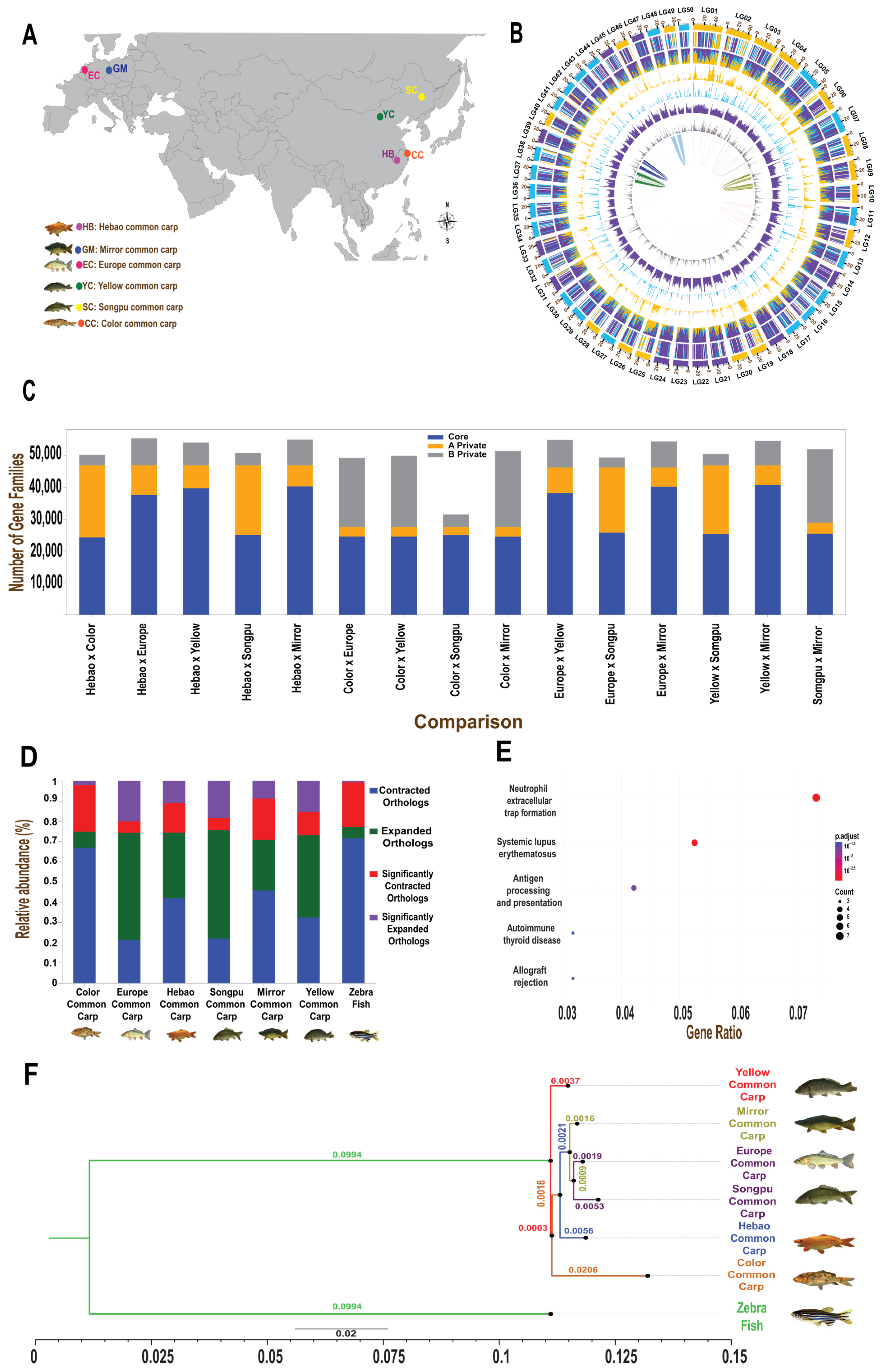
Six common carp varieties were included in this study: two from Europe, including European common carp (The Netherlands) and Mirror German common carp (Germany); and four from Asia (China), including Songpu common carp, Yellow River common carp, Hebao Wuyuan Red common carp, and Color common carp (Figure 1A; Table S2). The color common carp’s genome has the highest number of homologous chromosomal blocks (Figure 1B), followed by the genomes of European, Songpu, Hebao, Yellow, and Mirror common carps, respectively (Figure S1). A total of 62,601 homologous gene families were identified via Orthofinder (Table S3), with Mirror common carp having the highest percentage (77.3%; 48,372 orthogroups) and Color common carp having the lowest (44%; 27,575 orthogroups) (Figure S2A; Table S4). Yellow and Mirror common carps exhibited the greatest genetic overlap, with 40,702 shared gene families (Figure 1C; Table S5). Color common carp had the fewest private gene families (2571), while Mirror common carp had the most (23,839) (Table S5). Additionally, 22,657 orthogroups were found to have expanded across all common carp strains, with Color common carp having the least expanded (1006) and the highest contracted gene families (8392) (Figure 1D; Table S7). In the significantly (p < 0.05) expanded orthogroups of Color common carp (169 genes), the functions were enriched in five immune-related KEGG pathways, including autoimmune thyroid disease, systemic lupus erythematosus, neutrophil extracellular trap formation, antigen processing and presentation, and allograft rejection (Figure 1E; Table S8). Additionally, we discovered four KEGG pathways enriched in the significantly (p < 0.05) expanded gene families of Songpu common carp, such as motor proteins, muscle cell cytoskeleton, tight junctions, and axon guidance (Figure S3A; Table S8). Moreover, nine KEGG pathways were linked to the significantly (p < 0.05) expanded gene families of European common carp and involved in a variety of biological processes, including secretion and infections, such as bile secretion, bacterial invasion of epithelial cells, salivary secretion, and Yersinia infection (Figure S3B; Table S8). This genomic analysis of common carps identified 640 single-copy orthologous genes, which were utilized to create the phylogenetic tree, which showed that European and Songpu common carps are more closely connected than to the other species (Figure 1F), with Color common carp being the most distantly related of all common carp strains (Table S9).

3.2. Selection Signatures

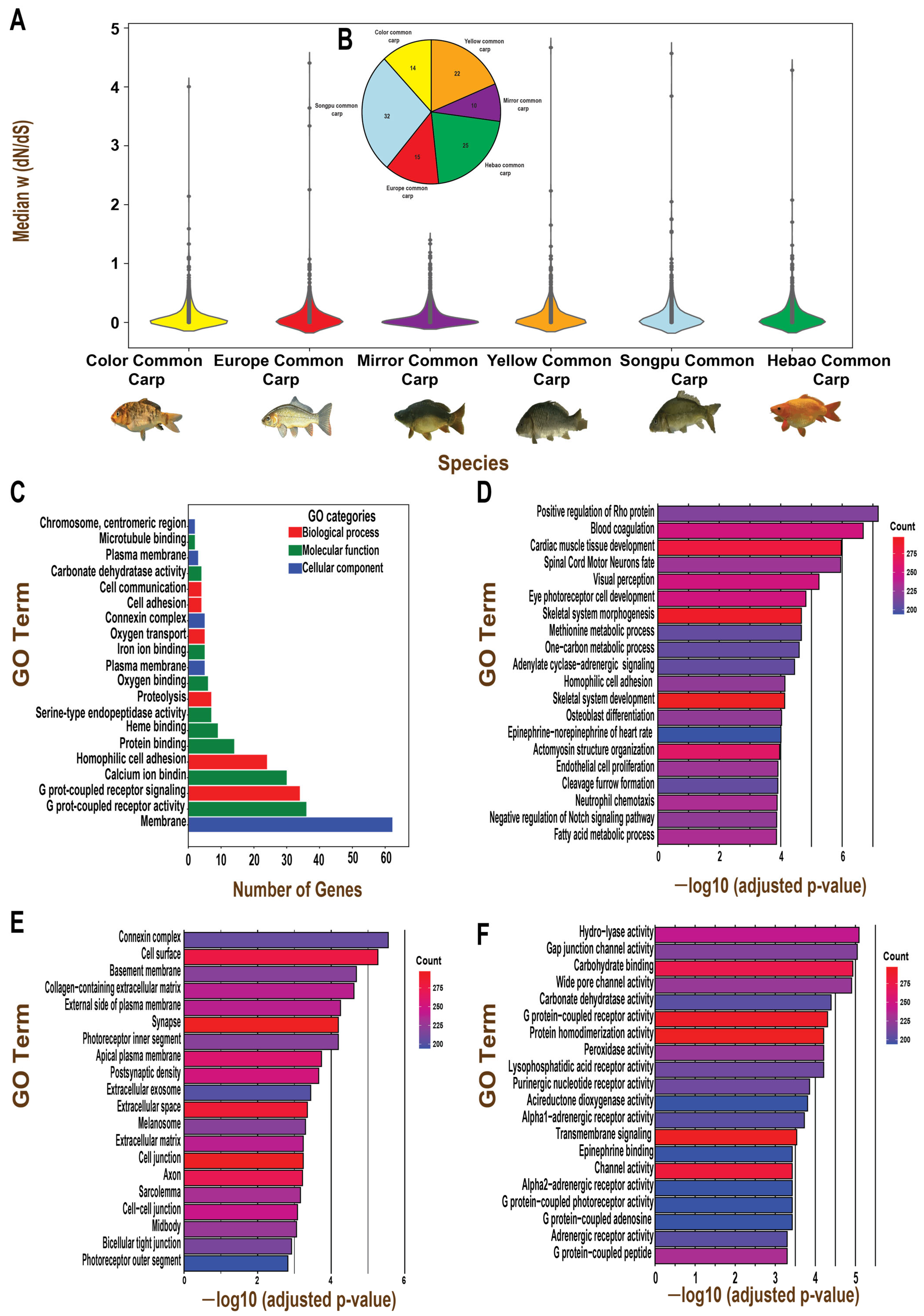
The selection tests performed on the single-copy orthologous genes identified strong evidence of positive selection genes in all common carps (dN/dS > 1; Figure 2A). A total of 118 PSGs were discovered in all six of the common carps, with the highest number detected in Songpu common carp (32 PSGs) and the lowest found in Mirror (10 PSGs), Color (14 PSGs), and European (15 PSGs) common carps, respectively (Figure 2B). We discovered GO terms in the Color and European common carp PSGs that were closely related to the cellular adaptations to hypoxia, particularly the biological process of oxygen transport and the molecular function of oxygen binding (Figure 2C; Tables S10 and S11). Additionally, the GO enrichment analysis in Color common carp involved the biological function of the positive regulation of Rho protein signal transduction, which is indirectly related to hypoxic stress (Figure 2D; Table S12), with important hypoxia-related molecular functions, such as gap junction channel activity, lysophosphatidic acid receptor activity, and G protein-coupled receptor activity (Figure 2F). Furthermore, in European common carp, we discovered enriched GO-related biological processes linked to hypoxia, such as superoxide anion generation and respiratory burst activity (Table S13).
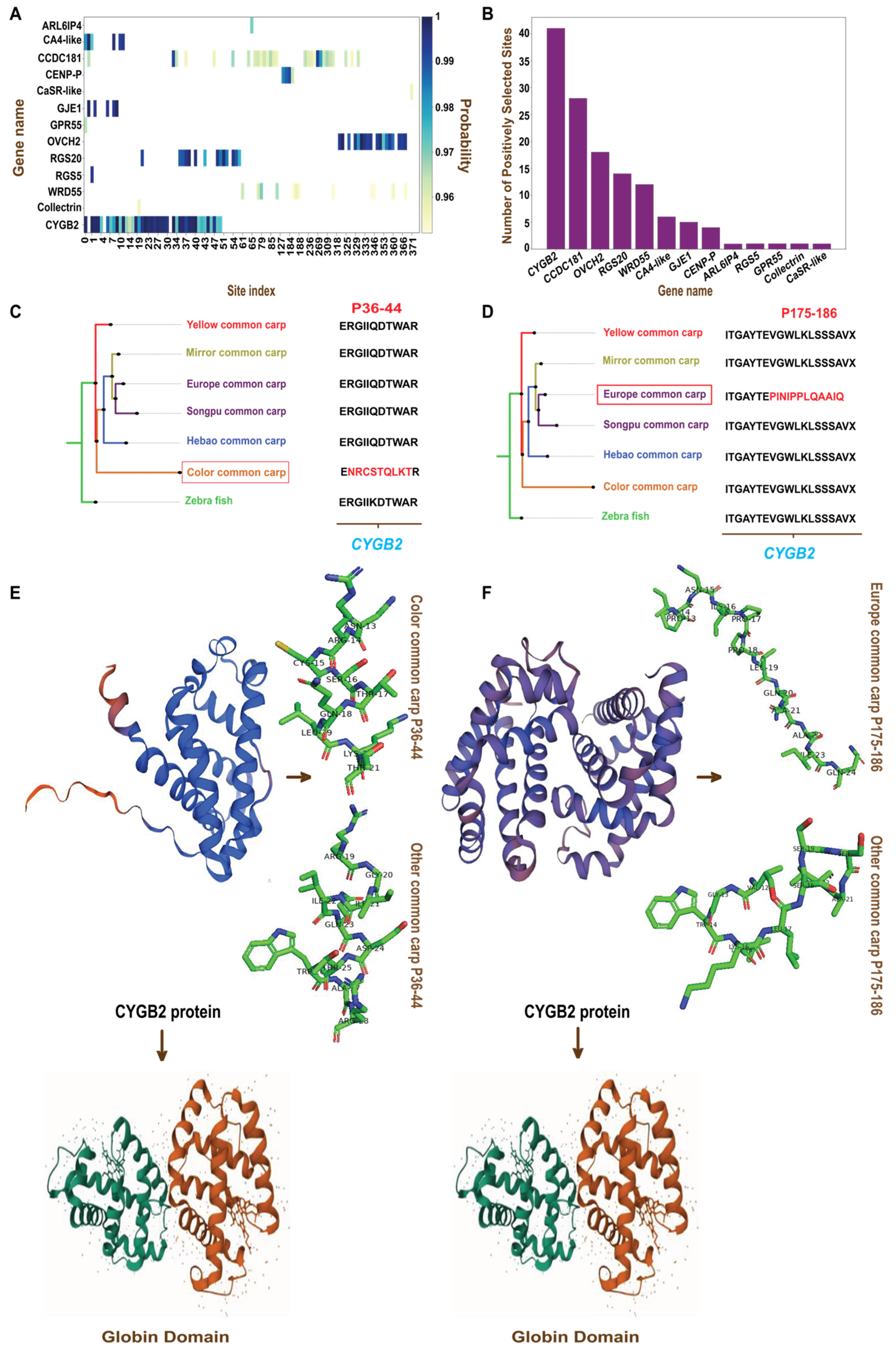
We also discovered cytoglobin-2 (CYGB2), one of the PSGs in Color and European common carps, which is reported to be crucial for oxygen transport and storage. According to the Bayesian Empirical Bayes (BEB) analysis (Figure 3A), multiple sites within the Color common carp CYGB2 gene are simultaneously under positive selection (Table 1 and Table S14; Figure 3B). We discovered nine amino acid substitutions, including the amino acids asparagine, arginine, cysteine, serine, threonine, glutamine, leucine, lysine, and arginine, which extend from sites 36 to 44 (Figure 3C). Additionally, similar to the Color common carp, CYGB2 was also discovered in European common carp, with 11 positively selected sites between positions 175 and 186 (Figure 3D), leading to different protein structures (Figure 3E,F). As well, we found a 26-amino acid insertion at the end of the European common carp CYGB2 gene, surrounded by several amino acid substitution events, in addition to lengthy deletions in the first 90 amino acids of the Color common carp CYGB2 gene (Figure S4).
In addition, we found that European, Songpu, Yellow, and Hebao common carps had distinct PSGs related to mitochondrial activity. The PSGs of European common carp were linked to mitochondrial biological processes, such as rRNA processing, methionine metabolism, mitochondrial translation, and 5.8S rRNA maturation (Tables S12 and S13). As well, the Songpu common carp PSGs included biological and molecular processes connected with mitochondria, like calcium ion protein transport, cysteine-type peptidase activity, and peptidyl–prolyl cis-trans isomerase activity (Tables S17 and S18). We also found mitochondrial PSGs in European common carp (Table S15), including nuclear-encoded S-adenosylmethionine (SAM)-dependent methyltransferase-3 (NSUN3) and 39S ribosomal protein-L20 (MRPL20). Multiple sites under simultaneous positive selection were identified in the first region of the MRPL20 protein (positions 2–16; Figure S5A). Furthermore, NSUN3 showed evidence of 13 amino acid deletions at the end of the amino acid sequence (Figure S6), after the positive selection events observed at sites 358–360, which included the amino acids cysteine, proline, and serine (Figure S5A). In Songpu common carp, we also identified mitochondria-related PSGs, including transmembrane protein-17B (TMEM17B) and GTPase elongation factor-1 (GUF1) (Table S16). We discovered that the GUF1 protein contains four continuous sites under positive selection at sites 71–74 (Figure S5B). We also discovered biological processes linked to mitochondria in the PSGs of Yellow common carp, such as the acyl-CoA metabolic process (Tables S19 and S20). The PSGs of Hebao common carp further showed mitochondria-related processes, including the fatty acid metabolic process and the lipid metabolic process (Tables S21 and S22). In Hebao common carp, the mitochondrial PSG 2′,5′-phosphodiesterase-12 (PDE12) was discovered (Table S23), with multiple discontinuous positively selected sites observed (Figure S5C). We found some mitochondrial PSGs in Yellow common carp (Table S24), including NSUN3, as well as 39S ribosomal protein-L32 (MRPL32) and acyl-CoA dehydrogenase-6 (ACAD6), whereas multiple continuous amino acid substitutions were also observed in these genes (Figure S5D).
Additionally, we discovered PSGs associated with reproduction in the Color common carp genome, including ovochymase-2 (OVCH2) and coiled-coil domain-containing protein-181 (CCDC181) (Table S12). Multiple locations within the CCDC181 and OVCH2 genes are simultaneously under positive selection in Color common carp (Figure S5E), whereas five positively selected sites (tryptophan, serine, proline, alanine, and tyrosine) make up the longest continuous positively selected region in OVCH2, which spans sites 368–372. Lastly, we identified a clear pattern of selection in the Color common carp’s CCDC181, where three deletion events were surrounded by amino acid substitutions (Figure S7). In particular, three deletions are identified: the first, between sites 52 and 64, with positive selection for alanine at location 50; the second, between sites 274 and 286, with positive selection for lysine at location 287; and the final deletion, covering positions 339–344, with positive selection for lysine, arginine, glutamic acid, and asparagine at sites 334–338 (Figure S5E).

3.3. Collinearity Detection

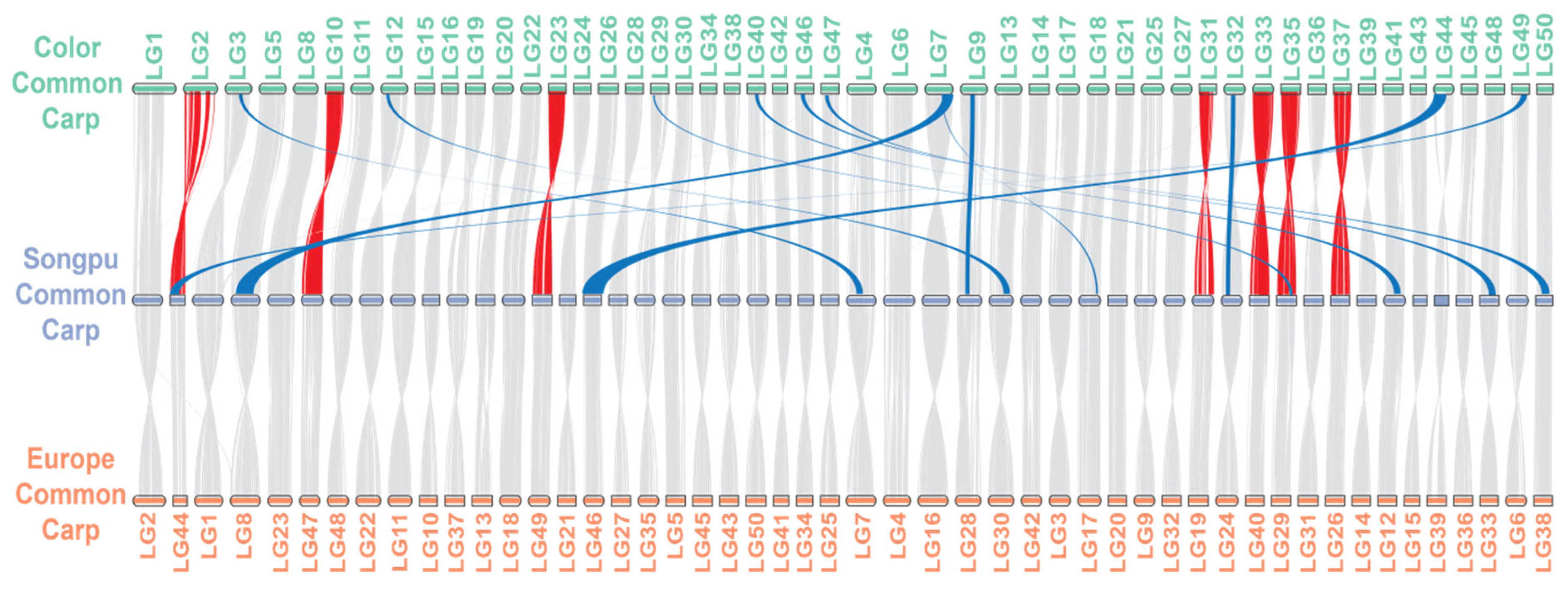
The collinearity analyses revealed that Color common carp and Songpu common carp share the greatest percentage of collinear genes (49.8%), with 65,026 collinear genes spread throughout 688 collinear blocks (average of 94.5 gene pairs per syntenic block) (Table S25). Significant collinearity and synteny were also observed between the chromosomes of Color common carp and Songpu common carp, as well as Songpu common carp and European common carp, suggesting that these common carps share regions of the same gene order (Figure 4 and Figure S8A). Genomic differences were found between strains, including 21 translocation events between Songpu common carp and Color common carp, in addition to 31 translocation events between Songpu common carp and European common carp. These translocations imply that portions of the genes that originally were identified on the chromosomes of Songpu common carp may have moved to the homologous chromosomes of European common carp and Color common carp (Figure 4). Furthermore, seven Songpu common carp chromosomes (chr A2, chr A9, chr A13, chr B13, chr B15, chr B2, and chr B12) showed genomic variations. Although translocation events were discovered between these chromosomes and the corresponding chromosomes of Color common carp, no similar rearrangements were found between the analogous chromosomes of European common carp, indicating that the Songpu and Color common carps had unique genetic rearrangements (Figure 4). In addition, most of the Songpu common carp genome (77%) aligns according to the 2:2 pattern, in which two Songpu common carp blocks align with each Color common carp gene (Figure S8B). Similarly, 81% of the Color common carp genome displays the 2:2 pattern, in which two Songpu common carp genes correspond with two Color common carp blocks. A total of twelve PSGs in Color common carp were found to exhibit collinearity with Songpu common carp, while thirteen PSGs were found to exhibit collinearity between Color and European common carps (Table S26). In addition, we discovered that all common carp strains, especially European and Songpu common carps, showed collinearity with the reproductive PSGs in Color common carp, such as OVCH2 and CCDC181. In addition, we found that CYGB2 was collinear between Color and European common carps, but not between Color and Songpu common carps, indicating potential genetic divergence in evolutionary pressures between these species. In addition, it was discovered that the mitochondrial PSGs of Songpu common carp (GUF1 and TMEM17B) and European common carp (MRPL20 and NSUN3) were collinear with those of Color common carp, indicating a conserved evolutionary relationship and functional similarity across these carps (Table S26).

3.4. Structure Variation Detection

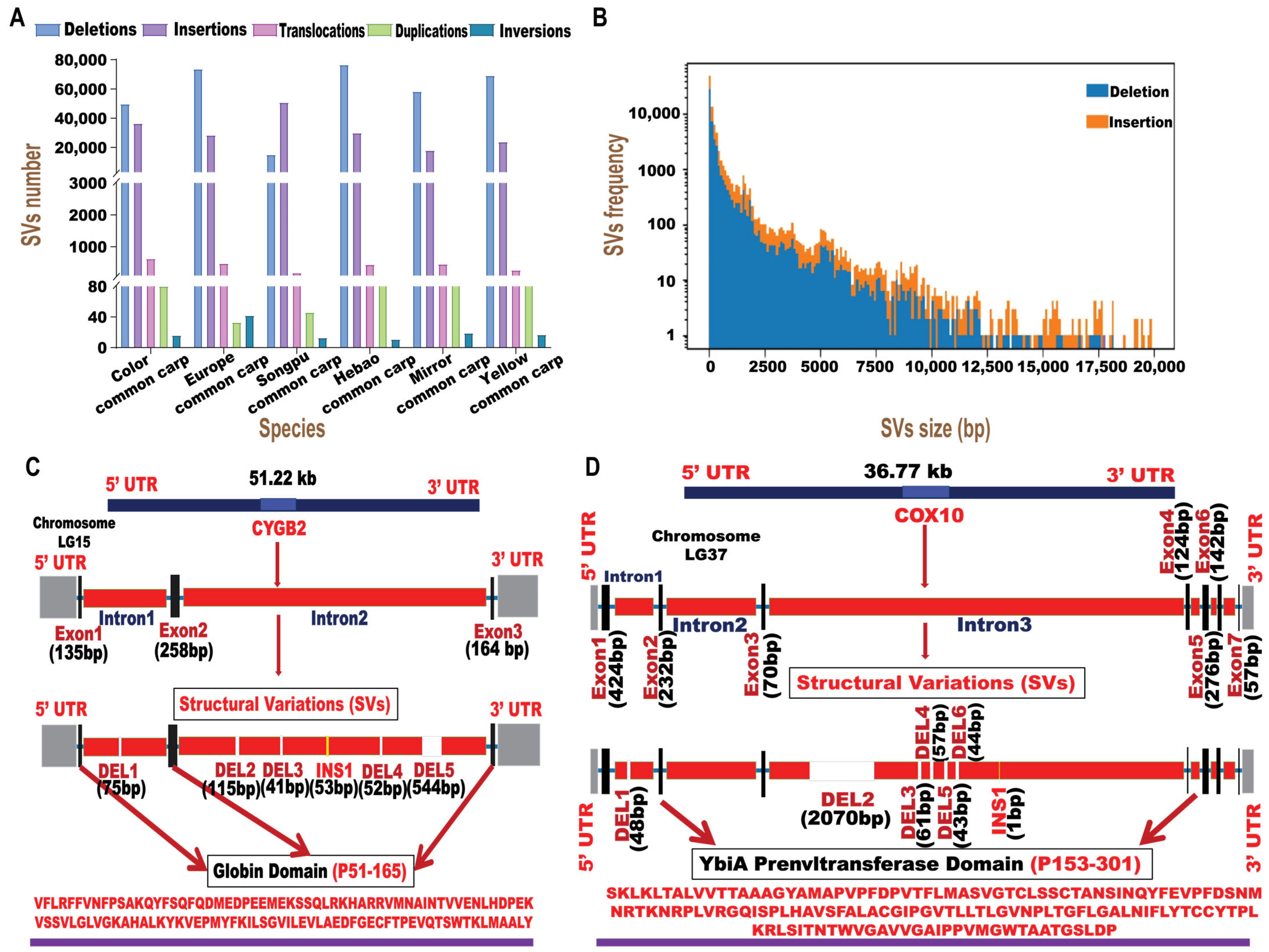
Our analysis revealed 86,915, 66,131, and 102,561 SVs exceeding 50bp in Color, Songpu, and European common carps, respectively, with the deletions and insertions predominating (Table S27; Figure 5A,B). Moreover, our observations revealed multiple intronic structural changes in Color common carp CYGB2, including five deletions and a single insertion (Figure 5C). Additionally, intronic insertions were observed in Color common carp mitochondrial genes (GUIF1 and NSUN3) (Figure S9A). The Color common carp GUF1 gene contains the P-loop containing the nucleoside triphosphate hydrolase (P-loop NTPase) domain (Figure S9B), which is necessary for the synthesis of mitochondrial energy. Moreover, the Color common carp NSUN3 gene contains the S-adenosyl-L-methionine-dependent methyltransferase (SAM) domain (Figure S9C), which is crucial for preserving mitochondrial function.
The translocation positions of chromosomes with translocated collinear blocks between Songpu and Color common carps were determined, yielding 570 translocation sites in total (Table S28). These comprised 3572 genes that were either 100 kb upstream or downstream or inside the translocated areas (Table S29). Translocation-related genes showed significant enrichment (p < 0.05) for hypoxic and mitochondrial GO biological processes, including the regulation of epithelial cell differentiation, chondrocyte differentiation, positive regulation of proteolysis, and peptidyl-serine phosphorylation (Figure S10A; Table S30). As well, hypoxia- and mitochondria-associated GO molecular functions and cellular components of the translocation-related genes were significantly enriched (p < 0.05), including transcription factor binding and the transcription regulator complex (Figure S10B,C; Table S30). Additionally, translocation-related genes showed significant enrichment (p < 0.05) of KEGG pathways related to hypoxic and mitochondrial functions, including actin cytoskeleton regulation, circadian entrainment, cell adhesion molecules, and calcium signaling pathways (Figure S10D; Table S31). Furthermore, we discovered the cytochrome c oxidase assembly homolog-10 (COX10) gene, which showed multiple intronic structural changes, including six deletions and one insertion, as well as a translocation 63.718 kb downstream and the inclusion of the YbiA Prenvltransferase domain (Figure 5D).
Strong interactions between CYGB2 and other proteins, including CYB5A, CYB5B, and CYBGR3, are shown in Figure S11A. Additionally, several proteins, including COX3, COX2, COX11, COX1, and COX15, interact with COX10 (Figure S11B), and the interactions of GUF1 with proteins such as MRPL15, MRPL32, MRPS6, MRPS9, RPS3, and RPS18 are shown in Figure S11C. Lastly, NSUN3 has a functional relationship in mitochondrial protein synthesis by interacting with many proteins, such as NIP7, METTL1, BXDC2, PUM3, GTPBP4, MTFMT, and TRDMT (Figure S11D).

4. Discussion

4.1. Genomic Divergence Among Common Carp Strains

We found that Color common carp probably possesses special genome characteristics compared to the other common carps under study. For example, Color common carp exhibits the highest number of homologous chromosomal blocks and contracted gene families, as well as the lowest private gene families, core gene families, and expanded gene families. These findings suggest that Color common carp may have different genomic characteristics, which may contribute to its phenotypic differences, indicating potential private ecological success that may affect the sustainability of the species. Interestingly, among the significantly expanded gene families in Color common carp were KEGG pathways linked to immunological responses, such as neutrophil extracellular trap (NET) production, indicating that the species prioritizes particular immunological functions despite the generally limited expansion and increased contraction of other gene families, which may enhance resilience and survival in fluctuating and adverse conditions [36]. This might be an adaptive response to physiological or environmental stressors, like pathogens or hypoxia. Similarly, candidate genes linked to resistance to viral diseases, such as LR3, TLR7, and MyD88, have been sequenced and found to be duplicated in the genome of common carp, suggesting an improved immune response [37]. However, the highest proportions of core gene families were found between Mirror common carp and Yellow, Hebao, and European common carps, indicating that Mirror common carp is more compatible in terms of reproduction [38].
Moreover, all common carps have deletions as the most frequent SVs, followed by insertions and translocations. This pattern is similar to that of Tibetan chickens, whose insertions and deletions led to a special adaptation to hypoxia [39]. Similar findings were reported by Jung et al. [40], who employed chromosome-level comparative genomics and long-read SV detection in the Pacific oyster Crassostrea gigas to identify genes and genomic regions linked to growth and disease. Additionally, Color common carp showed the highest collinearity with Songpu and European common carps, with several interchromosomal translocations discovered between Color and Songpu common carps, suggesting that many genes retain similar structures and functions, as well as indicating that despite the low shared gene families, Color common carp may have higher hybridization potential. Despite significant genomic collinearity and homology among Color, Songpu, and European common carps, these species display substantial genomic rearrangements. This indicates strong genetic differentiation in certain regions that may influence their responses to environmental conditions. We also suggest that genomic homology and similarity may mitigate the impact of gene recombination, which is supported by recent studies conducted in the Cyprinidae family [41].
Additionally, we discovered that the translocation-related genes in Color common carp showed enrichment for hypoxic and mitochondrial GO biological processes, including the regulation of epithelial cell differentiation [42], chondrocyte differentiation [43], positive regulation of proteolysis [44], and peptidyl-serine phosphorylation [45], in addition to KEGG pathways related to hypoxic and mitochondrial functions, including actin cytoskeleton regulation [46], circadian entrainment [47], cell adhesion molecules [48], and calcium signaling pathways [49]. These findings lend credence to the theory that these genetic modifications enable Color common carp to flourish in hypoxic conditions. Overall, these translocations emphasize the dynamic genomic processes involved in the evolution of each species by possibly influencing ecological niches, genetic diversity, and adaptive qualities, including hypoxia tolerance. Even though common carps are highly collinear, SV formation, basically deletions, insertions, and interchromosomal translocations, resulted in variations in genomic architecture, which contributed to common carp’s phenotypic diversities.
Our phylogenetic analysis indicated that European and Songpu common carps exhibit a closer genetic relationship to each other than to other strains, likely due to shared evolutionary history and environmental factors. Similarly, a phylogenetic analysis explained Songpu Mirror carp’s mating history and suggested that it might be a hybrid of maternal Xingguo red carp and paternal European Mirror carp [50]. In contrast, Color common carp is more distantly related, possibly having diverged earlier due to selective pressures or population isolation. These findings underline the complex evolutionary history of Cyprinus carpio and the importance of further research on the ecological factors influencing genetic differentiation among these strains.

4.2. Adaptive Evolution of Hypoxia-Related Genetic Signatures

We discovered that Color and European common carp PSGs contain GO functions directly linked to hypoxia response and adaptation, including the biological process of oxygen transport, the molecular function of oxygen binding, respiratory burst activity, and superoxide anion production, which are components of the cellular stress response to hypoxia [51]. This suggests that Color and European common carps may share similar adaptive mechanisms to cope with low-oxygen stress. These findings align with prior studies indicating that fish species in hypoxic environments frequently demonstrate adaptive genetic alterations in crucial pathways associated with oxygen sensing, transport, and antioxidant defense [52]. Furthermore, a hypoxia-related PSG called CYGB2, which is involved in oxygen binding and transport, as well as guarding against hypoxia by scavenging reactive oxygen species (ROS) [53], was found in both European and Color common carps with the globin domain [54] that facilitates oxygen binding and transport, in addition to several positive selection events, indicating adaptive evolution to hypoxic conditions. Similarly, the CYGB2 and CYGB2 genes in Schizopygopsis pylzovi are induced by hypoxia, and their transcription regulation responses to hypoxia are tissue-specific and dependent on the hypoxia regime [55]. Notable structural variations in the CYGB2 protein were observed in European and Color common carps, including exonic amino acid insertions and lengthy amino acid deletions, along with several intronic deletions and an intronic insertion in Color common carp’s CYGB2 protein, suggesting possible variations in gene regulation to deal with the lower oxygen levels. Intronic SVs can change gene expression, regulatory processes, and splicing, which may interfere with regular cellular functions, causing phenotypic changes and potentially being crucial for adaptation to hypoxic environments [56]. SVs have been demonstrated to produce novel gene combinations or modify regulatory networks in maize [57] and the marine teleost Chrysophrys auratus [58], and these SVs may alter the genome’s three-dimensional structure, which could affect the patterns of spatial gene expression and then the biological activities [59]. Although Color and European common carps evolved in different places (Asia and Europe, respectively), their shared responses to low oxygen might be due to convergent evolution, possibly influenced by ancestral factors. In general, the intronic and exonic SVs and the numerous amino acid substitutions in the Color and European common carps’ CYGB2 show that the coding and regulatory regions of the gene have undergone substantial changes, which could influence CYGB2’s ability to bind oxygen or how it reacts to hypoxia.

4.3. Adaptive Evolution of Mitochondria-Related Genetic Signatures

We identified mitochondria-related genes that also show positive selection in European, Hebao, Songpu, and Yellow common carps, including MRPL20, MRPL32, NSUN3, GUF1, TMEM17B, ACAD6, and PDE12, suggesting adaptive evolutions that potentially maximize mitochondrial efficiency under certain circumstances, which may result in improved cellular energy metabolism and mitochondrial function [60]. TMEM17B encodes a multipass transmembrane protein essential to the mitochondrial translocase TIM23 complex [61], and ACAD6 catalyzes the first step in fatty acid β-oxidation within the mitochondria [62]. Additionally, several amino acid substitutions were discovered in the identified mitochondria-related PSGs, as well as deletions in the European common carp NSUN3 protein that regulates mitochondrial translation [60], indicating further exonic structural modifications that could be a contributing factor to the protein’s functional changes. Interestingly, NSUN3 was found to be positively selected in European common carp and Yellow common carp, indicating ancient genetic divergence that resulted in species-specific adaptations and possible functional differences in response to environmental stressors. PDE12 is involved in eliminating poly (A) extensions from mitochondrial mRNAs [63]. Wei et al. [64] mentioned that PDE12 was reported to damage the oral mucosal epithelial barrier in rats with oral submucous fibrosis by interfering with mitochondrial oxidative phosphorylation and mediating mitochondrial dysfunction. MRPL32 is a mitochondrial ribosomal protein encoded by nuclear genes that aids in mitochondrial protein synthesis [65], while MRPL20 contributes to protein synthesis in the mitochondria [66]. Aziz et al. [67] reported that MRPL32 was highly expressed in human cancer cells under hypoxic conditions. MRPL20 has been shown to increase the survival rate of cancer cells under hypoxic conditions [67]. In addition, we discovered that Color common carp has intronic insertions and deletions in the mitochondria-related genes, such as GUF1, NSUN3, and COX10, potentially playing a role in the organism’s ability to respond to environmental challenges like low-oxygen conditions. GUF1 binds to mitochondrial ribosomes in a GTP-dependent manner [68]. COX10 is a crucial gene in the respiratory chain of the mitochondria that facilitates the reduction of oxygen to water by carrying out the last stage of the electron transport chain (ETC) [69]. The identified intronic deletions and insertions in COX10 may affect oxidative phosphorylation and mitochondrial efficiency, which may influence the Color common carp’s capacity to produce ATP in the low-oxygen environment [70]. This aligns with Saldana-Caboverde et al. [71] and Srivastava et al. [72], who reported that low oxygen levels raise complex I levels via HIF-1α, particularly in cells deficient in complexes III and IV because of COX10 mutations. The response to hypoxia at the cellular and molecular levels may include mitochondrial reprogramming, which modifies oxidative phosphorylation pathways and lessens the negative consequences of ROS produced during stress.
Additionally, according to Murakami et al. [73], NSUN3-mediated mitochondrial tRNA 5-formylcytidine modification is critical for mouse respiratory complexes and embryonic development. In addition, RNA cytosine methyltransferase NSUN3 controls the differentiation of embryonic stem cells by promoting mitochondrial activity [60]. Consequently, NSUN3 may be indirectly related to reproductive activities and may be associated with genes related to reproduction that are subjected to positive selection. Interestingly, in the genome of Color common carp, we discovered PSGs linked to reproduction, such as CCDC181, which is critical for sperm motility and function [74], and OVCH2, which is necessary for sperm fertilization ability [75]. We discovered five amino acid substitutions in OVCH2, in addition to three distinct amino acid deletion events in CCDC181, which may be a potential response to adverse ecological conditions to achieve successful reproduction through exonic mutations, where effective mitochondrial function and cellular resistance are essential for both survival and reproduction. These genes and the related SVs are suggested to play a key role in successful reproduction, especially when facing environmental challenges, which may lead to successful spawning and offspring survival in aquaculture if selected. The findings are consistent with research conducted by Wen et al. [76], who mentioned that the down-regulation of NSUN3 disrupts mitochondrial protein synthesis, which drastically affects cellular energy metabolism during early development. The interaction of CYGB2 with related proteins like CYB5A, CYB5B, and CYBGR3 highlights its critical role in biological processes involving oxygen transport, electron transfer, and redox reactions. Additionally, proteins such as COX3, COX2, COX11, COX1, and COX15 interact with COX10, suggesting its contribution to the regulation of oxidative stress. GUF1 interacts with proteins like MRPL15, MRPL32, MRPS6, MRPS9, RPS3, and RPS18, indicating its collective role in mitochondrial protein synthesis and maintenance. Additionally, NSUN3’s functional relationship with proteins such as NIP7, METTL1, BXDC2, PUM3, GTPBP4, MTFMT, and TRDMT implies a collaborative role in mitochondrial functions and RNA methylation.
More studies on common carp, specifically Color common carp, are recommended to gain a better understanding of genetic variables governing hypoxia and reproduction and to improve breeding techniques for better reproductive traits. Genes involved in reproduction may mutate in response to negative environmental shifts to improve reproductive success and species survival, whereas mitochondrial genes may also be essential to this evolution.

4.4. Applications and Perspectives

Interestingly, while the study on SVs and their impact on hypoxic and mitochondrial functions in Cyprinus carpio offers valuable insights, it has notable limitations. The focus on individual-level comparative genomics necessitates population-level analysis to fully understand genetic diversity. In addition, further validation is required to confirm the functional implications of identified SVs. In addition, our initial findings require further confirmation research to clarify common carp’s physiological and behavioral reactions to low oxygen levels, particularly concerning our study genes involved in hypoxic and mitochondrial function (CYGB2, MRPL20, MRPL32, NSUN3, GUF1, TMEM17B, PDE12, ACAD6, and COX10), as the knowledge gleaned from common carp genomic modifications may help to improve their farming methods, especially in regions that experience oxygen deprivation.
On the other hand, our study on the genetic evolution and variations in common carp Cyprinus carpio has broad applications spanning aquaculture, environmental biology, and conservation genetics. First, the identification of genes linked to mitochondria and hypoxia tolerance and responses in common carp can help select fish stocks that are better suited for farming in oxygen-limited environments. Therefore, aquaculture industries can increase the resilience of farmed fish species, increasing productivity and sustainability by incorporating genomic markers linked to hypoxia resistance into selective breeding programs [77]. Second, from the standpoint of environmental biology, managing fish populations in areas impacted by eutrophication and climate change may be significantly impacted by the comprehension of how common carp responds to hypoxia. This information could be used to manage ecosystems that are at risk of hypoxia as a result of human activities like industrial pollution and agricultural runoff [78]. Third, knowledge of the genomic traits linked to hypoxia tolerance can help conservation geneticists create more successful conservation plans for fish species that are in danger of extinction by benefiting from an understanding of the genetic responses that allow common carp to thrive in low-oxygen habitats [79].

5. Conclusions

The study of genome evolution in different common carps Cyprinus carpio has shed light on the shared and unique genetic alterations linked to hypoxia and mitochondria, which may be essential for improving common carp populations’ resistance to environmental stressors. Notably, hypoxia- and mitochondria-related biological functions, as well as the amino acid substitutions and SVs discovered in the hypoxia- and mitochondria-related genes, may indicate distinct evolutionary strategies that might help species survive in hypoxic conditions by supporting the response mechanisms essential for survival. This study presents a viable direction for further investigation to clarify the molecular functions and processes enabling common carp’s evolutionary adaptations, which may lead to the rise of new aquaculture applications related to environmental stress adaptation and hypoxia tolerance, ensuring species survival in variable aquatic habitats.

Supplementary Materials

The following supporting information can be downloaded at https://www.mdpi.com/article/10.3390/fishes10100509/s1, Figure S1: Chromosomal Characteristics of This Study Common Carp Genomes (window size: 1 Mb); Figure S2: Orthogroups and Species-Specific Genes Among Common Carp Strains; Figure S3: KEGG Enrichment of The Significantly Expanded Gene Families of This Study Common Carp Strains; Figure S4: Alignment of The Whole Amino Acid Sequences of CYGB2 in Color, European, and Songpu Common Carps; Figure S5: Specific Amino Acid Mutations in Different Common Carp Strains; Figure S6: Alignment of The Whole Amino Acid Sequences of NSUN3 in European, Yellow, Songpu Common Carps; Figure S7: Alignment of The Whole Amino Acid Sequences of CCDC181 in Color and Songpu Common Carps; Figure S8: The Genome Collinearity of Color and Songpu Common Carps; Figure S9: Color Common Carp Mitochondrial Genes Structure; Figure S10: GO and KEGG Enrichments of Color Common Carp Translocation-Related Genes; Figure S11: Protein-Protein Interactions of Hypoxia and Mitochondria-Related Genes of This Study Common Carp Strains; Table S1: Amino Acid Sequences Used for Protein-Protein Interactions (PPIs) Using STRING; Table S2: Overview on The Information of The Used Genomic Data of This Study Common Carp Strains; Table S3: Species-Specific Orthogroup Analysis Data of This Study Common Carp Strains; Table S4: The Identified Orthogroups of Color Common Carp Compared With Other Relatives; Table S5: Presence-Absence Variation (PAV) of Different Pair Comparisons of This Study Common Carp Strains Gene Families; Table S6: Gene Families Undergone Contractions and Expansions in This Study Common Carp Strains; Table S7: Number of Gene Families Undergone Contractions and Expansions in This Study Common Carp Strains; Table S8: KEGG Enrichment Analysis of This Study Common Carp Strains Significantly Expanded Gene Families; Table S9: PAUP-Bayesian Phylogenetic Inference of This Study Common Carp Strains; Table S10: GO Term Distribution and Categorization of Color Common Carp Positively Selected Genes (PSGs); Table S11: GO Term Distribution and Categorization of European Common Carp Positively Selected Genes (PSGs); Table S12: GO Enrichment Aanalysis of Color Common Carp Positively Selected Genes (PSGs); Table S13: GO Enrichment Analysis of European Common Carp Positively Selected Genes (PSGs); Table S14: Genes Under Positive Selection in Color Common Carp Genome; Table S15: GO Enrichment Analysis of Songpu Common Carp Positively Selected Genes (PSGs); Table S16: GO Term Distribution and Categorization of Songpu Common Carp Positively Selected Genes (PSGs); Table S17: Genes Under Positive Selection in European Common Carp Genome; Table S18: Genes Under Positive Selection in Songpu Common Carp Genome; Table S19: GO Term Distribution and Categorization of Yellow Common Carp Positively Selected Genes (PSGs); Table S20: GO Enrichment Analysis of Yellow Common Carp Positively Selected Genes (PSGs); Table S21: GO Term Distribution and Categorization of Hebao Common Carp Positively Selected Genes (PSGs); Table S22: GO Enrichment Analysis of Hebao Common Carp Positively Selected Genes (PSGs); Table S23: Genes Under Positive Selection in The Hebao Common Carp Genome; Table S24: Genes Under Positive Selection in Yellow Common Carp Genome; Table S25: Summary of Synteny and Collinearity Analyses in Color Common Carp Compared with Different Common Carp Strains; Table S26: Collinear Genes Under Positive Selection in Color Common Carp Compared with Different Common Carp Strains; Table S27: Total Numbers of Structural Variations (SVs) > 50pb of This Study Common Carp Strains; Table S28: Translocation Positions Related to Chromosomes with Translocated Collinear Blocks in Color Common Carp; Table S29: The Identified Color Common Carp Translocation-Related Genes; Table S30: GO Enrichment Analysis of of Color Common Carp Translocation-Related Genes; Table S31: KEGG Enrichment Analysis of Color Common Carp Translocation-Related Genes.

Author Contributions

Conceptualization, J.W. and C.W.; methodology, M.H.A.-R. and J.K.; software and formal analysis, M.H.A.-R.; visualization, M.H.A.-R. and J.K.; validation, J.W. and C.W.; investigation, M.H.A.-R.; data curation, M.H.A.-R.; writing—original draft preparation, M.H.A.-R.; writing—review and editing, J.W.; visualization, M.H.A.-R.; supervision, J.W. and C.W.; funding acquisition, C.W. All authors have read and agreed to the published version of the manuscript.

Funding

This study was funded by the National Natural Science Foundation of China (32293254).

Institutional Review Board Statement

Not applicable.

Data Availability Statement

All raw data analyzed in this study are publicly available from the Sequence Read Archive (SRA) without restriction (https://www.ncbi.nlm.nih.gov/sra/) (accessed on 14 June 2024). The genome assemblies of Color common carp, Songpu common carp, European common carp, Hebao common carp, Yellow common carp, Mirror common carp, and Zebra fish are available under accession numbers subPRO068883/PRJCA046932, GCF_018340385.1, GCA_905221575.1, GCA_004011595.1, GCA_004011575.1, GCA_004011555.1, and GCF_000002035.6, respectively. Detailed sample IDs and associated metadata are provided in Table S1.

Conflicts of Interest

The authors declare no competing interests.

References

  1. Bernatchez, L. On the maintenance of genetic variation and adaptation to environmental change: Considerations from population genomics in fishes. J. Fish Biol. 2016, 89, 2519–2556. [Google Scholar] [CrossRef]
  2. Kelley, J.L.; Grierson, P.F.; Collin, S.P.; Davies, P.M. Habitat disruption and the identification and management of functional trait changes. Fish Fish. 2018, 19, 716–728. [Google Scholar] [CrossRef]
  3. Wang, M.; Li, X.; Wang, C.; Zou, M.; Yang, J.; Li, X.D.; Guo, B. Asymmetric and parallel subgenome selection co-shape common carp domestication. BMC Biol. 2024, 22, 4. [Google Scholar] [CrossRef] [PubMed]
  4. Chen, L.; Xu, J.; Sun, X.; Xu, P. Research advances and future perspectives of genomics and genetic improvement in allotetraploid common carp. Rev. Aquac. 2022, 14, 957–978. [Google Scholar] [CrossRef]
  5. Piczak, M.; Bzonek, P.; Pratt, T.; Sorensen, P.; Stuart, I.; Theÿsmeÿer, T.; Mandrak, N.; Midwood, J.; Cooke, S. Controlling common carp (Cyprinus carpio): Barriers, biological traits, and selective fragmentation. Biol. Invasions 2023, 25, 1317–1338. [Google Scholar] [CrossRef]
  6. Nevo, E. Evolution of genome–phenome diversity under environmental stress. Proc. Natl. Acad. Sci. USA 2001, 98, 6233–6240. [Google Scholar] [CrossRef]
  7. McBryan, T.; Anttila, K.; Healy, T.; Schulte, P. Responses to temperature and hypoxia as interacting stressors in fish: Implications for adaptation to environmental change. Integr. Comp. Biol. 2013, 53, 648–659. [Google Scholar] [CrossRef]
  8. Solaini, G.; Baracca, A.; Lenaz, G.; Sgarbi, G. Hypoxia and mitochondrial oxidative metabolism. Biochim. Biophys. Acta (BBA)-Bioenerg. 2010, 1797, 1171–1177. [Google Scholar] [CrossRef]
  9. Sokolova, I.M.; Sokolov, E.P.; Haider, F. Mitochondrial mechanisms underlying tolerance to fluctuating oxygen conditions: Lessons from hypoxia-tolerant organisms. Integr. Comp. Biol. 2019, 59, 938–952. [Google Scholar] [CrossRef]
  10. Wang, Y.; Guo, B. Adaption to extreme environments: A perspective from fish genomics. Rev. Fish Biol. Fish. 2019, 29, 735–747. [Google Scholar] [CrossRef]
  11. Babin, C.H.; Leiva, F.P.; Verberk, W.C.; Rees, B.B. Evolution of key oxygen-sensing genes is associated with hypoxia tolerance in fishes. Genome Biol. Evol. 2024, 16, evae183. [Google Scholar] [CrossRef] [PubMed]
  12. Zhao, H.; Chong, J.; Tang, R.; Li, L.; Xia, J.; Li, D. Metabolomics investigation of dietary effects on flesh quality in grass carp (Ctenopharyngodon idellus). GigaScience 2018, 7, giy111. [Google Scholar] [CrossRef] [PubMed]
  13. Suo, N.; Zhou, Z.X.; Xu, J.; Cao, D.-C.; Wu, B.-Y.; Zhang, H.-Y.; Xu, P.; Zhao, Z.X. Transcriptome analysis reveals molecular underpinnings of common carp (Cyprinus carpio) under hypoxia stress. Front. Genet. 2022, 13, 907944. [Google Scholar] [CrossRef] [PubMed]
  14. Wani, A.K.; Akhtar, N.; Sher, F.; Navarrete, A.A.; Américo-Pinheiro, J.H.P. Microbial adaptation to different environmental conditions: Molecular perspective of evolved genetic and cellular systems. Arch. Microbiol. 2022, 204, 144. [Google Scholar] [CrossRef]
  15. Zhou, B.; Wu, R.; Randall, D.; Lam, P.; Ip, Y.; Chew, S. Metabolic adjustments in the common carp during prolonged hypoxia. J. Fish Biol. 2000, 57, 1160–1171. [Google Scholar] [CrossRef]
  16. Wang, X.; Zhai, H.; Guo, J.; Wang, X.; Gu, L.; Li, T.; Liu, Q. siRNA silencing and hypoxia challenge indicate that the function of common carp (Cyprinus carpio) hif-1αb genes are tightly linked to hif-1αa and hif-3α genes. BMC Genom. 2024, 25, 1203. [Google Scholar] [CrossRef]
  17. Tian, F.; Liu, S.; Zhou, B.; Tang, Y.; Zhang, Y.; Zhang, C.; Zhao, K. Chromosome-level genome of Tibetan naked carp (Gymnocypris przewalskii) provides insights into Tibetan highland adaptation. DNA Res. 2022, 29, dsac025. [Google Scholar] [CrossRef]
  18. Mable, B.; Alexandrou, M.; Taylor, M. Genome duplication in amphibians and fish: An extended synthesis. J. Zool. 2011, 284, 151–182. [Google Scholar] [CrossRef]
  19. Jia, K.H.; Wang, Z.X.; Wang, L.; Li, G.Y.; Zhang, W.; Wang, X.L.; Xu, F.J.; Jiao, S.Q.; Zhou, S.S.; Liu, H. SubPhaser: A robust allopolyploid subgenome phasing method based on subgenome-specific k-mers. New Phytol. 2022, 235, 801–809. [Google Scholar] [CrossRef]
  20. Emms, D.M.; Kelly, S. OrthoFinder: Phylogenetic orthology inference for comparative genomics. Genome Biol. 2019, 20, 238. [Google Scholar] [CrossRef]
  21. De Bie, T.; Cristianini, N.; Demuth, J.P.; Hahn, M.W. CAFE: A computational tool for the study of gene family evolution. Bioinformatics 2006, 22, 1269–1271. [Google Scholar] [CrossRef] [PubMed]
  22. Cantalapiedra, C.P.; Hernández-Plaza, A.; Letunic, I.; Bork, P.; Huerta-Cepas, J. eggNOG-mapper v2: Functional annotation, orthology assignments, and domain prediction at the metagenomic scale. Mol. Biol. Evol. 2021, 38, 5825–5829. [Google Scholar] [CrossRef] [PubMed]
  23. Buchfink, B.; Xie, C.; Huson, D.H. Fast and sensitive protein alignment using DIAMOND. Nat. Methods 2015, 12, 59–60. [Google Scholar] [CrossRef] [PubMed]
  24. Yu, G.; Wang, L.G.; Han, Y.; He, Q.Y. clusterProfiler: An R package for comparing biological themes among gene clusters. Omics A J. Integr. Biol. 2012, 16, 284–287. [Google Scholar] [CrossRef]
  25. Edgar, R.C. MUSCLE: Multiple sequence alignment with high accuracy and high throughput. Nucleic Acids Res. 2004, 32, 1792–1797. [Google Scholar] [CrossRef]
  26. Abascal, F.; Zardoya, R.; Telford, M.J. TranslatorX: Multiple alignment of nucleotide sequences guided by amino acid translations. Nucleic Acids Res. 2010, 38, W7–W13. [Google Scholar] [CrossRef]
  27. Talavera, G.; Castresana, J. Improvement of phylogenies after removing divergent and ambiguously aligned blocks from protein sequence alignments. Syst. Biol. 2007, 56, 564–577. [Google Scholar] [CrossRef]
  28. Zhu, Y.; Huang, B.; Jiang, S.; Yang, M.; Yang, Y.; Zhong, W. Progressive self-attention network with unsymmetrical positional encoding for sequential recommendation. In Proceedings of the 45th International ACM SIGIR Conference on Research and Development in Information Retrieval, New York, NY, USA, 11–15 July 2022. [Google Scholar] [CrossRef]
  29. Huelsenbeck, J.P.; Ronquist, F. MRBAYES: Bayesian inference of phylogenetic trees. Bioinformatics 2001, 17, 754–755. [Google Scholar] [CrossRef]
  30. Álvarez-Carretero, S.; Kapli, P.; Yang, Z. Beginner’s guide on the use of PAML to detect positive selection. Mol. Biol. Evol. 2023, 40, msad041. [Google Scholar] [CrossRef]
  31. Wang, J.; Gaughan, S.; Lamer, J.T.; Deng, C.; Hu, W.; Wachholtz, M.; Qin, S.; Nie, H.; Liao, X.; Ling, Q. Resolving the genetic paradox of invasions: Preadapted genomes and postintroduction hybridization of bigheaded carps in the Mississippi River Basin. Evol. Appl. 2020, 13, 263–277. [Google Scholar] [CrossRef]
  32. Yang, Z.; Wong, W.S.; Nielsen, R. Bayes empirical Bayes inference of amino acid sites under positive selection. Mol. Biol. Evol. 2005, 22, 1107–1118. [Google Scholar] [CrossRef] [PubMed]
  33. Tang, H.; Krishnakumar, V.; Zeng, X.; Xu, Z.; Taranto, A.; Lomas, J.S.; Zhang, Y.; Huang, Y.; Wang, Y.; Yim, W.C. JCVI: A versatile toolkit for comparative genomics analysis. IMETA 2024, 3, e211. [Google Scholar] [CrossRef]
  34. Ngoepe, T.K.; Qiang, J.; Chen, D.; Tao, Y.f.; Bao, J.; Mamuru, G.L.S.; Zhu, H.; Tadese, D.A.; Xu, P. The effects of dissolved oxygen and dietary protein levels on growth performance, physiological parameters and the immune response of the genetically improved farmed tilapia juveniles (Oreochromis niloticus). Aquac. Res. 2021, 52, 547–558. [Google Scholar] [CrossRef]
  35. Heller, D.; Vingron, M. SVIM-asm: Structural variant detection from haploid and diploid genome assemblies. Bioinformatics 2020, 36, 5519–5521. [Google Scholar] [CrossRef] [PubMed]
  36. Hidalgo, A.; Libby, P.; Soehnlein, O.; Aramburu, I.V.; Papayannopoulos, V.; Silvestre-Roig, C. Neutrophil extracellular traps: From physiology to pathology. Cardiovasc. Res. 2022, 118, 2737–2753. [Google Scholar] [CrossRef]
  37. Kongchum, P.; Palti, Y.; Hallerman, E.M.; Hulata, G.; David, L. SNP discovery and development of genetic markers for mapping innate immune response genes in common carp (Cyprinus carpio). Fish Shellfish Immunol. 2010, 29, 356–361. [Google Scholar] [CrossRef]
  38. Zhang, Z.; Bendixsen, D.P.; Janzen, T.; Nolte, A.W.; Greig, D.; Stelkens, R. Recombining your way out of trouble: The genetic architecture of hybrid fitness under environmental stress. Mol. Biol. Evol. 2020, 37, 167–182. [Google Scholar] [CrossRef]
  39. Zhang, Z.; Qiu, M.; Du, H.; Li, Q.; Yu, C.; Gan, W.; Peng, H.; Xia, B.; Xiong, X.; Song, X. Whole genome re-sequencing identifies unique adaption of single nucleotide polymorphism, insertion/deletion and structure variation related to hypoxia in Tibetan chickens. Gene Expr. Patterns 2021, 40, 119181. [Google Scholar] [CrossRef]
  40. Jung, H.; Jeon, M.S.; Choi, H.; Song, C.-u.; Doh, H.; Kwak, J.H.; Eyun, S.i. Comparative genomics and structural variation analysis reveal biotechnological potential in Crassostrea gigas. ICES J. Mar. Sci. 2025, 82, fsaf105. [Google Scholar] [CrossRef]
  41. Mallet, J. Hybrid speciation. Nature 2007, 446, 279–283. [Google Scholar] [CrossRef]
  42. Clerici, C.; Planès, C. Gene regulation in the adaptive process to hypoxia in lung epithelial cells. Am. J. Physiol.-Lung Cell. Mol. Physiol. 2009, 296, L267–L274. [Google Scholar] [CrossRef]
  43. Li, Q.; Gao, Z.; Chen, Y.; Guan, M.X. The role of mitochondria in osteogenic, adipogenic and chondrogenic differentiation of mesenchymal stem cells. Protein Cell 2017, 8, 439–445. [Google Scholar] [CrossRef] [PubMed]
  44. Carlucci, A.; Adornetto, A.; Scorziello, A.; Viggiano, D.; Foca, M.; Cuomo, O.; Annunziato, L.; Gottesman, M.; Feliciello, A. Proteolysis of AKAP121 regulates mitochondrial activity during cellular hypoxia and brain ischaemia. EMBO J. 2008, 27, 1073–1084. [Google Scholar] [CrossRef] [PubMed]
  45. Li, S.-S.; Liang, S.; Long, Y.; Chen, X.; Jin, X. hsa_circWDR37_016 Regulates Hypoxia-Induced Proliferation of Pulmonary Arterial Smooth Muscle Cells. Cardiovasc. Ther. 2022, 2022, 7292034. [Google Scholar] [CrossRef] [PubMed]
  46. Zieseniss, A. Hypoxia and the modulation of the actin cytoskeleton–emerging interrelations. Hypoxia 2014, 2, 11–21. [Google Scholar] [CrossRef]
  47. Sartor, F.; Ferrero-Bordera, B.; Haspel, J.; Sperandio, M.; Holloway, P.M.; Merrow, M. Circadian clock and hypoxia. Circ. Res. 2024, 134, 618–634. [Google Scholar] [CrossRef]
  48. Liang, X.; Arullampalam, P.; Yang, Z.; Ming, X.F. Hypoxia enhances endothelial intercellular adhesion molecule 1 protein level through upregulation of arginase type II and mitochondrial oxidative stress. Front. Physiol. 2019, 10, 1003. [Google Scholar] [CrossRef]
  49. Seta, K.A.; Yuan, Y.; Spicer, Z.; Lu, G.; Bedard, J.; Ferguson, T.K.; Pathrose, P.; Cole-Strauss, A.; Kaufhold, A.; Millhorn, D.E. The role of calcium in hypoxia-induced signal transduction and gene expression. Cell Calcium 2004, 36, 331–340. [Google Scholar] [CrossRef]
  50. Dong, C.; Xu, J.; Wang, B.; Feng, J.; Jeney, Z.; Sun, X.; Xu, P. Phylogeny and evolution of multiple common carp (Cyprinus carpio L.) populations clarified by phylogenetic analysis based on complete mitochondrial genomes. Mar. Biotechnol. 2015, 17, 565–575. [Google Scholar] [CrossRef]
  51. Prabhakar, N.R.; Kumar, G.K. Oxidative stress in the systemic and cellular responses to intermittent hypoxia. Biol. Chem. 2004, 385, 217–221. [Google Scholar] [CrossRef]
  52. Zhao, S.-S.; Su, X.L.; Yang, H.-Q.; Zheng, G.-D.; Zou, S.-M. Functional exploration of SNP mutations in HIF2αb gene correlated with hypoxia tolerance in blunt snout bream (Megalobrama amblycephala). Fish Physiol. Biochem. 2023, 49, 239–251. [Google Scholar] [CrossRef]
  53. Schlosser, A.; Helfenrath, K.; Wisniewsky, M.; Hinrichs, K.; Burmester, T.; Fabrizius, A. The knockout of cytoglobin 1 in zebrafish (Danio rerio) alters lipid metabolism, iron homeostasis and oxidative stress response. Biochim. Biophys. Acta (BBA)-Mol. Cell Res. 2023, 1870, 119558. [Google Scholar] [CrossRef] [PubMed]
  54. Vinogradov, S.N.; Moens, L. Diversity of globin function: Enzymatic, transport, storage, and sensing. J. Biol. Chem. 2008, 283, 8773–8777. [Google Scholar] [CrossRef] [PubMed]
  55. Chao, Y.; Xia, M.; Wu, R.; Chen, Q.; Zheng, Z.; Qi, D. Molecular characterization and expression changes of cytoglobin genes in response to hypoxia in a Tibetan schizothoracine fish, Schizopygopsis pylzovi. Fish Physiol. Biochem. 2019, 45, 863–872. [Google Scholar] [CrossRef] [PubMed]
  56. Bhatti, G.K.; Khullar, N.; Sidhu, I.S.; Navik, U.S.; Reddy, A.P.; Reddy, P.H.; Bhatti, J.S. Emerging role of non-coding RNA in health and disease. Metab. Brain Dis. 2021, 36, 1119–1134. [Google Scholar] [CrossRef]
  57. Zhou, P.; Li, Z.; Magnusson, E.; Gomez Cano, F.; Crisp, P.A.; Noshay, J.M.; Grotewold, E.; Hirsch, C.N.; Briggs, S.P.; Springer, N.M. Meta gene regulatory networks in maize highlight functionally relevant regulatory interactions. Plant Cell 2020, 32, 1377–1396. [Google Scholar] [CrossRef]
  58. Catanach, A.; Crowhurst, R.; Deng, C.; David, C.; Bernatchez, L.; Wellenreuther, M. The genomic pool of standing structural variation outnumbers single nucleotide polymorphism by threefold in the marine teleost Chrysophrys auratus. Mol. Ecol. 2019, 28, 1210–1223. [Google Scholar] [CrossRef]
  59. Hastings, P.J.; Lupski, J.R.; Rosenberg, S.M.; Ira, G. Mechanisms of change in gene copy number. Nat. Rev. Genet. 2009, 10, 551–564. [Google Scholar] [CrossRef]
  60. Trixl, L.; Amort, T.; Wille, A.; Zinni, M.; Ebner, S.; Hechenberger, C.; Eichin, F.; Gabriel, H.; Schoberleitner, I.; Huang, A. RNA cytosine methyltransferase Nsun3 regulates embryonic stem cell differentiation by promoting mitochondrial activity. Cell. Mol. Life Sci. 2018, 75, 1483–1497. [Google Scholar] [CrossRef]
  61. Huang, G.; Li, H.; Zhang, H. Abnormal expression of mitochondrial ribosomal proteins and their encoding genes with cell apoptosis and diseases. Int. J. Mol. Sci. 2020, 21, 8879. [Google Scholar] [CrossRef]
  62. Xu, H.; Yang, S.; Liu, P.; Zhang, Y.; Zhang, T.; Lan, J.; Jiang, H.; Wu, D.; Li, J.; Bai, X. The roles and functions of TMEM protein family members in cancers, cardiovascular and kidney diseases. Biomed. Rep. 2025, 22, 1–14. [Google Scholar] [CrossRef]
  63. Bauerschmitt, H.; Funes, S.; Herrmann, J.M. The membrane-bound GTPase Guf1 promotes mitochondrial protein synthesis under suboptimal conditions. J. Biol. Chem. 2008, 283, 17139–17146. [Google Scholar] [CrossRef]
  64. Rorbach, J.; Nicholls, T.J.; Minczuk, M. PDE12 removes mitochondrial RNA poly (A) tails and controls translation in human mitochondria. Nucleic Acids Res. 2011, 39, 7750–7763. [Google Scholar] [CrossRef] [PubMed]
  65. Gonçalves, A.M.; Pereira-Santos, A.R.; Esteves, A.R.; Cardoso, S.M.; Empadinhas, N. The Mitochondrial Ribosome: A World of Opportunities for Mitochondrial Dysfunction Toward Parkinson’s Disease. Antioxid. Redox Signal. 2021, 34, 694–711. [Google Scholar] [CrossRef] [PubMed]
  66. Lee, C.-K.; Allison, D.B.; Brand, J.; Weindruch, R.; Prolla, T.A. Transcriptional profiles associated with aging and middle age-onset caloric restriction in mouse hearts. Proc. Natl. Acad. Sci. USA 2002, 99, 14988–14993. [Google Scholar] [CrossRef] [PubMed]
  67. Wei, Q.; Chen, L.; Luo, W.; Chen, C.; Shi, Y.; Xie, J.; Xie, X.; Luo, H.-B. PDE12 disrupts mitochondrial oxidative phosphorylation and mediates mitochondrial dysfunction to induce oral mucosal epithelial barrier damage in oral submucous fibrosis. Eur. J. Pharmacol. 2024, 967, 176353. [Google Scholar] [CrossRef]
  68. Aziz, F.; Shoaib, N.; Rehman, A. Hub genes identification and association of key pathways with hypoxia in cancer cells: A bioinformatics analysis. Saudi J. Biol. Sci. 2023, 30, 103752. [Google Scholar] [CrossRef]
  69. Bourens, M.; Fontanesi, F.; Soto, I.C.; Liu, J.; Barrientos, A. Redox and reactive oxygen species regulation of mitochondrial cytochrome C oxidase biogenesis. Antioxid. Redox Signal. 2013, 19, 16. [Google Scholar] [CrossRef]
  70. Ugalde, C.; Morán, M.; Blázquez, A.; Arenas, J.; Martín, M.A. Mitochondrial disorders due to nuclear OXPHOS gene defects. In Inherited Neuromuscular Diseases. Advances in Experimental Medicine and Biology; Springer: Dordrecht, The Netherlands, 2009; pp. 85–116. [Google Scholar] [CrossRef]
  71. Saldana-Caboverde, A.; Nissanka, N.; Garcia, S.; Lombès, A.; Diaz, F. Hypoxia Promotes Mitochondrial Complex I Abundance via HIF-1α in Complex III and Complex IV Deficient Cells. Cells 2020, 9, 2197. [Google Scholar] [CrossRef]
  72. Srivastava, S.; Barrett, J.N.; Moraes, C.T. PGC-1α/β upregulation is associated with improved oxidative phosphorylation in cells harboring nonsense mtDNA mutations. Hum. Mol. Genet. 2007, 16, 993–1005. [Google Scholar] [CrossRef]
  73. Murakami, Y.; Wei, F.Y.; Kawamura, Y.; Horiguchi, H.; Kadomatsu, T.; Miyata, K.; Miura, K.; Oike, Y.; Ando, Y.; Ueda, M. NSUN3-mediated mitochondrial tRNA 5-formylcytidine modification is essential for embryonic development and respiratory complexes in mice. Commun. Biol. 2023, 6, 307. [Google Scholar] [CrossRef]
  74. Schwarz, T.; Prieler, B.; Schmid, J.A.; Grzmil, P.; Neesen, J. Ccdc181 is a microtubule-binding protein that interacts with Hook1 in haploid male germ cells and localizes to the sperm tail and motile cilia. Eur. J. Cell Biol. 2017, 96, 276–288. [Google Scholar] [CrossRef]
  75. Kent, K.; Nozawa, K.; Jain, A.; Malovannaya, A.; Garcia, T.X.; Matzuk, M.M. Ovochymase 2 is a key regulatory factor modulating proteolytic pathways and sperm maturation in the mammalian epididymis. Biol. Reprod. 2025, 113, 127–140. [Google Scholar] [CrossRef]
  76. Wen, J.; Zhu, Q.; Liu, Y.; Gou, L.T. RNA modifications: Emerging players in the regulation of reproduction and development: Function of RNA modifications in the reproduction and development. Acta Biochim. Biophys. Sin. 2024, 57, 33. [Google Scholar] [CrossRef]
  77. Houston, R.D.; Bean, T.P.; Macqueen, D.J.; Gundappa, M.K.; Jin, Y.H.; Jenkins, T.L.; Selly, S.L.C.; Martin, S.A.; Stevens, J.R.; Santos, E.M. Harnessing genomics to fast-track genetic improvement in aquaculture. Nat. Rev. Genet. 2020, 21, 389–409. [Google Scholar] [CrossRef] [PubMed]
  78. Zhang, J.; Gilbert, D.; Gooday, A.; Levin, L.; Naqvi, S.W.A.; Middelburg, J.; Scranton, M.; Ekau, W.; Pena, A.; Dewitte, B. Natural and human-induced hypoxia and consequences for coastal areas: Synthesis and future development. Biogeosciences 2010, 7, 1443–1467. [Google Scholar] [CrossRef]
  79. Bernos, T.A.; Jeffries, K.M.; Mandrak, N.E. Linking genomics and fish conservation decision making: A review. Rev. Fish Biol. Fish. 2020, 30, 587–604. [Google Scholar] [CrossRef]
Figure 1. The adaptive evolutionary characteristics of this study’s common carp strains. (A) Geographical distribution of common carp strains under study. (B) Chromosomal characteristics (window size: 1 Mb) of Color common carp genome. The rings are arranged as follows, starting from the outer to the inner: (1) Assignments of subgenomes using the k-means clustering technique. (2) Significantly enriched subgenome-specific k-mers (non-enriched windows are indicated by blank regions). (3) The normalized percentage of k-mers peculiar to each subgenome. (4–6) Density distribution (count) for every k-mer set unique to a subgenome. (7) Density distribution (count) of additional LTR-RTs and subgenome-specific LTR-RTs (gray outermost ring). (8) Homologous blocks for every homologous chromosomal set. (C) Percentage of distinct and shared gene families in pairs of common carp strains under study. A private indicates gene families specific to the first species and absent in the second, while B private represents gene families specific to the second species and absent in the first. Core indicates gene families that are shared between two species. (D) Relative abundance of gene families undergoing expansions and contractions. (E) KEGG enrichment of significantly expanded gene families in Color common carp genome. (F) Phylogenetic relationships of this study’s common carp strains. Colored numbers indicate branch lengths.
Fishes 10 00509 g001
Figure 2. Positive selection signatures of this study’s common carp strains. (A) dN/dS ratios of 650 1:1 orthologous genes of all common carp strains under study. (B) The total number of positively selected genes (PSGs) identified in each of the common carp strains under study. (C) GO distribution and categorization of Color common carp positively selected genes (PSGs). (D) GO enrichment of the biological processes of Color common carp positively selected genes (PSGs). (E) GO enrichment of the cellular components of Color common carp positively selected genes (PSGs). (F) GO enrichment of the molecular functions of Color common carp positively selected genes (PSGs).
Fishes 10 00509 g002
Figure 3. Sites undergoing positive selection in Color and European common carps positively selected genes (PSGs). (A) Heat map of the Bayesian Empirical Bayes (BEB) analysis of Color common carp positively selected genes (PSGs). (B) Bar plot of the number of positively selected sites of Color common carp positively selected genes (PSGs). (C) Color common carp-specific amino acid substitutions in the CYGB2 gene compared with different common carp species and the outgroup. (D) European common carp-specific amino acid substitutions in the CYGB2 gene compared with different common carp species and the outgroup. CYGB2: cytoglobin-2. (E) Protein domain structural analysis of color common carp CYGB2 Gene. (F) Protein domain structural analysis of European common carp CYGB2 gene.
Fishes 10 00509 g003
Figure 4. Chromosomal scale collinearity among the annotated genomes of Color, Songpu, and European common carps. Chromosomal segments that are color-coded and arranged horizontally illustrate interspecies chromosomal counts. Gray lines represent collinear blocks. Straight lines represent conserved chromosomal areas in both species. Wavy lines indicate chromosomal rearrangements. Twisted lines indicate chromosomal translocations. Blue lines indicate collinear genes under positive selection. Red lines represent seven interchromosomal translocations unique to Songpu and Color common carps.
Fishes 10 00509 g004
Figure 5. Structural variations (SVs) of this study’s common carp strains. (A) SV distribution of common carp strains under study. (B) Distribution of Color common carp SVs by size. (C) The gene structure and intronic SVs of CYGB2 in Color common carp. CYGB2: Cytoglobin-2. (D) The gene structure and intronic SVs of COX10 in Color common carp. COX10: Cytochrome c oxidase assembly homolog-10.
Fishes 10 00509 g005
Table 1. Hypoxia- and mitochondria-related PSGs among common carp strains under study.
StrainGeneFull NameFunctionsGO id and Description
Color common carpCYGB2Cytoglobin-2Helps in the distribution and storage of oxygenGO:0020037: heme binding
European common carpMRPL2039S ribosomal protein L20Helps in protein synthesis within the mitochondrionGO:0005840: ribosome
GO:0019843: rRNA binding
Yellow common carpNSUN3Nuclear-encoded S-adenosylmethionine-dependent methyltransferase-3Involved in regulation of mitochondrial translation GO:0001510: RNA methylation
GO:0031167: rRNA methylation
GO:0005762: mitochondrial large ribosomal subunit
GO:0008168: methyltransferase activity
GO:0008173: RNA methyltransferase activity
Songpu common carpGUF1GTPase elongation factor-1Binds to mitochondrial ribosomes in a GTP-dependent mannerGO:0045727: positive regulation of translation
GO:0097177: mitochondrial ribosome binding
GO:0043022: ribosome binding
TMEM17BTransmembrane protein 17BForms an integral component of the mitochondrial translocase TIM23 complexGO:1905515: non-motile cilium assembly
GO:0035869: ciliary transition zone
Hebao common carpPDE122′,5′-phosphodiesterase-12Removes poly(A) extensions from mitochondrial mRNAs GO:0000288: nuclear-transcribed mRNA catabolic process, deadenylation-dependent decay
GO:0000175: 3′-5′-RNA exonuclease activity
Yellow common carpMRPL3239S ribosomal protein L32Encodes nuclear genes and helps in protein synthesis within the mitochondrionGO:0015934: translation
GO:0015934: large ribosomal subunit
GO:0005762: mitochondrial large ribosomal subunit
GO:0003735: structural constituent of ribosome
Disclaimer/Publisher’s Note: The statements, opinions and data contained in all publications are solely those of the individual author(s) and contributor(s) and not of MDPI and/or the editor(s). MDPI and/or the editor(s) disclaim responsibility for any injury to people or property resulting from any ideas, methods, instructions or products referred to in the content.