

Short- and Medium-Term Predictions of Spatiotemporal Distribution of Marine Fishing Efforts Using Deep Learning

 , ,
, ,  , and
, and
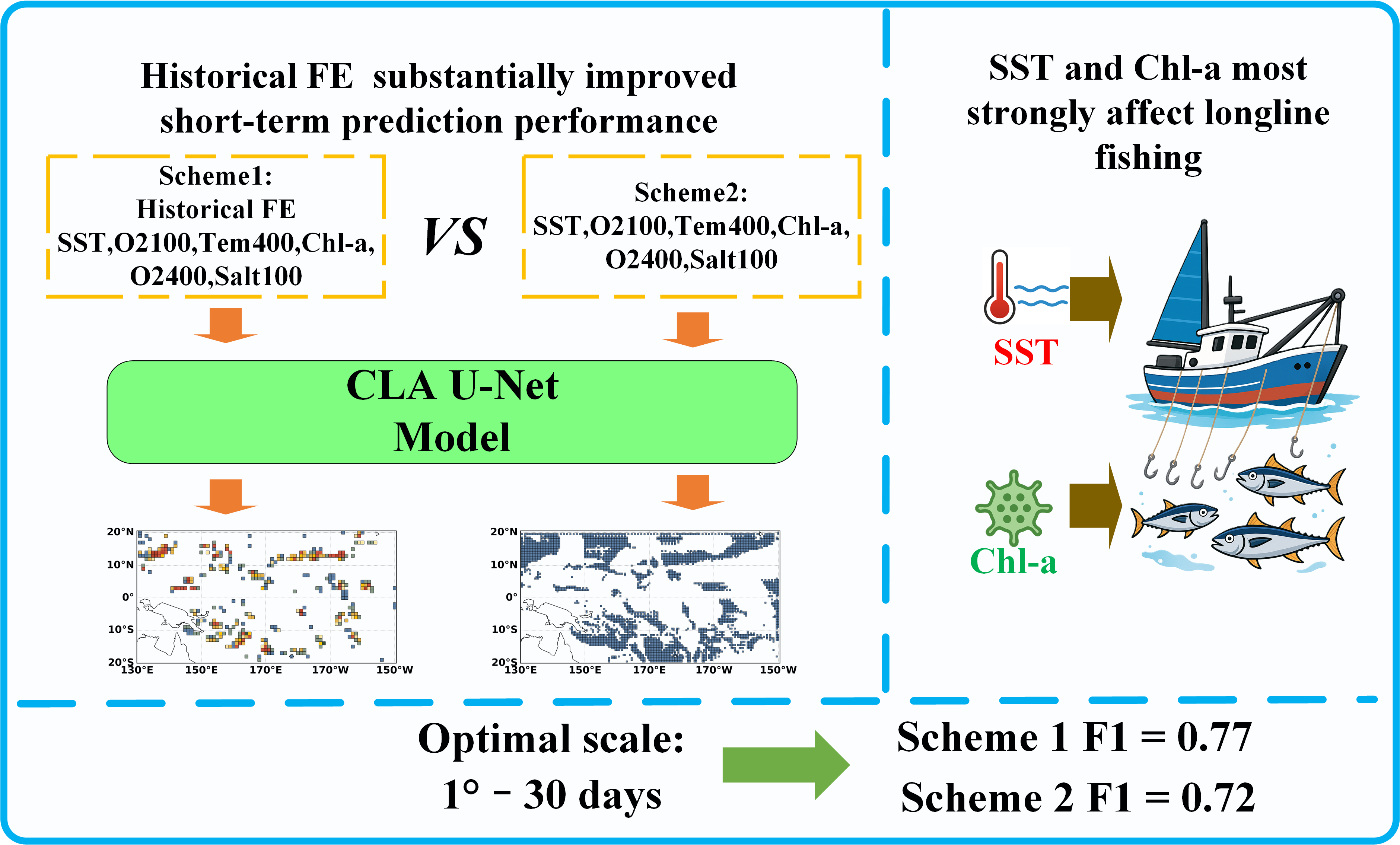
Abstract
1. Introduction
2. Data and Methods
2.1. Fishing Effort Data and Environmental Data
2.1.1. Fishing Effort Data
2.1.2. Environmental Predictor Variables
2.2. Data Processing
2.2.1. Design of the Scheme
2.2.2. Normalization
2.3. Model Design
2.3.1. Convolutional Long Short-Term Memory Network (ConvLSTM)
2.3.2. Attention U-Net
2.3.3. ConvLSTM Attention U-Net (CLA U-Net)
2.4. Deep Learning Model Fitting
2.5. Evaluation Metrics
2.6. Variable Importance Assessment
3. Result
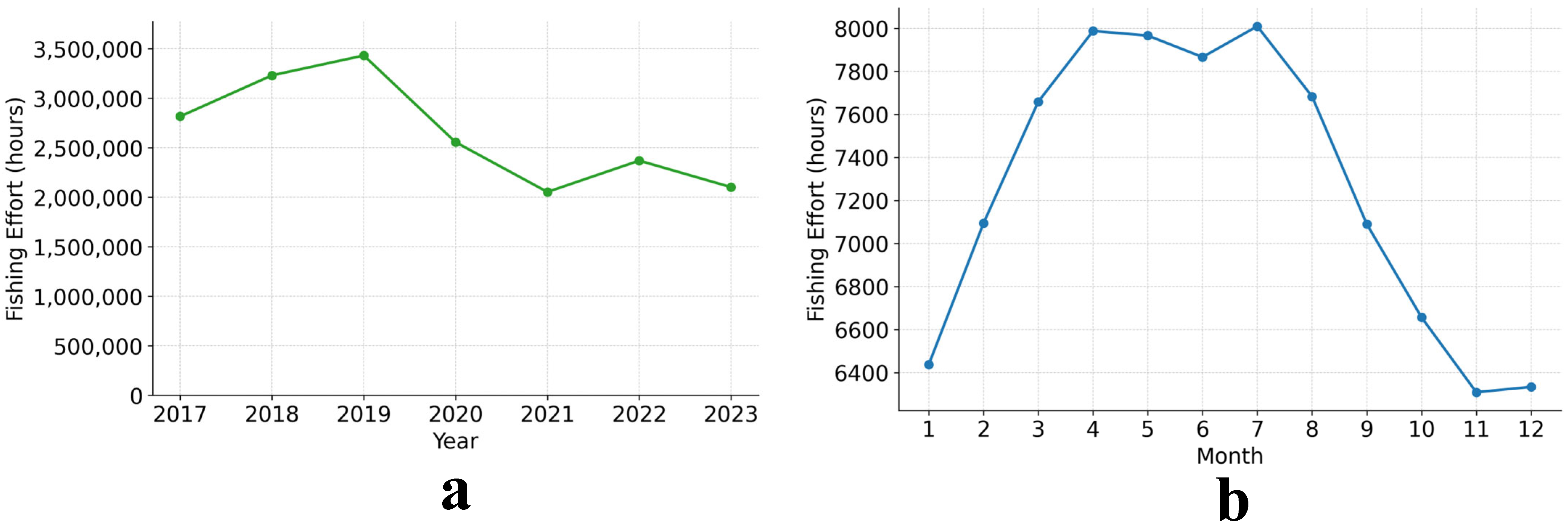
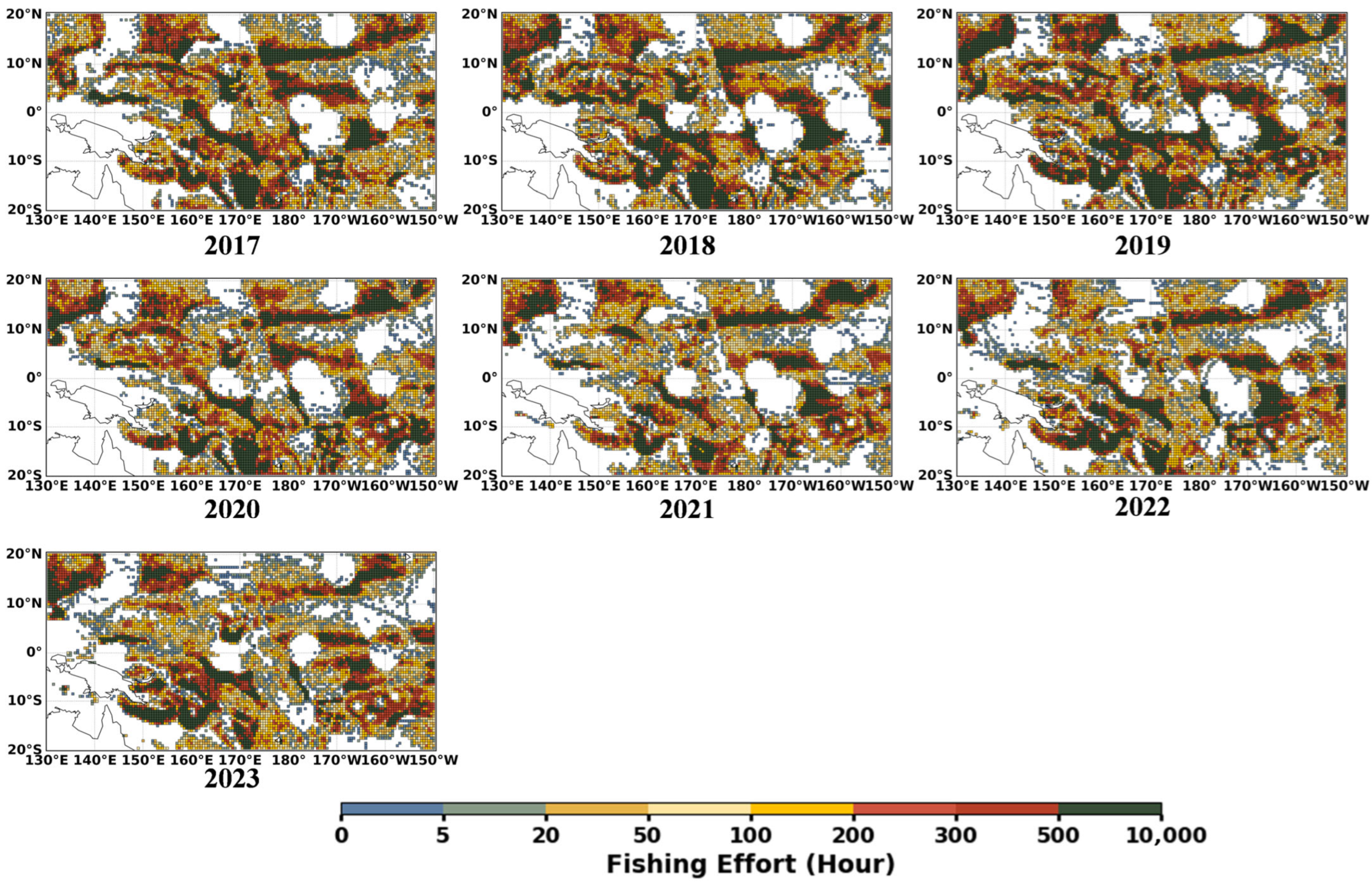
3.1. Spatiotemporal Characteristics of Tuna Longline Fishing Vessel Operations in the WCPO
3.2. Optimal Spatiotemporal Scale Assessment
3.3. Model Prediction Performance Evaluation
3.4. Assessment of Variable Importance
4. Discussion
4.1. Spatiotemporal Prediction of Fishing Effort
4.2. Impact of Historical Fishing Information on Model Outcomes
4.3. Variability Analysis of Model Performance Across Different Spatiotemporal Scales
4.4. Analysis of Variable Importance in the Model
5. Conclusions
Supplementary Materials
Author Contributions
Funding
Institutional Review Board Statement
Informed Consent Statement
Data Availability Statement
Acknowledgments
Conflicts of Interest
References
- Shen, H.; Song, L. Implementing Ecosystem Approach to Fisheries Management in the Western and Central Pacific Fisheries Commission: Challenges and Prospects. Fishes 2023, 8, 198. [Google Scholar] [CrossRef]
- Crespo, G.O.; Dunn, D.C.; Reygondeau, G.; Boerder, K.; Worm, B.; Cheung, W.; Tittensor, D.P.; Halpin, P.N. The environmental niche of the global high seas pelagic longline fleet. Sci. Adv. 2018, 4, eaat3681. [Google Scholar] [CrossRef]
- Agnew, D.J.; Pearce, J.; Pramod, G.; Peatman, T.; Watson, R.; Beddington, J.R.; Pitcher, T.J. Estimating the worldwide extent of illegal fishing. PLoS ONE 2009, 4, e4570. [Google Scholar] [CrossRef] [PubMed]
- Mackay, M.; Hardesty, B.D.; Wilcox, C. The intersection between illegal fishing, crimes at sea, and social well-being. Front. Mar. Sci. 2020, 7, 589000. [Google Scholar] [CrossRef]
- Bye, R.J.; Aalberg, A.L. Maritime navigation accidents and risk indicators: An exploratory statistical analysis using AIS data and accident reports. Reliab. Eng. Syst. Saf. 2018, 176, 174–186. [Google Scholar] [CrossRef]
- Huang, L.; Wen, Y.; Zhang, Y.; Zhou, C.; Zhang, F.; Yang, T. Dynamic calculation of ship exhaust emissions based on real-time AIS data. Transp. Res. Part D Transp. Environ. 2020, 80, 102277. [Google Scholar]
- Kontopoulos, I.; Varlamis, I.; Tserpes, K. A distributed framework for extracting maritime traffic patterns. Int. J. Geogr. Inf. Sci. 2021, 35, 767–792. [Google Scholar]
- Coomber, F.G.; D’Incà, M.; Rosso, M.; Tepsich, P.; di Sciara, G.N.; Moulins, A. Description of the vessel traffic within the north Pelagos Sanctuary: Inputs for Marine Spatial Planning and management implications within an existing international Marine Protected Area. Mar. Policy 2016, 69, 102–113. [Google Scholar] [CrossRef]
- Selig, E.R.; Nakayama, S.; Wabnitz, C.C.; Österblom, H.; Spijkers, J.; Miller, N.A.; Bebbington, J.; Decker Sparks, J.L. Revealing global risks of labor abuse and illegal, unreported, and unregulated fishing. Nat. Commun. 2022, 13, 1612. [Google Scholar] [CrossRef]
- White, T.D.; Ong, T.; Ferretti, F.; Block, B.A.; McCauley, D.J.; Micheli, F.; De Leo, G.A. Tracking the response of industrial fishing fleets to large marine protected areas in the Pacific Ocean. Conserv. Biol. 2020, 34, 1571–1578. [Google Scholar] [CrossRef] [PubMed]
- Chen, R.; Wu, X.; Liu, B.; Wang, Y.; Gao, Z. Mapping coastal fishing grounds and assessing the effectiveness of fishery regulation measures with AIS data: A case study of the sea area around the Bohai Strait, China. Ocean Coast. Manag. 2022, 223, 106136. [Google Scholar] [CrossRef]
- James, M.; Mendo, T.; Jones, E.L.; Orr, K.; McKnight, A.; Thompson, J. AIS data to inform small scale fisheries management and marine spatial planning. Mar. Policy 2018, 91, 113–121. [Google Scholar] [CrossRef]
- Le Tixerant, M.; Le Guyader, D.; Gourmelon, F.; Queffelec, B. How can Automatic Identification System (AIS) data be used for maritime spatial planning? Ocean Coast. Manag. 2018, 166, 18–30. [Google Scholar] [CrossRef]
- Natale, F.; Gibin, M.; Alessandrini, A.; Vespe, M.; Paulrud, A. Mapping fishing effort through AIS data. PLoS ONE 2015, 10, e0130746. [Google Scholar] [CrossRef]
- Le Guyader, D.; Ray, C.; Gourmelon, F.; Brosset, D. Defining high-resolution dredge fishing grounds with Automatic Identification System (AIS) data. Aquat. Living Resour. 2017, 30, 39. [Google Scholar] [CrossRef]
- Russo, T.; Carpentieri, P.; D’Andrea, L.; De Angelis, P.; Fiorentino, F.; Franceschini, S.; Garofalo, G.; Labanchi, L.; Parisi, A.; Scardi, M.; et al. Trends in effort and yield of trawl fisheries: A case study from the Mediterranean Sea. Front. Mar. Sci. 2019, 6, 153. [Google Scholar] [CrossRef]
- Soykan, C.U.; Eguchi, T.; Kohin, S.; Dewar, H. Prediction of fishing effort distributions using boosted regression trees. Ecol. Appl. 2014, 24, 71–83. [Google Scholar] [CrossRef] [PubMed]
- Cornic, M.; Rooker, J.R. Influence of oceanographic conditions on the distribution and abundance of blackfin tuna (Thunnus atlanticus) larvae in the Gulf of Mexico. Fish. Res. 2018, 201, 1–10. [Google Scholar] [CrossRef]
- Reimer, M.N.; Abbott, J.K.; Wilen, J.E. Fisheries production: Management institutions, spatial choice, and the quest for policy invariance. Mar. Resour. Econ. 2017, 32, 143–168. [Google Scholar] [CrossRef]
- Olsen, N.A.; Bahr, F.; Bethoney, N.D.; Mercer, A.M.; Gawarkiewicz, G. Integrating fishers’ knowledge with oceanographic observations to understand changing ocean conditions in the Northeast United States. Front. Mar. Sci. 2023, 10, 1144178. [Google Scholar] [CrossRef]
- Xu, W.; Sun, Y.; Huang, H. Multi-task Fishing Condition Prediction Based on Ocean Sensing and Vessel Trajectories Data. Comput. Syst. Appl. 2022, 31, 333–340. [Google Scholar]
- Fei, Y.; Yang, S.; Fan, W.; Shi, H.; Zhang, H.; Yuan, S. Relationship between the spatial and temporal distribution of squid-jigging vessels operations and marine environment in the North Pacific ocean. J. Mar. Sci. Eng. 2022, 10, 550. [Google Scholar] [CrossRef]
- Yang, S.; Zhang, H.; Fan, W.; Shi, H.; Fei, Y.; Yuan, S. Behaviour Impact Analysis of Tuna Purse Seiners in the Western and Central Pacific Based on the BRT and GAM Models. Front. Mar. Sci. 2022, 9, 881036. [Google Scholar] [CrossRef]
- Yang, S.; Yu, L.; Wang, F.; Chen, T.; Fei, Y.; Zhang, S.; Fan, W. The Environmental Niche of the Tuna Purse Seine Fleet in the Western and Central Pacific Ocean Based on Different Fisheries Data. Fishes 2023, 8, 78. [Google Scholar] [CrossRef]
- Yang, S.; Fei, Y.; Yu, L.; Tang, F.; Zhang, S.; Cheng, T.; Fan, W.; Yuan, S.; Zhang, H.; Jiang, K. The environmental niche of the squid-jigging fleet in the North Pacific Ocean based on automatic identification system data. Ecol. Indic. 2023, 155, 110934. [Google Scholar] [CrossRef]
- Su, S.; Mao, Q.; Li, Y.; Li, H.; Leng, J.; Lu, C. Deep learning-based fishing ground prediction for albacore and yellowfin tuna in the Western and Central Pacific Ocean. Fish. Res. 2024, 278, 107103. [Google Scholar] [CrossRef]
- Xie, M.; Liu, B.; Chen, X.; Yu, W.; Wang, J. Deep Learning-Based Fishing Ground Prediction Using Asymmetric Spatiotemporal Scales: A Case Study of Ommastrephes bartramii. Fishes 2024, 9, 64. [Google Scholar] [CrossRef]
- Du, Y.; Ma, Y.; Wang, J.; Chen, K. Prediction of spatial-temporal distribution trend of Pacific albacore tuna based on ConvLSTM-CNN. Mar. Sci. Bull. 2024, 43, 174–187. [Google Scholar]
- Xie, M.; Liu, B.; Chen, X. Deep learning-based fishing ground prediction with multiple environmental factors. Mar. Life Sci. Technol. 2024, 6, 736–749. [Google Scholar] [CrossRef] [PubMed]
- Han, H.; Yang, C.; Jiang, B.; Shang, C.; Sun, Y.; Zhao, X.; Xiang, D.; Zhang, H.; Shi, Y. Construction of chub mackerel (Scomber japonicus) fishing ground prediction model in the northwestern Pacific Ocean based on deep learning and marine environmental variables. Mar. Pollut. Bull. 2023, 193, 115158. [Google Scholar] [CrossRef]
- Han, H.; Jiang, B.; Shi, Y.; Jiang, P.; Zhang, H.; Shang, C.; Sun, Y.; Li, Y.; Xiang, D. Response of the Northwest Indian Ocean purpleback flying squid (Sthenoteuthis oualaniensis) fishing grounds to marine environmental changes and its prediction model construction based on multi-models and multi-spatial and temporal scales. Ecol. Indic. 2023, 154, 110809. [Google Scholar] [CrossRef]
- Zang, B.; Ding, L.; Feng, Z.; Zhu, M.; Lei, T.; Xing, M.; Zhou, X. CNN-LRP: Understanding convolutional neural networks performance for target recognition in SAR images. Sensors 2021, 21, 4536. [Google Scholar] [CrossRef]
- Nielsen, I.E.; Dera, D.; Rasool, G.; Ramachandran, R.P.; Bouaynaya, N.C. Robust explainability: A tutorial on gradient-based attribution methods for deep neural networks. IEEE Signal Process. Mag. 2022, 39, 73–84. [Google Scholar] [CrossRef]
- Lundberg, S.M.; Lee, S.-I. A unified approach to interpreting model predictions. In Proceedings of the 31st International Conference on Neural Information Processing Systems, Long Beach, CA, USA, 4–9 December 2017; Volume 30. [Google Scholar]
- Ribeiro, M.T.; Singh, S.; Guestrin, C. “ Why should i trust you?” Explaining the predictions of any classifier. In Proceedings of the 22nd ACM SIGKDD International Conference on Knowledge Discovery and Data Mining, San Francisco, CA, USA, 13–17 August 2016; pp. 1135–1144. [Google Scholar]
- Amoroso, R.O.; Parma, A.M.; Pitcher, C.R.; McConnaughey, R.; Jennings, S. Comment on “Tracking the global footprint of fisheries”. Science 2018, 361, eaat6713. [Google Scholar] [CrossRef] [PubMed]
- Shi, X.; Chen, Z.; Wang, H.; Yeung, D.-Y.; Wong, W.-K.; Woo, W.-C. Convolutional LSTM network: A machine learning approach for precipitation nowcasting. In Proceedings of the 29th International Conference on Neural Information Processing Systems, Montreal, QC, Canada, 7–12 December 2015; Volume 28. [Google Scholar]
- Pan, X.; Lu, Y.; Zhao, K.; Huang, H.; Wang, M.; Chen, H. Improving nowcasting of convective development by incorporating polarimetric radar variables into a deep-learning model. Geophys. Res. Lett. 2021, 48, e2021GL095302. [Google Scholar] [CrossRef]
- Oktay, O.; Schlemper, J.; Folgoc, L.L.; Lee, M.; Heinrich, M.; Misawa, K.; Mori, K.; McDonagh, S.; Hammerla, N.Y.; Kainz, B. Attention u-net: Learning where to look for the pancreas. arXiv 2018, arXiv:1804.03999. [Google Scholar] [CrossRef]
- Song, Z.; Li, J. Variable selection with false discovery rate control in deep neural networks. Nat. Mach. Intell. 2021, 3, 426–433. [Google Scholar] [CrossRef]
- Williams, P.; Ruaia, T. Overview of tuna fisheries in the western and central Pacific Ocean, including economic conditions—2022. In Proceedings of the 18th Regular Session of the WCPFC Scientific Commission, Koror, Palau, 16–24 August 2023. [Google Scholar]
- Juan-Jordá, M.J.; Mosqueira, I.; Cooper, A.B.; Freire, J.; Dulvy, N.K. Global population trajectories of tunas and their relatives. Proc. Natl. Acad. Sci. USA 2011, 108, 20650–20655. [Google Scholar] [CrossRef]
- Kroodsma, D.A.; Mayorga, J.; Hochberg, T.; Miller, N.A.; Boerder, K.; Ferretti, F.; Wilson, A.; Bergman, B.; White, T.D.; Block, B.A.; et al. Tracking the global footprint of fisheries. Science 2018, 359, 904–908. [Google Scholar] [CrossRef] [PubMed]
- Vaihola, S.; Kininmonth, S. Environmental Factors Determine Tuna Fishing Vessels’ Behavior in Tonga. Fishes 2023, 8, 602. [Google Scholar] [CrossRef]
- Jiarong, Z.; Xiaoming, Y.; Xiaojie, D.; Lijin, Z. Relationship between catch rate of longline albacore (Thunnus alalunga) and environmental factors in South Pacific. South China Fish. Sci. 2020, 16, 69–77. [Google Scholar]
- Ward, P.; Hindmarsh, S. An overview of historical changes in the fishing gear and practices of pelagic longliners, with particular reference to Japan’s Pacific fleet. Rev. Fish Biol. Fish. 2006, 17, 501–516. [Google Scholar] [CrossRef]
- Xie, M.; Liu, B.; Chen, X. Prediction on fishing ground of Ommastrephes bartramii in Northwest Pacific based on deep learning. J. Fish. China 2024, 48, 119311. [Google Scholar]
- Wang, W.; Fan, W.; Wu, Y.; Zhang, S.; Zhou, W.; Fan, X.; Shi, J.; Jin, W.; Wang, G.; Yang, S. Quantifying the spatial nonstationary response of environmental factors on purse seine tuna vessel fishing. Heliyon 2024, 10, e33298. [Google Scholar] [CrossRef]
- Wu, D.; Wu, L.; Zhang, T.; Zhang, W.; Huang, J.; Wang, X. Short-term rainfall prediction based on radar echo using an improved self-attention PredRNN deep learning model. Atmosphere 2022, 13, 1963. [Google Scholar] [CrossRef]
- Bouget, V.; Bereziat, D.; Brajard, J.; Charantonis, A.; Filoche, A. Fusion of rain radar images and wind forecasts in a deep learning model applied to rain nowcasting. Remote Sens. 2021, 13, 246. [Google Scholar] [CrossRef]
- Yang, S.; Shi, H.; Fan, X.; Cui, X.; Wang, F.; Zhang, H. Spatial Analysis of Suitable Habitat for Yellowfin Tuna in the Tropical Central and Western Pacific Ocean. J. Agric. Sci. Technol. 2022, 24, 183–191. [Google Scholar] [CrossRef]
- Núñez-Riboni, I.; Akimova, A.; Sell, A.F. Effect of data spatial scale on the performance of fish habitat models. Fish Fish. 2021, 22, 955–973. [Google Scholar] [CrossRef]
- Zhou, X.; Ma, S.; Cai, Y.; Yu, J.; Chen, Z.; Fan, J. The Influence of Spatial and Temporal Scales on Fisheries Modeling—An Example of Sthenoteuthis oualaniensis in the Nansha Islands, South China Sea. J. Mar. Sci. Eng. 2022, 10, 1840. [Google Scholar] [CrossRef]
- Gangopadhyay, S.; Clark, M.; Werner, K.; Brandon, D.; Rajagopalan, B. Effects of spatial and temporal aggregation on the accuracy of statistically downscaled precipitation estimates in the upper Colorado River basin. J. Hydrometeorol. 2004, 5, 1192–1206. [Google Scholar] [CrossRef]
- Meng, W.; Gong, Y.; Wang, X.; Tong, J.; Han, D.; Chen, J.; Wu, J. Influence of spatial scale selection of environmental factors on the prediction of distribution of Coilia nasus in Changjiang River Estuary. Fishes 2021, 6, 48. [Google Scholar] [CrossRef]
- Gong, C.; Chen, X.; Gao, F.; Tian, S. Effect of spatial and temporal scales on habitat suitability modeling: A case study of Ommastrephes bartramii in the northwest pacific ocean. J. Ocean. Univ. China 2014, 13, 1043–1053. [Google Scholar] [CrossRef]
- Shwartz-Ziv, R.; Goldblum, M.; Li, Y.L.; Bruss, C.B.; Wilson, A.G. Simplifying neural network training under class imbalance. In Proceedings of the 37th International Conference on Neural Information Processing Systems, New Orleans, LA, USA, 10–16 December 2023; p. 1530. [Google Scholar]
- Feng, G.; Xinjun, C.; Wenjiang, G.; Gang, L. Fishing ground forecasting of Chub mackerel in the Yellow Sea and East China Sea using boosted regression trees. Haiyang Xuebao 2015, 37, 39–48. [Google Scholar] [CrossRef]
- Girardin, R.; Vermard, Y.; Thébaud, O.; Tidd, A.; Marchal, P. Predicting fisher response to competition for space and resources in a mixed demersal fishery. Ocean. Coast. Manag. 2015, 106, 124–135. [Google Scholar] [CrossRef]
- Vaihola, S.; Yemane, D.; Kininmonth, S. Spatiotemporal Patterns in the Distribution of Albacore, Bigeye, Skipjack, and Yellowfin Tuna Species within the Exclusive Economic Zones of Tonga for the Years 2002 to 2018. Diversity 2023, 15, 1091. [Google Scholar] [CrossRef]
- Wang, W.; Fan, W.; Yu, L.; Wang, F.; Wu, Z.; Shi, J.; Cui, X.; Cheng, T.; Jin, W.; Wang, G.; et al. Analysis of multi-scale effects and spatial heterogeneity of environmental factors influencing purse seine tuna fishing activities in the Western and Central Pacific Ocean. Heliyon 2024, 10, e38099. [Google Scholar] [CrossRef]
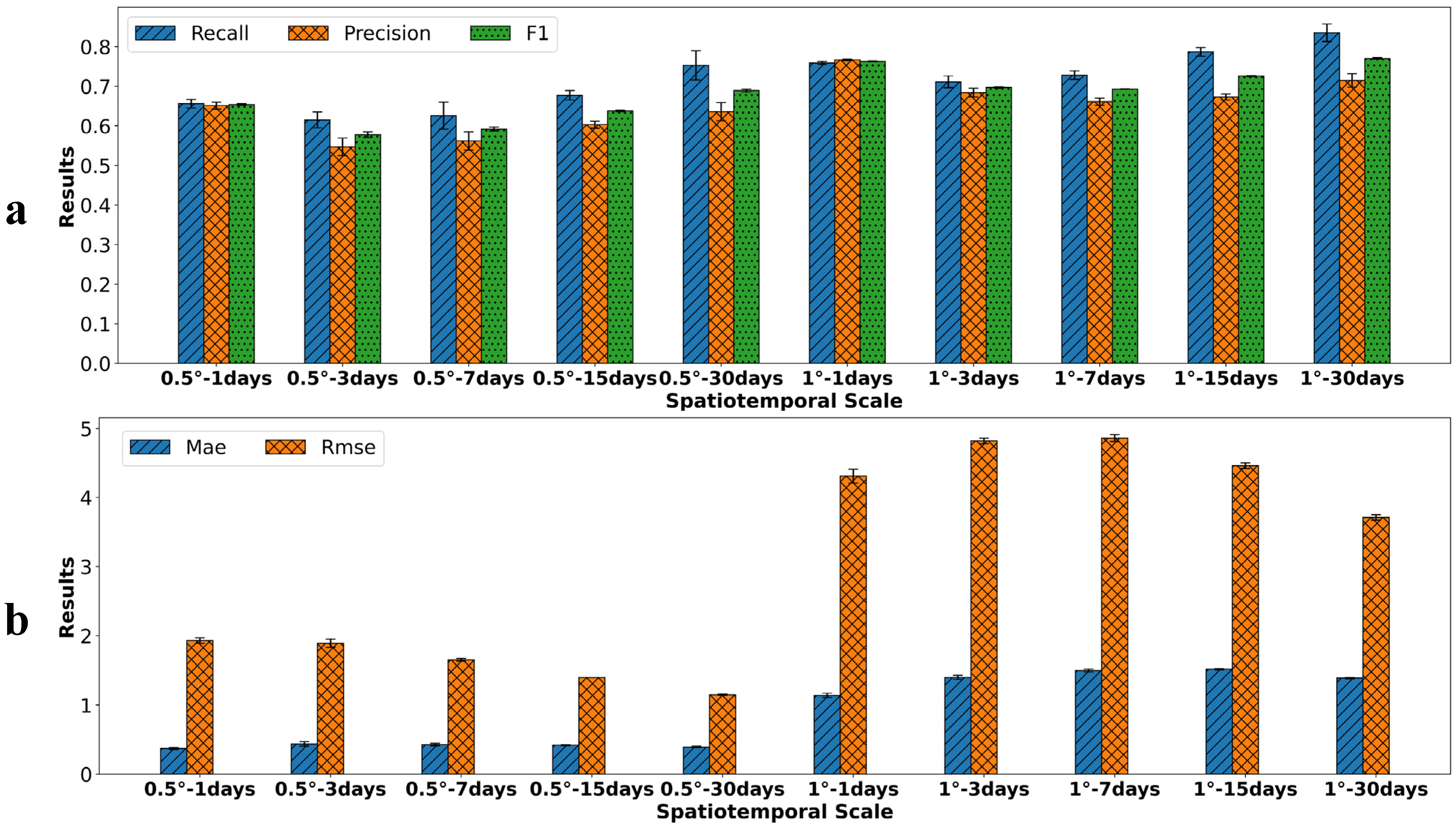


| Spatiotemporal Scale | Accuracy | F1 | Precision | Recall | MAE | RMSE |
|---|---|---|---|---|---|---|
| 0.5°-1 days | 0.961 ± 0.000 | 0.654 ± 0.002 | 0.651 ± 0.009 | 0.656 ± 0.011 | 0.372 ± 0.014 | 1.93 ± 0.04 |
| 0.5°-3 days | 0.917 ± 0.004 | 0.578 ± 0.007 | 0.547 ± 0.022 | 0.615 ± 0.020 | 0.437 ± 0.034 | 1.89 ± 0.06 |
| 0.5°-7 days | 0.875 ± 0.006 | 0.592 ± 0.005 | 0.562 ± 0.023 | 0.626 ± 0.034 | 0.427 ± 0.018 | 1.65 ± 0.02 |
| 0.5°-15 days | 0.835 ± 0.003 | 0.638 ± 0.002 | 0.603 ± 0.009 | 0.677 ± 0.012 | 0.420 ± 0.007 | 1.40 ± 0.00 |
| 0.5°-30 days | 0.802 ± 0.008 | 0.689 ± 0.004 | 0.636 ± 0.023 | 0.753 ± 0.037 | 0.392 ± 0.012 | 1.15 ± 0.01 |
| 1°-1 days | 0.943 ± 0.000 | 0.763 ± 0.001 | 0.767 ± 0.002 | 0.759 ± 0.004 | 1.14 ± 0.03 | 4.31 ± 0.10 |
| 1°-3 days | 0.893 ± 0.002 | 0.697 ± 0.002 | 0.684 ± 0.011 | 0.711 ± 0.015 | 1.40 ± 0.03 | 4.82 ± 0.04 |
| 1°-7 days | 0.843 ± 0.003 | 0.693 ± 0.001 | 0.661 ± 0.009 | 0.728 ± 0.011 | 1.50 ± 0.02 | 4.86 ± 0.05 |
| 1°-15 days | 0.803 ± 0.003 | 0.726 ± 0.001 | 0.673 ± 0.008 | 0.787 ± 0.011 | 1.52 ± 0.01 | 4.46 ± 0.04 |
| 1°-30 days | 0.790 ± 0.007 | 0.770 ± 0.002 | 0.715 ± 0.017 | 0.835 ± 0.022 | 1.39 ± 0.01 | 3.71 ± 0.04 |
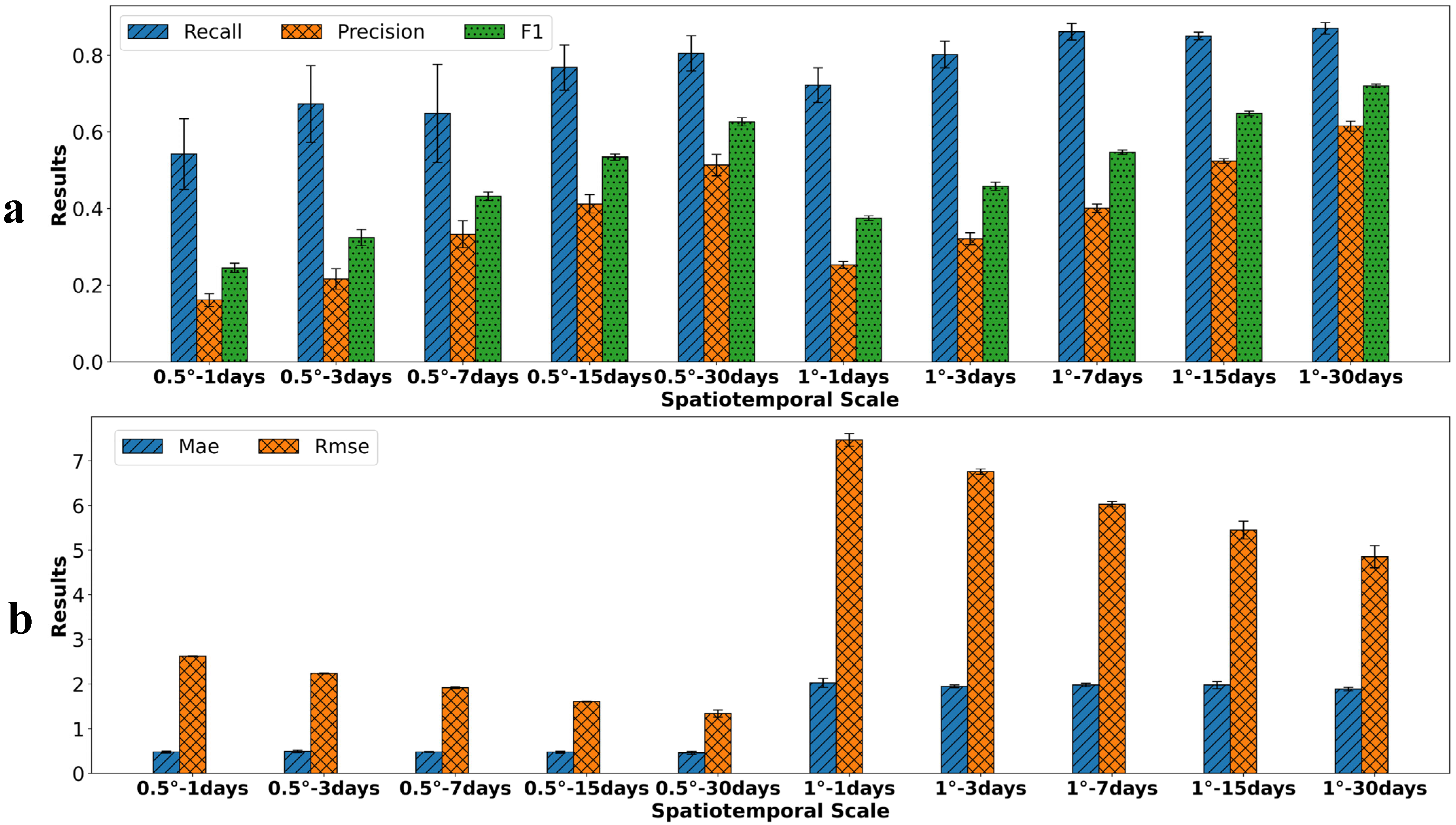
| Spatiotemporal Scale | Accuracy | F1 | Precision | Recall | MAE | RMSE |
|---|---|---|---|---|---|---|
| 0.5°-1 days | 0.811 ± 0.041 | 0.245 ± 0.012 | 0.161 ± 0.017 | 0.542 ± 0.092 | 0.478 ± 0.022 | 2.62 ± 0.01 |
| 0.5°-3 days | 0.736 ± 0.062 | 0.324 ± 0.021 | 0.216 ± 0.027 | 0.673 ± 0.100 | 0.490 ± 0.027 | 2.24 ± 0.01 |
| 0.5°-7 days | 0.754 ± 0.046 | 0.432 ± 0.011 | 0.333 ± 0.035 | 0.648 ± 0.128 | 0.478 ± 0.010 | 1.92 ± 0.02 |
| 0.5°-15 days | 0.712 ± 0.029 | 0.534 ± 0.008 | 0.412 ± 0.024 | 0.768 ± 0.059 | 0.475 ± 0.022 | 1.61 ± 0.01 |
| 0.5°-30 days | 0.720 ± 0.025 | 0.626 ± 0.011 | 0.513 ± 0.028 | 0.805 ± 0.046 | 0.458 ± 0.036 | 1.34 ± 0.08 |
| 1°-1 days | 0.708 ± 0.024 | 0.375 ± 0.006 | 0.253 ± 0.009 | 0.722 ± 0.045 | 2.03 ± 0.10 | 7.47 ± 0.14 |
| 1°-3 days | 0.672 ± 0.028 | 0.458 ± 0.011 | 0.321 ± 0.015 | 0.802 ± 0.035 | 1.95 ± 0.03 | 6.76 ± 0.06 |
| 1°-7 days | 0.653 ± 0.017 | 0.547 ± 0.006 | 0.401 ± 0.011 | 0.861 ± 0.022 | 1.98 ± 0.04 | 6.03 ± 0.06 |
| 1°-15 days | 0.695 ± 0.006 | 0.648 ± 0.006 | 0.524 ± 0.006 | 0.850 ± 0.010 | 1.98 ± 0.08 | 5.45 ± 0.20 |
| 1°-30 days | 0.715 ± 0.010 | 0.720 ± 0.005 | 0.615 ± 0.013 | 0.870 ± 0.015 | 1.89 ± 0.04 | 4.85 ± 0.25 |
Disclaimer/Publisher’s Note: The statements, opinions and data contained in all publications are solely those of the individual author(s) and contributor(s) and not of MDPI and/or the editor(s). MDPI and/or the editor(s) disclaim responsibility for any injury to people or property resulting from any ideas, methods, instructions or products referred to in the content. |
© 2025 by the authors. Licensee MDPI, Basel, Switzerland. This article is an open access article distributed under the terms and conditions of the Creative Commons Attribution (CC BY) license (https://creativecommons.org/licenses/by/4.0/).
Share and Cite
Yang, S.; Wang, W.; Cheng, T.; Zhang, S.; Dai, Y.; Wang, F.; Zhang, H.; Shi, Y.; Zhou, W.; Fan, W. Short- and Medium-Term Predictions of Spatiotemporal Distribution of Marine Fishing Efforts Using Deep Learning. Fishes 2025, 10, 479. https://doi.org/10.3390/fishes10100479
Yang S, Wang W, Cheng T, Zhang S, Dai Y, Wang F, Zhang H, Shi Y, Zhou W, Fan W. Short- and Medium-Term Predictions of Spatiotemporal Distribution of Marine Fishing Efforts Using Deep Learning. Fishes. 2025; 10(10):479. https://doi.org/10.3390/fishes10100479
Chicago/Turabian StyleYang, Shenglong, Wei Wang, Tianfei Cheng, Shengmao Zhang, Yang Dai, Fei Wang, Heng Zhang, Yongchuang Shi, Weifeng Zhou, and Wei Fan. 2025. "Short- and Medium-Term Predictions of Spatiotemporal Distribution of Marine Fishing Efforts Using Deep Learning" Fishes 10, no. 10: 479. https://doi.org/10.3390/fishes10100479
APA StyleYang, S., Wang, W., Cheng, T., Zhang, S., Dai, Y., Wang, F., Zhang, H., Shi, Y., Zhou, W., & Fan, W. (2025). Short- and Medium-Term Predictions of Spatiotemporal Distribution of Marine Fishing Efforts Using Deep Learning. Fishes, 10(10), 479. https://doi.org/10.3390/fishes10100479