
A Parameterizable Research Framework for Electronic Voting Based on Cryptographic Protocols and Blockchain Audit




Abstract
1. Introduction
- The integration of multiple types of cryptographic mechanisms with a single voting architecture;
- Configuring a voting architecture security level based on the specific needs of these applications;
- Measuring the performance impact of any given mechanism chosen to implement.
- We formally define a parameterizable designer for electronic voting scenarios as a configurable design space that combines authorization, ballot protection, audit, tallying, verification, security profiles, and measurable performance/integrity metrics.
- We implement a reproducible research prototype that instantiates this design space through blind-signature-based anonymous authorization, encrypted ballot submission, blockchain-style audit, receipt verification, homomorphic tally publication, threshold-supported tally artifacts, and automated integrity checks.
- We empirically demonstrate, within the stated prototype threat model, that the implemented mechanisms support eligibility control, repeated-vote prevention, receipt-based inclusion checking, ledger-derived tally publication, and audit-state consistency.
- We measure the computational overhead of different security configurations and show that authentication, anonymous token issuance, and receipt verification remain relatively stable at the studied prototype scale, while encrypted ballot submission and threshold-supported tally publication dominate the cryptographic cost.
- We identify the limitations of the current prototype, including the absence of a full zero-knowledge proof layer, coercion resistance, independently deployed threshold authorities, real distributed consensus, and large-scale deployment evaluation.
2. Related Work
2.1. End-to-End Verifiable Voting Systems
2.2. Classical Cryptographic Voting Schemes
2.3. Blockchain-Based Electronic Voting Systems
2.4. Modular and Configurable Voting Architectures
2.5. Comparison with the Closest Research Areas
3. Architecture of the Proposed Constructor
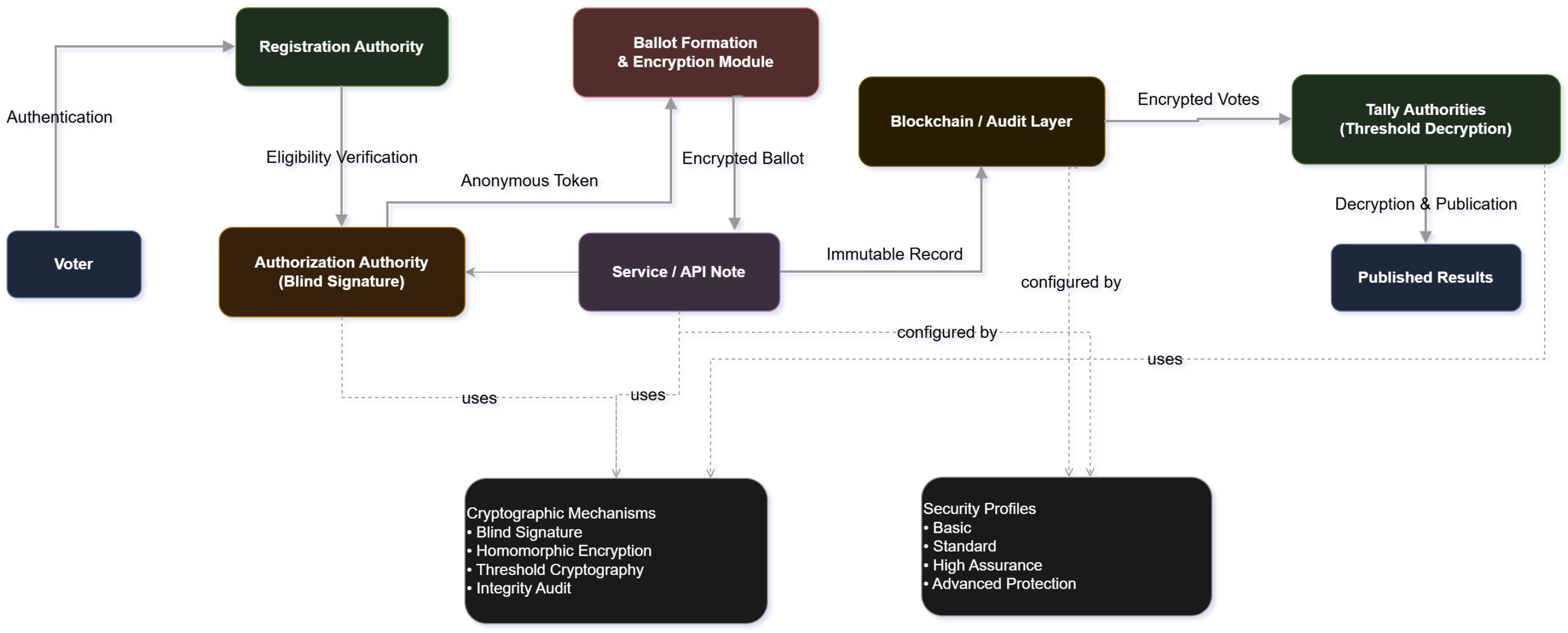
3.1. The Overall Architecture of the System
3.2. System Participants
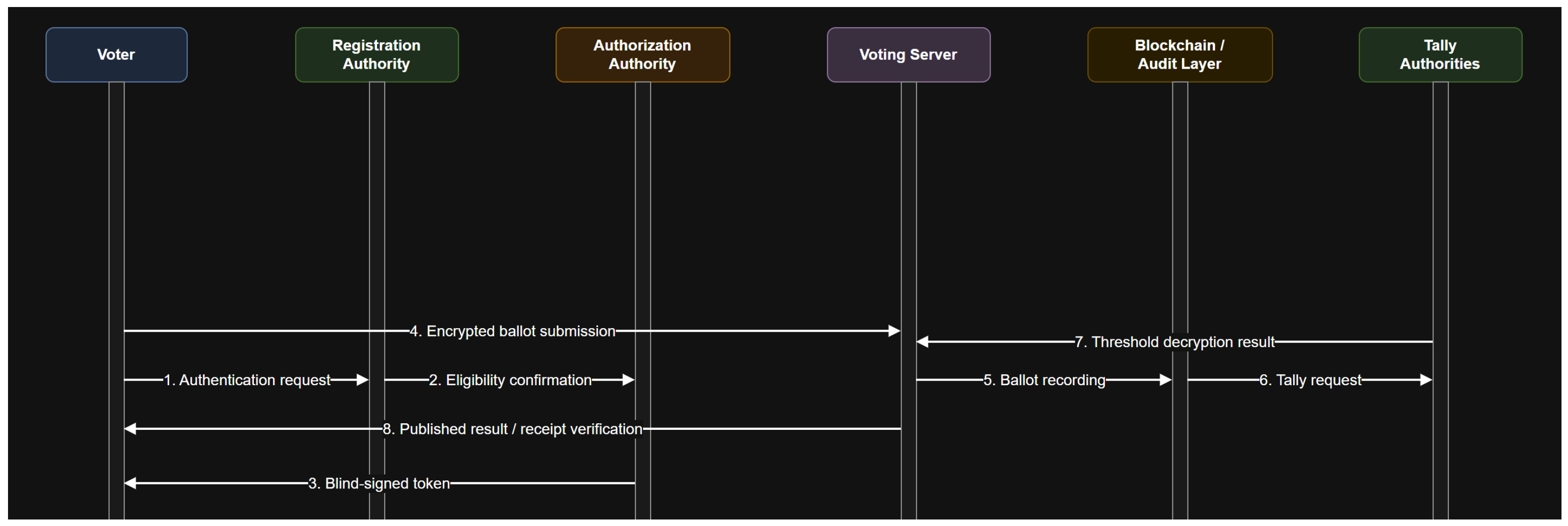
- Voter—generates and sends an encrypted ballot;
- Registration Authority—confirms the right to participate in voting;
- Authorization Authority—performs a blind token signature;
- Voting Server—accepts encrypted ballots;
- Audit Module (Audit Layer/Blockchain)—ensures the immutability of records;
- A set of trusted nodes (Tally Authorities) performs threshold decryption of the results.
3.3. Voting Protocol
3.4. Formalized Voting Protocol Flow
3.5. Cryptographic Mechanisms of the Constructor
- Blind signature
- 2.
- Ballot encryption
- 3.
- Individual verifiability (receipt-based verification)
- 4.
- Homomorphic aggregation
- 5.
- Threshold publication of the result
3.6. The Role of Blockchain Audit
- (1)
- recording of confirmed ballots;
- (2)
- support for subsequent verification of data immutability;
- (3)
- the formation of a publicly analyzed layer of events for audit and research.
3.7. Parameterizability and Security Profiles
- The basic level is the use of a minimal set of cryptographic mechanisms with an emphasis on integrity and ease of implementation;
- Standard level—adding anonymous authorization and ballot encryption;
- High level—the use of homomorphic aggregation and elements of threshold cryptography;
- Advanced level—the most complete set currently implemented in the prototype, including anonymous authorization, encryption, homomorphic counting, and threshold-supported publication of results.
4. Threat Model and Security Properties
4.1. Threat Model
4.2. Security Properties
- Eligibility: the right to participate in voting should be granted only to registered and admitted participants;
- Uniqueness: a participant should not be able to submit more than one valid ballot within the same electoral process;
- Privacy: The ballot record and the relationship between the participant and their election should remain obscured to external observation by the protection model implemented in the system;
- Integrity: Confirmed records should not undergo changes in an unnoticeable way after being placed in the confirmed area of the system;
- Individual verifiability: The ballot should have a way to verify (prove) there is a record of your ballot being included in the official confirmed states and an external observer will be able to verify that record as well through the use of the public ballot board and the confirmed chain.
- Audit Trail: A record of transactions showing all the steps in the history of all events, the status has been confirmed, and the final outcome of a publication is available to be validated against a predefined list of potential outcomes.
- Reduced Trust: The architecture must minimize centralization of trust, even if this is only partial for current implementation and prototype.
5. Materials and Methods
5.1. Methodological Approach
5.2. Research Prototype
5.3. Security Profiles as an Object of Parameterization
5.4. Experimental Methodology
- Authentication time;
- The time when the anonymous token was issued;
- The time of submission of the protected ballot;
- Receipt verification time;
- Block confirmation time;
- The e time of the basic publication of the result;
- The publication time of the threshold-supported result;
- Chain length increase;
- The number of published confirmation artifacts.
Automated Verification of the Correctness of the Prototype
6. Results
6.1. General Characteristics of the Results Obtained
6.2. Results of Computational Experiments
6.2.1. Visual Benchmark of the Constructor Profiles
Detailed Scenario Matrices
6.2.2. Automated Verification Results
6.3. Interpretation of the Results from the Point of View of the Security Architecture
6.4. The Results of the Analysis of Security Properties
- In the architectural aspect, since an integrated secure voting model is proposed that surpasses a simple voting scheme based on the blockchain;
- In the protocol aspect, since anonymous authorization, ballot encryption, receipt verification, homomorphic aggregation and threshold-supported publication of the tally are combined;
- In the methodological aspect, since a reproducible research constructor has been created to analyze the trade-offs between security and computational cost.
7. Discussion
7.1. Scientific Significance of the Proposed Approach
7.2. Comparison with Basic Blockchain Voting Models
7.3. A Compromise Between Security and Performance
Validation of Basic Statements
7.4. Limitations of the Current Prototype
Correct Statement Boundaries
7.5. Limitations of Interpretation of Results
7.6. Prospects for Further Development
- Placing the publication threshold authorities in independent processes or services;
- Introduction of separate authentication and authorization for administrative operations of the service node;
- Bringing cryptographic keys and threshold shares into a more isolated secret storage loop;
- Development of the evidentiary verification layer towards more formalized mechanisms with zero disclosure;
- Expansion of the experimental base in terms of the number of voters, the number of choices and the number of publication bodies of the results;
- Deeper comparative analysis with mix-net and full-format homomorphic voting schemes;
- Formalization of confidence assumptions and constraints in a mathematically more rigorous form.
8. Conclusions
- Proposed A parameterized constructor for electronic voting scenarios with enhanced cryptographic protection by considering the admission, anonymization, ballot submission, auditing and result publishing as a combination of agreed-upon security mechanisms.
- Implemented an experimental working prototype that utilizes blind signed anonymous ballots, encrypted ballot submissions, a blockchain audit, verifiable receipts, homomorphic aggregation, and threshold-based result publishing.
- Compared our implemented architecture against formally established security properties and the defined limitations of our defined threat model.
- A multidimensional experimental evaluation of computational costs for security was performed and includes comparisons of security profiles, numbers of voters, numbers of choice options, and threshold boundary parameters.
- Confirmed the functional stability of the prototype using a fully automated software verification process.
Author Contributions
Funding
Data Availability Statement
Conflicts of Interest
Abbreviations
| E2E | End-to-end |
| ZKP | zero-knowledge proofs |
References
- Benaloh, J.; Tuinstra, D. Receipt-free secret-ballot elections. In Proceedings of the Twenty-Sixth Annual ACM Symposium on Theory of Computing, Montreal, QC, Canada, 23–25 May 1994. [Google Scholar]
- Biehl, I.; Buchmann, J.; Meyer, B.; Thiel, C.; Thiel, C. Tools for proving zero knowledge. In Workshop on the Theory and Application of Cryptographic Techniques; Springer: Berlin/Heidelberg, Germany, 1992; pp. 356–365. [Google Scholar]
- Çabuk, U.C.; Adiguzel, E.; Karaarslan, E. A survey on feasibility and suitability of blockchain techniques for the e-voting systems. arXiv 2020, arXiv:2002.07175. [Google Scholar]
- Kho, Y.X.; Heng, S.H.; Chin, J.J. A review of cryptographic electronic voting. Symmetry 2022, 14, 858. [Google Scholar] [CrossRef]
- Chaum, D.L. Untraceable electronic mail, return addresses, and digital pseudonyms. Commun. ACM 1981, 24, 84–90. [Google Scholar] [CrossRef]
- Jakobsson, M. A practical mix. In International Conference on the Theory and Applications of Cryptographic Techniques; Springer: Berlin/Heidelberg, Germany, 1998. [Google Scholar]
- Groth, J. On the size of pairing-based non-interactive arguments. In Annual International Conference on the Theory and Applications of Cryptographic Techniques; Springer: Berlin/Heidelberg, Germany, 2016. [Google Scholar]
- Ben-Sasson, E.; Chiesa, A.; Tromer, E.; Virza, M. Succinct Non-Interactive zero knowledge for a von neumann architecture. In Proceedings of the 23rd USENIX Security Symposium (USENIX Security 14), San Diego, CA, USA, 20–22 August 2014. [Google Scholar]
- Xevgenis, M.; Kogias, D.G.; Leligou, H.C. Blockchain in next generation networks (NGNS). In Handbook of Blockchain Technology; Edward Elgar Publishing: Cheltenham, UK, 2025; pp. 329–348. [Google Scholar]
- Xu, Y.; Wang, H.; Zeng, J. SCOPE: A cross-chain supervision scheme for consortium blockchains. In International Conference on Information and Communications Security; Springer Nature: Singapore, 2023. [Google Scholar]
- Juels, A.; Catalano, D.; Jakobsson, M. Coercion-resistant electronic elections. In Proceedings of the 2005 ACM Workshop on Privacy in the Electronic Society, Alexandria, VA, USA, 5 November 2005. [Google Scholar]
- Gennaro, R.; Goldfeder, S. Fast multiparty threshold ECDSA with fast trustless setup. In Proceedings of the 2018 ACM SIGSAC Conference on Computer and Communications Security, Toronto, ON, Canada, 15–19 October 2018. [Google Scholar]
- Benaloh, J.; Lazarus, E. The Trash Attack: An Attack on Verifiable Voting Systems and a Simple Mitigatio; Technical Report MSR-TR-2011-115; Microsoft: Redmond, WA, USA, 2011. [Google Scholar]
- Kiayias, A.; Zacharias, T.; Zhang, B. On the necessity of auditing for election privacy in e-voting systems. In International Conference on e-Democracy; Springer International Publishing: Cham, Switzerland, 2015. [Google Scholar]
- Oprea, S.V.; Bâra, A.; Andreescu, A.I.; Cristescu, M.P. Conceptual architecture of a blockchain solution for e-voting in elections at the university level. IEEE Access 2023, 11, 18461–18474. [Google Scholar] [CrossRef]
- Zhang, J.; Zhang, B. Aggregation Zero Knowledge Proof Scheme Based on Blockchain Electronic Voting System. In 2025 5th International Conference on Artificial Intelligence, Big Data and Algorithms (CAIBDA); IEEE: New York, NY, USA, 2025. [Google Scholar]
- Dinh, T.Q.; Le, P.H.P.; Nguyen, A.T.H.; Nguyen, L.V. From Ballots to Blockchains: The Evolution of Peer-to-Peer Voting. In 2025 International Conference on Computing, Intelligence, and Application (CIACON); IEEE: New York, NY, USA, 2025. [Google Scholar]
- Jayakumari, B.; Sheeba, S.L.; Eapen, M.; Anbarasi, J.; Ravi, V.; Suganya, A.; Jawahar, M. E-voting system using cloud-based hybrid blockchain technology. J. Saf. Sci. Resil. 2024, 5, 102–109. [Google Scholar] [CrossRef]
- Wang, B.; Guo, F.; Liu, Y.; Li, B.; Yuan, Y. An efficient and versatile e-voting scheme on blockchain. Cybersecurity 2024, 7, 62. [Google Scholar] [CrossRef]
- Singh, A.; Ganesh, A.; Patil, R.R.; Kumar, S.; Rani, R.; Pippal, S.K. Secure voting website using Ethereum and smart contracts. Appl. Syst. Innov. 2023, 6, 70. [Google Scholar] [CrossRef]
- Li, M.; Xue, K.; Luo, X.; Sun, W.; Wei, D.S.; Sun, Q.; Lu, J. Voting: A Blockchain Sharding Based E-Voting Approach with Security and Scalability. IEEE Trans. Dependable Secur. Comput. 2024, 22, 1596–1611. [Google Scholar] [CrossRef]
- Revelo Sánchez, O.; Barón Salazar, A.; Bolaños González, M. Democratic Innovation: Systematic Evaluation of Blockchain-Based Electronic Voting (2022–2025). Technologies 2026, 14, 95. [Google Scholar] [CrossRef]
- Hajian Berenjestanaki, M.; Barzegar, H.R.; El Ioini, N.; Pahl, C. Blockchain-based e-voting systems: A technology review. Electronics 2023, 13, 17. [Google Scholar] [CrossRef]
- Adida, B. Helios: Web-based Open-Audit Voting. In Proceedings of the 17th USENIX Security Symposium, San Jose, CA, USA, 28 June–1 August 2008; Available online: https://www.usenix.org/conference/17th-usenix-security-symposium/helios-web-based-open-audit-voting (accessed on 27 March 2026).
- Chaum, D. Blind signatures for untraceable payments. In Advances in Cryptology: Proceedings of Crypto 82; Springer: Boston, MA, USA, 1983. [Google Scholar]
- Cramer, R.; Gennaro, R.; Schoenmakers, B. A secure and optimally efficient multi-authority election scheme. Eur. Trans. Telecommun. 1997, 8, 481–490. [Google Scholar] [CrossRef]
- Paillier, P. Public-key cryptosystems based on composite degree residuosity classes. In International Conference on the Theory and Applications of Cryptographic Techniques; Springer: Berlin/Heidelberg, Germany, 1999. [Google Scholar]



| Approach | Anonymous Authorization | Ballot Encryption | Blockchain Audit | Homomorphic Aggregation | Threshold Support for the Publication of the Tally | Parameterization of Profiles | A Reproducible Research Prototype | Experimental Cost Evaluation |
|---|---|---|---|---|---|---|---|---|
| Centralized web systems | Usually missing | Possible, but not required | No | Usually missing | Usually missing | Limited | Usually limited | Usually limited |
| Basic voting systems based on blockchain | Usually missing | Often missing or simplified | Yes | Usually missing | Usually missing | Usually missing | Often a demo | Often limited |
| Open-audit web systems such as Helios | Limited | Yes | No | Possible | Usually missing | Limited | Yes | Present in some works |
| Classic cryptographic multi-authority schemes | Yes | Yes | No | Yes | Yes | It is usually not the central goal | Often low engineering reproducibility | Usually theoretical or scheme-specific |
| Modern Hybrid blockchain Cryptographic Schemes | Partially implemented | Yes | Yes | Yes | Partially implemented | Usually limited | Depends on the platform and implementation | Depends on the platform and implementation |
| The proposed parameterizable constructor | Yes | Yes | Yes | Yes | Yes, at the prototype level | Yes | Yes | Yes, prototype-level |
| Step | Protocol Action | Security Purpose | Prototype Limitation |
|---|---|---|---|
| 1 | Voter authenticates with the registration/authentication authority | Establishes eligibility | Depends on trusted registration data |
| 2 | Voter generates token message τ and blinded request β = Blind(τ) | Separates voter identity from the final token | Does not remove timing metadata |
| 3 | Token authority verifies eligibility and signs β once per voter and election | Prevents unauthorized token issuance and repeated eligibility use | Authority is trusted within the prototype |
| 4 | Voter unblinds the response and obtains σ = Unblind(σβ) | Produces an anonymous authorization token. | Not a complete coercion-resistant credential system. |
| 5 | Voter encodes the selected option as one-hot vector m and encrypts it as C = Ency(m) | Supports ballot confidentiality and homomorphic tallying | Client environment is assumed honest |
| 6 | Voter generates ballot-validity artifacts π and receipt hash p = H(C) | Supports prototype-level well-formedness checking and receipt inclusion | Not a complete independently verifiable ZKP layer |
| 7 | Voters submit (e, τ, σ, C, π, p) to the voting service | Links authorization, encrypted ballot, and receipt consistency | Server-side validation remains trusted |
| 8 | Voting service verifies σ, token uniqueness, election status, π, and p | Rejects invalid or repeated ballots before confirmation | Correct execution of service logic is assumed |
| 9 | Accepted ballot transaction is appended to the blockchain-style audit ledger | Provides chronological, tamper-evident recording | Not a BFT distributed consensus system |
| 10 | Voter or observer verifies receipt inclusion and audit consistency | Supports individual verification and audit transparency | Receipt mechanism is not receipt-free |
| 11 | Confirmed ciphertexts are homomorphically aggregated and tally artifacts are published | Supports prototype-level tally transparency | Threshold authorities are not independently deployed |
| Phase | Possible Attacks | Security Condition/Mitigation | Residual Risk |
|---|---|---|---|
| Authentication | Credential misuse, unauthorized login, stolen PIN | Voter registry, PIN verification, role-based access control | Depends on registration authority and credential secrecy |
| Token issuance | Multiple token requests, linkability between voter and token | One-token-per-voter rule, blind signature, token issuance registry | Timing metadata and authority trust remain |
| Ballot construction | Malformed encrypted ballot, client-side malware, invalid option encoding | One-hot encoding, encrypted ballot, ballot-validity checks | Client compromise and full ZKP absence remain |
| Ballot submission | Replay, double voting, token reuse, receipt mismatch | Token signature verification, token-spending registry, receipt hash check | Correct server-side validation is assumed |
| Ledger confirmation | Transaction omission, record tampering, local database modification | Blockchain-style append-only ledger, receipt inclusion, chain validation | No BFT consensus or realistic distributed adversary |
| Receipt verification | Receipt misuse for coercion, false confidence from incomplete verification | Receipt lookup and inclusion check | Not receipt-free and not coercion-resistant |
| Tally publication | Incorrect aggregation, manipulated tally artifacts, compromised authorities | Homomorphic aggregation, threshold-supported artifacts, authority signatures | Authorities are not independently deployed; full independent verification is limited |
| Profile | Target Scenario | Active Mechanisms | Expected Properties | Main Limitations | Scientific Role in the Article |
|---|---|---|---|---|---|
| basic | Low-risk local voting | Authentication, role management, blockchain audit, basic integrity verification | Eligibility, basic uniqueness, auditability | There is no strong anonymization, no threshold layer, no developed public verifiability | It is used as a basic profile for comparison with enhanced modes. |
| standard | Institutional elections | Anonymous token, encrypted ballot, receipt verification, public ballot board | Enhanced privacy, individual verifiability, better unlikability compared to basic | There is no strong threshold decrease in confidence, there is no full stack of evidence | Shows the transition from simple secure voting to cryptographically enhanced |
| high_assurance | Highly significant research-level choices | Anonymous blind signature authorization, encrypted ballots, proof of the correctness of the ballot, homomorphic counting, threshold-supported publication of the tally | Stronger privacy, integrity, improved public verifiability, more pronounced decrease in trust concentration | Counting bodies are not operationally independent, there is no complete ZKP stack, there is no coherence resistance | This is the main profile of the article and the main carrier of scientific novelty. |
| advanced_protection | The upper experimental configuration of the research prototype | All advanced _assurance mechanisms plus a reinforced 3-of-5 threshold layer and more expensive publication of the result | The most powerful configuration in the current prototype privacy/verifiability/trust-reduction. | It does not implement a full-fledged independent organ infrastructure and a full ZKP stack | As an example for developing new products, this is the final comparative model for the designer (comparative production), not a general operational model. |
| Threat Class | Status in the Current Work | Interpretation |
|---|---|---|
| Eligibility violation | Addressed at prototype level | Controlled through voter registry, authentication, and anonymous token issuance |
| Double voting/replay | Addressed at prototype level | Controlled through one-token issuance, token-spending checks, and repeated-submission rejection |
| Ballot tampering after submission | Addressed at prototype level | Detected through receipt hashes, chain validation, and audit consistency checks |
| Invalid encrypted ballots | Partially addressed | The prototype performs implementation-level ballot-validity checks, but it does not provide a complete independently verifiable ZKP layer. |
| Receipt-inclusion failure | Addressed at prototype level | Checked through receipt-based verification against the confirmed ballot record |
| Result-state inconsistency | Addressed at prototype level | Confirmed results are derived from the ledger and checked against the application state |
| Trust concentration in tallying | Partially addressed | Threshold-supported artifacts reduce trust concentration but do not fully eliminate it in the co-located prototype |
| Voter coercion and vote buying | Out of scope | No receipt-freeness or coercion-resistance protocol is implemented |
| Malware on voter devices | Out of scope | The prototype assumes an honest or controlled client environment. |
| Denial-of-service attacks | Out of scope | Availability and network-level resilience are not evaluated |
| Side-channel leakage | Out of scope | Timing and metadata leakage are acknowledged but not formally analyzed |
| Compromised authorities | Partially addressed | Authorities are logically separated, but they are not independently deployed in the current prototype |
| Byzantine distributed behavior | Out of scope | The prototype does not implement BFT consensus or a real adversarial multi-node network |
| Number of Voters | Authentication, Seconds | Token Issuance, Seconds | Submission of the Ballot, Seconds | Checking the Receipt, Seconds | Block Confirmation, Seconds | Basic Publication of the Result, Seconds | Threshold-Supported Publication, Seconds |
|---|---|---|---|---|---|---|---|
| 5 | 0.0211 | 0.0536 | 0.4343 | 0.0003 | 0.0109 | 0.0004 | 0.4643 |
| 10 | 0.0218 | 0.0550 | 0.4470 | 0.0003 | 0.0308 | 0.0008 | 0.4824 |
| 25 | 0.0218 | 0.0547 | 0.4419 | 0.0002 | 0.3117 | 0.0004 | 0.4759 |
| Configuration | Auth Mean, Seconds | Token Mean, Seconds | Cast Mean, Seconds | Verify Mean, Seconds | Mine Mean, Seconds | Homomorphic Results, Seconds | Proof Artifacts |
|---|---|---|---|---|---|---|---|
| 5 voters, 3 options, threshold 2-of-3 | 0.0324 | 0.1188 | 0.7138 | 0.00049 | 0.0151 | 0.7661 | 6 |
| 5 voters, 5 options, threshold 3-of-5 | 0.0412 | 0.1085 | 1.0436 | 0.00039 | 0.0403 | 1.4254 | 15 |
| Profile | Number of Scenarios | Average Total Script Time, Seconds | Advanced Total Time, Seconds | Average Time for Submitting a Ballot, Seconds | Average Publication Time of the Result, Seconds | The Dominant Bottleneck |
|---|---|---|---|---|---|---|
| basic | 12 | 0.452 | 1.093 | 0.050 | 0.001 | auth_total |
| standard | 12 | 21.390 | 62.944 | 8.491 | 0.001 | cast_total |
| high_assurance | 12 | 21.501 | 63.358 | 8.239 | 0.805 | cast_total |
| advanced_protection | 12 | 22.277 | 66.407 | 8.471 | 1.034 | cast_total |
| Candidates\Voting Members | 3 | 5 | 10 | 25 |
|---|---|---|---|---|
| 2 | 0.116 s Auth | 0.225 s Auth | 0.412 s Auth | 1.022 s Auth |
| 3 | 0.111 s Auth | 0.230 s Auth | 0.401 s Auth | 1.087 s Auth |
| 5 | 0.111 s Auth | 0.222 s Auth | 0.398 s Auth | 1.093 s Auth |
| Candidates\Voting Members | 3 | 5 | 10 | 25 |
|---|---|---|---|---|
| 2 | 4.465 s Auth | 7.486 s Auth | 15.568 s Auth | 38.482 s Auth |
| 3 | 5.917 s Auth | 9.279 s Auth | 18.513 s Auth | 48.323 s Auth |
| 5 | 7.729 s Auth | 12.652 s Auth | 25.323 s Auth | 62.944 s Auth |
| Candidates\Voting Members | 3 | 5 | 10 | 25 |
|---|---|---|---|---|
| 2 | 4.881 s Auth | 7.924 s Auth | 15.163 s Auth | 37.262 s Auth |
| 3 | 6.185 s Auth | 9.771 s Auth | 18.889 s Auth | 45.883 s Auth |
| 5 | 8.485 s Auth | 13.767 s Auth | 26.444 s Auth | 63.358 s Auth |
| Candidates\Voting Members | 3 | 5 | 10 | 25 |
|---|---|---|---|---|
| 2 | 5.199 s Auth | 8.072 s Auth | 15.269 s Auth | 37.070 s Auth |
| 3 | 6.495 s Auth | 10.190 s Auth | 19.621 s Auth | 47.711 s Auth |
| 5 | 9.196 s Auth | 14.778 s Auth | 27.313 s Auth | 66.407 s Auth |
| Statement | Confirmation in the Project | Limitation |
|---|---|---|
| The system separates the authentication of the voter and the submission of the ballot | The logic of login and anonymous token issuance is implemented separately from the submission of the ballot; blind-signature tokens are used | Token authority and other components have not yet been distributed across independent trusted domains |
| Voting rights can be anonymized through blind signature | Message blinding, blinded token signing, deblinding, and signature verification are implemented | Anonymity is limited by time metadata and a shared server environment. |
| The ballot is stored in encrypted form, not as an open choice on the blockchain | Ballot encryption, ciphertext storage, receipt hash and token fingerprint are implemented instead of the voter ID | The server is still able to decrypt the ballot in the current prototype trust model |
| The system supports individual verifiability | Implemented a receipt and a mechanism for verifying the inclusion of the ballot | This is individual verifiability, but not receipt-freedom |
| The system supports enhanced public verifiability | A public ballot board, chain verification, homomorphic publication of totals, and counting confirmation artifacts are implemented | Public verifiability is enhanced, but it is not completely trust-independent |
| The system verifies the correctness of the one-hot structure of the homomorphic ballot | Bit proofs and unit sum proof are implemented | This is the evidentiary verification layer of the ballot, but not the full stack of zero-knowledge proof |
| The system reduces the risk of repeated voting | Implemented one-token-per-vote, token spend registry and re-submission restrictions | Protection depends on the integrity of the server-side state and the protection of authority keys |
| The system supports threshold-supported tally evidence | Rating promotions, signed partial artifacts, and threshold session reconstruction | Authorities are co-located; this is a prototype threshold support, not a fully independent distributed authority architecture |
| The system has a blockchain audit and chain integrity control | Blocks, chain verification, ballot board and peer sync are implemented | The consensus is simplified and is not Byzantine-grade |
| The architecture is suitable as a research platform | The experimental measurement contour, attack tests, audit panel and documentation are implemented | The experiments are limited to a prototype scale and are not rich enough for a strong comparative study |
Disclaimer/Publisher’s Note: The statements, opinions and data contained in all publications are solely those of the individual author(s) and contributor(s) and not of MDPI and/or the editor(s). MDPI and/or the editor(s) disclaim responsibility for any injury to people or property resulting from any ideas, methods, instructions or products referred to in the content. |
© 2026 by the authors. Licensee MDPI, Basel, Switzerland. This article is an open access article distributed under the terms and conditions of the Creative Commons Attribution (CC BY) license.
Share and Cite
Aidynov, T.; Satybaldina, D.; Abisheva, G.; Egamberdiyev, E. A Parameterizable Research Framework for Electronic Voting Based on Cryptographic Protocols and Blockchain Audit. Cryptography 2026, 10, 34. https://doi.org/10.3390/cryptography10030034
Aidynov T, Satybaldina D, Abisheva G, Egamberdiyev E. A Parameterizable Research Framework for Electronic Voting Based on Cryptographic Protocols and Blockchain Audit. Cryptography. 2026; 10(3):34. https://doi.org/10.3390/cryptography10030034
Chicago/Turabian StyleAidynov, Tolegen, Dina Satybaldina, Gulsipat Abisheva, and Eldor Egamberdiyev. 2026. "A Parameterizable Research Framework for Electronic Voting Based on Cryptographic Protocols and Blockchain Audit" Cryptography 10, no. 3: 34. https://doi.org/10.3390/cryptography10030034
APA StyleAidynov, T., Satybaldina, D., Abisheva, G., & Egamberdiyev, E. (2026). A Parameterizable Research Framework for Electronic Voting Based on Cryptographic Protocols and Blockchain Audit. Cryptography, 10(3), 34. https://doi.org/10.3390/cryptography10030034