Article

The Unity of Heaven and Humanity and Beautiful China: Contemporary Transformation of Traditional Chinese Ecological Aesthetics Wisdom


School of Humanities, Communication University of China, Beijing 100024, China
Philosophies 2026, 11(4), 129; https://doi.org/10.3390/philosophies11040129

Submission received: 18 March 2026 / Revised: 13 June 2026 / Accepted: 7 July 2026 / Published: 22 July 2026

Abstract

The traditional Chinese ecological aesthetics takes ‘the Unity of Heaven and Humanity’ [天人合一] as its philosophical core and constructs a cosmological landscape of coexistence and prosperity between humans and nature. Given the challenges of the global ecological crisis, this research draws on the ecological aesthetic wisdom of ‘the Unity of Heaven and Humanity’ to systematically explore its theoretical support and practical value for building a Beautiful China. By employing a mixed-method approach that integrates textual analysis, policy review, and multi-case comparative study, this research finds that in the process of building a Beautiful China, the traditional ecological aesthetic wisdom of ‘the Unity of Heaven and Humanity’ has achieved creative transformation and innovative development through the spatial creation of ‘Poetic Dwelling’, the green economy characterized by ‘Suitable for Employment’ and the ecological empowerment for the principle of ‘Suitable for Nurturing Life and Tourism’. This has paved a distinctive path for green development that integrates cultural subjectivity, ecological principles, and modern governance technologies. The discussion further emphasizes that intelligent ecological governance, leveraging technologies such as artificial intelligence and big data, provides a key technological pathway for the contemporary transformation of ‘the Unity of Heaven and Humanity’ philosophy. This study provides a unique ecological and cultural foundation for building a Beautiful China and for global ecological protection.

1. Introduction

The continuous deterioration and weakening of global natural ecosystems not only threaten the normal operation of ecosystems and lead to frequent natural disasters but also cause enormous harm to human physical and mental health. Jackson R pointed out, ‘When people are all suffering from the same cardiovascular diseases, diabetes, and depression, it is time to recognize that their health conditions are not due to a lack of self-discipline, but rather the root cause lies in our built environment.’ [1]. It can be seen that the task of global ecological governance is long-term and arduous, and in the context of the urgent global green transformation, research on ecological aesthetics is also undergoing profound fission. In this transformation, the construction of ‘Beautiful China’ provides unique Eastern wisdom for resolving the conflict between development and the environment. The core of this wisdom is the ecological aesthetic concept of ‘Unity of Heaven and Humanity’ [2] (Zhangzai [张载], Song Dynasty), which centers on the harmonious coexistence of humans and nature. Guided by this, China is transforming its traditional ecological aesthetic wisdom into tangible, sustainable governance efficacy and development achievements by constructing ecological environments that are ‘Suitable for Dwelling and Employment’ and ‘Suitable for Nurturing Life and Tourism’, thereby fully demonstrating its practical vitality in contemporary Chinese practice.
In his dialogue with Arnold Berleant, Cheng Xiangzhan [程相占] asserted that eco-aesthetics must ‘prioritize ecological value over aesthetic value within the hierarchy of values’ [3]. Evidently, eco-aesthetics inspired by ecology and grounded in the theoretical perspective of organic unity between ecological aesthetics and aesthetic ecology is coherent. It takes the harmonious development of humans and nature as its aesthetic imperative, and the aesthetic creation of human lifestyles and living environments as its objective. As an interdisciplinary field of aesthetics, it holds profound implications for constructing humanity’s beautiful homeland. Regarding the study of ecological aesthetics, Rolston first conducted a detailed discussion on the aesthetic experience of wilderness from the perspective of philosophy towards wilderness and proposed the concept of ‘ecological aesthetics’. Geographical poetics is influenced by Heidegger’s concept of ‘dwelling poetically’ [4], represented by Michel Deguy’s request to ‘gather the beauty of the earth’ [5] through poetry, etc., to think about how human beings can live poetically on the earth in modern society. However, it exhibits a pronounced emphasis on the cognitive dimension with relative deficiency in practical application, thus demonstrating insufficient engagement with the dynamic equilibrium of ecosystems and the depth of subject–object integration. Western ecological aesthetics is characterized by the rationality and subjectivity born from the Enlightenment movement, such as Descartes’ ‘I think, therefore I am’, which demonstrates a strong anthropocentric stance. The ecological aesthetic theories represented by Rolston and Berleant have already been reflected on this issue. They focus on the aesthetic coexistence of humans and nature. This also resonates with traditional Chinese ecological aesthetic wisdom across time and space. For example, the wisdom of traditional Chinese ecological aesthetics is based on the ontological assumption of ‘always adhering to the Unity of Heaven and Humanity’ ([天人无间断] Chenghao, Chengyi, Song Dynasty) [6] and has directly incorporated the harmony between man and nature into the operation mechanism of the universe since its inception. Therefore, there is still a need for in-depth cross-cultural research on combining the ecological aesthetic wisdom of ‘the Unity of Heaven and Humanity’ in China with Western ecological aesthetic theory and applying it to the construction of world ecological civilization.
‘The Unity of Heaven and Humanity’ constitutes the fundamental spirit of Chinese philosophy as well as Chinese aesthetics [7]. Its core lies in the pursuit of harmonious coexistence between humans and nature. Zeng Fanren’s [曾繁仁] eco-ontological aesthetic perspective, centered on the philosophical core of ‘the Unity of Heaven and Humanity,’ is characterized by ‘taking the eco-aesthetic relationship between humans and nature as its starting point, encompassing ecological aesthetic relationships among humans, nature, society, and the self, with the ultimate teleological aim of actualizing humanity’s aesthetic existence and poetic dwelling.’ [8]. In the first three decades after the founding of the People’s Republic of China, the first generation of the Party’s central collective leadership, with Comrade Mao Zedong at its core, faced urgent tasks such as national independence, national reconstruction, and the establishment of an independent industrial system. The key priority was to address the basic survival needs of the people. During this period, the development philosophy placed greater emphasis on the exploitation and utilization of natural resources in order to achieve rapid economic growth. Toward traditional culture, a critical inheritance attitude of ‘discarding the dross and selecting the essential’ [取其精华、去其糟粕] was adopted. Therefore, in this historical stage where industrialization was the primary goal, the holistic thinking of harmony between humans and nature, as represented by ‘the Unity of Heaven and Humanity’, mainly remained at the stage of exploring its feasibility within the field of philosophical history. It had not yet entered the central discourse of governance practice. However, since the reform and opening up, the rapid economic growth has significantly improved the comprehensive national strength, but it has also brought increasingly severe resource conservation and environmental pressure. The change in this objective condition has prompted a profound adjustment in the concept of national governance, shifting from focusing on development speed to emphasizing development quality, and from one-dimensional resource utilization to systematic ecological protection. It is precisely in the process of this transformation of the development paradigm that how to tap into intellectual resources from one’s own civilizational tradition that align with the new development concepts becomes a practically significant proposition. The organic holism and the ethics of reverence for nature embodied in the concept of ‘the Unity of Heaven and Humanity’ precisely provide a local Chinese cultural foundation for ecological civilization construction. Against this background, the ‘second combination’ [9] proposed by General Secretary Xi Jinping to combine the basic principles of Marxism with China’s excellent traditional culture just points out the direction for understanding the contemporary value of the ecological aesthetic wisdom of ‘the Unity of Heaven and Humanity’. Inspired by this, the Chinese government has proposed that ‘building a Beautiful China is an essential objective in comprehensively advancing the socialist modernization drive, and a vital component of realizing the Chinese Dream of the great rejuvenation of the Chinese nation’ [10]. The so-called ‘A Beautiful China Initiative’ (BCI) is a concept put forward by the CPC at the 18th National Congress. It pursues the beauty of mountains, water, people, environment, life, and everything, and it takes the advancement of ecological civilization as its foundation and guarantee, integrates green development into the new development philosophy, and substantively demands harmonious coexistence between humans and nature. Since the proposal of the BCI, the Central Committee of the Communist Party of China and the State Council have promulgated a series of policy documents (as detailed in Table 1).
The policy content encompasses key areas, including ecological civilization awareness cultivation, pollution prevention and control, urban–rural environmental development, green finance support, and technological innovation application. The study conducted quantitative text analysis on 16 policy documents (see Table 1 for details) issued at the central ministerial level between 2018 and 2025, which were obtained from the official website of the Chinese government and clearly involved in the construction of a ‘Beautiful China’. Based on the research question, six core keywords were selected: ‘beauty’, ‘ecology’, ‘environment’, ‘green’, ‘harmony’, and ‘Suitable for Dwelling’. These terms cover the core dimensions of ecological civilization, environmental protection, green development, and living environment in the construction of a Beautiful China and are highly related to the concept of ‘ecological aesthetics’. At the same time, with the help of WPS, automated retrieval and word frequency statistics were performed on the full text of each document (see Table 1 for the results).
Based on this and combined with a qualitative interpretation of policy texts, the evolution process of building a Beautiful China can be divided into the period from 2018 to 2020 as the embryonic stage of the concept, and the total frequency of words related to building a Beautiful China has increased from six times to 53 times, showing a preliminary focus on the word ‘beautiful’ (24 times). From 2021 to 2022, we entered a period of conceptual expansion. In the two core documents of the Beautiful China, I am an Actor action plan and the Opinions on Pollution Prevention and Control in 2021, the frequency of the word ‘ecology’ increased sharply to 343 times, and the frequency of ‘environment’ increased to 221 times, reflecting the shift in policy focus from aesthetic representation to the systematic construction of ‘ecological protection’ and ‘environmental governance’, with pollution prevention and control occupying a priority position in the agenda. The Tourism Promotion Notice expands the social perception dimension of ecological civilization through the brand communication of ‘Beautiful China, Better Life’. A key milestone for strategic establishment is 2023, with a total annual frequency of 426 times. Among them, the term ‘harmony’ in the Opinions of the Central Committee of the Communist Party of China and the State Council on Comprehensively Promoting the Construction of a Beautiful China has begun to appear significantly, marking the beginning of policy discourse surpassing basic environmental governance and leaping towards value rationality containing aesthetic values. From 2024 to 2025, the system enters a period of deepening. In the documents such as China’s Energy Transition and Green Finance Opinions, ‘green’ has been transformed from an abstract concept into operational guidelines for specific policy areas such as energy and finance; In the Implementation Plan for Beautiful City Construction and Implementation Plan for Beautiful Rural Construction, ‘Suitable for Dwelling’ appears 11 and four times respectively, becoming a stable constituent element of policy texts for the first time, and together with ‘harmony’, outlining the ultimate vision of ‘suitable for living, suitable for employment, harmonious and beautiful’ [11].
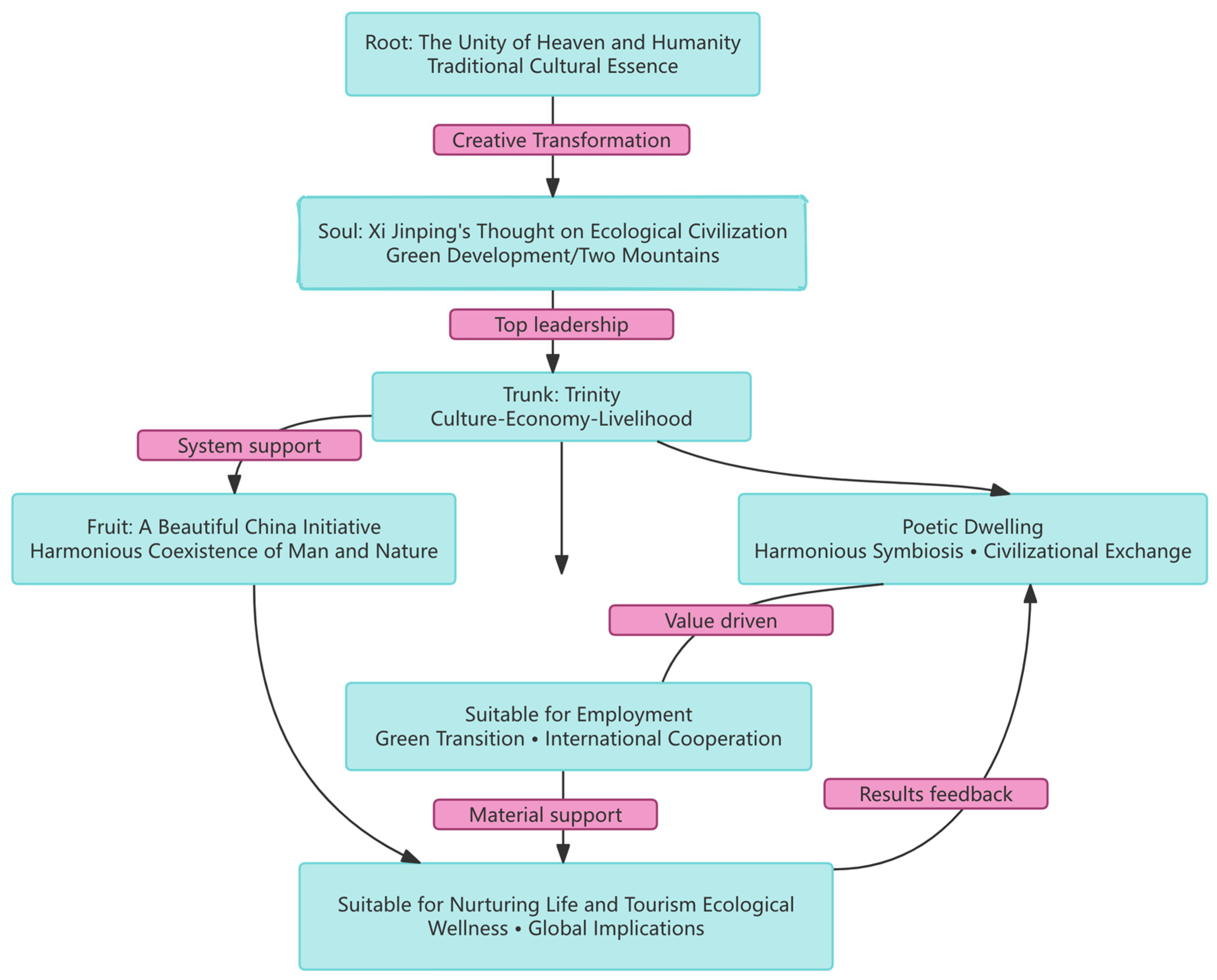
In summary, this study aims to systematically elucidate the ecological aesthetic wisdom of the Chinese concept of ‘the Unity of Heaven and Humanity’. It seeks to reveal its ideological connotations as the cultural foundation for building a Beautiful China. At the same time, this paper fully recognizes the unique advantages of Western ecological theories in areas such as scientific rational analysis. On this basis, this study attempts to provide both theoretical and practical support from the excellent traditional Chinese culture for contemporary ecological governance, while simultaneously learning from and drawing upon the advanced experience of Western ecological civilization construction, ultimately achieving the goal of building a Beautiful China. This is illustrated in Figure 1.
This argument follows an internal logic of ‘root-soul-trunk-fruit’: taking the traditional cultural concept of ‘the Unity of Heaven and Humanity’ as its root, Xi Jinping’s Thought on Ecological Civilization as its contemporary soul, and progressing through the tripartite systematic support of ‘culture-economy-livelihood’ to ultimately yield the fruit of practice—a Beautiful China where humanity and nature coexist in harmony. Within this framework, the article elaborates on the concepts of ‘Poetic Dwelling’, ‘Suitable for Employment’, and ‘Suitable for Nurturing and Tourism’. These three elements are mutually reinforcing and collectively demonstrate the significant contribution of the traditional Chinese ecological aesthetic wisdom of ‘the Unity of Heaven and Humanity’ in promoting global green transformation.

2. Results

2.1. Poetic Dwelling: Inheritance of the Harmonious Symbiosis Philosophy in Chinese Culture and Its Cross-Civilizational Exchange

Heidegger’s theory of ‘Poetic dwelling’ urges us to take a more systematic and theoretical view to reflect and reconstruct the ecological aesthetic wisdom originally scattered in the collection of classics and history in the Chinese tradition, so as to clearly explain the poetic ecological aesthetic paradigm formed by the ecological artistic conception of ‘the Unity of Heaven and Humanity’ described by ‘washing in clear water, chasing cool breezes, fishing for roaming carps, and hunting soaring wild geese’ [濯清水,追凉风,钓游鲤,弋高鸿] (Zhong Changtong [仲长统], Han Dynasty) [12] in Chinese culture.
The concept of ‘Poetic Dwelling’ nurtured by the Chinese traditional ecological wisdom of ‘the Unity of Heaven and Humanity’ has formed a cross-civilization dialogue with the Western geographical poetics, which explores the emotional and intellectual relationship with the earth, and jointly points to the eternal pursuit of harmonious living space. Xu Fuguan [徐复观] pointed out that ‘(Chinese culture) has taken a path of excessive affinity between humanity and nature.’ [13]. This characteristic was systematically presented in the pre-Qin tradition of ‘the Unity of Heaven and Humanity’. Zhouyi [周易] proposes that ‘Heaven and earth change, and the saints will follow it’ [天地变化,圣人效之] ([14], p.82) establishes the initial concept of ‘the Unity of Heaven and Humanity’, which suggests that humans should follow the movements of heaven and earth to achieve harmony. Mencius, the second sage of Confucianism, advocates that ‘the gentleman loves his kin, and then extends benevolence to the people; he extends benevolence to the people, and then loves all things’ [亲亲而仁民,仁民而爱物] ([15], p.6029–6030). Liji Zhongyong [礼记·中庸] further proposes that ‘if one can fully realize one’s innate nature, one can fully realize the nature of all things; if one can fully realize the nature of all things, one can assist heaven and earth in transforming and nourishing all things; if one can assist heaven and earth in transforming and nourishing all things, one can stand as a third alongside heaven and earth, achieving the state of “the Unity of Heaven and Humanity”’ [能尽人之性,则能尽物之性;能尽物之性,则可以赞天地之化育;可以赞天地之化育,则可以与天地参矣] ([16], p. 1632). These constitute the thought of the ‘Sancai’ composed of heaven, earth, and humanity (Sancai refers to heaven, earth, and humanity. Each of these three possesses spirituality, intelligence, and creativity. Together, they constitute the core elements of the universe. It is a theory that explains the changes and relationships among heaven, earth, and humanity). It can be seen that Confucianism advocates promoting harmony between humans and nature through moral cultivation and social governance. Laozi [老子] asserted ‘Humans follow the laws of earth, earth follows the laws of heaven, heaven follows the laws of the Dao, and the Tao models itself after nature’ [人法地,地法天,天法道,道法自然] ([17], p. 64), further emphasizing that all things should operate in accordance with natural laws. Zhuangzi [庄子] ([18], p. 690) explicitly stated that ‘Man and heaven are unified’ [人与天一], ‘Heaven and earth coexist with human beings, and all things in the world are one with humanity. There is no absolute distinction between subject and object, nor between self and other’ [天地与我并生,万物与我为一] ([18], p. 79), advocating the dissolution of the opposition between nature and humanity, and proposing that humans and nature should exist in harmonious unity. And the Guanzi·Mumin [管子·牧民] further points out, ‘When humanity harmonizes with heaven, the beauty of heaven and earth comes into being’ [人与天调,然后天地之美生] ([19], p. 865), highlighting the ShengSheng’s beauty arising from the coordination of the relationship between humans and nature. Thus, the intellectual lineage of ‘the Unity of Heaven and Humanity’ had already established its foundation in the pre-Qin period. After that, from Dong Zhongshu’s [董仲舒] ecological holistic perspective of ‘the interconnection between heaven and humanity, merging into one’ [天人之际,合而为一] ([20], p. 69) in the Han Dynasty, to Zhang Zai’s explicit proposal of the concept of ‘the Unity of Heaven and Humanity’ ([2], p. 65) in the Song Dynasty and the existent theoretical lineage of ‘unbroken unity between heaven and humanity’ [天人无间断] ([6], p. 119) among Song scholars, and further to Wang Yangming’s [王阳明] assertion in the Qing Dynasty that ‘heaven, earth, and all things are originally one with me’, [天地万物本吾一体] ([21], p. 79) the Chinese nation has consistently emphasized the consubstantial relationship between humanity and the cosmos, elevating ecological ethics into an aesthetics of continuous regeneration expressed as ‘the great virtue of heaven and earth is giving life’ [天地之大德曰生] ([14], p. 179). The Chinese nation regards ecological conservation not merely as a technical challenge of environmental governance, but as a profound value consciousness rooted in the reverence for nature’s majesty, as articulated in the Zhou Song·Wo Jiang [周颂·我将]: ‘Only by following the Way of Heaven and revering its power can heaven and earth protect the people of the country’ [畏天之威,于时保之] ([22], p. 1268). This value-based self-awareness resonates profoundly with Heidegger’s concept of ‘poetic dwelling’, as both critique the domination of nature by instrumental rationality. Heidegger attributes the malaise of modernity to a ‘poetic lack’ (Poesielosigkeit), proposing that if in the technological age, the Enframing [Gestell] that determines everything can be experienced, and if it becomes manifest how the ‘lack’—in a disguised form—holds sway within it, then the region of the saving power [das Rettende] would be granted to human Dasein as something to be openly participated in ([23], p. 242). He argues that only by first becoming aware of this ‘lack’ and, from within it, discerning the possibility of dwelling that has been obscured in the process of Western modernization, can human beings return to a state of belonging together with nature. Thus, the movement from ‘poetic lack’ to ‘poetic dwelling’ constitutes a reflection upon and reconstruction of the relationship between humanity and nature, as well as among human beings themselves. Heidegger’s profound analysis of the ecological crisis provides us with a crucial theoretical perspective and methodological reference for reactivating indigenous intellectual resources. The ‘oblivion of Being’, the ‘alienation from nature’, and the ‘technological Enframing [Gestell]’ that he revealed constitute the philosophical context for reinterpreting the traditional Chinese thought of ‘the Unity of Heaven and Humanity’. This enables the traditional Chinese ecological aesthetic wisdom, which was originally scattered in the realm of life and daily ethics, to be systematically expressed and theoretically presented. ‘The Unity of Heaven and Humanity’ is no longer merely a naive cosmology or an aesthetic attitude toward life; it now reveals its ecological ontological implications that transcend the subject–object dichotomy and oppose anthropocentrism. It emphasizes that human beings participate in the cosmic process by ‘assisting in the transforming and nourishing process of Heaven and Earth’ [参赞化育], rather than objectifying and resourcefying nature. This is precisely the Chinese response to ‘poetic dwelling’.
The construction of a Beautiful China is committed to building a ‘Poetic Dwelling’ environment. The key to its realization is to build a Beautiful China under the guidance of the traditional thought of ‘the Unity of Heaven and Humanity’ and with the core goal of creating a poetic dwelling with both natural and humanistic beauty. This practice draws on the experiences of building livable cities, such as Melbourne and Auckland, which have been validated by the Global Liveability Index established by The Economist in 2004. This system uses stability, healthcare, culture and environment, education, and infrastructure as evaluation metrics. Its quantitative criteria also provide a reference for China’s ‘Poetic Dwelling’ index system aimed at fostering harmonious living environments. On 28 February 2020, China’s National Development and Reform Commission issued the Assessment Indicator System and Implementation Plan for Building a Beautiful China. This framework comprises five core categories: clean air, unpolluted water bodies, safe soil, healthy ecosystems, and orderly human settlements, along with 22 specific indicators refined under the principles of prioritizing key areas, addressing public concerns, and ensuring data availability. Under the guidance of this evaluation framework, the construction of a Beautiful China encompasses not only the shaping of aesthetically pleasing natural landscapes but also emphasizes their deep integration with humanistic spirit and historical context, achieving a bidirectional enhancement between natural ecology and humanistic values. At the level of natural ecology, environmental pollution and ecological damage caused by rapid human development represent severe challenges commonly confronted by all nations. According to the Sixth Assessment Report (AR6) of the Intergovernmental Panel on Climate Change (IPCC), to limit global warming to 1.5 °C, carbon emissions need to be reduced by 40% by 2030. This trajectory is critical to aligning with the Paris Agreement’s aspirational target. In this context, Xi Jinping Thought on Ecological Civilization, centered on the philosophy of ‘the Unity of Heaven and Humanity’, guides the systematic practices of ecological restoration. It adopts concepts such as the ‘community of life between humanity and nature’ and the ‘community of life on Earth’ as its ontological foundation and enhances the construction of a national park-centered system of protected areas through measures such as mountain closure for reforestation and the conversion of farmlands back to forests. Successful examples like SaiHanBa [塞罕坝] Afforestation and MaoWuSu [毛乌素] Desert Control provide exemplary models for this systematic ecological restoration. At the level of humanistic environment, the concept of ‘Poetic Dwelling’ requires bridging natural attributes and cultural attributes, which serves as the value orientation for building a Beautiful China. This requires governments of all countries to strengthen the overall planning and regulation of land use and spatial development patterns. Scholars in geography have already focused on health inequalities caused by spatial inequalities. So, in pursuing ‘Poetic Dwelling’, they often use well-designed streets, neighborhood atmospheres, and other ‘idyllic suburban middle-class communities’ [24] as a blueprint. Therefore, the construction of harmonious and livable urban and rural areas in China not only promotes ecological protection but also needs to meet the public’s emotional demands for a beautiful living environment and social dignity. The key to building a ‘Poetic Dwelling’ in China is to prevent human external factors from interfering with a harmonious and livable environment, and to require the restoration, rectification, and even relinquishment of development and construction activities that severely damage the ecological environment.
In this context, the philosophical ideal of ‘poetic dwelling’ has transformed from a philosophical ideal into a new and practicable developmental paradigm. The core lies in the creative application of the traditional ecological aesthetic wisdom of ‘the Unity of Heaven and Humanity’ to modern urban–rural planning and global ecological governance, achieving a transition from concept to practice and from the local to the international. This transformation has first yielded tangible benefits for people’s livelihoods domestically. The transformation of Beijing’s urban positioning is a microcosm of the city’s ecological awakening and restoration history. From the early years of the People’s Republic to the reform and opening up period, Beijing’s urban orientation was long centered on industrialization. Take Shougang (Capital Steel) as an example: in 1958, Shougang, located in Shijingshan District, produced its ‘first furnace of steel’. That same year, the Beijing Municipal Committee proposed to build Beijing into a modern industrial base within five years. Industry’s share of GDP once reached as high as 64%, with towering chimneys becoming a symbol of the city, and its livability was greatly diminished. Even though Beijing’s revised master plan in 1982 no longer referred to the city as an ‘industrial base’, and the 2004 updated plan removed its designation as an ‘economic center’, replacing it with ‘national capital, political center, cultural center, and livable city’, the inertia of development slowed the phasing out of industries inconsistent with the capital’s functions. Environmental pressures pushed the city to its limits. According to journalist Zhang Shu, inhalable particulate emissions in urban Beijing reached 80,000 tons in 2002, with Shougang Group alone contributing 18,000 tons, accounting for 23% of the total [25]. During the hottest days of summer, residents were unable to open their windows for fresh air and had to wear masks whenever they went outside. The true systematic turning point began with the construction of an ecological civilization in the new era. Between 2014 and 2017, all four of Beijing’s major coal-fired thermal power plants: the Gaojing Thermal Power Plant, Jingneng Shijingshan Thermal Power Plant, Guohua Coal-Fired Thermal Power Plant, and Huaneng Thermal Power Plant were completely shut down, marking the beginning of a coal-free era for local power generation in Beijing. After Shougang Group was relocated to Hebei Province, it built the first project in China and abroad, named Carbon Dioxide Green Clean Steelmaking Technology and Application. This project recovers carbon dioxide from lime kiln tail gas and applies it to converter blowing. It can reduce carbon dioxide emissions by 50,000 tons annually [26]. In addition, the original plant site of Shougang was transformed into the headquarters of the Beijing 2022 Winter Olympics Organizing Committee, training bases, and public leisure spaces. The third blast furnace was preserved as a museum to pass on the industrial memory. This process marks the transformation from a ‘steel giant’ to a hub of ‘digital intelligence plus sports and culture.’ These bold and systematic ecological restoration efforts have opened up vast possibilities for turning ‘poetic dwelling’ from an ideal into reality. This practice of interweaving ecology and humanity has also extended to the western rural areas of Beijing. The ‘Poetic and Picturesque Countryside’ construction launched in the Mentougou District in 2024 represents a vivid grassroots embodiment of this concept. Through projects such as the creation of the ‘Cultural Experience Zone of the Ancient Western Beijing Road’, the district has developed an integrated complex combining culture, tourism, sports, commerce, and agriculture. The first set of 15 demonstration villages achieved a total collective economic income of 38.33 million yuan, representing a year-on-year growth of 23.8%, with rural residents’ per capita disposable income reaching 37,014 yuan, a 7.3% year-on-year increase, serving as a vivid practice of poetic planning and resource coordination [27]. Meanwhile, this poetic ecological aesthetic wisdom has not been confined within national borders. Exemplified by Suzhou gardens, which are celebrated for being ‘although wrought by human hands, it seems born of nature’ [虽由人作,宛自天开] (Ji, C., Ming Dynasty) [28], this wisdom aims to create a natural artistic conception through artificially constructed landscapes, emphasizing that architectural arrangements must harmonize with their surrounding landscape environment. Since the Ming Hall [明轩], a replica of a Suzhou-style courtyard, was installed at the Metropolitan Museum of Art in New York in 1980, the traditional Chinese ecological aesthetic wisdom of ‘the Unity of Heaven and Humanity’ has been engaged in over four decades of international transmission through the comprehensive and tangible cultural platform of Suzhou gardens. Notably, the ‘Liu Fang Yuan’ [流芳园] at the Huntington Library in Los Angeles, USA, has been expanded from 3.5 acres to 12 acres, making it the largest Suzhou-style garden overseas. As of now, represented by the ‘Yun Xiu Yuan’ [蕴秀园] in Singapore, the ‘Ai Su Yuan’ [爱苏园] in Dublin, Ireland, and the ‘Chinese Garden’ [中国园] at the Museum of Far Eastern Antiquities in Stockholm, Sweden, over fifty classical Suzhou-style gardens have been constructed in countries and regions including the United States, Germany, Canada, Australia, Japan, and Singapore. These gardens are by no means a simple architectural reproduction. They are organically integrated with local functional requirements in the design, such as adding spaces that can be used for weddings, parties, and performances. This deep cultural dialogue and adaptive integration indicate that the Chinese poetic dwelling concept has been sublimated from cultural display to a living aesthetic resource that can participate in shaping local community life.
The grand blueprint of Beautiful China is not only driven by top-down national strategies but is also invigorated by extensive bottom-up social participation. The participation of non-governmental forces is operationalized at two levels. The first level involves cultural dissemination and the inspiration of ideas through new media. Exemplified by the phenomenal content creator Li Ziqi (李子柒), she has translated the traditional ecological wisdom of ‘the Unity of Heaven and Humanity’ from a philosophical concept found in ancient texts into an everyday practice perceptible and tangible to hundreds of millions of people. Li Ziqi’s YouTube channel is organized into sections such as ‘Eating in Season’, ‘Diet with Festivity’, ‘Audible Blossoms’, and the four seasonal volumes of ‘Spring’, ‘Summer’, ‘Autumn’, and ‘Winter’, seamlessly integrating traditional Chinese elements like solar terms and seasonal customs with daily life. Her short videos depicting idyllic rural life employ a ‘de-narrativized’ visual language that transcends linguistic barriers, using cinematic imagery to present an Eastern pastoral existence reminiscent of the poetic line: ‘Picking chrysanthemums under the eastern fence, leisurely gazing at the southern mountains.’ [采菊东篱下, 悠然见南山] (Tao Yuanming, [陶渊明] Jin Dynasty) This resonates with a global wave of reflection on excessive industrialization and consumerism, transforming Chinese ecological wisdom into a ‘China Story’ that can be understood and appreciated worldwide, evoking widespread resonance both domestically and internationally. Secondly, there are localized community conservation actions. In the face of the implementation dilemma of the ‘last mile’ in environmental governance and the blind spot of administrative supervision, relying solely on top-down system design is often difficult to touch the subtle ecological vitality. At this time, non-governmental organizations rooted in local culture have become the key force. Up to now, there have been more than 300,000 ecological volunteer service teams and 35 million volunteers nationwide, and more than 1.51 million project activities have been implemented. (data source: Xinhua News Agency, 2025) [29]. They are not passive executors of policies, but active guardians of the environment.

2.2. Suitable for Employment [宜业]: China’s Exploration of Green Transition Pathways and Its International Cooperation

‘Suitable for Employment’ is an initiative to build a Beautiful China, aimed at accelerating the comprehensive green transition of economic and social development. It creatively integrates the viewpoints put forward by Aridolakis and others that nature should be rethought, opposing both utilitarian intervention and non-utilitarian aesthetic intervention. It aims to build a positive cycle in which environmental carrying capacity and people’s livelihood and employment complement each other, while underscoring that realizing the vision of a Beautiful China necessitates both the proactive leadership of the government and the enthusiastic engagement of the citizenry.
Chinese-style modernization takes green development as its core and regards ‘Suitable for Employment’ as the talent support for building a Beautiful China. This requires that the construction of a Beautiful China should not only be deeply rooted in traditional Chinese ecological wisdom, such as ‘the Unity of Heaven and Humanity’, but also fully incorporate advanced experiences and technological means of modern environmental governance. This thereby opens up a new realm of ecological civilization construction through the dialectical unity of inheritance and innovation. Confucius rigorously adhered to the ecological practice principle of ‘not using large nets to obstruct flowing water to catch fish, and refraining from shooting birds that have returned to their nests during hunting’ [钓而不纲,弋不射宿] ([30], p. 5393) thereby pursuing the ideal of ‘harmony between humanity and nature’ [天人之和] [31]. The Guanzi·Guozhun [管子·国准] critiques the sage-kings’ [圣王] excessive exploitation through phrases like ‘Cut off the water and cut down the mountains and forests… Burn the bushes and the groves’ [枯泽童山……烧增薮,焚沛泽] ([19], p. 1392), proposing the ‘Four Prohibitions’ [四禁] to legislate ecological protection. These all show the ecological aesthetic consciousness of Chinese civilization. At the same time, traditional Chinese ecological aesthetic wisdom emphasizes transcending the opposition between anthropocentrism and ecocentrism through the holistic perspective of ‘the Unity of Heaven and Humanity.’ This ecological aesthetic concept is expressed in ShiJi·HuoZhiLieZhuan [史记·货殖列传] as the ecological wisdom of a virtuous cycle of ecological conservation, resource utilization, and ‘Suitable for Employment’. Specifically, Sima Qian [司马迁] pointed out:
On land, you can graze fifty horses herded on the land, one hundred sixty to seventy oxen raised, two hundred fifty sheep kept. In the swamp, you can raise two hundred fifty pigs. In the water, you can have a fish pond with an annual production of a thousand stone fish. In the mountains, you can have thousands of mature timber trees. Anyi had several thousand jujube trees; Yan and Qin had several thousand chestnut trees; the regions of Shujun, Hanshui, and Jiangling had several thousand orange trees; areas north of the Huai River, south of the Changshan Mountains, and between the Yellow River and Ji River had several thousand qiu trees; Chen and Xia had several thousand mu of lacquer trees; Qi and Lu had several thousand mu of mulberry and hemp; and the Weichuan River valley had several thousand mu of bamboo groves [陆地牧马二百蹄,牛蹄角千,千足羊,泽中千足彘,水居千石鱼陂,山居千章之材。安邑千树枣;燕、秦千树栗;蜀、汉、江陵千树橘;淮北、常山已南,河济之间千树萩;陈、夏千亩漆;齐、鲁千亩桑麻;渭川千亩竹] ([32], p. 3271).
It is emphasized that people of the time, according to the ecological characteristics of different regions, engaged in large-scale and professional specialty breeding and planting activities of distinctive local products. This not only achieved agricultural diversity and regional economic complementarity, but also met the subsistence and employment needs of the common people. The construction of a material space for dignified living and the sense of professional fulfillment achieved through ecological practices together realized a poetic integration. Thereafter, the ecological development principle of ‘cultivating in due time, utilizing with moderation’ [育之以时, 用之有节] ([33], p. 3679) from Ban Gu’s HanShu·HuoZhiZhuan [班固.汉书·货值传], and Liu Ji’s [刘基] statement in the Ming dynasty’s Yu Li Zi [郁离子] that ‘Heaven and Earth are adept at fostering life, thus enabling them to accommodate all things. If it weren’t for the sage’s ability to use all things with moderation and planning, but rather each taking according to their desires, resources would be exhausted and reserves depleted, even Heaven and Earth could do nothing’ [天地之善生而后能容焉, 非圣人之善盗, 而各以其所欲取之,则物尽而藏竭, 天地亦无如之何矣] ([34], p. 41) are key principles of traditional ecological wisdom. Both elevated the protection of the ability of heaven and earth to grow and the balance of ecology to an inevitable choice for the survival of civilization. In addition, classic texts such as Guanzi [管子] propose the establishment of official positions for the protection and management of mountain and forest resources, including:
Multiple Yu officials were set up (officials in charge of water and marsh resources) in the Lake and swamp areas and multiple Heng officials (officials in charge of mountain and forest resources) in the mountainous areas [泽立三虞, 山立三衡] ([19], p. 400).
It is necessary to formulate fire prevention laws and protect the fuel accumulated in the mountains, forests and marshes. These natural resources are the source of wealth, and it is necessary to stipulate when logging is prohibited and when it is allowed according to the season. As for making people have wood for building houses and firewood for cooking, it is the duty of Yu Shi (an official managing mountain and water resources) [修火宪,敬山泽林薮积草。夫财之所出,以时禁发焉。使民于宫室之用,薪蒸之所积,虞师之事也] ([19], p. 73).
They had to dredge the accumulated water, open ditches, build dams, and manage the reservoir well. In this way, even if there is too much rain, the crops will not be flooded. Despite the severe drought, there have been some gains. These are all the responsibilities of Si Kong (official position in charge of water conservancy and civil engineering construction) [决水潦,通沟渎,修障防,安水藏,使时水虽过度,无害于五谷,岁虽凶旱,有所秎获,司空之事也] ([19], p. 73).
‘Yu’, ‘Heng’, and other officials with clear responsibilities ensure the effective implementation of the national ecological and environmental protection policy to the greatest extent. These have jointly constructed the ecological aesthetic system of ‘the Unity of Heaven and Humanity’, which is the trinity of ‘emotion, reason and law’ of the Chinese nation.
This system theoretically echoes Berleant’s The Aesthetics of Environment. In the Preface to his representative work, The Aesthetics of Environment [35], Berleant writes:
The underlying force of these inquiries is the need to reconceptualize environment and recognize its aesthetic implications. We are coming to realize that nature is not alien to the human world nor is environment an external territory. Aesthetics can help us grasp, in both theoretical terms and concrete situations, the inseparability of the human and the natural. Indeed, environmental aesthetics exemplifies the transformative conceptions of experience and knowledge in our time that press more and more insistently against the comfortable conventions of thought and practice. For we discover in the aesthetic perception of environment the reciprocity, indeed the continuity of forces in our world— those generated by human action and those to which we must respond. And we find in their ultimate identity not only the qualitative directness of experience but the immediacy of our engagement. Environmental aesthetics, as theory and as experience, can help us achieve a truer sense of the human condition [35].
From this passage, it can be seen that Berleant’s environmental aesthetics is essentially an aesthetic perception study of the environment. Through the aesthetic perception of the environment, it enables people to recognize the continuity and identity between humans and nature, thereby dissolving the cognitive framework of the subject–object dichotomy. This resonates deeply with the Chinese ecological wisdom of ‘the Unity of Heaven and Humanity’. Both do not regard nature as an object external to humans but rather emphasize the mutual interpenetration and fusion between humans and all things. Moreover, ‘the qualitative directness of experience’ and ‘the immediacy of our engagement’ revealed by Berleant also share an inherent consistency with the aesthetic experience of ‘forgetting both self and objects’ [物我两忘] in the traditional Chinese aesthetics of ‘the Unity of Heaven and Humanity’. It can be seen that although Berleant’s environmental aesthetics and the thought of ‘the Unity of Heaven and Humanity’ originate from different cultural and philosophical traditions, they converge on the core issue of transcending the human–nature relationship. Both advocate grasping the unity of humans and nature through aesthetic experience. At the practical level, Berleant’s environmental aesthetics provides an operable path of aesthetic perception for the concept of ‘the Unity of Heaven and Humanity’. By cultivating an aesthetic perception of the wholeness of the environment, people can directly feel the interdependence between humans and nature in daily experience, rather than remaining at the cognitive level of philosophical concepts. In turn, the symbiotic philosophy of all things living and thriving together within the Chinese tradition of ‘the Unity of Heaven and Humanity’ provides a deeper cultural foundation and historical accumulation for Berleant’s advocated aesthetic perception of environment. The two draw on each other and together reveal the fundamental requirements of ecological constraints on human behavior.
The construction of Beautiful China is committed to playing the ‘Suitable for Employment’ card. Since the advent of industrial civilization, the rapid progress of human material civilization has brought unprecedented economic growth and social change. But as Ivanhoe points out, such rapid development has fostered an anthropocentric view that ‘nature itself exists to be exploited by us in any way we see fit.’ [36]. Protecting the environment and pursuing green development not only determines the material foundation for human survival and development but also bears on the continuity of human civilization itself. However, scholars such as Rosenberg have also issued warnings regarding the global boom in green transition: an over-idealized pursuit of green cities may lead to the exclusion of original residents due to rising living costs, which may actually exacerbate ecological inequality [37]. Given this context, the rural transformation guided by Xi Jinping’s principle that ‘Green water and green mountains are golden mountains and silver mountains.’ ([38], p. 21) has provided a viable pathway to reconcile ecological conservation with people’s livelihood development (Abbreviated as the ‘Two Mountains Theory’). A case in point is Yu Village in Anji County [安吉余村], Zhejiang Province. After the launch of reform and opening up, the village achieved rapid economic growth by blasting mountains and mining stones. By the 1990s, its collective annual income had exceeded 3 million yuan, making it the wealthiest village in the county. However, as villager Yu Jinbao recalled, ‘Smoke from the cement plant’s chimney cast a gray haze over the village all year round. Large stretches of bamboo leaves on the mountains were blackened by the soot’ ([39], p. 18). Mining and blasting even caused casualties. Chen Changfa, a villager in his seventies, remembered clearly that injuries from falling rocks were common in those days. Those who survived, though earning money, lived constantly amid limestone dust and smoke, lamenting, ‘We can’t spend money without our lives!’ ([39], p. 19). At that time, although Yu Village had high-income employment opportunities, the villagers did not have the happiness of safety and livability, which fully exposed the serious opposition between ‘Suitable for Employment’ and ‘Poetic Dwelling’ under the development model of simply pursuing economic growth. On 15 August 2005, Xi Jinping, the then Secretary of the Zhejiang Provincial Party Committee, was the first to propose the forward-looking concept of ‘Green water and green mountains are golden mountains and silver mountains’ during his research in Yu Village. Furthermore, General Secretary Xi Jinping draws upon the ecological aesthetic wisdom of the Guanzi, pointing out: ‘To enhance the quality and stability of ecosystems is not only an inevitable requirement for increasing the supply of high-quality ecological products, but also an important means of mitigating and adapting to the adverse impacts of climate change. “When plants and trees thrive and grow, the nation is prosperous.” [草术植成,国之富也]. A sound ecology itself embodies economic and social value.’ [40]. This essentially means balancing ecology and economy, relying on abundant ecological resources, developing green industries and ecotourism, and pursuing a path of prosperity where building an ecological civilization and developing the economy complement each other. Guided by these visions, Yu Village initiated the restoration of the Lengshuidong Reservoir and launched reforestation efforts on its bare mining sites. Starting in 2013, all industrial enterprises were phased out, and the village shifted its focus toward ecotourism and environmental protection. In 2018, Yu Village was successfully designated as a National 4A-level Scenic Area and proposed and implemented the Greater Yu Village expansion plan. By 2024, Yu Village had received 1.22 million tourist visits, generating tourism revenue of 60 million yuan. The Greater Yu Village zone has since expanded to include 24 villages across three townships, attracting over 10 million visitors, with average collective operating income per village exceeding 2.54 million yuan [41]. This success story vividly demonstrates how green transformation, centered on preserving clear waters, lush mountains, and fresh air, can not only restore ecosystems but also create more sustainable and inclusive employment opportunities and economic benefits, achieving a virtuous cycle between ecology and employment. Therefore, green development requires the government, enterprises, and individuals to implement the concept of ‘Two Mountains Theory’ with a high degree of consciousness. While protecting the ecological environment and consolidating the foundation of people’s livelihood under the Beautiful China initiative, the government aims to achieve ‘Suitable for Employment’. This systematic project requires multi-dimensional collaborative advancement. In terms of the transformation of government functions, the Chinese government is transitioning its functions toward an ecological governance model. This involves establishing dedicated environmental protection departments and positions while developing a scientific performance evaluation system for ecological conservation. It mainly includes gradually improving the ‘Green GDP’ accounting system and implementing special assessments on ecological civilization construction for government agencies, units, and public servants. Typical representatives, such as the official ‘river governor system’ [河长制] set up by the government in many rivers and lakes, as well as the ‘folk River governors’ and ‘Lake patrol team’ composed of coastal residents as an important supplement, are also the creative transformation of the tradition of establishing natural management officials such as ‘Yu’ ‘Heng’ in ancient China.
In terms of constructing beautiful cities to high standards, BCI demands a comprehensive consideration of urban positioning and overall carrying capacity, coupled with scientific planning for urban development directions. Therefore, in 2016, China began implementing the ‘Blue Bay’ remediation project in its coastal areas. This project aims to create picturesque bays and coastlines, focusing not only on restoring ecological shorelines but also on emphasizing the protection and inheritance of marine folk culture. Under this strategic guidance, Weihai City became the only city nationwide to receive central government financial support for five consecutive phases (2016–2023). Leveraging its innovative implementation of the ‘Bay Chief System’ [湾长制], it not only saw Sanggou Bay honored as a national-level outstanding case of beautiful bays in 2023 but also directly promoted the green growth of the marine economy. Weihai’s practice has successfully transformed the ecological restoration achievements of the ‘Blue Bay’ initiative into tangible economic benefits through market mechanisms, with the blue carbon economy projected to account for over 30% of the city’s marine economy by 2025. The resulting collaborative promotion mechanism of ecological industrialization and industrial ecology provides a replicable Chinese plan for the global response to climate change and the development of a blue economy.
In terms of building beautiful villages according to local conditions, General Secretary Xi Jinping pointed out: ‘As ancient Chinese well put, “The sky covers all without exception, while the land has a limited capacity to accommodate.” [天之所覆者虽无所不至,而地之所容者则有限焉] [42]. We should improve the system of agricultural policy support that is guided by the principle of promoting ecological conservation and green development, establish an agricultural industrial system that is green, low-carbon and circular, and accelerate efforts to put in place a system for developing agricultural space that is well-conceived and appropriate in scale and conducted in an orderly way, so as to effectively change the model of agricultural development that excessively relies on resource consumption.’ Furthermore, the emphasis lies in promoting outstanding traditional agricultural culture, integrating local natural and historical-cultural resources. Specifically, while ‘creating recreational agricultural industry belts and clusters characterized by standardized production, intensive management, standardized services, and diversified functions’ [43], China also pays attention to the participation of local people and enhances the experience of foreign tourists. Together, both initiatives rely on the development of livable cities and villages to achieve ecological beauty, while tangibly enhancing people’s employment quality and sense of well-being.
In terms of the legal system, as the key to ecological protection, it is crucial to continuously improve the environmental regulatory system. Since the 18th National Congress of the Communist Party of China, a series of landmark laws and regulations have been successively promulgated and implemented, including the Environmental Protection Law of the People’s Republic of China (2014) [44], the Water Pollution Prevention and Control Law of the People’s Republic of China (2017) [45], the Soil Pollution Prevention and Control Law of the People’s Republic of China (2018) [46], the Marine Environmental Protection Law of the People’s Republic of China (2023) [47], and the Interim Regulation on the Management of Carbon Emissions Trading (State Council Decree No. 775, 2024) [48]. These are the ‘four beams and eight pillars’ that build the construction of ecological civilization. Mass participation serves as the cornerstone for building a beautiful and prosperous China, which necessitates enhancing citizens’ ecological awareness, participation capabilities, and aesthetic literacy, with the goal of cultivating ‘ecological citizens’. In this regard, China has integrated cherishing ecology, protecting resources, and preserving the environment into the national education and training system, promoting the construction of an ecological civilization as an endeavor that is participated in, contributed to, and benefited by all the people. General Secretary Xi Jinping has long drawn valuable insights from the ancient Chinese wisdom on harmonious coexistence with nature. He pointed out: ‘Philosophical ideas such as “the Unity of Heaven and Humanity” and “the Dao follows the way of nature” [道法自然], classic poetic lines like “I urge you not to shoot the spring birds, for their chicks are waiting in the nest for the mother’s return” [劝君莫打三春鸟,儿在巢中望母归] and household mottos such as “be mindful of the toil behind each grain of rice and each strand of cloth”, [一粥一饭,当思来处不易;半丝半缕,恒念物力维艰] these simple yet profound views of nature continue to offer us profound warnings and inspiration today.’ ([38], p. 6). In this process, the contemporary vitality and practical value of the ecological aesthetic wisdom of ‘the Unity of Heaven and Humanity’ are demonstrated.
In the process of building a Beautiful China, however, green transformation relies not only on policy guidance and market mechanisms, but also fundamentally on the wisdom and creative practices of the masses. Volunteers from various regions actively participate in promoting ecological agriculture and environmental technologies. Since 2021, the Taihang Road Community in Yunlong District, Xuzhou City, has been implementing the ‘Neighborhood Co-governance—Building a “1 + N” Volunteer Network for Environmental Protection’ project. This initiative innovatively establishes a self-governance model in which ‘one key volunteer drives N families’. Through activities such as family adoption of ‘one-square-meter gardens’, painting on recycled items, composting, and neighborhood swapping fairs for idle items, they turn environmental protection actions into emotional ties connecting neighbors. After three years of dedicated efforts, the community’s volunteer team has grown from fewer than 20 to 128 individuals, with over 60% of families participating regularly in environmental actions. Garbage accumulation in public areas has been reduced by 95%, and resident complaints related to environmental issues have dropped by 70% [49]. This has explored a new path for grassroots governance characterized by ‘minimizing administrative intervention while maximizing community autonomy’.
Moreover, in terms of international cooperation, China is guided by the core philosophy of driving global sustainable development through green transformation. China has effectively advanced the global green transition through international cooperation by promoting employment-friendly practices such as greening infrastructure development, enhancing green energy collaboration, and expanding green capacity building [50]. Furthermore, from the issuance of the Guidance on Promoting Green Belt and Road Construction in 2017 to the Beijing Initiative for Belt and Road Green Development in 2023, China has continuously improved the green development system of the Belt and Road Initiative, thereby providing institutional guarantees for the modernization and internationalization of traditional Chinese ecological aesthetic wisdom. This is technically manifested in China’s adoption of closed drainage system green design strategies and technical measures in the Montenegro North–South Highway Project, preserving the ‘picturesque landscape’ ecological foundation while reducing road surface water pollutant levels, achieving a win-win scenario for infrastructure benefits and ecological conservation. And the ecological barriers installed along Cambodia’s Phnom Penh-Sihanoukville Expressway safeguard residents’ right to ‘Poetic Dwelling’, while the wildlife passages designed for Kenya’s railway routes maintain the ecological harmony of ‘All things are nurtured’ [万物并育]. In terms of investment, in 2020, China’s renewable energy investment in countries along the Belt and Road accounted for 58.1% of its total energy investment in the initiative, exceeding the proportion of fossil energy investment for the first time [51]. This structural shift not only reflects the greening of capital allocation but also assists partner countries in gradually reducing their reliance on traditional fossil fuels, accelerating the process of regional green and low-carbon transition. In terms of green capacity building, the Green Silk Road Envoys Program has trained over 3000 environmental technicians from 120 countries [52], empowering developing nations to independently drive green transitions. This exploration of transforming the ecological aesthetic wisdom of ‘the Unity of Heaven and Humanity’ into a global sustainable development plan ensures that the achievements of green transformation benefit the people along the route, providing a Chinese solution that combines ecological benefits and people’s livelihood care for global green recovery.

2.3. Suitable for Nurturing Life and Tourism: China’s Ecological Model of Building Physical and Mental Health [康养] and Its Global Implications

The traditional Chinese ecological aesthetic wisdom of ‘the Unity of Heaven and Humanity’ has injected a philosophical foundation into the construction of a Beautiful China. By establishing an eco-empowerment system suitable for nurturing and tourism, it transforms landscape aesthetics into momentum for green development, achieving ecological conservation and industrial synergy while providing an Eastern paradigm for the global transition towards ecological civilization.

2.3.1. Building a China ‘Suitable for Nurturing Life’ [宜养]

‘Suitable for Nurturing Life’ is a human settlement paradigm formed through the integration of the Chinese cultural tradition of ‘attachment to homeland and reluctance to migrate’ [安土重迁] and Gesler’s theory of ‘therapeutic landscapes.’ [53]. It is supported by the function of ecologically nurturing all kinds of life and aims to maintain the physical and mental health and cultural psychological belonging of the people by protecting the high-quality natural environment, such as green mountains and clear water.
Traditional Chinese ecological aesthetics, with the concept of ‘the Unity of Heaven and Humanity’ at its core, constructs a cognitive system in which the natural ecosystem and humanistic spirit are mutually embedded. This provides a theoretical foundation for constructing ‘Suitable for Nurturing Life’ ecological environments. ZhouYi establishes the origin of life through its grand narrative: ‘There were heaven and earth, and then all things came into being; there were all things, and then man and woman emerged’ [有天地然后有万物,有万物然后有男女] ([17], p. 97). The Guanzi states: ‘Heaven produces the essence, earth produces the form, and their combination creates humans’ [天出其精, 地出其形, 合此以为人] ([19], p. 945–947), revealing the ecological interdependence of human existence. Xunzi [荀子] further proposed that ‘Heaven and Earth combine, and all things are produced; Yin and Yang interact, and changes arise’ [天地合而万物生, 阴阳接而变化起] ([54], p. 366). The aforementioned discussions all indicate that by the Pre-Qin period, the dynamic and unified cognitive system of ‘Heaven-Earth-Human’ [天-地-人] among the Chinese nation had reached maturity. It has established an ecological ethics of symbiosis and co-prosperity centered on the principle of ‘the Unity of Heaven and Humanity’. The odes to nature in The Book of Songs ([诗经] Shi Jing) also vividly interpret the ecological aesthetic of ‘the Unity of Heaven and Humanity’. When Xiaoya·Shumiaos [小雅·黍苗] ‘The high fields and low lands have been leveled, the wells and rivers have been cleared’ [原隰既平,泉流既清] ([22], p. 1064) nourish a rich ecosystem thriving with bream, carp, and female deer, and when Xiaoya·Jiris [小雅·吉日] ‘Wild beasts run and stroll in plenty, Roaming far and wide in herds’, [儦儦俟俟,或群或友] ([22], p. 920) reveals the vibrant charm of life in the mountains and forests, the fertile lands of the JiuZhou [九州] become a blessed realm bearing the good life, as depicted in Xiaoya·Heming [小雅·鹤鸣]: ‘The crane cries in the secluded marsh, its resonant call reaching the clouds. Fish frolic in the shallow shoals or dive into the deep abyss. Blissful is that garden, where tall sandalwood trees stand dense, with shorter paper mulberry trees beneath’ [鹤鸣于九皋, 声闻于天。鱼在于渚, 或潜在渊。乐彼之园, 爰有树檀, 其下维榖] ([22], p. 927). The maintenance of the beauty of ShengSheng between heaven and earth relies on a favorable ecological environment where life can freely thrive. It also provides ancient and vivid inspiration for promoting the construction of a Beautiful China. When the beauty of nature is truly integrated into the spiritual lifeblood of the people, the seeds of ecological civilization will take root and sprout in the soil of ‘Suitable for Nurturing Life and Tourism’ environments, while the West has not directly used the term ‘Suitable for Nurturing Life’. But Gesler was originally used to test the ‘therapeutic landscape’ [53] theory of the legendary Greek temple site of Asclepion, advocating for ‘helping people understand the geographic metaphors of specific healing processes in certain places or settings’ [53]. Subsequently, geographers such as Foley R, Donovan R, Wood V J, and others swiftly expanded this theory to encompass multifunctional value construction in ‘Suitable for Nurturing Life’ contexts, including specialized healing places [55], everyday healing places [56], and healthcare service places [57], elevating landscape functions from disease treatment to an integrated vehicle for enhancing health and ecological well-being. However, its function remains fundamentally based on people’s positive psychological attachment [58] and ultimately fails to transcend an anthropocentric perspective. It is evident that Western ‘Suitable for Nurturing Life’ related concepts place greater emphasis on ecological experience and explore how health is achieved [59], while China’s notion of ‘Suitable for Nurturing Life’ and recuperation carries the ultimate mission of rebuilding a spiritual homeland.
The German poet Hölderlin once lamented: ‘Human homelessness arises because technology has torn people from the earth, fragmented human nature, driven divinity from the human heart, and replaced the realm of the fourfold unity of heaven, earth, humanity, and divinity with cold metallic surroundings’ [60]. When the expansion of industrial civilization detaches humanity from the land, the green mountains and rivers that were once within reach turn into remnants of memory. The disappearance of such ecological homelands has plunged modern humanity into what Heidegger termed the ‘Heimatlosigkeit’, rendering the reconstruction of humanity’s natural ecology and spiritual homeland an urgent task. Xi Jinping’s Ecological Civilization Thought precisely provides a pathway to a breakthrough in this context. When thinking about the current construction of ecological civilization, he clearly said: ‘Our Chinese civilization has been inherited for more than 5000 years and has accumulated rich ecological wisdom… These simple and wise views of nature still give people profound warning and enlightenment’ [38]. General Secretary Xi focuses on the cultural tradition of the people’s strong attachment to their native land and reluctance to migrate, emphasizing that Chinese-style modernization must ‘preserve verdant mountains and clear waters while retaining the nostalgic essence of rural life’ [61]. This thereby fosters a sense of spiritual belonging, which is essentially a sense of homeland, among the people. It can be said that the sense of homeland as an internal mental state, together with the ecological environment as an external attribute, collectively constitutes an essential dimension of Building a Beautiful China. Therefore, the establishment of a habitable ecological environment requires prioritizing the preservation of integrity, authenticity, and continuity in both natural landscapes and historical urban–rural heritage. This requires creating cultural landscape spaces with local characteristics, such as the Suzhou Museum designed by I.M. Pei. The design of the rockery [片石假山] in its central courtyard skillfully integrates ecological landscape with humanistic art. Moreover, the ecosystem design with self-purification capabilities inherits the ancient ecological aesthetic wisdom from the construction and daily maintenance of traditional Suzhou gardens. This injects new vitality and energy into this ancient city.
Furthermore, studies indicate that increased PM10 pollution elevates the risk of suicide among cardiovascular disease patients by 18.9% [62], while each 0.8 ppm rise in average carbon monoxide (CO) concentration leads to a 15.5% increase in emergency department visits for depression [63]. And low-income populations are particularly vulnerable to air pollution [64], resulting in higher mortality rates during extreme heat events [65]. Faced with the severe damage caused by environmental pollution to human physical and mental health, China has consistently taken proactive measures. In 2013, China’s State Council approved the establishment of the country’s only ‘medical special zone’, the Boao Lecheng [博鳌乐城] International Medical Tourism Pilot Zone. Built upon the ecological foundation of the Wanquan [万泉] River, it has established a ‘medical-ecological’ recuperation paradigm. This type of area is ‘situated between the high-intensity development of urban functional zones and the strictly prohibited construction in ecological functional zones, facilitates the value realization of ecological and cultural products, and serves as a spatial vehicle for building a Beautiful China that is Suitable for Nurturing Life and Tourism’ [66]. At the level of beautiful rural construction, Zhejiang Province’s ‘Ten Million Project’ launched in 2003, represents a profound contemporary practice of the concept of ‘the Unity of Heaven and Humanity’. At its core, it systematically reverses the extensive development model of ‘pollute first, clean up later’ and aims to build ‘Suitable for Nurturing Life’ homes. This transformation can be substantiated through striking historical contrasts and quantifiable real-world achievements. After the reform and opening up in 1978, Zhejiang’s rural areas experienced rapid economic growth driven by township and village enterprises. However, the model of ‘Village factories open fire for work, households emit pollution and thick smoke’ came at a high environmental cost. In Meilin Village, Xiaoshan [萧山梅林], the birthplace of the ‘Ten Million Project’, the Meilin Brigade Dangshan Plastic Products Factory, established in 1976, attracted a cluster of highly polluting enterprises such as hardware and bathroom fittings manufacturers. These factories were intermingled with residential houses, with garbage and sewage flowing everywhere, turning their homeland into what the locals called ‘rotten Meilin’ [67]. He Lingling and others documented even more alarming scenes in their reportage, Poetic Dwelling: Seeing Beautiful China in Zhejiang. In the 1980s, Jianguang Village in Pujiang County [浦江建光], known as the ‘Crystal Capital of China’, was home to over 300 processing workshops at its peak. Chen Xiangyan, a villager, witnessed wastewater laden with dust and tailings being discharged directly into rivers. ‘There wasn’t a single clean river in the village; they were all “milk rivers”!’ ‘Crystals are so clear, yet so filthy’ ([39], p. 25). These accounts collectively reveal that an extensive growth model that neglects ecological costs inevitably endangers people’s livelihoods and sustainable development. In 2002, Xi Jinping, then Secretary of the Zhejiang Provincial Party Committee, conducted an inspection in Meilin Village, marking the beginning of the ‘Ten Million Project’. Over the following two decades, Meilin Village shut down polluting enterprises and carried out courtyard renovations aimed at ‘Removing walls and increasing greenery’, transforming the pursuit of classical garden aesthetics into open, transparent courtyards and poetic pastoral landscapes. This effort successfully realized the rebirth of a ‘poetic countryside’ [67]. In order to treat river water pollution, Pujiang County, Zhejiang Province, vigorously adjusted its industrial structure, shutting down more than 20,000 polluting enterprises within three years. The crystal industry was developed into an industrial cluster known as ‘Four Parks and One Town’, and a ‘15-min water-friendly circle’ was innovatively created: ‘Green spaces can be reached within a 500 m walk; Walk within 1000 m to reach the water bodies of rivers and lakes; Within a 2000 m walk, one can truly enter the water’s edge, participate in waterfront walks, relax, children’s water play, and other water related activities’ has become part of villagers’ daily lives, unleashing the vitality of the ‘water-friendly economy’ [68]. From single-point breakthroughs to comprehensive advancement, the ‘Ten Million Project’ has created tens of thousands of beautiful villages. In 2018, the United Nations Environment Program (UNEP) honored the project with the ‘Inspiration and Action’ category of its ‘Earth Champions Award’, praising that ‘making environmental protection go hand in hand with economic development, will generate transformative power’. The ‘Ten Million Project’ aims to transform rural areas into a beautiful homeland capable of being suitable for elderly care, health preservation, and spiritual nourishment.
The essence of ecological ‘Suitable for Nurturing Life’ lies in the deep integration of humanity and nature, with community volunteers serving as an important bridge for maintaining this harmonious relationship. In Yichang [宜昌], the ‘Three Gorges Ant Workers’ movement began in 2015 when Li Nianbang, a barber, started picking up trash along the Yangtze River by himself. Since then, nearly 100,000 volunteer participations have been recorded, and the riverbanks have become cleaner and cleaner [69]. What they safeguard is not only water quality safety, but also the clean environment upon which wellness bases depend for survival. It is precisely this daily, steadfast volunteer protection, carried out by grassroots Party members and ordinary citizens, that transforms ecological ‘Suitable for Nurturing Life’ from a concept into reality.

2.3.2. Building a China ‘Suitable for Tourism’

The ‘Suitable for Tourism’ concept, centered on ecological landscape experience, integrates the ancient Chinese ideal of living ‘settling in places with fertile fields and spacious homes, nestled against green mountains and facing flowing waters, surrounded by canals, with bamboo groves and trees, vegetable gardens in front and fruit trees behind… strolling leisurely through fields and gardens, playing in open woodlands’ ([使居有良田广宅, 背山临流, 沟池环匝, 竹木周布, 场圃筑前, 果园树后……蹰躇畦苑, 游戏平林]) [70]. This concept combines these ideals with Georges Henri Rivière’s theory of ecological museums, providing a practical framework for the modern transformation of traditional ecological wisdom. It is the inherent requirement and practical forest to realize the grand goal of building a Beautiful China.
Ancient Chinese literati cultivated a tradition of scholarly travel, journeying through renowned mountains and great rivers. While producing a vast corpus of literary masterpieces, they forged a unique ecological aesthetic tradition of nurturing the spirit through far-ranging travel. While roaming extensively, the mountain and water ode in ‘Wei Feng·Kao Pan’ [卫风·考槃] reveals the relieving function of the natural environment on mental depression, with the verses: ‘Build a wooden house on the slope of the mountain, and the sages live spaciously, comfortably and open-minded. Sleeping alone, waking up alone, singing alone, never leaving this mountain’ [考槃在阿, 硕人之薖。独寐寤歌, 永矢弗过] ([22], p. 678–679). In the practice of moral self-cultivation, Confucius’ assertion that ‘the wise cherish waters, the benevolent cherish mountains’ [知者乐水, 仁者乐山] ([30], p. 5384) formulates an ecological ethics advocating closeness to nature through its conceptual analogy between natural elements and moral virtues. In the pursuit of spiritual freedom, Zhuangzi’s declaration of life, ‘mountains and forests, marshes and fields, bring me boundless joy’ [山林欤,皋壤欤, 使我欣欣然而乐欤] ([18], p. 765), analogizes natural landscapes to existential fulfillment, constructs an ecological realm transcending the distinction between self and nature. These ancient Chinese sages’ reflections on the relationship between nature and human culture, derived from their rich ecological experiences, provide cultural support for building a China ‘Suitable for Tourism’. George Henry Rivière advocated for the concept of an ecological museum that closely integrates human beings, culture, and natural environment, which presents a profound fit with the ecological aesthetic tradition of the Chinese nation in terms of functionality. As Hugues de Varine explicitly stated: ‘The ecomuseum refers neither to economy nor ecology in general, but fundamentally signifies a balanced socio-environmental system: a community or society where humans constitute the core existential component, encompassing human activities and their evolutionary processes. This represents the original theoretical conception of the ecomuseum as invented in the 1970s’ [71]. However, its focus on community activities and processes, when compared with the diverse aesthetic appreciation of nature in the Chinese tradition, tends to marginalize the agency of nature and risks lapsing into anthropocentrism. Meanwhile, Sweden’s ‘Allemansrätten’, which establishes the principle that ‘nature belongs to the common heritage of mankind’, guarantees public access to ecological well-being through legislative practice. This forms an institutional echo with the tradition of visiting the famous mountains and rivers in the Chinese nation’s idea of ‘the Unity of Heaven and Humanity’, thereby providing a legal foundation for constructing a ‘Suitable for Tourism’ system that balances ecological conservation with public recreational rights.
The ecological aesthetic consciousness of Chinese culture, which delights in mountains and waters, guides the construction of a Beautiful China in the new era, not only to build a spiritual home ‘suitable for nurturing life’ for the residents, but also to create a charming landscape system that drives the high-quality development of the region. However, in addressing global issues such as cultural homogenization and ecological degradation caused by overtourism, China advocates for the promotion of ‘low disturbance, low-consumption, low-influence, and low-risk green development pathways for both urban and rural areas’ [65] at the operational level. This concept has been profoundly exemplified in the governance and transformation of the Yellow River Basin. Following the reform and opening up, rapid economic growth and intensive development led to a sharp increase in ecological pressure across the region. According to the study by Chen Xizhen and Chen Zhangcen [72], the area of soil erosion in the Yellow River Basin reached 430,000 square kilometers, with an average annual sediment discharge of 1.2 billion tons into the Bohai Sea. The sedimentation in the lower reaches resulted in the formation of a ‘suspended river’, directly endangering flood control safety. From 1972 to 1992, the Lijin Station in the lower reaches of the Yellow River frequently monitored the phenomenon of Yellow River flow interruption, with a total of 265 days of interruption. Among these, the interruption lasted as long as 78 days in 1992 [73], highlighting a water resource crisis and exposing the fragility of the Yellow River ecosystem. Since the beginning of the new era, China’s ecological governance has undergone a historic transformation. According to the Yellow River Basin Soil and Water Conservation Bulletin [74], by 2025, the area affected by soil erosion in the Yellow River Basin had been significantly reduced to 240,400 square kilometers, with a soil and water conservation rate of 69.75%. Director Liu Zhigang of the Yellow River Conservancy Commission of the Ministry of Water Resources emphasized: ‘Every one percentage point increase in the soil and water conservation rate is equivalent to reducing approximately 7947 square kilometers of soil erosion area’ [75]. More notably, through the implementation of unified water regulation of the Yellow River, the river has achieved 26 consecutive years of uninterrupted flow since 1999 [76], injecting sustained momentum into the sustainable development of the Yellow River Basin. On this solid foundation of soil and water governance and rocky desertification control, China’s ecological construction has further transcended basic environmental restoration and moved toward the multi-dimensional transformation of ecological value. For instance, the Chinese government advocates for the conservation-oriented development of the Yellow River Cultural Tourism Belt. The Yellow River Protection Law of the People’s Republic of China, enacted in 2022, addresses issues such as soil erosion and rocky desertification in the river basin. It also promotes the integration of historical culture, folk customs, arts, and heritage architecture along the Yellow River to construct a comprehensive cultural and tourism resource value system that is spatio-temporally integrated and blends virtual with tangible dimensions.
Meanwhile, the Chinese government has placed great emphasis on revitalizing rural economies through ecotourism. The practice in Lushi County, Henan Province, serves as a typical example of a sustainable livelihood model that takes ecological well-being as its core and transforms green resources into an integrated approach combining ‘integrated cultural-tourism-medical-wellness’, creating one national 4A-level tourist attraction, one provincial-level tourism resort, and several ‘Suitable for Nurturing Life’ demonstration villages. Specifically, the county has directly promoted the protection and enhancement of ecological resources by developing the under-forest economy 1. According to statistics, the county currently utilizes 1.733 million mu of forest land for the under-forest economy, achieving an annual comprehensive output value of over 1 billion yuan. Nearly 200 professional cooperatives are involved in the under-forest economy, engaging 18,000 farmer households, with an average annual income increase of more than 3000 yuan per household [77]. In addition, Lushi County actively implements the construction of beautiful rural areas, creating more than 600 ‘small sightseeing gardens’ and ‘small landscapes’ tailored to local conditions, continuously improving the appearance of villages and households, and significantly enhancing residents’ subjective well-being (SWB). Furthermore, Lushi County has innovated its marketing strategies by utilizing new media platforms to attract the silver-haired demographic, effectively converting first-time visitors into long-term residents, and further enhancing the influence and sustainability of the local health care industry. In 2024, it was recognized as one of ‘China’s top 100 counties with sustainable industrial development ability that is beneficial to physical and mental health.’ It shows that its ecological value has been transformed into real livelihood welfare and economic benefits.
Moreover, the true charm of a place worth visiting lies not only in its breathtaking natural scenery and well-established facilities but also in the silent guardianship of its landscapes by local communities. In Jiangchuan, Yunnan, the ‘Silver-haired pioneer: Guardian of Xingyun Lake’ volunteer service team, with an average age of 71, consists of 48 retired officials. Since 1999, they have persistently carried out lake protection activities on the 4th of every month, removing more than 10 tons of waste over 24 years. With the demonstration and guidance of local volunteers, HeJu village [河咀村] has transformed from a dirty fishing village into a popular internet-famous spot beloved by tourists, complete with boardwalk viewing platforms, lakeside go-kart tracks, and other cultural tourism facilities [78]. This form of guardianship, based on ‘local sentiment’ rather than ‘political achievements’, manifests in their dual role as both environmental protectors and cultural ambassadors. Coming from local communities, they possess an intimate knowledge and love for the land, enabling them to convey ecological conservation principles to visitors in the most relatable and accessible manner. By guiding tourists to participate in environmental protection experiences and explaining the local ecological culture, volunteers have made tourism no longer a simple consumption of tourism, but a new form of tourism suitable for in-depth dialogue between man and nature, and for the whole people to build and share.

3. Discussion

The profound ecological aesthetic wisdom of Chinese tradition is not merely a historical echo, but a living philosophy for the future. Tönnies’ concept of ‘Gemeinschaft’ refers to social groups characterized by close personal relationships and a shared sense of belonging [79]. Confronting the global ecological crisis, the construction of a Beautiful China, rooted in the philosophy of ‘the Unity of Heaven and Humanity’, essentially calls for building a life community between humans and nature, and among nations, on a global scale. Studying the formation and evolution of this Chinese approach opens a new window for observing the modernization pathways of late-developing nations. Furthermore, it provides profound cultural cohesion and spiritual impetus for building a shared future for all life on Earth.
It is in the context of the demands of this era and the reflection of civilization that the proposal and practice of BCI demonstrate the unique ecological awakening in the process of modernization. This study has reached a consensus with the academic community on the profound enlightening value of traditional Chinese ecological wisdom for modern sustainable development [80,81]. Under the dual perspectives of globalization and ecological crisis, China’s green transition exhibits complex characteristics interwoven with cultural heritage and policy innovation, urgently calling for a practical paradigm that integrates ancient and modern wisdom while bridging Eastern and Western approaches. This study is a systematic response and support to this proposition, and the core conclusion drawn is that the philosophical concept of ‘the Unity of Heaven and Humanity’ nourishes and shapes the construction of BCI, and the practice of Beautiful China in turn activates and verifies the contemporary value of traditional wisdom. And through comprehensive research, it can be found that there are at least two key mechanisms worth further elaboration; the first is the ‘top-down and bottom-up’ policy coordination mechanism. As a top-level design of the country, Beautiful China provides a strategic blueprint and institutional guarantee. The ecological aesthetic consciousness rooted in traditional culture, the spontaneous environmental protection practices of the people, and the practical implementation of the ‘Two Mountains Theory’ at the grassroots level constitute a vibrant folk community. This extends ecological aesthetic principles from policy documents into tangible living contexts and cultural identity. The other is the evolving roles of participating actors. In this process, the government plays the role of planner and rule-maker, scholars and artists serve as the interpreters of wisdom and disseminators of aesthetics, while the general public evolves from passive recipients of environmental protection to active enjoyers of eco-products, practitioners of green living, and proactive co-builders of ecological civilization. Accordingly, this study calls upon academia to enhance focus on the creative transformation and innovative development of traditional Chinese ecological aesthetic wisdom, underscoring that the synergistic advancement of cultural self-awareness and policy guidance is a distinctive feature of China’s green transition. Although this study provides systematic insights into the relationship between ‘the Unity of Heaven and Humanity’ and Beautiful China, it is not without limitations, especially in the exploration of specific technological paths, such as low-carbon and green. Therefore, how to accurately embed the wisdom of traditional Chinese ecological aesthetics into technological innovation and industrial upgrading is a topic that needs to be continuously explored in the construction of China’s ecological civilization.
In responding to the demands of exploring the aforementioned technical pathways, the emergence of intelligent ecological governance centered on artificial intelligence and big data has provided a technological medium for the modern realization of ‘the Unity of Heaven and Humanity’. Transcending perceptual observation, this approach establishes a real-time, precise data bridge between ‘Heaven’ (nature) and ‘humanity’, enabling the quantitative perception of natural ecosystems and the meticulous guidance of human activities. For example, by integrating the Internet of Things, remote sensing, big data, and algorithms, we can build an intelligent monitoring network covering water, atmosphere, soil, and other elements, realize the dynamic early warning and traceability of environmental risks [82], and simulate and optimize complex ecological processes. It is worth noting that the technical core of such a simulation benefits from the rapid development of ecological assessment models. The research team led by He Honglin from the National Ecosystem Science Data Center developed, on the basis of the CEVSA model, a remote sensing-driven ecosystem service assessment model (CEVSA-ES), enabling integrated simulation of multiple ecosystem services, including productivity, carbon sequestration, water retention, and soil conservation, thereby laying a scientific foundation for regional ecological assessment [83]. In response to the impact of forest age dynamics on carbon sink capacity, the team further constructed a carbon sink assessment model incorporating forest age dynamics (CEVSA-AgeD), revealing the significant role of forest age dynamics in increasing China’s carbon sink by 87–92 TgC yr−1 over the past two decades [84]. Meanwhile, a climate-driven ecosystem assessment model (CEVSA-CLIM) has improved the phenology simulation of deciduous forests, significantly enhancing the prediction accuracy of carbon flux variations [85]. The combination of these ecological assessment models and algorithms allows us to grasp ‘seasonal timing’ [天时] and ‘geographical advantage’ [地利] from experience perception to data intelligence. In this process, artificial intelligence and big data have jointly constructed a modern monitoring system characterized by ‘sky-earth integration and human–machine collaboration’.
Thus, intelligent ecological governance represents not merely an upgrade of technological tools but a paradigm shift in governance itself. It transforms the concept of ‘the Unity of Heaven and Humanity’ from an abstract ecological aesthetic ideal into an operable and iterative closed-loop governance system, enabling full-cycle intelligent stewardship of ecosystems, from the ‘perception’ of environmental monitoring, to the ‘prediction’ of risk early warning, to the ‘control’ of resource scheduling and the ‘feedback’ of effect evaluation. Each link reflects the integration of scientific decision-making and humanistic care driven by data. However, these technological measures are mostly regional pilot projects at present, rather than being fully implemented. They still face challenges such as data bias and implementation costs. Their effectiveness needs to be further verified and continuously refined through concrete practice.

4. Methodology

This study adopts a mixed-method research design, systematically integrating the textual interpretation of traditional Chinese ecological thinking, the sorting of Chinese government policy documents, and local practice case studies. The aim is to objectively reveal the macro policy framework and micro practical effectiveness of the Beautiful China strategy under the inspiration of the traditional ecological wisdom of ‘the Unity of Heaven and Humanity’ and thus demonstrate its contribution to global green transformation.

4.1. Data Collection

4.1.1. Close Reading

The interpretation and theoretical framework construction of the classic discourse on traditional Chinese ecological aesthetics are the methodological cornerstone of this study. We have systematically reviewed Chinese classic works such as the Book of Zhouyi [周易], Laozi [老子], Confucius, Mencius, Zhuangzi [庄子] that embody the core concept of ‘the Unity of Heaven and Humanity’, and used philosophical hermeneutic text analysis methods to deeply interpret the ecological aesthetic wisdom contained in key discourses such as ‘the Unity of Heaven and Humanity’ and ‘Tao follows nature’ [道法自然]. This analysis transcends mere citation, constructing a theoretical framework for the analysis of the BCI and its practice through contextualized interpretation and modern adaptation. This framework includes core dimensions such as ‘Suitable for Dwelling and Employment’, ‘Suitable for Nurturing Life and Tourism’, providing crucial theoretical foundations and evaluation criteria for subsequent policy document analysis and case practice analysis.

4.1.2. Policy Document Analysis

Policy document analysis forms the foundation of this study. The research systematically collected policy documents, laws, regulations, and initiative texts related to ecological civilization construction, the Green Development of the Belt and Road Initiative, and the BCI, published since 2018 by the central government and its ministries via official Chinese government websites (https://www.gov.cn). The analysis focused on four categories: the top-level design for green development, the legal framework for ecological and environmental protection, local ecological civilization construction plans, and international initiatives with multilateral cooperation. To ensure objectivity, the researchers employed quantitative methods to delineate the evolution of policy foci.

4.1.3. Practical Case Analysis

In order to test the effectiveness of policy implementation, this study carried out multiple case studies simultaneously. Guided by the three principles of geographical gradient representativeness, policy type diversity, and empirical data availability, this study used a longitudinal comparative case study method. We selected Zhejiang Province’s ‘thousand villages demonstration and ten thousand villages renovation’ project (hereinafter referred to as ‘ten million project’ [千万工程]), Mentougou District of Beijing, Weihai City of Shandong Province, Hainan Boao Lecheng International Medical Tourism pilot area, and Lushi County of Henan Province as the core analysis objects.
Among them, regarding ‘poetic dwelling’ and the enhancement of ecological and cultural value, Beijing provides a key case study. As a megacity, Beijing has gradually evolved from a typical industrial city plagued by environmental pollution to a modern metropolis that equally emphasizes ecological culture and aesthetic value. Within this context, Mentougou District, through its ‘Poetic and Picturesque Countryside’ initiative, has integrated traditional ecological wisdom into rural governance, demonstrating the feasibility of the ideal of poetic dwelling. The ‘ten million project’, as a long-lasting and extensive rural ecological governance system project, was recognized by the ‘Guardian of the Earth Award’ of the United Nations Environment Program in 2018 and has a broad international influence. Among them, Meilin [梅林] and Pujiang [浦江] have transitioned from early environmental degradation to systematic ecological restoration, demonstrating the effectiveness of grassroots ‘Suitable for Nurturing Life’ environment construction. As the representative of the eastern coastal area, Weihai’s ‘Bay leader system’ and blue carbon economic model reflect the advanced form of marine ecological governance and industrial collaborative development. At the same time, Yu Village [余村] has shifted from relying on environmentally polluting industries in the past, which posed significant health and life risks to villagers, to practicing the concept of green development. Both have successfully achieved a virtuous cycle of ecology and employment. As the only ‘special medical zone’ approved by the State Council, Hainan Boao Lecheng International Medical Tourism pilot zone has constructed a ‘medical + ecological’ health care integration paradigm, which has become an important frontier carrier for exploring the innovation of policies and functional practice ‘Suitable for Nurturing Life and Tourism’. In addition, this study pays special attention to the historical transformation of ecological governance in the Yellow River Basin, comparing the severe soil erosion situation in the Yellow River in the 1970s and 1980s with the ‘integration of culture, tourism, medicine and maintenance’ path implemented by Lushi County [卢氏县] in Henan Province under the strategy of ‘ecological protection and high-quality development of the Yellow River Basin’, which reflects the successful practice of the national ‘development oriented protection’ strategy in inland ecologically fragile areas. These cases have been cited and supported by local government performance reports, ministerial commendation documents, and authoritative academic research many times, which together lay the empirical foundation of this study. In addition to government-led ecological governance, this study further includes the practice of multiple social forces’ participation, including the grass-roots environmental protection autonomous network of the ‘neighborhood co-governance’ project in Taihang Road community, etc. These cases not only broaden the theoretical boundary of the governance subject but also highlight the folk power and social resilience in the construction of ecological civilization.

4.2. Data Analysis

In the data analysis phase, we integrated and cross-validated the quantitative results of policy texts with qualitative case materials. By analyzing the frequency and distribution of ‘ecological civilization’, ‘green transformation’, and ‘harmony’ in the documents, the research aims to understand the focus and development trend of the country in the process of building a Beautiful China. At the same time, combined with time series analysis, this paper makes a vertical comparison of the policy documents issued by the government in different periods, observes the evolution process and development context of the policy system, and analyzes the motivation and impact of policy adjustment and improvement, so as to deeply understand the development logic and strategic intention of the country at the policy level of ecological civilization construction.
Furthermore, this study conducts case study analyses of various practices, including the systemic environmental achievements of Zhejiang’s ‘Ten Million Project’, etc. These cases serve as representatives to illustrate and extract the common patterns of ‘Suitable for Dwelling and Employment’, ‘Suitable for Nurturing Life and Tourism’ construction of Beautiful China, as well as the different development characteristics of each region. These ensure the reliability and effectiveness of the research conclusions in explaining the proposition of Chinese ecological wisdom supporting global green transformation.

5. Conclusions

The evolution of human civilization is essentially the iterative history of ecological cognition. From passive adaptation to nature to active cultivation of ecological civilization, Chinese traditional ecological aesthetics takes ‘the Unity of Heaven and Humanity’ as its aesthetic core, and through the philosophical framework of the beauty of ShengSheng, elevates ecological protection from technical discipline to civilizational consciousness in the construction of Beautiful China. The core contribution of BCI lies in systematically establishing a modern transformation mechanism for Chinese traditional ecological aesthetics. Specifically, it innovatively proposes a trinity framework at the practical level: the spatial construction principle of ‘Poetic Dwelling’, the green development mechanism of ‘Suitable for Employment’, and the ecological restoration model of ‘Suitable for Nurturing Life and Tourism’. Furthermore, it demonstrates at the civilizational level how ecological aesthetic consciousness deconstructs the linear thinking inherent in industrial civilization. This paradigm shift from theory to practice not only provides a core mechanism for the construction of a Beautiful China but also deeply integrates green development into the evolution of human civilization, contributing cultural momentum to the global green transformation and realizing the vision of harmonious civilization between humans and nature.

Funding

This research received no external funding.

Institutional Review Board Statement

Not applicable.

Informed Consent Statement

Not applicable.

Data Availability Statement

The original contributions presented in the study are included in the article; further inquiries can be directed to the corresponding author.

Acknowledgments

The author would like to thank all the respondents in the interview for their helpful discussions on the topic related to this work, and Shenghu Diao in Communication University of China for his support. During the preparation of this manuscript, the author used DeepSeek-V3-0324 (developed by Deep Seek Company) for the purposes of linguistic refinement. The authors have reviewed and edited the output and take full responsibility for the content of this publication.

Conflicts of Interest

The author declares that the research was conducted in the absence of any commercial or financial relationships that could be construed as a potential conflict of interest.

Note

1
Underforest Economy: According to China’s National Forestry and Grassland Administration and the industry standard Terminology of Underforest Economy (T/CSF 001-2018), underforest economy refers to eco-friendly composite management activities carried out based on forests, forest land, and their ecological environment, following the principles of sustainable management. It is primarily categorized into four types: underforest planting, underforest breeding, collection and processing of related products, and forest landscape utilization, emphasizing its green, circular, and multi-dimensional composite industrial characteristics.

References

  1. Jackson, R. The impact of the built environment on health: An emerging field. Am. J. Public Health 2003, 93, 1382–1384. [Google Scholar] [CrossRef] [PubMed]
  2. Zhang, Z. Collected Works of Zhang Zai; Zhang, X.C., Ed.; Zhonghua Book Company: Beijing, China, 1978; Available online: https://jingdian.ancientbooks.cn/6/book/858584 (accessed on 25 February 2026). (In Chinese)
  3. Cheng, X.Z. Ecological Aesthetics: The Legitimate Connection Between Ecology and Aesthetics—A Response to Mr. Berleant. Explor. Contention 2016, 12, 52–57. Available online: https://kns.cnki.net/kcms2/article/abstract?v=0E3RU1Fdg_Oq8CbaZodhkn3ydrTvrxbTqoGxurs7dPwbjnI1-UPT_A5pNPp82xrqRd8-FhIJuReKVxDGqkLWqkuHEu8ON2MtZO7R7wy85bXG8CmxXWDVmBcAbZ7vJjKAZIwpOCP6eRBd5n8Kt0QAsHnacmLQI5pe8LB9ScLrOHa3M81cMV2TsnXOLUrrL71KEyL73Y-9MSk&uniplatform=NZKPT&captchaId=43f7565f-6bfc-4a6b-b7fe-1dd0a88a83b5 (accessed on 25 February 2026). (In Chinese)
  4. Martin, H. Elucidations of Hölderlin’s Poetry; Sun, Z.X., Translator; The Commercial Press: Beijing, China, 2014; p. 139. Available online: https://reader.kgb101.ru/read/8ea89439cc6e1a60274954aa2ca5f888a55d8e4c6dd14a248140fac4b9e77b2e/book/pN3eRORPEW/海德格尔文集-第04卷-荷尔德林诗的阐释.html?client_key=1fFLi67gBrNRP1j1iPy1&extension=pdf&signature=657c5a0218c187801546a72904dda4e429fb920a1192fc6f9ebaa53d535465d2&file_access_token=eyJleHAiOjE3ODQwOTkwNTcsInZlciI6IjEuMCIsInR5cCI6IkpXVCIsImFsZyI6IkhTMjU2In0.eyJzdWIiOiJma-WxlX2FjY2VzcyIsImZpbGVfc2hhMjU2IjoiOGVhODk0MzljYzZlMWE2MDI3NDk1NGFhMmNhNWY4ODhhNTVkOGU0YzZkZDE0YTI0ODE0MGZhYzRiOWU3N2IyZSIsImFjY2Vzc19sZXZlbCI6ImxpbWl0ZWQiLCJpc19wdWJsaWMiOnRydWV9.2iRQx_J4QeaDXOFh0r_jXi71J0cmWq2zu5FNnIKstdo (accessed on 25 February 2026). (In Chinese)
  5. Michel, D. Réouverture après Travaux; Galilée: Paris, France, 2007; p. 97. [Google Scholar]
  6. Cheng, H.; Cheng, Y. Er Cheng Ji; Zhonghua Book Company: Beijing, China, 2004; p. 119. Available online: https://jingdian.ancientbooks.cn/6/book/874415 (accessed on 25 February 2026). (In Chinese)
  7. Chen, W.H. A History of Chinese Aesthetics; People’s Publishing House: Beijing, China, 2005; p. 111. Available online: https://reader.kgb101.ru/read/5ba9966e1673355fe94de059faf9c450b1be04f88cce33e06e00e0258165149d/book/K8Jg459pEe/中国美学史.html?client_key=1fFLi67gBrNRP1j1iPy1&extension=pdf&signature=9e848cc4eb7546240525e46fcd2a8aad94bcba8e35ede20ba646c913cd7d7609&file_access_token=eyJleHAiOjE3ODQwOTg5NTgsInZlciI6IjEuMCIsInR5cCI6IkpXVCIsImFsZyI6IkhTMjU2In0.eyJzdWIiOiJma-WxlX2FjY2VzcyIsImZpbGVfc2hhMjU2IjoiNWJhOTk2NmUxNjczMzU1ZmU5NGRlMDU5ZmFmOWM0NTBiMWJlMDRmODhjY2UzM2UwNmUwMGUwMjU4MTY1MTQ5ZCIsImFjY2Vzc19sZXZlbCI6ImxpbWl0ZWQiLCJpc19wdWJsaWMiOnRydWV9.m4B78RGirIMguN8jWgU_XFJo1sKxhNNfcJsmEGXBkxw (accessed on 25 February 2026). (In Chinese)
  8. Zeng, F.R. Ecological Aesthetics—A Contemporary Aesthetic Concept with Chinese Characteristics. Chin. Cult. Res. 2005, 4, 1–5. Available online: https://kns.cnki.net/kcms2/article/abstract?v=0E3RU1Fdg_OiyXDBQMCpzwOB-1Iy9ZKdihyeCVLSNSpi9F4gsBR9aZE8BsXtAZjQfn_6rTlqKZBtcJtMDesJNJsMHQqtrkUy2eX8RQw1Xw0lYMbraFe5K71CdaIiqT8KGkYrCErGbRp5PCMvvZLy5Q6DOwZkWEuQag2R0WcKF4DUgVm8PnYzNQ==&uniplatform=NZKPT&language=CHS (accessed on 25 February 2026). (In Chinese)
  9. Xi, J.P. Take on a new cultural mission and strive to build a modern civilization of the Chinese nation. People’s Daily, 3 June 2023, p. 1. Available online: https://paper.people.com.cn/rmrb/html/2023-06/03/nw.D110000renmrb_20230603_1-01.htm (accessed on 25 February 2026). (In Chinese)
  10. Central Committee of the Communist Party of China and the State Council. Opinions on Comprehensively Promoting the Construction of a Beautiful China. People’s Daily, 12 January 2024, p. 1. Available online: https://paper.people.com.cn/rmrb/html/2024-01/12/nw.D110000renmrb_20240112_1-01.htm (accessed on 25 February 2026). (In Chinese)
  11. Xi, J.P. Hold High the Great Banner of Socialism with Chinese Characteristics and Strive in Unity to Build a Modern Socialist Country in All Aspects. People’s Daily, 17 October 2022, p. 2. Available online: https://elib.cuc.edu.cn/vpn/26/http/GIZDELSTGA4T6MSVFZ5DVPJWGH/web/index.htm (accessed on 25 February 2026). (In Chinese) [CrossRef] [PubMed][Green Version]
  12. Yan, K.J. Complete Prose Writings from the Antiquity, the Three Dynasties, the Qin, the Han, the Three Kingdoms, and the Six Dynasties; Shanghai Ancient Books Publishing House: Shanghai, China, 2009; Available online: https://jingdian.ancientbooks.cn/6/search?book_title=全上古三代秦汉三国六朝文&useSynonyms= (accessed on 25 February 2026). (In Chinese)
  13. Xu, F.G. The Spirit of Chinese Art; Jiuzhou Press: Beijing, China, 2014; p. 3. Available online: https://reader.kgb101.ru/read/78edd5d3a3bd9194338d9a202ad61d0a7bbd5cf0e5ca22d097ec0ee9c0181f1d/book/VNnXzeJMED/中国艺术精神-石涛之一研究.html?client_key=1fFLi67gBrNRP1j1iPy1&extension=pdf&signature=0d90b63c0c1c4b044549a0ec5d21a988ccbb5dbeee091bc58246b09e0886b06f&file_access_token=eyJleHAiOjE3ODQxMDA5ODUsInZlciI6IjEuMCIsInR5cCI6IkpXVCIsImFsZyI6IkhTMjU2In0.eyJzdWIiOiJma-WxlX2FjY2VzcyIsImZpbGVfc2hhMjU2IjoiNzhlZGQ1ZDNhM2JkOTE5NDMzOGQ5YTIwMmFkNjFkMGE3YmJkNWNmMGU1Y2EyMmQwOTdlYzBlZTljMDE4MWYxZCIsImFjY2Vzc19sZXZlbCI6ImxpbWl0ZWQiLCJpc19wdWJsaWMiOnRydWV9.VYYqu0UfV4WbIHwBgcRSj1qBbJcNX_L5DgBV-mhGUFs (accessed on 25 February 2026). (In Chinese)
  14. Wang, B.; Kong, Y.D.; Ruan, Y. Shisanjing Zhushu. In Zhouyi Zhengyi; Zhonghua Book Company: Beijing, China, 2009. (In Chinese) [Google Scholar]
  15. Zhao, Q.; Sun, S.; Ruan, Y. Shisanjing Zhushu. In Mencius Zhushu; Zhonghua Book Company: Beijing, China, 2009. (In Chinese) [Google Scholar]
  16. Zheng, X.; Kong, Y.D.; Ruan, Y. Shisanjing Zhushu. In Liji Zhengyi; Zhonghua Book Company: Beijing, China, 2009. (In Chinese) [Google Scholar]
  17. Wang, B.; Lou, Y.L. Laozi Daodejing Zhu Jiaoshi; Zhonghua Book Company: Beijing, China, 2008; Available online: https://jingdian.ancientbooks.cn/6/book/794773 (accessed on 25 February 2026). (In Chinese)
  18. Guo, Q.F. Zhuangzi Jishi; collated by Wang, X.Y.; Zhonghua Book Company: Beijing, China, 1961; Available online: https://jingdian.ancientbooks.cn/6/book/795071 (accessed on 25 February 2026). (In Chinese)
  19. Li, X.F. Guanzi Jiaozhu; collated by Liang, Y.H.; Zhonghua Book Company: Beijing, China, 2004; Available online: https://jingdian.ancientbooks.cn/6/book/797143 (accessed on 25 February 2026). (In Chinese)
  20. Dong, Z.S. Chunqiu Fanlu; Zhonghua Book Company: Beijing, China, 2012; p. 369. Available online: https://jingdian.ancientbooks.cn/6/book/4533559 (accessed on 25 February 2026). (In Chinese)
  21. Wang, S.R. Chuan Xi Lu. In Wang Yangming Quanji; Shanghai Ancient Books Publishing House: Shanghai, China, 1992; p. 79. Available online: https://reader.kgb101.ru/read/22665f97242459d03b262cb40897e7cd41ee638393f61de4a3aec190b1172fbc/book/mEwal2ojNb/王阳明全集.html?client_key=1fFLi67gBrNRP1j1iPy1&extension=pdf&signature=23b98426af49a394ae7c9c2883dc15302abda1577106822116f5572b63d6b541&file_access_token=eyJleHAiOjE3ODQxMDE0OTksInZlciI6IjEuMCIsInR5cCI6IkpXVCIsImFsZyI6IkhTMjU2In0.eyJzdWIiOiJma-WxlX2FjY2VzcyIsImZpbGVfc2hhMjU2IjoiMjI2NjVmOTcyNDI0NTlkMDNiMjYyY2I0MDg5N2U3Y2Q0MWVlNjM4MzkzZjYxZGU0YTNhZWMxOT-BiMTE3MmZiYyIsImFjY2Vzc19sZXZlbCI6ImxpbWl0ZWQiLCJpc19wdWJsaWMiOnRydWV9.I2dYou-Dp5CtpEoK_z9szscskfYt9LufzshS_7oCc4Q (accessed on 25 February 2026). (In Chinese)
  22. Zheng, X.; Kong, Y.D.; Ruan, Y. Shisanjing Zhushu. In MaoShi Zhengyi; Zhonghua Book Company: Beijing, China, 2009. (In Chinese) [Google Scholar]
  23. Heidegger Martin. From the Experience of Thinking; Sun, Z.X.; Yang, G.; Yu, M.F., Translators; The Commercial Press: Beijing, China, 2018; p. 242. Available online: https://reader.kgb101.ru/read/8fdf6b1546259ab2384aa6edde4b7c3e02d02ec335cff0d4e462353377c5b925/book/38qZ31a0Ek/海德格尔文集-第13卷-从思想的经验而来.html?client_key=1fFLi67gBrNRP1j1iPy1&extension=pdf&signature=78aef5da761631fb907f1a2e79b52e7f1ae0b4624d76d8084acc862dd9f200af&file_access_token=eyJleHAiOjE3ODQxMDE1OTgsInZlciI6IjEuMCIsInR5cCI6IkpXVCIsImFsZyI6IkhTMjU2In0.eyJzdWIiOiJma-WxlX2FjY2VzcyIsImZpbGVfc2hhMjU2IjoiOGZkZjZiMTU0NjI1OWFiMjM4NGFhNmVkZGU0YjdjM2UwMmQwMmVjMzM1Y2ZmMGQ0ZTQ2MjM1MzM3N2M1YjkyNSIsImFjY2Vzc19sZXZlbCI6ImxpbWl0ZWQiLCJpc19wdWJsaWMiOnRydWV9.Kl4NiTRz3cgc9qekBpEbD3eEKCvTsoo9aROQpDejuRo (accessed on 25 February 2026). (In Chinese)
  24. Rosenberg, M. Health geography I: Social justice, idealist theory, health and health care. Prog. Hum. Geogr. 2014, 38, 466–475. [Google Scholar] [CrossRef]
  25. Zhang, S. Hebei: The unbearable burden of being ‘China’s chimney’. Changjiang Business News, 8 December 2014. Available online: https://www.163.com/news/article/ACTF2MU700014Q4P.html (accessed on 25 February 2026). (In Chinese)
  26. Yin, S.S.; Wei, J.M. Beautiful China, I take the lead; Energy conservation and carbon reduction, set an example: A documentary on the green development of Shougang Jingtang United Iron and Steel Co., Ltd. Environ. Educ. 2025, 10, 118–121. Available online: https://kns.cnki.net/kcms2/article/abstract?v=lcmN7dc1d_OAtvPEzPQm3oKg9oKidoxIY3VLaL1yo-BqLi1tEtMC4J0GLfdLBIhTxvZPwqyaTvfkBReSYaGEov3P9xR1Y7wAUEIGyCuqCGY1yH6Je9XZd94IIpFEGl-NX5EBIwu7RFEhd_96grEdmy9eazVlBcHnIAEunrkPHM1Pwzwa3Hak-Q==&uniplatform=NZKPT&language=CHS (accessed on 25 February 2026). (In Chinese)
  27. Beijing Municipal Bureau of Agriculture and Rural Affairs. Picturesque Landscapes and Villages, Poetic Life in Harmony: Mentougou District of Beijing Vigorously Promotes the Construction of ‘Poetic and Picturesque Villages’. Farmers’ Daily, 21 July 2025. Available online: https://nyncj.beijing.gov.cn/nyj/jcsn/whgs/bjxczxgs/743701717/index.html (accessed on 25 February 2026). (In Chinese)
  28. Ji, C. Yuanzhi Annotations; Chen, Z., annotator; China Architecture & Building Press: Beijing, China, 1988; p. 51. Available online: https://elib.cuc.edu.cn/http/vpn/4/P75YPLU4NBTX6354NBVXM5BPMNYA/n/dsrqw/book/base/13991470/c8b641df87bb4c7a814b2bae4ffae274/323e5174e349c2bc13fa11056bc3b31b.shtml?dm=-1805745327&dxid=000030178979&tp=dsrquanwen&uf=1&userid=353&bt=qw&pagetype=6&sKey=虽由人作,宛自天开&sch=“外师造化,中得心源”&searchtype=qw&sourceurl=43d26d1f384904422c3b78c07dc074f3ee866465eb801e9ae02205beb091265309be6624587199f26b0b22de804c317a999fec4ef642780dba391b1bb10c62fa26a0a24db17a31f9ec395ce123a707ad40f0988b15766cca27855adf7d0ebebd7303faacac8b2626fb3164959d4b86ac7a17f82d7326813cffe3a104ee05f676&template=dsrquanwen&zjid=000030178979_134 (accessed on 25 February 2026). (In Chinese)
  29. Xinhua News Agency: National Ecological Environment Volunteers Exceed 35 Million in Number. Available online: https://www.gov.cn/lianbo/bumen/202506/content_7029388.htm (accessed on 25 February 2026). (In Chinese)
  30. He, Y.; Xing, B.; Ruan, Y. Shisanjing Zhushu. In LunYu ZhuShu; Zhonghua Book Company: Beijing, China, 2009. (In Chinese) [Google Scholar]
  31. Zeng, F.R. Collected Works of Zeng Fanren (Volume 1): Introduction to Ecological Aesthetics; China Social Sciences Press: Beijing, China, 2021; p. 197. Available online: https://reader.kgb101.ru/read/a6bcc53ff7ca2211c6acbc4e6336b6aca2b0943932d34b089c47793786c9e2e5/book/MN2z7MBXNO/曾繁仁文集第一卷生态美学导论.html?client_key=1fFLi67gBrNRP1j1iPy1&extension=epub&signature=018b6cea348b1cf55ea4bdd6d7017f661f805f58f559d60021627dcf4d08f9d7&download_location=https%3A%2F%2Fzh.kgb101.ru%2Fdl%2FWjDyGBov1d&file_access_token=eyJleHAiOjE3ODQxMDI1MDIsInZlciI6IjEuMCIsInR5cCI6IkpXVCIsImFsZyI6IkhTMjU2In0.eyJzdWIiOiJmaWxlX2FjY2VzcyIsImZpbGVfc2hhMjU2IjoiYTZiY2M1M2ZmN2NhMjIxMWM2YWNiYzRlNjMzNmI2YWNhMmIwOTQzOTMyZDM0YjA4OWM0Nzc5Mzc4NmM5ZTJlNSIsImFjY2Vzc19sZXZlbCI6ImZ1bGwiLCJpc19wdWJsaWMiOmZhbHNlLCJsaW5rX293bmVyIjozODE5NTM3Nn0._uih5330fRsVvnC1RCHaCCeTJ5qQyv1tmmj9i28kRk8 (accessed on 25 February 2026). (In Chinese)
  32. Sima, Q. Shiji; Zhonghua Book Company: Beijing, China, 1982; p. 3271. Available online: https://jingdian.ancientbooks.cn/6/book/720572 (accessed on 25 February 2026). (In Chinese)
  33. Ban, G. Hanshu; Zhonghua Book Company: Beijing, China, 1962; p. 3679. Available online: https://jingdian.ancientbooks.cn/6/book/720726 (accessed on 25 February 2026). (In Chinese)
  34. Liu, J. Liu BoWen Ji; Zhejiang Ancient Books Publishing House: Hangzhou, China, 2001; p. 41. Available online: https://jingdian.ancientbooks.cn/6/book/3776751 (accessed on 25 February 2026). (In Chinese)
  35. Arnold, B. The Aesthetics of Environment; Temple University Press: Philadelphia, PA, USA, 1992; p. xiii. Available online: https://reader.kgb101.ru/read/d2732e970d5c3c8d43a75e424f47d5e88df75bee14d4fac8708d2f41a014916f/book/3ZNxzLLlEp/the-aesthetics-of-environment.html?client_key=1fFLi67gBrNRP1j1iPy1&extension=pdf&signature=839774b9713afa7535967ee477af6039d1f3125624e8e64c7faba11b22aee155&download_location=https%3A%2F%2Fzh.kgb101.ru%2Fdl%2Fgb6yXNNQmv&file_access_token=eyJleHAiOjE3ODQxMDMyMDEsInZlciI6IjEuMCIsInR5cCI6IkpXVCIsImFsZyI6IkhTMjU2In0.eyJzdWIiOiJmaWxlX2FjY2VzcyIsImZpbGVfc2hhMjU2IjoiZDI3MzJlOTcwZDVjM2M4ZDQzYTc1ZTQyNGY0N2Q1ZTg4ZGY3NWJlZTE0ZDRmYWM4NzA4ZDJmNDFhMDE0OTE2ZiIsImFjY2Vzc19sZXZlbCI6ImZ1bGwiLCJpc19wdWJsaWMiOmZhbHNlLCJsaW5rX293bmVyIjozODE5NTM3Nn0.IDoiL6IWTiXl2QMHyesNSp93pcBAWM4bj6hoxNGohJQ (accessed on 25 February 2026).
  36. Ai, W.H. Early Confucianism and Environmental Ethics. In Confucianism and Ecology; Roger, T.A., Ed.; Jiangsu Education Publishing House: Nanjing, China, 2008; p. 67. Available online: https://reader.kgb101.ru/read/b94fda4a9d2a4e7f5c4b2856a13825c7de3ac76e6174bdd3ee0bbe488b4cf6a1/book/k8AexeZ58g/儒学与生态.html?client_key=1fFLi67gBrNRP1j1iPy1&extension=pdf&signature=050ee6b25de30749ec80543f5ecab5bf27a52de619600f70f4312e0f19378e14&download_location=https%3A%2F%2Fzh.kgb101.ru%2Fdl%2FZmPgbgk31W&file_access_token=eyJleHAiOjE3ODQxMDM0MzMsInZlciI6IjEuMCIsInR5cCI6IkpXVCIsImFsZyI6IkhTMjU2In0.eyJzdWIiOiJmaWxlX2FjY2VzcyIsImZpbGVfc2hhMjU2IjoiYjk0ZmRhNGE5ZDJhNGU3ZjVjNGIyODU2YTEzODI1YzdkZTNhYzc2ZTYxNzRiZGQzZWUwYmJlNDg4YjRjZjZhMSIsImFjY2Vzc19sZXZlbCI6ImZ1bGwiLCJpc19wdWJsaWMiOmZhbHNlLCJsaW5rX293bmVyIjozODE5NTM3Nn0.wzEyy2JnJ-k_RYibCC8ltFIX0jRtuOrxK8uZJ2iR1sU (accessed on 25 February 2026). (In Chinese)
  37. Rosenberg, M. Health geography III: Old ideas, new ideas or new determinisms? Prog. Hum. Geogr. 2017, 41, 832–842. [Google Scholar] [CrossRef]
  38. Central Literature Research Office of the Communist Party of China. Excerpts of Xi Jinping’s Discourses on the Construction of Socialist Ecological Civilization; Central Party Literature Press: Beijing, China, 2017; Available online: https://reader.kgb101.ru/read/a99c8efb8788cf231a1a3e241e01664d759ead41fa817db6569f6511d6ff7120/book/OEBogBmDrp/习近平关于社会主义生态文明建设论述摘编.html?client_key=1fFLi67gBrNRP1j1iPy1&extension=pdf&signature=229fd77d9bcae18f41ed74d918c1b1281495fca1af91141812bf4b8fe1321f11&download_location=https%3A%2F%2Fzh.kgb101.ru%2Fdl%2FXm0zVxeDjP&file_access_token=eyJleHAiOjE3ODQxMDM1NjAsInZlciI6IjEuMCIsInR5cCI6IkpXVCIsImFsZyI6IkhTMjU2In0.eyJzdWIiOiJmaWxlX2FjY2VzcyIsImZpbGVfc2hhMjU2IjoiYTk5YzhlZmI4Nzg4Y2YyMzFhMWEzZTI0MWUwMTY2NGQ3NTllYWQ0MWZhODE3ZGI2NTY5ZjY1MTFkNmZmNzEyMCIsImFjY2Vzc19sZXZlbCI6ImZ1bGwiLCJpc19wdWJsaWMiOmZhbHNlLCJsaW5rX293bmVyIjozODE5NTM3Nn0.K7SN-k2_UEW5gchlLN6R_c2TcPpsaCDJA0OPtTBL-RI (accessed on 25 February 2026). (In Chinese)
  39. He, L.L.; Fang, W.Y.; Wang, J.L. Poetic Dwelling: Seeing Beautiful China in Zhejiang; Zhejiang Photographic Press: Hangzhou, China, 2020. (In Chinese) [Google Scholar]
  40. Xi, J.P. On Upholding Harmony Between Humanity and Nature; Central Party Literature Press: Beijing, China, 2022; p. 284. (In Chinese) [Google Scholar]
  41. An, Y.H. ‘Two Mountains Theory’, Green Answer: Come to Yu Village to See ‘Two Mountains’—Always New with Each Visit. China Green Times, 11 September 2025. Available online: https://www.forestry.gov.cn/c/www/lcdt/633670.jhtml (accessed on 25 February 2026). (In Chinese)
  42. Xi, J.P. Xi Jinping Selected Economic Literature; Central Party Literature Press: Beijing, China, 2025; p. 291. Available online: https://reader.kgb101.ru/read/d89e9b852e56039b7e6c7ea22e463939b0c9ca5789c0de0f77985419a25bf90f/book/arM50RGerA/习近平经济文选-第一卷.html?client_key=1fFLi67gBrNRP1j1iPy1&extension=pdf&signature=083d08b33e410ad06a52cc594c6ea0a28dd12662ccf37e2e223a0033c503483a&download_location=https%3A%2F%2Fzh.kgb101.ru%2Fdl%2Fd6kA27X017&file_access_token=eyJleHAiOjE3ODQxMDQ0MTgsInZlciI6IjEuMCIsInR5cCI6IkpXVCIsImFsZyI6IkhTMjU2In0.eyJzdWIiOiJmaWxlX2FjY2VzcyIsImZpbGVfc2hhMjU2IjoiZDg5ZTliODUyZTU2MDM5YjdlNmM3ZWEyMmU0NjM5MzliMGM5Y2E1Nzg5YzBkZTBmNzc5ODU0MTlhMjViZjkwZiIsImFjY2Vzc19sZXZlbCI6ImZ1bGwiLCJpc19wdWJsaWMiOmZhbHNlLCJsaW5rX293bmVyIjozODE5NTM3Nn0._56th2f3DBl9SO54H0qCIPD1Z35-TagYCvgf5bqpp2s (accessed on 25 February 2026). (In Chinese)
  43. Wang, Q.; Zhao, H. High-Quality Development of Leisure Agriculture: Realization Paths and Countermeasures.; Hubei People’s Publishing House: Wuhan, China, 2019; p. 225. Available online: https://elib.cuc.edu.cn/http/vpn/4/P75YPLUKNFYGP4UJNSTXTLUDNG/n/dsrqw/book/base/96284651/e172110335ff459f881853cd1565c94e/7a1c122f9eb68126c03877da26b2140a.shtml?dm=-845579977&dxid=000019144159&tp=dsrquanwen&uf=1&userid=353&bt=qw&pagetype=6&sKey=打造生产标准化、经营集约化、服务规范化&sch=附录&searchtype=qw&sourceurl=43d26d1f384904422c3b78c07dc074f3ee866465eb801e9ae02205beb091265309be6624587199f26b0b22de804c317a999fec4ef642780dba391b1bb10c62fae41977746e41dfd270f1c7eb3c2259c2eb37bc8ec912fdaa3facb3fde42b7ce9f73049014f25f87321126aa37212c41dc6f17be56ea3af3cf1d635cb5dcaf44d&template=dsrquanwen&zjid=000019144159_44 (accessed on 25 February 2026). (In Chinese)
  44. Order No. 9 of the President of the People’s Republic of China; Environmental Protection Law of the People’s Republic of China (2014 Revision), effective from 1 January 2015. Available online: https://www.gov.cn/zhengce/2014-04/25/content_2666434.htm (accessed on 25 February 2026). (In Chinese)
  45. The Decision of the 28th Session of the Standing Committee of the Twelfth National People’s Congress on Amending the Water Pollution Prevention and Control Law of the People’s Republic of China (Second Revision), adopted on 27 June 2017. Available online: https://www.mee.gov.cn/ywgz/fgbz/fl/200802/t20080229_118802.shtml (accessed on 25 February 2026). (In Chinese)
  46. Legal and International Editorial Department of People’s Publishing House. Soil Pollution Prevention and Control Law of the People’s Republic of China; People’s Publishing House: Beijing, China, 2018. (In Chinese) [Google Scholar]
  47. Order No. 12 of the President of the People’s Republic of China; Marine Environmental Protection Law of the People’s Republic of China, effective from 1 January 2024. Available online: https://www.gov.cn/yaowen/liebiao/202310/content_6911358.htm (accessed on 25 February 2026). (In Chinese)
  48. State Council Decree No. 775; Interim Regulations on Carbon Emissions Trading Management, adopted at the 23rd Executive Meeting of the State Council on 5 January 2024, promulgated on 25 January 2024, and effective from 1 May 2024. Available online: https://www.gov.cn/gongbao/2024/issue_11186/202402/content_6934549.html (accessed on 25 February 2026). (In Chinese)
  49. Department of Ecology and Environment of Jiangsu Province. ‘1+N’ Environmental Self-Governance Network Activates New Vitality in Neighborhood Co-governance, Creating a New Model for Grassroots Governance. Available online: https://sthjt.jiangsu.gov.cn/art/2025/11/21/art_84025_11678928.html (accessed on 25 February 2026). (In Chinese)
  50. Liu, C.C.; Zhang, M. The historical formation, realistic foundation, and development direction of modernization in harmonious coexistence between humans and nature to address the global ecological crisis. Qinghai Soc. Sci. 2024, 2, 43–51. (In Chinese) [Google Scholar]
  51. Xia, Y.; Jiang, Q.; Yang, C.H.; Wang, S.Y. The ‘Belt and Road’ Initiative promotes green development in countries and regions along the routes. Bull. Chin. Acad. Sci. 2021, 36, 724–732. [Google Scholar]
  52. The State Council Information Office of the People’s Republic of China. China’s Green Development in the New Era; People’s Publishing House: Beijing, China, 2023; p. 43. Available online: https://www.gov.cn/zhengce/2023-01/19/content_5737923.htm (accessed on 25 February 2026). (In Chinese)
  53. Gesler, W.M. Therapeutic landscapes: Theory and a case study of Epidauros, Greece. Environ. Plan. D Soc. Space 1993, 11, 171–189. [Google Scholar] [CrossRef]
  54. Wang, X.Q. Xunzi Jijie; Zhonghua Book Company: Beijing, China, 1988; p. 366. Available online: https://jingdian.ancientbooks.cn/6/book/792892 (accessed on 25 February 2026). (In Chinese)
  55. Foley, R. Performing health in place: The holy well as a therapeutic assemblage. Health Place 2011, 17, 470–479. [Google Scholar] [CrossRef] [PubMed]
  56. Donovan, R.; Williams, A. Home as therapeutic landscape: Family caregivers providing palliative care at home. In Therapeutic Landscapes; Routledge: London, UK, 2017; pp. 199–218. Available online: https://www.taylorfrancis.com/chapters/edit/10.4324/9781315551166-13/home-therapeutic-landscape-family-caregivers-providing-palliative-care-home-rhonda-donovan-allison-williams (accessed on 25 February 2026).
  57. Wood, V.J.; Gesler, W.; Curtis, S.E.; Spencer, I.H.; Close, H.J.; Mason, J.; Reilly, J.G. ‘Therapeutic landscapes’ and the importance of nostalgia, solastalgia, salvage and abandonment for psychiatric hospital design. Health Place 2015, 33, 83–89. [Google Scholar] [CrossRef] [PubMed]
  58. Andrews, G.J.; Moon, G. Space, place, and the evidence base: Part I-An introduction to health geography. Worldviews Evid.-Based Nurs. 2005, 2, 55–62. [Google Scholar] [CrossRef] [PubMed]
  59. Andrews, G.J. Health geographies II: The posthuman turn. Prog. Hum. Geogr. 2019, 43, 1109–1119. [Google Scholar] [CrossRef]
  60. Lin, H.S. The Tragic Return: Meditations on the Spiritual Homeland; Sichuan People’s Publishing House: Chengdu, China, 2005; p. 31. Available online: https://reader.kgb101.ru/read/9c1187801766aadd49ccd7baea58e21f69d8b393ece079a0f4ed7f014a2f3cfa/book/BNgKLZzaNJ/悲壮的还乡-精神家园忧思录.html?client_key=1fFLi67gBrNRP1j1iPy1&extension=pdf&signature=9448ec45186cb04a725697e1120e6ddcea3478e8b0b670e9b1b0778ca5a89eeb&download_location=https%3A%2F%2Fzh.kgb101.ru%2Fdl%2F0jEY4pdqjA&file_access_token=eyJleHAiOjE3ODQxMDY1ODEsInZlciI6IjEuMCIsInR5cCI6IkpXVCIsImFsZyI6IkhTMjU2In0.eyJzdWIiOiJmaWxlX2FjY2VzcyIsImZpbGVfc2hhMjU2IjoiOWMxMTg3ODAxNzY2YWFkZDQ5Y2NkN2JhZWE1OGUyMWY2OWQ4YjM5M2VjZTA3OWEwZjRlZDdmMDE0YTJmM2NmYSIsImFjY2Vzc19sZXZlbCI6ImZ1bGwiLCJpc19wdWJsaWMiOmZhbHNlLCJsaW5rX293bmVyIjozODE5NTM3Nn0.iXL8bQJJD7RsDws5UM3NZuNHdsrsP4GsaYqaIy2ovWw (accessed on 25 February 2026). (In Chinese)
  61. Ju, P. Xi Jinping Stressed During Inspection Work in Yunnan: Resolutely Win the Battle Against Poverty for Development and Accelerate Economic and Social Development in Ethnic Minority Regions. People’s Daily, 22 January 2015, p. 1. Available online: https://elib.cuc.edu.cn/https/vpn/13/MSRYIZJPPBTX86DMMVYGG55NF3SXP/rmrb/pd.html?qs=%7B%22cds%22%3A%5B%7B%22fld%22%3A%22dataTime%22%2C%22cdr%22%3A%22AND%22%2C%22hlt%22%3A%22false%22%2C%22vlr%22%3A%22OR%22%2C%22qtp%22%3A%22DEF%22%2C%22val%22%3A%222015-01-22%22%7D%5D%2C%22obs%22%3A%5B%7B%22fld%22%3A%22dataTime%22%2C%22drt%22%3A%22DESC%22%7D%5D%7D&tr=A&pageNo=1&pageSize=20&position=1 (accessed on 25 February 2026). (In Chinese) [PubMed]
  62. Kim, C.; Jung, S.H.; Kang, D.R.; Kim, H.C.; Moon, K.T.; Hur, N.W.; Shin, D.C.; Suh, I. Ambient particulate matter as a risk factor for suicide. Am. J. Psychiatry 2010, 167, 1100–1107. [Google Scholar] [CrossRef] [PubMed]
  63. Szyszkowicz, M.; Rowe, B.; Colman, I. Air pollution and daily emergency department visits for depression. Int. J. Occup. Med. Environ. Health 2009, 22, 355–362. [Google Scholar] [CrossRef] [PubMed]
  64. O’Neill, M.S.; Jerrett, M.; Kawachi, I.; Levy, I.J.; Cohen, A.J.; Gouveia, N.; Wilkinson, P.; Fletcher, T.; Cifuentes, L.; Schwartz, J.; et al. Health, wealth, and air pollution: Advancing theory and methods. Environ. Health Perspect. 2003, 111, 1861–1870. [Google Scholar] [CrossRef] [PubMed]
  65. Semenza, J.C.; Rubin, C.H.; Falter, K.H.; Selanikio, J.D.; Flanders, W.D.; Howe, H.L.; Wilhelm, J.L. Heat-related deaths during the July 1995 heat wave in Chicago. N. Engl. J. Med. 1996, 335, 84–90. [Google Scholar] [CrossRef] [PubMed]
  66. Dong, K.; Tan, J.; Wang, L. Low-Impact, Low-Consumption, Low-Influence, and Low-Risk Green Development Path for Urban and Rural Areas; China Architecture & Building Press: Beijing, China, 2022; p. 133. (In Chinese) [Google Scholar]
  67. Hangzhou Hundred Villages Survey Task Force; Lu, W.R.; Ma, C.F.; Xiao, L.; Wang, J.P. Typical Case Demonstration of Hangzhou Hundred Villages Survey: The Origin of the ‘Thousand and Ten Thousand Projects’-The Original Aspiration and Mission of Meilin Village, Xiaoshan District, Hangzhou. Hangzhou Social Science Release [WeChat Official Account], 22 August 2024. Available online: https://mp.weixin.qq.com/s?__biz=MzIxNDcyNzExMg==&mid=2247534782&idx=1&sn=2a9426da9e9e387b92db9a2e7b54e18d&chksm=96e05911c3b1c65aa221adc8d060c7f2720281ea8f3cf3b0969b64750fec388b0106000e8f25&scene=27https://mp.weixin.qq.com/s?__biz=MzIxNDcyNzExMg==&mid=2247534782&idx=1&sn=2a9426da9e9e387b92db9a2e7b54e18d&chksm=96e05911c3b1c65aa221adc8d060c7f2720281ea8f3cf3b0969b64750fec388b0106000e8f25&scene=27 (accessed on 25 February 2026). (In Chinese)
  68. Liang, L.; Wang, K. Using Water as a Breakthrough: Zhejiang Outlines Rural Common Prosperity Circle with ‘Water-Friendly Circle’. China National Radio (CNR). 15 November 2025. Available online: https://news.cnr.cn/native/gd/20251115/t20251115_527430998.shtml (accessed on 25 February 2026). (In Chinese)
  69. Wang, J.J. Yichang: Glimmers of Light Converge into a Galaxy—How ‘Volunteer Red’ Outlines the City’s Warmth. Hubei Civilization Net. 9 October 2025. Available online: http://www.hbwmw.gov.cn:443/c/2025/10/73884.shtml (accessed on 25 February 2026). (In Chinese)
  70. Fan, Y. HouHan Shu; Shanghai Ancient Books Publishing House & Shanghai Bookstore: Shanghai, China, 1986; p. 948. Available online: https://jingdian.ancientbooks.cn/6/book/721236 (accessed on 25 February 2026). (In Chinese)
  71. Chen, Y. On the Ecomuseum Model for the Development of Ethnic Cultural Tourism. J. Yunnan Minzu Univ. (Philos. Soc. Sci. Ed.) 2009, 26, 52–55. (In Chinese) [Google Scholar]
  72. Chen, X.Z.; Chen, Z.C. Investigation of soil and water conservation in the Yellow River Basin. Soil Water Conserv. 1980, 1, 32–35. (In Chinese) [Google Scholar] [CrossRef]
  73. Wan, J.W. Study on the Flow Interruption in the Lower Yellow River in 1992 and Future Countermeasures. Northwest Hydropower 1993, 1, 1–6. Available online: https://kns.cnki.net/kcms2/article/abstract?v=LT90ZeEa8Uzb6L7xAx3cmaORc1kFSW3FseQ_BEXBQGT1CuULd-tpxXQpe8EBEnCdhfil7QBCm42ruKjS0M6gJDBK82Fuu0h6VLrkF8zWykWK-nBaMvJsiINyHBrqJIX_6EEOoWlYagI7YcIdgtWE0z1GpuwkBYm0BGHQWUzNyw0dut-8w-CANQ==&uniplatform=NZKPT&language=CHS (accessed on 25 February 2026). (In Chinese)
  74. Yellow River Conservancy Commission of the Ministry of Water Resources. Yellow River Basin Soil and Water Conservation Bulletin (2025). Available online: http://www.yrcc.gov.cn/gzfw/stbcgb/hhlystbcgb/202605/P020260506572265512779.pdf (accessed on 25 February 2026). (In Chinese)
  75. Ji, L.L. Significant Comprehensive Benefits of Soil and Water Conservation in the Yellow River Basin. Economic Daily, 14 May 2026; p. 1. (In Chinese) [CrossRef]
  76. Tan, Y. The Yellow River Has Achieved 26 Consecutive Years of Uninterrupted Flow. Henan Daily, 13 August 2025; p. 1. (In Chinese) [CrossRef]
  77. Liu, Y.M.; Li, J. New Model for Developing Under-Forest Economy in Lushi County, Henan Province. China Green Times, 23 January 2025. Available online: https://www.forestry.gov.cn/c/www/dfdt/607068.jhtml (accessed on 25 February 2026). (In Chinese)
  78. Silver-Haired Volunteer Team in Jiangchuan Hezui Has Protected Xingyun Lake for 24 Consecutive Years. Yunling Pioneer Net. 7 March 2023. Available online: https://ylxf.1237125.cn/Html/News/2023/3/7/408570.html (accessed on 25 February 2026). (In Chinese)
  79. Tönnies, F. Community and Civil Society; Harris, J.; Hollis, M., Translators; Cambridge University Press: Cambridge, UK, 2001; pp. 17,19. Available online: https://reader.kgb101.ru/read/f69c3ef39765a432e20d29a39253767db335d0b1ae436ca0957d5ea7d75fbbe1/book/ZOEBBR7wEp/tönnies-community-and-civil-society.html?client_key=1fFLi67gBrNRP1j1iPy1&extension=pdf&signature=4dd069a9ece14346165f25cc30553ad808e0f6d0164fce2d10c9e8c11555cc9a&download_location=https%3A%2F%2Fzh.kgb101.ru%2Fdl%2FrXm0xZENmP&file_access_token=eyJleHAiOjE3ODQxMjIzNTQsInZlciI6IjEuMCIsInR5cCI6IkpXVCIsImFsZyI6IkhTMjU2In0.eyJzdWIiOiJmaWxlX2FjY2VzcyIsImZpbGVfc2hhMjU2IjoiZjY5YzNlZjM5NzY1YTQzMmUyMGQyOWEzOTI1Mzc2N2RiMzM1ZDBiMWFlNDM2Y2EwOTU3ZDVlYTdkNzVmYmJlMSIsImFjY2Vzc19sZXZlbCI6ImZ1bGwiLCJpc19wdWJsaWMiOmZhbHNlLCJsaW5rX293bmVyIjozODE5NTM3Nn0.ZrYUyBRBxiHxX4Ago8mYTNjbNbA0rinaxGTsvK2-Zao (accessed on 25 February 2026).
  80. Li, J.; Wang, Z.Y. Ecological civilization in China: An analysis in the context of multiculturalism. Discov. Sustain. 2024, 5, 499. [Google Scholar] [CrossRef]
  81. Qin, C.B.; Xue, Q.; Zhang, J.W.; Lu, L.; Xiong, S.; Xiao, Y.; Zhang, X.; Wang, J. A Beautiful China Initiative Towards the Harmony between Humanity and the Nature. Front. Environ. Sci. Eng. 2024, 18, A. [Google Scholar] [CrossRef]
  82. Wang, X.H. Artificial Intelligence: Accelerating the Formation of a New Model for Eco-Environmental Governance. Environ. Prot. 2024, 52, 39–44. [Google Scholar] [CrossRef]
  83. Niu, Z.; He, H.; Peng, S.; Ren, X.; Zhang, L.; Gu, F.; Zhu, G.; Peng, C.; Li, P.; Wang, J.; et al. A Process-Based Model Integrating Remote Sensing Data for Evaluating Ecosystem Services. J. Adv. Model. Earth Syst. 2021, 13, e2020MS002451. [Google Scholar] [CrossRef]
  84. Zhang, M.Y.; He, H.; Zhang, L.; Yu, G.; Ren, X.; Huang, Y.; Yuan, W.; Niu, Z. A Terrestrial Ecosystem Carbon Sink Assessment Model Considering Forest Age Dynamics (CEVSA-AgeD). J. Adv. Model. Earth Syst. 2025, 17, e2024MS004575. [Google Scholar] [CrossRef]
  85. Lv, Y.; Zhang, L.; Li, P.; He, H.L.; Ren, X.; Xie, Z.; Wang, Y.; Wang, A.; Shi, F.; Chang, R.; et al. Improving Phenology Representation of Deciduous Forests in the Community Land Model: Evaluation and Modification Using Long-Term Observations in China. J. Adv. Model. Earth Syst. 2023, 15, e2023MS003655. [Google Scholar] [CrossRef]
Figure 1. Logical framework diagram of traditional Chinese ecological aesthetics supporting the construction of a Beautiful China.
Philosophies 11 00129 g001
Table 1. Frequency of key terms in policy documents on Beautiful China construction since the new era.
DateFile NameBeautifulEcologyEnvironmentGreenHarmonySuitable for Dwelling
24 October 2018Notice of the General Office of the Ministry of Agriculture and Rural Affairs on Releasing the 2018 List of Chinese Beautiful Leisure Villages411000
28 January 2020The Evaluation Indicator System and Implementation Plan for the Construction of a Beautiful China Initiative241513010
9 January 2021‘The Beautiful China Initiative, I am a Participant’ Action Plan for Enhancing Civic Ecological Civilization Awareness (2021–2025)122271143510
2 November 2021Opinions of the Central Committee of the Communist Party of China (CPC) and the State Council on Comprehensively Intensifying the Battle Against Pollution71161071910
9 June 2022Notice of the General Office of the Ministry of Culture and Tourism on Launching the ‘Beautiful China · Beautiful Life’ 2022 Domestic Tourism Promotion Campaign400000
28 February 2023Notice from the National Development and Reform Commission (NDRC) and Other Relevant Departments on Comprehensively Consolidating Major Achievements in Epidemic Prevention and Control and Promoting the Addressing of Weaknesses and Enhancement of Strengths in Urban and Rural Medical and Health Services and Environmental Protection Efforts26251711
12 September 2023Notice of the General Office of the Ministry of Agriculture and Rural Affairs on Announcing the 2023 List ofChina’sBeautiful and Leisure Villages641011
27 December 2023Opinions of the CPC Central Committee and the State Council on Comprehensively Promoting the Building of a Beautiful China721411024051
15 May 2024Work Plan on the In-Depth Implementation of ‘The Beautiful China Initiative, I Am a Participant’ Series of Activities1366411700
5 August 2024Implementation Opinions of the Ministry of Natural Resources on the Protection and Sustainable Utilization of Natural Resources to Solidly Advance the Building of a Beautiful China197410811
29 August 2024China’sEnergy Transition718159550
12 October 2024Guiding Opinions on Leveraging the Role of Green Finance to Serve the Building of a Beautiful China2733396410
12 January 2025Implementation Opinions on the Construction of Beautiful China Pilot Zones3468372503
14 January 2025Implementation Plan for the Construction of a Beautiful City59908837511
14 January 2025Implementation Plan for the Construction of a Beautiful Village3336331114
13 February 2025Implementation Opinions on Strengthening Technological Innovation in the Ecological and Environmental Field to Promote the Building of a Beautiful China8941061000
Disclaimer/Publisher’s Note: The statements, opinions and data contained in all publications are solely those of the individual author(s) and contributor(s) and not of MDPI and/or the editor(s). MDPI and/or the editor(s) disclaim responsibility for any injury to people or property resulting from any ideas, methods, instructions or products referred to in the content.