Article

Semantic Displacement and AI-Mediated Agency: Conversational Systems and the Externalization of Meaning


University Institute of Tourism and Sustainable Economic Development (TIDES), University of Las Palmas de Gran Canaria, 35001 Las Palmas de Gran Canaria, Spain
Philosophies 2026, 11(4), 121; https://doi.org/10.3390/philosophies11040121

Submission received: 18 May 2026 / Revised: 6 July 2026 / Accepted: 13 July 2026 / Published: 15 July 2026

Abstract

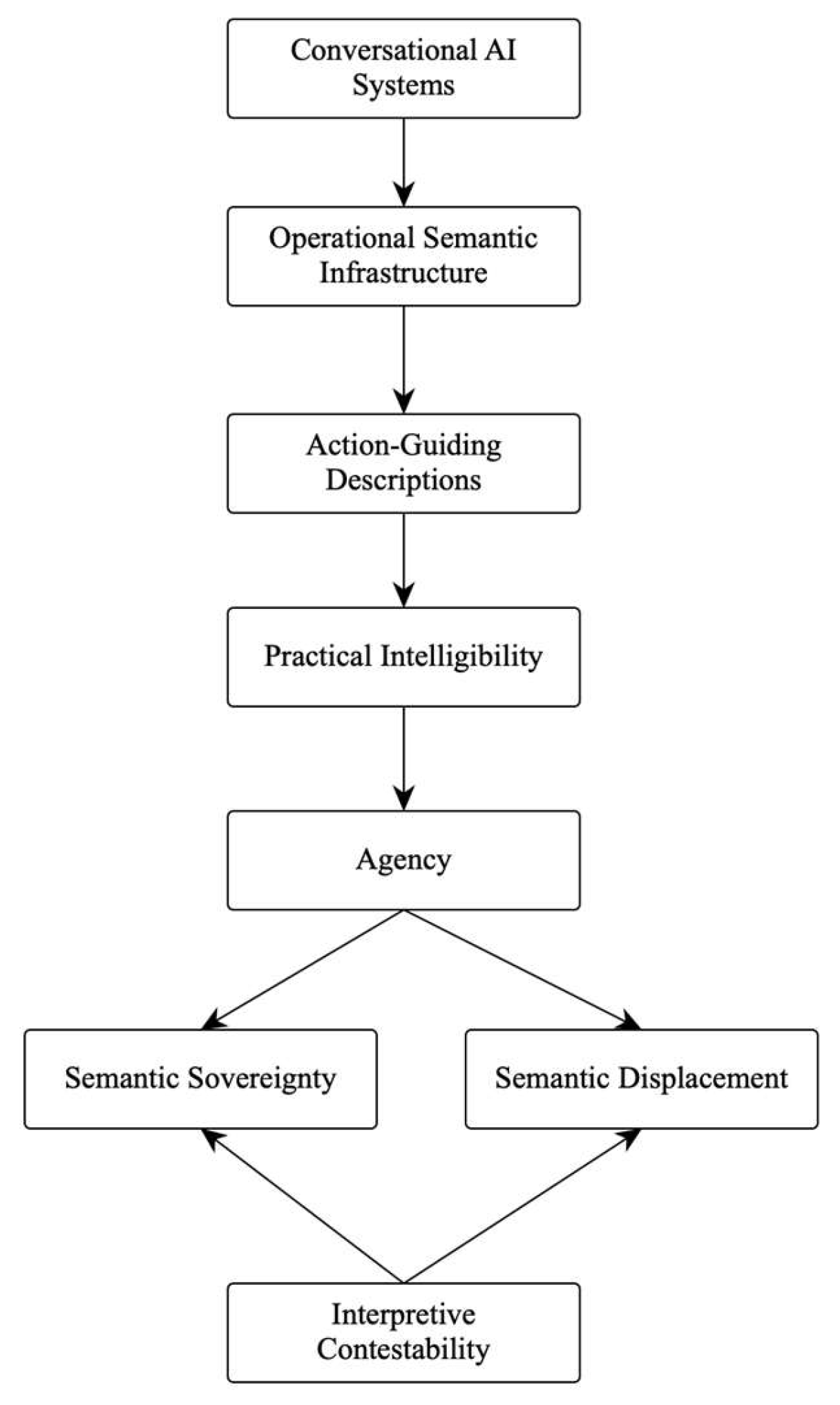
This article develops a conceptual account of semantic displacement in conversational AI. The central question concerns how agency is affected when systems do more than automate information retrieval and begin to supply the descriptions, classifications and normative cues through which users understand what they are doing. Drawing on philosophy of action, philosophy of language, hermeneutics, philosophy of technology and critical accounts of algorithmic mediation, this article reconstructs the relation between meaning and action as a condition of agency. Its methodological approach is conceptual and diagnostic, oriented toward clarifying a problem that becomes visible when established theories are brought together in relation to contemporary conversational systems. The article interprets these systems as operational semantic infrastructures that organize context-sensitive linguistic uptake within practical environments such as health, work, education, administration and everyday self-management. It then introduces semantic displacement as the condition in which action-relevant meanings become increasingly organized, prioritized and consolidated outside the agent’s own participatory interpretation. The argument contributes a vocabulary for distinguishing agency-enhancing semantic support from forms of semantic substitution that weaken interpretive participation. It concludes by proposing semantic sovereignty and interpretive contestability as normative ideals for human agency in AI-mediated environments. The argument specifies action as intentional conduct understood under socially available descriptions and cognition as situated interpretive sense-making rather than purely internal computation. It also clarifies three conditions under which semantic support becomes displacement: opaque semantic generation, practical stabilization and reduced interpretive contestability.
Keywords: conversational AI; agency; semantic displacement; philosophy of technology; interpretive contestability; semantic sovereignty; human–AI interaction; HCI; generative AI governance conversational AI; agency; semantic displacement; philosophy of technology; interpretive contestability; semantic sovereignty; human–AI interaction; HCI; generative AI governance