Review

Examining the Philosophical Underpinnings of Design Science Research (DSR)

School of Science, Engineering and Environment, University of Salford, 43 Crescent, Salford M5 4WT, UK
*
Author to whom correspondence should be addressed.
Philosophies 2025, 10(6), 139; https://doi.org/10.3390/philosophies10060139
Submission received: 14 October 2025 / Revised: 15 December 2025 / Accepted: 17 December 2025 / Published: 18 December 2025

Abstract

Design science research (DSR) has become a popular method in information systems research and has been warmly welcomed in other disciplines as well. The importance of DSR is evident, in terms of its contribution to knowledge, as well as the creation of artefacts to solve problems of common interest. While it has demonstrated a clear methodology for achieving research goals, the philosophical underpinnings are not widely synthesised. There are inconsistencies and voids related to the philosophical aspects of DSR. For example, there is an inconsistent argument among researchers regarding the definition of design science research in the first place. This study analysed six key texts published within the last fifteen years in design science research along with a critical discussion, with the help of the existing literature. Accordingly, the study presents suggestions for the philosophical aspects of DSR. Namely, the definitions related to DSR terms (design, design science, design science research, and research), philosophical aspects (ontology, epistemology, and axiology), and theory development approaches (inductive, deductive, abductive, and retroductive), as well as research strategies were discussed. This is recommended to take as a starting point for a formative discussion of the topic, fine-tuning ideas with a critical eye.

1. Introduction

Herbert Simon is believed to be the father of design science, with his book The Sciences of the Artificial in 1969. He introduced the science of man-made things or artificial things apart from the traditional science. Although the book does not say anything about design science in particular, the concept points towards the growth of a body of knowledge in design science [1]. A growing focus on the design science can be observed in the 1990s, probably due to the growth of information systems. Wojciech Gasparski acknowledged the existence of design science in the early 1990s and claimed that the philosophy and the definitions were immature [2]. Nigel Cross reflects on how research was conducted without “design” around 50 years ago, and how universities started to support the growth of design research discipline from the 1990s [3].
Design science is a science, as it possesses both the values of fundamentality and usefulness, as well as the creation of knowledge through a systematic process [4]. Accordingly, design science can be defined as the design of artefacts in a context to answer a problem and a contribution to the body of knowledge [5,6,7]. The research goals of natural and social sciences are to describe, explain, explore, and predict phenomena, while the research goals of design science are to prescribe solutions and solve problems through the creation of artefacts [8]. Artefacts are considered anything artificially created by humans. An artefact is a broader term covering both physical and conceptual developments. Some common types of artefacts in design science under the information systems discipline are constructs (vocabulary and symbols), models (abstractions and representations), methods (algorithms and practices), and instantiations (implemented and prototype systems) [4]. Different disciplines can have different artefact solutions.
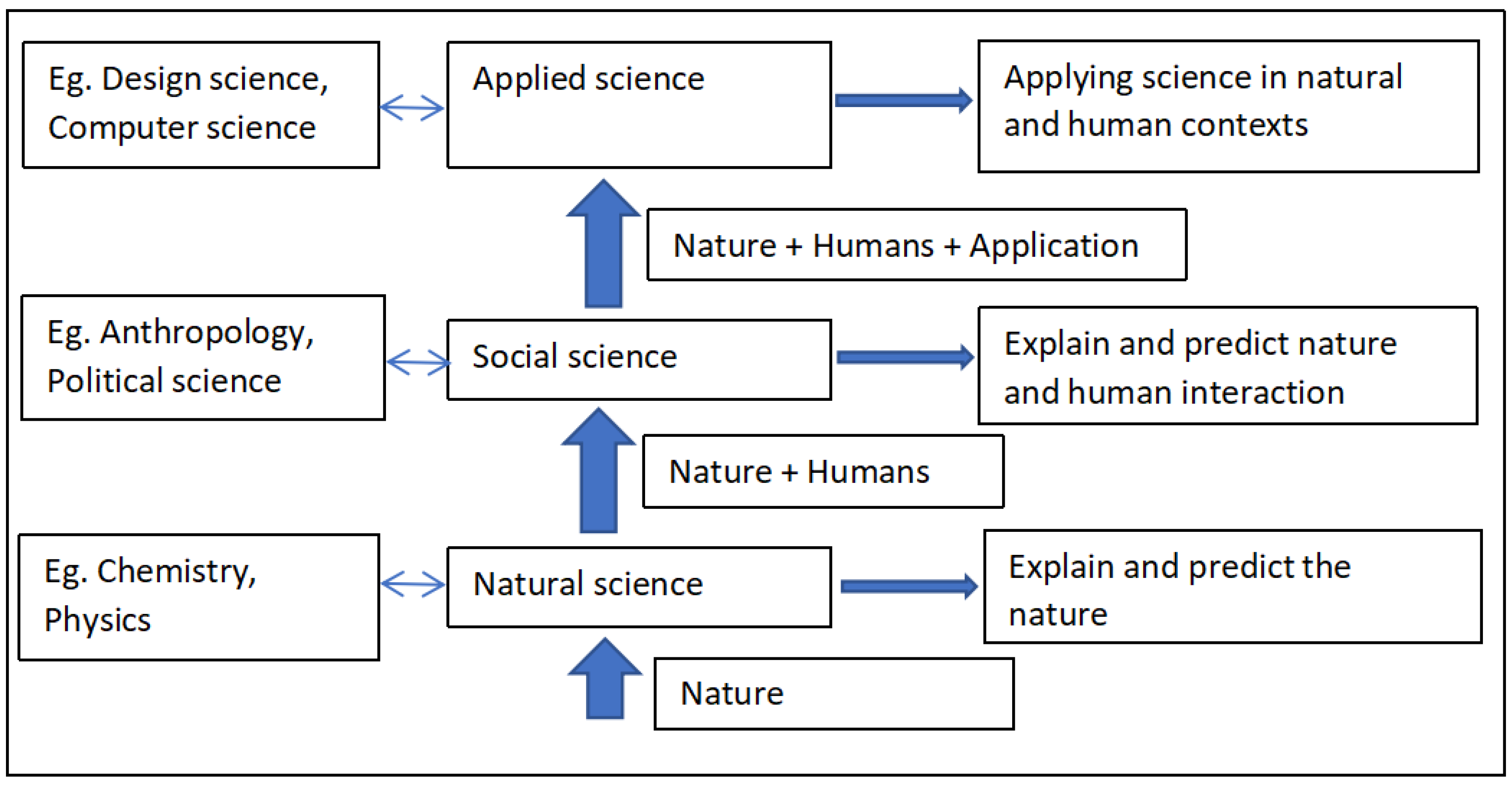
Figure 1 illustrates a proposed relationship among the sciences. There are four branches of academic disciplines: natural sciences, social sciences, applied sciences, and humanities. The three sciences are depicted in the figure above. Humanities, such as philosophy or history, are not included, as they do not fall within the realm of the sciences. Natural sciences such as physics or chemistry describe, explain, and predict nature with their theories. These theories are often broader and can be generalised to a higher level. The natural branch of science is mainly explained under positivist or post-positivist ontologies. They can stand alone, without the subjective interpretations of the observers.
The social sciences differ from the natural sciences, as they benefit from human agency and subjective interpretations. This makes social science less predictable than natural sciences. However, humans are also part of the environment, which is dominated by the natural sciences. Accordingly, social science is suggested to have inputs from both the natural sciences and human behaviour. Their ontological assumptions are mainly explained under interpretivism or similar ontologies such as postmodernism. It is difficult to remove subjective biases in these sciences.
In applied sciences, the theories from the social and natural science domains are applied to create something new. The discipline of design science can be identified as a branch of applied sciences. The ontological assumptions in these applied sciences are complex due to the broader range of applications. This can be one of the reasons for the unclear philosophical aspects of the design science.
There is a “science” suffix to design science [7]. Both design and design science create innovative artefacts to solve problems. The difference is that the design science artefacts are developed through a rigorous research process with relatively large generalisation and knowledge creation. The design science research undergoes a peer-review process to maintain its scientific rigour. This may not be observed in a general design project. Furthermore, the other research values, such as ethical considerations or critical arguments, also exist in design science research, no less than in any other research process [7]. It is also important to examine the problems that design science research aims to solve.
A design artefact (not design science) focuses on answering a problem in a particular case. An artefact designed under design science research (DSR) aims at solving a class of problems, not a problem in isolation [8]. As far as the literature is concerned, there are examples of using design science research to solve problems in the disciplines of information systems [5], built environment [10], engineering [8], and a range of applied sciences. One of the key aspects of these problems is that they fall into a middle-level generalisation, being neither a personal problem nor a universal-level problem.
A research paradigm is the worldview of the researcher, encompassing how they assign meanings to data and interpret conclusions. According to this definition, a research paradigm is subject to the researcher [11]. Design science research (DSR) is a research paradigm according to Hevner and Chatterjee [4], although this is not agreed upon by some other researchers. Design science research is a combination of answering design problems with artefacts and knowledge questions through a research process, according to Wieringa [5]. Design science research (DSR) is the type of research methodology that creates knowledge to design artefacts to meet functional requirements, according to Vaishnavi and Kuechler [6]. Dresch et al. have considered the design science as a research method [8]. This has also been stated by March and Storey [12].
In contrast, Johannesson and Perjons argue that design science is not a research method or research strategy [7]. Design science projects employ research methods in their activities. Research methods can be used to understand the problem, appraise the solutions, design the solutions, or evaluate the solutions. Scientific methods of data collection and analysis are required for all the design science project tasks. For example, the artefact evaluation can be performed by collecting user feedback and analysing it to understand to what extent the artefact has addressed its objectives.
Design science research (DSR) has gained considerable attention in the field of research during the past decades, mainly in the applied science domains, particularly in information systems [4,5]. As researchers confront more complex problems with both empirical and theoretical roots, the importance of having a tested methodology to solve them was emphasised. Design science research is observed to fill this gap due to its relevance in both theory and practice.
Despite the growing prominence of design science research, the philosophical and methodological aspects of design science research are less discussed. For example, the ontology of design science research is viewed from positions such as interpretivism, positivism [7], or critical realism [4,7] by different authors, while some authors convey unclear prepositions [6,13]. There is a clear need to understand the philosophy underlying any science before it is applied to research purposes.
The nature of design science research is characterised by its dual focus on practical relevance and scientific rigour. According to Baskerville et al. [14], DSR needs to produce prescriptive knowledge that contributes to theory while also being applicable in real-world contexts. Due to this duality of nature, the philosophical aspects require a more detailed and careful analysis by focusing on both artefact development and knowledge contribution. Furthermore, the discourse of philosophy in design science research often involves debates about the type of knowledge. In the design science literature, the knowledge is considered to be the “design knowledge” [15,16].
Design science is characterised by its longer and iterative process. While non-design research limits activities to data collection and analysis to draw conclusions, design science involves additional research steps. This can broaden the scope of a design science research project and make it more complex than general research.
Table 1 provides a synthesis of the design science research steps based on the key literature. Some authors have not explicitly mentioned some steps. Instead, they have provided consolidated steps, either explicit or implied. Only the explicitly highlighted steps by the authors are mentioned in the following table under the corresponding references. The first step is to identify the problem. Johannesson and Perjons identify this as explicating a problem in a broader sense, with sub-activities [7]. The objectives of the solution then need to be defined. The requirements are defined as the steps to achieve the specified objectives. These will be the deliverables of the artefact. The artefact is designed using design theories. Then the artefact needs to undergo iterative development cycles until it reaches a satisfactory level of performance (saturation). Although the texts have merged design and development into a single step, they are presented separately here for better clarification.
Demonstrating the artefact involves the presentation of the functionality to an audience before implementing it in the final context. The validation of the artefact conveys that the design team has ensured that the artefact delivers the objectives according to internal testing. Once the artefact passes the internal validation stage, it can be implemented in the final intended context, which will be used by the end users. It is also important to evaluate the artefact with the end users. Finally, the overall process must be documented and communicated as necessary. Depending on the research design, some steps may not be conducted. For example, implementation and evaluation may not take place if the artefact development stops at the validation stage.
This study reviews the lack of synthesis regarding the philosophical aspects of design science research through a comparative analysis of the literature. Six books related to design science research were reviewed to understand how they have considered philosophical aspects. This was further supported by a critical discussion, drawing on other existing literature.


2. Materials and Methods

The methodology of this study is considered to be a comparative analysis of the critical literature, conducted under a qualitative approach. Due to the nature of the research, which aims to understand the philosophical aspects of design science research, the study requires an interpretive approach, where the selected literature findings are interpreted in light of the existing literature through the researchers’ subjective worldview. There are six books related to the design science research (DSR) methodology, which were published after 2010. Only the books were selected, considering their in-depth comprehension of the subject. Other literature sources, such as journal articles, book chapters, or conference articles, were referred to during the critical discussion. The sampling process was not required, as these were the only books found in the discipline in the English language under the literature search.
Table 2 presents the selected texts for this study for the main review. The study first looked at the definitions of design, design science, research, and design science research. This identifies what design science research is. There are different definitions in the literature to identify the context of design science research. Then, the philosophical stances of design science research were studied. The research philosophy (ontology, epistemology, and axiology), approach to theory development, methodological choice, research strategy, data collection, and analysis methods were considered for this purpose.

3. Results

3.1. Design Science-Related Definitions

When it comes to the concept of design, design science, and research in design science, it has been observed that different authors have proposed varying ideas for these terms. Table 3 focuses on exploring how the selected literature has defined these terms to present the concept of design science research (DSR).

3.2. Research Philosophy

The research philosophy was approached under the three terms of ontology, epistemology, and axiology for this section. The ontology of research is the study of being, according to the Encyclopaedia Britannica [17]. Several ontological views are suggested in the literature. Epistemology is the nature, origin, and limits of human knowledge [18]. Axiology is the theory of value in a broader sense [19]. As far as the texts referred to design science research literature, there are mixed ideas about these theoretical underpinnings. Table 4 presents how selected texts have discussed the key philosophical aspects.

3.3. Approach to Theory Development

The theory development approach can be inductive, deductive, abductive, or retroductive. Inductive reasoning starts from a specific point to generalise to the whole scope, while deductive reasoning starts from the whole scope to narrow down the theory to the specific point. Induction aims to generate a theory, while deduction tries to falsify, verify, or modify a theory. Induction observes the phenomena, identifies patterns, and tries to create a theory. Deduction proposes a theory, finds testable hypotheses, and data collection and analysis are performed to accept or reject the proposition. Abductive reasoning is a combination of both inductive and deductive approaches. In simple terms, inductive methods suggest where theory originates. Deductive methods say what the theory should be. Abductive methods suggest what the theory can be. Retroductive methods are similar to abductive methods but they focus on underlying realities and causality [8]. Table 5 shows how the key texts have introduced approaches to theory development in design science research.

3.4. Research Strategies

There are data collection strategies. The study aims to understand how these data collection strategies are recommended in the key texts in the literature. While acknowledging the possibility of having further research strategies, this study’s scope is limited to the research strategies found in the chosen texts, with at least two citations. There are three main methodological choices found in the general literature: quantitative, qualitative, and mixed methods. Methodological choices were not reviewed in detail for this study. Table 6 presents how the key texts have recommended different research strategies for design science research.

4. Discussion

4.1. Design Science-Related Definitions

The design science research-related definitions vary among different sources. A critical discussion was carried out to synthesise different definitions for DSR terms. Table 7 presents the proposed definitions for design science research.
The first term to define is “design” (not to be confused with design science). The basic idea is to develop a solution to an identified problem. While Hevner and Chatterjee say there is no new knowledge generated [4], Vaishnavi and Kuechler argue about new knowledge generation [6]. Irrespective of whether new knowledge is generated or not, the basic idea is to develop a solution to a problem for once, ideally using the “existing knowledge”. It can also be argued that the generation of new knowledge is related to how existing knowledge is applied to the problem. In the concept of design, the artefact is emphasised over the knowledge [20]. In brief, the justification for a solution is irrelevant in the design process. The objective is just to solve the problem.
Compared with design, the justification is way more important in design science. The premises need to be established that the solution is the best of all the alternatives, and the solution is justified scientifically. It is commonly accepted in the literature that new knowledge is generated in design science. Both De Sordi and Dresch et al. agree that the knowledge (epistemology) aspect of the design science stays with design theories [8,13]. Compared with the isolated problems focused on design, design science focuses on a broader scope of problems, which are considered “a class of problems”. Accordingly, the generalisation of design science solutions is broader than that of design solutions. The importance of both the artefacts and theoretical underpinnings was highlighted in healthcare research conducted by Bullock et al. [21].
Although there are differences observed in other definitions, every text has agreed on the design science research definition. Three criteria can be identified in design science research. The first one is the artefact creation; there should be an innovative artefact developed. Second is the contribution to knowledge; the artefact should not just answer the problem of “what” is the solution, but it should justify “why” that is the answer and “how” it answers the problem. The knowledge should justify how the particular artefact answers the problem, based on the theoretical underpinning. Ultimately, a scientific research process should be employed through the design science steps. Design science research generalises more than the case level, but less than the universal level [5].
Unlike the other research types, design science research focuses on both theory and practice. It identifies the problem, designs the solution, and evaluates the solution, where the traditional science focuses on only theory development [22]. In line with these arguments, Baskerville et al. endorse the requirement of design science research to contribute to knowledge and answer real-world problems with artefact solutions [23].

4.2. Research Philosophy

The second part of the discussion focused on the philosophical aspects of design science research. Table 8 synthesises the literature in the selected texts to inform the philosophical aspects of design science research.
An artefact can be identified as the practical instrument which delivers the solution to the design science research problem [6,8]. Knowledge is the other output of a design science project. Some argue that the artefact and knowledge are the same. Bofylatos and Spyrou propose how artefacts contain different types of knowledge: tacit knowledge, empirical knowledge, and scientific knowledge [24]. While leaving that to debate, this study aims to treat artefact and knowledge as two distinct outputs of a DSR project: the artefact as the practical output, and the knowledge as the scientific explanation.
There are different knowledge forms. The knowledge that resides in people’s minds is called embodied knowledge or tacit knowledge. Only the person with knowledge can make use of it. Further, there is explicit knowledge, which is well documented as texts, data, or in any other form. Finally, there is embedded knowledge, which resides in entities, not humans. An artefact has embedded knowledge on how to solve a specific problem [7].
Ontology: Ontology can be defined as how the researcher sees the world or assumptions about reality. Wieringa or Dresch et al. have not touched on ontology in their texts [5,8]. Vaishnavi and Kuechler have proposed a vague explanation for ontology, which is not easily comprehensible [6]. Hevner and Chatterjee have stated the ontology of design science research as one of critical realism [4]. Examining these six texts, the most acceptable and easily comprehensible statements can be identified in the other two texts. De Sordi has the same idea as Vaishnavi and Kuechler, but in simpler terms [13]. He says the ontology of design science should be decided contextually. By taking this forward to a more specific level, Johannesson and Perjons argue that the ontology of the design science research can be explained via positivism, interpretivism, critical realism, and critical theory [7].
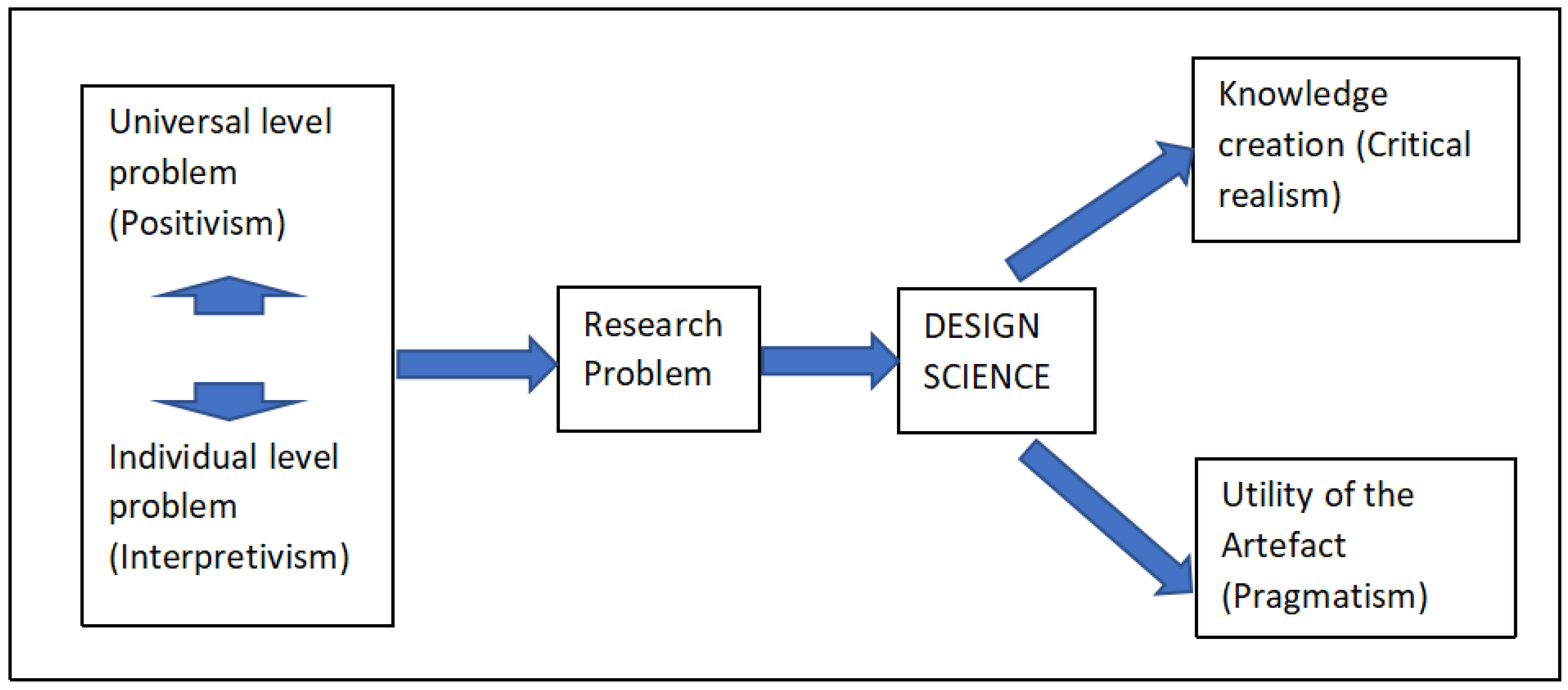
Figure 2 presents a proposal for the ontological assumptions of design science research. It is suggested that the ontology of design science research philosophy cannot be restricted to a single ontology, although it seems to be closely related to pragmatism or critical realism. It should be considered by the design science researcher in relation to their research problem and goals. Design science research is about problem solving by way of an artefact while contributing to knowledge. Knowledge creation is explained by critical realism. Retroduction is questioning why something happens. This is the methodology of critical realism. Retroduction is similar to the abductive reasoning observed in the validation of design science research, where knowledge is created [7]. Accordingly, critical realism can be considered as the ontology of knowledge creation in design science. Knowledge creation is a mandatory part of design science research.
The utility of the artefact is explained by pragmatism. The researcher expects the artefact to solve the research problem. However, there is a possibility that an artefact may not have any value in terms of pragmatism. An artefact may create more problems instead of solving the problem. In terms of ontology, this can be best described by pragmatism, where the artefact solution is viewed from the lens of its practical relevance [4,13].
Further, design science problems are located somewhere between absolute objectivity and absolute subjectivity. Design science does not answer universal-level problems as the natural sciences do. Neither does design science address individual-level/case-level problems like action research does. Ideally, design science problems reside somewhere between the extremes of objectivity and subjectivity.
Epistemology: While ontology is the nature of reality, epistemology is the nature of knowledge. The knowledge in design science can be recognised as design theories, artefacts, tools and techniques, methods to create artefacts, and evaluation details [6]. Knowledge in design science can be further divided into embedded knowledge with the artefact, and explicit knowledge with the justifications (design theories, tools, techniques, and methods) [4,6,7]. Knowledge creation is a basic outcome of any research. Design science research has broader outcomes, including the creation of artefact knowledge, apart from general knowledge creation.
Axiology: According to Vaishnavi and Kuechler, axiology is the study of values [6]. The nature of the values of a design science researcher is determined by how they see the world and what their ontological assumptions are. A critical realist will try to see phenomena as objectively as possible, while acknowledging the bias of the world views. Creswell and Creswell suggest this view as post-positivism [25]. They argue that absolute positivism is not practical in the real world. Post-positivism accepts the practical bias while holding onto positivism. They will value the knowledge creation more than the practical value of the artefact. A pragmatist will view the phenomenon more subjectively, giving greater weight to the practical value created through the utility of the artefact. A critical realist will value the underlying knowledge development by the artefact more. Tibau et al. demonstrate that some researchers prioritise practical value contributions, while others prioritise theoretical contributions [26].
In either case, Pries-Heje and Nielsen recommend the need for an ethical framework with broader societal goals in the axiological values of design science research [27]. Victor Papanek highlighted the importance of designing products and services for the 90% of the non-wealthy people in the world, with higher levels of moral and social responsibility [28]. This is another aspect of the axiology of a design science project. Again, four of the texts do not mention anything about axiology in design science research [5,7,8,13].

4.3. Approach to Theory Development

There are four theory development approaches considered in this study. Some selected texts have explained them in detail [6,7,8,13] while some of them have touched upon them gently [4,5]. Table 9 presents the proposed definitions of theory development approaches in the context of design science research.
Unlike traditional research, which focuses on suggesting a theory (validating a theory or explaining a phenomenon), design science research is identified with a broader process encompassing several activities, from identifying the problem to evaluating the solution. Due to this reason, different phases of design science research were observed to be addressed under different theory development approaches. The general idea is that design science research employs various theory development approaches across different phases.
The induction approach is observed to be valuable in generalising the solution to a class of problems [8,13]. Vaishnavi and Kuechler argue that an inductive approach can be used during the development stage as well [6]. When the artefact is developed and validated, it has proven its application in a single context. In the induction method of theory development, several instances are used to generalise a concept into a broader context. In other words, this broadens the knowledge from specific to general [29]. Accordingly, it can be argued that the induction approach is best suited for the generalisation of the results of a design science research project.
Most of the texts have mentioned the applicability of the deductive theory development approach in the artefact design, development, and evaluation stages [6,8,13]. This seems to be rationally sound, as the deduction is about developing a theory by focusing on the general and then the specific [29]. Once the design researcher has a broader idea about the potential solution, they can improve the solution by focusing on specific requirements as well as removing the unnecessary parts of the potential solution. This goes in an iterative process from the design, development, and, finally, the evaluation.
Abduction can be considered as a combination of induction and deduction, favouring the question of, “What can be?” [8]. According to the analysis of the texts, the abduction theory development method is best used in the stage of brainstorming a solution for the identified problem. There can be several potential solutions, and an abductive approach is recommended to justify “what can be” the best solution of the alternatives. The objectives of the solution and requirements of the artefact are the outputs of this process.
Retroduction is also similar to abduction, but it delves deeper to uncover the causal mechanisms underlying a phenomenon. Retroduction is suitable for understanding the research problem by uncovering the underlying structured realities. Root cause analysis is usually conducted under the retroduction theory development approach. The solutions need to be designed to address these underlying root causes. Only Johannesson and Perjons have discussed the relevance of retroduction to design science research [7].

4.4. Research Strategies

The study has identified eight key research strategies in the given text. In general, the texts have not attempted to discuss the research strategies most relevant to design science research projects. There were discussions of common research strategies and how they are used in research. Conclusively, there are no specific research strategies especially used in design science research. Any research strategy can be used as long as it serves the purposes of the design science research.
De Sordi identifies design science research as a research strategy similar to action research or grounded theory, and suggests novel research strategies combining these research strategies [13]. One such strategy is action design research, which combines action research and design research. The other approach is grounded design research, which combines grounded theory and design research. Vaishnavi and Kuechler do not explicitly talk about the research strategies [6]. They propose some evaluation and validation patterns related to the design science process.
Although the application of research strategies has shown no difference in the design science research, the selection of one or more strategies in a design science research project can be challenging compared with a traditional research project. Design science research can have many iterations as well as several phases [30]. Planning research strategies in a design science project can be more complex and of higher scope.
According to this qualitative analysis, design science is less likely to be a research strategy. If it is a research strategy, why are other research strategies, such as surveys or case studies, used in design science research projects? In conclusion, design science research can use any research strategy according to the requirements.

5. Conclusions

The philosophical aspects of design science research were identified as an under-researched subject, leaving several research gaps and inconsistencies. This study focused on six key texts written on the subject of design science research from 2010 onwards. The comparison and contrasting of the findings were discussed with the help of the existing literature.
The study was successful in establishing a ground for the synthesis of the philosophical aspects of design science research. Starting from the terminology related to design science research, the results focused on the research philosophy, approach to theory development, and research strategies. Summaries of the findings are given in the discussion section, respectively, for each theme of philosophical aspects. The study will be helpful for academics to apply design science research to their projects with a high level of academic rigour and relevance. This will improve the overall quality of the research process of design science research. It will also prevent practitioners from applying research methods incorrectly while creating a basis for further philosophical discussions.
The authors wish to present this synthesis of the literature as a starting point for a formative discussion. The key limitations of this study are that the results are based on six key texts and articles, which may be criticised for their limited discussion. Accordingly, further research is recommended to move forward the discussion and to fine-tune the philosophical aspects for better understanding.

Author Contributions

Conceptualisation, C.P., P.C., M.M. and S.S.; methodology, C.P. and S.S.; software, C.P.; validation, C.P., P.C. and M.M.; formal analysis, C.P.; investigation, C.P.; resources, S.S.; data curation, C.P.; writing—original draft preparation, C.P.; writing—review and editing, C.P.; visualisation, C.P.; supervision, P.C., M.M. and S.S.; project administration, C.P.; and funding acquisition, C.P. All authors have read and agreed to the published version of the manuscript.

Funding

This research received no external funding.

Institutional Review Board Statement

Not applicable.

Informed Consent Statement

Not applicable.

Data Availability Statement

No new data were created or analysed in this study. Data sharing is not applicable to this article.

Acknowledgments

The authors wish to acknowledge the valuable contributions of the original authors whose foundational texts were referenced and reviewed in the preparation of this article.

Conflicts of Interest

The authors declare no conflicts of interest.

References

  1. Simon, H.A. The Sciences of the Artificial, 3rd ed.; MIT Press: Cambridge, MA, USA, 1996; ISBN 978-0262690232. [Google Scholar]
  2. Gasparski, W.W.; Gregory, S.A.; Foque, R.; Strzalecki, A. Contemporary History of Design Science. In Design & Systems General Applications of Methodology-Praxiology; Collen, A., Gasparski, W.W., Eds.; Routledge: London, UK, 1994; pp. 15–24. ISBN 978-1560001874. [Google Scholar]
  3. Cross, N. Developing design as a discipline. J. Eng. Des. 2018, 29, 691–708. [Google Scholar] [CrossRef] [Scilit]
  4. Hevner, A.R.; Chatterjee, S. Design Research in Information Systems: Theory and Practice, 1st ed.; Springer: London, UK, 2010. [Google Scholar] [CrossRef] [Scilit]
  5. Wieringa, R.J. Design Science Methodology for Information Systems and Software Engineering, 1st ed.; Springer: London, UK, 2010. [Google Scholar] [CrossRef] [Scilit]
  6. Vaishnavi, V.K.; Kuechler, W. Design Science Research Methods and Patterns Innovating Information and Communication Technology, 2nd ed.; CRC Press: Boca Raton, FL, USA, 2015; ISBN 978-1-4987-1526-3. [Google Scholar]
  7. Johannesson, P.; Perjons, E. An Introduction To Design Science, 2nd ed.; Springer Nature: Cham, Switzerland, 2021. [Google Scholar] [CrossRef] [Scilit]
  8. Dresch, A.; Lacerda, D.P.; Antunes, J.A.V.A. Design Science Research, 1st ed.; Springer International Publishing: Cham, Switzerland, 2015. [Google Scholar] [CrossRef] [Scilit]
  9. Bud, R. “Applied Science”: A Phrase in Search of a Meaning. Isis 2012, 103, 537–545. [Google Scholar] [CrossRef] [Scilit] [PubMed]
  10. Aburamadan, R.; Trillo, C. Applying design science approach to architectural design development. Front. Archit. Res. 2020, 9, 216–235. [Google Scholar] [CrossRef] [Scilit]
  11. Kivunja, C.; Kuyini, A.B. Understanding and applying research paradigms in educational contexts. Int. J. High. Educ. 2017, 6, 26–41. [Google Scholar] [CrossRef] [Scilit]
  12. March, S.T.; Storey, V.C. Design Science in the Information Systems Discipline: An Introduction to the Special Issue on Design Science Research. MIS Q. 2008, 32, 725. [Google Scholar] [CrossRef] [Scilit]
  13. De Sordi, J.O. Design Science Research Methodology, 1st ed.; Palgrave Macmillan/Springer Nature: Cham, Switzerland, 2020. [Google Scholar] [CrossRef] [Scilit]
  14. Baskerville, R.; Kaul, M.; Pries-Heje, J.; Storey, V.C. Inducing Creativity in Design Science Research. In Extending the Boundaries of Design Science Theory and Practice; Springer: Cham, Switzerland, 2019; pp. 3–17. [Google Scholar] [CrossRef] [Scilit]
  15. Engström, E.; Storey, M.-A.; Runeson, P.; Höst, M.; Baldassarre, M.T. How Software Engineering Research Aligns with Design Science: A Review. Empir. Softw. Eng. 2020, 25, 2630–2660. [Google Scholar] [CrossRef] [Scilit]
  16. Iivari, J. Editorial: A Critical Look at Theories in Design Science Research. J. Assoc. Inf. Syst. 2020, 21, 502–519. [Google Scholar] [CrossRef] [Scilit]
  17. Encyclopedia, B. Ontology|Metaphysics. In Encyclopædia Britannica; Encyclopædia Britannica, Inc.: Chicago, IL, USA, 2015; Available online: https://www.britannica.com/topic/ontology-metaphysics (accessed on 22 October 2025).
  18. Encyclopedia, B. Epistemology. In Encyclopædia Britannica; Encyclopædia Britannica, Inc.: Chicago, IL, USA, 2019; Available online: https://www.britannica.com/topic/epistemology (accessed on 22 October 2025).
  19. Encyclopedia, B. Axiology|Philosophy. In Encyclopædia Britannica; Encyclopædia Britannica, Inc.: Chicago, IL, USA, 2015; Available online: https://www.britannica.com/topic/axiology (accessed on 22 October 2025).
  20. Merwe, A.v.d.; Gerber, A.; Smuts, H. Guidelines for Conducting Design Science Research in Information Systems. In ICT Education; Springer: Cham, Switzerland, 2019; pp. 163–178. [Google Scholar] [CrossRef] [Scilit]
  21. Bullock, A.; Morris, Z.S.; Atwell, C. Collaboration Between Health Services Managers and Researchers: Making a Difference? J. Health Serv. Res. Policy 2012, 17, 2–10. [Google Scholar] [CrossRef] [Scilit]
  22. Peffers, K.; Tuunanen, T.; Rothenberger, M.A.; Chatterjee, S. A Design Science Research Methodology for Information Systems Research. J. Manag. Inf. Syst. 2007, 24, 45–77. [Google Scholar] [CrossRef] [Scilit]
  23. Baskerville, R.; Baiyere, A.; Gergor, S.; Hevner, A.R.; Rossi, M. Design Science Research Contributions: Finding a Balance Between Artifact and Theory. J. Assoc. Inf. Syst. 2018, 19, 358–376. [Google Scholar] [CrossRef] [Scilit]
  24. Bofylatos, S.; Spyrou, T. Meaning, knowledge and artifacts, giving a voice to tacit knowledge. Des. J. 2017, 20, S4422–S4433. [Google Scholar] [CrossRef] [Scilit]
  25. Creswell, J.W.; Creswell, J.D. Research Design: Qualitative, Quantitative, and Mixed Methods Approaches, 5th ed.; Sage Publications, Inc.: London, UK, 2018; ISBN 978-1506386706. [Google Scholar]
  26. Tibau, M.; Siqueira, S.W.M.; Nunes, B.P. Mapping Knowledge Flows in ExploratoryWeb Searches. In Proceedings of the 55th Hawaii International Conference on System Sciences, Virtual Event, 4–7 January 2022. [Google Scholar] [CrossRef] [Scilit]
  27. Pries-Heje, J.; Nielsen, A.-D.F. Innovative Project Idea Maturation: An Important Part of Governance. In IFIP International Working Conference on Governance and Sustainability in Information Systems-Managing the Transfer and Diffusion of IT; Springer: Berlin/Heidelberg, Germany, 2011; pp. 29–42. [Google Scholar] [CrossRef] [Scilit]
  28. Papanek, V. Design for the Real World, 1st ed.; Bantam Books: New York, NY, USA, 1971; ISBN 978-0500295335. [Google Scholar]
  29. Saunders, M.N.K.; Lewis, P.; Thornhill, A. Research Methods for Business Students, 8th ed.; Pearson: London, UK, 2019. [Google Scholar]
  30. Van Aken, J.E. Management Research as a Design Science: Articulating the Research Products of Mode 2 Knowledge Production in Management. Br. J. Manag. 2005, 16, 19–36. [Google Scholar] [CrossRef] [Scilit]
Figure 1. Relationship among the sciences [8,9].
Philosophies 10 00139 g001
Figure 2. Proposed assumptions of design science ontology, adapted from [4,7,13].
Philosophies 10 00139 g002
Table 1. Synthesis of design science research steps.
DSR StepsHevner and Chatterjee, [4]Wieringa [5]Vaishnavi and Kuechler [6]Dresch et al. [8]Johannesson and Perjons [7]De Sordi [13]
1. Identify the problemXXX XX
2. Define objectives for a solutionX XX X
3. Define requirements X
4. Design the artefactXX XXX
5. Develop the artefactX XXXX
6. Demonstrate the artefactX XX
7. Validate the artefact X
8. Implement the artefact X X
9. Evaluate the artefactXXXXXX
10. Communicate the findingsX X X
Table 2. Selected key texts for the comparative analysis.
Name of the TextAuthorReference
1Design Research in Information SystemsAlan Hevner and Samir Chatterjee[4]
2Design Science MethodologyRoel J. Wieringa[5]
3Design Science Research Methods and PatternsVijay K. Vaishnavi and William Kuechler, Jr.[6]
4Design Science ResearchAline Dresch, Daniel Pacheco Lacerda and José Antônio Valle Antunes Jr.[8]
5An Introduction to Design SciencePaul Johannesson and Erik Perjons[7]
6Design Science Research MethodologyJosé Osvaldo De Sordi[13]
Table 3. Definition of key terms.
ReferenceResearchDesignDesign ScienceDesign Science Research
Hevner and Chatterjee [4]A systematic process of answering a problem. p. 3No new knowledge is generated. p. 3New knowledge is generated. p. 4Research paradigm of creating artefacts and generating new knowledge. p. 5
Wieringa [5]Research is required when the existing literature does not provide answers. p. 8Designing an artefact to improve a problem context. p. 7Design and investigation of artefacts in context. p. 7DSR generalises beyond the case level but is not universal. p. 10
Vaishnavi and Kuechler [6]An activity that contributes to the understanding of a phenomenon. p. 9Design involves creating a new artefact that does not exist, by drawing on existing knowledge. p. 10A body of knowledge about the design of artefacts to meet desired goals. p. 11Innovative design may necessitate the conduct of research (DSR) to address knowledge gaps. p. 10
Dresch et al. [8]Research should strive to integrate both theory and practice. p. 1The activity of making changes to a given system, transforming situations to achieve improvements. p. 47An epistemological paradigm that can guide research toward problem-solving and artefact design. p. 48A method that establishes and operationalises research when the desired goal is an artefact. p. 67
Johannesson and Perjons [7]The purpose of research is to create reliable and useful knowledge based on empirical evidence and logical arguments. p. 41A process of developing a working solution to a problem relevant to a single situation. p. 9Scientific study and creation of artefacts to solve practical problems of general interest. p. 8Use of research methods and strategies to create artefacts and generate knowledge. p. 16
De Sordi [13]-The term design implies designing something as a solution to a need, and these human creations are called artefacts. p. 9Design science is related to design theories. p. 9Design science research is a combination of theory and practice. p. 8
Table 4. Comparative analysis for key philosophical aspects of DSR.
ReferenceOntologyEpistemologyAxiology
Hevner and Chatterjee [4]Critical realism. p. 214Related to changes. p. 190Practical utility and theoretical knowledge. p. 190
Wieringa [5]Not foundNot foundNot found
Vaishnavi and Kuechler [6]Multiple, contextually situated alternative world states. Socio-technologically enabled. p. 31Knowing through making: objectively constrained construction within a context. Iterative circumscription reveals meaning. p. 31Control; creation; problem-solving; and progress. p. 31
Dresch et al. [8]Not foundDesign knowledge. p. 52Not found
Johannesson and Perjons [7]DSR can benefit from both positivist, interpretivist, critical realism, and critical theory. p. 180Not clearNot clear
De Sordi [13]Contingent truth is true in the way it happens or the way things are, but it need not be an absolute truth in all contexts. p. 9Not foundNot found
Table 5. Comparative analysis of the approach to theory development.
ReferenceInductiveDeductiveAbductiveRetroductive
Hevner and Chatterjee [4]AcknowledgedAcknowledgedNot foundNot found
Wieringa [5]Not clearNot clearHighlights abductive inferenceNot found
Vaishnavi and Kuechler [6]Can be used for the artefact development stage. p. 220Can be used for the artefact development and evaluation stages. pp. 17, 222Can be used to suggest a solution. p. 17Not found
Dresch et al. [8]Can be used to generalise the solution to a class of problems. p. 119Can be used to design, develop, and evaluate the artefact. p. 119Mainly used to propose a solution. p. 119Not found
Johannesson and Perjons [7]Not foundThere are some similarities, but not prominent ones. p. 88 Goes in line with critical realism, which is valuable in the evaluation of the artefact. pp. 177–178Starts with an unexplained phenomenon and moves on to proposing structures to explain the phenomenon. p. 177
De Sordi [13]To generalise the best solution to a class of problems. p. 22To evaluate the usefulness of the artefact. p. 22To identify possible solutions to the problem. p. 22Not found
Table 6. Comparative analysis for research strategies.
Research StrategiesHevner and Chatterjee [4]Wieringa [5]Vaishnavi and Kuechler [6]Dresch et al. [8]Johannesson and Perjons [7]De Sordi [13]
1. ExperimentsXXX X
2. Survey X XX
3. Case studiesXX XX
4. Ethnography X
5. Grounded theory XX
6. Action research XXX
7. Simulation/ModellingX XXX
8. Mathematical/logical proofX X X
Table 7. Proposed definitions for DSR, adapted from [4,5,6,7,8,13].
ResearchDesignDesign ScienceDesign Science Research
A systematic way of acquiring knowledge, which is replicable, refutable, and accepted by the scientific community.Use of existing knowledge to solve a particular problem innovatively.Solving a more generalised problem under a scientific process with the help of an artefact while contributing to the body of knowledge.Use of research methods to support the scientific process of a design science project to develop an artefact and contribute to knowledge.
Table 8. Suggested philosophical stance for DSR, adapted from [4,5,6,7,8,13].
OntologyEpistemologyAxiology
ArtefactPragmatismEmbedded knowledgeSolving the problem (utility of the artefact)
KnowledgeCritical realismDesign theoriesContribution to knowledge
Table 9. DSR theory development approaches, adapted from [4,5,6,7,8,13].
InductionDeductionAbductionRetroduction
Application in the DSR process To generalise the artefact solution to a class of problems. To support an artefact solution during the artefact design, development, and evaluation stages. To identify the artefact objectives and requirements. To understand the problem through its root causes.
Disclaimer/Publisher’s Note: The statements, opinions and data contained in all publications are solely those of the individual author(s) and contributor(s) and not of MDPI and/or the editor(s). MDPI and/or the editor(s) disclaim responsibility for any injury to people or property resulting from any ideas, methods, instructions or products referred to in the content.