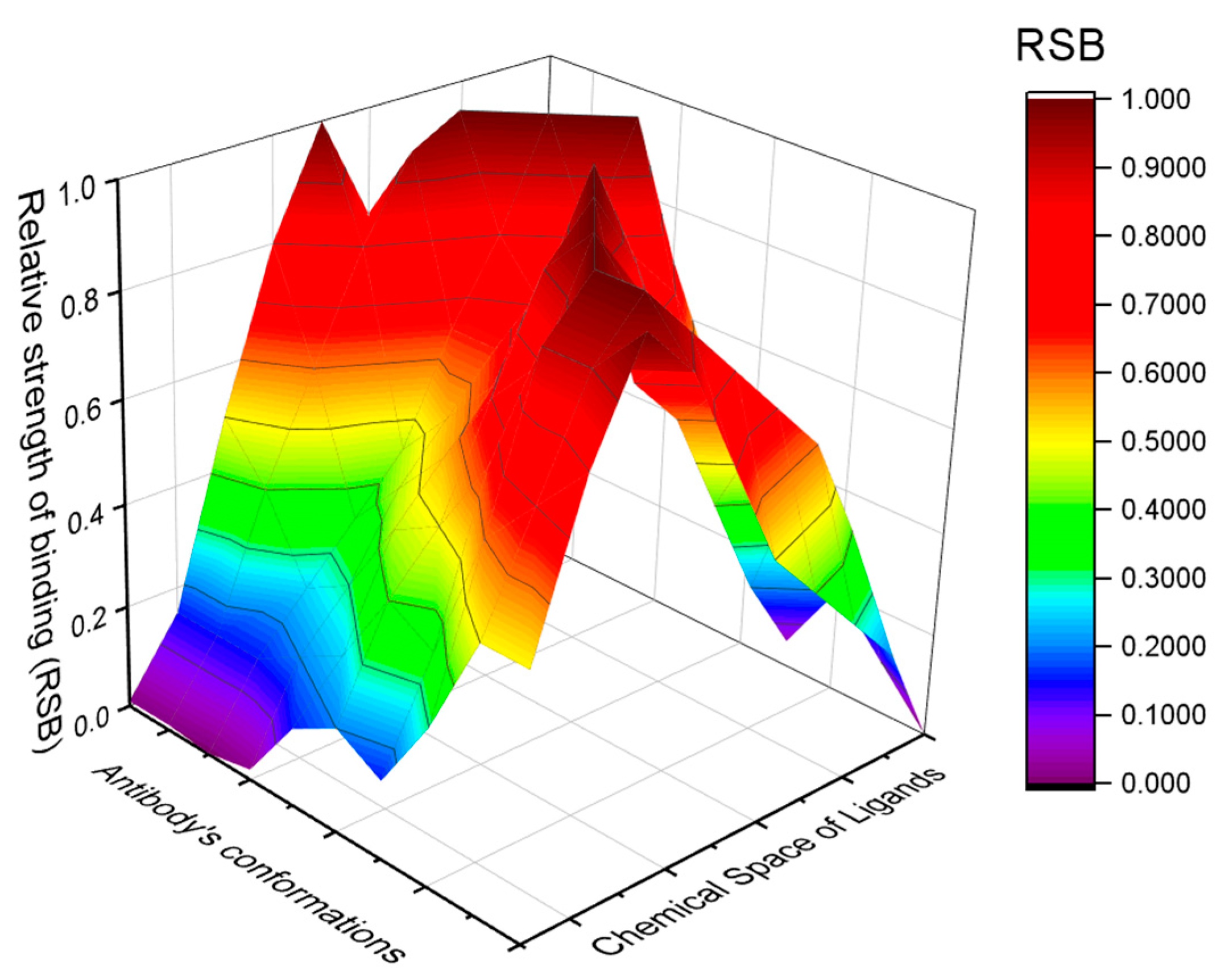

The Conformational Contribution to Molecular Complexity and Its Implications for Information Processing in Living Beings and Chemical Artificial Intelligence


Abstract
1. Introduction
2. Hierarchical Description of a Molecular Structure
3. Conformational Entropy
4. Fuzzy Entropy
5. The Biochemical Relevance of Conformations
6. The Logic of Life
7. Mimicking the Logic of Life
8. Conclusions
Funding
Institutional Review Board Statement
Data Availability Statement
Acknowledgments
Conflicts of Interest
References
- Whitlock, H.W. On the structure of total synthesis of complex natural products. J. Org. Chem. 1998, 63, 7982–7989. [Google Scholar] [CrossRef] [Scilit]
- Barone, R.; Chanon, M. A new simple approach to chemical complexity. Application to the synthesis of natural products. J. Chem. Inf. Comput. Sci. 2001, 41, 269–272. [Google Scholar] [CrossRef] [Scilit]
- Bertz, S.H. Complexity of synthetic reactions. The use of complexity indices to evaluate reactions, transforms and disconnections. New J. Chem. 2003, 27, 860–869. [Google Scholar] [CrossRef] [Scilit]
- Allu, T.K.; Oprea, T.I. Rapid evaluation of synthetic and molecular complexity for in silico chemistry. J. Chem. Inf. Model. 2005, 45, 1237–1243. [Google Scholar] [CrossRef] [Scilit] [PubMed]
- Ertl, P.; Schuffenhauer, A. Estimation of synthetic accessibility score of drug-like molecules based on molecular complexity and fragment contributions. J. Cheminf. 2009, 1, 8. [Google Scholar] [CrossRef] [Scilit]
- Leach, A.R.; Hann, M.M. Molecular complexity and fragment-based drug discovery: Ten years on. Curr. Opin. Chem. Biol. 2011, 15, 489–496. [Google Scholar] [CrossRef] [Scilit] [PubMed]
- Bonnet, P. Is chemical synthetic accessibility computationally predictable for drug and lead-like molecules? A comparative assessment between medicinal and computational chemists. Eur. J. Med. Chem. 2012, 54, 679–689. [Google Scholar] [CrossRef] [Scilit] [PubMed]
- Méndez-Lucio, O.; Medina-Franco, J.L. The many roles of molecular complexity in drug discovery. Drug Discov. Today 2017, 22, 120–126. [Google Scholar] [CrossRef] [Scilit]
- Rashevsky, N. Life, information theory, and topology. Bull. Math. Biophys. 1955, 17, 229–235. [Google Scholar] [CrossRef] [Scilit]
- Schuffenhauer, A.; Brown, N.; Selzer, P.; Ertl, P.; Jacoby, E. Relationship between molecular complexity, biological activity, and structural diversity. J. Chem. Inf. Model. 2006, 46, 525–535. [Google Scholar] [CrossRef] [Scilit]
- Marshall, S.M.; Mathis, C.; Carrick, E.; Keenan, G.; Cooper, G.J.; Graham, H.; Craven, M.; Gromski, P.S.; Moore, D.G.; Walker, S.I.; et al. Identifying molecules as biosignatures with assembly theory and mass spectrometry. Nat. Commun. 2021, 12, 3033. [Google Scholar] [CrossRef] [Scilit]
- d’Hendecourt, L.L. Molecular complexity in astrophysical environments: From astrochemistry to “astrobiology”? EPJ Web Conf. 2011, 18, 06001. [Google Scholar] [CrossRef] [Scilit]
- García-Sánchez, M.; Jiménez-Serra, I.; Puente-Sánchez, F.; Aguirre, J. The emergence of interstellar molecular complexity explained by interacting networks. Proc. Natl. Acad. Sci. USA 2022, 119, e2119734119. [Google Scholar] [CrossRef] [Scilit]
- Gentili, P.L. Small steps towards the development of chemical artificial intelligent systems. RSC Adv. 2013, 3, 25523–25549. [Google Scholar] [CrossRef] [Scilit]
- Gentili, P.L.; Stano, P. Tracing a new path in the field of AI and robotics: Mimicking human intelligence through chemistry. Part I: Molecular and supramolecular chemistry. Front. Robot. AI 2023, 10, 1238492. [Google Scholar] [CrossRef] [Scilit] [PubMed]
- Gentili, P.L.; Stano, P. Tracing a new path in the field of AI and robotics: Mimicking human intelligence through chemistry. Part II: Systems chemistry. Front. Robot. AI 2023, 10, 1266011. [Google Scholar] [CrossRef] [Scilit] [PubMed]
- des Cloizeaux, J.; Jannink, G. Polymers in Solution: Their Modeling and Structure; Clarendon Press: Oxford, UK, 1990. [Google Scholar]
- de Gennes, P.G. Introduction to Polymer Dynamics; Cambridge University Press: Cambridge, UK, 1990. [Google Scholar]
- Zuckerman, D.M. Statistical Physics of Biomolecules: An Introduction; CRC Press: Boca Raton, FL, USA, 2010. [Google Scholar]
- Bonchev, D.G.; Rouvray, D.H. (Eds.) Complexity: Introduction and Fundamentals; CRC Press: Boca Raton, FL, USA, 2003. [Google Scholar]
- Sabirov, D.S.; Shepelevich, I.S. Information Entropy in Chemistry: An Overview. Entropy 2021, 23, 1240. [Google Scholar] [CrossRef] [Scilit] [PubMed]
- Geerlings, P.; Borgooa, A. Information carriers and (reading them through) information theory in quantum chemistry. Phys. Chem. Chem. Phys. 2011, 13, 911–922. [Google Scholar] [CrossRef] [Scilit]
- Selzer, P.; Roth, H.-J.; Ertl, P.; Schuffenhauer, A. Complex molecules: Do they add value? Curr. Opin. Chem. Biol. 2005, 9, 310–316. [Google Scholar] [CrossRef] [Scilit]
- Sheridan, R.P.; Zorn, N.; Sherer, E.C.; Campeau, L.-C.; Chang, C.Z.; Cumming, J.; Maddess, M.L.; Nantermet, P.G.; Sinz, C.G.; O’Shea, P.D. Modeling a Crowdsourced Definition of Molecular Complexity. J. Chem. Inf. Model. 2014, 54, 1604–1616. [Google Scholar] [CrossRef] [Scilit]
- von Korff, M.; Sander, T. Molecular Complexity Calculated by Fractal Dimension. Sci. Rep. 2019, 9, 967. [Google Scholar] [CrossRef] [Scilit]
- Feldman, D.P. Chaos and Fractals: An Elementary Introduction; Oxford University Press: Oxford, UK, 2012. [Google Scholar]
- Chiolerio, A.; Vitiello, G.; Dehshibi, M.M.; Adamatzky, A. Living Plants Ecosystem Sensing: A Quantum Bridge between Thermodynamics and Bioelectricity. Biomimetics 2023, 8, 122. [Google Scholar] [CrossRef] [Scilit]
- Trinajstic, N. Chemical Graph Theory; CRC Press: Boca Raton, FL, USA, 1992. [Google Scholar]
- Chung, L.W.; Sameera, W.M.C.; Ramozzi, R.; Page, A.J.; Hatanaka, M.; Petrova, G.P.; Harris, T.V.; Li, X.; Ke, Z.; Liu, F.; et al. The ONIOM method and its applications. Chem. Rev. 2015, 115, 5678–5796. [Google Scholar] [CrossRef] [Scilit]
- Gentili, P.L. The fuzziness of a chromogenic spirooxazine. Dye. Pigment. 2014, 110, 235–248. [Google Scholar] [CrossRef] [Scilit]
- Gentili, P.L. The fuzziness of the molecular world and its perspectives. Molecules 2018, 23, 2074. [Google Scholar] [CrossRef] [Scilit] [PubMed]
- Zadeh, L.A. Fuzzy sets. Inf. Control 1965, 8, 338–353. [Google Scholar] [CrossRef] [Scilit]
- Zadeh, L.A. From computing with numbers to computing with words. From manipulation of measurements to manipulation of perceptions. IEEE Trans. Circuits Syst. I Fundam. Theory Appl. 1999, 46, 105–119. [Google Scholar] [CrossRef] [Scilit]
- Mendel, J.M. Fuzzy logic systems for engineering: A tutorial. Proc. IEEE 1995, 83, 345–377. [Google Scholar] [CrossRef] [Scilit]
- Zadeh, L.A. Toward a theory of fuzzy information granulation and its centrality in human reasoning and fuzzy logic. Fuzzy Sets Syst. 1997, 90, 111–127. [Google Scholar] [CrossRef] [Scilit]
- Gentili, P.L.; Perez-Mercader, J. Quantitative estimation of chemical microheterogeneity through the determination of fuzzy entropy. Front. Chem. 2022, 10, 950769. [Google Scholar] [CrossRef] [Scilit] [PubMed]
- Vickery, H.B. The origin of the word protein. Yale J. Biol. Med. 1950, 22, 387–393. [Google Scholar] [PubMed]
- Lemieux, R.U.; Spohr, U. How Emil Fischer was led to the lock and key concept for enzyme specificity. Adv. Carbohydr. Chem. Biochem. 1994, 50, 1–20. [Google Scholar]
- Kulkarni, P.; Leite, V.B.; Roy, S.; Bhattacharyya, S.; Mohanty, A.; Achuthan, S.; Singh, D.; Appadurai, R.; Rangarajan, G.; Weninger, K.; et al. Intrinsically disordered proteins: Ensembles at the limits of Anfinsen’s dogma. Biophys. Rev. 2022, 3, 011306. [Google Scholar] [CrossRef] [Scilit]
- James, L.C.; Tawfik, D.S. Conformational diversity and protein evolution–a 60-year-old hypothesis revisited. Trends Biochem. Sci. 2003, 28, 361–368. [Google Scholar] [CrossRef] [Scilit]
- Ma, B.; Shatsky, M.; Wolfson, H.J.; Nussinov, R. Multiple diverse ligands binding at a single protein site: A matter of pre-existing populations. Protein Sci. 2002, 11, 184–197. [Google Scholar] [CrossRef] [Scilit]
- Vavouri, T.; Semple, J.I.; Garcia-Verdugo, R.; Lehner, B. Intrinsic protein disorder and interaction promiscuity are widely associated with dosage sensitivity. Cell 2009, 138, 198–208. [Google Scholar] [CrossRef] [Scilit]
- Marcotte, E.M.; Tsechansky, M. Disorder, promiscuity, and toxic partnerships. Cell 2009, 138, 16–18. [Google Scholar] [CrossRef] [Scilit]
- Liu, H.; Jeffery, C.J. Moonlighting Proteins in the Fuzzy Logic of Cellular Metabolism. Molecules 2020, 25, 3440. [Google Scholar] [CrossRef] [Scilit]
- Wright, P.E.; Dyson, H.J. Intrinsically unstructured proteins: Re-assessing the protein structure-function paradigm. J. Mol. Biol. 1999, 293, 321–331. [Google Scholar] [CrossRef] [Scilit]
- Jakobs, U.; Kriwacki, R.; Uversky, V.N. Conditionally and Transiently Disordered Proteins: Awakening Cryptic Disorder to Regulate Protein Function. Chem. Rev. 2014, 114, 6779–6805. [Google Scholar] [CrossRef] [Scilit]
- Vucetic, S.; Brown, C.J.; Dunker, A.K.; Obradovic, Z. Flavors of protein disorder. Proteins Struct. Funct. Genet. 2003, 52, 573–584. [Google Scholar] [CrossRef] [Scilit]
- Ward, J.; Sodhi, J.; McGuffin, L.; Buxton, B.; Jones, D. Prediction and Functional Analysis of Native Disorder in Proteins from the Three Kingdoms of Life. J. Mol. Biol. 2004, 337, 635–645. [Google Scholar] [CrossRef] [Scilit] [PubMed]
- Peng, Z.; Yan, J.; Fan, X.; Mizianty, M.J.; Xue, B.; Wang, K.; Hu, G.; Uversky, V.N.; Kurgan, L. Exceptionally abundant exceptions: Comprehensive characterization of intrinsic disorder in all domains of life. Cell. Mol. Life Sci. 2015, 72, 137–151. [Google Scholar] [CrossRef] [Scilit] [PubMed]
- Piovesan, D.; Tabaro, F.; Mičetić, I.; Necci, M.; Quaglia, F.; Oldfield, C.J.; Aspromonte, M.C.; Davey, N.E.; Davidović, R.; Dosztányi, Z.; et al. DisProt 7.0: A major update of the database of disordered proteins. Nucleic Acids Res. 2017, 45, D219–D227. [Google Scholar] [CrossRef] [Scilit] [PubMed]
- Van Der Lee, R.; Buljan, M.; Lang, B.; Weatheritt, R.J.; Daughdrill, G.W.; Dunker, A.K.; Fuxreiter, M.; Gough, J.; Gsponer, J.; Jones, D.T.; et al. Classification of intrinsically disordered regions and proteins. Chem. Rev. 2014, 114, 6589–6631. [Google Scholar] [CrossRef] [Scilit]
- Pricer, R.; Gestwicki, J.E.; Mapp, A.K. From Fuzzy to Function: The New Frontier of Protein-Protein Interactions. Acc. Chem. Res. 2017, 50, 584–589. [Google Scholar] [CrossRef] [Scilit]
- Kulkarni, P. Intrinsically Disordered Proteins: Insights from Poincaré, Waddington, and Lamarck. Biomolecules 2020, 10, 1490. [Google Scholar] [CrossRef] [Scilit]
- Holehouse, A.S. Chapter 7—IDPs and IDRs in biomolecular condensates. In Intrinsically Disordered Proteins; Salvi, N., Ed.; Academic Press: Cambridge, MA, USA, 2019; pp. 209–255. [Google Scholar]
- Lella, M.; Mahalakshmi, R. Metamorphic Proteins: Emergence of Dual Protein Folds from One Primary Sequence. Biochemistry 2017, 56, 2971–2984. [Google Scholar] [CrossRef] [Scilit]
- Goodchild, S.C.; Curmi, P.M.G.; Brown, L.J. Structural gymnastics of multifunctional metamorphic proteins. Biophys. Rev. 2011, 3, 143–153. [Google Scholar] [CrossRef] [Scilit]
- Pastore, A.; Martin, S.R.; Temussi, P.A. Generalized View of Protein Folding: In Medio Stat Virtus. J. Am. Chem. Soc. 2019, 141, 2194–2200. [Google Scholar] [CrossRef] [Scilit]
- Tompa, P.; Fuxreiter, M. Fuzzy complexes: Polymorphism and structural disorder in protein–protein interactions. Trends Biochem. Sci. 2008, 33, 2–8. [Google Scholar] [CrossRef] [Scilit]
- Kulkarni, P.; Uversky, V.N. Intrinsically Disordered Proteins and the Janus Challenge. Biomolecules 2018, 8, 179. [Google Scholar] [CrossRef] [Scilit]
- Kulkarni, P.; Uversky, V.N. Intrinsically Disordered Proteins: The Dark Horse of the Dark Proteome. Proteomics 2018, 18, 1800061. [Google Scholar] [CrossRef] [Scilit]
- Shapiro, R. A simpler origin for life. Sci. Am. 2007, 296, 46–53. Available online: https://www.jstor.org/stable/26069306 (accessed on 20 December 2023). [CrossRef] [Scilit]
- Ruiz-Mirazo, K.; Briones, C.; de la Escosura, A. Prebiotic systems chemistry: New perspectives for the origins of life. Chem. Rev. 2014, 114, 285–366. [Google Scholar] [CrossRef] [Scilit] [PubMed]
- Shapiro, R. Small molecule interactions were central to the origin of life. R. Q. Rev. Biol. 2006, 81, 105–125. [Google Scholar] [CrossRef] [Scilit] [PubMed]
- Higgs, P.G.; Lehman, N. The RNA World: Molecular cooperation at the origins of life. Nat. Rev. Genet. 2015, 16, 7–17. [Google Scholar] [CrossRef] [Scilit]
- Katsnelson, A. Did disordered proteins help launch life on Earth? ACS Cent. Sci. 2020, 6, 1854–1857. [Google Scholar] [CrossRef] [Scilit]
- Keskin, O. Binding induced conformational changes of proteins correlate with their intrinsic fluctuations: A case study of antibodies. BMC Struct. Biol. 2007, 7, 31. [Google Scholar] [CrossRef] [Scilit] [PubMed]
- Mariuzza, R.A. Multiple Paths to Multispecificity. Immunity 2006, 24, 359–368. [Google Scholar] [CrossRef] [Scilit]
- Pauling, L. A theory of the structure and process of formation of antibodies. J. Am. Chem. Soc. 1940, 62, 2643–2657. [Google Scholar] [CrossRef] [Scilit]
- Manivel, V.; Sahoo, N.C.; Salunke, D.M.; Rao, K.V. Maturation of an antibody response is governed by modulations in flexibility of the antigen-combining site. Immunity 2000, 13, 611–620. [Google Scholar] [CrossRef] [Scilit]
- Oldstone, M.B. Molecular mimicry and immune-mediated diseases. FASEB J. 1998, 12, 1255–1265. [Google Scholar] [CrossRef] [Scilit]
- Payal, G.; Khadake, R.M.; Panja, S.; Shinde, K.; Rode, A.B. Alternative RNA Conformations: Companion or Combatant. Genes 2022, 13, 1930. [Google Scholar] [CrossRef] [Scilit]
- Cross, S.T.; Michalski, D.; Miller, M.R.; Wilusz, J. RNA regulatory processes in RNA virus biology. Wiley Interdiscip. Rev. RNA 2019, 10, e1536. [Google Scholar] [CrossRef] [Scilit]
- Masse, E.; Majdalani, N.; Gottesman, S. Regulatory roles for small RNAs in bacteria. Curr. Opin. Microbiol. 2003, 6, 120–124. [Google Scholar] [CrossRef] [Scilit] [PubMed]
- Stepanov, G.A.; Filippova, J.A.; Komissarov, A.B.; Kuligina, E.V.; Richter, V.A.; Semenov, D.V. Regulatory role of small nucleolar RNAs in human diseases. BioMed Res. Int. 2015, 2015, 206849. [Google Scholar] [CrossRef] [Scilit]
- Woodcock, C.L. Chromatin architecture. Curr. Opin. Struct. Biol. 2006, 16, 213–220. [Google Scholar] [CrossRef] [Scilit]
- Lin, X.; Qi, Y.; Latham, A.P.; Zhang, B. Multiscale modeling of genome organization with maximum entropy optimization. J. Chem. Phys. 2021, 155, 010901. [Google Scholar] [CrossRef] [Scilit] [PubMed]
- Cremer, T.; Cremer, M.; Hübner, B.; Strickfaden, H.; Smeets, D.; Popken, J.; Sterr, M.; Markaki, Y.; Rippe, K.; Cremer, C. The 4D nucleome: Evidence for a dynamic nuclear landscape based on co-aligned active and inactive nuclear compartments. FEBS Lett. 2015, 589, 2931–2943. [Google Scholar] [CrossRef] [Scilit]
- Jun, S.; Wright, A. Entropy as the driver of chromosome segregation. Nat. Rev. Microbiol. 2010, 8, 600–607. [Google Scholar] [CrossRef] [Scilit]
- Gentili, P.L.; Syropoulos, A. 6 Vagueness in chemistry. In Vagueness in the Exact Sciences: Impacts in Mathematics, Physics, Chemistry, Biology, Medicine, Engineering and Computing; Syropoulos, A., Papadopoulos, B.K., Eds.; De Gruyter: Berlin, Germany; Boston, MA, USA, 2021; pp. 107–112. [Google Scholar] [CrossRef] [Scilit]
- Peretó, J. Out of fuzzy chemistry: From prebiotic chemistry to metabolic networks. Chem. Soc. Rev. 2012, 41, 5394–5403. [Google Scholar] [CrossRef] [Scilit] [PubMed]
- Gilles, B.; Bartik, K.; Reisse, J. Is it useful to have a clear-cut definition of life? On the use of fuzzy logic in prebiotic chemistry. Orig. Life Evol. Biosph. 2010, 40, 137–143. [Google Scholar] [CrossRef] [Scilit]
- Gilles, B.; Bartik, K.; Reisse, J. Prebiotic chemistry: A fuzzy field. Comptes Rendus Chim. 2011, 14, 388–391. [Google Scholar] [CrossRef] [Scilit]
- Cleland, C.; Chyba, C. Does life have a definition? In Planets and Life: The Emerging Science of Astrobiology; Cambridge University Press: Cambridge, UK, 2007; pp. 119–131. [Google Scholar]
- Cornish-Bowden, A.; Cárdenas, M.L. Contrasting theories of life: Historical context, current theories. In search of an ideal theory. Biosystems 2020, 188, 104063. [Google Scholar] [CrossRef] [Scilit] [PubMed]
- Mariscal, C.; Doolittle, W.F. Life and life only: A radical alternative to life definitionism. Synthese 2020, 197, 2975–2989. [Google Scholar] [CrossRef] [Scilit]
- Ruiz-Mirazo, K.; Peretó, J.; Moreno, A. A universal definition of life: Autonomy and open-ended evolution. Orig. Life Evol. Biosph. 2004, 34, 323–346. [Google Scholar] [CrossRef] [Scilit]
- Vitas, M.; Dobovišek, A. Toward a general definition of life. Orig. Life Evol. Biosph. 2019, 49, 77–88. [Google Scholar] [CrossRef] [Scilit]
- Witzany, G. What is life? Front. Astron. Space Sci. 2020, 7, 7. [Google Scholar] [CrossRef] [Scilit]
- Bartlett, S.; Wong, M.L. Defining lyfe in the universe: From three privileged functions to four pillars. Life 2020, 10, 42. [Google Scholar] [CrossRef] [Scilit]
- Gentili, P.L. Why is Complexity Science valuable for reaching the goals of the UN 2030 Agenda? Rend. Fis. Acc. Lincei 2021, 32, 117–134. [Google Scholar] [CrossRef] [Scilit] [PubMed]
- Muñuzuri, A.P.; Pérez-Mercader, J. Unified representation of Life’s basic properties by a 3-species Stochastic Cubic Autocatalytic Reaction-Diffusion system of equations. Phys. Life Rev. 2022, 41, 64–83. [Google Scholar] [CrossRef] [Scilit] [PubMed]
- Gentili, P.L. The Relevant Role that Natural Computing Can Play in the Development of Complexity Science. Int. J. Unconv. Comput. 2023, 18, 291–304. [Google Scholar]
- Maturana, H.R.; Valera, F.J. Autopoiesis and cognition: The realization of the living. In Boston Studies in the Philosophy of Science; Cohen, R.S., Wartofsky, M.V., Eds.; D. Reidel Publishing: Dordecht, The Netherlands, 1980; Volume 42. [Google Scholar]
- Walker, S.I.; Davies, P.C.W.; Ellis, G.F.R. From Matter to Life; Cambridge University Press: Cambridge, UK, 2017. [Google Scholar]
- Roederer, J. Information and Its Role in Nature; Springer: Berlin/Heidelberg, Germany, 2005. [Google Scholar]
- Monod, J. Chance and Necessity: Essay on the Natural Philosophy of Modern Biology; Vintage Books: New York, NY, USA, 1971. [Google Scholar]
- Rojdestvenski, I.; Cottam, M.G.; Oquist, G.; Huner, N. Thermodynamics of complexity. Phys. A 2003, 320, 318–328. [Google Scholar] [CrossRef] [Scilit]
- Korzeniewski, B.J. Cybernetic Formulation of the Definition of Life. Theor. Biol. 2001, 209, 275–286. [Google Scholar] [CrossRef] [Scilit] [PubMed]
- Bartlett, S.; Louapre, D. Provenance of life: Chemical autonomous agents surviving through associative learning. Phys. Rev. E 2022, 106, 034401. [Google Scholar] [CrossRef] [Scilit] [PubMed]
- Dubois, D.; Prade, H. Possibility theory, probability theory and multiple-valued logics: A clarification. Ann. Math. Artif. Intell. 2001, 32, 35–66. [Google Scholar] [CrossRef] [Scilit]
- Yamakawa, T. Stabilization of an inverted pendulum by a high-speed fuzzy logic controller hardware system. Fuzzy Sets Syst. 1989, 32, 161–180. [Google Scholar] [CrossRef] [Scilit]
- Kandel, A.; Langholz, G. (Eds.) Fuzzy Hardware: Architectures and Applications; Springer Science & Business Media: Berlin/Heidelberg, Germany, 1998. [Google Scholar]
- Calvo, O.; Cartwright, J.H. Fuzzy control of chaos. Int. J. Bifurc. Chaos 1998, 8, 1743–1747. [Google Scholar] [CrossRef] [Scilit]
- Precup, R.-E.; Tomescu, M.L. Stable fuzzy logic control of a general class of chaotic systems. Neural Comput. Appl. 2015, 26, 541–550. [Google Scholar] [CrossRef] [Scilit]
- Gentili, P.L.; Giubila, M.S.; Heron, B.M. Processing Binary and Fuzzy Logic by Chaotic Time Series Generated by a Hydrodynamic Photochemical Oscillator. ChemPhysChem 2017, 18, 1831–1841. [Google Scholar] [CrossRef] [Scilit]
- Hayashi, K.; Gotoda, H.; Gentili, P.L. Probing and exploiting the chaotic dynamics of a hydrodynamic photochemical oscillator to implement all the basic binary logic functions. Chaos 2016, 26, 053102. [Google Scholar] [CrossRef] [Scilit]
- Gentili, P.L.; Gotoda, H.; Dolnik, M.; Epstein, I.R. Analysis and prediction of aperiodic hydrodynamic oscillatory time series by feedforward neural networks, fuzzy logic, and a local nonlinear predictor. Chaos 2015, 25, 13104. [Google Scholar] [CrossRef] [Scilit]
- Gentili, P.L. Untangling Complex Systems: A Grand Challenge for Science; CRC Press: Boca Raton, FL, USA, 2018. [Google Scholar]
- Gentili, P.L.; Szaciłowski, K.; Adamatzky, A. Editorial: Approaching human intelligence through chemical systems: Development of unconventional chemical artificial intelligence. Front. Chem. 2023, 11, 1332647. [Google Scholar] [CrossRef] [Scilit]
- Nagahara, H.; Ichino, T.; Yoshikawa, K. Direction detector on an excitable field: Field computation with coincidence detection. Phys. Rev. E 2004, 70, 036221. [Google Scholar] [CrossRef] [Scilit]
- Górecki, J.; Górecka, J.N.; Yoshikawa, K.; Igarashi, Y.; Nagahara, H. Sensing the distance to a source of periodic oscillations in a nonlinear chemical medium with the output information coded in frequency of excitation pulses. Phys. Rev. E 2005, 72, 046201. [Google Scholar] [CrossRef] [Scilit]
- Tomassoli, L.; Silva-Dias, L.; Dolnik, M.; Epstein, I.R.; Germani, R.; Gentili, P.L. Neuromorphic Engineering in Wetware: Discriminating Acoustic Frequencies through Their Effects on Chemical Waves. J. Phys. Chem. B 2024, 128, 1241–1255. [Google Scholar] [CrossRef] [Scilit]
- Gentili, P.L.; Micheau, J.-C. Light and chemical oscillations: Review and perspectives. J. Photochem. Photobiol. C Photochem. Rev. 2020, 43, 100321. [Google Scholar] [CrossRef] [Scilit]
- Gentili, P.L. Molecular Processors: From Qubits to Fuzzy Logic. ChemPhysChem 2011, 12, 739–745. [Google Scholar] [CrossRef] [Scilit]
- Gentili, P.L. Photochromic and Luminescent materials for the development of Chemical Artificial Intelligence. Dye. Pigment. 2022, 205, 110547. [Google Scholar] [CrossRef] [Scilit]
- Hagiya, M.; Konagaya, A.; Kobayashi, S.; Saito, H.; Murata, S. Molecular robots with sensors and intelligence. Acc. Chem. Res. 2014, 47, 1681–1690. [Google Scholar] [CrossRef] [Scilit]
- Murata, S.; Toyota, T.; Nomura, S.I.M.; Nakakuki, T.; Kuzuya, A. Molecular Cybernetics: Challenges toward cellular chemical artificial intelligence. Adv. Funct. Mat. 2022, 32, 2201866. [Google Scholar] [CrossRef] [Scilit]
- Chiolerio, A.; Quadrelli, M.B. Smart Fluid Systems: The Advent of Autonomous Liquid Robotics. Adv. Sci. 2017, 4, 1700036. [Google Scholar] [CrossRef] [Scilit]
- Guindani, C.; Silva, L.C.; Cao, S.; Ivanov, T.; Landfester, K. Synthetic cells: From simple bio-inspired modules to sophisticated integrated systems. Angew. Chem. Int. Ed. 2022, 61, e202110855. [Google Scholar] [CrossRef] [Scilit]
- Luisi, P.L. Toward the engineering of minimal living cells. Anat. Rec. 2002, 268, 208–214. [Google Scholar] [CrossRef] [Scilit]
- Gentili, P.L.; Stano, P. Monitoring the advancements in the technology of artificial cells by determining their complexity degree: Hints from complex systems descriptors. Front. Bioeng. Biotechnol. 2023, 11, 1132546. [Google Scholar] [CrossRef] [Scilit]
- Gentili, P.L.; Rightler, A.L.; Heron, B.M.; Gabbutt, C.D. Extending human perception of electromagnetic radiation to the UV region through biologically inspired photochromic fuzzy logic (BIPFUL) systems. Chem. Commun. 2016, 52, 1474–1477. [Google Scholar] [CrossRef] [Scilit]
- Gentili, P.L. The human sensory system as a collection of specialized fuzzifiers: A conceptual framework to inspire new artificial intelligent systems computing with words. J. Intell. Fuzzy Syst. 2014, 27, 2137–2151. [Google Scholar] [CrossRef] [Scilit]
- Gentili, P.L. Establishing a New Link between Fuzzy Logic, Neuroscience, and Quantum Mechanics through Bayesian Probability: Perspectives in Artificial Intelligence and Unconventional Computing. Molecules 2021, 26, 5987. [Google Scholar] [CrossRef] [Scilit]
- Gentili, P.L.; Stano, P. Chemical neural networks inside synthetic cells? A proposal for their realization and modeling. Front. Bioeng. Biotechnol. 2022, 10, 927110. [Google Scholar] [CrossRef] [Scilit]
- Couzin, I. Collective minds. Nature 2007, 445, 715. [Google Scholar] [CrossRef] [Scilit] [PubMed]
- Watson, R.; Levin, M. The collective intelligence of evolution and development. Collect. Intell. 2023, 2, 2. [Google Scholar] [CrossRef] [Scilit]
- Stano, P.; Gentili, P.L.; Damiano, L.; Magarini, M. A role for bottom-up synthetic cells in the internet of bio-nano things? Molecules 2023, 28, 5564. [Google Scholar] [CrossRef] [Scilit]
- Tran, H.H.; Watkins, A.; Oh, M.J.; Babeer, A.; Schaer, T.P.; Steager, E.; Koo, H. Targeting biofilm infections in humans using small scale robotics. Trends Biotechnol. 2023. [Google Scholar] [CrossRef] [Scilit]
- Shapiro, E. A mechanical Turing machine: Blueprint for a biomolecular computer. Interface Focus 2012, 2, 497–503. [Google Scholar] [CrossRef] [Scilit] [PubMed]
- Kuscu, M.; Unluturk, B.D. Internet of bio-nano things: A review of applications, enabling technologies and key challenges. ITU J. Future Evol. Technol. 2021, 2, 1–24. [Google Scholar] [CrossRef] [Scilit]
- Kurzweil, R. The Singularity Is Near; Palgrave Macmillan: London, UK, 2014. [Google Scholar]

Disclaimer/Publisher’s Note: The statements, opinions and data contained in all publications are solely those of the individual author(s) and contributor(s) and not of MDPI and/or the editor(s). MDPI and/or the editor(s) disclaim responsibility for any injury to people or property resulting from any ideas, methods, instructions or products referred to in the content. |
© 2024 by the author. Licensee MDPI, Basel, Switzerland. This article is an open access article distributed under the terms and conditions of the Creative Commons Attribution (CC BY) license (https://creativecommons.org/licenses/by/4.0/).
Share and Cite
Gentili, P.L. The Conformational Contribution to Molecular Complexity and Its Implications for Information Processing in Living Beings and Chemical Artificial Intelligence. Biomimetics 2024, 9, 121. https://doi.org/10.3390/biomimetics9020121
Gentili PL. The Conformational Contribution to Molecular Complexity and Its Implications for Information Processing in Living Beings and Chemical Artificial Intelligence. Biomimetics. 2024; 9(2):121. https://doi.org/10.3390/biomimetics9020121
Chicago/Turabian StyleGentili, Pier Luigi. 2024. "The Conformational Contribution to Molecular Complexity and Its Implications for Information Processing in Living Beings and Chemical Artificial Intelligence" Biomimetics 9, no. 2: 121. https://doi.org/10.3390/biomimetics9020121
APA StyleGentili, P. L. (2024). The Conformational Contribution to Molecular Complexity and Its Implications for Information Processing in Living Beings and Chemical Artificial Intelligence. Biomimetics, 9(2), 121. https://doi.org/10.3390/biomimetics9020121