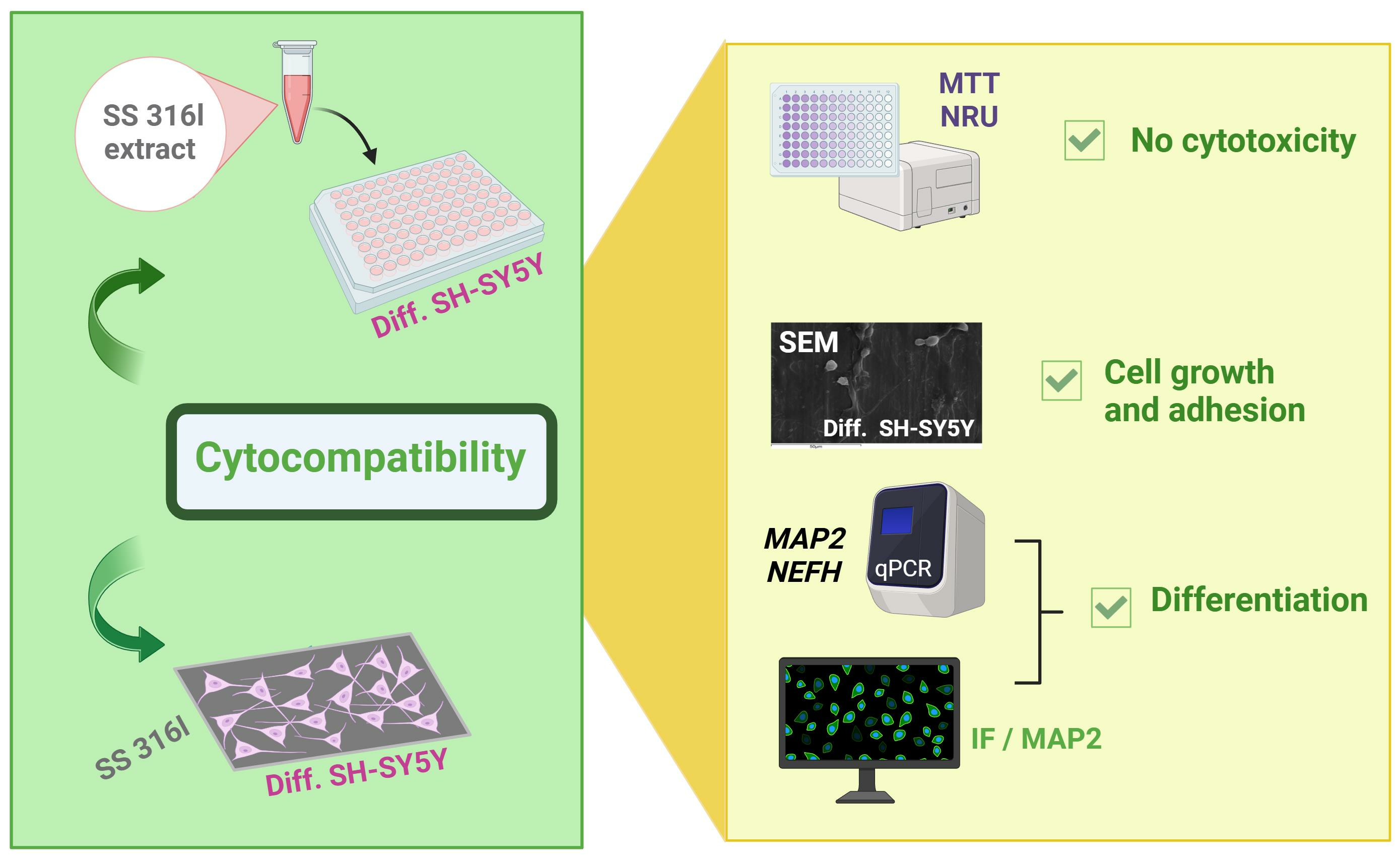

Cytocompatibility Study of Stainless Steel 316l Against Differentiated SH-SY5Y Cells


 , , and
 Abstract
Share and Cite
Zingkou, E.; Kolianou, A.; Angelis, G.; Lykouras, M.; Orkoula, M.; Pampalakis, G.; Sotiropoulou, G. Cytocompatibility Study of Stainless Steel 316l Against Differentiated SH-SY5Y Cells. Biomimetics 2025, 10, 169. https://doi.org/10.3390/biomimetics10030169
Zingkou E, Kolianou A, Angelis G, Lykouras M, Orkoula M, Pampalakis G, Sotiropoulou G. Cytocompatibility Study of Stainless Steel 316l Against Differentiated SH-SY5Y Cells. Biomimetics. 2025; 10(3):169. https://doi.org/10.3390/biomimetics10030169
Chicago/Turabian StyleZingkou, Eleni, Asimina Kolianou, Georgios Angelis, Michail Lykouras, Malvina Orkoula, Georgios Pampalakis, and Georgia Sotiropoulou. 2025. "Cytocompatibility Study of Stainless Steel 316l Against Differentiated SH-SY5Y Cells" Biomimetics 10, no. 3: 169. https://doi.org/10.3390/biomimetics10030169
APA StyleZingkou, E., Kolianou, A., Angelis, G., Lykouras, M., Orkoula, M., Pampalakis, G., & Sotiropoulou, G. (2025). Cytocompatibility Study of Stainless Steel 316l Against Differentiated SH-SY5Y Cells. Biomimetics, 10(3), 169. https://doi.org/10.3390/biomimetics10030169