Article

Predictive Model of Community Disaster Resilience Across Serbia: A BRIC–DROP Composite Index and Spatial Patterns


by
Vladimir M. Cvetković
1,2,3,4,5,*,
Dalibor Milenković
3,4,5,
Jasmina Bašić
6,
Tin Lukić
7,8 and
Renate Renner
2
1
Department of Disaster Management and Environmental Security, Faculty of Security Studies, University of Belgrade, Gospodara Vucica 50, 11040 Belgrade, Serbia
2
Safety and Disaster Studies, Chair of Thermal Processing Technology, Department of Environmental and Energy Process Engineering, Technical University of Leoben, Franz Josef-Straße 18, 8700 Leoben, Austria
3
Scientific-Professional Society for Disaster Risk Management, Dimitrija Tucovića 121, 11040 Belgrade, Serbia
4
International Institute for Disaster Research, Dimitrija Tucovića 121, 11040 Belgrade, Serbia
5
ProSafeNet, The Global Hub for Safety, Security, Risk, Emergency Professionals, and Scientists, 11040 Belgrade, Serbia
6
Academy of Applied Studies in Belgrade, College of Health Sciences, Cara Dušana 254, 11080 Belgrade, Serbia
7
Faculty of Sciences, Department of Geography, Tourism and Hotel Management, University of Novi Sad, Trg Dositeja Obradovića 3, 21000 Novi Sad, Serbia
8
Ruđer Bošković School, Kneza Višeslava 17, 11000 Belgrade, Serbia
*
Author to whom correspondence should be addressed.
Safety 2026, 12(3), 59; https://doi.org/10.3390/safety12030059
Submission received: 16 February 2026 / Revised: 1 April 2026 / Accepted: 10 April 2026 / Published: 1 May 2026

Abstract

Community disaster resilience is increasingly guiding risk-reduction investments, but in many Southeast European settings, comparable subnational data remain scarce. This study assesses perceived community disaster resilience across Serbia by combining BRIC–DROP dimensions into a single index and analyzing differences across hazard types and sociodemographic factors. A cross-sectional household survey was conducted using multistage random sampling and the “next birthday” method for respondent selection. The final sample included 1200 adults from 22 local government units across four regions: Belgrade, Vojvodina, Šumadija & Western Serbia, and Southern & Eastern Serbia. Participants evaluated preventive measures and societal resilience for ten hazard types and considered five social dimensions: social structure, social capital, social mechanisms, social equity/diversity, and social beliefs. Descriptive statistics, bivariate analyses (including Pearson correlations, t-tests, and ANOVA), and multiple linear regression identified key predictors of preventive behavior and perceived resilience. Composite scores highlighted spatial resilience differences. Overall perceptions were generally low, mostly falling below the midpoint of the scale. Furthermore, the highest ratings for implemented preventive measures were recorded for pandemics/epidemics, storms/hail, and floods, whereas the lowest were observed for environmental pollution and droughts. Perceived resilience was highest for snowstorms, storms/hail, and pandemics/epidemics, and lowest for environmental pollution and droughts. Also, respondents reported relatively strong family ties and favorable perceptions of communication and access to basic supplies, but weak institutional capacity, particularly in budget allocation, early warning and public notification, rapid decision-making, and evacuation and shelter readiness. Regression results were statistically significant but explained only a small portion of the variance. Age and public-sector employment positively predicted perceived resilience; fear, income, and, to a lesser extent, education were negatively associated. These findings highlight the structural and psychosocial factors that shape perceptions of resilience. The BRIC–DROP composite indicates generally low perceived preparedness and resilience, especially in risk communication, evacuation and shelter readiness, and financing—the key bottlenecks in strengthening local resilience. The results recommend combining institutional reform with targeted risk communication to reduce fear and build trust, especially focusing on hazard areas with the lowest confidence, such as environmental pollution and drought.

1. Introduction

Community disaster resilience has evolved from an aspirational idea to a critical practical priority for governments, emergency services, and local communities [1,2,3]. This concept now informs disaster risk reduction (DRR) investments, enhances preparedness, and facilitates more rapid recovery following disruptions [4,5,6,7]. Resilience, first identified in the mid-nineteenth century, has become foundational in climate adaptation and disaster risk reduction studies and is integral to global policy frameworks such as the Sendai Framework and the Sustainable Development Goals [8,9]. From a governance perspective, evidence of social resilience is particularly valuable because it enables local decision-makers to select and implement preventive measures in disaster-prone communities [5]. Consequently, resilience has emerged as a central social objective for researchers and policymakers across disciplines and sectors [4].
Although resilience is often considered a general characteristic of places, recent research demonstrates that it depends on communities’ capacity to anticipate threats, manage impacts, adapt to changing conditions, and maintain essential functions under stress [10,11,12,13,14,15]. The literature defines community disaster resilience as a multi-level phenomenon involving individuals, families, and social groups, with an emphasis on maintaining social order and functionality during and after major events [9,11,12]. Recent studies consistently indicate that community resilience is best understood as a dynamic process rather than a static trait. It is typically defined as the enhancement of a community’s capacity to prepare for, absorb, recover from, and adapt efficiently to adverse events, whether actual or anticipated [16]. More nuanced definitions highlight that this process includes the abilities to adapt and transform, absorb and anticipate, prepare and prevent, self-organize and connect, include diverse groups, and manage hazards [3]. Importantly, adaptive capacity extends beyond response to failure and encompasses proactive risk reduction and mitigation of crisis impacts at the community level [17]. In public health and social resilience frameworks, resilience is similarly conceptualized as an adaptive process operating across individual, community, and system levels to sustain positive outcomes despite hazards and crises [18]. This process is supported by interconnected adaptive capacities, such as economic development, social capital, information dissemination, and community competence, which collectively shape community responses to disturbances or adversity [19,20]. These capacities are often categorized as absorptive, adaptive, anticipatory, and transformative, each supporting recovery through assets, adjustment to adverse conditions, vulnerability prediction and prevention, and implementation of system changes to address emerging realities [18].
Resilience outcomes differ across populations. Empirical evidence shows that community resources and disaster exposure directly influence individual psychological resilience and alter the relationship between exposure and adaptive outcomes [21]. Socioeconomic status and higher income levels are consistently identified as predictors of improved adaptation following societal shocks and crises [22,23]. Conversely, socioeconomic disadvantages and traumatic disaster experiences are linked to increased risks of psychiatric disorders, highlighting the complex relationship between vulnerability and adaptive capacity [21]. Cross-national studies that incorporate vulnerability indices—including susceptibility, coping, and adaptive capacity—demonstrate that countries with lower vulnerability often possess stronger governance, better healthcare access, and greater income equality. Nevertheless, these countries may still experience higher rates of mental disorders when exposed to trauma [19]. Overall, these findings suggest that resilience encompasses both structural and psychological dimensions and that community context is critical in shaping individual outcomes.
Despite these conceptual advances, many regions still lack detailed local data to identify areas of weaker resilience, the most vulnerable aspects, and residents’ perceptions of preparedness in daily life [24,25,26,27,28]. These disparities are shaped by complex demographic, socioeconomic, and psychological factors that influence risk perception, resource availability, and protective behaviors [29,30]. Although climate change is expected to increase the frequency and intensity of hazards, the severity of impacts is often determined primarily by non-climatic factors [8]. Serbia provides a relevant context for this discussion, given the significant differences in exposure patterns and local capacities across its regions [31]. Municipalities vary in their hazard profiles, including floods, droughts, storms, heatwaves, earthquakes, technological accidents, and environmental pollution, and also operate under unequal conditions regarding institutional resources, infrastructure quality, financial capacity, demographic composition, and social cohesion [32]. Consequently, resilience is rarely uniform across localities. Some communities may benefit from strong informal networks but still experience deficiencies in organized preparedness, evacuation planning, crisis communication, or trust in local institutions [33]. Because disaster outcomes depend on both structural conditions (such as institutions, services, and resources) and social-psychological factors (including trust, fear, motivation, and risk perception), resilience in Serbia and elsewhere should be understood as a multidimensional social phenomenon rather than a single score [1,34]. Although numerous conceptual frameworks exist, measuring resilience remains challenging. Definitions vary across studies; many assessments focus on a single domain, and a substantial portion rely on administrative indicators that do not fully capture residents’ perceptions of prevention, coordination, or the visible readiness of services. Perception-based indicators should therefore complement, rather than replace, objective capacity measures by influencing trust, willingness to prepare, adherence to guidance, and collective action—factors that often determine the effectiveness of plans in practice [15,35].
In this context, the present study assesses perceived community disaster resilience in Serbia by integrating the frameworks of BRIC (Baseline Resilience Indicators for Communities) and DROP (Disaster Resilience of Place) within a composite approach. Although BRIC and DROP provide important foundations for resilience research, a significant gap remains in their application to perception-based, survey-derived assessments of community disaster resilience at the subnational level. This gap is particularly evident in Southeast Europe, where local disparities, hazard diversity, and citizens’ perceptions of institutional and social capacities have not been thoroughly investigated. The study addresses this gap by combining BRIC and DROP into a composite framework tailored to Serbia and by operationalizing resilience through five social dimensions that encompass both structural and perceptual aspects of community resilience.
This approach is valuable because it conceptualizes resilience as an interconnected set of capacities that links institutional and infrastructural conditions to social organization and inclusion. Building on this tradition, the study examines five social dimensions widely recognized as central to community resilience: social structure, social capital, social mechanisms, social equity and diversity, and social beliefs [5,14,34,36]. These dimensions represent organization and planning, trust and networks, preparedness practices and learning, inclusion and access for vulnerable groups, and shared norms and meanings through which risk is interpreted.
The study utilizes a cross-sectional household survey conducted in 22 local self-government units across four regions of Serbia: Belgrade, Vojvodina, Šumadija and Western Serbia, and Southern and Eastern Serbia. Respondents assessed both the implementation of preventive measures and perceptions of societal resilience across ten hazard types. This design allows for direct comparison of preparedness and resilience rankings for specific risks, illustrating that communities may respond differently to hazards such as floods, droughts, or pollution. The analysis incorporates variations in sociodemographic and socioeconomic factors, including age, gender, education, income, employment sector, and volunteering, as well as psychological factors such as fear. Emotions and trust are recognized as influential in preparedness and cooperation with authorities. By integrating these dimensions, the research addresses a significant gap in understanding how social identity and individual characteristics interact with structural conditions to shape collective resilience [4]. This methodology aligns with recent studies that conceptualize resilience as a holistic system of interconnected capacities, including proactive measures, stress responses, and system recovery [37].
This study offers three main contributions. First, it provides a hazard-specific profile of perceived preparedness and resilience across a broad range of risks, including drought and environmental pollution, which are frequently overlooked in household resilience research. Second, it develops a composite index based on the BRIC–DROP framework using survey data, enabling analysis of spatial patterns across regions and municipalities. Third, it examines the explanatory value of selected demographic, socioeconomic, and psychological factors in shaping perceptions of prevention and resilience.

Literary Review

Systematic reviews have investigated the associations between demographic, socioeconomic, and psychological factors and resilience outcomes [2,9,15,22,23,30,34,38,39,40,41,42,43,44]. Some studies have utilized growth mixture modeling to determine whether targeted predictors enhance predictive accuracy beyond core sociodemographic variables [22,23]. These reviews commonly classify influences into domains such as demographics, socioeconomic status, social context, psychosocial well-being, and prior experiences, thereby clarifying the specific contributions of each domain to coping and resilience [45]. The literature consistently indicates that, although sociodemographic characteristics provide a baseline profile, psychological and social factors are critical for a comprehensive understanding of adaptive potential [5,15]. Employing a multi-domain perspective advances resilience research by elucidating how psychological processes, social relationships, and material resources collectively shape adaptive capacity across varied contexts [11,12].
The concept of disaster resilience has evolved from an engineering- and asset-centered framework to a more integrative model that incorporates physical, social, institutional, and psychological dimensions [15]. Within this broader framework, resilience is understood not only as technical protection but also as a core element of sustainable development and societal robustness. This approach emphasizes biophysical, social, institutional, and place-specific factors as key determinants of effective disaster response and post-disaster recovery [15]. Individuals with greater economic resources generally achieve better outcomes, as they can mitigate the impacts of disasters and recover more rapidly [11,12,46]. Enhanced financial capital also facilitates access to essential goods, services, and recovery assistance, thereby improving post-disaster outcomes [5,6].
Beyond structural and social-capital frameworks, research in European and Mediterranean risk contexts demonstrates that perceived resilience is significantly shaped by institutional trust, prior hazard experience, and the social interpretation of risk [47,48,49,50,51]. These factors account for variations in resilience perceptions across hazard types and explain why formal capacities do not always translate into public confidence in preparedness and response. Perceived resilience is influenced not only by material and institutional capacities but also by psychosocial processes, such as fear, familiarity with hazards, and confidence in public authorities. Collective and intergenerational memory is also critical for community resilience, as the social remembrance of past disasters sustains risk awareness, transmits practical knowledge, and reinforces culturally shared expectations for appropriate responses. However, disaster memory may diminish across generations or fade without repeated exposure, thereby reducing perceived urgency and preparedness over time [52,53,54].
Demographic correlates, including gender, age, race or ethnicity, and educational attainment, are typically conceptualized as baseline factors that interact with psychosocial resources to shape resilient responses following traumatic exposures [22,23,40]. Analyses of gender differences indicate that associations between resilience-related factors and outcomes are more pronounced in samples with a higher proportion of women [22,23]. Research focused on age suggests that middle adulthood is more consistently linked to increased risk of adverse outcomes compared to other age groups, although findings regarding older age are mixed; some studies identify it as protective, while others associate it with increased vulnerability [29,55,56]. Recent evidence from wildfire-affected residents in Canada indicates that individuals aged 40 years or younger are more likely to report low resilience and probable PTSD symptoms. Additionally, unemployment and a prior mental health diagnosis have been identified as significant predictors of adverse post-disaster mental health outcomes [57]. Empirical evidence further demonstrates that certain demographic profiles, such as female sex and younger age, are associated with a higher risk of post-trauma mental health challenges [47,58]. Conversely, older age appears protective in some contexts, with adults aged 65 and older being more than three times as likely to exhibit resilience as young adults aged 18 to 24 [40]. The literature remains inconclusive regarding gender effects: some studies report that women employ more effective coping strategies, others find higher resilience scores among men, and some observe no statistically significant association [45,55,56]. In addition to age, variables such as gender, ethnicity, and social support have been extensively studied as both vulnerability and protective factors influencing mental health and resilience outcomes among disaster-affected populations [59].
Beyond individual characteristics, socioeconomic position and income are major social determinants, with low-socioeconomic-status (SES) groups facing increased mental health risks due to financial strain and diminished self-worth [59,60]. Conversely, higher income and socioeconomic status are often associated with more resilient responses, as economic stability enables access to resources that alleviate disaster-related stress [22,23]. Additional evidence indicates that women and individuals with limited income or financial resources are more likely to experience heightened post-disaster depressive symptoms and poorer mental health. This suggests that specific subgroups, such as unmarried older women with restricted financial means, may be particularly vulnerable to adverse well-being outcomes following disasters [40,61]. The literature also demonstrates that individual resilience develops through the interaction of personal characteristics, such as self-efficacy, optimism, and internal locus of control, with relational or situational supports, including social networks and problem-solving skills [62]. Psychological assets, especially supportive social ties and emotion-regulation capacities, serve as protective resources across contexts and are consistently associated with a higher likelihood of resilient trajectories during crises [22,23,55].
This cumulative pattern is supported by evidence indicating that resilience is more accurately explained when demographic characteristics, such as education and race or ethnicity, are examined in conjunction with sociocontextual factors, including social support and recent stress exposure [63]. Complementary theoretical frameworks conceptualize resilience as a dynamic process shaped by social determinants, such as support systems and accessible resources, operating through complex, structured pathways [64]. These findings underscore the necessity of an integrated perspective on resilience that recognizes the interdependence of individual attributes (such as cognitive capacity and life-course history) and broader socio-environmental conditions, including ethnicity and socioeconomic position [65]. Thus, adaptation to catastrophic events is not determined solely by static demographic indicators; it is strongly influenced by access to both tangible and intangible resources that facilitate recovery. These resources encompass material assets, social networks, psychological coping capacities, and spiritual beliefs, which collectively buffer the negative effects of extreme adversity [40,66].
Education illustrates this complexity. Lower socioeconomic attainment, often measured by educational level, has consistently been linked to less effective coping and lower resilience [45]. However, the relationship between education and resilience is nuanced; some adjusted multivariate models indicate that higher education predicts lower resilience when controlling for other demographics, exposure, resources, and life stress [40]. Certain multivariable models adjusting for confounders report a negative association between higher education and resilience [40,55,67], possibly because greater cognitive awareness may intensify perceived difficulties in adapting during large-scale disasters. In contrast, many studies associate higher education with improved outcomes and “minimal-impact” resilience trajectories [62,68,69]. While education is generally considered beneficial, its effects are often mediated or confounded by factors such as income, social support, and accumulated stress [40,45]. Although education is frequently expected to predict resilient psychological outcomes, studies report effects ranging from positive to negative to null [55]. These inconsistencies highlight methodological challenges in isolating demographic effects, as demographics are closely intertwined with socioeconomic and psychological resources that collectively shape adaptive capacity [40,59]. For example, although theory often posits that education enhances resilience through improved financial and social resources, some studies report no significant association, potentially due to limited sample variability or event-specific stressors related to particular disasters [40,67]. One study found that respondents with a college degree were approximately half as likely to be resilient as those with less than a high school education, suggesting that higher education may hinder adaptation to massive, overwhelming, and difficult-to-comprehend disasters [40]. This unexpected result may reflect that greater cognitive awareness or stronger expectations of control among highly educated individuals intensify distress when facing catastrophes that are difficult to explain or mitigate [70]. Such variation indicates that the effect of education is context-dependent and may change with the nature of the disaster and the coping options available to those affected [56].
Psychological determinants of adaptation, such as cognitive flexibility, coping self-efficacy, and emotion regulation, are increasingly recognized as central elements that interact with demographic characteristics to shape resilient functioning [64,71]. However, predictors of resilient outcomes, including these psychological determinants, often exhibit limited accuracy in forecasting future resilience, a phenomenon known as the “resilience paradox” [71]. This paradox indicates that attributes commonly associated with positive adjustment, such as strong self-esteem, stress tolerance, and self-regulatory capacity in behavior and cognition [72] do not guarantee resilience or emotional immunity when catastrophic events are unpredictable and exceed coping capacities [41,71]. Perceived resilience may also be influenced by informational dynamics, as misinformation, rumors, and other forms of hearsay can amplify fear, undermine institutional trust, and reduce citizens’ sense of safety during disaster events [73,74]. From an emergency psychology perspective, emotional reactions such as fear, anxiety, and uncertainty are not merely indicators of vulnerability. They are normal responses to abnormal or threatening situations and can significantly influence trust, coping behaviors, and perceptions of community resilience [75,76].
In this conceptualization, resources function within an interconnected system, reinforcing one another through reciprocal pathways that support psychological adaptation [77,78]. Internal strengths, such as self-esteem, stress resistance, and self-regulation, facilitate the maintenance of optimism, the generation of creative solutions, and the preservation of hope and motivation during adversity [72]. External supports, including social networks, financial stability, and community infrastructure, provide the scaffolding necessary for the effective expression of these internal capacities under stress [69,79]. Conversely, the absence or depletion of these key resources, for example, due to severe economic loss or weak social support, increases stress and reduces the likelihood of a minimal-impact resilience trajectory [68,77,78]. For example, the presence of children in the household has been associated with reduced resilience, likely because parenting demands intensified stress during lockdowns through home-schooling pressures and crowded living arrangements [80]. Psychological resilience is increasingly conceptualized not merely as the absence of psychopathology, but as a developmental process characterized by flexible adjustment to changing conditions through the deployment of internal and external resources [81,82]. Within this outcome-oriented framework, resilient outcomes are partially explained by multiple resilience factors that buffer the harmful effects of stress exposure on mental health, operating through a smaller set of resilience mechanisms [22,23,43]. These mechanisms include cognitive responses (such as appraisals), behavioral responses (such as active coping and help-seeking), and emotional responses that enable flexible adaptation to adversity according to contextual demands [15,22,23,82,83]. For instance, older adults are sometimes found to experience lower distress than younger adults during crises, a pattern attributed to higher average resilience and greater capacity to process negative emotions [84]. This reduced susceptibility to depression and substance use in older groups suggests that aging does not inherently increase vulnerability; rather, it may reflect life-course learning and experience that facilitate more effective coping [59].
Social organization and cohesion are essential to collective efficacy and disaster resilience, as robust kinship structures and social capital foster shared purpose and enhance adaptive capacity [46]. Resilience is therefore conceptualized as an emergent property of a multilayered socio-ecological system, in which numerous interacting factors activate and reinforce one another to produce a dynamic adaptive mechanism [77,78]. Recent research has shifted from focusing exclusively on internal traits to emphasizing contextual factors and strengths, reflecting a growing recognition of resilience as a complex phenomenon [77,78]. This dynamic system integrates psychological and social resources, including coping self-efficacy, emotion regulation, and meaning-making, which mitigate the negative effects of trauma exposure and support adaptive functioning over time [85]. Outcome-based models indicate that resilient outcomes are partially determined by multiple resilience factors that buffer the mental health impacts of stress, operating through mechanisms such as regulatory flexibility [43]. Regulatory flexibility refers to the capacity to adjust emotional responses and employ various coping strategies in response to contextual demands and feedback [22,23]. Within this framework, coping and emotion-regulation strategies are not inherently beneficial or detrimental; their adaptiveness depends on their alignment with the specific requirements of a given stressor context [83].
Social capital is widely recognized as a primary driver of community resilience, encompassing the strength of social ties, reciprocity, and trust in both individuals and institutions [18]. This collective resource enables communities to mobilize assistance, disseminate information, and coordinate recovery efforts more efficiently during and after crises [86]. Community resilience is further supported by economic development, reflected in the quantity, distribution, and diversity of economic resources, as well as by social capital indicators such as received and perceived support, sense of community, collective efficacy, and place attachment [21]. Information and communication capacities reinforce this adaptive foundation by facilitating the dissemination of accurate information through responsible media and trusted channels. At the same time, community competence enhances resilience through collective action, critical reflection, and problem-solving abilities [19]. Efforts to strengthen collective resilience include reducing risk and resource inequities, engaging residents in mitigation activities, building organizational linkages, expanding and safeguarding social supports, and preparing for uncertainty through flexibility, effective decision-making, and reliable information sources that remain functional under unpredictable conditions [20]. Social resilience is also reinforced by community infrastructure, such as health facilities, schools, and volunteer organizations, which provide essential support and resources during periods of disruption and recovery [87]. This comprehensive approach is grounded in empowerment principles, ecological perspectives, and strengths-based practices, while integrating insights from research on collective efficacy, social cohesion, and group processes [88]. Ultimately, community adaptation is reflected in population wellness, characterized by high and equitable levels of mental and behavioral health, functioning, and quality of life [89]. These capacities align with an ecological framework that incorporates multiple forms of capital, including economic, political, natural, cultural, and educational, to explain how communities organize in response to change and adversity [90]. Within this framework, community resilience is conceptualized as a dynamic process that links adaptive-capacity networks to successful adaptation following disturbance or adversity [20]. Protective social processes are facilitated by family, kin, and neighborhood support, as well as by community assets such as respected elders, traditional healers, religious institutions, and essential services such as schools and health facilities [91]. These formal and informal systems collectively provide psychosocial support, enable access to critical services, and maintain cultural continuity during periods of disruption, thereby playing a central role in sustained recovery and long-term adaptive capacity [18,89]. Key elements commonly identified in the literature include strengthening social capital, cultivating local leadership, diversifying resources, enhancing communication systems, and developing institutional capacity [88]. The development of community resilience is, therefore, contingent upon a comprehensive understanding of how social capital and networks serve as foundational supports [92].
Social capital, characterized by trust, reciprocity, and cohesion, fosters cooperation and mutual assistance during emergencies [18,92]. Inter-organizational networks further promote collaboration and resource sharing among government agencies, non-governmental organizations, and private-sector entities [92]. By leveraging partners’ complementary strengths, these networks can enhance response efficiency in complex disaster scenarios [93]. The effectiveness of such networks typically relies on pre-existing relationships and established communication protocols that facilitate rapid decision-making and coordinated action during crises [94,95]. Evidence also indicates that while structural social capital aids in resource mobilization, cognitive social capital—comprising shared narratives, trust, and a sense of belonging—is more consistently associated with reduced risk of common mental disorders during and after public health emergencies [18]. A sense of belonging and shared responsibility is fundamental to social cohesion, enabling community members to pursue collective goals through coordinated action [92]. Integrating social capital and networks within this framework facilitates collaboration among diverse stakeholders and enhances communities’ capacity to effectively mitigate and manage disaster impacts [92]. Maintaining resilience depends on establishing partnerships and networks that support the exchange of resources, information, and best practices through connections among regional authorities, community organizations, academic institutions, and the private sector [92]. Such cross-sector partnerships utilize distinct capabilities to strengthen collective efficacy and ensure a comprehensive approach to preparedness and response [96,97].
Equity and diversity are fundamental to disaster resilience because demographic and socioeconomic differences shape how communities prepare for, respond to, and recover from catastrophic events. Effective collaboration requires connections among individuals, organizations, institutions, and public authorities, forming an integrated network that supports continuous two-way communication and reciprocal influence over decisions critical to community resilience in disaster contexts [98]. Structural inequities create uneven exposure and unequal capacity to absorb shocks, necessitating targeted interventions that address the specific needs of marginalized subgroups to achieve equitable outcomes [4,11,12]. Low-income households, older adults, and other marginalized populations often face disproportionate risks due to limited access to resources, information, and supportive networks [99]. These disparities are exacerbated by pre-existing inequalities in economic capital, such as income and savings, and by unequal access to human capital, including education and health services, both of which are essential for effective response and recovery [100]. An intersectional approach is required to adequately represent diversity within vulnerable groups, as natural hazards can intensify spatial and social inequalities [101,102]. Consequently, disaster policy increasingly prioritizes investment in social resources to strengthen resilience and reduce inequities [103]. Policies that promote affordable housing, accessible public services, and equitable access to education and employment can address the structural disparities that heighten disaster vulnerability [104]. Disasters, hazards, and vulnerability are interconnected through the relationships among natural resource management, poverty, and social inequality, resulting in the social, cultural, and economic contexts of disadvantaged groups being most severely affected during disasters [105]. Addressing these intersecting vulnerabilities requires integrated strategies that consider social, economic, and environmental determinants, as community resilience is influenced by poverty levels and access to healthcare [106]. Standard emergency planning frequently fails to account for the lived experiences of marginalized groups, who face systemic barriers throughout preparedness, response, and recovery phases [107]. Evidence from Serbia indicates that poorer households are more likely to be exposed to flooding than non-poor households, underscoring the importance of housing quality in mitigating the disproportionate vulnerability of economically disadvantaged groups [5]. Research shows that socially marginalized groups often have limited access to resources, leading to their concentration in high-risk areas and resulting in greater losses due to unequal power dynamics [108]. This inequality is illustrated by the placement of lower-income housing in hazard-prone locations, such as former wetlands, where protective infrastructure, such as levees or dykes, is frequently inadequate [109]. Systemic barriers perpetuate these spatial injustices, as marginalized communities may lack the political influence required to set priorities and allocate resources for essential facilities [110]. The exclusion of marginalized voices can inadvertently increase vulnerability if residents relocate to areas with even greater exposure to hazards [110]. Social beliefs and customs significantly contribute to vulnerability by shaping risk interpretation and the mobilization of collective capacity during disasters [111]. Cultural norms and ideological frameworks affect risk perception and coping strategies, often determining which groups have access to resources and decision-making authority necessary for adaptive responses [112]. Demographic characteristics, including age and gender, further influence these processes by affecting risk perception and behavioral responses. Therefore, identifying vulnerable groups by gender and age is essential for promoting human security and enhancing community resilience [5].
Indigenous belief systems and customary practices can either mitigate or exacerbate vulnerability, depending on their alignment with current preparedness strategies [113]. When these beliefs diverge from recommended protocols, they may impede the adoption of safety measures or limit access to official assistance, particularly when traditional knowledge conflicts with scientific guidance or when marginalized groups distrust institutions [111,114]. This distrust often arises from historical exclusion and marginalization, where vulnerable groups have been systematically denied power and political representation [115]. Consequently, power relations within formal and informal institutions shape vulnerability, with unequal power dynamics interacting with natural events to determine the extent of vulnerability associated with specific hazards [116]. These disparities both originate from and reinforce social hierarchies, resulting in unequal access to resources and producing uneven vulnerability across communities [117]. Analyzing vulnerability through a power-structure perspective clarifies who is at risk, under which conditions, and what measures are necessary to enhance adaptive capacity [117]. In this framework, vulnerability encompasses the characteristics and circumstances of individuals or groups that affect their capacity to anticipate, cope with, resist, and recover from the impacts of natural hazards [118]. This perspective highlights vulnerability as a socially produced condition, “rooted in historical, cultural, social, and economic processes” [119]. Conceptualizing vulnerability as socially constructed challenges the notion that natural disasters impact all individuals equally, instead emphasizing that disasters are shaped by human systems and embedded within social structures [120,121]. Therefore, identifying the demographic and socioeconomic factors that influence adaptive capacity is essential for developing effective resilience interventions, as variables such as education directly affect a population’s ability to respond to disasters [98].

2. Methods

This study assesses perceived community disaster resilience across Serbia by combining BRIC–DROP dimensions into a single composite index and analyzing differences across hazard types and sociodemographic factors. A cross-sectional household survey was conducted using multistage random sampling and the “next birthday” method for respondent selection. The research drew on a cross-sectional household survey administered in 22 local self-government units spanning Serbia’s four regions (Belgrade, Vojvodina, Šumadija & Western Serbia, and Southern & Eastern Serbia). Participants evaluated both (a) the extent to which preventive measures were implemented and (b) perceived societal resilience across ten hazard types, enabling a direct comparison of preparedness and resilience rankings by specific risk and illustrating that communities may react differently to floods, droughts, or pollution. The analyses further examined differences by socio-demographic and socioeconomic characteristics (e.g., age, gender, education, income, employment sector, and volunteering). They incorporated psychological factors—such as fear—given that emotions and trust can shape preparedness and collaboration with authorities.

2.1. Sample

2.1.1. Sample of Population

The survey population comprised all adult residents of local communities across Serbia. The sample size was aligned with the geographic and demographic size of each community. The guideline for determining the survey sample size was based on the formula:
n = Z 2 p ( 1 p ) E 2
where n represents the sample size, Z denotes the desired confidence level (95% in this study), p is set to the expected proportion of 0.5 as a conservative estimate, and E is the margin of error (0.05). This guideline was adjusted using the finite population correction:
n k = n 1 + n 1 N
where N represents the total population size. In essence, generally accepted sampling guidelines were followed, and sampling was conducted in accordance with standard procedures. In addition, to meet basic research quality requirements, the study aimed to include at least (or approximately) 100 respondents in each examined local community (region), while the minimum target was 30–50 respondents at the municipal level within regions as statistical units in Serbia.
During data collection, a household survey approach was applied using a multistage random sampling design. In the first stage (primary sampling units), parts of each local community in which the research was conducted were selected. This stage was followed by mapping and defining the percentage share of each segment within the overall sample. At the survey-cluster stage, streets or street segments within the primary sampling units were selected. Survey clusters were defined as routes with a designated starting and ending point. In the next stage, households in which the survey was administered were selected, and the number of households was adjusted to the size of the local community. The final stage involved selecting a respondent within each selected household using the “next birthday” method. Fieldwork in each local community was generally conducted for three days per week, including weekends. Surveys were administered at different times of day, i.e., across different time periods.

2.1.2. Sample of Local Communities

For the sample of local communities in Serbia, the region (including its municipalities and cities) served as the basic unit of the country’s political–administrative organization. To enable the research, four regions were included: the Belgrade Region, the Vojvodina Region, the Šumadija and Western Serbia Region, and the Southern and Eastern Serbia Region (excluding Kosovo and Metohija). Accordingly, Serbia had 117 municipalities and 28 cities, excluding those in the Autonomous Province of Kosovo and Metohija. Using random sampling, at least 10% of the local communities in Serbia were selected from a total of 145 communities where the research could be conducted.
After the survey was completed, questionnaires were assigned unique codes for verification. The data were then entered into appropriate databases and prepared for analysis. Editing procedures were carried out, including reviewing details and checking completeness and consistency. Subsequently, the data were tabulated by relevant categories. The next step involved cross-tabulation to identify associations between variables.
Qualitative data collected through the survey questionnaire—particularly findings related to perceptions and subjective attitudes—were used to support a deeper analysis and interpretation of indicators and their values obtained through quantitative procedures. After all preparatory steps, descriptive statistical methods were applied, as initially specified.
In line with Table 1, the study included 1200 respondents from 22 local self-government units in Serbia. A review of the survey indicates that the largest share of respondents was from the municipality of Svrljig (n = 120; 10.0%), followed by Belgrade (n = 94; 7.8%), Kraljevo (n = 76; 6.3%), Novi Pazar (n = 73; 6.1%), and Prokuplje (n = 67; 5.6%). Overall, these municipalities together account for more than one-third of the total sample (35.8%). On the other hand, the least represented municipalities were Čačak (n = 31; 2.6%), Stara Pazova (n = 36; 3.0%), and Novi Sad (n = 37; 3.1%). Such a distribution reflects good geographical diversity of the sample, enabling the analysis of attitudes across different socio-territorial contexts (Table 1).

2.2. Study Area

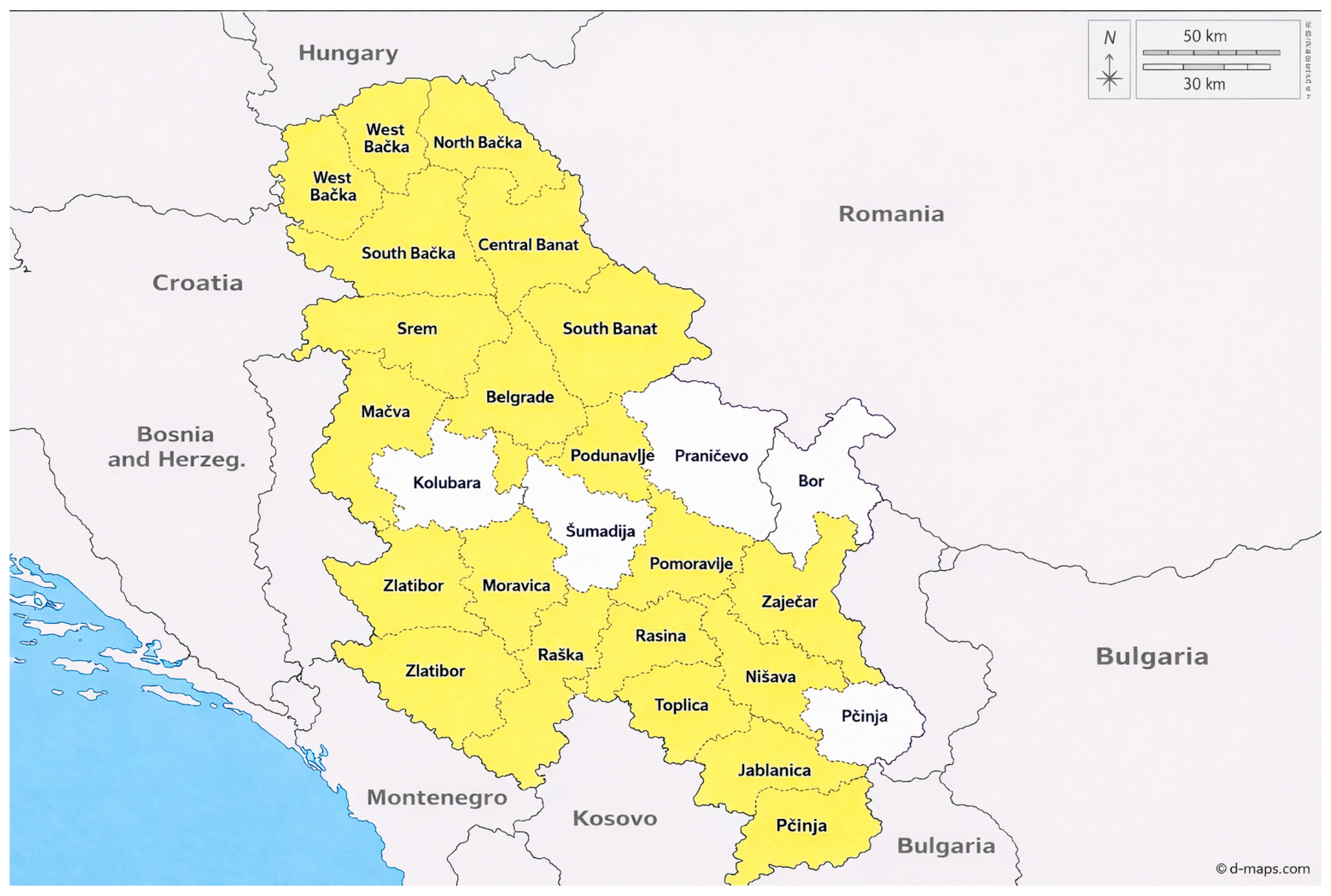
The study took place in the Republic of Serbia (Southeast Europe, central Balkan Peninsula) and involved 22 local self-government units (municipalities/cities; LSGUs) spread across various administrative districts (okrug), ensuring extensive geographic coverage from the north to the south and from the west to the east of the country (see Figure 1).
The sample comprised major urban centers—Belgrade (the capital), Novi Sad, and Niš—as well as smaller municipalities with different degrees of urbanization and development (e.g., Svrljig, Boljevac, Brus, and Stara Pazova). The surveyed LSGUs were located in Vojvodina (including Sombor, Novi Sad, Zrenjanin, Kovin, and Stara Pazova), central Serbia (including Belgrade, Šabac, Smederevo, Ćuprija, Čačak, Kraljevo, and Novi Pazar), and in the western, eastern, and southern parts of Serbia (including Užice, Prijepolje, Zaječar, Boljevac, Niš, Svrljig, Prokuplje, Leskovac, and Vranje). A total of n = 1200 respondents participated from these 22 LSGUs. Participation in each LSGU ranged from 2.6% (Čačak) to 10.0% (Svrljig), with the highest shares.

2.3. Questionnaire

A structured questionnaire was designed to collect data on perceived community disaster resilience, encompassing citizens’ socio-demographic, socioeconomic, psychosocial, and selected socio-cultural characteristics (Appendix B). The instrument consisted of three main components: (1) socio-demographic, socioeconomic, and psychosocial variables; (2) hazard-specific assessments of implemented preventive measures and perceived societal resilience across ten disaster types; and (3) 62 Likert-type indicators grouped into five theoretically defined resilience domains: social structure, social capital, social mechanisms, social equity and diversity, and social beliefs. Attitudinal items were rated on a five-point scale, where 1 represented the lowest or fully unsatisfactory response and 5 represented the highest or fully satisfactory response.
An instrument previously developed and applied in Serbia was used to examine the influence of demographic and socio-economic factors on disaster resilience. The earlier survey aimed to understand the development of local community resilience in Serbia [11,12]. For the current study, the instrument was semantically refined and adapted while preserving its core content and measurement validity. The revised instrument included 10 indicators of social structure (Group 1), 9 indicators of social capital (Group 2), 17 indicators of social mechanisms (Group 3), 13 indicators of social equity and diversity (Group 4), and 13 indicators of social beliefs (Group 5), resulting in a total of 62 indicators for assessing perceived community disaster resilience in Serbia. Additionally, the survey collected demographic data, attitudes toward resilience-related conditions, and perceptions of prevention and resilience across various disaster types. The questionnaire was selected to adapt the Baseline Resilience Indicators for Communities (BRIC) approach to the Serbian context and to develop a multidimensional, survey-based framework for assessing perceived community disaster resilience. The instrument was informed by several established questionnaires, pilot-tested in 2023, and aligned with the ethical standards of the Declaration of Helsinki.

2.4. Analysis

Quantitative data from the household survey underwent standard processing procedures, including coding, data entry, verification, and consistency checks. The dataset was cleaned by identifying missing values and outliers, and negatively worded items were reverse-coded as necessary. Composite scores were computed for each resilience dimension and for the overall perceived community disaster resilience measure, following the questionnaire’s indicator structure. Domain-level composite scores were calculated from the relevant sets of Likert-type items, in alignment with the five theoretically defined resilience domains: social structure, social capital, social mechanisms, social equity and diversity, and social beliefs. As all indicators were measured on a uniform five-point scale, no further standardization was required before constructing composite scores.
Descriptive statistics were used to summarize the sample characteristics and the distribution of key variables. Frequencies and percentages were reported for categorical variables, while means, standard deviations, and ranges were calculated for continuous variables, including resilience indicators and composite scores. These analyses provided an initial overview of perceived resilience patterns across hazard types and socio-demographic groups. To examine differences in perceived resilience across socio-demographic categories, inferential statistical tests were conducted. Independent-samples t-tests were used to compare two groups (such as gender), and one-way ANOVA was applied for comparisons among three or more groups (such as age or education). When ANOVA results were significant, post hoc tests identified specific group differences. Levene’s test assessed the assumption of equal variances; if this assumption was violated, robust alternatives such as Welch’s ANOVA and appropriate post hoc tests were employed. Effect sizes were reported alongside p-values to aid interpretation.
For categorical variables, such as participation in preparedness measures by socio-demographic factors, cross-tabulations and Pearson’s chi-square tests were used to assess the significance of observed differences. Standardized residuals were examined to identify cells contributing to significant associations. Pearson’s correlation coefficients were calculated to evaluate linear relationships among continuous indicators and composite scores, including socio-economic, infrastructural, and within-domain associations. Diagnostic checks were conducted to identify potential multicollinearity prior to regression modeling.
To examine the internal structure of the instrument and address interpretative challenges posed by numerous individual indicators, principal component analyses (PCA) were conducted separately for each of the five theoretically defined resilience domains. Sampling adequacy was assessed using the Kaiser–Meyer–Olkin (KMO) measure and Bartlett’s test of sphericity. Components with eigenvalues greater than 1 were retained. Given the theory-driven, multidimensional design of the questionnaire, PCA was performed within each domain rather than across the entire item pool. Oblimin rotation was specified to allow for potential correlations among components, except in domains where only one component was extracted. The PCA results were used to determine whether the predefined questionnaire domains functioned as analytically meaningful macro-dimensions and to support interpretation of findings at the domain level. Detailed component loadings are provided in the Appendix A.
Multiple linear regression was employed to assess the explanatory contributions of selected socio-demographic, socioeconomic, and psychosocial variables to perceived resilience and preventive-action scores. The dependent variable was the overall resilience score, or domain-specific scores where applicable, while independent variables included socio-demographic, socio-economic, and infrastructure indicators. The hierarchical regression model followed a theory-based sequence: first, demographic controls; second, socio-economic factors; and third, infrastructure variables. Model performance was evaluated using R2 and adjusted R2, as well as the significance and magnitude of standardized coefficients (β). Diagnostic procedures included residual plots to assess linearity and homoscedasticity, variance inflation factors (VIF) to detect multicollinearity, and tests for residual normality. When model assumptions were not fully met, robust standard errors or alternative model specifications were applied.

3. Results

3.1. Results of Descriptive Statistical Analyses

Regarding gender, Table 1 shows that 53.2% of respondents were male, while 46.8% were female. This indicates a relatively balanced gender structure, enabling an appropriate comparative analysis of gender-related differences in the attitudes and behaviors examined.
The age structure shows that the most represented group was aged 29–38 years (417 respondents; 34.8%), followed by those aged 39–48 years (390; 32.5%) and the youngest group, aged 18–28 years (197; 16.4%). Older age groups were less represented: 49–58 years (114; 9.5%) and 59 years and above (82; 6.8%). Overall, this indicates a predominantly younger population in the sample (Table 1).
Regarding education, the most significant proportion of respondents reported secondary education (50.0%). A substantial share also completed first-cycle studies (29.3%) and second-cycle studies (13.7%). Respondents with primary education accounted for 4.1%, while the smallest proportion had completed third-cycle studies (2.9%). This structure suggests that the sample predominantly comprises individuals with secondary and higher education, providing a relevant basis for analyzing socio-cognitive aspects related to the study topic. At the same time, the presence of all educational levels enables comparisons across formal education attainment (Table 1).
With respect to marital status, the largest share of respondents were married or cohabiting (59.8%), followed by those single (23.2%) and those in a relationship (9.6%). Divorced respondents accounted for 5.3%, while widows/widowers comprised 2.2%. This distribution indicates a predominance of respondents in stable partnerships, which may influence risk perception, sense of safety, and social support, depending on the research focus (Table 1).
Regarding employment status, most respondents were employed (76.1%), indicating a high level of labor market participation in the sample. Unemployed respondents accounted for 15.7%, retirees for 5.9%, and those who earn income in another way (e.g., temporary jobs, freelance work, honoraria, informal employment) for 2.3%. This structure enables analyses that account for economic activity, as well as potential differences in perceptions, access to resources, and social security across employment statuses (Table 1). Additionally, by type of employment, the largest share worked in the private sector (44.1%), followed by the public sector (36.2%), while 19.8% were unemployed. These findings indicate a relatively balanced representation of both sectors, with a slight predominance of private-sector employment. At the same time, nearly one-fifth of respondents are unemployed, which may be relevant for examining socio-economic conditions, job security, and access to institutional resources (Table 1).
Regarding housing, most respondents lived in a house (64.0%), while 35.4% lived in an apartment, and only 0.6% reported another type of housing. This distribution may suggest a higher representation of rural or suburban households than of urban ones, which is relevant for analyzing living conditions, access to resources, or risk perception by settlement type (Table 1).
In terms of income per household member, most respondents (65.8%) reported incomes below the national average (EUR 930), while 20.8% reported average income, and 13.5% reported income above average. This distribution indicates a predominance of lower-income respondents, which may be relevant when analyzing economic (in)security, risk perception, and access to resources (Table 1). At the same time, participation in volunteering shows that nearly half of respondents (47.7%) reported volunteering at some point, while 52.3% reported not volunteering. This suggests a relatively high level of civic engagement within the sample, which may be important for analyzing community orientation, solidarity, social responsibility, or risk management involvement (Table 1).
Finally, structural characteristics of households and the housing stock further complement the sample profile presented in Table 1. The largest share of respondents lived in buildings aged 41–60 years (49.3%), while smaller proportions lived in buildings aged ≤20 years (14.6%), 21–40 years (17.6%), 61–80 years (12.1%), and ≥81 years (6.5%). This distribution reflects the prevailing age structure of the housing stock in which respondents reside, with a relatively smaller share of newer construction (Table 1). Regarding household size, 3–4-member households were the most common (55.0%), followed by 5-member households (15.2%) and 2-member households (14.2%). Single-member households accounted for 6.8%, while households with six or more members accounted for 8.8%, overall indicating a predominance of nuclear-family household structures in the sample (Table 1).

3.1.1. Perception of the Implementation of Preventive Measures and Perceived Disaster Resilience

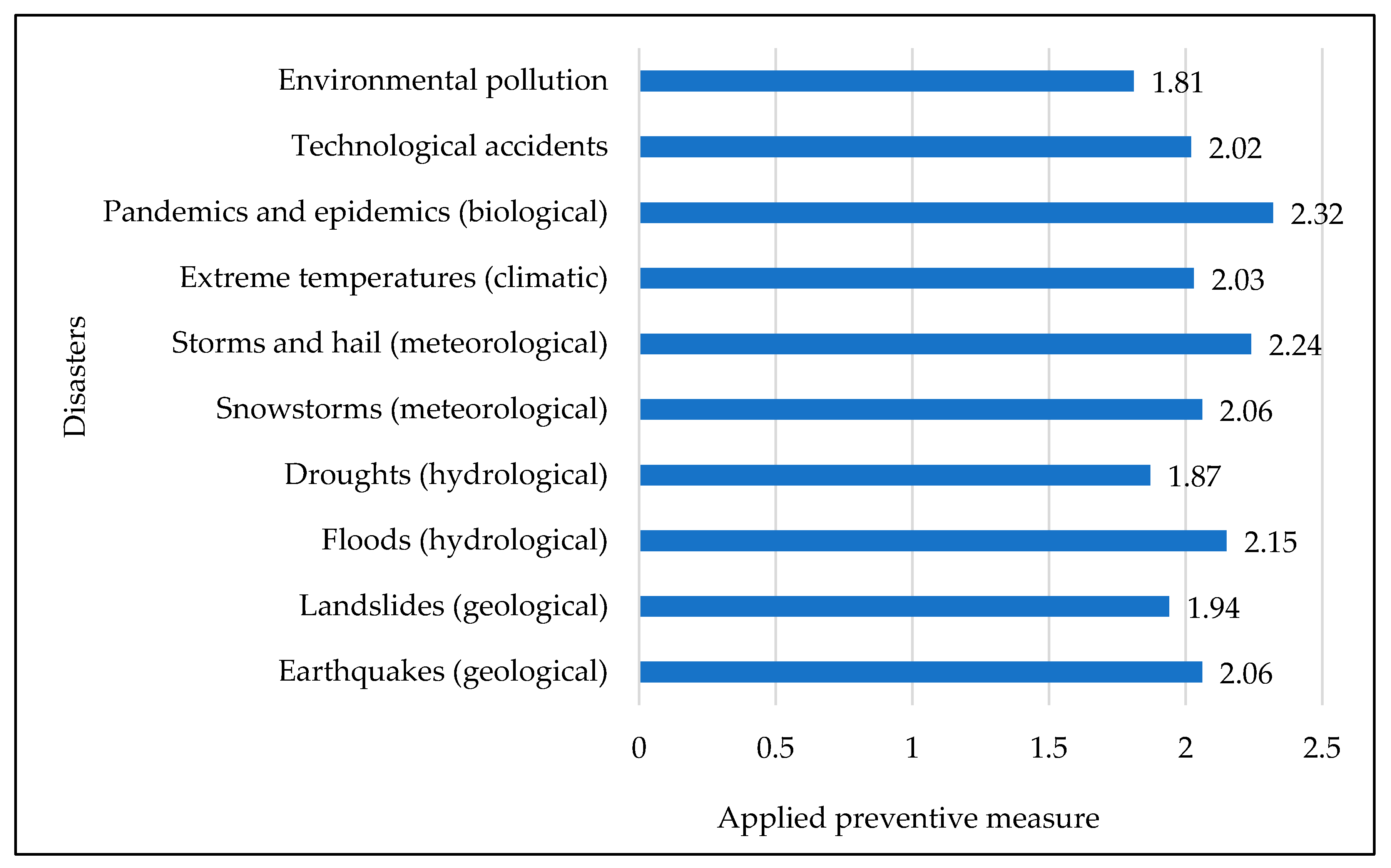
Respondents rated the implementation of preventive measures highest for pandemics and epidemics, with an average score of M = 2.32 (SD = 1.109). Storms and hail also received high ratings (M = 2.24; SD = 1.059), as did floods (M = 2.15; SD = 1.107). These three categories stand out as areas where respondents most strongly recognize preventive measures.
By contrast, mean values were recorded for earthquakes and snowstorms, both with an identical average of M = 2.06 (SD = 0.984 and SD = 0.971, respectively), as well as for extreme temperatures (M = 2.03; SD = 1.036) and technological accidents (M = 2.02; SD = 1.040). This indicates a moderate, yet still insufficient, perception of preventive engagement in these domains. However, at the lower end of the scale are landslides (M = 1.94; SD = 0.942) and droughts (M = 1.87; SD = 1.057). The lowest value was recorded for environmental pollution (M = 1.81; SD = 1.072), suggesting that respondents perceive almost no systemic and visible preventive measures in this area (Table 2 and Figure 2).
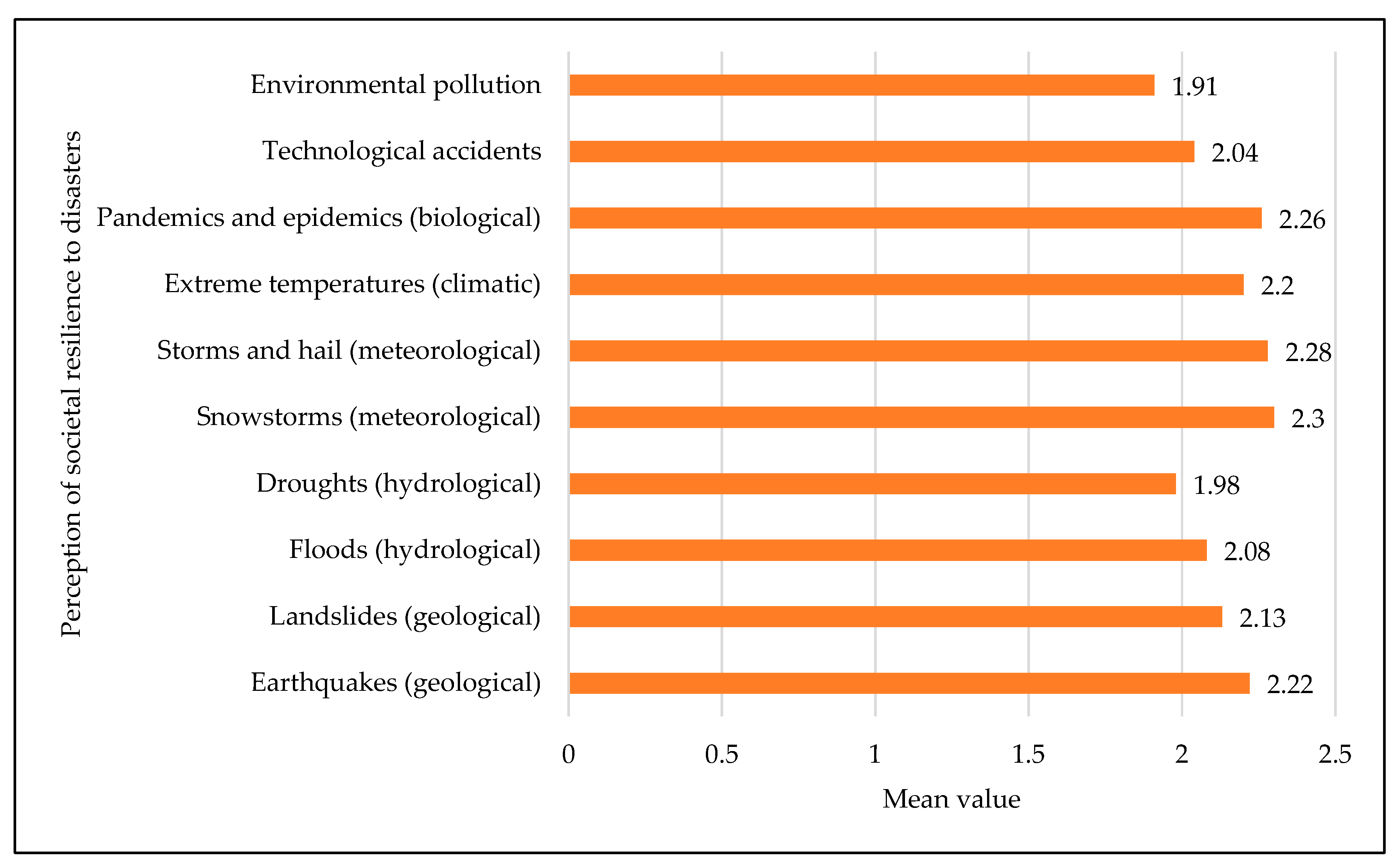
When it comes to societal resilience to disasters, the highest rating was assigned to snowstorms (M = 2.30; SD = 1.009), followed by storms and hail (M = 2.28; SD = 1.035) and pandemics and epidemics (M = 2.26; SD = 1.063). These three categories may be interpreted as those in which respondents have the greatest confidence in the system’s capacity to respond to a crisis. Next are earthquakes (M = 2.22; SD = 0.994), extreme temperatures (M = 2.20; SD = 1.020), landslides (M = 2.13; SD = 0.963), floods (M = 2.08; SD = 1.033), and technological accidents (M = 2.04; SD = 0.992), indicating a relatively low to moderate perception of society’s ability to cope with these risks. The lowest perceived societal resilience is associated with droughts (M = 1.98; SD = 1.014) and, in particular, with environmental pollution, which received the lowest score (M = 1.91; SD = 1.059). These results suggest that citizens have the least confidence in society’s systemic capacities regarding these risks.
Thus, the highest-rated categories in terms of implemented preventive measures are pandemics and epidemics (M = 2.32), followed by storms and hail (M = 2.24), and floods (M = 2.15). In contrast, the hazards rated highest for societal resilience are snowstorms (M = 2.30), storms and hail (M = 2.28), and pandemics and epidemics (M = 2.26). Respondents therefore perceive society as most resilient to snowstorms (M = 2.30; SD = 1.009), followed by storms and hail (M = 2.28; SD = 1.035) and pandemics and epidemics (M = 2.26; SD = 1.063), while it is perceived as least resilient to droughts (M = 1.98; SD = 1.014) and especially to environmental pollution (M = 1.91; SD = 1.059). Figure 3 presents the percentage distribution of perceived societal resilience to disasters.

3.1.2. Social Structure

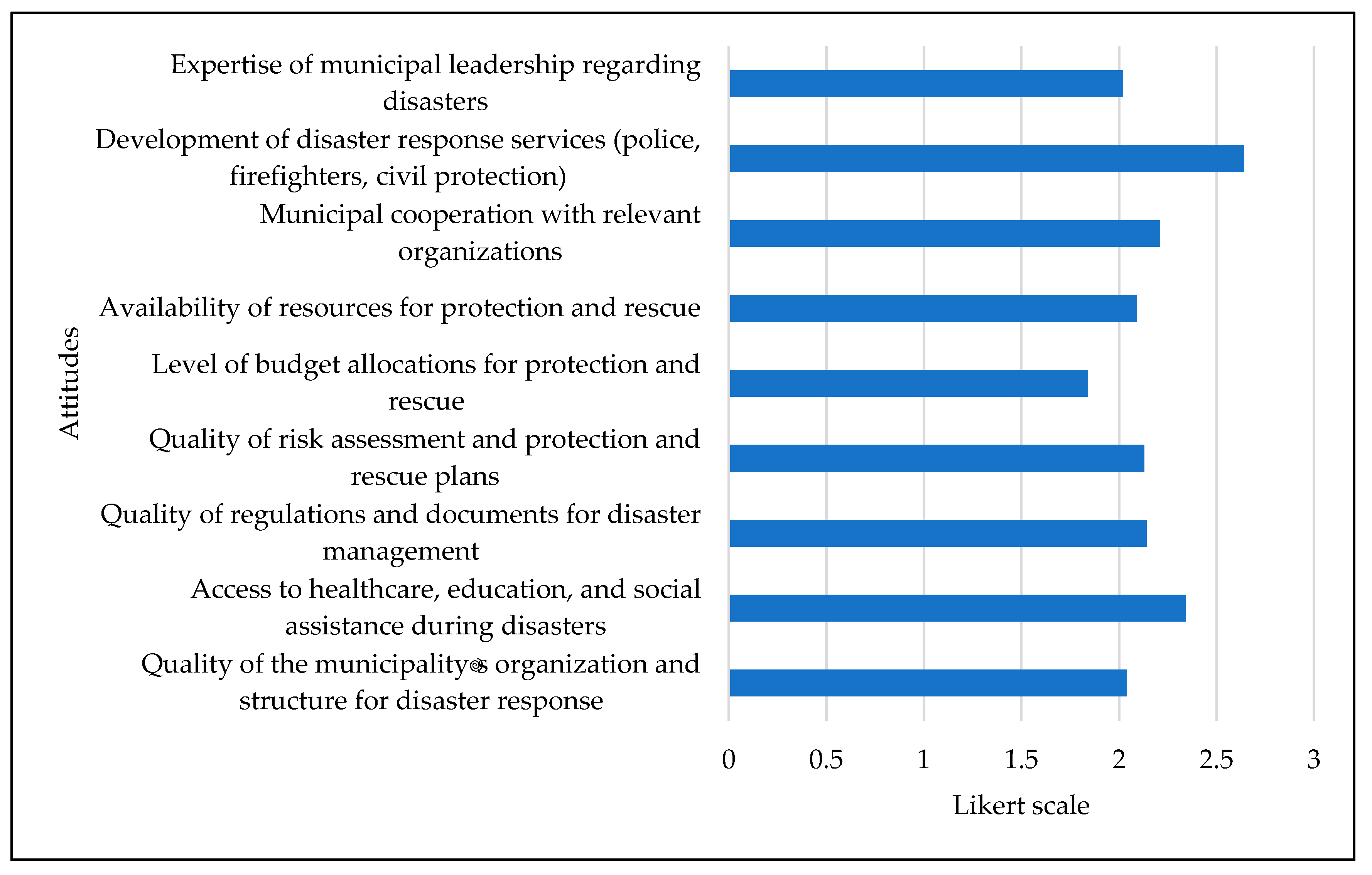
Regarding social structure, the highest average score was for the development of disaster response services, such as the police, firefighters, and civil protection, with a mean of 2.64 (SD = 1.120). While this rating remains below the scale’s midpoint, it reflects greater confidence in immediate operational capabilities than in other areas. Second was access to healthcare, education, and social assistance during disasters, with a mean of 2.34 (SD = 1.057), indicating a somewhat better perception of the availability of key public services during crises. This was followed by municipal cooperation with relevant organizations (M = 2.21; SD = 1.029), the quality of regulations and disaster management documents (M = 2.14; SD = 1.006), and the quality of risk assessment, protection, and rescue plans (M = 2.13; SD = 1.034). These scores suggest moderate to low confidence in institutional mechanisms (see Table 3 and Figure 4). Slightly lower scores appeared for the municipality’s resource capacities (M = 2.09; SD = 0.997), the organizational structure and emergency management system (M = 2.04; SD = 0.999), and the expertise of local leadership regarding disasters (M = 2.02; SD = 1.056), indicating limited confidence in local governance. The lowest score was for budget allocations for protection and rescue, with a mean of 1.84 (SD = 0.984), clearly indicating a perceived chronic shortage of financial resources for risk and emergency management. Overall, all components scored below the scale’s midpoint (3), indicating a generally low perception of local communities in Serbia’s institutional preparedness and capacity to respond effectively to disasters.

3.1.3. Social Capital

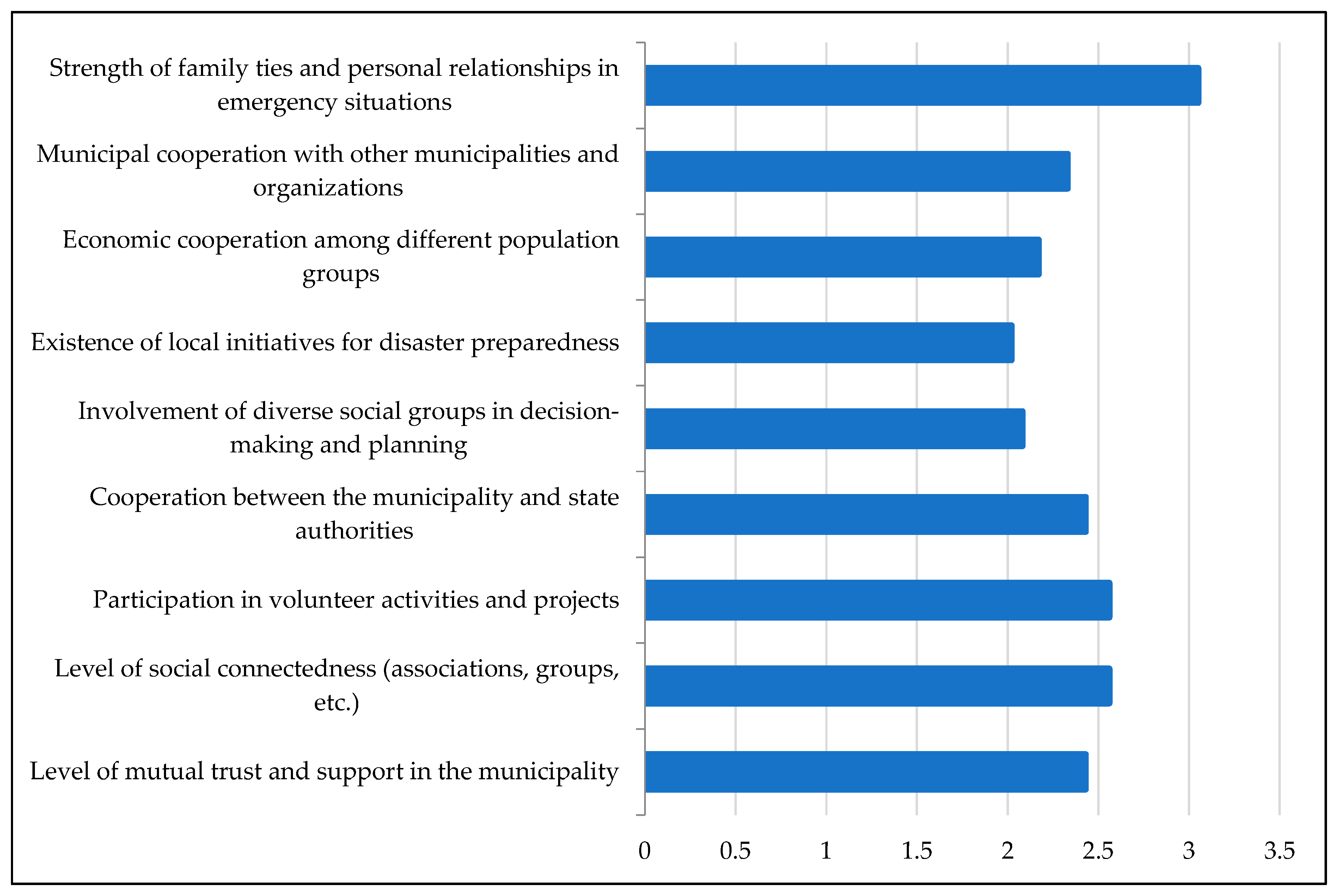
The assessment of social structure and social capital in local communities reveals variations in perceptions across different indicators that influence community resilience. The highest average score was for the strength of family ties and personal relationships in emergencies, with M = 3.05 (SD = 1.154). This indicates that citizens rely most on informal, close, and personal support networks during disasters. Scores were also relatively high for social connectedness through associations and groups (M = 2.56; SD = 1.094) and participation in volunteer activities and projects (M = 2.56; SD = 1.210), reflecting a certain level of civic engagement, though still below the scale’s midpoint. Mutual trust and support were rated at M = 2.43 (SD = 1.146), suggesting moderate trust among residents. Cooperation between the municipality and state authorities received the same rating as mutual trust (M = 2.43; SD = 1.077). Inter-municipal and inter-institutional cooperation in disaster contexts was assessed slightly lower (M = 2.33; SD = 1.043), indicating limited coordination at a broader territorial level. Economic cooperation among different social groups scored M = 2.17 (SD = 0.957), while the inclusion of diverse social groups in decision-making during disasters scored M = 2.08 (SD = 1.047), indicating low perceived inclusiveness. The lowest score was for local disaster preparedness initiatives, with M = 2.02 (SD = 1.009), highlighting their low visibility or frequency in practice (see Table 4 and Figure 5).

3.1.4. Social Mechanisms

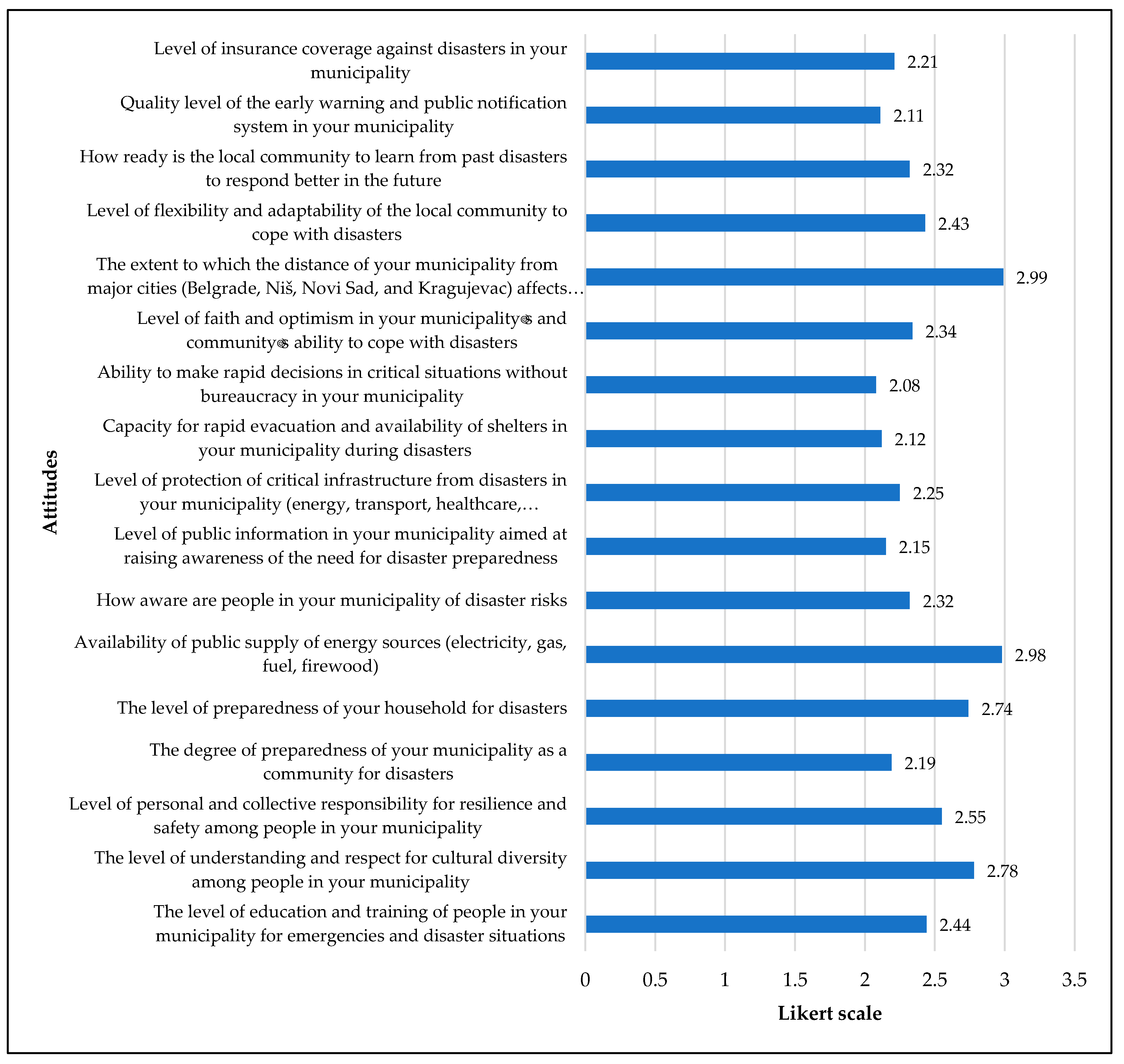
The evaluation of social mechanisms in local communities shows a somewhat low perception of their capacity to respond to and adapt to disasters. The highest average score was for the indicator related to the influence of distance from major cities (Belgrade, Niš, Novi Sad, and Kragujevac), with M = 2.99 (SD = 1.330). This indicates that respondents view the geographic location of their municipality as a significant factor in its ability to respond to disasters (Table 5). Scores were also high for the availability of public supplies of essential goods (M = 2.98; SD = 1.162) and for understanding and respecting cultural diversity (M = 2.78; SD = 1.149), implying better perceived capacities in basic infrastructure and social inclusion. Additionally, household preparedness for disasters (M = 2.74; SD = 1.023) indicates a degree of individual awareness and responsibility for protection.
Conversely, the lowest scores were related to institutional aspects of crisis management: the ability to make quick decisions in emergencies without bureaucratic delays (M = 2.08; SD = 1.073), the quality of early warning and public notification systems (M = 2.11; SD = 1.097), and the capacity for rapid evacuation and availability of shelters (M = 2.12; SD = 1.061). This suggests perceptions of limited efficiency and preparedness of local government structures in responding to crises.
Other indicators, such as public awareness/informedness (M = 2.15), protection of critical infrastructure (M = 2.25), insurance coverage (M = 2.21), and willingness to learn from past disasters (M = 2.32), are also below the midpoint of the scale. This highlights the need to strengthen systemic support, education, and risk management policies. Overall, the findings indicate a perceived low level of institutional and structural preparedness, with a heavier reliance on individual and infrastructural resources. There is considerable potential to improve coordination, communication, and inclusiveness in community resilience strategies (Table 5 and Figure 6).

3.1.5. Social Equality and Diversity

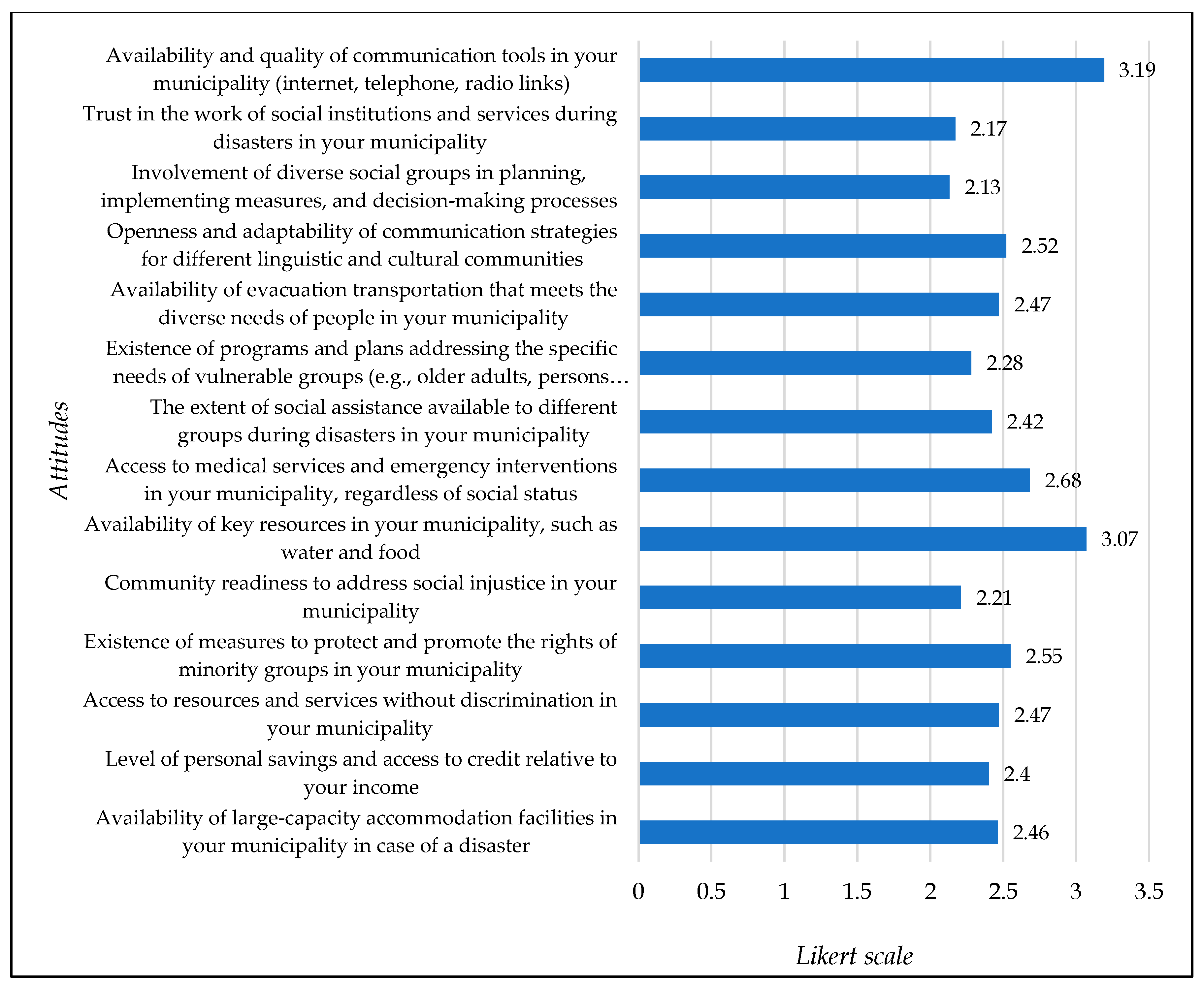
The evaluation of social equality and diversity within local communities reveals a somewhat low perception of inclusiveness and accessibility during emergencies. The highest scores were for the availability and quality of communication tools such as internet, telephone, and radio links, with an average of 3.19 (SD = 1.223), indicating a relatively adequate level of technical connectivity during crises. Similarly, resources such as water and food supplies (large stores and similar outlets) received high ratings, averaging 3.07 (SD = 1.234), reflecting existing basic supply infrastructure. Moderate ratings were observed for indicators like access to medical services and emergency interventions regardless of social status (M = 2.68; SD = 1.194), measures to protect minority rights (M = 2.55; SD = 1.151), and communication strategies adapted for linguistic and cultural diversity (M = 2.52; SD = 1.090). This suggests some efforts toward social justice and accessibility, but also indicates perceived deficiencies in their effectiveness. The lowest scores highlight limited social inclusion in decision-making and support for marginalized groups. For example, participation of diverse social groups in planning was rated at M = 2.13 (SD = 1.049), and trust in social institutions’ work during disasters was M = 2.17 (SD = 1.039). Additionally, community readiness to address social injustice was low (M = 2.21; SD = 1.107), suggesting limited acknowledgment of collective responsibility for equality during crises. The existence of programs for vulnerable groups, like older adults or persons with special needs, received a rating of M = 2.28 (SD = 1.045), indicating limited visibility or implementation. Overall, citizens perceive social equality, fairness, and preparedness as low to moderate, with a greater reliance on technical resources than on institutional and social inclusion, as shown in Table 6 and Figure 7.

3.1.6. Social Beliefs

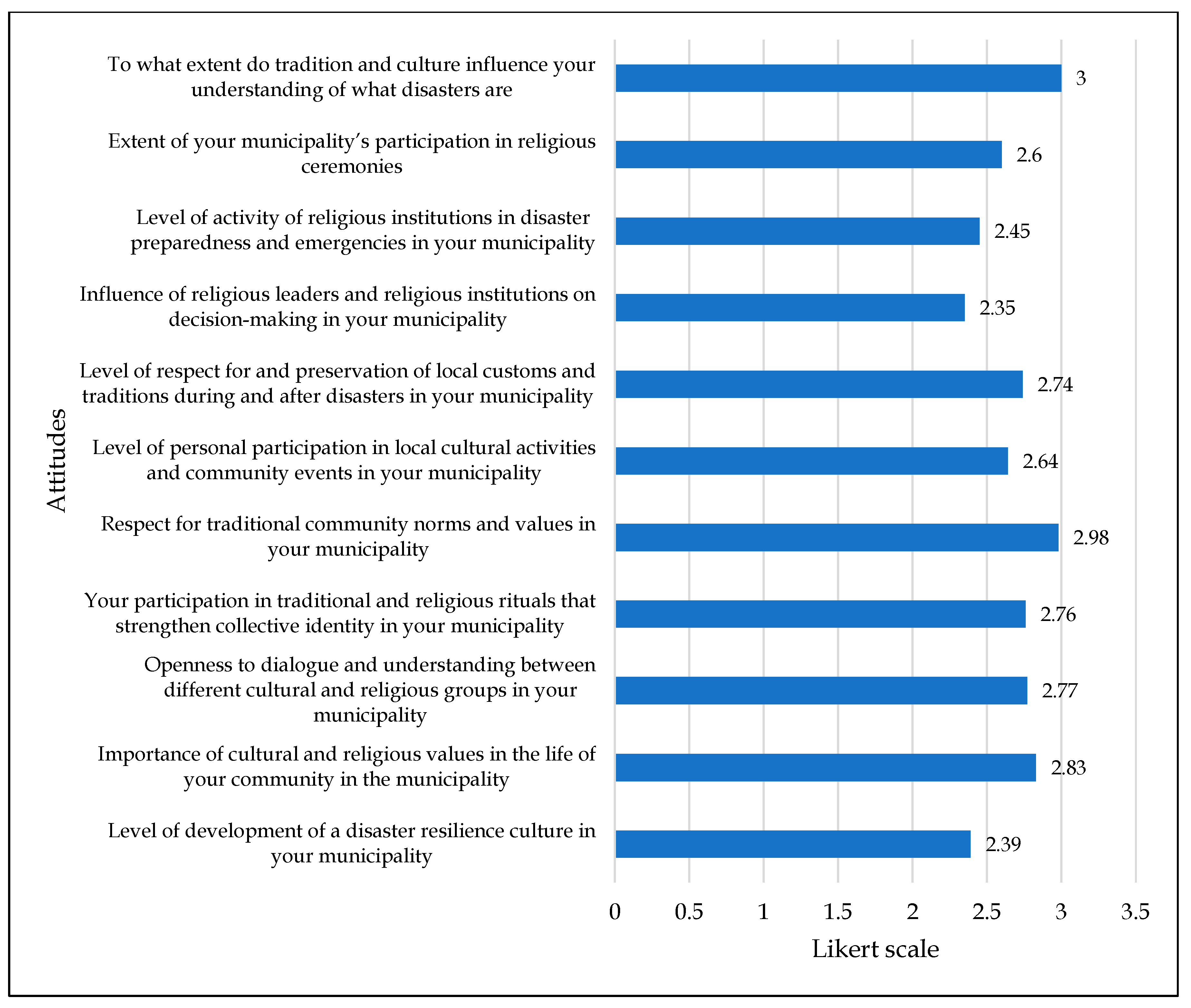
The perception of social beliefs within the context of culture, tradition, and religion reflects a moderate level of societal awareness about the significance of intangible values in fostering community resilience. The highest average score was for the statement “To what extent do tradition and culture influence your understanding of what disasters are?” with M = 3.00 (SD = 1.211), indicating a relatively strong influence of cultural heritage on how risks and emergencies are interpreted. Additionally, high ratings were given to statements such as “Respect for traditional community norms and values” (M = 2.98; SD = 1.123), “The importance of cultural and religious values in community life” (M = 2.83; SD = 1.111), “Openness to dialogue and understanding between different cultural and religious groups” (M = 2.77; SD = 1.114), and “Participation in traditional and religious rituals” (M = 2.76; SD = 1.184). These results suggest a positive view of social cohesion and cultural connectedness as key aspects of collective identity. Moderate scores were observed for items like “Respect for and preservation of local customs and traditions during and after disasters” (M = 2.74; SD = 1.110), “Personal involvement in local cultural activities” (M = 2.64; SD = 1.090), and “Municipal participation in religious ceremonies” (M = 2.60; SD = 1.073), indicating some level of engagement from citizens and institutions in maintaining the community’s cultural dimension. The lowest scores were for items related to the institutional role of religious structures, such as “The influence of religious leaders and institutions on decision-making” (M = 2.35; SD = 1.087) and “The activity level of religious institutions in disaster preparedness” (M = 2.45; SD = 1.099), reflecting a limited role and presence of these actors in formal risk governance and response planning. Overall, the findings suggest respondents recognize the importance of cultural and traditional values for social resilience. However, the role of formal religious institutions in disaster management appears underdeveloped and perceived as weak (Table 7 and Figure 8).

3.2. Results of Inferential Statistical Analyses

3.2.1. Correlational Analyses of Demographic and Socioeconomic Factors with the Perception of Preventive Measures and Community Disaster Resilience

Pearson Correlation Between Age (In Years) and the Perception of Preventive Measures and Community Disaster Resilience
The Pearson correlation analysis indicates a statistically significant association between respondents’ age and their perception of the implementation of preventive measures in the context of societal preparedness for earthquake-induced disasters (r = −0.100, p ≤ 0.01; low correlation). Specifically, the calculations show that age explains 1.00% of the variance in the assessment of earthquake measure implementation. The negative relationship suggests that older individuals tend to rate earthquake-prevention activities lower. A similar pattern was observed for landslides (r = −0.090, p ≤ 0.01; low correlation), where age explains 0.81% of the variance. For snowstorms (r = −0.094, p ≤ 0.01; low correlation), the explained variance is approximately 0.88%. The same trend was found for storms and hail (r = −0.098, p ≤ 0.01; low correlation), as well as for environmental pollution (r = −0.102, p ≤ 0.01; low correlation). Taken together, these findings suggest a consistent trend: older respondents are less likely to perceive communities as adequately prepared for these types of disasters. A slightly weaker, yet still statistically significant, negative correlation was identified for floods (r = −0.060, p ≤ 0.05), high temperatures (r = −0.071, p ≤ 0.05), and technological accidents (r = −0.074, p ≤ 0.05). These results indicate very weak negative associations, explaining variance ranging from 0.36% to 0.52%. The strongest negative correlation was observed between epidemics and pandemics (r = −0.139, p ≤ 0.01; small to moderate), with age explaining 1.93% of the variance. This suggests that older respondents are significantly more likely to question societal preparedness for biological disasters.
In contrast, no statistically significant association was found between age and perceptions of preventive measures during drought (r = −0.041, p > 0.05), suggesting that age does not affect societal preparedness in this context. Overall, the findings demonstrate a weak but consistent negative relationship between age and perceptions of preventive measures for most of the disasters examined. This suggests that older individuals have slightly lower confidence in society’s capacity to implement effective preventive actions, which is important for developing targeted risk communication and education strategies (Table 8).
In the next phase of the analysis, the Pearson correlation results confirmed a statistically significant association between respondents’ age and their assessment of societal resilience in the context of earthquake-related disasters (r = −0.125, p ≤ 0.01; low correlation). A similar pattern was observed for landslides (r = −0.127, p ≤ 0.01; low correlation). For snowstorms (r = −0.078, p ≤ 0.01), storms and hail (r = −0.093, p ≤ 0.01), and high temperatures (r = −0.110, p ≤ 0.01), similarly weak negative correlations were identified.
The strongest negative association was observed for environmental pollution (r = −0.092, p ≤ 0.01; low correlation), indicating that older respondents are less likely to believe in society’s resilience to industrial and environmental stressors. By contrast, correlations with perceived resilience to epidemics and pandemics (r = −0.056, p = 0.052) and technological accidents (r = −0.042, p = 0.149) were not statistically significant, although the former approached statistical significance.
In addition, no statistically significant relationship was found for floods (r = −0.032, p = 0.274) or droughts (r = −0.028, p = 0.335), suggesting that respondents’ age does not influence perceptions of societal resilience to these hydrological disasters (Table 9).
t-Test Analysis of the Associations of Gender, Fear, and Type of Housing with the Perception of Preventive Measures and Community Disaster Resilience
Table 10 presents the results of the t-test analysis of gender differences in perceptions of the implementation of preventive measures in society across disaster types. In most cases, no statistically significant differences were found between men and women. For example, in assessing earthquake-related measure implementation, the mean ratings were identical (men: M = 2.06; women: M = 2.06), with t = 0.105 and p = 0.917. Similarly, differences in perceptions of measures for landslides (t = 1.361; p = 0.174), floods (t = 1.934; p = 0.053), droughts (t = −0.219; p = 0.827), snowstorms (t = 1.196; p = 0.232), storms and hail (t = 1.195; p = 0.232), epidemics and pandemics (t = 1.383; p = 0.167), technological accidents (t = 1.766; p = 0.078), and environmental pollution (t = 0.192; p = 0.848) did not reach statistical significance. The only significant difference was observed for perceptions of measure implementation in the case of high temperatures, where men gave higher ratings (M = 2.10) than women (M = 1.95), which was statistically significant (t = 2.507; p = 0.012). This indicates a modest gender difference in the perception of climate-related threats, whereas for other types of disasters, perceptions of preventive measures were largely similar across genders (Table 10).
The presented t-test results indicate that respondents who report fear evaluate the implementation of preventive measures for certain types of disasters differently compared with those who do not feel fear. Significantly lower ratings were given for the implementation of measures in the case of snowstorms (M = 1.98 among those with fear vs. M = 2.13 among those without fear; t = −2.618; p = 0.009), as well as for storms and hail (M = 2.14 vs. M = 2.32; t = −2.840; p = 0.005). These differences are statistically significant at the p < 0.01 level. For other types of disasters—including earthquakes, landslides, droughts, epidemics, technological accidents, and environmental pollution—the differences did not reach statistical significance, although trends were observed in some cases (e.g., landslides: p = 0.080; droughts: p = 0.079). Overall, these findings suggest that fear may influence perceptions of societal preparedness in specific contexts, particularly regarding meteorological risks (Table 11).
Next, the t-test results indicate a statistically significant difference in how respondents perceive and interpret the implementation of preventive measures between volunteers and non-volunteers. Volunteers consistently rated the implementation of earthquake measures lower (M = 1.97) than non-volunteers (M = 2.14), and this difference was statistically significant (t = −3.086; p = 0.002). Significantly lower ratings were also reported for snowstorms (t = −3.632; p < 0.001), high temperatures (t = −2.242; p = 0.025), epidemics and pandemics (t = −3.333; p = 0.001), and technological accidents (t = −1.999; p = 0.046). These differences suggest that volunteer experience may be associated with a more critical assessment of institutional preparedness for various types of disasters. For the remaining categories (landslides, floods, droughts, storms and hail, and environmental pollution), the differences were not statistically significant (Table 12).
The results show that male respondents rated society as more resilient to earthquakes (M = 2.31; SD = 1.00) more often than female respondents (M = 2.12; SD = 0.98), t(1198) = 3.22, p = 0.001. Men also perceived society as more resilient to landslides (M = 2.18; SD = 0.95) than women (M = 2.07; SD = 0.97), t(1198) = 2.03, p = 0.043, as well as to floods (M = 2.15; SD = 1.05) compared with women (M = 2.00; SD = 1.00), t(1198) = 2.41, p = 0.016. A significant difference was also observed in perceived resilience to snowstorms, with men rating higher (M = 2.40; SD = 1.02) than women (M = 2.18; SD = 0.98), t(1198) = 3.85, p < 0.001. Similarly, for technological accidents, men rated society as more resilient (M = 2.10; SD = 0.99) compared with women (M = 1.97; SD = 0.99), t(1198) = 2.23, p = 0.026. For other disaster types—droughts, storms and hail, high temperatures, epidemics and pandemics, and environmental pollution—no statistically significant differences were found between men and women (p > 0.05). These results indicate that gender may influence perceptions of resilience for some disaster categories but not for others (Table 13).
Testing differences in perceived societal resilience to disasters between respondents who experience fear and those who do not revealed statistically significant differences for several categories. Respondents who reported fear rated societal resilience significantly lower for: earthquakes—those with fear gave a mean score of 2.02 (SD = 0.97), whereas those without fear reported 2.37 (SD = 0.99), t = −6.093, p < 0.001; landslides—ratings were 1.98 (SD = 0.96) among those with fear and 2.24 (SD = 0.96) among those without fear, t = −4.560, p < 0.001; snowstorms—those with fear rated society at 2.09 (SD = 0.98), while others reported an average of 2.46 (SD = 1.01), t = −6.464, p < 0.001; storms and hail—the mean in the fear group was 2.07 (SD = 1.00), compared with 2.44 (SD = 1.03) among those without fear, t = −6.254, p < 0.001; high temperatures—the difference was also significant: 2.07 (SD = 0.98) with fear versus 2.30 (SD = 1.04) without fear, t = −3.962, p < 0.001; epidemics and pandemics—2.12 (SD = 1.09) with fear and 2.37 (SD = 1.03) without fear, t = −3.961, p < 0.001; and technological accidents—respondents with fear rated resilience at 1.93 (SD = 0.98), compared with 2.11 (SD = 1.00) in the other group, t = −3.107, p = 0.002. For other disaster types, such as floods, droughts, and environmental pollution, the differences were not statistically significant. Overall, these results indicate that fear of disasters is associated with lower perceived societal resilience ratings, particularly for geological, meteorological, and biological risks (Table 14).
Based on the t-test results, it can be concluded that volunteering is a statistically significant factor in differentiating perceptions of societal resilience across specific disaster categories. Respondents who volunteer rated societal resilience to snowstorms lower (M = 2.22, SD = 0.99) than those who do not volunteer (M = 2.36, SD = 1.02), t(1198) = −2.393, p = 0.017. Similarly, significant differences were found in perceived resilience to storms and hail (M = 2.21, SD = 1.01 vs. M = 2.35, SD = 1.06; t(1198) = −2.359, p = 0.018), as well as to epidemics and pandemics (M = 2.20, SD = 1.05 vs. M = 2.32, SD = 1.07; t(1198) = −1.997, p = 0.046). Other differences did not reach statistical significance (Table 15).
ANOVA Analysis of the Associations of Education, Marital and Employment Status, and Income with the Perception of Preventive Measures and Community Disaster Resilience
The results of the one-way analysis of variance (ANOVA) indicate that education level has a statistically significant effect on assessments of the implementation of preventive measures in society in the case of earthquakes (F(3, 1196) = 2.86, p = 0.036) and environmental pollution (F(3, 1196) = 4.08, p = 0.007). For other types of disasters—such as landslides, floods, droughts, snowstorms, storms and hail, high temperatures, epidemics and pandemics, and technological accidents—the analysis did not reveal statistically significant differences in ratings by respondents’ education level (p > 0.05).
Further analysis based on mean values shows that respondents with doctoral education (M = 2.03) rated the implementation of preventive measures in the case of earthquakes higher than the other groups: primary education (M = 1.99), secondary education (M = 2.14), and master’s/specialist education (M = 1.95). In the case of environmental pollution, the highest ratings were given by respondents with the highest level of education—doctoral studies (M = 2.31)—while the lowest values were recorded among those with master’s/specialist education (M = 1.70), as well as among respondents with lower levels of education (M = 1.75 and M = 1.86).
Mean values and standard deviations across all education groups and disaster types provide additional insights into group differences. The highest mean rating for preventive measures in the case of earthquakes was given by respondents with secondary education (M = 2.14, SD = 1.01). In contrast, the lowest was among respondents with third-cycle academic education (doctoral studies) (M = 1.95, SD = 1.00). For environmental pollution, the highest rating was given by respondents with third-cycle academic education (doctoral studies) (M = 2.31, SD = 1.45). This finding is statistically the most notable because it exceeds the ratings of the other groups.
Although larger differences were not statistically significant, trends can be observed for certain disaster types. For example, in the case of floods, respondents with doctoral education reported the highest mean rating (M = 2.43, SD = 1.17), and they also gave higher ratings for technological accidents (M = 2.40, SD = 1.27). These findings may suggest that higher education is associated with greater awareness of certain types of risks, particularly in domains with more complex technical or environmental dimensions (Table 16).
In the study, the effect of marital status on perceptions of preventive measure implementation across different types of disasters was examined using a one-way analysis of variance (ANOVA). Respondents were classified into five categories: divorced, single, married or cohabiting, in a relationship, and widowed. The assumption of homogeneity of variances was tested using Levene’s test, and, when violated, results from Welch’s test were used as a more robust indicator (Table 17).
The analysis showed that respondents’ marital status is a statistically significant factor in differentiating mean ratings of perceived preventive measures across several types of disasters. For geological disasters, such as earthquakes, a significant difference was found (F(4, 1195) = 3.57, p = 0.007), with the lowest mean ratings recorded among divorced respondents (M = 1.92, SD = 1.03) and the highest among those who were married or in a cohabiting partnership (M = 2.29, SD = 1.02). Similarly, for landslides, a significant difference was also obtained (F = 2.94, p = 0.020), with lower values among widowed respondents (M = 1.88, SD = 1.07) and higher values among single respondents (M = 2.09, SD = 0.95).
Regarding hydrological disasters, statistically significant differences were observed in perceptions of preventive measures for floods (F = 4.74, p = 0.001) and droughts (F = 4.09, p = 0.003). In both cases, single respondents reported higher ratings (M = 2.45, SD = 1.11 for floods; M = 2.17, SD = 1.12 for droughts) compared with divorced respondents (M = 1.95, SD = 1.15; M = 1.58, SD = 0.97). For meteorological disasters, such as snowstorms (F = 2.56, p = 0.037) and hailstorms (F = 3.92, p = 0.004), statistically significant differences in ratings were also found, though with smaller group differences.
Particularly pronounced differences were identified in perceptions of preventive measures for biological disasters—epidemics and pandemics (F = 6.98, p < 0.001)—as well as for technological accidents (F = 3.34, p = 0.010) and environmental pollution (F = 7.58, p < 0.001). For example, in the case of epidemics/pandemics, single respondents reported the highest mean rating (M = 2.67, SD = 1.15). In contrast, widowed and divorced respondents reported lower levels of perceived preventive measures (M = 2.14, SD = 1.14; M = 1.88, SD = 0.99, respectively).
On the other hand, for climate-related disasters—specifically high temperatures—no statistically significant difference in mean ratings by marital status was found (F = 2.22, p = 0.064), indicating relatively similar views across all groups in this domain. Overall, these findings suggest that marital status is a relevant factor in shaping perceptions of society’s preparedness to respond to certain types of disasters.
In the study, the effect of employment status on perceptions of preventive measure implementation across different types of disasters was examined using a one-way analysis of variance (ANOVA). Respondents were classified into three groups: unemployed, employed, and “other” (retirees, students, homemakers, etc.). The assumption of homogeneity of variances was assessed using Levene’s test, and the ANOVA results indicated statistically significant differences in perceptions for certain disaster types. The most notable difference was observed in perceptions of flood-prevention measures (F(2, 1197) = 4.35, p = 0.013). Unemployed respondents reported higher ratings (M = 2.34, SD = 1.18) than employed respondents (M = 2.10, SD = 1.09) and the “other” category (M = 2.21, SD = 1.08), suggesting that unemployed citizens perceived greater implementation of measures in this area. A similar statistically significant difference was also found for environmental pollution (F(2, 1197) = 4.40, p = 0.013), where unemployed respondents again reported a higher mean rating (M = 2.01, SD = 1.25) than employed respondents (M = 1.77, SD = 1.03) and others (M = 1.79, SD = 0.98). For earthquakes (F = 2.85, p = 0.058), the difference was at the level of marginal significance, with the “other” group reporting the lowest rating (M = 1.82, SD = 0.82) compared with unemployed (M = 2.01, SD = 1.06) and employed respondents (M = 2.09, SD = 0.98). For the remaining disaster types—landslides, droughts, snowstorms, storms with hail, high temperatures, epidemics/pandemics, and technological accidents—no statistically significant differences by employment status were found (p > 0.05), indicating relatively similar perceptions across groups in these domains. Overall, these findings suggest that employment status influences how citizens perceive the implementation of preventive measures in society, particularly regarding hydrological and environmental hazards. In contrast, for other risk types, the effect is weaker or absent (Table 18).
In the study, the effect of housing type on perceptions of preventive measure implementation across different types of disasters was analyzed using a one-way analysis of variance (ANOVA). Respondents were classified into three categories: apartment in a building (1), house (2), and other forms of housing (3). The analysis examined whether there were statistically significant differences in mean ratings across disaster types by housing type. The ANOVA showed a statistically significant difference in perceptions of the implementation of preventive measures only for climate-related disasters, specifically high temperatures (F(2, 1197) = 6.50, p = 0.002) (Table 19). The highest rating was given by respondents living in houses (M = 2.36, SD = 1.13), followed by those living in apartments in buildings (M = 2.01, SD = 0.97), while the lowest rating was reported by those in “other” housing types (M = 1.98, SD = 1.08). This suggests that residents of houses are more likely to perceive that measures related to high temperatures are implemented in society, which may be associated with greater direct exposure or experience with this type of risk. In all other disaster cases (earthquakes, landslides, floods, droughts, snowstorms, storms and hail, epidemics and pandemics, technological accidents, and environmental pollution), no statistically significant differences in perceptions were found by housing type (p > 0.05). Although mean values varied slightly (e.g., floods: M = 2.25 for houses, M = 2.12 for others, M = 2.15 for apartments), the differences were not statistically significant. These results indicate that housing type generally does not affect perceptions of the implementation of preventive measures in society, except in the case of climate-related disasters, such as high temperatures, where residents of houses report greater sensitivity or awareness (Table 19).
Within the study, the effect of income level on perceptions of the implementation of preventive measures in society across different types of disasters was analyzed. Respondents were categorized into three income groups: below average (1), average (2), and above average (3). The results of the one-way analysis of variance (ANOVA) showed statistically significant differences across several areas. The most pronounced differences were observed for hydrological and climate-related disasters. In the case of floods, a statistically significant difference was confirmed (F(2, 1197) = 15.49, p < 0.001), with respondents with average (M = 2.39, SD = 1.13) and above-average incomes (M = 2.38, SD = 1.10) reporting markedly higher perceptions of measure implementation compared with those with below-average incomes (M = 2.02, SD = 1.08). Similarly, for droughts, a significant difference was also found (F(2, 1197) = 4.83, p = 0.008), with the lowest perceived implementation among low-income respondents (M = 1.80, SD = 1.06) and the highest among high-income respondents (M = 2.06, SD = 1.07). For high temperatures, results also indicated significant differences in perceptions (F(2, 1197) = 3.17, p = 0.042), where higher-income respondents showed greater sensitivity and assessed implementation as better (M = 2.20, SD = 0.98) compared with lower-income respondents (M = 1.98, SD = 1.03). For biological disasters (epidemics and pandemics), a statistically significant difference was also found (F(2, 1197) = 3.18, p = 0.042), with the highest rating among high-income respondents (M = 2.50, SD = 1.15) and the lowest among low-income respondents (M = 2.27, SD = 1.08). Additionally, regarding environmental pollution, differences in perceptions were identified (F(2, 1197) = 3.63, p = 0.027), with higher-income respondents again reporting higher ratings (M = 2.02, SD = 1.14) than lower-income respondents (M = 1.78, SD = 1.05). However, the analysis did not show statistically significant differences for other disaster types—earthquakes (p = 0.399), landslides (p = 0.122), snowstorms (p = 0.640), storms and hail (p = 0.405), and technological accidents (p = 0.167)—indicating relatively similar perceptions regardless of income level in these domains. These results suggest that an individual’s economic situation influences perceptions of societal preparedness and the implementation of preventive measures, especially for disasters that more directly affect living conditions and health (Table 20).
Within the study, the effect of education level on perceptions of society’s resilience to different types of disasters was analyzed. Respondents were classified into four categories: primary education (1), secondary education (2), higher education—master/specialist studies (3), and doctoral studies (4). A one-way analysis of variance (one-way ANOVA) was applied to all examined disaster types. The findings confirm statistically significant differences in the assessment of society’s resilience regarding landslides (F(3, 1196) = 2.77, p = 0.040), storms and hail (F(3, 1196) = 3.31, p = 0.020), technological accidents (F(3, 1196) = 2.94, p = 0.032), and environmental pollution (F(3, 1196) = 4.58, p = 0.003). For landslides, the highest perceived resilience was reported by respondents with secondary education (M = 2.19, SD = 0.97), while the lowest ratings were given by those with doctoral studies (M = 1.91, SD = 0.82). For technological accidents, respondents with secondary education again reported the highest perceived resilience (M = 2.11, SD = 1.03), whereas doctoral respondents reported the lowest (M = 1.86, SD = 0.91). Regarding environmental pollution, respondents with secondary education received the highest ratings (M = 2.02, SD = 1.15), whereas those with primary education and doctoral studies reported lower ratings (M = 1.78, SD = 0.96, and 1.83, SD = 0.98, respectively). For storms and hail, the highest resilience assessment was again provided by respondents with secondary education (M = 2.36, SD = 1.07), and the lowest by respondents with doctoral studies (M = 1.91, SD = 0.78). At the same time, the analysis did not show statistically relevant differences in perceptions for the remaining disaster categories: earthquakes (p = 0.051), floods (p = 0.467), droughts (p = 0.084), snowstorms (p = 0.163), high temperatures (p = 0.375), and epidemics and pandemics (p = 0.399). These results indicate that education level has a limited influence on perceptions of societal resilience, and that differences are most pronounced in the context of specific disasters involving technological or environmental risks (Table 21).
Comprehensive analyses show that marital status statistically significantly affects perceptions of society’s resilience to earthquakes (F = 3.63, p = 0.006), landslides (F = 3.03, p = 0.017), floods (F = 2.63, p = 0.033), droughts (F = 2.90, p = 0.021), and environmental pollution (F = 3.78, p = 0.005). In contrast, differences are not significant for snowstorms (F = 1.38, p = 0.241), storms and hail (F = 1.79, p = 0.129), and epidemics/pandemics (F = 1.75, p = 0.136), while for high temperatures (F = 2.24, p = 0.062) and technological accidents (F = 2.36, p = 0.052) results are at the threshold of significance. Furthermore, mean values indicate that respondents in a marital or cohabiting partnership most often report the highest levels of perceived resilience (e.g., earthquakes: M = 2.29; floods: M = 2.45; droughts: M = 2.17; environmental pollution: M = 2.16), while the lowest values are observed among divorced respondents (earthquakes: M = 1.92; droughts: M = 1.58; environmental pollution: M = 1.48) and widowed respondents (earthquakes: M = 1.88; floods: M = 1.81; technological accidents: M = 1.69). Single respondents generally fall between these two extremes, while those “in a relationship” most often have slightly lower values compared with the married/cohabiting group; however, compared with divorced and widowed respondents, they report higher values. Overall, results suggest that more stable partnerships are associated with higher expectations and perceptions of societal resilience to geological, hydrological, and environmental disasters. In contrast, for other disaster types, assessments generally do not differ significantly by marital status (Table 22).
In the study, the effect of employment status on perceptions of society’s resilience to different types of disasters was examined using a one-way analysis of variance (ANOVA). Respondents were classified into three groups: employed (1), unemployed (2), and other (3), including retirees, students, etc. The ANOVA results confirm statistically significant differences in perceptions of society’s resilience to earthquakes (F = 5.03, p = 0.007), high temperatures (F = 3.77, p = 0.023), and environmental pollution (F = 9.39, p < 0.001) across employment status groups. For earthquakes, employed and unemployed respondents reported similar mean ratings (M = 2.24, SD = 1.21 and M = 2.24, SD = 0.94), while the “other” group rated societal resilience significantly lower (M = 1.86, SD = 0.88). For high temperatures, employed respondents expressed the highest perceived resilience (M = 2.35, SD = 1.14), followed by unemployed respondents (M = 2.18, SD = 1.00), while the “other” group reported the lowest ratings (M = 2.00, SD = 0.81). The largest differences were found for environmental pollution, where employed respondents reported the highest perceived resilience (M = 2.19, SD = 1.29), while values were notably lower among unemployed respondents (M = 1.86, SD = 1.00) and others (M = 1.75, SD = 0.86). On the other hand, for most other disaster types—landslides (F = 1.55, p = 0.213), floods (F = 1.30, p = 0.273), droughts (F = 2.42, p = 0.089), snowstorms (F = 0.11, p = 0.895), storms and hail (F = 0.73, p = 0.483), epidemics and pandemics (F = 0.48, p = 0.618), and technological accidents (F = 0.03, p = 0.966)—differences were not statistically significant. This indicates relatively similar understandings of societal resilience to these disasters regardless of employment status. These results imply that economic and professional engagement may influence perceptions of institutional preparedness and protective infrastructure, particularly in domains perceived as climate- or environmentally driven risks (Table 23).
In the study, the effect of housing conditions on perceptions of society’s resilience to different disaster types was analyzed using a one-way analysis of variance (ANOVA). Respondents were classified into three groups based on housing status: 1—own property, 2—rented accommodation, 3—other forms of housing. The ANOVA results show statistically significant differences in perceptions of society’s resilience in the case of floods (F = 6.23, p = 0.002), droughts (F = 12.20, p < 0.001), high temperatures (F = 10.91, p < 0.001), and environmental pollution (F = 3.86, p = 0.021). A follow-up comparison of mean ratings indicates that respondents living in rented apartments more strongly perceive society as resilient to floods (M = 2.40, SD = 1.26), droughts (M = 2.39, SD = 1.23), and high temperatures (M = 2.56, SD = 1.26), compared with those living in owned property (e.g., droughts: M = 1.88, SD = 0.95) or other housing types (e.g., floods: M = 2.05, SD = 0.99). Regarding perceptions of resilience to environmental pollution, the lowest mean rating was reported by respondents living in owned property (M = 1.84, SD = 0.98). In contrast, those in rented apartments reported a somewhat higher mean rating (M = 2.12, SD = 1.10). Although the difference is small, it proved statistically significant. In contrast, for the remaining disaster categories—earthquakes (F = 0.037, p = 0.964), landslides (F = 0.115, p = 0.891), snowstorms (F = 0.259, p = 0.772), storms and hail (F = 0.881, p = 0.415), epidemics and pandemics (F = 1.79, p = 0.167), and technological accidents (F = 0.183, p = 0.833)—no statistically significant differences were detected in mean ratings between groups based on housing status. This indicates relatively similar perceptions of society’s resilience in these domains regardless of housing conditions (Table 24).
In the study, the effect of income level on perceptions of society’s resilience to different disaster types was analyzed using a one-way analysis of variance (ANOVA). Respondents were classified into three groups: 1—below-average income, 2—average income, 3—above-average income. The ANOVA results indicate statistically significant differences in perceptions of societal resilience in the case of floods (F = 18.03, p < 0.001), droughts (F = 15.26, p < 0.001), snowstorms (F = 4.78, p = 0.009), storms and hail (F = 4.48, p = 0.012), high temperatures (F = 11.15, p < 0.001), epidemics and pandemics (F = 5.01, p = 0.007), and environmental pollution (F = 9.45, p < 0.001). The data show that, on average, respondents with higher incomes provide higher ratings of societal resilience. For example, in the context of floods, those with above-average incomes rated resilience at M = 2.41 (SD = 1.10), compared with those with below-average incomes (M = 1.96, SD = 1.02). A similar pattern was observed for droughts (above-average: M = 2.24, SD = 1.01; below-average: M = 1.86, SD = 0.99), as well as for high temperatures (above-average: M = 2.48, SD = 1.11; below-average: M = 2.11, SD = 0.98). In the case of snowstorms, citizens with average (M = 2.43, SD = 1.06) and above-average incomes (M = 2.41, SD = 1.03) assessed a higher level of societal resilience than those with below-average incomes (M = 2.23, SD = 0.98). For epidemics and pandemics, an increase in perceived resilience with rising income is also evident: above-average (M = 2.43, SD = 1.14) vs. below-average (M = 2.19, SD = 1.01). The lowest values for environmental pollution were reported by low-income respondents (M = 1.82, SD = 1.02), whereas higher income levels were associated with higher perceptions of resilience (average: M = 2.04, SD = 1.14; above-average: M = 2.15, SD = 1.07). On the other hand, for earthquakes (F = 1.39, p = 0.25), landslides (F = 2.98, p = 0.051), and technological accidents (F = 2.48, p = 0.084), no statistically meaningful differentiation in perceptions of resilience was recorded between income groups, indicating relatively uniform assessments regardless of economic status (Table 25).

3.2.2. Correlational Analyses of Demographic and Socioeconomic Factors with the Perception of Social Structure, Social Capital, Social Mechanisms, Social Equity and Diversity, and Social Beliefs

Pearson Correlation Between Age and the Perception of Social Structure, Social Capital, Social Mechanisms, Social Equity and Diversity, and Social Beliefs
The Pearson correlation results (Table 26) show that, of the nine observed variables within the social structure domain, only one is statistically significantly associated with age—namely, the development of disaster response services in the municipality (e.g., police, firefighters, civil protection): r = −0.076, p = 0.009. This negative correlation suggests that older respondents tend to perceive disaster response services in their municipality as less developed. Although the correlation is weak, its statistical significance indicates that this perception is consistently present in the sample. This may reflect greater skepticism among older adults or higher expectations shaped by prior life experiences with disasters and institutions. For the remaining eight dimensions, no statistically significant association with age was found: the quality of municipal organization and structures for disaster response (r = −0.035, p = 0.227), access to healthcare, education, and social assistance during disasters (r = −0.027, p = 0.343), the quality of regulations and documents related to disaster management (r = −0.043, p = 0.134), the existence and quality of risk assessments and protection-and-rescue plans (r = −0.035, p = 0.221), the level of financial allocations for disaster protection and response (r = 0.015, p = 0.600), the availability of municipal resources for protection and rescue (r = −0.054, p = 0.063), municipal cooperation with relevant organizations and institutions to develop preventive measures (r = −0.022, p = 0.438), and the expertise of municipal leadership regarding disasters (r = −0.024, p = 0.407).
Within the analysis of the association between social capital and age, nine variables were examined reflecting different dimensions of social connectedness, trust, cooperation, and community participation. The analysis showed that for eight of the nine aspects of social capital, a statistically significant negative association with age was identified, indicating that older respondents, on average, perceive these aspects of collective action as somewhat less developed: social connectedness among people (associations, groups, etc.): r = −0.156, p < 0.001; participation in voluntary (volunteering) activities and projects: r = −0.147, p < 0.001; cooperation between the municipality and state authorities: r = −0.085, p = 0.003; inclusion of different social groups in decision-making and planning during disasters: r = −0.062, p = 0.033; the existence of local disaster-preparedness initiatives involving different population groups: r = −0.099, p = 0.001; economic cooperation among different population groups: r = −0.166, p < 0.001; municipal cooperation with other municipalities, organizations, and companies: r = −0.094, p = 0.001; and the strength of family ties and personal relationships in emergencies: r = −0.166, p < 0.001.
These associations are negative, meaning that as age increases, perceived connectedness, cooperation, and community initiative decrease. The most pronounced correlations are with social and economic connectedness and family relations, suggesting that younger respondents are more likely to recognize or value these aspects of community and collective resilience. These findings may indicate generational differences in perception and/or participation in the community and its collective coping mechanisms.
Further Pearson correlation results showed statistically significant negative associations between age and a range of aspects of social mechanisms in local communities. Respondents’ age correlated weakly but significantly negatively with the level of education and training of people in the municipality for emergencies and disaster situations (r = −0.152, p ≤ 0.001), as well as with the level of understanding and respect for cultural diversity (r = −0.158, p ≤ 0.001). Older individuals also rated the level of personal and collective responsibility for safety and resilience in their communities (r = −0.156, p ≤ 0.001), the overall preparedness of the community (r = −0.121, p ≤ 0.001), and of their own household (r = −0.126, p ≤ 0.001) for disasters.
A negative correlation was also found with perceived availability of public energy supply (r = −0.060, p ≤ 0.05) and with community awareness of disaster risks (r = −0.107, p ≤ 0.001). As age increases, perceived community informedness about the importance of disaster preparedness also decreases (r = −0.118, p ≤ 0.001), as assessed by the level of critical infrastructure protection (r = −0.127, p ≤ 0.001) (Table 26).
Older respondents evaluated the capacity for rapid evacuation and the availability of shelters less positively (r = −0.170, p ≤ 0.001), as well as the ability to make decisions in critical situations without bureaucratic obstacles (r = −0.126, p ≤ 0.001). An association was also found with the level of optimism and belief in the community’s capacity to cope with disasters (r = 0.145, p ≤ 0.001), as well as with the perceived impact of the municipality’s distance from larger cities on successful disaster response (r = −0.106, p ≤ 0.001).
Furthermore, statistically significant associations were found with the community’s perceived flexibility and adaptability (r = −0.161, p ≤ 0.001) and its willingness to learn from previous disasters (r = −0.132, p ≤ 0.001). Age was also associated with a lower assessment of the degree of insurance coverage against disasters (r = −0.118, p ≤ 0.001). On the other hand, no statistically significant association was identified between age and the perceived quality of early warning and notification systems (r = −0.023, p = 0.424).
These findings indicate that as age increases, positive perceptions of various social mechanisms relevant to risk and disaster management decrease. Although all correlations are weak, their consistency and statistical significance suggest the need for special attention when planning measures to include older persons in disaster preparedness and response.
Additionally, the Pearson correlation analysis showed a statistically significant, weak negative association between respondents’ age and several aspects related to availability, equality, and social justice in the context of disasters. Age was weakly but significantly negatively associated with the perceived availability of larger accommodation capacities during disasters, such as hotels, halls, and hospitals (r = −0.085, p ≤ 0.01), as well as with personal savings and access to credit (r = −0.088, p ≤ 0.01). Older respondents also rated the extent to which their communities provide access to resources and services without discrimination slightly lower (r = −0.083, p ≤ 0.01), as did the existence of measures to protect and promote the rights of minority groups (r = −0.065, p ≤ 0.05).
Negative correlations were also observed for perceived community readiness to address social injustice (r = −0.099, p ≤ 0.01) and the availability of social assistance across different groups during disasters (r = −0.059, p ≤ 0.05). Older respondents also assigned lower values to the existence of programs for the specific needs of vulnerable groups (r = −0.078, p ≤ 0.01) and to the availability of adapted transport for evacuation (r = −0.065, p ≤ 0.05). Similar associations were found for openness to communication strategies across different language and cultural communities (r = −0.063, p ≤ 0.05) and for trust in social institutions’ work during disasters (r = −0.098, p ≤ 0.01).
Conversely, no statistically significant association was found between age and perceptions of the availability of key resources such as water and food (r = −0.034, p = 0.238), access to medical services regardless of social status (r = −0.026, p = 0.374), or the inclusion of different social groups in disaster-related planning and decision-making (r = −0.039, p = 0.173).
Overall, the findings indicate that older people perceive somewhat lower service availability and reduced community inclusiveness in disaster response, which may point to the need for stronger intergenerational connectedness and policies adapted to the specific needs of older populations in risk reduction planning.
The Pearson correlation results further show that respondents’ age is statistically significant but negatively correlated with a range of variables related to social beliefs, cultural patterns, and value systems. Specifically, older respondents are less likely to perceive favorable conditions for communication during disasters; a weak negative correlation was found between age and the assessment of the availability and quality of communication infrastructure in the municipality (internet, telephone, radio links, etc.) (r = −0.068, p ≤ 0.05).
Age was also significantly negatively associated with perceived development of a disaster resilience culture (r = −0.099, p ≤ 0.01) and with the importance attributed to cultural and religious values in community life (r = −0.127, p ≤ 0.01). Older respondents also gave lower ratings to openness to dialogue and understanding among different cultural and religious groups (r = −0.097, p ≤ 0.01) and to their own participation in traditional and religious rituals that strengthen collective identity (r = −0.127, p ≤ 0.01). A similar weak negative association was identified with respect for traditional social norms and community values (r = −0.125, p ≤ 0.01) and with personal participation in local cultural activities and community events (r = −0.147, p ≤ 0.01).
The strongest negative relationship in this set was observed for the variable measuring respect for and preservation of local customs and traditions during and after disasters (r = −0.185, p ≤ 0.01), indicating that, on average, older respondents give lower ratings to the preservation of tradition in such situations. A significant negative association was also found between age and perceptions of the influence of religious leaders and institutions on municipal decision-making (r = −0.100, p ≤ 0.01) and the extent to which those institutions are active in disaster preparedness (r = −0.172, p ≤ 0.01). Older respondents also rated their municipality’s participation in religious rituals (r = −0.117, p ≤ 0.01).
On the other hand, the only variable in this group that did not show a statistically significant association with age relates to the belief that tradition and culture influence the understanding of disasters (r = −0.053, p = 0.066), indicating the absence of a consistent relationship between respondents’ age structure and this aspect of social belief. Overall, the results suggest that with increasing age, perceptions of social, cultural, and religious cohesion in the community decline, as does belief in the role of these elements in building disaster resilience.
t-test Analysis of the Associations of Gender, Fear, and Volunteering with the Perception of Social Structure, Social Capital, Social Mechanisms, Social Equity and Diversity, and Social Beliefs
The t-test results show a statistically significant gender difference only in the perception of social structure (t = 2.245; p = 0.025), with men (M = 2.21; SD = 0.86) reporting a slightly higher mean score than women (M = 2.10; SD = 0.84). For the other variables (social capital, social mechanisms, social equity, and social beliefs), the observed differences were not statistically significant at the p < 0.05 level, although some were close to the significance threshold (e.g., social mechanisms, p = 0.055; social equity, p = 0.064) (Table 27).
Respondents who reported fear rated social structure significantly lower (M = 2.05) compared with those who did not report fear (M = 2.25), and this difference was statistically significant (t = −4.119; p < 0.001). A similar pattern was observed for social capital: individuals who felt fear reported lower ratings (M = 2.29) than those without fear (M = 2.49), with the difference statistically significant (t = −4.177; p < 0.001). A significant difference was likewise found for social mechanisms: respondents who experienced fear had a lower mean (M = 2.25) than those who did not (M = 2.54), with a highly statistically significant difference (t = −6.551; p < 0.001). Regarding social equity, respondents with fear (M = 2.26) also reported lower ratings compared with those without fear (M = 2.59), with strong statistical support (t = −6.737; p < 0.001). The most pronounced difference was observed for social beliefs, where the mean in the fear group was M = 2.56 and in the no–fear group M = 2.85; this difference was highly statistically significant (t = −5.992; p < 0.001). Overall, these results consistently indicate that fear is associated with lower perceptions of social structure, trust, fairness, and general social beliefs (Table 28).
Further analyses show that respondents who volunteered reported significantly higher scores on the social beliefs domain (M = 2.78) than those who did not volunteer (M = 2.68), and this difference was statistically significant (t = 2.071; p = 0.039). For the other dimensions—social structure (t = −0.324; p = 0.746), social capital (t = 1.805; p = 0.071), social mechanisms (t = −1.129; p = 0.259), and social equity (t = −0.282; p = 0.778)—the differences between volunteers and non-volunteers were not statistically significant. These findings suggest a potential role of volunteering engagement in strengthening general social beliefs, but not in perceptions of other social aspects (Table 29).
ANOVA Analysis of the Associations of Education, Marital and Employment Status, Housing Conditions, and Income with the Perception of Social Structure, Social Capital, Social Mechanisms, Social Equity and Diversity, and Social Beliefs
Based on the results of the one-way analysis of variance (ANOVA), respondents’ level of education does not have a statistically significant effect on perceptions of the key dimensions of social resilience. The following dimensions were analyzed: social structure, social capital, social mechanisms, social equity, and social beliefs. In all cases, the obtained F-values were not statistically significant (p ≥ 0.05). Specifically, for the social structure domain, the ANOVA yielded F(3, 1196) = 0.22, p = 0.882. Mean values of perceived resilience by education level were: primary education (M = 2.15, SD = 0.88), secondary education (M = 2.16, SD = 0.86), master/specialist studies (M = 2.21, SD = 0.81), and doctoral studies (M = 2.17, SD = 0.82). The differences in perceptions were minimal and within the range of sampling error. Similarly, for social capital, the value F(3, 1196) = 0.36, p = 0.781 was obtained. Mean values were: primary education (M = 2.41, SD = 0.86), secondary education (M = 2.38, SD = 0.86), master/specialist (M = 2.46, SD = 0.78), and doctoral studies (M = 2.38, SD = 0.83), again indicating a uniform perception without notable deviations.
With respect to social mechanisms, although somewhat larger differences in mean values were observed (highest for secondary education: M = 2.46, SD = 0.78; lowest for doctoral studies: M = 2.32, SD = 0.80), the result F(3, 1196) = 1.80, p = 0.145 indicates that this difference is not statistically significant. For social equity, F(3, 1196) = 0.69, p = 0.556, with mean values ranging from M = 2.44 (SD = 0.88) for primary education to M = 2.56 (SD = 0.96) for doctoral education, which also does not suggest meaningful differences. Finally, for social beliefs, F(3, 1196) = 0.19, p = 0.906, confirms the absence of significant differences, with all groups reporting similar mean ratings (M = 2.72), and somewhat higher SD values among respondents with doctoral education (SD = 1.03). Overall, the results indicate that respondents’ formal education level is not a significant factor in shaping their views on social resilience across the examined dimensions (Table 30).
In this study, the effect of marital status on the dimensions of social resilience was examined using one-way ANOVA. Respondents were classified into five groups: 1 = single, 2 = in a relationship, 3 = married/cohabiting, 4 = divorced, 5 = widowed. Before the analysis, the assumption of homogeneity of variances was assessed using Levene’s test, and since no serious violations were detected, the standard ANOVA procedure was applied.
The results confirmed statistically significant differences in social structure assessment by marital status (F(4, 1195) = 2.52, p = 0.040). The highest mean value was reported by respondents who were married/cohabiting (M = 2.35, SD = 0.84), followed by those in a relationship (M = 2.23, SD = 0.95). In contrast, the lowest mean value was reported by divorced respondents (M = 2.08, SD = 1.17).
Regarding social capital, a significant difference between groups was also found (F(4, 1195) = 5.64, p < 0.001). Respondents who were married/cohabiting (M = 2.58, SD = 0.81) and those in a relationship (M = 2.56, SD = 0.94) assigned the highest importance to social capital. In contrast, the lowest ratings were recorded among divorced individuals (M = 2.19, SD = 1.17).
A statistically significant difference was also observed for social mechanisms (F(4, 1195) = 4.17, p = 0.002). In this case, the highest mean values were reported by respondents in a relationship (M = 2.54, SD = 0.86) and those married/cohabiting (M = 2.54, SD = 0.82). In contrast, the lowest were reported by single respondents (M = 2.28, SD = 0.73) and divorced respondents (M = 2.24, SD = 1.17).
By contrast, for social equity, no significant group differences were found (F(4, 1195) = 1.86, p = 0.115). However, for social beliefs, differences were statistically significant (F(4, 1195) = 4.31, p = 0.002), with the highest mean values reported by respondents in a relationship (M = 2.88, SD = 0.91) and the lowest by divorced respondents (M = 2.48, SD = 1.02). These findings indicate differences in perceptions and evaluations of social resilience elements by marital status (Table 31).
The effect of employment status on the dimensions of social resilience was examined using one-way ANOVA. Respondents were classified into three groups: 1 = employed, 2 = unemployed, 3 = retired. Prior to the analysis, the homogeneity of variance assumption was checked and found not to be substantially violated, which justified the use of the standard ANOVA procedure.
For social structure, no statistically significant differences were found by employment status (F(2, 1197) = 0.23, p = 0.795). Mean values were: employed (M = 2.13, SD = 0.88), unemployed (M = 2.17, SD = 0.84), and retired (M = 2.17, SD = 0.97).
For social capital, the result was at the borderline of statistical significance (F(2, 1197) = 2.97, p = 0.052). Employed respondents reported the highest mean value (M = 2.49, SD = 0.87), followed by unemployed respondents (M = 2.40, SD = 0.84), while retired respondents reported the lowest (M = 2.21, SD = 0.92).
For social mechanisms, the results indicate a statistically significant difference between groups (F(2, 1197) = 3.31, p = 0.037). The highest values were reported by employed respondents (M = 2.48, SD = 0.86), followed by unemployed respondents (M = 2.41, SD = 0.76), while retirees reported the lowest (M = 2.21, SD = 0.90).
For social equity, no statistically significant differences were found by employment status (F(2, 1197) = 0.35, p = 0.702), with similar mean values across all three groups: employed (M = 2.46, SD = 0.93), unemployed (M = 2.45, SD = 0.82), and retired (M = 2.37, SD = 0.98).
The most pronounced difference was observed for social beliefs (F(2, 1197) = 6.52, p = 0.002), where employed respondents reported the highest mean value (M = 2.82, SD = 0.91), followed by unemployed respondents (M = 2.73, SD = 0.80), and retirees the lowest (M = 2.41, SD = 0.90). These values suggest that employment status may influence certain aspects of social resilience, particularly social mechanisms and beliefs, with employed respondents expressing greater engagement and optimism than unemployed and retired respondents (Table 32).
The effect of housing conditions on the dimensions of social resilience was examined using one-way ANOVA. Respondents were grouped into three categories based on housing status: 1 = owner-occupied, 2 = rented housing, 3 = collective/other housing arrangements. Prior to the ANOVA, the assumption of homogeneity of variances was assessed and found not to be significantly violated (Table 33).
For social structure, a statistically significant difference was found (F(2, 1197) = 4.71, p = 0.009). Respondents in rented housing reported the highest mean value (M = 2.39, SD = 0.91), compared with owner-occupied respondents (M = 2.13, SD = 0.84) and those in collective/other housing (M = 2.14, SD = 0.86).
For social capital, a significant difference was also identified (F(2, 1197) = 8.96, p < 0.001). The highest values were reported by respondents in rented housing (M = 2.70, SD = 0.88), followed by those in collective arrangements (M = 2.41, SD = 0.88). In contrast, the lowest values were reported by owner-occupied respondents (M = 2.33, SD = 0.80).
For social mechanisms, no significant differences were found (F(2, 1197) = 1.84, p = 0.160). Mean values were similar: owner-occupied (M = 2.40, SD = 0.77), rented housing (M = 2.55, SD = 0.84), and collective/other (M = 2.39, SD = 0.79).
For social equity, the results indicated a borderline statistically significant difference (F(2, 1197) = 2.75, p = 0.065). Respondents in rented housing had slightly higher values (M = 2.63, SD = 0.91) than the other groups: owner-occupied (M = 2.42, SD = 0.80) and collective/other (M = 2.44, SD = 0.89).
For social beliefs, a statistically significant differentiation was observed (F(2, 1197) = 4.15, p = 0.016). Respondents in rented apartments reported the highest values (M = 2.81, SD = 0.83), followed by those in collective arrangements (M = 2.79, SD = 0.86), while the lowest values were reported by owner-occupied respondents (M = 2.65, SD = 0.81). These results suggest that housing conditions—especially renting—may be associated with higher perceived social connectedness and mobility, as well as a stronger sense of social structure and capital.
The effect of income level on the dimensions of social resilience was examined using a one-way ANOVA, and statistically significant differences were found across all five dimensions. Respondents were divided into three categories: 1 = below average, 2 = around average, 3 = above average.
For social structure, a statistically significant effect was obtained (F(2, 1197) = 15.03, p < 0.001). Respondents with above-average income reported the highest mean values (M = 2.37, SD = 0.89), followed by those with average income (M = 2.34, SD = 0.89). In contrast, the lowest values were reported by respondents with below-average income (M = 2.07, SD = 0.83) (Table 34).
For social capital, a significant difference was also found (F(2, 1197) = 22.60, p < 0.001). The highest values were reported by respondents with above-average income (M = 2.62, SD = 0.85), followed by those with average income (M = 2.63, SD = 0.85). In contrast, the lowest were reported by those with below-average income (M = 2.29, SD = 0.82).
For social mechanisms, results also showed statistically significant differences (F(2, 1197) = 12.12, p < 0.001). Respondents in the above-average income group reported the highest mean values (M = 2.57, SD = 0.83), followed by those in the average income group (M = 2.56, SD = 0.82). In contrast, the lowest were reported by those in the below-average income group (M = 2.33, SD = 0.76).
The largest difference was observed for social equity (F(2, 1197) = 49.31, p < 0.001). Respondents with above-average income reported the highest mean rating (M = 2.81, SD = 0.88), followed by those around average (M = 2.75, SD = 0.87). In contrast, the lowest were reported by the below-average group (M = 2.28, SD = 0.79).
Finally, for social beliefs, the difference was statistically significant (F(2, 1197) = 14.79, p < 0.001). Respondents with around-average income (M = 2.93, SD = 0.84) and above-average income (M = 2.85, SD = 0.88) reported higher levels compared with those below average (M = 2.63, SD = 0.81).
Overall, these values consistently indicate that higher income levels are associated with higher perceived social resilience across all dimensions, particularly social equity, social capital, and social beliefs.

3.3. Results of Predictor Analyses Using a Regression Model

A multiple linear regression analysis was conducted to examine the effects of sociodemographic and psychological factors on preventive measures undertaken during disasters. The results indicate that the model is statistically significant, F(10, 1189) = 7.643, p < 0.001, and that the predictors jointly explain 6.0% of the variance in the dependent variable (R2 = 0.060; adjusted R2 = 0.052). This suggests that the specified factors predict preventive behavior to a limited extent, yet the relationship remains statistically significant (Table 35). Among all included predictors, four were statistically significant. Older respondents reported undertaking preventive measures to a greater extent (β = 0.163, t = 5.495, p < 0.001), as did public-sector employees (β = 0.176, t = 6.031, p < 0.001). In contrast, divorced respondents reported implementing preventive measures to a lesser extent than others (β = −0.059, t = −2.099, p = 0.036), and the same was true for respondents who volunteered (β = −0.073, t = −2.550, p = 0.011). Gender, education level, income, fear of disasters, unemployment, and housing status did not emerge as significant predictors (p > 0.05). Although the model is significant, the modest R2 value suggests that a broad range of relevant factors not included in this analysis may also influence individuals’ willingness to undertake preventive measures against risks and disasters.
A multiple linear regression analysis further indicated that a model including ten independent variables—gender, age, education level, marital status, employment in the public sector, income level, perceived fear, participation in volunteering activities, unemployment, and housing conditions—statistically significantly explains variations in the level of societal perceived disaster resilience, F(10, 1189) = 6.423, p < 0.001. The model explains 5.1% of the total variance in the composite resilience index (R2 = 0.051; adjusted R2 = 0.043), indicating modest but statistically significant predictive power.
An examination of individual predictors showed that age was positively and statistically significantly associated with resilience (β = 0.073, t = 2.464, p = 0.014), meaning that older respondents reported slightly higher levels of societal resilience. Similarly, employment in the public sector was a positive and significant predictor (β = 0.100, t = 3.410, p = 0.001), suggesting better access to information or greater involvement in institutional response mechanisms. In contrast, three variables showed statistically significant negative effects: education level (β = −0.068, t = −2.365, p = 0.018), income (β = −0.109, t = −3.719, p < 0.001), and fear (β = −0.117, t = −3.934, p < 0.001). These results suggest that higher levels of education and income, as well as greater fear, may be associated with lower subjective perceptions of societal resilience. The remaining variables—gender, marital status, volunteering, unemployment, and housing status—did not show statistically significant effects on perceived resilience (p > 0.05). Despite the relatively small proportion of explained variance, these findings may point to specific social and psychological characteristics that shape perceptions of society’s capacity to cope with disasters. This supports the need to extend the model in future research by including cultural and institutional factors.
Although the explained variance in both models remains modest, the regression results reveal several meaningful patterns. The positive effects of age and public-sector employment indicate that perceptions of preventive action and societal resilience are more favorable among respondents with greater institutional familiarity, longer life experience, or more direct exposure to formal response structures. In contrast, the negative association between fear and perceived resilience suggests that emotional insecurity can undermine confidence in society’s capacity to cope, even when institutional arrangements are in place. Similarly, the negative effects of education and income on perceived resilience may reflect a more critical evaluation among respondents with greater cognitive or material resources, who may hold institutional performance to higher standards. Overall, these findings indicate that perceptions of resilience are influenced not only by objective capacities but also by trust, emotional climate, and citizens’ interpretative frameworks.
The set of predictors significantly predicts the perception of social structure in the context of disaster response, F(10, 1189) = 13.848, p < 0.001. The model explains 10.4% of the total variance in the dependent variable (R2 = 0.104; adjusted R2 = 0.097), indicating a relatively moderate predictive power for this type of social research (Table 36). The most significant individual predictor in the model is public-sector employment (β = 0.233, t = 8.183, p < 0.001), suggesting that members of this group are more likely to perceive a functional social structure. Age also has a significant and positive effect (β = 0.158, t = 5.451, p < 0.001), as does unemployment status (β = 0.064, t = 2.279, p = 0.023), which may indicate that older individuals and unemployed citizens, despite limited resources, recognize or expect the existence of certain social protection mechanisms. By contrast, three predictors show statistically significant negative effects: lower income (β = −0.135, t = −4.756, p < 0.001) and higher fear (β = −0.110, t = −3.805, p < 0.001). Gender shows a small effect but is not statistically significant (β = 0.027, p = 0.369). These findings may suggest that economic insecurity and heightened fear reduce perceptions of social cohesion and organization during emergencies. Other variables—education, marital status, volunteering, and housing status—did not show statistically significant effects (p > 0.05). Despite the relatively modest explained variance, the results highlight the importance of institutional connectedness and economic security as key factors in shaping a disaster-resilient social structure.
Next, the multiple linear regression results indicate that the proposed model significantly predicts perceptions of social capital in the examined sample, F(10, 1189) = 13.623, p < 0.001. The model explains 10.3% of the variance in the dependent variable (R2 = 0.103; adjusted R2 = 0.095), reflecting moderate predictive strength in social research (Table 36). The strongest positive predictors of social capital were age (β = 0.179, t = 6.183, p < 0.001) and public-sector employment (β = 0.160, t = 5.608, p < 0.001). These results indicate that older respondents and those working in the public sector are more likely to perceive trust, solidarity, and connectedness within the community. On the other hand, several predictors had statistically significant negative effects. Respondents with lower income reported lower levels of social capital (β = −0.156, t = −5.499, p < 0.001), as did those experiencing higher fear (β = −0.106, t = −3.651, p < 0.001). Housing status also showed a negative, though weaker, effect (β = −0.071, t = −2.442, p = 0.015), suggesting inequalities in community belonging across different housing conditions. Other predictors, including gender, education, marital status, volunteering, and employment status, were not statistically significant (p > 0.05). Although the overall explained variance is not high, the results underscore the roles of age, employment, income, and fear as relevant factors in shaping social capital, an important component of societal resilience in contexts of risk and crisis.
Further analyses show that the model significantly predicts the social mechanisms indicator (F(10, 1189) = 12.258, p < 0.001), explaining 9.3% of the total variance in the dependent variable (R2 = 0.093; adjusted R2 = 0.086). Although the predictive strength is moderate, multiple individual factors exert statistically significant effects on perceptions of social mechanisms (Table 36). Age emerged as the strongest positive predictor (β = 0.165, t = 5.684, p < 0.001), indicating that older respondents are more likely to perceive the existence of functional social mechanisms, such as cooperation, mutual support, and organized social responses. Public-sector employment also positively influenced this perception (β = 0.132, t = 4.604, p < 0.001), likely due to closer ties with institutional structures and greater trust in mechanisms of collective action. Conversely, respondents with lower income were significantly less likely to perceive social mechanisms in their environment (β = −0.111, t = −3.892, p < 0.001). Similarly, fear had a strong negative effect (β = −0.178, t = −6.091, p < 0.001), suggesting that heightened threat perception reduces confidence in organized forms of social support. Education also showed a mild negative effect (β = −0.068, t = −2.433, p = 0.015), possibly reflecting a more critical stance among more educated respondents toward the actual functionality of existing social structures. Variables such as gender, marital status, volunteering, employment status, and housing status were not statistically significant predictors of social mechanisms (p > 0.05). These results emphasize the importance of age, employment, income, and emotional stability (fear) as key factors in evaluating the effectiveness and accessibility of social support and coping mechanisms in crisis situations.
Finally, the multiple linear regression analysis with social beliefs as the dependent variable showed that the model has statistically significant predictive value (R2 = 0.093; adjusted R2 = 0.086), with the set of independent variables explaining 9.3% of the variance. The model was statistically significant, F(10, 1189) = 12.17, p < 0.001, indicating that the overall set of predictors significantly predicts social beliefs.
Among individual predictors, significant positive predictors were age (β = 0.153, t = 5.26, p < 0.001) and public-sector employment (β = 0.119, t = 4.16, p < 0.001), while fear was a significant negative predictor (β = −0.162, t = −5.56, p < 0.001), indicating that older respondents and those employed in the public sector—and those experiencing less fear—report higher levels of social beliefs. Lower income was negatively associated with social beliefs (β = −0.111, t = −3.90, p < 0.001), as was home ownership (β = −0.071, t = −2.43, p = 0.015), suggesting that respondents with lower incomes and those living in owner-occupied housing report lower levels of these beliefs. Other predictors such as gender, marital status, education, employment status, and volunteering experience were not statistically significant. Multicollinearity diagnostics did not indicate problems, as no Condition Index value exceeded critical thresholds, and tolerance and VIF values were within acceptable ranges.
Overall, the results suggest that demographic and structural factors—particularly age, employment status, and income—significantly influence the formation and maintenance of social beliefs in the analyzed population. A consistent pattern is observed across the resilience domains. Age and public-sector employment are consistently associated with higher evaluations of resilience-related capacities, while fear and lower income are linked to less favorable assessments. This pattern indicates that perceived resilience is unevenly distributed across institutional, social, and psychosocial dimensions. Respondents who report greater economic security and lower levels of fear also express higher confidence in local support structures, coordination, and collective functioning. However, the explained variance remains limited, suggesting that perceptions of community disaster resilience are shaped by a wider range of contextual, experiential, cultural, and institutional factors not fully addressed by the current models. These findings suggest that enhancing resilience requires more than formal planning; it necessitates visible institutional responsiveness, trust-building, and risk communication strategies that reduce fear and increase public confidence in local capacities.

3.4. Principal Component Structure of the Resilience Domains

Principal component analyses (PCAs) were conducted separately for each of the five theoretical resilience domains (Table 37). The data demonstrated high suitability for domain-level component analysis, as indicated by KMO values ranging from 0.924 to 0.957 and statistically significant Bartlett’s tests of sphericity in all cases (p < 0.001). Four domains, social structure, social capital, social equity and diversity, and social beliefs, exhibited a clear one-component structure, while the social mechanisms domain produced a two-component solution. These findings support the internal coherence of the theory-driven domain structure and minimize interpretative fragmentation that may arise from reporting numerous individual indicators.
A differentiated structure was observed exclusively within the social mechanisms domain. The first component represented overall preparedness and adaptive capacity, while the second encompassed a more specific set of perceived spatial and operational constraints, mainly related to distance from major urban centers. As this was the only domain with multiple components, its factor structure is detailed in the main text. The complete one-component loading tables for the other domains are provided in Appendix A.
Collectively, the principal component analysis (PCA) findings provide further empirical support for the instrument’s theory-driven structure (Table 38). Most domains demonstrated empirical unidimensionality, indicating that respondents viewed social structure, social capital, social equity and diversity, and social beliefs as internally coherent dimensions of community disaster resilience. In contrast, the social mechanisms domain exhibited greater differentiation, suggesting that preparedness-related capacities were perceived both as a broad adaptive resource and as influenced by specific operational and geographic constraints. These results support the use of predefined resilience domains as analytically meaningful macro-dimensions in the subsequent interpretation of findings.

4. Discussion

A comprehensive study was conducted to examine social mechanisms of resilience ‘from below,’ enabling us to understand how citizens themselves perceive their society’s preparedness and resilience, and which demographic and socioeconomic factors shape these perceptions. Taken together, the findings suggest that community disaster resilience in Serbia is shaped by an uneven configuration of capacities in which informal social resources, particularly family ties and everyday support networks, appear more robust than citizens’ confidence in institutional preparedness, financing, and coordinated response mechanisms. This pattern indicates that resilience should not be understood as a uniform community attribute, but rather as a socially differentiated and hazard-sensitive configuration of trust, resources, institutional visibility, and perceived coping capacity. The survey sample was carefully designed to represent the population of local self-government units across Serbia. The geographic distribution of respondents was balanced, and the main demographic characteristics (gender, age, education, employment status, etc.) did not deviate substantially from those in the census. This ensured that the findings could, with relative confidence, reflect broader societal trends. The analysis showed that perceptions of disaster preparedness vary by risk type. Respondents assessed that the greatest number of preventive measures are undertaken in the case of pandemics/epidemics and severe storms (including hail). This is not surprising given the recent experience with the COVID-19 pandemic, as well as the increasing frequency of storms and hail in recent years—threats that society has recognized and, to some extent, normalized [122,123,124].
In contrast, environmental pollution (e.g., industrial contamination of water and air) received the lowest ratings for preventive activities, implying that in this domain, there are virtually no visible, systematic prevention measures. This corresponds to the reality that environmental risks in Serbia are often neglected in public discourse until they escalate into an acute problem [34,125,126,127]. When it comes to perceived societal resilience across different types of disasters, citizens believe that we are most capable of coping with snowstorms, strong winds/hail, and pandemics. This perception indicates that individuals place the greatest trust in institutions within risk domains that are familiar and have previously occurred [128]. Snow and storms represent relatively frequent events to which emergency services and communities have adapted. In contrast, the pandemic, although extraordinary, prompted the mobilization of the state apparatus and created a collective impression that this risk is nonetheless manageable.
Conversely, droughts and environmental pollution appear to be the ‘Achilles’ heel’ of resilience from the citizens’ perspective. In other words, these are the areas in which respondents have the least confidence that institutions are prepared and resilient enough to respond to the challenges [2,4,31,122]. These differences in perception indicate that citizens distinguish between different types of threats: where there is direct experience or frequent interaction with a particular hazard, perceived preparedness (or at least confidence in preparedness) is higher. In contrast, risks that occur less frequently or manifest gradually, such as droughts that progressively damage agriculture or pollution that impacts health over extended periods, are often underestimated in preparedness planning. Risk normalization explains how repeated exposure to familiar or gradually emerging hazards can diminish their perceived urgency. This process may cause communities to underestimate the seriousness of objectively serious threats, including floods, earthquakes, droughts, and environmental pollution [129]. Also, this finding aligns with well-established phenomena in risk perception research, namely that people tend to take more seriously those hazards they have experienced recently or about which they possess tangible information [130,131,132,133,134,135,136,137,138,139,140]. In a study conducted in China, it was found that women—who more often take responsibility for family health—have a heightened subjective perception of disaster risk compared to men [141]. A similar interpretation could be applied to our respondents regarding, for example, pollution: those who have personally experienced, or are aware of, certain consequences are likely to be more sensitive. More broadly, these results imply the need to raise awareness of underestimated risks (e.g., through campaigns on the dangers of drought, climate change, or chronic pollution), so that resilience capacity is built for them as well, and not only for ‘spectacular’ disasters.
Citizens’ attitudes were then examined with respect to various aspects of social structure and response capacity. It was observed that citizens express the highest trust in emergency intervention services (the police, firefighters, emergency medical services, and similar) [24,142]. Although these institutions were not rated as excellent, they received more favorable evaluations than other components. This suggests that the public recognizes the importance and on-the-ground commitment of these services. Immediately after them, the availability of key public services during a crisis (such as water and electricity supply, hospital operations, and similar) was assessed more moderately, suggesting a degree of confidence that basic infrastructure will continue to function, at least for some time after a disaster. The observed “resilience paradox” indicates that community-level resilience is unevenly distributed. Respondents reported higher confidence in tangible, everyday, and household-level capacities, whereas confidence in formal institutional preparedness, particularly in financing, bureaucratic efficiency, and decision-making, was substantially lower.
However, all other aspects of institutional preparedness were rated below the midpoint of the scale. Notably, there is dissatisfaction with investments in protection and rescue: citizens see budget allocations as consistently inadequate and believe that local communities lack the financial capacity to build resilience on their own. This pessimism is grounded in reality. At the local level, Serbia indeed allocates limited resources to risk prevention, and most municipalities rely on central government interventions when disasters occur. Such a picture of institutional weakness is not specific to Serbia alone. Research in countries with similar socio-political systems shows that a lack of transparency and trust in institutions can seriously constrain the adoption of preventive measures at the household level [143]. In other words, if citizens believe that “the state does not invest enough,” they may see little value in personal preparedness and instead rely on luck or improvisation. The results obtained in this study point to this problem: overall assessments of social structure (including the organization of local response systems, plans, resources, and personnel) indicate a prevailing view that local communities are not adequately institutionally prepared.
The domain of social capital, defined as mutual trust, connectedness, and citizens’ collective action, was examined. Citizens identified family ties and personal relationships as the strongest assets during emergencies. Most respondents indicated that family members, friends, or neighbors would be the first to provide assistance in the event of an accident or disaster level [4,5,6,7]. This finding underscores the strength of informal support networks in Serbia. The relatively high rating of family ties suggests that close personal networks serve as a primary informal stabilizer, particularly when institutional preparedness and coordinated response capacity are perceived as insufficient. This aligns with the broader understanding that social capital is a key resource for resilience. According to Daniel Aldrich, the difference between a community that recovers quickly after a disaster and one that descends into chaos often lies in the depth of its social ties level [144]. Our respondents confirm precisely this: in the absence of trust in institutions, they turn to one another.
On the other hand, the existence of local civic initiatives for disaster preparedness was rated the lowest. This indicates that citizens rarely witness organized activities such as voluntary trainings, drills, or planned community meetings in their locality. This lack of formalized collective action points to clear room for improvement. The existing willingness to help “within households” and among personally known people should be strengthened through stronger community-level organization. In this regard, local authorities and civil society organizations play a crucial role in channeling trust and solidarity into structured programs [11,12]. In that context, it is worth noting that research in other countries shows that citizens’ participation in volunteering activities and associations increases community resilience by building “bridges” between different groups and enabling faster exchange of information and assistance [145,146,147,148]. Unfortunately, in Serbia, this culture of volunteering is still underdeveloped, as reflected in the fact that respondents with volunteering experience constitute a minority, yet they are more critical of societal resilience. Those “insiders” who have been involved in certain activities have likely observed system shortcomings firsthand and, therefore, apply stricter evaluations (volunteers, on average, gave lower ratings of societal resilience than those who had never been involved). This difference was also statistically confirmed in our analyses: individuals with volunteering experience were significantly more likely to believe that community resilience is low than those without such experience (who may be more inclined to assume that “everything will be fine”) [143]. International research demonstrates a similar pattern: individuals with firsthand experience, such as surviving a disaster or participating in response efforts, become more aware of the complexity of such problems and consequently approach preparedness more seriously.
The segment on social mechanisms and institutional processes yielded perhaps the most interesting individual results. Respondents indicated that an objective factor—proximity to a large city—also significantly affects community resilience. Municipalities that are farther from major urban centers perceive themselves as considerably more vulnerable. This perspective is understandable: being closer to a large city means being closer to hospitals, fire brigades, a larger number of rescuers, supplies, and alternative sources of provision [149,150,151,152,153,154]. Ultimately, this implies a faster response in the event of a disaster. This awareness is highly realistic, as peripheral and rural areas worldwide are often disadvantaged precisely because of geographic isolation. It is therefore unsurprising that citizens in our study identify this factor as important. Although proximity to a city is generally regarded as advantageous, several institutional mechanisms were identified as significantly deficient. Three interconnected areas received notably low evaluations: the speed of response by relevant authorities, the extent of bureaucracy during emergencies, and the effectiveness of early warning and evacuation systems. Respondents indicated that, in the event of a disaster, the institutional framework would likely fail to act with adequate urgency, with procedural delays and inefficiency impeding timely response and assistance. Furthermore, most participants expressed limited confidence in the existence of a functional early warning system, such as timely SMS notifications, sirens, or other alerting mechanisms, or in the availability of sufficient capacity to evacuate at-risk populations and provide shelter. These perceptions are consistent with observations made during previous emergency situations. For example, during the 2014 floods, shortcomings in timely warning and evacuation coordination were evident [155,156,157,158]. The low ratings in this domain signal an urgent need to strengthen civil protection capacities, shorten and de-bureaucratize decision-making chains during crises, and ultimately build public trust in these mechanisms. If people believe that warnings will not arrive or that authorities will delay decisions, they may respond passively or incorrectly when confronted with danger [159]. Studies show that trust in institutions is crucial for effective disaster risk reduction: in contexts where people trust authorities, they are more willing to evacuate when instructed and to comply with orders and recommendations, whereas distrust fosters resistance and delays in response [160,161]. The research reveals a worrying lack of such trust, which should be understood as a serious call to action. It could be argued that institutions must appear faster, more transparent, and more competent in the eyes of citizens for a culture of prevention to take hold. Experience suggests that when local authorities are proactive in communicating with and training the population, citizens become more willing to participate and take protective measures [34,126,136].
The areas of social equality and diversity, as well as social beliefs, shed light on important aspects of inclusiveness and culture within resilience. Citizens rated the availability of communication means and key resources (food, water) for all groups in the event of a disaster relatively positively. At first glance, this is encouraging, as it indicates a belief that, should a crisis occur, basic necessities would be provided and that communication (mobile telephony, radio, the internet) would not completely fail. This perception is likely shaped by experience that even in difficult situations (such as heavy snowdrifts or floods), the most basic social functions persist, at least at a minimal level [7,129]. Nevertheless, a problem arises regarding perceived fairness and social inclusion. Respondents believe that there is insufficient concern for marginalized groups in disaster contexts. Meaningful social inclusion in decision-making is seen as almost non-existent, as are dedicated support programs for vulnerable categories (older adults, persons with disabilities, and the poor). This is a significant weakness because emergencies typically affect the most vulnerable the hardest, thereby deepening existing inequalities [155]. If there are no mechanisms to mitigate such injustice (e.g., priority evacuation or accommodation for people with limited mobility, special stockpiles for at-risk groups, or the inclusion of minority representatives in evacuation planning), then societal resilience is, in principle, low. The results imply that Serbia faces a deficit in this regard, further reinforced by the insight that citizens tend to conceptualize societal resilience primarily in terms of technical and institutional capacities rather than of justice and equality. Changing this paradigm would need to be part of a broader transformation of the culture of security: resilience is not only a matter of the number of bulldozers or the quality of flood embankments, but also the degree of care for the most vulnerable among us.
The domain of social beliefs, culture, and tradition in the context of resilience reveals a notable contrast. Respondents indicate that culture and tradition significantly influence how disasters are understood. For instance, individuals from communities with a collective memory of specific events, such as floods or earthquakes, may possess a more developed understanding of these occurrences and appropriate responses, often transmitted through oral traditions or customary practices. This factor received the highest average rating within this segment. In contrast, the influence of religious institutions on decision-making during crises was rated as very low. Citizens do not perceive religious leaders or the church as relevant actors in disaster management, at least not in a formal capacity [156]. This perception may reflect the secular nature of decision-making in Serbia and the limited integration of religious communities into civil protection systems. International experiences differ; for example, in the United States and some Asian countries, faith-based organizations are important partners in supporting populations during evacuations, such as by providing shelters in church facilities and distributing aid. In Serbia, however, such practices are less common or occur on an ad hoc basis. Overall, respondents do not believe that religious actors contribute substantially to resilience, indicating a greater reliance on secular state or civil structures and personal relationships during crises.
Statistical analyses of relationships between sociodemographic characteristics and the perceptions described above provided additional insights. First, age was found to significantly influence how people assess disaster preparedness. Older respondents (e.g., those aged 60+) tend to believe that their community is not adequately prepared; compared with younger respondents, they gave lower ratings to preventive measures and overall resilience. This difference may have several causes. Older people have longer life experience and have likely witnessed various crises, and therefore may have higher expectations of institutions (shaped under a former system in which the state may have intervened more strongly across all spheres) [11,12,41]. If they now perceive that local systems lack the capacity they once had, their assessments are more critical. Moreover, with age, immediate social connectedness often declines: retirees may move less and participate less in community life than younger people, which can contribute to a sense of social exclusion. The data support this: older respondents provided lower ratings for components such as informedness, communication, collective connectedness, and even their own participation in prevention. It appears that with age, feelings of helplessness and dependence on others increase, while confidence that individuals or neighborhoods can do much decreases. Their attitudes are also shaped by natural concerns for health and safety: older adults are aware that they are physically more vulnerable and therefore perceive risks more seriously.
Interestingly, the statistics indicate that older adults are also more inclined to shift responsibility to institutions: they have less faith in citizens’ personal and collective responsibility for resilience and instead see it as “the state’s job.” When people have high trust (or expectations) that the government will manage everything, they are less likely to take their own preparedness measures [129]. For older respondents in this study, the issue appears to concern dependence rather than trust. Many are genuinely reliant on state pensions, healthcare, and assistance from others, and they extend this dependence to disaster contexts, stating, “if something happens, we cannot do much ourselves; institutions will have to rescue us.”
Furthermore, the subjective feeling of fear of disasters proved to be a significant factor: respondents who stated that the thought of a disaster frightens them, on average, gave lower ratings of societal resilience. This finding is expected—fear is often accompanied by a sense that we are not sufficiently prepared [24,156]. Fear can amplify risk perception and lead people to assess shortcomings around them more critically. In the results, more fearful citizens rated institutional preparedness and fairness particularly low. It appears that fear goes hand in hand with distrust in institutions and with the feeling that “the system will not take care of us when it matters.” Some research supports this by showing that extreme anxiety can “suppress” the role of trust: when fear is very high, people may care less about whether authorities are reliable because they assume they are threatened regardless.
Respondents’ gender also affects perceived resilience. Men rated societal resilience statistically significantly higher than women. In other words, women tend to be more critical and more likely to notice deficiencies in preparedness. This difference is consistent with numerous prior findings: women generally have higher risk perceptions and a stronger desire for protection compared to men [162,163]. Men, on the other hand, may be more inclined to express confidence (due to socially conditioned expectations to “be strong”), and therefore provide somewhat more optimistic ratings. This insight is important because it suggests that a gender perspective should be incorporated into risk communication and preparedness planning: women should be empowered to translate perceived risk into preventive action (rather than worry), while men should be encouraged to acknowledge these concerns and assess risks more realistically. A good example of integrating this perspective includes training programs that target women as “guardians of family safety” (e.g., educating mothers on assembling household emergency kits), as research shows that households in which women take the initiative tend to have higher levels of preparedness [156,157].
Education, income, marital and employment status, and housing conditions were also examined in relation to perceived resilience. The results are complex, but several regularities can be identified. It turned out that higher levels of education do not necessarily lead to a more optimistic assessment of resilience. In fact, highly educated respondents were equally—if not more—critical in judging collective preparedness, especially for complex risks such as technological accidents or environmental crises. This can be explained by the fact that more educated individuals possess more information and better understand the complexity of these threats, and may therefore recognize that the system lacks adequate capacities (for example, an engineer may more readily notice poor dam maintenance or the absence of industrial filters) [24,164]. In the study, participants gave lower ratings for preventive measures against technological and environmental hazards, indicating awareness of preparedness shortcomings in these domains. This aligns with the thesis that knowledge is a precondition for critical judgment, but not necessarily for better conditions. Highly educated respondents may recognize the problem, but if the system fails to heed expert input, the problem persists. At the same time, it is noteworthy that education was not a strong predictor of overall perceived resilience in the models. This may be because community resilience also depends on factors not directly linked to formal schooling (e.g., solidarity, experience, and leadership).
Household income level also exerted some influence. Wealthier respondents were more inclined to believe in existing societal resilience, especially in the dimensions of social capital, equality, and beliefs. This can be interpreted to mean that materially secure individuals have greater confidence that they will “manage” in adversity—either thanks to their own resources or through better social connections. This interpretation is supported by the well-known fact that disasters disproportionately affect poorer populations; therefore, wealthier people, aware of their advantages, may perceive society as more resilient than poorer groups do [165]. Encouragingly, higher income was also positively correlated with a sense of social connectedness. Thus, at least some better-off respondents are not living “in the clouds,” but remain engaged in their communities and rely on them.
Marital status revealed another psychosocial pattern: respondents who were married or in long-term relationships showed greater concern about resilience (giving lower ratings) than single respondents. This can be interpreted through the lens of responsibility. Those with families are concerned for more lives and are therefore more aware of what can go wrong and how prepared they actually are (for example, parents of young children are more likely to ask whether they have enough food, diapers, medicines, and similar supplies at home, just in case).
Employment status (employed versus unemployed) did not exert a significant influence on perceptions of preventive measures; however, differences in emphasis were identified. Employed respondents, particularly those in the public sector, evaluated institutional aspects more favorably. In contrast, unemployed respondents placed greater importance on existential risks, such as climatic and environmental threats, likely due to the heightened impact of these risks in the absence of stable income. The type of housing unit and home ownership status influence risk perceptions within specific population segments. Individuals residing in detached houses, often located in smaller communities, demonstrate a heightened awareness of climate-related risks and are more likely to undertake preventive measures themselves, such as repairing roofs or creating drainage channels. Conversely, apartment dwellers, particularly renters, express less concern about structural hazards. This is partly attributed to the perception that such responsibilities fall to property owners or building management, and partly to the expectation of faster assistance or the ability to relocate in urban environments. Notably, renters reported a stronger sense of social connectedness and mobility, possibly reflecting the younger, more socially active, and adaptable demographic profile of this group. These findings indicate that risk communication and resilience planning should account for these differences; strategies for house owners in rural areas should differ from those targeting apartment residents in urban settings. Multiple regression analyses further clarified the influence of these factors when considered jointly. The model explaining the propensity to undertake preventive measures indicated that older individuals and those employed in the public sector are more proactive in implementing measures (e.g., acquiring equipment, insuring their homes, developing plans). At first glance, this may seem counterintuitive in light of earlier findings, since older respondents reported lower overall perceptions of resilience. However, one explanation is that older adults may have become more aware of weaknesses and therefore take whatever individual actions they can (e.g., stocking essential medicines, regularly monitoring weather forecasts), while still lacking confidence in collective preparedness. Public-sector employees likely have better insight into institutional mechanisms (some may participate in emergency headquarters, protection-and-rescue structures, the Red Cross, and similar organizations) and, due to this awareness, may be more personally engaged in prevention. They were also identified in our model as the group that most strongly recognizes and values the social-structure dimension of resilience, which is logical, given that their everyday professional activities are linked to system functionality.
By contrast, divorced individuals and those who had participated in volunteer activities showed a lower propensity to take preventive action in the model. This points to an interesting nuance: people who have volunteered or experienced personal stress (such as divorce) may feel a degree of “fatigue” or cynicism toward prevention because they have encountered the system’s realities. Nevertheless, caution is needed in interpretation, as the effects of these variables were not dominant.
When it comes to perceived societal resilience overall, the models showed that men have statistically higher ratings (as already noted), while high levels of fear and volunteering experience reduce these ratings. Furthermore, more educated and wealthier respondents tend to assess resilience more critically, partially dispelling the myth that “the wealthy live under the illusion that everything is excellent.” It appears that higher social strata become aware of the complexity of modern threats and recognize that money does not guarantee protection from everything, and therefore express a need for stronger systems as well. Indeed, the literature notes that in developed societies, educated people often have higher expectations of institutions and a more critical stance toward them, which can serve as a stimulus for improving public services [11,12,166,167]. In our case, this may mean that precisely this population (educated and financially stable citizens) should be an ally to decision-makers through professional or local-community engagement, where they can help advance the disaster risk reduction agenda (e.g., engineers working on building safety, IT specialists contributing to early warning systems, business leaders supporting corporate social responsibility, etc.).
The models also confirmed earlier indications: age and public-sector employment positively predict perceptions of social capital, mechanisms, and beliefs. Older respondents and public-sector employees therefore feel a greater presence of trust, solidarity, and tradition in their communities, as expected, given their generational and professional roots in them. By contrast, individuals with lower incomes, as well as those expressing fear or lacking stable housing (renters), show statistically weaker perceptions of social connectedness and support. This is an important indicator that social exclusion and economic insecurity erode social capital. Those without financial security or a stable home are less integrated into social life (because they are preoccupied with basic survival or are frequently moving). Consequently, they have less trust in neighbors, are less likely to belong to associations, and have less time for volunteering—in short, more vulnerable groups are also less socially connected, which creates a double risk. On the one hand, they are the ones who would benefit most from community support; on the other hand, because of the absence of ties, they may be left out when assistance is needed.
This finding resonates with the global observation that social inequality and resilience are negatively correlated: societies with greater inequalities tend to have weaker collective responses in crises because cohesion and a sense of “we are all in this together” are lacking. This is indirectly confirmed by comparative research; for example, a study in England found that a resilience index is moderately negatively correlated with an index of deprivation [168], suggesting that resilience adds a new dimension to the understanding of poverty. Similarly, Hobfoll’s concept of the so-called resource caravan suggests that individuals with abundant resources are better able to gain additional resources, whereas those with few resources are particularly vulnerable [169,170]. The conducted research points in the same direction: where social exclusion exists, whether due to age, poverty, or marginalization, resilience is weaker, and targeted efforts are needed to include and empower these groups within the wider collective. From a disaster risk management and resilience policy perspective, these findings indicate that enhancing community resilience in Serbia requires more than the implementation of formal plans, legal frameworks, or technical response capacities. Citizens tend to assess resilience based on the observable functionality of local systems, such as financing, early warning mechanisms, evacuation capacity, public communication, and the responsiveness of institutions in daily life. Therefore, resilience policy should prioritize institutional transparency, trust-building, effective risk communication, and preparedness measures that are visible at the local level. Additionally, the relatively greater influence of family ties and informal support networks suggests that local resilience strategies should not depend solely on top-down institutional arrangements. Instead, they should leverage existing community-based capacities, social capital, and inclusive participation mechanisms, particularly for groups experiencing higher levels of exclusion and insecurity.
Several limitations warrant consideration. This study utilizes cross-sectional, perception-based data that capture public confidence in resilience but do not establish causality or fully represent objective institutional performance. Although the instrument’s multidimensional structure enabled a comprehensive assessment of perceived community disaster resilience, the inclusion of numerous individual indicators may have reduced interpretative clarity and introduced statistical noise. Future research should consider applying principal component analysis or exploratory factor analysis to identify broader latent dimensions and develop more parsimonious models of perceived community disaster resilience. The modest explanatory power of the regression models indicates that resilience perceptions are influenced by additional structural and contextual factors not fully addressed in the current design. Subsequent studies are encouraged to integrate survey-based measures with administrative, financial, and geospatial data, and to validate composite indices against objective performance metrics, such as early-warning coverage, service continuity, response capacity, and recovery outcomes. Employing multilevel and longitudinal approaches would be particularly valuable for elucidating how institutional reforms, hazard experience, and social change shape resilience trajectories over time. Overall, the findings demonstrate that a BRIC–DROP-based composite framework can effectively characterize local resilience and inform policy priorities. Enhancing disaster resilience in Serbia will require coordinated efforts to strengthen institutional capacity, restore public trust, and explicitly incorporate equity considerations into preparedness and response planning.

5. Conclusions

This study advances the assessment of community disaster resilience in Serbia by integrating BRIC–DROP-aligned dimensions into a composite index and examining the relationships between sociodemographic and psychosocial factors, perceived resilience, and preventive actions. In addition to providing a structured measurement approach, the analysis yields an interpretable, hazard-sensitive profile that identifies areas where citizens perceive resilience as strongest and highlights systemic weaknesses, thereby supporting evidence-based prioritization at the local level. The findings demonstrate that perceptions of resilience extend beyond basic demographics and are embedded within broader social-resilience dimensions, such as institutional arrangements, social connectedness, functional mechanisms, equity-related accessibility, and shared beliefs. Specific areas for enhancing governance and community systems are identified. From a policy perspective, the results suggest that strengthening community disaster resilience requires more than technical capacity improvements. Increased institutional transparency is necessary, including clearer communication of responsibilities, resources, and preparedness measures to foster public trust. Furthermore, emotional normalization should be recognized as a critical element of disaster risk reduction. Fear must be acknowledged as a legitimate public response and addressed through timely information, community engagement, and effective risk communication. Rather than indicating a uniform level of local resilience, the findings reveal a differentiated resilience landscape in which social support, institutional trust, and hazard-specific perceptions collectively shape community assessments of disaster coping capacity. These results emphasize the importance of context-sensitive and trust-oriented approaches to disaster risk reduction in Serbia.
The results highlight a persistent difference in how people perceive their own coping abilities compared to the preparedness of formal institutions. While support from close personal relationships helps provide stability, confidence in institutions, especially those requiring ongoing funding, coordination, and swift decision-making, remains relatively low. This suggests that building resilience shouldn’t rely solely on social bonds as a substitute for governance. Instead, efforts should harness community strengths while addressing institutional challenges that limit effective prevention, preparedness, and response. Importantly, the analysis confirms that how people see resilience is affected by structural factors as well as feelings of fear and trust. This underscores the need for resilience policies to combine technical solutions with social approaches—enhancing systems (such as planning, warning, evacuation, and service continuity) while also improving communication to reduce uncertainty, promote realistic risk understanding, and build trust through transparency and proven results.
Additionally, the impact of socioeconomic differences highlights the need for equitable resilience governance, ensuring resources for preparedness, protective services, and recovery are accessible to lower-capacity households and communities. In practice, the composite index provides a reproducible baseline for tracking resilience over time and for identifying critical areas for targeted investment and policy reform. It can serve as a decision-support tool that links resilience profiles to specific interventions (e.g., risk communication, early warning updates, evacuation plans, and budget alignment), thereby bridging measurement and practical action. Although the findings should be interpreted in light of the study’s methodological limitations, the results provide a useful basis for understanding how citizens perceive local disaster resilience in Serbia and for identifying practical priorities for institutional strengthening, trust-building, and inclusive preparedness planning.
The proposed BRIC–DROP-based composite index serves as a diagnostic, prioritization, and monitoring tool for decision makers in local disaster risk management. Specifically, it enables local governments to identify which resilience dimensions, including institutional preparedness, social capital, social mechanisms, social equity, or social beliefs, are perceived as weakest within a community, thereby informing intervention prioritization. The index facilitates the allocation of limited resources to targeted measures such as enhancing early warning systems, strengthening evacuation planning, expanding support for vulnerable groups, increasing public communication, or reinforcing local cooperation networks. Additionally, it can be applied longitudinally to assess whether reforms, training programs, or investments result in measurable improvements in perceived resilience over time.

Author Contributions

V.M.C. and D.M. conceived the original idea for this study and led the study design and overall methodological approach. V.M.C. coordinated the research process and manuscript development. D.M. and V.M.C. developed the indicator framework, collected, processed, and curated the data, and compiled the final dataset. D.M. conducted the primary analyses and produced the initial results and figures, while V.M.C. performed additional analyses, verified and validated the results, and refined the methodological and interpretation sections. V.M.C. drafted and substantially expanded the manuscript and led the revision and editing process, with input from D.M. T.L. contributed domain-specific input and critical review, providing comments and minor revisions. J.B. and R.R. contributed to review and editing, provided constructive feedback, and approved the final version. All authors have read and agreed to the published version of the manuscript.

Funding

This research was funded by the Scientific–Professional Society for Disaster Risk Management, Belgrade (https://upravljanje-rizicima.com/, accessed on 10 January 2026), International Institute for Disaster Research (https://idr.edu.rs/, accessed 10 January 2026), Belgrade, Serbia, and ProSafeNet—The Global Hub for Safety, Security, Risk & Emergency Professionals & Scientists (https://prosafenet.com/, accessed 10 January 2026).

Institutional Review Board Statement

The study was conducted in accordance with the Declaration of Helsinki and was approved by the Institutional Review Board of the Scientific–Professional Society for Disaster Risk Management and the International Institute for Disaster Research (protocol code 003/2025, 15 July 2025).

Informed Consent Statement

Informed consent was obtained from all subjects involved in the study.

Data Availability Statement

Data are contained within the article.

Acknowledgments

This study was supported by the Scientific-Professional Society for Disaster Risk Management and ProSafeNet—The Global Hub for Safety, Security, Risk & Emergency Professionals and Scientists (https://prosafenet.com/ accessed on 5 March 2026). The authors acknowledge the use of Grammarly Premium and ChatGPT 5.2 to improve the English in this manuscript. The AI tools were used to assist with language enhancement but were not involved in developing the scientific content. The authors take full responsibility for the originality, validity, and integrity of the manuscript.

Conflicts of Interest

The authors declare no conflict of interest.

Appendix A. Detailed Principal Component Loadings for the Resilience Domains

Table A1. Principal component loadings for the social structure domain.
ItemComponent 1
Cooperation with relevant organizations and institutions in developing preventive measures0.880
Quality of local risk assessment and protection/rescue planning0.854
Municipal funding for protection and rescue0.853
Availability of protection and rescue resources0.853
Expertise of municipal leadership regarding disasters0.853
Quality of regulations and documents for disaster management0.826
Access to health, education, and social assistance during disasters0.809
Development of disaster response services0.723
Note: KMO = 0.928; Bartlett’s test χ2(28) = 7299.946, p < 0.001; eigenvalue = 5.545; variance explained = 69.31%. PCA indicated a one-component solution.
Table A2. Principal component loadings for the social capital domain.
ItemComponent 1
Cooperation with other municipalities, organizations, and enterprises0.856
Economic cooperation among social groups0.833
Local initiatives for disaster preparedness involving different groups0.815
Inclusion of different social groups in decision-making and planning0.814
Cooperation between the municipality and state authorities0.807
Social connectedness of residents0.765
Participation in volunteering and community projects0.757
Mutual trust and support among residents0.757
Strength of family ties and personal relations0.664
Note: KMO = 0.924; Bartlett’s test χ2(36) = 6969.631, p < 0.001; eigenvalue = 5.576; variance explained = 61.96%. PCA indicated a one-component solution.
Table A3. Principal component loadings for the social mechanisms domain.
ItemComponent 1Component 2
Community preparedness for disasters0.848<0.30
Flexibility and adaptability of the local community0.832<0.30
Protection of critical infrastructure0.829<0.30
Learning from previous disasters0.797<0.30
Insurance against disasters0.770−0.334
Faith and optimism in local coping capacity0.761<0.30
Risk awareness among residents0.739<0.30
Education and training for emergencies0.646<0.30
Personal and collective responsibility for resilience and safety0.6440.309
Understanding and respect for cultural diversity0.5210.356
Household preparedness0.4430.346
Availability of public energy supply0.4340.410
Distance from major urban centers and successful disaster response<0.300.734
Note: KMO = 0.957; Bartlett’s test χ2(136) = 12,853.690, p < 0.001. PCA with oblimin rotation yielded a two-component solution. Eigenvalues = 9.252 and 1.130; variance explained = 54.42% and 6.65% (cumulative = 61.07%). Component correlation = 0.303. Only loadings ≥ 0.30 are shown.
Table A4. Principal component loadings for the social equity and diversity domain.
ItemComponent 1
Programs and plans for vulnerable groups0.847
Social assistance available to different groups during disasters0.842
Trust in social institutions and services during disasters0.812
Availability of evacuation transport adapted to diverse needs0.717
Openness and adaptability of communication strategies for linguistic/cultural communities0.659
Community readiness to address social injustice0.608
Inclusion of different social groups in planning and decision-making0.594
Availability of larger accommodation capacities0.571
Measures for protection and promotion of minority rights0.562
Access to resources and services without discrimination0.411
Note: KMO = 0.950; Bartlett’s test χ2(78) = 10,670.489, p < 0.001; eigenvalue = 7.672; variance explained = 59.02%. PCA indicated a one-component solution. Values shown reflect the strongest loadings and fully visible extracted values available from the SPSS, version 29.0 (IBM Corp., Armonk, NY, USA) output export.
Table A5. Principal component loadings for the social beliefs domain.
ItemComponent 1
Importance of cultural and religious values in community life0.818
Respect for and preservation of local customs and traditions0.816
Respect for traditional community norms and values0.814
Openness to dialogue and understanding between different cultural and religious groups0.786
Activity of religious institutions in preparedness and emergencies0.600
Municipality’s participation in religious rituals0.559
Personal participation in local cultural activities0.551
Development of a culture of resilience0.526
Influence of religious leaders and institutions on decision-making0.499
Influence of tradition and culture on understanding disasters0.391
Availability and quality of communication means0.380
Note: KMO = 0.932; Bartlett’s test χ2(66) = 8702.818, p < 0.001; eigenvalue = 6.694; variance explained = 55.78%. PCA indicated a one-component solution. Values shown reflect the strongest loadings and fully visible extracted values available from the SPSS output export.

Appendix B. Survey Instrument

Appendix B.1. General Information

Please answer the following questions by selecting the option that best describes your situation.
1. Gender
(a) Male
(b) Female
2. Age
_____ years
3. Highest level of education completed
(a) Elementary school
(b) High school
(c) Bachelor’s degree
(d) Master’s degree
(e) PhD degree
4. Marital status
(a) Single
(b) In a relationship
(c) Married or cohabiting
(d) Divorced
(e) Widow/Widower
5. Employment status
(a) Unemployed
(b) Employed
(c) Retired
(d) I earn income in another way
6. Number of household members
_____ persons
7. Housing tenure status
(a) Owner-occupied
(b) Owned by a family member (spouse or child)
(c) Rented
(d) Provided for use by parents or another person
8. Type of housing unit
(a) House
(b) Apartment
(c) Other
9. Approximate age of the building in which you live
_____ years
10. Average monthly income per household member
(Only adult working household members who are not in education should be counted)
(a) Below average (less than EUR 930 per person)
(b) Average (around EUR 930 per person)
(c) Above average (more than EUR 930 per person)
11. Employment sector
(a) Public sector
(b) Private sector
(c) Unemployed
12. If you work in the private sector, how many employees does your employer have?
(a) Fewer than 50 employees
(b) Between 50 and 250 employees
(c) More than 250 employees
13. Have you ever volunteered?
(a) Yes
(b) No
14. Do you feel fear of disasters?
(a) Yes
(b) No

Appendix B.2. Assessment of Implemented Preventive Measures and Perceived Societal Resilience

Using a scale from 1 (lowest) to 5 (highest), please assess the extent to which preventive measures are implemented in society in relation to disasters, as well as the level of societal resilience to disasters.

Social Structure

Table A6. Assessment of implemented preventive measures and perceived societal resilience by disaster type.
Type of DisasterImplemented Preventive MeasuresPerceived Societal Resilience to Disasters
Earthquakes (geological)1 2 3 4 51 2 3 4 5
Landslides (geological)1 2 3 4 51 2 3 4 5
Floods (hydrological)1 2 3 4 51 2 3 4 5
Droughts (hydrological)1 2 3 4 51 2 3 4 5
Snowstorms (meteorological)1 2 3 4 51 2 3 4 5
Storms and hail (meteorological)1 2 3 4 51 2 3 4 5
Extreme temperatures (climatic)1 2 3 4 51 2 3 4 5
Fires (climatic)1 2 3 4 51 2 3 4 5
Pandemics and epidemics (biological)1 2 3 4 51 2 3 4 5
Technological accidents1 2 3 4 51 2 3 4 5
Environmental pollution1 2 3 4 51 2 3 4 5

Appendix B.3. Assessment of Resilience Dimensions

Using a scale from 1 (lowest/completely unsatisfactory) to 5 (highest/completely satisfactory), please assess the following statements.

Appendix B.3.1. Social Structure

Table A7. Assessment items for the social structure dimension.
StatementRating
The quality of the organization and structure of your municipality for disaster response1 2 3 4 5
Access to basic services such as healthcare, education, and social assistance during disasters1 2 3 4 5
The quality of regulations and documents related to disaster management1 2 3 4 5
The existence and quality of risk assessments and protection-and-rescue plans in your municipality1 2 3 4 5
The level of budget allocation in your municipality for protection, rescue, and disaster management1 2 3 4 5
The availability of resources in your municipality for protection and rescue1 2 3 4 5
The level of cooperation between your municipality and relevant organizations and institutions in developing preventive measures1 2 3 4 5
The level of development of disaster response services in your municipality, such as police, firefighters, civil protection, and similar services1 2 3 4 5
The level of expertise of the leadership in your municipality regarding disasters1 2 3 4 5

Appendix B.3.2. Social Capital

Table A8. Assessment items for the social capital dimension.
StatementRating
The level of mutual trust and support among people in your municipality1 2 3 4 5
The level of social connectedness among people (associations, groups, etc.) in your municipality1 2 3 4 5
The level of participation of people in voluntary activities and projects in your municipality1 2 3 4 5
The level of cooperation between your municipality and state authorities1 2 3 4 5
The extent to which different social groups are involved in decision-making and planning during disasters in your municipality1 2 3 4 5
The existence of local initiatives for disaster preparedness involving different population groups in your municipality1 2 3 4 5
The existence and strength of economic cooperation among different social groups in your municipality1 2 3 4 5
The level of cooperation between your municipality and other municipalities, organizations, and companies in relation to disasters1 2 3 4 5
The strength of family ties and personal relationships among people in your municipality during emergencies and disasters1 2 3 4 5

Appendix B.3.3. Social Mechanisms

Table A9. Assessment items for the social mechanisms dimension.
StatementRating
The level of education and training of people in your municipality for emergencies and disaster situations1 2 3 4 5
The level of understanding and respect for cultural diversity among people in your municipality1 2 3 4 5
The level of personal and collective responsibility for resilience and safety among people in your municipality1 2 3 4 5
The degree of preparedness of your municipality as a community for disasters1 2 3 4 5
The level of preparedness of your household for disasters1 2 3 4 5
The degree of availability of public energy supply (electricity, gas, fuel, heating)1 2 3 4 5
The level of public information in your municipality aimed at increasing awareness of the need for disaster preparedness1 2 3 4 5
The level of protection of critical infrastructure from disasters in your municipality (energy, transport, healthcare, communications, etc.)1 2 3 4 5
The extent to which people in your municipality are aware of disaster risks1 2 3 4 5
The ability for rapid evacuation and the availability of shelters in your municipality during disasters1 2 3 4 5
The ability to make rapid decisions in critical situations without bureaucratic complications in your municipality1 2 3 4 5
The extent to which the distance of your municipality from large cities (Belgrade, Niš, Novi Sad, and Kragujevac) affects successful disaster response1 2 3 4 5
The level of faith and optimism in the ability of your municipality to cope with disasters1 2 3 4 5
The level of flexibility and adaptability of the local community in coping with disasters1 2 3 4 5
The extent to which the local community is ready to learn from previous disasters in order to respond better to future disasters1 2 3 4 5
The level of quality of the early warning and notification system in your municipality1 2 3 4 5
The degree of insurance coverage against disasters in your municipality1 2 3 4 5

Appendix B.3.4. Social Equity and Diversity

Table A10. Assessment items for the social equity and diversity dimension.
StatementRating
The availability of larger accommodation capacities in your municipality in the event of disasters (hotels, larger schools, halls, hospitals, etc.)1 2 3 4 5
The level of your savings and access to credit relative to your income1 2 3 4 5
The existence of measures for the protection and promotion of the rights of minority groups in your municipality1 2 3 4 5
Access to resources and services without discrimination in your municipality1 2 3 4 5
The readiness of the community to address social injustice in your municipality1 2 3 4 5
The level of access to key resources in your municipality, such as water and food (large stores, etc.)1 2 3 4 5
Access to medical services and emergency interventions in your municipality regardless of your social status1 2 3 4 5
The degree of social assistance available to different groups during disasters in your municipality1 2 3 4 5
The existence of programs and plans for the specific needs of vulnerable groups such as older persons and persons with disabilities in your municipality1 2 3 4 5
The availability of transportation for evacuation that meets different human needs and activities in your municipality, such as roads and railways1 2 3 4 5
The openness and adaptability of communication strategies for different linguistic and cultural communities in your municipality1 2 3 4 5
The involvement of different social groups in planning, implementing measures, and decision-making related to disasters in your municipality1 2 3 4 5
Trust in the work of social institutions and services during disasters in your municipality1 2 3 4 5

Appendix B.3.5. Social Beliefs

Table A11. Assessment items for the social beliefs dimension.
StatementRating
The availability and quality of communication means in your municipality (internet, telephone, radio communication, etc.)1 2 3 4 5
The level of development of a culture of disaster resilience in your municipality1 2 3 4 5
The importance of cultural and religious values in the life of your community in the municipality1 2 3 4 5
Openness to dialogue and understanding between different cultural and religious groups in your municipality1 2 3 4 5
Your participation in traditional and religious rituals that strengthen collective identity in your municipality1 2 3 4 5
Respect for traditional social norms and the values of the community in your municipality1 2 3 4 5
The level of your personal participation in local activities and community events in your municipality1 2 3 4 5
The level of respect for and preservation of local customs and traditions during and after disasters in your municipality1 2 3 4 5
The extent to which your municipality participates in religious rituals1 2 3 4 5
The level of influence of religious leaders and religious institutions on decision-making in your municipality1 2 3 4 5
The degree of activity of religious institutions in disaster preparedness and emergency situations in your municipality1 2 3 4 5
The extent to which tradition and culture influence your understanding of disasters1 2 3 4 5

References

  1. Chapagain, D.; Hochrainer-Stigler, S.; Velev, S.; Keating, A.; Mechler, R. Realized resilience after community flood events: A global empirical study. Int. J. Disaster Risk Reduct. 2025, 118, 105246. [Google Scholar] [CrossRef]
  2. Cvetković, V.M.; Aleksov, B.; Renner, R.; Gačić, J.; Ivanov, A.; Milašinović, S. Community-based disaster risk reduction: Overcoming barriers to build stronger communities. Int. J. Disaster Risk Manag. 2025, 7, 113–129. [Google Scholar] [CrossRef]
  3. Van Kessel, G.; Milanese, S.; Dizon, J.; De Vries, D.H.; MacGregor, H.; Abramowitz, S.; Enria, L.; Burtscher, D.; Yeoh, E.K.; Thomas, B.E.; et al. Community resilience to health emergencies: A scoping review. BMJ Glob. Health 2025, 10, e016963. [Google Scholar] [CrossRef]
  4. Cvetković, V.M. A predictive model of community disaster resilience based on social identity influences (MODERSI). Int. J. Disaster Risk Manag. 2023, 5, 57–80. [Google Scholar] [CrossRef]
  5. Cvetković, V.M.; Ivković, T. Social resilience to flood disasters: Demographic, socio-economic and psychological factors of impact. Acad. Perspect. Procedia 2022, 5, 299–317. [Google Scholar] [CrossRef]
  6. Cvetković, V.M.; Rikanović, S.; Knežević, S. Resilience of society in disasters caused by nuclear accidents. In IAI Academic Conference Proceedings: Budapest Conference, 5 May 2022; Apostolovska-Stepanoska, M., Ed.; International Academic Institute: Budapest, Hungary, 2022; pp. 38–47. ISSN 2671-3179. [Google Scholar]
  7. Cvetković, V.M.; Tanasić, J.; Öcal, A.; Živković-Šulović, M.; Ćurić, N.; Milojević, S.; Knežević, S. The assessment of public health capacities at local self-governments in Serbia. Lex Localis J. Local Self-Gov. 2023, 21, 1201–1234. [Google Scholar] [CrossRef] [PubMed]
  8. Hochrainer-Stigler, S.; Velev, S.; Laurien, F.; Campbell, K.; Czajkowski, J.; Keating, A.; Mechler, R. Differences in the dynamics of community disaster resilience across the globe. Sci. Rep. 2021, 11, 17625. [Google Scholar] [CrossRef]
  9. Zaman, O.; Raihan, M.M.H. Community resilience to natural disasters: A systemic review of contemporary methods and theories. Nat. Hazards Res. 2023, 3, 583–594. [Google Scholar] [CrossRef]
  10. Arneson, E.; Deniz, D.; Javernick-Will, A.; Liel, A.B.; Dashti, S. Information deficits and community disaster resilience. Nat. Hazards Rev. 2017, 18, 04017010. [Google Scholar] [CrossRef]
  11. Cvetković, V.M.; Šišović, V. Understanding the sustainable development of community (social) disaster resilience in Serbia: Demographic and socio-economic impacts. Sustainability 2024, 16, 2620. [Google Scholar] [CrossRef]
  12. Cvetković, V.; Šišović, V. Community Disaster Resilience in Serbia; Scientific-Professional Society for Disaster Risk Management: Belgrade, Serbia, 2024. [Google Scholar]
  13. Fisher, R.; Porod, C. Enhancing resilience of our Nation’s critical infrastructure. In Risk-Informed Methods and Applications in Nuclear and Energy Engineering; Academic Press: Cambridge, MA, USA, 2024; p. 241. [Google Scholar] [CrossRef]
  14. Jewett, L.; Mah, S.M.; Howell, N.A.; Larsen, M.M. Social Cohesion and Community Resilience During COVID-19 and Pandemics: A Rapid Scoping Review to Inform the United Nations Research Roadmap for COVID-19 Recovery. Int. J. Health Serv. 2021, 51, 325–336. [Google Scholar] [CrossRef]
  15. Milenković, D.; Cvetković, V.M. Rethinking Disaster Resilience: Conceptual Framework, Core Dimensions, and Key Actors. Int. J. Disaster Risk Manag. 2025, 7, 455–468. [Google Scholar] [CrossRef]
  16. Zhao, G.; Xu, H.; Zhao, F.; Feng, L.; Lu, Y.; Zhang, Y. How does social capital facilitate community disaster resilience? A systematic review. Front. Environ. Sci. 2025, 12, 1496813. [Google Scholar] [CrossRef]
  17. Zhai, L.; Lee, J.E. Exploring and Enhancing Community Disaster Resilience: Perspectives from Different Types of Communities. Water 2024, 16, 881. [Google Scholar] [CrossRef]
  18. Hall, C.E.; Wehling, H.; Stansfield, J.; South, J.; Brooks, S.K.; Greenberg, N.; Amlôt, R.; Weston, D. Examining the role of community resilience and social capital on mental health in public health emergency and disaster response: A scoping review. BMC Public Health 2023, 23, 2482. [Google Scholar] [CrossRef] [PubMed]
  19. Dückers, M. A multilayered psychosocial resilience framework and its implications for community-focused crisis management. J. Contingencies Crisis Manag. 2017, 25, 182–187. [Google Scholar] [CrossRef]
  20. Norris, F.H.; Stevens, S.; Pfefferbaum, B.; Wyche, K.F.; Pfefferbaum, R.L. Community Resilience as a Metaphor, Theory, Set of Capacities, and Strategy for Disaster Readiness. Am. J. Community Psychol. 2007, 41, 127–150. [Google Scholar] [CrossRef]
  21. Lowe, S.R.; Sampson, L.; Gruebner, O.; Galea, S. Psychological Resilience after Hurricane Sandy: The Influence of Individual- and Community-Level Factors on Mental Health after a Large-Scale Natural Disaster. PLoS ONE 2015, 10, e0125761. [Google Scholar] [CrossRef]
  22. Schäfer, S.K.; von Boros, L.; Schaubruch, L.M.; Kunzler, A.M.; Lindner, S.; Koehler, F.; Werner, T.; Zappalà, F.; Helmreich, I.; Wessa, M.; et al. Digital interventions to promote psychological resilience: A systematic review and meta-analysis. Npj Digit. Med. 2024, 7, 30. [Google Scholar] [CrossRef]
  23. Schäfer, S.K.; Supke, M.; Kausmann, C.; Schaubruch, L.M.; Lieb, K.; Cohrdes, C. A systematic review of individual, social, and societal resilience factors in response to societal challenges and crises. Commun. Psychol. 2024, 2, 92. [Google Scholar] [CrossRef]
  24. Cvetković, V.M. Fear and floods in Serbia: Citizens preparedness for responding to natural disaster. Zb. Matice Srp. Društv. Nauk. 2016, 155–156, 303–324. [Google Scholar] [CrossRef]
  25. Cvetković, V.M.; Gole, S.; Renner, R.; Jakovljević, V.; Lukić, T. Qualitative insights into cultural heritage protection in Serbia: Addressing legal and institutional gaps for disaster risk resilience. Open Geosci. 2024, 16, 20220755. [Google Scholar] [CrossRef]
  26. Ibrahim, M.E.; Hassan, S.E.-D.; Saulnier, D.D.; Blanchet, K. Measuring what matters: Key indicators for performance and resilience in fragile, low-income contexts. A scoping review. Health Res. Policy Syst. 2025, 23, 146. [Google Scholar] [CrossRef]
  27. Jones, L.; Tanner, T. ‘Subjective resilience’: Using perceptions to quantify household resilience to climate extremes and disasters. Reg. Environ. Change 2016, 17, 229–243. [Google Scholar] [CrossRef]
  28. Kieu, M.; Senanayake, G. Perception, experience and resilience to risks: A global analysis. Sci. Rep. 2023, 13, 19356. [Google Scholar] [CrossRef] [PubMed]
  29. Gilbert, S.W. Disaster Resilience: A Guide to the Literature (NIST Special Publication 1117); National Institute of Standards and Technology: Gaithersburg, MD, USA, 2010. [Google Scholar] [CrossRef]
  30. Ni, M.; Xia, L.; Wang, X.; Wei, Y.; Han, X.; Liu, Y.; Pan, S. Psychological influences and implications for household disaster preparedness: A systematic review. Front. Public Health 2025, 13, 1457406. [Google Scholar] [CrossRef]
  31. Grozdanić, G.; Cvetković, V.M.; Lukić, T.; Ivanov, A. Sustainable Earthquake Preparedness: A Cross-Cultural Comparative Analysis in Montenegro, North Macedonia, and Serbia. Sustainability 2024, 16, 3138. [Google Scholar] [CrossRef]
  32. Beli, A.; Renner, R.; Cvetković, V.M.; Ivanov, A.; Gačić, J. A Cross-National Study of Disaster Risk Management: Strengths and Weaknesses in Bulgaria, Romania, and Albania with Reflections on Serbia. Int. J. Disaster Risk Manag. 2025, 7, 431–460. [Google Scholar] [CrossRef]
  33. Tollefson, J.J.; Frickel, S.; Gore, C.; Helgeson, J. Community Resilience Planning: What New Methods Reveal About the Formation and Transformation of a Field. Wiley Interdiscip. Rev. Clim. Change 2025, 16, e70015. [Google Scholar] [CrossRef]
  34. Nikolić, N.; Cvetković, V.M.; Renner, R.; Cvijović, N.; Gačić, J. Disaster risk perception and local resilience near the “Duboko” landfill: Challenges of governance, management, trust, and environmental communication in Serbia. Open Geosci. 2025, 17, 20250850. [Google Scholar] [CrossRef]
  35. Takemoto, T.; Ishihara, S.; Suzuki, A.; Tatewaki, K.; Sukeda, T.; Yamada, R.; Yamaoka, Y.; Oe, H. The Importance of a Comprehensive Disaster Preparedness Strategy Focused on the Interplay of Individual and Community Elements: An Exploratory Study. Socioecon. Chall. 2024, 8, 234–246. [Google Scholar] [CrossRef]
  36. Faulkner, L.; Brown, K.; Quinn, T. Analyzing community resilience as an emergent property of dynamic social-ecological systems. Ecol. Soc. 2018, 23, 1–10. [Google Scholar] [CrossRef]
  37. Dinić, J.M. Quantification of Fire Resilience in Urban Communities: Evidence from the City of Novi Pazar, Serbia. Pol. J. Environ. Stud. 2023, 32, 3525–3533. [Google Scholar] [CrossRef]
  38. Cheng, D. Inequalities in resilience and preparedness. Nat. Clim. Change 2025, 16, 14. [Google Scholar] [CrossRef]
  39. Sandoval-Díaz, J.; Suazo-Muñoz, C.; Navarrete-Valladares, C. Community Resilience to Disaster Risk in Older Adults: Socio-Community Attributes and Resilient Dimensions Produced via Participatory Strategies. J. Community Psychol. 2025, 53, e70030. [Google Scholar] [CrossRef] [PubMed]
  40. Bonanno, G.A.; Galea, S.; Bucciarelli, A.; Vlahov, D. What predicts psychological resilience after disaster? The role of demographics, resources, and life stress. J. Consult. Clin. Psychol. 2007, 75, 671. [Google Scholar] [CrossRef]
  41. Janković, L.; Cvetković, V.M.; Gačić, J.; Renner, R.; Jakovljević, V. Integrating Psychosocial Support into Emergency and Disaster Management and Public Safety: The Role of the Red Cross of Serbia. Int. J. Contemp. Secur. Stud. 2025, 1, 99–124. [Google Scholar] [CrossRef]
  42. Pellerin, N.; Raufaste, É.; Corman, M.; Teissèdre, F.; Dambrun, M. Psychological resources and flexibility predict resilient mental health trajectories during the French COVID-19 lockdown. Sci. Rep. 2022, 12, 10674. [Google Scholar] [CrossRef]
  43. Schäfer, S.K.; Fritz, J.; Sopp, M.R.; Kunzler, A.M.; von Boros, L.; Tüscher, O.; Göritz, A.S.; Lieb, K.; Michael, T. Interrelations of resilience factors and their incremental impact for mental health: Insights from network modeling using a prospective study across seven timepoints. Transl. Psychiatry 2023, 13, 328. [Google Scholar] [CrossRef] [PubMed]
  44. Wijk, C.H.V. Psychological profiles of resilience in extreme environments: Correlating measures of personality and coping and resilience. Sci. Mil. S. Afr. J. Mil. Stud. 2022, 50, 1–18. [Google Scholar] [CrossRef]
  45. Van Der Meer, L.; Barsties, L.S.; Daalderop, L.A.; Waelput, A.J.M.; Steegers, E.A.P.; Bertens, L.C.M. Social determinants of vulnerability in the population of reproductive age: A systematic review. BMC Public Health 2022, 22, 1252. [Google Scholar] [CrossRef]
  46. Ludin, S.M. Associations Between Demographic Characteristics and Resilience Factors: A Self-Report Survey. Int. J. Care Sch. 2018, 1, 22–28. [Google Scholar] [CrossRef]
  47. Bodas, M.; Peleg, K.; Stolero, N.; Adini, B. Understanding Societal Resilience—Cross-Sectional Study in Eight Countries. Front. Public Health 2022, 10, 883281. [Google Scholar] [CrossRef] [PubMed]
  48. Fornalé, E.; Armiero, M.; Odasso, L. Trust in disaster resilience. Disaster Prev. Manag. Int. J. 2023, 32, 253–267. [Google Scholar] [CrossRef]
  49. Wachinger, G.; Renn, O.; Begg, C.; Kuhlicke, C. The Risk Perception Paradox—Implications for Governance and Communication of Natural Hazards. Risk Anal. 2013, 33, 1049–1065. [Google Scholar] [CrossRef]
  50. Cisternas, P.; Cifuentes, L.; Bronfman, N.; Repetto, P. The influence of risk awareness and government trust on risk perception and preparedness for natural hazards. Risk Anal. 2023, 44, 333–348. [Google Scholar] [CrossRef]
  51. Macgillivray, B. Beyond social capital: The norms, belief systems, and agency embedded in social networks shape resilience to climatic and geophysical hazards. Environ. Sci. Policy 2018, 89, 116–125. [Google Scholar] [CrossRef]
  52. Arora, S. Post-disaster memoryscapes: Communicating disaster risks and climate change after the Leh flash floods in 2010. Commun. Public 2018, 3, 310–321. [Google Scholar] [CrossRef]
  53. De Guttry, C.; Ratter, B. Expiry date of a disaster: Memory anchoring and the storm surge of 1962 in Hamburg, Germany. Int. J. Disaster Risk Reduct. 2022, 70, 102719. [Google Scholar] [CrossRef]
  54. Navarrete-Valladares, C.; Sandoval-Díaz, J.; Sandoval-Obando, E. Experience and local memory of older people in the face of disasters: A systematic review. Front. Public Health 2023, 11, 1163561. [Google Scholar] [CrossRef]
  55. Rodriguez-Llanes, J.M.; Vos, F.; Guha-Sapir, D. Measuring psychological resilience to disasters: Are evidence-based indicators an achievable goal? Environ. Health 2013, 12, 115. [Google Scholar] [CrossRef]
  56. Sugiura, M.; Ishibashi, R.; Abe, T.; Nouchi, R.; Honda, A.; Sato, S.; Muramoto, T.; Imamura, F. Self-help and mutual assistance in the aftermath of a tsunami: How individual factors contribute to resolving difficulties. PLoS ONE 2021, 16, e0258325. [Google Scholar] [CrossRef]
  57. Adu, M.K.; Shalaby, R.; Agyapong, B.; Dias, R.d.L.; Agyapong, V.I.O. Exploring the prevalence and predictors of low resilience and likely PTSD in residents of two provinces in Canada during the 2023 wildfires. Front. Public Health 2024, 12, 1343399. [Google Scholar] [CrossRef]
  58. Godara, M.; Silveira, S.; Matthäus, H.; Singer, T. The Wither or Thrive Model of Resilience: An Integrative Framework of Dynamic Vulnerability and Resilience in the Face of Repeated Stressors During the COVID-19 Pandemic. Advers. Resil. Sci. 2022, 3, 261–282. [Google Scholar] [CrossRef]
  59. Mao, W.; Agyapong, V.I.O. The Role of Social Determinants in Mental Health and Resilience After Disasters: Implications for Public Health Policy and Practice. Front. Public Health 2021, 9, 658528. [Google Scholar] [CrossRef] [PubMed]
  60. Cuthbertson, J.; Archer, F.; Robertson, A.; Rodriguez-Llanes, J.M. A Socio-Health Approach to Improve Local Disaster Resilience and Contain Secondary Crises: A Case Study in an Agricultural Community Exposed to Bushfires in Australia. Prehospital Disaster Med. 2023, 38, 3–10. [Google Scholar] [CrossRef] [PubMed]
  61. Kwan, C. Factors and processes in the pre-disaster context that shape the resilience of older women in poverty. Int. J. Disaster Risk Reduct. 2020, 48, 101610. [Google Scholar] [CrossRef]
  62. Boon, H.; Cottrell, A.; King, D.; Stevenson, R.B.; Millar, J. Bronfenbrenner’s bioecological theory for modelling community resilience to natural disasters. Nat. Hazards 2011, 60, 381–408. [Google Scholar] [CrossRef]
  63. Pangallo, A.; Zibarras, L.; Lewis, R.; Flaxman, P.E. Resilience through the lens of interactionism: A systematic review. Psychol. Assess. 2014, 27, 1–20. [Google Scholar] [CrossRef]
  64. Saltzman, L.Y.; Hansel, T.C. Psychological and social determinants of adaptation: The impact of finances, loneliness, information access and chronic stress on resilience activation. Front. Psychol. 2024, 15, 1245765. [Google Scholar] [CrossRef]
  65. Wyatt, Z. Dynamism: Reconceptualising Resilience in Recovery From Trauma. Asian J. Soc. Sci. Stud. 2021, 6, 28. [Google Scholar] [CrossRef]
  66. Kaim, A.; Siman-Tov, M.; Kimhi, S.; Marciano, H.; Eshel, Y.; Adini, B. Unveiling factors shaping distress levels over 2.5 years of enduring adversity. Sci. Rep. 2024, 14, 17538. [Google Scholar] [CrossRef]
  67. Ni, C.; Chow, M.C.M.; Jiang, X.; Li, S.; Pang, S.M.C. Factors Associated with Resilience of Adult Survivors Five Years after the 2008 Sichuan Earthquake in China. PLoS ONE 2015, 10, e0121033. [Google Scholar] [CrossRef]
  68. Bonanno, G.A.; Diminich, E.D. Annual Research Review: Positive adjustment to adversity–trajectories of minimal–impact resilience and emergent resilience. J. Child Psychol. Psychiatry 2012, 54, 378–401. [Google Scholar] [CrossRef]
  69. Hobfoll, S.E.; Palmieri, P.A.; Johnson, R.J.; Canetti-Nisim, D.; Hall, B.J.; Galea, S. Trajectories of Resilience, Resistance, and Distress During Ongoing Terrorism: The Case of Jews and Arabs in Israel. J. Consult. Clin. Psychol. 2009, 77, 138. [Google Scholar] [CrossRef] [PubMed]
  70. Talamonti, D.; Schneider, J.; Gibson, B.; Forshaw, M. The impact of national and international financial crises on mental health and well-being: A systematic review. J. Ment. Health 2023, 33, 522–559. [Google Scholar] [CrossRef] [PubMed]
  71. Bonanno, G.A.; Chen, S.; Bagrodia, R.; Galatzer-Levy, I.R. Resilience and Disaster: Flexible Adaptation in the Face of Uncertain Threat. Annu. Rev. Psychol. 2024, 75, 573–599. [Google Scholar] [CrossRef] [PubMed]
  72. Carriedo, N.; Rodríguez-Villagra, O.A.; Moguilner, S.; Morales-Sepulveda, J.P.; Huepe-Artigas, D.; Soto, V.; Franco-O’Byrne, D.; Ibáñez, A.; Bekinschtein, T.A.; Huepe, D. Cognitive, emotional, and social factors promoting psychosocial adaptation: A study of latent profiles in people living in socially vulnerable contexts. Front. Psychol. 2024, 15, 1321242. [Google Scholar] [CrossRef]
  73. Hansson, S.; Orru, K.; Siibak, A.; Bäck, A.; Krüger, M.; Gabel, F.; Morsut, C. Communication-related vulnerability to disasters: A heuristic framework. Int. J. Disaster Risk Reduct. 2020, 51, 101931. [Google Scholar] [CrossRef]
  74. Hilberts, S.; Evers, S.; Govers, M.; Petelos, E. The impact of misinformation on social media in the context of natural disasters. Eur. J. Public Health 2024, 34, ckae144-245. [Google Scholar] [CrossRef]
  75. Rubaltelli, E.; Tedaldi, E.; Orabona, N.; Scrimin, S. Environmental and psychological variables influencing reactions to the COVID-19 outbreak. Br. J. Health Psychol. 2020, 25, 1020–1038. [Google Scholar] [CrossRef]
  76. Zhao, Y.; Jiang, Y.; Zhang, W.; Zhu, Y. Relationship between Risk Perception, Emotion, and Coping Behavior during Public Health Emergencies: A Systematic Review and Meta-Analysis. Systems 2023, 11, 181. [Google Scholar] [CrossRef]
  77. Tao, T.J.; Li, T.W.; Liang, L.; Liu, H.; Hou, W.K. Investigating the reciprocity between cognition and behavior in adaptation to large-scale disasters. NPJ Ment. Health Res. 2023, 2, 21. [Google Scholar] [CrossRef]
  78. Tao, T.J.; Liang, L.; Liu, H.; Hobfoll, S.E.; Hou, W.K.; Bonanno, G.A. The interrelations between psychological outcome trajectories and resource changes amid large-scale disasters: A growth mixture modeling analysis. Transl. Psychiatry 2023, 13, 57. [Google Scholar] [CrossRef]
  79. Bakić, H. Resilience and disaster research. Psihol. Teme 2019, 28, 529. [Google Scholar] [CrossRef]
  80. Panzeri, A.; Bertamini, M.; Butter, S.; Levita, L.; Gibson-Miller, J.; Vidotto, G.; Bentall, R.P.; Bennett, K.M. Factors impacting resilience as a result of exposure to COVID-19: The ecological resilience model. PLoS ONE 2021, 16, e0256041. [Google Scholar] [CrossRef] [PubMed]
  81. Öztürk, Ö.; Maçkalı, Z. An Integrative Perspective on Understanding Human Functioning: Positive Clinical Psychology. Psikiyatr. Guncel Yaklasimlar Curr. Approaches Psychiatry 2023, 15, 589–612. [Google Scholar] [CrossRef]
  82. Robles-Bello, M.A.; Sánchez-Teruel, D.; Naranjo, N.V. Variables protecting mental health in the Spanish population affected by the COVID-19 pandemic. Curr. Psychol. 2020, 41, 5640–5651. [Google Scholar] [CrossRef]
  83. Schäfer, S.K.; Kunzler, A.; Kalisch, R.; Tüscher, O.; Lieb, K. Trajectories of resilience and mental distress to global major disruptions. Trends Cogn. Sci. 2022, 26, 1171–1189. [Google Scholar] [CrossRef] [PubMed]
  84. Oviedo, D.C.; Tratner, A.E.; Pinzón, M.S.; Rodríguez-Araña, S.; Pauli-Quirós, E.; Chavarría, C.; Rodríguez, C.P.; Britton, G.B. Resilience mediates the effect of the COVID-19 pandemic on mental health in a sample of adults in Panama. Front. Psychol. 2023, 14, 1235935. [Google Scholar] [CrossRef]
  85. Yılmazer, E. Psychological distress, resilience, and well-being among survivors of the 2023 Kahramanmaraş earthquakes: A multi-site cross-sectional study. Front. Psychol. 2025, 16, 1730083. [Google Scholar] [CrossRef]
  86. Hechanova, M.R.M.; Waelde, L.C.; Ramos, P.A.P. Evaluation of a Group-Based Resilience Intervention for Typhoon Haiyan Survivors. J. Pac. Rim Psychol. 2016, 10, e12. [Google Scholar] [CrossRef]
  87. Antonescu, D.; Florescu, C.I. Theoretical approaches to urban resilience. East. Eur. J. Reg. Stud. 2025, 11, 118–143. [Google Scholar] [CrossRef]
  88. Berkes, F. Understanding uncertainty and reducing vulnerability: Lessons from resilience thinking. Nat. Hazards 2007, 41, 283–295. [Google Scholar] [CrossRef]
  89. Sanders, M. Enhancing Community Resilience Through Social Capital and Social Connectedness: Stronger Together! The National Academies Press: Cambridge, MA, USA, 2021; Available online: https://www.academia.edu/49006040/Enhancing_Community_Resilience_through_Social_Capital_and_Social_Connectedness_Stronger_Together_ (accessed on 1 March 2026).
  90. Da Silva, S.M.; Nata, G.; Silva, A.M.; Faria, S. Development and validation of a Community Resilience Scale for Youth (CRS-Y). PLoS ONE 2022, 17, e0269027. [Google Scholar] [CrossRef]
  91. Somasundaram, D.; Sivayokan, S. Rebuilding community resilience in a post-war context: Developing insight and recommendations—A qualitative study in Northern Sri Lanka. Int. J. Ment. Health Syst. 2013, 7, 3. [Google Scholar] [CrossRef] [PubMed]
  92. Ma, C.; Qirui, C.; Lv, Y. “One community at a time”: Promoting community resilience in the face of natural hazards and public health challenges. BMC Public Health 2023, 23, 2510. [Google Scholar] [CrossRef] [PubMed]
  93. Oliveira, A.T.C.; Morais, N.A.d. Community Resilience: An Integrative Literature Review Study. Trends Psychol. 2018, 26, 1731–1745. [Google Scholar] [CrossRef]
  94. Parrott, E.; Bernardino, A.; Lomeli-Rodriguez, M.; Burgess, R.; Rahman, A.; Direzkia, Y.; Joffé, H. Community Resilience after Disasters: Exploring Teacher, Caregiver and Student Conceptualizations in Indonesia. Sustainability 2023, 16, 73. [Google Scholar] [CrossRef]
  95. Sippel, L.M.; Pietrzak, R.H.; Charney, D.S.; Mayes, L.C.; Southwick, S.M. How does social support enhance resilience in the trauma-exposed individual? Ecol. Soc. 2015, 20, 1–10. [Google Scholar] [CrossRef]
  96. NIST. Community Resilience Planning Guide for Buildings Infrastructure Systems: Volume II; NIST: Gaithersburg, MD, USA, 2015. [Google Scholar] [CrossRef]
  97. Wakil, A.; Sun, Y.; Chan, E.H.W. Co-flourishing: Intertwining community resilience and tourism development in destination communities. Tour. Manag. Perspect. 2021, 38, 100803. [Google Scholar] [CrossRef]
  98. Milenković, D.; Cvetković, V.M.; Renner, R. A Systematic Literary Review on Community Resilience Indicators: Adaptation and Application of the BRIC Method for Measuring Disasters Resilience. Int. J. Disaster Risk Manag. 2024, 6, 79–104. [Google Scholar] [CrossRef]
  99. Lindsey, A.B.; Goldenberg, S.; Wandersee, C. Developing and Strengthening Networks to Promote Resilience After Disasters. EDIS 2018, 2018, 1–3. [Google Scholar] [CrossRef]
  100. Coşkun, S.; Ulusoy, M.D. Grounding Vulnerability and Resilience in the Face of Disasters: A Capital-Based Comprehensive Cognitive and Operational Model Proposal. Akdeniz İnsani Bilim. Derg. 2024, 14, 97–117. [Google Scholar] [CrossRef]
  101. Graveline, M.-H.; Germaın, D. Disaster Risk Resilience: Conceptual Evolution, Key Issues, and Opportunities. Int. J. Disaster Risk Sci. 2022, 13, 330–341. [Google Scholar] [CrossRef]
  102. Siawsh, N.M.; Peszynski, K.; Vo-Tran, H.; Young, L. Toward the Creation of Disaster-Resilient Communities: The Machizukuri Initiative—The 2011 Tōhoku Great East Japan Earthquake and Tsunami. Int. J. Disaster Risk Reduct. 2023, 96, 103961. [Google Scholar] [CrossRef]
  103. Matthews, V.; Longman, J.; Bennett-Levy, J.; Braddon, M.; Passey, M.; Bailie, R.; Berry, H. Belonging and Inclusivity Make a Resilient Future for All: A Cross-Sectional Analysis of Post-Flood Social Capital in a Diverse Australian Rural Community. Int. J. Environ. Res. Public Health 2020, 17, 7676. [Google Scholar] [CrossRef] [PubMed]
  104. Nguyen, H.T.; Nguyen, Q.L.H.T.T. Exploring the Role of Social Capital in Urban Resilience for Sustainable Development: The Case of Ho Chi Minh City in Vietnam. Int. J. Sustain. Dev. Plan. 2024, 19, 3213–3223. [Google Scholar] [CrossRef]
  105. Van Wessel, M.; Naz, F.; Sahoo, S. Complementarities in CSO Collaborations: How Working with Diversity Produces Advantages. Volunt. Int. J. Volunt. Nonprofit Organ. 2021, 32, 717–730. [Google Scholar] [CrossRef]
  106. Martínez, M.F.C.; Liccioni, E.J.; Corozo, J.P.M.; Velazco, D.J.M.; Cejas, M.N. Social Dynamics and Public Policies in Peripheral Degraded Areas in the Northern Zone of Ecuador. Evergreen 2024, 11, 602–611. [Google Scholar] [CrossRef]
  107. Badiezadeh, S.; Naseh, M.; Howard, A. Community Perspectives on Social Equity in Disaster Planning: A Qualitative Inquiry. Urban Sci. 2025, 9, 365. [Google Scholar] [CrossRef]
  108. Pant, Y.R. Disaster Risk Reduction (DRR) Education from Social Disciplinary Theoretical Perspectives. Open J. Earthq. Res. 2024, 13, 41. [Google Scholar] [CrossRef]
  109. Gooley, K.; Bakema, M. The Resiliency Web—A bottom-linked governance model for resilience and environmental justice in the context of disasters. In Governing for Resilience in Vulnerable Places; Routledge: Oxford, UK, 2017; p. 146. [Google Scholar] [CrossRef]
  110. Blockstein, J.; Tilt, J.H.; Salgado, B.B. Daily vulnerability and disaster resilience: A case study of preferred community assets and social capital for Latinx coastal residents. Disaster Prev. Manag. Int. J. 2024, 33, 57–72. [Google Scholar] [CrossRef]
  111. Mohammadi, M.M.D.; Salmani, I.; Farahmandnia, H. Social vulnerabilities among immigrants and refugees in emergencies and disasters: A systematic review. Front. Public Health 2024, 11, 1235464. [Google Scholar] [CrossRef]
  112. Eriksen, C.; Simon, G.L.; Roth, F.; Lakhina, S.J.; Wisner, B.; Adler, C.; Thomalla, F.; Scolobig, A.; Brady, K.; Bründl, M.; et al. Rethinking the interplay between affluence and vulnerability to aid climate change adaptive capacity. Clim. Change 2020, 162, 25–39. [Google Scholar] [CrossRef] [PubMed]
  113. Daddoust, L.; Khankeh, H.R.; Ebadi, A.; Sahaf, R.; Nakhaei, M.; Asgary, A. The social vulnerability of older people to natural disasters: An integrative review. Health Emerg. Disasters Q. 2018, 4, 5–14. [Google Scholar] [CrossRef]
  114. Painter, M.A.; Shah, S.H.; Damestoit, G.C.; Khalid, F.; Prudencio, W.; Chisty, M.A.; Tormos-Aponte, F.; Wilhelmi, O. A systematic scoping review of the Social Vulnerability Index as applied to natural hazards. Nat. Hazards 2024, 120, 7265–7356. [Google Scholar] [CrossRef]
  115. Enderami, S.A.; Sutley, E.J. Social Vulnerability Score: A Scalable Index for Representing Social Vulnerability in Virtual Community Resilience Testbeds. Nat. Hazards 2024, 120, 6457–6480. [Google Scholar] [CrossRef]
  116. Ahmed, S. Unequal Power Relations at the Center of Social Vulnerability to Climate Change: Empirical Insights from Coastal Bangladesh. PS Political Sci. Politics 2024, 57, 540–544. [Google Scholar] [CrossRef]
  117. Thomas, K.A.; Hardy, D.; Lazrus, H.; Méndez, M.; Orlove, B.; Rivera-Collazo, I.; Roberts, J.T.; Rockman, M.; Warner, B.P.; Winthrop, R. Explaining differential vulnerability to climate change: A social science review. Wiley Interdiscip. Rev. Clim. Change 2018, 10, e565. [Google Scholar] [CrossRef] [PubMed]
  118. Singh, S.R.; Eghdami, M.R.; Singh, S. The Concept of Social Vulnerability: A Review from Disasters Perspectives. Int. J. Interdiscip. Multidiscip. Stud. 2014, 1, 71–82. [Google Scholar]
  119. Whytlaw, J.L.; Hutton, N.; Yusuf, J.E.W.; Richardson, T.; Hill, S.; Olanrewaju-Lasisi, T.; Antwi-Nimarko, P.; Landaeta, E.; Diaz, R. Changing vulnerability for hurricane evacuation during a pandemic: Issues and anticipated responses in the early days of the COVID-19 pandemic. Int. J. Disaster Risk Reduct. 2021, 61, 102386. [Google Scholar] [CrossRef]
  120. Fuchs, S. Susceptibility versus resilience to mountain hazards in Austria—Paradigms of vulnerability revisited. Nat. Hazards Earth Syst. Sci. 2009, 9, 337–352. [Google Scholar] [CrossRef]
  121. Galindo, K.B.; Eslami, Z.R.; Bashir, H. Culture’s influence on social network vulnerabilities for ethnic minorities in rural disaster events. J. Int. Humanit. Action 2018, 3, 17. [Google Scholar] [CrossRef]
  122. Cvetković, V.; Nikolić, N.; Nenadić, U.R.; Öcal, A.; Noji, E.K.; Zečević, M. Preparedness and preventive behaviors for a pandemic disaster caused by COVID-19 in Serbia. Int. J. Environ. Res. Public Health 2020, 17, 4124. [Google Scholar] [CrossRef]
  123. Öcal, A.; Cvetković, V.M.; Baytiyeh, H.; Tedim, F.M.S.; Zečević, M. Public reactions to the disaster COVID-19: A comparative study in Italy, Lebanon, Portugal, and Serbia. Geomat. Nat. Hazards Risk 2020, 11, 1864–1885. [Google Scholar] [CrossRef]
  124. Janković, B.; Cvetković, V. Public perception of police behaviors in the disaster COVID-19—The Case of Serbia. Polic. Int. J. Police Strateg. Manag. 2020, 43, 979–992. [Google Scholar] [CrossRef]
  125. Sudar, S.; Cvetković, V.; Ivanov, A. Harmonization of Soft Power and Institutional Skills: Montenegro’s Path to Accession to the European Union in the Environmental Sector. Int. J. Disaster Risk Manag. 2024, 6, 41–74. [Google Scholar] [CrossRef]
  126. Hira, K.K. Effective risk communication in environmental disasters: Strategies and challenges. Int. J. Adv. Acad. Stud. 2025, 7, 45–51. [Google Scholar] [CrossRef]
  127. Cvetković, V.; Sudar, S.; Ivanov, A.; Lukić, T.; Grozdanić, G. Exploring environmental awareness, knowledge, and safety: A comparative study among students in Montenegro and North Macedonia. Open Geosci. 2024, 16, 20220669. [Google Scholar] [CrossRef]
  128. Cvetković, V.; Lipovac, M.; Renner, R.; Stanarević, S.; Raonić, Z. A predictive framework for understanding multidimensional security perceptions among students in Serbia: The role of institutional, socio-economic, and demographic determinants of sustainability. Sustainability 2025, 17, 5030. [Google Scholar] [CrossRef]
  129. Tanasić, J.; Cvetković, V. The Efficiency of Disaster and Crisis Management Policy at the Local Level: Lessons from Serbia; Scientific-Professional Society for Disaster Risk Management: Teaneck, NJ, USA, 2024. [Google Scholar]
  130. Bronfman, N.C.; Cisternas, P.C.; López-Vázquez, E.; Cifuentes, L.A. Trust and risk perception of natural hazards: Implications for risk preparedness in Chile. Nat. Hazards 2016, 81, 307–327. [Google Scholar] [CrossRef]
  131. Bronfman, N.; Cisternas, P.; Repetto, P.; Castañeda, J.; Guic, E. Understanding the Relationship Between Direct Experience and Risk Perception of Natural Hazards. Risk Anal. 2020, 40, 2057–2070. [Google Scholar] [CrossRef]
  132. Evans, T.; Stuckey, R.; Macdonald, W. Young drivers’ perception of hazards: Variation with experience and day versus night. Transp. Res. Part F Traffic Psychol. Behav. 2022, 88, 258–280. [Google Scholar] [CrossRef]
  133. Hulse, L.; Galea, E.; Thompson, O.; Wales, D. Perception and recollection of fire hazards in dwelling fires. Saf. Sci. 2020, 122, 104518. [Google Scholar] [CrossRef]
  134. Knuth, D.; Kehl, D.; Hulse, L.; Schmidt, S. Risk perception, experience and preparedness in flood risk management. Nat. Hazards 2014, 72, 1127–1148. [Google Scholar]
  135. Knuth, D.; Kehl, D.; Hulse, L.; Schmidt, S. Risk Perception, Experience, and Objective Risk: A Cross-National Study with European Emergency Survivors. Risk Anal. 2014, 34, 1286–1298. [Google Scholar] [CrossRef] [PubMed]
  136. Renner, R.; Mayr-Veselinovic, C. Social License to Operate: Where Are You? The Role of Risk Communication in Raw Material Extraction. Int. J. Contemp. Secur. Stud. 2025, 1, 49–74. [Google Scholar] [CrossRef]
  137. Renner, R.; Cvetković, V.; Lieftenegger, N. Dealing with High-Risk Police Activities and Enhancing Safety and Resilience: Qualitative Insights into Austrian Police Operations from a Risk Perception and Group Dynamic Perspective. Safety 2025, 11, 68. [Google Scholar] [CrossRef]
  138. Sagberg, F.; Bjørnskau, T. Hazard perception and driving experience among novice drivers. Accid. Anal. Prev. 2006, 38, 407–414. [Google Scholar] [CrossRef]
  139. Siegrist, M.; Arvai, J. Risk perception indicated by perceived uncertainty and dread. Risk Anal. 2020, 40, 2467–2478. [Google Scholar]
  140. Siegrist, M.; Arvai, J. Risk Perception: Reflections on 40 Years of Research. Risk Anal. 2020, 40, 2191–2206. [Google Scholar] [CrossRef] [PubMed]
  141. Gendeshmin, S.; Rostamzadeh, R.; Dowlati, M. Gender differences in disaster risk perception and preparedness: A study in China. Int. J. Disaster Risk Reduct. 2025, 66, 102589. [Google Scholar]
  142. Cvetković, V. Comparative analysis of the efficiency of police, military, and fire rescue unit responses in natural disasters. In Management of Police Organizations in Preventing and Suppressing Security Threats in the Republic of Serbia: Thematic Proceedings; Academy of Criminalistic and Police Studies: Belgrade, Serbia, 2017; Volume 1, pp. 219–239. [Google Scholar]
  143. Robinson, S.; Choi, M.; McNair, A. Institutional trust and household disaster preparedness: Evidence from transitional settings. Int. J. Disaster Risk Reduct. 2025, 82, 103340. [Google Scholar]
  144. Aldrich, P.D. Building Resilience: Social Capital in Post-Disaster Recovery; The University of Chicago Press: Chicago, IL, USA, 2012. [Google Scholar]
  145. Forbes, K.F.; Zampelli, E.M. Volunteerism: The influences of social, religious, and human capital. Nonprofit Volunt. Sect. Q. 2014, 43, 227–253. [Google Scholar] [CrossRef]
  146. Marceta, Ž.; Jurišic, D. Psychological Preparedness of the Rescuers and Volunteers: A Case Study of the 2023 Türkiye Earthquake. Int. J. Disaster Risk Manag. 2023, 6, 27–40. [Google Scholar] [CrossRef]
  147. Molnár, A. A Systematic Collaboration of Volunteer and Professional Fire Units in Hungary. Int. J. Disaster Risk Manag. 2024, 6, 1–13. [Google Scholar] [CrossRef]
  148. Taniguchi, H.; Marshall, G.A. The effects of social trust and institutional trust on formal volunteering and charitable giving in Japan. Volunt. Int. J. Volunt. Nonprofit Organ. 2014, 25, 150–175. [Google Scholar] [CrossRef]
  149. Ahmed, S.; Adams, A.; Islam, R.; Hasan, S.M.; Panciera, R. Impact of traffic variability on geographic accessibility to 24/7 emergency healthcare for the urban poor: A GIS study in Dhaka, Bangladesh. PLoS ONE 2019, 14, e0222488. [Google Scholar] [CrossRef]
  150. Brito, P.M.; Ribeiro, K.S.Q.S.; Melo, R.; Netto, A.R.T.; Sarinho, S.W. Relationship between geographic accessibility to emergency services and infant mortality: A systematic review and meta-analysis. J. Paediatr. Child Health 2024, 60, 479–488. [Google Scholar] [CrossRef]
  151. Brown, K.; Watts, S.; Turner, P.; Wallace, D. Does proximity to service providers impact punitivity in stop outcomes for individuals experiencing homelessness? J. Crime Justice 2024, 48, 157–175. [Google Scholar] [CrossRef]
  152. Green, D.; Yu, D.; Pattison, I.; Wilby, R.; Bosher, L.; Patel, R.; Thompson, P.; Trowell, K.; Draycon, J.; Halse, M.; et al. City-scale accessibility of emergency responders operating during flood events. Nat. Hazards Earth Syst. Sci. 2017, 17, 1–16. [Google Scholar] [CrossRef]
  153. McCrum, M.; Wan, N.; Han, J.; Lizotte, S.; Horns, J. Disparities in Spatial Access to Emergency Surgical Services in the US. JAMA Health Forum 2022, 3, e223633. [Google Scholar] [CrossRef]
  154. McGaughey, T.; Peters, P. Where should we go—Estimating travel times for modelling accessibility to 24-hour emergency departments in Canada. Sci. Data 2024, 11, 853. [Google Scholar] [CrossRef] [PubMed]
  155. Jevtić, M.; Cvetković, V.M.; Gačić, J.; Raonić, Z. Factors of Vulnerability and Resilience of Persons with Disabilities During Disasters: Challenges and Strategies for Inclusive Risk Reduction. Int. J. Disaster Risk Manag. 2025, 7, 91–113. [Google Scholar] [CrossRef]
  156. Cvetković, V. Disaster Risk Management; Scientific-Professional Society for Disaster Risk Management, Babelcube: Teaneck, NJ, USA, 2024. [Google Scholar]
  157. Gačić, J.; Jović, J.S.; Terzić, N.; Cvetković, V.; Terzić, M.; Stojanović, D.; Stojanović, G. Gender differences in stress intensity and coping strategies among students—Future emergency relief specialist. Vojnosanit. Pregl. Mil.-Med. Pharm. Rev. 2021, 78, 635–641. [Google Scholar] [CrossRef]
  158. Mumović, N.; Cvetković, V. Činioci uticaja na donošenje odluka o sprovođenju evakuacije u uslovima katastrofa izazvanih požarima u stambenim objektima: Studija slučaja Beograda—Factors influencing decision-making on evacuation in the context of induced fire disasters. Vojn. Delo 2019, 71, 142–163. [Google Scholar] [CrossRef]
  159. Vibhas, S.; Adu, G.B.; Ruiyi, Z.; Anwaar, M.A.; Rajib, S. Understanding the barriers restraining effective operation of flood early warning systems. Int. J. Disaster Risk Manag. 2019, 1, 1–19. [Google Scholar] [CrossRef]
  160. Al-ramlawi, A.; El-Mougher, M.; Al-Agha, M. The Role of Al-Shifa Medical Complex Administration in Evacuation & Sheltering Planning. Int. J. Disaster Risk Manag. 2020, 2, 19–36. [Google Scholar] [CrossRef]
  161. Hulida, E.; Pasnak, I.; Koval, O.; Tryhuba, A. Determination of the critical time of fire in the building and ensure successful evacuation of people. Period. Polytech. Civ. Eng. 2019, 63, 308–316. [Google Scholar] [CrossRef]
  162. Ariyabandu, M.M. Sex, gender, and gender relations in disasters. In Women, Gender and Disaster: Global Issues and Initiatives; Sage Publishing: Thousand Oaks, CA, USA, 2009; pp. 5–17. [Google Scholar]
  163. Garba, T.M.; Amuka, I.; Akaan, R. Female Gender Empowerment, Individualism, Collectivism, and Resilience: A Comparative Study in the Context of Disaster Risk Management. Int. J. Disaster Risk Manag. 2025, 7, 313–324. [Google Scholar] [CrossRef]
  164. Stanišić, J.; Maksić, S. Environmental Education in Serbian Primary Schools: Challenges and Changes in Curriculum, Pedagogy, and Teacher Training. J. Environ. Educ. 2014, 45, 118–131. [Google Scholar] [CrossRef]
  165. Benson, C.; Clay, E.J. Understanding the Economic and Financial Impacts of Natural Disasters; World Bank Publications: Washington, DC, USA, 2004. [Google Scholar]
  166. Domingo Dela Cruz, R.; Ormilla, R.C.G. Disaster Risk Reduction Management Implementation in the Public Elementary Schools of the Department of Education, Philippines. Int. J. Disaster Risk Manag 2022, 4, 1–15. [Google Scholar] [CrossRef]
  167. Jawahar, P.; Varghese, S.M.; Shenai, S.N. Assess The Knowledge on Disaster Preparedness and Family Disaster Kit. Asian J. Nurs. Educ. Res. 2018, 8, 213–214. [Google Scholar] [CrossRef]
  168. Camacho, C.; Webb, R.T.; Bower, P.; Munford, L. Adapting the Baseline Resilience Indicators for Communities (BRIC) framework for England: Development of a Community Resilience Index. Int. J. Environ. Res. Public Health 2024, 21, 1012. [Google Scholar] [CrossRef] [PubMed]
  169. Hobfoll, S.E. Conservation of resources: A new attempt at conceptualizing stress. Am. Psychol. 1989, 44, 513–524. [Google Scholar] [CrossRef]
  170. Hobfoll, S.E. The influence of culture, community, and the nested-self in the stress process: Advancing conservation of resources theory. Appl. Psychol. Int. Rev. 2001, 50, 337–421. [Google Scholar] [CrossRef]
Figure 1. Study area and surveyed administrative districts (okrug) in Serbia. Districts where the survey was conducted are highlighted in yellow. Source: © d-maps.com (base map), adapted by the authors. Note: The surveyed administrative districts highlighted in yellow were grouped into four macro-regions for analytical purposes: Belgrade Region (Belgrade); Vojvodina Region (West Bačka, North Bačka, South Bačka, Central Banat, South Banat, and Srem); Šumadija and Western Serbia Region (Mačva, Kolubara, Šumadija, Pomoravlje, Moravica, Zlatibor, Raška, and Rasina); and Southern and Eastern Serbia Region (Podunavlje, Braničevo, Bor, Zaječar, Nišava, Toplica, Jablanica, and Pčinja).
Safety 12 00059 g001
Figure 2. Percentage distribution of implemented preventive measures across different disaster types.
Safety 12 00059 g002
Figure 3. Percentage distribution of perceived societal resilience to disasters.
Safety 12 00059 g003
Figure 4. Percentage distribution of attitudes regarding the social-structure dimension of resilience.
Safety 12 00059 g004
Figure 5. Percentage distribution of attitudes regarding social capital.
Safety 12 00059 g005
Figure 6. Percentage distribution of attitudes regarding social mechanisms.
Safety 12 00059 g006
Figure 7. Percentage distribution of attitudes regarding social equality and diversity.
Safety 12 00059 g007
Figure 8. Percentage distribution of attitudes regarding social beliefs.
Safety 12 00059 g008
Table 1. Sample structure by socio-demographic characteristics (n = 1200).
VariablesCategoryn%
Place of residenceBelgrade947.8
Boljevac403.3
Brus484.0
Čačak312.6
Ćuprija413.4
Kovin383.2
Kraljevo766.3
Kruševac393.3
Leskovac484.0
Niš413.4
Novi Pazar736.1
Novi Sad373.1
Prijepolje715.9
Prokuplje675.6
Šabac342.8
Smederevo393.3
Sombor473.9
Stara Pazova363.0
Svrljig12010.0
Užice484.0
Vranje564.7
Zrenjanin373.1
GenderMale63853.2
Female56246.8
Age (years)18–2819716.4
29–3841734.8
39–4839032.5
49–581149.5
≥59826.8
EducationElementary school494.1
High school60050.0
Undergraduate (Bachelor’s) degree35229.3
Master’s degree16413.7
Doctoral degree352.9
Marital statusDivorced645.3
Single27823.2
Married or cohabiting71759.8
In a relationship1159.6
Widow/Widower262.2
Employment statusUnemployed18815.7
I earn income in another way282.3
Retired715.9
Employed91376.1
Type of employmentPublic sector43436.2
Unemployed23719.8
Private sector52944.1
Type of housing unitOther70.6
House76864.0
Apartment42535.4
Income (per household member)Below average (<EUR 930)78965.8
Average (≈EUR 930)24920.8
Above average (>EUR 930)16213.5
VolunteeringYes57247.7
No62852.3
Building age ≤20 years17514.6
21–40 years21117.6
41–60 years59149.3
61–80 years14512.1
≥81 years786.5
Household size1 member826.8
2 members17014.2
3–4 members66055.0
5 members18215.2
6+ members1068.8
Table 2. Implemented preventive measures and perceived resilience by disaster type, rated on a Likert scale from 1 to 5.
Disaster TypeImplemented
Preventive
Measures
(Mean, SD)
Perceived
Societal
Resilience
to Disasters
Earthquakes (geological)2.06 (0.984)2.22 (0.994)
Landslides (geological)1.94 (0.942)2.13 (0.963)
Floods (hydrological)2.15 (1.107)2.08 (1.033)
Droughts (hydrological)1.87 (1.057)1.98 (1.014)
Snowstorms (meteorological)2.06 (0.971)2.30 (1.009)
Storms and hail (meteorological)2.24 (1.059)2.28 (1.035)
Extreme temperatures (climatic)2.03 (1.036)2.20 (1.020)
Pandemics and epidemics (biological)2.32 (1.109)2.26 (1.063)
Technological accidents2.02 (1.040)2.04 (0.992)
Environmental pollution1.81 (1.072)1.91 (1.059)
Table 3. Perceptions of attitudes regarding the social-structure dimension of resilience.
AttitudesMeanSD
Quality of the municipality’s organization and structure for disaster response2.040.999
Access to healthcare, education, and social assistance during disasters2.341.057
Quality of regulations and documents for disaster management2.141.006
Quality of risk assessment, protection, and rescue plans2.131.034
Level of budget allocations for protection and rescue1.840.984
Availability of resources for protection and rescue2.090.997
Municipal cooperation with relevant organizations2.211.029
Development of disaster response services (police, firefighters, civil protection)2.641.120
Expertise of municipal leadership regarding disasters2.021.056
Table 4. Perceptions of attitudes regarding social capital.
AttitudesMeanSD
Level of mutual trust and support in the municipality2.431.146
Level of social connectedness (associations, groups, etc.)2.561.094
Participation in volunteer activities and projects2.561.210
Cooperation between the municipality and state authorities2.431.077
Involvement of diverse social groups in decision-making and planning2.081.047
Existence of local initiatives for disaster preparedness2.021.009
Economic cooperation among different population groups2.170.957
Municipal cooperation with other municipalities and organizations2.331.043
Strength of family ties and personal relationships in emergencies3.051.154
Table 5. Perceptions of attitudes regarding social mechanisms.
VariableMeanStd. Deviation
The level of education and training of people in your municipality for emergencies and disaster situations2.441.076
The level of understanding and respect for cultural diversity among people in your municipality2.781.149
Level of personal and collective responsibility for resilience and safety among people in your municipality2.551.027
The degree of preparedness of your municipality as a community for disasters2.190.977
The level of preparedness of your household for disasters2.741.023
Availability of public supply of energy sources (electricity, gas, fuel, firewood)2.981.162
How aware are people in your municipality of disaster risks2.321.081
Level of public information in your municipality aimed at raising awareness of the need for disaster preparedness2.151.097
Level of protection of critical infrastructure from disasters in your municipality (energy, transport, healthcare, communications, etc.)2.251.016
Capacity for rapid evacuation and availability of shelters in your municipality during disasters2.121.061
Ability to make rapid decisions in critical situations without bureaucracy in your municipality2.081.073
Level of faith and optimism in your municipality’s and community’s ability to cope with disasters2.341.088
The extent to which the distance of your municipality from major cities (Belgrade, Niš, Novi Sad, and Kragujevac) affects successful coping with disasters2.991.33
Level of flexibility and adaptability of the local community to cope with disasters2.431.011
How ready is the local community to learn from past disasters to respond better in the future2.321.094
Quality level of the early warning and public notification system in your municipality2.111.097
Level of insurance coverage against disasters in your municipality2.211.066
Table 6. Perceptions of attitudes regarding social equality and diversity.
VariableMeanStd. Deviation
Availability of large-capacity accommodation facilities in your municipality in case of a disaster2.461.113
Level of personal savings and access to credit relative to your income2.41.134
Access to resources and services without discrimination in your municipality2.471.145
Existence of measures to protect and promote the rights of minority groups in your municipality2.551.151
Community readiness to address social injustice in your municipality2.211.107
Availability of key resources in your municipality, such as water and food3.071.234
Access to medical services and emergency interventions in your municipality, regardless of social status2.681.194
The extent of social assistance available to different groups during disasters in your municipality2.421.078
Existence of programs and plans addressing the specific needs of vulnerable groups (e.g., older adults, persons with disabilities)2.281.045
Availability of evacuation transportation that meets the diverse needs of people in your municipality2.471.072
Openness and adaptability of communication strategies for different linguistic and cultural communities2.521.09
Involvement of diverse social groups in planning, implementing measures, and decision-making processes2.131.049
Trust in the work of social institutions and services during disasters in your municipality2.171.039
Availability and quality of communication tools in your municipality (internet, telephone, radio links)3.191.223
Table 7. Perceptions of attitudes regarding social beliefs.
VariableMeanStd. Deviation
Level of development of a disaster resilience culture in your municipality2.391.021
The importance of cultural and religious values in the life of your community in the municipality2.831.111
Openness to dialogue and understanding between different cultural and religious groups in your municipality2.771.114
Your participation in traditional and religious rituals that strengthen collective identity in your municipality2.761.184
Respect for traditional community norms and values in your municipality2.981.123
Level of personal participation in local cultural activities and community events in your municipality2.641.09
Level of respect for and preservation of local customs and traditions during and after disasters in your municipality2.741.11
Influence of religious leaders and religious institutions on decision-making in your municipality2.351.087
Level of activity of religious institutions in disaster preparedness and emergencies in your municipality2.451.099
Extent of your municipality’s participation in religious ceremonies2.61.073
To what extent do tradition and culture influence your understanding of what disasters are3.01.211
Table 8. Pearson Correlations Between Age (Years) and the Perception of Preventive-Measure Implementation Across Different Types of Disasters.
Age (Years)EarthquakesLandslidesFloodsDroughtsSnowstormsStorms and HailHigh TemperaturesEpidemics and PandemicsTechnological AccidentsEnvironmental Pollution
Age (years)1.00
Earthquakes−0.10 **1.00
Landslides−0.09 **0.73 **1.00
Floods−0.06 *0.50 **0.60 **1.00
Droughts−0.040.50 **0.57 **0.67 **1.00
Snowstorms−0.09 **0.64 **0.64 **0.52 **0.61 **1.00
Storms and hail−0.10 **0.56 **0.59 **0.53 **0.56 **0.69 **1.00
High temperatures−0.07 *0.54 **0.58 **0.57 **0.68 **0.63 **0.69 **1.00
Epidemics and pandemics−0.14 **0.59 **0.60 **0.62 **0.59 **0.61 **0.68 **0.63 **1.00
Technological accidents−0.07 *0.57 **0.56 **0.55 **0.60 **0.61 **0.61 **0.62 **0.69 **1.00
Environmental pollution−0.10 **0.49 **0.49 **0.56 **0.63 **0.45 **0.52 **0.60 **0.63 **0.71 **1.00
Note: * p < 0.05; ** p < 0.01.
Table 9. Pearson Correlation Between Age (Years) and the Perception of Societal Resilience to Different Types of Disasters.
Age (Years)EarthquakesLandslidesFloodsDroughtsSnowstormsStorms and HailHigh TemperaturesEpidemics and PandemicsTechnological AccidentsEnvironmental Pollution
Age (years)1.00
Earthquakes−0.13 **1.00
Landslides−0.13 **0.76 **1.00
Floods−0.030.57 **0.65 **1.00
Droughts−0.030.52 **0.62 **0.72 **1.00
Snowstorms−0.08 **0.67 **0.70 **0.60 **0.63 **1.00
Storms and hail−0.09 **0.64 **0.66 **0.61 **0.59 **0.76 **1.00
High temperatures−0.11 **0.59 **0.63 **0.64 **0.70 **0.69 **0.75 **1.00
Epidemics and pandemics−0.060.64 **0.64 **0.64 **0.59 **0.66 **0.70 **0.64 **1.00
Technological accidents−0.040.66 **0.69 **0.62 **0.61 **0.63 **0.67 **0.61 **0.71 **1.00
Environmental pollution−0.09 **0.58 **0.62 **0.63 **0.64 **0.56 **0.61 **0.62 **0.65 **0.74 **1.00
Note: ** p < 0.01.
Table 10. t-test Analysis of the Association Between Gender and the Perception of Preventive Measures.
Disaster CategoryFtSig. (2-Tailed)dfMale M (SD)Female M (SD)
Earthquakes1.4260.1050.91711982.06 (0.99)2.06 (0.98)
Landslides0.6581.3610.17411981.98 (0.96)1.90 (0.92)
Floods2.7291.9340.05311982.20 (1.11)2.08 (1.10)
Droughts1.662−0.2190.82711981.86 (1.09)1.88 (1.02)
Snowstorms3.1371.1960.23211982.10 (0.94)2.03 (1.00)
Storms and hail0.2241.1950.23211982.27 (1.06)2.20 (1.06)
High temperatures2.4562.5070.012 *11982.10 (1.06)1.95 (1.01)
Epidemics and pandemics0.0161.3830.16711982.36 (1.11)2.27 (1.10)
Technological accidents0.4091.7660.07811982.07 (1.03)1.96 (1.05)
Environmental pollution0.1140.1920.84811981.82 (1.07)1.81 (1.07)
Note: * p < 0.05.
Table 11. t-test Analysis of the Association Between Fear and the Perception of Preventive Measures Across Different Types of Disasters.
Disaster CategoryFtSig. (2-Tailed)dfFear M (SD)No Fear: M (SD)
Earthquakes0.204−1.5090.13111982.01 (1.03)2.10 (0.95)
Landslides0.612−1.7540.08011981.89 (0.94)1.99 (0.94)
Floods0.1010.4060.68511982.16 (1.11)2.13 (1.11)
Droughts4.5141.7570.07911981.93 (1.03)1.82 (1.08)
Snowstorms0.150−2.6180.009 *11981.98 (0.98)2.13 (0.96)
Storms and hail0.821−2.8400.005 *11982.14 (1.11)2.32 (1.02)
High temperatures0.301−1.7190.08611981.97 (1.02)2.08 (1.04)
Epidemics and pandemics4.352−1.0070.31411982.28 (1.16)2.34 (1.07)
Technological accidents1.696−1.0580.29011981.98 (1.07)2.05 (1.01)
Environmental pollution3.5121.3690.17111981.86 (1.10)1.78 (1.05)
Note: * p < 0.05.
Table 12. t-test Analysis of the Association Between Volunteering and the Perception of Preventive Measures.
Disaster CategoryFtSig. (2-Tailed)dfVolunteers M (SD)Non-Volunteers M (SD)
Earthquakes9.126−3.0860.002 *11981.97 (0.94)2.14 (1.02)
Landslides0.001−1.6320.10311981.90 (0.92)1.99 (0.96)
Floods0.3681.1270.26011982.18 (1.13)2.11 (1.09)
Droughts2.796−1.2410.21511981.83 (1.02)1.90 (1.09)
Snowstorms13.214−3.6320.000 **11981.96 (0.90)2.16 (1.02)
Storms and hail4.482−1.8730.06111982.18 (1.03)2.29 (1.09)
High temperatures2.722−2.2420.025 *11981.96 (0.99)2.10 (1.07)
Epidemics and pandemics2.395−3.3330.001 **11982.20 (1.09)2.42 (1.12)
Technological accidents0.276−1.9990.046 *11981.96 (1.03)2.08 (1.05)
Environmental pollution0.105−1.4950.13511981.77 (1.07)1.86 (1.08)
Note: * p < 0.05; ** p < 0.01.
Table 13. t-test Analysis of the Association Between Gender and Community Disaster Resilience.
Disaster CategorytSig. (2-Tailed)dfMale M (SD)Female M (SD)Difference
Earthquakes3.2200.001 *11982.31 (1.00)2.12 (0.98)+0.19
Landslides2.0280.043 *11982.18 (0.95)2.07 (0.97)+0.11
Floods2.4100.016 *11982.15 (1.05)2.00 (1.00)+0.15
Droughts0.3620.71711981.99 (1.02)1.97 (1.00)+0.02
Snowstorms3.8480.000 **11982.40 (1.02)2.18 (0.98)+0.22
Storms and hail1.6430.10111982.33 (1.03)2.23 (1.04)+0.10
High temperatures1.8080.07111982.25 (1.05)2.14 (0.99)+0.11
Epidemics and pandemics1.8560.06411982.32 (1.06)2.20 (1.07)+0.12
Technological accidents2.2280.026 *11982.10 (0.99)1.97 (0.99)+0.13
Environmental pollution0.4600.64611981.92 (1.05)1.90 (1.07)+0.02
Note: * p < 0.05; ** p < 0.01.
Table 14. t-test Analysis of the Association Between Fear and the Perception of Community Disaster Resilience.
Disaster CategoryFtSig. (2-Tailed)dfFear M (SD)No Fear M (SD)
Earthquakes4.447−6.0930.000 **11982.02 (0.97)2.37 (0.99)
Landslides1.57−4.560.000 **11981.98 (0.96)2.24 (0.96)
Floods0.831−1.2310.21911982.04 (1.02)2.11 (1.04)
Droughts0.968−0.8750.38211981.95 (0.97)2.00 (1.05)
Snowstorms2.189−6.4640.000 **11982.09 (0.98)2.46 (1.01)
Storms and hail5.946−6.2540.000 **11982.07 (1.00)2.44 (1.03)
High temperatures5.964−3.9620.000 **11982.07 (0.98)2.30 (1.04)
Epidemics and pandemics1.9−3.9610.000 **11982.12 (1.09)2.37 (1.03)
Technological accidents0.186−3.1070.002 *11981.93 (0.98)2.11 (1.00)
Environmental pollution0.037−1.3710.17111981.86 (1.03)1.95 (1.08)
Note: * p < 0.05; ** p < 0.01.
Table 15. t-test analysis of the association between volunteering and the perceived resilience of communities to disasters.
Disaster CategoryFtSig. (2-Tailed)dfVolunteers M (SD)Non-Volunteers M (SD)
Earthquakes8.500−1.7650.07811982.17 (0.97)2.27 (1.01)
Landslides2.161−1.5000.13411982.08 (0.96)2.17 (0.96)
Floods0.5380.9640.33511982.11 (1.03)2.05 (1.04)
Droughts0.4281.1330.25711982.01 (1.02)1.95 (1.01)
Snowstorms1.621−2.3930.017 *11982.22 (0.99)2.36 (1.02)
Storms and hail3.207−2.3590.018 *11982.21 (1.01)2.35 (1.06)
High temperatures0.7450.0640.94911982.20 (1.04)2.20 (1.00)
Epidemics and pandemics0.929−1.9970.046 *11982.20 (1.05)2.32 (1.07)
Technological accidents1.910−1.5450.12311981.99 (0.98)2.08 (1.01)
Environmental pollution0.236−1.1750.24011981.87 (1.06)1.94 (1.06)
Note: * p < 0.05.
Table 16. One-way ANOVA: Association between education level and perceptions of preventive measures.
HazardsdfFSig.
Earthquakes(3, 1196)2.8640.036 *
Landslides(3, 1196)0.5670.637
Floods(3, 1196)0.9890.397
Droughts(3, 1196)1.9710.117
Snowstorms(3, 1196)0.2450.865
Storms and hail(3, 1196)1.1860.314
High temperatures(3, 1196)1.1800.316
Epidemics and pandemics(3, 1196)0.5780.629
Technological accidents(3, 1196)2.0870.100
Environmental pollution(3, 1196)4.0810.007 *
Note: * p < 0.05.
Table 17. One-way ANOVA: Association between marital status and perceptions of preventive measures.
HazarddfFSig.
Earthquakes(4, 1195)3.5740.007 *
Landslides(4, 1195)2.9390.020 *
Floods(4, 1195)4.7410.001 **
Droughts(4, 1195)4.0890.003 *
Snowstorms(4, 1195)2.5630.037 *
Storms and hail(4, 1195)3.9160.004 *
High temperatures(4, 1195)2.2240.064
Epidemics and pandemics(4, 1195)6.9840.000 **
Technological accidents(4, 1195)3.3450.010 **
Environmental pollution(4, 1195)7.5800.000 **
Note: * p < 0.05; ** p < 0.01.
Table 18. Association between employment status and perceptions of preventive measures (One-way ANOVA).
HazarddfFSig.
Earthquakes(2, 1197)2.8470.058
Landslides(2, 1197)1.7380.176
Floods(2, 1197)4.3530.013 *
Droughts(2, 1197)1.4160.243
Snowstorms(2, 1197)0.6730.510
Storms and hail(2, 1197)1.6850.186
High temperatures(2, 1197)0.0720.930
Epidemics and pandemics(2, 1197)1.8680.155
Technological accidents(2, 1197)0.0320.968
Environmental pollution(2, 1197)4.3980.013 *
Note: * p < 0.05.
Table 19. Association between housing conditions and perceptions of preventive measures (One-way ANOVA).
HazarddfFSig.
Earthquakes(2, 1197)2.2190.109
Landslides(2, 1197)0.2310.794
Floods(2, 1197)0.6270.534
Droughts(2, 1197)1.9660.141
Snowstorms(2, 1197)1.6650.190
Storms and hail(2, 1197)0.8860.412
High temperatures(2, 1197)6.4990.002
Epidemics and pandemics(2, 1197)1.3530.259
Technological accidents(2, 1197)1.0350.356
Environmental pollution(2, 1197)1.4620.232
Table 20. Association between income and perceptions of preventive measures (One-way ANOVA).
HazarddfFSig.
Earthquakes(2, 1197)0.9190.399
Landslides(2, 1197)2.1100.122
Floods(2, 1197)15.4860.000
Droughts(2, 1197)4.8320.008
Snowstorms(2, 1197)0.4460.640
Storms and hail(2, 1197)0.9040.405
High temperatures(2, 1197)3.1710.042
Epidemics and pandemics(2, 1197)3.1830.042
Technological accidents(2, 1197)1.7900.167
Environmental pollution(2, 1197)3.6290.027
Table 21. Association between education and perceptions of community resilience to disasters (One-way ANOVA).
HazarddfFSig.
Earthquakes(3, 1196)2.5940.051
Landslides(3, 1196)2.7740.040
Floods(3, 1196)0.8490.467
Droughts(3, 1196)2.2210.084
Snowstorms(3, 1196)1.7130.163
Storms and hail(3, 1196)3.3100.020
High temperatures(3, 1196)1.0370.375
Epidemics and pandemics(3, 1196)0.9840.399
Technological accidents(3, 1196)2.9420.032
Environmental pollution(3, 1196)4.5780.003
Table 22. Association between marital status and perceptions of community resilience to disasters (One-way ANOVA).
HazarddfFSig.
Earthquakes(4, 1195)3.6290.006
Landslides(4, 1195)3.0290.017
Floods(4, 1195)2.6330.033
Droughts(4, 1195)2.8950.021
Snowstorms(4, 1195)1.3750.241
Storms and hail(4, 1195)1.7870.129
High temperatures(4, 1195)2.2430.062
Epidemics and pandemics(4, 1195)1.7530.136
Technological accidents(4, 1195)2.3600.052
Environmental pollution(4, 1195)3.7790.005
Table 23. Association between employment status and perceptions of community resilience to disasters (One-way ANOVA).
HazarddfFSig.
Earthquakes(2, 1197)5.0310.007
Landslides(2, 1197)1.5480.213
Floods(2, 1197)1.3000.273
Droughts(2, 1197)2.4210.089
Snowstorms(2, 1197)0.1110.895
Storms and hail(2, 1197)0.7290.483
High temperatures(2, 1197)3.7730.023
Epidemics and pandemics(2, 1197)0.4810.618
Technological accidents(2, 1197)0.0340.966
Environmental pollution(2, 1197)9.3880.000
Table 24. Association between housing conditions and perceptions of community resilience to disasters (One-way ANOVA).
HazarddfFSig.
Earthquakes(2, 1197)0.0370.964
Landslides(2, 1197)0.1150.891
Floods(2, 1197)6.2310.002
Droughts(2, 1197)12.2000.000
Snowstorms(2, 1197)0.2590.772
Storms and hail(2, 1197)0.8810.415
High temperatures(2, 1197)10.9110.000
Epidemics and pandemics(2, 1197)1.7950.167
Technological accidents(2, 1197)0.1830.833
Environmental pollution(2, 1197)3.8620.021
Table 25. Association between income and perceptions of community resilience to disasters (One-way ANOVA).
HazarddfFSig.
Earthquakes(2, 1197)1.3880.250
Landslides(2, 1197)2.9750.051
Floods(2, 1197)18.0260.000
Droughts(2, 1197)15.2640.000
Snowstorms(2, 1197)4.7780.009
Storms and hail(2, 1197)4.4770.012
High temperatures(2, 1197)11.1540.000
Epidemics and pandemics(2, 1197)5.0120.007
Technological accidents(2, 1197)2.4810.084
Environmental pollution(2, 1197)9.4540.000
Table 26. Pearson correlation between age and the perception of social structure, social capital, social mechanisms, social equity, diversity, and social beliefs.
VariablesAge
The quality of the organization and structures of your municipality for disaster responser−0.035
p0.227
What is access to healthcare, education, and social assistance like during disasters in your municipalityr−0.027
p0.343
What is the quality of regulations and documents in disaster management liker−0.043
p0.134
Whether risk assessment, protection, and rescue plans exist in your municipality, and what their quality is liker−0.035
p0.221
What is the level of budget allocation in your municipality for protection, rescue, and disaster response?r0.015
p0.600
What is the level of availability of resources in your municipality for protection and rescue, liker−0.054
p0.063
What is the level of cooperation of your municipality with relevant organizations and institutions for the development of preventive measures, liker−0.022
p0.438
What is the level of development of disaster response services in your municipality, such as the police, firefighters, civil protection, and similar servicesr−0.076 **
p0.009
What is the level of expertise of the leadership in your municipality regarding disasters?r−0.024
p0.407
What is the level of mutual trust and support among people in your municipality liker−0.056
p0.053
What is the level of social connectedness among people (associations, groups, etc.) in your municipality liker−0.156 **
p0.000
What is the level of people’s participation in voluntary (volunteering) activities and projects in your municipality liker−0.147 **
p0.000
What is the level of cooperation between your municipality and state authorities liker−0.085 **
p0.003
How many different social groups are included in decision–making and planning during disasters in your municipalityr−0.062 *
p0.033
The existence of local disaster preparedness initiatives with the participation of different population groups in your municipalityr−0.099 **
p0.001
The existence and strength of economic cooperation among different population groups in your municipalityr−0.166 **
p0.000
The level of cooperation of your municipality with other municipalities, organizations, and companies when it comes to disastersr−0.094 **
p0.001
The strength of family ties and personal relationships among people in your municipality in various emergencies and disastersr−0.166 **
p0.000
The level of education and training of people in your municipality for emergencies and disaster situationsr−0.152 **
p0.000
The level of understanding and respect for cultural diversity among people in your municipalityr−0.158 **
p0.000
The level of personal and collective responsibility for resilience and safety among people in your municipalityr−0.156 **
p0.000
The level of preparedness of your municipality as a community for disastersr−0.121 **
p0.000
The level of preparedness of your household for disastersr−0.126 **
p0.000
The degree of availability of public energy supply (electricity, gas, fuel, firewood)r−0.060 *
p0.037
How aware are people in your municipality of disaster risksr−0.107 **
p0.000
The level of information in your municipality aimed at raising awareness of the need for disaster preparednessr−0.118 **
p0.000
The level of protection of critical infrastructure from disasters in your municipality (energy, transport, healthcare, communications, etc.)r−0.127 **
p0.000
The ability for rapid evacuation and the availability of shelters in your municipality during disastersr−0.170 **
p0.000
The ability to make quick decisions in critical situations without bureaucracy in your municipalityr−0.126 **
p0.000
What is the level of belief and optimism in the ability of your municipality and community to cope with disasters liker−0.145 **
p0.000
How much does the distance of your municipality from major cities (Belgrade, Niš, Novi Sad, and Kragujevac) affect successful disaster responser−0.106 **
p0.000
What is the level of flexibility and adaptability of the local community to cope with disasters liker−0.161 **
p0.000
How ready is the local community to learn from previous disasters in order to respond better to disasters in the futurer−0.132 **
p0.000
The level of quality of the early warning and notification system in your municipalityr−0.023
p0.424
The degree of insurance coverage provided by insurance companies against disasters in your municipalityr−0.118 **
p0.000
The availability of larger accommodation capacities in your municipality in case of a disaster (hotels, larger schools, halls, hospitals, and similar)r−0.085 **
p0.003
The level of your savings and access to credit relative to your incomer−0.088 **
p0.002
Access to resources and services without discrimination in your municipalityr−0.083 **
p0.004
The existence of measures to protect and promote the rights of minority groups in your municipalityr−0.065 *
p0.024
The readiness of the community to address social injustice in your municipalityr−0.099 **
p0.001
The level of availability of key resources in your municipality, such as water and food (large stores and similar)r−0.034
p0.238
Access to medical services and emergency interventions in your municipality, regardless of your social statusr−0.026
p0.374
The degree of social assistance available to different groups during disasters in your municipalityr−0.059 *
p0.042
The existence of programs and plans for the specific needs of certain vulnerable groups, such as older people and persons with disabilities, and similar in your municipalityr−0.078 **
p0.007
The availability of transport for evacuation that meets different people’s needs and activities in your municipality, such as roads and railwaysr−0.065 *
p0.025
The openness and adaptation of communication strategies for different linguistic and cultural communities in your municipalityr−0.063 *
p0.029
The involvement of different social groups in planning and implementing measures and in the decision–making process related to disasters in your municipalityr−0.039
p0.173
Trust in the work of social institutions and services during disasters in your municipalityr−0.098 **
p0.001
The availability and quality of communication means in your municipality (internet, telephone, radio links, and similar)r−0.068 *
p0.019
The level of development of a disaster resilience culture in your municipalityr−0.099 **
p0.001
The level of importance of cultural and religious values in the life of your community in the municipalityr−0.127 **
p0.000
The openness to dialogue and understanding between different cultural and religious groups in your municipalityr−0.097 **
p0.001
Your participation in traditional and religious rituals that strengthen collective identity in your municipalityr−0.127 **
p0.000
Respect for traditional social norms and values of the community in your municipalityr−0.125 **
p0.000
The level of personal participation in local cultural activities and joint community events in your municipalityr−0.147 **
p0.000
The level of respect for and preservation of local customs and traditions during and after disasters in your municipalityr−0.185 **
p0.000
The level of influence of religious leaders and religious institutions on decision–making in your municipalityr−0.100 **
p0.001
The degree of activity of religious institutions in disaster and emergency preparedness in your municipalityr−0.172 **
p0.000
How much does your municipality take part in religious ritualsr−0.117 **
p0.000
How much tradition and culture influence your understanding of what disasters arer−0.053
p0.066
Note: * p < 0.05; ** p < 0.01.
Table 27. t-test Analysis of the Association Between Gender and the Perception of Social Structure, Social Capital, Social Mechanisms, Social Equity and Diversity, and Social Beliefs.
VariableFtSig. (2-Tailed)dfMale M (SD)Female M (SD)
Social structure0.2412.2450.025 *11982.21 (0.86)2.10 (0.84)
Social capital0.6011.7070.08811982.44 (0.84)2.36 (0.85)
Social mechanisms1.3481.9220.05511982.45 (0.76)2.37 (0.81)
Social equity5.0541.8520.06411982.49 (0.82)2.40 (0.88)
Social beliefs4.5971.4690.14211982.76 (0.80)2.69 (0.86)
Note: * p < 0.05.
Table 28. t-test Analysis of the Association Between Fear and the Perception of Social Structure, Social Capital, Social Mechanisms, Social Equity and Diversity, and Social Beliefs.
VariableFtSig. (2-Tailed)dfFear M (SD)No Fear M (SD)
Social structure2.878−4.1190.000 **11982.05 (0.81)2.25 (0.88)
Social capital0.246−4.1770.000 **11982.29 (0.84)2.49 (0.84)
Social mechanisms3.766−6.5510.000 **11982.25 (0.80)2.54 (0.76)
Social equity1.848−6.7370.000 **11982.26 (0.85)2.59 (0.82)
Social beliefs10.529−5.9920.000 **11982.56 (0.86)2.85 (0.79)
Note: ** p < 0.01.
Table 29. Association Between Volunteering and the Perception of Social Structure, Social Capital, Social Mechanisms, Social Equity, and Social Beliefs.
VariableFtSig. (2-Tailed)dfVolunteers M (SD)Non–Volunteers: M (SD)
Social structure3.430−0.3240.74611982.15 (0.83)2.17 (0.88)
Social capital3.4171.8050.07111982.45 (0.81)2.36 (0.88)
Social mechanisms3.664−1.1290.25911982.39 (0.74)2.44 (0.83)
Social equity2.405−0.2820.77811982.44 (0.82)2.46 (0.87)
Social beliefs1.8622.0710.039 *11982.78 (0.80)2.68 (0.86)
Note: * p < 0.05.
Table 30. Association of education with perceptions of social structure, capital, mechanisms, equity, and social beliefs (ANOVA).
Dimensiondf (Between, Within)FSig. (p)
Social structure(3, 1196)0.2210.882
Social capital(3, 1196)0.3610.781
Social mechanisms(3, 1196)1.8020.145
Social equity(3, 1196)0.6940.556
Social beliefs(3, 1196)0.1860.906
Table 31. Association of marital status with perceptions of social structure, capital, mechanisms, equity, and social beliefs (ANOVA).
DimensiondfFSig. (p)
Social structure(4, 1195)2.5170.040
Social capital(4, 1195)5.638<0.001
Social mechanisms(4, 1195)4.1670.002
Social equity(4, 1195)1.8630.115
Social beliefs(4, 1195)4.3120.002
Table 32. Association of employment status with perceptions of social structure, capital, mechanisms, equity, and social beliefs (ANOVA).
DimensiondfFSig. (p)
Social structure(2, 1197)0.2300.795
Social capital(2, 1197)2.9690.052
Social mechanisms(2, 1197)3.3110.037
Social equity(2, 1197)0.3530.702
Social beliefs(2, 1197)6.5170.002
Table 33. Association of housing conditions with perceptions of social structure, capital, mechanisms, equity, and social beliefs (ANOVA).
DimensiondfFSig. (p)
Social structure(2, 1197)4.7130.009
Social capital(2, 1197)8.964<0.001
Social mechanisms(2, 1197)1.8370.160
Social equity(2, 1197)2.7460.065
Social beliefs(2, 1197)4.1520.016
Table 34. Association of income with perceptions of social structure, capital, mechanisms, equity, and social beliefs (ANOVA).
Dimensiondf (Between, Within)FSig. (p)
Social structure(2, 1197)15.025<0.001
Social capital(2, 1197)22.600<0.001
Social mechanisms(2, 1197)12.123<0.001
Social equity(2, 1197)49.307<0.001
Social beliefs(2, 1197)14.785<0.001
Table 35. Multiple linear regression results for predictors of disaster resilience: preventive measures and perceived resilience.
Predictor VariablesPreventive MeasuresPerceived Resilience
BSEβBSEβ
Gender0.0400.0520.0230.0650.0520.039
Age (years)0.3690.0670.163 **0.1660.0670.073 *
Education−0.0430.051−0.024−0.1210.051−0.068 *
Marital status−0.2220.106−0.059 *−0.0640.106−0.017 **
Employment0.3080.0510.176 **0.1750.0510.100 **
Income−0.0850.052−0.048−0.1920.052−0.109 **
Fear−0.0260.050−0.015−0.1990.051−0.117 *
Volunteering−0.1220.048−0.073 *−0.0720.048−0.043
Employment status0.0100.0520.0060.0430.0520.024
Housing conditions0.0520.0500.031−0.0900.050−0.053
Note: * p < 0.05; ** p < 0.01.
Table 36. Multiple linear regression results for predictors of disaster resilience: social structure, social capital, social mechanisms, and social equity.
Social StructureSocial CapitalSocial MechanismsSocial Equity
Predictor VariablesBSEβBSEβBSEβBSEβ
Gender0.0460.0510.0270.0550.0510.032−0.0020.048−0.001−0.0060.050−0.003
Age (years)0.3640.0670.158 **0.4090.0660.179 **0.3510.0620.165 **0.2640.0650.115 **
Education−0.0730.051−0.040−0.0370.050−0.021−0.1140.047−0.068 *−0.0750.049−0.042
Marital status−0.0350.105−0.009−0.0540.104−0.014−0.1080.097−0.031−0.0470.102−0.012
Employment0.4160.0510.233 **0.2820.0500.160 **0.2160.0470.132 **0.3070.0490.174 **
Income−0.2440.051−0.135 **−0.2790.051−0.156 **−0.1840.047−0.111 **−0.4570.050−0.255 **
Fear−0.1910.050−0.110 **−0.1810.050−0.106 **−0.2820.046−0.178 **−0.3070.049−0.179 **
Volunteering−0.0340.048−0.0200.0610.0470.036−0.0560.044−0.036−0.0560.046−0.033
Employment status0.1170.0510.064 *0.0230.0510.013−0.0090.047−0.0050.0880.0500.049
Housing conditions−0.0560.050−0.033−0.1200.049−0.071−0.0100.046−0.006−0.0640.048−0.038
Note: * p < 0.05; ** p < 0.01.
Table 37. Summary of principal component analyses across the five resilience domains.
Resilience DomainNo. of ItemsKMOBartlett’s Test χ2 (df)Components RetainedVariance Explained (%)Interpretation
Social structure80.9287299.9 (28) **169.31Institutional preparedness and response capacity
Social capital90.9246969.63(36) **161.96Community connectedness and cooperation
Social mechanisms170.95712,853.6 (136) **261.07Preparedness/adaptive capacity; spatial-operational constraints
Social equity and diversity130.95010,670.4 (78) **159.02Inclusive access and social support capacity
Social beliefs120.9328702.8 (66) **155.78Cultural-normative resilience orientation
Note: PCA was conducted separately for each theoretically defined domain. ** p < 0.001. Detailed component loadings are provided in Appendix A.
Table 38. Principal component analysis of the social mechanisms domain.
ItemComponent 1:
Preparedness and
Adaptive Capacity
Component 2:
Spatial-Operational
Constraints
Community preparedness for disasters0.848<0.30
Flexibility and adaptability of the local community0.832<0.30
Protection of critical infrastructure0.829<0.30
Learning from previous disasters0.797<0.30
Insurance against disasters0.770−0.334
Faith and optimism in local coping capacity0.761<0.30
Risk awareness among residents0.739<0.30
Education and training for emergencies0.646<0.30
Personal and collective responsibility for resilience and safety0.6440.309
Understanding and respect for cultural diversity0.5210.356
Household preparedness0.4430.346
Availability of public energy supply0.4340.410
Distance from major urban centers and successful disaster response<0.300.734
Note: Extraction method: principal component analysis with oblimin rotation. Eigenvalues = 9.252 and 1.130. Variance explained = 54.42% and 6.65%, cumulative = 61.07%. Component correlation = 0.303. Only loadings ≥ 0.30 are shown.
Disclaimer/Publisher’s Note: The statements, opinions and data contained in all publications are solely those of the individual author(s) and contributor(s) and not of MDPI and/or the editor(s). MDPI and/or the editor(s) disclaim responsibility for any injury to people or property resulting from any ideas, methods, instructions or products referred to in the content.