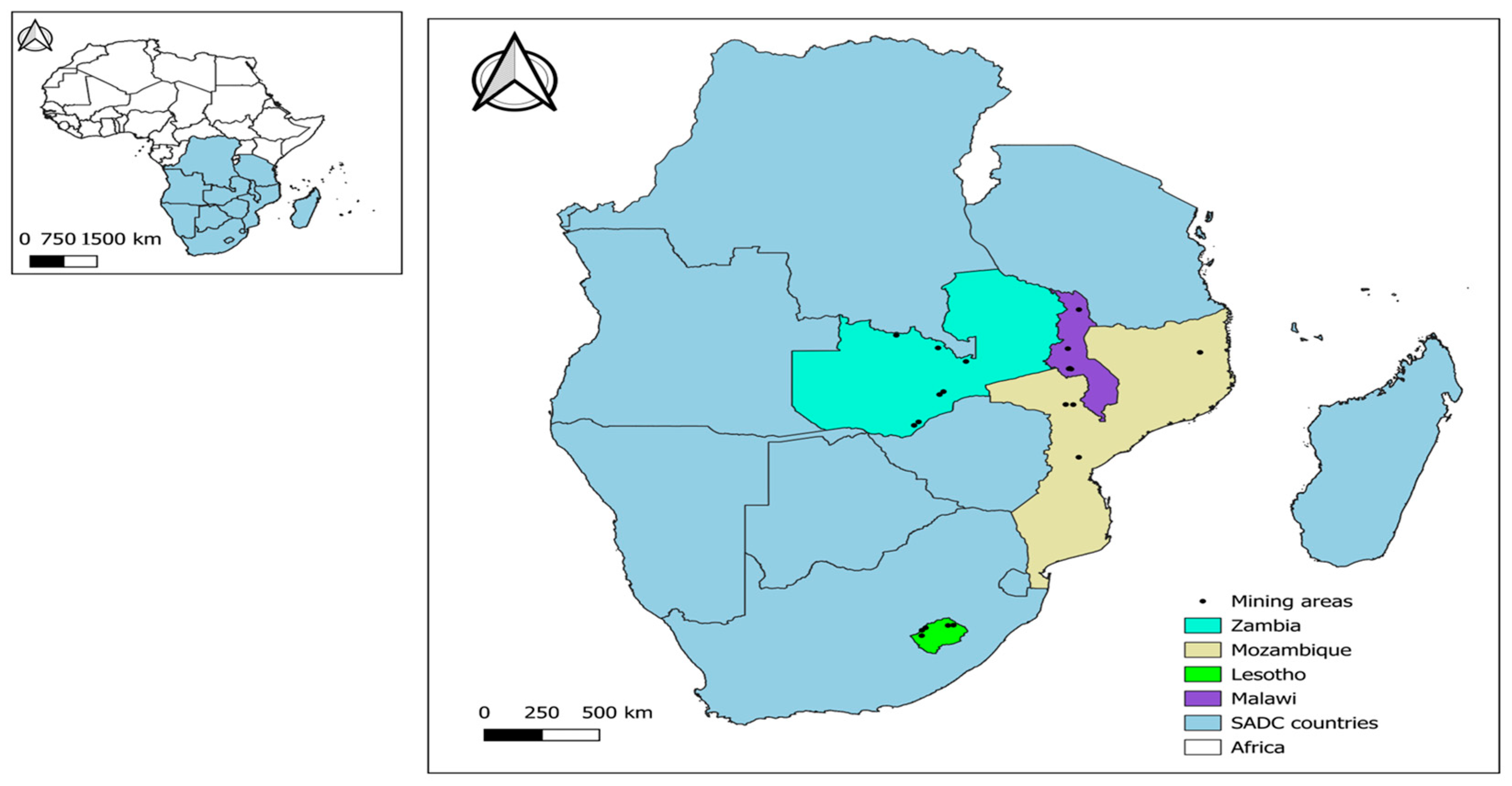

Workers’ Exposure to Respirable Dust and Quartz in the Southern African Large, Medium, Small and Artisanal Small-Scale Mining Industry: An Exploratory Study

 , , , and
Abstract
1. Introduction
2. Materials and Methods
2.1. Project Scope, Mine Selection and Ethical Clearance
2.2. Air Sampling and Analytical Methods
2.3. Data Management and Statistical Analysis
3. Results
3.1. Overall Overview of Samples Taken and Compliance
3.2. Overall Respirable Dust and Quartz Exposures
3.3. Respirable Coal Mine Dust and Quartz Exposures
3.4. Quartz Exposure in Quarries
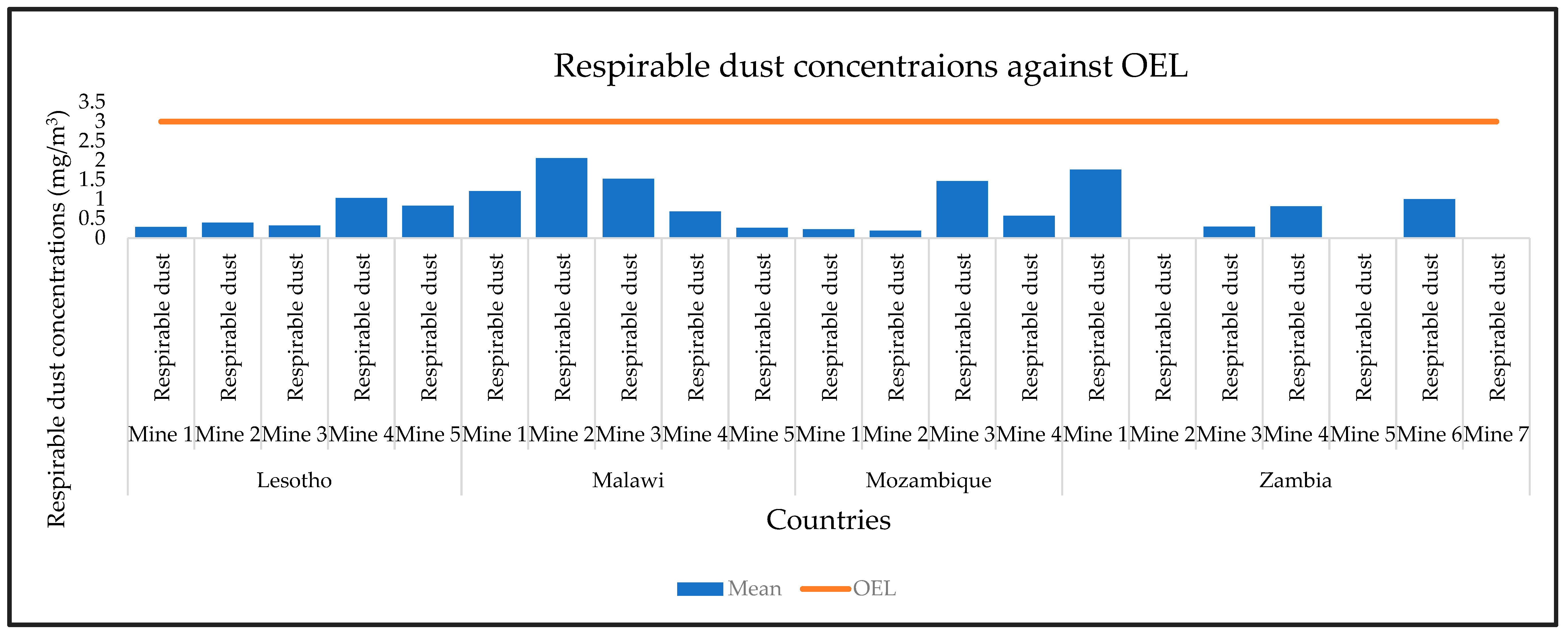
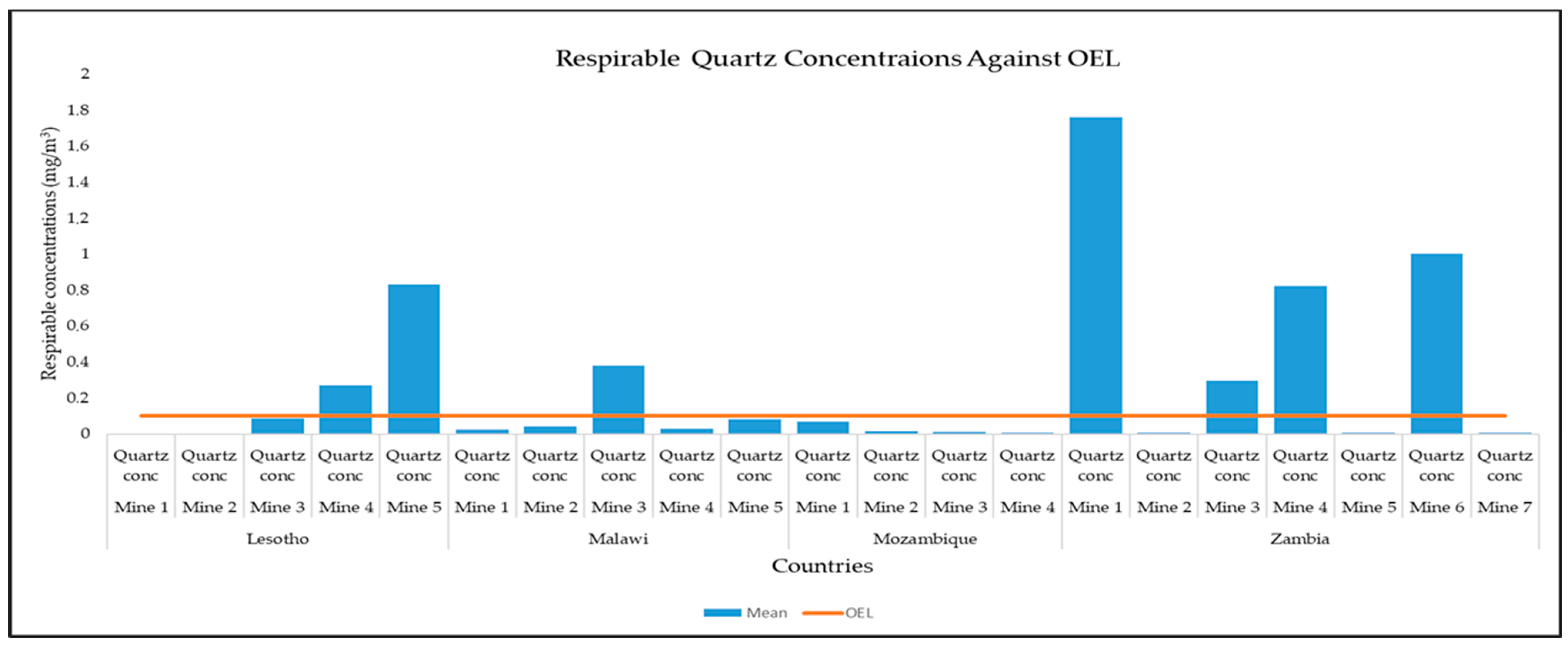
3.5. Respirable Dust and Quartz Concentration Exposure in Comparison with the Respective Occupational Exposure Limits
4. Discussion
Limitations and Strengths of the Study
5. Conclusions
Author Contributions
Funding
Institutional Review Board Statement
Informed Consent Statement
Data Availability Statement
Acknowledgments
Conflicts of Interest
References
- Ericsson, M.; Löf, O. Mining’s contribution to national economies between 1996 and 2016. Miner. Econ. 2019, 32, 223–250. [Google Scholar] [CrossRef]
- McQueen, K.E.N. The importance and future of mining history: An Australian perspective. J. Earth Sci. Hist. 2012, 31, 316–320. [Google Scholar]
- Wilson, F. Minerals and migrants: How the mining industry has shaped South Africa. Daedalus 2001, 130, 99–121. [Google Scholar]
- Statistics South Africa. Mining: A Brief History. 2017. Available online: https://www.statssa.gov.za/?p=9720 (accessed on 6 September 2025).
- Mrema, E.J.; Ngowi, A.V.; Mamuya, S.H.D. Status of occupational health and safety and related challenges in the expanding economy of Tanzania. Ann. Glob. Health 2015, 81, 538–547. [Google Scholar] [CrossRef]
- Donoghue, A.M. Occupational health hazards in mining: An overview. Occup. Med. 2004, 54, 283–289. [Google Scholar] [CrossRef] [PubMed]
- Nelson, G. Occupational respiratory diseases in the South African mining industry. Glob. Health Action 2013, 6, 19520. [Google Scholar] [CrossRef]
- National Institute for Occupational Safety and Health. Health Hazard Evaluation Report 97-0265-2781; AFG Industries: Bridgeport, WV, USA; U.S. Department of Health and Human Services, Centres for Disease Control and Prevention, National Institute for Occupational Safety and Health: Cincinnati, OH, USA, 2000. Available online: https://www.cdc.gov/niosh/hhe/reports/pdfs/1997-0265-2781.pdf (accessed on 10 March 2025).
- South Africa. Mine Health and Safety Act. Department of Mining, 1996. Available online: https://www.gov.za/sites/default/files/gcis_document/201409/act29of1996s.pdf (accessed on 1 December 2025).
- Mine Safety and Health Administration. Federal Mine Safety & Health Act of 1977, Public Law 91-173, as Amended by Public Law 95-164. 1977. Available online: https://arlweb.msha.gov/regs/act/act1.htm (accessed on 6 August 2025).
- Moyo, D. An overview of occupational medicine and health services and associated challenges in southern Africa. Occup. Health S. Afr. 2021, 27, 51–54. [Google Scholar]
- Min, J.; Kim, Y.; Lee, S.; Jang, T.-W.; Kim, I.; Song, J. The fourth industrial revolution and its impact on occupational health and safety, worker’s compensation and labor conditions. Saf. Health Work 2019, 10, 400–408. [Google Scholar] [CrossRef]
- Rikhotso, O.; Morodi, T.J.; Masekameni, D.M. Occupational health and safety statistics as an indicator of worker physical health in South African industry. Int. J. Environ. Res. Public Health 2022, 19, 1690. [Google Scholar] [CrossRef] [PubMed]
- Moyo, D.; Ncube, R.; Kavenga, F.; Chikwava, L.; Mapuranga, T.; Chiboyiwa, N.; Chimunhu, C.; Mudzingwa, F.; Muzvidziwa, O.; Ncube, P. The triple burden of tuberculosis, human immunodeficiency virus and silicosis among artisanal and small-scale miners in Zimbabwe. Int. J. Environ. Res. Public Health 2022, 19, 13822. [Google Scholar] [CrossRef] [PubMed]
- Gualtieri, A.F.; Gandolfi, N.B.; Passaglia, E.; Pollastri, S.; Mattioli, M.; Giordani, M.; Ottaviani, M.F.; Cangiotti, M.; Bloise, A.; Barca, D.; et al. Is fibrous ferrierite a potential health hazard? Characterization and comparison with fibrous erionite. Am. Mineral. 2018, 103, 1044–1055. [Google Scholar] [CrossRef]
- National Institute for Occupational Safety and Health. Mining Publication: Injuries, Illnesses, and Hazardous Exposures in the Mining Industry, 1986–1995: A Surveillance Report. 2000. Available online: https://www.cdc.gov/niosh/mining/works/coversheet645.html (accessed on 5 September 2025).
- Shockey, T.M.; Babik, K.R.; Wurzelbacher, S.J.; Moore, L.L.; Bisesi, M.S. Occupational exposure monitoring data collection, storage, and use among state-based and private workers’ compensation insurers. J. Occup. Environ. Hyg. 2018, 15, 502–509. [Google Scholar] [CrossRef]
- Rumchev, K.; Van Hoang, D.; Lee, A.H. Exposure to dust and respiratory health among Australian miners. Int. Arch. Occup. Environ. Health 2023, 96, 355–363. [Google Scholar] [CrossRef]
- Mazitova, N.N.; Simonova, N.I.; Onyebeke, L.C.; Moskvichev, A.V.; Adeninskaya, E.E.; Kretov, A.S.; Trofimova, M.V.; Sabitova, M.M.; Bushmanov, A.Y. Current status and prospects of occupational medicine in the Russian Federation. Ann. Glob. Health 2015, 81, 576–586. [Google Scholar] [CrossRef]
- South Africa. Circular Instruction No. 171. The Determination of Permanent Disablement Resulting from Hearing Loss Caused by Exposure to Excessive Noise and Trauma; Department of Labour, Ed.; Government Gazette: Pretoria, South Africa, 2001; Volume 431. [Google Scholar]
- South Africa. Lead Regulations; Department of Labour, Ed.; Government Printer: Pretoria, South Africa, 2002. [Google Scholar]
- United Kingdom. Control of Noise at Work Regulations 2005; Department of Work and Pensions, Ed.; Health and Safety Executive: Richmond, UK, 2005. [Google Scholar]
- Courtice, M.N.; Olsson, A.C.; Cherrie, J.W. Less economically developed countries need help to create healthy workplaces. Front. Public Health 2019, 7, 257. [Google Scholar] [CrossRef]
- Caraballo-Arias, Y. Occupational safety and health in Venezuela. Ann. Glob. Health 2015, 81, 512–521. [Google Scholar] [CrossRef][Green Version]
- Dzhusupov, K.O.; Colosio, C.; Tabibi, R.; Sulaimanova, C.T. Occupational health in mountainous Kyrgyzstan. Ann. Glob. Health 2015, 81, 530–537. [Google Scholar] [CrossRef]
- LaDou, J.; London, L.; Watterson, A. Occupational health: A world of false promises. Environ. Health 2018, 17, 81. [Google Scholar] [CrossRef]
- Moyo, D.; Zungu, M.; Erick, P.; Tumoyagae, T.; Mwansa, C.; Muteti, S.; Makhothi, A.; Maribe, K. Occupational health and safety in the Southern African Development Community. Occup. Med. 2017, 67, 590–592. [Google Scholar] [CrossRef]
- Moyo, D.; Zungu, M.; Kgalamono, S.; Mwila, C.D. Review of occupational health and safety organization in expanding economies: The case of Southern Africa. Ann. Glob. Health 2015, 81, 495–502. [Google Scholar] [CrossRef]
- Howlett, P.; Mousa, H.; Said, B.; Mbuya, A.; Kon, O.M.; Mpagama, S.; Feary, J. Silicosis, tuberculosis and silica exposure among artisanal and small-scale miners: A systematic review and modelling paper. PLoS Glob. Public Health 2023, 3, e0002085. [Google Scholar] [CrossRef]
- Howlett, P.; Said, B.; Mwanga, E.; Mbuya, A.; Nota, M.; Kon, O.M.; Gottesfeld, P.; Feary, J.; Mpagama, S.; Ehrlich, R. Confronting the growing epidemic of silicosis and tuberculosis among small-scale miners. Lancet Public Health 2025, 10, e343–e346. [Google Scholar] [CrossRef]
- Kniesner, T.J.; Leeth, J.D. Data mining mining data: MSHA enforcement efforts, underground coal mine safety, and new health policy implications. J. Risk Uncertain. 2004, 29, 83–111. [Google Scholar] [CrossRef]
- Kuempel, E.D. Occupational Exposure to Respirable Coal Mine Dust. 1995. Available online: https://stacks.cdc.gov/view/cdc/11239 (accessed on 26 September 2025).
- De Matteis, S.; Heederik, D.; Burdorf, A.; Colosio, C.; Cullinan, P.; Henneberger, P.K.; Olsson, A.; Raynal, A.; Rooijackers, J.; Santonen, T.; et al. Current and new challenges in occupational lung diseases. Eur. Respir. Rev. 2017, 26, 170080. [Google Scholar] [CrossRef]
- Echt, H.; Brueck, S.E.; National Institute for Occupational Safety and Health. Evaluation of Silica and Noise Exposures at a Concrete Corrosion Testing Facility; Health Hazard Evaluation Report 2023-0001-3405; U.S. Department of Health and Human Services, Centres for Disease Control and Prevention, National Institute for Occupational Safety and Health: Cincinnati, OH, USA, 2024. Available online: https://www.cdc.gov/niosh/hhe/reports/pdfs/2023-0001-3405.pdf (accessed on 1 December 2025).
- Knight, D.; Ehrlich, R.; Fielding, K.; Jeffery, H.; Grant, A.; Churchyard, G. Trends in silicosis prevalence and the healthy worker effect among gold miners in South Africa: A prevalence study with follow up of employment status. BMC Public Health 2015, 15, 1258. [Google Scholar] [CrossRef]
- Murray, J.; Davies, T.; Rees, D. Occupational lung disease in the South African mining industry: Research and policy implementation. J. Public Health Policy 2011, 32, S65–S79. [Google Scholar] [CrossRef]
- Rees, D.; Murray, J.; Nelson, G.; Sonnenberg, P. Oscillating migration and the epidemics of silicosis, tuberculosis, and HIV infection in South African gold miners. Am. J. Ind. Med. 2010, 53, 398–404. [Google Scholar] [CrossRef]
- Smith, J.; Blom, P. Those Who Don’t Return: Improving Efforts to Address Tuberculosis Among Former Miners in Southern Africa. New Solut. J. Environ. Occup. Health Policy 2019, 29, 76–104. [Google Scholar] [CrossRef]
- Churchyard, G.J.; Ehrlich, R.; teWaterNaude, J.M.; Pemba, L.; Dekker, K.; Vermeijs, M.; White, N.; Myers, J. Silicosis prevalence and exposure-response relations in South African goldminers. Occup. Environ. Med. 2004, 61, 811–816. [Google Scholar] [CrossRef]
- Hnizdo, E.; Murray, J. Risk of pulmonary tuberculosis relative to silicosis and exposure to silica dust in South African gold miners. Occup. Environ. Med. 1998, 55, 496–502. [Google Scholar] [CrossRef]
- Kiefer, A.M.; Drace, K.; Seney, C.S.; Veiga, M.M. Challenges associated with using retorts to limit mercury exposure in artisanal and small-scale gold mining: Case studies from Mozambique, Ecuador, and Guyana. In Trace Materials in Air, Soil, and Water; ACS Symposium Series; American Chemical Society: Washington, DC, USA, 2015; Volume 1210, pp. 51–77. [Google Scholar]
- Shandro, J.A.; Veiga, M.M.; Chouinard, R. Reducing mercury pollution from artisanal gold mining in Munhena, Mozambique. J. Clean. Prod. 2009, 17, 525–532. [Google Scholar] [CrossRef]
- British Standards Institution. Workplace Atmospheres: Size Fraction Definitions for Measurement of Airborne Particles; British Standards Institution: London, UK, 1993. [Google Scholar]
- Health and Safety Executive. General Methods for Sampling and Gravimetric Analysis of Respirable, Thoracic and Inhalable Aerosols. 2014. Available online: https://www.hse.gov.uk/pubns/mdhs/pdfs/mdhs14-4.pdf (accessed on 7 November 2023).
- Health and Safety Executive. Crystalline Silica in Respirable Airborne Dust. Direct-on-Filter Analyses by Infrared Spectroscopy or X-Ray MDHS 101/2. Health and Safety Laboratory, 2014. Available online: https://www.hse.gov.uk/pubns/mdhs/pdfs/mdhs101.pdf (accessed on 7 August 2025).
- National Institute for Occupational Safety and Health (NIOSH). Method 7500: Silica, crystalline by XRD, Issue 4, 15 March 2003. NIOSH Manual of Analytical Methods, 4th ed.; Publication No. 94–113. Available online: https://www.cdc.gov/niosh/docs/2003-154/pdfs/7500.pdf (accessed on 1 December 2025).
- National Institute for Occupational Safety and Health (NIOSH). NIOSH Manual of Analytical Methods (NMAM), 5th ed.; Method 7603: QUARTZ in respirable coal mine dust, by IR (redeposition) Infrared Absorption Spectrophotometry; Centers for Disease Control and Prevention: Cincinnati, OH, USA, 2017. [Google Scholar]
- SANS 17025:2018 ISO/IEC 17025:2017; General Requirements for the Competence of Testing and Calibration Laboratories. South African Bureau of Standards: Pretoria, South Africa, 2018; ISBN 978-0-626-36236-2.
- National Institute for Occupational Safety and Health. Occupational Exposure Sampling Strategy Manual. 1977. Available online: https://www.cdc.gov/niosh/docket/archive/pdfs/NIOSH-091/0091-010177-document.pdf (accessed on 13 September 2025).[Green Version]
- EXPOSTATS. Statistical Tools for the Interpretation of Industrial Hygiene Data. 2015. Available online: https://expostats.ca/site/en/ (accessed on 12 September 2025).
- Lavoué, J.; Joseph, L.; Knott, P.; Davies, H.; Labrèche, F.; Clerc, F.; Mater, G.; Kirkham, T. Expostats: A Bayesian toolkit to aid the interpretation of occupational exposure measurements. Ann. Work Expo. Health 2018, 63, 267–279. [Google Scholar] [CrossRef]
- Davies, L.S.T.; Robertson, A.; Agius, R.M.; Cowie, H.A.; Cherrie, J.W.; Hutchison, P. The use of compliance monitoring for assessing quarry workers’ exposures to respirable dust and quartz. Ann. Occup. Hyg. 1994, 38, 559–570. [Google Scholar] [CrossRef]
- Brown, T.P.; Rushton, L. Mortality in the UK industrial silica sand industry: 1. Assessment of exposure to respirable crystalline silica. Occup. Environ. Med. 2005, 62, 442. [Google Scholar] [CrossRef]
- Doney, B.C.; Blackley, D.; Hale, J.M.; Halldin, C.; Kurth, L.; Syamlal, G.; Laney, A.S. Respirable coal mine dust at surface mines, United States, 1982–2017. Am. J. Ind. Med. 2020, 63, 232–239. [Google Scholar] [CrossRef]
- Onder, M.; Yigit, E. Assessment of respirable dust exposures in an opencast coal mine. Environ. Monit. Assess. 2009, 152, 393–401. [Google Scholar] [CrossRef]
- Mamuya, S.H.D.; Bratveit, M.; Mwaiselage, J.; Mashalla, Y.J.S.; Moen, B.E. High exposure to respirable dust and quartz in a labour-intensive coal mine in Tanzania. Ann. Occup. Hyg. 2005, 50, 197–204. [Google Scholar] [CrossRef]
- Otgonnasan, A.; Yundendorj, G.; Tsogtbayar, O.; Erdenechimeg, Z.; Ganbold, T.; Namsrai, T.; Damiran, N.; Erdenebayar, E. Respirable dust and respirable crystalline silica concentration in workers of copper mine, Mongolia. Occup. Dis. Environ. Med. 2022, 10, 167–179. [Google Scholar] [CrossRef]
- Surasi, K.; Ballen, B.; Weinberg, J.L.; Materna, B.L.; Harrison, R.; Cummings, K.J.; Heinzerling, A. Elevated exposures to respirable crystalline silica among engineered stone fabrication workers in California, January 2019–February 2020. Am. J. Ind. Med. 2022, 65, 701–707. [Google Scholar] [CrossRef] [PubMed]
- Dhatrak, S.; Nandi, S. Assessment of silica dust exposure profile in relation to prevalence of silicosis among Indian sandstone mine workers: Need for review of standards. Am. J. Ind. Med. 2020, 63, 277–281. [Google Scholar] [CrossRef]
- Shao, Y.; Almberg, K.S.; Friedman, L.S.; Cohen, R.A.; Go, L.H.T. Drillers and bulldozer operators have experienced exceptionally high exposures to respirable crystalline silica in US surface coal mines. Occup. Environ. Med. 2024, 81, 622–627. [Google Scholar] [CrossRef] [PubMed]
- Matjie, R.H.; Li, Z.; Ward, C.R.; Bunt, J.R.; Strydom, C.A. Determination of mineral matter and elemental composition of individual macerals in coals from Highveld mines. J. S. Afr. Inst. Min. Metall. 2016, 116, 169–180. [Google Scholar] [CrossRef]
- Joy, G.J. Evaluation of the approach to respirable quartz exposure control in U.S. coal mines. J. Occup. Environ. Hyg. 2012, 9, 65–68. [Google Scholar] [CrossRef]
- Mine Safety and Health Administration. Chapter I Subchapter O. Part 70—Mandatory Health Standards—Underground Coal Mines; Mine Safety and Health Administration: Arlington, VA, USA, 2014; Volume 79. [Google Scholar]
- Doney, B.C.; Miller, W.E.; Hale, J.M.; Syamlal, G. Estimation of the number of workers exposed to respirable crystalline silica by industry: Analysis of OSHA compliance data (1979–2015). Am. J. Ind. Med. 2020, 63, 465–477. [Google Scholar] [CrossRef]
- Scarselli, A.; Binazzi, A.; Marinaccio, A. Occupational exposure to crystalline silica: Estimating the number of workers potentially at high risk in Italy. Am. J. Ind. Med. 2008, 51, 941–949. [Google Scholar] [CrossRef]
- Peters, S.; Vermeulen, R.; Fritschi, L.; Musk, A.; Reid, A.; de Klerk, N. Trends in exposure to respirable crystalline silica (1986–2014) in Australian mining. Am. J. Ind. Med. 2017, 60, 673–678. [Google Scholar] [CrossRef]
- Zilaout, H.; Vlaanderen, J.; Houba, R.; Kromhout, H. 15 years of monitoring occupational exposure to respirable dust and quartz within the European industrial minerals sector. Int. J. Hyg. Environ. Health 2017, 220, 810–819. [Google Scholar] [CrossRef]
- Rupani, M.P. Challenges and opportunities for silicosis prevention and control: Need for a national health program on silicosis in India. J. Occup. Med. Toxicol. 2023, 18, 11. [Google Scholar] [CrossRef] [PubMed]
- Siahidouzazar, S.; Sharmba, T.; Rezaee, M.; Rubasinghege, G.; Arnold, G.J.; Roghanchi, P. A review of respirable crystalline silica dust concentration, characteristics, toxicity, and regulation in US metal and nonmetal mines. J. Hazard. Mater. 2025, 497, 139733. [Google Scholar] [CrossRef] [PubMed]
- Barnes, H.; Goh, N.S.L.; Leong, T.L.; Hoy, R. Silica-associated lung disease: An old-world exposure in modern industries. Respirol. 2019, 24, 1165–1175. [Google Scholar] [CrossRef] [PubMed]



| Country | Mine Scale * | Type of Mine | Commodity Mined | Total Mineworkers (Including Contractors) |
|---|---|---|---|---|
| Lesotho (N = 5) | ||||
| Mine 1 | Large | Surface | Diamonds | 711 |
| Mine 2 | Large | Surface | Diamonds | 1500 |
| Mine 3 | Medium | Surface | Aggregate | 230 |
| Mine 4 | Small | Surface | Aggregate | 35 |
| Mine 5 | Small | Surface | Aggregate | 64 |
| Malawi (N = 5) | ||||
| Mine 1 | Large | Underground | Coal | 400 |
| Mine 2 | Medium | Surface | Aggregate | 100 |
| Mine 3 | Medium | Surface | Limestone | 600 |
| Mine 4 | Small | Surface | Aggregate | 350 |
| Mine 5 | Small | Surface | Rose quarts | 25 |
| Mozambique (N = 4) | ||||
| Mine 1 | Large | Surface | Coal | 1500 |
| Mine 2 | Medium | Underground | Ruby | 144 |
| Mine 3 | Large | Surface | Quarry | 20 |
| Mine 4 | Small | Surface | Gold | 1480 |
| Zambia (N = 7) | ||||
| Mine 1 | Large | Underground | Copper | 2226 |
| Mine 2 | Large | Surface | Copper | 2982 |
| Mine 3 | Large | Surface | Coal | 633 |
| Mine 4 | Medium | Surface | Limestone | 760 |
| Mine 5 | Medium | Underground | Coal | 437 |
| Mine 6 | Small | Surface | Aggregate | 47 |
| Mine 7 | Small | Surface | Manganese | 150 |
| Sample Type | Total Samples | Samples Under OEL | Samples > OEL | Samples > 1/2 OEL | |||
|---|---|---|---|---|---|---|---|
| No. | % | No. | % | No. | % | ||
| Respirable dust | 119 | 111 | 93 | 8 | 7 | 10 | 8 |
| ▪ Quartz | 117 | 98 | 2 | 2 | 12 | 10 | |
| Respirable coal mine dust | 94 | 90 | 96 | 4 | 4 | 5 | 5 |
| ▪ Quartz (coal mine dust) | 75 | 80 | 19 | 20 | 6 | 6 | |
| Quartz (quarries) | 137 | 65 | 47 | 72 | 53 | 14 | 10 |
| Country | Mine Name | Number of Samples Collected | Contaminant Type | Range | Geometric Mean | Geometric Standard Deviation | Mean | Standard Deviation | Median | Coefficient of Variation |
|---|---|---|---|---|---|---|---|---|---|---|
| (mg/m3) | (mg/m3) | (mg/m3) | (mg/m3) | (%) | ||||||
| Lesotho | Mine 1 | 11 | : Quartz fraction | 0.007–1.712 | 0.00377 | 1.25 | 0.00387 | 0.000987 | 0.0036 | 25.5 |
| : Respirable dust | 0.003–0.006 | 0.131 | 4.92 | 0.284 | 0.374 | 0.134 | 132 | |||
| Mine 2 | 9 | : Quartz fraction | 0.022–1.712 | 0.00372 | 1.39 | 0.00401 | 0.00229 | 0.0033 | 57.1 | |
| : Respirable dust | 0.003–0.014 | 0.281 | 2.81 | 0.397 | 0.41 | 0.3 | 103 | |||
| Mine 3 | 23 | : Quartz fraction | 0.020–1.405 | 0.0362 | 4.18 | 0.0837 | 0.104 | 0.0333 | 124 | |
| : Respirable dust | 0.004–0.296 | 0.138 | 3.81 | 0.326 | 0.452 | 0.117 | 138 | |||
| Mine 4 | 19 | : Quartz fraction | 0.187–2.184 | 0.209 | 2.28 | 0.272 | 0.186 | 0.214 | 68.4 | |
| : Respirable dust | 0.056–0.539 | 0.788 | 2.32 | 1.03 | 0.699 | 0.863 | 67.9 | |||
| Mine 5 | 24 | : Quartz fraction | 0.139–2.104 | 0.0186 | 2.31 | 0.0247 | 0.0189 | 0.0193 | 76.5 | |
| : Respirable dust | 0.005–0.066 | 0.6 | 2.5 | 0.832 | 0.632 | 0.805 | 75.9 | |||
| Malawi | Mine 1 | 26 | : Quartz fraction | 0.065–6.721 | 0.02 | 3.58 | 0.0431 | 0.0577 | 0.0217 | 134 |
| : Respirable dust | 0.005–0.217 | 0.702 | 2.95 | 1.21 | 1.48 | 0.736 | 122 | |||
| Mine 2 | 25 | : Quartz fraction | 0.252–10.630 | 0.025 | 2.46 | 0.379 | 0.44 | 0.239 | 116 | |
| : Respirable dust | 0.058–2.004 | 1.13 | 3.03 | 2.06 | 2.59 | 0.97 | 126 | |||
| Mine 3 | 9 | : Quartz fraction | 0.147–0.516 | 0.0113 | 3.36 | 0.0286 | 0.049 | 0.0055 | 171 | |
| : Respirable dust | 0.016–0.279 | 0.622 | 3.85 | 1.53 | 2.45 | 0.424 | 160 | |||
| Mine 4 | 10 | : Quartz fraction | 0.064–3.847 | 0.0255 | 5.13 | 0.0797 | 0.133 | 0.0292 | 167 | |
| : Respirable dust | 0.006–0.437 | 0.315 | 3.37 | 0.685 | 1.14 | 0.267 | 167 | |||
| Mine 5 | 20 | : Quartz fraction | 0.074–10.623 | 0.0499 | 2.19 | 0.0699 | 0.0799 | 0.0595 | 114 | |
| : Respirable dust | 0.005–0.164 | 0.239 | 1.54 | 0.26 | 0.121 | 0.25 | 46.5 | |||
| Mozambique | Mine 1 | 28 | : Quartz fraction | 0.005–1.440 | 0.00835 | 2.76 | 0.0143 | 0.0163 | 0.0045 | 114 |
| : Respirable dust | 0.003–0.060 | 0.147 | 2.4 | 0.226 | 0.286 | 0.125 | 126 | |||
| Mine 2 | 30 | : Quartz fraction | 0.017–0.499 | 0.00765 | 1.9 | 0.00948 | 0.00665 | 0.0049 | 70.1 | |
| : Respirable dust | 0.005–0.023 | 0.156 | 2.15 | 0.193 | 0.11 | 0.188 | 56.9 | |||
| Mine 3 | 9 | : Quartz fraction | 0.090–7.345 | 0.00473 | 1.05 | 0.00474 | 0.000229 | 0.0048 | 4.84 | |
| : Respirable dust | 0.0043–0.005 | 0.654 | 3.73 | 1.47 | 2.07 | 0.496 | 141 | |||
| Mine 4 | 10 | : Quartz fraction | 0.022–4.084 | 0.0106 | 2.7 | 0.0191 | 0.0278 | 0.00665 | 146 | |
| : Respirable dust | 0.005–0.093 | 0.191 | 3.98 | 0.576 | 1.24 | 0.162 | 216 | |||
| Zambia | Mine 1 | 30 | : Quartz fraction | 0.0020–5.241 | 0.88 | 5.42 | 1.76 | 1.46 | 1.56 | 83 |
| : Respirable dust | 0.0020–5.241 | 0.88 | 5.42 | 1.76 | 1.46 | 1.56 | 83% | |||
| Mine 2 | 30 | : Quartz fraction | <0.005 | 0.005 | 0.005 | 0.005 | 0 | |||
| : Respirable dust | <0.005 | 0.005 | 0.005 | 0.005 | 0% | |||||
| Mine 3 | 25 | : Quartz fraction | 0.005–1.8 | 0.071 | 6.98 | 0.296 | 0.496 | 0.078 | 171 | |
| : Respirable dust | 0.005–1.8 | 0.071 | 6.98 | 0.296 | 0.496 | 0.078 | 171% | |||
| Mine 4 | 20 | : Quartz fraction | 0.001–2.739 | 0.345 | 6.82 | 0.821 | 0.794 | 0.637 | 97 | |
| : Respirable dust | 0.001–2.739 | 0.345 | 6.82 | 0.821 | 0.794 | 0.637 | 97% | |||
| Mine 5 | 15 | : Quartz fraction | <0.005 | 0.005 | 0.005 | 0.005 | 0 | |||
| : Respirable dust | <0.005 | 0.005 | 0.005 | 0.005 | 0% | |||||
| Mine 6 | 10 | : Quartz fraction | 0.198–1.928 | 0.783 | 2.22 | 1 | 0.0643 | 1.01 | 64 | |
| : Respirable dust | 0.198–1.928 | 0.783 | 2.22 | 1 | 0.0643 | 1.01 | 64% | |||
| Mine 7 | 10 | : Quartz fraction | <0.005 | 0.005 | 0.005 | 0.005 | 0 | |||
| : Respirable dust | <0.005 | 0.005 | 0.005 | 0.005 | 0% |
| Country | Mine Name | Contaminant Type | Range |
|---|---|---|---|
| (mg/m3) | |||
| Malawi | Mine 1 | : Respirable coal mine dust | 0.065–6.721 |
| : Quartz fraction | 0.005–0.217 | ||
| Mozambique | Mine 1 | : Respirable coal mine dust | <0.0001–1.440 |
| : Quartz fraction | 0.003–0.060 | ||
| Zambia | Mine 3 | : Respirable coal mine dust | <0.0001–1.754 |
| : Quartz fraction | 0.005–1.621 | ||
| Mine 5 | : Respirable coal mine dust | <0.0001 | |
| : Quartz fraction | <0.005 |
| Country | Mine Name | Range | Geometric Mean | Geometric Standard Deviation | Mean | Standard Deviation | Median | Coefficient of Variation |
|---|---|---|---|---|---|---|---|---|
| (mg/m3) | (mg/m3) | (mg/m3) | (mg/m3) | (%) | ||||
| Lesotho | Mine 3 | 0.004–0.296 | 0.138 | 3.81 | 0.326 | 0.452 | 0.117 | 138 |
| Mine 4 | 0.056–0.539 | 0.788 | 2.32 | 1.03 | 0.699 | 0.863 | 67.9 | |
| Mine 5 | <0.005–0.066 | 0.6 | 2.5 | 0.832 | 0.632 | 0.805 | 75.9 | |
| Malawi | Mine 2 | 0.06–2 | 1.13 | 3.03 | 2.06 | 2.59 | 0.97 | 126 |
| Mine 3 | <0.005–0.164 | 0.622 | 3.85 | 1.53 | 2.45 | 0.424 | 160 | |
| Mine 4 | 0.006–0.437 | 0.315 | 3.37 | 0.685 | 1.14 | 0.267 | 167 | |
| Mine 5 | 0.016–0.279 | 0.239 | 1.54 | 0.26 | 0.121 | 0.25 | 46.5 | |
| Mozambique | Mine 3 | <0.005–0.010 | 0.191 | 3.98 | 0.576 | 1.24 | 0.162 | 216 |
| Zambia | Mine 4 | <0.005–2.739 | 0.345 | 6.82 | 0.821 | 0.794 | 0.637 | 97 |
| Mine 6 | 0.198–1.928 | 0.783 | 2.22 | 1 | 0.0643 | 1.01 | 64 |
Disclaimer/Publisher’s Note: The statements, opinions and data contained in all publications are solely those of the individual author(s) and contributor(s) and not of MDPI and/or the editor(s). MDPI and/or the editor(s) disclaim responsibility for any injury to people or property resulting from any ideas, methods, instructions or products referred to in the content. |
© 2026 by the authors. Licensee MDPI, Basel, Switzerland. This article is an open access article distributed under the terms and conditions of the Creative Commons Attribution (CC BY) license.
Share and Cite
Khoza, N.N.; Rikhotso, O.; Mbonane, T.P.; Moyo, D.; Rathebe, P.C.; Masekameni, M.D. Workers’ Exposure to Respirable Dust and Quartz in the Southern African Large, Medium, Small and Artisanal Small-Scale Mining Industry: An Exploratory Study. Safety 2026, 12, 58. https://doi.org/10.3390/safety12030058
Khoza NN, Rikhotso O, Mbonane TP, Moyo D, Rathebe PC, Masekameni MD. Workers’ Exposure to Respirable Dust and Quartz in the Southern African Large, Medium, Small and Artisanal Small-Scale Mining Industry: An Exploratory Study. Safety. 2026; 12(3):58. https://doi.org/10.3390/safety12030058
Chicago/Turabian StyleKhoza, Norman Nkuzi, Oscar Rikhotso, Thokozane Patrick Mbonane, Dingani Moyo, Phoka Caiphus Rathebe, and Masilu Daniel Masekameni. 2026. "Workers’ Exposure to Respirable Dust and Quartz in the Southern African Large, Medium, Small and Artisanal Small-Scale Mining Industry: An Exploratory Study" Safety 12, no. 3: 58. https://doi.org/10.3390/safety12030058
APA StyleKhoza, N. N., Rikhotso, O., Mbonane, T. P., Moyo, D., Rathebe, P. C., & Masekameni, M. D. (2026). Workers’ Exposure to Respirable Dust and Quartz in the Southern African Large, Medium, Small and Artisanal Small-Scale Mining Industry: An Exploratory Study. Safety, 12(3), 58. https://doi.org/10.3390/safety12030058