
Development of Lead Indicators to Reduce Injury in Australian Agriculture: Protocol for a Modified Delphi Study

 , , , and
Abstract
1. Introduction
2. Methods and Design
2.1. Systematic Review
2.2. The Modified Delphi Method
2.3. Panel Selection
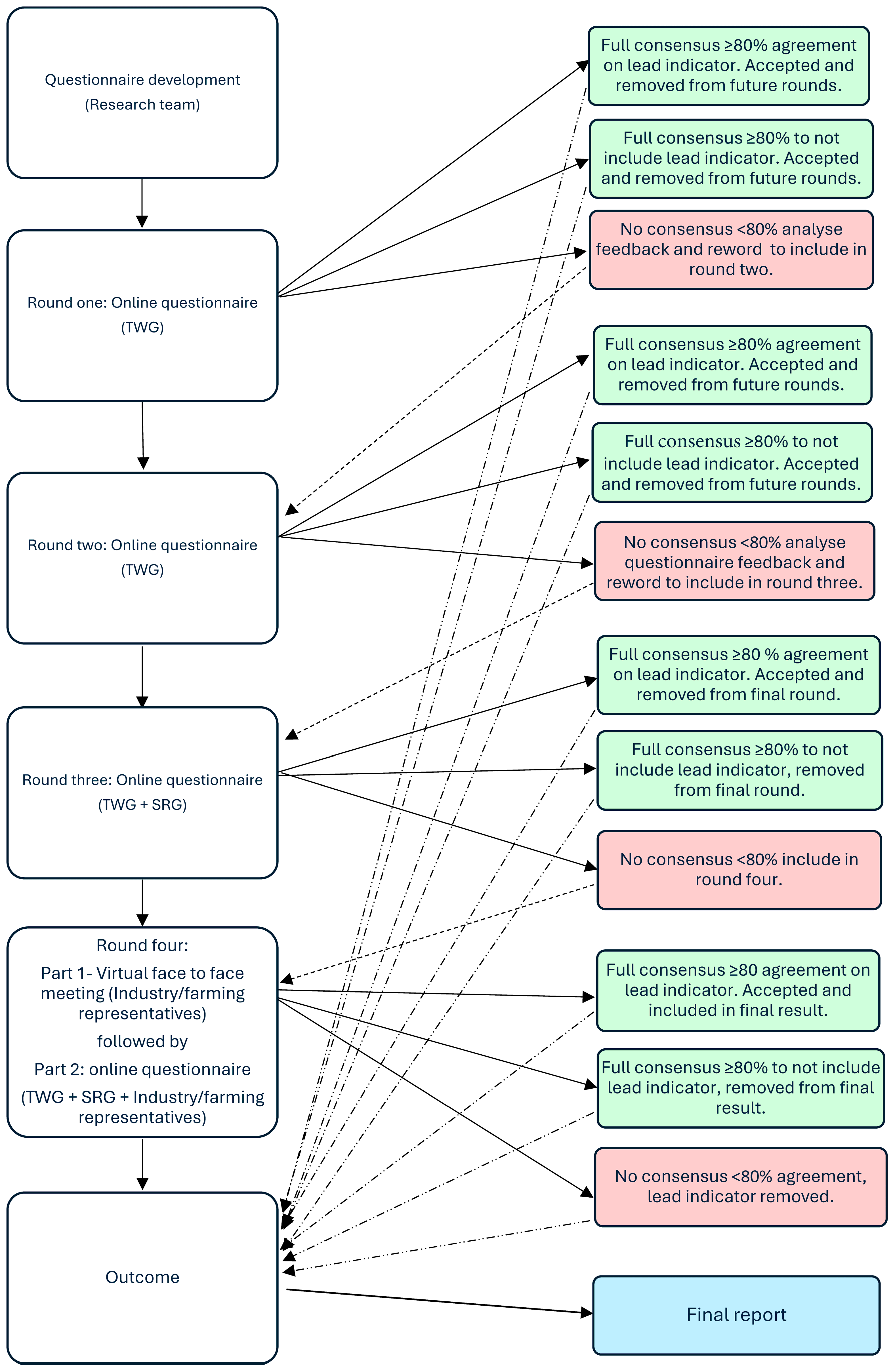
- An existing Technical Working Group (TWG) that provides support to a national farm injury prevention project. Members (n = 6) have been selected for their WHS knowledge, plus experience in the agriculture sector. The TWG members will be invited to all four rounds of questionnaires. If a participant is unable to complete a round, they will remain eligible to participate in subsequent rounds. As the TWG members have high level expertise in WHS, these inputs have been scheduled for the first two rounds, so that the technical nuances that are embedded within the ISO framework can gain full consideration.
- A Stakeholder Reference Group (SRG) consisting of members from the Rural Safety and Health Alliance. These individuals have a cross-section of experience and are drawn from several different agricultural commodity sectors (n = 10). They will be invited for the third-round questionnaire in addition to the TWG members. These individuals will bring additional context from different commodity sectors in assessing the indicators.
- The fourth round will introduce industry/farming representatives (n = 10) and require these representatives to participate in a face-to-face (virtual) meeting. The industry/farming representatives will be identified by purposive sampling through the SRG, drawing on their links within the commodity sectors they represent. This group is fundamental to obtaining a practical and real-world perspective of the proposed indicators. In negotiation with the funding agency, farmers from four commodity sectors will be involved in this initial work—cotton, dairy, grains, and pork. This group will also be invited to complete the fourth-round questionnaire, in addition to the TWG and SRG.
2.4. Study Design
2.5. Rounds
2.5.1. Round One
2.5.2. Round Two
2.5.3. Round Three
2.5.4. Round Four
2.6. Considerations
3. Data Analysis
4. Conclusions
Author Contributions
Funding
Institutional Review Board Statement
Informed Consent Statement
Data Availability Statement
Acknowledgments
Conflicts of Interest
Abbreviations
| WHS | Work, Health, and Safety |
| ISO | International Organization for Standardization |
| ACCORD | ACcurate COnsensus Reporting Document |
| TWG | Technical Working Group |
| SRG | Stakeholder Reference Group |
| NCIS | National Coronial Information System |
| ASDN | Ag Safety Data Net |
Appendix A
| Round 1—Delphi Study—WHS Lead Indicators | ||||
| Indicator | Include as Leading Indicators | Comments (Please Type in) | ||
| Yes | No | |||
| Leadership Commitment | ||||
| 1 | The farm business has a Work, Health, and Safety (WHS) management plan in place. | |||
| 2 | The farm business has a fit for work policy for all workers (managing fatigue, drug, and alcohol). | |||
| Worker Participation | ||||
| 3 | Workers are involved in developing and reviewing procedures and safety instructions. | |||
| Hazard Identification and Risk Assessment | ||||
| 4 | All workers have completed a WHS induction. | |||
| 5 | Risk assessments are completed for hazardous tasks. | |||
| 6 | Workers report hazards as they are identified. | |||
| 7 | Reported hazards are controlled by management. | |||
| 8 | Prestart discussions are conducted with all workers daily and before hazardous tasks. | |||
| 9 | Designated call-in times are established daily for remote or isolated workers. | |||
| 10 | The correct vehicle/machine is chosen for the task to be completed. | |||
| 11 | The tractor is fitted with a roll over protection system. | |||
| 12 | Quad bike is fitted with an operator protection device. | |||
| 13 | Where seatbelts are fitted to machinery/vehicles, they are always used (e.g., tractors, side-by-sides, utes, trucks, forklifts, etc.). | |||
| 14 | There are safety systems in place and used to prevent falls from heights (e.g., caged ladders on silos, safety harnesses, etc.). | |||
| 15 | Powerline markers are installed on the property and/or power is underground in high work traffic areas. | |||
| 16 | Maintenance is scheduled and completed for farm vehicles and machinery. | |||
| 17 | Managers/supervisors stop unsafe work. | |||
| 18 | Workers are encouraged to report unsafe work conditions. | |||
| 19 | Helmets are always worn by all workers when operating quad bikes. | |||
| Legal Requirements | ||||
| 20 | All workers are trained to understand their roles and responsibilities. | |||
| 21 | Each worker is issued the necessary personal protective equipment (PPE) for their role and trained in its proper use. | |||
| 22 | Procedures or safety instructions are available to all workers for hazardous tasks. | |||
| 23 | All workers are trained in the emergency response plan. | |||
| 24 | All workers are trained and assessed for competency in the use of all farm vehicles and machinery. | |||
| 25 | All workers are trained and assessed for competency in livestock handling. | |||
| 26 | Induction, training, and competency records are maintained. | |||
| 27 | The farm business has a system for managing WHS for contractors. | |||
| 28 | The farm business has a system for managing WHS for visitors. | |||
| Emergency Planning | ||||
| 29 | An emergency response plan is in place. | |||
| 30 | At least one person is first aid trained for every ten workers. | |||
| 31 | All workers have access to reliable communication devices (phone, 2-way, etc.). | |||
| Incident Investigation | ||||
| 32 | Near misses are reported by workers and recorded. | |||
| 33 | Information from near misses is used to prevent future incidents. | |||
| Continual Improvement | ||||
| 34 | WHS audits are conducted annually. | |||
| 35 | Improvements are identified in incident investigations and put into practice. | |||
| 36 | Improvements are completed within specified timeframes. | |||
References
- Safe Work Australia. Agriculture Safe Work Australia. Available online: https://www.safeworkaustralia.gov.au/safety-topic/industry-and-business/agriculture (accessed on 14 September 2025).
- Safe Work Australia. Workers’ Compensation Injury Frequency Rates. 2025. Available online: https://data.safeworkaustralia.gov.au/interactive-data/topic/workers-compensation-injury-frequency-rates (accessed on 8 November 2025).
- Lower, T.; Peachey, K.L.; Rolfe, M. Farm-related injury deaths in Australia (2001–20). Aust. J. Rural Health 2023, 31, 52–60. [Google Scholar] [CrossRef]
- Mesa-Castrillon, C.; Peachey, K.L.; Lower, T. Farm Injury Deaths and Workers’ Compensation Claims in Australia and Their Economic Costs. Aust. J. Rural Health 2025, 33, e70087. [Google Scholar] [CrossRef] [PubMed]
- Sheehan, C.; Donohue, R.; Shea, T.; Cooper, B.; Cieri, H.D. Leading and lagging indicators of occupational health and safety: The moderating role of safety leadership. Accid. Anal. Prev. 2016, 92, 130–138. [Google Scholar] [CrossRef]
- Latham, A.; Najdovski, Z.; Bartel, R.; Cotton, J. Which Technologies Make Australian Farm Machinery Safer? A Decision Support Tool for Agricultural Safety Effectiveness. Safety 2024, 10, 23. [Google Scholar] [CrossRef]
- Mesa Castrillon, C.; Peachey, K.-L.; Harrison, L.; Franklin, R.; Lyle, D.; Lower, T. Leading Indicators for Farmers’ Work Health and Safety in Western Agricultural Systems: A Systematic Review. J. Agromed. 2025, 31, 130–138. [Google Scholar] [CrossRef]
- Castillo, C.; Shahriari, M.; Casarejos, F.; Arezes, P. Prioritization of leading operational indicators in occupational safety and health. Int. J. Occup. Saf. Ergon. 2023, 29, 806–814. [Google Scholar] [CrossRef]
- Latham, A.; Cotton, J.; Brumby, S. A rapid review of leading indicators to measure Australian farm safety culture. Heliyon 2024, 10, e32736. [Google Scholar] [CrossRef]
- Golabchi, H.; Abellanosa, A.D.; Lefsrud, L.; Pereira, E.; Mohamed, Y. A comprehensive systematic review of safety leading indicators in construction. Saf. Sci. 2024, 172, 106433. [Google Scholar] [CrossRef]
- Ali, M.X.M.; Arifin, K.; Abas, A.; Ahmad, M.A.; Khairil, M.; Cyio, M.B.; Samad, M.A.; Lampe, I.; Mahfudz, M.; Ali, M.N. Systematic Literature Review on Indicators Use in Safety Management Practices among Utility Industries. Int. J. Environ. Res. Public Health 2022, 19, 6198. [Google Scholar] [CrossRef] [PubMed]
- Shea, T.; De Cieri, H.; Donohue, R.; Cooper, B.; Sheehan, C. Leading indicators of occupational health and safety: An employee and workplace level validation study. Saf. Sci. 2016, 85, 293–304. [Google Scholar] [CrossRef]
- International Organization for Standardization. Occupational Health and Safety Management Systems—Requirements with Guidance for Use; International Organization for Standardization: Geneva, Switzerland, 2018. [Google Scholar]
- Williams, P.L.; Webb, C. The Delphi technique: A methodological discussion. J. Adv. Nurs. 1994, 19, 180–186. [Google Scholar] [CrossRef]
- Pilbeam, C.; Denyer, D.; Sutliff, M. Guided by principles or rules: A Delphi study on how safety professionals frame safety practices. Saf. Sci. 2025, 184, 106772. [Google Scholar] [CrossRef]
- Taylor, E. We Agree, Don’t We? The Delphi Method for Health Environments Research. Health Environ. Res. Des. J. 2020, 13, 11–23. [Google Scholar] [CrossRef]
- Skulmoski, G.J.; Hartman, F.T.; Krahn, J. The Delphi Method for Graduate Research. J. Inf. Technol. Educ. 2007, 6, 1–21. [Google Scholar] [CrossRef] [PubMed]
- Harmsen, A.M.K.; Geeraedts, L.M.G.; Giannakopoulos, G.F.; Terra, M.; Christiaans, H.M.T.; Mokkink, L.B.; Bloemers, F.W. Protocol of the DENIM study: A Delphi-procedure on the identification of trauma patients in need of care by physician-staffed Mobile Medical Teams in the Netherlands. Scand. J. Trauma Resusc. Emerg. Med. 2015, 23, 15. [Google Scholar] [CrossRef] [PubMed]
- Nasa, P.; Jain, R.; Juneja, D. Delphi methodology in healthcare research: How to decide its appropriateness. World J. Methodol. 2021, 11, 116–129. [Google Scholar] [CrossRef]
- Cowan, D.; Brunero, S.; Lamont, S.; Joyce, M. Direct care activities for assistants in nursing in inpatient mental health settings in Australia: A modified Delphi study. Collegian 2015, 22, 53–60. [Google Scholar] [CrossRef]
- Taylor, E.; Hignett, S.; Joseph, A. The environment of safe care: Considering building design as one facet of safety. Proc. Int. Symp. Hum. Factors Ergon. Healthc. 2014, 3, 123–127. [Google Scholar] [CrossRef]
- Adams, J.; Kennedy, A.; Cotton, J.; Brumby, S. Utilizing the Delphi method to develop parent and child surveys to understand exposure to farming hazards and attitudes toward farm safety. Front. Public Health 2022, 10, 3–10. [Google Scholar] [CrossRef]
- Kizawa, Y.; Tsuneto, S.; Tamba, K.; Takamiya, Y.; Morita, T.; Bito, S.; Otaki, J. Development of a nationwide consensus syllabus of palliative medicine for undergraduate medical education in Japan: A modified Delphi method. Palliat. Med. 2012, 26, 744–752. [Google Scholar] [CrossRef]
- Gattrell, W.T.; Hungin, A.P.; Price, A.; Winchester, C.C.; Tovey, D.; Hughes, E.L.; van Zuuren, E.J.; Goldman, K.; Logullo, P.; Matheis, R.; et al. ACCORD guideline for reporting consensus-based methods in biomedical research and clinical practice: A study protocol. Res. Integr. Peer Rev. 2022, 7, 3–10. [Google Scholar] [CrossRef] [PubMed]
- Gattrell, W.T.; Logullo, P.; van Zuuren, E.J.; Price, A.; Hughes, E.L.; Blazey, P.; Winchester, C.C.; Tovey, D.; Goldman, K.; Hungin, A.P.; et al. ACCORD (ACcurate COnsensus Reporting Document): A reporting guideline for consensus methods in biomedicine developed via a modified Delphi. PLoS Med. 2024, 21, e1004326. [Google Scholar] [CrossRef] [PubMed]
- Lecours, A. Scientific, professional and experiential validation of the model of preventive behaviours at work: Protocol of a modified Delphi Study. BMJ Open 2020, 10, e035606. [Google Scholar] [CrossRef] [PubMed]
- Keeney, S.; Hasson, F.; McKenna, H. Debates, Criticisms and Limitations of the Delphi. In The Delphi Technique in Nursing and Health Research; Wiley-Blackwell: Hoboken, NJ, USA, 2011; pp. 18–31. [Google Scholar]

Disclaimer/Publisher’s Note: The statements, opinions and data contained in all publications are solely those of the individual author(s) and contributor(s) and not of MDPI and/or the editor(s). MDPI and/or the editor(s) disclaim responsibility for any injury to people or property resulting from any ideas, methods, instructions or products referred to in the content. |
© 2026 by the authors. Licensee MDPI, Basel, Switzerland. This article is an open access article distributed under the terms and conditions of the Creative Commons Attribution (CC BY) license.
Share and Cite
Harrison, L.J.; Peachey, K.-L.; Mesa-Castrillon, C.; Lyle, D.; Franklin, R.; Lower, T. Development of Lead Indicators to Reduce Injury in Australian Agriculture: Protocol for a Modified Delphi Study. Safety 2026, 12, 42. https://doi.org/10.3390/safety12020042
Harrison LJ, Peachey K-L, Mesa-Castrillon C, Lyle D, Franklin R, Lower T. Development of Lead Indicators to Reduce Injury in Australian Agriculture: Protocol for a Modified Delphi Study. Safety. 2026; 12(2):42. https://doi.org/10.3390/safety12020042
Chicago/Turabian StyleHarrison, Lisa Jane, Kerri-Lynn Peachey, Carlos Mesa-Castrillon, David Lyle, Richard Franklin, and Tony Lower. 2026. "Development of Lead Indicators to Reduce Injury in Australian Agriculture: Protocol for a Modified Delphi Study" Safety 12, no. 2: 42. https://doi.org/10.3390/safety12020042
APA StyleHarrison, L. J., Peachey, K.-L., Mesa-Castrillon, C., Lyle, D., Franklin, R., & Lower, T. (2026). Development of Lead Indicators to Reduce Injury in Australian Agriculture: Protocol for a Modified Delphi Study. Safety, 12(2), 42. https://doi.org/10.3390/safety12020042