


Abstract
Zion National Park has seen substantial increased visitor use in recent years, bringing forward a number of visitor use management challenges. Many visitors consider the park’s Angels Landing trail, a steep and relatively challenging hike, a primary destination in the park. A number of well documented fatalities have been associated with the Angels Landing trail, prompting substantial risk management concerns. In the context of increased visitor use and increased attention to these fatalities, this research reviews literature on crowding and risk management before using National Park Service and media reports concerning 16 deaths associated with Angels Landing to characterize trends among age, gender, time of day, specific location, and other factors. Findings note that few of the fatalities occurred on the trail itself; those that did were not on the sections of the trail where risk management interventions have been installed, and none were associated with crowding or high visitor use. From these analyses, managers should consider disentangling notions of crowding and risk, particularly in light of new management strategies concerning permitting and limiting hikers on Angels Landing.
1. Introduction
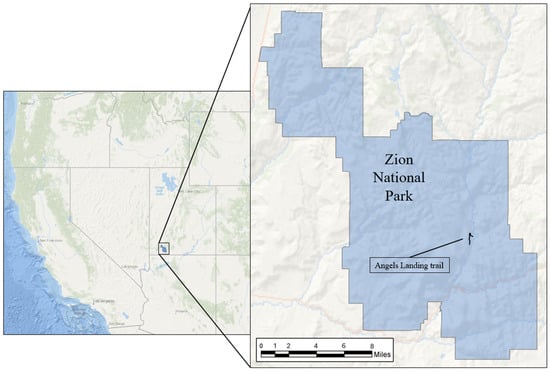
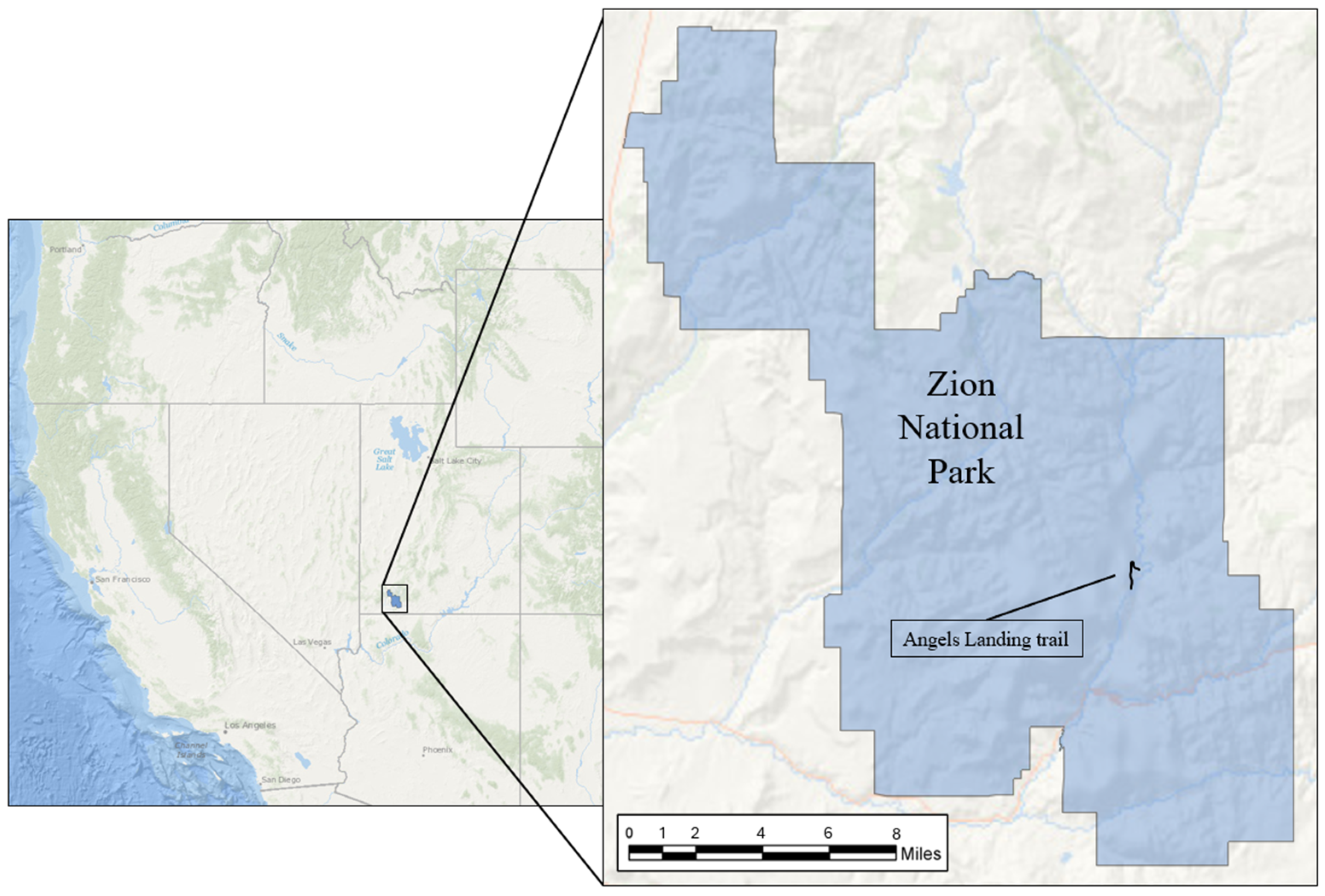
Zion National Park, located in southwestern Utah, USA (Figure 1), is geologically characterized by striking vertical relief, with towering Navajo sandstone walls rising thousands of feet above the Virgin River. Encompassing 229 square miles, the park is a relatively small national park, and even though its gateway community of Springdale, Utah, is rapidly growing [1]. The majority of the park’s visitation is centered on Zion Canyon, where since 2000, a shuttle system, designed to relieve crowding and congestion and to protect natural resources, distributes visitors to various trailheads and other attractions along the six-mile road [2]. The increased visitation has only intensified in recent years, as there are now significant issues in Zion National Park concerning the number of people visiting [3], with a reported 5,039,835 visitors in 2021 alone [4], a 40.3 percent increase from the previous year. The increased visitation follows national and international trends that were only intensified during various phases of the COVID-19 pandemic and subsequent years [5,6,7]. Some of this increased visitation may be due to increased social media attention and tagging locations on social media posts [8,9], but outdoor recreation spaces broadly have seen heightened attention and visitation. In summary, Zion National Park has seen lots of visitation in absolute terms, and it has seen rapid increases in recent years [1] and therefore warrants increased attention in terms of the visitor use management, crowding, and risk, among others.
Figure 1.
Zion National Park (shaded in blue), and the Angels Landing trail, located in southwestern Utah, USA.
A highlight for many visitors to Zion National Park is the Angels Landing trail. Originating along the Virgin River, the trail rises more than 1500 feet in elevation over 2.5 miles of hiking. The trail itself follows the river for a short distance before a paved section takes hikers along steep switchbacks before arriving at Scout Lookout, a large flat area with bathrooms and signage and commanding views along the Zion Canyon rim. From there, the trail continues approximately half a mile along a steep, narrow, exposed fin of sandstone that takes hikers to the highest point of Angels Landing. The National Park Service [10] refers to this section of the trail as “the most famous—or infamous—part of the hike.” There are numerous sharp drop-offs along the trail, and much of the trail is lined with fixed metal chains and posts that are designed to offer hikers additional support as they negotiate this terrain. Hikers have regular exposure to sheer cliffs that drop up to a thousand feet on either side of the trail; a fall from these positions would be almost certainly fatal. The top of Angels Landing broadens and flattens, providing stunning views both up and down Zion Canyon and the Virgin River. The hike is regularly cited in popular media as a desirable destination for hikers, outdoor enthusiasts, tourists, and national park supporters. Angels Landing has been called “one of the most spectacular day hikes in the world” [11], and Backpacker Magazine referred to the trail as a hike for “your bucket list” [12]. According to the Zion National Park superintendent, “Angels Landing is one of the most iconic destinations” [13] in an already iconic national park, a place where people can find a deep sense of supposed self-authenticity in their outdoor pursuits [14].
Angels Landing has also received outsized attention for a number of fatalities that have been associated with it. More than 330,000 people are thought to make the hike to Angels Landing each year [15], though it is unclear how many visitors actually ascend all the way to the top, above the chained sections. Of these hundreds of thousands of hikers, there have been numerous reported deaths in popular and news media. Sensationalized and often misrepresentative news articles, websites, and blog posts have made outlandish and sometimes contradictory claims about the dangers associated with hiking the Angels Landing trail. Additionally, in 2022, the National Park Service implemented a permitting system on the trail, “in response to concerns about crowding and congestion” [10]. Because crowding is specifically cited, and due to the outsized attention given to fatalities associated with the Angels Landing trail, it is necessary to contextualize both crowding and risk management in parks and protected areas, before turning to the empirical specifics of the fatalities associated with this specific location and its management.
Therefore, the purpose of this research is to build upon the literature concerning crowding and risk management in park and protected areas, before analyzing the specificities of fatalities associated with Angels Landing. Here, data from Freedom of Information Act requests are analyzed to contextualize the fatal incidents associated with Angels Landing to determine some of the trends that have accompanied these tragedies. A discussion concludes with a consideration of cultural conceptualizations of nature-society relations, and what these findings might mean for visitor use management at Angels Landing and other high-profile locations that are commonly associated with physical risk.
1.1. Crowding in Parks and Protected Areas
For decades, understanding crowding, its response, and its measurement has been a central concern for researchers studying visitor use management in park and protected areas [16,17,18]. Visitor use management is the “proactive and adaptive process for managing characteristics of visitor use and the natural and managerial setting using a variety of strategies and tools to achieve and maintain desired resource conditions and visitor experiences” [19]. As a topic, crowding “has received arguably the most attention in outdoor recreation research and practice” [20]. Crowding is usually understood as a negative evaluation of the level of use at a particular site and may be negatively associated with visitors’ senses of satisfaction, stress, and overall attitude [21]. People’s preferences and expectations for encounters with others are significant drivers of perceived crowding, cognitive and behavioral coping strategies, and ultimately, their enjoyment of their nature-based recreational experience [22]. Furthermore, the dynamic nature of visitation patterns, particularly under changing social and environmental conditions, continues to complicate the measurement of crowding. Recent research also highlights how technology, such as social media, can shape visitors’ expectations of use levels even before they arrive on site.
As people’s social and emotional connections to a particular place increase, so does the influence of crowding and their sensitivity to encounters with others [22]. At particular thresholds of crowding, visitors may become displaced [23]; displacement may occur quite frequently, and although it is reported as a key problem for visitors, it may also represent a successful coping strategy [20]. In some cases, displacement can reshape long-term visitation patterns, leading visitors to substitute different times, places, or activities in order to maintain desired experience quality. These behavioral adjustments underscore the complex interplay between place attachment, perceived control, and the willingness of visitors to adapt in the face of increasing use densities.
However, crowding is not a universal experience. In fact, crowding is culturally specific [24] and ultimately is a subjective norm [25]. In short, there is no single objective measurement for assessing if a particular site in a park or protected area is crowded or not, as people have highly subjective and differential understandings and expectations of crowding. While crowding has been studied extensively in U.S. national parks, there are no empirical studies on perceptions of crowding in Zion National Park, nor at Angels Landing, more specifically. This absence of site-specific research is notable given the rapid rise in visitation and the growing prominence of Angels Landing in popular media. Understanding how diverse groups of visitors interpret and respond to use levels and risk management strategies on this iconic trail represents an increasingly important research need.
1.2. Risk Management in Parks and Protected Areas
Risk management in outdoor recreation contexts, while quite varied across contexts, can be understood as systems that “address policy, risk identification processes, training, incident reporting and claims management, inspections, and legal advice” [26]. While institutions may focus on limiting risk and liability exposure, outdoor recreation literature tends to focus more on issues of leadership and decision making. Additionally, rather than strict procedures, rules, and checklists, risk management can also be understood as an ongoing, collaborative process of learning from successes and mistakes, a perspective that encourages ongoing self-reflection [27]. In this sense, outdoor and adventure recreation, often associated with outdoor activities in national parks, faces a paradox. On one hand, ideologies associated with outdoor recreation (meeting a challenge, overcoming difficulties, personal responsibility, and ideas of freedom and choice) promotes a climate of individualism and accountability [28]; on the other hand, land management agencies and other bureaucratic structures are often responsive to a “risk management industry” that seeks to minimize liability [29]. In reviews of crowding in outdoor adventure recreation settings, there is no direct relationship between crowding and risk [30,31].
Outdoor recreation risk management that takes place in park and protected areas, broadly, and in U.S. national parks, more specifically. For a variety of reasons, risk management in national parks is particularly complex, and may be further complicated when associated with rapid increases in visitation [32]. In general, national park visitors tend to perceive themselves as responsible for their own safety, and perceptions of the uncontrollability of risks are positively associated with these attributions [33]. From 2018 to 2020, Zion National Park had the sixth most documented search and rescue incidents of the National Park Service’s 423 units [34], although these recently increased support services are connected to overall visitation numbers. There are numerous informational resources directly from the National Park Service (e.g., on-site interpretive signage, NPS websites, park rangers) and from popular media outlets (e.g., travel websites, trail description websites, hiking blogs) for considering one’s management of risk on Angels Landing. In addition to understanding one’s risk “in the moment,” these additional resources, regardless of their validity, contribute to people’s understanding of risk management in many popular areas.
Risk management in outdoor recreation taking place in parks and protected areas requires balancing many competing needs and seems to be connected to issues of crowding [32]. Because the National Park Service is simultaneously instituting management measures to address crowding [10,15] and is under scrutiny for fatalities associated with Angels Landing [15,35], the purpose of this study is to understand if fatalities associated with the Angels Landing hiking trail in Zion National Park are associated with crowding and risk management strategies implemented by the National Park Service.
2. Materials and Methods
This study sought to contextualize the documented fatal incidents associated with the Angels Landing trail in Zion National Park. According to various media sources, there have been multiple fatalities associated with Angels Landing, with numbers ranging from nine to 13 deaths since 2000 [15,35]. The ambiguities behind these numbers, however, belie the ambiguities behind what “counts” as an accident on Angels Landing, further underscoring the rationale for this analysis. In particular, this research sought to understand if commonly ascribed causes of accidents—crowding, risk management interventions, or other factors—were coincidental with fatalities. Going back to 1989, there were 16 fatalities that were publicly associated with Angels Landing through media reports. (It is possible, and even likely, that deaths near or on Angels Landing occurred prior to 1989, but none could be located in media reports, and Zion National Park administrators could not find evidence.) Deeply qualitative case studies of each of these incidents would be helpful, but after substantial investigation, consistent narratives and analyses of the fatalities were unavailable.
Data for this study came from official reports from the National Park Service and media coverage of the incidents. The official National Park Service reports were obtained through Freedom of Information Act requests and were available for nine of the 16 deaths (56.3 percent). Major incidents in U.S. national parks require an incident report to be produced by the NPS. Researchers requested any and all information regarding any fatalities on or near the Angels Landing trail in Zion National Park. However, despite these requests, many of the incidents did not have an NPS report associated with them. The first available NPS report is from an incident taking place in 2004, suggesting that incident reporting was not conducted or is not currently available before that period. These official NPS incident reports are publicly available to anyone who makes a request and therefore not subject to Institutional Review Board approval. Information on fatalities from media came from systematic online searches using the following keywords, in various combinations: Angels, Angel’s, death, died, fatality, fall, fell, Landing, national park, Utah, Zion. In general, media coverage of the fatalities was brief, with few details, often derived from statements made by Zion National Park administrators. For some incidents, media coverage provided additional detail if the coverage obtained additional information from a deceased person’s family or close friends. Between the NPS reports and media coverage of fatalities, rarely was it possible to obtain a full accounting of the complete details of the incidents in question.
From these National Park Service reports, combined with often inconsistent and variable information available from media coverage, the following data points were determined for each fatality since one was first noted in the media in 1989: date, time of day, gender, age, home location, environmental conditions, if the death actually occurred on the Angels Landing trail, how the death occurred, and where on the trail it occurred. These data from NPS reports and from media sources were then synthesized into a comparative table. Before reporting the findings, it is worth remembering that this sensitive information is not solely abstract statistics, but indicators of real people who suffered tragically while they were seeking benefits of outdoor recreation experiences.
3. Results
Reported incidents range from 1989 to 2021, the last year a fatality was associated with Angels Landing. For all of the incidents, there was incomplete information available on what happened, pointing to a combination of unknowable information, inadequate investigations, inconsistent reporting practices on the part of the National Park Service and media, and inconsistent file storage practice within the U.S. federal government. However, some demographic information is available. As seen in Table 1 (below), the 16 victims ranged in age from 13 to 63 years old (M = 39.4, SD = 16.3). These people came from a variety of locations: one was from outside the U.S. (Germany), three of them lived in Utah (18.8 percent), seven were from the Intermountain West (43.8 percent), and 13 were from the U.S. (81.3 percent). Seventy-five percent of the victims were male.
Table 1.
Summary data of fatalities associated with Angels Landing.
The fatalities occurred in seven different months of the year, with the most (four) occurring in August, followed by three in April. The incidents occurred at multiple times of the day, though most occurred in the mid- to late-afternoon, at an average time of 2:04 pm. None of the 16 fatalities were from falls that originated on sections of the trail that have chains. For three of the fatalities (ID 9, ID 10, and ID 15), it is unlikely that these incidents actually occurred on Angels Landing but were in the nearby area. For those that had sufficient information, 75 percent of the reports were clearly on the Angels Landing formation, as opposed to the concrete hiking trail leading up to it or somewhere else along the adjacent steep, exposed western rim of Zion Canyon. (One of the fatalities (ID 9) was a rock climber on the vertical face well below the plateau of Angels Landing. As this death was not an incident involving the trail, its management, or crowding, it was not included in the 75 percent metric).
Additional information not reflected in Table 1 includes that 44 percent of fatalities occurred at the top of Angels Landing, 44 percent occurred while ascending the trail, and 11 percent occurred while descending the trail. While none of the incidents involved a victim falling from a section of the trail with chains, there was a similar distribution of fatal falls from the west side of the formation, the east side of the formation, and the top of Angels Landing. Some of the reports from the National Park Service and media reports included environmental conditions (e.g., wet, hot, icy), and with the exception of one that noted the onset of darkness, there were few indications that environmental conditions contributed to any of the fatal incidents. Some contextual factors from the incidents are additionally enlightening; one fall reportedly occurred while walking near the edge of the cliff on a dare (ID 3), one reportedly occurred while posing for a photograph at the top of the formation (ID 4) and suggested subsequent criminal considerations, one occurred while rock climbing on the vertical face well below the top of the trail (ID 9), and one was a heart attack while hiking toward Angels Landing, but was not on the actual exposed section of the trail (ID 10), Lastly, and germane to the overall topic of this research, none of the reports (from the National Park Service or the media) indicated that crowding was a factor in these fatal incidents. In fact, multiple reports indicate that victims fell while alone, where perhaps counterintuitively, the absence of people in the proximate area may have been a factor in the incident.
4. Discussion
There may be a supposedly obvious connection between crowding and increased risk in outdoor settings. However, outside of the specificities of mountainous avalanche terrain [36], there is little support in the literature for these associations, and in the case of the Angels Landing trail, there is also little empirical support. Fatality statistics, of course, are not a complete measure of risk, as many negative consequences can and do occur in outdoor recreation settings that are non-fatal (e.g., injuries, illnesses, financial loss, psychological loss, social loss). However, in an extremely steep, exposed, and popular [11,12] physical setting like Angels Landing, where consequences are severe, fatalities themselves are a helpful proxy measure for risk. The absence of evidence concerning the fatalities during crowding or fatalities on sections of the trail that have chains examined here does not necessarily mean that there is no relationship, only that other factors are likely at play. Associating crowding and risk may be culturally driven, as ideas about national parks in the U.S. are deeply intertwined with ideas about solitude, individualism, overcoming challenges, and colonialist exploration [37], among others. The National Park Service has initiated a permitting process on Angels Landing designed to reduce crowding, while simultaneously implicitly supporting increased visitor safety as well. While the merits of the permitting process are outside the purview of this study, it should be noted that decreasing visitor numbers alone may not necessarily constitute a more assertive approach to managing visitors’ physical risk and may even counterintuitively make permitted visitors less attune to their personal safety while hiking the trail, as noted above.
In addition to crowding not being a notable factor in the 16 fatalities associated with the Angels Landing trail, the risk management interventions by the National Park Service do not seem to play a negative role either. The two primary interventions by Zion National Park managers are (1) extensive signage, interpretative exhibits, and online communication about the steepness and exposure of the trail, as well as the exertion required to hike it, and (2) the posts and chains installed and maintained by the park. While the chains often receive outsized attention as particularly perilous sections of the trail [12], none of the fatalities originated on sections of the trail that had chains, indicating that the existing chains are likely working as intended. Interpretive signage in the visitor center and along the trail is also considerable, suggesting that visitors have ample understanding of the environmental possibilities they are likely to encounter along the exposed sections of trail.
Managing recreationists in complex and/or technical environments requires increased clarity and communication about the risks involved [38], and the National Park Service should continue to implement management plans that educate visitors about the route, the likely conditions, the expected difficulties, and the potential consequences of slips or falls. Like other studies, the underlying cause of accidents and fatalities “often appears to be visitors’ failure to understand the seriousness of risk in unfamiliar and unpredictable natural environments” [26]. Additional funding for national parks may enable managers to place rangers at strategic locations to assist and inform visitors.
Finally, there are additional justice and equity considerations with various management approaches. Permits, limits, and increased fees may have disproportional effects on various visitor populations [39,40,41], and equity approaches to park management necessitate that managers carefully consider the ramifications of these complex decisions [42]. At Zion National Park, the permitting and limiting of people on the Angels Landing trail is likely to have cascading effects that are felt unevenly by visitors, and the advantages and disadvantages of these decisions should be monitored and evaluated carefully; managing for justice and equity will also have implications for crowding and risk management.
There are limitations with the analysis presented here. The data were quite limited, and both official National Park Service and media reports of these kinds of incidents may be both incomplete and unreliable for a thoroughly detailed analysis [43]. Angels Landing is likely a unique management situation, as there are few destinations that have its combination of high exposure and global appeal, where a small misstep could result in the loss of life. Few empirical studies have examined mortality risk associated with outdoor recreation, hiking, climbing and similar activities, though hiking and trekking have less mortality than paragliding, rock climbing, ice climbing, and mountaineering, among others [44]. Risk management, necessarily, encompasses more than just assessing fatalities associated with particular locations or activities, and a more comprehensive approach should also incorporate smaller, less fatal incidents, as well as near misses and various successes associated with various management scenarios [27]. In that sense, this study was more narrowly targeted than understanding a more broadly conceived notion of risk management. From this standpoint, risk in outdoor recreation experiences is not necessarily something to be minimized or eliminated, but part of the inherent value and benefit of undertaking these experiences. For the hundreds of thousands of visitors who hike Angels Landing each year, these benefits are seemingly worth weighing against the tragic and unfortunate losses of life. Accurately contextualizing these incidents helps us better inform these critical community discussions.
Fatalities associated with the Angels Landing trail in Zion National Park represent tragic occurrences and prompt park and protected area managers, visitors, and the public at large to reconsider the policies, procedures, and overall management of the trail. In this study, a revisiting of the 16 fatalities associated with Angels Landing reveals that none of the falls were directly associated with section of the trail that had risk management interventions (i.e., chains) installed to support visitor travel, and that reports of the trail’s crowding are not connected to these fatalities. This distinction underscores the importance of grounding managerial decisions in empirical evidence rather than assumptions about visitor behavior or perceived hazards. Crowding, a subjective norm, should be considered by park and protected area managers, as should issues of exposure, material intervention (e.g., chains, railings), and overall risk management. However, the issues of crowding and risk management, from the data on fatalities at Angels Landing, should not be overly interconnected, and instead should be evaluated as distinct yet complementary considerations that shape visitor experiences, perceptions of safety, and the long-term sustainability of the trail.
Funding
This research received no external funding.
Institutional Review Board Statement
Not applicable.
Informed Consent Statement
Not applicable.
Data Availability Statement
Data for this research were obtained through media searches and through data provided by the National Park Service through Freedom of Information Act requests. These data are available to all.
Conflicts of Interest
The author declares no conflicts of interest.
References
- Stoker, P.; Rumore, L.; Romaniello, L.; Levine, Z. Planning and development challenges in western gateway communities. J. Am. Plan. Assoc. 2020, 87, 21–33. [Google Scholar] [CrossRef] [Scilit]
- Mace, B.; Marquit, J.; Bates, S. Visitor assessment of the mandatory alternative transportation system at Zion National Park. Environ. Manag. 2013, 52, 1271–1285. [Google Scholar] [CrossRef] [Scilit]
- Hobbs, K.G.; Link, A.N.; Swann, C.A. The overcrowding of Zion National Park: Is it a pricing problem? J. Environ. Econ. Policy 2022, 11, 351–360. [Google Scholar] [CrossRef] [Scilit]
- National Park Service. Visitation Numbers. 2022. Available online: https://www.nps.gov/aboutus/visitation-numbers.htm (accessed on 29 December 2025).
- Beery, T.; Rask Olsson, M.; Vitestam, M. COVID-19 and outdoor recreation management: Increased participation, connection to nature, and a look to climate adaptation. J. Outdoor Recreat. Tour. 2021, 36, 100457. [Google Scholar] [CrossRef] [Scilit] [PubMed]
- Espiner, N.; Degarege, G.; Stewart, E.J.; Espiner, S. From backyards to the backcountry: Exploring outdoor recreation coping strategies and experiences during the 2020 COVID-19 pandemic in New Zealand. J. Outdoor Recreat. Tour. 2023, 41, 100497. [Google Scholar] [CrossRef] [Scilit] [PubMed]
- Landry, C.; Bergstrom, J.; Salazar, J.; Turner, D. How has the COVID-19 pandemic affected outdoor recreation in the U.S.? A revealed preference approach. Appl. Econ. Perspect. Policy 2021, 43, 443–457. [Google Scholar] [CrossRef] [Scilit]
- Chu, S.-C.; Cheng, H. The role of social media advertising in hospitality, tourism and travel: A literature review and research agenda. Int. J. Contemp. Hosp. Manag. 2020, 32, 3419–3438. [Google Scholar] [CrossRef] [Scilit]
- Wengel, Y.; Ma, L.; Ma, Y.; Apollo, M.; Maciuk, K.; Suwaree, A. The TikTok effect on destination development: Famous overnight, now what? J. Outdoor Recreat. Tour. 2022, 37, 100458. [Google Scholar] [CrossRef] [Scilit]
- National Park Service. Angels Landing Permits & Hiking. 2022. Available online: https://www.nps.gov/zion/planyourvisit/angels-landing-hiking-permits.htm (accessed on 29 December 2025).
- Visit Utah. (n.d.). Angels Landing. Available online: https://www.visitutah.com/places-to-go/parks-outdoors/zion/outdoor-experiences/angels-landing (accessed on 29 December 2025).
- McFall-Johnsen, M. Hiking Angels Landing in Zion National Park: Everything You Need to Know. Backpacker Magazine, 18 August 2021. Available online: https://www.backpacker.com/trips/trips-by-national-park/zion-national-park/angels-landing-hike-zion-national-park/ (accessed on 29 December 2025).
- Pierce, S. Hikers Will Soon Need Permits to Climb Angels Landing. The Salt Lake Tribune, 3 December 2021. Available online: https://www.sltrib.com/news/2021/12/03/hikers-will-soon-need/ (accessed on 29 December 2025).
- Senda-Cook, S. Rugged practices: Embodying authenticity in outdoor recreation. Q. J. Speech 2012, 98, 129–152. [Google Scholar] [CrossRef] [Scilit]
- Maffly, B. Lottery System in the Works for Hiking Zion’s Angels Landing. Salt Lake Tribune, 14 August 2021. Available online: https://www.sltrib.com/news/environment/2021/08/14/lottery-system-works/ (accessed on 29 December 2025).
- Manning, R. Crowding norms in backcountry settings: A review and synthesis. J. Leis. Res. 1985, 17, 75–89. [Google Scholar] [CrossRef] [Scilit]
- Manning, R.; Valliere, W. Coping in outdoor recreation: Causes and consequences of crowding and conflict among community residents. J. Leis. Res. 2001, 33, 410–426. [Google Scholar] [CrossRef] [Scilit]
- Manning, R.; Lawson, S.; Newman, P.; Laven, D.; Valliere, W. Methodological issues in measuring crowding-related norms in outdoor recreation. Leis. Sci. 2002, 24, 339–348. [Google Scholar] [CrossRef] [Scilit]
- Interagency Visitor Use Management Council (n.d.). Visitor Use Management. Available online: https://visitorusemanagement.nps.gov/ (accessed on 29 December 2025).
- Fefer, J.P.; Hallo, J.C.; Collins, R.H.; Baldwin, E.D.; Brownlee, M.T. From displaced to misplaced: Exploring the experience of visitors who were ‘crowded out’ of their recreation destination. Leis. Sci. 2024, 46, 1–20. [Google Scholar] [CrossRef] [Scilit]
- Manning, R. Studies in Outdoor Recreation: Search and Research for Satisfaction, 3rd ed.; Oregon State University Press: Corvallis, OR, USA, 2011. [Google Scholar]
- Kyle, G.; Landon, A.; Schuett, M. Crowding, coping and place attachment in nature. Curr. Psychol. 2023, 42, 13003–13019. [Google Scholar] [CrossRef] [Scilit]
- Zajchowski, C.A.; Armeson, K.; Rose, J.; Brownless, M.T.J. A test of the effect of place attachment on the crowding norms of hikers. J. Outdoor Recreat. Educ. Leadersh. 2020, 12, 350–357. [Google Scholar] [CrossRef] [Scilit]
- Dogru-Dastan, H. A chronological review on perceptions of crowding in tourism and recreation. Tour. Recreat. Res. 2022, 47, 190–210. [Google Scholar] [CrossRef] [Scilit]
- Vaske, J.; Donnelly, M. Generalizing the encounter-norm-crowding relationship. Leis. Sci. 2002, 24, 255–269. [Google Scholar] [CrossRef] [Scilit]
- Saunders, R.; Weiler, B.; Scherrer, P.; Zeppel, H. Best practice principles for communicating safety messages in national parks. J. Outdoor Recreat. Tour. 2019, 25, 132–142. [Google Scholar] [CrossRef] [Scilit]
- Smith, S. Beneficial Risks: The Evolution of Risk Management for Outdoor and Experiential Education Programs; Sagamore: Champaign, IL, USA, 2021. [Google Scholar]
- Warner, R.P.; Meerts-Brandsma, L.; Rose, J. Neoliberal ideologies in outdoor adventure education: Barriers to social justice and strategies for change. J. Park Recreat. Adm. 2020, 38, 77–92. [Google Scholar] [CrossRef] [Scilit]
- Lipscomb, N. The risk management paradox for urban recreation and park managers: Providing high risk recreation within a risk management context. Ann. Leis. Res. 2007, 10, 3–25. [Google Scholar] [CrossRef] [Scilit]
- Döringer, S.; Porst, F.; Stumpf, L.; Heurich, M. The relationship between measured visitor density and perceived crowding revisited: Predicting perceived crowding in outdoor recreation. Leis. Sci. 2025, 47, 2071–2094. [Google Scholar] [CrossRef] [Scilit]
- Dudney, H.R.; Moghimehfar, F. Crowding in outdoor sports, recreation, and tourism: A review of American and Canadian parks and protected areas. Int. Perspect. Sport Tour. Manag. 2024, 58–73. [Google Scholar]
- Gstaettner, A.M.; Rodger, K.; Lee, D. Managing the safety of nature? Park visitor perceptions on risk and risk management. J. Ecotourism 2022, 21, 246–265. [Google Scholar] [CrossRef] [Scilit]
- Rickard, L.; Scherer, C.; Newman, S. Exploring attribution of responsibility for visitor safety in a US national park. Health Risk Soc. 2011, 13, 527–545. [Google Scholar]
- Borg, C. The USA’s Search and Rescue Hotspots. Outforia, 21 December 2021. Available online: https://outforia.com/search-and-rescue-hotspots/ (accessed on 29 December 2025).
- Carlisle, N. Hikers Pay Deadly Price on Zion’s Angels Landing Trail. Fox 13 News, 15 March 2021. Available online: https://www.fox13now.com/news/fox-13-investigates/fox-13-investigates-hikers-pay-deadly-price-on-zions-angels-landing-trail (accessed on 29 December 2025).
- Ebert, P.A.; Morreau, M. Safety in numbers: How social choice theory can inform avalanche risk management. J. Adventure Educ. Outdoor Learn. 2023, 23, 340–356. [Google Scholar] [CrossRef] [Scilit]
- Lee, K.J. Violent and Verdant: Systemic Injustice in Public Parks in the US; Taylor & Francis: Milton Park, UK, 2025. [Google Scholar]
- Rose, J. Terrain classification, climbing exposure, and technical management. J. Outdoor Recreat. Educ. Leadersh. 2013, 5, 242–257. [Google Scholar] [CrossRef] [Scilit]
- Chung, J.Y.; Kyle, G.T.; Petrick, J.F.; Absher, J.D. Fairness of prices, user fee policy and willingness to pay among visitors to a national forest. Tour. Manag. 2011, 32, 1038–1046. [Google Scholar] [CrossRef] [Scilit]
- Nyaupane, G.P.; Graefe, A.R.; Burns, R.C. The role of equity, trust and information on user fee acceptance in protected areas and other public lands: A structural model. J. Sustain. Tour. 2009, 17, 501–517. [Google Scholar] [CrossRef] [Scilit]
- Zafra-Calvo, N.; Pascual, U.; Brockington, D.; Coolsaet, B.; Cortes-Vazquez, J.A.; Gross-Camp, N.; Palomo, I.; Burgess, N.D. Towards an indicator system to assess equitable management in protected areas. Biol. Conserv. 2017, 211, 134–141. [Google Scholar] [CrossRef] [Scilit]
- Rose, J.; Pitt, A.; Verbos, R.; Weller, L. Incorporating racial justice in the planning and management of U.S. national parks. J. Park Recreat. Adm. 2022, 40, 44–60. [Google Scholar]
- Sills, D.; Boyette, C. Hiker Found Dead After Suspected Fall at Utah’s Zion National Park. CNN, 22 November 2019. Available online: https://www.cnn.com/travel/article/hiker-killed-angels-landing-zion-national-park/index.html (accessed on 29 December 2025).
- Gatterer, H.; Niedermeier, M.; Pocecco, E.; Fruehauf, A.; Faulhaber, M.; Menz, V.; Burtscher, J.; Posch, M.; Ruedl, G.; Burtscher, M. Mortality in different mountain sports activities primarily practiced in the summer season—A narrative review. Int. J. Environ. Res. Public Health 2019, 16, 3920. [Google Scholar] [CrossRef] [Scilit] [PubMed]

Disclaimer/Publisher’s Note: The statements, opinions and data contained in all publications are solely those of the individual author(s) and contributor(s) and not of MDPI and/or the editor(s). MDPI and/or the editor(s) disclaim responsibility for any injury to people or property resulting from any ideas, methods, instructions or products referred to in the content. |
© 2026 by the author. Licensee MDPI, Basel, Switzerland. This article is an open access article distributed under the terms and conditions of the Creative Commons Attribution (CC BY) license.