Article

CNN-Based Classification for Highly Similar Vehicle Model Using Multi-Task Learning

1
Department of Informatics, Universitas Teknologi Yogyakarta, Yogyakarta 55285, Indonesia
2
Department of Computer Science and Electronics, Universitas Gadjah Mada, Yogyakarta 55281, Indonesia
*
Author to whom correspondence should be addressed.
J. Imaging 2022, 8(11), 293; https://doi.org/10.3390/jimaging8110293

Submission received: 21 September 2022 / Revised: 12 October 2022 / Accepted: 16 October 2022 / Published: 22 October 2022
(This article belongs to the Special Issue Computer Vision and Deep Learning: Trends and Applications)

Abstract

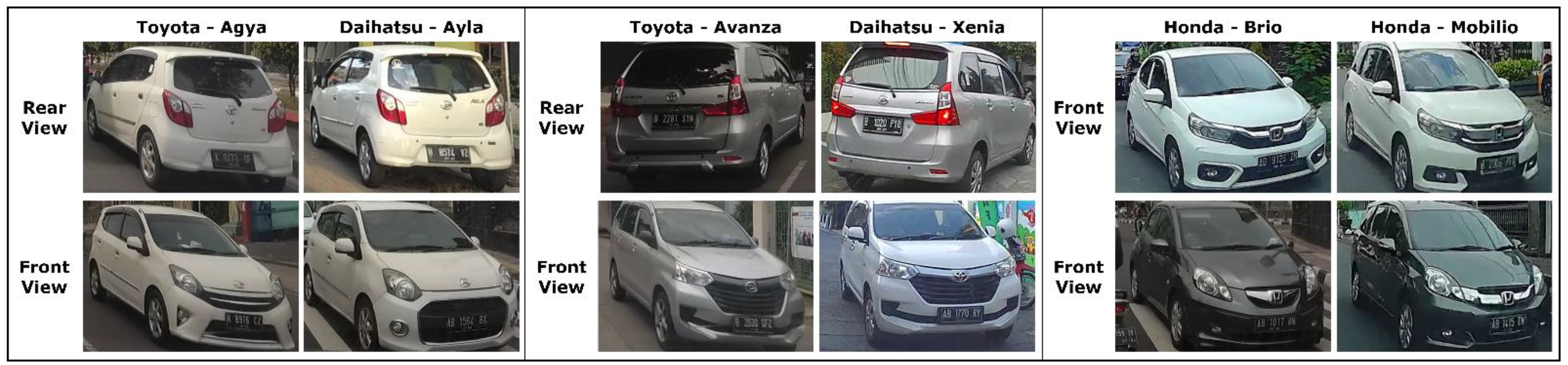
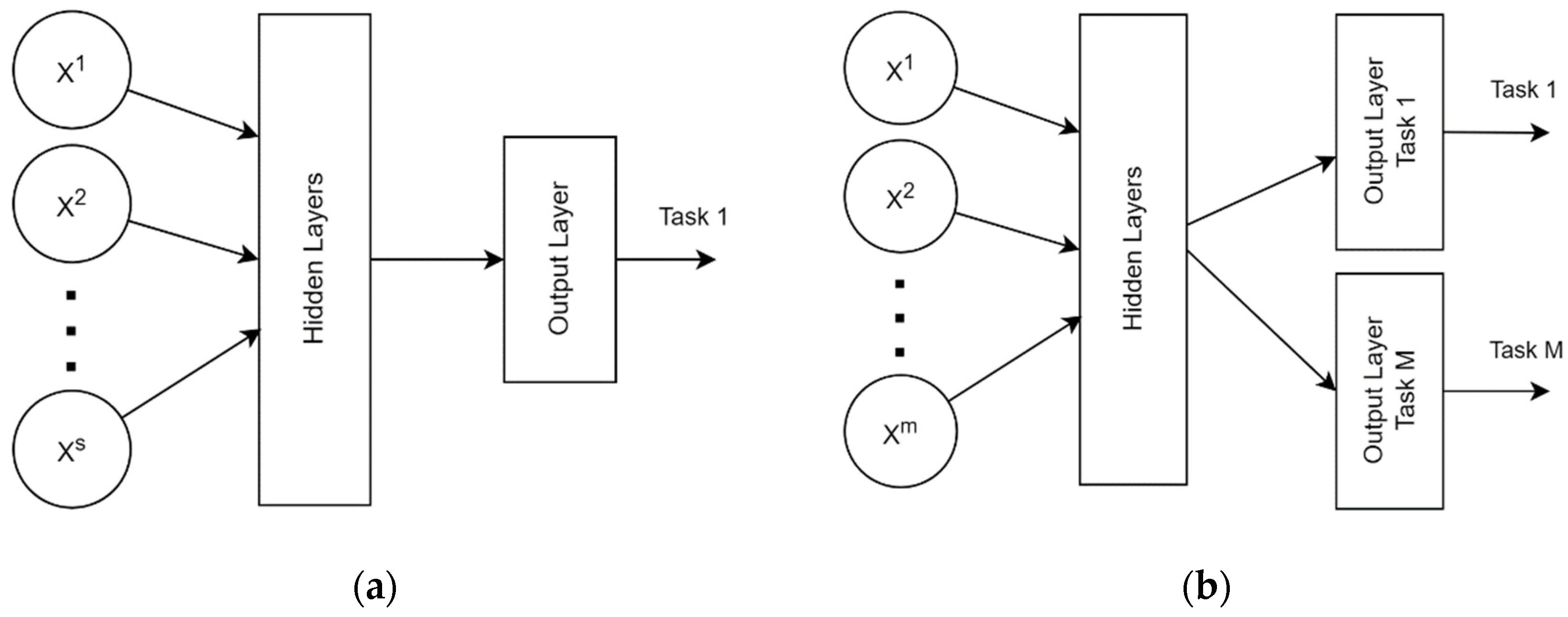
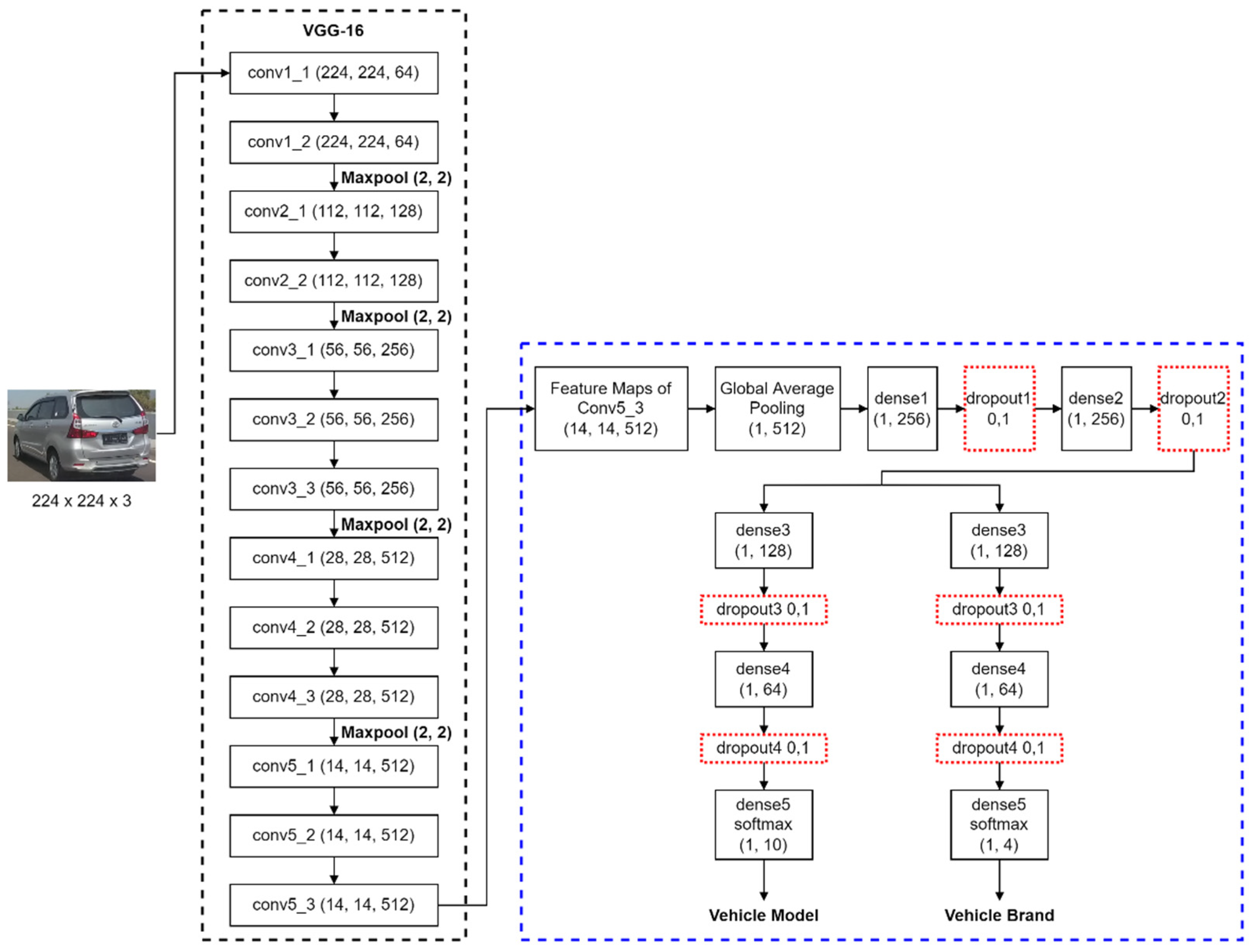
Vehicle make and model classification is crucial to the operation of an intelligent transportation system (ITS). Fine-grained vehicle information such as make and model can help officers uncover cases of traffic violations when license plate information cannot be obtained. Various techniques have been developed to perform vehicle make and model classification. However, it is very hard to identify the make and model of vehicles with highly similar visual appearances. The classifier contains a lot of potential for mistakes because the vehicles look very similar but have different models and manufacturers. To solve this problem, a fine-grained classifier based on convolutional neural networks with a multi-task learning approach is proposed in this paper. The proposed method takes a vehicle image as input and extracts features using the VGG-16 architecture. The extracted features will then be sent to two different branches, with one branch being used to classify the vehicle model and the other to classify the vehicle make. The performance of the proposed method was evaluated using the InaV-Dash dataset, which contains an Indonesian vehicle model with a highly similar visual appearance. The experimental results show that the proposed method achieves 98.73% accuracy for vehicle make and 97.69% accuracy for vehicle model. Our study also demonstrates that the proposed method is able to improve the performance of the baseline method on highly similar vehicle classification problems.
Keywords: convolutional neural network; vehicle make and model; multi-task learning convolutional neural network; vehicle make and model; multi-task learning