
Article

Colour and Texture Descriptors for Visual Recognition: A Historical Overview

by
Francesco Bianconi
1,*,
Antonio Fernández
2,
Fabrizio Smeraldi
3 and
Giulia Pascoletti
4
1
Department of Engineering, Università degli Studi di Perugia, Via Goffredo Duranti 93, 06135 Perugia, Italy
2
School of Industrial Engineering, Universidade de Vigo, Rúa Maxwell s/n, 36310 Vigo, Spain
3
School of Electronic Engineering and Computer Science, Queen Mary University of London, Mile End Road, London E1 4NS, UK
4
Department of Mechanical and Aerospace Engineering, Politecnico di Torino, Corso Duca degli Abruzzi 24, 10129 Torino, Italy
*
Author to whom correspondence should be addressed.
J. Imaging 2021, 7(11), 245; https://doi.org/10.3390/jimaging7110245

Submission received: 14 October 2021 / Revised: 14 November 2021 / Accepted: 16 November 2021 / Published: 19 November 2021
(This article belongs to the Special Issue Color Texture Classification)

Abstract

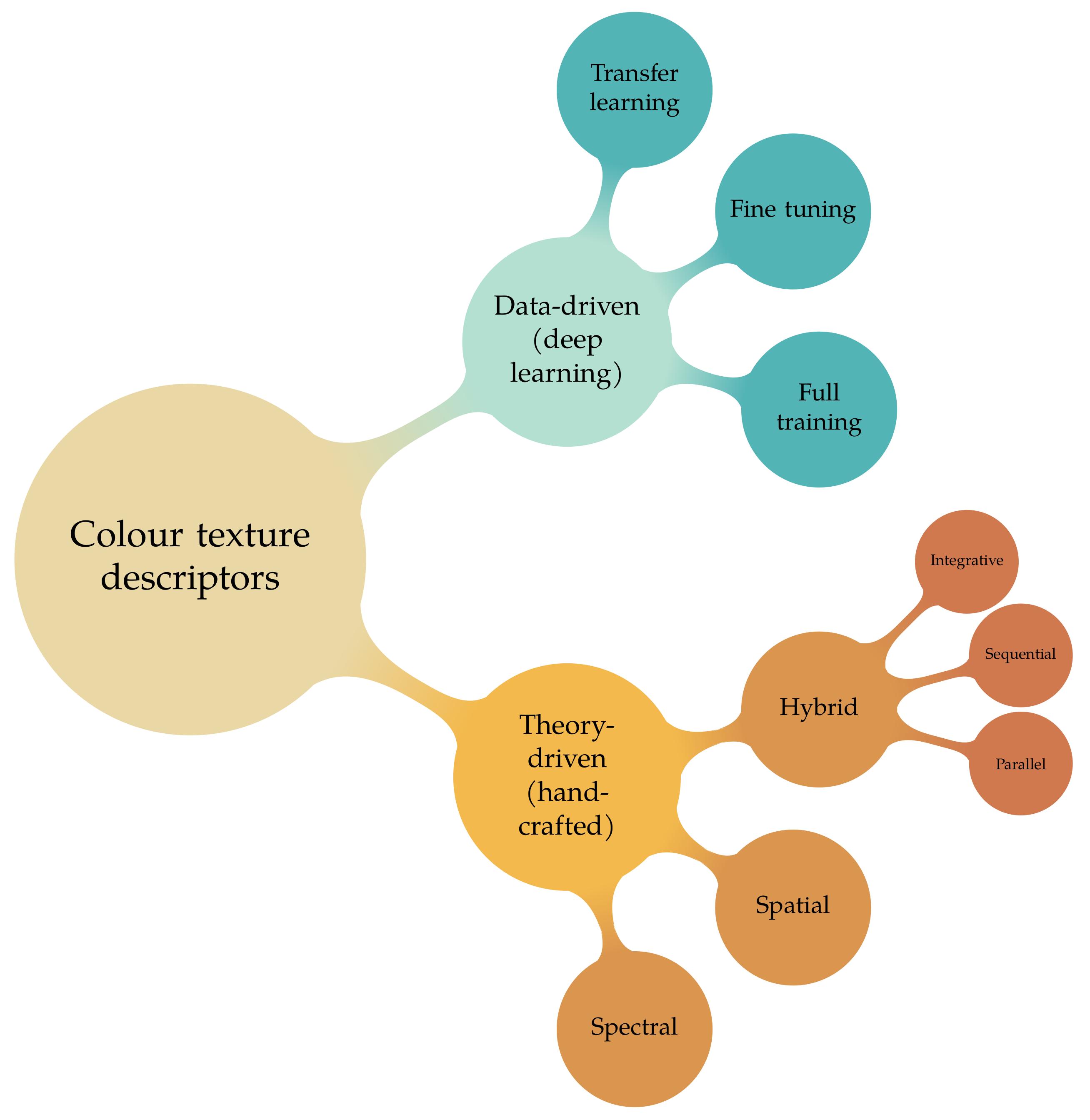
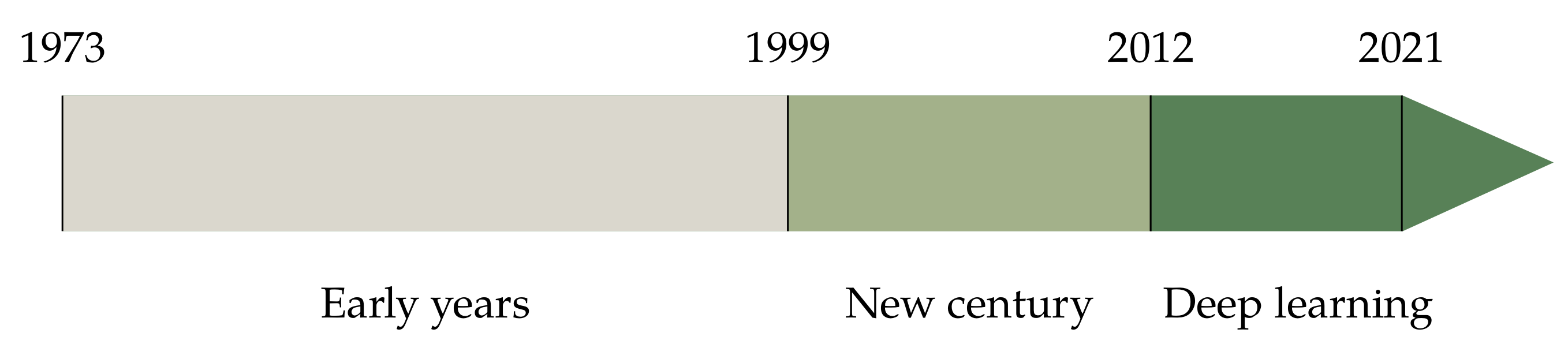
Colour and texture are two perceptual stimuli that determine, to a great extent, the appearance of objects, materials and scenes. The ability to process texture and colour is a fundamental skill in humans as well as in animals; therefore, reproducing such capacity in artificial (‘intelligent’) systems has attracted considerable research attention since the early 70s. Whereas the main approach to the problem was essentially theory-driven (‘hand-crafted’) up to not long ago, in recent years the focus has moved towards data-driven solutions (deep learning). In this overview we retrace the key ideas and methods that have accompanied the evolution of colour and texture analysis over the last five decades, from the ‘early years’ to convolutional networks. Specifically, we review geometric, differential, statistical and rank-based approaches. Advantages and disadvantages of traditional methods vs. deep learning are also critically discussed, including a perspective on which traditional methods have already been subsumed by deep learning or would be feasible to integrate in a data-driven approach.
Keywords: texture; colour; visual recognition; deep learning texture; colour; visual recognition; deep learning