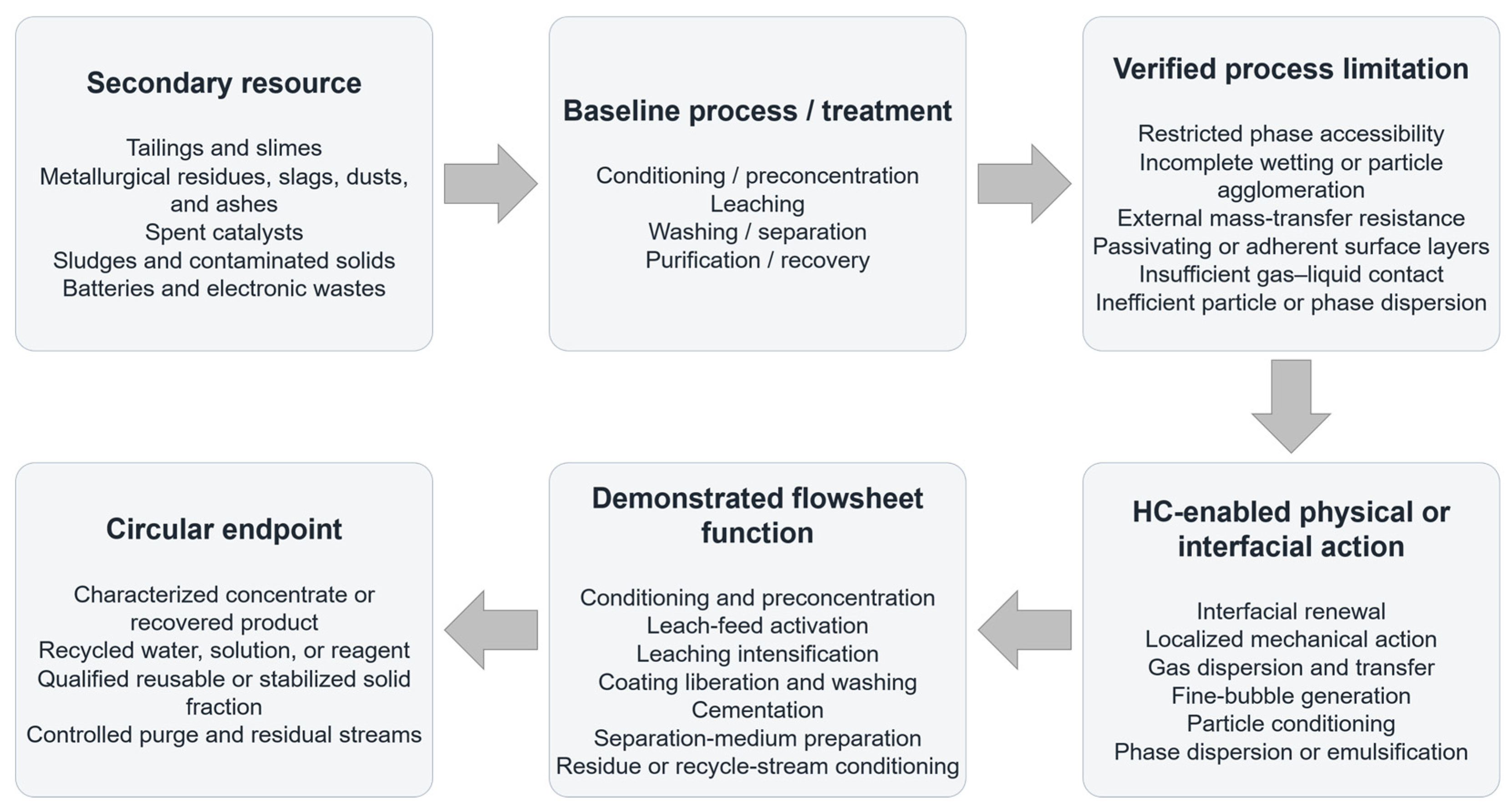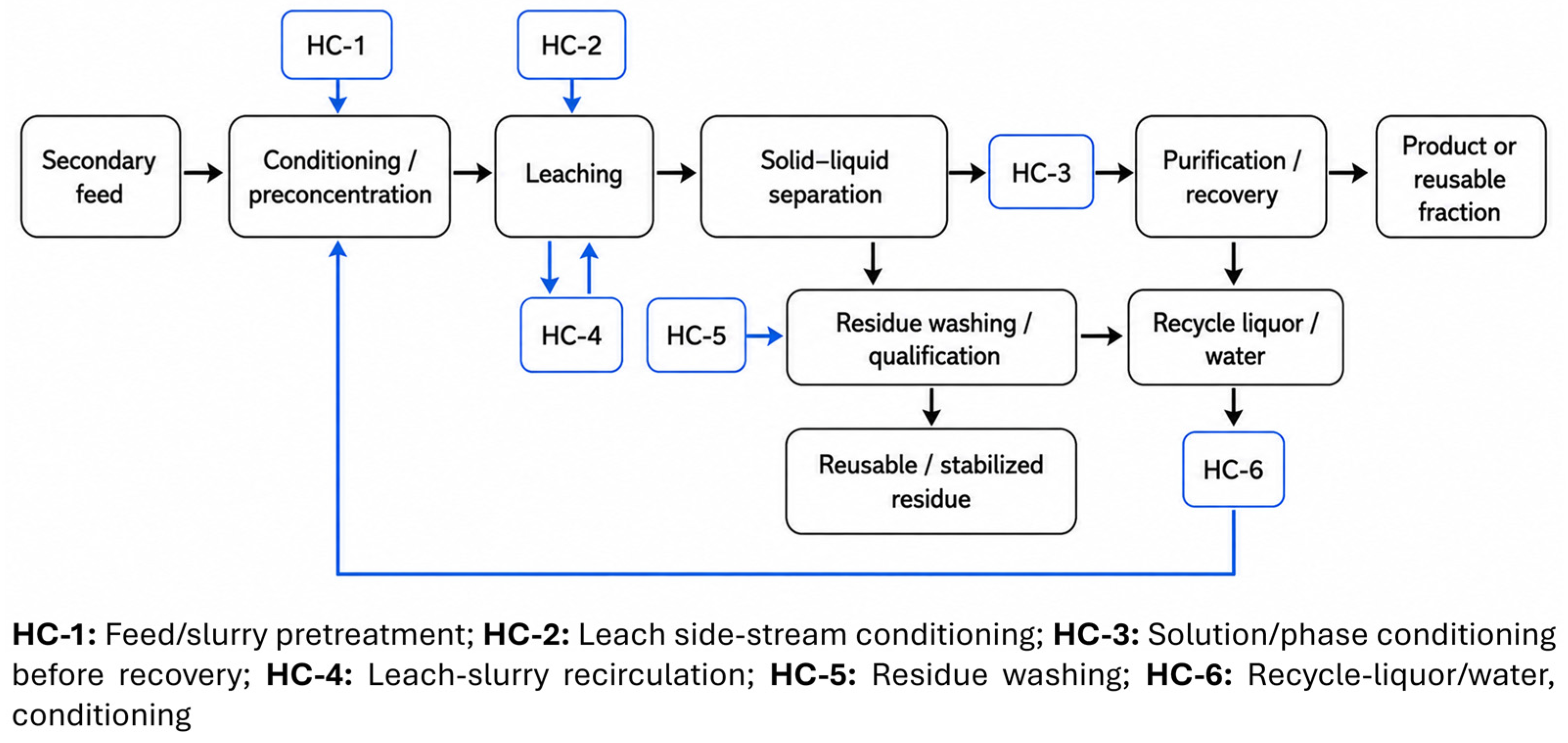

Hydrodynamic Cavitation in Circular Hydrometallurgical Flowsheets: Function-Specific Evidence and Process Integration for Secondary-Resource Recovery


Abstract
1. Introduction
2. Scope, Literature Basis, and Evidence Appraisal
2.1. Definitions, Scope Boundaries, and Literature Selection
2.2. Evidence Appraisal and Claim Boundaries
3. Hydrodynamic Cavitation Functions and Flowsheet Integration
3.1. Transport, Interfacial, Bubble, and Particle Responses
3.2. Flowsheet Positioning and Operating Modes
4. Application Evidence Across Circular Hydrometallurgical Flowsheets
4.1. Upstream Conditioning and Preconcentration
4.2. Cavitation-Assisted Leaching and Metal Mobilization
4.3. Spent Catalysts: Coating Liberation and Selective Recovery
4.4. Batteries and Electronic Wastes: Emerging Evidence and Gaps
4.5. Downstream Metal Separation and Product Recovery
5. Whole-Flowsheet Performance, Loop Closure, and Scale-Up
5.1. Circularity, Resource Use, Productivity, and Residue Fate
5.2. Scale-Up, Operability, and Minimum Reporting
6. Evidence Coverage and Research Priorities
7. Conclusions
Funding
Data Availability Statement
Conflicts of Interest
References
- Chowdhury, M.O.S.; Talan, D. From Waste to Wealth: A Circular Economy Approach to the Sustainable Recovery of Rare Earth Elements and Battery Metals from Mine Tailings. Separations 2025, 12, 52. [Google Scholar] [CrossRef] [Scilit]
- Işıldar, A.; Rene, E.R.; van Hullebusch, E.D.; Lens, P.N.L. Electronic Waste as a Secondary Source of Critical Metals: Management and Recovery Technologies. Resour. Conserv. Recycl. 2018, 135, 296–312. [Google Scholar] [CrossRef] [Scilit]
- Kaya, M.; Hussaini, S.; Kursunoglu, S. Critical Review on Secondary Zinc Resources and Their Recycling Technologies. Hydrometallurgy 2020, 195, 105362. [Google Scholar] [CrossRef] [Scilit]
- Costis, S.; Mueller, K.K.; Coudert, L.; Neculita, C.M.; Reynier, N.; Blais, J.-F. Recovery Potential of Rare Earth Elements from Mining and Industrial Residues: A Review and Case Studies. J. Geochem. Explor. 2021, 221, 106699. [Google Scholar] [CrossRef] [Scilit]
- Binnemans, K.; Jones, P.T.; Blanpain, B.; Van Gerven, T.; Yang, Y.; Walton, A.; Buchert, M. Recycling of Rare Earths: A Critical Review. J. Clean. Prod. 2013, 51, 1–22. [Google Scholar] [CrossRef] [Scilit]
- Dold, B. Sourcing of Critical Elements and Industrial Minerals from Mine Waste—The Final Evolutionary Step Back to Sustainability of Humankind? J. Geochem. Explor. 2020, 219, 106638. [Google Scholar] [CrossRef] [Scilit]
- Dagwar, P.P.; Iqbal, S.S.; Dutta, D. Sustainable Recovery of Rare Earth Elements from Industrial Waste: A Path to Circular Economy and Environmental Health. Waste Manag. Bull. 2025, 3, 373–390. [Google Scholar] [CrossRef] [Scilit]
- Abbadi, A.; Mucsi, G. A Review on Complex Utilization of Mine Tailings: Recovery of Rare Earth Elements and Residue Valorization. J. Environ. Chem. Eng. 2024, 12, 113118. [Google Scholar] [CrossRef] [Scilit]
- Araya, N.; Kraslawski, A.; Cisternas, L.A. Towards Mine Tailings Valorization: Recovery of Critical Materials from Chilean Mine Tailings. J. Clean. Prod. 2020, 263, 121555. [Google Scholar] [CrossRef] [Scilit]
- Kinnunen, P.; Karhu, M.; Yli-Rantala, E.; Kivikytö-Reponen, P.; Mäkinen, J. A Review of Circular Economy Strategies for Mine Tailings. Clean. Eng. Technol. 2022, 8, 100499. [Google Scholar] [CrossRef] [Scilit]
- Li, Q.; Yin, S.; Zhang, L.; Li, S. Cavitation-Induced Reactive Microenvironments in Metal Leaching: From Bubble Dynamics to Multiscale Mechanistic Modeling. Miner. Eng. 2026, 246, 110415. [Google Scholar] [CrossRef] [Scilit]
- Laishram, D.; Golmohammadi, T.; Alamdari, H.D.; Kolliopoulos, G. Micro- and Nanobubble-Assisted Mineral Processing and Hydrometallurgy: A New Paradigm in Sustainable Metal Extraction and Recovery. Miner. Eng. 2026, 245, 110320. [Google Scholar] [CrossRef] [Scilit]
- Chaitanya, G.V.A.; Gupta, G.S. Liquid Flow in Heap Leaching Using the Discrete Liquid Flow Model and Graph-Based Void Search Algorithm. Hydrometallurgy 2023, 221, 106151. [Google Scholar] [CrossRef] [Scilit]
- Johansson, Ö.; Pamidi, T.; Shankar, V. Extraction of Tungsten from Scheelite Using Hydrodynamic and Acoustic Cavitation. Ultrason. Sonochem. 2021, 71, 105408. [Google Scholar] [CrossRef] [Scilit] [PubMed]
- Ladola, Y.S.; Chowdhury, S.; Roy, S.B.; Pandit, A.B. Application of Cavitation in Uranium Leaching. Desalin. Water Treat. 2014, 52, 407–414. [Google Scholar] [CrossRef] [Scilit]
- Mbayo, J.J.K.; Simonsen, H.; Ndlovu, S. Improving the Gold Leaching Process of Refractory Ores Using the Jetleach Reactor. Miner. Eng. 2019, 134, 300–308. [Google Scholar] [CrossRef] [Scilit]
- Mbayo, J.J.K.; Simonsen, H.; Ndlovu, S. Use of Cavitation to Enhance the Leaching Kinetics of Refractory Gold Ores. Miner. Process. Extr. Metall. 2023, 132, 40–48. [Google Scholar] [CrossRef] [Scilit]
- Oliveira, H.; Azevedo, A.; Rubio, J. Nanobubbles Generation in a High-Rate Hydrodynamic Cavitation Tube. Miner. Eng. 2018, 116, 32–34. [Google Scholar] [CrossRef] [Scilit]
- Etchepare, R.; Oliveira, H.; Nicknig, M.; Azevedo, A.; Rubio, J. Nanobubbles: Generation Using a Multiphase Pump, Properties and Features in Flotation. Miner. Eng. 2017, 112, 19–26. [Google Scholar] [CrossRef] [Scilit]
- Azevedo, A.; Etchepare, R.; Calgaroto, S.; Rubio, J. Aqueous Dispersions of Nanobubbles: Generation, Properties and Features. Miner. Eng. 2016, 94, 29–37. [Google Scholar] [CrossRef] [Scilit]
- Pourkarimi, Z.; Rezai, B.; Noaparast, M.; Nguyen, A.V.; Chehreh Chelgani, S. Proving the Existence of Nanobubbles Produced by Hydrodynamic Cavitation and Their Significant Effects in Powder Flotation. Adv. Powder Technol. 2021, 32, 1810–1818. [Google Scholar] [CrossRef] [Scilit]
- Li, H.; Afacan, A.; Liu, Q.; Xu, Z. Study Interactions between Fine Particles and Micron Size Bubbles Generated by Hydrodynamic Cavitation. Miner. Eng. 2015, 84, 106–115. [Google Scholar] [CrossRef] [Scilit]
- Li, M.; Liu, J.; Li, J.; Xiang, B.; Manica, R.; Liu, Q. Enhancement of Selective Fine Particle Flotation by Microbubbles Generated through Hydrodynamic Cavitation. Powder Technol. 2022, 405, 117502. [Google Scholar] [CrossRef] [Scilit]
- Zhou, S.; Wang, X.; Bu, X.; Wang, M.; An, B.; Shao, H.; Ni, C.; Peng, Y.; Xie, G. A Novel Flotation Technique Combining Carrier Flotation and Cavitation Bubbles to Enhance Separation Efficiency of Ultra-Fine Particles. Ultrason. Sonochem. 2020, 64, 105005. [Google Scholar] [CrossRef] [Scilit] [PubMed]
- Pourkarimi, Z.; Hassanzadeh, A. A Rheological Study on Nano-Bubble-Assisted Flotation of Phosphate Fine Particles. Sep. Sci. Technol. 2024, 59, 1621–1633. [Google Scholar] [CrossRef] [Scilit]
- Ahmadi, R.; Khodadadi Darban, A.; Abdollahy, M.; Fan, M. Nano-Microbubble Flotation of Fine and Ultrafine Chalcopyrite Particles. Int. J. Min. Sci. Technol. 2014, 24, 559–566. [Google Scholar] [CrossRef] [Scilit]
- Chipakwe, V.; Sand, A.; Chehreh Chelgani, S. Nanobubble-Assisted Flotation Separation of Complex Pb–Cu–Zn Sulfide Ore—Assessment of Process Readiness. Sep. Sci. Technol. 2022, 57, 1351–1358. [Google Scholar] [CrossRef] [Scilit]
- Han, H.; Liu, A.; Wang, H. Effect of Hydrodynamic Cavitation Assistance on Different Stages of Coal Flotation. Minerals 2020, 10, 221. [Google Scholar] [CrossRef] [Scilit]
- Ross, V.; Singh, A.; Pillay, K. Improved Flotation of PGM Tailings with a High-Shear Hydrodynamic Cavitation Device. Miner. Eng. 2019, 137, 133–139. [Google Scholar] [CrossRef] [Scilit]
- Taghavi, F.; Noaparast, M.; Pourkarimi, Z.; Nakhaei, F. Comparison of Mechanical and Column Flotation Performances on Recovery of Phosphate Slimes in Presence of Nano-Microbubbles. J. Cent. South Univ. 2022, 29, 102–115. [Google Scholar] [CrossRef] [Scilit]
- Chipakwe, V.; Jolsterå, R.; Chehreh Chelgani, S. Nanobubble-Assisted Flotation of Apatite Tailings: Insights on Beneficiation Options. ACS Omega 2021, 6, 13888–13894. [Google Scholar] [CrossRef] [Scilit] [PubMed]
- Zhou, W.; Ou, L.; Shi, Q.; Feng, Q.; Chen, H. Different Flotation Performance of Ultrafine Scheelite under Two Hydrodynamic Cavitation Modes. Minerals 2018, 8, 264. [Google Scholar] [CrossRef] [Scilit]
- Zhou, W.; Ou, L.; Shi, Q.; Chen, H. Aggregation of Ultra-Fine Scheelite Particles Induced by Hydrodynamic Cavitation. Int. J. Miner. Process. 2016, 157, 236–240. [Google Scholar] [CrossRef] [Scilit]
- Nazari, S.; Chehreh Chelgani, S.; Shafaei, S.Z.; Shahbazi, B.; Matin, S.S.; Gharabaghi, M. Flotation of Coarse Particles by Hydrodynamic Cavitation Generated in the Presence of Conventional Reagents. Sep. Purif. Technol. 2019, 220, 61–68. [Google Scholar] [CrossRef] [Scilit]
- Cho, K.; Kim, H.; Purev, O.; Choi, N.; Lee, J. Physical Separation of Contaminated Soil Using a Washing Ejector Based on Hydrodynamic Cavitation. Sustainability 2022, 14, 252. [Google Scholar] [CrossRef] [Scilit]
- Kim, H.; Cho, K.; Purev, O.; Choi, N.; Lee, J. Remediation of Toxic Heavy Metal Contaminated Soil by Combining a Washing Ejector Based on Hydrodynamic Cavitation and Soil Washing Process. Int. J. Environ. Res. Public Health 2022, 19, 786. [Google Scholar] [CrossRef] [Scilit] [PubMed]
- Kim, H.; Myung, E.; Park, C.; Choi, N.; Lee, J.; Cho, K. Design of a Washing Ejector and Column Flotation Based on the Microbubble for Heavy Metal Contaminants Removal from Contaminated Soils: A Pilot and Laboratory-Scale Studies. Results Eng. 2024, 22, 102312. [Google Scholar] [CrossRef] [Scilit]
- Kim, H.; Purev, O.; Cho, K.; Choi, N.; Lee, J.; Yoon, S. Removal of Inorganic Salts in Municipal Solid Waste Incineration Fly Ash Using a Washing Ejector and Its Application for CO2 Capture. Int. J. Environ. Res. Public Health 2022, 19, 2306. [Google Scholar] [CrossRef] [Scilit] [PubMed]
- Li, K.; Shi, C.; Zeng, Y.; Huang, L.; Chen, B.; Liu, C.; Bao, S.; Yang, S. A High-Efficiency Purification Method of Waste Phosphogypsum via Hydrodynamic Cavitation Pretreatment and Froth Flotation. J. Clean. Prod. 2025, 512, 145685. [Google Scholar] [CrossRef] [Scilit]
- Li, T.; Huang, H.; Liu, H.; Bilal, M.; Ma, G.; Zhang, L.; Liu, G. Effects of Hydrodynamic Cavitation Treatment on Flotation of Coal Gasification Fine Slag. Int. J. Coal Prep. Util. 2026. Epub ahead of print. [Google Scholar] [CrossRef] [Scilit]
- Nazari, S.; Zhou, S.; Hassanzadeh, A.; Li, J.; He, Y.; Bu, X.; Kowalczuk, P.B. Influence of Operating Parameters on Nanobubble-Assisted Flotation of Graphite. J. Mater. Res. Technol. 2022, 20, 3891–3904. [Google Scholar] [CrossRef] [Scilit]
- Matos Maldonado, H.; Benites-Alfaro, E. Controlled Hydrodynamic Cavitation for Reduction of Toxic Metals in Metallurgical Residual Effluents. Chem. Eng. Trans. 2023, 99, 559–564. [Google Scholar] [CrossRef]
- Wang, J.; Faraji, F.; Ramsay, J.; Ghahreman, A. A Review of Biocyanidation as a Sustainable Route for Gold Recovery from Primary and Secondary Low-Grade Resources. J. Clean. Prod. 2021, 296, 126457. [Google Scholar] [CrossRef] [Scilit]
- Boboev, I.R.; Tabarov, F.S.; Vorotilo, S. Sulfur Dioxide as a Thiourea Stabilizer in the Carbon-in-Leach (CIL) Process Using a Hydrodynamic Cavitation Reactor for Gold Recovery from Dump Tailings. Hydrometallurgy 2024, 225, 106261. [Google Scholar] [CrossRef] [Scilit]
- Morales Arteaga, J.F.; Vodnik, D.; Kastelec, D.; Zupanc, M.; Dular, M.; Ortar, J.; Đurić, M.; Kaurin, A.; Mihelič, R.; Leštan, D. Removal of Toxic Metals from Sewage Sludge by EDTA and Hydrodynamic Cavitation and Use of the Sludge as Fertilizer. Sci. Total Environ. 2024, 923, 171444. [Google Scholar] [CrossRef] [Scilit] [PubMed]
- Jha, M.K.; Lee, J.-C.; Kim, M.-S.; Jeong, J.; Kim, B.-S.; Kumar, V. Hydrometallurgical Recovery/Recycling of Platinum by the Leaching of Spent Catalysts: A Review. Hydrometallurgy 2013, 133, 23–32. [Google Scholar] [CrossRef] [Scilit]
- Trinh, H.B.; Lee, J.-C.; Suh, Y.-J.; Lee, J. A Review on the Recycling Processes of Spent Auto-Catalysts: Towards the Development of Sustainable Metallurgy. Waste Manag. 2020, 114, 148–165. [Google Scholar] [CrossRef] [Scilit] [PubMed]
- Ding, Y.; Zhang, S.; Liu, B.; Zheng, H.; Chang, C.-C.; Ekberg, C. Recovery of Precious Metals from Electronic Waste and Spent Catalysts: A Review. Resour. Conserv. Recycl. 2019, 141, 284–298. [Google Scholar] [CrossRef] [Scilit]
- Sun, S.; Jin, C.; He, W.; Li, G.; Zhu, H.; Huang, J. A Review on Management of Waste Three-Way Catalysts and Strategies for Recovery of Platinum Group Metals from Them. J. Environ. Manag. 2022, 305, 114383. [Google Scholar] [CrossRef] [Scilit] [PubMed]
- Zeng, L.; Cheng, C.Y. A Literature Review of the Recovery of Molybdenum and Vanadium from Spent Hydrodesulphurisation Catalysts: Part I: Metallurgical Processes. Hydrometallurgy 2009, 98, 1–9. [Google Scholar] [CrossRef] [Scilit]
- Zeng, L.; Cheng, C.Y. A Literature Review of the Recovery of Molybdenum and Vanadium from Spent Hydrodesulphurisation Catalysts: Part II: Separation and Purification. Hydrometallurgy 2009, 98, 10–20. [Google Scholar] [CrossRef] [Scilit]
- Liang, X.; Tang, J.; Li, L.; Wu, Y.; Sun, Y. A Review of Metallurgical Processes and Purification Techniques for Recovering Mo, V, Ni, Co, Al from Spent Catalysts. J. Clean. Prod. 2022, 376, 134108. [Google Scholar] [CrossRef] [Scilit]
- Asghari, I.; Mousavi, S.M.; Amiri, F.; Tavassoli, S. Bioleaching of Spent Refinery Catalysts: A Review. J. Ind. Eng. Chem. 2013, 19, 1069–1081. [Google Scholar] [CrossRef] [Scilit]
- Valverde, I.M., Jr.; Paulino, J.F.; Afonso, J.C. Hydrometallurgical Route to Recover Molybdenum, Nickel, Cobalt and Aluminum from Spent Hydrotreating Catalysts in Sulphuric Acid Medium. J. Hazard. Mater. 2008, 160, 310–317. [Google Scholar] [CrossRef] [Scilit] [PubMed]
- Ferella, F.; Ognyanova, A.; De Michelis, I.; Taglieri, G.; Vegliò, F. Extraction of Metals from Spent Hydrotreating Catalysts: Physico-Mechanical Pre-Treatments and Leaching Stage. J. Hazard. Mater. 2011, 192, 176–185. [Google Scholar] [CrossRef] [Scilit] [PubMed]
- Vasile, E.; Ciocanea, A.; Ionescu, V.; Lepadatu, I.; Diac, C.; Stamatin, S.N. Making Precious Metals Cheap: A Sonoelectrochemical–Hydrodynamic Cavitation Method to Recycle Platinum Group Metals from Spent Automotive Catalysts. Ultrason. Sonochem. 2021, 72, 105404. [Google Scholar] [CrossRef] [Scilit] [PubMed]
- Ciocanea, A.; Vasile, E.; Ionescu, V.; Maxim, F.I.; Diac, C.; Miron, C.; Stamatin, S.N. Second Life Application of Automotive Catalysts: Hydrodynamic Cavitation Recovery and Photo Water Splitting. Metals 2020, 10, 1307. [Google Scholar] [CrossRef] [Scilit]
- Choi, I.-H.; Kim, H.-R.; Moon, G.; Jyothi, R.K.; Lee, J.-Y. Spent V2O5–WO3/TiO2 Catalyst Processing for Valuable Metals by Soda Roasting–Water Leaching. Hydrometallurgy 2018, 175, 292–299. [Google Scholar] [CrossRef] [Scilit]
- Choi, I.-H.; Moon, G.; Lee, J.-Y.; Jyothi, R.K. Extraction of Tungsten and Vanadium from Spent Selective Catalytic Reduction Catalyst for Stationary Application by Pressure Leaching Process. J. Clean. Prod. 2018, 197, 163–169. [Google Scholar] [CrossRef] [Scilit]
- Kim, J.W.; Lee, W.G.; Hwang, I.S.; Lee, J.Y.; Han, C. Recovery of Tungsten from Spent Selective Catalytic Reduction Catalysts by Pressure Leaching. J. Ind. Eng. Chem. 2015, 28, 73–77. [Google Scholar] [CrossRef] [Scilit]
- Choi, I.-H.; Moon, G.; Lee, J.-Y.; Jyothi, R.K. Hydrometallurgical Processing of Spent Selective Catalytic Reduction (SCR) Catalyst for Recovery of Tungsten. Hydrometallurgy 2018, 178, 137–145. [Google Scholar] [CrossRef] [Scilit]
- Li, H.; Eksteen, J.; Oraby, E. Hydrometallurgical Recovery of Metals from Waste Printed Circuit Boards (WPCBs): Current Status and Perspectives—A Review. Resour. Conserv. Recycl. 2018, 139, 122–139. [Google Scholar] [CrossRef] [Scilit]
- Sethurajan, M.; van Hullebusch, E.D.; Fontana, D.; Akcil, A.; Deveci, H.; Batinic, B.; Leal, J.P.; Gasche, T.A.; Kucuker, M.A.; Kuchta, K.; et al. Recent Advances on Hydrometallurgical Recovery of Critical and Precious Elements from End-of-Life Electronic Wastes—A Review. Crit. Rev. Environ. Sci. Technol. 2019, 49, 212–275. [Google Scholar] [CrossRef] [Scilit]
- Harper, G.; Sommerville, R.; Kendrick, E.; Driscoll, L.; Slater, P.; Stolkin, R.; Walton, A.; Christensen, P.; Heidrich, O.; Lambert, S.; et al. Recycling Lithium-Ion Batteries from Electric Vehicles. Nature 2019, 575, 75–86, Erratum in Nature 2020, 578, E20. [Google Scholar] [CrossRef] [Scilit] [PubMed]
- Ordoñez, J.; Gago, E.J.; Girard, A. Processes and Technologies for the Recycling and Recovery of Spent Lithium-Ion Batteries. Renew. Sustain. Energy Rev. 2016, 60, 195–205. [Google Scholar] [CrossRef] [Scilit]
- Gaines, L. Lithium-Ion Battery Recycling Processes: Research towards a Sustainable Course. Sustain. Mater. Technol. 2018, 17, e00068. [Google Scholar] [CrossRef] [Scilit]
- Gaines, L. The Future of Automotive Lithium-Ion Battery Recycling: Charting a Sustainable Course. Sustain. Mater. Technol. 2014, 1–2, 2–7. [Google Scholar] [CrossRef] [Scilit]
- Canciani, C.; Colleoni, E.; Sarvothaman, V.P.; Guida, P.; Roberts, W.L. On the Effect of Cavitation on Particles in Leaching Processes: Implications to Battery Recycling. Environ. Adv. 2024, 17, 100570. [Google Scholar] [CrossRef] [Scilit]
- Okonkwo, E.G.; Wheatley, G.; Liu, Y.; He, Y. A Cavitation Enabled Green Leaching of Metals from Spent Lithium-Ion Batteries. Chem. Eng. Process. Process Intensif. 2024, 202, 109850. [Google Scholar] [CrossRef] [Scilit]
- Shishkin, A.; Mironovs, V.; Vu, H.; Novak, P.; Baronins, J.; Polyakov, A.; Ozolins, J. Cavitation-Dispersion Method for Copper Cementation from Wastewater by Iron Powder. Metals 2018, 8, 920. [Google Scholar] [CrossRef] [Scilit]
- Jha, M.K.; Kumari, A.; Panda, R.; Rajesh Kumar, J.; Yoo, K.; Lee, J.Y. Review on Hydrometallurgical Recovery of Rare Earth Metals. Hydrometallurgy 2016, 165, 2–26. [Google Scholar] [CrossRef] [Scilit]
- Parbat, S.A.; Bhanvase, B.A.; Sonawane, S.H. Investigation on Liquid Emulsion Membrane Prepared with Hydrodynamic Cavitation Process for Cobalt (II) Extraction from Wastewater. Sep. Purif. Technol. 2020, 237, 116385. [Google Scholar] [CrossRef] [Scilit]
- Bolne, P.C.; Ghodke, S.A.; Bhanvase, B.A. Intensified Hydrodynamic Cavitation-Based Process for the Production of Liquid Emulsion Membrane for the Extraction of Chromium(VI) Ions. Int. J. Environ. Res. 2021, 15, 313–320. [Google Scholar] [CrossRef] [Scilit]
- Lakhe, M.; Parbat, S.A.; Bhanvase, B.A.; Sonawane, S.H. Enhanced Performance of Emulsion Liquid Membrane Prepared with Aid of Hydrodynamic Cavitation for Effective Removal of Pb (II) from Aqueous Feed Phase: Optimization Using Artificial Neural Networks Modeling. J. Environ. Chem. Eng. 2021, 9, 106866. [Google Scholar] [CrossRef] [Scilit]
- Botelho Junior, A.B.; Tenório, J.A.S.; Espinosa, D.C.R. Separation of Critical Metals by Membrane Technology under a Circular Economy Framework: A Review of the State-of-the-Art. Processes 2023, 11, 1256. [Google Scholar] [CrossRef] [Scilit]
- Paiva, A.P.; Piedras, F.V.; Rodrigues, P.G.; Nogueira, C.A. Hydrometallurgical Recovery of Platinum-Group Metals from Spent Auto-Catalysts—Focus on Leaching and Solvent Extraction. Sep. Purif. Technol. 2022, 286, 120474. [Google Scholar] [CrossRef] [Scilit]
- Kinas, S.; Jermakowicz-Bartkowiak, D.; Pohl, P.; Dzimitrowicz, A.; Cyganowski, P. On the Path of Recovering Platinum-Group Metals and Rhenium: A Review on the Recent Advances in Secondary-Source and Waste Materials Processing. Hydrometallurgy 2024, 223, 106222. [Google Scholar] [CrossRef] [Scilit]
- Tunsu, C.; Menard, Y.; Eriksen, D.Ø.; Ekberg, C.; Petranikova, M. Recovery of Critical Materials from Mine Tailings: A Comparative Study of the Solvent Extraction of Rare Earths Using Acidic, Solvating and Mixed Extractant Systems. J. Clean. Prod. 2019, 218, 425–437. [Google Scholar] [CrossRef] [Scilit]
- Coman, V.; Robotin, B.; Ilea, P. Nickel Recovery/Removal from Industrial Wastes: A Review. Resour. Conserv. Recycl. 2013, 73, 229–238. [Google Scholar] [CrossRef] [Scilit]
- Tuncay, G.; Yuksekdag, A.; Kose Mutlu, B.; Koyuncu, I. A Review of Greener Approaches for Rare Earth Elements Recovery from Mineral Wastes. Environ. Pollut. 2024, 357, 124379. [Google Scholar] [CrossRef] [Scilit] [PubMed]



| Appraisal Dimension | Category Within Dimension | Minimum Evidence Required | Maximum Supported Inference |
|---|---|---|---|
| System relevance | Simplified or model system | Pure compounds, model particles, synthetic solutions, or other matrices of defined composition used to isolate a physicochemical response under controlled conditions. | Mechanistic plausibility under simplified conditions; no direct inference for heterogeneous secondary resources. |
| Primary-mineral or process benchmark | Primary ore, pure mineral, conventional process stream, or another non-secondary system reproducing a limitation relevant to hydrometallurgical processing. | Transferable mechanistic or unit-operation insight; applicability to secondary resources requires direct validation. | |
| Representative secondary resource | Characterized tailings, slimes, residue, slag, ash, sludge, spent catalyst, battery-derived material, electronic waste, or other secondary feed retaining its relevant heterogeneity, phase associations, and impurity burden. | Performance of the demonstrated function for the tested secondary resource, feed characteristics, and operating conditions. | |
| Integrated secondary-resource process sequence | A representative secondary feed evaluated across two or more physically connected unit operations under a defined process configuration. | Applicability of the demonstrated response within the tested process sequence; causal strength, product recovery, and loop closure remain independently assessed. | |
| Causal attribution | HC nominally present; contribution unresolved | A device or treatment is identified as hydrodynamically cavitating, but no suitable control distinguishes HC-associated effects from pumping, mixing, heating, gas injection, recirculation, particle attrition, acoustic excitation, electrochemistry, or chemical additives. | Association between the complete treatment configuration and the measured response; no isolated attribution to HC. |
| Comparative treatment with unmatched process duty | Comparison with untreated material, conventional stirring, pumping, mixing, or another reference treatment, but hydraulic power, pressure history, temperature, gas supply, residence time, recirculation, or chemical exposure is not adequately matched. | Incremental benefit of the intensified treatment configuration; the specific contribution of HC remains partly confounded. | |
| Matched noncavitating hydraulic control | Cavitating and noncavitating operation compared at matched or appropriately normalized flow, hydraulic power, mixing duty, temperature, gas supply, chemistry, solids loading, and treatment history. | Attribution of the observed process response to pressure-driven cavitating operation under the tested conditions, without necessarily resolving the active HC-mediated mechanism. | |
| Mechanism-resolved attribution | Matched hydraulic controls combined with direct diagnostics or independently varied conditions sufficient to distinguish the specified HC-mediated response from bulk mixing, pumping, heating, externally imposed gas transfer, acoustic excitation, electrochemistry, and chemical-additive effects. | Strong attribution of the demonstrated process response to a specified HC-mediated physical or interfacial mechanism under the tested conditions. | |
| Endpoint completeness | Mechanistic or local physicochemical response | Direct measurement of cavity-related, pressure, bubble, particle, surface, wetting, dispersion, mass-transfer, or other local physicochemical behavior. | Existence of a local response associated with the tested HC treatment; no automatic inference for unit-operation performance. |
| Enabling process function | Demonstrated wetting, deagglomeration, surface renewal, coating detachment, gas transfer, particle conditioning, phase dispersion, or another defined function relevant to a recovery sequence. | Support for the specific enabling function measured; no inference for recovery, selectivity, product quality, or circular performance. | |
| Unit-operation performance | Quantified conditioning, preconcentration, leaching, washing, cementation, emulsification, or separation performance assessed against an appropriate comparator. | Performance claim for the tested unit operation; downstream product recovery and management of associated streams remain unresolved. | |
| Characterized product or reusable fraction | The target is followed into a concentrate, cemented solid, separated internal phase, purified solution, regenerated material, or reusable solid fraction, with yield and relevant compositional or functional quality characterized. | Recovery or valorization claim for the defined product or fraction under the tested feed and process conditions. | |
| Integrated recovery with liquid- and solid-stream management | Feed-to-product accounting; tracking of target and major impurities; characterization of product and residual solids; defined solution recycle or purge; chemical, water, and energy inventories; and appropriate mass-balance closure. | Integrated circular-flowsheet claim limited to the tested feed, product specification, operating duration, process boundary, and demonstrated management of liquid and solid outputs. |
| Flowsheet Position and Controlling Limitation | HC-Enabled Function | Decision-Relevant Endpoint | Principal Failure Mode |
|---|---|---|---|
| Feed conditioning before physical separation. Incomplete wetting, particle agglomeration, poor solids dispersion, or nonuniform reagent–particle contact | Wetting enhancement, deagglomeration, slurry homogenization, and conditioning of particle surfaces | Degree of deagglomeration; particle-size distribution; slurry rheology; reagent utilization; subsequent separation response under unchanged downstream conditions | Excessive attrition; fines generation; increased viscosity; reagent degradation; wear-derived contamination |
| Preconcentration or fine-particle separation. Inefficient particle–bubble attachment, weak selective aggregation, or poor recovery of fine and ultrafine particles | Fine-bubble generation, particle conditioning, and enhancement of selective particle–bubble contact | Target recovery; concentrate grade; mass pull; impurity rejection; target loss to rejected streams; reduction of downstream feed mass | Nonselective gangue entrainment; aggregate disruption; unstable froth; excessive water demand; insufficient concentrate upgrading |
| Leach-feed activation before dissolution. Restricted access to target phases, weakly attached product layers, adherent coatings, passivation, or incomplete exposure of reactive surfaces | Surface renewal, coating or deposit removal, and exposure of reactive phases before conventional leaching | Subsequent extraction kinetics and selectivity at equivalent lixiviant concentration, temperature, solids loading, and treatment duty | Exposure of gangue phases; increased non-target dissolution; fines accumulation; greater reagent demand; impaired solid–liquid separation |
| Leach-slurry recirculation. External mass-transfer resistance, poor solids suspension, insufficient gas–liquid contact, or nonuniform liquid–solid interaction | Repeated interfacial renewal, solids dispersion, gas transfer, and renewal of liquid–solid contact during dissolution | Extraction kinetics; target selectivity; impurity transfer; gas and reagent utilization; recovery at equivalent product specification; specific energy and throughput | Excessive cumulative exposure; temperature rise; reagent degradation; particle erosion; equipment wear; limited single-pass productivity |
| Dedicated liquid or classified-solids side-stream loop. Poor gas dissolution, inadequate reagent dispersion, or incompatibility of the bulk feed with a restrictive active zone | Conditioning of lixiviant, gas-containing solution, low-solids stream, or classified fine-solids fraction before its return to the main process | Treated-stream fraction; dissolved-gas concentration; reagent utilization; stream-property stability; effect on overall recovery, selectivity, or residence time | Negligible influence on the total process inventory; excessive gas suppressing vaporous cavitation; pump instability; untreated bulk-fraction limitation |
| Localized washing or coating-liberation stage. Adherent catalytic or mineral coatings, retained soluble species, localized contamination, or valuable phases attached to a support | Jet impact, localized shear, coating detachment, washing, and selective liberation | Liberation or washing yield per pass; recovered-fraction mass and composition; support integrity; wash efficiency; dry-solids throughput | Support fragmentation; nozzle or throat erosion; wear contamination; low single-pass productivity; difficult recovery of detached fines |
| Cementation stage. Passivation of the solid reductant, poor reductant dispersion, or insufficient renewal of the metal–reductant interface | Reductant dispersion, removal of weak passivating deposits, and renewal of reactive surfaces during cementation | Recovered-metal mass; purity; morphology; filterability; residual dissolved target; reductant consumption; dissolved reductant metal | Excessive reductant attrition; generation of unrecoverable fines; increased reductant dissolution; poor product purity; difficult filtration |
| Separation-medium or liquid-emulsion-membrane preparation. Insufficient phase dispersion, large or nonuniform droplets, limited interfacial area, or slow mass transfer across the dispersed phase | Rapid emulsification and formation of fine, comparatively uniform dispersed phases | Droplet-size distribution; extraction and stripping efficiency; emulsion stability; swelling; rupture; phase disengagement; membrane reuse | Emulsion instability; slow phase separation; extractant or surfactant loss; excessive chemical inventory; incomplete recovery from the internal phase |
| Residue-washing stage. Retained mother liquor, soluble salts, residual lixiviant or complexant, and dissolved target entrained within the solid product or residue | Intensified washing, release of retained liquid, and improved liquid–solid contact during residue cleaning | Wash efficiency; cake moisture; dissolved-target and reagent loss; water demand; residue leachability; suitability for reuse, stabilization, or disposal | Persistent fine suspensions; increased clarification or filtration demand; greater wash-water inventory; contaminant transfer to the liquid stream; deterioration of residue quality |
| Recycle-liquor or purge-stream conditioning. Accumulation of dissolved gangue, salts, suspended fines, degraded reagents, organics, or wear products in recirculating solutions | Conditioning of recycled liquor or a controlled purge stream through dispersion, gas transfer, reagent redistribution, or removal of selected deposits | Recycle fraction; reagent make-up; impurity accumulation; purge composition; stability of extraction and product quality over repeated cycles | Burden transfer without recovery; progressive impurity accumulation; reagent degradation; unstable cavitation behavior; increased purification or purge-treatment demand |
| Resource or Process Context | HC-Enabled Function | Main Demonstrated Outcome | Principal Evidence Boundary | Ref. |
|---|---|---|---|---|
| Contaminated soils | Washing, fractionation, and preconcentration | Metal mobilization and reduction of the fine-particle burden | HC contribution and downstream recovery of enriched fines remain unresolved | [35,36,37] |
| Graphite flotation benchmark | Nanobubble-assisted particle conditioning | Higher recovery and faster flotation kinetics | Transferability to heterogeneous battery black mass remains unverified | [41] |
| Scheelite and uranium-bearing materials | Leaching intensification | Faster dissolution and increased target extraction | Cavitation effects remain partly confounded by acoustic, hydraulic, and particle-size effects | [14,15] |
| Gold ores and tailings | Gas–liquid–solid contact intensification | Higher recovery and, in selected cases, lower oxygen or reagent demand | HC was not isolated from jet mixing, oxygenation, or chemical stabilization | [16,17,44] |
| Metal-bearing sewage sludge | Chelant-assisted washing and metal mobilization | Partial metal removal with retention of residue-valorization potential | Mobilized metals were not recovered as characterized products | [45] |
| Spent automotive catalysts | Coating liberation and washing | Recovery of catalyst-bearing and oxide-rich fractions | High pressure or repeated passes limit demonstrated process productivity | [56,57] |
| Copper-bearing aqueous streams | Cementation intensification | Improved iron dispersion and renewal of reactive surfaces | Product quality and complete metal balances remain insufficiently reported | [70] |
| Co(II)-, Cr(VI)-, and Pb(II)-containing extraction systems | Liquid-emulsion- membrane preparation | Rapid formation of fine dispersed phases for metal extraction | Stability, stripping, reuse, and final product recovery remain incomplete | [72,73,74] |
| Reporting Domain | Mechanistic Interpretation | Bench-Scale Process Validation | Pilot or Integrated-Flowsheet Claim |
|---|---|---|---|
| Resource and fluid basis | Feed origin and composition; relevant mineralogy or phase structure; particle-size distribution; solids loading; key fluid properties; temperature | Representative feed preparation and variability; complete lixiviant, reagent, and gas composition; initial and final stream properties | Feed provenance and campaign variability; representative sampling; inventory and stream-distribution data |
| HC system and treatment history | Active-zone geometry; pressure and flow reference locations; pressure drop; flow rate; temperature; evidence of cavitation; treatment time or number of passes | Treated volume; recirculation ratio; gas addition; power and energy input; throughput; cumulative exposure | Device scale and number; parallel or staged arrangement; control strategy; duty cycle; start-up, shutdown, and off-specification operation |
| Controls and measurement quality | Appropriate noncavitating hydraulic control; sensor location, calibration, and acquisition frequency; replicates; analytical uncertainty | Comparator at equivalent process duty; validated sampling; run-to-run reproducibility; uncertainty propagation | Campaign-level variability; independent material-balance closure; reporting of unstable or unsuccessful operating periods |
| Process response and material outputs | Direct measurement of the claimed bubble, particle, surface, transport, or interfacial response | Kinetics and selectivity; particle or surface changes; target and impurity balances; product and residue characterization | Feed-to-product recovery; product specification; liquid- and solid-stream accounting; sustained performance consistency |
| Resource use, circularity, and operability | Defined experimental boundary; chemical, gas, water, and electrical inputs relevant to the claimed response | Specific energy and throughput; chemical and water inventories; reagent utilization; preliminary wear, fouling, or blockage observations | Recycle and purge behavior; reagent and water make-up; residue fate; wear, corrosion, maintenance, durability, and long-duration productivity |
| Resource Class | Decision-Critical Gap | Priority Validation Experiment | Advancement Criterion |
|---|---|---|---|
| Tailings and slimes | Selective preconcentration is not yet linked consistently to grade–recovery balance, water use, and residue management | Continuous HC-assisted conditioning or preconcentration on representative feeds with complete fraction and water balances | Lower downstream feed mass at maintained target recovery, with water demand and residue quality quantified relative to the matched reference process |
| Spent catalysts | Selective liberation or dissolution remains limited by high pressure, repeated passes, incomplete recovery, and equipment wear | Matched HC and noncavitating tests including single-pass yield, product recovery, support integrity, energy, and wear | Maintained target recovery and product quality with lower specific energy, chemical or comminution demand, or fewer treatment passes, with equipment wear quantified |
| Metal-bearing sludges | Metal mobilization is not completed by chelator regeneration, isolated metal recovery, and safe residue qualification | Repeated-cycle washing with chelator and water recycle, metal recovery, and residue testing | Stable repeated-cycle operation with quantified metal recovery, chelator and water make-up, and residual-metal content in the qualified solid |
| Fly ash and mineral residues | Matrix upgrading is not sufficiently connected to contaminant concentration, water recycle, and long-term solid qualification | Closed-loop washing or fractionation with contaminant capture, purge control, and solid characterization | Quantified contaminant concentration or removal with maintained solid recovery or reuse quality and documented water demand and purge generation |
| Battery black mass | Pressure-driven HC lacks representative validation across graphite separation, selective metal recovery, impurity control, and recycle | Chemistry-specific testing on heterogeneous black mass with product-grade recovery and solution recycle | Higher or maintained graphite or metal recovery and product purity without increased impurity transfer, reagent or water demand, or residual-stream generation relative to the matched reference |
| Electronic wastes | Delamination and liberation may generate inseparable polymer–metal fines and downstream contamination | HC-assisted liberation followed by classification, metal recovery, and nonmetal-fraction characterization | Higher selective liberation or metal recovery with maintained product purity and separability and quantified fines generation |
| Rare-earth and complex metallurgical residues | Feed variability and impurity-sensitive recovery prevent transferable operating windows | Function-specific studies linking HC exposure to selectivity, solid–liquid separation, purification, and product formation | Higher target recovery with quantified impurity rejection, product quality, solid–liquid separation performance, and residual-stream generation |
Disclaimer/Publisher’s Note: The statements, opinions and data contained in all publications are solely those of the individual author(s) and contributor(s) and not of MDPI and/or the editor(s). MDPI and/or the editor(s) disclaim responsibility for any injury to people or property resulting from any ideas, methods, instructions or products referred to in the content. |
© 2026 by the author. Licensee MDPI, Basel, Switzerland. This article is an open access article distributed under the terms and conditions of the Creative Commons Attribution (CC BY) license.
Share and Cite
Albanese, L. Hydrodynamic Cavitation in Circular Hydrometallurgical Flowsheets: Function-Specific Evidence and Process Integration for Secondary-Resource Recovery. Recycling 2026, 11, 161. https://doi.org/10.3390/recycling11090161
Albanese L. Hydrodynamic Cavitation in Circular Hydrometallurgical Flowsheets: Function-Specific Evidence and Process Integration for Secondary-Resource Recovery. Recycling. 2026; 11(9):161. https://doi.org/10.3390/recycling11090161
Chicago/Turabian StyleAlbanese, Lorenzo. 2026. "Hydrodynamic Cavitation in Circular Hydrometallurgical Flowsheets: Function-Specific Evidence and Process Integration for Secondary-Resource Recovery" Recycling 11, no. 9: 161. https://doi.org/10.3390/recycling11090161
APA StyleAlbanese, L. (2026). Hydrodynamic Cavitation in Circular Hydrometallurgical Flowsheets: Function-Specific Evidence and Process Integration for Secondary-Resource Recovery. Recycling, 11(9), 161. https://doi.org/10.3390/recycling11090161