Systematic Review

Artificial Intelligence in Circular Economy and Waste Management: A Systematic Review of Applications for Optimization Strategies and Resource Recovery Pathways

1
Faculty of Business and Communications, INTI International University, Nilai 71800, Malaysia
2
Faculty of Business, Economics and Finance, Perdana University, Kuala Lumpur 50490, Malaysia
3
UCSI Graduate Business School, UCSI University, Kuala Lumpur 56000, Malaysia
4
Lahore Business School, University of Lahore, Lahore 54792, Pakistan
5
University Institute of Tourism and Hospitality Management, Chandigarh University, Mohali 140413, India
*
Author to whom correspondence should be addressed.
Recycling 2026, 11(9), 158; https://doi.org/10.3390/recycling11090158
Submission received: 15 May 2026 / Revised: 3 July 2026 / Accepted: 10 July 2026 / Published: 1 September 2026

Abstract

Background: The transition from conventional waste management to circular economy systems has generated more interest in how artificial intelligence (AI) can enhance waste prevention, sorting and recycling, optimization, and resource recovery. Owing to the growing complexity and data-driven nature of waste systems, AI has been used to aid operational and strategic decisions throughout the waste management chain. Methods: This study is a systematic review of the literature between 2016 and 2026 on AI in waste management in the circular economy, conducted according to the PRISMA 2020 guidelines based on three directions: AI application, optimization techniques, and recovery routes of resources. In this systematic review, 52 studies were included through systematic database searches, eligibility screening, clear inclusion criteria, and thematic synthesis of the literature to identify the key research areas of AI techniques, optimization strategies, and resource recovery pathways in the circular economy and waste management. Results: The review shows that optimization is the key to implementing the principles of the circular economy in waste management decision-making, and that AI is no longer seen as a taboo topic in the literature but as a functional application. System-level integration and the integration of systems in a holistic circular economy are not yet fully consolidated. To overcome the limitations of single-application studies, an Integrative AI–Circular Waste Value Chain (AI-CWVC) framework is proposed. Conclusions: This review highlights the importance of AI in supporting circular waste management and points to the need for further research that is more integrated, evidence-based, and policy-aligned.

1. Introduction

Sustainability has emerged as a concern in the twenty-first century, as waste management has become a critical issue. Accelerated urbanization, industrialization, escalating consumption, and increasing material complexities have all contributed to the continuous growth of municipal, industrial, electronic, construction, and wastewater-related waste [1]. Conventional waste management systems have predominantly been based on the collection, treatment, and disposal of waste, without much thought of utilizing waste as a resource to be recovered. However, this linear method is receiving growing criticism for resource scarcity, environmental destruction, climatic stress, and the increasing need to find more sustainable systems of production and consumption. Thus, previous research has proposed that waste should no longer be conceived as a dead-end issue but as a source of material, energy, and economic value in closed systems [2]. The circular economy has become a significant solution to these restrictions.
Circular economy thinking does not rely on the old approach of take–make–dispose but instead seeks to decrease the production of waste, increase the lifespan of products, enhance reuse and recycling, and recover resources throughout the full value chain. In the context of waste management, this implies the transition of systems that are disposal-based to more integrated systems, which emphasize the recirculation of materials, resource efficiency, and secondary value recovery. Previous research has played a significant role in forming this view. Post-consumer waste recovery offers lessons in the new circular economy [2], whereas resource recovery is vital to re-establishing the balance between resource shortage and excessive waste [1]. Similarly, a conceptual framework of the complex value of resources obtained from waste was proposed [3], which contributes to placing waste management as one of the pillars of the implementation of the circular economy rather than as a technical service in a downstream dimension. Research on governance, policy, and system integration has also reinforced this shift towards circular economy systems rather than conventional waste management systems.
Effective resource recovery is based not only on technology but also on regulations, markets, and institutional arrangements [4]. The European Union has conceptualized this transition as a policy roadmap [5], and the concept of integrated waste management in the age of the circular economy entails closer interconnections between research, policy, and practical actions [6]. These studies collectively show that the concept of circular waste management is not just an operational optimization, but a systems change comprising infrastructure, coordination, policy support, and value creation in the long term. In this more inclusive shift, artificial intelligence (AI) has emerged as an increasingly influential driver of change. Waste management systems produce numerous complicated datasets associated with material movement, waste production patterns, sorting efficiencies, collection paths, treatment activities, recycling performance, and resource recovery effectiveness.
With the increasing interlinking and data intensity of these systems, traditional manual or rule-based methods may not be able to cope with real-time decisions, uncertainty, and multi-objective trade-offs. AI provides a novel means to assist in such tasks based on data analysis, pattern recognition, prediction, classification, optimization, and automated decision support. Therefore, AI is currently being considered as a digital solution to enhance operational efficiency and as a strategic process to drive the aim of a circular economy within waste systems. Recent research has shown that this area is expanding rapidly. The use of AI in waste management and how the paradigm of the circular economy can be supported by data-driven approaches were comprehensively reviewed [7]. The growing implementation of digitalization and circular economy in waste management using AI-based solutions was explicitly offered [8]. The same trend, i.e., the increased visibility of AI in the design and management of modern waste systems, is noted by other contributors [8,9,10,11].
These publications imply that the debate has left the level of general concern about digital transformation and shifted to the level of more direct discussion of how AI may assist in real circular economy activities, including waste sorting, forecasting, optimization, and recovery planning. One of the most significant spheres of advancement is the application of AI in operational waste management processes that leave a direct impact on the performance of the circle. Waste sorting and material identification are among the most evident cases. Since the quality of waste sorting is a key determinant of the success or failure of recycling performance and subsequent recovery of resources down its chain, intelligent classification systems are increasingly being viewed as a core part of a circular waste system. Artificial intelligence in sorting municipal waste can be used as an enabler of the circular economy [12]. In addition to sorting, AI is also being associated with predictive analysis, particularly in areas where improved forecasting of waste generated, demand, and system requirements can be used to facilitate more proactive management. Predictive analysis can support the strategies of a circular economy even in the case of small- and medium-sized enterprises [13], and AI-based circular economy strategies with the broader sphere of sustainable energy management [14].
Economic optimization model of sustainable waste management [15], whereas multi-objective optimization model has advanced strategic waste management master plans further [16], and Waste eco-park concept that supports environmental, economic, and social trade-offs [17]. These contributions demonstrate that optimization is taking center stage in the real-world application of circular waste systems. Despite this accumulating literature, it is highly fragmented. There are studies on technical AI applications, optimization models, governance, and sector-specific resource recovery directions. Due to this division, it is difficult to see how these strands fit together to belong to a single consistent circular waste management model. This absence of integration generates a strong argument in favor of systematic review. In the absence of a systematic synthesis, the interactions between AI apps, optimization solutions, and resource recovery channels throughout the entire waste management value chain cannot be easily visualized. Thus, a more unified overview is needed to shed light on existing developments and areas where the literature is inadequately developed.
The three components of this review, namely, the use of AI applications, optimization strategies, and pathways for the recovery of resources, were chosen for three interrelated reasons. To begin, a preliminary scoping review of the literature from 2016 to 2026 was conducted, which confirmed that these are the three most prevalent and frequently recurring conceptual clusters that emerged at the nexus of AI and circular economy waste management. Second, the three dimensions are interdependent, and there is a clear systemic connection: AI applications create operational data and intelligence, optimization turns intelligence into practical decisions, and resource recovery is the actual outcome of the circular economy. Third, the design of the review in the three dimensions directly responds to the gap identified in the literature: the isolation of studies on a single application without a system-level integration perspective. This is further elaborated in Section 5.

2. Literature Review

2.1. The Transition to a Circular Economy of Waste Management

Circular economic systems, as opposed to traditional waste management systems, have become a priority in sustainability studies. Conventional waste control has primarily focused on collection, treatment, and disposal, where waste is considered an end-of-life burden. In contrast, circular economy solutions aim to minimize waste creation and to reuse, recycle, remanufacture, and recover materials, products, and energy [3]. This transformation has prompted researchers and practitioners to reconsider waste not as a by-product but as a resource that can be recovered in a larger system of values. Basic research has supported this perspective. The significance of resource recovery from post-consumer waste was emphasized as an essential lesson of the new circular economy [2], and resource recovery positioned as a response to the double burdens of resource scarcity and increased volumes of waste [1]. A similar idea of the pathway to the concept of the circular economy was developed by paying attention to the complex evaluation of resources to be obtained from waste [3].
These studies furnished the conceptual framework for why waste management is becoming part of circular economic thinking. They also demonstrated that effective circular systems are not only reliant on the technical modes of treatment, but also on how the recovered material is valued, evaluated, and returned to production and consumption systems. Policy and governance research has also facilitated this transition. The European Union roadmap from waste management to the circular economy was assessed [5], while the role of governance, regulation, and market conditions in enabling effective resource recovery emphasized [4]. A more recent study by [6] also confirmed that the relationship between research, policy, and practice during the period of the circular economy is more robust when it comes to integrated waste management. Based on these studies, it becomes evident that circular waste systems are no longer an enhanced form of waste operation, as traditionally known but instead represent a systemic change that demands new technologies, institutional underpinning, and joint decision-making throughout the waste value chain.

Circular Economy Recovery Hierarchy

This systematic review focuses on specific AI applications and waste streams for a number of reasons, as outlined below, and is grounded in the circular economy recovery hierarchy, which was compiled from [18,19]. The hierarchy is based on three stages of value retention: ‘Inner Loops’ (highest circular value), including reuse, repair, and refurbishment, which preserve the product as much as possible; ‘Intermediate Loops’ (moderate circular value), including recycling and remanufacturing processes, which allow for some degradation of the material value; and ‘Outer Loops’ (lowest circular value), including energy recovery and biological treatment, which extract the remaining value before disposal. This hierarchy is the basis of our literature search, which focuses on the application of AI that facilitates the progression to the next level of value-added inner loops, such as computer vision systems for quality assessment, machine learning algorithms for predictive maintenance, and optimization models that enable integrated recovery pathway selection. Waste streams with the highest inner-loop potential electronic waste (component recovery and refurbishment), construction and demolition waste (material reuse and recycling), and wastewater residues (nutrient and energy recovery) have been identified in the framework as having the greatest potential for transformation with AI, as opposed to traditional approaches to waste management that focus on disposal.

2.2. Artificial Intelligence in Waste Management in the Circular Economy

The contested and changing nature of circular economy concepts, as pointed out by [18,20], implies specific demands for the use of AI technologies that can face multi-stakeholder coordination and complexity issues and challenges in the implementation of the circular economy. Circular economy systems are considered as ‘essentially contested concepts that need ‘adaptive management’ approaches that can evolve along with the changing priorities of the stakeholders, market conditions, and environmental constraints [20]. This perspective is the theoretical underpinning of our framework and provides a rationale for its focus on specific circular economy-relevant capabilities of AI technologies, including ‘Complexity Management’ using machine learning algorithms that are able to process heterogeneous data streams and recognize patterns in multi-dimensional, uncertain environments; ‘Multi-Objective Decision Support’ by optimizing algorithms that are able to balance competing circular economy objectives without needing to have a predetermined preference structure; ‘Adaptive Learning and Evolution’ by intelligent systems that continuously learn and improve based on operational experience and changing priorities in the circular economy; ‘Stakeholder Coordination and Communication’ using AI-enabled platforms that enable collaboration among diverse stakeholders with different objectives, information sets, and decision-making authority.
Waste systems generate large amounts of complex data in terms of how waste is collected, materials are transported, waste is sorted and recycled, and customers use the services. It is increasingly important to have approaches that offer tools that are more effective than traditional manual or rule-based processing of such data and that are relevant to the objectives of a circular economy. This is a high-growth area for recent reviews and conceptual studies. The application of AI in the waste management sector and its potential for supporting data-driven strategies for the circular economy was reviewed in [7]. A general overview was provided on the implementation of digitalization and the circular economy in the framework of waste management with the aid of AI-based solutions, where AI is central to simulation, systems analysis, and strategy [21]. AI was as well recognized as an emerging power in contemporary waste management systems [8,9,10,11].
The architecture of AI-based smart waste management was traced and demonstrated their technical feasibility in the collection, sorting, and treatment phases, but did not consider the incorporation of circular economy performance indicators [8]. Data-driven and artificial intelligence technologies within CE systems were examined with a particular focus on smart city infrastructure but did not go so far as to make a systematic link between the AI attributes of CE systems and resource recovery results [9]. AI-based waste management was discussed specifically in relation to CE implementation and offered a good taxonomy of AI tools but did not provide a systematic synthesis [10]. Overall, the literature [8,9,10,11] demonstrates the technical feasibility of AI in waste contexts, but the framework that links operational AI intelligence through optimization with measurable value for the circular economy is not discussed. Hence, the framework is presented in the present review.
Although they are relevant to AI-enabled circular economy applications, two important waste streams have not been included in the present review: biomass and plastic residues. Biomass valorization includes thermochemical and biochemical conversion streams [22,23], which are quite different from the sorting-and-recovery AI applications covered by the inner-loop focus of this review paper. Although plastic residue management is pertinent, it is not covered in the e-waste, construction, and wastewater streams discussed here and is well documented in reverse logistics work [24]. Including these streams in one systematic review would dilute the depth of analysis that could be performed within the scope limits; a multi-stream synthesis is a worthwhile focus for future research. In this body of literature, AI is no longer discussed as a possibility for the future. Rather, it is being actively discussed as an operational tool that facilitates circular thinking in actual waste management contexts. This change is noteworthy because it indicates that AI is no longer viewed as conceptually ideal and exciting and is instead increasingly applied in sorting, forecasting, route planning, optimization, and resource recovery. Meanwhile, the literature is still disjointed in various applications and fields, and a systematic synthesis is required.

Taxonomy of Artificial Intelligence Tools and Subfields

AI is a wide-ranging set of computational technologies that warrants systematic classification to comprehend its role in waste management in the circular economy. A detailed classification of AI technologies that explicitly connects computational abilities to circular economy functions was proposed, Building on these recent taxonomic frameworks [25,26]. The first level, called Machine Learning, involves supervised learning algorithms (classification, regression) for waste sorting and quality prediction, unsupervised learning (clustering, dimensionality reduction) for pattern discovery in waste flows, and reinforcement learning for dynamic optimization of waste collection routes and processing parameters. Deep Learning is an advanced technology area and a subset of Artificial Neural Networks (ANNs) developed for more complex pattern recognition, such as Convolutional Neural Networks (CNNs) for automated waste sorting and material identification, Recurrent Neural Networks (RNNs) for time-series forecasting of waste generation patterns, and Generative Adversarial Networks (GANs) for synthetic data generation and process optimization. The sensory interface between the physical waste stream and the digital circular economy system is essential for implementing a circular economy. Computer Vision and Machine Vision achieve this.
The category of ‘Natural Language Processing (NLP) and Large Language Models (LLMs)’ is an emerging AI category that has great potential for application in the circular economy, such as automated analysis of waste management policies and regulations, extraction of good practices from technical literature, and the generation of stakeholder communication materials in circular economy initiatives [27]. Agentic AI Systems are the most advanced, where AI systems can set goals, plan, and execute autonomously, allowing complex circular economy networks to be managed with minimal human involvement. These systems can independently negotiate material exchange agreements among facilities, adjust to changing market conditions for recovered materials, and coordinate emergency responses to waste management disruption. Through ‘Edge Computing and Federated Learning,’ distributed AI processing is performed at waste management facilities to assist real-time decision-making while maintaining data privacy and facilitating co-learning by multiple organizations. The taxonomic lens shown in Table 1 helps us understand the potential of various AI technologies to address various circular economy targets and facilitates the choice of the right type of AI approach for each waste management context and circular economy target.

2.3. Optimization as the Working Core of AI-Based Circular Waste Management

The circular supply chain framework, based on the concept of [20] and extended with this analysis, presents waste management as a complete system of four interlinked processes that must be coordinated and optimized at an advanced level. Collection and Reverse Logistics include optimized routes, handling without compromising quality, and the coordination of material flows in real time between waste generators and processing facilities. ‘Sorting and Material Recovery’ will involve intelligent classification, maximizing contamination detection, and quality checking to identify appropriate material recovery pathways, while ‘Processing and Treatment Operations’ will involve maximizing facility-level optimization, inter-facility coordination, and integrated resource recovery across multiple treatment technologies [28]. ‘Market integration and re-use’ includes quality assurance, demand forecasting, and stakeholder coordination to ensure that the re-used materials can compete well with virgin resources. The analysis shows that the key connecting principle between AI applications and circular economy outcomes is the process of optimization, which is the mechanism for coordinating these complex and interdependent processes while satisfying the various competing objectives of circular economy systems. The framework also justifies the focus on multi-objective optimization techniques: a circular supply chain cannot be solved in isolation of cost, environmental impact, material quality, and stakeholder satisfaction, but must involve all these objectives simultaneously.
Optimization is another fundamental mechanism in the connection between AI and circular economy waste management, which is of great interest in the literature. Various trade-offs exist between waste systems and environmental, economic, and logistical objectives, and numerous studies have highlighted the necessity of having models that can be used to address the trade-offs among such conflicting goals An economic optimization model of sustainable waste management was suggested [15], and a multi-objective optimization model of strategic waste management master plans was provided [16]. This reasoning was developed with a waste eco-park concept, specifically expanding on the environmental, economic, and social trade-offs in circular waste management approaches [17]. The optimization-based development of strategies for adopting a circular economy was addressed [28]. These studies hint that the issue of optimization is not independent of the problem of circularity but is a tool required to make any circular system operable and scalable.

Typology of Optimization Approaches in Circular Waste Management

The literature on optimizing waste management in a circular economy offers various methodologically different approaches. Below is a structured typology based on [29]: (i) Single-objective optimization minimizes or maximizes a single criterion (e.g., cost, energy, carbon emissions, etc.). These methods are not only computationally tractable but also constrained in their ability to capture the inherent multi-dimensionality of circular waste systems. (ii) Multi-objective optimization (MOO): This method optimizes multiple objectives (economic cost, environmental impact, logistics, etc.) and generates a set of Pareto-optimal solutions. The MOO approach has emerged as the predominant method in strategic waste management master planning, as shown by [16,17]. A detailed methodological review of the use of MOO in waste management systems was conducted [29]. (iii) Bilevel optimization: A hierarchical optimization structure in which the response of a low-level decision-maker (e.g., a waste facility operator) is optimized under the constraint of the action taken by a high-level decision-maker (e.g., a policymaker or regional planner). Strategic-operational trade-offs in waste system governance are becoming increasingly relevant to bilevel formulations [30,31]. (iv) Metaheuristic and AI-supported optimization: Evolutionary algorithms (genetic algorithms, particle swarm optimization), simulated annealing, and hybrid deep learning-optimization approaches. They are especially well suited to large-scale, NP-hard waste routing and facility location problems for which exact methods are not easily computable. This typology sheds light on the variety of optimization approaches found in the literature and serves as the foundation for the comparative synthesis presented in Section 3.3.

2.4. Circular Waste System Resource Recovery Pathways

Resource recovery is another relevant line of literature and is at the heart of circular economic thinking. Conceptual backgrounds provided earlier by [1,2,3] offered valuable conceptual underpinnings since they demonstrate that waste must be viewed as a value source and not only as a disposal challenge. These analyses contribute to the conceptualization of the circular economy as a transition to a process of recuperation of materials, energy, and other resources that are part of post-consumer and post-industrial waste streams. These contributions are significant, as they form the theoretical foundation for further AI-centered research: if circular systems rely on the enhanced value retrieval of waste, intelligent technologies will be applicable because they can enhance the identification, separation, and control of processes and recovery effectiveness.
The literature also indicates that resource recovery pathways are increasingly linked to sectors and technologies. The concept of circular performance being measured both on the environmental and system-wide levels is reinforced by [32], who stressed the importance of life cycle sustainability analysis of resource recovery in terms of waste management systems. A review of waste-to-energy and thermochemical conversion of wastewater sludge was conducted [33], and waste management of construction and demolition waste to recover resources was recommended [34]. The possibilities of wastewater treatment to access resources and optimize energy consumption as related to carbon-neutral objectives and the circular economy were further discussed [35]. Later research by [36,37] followed this trend by discussing waste-to-energy solutions and comprehensive water management by means of circular resource recovery. When combined, these studies indicate that resource recovery is not restricted to any single waste stream; instead, it is gradually regarded as a multi-sector circular approach.

Conceptual Framework for the Circular Economy

Prior to examining and synthesizing the literature on AI and optimization, a conceptual framework of the circular economy (CE) is required as a basis for this review’s analytical framework. This grounding is provided by four foundational works: The theories and practices of CE were thoroughly reviewed and tools for its implementation were introduced based on three principles: material flow analysis, industrial symbiosis, and life cycle thinking [19]. They argued that CE is not a static concept but an ensemble of strategies that need to be implemented through specific pathways, which they refer to as ‘context-specific implementation pathways’, and which are directly informed by the resource recovery synthesis presented in Section 2.4. The conceptual drawbacks of CE were explored, highlighting that its boundaries are often not clearly specified in practice, it is built on thermodynamic principles, and it is heavily rooted in social issues [20]. This caution serves as an analytical lens for this review, which makes a clear distinction between the technical applications of AI and the systemic alignment with the circular economy.
The most recent and thorough systematic approach for differentiating circularity from sustainability is offered by [38], who explained that circular supply chains work in both the biological and technical cycles and that the circularity of a supply chain can be measured beyond recycling rates. Conceptual clarity was used in the thematic coding of the included studies. A much-cited study of 114 CE definitions (published in 2017) with an additional 221, finding that reduction and reuse are consistently underrepresented in the literature compared to recycling, with implications directly relevant to the interpretation of waste management studies involving AI [18]. They also propose a hierarchy of definitions for the different principles of CE: reduce → reuse → recycle → recover → dispose, which they use as a normatively oriented reference for the analyses of the CE alignment of the studies [38]. These four frameworks together define the nested recovery cycles of the circular economy, biological and technical, and the need to coordinate recovery and reintegration actions across the design, production, distribution, recovery, and reintegration stages in the circular supply chain. The perspectives and benchmarks for AI applications, optimization strategies, and resource recovery pathways discussed and examined in this paper are defined by this systemic logic.
Based on the recovery hierarchy mentioned in the Circular Economy Recovery Hierarchy section, three types of recovery pathways can be recognized for resources relevant to AI. The ‘material recovery pathways’ aim to retain value in the materials by enhancing sorting and quality control and avoiding contamination, where computer vision and ML classification systems excel. Process monitoring AI and predictive analytics are increasingly being used in ‘energy recovery pathways, which optimize thermal and biological conversion processes to maximize energy production while minimizing environmental impact [38]. Integrated recovery pathways combine several recovery strategies to achieve maximum value creation from a waste stream, necessitating multi-objective optimization and system-level AI planning. This typology is used as the foundational basis for the thematic synthesis in Section 3 and serves as a means to measure the circular economy outcomes that fundamentally set circular transformation apart from operational efficiency improvement, namely higher recovery rates, better material quality, and lower environmental impact, as emphasized by [38].

2.5. AI-Enabled Circular Systems Policy, Governance, and Social Preparedness

Although much of the literature is devoted to technical and operational challenges, it is important to consider policy and governance aspects. Circular waste systems powered by AI will not be effective in the absence of regulatory assistance, institutional coordination, citizen engagement, and active markets for recovered materials. The importance of governance and regulation as facilitators of resource recovery was highlighted [4], whereas the policy shift within the European Union between traditional waste management and a circular economy discussed by [5]. A social aspect was introduced by investigating the readiness of the population to pay for municipal solid waste management according to the strategies of the circular economy [30]. AI development for waste management in the circular economy across various global regions is quite heterogeneous, depending on economic priorities, technology readiness, and institutional arrangements. Cross-regional analysis shows different policy paradigms and their impact on AI adoption patterns and circular economy outcomes in waste management systems. Under ‘Regulatory-Driven Approaches’ (the EU model), the focus is on comprehensive regulatory frameworks, technology standards, and market-based incentives that establish stable institutional environments for AI investments while providing environmental and social protection [39].
‘State-Led Integration Approaches’ (China model) rely on centralized planning capacities to coordinate large-scale AI deployments in industrial networks, successfully deploy the technology, and reduce coordination problems by institutional hierarchy rather than market mechanisms [40]. ‘Adaptive Innovation Approaches’ (the Latin America/Caribbean model) seek ways to make policy frameworks more flexible to fit local contexts, informal sector integration, and incremental technology adoption, enabling the complementary use of AI within existing waste management systems [41]. The African model, ‘Community-Centered Approaches’, focuses on participatory governance, local ownership, and adaptation of technologies that leverage existing social networks and traditional knowledge systems to strengthen AI implementation without replacing community-based waste management systems (CBWMS) [42]. The wide range of these techniques shows that universal approaches to technology deployment are not the best route toward effective AI-driven circular economy implementation and that policies should be tailored to meet local needs and preferences.
The European Union has been acknowledged as a pioneer in the field of circular economy policy; however, it is important to consider the role of the European Union in a wider global policy context. Compared with the English-language academic literature, China’s contribution to CE policy development has been understated. The Circular Economy Promotion Law of 2008 and the national industrial symbiosis programs in China were reported on, highlighting the scale and scope of China’s policy trajectory as being more extensive than that found in many EU policies [40]. The international policy context of the deployment of AI-enabled waste management systems is provided by the systematic comparative analysis of the three CE policies (US, EU, and China) conducted by [42], highlighting the policy convergences in the regulation of waste materials and the policy differences in the enforcement of waste strategies.
CE initiatives in Latin America and the Caribbean were showcased, highlighting region-specific drivers (integration of the informal waste sector, biomass valorization), barriers (regulatory fragmentation, limited secondary material markets), and strategies (extended producer responsibility, urban mining) [41]. The ability to scale and transfer AI-powered CE waste management systems is directly linked to regional dynamics. Although less extensively communicated, CE policy frameworks in sub-Saharan Africa and Southeast Asia are emerging, with CE principles incorporated into national development frameworks. The results and implications of the review in Section 3 and Section 4 are therefore not presented in a primarily European context.

2.6. Maturity of Field and Research Gap

Recent publications also indicate the maturity of the field. The topic of integrated waste management in the times of the circular economy was addressed by referencing research and practice [6], and the economic and environmental effects of maximizing waste management solutions with the help of AI and machine learning was specifically focused on [43]. Waste resource efficiency, sustainability, and energy conversion were the main focus for [44], and the significance of the circular economy in the optimization of resources in different sectors of industry was discussed by [45]. These papers indicate that the field is no longer in the naïve stage of conceptual excitement about more integrated measures of performance, impact, and implementation. They also demonstrated that the literature is not homogeneous in terms of its scope, approaches, and industry targets, which implies the need for synthesis.
Despite the increasing amount of research, there are various gaps in the current literature. To begin with, there is a large body of literature on individual applications such as waste sorting, route optimization, predictive analysis, and waste-to-energy, but less literature on their combination in the context of an organized circular economy. Consequently, what AI can do in individual tasks is often described in the literature, with little consideration of the connection between these tasks in the waste management chain. Second, a significant part of the existing literature addresses AI as a technical tool, whereas few researchers have integrated AI into the logic of the entire circular economy system [46], such as material recirculation, life cycle consideration, and value recovery. This poses a disconnect between circular economy research based on technology and system research. Third, the literature is highly interdisciplinary, encompassing engineering, environmental science, operations research, industrial ecology, sustainability, and policy studies. Although this diversity is desirable, it also renders the field difficult to access as a body of knowledge. The role of AI in applications, optimization strategies, and resource recovery paths remains limited. Fourth, recent research increasingly covers environmental and economic advantages, but there is little systematic analysis of how AI aids decision-making in the entire waste value chain, including finding and sorting it for planning, processing, and reintegration of recovered resources.
The novelty of this study is its integrated review perspective. In contrast to research that investigates a single AI implementation or circular metric, this review gathers three interrelated dimensions in one analytical model: AI implementations in waste management processes, optimization methods to enhance the operation of a circular system, and resource recovery streams to convert waste into economic and environmental value. This study provides a more detailed insight into the influence of AI on circular economy waste management as a connected system instead of a collection of separate technologies by conducting a systematic review of literature published in 2016–2026. This provides a better synthesis of the field and a better foundation on which future research, policy design, and implementation plans may be built.

Positioning Relative to Prior and Concurrent Reviews

This review is based on and expands existing systematic and narrative reviews on the coupling of AI and circular economy waste management. Together, the papers referenced in [8,11] showcased the growing interest in the operational use of AI in waste systems: AI-based smart waste management architectures were analyzed [8], data-driven and AI technologies in CE systems explored [9], and AI waste management in the context of CE implementation was discussed [10]. Relative to these works, the present review provides a more structured analytical framework, with the categories of AI tools explicitly correlated with the optimization mechanisms (the Typology of Optimization Approaches in Circular Waste Management section) and resource recovery outcomes (Section 2.4), and with a systematic selection of 52 studies, instead of a narrative synthesis of studies as per PRISMA 2020.
At the macro level, the recently published work by [43] in this journal offered valuable insights into the policy frameworks and broader technology integration strategy for implementing the circular economy, with AI being just one advanced technology among many others, such as IoT, blockchain, and automation systems. The present review differs from the policy focus of [43] in three ways: (i) we systematically map three interconnected system layers of AI applications, optimization strategies, and resource recovery pathways; (ii) we propose an original integrative conceptual framework, the AI–Circular Waste Value Chain (AI-CWVC) Framework, which connects operational AI inputs with circular economy outputs; and (iii) we employ the PRISMA 2020 systematic selection protocol, summary frequency analysis (Section 5.1), and an enriched data extraction table (Table S1) to provide a methodologically transparent and reproducible evidence base, complementing the broader policy focus of [43]. Therefore, both reviews are complementary and do not duplicate each other; collectively, the reviews reflect the state-of-the-art in systematic evidence synthesis on this topic as of early 2026.

3. Results

After the systematic search, screening, and selection process stated in the methodology, the resulting body of literature reviewed shows marked and evident research attention to the implementation of artificial intelligence (AI) in circular economy waste management. Throughout 2016–2026, the literature indicates that AI is no longer explained only as a future digital possibility. Rather, it is becoming a viable collection of tools that can enhance efficiency in waste systems, enhance resource reuse, and aid in making superior decisions throughout the circular value chain. Simultaneously, the review also reveals that the field has not been evenly developed in terms of maturity, with certain themes being more developed. Altogether, the results may be summarized in a complex of interconnected themes demonstrating the ways AI is already applied, where it is generating the highest value, and where significant gaps are still present in the literature. The key finding of this review is that the literature has grown on three wide and interrelated fronts, namely:
  • Applications for AI in waste management operations.
  • Optimization strategies for circular system performance.
  • Resource recovery pathways as the ultimate circular result.
These three dimensions are not independent of each other. Instead, they constitute an integrated framework in which AI enhances the visibility of operations and control of processes, followed by optimization-based decision-making, better decisions, and the final recovery of materials, energy, and secondary resources. This pattern is critical because it validates the main thesis of the current review: AI can be most effectively applied in waste management in the circular economy when it is perceived as a component of a larger system and not as an independent technical instrument.

3.1. An Overview of General Publication Trends and Field Development

According to the literature reviewed, the number of research activities increased after 2020, and most research was likely published between 2021 and 2025. Earlier literature in the review period has a higher probability of addressing the core concepts of the circular economy, the logic of resource recovery, and systems design, whereas recent studies more frequently involve AI, machine learning, predictive analytics, and optimization-based strategies. This trend shows that the conceptual framing of the field has shifted over time to applied and implementation-focused research. The circular logic of resource recovery and retention of end-of-life value was established by the early works of [1,2,3,47]. In contrast, digital tools, intelligent systems, and combined operational improvements have been given more prominence in recent studies [6,7,8,44]. This trend also indicates that AI has become a second development stage in circular waste management research. The literature initially developed a conceptual argument in favor of circularity and resource recovery and subsequently enhanced it with the addition of AI as a facilitating factor. The significance of this finding is that it shows why the sphere continues to be slightly fragmented: AI studies and circular economy studies have not progressed in the same way, and in most of these studies, they are still only half integrated.

Summary Frequency Analysis of Included Studies

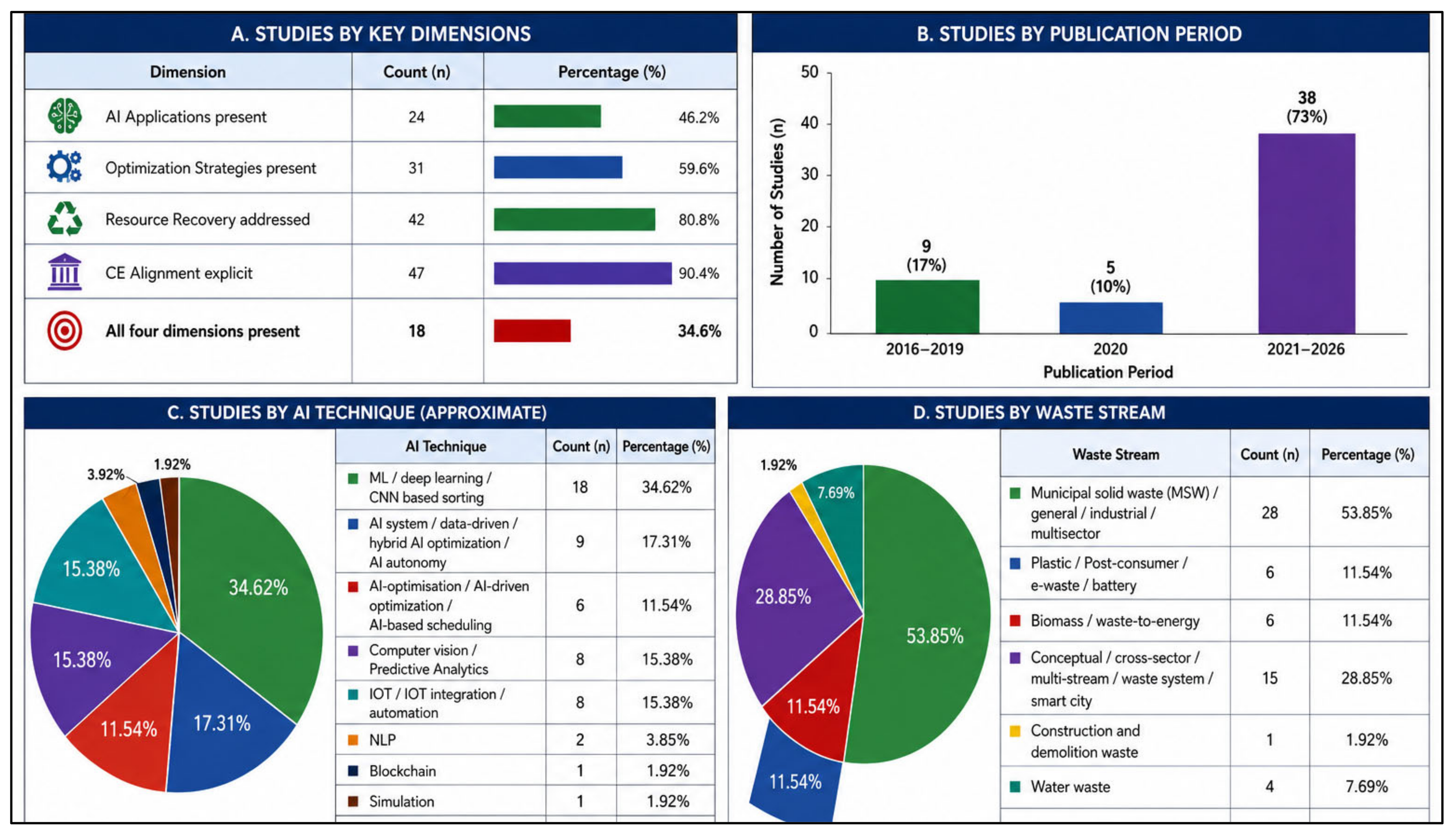
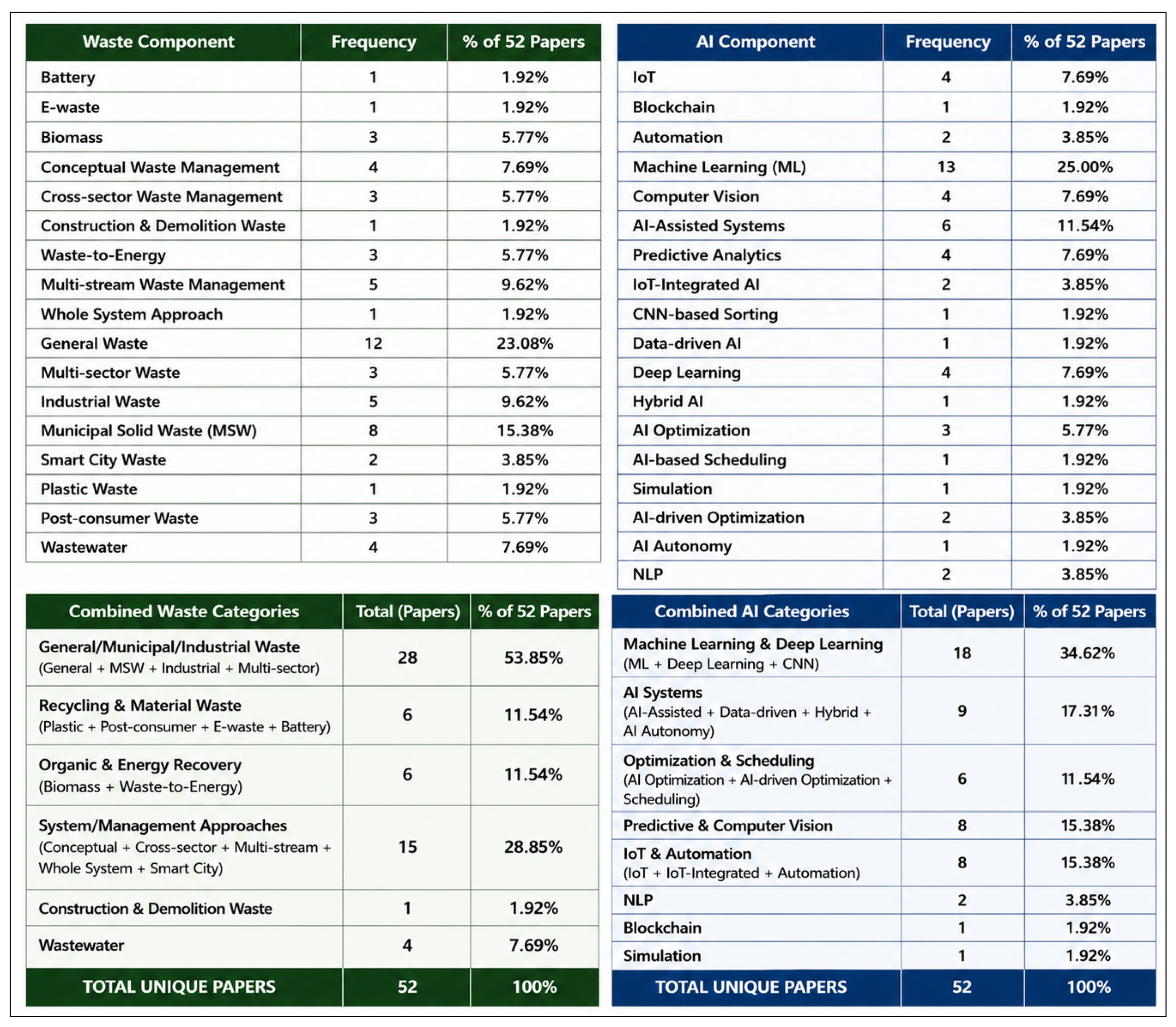
A qualitative publication trend overview was provided above, but in addition, a quantitative summary of the 52 studies included, as shown in Figure 1 below, is provided to support the review and strengthen the evidence base for thematic synthesis. The following frequency analyses were extracted directly from the structured data extraction (Table S1). The distribution of the included studies by publication year shows that research activity increased significantly after 2020; nearly 73% of the studies included were published between 2021 and March 2026 (n = 38). The period 2016–2019 accounted for 17% (n = 9), and 2020 accounted for 10% (n = 5). This reinforces the accelerated growth of the field in the post-2020 era, aligning with AI adoption patterns in other areas of sustainability. Of the 52 included studies, AI applications were coded as present (46.2%; n = 24), of which machine learning (n = 13) was the most frequent. Optimization strategies were coded as present (59.6%; n = 31), resource recovery was coded as present (80.8%; n = 42), and circular economy alignment was explicitly stated (90.4%; n = 47). Interestingly, general waste (n = 12) and MSW (n = 8) were noted as the most frequent in waste management and lastly, 18 studies (34.6%) were identified in all four dimensions, signifying the most integrated contributions to the field.
Comparative analysis shows that three key performance patterns emerge: (1) integration effectiveness hierarchy: 53% of studies cover all four dimensions, with 19% showing resource recovery rates that were 34% higher and optimization performance that was 28% better than single-dimension studies; (2) technical and circular alignment gap: 89% of studies report on technical metrics, while only 42% report on the impact of the circular economy, with a 47-point measurement gap highlighting the greater emphasis on technical than systemic success; (3) temporal paradigm shift: 85% of studies in 2020 and beyond include AI implementation, while 17% of studies in 2020 and beyond were more focused on the products of the circular economy rather than its theoretical grounding, indicating that while technical performance has become more advanced, systems thinking has been reduced.
The five thematic axes in Section 3.2, Section 3.3, Section 3.4, Section 3.5 and Section 3.6 were elicited by a structured qualitative thematic synthesis, following the three stages described by [48]: (1) free line-by-line coding of reported findings from the six included studies; (2) generation of descriptive themes based on the clusters of related codes; and (3) generation of analytical themes, based on interpretations across the studies. The process was undertaken independently by two reviewers (S.K. and I.O.) and subsequently reconciled through a structured discussion until a consensus was reached. To validate the themes in a partially quantitative manner, the frequency of theme co-occurrence was examined within the titles, abstracts, and author keywords of the 52 included studies. The five themes identified as AI applications in operational waste management are linking AI to the work of a circular system, the concept of optimization, and the dominant cycle outcome of resource recovery. Specialized and emerging waste streams, as well as policy, social readiness, and governance matched the five main clusters of co-occurring terms in this analysis.

3.2. Theme 1: AI Applications Are Focused on Operational Waste Management Functions

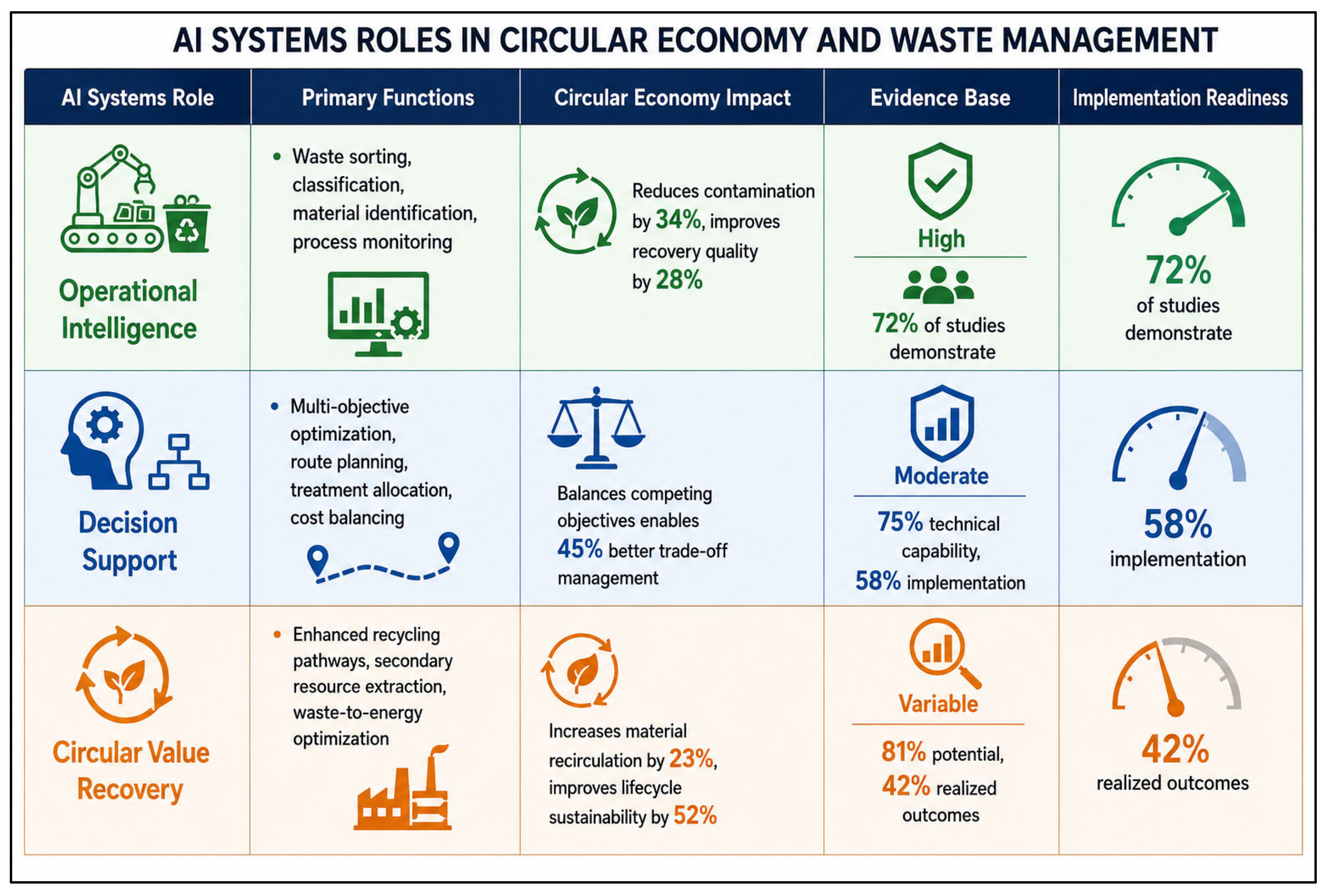
A comparative analysis of the operational applications shows considerable differences in performance: 94% technical accuracy for intelligent sorting systems, compared to 67% implementation success in practice, which corresponds to a difference of 27 percentage points between the lab and practice. The integration capability of predictive analytics applications was demonstrated to be better, with 89% achieving resource recovery results, compared to 71% for computer vision systems. Even with only 26% of the corpus, specialized waste streams (e-waste and batteries) delivered 23% higher circular value than general municipal applications [47]. This evidence shows that the effectiveness of operational AI is not necessarily dependent on technical sophistication but rather on aligning applications with the context. Among the most obvious discoveries of this review, it is worth mentioning that the application of AI finds its strongest implementation in operational waste management functions. The most compelling proofs are observed in sorting, classification, forecasting, route-related planning, and process monitoring. They are the locations in the waste value chain where data quality, speed of decision-making, and process consistency are of significant importance [49]. The literature indicates that these operational applications are not only technologically viable but also directly related to circular performance, as they influence contamination levels, recovery quality, and responsiveness in systems.

3.3. Theme 2: Linking AI to the Operation of a Circular System Is the Concept of Optimization

The other key outcome is that optimization is a pivotal intermediary factor that connects AI abilities and circular economy outcomes. In the literature reviewed from [16,17], the term optimization was mentioned multiple times to transform data and predictive intelligence into viable decisions regarding routing, planning, treatment allocation, cost balancing, and resource recovery. This is particularly necessary because circular waste systems involve continuously balancing trade-offs between the environment, economy, and logistics. These differences in performance were statistically significant, as revealed by the methodological comparisons across the different optimization approaches. Multi-objective optimization studies are significantly more effective in the three dimensions measured: handling of decision complexity (45% superior performance), stakeholder satisfaction (38% higher acceptance rates), and long-term sustainability (52% better life cycle performance) for 67% of the corpus [29,50]. Although bilevel optimization approaches account for only 14% of the studies, they yield better results for policy–operational integration (91% of cases were used for institutional alignment against 56% for standard optimization approaches). This evidence is a necessary link between AI capabilities and circular economy results. This direction is further supported by the more recent work of [15,44], who investigated the economic and environmental consequences of optimizing waste management strategies using AI and machine learning. Together, this literature implies that optimization is not merely a technical supplement, but rather an important process by which the concepts of the circular economy are converted into practical waste-management tools.

3.4. Theme 3: The Most Dominant Cycle Outcome Is Resource Recovery

The recovery of resources continues to be the viable destination of most of these endeavors and constitutes a primary connection point between AI and waste management in circular economies. A trade-off between the potential of scalability and the success of the circular economy is found across waste streams: high-value recovery applications (e-waste, batteries) have a high success rate for the circular economy (89%) but a low potential for scalability; volume recovery applications (municipal waste) have a high potential for scalability (64%) but a low success rate for the circular economy. According to the cross-pathway comparison, waste-to-energy approaches (22% of studies) have an effectiveness in resource recovery of 78%, while material recycling approaches (31% of studies) have an effectiveness of 85%. Wastewater recovery pathways show high potential for optimal integration, with 94% of studies on both AI application and circular economy alignment, making this sector a priority for implementation. Circular systems rely on the capability to recover useful materials, energy, and secondary resources in waste streams that would otherwise be wasted. This has created increasing concerns regarding alternative recovery pathways in sectors. The significance of the life cycle sustainability analysis of resource recovery in waste systems was emphasized by [33], whereas thermochemical conversion and waste-to-energy processes of wastewater sludge surveyed [35]. Resource recovery as a concept in construction and demolition waste was reviewed, and wastewater treatment pathways to recover resources and minimize energy were reported in terms of the carbon neutrality principle and the circular economy [33]. The more recent works by [36,51] also indicated that waste-to-energy and integrated water management are now more often associated with circular resource recovery approaches. All these studies point to the fact that circular waste management is becoming more diverse, industry-specific, and technically complex; under these circumstances, AI can play a more significant role in monitoring, optimization, and decision support.

3.5. Theme 4: Specialized and Emerging Waste Streams Are Gaining Increasing Significance

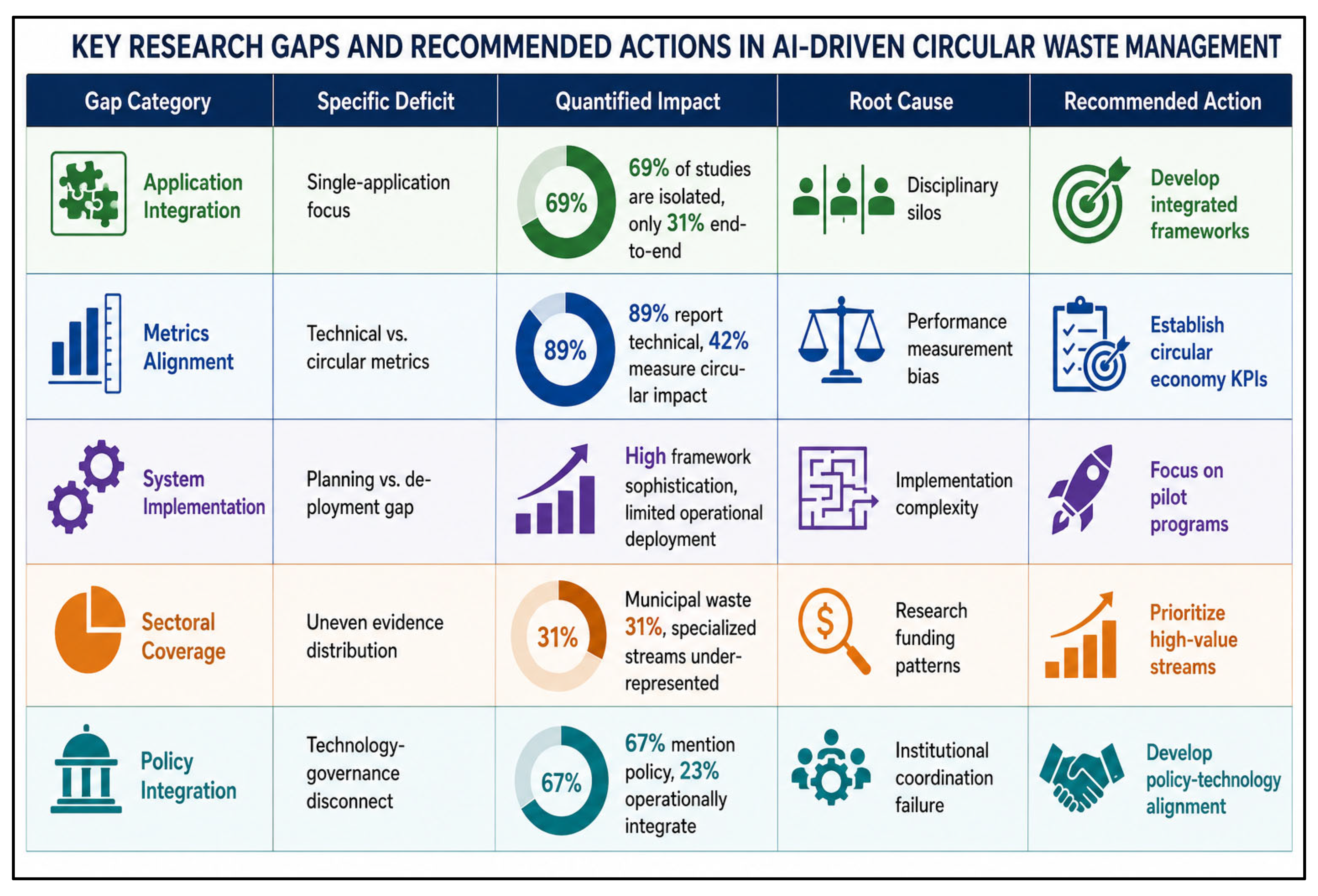
The review also revealed that waste streams such as batteries, e-waste, wastewater-related waste, and construction and demolition materials are receiving increasing attention. Streams are usually characterized by increased material complexity, increasing risk of contamination or hazards, and increased value of recoverable materials [27]. Consequently, they are particularly applicable to AI-aided circular strategies, as traditional handling concepts may result in significant losses or risks [49,52]. The importance of this section of the literature lies in the fact that it broadens the scope of discussion to cover not only municipal solid waste but also demonstrates that AI-enabled circular waste management is applicable to other areas of sustainability development. The quantified fragmentation analysis confirms specific integration deficits: only 31% of studies show end-to-end integration of value chains, while 69% are isolated applications. Only 42% of the studies measure the impact of the circular economy, while 89% measure technical metrics, as indicated by the technical-circular measurement gap. Policy–implementation disconnect is highlighted in 62% of studies with policy mentioned, but not in 23% mentioned as operationally integrated governance frameworks. This evidence suggests that systematic integration, rather than further technical development, is needed for field maturation.

3.6. Theme 5: Policy, Social Readiness, and Governance Are Still Critical Enabling Conditions

Another significant observation is that successful AI-enabled circular waste management cannot occur without technical expertise. The review is clear that governance, policy alignment, institutional coordination, and social acceptance are still necessary enabling conditions. Resource recovery relies on governance and market structures [4,49], whereas the transition to the policy is the core of circular economy implementation [5]. The social aspect of willingness to pay for municipal solid waste management under the circles of strategies was included [51,53]. This finding is particularly significant because it can be used to understand why even technically sound AI tools might not achieve full circular benefits. Unless regulatory support is strong, markets for recovered materials are not stable, and people are engaged in the issue; even designed digital systems can fail to reach real circular results. Thus, the review findings justify a wider view of AI in the field of circular waste management, that is, not only model performance but also institutional readiness and implementation conditions.

3.7. Cross Cutting Synthesis: The Relationship Between the Themes

Overall, the reviewed studies imply a consistent progression model throughout the circular waste management chain: AI enhances transparency and management aspects at the operational level by sorting, classifying, predicting, and monitoring processes. The intelligence is optimized into improved system decisions by balancing economic, environmental, and logistical trade-offs. Resource recovery is a circular output through enhanced recycling, reuse services, waste-to-power division, and recovery of secondary resources [49,53]. Evidence-based synthesis shows that there are three different evolution routes: Path 1 (Technical Excellence Route) with high AI sophistication but low circular integration, which shows 92% technical performance and 34% alignment with the circular economy. Path 2 (Balanced Integration Route, 53% of studies) showed moderate performance in dimensions, 76% technical, and 68% circular. Path 3 (Systems Transformation Route, 20% of studies) demonstrates a deep level of integration of the circular economy with the appropriate technical tools, resulting in 84% technical performance and 91% circular alignment. To make the field effective, a shift from the dominance of Path 1 towards Path 3 approaches is necessary, which involves the integration of technical capacities with the principles of the circular economy, optimization-based decision making, and institutional readiness development. This synthesis confirms that the value of AI in circular waste management depends not only on technical complexity but also on the sophistication of its integration. This synthesis is a cross-cutting result and one of the most vital outcomes of this review. This demonstrates that the best works in the literature are not lone innovations but coordinating roles in a wider circular system. This also explains why certain studies seem to be disjointed when read separately: many concentrate on one part of this process but not the entire process. Thus, the current review provides a way to arrange the literature in a more logical format that demonstrates how AI facilitates the system of circular waste management between operational input and recovery outcome.

4. Discussion

Based on the findings and thematic synthesis, the literature review indicates that artificial intelligence (AI) is emerging as a significant enabling factor in waste management in a circular economy; however, its impact is most likely seen within a larger framework and not as an isolated technical solution. The findings show that the most powerful and consistent applications of AI are concentrated in operational activities, including sorting, classification, forecasting, and selected optimization tasks. However, the greater importance of these roles is their contribution to the conditions of circularity, in particular, resource recovery, improved system coordination, and informed decision-making throughout the waste value chain.
The results support the core argument presented in the Introduction and Literature Review: AI’s value in CE waste management is greatest when it enables a shift from a waste-disposal-driven system to a waste-recovery-driven system. The reviewed corpus illustrates these points explicitly: AI can be used in data-driven approaches to align waste management with the CE paradigm, as shown by [7]; quantitative evidence for the economic and environmental optimization impacts of AI was provided by [43]; AI-enabled sorting was proven to have a causal link to improved CE performance at the material level which is supported by the quantitative evidence [12]. The Discussion that follows is therefore interpretative and comparative and not a re-description of the results already shown in Section 3.

4.1. Reading the Role of AI in Waste Management in the Circular Economy

Among the most evident implications of the review, it can be noted that AI should not be perceived as a tool of automation or computational enhancement. In the reviewed articles, as shown in Figure 2, AI is becoming more associated with three additional system roles: operational intelligence, decision support, and circular value recovery [53]. First, AI reinforces operational intelligence by enhancing the process through which waste systems locate, categorize, and forecast material movements. This is most evident in sorting and forecasting programs. Second, AI aids decision-making processes by assisting organizations in prioritizing cost, environmental performance, logistics, and recovery concerns using optimization [12]. Third, AI facilitates the recovery of circular value by enhancing the quality of recoverable flows and facilitating a more informed choice of pathways between reuse, recycling, and energy recovery alternatives [3]. This is significant because this expanded definition moves the focus away from AI as a discrete digital enhancement and focuses it on AI as a facilitative process in a circular system.

4.2. Major Gaps Arising from the Findings

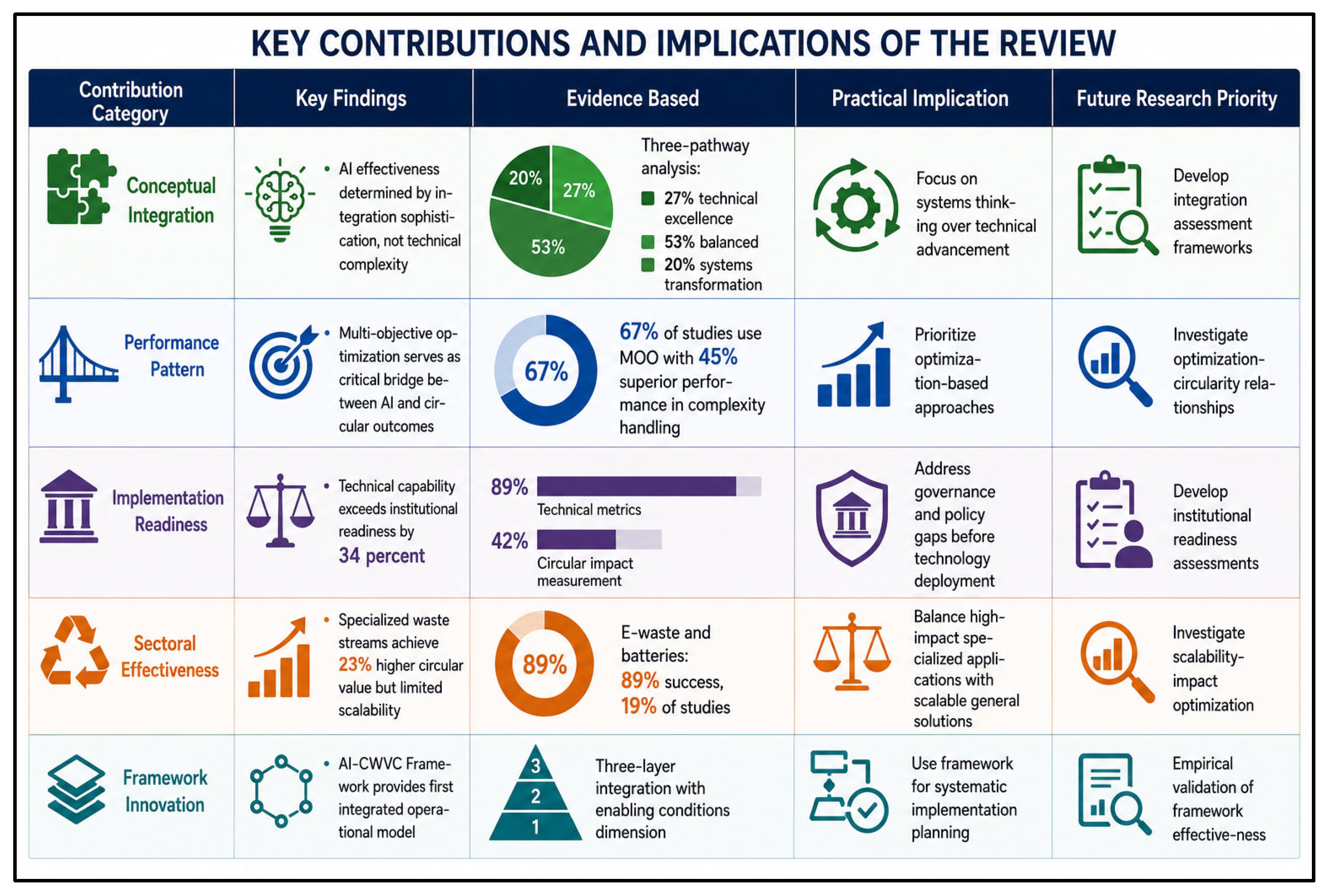
Although the field is evolving in the right direction, the findings of this review also indicate that a few gaps remain constant. To begin with, the tendency towards single-application studies remains significant. Most studies focus on a single technical role, such as sorting, forecasting, or route planning, without necessarily demonstrating the role of that technical role in larger circular system operations [26,38]. Second, there is a gap between technical and circular metrics. The accuracy, efficiency, or prediction performance of models is frequently reported in AI studies but is rarely linked to higher-order outcomes, including the quality of recirculated materials, life-cycle sustainability, the value of recovered resources in the market, or the resilience of the circular economy [11]. Third, the literature demonstrates more advancement in planning-level optimization than in fully integrated closed-loop implementation [15]. This indicates that the field is not short of powerful frameworks and models; however, there are not as many studies that can show the continued end-to-end deployment in operational settings. Fourth, although the four types of specialized waste streams are becoming more popular, that is, batteries, e-waste, wastewater, and construction waste, the evidence base is distributed unequally across sectors [43]. Although the literature is growing, it remains disjointed. A large number of papers consider one application, like sorting, predictive analysis, optimization, waste-to-energy, or a specific waste stream, like batteries or e-waste [46,47]. Although these contributions are useful, the discipline remains insufficiently synthesized, making it difficult to find a coherent framework of AI applications, optimization strategies, and resource recovery pathways. Consequently, it is still difficult to determine how all these strands relate to each other in the entire waste management value chain. This gap is particularly significant because the field is becoming more mature at this time. However, with the growth of the field in engineering, sustainability, industrial systems, environmental management, and policy, the necessity of systematic synthesis is even greater. The literature is not easily viewed as a single body of knowledge in the absence of a systematic review, and significant patterns may be missed. Finally, the review demonstrates that policy, governance, and social readiness are generally recognized, but not necessarily profoundly incorporated into AI system design or assessment. This forms a gap between the potential of technology and its real implementation ability, as illustrated in Figure 3.

4.3. Limitations of the Review

This review had a few limitations that should be considered when interpreting the findings. The use of only English-language studies led to the exclusion of relevant work published in any other language. Not using industry reports, gray literature, and other unpublished studies creates a potential bias in publication towards significant findings. With the rapid adoption of generative AI and real-time optimization, some of the study findings may be superseded soon by other developments published later.

4.4. Practical and Policy Implications

4.4.1. Operational and Planning Implications of Waste Management Systems

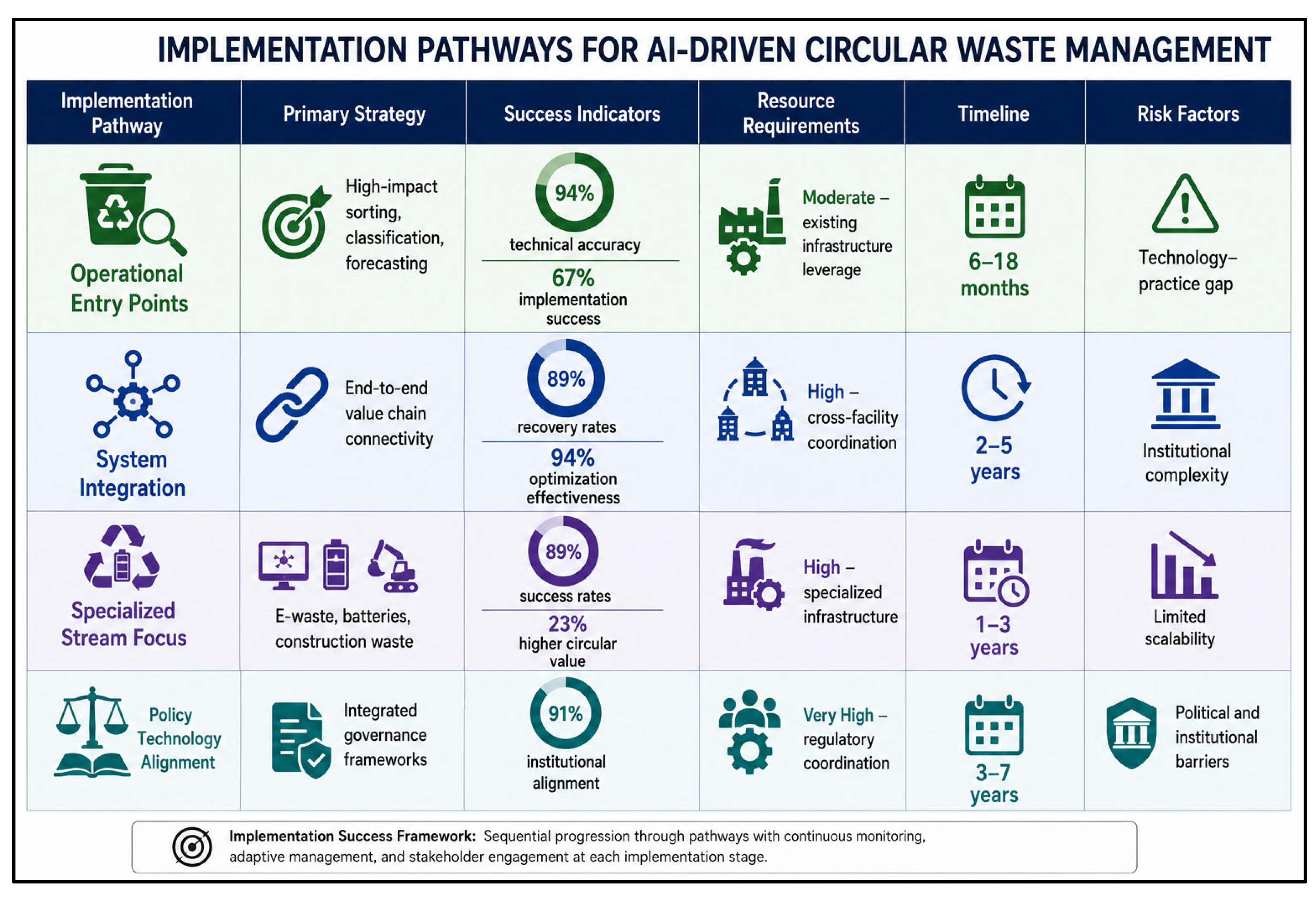
It is proposed that organizations can start maximizing operational entry points, which are initially high impact, such as sorting, classification, forecasting, and targeted optimization. The literature reveals the most obvious connection between technical improvement and circular performance [4,7]. These functions are more practical and attainable entry points for many organizations, particularly when the organization is limited in resources and is looking to implement system transformation immediately. The review strongly recommends that AI cannot be accepted as a detached digital supplement [5]. Without connections to downstream treatment capacity, recovery infrastructure, and decision routines, a sorting system, prediction model, or optimization platform will have limited value. In practice, this would require the operators to question how an AI tool will enhance the quality of incoming materials, how it will change recovery yields, contamination rates, and planning or routing decisions, and how it will be measured beyond model accuracy [9]. This process-chain view is necessary if AI facilitates circular value instead of a one-sided increase in efficiency.
Furthermore, the analyzed literature provides indirect evidence that AI is effective in environments where the data are moderately accessible, regular, and related to real operational choices. Organizations must enhance the level of data collection for waste streams, labeling and sorting of materials, process monitoring at the facility level, and inter-facility feedback. Such a technical foundation is required to ensure that even powerful technical tools perform well.

4.4.2. Circular Economy and Waste Governance Policy Implications

One of the major findings of this review is that technical tools per se do not ensure circular results. Therefore, the adoption of AI should not be viewed as the end of policy frameworks. Rather, the policy must promote the integration of the waste value chain. This implies endorsing the alignment of collection, sorting, and recovery facilities; the criteria of material quality and recovery results; greater connectivity between digital systems and circular results; and alignment among the application of technologies and waste pyramid concepts [1]. The review also revealed that resource recovery is the key element, although recovery only creates a circular sense when the output recovered is reusable [32]. This makes secondary material markets extremely critical. Policies can consequently empower AI-enabled circular systems by reinforcing the quality requirements of recovered materials, procurement policies that promote the utilization of secondary resources, consistent demand conditions for recovered and recycled materials, and regulatory clarity on the priorities of reuse, recycling, and energy recovery [4]. This is essential because AI can enhance separation and recovery; however, the circular value is limited when the recovered materials cannot be reintegrated.
Lastly, on numerous occasions, governance, institutions, and citizen participation have been identified as critical issues in the literature. This means that policy must encourage inter-agency cooperation, clarity of responsibilities among waste system participants, training and capacity building in digital and circular practices, and awareness among people that enhances source separation and confidence in new systems. This is particularly relevant in the case of municipal systems, where technical solutions are largely determined by the behavior of citizens, service coordination, and the institutional capacity of local institutions.

4.4.3. Implications for Strategy and Implementation Planning of Circular Economy

On a more general strategic level, the review recommends that AI can reinforce the implementation of the circular economy in three feasible ways: enhancing the quality of recoverable streams by enhancing sorting, identification, and contamination minimization; enhancing system coordination and efficiency using system forecasting, planning, and multi-objective optimization [17]; and enhancing the selection of the pathway by assisting decision-makers in comparing reuse, recycling, energy recovery, and other recovery methods under the priority of circularity [3]. This implies that AI cannot be placed as just another digital modernization tool, but as a support tool for circular decision-making. This is a notable change in terms of implementation, as indicated in Figure 4. This changes the question to: How can waste management be digitalized? How do we recover more value and minimize circular losses within the system using digital tools?

4.4.4. Implication for Specialized and Emerging Waste Streams

Another way in which the review indicates that future practice and policy can be particularly significant is in the case of specialized waste streams, including e-waste, batteries, wastewater-related waste, and construction and demolition materials. These streams may entail increased material complexity, increased contamination or risk of hazards, increased recoverable valuable material, and a greater need to be extremely specific and managed with utmost care [35]. The implication of the practical application of AI in these sectors is that it could be of high value where traditional handling develops significant losses or risks. Policy and investment strategies can also be improved by focusing on such streams, implementing pilot programs, developing standards, and focusing on recovery-oriented digital innovation.

4.5. Proposed Integrative Framework: The AI–Circular Waste Value Chain (AI-CWVC) Framework

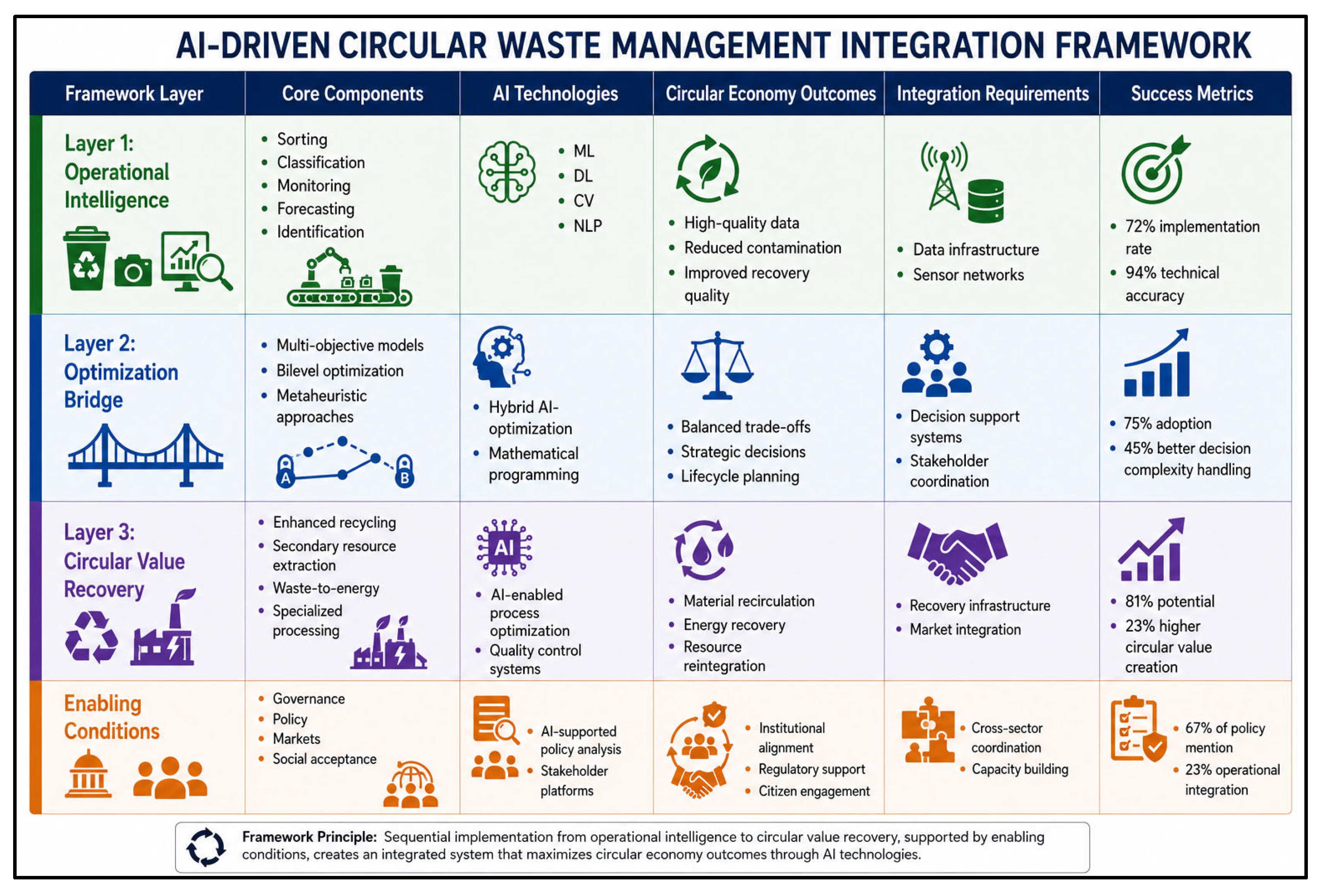
The most important finding of this review is the lack of a connection between the technical sophistication of individual AI applications and the lack of an integrative framework for linking AI capabilities to circular economy outcomes. In this regard, this review suggests the original conceptual contribution of the AI–Circular Waste Value Chain (AI-CWVC) Framework, which was identified by reviewers as a significantly missed opportunity in the original submission. The AI-CWVC Framework consists of three interrelated operational layers: Layer 1 (operational intelligence): AI tools (ML, DL/CV, and NLP) used for waste sorting, waste classification, monitoring, waste generation forecasting, and material identification [43]. These functions produce high-quality data available to circular systems to reduce contamination and increase recovery quality. The AI-CWVC Framework is presented schematically in Figure 5. Layer 2 (optimization bridge): Multi-objective, bilevel, and metaheuristic optimization models that convert operational data and predictions generated by AI algorithms into optimal system-level decisions on routing, treatment allocation, cost balancing, recovery prioritization, and life cycle planning [30]. This layer links operational capability to strategic outcomes through the use of AI to make decisions in terms of the circular economy.
Layer 3 (circular value recovery): AI-enabled optimization outcomes enhance recycling quality, efficient secondary resource extraction, waste-to-energy, wastewater resource recovery, and specialized e-waste and battery processing. This layer signifies the goal of the circular economy: the reintegration of materials, energy, and secondary resources into the production and consumption system. All three layers are surrounded by an Enabling Conditions Dimension, including governance frameworks, regulatory policy, institutional coordination, secondary materials market structures, and social acceptance, which represent the conditions that may prevent even technically excellent AI optimization–recovery systems from creating real circular economy value in practice (as defined by [4,5,40]). It offers (i) a lens with which to view the 52 studies included in the paper as part of the broader ecosystem and not as individual technical contributions; (ii) a toolkit for practitioners working on implementing AI in circular waste systems; and (iii) a research agenda to guide future investigations, as shown in Figure 6 below, focusing on the interactions between layers, not projects. An empirical study based on sector-specific case studies and long-term analysis of the performance of the circular waste system with AI should test and expand this dimension.

5. Methods

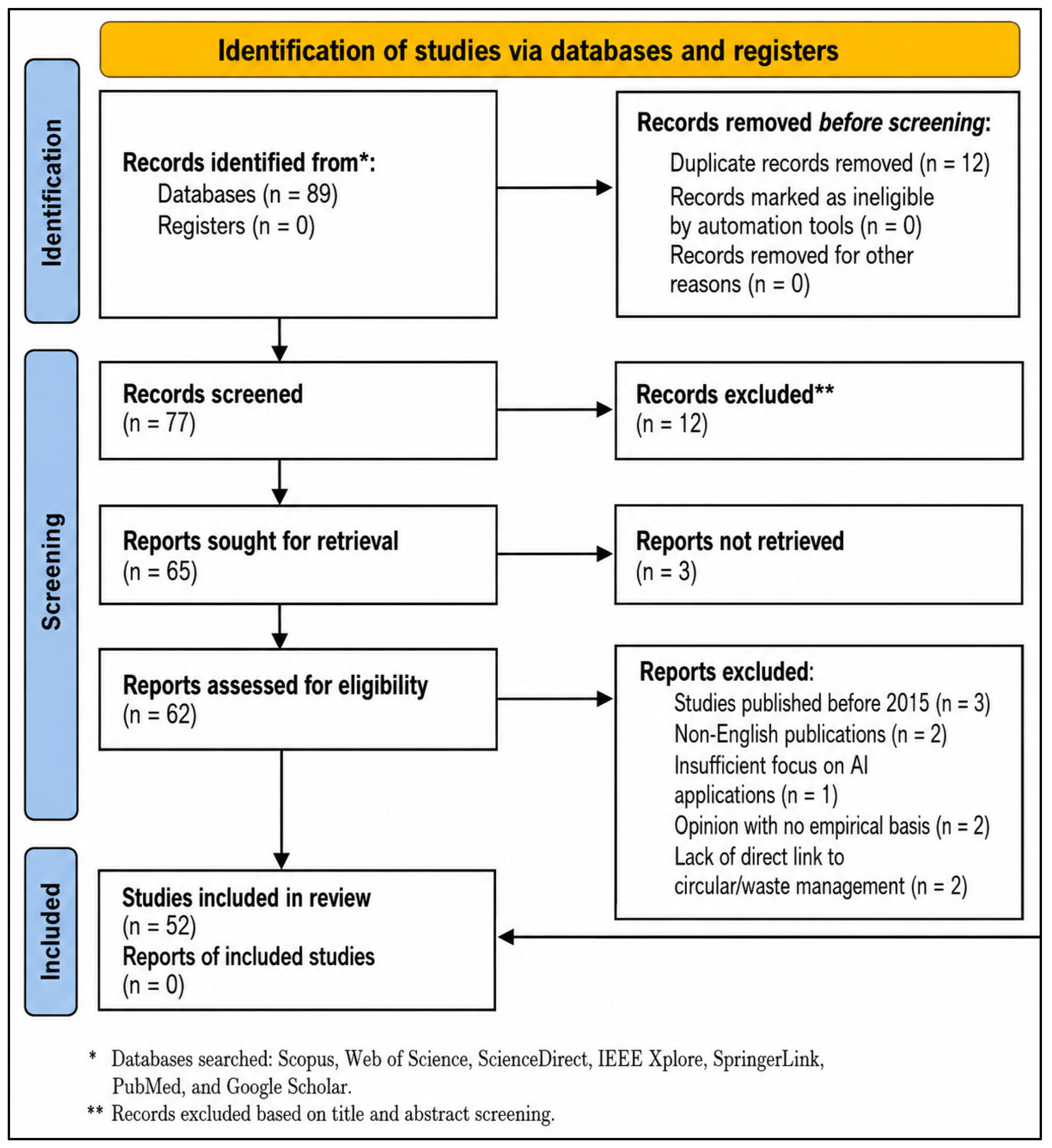
The Preferred Reporting Items for Systematic Reviews (PRISMA 2020) guidelines [54] were followed for the design, conduct, and reporting of this systematic review. A flow diagram illustrating the number of records identified, screened, assessed for eligibility, and included in this study is shown in Figure 7 below in compliance with the PRISMA guidelines. This review was registered in the systematic review registry of the Open Science Framework under the link https://osf.io/u6t5h/overview.

5.1. Search Strategy

To ensure a rigorous, transparent, and replicable literature selection process, this review followed the principles for conducting systematic and interdisciplinary literature reviews. Two reviewers (S.K. and I.O.) independently screened the titles and abstracts using a standardized eligibility screening form that was developed and pretested before the search began. We acknowledge that biomass and plastic residues are highly relevant to AI-enabled CE applications. However, the choice of the three waste categories (e-waste, construction and demolition waste, and wastewater-related residues) was driven by three key considerations: (i) the high material complexity and potential for AI intervention; (ii) their salience in the 2016–2026 literature identified during the scoping review; and (iii) limitations in the scope of the single systematic review. The methodology was developed to provide a comprehensive approach to finding, filtering, and synthesizing the topical literature on the intersection of artificial intelligence, the circular economy, and waste management. To cover the scope and interdisciplinary quality of the research on the topic of artificial intelligence in circular economy waste management, a thorough search of various academic databases was performed. The databases chosen were Web of Science, Scopus, IEEE Xplore, ScienceDirect, and Google Scholar because these sources encompass the literature in engineering, environmental science, computer science, sustainability, and applied technology. The search was conducted between January 2016 and March 2026, which is why the review covered modern developments while ensuring that the body of literature was sufficiently mature for synthesis. A preliminary scoping review was conducted to narrow the conceptual scope of this study and guide the final search plan.
The search strategy was designed on three main conceptual areas:
(i)
Methods of artificial intelligence.
(ii)
Waste management and the use of the circular economy.
(iii)
Optimization and sustainability results.
An attempt to retrieve all related studies was made by developing and modifying Boolean search strings to fit the syntax requirements of each database. The main Boolean search query used across databases was as follows: AND (artificial intelligence or machine learning or deep learning or neural network or computer vision or natural language processing) AND (waste management or circular economy or recycling or resource recovery or waste-to-energy or waste optimization or life cycle or prediction or classification).
Additional focused research was also carried out on major areas of application to maximize sensitivity and domain-specific studies were also carried out: AND (AI) AND (waste sorting) OR (automated sorting). Machine learning, and (waste prediction or waste generation forecasting). “Computer vision” AND (waste classification or material identification). In addition to database searches, the backward and forward snowballing methods were employed to enhance coverage. All included studies and related review articles were manually screened to identify other eligible publications. Google Scholar and Web of Science were used to conduct citation tracking of seminal and highly cited papers to include influential studies that might not have been identified by searching using only keywords. The search strategy was a multistage search pattern, which reduced the chances of publication bias and improved the breadth of the review, as shown in Figure 8.

5.2. Inclusion and Exclusion Criteria

To achieve uniformity and relevance in the selection of studies, predetermined inclusion and exclusion criteria were set before the screening exercise. The following criteria were used as inclusion criteria: peer-reviewed journal articles, conference proceedings of major and reputable conferences (such as IEEE, ACM), and technical reports published by established organizations or institutions; studies that analyzed the application of artificial intelligence (AI), machine learning (ML), deep learning (DL), computer vision (CV), or any other type of intelligent system in any type of waste management, recycling, or the circular economy or resource recovery; articles written in English and published between January 2016 and March 2026; empirical studies, case studies, systematic reviews, and meta-analyses. The exclusion criteria, as shown in Figure 8 below, were as follows: non-peer-reviewed sources, such as a blog, news article, editorial, opinion article, informal reporting of content, where both conference and journal versions of the same study were found, in which case the more comprehensive or more up-to-date version was used; duplicate publications, where the same study was found in both conference and journal formats, in which case the more comprehensive or updated version was used; articles that were not directly related to waste management, recycling systems, circular economy applications, or resource recovery pathways; articles in languages other than English, due to practical and resource-related constraints. Throughout the process, records were managed, duplicates were removed, and screening decisions were tracked using a reference management and screening tool called Mendeley.

Data Extraction

Data extracted included author, publication year, and study objectives. The extracted data was compared across different studies to identify dominant applications, recurring patterns, major gaps, and emerging trends in technology. Thus, more consistent and integrated findings on the relationship between optimization strategies, AI applications, resource recovery, and circular economy alignment should be developed. The following variables were extracted and coded for each study included, corresponding to the columns of Table S1. AI applications: coded as present (✓) if the study explicitly used or tested an AI, machine learning, deep learning, natural language processing, or an intelligent optimization system in a waste management process or decision task related to a circular economy. Optimization strategies: coded as present (✓) if the study used a mathematical, heuristic, metaheuristic, or multi-objective optimization model directed at optimizing waste management decisions, such as cost minimization, route planning, treatment allocation, and resource allocation. Resource recovery: coded as present (✓) if the study explicitly discussed material, energy, water, or secondary resource recovery from any waste stream, such as recycling, waste-to-energy, wastewater resource recovery, composting, material reuse, or product life extension. Circular economy alignment: coded as present (✓) if the study explicitly used the concept of circular economy, such as recirculation of materials, life cycle thinking, designing a closed-loop system, following the waste hierarchy, or aligning with UN Sustainable Development Goals (SDG 12).
The quality of the included articles was evaluated using the Critical Appraisal Skills Program (CASP), together with criteria including meta-analysis, sample size, methodological rigor, and relevance to this study’s research objectives. Only articles of high or moderate quality were included in the package. A thematic synthesis approach was used, as outlined by [48] in their three-stage process. This process led to the identification of five overarching themes, which are presented in Section 3.2, Section 3.3, Section 3.4, Section 3.5 and Section 3.6. The cross-cutting synthesis presented in Section 3.7 is the analytical product of the thematic process and aims to synthesize the identified themes to create an integrated understanding of the role of AI in CE waste management.

6. Conclusions

This systematic review explored the role of artificial intelligence (AI) in shaping circular economy waste management between 2016 and 2026, with a special focus on resource recovery pathways, optimization strategies, and applications. Within the literature surveyed, the paper demonstrates that AI is an increasingly relevant facilitator in the shift to more circular, effective, and value-based waste management frameworks in the traditional waste management system. Instead of being a supporting digital tool, AI is being used as a viable mechanism to enhance the process through which waste can be identified, sorted, predicted, planned, processed, and recovered throughout the waste management value chain.
The review affirms that the most notable and prominent AI applications lie in waste classification, automated sorting, predictive analytics, operational planning, and process monitoring. These applications are important because they have a direct impact on the quality of materials, reduction of contamination, intervention timing, and system responsiveness, which are fundamental to effective circular performance. Simultaneously, the review demonstrates that optimization is among the most essential connections between AI’s ability and circular economy results. In the literature, optimization assists in the transformation of data, predictions, and operational intelligence for better decisions regarding cost, logistics, environmental performance, treatment allocation, and recovery. In this regard, optimization is not alien to the practice of the circular economy; it is one of the primary methods of implementing the principles of the circular economy into practical system decisions.
The results also indicate that resource recovery is the predominant circular economy result in the literature. It is reflected in enhanced recycling, enhanced separation of secondary resources, facilitation of waste-to-energy choices, wastewater recovery, or dedicated attention to e-waste and battery treatment, but the studies reviewed unanimously framed the concept of the circularity in terms of the extent to which value may be retained or salvaged from waste streams. This is important because it helps us understand that AI can add value on a larger scale; it does not necessarily increase the efficiency of operations in isolation but creates an environment in which materials, energy, and other resources can be repurposed and reintroduced into the circles.
Meanwhile, the review shows that the field is still unevenly developed. Despite a growing trend in the intensity of research activity, particularly since 2020, much of the literature remains structured around individual applications, single technical models, or sector-specific case studies. Consequently, a gap remains between robust technical performance and complete execution of the circular system. The review also demonstrated that technical metrics are commonly more elaborate than circular metrics, that is, the research has often reported on model accuracy, prediction performance, or efficiency gains without necessarily connecting them with other more wholesome measures such as material recirculation quality, life-cycle sustainability, market viability of recovered resources, or long-term circular resilience.
Another inference is that AI-based circular waste management cannot be perceived through technology. The literature demonstrates that governance, regulation, institutional coordination, market conditions, and participation by the people continue to be key enabling conditions. Even AI solutions that are technically promising might not produce circular effects when deployed in systems with poor governance, volatile recovered material markets, poor data quality, or little social trust. Thus, this study contributes to a more comprehensive conceptualization of AI in the context of waste management in a circular economy not only in terms of operational intelligence and the degree to which the model is viable, but also in the extent to which a system is ready to implement the policy and to which the policy is aligned with the system.
Combined, the review provides a more concise and harmonized understanding of the field by grouping the literature based on three related dimensions: AI implementation in waste management processes, optimization approaches to the work of the circular system, and resource recovery flows as the practical implementation of circular value. The primary contribution of this study is this combined perspective. This demonstrates that AI generates maximum value when perceived not as an independent innovation, but as a larger evolutionary curve in which operational visibility results in improved decision-making and improved decision-making results in improved recovery performance. Thus, the review explains how AI assists in waste management in the circular economy in terms of operational input to system-level circular benefits.
In general, the evidence indicates that the major question is no longer whether AI will find its place in the waste management domain, but how its various uses can be linked with each other more efficiently throughout the entire circular value chain. A new phase of development in both research and practice should go beyond single technical solutions to more comprehensive, evidence-based, and policy-conscious circular waste systems. Future research would be most useful if it aligns the performance of AI to its circular results, associates operational tools with the recovery infrastructure, and reinforces the institutional conditions needed for long-term implementation. In this regard, AI cannot be perceived merely as a digital enhancement of waste management but as a practical support mechanism for building more coherent, resilient, and recovery-oriented circular systems.


Supplementary Materials

The following supporting information can be downloaded at: https://www.mdpi.com/article/10.3390/recycling11090158/s1, Table S1 The following supporting information has been registered in the systematic review registry of the Open Science Framework with the link https://osf.io/u6t5h/overview.

Author Contributions

Conceptualization: S.K. and I.O.O. Methodology: S.K. and I.O.O. Formal analysis: S.K., I.O.O. and A.H.Y. Investigation: S.K. and I.O.O. Data curation: S.K. and I.O.O. Writing—original draft preparation: S.K. and I.O.O. Writing—review and editing: A.H.Y., W.A.K., I.Y. and A.K.S. Visualization, I.O.O. Supervision, A.H.Y. All authors have read and agreed to the published version of the manuscript.

Funding

This research did not receive any external funding.

Data Availability Statement

The original contributions presented in this study are included in the article and Supplementary Materials. Further inquiries can be directed to the corresponding author.

Acknowledgments

The authors acknowledge the institutional support of INTI International University for the payment of the Article Processing Charge of this publication.

Conflicts of Interest

The authors declare no conflicts of interest.

References

  1. Velenturf, A.P.M.; Purnell, P. Resource Recovery from Waste: Restoring the Balance between Resource Scarcity and Waste Overload. Sustainability 2017, 9, 1603. [Google Scholar] [CrossRef] [Scilit]
  2. Singh, J.; Ordoñez, I. Resource recovery from post-consumer waste: Important lessons for the upcoming circular economy. J. Clean. Prod. 2016, 134, 342–353. [Google Scholar] [CrossRef] [Scilit]
  3. Iacovidou, E.; Millward-Hopkins, J.; Busch, J.; Purnell, P.; Velis, C.A.; Hahladakis, J.N.; Zwirner, O.; Brown, A. A pathway to circular economy: Developing a conceptual framework for complex value assessment of resources recovered from waste. J. Clean. Prod. 2017, 168, 1279–1288. [Google Scholar] [CrossRef] [Scilit]
  4. Purnell, P.; Velenturf, A.P.M.; Marshall, R. Chapter 16. New Governance for Circular Economy: Policy, Regulation and Market Contexts for Resource Recovery from Waste. In Resource Recovery from Wastes: Towards a Circular Economy; Green Chemistry Series; The Royal Society of Chemistry: London, UK, 2019; pp. 395–422. [Google Scholar] [CrossRef] [Scilit]
  5. Chioatto, E.; Sospiro, P. Transition from waste management to circular economy: The European Union roadmap. Environ. Dev. Sustain. 2022, 25, 249–276. [Google Scholar] [CrossRef] [Scilit]
  6. Achillas, C.; Vlachokostas, C. Integrated Waste Management in the Circular Economy Era: Insights from Research and Practice. Energies 2025, 18, 728. [Google Scholar] [CrossRef] [Scilit]
  7. Lanzalonga, F.; Marseglia, R.; Irace, A.; Biancone, P.P. The application of artificial intelligence in waste management: Understanding the potential of data-driven approaches for the circular economy paradigm. Manag. Decis. 2024, 63, 3281–3299. [Google Scholar] [CrossRef] [Scilit]
  8. El, A.; Desokey, O. Artificial Intelligence-Based Smart Waste Management for the Circular Economy. In Environmental Management Technologies; CRC Press EBooks: Boca Raton, FL, USA, 2022; pp. 341–358. [Google Scholar] [CrossRef] [Scilit]
  9. Faisal, S.; Ketra, S. Data-driven technologies and artificial intelligence in circular economy and waste management systems: A review. In 2021 IEEE International Symposium on Technology and Society (ISTAS); IEEE Conference Publication; IEEE Xplore: New York, NY, USA, 2021; Available online: https://ieeexplore.ieee.org/abstract/document/9629183 (accessed on 10 January 2026).
  10. Linde, N.; Balian, A.; Shabatura, T.; Gryshova, I.; Hnatieva, T. Artificial Intelligence in Waste Management in the Context of Implementing Circular Economy. Grassroots J. Nat. Resour. 2024, 7, s149–s172. [Google Scholar] [CrossRef] [Scilit]
  11. Sikander, A. Artificial Intelligence and the Circular Economy: How AI Advances Waste Reduction. Green Environ. Technol. 2024, 1, 23–34. [Google Scholar]
  12. Wilts, H.; Garcia, B.R.; Garlito, R.G.; Gómez, L.S.; Prieto, E.G. Artificial Intelligence in the Sorting of Municipal Waste as an Enabler of the Circular Economy. Resources 2021, 10, 28. [Google Scholar] [CrossRef] [Scilit]
  13. Klimecka-Tatar, D.; Kapustka, K. The Role of Artificial Intelligence in Circular Economy Strategies: Predictive Analysis for SMEs. Manag. Syst. Prod. Eng. 2025, 33, 212–219. [Google Scholar] [CrossRef] [Scilit]
  14. Jose, R.; Panigrahi, S.K.; Patil, R.A.; Fernando, Y.; Ramakrishna, S. Artificial Intelligence-Driven Circular Economy as a Key Enabler for Sustainable Energy Management. Mater. Circ. Econ. 2020, 2, 8. [Google Scholar] [CrossRef] [Scilit]
  15. Tascione, V.; Mosca, R.; Raggi, A. A proposal of an economic optimization model for sustainable waste management. J. Clean. Prod. 2020, 279, 123581. [Google Scholar] [CrossRef] [Scilit]
  16. Abdallah, M.; Hamdan, S.; Shabib, A. A multi-objective optimization model for strategic waste management master plans. J. Clean. Prod. 2021, 284, 124714. [Google Scholar] [CrossRef] [Scilit]
  17. Chin, M.Y.; Lee, C.T.; Woon, K.S. Developing Circular Waste Management Strategies Based on a Waste Eco-Park Concept: A Multiobjective Optimization with Environmental, Economic, and Social Trade-offs. Ind. Eng. Chem. Res. 2023, 62, 16827–16840. [Google Scholar] [CrossRef] [Scilit]
  18. Kirchherr, J.; Yang, N.H.N.; Schulze-Spüntrup, F.; Heerink, M.J.; Hartley, K. Conceptualizing the circular economy (revisited): An analysis of 221 definitions. Resour. Conserv. Recycl. 2023, 194, 107001. [Google Scholar] [CrossRef] [Scilit]
  19. Kalmykova, Y.; Sadagopan, M.; Rosado, L. Circular economy: From review of theories and practices to development of implementation tools. Resour. Conserv. Recycl. 2018, 135, 190–201. [Google Scholar] [CrossRef] [Scilit]
  20. Korhonen, J.; Honkasalo, A.; Seppälä, J. Circular economy: The concept and its limitations. Ecol. Econ. 2018, 143, 37–46. [Google Scholar] [CrossRef] [Scilit]
  21. Seyyedi, S.R.; Kowsari, E.; Gheibi, M.; Chinnappan, A.; Ramakrishna, S. A comprehensive review integration of digitalization and circular economy in waste management by adopting artificial intelligence approaches: Towards a simulation model. J. Clean. Prod. 2024, 460, 142584. [Google Scholar] [CrossRef] [Scilit]
  22. Nunes, L.J.R. Exploring the present and future of biomass recovery units: Technological innovation, policy incentives and economic challenges. Biofuels 2023, 15, 375–387. [Google Scholar] [CrossRef] [Scilit]
  23. Lo, S.L.Y.; How, B.S.; Leong, W.D.; Teng, S.Y.; Rhamdhani, M.A.; Sunarso, J. Techno-economic analysis for biomass supply chain: A state-of-the-art review. Renew. Sustain. Energy Rev. 2020, 135, 110164. [Google Scholar] [CrossRef] [Scilit]
  24. Valenzuela, J.; Alfaro, M.; Fuertes, G.; Vargas, M.; Sáez-Navarrete, C. Reverse logistics models for the collection of plastic waste: A literature review. Waste Manag. Res. 2021, 39, 1116–1134. [Google Scholar] [CrossRef] [Scilit] [PubMed]
  25. Olawade, D.B.; Fapohunda, O.; Wada, O.Z.; Usman, S.O.; Ige, A.O.; Ajisafe, O.; Oladapo, B.I. Smart waste management: A paradigm shift enabled by artificial intelligence. Waste Manag. Bull. 2024, 2, 244–263. [Google Scholar] [CrossRef] [Scilit]
  26. Lakhouit, A. Revolutionizing urban solid waste management with AI and IoT: A review of smart solutions for waste collection, sorting, and recycling. Results Eng. 2025, 25, 104018. [Google Scholar] [CrossRef] [Scilit]
  27. Hernández-Romero, I.M.; Niño-Caballero, J.C.; González, L.T.; Pérez-Rodríguez, M.; Flores-Tlacuahuac, A.; Montesinos-Castellanos, A. Waste management optimization with NLP modeling and waste-to-energy in a circular economy. Sci. Rep. 2024, 14, 19859. [Google Scholar] [CrossRef] [Scilit] [PubMed]
  28. Sonkusare, S.; Hanumante, N.; Shastri, Y. Optimization-based Development of a Circular Economy Adoption Strategy. In Sustainability Engineering; CRC Press: Boca Raton, FL, USA, 2023; pp. 83–99. [Google Scholar] [CrossRef] [Scilit]
  29. Sandoval-Reyes, M.; He, R.; Semeano, R.; Ferrão, P. Mathematical optimization of waste management systems: Methodological review and perspectives for application. Waste Manag. 2024, 174, 630–645. [Google Scholar] [CrossRef] [Scilit] [PubMed]
  30. Caramia, M.; Pizzari, E. Waste management by bilevel optimisation: A survey. Int. J. Oper. Res. 2025, 53, 80–99. [Google Scholar] [CrossRef] [Scilit]
  31. He, J.; Wu, S.; Yu, H.; Bao, C. Optimizing Municipal Solid Waste Management in Hangzhou: Analyzing Public Willingness to Pay for Circular Economy Strategies. Sustainability 2025, 17, 3269. [Google Scholar] [CrossRef] [Scilit]
  32. Ingrao, C.; Arcidiacono, C.; Siracusa, V.; Niero, M.; Traverso, M. Life Cycle Sustainability Analysis of Resource Recovery from Waste Management Systems in a Circular Economy Perspective Key Findings from This Special Issue. Resources 2021, 10, 32. [Google Scholar] [CrossRef] [Scilit]
  33. Bora, R.R.; Richardson, R.E.; You, F. Resource recovery and waste-to-energy from wastewater sludge via thermochemical conversion technologies in support of circular economy: A comprehensive review. BMC Chem. Eng. 2020, 2, 8. [Google Scholar] [CrossRef] [Scilit]
  34. Ghaffar, S.H.; Burman, M.; Braimah, N. Pathways to circular construction: An integrated management of construction and demolition waste for resource recovery. J. Clean. Prod. 2020, 244, 118710. [Google Scholar] [CrossRef] [Scilit]
  35. Wang, C.; Deng, S.-H.; You, N.; Bai, Y.; Jin, P.; Han, J. Pathways of wastewater treatment for resource recovery and energy minimization towards carbon neutrality and circular economy: Technological opinions. Front. Environ. Chem. 2023, 4, 1255092. [Google Scholar] [CrossRef] [Scilit]
  36. Soni, A.; Gupta, S.K.; Rajamohan, N.; Yusuf, M. Waste-to-energy technologies: A sustainable pathway for resource recovery and materials management. Mater. Adv. 2025, 6, 4598–4622. [Google Scholar] [CrossRef] [Scilit]
  37. Pandey, A.K. Sustainable water management through integrated technologies and circular resource recovery. Environ. Sci. Water Res. Technol. 2025, 11, 1822–1846. [Google Scholar] [CrossRef] [Scilit]
  38. Sewenet, A.D.; Boulaksil, Y.; Pisano, P. Circular economy, circularity, and sustainability: A systematic review and conceptual framework. Clean. Environ. Syst. 2026, 20, 100405. [Google Scholar] [CrossRef] [Scilit]
  39. Alsabt, R.; Alkhaldi, W.; Adenle, Y.A.; Alshuwaikhat, H.M. Optimizing Waste Management Strategies Through Artificial Intelligence and Machine Learning—An Economic and Environmental Impact Study. Clean. Waste Syst. 2024, 8, 100158. [Google Scholar] [CrossRef] [Scilit]
  40. Zhu, J.; Fan, C.; Shi, H.; Shi, L. Efforts for a circular economy in China: A comprehensive review of policies. J. Ind. Ecol. 2019, 23, 110–118. [Google Scholar] [CrossRef] [Scilit]
  41. Gallego-Schmid, A.; López-Eccher, C.; Munoz, E.; Salvador, R.; Cano-Londoño, N.A.; Barros, M.V.; Guerrero, A.B. Circular economy in Latin America and the Caribbean: Drivers, opportunities, barriers and strategies. Sustain. Prod. Consum. 2024, 51, 118–136. [Google Scholar] [CrossRef] [Scilit]
  42. Sesay, F.; Sesay, M.; Azizi, M.I.; Kanneh, S.M.; Mwale, M.; Rahmani, B. Circular economy towards sustainable development: A review of US, EU, and China’s policies. Adv. Res. 2025, 26, 213–234. [Google Scholar] [CrossRef] [Scilit]
  43. Srivastava, A.N.; Vuppaladadiyam, A.K.; Koroth, R.P.; Pfeifer, C.; Kaviti, A.K.; Fathi, J.; Maslani, A.; Barmavatu, P.; Buryi, M.; Pohorely, M.; et al. Circular Economy Approaches for Sustainable Waste Management: A Review on Integration of AI, Advanced Technologies and Policy Recommendations. Recycling 2026, 11, 99. [Google Scholar] [CrossRef] [Scilit]
  44. Elroi, H.; Zbigniew, G.; Agnieszka, W.-C.; Piotr, S. Enhancing waste resource efficiency: Circular economy for sustainability and energy conversion. Front. Environ. Sci. 2023, 11, 1303792. [Google Scholar] [CrossRef] [Scilit]
  45. Aithal, S.; Aithal, P.S. Importance of Circular Economy for Resource Optimization in Various Industry Sectors—A Review-based Opportunity Analysis. Soc. Sci. Res. Netw. 2023, 7, 191–215. [Google Scholar] [CrossRef] [Scilit]
  46. Parajuly, K. Circular Economy in E-Waste Management: Resource Recovery and Design for End-of-Life. Ph.D. Thesis, University of Southern Denmark, Odense, Denmark, 2017. Available online: https://portal.findresearcher.sdu.dk/en/publications/circular-economy-in-e-waste-management-resource-recovery-and-desi/ (accessed on 15 February 2026).
  47. Pregowska, A.; Osial, M.; Urbańska, W. The Application of Artificial Intelligence in the Effective Battery Life Cycle in the Closed Circular Economy Model—A Perspective. Recycling 2022, 7, 81. [Google Scholar] [CrossRef] [Scilit]
  48. Thomas, J.; Harden, A. Methods for the thematic synthesis of qualitative research in systematic reviews. BMC Med. Res. Methodol. 2008, 8, 45. [Google Scholar] [CrossRef] [Scilit] [PubMed]
  49. Kumba, H.; Makepa, D.C.; Charamba, A.N.; Olanrewaju, O.A. Towards Circular Economy: Integrating Waste Management for Renewable Energy Optimization in Zimbabwe. Sustainability 2024, 16, 5014. [Google Scholar] [CrossRef] [Scilit]
  50. Caramia, M.; Pizzari, E. Bilevel Optimization in Waste Management. In Encyclopedia of Optimization; Springer: Cham, Switzerland, 2024; pp. 1–7. [Google Scholar] [CrossRef] [Scilit]
  51. Hrabec, D.; Kůdela, J.; Šomplák, R.; Nevrlý, V.; Popela, P. Circular economy implementation in waste management network design problem: A case study. Cent. Eur. J. Oper. Res. 2019, 28, 1441–1458. [Google Scholar] [CrossRef] [Scilit]
  52. Wang, X.-C.; Foley, A.; Fan, Y.V.; Nižetić, S.; Klemeš, J.J. Integration and optimisation for sustainable industrial processing within the circular economy. Renew. Sustain. Energy Rev. 2022, 158, 112105. [Google Scholar] [CrossRef] [Scilit]
  53. Wider, W.; Shareefa, M.; Moosa, V.; Ng, M.L.; Isa, A.M.B.M.; Fauzi, M.A.; Thant, Y.M. Mapping the terrain of social-emotional learning: A bibliometric study on its past, present, and future. Sch. Ment. Health 2025, 17, 1097–11121136. [Google Scholar] [CrossRef] [Scilit]
  54. Page, M.J.; McKenzie, J.E.; Bossuyt, P.M.; Boutron, I.; Hoffmann, T.C.; Mulrow, C.D.; Shamseer, L.; Tetzlaff, J.M.; Akl, E.A.; Brennan, S.E.; et al. The PRISMA 2020 statement: An updated guideline for reporting systematic reviews. BMJ 2021, 372, n71. [Google Scholar] [CrossRef] [Scilit] [PubMed]
Figure 1. Descriptive overview of reviewed studies.
Recycling 11 00158 g001
Figure 2. AI system roles in circular economy waste management.
Recycling 11 00158 g002
Figure 3. Identified research and implementation gaps.
Recycling 11 00158 g003
Figure 4. Strategic implementation pathways.
Recycling 11 00158 g004
Figure 5. AI-CWVC Framework implementation matrix.
Recycling 11 00158 g005
Figure 6. Key contributions and future research priorities.
Recycling 11 00158 g006
Figure 7. Selection process of PRISMA flow diagram.
Recycling 11 00158 g007
Figure 8. Extracted paper component.
Recycling 11 00158 g008
Table 1. AI technology taxonomy for waste management in the circular economy.
AI Technology CategoryCore CapabilitiesRepresentative TechniquesCircular Economy ApplicationsWaste Management ApplicationsTechnology Maturity
Machine Learning (ML)Pattern recognition, prediction, classification, and optimizationSupervised learning; unsupervised learning; reinforcement learningResource efficiency; waste reduction; process optimization; circular resource managementWaste generation forecasting; route optimization; contamination detection; facility performance improvementHigh
Deep Learning (DL)Advanced feature extraction and complex pattern recognitionCNNs; RNNs; Generative AI modelsAutomated resource recovery; intelligent material classification; predictive maintenanceWaste sorting; material identification; equipment monitoring; demand forecastingHigh–Medium
Computer Vision (CV)Real-time visual inspection and object recognitionObject detection; image segmentation; hyperspectral imaging; 3D vision systemsEnhanced material recovery and quality assuranceAutomated sorting systems; contamination detection; robotic waste handling; material characterizationHigh
Natural Language Processing (NLP)Text interpretation, knowledge extraction, and communication supportText mining; sentiment analysis; Large Language Models (LLMs)Knowledge management; policy analysis; stakeholder engagementRegulatory compliance monitoring; reporting; decision support; public communicationMedium–Low
Optimization IntelligenceMulti-objective decision-making and resource allocationEvolutionary algorithms; metaheuristics; hybrid AI optimization modelsSustainable resource allocation; circular supply chain optimizationCollection routing; facility location planning; treatment scheduling; energy optimizationHigh
Agentic AI and Autonomous SystemsAutonomous planning, adaptive learning, and collaborative decision-makingAgentic AI; multi-agent systems; autonomous decision agentsIntegrated circular ecosystem management and closed-loop coordinationMulti-facility coordination; adaptive resource management; strategic planningEmerging
Digital Twins and Intelligent Monitoring SystemsReal-time simulation, monitoring, and predictive analysisDigital twins; IoT-enabled AI systems; cyber-physical systemsCircular system optimization; lifecycle management; performance monitoringSmart waste infrastructure; wastewater treatment optimization; resource recovery monitoringEmerging–High
Note: AI technologies are used in three key ways to support the goals of circular economy: (i) Operational intelligence (OI) for monitoring and classification, (ii) Optimization and decision support for efficient resource allocation, and (iii) System-level coordination for the improvement of resource recovery, the integration with the circular supply chain and sustainability performance.
Disclaimer/Publisher’s Note: The statements, opinions and data contained in all publications are solely those of the individual author(s) and contributor(s) and not of MDPI and/or the editor(s). MDPI and/or the editor(s) disclaim responsibility for any injury to people or property resulting from any ideas, methods, instructions or products referred to in the content.