
Reclaiming Gold from Integrated Circuits Waste via a Sustainable Physic-Hydrometallurgical Approach

 and
and
Abstract
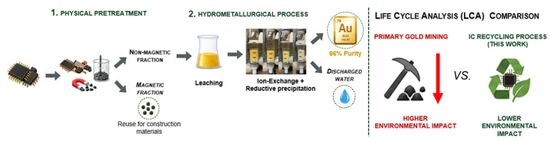
1. Introduction
2. Results and Discussion
2.1. Physical Pretreatment
2.2. Gold Extraction
2.3. Gold Purification
3. Environmental Impact: Developed Process vs. Primary Extraction
4. Materials and Methods
4.1. Materials
4.2. Methods
4.2.1. Physical Pretreatment of the IC
4.2.2. Gold Extraction Procedure
4.2.3. Gold Purification Procedure
4.3. Metal(oid)s Quantification
4.4. Life-Cycle Assessment
4.4.1. Goal and Scope of Study
4.4.2. Inventory
5. Conclusions
Supplementary Materials
Author Contributions
Funding
Data Availability Statement
Conflicts of Interest
References
- Baldé, C.P.; D’Angelo, E.; Luda, V.; Deubzer, O.; Kuehr, R. Global Transboundary E-Waste Flows Monitor; United Nations Institute for Training and Research (UNITAR): Bonn, Germany, 2022. [Google Scholar]
- Ly, N.H.; Joo, S.W.; Choo, J.; Vasseghian, Y.; Cho, J.; Rezania, S. Sustainable Cutting-Edge Techniques for Gold Valorization from Electronic Wastes. Chem. Eng. J. 2023, 471, 144324. [Google Scholar] [CrossRef]
- Mao, S.; Kang, Y.; Zhang, Y.; Xiao, X.; Zhu, H. Fractional Grey Model Based on Non-Singular Exponential Kernel and Its Application in the Prediction of Electronic Waste Precious Metal Content. ISA Trans. 2020, 107, 12–26. [Google Scholar] [CrossRef] [PubMed]
- Niu, B.; Shanshan, E.; Xu, Z.; Guo, J. How to Efficient and High-Value Recycling of Electronic Components Mounted on Waste Printed Circuit Boards: Recent Progress, Challenge, and Future Perspectives. J. Clean. Prod. 2023, 415, 1377815. [Google Scholar] [CrossRef]
- Li, K.; Zhang, L.; Xu, Z. Decomposition Behaviour and Mechanism of Epoxy Resin from Waste Integrated Circuits Under Supercritical Water Condition. J. Hazard. Mater. 2019, 374, 356–364. [Google Scholar] [CrossRef] [PubMed]
- Lee, C.H.; Tang, L.W.; Popuri, S.R. A Study on the Recycling of Scrap Integrated Circuits by Leaching. Waste Manag. Res. 2011, 29, 677–685. [Google Scholar] [CrossRef] [PubMed]
- Debnath, B.; Roychowdhury, P.; Kundu, R. Electronic Components (EC) Reuse and Recycling—A New Approach Towards WEEE Management. Procedia Environ. Sci. 2016, 35, 656–668. [Google Scholar] [CrossRef]
- Ismail, H.; Hanafiah, M.M. An Overview of LCA Application in WEEE Management: Current Practices, Progress and Challenges. J. Clean. Prod. 2019, 5, 79–93. [Google Scholar] [CrossRef]
- Liu, Y.; Li, K.; Guo, J.; Xu, Z. Impact of the Operating Conditions on the Derived Products and the Reaction Mechanism in Vacuum Pyrolysis Treatment of the Organic Material in Waste Integrated Circuits. J. Clean. Prod. 2018, 197, 1488–1497. [Google Scholar] [CrossRef]
- Wang, X.; Huang, W.; Yan, B.; Zhou, S.; Zhu, X.; Wang, Z.; Cheng, Z.; Chen, G. E-Waste Recycling: Integrated Life Cycle Assessment and Techno-Economic Analysis Unravels Pyrometallurgy’s Edge and Delivers an Optimization Framework for Recovering Waste Printed Circuit Boards. Waste Manag. 2025, 207, 115135. [Google Scholar] [CrossRef] [PubMed]
- Panda, R.; Dinkar, O.S.; Kumari, A.; Gupta, R.; Jha, M.K.; Pathak, D.D. Hydrometallurgical Processing of Waste Integrated Circuits (ICs) to Recover Ag and Generate Mix Concentrate of Au, Pd and Pt. J. Ind. Eng. Chem. 2021, 93, 315–321. [Google Scholar] [CrossRef]
- Birloaga, I.; Vegliò, F. Study of Multi-Step Hydrometallurgical Methods to Extract the Valuable Content of Gold, Silver and Copper from Waste Printed Circuit Boards. J. Environ. Chem. Eng. 2016, 4, 20–29. [Google Scholar] [CrossRef]
- Sethurajan, M.; van Hullebusch, E.D.; Fontana, D.; Akcil, A.; Deveci, H.; Batinic, B.; Leal, J.P.; Gasche, T.A.; Kucuker, M.A.; Kuchta, K.; et al. Recent Advances on Hydrometallurgical Recovery of Critical and Precious Elements from End of Life Electronic Wastes—A Review. Crit. Rev. Environ. Sci. Technol. 2019, 49, 212–275. [Google Scholar] [CrossRef]
- Wang, H.; Zhang, S.; Li, B.; Pan, D.; Wu, Y.; Zuo, T. Recovery of Waste Printed Circuit Boards Through Pyrometallurgical Processing: A Review. Resour. Conserv. Recycl. 2017, 8, 209–218. [Google Scholar] [CrossRef]
- Panda, R.; Dinkar, O.S.; Jha, M.K.; Pathak, D.D. Recycling of Gold from Waste Electronic Components of Devices. Korean J. Chem. Eng. 2020, 37, 111–119. [Google Scholar] [CrossRef]
- Gómez, M.; Grimes, S.; Fowler, G. Development of Complete Hydrometallurgical Processes for Gold Recovery from ICs and CPUs Using Ionic Liquids. J. Environ. Manag. 2024, 362, 121306. [Google Scholar] [CrossRef] [PubMed]
- Binnemans, K.; Jones, P.T. Ionic Liquids and Deep-Eutectic Solvents in Extractive Metallurgy: Mismatch Between Academic Research and Industrial Applicability. J. Sustain. Metall. 2023, 9, 423–438. [Google Scholar] [CrossRef]
- Aylmore, M.G. Alternative Lixiviants to Cyanide for Leaching Gold Ores. In Gold Ore Processing: Project Development and Operations; Elsevier: Amsterdam, The Netherlands, 2016; pp. 447–484. [Google Scholar] [CrossRef]
- Rigoldi, A.; Trogu, E.F.; Marcheselli, G.C.; Artizzu, F.; Picone, N.; Colledani, M.; Deplano, P.; Serpe, A. Advances in Recovering Noble Metals from Waste Printed Circuit Boards (WPCBs). ACS Sustain. Chem. Eng. 2019, 7, 1308–1317. [Google Scholar] [CrossRef]
- Bożejewicz, D.; Witt, K.; Kaczorowska, M.A.; Urbaniak, W.; Ośmiałowski, B. The Application of 2,6-Bis(4-Methoxybenzoyl)-Diaminopyridine in Solvent Extraction and Polymer Membrane Separation for the Recovery of Au(III), Ag(I), Pd(II) and Pt(II) Ions from Aqueous Solutions. Int. J. Mol. Sci. 2021, 22, 179123. [Google Scholar] [CrossRef] [PubMed]
- Tomizaki, K.Y.; Okamoto, T.; Tonoda, T.; Imai, T.; Asano, M. Selective Gold Recovery from Homogenous Aqueous Solutions Containing Gold and Platinum Ions by Aromatic Amino Acid-Containing Peptides. Int. J. Mol. Sci. 2020, 21, 5060. [Google Scholar] [CrossRef] [PubMed]
- Doidge, E.D.; Kinsman, L.M.M.; Ji, Y.; Carson, I.; Duffy, A.J.; Kordas, I.A.; Shao, E.; Tasker, P.A.; Ngwenya, B.T.; Morrison, C.A.; et al. Evaluation of Simple Amides in the Selective Recovery of Gold from Secondary Sources by Solvent Extraction. ACS Sustain. Chem. Eng. 2019, 7, 15019–15029. [Google Scholar] [CrossRef]
- Sadeghi, S.M.; Soares, H.M.V.M. A Sustainable Hydrometallurgical Strategy for Recycling Efficiently Platinum from Spent Reforming Petroleum Catalyst. Environ. Sci. Pollut. Res. 2023, 30, 101410–101423. [Google Scholar] [CrossRef] [PubMed]
- Wołowicz, A.; Hubicki, Z. Adsorption Characteristics of Noble Metals on the Strongly Basic Anion Exchanger Purolite A-400TL. J. Mater. Sci. 2014, 49, 6191–6202. [Google Scholar] [CrossRef]
- Fritz, B.; Aichele, C.; Schmidt, M. Environmental Impact of High-Value Gold Scrap Recycling. Int. J. Life Cycle Assess. 2020, 25, 1930–1941. [Google Scholar] [CrossRef] [PubMed]
- Oke, E.A.; Potgieter, H. Discarded E-Waste/Printed Circuit Boards: A Review of Their Recent Methods of Disassembly, Sorting and Environmental Implications. J. Mater. Cycles Waste Manag. 2024, 81, 1277–1293. [Google Scholar] [CrossRef]
- Iannicelli-Zubiani, E.M.; Giani, M.I.; Recanati, F.; Dotelli, G.; Puricelli, S.; Cristiani, C. Environmental Impacts of a Hydrometallurgical Process for Electronic Waste Treatment: A Life Cycle Assessment Case Study. J. Clean. Prod. 2017, 140, 1204–1216. [Google Scholar] [CrossRef]
- Francini, A.; Cornelio, A.; Bontempi, E.; Serpe, A.; Ferrari, A.M.; Neri, P.; Rosa, R. Environmental Assessment of Noble Metals Recovery from E-Waste: An ESCAPE and LCA-Based Comparative Analysis towards Design for Sustainability. J. Clean. Prod. 2025, 534, 147016. [Google Scholar] [CrossRef]
- Bachér, J.; Rintala, L.; Horttanainen, M. The Effect of Crusher Type on Printed Circuit Board Assemblies’ Liberation and Dust Generation from Waste Mobile Phones. Miner. Eng. 2022, 185, 107674. [Google Scholar] [CrossRef]
- Duan, C.; Zhao, Y.; He, J.; Zhou, N. Research on Liberation Mechanism of the Impact Crushing Waste Printed Circuit Board. Adv. Mater. Res. 2010, 113–116, 730–734. [Google Scholar] [CrossRef]
- Marra, A.; Cesaro, A.; Belgiorno, V. Separation Efficiency of Valuable and Critical Metals in WEEE Mechanical Treatments. J. Clean. Prod. 2018, 186, 490–498. [Google Scholar] [CrossRef]
- Barnwal, A.; Dhawan, N. Physical Processing of Discarded Integrated Circuits for Recovery of Metallic Values. JOM 2020, 72, 2730–2738. [Google Scholar] [CrossRef]
- Barnwal, A.; Dhawan, N. Recovery of Metals from Discarded Integrated Circuits. Min. Metall. Explor. 2020, 20, 1641–1651. [Google Scholar] [CrossRef]
- Ajiboye, E.A.; Olasehinde, E.F.; Adebayo, A.O.; Ajayi, O.O.; Ghosh, M.K.; Basu, S. Extraction of Cu, Zn, and Ni from Waste Silica-Rich Integrated Circuits by Sulfation Roasting and Water Leaching. Chem. Pap. 2020, 74, 663–671. [Google Scholar] [CrossRef]
- Sousa, R.; Regufe, M.J.; Fiúza, A.; Leite, M.M.; Futuro, A. A Systematic Review of Sustainable Gold Extraction from Raw Ores Using Alternative Leaching Reagents. Extr. Ind. Soc. 2022, 21, 101018. [Google Scholar] [CrossRef]
- Al Adday, F.; Awad, A.; Aleghnimat, R.; Bassam, H.; Khater, A. Fresh and Hardened Properties of Recycled Concrete Aggregate Modified by Iron Powder and Silica. Int. J. GEOMATE 2019, 16, 222–230. [Google Scholar] [CrossRef]
- Chandrashekhar, V.G.; Senthamarai, T.; Kadam, R.G.; Malina, O.; Kašlík, J.; Zbořil, R.; Gawande, M.B.; Jagadeesh, R.V.; Beller, M. Silica-Supported Fe/Fe–O Nanoparticles for the Catalytic Hydrogenation of Nitriles to Amines in the Presence of Aluminium Additives. Nat. Catal. 2022, 5, 20–29. [Google Scholar] [CrossRef]
- Suo, H.; Wang, S.; Zhang, C.; Xu, J.; Wu, B.; Yang, Y.; Xiang, H.; Li, Y.W. Chemical and Structural Effects of Silica in Iron-Based Fischer-Tropsch Synthesis Catalysts. J. Catal. 2012, 286, 111–123. [Google Scholar] [CrossRef]
- Wielers, A.F.H.; Kock, A.J.H.M.; Hop, C.E.C.A.; Geus, J.W.; van der Kraan, A.M. The reduction behavior of silica-supported and alumina-supported iron catalysts: A Mössbauer and infrared spectroscopic study. J. Catal. 1989, 117, 1–18. [Google Scholar] [CrossRef]
- Finkelstein, N.P.; Hancock, R.D. A New Approach to the Chemistry of Gold. Gold Bull. 1974, 7, 72–77. [Google Scholar] [CrossRef]
- Nicol, M.J.; Fleming, C.A.; Paul, R.L. The Chemistry of the Extraction of Gold; South African Institute of Mining and Metallurgy: Johannesburg, South Africa, 1987. [Google Scholar]
- Jeffrey, M.I.; Breuer, P.L.; Choo, W.L. A Kinetic Study That Compares the Leaching of Gold in the Cyanide, Thiosulfate, and Chloride Systems. Metall. Mater. Trans. B 2001, 32B, 979–986. [Google Scholar] [CrossRef]
- Baghalha, M. Leaching of an Oxide Gold Ore with Chloride/Hypochlorite Solutions. Int. J. Miner. Process. 2007, 82, 178–186. [Google Scholar] [CrossRef]
- He, Y.; Xu, Z. Recycling Gold and Copper from Waste Printed Circuit Boards Using Chlorination Process. RSC Adv. 2015, 5, 8957–8964. [Google Scholar] [CrossRef]
- Neto, I.F.F.; Soares, H.M.V.M. Simple and Near-Zero-Waste Processing for Recycling Gold at a High Purity Level from Waste Printed Circuit Boards. Waste Manag. 2021, 135, 90–97. [Google Scholar] [CrossRef] [PubMed]
- Machesky, M.L.; Rose, A.W. Adsorption of Gold(III~chloride and Gold(I)-Thiosulfate Anions by Goethite. Geochim. Cosmochim. Acta 1991, 55, 769–776. [Google Scholar] [CrossRef]
- Hasab, M.G.; Rashchi, F.; Raygan, S. Chloride-Hypochlorite Leaching and Hydrochloric Acid Washing in Multi-Stages for Extraction of Gold from a Refractory Concentrate. Hydrometallurgy 2014, 142, 56–59. [Google Scholar] [CrossRef]
- Spiegel, M.; Zahs, A.; Grabke, H.J. Fundamental Aspects of Chlorine Induced Corrosion in Power Plants. Mater. High Temp. 2003, 20, 153–159. [Google Scholar] [CrossRef]
- DeCoste, J.B.; Browe, M.A.; Wagner, G.W.; Rossin, J.A.; Peterson, G.W. Removal of Chlorine Gas by an Amine Functionalized Metal-Organic Framework via Electrophilic Aromatic Substitution. Chem. Commun. 2015, 51, 12474–12477. [Google Scholar] [CrossRef] [PubMed]
- Jeon, S.; Tabelin, C.B.; Takahashi, H.; Park, I.; Ito, M.; Hiroyoshi, N. Interference of Coexisting Copper and Aluminum on the Ammonium Thiosulfate Leaching of Gold from Printed Circuit Boards of Waste Mobile Phones. Waste Manag. 2018, 81, 148–156. [Google Scholar] [CrossRef] [PubMed]
- Bui, T.H.; Jeon, S.; Lee, Y. Facile Recovery of Gold from E-Waste by Integrating Chlorate Leaching and Selective Adsorption Using Chitosan-Based Bioadsorbent. J. Environ. Chem. Eng. 2021, 9, 104661. [Google Scholar] [CrossRef]
- Olteanu, A.F.; Dobre, T.; Panturu, E.; Radu, A.D.; Akcil, A. Experimental Process Analysis and Mathematical Modeling for Selective Gold Leaching from Slag Through Wet Chlorination. Hydrometallurgy 2014, 144–145, 170–185. [Google Scholar] [CrossRef]
- Fu, L.; Zhang, L.; Wang, S.; Cui, W.; Peng, J. Synergistic Extraction of Gold from the Refractory Gold Ore via Ultrasound and Chlorination-Oxidation. Ultrason. Sonochem. 2017, 37, 471–477. [Google Scholar] [CrossRef] [PubMed]
- Filcenco-Olteanu, A.; Dobre, T.; Rădulescu, R.; Panţuru, E.; Panţuru, R. Selective Recovery of Gold from Hydrochloric Solutions with Amberlite XAD-7 Ion-Exchange Resin. UPB Sci. Bull. Ser. B Chem. Mater. Sci. 2010, 72, 233–242. [Google Scholar]
- van Deventer, J.; Bazhko, V.; Yahorava, V. Premier Products Gold Selective Ion Exchange Resin vs. Activated Carbon for Recovery of Gold Comparison of Gold-Selective Ion Exchange Resins and Activated Carbon for the Recovery of Gold from Copper-Gold Leach Liquors Gols Selected; ALTA Metallurgical Services: Perth, Australia, 2000. [Google Scholar]
- Azizitorghabeh, A.; Mahandra, H.; Ramsay, J.; Ghahreman, A. Selective Gold Recovery from Pregnant Thiocyanate Leach Solution Using Ion Exchange Resins. Hydrometallurgy 2023, 218, 106055. [Google Scholar] [CrossRef]
- European Union. Directive (EU) 2024/3019 on Urban Wastewater Treatment. In Official Journal of the European Union; European Union: Luxembourg, 2024. [Google Scholar]
- Tian, Y.; Olivetti, E.A. Strategies for Industrial Residue Valorization Through Metal Recovery, Use in Construction, or CO2 Mineralization. Waste Manag. 2025, 203, 114824. [Google Scholar] [CrossRef] [PubMed]
- Shields, V.R.; Robshaw, T.J.; Porter, C.P.; Amphlett, J.T.M.; Hides, A.; Bruce, R.; Cordiner, J.; Ogden, M.D. Gold Recovery from Synthetic Mine Tailings Leachate Using Chelating Ion Exchange Resins with Thiosulfate-Thiourea Lixiviant. Resour. Conserv. Recycl. Adv. 2023, 19, 200182. [Google Scholar] [CrossRef]
- Alguacil, F.J.; Adeva, P.; Alonso, M. Processing of Residual Gold (III) Solutions via Ion Exchange. Gold Bull. 2005, 38, 9–13. [Google Scholar] [CrossRef]
- Marinho, R.S.; da Silva, C.N.; Afonso, J.C.; da Cunha, J.W.S.D. Recovery of Platinum, Tin and Indium from Spent Catalysts in Chloride Medium Using Strong Basic Anion Exchange Resins. J. Hazard. Mater. 2011, 192, 1155–1160. [Google Scholar] [CrossRef] [PubMed]
- Sadeghi, S. Selective Recycling of Metals from Secondary Resources. Ph.D. Thesis, University of Porto, Porto, Portugal, 2020. [Google Scholar] [CrossRef]
- Craw, D.; McLachlan, C.; Negrini, M.; Becker, N. Quantification and Prediction of Bulk Gold Fineness at Placer Gold Mines: A New Zealand Example. Minerals 2017, 7, 110226. [Google Scholar] [CrossRef]
- International Energy Agency. Available online: https://www.iea.org/ (accessed on 24 April 2026).



| IC | Magnetic Fraction | Non-Magnetic Fraction | ||||
|---|---|---|---|---|---|---|
| mg/g | %wt. | mg/g | %wt. | mg/g | %wt. | |
| Cu | 84.3 ± 57.3 | 42.3 | 4.3 ± 0.2 | 4.3 | 80.0 ± 11.2 | 81.1 |
| Fe | 59.6 ± 16.9 | 29.9 | 57.8 ± 6.5 | 57.4 | 1.8 ± 0.2 | 1.8 |
| Ni | 34.0 ± 1.7 | 17.1 | 30.6 ± 6.5 | 30.4 | 3.4 ± 1.5 | 3.4 |
| Sn | 10.3 ± 0.9 | 5.2 | 4.6 ± 1.2 | 4.6 | 5.6 ± 2.0 | 5.7 |
| Pb | 4.7 ± 0.2 | 2.4 | 1.3 ± 0.1 | 1.3 | 3.4 ± 1.1 | 3.5 |
| Al | 3.6 ± 0.8 | 1.8 | 1.2 ± 0.9 | 1.2 | 2.4 ± 0.1 | 2.4 |
| Ag | 0.16 ± 0.1 | 0.1 | 0.06 ± 0.01 | 0.1 | 0.1 ± 0.1 | 0.1 |
| Au | 1.8 ± 0.3 | 0.9 | 0.4 ± 0.05 | 0.4 | 1.5 ± 0.7 | 1.5 |
| Zn | 0.5 ± 0.05 | 0.2 | 0.1 ± 0.02 | 0.1 | 0.4 ± 0.1 | 0.4 |
| Cr | 0.1 ± 0.1 | 0.1 | 0.4 ± 0.1 | 0.4 | 0.1 ± 0.03 | 0.1 |
| Run | [HCl] (M) | [NaClO] (%) | S/L (g/mL) | Au Leached (%) | S/N |
|---|---|---|---|---|---|
| 1 | 1.5 | 0.27 | 1/10 | 18 6 | 22.86 |
| 2 | 1.5 | 0.34 | 1/20 | 23 3 | 26.95 |
| 3 | 1.5 | 0.47 | 1/40 | 58 14 | 35.50 |
| 4 | 2.5 | 0.27 | 1/20 | 22 3 | 26.51 |
| 5 | 2.5 | 0.34 | 1/40 | 88.6 0.3 | 40.23 |
| 6 | 2.5 | 0.47 | 1/10 | 13 2 | 21.65 |
| 7 | 3.5 | 0.27 | 1/40 | 79 5 | 37.87 |
| 8 | 3.5 | 0.34 | 1/20 | 50 9 | 33.21 |
| 9 | 3.5 | 0.47 | 1/10 | 25 6 | 27.18 |
| Resin | Nature of Resin | Matrix Solution (M) | Au (q0) (mg/g) | Reference |
|---|---|---|---|---|
| Purolite® A200 | Type II quaternary ammonium | 1.71 of thiosulfate and 0.13 of TU | 4.7 ± 0.3 | [59] |
| Lewatit® MonoPlus TP 214 | Chelating (TU) | 13 ± 1 | ||
| Dowex™ M-4195 | Chelating (bispicolylamine) | 25 ± 6 | ||
| Puromet® MTS9140 (thiourea) | Chelating (TU) | 42 ± 7 | ||
| PurogoldTM A194 | Strong anionic | 2.5 of HCl and 0.34 of NaClO | 31.3 ± 3.2 | In this work |
| Factor | Description | Level 1 (L1) | Level (L2) | Level (L3) |
|---|---|---|---|---|
| A | [HCl] (M) | 1.5 | 2.5 | 3.5 |
| B | [NaClO] (M) | 0.27 | 0.34 | 0.46 |
| C | S/L ratio (g/mL) | 1/10 | 1/20 | 1/40 |
| Reference Flow | ||
|---|---|---|
| Inputs | Raw material | 0.87 g Integrated Circuit |
| Energy | 0.171 KWh eletricity, high voltage PT production mix | |
| Chemicals | 1.82 g HCl (2.5 M) 0.51 g NaClO (0.34 M) 0.098 g TU (0.25 M) 0.057 g H2SO4 (0.5 M) 1.6 g NaOH (2 M) 0.056 g NaBH4 (0.5 M) | |
| Outputs | Product | 1 mg of solid Au |
| Emissions to water | 0.023 L wastewater * | |
| Emissions to air ** | 0.049 g Silicates | |
| Co-products | Metals: Cu: 82.74 mg; Fe: 58.5 mg; Ni: 33.37 mg; Sn: 10.11 mg; Pb: 4.09 mg Silicon: 0.932 g | |
| Processes | Ecoinvent database V.3.11 | |
| Gold, Peru (PE) | Gold-silver, Ingot {PE}| gold mine operation with extraction | Cut-off, U | |
| Gold, Australia (AU) | Gold {AU} | gold production | Cut-off, U | |
| Gold, Chile (CL) | Gold {CL} | silver-gold mine operation with refinery | Cut-off, U | |
| Gold, Papa New Guinea (PG) | Gold {PG}| gold-silver mine operation with refinery | Cut-off, U | |
| Gold, Sweden (SE) | Gold {SE}| gold mine operation and refining | Cut-off, U | |
| Gold, United States of America (US) | Gold {US} | gold production | Cut-off, U | |
Disclaimer/Publisher’s Note: The statements, opinions and data contained in all publications are solely those of the individual author(s) and contributor(s) and not of MDPI and/or the editor(s). MDPI and/or the editor(s) disclaim responsibility for any injury to people or property resulting from any ideas, methods, instructions or products referred to in the content. |
© 2026 by the authors. Licensee MDPI, Basel, Switzerland. This article is an open access article distributed under the terms and conditions of the Creative Commons Attribution (CC BY) license.
Share and Cite
Silva, M.A.D.; Martelo, L.M.; Neto, B.; Bastos, M.M.S.M.; Soares, H.M.V.M. Reclaiming Gold from Integrated Circuits Waste via a Sustainable Physic-Hydrometallurgical Approach. Recycling 2026, 11, 127. https://doi.org/10.3390/recycling11070127
Silva MAD, Martelo LM, Neto B, Bastos MMSM, Soares HMVM. Reclaiming Gold from Integrated Circuits Waste via a Sustainable Physic-Hydrometallurgical Approach. Recycling. 2026; 11(7):127. https://doi.org/10.3390/recycling11070127
Chicago/Turabian StyleSilva, Márcia A. D., Liliana M. Martelo, Belmira Neto, Margarida M. S. M. Bastos, and Helena M. V. M. Soares. 2026. "Reclaiming Gold from Integrated Circuits Waste via a Sustainable Physic-Hydrometallurgical Approach" Recycling 11, no. 7: 127. https://doi.org/10.3390/recycling11070127
APA StyleSilva, M. A. D., Martelo, L. M., Neto, B., Bastos, M. M. S. M., & Soares, H. M. V. M. (2026). Reclaiming Gold from Integrated Circuits Waste via a Sustainable Physic-Hydrometallurgical Approach. Recycling, 11(7), 127. https://doi.org/10.3390/recycling11070127