
Article

Selective Lithium Recovery from Ni-Based Li-Ion Batteries via Sucrose-Assisted Reductive Roasting

1
National Institute of Chemical Physics and Biophysics, 12618 Tallinn, Estonia
2
Department of Materials and Environmental Technology, Tallinn University of Technology, 19086 Tallinn, Estonia
*
Author to whom correspondence should be addressed.
Recycling 2026, 11(7), 114; https://doi.org/10.3390/recycling11070114 (registering DOI)
Submission received: 7 May 2026 / Revised: 16 June 2026 / Accepted: 22 June 2026 / Published: 25 June 2026

Abstract

The increasing demand for lithium-ion batteries (LIBs) raises concerns about the security of critical raw material supply and the management of hazardous waste. Efficient recycling can alleviate these issues by transforming spent batteries into high-value secondary materials for the circular economy. Industrial recycling has traditionally focused on the recovery of nickel (Ni) and cobalt (Co), whereas lithium (Li) recovery has often been sidelined due to technical complexities and fluctuating economic incentives. To meet the European Union (EU) Batteries Regulation target of 80% lithium recovery by the end of 2031, technically effective and economically viable lithium recovery strategies are required. This study investigates the use of food-grade sucrose as an organic reductant for the targeted recovery of lithium from NMC622 and NCA battery materials. The process combines sucrose-assisted reductive roasting with selective water leaching. The effects of roasting temperature, holding time, sucrose dosage, and heating rate were systematically evaluated and optimised. Under the best conditions of 600 °C, 15 min, 15 wt% sucrose, and a heating rate of 20 °C/min, lithium leaching efficiencies of 93.2% and 87.6% were achieved for separated NMC622 cathode material and NMC622-derived black mass, respectively. The method was also applicable to NCA-based black mass, reaching 83.7% lithium recovery under the same conditions. Mechanistic analysis revealed that lithium release was strongly controlled by the extent of transition metal reduction. Cobalt was fully reduced to its metallic state under all tested conditions. However, maximum lithium recovery required nickel to be reduced to metallic Ni and manganese-containing phases to be converted to MnO. The sucrose-assisted roasting process was rapid and holding times longer than 15 min decreased lithium recovery. This decrease was caused by the formation of poorly soluble lithium-containing phases, such as LiF and Li3PO4. F composition analysis showed the black mass (1.06 wt%) and anode fractions (2.26 wt%) to contain significantly more F than the cathode fraction (0.46 wt%), hence leading to the 5% Li leaching efficiency difference between cathode and black mass fractions under most conditions tested. Overall, these results demonstrate that sucrose-assisted reductive roasting, followed by selective water leaching, provides a rapid and effective route for high-efficiency lithium recovery from NMC- and NCA-based battery materials.

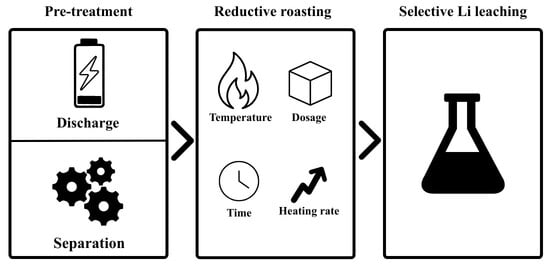
Graphical Abstract

1. Introduction

Lithium-ion batteries (LIBs) have become the main energy storage solution for a wide range of applications, including electric vehicles (EVs), portable electronic devices, and stationary energy storage, which can be attributed to their high energy density, good cycle life, and low self-discharge compared to other popular battery technologies like nickel–metal hydride and lead–acid batteries [1,2,3]. Driven largely by the transportation sector, global demand for LIBs has maintained an average annual growth rate of 30% since 2010 [4,5]. While current projections estimate a total production capacity of 2.5–3 TWh by 2030, global automakers have signalled even greater ambitions, announcing investment plans totalling $1.2 trillion to support 5.8 TWh in cumulative battery targets by the same year [6]. Such a massive increase in production capacity will require large amounts of critical raw materials such as Li, Co, Ni, and graphite [3,7], and will produce large quantities of waste from mining, processing, manufacturing, and batteries reaching their end of life (11–12 million metric tons by 2030 [8,9]), with recycling being essential to maximise the efficient use of materials and to reduce the environmental footprint of LIBs [10,11].
Many of the materials used in LIBs face problems with supply security and volatile price changes. Geographical concentration dominates the LIB supply chain; specifically, three countries (Australia, Chile, and China) mined 72% of Li in 2025 [12], and the Democratic Republic of the Congo produced 74% of Co in 2025 [13]. This extends to processing, with China, Japan, and South Korea responsible for more than 80% of global processed material and component supply [3,14]. To reduce concerns over raw material availability and prices, battery manufacturers have shifted towards low-Co-concentration chemistries with the EV market predicted to be dominated by high Ni concentration (LiNi1-x-yMnxCoyO2, NMC532-NMC955), LiNi0.5Mn1.5O4 (LNMO), or LiNi1-x-yCoxAlyO2 (NCA) and/or iron phosphate (LiFePO4, LFP) chemistries [15]. Even though this shift in chemistries can diminish the dependency on Co [3], concerns over other critical materials, especially lithium, remain high [3,11,15,16]. When looking at data collected on the Chinese lithium market, lithium recovery from waste LIBs was near 0% until 2020 and increased to only 13% in 2021 [16]. This jump in the lithium recycling rate was mostly attributed to the sudden price increase of lithium, which made recovering lithium profitable [16]. However, such lithium prices were not sustained for long and have seen an 80% drop between 2022 and 2025 due to oversupply in the market [17].
Industrial LIB recycling primarily employs pyrometallurgy and hydrometallurgy, typically following mechanical pre-treatment to concentrate metals and improve efficiency [11,18]. Pyrometallurgy is based on high-temperature smelting (>1200 °C), which offers high scalability and input flexibility but incurs significant energy costs and emissions [11,19]. A major drawback is the loss of critical materials like graphite and lithium to combustion or slag. Furthermore, the resulting alloy requires secondary hydrometallurgical treatment to isolate Co, Ni, and Cu [19]. Hydrometallurgy involves leaching metals from black mass or alloys into acidic solutions (typically H2SO4 or HCl with a reductant like H2O2) [11,18]. While this method recovers battery-grade salts via selective precipitation, solvent extraction, ion-exchange, or electrochemical methods, it is highly sensitive to input composition and various additives [18]. Consequently, it requires rigorous pre- and post-treatments that can increase costs and complicate upscaling [18]. Direct recycling is an emerging strategy aimed at restoring the cathode’s electrochemical performance without destroying its crystalline structure. This process involves the careful separation of cathode active materials (CAM), followed by relithiation to restore the stoichiometric lithium deficiency caused by cycling. While economically promising, particularly for lower-value chemistries like LFP, direct recycling remains largely confined to the laboratory scale. Its industrialisation is primarily hindered by the need for rigorous sorting and pre-treatment to isolate specific chemistries and CAMs. Furthermore, the high variability in battery cell types (cylindrical, prismatic, and pouch) and divergent degradation states add significant complexity to the separation and purification stages [20].
The European Commission has set specific targets for material recovery for LIB recycling, with the targets for Li being 50% by the end of 2027 and 80% by the end of 2031 [21]. Reaching these targets using conventional methods is challenging, as it would require recycling low-value streams such as slag to recover Li and modifying hydrometallurgical processes to reduce Li losses. This would significantly increase costs and may be economically unviable. However, several promising methods have already been explored in both academia and industry. In smelting, Hu et al. demonstrated the feasibility of lithium recovery in a pilot-scale line by leaching Li2CO3 from flue dust. However, the overall Li recovery efficiency was only around 40%, and the product purity reached 95.8% without any further purification treatment [22]. Umicore has also developed a promising lithium fuming technology for the recovery of Li during smelting. In their process, a chloride salt (CaCl2, MgCl2 or NaCl) is added to the slag during operation, which reacts with the lithium in the slag to form LiCl. The LiCl vaporises, and can then be collected and sent for further hydrometallurgical treatment. The process is reported to achieve an Li yield of up to 96% in the fumes; however, the patent does not provide any information on the final recovery efficiency [23].
In hydrometallurgy, Li is typically recovered at the final stage, which can result in significant operational losses. Precipitation steps may lead to overall Li losses of up to 30%, while other processes, such as solvent extraction, can contribute an additional 15% loss [24]. To enhance metal leachability and enable selective lithium recovery at the start of the hydrometallurgical process, reductive roasting has emerged as a promising approach. In general, roasting can be divided into oxidative roasting and reductive roasting, depending on the reaction atmosphere and the intended phase transformations. In reductive roasting, the CAM or black mass is mixed with a reductant and heated up in a reducing environment to decompose the lithium metal oxide structure. The metals are transformed into metal salts or more preferably reduced to lower-oxidation-state oxides or metallic forms, leaving only Li in a water-dissolvable form, which can then be selectively leached with water. For example, in carbothermal reduction, carbon and CO reduce the transition metals in the cathode active material into lower valence states, while Li is transformed into Li2CO3, which serves as the predominant water-soluble phase in the resulting mixture [25]. Various roasting techniques have been investigated, including sulphuric [26], chloride [27], nitration [28], and hydrogen [29] roasting or in situ carbothermic [25] and thermite roasting [30], which utilise the graphite and Al current collectors in the black mass as internal reductants. Compared to smelting, reductive roasting requires significantly lower temperatures (300–900 °C) and does not result in the loss of graphite; however, harmful emissions such as HF, SOx, Cl2, NOx, and COx can still be produced during operation which require the further treatment of off-gas to reduce their environmental impact [19].
In addition to the roasting methods mentioned before, roasting using organic reductants, such as biomass (pine saw dust [31], wheat straw [32]), waste plastics (polyvinyl chloride (PVC) [33], polyethylene (PE) [32]), and glucose [34], has recently gained attention by transforming organic materials into reducing agents such as H2, CO, and char [19,35]. Transition metals, such as Co and Ni, present in the black mass can reduce the formation of CO2, CH4, and tars and further promote the yield of CO and H2 by acting as catalysts for the pyrolysis of organic additives [36,37,38]. In addition to these reducing agents, several intermediate products formed during the pyrolysis of organic materials can also help promote the reduction of CAMs, which further improves the energy efficiency of the process by lowering the process temperature and/or the required heating time [34]. Zhao et al. demonstrated the recovery of lithium from spent NMC111 cathode powder by using shells of macadamia nuts during a two-stage microwave pyrolysis process. A lithium leaching efficiency of 93.4% using carbonated water leaching was achieved by the pyrolysis of biomass at 500 °C followed by roasting at 750 °C with a holding time of 25 min. In their work, they also showed that biomass pyrolysis starts already at around 190 °C, producing reducing agents that were already able to partly reduce the CAM at 300 °C [39]. A similar effect was observed in our previous study where LiCoO2 (LCO) was roasted with sucrose, achieving a Li leaching efficiency of 66.1% at 250 °C with 10 wt% sucrose dosage and a 60 min holding time. This increased to 90.1% when the roasting temperature and sucrose dosage were raised to 500 °C and 15 wt%, respectively. Furthermore, Li leaching efficiencies reached 94.5% when additional pre-treatment steps to remove F and Al were performed on the CAM prior to roasting [40]. Lin et al. also demonstrated an effective method in recovering lithium from NMC532 by using bean dreg as a reductive agent. A lithium leaching efficiency of 93.78% was achieved with carbonated water leaching after roasting at 700 °C for 40 min using a bean dreg dosage ratio of 1:0.3. In addition to H2, CO, and biochar, NH3 was also formed during the pyrolysis of bean dreg. It was found that for complete reduction and high Li leaching efficiency, the synergistic effect of both gas and biochar reduction was essential, as neither could fully reduce the cathode active material alone under the used conditions [41]. However, it should be noted that using organic reductants can also introduce new impurities to the system which could affect final yields and purification processes for the recovery of lithium [19]. Based on the literature, a simplified list of possible reactions occurring during the reduction of NMC black mass using organic reductants is as follows [42,43]:
N i O + H 2 ( g ) N i + H 2 O ( g ) ,
C o O + H 2 ( g ) C o + H 2 O ( g ) ,
M n O 2 + H 2 ( g ) M n O + H 2 O ( g ) ,
M n 3 O 4 + H 2 ( g ) 3 M n O + H 2 O ( g ) ,
2 N i O + C 2 N i + C O 2 ( g ) ,
N i O + C N i + C O ( g ) ,
2 C o O + C 2 C o + C O 2 ( g ) ,
C o O + C C o + C O ( g ) ,
2 M n O 2 + C 2 M n O + C O 2 ( g ) ,
M n O 2 + C M n O + C O ( g ) ,
2 M n 3 O 4 + C 6 M n O + C O 2 ( g ) ,
M n 3 O 4 + C 3 M n O + C O ( g ) ,
N i O + C O ( g ) N i + C O 2 ( g ) ,
C o O + C O ( g ) C o + C O 2 ( g ) ,
M n O 2 + C O ( g ) M n O + C O 2 ( g ) ,
M n 3 O 4 + C O ( g ) 3 M n O + C O 2 ( g ) ,
L i 2 O + C O 2 ( g ) L i 2 C O 3 .
The aim of this research was to study the feasibility of using inexpensive food-grade sucrose as a reductant for the reductive roasting of Ni-based cathode chemistries and thereafter selectively recovering lithium through water leaching. The influence of the roasting temperature, holding time, sucrose dosage, and heating rate on both pure NMC cathode material and black mass fractions was systematically investigated, with particular emphasis on their effect on lithium leaching efficiency. Additional experiments were conducted with an NCA black mass fraction to compare its reduction behaviour with that of NMC.

2. Results and Discussion

2.1. Stock Materials

Three distinct working stocks were prepared from the Bolt cells (NMC) for the reductive roasting optimisation experiments: a cathode active material stock, an anode active material stock, and a black mass stock containing both cathode and anode active materials. A Tuul cell (NCA) black mass stock was also prepared for comparative analysis. The chemical compositions of all stocks are provided in Table 1. Based on the elemental composition, the cathode active material consisted of LiNi0.6Mn0.2Co0.2O2 (NMC622) for the Bolt cells and LiNi0.89Co0.1Al0.01O2 (NCA) for the Tuul cells. F concentrations varied significantly between the working stocks with the anode stock (2.26 wt%), containing over four times the F than the cathode stock (0.46 wt%). This difference stems from the solid electrolyte interface (SEI) layer on the anode, which comprises LiF, Li2O, and organic compounds [44]. The P concentrations were similar for all samples, originating from the electrolyte salts. All stocks contained an insoluble fraction, which for the anode and black mass mainly consisted of graphite and for the cathode of carbon additives used to enhance conductivity.
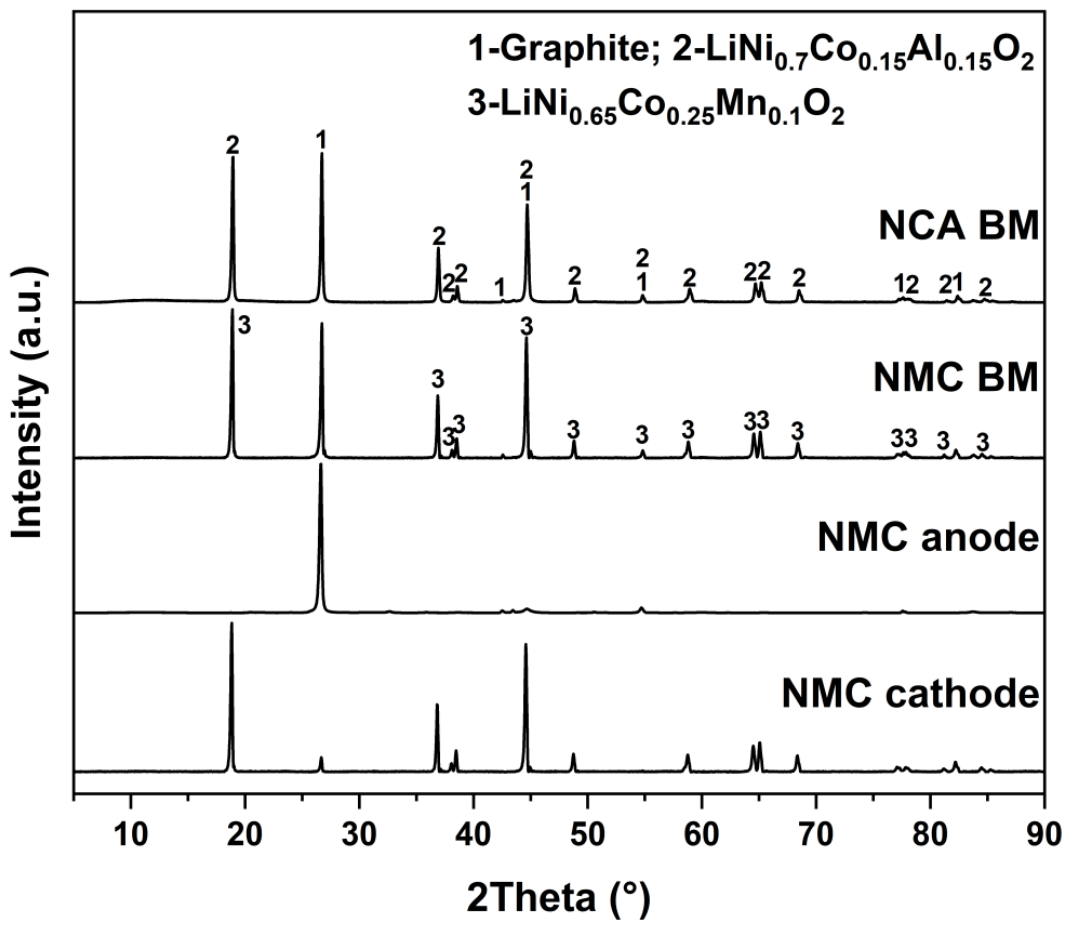
The X-ray diffraction (XRD) analysis in Figure 1 confirmed that the Bolt cathode material was NMC622 (LiNi0.65Co0.25Mn0.1O2 best match, ICDD:98-015-9318) and the anode consisted of graphite (ICDD:96-900-0047). Diffractograms of aqua regia residues in Figure S1 showed no detectable peaks other than graphite or carbon, indicating the successful dissolution of the metallic phases. For the Tuul black mass, the XRD results identified the presence of NCA (LiNi0.7Co0.15Al0.15O2, ICDD: 96-153-3586) and graphite (ICDD:96-900-8570) in the black mass. Similarly, no crystalline phases other than graphite were detected in the aqua regia residue of the NCA black mass.

2.2. Effect of Roasting Temperature on Li Leaching Efficiency from NMC

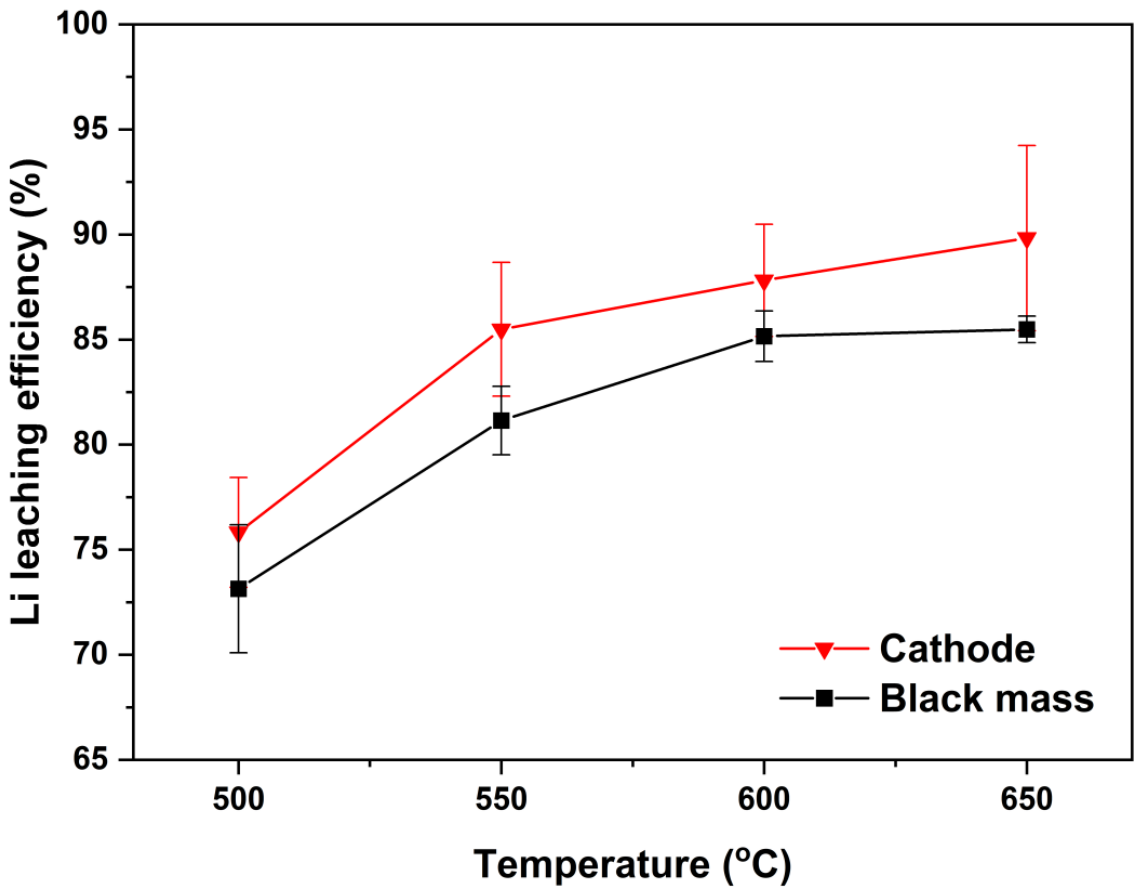
The effect of roasting temperature on Li leaching efficiency was investigated for both the cathode and black mass stocks of NMC across a temperature range of 500 to 650 °C, utilising a 15 wt% sucrose dosage and a 60 min holding time. Higher temperatures were deliberately not employed to prevent aluminium melting, which could adversely affect the roasting behaviour and process stability. These initial parameters were selected based on a previous study of LCO cathodes, which demonstrated that reduction was incomplete below 500 °C and identified 15 wt% as the optimal sucrose dosage [40]. As illustrated in Figure 2, roasting temperature had a significant effect on the reduction of NMC and thereby on the Li leaching efficiency. At 500 °C, Li recovery was already noticeable for both the cathode (75.8%) and black mass (70.5%). The Li leaching efficiency increased with rising roasting temperature up to 600 °C (87.8% cathode, 85.2% black mass); however, no significant improvements were observed with further temperature increases (89.8% cathode, 85.5% black mass).
At each temperature tested, Li leaching efficiencies for the NMC cathode active material experiments were approximately 5% higher than for the black mass experiments. This can be attributed to the fact that the presence of the anode introduces new impurities from the electrolyte, additives, binder, and SEI layer [44], which can form low-solubility or insoluble complexes with released Li during roasting. The main impurities that can act as a “Li trap” include Al (LiAlO2) [40], P (Li3PO4) [44], Si (Li2SiO3 and LiAlSiO4) [45], and F (LiF) [46]. The chemical composition data in Table 1 also show the NMC black mass stock to contain over two times the F than in the NMC cathode stock (1.06 wt% vs. 0.46 wt%). To validate these observations, additional tests were performed on the separated anode active material. Prior to thermal treatment, the anode yielded a Li leaching efficiency of 99.8%. However, the leaching efficiency decreased to 73.1% after being subjected to thermal treatment (500 °C, 15 wt%, 60 min), confirming that additional impurities from the anode negatively affected the Li leaching. Furthermore, roasted and water-leached sample F concentrations were analysed (Table S1). At 600 °C, the F content in both the roasted black mass and cathode samples had increased by approximately 0.5 wt%, from 0.46 wt% to 1.07 wt% for cathode and from 1.06 wt% to 1.54 wt% for black mass. This increase in F concentrations was attributed to the decomposition of the polyvinylidene fluoride (PVDF) binder, which reacted with the released Li and transition metals. The PVDF binder is chemically inert and resists dissolution in even very strong acidic and basic solutions; hence, the F concentrations measured for the initial stocks were lower than those recorded for the roasted samples. After water leaching, the F concentration declined to 0.41 wt% for the cathode sample and to 0.53 wt% for the black mass sample due to the partial dissolution of F phases in the sample.
A per-phase Li balance analysis was performed to compare the Li to impurity elements ratios against the best Li leaching results achieved for each stock during in the roasting temperature experiments. The results in Table S2 were calculated based on molar ratios, with an assumption that 100% of the impurities react with Li during roasting to form low-solubility or insoluble phases. The calculated mass balances per phase agreed well with the best temperature optimisation Li leaching results, especially for the cathode stock (89.8% leaching efficiency vs. 89.2 mol% Li2CO3 + Li2O). For the anode (73.1% Li leaching vs. 66.0 mol%) and black mass stocks (85.5% Li leaching vs. 79.5 mol%), the dissolvable Li2CO3 and Li2O phase was slightly lower than the leaching efficiencies achieved. When accounting for the elevated F concentrations in the roasted samples at 600 °C (1.07 wt% F cathode, 1.54 wt% F black mass), the calculated LiF content increased to 6.2 mol% in the cathode and 13.0 mol% in the black mass. This resulted in the theoretical dissolvable phase being smaller than the actual leached fraction across all samples. Furthermore, the remaining Li in the water-leach residues was stoichiometrically accounted for, with LiF alone making up 30.1 mol% in the cathode and 41.2 mol% in the black mass. This overestimation can be explained by the fact that not all impurity elements react with Li, especially Al, as no LiAlO2 phase was detected in any samples, and because LiF is slightly soluble in water (1.32 g/L at 20 °C [47]). Overall, the calculated mass balance values per phase can serve as a rough estimation of the obtainable Li leaching efficiency, assuming full reduction of the CAM has occurred.
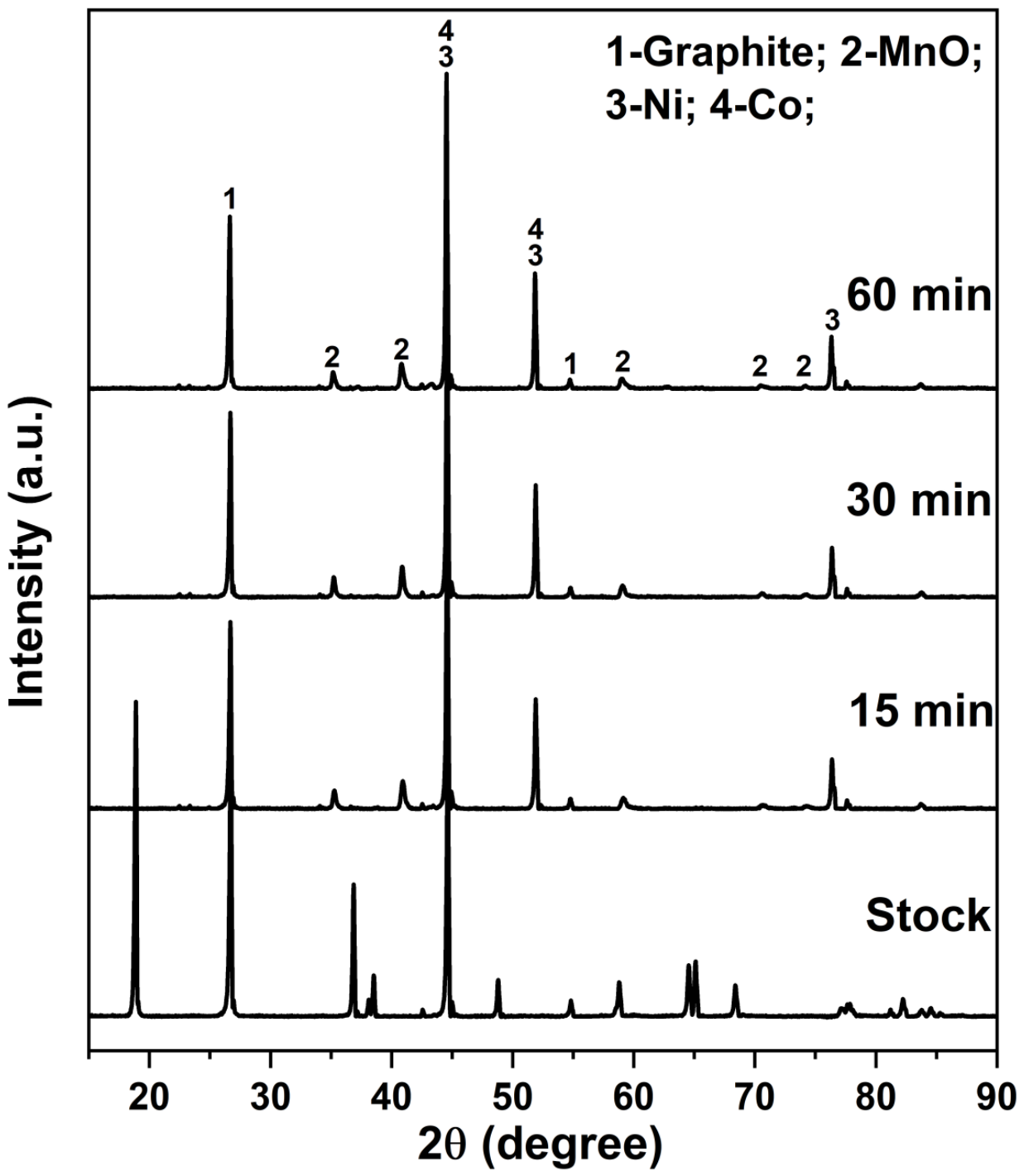
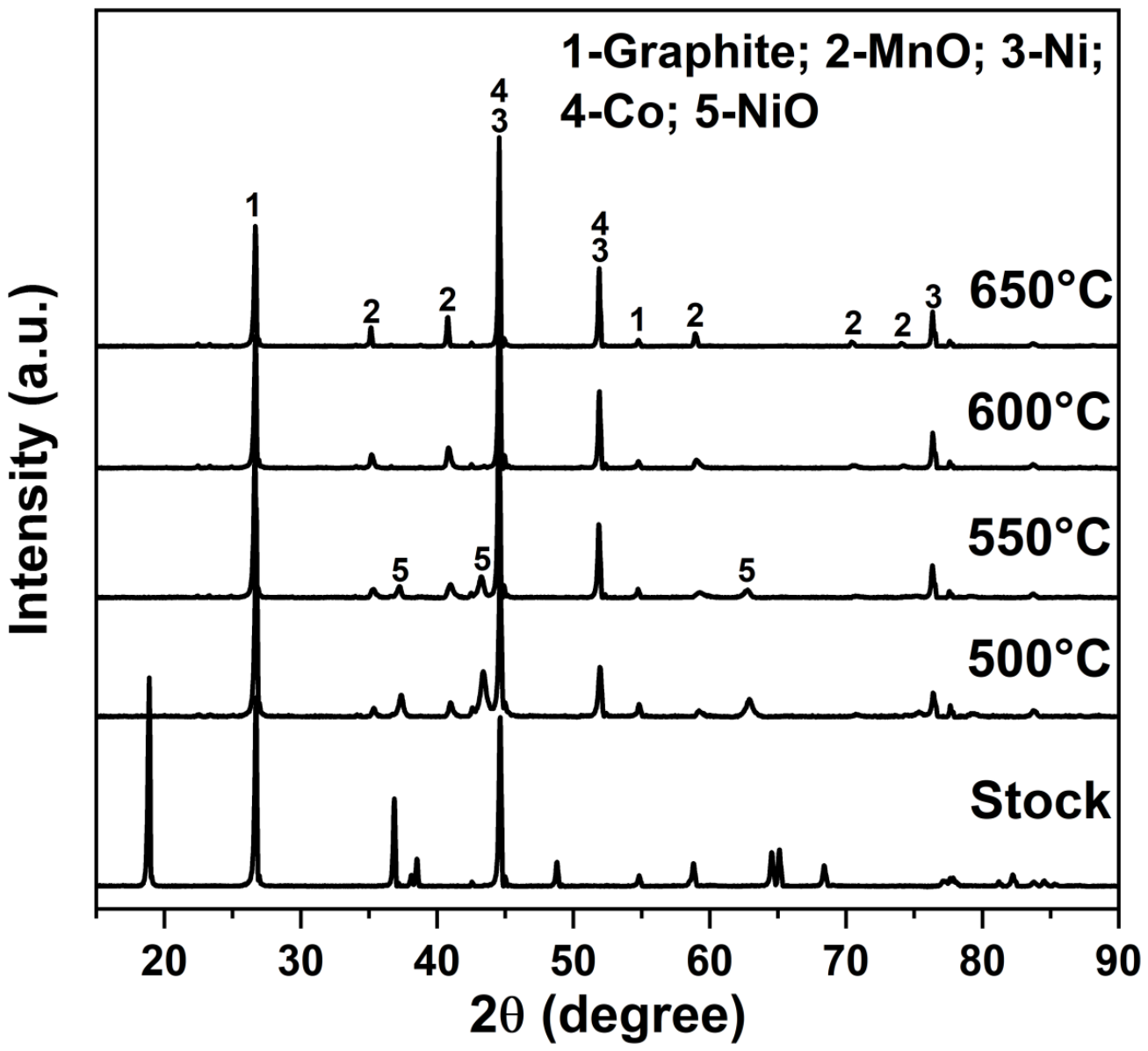
The X-ray diffractograms of water-leached residues showed that NMC622 had already reductively decomposed into Co, Ni, NiO, and MnO phases at 500 °C for both the cathode (Figure S2) and black mass (Figure 3) samples. Further increasing the temperature resulted in characteristic peaks for NiO decreasing in intensity, indicating reduction into metallic Ni. MnO peak intensities also increased with rising temperature, signalling further reduction to Mn2+. Compared to Ni and Mn, Co was found to be fully reduced to metallic Co at all tested temperatures. A correlation between the Li leaching efficiency and the reduction rate of Ni and Mn was seen when comparing the XRD and leaching results. The leaching efficiency increased visibly alongside NiO conversion to Ni and Mn to MnO, demonstrating that transition metal phases with higher valence states can still effectively bind Li. This effect was also highlighted when comparing the cathode and black mass samples at 600 and 650 °C. At 600 °C, minor peaks for NiO could still be identified in the cathode, while full reduction had already taken place in the black mass sample. This resulted in a slight increase in leaching efficiency for the cathode when the temperature increased to 650 °C, while no change was seen for the black mass. A similar effect was reported by Tao et al. during the carbothermal reduction of NMC523 using graphite. At 550 °C, characteristic peaks for CoO, NiO, and LiMnO2 were seen which restricted Li release, resulting in a Li leaching efficiency of 8.07%. Once the full reduction of transition metals was achieved at 700 °C, the Li leaching efficiency increased to 97.77% [48]. The XRD results for the anode residues in Figure S3 show the presence of crystalline Li3PO4 and LiF after thermal treatment along with Al2O3, Cu, and SiO2 phases, which were present in both residues. These trapping phases were too diluted or masked by high background noise to be identified in black mass samples. The aqua regia residues for cathode and black mass samples in Figure S1 confirm that graphite was the only insoluble phase, excluding the formation of major alternative macro-scale lithium compounds.

2.3. Effect of Sucrose Dosage on Li Leaching Efficiency from NMC

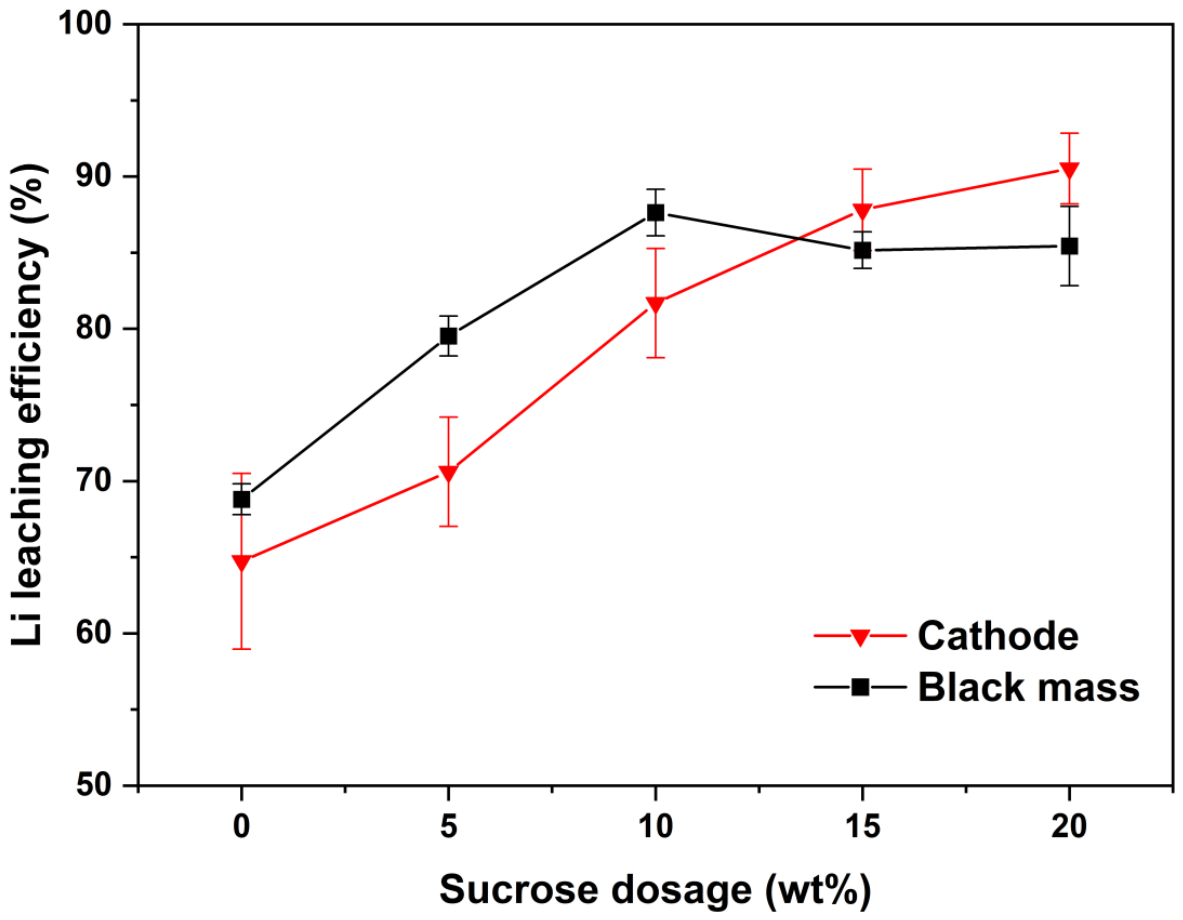
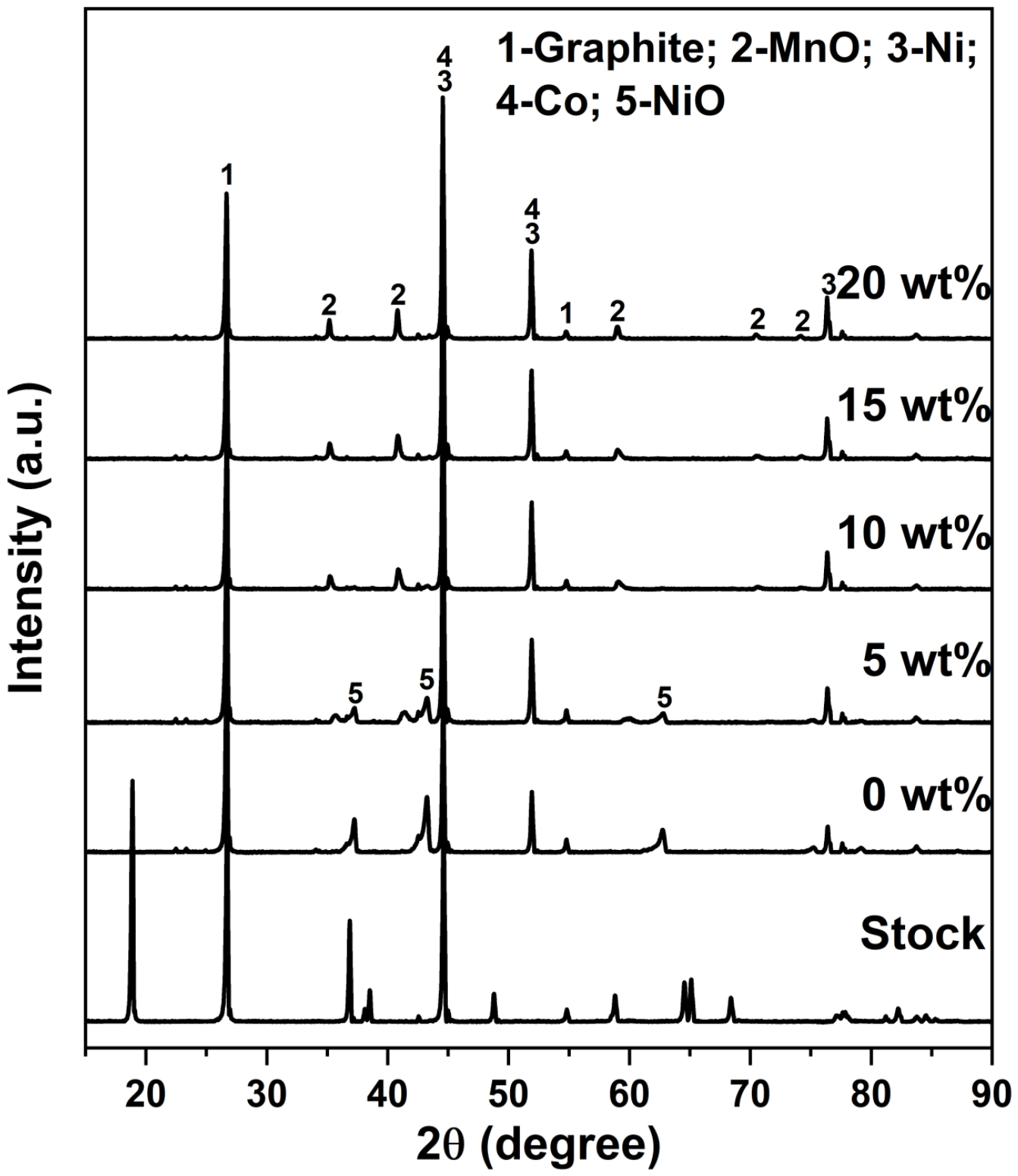
A target temperature of 600 °C was selected based on the temperature optimisation experiments to investigate the effect of sucrose dosage in the range of 0 to 20 wt% for NMC roasting. The Li leaching efficiency results in Figure 4 demonstrate surprisingly high lithium recoveries, reaching 65% for the cathode and 68% for the black mass. The XRD results in Figure 5 and Figure S4 reveal that endogenous carbon components—graphite, conductive carbon, and organic binders—initiated the partial carbothermal decomposition of NMC into the intermediate NiO phase.
Interestingly, an inversion of the standard cathode vs. black mass baseline was observed at lower sucrose concentrations (0 to 10 wt%). Within this region, the black mass exhibited noticeably higher lithium leaching efficiencies than the pure cathode active material. This deviation directly stems from the anode-derived graphite concentrated within the black mass fraction. This carbon source acts as a supplementary reducing agent via parallel carbothermal pathways, thereby boosting the local reduction potential beyond that of the standalone cathode at low additive volumes. However, this trend normalised and returned to the expected baseline configuration at 15 wt% sucrose dosage, where the recovery rates for the cathode surpassed that of the black mass (87.8% vs. 85.2%). Increasing the dosage to 20 wt% pushed the pure cathode recovery to its peak of 90.5%, whereas the black mass efficiency plateaued (85.5%). XRD analysis (Figure 5 and Figure S4) verified that full transition metal reduction (evidenced by the total elimination of NiO and the clear emergence of MnO peaks) directly correlated with the Li leaching efficiencies. Notably, this was achieved at a lower sucrose loading for the black mass (10 wt%) than for the cathode (15 wt%).

2.4. Effect of Holding Time on Li Leaching Efficiency from NMC

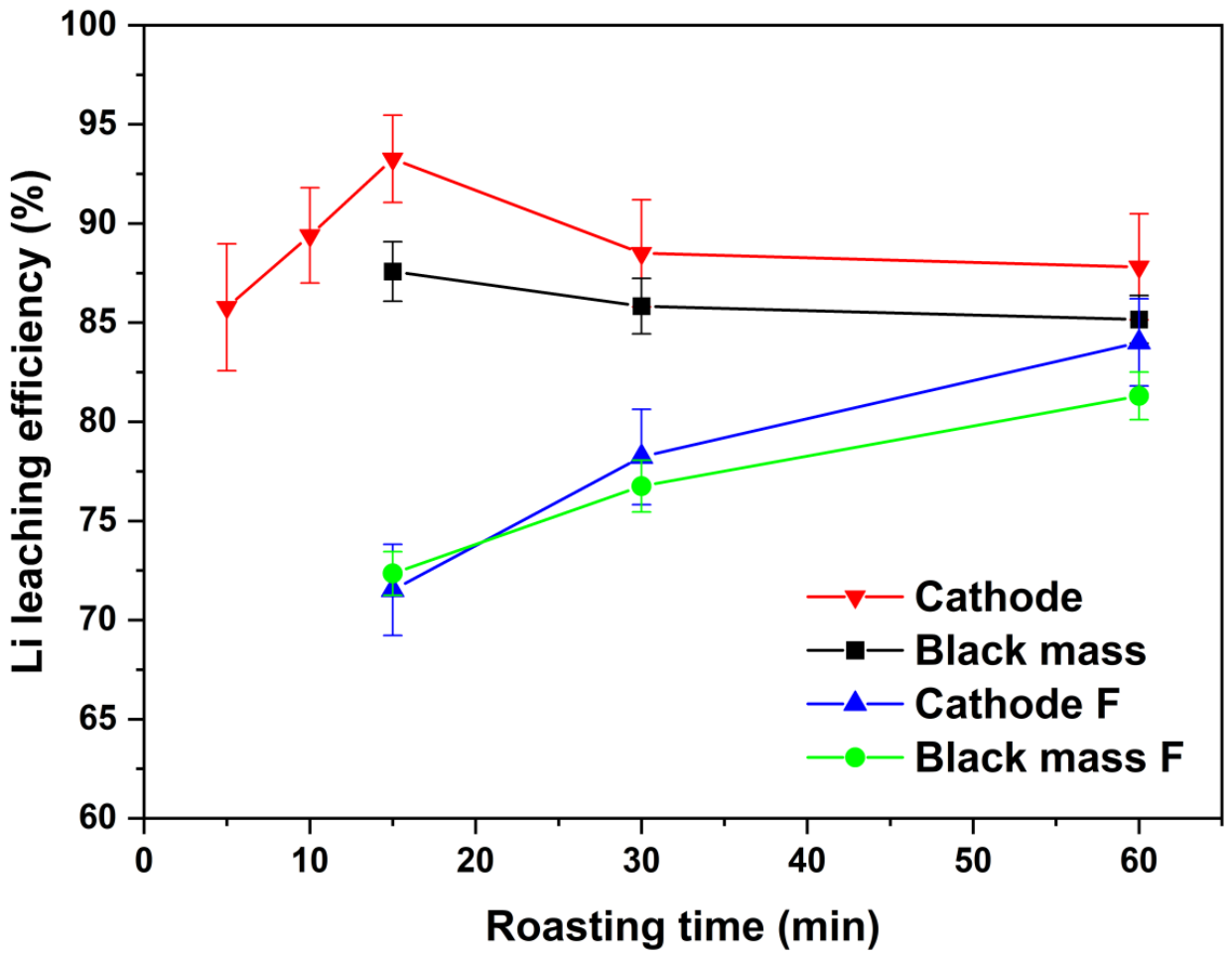
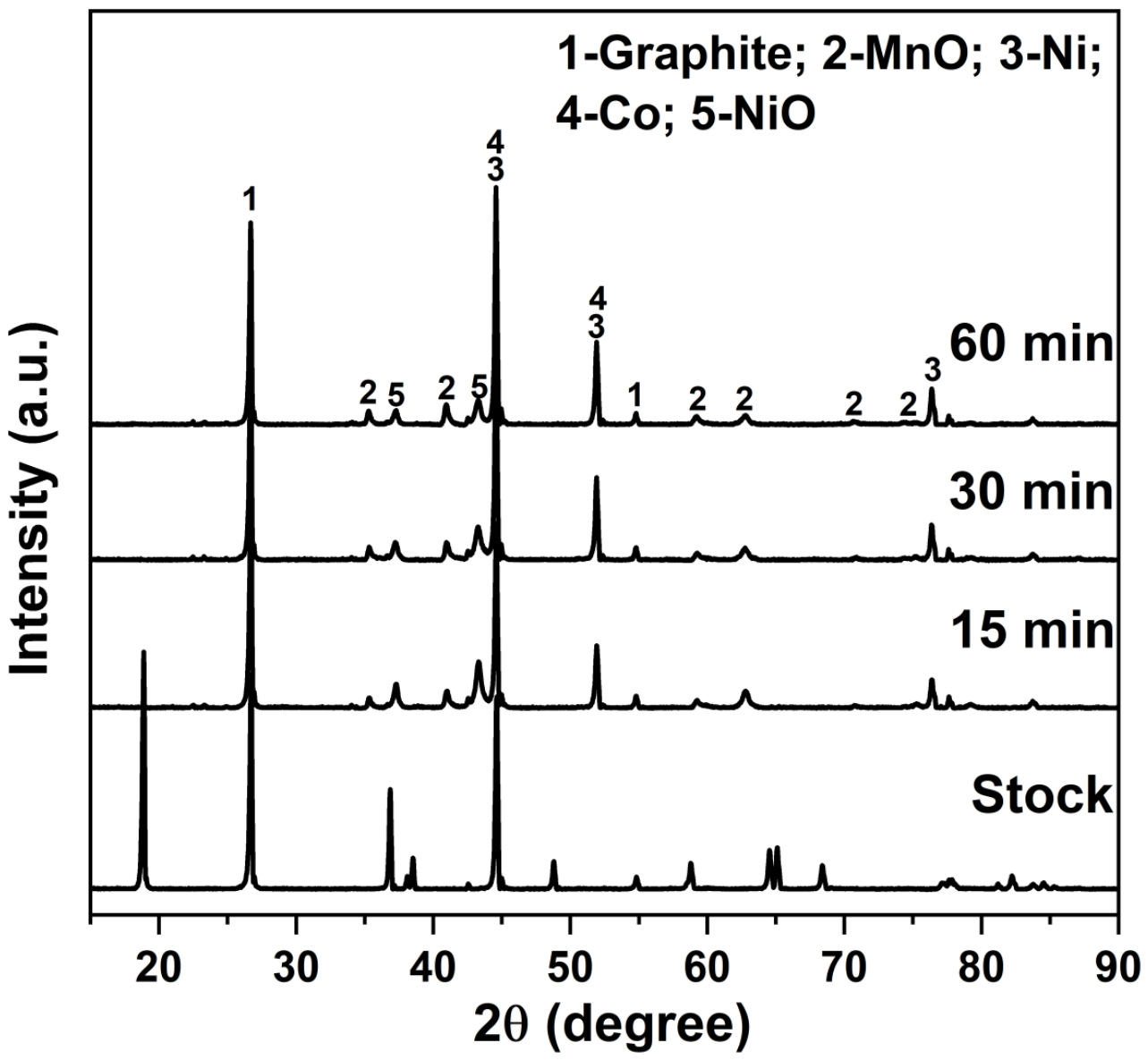
The influence of roasting time was evaluated at 600 °C with 15 wt% sucrose dosage by varying the holding time from 5 to 60 min for the cathode and 15 to 60 min for the black mass. The leaching results in Figure 6 show sucrose-assisted reduction roasting to have exceptionally rapid kinetics, with the cathode sample achieving a Li leaching efficiency of 85.1% at a holding time of only 5 min. Peak Li recoveries for both stocks were achieved at 15 min holding time, yielding Li leaching efficiencies of 93.2% for the cathode and 87.6% for the black mass. The XRD data in Figure 7 and Figure S5 align well with the leaching efficiencies, with no visible differences seen in the Ni and MnO peaks between the samples at 15 and 60 min holding times for both stocks, signalling full reduction. Prolonging the holding time beyond 15 min resulted in a slight decline in the leaching efficiencies for both materials, with the Li efficiencies reducing to 87.8% for the cathode and to 85.2% for the black mass at 60 min holding time. This confirmed that extended residence times, after full reduction was achieved, provided the necessary thermal activation and duration for secondary side-reactions between the liberated Li ions and impurities to take place. This results in the progressive formation of lower-solubility Li phases that affect the subsequent Li leaching yields negatively. The F composition data in Table S1 also show that the F concentration in the roasted cathode samples increased from 0.99 wt% at the 5 min holding time to 1.18 wt% at the 30 min holding time, showing further decomposition of the PVDF binder as the holding time was increased. This resulted in the increased formation of LiF, lowering the Li leaching efficiency as the holding time increased.

2.5. Effect of Heating Rate on Li Leaching Efficiency from NMC

The heating rate of 20 °C/min selected for these experiments can be considered high when compared to typical thermal processes, which typically use a heating rate of 5–10 °C/min. The influence of heating rate was tested at 5, 10, and 20 °C/min (at 600 °C, 15 wt% sucrose, and 60 min holding time). Small changes (2.4%) could be seen in the Li leaching efficiencies between the different heating rates (Table S3) and thus a 20 °C/min heating rate was chosen. This also agrees with the sucrose pyrolysis results from Wang et al. [49], where the heating profiles for sucrose at heating rates of 5–20 °C/min were shown to be similar.
To evaluate the effect of higher heating rates, flash roasting experiments were conducted in which the samples with 15 wt% sucrose were directly inserted into a furnace preheated to 600 °C. The Li leaching results in Figure 6 show a significant drop in leaching efficiencies compared to gradual heating. The XRD analysis (Figure 8 and Figure S6) revealed that although the parent NMC phase was no longer detected, prominent peaks for NiO still persisted for both cathode and black mass residues, even after a 60 min holding time. This shared reduction behaviour was fundamentally governed by the fast kinetics of sucrose volatilization. Under gradual heating, sucrose starts to caramelise at 200 °C and decompose at around 250 °C [40,49], releasing a wide range of liquid and gaseous byproducts with NMC to drive rapid, low-temperature reduction. A similar effect was shown by Zhao et al., where the pyrolysis products of macadamia nuts were able to partially reduce the NMC111 CAM as low as 300 °C [39]. As the heating rate increases, the yield of gaseous sucrose decomposition products will increase, a tendency that has also been observed when using high heating rates on wood pellets or biomass [50]. These gaseous byproducts escape the system before they have sufficient time to react with the NMC, and the roasting system shifts to a typical gas and solid carbothermic reaction. This reaction pathway is significantly slower and will thus require extended holding times and sufficient carbon sources to fully reduce the cathode active material.

2.6. Effect of Reductive Roasting on NCA

The efficacy of sucrose as a reductant for lithium recovery via reductive roasting has been demonstrated for NMC and LCO chemistries [40]. This leaves two prominent chemistries yet to be evaluated: NCA and LFP. LFP was excluded from the current study because, unlike layered oxide cathodes, it has been shown to require an oxidative environment to effectively release Li from its olivine crystal structure [51]. However, NCA could be efficiently reduced by sucrose during roasting as NMC and LCO due to its similar layered structure [52]. When treated under the optimal conditions that were determined for the NMC samples (Table 2), the NCA black mass yielded a Li leaching efficiency of 83.7% ± 1.2%. Extending the holding time to 60 min caused the efficiency to drop to 81.2% ± 2.0%, following a similar trend to the NMC samples.
The XRD analysis of the water leaching residue (Figure S7) indicated that the NCA cathode had been reduced to metallic Co, Ni, and NiO. No crystalline Al compounds were detected in the residue due to the low Al composition in the water-leached residue (0.59 wt%). In addition to the reduced metals, Li3PO4 was identified. The presence of both Li3PO4 and NiO explains the lower lithium leaching efficiency compared to NMC under identical conditions; these phases represent insoluble lithium sinks and signify incomplete reduction of the cathode framework. The analysis of the aqua regia residues showed no additional insoluble complexes besides graphite, which was similar to NMC aqua regia residues. Nevertheless, these results confirm that sucrose is an effective reductant also for NCA.
When comparing the results against the literature in Table 2, the best Li leaching efficiencies achieved in this study (93.2% NMC cathode, 87.6% for NMC black mass, and 83.7% for NCA black mass) were slightly lower than those reported for NMC532 cathode roasted with sucrose (97.9%) [53] and NMC cathode roasted with glucose (95.4%) [54]. This difference is attributed to the differences in pre-treatments, as other works had done extra steps to purify the cathode before roasting. These included washing with ethanol and water to remove electrolyte salts, pyrolysis to remove organic compounds and PVDF, and the manual separation of the CAM from the Al foil to minimise the Al concentration. This resulted in fewer impurities in the roasting mixture that could form insoluble or low-solubility phases with Li, such as LiF. This was well demonstrated in our previous LCO sucrose study, where additional pre-treatments steps (NMP and NaOH dissolution) increased the Li leaching efficiency from 90.1% to 94.5% [40]. Although additional pre-treatments can increase the leaching efficiency, the associated costs, safety concerns (such as NMP dissolution) and manual handling steps inhibit their industrial viability.
Furthermore, a comparison of different cathode chemistries revealed that LCO systems had a lower target temperature requirement to reach maximum Li recovery compared to NMC and NCA (500 [40] and 550 [39] °C vs. 600 [53] and 650 °C [52]). This difference stems mainly from the phase evolution pathways between the chemistries and the ability of intermediate phases to still bind Li. In the LCO studies, the presence of CoO was not found to inhibit Li release, and thus full reduction of Co was not necessary—hence the lower temperature requirement. For NMC, the reduction state of Ni and Mn affected Li release significantly, as was discussed in Section 2.2. Additionally, all other studies focused on the roasting behaviour of pure cathode fractions, which are industrially less relevant due to the absence of the anode and its associated impurities in the black mass.

3. Materials and Methods

3.1. Used Lithium-Ion Batteries and Preparation of Stock Materials

The LIBs used in this study were sourced from end-of-life electric scooter battery packs provided by Bolt Technology OÜ (Tallinn, Estonia) and Tuul Mobility OÜ (Tallinn, Estonia). The Bolt battery packs contained LG Energy Solution (Seoul, South Korea) INR18650-MH1 cylindrical cells (NMC) and the Tuul battery backs contained Panasonic (Osaka, Japan) NCR18650BD cylindrical cells (NCA).
The casing, the wiring, and the battery management system were manually removed to isolate the individual cells. To ensure safety during subsequent mechanical processing, the cells were passivated in a 5 wt% NaCl solution (KATI coarse salt, 99%, Teskatel OÜ, Suure-Jaani, Estonia) for 24 h at room temperature to discharge residual energy. Following passivation, the cells were manually dismantled to separate the steel casing, polymeric separator, and electrode materials. The collected cathode and anode electrodes were crushed and sieved to a particle size under 400 µm.
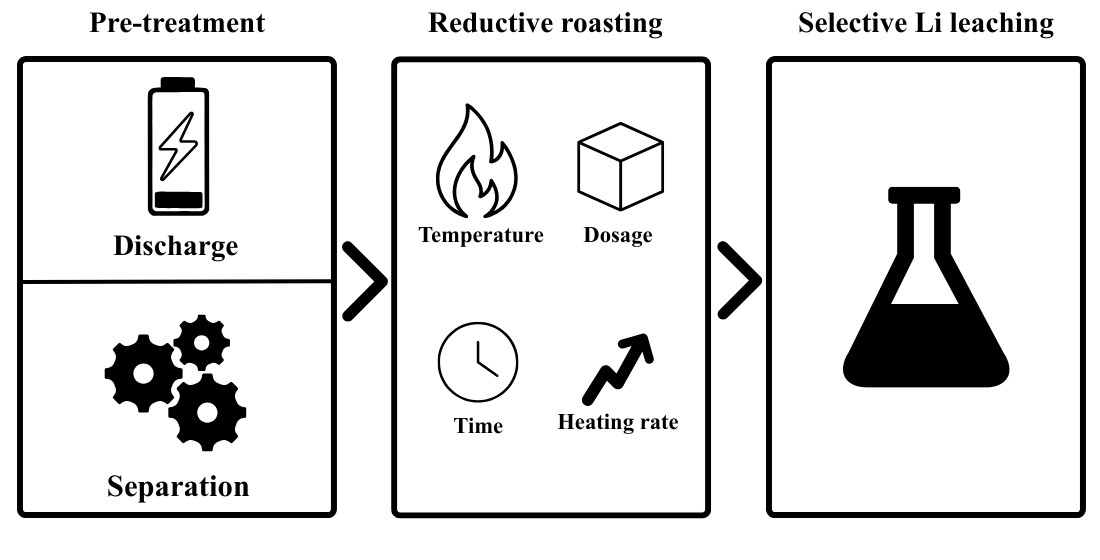
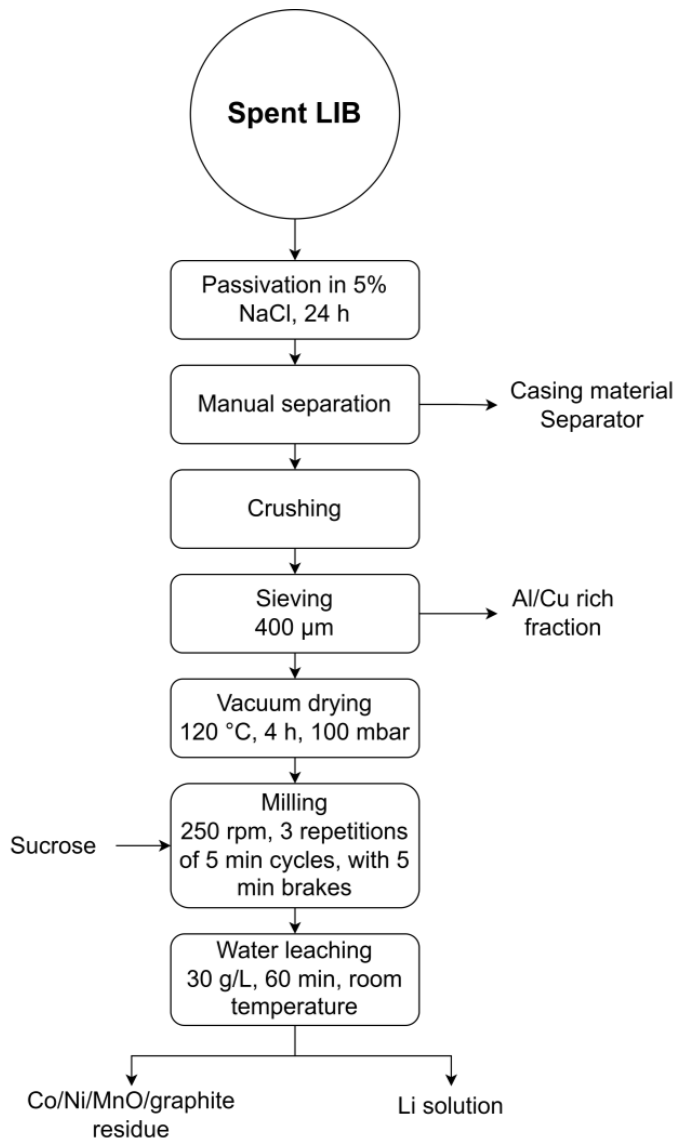
Three distinct stock batches of the Bolt cells (NMC) were prepared for the reductive roasting optimisation experiments: concentrated cathode powder, concentrated anode powder, and black mass mixture comprising both cathode and anode active material in their original proportions. For the Tuul cells (NCA), only a mixture of cathode and anode active material—black mass stock—was prepared. To remove the organic electrolyte and residual moisture, all batches were dried under vacuum (100 mbar) at 120 °C for 4 h prior to thermal processing. The full process flowsheet used in this study can be seen in Figure 9.

3.2. Roasting and Water Leaching Experiments

The stocks were mixed with sucrose (Dan Sukker, granulated beet sugar, AB Nordic Sugar Kedainiai, Kedainiai, Lithuania) at different dosages (0–20 wt%) in a planetary mill (PULVERISETTE 7 classic line, Fritsch GmbH, Idar-Oberstein, Germany) at 250 rpm, with three repetitions of 5 min cycles, and 5 min brakes in between each cycle to avoid the melting of sugar and to get a homogeneous mixture for roasting. All roasting experiments were performed with 10 g of either cathode active material or black mass. The roasting was carried out in a tube furnace (RSH 50/500/13, Nabertherm GmbH, Lilienthal, Germany) at different temperatures for NMC samples (500–650 °C), with a heating rate 20 °C/min (except flash roasting experiments), under Ar flow.
The holding time optimisation experiments were performed at 600 °C, with 15 wt% sucrose dosage, under Ar flow with the holding time being varied between 5 and 60 min for -NMC cathode and between 15 and 60 min for NMC black mass tests. Flash roasting experiments for NMC were also conducted at holding times 15 to 60 min, to study the effect of high heating rates on the reduction behaviour. In these experiments, the samples were inserted directly into the preheated furnace at 600 °C, rather than being subjected to gradual heating. Flash roasting experiments also enabled rapid cooling by removing the samples from the heated zone immediately after completion, providing improved control over the duration of the reductive reaction. NCA black mass was roasted at 600 °C, 15 wt% sucrose dosage, 20 °C/min, Ar flow, and 15 and 60 min holding times. All roasted samples were leached in ultra-pure water (18.2 MΩ/cm at 25 °C) at room temperature (20 °C) with a solid-to-liquid (S/L) ratio of 30 g/L for 1 h. The water leaching S/L ratio of 30 g/L was chosen for all experiments so that the Li2CO3 solubility (13.3 g/L at 20 °C [55]) would remain under the solubility limit (10.4 g/L if all Li in cathode would be transformed to Li2CO3).

3.3. Material Characterisation

Phase composition analysis for stocks and leach residues was performed using X-ray diffraction (XRD, PANalytical, X’Pert3 Powder diffractometer, Almelo, Netherlands), with Cu K1 radiation at an operation voltage of 45 kV, current 40 mA, scan angle (2Θ) 5–90°, step size 0.026° and a scanning speed of 0.044°/s. The XRD data was analysed using HighScore Plus software (version 4.1). Li, Ni, Co, Cu, and Mn concentrations in leaching and aqua regia solutions were measured using flame atomic absorption spectroscopy (AAS) (iCE 3000 Series AA Spectrometer, Thermo Fisher Scientific Inc., Waltham, MA, USA) controlled by iCE SOLAAR software (v.1.0, Thermo Fisher Scientific Inc.). Al concentrations in leaching and AR solutions were measured using graphite furnace atomic absorption spectroscopy (GFAAS) (contrAA 800 Series, Analytik Jena GmbH, Jena, Germany) and the results were analysed using ASpect CS (v.2.3.1.0; Analytic Jena GmbH). P concentrations for stocks were measured from aqua regia solutions using total reflection X-ray fluorescence analysis (TXRF) (S2 PICOFOX, Bruker Nano GmbH, Berlin, Germany). The Li leaching efficiency in the water leaching experiments was determined based on the Li content in the pregnant leach solution (PLS) and in the corresponding leach residue. These results were used to evaluate the effectiveness of the roasting process. The leaching efficiency was calculated according to the following equation:
L e a c h i n g   e f f i c i e n c y ( % ) = m e l e m e n t   i n   P L S m e l e m e n t   i n   P L S + m e l e m e n t   i n   l e a c h   r e s i d u e × 100
where melement in PLS was the total mass of the measured element in the PLS and the melement in leach residue was the total mass of the measured element in the leach residue. To determine the Li mass in the leach residue, 2.5 g of leach residue was dissolved in 25 mL aqua regia (65% HNO3, Lach-ner, Neratovice, Czech Republic, and 37% HCl, Honeywell, Muskegon, MI, USA, 1:4 ratio, 2 h, 100 °C) for all experiments.
To measure F concentrations, samples were leached in 50 mL 0.25 M HCl at room temperature with a S/L ratio of 1 g/L for 2 h. The solutions were then vacuum filtrated and diluted to 100 mL using ultra-pure water. The diluted solutions were measured for F using a F-ion selective electrode (ISE) (Mettler Toledo GmbH, Schwerzenbach, Switzerland) calibrated with Fluoride ISE standards 1, 10, 100 ppm (Mettler Toledo GmbH) diluted 1:1 with TISAB III concentrate (Sigma-Aldrich, St. Louis, MO, USA),with CDTA (Mettler Toledo GmbH) and measured by Automatic titrator (T90, Mettler Toledo GmbH) using ISE Average Direct measurement method controlled by LabX software (Mettler Toledo GmbH, https://www.mt.com).

4. Conclusions

The growing demand for LIBs raises significant concerns regarding Li supply security and the sustainable disposal and recycling of spent LIBs. To meet the EU Battery Regulation target of 80% lithium recovery by the end of 2031, recycling strategies need to be both technically effective and economically viable. This study demonstrated the efficacy of food-grade sucrose as a sustainable organic reductant for the targeted recovery of Li from NMC and NCA-based chemistries through reductive roasting followed by water leaching.
The best results were achieved at a target temperature of 600 °C, a heating rate of 20 °C/min, a sucrose dosage of 15 wt%, and a holding time of 15 min. Under these conditions, Li leaching efficiencies of 93.2% and 87.6% were achieved for the separated cathode material and black mass, respectively. The lower recovery from black mass was attributed to anode-derived impurities, which promoted the formation of poorly soluble lithium containing compounds such as LiF and Li3PO4. F composition analysis also confirmed the higher concentration of F in the roasted black mass samples (1.54 wt%) compared to cathode samples (1.07 wt%) at the same conditions. As a result, lithium leaching efficiency from black mass was approximately 5% lower than that from separated cathode material across the experiments. Furthermore, the process proved applicable to NCA-based chemistry, achieving a lithium recovery of 83.7% under baseline conditions. However, recovery from this material was limited by the formation of an insoluble Li3PO4 phase and the presence of residual NiO.
Mechanistic investigations revealed that the phase transitions of Ni and Mn were directly linked to Li leaching efficiency. While the NMC structure decomposed under all conditions tested, the Li leaching efficiency remained below 80% until complete reduction of NiO to metallic Ni and Mn into MnO was achieved. In contrast to Ni and Mn, Co reduction showed no direct correlation with the Li leaching efficiency and was fully reduced to metallic Co across all tested conditions. This dependency on the reduction rate of Ni and Mn also increased the target roasting temperature required (600 °C) for NMC when compared to studies done on LCO (500 °C). The roasting kinetics were found to be rapid; however, extending holding time beyond 15 min decreased lithium recovery. This decrease was attributed to secondary reactions between released lithium and impurities, leading to the formation of poorly soluble lithium phases. The heating rate also played an important role in the reduction process. Heating rates below 20 °C/min had only a minor effect on Li leaching efficiency (2.4%), whereas flash roasting significantly decreased Li recovery. Under these conditions, the system appeared to behave more similarly to conventional carbothermal or hydrogen reduction. This suggests that excessively high heating rates limit both the residence time and the availability of sucrose by-pyrolysis products needed for rapid reduction of the cathode matrix. Comparison with the literature confirmed that the highest efficiencies achieved in this study were comparable to previous works. In those studies, the higher Li leaching efficiencies were achieved through additional manual separation and chemical or thermal pre-treatment steps to reduce the impurity content prior to roasting, which might not be economically or technologically feasible at an industrial scale.
Overall, sucrose-assisted reductive roasting provides a promising, low-temperature, and rapid route for targeted lithium recovery from Ni-rich LIB chemistries. Future work should focus on optimisation of the water leaching stage, including the solid-to-liquid ratio and counter-current leaching configurations, to further improve lithium recovery and support the industrial viability of this recycling approach.

5. Patents

The authors declare that a patent related to this work was filed and has subsequently been assigned to a company. M. J and K. L hold ownership interests in this company. The findings may be subject to future commercialization.

Supplementary Materials

The following supporting information can be downloaded at https://www.mdpi.com/article/10.3390/recycling11070114/s1. Table S1. F measurement results of roasted and water-leached samples for NMC cathode and black mass experiments; Table S2. Calculated per-phase Li balances for each stock. The compositions of LiF, Li3PO4, and LiAlO2 are calculated from molar values and on the assumption they have completely reacted with Li. The binding effects of Li with Ni and Mn were not considered; Table S3. Li leaching efficiency as a function of heating rate for NMC black mass. The constant parameters used during roasting were 600 °C target temperature, 15 wt% sucrose dosage, and 60 min holding time; Figure S1: X-ray diffractograms of aqua regia residues for NMC cathode and black mass samples; Figure S2: X-ray diffractograms of water leaching residues from NMC cathode temperature experiments. The roasting parameters used were 15 wt% sucrose dosage, 20 °C/min heating rate, and 60 min holding time; Figure S3. X-ray diffractograms of NMC anode water leaching residues. For SiO2, “Q” stands for quartz and “K” for keatite. The roasting parameters used were 500 °C target temperature, 15 wt% sucrose dosage, 20 °C/min heating rate, and 60 min holding time; Figure S4. X-ray diffractograms of water leaching residues from NMC cathode sucrose experiments. The roasting parameters used were 600 °C roasting temperature, 20 °C/min heating rate, and 60 min holding time; Figure S5. X-ray diffractograms of water leaching residues from NMC cathode holding time experiments. The roasting parameters used were 600 °C roasting temperature, 15 wt% sucrose dosage, and 20 °C/min heating rate; Figure S6. X-ray diffractograms of water leaching residues from NMC cathode flash roasting experiments. The roasting parameters used were 600 °C roasting temperature and 15 wt% sucrose dosage; Figure S7: X-ray diffractograms of water-leached (WL) NCA black mass (BM) and the corresponding aqua regia (AR) insoluble residue. The roasting parameters used were 600 °C target temperature, 15 wt% sucrose dosage, 20 °C/min heating rate, and 60 min holding time.

Author Contributions

Conceptualization, M.J. and K.L.; Methodology, M.J. and K.L.; Validation, M.J.; Formal analysis, M.J.; Investigation, M.J., R.T. and K.L.; Resources, K.L.; Data curation, M.J.; Writing—original draft, M.J. and K.L.; Visualization, M.J.; Supervision, K.L.; Project administration, K.L.; Funding acquisition, K.L. All authors have read and agreed to the published version of the manuscript.

Funding

This research was funded by the Estonian Research Council, grant numbers EAG248 and PSG926, and the Ministry of Education and Research through the Centre of Excellence in Circular Economy for Strategic Mineral and Carbon Resources (1 January 2024–31 December 2030, grant number TK228).

Data Availability Statement

The data generated during the current study are available from the corresponding author on reasonable request.

Acknowledgments

The authors would like to thank Bolt Technology OÜ and Tuul Mobility OÜ for providing the spent e-scooter lithium-ion batteries used in this research. During the preparation of this manuscript, the authors used Gemini 3 Flash (Google) for the purposes of language editing and to improve the grammatical clarity of the text. The authors have reviewed and edited the output and take full responsibility for the content of this publication.

Conflicts of Interest

The authors declare that a patent related to this work has been filed and assigned to Jälle Technologies OÜ. M.J. and K.L. hold ownership interests in this company. The findings may be subject to future commercialization. This research was conducted within a government-funded project and was not influenced by commercial considerations. The authors declare no other conflicts of interest.

Abbreviations

The following abbreviations are used in this manuscript:
LIBLithium-ion battery
NMCLiNi1-x-yMnxCoyO2
NCALiNi1-x-yCoxAlyO2
EVElectric vehicle
LNMOLiNi0.5Mn1.5O4
LFPLiFePO4
CAMCathode active material
PVCPolyvinyl chlorine
PEPolyethylene
ICDDInternational Centre for Diffraction Data
AASAtomic absorption spectroscopy
UDUndissolved
XRDX-ray diffraction
PLSPregnant leach solution
EUEuropean Union
ARAqua regia
BMBlack mass
QQuartz
KKeatite
LCOLiCoO2
SEISolid electrolyte interface
PVDFPolyvinylidene fluoride
FFlash roasting
TXRFTotal reflection X-ray fluorescence analysis
ISEIon-selective electrode
WLWater-leached
GFAASGraphite furnace atomic absorption spectroscopy

References

  1. Meng, J.; You, Y.; Lin, M.; Wu, J.; Song, Z. Multi-scenarios transferable learning framework with few-shot for early lithium-ion battery lifespan trajectory prediction. Energy 2024, 286, 129682. [Google Scholar] [CrossRef]
  2. Waseem, M.; Ahmad, M.; Parveen, A.; Suhaib, M. Battery technologies and functionality of battery management system for EVs: Current status, key challenges, and future prospectives. J. Power Sources 2023, 580, 233349. [Google Scholar] [CrossRef]
  3. Maisel, F.; Neef, C.; Marscheider-Weidemann, F.; Nissen, N.F. A forecast on future raw material demand and recycling potential of lithium-ion batteries in electric vehicles. Resour. Conserv. Recycl. 2023, 192, 106920. [Google Scholar] [CrossRef]
  4. Frith, J.T.; Lacey, M.J.; Ulissi, U. A non-academic perspective on the future of lithium-based batteries. Nat. Commun. 2023, 14, 420. [Google Scholar] [CrossRef] [PubMed]
  5. Rehman, S.; Al-Greer, M.; Burn, A.S.; Short, M.; Cui, X. High-Volume Battery Recycling: Technical Review of Challenges and Future Directions. Batteries 2025, 11, 94. [Google Scholar] [CrossRef]
  6. Anufriev, I.E.; Khusainov, B.; Tick, A.; Devezas, T.; Sarygulov, A.; Kaimoldina, S. Mathematical Model for Assessing New, Non-Fossil Fuel Technological Products (Li-Ion Batteries and Electric Vehicle). Mathematics 2025, 13, 143. [Google Scholar] [CrossRef]
  7. Simas, M.S.; Bly, K.; Arega, M.A.; Aponte, F.R.; Silva, T.L.; Wiebe, K.S. Sustainability effects of material demand by next-generation lithium-ion battery technologies: A global value chain perspective. Resour. Conserv. Recycl. 2025, 219, 108294. [Google Scholar] [CrossRef]
  8. Bai, Y.; Muralidharan, N.; Sun, Y.-K.; Passerini, S.; Whittingham, M.S.; Belharouak, I. Energy and environmental aspects in recycling lithium-ion batteries: Concept of Battery Identity Global Passport. Mater. Today 2020, 41, 304–315. [Google Scholar] [CrossRef]
  9. Gao, W.; Thoo, A.C.; Sarker, M.; Lee, N.; Deng, X.; Yang, Y. Secondary Use of Retired Lithium-Ion Traction Batteries: A Review of Health Assessment, Interface Technology, and Supply Chain Management. Batteries 2025, 12, 1. [Google Scholar] [CrossRef]
  10. Gutsch, M.; Leker, J. Costs, carbon footprint, and environmental impacts of lithium-ion batteries—From cathode active material synthesis to cell manufacturing and recycling. Appl. Energy 2024, 353, 122132. [Google Scholar] [CrossRef]
  11. Bruno, M.; Fiore, S. Review of lithium-ion batteries’ supply-chain in Europe: Material flow analysis and environmental assessment. J. Environ. Manag. 2024, 358, 120758. [Google Scholar] [CrossRef] [PubMed]
  12. Jaskula, B.W. Lithium. In Mineral Commodity Summaries 2026; U.S. Geological Survey: Reston, VA, USA, 2026; pp. 118–119. [Google Scholar] [CrossRef]
  13. Ewing, S.M. Cobalt. In Mineral Commodity Summaries 2026; U.S. Geological Survey: Reston, VA, USA, 2026; pp. 70–71. [Google Scholar] [CrossRef]
  14. Yousefi, D.; Soleymani, A. Circular Economy and Sustainability in Lithium-Ion Battery Development in China and the USA. World Electr. Veh. J. 2025, 16, 578. [Google Scholar] [CrossRef]
  15. Xu, C.; Dai, Q.; Gaines, L.; Hu, M.; Tukker, A.; Steubing, B. Future material demand for automotive lithium-based batteries. Commun. Mater. 2020, 1, 99. [Google Scholar] [CrossRef]
  16. Sun, X.; Hao, H.; Geng, Y.; Liu, Z.; Zhao, F. Exploring the potential for improving material utilization efficiency to secure lithium supply for China’s battery supply chain. Fundam. Res. 2024, 4, 167–177. [Google Scholar] [CrossRef] [PubMed]
  17. Lin, B.; Li, J. Spot price fluctuations of battery-grade lithium carbonate and supply chain disruptions: The survival game of new energy enterprises. Renew. Energy 2026, 262, 125372. [Google Scholar] [CrossRef]
  18. Latini, D.; Vaccari, M.; Lagnoni, M.; Orefice, M.; Mathieux, F.; Huisman, J.; Tognotti, L.; Bertei, A. A comprehensive review and classification of unit operations with assessment of outputs quality in lithium-ion battery recycling. J. Power Sources 2022, 546, 231979. [Google Scholar] [CrossRef]
  19. Pan, C.; Shen, Y. Pyrometallurgical recycling of spent lithium-ion batteries from conventional roasting to synergistic pyrolysis with organic wastes. J. Energy Chem. 2023, 85, 547–561. [Google Scholar] [CrossRef]
  20. Lin, J.; Li, W.; Chen, Z. Scaling Direct Recycling of Lithium-Ion Batteries toward Industrialization: Challenges and Opportunities. ACS Energy Lett. 2025, 10, 947–957. [Google Scholar] [CrossRef]
  21. European Parliament; Council of the European Union. Regulation (EU) 2023/1542 of the European Parliament and of the Council of 12 July 2023 Concerning Batteries and Waste Batteries, Amending Directive 2008/98/EC and Regulation (EU) 2019/1020 and Repealing Directive 2006/66/EC; The Official Journal of the European Union: Brussels, Belgium, 2023; pp. 1–117. [Google Scholar]
  22. Hu, X.; Mousa, E.; Ye, G. Recovery of Co, Ni, Mn, and Li from Li-ion batteries by smelting reduction—Part II: A pilot-scale demonstration. J. Power Sources 2021, 483, 229089. [Google Scholar] [CrossRef]
  23. Scheunis, L.; Callebaut, W. Process for the Recovery of Lithium. U.S. Patent 11,952,643 B2, 9 April 2024. [Google Scholar]
  24. Marcinov, V.; Klimko, J.; Takáčová, Z.; Pirošková, J.; Miškufová, A.; Sommerfeld, M.; Dertmann, C.; Friedrich, B.; Oráč, D. Lithium Production and Recovery Methods: Overview of Lithium Losses. Metals 2023, 13, 1213. [Google Scholar] [CrossRef]
  25. Zha, Y.; Li, Y.; Fei, Z.; Fan, C.; Meng, Q.; Peng, X.; Dong, P. Leaching Li from mixed cathode materials of spent lithium-ion batteries via carbon thermal reduction. Dalton Trans. 2024, 53, 5592–5600. [Google Scholar] [CrossRef] [PubMed]
  26. Chen, Y.; Shi, P.; Chang, D.; Jie, Y.; Yang, S.; Wu, G.; Chen, H.; Zhu, J.; Hu, F.; Wilson, B.P.; et al. Selective extraction of valuable metals from spent EV power batteries using sulfation roasting and two stage leaching process. Sep. Purif. Technol. 2021, 258, 118078. [Google Scholar] [CrossRef]
  27. Huang, Y.; Shao, P.; Yang, L.; Zheng, Y.; Sun, Z.; Fang, L.; Lv, W.; Yao, Z.; Wang, L.; Luo, X. Thermochemically driven crystal phase transfer via chlorination roasting toward the selective extraction of lithium from spent LiNi1/3Co1/3Mn1/3O2. Resour. Conserv. Recycl. 2021, 174, 105757. [Google Scholar] [CrossRef]
  28. Peng, C.; Liu, F.; Wang, Z.; Wilson, B.P.; Lundström, M. Selective extraction of lithium (Li) and preparation of battery grade lithium carbonate (Li2CO3) from spent Li-ion batteries in nitrate system. J. Power Sources 2019, 415, 179–188. [Google Scholar] [CrossRef]
  29. Liu, F.; Peng, C.; Ma, Q.; Wang, J.; Zhou, S.; Chen, Z.; Wilson, B.P.; Lundström, M. Selective lithium recovery and integrated preparation of high-purity lithium hydroxide products from spent lithium-ion batteries. Sep. Purif. Technol. 2021, 259, 118181. [Google Scholar] [CrossRef]
  30. Ma, S.; Liu, F.; Li, K.; Chen, Z.; Chen, F.; Wang, J.; Zhong, S.; Wilson, B.P.; Lundström, M. Separation of Li and Al from spent ternary Li-ion batteries by in-situ aluminum-carbon reduction roasting followed by selective leaching. Hydrometallurgy 2022, 213, 105941. [Google Scholar] [CrossRef]
  31. Zhou, F.; Qu, X.; Wu, Y.; Zhao, J.; Gao, S.; Wang, D.; Yin, H. Vacuum Pyrolysis of Pine Sawdust to Recover Spent Lithium Ion Batteries: The Synergistic Effect of Carbothermic Reduction and Pyrolysis Gas Reduction. ACS Sustain. Chem. Eng. 2022, 10, 1287–1297. [Google Scholar] [CrossRef]
  32. Lai, Y.; Zhu, X.; Li, J.; Peng, Q.; Hu, S.; Xia, A.; Huang, Y.; Liao, Q.; Zhu, X. Efficient recovery of valuable metals from cathode materials of spent LiCoO2 batteries via co-pyrolysis with cheap carbonaceous materials. Waste Manag. 2022, 148, 12–21. [Google Scholar] [CrossRef] [PubMed]
  33. Yang, B.; Lu, X.; Wang, X.; Zhang, J. Selective lithium extraction from spent lithium-ion batteries through polyvinyl chloride thermal decomposition-based gas-solid reaction. Heliyon 2024, 10, e25575. [Google Scholar] [CrossRef] [PubMed]
  34. Zhang, B.; Xu, Y.; Makuza, B.; Zhu, F.; Wang, H.; Hong, N.; Long, Z.; Deng, W.; Zou, G.; Hou, H.; et al. Selective lithium extraction and regeneration of LiCoO2 cathode materials from the spent lithium-ion battery. Chem. Eng. J. 2023, 452, 139258. [Google Scholar] [CrossRef]
  35. Chen, H.; Dou, B.; Song, Y.; Xu, Y.; Zhang, Y.; Wang, C.; Zhang, X.; Tan, C. Pyrolysis characteristics of sucrose biomass in a tubular reactor and a thermogravimetric analysis. Fuel 2012, 95, 425–430. [Google Scholar] [CrossRef]
  36. Richardson, Y.; Blin, J.; Volle, G.; Motuzas, J.; Julbe, A. In situ generation of Ni metal nanoparticles as catalyst for H2-rich syngas production from biomass gasification. Appl. Catal. A 2010, 382, 220–230. [Google Scholar] [CrossRef]
  37. Matras, J.; Niewiadomski, M.; Ruppert, A.; Grams, J. Activity of Ni catalysts for hydrogen production via biomass pyrolysis. Kinet. Catal. 2012, 53, 565–569. [Google Scholar] [CrossRef]
  38. Zheng, D.; Deng, F.; Chen, R.; Wang, M.; Tao, L.; Cheng, Q. Comparison between ex-situ and in-situ catalytic pyrolysis of food waste over nickel based catalysts. BMC Chem. 2026, 20, 24. [Google Scholar] [CrossRef] [PubMed]
  39. Zhao, Y.; Liu, B.; Zhang, L.; Guo, S. Microwave Pyrolysis of Macadamia Shells for Efficiently Recycling Lithium from Spent Lithium-ion Batteries. J. Hazard. Mater. 2020, 396, 122740. [Google Scholar] [CrossRef] [PubMed]
  40. Jantson, M.; Liivand, K.; Mikli, V. Early-stage extraction of lithium from LCO cathodes via sucrose-assisted reductive roasting. RSC Adv. 2026, 16, 872–882. [Google Scholar] [CrossRef] [PubMed]
  41. Lin, T.; Wang, Y.; Jin, S.; Mu, D.; Zhang, J.; Liang, J.; Dai, C. An enhanced strategy based on the pyrolysis of bean dregs for efficient selective recovery of lithium from spent lithium-ion batteries. Green Chem. 2022, 24, 9552–9564. [Google Scholar] [CrossRef]
  42. Huang, Z.; Liu, F.; Makuza, B.; Yu, D.; Guo, X.; Tian, Q. Metal Reclamation from Spent Lithium-Ion Battery Cathode Materials: Directional Conversion of Metals Based on Hydrogen Reduction. ACS Sustain. Chem. Eng. 2022, 10, 756–765. [Google Scholar] [CrossRef]
  43. Lombardo, G.; Ebin, B.; St. J. Foreman, M.R.; Steenari, B.-M.; Petranikova, M. Chemical Transformations in Li-Ion Battery Electrode Materials by Carbothermic Reduction. ACS Sustain. Chem. Eng. 2019, 7, 13668–13679. [Google Scholar] [CrossRef]
  44. Adenusi, H.; Chass, G.A.; Passerini, S.; Tian, K.V.; Chen, G. Lithium Batteries and the Solid Electrolyte Interphase (SEI)—Progress and Outlook. Adv. Energy Mater. 2023, 13, 2203307. [Google Scholar] [CrossRef]
  45. Sommerfeld, M.; Vonderstein, C.; Dertmann, C.; Klimko, J.; Oráč, D.; Miškufová, A.; Havlik, T.; Friedrich, B. A Combined Pyro- and Hydrometallurgical Approach to Recycle Pyrolyzed Lithium-Ion Battery Black Mass Part 1: Production of Lithium Concentrates in an Electric Arc Furnace. Metals 2020, 10, 1069. [Google Scholar] [CrossRef]
  46. Zhang, G.; Liu, Z.; Yuan, X.; He, Y.; Wei, N.; Wang, H.; Zhang, B. Recycling of valuable metals from spent cathode material by organic pyrolysis combined with in-situ thermal reduction. J. Hazard. Mater. 2022, 430, 128374. [Google Scholar] [CrossRef] [PubMed]
  47. Stubblefield, C.B.; Bach, R.O. Solubility of Lithium Fluoride in Water. J. Chem. Eng. Data 1972, 17, 491–492. [Google Scholar] [CrossRef]
  48. Tao, Y.; Wang, M.; Yuan, J.; Wu, J.; Gao, J.; Xia, Y. Carbothermal Reduction for High-Efficiency Lithium Recovery from Spent Ternary Cathode Materials. Ind. Eng. Chem. Res. 2025, 64, 2531–2542. [Google Scholar] [CrossRef]
  49. Wang, C.; Dou, B.; Song, Y.; Chen, H.; Yang, M.; Xu, Y. Kinetic Study on Non-isothermal Pyrolysis of Sucrose Biomass. Energy Fuels 2014, 28, 3793–3801. [Google Scholar] [CrossRef]
  50. Efika, C.E.; Onwudili, J.A.; Williams, P.T. Influence of heating rates on the products of high-temperature pyrolysis of waste wood pellets and biomass model compounds. Waste Manag. 2018, 76, 497–506. [Google Scholar] [CrossRef] [PubMed]
  51. Chen, Z.; Shen, C.; Liu, F.; Wang, J. Selective Separation and Recovery of Li from Spent LiFePO4 Cathode Materials by Oxidation Roasting Followed by Low-Acid Pressure Leaching. Metals 2023, 13, 1884. [Google Scholar] [CrossRef]
  52. Mallick, S.; Patel, A.; Paranthaman, M.P.; Mugumya, J.M.; Kim, A.; Rasche, M.L.; Jiang, M.; Lopez, H.; Gupta, R.B. An overview of various critical aspects of low-cobalt/cobalt-free Li-ion battery cathodes. Sustain. Energy Fuels 2025, 9, 724–738. [Google Scholar] [CrossRef]
  53. Hu, P.; Wu, H.; Yao, L.; Yao, J.; Zhang, T.; Jiang, S.; Wu, X.; Liu, Y.; Li, J.; Dong, P.; et al. Recovery of Lithium from Spent Lithium-Ion Batteries Through Pyrolysis Reduction. Crystals 2026, 16, 341. [Google Scholar] [CrossRef]
  54. Zhai, R.; Huang, K.; Mao, S.; Li, R.; Dong, H.; Zhai, X. Recovery of Valuable Metals from Spent Lithium-Ion Batteries by Combining Reduction Roasting and Selective Leaching. Recycling 2026, 11, 59. [Google Scholar] [CrossRef]
  55. Cheng, W.; Li, Z.; Cheng, F. Solubility of Li2CO3 in Na-K-Li-Cl brines from 20 to 90 °C. J. Chem. Thermodyn. 2013, 67, 74–82. [Google Scholar] [CrossRef]
Figure 1. X-ray diffractograms of the stock used in this study. “BM” represents black mass.
Recycling 11 00114 g001
Figure 2. Li leaching efficiency as a function of temperature for NMC cathode and black mass stocks. The constant parameters used during roasting were 15 wt% sucrose dosage, 20 °C/min heating rate, and 60 min holding time.
Recycling 11 00114 g002
Figure 3. X-ray diffractograms of water leaching residues from NMC black mass temperature experiments. The roasting parameters used were 15 wt% sucrose dosage, 20 °C/min heating rate, and 60 min holding time.
Recycling 11 00114 g003
Figure 4. Li leaching efficiency as a function of sucrose dosage both NMC cathode and black mass stocks. The constant parameters used during roasting were 600 °C roasting temperature, 20 °C/min heating rate, and 60 min holding time.
Recycling 11 00114 g004
Figure 5. X-ray diffractograms of water leaching residues from NMC black mass sucrose experiments. The roasting parameters used were 600 °C roasting temperature, 20 °C/min heating rate, and 60 min holding time.
Recycling 11 00114 g005
Figure 6. Li leaching efficiency results for holding time and flash roasting experiments (noted with F) for both NMC cathode and black mass stocks. The constant parameters used during roasting were 600 °C roasting temperature, 15 wt% sucrose dosage, and for time optimisation experiments the heating rate was 20 °C/min.
Recycling 11 00114 g006
Figure 7. X-ray diffractograms of water leaching residues from NMC black mass holding time experiments. The roasting parameters used were 600 °C roasting temperature, 15 wt% sucrose dosage, and 20 °C/min heating rate.
Recycling 11 00114 g007
Figure 8. X-ray diffractograms of water leaching residues from NMC black mass flash roasting experiments. The roasting parameters used were 600 °C roasting temperature and 15 wt% sucrose dosage.
Recycling 11 00114 g008
Figure 9. Overall process flowsheet with pre-treatment and reductive roasting steps for Li separation.
Recycling 11 00114 g009
Table 1. Chemical composition of cathode and black mass stocks measured using flame atomic absorption spectroscopy (AAS), F-ion selective electrode (ISE), total reflection X-ray fluorescence (TXRF), and graphite furnace atomic absorption spectroscopy (GFAAS).
StockLi (wt%)Co (wt%)Ni (wt%)Mn (wt%)Al (wt%)F (wt%)P (wt%)UD * (wt%)
Bolt cathode5.99.129.49.10.220.460.613.8
Bolt anode3.70000.042.260.6382.0
Bolt black mass4.36.121.06.30.211.060.6535.2
Tuul black mass4.13.327.600.390.910.5833.7
* UD denotes the undissolved fraction after aqua regia treatment, which mainly consists of carbon additives, binder material and graphite.
Table 2. Comparison of Li leaching efficiencies, roasting conditions, and pre-treatment methods for layered Li metal oxides using carbohydrate reductants.
ChemistryReductantPre-TreatmentRoasting ConditionsLi Leaching Efficiency (%)
NMC622 cathodeSucroseManually separated cathode, crushing, vacuum drying, sieving.600 °C, 15 wt% sucrose, 15 min holding time, 20 °C/min, Ar flow.93.2 (current study)
NMC622 black massSucroseManually separated anode and cathode, crushing, vacuum drying, sieving.600 °C, 15 wt% sucrose, 15 min holding time, 20 °C/min, Ar flow.87.6 (current study)
NCA black massSucroseManually separated cathode, crushing, vacuum drying, sieving.600 °C, 15 wt% sucrose, 15 min holding time, 20 °C/min, Ar flow.83.7 (current study)
NMC532 cathodeSucroseManually separated cathode, CAM
manually separated from Al foil, washed with ethanol and water,
pyrolysis at 350 °C for 60 min.
650 °C, 15 wt% sucrose, 30 min holding time, 5 °C/min, N2 flow97.9 [53]
NMC
cathode
GlucoseManually separated cathode,
pyrolysis at 530 °C for 120 min, CAM separated from Al foil, grinding, milling.
600 °C, 20 wt% glucose, 90 min holding time, 10 °C/min, N2 flow95.4 [54]
LCO
cathode
SucroseManually separated cathode, crushing, sieving500 °C, 15 wt% sucrose, 60 min holding time, 20 °C/min, Ar flow.90.1 [40]
LCO
cathode
SucroseManually separated cathode, crushing, sieving, NMP dissolution, NaOH dissolution.500 °C, 15 wt% sucrose, 60 min holding time, 20 °C/min, Ar flow.94.5 [40]
LCO
cathode
GlucoseManually separated cathode, cathode foils treated with NMP for 120 min at 90 °C, CAM calcined at 700 °C for 120 min.550 °C, 10 wt% glucose, 60 min holding time, 5 °C/min, Ar flow.97.0 [39]
Disclaimer/Publisher’s Note: The statements, opinions and data contained in all publications are solely those of the individual author(s) and contributor(s) and not of MDPI and/or the editor(s). MDPI and/or the editor(s) disclaim responsibility for any injury to people or property resulting from any ideas, methods, instructions or products referred to in the content.