1. Introduction
With the ongoing development and utilization of global mineral resources, the volume of tailings generated is growing rapidly and has become a significant component of bulk industrial solid waste [
1,
2,
3]. According to statistics, the cumulative stockpile of tailings has reached about 7 billion tons and continues to increase worldwide [
4,
5,
6]. The large-scale stockpiling of tailings not only occupies vast amounts of land but also poses environmental and safety risks, such as dust dispersion, heavy metal leaching, and dam instability, posing a long-term threat to ecosystems and human society [
7,
8]. Therefore, achieving the reduction, resource recovery, and high-value utilization of tailings has become a key research focus in the fields of resources and the environment.
Among various resource recovery approaches, the application of tailings in cement-based material systems, particularly as a substitute for natural aggregates in concrete, is regarded as a utilization method that combines environmental benefits with engineering value [
9,
10,
11]. On the one hand, the over-exploitation of natural sand and gravel resources has led to their depletion and ecological damage, creating an urgent need for sustainable alternative materials. On the other hand, after appropriate processing, tailings possess certain particle characteristics and mechanical stability, allowing them to be used as fine aggregates in concrete, thereby achieving the goal of substituting waste for materials [
12,
13,
14]. Consequently, research on tailings aggregate concrete not only aligns with the development direction of green building materials but also holds significant importance for promoting the recycling of solid waste resources.
However, compared to natural aggregates, tailings aggregates exhibit significant differences in particle morphology, surface structure, mineral composition, and physical and mechanical properties [
15]. Tailings particles typically feature sharp edges, rough surfaces, and well-developed pore structures, and their gradation composition is often suboptimal [
16]. These differences directly affect the mixing performance and structural formation process of concrete. For example, high water absorption and irregular morphology reduce the workability of the mixture and increase water demand, while the rough surface enhances the interfacial bonding between the aggregate and the paste [
17]. Furthermore, potential active components in tailings (such as SiO
2 and Al
2O
3) may participate in secondary reactions under certain conditions, exerting further influence on the microstructure of the system [
18].
Extensive research [
19,
20,
21] indicates that the influence of tailings aggregates on concrete performance exhibits a distinct dual effect. On the one hand, their rough surfaces and good mechanical interlocking action help improve the structure of the interfacial transition zone, enhancing compressive strength and long-term mechanical properties. On the other hand, their high porosity and water absorption characteristics may introduce more defects, leading to increased shrinkage, reduced impermeability, and deteriorated durability. Therefore, factors such as the substitution rate of tailings and optimization of particle gradation all play a critical role in regulating concrete performance. In recent years, with the advancement of material characterization techniques and multiscale analysis methods, researchers have gradually shifted their focus from macro-level performance evaluation to systematic studies of microstructure and mechanisms of action. For example, techniques such as scanning electron microscopy (SEM), energy-dispersive spectroscopy (EDS), and pore structure testing can provide in-depth insights into the mechanisms by which tailings aggregates influence the interface transition zone and the paste structure. However, current research still faces certain limitations, such as the lack of a unified evaluation system across different types of tailings and the incomplete clarification of performance influence patterns. In addition, most previous reviews primarily focus on the specific types of tailings for individual case studies and isolated evaluations of mechanical properties. In addition, it is imperative to further verify their applicability and long-term durability in practical engineering applications to ensure reliability and performance. The research objectives and content of the existing reviews are summarized in detail in
Table 1. The ✓ and the ✗ indicate whether the review covers or does not cover the content of the corresponding study, respectively.
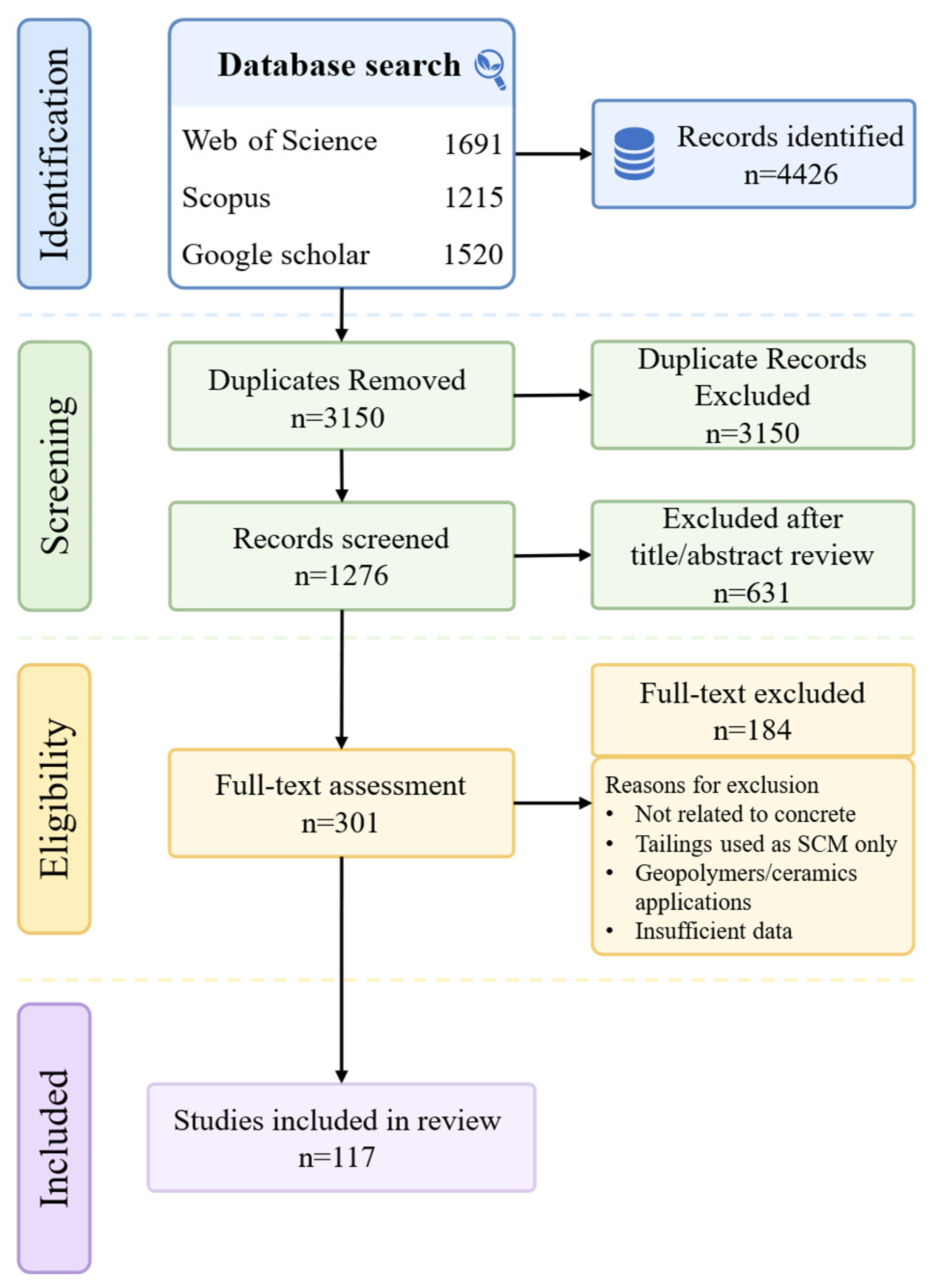
Consequently, it is necessary to systematically review and summarize the research progress on the use of tailings as concrete aggregates. This paper focuses on reviewing the fundamental properties of different types of tailings aggregates and their effects on the workability, mechanical properties, durability, microscopic characterization of concrete materials. It will further analyze the underlying mechanisms, identify key issues in current research, and outline future research directions, with the aim of providing a reference for both the engineering application and theoretical research of concrete using tailings aggregates. The literature included in this review was collected from major scientific databases, including Web of Science, Scopus, and Google Scholar.
Figure 1 shows the flowchart of the literature search process.
2. Physical and Chemical Properties
2.1. Particle Size Distribution
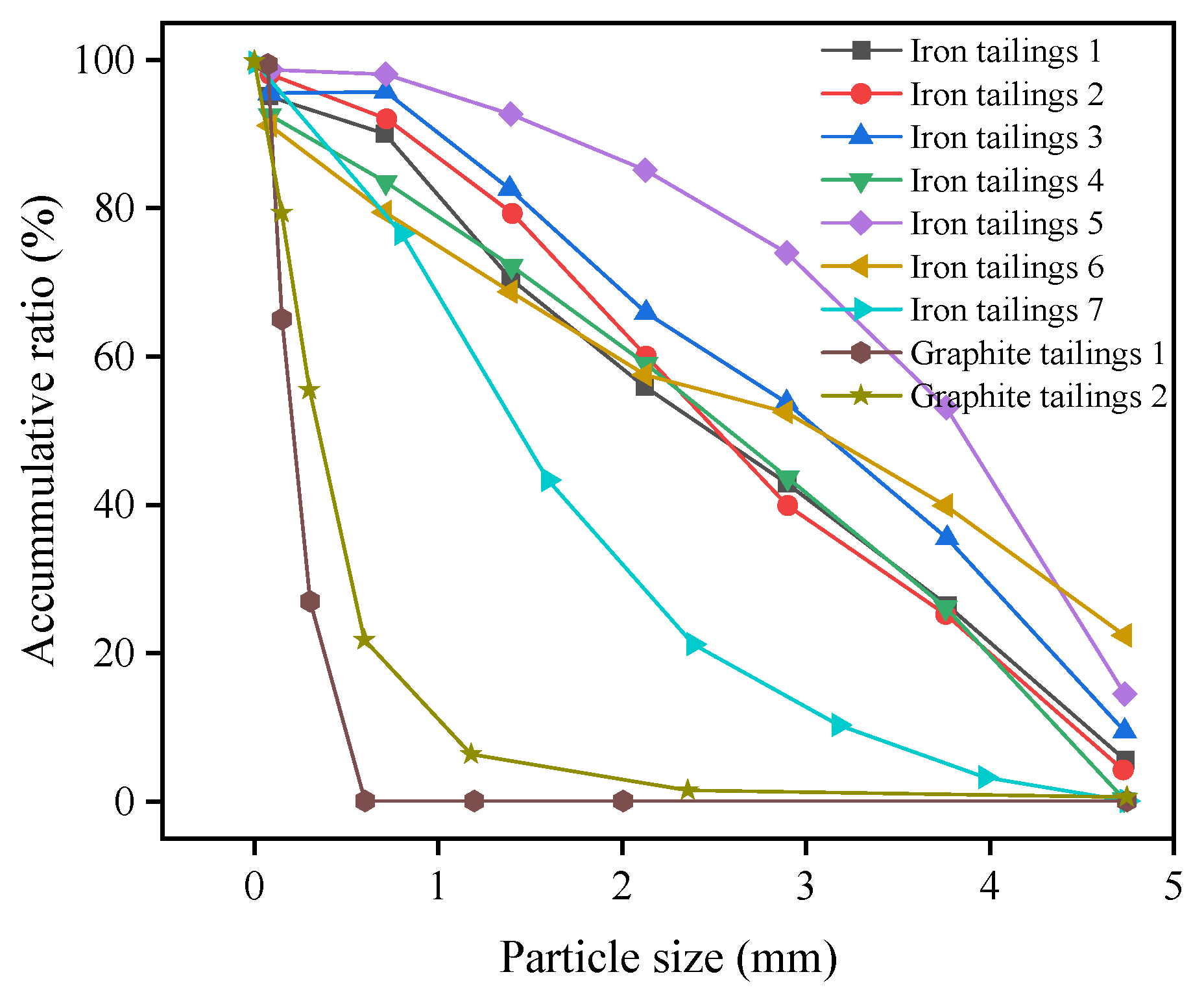
The accumulative particle size distributions of the different tailings exhibited significant differences (
Figure 2) [
29,
30,
31,
32]. The figure highlights iron tailings and graphite tailings, which are the most widely used aggregates in concrete materials. Iron tailings generally display a smooth, decreasing curve, reflecting a wide particle size range and continuous gradation. In contrast, graphite tailings show a steep drop within the 1 mm range, exhibiting typical fine-grain concentration and discontinuous gradation. This difference essentially stems from the distinct mechanisms of particle formation and fragmentation, and directly determines their deposition behavior and structural formation. From a mechanistic perspective, the continuous gradation of iron tailings facilitates the formation of a multiscale particle packing system. Through the synergistic interaction, coarse particles function as a skeletal framework, with fine particles filling the interstitial voids. This interaction improves particle packing, which in turn increases density and lowers porosity. In contrast, graphite tailings are dominated by fine particles, which provide poorer skeletal support. This results in high specific surface area and water absorption, ultimately compromising system stability. Therefore, particle size distribution is not merely a geometric attribute but a governing structural parameter that dictates the macroscopic properties of tailings.
2.2. Particle Shape
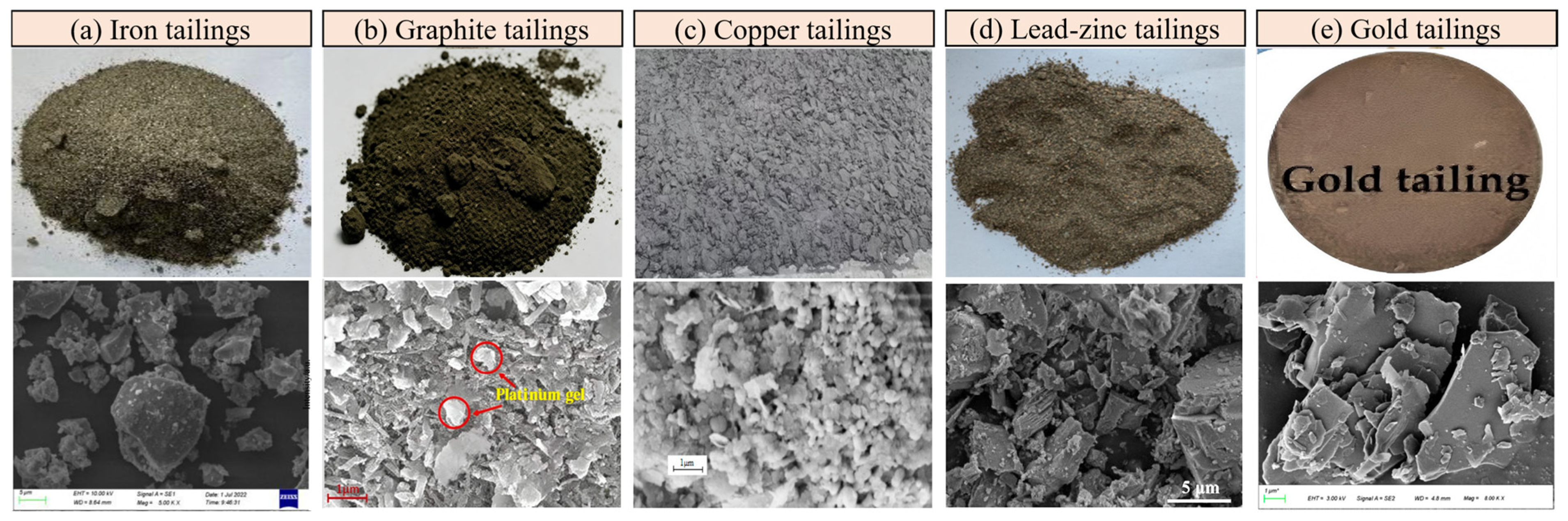
Figure 3 illustrates the macroscopic morphology and corresponding SEM microstructures of different types of tailings (iron, graphite, copper, lead–zinc, and gold tailings) [
4,
5,
28,
33,
34,
35,
36,
37,
38,
39]. Overall, particles of all tailings types generally exhibit angular, irregular shapes with distinct boundaries and a lack of rounded features. This indicates that they primarily originate from mechanical crushing rather than natural erosion processes. At the microscopic scale, all tailings exhibit highly rough and heterogeneous surface structures. The surfaces of iron and graphite tailings particles show distinct protrusions and microporous structures. Copper tailings consist primarily of fine particle aggregates, exhibiting high dispersion and irregular accumulation. Lead–zinc tailings feature a coexistence of flaky and clastic particles with a loose structure. And gold tailings display a typical layered or flaky structure with pronounced surface undulations. These multiscale roughness and morphological complexity features indicate that different tailings have undergone distinct fragmentation and sorting mechanisms during particle formation and mineral liberation.
From the perspective of particle geometry, the angular and rough morphology of tailings essentially implies a higher specific surface area and stronger mechanical interlocking capacity. On the one hand, rough surfaces and sharp edges help enhance interparticle and particle-to-cement paste interlocking, thereby potentially improving interfacial bonding performance. On the other hand, irregular morphology generally increases interparticle friction resistance, weakens the rolling effect of particles, and consequently alters the rheological behavior of the mixture. At the macroscopic level, these morphological characteristics exhibit a distinct dual effect on concrete performance. Tailings particles lack the “ball-bearing effect” typically provided by smooth natural aggregates. Their irregular shape and rough surface texture hinder particle movement. As a result, the flowability of the mixture is reduced and flow resistance and energy dissipation are generally increased. Fortunately, the rough surfaces also help improve the structural integrity of the interfacial transition zone. By enhancing mechanical interlocking and interfacial friction, they increase the overall integrity and load-bearing capacity of the hardened materials.
Therefore, the impact of tailings particle morphology fundamentally represents a trade-off between deteriorated workability and enhanced interfacial bonding. The net effect is governed by the combined influence of particle shape, surface roughness, and gradation. This underscores the need to balance these properties through particle shaping or gradation optimization in practical applications.
2.3. Physical Properties
The physical properties of tailings as fine aggregates exhibit significant source-specificity and process-dependence, which directly determine the technical pathways and challenges for their resource utilization. As shown in
Table 2, the physical parameters of different tailings vary widely. Iron tailings exhibit a high bulk density (generally >2750 kg/m
3) due to their heavy mineral content. However, their angular particle shape (
Figure 3) results in a bulk porosity as high as 33%~50%, leading to water absorption ranging from 0.8%~9%. The high porosity of iron tailings accounts for their complex water demand in concrete. In contrast, graphite tailings are characterized by an extremely fine particle size (fineness modulus as low as 0.9), resulting in a high specific surface area. This causes their water absorption to increase sharply to 28%~37%, posing a severe challenge to the control of workability in concrete materials. Copper tailings may exhibit a lower bulk density (2360 kg/m
3) due to differences in mineral composition. These property differences profoundly influence concrete performance. The high density and angularity of iron tailings help enhance mechanical strength, but their high porosity must be compensated for in mix design. The extremely fine particles of graphite tailings can optimize microstructure, while their high water demand presents a technical hurdle that must be overcome.
Therefore, future research and practical applications should no longer treat tailings as homogeneous materials. Instead, they must be classified based on key attributes such as mineral composition, particle size distribution, particle morphology, and pore structure. Establishing a refined classification system and comprehensive property database will enable more precise and tailored utilization.
2.4. Chemical and Mineral Compositions
The chemical composition of tailings is the foundation of their resource utilization, profoundly influencing both technical pathways and environmental risks. As shown in
Table 3, tailings from different ore deposits and beneficiation processes exhibit highly heterogeneous chemical compositions. The iron tailings were generally rich in silicon (SiO
2: 56%~74.3%) and poor in calcium (CaO: 2%~9.1%), with a generally variable Si/Al ratio. This offered potential for their application in concrete materials [
29,
47,
48,
49]. It is worth noting that with the development of mineral processing technology and improved iron recovery rates, the Fe
2O
3 content in modern iron tailings could be as low as 3.8%, while the SiO
2 content had correspondingly increased to 74.3% [
29]. This reflected the dynamic nature of tailings properties as they evolve over time and with process changes. In contrast, lead–zinc tailings exhibited distinctly different chemical characteristics, namely extremely high SO
3 (up to 25.92%) and CaO (up to 22.78%) contents [
50,
51]. This indicated a high concentration of sulfate and carbonate minerals; therefore, their volumetric stability and the risk of heavy metal leaching must be rigorously assessed prior to utilization. The chemical composition of gold and copper tailings was even more variable, ranging from nearly pure quartz sand to complex systems rich in iron and calcium [
35,
46,
52,
53,
54,
55]. Therefore, any tailings utilization strategy must be based on precise chemical and phase analysis. Future research should focus on establishing a database of the chemical and mineralogical composition of tailings and developing a corresponding system of activation, stabilization, and functionalization technologies to achieve the transformation from waste to engineered raw materials. It is widely recognized that some tailings contain radioactivity [
56]. The natural radioactivity of tailings depends on their geological origin and mineral composition. Existing studies indicate that incorporating tailings into concrete can effectively immobilize radionuclides through physical encapsulation and reduce radon emissions [
57]. Nevertheless, radiation assessments must be conducted prior to large-scale application, and tailings must comply with relevant regulatory requirements regarding radionuclide activity concentrations and radiation safety. Therefore, when assessing the environmental suitability of tailings for construction applications, natural radioactivity should be considered in conjunction with heavy metal leaching, durability, and sustainability.
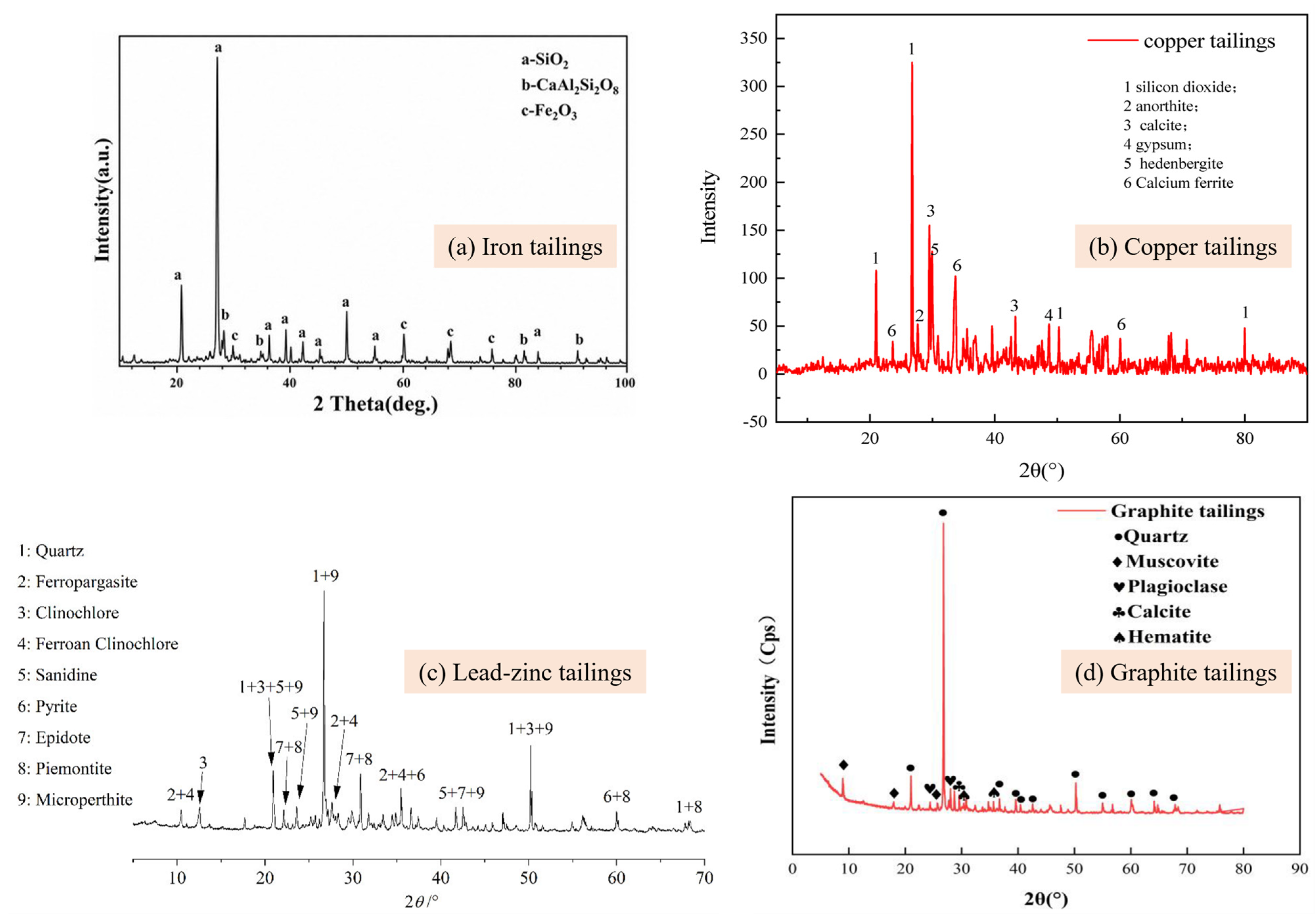
This comparative analysis of X-ray diffraction (XRD) patterns indicates significant differences in the mineral composition among typical iron tailings, copper tailings, lead–zinc tailings, and graphite tailings [
62,
63,
64,
65] (
Figure 4). Iron tailings exhibited a relatively simple mineral phase composition with good crystallinity. Copper tailings consisted of a mixture of multiple minerals, resulting in a more complex composition. And lead–zinc tailings exhibited the richest mineral diversity, comprising a combination of silicates, carbonates, sulfides, and other minerals. Graphite tailings had a distinctive mineral composition, dominated by crystalline quartz. These fundamental mineralogical differences result in distinctly different physicochemical properties among the various types of tailings. Therefore, when utilizing them as secondary resources for high-value applications, targeted strategies must be developed based on their specific mineral composition.
3. Properties of Concrete
3.1. Fresh Properties
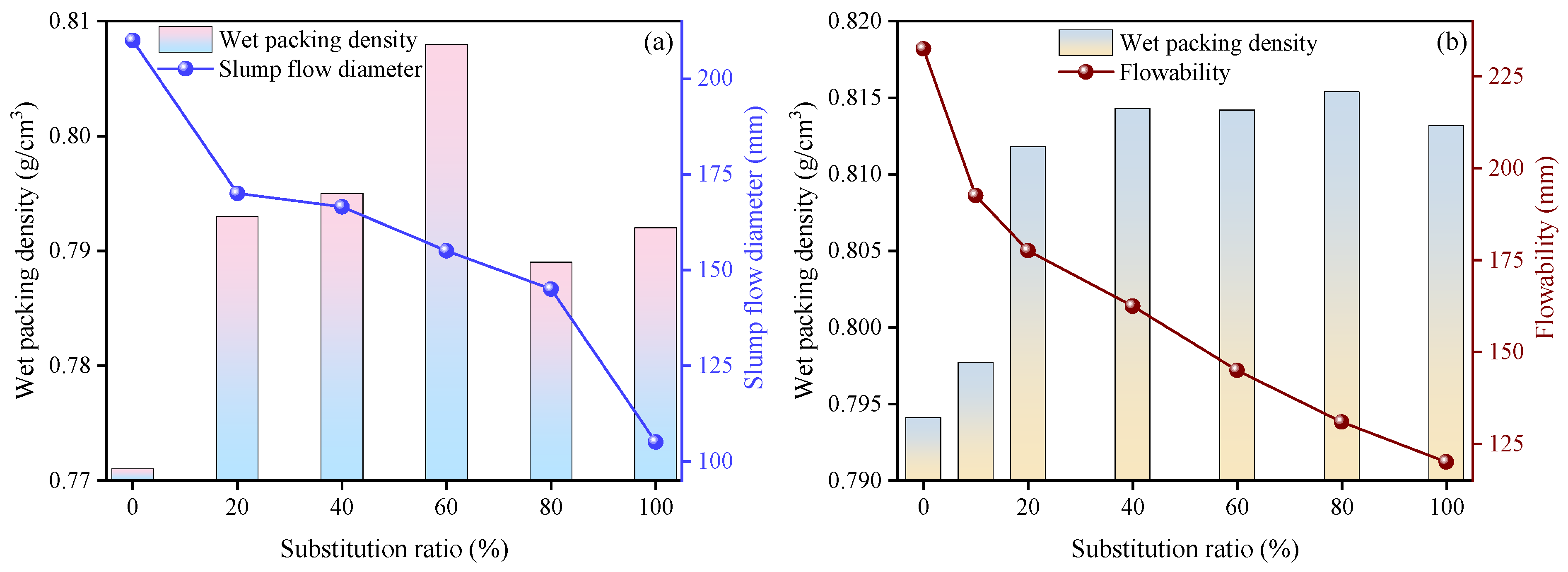
The fresh properties of concrete are mainly in workability, setting time, and wet packing density. These parameters play a significant role in the physico-mechanical performance and durability. For example, gold tailings were utilized to replace the quartz sand in the preparation of ultra-high-performance concrete (UHPC), as reported by Ahmed et al. [
66] and Wang et al. [
67]. They found that the slump of UHPC decreased generally and the packing density increased with the incorporation of tailings (
Figure 5). Gold tailings have a larger specific surface area compared with quartz sand, which can thus absorb more free water. In addition, the rough surface of tailings increases the friction between particles. Wang et al. [
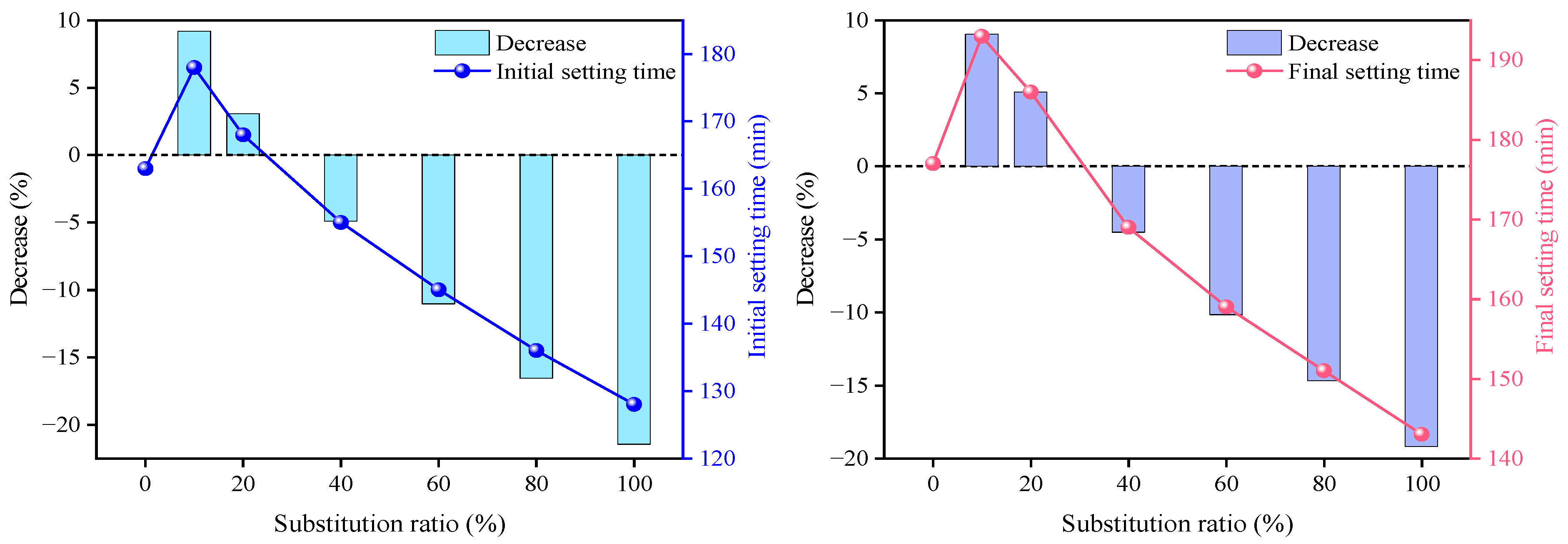
67] also demonstrated that the addition of gold tailings to UHPC remarkably shortened the setting time (
Figure 6). This is attributed to the fine tailings (particle size ≤ 75 µm) that can provide nucleation sites for cement hydration and accelerate the hydration rate.
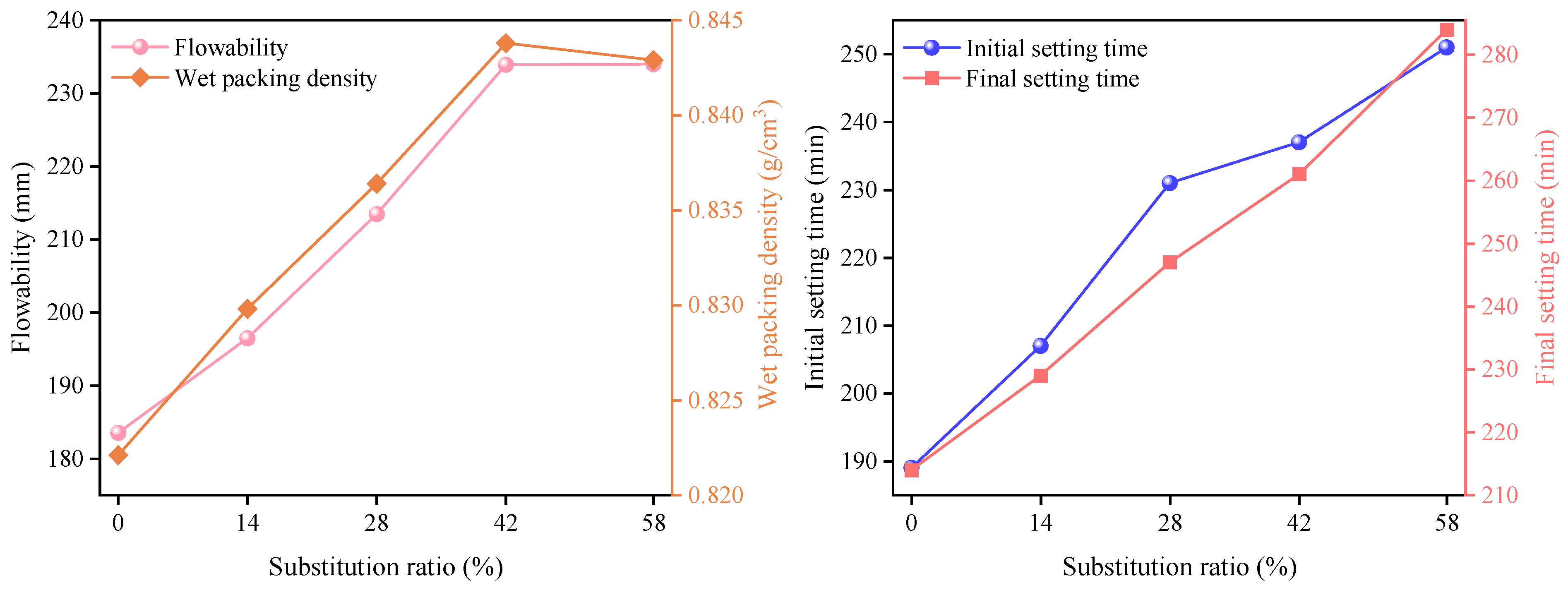
However, Wang et al. [
68] held that when gold tailings replaced the quartz sands and cement, the UHPC with tailings has a higher slump, packing density, and longer setting time (
Figure 7). For example, UHPC with 58% gold tailings achieved a maximum flowability of 234 mm, and an increase of 27.52% occurred compared to UHPC without tailings (183.5 mm). Zhang et al. [
33] also found the flowability initially improved with increasing copper tailings sand content, reaching an optimum at 60%, and then decreased with further additions. The cement with greater specific surface area in the UHPC decreases with the increase in tailings which results in more free water to lubricate the particles. In addition, the tailings with a more rounded surface than river sands can reduce the friction between particles. The addition of tailings can contribute to an increase in slump. This is because fine tailings can tightly bind to the surfaces of the coarse aggregates, resulting in a higher packing density. Regarding the longer setting time, the primary factor may be the increase in the water–cement ratio. By incorporating tailings, the water–cement ratio is enhanced, which further increases the space between particles and loosens the overall structure.
Similar observations have been made for other types of tailings. Numerous studies have shown [
69,
70,
71,
72] that as the substitution rate of iron tailings and molybdenum tailings increases, the slump value of concrete generally shows a downward trend.
The decrease in fluidity with increasing dosage can be mainly attributed to the following two physical mechanisms:
(a) Specific surface area effect: Tailings particles are usually finer and have a larger specific surface area than natural sand. Under the same amount of cement slurry, the amount of slurry required to wrap the surface of aggregate particles increases. This results in a decrease in the free slurry used for lubrication and flow, thereby reducing the fluidity of the mixture.
(b) Particle morphology effect: Natural sand undergoes natural weathering, resulting in particles that are mostly spherical and have a smooth surface. And tailings are mostly mechanical crushing products, with angular shapes and rough surfaces. This morphological feature generally increases the mechanical interlocking and frictional resistance between particles, hindering the flow deformation of fresh concrete under its own weight.
However, it is worth noting that some studies [
73,
74,
75] have observed an opposite phenomenon: when the tailings content is at a low level (such as less than 20%), the flowability of concrete is sometimes slightly higher than that of the control group (pure natural sand). There are two possible explanations proposed by the academic community for this abnormal phenomenon:
(a) Filling and slurry increment effect: A small amount of extremely fine particles can fill the gaps between cement particles and natural sand, optimizing particle size distribution, and improving the compactness of the system. At the same time, these fine particles are considered as part of the cementitious slurry during actual mixing, which invisibly increases the effective slurry volume and improves fluidity in the initial stage.
(b) Threshold effect on workability: At low dosages, the negative effects mentioned above are not significant, while the positive effects of improved grading and reduced water demand may dominate. Once the dosage exceeds a certain critical threshold, the negative effects on specific surface area and morphology will sharply increase, leading to a decrease in slump instead.
In summary, the impact of tailings on concrete slump presents a complex and non-singular nature, depending on the interaction between dosage, particle size, morphology, and system composition. In practical applications, it is necessary to achieve efficient and high-value utilization of tailings through precise mix design and admixture compounding, while ensuring working performance.
3.2. Water Absorption and Porosity
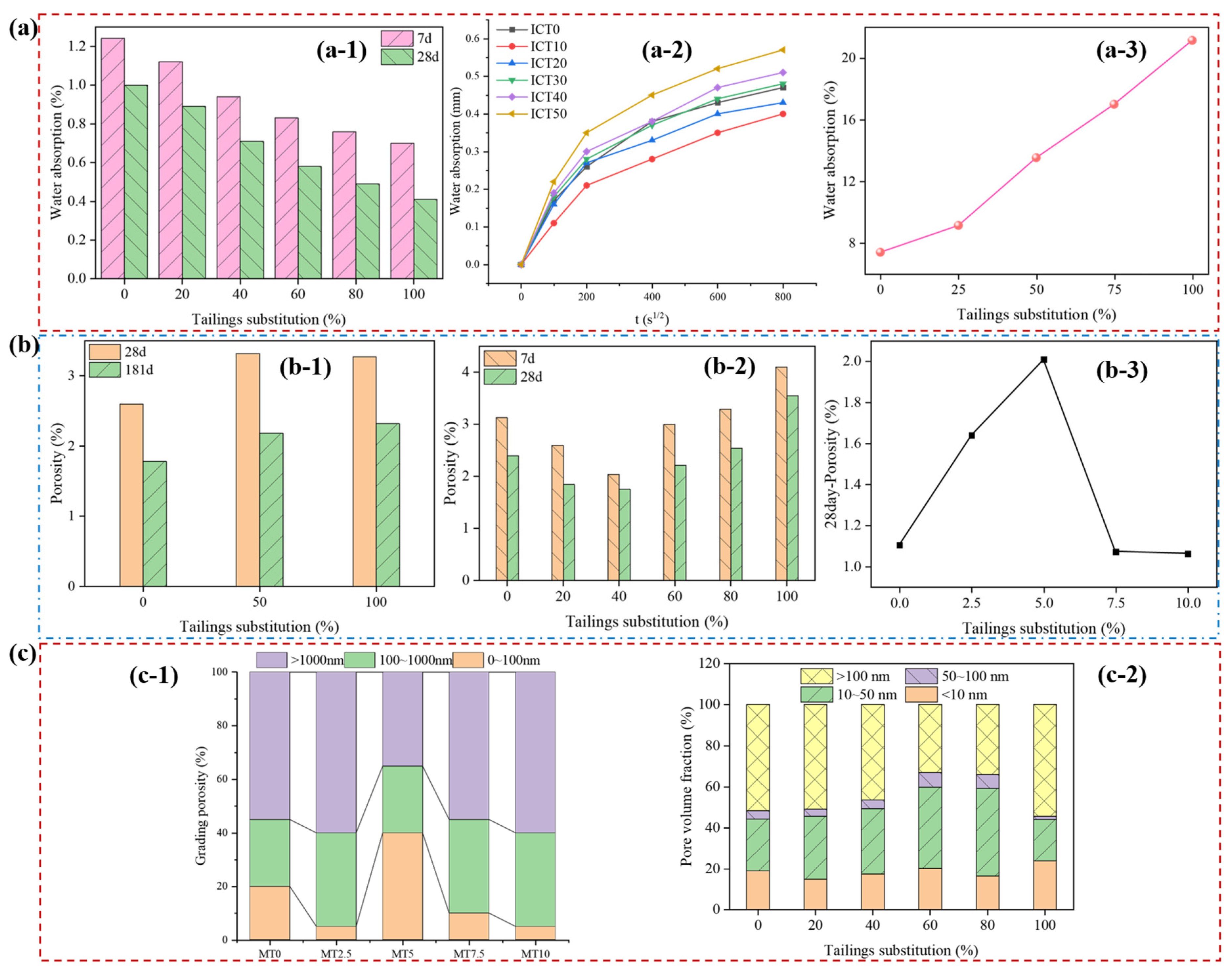
Figure 8 analyzes the water absorption, porosity, and microstructural pore structure of tailings concrete (including gold tailings, iron tailings, molybdenum tailings and copper tailings) [
48,
69,
75,
76,
77,
78]. As the tailings substitution increased, the water absorption, porosity, and pore structure distribution of the concrete exhibited distinct non-monotonic changes. Overall, water absorption tended to decrease with increasing substitution ratios. The trend within these bounds was characterized by variation, or in other cases, a pattern that rose to a maximum before falling. Capillary water absorption curves (a-2) also indicated significant differences in the initial water absorption rate and final water absorption volume among specimens at different substitutions. In addition, the pore structure experienced continuous evolution, with the proportion of large pores gradually decreasing and that of small pores increasing. The total porosity may exhibit a monotonic decrease or a pattern of first decreasing and then increasing. These phenomena indicated that the internal structure of the tailings concrete underwent a complex adjustment process following the incorporation of tailings.
The aforementioned changes primarily resulted from the synergistic and competitive interactions of multiple mechanisms. First, the relatively fine tailings particles could fill the pores in the matrix and refine the pore structure, thereby decreasing porosity and water transport pathways [
79]. This was the primary reason for the decline in water absorption. Second, tailings particles could also serve as nucleation sites for reactions, which promoted the formation of gel products and improved the structure of the interfacial transition zone [
80]. Therefore, the pore structure was further optimized to make the matrix denser and enhance macroscopic properties. However, when the tailings substitution increased beyond a certain threshold, the irregular morphology and high specific surface area of the tailings particles increased the water demand and weakened the supporting role of the aggregate skeleton [
81]. This introduced new defects and voids, leading to a rebound in porosity and performance fluctuations.
Therefore, the effects of tailings substitution on concrete performance are not a single-directional trend but are determined by the dynamic balance among the filling effect, nucleation effect, and defect effect. At a lower substitution ratio, the filling and nucleation effects dominate, leading to a denser structure. In the range of moderate substitution ratio, these mechanisms compete mutually, which results in performance fluctuations. At a higher substitution ratio, the defect effect gradually intensifies, potentially causing structural degradation. It is precisely this coupled interaction of multiple mechanisms that causes the water absorption, porosity, and pore structure to exhibit diverse patterns of evolution. This also clearly demonstrates the characteristics of an optimal substitution range.
3.3. Mechanical Properties
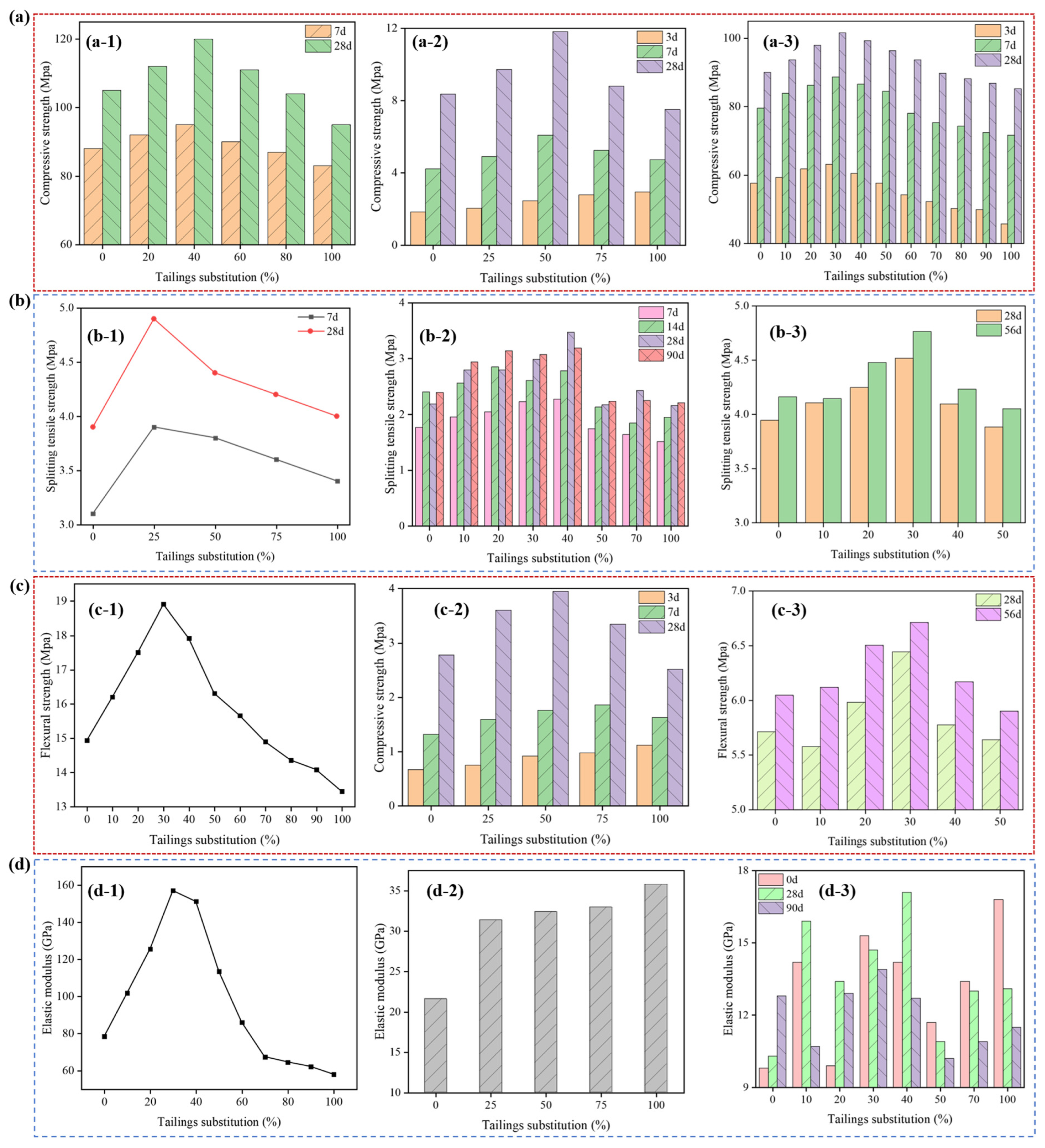
Figure 9 analyzes the compressive strength, splitting tensile strength, flexural strength and elastic modulus of tailings concrete (including graphite tailings and iron tailings) [
40,
43,
44,
76,
82,
83]. This section systematically investigated the effects of tailings used as fine aggregates on the macroscopic mechanical properties of concrete materials. In addition, this elucidated the complex underlying mechanisms governing the performance evolution of tailings concrete, providing a theoretical foundation for its scientific design and application. As the tailings substitution increased, the compressive strength, tensile strength, flexural strength, and elastic modulus of the tailings concrete all exhibited distinct non-monotonic variations. However, the evolution paths of different mechanical properties differed. Overall, most strength indicators showed a trend of first increasing and then decreasing within the low-to-medium substitution range, exhibiting a relatively distinct peak interval. In contrast, some parameters exhibited a continuous decline or a pattern of first decreasing and then rebounding. Additionally, the sensitivity of various properties to the substitution ratio varied across different ages. For example, early-stage strength changes were more pronounced, while later stages tended to flatten out. This indicated that the impact of tailings incorporation on the macroscopic mechanical properties was both phased and diverse.
These complex changes primarily stemmed from the coupling and competition of various mechanisms within the system following the introduction of tailings. First, under low substitution ratios, the fine tailings particles effectively filled the voids between aggregates and optimized the particle gradation of natural sands. Simultaneously, their surfaces served as nucleation sites for hydration reactions, which promoted gel formation and enhanced the density of the interface transition zone. At this stage, the tailings enhance the mechanical properties via combined filling, nucleation, and defect effects (
Section 3.2). This results in a denser matrix structure that improved compressive, tensile, and flexural strengths, and to some extent increased the elastic modulus.
However, as the substitution ratio further increased, the irregular morphology and high specific surface area of tailings gradually exerted adverse effects. On the one hand, their high water demand may lead to a reduction in effective water within the slurry and the introduction of additional pores. On the other hand, the extensive tailings substitution weakened the original aggregate skeleton structure, which degraded stress transfer pathways and potentially caused the degradation of the interface transition zone and the formation of microcracks. At this stage, defect effects gradually intensified, which resulted in a decline in strengths and elastic modulus. Therefore, the mechanical properties manifested as a trend of first increasing then decreasing or a continuous decrease.
Furthermore, the differing sensitivities of various mechanical properties to microstructural changes were a key factor contributing to the variations in their evolution patterns. For example, compressive strength was primarily controlled by overall density and thus tended to peak at moderate substitution ratios. In contrast, tensile and flexural strengths were more sensitive to microcracks and interfacial defects, resulting in more pronounced declines at high substitution ratios. The elastic modulus was closely related to the stiffness of the aggregate skeleton. The silicon content in tailings was generally lower than that in natural aggregates. When silica-rich natural sands were replaced on a large scale, the stiffness of concrete decreased, and the decline in elastic modulus became more pronounced. However, when the filling effect of fine tailings particles partially compensated for the weakening of the matrix, a phenomenon of initial decrease followed by a slight rebound may even occur.
In summary, the impact of tailings replacing natural sand on the mechanical properties of concrete is essentially the result of a dynamic balance among the filling effect, nucleation effect, and defect effect: (1) At a lower substitution ratio, beneficial effects dominated, leading to improved performance. (2) At moderate substitution ratio, an optimal state was achieved. (3) At a higher substitution ratio, adverse effects occurred and gradually strengthened, resulting in performance degradation. It was precisely this multi-mechanism coupling that caused different mechanical properties to exhibit diverse evolutionary patterns. This indicates the existence of a reasonable optimal replacement rate range within the system. To ensure the performance of tailings concrete in engineering structures, its workability and density should first be improved by optimizing the tailings gradation or incorporating complementary aggregates. Furthermore, activation techniques can be applied to strengthen the bonding at the tailings–matrix interface. Collectively, these steps help maximize the utility of tailings as an effective filler while minimizing drawbacks related to particle shape and defects.
3.4. Durability
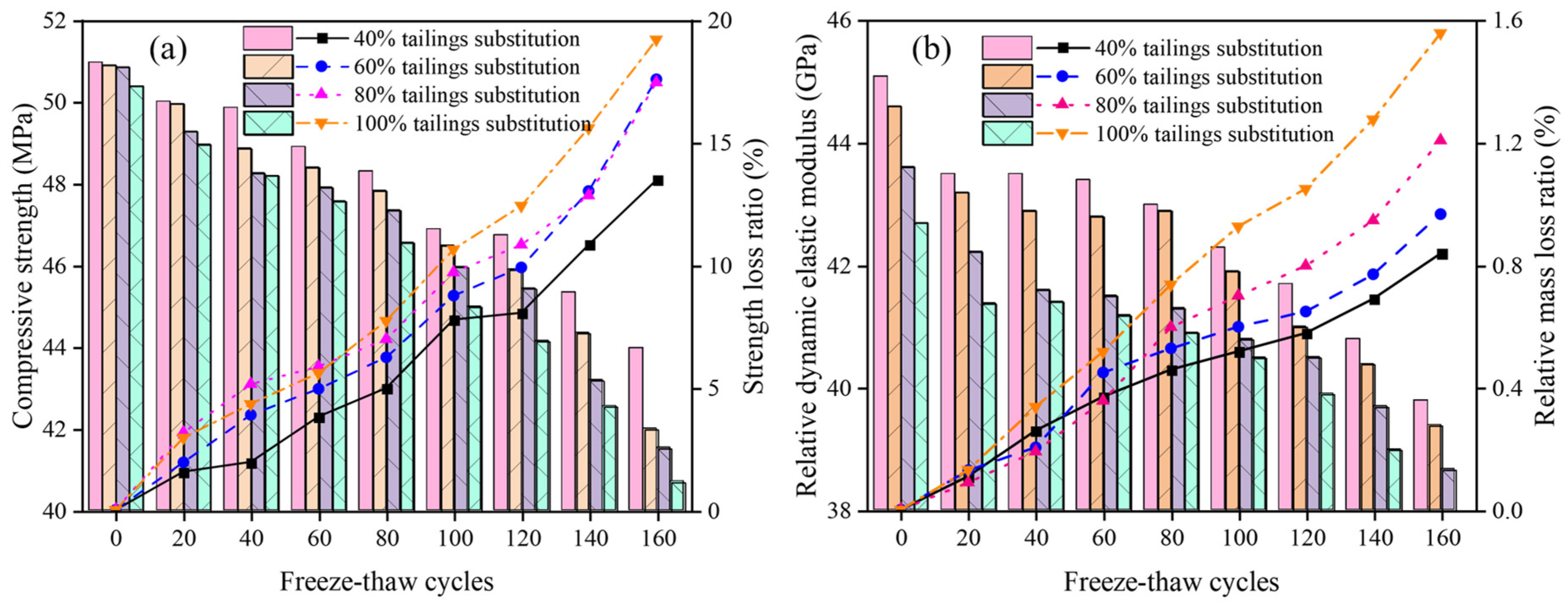
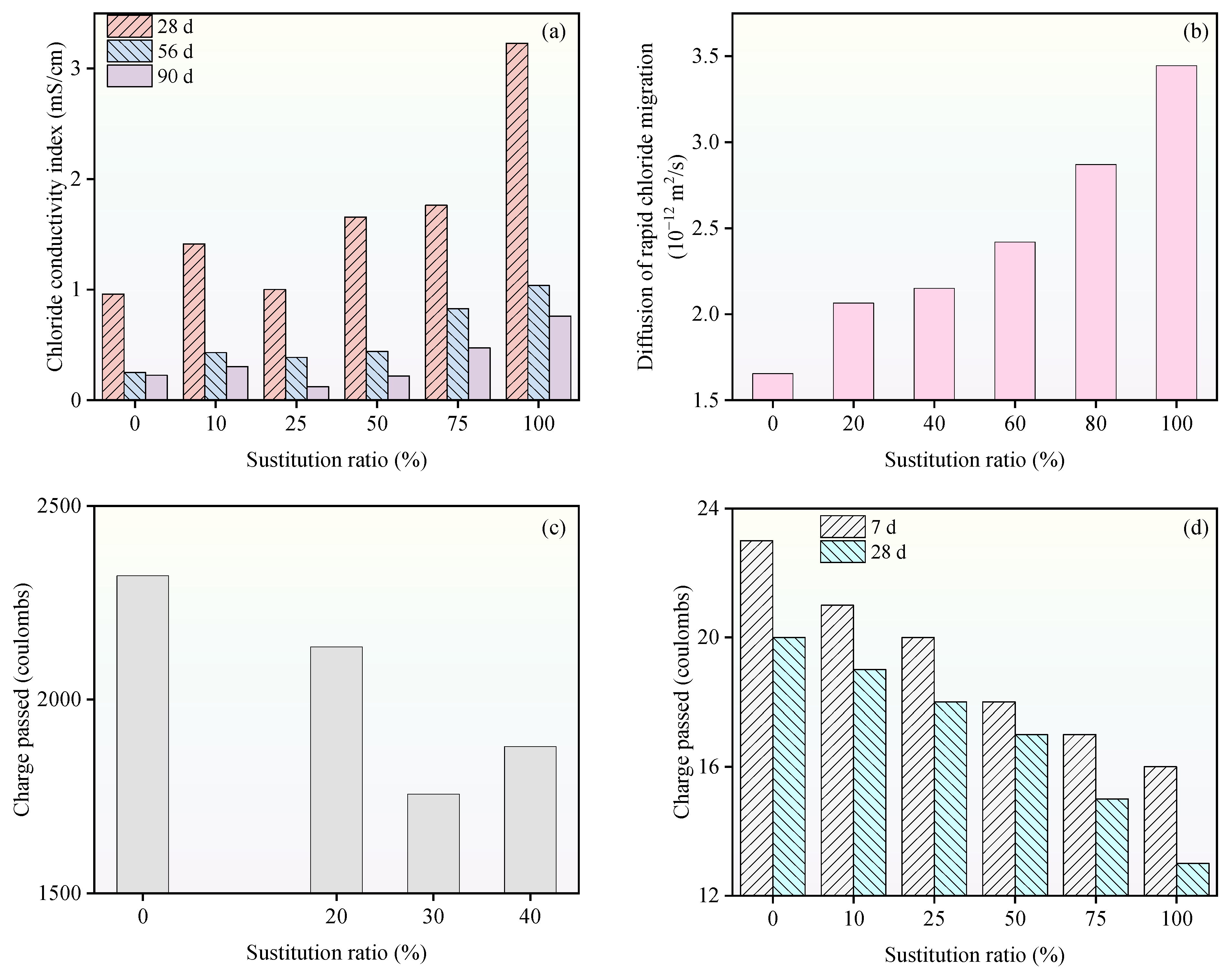
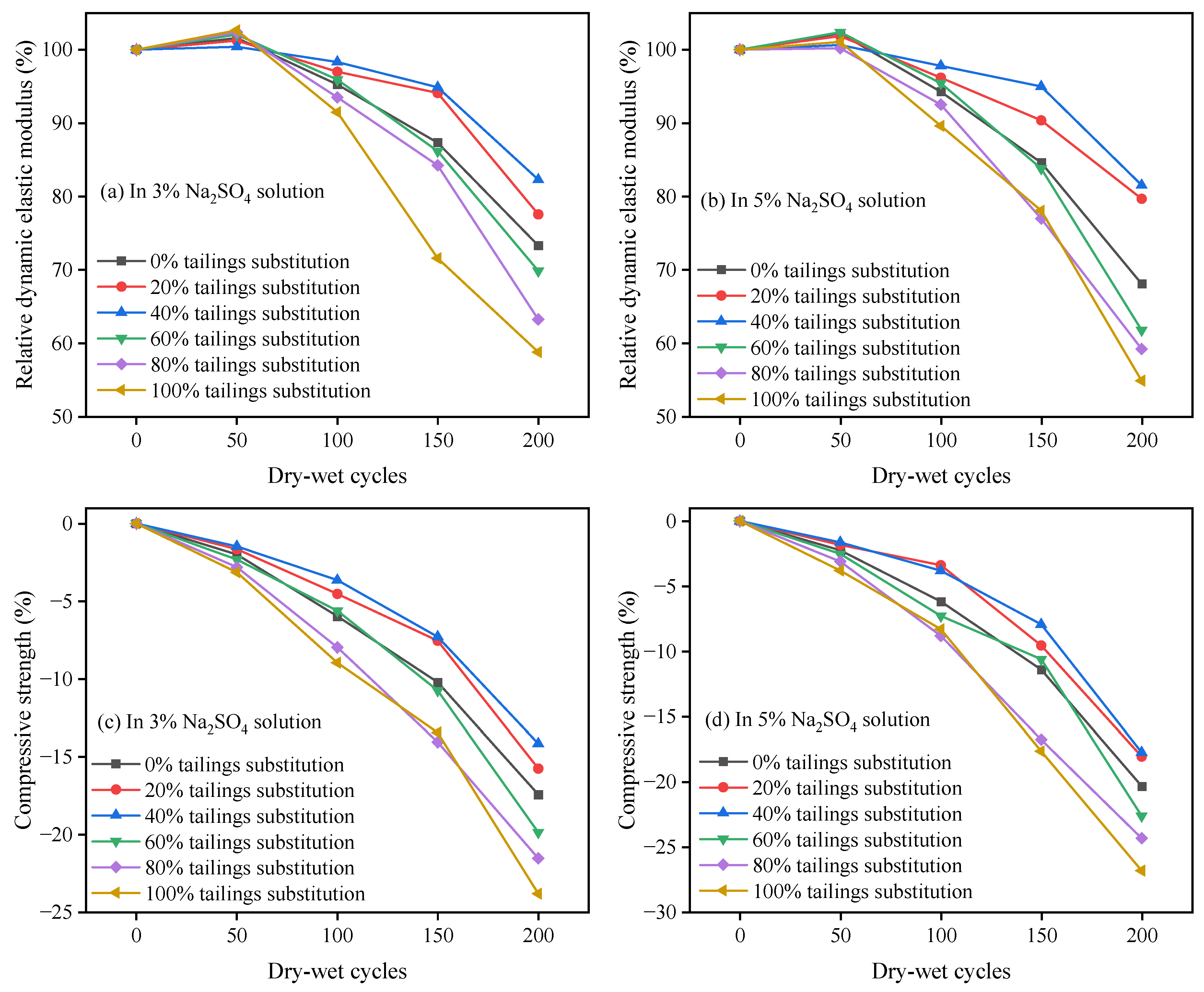
Research on concrete materials incorporating tailings focuses on their resistance to freeze–thaw cycles, sulfate attack, chloride erosion, and carbonation (
Figure 10,
Figure 11,
Figure 12,
Figure 13 and
Figure 14). In cold climates, freeze–thaw cycling was a major cause of concrete deterioration. Consequently, the frost resistance was a critical durability property and commonly defined in the laboratory as the ability of saturated concrete to withstand such cycles. Evaluating this resistance thereby provided a key index for predicting the service life of concrete structures in freezing conditions [
84,
85]. In
Figure 10, the strength and relative dynamic elastic modulus of tailings concrete decreased with an increase in the number of freeze–thaw cycles. Furthermore, the mechanical properties of concrete containing 100% tailings suffered the most significant deterioration. However, Song et al. [
35] explored the different effects of gold tailings on frost resistance and resistance to chloride erosion in concrete. The findings revealed that after 300 freeze–thaw cycles, concrete containing 30% gold tailings exhibited the best frost resistance and resistance to chloride erosion. Compared to the control group, the relative dynamic elastic modulus increased by 4.25%, while mass loss decreased by 13.45%. The filling effect of tailings enhanced the densification of the concrete and optimized the aggregate gradation, thereby improving the frost resistance. This result agrees with the findings observed by Ince et al. [
53]. Wang et al. [
67] reported that tailings can generally reduce the frost resistance and chloride erosion in the UHPC. The incorporation of tailings primarily affected resistance to chloride erosion by altering the transport properties of the concrete.
In
Figure 11, the diffusion of rapid chloride migration of UHPC remarkably increased from 1.66 × 10
−12 m
2/s to 3.45 × 10
−12 m
2/s with the tailings increased from 0 to 100%. The conductive materials in the tailings enhanced the conductivity of UHPC, but they also compromised its dense structure and durability. However, Song et al. [
36] held that the incorporation of tailings improved the resistance to chloride erosion due to the filling effect of tailings. Similar findings were also reported in concrete with iron tailings (Zhang et al. [
76]). Sulfate attack was primarily a form of chemical corrosion, and the damage stemmed from the stresses generated by the internal crystallization and expansion of erosion products (such as gypsum and ettringite). In
Figure 12, The compressive strength and relative dynamic elastic modulus of tailings concrete decreased with increasing sulfate attack cycles. Furthermore, the mechanical properties of concrete containing 40% tailings showed the least deterioration, while those containing 100% tailings show the greatest deterioration [
86]. Xu et al. [
87] also found that after 100 sulfate attack cycles, all specimens exhibited a significant reduction in strength and relative dynamic elastic modulus. It is worth noting that concrete containing 10%~30% iron tailings exhibited superior compressive strength compared to concrete without tailings after 75 and 100 cycles. On the one hand, the angular morphology and rough surface texture of tailings particles enhanced mechanical interlocking with the cement matrix, thereby strengthening the interfacial transition zone [
23]. On the other hand, IOT particles acted as a micro-filler, refining the pore structure and improving the pore size distribution, which led to a denser cement paste.
Figure 11.
The diffusion of rapid chloride migration in the UHPC: (
a) [
68], (
b) [
87], (
c) [
36], (
d) [
77].
Figure 11.
The diffusion of rapid chloride migration in the UHPC: (
a) [
68], (
b) [
87], (
c) [
36], (
d) [
77].
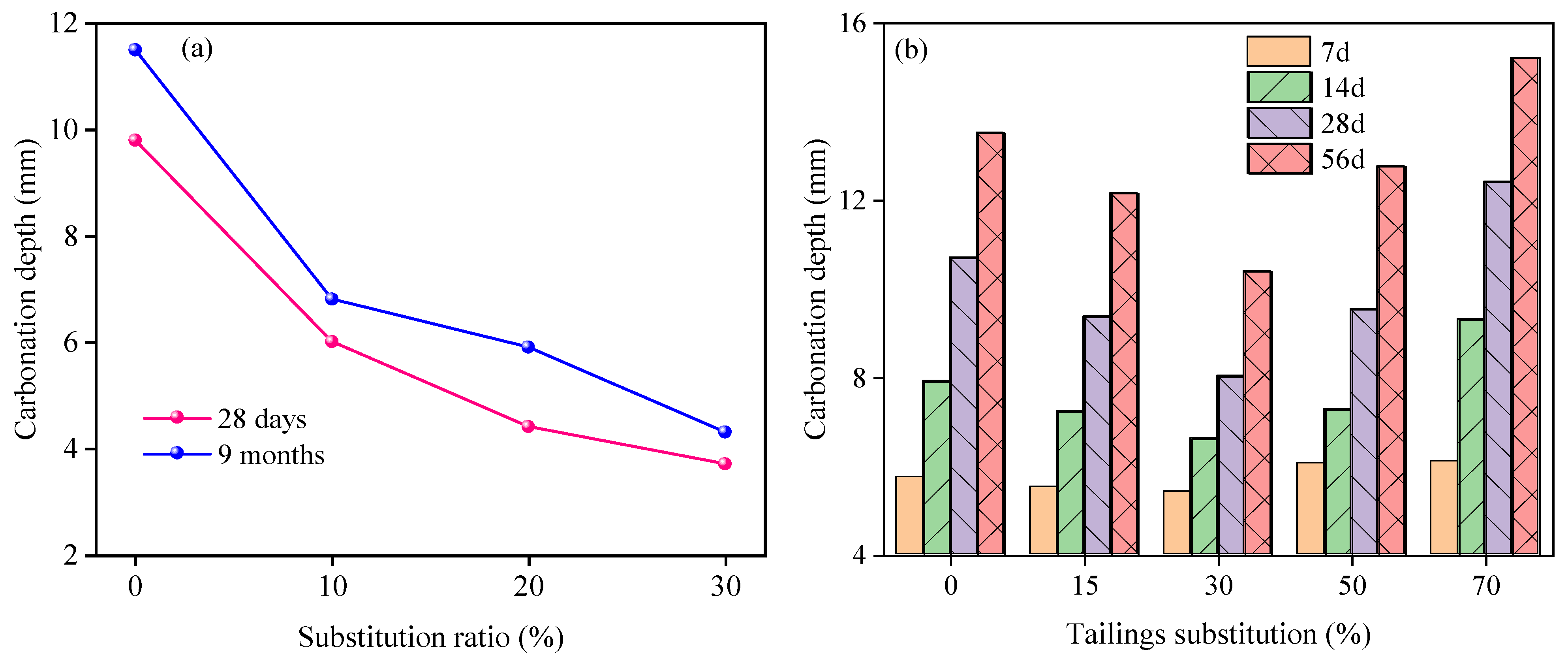
Carbonation was also investigated by a series of researchers. Ahmed et al. [
66] reported that the carbonation depth of concrete containing tailings was less than the detection limit (0.5 mm). And they found the color changes in cut sections of UHPC specimens cured under elevated CO
2 after phenolphthalein application. Zheng also found [
38] that the carbonation depth increased with prolonged carbonation age. As the substitution ratio increased, the carbonation rate initially decreased before increasing. Notably, the minimum carbonation depth was observed at a 30% iron tailings substitution ratio. However, Ince et al. [
53] also found that the addition of tailings generally reduced the carbonation depth of the mortar (
Figure 13a). The carbonation depth was closely associated with the characteristics of the pore spaces of the cementitious materials. The fine tailings filled the pores and made the matrix dense, thus reducing the intrusion of CO
2. Besides the filling effects, chemical effects resulting from the hydration could also improve the density of the matrix. For example, the tailings with pozzolanic activity reacting with Ca(OH)
2 can produce more C-S-H gels and, therefore compact the matrix [
88,
89].
Figure 12.
The (
a,
b) relative dynamic elastic modulus and (
c,
d) compressive strength of tailings concrete after sulfate attack cycles [
86].
Figure 12.
The (
a,
b) relative dynamic elastic modulus and (
c,
d) compressive strength of tailings concrete after sulfate attack cycles [
86].
Figure 13.
The carbonation depth of the tailings mortar: (
a) [
53], (
b) [
38].
Figure 13.
The carbonation depth of the tailings mortar: (
a) [
53], (
b) [
38].
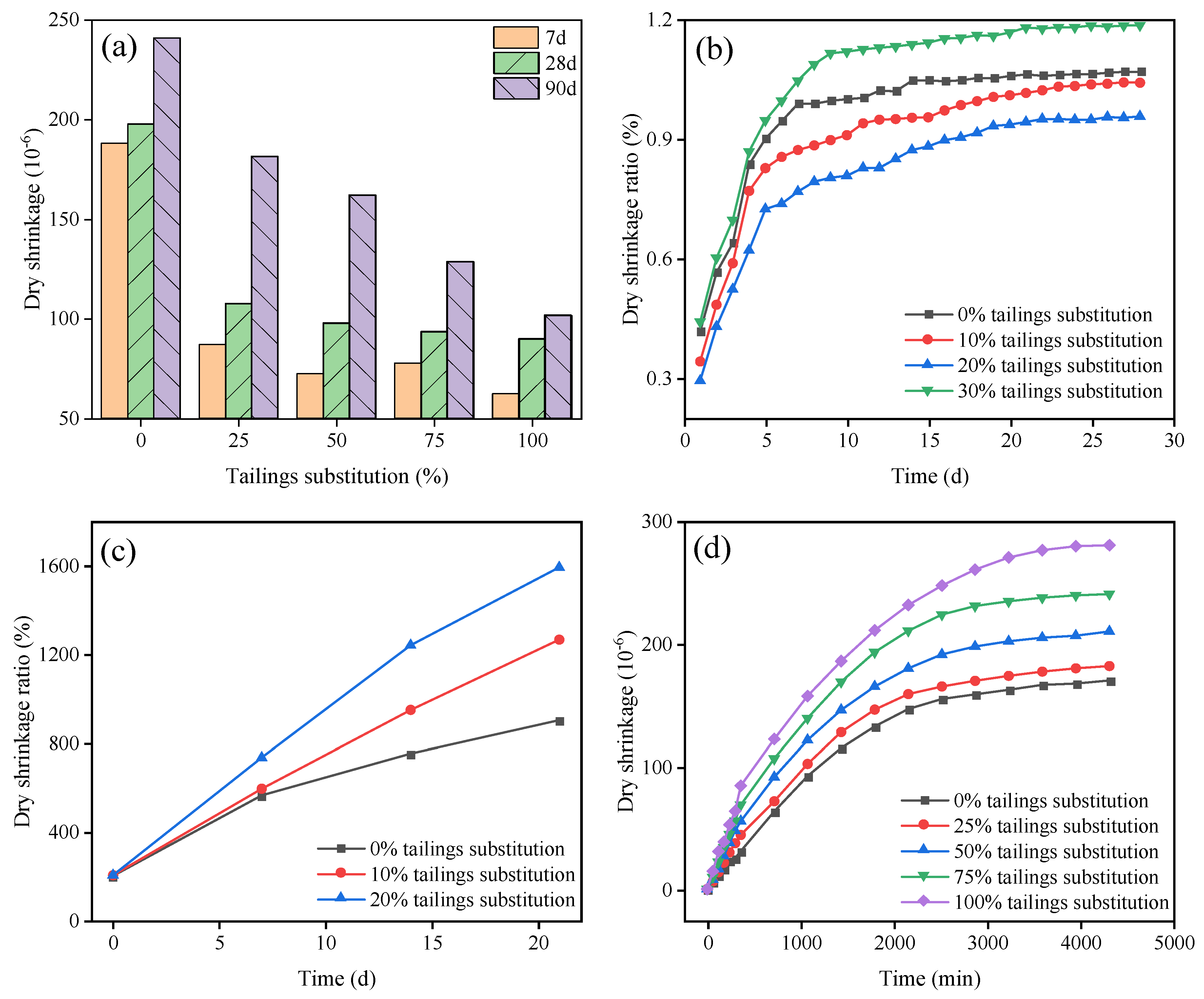
Free water migration and evaporation induced dry shrinkage in concrete, which could lead to microcrack initiation and propagation, thereby affecting durability. As shown in
Figure 14, the incorporation of tailings results in complex and stage-dependent shrinkage behavior [
49,
90,
91,
92]. At early age (7 d), shrinkage generally decreased with increasing substitution ratios. However, at later ages (28 d and 90 d), it exhibited a initially decreasing and then increasing trend with a minimum at moderate substitution levels. Dry shrinkage developed rapidly at early times and gradually stabilized, with higher substitution ratios leading to greater long-term shrinkage. At high substitution levels (50%~100%), dry shrinkage increased monotonically and became more pronounced over time. These trends were governed by the competition between filling and defect effects. At low substitution ratios, fine tailings particles densified the matrix and reduced capillary pores, thereby mitigating shrinkage [
24,
93]. In contrast, high substitution ratios increased water demand and weakened the aggregate skeleton, promoting moisture loss and deformation [
23]. This interplay led to both monotonic and non-monotonic evolution, indicating the existence of an optimal substitution range for shrinkage control.
Figure 14.
The dry shrinkage behavior of tailings concrete: (
a) [
49], (
b) [
90], (
c) [
91], (
d) [
92].
Figure 14.
The dry shrinkage behavior of tailings concrete: (
a) [
49], (
b) [
90], (
c) [
91], (
d) [
92].
These findings demonstrate that tailings can act as a sustainable substitute for natural aggregates in concrete, provided that suitable mix proportions and replacement ratios are employed. Such a strategy not only contributes to the conservation of natural sand and gravel resources, but also facilitates the large-scale valorization of industrial solid waste, which is consistent with the development objectives of green building materials. The results reveal that properly designed tailings concrete presents comparable long-term mechanical performance and durability, including compressive strength, impermeability, and carbonation resistance, to those of conventional concrete. Accordingly, the application of tailings in concrete is not only environmentally favorable, but also provides a practical approach for improving resource efficiency and advancing sustainable civil engineering. Further optimization of mix designs and curing regimes is expected to broaden its application in diverse engineering fields in the future. In addition, the selection of structural materials must account for the complex corrosion mechanisms in harsh marine environments. Understanding these mechanisms is fundamental to developing effective protection strategies. Maher Aader’s study [
94] demonstrated that chloride diffusion in coastal concrete decreases with longer curing time, higher compactness, and a lower water-to-cement ratio. In a related long-term study, Qu et al. [
95] revealed that concrete exposed to mining wastewater for 20 years underwent deep carbonation and microstructural degradation near the surface. Importantly, chlorides that penetrated were partially immobilized as Friedel’s salt or within C-S-H gel. These findings are critical for assessing and predicting the long-term performance of concrete structures.
3.5. Microscopic Characterization
In concrete materials research, scanning electron microscopy (SEM), X-ray diffraction (XRD), and thermogravimetric analysis (TGA) are core characterization techniques for revealing the relationship between microstructure and macroscopic properties. These methods complement each other and work synergistically. SEM is used to observe the morphology of hydration products, as well as pore and interface structures. XRD is used to identify phase composition and crystal structure, while TGA quantitatively analyzes the content of key components (such as Ca(OH)2 and CaCO3) through mass loss. Through their combined application, a comprehensive analytical system can be established, ranging from morphological characterization and phase identification to quantitative analysis of components. This enables a systematic elucidation of the hydration mechanism and performance evolution of concrete, thereby providing a reliable basis for the optimized design of materials.
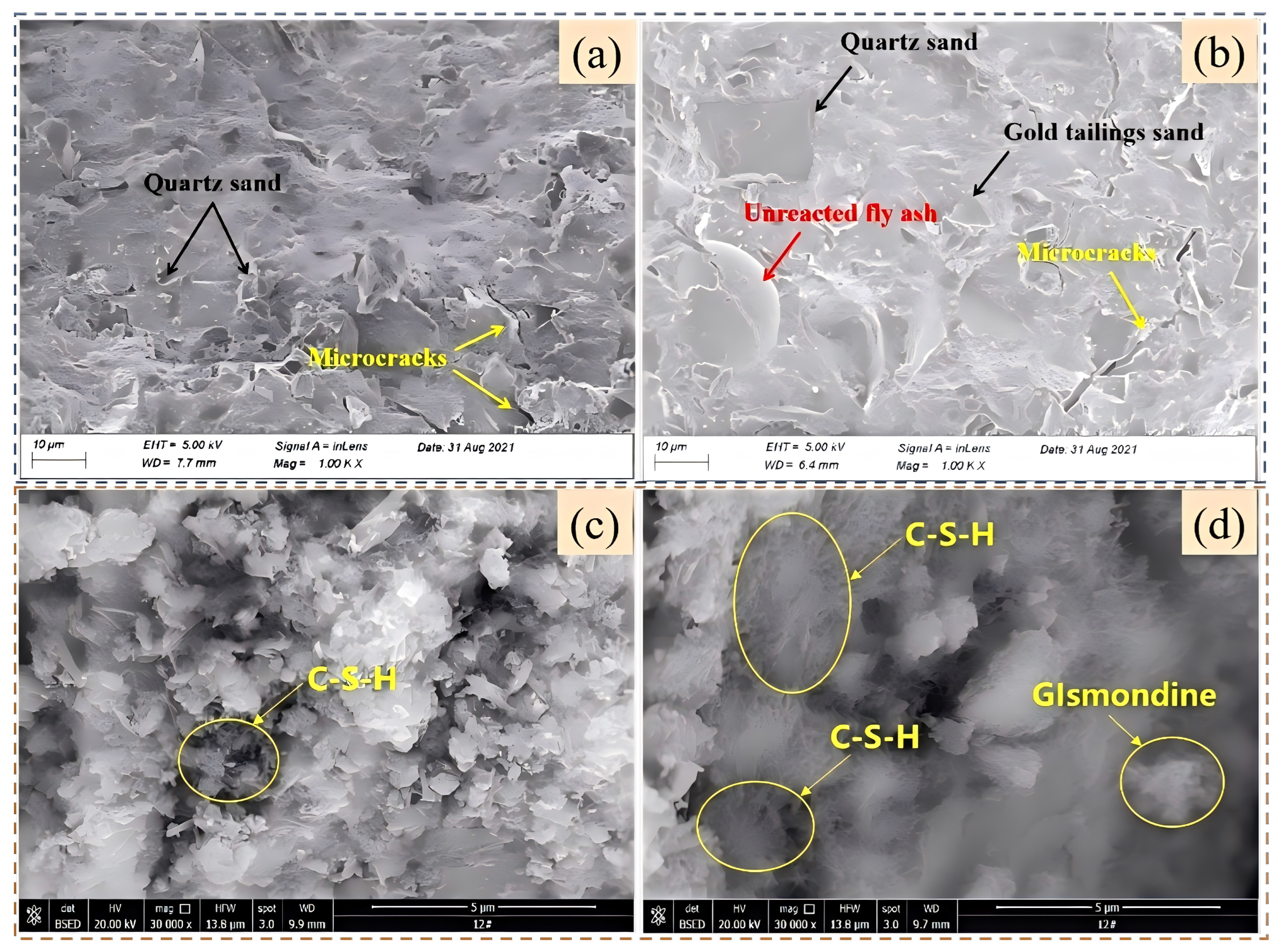
Lai et al. [
82] used SEM technology to observe the microscopic morphology of concrete with varying tailings substitution ratios (2000× and 5000×). The control samples exhibited a dense matrix with abundant C-S-H gel and plate-like CH. With increasing tailings contents, the structure initially became more compact, accompanied by the formation of needle-like AFt and the presence of FeS
2. However, at high substitution levels, the microstructure deteriorated. Samples with 75% tailings displayed evident microcracks, while full substitution (100%) led to increased porosity and crack density, indicating significant structural degradation. Ouyang et al. [
36] and Zhang et al. [
70] also reported that adding an appropriate amount of tailings helped compact the matrix (
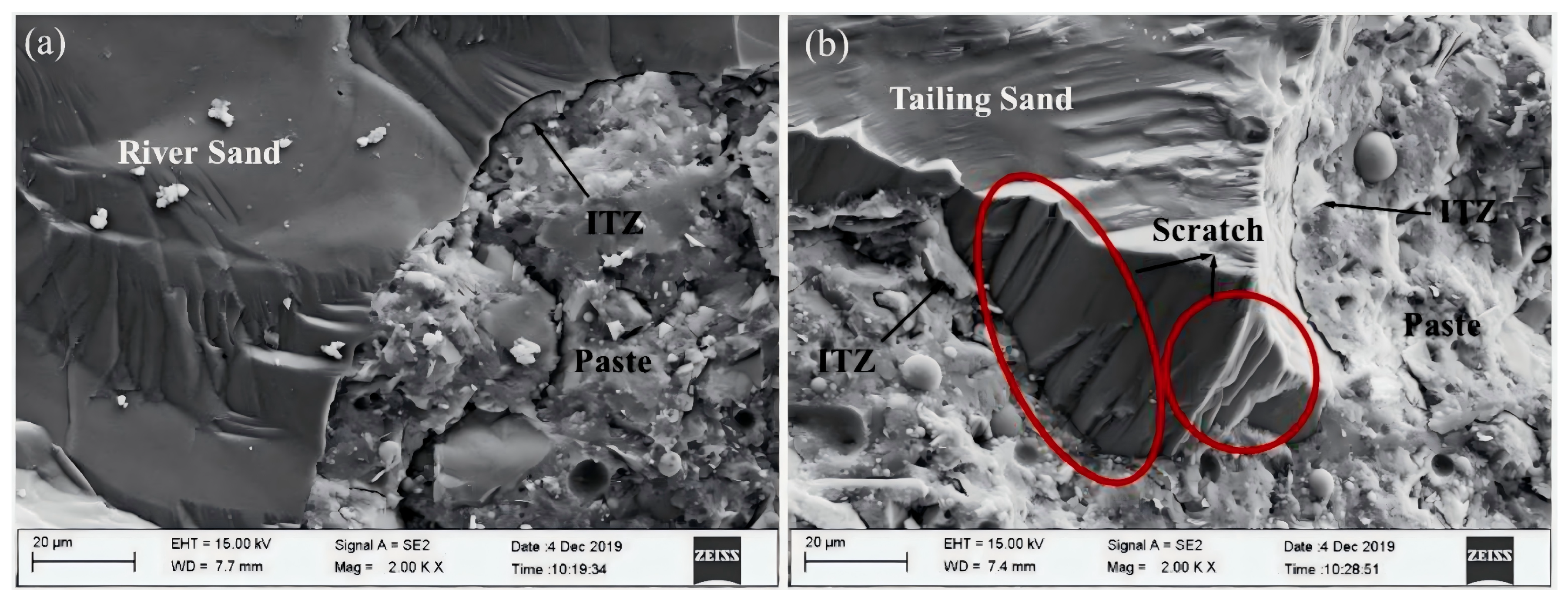
Figure 15). In concrete, the interfacial transition zone (ITZ) is a relatively weak region between the aggregate surface and the cement paste matrix, differing in both structure and performance. Li et al. [
9] also held that the tailings in the concrete with 20% substitution were tightly bonded with hydration products, forming a dense and high-strength ITZ. Conversely, with increasing tailings content, the ITZ bonding strength gradually weakened. In the specimens with 50% and 100% tailings, cracks were observed within the ITZ, with wider and more developed cracks in the concrete with 100% tailings. This indicated that excessive tailings reduced ITZ integrity, which contributed to pore structure deterioration and the decline in macroscopic mechanical properties [
96].
Figure 16 shows the ITZ of tailings concrete [
97]. The ITZ is observed between both aggregate (tailings and river sand) and the paste. The ITZ, where Ca(OH)
2 crystals tend to precipitate, is typically the weakest microstructural region. Although the ITZ width is similar for river sands and tailings, the larger specific surface area of tailings (at comparable particle size) results in a more extensive and detrimental ITZ. This is the main cause of the decrease in strength [
98].
Li et al. [
9] and Wang et al. [
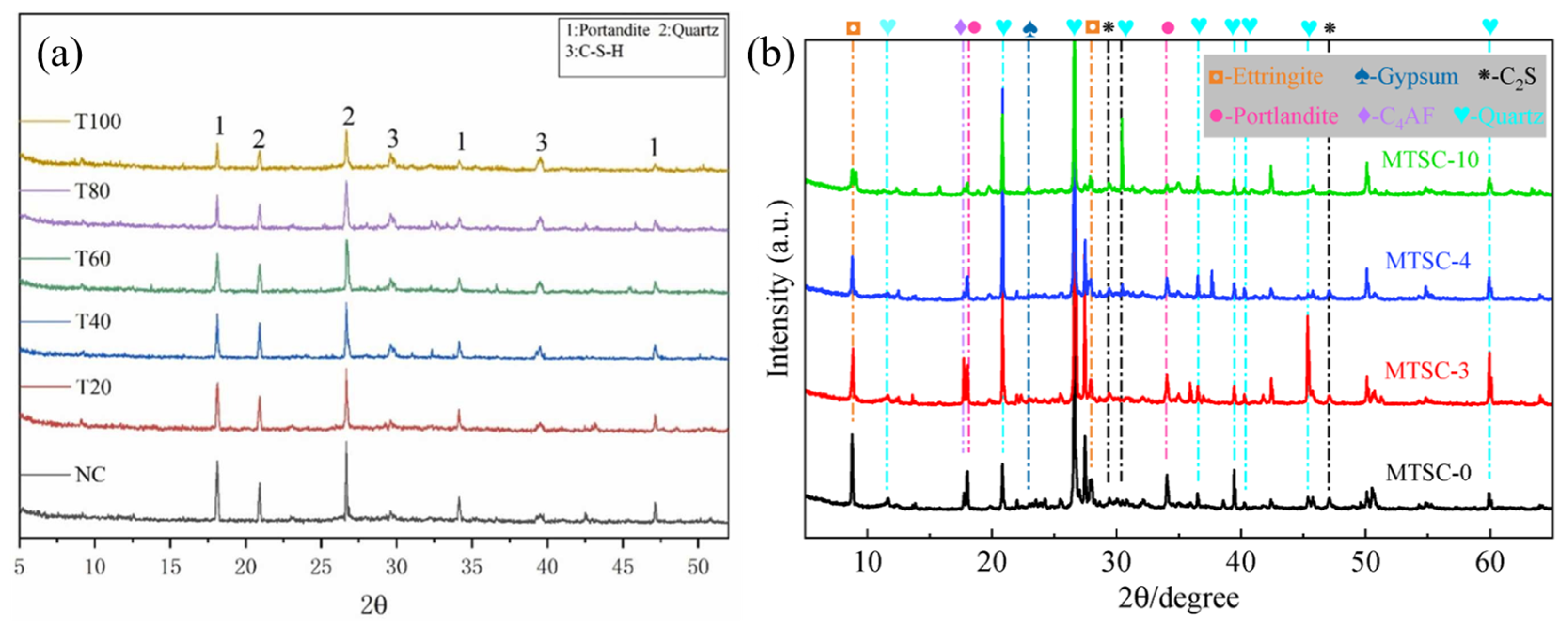
99] summarize the influence of tailings contents on the phase evolution of concrete. The main crystalline phases included quartz (SiO
2), calcium silicate (CaSiO
3), portlandite (CH), calcium carbonate (CaCO
3), and clinker minerals (C
2S and C
3S). The diffraction peak intensities of CH and C-S-H were commonly used as indicators to assess the degree of hydration [
58]. At moderate tailings contents (10%~20%), the CH peaks (around 2θ ≈ 18° and 34°) generally enhanced, indicating a higher hydration degree [
100,
101]. And partial tailings exerted the dilution and filling effects, which promoted cement hydration and generated more gel products. The abundant hydration products improved matrix densification by effectively binding aggregates and filling internal pores, thereby enhancing mechanical performance [
102]. In addition, part of CH could be further consumed to form secondary gel products. However, when the tailings contents increased to 50%~100%, the diffraction peaks of CH and C-S-H generally weakened. This was caused by excessive tailings with a higher water absorption suppressing hydration. This reduced the effective water available for cement hydration [
103]. Consequently, the formation of hydration products was hindered, leading to a more porous structure and reduced strength. Overall, tailings exhibited a dual effect: moderate incorporation promoted hydration and densification, whereas excessive contents inhibited hydration and deteriorated microstructure and mechanical properties. Zhang et al. [
104] and Liu et al. [
86] also observed the same evolution mechanism, which was concluded in
Figure 17.
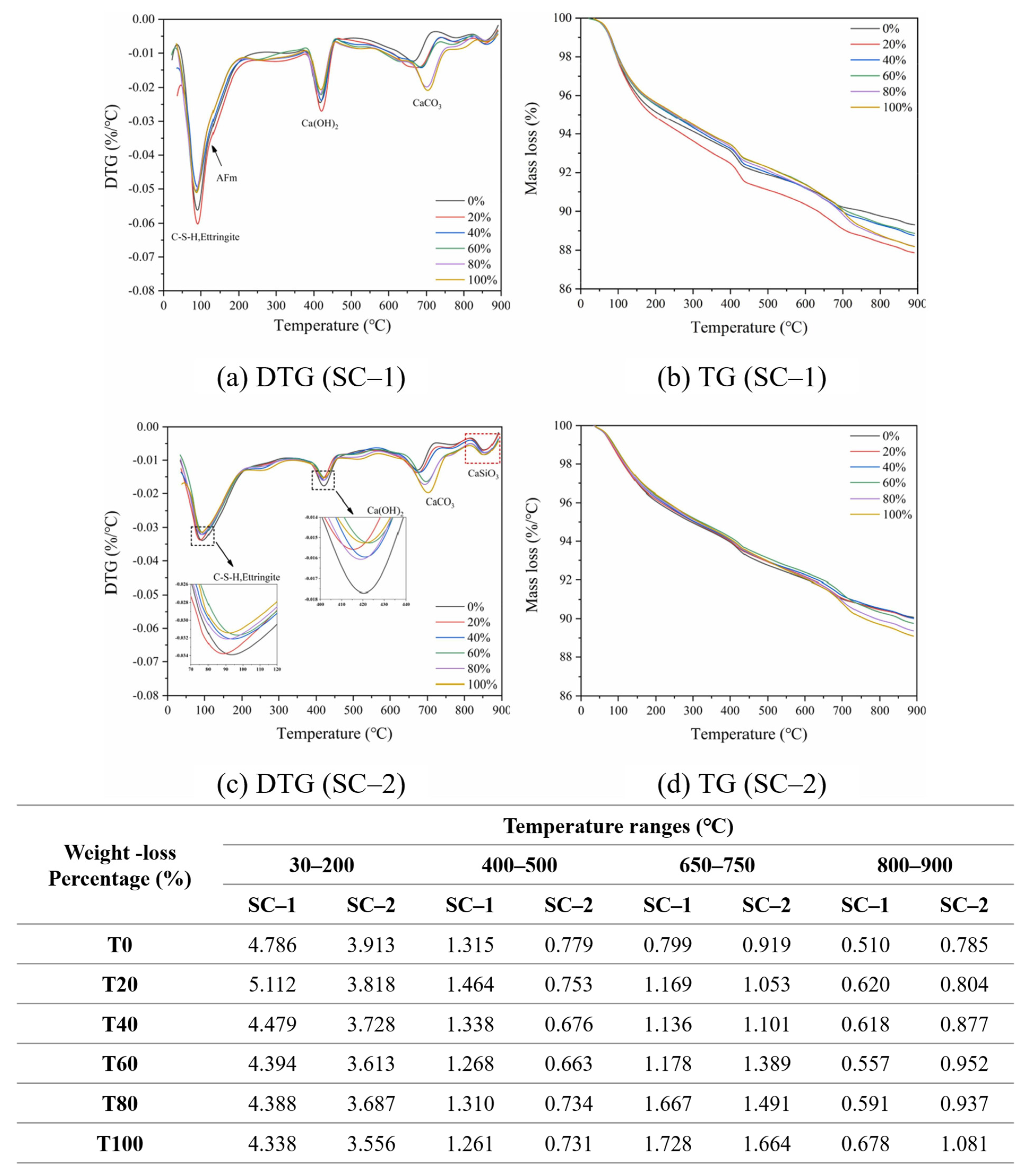
Figure 18 shows the TGA-DTG results of concrete materials with varying tailings contents [
105]. Obviously, the results exhibited multi-stage mass loss behavior corresponding to the decomposition of different hydration products. At low temperatures (30~250 °C), mass loss was mainly associated with the dehydration of C-S-H and related gels, reflecting the amount of hydration products formed [
106]. In the intermediate range (380~550 °C), the decomposition of portlandite (CH) provided a reliable indicator of the hydration degree [
107]. At higher temperatures (>550 °C), mass loss was primarily attributed to the decarbonation of CaCO
3 and structural evolution of gels [
108]. The results indicated that moderate tailings incorporation (20%~25%) generally increased mass loss across these stages, which suggested enhanced hydration and greater gel formation. In contrast, higher tailings contents (≥50%) reduced mass loss, which implied suppressed hydration. This was due to the high water absorption of tailings, which limited the availability of free water for reaction. The content of M-(A)-S-H gel reached its maximum at 50% tailings substitution, indicating that the alkaline activator effectively stimulated the pozzolanic activity of magnesium-containing components [
109]. A moderate tailings content (around 20%) promoted hydration through dilution and filling effects, increasing gel formation and enhancing matrix performance. However, excessive tailings (≥50%) generally raised the water demand due to their high absorption, leading to insufficient free water and consequently inhibiting the formation of hydration products. This finding was consistent with the XRD analysis.
3.6. Environmental and Economic Evaluation
Environmental and economic evaluations are two factors that must be analyzed when tailings concrete materials are used on a large scale. The carbon emission of UHPC containing 58% gold tailings was reduced by 28% from 443 kg/m
3 to 317 kg/m
3 compared to the control group, as reported by Wang et al. [
68]. Ince et al. [
53] also found that mortar containing 30% gold tailings showed a 9% decrease in carbon emission compared to the control group. Pavlů et al. [
110] and Marín et al. [
111] reported a modest reduction (~3%) in global warming potential as a result of completely replacing sand with tailings. As presented in
Table 4, differences in acidification potential and photochemical ozone creation potential among the mixes were negligible. In contrast, the global warming potential of tailings concrete was markedly lower [
16]. Therefore, it is evident that tailings generally reduce the environmental impact of cementitious materials.
Table 5 depicts the leaching behavior of Cr, Cu, Pb, and Zn at copper tailings substitution of 40–60%. The leaching concentration of Cr decreased with increasing tailings substitution, reaching a minimum of 0.04 mg/L at 50% for 28-day samples. In contrast, Pb leaching peaked at 45% tailings substitution before declining. Both Cu and Zn leaching increased up to 50% sand rate and then decreased. These trends are attributed to the formation of ettringite and a dense network during hydration. Heavy metal ions (e.g., Pb
2+, Zn
2+) are immobilized via ion exchange with Ca
2+ in hydration products or physical encapsulation, confirming that hydration is essential for effective stabilization. Although current studies suggest that tailings concrete can effectively reduce heavy metal mobility, most investigations remain limited to short-term laboratory conditions. Future research should focus on long-term leaching performance under carbonation, sulfate attack, freeze–thaw cycling, and cracking conditions to ensure environmental safety throughout the service life of tailings concrete structures.
Economic evaluations were also conducted by a series of researchers. The production cost of concrete materials with gold tailings was calculated by Ahmed et al. [
66].
Table 6 shows the production cost reduction ratio of the concrete incorporated with gold tailings compared to the control group. The production cost of the concrete material was generally reduced with the increase in incorporated tailings. For example, the production cost could be reduced by 24.8% if the tailing contents were 80% of fine aggregates. In addition, Yang et al. [
112] also found that adding gold tailings could generally reduce the production cost. The production cost of control foamed concrete was calculated to be 240~300 CNY/t. In contrast, concrete prepared with gold tailings achieved a generally lower cost, ranging from 105 to 125 CNY/m
3. Quan et al. [
58] held that compared with that of OPC concrete, the cost of graphite tailings concrete was reduced by approximately 50%. In addition, Wang et al. [
113] found that compared with the control group, the total cost of molybdenum tailings concrete was reduced by 8.27%~51.86%.
In summary, tailings play a significant role in lowering both direct environmental impact and production costs associated with concrete materials. Moreover, incorporating tailings into concrete can generally protect the neighboring ecosystems, thereby reducing the need for investments in tailing pond construction. Furthermore, the use of tailings in concrete not only helps to minimize direct carbon emissions but also contributes to a substantial reduction in indirect carbon emissions and production expenses [
114,
115,
116].
Based on the above analyses, we have compiled a final summary listing the recommended optimal substitution ranges for workability, strength, durability, etc., in
Table 7. Actually, the reported performance of tailings concrete is influenced not only by the tailings type and mineralogical composition, but also by factors such as particle size distribution, replacement ratio, water-to-cement ratio, binder composition, admixture dosage, curing conditions, and testing age. These factors contribute to the differences in optimal substitution levels and performance outcomes reported in the literature and help explain why results from different studies are not always directly comparable.
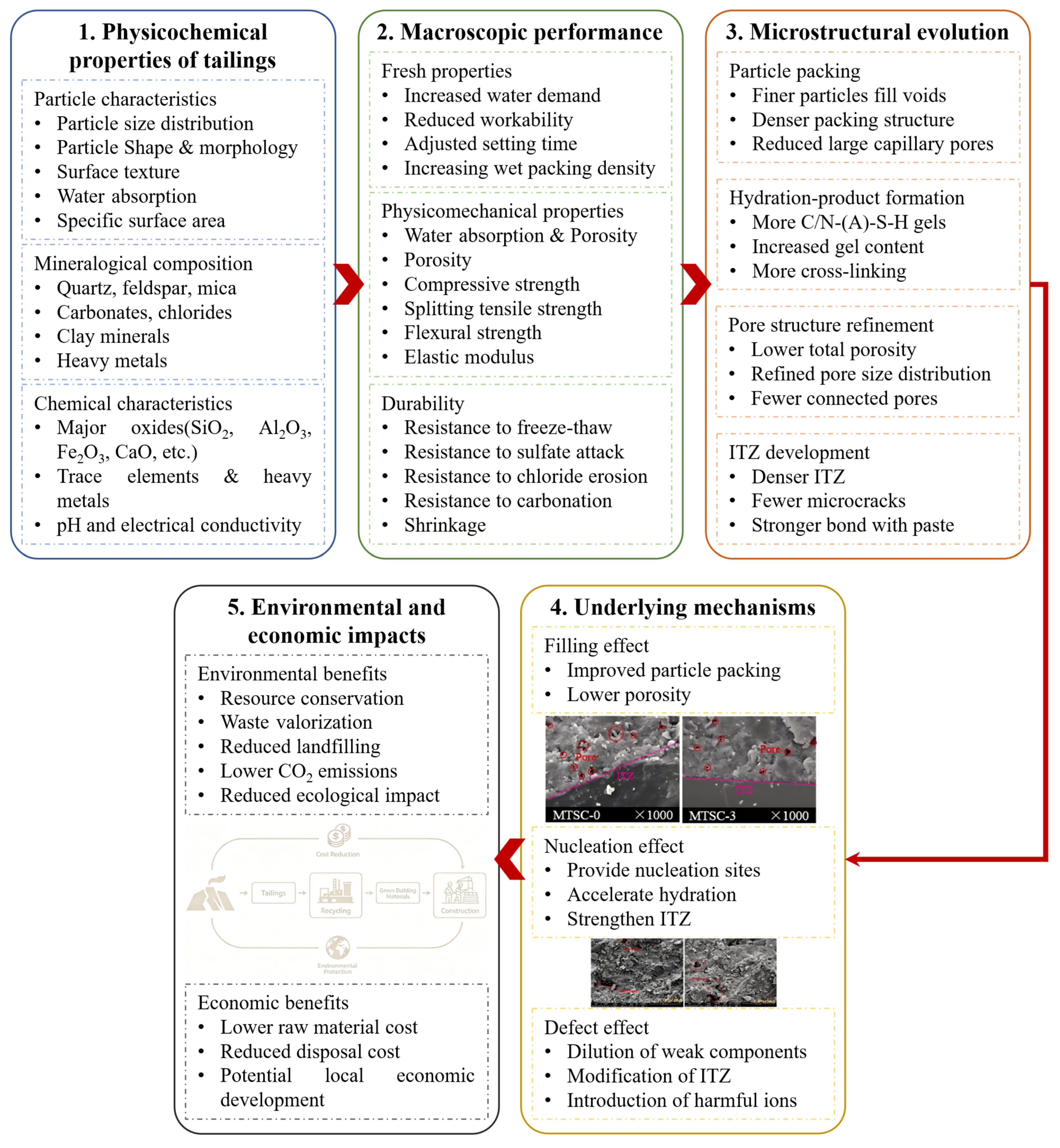
The practical application of tailings as fine aggregates in concrete is constrained by regional and logistical factors. The feasibility and cost-effectiveness depend heavily on local availability of suitable tailings, which vary widely in type, volume, and composition. Furthermore, long-distance transportation can diminish both economic and environmental benefits, potentially offsetting the carbon reduction gained from replacing natural aggregates. Therefore, optimal substitution ratios and projected cost savings from the literature are not universally applicable. Successful implementation requires site-specific assessments that balance local tailings supply, transport logistics, and mix design optimization. In addition, the integrative conceptual framework to provide a comprehensive overview of the research presented in this paper is developed in
Figure 19.
4. Conclusions
The systematic analysis of physico-mechanical properties, durability, microscopic characterization, environmental analysis, and production cost analysis of concrete materials incorporated with tailings indicated significant potential for their use as construction aggregates. It is important to note that tailings exhibit both positive and negative effects on the performance of concrete materials, largely depending on their inherent characteristics. Based on an extensive discussion, the following conclusions can be drawn:
(a) Material characteristics of Tailings
The overall physical properties, chemical and mineral compositions of tailings were broadly comparable to those of natural aggregates. However, these similarities masked substantial variability. Differences in ore type and processing routes led to pronounced changes in key characteristics, including particle size distribution, fineness modulus, apparent density, and phase composition. In most cases, tailings particles exhibit angular and irregular geometries. Their surfaces are typically rough and often porous, reflecting the combined effects of mineralogy and mechanical processing.
(b) Fresh properties of tailings concrete
The workability of concrete materials generally decreased with increasing tailings contents, whereas setting time and wet packing density tended to increase. At low substitution levels, a slight improvement in flowability may occur, primarily due to particle packing optimization and the associated filling effect. Overall, the workability of tailings concrete was adversely affected by the high fraction of fine particles.
(c) Mechanical properties of tailings concrete
Tailings concrete shows mainly non-monotonic mechanical behavior with increasing substitution, typically rising then declining. This stemmed from the competition among filling, nucleation, and defect effects. At low levels, improved packing and nucleation enhance matrix densification and strengths. At higher levels, high surface area, water demand, and irregular morphology introduced pores, weakened the aggregate skeleton, and degraded interfaces. The mechanical strengths of concrete exhibited a marked decline when the tailings contents exceeded 50%.
(d) Durability of tailings concrete
Tailings incorporation induced non-monotonic durability evolution governed by the competition between filling and defect effects. At low-to-moderate replacement (10%~40%), fine particles densified the matrix, refined pore structure, and enhanced interfacial bonding, improving resistance to freeze–thaw, sulfate attack, chloride corrosion, carbonation, and shrinkage. At high substitution levels, increased water demand, weakened aggregate skeleton, and higher transport pathways dominated, leading to durability degradation. Consequently, an optimal substitution range existed where microstructural densification maximizes performance, while excessive tailings introduced defects that controlled long-term deterioration.
(e) Microscopic characterization of tailings concrete
SEM, XRD, and TGA collectively revealed that tailings induced a dual effect on concrete microstructure and hydration. At moderate levels (10%~25%), filling and dilution effects enhanced hydration, densified the matrix, and strengthened the ITZ. In contrast, excessive tailings (≥50%) increased water demand, suppressed hydration, weakened ITZ integrity, and introduced pores and microcracks, leading to microstructural deterioration and reduced macroscopic performance.
(f) Environmental and economic evaluation of tailings concrete
Tailings generally reduced environmental impact and cost by replacing natural aggregates and lowering cement demand. This decreased carbon emissions (up to ~28%) and production costs (up to ~50%). The benefits arise from reduced clinker usage, waste valorization, and minimized resource extraction and tailings storage requirements.
5. Future Perspectives
(a) Despite extensive research, a unified understanding of tailings in cementitious systems remains lacking, particularly for structural applications. Future work should focus on the coupled effects of particle size, chemistry, and mineralogy on binder evolution. Advanced predictive tools, including digital twins, multiscale modeling, and artificial intelligence, can be leveraged to simulate material behavior across scales, capture complex nonlinear relationships, and optimize mixture design based on physicochemical parameters and performance targets.
(b) Existing studies have predominantly emphasized strength, while fracture behavior, cracking mechanisms, and constitutive models remain insufficiently understood. Establishing quantitative correlations between microstructural evolution and failure mechanisms, potentially supported by AI-driven data analysis and multiscale simulations, is essential for improving structural reliability and performance prediction.
(c) Durability under aggressive environments represents another critical gap. The long-term behavior of tailings concrete in chloride-rich, sulfate-rich, and alkali-rich conditions requires systematic evaluation. Integration of digital monitoring platforms and accelerated testing within digital twin frameworks can facilitate predictive durability assessment, enabling proactive design and mitigation strategies.
(d) From a design perspective, current replacement levels (25–30%) may underestimate the potential of tailings. Higher substitution ratios (up to 80%) should be explored within particle grading and mix constraints, with optimization guided by strength, durability, and serviceability targets. AI-based optimization and multiscale modeling can support such design exploration by predicting the combined effects of particle characteristics, hydration kinetics, and microstructural evolution on macroscopic performance.
(e) Finally, health, safety, and sustainability considerations must be incorporated into future research. Long-term leaching risks should be assessed, and durability-oriented life-cycle assessment should be conducted to evaluate environmental benefits over the full service life. Coupling sustainability assessment with digital twin simulations and AI-driven optimization offers a promising route to design tailings-based cementitious materials that are both high-performance and environmentally responsible.
Author Contributions
Conceptualization, W.L. and N.Z.; methodology, W.L. and N.Z.; validation, W.L., J.H. and N.Z.; formal analysis, W.L., J.H., Z.P. and N.Z.; investigation, W.L., J.H., Z.P. and N.Z.; resources, N.Z.; data curation, Q.X., D.W., Z.P. and N.Z.; writing—original draft preparation, W.L., N.Z. and Z.P.; writing—review and editing, W.L., N.Z. and Z.P.; visualization, D.W.; supervision, J.H.; project administration, N.Z.; funding acquisition, N.Z. All authors have read and agreed to the published version of the manuscript.
Funding
This research was funded by The Major Scientific and Technological Research and Development Projects of China Harbor Engineering Co., Ltd. (2025-ZGKJ-599 ZDYF-03), Natural Science Foundation of Shandong Province (ZR2023QE174), Shandong Excellent Young Scientists Fund Program (Overseas) under Award 2023HWYQ-030, and Natural Science Foundation of Jiangsu Province (BK20240432).
Data Availability Statement
Reasonable data requests will be provided with the authors’ agreement.
Acknowledgments
The financial support provided by Shandong Provincial Department of Science and Technology, Jiangsu Provincial Department of Science and Technology, and CHEC are highly acknowledged.
Conflicts of Interest
Wenpeng Liu, Junbiao He, and Qingyun Xu are employees of China Harbour Engineering Co., Ltd. Di Wang is an employee of Luzhong Mining Co., Ltd. The other authors declare no conflicts of interest. Wenpeng Liu has received research grants from China Harbour Engineering Co., Ltd. Qingyun Xu has received a speaker honorarium from China Harbour Engineering Co., Ltd. Junbiao He has been involved as a consultant and expert witness in China Harbour Engineering Co., Ltd. Di Wang is the inventor of patent in Luzhong Mining Co., Ltd. The companies had no role in the design of the study; in the collection, analyses, or interpretation of data; in the writing of the manuscript; or in the decision to publish the results.
Abbreviations
The following abbreviations are used in this manuscript:
| SEM | Scanning electron microscopy |
| EDS | Energy-dispersive spectroscopy |
| XRD | X-ray diffraction |
| UHPC | Ultra-high-performance concrete |
| TGA | Thermogravimetric analysis |
| ITZ | Interfacial transition zone |
| MB | Methylene Blue |
References
- Liu, H.-B.; Li, Y.-F.; Deng, S.-W.; Wang, H.-Y.; Xu, B.; Bai, Q. Evolution Mechanisms of Cement Mortar Performance with Molybdenum Tailings as River Sand Substitute: A Multidimensional Investigation on Macro-Micro Synergistic Interactions. J. Build. Eng. 2026, 117, 114744. [Google Scholar] [CrossRef]
- Liu, S.; Hu, J.; Jin, W.; Zhang, J.; Huang, P.; Hu, Q. Shear Performance of Brick Masonry Retrofitted by High-Strength Fibrous Cement Mortar. J. Build. Eng. 2024, 98, 111044. [Google Scholar] [CrossRef]
- Xue, L.; Li, Y.; Li, R.; Yu, W. Preparation of Specialized Plastering Mortar for Foam Concrete Using Low Silica Iron Tailings. Mater. Struct. 2025, 58, 239. [Google Scholar] [CrossRef]
- Johansson, L.; Bahrami, A.; Cehlin, M.; Wallhagen, M. Experimental Investigation on Using Lead–Zinc Tailings as Low-Carbon Partial Replacement of Cement in Mortar for Sustainable Construction. Buildings 2026, 16, 730. [Google Scholar] [CrossRef]
- Gao, S.; Xu, J.; Zhou, S.; Xu, M.; Li, H. Application of Graphite Tailings in Concrete Manufacturing: A Review. Materials 2026, 19, 641. [Google Scholar] [CrossRef] [PubMed]
- Obenaus-Emler, R.; Falah, M.; Illikainen, M. Assessment of Mine Tailings as Precursors for Alkali-Activated Materials for on-Site Applications. Constr. Build. Mater. 2020, 246, 118470. [Google Scholar] [CrossRef]
- Pi, Z.; Huang, S.; Xu, J.; Chen, Z.; Li, H.; Shen, Y.; Tian, J. The Reinforcement Mechanism of Basalt and Polypropylene Fibers on the Strength, Toughness and Crack Resistance of Tailing Mortar. Constr. Build. Mater. 2024, 419, 135531. [Google Scholar] [CrossRef]
- Chen, Z.; Qiu, W.; Peng, F.; Chen, P.; Wang, C.; Ding, S.; Zhao, G.; Tan, Q.; Bao, L. Tailing Sand as Sustainable Aggregate: Enhancing Durability of Cast-in-Situ Concrete against Combined Sulfate-Chloride Attack. Case Stud. Constr. Mater. 2025, 23, e05512. [Google Scholar] [CrossRef]
- Li, Y.; Dang, F.; Zhou, M.; Zhou, J. Influence of Molybdenum Tailings Replacing River Sand on Mechanical Properties and Concrete Microstructure. Constr. Build. Mater. 2024, 435, 136897. [Google Scholar] [CrossRef]
- Quan, X.; Wang, S.; Liu, K.; Xu, J.; Zhao, N.; Liu, B. Evaluation of Molybdenum Tailings as Replacement for Fine Aggregate in Concrete: Mechanical, Corrosion Resistance, and Pore Microstructural Characteristics. Constr. Build. Mater. 2022, 343, 127982. [Google Scholar] [CrossRef]
- Li, Y.; Yu, M.; Li, W.; Bian, X. Relation between Pore Structure Uniformity and Compressive Strength of Iron Tailings Mortar. Cem. Concr. Compos. 2025, 157, 105964. [Google Scholar] [CrossRef]
- Ma, X.; Sun, J.; Zhang, R.; Yang, M.; Meng, Z.; Yuan, J.; Zhang, F. Experimental Studies on Flexural Behavior of Full Iron Tailings Concrete Beams. Struct. Concr. 2023, 24, 7222–7236. [Google Scholar] [CrossRef]
- Pi, Z.; Huang, S.; Cai, H.; Chen, Z.; Shen, Y.; Li, H. Resistance Mechanism of Hybrid Fiber-Reinforced Tailing Mortar Under Freeze–Thaw and Sulfate Attack. J. Mater. Civ. Eng. 2026, 38, 04026107. [Google Scholar] [CrossRef]
- Zhao, Z.; Cheng, D.; Kang, X.; Cheng, N.; Zhu, C.; Li, H.; Xu, M. Study on the Performance Degradation of Iron Ore Tailings Concrete Under Microwave Irradiation. Constr. Build. Mater. 2025, 492, 142976. [Google Scholar] [CrossRef]
- Yuan, J.; Bai, Q.; Gao, S.; Wang, Y.; Yu, S. Uniaxial Compressive Stress-Strain Model of Molybdenum Tailings Concrete After High-Temperature Exposure. Constr. Build. Mater. 2024, 428, 136343. [Google Scholar] [CrossRef]
- Gao, S.; Cui, X.; Kang, S.; Ding, Y. Sustainable Applications for Utilizing Molybdenum Tailings in Concrete. J. Clean. Prod. 2020, 266, 122020. [Google Scholar] [CrossRef]
- Shi, J.; Pan, W.; Kang, J.; Yu, Z.; Sun, G.; Li, J.; Zheng, K.; Shen, J. Properties of Ultra-High Performance Concrete Incorporating Iron Tailings Powder and Iron Tailings Sand. J. Build. Eng. 2024, 83, 108442. [Google Scholar] [CrossRef]
- Amin, M.; Hakeem, I.Y.; Zeyad, A.M.; Tayeh, B.A.; Maglad, A.M.; Agwa, I.S. Influence of Recycled Aggregates and Carbon Nanofibres on Properties of Ultra-High-Performance Concrete Under Elevated Temperatures. Case Stud. Constr. Mater. 2022, 16, e01063. [Google Scholar] [CrossRef]
- Li, Y.; Dang, F.; Zhou, M.; Zhang, Y. Research on Mechanics, Frost Resistance Characteristics, and Strength Improvement Mechanism of Concrete with Molybdenum Tailings. Constr. Build. Mater. 2025, 489, 142350. [Google Scholar] [CrossRef]
- Quan, W.; Huang, W.; Li, Z.; Mao, W.; Miao, X.; Hou, L.; Bu, X.; Wei, J.; Hao, L. A New Approach for Improving the Properties of Tailings Sand Autoclaved Aerated Concrete—From a Mineralogical Perspective. Constr. Build. Mater. 2024, 441, 137584. [Google Scholar] [CrossRef]
- Peng, Y.; Liu, Y.; Zhan, B.; Xu, G. Preparation of Autoclaved Aerated Concrete by Using Graphite Tailings as an Alternative Silica Source. Constr. Build. Mater. 2021, 267, 121792. [Google Scholar] [CrossRef]
- Gou, M.F.; Zhou, L.; Then, N. Utilization of Tailings in Cement and Concrete: A Review. Sci. Eng. Compos. Mater. 2019, 26, 449–464. [Google Scholar] [CrossRef]
- Zhao, J.; Ni, K.; Su, Y.; Shi, Y. An Evaluation of Iron Ore Tailings Characteristics and Iron Ore Tailings Concrete Properties. Constr. Build. Mater. 2021, 286, 122968. [Google Scholar] [CrossRef]
- Bahmani, H.; Mostafaei, H.; Wu, C. Innovative Uses of Iron Ore Tailings in Sustainable Concrete: An in-Depth Review of Achievements, Future Potential, and Strategic Directions. Arab. J. Sci. Eng. 2026, 51, 3931–3950. [Google Scholar] [CrossRef]
- Fang, Y.; Qiao, L.; Hu, T.; Zhang, L.; Long, H.; Yu, F.; Yang, Z. Characteristics of Iron Ore Tailings Sand and Properties of Iron Ore Tailings Sand Concrete: A Review. Int. J. Concr. Struct. Mater. 2025, 19, 41. [Google Scholar] [CrossRef]
- Arbili, M.M.; Alqurashi, M.; Majdi, A.; Ahmad, J.; Deifalla, A.F. Concrete Made with Iron Ore Tailings as a Fine Aggregate: A Step towards Sustainable Concrete. Materials 2022, 15, 6236. [Google Scholar] [CrossRef] [PubMed]
- Wu, Z.; Zhao, Z.; Duan, W.; Pu, S.; Chu, Y.; Liu, X.; Chen, R.; Li, T. Utilization of Tailings Sand in Sustainable Cement-Based Materials: A Comprehensive Review and Potential Challenges. Arab. J. Sci. Eng. 2025, 50, 16297–16332. [Google Scholar] [CrossRef]
- Li, R.; Yin, Z.; Lin, H. Research Status and Prospects for the Utilization of Lead–Zinc Tailings as Building Materials. Buildings 2023, 13, 150. [Google Scholar] [CrossRef]
- Kong, L.; Xie, S.; Wang, C.; Wang, L. Effect of Iron Tailings as Fine Aggregate and Mineral Admixture on Strength and Microstructure of Cement Mortar. Int. J. Concr. Struct. Mater. 2023, 17, 24. [Google Scholar] [CrossRef]
- Huang, S.; Pi, Z.; Cai, C.; Li, H. Utilization of High-Sulfur Iron Ore Tailings in Cement Mortar by Considering the Influence of Curing Temperature and Tailing Content. J. Build. Eng. 2023, 74, 106826. [Google Scholar] [CrossRef]
- Zhao, J.; He, T.; Mao, J.; Wang, H. Evolution Mechanism of the Mechanical Properties of Graphite Tailings Ultra-High Performance Concrete Based on Particle Size Reorganization. Constr. Build. Mater. 2025, 495, 143605. [Google Scholar] [CrossRef]
- Sun, M.; Li, Z.; Li, Z.; Xu, Q.; Zou, B.; Liu, H.; Wang, F. Mechanical and Microstructural Properties of Graphite Tailings Based Geopolymer Mortars at High Temperature. Case Stud. Constr. Mater. 2025, 23, e05388. [Google Scholar] [CrossRef]
- Zhang, Z.; Gao, N.; Wang, H. The Effect of Copper Tailings Sand on the Workability and Mechanical Properties of Concrete. Buildings 2024, 14, 1789. [Google Scholar] [CrossRef]
- Zhang, J.; Wei, Q.; Zhang, N.; Zhang, S.; Zhang, Y. Comparative Study of Iron-Tailings-Based Cementitious Mortars with Incorporated Graphite Ore and Graphite Tailings: Strength Properties and Microstructure. Materials 2023, 16, 3743. [Google Scholar] [CrossRef] [PubMed]
- Lu, Y.; Yang, J.; Wu, Y.; Lu, R.; Li, Y.; Zhang, L.; Guo, J. Study on the Properties of All-Solid Waste Fluidized Filling Materials Applied to Mine Void Area Filling Engineering. Materials 2024, 17, 5154. [Google Scholar] [CrossRef] [PubMed]
- Ouyang, Q.; Zhou, X.; Liang, X.; Luo, B. Effect of Early Curing Experiences on Mechanical Properties and Microstructure of ECO-UHPC Prepared by Gold Tailings Sand. Materials 2025, 18, 842. [Google Scholar] [CrossRef] [PubMed]
- Zhang, L.; Li, J.; Qiao, H. Effect of Copper Tailing Content on Corrosion Resistance of Steel Reinforcement in a Salt Lake Environment. Materials 2019, 12, 3069. [Google Scholar] [CrossRef] [PubMed]
- Zheng, W.; Wang, S.; Quan, X.; Qu, Y.; Mo, Z.; Lin, C. Carbonation Resistance and Pore Structure of Mixed-Fiber-Reinforced Concrete Containing Fine Aggregates of Iron Ore Tailings. Materials 2022, 15, 8992. [Google Scholar] [CrossRef] [PubMed]
- Wu, X.; Xu, X.; Li, S.; Li, X.; Pei, D.; Yang, X.; Yu, X.; Zhu, X. Experimental Study on the Preparation of Cementitious Materials Through the Activation of Lead—Zinc Tailings. Minerals 2024, 14, 1215. [Google Scholar] [CrossRef]
- Bangalore Chinnappa, G.; Karra, R.C. Experimental and statistical evaluations of strength properties of concrete with iron ore tailings as fine aggregate. J. Hazard. Toxic Radioact. Waste 2020, 24, 04019038. [Google Scholar] [CrossRef]
- Zhu, Q.; Yuan, Y.; Chen, J.; Fan, L.; Yang, H. Research on the High-Temperature Resistance of Recycled Aggregate Concrete with Irontailing Sand. Constr. Build. Mater. 2022, 327, 126889. [Google Scholar] [CrossRef]
- Zhang, C.; Li, B.; Yu, Y.; Zhang, Y.; Xu, H.; Wang, W. An Investigation of the Mechanical Properties of Basalt Fibre-Reinforced Graphite Tailings Cement Mortar. Buildings 2022, 12, 2106. [Google Scholar] [CrossRef]
- Liu, H.; Bai, Q.; Ma, H.; Xin, Z.; Deng, S.; Jiang, C. Research on the Preparation of Eco-Economical Ultra-High Performance Concrete Utilizing Graphite Tailings Resources. Constr. Build. Mater. 2024, 438, 137102. [Google Scholar] [CrossRef]
- Duan, H.; Liu, H.; Li, B.; Wang, Z.; Gao, H. Mechanical Properties and Mechanism Analysis of Graphite Tailings Environment-Friendly Concrete. Materials 2022, 15, 8870. [Google Scholar] [CrossRef] [PubMed]
- Zhang, C.; Li, B.; Wu, F.; Yu, Y.; Zhang, Y.; Xu, H. Research on Modification of Mechanical Properties of Recycled Aggregate Concrete by Replacing Sand with Graphite Tailings. Rev. Adv. Mater. Sci. 2022, 61, 493–512. [Google Scholar] [CrossRef]
- Li, H.; Zhang, L.; Liu, J.; Chu, D.; Ren, J. Optimization of the Proportioning and Microscopic Mechanism Study of Cement Mortar Prepared with Copper Tailings as Fine Aggregate. Materials 2025, 18, 2569. [Google Scholar] [CrossRef] [PubMed]
- Li, J.; Ren, W.; Zhang, A.; Li, S.; Tan, J.; Liu, H. Mechanical Properties and Microstructure Analysis of Cement Mortar Mixed with Iron Ore Tailings. Buildings 2023, 13, 149. [Google Scholar] [CrossRef]
- Andrews, A.; Nyarko, E.F.; Adjaottor, A.A.; Nsiah-Baafi, E.; Adom-Asamoah, M. Reuse and Stabilization of Sulphide Mine Tailings as Fine Aggregate for Construction Mortar. J. Clean. Prod. 2022, 357, 131971. [Google Scholar] [CrossRef]
- Shettima, A.U.; Hussin, M.W.; Ahmad, Y.; Mirza, J. Evaluation of Iron Ore Tailings as Replacement for Fine Aggregate in Concrete. Constr. Build. Mater. 2016, 120, 72–79. [Google Scholar] [CrossRef]
- Wang, X.; Yu, R.; Shui, Z.; Zhao, Z.; Song, Q.; Yang, B.; Fan, D. Development of a Novel Cleaner Construction Product: Ultra-High Performance Concrete Incorporating Lead-Zinc Tailings. J. Clean. Prod. 2018, 196, 172–182. [Google Scholar] [CrossRef]
- Wang, H.; Ju, C.; Zhou, M.; Chen, J.; Dong, Y.; Hou, H. Sustainable and Efficient Stabilization/Solidification of Pb, Cr, and Cd in Lead-Zinc Tailings by Using Highly Reactive Pozzolanic Solid Waste. J. Environ. Manag. 2022, 306, 114473. [Google Scholar] [CrossRef] [PubMed]
- Yildirim Ozen, M.; Moroydor Derun, E. A Comparative Study: Effects of Different Nanoparticles on the Properties of Gold Mine Tailings Containing Cement Mortars. Constr. Build. Mater. 2019, 202, 396–405. [Google Scholar] [CrossRef]
- Ince, C. Reusing Gold-Mine Tailings in Cement Mortars: Mechanical Properties and Socio-Economic Developments for the Lefke-Xeros Area of Cyprus. J. Clean. Prod. 2019, 238, 117871. [Google Scholar] [CrossRef]
- Esmaeili, J.; Aslani, H.; Onuaguluchi, O. Reuse Potentials of Copper Mine Tailings in Mortar and Concrete Composites. J. Mater. Civ. Eng. 2020, 32, 04020084. [Google Scholar] [CrossRef]
- Fisonga, M.; Wang, F.; Mutambo, V. Sustainable Utilization of Copper Tailings and Tyre-Derived Aggregates in Highway Concrete Traffic Barriers. Constr. Build. Mater. 2019, 216, 29–39. [Google Scholar] [CrossRef]
- Liza, R.; Pereyra, P.; Rau, J.; Guzman, M.; Sajo-Bohus, L.; Palacios, D. Assessment of Natural Radioactivity and Radon Exhalation in Peruvian Gold Mine Tailings to Produce a Geopolymer Cement. Atmosphere 2023, 14, 588. [Google Scholar] [CrossRef]
- Paiva, I.; Marques, R.; Santos, M.; Reis, M.; Prudêncio, M.I.; Waerenborgh, J.C.; Dias, M.I.; Russo, D.; Cardoso, G.; Vieira, B.J.C.; et al. Naturally Occurring Radioactive Material and Risk Assessment of Tailings of Polymetallic and Ra/U Mines from Legacy Sites. Chemosphere 2019, 223, 171–179. [Google Scholar] [CrossRef] [PubMed]
- Quan, P.; Sun, Q.; Xu, Z.; Shi, M.; Gao, Z.; Wang, D.; Liu, D.; Yang, L.; Song, S. Study on the Mechanical Properties and Strength Formation Mechanism of High-Volume Graphite Tailings Concrete. J. Build. Eng. 2024, 84, 108500. [Google Scholar] [CrossRef]
- Zhang, D.; Shi, S.; Wang, C.; Yang, X.; Guo, L.; Xue, S. Preparation of Cementitious Material Using Smelting Slag and Tailings and the Solidification and Leaching of Pb2+. Adv. Mater. Sci. Eng. 2015, 2015, 352567. [Google Scholar] [CrossRef]
- Deng, P.; Zheng, Z. Mechanical Properties of One-Part Geopolymer Masonry Mortar Using Alkali-Fused Lead–Zinc Tailings. Constr. Build. Mater. 2023, 369, 130522. [Google Scholar] [CrossRef]
- Han, Q.; Wang, A.; Wang, W.; Zhang, J. Fracture Performance and Damage Behavior of Fly Ash-Based Geopolymers Toughened by Molybdenum Tailings Based on Acoustic Emission and Digital Image Correlation. Ceram. Int. 2023, 49, 27878–27891. [Google Scholar] [CrossRef]
- Yi, G.; Duan, W.; Song, C.; Geng, C.; Li, Q.; Chen, Z. Influence of Iron Tailing Powder-Granulated Blast Furnace Slag Composite Admixtures on the Mechanical Properties and Resistance to Chloride Erosion of Cement Mortar. Buildings 2026, 16, 2224. [Google Scholar] [CrossRef]
- Cui, L.; Wang, L.; Xu, Y.; Lou, X.; Wang, H. Feasibility Evaluation of Replacing River Sand with Copper Tailings. Sustainability 2021, 13, 7575. [Google Scholar] [CrossRef]
- Li, M.; Gong, M.; Li, H.; Guo, L.; Li, Z.; Guo, X.; Yin, Y.; Ren, T. Preparation Process and Performance of Mineral Admixtures Derived from High-Sulfur Lead-Zinc Tailings. Minerals 2025, 15, 1256. [Google Scholar] [CrossRef]
- Jiang, R.; Wang, Z. Performance and Heavy Metal Analysis of Graphite Tailings Cured Using Cementitious Materials. Buildings 2024, 14, 537. [Google Scholar] [CrossRef]
- Ahmed, T.; Elchalakani, M.; Basarir, H.; Karrech, A.; Sadrossadat, E.; Yang, B. Development of ECO-UHPC Utilizing Gold Mine Tailings as Quartz Sand Alternative. Clean. Eng. Technol. 2021, 4, 100176. [Google Scholar] [CrossRef]
- Wang, J.N.; Yu, R.; Ji, D.D.; Tang, L.W.; Yang, S.C.; Fan, D.Q.; Shui, Z.H.; Leng, Y.; Liu, K.N. Effect of Distribution Modulus (q) on the Properties and Microstructure Development of a Sustainable Ultra-High Performance Concrete (UHPC). Cem. Concr. Compos. 2022, 125, 104335. [Google Scholar] [CrossRef]
- Wang, J.N.; Yu, R.; Xu, W.Y.; Hu, C.Y.; Shui, Z.H.; Qian, D.; Leng, Y.; Liu, K.N.; Hou, D.S.; Wang, X.P. A Novel Design of Low Carbon Footprint Ultra-High Performance Concrete (UHPC) Based on Full Scale Recycling of Gold Tailings. Constr. Build. Mater. 2021, 304, 124664. [Google Scholar] [CrossRef]
- Yang, J.; Zhu, M.; He, X.; Su, Y.; Huang, T.; Wang, X.; Tang, D.; Zeng, J.; Dai, F. Converting Iron Mine Tailings into Composite Aggregates for Ultrahigh-Performance Mortar. J. Mater. Civ. Eng. 2025, 37, 04024460. [Google Scholar] [CrossRef]
- Zhang, W.; Yang, C.; Huang, L.; Wang, Z.; Zeng, C.; Zhu, J.; Huang, W. A Study on the Performance of Self-Leveling Mortar Utilizing Tungsten Tailings as the Aggregate. Sustainability 2024, 16, 5545. [Google Scholar] [CrossRef]
- Álvarez-Fernández, M.I.; Guerrero-Miguel, D.-J.; González-Nicieza, C.; Prendes-Gero, M.B.; Peñas-Espinosa, J.C.; Fernández-Rodríguez, R. Mortars with Mining Tailings Aggregates: Implications for Additive Manufacturing. Buildings 2025, 15, 1912. [Google Scholar] [CrossRef]
- Xia, R.; Zhang, N.; Zhang, Y.; Zhang, S.; Wang, Y.; Wang, Y.; Zhang, Y.; Zhou, Y. Effects of halloysite-decorated basalt fiber on mechanical properties and microstructure of iron tailings-based cementitious mortar. Constr. Build. Mater. 2024, 417, 135300. [Google Scholar] [CrossRef]
- Wang, C.; Ji, Y.; Qie, R.; Wang, J.; Wang, D. Mechanical Performance Investigation on Fiber Strengthened Recycled Iron Tailings Concrete. Case Stud. Constr. Mater. 2024, 20, e02734. [Google Scholar] [CrossRef]
- Gao, S.; Xu, J.; Huang, Z.; Nishiwaki, T.; Rong, C. Life Cycle Environmental Evaluation Framework for Mining Waste Concrete: Insights from Molybdenum Tailings Concrete in China. Buildings 2025, 15, 3755. [Google Scholar] [CrossRef]
- Luo, T.; Yi, Y.; Sun, Q.; Li, L.G.; Tang, L.; Hua, C. The Effects of Adding Molybdenum Tailings as Cementitious Paste Replacement on the Fluidity, Mechanical Properties and Micro-Structure of Concrete. J. Build. Eng. 2022, 62, 105377. [Google Scholar] [CrossRef]
- Zhang, W.; Gu, X.; Qiu, J.; Liu, J.; Zhao, Y.; Li, X. Effects of Iron Ore Tailings on the Compressive Strength and Permeability of Ultra-High Performance Concrete. Constr. Build. Mater. 2020, 260, 119917. [Google Scholar] [CrossRef]
- Zhao, B.; Wang, G.; Wu, B.; Kong, X. A Study on Mechanical Properties and Permeability of Steam-Cured Mortar with Iron-Copper Tailings. Constr. Build. Mater. 2023, 383, 131372. [Google Scholar] [CrossRef]
- Pyo, S.; Tafesse, M.; Kim, B.-J.; Kim, H.-K. Effects of Quartz-Based Mine Tailings on Characteristics and Leaching Behavior of Ultra-High Performance Concrete. Constr. Build. Mater. 2018, 166, 110–117. [Google Scholar] [CrossRef]
- Liu, J.; Zhou, Y.; Wu, A.; Wang, H. Reconstruction of Broken Si–O–Si Bonds in Iron Ore Tailings (IOTs) in Concrete. Int. J. Miner. Metall. Mater. 2019, 26, 1329–1336. [Google Scholar] [CrossRef]
- Hamada, H.M.; Al-Attar, A.; Askar, M.K.; Beddu, S.; Majdi, A. Enhancing Sustainable Concrete with Iron Ore Tailings as Fine Aggregate: Environmental and Engineering Perspectives. Constr. Build. Mater. 2025, 470, 140707. [Google Scholar] [CrossRef]
- Puiatti, G.A.; Elerate, E.M.; de Carvalho, J.P.; Luciano, V.A.; de Carvalho Teixeira, A.P.; Lopes, R.P.; Teixeira de Matos, A. Reuse of Iron Ore Tailings as an Efficient Adsorbent to Remove Dyes from Aqueous Solution. Environ. Technol. 2024, 45, 2308–2319. [Google Scholar] [CrossRef] [PubMed]
- Lai, H.; Li, N.; Wang, W.; Lin, J.; Jiang, P.; Wu, E.; Jia, L. The Impact of Iron Tailings on the Properties and Microstructure of Mortar Under Coupled Freeze-Thaw and Sulfate Attack Environments. Constr. Build. Mater. 2025, 478, 141430. [Google Scholar] [CrossRef]
- Li, T.; Wang, S.; Xu, F.; Meng, X.; Li, B.; Zhan, M. Study of the Basic Mechanical Properties and Degradation Mechanism of Recycled Concrete with Tailings Before and After Carbonation. J. Clean. Prod. 2020, 259, 120923. [Google Scholar] [CrossRef]
- Shi, H.; Wang, H.; Xue, S.; Feng, S.; Li, Y. Durability Evaluation of Iron Tailings Concrete Under Freeze-Thaw Cycles and Sulfate Erosion Based on Entropy Weighting Method. Constr. Build. Mater. 2024, 443, 137747. [Google Scholar] [CrossRef]
- Gu, X.; Liu, S.; Jiang, Y.; Zhang, R.; Sun, D.; Sun, R. Characteristics of Microstructural Damage Evolution of Full-Size Iron Tailings Concrete in Freeze–Thaw Cycles. Eng. Fract. Mech. 2026, 338, 112023. [Google Scholar] [CrossRef]
- Liu, K.; Wang, S.; Quan, X.; Jing, W.; Xu, J.; Zhao, N.; Liu, B. Effect of Iron Ore Tailings Industrial By-Product as Eco-Friendly Aggregate on Mechanical Properties, Pore Structure, and Sulfate Attack and Dry-Wet Cycles Resistance of Concrete. Case Stud. Constr. Mater. 2022, 17, e01472. [Google Scholar] [CrossRef]
- Xu, F.; Wang, S.; Li, T.; Liu, B.; Li, B.; Zhou, Y. The Mechanical Properties of Tailing Recycled Aggregate Concrete and Its Resistance to the Coupled Deterioration of Sulfate Attack and Wetting–Drying Cycles. Structures 2020, 27, 2208–2216. [Google Scholar] [CrossRef]
- Liu, C.; Wu, D.; Chen, M.; Chen, K.; Lou, Z. Study on the Mechanical Properties and Molecular Dynamics Simulation of One-Component Fly Ash-Slag-Based Geopolymer. J. Build. Eng. 2025, 101, 111957. [Google Scholar] [CrossRef]
- Weishi, L.; Guoyuan, L.; Ya, X.; Qifei, H. The Properties and Formation Mechanisms of Eco-Friendly Brick Building Materials Fabricated from Low-Silicon Iron Ore Tailings. J. Clean. Prod. 2018, 204, 685–692. [Google Scholar] [CrossRef]
- Luo, T.; Yi, Y.; Zhang, T.; Li, L.; Yu, W.; Zhang, X.; Zhang, K.; Mostafa, S.A. Developing Low Carbon Molybdenum Tailing Self-Consolidating Concrete: Workability, Shrinkage, Strength, and Pore Structure. Rev. Adv. Mater. Sci. 2025, 64, 20250170. [Google Scholar] [CrossRef]
- Gao, M.-Y.; Chen, S.-C.; Lin, W.-T. Effect of Using Copper Tailings as Replacement of Fine Aggregate for Concrete Pavement. In Proceedings of the Finding Solutions of the 21st Century Transportation Problems Through Research and Innovations; Hossain, Z., Zaman, M., Zhang, J., Eds.; Springer International Publishing: Cham, Switzerland, 2021; pp. 91–101. [Google Scholar]
- Wang, J.; Jiang, Q.; Xue, H. Mechanical and Shrinkage Properties of Alkali-Activated Mortars with Graphite Tailings. J. Build. Eng. 2024, 97, 110809. [Google Scholar] [CrossRef]
- Zhang, Z.; Zhang, Z.; Yin, S.; Yu, L. Utilization of Iron Tailings Sand as an Environmentally Friendly Alternative to Natural River Sand in High-Strength Concrete: Shrinkage Characterization and Mitigation Strategies. Materials 2020, 13, 5614. [Google Scholar] [CrossRef] [PubMed]
- Bader, M.A. Performance of Concrete in a Coastal Environment. Cem. Concr. Compos. 2003, 25, 539–548. [Google Scholar] [CrossRef]
- Qu, F.; Zhao, H.; Wu, K.; Liu, Y.; Zhao, X.; Li, W. Phase Transformation and Microstructure of In-Situ Concrete After 20-Year Exposure to Harsh Mining Environment: A Case Study. Case Stud. Constr. Mater. 2023, 19, e02287. [Google Scholar] [CrossRef]
- Zhang, Y.; Shen, W.; Wu, M.; Shen, B.; Li, M.; Xu, G.; Zhang, B.; Ding, Q.; Chen, X. Experimental Study on the Utilization of Copper Tailing as Micronized Sand to Prepare High Performance Concrete. Constr. Build. Mater. 2020, 244, 118312. [Google Scholar] [CrossRef]
- Zhao, Y.; Gu, X.; Qiu, J.; Zhang, W.; Li, X. Study on the Utilization of Iron Tailings in Ultra-High-Performance Concrete: Fresh Properties and Compressive Behaviors. Materials 2021, 14, 4807. [Google Scholar] [CrossRef] [PubMed]
- Imoh, U.U.; Apata, A.C.; Movahedi Rad, M. Performance of Concrete Incorporating Waste Glass Cullet and Snail Shell Powder: Workability and Strength Characteristics. Buildings 2025, 15, 2161. [Google Scholar] [CrossRef]
- Wang, W.; Chen, R.; Li, H.; Yin, Y.; He, M.; Xi, B. Mechanical Performance and Microcosmic Characteristic of the Iron Ore Tailings as Fine Aggregate and Cementitious Material at the Recycled Concrete. J. Build. Eng. 2025, 114, 114130. [Google Scholar] [CrossRef]
- Cheng, Y.; Huang, F.; Qi, S.; Li, W.; Liu, R.; Li, G. Durability of Concrete Incorporated with Siliceous Iron Tailings. Constr. Build. Mater. 2020, 242, 118147. [Google Scholar] [CrossRef]
- Liu, S.; Wang, L.; Li, Q.; Song, J. Hydration Properties of Portland Cement-Copper Tailing Powder Composite Binder. Constr. Build. Mater. 2020, 251, 118882. [Google Scholar] [CrossRef]
- Barzegar Ghazi, A.; Jamshidi-Zanjani, A.; Nejati, H. Utilization of Copper Mine Tailings as a Partial Substitute for Cement in Concrete Construction. Constr. Build. Mater. 2022, 317, 125921. [Google Scholar] [CrossRef]
- Xu, F.; Wang, S.; Li, T.; Liu, B.; Zhao, N.; Liu, K. The Mechanical Properties and Resistance against the Coupled Deterioration of Sulfate Attack and Freeze-Thaw Cycles of Tailing Recycled Aggregate Concrete. Constr. Build. Mater. 2021, 269, 121273. [Google Scholar] [CrossRef]
- Bai, M.; Long, G.; Wang, F. Properties and Microstructural Characteristics of Manganese Tailing Sand Concrete. Materials 2022, 15, 5583. [Google Scholar] [CrossRef] [PubMed]
- Sun, J.; Sun, M.; Su, A.; Gao, X. Influence of Graphite Tailings on the Mechanical Performance, of Ultra-High Performance Concrete. Case Stud. Constr. Mater. 2025, 22, e04246. [Google Scholar] [CrossRef]
- Jin, F.; Gu, K.; Al-Tabbaa, A. Strength and Hydration Properties of Reactive MgO-Activated Ground Granulated Blastfurnace Slag Paste. Cem. Concr. Compos. 2015, 57, 8–16. [Google Scholar] [CrossRef]
- Chen, B.; Pang, L.; Zhou, Z.; Chang, Q.; Fu, P. Study on the Activation Mechanism and Hydration Properties of Gold Tailings Activated by Mechanical-Chemical-Thermal Coupling. J. Build. Eng. 2022, 48, 104014. [Google Scholar] [CrossRef]
- Kasap, T.; Yilmaz, E.; Sari, M. Effects of Mineral Additives and Age on Microstructure Evolution and Durability Properties of Sand-Reinforced Cementitious Mine Backfills. Constr. Build. Mater. 2022, 352, 129079. [Google Scholar] [CrossRef]
- Wei, M.; Wei, W.; Li, Y.; Liu, L.; Zhong, F.; Xue, Q. Maximizing the Pozzolanic Potential of Superfine Iron Tailings for Low-Carbon Stabilization: Application of High-Calcium Geopolymer. Resour. Conserv. Recycl. 2023, 198, 107198. [Google Scholar] [CrossRef]
- Pavlů, T.; Kočí, V.; Hájek, P. Environmental Assessment of Two Use Cycles of Recycled Aggregate Concrete. Sustainability 2019, 11, 6185. [Google Scholar] [CrossRef]
- Marín, O.; Valderrama, J.O.; Kraslawski, A.; Cisternas, L.A. Potential of Tailing Deposits in Chile for the Sequestration of Carbon Dioxide Produced by Power Plants Using Ex-Situ Mineral Carbonation. Minerals 2021, 11, 320. [Google Scholar] [CrossRef]
- Yang, S.; Yao, X.; Li, J.; Wang, X.; Zhang, C.; Wu, S.; Wang, K.; Wang, W. Preparation and Properties of Ready-to-Use Low-Density Foamed Concrete Derived from Industrial Solid Wastes. Constr. Build. Mater. 2021, 287, 122946. [Google Scholar] [CrossRef]
- Wang, Y.; Zhuge, Y.; Yao, Y. Design and Performance Analysis of Ultra-High Performance Concrete Using Fully Recycled Molybdenum Tailings Waste. Constr. Build. Mater. 2025, 473, 140981. [Google Scholar] [CrossRef]
- Yu-yun, F.; Xi, W.; Ming-wei, J.; Xing-quan, L. The Microstructure and Mechanical Property of Tailings and Its Application in Artificial Concrete. Arab. J. Geosci. 2021, 14, 2105. [Google Scholar] [CrossRef]
- Dey, A.; Rumman, R.; Wakjira, T.G.; Jindal, A.; Bediwy, A.G.; Islam, M.S.; Alam, M.S.; Al Martini, S.; Sabouni, R. Towards Net-Zero Emission: A Case Study Investigating Sustainability Potential of Geopolymer Concrete with Recycled Glass Powder and Gold Mine Tailings. J. Build. Eng. 2024, 86, 108683. [Google Scholar] [CrossRef]
- Balegamire, C.; Nkuba, B.; Dable, P. Production of Gold Mine Tailings Based Concrete Pavers by Substitution of Natural River Sand in Misisi, Eastern Congo. Clean. Eng. Technol. 2022, 7, 100427. [Google Scholar] [CrossRef]
| Disclaimer/Publisher’s Note: The statements, opinions and data contained in all publications are solely those of the individual author(s) and contributor(s) and not of MDPI and/or the editor(s). MDPI and/or the editor(s) disclaim responsibility for any injury to people or property resulting from any ideas, methods, instructions or products referred to in the content. |