
Review

The Drop-In Delusion: Technical and Systemic Impacts of PLA Contamination on the HDPE Circular Economy


by
Anayansi Estrada-Monje
1,*,
Sergio Alonso-Romero
1,
Anayansi Zaragoza-Estrada
2,
María Cristina Kantún-Uicab
3,
Claudia Ivone Piñón-Balderrama
2,
Claudia Alejandra Hernández-Escobar
2 and
Erasto Armando Zaragoza-Contreras
2,*
1
Departamento de Procesos Industriales y Energía, Centro de Innovación Aplicada en Tecnologías Competitivas, Omega No. 201, Industrial Delta, Leon 37545, Guanajuato, Mexico
2
Departamento de Ingeniería y Química de Materiales, Centro de Investigación en Materiales Avanzados, S.C., Miguel de Cervantes No. 120, Complejo Industrial Chihuahua, Chihuahua 31136, Chihuahua, Mexico
3
Departamento de Ingeniería en Plásticos, Universidad Politécnica de Juventino Rosas, Hidalgo No. 102, Comunidad de Valencia, Juventino Rosas 38253, Guanajuato, Mexico
*
Authors to whom correspondence should be addressed.
Recycling 2026, 11(5), 90; https://doi.org/10.3390/recycling11050090 (registering DOI)
Submission received: 25 March 2026 / Revised: 5 May 2026 / Accepted: 7 May 2026 / Published: 12 May 2026

Abstract

The increasing use of biodegradable polymers, especially poly (lactic acid) (PLA), has raised concern about their entry into conventional post-consumer recycling streams. This review examines the technical and systemic consequences of PLA contamination in the high-density polyethylene (HDPE) circular economy through the “drop-in delusion,” defined here as the mistaken assumption that a sustainability-marketed polymer can enter an established recycling stream without compromising system compatibility. Focusing on contamination-sensitive conditions in which segregation, sorting, or stream purity are insufficient to prevent cross-contamination, the review discusses the immiscibility of HDPE/PLA blends and the resulting changes in stiffness, ductility, toughness, and aging behavior. It also analyzes mitigation routes such as improved sorting, compatibilization, and policy measures, while emphasizing that the practical severity of contamination depends on local infrastructure and contamination levels. In addition, it considers the risk that contaminated materials diverted into lower-value applications may become more vulnerable to interfacial damage, weathering, and secondary fragmentation. Overall, the review argues that circular-plastics strategies must distinguish biodegradability from recycling-system compatibility to protect the quality and value of HDPE recyclates.

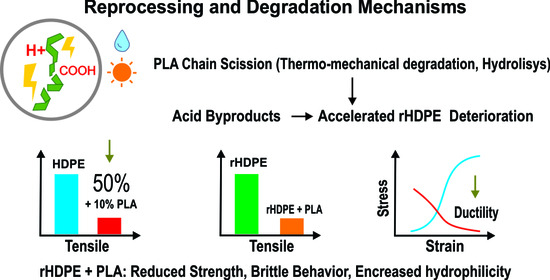
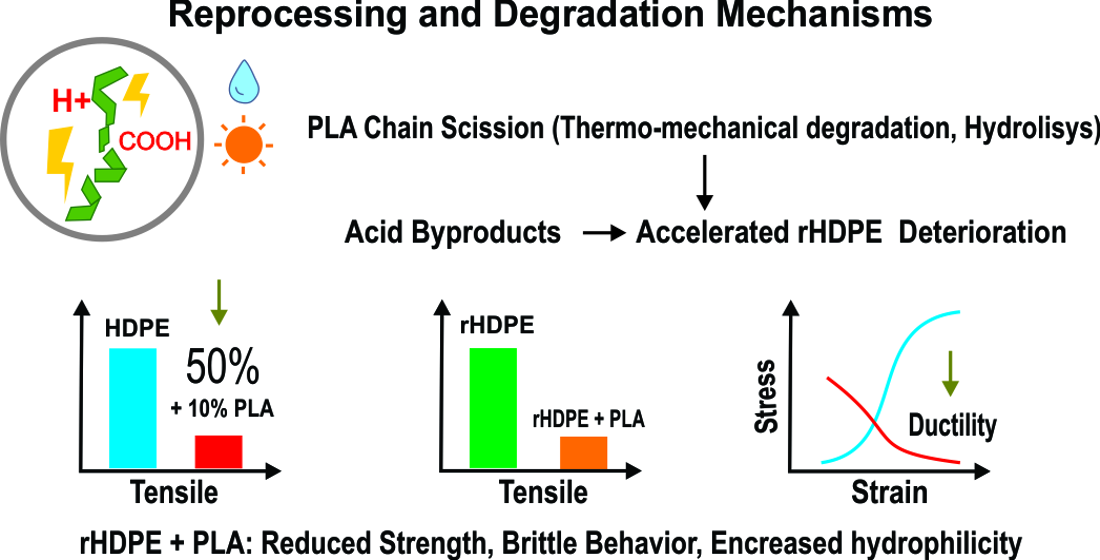
Graphical Abstract

1. Introduction

HDPE stands among the most widely used thermoplastic worldwide because of its low cost, chemical resistance, processability, and broad use in rigid containers, bottles, pipes, geomembranes, and consumer goods [1]. The sustained growth in the production and consumption of HDPE-based products has led to a parallel increase in post-consumer plastic waste streams [2]. In response, the circular economy has gained relevance as a framework for reducing disposal and promoting reuse, recycling, and material valorization, making HDPE an important target for high-quality recovery [3].
HDPE is particularly relevant in current circular-plastics discussions because of its high production volume, widespread use in packaging and consumer products, and established role in mechanical recycling systems [4]. However, as with other polyolefins, its circularity remains constrained by contamination, quality losses during repeated reprocessing, and the limited availability of straightforward closed-loop chemical recycling routes [5]. Improving the quality and purity of HDPE recycling streams, therefore, remains a practical priority within broader circular-economy strategies [6]. The inadvertent incorporation of biodegradable polymers into conventional HDPE recycling streams represents an additional challenge, since it can affect recyclate quality, performance, and market value [7].
Biodegradable polymers are often presented as environmentally preferable materials because they can break down into carbon dioxide, water, and humus under defined conditions [8]. Yet their environmental value depends strongly on the conditions under which degradation actually occurs. In regulatory and technical terms, a plastic is considered biodegradable only when it meets standardized criteria within specific environments and timeframes, such as industrial composting systems [9]. For this reason, biodegradability should not be interpreted as a universal guarantee of benign environmental behavior, particularly in regions where collection, sorting, and dedicated end-of-life infrastructure remain limited [10]. Under such conditions, biodegradable plastics may follow the same mismanaged pathways as conventional plastics, including landfilling, leakage, or unintended incorporation into established recycling streams [11].
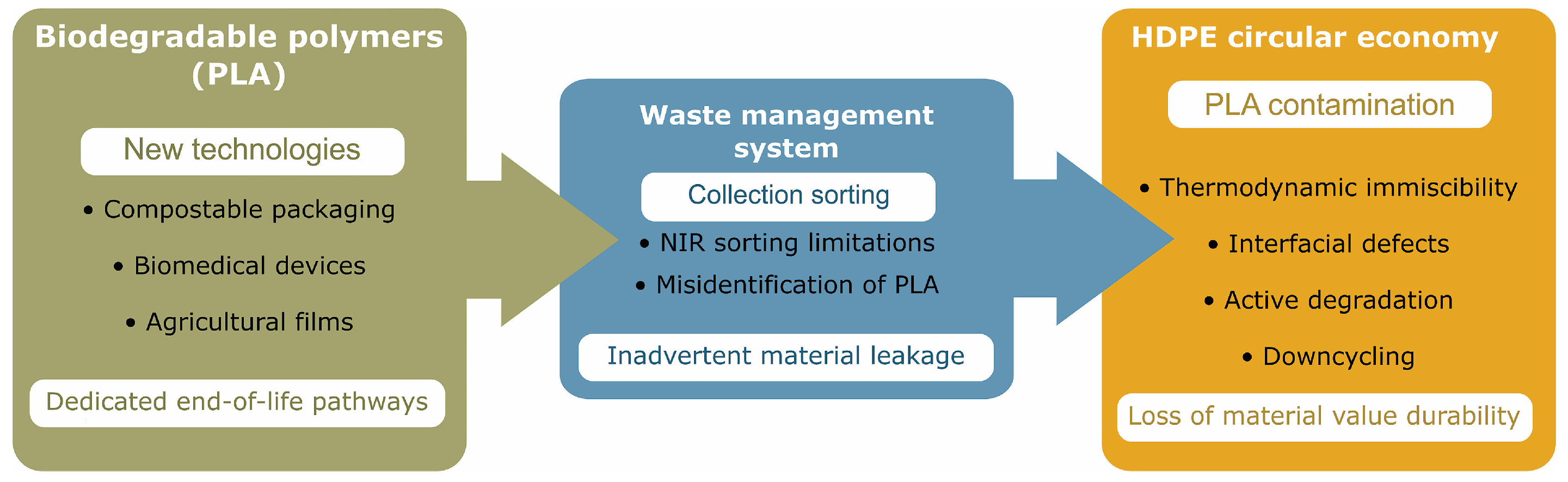
This disconnect between material innovation and waste-management infrastructure remains a central limitation of the circular economy (Figure 1) [6]. Although PLA can be identified and separated from conventional plastics by near-infrared (NIR) sorting under appropriate conditions [12,13], contamination may still occur in practice when source separation is inadequate, sorting configurations are not optimized for bioplastics, product design complicates recognition, or end-of-life routing remains incomplete [14]. Therefore, the concern addressed in this review is not based on the assumption that PLA is intrinsically undetectable, but on the fact that technical detectability does not always guarantee complete segregation in real post-consumer systems [15,16].
The practical relevance of this problem is not uniform across all regions or recycling systems. In highly optimized facilities equipped with efficient identification, sorting, and stream-cleaning operations, PLA contamination may remain limited or manageable [17]. By contrast, in systems where source separation is inconsistent, labeling is unclear, sorting performance is variable, or dedicated end-of-life pathways for biodegradable plastics are not well established, even relatively low levels of cross-contamination may become more consequential for recyclate quality [14]. Accordingly, this review does not assume a universal global scenario, but instead examines why PLA intrusion can become technically relevant under contamination-sensitive conditions [18].
The focus on PLA should not be interpreted as implying that it is necessarily a more prevalent contaminant than PET or other conventional polymers in all HDPE recycling systems [19]. In many real waste streams, PET may be equally or even more relevant in absolute contamination terms because of its larger market penetration [20]. PLA is examined here because it offers a particularly informative case of system incompatibility [6], as it combines a strong sustainability narrative with a polyester chemistry distinct from polyolefins [21] and end-of-life expectations that differ from those governing established HDPE recycling routes [22]. In this context, system compatibility must be understood at two levels: the ability of waste-management infrastructure to identify and separate materials correctly, and the ability of resulting material streams to preserve recyclate quality when polymers are inadvertently commingled.
The growing relevance of this issue is also linked to the expanding production of biodegradable plastics. A report on European bioplastics projects that global bioplastic production capacity, including biodegradable plastics, will increase from approximately 2.31 million tons in 2025 to 4.69 million tons by 2030 [7,23]. Within this broader trend, PLA has become one of the most studied and commercially relevant bioplastics because of its renewable feedstock origin, industrial processability, availability, and suitability for controlled end-of-life scenarios, rather than because it degrades efficiently under unmanaged environmental conditions [24,25,26].
This review analyzes the technical, environmental, and socio-technical implications that may arise when PLA enters HDPE recycling systems under insufficient segregation or other contamination-sensitive conditions. Instead of treating PLA contamination as a uniformly dominant obstacle across all recycling infrastructures, the review examines why this polymer pair deserves attention from a system-compatibility perspective: HDPE and PLA are chemically dissimilar, thermodynamically immiscible, and commonly managed through different end-of-life logics. Within this scope, the discussion integrates evidence on blend immiscibility, contamination-sensitive property loss, reprocessing-related instability, mitigation strategies, and broader circularity implications, while emphasizing that the practical severity of the issue depends on contamination level, application requirements, and local waste-management performance. It also considers the possible environmental consequences of downcycling, including the greater susceptibility of lower-tier outdoor products to interfacial deterioration and secondary fragmentation under stressors such as UVA radiation and moisture. In parallel, the review discusses mitigation pathways such as compatibilization while distinguishing their technical effectiveness in controlled blends from their practical limitations in heterogeneous post-consumer recycling systems. Finally, it extends the analysis to policy and governance dimensions, including eco-modulated extended producer responsibility (EPR) and purity-based approaches to recyclate classification. The contribution of the review is not limited to summarizing the immiscibility of HDPE/PLA blends; rather, it develops an integrative perspective linking material incompatibility, recyclate performance, real-world segregation constraints, downcycling risk, and life-cycle governance to show that the relevance of PLA contamination is defined not only by blend chemistry, but also by its interaction with infrastructure, application demands, and end-of-life system design.

2. HDPE/PLA Blends

2.1. Fundamental Immiscibility and Mechanical Consequences

Polymer blends based on HDPE and PLA have been widely studied as partially bio-based materials that combine the chemical resistance, processability, and low cost of HDPE with the rigidity and renewable origin of PLA [27,28]. From a thermodynamic standpoint, however, HDPE and PLA are inherently immiscible because of their marked differences in polarity and molecular architecture. As a result, these blends typically show clear phase separation, with PLA dispersed within the HDPE matrix and weak interfacial adhesion in the absence of compatibilizing agents [28,29].
This biphasic morphology strongly influences mechanical behavior. Adding PLA can increase stiffness and elastic modulus because PLA is intrinsically more rigid than HDPE, but this effect should not be mistaken for improved compatibility. The main limitation of non-compatibilized HDPE/PLA blends is their weak interfacial cohesion, which restricts stress transfer and usually causes pronounced losses in ductility, impact resistance, and toughness. Several studies therefore show that, although modulus may increase with PLA content, these materials remain mechanically fragile and poorly suited for applications that require damage tolerance or structural reliability [29,30,31].
Non-compatibilized HDPE/PLA blends may increase renewable content and modify stiffness, but their low interfacial adhesion limits their overall mechanical performance and practical usefulness in structural applications [32,33,34]. The literature must also be interpreted with caution, since reported results vary not only with composition, but also with processing route, compatibilization strategy, specimen preparation, thermal history, and the specific property under evaluation. Accordingly, the studies discussed in this review are best read as complementary rather than directly equivalent, and comparison requires separating intrinsic composition effects from morphology-driven interfacial limitations and property changes amplified by reprocessing or aging history [28,31].
As shown in Table 1, the mechanical behavior of HDPE/PLA blends depends strongly on composition. At the HDPE-rich end (95–100% HDPE), the materials retain the high ductility and low rigidity characteristic of HDPE, with high elongation at break and low elastic modulus. As PLA content increases to intermediate levels (15–50%), strength and ductility generally decline while rigidity increases. At PLA-rich compositions (60–100% PLA), the blends become markedly brittle, with high modulus and below elongation at break, reflecting the rigid nature of PLA. Some intermediate formulations nevertheless show higher elongation when processing favors a continuous HDPE phase, underscoring the strong sensitivity of mechanical performance to morphology and processing history.
These results indicate that HDPE/PLA blends prepared without compatibilizers, including those formed by inadvertent PLA contamination in HDPE, are mechanically limited systems whose performance may deteriorate further when HDPE undergoes repeated reprocessing and thermo-oxidative degradation [29]. For example, Torres-Huerta et al. reported that immiscibility reduced mechanical performance and increased degradation rate [33]. Overall, the available evidence supports the view that biopolymer contamination can represent a real risk to the HDPE recycling loop.
It should be emphasized that Table 1 is intended to illustrate broad composition-dependent trends in HDPE/PLA blends and not to establish a universal failure threshold for low-level contamination in post-consumer recycling streams.

2.2. Compatibilized HDPE/PLA Blends

Interest in blends based on HDPE and PLA has grown because they offer a route to partially bio-based materials that combine the chemical resistance, processability, and cost-effectiveness of HDPE with the renewable origin and rigidity of PLA [28,31]. Their main limitation, however, is the strong thermodynamic incompatibility between the two polymers. Differences in polarity and chemical structure promote phase separation and weak interfacial adhesion in non-compatibilized blends, leading to heterogeneous morphologies, low impact resistance, and substantial losses in ductility [28,29].
Compatibilization is therefore a key strategy for improving interaction between the two phases. Functional agents such as maleic anhydride-grafted polyethylene (PE-g-MA), epoxide-containing copolymers (PE-co-GMA), functionalized vegetable oils, and peroxide-activated systems can promote in situ interfacial reactions during melt processing. These reactions improve phase dispersion, reduce domain size, and facilitate more efficient stress transfer between HDPE and PLA [27,31]. As a result, compatibilized blends often show a better balance of stiffness, strength, and toughness, together with improved thermal and rheological stability relative to non-compatibilized systems. This has broadened their potential use in packaging, injection-molded products, consumer goods, and other technical applications where mechanical performance must be balanced with sustainability criteria [27,31].
Several studies illustrate these effects. Quitadamo et al. examined HDPE/PLA blends with weight ratios of 30:70, 50:50, and 70:30 and evaluated the addition of PE-g-MA and ethylene-glycidyl methacrylate (PE-g-GMA) at 1, 3, and 5 wt%. Their results showed that these compatibilizers reduced dispersed-phase size and improved interfacial adhesion, with corresponding gains in mechanical and thermal performance [35]. Likewise, Lu et al. reported that adding 5 wt% of an ethylene-butyl acrylate-glycidyl methacrylate terpolymer (PTW) to a PLA/HDPE (60/40) blend increased impact strength to about 18 kJ/m2 [30].
Quiles-Carrillo et al. studied bio-based high-density polyethylene (bio-HDPE)/PLA blends and confirmed that these systems are inherently immiscible, with poor interfacial adhesion and major losses in ductility and impact resistance as PLA content increases without compatibilization, as shown in Table 2 [31]. They evaluated PE-g-MA, maleinized linseed oil (MLO), and dicumyl peroxide (DCP). PE-g-MA improved phase adhesion and increased stiffness and mechanical strength, although its effect on impact toughness was limited. By contrast, MLO acted more as a plasticizer, reducing modulus while improving impact resistance, and the combination of MLO and DCP further enhanced interfacial compatibilization. In addition, PE-g-MA reduced PLA domain size within the HDPE matrix by promoting reactions between maleic anhydride groups and PLA hydroxyl groups, thereby generating a more continuous interface [27].
Compatibilization should be viewed as a technically relevant mitigation strategy rather than a universal solution for contaminated recycling systems [21]. In post-consumer streams, its effectiveness depends on contamination level, formulation control, additive dosage, residence time, prior degradation history, and economic feasibility at scale. Consequently, compatibilization is best understood as an important complement to sorting and contamination prevention, not a substitute for them [37].

2.3. Recycled HDPE/PLA Blends

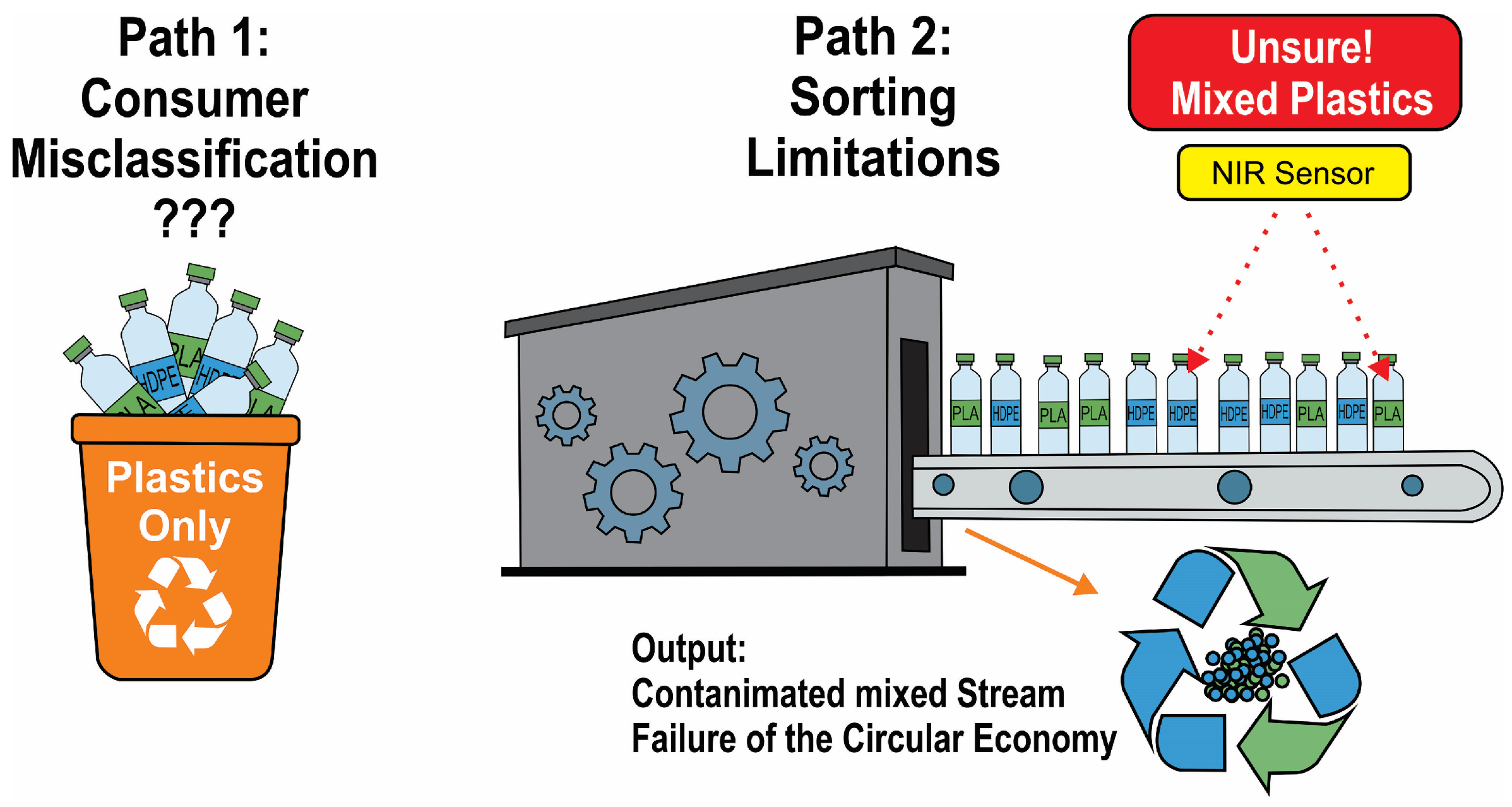
As discussed above, HDPE/PLA immiscibility becomes especially relevant in recycling scenarios where contamination occurs without compatibilization and under variable processing histories [36]. Under these conditions, recyclate quality depends on contamination level, prior degradation, and subsequent aging exposure [6]. Although PLA can be distinguished from conventional plastics by near-infrared (NIR) sorting under appropriate conditions, and can also be separated from polyolefin-rich fractions by density-based methods because PLA (~1.240 g/cm3) does not enter the density range typical of HDPE (~0.9635 g/cm3) [36,38], sufficient segregation may not always be achieved in practice, particularly when source separation, labeling, sorting configuration, or purification efficiency are not optimal. Cross-contamination may therefore persist when source separation, labeling, sorting configuration, or purification efficiency are insufficient (Figure 2). In such cases, PLA may reach the melt-processing stage and affect recyclate behavior depending on contamination level and processing conditions [6].
Recent factorial evidence further supports this point by showing that the consequences of PLA intrusion in recycled HDPE depend not only on composition, but also on recycling cycle, exposure time, and aging environment. In a multilevel experimental design covering 0–50 wt% PLA, two recycling cycles, and both natural and accelerated aging, PLA incorporation caused drastic losses in elongation at break and impact resistance, whereas accelerated aging produced the strongest reduction in tensile strength. These results reinforce the view that recyclate deterioration in contaminated HDPE/PLA systems is governed by the interaction between interfacial incompatibility, reprocessing history, and environmental exposure rather than by composition alone [39].
Under these non-compatibilized conditions, PLA does not merely modify mechanical behavior; it can also increase the susceptibility of the system to thermo-oxidative deterioration during subsequent reprocessing cycles. Because PLA is a biodegradable and hydrolytically unstable polyester, it may behave as a preferentially degradable phase, generating microcavities and moisture-diffusion pathways within the HDPE matrix. These effects can accelerate physical deterioration and reduce structural integrity [27,28]. In addition, the phase separation characteristic of immiscible HDPE/PLA blends promotes PLA exposure at interfaces and at the material surface, which may intensify localized hydrolysis and biodeterioration, especially under weathering conditions [28,31].
This makes PLA contamination in recycled HDPE more than a simple compositional impurity. In contamination-sensitive recycling systems, it can become a source of morphological weakness, localized degradation, and greater long-term instability, particularly when reprocessing history and environmental exposure are taken into account. Hence, understanding recycled HDPE/PLA blends requires linking contamination level with interfacial behavior, degradation susceptibility, and the practical conditions under which the recyclate will later be processed or used.

2.4. Reprocessing and Degradation Mechanisms

The quality of recycled HDPE depends strongly on feedstock purity, and this becomes especially relevant when PLA is present as a contaminant, and the resulting material is later exposed to reprocessing or ultraviolet aging. Beltrán et al. showed that PLA undergoes substantial degradation during mechanical recycling and accelerated aging, with thermomechanical chain scission during extrusion, milling, and high-temperature processing acting as a major degradation route [40]. Because PLA is a polyester, its ester bonds are also highly susceptible to hydrolysis. Chain cleavage generates additional terminal carboxyl and hydroxyl groups, while associated microstructural defects can facilitate moisture ingress and further hydrolytic attack during humid storage or aging. Muñoz-Shugulí et al. likewise reported that repeated recycling progressively reduces PLA molecular weight and alters its structure, often with increasing crystallinity and corresponding changes in physical, thermal, barrier, and biodegradation behavior [22]. These effects are central to understanding how PLA contamination may influence the long-term stability of HDPE-rich blends over multiple recycling loops.
This interpretation is also consistent with recent experimental work on rHDPE/PLA blends, in which aging condition, PLA content, exposure time, and recycling cycle all showed significant effects on mechanical retention. In that study, accelerated aging generated the largest decrease in tensile strength, while PLA content dominated the loss of ductility and impact resistance, confirming that degradation severity depends on the combined action of thermo-oxidative stress, repeated processing, and phase incompatibility. Rather than behaving as an isolated composition effect, PLA contamination becomes more consequential when degradation history and environmental exposure are superimposed on an already immiscible morphology [39].

2.4.1. Active Degradation and Reprocessing Mechanisms

During mechanical reprocessing, PLA may undergo thermomechanical chain cleavage and hydrolytic degradation, generating low-molecular-weight species together with terminal carboxyl and hydroxyl groups [22]. In immiscible HDPE/PLA systems, these degradation products are not uniformly distributed throughout the material; instead, they remain associated with dispersed PLA domains, interfacial regions, and morphology-related defects [35]. Therefore, degraded PLA should not be treated as an inert contaminant phase. Under repeated processing, residual moisture, or later environmental aging, it can become a localized source of instability within the blend [20].
Recycled HDPE, in parallel, is itself susceptible to thermo-oxidative degradation during repeated processing, including chain scission, branching, crosslinking, and progressive stabilizer depletion [41]. In contaminated systems, the relevance of PLA degradation therefore extends beyond the internal deterioration of the polyester phase [42]. Acidic and hydroxyl-containing degradation products, together with interfacial voids and microstructural heterogeneity, may promote localized deterioration by facilitating moisture ingress, weakening phase boundaries, and intensifying stress concentration sites [43]. Under thermo-oxidative or photo-oxidative exposure, these effects may indirectly accelerate embrittlement and loss of mechanical reliability in the HDPE-rich material, even if no single universal catalytic pathway can be assumed across all formulations and processing histories [6].
Consequently, degraded PLA is better understood as a context-dependent destabilizing factor than as a universally quantified catalyst of HDPE oxidation [44]. Its practical influence depends on contamination level, dispersion state, residence time, thermal history, stabilizer content, humidity, and aging conditions. This interpretation is consistent with the broader view of this review: the relevance of PLA contamination arises not only from immiscibility itself, but from the interaction between phase incompatibility, degradation history, and the environmental or processing conditions to which the recyclate is later exposed [36].

2.4.2. Mechanical and Chemical Recycling Pathways for Contaminated HDPE/PLA Streams

Mechanical and chemical recycling should not be treated as equivalent solutions for HDPE/PLA mixed streams. In mechanical recycling, polymer chains are largely retained, so immiscibility, interfacial defects, and contamination directly control the morphology and performance of the recyclate [45]. Under these conditions, even relatively low concentrations of incompatible polymers may reduce the functional quality of recycled HDPE [15]. Chemical recycling, by contrast, seeks to transform polymers into smaller molecules, feedstocks, or monomers, but its effectiveness still depends strongly on feedstock identity and purity [46].
This distinction is especially important for HDPE/PLA mixtures because the two polymers are usually associated with different valorization routes. Polyolefins such as HDPE are more often linked to thermochemical or catalytic conversion pathways [47,48], whereas PLA is more logically directed toward depolymerization, solvolysis, or other polyester-oriented recycling approaches [49]. Chemical recycling should therefore be viewed as a complementary option for appropriately segregated fractions, not as a universal remedy for commingled HDPE/PLA waste. Regardless of the downstream route, effective upstream sorting remains essential.
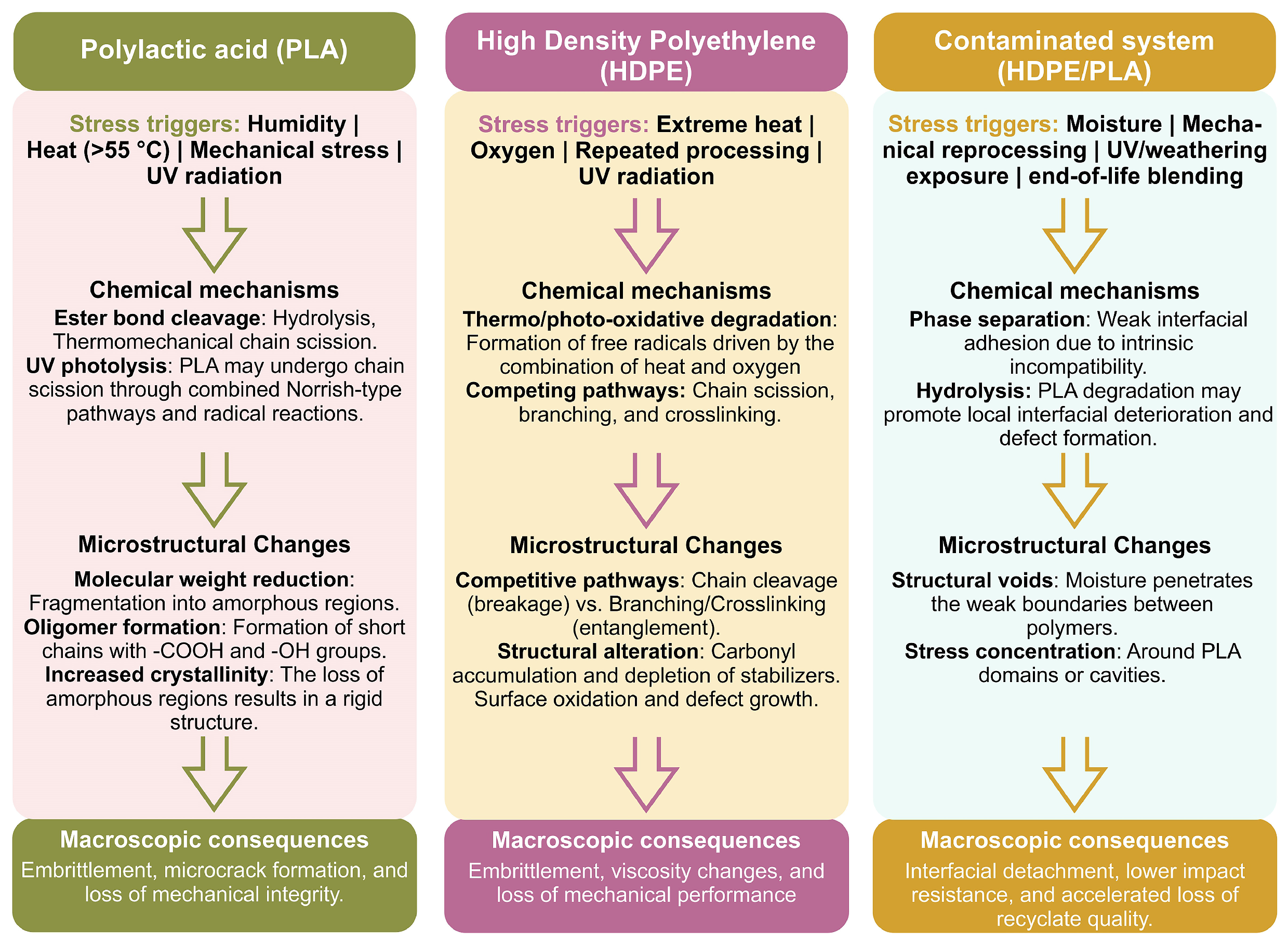
Figure 3 summarizes the degradation pathways discussed in this section by comparing the main stressors, chemical events, microstructural changes, and macroscopic consequences in neat PLA, neat HDPE, and contaminated HDPE/PLA systems. Its purpose is not to provide a universal predictive model, but to synthesize the reviewed evidence and emphasize that degradation in contaminated blends cannot be interpreted as a simple superposition of the behavior of each polymer in isolation. Rather, phase separation, weak interfacial adhesion, and preferential deterioration of the PLA-rich dispersed phase can amplify local damage and accelerate performance loss during reprocessing and aging.

2.5. Impact on Mechanical Performance and Quality

For interpretive clarity, the evidence discussed in this review can be grouped into three broad contamination scenarios: trace or low PLA levels, which may remain tolerable in some applications [51]; low-to-moderate levels, where properties such as toughness, aging resistance, or surface behavior may become more sensitive [6]; and higher PLA fractions, where immiscibility, phase separation, and performance loss become more evident [21]. These categories should be understood as practical guides instead of strict universal thresholds. For interpretive clarity, the evidence discussed in this review can be grouped into three broad qualitative contamination scenarios, as reported in Table 3. These categories are not intended to define universal industrial thresholds, but to summarize how the practical consequences of PLA intrusion in HDPE may evolve depending on the property evaluated, processing history, aging conditions, and application requirements.
This qualitative classification helps explain why contamination cannot be judged from tensile strength alone and why apparently low PLA contents may still become relevant when toughness, weathering resistance, crack sensitivity, or interfacial stability are considered.
It is worth saying that in practical bale or post-consumer stream conditions, PLA should be considered within a broader contamination landscape that may include PET, PP, multilayer residues, fillers, labels, and other non-target materials whose combined presence can further complicate recyclate quality and interpretation of contamination effects.
Staplevan et al. directly evaluated the effect of PLA contamination on the HDPE recycling input stream [6]. As shown in Table 4, the deterioration caused by PLA should not be judged only by tensile strength retention or loss. In immiscible HDPE/PLA systems, the earliest and most functionally relevant signs of failure often appear in properties related to deformability and energy dissipation, particularly elongation at break, impact resistance, and toughness. A blend may retain part of its short-term tensile strength after limited processing, yet still become substantially more brittle and more sensitive to crack initiation and propagation, especially once interfacial defects are intensified by thermal or UV aging. This distinction is crucial for assessing contamination in recycled HDPE (rHDPE), where functional reliability depends not only on maximum stress at failure, but also on the ability to tolerate handling, service loads, and environmental exposure [6].
The available evidence does not support a single universal contamination threshold above which PLA is always unacceptable or below which it is always harmless [7,52]. Instead, practical relevance depends on contamination level, the property under evaluation, the extent of prior processing or aging, and the performance demands of the intended application [40]. Low PLA contents may remain tolerable for some short-term tensile properties or low-demand uses, while the same range may become more critical when toughness, weathering resistance, crack sensitivity, or barrier performance are considered [22,32]. These property losses should be interpreted not only as a consequence of immiscibility but also as a manifestation of the combined effects of degraded PLA domains, interfacial defect growth, moisture-assisted deterioration, and the intrinsic thermo-oxidative sensitivity of recycled HDPE under repeated processing and UVA exposure.
Recent data also support this caution against fixed universal thresholds. Although one recent study examined a broad PLA range up to 50 wt%, the authors explicitly stated that this composition window was selected to capture both low-level contamination effects and higher-content scenarios associated with poorly sorted streams or recycled-blend applications, rather than to represent a single typical industrial bale composition. This distinction is important because it reinforces that contamination relevance should be interpreted in relation to the property measured, the exposure history, and the specific recycling context, not by extrapolating one composition range into a universal acceptance criterion [39].
As the use of biopolymers expands in selected applications, their presence in conventional waste-management systems may become more plausible in some contexts, particularly where segregation and end-of-life routing remain incomplete [32]. Even so, the consequences of contamination should not be generalized through a single universal threshold, since practical significance depends on composition, property requirements, and processing history [52]. Gere and Czigány suggested that only blends containing 2% PLA or less remain functional, whereas higher concentrations are more likely to generate defective products because of component immiscibility [20]. Their interpretation reinforces the argument that biodegradable plastics should be collected in separate streams for dedicated recycling or composting when the aim is to protect conventional polyolefin loops.
Estrada-Monje et al. also reported the effects of comparatively high PLA concentrations (10–50 wt%) over two recycling cycles in non-compatibilized blends [36]. As summarized in Table 5, tensile strength did not collapse after the first or second cycle, particularly in HDPE-rich formulations. This does not contradict the concern raised in low-contamination studies. Instead, it indicates that short-term tensile strength alone is not sufficient to define the onset of contamination-induced failure. These results are better understood as complementary to the stronger reductions in toughness, ductility, and weathering resistance observed in lower-contamination studies such as Staplevan et al. [6]. In other words, immiscible HDPE/PLA systems may first show embrittlement, loss of damage tolerance, and growing sensitivity to interfacial degradation before a dramatic drop in tensile strength becomes evident.
The contamination levels of 1, 2.5, and 5 wt% discussed throughout this review (Table 3) should therefore be interpreted as technically informative sensitivity thresholds and not as universally representative average PLA concentrations in industrial HDPE bales. Actual contamination levels are expected to vary widely with collection systems, bale specifications, packaging mix, and sorting performance. These low-level scenarios are used here to illustrate how sensitive rHDPE can be to PLA intrusion, not to claim a single generalized contamination average across facilities [20].
The current literature remains limited regarding the specific effects of PLA contamination on rHDPE quality, and an important gap persists regarding aging effects in conventional plastics contaminated with bioplastics. In non-compatibilized HDPE/PLA blends, PLA forms a structurally vulnerable phase whose stability may be compromised by mechanical reprocessing, hydrolysis, and accelerated aging [27,28]. Thermal cycling can also increase PLA crystallinity, which may raise initial stiffness but at the same time increase microstructural heterogeneity and stress concentration within amorphous regions, thereby facilitating microcrack initiation [22]. Under accelerated aging involving UV radiation and elevated temperature, PLA located at interfaces and at the material surface may undergo photo-oxidation and carbonyl formation, further promoting chain scission, loss of integrity, and overall deterioration of the non-compatibilized HDPE/PLA system [18,33,53,54,55].
As for contamination, PLA is not the only polymer capable of impairing recycled HDPE performance, but its behavior differs from that of more conventional contaminants such as PP or PET. PP is also immiscible with HDPE under many processing conditions, yet both belong to the polyolefin family and therefore remain chemically closer than HDPE and PLA. PET and PLA, by contrast, both introduce polyester domains into the HDPE matrix, producing a sharper polarity mismatch and different thermal-processing windows. PLA is further distinguished by its greater susceptibility to hydrolytic and thermomechanical degradation during reprocessing, which may intensify interfacial deterioration and moisture-related instability in ways that are not fully analogous to PP contamination and may also differ from more hydrolytically stable polyester contaminants such as PET [18,54,55].
Table 6 is useful in this context because it frames the available evidence as complementary in place of contradictory. Different studies examine different contamination ranges, degradation histories, and response variables, and together they suggest that tensile strength alone does not fully capture the onset of contamination-induced embrittlement in immiscible HDPE/PLA systems.
Looking ahead, future research should place greater emphasis on toughness retention, interfacial stability, resistance to environmental aging, and performance evolution across multiple recycling loops [22]. Although reactive compatibilization, moisture control during processing, and improved stabilization may help in controlled formulations, these strategies are more feasible in engineered blends than in heterogeneous post-consumer streams [54]. For practical recycling systems, the most robust approach remains prevention of PLA intrusion through improved sorting, clearer labeling, and stricter stream segregation, while material-level enhancement should be viewed as a complementary instead of primary solution [52].
For interpretive clarity, the evidence discussed in this review can be grouped into three broad qualitative contamination scenarios. These categories are not intended to define universal industrial thresholds, but to summarize how the practical consequences of PLA intrusion in HDPE may evolve depending on the property evaluated, processing history, aging conditions, and application requirements.

2.6. System-Level Implications for Circularity

The material-level effects discussed in Section 2.4 and Section 2.5 have implications that extend beyond blend mechanics. When PLA contamination becomes functionally relevant for a given application, HDPE recyclates may lose access to higher-value uses and be diverted toward lower-specification pathways, reducing both economic value and circular performance [11]. The issue is not limited to immiscibility itself, but includes the broader socio-technical conditions that determine whether contamination can be prevented, detected, or tolerated within existing recycling systems [6,20].

2.6.1. The Drop-In Delusion

A central obstacle in the management of bioplastics is the conceptual confusion between bio-based and biodegradable materials. In this review, that confusion is described as the “drop-in delusion,” namely the mistaken assumption that any polymer presented as sustainable, bio-based, or environmentally preferable can be introduced into an existing recycling infrastructure without affecting process compatibility, material quality, or downstream valorization [57]. The concept does not imply that all bioplastics behave the same way, nor that all recycling systems fail to manage them. Instead, it draws attention to the risk of equating sustainability claims with technical interchangeability [57].
The term “drop-in” more properly applies to bio-based materials that are chemically identical to their fossil-derived counterparts and can therefore enter established production and recycling systems without requiring major technical adjustments [58]. Examples include Bio-PE, Bio-PP, and Bio-PET, which retain the same technical characteristics and end-of-life compatibility as their petrochemical equivalents [59]. As a biodegradable polyester with distinct chemistry, processing behavior, and end-of-life requirements, it cannot be considered a drop-in substitute for HDPE despite its sustainability-oriented market positioning [19]. Distinguishing bio-based replacement plastics from biodegradable functional materials is therefore essential if circular systems are to preserve stream compatibility and recyclate quality [3].

2.6.2. Technological and Market Implications

The system-level concern addressed here does not arise because PLA is intrinsically impossible to sort, but because technical sortability does not always guarantee an optimal segregation in real post-consumer systems [60]. In practice, the challenge is one of incomplete separation, variable infrastructure performance, and contamination-sensitive recyclate quality rather than a universal failure of automated sorting itself. This distinction matters because the market value of rHDPE depends strongly on consistency and suitability for application. Once contamination becomes functionally relevant, even modest uncertainty in stream purity can reduce confidence in recyclate performance and limit higher-value applications [6].

2.6.3. Regulatory Misalignment

This same distinction also has regulatory consequences. Policies that promote bio-based or biodegradable materials without clearly differentiating their end-of-life compatibility may inadvertently encourage the use of polymers that are not suitable for existing polyolefin recycling loops [57]. Unlike drop-in biopolymers such as Bio-HDPE, PLA is a non-drop-in material that requires a different end-of-life logic. When regulation, labeling, or market incentives fail to reflect that distinction, incompatibility at the material level can become misalignment at the system level [52].

2.6.4. Multi-Level Valorization and the Downcycling Trap

A major circularity challenge emerges when PLA contamination compromises the performance requirements of the intended application, especially after repeated processing or environmental exposure [10]. Under those conditions, recyclates may be diverted from higher-value uses toward lower-specification applications [6]. This shift is a central expression of the downcycling trap: material is still retained in the economy, but with reduced functional value and diminished capacity for high-quality circular use.
Here, tensile strength should be distinguished from ductility. As reflected in Table 3 and Table 4, maximum tensile strength may remain comparatively stable in some formulations, while elongation at break and related indicators of damage tolerance decline much more sharply. This is characteristic of immiscible systems in which dispersed PLA domains act as stress concentrators rather than reinforcements. As Titone et al. noted, loss of ductility is often a more meaningful indicator of mechanical failure in recycled polyolefins than tensile strength alone because it directly affects resistance to impact and long-term deformation in structural applications [56].

2.6.5. The Downcycling Bottleneck and Application Limits

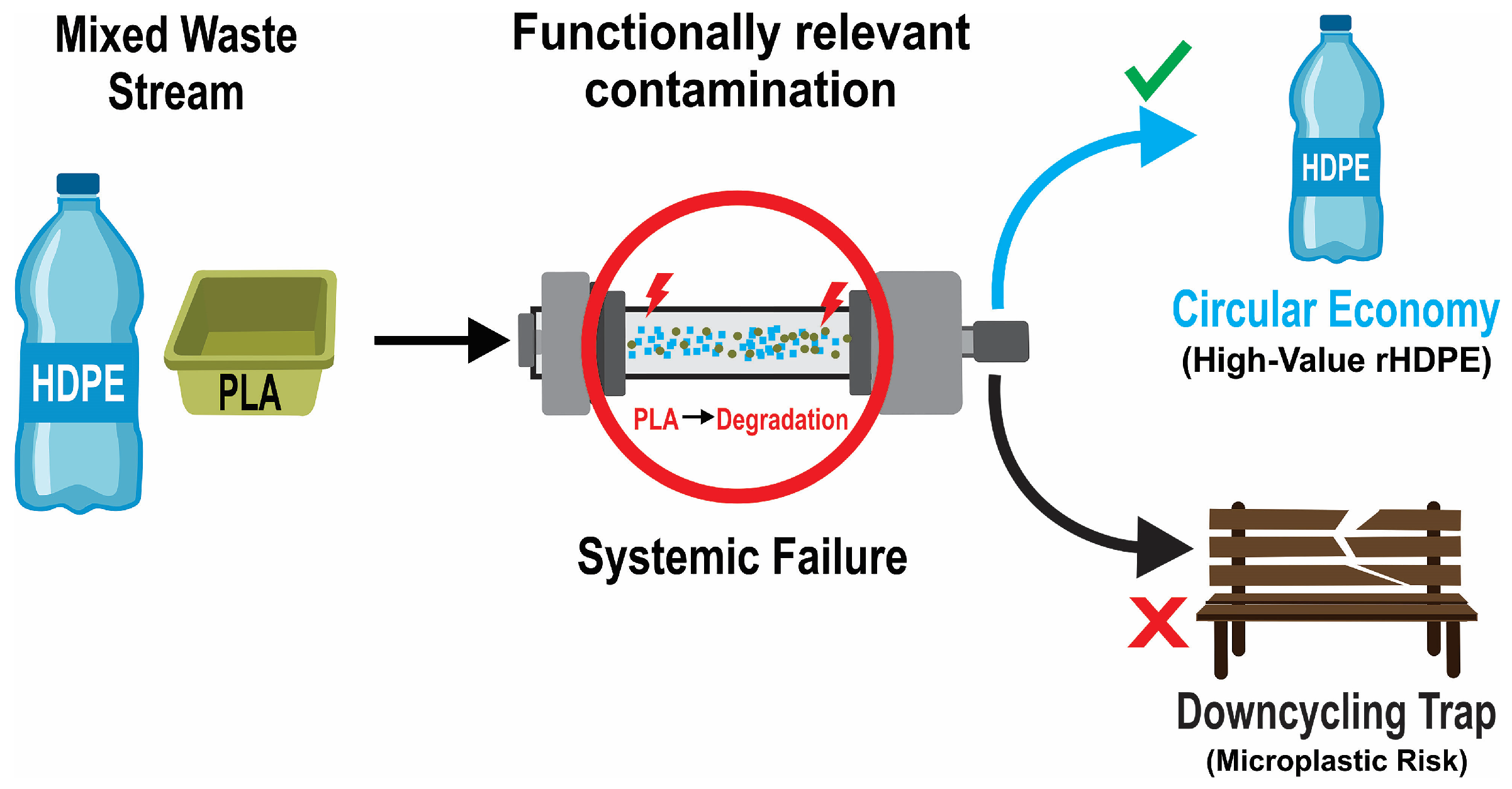
Once contamination-induced embrittlement, interfacial debonding, or loss of toughness becomes relevant, HDPE/PLA recyclates are more likely to be redirected away from demanding applications and toward lower-value uses [61]. Plastic lumber, pallets, park benches, non-pressure construction profiles, outdoor utility components, and selected agricultural products illustrate this pathway, although the exact destination depends on the service environment and performance requirements [14]. The broader implication is consistent across these cases: contamination narrows the range of applications compatible with recycled HDPE and promotes value loss by shifting material toward uses that can tolerate lower and less predictable property profiles [6].
From a regulatory and safety perspective, contamination may also limit re-entry into high-value packaging applications. The presence of PLA-derived degradation products and the porous, weakly bonded morphology of immiscible HDPE/PLA systems can increase concern regarding migration, contaminant uptake, and long-term reliability, further constraining closed-loop valorization in sensitive applications such as food-contact packaging [6].

2.6.6. Secondary Fragmentation Risk

Beyond loss of application value, contaminated HDPE/PLA blends may also show greater susceptibility to secondary fragmentation during outdoor aging. Because these systems combine weak interfaces, brittle dispersed domains, and stress concentrators, crack initiation may be facilitated under UV exposure, thermal cycling, and mechanical wear [36,40]. Preferential deterioration of the polyester phase can further promote interfacial debonding and weaken the surrounding HDPE-rich matrix.
At present, however, the literature does not provide a standardized quantitative shedding rate for secondary microplastic release from immiscible HDPE/PLA blends under UV weathering that would justify a universal numerical claim [62]. This review, therefore, treats accelerated fragmentation not as a fully quantified outcome, but as a mechanistically supported risk hypothesis grounded in the known combination of immiscibility, embrittlement, interfacial failure, and weathering-induced degradation [6]. This interpretation is consistent with broader evidence that recycling and weathering processes can contribute to microplastic generation, even though shedding rates remain strongly system- and condition-dependent [63].

2.6.7. Strategic Redirection: Toward System Compatibility

Avoiding the downcycling trap requires prioritizing prevention over downstream correction. Compatibilization may improve controlled blends, but in practical recycling systems the more robust strategy remains effective segregation, clearer labeling, and stream management criteria that distinguish biodegradability from recycling compatibility [32,35]. However, they should be understood as remediation tools rather than the main organizing principle of circularity. In practical recycling systems, the more robust strategy is prevention: improved sorting, clearer labeling, and stream management criteria that distinguish biodegradability from recycling compatibility [3].
Figure 4 illustrates a context-dependent pathway through which PLA contamination may contribute to application downgrading, diversion toward lower-specification uses, and increased susceptibility to weathering-related deterioration under insufficient segregation. Its purpose is not to define a universal contamination threshold or an inevitable outcome, but to synthesize the relationship between insufficient separation, material incompatibility, and circular value loss [52].

2.7. Spectral Interference and the Infrastructure Gap

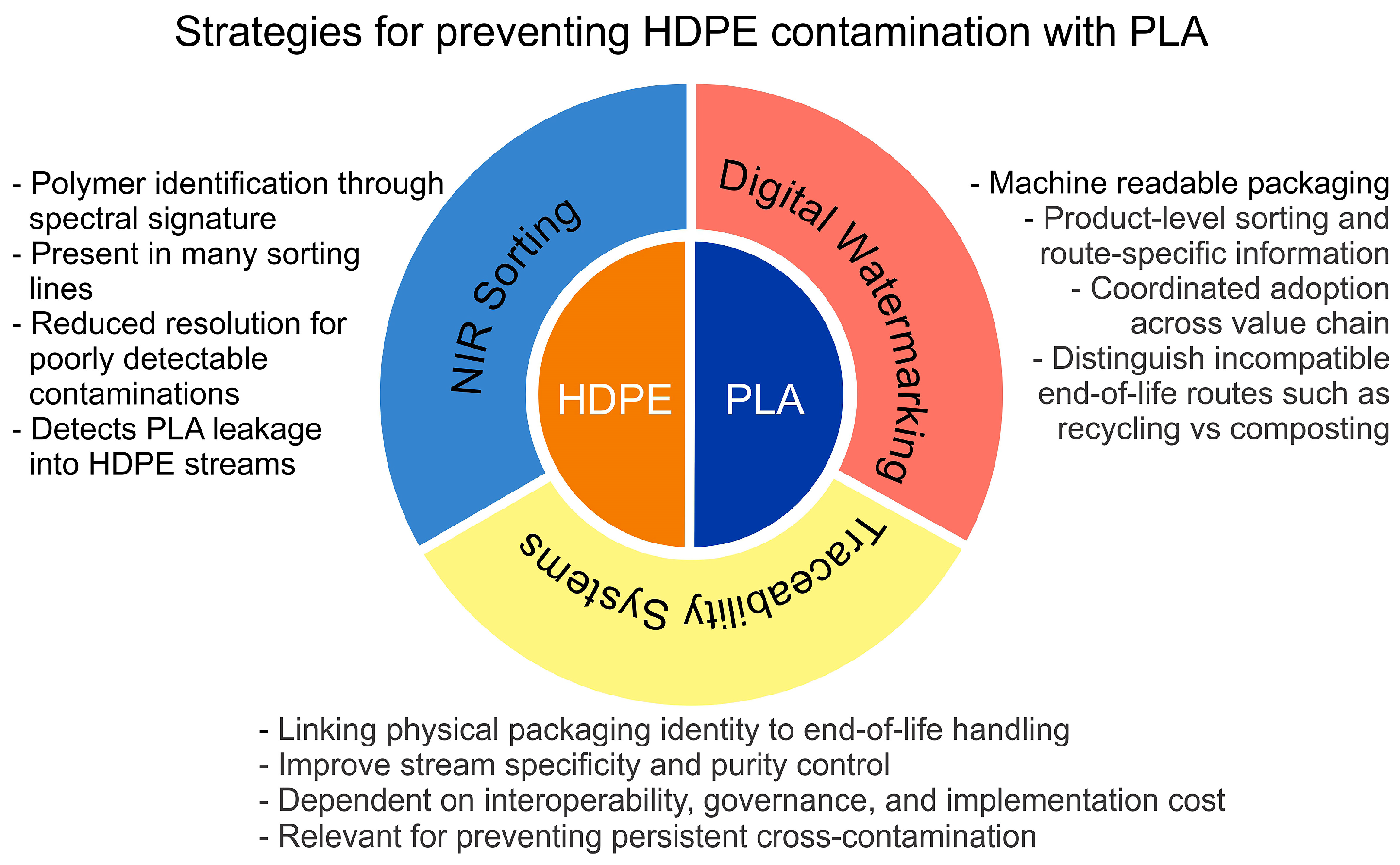
The contamination patterns discussed in this review highlight a structural limitation of current automated sorting systems. This limitation shows that circularity cannot be achieved through polymer design alone [64]. It also depends on identification and sorting infrastructures capable of distinguishing not only polymer families, but also end-of-life compatibility [65]. In that context, digital watermarking has emerged as a promising complementary strategy for high-resolution packaging identification [52,66]. By embedding machine-readable codes into packaging surfaces, such systems can potentially encode resin type, application, food-contact status, and intended recovery route, enabling a level of sorting granularity that conventional spectral recognition alone may not always provide [11]. Industrial demonstrations associated with HolyGrail 2.0 suggest that these approaches can improve sorting precision under realistic conditions, highlighting the growing relevance of traceability tools in future recovery systems [3].
Digital watermarking should not, however, be viewed as a standalone solution. Its practical effect depends on coordinated adoption across packaging design, collection systems, optical detection hardware, and downstream recycling infrastructure [67].
Preventing PLA intrusion into HDPE loops will therefore require a combined strategy involving design for sorting, clearer labeling, improved automated separation, and policy frameworks that align compostable and recyclable materials with distinct end-of-life routes [65]. Sorting performance thus becomes part of system compatibility rather than a purely technical pre-treatment step.
Figure 5 summarizes the sorting and traceability approaches most relevant to the challenge addressed in this review: reducing compostable polyester leakage into mechanically recyclable polyolefin streams. The broader point is that future circularity will depend not only on material formulation, but also on information-rich recovery systems capable of preserving stream integrity.

2.7.1. Eco-Modulation of EPR Fees to Internalize Externalities

The economic dimension of the downcycling trap is closely tied to the externalization of waste-management and quality-loss costs [68]. Extended producer responsibility (EPR) is intended to shift at least part of that burden from municipalities and taxpayers toward producers, who are better positioned to influence packaging design and end-of-life performance [66]. In current systems, however, manufacturers may benefit from sustainability-oriented branding while the costs of managing contaminated, lower-value recyclates are absorbed downstream by sorting and recycling actors [68].
Eco-modulated EPR offers one possible response by differentiating fees according to the real end-of-life cost and recyclability profile of specific products [69]. Under such an approach, materials that act as disruptive contaminants in high-volume recycling streams could face higher fees, while collected funds could help support the infrastructure needed to manage non-drop-in materials without undermining established HDPE loops [66]. In this review, the relevance of this approach lies less in prescribing a single policy design than in reinforcing a core principle: material innovation should not be decoupled from system compatibility.

2.7.2. Synthesis: Redefining Circularity Standards

The evidence reviewed here suggests that regulatory frameworks may need to move beyond a simple recyclable/non-recyclable distinction. When contamination alters the functional quality of rHDPE, the resulting material may no longer meet the same application requirements as uncontaminated recyclate, even if it remains technically processable [6]. Hence, purity-based approaches to recyclate classification deserve consideration as a way to distinguish materials suitable for high-specification loops from those limited to lower-tier uses [6].
More broadly, circularity standards should reflect not only whether a material can in principle be collected or reprocessed, but whether it can do so without degrading adjacent recycling systems. From that perspective, the waste hierarchy and the preservation of high-value loops become more informative than the assumption that all bio-based materials are automatically compatible with existing infrastructure [70].

2.7.3. Implementation Constraints and Governance Challenges

Compatibility-oriented policy tools such as eco-modulated EPR schemes and purity-based recyclate classification may help protect high-value HDPE circularity, but their implementation is not straightforward [71,72]. Their effectiveness depends on coordination among producers, recyclers, municipalities, sorting facilities, and regulators, whose technical and institutional capacities may vary substantially across regions [73].
One challenge is standardization. If policy instruments are expected to distinguish between acceptable and disruptive contamination levels, they require harmonized analytical methods, reporting criteria, and quality metrics for recycled materials [69]. Without such alignment, concepts such as purity grade or system compatibility may remain difficult to apply consistently across jurisdictions and markets [74].
A second challenge concerns feasibility at the firm and system level. The costs associated with traceability, redesign, upgraded sorting, or eco-modulated fees may be easier for large producers to absorb than for small and medium-sized enterprises [75]. Effective implementation also depends on monitoring and enforcement capacity, which remains limited in many waste-management systems [14].
For these reasons, the policy directions discussed in this review should be understood as context-dependent strategies rather than universally transferable mandates [76]. Their practical value will depend on gradual implementation, stronger labeling and traceability, analytical standardization, and closer alignment between material innovation and the capabilities of existing recycling infrastructure [66].

2.8. Life-Cycle Perspective on System Compatibility

From a life-cycle perspective, the sustainability of bioplastics cannot be inferred from renewable origin or nominal biodegradability alone [77]. Recent reviews show that environmental performance depends just as much on collection efficiency, contamination control, achievable recyclate quality, and the local availability of end-of-life infrastructure suited to the material in question [64]. Thus, the environmental benefit of PLA is not universal or automatic; it depends on whether the material is directed toward a management route compatible with its chemistry and intended degradation pathway [78].
From a life-cycle standpoint, the sustainability of PLA cannot be judged only by its renewable origin or intended end-of-life route, but also by whether its presence undermines recyclate quality and circular value retention in adjacent HDPE recovery system [79].
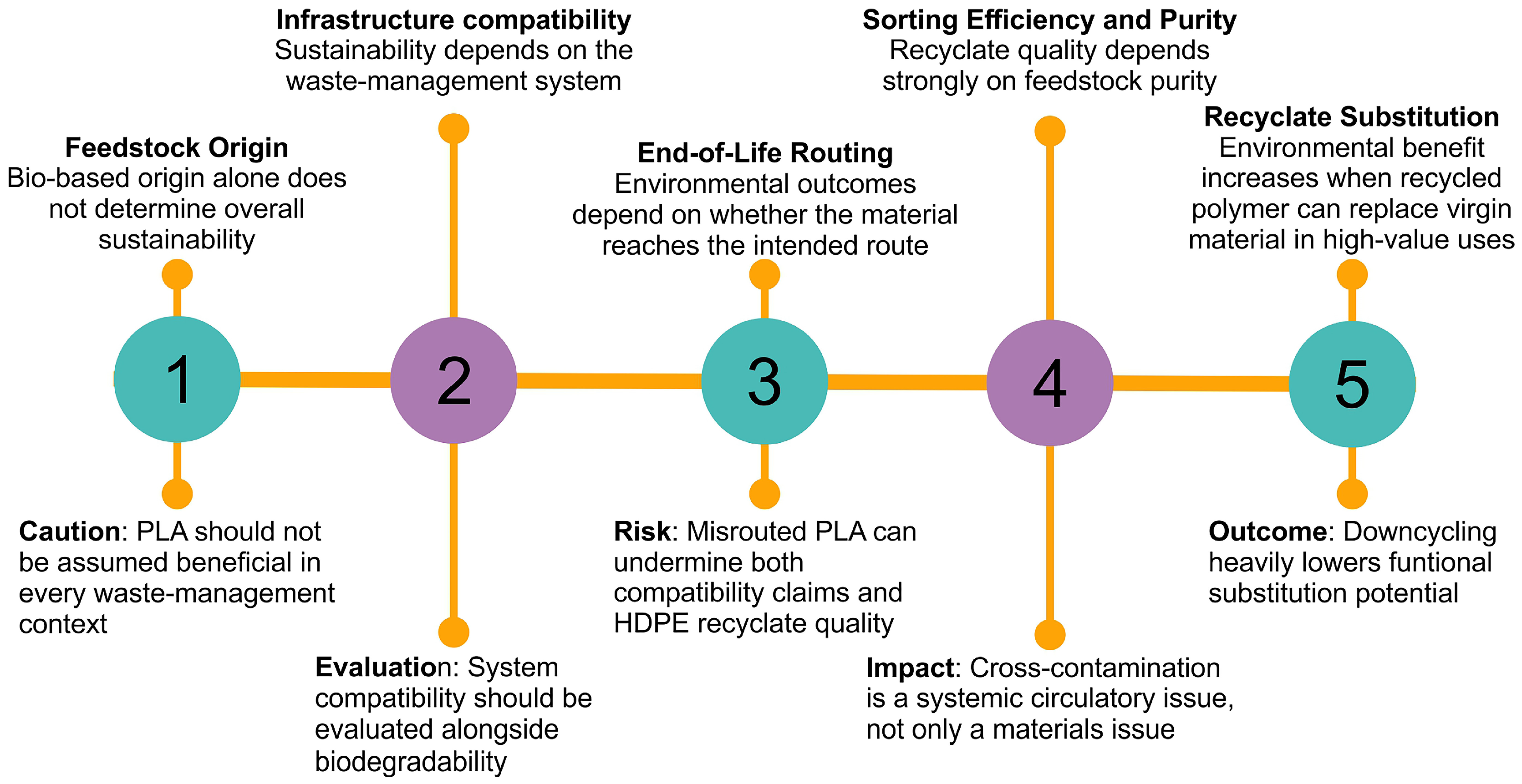
Figure 6 provides a concise life-cycle framing for the argument developed throughout this review. In place of treating PLA contamination as an isolated compositional defect, it places the issue within a broader systems analysis in which sorting fidelity, infrastructure fit, and preservation of high-quality secondary materials are all part of sustainability performance.

3. Conclusions

PLA contamination in HDPE recycling systems is best understood as a problem of system compatibility rather than as a universal failure scenario. The literature reviewed here shows that, under insufficient segregation or other contamination-sensitive conditions, HDPE/PLA immiscibility can reduce recyclate quality through phase separation, weak interfacial adhesion, and losses in ductility, toughness, and application reliability, although the practical severity of these effects depends on contamination level, processing history, application requirements, and local infrastructure performance.
More broadly, the significance of PLA contamination cannot be defined by blend chemistry alone. It depends on how material behavior interacts with sorting performance, processing history, and end-of-life system design. The recent literature evidence further reinforces this interpretation by showing that in rHDPE/PLA systems the practical severity of contamination is shaped by interactions among the composition, reprocessing cycle, exposure time, and aging environment rather than by PLA content alone. Real post-consumer contamination scenarios may also involve other non-target polymers and mixed-material interactions, reinforcing the need to assess recyclate quality at the system level rather than through single-polymer assumptions alone. In this sense, PLA is best treated as one example of a broader circularity challenge in which emerging materials may carry environmental promise in principle, yet still disrupt adjacent recovery systems when infrastructure fit is incomplete.

Author Contributions

Conceptualization, Investigation, Formal analysis, and Writing—original draft: A.E.-M., A.Z.-E. and M.C.K.-U. Methodology and Supervision: A.E.-M. and E.A.Z.-C. Software and Visualization and Validation: C.I.P.-B., S.A.-R. and C.A.H.-E. Writing—review and editing: A.E.-M. and E.A.Z.-C. All authors have read and agreed to the published version of the manuscript.

Funding

This review received no external funding.

Data Availability Statement

No new data were created or analyzed in this study. Data sharing is not applicable to this article.

Conflicts of Interest

The authors declare no conflicts of interest.

Abbreviations

The following abbreviations are used in this manuscript:
HDPEHigh-density polyethylene
PLAPoly (lactic acid)
MRFsMaterials Recovery Facilities
NIRNear-infrared
PE-g-MAMaleic anhydride-grafted polyethylene
PE-co-GMACopolymers containing epoxide groups
PE-g-GMAEthylene-glycidyl methacrylate
PTWEthylene-butyl acrylate-glycidyl methacrylate terpolymer
MLOMaleinized linseed oil
DCPDicumyl peroxide
UVUltraviolet
EPRExtended producer responsibility

References

  1. Olesik, P.; Godzierz, M.; Kozioł, M.; Jala, J.; Szeluga, U.; Myalski, J. Structure and Mechanical Properties of High-Density Polyethylene Composites Reinforced with Glassy Carbon. Materials 2021, 14, 4024. [Google Scholar] [CrossRef] [PubMed]
  2. OECD Publishing. OECD Global Plastics Outlook; OECD Publishing: Paris, France, 2022. [Google Scholar]
  3. Rosenboom, J.-G.; Langer, R.; Traverso, G. Bioplastics for a circular economy. Nat. Rev. Mater. 2022, 7, 117–137. [Google Scholar] [CrossRef]
  4. Barrera Valdivia, I.; Millán Medina, B.E.; Santos Mendoza, C. Circular economy approach to recycling of high-density polyethylene (HDPE) for the production of pet products. Sapienza Int. J. Interdiscip. Stud. 2024, 5, e24036. [Google Scholar] [CrossRef]
  5. Hassanian-Moghaddam, D.; Asghari, N.; Ahmadi, M. Circular Polyolefins: Advances toward a Sustainable Future. Macromolecules 2023, 56, 5679–5697. [Google Scholar] [CrossRef]
  6. Staplevan, M.J.; Ansari, A.J.; Ahmed, A.; Hai, F.I. Impact of bioplastic contamination on the mechanical recycling of conventional plastics. Waste Manag. 2024, 185, 1–9. [Google Scholar] [CrossRef]
  7. Mazhandu, Z.S.; Muzenda, E.; Mamvura, T.A.; Belaid, M.; Nhubu, T. Integrated and Consolidated Review of Plastic Waste Management and Bio-Based Biodegradable Plastics: Challenges and Opportunities. Sustainability 2020, 12, 8360. [Google Scholar] [CrossRef]
  8. Rahman, M.H.; Bhoi, P.R. An overview of non-biodegradable bioplastics. J. Clean. Prod. 2021, 294, 126218. [Google Scholar] [CrossRef]
  9. Coppola, G.; Gaudio, M.T.; Lopresto, C.G.; Calabro, V.; Curcio, S.; Chakraborty, S. Bioplastic from Renewable Biomass: A Facile Solution for a Greener Environment. Earth Syst. Environ. 2021, 5, 231–251. [Google Scholar] [CrossRef]
  10. Pinaeva, L.G.; Noskov, A.S. Biodegradable biopolymers: Real impact to environment pollution. Sci. Total Environ. 2024, 947, 174445. [Google Scholar] [CrossRef] [PubMed]
  11. DeWeerdt, S. How to make plastic less of an environmental burden. Nature 2022, 611, S2–S5. [Google Scholar] [CrossRef]
  12. Araujo-Andrade, C.; Bugnicourt, E.; Philippet, L.; Rodriguez-Turienzo, L.; Nettleton, D.; Horrmann, L.; Schlummer, M. Review on the photonic techniques suitable for automatic monitoring of the composition of multi-materials wastes in view of their posterior recycling. Waste Manag. Res. J. A Sustain. Circ. Econ. 2021, 39, 631–651. [Google Scholar] [CrossRef]
  13. Chen, X.; Kroell, N.; Li, K.; Feil, A.; Pretz, T. Influences of bioplastic polylactic acid on near-infrared-based sorting of conventional plastic. Waste Manag. Res. J. A Sustain. Circ. Econ. 2021, 39, 1210–1213. [Google Scholar] [CrossRef]
  14. Jiang, X.; Bateer, B. A systematic review of plastic recycling: Technology, environmental impact and economic evaluation. Waste Manag. Res. J. A Sustain. Circ. Econ. 2025, 43, 1159–1178. [Google Scholar] [CrossRef] [PubMed]
  15. Kazemi, Y.; Ramezani Kakroodi, A.; Rodrigue, D. Compatibilization efficiency in post-consumer recycled polyethylene/polypropylene blends: Effect of contamination. Polym. Eng. Sci. 2015, 55, 2368–2376. [Google Scholar] [CrossRef]
  16. Hottle, T.A.; Bilec, M.M.; Landis, A.E. Sustainability assessments of bio-based polymers. Polym. Degrad. Stab. 2013, 98, 1898–1907. [Google Scholar] [CrossRef]
  17. Bartolucci, L.; Cordiner, S.; De Maina, E.; Kumar, G.; Mele, P.; Mulone, V.; Iglinski, B.; Piechota, G. Sustainable Valorization of Bioplastic Waste: A Review on Effective Recycling Routes for the Most Widely Used Biopolymers. Int. J. Mol. Sci. 2023, 24, 7696. [Google Scholar] [CrossRef]
  18. Luo, H.; Tyrrell, H.; Bai, J.; Miazu, R.I.; Long, X. Fundamental, technical and environmental overviews of plastic chemical recycling. Green Chem. 2024, 26, 11444–11467. [Google Scholar] [CrossRef]
  19. Huang, S.; Dong, Q.; Che, S.; Li, R.; Tang, K.H.D. Bioplastics and biodegradable plastics: A review of recent advances, feasibility and cleaner production. Sci. Total Environ. 2025, 969, 178911. [Google Scholar] [CrossRef]
  20. Gere, D.; Czigany, T. Rheological and mechanical properties of recycled polyethylene films contaminated by biopolymer. Waste Manag. 2018, 76, 190–198. [Google Scholar] [CrossRef]
  21. Ferri, J.M.; Garcia-Garcia, D.; Rayón, E.; Samper, M.D.; Balart, R. Compatibilization and Characterization of Polylactide and Biopolyethylene Binary Blends by Non-Reactive and Reactive Compatibilization Approaches. Polymers 2020, 12, 1344. [Google Scholar] [CrossRef]
  22. Muñoz-Shugulí, C.; Morán, D.; Velásquez, E.; López-Vilariño, J.M.; López-de-Dicastillo, C. Effect of Degradation During Multiple Primary Mechanical Recycling Processes on the Physical Properties and Biodegradation of Commercial PLA-Based Water Bottles. Polymers 2025, 17, 2542. [Google Scholar] [CrossRef] [PubMed]
  23. European Bioplastics. Bioplastics Market Development Update 2025. Available online: https://www.residuosprofesional.com/produccion-global-bioplasticos-2030/ (accessed on 10 March 2026).
  24. Milovanovic, S.; Pajnik, J.; Lukic, I. Tailoring of advanced poly(lactic acid)-based materials: A review. J. Appl. Polym. Sci. 2022, 139, 51839. [Google Scholar] [CrossRef]
  25. Senila, L.; Kovacs, E.; Senila, M. A Review of Polylactic Acid (PLA) and Poly(3-hydroxybutyrate) (PHB) as Bio-Sourced Polymers for Membrane Production Applications. Membranes 2025, 15, 210. [Google Scholar] [CrossRef]
  26. Singhvi, M.; Gokhale, D. Biomass to biodegradable polymer (PLA). RSC Adv. 2013, 3, 13558. [Google Scholar] [CrossRef]
  27. de Oliveira, A.G.; Moreno, J.F.; de Sousa, A.M.F.; Alves Escócio, V.; de Oliveira Cavalcanti Guimarães, M.J.; da Silva, A.L.N. Composites based on high-density polyethylene, polylactide and calcium carbonate: Effect of calcium carbonate nanoparticles as co-compatibilizers. Polym. Bull. 2020, 77, 2889–2904. [Google Scholar] [CrossRef]
  28. Machado, A.V.; Moura, I.; Duarte, F.M.; Covas, J.A. Evaluation of Properties and Biodeterioration Potential of Polyethylene and Aliphatic Polyester Blends. Int. Polym. Process. 2007, 22, 512–518. [Google Scholar] [CrossRef]
  29. Alzarzouri, F.; Jabra, R.; Fawaz, D. Melt rheological behaviour and mechanical properties of poly (lactic acid)/high density polyethylene blends. Mater. Phys. Mech. 2021, 47, 103–116. [Google Scholar]
  30. Lu, X.; Tang, L.; Wang, L.; Li, P. Morphology and properties of bio-based poly (lactic acid)/high-density polyethylene blends and their glass fiber reinforced composites. Polym. Test. 2016, 54, 90–97. [Google Scholar] [CrossRef]
  31. Quiles-Carrillo, L.; Montanes, N.; Jorda-Vilaplana, A.; Balart, R.; Torres-Giner, S. A comparative study on the effect of different reactive compatibilizers on injection-molded pieces of bio-based high-density polyethylene/polylactide blends. J. Appl. Polym. Sci. 2019, 136, 47396. [Google Scholar] [CrossRef]
  32. Madhu, G.; Bhunia, H.; Bajpai, P.K.; Nando, G.B. Mechanical and morphological properties of high density polyethylene and polylactide blends. J. Polym. Eng. 2014, 34, 813–821. [Google Scholar] [CrossRef]
  33. Torres-Huerta, A.M.; Domínguez-Crespo, M.A.; Palma-Ramírez, D.; Del Ángel-López, D.; de la Fuente, D. Preparation and Degradation Study of Hdpe/Pla Polymer Blends for Packaging Applications. Rev. Mex. Ing. Quim. 2018, 19, 251–271. [Google Scholar] [CrossRef]
  34. Wiphanurat, C.; Hanthanon, P.; Kaisone, T.; Kaewkuk, S.; Sombatsompop, N. Properties of HDPE/Biodegradable Polymer Blends Using Modified Rubber. Appl. Mech. Mater. 2017, 873, 101–106. [Google Scholar] [CrossRef]
  35. Quitadamo, A.; Massardier, V.; Santulli, C.; Valente, M.; Sarasini, F. Optimization of Thermoplastic Blend Matrix HDPE/PLA with Different Types and Levels of Coupling Agents. Materials 2018, 11, 2527. [Google Scholar] [CrossRef] [PubMed]
  36. Estrada-Monje, A.; Silva-Goujon, M.A.; Rodríguez-Sánchez, I.; Hernández-Hernández, E.; Pérez-Fonseca, A.A. Effect of the Addition of PLA on the Thermal and Mechanical Properties of Reprocessed HDPE. Polymers 2024, 16, 2387. [Google Scholar] [CrossRef]
  37. Ramírez-Vargas, E.; Sandoval-Arellano, Z.; Hernández-Valdez, J.S.; Calderas, F.; Medellín-Rodríguez, F.J. Compatibility of HDPE/postconsumer HDPE blends using compatibilizing agents. J. Appl. Polym. Sci. 2006, 100, 3696–3706. [Google Scholar] [CrossRef]
  38. Meneses Quelal, W.O.; Velázquez-Martí, B.; Ferrer Gisbert, A. Separation of virgin plastic polymers and post-consumer mixed plastic waste by sinking-flotation technique. Environ. Sci. Pollut. Res. 2022, 29, 1364–1374. [Google Scholar] [CrossRef]
  39. Mnif, R.; Elleuch, R. Effects of reprocessing cycles and ageing on the rheological and mechanical properties of virgin-recycled HDPE blends. Matériaux Tech. 2015, 103, 704. [Google Scholar] [CrossRef]
  40. Beltrán, F.R.; Lorenzo, V.; de la Orden, M.U.; Martínez-Urreaga, J.; Urreaga, J.M. Effect of different mechanical recycling processes on the hydrolytic degradation of poly(l-lactic acid). Polym. Degrad. Stab. 2016, 133, 339–348. [Google Scholar] [CrossRef]
  41. Avalos-Belmontes, F.; Zapata-González, I.; Ramos-De Valle, L.; Méndez-Nonell, J.; Rodríguez-Fernández, O.S. Thermo-oxidative degradation of HDPE as a function of its crystalline content. J. Polym. Sci. B Polym. Phys. 2009, 47, 1906–1915. [Google Scholar] [CrossRef]
  42. Podzorova, M.V.; Tertyshnaya, Y.V.; Monakhova, T.V. Thermal oxidation and structure of polylactide–polyethylene blends. Russ. J. Phys. Chem. B 2016, 10, 825–829. [Google Scholar] [CrossRef]
  43. Speranza, V.; De Meo, A.; Pantani, R. Thermal and hydrolytic degradation kinetics of PLA in the molten state. Polym. Degrad. Stab. 2014, 100, 37–41. [Google Scholar] [CrossRef]
  44. Madhu, G.; Mandal, D.K.; Bhunia, H.; Nando, G.B. Thermal degradation kinetics and lifetime of high-density polyethylene/poly (l-lactic acid) blends. J. Thermoplast. Compos. Mater. 2017, 30, 773–793. [Google Scholar] [CrossRef]
  45. Titone, V.; Botta, L.; La Mantia, F.P. Mechanical Recycling of New and Challenging Polymer Systems: A Brief Overview. Macromol. Mater. Eng. 2025, 310, 2400275. [Google Scholar] [CrossRef]
  46. Li, X.; Mahadas, N.A.; Zhang, M.; Chen, C.; Wang, Z. Sustainable high-density polyethylene via chemical recycling: From modification to polymerization methods. Polymer 2024, 295, 126698. [Google Scholar] [CrossRef]
  47. Arroyave, A.; Cui, S.; Lopez, J.C.; Ellison, C.J.; Coates, G.W.; Dichtel, W.R. Catalytic Chemical Recycling of Post-Consumer Polyethylene. J. Am. Chem. Soc. 2022, 144, 23280–23285. [Google Scholar] [CrossRef] [PubMed]
  48. Pinsuwan, K.; Opaprakasit, P.; Petchsuk, A.; Sombatsompop, N.; Dangtungee, R. Chemical recycling of high-density polyethylene (HDPE) wastes by oxidative degradation to dicarboxylic acids and their use as value-added curing agents for acrylate-based materials. Polym. Degrad. Stab. 2023, 210, 110306. [Google Scholar] [CrossRef]
  49. Piemonte, V.; Sabatini, S.; Gironi, F. Chemical Recycling of PLA: A Great Opportunity Towards the Sustainable Development? J. Polym. Environ. 2013, 21, 640–647. [Google Scholar] [CrossRef]
  50. Lomakin, S.; Mikheev, Y.; Usachev, S.; Popov, A.; Kireev, V.; Berlin, A. Evaluation and Modeling of Polylactide Photodegradation under Ultraviolet Irradiation: Bio-Based Polyester Photolysis Mechanism. Polymers 2024, 16, 985. [Google Scholar] [CrossRef]
  51. Åkesson, D.; Kuzhanthaivelu, G.; Bohlén, M. Effect of a Small Amount of Thermoplastic Starch Blend on the Mechanical Recycling of Conventional Plastics. J. Polym. Environ. 2021, 29, 985–991. [Google Scholar] [CrossRef]
  52. Alaerts, L.; Augustinus, M.; Van Acker, K. Impact of Bio-Based Plastics on Current Recycling of Plastics. Sustainability 2018, 10, 1487. [Google Scholar] [CrossRef]
  53. González-López, M.E.; Martín del Campo, A.S.; Robledo-Ortíz, J.R.; Arellano, M.; Pérez-Fonseca, A.A.; Rodrigue, D. Accelerated weathering of poly(lactic acid) and its biocomposites: A review. Polym. Degrad. Stab. 2020, 179, 109290. [Google Scholar] [CrossRef]
  54. Patel, A.D.; Schyns, Z.O.G.; Franklin, T.W.; Rorrer, N.A.; Beckham, G.T.; Román-Leshkov, Y. Defining quality by quantifying degradation in the mechanical recycling of polyethylene. Nat. Commun. 2024, 15, 8733. [Google Scholar] [CrossRef]
  55. Bezeraj, E.; Debrie, S.; Arraez, F.J.; Delva, L.; Cardon, L.; Ragaert, K. State-of-the-art of industrial PET mechanical recycling: Technologies, impact of contamination and guidelines for decision-making. RSC Sustain. 2025, 3, 1996–2047. [Google Scholar] [CrossRef]
  56. Titone, V.; Botta, L.; Mistretta, M.C.; La Mantia, F.P.; Ceraulo, M. Influence of a biodegradable contaminant on the mechanical recycling of a low-density polyethylene sample. Polym. Eng. Sci. 2024, 64, 845–851. [Google Scholar] [CrossRef]
  57. Befort, N. The promises of drop-in vs. functional innovations: The case of bioplastics. Ecol. Econ. 2021, 181, 106886. [Google Scholar] [CrossRef]
  58. Mattlar, T.; Ekholm, T. The impact of bioplastics production on climate change mitigation, fossil fuels and land-use. Renew. Sustain. Energy Rev. 2025, 212, 115234. [Google Scholar] [CrossRef]
  59. De Almeida Oroski, F.; Chaves Alves, F.; Vitor Bomtempo, J. Bioplastics Tipping Point: Drop-in or non-drop-in? J. Bus. Chem. 2014, 11, 43–50. [Google Scholar]
  60. Mhaddolkar, N.; Koinig, G.; Vollprecht, D. Near-Infrared Identification and Sorting of Polylactic Acid. Detritus 2022, 20, 29–40. [Google Scholar] [CrossRef]
  61. Ogwu, M.C.; Kosoe, E.A. Innovative Approaches to Recycling, Upcycling, and Downcycling for Sustainable Waste Management. CleanMat 2025, 2, 242–261. [Google Scholar] [CrossRef]
  62. Umarie, W.I.; Bagastyo, A.Y. Microplastics Identification in Plastic Recycling Facility: Removal Efficiencies of the Treatment Plants and Its Potential Release to the Environment. J. Ecol. Eng. 2024, 25, 303–315. [Google Scholar] [CrossRef]
  63. Guo, Y.; Xia, X.; Ruan, J.; Fu, Y.; Zhao, Y. Ignored microplastic sources from plastic bottle recycling. Sci. Total Environ. 2022, 838, 156038. [Google Scholar]
  64. Awad, I.G.A.A. Polymer-Based Recycling Strategies for Plastic Waste: A Comprehensive Review. Environ. Qual. Manag. 2026, 35, e70294. [Google Scholar] [CrossRef]
  65. Howard, I.A.; Busko, D.; Gao, G.; Reineke, T.M.; Wondraczek, L. Sorting plastics waste for a circular economy: Perspectives for lanthanide luminescent markers. Resour. Conserv. Recycl. 2024, 205, 107557. [Google Scholar] [CrossRef]
  66. Watkins, E.; Gionfra, S.; Schweitzer, J.-P. EPR in the EU Plastics Strategy and the Circular Economy: A focus on plastic packaging. Inst. Eur. Environ. Policy (IEEP) 2017, 15309290, 6. [Google Scholar]
  67. Vogt, B.D.; Stokes, K.K.; Kumar, S.K. Why is Recycling of Postconsumer Plastics so Challenging? ACS Appl. Polym. Mater. 2021, 3, 4325–4346. [Google Scholar] [CrossRef]
  68. Diggle, A.; Walker, T.R. Implementation of harmonized Extended Producer Responsibility strategies to incentivize recovery of single-use plastic packaging waste in Canada. Waste Manag. 2020, 110, 20–23. [Google Scholar] [CrossRef] [PubMed]
  69. Andreasi Bassi, S.; Boldrin, A.; Faraca, G.; Astrup, T.F. Extended producer responsibility: How to unlock the environmental and economic potential of plastic packaging waste? Resour. Conserv. Recycl. 2020, 162, 105030. [Google Scholar] [CrossRef]
  70. Santana, J.; Magrinyà, F.; Maspoch, M.L. Closing the loop of flexible plastic packaging in Spain: A review of the role of extended producer responsibility and circular economy strategies. J. Clean. Prod. 2025, 504, 145139. [Google Scholar] [CrossRef]
  71. Tumu, K.; Vorst, K.; Curtzwiler, G. Global plastic waste recycling and extended producer responsibility laws. J. Environ. Manag. 2023, 348, 119242. [Google Scholar] [CrossRef] [PubMed]
  72. Dey, A.; Ashok, S.D. Policy pathways utilizing extended producer responsibility and eco-modulation frameworks for sustainable food packaging waste management in India: A review. Results Eng. 2025, 26, 104885. [Google Scholar] [CrossRef]
  73. Johnson, H.; Keane, K.; McGillivray, L.; Walker, T.R.; Xanthos, D. Reforming plastic packaging regulation: Outcomes from stakeholder interviews and regulatory analysis. Sustain. Prod. Consum. 2025, 54, 52–63. [Google Scholar] [CrossRef]
  74. Saldaña-Pierard, C.; Nguyen, P.M.; Debeaufort, F.; Guillard, V.; Gontard, N. Impact of emerging packaging regulations on international trade and product safety with emphasis on plastic reuse and recycling in Europe and North America. J. Ind. Ecol. 2025, 29, 1473–1504. [Google Scholar] [CrossRef]
  75. Durrani, N.; Raziq, A.; Mahmood, T.; Ahmad, N.; Khan, M.A.S. Barriers to adaptation of environmental sustainability in SMEs: A qualitative study. PLoS ONE 2024, 19, e0298580. [Google Scholar] [CrossRef]
  76. Shamsuyeva, M.; Endres, H.-J. Plastics in the context of the circular economy and sustainable plastics recycling: Comprehensive review on research development, standardization and market. Compos. Part C Open Access 2021, 6, 100168. [Google Scholar] [CrossRef]
  77. Ali, S.S.; Abdelkarim, E.A.; Elsamahy, T.; Koutra, E.; Kornaros, M.; Sun, J.; Zhang, Y. Bioplastic production in terms of life cycle assessment: A state-of-the-art review. Environ. Sci. Ecotechnol. 2023, 15, 100254. [Google Scholar] [CrossRef]
  78. Majgaonkar, P.; Hanich, R.; Malz, F.; Hoffmann, A. Chemical Recycling of Post-Consumer PLA Waste for Sustainable Production of Ethyl Lactate. Chem. Eng. J. 2021, 423, 129952. [Google Scholar] [CrossRef]
  79. Seitzinger, C.L.; Lahive, C.W.; Shaver, M.P. Up, down and back again: Value judgements in polymer recycling. Camb. Prism. Plast. 2026, 4, e4. [Google Scholar] [CrossRef]
Figure 1. System-level divergence in end-of-life pathways for PLA and HDPE. (Left) PLA may follow compostable or other dedicated treatment routes when correctly identified and directed. (Center) If segregation, labeling, or sorting performance is insufficient, PLA may remain in mixed post-consumer flows and enter conventional recycling routes. (Right) Once commingled with HDPE, the resulting immiscible blends may show property loss and reduced suitability for high-value recycling applications.
Recycling 11 00090 g001
Figure 2. Illustrative pathways through which PLA may enter post-consumer HDPE recycling systems. Path 1: mis-sorting or mis-disposal at the consumer or collection stage. Path 2: incomplete segregation during sorting and stream-cleaning operations, particularly when packaging design, labeling, multilayer structures, or operational conditions complicate identification. The figure is intended to illustrate possible contamination routes rather than a universal failure mode of any specific sorting technology.
Recycling 11 00090 g002
Figure 3. Conceptual comparison of degradation pathways in PLA, HDPE, and contaminated HDPE/PLA systems under reprocessing and aging-related stressors. The scheme summarizes representative stress triggers, dominant chemical mechanisms, associated microstructural changes, and expected macroscopic consequences discussed in this review. For contaminated HDPE/PLA systems, the figure emphasizes that performance loss arises not only from the individual degradation susceptibility of each polymer, but also from phase separation, weak interfacial adhesion, and preferential deterioration of the PLA-rich dispersed phase. The figure is intended as a mechanistic synthesis of the reviewed literature in lieu of a universal predictive model for all contamination levels or service conditions [22,40,47,48,50].
Recycling 11 00090 g003
Figure 4. Context-dependent conceptual pathway through which PLA contamination in HDPE recycling streams may contribute to loss of application quality, diversion to lower-specification uses, and greater susceptibility to weathering-related deterioration under insufficient segregation and contamination-sensitive conditions [53].
Recycling 11 00090 g004
Figure 5. Sorting and traceability approaches that may help reduce PLA intrusion into HDPE recycling streams, including improved optical identification, product design for sorting, clearer labeling, and information-rich traceability systems such as digital watermarking.
Recycling 11 00090 g005
Figure 6. Life-cycle dimensions relevant for evaluating PLA intrusion into HDPE recycling systems, emphasizing that sustainability depends not only on material origin or nominal biodegradability but also on collection, sorting fidelity, infrastructure fit, and preservation of recyclate quality.
Recycling 11 00090 g006
Table 1. Comparison of the mechanical properties of HDPE/PLA mixtures as a function of composition. Adapted from the literature.
HDPE (%)PLA (%)Tensile StrengthElastic ModulusElongation at BreakMechanical Behavior
100 0Medium-low a
High b,c
Moderate f
Low a,b,c,d,e,fHigh a,b,c,d,fDuctile d,e,f
955Reduces b,iSimilar to HDPE b
Increases i
Reduces b,iLess ductile i
9010Low b
Reduces i
Low b
Increases i
Low bLess ductile i
8515Low b
Reduces i
Low b
Increases i
Low b,iSemi-brittle i
8020Low a,b,c
Reduces e,h,i
Low a,b
High c
Increases e,h,i
High a
Low b,c,e,h,i
Onset of embrittlement e
Brittle i
7525Medium d
Decreases g
High d
Decreases g
Low d,gOnset of embrittlement d,e
Less ductile g
6040Low a,b,c
Decreases e,f,h
Low a
High c,e,f,h
High a,b
Low c,e,f,h
Semi-brittle e,f
5050Medium a,c,d,f
Decrease g,h
Medium-low a
Medium-high c,d,f,g,h
High a
Low c,d,f,g,h
Ductile d
Brittle f,h
4060Decreases a
Low c
Approaches PLA e,f,h
Decreases a
High c,e,f,h
Increases a
Low c,e,f,h
Brittle e,f
2575Approaches PLA d,e,gHigh d,gLow d,gBrittle d,e
2080Lower than PLA a
Similar to
PLA f,h
Low a
High f,h
Greater than PLA a
Low f,h
Brittle f
0100High a,c,d,f,g,hHigh a,c,d,f,g,hLow a,c,d,f,g,hBrittle d,g,h
a [32], b [30], c [33], d [27], e [28], f [31], g [35], h [36], i [32].
Table 2. Mechanical properties of bio-HDPE/PLA blends with various compatibilizers. Data based on the literature [31].
Bio-HDPE
(wt %)
PLA
(wt%)
PE-g-MA (phr)PE-co-GMA
(phr)
MLO
(phr)
DCP
(phr)
Tensile Modulus (MPa)Maximum Resistance (MPa)Elongation at Break
(%)
Impact (kJ/m2)
10000000408.4 ± 16.621.6 ± 0.4545.2 ± 56.13.77 ± 0.2
9550000492.9 ± 11.121.7 ± 0.2499.0 ± 74.52.83 ± 0.2
90100000500.0 ± 9.121.5 ± 0.2253.2 ± 35.81.88 ± 0.2
85150000538.6 ± 6.322.2 ± 0.1122.4 ± 6.71.76 ± 0.2
80200000563.0 ± 10.323.2 ± 0.354.0 ± 6.11.70 ± 0.2
80203000568.1 ± 8.822.7 ± 0.257.6 ± 4.31.57 ± 0.2
80200300570.1 ± 6.422.1 ± 0.134.4 ± 4.32.01 ± 0.3
80200050496.1 ± 17.418.9 ± 0.250.5 ± 2.73.96 ± 0.3
80200051582.0 ± 6.122.0 ± 0.223.2 ± 1.23.71 ± 0.5
(PE-g-MA) Polyethylene-grafted maleic anhydride, (MLO) maleinized linseed oil, (DCP) dicumyl peroxide.
Table 3. Qualitative interpretation of PLA contamination levels in HDPE recycling streams.
Qualitative Contamination Range of PLAInterpretive DescriptionTypical ConcernsPractical Implication
Trace or low levelsImmiscibility is still present, but its practical impact may remain limited for some short-term or low-demand uses.Early changes may appear first in toughness, crack sensitivity, weathering resistance, or surface/interfacial behavior rather than in tensile strength alone.May remain tolerable in some applications, but should not be assumed universally harmless across all properties or service conditions.
Low-to-moderate levelsInterfacial and morphological effects become more evident, especially when prior processing, aging, or environmental exposure are considered. Toughness, ductility, aging resistance, and application reliability may become more sensitive to contamination at this stage.Requires property-specific evaluation; acceptability depends on processing history, application demands, and exposure conditions rather than on a single fixed threshold.
Higher fractionsPhase separation and the practical consequences of immiscibility become clearer and more difficult to ignore. More evident losses in ductility, toughness, and mechanical reliability may occur, together with stronger morphological instability and a greater likelihood of performance penalties. More likely to compromise recyclate quality and restrict the material to lower-value or less demanding applications unless composition is intentionally controlled and compatibilization is used.
Note: These categories are intended as qualitative interpretive guides rather than universal quantitative thresholds for industrial bale contamination. Their practical significance depends on the property evaluated, prior processing history, aging conditions, and application requirements.
Table 4. Comparison of mechanical properties of HDPE/PLA mixtures before and after exposure to UVA radiation for 400 h [6].
PLA (%)HDPE (%)Strength (MPa)Strength
UVA (MPa)
Modulus (MPa)Modulus UVA
(MPa)
Virgin
Toughness (MJ/m3)
UVA
Toughness (MJ/m3)
010030.4924.80728.28602.542.651.44
19928.4420.51685.38548.842.411.06
2.597.520.1112.16515.07393.510.960.27
59517.9610.65461.15292.100.870.50
109016.499.33405.78285.620.750.21
100048.8339.851404.801365.130.660.72
Table 5. Mechanical properties of HDPE/PLA blends with one and two recycling cycles [36].
HDPE
(%)
PLA (%)Tensile Strength (MPa)
Cycle 1
Tensile Strength
(MPa)
Cycle 2
100023.69 ± 0.6523.44 ± 0.66
901023.38 ± 0.6423.32 ± 1.16
703023.58 ± 0.8522.79 ± 0.67
505023.28 ± 0.8521.50 ± 1.21
Table 6. Complementary interpretation of the mechanical evidence used in this review for HDPE/PLA contamination scenarios.
Evidence SourceContamination ScenarioProperties Most AffectedInterpretation
Staplevan et al. [6]Low PLA contamination in HDPE (1–10 wt%), with and without UVA agingTensile strength, modulus, toughnessEven low PLA levels can reduce performance markedly, especially after aging
Estrada- Monje et al. [36]Higher PLA contents (10–50 wt%) over two reprocessing cyclesTensile strength after C1 and C2; degradation trend with compositionShort-term tensile strength may remain comparatively stable in some formulations, but this does not exclude embrittlement or later failure under aging
The general literature on immiscible HDPE/PLA blends [29,33,51,56]Non-compatibilized blends across broad composition windowsElongation at break, impact resistance, toughness, and interfacial integrityFailure often manifests first as loss of ductility and energy absorption rather than immediate collapse in tensile strength
Disclaimer/Publisher’s Note: The statements, opinions and data contained in all publications are solely those of the individual author(s) and contributor(s) and not of MDPI and/or the editor(s). MDPI and/or the editor(s) disclaim responsibility for any injury to people or property resulting from any ideas, methods, instructions or products referred to in the content.