
Review

Recycling of Printed Circuit Boards to Recover Critical Materials

by
Md Kaviul Islam
1,2,
Anirudha Karati
1,
Ikenna C. Nlebedim
1 and
Pranav Shrotriya
1,2,*
1
Division of Critical Materials, Ames National Laboratory of US DOE, Ames, IA 50011, USA
2
Department of Mechanical Engineering, Iowa State University, Ames, IA 50011, USA
*
Author to whom correspondence should be addressed.
Recycling 2026, 11(5), 89; https://doi.org/10.3390/recycling11050089
Submission received: 15 March 2026 / Revised: 27 April 2026 / Accepted: 6 May 2026 / Published: 9 May 2026

Abstract

The printed circuit board (PCB), a central component of most electronic devices, represents a significant fraction of the electronic product waste stream. The complex composition of PCBs, consisting of metals, polymers, and fiberglass, requires specialized recovery steps to reclaim valuable and critical materials and the safe disposal of brominated compounds. In this review paper, we describe the current state of critical material recovery and traditional recycling technologies and identify key obstacles to large-scale implementation. Metals present at high concentrations, such as copper, lead, and iron, are conventionally recovered from PCBs using hydrometallurgical, pyrometallurgical, or electrometallurgical processes. Hydrometallurgical methods achieve high selectivity through chemical leaching but pose significant challenges for effluent and reagent recovery. Pyrometallurgical methods facilitate rapid metal separation through smelting but require substantial energy and may release harmful gases. Electrometallurgical techniques produce high-purity metals but are constrained by pretreatment requirements and the consumption of energy. The non-metallic fraction of PCB waste is recycled using thermochemical conversion, microwave-aided heating, and direct recycling of epoxy–fiberglass composites, enabling material or energy recovery. The recovered polymer from direct recycling may have reduced mechanical strength and poor compatibility with new polymer matrices, and the resulting products from the thermal conversion suffer from incomplete conversion, degradation of quality, and residual contamination, as compared to synthetic polymers. Recent process developments have focused on extracting rare earth and supply-critical materials present at lower concentrations in the waste stream. The literature on existing and emerging approaches for recycling PCB wastes is reviewed to identify sustainable, economically viable, and environmentally responsible strategies for the recovery and reuse of critical materials from waste streams.

1. Introduction

Electronic devices are indispensable in modern society, supporting communication, healthcare, transportation, energy management, manufacturing, and daily domestic activities. At the core of most electronic systems is the PCB, which provides mechanical support and electrical interconnection for components and integrated circuits [1]. The architecture of PCBs has evolved from early transistor-mounted layouts to highly miniaturized multilayer boards with dense surface-mounted assemblies and fine interconnect features, improving performance but increasing material coupling and recycling difficulty. Modern PCBs typically integrate copper-rich conductive networks with alloyed metals (e.g., Sn, Pb, Zn, Al, Fe, and Ni) and precious metals, embedded within thermally robust composite substrates composed of brominated epoxy resin, glass fibers, and ceramic fillers [2]. A widely used approximation is that waste printed circuit boards (WPCBs) consist of about 40 wt.% metals, 30 wt.% polymers, and 30 wt.% ceramics, illustrating the challenge in separating and extracting individual materials, as these phases are intimately bonded and fragmented during comminution [2,3].
The rapid turnover of electronic products has driven a steep rise in electronic waste (e-waste). Global e-waste generation reached 62 million tonnes in 2022, while only 22.3% was documented as formally collected and recycled, and the total is projected to reach about 82 million tonnes by 2030 under business-as-usual trends [4,5,6]. Improper disposal and informal handling of PCBs can lead to persistent environmental and health hazards, including toxic metal release into soil and water, and hazardous emissions from the uncontrolled thermal treatment of halogenated polymeric materials [1,7,8]. These pressures have intensified interest in resource-efficient recycling technologies that can recover valuable metals while minimizing secondary pollution and managing the large non-metal fraction that is frequently downcycled or discarded.
Prior studies have proposed distinct, selective routes for WPCB processing, but also show why a single method rarely achieves comprehensive recovery. Wang et al. [9] reviewed WPCB recycling, with an emphasis on preparing metallic fractions and reusing non-metal fractions, noting that non-metals constitute nearly 70 wt.% of WPCBs. Historically, the non-metal fraction has been combusted or landfilled, and hence, there is a need for reuse and conversion pathways to improve the overall circularity of the WPCB processing. Mir and Dhawan [10] organized PCB recycling as an integrated sequence from pretreatment and physical upgrading to downstream pyro- and hydrometallurgy, and emphasized that recovery performance is often constrained by liberation and partitioning established during preprocessing, rather than by leaching or smelting alone. Li et al. [11] analyzed hydrometallurgical recovery and highlighted that multi-metal selectivity typically requires staged leaching and downstream purification, thereby increasing process complexity and wastewater burden when many metals must be recovered from a single heterogeneous feed. Ji et al. [12] summarized PCB bioleaching and reported that microbial dissolution can proceed under mild solvent conditions. However, the leaching rates remain limited by slow kinetics and inhibition at higher pulp density, suggesting the need for hybrid concepts in which biogenic lixiviants are generated separately and applied to PCB solids to reduce toxicity constraints. Blumbergs et al. [13] evaluated the economics of mechanical pretreatment and showed that profitability is highly sensitive to disintegration and separation choices, because concentrate grade and mass yield govern the cost and feasibility of subsequent metallurgical recovery. Taken together, these findings indicate a clear need to review PCB recycling from a combined metal and non-metal perspective, including challenges, limitations, and emerging strategies, such as selective leaching, bioleaching, deep eutectic solvents (DESs), and ionic liquids (ILs)-assisted extraction within a staged, multi-step recycling workflow.
In this article, the current recycling processes for PCBs are critically reviewed, with an emphasis on both metallic and non-metallic components. We examine established and emerging pathways for selective recovery of valuable metal fractions and discuss their operational principles and limitations. Furthermore, recent advancements in bioleaching, selective hydrometallurgy, DES systems, and IL-based extraction are summarized to highlight progress toward improved selectivity and reduced environmental burden. By integrating insights from metal and non-metal recycling studies, this review aims to clarify current technological gaps and outline directions for more sustainable and comprehensive WPCB management strategies.

2. PCBs Recycling Process

2.1. Metal Fraction Recycling

2.1.1. Pyrometallurgical Recycling

Pyrometallurgy is an established industrial route for recovering metals from WPCBs. It relies on high-temperature operations that generate reactive liquid phases, particularly slag during lead smelting and matte during copper smelting. These phases provide an effective medium for melting and dissolving electronic scrap and for facilitating the transfer of metals between coexisting phases [13]. In many commercial smelting systems, multiple liquid phases may coexist (e.g., slag, matte, metallic melt, and, in some configurations, molten salts). This multiphase environment enables valuable metals and undesirable impurities to partition selectively, allowing subsequent recovery of target elements while directing contaminants to discardable phases [14].
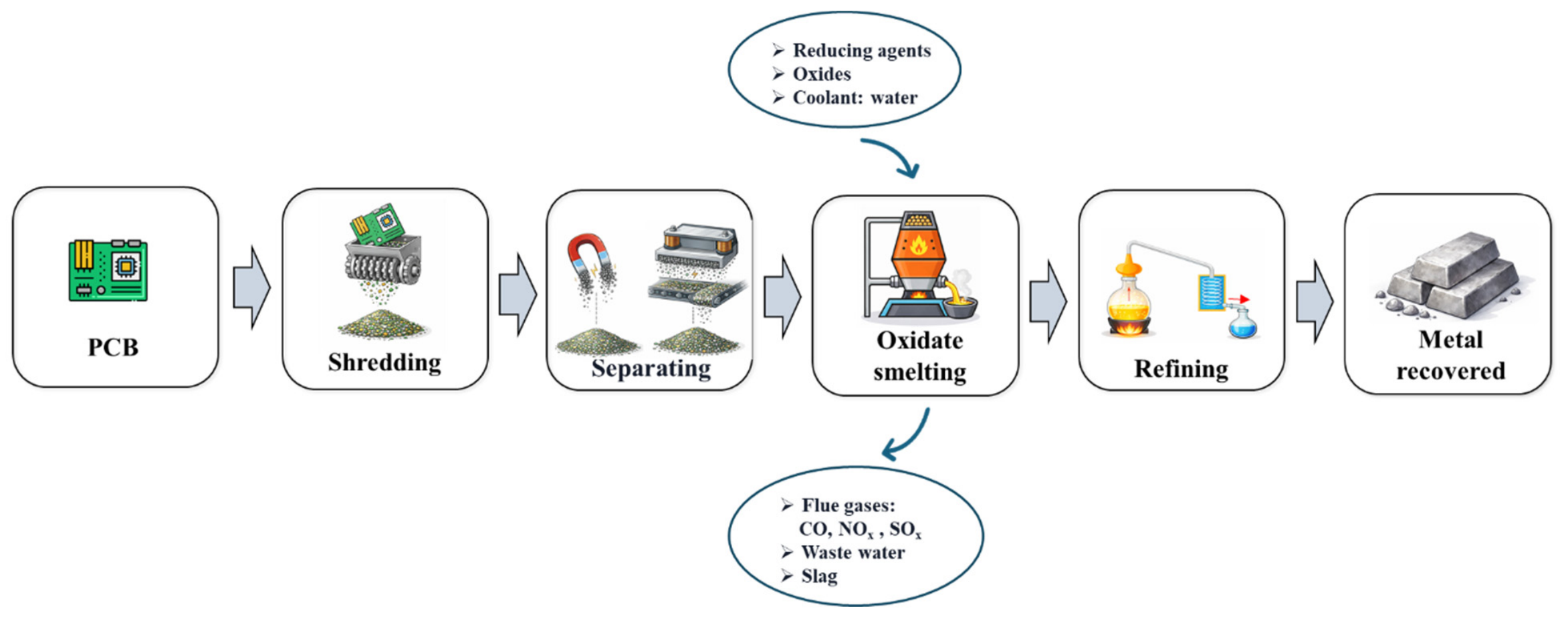
Conventional pyrometallurgical PCB recycling typically begins with the mechanical size reduction of the scrap, followed by separation to concentrate the metallic fraction and remove non-metallic components [15]. The resulting metal-rich concentrate is then subjected to oxidative smelting, during which controlled oxidation converts a portion of the feed and added reagents into oxides that report to the slag phase, while collectible metals concentrate into a metallic melt or matte, depending on the process configuration. In practical operation, reducing agents and fluxing oxides are introduced to adjust oxygen potential and slag chemistry, and water-based cooling is commonly employed for off-gas handling and thermal management. The principal outputs include a metal-bearing phase (matte/metallic melt) suitable for downstream refining, alongside by-products, such as flue gases (e.g., CO, NOx, and SOx), wastewater from gas cleaning, and solid residues, such as slag [16,17]. The crude product is subsequently cast (e.g., as ingots) and refined to separate individual metals and remove remaining impurities to meet product specifications [15]. Figure 1 illustrates the thermal-based recycling of metal recovery from PCB waste.
Despite broad industrial adoption, pyrometallurgical recycling remains constrained by high energy demand and the generation of potentially hazardous emissions. Effective off-gas treatment is therefore essential to capture toxic species and particulates prior to atmospheric release, adding both operational complexity and cost [18].

2.1.2. Hydrometallurgical Recycling

Hydrometallurgical recycling is widely applied for recovering metals from PCBs, commonly through a leaching–solvent extraction route. In many cases, leaching is performed directly on metal-rich fractions, in which conductive components remain coated or encapsulated by resins and ceramic constituents, creating additional mass transfer and accessibility constraints [19]. Metal dissolution is typically achieved in acidic or alkaline media, using mineral acids such as nitric acid (HNO3), hydrochloric acid (HCl), and sulfuric acid (H2SO4), as well as aqua regia, frequently reported for extracting metals from PCB-derived concentrates [19] Alternative lixiviants and complexing agents, such as cyanide, halide-based systems, thiosulfate, and thiourea, have also been investigated, particularly to improve the selective recovery of precious metals [20,21,22,23].
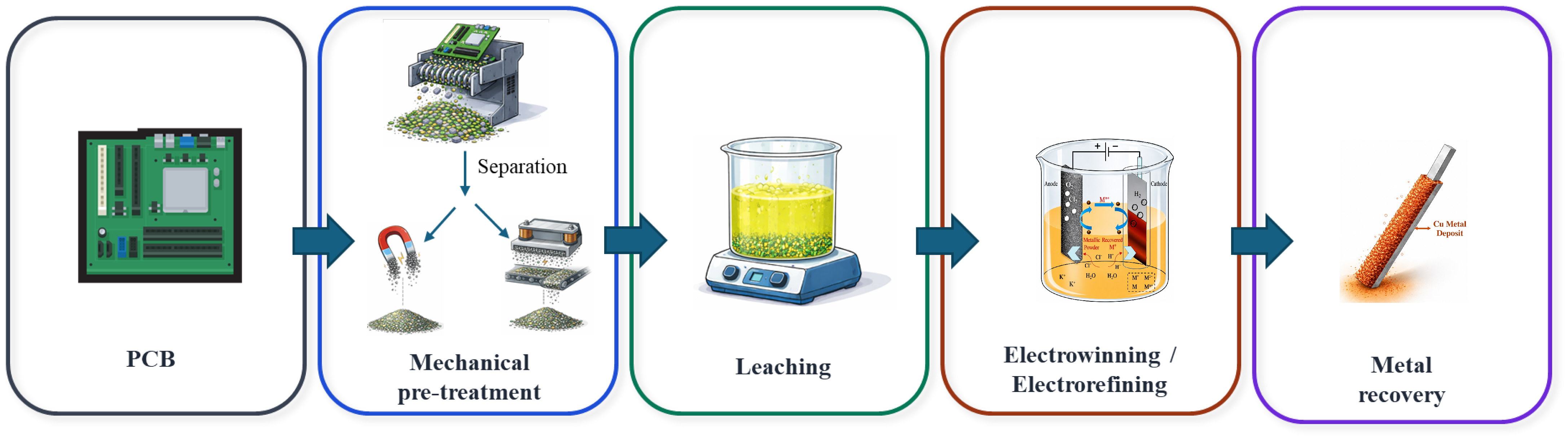
A conventional hydrometallurgical flowsheet generally begins with mechanical size reduction. WPCBs are crushed and subsequently milled (e.g., using a pulverizer) to further liberate metallic particles from the polymeric and ceramic matrix. The comminuted material is then upgraded by physical separations, such as magnetic and gravity-based methods, to obtain a metal-enriched concentrate suitable for downstream chemical processing [24]. This concentrate is leached to produce a metal-bearing pregnant leach solution. The leachate is then treated through solution purification and selective recovery steps, commonly including solvent extraction and ion-exchange operations [25]. In ion exchange, dissolved metal ions are selectively captured on functionalized resin surfaces through reversible exchange reactions, enabling separation from competing ions and impurities. The loaded resins are subsequently eluted using an appropriate stripping solution to produce a concentrated metal stream, after which the resin can be regenerated and reused. The overall sequence of crushing, concentration, leaching, solvent extraction, and electrowinning that defines the traditional hydrometallurgical approach is summarized in Figure 2.
Hydrometallurgy is particularly effective for copper recovery, but it can also extract a broader suite of metals, including Fe, Sn, Zn, Al, Ni, Pb, and others, depending on lixiviant selection, solution chemistry, and the downstream separation strategy [26]. Although the approach is often valued for its selectivity, high product purity, and comparatively lower energy demand than high-temperature routes, it also presents notable limitations. Reported challenges include long processing times, reagent hazards associated with strong acids and toxic elements, risks of heavy-metal contamination, generation of solid residues, and the production of large volumes of wastewater that require treatment prior to discharge or reuse [27].

2.1.3. Electrometallurgical Recycling

Electrometallurgical recycling is commonly implemented as an integrated route that couples mechanical upgrading with hydrometallurgical leaching and electrochemical recovery, typically through electrowinning and/or electrorefining. This combined approach can produce high-purity metals (for example, copper purities approaching 99%) and may also enable the recovery of precious metals, such as Ag, Au, and Pd, either from the insoluble “anode slime” generated during refining or through selective electrodeposition under controlled operating conditions [28].
The process generally begins with mechanical pretreatment, including shredding and grinding, followed by physical separations, such as magnetic and electrostatic methods, to enrich the metallic fraction. Leaching becomes particularly effective once a sufficiently high metal concentrate is obtained, often reported to be in the range of 50–90% [28,29]. During leaching, metallic constituents are converted into soluble ionic species using appropriate lixiviants; commonly reported systems include H2SO4 with oxidants such as H2O2, as well as aqua regia for more aggressive dissolution of noble and base metals [29]. The resulting pregnant leach solution (PLS) is then directed to an electrochemical cell for metal recovery.
In electrorefining or electrowinning, dissolved metal ions are converted into solid products by applying a regulated electrical potential. Target ions migrate toward the cathode and are reduced to the metallic state, leading to deposition of high-purity metal on the cathode surface according to the general reaction (Mn+ + ne → M0) [30,31,32]. In copper-focused systems, less readily soluble or less readily deposited species, including Au and Ag, do not follow copper into solution or do not electrodeposit under the same conditions. These species instead accumulate as an insoluble residue, commonly referred to as anode slime, which settles at the bottom of the cell and can be collected for subsequent precious-metal recovery. Where selective plating is pursued, electrode potential and electrolyte chemistry may be adjusted to favor the deposition of specific target metals [33]. The overall flow process of the electrometallurgical recycling is illustrated in Figure 3.
A persistent challenge in electrometallurgical recycling of PCBs arises from the complex, multi-metal composition of the feed. Several metals present in PCB-derived solutions, including Cu, Sb, and Bi, can exhibit closely spaced reduction potentials under certain electrolyte conditions. This overlap complicates selective electrodeposition and increases the likelihood of co-deposition, thereby reducing product purity unless additional separation steps or tighter electrochemical control strategies are implemented [34].

2.1.4. Bio-Metallurgical Recycling

Bio-metallurgical recovery, commonly referred to as bioleaching, promotes the solubilization of metals through microbially mediated oxidation–reduction reactions. The process is most frequently associated with chemolithoautotrophic microorganisms, which derive energy from inorganic substrates such as ferrous iron (Fe2+) and reduced sulfur species, while using CO2 as the principal carbon source. In bioleaching systems, iron- and sulfur-oxidizing microorganisms play a central role in mobilizing metals from solid matrices. These organisms can oxidize Fe2+ to Fe3+, thereby generating ferric iron as a strong oxidant capable of attacking metal-bearing phases [15]. In parallel, oxidation of elemental sulfur and reduced sulfur compounds produces leaching reagents, including sulfuric acid and reactive sulfur oxidation intermediates, which together contribute substantially to metal dissolution and transport into the aqueous phase [35]. Although bioleaching is typically associated with sulfide materials, it has also been applied to metal recovery from non-sulfidic and low-iron sources, depending on the feed composition and microbial consortia [36].
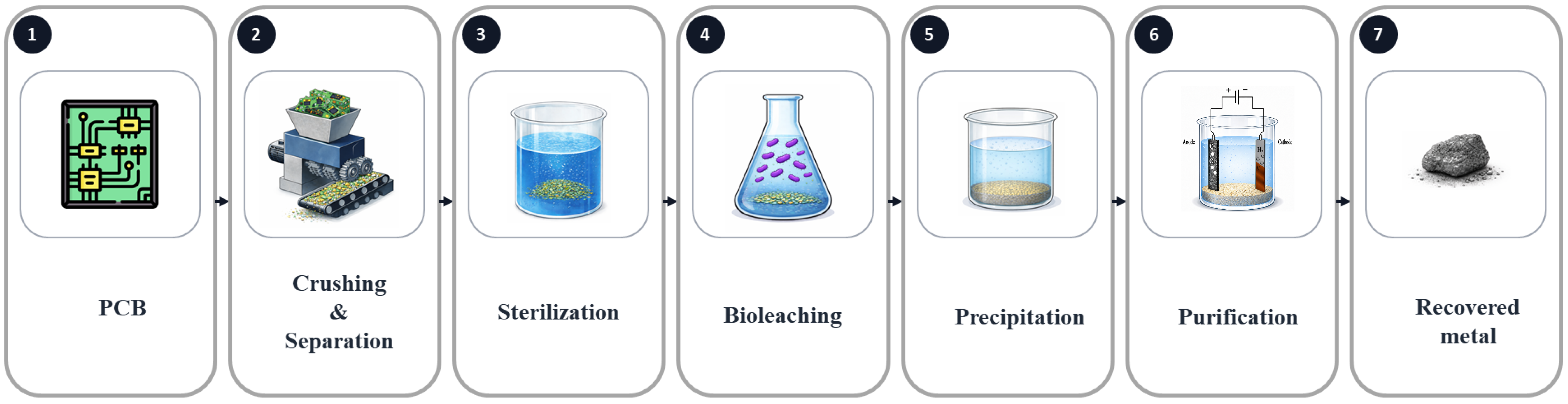
From a flowsheet perspective shown in Figure 4, bioleaching parallels hydrometallurgical processing, with the key distinction that biological activity supplies the oxidative capacity and acidity required for leaching rather than relying solely on externally added chemical reagents. In PCB recycling applications, a sterilization step is often incorporated prior to inoculation to suppress competing or inhibitory microorganisms and to ensure that the intended strains or consortia dominate during leaching [37,38]. Relative to high-temperature smelting, bioleaching typically operates at a lower temperature and can reduce overall energy demand. However, it is frequently limited by slower kinetics compared with conventional hydrometallurgical leaching. In addition, the chemical complexity and potential toxicity of PCB-derived feeds, including flame retardants, diverse organic additives, and mixed-metal constituents, can inhibit microbial growth and activity. These effects may necessitate additional pretreatment, careful control of solution chemistry, and extended adaptation periods to establish stable and productive bioleaching performance [39,40,41].

2.2. Non-Metal Recycling

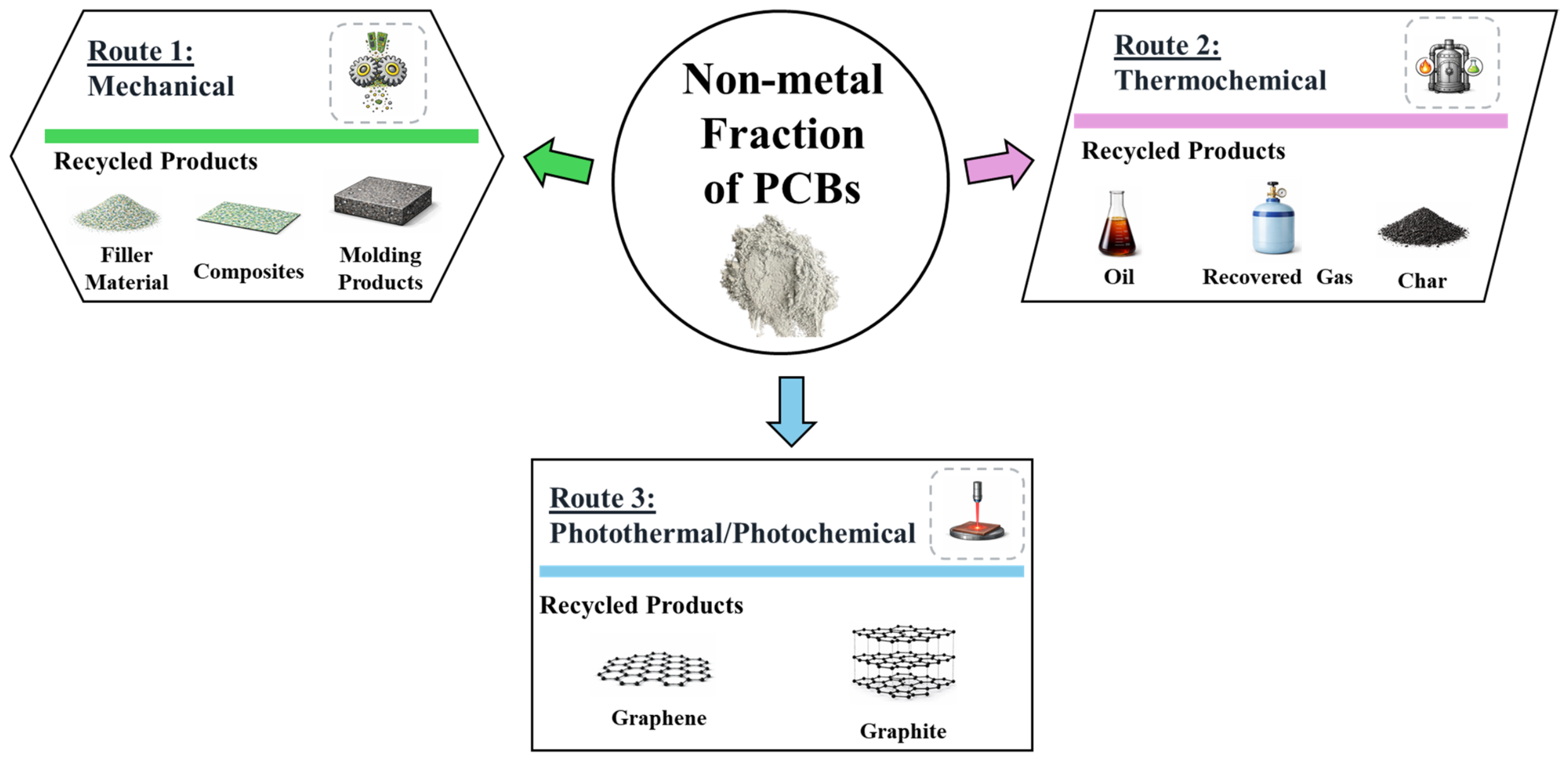
The non-metallic fraction of PCBs can be valorized through three primary pathways, as shown in Figure 5. The most widely implemented option is mechanical or physical recycling, in which non-metal constituents are separated using size and shape classification, along with magnetic and electrostatic separation. The recovered mixture, typically composed of thermosetting resins, glass fibers, ceramics, and other polymers, is often subjected to secondary processing such as air classification and grinding to obtain a more uniform filler material. These fillers have been reported as reinforcing additives in epoxy-based products, including adhesives, construction materials, and coatings [42,43]. Recovered polymers from these processes often suffer from reduced mechanical strength and poor compatibility with new matrices. To address these limitations, recent studies have explored coupling agents and optimized blending strategies to improve interfacial adhesion and dispersion. For example, in polypropylene (PP)-based composites, the silane coupling agent KH-550 (γ-aminopropyltriethoxysilane) was used to modify recycled non-metallic PCB fillers, resulting in improved tensile, flexural, and thermal properties [43]. Similarly, blending non-metallic PCB fractions with mixed waste plastics containing polypropylene, polyethylene, polycarbonate, and acrylonitrile–butadiene–styrene (ABS) enhanced fiber encapsulation and improved the mechanical performance of composite panels [44]. Non-metallic PCB powders have also been used in phenolic molding compounds as partial substitutes for wood flour and lignocellulosic fillers (sawdust), improving impact resistance and heat deflection temperature, although filler loading and particle size require careful optimization to maintain processability [45,46,47,48]. Mechanical recycling is generally attractive due to its relatively low capital requirement and modest energy demand, and because it yields products that can be directed to multiple end-use applications with minimal chemical input.
A second route involves chemical recycling through thermochemical conversion, where polymer-rich fractions are decomposed into smaller molecules or secondary products via processes such as pyrolysis, gasification, and torrefaction. In these systems, the separated polymers undergo thermal treatment under oxygen-free or oxygen-limited conditions to promote depolymerization and volatilization reactions [9]. In practice, the product distribution can be biased toward solid residues rather than liquid oil, despite oils often constituting a major fraction in the thermochemical decomposition of many polymers and lignocellulosic materials [49]. The resulting oil, char, and non-condensable gases may nevertheless be utilized as chemical feedstocks, solid fuels, or carbonaceous additives, and process energy sources, respectively, depending on their composition and required upgrading steps [50]. Recent research highlights multiple valorization pathways for glass fibers and ceramic-rich fractions, including physical separation, thermochemical processing, and material reuse. Thermochemical treatments, such as pyrolysis and thermolysis, enable the removal of the polymer matrix and recovery of glass fibers, although some degradation in mechanical properties is typically observed. Importantly, recovered glass fibers can be further valorized into high-value materials. For instance, demonstrated that glass fibers obtained from thermolysis and gasification of composite waste can be successfully converted into glass–ceramic materials for tile applications. F. López et al. [51] demonstrated that polyester fiberglass waste could be thermally treated at 550 °C to remove organics, producing a solid residue (~68 wt.%) rich in glass fibers, which was subsequently melted (≈1450 °C) and sintered (~1013 °C) to form wollastonite–plagioclase glass–ceramics suitable for architectural tiles. The resulting materials exhibited desirable properties, such as high hardness, low water absorption, and aesthetic similarity to natural stone, making them viable for wall and floor applications. In addition, other studies have shown that NMF-derived materials can be used as fillers in polymer composites, as adsorbents, or as precursors for activated carbon and silica, further supporting the circular utilization of e-waste resources [52,53]. A key environmental and operational concern is the release of brominated species when brominated flame retardants decompose at elevated temperatures. For example, hydrogen bromide (HBr) and brominated organics, such as tetrabromobisphenol-A (TBBPA), can evolve during thermal processing, necessitating robust gas-cleaning and emission-control strategies [54].
More recently, emerging approaches have aimed to upcycle polymeric PCB residues into graphitic carbon materials. In a recent study, the epoxy-based polymer matrix was first separated from metallic components and then converted via laser scribing into graphitic structures, offering a potential route to synthetic graphite-like materials [55]. Related studies have also explored dispersing polymeric precursors in aqueous media and applying laser-based processing to generate graphene-like carbon for conductive inks, including graphene ink formulations [56]. Although these strategies remain relatively underreported compared with conventional mechanical and thermochemical routes, they highlight a promising direction for transforming polymer-rich PCB waste into higher-value carbon materials that are increasingly relevant to critical material supply chains.

3. The State of the Art in the Critical Materials Recovery Process from PCBs

3.1. Recent Advancements in Leaching

Recent studies on the selective leaching of metals from PCBs have increasingly targeted the substitution of conventional reagents, particularly aqua regia and cyanide, with lower-impact lixiviants, such as thiosulfate, thiourea, halide-based systems, and glycine. These alternatives are being pursued to improve separation selectivity while reducing the environmental and safety concerns associated with highly aggressive or toxic leaching media. A clear methodological shift is the adoption of sequential, two-stage leaching strategies. In typical implementations, dilute mineral acids or suitable complexing solutions are first applied to dissolve base metals (e.g., Cu, Pb, and Sn), followed by thiosulfate- or thiourea-based systems to target precious metals (Au, Ag, and Pd). This staged design is intended to limit interference from base–metal co-dissolution and to lower reagent demand during the precious-metal recovery step [57,58].
Within this broader framework, glycine-based leaching has drawn particular attention. Glycine can function as a selective complexant for copper under mild, near-ambient operating conditions and has also been incorporated into thiosulfate formulations for gold recovery. In such systems, Cu– or Co–glycine–thiosulfate media have been reported to achieve high Au extraction from pretreated PCB materials, with recoveries commonly exceeding ~90% under optimized conditions [59,60]. In parallel, recent work increasingly emphasizes process intensification through particle-size reduction, surface coating removal, and related pretreatment steps that improve leach accessibility and mass transfer. Integration with downstream recovery operations, including electro-recovery, cementation, and adsorption, is also frequently highlighted as a means to produce cleaner pregnant leach solutions and enhance overall flowsheet selectivity for WPCB recycling [61,62]. Table 1 summarizes recent advances in leaching-based approaches for metal recovery from PCB waste.

3.2. Recent Advancements in ILs for Metal Extraction from PCB Waste

IL approaches for WPCB metal recovery are increasingly designed around selective dissolution or extraction, coupled with efficient stripping and solvent reuse to enable closed-loop hydrometallurgical operation. Acid-functionalized IL acids, particularly hydrogen sulfate-based systems, have been reported to leach nearly 100% of Cu from waste PCBs and can outperform analogous sulfonate-based IL acids, indicating that IL acidity and anion chemistry can achieve base–metal dissolution efficiencies comparable to conventional mineral acids [69]. Acidic imidazolium ILs (e.g., [BMIM][HSO4] and [HMIM][HSO4]) can achieve ~100% Cu extraction and >90% Co extraction from mobile-phone PCB, while tailored phosphonium and task-specific ILs often transfer >90–99% of Cu, Ag, or Au from PCB leachates into an IL-rich phase with Au/base–metal separation factors exceeding 100 [70,71]. In optimized Cu-focused flowsheets, overall Cu recovery typically reaches 98–100% with product purity >99.9%, and many IL systems retain 90–95% of the initial extraction efficiency over multiple reuse cycles [72]. Table 2 depicts the recent advancements in the ionic leaching process.

3.3. Recent Advancements in DESs for Metal Extraction from WPCBs

DESs are liquid mixtures produced through mixing a hydrogen bond acceptor, typically a quaternary ammonium salt like choline chloride, with a hydrogen bond donor, such as organic acids, glycols, or urea, in a defined molar ratio, resulting in a homogeneous liquid with a melting point significantly lower than that of the element components. Their minimal volatility, adjustable acidity, and capacity to coordinate with metal ions give them promising substitutes for strong mineral acids in the hydrometallurgical extraction of metals from WPCBs [75]. DESs are employed in the recycling of PCBs as direct leaching media to dissolve base and/or precious metals from thermally treated or shredded boards, or as a component of hybrid schemes that include traditional separation processes like solvent extraction, precipitation, or electrowinning after DES leaching [75,76]. Choline chloride–organic acid DESs (for example, ChCl–oxalic acid, ChCl–glycolic acid, and ChCl–malonic acid), ChCl–ethylene glycol, and carboxylic acid-based DESs are all examples of common systems. In order to improve metal dissolution, various oxidants, such as hydrogen peroxide or copper chloride, are frequently coupled with these DESs [75].
In WPCB recycling, ChCl-based DESs have been utilized to dissolve metal oxides and metallic phases via a combination of proton-driven attack and complexation, facilitating the leaching of base metals (e.g., Cu, Zn, Pb, and Sn) from thermally or chemically pretreated boards under relatively mild conditions and without the use of concentrated strong acids [76,77]. Sequential DES methodologies, such as ChCl–glycolic acid followed by ChCl–oxalic acid, have been shown to fractionate metals in stages, achieving significant removals of Zn and Pb in the initial phase and facilitating the recovery of Cu as a high-purity oxalate product in the subsequent phase [77]. Additional specialized DES configurations have been reported, including DES-based emulsion liquid membranes for the treatment of WPCBs from mobile phones, which can achieve near-quantitative gold extraction following process optimization. This demonstrates that DESs can serve both as bulk leachants and as selective carriers in membrane separations [78].
Comparative studies assessing DESs in conjunction with ionic liquids demonstrate that the composition of DESs significantly influences selectivity (e.g., ChCl–malonic acid promotes Ag uptake, whereas ChCl–ethylene glycol enhances Cu extraction), although the overall metal loading and kinetics may be inferior to those attainable with specifically designed ionic liquids in certain cases [71]. Recent studies on acidic ChCl–carboxylic-acid DES (e.g., acetic, chloroacetic, and dichloroacetic acid donors) indicate the significant removal of hazardous metals, such as Pb, Zn, Cr, and Ni, establishing these systems as relatively benign alternatives for decontamination and base–metal recovery from waste printed circuit board-derived solids [79]. Furthermore, recent research has underscored the potential of DESs as a promising platform for selective and potentially recyclable WPCB hydrometallurgy by demonstrating that leaching efficiencies for targeted metals can be increased to over 90% by pairing DESs with appropriate oxidants and operating at moderate temperatures. In addition, solvent reuse is supported [76]. Current research based on DESs for PCB metal recycling is illustrated below (Table 3).

3.4. Recent Advancements in Bioleaching Process for Metal Extraction from PCB Waste

Recent bio-based methods in WPCB recycling predominantly focus on comminuted or fragmented boards, employing acidophilic Fe/S-oxidizing consortia to regenerate ferric iron as the principal oxidant and heterotrophic fungi to produce organic acids, while distinct cyanogenic pathways are investigated for Au mobilization [83,84]. Current research is increasingly emphasizing the importance of pretreatment (e.g., size reduction and conditioning stages) to expose metal surfaces and mitigate toxicity prior to biological contact, as WPCBs contain brominated resins and multi-metal mixtures that can inhibit microbial activity [85]. The three predominant operating modes are: one-step contact, two-step operation (where microorganisms are cultivated initially before the introduction of WPCBs), and spent-medium tactics that utilize cell-free metabolites to prevent direct inhibition [85].
In terms of quantitative performance, the most effective strategies are two-step and process integration, particularly for Cu. A recent study that utilized new bacterial candidates for WPCB processing reported a maximum of 40% Cu recovery within three days (two-step, with cells), and up to 35% Au recovery within three days (spent medium). Additionally, the study demonstrated that metal release was enhanced by ball milling and ozonation pretreatments [85]. In addition, continuous or semi-continuous designs are being developed to enhance ferric–iron cycling, while separating microbial growth from direct PCB exposure; a two-stage system that integrates a stirred-tank leaching reactor with a packed-bed bioreactor for Fe(II) re-oxidation has been shown to facilitate sustained ferric regeneration and enhance operational stability [83]. Mechanistic understanding is also advancing: a coupled kinetic model explicitly linking biological Fe(II) oxidation to chemical Cu dissolution by biogenic Fe(III) has shown strong agreement with experiments and clarified the relative rates of the biological and chemical steps [86]. Mechanistic knowledge is advancing: a coupled kinetic model that directly links biological Fe(II) oxidation to chemical Cu dissolution via biogenic Fe(III) has shown strong agreement with experimental results and confirmed the relative rates of the biological and chemical processes [86].
Cyanogenic routes for precious metals are often characterized as indirect gold mobilization through metabolite-generated complexes (complexolysis), with reported Au leaching efficiencies from WPCBs being limited to approximately 70% in optimal situations examined. Recent studies increasingly emphasize inhibition management. Progressive acclimation of an acidophilic Fe(II)-oxidizing consortium maintained Fe(II) oxidation under leachate conditions, corresponding to 6% (w/v) PCB, while sequential subculturing reduced the PCB-associated lag phase by as much as ~2.6times [87]. Table 4 depicts the recent advancement in the bioleaching process, with the type of bioleaching and target metals.

3.5. Emerging Technologies for Rare and Critical Element Recovery (e.g., Nd, Ta, In, and Ga)

Recent work on critical dispersed metals in PCBs has concentrated more on substreams that contain Ta, Ga, and In (such as capacitors and LED modules). This is because these elements are found in specific components and may be upgraded at the component level before they are extracted. An AI-assisted sorting and “reverse leaching” strategy for tantalum achieved 98.2% Ta recovery under mild conditions and produced >99.8% Ta2O5. This shows that accurately identifying and separating Ta capacitors can lead to high-yield, high-purity critical-material production from PCB assemblies [91]. Complementary separation research has investigated the physical liberation of tantalum capacitors from WPCBs through molten salt or molten metal treatments, suggesting that disassembly and selective component extraction can serve as an effective preliminary step in tantalum recycling. However, encapsulation and solder/adhesive systems present challenges that must be resolved to facilitate reliable downstream refining [92]. On the contrary, gallium and indium are generally found in minimal concentrations in standard FR-4 WPCB; thus, current material on “PCB-based” Ga/In recovery incorporates design-for-recycling strategies that intentionally integrate Ga–In alloys into recoverable PCB conductor frameworks. The DissolvPCB method constructs printed circuit board assemblies (PCBA), utilizing a water-soluble polyvinyl alcohol (PVA) substrate and eutectic gallium–indium (EGaIn) conductors. Upon reaching end-of-life, immersion in water facilitates material separation and promotes reuse, achieving reported recovery rates of up to 99.4% for PVA and 98.6% for Ga–In metal, thereby quantitatively demonstrating closed-loop Ga/In reclamation in a PCB format [93].
On the contrary, gallium and indium are generally found in minimal concentrations in standard FR-4 WPCBs; thus, current material on “PCB-based” Ga/In recovery incorporates design-for-recycling strategies that intentionally integrate Ga–In alloys into recoverable PCB conductor frameworks. The DissolvPCB method constructs PCBAs utilizing a water-soluble PVA substrate and eutectic gallium–indium (EGaIn) conductors. Upon reaching end-of-life, immersion in water facilitates material separation and promotes reuse, achieving reported recovery rates of up to 99.4% for PVA and 98.6% for Ga–In metal, thereby quantitatively demonstrating closed-loop Ga/In reclamation in a PCB format [94]. Thermochemical conditioning reinforces this rationale: high-temperature pyrolysis (850 °C) concentrates the majority of rare earth elements (REEs) in a slag-rich carbonaceous residue, whereas metallic fractions exhibit minimal REE concentrations, suggesting that REE recovery is more effectively achieved from refractory residues than from metal phases [95]. A complementary hybrid method that combined vacuum pyrolysis (~550 °C, 10 mbar) and multi-stage electrostatic separation quantified REEs in upgraded solid residues (e.g., Nd 38.72 ppm, Y 35.90 ppm, Ce 31.30 ppm, and La 18.72 ppm) and showed that electrostatic sorting and thermal treatment can produce REE-enriched solids appropriate for downstream processing [96]. Recent integrated hydrometallurgical flowsheets have effectively demonstrated product formation: selective leaching of smartphone PCBs, followed by oxalate precipitation, achieved a recovery of 92% of REEs and yielded a rare-earth oxide concentrate with 91% purity post-calcination, thereby illustrating a pathway from PCB feed to a marketable rare-earth oxide stream (REO), rather than merely a REE-bearing leachate [97]. Table 5 depicts the recent progress in REE recovery from PCBs.

4. Mitigation of Brominated Emissions During PCB Recycling

The presence of brominated flame retardants (BFRs) in PCBs creates a major challenge during recycling, especially under thermal treatment, where hazardous species, such as hydrogen bromide (HBr), brominated phenols, and polybrominated dibenzo-p-dioxins and furans (PBDD/Fs), can form. Recent research shows that the formation and release of these brominated pollutants are strongly influenced by treatment temperature, oxygen availability, and bromine chemistry during decomposition [98,99,100]. Therefore, safe recycling of PCB materials requires a combination of pretreatment, in-process bromine fixation, and post-treatment emission control.
At the pretreatment stage, the main objective is to reduce brominated release before materials enter high-temperature treatment units. Mechanical separation and selective dismantling help lower the bromine load entering thermal systems, while solvent-based extraction and dissolution recycling offer direct routes for removing BFRs from polymer-rich fractions [101,102,103]. In particular, dissolution recycling of polystyrene-containing WEEE fractions has shown that undissolved flame retardants can be removed by >99 wt.% through filtration, while dissolved species can be reduced by 80–99 wt.%, using activated-carbon adsorption [101]. Solvent extraction studies on brominated plastics have also demonstrated that pretreatment can significantly reduce brominated content and limit later emissions during downstream thermal processing [102,103]. In addition, supercritical fluid technologies have emerged as promising debromination routes because their high diffusivity and tunable solvent properties enhance bond cleavage and bromine removal under controlled conditions [104,105].
During thermal recycling, in situ bromine fixation is essential to suppress hazardous emissions. Alkaline additives, such as CaO, Ca(OH)2, and CaCO3, have been widely reported to neutralize HBr and suppress the formation of brominated dioxins by converting bromine into stable inorganic salts [99,100]. Earlier studies on the thermal behavior of brominated plastics also showed that reactor temperature and process configuration strongly affect whether bromine is retained in solid residues or released into gas and oil fractions [106,107]. Transition metal oxides offer an additional control strategy. For example, Fe2O3 has been shown to capture bromine through dissociative adsorption and catalytic conversion, leading to about 90% reduction in HBr emission during decomposition of tetrabromobisphenol A-derived pyrolysates [108]. More recent pyrolysis studies further indicate that controlled thermal treatment can enable simultaneous debromination and bromine recovery from WPCBs, thereby improving both environmental and economic performance [109].
Post-treatment technologies remain necessary because residual brominated compounds may still be present in flue gases after thermal conversion. Rapid quenching is commonly used to suppress the reformation of brominated dioxins, while adsorption-based systems, such as activated carbon injection and filtration units, are applied to capture brominated organic compounds and particulate-bound pollutants [98,100]. Reviews of brominated-plastic recycling also emphasize that integrated thermal–chemical systems, rather than single-unit operations, are more effective for minimizing toxic emissions while maintaining material recovery [105,110]. Till now, no single technology is sufficient on its own. Instead, environmentally sustainable PCB recycling requires an integrated strategy that combines pretreatment to lower bromine input, in-process additives or sorbents to immobilize bromine, and post-treatment systems to capture any remaining brominated emissions.

5. Challenges and Limitations of the PCB Recycling Process

Recycling WPCBs is challenging because they comprise a variety of materials, and the numerous methods used to recycle them (mechanical, pyrometallurgical, hydrometallurgical, and bio-metallurgical) can have different effects on the same multilayer feed. The integration of copper-rich metal networks with alloyed metals (Sn, Pb, Zn, Al, Fe, and Ni), precious metals, brominated epoxy resins, glass fibers, and ceramic inserts in typical PCBs results in a strong physical and chemical coupling between phases, which complicates the process of liberation and selective separation [11,111,112]. Effective recycling typically necessitates dismantling and depopulation, succeeded by comminution and pre-enrichment. However, high-energy size reduction produces fines that are challenging to separate, exacerbates dust generation, and may lead to the loss of precious and critical metals. Therefore, the overall economics are acutely sensitive to pretreatment decisions, including selective disintegration, grinding intensity, and the extent of manual or automated component removal [113,114].
Pyrometallurgical processing can handle substantial throughputs and attain effective recovery of copper and related precious metals; however, it remains highly energy-consuming and may produce hazardous off-gases (including halogenated organics) unless sophisticated gas cleaning is employed. Additionally, brominated polymers are predominantly destroyed rather than valorized, and various non-target metals segregate into slags or flue dusts, necessitating further management [11,111]. The selectivity of hydrometallurgical routes can be enhanced; however, the production of large volumes of contaminated effluents by strong acids/oxidants, and the cost of chemically complex multi-step leaching–separation flowsheets when attempting the simultaneous recovery of multiple metal groups, are both significant challenges. Recent “gentle” or gradient concepts have been developed to address selectivity and chemical intensity; however, scaling such integrated schemes remains non-trivial under realistic feed variability [11,112].
IL- and DES-based processes have demonstrated high selectivity and promising extraction performance for metals from PCBs; however, several limitations constrain their practical application. Many ionic liquids remain costly due to complex synthesis and purification requirements, while DES, although comparatively less expensive, still requires careful control of composition and regeneration [115,116]. In addition, ILs are not inherently benign, as some exhibit toxicity, persistence, and limited biodegradability, whereas the environmental profile of DESs depends strongly on the nature of the hydrogen-bond donor and acceptor [2,3]. High viscosity is another critical limitation, as it restricts mass transfer and slows reaction kinetics, particularly at higher solid loadings relevant to PCB processing [115,117]. Although solvent reuse has been reported, challenges such as metal accumulation, contamination, and declining efficiency over repeated cycles remain [71,117]. Furthermore, most studies are still limited to laboratory-scale systems, and issues related to continuous processing, long-term solvent stability, and techno-economic feasibility hinder industrial-scale implementation [71].
Bio-metallurgical methods provide milder operating conditions; however, they are generally slower than chemical leaching and are severely restricted by pulp density and PCB toxicity (e.g., inhibition of iron oxidation and microbial activity). This necessitates precise control of pH/redox and nutrient supply, which has restricted industrial uptake to date [12,87].
Unlike base metals, such as copper (Cu: ~20–40 wt.%), iron (Fe: ~5–10 wt.%), zinc (Zn: ~5–30 wt.%), and aluminum (Al: ~1–6 wt.%), which occur at weight-percent levels in WPCBs, REEs are present at trace concentrations. Typical bulk concentrations of REEs, such as yttrium (Y), lanthanum (La), and neodymium (Nd), are generally in the range of ~1–100 ppm (0.0001–0.01 wt.%) [94,95]. However, mechanical pretreatment and size fractionation can significantly enrich REEs in finer particles (<0.5 mm), where concentrations may increase to ~100–4000 ppm (0.01–0.4 wt.%), with specific elements such as La reaching >2000 ppm and Nd exceeding 4000 ppm in certain fractions, which makes their recovery technically feasible but economically more challenging [94].
Moreover, informal recycling methods, including open burning, basic acid leaching, and manual sorting, prevail in numerous areas, resulting in significant occupational and environmental hazards, while resin-rich residues and toxic metals remain inadequately managed. Even within formal systems, an ongoing constraint is the restricted access to high-value markets for brominated epoxy and glass–fiber fractions, which are often downcycled or discarded, thereby compromising circularity [111,113,118]. Finally, process systems and techno-economic analyses highlight that much of the literature predominantly concentrates on the recovery of a single metal group (usually Cu or precious metals), while overlooking the comprehensive, sequential recovery of base, precious, and critical metals [112,119]. Table 6 illustrates the comparison of metal recycling routes from PCBs.

6. Conclusions

The traditional recycling of WPCBs remains constrained by the intrinsic complexity of PCB assemblies and by the selectivity limits of individual processing routes. Metal-focused pathways can recover Cu and precious metals efficiently, yet they often rely on energy-intensive pretreatment and generate secondary residues, such as slags, dusts, and contaminated solutions, with additional requirements for emissions and effluent control. These routes are typically optimized for a narrow set of targets, so co-occurring base and critical metals may be partially lost to residues or require extra purification stages that increase chemical demand, operational complexity, and cost. In parallel, the non-metal fraction constitutes a major portion of PCB mass, but thermoset epoxy, brominated additives, glass fibers, and ceramic fillers remain difficult to separate and upgrade; as a result, much of this material is still downcycled or disposed of, limiting circularity and weakening the overall environmental value proposition of recycling.
Given these constraints, no single mechanical, pyrometallurgical, hydrometallurgical, or bio-metallurgical method is sufficient to recover the full spectrum of PCB metals and non-metals with high yield, high purity, and low environmental burden. Future strategies should therefore be designed as integrated, multi-step systems that stage selectivity across unit operations: physical depopulation and pre-enrichment to create higher-grade micro-streams, sequential metal recovery to separate base, precious, and critical metals, and parallel valorization routes that convert non-metal fractions into value-added products rather than landfill-bound residues. In this context, techno-economic analysis and life-cycle assessment are essential to quantify trade-offs among recovery, purity, energy use, emissions, and waste generation, and to identify process configurations that remain viable under realistic feed variability. Ultimately, simultaneous recovery and upgrading of both metallic and non-metallic fractions is central to improving resource efficiency, reducing disposal burdens, and advancing a sustainable circular economy for PCB-derived materials.

Author Contributions

M.K.I.: writing—original draft, writing—review and editing, visualization, validation. A.K.: writing—review and editing, validation, investigation. I.C.N.: writing—review and editing, supervision, funding acquisition. P.S.: writing—review and editing, supervision, project administration, funding acquisition. All authors have read and agreed to the published version of the manuscript.

Funding

This research was funded by the U.S. Department of Energy, Office of Critical Minerals and Energy Innovation (CMEI), Advanced Materials and Manufacturing Technologies Office (AMMTO). The work was performed at the Ames National Laboratory, operated for the U.S. Department of Energy by Iowa State University of Science and Technology under Contract No. DE-AC02-07CH11358. Also, this research was partially supported by the Manorama and Shyam Bahadur Professorship at Iowa State University.

Data Availability Statement

No new data were created or analyzed in this study.

Acknowledgments

The authors acknowledge the use of Grammarly( version: 1.2.258.1885) and ChatGPT Instant 5.3 for spell checking and minor language correction. The flowchart figures were prepared in Microsoft PowerPoint (version: 2108; Build 14334.20624) using copyright-free icons and Canva’s AI-assisted design features and were assembled by the authors using PowerPoint’s built-in flowchart and text box tools. All content was subsequently reviewed and revised by the authors, who assume full responsibility for the final version of the manuscript.

Conflicts of Interest

The authors declare no conflict of interest.

References

  1. World Health Organization. Electronic Waste (E-Waste); World Health Organization: Geneva, Switzerland, 2023.
  2. Stuhlpfarrer, P.; Luidold, S.; Antrekowitsch, H. Recycling of waste printed circuit boards with simultaneous enrichment of special metals by using alkaline melts: A green and strategically advantageous solution. J. Hazard. Mater. 2016, 307, 17–25. [Google Scholar] [CrossRef]
  3. Kang, K.D.; Ilankoon, I.M.S.K.; Dushyantha, N.; Chong, M.N. Assessment of Pre-Treatment Techniques for Coarse Printed Circuit Boards (PCBs) Recycling. Minerals 2021, 11, 1134. [Google Scholar] [CrossRef]
  4. Baldé, C.P.; Kuehr, R.; Yamamoto, T.; McDonald, R.; D’Angelo, E.; Althaf, S.; Bel, G.; Deubzer, O.; Fernandez-Cubillo, E.; Forti, V. Global E-Waste Monitor 2024; International Telecommunication Union (ITU): Geneva, Switzerland; United Nations Institute for Training and Research: Geneva, Switzerland, 2024.
  5. Baldé, C.P.; Kuehr, R.; Yamamoto, T.; McDonald, R.; D’Angelo, E.; Althaf, S.; Bel, G.; Deubzer, O.; Fernandez-Cubillo, E.; Forti, V. Electronic Waste Rising Five Times Faster than Documented E-Waste Recycling: UN. Available online: https://unitar.org/about/news-stories/press/global-e-waste-monitor-2024-electronic-waste-rising-five-times-faster-documented-e-waste-recycling (accessed on 27 April 2026).
  6. Mourshed, M.; Khatun, S.; Islam, K.; Masuk, N.I.; Masud, M.H. Generation, Composition, Collection, and Treatment of E-Waste. In Management of Electronic Waste; John Wiley & Sons, Inc.: Hoboken, NJ, USA, 2024; pp. 39–72. [Google Scholar]
  7. Kiddee, P.; Naidu, R.; Wong, M.H. Metals and polybrominated diphenyl ethers leaching from electronic waste in simulated landfills. J. Hazard. Mater. 2013, 252–253, 243–249. [Google Scholar] [CrossRef]
  8. Islam, M.K.; Khatun, M.S.; Mourshed, M. An in-depth analysis and review of management strategies for E-waste in the south Asian region: A way forward towards waste to energy conversion and sustainability. Heliyon 2024, 10, e28707. [Google Scholar] [CrossRef]
  9. Guo, J.; Guo, J.; Xu, Z. Recycling of non-metallic fractions from waste printed circuit boards: A review. J. Hazard. Mater. 2009, 168, 567–590. [Google Scholar] [CrossRef]
  10. Mir, S.; Dhawan, N. A comprehensive review on the recycling of discarded printed circuit boards for resource recovery. Resour. Conserv. Recycl. 2022, 178, 106027. [Google Scholar] [CrossRef]
  11. Li, H.; Eksteen, J.; Oraby, E. Hydrometallurgical recovery of metals from waste printed circuit boards (WPCBs): Current status and perspectives—A review. Resour. Conserv. Recycl. 2018, 139, 122–139. [Google Scholar] [CrossRef]
  12. Ji, X.; Yang, M.; Wan, A.; Yu, S.; Yao, Z. Bioleaching of Typical Electronic Waste—Printed Circuit Boards (WPCBs): A Short Review. Int. J. Environ. Res. Public Health 2022, 19, 7508. [Google Scholar] [CrossRef]
  13. Harvey, J.-P.; Khalil, M.; Chaouki, J. Pyrometallurgical Processes for Recycling Waste Electrical and Electronic Equipment. In Electronic Waste; Wiley-VCH GmbH: Weinheim, Germany, 2022; pp. 135–164. [Google Scholar]
  14. Wang, H.; Zhang, S.; Li, B.; Pan, D.a.; Wu, Y.; Zuo, T. Recovery of waste printed circuit boards through pyrometallurgical processing: A review. Resour. Conserv. Recycl. 2017, 126, 209–218. [Google Scholar] [CrossRef]
  15. Priya, A.; Hait, S. Comparative assessment of metallurgical recovery of metals from electronic waste with special emphasis on bioleaching. Environ. Sci. Pollut. Res. 2017, 24, 6989–7008. [Google Scholar] [CrossRef]
  16. Park, E.; Kim, M.; Pin, M.-W.; Park, H.; Kim, Y.-H. Precious Metal Recovery from Waste Electrical and Electronic Equipment through Oxidative Refining. Recycling 2023, 8, 80. [Google Scholar] [CrossRef]
  17. Tsebe, S.P.; Steenkamp, J.D. Development of an Integrated Process Flowsheet to Recover Valuable Metals from Waste Cathode Ray Tubes and Printed Circuit Boards. J. Sustain. Metall. 2024, 10, 224–240. [Google Scholar] [CrossRef]
  18. Ma, E. Chapter 11—Recovery of Waste Printed Circuit Boards Through Pyrometallurgy. In Electronic Waste Management and Treatment Technology; Prasad, M.N.V., Vithanage, M., Eds.; Butterworth-Heinemann: Oxford, UK, 2019; pp. 247–267. [Google Scholar]
  19. Jadhav, U.; Hocheng, H. Hydrometallurgical Recovery of Metals from Large Printed Circuit Board Pieces. Sci. Rep. 2015, 5, 14574. [Google Scholar] [CrossRef] [PubMed]
  20. Parga, J.R.; Valenzuela, J.L.; Francisco, C.T. Pressure cyanide leaching for precious metals recovery. JOM 2007, 59, 43–47. [Google Scholar] [CrossRef]
  21. Kim, E.-y.; Kim, M.-s.; Lee, J.-c.; Pandey, B.D. Selective recovery of gold from waste mobile phone PCBs by hydrometallurgical process. J. Hazard. Mater. 2011, 198, 206–215. [Google Scholar] [CrossRef] [PubMed]
  22. Ha, V.H.; Lee, J.-C.; Jeong, J.; Hai, H.T.; Jha, M.K. Thiosulfate leaching of gold from waste mobile phones. J. Hazard. Mater. 2010, 178, 1115–1119. [Google Scholar] [CrossRef]
  23. Örgül, S.; Atalay, Ü. Reaction chemistry of gold leaching in thiourea solution for a Turkish gold ore. Hydrometallurgy 2002, 67, 71–77. [Google Scholar] [CrossRef]
  24. Kamberović, Ž.; Ranitović, M.; Korać, M.; Andjić, Z.; Gajić, N.; Djokić, J.; Jevtić, S. Hydrometallurgical Process for Selective Metals Recovery from Waste-Printed Circuit Boards. Metals 2018, 8, 441. [Google Scholar] [CrossRef]
  25. Kumari, S.; Panda, R.; Prasad, R.; Alorro, R.D.; Jha, M.K. Sustainable Process to Recover Metals from Waste PCBs Using Physical Pre-Treatment and Hydrometallurgical Techniques. Sustainability 2024, 16, 418. [Google Scholar] [CrossRef]
  26. Silvas, F.P.C.; Jiménez Correa, M.M.; Caldas, M.P.K.; de Moraes, V.T.; Espinosa, D.C.R.; Tenório, J.A.S. Printed circuit board recycling: Physical processing and copper extraction by selective leaching. Waste Manag. 2015, 46, 503–510. [Google Scholar] [CrossRef]
  27. Sethurajan, M.; van Hullebusch, E.D.; Fontana, D.; Akcil, A.; Deveci, H.; Batinic, B.; Leal, J.P.; Gasche, T.A.; Ali Kucuker, M.; Kuchta, K.; et al. Recent advances on hydrometallurgical recovery of critical and precious elements from end of life electronic wastes—A review. Crit. Rev. Environ. Sci. Technol. 2019, 49, 212–275. [Google Scholar] [CrossRef]
  28. Ding, Y.; Zhang, S.; Liu, B.; Li, B. Integrated process for recycling copper anode slime from electronic waste smelting. J. Clean. Prod. 2017, 165, 48–56. [Google Scholar] [CrossRef]
  29. Udayakumar, S.; Razak, M.I.B.A.; Ismail, S. Recovering valuable metals from Waste Printed Circuit Boards (WPCB): A short review. Mater. Today Proc. 2022, 66, 3062–3070. [Google Scholar] [CrossRef]
  30. Cocchiara, C.; Dorneanu, S.-A.; Inguanta, R.; Sunseri, C.; Ilea, P. Dismantling and electrochemical copper recovery from Waste Printed Circuit Boards in H2SO4–CuSO4–NaCl solutions. J. Clean. Prod. 2019, 230, 170–179. [Google Scholar] [CrossRef]
  31. Wang, D.; Liang, Y.; Zeng, Y.; Liu, C.; Zhan, C.; Chen, P.; Song, S.; Jia, F. Highly selective recovery of gold and silver from E-waste via stepwise electrodeposition directly from the pregnant leaching solution enabled by the MoS2 cathode. J. Hazard. Mater. 2024, 465, 133430. [Google Scholar] [CrossRef] [PubMed]
  32. Liu, K.; Huang, S.; Jin, Y.; Lam, J.C.-H. Teaching Electrometallurgical Recycling of Metals from Waste Printed Circuit Boards via Slurry Electrolysis Using Benign Chemicals. J. Chem. Educ. 2023, 100, 782–790. [Google Scholar] [CrossRef]
  33. Choubey, S.; Goswami, P.; Gautam, S. Recovery of copper from Waste PCB boards using electrolysis. Mater. Today Proc. 2021, 42, 2656–2659. [Google Scholar] [CrossRef]
  34. Rai, V.; Liu, D.; Xia, D.; Jayaraman, Y.; Gabriel, J.-C.P. Electrochemical Approaches for the Recovery of Metals from Electronic Waste: A Critical Review. Recycling 2021, 6, 53. [Google Scholar] [CrossRef]
  35. Monneron-Enaud, B.; Wiche, O.; Schlömann, M. Biodismantling, a Novel Application of Bioleaching in Recycling of Electronic Wastes. Recycling 2020, 5, 22. [Google Scholar] [CrossRef]
  36. Yang, T.; Xu, Z.; Wen, J.; Yang, L. Factors influencing bioleaching copper from waste printed circuit boards by Acidithiobacillus ferrooxidans. Hydrometallurgy 2009, 97, 29–32. [Google Scholar] [CrossRef]
  37. Chu, H.; Qian, C.; Tian, B.; Qi, S.; Wang, J.; Xin, B. Pyrometallurgy coupling bioleaching for recycling of waste printed circuit boards. Resour. Conserv. Recycl. 2022, 178, 106018. [Google Scholar] [CrossRef]
  38. Becci, A.; Amato, A.; Fonti, V.; Karaj, D.; Beolchini, F. An innovative biotechnology for metal recovery from printed circuit boards. Resour. Conserv. Recycl. 2020, 153, 104549. [Google Scholar] [CrossRef]
  39. Manikkampatti Palanisamy, M.; Myneni, V.R.; Gudeta, B.; Komarabathina, S. Toxic Metal Recovery from Waste Printed Circuit Boards: A Review of Advanced Approaches for Sustainable Treatment Methodology. Adv. Mater. Sci. Eng. 2022, 2022, 6550089. [Google Scholar] [CrossRef]
  40. Yaashikaa, P.R.; Priyanka, B.; Senthil Kumar, P.; Karishma, S.; Jeevanantham, S.; Indraganti, S. A review on recent advancements in recovery of valuable and toxic metals from e-waste using bioleaching approach. Chemosphere 2022, 287, 132230. [Google Scholar] [CrossRef]
  41. Dutta, D.; Rautela, R.; Gujjala, L.K.S.; Kundu, D.; Sharma, P.; Tembhare, M.; Kumar, S. A review on recovery processes of metals from E-waste: A green perspective. Sci. Total Environ. 2023, 859, 160391. [Google Scholar] [CrossRef]
  42. Marques, A.C.; Cabrera Marrero, J.-M.; de Fraga Malfatti, C. A review of the recycling of non-metallic fractions of printed circuit boards. SpringerPlus 2013, 2, 521. [Google Scholar] [CrossRef]
  43. Zheng, Y.; Shen, Z.; Cai, C.; Ma, S.; Xing, Y. The reuse of nonmetals recycled from waste printed circuit boards as reinforcing fillers in the polypropylene composites. J. Hazard. Mater. 2009, 163, 600–606. [Google Scholar] [CrossRef]
  44. Rajagopal, R.R.; Rajarao, R.; Cholake, S.T.; Sahajwalla, V. Sustainable composite panels from non-metallic waste printed circuit boards and automotive plastics. J. Clean. Prod. 2017, 144, 470–481. [Google Scholar] [CrossRef]
  45. Mou, P.; Xiang, D.; Pan, X.; Wa, L.; Gao, J.; Duan, G. New solutions for reusing nonmetals reclaimed from waste printed circuit boards. In Proceedings of the 2005 IEEE International Symposium on Electronics and the Environment, 2005, New Orleans, LA, USA, 16–19 May 2005; pp. 205–209. [Google Scholar] [CrossRef]
  46. Li, J.; Xu, Z.; Zhou, Y. Application of corona discharge and electrostatic force to separate metals and nonmetals from crushed particles of waste printed circuit boards. J. Electrost. 2007, 65, 233–238. [Google Scholar] [CrossRef]
  47. Guo, J.; Rao, Q.; Xu, Z. Application of glass-nonmetals of waste printed circuit boards to produce phenolic moulding compound. J. Hazard. Mater. 2008, 153, 728–734. [Google Scholar] [CrossRef]
  48. Guo, J.; Li, J.; Rao, Q.; Xu, Z. Phenolic Molding Compound Filled with Nonmetals of Waste PCBs. Environ. Sci. Technol. 2008, 42, 624–628. [Google Scholar] [CrossRef] [PubMed]
  49. Hall, W.J.; Williams, P.T. Separation and recovery of materials from scrap printed circuit boards. Resour. Conserv. Recycl. 2007, 51, 691–709. [Google Scholar] [CrossRef]
  50. Islam, M.K.; Khatun, M.S.; Arefin, M.A.; Islam, M.R.; Hassan, M. Waste to energy: An experimental study of utilizing the agricultural residue, MSW, and e-waste available in Bangladesh for pyrolysis conversion. Heliyon 2021, 7, e08530. [Google Scholar] [CrossRef] [PubMed]
  51. López, F.A.; Martín, M.I.; García-Díaz, I.; Rodríguez, O.; Alguacil, F.J.; Romero, M. Recycling of Glass Fibers from Fiberglass Polyester Waste Composite for Manufacture Glass-Ceramic Materials; Scientific Research Publishing: Wuhan, China, 2012. [Google Scholar]
  52. Kumar, A.; Holuszko, M.E. Processing of Nonmetal Fraction from Printed Circuit Boards and Reutilization. In Electronic Waste; Wiley-VCH GmbH: Weinheim, Germany, 2022; pp. 213–230. [Google Scholar]
  53. Hu, D.; Zeng, X.; Lin, Y.; Chen, Y.; Chen, W.; Jia, Z.; Lin, J. High Value-Added Reutilization of Waste-Printed Circuit Boards Non-Metallic Components in Sustainable Polymer Composites. Molecules 2023, 28, 6199. [Google Scholar] [CrossRef]
  54. Grause, G.; Furusawa, M.; Okuwaki, A.; Yoshioka, T. Pyrolysis of tetrabromobisphenol-A containing paper laminated printed circuit boards. Chemosphere 2008, 71, 872–878. [Google Scholar] [CrossRef]
  55. Islam, M.K. Conversion of Printed Circuit Board Polymer into Graphitic Materials During Laser-Induced Carbonization Process. Master’s Thesis, Iowa State University, Ames, IA, USA, 2025. [Google Scholar]
  56. Bajpai, A.; Kumbhakar, P.; Tiwary, C.S.; Biswas, K. Conducting Graphene Synthesis from Electronic Waste. ACS Sustain. Chem. Eng. 2021, 9, 14090–14100. [Google Scholar] [CrossRef]
  57. Rahimi, V.; Gómez-Díaz, D.; Freire, M.S.; Lazzari, M.; González-Álvarez, J. Two-stage leaching strategy for the selective recovery of base and precious metals from waste motherboard PCBs: Kinetic study and process optimization. Sep. Purif. Technol. 2026, 387, 136665. [Google Scholar] [CrossRef]
  58. Rahimi, V.; Inzulza-Moraga, E.A.; Gómez-Díaz, D.; Freire, M.S.; González-Álvarez, J. Screening of variables affecting the selective leaching of valuable metals from waste motherboards’ PCBs. Environ. Sci. Pollut. Res. 2025, 32, 27651–27666. [Google Scholar] [CrossRef]
  59. Rezaee, M.; Saneie, R.; Mohammadzadeh, A.; Abdollahi, H.; Kordloo, M.; Rezaee, A.; Vahidi, E. Eco-friendly recovery of base and precious metals from waste printed circuit boards by step-wise glycine leaching: Process optimization, kinetics modeling, and comparative life cycle assessment. J. Clean. Prod. 2023, 389, 136016. [Google Scholar] [CrossRef]
  60. Mokhlis, H.; Daoudi, R.; Azzi, M. Selective leaching of copper from waste printed circuit boards (PCBs) using glycine as a complexing agent. Glob. NEST J. 2021, 23, 90–96. [Google Scholar]
  61. Segura-Bailón, B.; Lapidus, G.T. Selective leaching of base/precious metals from E-waste of cellphone printed circuit boards (EWPCB): Advantages and challenges in a case study. Hydrometallurgy 2023, 217, 106040. [Google Scholar] [CrossRef]
  62. Khan, M.A.R.; Rashed, H.M.M.A. Selective recovery of nanoscale copper particles from mobile phone waste printed circuit boards through acid leaching and low temperature electrowinning. Sci. Rep. 2025, 15, 23195. [Google Scholar] [CrossRef] [PubMed]
  63. Xiong, Z.; Huang, Y.; Li, Y.; Sheng, C.; Sun, L.; Ma, J.; Chi, B.; Tan, J.; Tang, X.; Zha, R.; et al. Selective recovery of Au from waste printed circuit board by water-soluble organic leaching: The key role of in situ bromine mediation and identificationof pathway. J. Hazard. Mater. 2024, 480, 136255. [Google Scholar] [CrossRef] [PubMed]
  64. Hao, J.; Wang, X.; Wang, Y.; Guo, F.; Wu, Y. Study of gold leaching from pre-treated waste printed circuit boards by thiosulfate-cobalt-glycine system and separation by solvent extraction. Hydrometallurgy 2023, 221, 106141. [Google Scholar] [CrossRef]
  65. Segura-Bailón, B.; Lapidus, G.T. Selective recovery of copper contained in waste PCBs from cellphones with impurity inhibition in the citrate-phosphate system. Hydrometallurgy 2021, 203, 105699. [Google Scholar] [CrossRef]
  66. Li, H.; Oraby, E.A.; Eksteen, J.J. Development of an integrated glycine-based process for base and precious metals recovery from waste printed circuit boards. Resour. Conserv. Recycl. 2022, 187, 106631. [Google Scholar] [CrossRef]
  67. Han, Y.; Yi, X.; Wang, R.; Huang, J.; Chen, M.; Sun, Z.; Sun, S.; Shu, J. Copper extraction from waste printed circuit boards by glycine. Sep. Purif. Technol. 2020, 253, 117463. [Google Scholar] [CrossRef]
  68. Oraby, E.A.; Li, H.; Eksteen, J.J. An Alkaline Glycine-Based Leach Process of Base and Precious Metals from Powdered Waste Printed Circuit Boards. Waste Biomass Valorization 2020, 11, 3897–3909. [Google Scholar] [CrossRef]
  69. Inman, G.; Nlebedim, I.C.; Prodius, D. Application of Ionic Liquids for the Recycling and Recovery of Technologically Critical and Valuable Metals. Energies 2022, 15, 628. [Google Scholar] [CrossRef]
  70. Babu, S.; Manickasundaram, M.; Kancharla, S. A Dual-Function Insoluble Ionic Liquid for the Selective Recovery of Gold and Copper from E-Waste. ChemSusChem 2025, 18, e202402419. [Google Scholar] [CrossRef]
  71. Domańska, U.; Wiśniewska, A.; Dąbrowski, Z. Recovery of Strategic Metals from Waste Printed Circuit Boards with Deep Eutectic Solvents and Ionic Liquids. Processes 2024, 12, 530. [Google Scholar] [CrossRef]
  72. Zhang, D.-J.; Dong, L.; Li, Y.-T.; Wu, Y.; Ma, Y.-X.; Yang, B. Copper leaching from waste printed circuit boards using typical acidic ionic liquids recovery of e-wastes’ surplus value. Waste Manag. 2018, 78, 191–197. [Google Scholar] [CrossRef]
  73. Liu, X.; Liu, R.; Lu, Y.; Sun, Q.; Xue, W.; Cheng, M.; Yang, Y. Efficient and selective gold recovery from e-waste by imidazolium-based poly(ionic liquid)s. Sep. Purif. Technol. 2024, 328, 125049. [Google Scholar] [CrossRef]
  74. Gómez, M.; Grimes, S.; Fowler, G. Novel hydrometallurgical process for the recovery of copper from end-of-life mobile phone printed circuit boards using ionic liquids. J. Clean. Prod. 2023, 420, 138379. [Google Scholar] [CrossRef]
  75. Moganti, L.K.; Dutta, D. Deep eutectic solvents in E-waste recycling: Preparation, properties, and hydrometallurgical metal recovery. RSC Adv. 2026, 16, 5228–5251. [Google Scholar] [CrossRef] [PubMed]
  76. Mishra, S.; Hunter, T.N.; Pant, K.K.; Harbottle, D. Green Deep Eutectic Solvents (DESs) for Sustainable Metal Recovery from Thermally Treated PCBs: A Greener Alternative to Conventional Methods. ChemSusChem 2024, 17, e202301418. [Google Scholar] [CrossRef]
  77. Zhao, Q.; Ma, S.; Ho, W.; Wang, Y.; Ho, J.Y.T.; Shih, K. Simple and environmentally friendly metal recovery from waste printed circuit boards by using deep eutectic solvents. J. Clean. Prod. 2023, 421, 138508. [Google Scholar] [CrossRef]
  78. Behroozi, M.; Abedini, M.; Khaleghi, F. Green recovery of gold from waste mobile PCBs using deep eutectic solvent-based emulsion liquid membranes: Box–Behnken optimization. Waste Manag. 2025, 207, 115110. [Google Scholar] [CrossRef]
  79. Oke, E.A.; Potgieter, J.H. Effectiveness of acidic deep eutectic solvents in recovery of hazardous base metals from waste printed circuit boards. Environ. Sci. Pollut. Res. 2025, 32, 16361–16379. [Google Scholar] [CrossRef] [PubMed]
  80. Oke, E.A.; Potgieter, J.H. Sustainable leaching of metals from waste printed circuit boards using efficient carboxylic acid-based deep eutectic solvents. Sep. Purif. Technol. 2025, 374, 133712. [Google Scholar] [CrossRef]
  81. Marin Rivera, R.; Elgar, C.E.; Jacobson, B.; Feeney, A.; Prentice, P.; Ryder, K.; Abbott, A.P. Ultra-fast extraction of metals from a printed circuit board using high power ultrasound in a calcium chloride-based deep eutectic solvent. RSC Sustain. 2024, 2, 403–415. [Google Scholar] [CrossRef]
  82. Łukomska, A.; Wiśniewska, A.; Dąbrowski, Z.; Lach, J.; Wróbel, K.; Kolasa, D.; Domańska, U. Recovery of Metals from Electronic Waste-Printed Circuit Boards by Ionic Liquids, DESs and Organophosphorous-Based Acid Extraction. Molecules 2022, 27, 4984. [Google Scholar] [CrossRef]
  83. Maluleke, M.D.; Kotsiopoulos, A.; Govender-Opitz, E.; Harrison, S.T.L. Bioleaching of printed circuit boards in a two-stage reactor system with enhanced ferric iron regeneration in a re-circulating packed-bed reactor from PCB leaching. Miner. Eng. 2024, 218, 109000. [Google Scholar] [CrossRef]
  84. Niskanen, E. The Process of Gold Bioleaching from Waste Printed Circuit Boards Using Cyanogenic Bacteria. 2024. Available online: https://lutpub.lut.fi/bitstream/handle/10024/167681/kandidaatintyo_niskanen_elias.pdf;jsessionid=363FE820806ECE3E32023E4282C65B0E?sequence=1 (accessed on 27 April 2026).
  85. Khetwunchai, N.; Akeprathumchai, S.; Anusaraporn, S.; Krobthong, S.; Yingchutrakul, Y.; Thiravetyan, P. Enhanced bioleaching of copper and gold from waste printed circuit boards: Stepwise process, pretreatment strategies, metabolomics analysis, and the role of N8-acetylspermidine. Process Saf. Environ. Prot. 2025, 194, 289–305. [Google Scholar] [CrossRef]
  86. Becci, A.; Amato, A.; Rodríguez-Maroto, J.M.; Beolchini, F. Bioleaching of End-of-Life Printed Circuit Boards: Mathematical Modeling and Kinetic Analysis. Ind. Eng. Chem. Res. 2021, 60, 4261–4268. [Google Scholar] [CrossRef]
  87. Anaya-Garzon, J.; Hubau, A.; Joulian, C.; Guezennec, A.-G. Bioleaching of E-Waste: Influence of Printed Circuit Boards on the Activity of Acidophilic Iron-Oxidizing Bacteria. Front. Microbiol. 2021, 12, 669738. (In English) [Google Scholar] [CrossRef] [PubMed]
  88. Sharada, H.M.; Abdel-Halim, S.A.; Hafez, M.; Ibrahim, I.; Elbarbary, T.A.; Abdel-Fatah, Y. Bioleaching of Copper from Electronic Waste Using Aspergillus niger. Biointerface Res. Appl. Chem. 2022, 12, 8406–8425. [Google Scholar] [CrossRef]
  89. Tapia, J.; Dueñas, A.; Cheje, N.; Soclle, G.; Patiño, N.; Ancalla, W.; Tenorio, S.; Denos, J.; Taco, H.; Cao, W.; et al. Bioleaching of Heavy Metals from Printed Circuit Boards with an Acidophilic Iron-Oxidizing Microbial Consortium in Stirred Tank Reactors. Bioengineering 2022, 9, 79. [Google Scholar] [CrossRef]
  90. Hołda, A.; Krawczykowska, A. Bioleaching of selected metals from waste printed circuit boards by fungs. Inżynieria Miner. 2020, 2, 161–170. (In English) [Google Scholar] [CrossRef]
  91. Xia, D.; Koh, K.Y.; Nayar, R.; Locoge, C.; Charpentier, N.M.; Khin, M.M.; Nguyen, T.H.; Zante, G.; Khodja, H.; Gabriel, J.-C.P. AI-enhanced sorting enabling direct high-purity tantalum urban mining: A novel pathway from e-waste to critical materials. Resour. Conserv. Recycl. 2026, 227, 108717. [Google Scholar] [CrossRef]
  92. Riedewald, F.; Povey, I.; Barton, K.; Lewis, L.; Santos, S.; O’Mahoney, M.; Sousa-Gallagher, M. Tantalum Capacitor Separation from Waste Printed Circuit Boards with Molten Salt or Metal. Chem. Ing. Tech. 2023, 95, 944–949. [Google Scholar] [CrossRef]
  93. Yan, Z.; Hong, S.H.; Hester, J.; Cheng, T.; Peng, H. DissolvPCB: Fully Recyclable 3D-Printed Electronics Using Liquid Metal Conductors and PVA Substrates. In Proceedings of the 38th Annual ACM Symposium on User Interface Software and Technology, Busan, Republic of Korea, 28 September–1 October 2025. [Google Scholar] [CrossRef]
  94. Gonzalez Baez, A.; Pantoja Muñoz, L.; Garelick, H.; Purchase, D. Characterization of industrially pre-treated waste printed circuit boards for the potential recovery of rare earth elements. Environ. Technol. Innov. 2022, 27, 102481. [Google Scholar] [CrossRef]
  95. Khanna, R.; Ellamparuthy, G.; Cayumil, R.; Mishra, S.K.; Mukherjee, P.S. Concentration of rare earth elements during high temperature pyrolysis of waste printed circuit boards. Waste Manag. 2018, 78, 602–610. [Google Scholar] [CrossRef] [PubMed]
  96. Popović, A.; Manojlović, V.; Adnadjević, B.; Petrović, J.; Kamberović, Ž.; Ranitović, M. Recovery of Rare-Earth Elements from Printed Circuit Boards by Vacuum Pyrolysis and Multiple Electrostatic Separation. Processes 2022, 10, 1152. [Google Scholar] [CrossRef]
  97. Diallo, S.; Tran, L.-H.; Larivière, D.; Blais, J.-F. Leaching and recovery of rare earth elements, copper, nickel, silver and gold from used smartphone circuit boards. Miner. Eng. 2025, 222, 109157. [Google Scholar] [CrossRef]
  98. Wan, J.; Sun, J.; Zhao, X.-L.; Le, A.-S.; Ren, P.-B.; Zhan, M.-X.; Lin, X.-Q.; Chen, T. Emission of Brominated Pollutants from Waste Printed Circuit Boards during Thermal Treatment: A Review. Aerosol Air Qual. Res. 2023, 23, 230135. [Google Scholar] [CrossRef]
  99. Weber, R.; Kuch, B. Relevance of BFRs and thermal conditions on the formation pathways of brominated and brominated–chlorinated dibenzodioxins and dibenzofurans. Environ. Int. 2003, 29, 699–710. [Google Scholar] [CrossRef]
  100. Ma, C.; Yu, J.; Wang, B.; Song, Z.; Xiang, J.; Hu, S.; Su, S.; Sun, L. Chemical recycling of brominated flame retarded plastics from e-waste for clean fuels production: A review. Renew. Sustain. Energy Rev. 2016, 61, 433–450. [Google Scholar] [CrossRef]
  101. Van Melkebeke, M.; Kol, R.; Tehrani, A.S.; Manhaeghe, D.; Casiries, E.; Van Laere, T.; Xie, Y.; Shirazi, H.M.; Niessner, N.; Reichert, D.; et al. Removal of (Brominated) flame retardants in the dissolution recycling of polystyrene. Chem. Eng. J. 2025, 519, 164504. [Google Scholar] [CrossRef]
  102. Evangelopoulos, P.; Arato, S.; Persson, H.; Kantarelis, E.; Yang, W. Reduction of brominated flame retardants (BFRs) in plastics from waste electrical and electronic equipment (WEEE) by solvent extraction and the influence on their thermal decomposition. Waste Manag. 2019, 94, 165–171. [Google Scholar] [CrossRef]
  103. Charitopoulou, M.A.; Papadopoulou, L.; Achilias, D.S. Removal of Bromine from Polymer Blends with a Composition Simulating That Found in Waste Electric and Electronic Equipment through a Facile and Environmentally Friendly Method. Polymers 2023, 15, 709. [Google Scholar] [CrossRef]
  104. Qin, Y.; Zhang, J.; Tian, X.; Tu, Y.; Chen, C. Study on the degradation of brominated flame retardants in waste circuit boards using a supercritical fluid method: Methodology, influencing factors, and optimal fluid type. Glob. NEST J. 2024, 26, 1–15. [Google Scholar]
  105. Farag, S.; Farag, Y.; Attia, M. Recycling technologies for brominated flame-retardant plastics in e-waste. Clean. Waste Syst. 2025, 12, 100418. [Google Scholar] [CrossRef]
  106. Hall, W.J.; Williams, P.T. Fast Pyrolysis of Halogenated Plastics Recovered from Waste Computers. Energy Fuels 2006, 20, 1536–1549. [Google Scholar] [CrossRef]
  107. Hall, W.J.; Williams, P.T. Pyrolysis of brominated feedstock plastic in a fluidised bed reactor. J. Anal. Appl. Pyrolysis 2006, 77, 75–82. [Google Scholar] [CrossRef]
  108. Altarawneh, M.; Ahmed, O.H.; Jiang, Z.-T.; Dlugogorski, B.Z. Thermal Recycling of Brominated Flame Retardants with Fe2O3. J. Phys. Chem. A 2016, 120, 6039–6047. [Google Scholar] [CrossRef] [PubMed]
  109. Liu, J.; Zhan, L.; Xu, Z. Debromination with Bromine Recovery from Pyrolysis of Waste Printed Circuit Boards Offers Economic and Environmental Benefits. Environ. Sci. Technol. 2023, 57, 3496–3504. [Google Scholar] [CrossRef] [PubMed]
  110. Das, P.; Zeng, Q.; Leybros, A.; Gabriel, J.-C.P.; Yong Tay, C.; Lee, J.-M. Enhanced extraction of brominated flame retardants from e-waste plastics. Chem. Eng. J. 2023, 469, 144126. [Google Scholar] [CrossRef]
  111. Faraji, F.; Golmohammadzadeh, R.; Pickles, C.A. Potential and current practices of recycling waste printed circuit boards: A review of the recent progress in pyrometallurgy. J. Environ. Manag. 2022, 316, 115242. [Google Scholar] [CrossRef]
  112. Li, X.; Gao, Q.; Jiang, S.; Nie, C.; Zhu, X.; Jiao, T. Review on the gentle hydrometallurgical treatment of WPCBs: Sustainable and selective gradient process for multiple valuable metals recovery. J. Environ. Manag. 2023, 348, 119288. [Google Scholar] [CrossRef]
  113. Blumbergs, E.; Shishkin, A.; Markus, K.; Serga, V.; Goljandin, D.; Klauson, A.; Abramovskis, V.; Baronins, J.; Zarkov, A.; Pankratov, V. Economic Aspects of Mechanical Pre-Treatment’s Role in Precious Metals Recovery from Electronic Waste. Metals 2024, 14, 95. [Google Scholar] [CrossRef]
  114. Hosseini, P.; Klauson, A.; Goljandin, D.; Hendrickx, B.; Duflou, J. Environmental performance analysis of innovative mechanical separation for recycling of waste printed circuit boards. Proc. Est. Acad. Sci. 2025, 74, 291–301. [Google Scholar] [CrossRef]
  115. Pena-Pereira, F.; Namieśnik, J. Ionic Liquids and Deep Eutectic Mixtures: Sustainable Solvents for Extraction Processes. ChemSusChem 2014, 7, 1784–1800. [Google Scholar] [CrossRef] [PubMed]
  116. Khalid, H.M.; Santos, R.M. Deep eutectic solvents and ionic liquids in hydrometallurgical recovery of metals—A review of recent advances and challenges. Hydrometallurgy 2025, 238, 106571. [Google Scholar] [CrossRef]
  117. Smith, E.L.; Abbott, A.P.; Ryder, K.S. Deep Eutectic Solvents (DESs) and Their Applications. Chem. Rev. 2014, 114, 11060–11082. [Google Scholar] [CrossRef]
  118. Wang, Q.; Zhang, B.; Yu, S.; Xiong, J.; Yao, Z.; Hu, B.; Yan, J. Waste-Printed Circuit Board Recycling: Focusing on Preparing Polymer Composites and Geopolymers. ACS Omega 2020, 5, 17850–17856. [Google Scholar] [CrossRef]
  119. Palav, S.D.; Torres, A.I.; Biegler, L.T. Systematic conceptual design strategies for the recovery of metals from E-waste. Front. Chem. Eng. 2024, 6, 1388456. [Google Scholar] [CrossRef]
  120. Phogat, P.; Kumar, S.; Wan, M. A scientometrics study of advancing sustainable metal recovery from e-waste: Processes, challenges, and future directions. RSC Sustain. 2025, 3, 2434–2454. [Google Scholar] [CrossRef]
  121. Ning, C.; Lin, C.S.K.; Hui, D.C.W.; Gordon, M. Waste Printed Circuit Board (PCB) Recycling Techniques. In Chemistry and Chemical Technologies in Waste Valorization; Lin, C.S.K., Ed.; Springer International Publishing: Cham, Switzerland, 2018; pp. 21–56. [Google Scholar]
  122. Pokhrel, P.; Lin, S.-L.; Tsai, C.-T. Environmental and economic performance analysis of recycling waste printed circuit boards using life cycle assessment. J. Environ. Manag. 2020, 276, 111276. [Google Scholar] [CrossRef]
  123. Hu, S.; Wang, H.; Li, X.; He, W.; Ma, J.; Xu, Y.; Xu, Y.; Ming, W. Recent advances in bioleaching and biosorption of metals from waste printed circuit boards: A review. J. Environ. Manag. 2024, 371, 123008. [Google Scholar] [CrossRef] [PubMed]
  124. Qiu, R.; Lin, M.; Ruan, J.; Fu, Y.; Hu, J.; Deng, M.; Tang, Y.; Qiu, R. Recovering full metallic resources from waste printed circuit boards: A refined review. J. Clean. Prod. 2020, 244, 118690. [Google Scholar] [CrossRef]
  125. Park, J.; Jung, Y.; Kusumah, P.; Lee, J.; Kwon, K.; Lee, C.K. Application of Ionic Liquids in Hydrometallurgy. Int. J. Mol. Sci. 2014, 15, 15320–15343. [Google Scholar] [CrossRef] [PubMed]
Figure 1. WPCBs recycling from the pyrometallurgical process.
Recycling 11 00089 g001
Figure 2. Hydrometallurgical process for metal recycling from WPCBs.
Recycling 11 00089 g002
Figure 3. Electrometallurgical process for WPCB metal recycling.
Recycling 11 00089 g003
Figure 4. PCB metal recycling via a bio-metallurgical route.
Recycling 11 00089 g004
Figure 5. PCB metal recycling pathways for the non-metal fraction.
Recycling 11 00089 g005
Table 1. Recent advancements in the selective leaching process for PCB recycling.
YearFocus of WorkLixiviantTarget MetalsRemarksRef.
2026Two-stage leaching strategy for recovering base and precious metals from waste motherboard.Sequential acid/lixiviant stages (optimized)First stage (Cu, Pb), Second stage (Au, Ag, Pd)Innovative two-stage hydrometallurgy process: >95% base metals (first stage), ~90% precious (second stage); parameters optimized via modeling/experiments.[57]
2025Nanoscale copper particle recovery through acid leaching and electrowinning.Acidic leaching + nanoparticle processingCuControlled process yields selective nanoscale Cu (29,437.5 ppm) with 200 to 300 nm particle size from mobile-phone PCBs; focuses on leaching kinetics/selectivity.[62]
2024Au recovery from waste PCB by water-soluble organic leaching.N-bromosuccinimide
(NBS) and dimethylformamide (DMF) in water
AuMild WS-NBS–DMF for selective Au dissolution (94.9% efficiency); limited base metal attack, safe oxidant alternative.[63]
2024Sequential two stage metal recovery from waste motherboards.Nitric acid and hydrochloric acid for first stage; thiourea and sodium thiosulfate for second stageFirst stage (Cu, Pb, Sn), Second Stage (Au, Ag, Pd)A sequential two-stage leaching route was achieved, where Cu dissolution was increased to 73.9% with HNO3 (vs 28.7% with HCl), Sn leaching was maximized with HCl (71,584.5 µg/g), and in the second stage, Au recovery reached 6.02% with thiourea, while Pd recovery reached 30.10% with thiosulfate (Ag peaked at ~17.8%).[58]
2023Eco-friendly recovery of base and precious metals from WPCBs.Glycine + H2O2 (for Cu leaching), glycine + KMnO4 (for Au leaching)Cu, AuA sequential leaching process with kinetic modeling and LCA analysis was developed, where 99.96% and 96.17% recovery were achieved for Cu and Au, respectively.[59]
2023Gold leaching from pretreated WPCBs.Co(II)–glycine–thiosulfate catalystAuNovel Co–glycine catalyst enables efficient Au leaching (~98%) post-Cu removal; improves thiosulfate stability/selectivity.[64]
2023Selective leaching of base/precious metals from cellphone PCBs.Thiourea–oxalate + inhibitors + acidic pretreatmentAuPretreatment removes >98% Cu, >80% Fe, Zn, and Ni; thiourea–oxalate leaches ~87% Au selectively at ambient temperature.[61]
2021Selective Cu leaching from pulverized WPCBs.Alkaline glycineCu92.8% Cu from ≤1 mm powder ambient; highly selective gas–liquid–solid mechanism.[60]
2021Selective Cu recovery from cellphone PCBs.Citrate–phosphate system (1.0–1.2 M sodium citrate + 0.5 M ammonium phosphate + 0.2 M H2O2 additions, pH ≈ 4–4.5)Cu>30–40 g/L Cu leached with high selectivity; electrowinning gives >99% Cu and allows solution recycling[65]
2022Integrated glycine-based process for base and metal recovery.Glycine at high solids (10–15%)Cu, Au, Pd, AgGlycine-ammonia leaching was used to extract > 99% Cu, >80% Au, >90% Ag, and >85% Pd.[66]
2020Cu extraction from waste PCBs by glycine.Glycine as Cu lixiviant (alkaline)CuGlycine replaces traditional organic acids for Cu extraction; 94.8% leaching efficiency was achieved by adjusting the parametric study based on temperature, H2O2 volume fraction, Solid–liquid ratio, glycine concentration.[67]
2019Alkaline glycine leach for recovering base metals.Glycine (alkaline)Au, Ag, Zn, Pb, CuA two-stage (glycine and glycine–cyanide leaching) leaching system was utilized to recover 92.1%, 85.3%, 98.5%, 89.8%, and 99.1% for gold, silver, zinc, lead, and copper, respectively.[68]
Table 2. Recent advancements in the ionic leaching process for metal extraction from PCBs.
YearFocus of WorkIonic Liquid Type and RoleTarget MetalsRemarksRef.
2025Dual-function insoluble ILs for selective Au/Cu recovery from e-waste.Hydrophobic imidazolium ionic liquid 1-carboxymethyl-3-dodecyl imidazolium bromide [C12C1COOHim]Br acting as dual-function phaseAu and Cu Carboxyl-functionalized imidazolium ionic liquid enabled selective Au adsorption (≈96.7% recovery, >97% purity) from aqua regia leachate and selective Cu leaching (≈99.1%), demonstrating a single-material approach for targeted recovery of both metals from CPU-pin e-waste.[70]
2024Efficient and selective Au recovery from e-waste by imidazolium ionic liquid.Imidazolium-based poly liquids (P(nDVB-mVBIMCl))Au(III)Imidazolium-based poly(ionic liquid) adsorbents enabled rapid and highly selective Au(III) recovery from strongly acidic CPU e-waste leachate, achieving 99.39% gold recovery (equilibrium ~15 min) with high uptake capacity (up to 820.5 mg/g) and stable reuse over at least 8 cycles.[73]
2024Ionic leaching of Cu, Co, Au, and Ag from WPCBs.Didecyldimethylammonium propionate, didecylmethylammonium hydrogen sulfate, didecyldimethylammonium dihydrogen phosphate, and tetrabutylphosphonium dihydrogen phosphateCu, Ag, Al, Fe, ZnIonic-liquid extraction aided by trichloroisocyanuric acid achieved complete Ag recovery (100%) from thermally pretreated WPCB solids, while the best Cu extraction reached 68.9% using tetrabutylphosphonium chloride [P4,4,4,4][Cl] in a two-stage solid–liquid extraction.[71]
2023Hydrometallurgical process for Cu extraction with two task specific ionic liquid.[Bmim]BF4 and [Bmim]HSO4Au, Cu[Bmim]BF4 enables clean component/solder separation and [Bmim]HSO4 leaches >99% Cu (with H2O2), followed by direct electrowinning to recover Cu at ~99% purity with recyclable ionic-liquid streams.[74]
2018Copper leaching from WPCBs using acidic Ionic leaching.[BMIM][HSO4]CuAcid-functionalized ionic liquid [CM-MIM][HSO4] with hydrogen peroxide achieved 98.31% Cu leaching from WPCBs under optimized conditions (80 °C, 2 h; solid/liquid 1:20), and the ionic liquid was recoverable by rotary evaporation at generally >97%.[72]
Table 3. Current research on metal extraction from PCBs using DES.
YearFocus of WorkDES System/SolventTarget
Metals
RemarksRef.
2025Acidic DESs for hazardous base metals recovery from WPCBs.Choline chloride (ChCl)—acid DES (ChCl—acetic acid (AA), ChCl—chloroacetic acid (CAA), ChCl—dichloroacetic acid (DCA))Pb, Cr, Zn, and NiMetal recovery increased with DES acidity (ChCl:DCA > ChCl:CAA > ChCl:AA); with an oxidant (H2O2) ChCl:DCA achieved 89.5% Pb, 55.2% Cr, 80.5% Zn, and 88.6% Ni at 50 °C for 3 h.[79]
2025 Developed an emulsion membrane DES process to selectively recover the Au from WPCBs.Chloride–ethylene glycol DES (ChCl: EG, 1:2 molar ratio)AuDES-based emulsion liquid membrane achieved near-quantitative gold separation from waste mobile-phone PCB leachate, reaching ~99.9% Au extraction under optimized conditions.[78]
2025Sustainable base metal leaching from WPCBs.Carboxylic acid DES (ChCl–citric acid)Cu, Al, Fe, SnDES selectively leaches >90% Cu at low T; green, selective over precious metals with solvent regeneration.[80]
2024Strategic metals recovery from WPCBs with DESs and IL.ChCl + malonic acid; ChCl + ethylene glycolCu, AgDES achieves lower extraction efficiency (~15–20%) after two extraction stages, whereas ILs enable higher metal loadings and distribution.[71]
2024Ultra-fast metal extraction from PCBs using high-power ultrasound.CaCl2·6H2O: ethylene glycol DES + CuCl2 (ultrasound-assisted)CuHigh selectivity for Cu dissolution while less reactive metals (e.g., Au, Ni) remain largely on the substrate.[81]
2024Green DESs for metal recovery from thermally treated PCBs.(FA-ChCl, urea-CHCl) DESsCu, Fe, Ni, Zn, SnFA–ChCl + H2O2 achieved >90% extraction of Cu/Fe/Ni under optimized conditions (reported Cu ~94–95% and Fe/Ni ~95% range), while urea–ChCl enabled selective Zn leaching at ~90.4 ± 2.9.[76]
2023Environmentally friendly metal recovery from PCBs using DESs.ChCl-based DES (ChCl—ethylene glycol; ChCl—oxalic acid; ChCl—glycolic acid)Sn, Zn, CuTwo-stage choline chloride-based DES leaching flowsheet (ChCl–glycolic acid, then ChCl–oxalic acid) for calcined mixed-metal WPCBs powder, achieving 90.35% Zn and 87.47% Pb removal in stage 1 and recovering 74.93% Cu as CuC2O4·2H2O with >98 wt.% purity in stage 2 (Sn recovery 51.29% via Fe-assisted precipitation).[77]
2022Extraction of metals from WPCBs using IL, DESs, and organophosphorous-based acid.Choline chloride + lactic acid (1:2); choline chloride + malonic acid (1:1)Cu, AgLow solid-phase extraction efficiencies, achieving only 15.8 wt.% Cu and 20.1 wt.% Ag after thermal pretreatment + DES, and 9.6 wt.% Cu and 14.2 wt.% Ag after thermal pretreatment alone.[82]
Table 4. Recent progress in metal extraction from PCBs using the bioleaching process.
YearFocus of WorkType of Bioleaching UsedTarget MetalsRemarksRef.
2025Stepwise bioleaching of Cu and Au from WPCBs.Bacillus thuringiensis, Macrococcus caseolyticus, and Cellulosimicrobium funkeiCu, AuDemonstrates for the use of the three different strains for PCB bioleaching; best Cu extraction 40% via two-step bioleaching with C. funkei (cells present) and best Au dissolution 35% via spent-medium bioleaching with B. thuringiensis; explores ball milling and ozonation pretreatments to enhance metal release.[85]
2024Bioleaching of PCBs in a two-stage reactor system with an enhanced ferric iron regeneration system.Leptospirillum ferriphilumAl, Ca, Cr, CU, Mg, Ni, Pb, Sn, ZnTwo-stage operation regenerates Fe3+ in a packed column and uses the Fe3+-rich solution in a stirred tank to leach PCBs, maintaining effective metal solubilisation up to ~18% (w/v) solids and outperforming a one-stage system for Cu extraction.[83]
2024Bioleaching of Au from WPCBs using cyanogenic bacteria. Chromobacterium violaceumAuCyanogenic–bacteria bioleaching solubilizes Au indirectly via metabolite-driven complexolysis, recovery from WPCB particles reaching at best ~70%.[84]
2022Bioleaching of copper from WPCBs.Aspergillus nigerCuAspergillus niger–mediated organic–acid bioleaching (citric and malic acids) enables about 100% copper extraction from PCB waste under optimized conditions (0.5% pulp density, 150-mesh, 30 °C, ~5 days).[88]
2022Bioleaching treatment for precious metals.Acidophilic Fe oxidizersCu, Zn, Sn, AuAn acidophilic iron-oxidizing consortium was employed for leaching. High bioleaching efficiencies of 69% and 91% were observed for Cu and Zn, respectively; lower efficiencies were observed for Au (28%) and Sn (16%).[89]
2021Bioleaching of PCB waste using acidophilic iron-oxidizing culture.Leptospirillum ferriphilumCu, AuProgressive adaptation of an acidophilic Fe(II)-oxidizing consortium to PCB-containing media enabled sustained Fe(II) oxidation at leachate conditions equivalent to 6% (w/v) PCB, and sequential subculturing reduced the PCB-induced lag phase by up to ~2.6×.[87]
2021Kinetic analysis and mathematical modeling for bioleaching of WPCBs.Acidithiobacillus ferrooxidansCuDeveloped a kinetic model for Cu extraction from that links biological Fe(II) oxidation to chemical Cu dissolution by biogenerated Fe(III), showing similar with experiments (R2 > 0.97) and showing Fe(II) bio-oxidation proceeds ~1.8–2.5× faster than the Fe(III)–Cu reaction.[86]
2020Selected metal recovery from WPCBs using fungs.Aspergillus nigerCu, Ag, AlUsing Aspergillus niger (2% w/v pulp density), the spent-medium bioleaching route delivered the highest metal mobilization, reaching approximately 20% Cu, 16% Al, and 2.2% Ag leached after 25 days.[90]
Table 5. Recent progress in REE recovery from PCBs.
YearFocus of WorkChemical/SystemTarget MetalsRemarksRef.
2025Rare earth metals recovery from WPCBs using carboxylic acid-based DES.Carboxylic acidScUp to ~82.6% Sc leaching under intensified conditions.[80]
2025Integrated leaching for REE recovery from PCB waste.Oxalate precipitation followed by calcinationNd, Dy, Sm, Gd, Tb, Ho~92% REE precipitation; ~91% REO concentrate purity.[97]
2022REE recovery from PCBs using vacuum pyrolysis and electrostatic separation.Multiple-stage electrostatic separation + vacuum pyrolysis (~550 °C, 10 mbar)REE (distribution emphasized)After separation and pyrolytic treatment, solid residue contained REEs at ppm levels, with Nd ≈ 38.72 ppm, Y ≈ 35.90 ppm, Ce ≈ 31.30 ppm, La ≈ 18.72 ppm, Sm ≈ 6.81 ppm, and Pr ≈ 5.43 ppm (with additional minor REEs such as Eu ≈ 2.84 ppm and Gd ≈ 4.22 ppm.[96]
2022Recovery of REEs from industrially pretreated WPCBs.Size classification of industrially pretreated WPCBsY, La, GdUp to ~103 × enrichment in <0.25 mm fraction; fines can contain >60% of some REEs.[94]
Table 6. Comparison of PCB metal recycling routes.
MethodTypical
Efficiency
Associated
Cost
Environmental ImpactScalabilityRemarksRef.
PyrometallurgyHigh for Cu, Au, Ag; typically ~85–98% for valuable metalsHigh capital and energy demandHigh emissions (CO2, dioxins, furans); requires advanced off-gas treatmentHigh; industrially establishedEffective for large mixed streams, but poor polymer recovery and high emissions[10,120,121]
HydrometallurgyHigh; often up to ~90–95% for targeted metals under optimized conditionsModerate to high; depends on reagents and separation stepsLower than pyrometallurgy but generates acidic and metal-bearing effluentsModerate to high; pilot to industrial scaleHigh selectivity and purity, but chemical consumption and wastewater are concerns[121,122]
Bioleaching~30–90% for base metals (e.g., Cu); lower for precious metalsLow reagent cost; long residence time increases operating costLow emissions; mild operating conditionsLow to moderate; limited industrial implementationEnvironmentally attractive, but slow kinetics and pulp density limitations[121,123,124]
ILModerate to high; high selectivity for Cu, Au in lab studiesHigh solvent cost and recovery complexityLow volatility; reduced emissions compared to mineral acidsLow to moderate; mostly lab-scaleTunable and selective, but high viscosity and recycling challenges[71,121,125]
DESModerate to high; metal recovery depends on composition and oxidant useLower than ILs but sometimes higher than conventional acidsFavorable; low volatility and reduced corrosivityLow to moderate; emerging technologyPromising green alternative, but performance depends on system design[71,116,117,121]
Disclaimer/Publisher’s Note: The statements, opinions and data contained in all publications are solely those of the individual author(s) and contributor(s) and not of MDPI and/or the editor(s). MDPI and/or the editor(s) disclaim responsibility for any injury to people or property resulting from any ideas, methods, instructions or products referred to in the content.