Review

Waste-to-Energy Technologies and Their Role in Municipal Solid Waste Management

by
Harrison Appiah
1,
Paul Asamoah
2 and
Armando Gabriel McDonald
1,*
1
Department of Forest, Rangeland and Fire Sciences, University of Idaho, Moscow, ID 83844, USA
2
College of Arts and Sciences, Our Lady of the Lake University, San Antonio, TX 78207, USA
*
Author to whom correspondence should be addressed.
Recycling 2026, 11(3), 56; https://doi.org/10.3390/recycling11030056
Submission received: 17 December 2025 / Revised: 13 February 2026 / Accepted: 16 February 2026 / Published: 5 March 2026

Abstract

Rising global municipal solid waste (MSW) generation poses severe environmental and resource challenges, necessitating sustainable management strategies beyond landfilling. This review critically synthesizes thermochemical waste-to-energy (WtE) technologies, including incineration, pyrolysis, gasification, and hydrothermal carbonization, as viable pathways for converting heterogeneous MSW into energy (electricity, heat, syngas, bio-oil) and valuable materials (biochar, ash for construction). Drawing on recent literature, it highlights their superior greenhouse gas reductions, energy recovery efficiencies, and residue valorization potential compared to traditional disposal, while addressing persistent limitations such as feedstock variability, tar formation, high capital costs, and stringent emission controls. Advanced variants and integration with circular economy principles enhance feasibility, particularly in diverse regional contexts. Despite technical and economic barriers, thermochemical WtE offers a transformative approach to resource-efficient waste management, supporting zero-waste goals and renewable energy transitions when combined with optimized pre-treatment, policy incentives, and ongoing innovation in process efficiency and pollutant mitigation.

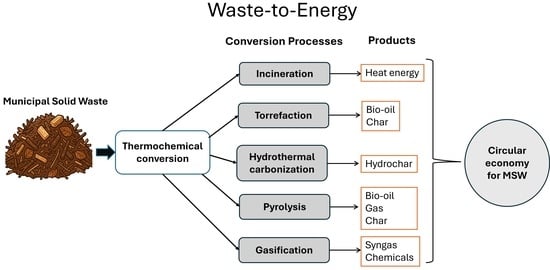
Graphical Abstract

1. Introduction

The generation of municipal solid waste (MSW) has experienced worldwide escalation, which is driven by population growth, urbanization, and changing consumption behaviors. Global MSW production in 2023 reached approximately 2.24 billion tonnes, with projections indicating an increase to 3.40 billion tonnes by 2050 under a business-as-usual scenario [1,2]. High-income countries generate about 34% of this waste despite comprising only 16% of the global population, averaging 1.5 kg per capita per day, while low-income countries produce 0.5 kg per capita daily but face disproportionate collection and disposal challenges [3]. Asia and Africa are hotspots for future growth; for instance, East Asia and the Pacific region accounted for 23% of the global MSW in 2016, expected to rise due to rapid economic developments [3]. These trends pose severe environmental challenges. Improper waste management contributes to greenhouse gas (GHG) emissions, with landfills emitting methane, a potent GHG with 28 times the global warming potential of CO2 over 100 years [4]. In 2016, emissions from the MSW sector accounted for 1.6 billion tons of CO2 equivalent worldwide, or 5% of all anthropogenic emissions [5]. Additionally, open dumping and landfilling release contaminants into groundwater and soils, aggravating the 11 million tonnes of plastic that reach the oceans each year [6]. These problems are made worse by biodiversity loss, resource depletion, and the risk of vector-borne illnesses to the public’s health, especially in poor nations where open dumping rates can reach 90% in certain places [7].

1.1. The Waste Management Hierarchy and Waste-to-Energy Position

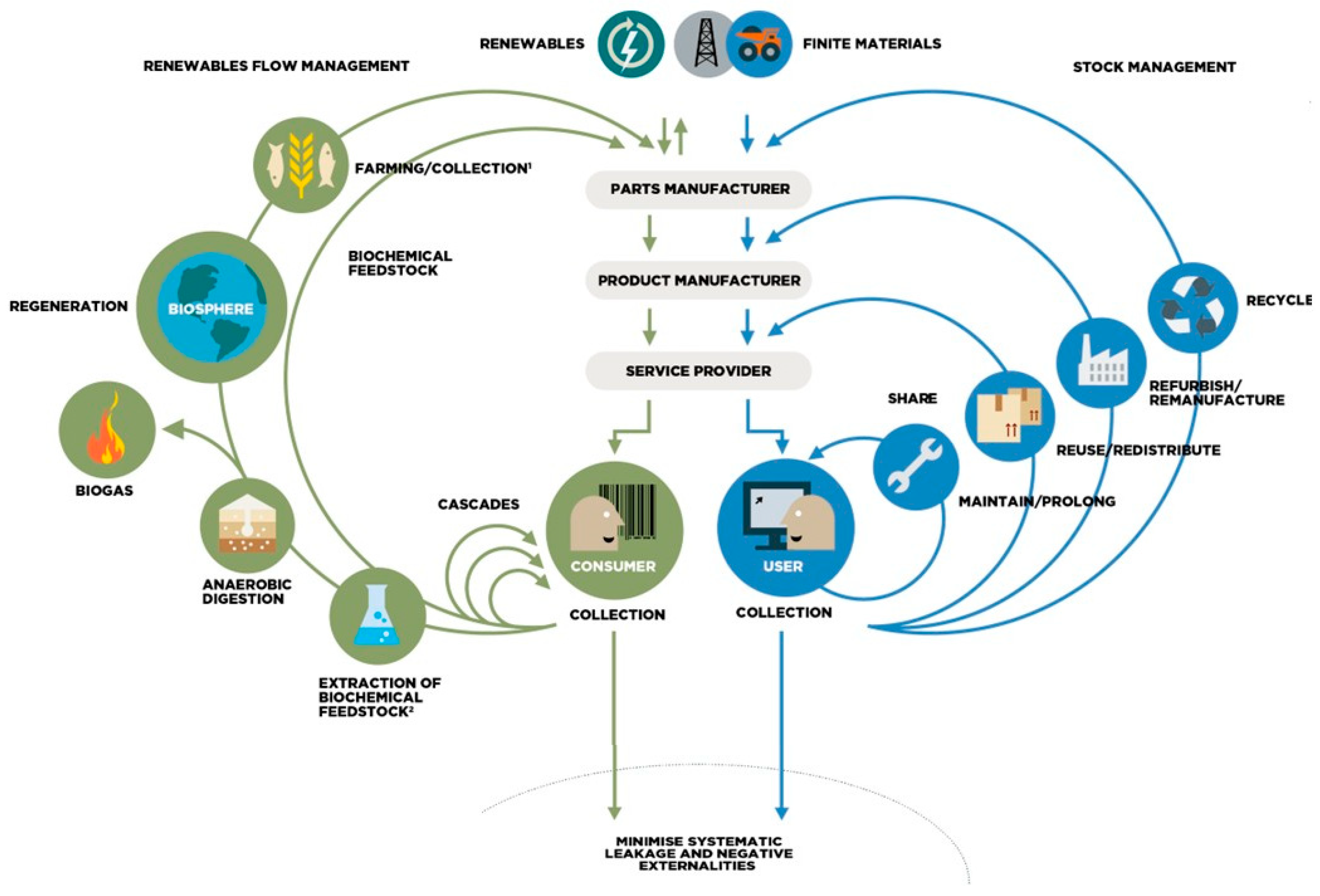
The waste management hierarchy provides a framework for prioritizing waste handling strategies, traditionally ranked from most to least preferred: prevention, reduction, reuse, recycling, energy recovery, and disposal. Within this hierarchy, WTE occupies a critical but often debated position between recycling and landfilling. While WTE diverts waste from landfills and generates energy, it sits below material recovery in the hierarchy because it consumes materials rather than preserving them for continued use. However, a more subtle different perspective emerges when considering the circular economy framework, which emphasizes keeping materials in productive use for as long as possible while obtaining maximum value, as shown by the Ellen MacArthur Foundation in Figure 1 [8]. This approach is intended to support resource efficiency and reduce environmental effects in a circular economy model [9]. Waste-to-energy (WtE) technologies occupy the energy recovery tier, positioned above recycling but below disposal, as they divert waste from landfills while generating energy, thereby reducing fossil fuel dependency and GHG emissions compared to landfilling [10]. Because of its context-dependent role, WtE handles non-recyclable items to supplement material recovery in areas with strong recycling rates, such as Europe, where recycling rates reached 48% in 2019 [11]. Critiques argue it may discourage upstream reduction if not regulated, potentially locking in waste generation [12]. However, integrated systems show WtE can achieve net energy gains and lower emissions when replacing coal-based power with modern facilities recovering between 14 and 20% more energy than lost in recycling foregone [13].

1.2. Definition and Scope of Waste-to-Energy Technologies

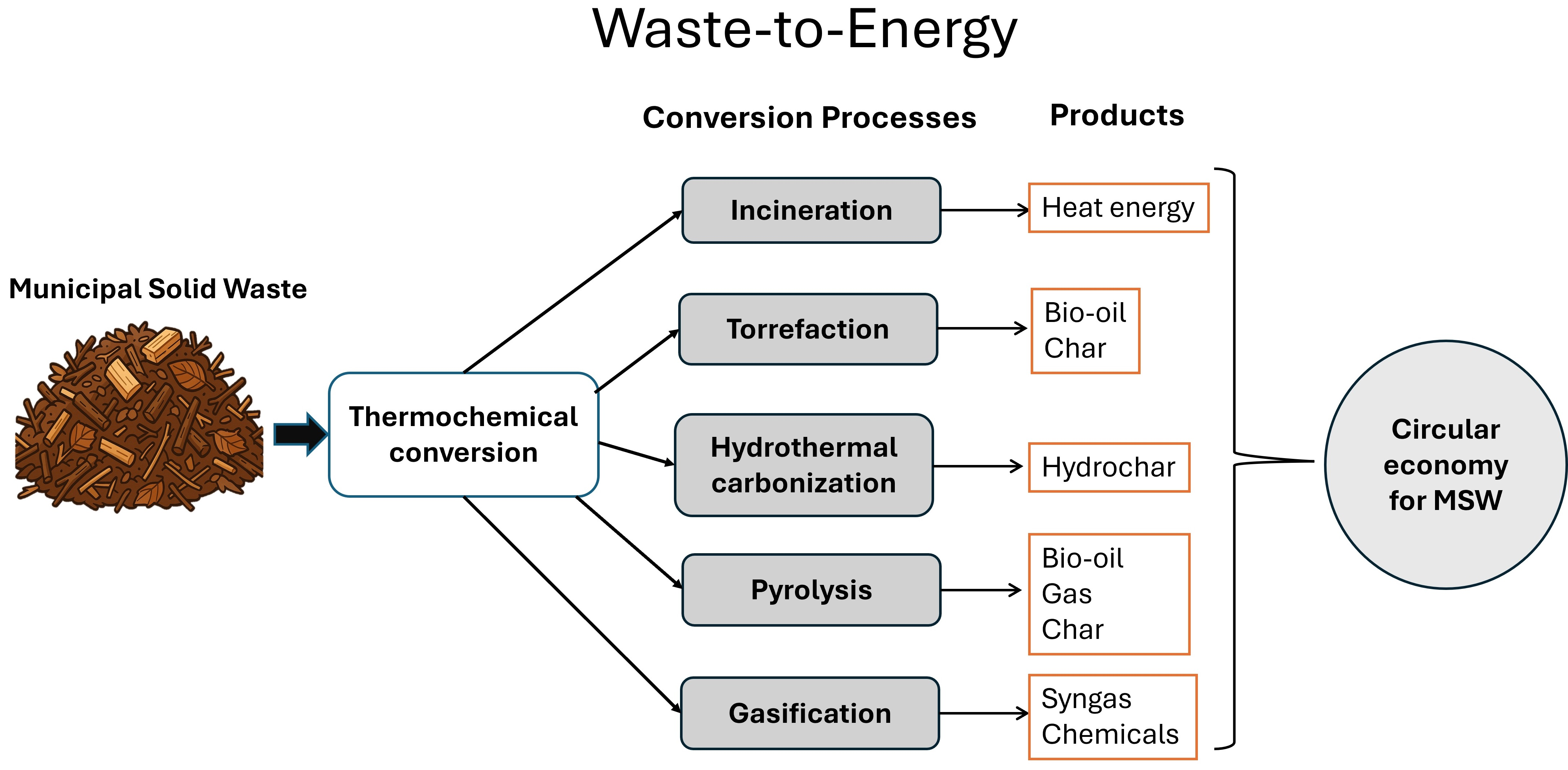
WtE includes operations that reduce volume and bulk while transforming waste into sources of energy that can be used, such as fuels, heat, or electricity [14]. In general, it encompasses thermochemical processes such as gasification, pyrolysis, and incineration. Due to their applicability for heterogeneous MSW, this evaluation focuses on thermochemical approaches rather than biochemical (anaerobic digestion) or mechanical treatments [15]. Combustion oxidizes waste fully; pyrolysis decomposes it anaerobically into oils and gases and partially oxidizes to produce syngas [16]. This scope excludes processes like composting, focusing on MSW fractions post-recycling. Global WtE potential treated 280 million tonnes in 2020, generating 150 TWh of electricity, equivalent to 0.6% of global power [17]. Thermochemical WtE handles diverse waste, achieves 80–90% volume reduction, and supports decarbonization by displacing fossil fuels [18].

1.3. Objectives and Structure of the Review

This review aims to (1) evaluate thermochemical WtE technologies for MSW management. (2) analyze their technical, environmental, and economic performance; (3) identify challenges and future directions for integration into sustainable systems. Drawing from the peer reviewed literature (2015–2023). It analyses advancements post-Paris Agreement to align with SDG 11 (sustainable cities) and SDG 12 (responsible consumption [19]. This review centers on thermochemical conversion technologies (incineration, pyrolysis, gasification, and hydrothermal carbonization) as applied to biogenic municipal solid waste (MSW) and its derived fractions, such as refuse-derived fuel (RDF), because these processes are particularly effective for managing the heterogeneous, high-moisture, and variable composition typical of MSW, while offering substantial energy recovery, volume reduction, and potential for resource valorization compared to landfilling or biochemical methods. Thermochemical approaches excel in handling mixed waste streams without requiring extensive sorting, producing usable products like electricity, heat, syngas, bio-oil, and char, and aligning with sustainable waste hierarchies by diverting non-recyclable fractions from disposal. Although the primary scope is MSW-specific, discussions incorporate insights from biomass and agricultural residues where data on pure MSW are limited or where co-processing is relevant. This inclusion is justified by the significant biogenic (organic) fraction in MSW, typically 50–70% of its content and energy value, which exhibits thermochemical behavior analogous to lignocellulosic biomass, enabling transferable mechanistic understanding of reaction pathways, product yields, and process parameters [20]. These synergies directly enhance the technical feasibility, energy efficiency, and environmental performance of thermochemical WtE for MSW management, particularly in addressing feedstock variability and low heating values, as demonstrated in recent studies [21,22]. By drawing on this broader feedstock knowledge, the review provides a comprehensive foundation for optimizing MSW thermochemical products.

Literature Search Methodology

The literature search was conducted in two major academic databases: Web of Science and Google Scholar, covering publications from January 2015 to December 2023, with selective inclusion of pre-2015 works for foundational concepts and highly cited studies. The search strategy employed Boolean operators combining two key term sets: (Set 1) waste-to-energy and conversion technology terms including “waste-to-energy”, “WtE”, “waste to energy”, “thermochemical”, “incineration”, “pyrolysis”, “gasification”, and “hydrothermal carbonization”; and (Set 2) feedstock and research focus terms including “municipal solid waste”, “MSW”, “urban waste”, “review”, “assessment”, “technology”, “emissions”, “LCA”, “economics”, “sustainability”, and “circular economy”. The complete Boolean search string was constructed as: (“waste-to-energy” OR “WtE” OR “waste to energy” OR “thermochemical” OR “incineration” OR “pyrolysis” OR “gasification” OR “hydrothermal carbonization”) AND (“municipal solid waste” OR “MSW” OR “urban waste” OR “review” OR “assessment” OR “technology” OR “emissions” OR “LCA” OR “economics” OR “sustainability” OR “circular economy”).
The search in Google Scholar yielded 536 results, while Web of Science returned 148 results, generating a total of 684 initial records. Following the removal of duplicates and systematic screening of titles and abstracts based on predefined inclusion and exclusion criteria, the dataset was refined to eliminate irrelevant studies that did not address waste-to-energy technologies for municipal solid waste. After this cleaning process, 275 studies were retained and formed the final basis for this review.

1.4. Thermochemical Conversion Technologies

Thermochemical conversion is prioritized for its robustness with unsorted MSW, high energy recovery and lower land use versus landfilling [23]. Unlike biochemical methods limited to organics (20–50% MSW fractions), thermochemical processes treat mixed waste, including plastics, yielding high calorific value (15–20 MJ/kg) [24]. These addresses global waste surge, where recycling plateaus at 30–40% recovery rates [3]. Environmental benefits include GHG savings of 0.5–1.2 tonnes of CO2 equivalent per tonne MSW processed versus landfilling [25]. Amid energy transitions, these technologies enable full synthesis, supporting net-zero goals. Modern incineration plants typically achieve net electrical efficiencies of 14–28% for electricity-only mode, while combined heat and power (CHP) configurations can reach overall system efficiencies of 60–80%, depending on plant size, waste lower heating value, and steam parameters [26]. Regarding GHG mitigation potential, life cycle assessments demonstrate that thermal waste-to-energy systems can achieve significant emissions reductions compared to conventional disposal methods. Specifically, landfilling and incinerating 1 tonne of MSW produce 1807.0 kg CO2-eq/t and 373.3 kg CO2-eq/t of GHG emissions, respectively, while recycling waste reduces emissions to merely 78.9 kg CO2-eq/t [27].

2. Municipal Solid Waste Characteristics

MSW serves as the primary feedstock for WtE processes, particularly thermochemical conversions, where its inherent properties directly influence process efficiency, product yields, and environmental outcomes. Understanding MSW characteristics is essential for optimizing technology selection and pre-treatment strategies. This section examines the composition, properties, variations, and pre-treatment needs of MSW, drawing on global data and studies. Solid Recovered Fuel (SRF) represents an upgraded, standardized combustible material derived from the MSW stream (or other non-hazardous waste sources), produced through advanced mechanical (and sometimes biological) treatment processes. Unlike basic RDF, which is a more heterogeneous, input-driven product obtained from shredded and partially sorted MSW with variable properties, SRF complies with strict international standards. SRF production typically involves several steps: pre-sorting to remove recyclables, shredding, screening, air classification, ballistic separation, magnetic/eddy current separation for metals, and often densification (e.g., pelletizing) to achieve homogeneity, reduced moisture (<15 wt% dry basis), and enhanced energy density [28,29]. RDF production typically involves several steps, including pre-sorting to remove recyclables, shredding, screening, air classification, ballistic separation, magnetic/eddy current separation for metals, and often densification (e.g., pelletizing) to achieve homogeneity, reduced moisture (<15 wt% dry basis), and enhanced energy density. The primary combustible fractions include paper/cardboard, plastics (excluding high-PVC), textiles, and wood, which contribute to higher and more stable calorific values compared to raw MSW.

2.1. Composition and Variability of MSW

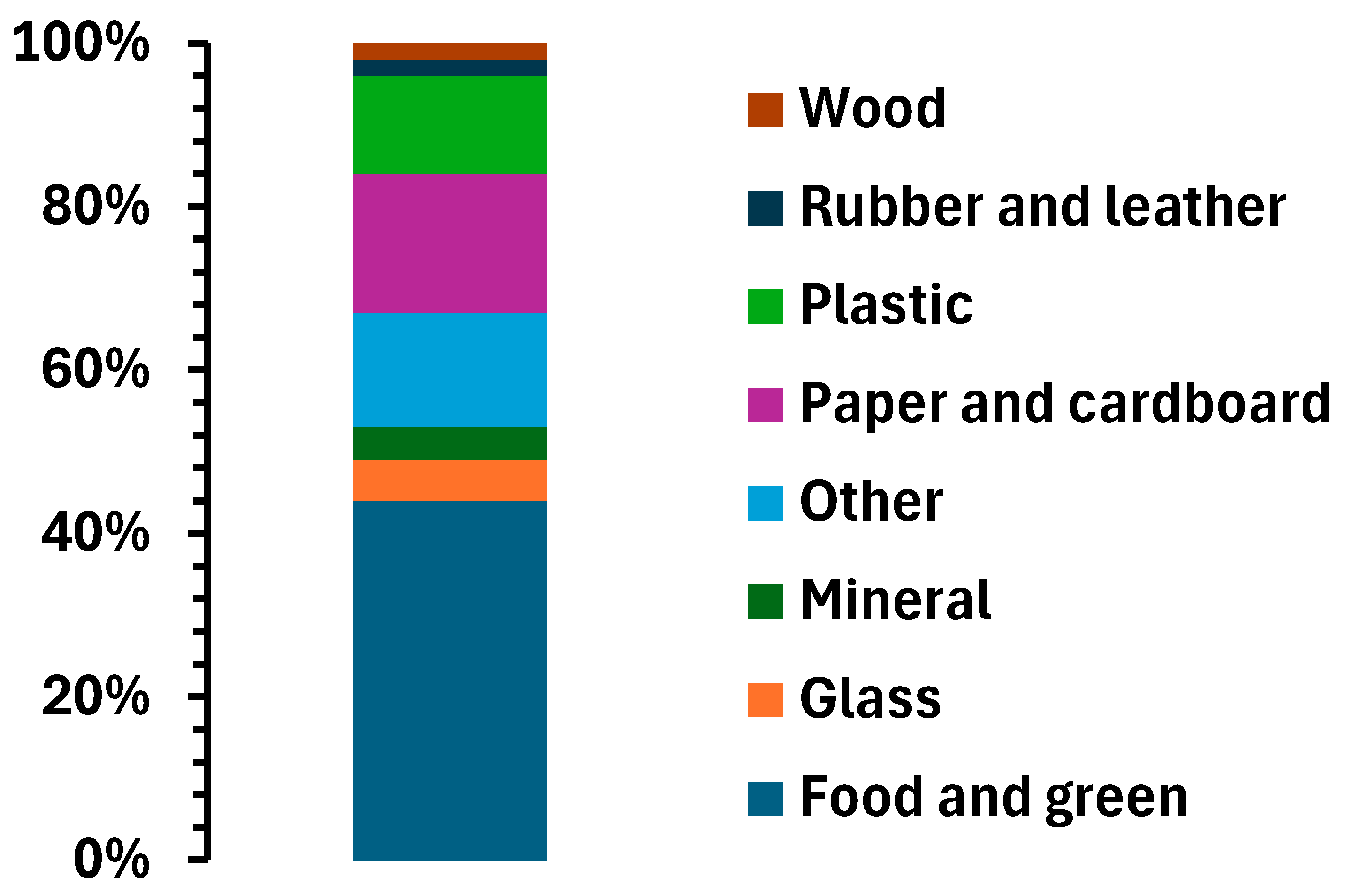
MSW typically comprises organic waste, paper and cardboard, plastics, metals, glass, textiles, and inert materials, with proportions varying widely based on socioeconomic factors, urbanization, and consumption patterns (Figure 2). Globally, organic fractions dominate in low- and middle-income countries, while recyclables like plastics and paper prevail in high-income nations [3]. For instance, in developing regions such as sub-Saharan Africa and South Asia, food waste can exceed 60%, whereas in Europe and North America, paper/cardboard and plastics constitute 40–50% [3]. Variability arises from household behaviors, seasonal changes, and waste collection systems. A study across 22 cities in China revealed that urban MSW contained 55–65% organics, 10–15% plastics, and 5–10% paper, with rural areas showing higher inert content due to construction debris [30]. In the European Union, MSW composition shifted from 2010 to 2020, with recyclables increasing to 48% owing to enhanced sorting policies, reducing the residual fraction suitable for WtE to about 25% [11]. This heterogeneity poses challenges for thermochemical processes, as inconsistent feeds can lead to variable energy outputs and emissions [10]. Elemental analyses of MSW reveal broad ranges in carbon, hydrogen, oxygen, nitrogen, and sulfur contents across different waste types, reflecting the influence of material heterogeneity and management strategies on fuel characteristics. Such variability can lead to fluctuations in calorific value, combustion behavior, and pollutant formation during thermal conversion, thereby necessitating waste preparation and characterization as part of process design [31].

2.2. Relevant Physical and Chemical Properties of Thermochemical Conversion

The suitability of MSW for thermochemical conversion, incineration, pyrolysis, and gasification depends on its physical (e.g., particle size, density and moisture content) and chemical properties like volatile matter, ash content, elemental composition and higher heating value, which collectively affect reaction kinetics, heat transfer, and product quality [32]. High moisture levels, particularly in food and yard waste fractions, reduce thermal efficiency by increasing the energy demand for drying, whereas plastics and paper typically contribute higher volatile content and calorific value, enhancing gas and liquid yields during pyrolysis [15,33]. In addition, ash-forming inorganic components affect slagging behavior, catalytic reactions, and the physicochemical characteristics of MSW-derived char [34] (Table 1). These factors ultimately determine the distribution of thermochemical derivatives, including biochar, syngas, and condensable organics, and therefore must be considered in process design and feedstock preparation [33]. To improve consistency and energy performance, MSW is often upgraded into SRF through mechanical processing, sorting, and drying [35]. Such treatment schemes increase feedstock homogeneity, reduce undesirable fractions, and enhance overall conversion efficiency, supporting both material recovery and energy maximization strategies in waste-to-energy systems [36]. SRF demonstrates substantially improved fuel properties compared to raw MSW through mechanical processing, sorting, and drying. The SRF production process yields a stable moisture content of 10–15% maximum, achieves 30% mass reduction, and increases calorific value by approximately 35% relative to the biogenic MSW stream [28].
These properties are quantified via proximate and ultimate analyses per ASTM standards, revealing MSW’s lower energy density than coal but potential for valorization [15].
For high-chlorine MSW, washing or additives mitigate corrosion in gasifiers [42]. Overall, pre-treatment boosts energy recovery by 20–30% but adds 10–15% to costs, underscoring the need for site-specific optimization [39].

3. Thermochemical Conversion Technologies

Thermochemical conversion technologies transform MSW into energy and valuable products through high-temperature processes. These include incineration, pyrolysis, gasification, hydrothermal carbonization (HTC), and co-processing approaches. This section examines their principles, operational parameters, products, and environmental considerations, focusing on their role in WtE systems.

3.1. Incineration

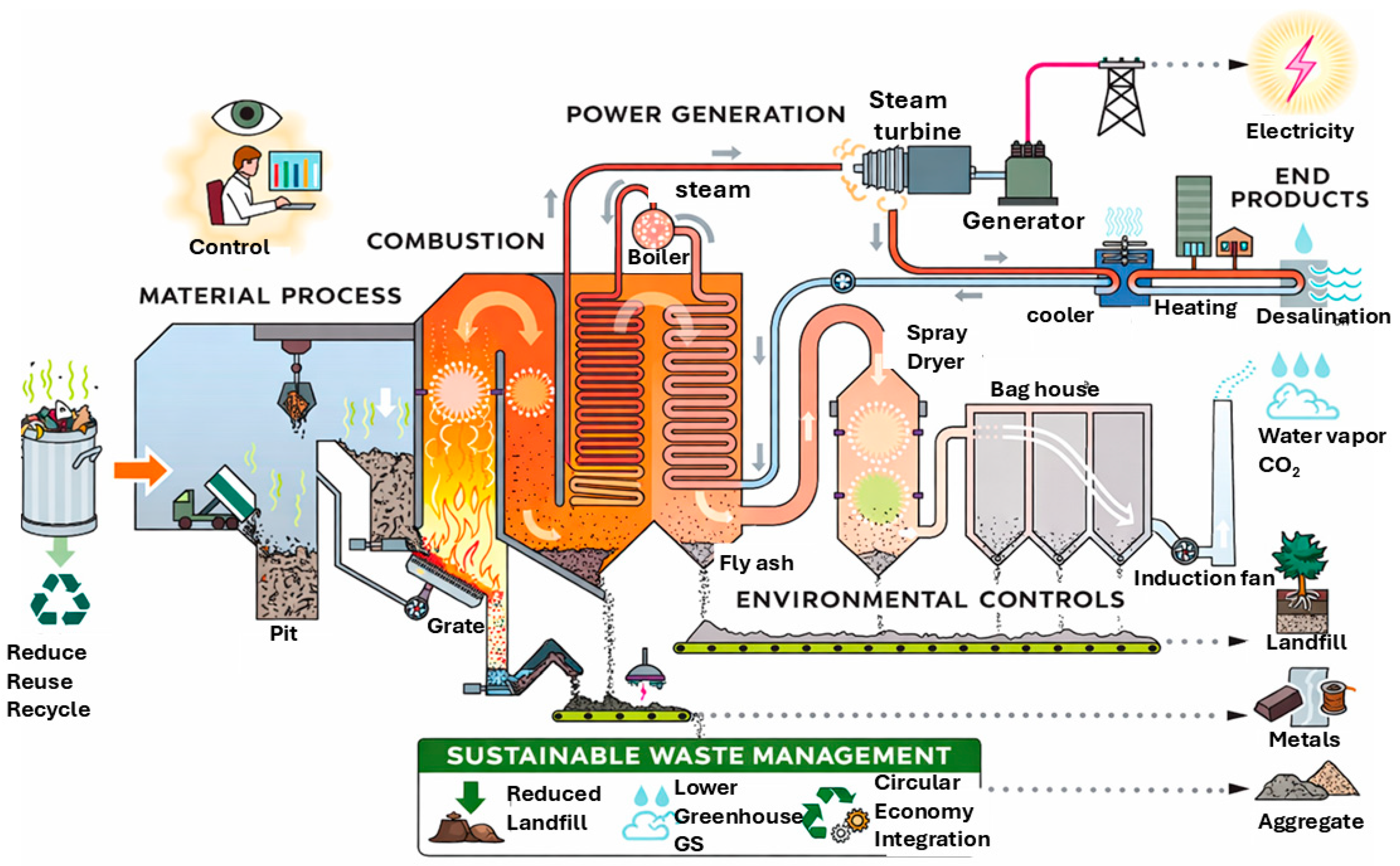
Incineration, also known as mass-burn combustion, remains the dominant thermal WtE technology for managing non-recyclable MSW. It involves controlled high-temperature combustion (typically 850–1100 °C) in grate furnaces, achieving approximately 90% volume reduction while generating steam to drive turbines for electricity production [43]. A typical modern grate-fired incineration plant comprises waste reception and bunker storage, feeding systems, a moving grate combustion chamber with primary and secondary air supply, a heat recovery boiler, flue gas cleaning, energy conversion via turbine-generator, and ash handling systems [44]. As of 2024, more than 2800 wte plants operated worldwide, with a total treatment capacity of about 576 million tonnes per year [45]. Projections indicate growth to approximately 3100 plants and over 700 million tonnes capacity by 2033, primarily driven by expansions in Asia, especially China and emerging markets, while Europe emphasizes plant modernization and efficiency improvements [45]. In Europe, over 500 plants focus heavily on CHP; China leads in capacity additions; and the U.S. maintains around 60 plants with roughly 2 GW electrical capacity [46]. Global electrical capacity from municipal waste WtE reached approximately 21.76 GW in 2024, though gasification and pyrolysis technologies remain limited in scale compared to incineration [47]. Incineration is the combustion of MSW at elevated temperatures (800–1200 °C) in the presence of oxygen to produce heat, which is converted into electricity or used for heating [48]. The process reduces waste volume by up to 90% and destroys organic pollutants [49]. Key parameters include temperature, residence time (1–2 s), and oxygen supply, which influence combustion efficiency and emissions [50].

3.2. Types of Incineration Systems

Incineration systems include mass burn, RDF, and modular systems. Mass burn processes for unsorted MSW are suitable for large-scale facilities. RDF systems use pre-processed waste with a higher calorific value, improving efficiency. Modular systems are smaller, designed for decentralized applications [10]. There is a difference in capacity and feedstock flexibility in each system. Energy recovery occurs through steam generation in boilers, through driving turbines for electricity, or supplying heat. Typical electrical efficiency ranges from 20–30%, with CHP systems reaching up to 80% total efficiency [51]. Efficiency depends on the waste calorific value and boiler design. Incineration produces heat, electricity, and district heating. Bottom ash (20–30% of input waste) and fly ash are byproducts, with potential for construction material use after treatment [52]. WtE plants equipped with CHP systems demonstrate significantly higher energy recovery rates compared to electricity-only facilities. In Europe, modern WtE plants with CHP achieve overall energy efficiencies of 70–85%, with electricity generation ranging from 500–700 kWh per ton of waste incinerated [53]. Japanese facilities are among the most efficient globally, with advanced plants generating approximately 600–650 kWh/ton and achieving thermal efficiencies exceeding 80% when heat recovery is included [54,55]. In the United States, WtE plants typically generate 500–600 kWh/ton with electrical efficiencies of 20–25%, though facilities with district heating systems can achieve combined efficiencies of 60–70% [56,57]. Canadian WtE facilities report similar performance metrics, with newer plants achieving 550–650 kWh/ton and overall energy efficiencies of 65–75% when integrated with district heating networks [58].

4. Products from Thermochemical Conversion

Thermochemical conversion technologies, such as incineration, pyrolysis, gasification, and hydrothermal carbonization, yield diverse products that contribute to energy recovery, material valorization, and chemical production. This section reviews the energy, material, and chemical products derived from these processes, drawing on recent literature to highlight their characteristics, applications, and challenges.

4.1. Energy Products

The primary aim of thermochemical conversion is to recover energy from MSW in the form of electricity, heat, and/or fuels. Studies show that incineration remains the most established method for electricity and heat generation from MSW. For instance, mass-burn incineration systems achieve electricity generation efficiencies of 20–30%, with CHP systems improving overall energy efficiency to 80% by recovering both electricity and heat for district heating [15]. Researchers note that gasification offers higher electrical efficiencies (up to 35%) when synthesis gas (syngas) is used in gas engines or turbines, though its commercial scalability lags incineration [59]. Pyrolysis, while less common for direct electricity production, generates bio-oil, which can be upgraded for use in internal combustion engines or turbines [60]. Liquid and gaseous fuels from thermochemical processes have garnered attention for their versatility. Bio-oil obtained from Pyrolysis has a characteristic high oxygen content and viscosity and requires upgrading to serve as a drop-in fuel, such as synthetic diesel, but its energy content (15–20 MJ/kg) makes it viable for industrial applications [61]. Gasification produces syngas, a mixture of CO, H2, and CH4, with a heating value of 4–10 MJ/Nm3 depending on the gasifying agent (air, oxygen, or steam) [62]. Recent studies show syngas applications in power generation and as a precursor for biomethane or hydrogen production, particularly when integrated with catalytic reforming [63]. HTC is less suited for energy products due to its focus on solid hydrochar, though the process, water can be anaerobically digested to produce biogas [64].

4.2. Material Products

Material products from thermochemical conversion, such as biochar, ash, and metal residues, offer opportunities for resource recovery and circular economy integration. Biochar and hydrochar, which are rich in carbon solids and used as a basic material for activated carbon, soil amendment, and carbon sequestration, are produced by pyrolysis and hydrothermal carbonization, respectively. According to Lehmann and Joseph, pyrolysis-derived biochar increases soil fertility by improving nutrient availability and water retention, with a potential for carbon sequestration of 0.7–1.3 t CO2 per ton of biochar [65]. Hydrochar, while less stable than biochar due to its lower degree of carbonization, is suitable for wet MSW fractions and shows promise in wastewater treatment as an adsorbent [66].
Incineration generates bottom ash and fly ash, which present both challenges and opportunities. Bottom ash, constituting 15–20% of MSW by weight, is widely used in construction as an aggregate substitute in road bases and concrete, though its leaching potential requires pre-treatment [67]. Fly ash, classified as hazardous due to heavy metal content, can be stabilized for use in cement production or landfilled after treatment [68]. Metal recovery from ash residues is gaining traction, with studies demonstrating that magnetic separation can recover 1–2% of ferrous metals from bottom ash, enhancing resource efficiency [69]. Gasification slag, a vitrified residue, is inert and suitable for construction applications, though its valorization is less studied compared to incineration ash [70]. In the United States, the most used WtE system is the mass-burn system. As seen in Figure 3, unprocessed MSW is burned in an incinerator equipped with a boiler and a generator that helps to produce electricity.

4.3. Chemical Products

Thermochemical processes also yield chemical products, particularly from pyrolysis and gasification. Syngas serves as a feedstock for platform chemicals via Fischer-Tropsch synthesis, producing methanol, ethanol, or hydrocarbons [71]. Bio-oil from pyrolysis contains oxygenated compounds (e.g., phenols, aldehydes) that can be upgraded to produce specialty chemicals, such as resins or adhesives, though challenges in separation and purification persist [60]. Carbon black, a high-value product, can be derived from pyrolysis char through further processing, with applications in tire manufacturing and pigments [72]. Recent literature emphasizes the potential of integrating thermochemical processes with chemical production to enhance economic viability. For example, catalytic pyrolysis can increase the yield of aromatic hydrocarbons suitable for chemical synthesis, though catalyst deactivation remains a barrier [61]. Plasma gasification, an advanced variant, produces high-purity syngas, enabling efficient chemical synthesis, but its high energy costs limit widespread adoption [73]. These findings underscore the need for further research into cost-effective upgrading and purification techniques to make chemical products competitive with fossil-derived alternatives.

5. Environmental and Sustainability Assessment

This section evaluates the environmental and sustainability implications of thermochemical WtE technologies, including incineration, pyrolysis, gasification, and HTC. By synthesizing findings from recent studies, emissions and pollutant control, life cycle impacts, and integration with circular economy principles, the role of these technologies in sustainable MSW management can be assessed and highlighted.

5.1. Emissions and Pollutant Control

Thermochemical WtE technologies convert MSW into energy and material products but generate emissions that require stringent control to minimize environmental and health impacts. Key air pollutants include NOx, SOx, dioxins, furans, and heavy metals, which vary depending on the technology, feedstock composition, and operating conditions [74].

5.1.1. Air Pollutants

The most adopted thermochemical process, incineration, produces significant quantities of NOx and SOx due to high-temperature combustion of nitrogen- and sulfur-containing waste fractions (e.g., plastics, food waste). Dioxins and furans, persistent organic pollutants, form during incomplete combustion, particularly in the presence of chlorine-containing materials like polyvinyl chloride (PVC) [75]. Gasification and pyrolysis, operating under oxygen-limited conditions, typically emit lower levels of NOx and SOx but can produce volatile organic compounds (VOCs) and polycyclic aromatic hydrocarbons (PAHs) due to incomplete thermal decomposition [15]. These persistent organic pollutants form through three main pathways: (1) high-temperature gas-phase reactions (homogeneous synthesis) from chlorinated precursors like chlorophenols and chlorobenzenes at 500–800 °C; (2) low-temperature heterogeneous “de novo” synthesis on fly ash surfaces involving carbon, chlorine, and catalysts at 200–400 °C; and (3) precursor synthesis from incomplete combustion products [31]. Heavy metals, including mercury (Hg), cadmium (Cd), lead (Pb), zinc (Zn), and copper (Cu), volatilize at high temperatures and partition predominantly into fly ash and flue gases, with less volatile metals like chromium (Cr) and nickel (Ni) enriching bottom ash [42]. Heavy metals, such as mercury and cadmium, concentrate in fly ash and flue gases, posing risks if not effectively managed. HTC, primarily suited for wet organic waste, generates fewer gaseous emissions but produces process water containing organic pollutants, requiring treatment [76]. In contrast, pyrolysis and gasification operate under oxygen-limited or reducing conditions, which inherently suppress NOx and SOx formation by minimizing oxidation of nitrogen and sulfur [77]. These processes produce lower levels of these acid gases compared to incineration, though VOCs and PAHs may arise from incomplete decomposition [15]. Dioxins and furans are significantly reduced in pyrolysis and gasification due to the absence of excess oxygen and lower propensity for de novo synthesis; studies indicate emissions are often orders of magnitude lower than in incineration, frequently below regulatory limits without extensive controls [78,79]. However, residual chlorine and metals in the feedstock can still lead to minor formation if post-processing is not optimized.

5.1.2. Feedstock-Specific Emission Profiles

The environmental performance of thermochemical waste-to-energy technologies varies significantly depending on feedstock characteristics. MSW, SRF, and RDF exhibit distinct emission profiles due to differences in composition, heating value, and contaminant content. Ragazzi et al. demonstrated that fuel selection critically influences environmental performance in district heating applications. Their comparative analysis revealed that LHVs of lignite coal from Romania and Italy exceeded those of raw MSW but were comparable to residual municipal solid waste (RMSW) and bio-dried waste [80]. This variation in energy content directly impacts combustion efficiency and emissions per unit of energy produced. Particulate matter (PM) emissions from waste combustion exhibit complex behavior influenced by feedstock composition (Table 2). Qin et al. demonstrated that PM10 from solid waste combustion displays a trimodal distribution, with yields of PM1 and PM10 correlating linearly with the (Na2O + K2O)/(SiO2 + Al2O3) ratio in fuel ash. As this ratio increases, both PM1 yields and the PM1/PM10 increase proportionally [81].

5.1.3. Emission Control Technologies

To mitigate these pollutants, WtE facilities employ advanced emission control systems. Incineration plants commonly use wet and dry scrubbers to neutralize acid gases (SOx, HCl), electrostatic precipitators (ESPs) or baghouse filters to capture particulate matter and activated carbon injections to trap dioxins and heavy metals [83]. Selective catalytic reduction (SCR) and selective non-catalytic reduction (SNCR) effectively reduce NOx emissions by converting them to nitrogen and water. Gasification systems require syngas cleaning technologies, such as cyclones, wet scrubbers, and catalytic tar reforming, to remove particulates and tars before utilization [15]. Pyrolysis systems, producing bio-oil and syngas, often integrate condensers and filters to manage VOCs and PAHs. HTC facilities focus on wastewater treatment, employing anaerobic digestion or membrane filtration to handle process water [76]. Studies show that modern WtE plants, when equipped with state-of-the-art controls, can achieve emission levels well below regulatory thresholds, though capital and operational costs remain significant [84]. Effective particulate matter control represents an important component of sustainable WtE operations, particularly in urban environments where PM2.5 and PM10 contribute significantly to air quality degradation and public health impacts. Ionescu et al. provided a comprehensive analysis of practical PM reduction strategies applicable to urban waste-to-energy facilities.

5.1.4. Regulatory Frameworks and Emission Standards

Emission standards for WtE facilities vary globally but are increasingly stringent. The European Union’s Industrial Emissions Directive sets limits for dioxins (0.1 ng/Nm3), NOx (200 mg/Nm3), and SOx (50 mg/Nm3) for incineration plants [85]. In the United States, the Clean Air Act mandates similar controls, with additional requirements for continuous emissions monitoring [86]. Developing countries, such as India and China, have adopted standards inspired by Western frameworks but face challenges in enforcement due to cost constraints and technological gaps [87]. Compliance with these standards drives innovation in emission control but increases project costs, influencing the economic feasibility of WtE technologies. Table 3 summarizes the emission standards for hazardous air pollutants from MSW incineration plants in countries including the USA, Japan, Canada, China and the EU.

5.2. Life Cycle Assessment

Life cycle assessment (LCA) provides a holistic framework to evaluate the environmental impacts of thermochemical WtE technologies, from feedstock collection to product utilization and residue disposal. LCAs quantify impacts across categories such as global warming potential, energy balance, and resource depletion. LCAs typically adopt a functional unit of 1 tonne of MSW processed or 1 kWh of electricity generated, incorporating system expansion to account for avoided impacts from displaced landfilling (e.g., methane emissions) or fossil energy substitution [10]. Recent studies emphasize the importance of consistent system boundaries, energy substitution modeling, and sensitivity analyses to address uncertainties in waste composition, energy efficiency, and regional energy mixes [92].

5.2.1. Carbon Footprint and GHG Emissions

Thermochemical WtE technologies generally yield reduced GHG emissions compared to landfilling, which emits methane, a potent GHG. Incineration with energy recovery offsets fossil fuel use, yielding net GHG savings of approximately 0.1–0.5 tCO2e per ton of MSW processed, depending on energy mix and efficiency [10]. Gasification and pyrolysis offer similar benefits but vary with product use; for instance, syngas used for power generation has a lower carbon footprint than bio-oil combustion due to higher conversion efficiencies [93]. HTC, suitable for wet waste, achieves lower GHG emissions by avoiding energy-intensive drying, but is less studied [94]. However, emissions from auxiliary processes, such as feedstock pre-treatment and emission control, can offset these benefits, necessitating optimization [92]. Patterns across studies indicate incineration’s reliable performance in mature systems with CHP, whereas gasification frequently exhibits lower impacts due to cleaner syngas utilization and reduced direct emissions [95]. Divergences arise from assumptions about energy credits (e.g., grid mix) and residue handling; optimistic scenarios credit high avoided emissions, while conservative ones highlight auxiliary energy use. Consensus emerges that all thermochemical options reduce global warming potential by 50–85% compared to landfilling without gas capture, with gasification and advanced incineration showing the strongest advantages in recent assessments [96].

5.2.2. Energy Balance and Net Energy Ratio

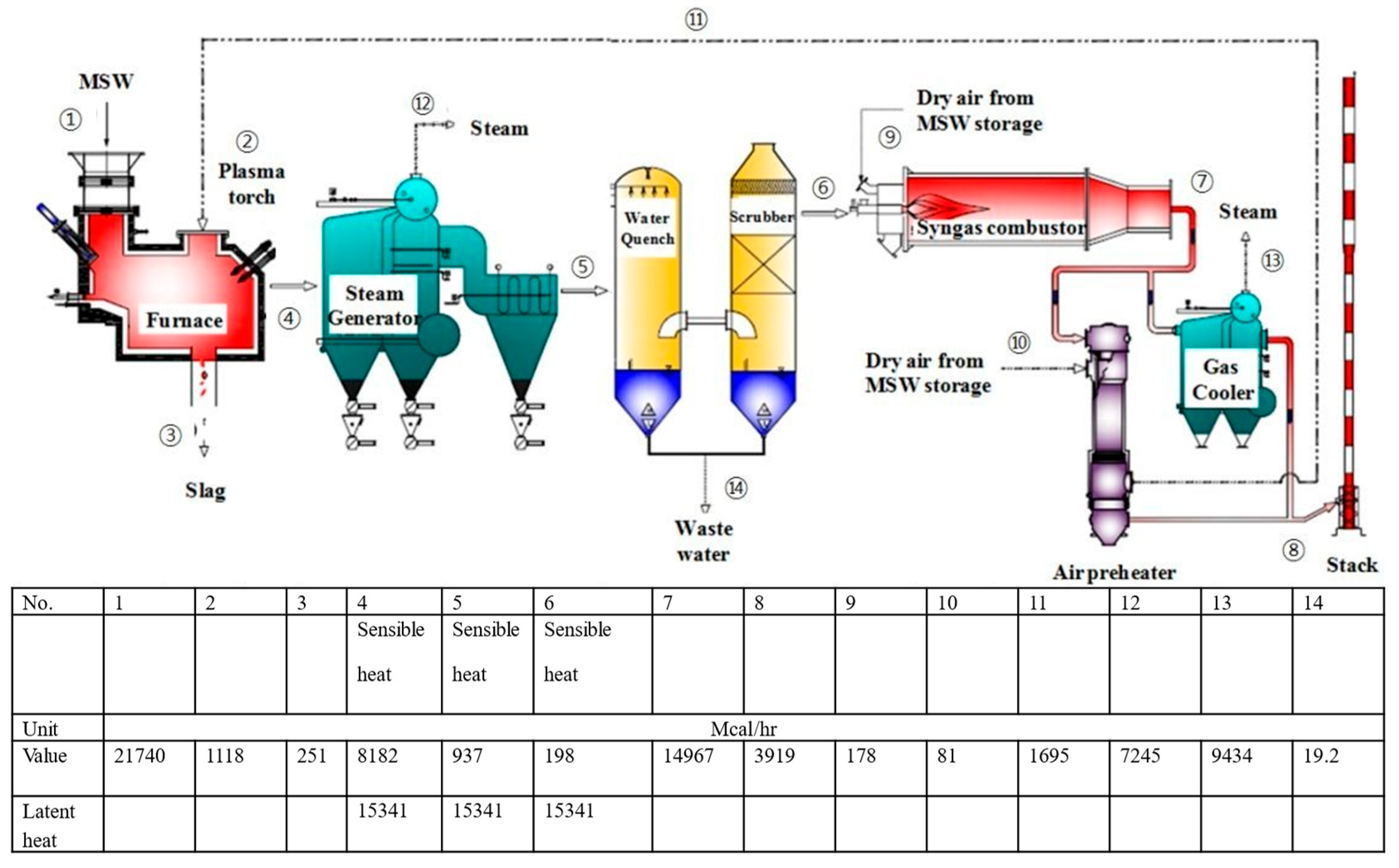
The net energy ratio (NER), defined as the ratio of energy output to energy input, is an important metric for WtE sustainability. Incineration typically achieves an NER of 0.6–0.8, with CHP systems improving efficiency to 0.9–1.2 [10]. Gasification and pyrolysis have lower NERs (0.4–0.7) due to energy losses in syngas cleaning and product upgrading, though advanced reactor designs are narrowing this gap [15]. HTC’s energy balance is favorable for wet feedstocks, with NERs of 0.8–1.0, as it avoids energy-intensive drying [94]. These ratios emphasize how important feedstock selection and process optimization are to maximizing energy recovery. A biomass gasification WtE system, including energy from feedstock to syngas production, a thermal plasma gasification for power, and related energy outputs are shown in Figure 4 [97]. The input is primarily from MSW feedstock, converted to syngas. Outputs focus on electrical power from the ICE, with heat recovery possible but emphasizing losses in conversion (e.g., tar, char, and heat dissipation).

5.2.3. Comparison with Landfilling and Other Disposal Methods

Compared to landfilling, thermochemical WtE technologies reduce environmental impacts by minimizing methane emissions and land use [98]. Some studies LCAs studies have shown that incineration reduces global warming potential by 50–70% compared to landfilling without gas capture [92]. Gasification and pyrolysis further reduce impacts when producing high-value products like syngas or biochar, though their benefits diminish if energy recovery is inefficient [93]. Recycling, while preferable for recoverable materials, is less effective for mixed or contaminated MSW, where WtE technologies excel [10]. HTC complements recycling by processing wet organic fractions unsuitable for other methods [94]. Beyond GHG emissions, LCAs assess impacts like acidification, eutrophication, and human toxicity. Incineration contributes to acidification due to NOx and SOx emissions, though modern controls mitigate this [84]. Pyrolysis and gasification reduce acidification by operating under oxygen-limited conditions but may increase toxicity if bio-oil or ash is mismanaged [15]. HTC’s primary impact is water-related, due to process water disposal, though integration with wastewater treatment mitigates this [76]. HTC, suited for high-moisture fractions, yields favorable GHG balances by avoiding energy-intensive drying. Studies report net reductions through hydrochar production and process water valorization, though auxiliary energy inputs and process water treatment influence outcomes [94,99]. Overall, WtE technologies offset fossil electricity and avoid landfill CH4, with net savings often 50–85% compared to landfilling without gas capture [10,100].
Figure 4. Thermal plasma gasification plant processing MSW (tons per day) [99].
Recycling 11 00056 g004

5.3. Circular Economy Integration

Thermochemical WtE technologies align with circular economy (CE) principles by transforming non-recyclable MSW fractions into energy and secondary materials, thereby reducing virgin resource extraction, minimizing landfill dependency, and closing material loops through residue valorization [32,101]. These processes support the EU Waste Framework Directive’s hierarchy, which prioritizes prevention, reuse, and recycling before energy/material recovery, with disposal as the least preferred option [102]. Thermochemical WtE primarily occupies the “other recovery” tier for residual, non-recyclable waste, while enabling reintegration of residues into productive cycles.

5.3.1. Material Recovery and Recycling Synergies

WtE technologies complement recycling by processing non-recyclable MSW fractions. Incineration recovers metals from bottom ash, with European plants achieving 80–90% metal recovery rates [83]. Pyrolysis and gasification produce biochar and slag, which can be used as soil amendments or construction materials, respectively [15]. HTC’s hydrochar serves as a soil enhancer or activated carbon precursor, supporting agricultural and industrial applications [94]. Integrating WtE with source separation enhances recycling rates by diverting recoverable materials before thermochemical processing [92].

5.3.2. Residue Management and Valorization

Residue management is critical for sustainability. Incineration bottom ash is widely used in road construction, with studies confirming its stability and low leaching potential [68,83]. Fly ash, containing heavy metals, requires stabilization or vitrification before disposal or reuse [84]. Gasification slag and pyrolysis biochar have applications in cement production and soil remediation, respectively, though standardization is needed [15]. HTC process water can be anaerobically digested to produce biogas, closing the resource loop [66]. Comparative LCAs consistently indicate that thermochemical WtE reduces global warming potential by 50–75% compared to landfilling without gas capture [75]. However, divergences emerge in toxic impacts: incineration performs well with advanced flue gas cleaning, while pyrolysis and gasification show lower acidification but higher variability from tar/bio-oil management. Recent studies highlight gasification’s edge in net energy ratio when syngas is used efficiently, though sensitivity to feedstock heterogeneity remains a common limitation

5.3.3. Contribution to Resource Efficiency

By converting waste into energy and materials, WtE technologies reduce landfill dependency and fossil fuel use. Studies estimate that WtE can meet 5–10% of global energy demand while diverting 20–30% of MSW from landfills [10]. Integration with renewable energy systems, such as solar or wind, further enhances resource efficiency by stabilizing energy output [93]. In developing countries, WtE supports resource efficiency by managing growing waste volumes, though infrastructure and policy gaps must be addressed [39,89].

6. Technical and Economic Considerations

Thermochemical conversion technologies, including incineration, pyrolysis, gasification, and HTC, present unique technical and economic challenges and opportunities for MSW management. This section examines the critical process parameters, scale considerations, and economic factors influencing the adoption of these technologies, drawing on recent literature to highlight advances, contradictions, and gaps in current understanding.

6.1. Process Parameters and Optimization

To maximize the effectiveness and output quality of thermochemical conversion processes, it is essential to optimize process parameters, including temperature, pressure, and residence time. According to Brunner and Rechberger, elevated temperatures (usually 850–1100 °C) during incineration guarantee full combustion and reduce the production of dioxin [14]. Jones et al. countered that elevated temperatures could raise operating costs because they cause refractory wear and increased fuel consumption, recommending 900–1000 °C as the ideal range for the majority of MSW compositions [103].
In pyrolysis, temperature and residence time significantly affect product distribution. Slow pyrolysis at 400–600 °C favors biochar production, while fast pyrolysis at 500–700 °C maximizes bio-oil yield, as demonstrated by Czajczyńska [60]. Their study highlighted that precise control of heating rates is essential for tailoring product outputs to specific applications. In contrast, Garcia-Nunez et al. posited that feedstock variability often overshadows the impact of temperature, complicating process optimization for heterogeneous MSW [104]. Gasification requires careful management of gasifying agents (air, oxygen, steam, or CO2) and temperature (700–1500 °C) to optimize syngas quality. Arena emphasized that oxygen-blown gasification at higher temperatures enhances syngas calorific value but increases costs due to oxygen production [15]. Conversely, Heidenreich and Foscolo suggested steam gasification as a cost-effective alternative, producing hydrogen-rich syngas, though it requires additional cleaning to remove tars [62].
Catalysts and additives play a pivotal role in improving process efficiency. For instance, in gasification, dolomite and nickel-based catalysts reduce tar formation, as shown by Shen and Yoshikawa [105]. However, Ming Hsun and Ding [106] noted that catalyst deactivation due to ash fouling remains a significant challenge, particularly for MSW with high inorganic content. Similarly, in HTC, catalysts like citric acid can enhance hydrochar yield, but their cost-effectiveness remains debated [107,108].
Feedstock variability management is another important aspect of MSW valorization that needs attention. MSW’s heterogeneity in moisture, calorific value, and composition complicates process stability. In the works of Dong et al., they emphasized pre-treatment techniques like drying and shredding to homogenize feedstock, improving process reliability [59]. Contrary to this, Panepinto et al. argued that excessive pre-treatment increases operational costs, suggesting adaptive control systems to handle variability in real-time [51].

6.2. Scale and Capacity Considerations

The scale of thermochemical conversion systems influences both technical feasibility and economic viability. Large-scale incineration plants benefit from economies of scale, as highlighted by Psomopoulos et al. [109]. Their analysis of European facilities showed that large-scale systems achieve higher energy recovery efficiencies. However, smaller communities often lack sufficient MSW volumes, leading to underutilized capacity, as noted by Eriksson et al. [110].
Modular and decentralized systems offer an alternative for smaller scales. In their work, Kumar and Samadder emphasized that modular incineration and gasification units (50–200 tonnes/day) are suitable for rural or developing regions with dispersed waste sources [87]. These systems reduce transportation costs but face challenges in maintaining consistent energy output due to feedstock variability. In contrast, Jung argued that centralized large-scale gasification plants are more efficient for syngas production, particularly when integrated with downstream applications like Fischer-Tropsch synthesis [111].
Feedstock requirements and collection logistics are critical for scaling. Large-scale facilities require robust waste collection networks, which can be challenging in developing countries, as discussed by Guerrero et al. [112]. They highlighted that inconsistent waste supply disrupts plant operations, reducing economic viability. Conversely, decentralized systems can leverage local waste streams, but their smaller scale often results in higher per-unit processing costs, as noted by Dong et al. [59]
Based on available data from relevant studies, including Psomopoulos et al. [109] and Kumar and Samadder [87] on technological options for municipal solid waste management, as well as additional sources like the IEA Bioenergy Task 36 report on small-scale energy-from-waste, here’s a comparison of throughput capacities and energy efficiencies. Note that Psomopoulos et al. primarily focus on large-scale systems (with small-scale representing only ~5% of U.S. capacity at 32–227 tonnes/day) and report average net electricity generation of ~600 kWh per tonne in modern plants (Table 4). Kumar and Samadder emphasize that larger installations generally offer better energy recovery (up to 30% for electricity and 60% for combined heat and power), while pyrolysis/gasification may suit modular setups but with trade-offs in efficiency. The IEA report provides the most direct comparisons, defining small-scale as <100,000 tonnes/year

6.3. Economic Analysis

The economic feasibility of thermochemical WtE technologies depends on capital and operational costs, revenue streams, and policy incentives. Incineration plants have high capital costs (approximately $100–300 million for a 500,000-tonne/year facility), as reported by Tangri and Yukon Energy Corporation [116,117]. Operational costs, including maintenance and emission control, further increase expenses. However, revenue from electricity, heat, and gate fees can offset costs. In their analysis, Tabata [118] emphasized that CHP systems significantly improve economic returns by utilizing waste heat for district heating.
Pyrolysis and gasification face higher capital costs than incineration due to complex reactor designs and syngas cleaning requirements. According to Veses, small-scale pyrolysis plants have capital costs of $5–10 million for 50–100 tonnes/d, with operational costs driven by energy-intensive pre-treatment and product upgrading [119]. Al-Salem et al. argued that pyrolysis’s ability to produce high-value products like bio-oil and biochar could yield better returns than incineration in niche markets, though market volatility for these products remains a concern [120].
Economic feasibility varies by technology and region. Gasification’s high upfront costs are justified in regions with strong policy incentives, such as feed-in tariffs, as shown by Watson et al. [63]. However, Dong et al. argued that gasification’s economic viability is limited in developing countries due to low gate fees and underdeveloped energy markets. Policy incentives, such as carbon credits and renewable energy subsidies, are critical for WtE adoption [94]. In their work, Malinauskaite et al. highlighted that European Union directives have driven incineration growth through favorable gate fees, while emerging economies often lack such support [35]. Payback periods for WtE projects typically range from 7–15 years, depending on scale and revenue streams. Cucchiella and Dong noted that incineration plants with CHP achieve shorter payback periods (7–10 years) compared to gasification (10–15 years) [121,122]. Comparative analyses by Panepinto et al. show that incineration remains the most economically viable for large-scale applications, while pyrolysis and gasification are more competitive in niche or decentralized settings [51].

7. Case Studies and Industrial Applications

This section reviews practical implementations of thermochemical WtE technologies, specifically incineration, gasification, and pyrolysis, through global case studies. By examining commercial-scale incineration plants, operational gasification projects, emerging pyrolysis applications, and comparative analyses, the discussion points out performance metrics, technical challenges, and success factors. The analysis draws on published literature to contextualize the role of these technologies in MSW management systems.

7.1. Commercial-Scale Incineration Plants

Incineration is the go-to thermochemical WtE technology; it has been around the longest and handles huge amounts of mixed MSW. Take the Avesta plant in Sweden, for example. Every year, it incinerates about 200,000 tonnes of waste and gets roughly 2.5 MWh of heat from each tonne. That heat goes into warming homes and communities nearby [123]. The plant runs on a mass-burn system and does not cut corners on emissions. They have advanced control electrostatic precipitators and selective catalytic reduction, so they meet the EU’s stringent standards. These systems help in cutting down dioxins, NOx, and particulate matter, keeping the air clean and ensuring environmental compliance [33]. In Asia, Japan’s Tokyo Rinkai Recycle Power plant demonstrates large-scale incineration, processing 600,000 tonnes of MSW per year. The facility generates electricity at an efficiency of about 20% and recycles bottom ash for construction [124]. Public acceptance in Japan is supported by transparent emission monitoring and community engagement, addressing concerns about air quality [125]. In contrast, developing countries like India face challenges due to high moisture content in MSW, requiring pre-treatment such as RDF production to enhance calorific value [126]. These case studies show the necessity of adapting incineration systems to local waste characteristics and regulatory frameworks.

7.2. Gasification Projects

Gasification offers flexibility in producing syngas for energy and chemical applications, though it is less widespread than incineration due to technical complexity. The Lahti Energy plant in Finland, operational since 2012, gasifies 250,000 tonnes of RDF annually using a circulating fluidized bed (CFB) gasifier, and it produces 50 MW of electricity and 90 MW of district heating, achieving a net energy efficiency of 85% [127]. Tar formation, a common challenge, is mitigated through hot gas filtration, though this increases operational costs [128]. The use of RDF ensures consistent feedstock quality, critical for stable syngas production.
In Canada, the Enerkem facility in Edmonton converts 100,000 tonnes of MSW into 38 million liters of ethanol annually via syngas fermentation, showing gasification’s potential for biofuel production [129]. Syngas cleaning to remove contaminants like hydrogen chloride remains a significant challenge, requiring advanced conditioning systems [62]. In developing regions, small-scale gasification units, such as a 1 MW fixed-bed gasifier in India, process MSW and agricultural residues but face reliability issues due to feedstock variability [130].

7.3. Pyrolysis Implementations

Pyrolysis is an emerging WtE technology with growing interest due to its ability to produce bio-oil, biochar, and syngas. The Ensyn facility in Ontario, Canada, employs fast pyrolysis to process 20,000 tonnes of biomass and MSW-derived RDF annually, yielding 3 million gallons of bio-oil for industrial heating [131]. The bio-oil has a calorific value of 15 to 20 MJ/kg, but its high oxygen content limits applications without upgrading [60]. In Europe, the Fortum pyrolysis plant in Finland processes plastic-rich MSW fractions, producing bio-oil for chemical feedstocks, demonstrating versatility in product outputs [132]. The technology readiness level (TRL) for MSW pyrolysis is estimated at 6 to 7, indicating a transition from pilot to commercial stages [133]. Challenges include reactor fouling due to ash accumulation and variability in product yields caused by heterogeneous feedstocks [104].

7.4. Comparative Analysis and Future Prospects

Comparative analysis of these case studies reveals distinct strengths and challenges. Incineration, with a TRL of 9, excels in scalability and reliability, as seen in Avesta’s consistent energy output [134]. However, high capital costs and public opposition due to emission concerns can limit deployment, particularly in regions with strict regulations [125]. Gasification, as demonstrated by Enerkem, offers versatility in producing biofuels and chemicals but requires complex syngas cleaning, increasing costs and operational challenges [62]. Pyrolysis, while promising for material recovery, faces economic hurdles due to lower TRL and high pre-treatment costs [60]. Success factors include integration with existing waste management systems, as seen in Tokyo’s ash recycling, and optimizing feedstock quality through RDF production, as in Lahti [124,127]. Technology selection depends on local waste characteristics, energy demands, and regulatory frameworks. Incineration suits urban areas with high waste volumes, while gasification and pyrolysis are better for regions prioritizing chemical or material outputs [130]. Best practices involve robust pre-treatment, emission control, and community engagement to ensure long-term viability.
Thermochemical WtE technologies, including incineration, pyrolysis, gasification, and HTC, face multifaceted challenges that hinder their widespread adoption. These challenges span technical, economic, social, and policy domains, as discussed extensively in recent literature. Simultaneously, future perspectives point toward innovative solutions, advanced process optimization, and integration with broader sustainability goals. This section summarizes the current state of knowledge, drawing on key studies, and outlines research directions to address these barriers.

8. Technical Challenges

Thermochemical WtE technologies must contend with several technical hurdles that affect their efficiency, scalability, and reliability. These challenges are well-documented in the literature and stem primarily from the inherent complexity of MSW and the operational demands of thermochemical processes. Literature patterns reveal consensus on feedstock heterogeneity as the primary technical barrier across thermochemical processes, leading to inconsistent product quality. Divergences appear in mitigation: incineration relies on robust emission controls, whereas gasification/pyrolysis require advanced tar cracking, with studies showing 20–50% efficiency losses if unaddressed. MSW is highly heterogeneous, with compositions varying by region, season, and socio-economic factors [135]. Studies highlight that variability in moisture content, calorific value, and elemental composition complicates process stability in incineration, pyrolysis, and gasification [49,136,137]. For instance, high moisture content in organic-rich MSW reduces the efficiency of incineration and gasification, necessitating robust pre-treatment steps like drying or sorting [42]. The literature emphasizes that feedstock variability can lead to inconsistent product yields, particularly in pyrolysis, where bio-oil quality depends heavily on feedstock properties [60].

8.1. Tar and Ash Handling Issues

Tar formation remains a significant challenge in gasification and pyrolysis, as it can clog downstream equipment and reduce syngas quality. Research by Li and Suzuki indicates that tar, a complex mixture of hydrocarbons, forms in gasification under incomplete combustion conditions, particularly in fixed-bed and fluidized-bed gasifiers [138]. Mitigation strategies, such as catalytic cracking or thermal tar removal, have been proposed, but these increase operational costs [105]. Similarly, ash handling poses challenges due to its potential to cause fouling and corrosion in reactors. Studies note that ash with high alkali metal content can lead to slagging in incinerators and gasifiers, reducing equipment lifespan [139].

8.2. Product Quality and Consistency

Achieving consistent product quality is critical for market acceptance of WtE outputs like syngas, bio-oil, and biochar. For pyrolysis, bio-oil often contains high oxygen and water content, limiting its use as a fuel without costly upgrading [60]. Gasification syngas requires extensive cleaning to remove contaminants like sulfur and nitrogen compounds for applications in power generation or chemical synthesis [15]. Literature suggests that variability in product quality remains a barrier to scaling up these technologies for commercial use [63]. Corrosion in thermochemical reactors, particularly in incineration and gasification, is a well-documented issue due to the presence of chlorine and sulfur in MSW. According to Qu et al., chlorine-induced corrosion affects boiler tubes and gasifier linings, increasing maintenance costs and downtime [140]. Advanced materials like nickel-based alloys have been explored to mitigate corrosion, but their high cost limits widespread adoption [141].

8.3. Economic and Market Barriers

Economic viability is a critical factor in the deployment of WtE technologies. The literature identifies several barriers that limit their competitiveness against alternative waste management options like landfilling or recycling. Thermochemical WtE facilities, particularly gasification and pyrolysis plants, require significant upfront investment. Studies estimate that capital costs for gasification plants can range from $1500 to $3000 per kW of installed capacity, significantly higher than conventional incineration [15]. These costs are driven by complex reactor designs, gas cleaning systems, and emission control technologies. Pilot-scale projects often struggle to secure funding due to perceived risks, as noted by Kumar and Samadder [37]. In many regions, landfilling remains a cheaper waste disposal option, particularly where land is abundant and tipping fees are low. Research by Malinauskaite et al. highlights that WtE technologies struggle to compete in such markets without policy incentives like carbon taxes or landfill bans [35]. Additionally, the push for recycling and circular economy principles diverts high-calorific materials (e.g., plastics) from WtE processes, reducing feedstock availability and energy output [142]. The economic feasibility of WtE plants depends on revenue from energy sales, which is sensitive to fluctuations in energy markets. For instance, low natural gas prices can undermine the competitiveness of WtE-derived electricity or syngas [42]. Literature suggests that integrating WtE with CHP systems can improve economic resilience, but this requires proximity to heat demand centers, limiting applicability [51].

8.4. Social and Policy Aspects

Social acceptance and regulatory frameworks play a pivotal role in the deployment of WtE technologies. Public perception and policy support are critical drivers of success, as discussed in recent studies. Public opposition, often termed “Not In My Backyard” (NIMBY), is a significant barrier to WtE facility siting. Concerns about emissions, odor, and health risks, especially from incineration, are well-documented [107]. Studies suggest that transparent communication and community engagement can mitigate opposition, as demonstrated by successful WtE projects in Europe [141]. However, misinformation about dioxin and heavy metal emissions continues to fuel resistance in many regions.

8.5. Regulatory Frameworks and Standards

Regulatory frameworks vary widely across regions, affecting WtE adoption. In the European Union, stringent emission standards under the Industrial Emissions Directive have driven advancements in emission control technologies for incineration [85]. In contrast, less stringent regulations in developing countries can lead to environmental concerns, discouraging investment [87]. Policy incentives, such as feed-in tariffs, renewable energy credits, and landfill taxes, are critical for WtE viability. Malinauskaite notes that countries like Sweden and Germany have successfully used landfill bans and taxes to promote WtE adoption [35]. However, inconsistent policy support in developing nations hinders progress, as highlighted by Dong et al. [42]. Advancements in reactor design, such as plasma gasification and microwave-assisted pyrolysis, offer potential for improved efficiency and product quality. Research by Materazzi et al. demonstrates that plasma gasification can effectively handle heterogeneous MSW while minimizing tar formation [143]. Similarly, microwave pyrolysis shows promise for producing high-quality bio-oil [144].

8.6. Hybrid and Integrated Technologies

Hybrid systems combining pyrolysis, gasification, and incineration are gaining attention for their synergistic benefits. For example, integrating pyrolysis with gasification can enhance syngas quality while utilizing biochar for soil amendment [60]. Literature suggests that such systems could improve energy and material recovery rates [63]. WtE technologies have the potential to play a central role in sustainable waste management, particularly in achieving zero-waste and circular economy objectives. By diverting waste from landfills and recovering energy and materials, WtE supports zero-waste goals. Studies indicate that countries with high WtE adoption, such as Denmark, achieve landfill diversion rates above 90% [35]. However, maximizing this contribution requires integration with robust recycling systems to avoid competition for recyclable materials. Effective source separation enhances WtE efficiency by providing cleaner feedstocks. Research by Arena emphasizes that integrating WtE with recycling systems can optimize resource recovery while reducing environmental impacts [15]. For example, removing plastics for recycling before gasification improves syngas quality and reduces tar formation. The applicability of WtE varies between developed and developing countries. In developed nations, WtE complements advanced waste management systems, while in developing countries, it faces challenges like inadequate infrastructure and informal waste sectors. Tailored solutions, such as small-scale modular WtE systems, could bridge this gap [63,87].

9. Conclusions and Key Observations

The review establishes that thermochemical WtE technologies, including incineration, pyrolysis, gasification, and hydrothermal carbonization, offer viable pathways for converting MSW into energy and value-added products. Incineration remains the most mature and widely implemented technology, particularly in developed regions like Europe and Japan, where it supports electricity and heat generation with efficiencies up to 30% for electricity and 80% for CHP systems. Pyrolysis and gasification, while less commercially widespread, provide flexibility in producing diverse products such as syngas, bio-oil, and biochar, which align with circular economy principles. Hydrothermal carbonization shows promise for processing high-moisture MSW fractions, yielding hydrochar with applications in soil amendment and carbon sequestration.
The environmental performance of WtE technologies depends on robust emission control systems. Advanced air pollution control technologies, such as electrostatic precipitators and selective catalytic reduction, effectively mitigate dioxins, NOx, and heavy metals, ensuring compliance with stringent regulations like the EU Industrial Emissions Directive. LCAs indicate that WtE technologies generally outperform landfilling in terms of GHG emissions, with gasification and pyrolysis offering lower carbon footprints when coupled with syngas utilization or biochar sequestration. However, challenges such as feedstock heterogeneity, high capital costs, and public acceptance remain significant barriers to widespread adoption.

9.1. Comparative Advantages of Thermochemical WtE Technologies

Each thermochemical WtE technology offers distinct advantages depending on the waste management context. Incineration excels in large-scale, centralized facilities with established infrastructure, delivering reliable energy outputs and reducing landfill dependency. Its high throughput and ability to handle mixed MSW without extensive pre-treatment make it suitable for urban settings with high waste volumes. In contrast, pyrolysis and gasification provide greater product versatility. Pyrolysis yields bio-oil and biochar, which can be used for liquid fuels or soil enhancement, while gasification produces syngas for power generation or chemical synthesis. These technologies are particularly advantageous for regions with specific waste streams, such as plastics or biomass-rich MSW, due to their ability to tailor product outputs through process optimization. Hydrothermal carbonization is uniquely suited for wet organic waste, offering energy-efficient processing without the need for pre-drying, unlike pyrolysis or gasification. Its hydrochar product supports carbon sequestration and soil fertility, aligning with sustainability goals. Co-processing approaches, such as co-gasification of MSW with biomass, enhance efficiency and reduce emissions by leveraging synergistic effects. The choice of technology depends on local waste characteristics, infrastructure, and policy support, with hybrid systems showing promise for integrating multiple conversion pathways.

9.2. Critical Success Factors for Implementation

Successful implementation of WtE technologies hinges on several factors identified in the literature. First, feedstock quality and consistency are critical, as heterogeneous MSW can reduce process efficiency and increase maintenance costs. Pre-treatment technologies, such as mechanical-biological treatment, improve feedstock suitability for pyrolysis and gasification. Second, robust regulatory frameworks and policy incentives, such as feed-in tariffs and carbon credits, drive economic feasibility by offsetting high capital costs. Third, public acceptance is essential, particularly in addressing “not in my backyard” (NIMBY) concerns through transparent communication and community engagement. Finally, integration with existing waste management systems, including recycling and source separation, enhances resource efficiency and aligns WtE with circular economy goals. Studies such as incineration plants in Copenhagen and gasification pilots in Japan demonstrate that success requires tailored technology selection based on local waste composition and energy demand. Modular and decentralized systems are gaining traction in developing countries, where small-scale pyrolysis units address logistical challenges in waste collection.

9.3. Recommendations for Future Development

Future development of WtE technologies should prioritize technological innovation and system integration. Advanced gasification and pyrolysis systems, such as plasma gasification, offer improved syngas quality and reduced tar formation, but require further research to achieve commercial scalability. Hybrid systems combining pyrolysis and gasification could optimize product yields and energy efficiency, as demonstrated in pilot studies. The integration of artificial intelligence for real-time process optimization, such as adjusting reaction conditions based on feedstock variability, is an emerging area with potential to enhance performance. Policy frameworks should incentivize WtE adoption through subsidies and carbon pricing while ensuring alignment with recycling and zero-waste goals. Research into novel products, such as high-value chemicals from bio-oil or syngas, could improve economic viability. Additionally, WtE systems should be integrated with renewable energy sources, such as solar or wind, to create hybrid energy grids that maximize sustainability.
Thermochemical WtE technologies play a pivotal role in valorizing MSW by converting waste into energy and materials while reducing environmental impacts compared to landfilling. Their integration into sustainable waste management systems supports global efforts toward resource efficiency and climate change mitigation. In developed countries, WtE complements recycling and source separation, while in developing nations, it offers a pathway to reduce open dumping and improve energy access. Continued advancements in process efficiency, emission control, and product valorization will enhance their contribution to a circular economy. By addressing technical, economic, and social challenges, WtE technologies can serve as a cornerstone of sustainable MSW management, aligning with global sustainability goals.

Author Contributions

Conceptualization, H.A. and P.A.; validation, A.G.M.; data curation, H.A. and P.A.; writing—original draft preparation, H.A.; review and editing, A.G.M., P.A. and H.A. All authors have read and agreed to the published version of the manuscript.

Funding

Support from the University of Idaho.

Data Availability Statement

The original contributions presented in this study are included in the article. Further inquiries can be directed to the corresponding author(s).

Conflicts of Interest

The authors declare no conflicts of interest.

Abbreviations

The following abbreviations are used in this manuscript:
ASTMAmerican Society for Testing and Materials
NIMBYNot In My Backyard
SNCRSelective non-catalytic Reduction
ICEInternal Combustion Engine
SCRSelective catalytic reduction
MSWMunicipal Solid Waste
SRFSolid Recovered Fuel
PVCPolyvinyl Chloride
RDFRefuse-Derived Fuel
CFBCirculating Fluidized Bed (CFB)
PAHsPolycyclic Aromatic Hydrocarbons
LHVLower Heating Value
ESPsElectrostatic Precipitators
HTCHydrothermal Carbonization
NERNet Energy Ratio
GHGGreen House Gas
TRLTechnology Readiness Level
SDGSustainable Development Goals
WtEWaste-to-Energy
VOCsVolatile Organic Compounds
CHPCombined Heat and Power
EUEuropean Union
RFRecovered Fuel
CECircular Economy
GWGigaWatt

References

  1. Appiah, H.; Bar-Ziv, E.; Klinger, J.L.; McDonald, A.G. Exploring New Applications of Municipal Solid Waste. Sustainability 2025, 17, 3719. [Google Scholar] [CrossRef]
  2. Zhang, X.; Liu, C.; Chen, Y.; Zheng, G.; Chen, Y. Source Separation, Transportation, Pretreatment, and Valorization of Municipal Solid Waste: A Critical Review. Environ. Dev. Sustain. 2021, 24, 11471–11513. [Google Scholar] [CrossRef]
  3. Kaza, S.; Yao, L.; Bhada-Tata, P.; Van Woerden, F. What a Waste 2.0: A Global Snapshot of Solid Waste Management to 2050; World Bank Publication: Washington, DC, USA, 2018. [Google Scholar] [CrossRef]
  4. Shukla, A.; Sharma, V.; Basak, S.; Ali, S.W. Sodium Lignin Sulfonate: A Bio-Macromolecule for Making Fire Retardant Cotton Fabric. Cellulose 2019, 26, 8191–8208. [Google Scholar] [CrossRef]
  5. Oo, P.Z.; Prapaspongsa, T.; Strezov, V.; Huda, N.; Oshita, K.; Takaoka, M.; Ren, J.; Halog, A.; Gheewala, S.H. The Role of Global Waste Management and Circular Economy towards Carbon Neutrality. Sustain. Prod. Consum. 2024, 52, 498–510. [Google Scholar] [CrossRef]
  6. ISWA. ISWA Annual Report 2020; ISWA: Rotterdam, The Netherlands, 2020; Available online: https://www.iswa.org/wp-content/uploads/2021/09/12805-ISWA-Annual-Report-210x210mm-v7-DIGITAL-compressed.pdf?v=7516fd43adaa (accessed on 2 April 2025).
  7. Ferronato, N.; Torretta, V. Waste Mismanagement in Developing Countries: A Review of Global Issues. Int. J. Environ. Res. Public Health 2019, 16, 1060. [Google Scholar] [CrossRef]
  8. Ellen MacArthur Foundation. The New Plastics Economy: Rethinking the Future of Plastics. 2016, pp. 1–120. Available online: https://www.ellenmacarthurfoundation.org/the-new-plastics-economy-rethinking-the-future-of-plastics (accessed on 2 April 2025).
  9. Ghisellini, P.; Cialani, C.; Ulgiati, S. A Review on Circular Economy: The Expected Transition to a Balanced Interplay of Environmental and Economic Systems. J. Clean. Prod. 2016, 114, 11–32. [Google Scholar] [CrossRef]
  10. Astrup, T.F.; Tonini, D.; Turconi, R.; Boldrin, A. General Rights Life Cycle Assessment of Thermal Waste-to-Energy Technologies: Review and Recommendations Life Cycle Assessment of Thermal Waste-to-Energy Technologies: Review and Recommendations. Waste Manag. 2014, 37, 104–115. [Google Scholar] [CrossRef]
  11. Waste Management Indicators—Statistics Explained—Eurostat. Available online: https://ec.europa.eu/eurostat/statistics-explained/index.php?title=Waste_management_indicators (accessed on 19 October 2025).
  12. Christensen, T.H.; Gentil, E.; Boldrin, A.; Larsen, A.W.; Weidema, B.P.; Hauschild, M. C Balance, Carbon Dioxide Emissions and Global Warming Potentials in LCA-Modelling of Waste Management Systems. Waste Manag. Res. 2009, 27, 707–715. [Google Scholar] [CrossRef]
  13. Allegrini, E.; Vadenbo, C.; Boldrin, A.; Fruergaard, T. Life Cycle Assessment of Resource Recovery from Municipal Solid Waste Incineration Bottom Ash. J. Environ. Manag. 2015, 151, 132–143. [Google Scholar] [CrossRef]
  14. Brunner, P.H.; Rechberger, H. Waste to Energy—Key Element for Sustainable Waste Management. Waste Manag. 2015, 37, 3–12. [Google Scholar] [CrossRef]
  15. Arena, U. Process and Technological Aspects of Municipal Solid Waste Gasification. A Review. Waste Manag. 2012, 32, 625–639. [Google Scholar] [CrossRef]
  16. Basu, P. Biomass Gasification, Pyrolysis, and Torrefaction: Practical Design and Theory; Academic Press: Cambridge, MA, USA, 2013. [Google Scholar] [CrossRef]
  17. Wagner, M.; Baldé, C.P.; Luda, V.; Nnorom, I.C.; Kuehr, R.; Iattoni, G. Regional-E-Waste-Monitor-for-Latin-America Results for the 13 Countries in Project UNIDO-GEF 5554. 2022. Available online: https://ewastemonitor.info/wp-content/uploads/2022/01/REM_LATAM_2022_ENG_Final.pdf (accessed on 19 October 2025).
  18. Morcos, V.H. Energy Recovery from Municipal Solid Waste Incineration—A Review. Heat Recovery Syst. CHP 1989, 9, 115–126. [Google Scholar] [CrossRef]
  19. Chan, S.; Weitz, N.; Persson, Å.; Trimmer, C. Stockholm Environment Institute SDG 12: Responsible Consumption and Production-A Review of Research Needs 1 1 SDG 12: Responsible Consumption and Production A Review of Research Needs. 2018. Available online: https://www.sei.org/wp-content/uploads/2018/11/sdg-12-responsible-consumption-and-production-review-of-research-needs.pdf (accessed on 19 October 2025).
  20. Tu, M. DOE Bioenergy Technologies Office (BETO) 2023 Project Peer Review. High Precision Sorting, Fractionation, and Formulation of Municipal Solid Waste for Biochemical Conversion. Feedstock Technologies; 2023. Available online: https://www.epa.gov/ (accessed on 19 January 2026).
  21. Inayat, A.; Dafalla, M.; Asaad, S.; Jamil, F.; Al-Haj, L.; Shah, F.M.; Ghenai, C.; Shanableh, A. Sustainable Energy Production From Waste: A Review of Hybrid Approaches Combining Anaerobic Digestion and Gasification. Int. J. Energy Res. 2025, 2025, 6644084. [Google Scholar] [CrossRef]
  22. Munawar, M.A.; Li, P.; Ma, Q.; Haque, M.A.; Chen, W.T. Thermochemical Conversions of Municipal Solid Waste into Fuels and Chemicals. Adv. Bioenergy 2023, 8, 239–305. [Google Scholar] [CrossRef]
  23. Consonni, S.; Giugliano, M.; Grosso, M. Alternative Strategies for Energy Recovery from Municipal Solid Waste Part B: Emission and Cost Estimates. Waste Manag. 2005, 25, 137–148. [Google Scholar] [CrossRef] [PubMed]
  24. Pham, T.P.T.; Kaushik, R.; Parshetti, G.K.; Mahmood, R.; Balasubramanian, R. Food Waste-to-Energy Conversion Technologies: Current Status and Future Directions. Waste Manag. 2015, 38, 399–408. [Google Scholar] [CrossRef]
  25. International Energy Agency. Net Zero by 2050—A Roadmap for the Global Energy Sector. 2021. Available online: https://iea.blob.core.windows.net/assets/deebef5d-0c34-4539-9d0c-10b13d840027/NetZeroby2050-ARoadmapfortheGlobalEnergySector_CORR.pdf (accessed on 19 October 2025).
  26. Fruergaard, T.; Christensen, T.H.; Astrup, T. Energy Recovery from Waste Incineration: Assessing the Importance of District Heating Networks. Waste Manag. 2010, 30, 1264–1272. [Google Scholar] [CrossRef]
  27. Chen, Y.C.; Liu, H.M. Evaluation of Greenhouse Gas Emissions and the Feed-in Tariff System of Waste-to-Energy Facilities Using a System Dynamics Model. Sci. Total Environ. 2021, 792, 148445. [Google Scholar] [CrossRef]
  28. Martignon, G.P. Trends in the Use of Solid Recovered Fuels; IEA Bioenergy: Paris, France, 2020. Available online: https://www.ieabioenergy.com/wp-content/uploads/2020/05/Trends-in-use-of-solid-recovered-fuels-Main-Report-Task36.pdf (accessed on 19 October 2025).
  29. Nasrullah, M.; Vainikka, P.; Hannula, J.; Hurme, M. Elemental Balance of SRF Production Process: Solid Recovered Fuel Produced from Commercial and Industrial Waste. Fuel 2015, 145, 1–11. [Google Scholar] [CrossRef]
  30. Zhou, H.; Meng, A.; Long, Y.; Li, Q.; Zhang, Y. An Overview of Characteristics of Municipal Solid Waste Fuel in China: Physical, Chemical Composition and Heating Value. Renew. Sustain. Energy Rev. 2014, 36, 107–122. [Google Scholar] [CrossRef]
  31. Fei, X.; Zhou, C.; Zhang, H.; Ma, S.; Lou, Z.; Raskin, L.; Zekkos, D.; Coulon, F.; Skerlos, S.; Hussain, A.; et al. Transformation, Transport, and Storage of Major Elements in Municipal Solid Waste Disposal Sites. Preprints 2024. [Google Scholar] [CrossRef]
  32. Sarker, T.R.; Khatun, M.L.; Ethen, D.Z.; Ali, M.R.; Islam, M.S.; Chowdhury, S.; Rahman, K.S.; Sayem, N.S.; Akm, R.S. Recent Evolution in Thermochemical Transformation of Municipal Solid Wastes to Alternate Fuels. Heliyon 2024, 10, e37105. [Google Scholar] [CrossRef]
  33. de Alegría Mancisidor, I.M.; Díaz de Basurto Uraga, P.; Martínez de Alegría Mancisidor, I.; Ruiz de Arbulo López, P. European Union’s Renewable Energy Sources and Energy Efficiency Policy Review: The Spanish Perspective. Renew. Sustain. Energy Rev. 2009, 13, 100–114. [Google Scholar] [CrossRef]
  34. Chanaka Udayanga, W.D.; Veksha, A.; Giannis, A.; Lim, T.T. Pyrolysis Derived Char from Municipal and In-dustrial Sludge: Impact of Organic Decomposition and Inorganic Accumulation on the Fuel Characteristics of Char. Waste Manag. 2019, 83, 131–141. [Google Scholar] [CrossRef] [PubMed]
  35. Malinauskaite, J.; Jouhara, H.; Czajczyńska, D.; Stanchev, P.; Katsou, E.; Rostkowski, P.; Thorne, R.J.; Colón, J.; Ponsá, S.; Al-Mansour, F.; et al. Municipal Solid Waste Management and Waste-to-Energy in the Context of a Circular Economy and Energy Recycling in Europe. Energy 2017, 141, 2013–2044. [Google Scholar] [CrossRef]
  36. Palm, J.; Reindl, K.; Ambrose, A. Understanding Tenants’ Responses to Energy Efficiency Renovations in Public Housing in Sweden: From the Resigned to the Demanding. Energy Rep. 2020, 6, 2619–2626. [Google Scholar] [CrossRef]
  37. Yadav, P.; Samadder, S.R. Environmental Impact Assessment of Municipal Solid Waste Management Options Using Life Cycle Assessment: A Case Study. Environ. Sci. Pollut. Res. 2018, 25, 838–854. [Google Scholar] [CrossRef]
  38. Ahmad, W.; Hassan, M.; Zeshan; Masud, S.F.B.; Kanwal, S.; Singh, R.S.; Anwar, M.; Mehryar, E.; Zhao, C. Proximate and Elemental Analysis of Solid Recovered Fuel, Its Comparison with Existing Fossil Fuels in Terms of Physical Characteristics and Economic Benefits. Bioresour. Technol. Rep. 2022, 18, 101049. [Google Scholar] [CrossRef]
  39. Beylot, A.; Villeneuve, J. Environmental Impacts of Residual Municipal Solid Waste Incineration: A Comparison of 110 French Incinerators Using a Life Cycle Approach. Waste Manag. 2013, 33, 2781–2788. [Google Scholar] [CrossRef]
  40. Chen, D.; Yin, L.; Wang, H.; He, P. Pyrolysis Technologies for Municipal Solid Waste: A Review. Waste Manag. 2014, 34, 2466–2486. [Google Scholar] [CrossRef]
  41. Garg, A.; Smith, R.; Hill, D.; Simms, N.; Pollard, S. Wastes as Co-Fuels: The Policy Framework for Solid Recovered Fuel (SRF) in Europe, with UK Implications. Environ. Sci. Technol. 2007, 41, 4868–4874. [Google Scholar] [CrossRef] [PubMed]
  42. Dong, J.; Chi, Y.; Tang, Y.; Ni, M.; Nzihou, A.; Weiss-Hortala, E.; Huang, Q. Partitioning of Heavy Metals in Municipal Solid Waste Pyrolysis, Gasification, and Incineration. Energy Fuels 2015, 29, 7516–7525. [Google Scholar] [CrossRef]
  43. Vandecasteele, C.; Wauters, G.; Arickx, S.; Jaspers, M.; Van Gerven, T. Integrated Municipal Solid Waste Treatment Using a Grate Furnace Incinerator: The Indaver Case. Waste Manag. 2007, 27, 1366–1375. [Google Scholar] [CrossRef]
  44. Leckner, B.; Lind, F. Combustion of Municipal Solid Waste in Fluidized Bed or on Grate—A Comparison. Waste Manag. 2020, 109, 94–108. [Google Scholar] [CrossRef] [PubMed]
  45. Ecoprog. Waste to Energy 2024/2025, Plants, Projects, Players and Backgrounds of the global Thermal Waste Treatment Business. 2024. Available online: https://ecoprog.com/attachments/tzHUmJGANtoQsACtYOHZB4wNwcG4HjOYhSdVd0Ft.pdf (accessed on 19 January 2026).
  46. U.S. Energy Information Administration (EIA). Waste-to-Energy Plants Are a Small but Stable Source of Electricity in the United States. Available online: https://www.eia.gov/todayinenergy/detail.php?id=55900 (accessed on 19 January 2026).
  47. Global Renewable Municipal Waste Energy Capacity|Statista. Available online: https://www.statista.com/statistics/1618587/global-renewable-municipal-waste-energy-capacity/?srsltid=AfmBOopo519hh_k60DvXqVuajiA6tjIoqnWd0IwZIdDrykrGYpyhCv4A (accessed on 19 January 2026).
  48. Nandhini, R.; Berslin, D.; Sivaprakash, B.; Rajamohan, N.; Vo, D.V.N. Thermochemical Conversion of Municipal Solid Waste into Energy and Hydrogen: A Review. Environ. Chem. Lett. 2022, 20, 1645. [Google Scholar] [CrossRef]
  49. Beyene, H.D.; Werkneh, A.A.; Ambaye, T.G. Current Updates on Waste to Energy (WtE) Technologies: A Review. Renew. Energy Focus 2018, 24, 1–11. [Google Scholar] [CrossRef]
  50. Rahman, I.U.; Mohammed, H.J.; Bamasag, A. An Exploration of Recent Waste-to-Energy Advancements for Optimal Solid Waste Management. Discov. Chem. Eng. 2025, 5, 7. [Google Scholar] [CrossRef]
  51. Panepinto, D.; Senor, A.; Genon, G. Energy Recovery from Waste Incineration: Economic Aspects. Clean Technol. Environ. Policy 2016, 18, 517–527. [Google Scholar] [CrossRef]
  52. Clavier, K.A.; Watts, B.; Liu, Y.; Ferraro, C.C.; Townsend, T.G. Risk and Performance Assessment of Cement Made Using Municipal Solid Waste Incinerator Bottom Ash as a Cement Kiln Feed. Resour. Conserv. Recycl. 2019, 146, 270–279. [Google Scholar] [CrossRef]
  53. CEWEP. Waste to Energy Climate Roadmap: The Path to Carbon Negative. Available online: https://www.cewep.eu/wp-content/uploads/2022/06/CEWEP-WtE-Climate-Roadmap-2022.pdf.pdf (accessed on 19 January 2026).
  54. Hamidul Bari, Q.; Mahbub Hassan, K.; Ehsanul Haque, M. Solid Waste Recycling in Rajshahi City of Bangladesh. Waste Manag. 2012, 32, 2029–2036. [Google Scholar] [CrossRef]
  55. Tanigaki, N.; Ishida, Y.; Osada, M. A Case-Study of Landfill Minimization and Material Recovery via Waste Co-Gasification in a New Waste Management Scheme. Waste Manag. 2015, 37, 137–146. [Google Scholar] [CrossRef]
  56. Chand Malav, L.; Yadav, K.K.; Gupta, N.; Kumar, S.; Sharma, G.K.; Krishnan, S.; Rezania, S.; Kamyab, H.; Pham, Q.B.; Yadav, S.; et al. A Review on Municipal Solid Waste as a Renewable Source for Waste-to-Energy Project in India: Current Practices, Challenges, and Future Opportunities. J. Clean. Prod. 2020, 277, 123227. [Google Scholar] [CrossRef]
  57. Funk, K.; Milford, J.; Simpkins, T. Waste Not, Want Not: Analyzing the Economic and Environmental Viability of Waste-to-Energy (WTE) Technology for Site-Specific Optimization of Renewable Energy Options. Technical Report; 2013. Available online: https://docs.nrel.gov/docs/fy13osti/52829.pdf (accessed on 2 April 2025).
  58. Bosmans, A.; Helsen, L. Energy From Waste: Review of Thermochemical Technologies for Refuse Derived Fuel (RDF) Treatment. In Proceedings of the Venice 2010, Third International Symposium on Energy from Biomass and Waste, Venice, Italy, 8–11 November 2010; CISA: Cagliari, Italy, 2010. [Google Scholar]
  59. Sun, Y.; Dong, J.; Zhao, P.; Dou, B. Formation and Phase Transformation of Aluminide Coating Prepared by Low-Temperature Aluminizing Process. Surf. Coat. Technol. 2017, 330, 234–240. [Google Scholar] [CrossRef]
  60. Czajczyńska, D.; Anguilano, L.; Ghazal, H.; Krzyżyńska, R.; Reynolds, A.J.; Spencer, N.; Jouhara, H. Potential of Pyrolysis Processes in the Waste Management Sector. Therm. Sci. Eng. Prog. 2017, 3, 171–197. [Google Scholar] [CrossRef]
  61. Perkins, G.; Bhaskar, T.; Konarova, M. Process Development Status of Fast Pyrolysis Technologies for the Manufacture of Renewable Transport Fuels from Biomass. Renew. Sustain. Energy Rev. 2018, 90, 292–315. [Google Scholar] [CrossRef]
  62. Heidenreich, S.; Foscolo, P.U. New Concepts in Biomass Gasification. Prog. Energy Combust. Sci. 2015, 46, 72–95. [Google Scholar] [CrossRef]
  63. Watson, J.; Zhang, Y.; Si, B.; Chen, W.T.; de Souza, R. Gasification of Biowaste: A Critical Review and Outlooks. Renew. Sustain. Energy Rev. 2018, 83, 1–17. [Google Scholar] [CrossRef]
  64. Ojewumi, M.E.; Chen, G. Hydrochar Production by Hydrothermal Carbonization: Microwave versus Supercritical Water Treatment. Biomass 2024, 4, 574–598. [Google Scholar] [CrossRef]
  65. Lehmann, J.; Joseph, S. Biochar for Environmental Management: An Introduction. In Biochar for Environmental Management: Science, Technology and Implementation; Routledge: London, UK, 2024; pp. 1–14. [Google Scholar] [CrossRef]
  66. Petrović, J.; Ercegović, M.; Simić, M.; Koprivica, M.; Dimitrijević, J.; Jovanović, A.; Janković Pantić, J. Hydrothermal Carbonization of Waste Biomass: A Review of Hydrochar Preparation and Environmental Application. Processes 2024, 12, 207. [Google Scholar] [CrossRef]
  67. Cho, B.H.; Nam, B.H.; An, J.; Youn, H. Municipal Solid Waste Incineration (MSWI) Ashes as Construction Materials—A Review. Materials 2020, 13, 3143. [Google Scholar] [CrossRef]
  68. Quina, M.J.; Bordado, J.C.; Quinta-Ferreira, R.M. Treatment and Use of Air Pollution Control Residues from MSW Incineration: An Overview. Waste Manag. 2008, 28, 2097–2121. [Google Scholar] [CrossRef]
  69. Šyc, M.; Simon, F.G.; Hykš, J.; Braga, R.; Biganzoli, L.; Costa, G.; Funari, V.; Grosso, M. Metal Recovery from Incineration Bottom Ash: State-of-the-Art and Recent Developments. J. Hazard. Mater. 2020, 393, 122433. [Google Scholar] [CrossRef]
  70. Oliveira, M.; Ramos, A.; Ismail, T.M.; Monteiro, E.; Rouboa, A. A Review on Plasma Gasification of Solid Residues: Recent Advances and Developments. Energies 2022, 15, 1475. [Google Scholar] [CrossRef]
  71. Griffin, G.J.; Shu, L. Solvent Extraction and Purification of Sugars from Hemicellulose Hydrolysates Using Boronic Acid Carriers. J. Chem. Technol. Biotechnol. 2004, 79, 505–511. [Google Scholar] [CrossRef]
  72. Martínez, J.D.; Puy, N.; Murillo, R.; García, T.; Navarro, M.V.; Mastral, A.M. Waste Tyre Pyrolysis—A Review. Renew. Sustain. Energy Rev. 2013, 23, 179–213. [Google Scholar] [CrossRef]
  73. Kaushal, R.; Rohit; Dhaka, A.K. A Comprehensive Review of the Application of Plasma Gasification Technology in Circumventing the Medical Waste in a Post-COVID-19 Scenario. Biomass Convers. Biorefin. 2024, 14, 1427–1442. [Google Scholar] [CrossRef]
  74. Shaffer, R.M.; Blanco, M.N.; Li, G.; Adar, S.D.; Carone, M.; Szpiro, A.A.; Kaufman, J.D.; Larson, T.V.; Larson, E.B.; Crane, P.K.; et al. Fine Particulate Matter and Dementia Incidence in the Adult Changes in Thought Study. Environ. Health Perspect. 2021, 129, 87001. [Google Scholar] [CrossRef]
  75. Cho, H.H.; Strezov, V.; Evans, T.J. Life Cycle Assessment of Power-to-Methane and Renewable Methane Pro-duction Technologies. Renew. Sustain. Energy Rev. 2024, 206, 114856. [Google Scholar] [CrossRef]
  76. Wilk, M.; Czerwińska, K.; Śliz, M.; Imbierowicz, M. Hydrothermal Carbonization of Sewage Sludge: Hydrochar Properties and Processing Water Treatment by Distillation and Wet Oxidation. Energy Rep. 2023, 9, 39–58. [Google Scholar] [CrossRef]
  77. Jin, Y.; Wei, X.; Bu, T.; He, Q.; Liu, H.; Luan, J.; Shao, D.; Han, P.; Zhang, Y. Generation-Reduction-Burnout Strategy Empowering Ultra-Low Pollutant Emissions in Biomass Chain Grate Boilers: CFD Modeling and Indus-trial Experimental Validation. Energy 2025, 339, 139062. [Google Scholar] [CrossRef]
  78. Bei, J.; Xu, X.; Zhan, M.; Li, X.; Jiao, W.; Khachatryan, L.; Wu, A. Revealing the Mechanism of Dioxin Formation from Municipal Solid Waste Gasification in a Reducing Atmosphere. Environ. Sci. Technol. 2022, 56, 14539–14549. [Google Scholar] [CrossRef]
  79. Safavi, S.M.; Richter, C.; Unnthorsson, R. Dioxin and Furan Emissions from Gasification. In Gasification; IntechOpen: London, UK, 2021. [Google Scholar] [CrossRef]
  80. Ragazzi, M.; Ionescu, G.; Cioranu, S.I. Assessment of Environmental Impact from Renewable and Non-Renewable Energy Sources. Int. J. Energy Prod. Manag. 2017, 2, 8–16. [Google Scholar] [CrossRef]
  81. Qin, W.; Luo, L.; Chen, S.; Iqbal, T.; Xiao, X.; Dong, C. The Mineral Transformation and Molten Behaviors of Biomass Waste Ashes in Gasification-Melting Process. Fuel Process. Technol. 2022, 226, 107095. [Google Scholar] [CrossRef]
  82. Wagland, S.T.; Kilgallon, P.; Coveney, R.; Garg, A.; Smith, R.; Longhurst, P.J.; Pollard, S.J.T.; Simms, N. Com-parison of Coal/Solid Recovered Fuel (SRF) with Coal/Refuse Derived Fuel (RDF) in a Fluidised Bed Reactor. Waste Manag. 2011, 31, 1176–1183. [Google Scholar] [CrossRef] [PubMed]
  83. Quina, M.J.; Bordado, J.C.M.; Quinta-Ferreira, R.M.; Quina, M.J.; Bordado, J.C.M.; Quinta-Ferreira, R.M. Air Pollution Control in Municipal Solid Waste Incinerators. In The Impact of Air Pollution on Health, Economy, Environment and Agricultural Sources; InTech: London, UK, 2011; p. 2. [Google Scholar] [CrossRef][Green Version]
  84. Nabavi-Pelesaraei, A.; Bayat, R.; Hosseinzadeh-Bandbafha, H.; Afrasyabi, H.; Chau, K.-w. Modeling of Energy Consumption and Environmental Life Cycle Assessment for Incineration and Landfill Systems of Municipal Solid Waste Management—A Case Study in Tehran Metropolis of Iran. J. Clean. Prod. 2017, 148, 427–440. [Google Scholar] [CrossRef]
  85. European Union. Directive 2010/75/EU of the European Parliament and of the Council of 24 November 2010 on industrial emissions (integrated pollution prevention and control) (recast) (Text with EEA relevance). Off. J. Eur. Union 2010, 334, 17–119. Available online: http://data.europa.eu/eli/dir/2010/75/oj (accessed on 20 July 2025).
  86. EPA. National Overview: Facts and Figures on Materials, Wastes and Recycling|US EPA. Available online: https://www.epa.gov/facts-and-figures-about-materials-waste-and-recycling/national-overview-facts-and-figures-materials (accessed on 20 July 2025).
  87. Kumar, A.; Samadder, S.R. A Review on Technological Options of Waste to Energy for Effective Management of Municipal Solid Waste. Waste Manag. 2017, 69, 407–422. [Google Scholar] [CrossRef]
  88. US. EPA Standards of Performance for New Stationary Sources and Emission Guidelines for Existing Sources: Commercial and Industrial Solid Waste Incineration Units; Technical Amendments. Available online: https://www.epa.gov/sites/default/files/2019-03/documents/ciswi_technical_amendments_fact_sheetfinal.pdf (accessed on 20 July 2025).
  89. Office of Environmental Risk Assessment. Council of Ministries and Agencies on Dioxin Policy: Member Ministries and Agencies, Government of Japan. Available online: https://www.env.go.jp/content/900450548.pdf (accessed on 20 July 2025).
  90. Werry, D.J.; Eng, P. Recent Changes to Regulatory Requirements for Low Level Radioactive Wastes Incineration at Fuel Facilities in Canada. Available online: https://www.oecd-nea.org/nsd/workshops/fcsafety/proceedings/documents/Session_4_Paper_4.pdf (accessed on 20 July 2025).
  91. Yuan, X.; Fan, X.; Liang, J.; Liu, M.; Teng, Y.; Ma, Q.; Wang, Q.; Mu, R.; Zuo, J. Public Perception towards Waste-to-Energy as a Waste Management Strategy: A Case from Shandong, China. Int. J. Environ. Res. Public Health 2019, 16, 2997. [Google Scholar] [CrossRef]
  92. Laurent, A.; Bakas, I.; Clavreul, J.; Bernstad, A.; Niero, M.; Gentil, E.; Hauschild, M.Z.; Christensen, T.H. Review of LCA Studies of Solid Waste Management Systems—Part I: Lessons Learned and Perspectives. Waste Manag. 2014, 34, 573–588. [Google Scholar] [CrossRef]
  93. Cleary, J. Life Cycle Assessments of Municipal Solid Waste Management Systems: A Comparative Analysis of Selected Peer-Reviewed Literature. Environ. Int. 2009, 35, 1256–1266. [Google Scholar] [CrossRef]
  94. Berge, N.D.; Ro, K.S.; Mao, J.; Flora, J.R.V.; Chappell, M.A.; Bae, S. Hydrothermal Carbonization of Municipal Waste Streams. Environ. Sci. Technol. 2011, 45, 5696–5703. [Google Scholar] [CrossRef]
  95. Sher, F.; Hameed, S.; Smječanin Omerbegović, N.; Chupin, A.; Ul Hai, I.; Wang, B.; Heng Teoh, Y.; Joka Yildiz, M. Cutting-Edge Biomass Gasification Technologies for Renewable Energy Generation and Achieving Net Zero Emissions. Energy Convers. Manag. 2025, 323, 119213. [Google Scholar] [CrossRef]
  96. Cuéllar-Franca, R.M.; Azapagic, A. Carbon Capture, Storage and Utilisation Technologies: A Critical Analysis and Comparison of Their Life Cycle Environmental Impacts. J. CO2 Util. 2015, 9, 82–102. [Google Scholar] [CrossRef]
  97. Byun, Y.; Cho, M.; Hwang, S.-M.; Chung, J.; Byun, Y.; Cho, M.; Hwang, S.-M.; Chung, J. Thermal Plasma Gasification of Municipal Solid Waste (MSW). In Gasification for Practical Applications; IntechOpen: London, UK, 2012. [Google Scholar] [CrossRef]
  98. Lee, U.; Han, J.; Wang, M. Evaluation of Landfill Gas Emissions from Municipal Solid Waste Landfills for the Life-Cycle Analysis of Waste-to-Energy Pathways. J. Clean. Prod. 2017, 166, 335–342. [Google Scholar] [CrossRef]
  99. Gievers, F.; Loewen, A.; Nelles, M. Hydrothermal Carbonization (HTC) of Sewage Sludge: GHG Emissions of Various Hydrochar Applications. In Sustainable Production, Life Cycle Engineering and Management; Springer: Cham, Switzerland, 2019; pp. 59–68. [Google Scholar] [CrossRef]
  100. Zhao, Y.B.; Lv, X.D.; Ni, H.G. Solvent-Based Separation and Recycling of Waste Plastics: A Review. Chemosphere 2018, 209, 707–720. [Google Scholar] [CrossRef]
  101. Goh, K.C.; Kurniawan, T.A.; Goh, H.H.; Zhang, D.; Jiang, M.; Dai, W.; Khan, M.I.; Othman, M.H.D.; Aziz, F.; Anouzla, A.; et al. Harvesting Valuable Elements from Solar Panels as Alternative Construction Materials: A New Approach of Waste Valorization and Recycling in Circular Economy for Building Climate Resilience. Sustain. Mater. Technol. 2024, 41, e01030. [Google Scholar] [CrossRef]
  102. Smith, A.; Brown, K.; Ogilvie, S.; Rushton, K.; Bates, J. Waste Management Options and Climate Change. European Commission 2001. Available online: https://ec.europa.eu/environment/pdf/waste/studies/climate_change.pdf (accessed on 19 January 2026).
  103. Jones, P.T.; Geysen, D.; Tielemans, Y.; Van Passel, S.; Pontikes, Y.; Blanpain, B.; Quaghebeur, M.; Hoekstra, N. Enhanced Landll Mining in View of Multiple Resource Recovery: A Critical Review. J. Clean. Prod. 2013, 55, 45–55. [Google Scholar] [CrossRef]
  104. Garcia-Nunez, J.A.; Pelaez-Samaniego, M.R.; Garcia-Perez, M.E.; Fonts, I.; Abrego, J.; Westerhof, R.J.M.; Gar-cia-Perez, M. Historical Developments of Pyrolysis Reactors: A Review. Energy Fuels 2017, 31, 5751–5775. [Google Scholar] [CrossRef]
  105. Shen, Y.; Yoshikawa, K. Recent Progresses in Catalytic Tar Elimination during Biomass Gasification or Pyrolysis—A Review. Renew. Sustain. Energy Rev. 2013, 21, 371–392. [Google Scholar] [CrossRef]
  106. Ding, L.; Cheng, M.H.; Lin, Y.; Lin, K.T.; Sale, K.L.; Sun, N.; Donohoe, B.S.; Ray, A.E.; Li, C. Understanding the Impacts of Inorganic Species in Woody Biomass for Preprocessing and Pyrolysis—A Review. Energy 2025, 322, 135697. [Google Scholar] [CrossRef]
  107. Fang, J.; Zhan, L.; Ok, Y.S.; Gao, B. Minireview of Potential Applications of Hydrochar Derived from Hydro-thermal Carbonization of Biomass. J. Ind. Eng. Chem. 2018, 57, 15–21. [Google Scholar] [CrossRef]
  108. Ma, M.G.; Jia, N.; Zhu, J.F.; Li, S.M.; Peng, F.; Sun, R.C. Isolation and Characterization of Hemicelluloses Extracted by Hydrothermal Pretreatment. Bioresour. Technol. 2012, 114, 677–683. [Google Scholar] [CrossRef] [PubMed]
  109. Psomopoulos, C.S.; Bourka, A.; Themelis, N.J. Waste-to-Energy: A Review of the Status and Benefits in USA. Waste Manag. 2009, 29, 1718–1724. [Google Scholar] [CrossRef] [PubMed]
  110. Eriksson, O.; Finnveden, G.; Ekvall, T.; Björklund, A. Life Cycle Assessment of Fuels for District Heating: A Comparison of Waste Incineration, Biomass- and Natural Gas Combustion. Energy Policy 2007, 35, 1346–1362. [Google Scholar] [CrossRef]
  111. Jung, W.; Rhim, G.B.; Kim, K.Y.; Youn, M.H.; Chun, D.H.; Lee, J. Comprehensive Analysis of Syngas-Derived Fischer–Tropsch Synthesis Using Iron-Based Catalysts with Varied Acidities. Chem. Eng. J. 2024, 484, 149408. [Google Scholar] [CrossRef]
  112. Guerrero, L.A.; Maas, G.; Hogland, W. Solid Waste Management Challenges for Cities in Developing Countries. Waste Manag. 2013, 33, 220–232. [Google Scholar] [CrossRef]
  113. Ellyin, C. Small Scale Waste-to-Energy Technologies. 2012. Available online: https://wtert.org/wp-content/uploads/2020/10/Ellyin_Thesis.pdf (accessed on 19 January 2026).
  114. Maphuhla, N.G.; Oyedeji, O.O. From Trash to Treasure: Systematic Evaluation of Potential and Efficiency of Waste-to-Energy Incineration for Electricity Generation. Waste 2025, 3, 39. [Google Scholar] [CrossRef]
  115. Granatstein, D.L. Case Study on Lahden Lampovoima Gasification Project Kymijarvi Power Station, Lahti, Finland; IEA Bioenergy Agreement-Task 36; IEA Bioenergy: Paris, France, 2002. Available online: https://task36.ieabioenergy.com/wp-content/uploads/sites/4/2016/06/Case_Study_on_Lahden_Lampovoima_Gasification_Project.pdf (accessed on 19 January 2026).
  116. Morrison Hershfield. Waste to Energy Business Case Analysis (FINAL) Technical Report. 2011. Available online: https://emrlibrary.gov.yk.ca/yec/waste-to-energy-business-case-analysis-2011.pdf (accessed on 19 January 2026).
  117. Tangri, N. Waste Incinerators Undermine Clean Energy Goals. PLoS Clim. 2023, 2, e000010. [Google Scholar] [CrossRef]
  118. Tabata, T. Waste-to-Energy Incineration Plants as Greenhouse Gas Reducers: A Case Study of Seven Japanese Metropolises. Waste Manag. Res. 2013, 31, 1110–1117. [Google Scholar] [CrossRef]
  119. Veses, A.; Sanahuja-Parejo, O.; Callén, M.S.; Murillo, R.; García, T. A Combined Two-Stage Process of Pyrolysis and Catalytic Cracking of Municipal Solid Waste for the Production of Syngas and Solid Refuse-Derived Fuels. Waste Manag. 2020, 101, 171–179. [Google Scholar] [CrossRef]
  120. Al-Salem, S.M.; Evangelisti, S.; Lettieri, P. Life Cycle Assessment of Alternative Technologies for Municipal Solid Waste and Plastic Solid Waste Management in the Greater London Area. Chem. Eng. J. 2014, 244, 391–402. [Google Scholar] [CrossRef]
  121. Dong, J.; Tang, Y.; Nzihou, A.; Chi, Y.; Weiss-Hortala, E.; Ni, M. Life Cycle Assessment of Pyrolysis, Gasification and Incineration Waste-to-Energy Technologies: Theoretical Analysis and Case Study of Commercial Plants. Sci. Total Environ. 2018, 626, 744–753. [Google Scholar] [CrossRef]
  122. Cucchiella, F.; D’Adamo, I.; Gastaldi, M. Sustainable Management of Waste-to-Energy Facilities. Renew. Sustain. Energy Rev. 2014, 33, 719–728. [Google Scholar] [CrossRef]
  123. Hirvonen, J.; Kosonen, R. Waste Incineration Heat and Seasonal Thermal Energy Storage for Promoting Economically Optimal Net-Zero Energy Districts in Finland. Building 2020, 10, 205. [Google Scholar] [CrossRef]
  124. Lu, J.; Yang, X.; Lai, Y.; Wan, X.; Gao, J.; Wang, Y.; Tan, L.; Deng, F. Utilization of Municipal Solid Waste Incinerator Bottom Ash (MSWIBA) in Concrete as Partial Replacement of Fine Aggregate. Constr. Build. Mater. 2024, 414, 134918. [Google Scholar] [CrossRef]
  125. Chun, Y.Y.; Fujiwara, T.; Ono, K. Public Acceptance of Spent Nuclear Fuel Use for New Energy in Japan. Nucl. Eng. Technol. 2026, 58, 103881. [Google Scholar] [CrossRef]
  126. Muthuraman, M. Waste to Energy—Challenges and Opportunities in India. Indian J. Power River Val. Dev. 2022, 72, 161–166. Available online: https://www.informaticsjournals.co.in/index.php/ijprvd/article/view/31338 (accessed on 20 October 2025).
  127. Lahti Energia Lahti Gasification Plant Performance Metrics. Available online: https://www.lahtienergia.fi/en/about-us/energy/ (accessed on 20 October 2025).
  128. Cortazar, M.; Santamaria, L.; Lopez, G.; Alvarez, J.; Zhang, L.; Wang, R.; Bi, X.; Olazar, M. A Comprehensive Review of Primary Strategies for Tar Removal in Biomass Gasification. Energy Convers. Manag. 2023, 276, 116496. [Google Scholar] [CrossRef]
  129. Enerkem. Enerkem Launches World’s First, Game-Changing Full-Scale Waste-to-Biofuels and Chemicals Facility. Available online: https://enerkem.com/newsroom/enerkem-launches-worlds-first-game-changing-full-scale-waste-to-biofuels-and-chemicals-facility (accessed on 20 October 2025).
  130. Sansaniwal, S.K.; Rosen, M.A.; Tyagi, S.K. Global Challenges in the Sustainable Development of Biomass Gasification: An Overview. Renew. Sustain. Energy Rev. 2017, 80, 23–43. [Google Scholar] [CrossRef]
  131. Saxena, S. Pyrolysis and beyond: Sustainable Valorization of Plastic Waste. Appl. Energy Combust. Sci. 2025, 21, 100311. [Google Scholar] [CrossRef]
  132. Dahlbo, H.; Poliakova, V.; Mylläri, V.; Sahimaa, O.; Anderson, R. Recycling Potential of Post-Consumer Plastic Packaging Waste in Finland. Waste Manag. 2018, 71, 52–61. [Google Scholar] [CrossRef] [PubMed]
  133. European Technology and Innovation Platform. Current Status of Advanced Biofuels Demonstrations in Europe Partners Prepared by: Etip Bioenergy Working Group 2-Conversion Processes and Etip-B-Sabs2 Project Team 3 Etip Bioenergy. 2020. Available online: https://www.etipbioenergy.eu/wp-content/uploads/2025/05/ETIP-Bioenergy_Current_Status_of_Adv_Biofuels_Demonstrations_in_Europe.pdf (accessed on 20 October 2025).
  134. Johansson, I.; Warren, K.; Energy, R. Small Scale Energy-from-Waste Drivers and Barriers IEA Bioenergy: Task 36: Integrating Energy Recovery into Solid Waste Management Systems Small Scale Energy-from-Waste Drivers and Barriers; IEA Bioenergy: Paris, France, 2015. Available online: https://task36.ieabioenergy.com/wp-content/uploads/sites/34/2016/06/IEA-Bioenergy-Small-scale-EfW-Final.pdf (accessed on 20 October 2025).
  135. Denafas, G.; Ruzgas, T.; Martuzevičius, D.; Shmarin, S.; Hoffmann, M.; Mykhaylenko, V.; Ogorodnik, S.; Romanov, M.; Neguliaeva, E.; Chusov, A.; et al. Seasonal Variation of Municipal Solid Waste Generation and Composition in Four East European Cities. Resour. Conserv. Recycl. 2014, 89, 22–30. [Google Scholar] [CrossRef]
  136. Appiah, H.; Ewurum, N.; Yusuf, S.B.; Tongco, J.V. Recycled Plastics in Smart Packaging Applications. In Polymers and Composite Materials for Packaging: Smart Food Packaging and Solutions; Springer: Singapore, 2025; pp. 395–413. [Google Scholar] [CrossRef]
  137. Appiah, H.; Bar-Ziv, E.; Klinger, J.; McDonald, A.G. Plastic Recovery from Municipal Solid Waste by Solvent Ex-traction. ACS Sustain. Resour. Manag. 2026, 3, 524–533. [Google Scholar] [CrossRef]
  138. Li, C.; Suzuki, K. Tar Property, Analysis, Reforming Mechanism and Model for Biomass Gasification—An Overview. Renew. Sustain. Energy Rev. 2009, 13, 594–604. [Google Scholar] [CrossRef]
  139. Vassilev, S.V.; Baxter, D.; Andersen, L.K.; Vassileva, C.G. An Overview of the Composition and Application of Biomass Ash.: Part 2. Potential Utilisation, Technological and Ecological Advantages and Challenges. Fuel 2013, 105, 19–39. [Google Scholar] [CrossRef]
  140. Qu, Z.; Tian, X. Research Progress in the Corrosion Mechanisms and Anticorrosion Technologies of Waste-to-Energy Plant Boilers. Coating 2024, 14, 1391. [Google Scholar] [CrossRef]
  141. Nielsen, H.P.; Frandsen, F.J.; Dam-Johansen, K.; Baxter, L.L. The Implications of Chlorine-Associated Corrosion on the Operation of Biomass-Fired Boilers. Prog. Energy Combust. Sci. 2000, 26, 283–298. [Google Scholar] [CrossRef]
  142. Gradus, R.H.J.M.; Nillesen, P.H.L.; Dijkgraaf, E.; van Koppen, R.J. A Cost-Effectiveness Analysis for Incineration or Recycling of Dutch Household Plastic Waste. Ecol. Econ. 2017, 135, 22–28. [Google Scholar] [CrossRef]
  143. Materazzi, M.; Lettieri, P.; Mazzei, L.; Taylor, R.; Chapman, C. Fate and Behavior of Inorganic Constituents of RDF in a Two Stage Fluid Bed-Plasma Gasification Plant. Fuel 2015, 150, 473–485. [Google Scholar] [CrossRef]
  144. Lam, S.S.; Liew, R.K.; Jusoh, A.; Chong, C.T.; Ani, F.N.; Chase, H.A. Progress in Waste Oil to Sustainable Energy, with Emphasis on Pyrolysis Techniques. Renew. Sustain. Energy Rev. 2016, 53, 741–753. [Google Scholar] [CrossRef]
Figure 1. Waste Management hierarchy pyramid integrated with circular economy loops. Source: Ellen MacArthur Foundation, SUN, and McKinsey Center for Business and Environment; Drawing from Braungart & McDonough, Cradle to Cradle (C2C).
Recycling 11 00056 g001
Figure 2. Global waste treatment (percent), adapted from the World Bank.
Recycling 11 00056 g002
Figure 3. A mass-burn waste-to-energy plant (With permission from Deltaway Energy).
Recycling 11 00056 g003
Table 1. Factors influencing thermochemical conversion of MSW.
Factor Effect on Thermochemical Conversion
Moisture content High moisture (typically 20–50% in as-received MSW) reduces calorific value and energy efficiency by requiring additional heat for evaporation, favoring drying pre-treatments for processes like gasification [24]. In wet organic-rich MSW from tropical regions, moisture can reach 60%, compared to 30% in drier climates [37]. 10–15% for processed SRF; <−12% for lime kilns) [38]
Calorific value Measured as lower heating value (LHV), MSW ranges from 8–12 MJ/kg globally, with plastics boosting it to 15–20 MJ/kg in sorted RDF [10]. Mixed MSW in India averages 7–9 MJ/kg, insufficient for auto-thermal combustion without auxiliaries [39]. SRF 15–30 MJ/kg [38]
Elemental composition Carbon (C) content (30–50%) drives energy release, hydrogen (H, 4–7%) enhances volatile yields, and oxygen (O, 20–40%) influences oxidation. Nitrogen (N, 0.5–2%) and sulfur (S, 0.1–0.5%) contribute to NOx and SOx emissions, while ash (10–25%) forms residues like slag [39]. Ultimate analysis of European MSW shows C: 45%, H: 6%, O: 30%, with chlorine from PVC plastics (1–2%) risking dioxin formation [23].
Volatile matter and fixed carbon Volatiles (60–80% of dry mass) volatilize rapidly in pyrolysis/gasification, yielding gases and oils, whereas fixed carbon (5–15%) supports char formation and gasification reactions [16]. High volatiles in paper/plastics suit fast pyrolysis, but low fixed carbon in food waste limits char production [40]. SRF volatile matter 82–90%; fixed carbon 2.3–5.06% [41]
Table 2. Environmental Performance Comparison of MSW, SRF, and RDF across Thermochemical Technologies.
ParameterMSWSRFRDFReferences
Particulate Matter Emissions
PM10 (mg/Nm3)5–102–54–8[81]
PM2.5 (mg/Nm3)3–61–32–5
K Migration to PM10>50%>50%>50%
PM CompositionAlkali salts, heavy metalsRefractory minerals, alkali saltsMixed composition
Heavy Metal Emissions (μg/Nm3)
Mercury (Hg)20–5010–3015–40[82]
Lead (Pb)50–20030–10040–150
Cadmium (Cd)5–203–104–15
Arsenic (As)10–305–158–25
Heavy Metals in Ash~98%~98%~98%
Table 3. Comparative Emission Standards for Hazardous Air Pollutants (HAPs) from MSW Incineration Facilities.
Country/RegionDioxins/Furans Mercury Cadmium Lead Reference
European Union0.1 (ng TEQ/Nm3)0.05 (mg/Nm3)0.05 (mg/Nm3)0.5 (mg/Nm3)[85]
United States0.13 (mg/Nm3) (0.41 total)0.055 (0.0014 (mg/Nm3) for new plants)0.0020 (0.00040 (mg/Nm3) for new plants)0.20 (0.014 (mg/Nm3) for new plants)[88]
Japan0.41 ng/dscm0.47 ng/dscm0.04 mg/dscm0.4 mg/dscm[89]
Canada80 pg/TEQ/Rm320 ug/Rm314 ug/Rm3142 ug/Rm3[90]
China0.1 mg/Nm30.05 mg/Nm30.11.0 mg/Nm3[91]
pg/TEQ/Rm3 means picograms of toxicity equivalents. mg/dscm = milligrams per dry standard cubic meter.
Table 4. Throughput capacities and energy efficiencies of small-scale modular systems versus large-scale centralized plants.
System TypeTypical Throughput Capacity (tonnes/year)Net Electrical Efficiency (%)Energy Output Examples (kWh/tonne)
Small-Scale Modular10,000–100,000 (e.g., Energos plants: 10,000–78,000 [113]; Exeter Energy Recovery Facility: 60,000, many European plants < 50,000–100,000 [113]20–30 (electricity-only; total up to 85% in CHP mode [113]500–700 (electricity-only; e.g., Exeter: ~447 exported in electricity mode, general WtE ~500–600 [114]
Large-Scale Centralized>100,000 (e.g., Lahti, Finland: 250,000, U.S. average ~300,000 per plant [114]25–35 (electricity-only; total up to 80–90% in CHP mode [115]550–800 (e.g., modern plants ~600 [114]; ~600 electrical in CHP mode; up to ~620 in some cases [114,115]
Disclaimer/Publisher’s Note: The statements, opinions and data contained in all publications are solely those of the individual author(s) and contributor(s) and not of MDPI and/or the editor(s). MDPI and/or the editor(s) disclaim responsibility for any injury to people or property resulting from any ideas, methods, instructions or products referred to in the content.