
Review of Reagent-Free Electronic Waste Recycling: Technology, Energy, Materials and Spatial Effects



Abstract
1. Introduction
1.1. General Topic Introduction
1.2. Scientific Rationale for Reagent-Free Recycling in E-Waste Management
1.3. Conceptual Foundations and Significance of Reagent-Free Recycling
2. Technologies of Reagent-Free, Energy- and Resource-Saving E-Waste Recycling
2.1. Printed Circuit Boards
2.2. Lithium-Ion and Other Batteries
2.3. Electronic Plastics and Polymers
2.4. Displays and Screens
2.5. Electrical Cables and Wiring
2.6. Large and Small Household Appliances
2.7. Summary and Discussion
3. Experimental Issues of Reagent-Free Techniques for Recycling Diverse Alloys and Non-Ferrous Metals Contained in Electronic Waste
4. Transforming E-Waste Plastics into Functional Materials
5. The Feasibility of Recovering Microparticles from Plastic E-Waste
6. Mathematical Modeling for Various Electronic Waste Recycling Technologies
7. Evaluation of the Energy Efficiency of Different E-Waste Recycling Technologies
8. Spatial Aspects of E-Waste Recycling Around the Globe
9. Conclusions
Author Contributions
Funding
Data Availability Statement
Conflicts of Interest
Abbreviations
| ABS | Acrylonitrile butadiene styrene |
| BFR | Brominated flame retardant |
| BIP | Binary integer programming |
| CNT | Carbon nanotube |
| CRT | Cathode ray tube |
| EPR | Extended producer responsibility |
| e-waste | Electronic waste |
| HIPS | High-impact polystyrene |
| GIS | Geographic information systems |
| ITO | Indium in indium-tin oxide |
| LCA | Life-cycle assessments |
| LCD | Liquid crystal display |
| LED | Light-emitting diode |
| Li-ion | Lithium-ion |
| LIBS | Laser-induced breakdown spectroscopy |
| MILP | Mixed-integer linear programming |
| NiMH | Nickel–metal hydride |
| OLED | Organic light-emitting diode |
| PC | Polycarbonate |
| PCBs | Printed circuit boards |
| PET | Polyethylene terephthalate |
| PVC | Polyvinyl chloride |
| REE | Rare-earth elements |
| Syngas | Synthesis gas |
| WEEE | Waste electrical and electronic equipment |
References
- Fowler, B.A. Chapter 1—Magnitude of the Global E-Waste Problem. In Electronic Waste; Fowler, B.A., Ed.; Academic Press: Boston, MA, USA, 2017; pp. 1–15. ISBN 978-0-12-803083-7. [Google Scholar]
- Baldé, C.P.; Kuehr, R.; Yamamoto, T.; McDonald, R.; D’Angelo, E.; Althaf, S.; Bel, G.; Deubzer, O.; Fernandez-Cubillo, E.; Forti, V.; et al. The Global E-Waste Monitor 2024; United Nations Institute for Traning and Research: Geneva, Switzerland, 2024. [Google Scholar]
- Mishra, K.; Siwal, S.S.; Thakur, V.K. E-Waste Recycling and Utilization: A Review of Current Technologies and Future Perspectives. Curr. Opin. Green Sustain. Chem. 2024, 47, 100900. [Google Scholar] [CrossRef]
- Palanisamy, K.; Subburaj, R.G. Integration of Electronic Waste Management: A Review of Current Global Generation, Health Impact, and Technologies for Value Recovery and Its Pertinent Management Technique. Environ. Sci. Pollut. Res. 2023, 30, 63347–63367. [Google Scholar] [CrossRef] [PubMed]
- Serpe, A.; Purchase, D.; Bisschop, L.; Chatterjee, D.; Gioannis, G.D.; Garelick, H.; Kumar, A.; Peijnenburg, W.J.G.M.; Piro, V.M.I.; Cera, M.; et al. 2002–2022: 20 Years of e-Waste Regulation in the European Union and the Worldwide Trends in Legislation and Innovation Technologies for a Circular Economy. RSC Sustain. 2025, 3, 1039–1083. [Google Scholar] [CrossRef]
- Ramesh, M.V.; Paramasivan, M.; Akshay, P.; Jarin, T. A Review on Electric and Electronic Waste Material Management in 21st Century. Mater. Today Proc. 2023. [Google Scholar] [CrossRef]
- Neves, S.A.; Marques, A.C.; de Sá Lopes, L.B. Is Environmental Regulation Keeping E-Waste under Control? Evidence from e-Waste Exports in the European Union. Ecol. Econ. 2024, 216, 108031. [Google Scholar] [CrossRef]
- Liu, K.; Tan, Q.; Yu, J.; Wang, M. A Global Perspective on E-Waste Recycling. Circ. Econ. 2023, 2, 100028. [Google Scholar] [CrossRef]
- Daily Metal Price: Spot Metal Prices on 2 February 2024. Available online: https://www.dailymetalprice.com/metaltables.php?d=2024-02-02&x=AUD (accessed on 4 August 2025).
- Zhang, K.; Schnoor, J.L.; Zeng, E.Y. E-Waste Recycling: Where Does It Go from Here? Environ. Sci. Technol. 2012, 46, 10861–10867. [Google Scholar] [CrossRef]
- Patel, A.; Kumar, S.; Awasthi, A. Chapter 6—Hydrometallurgy: Urban Mining of E-Waste and Its Future Implications. In Global E-Waste Management Strategies and Future Implications; Arya, S., Kumar, S., Eds.; Elsevier: Amsterdam, The Netherlands, 2023; pp. 105–123. ISBN 978-0-323-99919-9. [Google Scholar]
- Chen, S.; Wu, J.; Wang, X.; Fan, Y.; Yan, Y.; Guan, X.; Guo, Z.; Zhao, S.; Tan, W.; Ding, C.; et al. Mechanisms of Chemical Corrosion in Alumina-Chromite Refractories during e-Waste Recovery via Pyrometallurgy. J. Environ. Chem. Eng. 2025, 13, 116371. [Google Scholar] [CrossRef]
- Díaz, I.; Borro, D.; Iparraguirre, O.; Eizaguirre, M.; Ricardo, F.A.; Muñoz, N.; Gil, J.J. Robotic System for Automated Disassembly of Electronic Waste: Unscrewing. Robot. Comput. -Integr. Manuf. 2025, 95, 103032. [Google Scholar] [CrossRef]
- Van Yken, J.; Boxall, N.J.; Cheng, K.Y.; Nikoloski, A.N.; Moheimani, N.R.; Kaksonen, A.H. E-Waste Recycling and Resource Recovery: A Review on Technologies, Barriers and Enablers with a Focus on Oceania. Metals 2021, 11, 1313. [Google Scholar] [CrossRef]
- Dey, S.; Veerendra, G.T.N.; Padavala, S.S.A.B.; Manoj, A.V.P. Recycling of E-Waste Materials for Controlling the Environmental and Human Heath Degradation in India. Green. Anal. Chem. 2023, 7, 100085. [Google Scholar] [CrossRef]
- Alam, T.; Golmohammadzadeh, R.; Faraji, F.; Shahabuddin, M. E-Waste Recycling Technologies: An Overview, Challenges and Future Perspectives. In Paradigm Shift in E-Waste Management; CRC Press: Boca Raton, FL, USA, 2022; ISBN 978-1-00-309597-2. [Google Scholar]
- Kadhem, A.J.; Muslim, M.N.; Hamad, A.A.; Fadhil, B.H.; Abduljaleel, H.Y. Assessing University Students’ Awareness and Perceptions of Electronic Waste Hazards in Baghdad, Iraq. Clean. Waste Syst. 2025, 11, 100309. [Google Scholar] [CrossRef]
- Kaya, M. Recovery of Metals and Nonmetals from Electronic Waste by Physical and Chemical Recycling Processes. Waste Manag. 2016, 57, 64–90. [Google Scholar] [CrossRef]
- Kar, U.; Nili, S.; Mends, E.; Vahidi, E.; Chu, P. A Review and Environmental Impact Analysis on the Current State of Froth Flotation on Recycling of E-Wastes. Resour. Conserv. Recycl. 2025, 212, 107967. [Google Scholar] [CrossRef]
- Seif, R.; Salem, F.Z.; Allam, N.K. E-Waste Recycled Materials as Efficient Catalysts for Renewable Energy Technologies and Better Environmental Sustainability. Environ. Dev. Sustain. 2024, 26, 5473–5508. [Google Scholar] [CrossRef] [PubMed]
- Lin, S.; Ali, M.U.; Zheng, C.; Cai, Z.; Wong, M.H. Toxic Chemicals from Uncontrolled E-Waste Recycling: Exposure, Body Burden, Health Impact. J. Hazard. Mater. 2022, 426, 127792. [Google Scholar] [CrossRef] [PubMed]
- Perkins, D.N.; Brune Drisse, M.-N.; Nxele, T.; Sly, P.D. E-Waste: A Global Hazard. Ann. Glob. Health 2014, 80, 286–295. [Google Scholar] [CrossRef]
- Ncube, A.; Mtetwa, S.; Bukhari, M.; Fiorentino, G.; Passaro, R. Circular Economy and Green Chemistry: The Need for Radical Innovative Approaches in the Design for New Products. Energies 2023, 16, 1752. [Google Scholar] [CrossRef]
- Boldyryev, S.; Wan Alwi, S.R.; Varbanov, P.S.; Nowak-Ocłoń, M.; Pan, T.; Yu, H. Energy Implications of Circular Economy Solutions and Renewable Energy Integration. J. Sustain. Dev. Indic. 2025, 1, 1–35. [Google Scholar] [CrossRef]
- Smith, R.L.; Behdad, S. From Present to Future: A Review of e-Waste Recycling Processes. Waste Manag. 2025, 204, 114863. [Google Scholar] [CrossRef]
- Nekouei, R.K.; Pahlevani, F.; Rajarao, R.; Golmohammadzadeh, R.; Sahajwalla, V. Two-Step Pre-Processing Enrichment of Waste Printed Circuit Boards: Mechanical Milling and Physical Separation. J. Clean. Prod. 2018, 184, 1113–1124. [Google Scholar] [CrossRef]
- Shan, Z.; Yuan, Y.; Miao, S.; Li, G.; Wang, Q. Design and Performance of Radial Multilayer Magnetic Structure for Magnetic Roller in Eddy Current Separation. Miner. Eng. 2025, 229, 109377. [Google Scholar] [CrossRef]
- Xue, M.; Yan, G.; Li, J.; Xu, Z. Electrostatic Separation for Recycling Conductors, Semiconductors, and Nonconductors from Electronic Waste. Environ. Sci. Technol. 2012, 46, 10556–10563. [Google Scholar] [CrossRef]
- Shan, Z.; Yuan, Y.; Yang, L.; Cao, B.; Li, G.; Wang, Q. Key Factors Affecting the Vertical Eddy Current Separation Efficiency between Cu and Al Particles. J. Environ. Manag. 2025, 375, 124392. [Google Scholar] [CrossRef]
- Tiwary, C.S.; Kishore, S.; Vasireddi, R.; Mahapatra, D.R.; Ajayan, P.M.; Chattopadhyay, K. Electronic Waste Recycling via Cryo-Milling and Nanoparticle Beneficiation. Mater. Today 2017, 20, 67–73. [Google Scholar] [CrossRef]
- Nascimento, G.d.A.; de Souza, R.G.; Fiore, F.A.; Dantas de Jesus, A.M. Leachate Analysis of Trace Metals from E-Waste Disposed of in Landfills and Open Dumps. Clean. Eng. Technol. 2024, 21, 100771. [Google Scholar] [CrossRef]
- Gurgul, A.; Szczepaniak, W.; Zabłocka-Malicka, M. Incineration and Pyrolysis vs. Steam Gasification of Electronic Waste. Sci. Total Environ. 2018, 624, 1119–1124. [Google Scholar] [CrossRef]
- Emmons-Burzyńska, M.; Jędrzejczak, E.; Piasecki, A.; Ławniczak, Ł.; Regel-Rosocka, M.; Wysokowski, M. Leaching of Metals from Electronic Waste Using Carboxylic Acid-Based Deep Eutectic Solvents: Preliminary Laboratory Studies and Molecular Modelling. Hydrometallurgy 2025, 234, 106465. [Google Scholar] [CrossRef]
- Dube, S.; Moyo-Mahlangu, T. Bibliometric Analysis and Data Visualization of Research Trends in Lithium-Ion and Nickel-Metal-Hydride Battery Recycling Processes. Sustain. Mater. Technol. 2025, 45, e01565. [Google Scholar] [CrossRef]
- Li, J.; Nazari, S.; Ma, X.; Wei, N.; He, Y. A Critical Review on the Advances in Thermal Reduction Technology for Recycling Spent Lithium-Ion Batteries. Next Mater. 2025, 8, 100641. [Google Scholar] [CrossRef]
- Choux, M.; Pripp, S.W.; Kvalnes, F.; Hellström, M. To Shred or to Disassemble—A Techno-Economic Assessment of Automated Disassembly vs. Shredding in Lithium-Ion Battery Module Recycling. Resour. Conserv. Recycl. 2024, 203, 107430. [Google Scholar] [CrossRef]
- Nshizirungu, T.; Rana, M.; Jo, Y.T.; Uwiragiye, E.; Kim, J.; Park, J.-H. Ultrasound-Assisted Sustainable Recycling of Valuable Metals from Spent Li-Ion Batteries via Optimisation Using Response Surface Methodology. J. Environ. Chem. Eng. 2024, 12, 112371. [Google Scholar] [CrossRef]
- Lei, C.; Aldous, I.; Hartley, J.M.; Thompson, D.L.; Scott, S.; Hanson, R.; Anderson, P.A.; Kendrick, E.; Sommerville, R.; Ryder, K.S.; et al. Lithium Ion Battery Recycling Using High-Intensity Ultrasonication. Green Chem. 2021, 23, 4710–4715. [Google Scholar] [CrossRef]
- Fang, Z.; Wu, Z.; Zeng, W.; Bontempi, E.; Duan, Q.; Sun, J.; Wang, Q. Exploring the Viability of Cryogenic Freezing for Safe Pretreatment in Lithium-Ion Battery Recycling. Renew. Energy 2025, 252, 123481. [Google Scholar] [CrossRef]
- Xia, X.; Li, Z.; Zhou, H.; Qiu, Y.; Zhang, C. The Effect of Deep Cryogenic Treatment on SnSb/C Nanofibers Anodes for Li-Ion Battery. Electrochim. Acta 2016, 222, 765–772. [Google Scholar] [CrossRef]
- Reynolds, C.D.; Walker, H.; Mahgoub, A.; Adebayo, E.; Kendrick, E. Battery Electrode Slurry Rheology and Its Impact on Manufacturing. Energy Adv. 2025, 4, 84–93. [Google Scholar] [CrossRef]
- Liu, H.; Han, J.; Gu, J.; Feng, Y.; Liu, G.; Yuan, H. Co-Pyrolysis of Polyolefin Separators and Active Materials from Lithium Batteries: Thermal Conversion Performance, Interaction Behaviors, and Products. Fuel 2026, 404, 136198. [Google Scholar] [CrossRef]
- Wang, L.; Jiao, X.; Xie, T.; Bian, H.; Ma, J.; Zhang, Z. Waste Treats Waste: An Efficient Co-Pyrolysis Approach for the Preferential Li Extraction from Spent Lithium-Ion Battery Powder Utilizing Coffee Grounds. Chem. Eng. J. 2025, 520, 165670. [Google Scholar] [CrossRef]
- Patil, C.S.; Saqib, Q.M.; Patil, S.R.; Noman, M.; Chougale, M.Y.; Shaukat, R.A.; Kim, J.; Ko, Y.; Dongale, T.D.; Bae, J. Triboelectric Nanogenerator Based on Reactivated Electrode Materials Derived from Waste Alkaline Battery: Influence of Pyrolysis Temperature and Surface Morphology. Nano Energy 2024, 121, 109205. [Google Scholar] [CrossRef]
- Wu, L. Efficient Metal Recovery from Lithium-Ion Batteries Using Plastics. Nat. Rev. Electr. Eng. 2024, 1, 767. [Google Scholar] [CrossRef]
- Boldyryev, S.; Maljković, D.; Kirasić, E.; Krajačić, G. Assessment of Product Composition and Energy Output of Sewage Sludge Gasification by Simulation Model. Energy 2025, 321, 135476. [Google Scholar] [CrossRef]
- Han, C.; Gao, P.; Yuan, S.; Wen, G.; Ding, H.; Bai, Z.; Lei, S. Comprehensive Study of Pyrolysis of Spent Lithium Iron Phosphate Batteries. Sep. Purif. Technol. 2025, 375, 133793. [Google Scholar] [CrossRef]
- Cai, K.; Song, Q.; Yuan, W.; Yang, G.; Li, J. Composition Changes, Releases, and Potential Exposure Risk of PBDEs from Typical E-Waste Plastics. J. Hazard. Mater. 2022, 424, 127227. [Google Scholar] [CrossRef]
- Bachér, J.; Laatikainen-Luntama, J.; Rintala, L.; Horttanainen, M. The Distribution of Valuable Metals in Gasification of Metal-Containing Residues from Mechanical Recycling of End-of-Life Vehicles and Electronic Waste. J. Environ. Manag. 2025, 373, 123526. [Google Scholar] [CrossRef] [PubMed]
- Andrieu, L.; Espinosa-Rodriguez, E.; Taam, M.; Villard, M.; Boyron, O. Identification of Polymeric Binders in Anticorrosive Coatings via FTIR Spectroscopy. Spectrochim. Acta Part A Mol. Biomol. Spectrosc. 2025, 343, 126493. [Google Scholar] [CrossRef] [PubMed]
- Alharbi, A.; Shahat, A. A Novel Approach for Green Synthesis of Cellulose Nanorods as Optical Sensor Support for Ultra-Detection and Recovery of Precious Metals from Electronic Wastes. J. Environ. Chem. Eng. 2024, 12, 112564. [Google Scholar] [CrossRef]
- Algafri, M.; Sayad, M.; Abdel-Aal, M.A.M.; Attia, A.M. A Comparative Study of Machine Learning Models for Accurate E-Waste Prediction. Results Eng. 2025, 26, 105388. [Google Scholar] [CrossRef]
- He, X.; Zhong, Z.; Ouyang, Y.; Wang, J. Investigation of Tribo-Electrostatic Separation Mechanism for Thermoplastics in e-Waste Based on Functional Group Distribution and Surface Potential. Sep. Purif. Technol. 2025, 362, 131764. [Google Scholar] [CrossRef]
- Kanta Das, S.; Ellamparuthy, G.; Kundu, T.; Angadi, S.I.; Rath, S.S. A Comprehensive Review of the Mechanical Separation of Waste Printed Circuit Boards. Process Saf. Environ. Prot. 2024, 187, 221–239. [Google Scholar] [CrossRef]
- Kumar, S.; Singh, H.; Singh, H.; Soni, H.; Bechelany, M.; Singh, J. Extraction of Metallic Nanoparticles from Electronic Waste for Biomedical Applications: Pioneering Sustainable Technological Progress. Sustainability 2025, 17, 2100. [Google Scholar] [CrossRef]
- Kuznetsov, M.; Boldyryev, S.; Kenzhebekov, D.; Kaldybaeva, B. Improving Inter-Plant Integration of Syngas Production Technologies by the Recycling of CO2 and by-Product of the Fischer-Tropsch Process. Int. J. Hydrogen Energy 2022, 47, 31755–31772. [Google Scholar] [CrossRef]
- Santo Stefano, L.; Cafiero, L.; De Angelis, D.; Pavoni, S.; Tuffi, R.; Scarsella, M. Thermal Pyrolysis of a Real Plastic Sample from Small WEEE and Characterization of the Produced Oil in View of Fuel or Feedstock Uses. Therm. Sci. Eng. Prog. 2024, 48, 102403. [Google Scholar] [CrossRef]
- Charitopoulou, M.A.; Stefanidis, S.D.; Lappas, A.A.; Achilias, D.S. Catalytic Pyrolysis of Polymers with Brominated Flame-Retardants Originating in Waste Electric and Electronic Equipment (WEEE) Using Various Catalysts. Sustain. Chem. Pharm. 2022, 26, 100612. [Google Scholar] [CrossRef]
- Islam, K.M.O.; Ahmad, N.; Ummer, A.C.; Ahmed, U.; Siddiqui, M.N.; Millan, M.; Abdul Jameel, A.G. Microwave-Assisted Pyrolysis of Waste Plastics: A Comprehensive Review on Process Parameters, Catalysts, and Future Prospects. Results Eng. 2025, 26, 105571. [Google Scholar] [CrossRef]
- Zhou, D.; Yu, W.; Sun, J.; Qi, J.; Yin, J. Advances and Applications of Supercritical Carbon Dioxide Microemulsions with or without Ionic Liquids. J. Supercrit. Fluids 2025, 222, 106603. [Google Scholar] [CrossRef]
- Siew, S.W.; Khairi, M.H.F.; Hamid, N.A.; Asras, M.F.F.; Ahmad, H.F. Shallow Shotgun Sequencing of Healthcare Waste Reveals Plastic-Eating Bacteria with Broad-Spectrum Antibiotic Resistance Genes. Environ. Pollut. 2025, 364, 125330. [Google Scholar] [CrossRef]
- Bajo, K.; Romano, R.; Kolvenbach, B.; Nazemi, S.A.; Shahgaldian, P.; Corvini, P.F.-X.; Fava, F.; Raddadi, N. Biodegradation of Untreated Plasticizers-Free Linear Low-Density Polyethylene Films by Marine Bacteria. Mar. Pollut. Bull. 2024, 209, 117115. [Google Scholar] [CrossRef] [PubMed]
- Andooz, A.; Eqbalpour, M.; Kowsari, E.; Ramakrishna, S.; Cheshmeh, Z.A. A Comprehensive Review on Pyrolysis of E-Waste and Its Sustainability. J. Clean. Prod. 2022, 333, 130191. [Google Scholar] [CrossRef]
- Murugapoopathi, S.; Sathiyamoorthi, R.; Senthil, S. Chapter Twelve—Critical Review on Various Recycling Methods of Indium from Flat Panel Displays. In Metal Value Recovery from Industrial Waste Using Advanced Physicochemical Treatment Technologies; Giannakoudakis, D.A., Das, P., Pal, P., Nayak, J., Chakrabortty, S., Eds.; Elsevier: Amsterdam, The Netherlands, 2025; pp. 261–276. ISBN 978-0-443-21884-2. [Google Scholar]
- Gong, Y.; Tian, X.; Wu, Y.; Tan, Z.; Lv, L. Recent Development of Recycling Lead from Scrap CRTs: A Technological Review. Waste Manag. 2016, 57, 176–186. [Google Scholar] [CrossRef] [PubMed]
- Zhan, L.; Xu, Z. State-of-the-Art of Recycling e-Wastes by Vacuum Metallurgy Separation. Environ. Sci. Technol. 2014, 48, 14092–14102. [Google Scholar] [CrossRef]
- Al-Buriahi, M.S.; Kavas, T.; Kavaz, E.; Kurtulus, R.; Olarinoye, I.O. Recycling Potential of Cathode Ray Tubes (CRTs) Waste Glasses Based on Bi2O3 Addition Strategies. Waste Manag. 2022, 148, 43–49. [Google Scholar] [CrossRef]
- Hanif, A. Sustainable Use of Organic Light-Emitting Diode (OLED) and Liquid Crystal Display (LCD) Glass Wastes as Cement Replacement in Concrete. Mater. Today Proc. 2023. [Google Scholar] [CrossRef]
- Volokitin, A.; Naizabekov, A.; Volokitina, I.; Lezhnev, S.; Panin, E. Thermomechanical Treatment of Steel Using Severe Plastic Deformation and Cryogenic Cooling. Mater. Lett. 2021, 304, 130598. [Google Scholar] [CrossRef]
- Illés, I.B.; Nagy, S.; Kékesi, T. The Recycling of Pure Metallic Indium from Waste LCD Screens by a Combined Hydro-Electrometallurgical Method. Hydrometallurgy 2022, 213, 105945. [Google Scholar] [CrossRef]
- Zhang, J.; Chu, Z.; Cao, R.; Wu, X.; Han, K. A Review of Resource Recovery from Waste Plastics via Pyrolysis and Gasification. Fuel 2026, 404, 136319. [Google Scholar] [CrossRef]
- Bortot Coelho, F.E.; Moreira, V.R.; Majuste, D.; Ciminelli, V.S.T.; Amaral, M.C.S. Sustainable Indium Recovery from e-Waste and Industrial Effluents: Innovations and Opportunities Integrating Membrane Separation Processes. Desalination 2025, 612, 118900. [Google Scholar] [CrossRef]
- Elo, K.; Sundin, E. Process Concepts for Semi-Automatic Dismantling of LCD Televisions. Procedia CIRP 2014, 23, 270–275. [Google Scholar] [CrossRef]
- Zhang, H.; Sun, B.; Liu, X.; Zhang, W.; Zhao, H.; Zhao, Y.; Liang, X.; Yang, Y.; Zhang, J.; Yao, Y.; et al. Revolutionizing ITO Waste Recycling: Dynamic Evolution of Ultrafine Pulverization and Densification. Ceram. Int. 2024, 50, 41003–41015. [Google Scholar] [CrossRef]
- Rigotti, D.; Pegoretti, A. Recycling of LDPE-PVC Blends from Cable Waste: Mechanical Characterization and Performance Optimization. Results Mater. 2024, 23, 100608. [Google Scholar] [CrossRef]
- Li, L.; Liu, G.; Pan, D.; Wang, W.; Wu, Y.; Zuo, T. Overview of the Recycling Technology for Copper-Containing Cables. Resour. Conserv. Recycl. 2017, 126, 132–140. [Google Scholar] [CrossRef]
- Rawat, S.; Samyal, R.; Bedi, R.; Kumar Bagha, A. A Comparative Study of Interface Material through Selective Microwave Hybrid Heating for Joining Metal Plates. Mater. Today Proc. 2022, 65, 3117–3125. [Google Scholar] [CrossRef]
- Younas, T.; Shalchian, H.; Ullah, M.; Vegliò, F.; Innocenzi, V. Optimizing Dismantling Approaches for Recycling of Li-Ion Batteries: Strategies, Challenges and Economic Analysis. J. Energy Storage 2025, 132, 117918. [Google Scholar] [CrossRef]
- Tembhare, S.; Bhanvase, B.A. 10—Technological Development in Metal Extraction Processes from e-Waste. In 360-Degree Waste Management, Volume 2; Raut, N.A., Kokare, D.M., Bhanvase, B.A., Randive, K.R., Dhoble, S.J., Eds.; Elsevier: Amsterdam, The Netherlands, 2023; pp. 221–253. ISBN 978-0-323-90909-9. [Google Scholar]
- Jeschonowski-Papstein, J.; Gast, L.; Binding, M.; Faulstich, M. Improving the Recycling of Plastic Parts in Household Appliances–a Review. Resour. Conserv. Recycl. Adv. 2024, 24, 200235. [Google Scholar] [CrossRef]
- Liu, J.; Bai, H.; Liang, H.; Wang, Y.; Xu, H. How to Recycle the Small Waste Household Appliances in China? A Revenue- Expenditure Analysis. Resour. Conserv. Recycl. 2018, 137, 292–301. [Google Scholar] [CrossRef]
- Prasad, A.K.; Kapil, S.; Bag, S. Wire Additive Metal Transfer for the Development of High-Frequency Induction Heating-Based Directed Energy Deposition Process. J. Manuf. Process. 2025, 146, 248–263. [Google Scholar] [CrossRef]
- Uddin, M.B.; Rasul, M.G.; Chowdhury, A.A.; Hassan, N.M.S. Hydrogen Production from Plastic Waste Pyrolysis Syngas: A Review on Progresses and Challenges. Int. J. Hydrogen Energy 2025, 158, 150512. [Google Scholar] [CrossRef]
- Cuevas, A.B.; Leiva-Candia, D.E.; Dorado, M.P. An Overview of Pyrolysis as Waste Treatment to Produce Eco-Energy. Energies 2024, 17, 2852. [Google Scholar] [CrossRef]
- Precious Metals Recovery from E-Waste. Available online: https://emew.com/blog/precious-metals-recovery-from-e-waste (accessed on 12 August 2025).
- Next-Generation E-Waste Recycling: Smarter, Safer, and More Sustainable. Newsletter CEAR. March 2025. Available online: https://www.cearinc.com/2025/03/17/next-generation-e-waste-recycling-smarter-safer-and-more-sustainable/.
- Peng, X.; Peng, W.-C.; Chen, Y.-T.; Yan, Z.-X.; Lee, L.-Y.; Hsiao, K.-Y.; Lu, M.-H.; Shao, B.; Jhan, D.-J.; Xie, B.-Y.; et al. Synergistically Designed Carbon-Based Hybrid Non-Contact Triboelectric-and-Electromagnetic Nanogenerator with Ultralong Charge Retention for Wearable and Ambient Electromagnetic-Waste Energy Harvesting and Self-Powered Sensing. Mater. Sci. Eng. R Rep. 2025, 165, 100994. [Google Scholar] [CrossRef]
- Nie, C.; Jiang, S.; Li, X.; Wang, X.; Li, Z.; Zhu, X.; Lyu, X.; You, X.; Li, L. Eco-Friendly Approach for Enhancing the Floatability of Non-Metallic Components in Waste Printed Circuit Boards: Adding Gutter Oil during Dry Grinding. Waste Manag. 2023, 172, 71–79. [Google Scholar] [CrossRef]
- Zhang, H.; He, B.; Cheng, Y.; Tang, Y.; Ren, Q.; Zhu, X.; Jiang, Z. Strengthening and Embrittlement Effect of Cryogenic Temperature on Fiber Reinforced Geopolymer Composite. Cem. Concr. Compos. 2024, 153, 105727. [Google Scholar] [CrossRef]
- Koslow, A. Recycling Process of Electronic Waste in Order to Receive Re-Usable Material without Producing Toxic Agents. Canada patent CA2736293A1, 20 October 2015. [Google Scholar]
- Armstrong, W.T.; Morriss, S.M.; Wilkie, G.; Scheirs, J. Method of Recycling Mixed Streams of Ewaste (WEEE) 2011. U.S. Patent 7,902,262, 8 March 2011. [Google Scholar]
- Korzenski, M.B.; Jiang, P.; Norman, J.; Warner, J.; Ingalls, L.; Gnanamgari, D.; Strickler, F.; Mendum, T. Sustainable Process for Reclaiming Precious Metals and Base Metals from E-Waste 2016. U.S. Patent 9,238,850, 19 January 2016. [Google Scholar]
- Crush, O.; Whitby, R.; Smith, R. A Process for Recovering Metal from Electronic Waste 2019. U.S. Patent 11,608,544, 21 March 2023. [Google Scholar]
- Shackle, D.R. Method for Recycling Metal Containing Electrical Components 1994. U.S. Patent 5,352,270, 4 October 1994. [Google Scholar]
- Ilankoon, I.M.S.K.; Dilshan, R.A.D.P.; Dushyantha, N. Co-Processing of e-Waste with Natural Resources and Their Products to Diversify Critical Metal Supply Chains. Miner. Eng. 2024, 211, 108706. [Google Scholar] [CrossRef]
- Mohamed, D.; Fayad, A.; Mohamed, A.-M.O.; Al Nahyan, M.T. The Role of E-Waste in Sustainable Mineral Resource Management. Waste 2025, 3, 27. [Google Scholar] [CrossRef]
- Prasad, M.N.V.; Vithanage, M.; Borthakur, A. (Eds.) Handbook of Electronic Waste Management: International Best Practices and Case Studies; Butterworth-Heinemann Elsevier: Oxford, UK; Cambridge, MA, USA, 2020; ISBN 978-0-12-817030-4. [Google Scholar]
- Wang, X.; Huang, W.; Yan, B.; Zhou, S.; Zhu, X.; Wang, Z.; Cheng, Z.; Chen, G. E-Waste Recycling: Integrated Life Cycle Assessment and Techno-Economic Analysis Unravels Pyrometallurgy’s Edge and Delivers an Optimization Framework for Recovering Waste Printed Circuit Boards. Waste Manag. 2025, 207, 115135. [Google Scholar] [CrossRef]
- Martín, M.I.; García-Díaz, I.; López, F.A. Properties and Perspective of Using Deep Eutectic Solvents for Hydrometallurgy Metal Recovery. Miner. Eng. 2023, 203, 108306. [Google Scholar] [CrossRef]
- Wang, J.; Feng, Y.; Shi, M.; He, Y. A Comparative Study of Mechanical Crushing and Pyrolysis Techniques for Separation and Recovery of Discarded Polycrystalline Silicon Photovoltaic Modules. Sol. Energy Mater. Sol. Cells 2024, 275, 113020. [Google Scholar] [CrossRef]
- Remadnia, M.; Kachi, M. Electrostatic Separation of Al/Cu/PVC Mixture Using a Cascade of Flat Horizontal Discs. J. Electrost. 2025, 136, 104097. [Google Scholar] [CrossRef]
- Cui, J.; Forssberg, E. Mechanical Recycling of Waste Electric and Electronic Equipment: A Review. J. Hazard. Mater. 2003, 99, 243–263. [Google Scholar] [CrossRef]
- Yuan, Y.; Shan, Z.; Yan, H.; Cao, B.; Yang, L.; Li, G.; Wang, Q. Optimal Design of a New Halbach Array Magnetic Roller with Axial Eddy Current Force. Miner. Eng. 2023, 204, 108406. [Google Scholar] [CrossRef]
- Zhang, P.; Chaerusani, V.; Az Zahra, A.C.; Anniwaer, A.; Zhao, K.; Gu, F.; Feng, Z.; Liu, Z.; Abudula, A.; Guan, G. CO2-Assisted Pyrolysis of Plastic Wastes: A Review. Sustain. Energy Technol. Assess. 2025, 75, 104209. [Google Scholar] [CrossRef]
- Isildar, A.; Rene, E.R.; Hullebusch, E.D.V.; Lens, P.N.L. Two-Step Leaching of Valuable Metals from Discarded Printed Circuit Boards, and Process Optimization Using Response Surface Methodology. Adv. Recycl. Waste Manag. 2017, 2, 132. [Google Scholar] [CrossRef]
- Zhang, T.; Mao, X.; Qu, J.; Liu, Y.; Siyal, A.A.; Ao, W.; Fu, J.; Dai, J.; Jiang, Z.; Deng, Z.; et al. Microwave-Assisted Catalytic Pyrolysis of Waste Printed Circuit Boards, and Migration and Distribution of Bromine. J. Hazard. Mater. 2021, 402, 123749. [Google Scholar] [CrossRef]
- Duan, C.; Wen, X.; Shi, C.; Zhao, Y.; Wen, B.; He, Y. Recovery of Metals from Waste Printed Circuit Boards by a Mechanical Method Using a Water Medium. J. Hazard. Mater. 2009, 166, 478–482. [Google Scholar] [CrossRef]
- Charpentier, N.M.; Xia, D.; Gabriel, J.-C.P. Printed circuit board recycling: A focus on a novel, efficient and sustainable process for spent critical metals recovery. Comptes Rendus. Chim. 2024, 27, 5–15. [Google Scholar] [CrossRef]
- Costa, V.C.; Castro, J.P.; Andrade, D.F.; Victor Babos, D.; Garcia, J.A.; Sperança, M.A.; Catelani, T.A.; Pereira-Filho, E.R. Laser-Induced Breakdown Spectroscopy (LIBS) Applications in the Chemical Analysis of Waste Electrical and Electronic Equipment (WEEE). TrAC Trends Anal. Chem. 2018, 108, 65–73. [Google Scholar] [CrossRef]
- dos Santos, D.M.; Buzzi, D.C.; Botelho Junior, A.B.; Espinosa, D.C.R. Recycling of Printed Circuit Boards: Ultrasound-Assisted Comminution and Leaching for Metals Recovery. J. Mater. Cycles Waste Manag. 2022, 24, 1991–2001. [Google Scholar] [CrossRef]
- Islam, M.T.; Iyer-Raniga, U. Life Cycle Assessment of E-Waste Management System in Australia: Case of Waste Printed Circuit Board (PCB). J. Clean. Prod. 2023, 418, 138082. [Google Scholar] [CrossRef]
- Hariyani, D.; Hariyani, P.; Mishra, S.; Sharma, M.K. A Literature Review on Waste Management Treatment and Control Techniques. Sustain. Futures 2025, 9, 100728. [Google Scholar] [CrossRef]
- Zhu, Y.; Miao, J.; Zhang, Y.; Li, C.; Wang, Y.; Cheng, Y.; Long, M.; Wang, J.; Wu, C. Carbon Nanotubes Production from Real-World Waste Plastics and the Pyrolysis Behaviour. Waste Manag. 2023, 166, 141–151. [Google Scholar] [CrossRef]
- Wang, Y.; Cai, N.; Yang, H.; Wu, C. Application of Carbon Nanotubes from Waste Plastics As Filler to Epoxy Resin Composite. ACS Sustain. Chem. Eng. 2022, 10, 2204–2213. [Google Scholar] [CrossRef]
- Kim, H.; Nam, E.; An, K.; Lim, H. Laboratory-Scale Plastic Upcycling and Green Growth: Evaluating the Upcycling of Plastic Waste into Carbon Nanotubes from Economic and Environmental Aspects. Chem. Eng. J. 2024, 495, 153300. [Google Scholar] [CrossRef]
- Loke, K.Y.; Lim, X.X.; Osman, M.A.; Low, S.C.; Oh, W.-D. Enhancing Plastic Pyrolysis for Carbon Nanotubes Synthesis through Machine Learning Integration: A Review. J. Anal. Appl. Pyrolysis 2025, 187, 106989. [Google Scholar] [CrossRef]
- Cai, N.; Liu, Q.; Zhu, Y.; Yang, H.; Chen, H. Preparation of High-Value Carbon Nanotubes from Real Waste Plastic towards the Negative Carbon Technology. Carbon. Capture Sci. Technol. 2024, 13, 100258. [Google Scholar] [CrossRef]
- Chi, L.; Omar Shaikh, M. Upcycling Plastic Waste into Valuable Carbon Nanomaterials. ChemNanoMat 2024, 10, e202400409. [Google Scholar] [CrossRef]
- Liu, Q.; Jiang, D.; Zhou, H.; Yuan, X.; Wu, C.; Hu, C.; Luque, R.; Wang, S.; Chu, S.; Xiao, R.; et al. Pyrolysis–Catalysis Upcycling of Waste Plastic Using a Multilayer Stainless-Steel Catalyst toward a Circular Economy. Proc. Natl. Acad. Sci. USA 2023, 120, e2305078120. [Google Scholar] [CrossRef]
- Wu, C.; Nahil, M.A.; Miskolczi, N.; Huang, J.; Williams, P.T. Processing Real-World Waste Plastics by Pyrolysis-Reforming for Hydrogen and High-Value Carbon Nanotubes. Environ. Sci. Technol. 2014, 48, 819–826. [Google Scholar] [CrossRef]
- Qiu, B.; Liu, M.; Qu, X.; Zhou, F.; Xie, H.; Wang, D.; Lee, L.Y.S.; Yin, H. Waste Plastics Upcycled for High-Efficiency H2O2 Production and Lithium Recovery via Ni-Co/Carbon Nanotubes Composites. Nat. Commun. 2024, 15, 6473. [Google Scholar] [CrossRef] [PubMed]
- Nam, E.; Park, G.; Nam, J.Y.; Park, S.; Jo, Y.; Kim, J.; Park, B.G.; Baek, K.; Kang, S.J.; Ra, H.W.; et al. Upcycling of Plastic Waste into Carbon Nanotubes as Efficient Battery Additives. Green. Chem. 2023, 25, 8007–8018. [Google Scholar] [CrossRef]
- Pasha, M.S.; Aslam, M.F.; Hamza, M.; Ali, N.M.; Jabbar, I.; Ahmed, S.; Abbasi, H.K.J. Sustainable Construction: Performance Analysis of Concrete Incorporating E-Waste Plastic Aggregates and Silica Fume. Constr. Build. Mater. 2025, 474, 141103. [Google Scholar] [CrossRef]
- Hopewell, J.; Dvorak, R.; Kosior, E. Plastics Recycling: Challenges and Opportunities. Philos. Trans. R. Soc. B Biol. Sci. 2009, 364, 2115–2126. [Google Scholar] [CrossRef]
- Geyer, R.; Jambeck, J.R.; Law, K.L. Production, Use, and Fate of All Plastics Ever Made. Sci. Adv. 2017, 3, e1700782. [Google Scholar] [CrossRef]
- Rochman, C.M.; Browne, M.A.; Halpern, B.S.; Hentschel, B.T.; Hoh, E.; Karapanagioti, H.K.; Rios-Mendoza, L.M.; Takada, H.; Teh, S.; Thompson, R.C. Classify Plastic Waste as Hazardous. Nature 2013, 494, 169–171. [Google Scholar] [CrossRef]
- Hahladakis, J.N.; Velis, C.A.; Weber, R.; Iacovidou, E.; Purnell, P. An Overview of Chemical Additives Present in Plastics: Migration, Release, Fate and Environmental Impact during Their Use, Disposal and Recycling. J. Hazard. Mater. 2018, 344, 179–199. [Google Scholar] [CrossRef]
- Shaaban, M.; Wang, X.-L.; Song, P.; Hou, X.; Wei, Z. Microplastic Pollution and E-Waste: Unraveling Sources, Mechanisms, and Impacts across Environments. Curr. Opin. Green. Sustain. Chem. 2024, 46, 100891. [Google Scholar] [CrossRef]
- Jessieleena, A.A.; Premkumar, R.; Nambi, I.; Nambi, I.M. Distribution of Microplastics in Domestic Wastewater Treatment Plant: Exploring Ferrofluid Assisted Magnetic Separation for Microplastics Removal. J. Water Process Eng. 2025, 76, 108186. [Google Scholar] [CrossRef]
- Joshua, A.M.; Aznir, P.A.D.; Lau, E.V. Understanding Microplastic Flotation through Microbubble-Microplastic Interactions. Surf. Interfaces 2025, 64, 106399. [Google Scholar] [CrossRef]
- Pelto, J.; Barreto, C.; Anwar, H.; Strobl, L.; Schlummer, M. Compatibilized PC/ABS Blends from Solvent Recycled PC and ABS Polymers from Electronic Equipment Waste. Polym. Test. 2023, 120, 107969. [Google Scholar] [CrossRef]
- Tournier, V.; Topham, C.M.; Gilles, A.; David, B.; Folgoas, C.; Moya-Leclair, E.; Kamionka, E.; Desrousseaux, M.-L.; Texier, H.; Gavalda, S.; et al. An Engineered PET Depolymerase to Break down and Recycle Plastic Bottles. Nature 2020, 580, 216–219. [Google Scholar] [CrossRef]
- Tavşanoğlu, Ü.N.; Koraltan, İ.; Basaran Kankılıç, G.; Çırak, T.; Ertürk, Ş.; Ürker, O.; Güçlü, P.; Ünlü, H.; Çağan, A.S.; Deniz Yağcıoğlu, K.; et al. Assessing Microplastic Pollution in a River Basin: A Multidisciplinary Study on Circularity, Sustainability, and Socio-Economic Impacts. Environ. Res. 2024, 262, 119819. [Google Scholar] [CrossRef] [PubMed]
- Suzuki, G.; Uchida, N.; Tanaka, K.; Higashi, O.; Takahashi, Y.; Kuramochi, H.; Yamaguchi, N.; Osako, M. Global Discharge of Microplastics from Mechanical Recycling of Plastic Waste. Environ. Pollut. 2024, 348, 123855. [Google Scholar] [CrossRef]
- Lacroix, R.; Judicone, C.; Poncelet, P.; Robert, S.; Arnaud, L.; Sampol, J.; Dignat-george, F. Impact of Pre-analytical Parameters on the Measurement of Circulating Microparticles: Towards Standardization of Protocol. J. Thromb. Haemost. 2012, 10, 437–446. [Google Scholar] [CrossRef]
- Ardolino, F.; Cardamone, G.F.; Arena, U. How to Enhance the Environmental Sustainability of WEEE Plastics Management: An LCA Study. Waste Manag. 2021, 135, 347–359. [Google Scholar] [CrossRef]
- Plastics Europe Launches Plastics—The Fast Facts 2023 Plastics Europe. Available online: https://plasticseurope.org/media/plastics-europe-launches-the-plastics-the-fast-facts-2023/ (accessed on 15 August 2025).
- Toha, M.; Rahman, R.-R.; Alam, M. Microplastics in Waste Management Systems: An Invisible Threat to Environmental and Public Health. Bioresour. Technol. Rep. 2025, 30, 102141. [Google Scholar] [CrossRef]
- From Pollution to Solution: A Global Assessment of Marine Litter and Plastic Pollution. Available online: https://www.unep.org/resources/pollution-solution-global-assessment-marine-litter-and-plastic-pollution (accessed on 15 August 2025).
- Yang, Y.; Jalalah, M.; Alsareii, S.A.; Harraz, F.A.; Thakur, N.; Zheng, Y.; Koutb, M.; Yoon, Y.; Salama, E.-S. Plastic Wastes (PWs) and Microplastics (MPs) Formation: Management, Migration, and Environmental Impact. J. Environ. Chem. Eng. 2024, 12, 112926. [Google Scholar] [CrossRef]
- Zheng, Y.; Hernando, M.D.; Barceló, D.; Wang, C.; Li, H. Climate Change Exacerbates Microplastic Pollution: Environmental Behavior and Human Health Risks. Curr. Opin. Environ. Sci. Health 2025, 45, 100608. [Google Scholar] [CrossRef]
- Puteri, M.N.; Gew, L.T.; Ong, H.C.; Ming, L.C. Technologies to Eliminate Microplastic from Water: Current Approaches and Future Prospects. Environ. Int. 2025, 199, 109397. [Google Scholar] [CrossRef] [PubMed]
- Khan, S.; Kalsoom, U.; Kashif, M.; Hussain, S.A.; Gul, M.; Azizi, S.; Maaza, M. Smart and Sustainable Microplastic Removal: Hybrid Systems, Bio-Inspired Technologies, Real-Time Sensing, and Policy Integration. Water Air Soil. Pollut. 2025, 236, 900. [Google Scholar] [CrossRef]
- Trestrail, C.; Walpitagama, M.; Miranda, A.; Nugegoda, D.; Shimeta, J. Microplastics Alter Digestive Enzyme Activities in the Marine Bivalve, Mytilus galloprovincialis. Sci. Total Environ. 2021, 779, 146418. [Google Scholar] [CrossRef]
- Nene, A.; Sadeghzade, S.; Viaroli, S.; Yang, W.; Uchenna, U.P.; Kandwal, A.; Liu, X.; Somani, P.; Galluzzi, M. Recent Advances and Future Technologies in Nano-Microplastics Detection. Environ. Sci. Eur. 2025, 37, 7. [Google Scholar] [CrossRef]
- Prata, J.C. The Environmental Impact of E-Waste Microplastics: A Systematic Review and Analysis Based on the Driver–Pressure–State–Impact–Response (DPSIR) Framework. Environments 2024, 11, 30. [Google Scholar] [CrossRef]
- Nguyen, M.-K.; Lin, C.; Nguyen, D.D. Microplastic Pollution Associated with Probabilistic Human Health Risks: Potential Hazards, Critical Factors, Challenges, and Limitations. Mar. Pollut. Bull. 2025, 221, 118528. [Google Scholar] [CrossRef]
- Divya, V.; Deivayanai, V.C.; Anbarasu, K.; Saravanan, A.; Vickram, A.S. A Review on Advances in Hybrid Magnetic Nanoparticles for Microplastics Removal: Mechanistic Insights and Emerging Prospects. Environ. Res. 2025, 285, 122554. [Google Scholar] [CrossRef] [PubMed]
- Xu, Y.; Zhang, P.; Zhang, R.; Qu, C.; Yuan, Y.; Hui, K.; Sun, J.; Tan, W. Separation and Degradation Techniques for Microplastics in Soil Environments. J. Water Process Eng. 2025, 71, 107302. [Google Scholar] [CrossRef]
- Mohammadimehr, A.; Rodríguez-Villarreal, A.I.; López Martínez, J.A.; Casals-Terré, J. Review: Impact of Microfluidic Cell and Particle Separation Techniques on Microplastic Removal Strategies. J. Agric. Food Res. 2024, 16, 101124. [Google Scholar] [CrossRef]
- Dewika, M.; Markandan, K.; Ruwaida, J.N.; Sara, Y.Y.; Deb, A.; Irfan, N.A.; Khalid, M. Integrating the Quintuple Helix Approach into Atmospheric Microplastics Management Policies for Planetary Health Preservation. Sci. Total Environ. 2024, 954, 176063. [Google Scholar] [CrossRef]
- Gulshan, S.; Shafaghat, H.; Wang, S.; Dai, L.; Tang, C.; Fu, W.; Wen, Y.; Wang, C.-H.; Evangelopoulos, P.; Yang, W. Kinetic Investigation on the Catalytic Pyrolysis of Plastic Fractions of Waste Electrical and Electronic Equipment (WEEE): A Mathematical Deconvolution Approach. Waste Manag. 2024, 187, 156–166. [Google Scholar] [CrossRef]
- Lai, Y.; Zhu, X.; Li, J.; Peng, Q.; Hu, S.; Xia, A.; Huang, Y.; Liao, Q.; Zhu, X. Efficient Recovery of Valuable Metals from Cathode Materials of Spent LiCoO2 Batteries via Co-Pyrolysis with Cheap Carbonaceous Materials. Waste Manag. 2022, 148, 12–21. [Google Scholar] [CrossRef]
- Kim, J.Y.; Hwang, J.-H.; Lee, T.; Kim, Y.; Bae, S.; Kim, D.; Lee, J.; Lee, J.; Tsang, Y.F.; Kwon, E.E. A Review of Sustainable Metal Recovery from E-Waste via Bioleaching: Current Status and Strategies for Improvement. Chem. Eng. J. 2025, 516, 164149. [Google Scholar] [CrossRef]
- Russo, F.; Luongo, V.; Mattei, M.R.; Frunzo, L. Mathematical Modeling of Metal Recovery from E-Waste Using a Dark-Fermentation-Leaching Process. Sci. Rep. 2022, 12, 4274. [Google Scholar] [CrossRef] [PubMed]
- Mishra, H.; Patidar, B.; Pante, A.S.; Sharma, A. Mathematical Modelling, Simulation and Experimental Validation of Resistance Heating and Induction Heating Techniques for E-waste Treatment. IET Electr. Power Appl. 2019, 19, 487–493. [Google Scholar] [CrossRef]
- Alenezi, R.A.; Al-Fadhli, F.M. Thermal Degradation Kinetics of Waste Printed Circuit Boards. Chem. Eng. Res. Des. 2018, 130, 87–94. [Google Scholar] [CrossRef]
- Long, L.; Sun, S.; Zhong, S.; Dai, W.; Liu, J.; Song, W. Using Vacuum Pyrolysis and Mechanical Processing for Recycling Waste Printed Circuit Boards. J. Hazard. Mater. 2010, 177, 626–632. [Google Scholar] [CrossRef]
- Mensah, T.; Awuah-Offei, K. A Binary Integer Linear Programming Model for Optimizing Underground Stope Layout. Min. Metall. Explor. 2025, 42, 1903–1928. [Google Scholar] [CrossRef]
- Restrepo Diaz, J.D.; Amin, S.H. A Multi-Objective Optimization Approach for Sustainable Management of Computers E-Waste in a Closed-Loop Supply Chain Network. J. Clean. Prod. 2025, 506, 145494. [Google Scholar] [CrossRef]
- Huang, H.; Li, B. Optimization of WEEE Recycling Network for E-Wastes Based on Discrete Event Simulation. Procedia CIRP 2020, 90, 705–711. [Google Scholar] [CrossRef]
- Kulkarni, P.S.; Jadhav, O. An Optimization Framework for Electronic Waste Recycling: Integrating Cost-Effectiveness and Environmental Considerations through Binary Integer Programming. Environ. Monit. Assess. 2025, 197, 670. [Google Scholar] [CrossRef]
- van Schaik, A.; Reuter, M.A. Dynamic Modelling of E-Waste Recycling System Performance Based on Product Design. Miner. Eng. 2010, 23, 192–210. [Google Scholar] [CrossRef]
- Berdychowski, M.; Górecki, J.; Biszczanik, A.; Wałęsa, K. Numerical Simulation of Dry Ice Compaction Process: Comparison of Drucker-Prager/Cap and Cam Clay Models with Experimental Results. Materials 2022, 15, 5771. [Google Scholar] [CrossRef] [PubMed]
- Alsabt, R.; Alkhaldi, W.; Adenle, Y.A.; Alshuwaikhat, H.M. Optimizing Waste Management Strategies through Artificial Intelligence and Machine Learning—An Economic and Environmental Impact Study. Clean. Waste Syst. 2024, 8, 100158. [Google Scholar] [CrossRef]
- Singh, D.G.; Bhadauria, J.S. Statistical Modeling of Electronic Waste (e-Waste) Generated in India. Int. J. Stat. Appl. Math. 2023, 8, 116–122. [Google Scholar] [CrossRef]
- Ventana Systems, Inc. Vensim, Version 10.4.0. Software for Industrial-Strength Simulation and Improving the Performance of Real Systems. Ventana Systems, Inc.: Harvard, MA, USA, 2025.
- Deva, I.; van der Weijden, R. A System Dynamics Modelling Approach for Electronic Waste Recycling after Floods in Jakarta and New Orleans. Adv. Environ. Eng. Res. 2021, 2, 1–23. [Google Scholar] [CrossRef]
- Jaunich, M.K.; DeCarolis, J.; Handfield, R.; Kemahlioglu-Ziya, E.; Ranjithan, S.R.; Moheb-Alizadeh, H. Life-Cycle Modeling Framework for Electronic Waste Recovery and Recycling Processes. Resour. Conserv. Recycl. 2020, 161, 104841. [Google Scholar] [CrossRef]
- Bai, Y.; Muralidharan, N.; Sun, Y.-K.; Passerini, S.; Stanley Whittingham, M.; Belharouak, I. Energy and Environmental Aspects in Recycling Lithium-Ion Batteries: Concept of Battery Identity Global Passport. Mater. Today 2020, 41, 304–315. [Google Scholar] [CrossRef]
- Kiehbadroudinezhad, M.; Merabet, A.; Hosseinzadeh-Bandbafha, H. Electronic Waste to Energy, Technologies, Economics, and Challenges: A Renewable or Non-Renewable Path? In Encyclopedia of Renewable Energy, Sustainability and the Environment, 1st ed.; Rahimpour, M.R., Ed.; Elsevier: Oxford, UK, 2024; pp. 81–94. ISBN 978-0-323-93941-6. [Google Scholar]
- Sharma, V.K.; Jain, S.; Singh, V.P. A Comparative Analysis of Recycling Technologies for Sustainable Extraction of Cathodic Materials from Battery Waste: Evaluation of Energy, Economic, and Environmental Performance. J. Energy Storage 2025, 111, 115407. [Google Scholar] [CrossRef]
- Anderson, C.G. Pyrometallurgy. In Reference Module in Materials Science and Materials Engineering; Elsevier: Amsterdam, The Netherlands, 2016; ISBN 978-0-12-803581-8. [Google Scholar]
- Zhang, J. Chapter 9—Pyrometallurgy-Based Applications in Spent Lithium-Ion Battery Recycling. In Nano Technology for Battery Recycling, Remanufacturing, and Reusing; Farhad, S., Gupta, R.K., Yasin, G., Nguyen, T.A., Eds.; Micro and Nano Technologies; Elsevier: Amsterdam, The Netherlands, 2022; pp. 171–182. ISBN 978-0-323-91134-4. [Google Scholar]
- Kulczycka, J.; Lelek, Ł.; Lewandowska, A.; Wirth, H.; Bergesen, J.D. Environmental Impacts of Energy-Efficient Pyrometallurgical Copper Smelting Technologies: The Consequences of Technological Changes from 2010 to 2050. J. Ind. Ecol. 2016, 20, 304–316. [Google Scholar] [CrossRef]
- Hagelüken, C.; Meskers, C.E.M. Complex Life Cycles of Precious and Special Metals. In Linkages of Sustainability; Graedel, T.E., van der Voet, E., Eds.; The MIT Press: Cambridge, MA, USA, 2009; ISBN 978-0-262-01358-1. [Google Scholar]
- Hagelüken, C.; Corti, C.W. Recycling of Gold from Electronics: Cost-Effective Use through ‘Design for Recycling’. Gold. Bull. 2010, 43, 209–220. [Google Scholar] [CrossRef]
- Niu, B.; E, S.; Song, Q.; Xu, Z.; Han, B.; Qin, Y. Physicochemical Reactions in E-Waste Recycling. Nat. Rev. Chem. 2024, 8, 569–586. [Google Scholar] [CrossRef] [PubMed]
- Huy Do, M.; Tien Nguyen, G.; Dong Thach, U.; Lee, Y.; Huu Bui, T. Advances in Hydrometallurgical Approaches for Gold Recovery from E-Waste: A Comprehensive Review and Perspectives. Miner. Eng. 2023, 191, 107977. [Google Scholar] [CrossRef]
- Cui, J.; Zhang, L. Metallurgical Recovery of Metals from Electronic Waste: A Review. J. Hazard. Mater. 2008, 158, 228–256. [Google Scholar] [CrossRef] [PubMed]
- Biniaz, P.; Gol, R.; Askari, S.; Hora, Y.; Chakraborty Banerjee, P.; Bhattacharya, S. Selective Recovery of Critical Metals from Spent Lithium-Ion Batteries Using Maleic Acid-Based Deep Eutectic Solvent. Resour. Conserv. Recycl. 2025, 217, 108177. [Google Scholar] [CrossRef]
- Zhang, J.; Zhao, B.; Schreiner, B. Separation Hydrometallurgy of Rare Earth Elements; Springer International Publishing: Cham, Switzerland, 2016; ISBN 978-3-319-28233-6. [Google Scholar]
- Jha, M.K.; Kumari, A.; Panda, R.; Rajesh Kumar, J.; Yoo, K.; Lee, J.Y. Review on Hydrometallurgical Recovery of Rare Earth Metals. Hydrometallurgy 2016, 165, 2–26. [Google Scholar] [CrossRef]
- Das, D.; Mukherjee, S.; Chaudhuri, M.G. Studies on Leaching Characteristics of Electronic Waste for Metal Recovery Using Inorganic and Organic Acids and Base. Waste Manag. Res. 2021, 39, 242–249. [Google Scholar] [CrossRef]
- Mathivanan, K.; Zhang, R.; Chandirika, J.U.; Mathimani, T.; Wang, C.; Duan, J. Bacterial Biofilm-Based Bioleaching: Sustainable Mitigation and Potential Management of e-Waste Pollution. Waste Manag. 2025, 193, 221–236. [Google Scholar] [CrossRef]
- Tezyapar Kara, I.; Wagland, S.T.; Coulon, F. Techno-Economic Assessment of Bioleaching for Metallurgical by-Products. J. Environ. Manag. 2024, 358, 120904. [Google Scholar] [CrossRef] [PubMed]
- Irrgang, N.; Monneron-Enaud, B.; Möckel, R.; Schlömann, M.; Höck, M. Economic Feasibility of the Co-Production of Indium from Zinc Sulphide Using Bioleaching Extraction in Germany. Hydrometallurgy 2021, 200, 105566. [Google Scholar] [CrossRef]
- Desmarais, M.; Pirade, F.; Zhang, J.; Rene, E.R. Biohydrometallurgical Processes for the Recovery of Precious and Base Metals from Waste Electrical and Electronic Equipments: Current Trends and Perspectives. Bioresour. Technol. Rep. 2020, 11, 100526. [Google Scholar] [CrossRef]
- Yang, Y.; Chen, S.; Li, S.; Chen, M.; Chen, H.; Liu, B. Bioleaching Waste Printed Circuit Boards by Acidithiobacillus ferrooxidans and Its Kinetics Aspect. J. Biotechnol. 2014, 173, 24–30. [Google Scholar] [CrossRef]
- Tezyapar Kara, I.; Kremser, K.; Wagland, S.T.; Coulon, F. Bioleaching Metal-Bearing Wastes and by-Products for Resource Recovery: A Review. Environ. Chem. Lett. 2023, 21, 3329–3350. [Google Scholar] [CrossRef]
- Zhu, P.; Li, W.; Jiang, H.; Zhang, L. Mechanochemical Capture of Organic Bromine from Hexabromocyclododecane (HBCD) and Simultaneous Selective Lithium Extraction from NCM Cathode Based on e-Waste. Chem. Eng. J. 2025, 506, 160092. [Google Scholar] [CrossRef]
- Jayant, V.; Kumar, R.; Tyagi, P.; Yusuf, M. 7—Grinding and Milling (Mechanochemical) Methods: An Excellent Greener Approach to Develop Sustainable Materials. In Green Chemistry; Prasad, L., Khan, S.A., Jain, A.K., Varma, R.S., Eds.; Elsevier: Amsterdam, The Netherlands, 2025; pp. 133–168. ISBN 978-0-443-21990-0. [Google Scholar]
- Wang, M.; Liu, K.; Yu, J.; Zhang, C.-C.; Zhang, Z.; Tan, Q. Recycling Spent Lithium-Ion Batteries Using a Mechanochemical Approach. Circ. Econ. 2022, 1, 100012. [Google Scholar] [CrossRef]
- Chen, Z.; Lu, S.; Mao, Q.; Buekens, A.; Wang, Y.; Yan, J. Energy Transfer and Kinetics in Mechanochemistry. Environ. Sci. Pollut. Res. 2017, 24, 24562–24571. [Google Scholar] [CrossRef]
- Martinez, V.; Stolar, T.; Karadeniz, B.; Brekalo, I.; Užarević, K. Advancing Mechanochemical Synthesis by Combining Milling with Different Energy Sources. Nat. Rev. Chem. 2023, 7, 51–65. [Google Scholar] [CrossRef]
- Cai, S.; Li, Y.; Wang, Y.; Guo, Z.; Liu, B.; Huang, L.; Beiyuan, J.; Liu, D.; Cha, R.; Yuan, W. Highly Efficient Kilogram-Scale Mechanochemical Catalytic Depolymerization of PET Polyester Waste into Reusable Monomers. Chem. Eng. J. 2024, 500, 157131. [Google Scholar] [CrossRef]
- Barragan, J.A.; Larios-Durán, E.R.; Peregrina-Lucano, A.A.; Rivero, E.P. Modeling and Simulation of the Paired Recovery of Metal Ions from Emulated E-Waste Solutions in an RCE Electrochemical Reactor in a Continuous Mode of Operation. Electrochim. Acta 2024, 503, 144862. [Google Scholar] [CrossRef]
- Rai, V.; Liu, D.; Xia, D.; Jayaraman, Y.; Gabriel, J.-C.P. Electrochemical Approaches for the Recovery of Metals from Electronic Waste: A Critical Review. Recycling 2021, 6, 53. [Google Scholar] [CrossRef]
- Siwal, S.S.; Kaur, H.; Deng, R.; Zhang, Q. A Review on Electrochemical Techniques for Metal Recovery from Waste Resources. Curr. Opin. Green. Sustain. Chem. 2023, 39, 100722. [Google Scholar] [CrossRef]
- Ashiq, A.; Cooray, A.; Srivatsa, S.C.; Vithanage, M. 6—Electrochemical Enhanced Metal Extraction from E-Waste. In Handbook of Electronic Waste Management; Prasad, M.N.V., Vithanage, M., Borthakur, A., Eds.; Butterworth-Heinemann Elsevier: Oxford, UK; Cambridge, MA, USA, 2020; pp. 119–139. ISBN 978-0-12-817030-4. [Google Scholar]
- Phogat, P.; Kumar, S.; Wan, M. A Scientometrics Study of Advancing Sustainable Metal Recovery from E-Waste: Processes, Challenges, and Future Directions. RSC Sustain. 2025, 3, 2434–2454. [Google Scholar] [CrossRef]
- Javed, A.; Singh, J. Process Intensification for Sustainable Extraction of Metals from E-Waste: Challenges and Opportunities. Environ. Sci. Pollut. Res. 2024, 31, 9886–9919. [Google Scholar] [CrossRef] [PubMed]
- Wei, D.; Yuan, K.; Ai, F.; Li, M.; Zhu, N.; Wang, Y.; Zeng, K.; Yin, D.; Bu, Y.; Zhang, Z. Occurrence, Spatial Distributions, and Temporal Trends of Bisphenol Analogues in an E-Waste Dismantling Area: Implications for Risk Assessment. Sci. Total Environ. 2023, 867, 161498. [Google Scholar] [CrossRef]
- Zhou, Y.; Sun, J.; Wang, L.; Zhu, G.; Li, M.; Liu, J.; Li, Z.; Gong, H.; Wu, C.; Yin, G. Multiple Classes of Chemical Contaminants in Soil from an E-Waste Disposal Site in China: Occurrence and Spatial Distribution. Sci. Total Environ. 2021, 752, 141924. [Google Scholar] [CrossRef]
- Ouro-Salim, O. Urban Mining of E-Waste Management Globally: Literature Review. Clean. Waste Syst. 2024, 9, 100162. [Google Scholar] [CrossRef]
- Chakraborty, P.; K, R.R.; Syed, J.H.; Chandra, S.; Hande, S.; Pokhrel, B.; Islam, E.; Miah, M.A.H. Electronic Waste Recycling in South Asia: Overview of Associated Risks from a Cocktail of Micro-Pollutants and Recommendations for Sustainable e-Waste Management. J. Hazard. Mater. Adv. 2025, 18, 100715. [Google Scholar] [CrossRef]
- Andeobu, L.; Wibowo, S.; Grandhi, S. Informal E-Waste Recycling Practices and Environmental Pollution in Africa: What Is the Way Forward? Int. J. Hyg. Environ. Health 2023, 252, 114192. [Google Scholar] [CrossRef]
- Liu, M.; Li, H.; Chen, P.; Song, A.; Peng, P.; Hu, J.; Sheng, G.; Ying, G. PCDD/Fs and PBDD/Fs in Sediments from the River Encompassing Guiyu, a Typical e-Waste Recycling Zone of China. Ecotoxicol. Environ. Saf. 2022, 241, 113730. [Google Scholar] [CrossRef]
- Tsydenova, O.; Bengtsson, M. Chemical Hazards Associated with Treatment of Waste Electrical and Electronic Equipment. Waste Manag. 2011, 31, 45–58. [Google Scholar] [CrossRef]
- Chaudhary, K.; Vrat, P. Case Study Analysis of E-Waste Management Systems in Germany, Switzerland, Japan and India: A RADAR Chart Approach. Benchmarking Int. J. 2018, 25, 3519–3540. [Google Scholar] [CrossRef]
- Li, T.-Y.; Bao, L.-J.; Wu, C.-C.; Liu, L.-Y.; Wong, C.S.; Zeng, E.Y. Organophosphate Flame Retardants Emitted from Thermal Treatment and Open Burning of E-Waste. J. Hazard. Mater. 2019, 367, 390–396. [Google Scholar] [CrossRef] [PubMed]
- Rajesh, R.; Kanakadhurga, D.; Prabaharan, N. Electronic Waste: A Critical Assessment on the Unimaginable Growing Pollutant, Legislations and Environmental Impacts. Environ. Chall. 2022, 7, 100507. [Google Scholar] [CrossRef]
- Herbst, A.; Sodhi, M.; Rousseau, C.-E. Conceptualizing a Safe, Manual Disassembly Line for Rechargeable Consumer Electronics Batteries. Procedia CIRP 2025, 135, 388–395. [Google Scholar] [CrossRef]
- Grant, K.; Goldizen, F.C.; Sly, P.D.; Brune, M.-N.; Neira, M.; van den Berg, M.; Norman, R.E. Health Consequences of Exposure to E-Waste: A Systematic Review. Lancet Glob. Health 2013, 1, e350–e361. [Google Scholar] [CrossRef]
- Marzouk, M.; Othman, E.; Metawie, M. Managing Demolition Wastes Using GIS and Optimization Techniques. Clean. Eng. Technol. 2024, 23, 100852. [Google Scholar] [CrossRef]
- Liu, Y.; Song, L.; Wang, W.; Jian, X.; Chen, W.-Q. Developing a GIS-Based Model to Quantify Spatiotemporal Pattern of Home Appliances and e-Waste Generation—A Case Study in Xiamen, China. Waste Manag. 2022, 137, 150–157. [Google Scholar] [CrossRef]
- Cheng, X.; Yang, J.; Han, Z.; Shi, G.; Pan, D.; Meng, L.; Zeng, Z.; Shen, Z. Optimizing Rural Waste Management: Leveraging High-Resolution Remote Sensing and GIS for Efficient Collection and Routing. Int. J. Appl. Earth Obs. Geoinf. 2024, 135, 104219. [Google Scholar] [CrossRef]
- Kahhat, R.; Williams, E. Materials Flow Analysis of E-Waste: Domestic Flows and Exports of Used Computers from the United States. Resour. Conserv. Recycl. 2012, 67, 67–74. [Google Scholar] [CrossRef]
- Environment, U.N. Basel Convention on the Control of Transboundary Movements of Hazardous Wastes; U.N. Environment Programme: Nairobi, Kenya, 2011. [Google Scholar]
- Directive 2012/19/EU of the European Parliament and of the Council of 4 July 2012 on Waste Electrical and Electronic Equipment (WEEE) (Recast) (Text with EEA Relevance); Document 02012L0019-20180704; The European Parliament: Brussels, Belgium, 2012.
- Deubzer, O. Report E-Waste Management in Germany; United Nations University: Bonn, Germany, 2011. [Google Scholar]
- Golsteijn, L.; Valencia Martinez, E. The Circular Economy of E-Waste in the Netherlands: Optimizing Material Recycling and Energy Recovery. J. Eng. 2017, 2017, 8984013. [Google Scholar] [CrossRef]
- Chen, M.; Ogunseitan, O.A.; Duan, H.; Zeng, X.; Li, J. China E-Waste Management: Struggling for Future Success. Resour. Conserv. Recycl. 2018, 139, 48–49. [Google Scholar] [CrossRef]
- Wang, X.; Li, Y.; Zhou, R.; Yang, Q.; Shi, C. How China Can Promote the Outer Circular Economy under Policy Uncertainty. Int. Rev. Econ. Financ. 2024, 96, 103615. [Google Scholar] [CrossRef]
- Japanese Home Appliance Recycling Law. Available online: https://panasonic.net/eco/petec/recycle/ (accessed on 22 August 2025).
- Manomaivibool, P.; Hong, J.H. Two Decades, Three WEEE Systems: How Far Did EPR Evolve in Korea’s Resource Circulation Policy? Resour. Conserv. Recycl. 2014, 83, 202–212. [Google Scholar] [CrossRef]
- Rhee, S.-W. Beneficial Use Practice of E-Wastes in Republic of Korea. Procedia Environ. Sci. 2016, 31, 707–714. [Google Scholar] [CrossRef][Green Version]
- Ministry of Environment, Forest and Climate Change of India. E-Waste Management Rules; Ministry of Environment, Forest and Climate Change of India: Delhi, India, 2022.
- Annamalai, J. Occupational Health Hazards Related to Informal Recycling of E-Waste in India: An Overview. Indian. J. Occup. Environ. Med. 2015, 19, 61–65. [Google Scholar] [CrossRef]
- Jain, M.; Kumar, D.; Chaudhary, J.; Kumar, S.; Sharma, S.; Singh Verma, A. Review on E-Waste Management and Its Impact on the Environment and Society. Waste Manag. Bull. 2023, 1, 34–44. [Google Scholar] [CrossRef]
- Sengupta, D.; Ilankoon, I.M.S.K.; Kang, K.D.; Chong, M.N. Circular Economy and Household E-Waste Management in India. Part II: A Case Study on Informal e-Waste Collectors (Kabadiwalas) in India. Miner. Eng. 2023, 200, 108154. [Google Scholar] [CrossRef]
- Schumacher, K.A.; Agbemabiese, L. E-Waste Legislation in the US: An Analysis of the Disparate Design and Resulting Influence on Collection Rates across States. J. Environ. Plan. Manag. 2021, 64, 1067–1088. [Google Scholar] [CrossRef]
- Kollikkathara, N.; Feng, H.; Stern, E. A Purview of Waste Management Evolution: Special Emphasis on USA. Waste Manag. 2009, 29, 974–985. [Google Scholar] [CrossRef] [PubMed]
- Schumacher, K.A.; Agbemabiese, L. Towards Comprehensive E-Waste Legislation in the United States: Design Considerations Based on Quantitative and Qualitative Assessments. Resour. Conserv. Recycl. 2019, 149, 605–621. [Google Scholar] [CrossRef]
- Department of Climate Change, Energy, the Environment, and Water of Australia. National Television and Computer Recycling Scheme; Australian Government: Canberra, Australia, 2025.
- Njoku, A.; Agbalenyo, M.; Laude, J.; Ajibola, T.F.; Attah, M.A.; Sarko, S.B. Environmental Injustice and Electronic Waste in Ghana: Challenges and Recommendations. Int. J. Environ. Res. Public. Health 2024, 21, 25. [Google Scholar] [CrossRef]
- Maes, T.; Preston-Whyte, F. E-Waste It Wisely: Lessons from Africa. SN Appl. Sci. 2022, 4, 72. [Google Scholar] [CrossRef] [PubMed]
- Islam, M.S.; Hasan, M.R.; Mostakim, K.; Joarder, M.S.A.; Hasan, M.H.; Ahmed, M.R. E-Waste Management in Bangladesh: Environmental Impacts, Health Risks, and Sustainable Policy Strategies. Clean. Waste Syst. 2025, 11, 100297. [Google Scholar] [CrossRef]
- Imran, M.; Haydar, S.; Kim, J.; Awan, M.R.; Bhatti, A.A. E-Waste Flows, Resource Recovery and Improvement of Legal Framework in Pakistan. Resour. Conserv. Recycl. 2017, 125, 131–138. [Google Scholar] [CrossRef]
- He, Y.; Kiehbadroudinezhad, M.; Hosseinzadeh-Bandbafha, H.; Gupta, V.K.; Peng, W.; Lam, S.S.; Tabatabaei, M.; Aghbashlo, M. Driving Sustainable Circular Economy in Electronics: A Comprehensive Review on Environmental Life Cycle Assessment of e-Waste Recycling. Environ. Pollut. 2024, 342, 123081. [Google Scholar] [CrossRef]



| Waste Type | Technology/ Method | Scientific Principle | Energy/Resource Efficiency | Technology Readiness |
|---|---|---|---|---|
| PCBs | Mechanical shredding, magnetic/eddy | Mechanical size reduction; magnets for Fe/steel; eddy currents for Cu/Al [85] | Widely used; no chemicals; moderate energy use; can lose fine precious metals | Commercial (ubiquitous) |
| Cryogenic ball milling | Thermal contraction (LN2 freezing) makes plastics brittle; yields nanoscale powders [30] | High metal purity; avoids reagents; energy-intensive (cooling/milling) | Experimental (university/pilot) | |
| Vacuum pyrolysis/metallurgy | Vacuum distillation of organics; thermal vaporization of plastics [66] | Reagent-free separation of organics and metals; high heat input; minimal secondary waste | Lab/demo (research stage) | |
| Electrostatic separation | Charge materials triboelectrically; electric field deflects conductors vs. insulators [28] | No chemicals; moderate electricity; effective for fine fractions (around 80% efficiency) | Industrial pilot | |
| Lithium batteries | High-intensity ultrasonics | Acoustic cavitation fractures adhesive bonds [38] | Very fast, recovers about 80% of material, highly efficient | Early commercial/demo (Faraday Inst) |
| Thermal pyrolysis of waste plastic | Heat triggers PET decomposition; radicals reduce/strip cathode metal [45] | Chemical-free metal recovery, uses waste PET as reductant, energy-saving hybrid process | Lab stage | |
| Mechanical disassembly, magnets/eddy | Physical breaking, Fe magnets, Cu/Al eddy-separation [27,29] | Standard practice; no reagents; relatively low-cost; yields mixed “black mass” | Commercial | |
| Cryogenic freezing | Embrittlement of adhesives and electrodes [86] | Enhances safety; easier separation; moderate electricity for cooling | Emerging (pilot) | |
| e-Plastics/polymers | Shredding, tribo sorting | Optical spectroscopy; triboelectric charging [87] | No solvents; moderate electricity; purity depends on sorting accuracy | Commercial (for sorted streams) |
| Density/float separation | Buoyancy in water or air separates by density [88] | Water usage (no chemical), effective if water treated, limited to clean size fractions | Commercial (limited use) | |
| Pyrolysis/gasification | Thermal cracking of polymers (char/oil/gas) [55] | High energy input, produces fuel gas, no chemicals, toxic byproducts if not scrubbed | Demonstration/commercial (waste-to-energy) | |
| Displays/screens | Vacuum distillation of CRT glass | Vaporize PbO in vacuum, condense metal [66] | Very high Pb recovery, no reagents, energy-intensive (furnace) | Commercial (legacy CRT recycling) |
| Freeze and delaminate LCD layers | Cryogenic embrittlement breaks adhesive bonds [89] | Safer disassembly; moderate energy for cooling | R&D/pilot | |
| Shredding, magnetic/eddy | Break and separate ferrous frames and aluminum parts [85] | Standard technique; no chemicals; mixed glass/plastic residue | Commercial (waste electronics yards) | |
| Cables/wires | Cable-stripping machine | Mechanical blades peel insulation; gravity to separate [75] | No chemicals; high copper yield; electricity-driven | Commercial (widely used) |
| Shredding, density separation | Grind, then water bath [76] | Simple; uses water (no reagents); effective on mixed cables | Commercial | |
| Cryogenic fracturing | Freeze insulation, then crack it off [30] | Improves recovery on tough insulations, energy for LN2 | Emerging (industry trials) | |
| Appliances | Whole-unit shredding, magnets/eddies | Crush, then ferrous magnet, non-ferrous eddy [78,79] | Mature process; no chemicals; recovers most metals from appliances | Commercial (standard practice) |
| Manual/robotic disassembly | Separate components (e.g., motors, PCBs, compressors) by hand or bots [80] | Labor/tech-intensive; maximizes high-value part reuse; no chemicals | R&D/commercial (growing use) | |
| Induction heating | Eddy currents heat and burn off coil insulation [81] | Still experimental; avoids chemical stripping; requires power | Research stage |
| Technique | Key Output | Purity (%) | Application Remarks |
|---|---|---|---|
| Electrostatic Separation | Cu, Al | ~80–90 | Effective for coarse fractions |
| Magnetic/Eddy Current | Fe, Al, Cu | >85 | No chemicals required |
| Low-Temp Pyrolysis | Metals from PCBs | 70–90 | Low environmental impact |
| Mechanical Milling | Cu, Sn, Ag | >95 | High enrichment with classification |
| Microwave Delamination | ICs, solder, Cu | 80–90 | Fast, modular scaling possible |
| Cryogenic Fracturing | Cu, Au, Al | >90 | Excellent for embedded metals |
| Laser/Optical Sorting | Alloys, REEs | >95 | High-tech, real-time sorting |
| Ultrasound Cavitation | Au, Pd, Cu | +10–20% Y | Boosts the yield of other processes |
| Factor | Feasibility | Notes |
|---|---|---|
| Technical | Moderate | Advanced techniques exist but are not widespread |
| Economic | Low–Moderate | High cost vs. low return unless niche applications |
| Environmental | Moderate–High | Positive impact but energy costs must be managed |
| Regulatory/Market | Emerging | Trends are favorable but still early-stage |
| Technology | Energy Use (GJ/ton) | Environmental Impact | Key Assumptions | Uncertainty |
|---|---|---|---|---|
| Pyrometallurgy | 2–4 [175] | High | Continuous large-scale smelting; fossil-based energy mix; average metal grades. | Furnace efficiency; feedstock heterogeneity; emission control performance. |
| Hydrometallurgy | 0.5–2 [180] | Moderate | Efficient reagent recovery; optimized leaching chemistry; centralized treatment. | Reagent production footprint; effluent treatment efficiency; scale effects. |
| Biohydrometallurgy | 0.1–0.5 [187] | Low | Ambient operation; favorable microbial kinetics; limited pre-treatment. | Reaction time variability; sensitivity to feed composition; scalability limits. |
| Mechanochemical processing | 1–3 [191] | Low–Moderate | High-energy milling without solvents; steady-state operation. | Milling efficiency; wear-related energy losses; equipment lifetime. |
| Reagent-free mechanical and electromagnetic separation | 0.2–1.0 [18,28] | Low | High throughput; minimal fine-particle losses; electricity-based energy. | Particle size distribution; separation selectivity; grid carbon intensity. |
| Reagent-free thermal (pyrolysis, vacuum processes) | 1.5–3.5 [19,25] | Moderate | Heat recovery implemented; inert or vacuum atmosphere; mixed waste streams. | Energy recovery efficiency; halogen content; scale-dependent heat losses. |
| Ultrasonic/cryogenic reagent-free methods | 0.8–2.5 [38,39] | Low–Moderate | Targeted high-value streams; optimized power density; batch or modular systems. | Cooling efficiency; acoustic coupling; capital-energy trade-offs. |
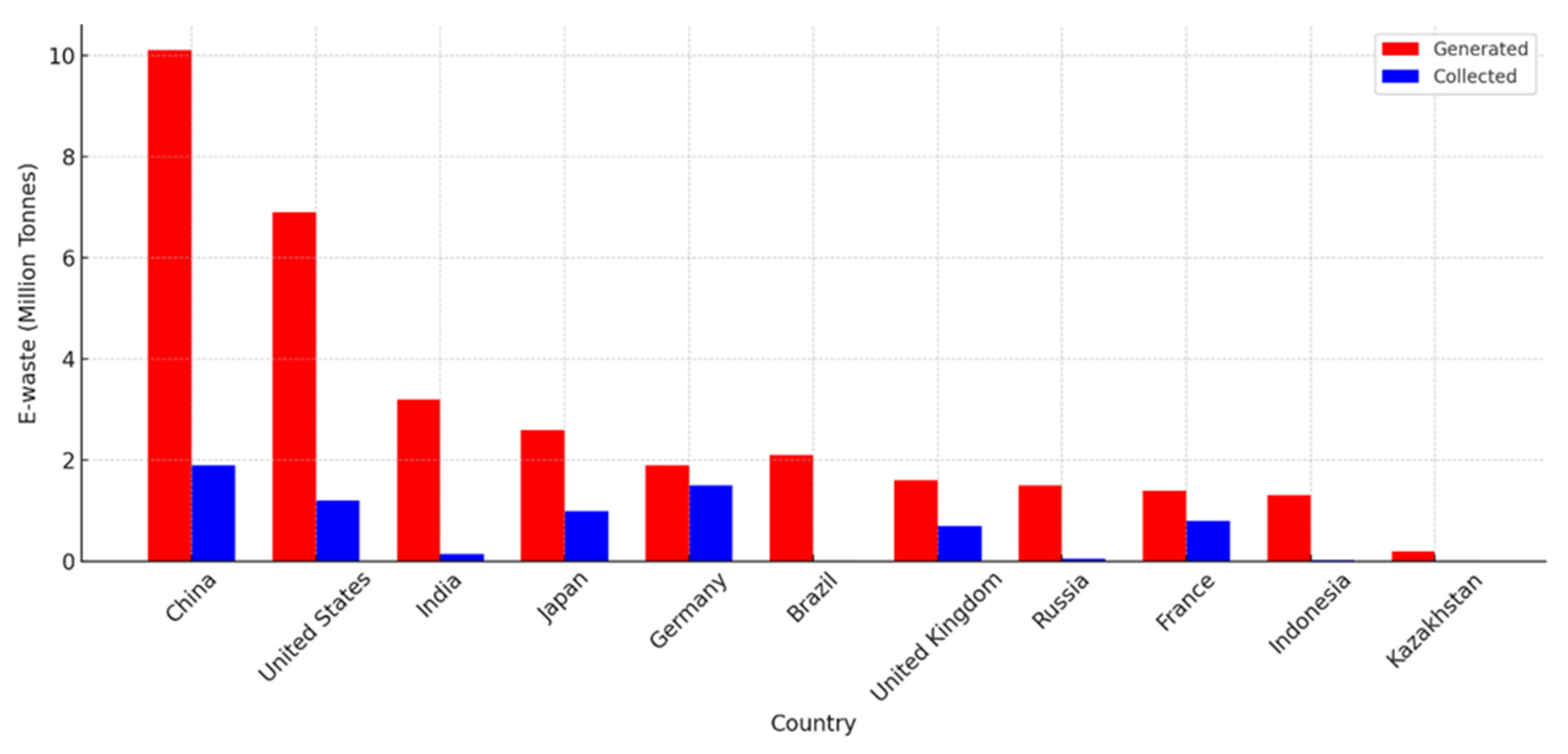
| Country | E-Waste Generated (Mt) | E-Waste Collected (Mt) | Collection Rate | Remarks |
|---|---|---|---|---|
| China | 10.1 | 1.9 | 18.8% | Largest generator; improving formal sector capacity. |
| US | 6.9 | 1.2 | 17.4% | Significant informal sector; state-level policies vary. |
| India | 3.2 | 0.15 | 4.7% | Low formal recycling; strong informal economy. |
| Japan | 2.6 | 1.0 | 38.5% | Strict e-waste laws; efficient collection infrastructure. |
| Germany | 1.9 | 1.5 | 79% | Among highest collection rates; strong EU-backed regulations. |
| Brazil | 2.1 | 0.02 | 1% | Low collection rate; mostly unregulated informal recycling. |
| UK | 1.6 | 0.7 | 43.8% | Strong producer responsibility schemes. |
| Russia | 1.5 | 0.05 | 3.3% | Lack of regulatory framework. |
| France | 1.4 | 0.8 | 57.1% | EU-mandated collection and recycling standards. |
| Indonesia | 1.3 | 0.03 | 2.3% | Informal sector dominates; minimal formal facilities. |
| Kazakhstan | 0.196 | 0.012 | 6% | Infrastructure growing; pilot projects and international support active. |
Disclaimer/Publisher’s Note: The statements, opinions and data contained in all publications are solely those of the individual author(s) and contributor(s) and not of MDPI and/or the editor(s). MDPI and/or the editor(s) disclaim responsibility for any injury to people or property resulting from any ideas, methods, instructions or products referred to in the content. |
© 2026 by the authors. Licensee MDPI, Basel, Switzerland. This article is an open access article distributed under the terms and conditions of the Creative Commons Attribution (CC BY) license.
Share and Cite
Kulenova, N.; Sadenova, M.; Boldyryev, S. Review of Reagent-Free Electronic Waste Recycling: Technology, Energy, Materials and Spatial Effects. Recycling 2026, 11, 27. https://doi.org/10.3390/recycling11020027
Kulenova N, Sadenova M, Boldyryev S. Review of Reagent-Free Electronic Waste Recycling: Technology, Energy, Materials and Spatial Effects. Recycling. 2026; 11(2):27. https://doi.org/10.3390/recycling11020027
Chicago/Turabian StyleKulenova, Natalya, Marzhan Sadenova, and Stanislav Boldyryev. 2026. "Review of Reagent-Free Electronic Waste Recycling: Technology, Energy, Materials and Spatial Effects" Recycling 11, no. 2: 27. https://doi.org/10.3390/recycling11020027
APA StyleKulenova, N., Sadenova, M., & Boldyryev, S. (2026). Review of Reagent-Free Electronic Waste Recycling: Technology, Energy, Materials and Spatial Effects. Recycling, 11(2), 27. https://doi.org/10.3390/recycling11020027