Review

Review of Reagent-Free Electronic Waste Recycling: Technology, Energy, Materials and Spatial Effects


by
Natalya Kulenova
1,
Marzhan Sadenova
1 and
Stanislav Boldyryev
2,*
1
The Center of Excellence “VERITAS”, D. Serikbayev East Kazakhstan Technical University, Ust-Kamenogorsk 070004, Kazakhstan
2
Faculty of Mechanical Engineering and Naval Architecture, The University of Zagreb, 10000 Zagreb, Croatia
*
Author to whom correspondence should be addressed.
Recycling 2026, 11(2), 27; https://doi.org/10.3390/recycling11020027
Submission received: 7 November 2025 / Revised: 8 January 2026 / Accepted: 16 January 2026 / Published: 1 February 2026

Abstract

The rapid increase in e-waste has become a significant global concern, influenced by swift technological advancements, shorter product lifecycles, and rising consumer demand. This situation leads to considerable environmental and health hazards, primarily due to the presence of toxic materials, energy demands, and the inadvertent loss of valuable resources when waste is not adequately managed. This review synthesises contemporary theories related to sustainable e-waste management, featuring concepts such as principles of the circular economy, energy efficiency and innovative recycling technologies. The review explores a range of actions, including regulatory strategies, mechanical pre-treatment methods, focusing on reagent-free recovery techniques, and the utilisation of digital solutions to enhance traceability and operational efficiency. The findings indicate substantial improvements in formal e-waste collection rates in areas with strong legislative frameworks, enhanced metal recovery efficiencies through refined hydrometallurgical and pyrometallurgical techniques and minimised environmental footprints through reagent-free and energy-conserving practices. The review emphasises the importance of viewing e-waste recycling not just as a waste management issue but as a fundamental element of resource security and sustainable industrial practices. By assessing recent developments, this work advocates for closed-loop recycling as an essential driver in the global shift towards a resilient, low-carbon, energy-efficient and circular economy.

1. Introduction

1.1. General Topic Introduction

Electronic waste (e-waste) has become the most rapidly increasing category of waste globally, a phenomenon attributable primarily to swift technological advancements, decreasing product lifespans, and heightened consumer demand [1]. In 2022, approximately 62 million tons of e-waste were generated worldwide, marking an 82% increase since 2010, which translates to roughly 7.8 kg per capita annually [2]. However, despite this significant growth, only 22.3% of e-waste was collected correctly and recycled. Projections indicate that this percentage may decline to 20% by 2030 if current trajectories persist [3]. This escalating disparity between e-waste generation and its appropriate recycling presents substantial environmental and economic challenges. The variation in e-waste recycling rates across different regions is notable [4]. Europe achieves the highest formal e-waste collection rate, approximately 43% [5].
In contrast, Asia, which generates over half of the world’s e-waste, manages to recycle only about 12% [6]. The situation is particularly concerning in Africa and Oceania, where collection rates are below 2%. These regional discrepancies are influenced by factors such as legislative frameworks, the availability of recycling infrastructure, and levels of public awareness. For example, countries that implement robust extended producer responsibility policies, like those within the European Union [7], tend to demonstrate significantly better recycling performance compared to nations lacking enforceable take-back or eco-design regulations.
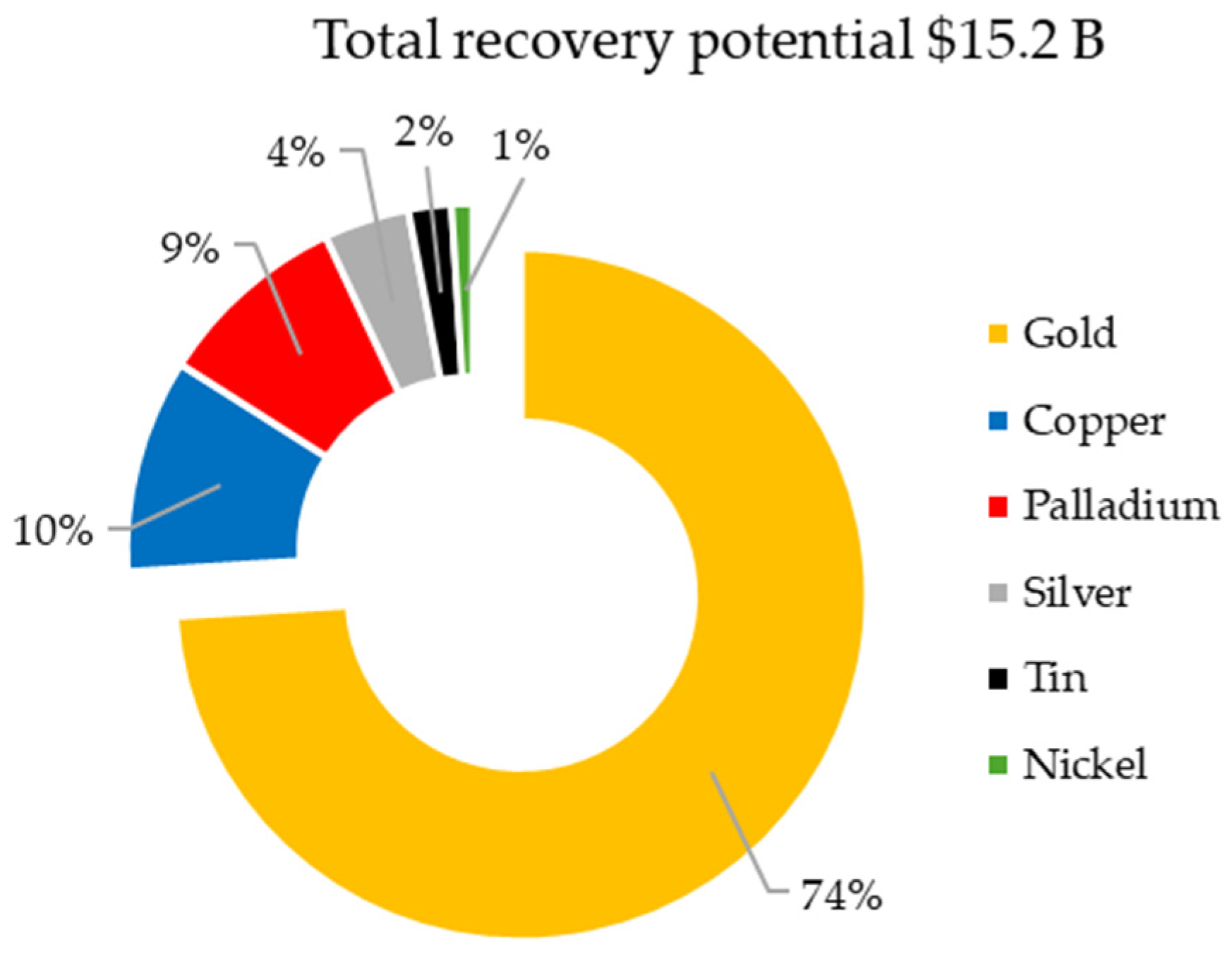
From an economic perspective, the inefficiencies inherent in current e-waste management result in significant financial losses [8]. E-waste comprises valuable materials, including gold, copper, and rare-earth elements (REE), and it has significant economic potential, as reported by the Global E-waste Monitor [2]. Based on metal prices for 2024 and generated e-waste in 2022 [9], the total economic potential of metal extraction is estimated at 15.2 billion US dollars. The share of different metals is demonstrated in Figure 1. However, fewer than 1% of the rare-earth metals utilised in electronics are recovered through recycling initiatives. Estimates suggest that enhancing global recycling rates to 60% by 2040 could potentially release more than USD 57 billion in material value each year [10]. These materials are crucial not only for economic recovery but also for facilitating the transition to clean energy, thereby making their recovery a strategic priority.
Technological innovation is enhancing the efficiency of material and energy recovery from e-waste. Advanced recycling methods, including hydrometallurgy [11], pyrometallurgy [12], and robotic disassembly [13], are being tested and implemented in countries with established recycling infrastructures. Conversely, in low- and middle-income nations, informal recycling practices prevail. These operations frequently involve hazardous techniques, such as open burning and acid leaching, which result in the release of toxic substances, including lead, mercury, and brominated flame retardants, into the environment [14]. The health repercussions of these practices are particularly dire for workers and children who are exposed to contaminated sites [15]. The pressing nature of the e-waste issue necessitates a multifaceted approach. In addition to enhancing technological capabilities, there is a clear imperative to bolster global policy frameworks, especially through the broader implementation of extended producer responsibility schemes and the enforcement of environmentally sound management practices [16]. Equally important is the need to enhance public awareness and foster international collaboration to ensure safe and equitable access to recycling infrastructure [17]. Without these crucial interventions, the e-waste crisis is poised to worsen, compromising environmental sustainability, public health, and the potential for a circular economy.
Usually, hydrometallurgy and pyrometallurgy are used for e-waste processing. Hydrometallurgy is a process wherein crushed e-waste particles are subjected to acid or alkaline solutions, enabling the selective separation and recovery of high-purity metals through techniques such as solvent extraction, precipitation, cementation (replacement), ion exchange, filtration, and distillation. In comparison to pyrometallurgical methods, hydrometallurgy can be conducted under ambient temperature and pressure, which results in lower emissions and achieves superior metal separation efficiency, yielding notable economic benefits. However, hydrometallurgical operations require substantial quantities of chemical reagents, involve complex processing steps, and generate significant volumes of acidic wastewater, presenting challenges for waste management and environmental protection. In contrast, reagent-free technologies for e-waste recycling focus on physical, thermal and biological methods that minimize or eliminate the use of hazardous chemicals typical of traditional hydrometallurgy.

1.2. Scientific Rationale for Reagent-Free Recycling in E-Waste Management

Traditional e-waste recycling methods depend heavily on chemical reagents [18] and high-temperature processes, leading to environmental pollution [19], high energy use [20], and risks to human health [21]. These approaches generate significant greenhouse gas emissions and toxic byproducts, especially when poorly regulated. As e-waste grows and circular economy goals become critical, there is an urgent need for safer, more sustainable recycling [8]. Reagent-free recycling addresses these issues by minimizing or eliminating the use of harmful chemicals. This reduces the creation of hazardous secondary wastes and simplifies environmental management. It also improves energy efficiency, as reagent-free processes, using mechanical, acoustic, electromagnetic, or controlled thermal methods, focus energy directly on material separation, often using less energy overall, especially if powered by renewables or industrial waste heat.
Socially, reagent-free methods are safer for workers and communities, especially in low- and middle-income regions lacking proper infrastructure for chemical handling [22]. These methods are easier to regulate and less prone to environmental injustice. From a resource perspective, they also preserve more of the original material’s structure and function, supporting direct reuse or low-energy reprocessing crucial for high-value components like battery electrodes and rare-earth magnets.

1.3. Conceptual Foundations and Significance of Reagent-Free Recycling

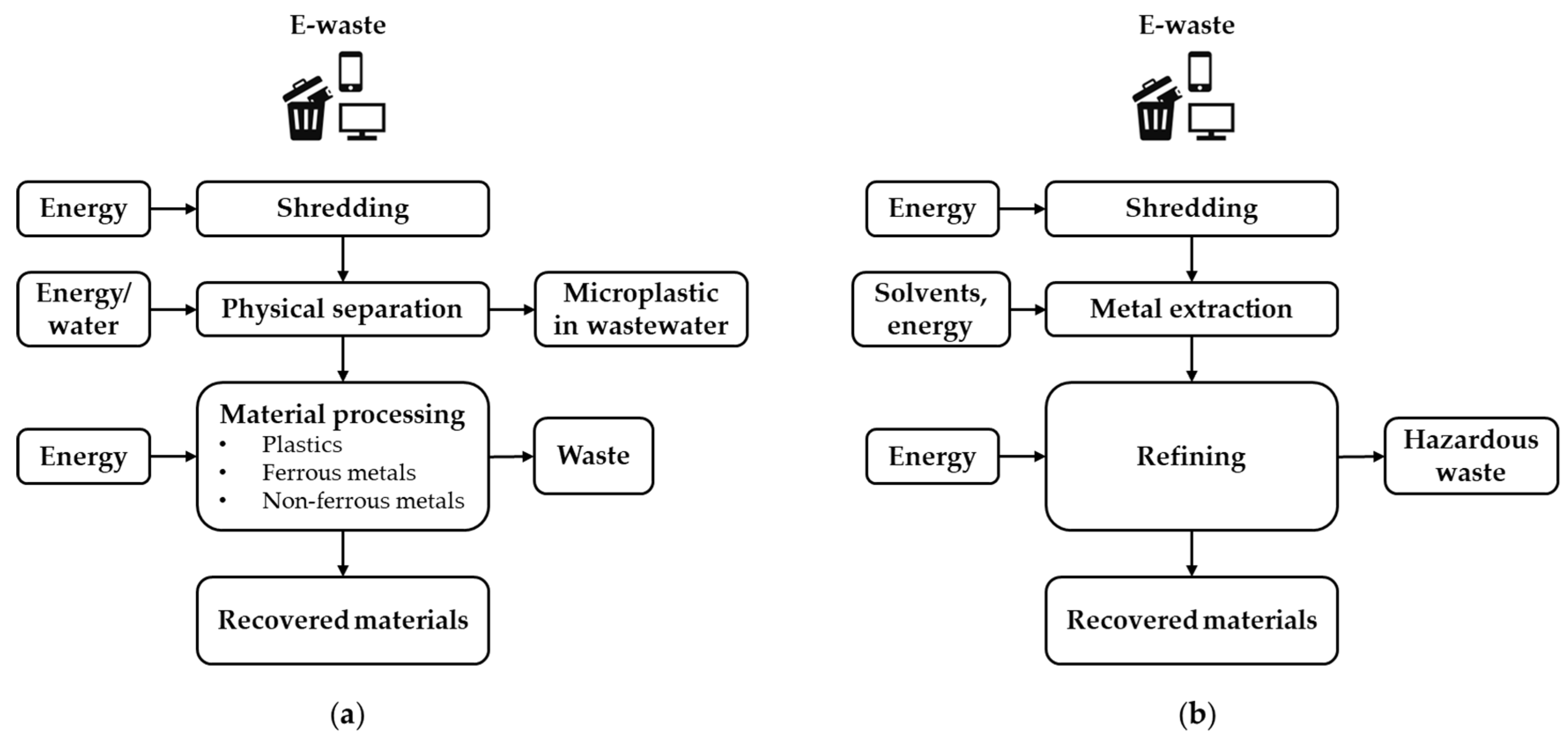
Reagent-free recycling is more than just avoiding chemicals; it is a fundamentally different approach. By exploiting differences in physical, thermal, electrical, and mechanical properties, these methods separate materials without dissolving or chemically altering them. This preserves material quality and enables higher-value recovery. A key idea is reversibility: instead of breaking down products chemically, reagent-free methods target the physical bonds holding components together, such as by using ultrasound, cryogenic cooling, or electromagnetic fields. This minimizes damage to valuable materials and enables their direct reuse. The simplified process workflow of reagent-free and conventional e-waste recycling is presented in Figure 2.
These technologies also support modular, decentralized recycling, reducing the need for centralized chemical supply chains and waste treatment and enabling recycling closer to the source of waste. This decreases transport emissions and increases resilience. Reagent-free recycling fits well with circular economy and industrial ecology principles [23], reducing reliance on virgin chemicals and supporting transparent, traceable material flows [24]. As energy systems move toward renewables, these electrically driven processes can achieve very low emissions [25], unlike conventional recycling, which remains dependent on fossil-derived reagents. In essence, reagent-free recycling represents a shift from chemistry-based extraction to physics-based recovery, offering a scalable, adaptable, and scientifically grounded path for sustainable management of electronic waste.
This review focuses on reagent-free technologies for e-waste recycling, highlighting the problems associated with available approaches, material extraction potential, energy requirements, spatial effects, and achievements in different countries. It addresses the specifics of various elements of electronic waste, including metals, batteries, plastics, microplastics, etc. The main goal is to demonstrate achievements in the field, highlight lessons learned, and identify potential prospects for future developments.

2. Technologies of Reagent-Free, Energy- and Resource-Saving E-Waste Recycling

E-waste includes an extensive array of discarded electronics, ranging from small components like circuit boards and batteries to large appliances. This section meticulously explores the primary categories of e-waste, underscoring both proven and innovative reagent-free technologies while elucidating their scientific foundations.

2.1. Printed Circuit Boards

Printed Circuit Boards (PCBs) found in computers, phones, etc., are composites of metals (Cu, Au, Ag, Ni) and non-metallic substrates. The first step is mechanical pre-processing: manual or robotic disassembly followed by shredding and milling [26]. Shredders/crushers break PCBs into small fragments, after which magnetic and eddy-current separators isolate ferrous metals and non-ferrous metals (e.g., Cu, Al, etc.) respectively [27], while plastics and glass fragments remain. Electrostatic (triboelectric) separation can further sort conductive (metals, semiconductors) from insulating (resin, glass) powders by giving them opposite charges and letting an electric field deflect them [28]. These purely physical steps (density, shape, conductivity) require only electricity and produce no chemical waste but can lose some fine precious metals and consume significant power [29].
Cryogenic milling represents a novel technique in which PCBs are subjected to freezing, often utilising liquid nitrogen, to induce extreme brittleness in polymers. This process enables the material to be pulverised into a fine, nanometer-scale powder. Research conducted at Rice University demonstrated that cryogenic milling effectively liberates metal particles from the plastic matrix, facilitating nearly complete separation through straightforward methods such as sieving or flotation [30]. This innovation addresses the typical disposal paradigm of landfilling [31] or incineration [32] by transforming all components into reusable powders. The underlying mechanism of cryogenic processing takes advantage of differential thermal contraction and the embrittlement of materials at low temperatures. While this method circumvents the use of solvents [33], it does require energy for both cooling and milling; however, if this energy is sourced from renewable resources, such as recovered gas, the process can be considered relatively environmentally friendly.

2.2. Lithium-Ion and Other Batteries

Batteries, such as lithium-ion (Li-ion), nickel–metal hydride (NiMH), and lead-acid, exhibit significant chemical complexity. For instance, Li-ion cells incorporate various materials, including metal foils, such as copper and aluminium, active compounds, like lithium cobalt oxide, electrolytes, and polymers [34]. A safe, reagent-free recycling process emphasises the physical disassembly of these components along with selective thermal methods [35]. Initially, battery packs are discharged to minimise safety risks before being dismantled or shredded. The shredding process yields a heterogeneous mixture of metal and plastic fragments, which can then be separated using techniques such as magnetic separation for ferrous materials, eddy current methods for non-ferrous metals like copper and aluminium, and air or water density separation for distinguishing plastics from heavier metals [36].
A novel technique known as “ultrasonic delamination” offers a rapid method for separating battery electrodes without the use of chemicals [37]. This process employs high-intensity ultrasound to induce cavitation at the interface between the active material and current collectors. The formation and subsequent implosion of microscopic bubbles disrupt the adhesive bonds, resulting in the efficient release of graphite and cathode materials from the underlying copper or aluminium foils within seconds [38]. This method operates much more quickly, approximately 100 times faster than traditional hydrometallurgical or pyrometallurgical processes. It achieves about 80% material recovery, produces high-purity powders, and functions using moderate levels of electrical power. Additionally, the process requires only water as a sound transmission medium and electricity, rendering it both environmentally friendly and scalable for broader applications.
Recycling of batteries through the application of extremely low temperatures, specifically liquid nitrogen (N2), enhances their processing [39]. These sub-zero conditions induce embrittlement in the plastics and adhesives found within battery cells, resulting in differential contraction. This effect can lead to fractures in cell casings and disruption of internal bonds, thereby facilitating safer handling and more efficient mechanical separation of components. Cryogenic treatment effectively neutralising the batteries temporarily and minimising fire hazards [40]. Additionally, the process may allow for battery slurries and electrode coatings to detach with reduced force, functioning similarly to the ultrasonic effect but relying solely on thermal contraction [41].
Thermal treatment, specifically pyrolysis, represents a reagent-free method for recycling. In a recent approach, lithium-ion cathode powder is combined with waste polyethylene terephthalate (PET) plastic and subjected to high temperatures [42]. This thermal decomposition of PET generates reactive reducing radicals that effectively remove oxygen from the cathode material, leading to its decomposition and the subsequent release of lithium and other metals. This synergistic pyrolysis process not only recovers valuable metals but also utilises waste plastic as a reactant, illustrating that careful manipulation of thermal chemistry, leveraging plastics as reducing agents, can be both energy-efficient and scalable for battery recovery [43]. In general, battery pyrolysis, conducted at temperatures exceeding 500 °C [44], volatilizes organic components such as electrolytes and binders, resulting in a by-product known as “black mass,” which consists predominantly of metal oxides and carbon [45]. This black mass can subsequently be processed, either through gentle heating or physical separation, to recover metals such as copper, nickel, and cobalt. While pyrolysis does not require solvents, it is an energy-intensive process and must be performed in an inert atmosphere [46] or vacuum [47] to prevent combustion. The integration of renewable heat sources, such as solar concentrators or biomass, holds the potential to enhance the sustainability of this method.
Reagent-free battery recycling relies on physical and thermal separation techniques, including mechanical shredding combined with magnetic and eddy current separation, ultrasonic delamination of electrodes, cryogenic embrittlement, and advanced thermal treatments. Both ultrasonic and cryogenic methods significantly enhance the efficiency of separation processes, leading to a reduction in energy consumption per unit mass of material recovered. These approaches facilitate the direct reuse of electrode materials in closed-loop systems, such as direct cathode reuse, without the need for chemical refining. Consequently, they substantially decrease energy requirements and material losses during the recycling process.

2.3. Electronic Plastics and Polymers

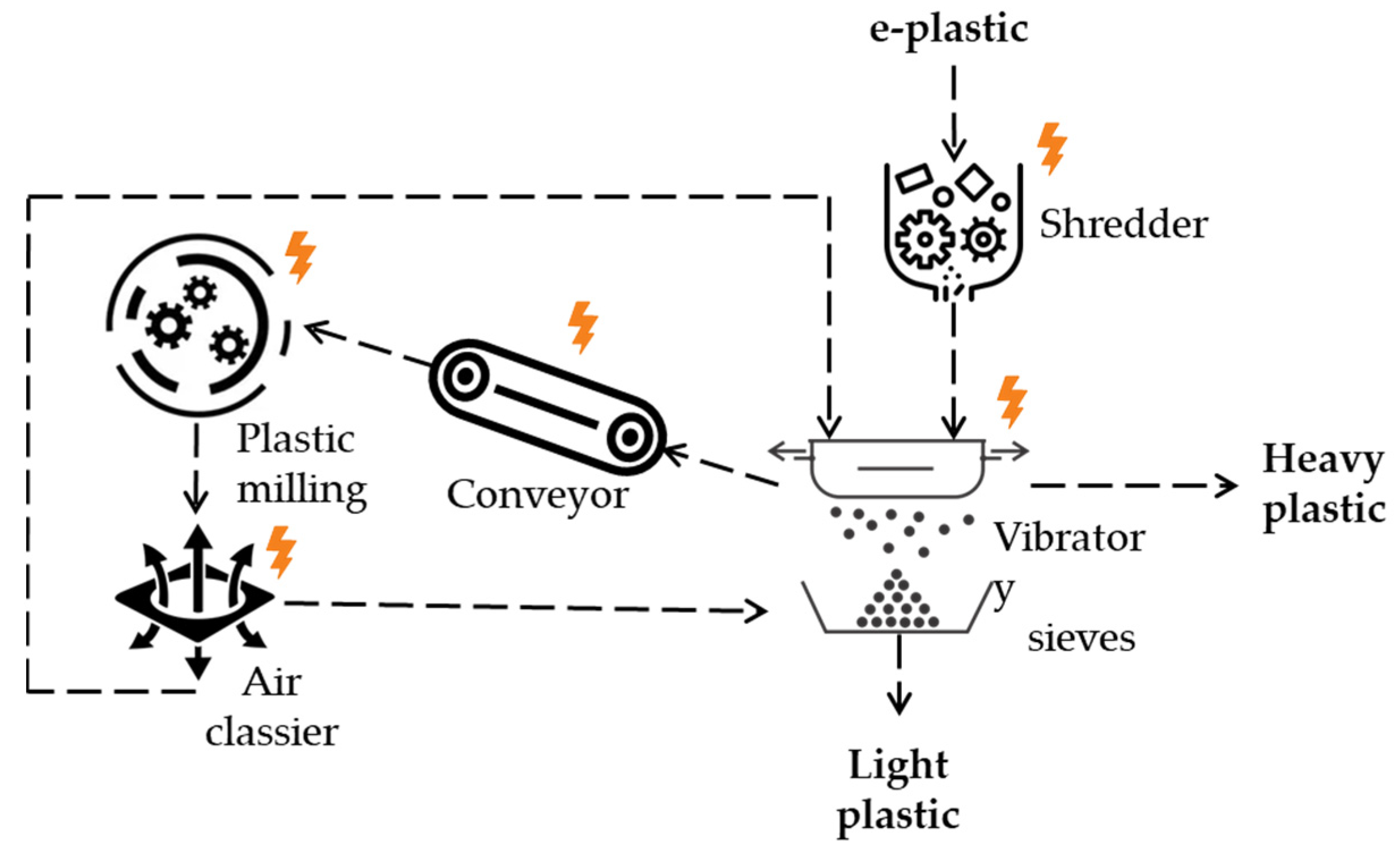
E-waste plastics comprise materials such as Acrylonitrile Butadiene Styrene (ABS), Polycarbonate (PC), High-Impact Polystyrene (HIPS), and Polyvinyl Chloride (PVC), often incorporated with flame retardants [48]. The process of mechanical recycling focuses on sorting, cleaning, and granulating these plastics without the use of solvents [49]. Techniques such as near-infrared spectroscopy [50] and optical sensors [51], as well as machine learning algorithms [52], can facilitate the identification of various polymer types, enabling either manual or automated sorting processes. Tribo-electrostatic separation leverages the variances in electrostatic charging that occur through friction among different polymers; opposing charges are generated, allowing for the separation of materials via electric fields [53]. Density separation methods, employing water baths, enable the flotation of lighter polymers while heavier, filler-rich components sink, using only water as a medium without any chemical additives. Following mechanical shredding, air classifiers or vibratory sieves are employed to separate plastics based on size and density, as illustrated in Figure 3. These mechanical processes primarily consume electrical energy [54]. Nonetheless, it is important to note that plastics derived from electronic waste frequently contain brominated flame retardants (BFRs), which pose challenges for subsequent reuse and recycling efforts.
Thermal processing methods, including pyrolysis and gasification, represent reagent-free approaches to retrieving value from polymers. During this process, shredded plastics are subjected to elevated temperatures, often facilitated by inert gases or microwave irradiation, to induce depolymerisation. This thermal degradation results in the formation of char and liquid fuel or synthesis gas (syngas) [55] that the Fischer–Tropsch process can be used to produce more valuable products [56]. For instance, the pyrolysis of heterogeneous electronic plastics typically yields combustible oil (approximately 20%) along with carbon-rich char; the char may also contain metal nanoparticles if certain additives are incorporated [57]. While the process necessitates high temperatures, it effectively captures energy in the form of gaseous fuels. Additionally, it has the capability to decompose brominated flame retardants, although this generates hydrogen bromide and hydrogen chloride gases that require scrubbing [58]. Moreover, selectively targets polymers, utilising their favourable dielectric properties for efficient heating, while leaving metallic materials relatively unchanged, thus enabling accelerated thermal processing [59].
Novel depolymerisation techniques are emerging that include solvent-free methods, such as the utilisation of supercritical carbon dioxide or ionic liquids, with carbon dioxide serving as a benign reagent [60]. Researchers are also investigating biological approaches that involve the use of bacteria or larvae that can consume plastics [61], though these methods often exhibit slower rates of degradation [62]. While purely mechanical separation techniques (such as sorting and grinding) require minimal energy, they frequently result in contaminated recyclables [54]. In contrast, pyrolysis offers a more comprehensive solution by converting waste materials into fuels, although it is typically associated with higher energy consumption and increased emissions [63]. The optimal method for depolymerisation is contingent upon the specific type of plastic and the availability of local energy resources. Significantly, employing techniques that do not involve harsh chemicals can mitigate the production of secondary waste and enhance worker safety.

2.4. Displays and Screens

Display technologies vary widely, ranging from traditional cathode ray tube (CRT) monitors to contemporary liquid crystal display (LCD), organic light-emitting diode (OLED), and light-emitting diode (LED) panels. These devices comprise various materials, including glass, polymers, metals, such as indium in indium-tin oxide (ITO) coatings, and adhesives [64]. Recycling methods for CRTs have historically employed “lead reclamation” techniques, where CRT glass, containing approximately 20–30% lead oxide (PbO), is crushed and subjected to heating in a vacuum furnace [65]. This process facilitates the volatilisation of lead oxide, which is then collected, producing de-leaded glass. Vacuum metallurgy, as outlined by Zhan and Xu, exemplifies this approach [66]; vacuum distillation effectively separates heavy metals, including lead, from glass under reduced pressure, thus minimising airborne emissions. The resulting purified glass can be repurposed in applications such as the production of new CRTs or crystal glassware [67]. This method is purely thermal, requiring high temperatures without the use of chemical solvents.
In contrast, flat-panel displays like LCDs and OLEDs present distinct recycling challenges [68]. LCD screens consist of laminated layers of glass, plastic films, and liquid crystals. Current recycling techniques involve processes such as cryogenic cooling [69], where the panel is frozen to induce cracking and peeling of the layers, or thermal methods performed under vacuum conditions to evaporate liquid crystals and organic compounds [70]. Vacuum pyrolysis treatment of entire panels can vaporise plastics and adhesives, leaving behind residual glass and metal fractions [71]. For the recovery of indium from ITO coatings, researchers have successfully implemented the use of carbonised polymers generated during the pyrolysis process as reductants, enabling the chemical release of indium without the need for external reagents aside from the panel’s inherent plastics [72]. Additionally, ultrasonic methods utilising cavitation may assist in delaminating coated films from substrates.
Currently, the predominant approach for LCD recycling remains mechanical, which involves the disassembly of backlight units and frames, followed by crushing the glass and filtering out metallic components [73]. Advanced laboratories are increasingly employing ultrafine pulverisation and densification technologies to etch ITO from glass substrates [74]. Fundamentally, reagent-free recycling processes for displays rely on a combination of thermal and physical separation techniques: freezing, shredding, and controlled heating under vacuum conditions. These methods manipulate the differences in melting and boiling points, as well as the mechanical properties of the various layers, thus circumventing the need for acid leaching or other chemical processes. Ideally, the energy requirements for these thermal processes could be sourced from renewable energy systems, enhancing the overall sustainability of the recycling operation.

2.5. Electrical Cables and Wiring

Wires and cables comprise valuable conductors made of copper or aluminium, which are insulated with materials such as plastics or rubber. Reagent-free recycling methods prioritise the physical separation of metals from their insulating materials. Industrial cable-stripping machines utilise rotating blades or drums to effectively cut and peel the insulation away from the conductors [75]. Alternatively, complete cables can be processed through shredding or granulation. Ferrous contaminants are removed magnetically, while copper is separated based on density. Copper sinks when placed in water, whereas plastics, PVC, float and can be sorted [76]. The processes employed are chemical-free, relying solely on electricity to power the machinery, and typically require water for float-sink separation, which is non-toxic. Cables treated with liquid nitrogen experience a reduction in the plastic’s ductility, rendering it brittle. Heating cables above the decomposition temperature of the plastics, using methods such as induction coils or furnaces, melts or incinerates the insulation. For example, pyrolysing PVC-insulated cables under controlled conditions generates hydrogen chloride gas, which needs to be scrubbed, and yields a carbonaceous residue alongside clean copper [55]. Although this approach does not utilize added reagents, it necessitates gas treatment for emissions control. Additionally, microwave heating can selectively heat the metal, due to the generation of eddy currents, thereby indirectly facilitating the combustion of the insulation [77].
Overall, physical recycling methods for cables are energy-efficient and have reached commercial viability, with mechanical strippers capable of recovering over 95% of the copper with minimal waste production [75]. The primary costs are associated with electricity consumption and potentially water usage, with no requirement for acids. While cryogenic and thermal techniques enhance recovery rates for more challenging cable types, such as insulated high-voltage cables, they do involve additional equipment and energy demands. These methods underscore principles of mechanical processing and materials science, such as brittleness and phase transitions, rather than relying on chemical processes.

2.6. Large and Small Household Appliances

Household appliances such as refrigerators, washing machines, microwaves, and toasters are composed of a variety of materials, including steel, aluminium, copper, plastics, refrigerants, and glass. The recycling process for these appliances typically begins with the dismantling of hazardous components, such as batteries and refrigerants, followed by shredding the entire units [78]. In standard scrap processing, appliances are shredded into smaller fragments, allowing for the effective separation of materials. Magnets are employed to extract ferrous metals like steel and compressors, while eddy-current separators are utilized to separate aluminum and copper fragments [79]. Finally, optical or manual sorting techniques are implemented to isolate plastics and circuit boards [80]. This mechanical recycling process is characterized by shredding, magnetic separation, eddy-current separation, and sorting is commercially prevalent and efficiently recovers a significant proportion of metals, though it does require substantial electrical energy for the shredding phase [81].
In more sophisticated recycling facilities, advanced technologies are employed to facilitate robotic disassembly of components such as motors, PCBs, and glass prior to shredding. Some experimental methods, such as induction heating, have been explored to strip enamel from copper windings, but these techniques have not yet been fully implemented [82]. Additionally, while thermal treatment methods, such as pyrolysis, can be applied to process plastic components [83], the mixed nature of polymer grades in shredded appliances often results in these plastics being converted to fuel sources, rather than being recycled back into usable polymers [84].

2.7. Summary and Discussion

Representative reagent-free e-waste recycling technologies by e-waste type are demonstrated in Table 1.
Apart from scientific insights, a range of patented technologies illustrates the progressive evolution of e-waste recycling strategies toward improved material recovery and environmental performance. Early integrated mechanical approaches, exemplified by CA2736293A1, focus on controlled dismantling, comminution, and physical separation to recover metals and plastics while limiting the release of hazardous substances [90]. Similarly, US7902262B2 discloses modular mechanical and physical processing routes for mixed WEEE streams, with particular attention to plastics containing brominated flame retardants, aiming to enhance circular reuse of polymer fractions [91]. In contrast, US9238850B2 addresses the recovery of precious and base metals from printed circuit boards through selective extraction sequences designed to reduce environmental impact relative to conventional metallurgical practices [92]. More recent innovation is reflected in WO2019078735A1, which integrates physical pre-treatment with biometallurgical and biosorption concepts to enable metal recovery with reduced reliance on aggressive chemical reagents [93]. Finally, the earlier US5352270A provides a foundational framework for recycling metal-containing electronic components through controlled comminution and aqueous separation, highlighting early efforts to manage safety and reactivity in mixed metal wastes [94]. Collectively, these patents demonstrate a clear technological trajectory from primarily mechanical and reagent-based methods toward more selective, environmentally conscious, and potentially reagent-minimized recycling solutions.
Reagent-free recycling technologies encompass a broad spectrum of technological maturity, throughput capacity, and system complexity, each of which fundamentally influences their scalability and economic viability. Mechanical separation methods, including shredding paired with magnetic, eddy-current, and electrostatic techniques, present the most mature and economically favorable solutions for large-scale e-waste processing. These technologies are widely implemented in industry due to their comparatively low capital requirements, predictable operational expenditures, and compatibility with high-throughput systems capable of handling several tons per hour [18]. However, their efficiency is counterbalanced by limitations in selective recovery, especially for fine or embedded valuable metals, and by incremental material losses incurred during comminution, notably affecting the recovery of precious and rare-earth elements [26].
Emergent reagent-free methods, such as cryogenic milling, ultrasonic delamination, and vacuum pyrolysis, offer enhanced selectivity and improved liberation of targeted materials. For example, cryogenic milling facilitates near-complete separation of metal particles from polymer matrices, yielding high-purity outputs suitable for direct reuse [30]. Despite these advantages, the substantial energy and infrastructure demands associated with liquid nitrogen use constrain the economic feasibility of cryogenic milling to specific high-value or hazardous waste streams, unless integrated with cost-effective cryogenic energy recovery systems [39]. Ultrasonic delamination is distinguished by rapid and precise separation capabilities but is limited by reactor volume, acoustic energy dissipation, and equipment durability, thereby confining its application to batch or modular operations rather than continuous bulk processing [38].
Thermal reagent-free approaches, including pyrolysis and vacuum metallurgy, represent an intermediate category in terms of scalability. These methods are industrially deployed for particular waste fractions, such as cathode ray tube (CRT) glass and mixed plastics. Nevertheless, their economic performance is contingent upon energy costs and the efficiency of heat recovery systems [32]. Although they eliminate the need for chemical reagents, they require significant capital investment and advanced emission control infrastructure, particularly when processing halogenated polymers [25].
In contemporary industrial practice, advanced e-waste recycling operations commonly integrate reagent-free pre-treatment steps with conventional pyrometallurgical or hydrometallurgical processes to optimize both sustainability and metal recovery [95]. Reagent-free mechanical operations, including dismantling, shredding, and magnetic, eddy-current, or electrostatic separation, are routinely employed to liberate and concentrate metal-rich fractions while removing plastics and other organics prior to high-temperature smelting or aqueous leaching. This approach reduces chemical consumption, improves process selectivity, and limits the formation of hazardous emissions [96]. A well-documented example is the integrated pyro-hydrometallurgical flowsheet implemented at industrial facilities such as Umicore’s Hoboken plant, where mechanically pre-treated e-waste is initially smelted to concentrate base and precious metals, followed by hydrometallurgical refining steps, such as electrorefining, to achieve high-purity products [97]. Comparable hybrid flowsheets are extensively reported in the literature for printed circuit board recycling, where physical separation enhances leaching kinetics and recovery efficiency while minimizing reagent use in upstream stages [98]. These combined strategies underscore the role of reagent-free technologies as enabling pre-treatments that enhance the efficiency, environmental control, and economic viability of metallurgical recycling systems, rather than serving as complete replacements.
Reagent-free metal recycling is most effective when metals are present in relatively pure, physically separable forms, but this does not preclude its application to alloy-containing electronic components. For alloys, reagent-free methods remain highly relevant at the stages of material liberation, cleaning, and pre-sorting. Mechanical, cryogenic, and thermal treatments can detach alloy particles from polymers and coatings, while sensor-based and electromagnetic sorting can generate compositionally homogeneous alloy streams without altering their chemical structure. However, once metals are metallurgically bonded within an alloy, reagent-free techniques alone are generally insufficient to separate individual elements. In such cases, these methods function as enabling pre-treatments that reduce contamination and reagent demand before downstream pyrometallurgical or hydrometallurgical refining. Thus, even for alloy-rich e-waste, reagent-free approaches play a critical complementary role within hybrid recycling flowsheets rather than serving as complete substitutes for conventional metallurgical separation.
The technologies described above exemplify fundamental scientific principles. For instance, mechanical crushing operates on the principles of fracture mechanics, while magnetic and eddy current separation utilizes electromagnetism for the classification of metal types. Electrostatic and triboelectric separation methods leverage the charge and material properties for effective sorting. Ultrasound technology employs acoustic cavitation to disrupt molecular bonds, and cryogenic processes exploit differential thermal contraction and glass transition behavior. Additionally, thermal processes such as pyrolysis and vacuum distillation are based on concepts of chemical thermodynamics, facilitating the vaporization and separation of various materials. Collectively, these technologies contribute to high rates of material recovery with minimal additional inputs. When powered by renewable energy sources or integrated with waste heat recovery systems, these processes significantly diminish the carbon footprint associated with recycling activities.

3. Experimental Issues of Reagent-Free Techniques for Recycling Diverse Alloys and Non-Ferrous Metals Contained in Electronic Waste

The recycling of e-waste presents a substantial opportunity for recovering valuable non-ferrous metals, including copper (Cu), aluminum (Al), tin (Sn), and precious metals such as gold (Au) and palladium (Pd). Conventional recycling methods often rely on reagent-intensive hydrometallurgical and pyrometallurgical techniques, which can create environmental and economic challenges due to high energy consumption and the generation of toxic byproducts [99]. As a result, recent research has shifted towards the development of reagent-free or minimally reagent-based processes that utilize physical and mechanical separation techniques for material recovery [100]. Among the various methods investigated, electrostatic separation has emerged as a prominent approach [101]. This technique capitalizes on the differing electrical conductivities of the components within e-waste. In the process, shredded e-waste is exposed to a high-voltage corona discharge, which causes conductive particles, such as metals, to acquire a different charge than non-conductive particles, such as plastics. Subsequently, these charged particles are separated on a rotating drum. Experimental findings indicate that when particle sizes are optimized within the range of 0.5 to 5 mm, recovery efficiencies for copper and aluminum can reach as high as 90% [102].
In addition to electrostatic techniques, magnetic and eddy current separation methods are also effective for the segregation of ferrous and non-ferrous metals [103]. High-intensity magnets are employed to efficiently extract ferrous materials from e-waste, while eddy current separators utilize induced repulsive forces to selectively eject conductive non-ferrous metals, such as Al and Cu, from the waste stream [29]. These advanced separation techniques have demonstrated the capability to recover up to 85% of non-ferrous metals from post-consumer e-waste streams.
Thermal delamination via reagent-free pyrolysis conducted in inert atmospheres, such as nitrogen or argon, presents a promising method for extracting metals from composite materials like PCBs [104]. Experiments conducted at temperatures ranging from 300 to 450 °C indicate that organic resins decompose, resulting in the release of metal foils that can be subsequently separated either manually or mechanically. This technique minimizes oxidation and achieves recovery efficiencies for Cu and gold Au exceeding 90% under optimized conditions [105]. A related method, microwave-assisted separation, employs dielectric heating to selectively heat polymeric components within PCBs, facilitating the disintegration of the board structure and the release of metallic elements without the use of chemical solvents [106].
Mechanical milling techniques, particularly ball or planetary milling, have also proven effective in liberating metal particles from complex e-waste matrices. This process induces differential fracturing based on material hardness and brittleness, which enhances subsequent separation via sieving or air classification. Studies have reported enrichment factors for copper and tin exceeding 95% from milled PCB powders [107]. Additionally, cryogenic treatments improve liberation efficiency by embrittling plastic components through exposure to liquid nitrogen, followed by mechanical impact. This approach enhances metal separation and reduces cross-contamination between polymer and metal fractions [108]. Advanced optical and laser-based sorting techniques, such as Laser-Induced Breakdown Spectroscopy (LIBS), provide rapid, non-contact analysis of metal compositions. These systems are capable of real-time identification and sorting of metallic particles based on their spectral signatures. LIBS has shown effectiveness in distinguishing alloy compositions and isolating rare earth elements from neodymium magnets within e-waste, achieving purity levels greater than 95% [109]. Moreover, ultrasound-assisted separation utilizes cavitational energy to promote the detachment of metal coatings and the disaggregation of composite particles, which has been shown to enhance metal recovery rates. Ultrasonic treatment of ground PCB particles in aqueous environments can improve recovery rates for copper and gold by 10–20%, particularly when applied as a pre-treatment step before mechanical separation [110]. The comparison of metal recovery for different reagent-free techniques is summarized in Table 2.
These emerging reagent-free methodologies underline the potential for high-efficiency, low-impact recovery of valuable metals from electronic waste. Future research should emphasize the scaling of these technologies, assess their energy and environmental impacts through life-cycle assessments (LCA), and develop machine-learning-based control systems for real-time process optimization [111]. The integration of hybrid processing systems that combine mechanical, thermal, and optical methods appears particularly promising for maximizing metal recovery while minimizing environmental impact [112].
The reagent-free techniques confirm that high recovery efficiencies for non-ferrous metals are technically attainable without resorting to chemical leaching; however, their scalability is highly variable. Electrostatic and eddy-current separation technologies are already established in industrial recycling operations, providing favorable cost-to-recovery ratios for copper and aluminum, particularly for particle sizes above the millimeter scale [28,29]. Their principal limitation is diminished effectiveness for ultra-fine particles, where electrostatic interactions become less reliable and particle agglomeration impedes separation. Cryogenic fracturing and high-energy mechanical milling achieve superior liberation and enrichment efficiencies, often surpassing 90% for copper and precious metals [26,30]. These methods, however, require substantial energy input and are associated with increased equipment wear, which impacts their long-term economic viability. Consequently, they are most suitable as pre-treatment steps or for targeted application to complex composite materials, rather than as universal recycling solutions.
Emerging optical and laser-based sorting technologies, such as laser-induced breakdown spectroscopy, represent a significant advancement by enabling real-time, high-purity identification and separation of metals [5]. While scalability is improving due to advancements in automation and machine learning, current constraints, including high capital investment and sensitivity to surface contamination, limit their application to high-value material streams, such as rare-earth magnets or specialty alloys. These observations underscore a key trend: reagent-free recycling methods tend to reallocate costs from consumables to capital expenditures and energy use, making them particularly advantageous for processing waste streams with consistent composition and elevated material value.
Future research should focus on the development of hybrid methodologies that integrate mechanical, thermal, and acoustic techniques to enhance selectivity in material processing. Additionally, the incorporation of machine learning with LIBS could facilitate dynamic recognition of various alloys, thereby improving sorting efficiency. Furthermore, conducting LCA to assess the energy consumption and carbon dioxide emissions of reagent-free methods in comparison to traditional chemical recycling processes will provide valuable insights into their environmental impact and sustainability.

4. Transforming E-Waste Plastics into Functional Materials

The recovery of plastics from e-waste, such as PE, PP, and PS, presents a significant opportunity for producing advanced construction materials. With global e-waste generation surpassing 50 million tons annually, repurposing the plastic fraction addresses both environmental concerns associated with improper disposal and supports circular economy initiatives [8]. When appropriately processed, these plastics can serve as functional fillers and reinforcements, enhancing the performance of conventional building materials. A particularly promising method is the catalytic pyrolysis of e-waste plastics, yielding carbon nanotubes (CNTs) and carbon-rich char, which possess remarkable mechanical, thermal, and electrical properties suitable for incorporation into polymeric and cementitious matrices [113]. Research has shown that adding 2 wt% of CNTs derived from waste plastics significantly improves the Young’s modulus and fracture strength of epoxy composites, while the inclusion of 5 wt% CNTs in phase change materials can more than double thermal conductivity, enhancing the thermally efficient design of building envelopes and insulation systems [114].
Moreover, e-waste-derived CNTs and char can be utilized as microfillers in traditional concrete and cement, enhancing density, compressive strength, and resistance to environmental degradation [115]. The replacement of fine aggregates with treated plastic waste has demonstrated reduced thermal conductivity and increased fracture energy, thus contributing to better thermal insulation and toughness. Pre-treatment techniques, such as gamma radiation and microwave exposure, can further augment interfacial bonding between plastic aggregates and cement matrices, optimizing material performance [116]. In polymer applications, incorporating CNTs and chars from e-waste leads to multifunctional composites with enhanced mechanical integrity, wear resistance, and electrical conductivity, rendering them suitable for coatings, adhesives, and structural components [117].
The establishment of conductive networks within the polymer matrix opens avenues for smart construction materials that are capable of self-sensing and energy harvesting [118]. Nevertheless, challenges remain, including variability in plastic waste composition and processing conditions that impact material consistency, as well as difficulties in achieving uniform dispersion of CNTs, which can compromise performance [119]. To address these issues, standardized recovery and treatment protocols are necessary, along with comprehensive LCAs to examine the environmental and economic implications of scaling these technologies [120]. Co-pyrolysis of waste plastics and spent lithium-ion batteries demonstrated as a method for generating CNTs and hydrogen peroxide, underscoring a sustainable strategy for recycling critical materials [121]. Another research introduced a method for synthesizing CNTs from waste face masks and mixed plastic waste through pyrolysis coupled with chemical vapor deposition, and it assesses their potential efficacy as materials for battery electrodes [122].
The valorization of e-waste plastics into high-performance construction materials, particularly through the use of carbon nanotube additives, represents a sustainable innovation pathway that addresses waste management and enhances the durability and thermal efficiency of building materials [123]. Continued interdisciplinary research and collaboration between industry and academia will be critical to optimize processing technologies, ensuring safety, and promoting market adoption of these advanced materials.
The conversion of e-waste plastics into functional materials constitutes one of the most economically attractive yet technically challenging avenues in reagent-free recycling. Mechanical recycling remains the most scalable and cost-effective approach, particularly for relatively pure polymer fractions such as ABS or HIPS recovered from device housing. Nonetheless, the presence of flame retardants and mixed polymer contaminants often degrades product quality and limits market value, frequently resulting in downcycling [4]. Thermal conversion processes, including pyrolysis and catalytic reforming, provide greater flexibility by processing heterogeneous plastic mixtures and generating products such as fuels, char, or advanced CNTs [8,43]. While these technologies can be industrially scaled, their economic viability is highly dependent on effective product valorization strategies. For instance, CNT synthesis from waste plastics yields high-value outputs but demands stringent temperature control and catalyst management, increasing both operational complexity and capital investment [20]. A central trade-off in plastic valorization exists between material circularity and energy recovery. Mechanical recycling preserves polymer structure but is prone to quality loss, whereas thermal processes enhance energy and functional material yields at the expense of direct polymer reuse. From a systems perspective, hybrid strategies integrating mechanical sorting with selective thermal upgrading appear most promising for optimizing scalability, economic returns, and environmental outcomes.

5. The Feasibility of Recovering Microparticles from Plastic E-Waste

The extraction of microparticles from plastic e-waste constitutes a technically feasible yet intricate challenge that has attracted growing scientific and environmental attention [124]. Microparticles, classified as plastic fragments smaller than 5 mm, arise from the degradation of polymers or from mechanical processes such as shredding and grinding of e-waste [125]. These particles can consist of various thermoplastics, including ABS, HIPS, PC, and PVC, which are prevalent in electronic components [126]. Moreover, microparticles from e-waste may also contain additives such as flame retardants, stabilizers, and plasticizers, complicating the recovery process due to risks of chemical contamination and material heterogeneity [127].
A range of methodologies has been proposed for the segregation and recovery of microparticles from plastic e-waste [128]. Mechanical separation methods like sieving, sedimentation, and centrifugation are frequently utilized for size-based sorting; however, their effectiveness diminishes for particles smaller than 100 µm [129]. Density-based flotation techniques offer a promising avenue, capitalizing on the differential buoyancy of various plastic types in selective media [130]. More advanced techniques, including electrostatic separation and solvent-based dissolution methods (e.g., the CreaSolv® process), allow for the isolation of specific polymer fractions but tend to be resource-intensive and are not widely implemented in commercial applications [131]. Emerging technologies, such as magnetic nanoparticle functionalization and selective chemical depolymerization, are being developed and may enhance the selectivity and efficiency of microparticle recovery in forthcoming applications [132].
From an economic perspective, the feasibility of microparticle recovery remains constrained [133]. Elevated processing costs, combined with the relatively low market value of recovered microparticles, diminish the commercial viability of such initiatives [134]. Furthermore, the lack of standardized methodologies for microparticle collection and quality assessment further limits market potential [135]. Recovery operations may become more economically viable within specialized high-throughput recycling facilities or in regions endowed with robust legislative frameworks that foster circular economy principles, such as Extended Producer Responsibility (EPR) policies and LCA [136]. In 2022, global production of recycled plastics experienced a continuous rise, achieving a total of 35.5 million tons, which represents 8.9% of the overall plastics production worldwide. Notably, Europe contributed to this growth by accounting for 21% of the total global recycled plastics output [137].
On an environmental level, the potential advantages of recovering microparticles from plastic e-waste are considerable [138]. By curtailing the release of microplastics into terrestrial and aquatic ecosystems, recovery initiatives can mitigate long-term ecological threats and contribute to sustainable waste management practices [139]. However, the environmental benefits must be balanced against the energy and chemical inputs necessitated by existing recovery technologies [140]. Processes that incorporate thermal treatment or solvent use may introduce additional environmental risks if not meticulously managed [141].
Complementary hybrid systems integrating physical filtration, biofilm-mediated aggregation, and adsorption strategies have also been advanced within the environmental remediation literature [142]. These configurations are designed to enhance the removal of microplastics and co-contaminants from water and soil matrices by harnessing synergistic effects between abiotic and biotic processes [143]. The incorporation of such hybrid systems into wastewater streams originating from industrial electronic waste processing facilities may provide a scalable solution for microplastic mitigation. Environmental monitoring and analytical research on micro- and nanoplastics are rapidly advancing, highlighting both the ubiquitous presence of these particles and the significant technical challenges associated with their detection and quantification at progressively smaller size scales [144]. State-of-the-art spectroscopic, imaging, and separation techniques are being investigated to improve detection sensitivity and promote methodological standardization [145]. Economic feasibility is enhanced when microparticle management contributes to broader regulatory compliance or enables the acquisition of environmental credits, particularly in jurisdictions with stringent discharge limits for microplastics or related contaminants. Nevertheless, a significant gap persists in policy frameworks explicitly addressing microplastics within e-waste streams, which currently constrains the development of direct market incentives for investment in this area [146]. The impact of different factors on microplastic recovery is summarized in Table 3.
The recovery of microparticles from plastic e-waste is scientifically and technically attainable, yet considerable obstacles persist regarding cost-efficiency, scalability, and environmental optimization [147]. Ongoing research and innovation, alongside the evolution of regulatory frameworks, are vital to enhancing the feasibility and sustainability of these recovery methods. Advances in materials science [148], separation techniques [149], [150], and policy initiatives [151] will be crucial in facilitating more effective solutions for the management of microparticles within the realm of e-waste recycling.
Microparticle recovery from e-waste plastics is technically achievable but remains economically marginal. Advanced separation techniques, such as centrifugation, electrostatic sorting, and density gradient separation, can yield high recovery efficiencies. However, their scalability is constrained by elevated processing costs and limited market demand for recovered microplastics [8]. As particle size decreases, the energy required per unit mass increases disproportionately, further undermining economic feasibility. Environmentally, microparticle recovery offers the important benefit of reducing microplastic pollution, but these advantages must be balanced against the substantial energy and infrastructure investments required. Accordingly, microparticle recovery is most likely to be viable as a supplementary process within large-scale recycling operations or when mandated by regulatory frameworks, rather than being driven by market incentives alone [7].

6. Mathematical Modeling for Various Electronic Waste Recycling Technologies

Mathematical modeling serves as an essential intermediary between the conceptual benefits of reagent-free recycling and their practical application at the industrial scale. As evidenced in Section 2, Section 3, Section 4 and Section 5, reagent-free technologies are capable of achieving high material recovery efficiencies while minimizing environmental impacts. However, their widespread industrial adoption hinges on the capacity to predict process performance, optimize energy requirements, and assess economic trade-offs under real-world operating conditions. Mathematical modeling frameworks fulfill this role by extrapolating laboratory-scale data to system-level analyses, thereby embedding reagent-free recycling approaches within a quantitatively rigorous context for decision-making. Mathematical modeling has emerged as a critical tool in the enhancement and advancement of e-waste recycling technologies [52]. This approach enables researchers and policymakers to effectively optimize recovery processes, mitigate environmental impacts, and improve economic efficiencies. The intricate nature of modern electronic devices, along with the presence of both hazardous and valuable materials, highlights the necessity of systematic and methodical approaches to e-waste recycling. Through mathematical models, researchers can simulate, optimize, and forecast various parameters throughout the e-waste processing chain, which encompasses the stages from collection to material recovery and final disposal [152].
At the micro-level of processes, kinetic and thermodynamic modeling is pivotal for enhancing the efficiency of material recovery methods such as pyrolysis [153] and bioleaching [154]. For example, a nonlinear kinetic model was developed to effectively describe the dark fermentation process involved in the microbial leaching of metals from e-waste. This model intricately integrates physical, chemical, and biological dynamics to optimize the leaching process across diverse operational conditions, ultimately leading to improved recovery yields for essential metals like copper and gold [155]. Similarly, thermochemical models have been utilized to simulate pyrolysis processes, helping to identify optimal parameters, such as temperature and residence time, that maximize energy recovery and the extraction of metals from printed PCBs [156]. At the process scale, the application of kinetic and thermodynamic models to reagent-free thermal and mechanical treatments has become increasingly prevalent for the optimization of operating parameters and the reduction of energy consumption. For instance, thermochemical modeling of low-temperature pyrolysis processes for printed circuit boards has enabled the identification of optimal temperature ranges (typically 350–450 °C) that maximize polymer decomposition while maintaining the structural integrity of metallic components [157]. This facilitates efficient downstream physical separation without the need for chemical leaching. In a similar vein, kinetic models applied to vacuum pyrolysis have been utilized to predict the volatilization rates of organic and halogenated compounds, thereby informing the design of reagent-free systems characterized by lower emission outputs and enhanced heat recovery efficiency [158].
At the systems level, mathematical programming methodologies, including binary integer programming (BIP) [159] and mixed-integer linear programming (MILP) [160], are commonly employed to design and optimize e-waste recycling networks [161]. These models consider a variety of variables, such as transportation costs, facility capacities, regulatory requirements, and waste flow rates. Kulkarni and Jadhav (2025) illustrated the application of a BIP model to assess cost-effective recycling pathways for different categories of e-waste in India, factoring in product lifespan, generation rates, and constraints related to recycling capacity [162]. Additionally, Restrepo Diaz and Amin (2025) showcased how MILP frameworks can facilitate multi-objective decision-making in closed-loop supply chains, adeptly balancing economic considerations with environmental sustainability initiatives [160].
Modeling approaches rooted in fracture mechanics and energy balance analysis have also advanced mechanical and cryogenic reagent-free processes. Discrete element modeling has been implemented to simulate particle fragmentation and liberation phenomena during the mechanical and cryogenic milling of composite electronic waste, enabling correlation of milling intensity, particle size distribution, and metal liberation efficiency [163,164]. These computational models demonstrate that cryogenic pretreatment significantly reduces the specific energy input required for subsequent comminution by inducing polymer embrittlement, thus enhancing the overall energy efficiency of reagent-free separation processes. Such mechanistic insights are particularly critical for the upscaling of cryogenic methodologies, where energy expenditure constitutes the primary economic constraint. Ultrasonic and electromagnetic reagent-free methods introduce additional modeling complexities due to their dependence on intricate physical field interactions. In the domain of ultrasonic delamination for lithium-ion battery recycling, multiphysics models that couple acoustic cavitation, fluid dynamics, and interfacial stress have been constructed to elucidate the mechanisms underlying rapid electrode coating detachment from current collectors [37]. These models indicate that optimal cavitation intensity can be attained at comparatively moderate power densities, supporting the scalability of ultrasonic systems without necessitating proportional increases in energy input. Similarly, electromagnetic modeling of eddy-current separators has been leveraged to optimize rotor geometries, magnetic field strengths, and particle trajectories, thereby directly enhancing the selectivity of reagent-free copper and aluminum fraction separation [27]. Predictive analytics and statistical models are equally vital for forecasting e-waste generation rates and for informing infrastructure planning [165]. A recent investigation focusing on India employed statistical models to project concerning increases in e-waste volumes, highlighting the significant gap between rising waste generation figures and the current recycling capabilities available [166]. These predictive frameworks not only assist policymakers in strategic capacity planning but also enable businesses to anticipate material flows pertinent to urban mining initiatives. System dynamics and lifecycle assessment models present comprehensive frameworks that facilitate an understanding of the long-term consequences and feedback mechanisms associated with e-waste management. Deva and van der Weijden (2021) utilized system dynamics modeling through Vensim [167] to evaluate various scenarios regarding e-waste accumulation and corresponding revenue implications under differing policy interventions [168]. Conversely, lifecycle modeling is instrumental in assessing the comprehensive environmental impact of electronics from their production stages to end-of-life management, thereby supporting the development of more sustainable recycling systems [169].
Mathematical modeling serves as an essential tool for systematically comparing reagent-free recycling technologies across different operational scales. Process-level models enable the optimization of key parameters such as energy consumption, residence time, and material liberation efficiency for specific techniques, including pyrolysis and cryogenic treatment [168]. At the broader system level, MILP and BIP models demonstrate that hybrid recycling networks, integrating mechanical, thermal, and optical processes, consistently surpass single-technology approaches in both economic and environmental performance metrics [160]. Modeling studies consistently underscore a fundamental trade-off between system complexity and operational robustness. While integrated systems achieve higher recovery rates and greater resilience, they necessitate increased capital investment and sophisticated control infrastructures.
The application of mathematical modeling spans multiple scales, from intricate micro-level process kinetics to broader macro-level supply chains and policy frameworks, offering a robust foundation for the optimization of e-waste recycling technologies. Such models are indispensable for addressing the technical, environmental, and economic challenges posed by the escalating volume and complexity of electronic waste within the contemporary global economy.

7. Evaluation of the Energy Efficiency of Different E-Waste Recycling Technologies

The rapid growth of electronic devices has resulted in a substantial rise in e-waste, necessitating the innovation and optimization of various recycling technologies to effectively manage this increasing burden [170]. Central to the evaluation of these recycling methods is energy efficiency, which has emerged as a crucial criterion for determining the sustainability and economic viability of the recycling processes involved [171]. The study [172] provides a comprehensive assessment of the energy consumption and overall efficiency of several prominent e-waste recycling technologies, including pyrometallurgy, hydrometallurgy, biohydrometallurgy, mechanochemical processing, and electrochemical recovery.
Pyrometallurgy has long been a staple within the recycling sector, utilizing high-temperature processes such as smelting and incineration to extract valuable metals such as copper, gold, and silver from e-waste [173]. While this method is effective in treating large quantities of material and achieving high rates of metal recovery [174], it is characterized by significant energy demands, typically ranging from 2 to 4 GJ per ton of e-waste processed [175]. Additionally, this method is associated with considerable greenhouse gas emissions [176] and the generation of hazardous by-products [177], which require intricate and costly environmental management systems to mitigate risk [4].
In contrast, hydrometallurgy functions at significantly lower temperatures, employing aqueous solutions of acids and leaching agents to extract metals from e-waste [178], thereby exhibiting enhanced energy efficiency [179]. Its energy consumption typically falls within the range of 0.5 to 2 GJ per ton [180]. This method allows for the selective recovery of metals [181], particularly precious and rare earth elements [182], but also brings concerns related to secondary pollution stemming from the use of potent chemicals, necessitating effective effluent treatment protocols [183].
Biohydrometallurgy, or bioleaching, offers a more sustainable and energy-efficient approach by harnessing the metabolic capabilities of microorganisms to solubilize metals [184,185]. This method’s energy requirements are markedly low [186], estimated at approximately 0.1 to 0.5 GJ per ton, as it operates under ambient conditions [187]. Despite its environmental benefits and reduced energy usage [188], bioleaching is limited by slower reaction kinetics [189] and is primarily applicable to specific waste streams with favorable elemental compositions [190].
Another innovative approach in e-waste recycling is mechanochemical processing [191], which utilizes high-energy milling to drive chemical reactions in a solvent-free manner [192]. This method is advantageous due to its ability to process complex and heterogeneous e-waste materials without the need for solvents [193]. The energy requirements for mechanochemical processing can vary broadly depending on the specific operational setup [194], typically ranging from 1 to 3 GJ per ton [14,191]. While this technique shows promise [195], further research is needed to address issues surrounding scalability and the evaluation of its broader applicability in commercial settings [196].
Electrochemical recovery has gained traction as an increasingly utilized technique, particularly as a secondary processing step following leaching [197]. This method employs electrical current to recover metals from solution and boasts favorable energy efficiency estimates suggest energy consumption ranges from 0.2 to 1.5 GJ per ton, contingent upon factors such as electrode materials and processing parameters [198]. Electrochemical methods allow for precise control over metal deposition [199], reducing the reliance on additional chemicals and facilitating high-purity recovery of valuable materials [200]. The energy and environmental impact of different technologies for extracting electronic waste is demonstrated in Table 4.
Energy efficiency is a key differentiator between reagent-free technologies and conventional chemical recycling. Mechanical and electromagnetic methods are characterized by low to moderate energy consumption and high scalability, making them well-suited for large-scale processing applications [25]. While thermal approaches are more energy-intensive, their overall system efficiency can be significantly enhanced through integration with waste heat recovery or energy valorization processes [32]. In contrast to hydrometallurgical recycling, reagent-free systems transfer energy demand from chemical production to direct electricity and heat, facilitating progressive decarbonization as energy grids transition to low-carbon sources. The primary trade-off is temporal: although some reagent-free technologies may currently lag in economic competitiveness, their long-term sustainability and alignment with renewable energy infrastructures render them strategically advantageous for future recycling systems.
Traditional pyrometallurgical techniques have historically dominated the landscape of large-scale e-waste processing; they are often less favorable from an energy efficiency standpoint [201]. Hydrometallurgy and electrochemical recovery represent a more balanced approach regarding efficiency and recovery effectiveness, while biohydrometallurgy is notable for its minimal energy demands and environmental advantages, despite its slower kinetics. Future recycling strategies are likely to benefit from hybrid methods that leverage the strengths of these various technologies, aiming to optimize material recovery while simultaneously reducing energy consumption and mitigating environmental impacts [202].

8. Spatial Aspects of E-Waste Recycling Around the Globe

The production, distribution, and treatment of e-waste exhibit considerable spatial inequalities closely tied to global consumption patterns, economic advancement, and infrastructure capabilities [203]. E-waste represents one of the most rapidly expanding waste categories worldwide, with the Global E-waste Monitor (2024) indicating that more than 62 million metric tons were generated globally in 2022 [2]. This amount is projected to escalate to 82 million tons by 2030 if current trends persist, alarmingly, only around 22% of this waste has been collected and recycled properly. The distribution of this waste is uneven; high-income countries exhibit the highest per capita production, while low- and middle-income nations increasingly serve as processing sites or dumping zones, often under hazardous conditions [204].
Urban centers are significant hotspots for e-waste accumulation due to their elevated electronics consumption rates [205]. As a result, numerous metropolitan areas in Asia and Africa have evolved into key regions for informal e-waste recycling activities [206,207]. Cities such as Guiyu in China [208], Akwatia-Line in Ghana [204], and different locations in India have become well-known recycling hubs characterized by predominately unregulated processing operations [209]. These locations typically lack structured waste management systems [210], resulting in perilous practices like open burning [211], acid baths [212], and manual disassembly [213] without adequate protective measures. Such actions lead to substantial exposure to heavy metals and persistent organic pollutants, exacerbating public health emergencies and environmental deterioration [214].
Recent advancements in Geographic Information Systems (GIS) and remote sensing technologies have empowered researchers to effectively map and analyze the spatial distribution and dynamics of e-waste flows [215]. For instance, a GIS-based research study in Xiamen, China, illustrated a migration of e-waste hotspots from central urban districts to suburban and peri-urban areas over two decades [216]. This shift corresponds with urban expansion and changes in socioeconomic demographics, underscoring the necessity for spatially-informed waste management policies [217]. The concept of urban mining, recovering valuable metals from e-waste in urban settings, has also emerged as a sustainable approach to mitigate the environmental impact of primary mining while promoting material circularity [218].
The spatial disparities in e-waste recycling are further compounded by variances in national regulatory frameworks and recycling infrastructures. Developed nations, particularly those in the European Union, have enacted EPR policies that require proper recycling and recovery protocols, achieving recycling rates exceeding 40% [2]. Conversely, many countries in Africa and parts of Asia implement inadequate enforcement strategies and possess limited access to safe recycling technologies, resulting in recycling rates as low as 1% in certain areas [207]. This regulatory discrepancy often facilitates the export of e-waste from developed to developing countries, a practice that persists despite the Basel Convention’s aim to restrict cross-border movements of hazardous waste [219]. Table 5 presents a comparative analysis of e-waste recycling across various countries, emphasizing key metrics such as generation, collection, and recycling efficiencybased on the latest available data, primarily sourced from the Global E-waste Monitor and national reporting agencies, covering the period from 2020 to 2022 [2].
In the EU, the recycling of e-waste is primarily regulated by the Waste Electrical and Electronic Equipment (WEEE) Directive [220], which emphasizes EPR. This directive mandates that manufacturers bear the costs associated with the collection, treatment, and recycling of electronic products. Countries like Germany and the Netherlands exemplify effective practices within the EU, utilizing stringent regulations and advanced recycling infrastructure to promote a circular economy [5]. Germany employs a systematic approach that includes dedicated e-waste collection centers and consumer awareness campaigns [221], while the Netherlands highlights reuse and collaborative recycling partnerships [222].
In Asia, China and Japan adopt different strategies for e-waste management. China, the largest generator of e-waste, has implemented national regulations that require manufacturers to contribute to a government-managed recycling fund [223]. Although the Circular Economy Law aims to enhance waste reduction and recycling efforts, challenges in enforcement and a limited formal recycling sector have hindered the efficacy of these initiatives [224]. Conversely, Japan enforces the Home Appliance Recycling Law, which mandates consumer-funded recycling for specific electronic products and encourages practices such as reuse, component recovery, and environmentally responsible disposal [225]. South Korea has developed a comprehensive EPR system under the Act on Resource Circulation, covering 50 categories of electronic products and aiming to recycle 65% of e-waste by 2025 [226]. This initiative is bolstered by public-private partnerships and investments in recycling technology [227]. In contrast, India’s introduction of the E-Waste Management Rules (2022) requires producers to adhere to collection targets for 21 categories of electronic products [228]. However, a significant proportion of e-waste in India is still processed informally [229], resulting in considerable environmental and health hazards due to unsafe recycling methods [230,231].
In the United States, e-waste recycling is characterized by the absence of comprehensive federal legislation [232], resulting in variability at the state level [233]. While over four million metric tons of e-waste were recycled in the U.S. in 2022, the overall recycling rate remains inconsistent [234]. Country-wide initiatives like Australia’s National Television and Computer Recycling Scheme represent a more cohesive approach, featuring mandatory recycling and restrictions on landfill disposal of e-waste [235].
Developing countries encounter even greater hurdles in e-waste management. For instance, Ghana is home to Agbogbloshie, one of the largest informal e-waste dumping sites globally, where workers often handle toxic materials without adequate protective measures [236]. In contrast, Rwanda has made progress by establishing its first formal e-waste recycling facility in 2020 and expanding nationwide collection systems [237]. Meanwhile, Bangladesh [238] and Pakistan [239] are in the initial phases of developing regulatory frameworks, though effective enforcement continues to be a significant obstacle.
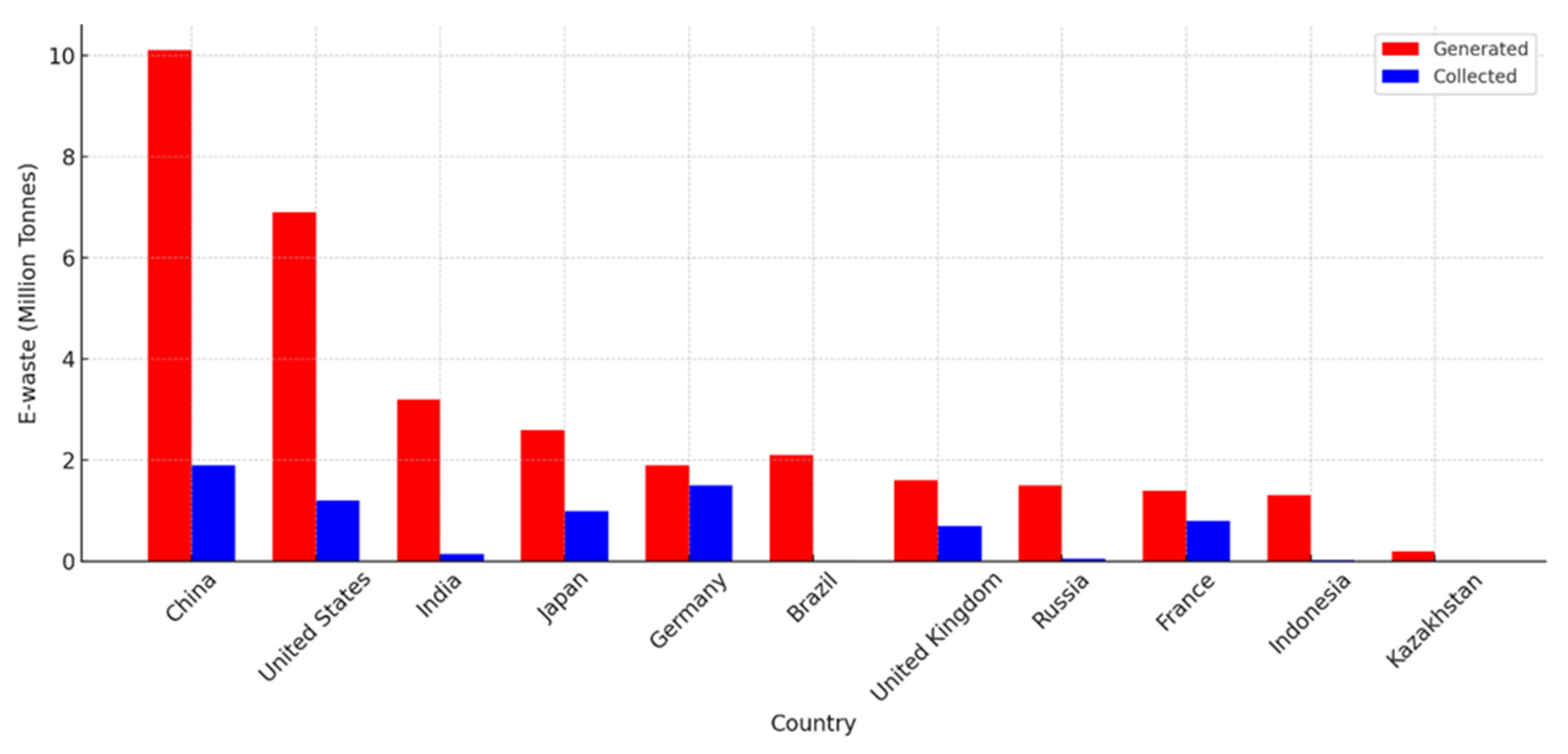
While nations such as those in the EU, Japan, and South Korea have established comprehensive and effective e-waste recycling systems, many regions globally still struggle with informal practices and insufficient infrastructure [5]. The scale of the problem is well-illustrated in Figure 4. A global transition toward circular economy principles, combined with international cooperation and robust policy implementation, is crucial for mitigating the environmental and health consequences of e-waste [240].
The disparity in progress among different regions underlines the urgent need for synchronized global policies that promote sustainable e-waste recycling. Moreover, significant investment in innovative recycling technologies is essential to effectively address the environmental and socio-economic challenges posed by the escalating volumes of e-waste. Such initiatives would not only mitigate the harmful impacts on ecosystems but also ensure that the economic benefits of recycling are equitably distributed across all regions.

9. Conclusions

The examination of e-waste recycling strategies reveals a significant transition from traditional, resource-intensive practices to innovative, sustainable closed-loop systems that emphasize environmental responsibility and the efficient recovery of materials. Key strategies such as the implementation and adoption of advanced mechanical and reagent-free technologies, and the incorporation of circular economy principles, illustrate a growing global consensus on the urgent need for a transformative approach to waste management. These initiatives have yielded quantifiable improvements in material recovery rates, reduced hazardous emissions, and enhanced economic viability through effective resource reclamation.
The implications of these findings extend well beyond the sphere of waste management. They highlight the intricate interconnections between technological advancement, resource sustainability, and ecological resilience. By reframing waste as a valuable resource instead of a mere liability, society is establishing the groundwork for a regenerative industrial paradigm that decouples economic growth from the consumption of finite resources. This paradigm shift carries significant ramifications for global supply chains, strategies for addressing climate change, and efforts toward sustainable urban development, indicating a transition to production and consumption systems designed to be restorative.
The success of these recycling initiatives will not only help mitigate environmental damage but will also redefine the trajectory of industrial progress, offering a robust framework for sustainable advancement in an era characterized by increasing resource constraints. As such, it is imperative for policymakers, businesses, and communities to align their strategies with these emerging practices, ensuring that environmental considerations are integrated into every facet of industrial operation and economic activity. This holistic approach will be crucial for fostering a sustainable future where ecological integrity and resource efficiency are prioritized.

Author Contributions

Conceptualization, N.K. and S.B.; methodology, S.B.; validation, N.K., M.S. and S.B.; formal analysis, M.S.; investigation, M.S. and S.B.; resources, M.S.; data curation, N.K. and S.B.; writing—original draft preparation, M.S. and S.B.; writing—review and editing, S.B.; visualization, S.B.; supervision, N.K.; project administration, N.K. and M.S.; funding acquisition, N.K. All authors have read and agreed to the published version of the manuscript.

Funding

This research was funded by the Committee of Science of the Ministry of Science and Higher Education of the Republic of Kazakhstan, Grant No. AP23488821.

Data Availability Statement

No new data were created or analyzed in this study. Data sharing is not applicable to this article.

Conflicts of Interest

The authors declare no conflicts of interest.

Abbreviations

The following abbreviations are used in this manuscript:
ABSAcrylonitrile butadiene styrene
BFRBrominated flame retardant
BIPBinary integer programming
CNTCarbon nanotube
CRTCathode ray tube
EPRExtended producer responsibility
e-wasteElectronic waste
HIPSHigh-impact polystyrene
GISGeographic information systems
ITOIndium in indium-tin oxide
LCALife-cycle assessments
LCDLiquid crystal display
LEDLight-emitting diode
Li-ionLithium-ion
LIBSLaser-induced breakdown spectroscopy
MILPMixed-integer linear programming
NiMHNickel–metal hydride
OLEDOrganic light-emitting diode
PCPolycarbonate
PCBsPrinted circuit boards
PETPolyethylene terephthalate
PVCPolyvinyl chloride
REERare-earth elements
SyngasSynthesis gas
WEEEWaste electrical and electronic equipment

References

  1. Fowler, B.A. Chapter 1—Magnitude of the Global E-Waste Problem. In Electronic Waste; Fowler, B.A., Ed.; Academic Press: Boston, MA, USA, 2017; pp. 1–15. ISBN 978-0-12-803083-7. [Google Scholar]
  2. Baldé, C.P.; Kuehr, R.; Yamamoto, T.; McDonald, R.; D’Angelo, E.; Althaf, S.; Bel, G.; Deubzer, O.; Fernandez-Cubillo, E.; Forti, V.; et al. The Global E-Waste Monitor 2024; United Nations Institute for Traning and Research: Geneva, Switzerland, 2024. [Google Scholar]
  3. Mishra, K.; Siwal, S.S.; Thakur, V.K. E-Waste Recycling and Utilization: A Review of Current Technologies and Future Perspectives. Curr. Opin. Green Sustain. Chem. 2024, 47, 100900. [Google Scholar] [CrossRef]
  4. Palanisamy, K.; Subburaj, R.G. Integration of Electronic Waste Management: A Review of Current Global Generation, Health Impact, and Technologies for Value Recovery and Its Pertinent Management Technique. Environ. Sci. Pollut. Res. 2023, 30, 63347–63367. [Google Scholar] [CrossRef] [PubMed]
  5. Serpe, A.; Purchase, D.; Bisschop, L.; Chatterjee, D.; Gioannis, G.D.; Garelick, H.; Kumar, A.; Peijnenburg, W.J.G.M.; Piro, V.M.I.; Cera, M.; et al. 2002–2022: 20 Years of e-Waste Regulation in the European Union and the Worldwide Trends in Legislation and Innovation Technologies for a Circular Economy. RSC Sustain. 2025, 3, 1039–1083. [Google Scholar] [CrossRef]
  6. Ramesh, M.V.; Paramasivan, M.; Akshay, P.; Jarin, T. A Review on Electric and Electronic Waste Material Management in 21st Century. Mater. Today Proc. 2023. [Google Scholar] [CrossRef]
  7. Neves, S.A.; Marques, A.C.; de Sá Lopes, L.B. Is Environmental Regulation Keeping E-Waste under Control? Evidence from e-Waste Exports in the European Union. Ecol. Econ. 2024, 216, 108031. [Google Scholar] [CrossRef]
  8. Liu, K.; Tan, Q.; Yu, J.; Wang, M. A Global Perspective on E-Waste Recycling. Circ. Econ. 2023, 2, 100028. [Google Scholar] [CrossRef]
  9. Daily Metal Price: Spot Metal Prices on 2 February 2024. Available online: https://www.dailymetalprice.com/metaltables.php?d=2024-02-02&x=AUD (accessed on 4 August 2025).
  10. Zhang, K.; Schnoor, J.L.; Zeng, E.Y. E-Waste Recycling: Where Does It Go from Here? Environ. Sci. Technol. 2012, 46, 10861–10867. [Google Scholar] [CrossRef]
  11. Patel, A.; Kumar, S.; Awasthi, A. Chapter 6—Hydrometallurgy: Urban Mining of E-Waste and Its Future Implications. In Global E-Waste Management Strategies and Future Implications; Arya, S., Kumar, S., Eds.; Elsevier: Amsterdam, The Netherlands, 2023; pp. 105–123. ISBN 978-0-323-99919-9. [Google Scholar]
  12. Chen, S.; Wu, J.; Wang, X.; Fan, Y.; Yan, Y.; Guan, X.; Guo, Z.; Zhao, S.; Tan, W.; Ding, C.; et al. Mechanisms of Chemical Corrosion in Alumina-Chromite Refractories during e-Waste Recovery via Pyrometallurgy. J. Environ. Chem. Eng. 2025, 13, 116371. [Google Scholar] [CrossRef]
  13. Díaz, I.; Borro, D.; Iparraguirre, O.; Eizaguirre, M.; Ricardo, F.A.; Muñoz, N.; Gil, J.J. Robotic System for Automated Disassembly of Electronic Waste: Unscrewing. Robot. Comput. -Integr. Manuf. 2025, 95, 103032. [Google Scholar] [CrossRef]
  14. Van Yken, J.; Boxall, N.J.; Cheng, K.Y.; Nikoloski, A.N.; Moheimani, N.R.; Kaksonen, A.H. E-Waste Recycling and Resource Recovery: A Review on Technologies, Barriers and Enablers with a Focus on Oceania. Metals 2021, 11, 1313. [Google Scholar] [CrossRef]
  15. Dey, S.; Veerendra, G.T.N.; Padavala, S.S.A.B.; Manoj, A.V.P. Recycling of E-Waste Materials for Controlling the Environmental and Human Heath Degradation in India. Green. Anal. Chem. 2023, 7, 100085. [Google Scholar] [CrossRef]
  16. Alam, T.; Golmohammadzadeh, R.; Faraji, F.; Shahabuddin, M. E-Waste Recycling Technologies: An Overview, Challenges and Future Perspectives. In Paradigm Shift in E-Waste Management; CRC Press: Boca Raton, FL, USA, 2022; ISBN 978-1-00-309597-2. [Google Scholar]
  17. Kadhem, A.J.; Muslim, M.N.; Hamad, A.A.; Fadhil, B.H.; Abduljaleel, H.Y. Assessing University Students’ Awareness and Perceptions of Electronic Waste Hazards in Baghdad, Iraq. Clean. Waste Syst. 2025, 11, 100309. [Google Scholar] [CrossRef]
  18. Kaya, M. Recovery of Metals and Nonmetals from Electronic Waste by Physical and Chemical Recycling Processes. Waste Manag. 2016, 57, 64–90. [Google Scholar] [CrossRef]
  19. Kar, U.; Nili, S.; Mends, E.; Vahidi, E.; Chu, P. A Review and Environmental Impact Analysis on the Current State of Froth Flotation on Recycling of E-Wastes. Resour. Conserv. Recycl. 2025, 212, 107967. [Google Scholar] [CrossRef]
  20. Seif, R.; Salem, F.Z.; Allam, N.K. E-Waste Recycled Materials as Efficient Catalysts for Renewable Energy Technologies and Better Environmental Sustainability. Environ. Dev. Sustain. 2024, 26, 5473–5508. [Google Scholar] [CrossRef] [PubMed]
  21. Lin, S.; Ali, M.U.; Zheng, C.; Cai, Z.; Wong, M.H. Toxic Chemicals from Uncontrolled E-Waste Recycling: Exposure, Body Burden, Health Impact. J. Hazard. Mater. 2022, 426, 127792. [Google Scholar] [CrossRef] [PubMed]
  22. Perkins, D.N.; Brune Drisse, M.-N.; Nxele, T.; Sly, P.D. E-Waste: A Global Hazard. Ann. Glob. Health 2014, 80, 286–295. [Google Scholar] [CrossRef]
  23. Ncube, A.; Mtetwa, S.; Bukhari, M.; Fiorentino, G.; Passaro, R. Circular Economy and Green Chemistry: The Need for Radical Innovative Approaches in the Design for New Products. Energies 2023, 16, 1752. [Google Scholar] [CrossRef]
  24. Boldyryev, S.; Wan Alwi, S.R.; Varbanov, P.S.; Nowak-Ocłoń, M.; Pan, T.; Yu, H. Energy Implications of Circular Economy Solutions and Renewable Energy Integration. J. Sustain. Dev. Indic. 2025, 1, 1–35. [Google Scholar] [CrossRef]
  25. Smith, R.L.; Behdad, S. From Present to Future: A Review of e-Waste Recycling Processes. Waste Manag. 2025, 204, 114863. [Google Scholar] [CrossRef]
  26. Nekouei, R.K.; Pahlevani, F.; Rajarao, R.; Golmohammadzadeh, R.; Sahajwalla, V. Two-Step Pre-Processing Enrichment of Waste Printed Circuit Boards: Mechanical Milling and Physical Separation. J. Clean. Prod. 2018, 184, 1113–1124. [Google Scholar] [CrossRef]
  27. Shan, Z.; Yuan, Y.; Miao, S.; Li, G.; Wang, Q. Design and Performance of Radial Multilayer Magnetic Structure for Magnetic Roller in Eddy Current Separation. Miner. Eng. 2025, 229, 109377. [Google Scholar] [CrossRef]
  28. Xue, M.; Yan, G.; Li, J.; Xu, Z. Electrostatic Separation for Recycling Conductors, Semiconductors, and Nonconductors from Electronic Waste. Environ. Sci. Technol. 2012, 46, 10556–10563. [Google Scholar] [CrossRef]
  29. Shan, Z.; Yuan, Y.; Yang, L.; Cao, B.; Li, G.; Wang, Q. Key Factors Affecting the Vertical Eddy Current Separation Efficiency between Cu and Al Particles. J. Environ. Manag. 2025, 375, 124392. [Google Scholar] [CrossRef]
  30. Tiwary, C.S.; Kishore, S.; Vasireddi, R.; Mahapatra, D.R.; Ajayan, P.M.; Chattopadhyay, K. Electronic Waste Recycling via Cryo-Milling and Nanoparticle Beneficiation. Mater. Today 2017, 20, 67–73. [Google Scholar] [CrossRef]
  31. Nascimento, G.d.A.; de Souza, R.G.; Fiore, F.A.; Dantas de Jesus, A.M. Leachate Analysis of Trace Metals from E-Waste Disposed of in Landfills and Open Dumps. Clean. Eng. Technol. 2024, 21, 100771. [Google Scholar] [CrossRef]
  32. Gurgul, A.; Szczepaniak, W.; Zabłocka-Malicka, M. Incineration and Pyrolysis vs. Steam Gasification of Electronic Waste. Sci. Total Environ. 2018, 624, 1119–1124. [Google Scholar] [CrossRef]
  33. Emmons-Burzyńska, M.; Jędrzejczak, E.; Piasecki, A.; Ławniczak, Ł.; Regel-Rosocka, M.; Wysokowski, M. Leaching of Metals from Electronic Waste Using Carboxylic Acid-Based Deep Eutectic Solvents: Preliminary Laboratory Studies and Molecular Modelling. Hydrometallurgy 2025, 234, 106465. [Google Scholar] [CrossRef]
  34. Dube, S.; Moyo-Mahlangu, T. Bibliometric Analysis and Data Visualization of Research Trends in Lithium-Ion and Nickel-Metal-Hydride Battery Recycling Processes. Sustain. Mater. Technol. 2025, 45, e01565. [Google Scholar] [CrossRef]
  35. Li, J.; Nazari, S.; Ma, X.; Wei, N.; He, Y. A Critical Review on the Advances in Thermal Reduction Technology for Recycling Spent Lithium-Ion Batteries. Next Mater. 2025, 8, 100641. [Google Scholar] [CrossRef]
  36. Choux, M.; Pripp, S.W.; Kvalnes, F.; Hellström, M. To Shred or to Disassemble—A Techno-Economic Assessment of Automated Disassembly vs. Shredding in Lithium-Ion Battery Module Recycling. Resour. Conserv. Recycl. 2024, 203, 107430. [Google Scholar] [CrossRef]
  37. Nshizirungu, T.; Rana, M.; Jo, Y.T.; Uwiragiye, E.; Kim, J.; Park, J.-H. Ultrasound-Assisted Sustainable Recycling of Valuable Metals from Spent Li-Ion Batteries via Optimisation Using Response Surface Methodology. J. Environ. Chem. Eng. 2024, 12, 112371. [Google Scholar] [CrossRef]
  38. Lei, C.; Aldous, I.; Hartley, J.M.; Thompson, D.L.; Scott, S.; Hanson, R.; Anderson, P.A.; Kendrick, E.; Sommerville, R.; Ryder, K.S.; et al. Lithium Ion Battery Recycling Using High-Intensity Ultrasonication. Green Chem. 2021, 23, 4710–4715. [Google Scholar] [CrossRef]
  39. Fang, Z.; Wu, Z.; Zeng, W.; Bontempi, E.; Duan, Q.; Sun, J.; Wang, Q. Exploring the Viability of Cryogenic Freezing for Safe Pretreatment in Lithium-Ion Battery Recycling. Renew. Energy 2025, 252, 123481. [Google Scholar] [CrossRef]
  40. Xia, X.; Li, Z.; Zhou, H.; Qiu, Y.; Zhang, C. The Effect of Deep Cryogenic Treatment on SnSb/C Nanofibers Anodes for Li-Ion Battery. Electrochim. Acta 2016, 222, 765–772. [Google Scholar] [CrossRef]
  41. Reynolds, C.D.; Walker, H.; Mahgoub, A.; Adebayo, E.; Kendrick, E. Battery Electrode Slurry Rheology and Its Impact on Manufacturing. Energy Adv. 2025, 4, 84–93. [Google Scholar] [CrossRef]
  42. Liu, H.; Han, J.; Gu, J.; Feng, Y.; Liu, G.; Yuan, H. Co-Pyrolysis of Polyolefin Separators and Active Materials from Lithium Batteries: Thermal Conversion Performance, Interaction Behaviors, and Products. Fuel 2026, 404, 136198. [Google Scholar] [CrossRef]
  43. Wang, L.; Jiao, X.; Xie, T.; Bian, H.; Ma, J.; Zhang, Z. Waste Treats Waste: An Efficient Co-Pyrolysis Approach for the Preferential Li Extraction from Spent Lithium-Ion Battery Powder Utilizing Coffee Grounds. Chem. Eng. J. 2025, 520, 165670. [Google Scholar] [CrossRef]
  44. Patil, C.S.; Saqib, Q.M.; Patil, S.R.; Noman, M.; Chougale, M.Y.; Shaukat, R.A.; Kim, J.; Ko, Y.; Dongale, T.D.; Bae, J. Triboelectric Nanogenerator Based on Reactivated Electrode Materials Derived from Waste Alkaline Battery: Influence of Pyrolysis Temperature and Surface Morphology. Nano Energy 2024, 121, 109205. [Google Scholar] [CrossRef]
  45. Wu, L. Efficient Metal Recovery from Lithium-Ion Batteries Using Plastics. Nat. Rev. Electr. Eng. 2024, 1, 767. [Google Scholar] [CrossRef]
  46. Boldyryev, S.; Maljković, D.; Kirasić, E.; Krajačić, G. Assessment of Product Composition and Energy Output of Sewage Sludge Gasification by Simulation Model. Energy 2025, 321, 135476. [Google Scholar] [CrossRef]
  47. Han, C.; Gao, P.; Yuan, S.; Wen, G.; Ding, H.; Bai, Z.; Lei, S. Comprehensive Study of Pyrolysis of Spent Lithium Iron Phosphate Batteries. Sep. Purif. Technol. 2025, 375, 133793. [Google Scholar] [CrossRef]
  48. Cai, K.; Song, Q.; Yuan, W.; Yang, G.; Li, J. Composition Changes, Releases, and Potential Exposure Risk of PBDEs from Typical E-Waste Plastics. J. Hazard. Mater. 2022, 424, 127227. [Google Scholar] [CrossRef]
  49. Bachér, J.; Laatikainen-Luntama, J.; Rintala, L.; Horttanainen, M. The Distribution of Valuable Metals in Gasification of Metal-Containing Residues from Mechanical Recycling of End-of-Life Vehicles and Electronic Waste. J. Environ. Manag. 2025, 373, 123526. [Google Scholar] [CrossRef] [PubMed]
  50. Andrieu, L.; Espinosa-Rodriguez, E.; Taam, M.; Villard, M.; Boyron, O. Identification of Polymeric Binders in Anticorrosive Coatings via FTIR Spectroscopy. Spectrochim. Acta Part A Mol. Biomol. Spectrosc. 2025, 343, 126493. [Google Scholar] [CrossRef] [PubMed]
  51. Alharbi, A.; Shahat, A. A Novel Approach for Green Synthesis of Cellulose Nanorods as Optical Sensor Support for Ultra-Detection and Recovery of Precious Metals from Electronic Wastes. J. Environ. Chem. Eng. 2024, 12, 112564. [Google Scholar] [CrossRef]
  52. Algafri, M.; Sayad, M.; Abdel-Aal, M.A.M.; Attia, A.M. A Comparative Study of Machine Learning Models for Accurate E-Waste Prediction. Results Eng. 2025, 26, 105388. [Google Scholar] [CrossRef]
  53. He, X.; Zhong, Z.; Ouyang, Y.; Wang, J. Investigation of Tribo-Electrostatic Separation Mechanism for Thermoplastics in e-Waste Based on Functional Group Distribution and Surface Potential. Sep. Purif. Technol. 2025, 362, 131764. [Google Scholar] [CrossRef]
  54. Kanta Das, S.; Ellamparuthy, G.; Kundu, T.; Angadi, S.I.; Rath, S.S. A Comprehensive Review of the Mechanical Separation of Waste Printed Circuit Boards. Process Saf. Environ. Prot. 2024, 187, 221–239. [Google Scholar] [CrossRef]
  55. Kumar, S.; Singh, H.; Singh, H.; Soni, H.; Bechelany, M.; Singh, J. Extraction of Metallic Nanoparticles from Electronic Waste for Biomedical Applications: Pioneering Sustainable Technological Progress. Sustainability 2025, 17, 2100. [Google Scholar] [CrossRef]
  56. Kuznetsov, M.; Boldyryev, S.; Kenzhebekov, D.; Kaldybaeva, B. Improving Inter-Plant Integration of Syngas Production Technologies by the Recycling of CO2 and by-Product of the Fischer-Tropsch Process. Int. J. Hydrogen Energy 2022, 47, 31755–31772. [Google Scholar] [CrossRef]
  57. Santo Stefano, L.; Cafiero, L.; De Angelis, D.; Pavoni, S.; Tuffi, R.; Scarsella, M. Thermal Pyrolysis of a Real Plastic Sample from Small WEEE and Characterization of the Produced Oil in View of Fuel or Feedstock Uses. Therm. Sci. Eng. Prog. 2024, 48, 102403. [Google Scholar] [CrossRef]
  58. Charitopoulou, M.A.; Stefanidis, S.D.; Lappas, A.A.; Achilias, D.S. Catalytic Pyrolysis of Polymers with Brominated Flame-Retardants Originating in Waste Electric and Electronic Equipment (WEEE) Using Various Catalysts. Sustain. Chem. Pharm. 2022, 26, 100612. [Google Scholar] [CrossRef]
  59. Islam, K.M.O.; Ahmad, N.; Ummer, A.C.; Ahmed, U.; Siddiqui, M.N.; Millan, M.; Abdul Jameel, A.G. Microwave-Assisted Pyrolysis of Waste Plastics: A Comprehensive Review on Process Parameters, Catalysts, and Future Prospects. Results Eng. 2025, 26, 105571. [Google Scholar] [CrossRef]
  60. Zhou, D.; Yu, W.; Sun, J.; Qi, J.; Yin, J. Advances and Applications of Supercritical Carbon Dioxide Microemulsions with or without Ionic Liquids. J. Supercrit. Fluids 2025, 222, 106603. [Google Scholar] [CrossRef]
  61. Siew, S.W.; Khairi, M.H.F.; Hamid, N.A.; Asras, M.F.F.; Ahmad, H.F. Shallow Shotgun Sequencing of Healthcare Waste Reveals Plastic-Eating Bacteria with Broad-Spectrum Antibiotic Resistance Genes. Environ. Pollut. 2025, 364, 125330. [Google Scholar] [CrossRef]
  62. Bajo, K.; Romano, R.; Kolvenbach, B.; Nazemi, S.A.; Shahgaldian, P.; Corvini, P.F.-X.; Fava, F.; Raddadi, N. Biodegradation of Untreated Plasticizers-Free Linear Low-Density Polyethylene Films by Marine Bacteria. Mar. Pollut. Bull. 2024, 209, 117115. [Google Scholar] [CrossRef] [PubMed]
  63. Andooz, A.; Eqbalpour, M.; Kowsari, E.; Ramakrishna, S.; Cheshmeh, Z.A. A Comprehensive Review on Pyrolysis of E-Waste and Its Sustainability. J. Clean. Prod. 2022, 333, 130191. [Google Scholar] [CrossRef]
  64. Murugapoopathi, S.; Sathiyamoorthi, R.; Senthil, S. Chapter Twelve—Critical Review on Various Recycling Methods of Indium from Flat Panel Displays. In Metal Value Recovery from Industrial Waste Using Advanced Physicochemical Treatment Technologies; Giannakoudakis, D.A., Das, P., Pal, P., Nayak, J., Chakrabortty, S., Eds.; Elsevier: Amsterdam, The Netherlands, 2025; pp. 261–276. ISBN 978-0-443-21884-2. [Google Scholar]
  65. Gong, Y.; Tian, X.; Wu, Y.; Tan, Z.; Lv, L. Recent Development of Recycling Lead from Scrap CRTs: A Technological Review. Waste Manag. 2016, 57, 176–186. [Google Scholar] [CrossRef] [PubMed]
  66. Zhan, L.; Xu, Z. State-of-the-Art of Recycling e-Wastes by Vacuum Metallurgy Separation. Environ. Sci. Technol. 2014, 48, 14092–14102. [Google Scholar] [CrossRef]
  67. Al-Buriahi, M.S.; Kavas, T.; Kavaz, E.; Kurtulus, R.; Olarinoye, I.O. Recycling Potential of Cathode Ray Tubes (CRTs) Waste Glasses Based on Bi2O3 Addition Strategies. Waste Manag. 2022, 148, 43–49. [Google Scholar] [CrossRef]
  68. Hanif, A. Sustainable Use of Organic Light-Emitting Diode (OLED) and Liquid Crystal Display (LCD) Glass Wastes as Cement Replacement in Concrete. Mater. Today Proc. 2023. [Google Scholar] [CrossRef]
  69. Volokitin, A.; Naizabekov, A.; Volokitina, I.; Lezhnev, S.; Panin, E. Thermomechanical Treatment of Steel Using Severe Plastic Deformation and Cryogenic Cooling. Mater. Lett. 2021, 304, 130598. [Google Scholar] [CrossRef]
  70. Illés, I.B.; Nagy, S.; Kékesi, T. The Recycling of Pure Metallic Indium from Waste LCD Screens by a Combined Hydro-Electrometallurgical Method. Hydrometallurgy 2022, 213, 105945. [Google Scholar] [CrossRef]
  71. Zhang, J.; Chu, Z.; Cao, R.; Wu, X.; Han, K. A Review of Resource Recovery from Waste Plastics via Pyrolysis and Gasification. Fuel 2026, 404, 136319. [Google Scholar] [CrossRef]
  72. Bortot Coelho, F.E.; Moreira, V.R.; Majuste, D.; Ciminelli, V.S.T.; Amaral, M.C.S. Sustainable Indium Recovery from e-Waste and Industrial Effluents: Innovations and Opportunities Integrating Membrane Separation Processes. Desalination 2025, 612, 118900. [Google Scholar] [CrossRef]
  73. Elo, K.; Sundin, E. Process Concepts for Semi-Automatic Dismantling of LCD Televisions. Procedia CIRP 2014, 23, 270–275. [Google Scholar] [CrossRef]
  74. Zhang, H.; Sun, B.; Liu, X.; Zhang, W.; Zhao, H.; Zhao, Y.; Liang, X.; Yang, Y.; Zhang, J.; Yao, Y.; et al. Revolutionizing ITO Waste Recycling: Dynamic Evolution of Ultrafine Pulverization and Densification. Ceram. Int. 2024, 50, 41003–41015. [Google Scholar] [CrossRef]
  75. Rigotti, D.; Pegoretti, A. Recycling of LDPE-PVC Blends from Cable Waste: Mechanical Characterization and Performance Optimization. Results Mater. 2024, 23, 100608. [Google Scholar] [CrossRef]
  76. Li, L.; Liu, G.; Pan, D.; Wang, W.; Wu, Y.; Zuo, T. Overview of the Recycling Technology for Copper-Containing Cables. Resour. Conserv. Recycl. 2017, 126, 132–140. [Google Scholar] [CrossRef]
  77. Rawat, S.; Samyal, R.; Bedi, R.; Kumar Bagha, A. A Comparative Study of Interface Material through Selective Microwave Hybrid Heating for Joining Metal Plates. Mater. Today Proc. 2022, 65, 3117–3125. [Google Scholar] [CrossRef]
  78. Younas, T.; Shalchian, H.; Ullah, M.; Vegliò, F.; Innocenzi, V. Optimizing Dismantling Approaches for Recycling of Li-Ion Batteries: Strategies, Challenges and Economic Analysis. J. Energy Storage 2025, 132, 117918. [Google Scholar] [CrossRef]
  79. Tembhare, S.; Bhanvase, B.A. 10—Technological Development in Metal Extraction Processes from e-Waste. In 360-Degree Waste Management, Volume 2; Raut, N.A., Kokare, D.M., Bhanvase, B.A., Randive, K.R., Dhoble, S.J., Eds.; Elsevier: Amsterdam, The Netherlands, 2023; pp. 221–253. ISBN 978-0-323-90909-9. [Google Scholar]
  80. Jeschonowski-Papstein, J.; Gast, L.; Binding, M.; Faulstich, M. Improving the Recycling of Plastic Parts in Household Appliances–a Review. Resour. Conserv. Recycl. Adv. 2024, 24, 200235. [Google Scholar] [CrossRef]
  81. Liu, J.; Bai, H.; Liang, H.; Wang, Y.; Xu, H. How to Recycle the Small Waste Household Appliances in China? A Revenue- Expenditure Analysis. Resour. Conserv. Recycl. 2018, 137, 292–301. [Google Scholar] [CrossRef]
  82. Prasad, A.K.; Kapil, S.; Bag, S. Wire Additive Metal Transfer for the Development of High-Frequency Induction Heating-Based Directed Energy Deposition Process. J. Manuf. Process. 2025, 146, 248–263. [Google Scholar] [CrossRef]
  83. Uddin, M.B.; Rasul, M.G.; Chowdhury, A.A.; Hassan, N.M.S. Hydrogen Production from Plastic Waste Pyrolysis Syngas: A Review on Progresses and Challenges. Int. J. Hydrogen Energy 2025, 158, 150512. [Google Scholar] [CrossRef]
  84. Cuevas, A.B.; Leiva-Candia, D.E.; Dorado, M.P. An Overview of Pyrolysis as Waste Treatment to Produce Eco-Energy. Energies 2024, 17, 2852. [Google Scholar] [CrossRef]
  85. Precious Metals Recovery from E-Waste. Available online: https://emew.com/blog/precious-metals-recovery-from-e-waste (accessed on 12 August 2025).
  86. Next-Generation E-Waste Recycling: Smarter, Safer, and More Sustainable. Newsletter CEAR. March 2025. Available online: https://www.cearinc.com/2025/03/17/next-generation-e-waste-recycling-smarter-safer-and-more-sustainable/.
  87. Peng, X.; Peng, W.-C.; Chen, Y.-T.; Yan, Z.-X.; Lee, L.-Y.; Hsiao, K.-Y.; Lu, M.-H.; Shao, B.; Jhan, D.-J.; Xie, B.-Y.; et al. Synergistically Designed Carbon-Based Hybrid Non-Contact Triboelectric-and-Electromagnetic Nanogenerator with Ultralong Charge Retention for Wearable and Ambient Electromagnetic-Waste Energy Harvesting and Self-Powered Sensing. Mater. Sci. Eng. R Rep. 2025, 165, 100994. [Google Scholar] [CrossRef]
  88. Nie, C.; Jiang, S.; Li, X.; Wang, X.; Li, Z.; Zhu, X.; Lyu, X.; You, X.; Li, L. Eco-Friendly Approach for Enhancing the Floatability of Non-Metallic Components in Waste Printed Circuit Boards: Adding Gutter Oil during Dry Grinding. Waste Manag. 2023, 172, 71–79. [Google Scholar] [CrossRef]
  89. Zhang, H.; He, B.; Cheng, Y.; Tang, Y.; Ren, Q.; Zhu, X.; Jiang, Z. Strengthening and Embrittlement Effect of Cryogenic Temperature on Fiber Reinforced Geopolymer Composite. Cem. Concr. Compos. 2024, 153, 105727. [Google Scholar] [CrossRef]
  90. Koslow, A. Recycling Process of Electronic Waste in Order to Receive Re-Usable Material without Producing Toxic Agents. Canada patent CA2736293A1, 20 October 2015. [Google Scholar]
  91. Armstrong, W.T.; Morriss, S.M.; Wilkie, G.; Scheirs, J. Method of Recycling Mixed Streams of Ewaste (WEEE) 2011. U.S. Patent 7,902,262, 8 March 2011. [Google Scholar]
  92. Korzenski, M.B.; Jiang, P.; Norman, J.; Warner, J.; Ingalls, L.; Gnanamgari, D.; Strickler, F.; Mendum, T. Sustainable Process for Reclaiming Precious Metals and Base Metals from E-Waste 2016. U.S. Patent 9,238,850, 19 January 2016. [Google Scholar]
  93. Crush, O.; Whitby, R.; Smith, R. A Process for Recovering Metal from Electronic Waste 2019. U.S. Patent 11,608,544, 21 March 2023. [Google Scholar]
  94. Shackle, D.R. Method for Recycling Metal Containing Electrical Components 1994. U.S. Patent 5,352,270, 4 October 1994. [Google Scholar]
  95. Ilankoon, I.M.S.K.; Dilshan, R.A.D.P.; Dushyantha, N. Co-Processing of e-Waste with Natural Resources and Their Products to Diversify Critical Metal Supply Chains. Miner. Eng. 2024, 211, 108706. [Google Scholar] [CrossRef]
  96. Mohamed, D.; Fayad, A.; Mohamed, A.-M.O.; Al Nahyan, M.T. The Role of E-Waste in Sustainable Mineral Resource Management. Waste 2025, 3, 27. [Google Scholar] [CrossRef]
  97. Prasad, M.N.V.; Vithanage, M.; Borthakur, A. (Eds.) Handbook of Electronic Waste Management: International Best Practices and Case Studies; Butterworth-Heinemann Elsevier: Oxford, UK; Cambridge, MA, USA, 2020; ISBN 978-0-12-817030-4. [Google Scholar]
  98. Wang, X.; Huang, W.; Yan, B.; Zhou, S.; Zhu, X.; Wang, Z.; Cheng, Z.; Chen, G. E-Waste Recycling: Integrated Life Cycle Assessment and Techno-Economic Analysis Unravels Pyrometallurgy’s Edge and Delivers an Optimization Framework for Recovering Waste Printed Circuit Boards. Waste Manag. 2025, 207, 115135. [Google Scholar] [CrossRef]
  99. Martín, M.I.; García-Díaz, I.; López, F.A. Properties and Perspective of Using Deep Eutectic Solvents for Hydrometallurgy Metal Recovery. Miner. Eng. 2023, 203, 108306. [Google Scholar] [CrossRef]
  100. Wang, J.; Feng, Y.; Shi, M.; He, Y. A Comparative Study of Mechanical Crushing and Pyrolysis Techniques for Separation and Recovery of Discarded Polycrystalline Silicon Photovoltaic Modules. Sol. Energy Mater. Sol. Cells 2024, 275, 113020. [Google Scholar] [CrossRef]
  101. Remadnia, M.; Kachi, M. Electrostatic Separation of Al/Cu/PVC Mixture Using a Cascade of Flat Horizontal Discs. J. Electrost. 2025, 136, 104097. [Google Scholar] [CrossRef]
  102. Cui, J.; Forssberg, E. Mechanical Recycling of Waste Electric and Electronic Equipment: A Review. J. Hazard. Mater. 2003, 99, 243–263. [Google Scholar] [CrossRef]
  103. Yuan, Y.; Shan, Z.; Yan, H.; Cao, B.; Yang, L.; Li, G.; Wang, Q. Optimal Design of a New Halbach Array Magnetic Roller with Axial Eddy Current Force. Miner. Eng. 2023, 204, 108406. [Google Scholar] [CrossRef]
  104. Zhang, P.; Chaerusani, V.; Az Zahra, A.C.; Anniwaer, A.; Zhao, K.; Gu, F.; Feng, Z.; Liu, Z.; Abudula, A.; Guan, G. CO2-Assisted Pyrolysis of Plastic Wastes: A Review. Sustain. Energy Technol. Assess. 2025, 75, 104209. [Google Scholar] [CrossRef]
  105. Isildar, A.; Rene, E.R.; Hullebusch, E.D.V.; Lens, P.N.L. Two-Step Leaching of Valuable Metals from Discarded Printed Circuit Boards, and Process Optimization Using Response Surface Methodology. Adv. Recycl. Waste Manag. 2017, 2, 132. [Google Scholar] [CrossRef]
  106. Zhang, T.; Mao, X.; Qu, J.; Liu, Y.; Siyal, A.A.; Ao, W.; Fu, J.; Dai, J.; Jiang, Z.; Deng, Z.; et al. Microwave-Assisted Catalytic Pyrolysis of Waste Printed Circuit Boards, and Migration and Distribution of Bromine. J. Hazard. Mater. 2021, 402, 123749. [Google Scholar] [CrossRef]
  107. Duan, C.; Wen, X.; Shi, C.; Zhao, Y.; Wen, B.; He, Y. Recovery of Metals from Waste Printed Circuit Boards by a Mechanical Method Using a Water Medium. J. Hazard. Mater. 2009, 166, 478–482. [Google Scholar] [CrossRef]
  108. Charpentier, N.M.; Xia, D.; Gabriel, J.-C.P. Printed circuit board recycling: A focus on a novel, efficient and sustainable process for spent critical metals recovery. Comptes Rendus. Chim. 2024, 27, 5–15. [Google Scholar] [CrossRef]
  109. Costa, V.C.; Castro, J.P.; Andrade, D.F.; Victor Babos, D.; Garcia, J.A.; Sperança, M.A.; Catelani, T.A.; Pereira-Filho, E.R. Laser-Induced Breakdown Spectroscopy (LIBS) Applications in the Chemical Analysis of Waste Electrical and Electronic Equipment (WEEE). TrAC Trends Anal. Chem. 2018, 108, 65–73. [Google Scholar] [CrossRef]
  110. dos Santos, D.M.; Buzzi, D.C.; Botelho Junior, A.B.; Espinosa, D.C.R. Recycling of Printed Circuit Boards: Ultrasound-Assisted Comminution and Leaching for Metals Recovery. J. Mater. Cycles Waste Manag. 2022, 24, 1991–2001. [Google Scholar] [CrossRef]
  111. Islam, M.T.; Iyer-Raniga, U. Life Cycle Assessment of E-Waste Management System in Australia: Case of Waste Printed Circuit Board (PCB). J. Clean. Prod. 2023, 418, 138082. [Google Scholar] [CrossRef]
  112. Hariyani, D.; Hariyani, P.; Mishra, S.; Sharma, M.K. A Literature Review on Waste Management Treatment and Control Techniques. Sustain. Futures 2025, 9, 100728. [Google Scholar] [CrossRef]
  113. Zhu, Y.; Miao, J.; Zhang, Y.; Li, C.; Wang, Y.; Cheng, Y.; Long, M.; Wang, J.; Wu, C. Carbon Nanotubes Production from Real-World Waste Plastics and the Pyrolysis Behaviour. Waste Manag. 2023, 166, 141–151. [Google Scholar] [CrossRef]
  114. Wang, Y.; Cai, N.; Yang, H.; Wu, C. Application of Carbon Nanotubes from Waste Plastics As Filler to Epoxy Resin Composite. ACS Sustain. Chem. Eng. 2022, 10, 2204–2213. [Google Scholar] [CrossRef]
  115. Kim, H.; Nam, E.; An, K.; Lim, H. Laboratory-Scale Plastic Upcycling and Green Growth: Evaluating the Upcycling of Plastic Waste into Carbon Nanotubes from Economic and Environmental Aspects. Chem. Eng. J. 2024, 495, 153300. [Google Scholar] [CrossRef]
  116. Loke, K.Y.; Lim, X.X.; Osman, M.A.; Low, S.C.; Oh, W.-D. Enhancing Plastic Pyrolysis for Carbon Nanotubes Synthesis through Machine Learning Integration: A Review. J. Anal. Appl. Pyrolysis 2025, 187, 106989. [Google Scholar] [CrossRef]
  117. Cai, N.; Liu, Q.; Zhu, Y.; Yang, H.; Chen, H. Preparation of High-Value Carbon Nanotubes from Real Waste Plastic towards the Negative Carbon Technology. Carbon. Capture Sci. Technol. 2024, 13, 100258. [Google Scholar] [CrossRef]
  118. Chi, L.; Omar Shaikh, M. Upcycling Plastic Waste into Valuable Carbon Nanomaterials. ChemNanoMat 2024, 10, e202400409. [Google Scholar] [CrossRef]
  119. Liu, Q.; Jiang, D.; Zhou, H.; Yuan, X.; Wu, C.; Hu, C.; Luque, R.; Wang, S.; Chu, S.; Xiao, R.; et al. Pyrolysis–Catalysis Upcycling of Waste Plastic Using a Multilayer Stainless-Steel Catalyst toward a Circular Economy. Proc. Natl. Acad. Sci. USA 2023, 120, e2305078120. [Google Scholar] [CrossRef]
  120. Wu, C.; Nahil, M.A.; Miskolczi, N.; Huang, J.; Williams, P.T. Processing Real-World Waste Plastics by Pyrolysis-Reforming for Hydrogen and High-Value Carbon Nanotubes. Environ. Sci. Technol. 2014, 48, 819–826. [Google Scholar] [CrossRef]
  121. Qiu, B.; Liu, M.; Qu, X.; Zhou, F.; Xie, H.; Wang, D.; Lee, L.Y.S.; Yin, H. Waste Plastics Upcycled for High-Efficiency H2O2 Production and Lithium Recovery via Ni-Co/Carbon Nanotubes Composites. Nat. Commun. 2024, 15, 6473. [Google Scholar] [CrossRef] [PubMed]
  122. Nam, E.; Park, G.; Nam, J.Y.; Park, S.; Jo, Y.; Kim, J.; Park, B.G.; Baek, K.; Kang, S.J.; Ra, H.W.; et al. Upcycling of Plastic Waste into Carbon Nanotubes as Efficient Battery Additives. Green. Chem. 2023, 25, 8007–8018. [Google Scholar] [CrossRef]
  123. Pasha, M.S.; Aslam, M.F.; Hamza, M.; Ali, N.M.; Jabbar, I.; Ahmed, S.; Abbasi, H.K.J. Sustainable Construction: Performance Analysis of Concrete Incorporating E-Waste Plastic Aggregates and Silica Fume. Constr. Build. Mater. 2025, 474, 141103. [Google Scholar] [CrossRef]
  124. Hopewell, J.; Dvorak, R.; Kosior, E. Plastics Recycling: Challenges and Opportunities. Philos. Trans. R. Soc. B Biol. Sci. 2009, 364, 2115–2126. [Google Scholar] [CrossRef]
  125. Geyer, R.; Jambeck, J.R.; Law, K.L. Production, Use, and Fate of All Plastics Ever Made. Sci. Adv. 2017, 3, e1700782. [Google Scholar] [CrossRef]
  126. Rochman, C.M.; Browne, M.A.; Halpern, B.S.; Hentschel, B.T.; Hoh, E.; Karapanagioti, H.K.; Rios-Mendoza, L.M.; Takada, H.; Teh, S.; Thompson, R.C. Classify Plastic Waste as Hazardous. Nature 2013, 494, 169–171. [Google Scholar] [CrossRef]
  127. Hahladakis, J.N.; Velis, C.A.; Weber, R.; Iacovidou, E.; Purnell, P. An Overview of Chemical Additives Present in Plastics: Migration, Release, Fate and Environmental Impact during Their Use, Disposal and Recycling. J. Hazard. Mater. 2018, 344, 179–199. [Google Scholar] [CrossRef]
  128. Shaaban, M.; Wang, X.-L.; Song, P.; Hou, X.; Wei, Z. Microplastic Pollution and E-Waste: Unraveling Sources, Mechanisms, and Impacts across Environments. Curr. Opin. Green. Sustain. Chem. 2024, 46, 100891. [Google Scholar] [CrossRef]
  129. Jessieleena, A.A.; Premkumar, R.; Nambi, I.; Nambi, I.M. Distribution of Microplastics in Domestic Wastewater Treatment Plant: Exploring Ferrofluid Assisted Magnetic Separation for Microplastics Removal. J. Water Process Eng. 2025, 76, 108186. [Google Scholar] [CrossRef]
  130. Joshua, A.M.; Aznir, P.A.D.; Lau, E.V. Understanding Microplastic Flotation through Microbubble-Microplastic Interactions. Surf. Interfaces 2025, 64, 106399. [Google Scholar] [CrossRef]
  131. Pelto, J.; Barreto, C.; Anwar, H.; Strobl, L.; Schlummer, M. Compatibilized PC/ABS Blends from Solvent Recycled PC and ABS Polymers from Electronic Equipment Waste. Polym. Test. 2023, 120, 107969. [Google Scholar] [CrossRef]
  132. Tournier, V.; Topham, C.M.; Gilles, A.; David, B.; Folgoas, C.; Moya-Leclair, E.; Kamionka, E.; Desrousseaux, M.-L.; Texier, H.; Gavalda, S.; et al. An Engineered PET Depolymerase to Break down and Recycle Plastic Bottles. Nature 2020, 580, 216–219. [Google Scholar] [CrossRef]
  133. Tavşanoğlu, Ü.N.; Koraltan, İ.; Basaran Kankılıç, G.; Çırak, T.; Ertürk, Ş.; Ürker, O.; Güçlü, P.; Ünlü, H.; Çağan, A.S.; Deniz Yağcıoğlu, K.; et al. Assessing Microplastic Pollution in a River Basin: A Multidisciplinary Study on Circularity, Sustainability, and Socio-Economic Impacts. Environ. Res. 2024, 262, 119819. [Google Scholar] [CrossRef] [PubMed]
  134. Suzuki, G.; Uchida, N.; Tanaka, K.; Higashi, O.; Takahashi, Y.; Kuramochi, H.; Yamaguchi, N.; Osako, M. Global Discharge of Microplastics from Mechanical Recycling of Plastic Waste. Environ. Pollut. 2024, 348, 123855. [Google Scholar] [CrossRef]
  135. Lacroix, R.; Judicone, C.; Poncelet, P.; Robert, S.; Arnaud, L.; Sampol, J.; Dignat-george, F. Impact of Pre-analytical Parameters on the Measurement of Circulating Microparticles: Towards Standardization of Protocol. J. Thromb. Haemost. 2012, 10, 437–446. [Google Scholar] [CrossRef]
  136. Ardolino, F.; Cardamone, G.F.; Arena, U. How to Enhance the Environmental Sustainability of WEEE Plastics Management: An LCA Study. Waste Manag. 2021, 135, 347–359. [Google Scholar] [CrossRef]
  137. Plastics Europe Launches Plastics—The Fast Facts 2023 Plastics Europe. Available online: https://plasticseurope.org/media/plastics-europe-launches-the-plastics-the-fast-facts-2023/ (accessed on 15 August 2025).
  138. Toha, M.; Rahman, R.-R.; Alam, M. Microplastics in Waste Management Systems: An Invisible Threat to Environmental and Public Health. Bioresour. Technol. Rep. 2025, 30, 102141. [Google Scholar] [CrossRef]
  139. From Pollution to Solution: A Global Assessment of Marine Litter and Plastic Pollution. Available online: https://www.unep.org/resources/pollution-solution-global-assessment-marine-litter-and-plastic-pollution (accessed on 15 August 2025).
  140. Yang, Y.; Jalalah, M.; Alsareii, S.A.; Harraz, F.A.; Thakur, N.; Zheng, Y.; Koutb, M.; Yoon, Y.; Salama, E.-S. Plastic Wastes (PWs) and Microplastics (MPs) Formation: Management, Migration, and Environmental Impact. J. Environ. Chem. Eng. 2024, 12, 112926. [Google Scholar] [CrossRef]
  141. Zheng, Y.; Hernando, M.D.; Barceló, D.; Wang, C.; Li, H. Climate Change Exacerbates Microplastic Pollution: Environmental Behavior and Human Health Risks. Curr. Opin. Environ. Sci. Health 2025, 45, 100608. [Google Scholar] [CrossRef]
  142. Puteri, M.N.; Gew, L.T.; Ong, H.C.; Ming, L.C. Technologies to Eliminate Microplastic from Water: Current Approaches and Future Prospects. Environ. Int. 2025, 199, 109397. [Google Scholar] [CrossRef] [PubMed]
  143. Khan, S.; Kalsoom, U.; Kashif, M.; Hussain, S.A.; Gul, M.; Azizi, S.; Maaza, M. Smart and Sustainable Microplastic Removal: Hybrid Systems, Bio-Inspired Technologies, Real-Time Sensing, and Policy Integration. Water Air Soil. Pollut. 2025, 236, 900. [Google Scholar] [CrossRef]
  144. Trestrail, C.; Walpitagama, M.; Miranda, A.; Nugegoda, D.; Shimeta, J. Microplastics Alter Digestive Enzyme Activities in the Marine Bivalve, Mytilus galloprovincialis. Sci. Total Environ. 2021, 779, 146418. [Google Scholar] [CrossRef]
  145. Nene, A.; Sadeghzade, S.; Viaroli, S.; Yang, W.; Uchenna, U.P.; Kandwal, A.; Liu, X.; Somani, P.; Galluzzi, M. Recent Advances and Future Technologies in Nano-Microplastics Detection. Environ. Sci. Eur. 2025, 37, 7. [Google Scholar] [CrossRef]
  146. Prata, J.C. The Environmental Impact of E-Waste Microplastics: A Systematic Review and Analysis Based on the Driver–Pressure–State–Impact–Response (DPSIR) Framework. Environments 2024, 11, 30. [Google Scholar] [CrossRef]
  147. Nguyen, M.-K.; Lin, C.; Nguyen, D.D. Microplastic Pollution Associated with Probabilistic Human Health Risks: Potential Hazards, Critical Factors, Challenges, and Limitations. Mar. Pollut. Bull. 2025, 221, 118528. [Google Scholar] [CrossRef]
  148. Divya, V.; Deivayanai, V.C.; Anbarasu, K.; Saravanan, A.; Vickram, A.S. A Review on Advances in Hybrid Magnetic Nanoparticles for Microplastics Removal: Mechanistic Insights and Emerging Prospects. Environ. Res. 2025, 285, 122554. [Google Scholar] [CrossRef] [PubMed]
  149. Xu, Y.; Zhang, P.; Zhang, R.; Qu, C.; Yuan, Y.; Hui, K.; Sun, J.; Tan, W. Separation and Degradation Techniques for Microplastics in Soil Environments. J. Water Process Eng. 2025, 71, 107302. [Google Scholar] [CrossRef]
  150. Mohammadimehr, A.; Rodríguez-Villarreal, A.I.; López Martínez, J.A.; Casals-Terré, J. Review: Impact of Microfluidic Cell and Particle Separation Techniques on Microplastic Removal Strategies. J. Agric. Food Res. 2024, 16, 101124. [Google Scholar] [CrossRef]
  151. Dewika, M.; Markandan, K.; Ruwaida, J.N.; Sara, Y.Y.; Deb, A.; Irfan, N.A.; Khalid, M. Integrating the Quintuple Helix Approach into Atmospheric Microplastics Management Policies for Planetary Health Preservation. Sci. Total Environ. 2024, 954, 176063. [Google Scholar] [CrossRef]
  152. Gulshan, S.; Shafaghat, H.; Wang, S.; Dai, L.; Tang, C.; Fu, W.; Wen, Y.; Wang, C.-H.; Evangelopoulos, P.; Yang, W. Kinetic Investigation on the Catalytic Pyrolysis of Plastic Fractions of Waste Electrical and Electronic Equipment (WEEE): A Mathematical Deconvolution Approach. Waste Manag. 2024, 187, 156–166. [Google Scholar] [CrossRef]
  153. Lai, Y.; Zhu, X.; Li, J.; Peng, Q.; Hu, S.; Xia, A.; Huang, Y.; Liao, Q.; Zhu, X. Efficient Recovery of Valuable Metals from Cathode Materials of Spent LiCoO2 Batteries via Co-Pyrolysis with Cheap Carbonaceous Materials. Waste Manag. 2022, 148, 12–21. [Google Scholar] [CrossRef]
  154. Kim, J.Y.; Hwang, J.-H.; Lee, T.; Kim, Y.; Bae, S.; Kim, D.; Lee, J.; Lee, J.; Tsang, Y.F.; Kwon, E.E. A Review of Sustainable Metal Recovery from E-Waste via Bioleaching: Current Status and Strategies for Improvement. Chem. Eng. J. 2025, 516, 164149. [Google Scholar] [CrossRef]
  155. Russo, F.; Luongo, V.; Mattei, M.R.; Frunzo, L. Mathematical Modeling of Metal Recovery from E-Waste Using a Dark-Fermentation-Leaching Process. Sci. Rep. 2022, 12, 4274. [Google Scholar] [CrossRef] [PubMed]
  156. Mishra, H.; Patidar, B.; Pante, A.S.; Sharma, A. Mathematical Modelling, Simulation and Experimental Validation of Resistance Heating and Induction Heating Techniques for E-waste Treatment. IET Electr. Power Appl. 2019, 19, 487–493. [Google Scholar] [CrossRef]
  157. Alenezi, R.A.; Al-Fadhli, F.M. Thermal Degradation Kinetics of Waste Printed Circuit Boards. Chem. Eng. Res. Des. 2018, 130, 87–94. [Google Scholar] [CrossRef]
  158. Long, L.; Sun, S.; Zhong, S.; Dai, W.; Liu, J.; Song, W. Using Vacuum Pyrolysis and Mechanical Processing for Recycling Waste Printed Circuit Boards. J. Hazard. Mater. 2010, 177, 626–632. [Google Scholar] [CrossRef]
  159. Mensah, T.; Awuah-Offei, K. A Binary Integer Linear Programming Model for Optimizing Underground Stope Layout. Min. Metall. Explor. 2025, 42, 1903–1928. [Google Scholar] [CrossRef]
  160. Restrepo Diaz, J.D.; Amin, S.H. A Multi-Objective Optimization Approach for Sustainable Management of Computers E-Waste in a Closed-Loop Supply Chain Network. J. Clean. Prod. 2025, 506, 145494. [Google Scholar] [CrossRef]
  161. Huang, H.; Li, B. Optimization of WEEE Recycling Network for E-Wastes Based on Discrete Event Simulation. Procedia CIRP 2020, 90, 705–711. [Google Scholar] [CrossRef]
  162. Kulkarni, P.S.; Jadhav, O. An Optimization Framework for Electronic Waste Recycling: Integrating Cost-Effectiveness and Environmental Considerations through Binary Integer Programming. Environ. Monit. Assess. 2025, 197, 670. [Google Scholar] [CrossRef]
  163. van Schaik, A.; Reuter, M.A. Dynamic Modelling of E-Waste Recycling System Performance Based on Product Design. Miner. Eng. 2010, 23, 192–210. [Google Scholar] [CrossRef]
  164. Berdychowski, M.; Górecki, J.; Biszczanik, A.; Wałęsa, K. Numerical Simulation of Dry Ice Compaction Process: Comparison of Drucker-Prager/Cap and Cam Clay Models with Experimental Results. Materials 2022, 15, 5771. [Google Scholar] [CrossRef] [PubMed]
  165. Alsabt, R.; Alkhaldi, W.; Adenle, Y.A.; Alshuwaikhat, H.M. Optimizing Waste Management Strategies through Artificial Intelligence and Machine Learning—An Economic and Environmental Impact Study. Clean. Waste Syst. 2024, 8, 100158. [Google Scholar] [CrossRef]
  166. Singh, D.G.; Bhadauria, J.S. Statistical Modeling of Electronic Waste (e-Waste) Generated in India. Int. J. Stat. Appl. Math. 2023, 8, 116–122. [Google Scholar] [CrossRef]
  167. Ventana Systems, Inc. Vensim, Version 10.4.0. Software for Industrial-Strength Simulation and Improving the Performance of Real Systems. Ventana Systems, Inc.: Harvard, MA, USA, 2025.
  168. Deva, I.; van der Weijden, R. A System Dynamics Modelling Approach for Electronic Waste Recycling after Floods in Jakarta and New Orleans. Adv. Environ. Eng. Res. 2021, 2, 1–23. [Google Scholar] [CrossRef]
  169. Jaunich, M.K.; DeCarolis, J.; Handfield, R.; Kemahlioglu-Ziya, E.; Ranjithan, S.R.; Moheb-Alizadeh, H. Life-Cycle Modeling Framework for Electronic Waste Recovery and Recycling Processes. Resour. Conserv. Recycl. 2020, 161, 104841. [Google Scholar] [CrossRef]
  170. Bai, Y.; Muralidharan, N.; Sun, Y.-K.; Passerini, S.; Stanley Whittingham, M.; Belharouak, I. Energy and Environmental Aspects in Recycling Lithium-Ion Batteries: Concept of Battery Identity Global Passport. Mater. Today 2020, 41, 304–315. [Google Scholar] [CrossRef]
  171. Kiehbadroudinezhad, M.; Merabet, A.; Hosseinzadeh-Bandbafha, H. Electronic Waste to Energy, Technologies, Economics, and Challenges: A Renewable or Non-Renewable Path? In Encyclopedia of Renewable Energy, Sustainability and the Environment, 1st ed.; Rahimpour, M.R., Ed.; Elsevier: Oxford, UK, 2024; pp. 81–94. ISBN 978-0-323-93941-6. [Google Scholar]
  172. Sharma, V.K.; Jain, S.; Singh, V.P. A Comparative Analysis of Recycling Technologies for Sustainable Extraction of Cathodic Materials from Battery Waste: Evaluation of Energy, Economic, and Environmental Performance. J. Energy Storage 2025, 111, 115407. [Google Scholar] [CrossRef]
  173. Anderson, C.G. Pyrometallurgy. In Reference Module in Materials Science and Materials Engineering; Elsevier: Amsterdam, The Netherlands, 2016; ISBN 978-0-12-803581-8. [Google Scholar]
  174. Zhang, J. Chapter 9—Pyrometallurgy-Based Applications in Spent Lithium-Ion Battery Recycling. In Nano Technology for Battery Recycling, Remanufacturing, and Reusing; Farhad, S., Gupta, R.K., Yasin, G., Nguyen, T.A., Eds.; Micro and Nano Technologies; Elsevier: Amsterdam, The Netherlands, 2022; pp. 171–182. ISBN 978-0-323-91134-4. [Google Scholar]
  175. Kulczycka, J.; Lelek, Ł.; Lewandowska, A.; Wirth, H.; Bergesen, J.D. Environmental Impacts of Energy-Efficient Pyrometallurgical Copper Smelting Technologies: The Consequences of Technological Changes from 2010 to 2050. J. Ind. Ecol. 2016, 20, 304–316. [Google Scholar] [CrossRef]
  176. Hagelüken, C.; Meskers, C.E.M. Complex Life Cycles of Precious and Special Metals. In Linkages of Sustainability; Graedel, T.E., van der Voet, E., Eds.; The MIT Press: Cambridge, MA, USA, 2009; ISBN 978-0-262-01358-1. [Google Scholar]
  177. Hagelüken, C.; Corti, C.W. Recycling of Gold from Electronics: Cost-Effective Use through ‘Design for Recycling’. Gold. Bull. 2010, 43, 209–220. [Google Scholar] [CrossRef]
  178. Niu, B.; E, S.; Song, Q.; Xu, Z.; Han, B.; Qin, Y. Physicochemical Reactions in E-Waste Recycling. Nat. Rev. Chem. 2024, 8, 569–586. [Google Scholar] [CrossRef] [PubMed]
  179. Huy Do, M.; Tien Nguyen, G.; Dong Thach, U.; Lee, Y.; Huu Bui, T. Advances in Hydrometallurgical Approaches for Gold Recovery from E-Waste: A Comprehensive Review and Perspectives. Miner. Eng. 2023, 191, 107977. [Google Scholar] [CrossRef]
  180. Cui, J.; Zhang, L. Metallurgical Recovery of Metals from Electronic Waste: A Review. J. Hazard. Mater. 2008, 158, 228–256. [Google Scholar] [CrossRef] [PubMed]
  181. Biniaz, P.; Gol, R.; Askari, S.; Hora, Y.; Chakraborty Banerjee, P.; Bhattacharya, S. Selective Recovery of Critical Metals from Spent Lithium-Ion Batteries Using Maleic Acid-Based Deep Eutectic Solvent. Resour. Conserv. Recycl. 2025, 217, 108177. [Google Scholar] [CrossRef]
  182. Zhang, J.; Zhao, B.; Schreiner, B. Separation Hydrometallurgy of Rare Earth Elements; Springer International Publishing: Cham, Switzerland, 2016; ISBN 978-3-319-28233-6. [Google Scholar]
  183. Jha, M.K.; Kumari, A.; Panda, R.; Rajesh Kumar, J.; Yoo, K.; Lee, J.Y. Review on Hydrometallurgical Recovery of Rare Earth Metals. Hydrometallurgy 2016, 165, 2–26. [Google Scholar] [CrossRef]
  184. Das, D.; Mukherjee, S.; Chaudhuri, M.G. Studies on Leaching Characteristics of Electronic Waste for Metal Recovery Using Inorganic and Organic Acids and Base. Waste Manag. Res. 2021, 39, 242–249. [Google Scholar] [CrossRef]
  185. Mathivanan, K.; Zhang, R.; Chandirika, J.U.; Mathimani, T.; Wang, C.; Duan, J. Bacterial Biofilm-Based Bioleaching: Sustainable Mitigation and Potential Management of e-Waste Pollution. Waste Manag. 2025, 193, 221–236. [Google Scholar] [CrossRef]
  186. Tezyapar Kara, I.; Wagland, S.T.; Coulon, F. Techno-Economic Assessment of Bioleaching for Metallurgical by-Products. J. Environ. Manag. 2024, 358, 120904. [Google Scholar] [CrossRef] [PubMed]
  187. Irrgang, N.; Monneron-Enaud, B.; Möckel, R.; Schlömann, M.; Höck, M. Economic Feasibility of the Co-Production of Indium from Zinc Sulphide Using Bioleaching Extraction in Germany. Hydrometallurgy 2021, 200, 105566. [Google Scholar] [CrossRef]
  188. Desmarais, M.; Pirade, F.; Zhang, J.; Rene, E.R. Biohydrometallurgical Processes for the Recovery of Precious and Base Metals from Waste Electrical and Electronic Equipments: Current Trends and Perspectives. Bioresour. Technol. Rep. 2020, 11, 100526. [Google Scholar] [CrossRef]
  189. Yang, Y.; Chen, S.; Li, S.; Chen, M.; Chen, H.; Liu, B. Bioleaching Waste Printed Circuit Boards by Acidithiobacillus ferrooxidans and Its Kinetics Aspect. J. Biotechnol. 2014, 173, 24–30. [Google Scholar] [CrossRef]
  190. Tezyapar Kara, I.; Kremser, K.; Wagland, S.T.; Coulon, F. Bioleaching Metal-Bearing Wastes and by-Products for Resource Recovery: A Review. Environ. Chem. Lett. 2023, 21, 3329–3350. [Google Scholar] [CrossRef]
  191. Zhu, P.; Li, W.; Jiang, H.; Zhang, L. Mechanochemical Capture of Organic Bromine from Hexabromocyclododecane (HBCD) and Simultaneous Selective Lithium Extraction from NCM Cathode Based on e-Waste. Chem. Eng. J. 2025, 506, 160092. [Google Scholar] [CrossRef]
  192. Jayant, V.; Kumar, R.; Tyagi, P.; Yusuf, M. 7—Grinding and Milling (Mechanochemical) Methods: An Excellent Greener Approach to Develop Sustainable Materials. In Green Chemistry; Prasad, L., Khan, S.A., Jain, A.K., Varma, R.S., Eds.; Elsevier: Amsterdam, The Netherlands, 2025; pp. 133–168. ISBN 978-0-443-21990-0. [Google Scholar]
  193. Wang, M.; Liu, K.; Yu, J.; Zhang, C.-C.; Zhang, Z.; Tan, Q. Recycling Spent Lithium-Ion Batteries Using a Mechanochemical Approach. Circ. Econ. 2022, 1, 100012. [Google Scholar] [CrossRef]
  194. Chen, Z.; Lu, S.; Mao, Q.; Buekens, A.; Wang, Y.; Yan, J. Energy Transfer and Kinetics in Mechanochemistry. Environ. Sci. Pollut. Res. 2017, 24, 24562–24571. [Google Scholar] [CrossRef]
  195. Martinez, V.; Stolar, T.; Karadeniz, B.; Brekalo, I.; Užarević, K. Advancing Mechanochemical Synthesis by Combining Milling with Different Energy Sources. Nat. Rev. Chem. 2023, 7, 51–65. [Google Scholar] [CrossRef]
  196. Cai, S.; Li, Y.; Wang, Y.; Guo, Z.; Liu, B.; Huang, L.; Beiyuan, J.; Liu, D.; Cha, R.; Yuan, W. Highly Efficient Kilogram-Scale Mechanochemical Catalytic Depolymerization of PET Polyester Waste into Reusable Monomers. Chem. Eng. J. 2024, 500, 157131. [Google Scholar] [CrossRef]
  197. Barragan, J.A.; Larios-Durán, E.R.; Peregrina-Lucano, A.A.; Rivero, E.P. Modeling and Simulation of the Paired Recovery of Metal Ions from Emulated E-Waste Solutions in an RCE Electrochemical Reactor in a Continuous Mode of Operation. Electrochim. Acta 2024, 503, 144862. [Google Scholar] [CrossRef]
  198. Rai, V.; Liu, D.; Xia, D.; Jayaraman, Y.; Gabriel, J.-C.P. Electrochemical Approaches for the Recovery of Metals from Electronic Waste: A Critical Review. Recycling 2021, 6, 53. [Google Scholar] [CrossRef]
  199. Siwal, S.S.; Kaur, H.; Deng, R.; Zhang, Q. A Review on Electrochemical Techniques for Metal Recovery from Waste Resources. Curr. Opin. Green. Sustain. Chem. 2023, 39, 100722. [Google Scholar] [CrossRef]
  200. Ashiq, A.; Cooray, A.; Srivatsa, S.C.; Vithanage, M. 6—Electrochemical Enhanced Metal Extraction from E-Waste. In Handbook of Electronic Waste Management; Prasad, M.N.V., Vithanage, M., Borthakur, A., Eds.; Butterworth-Heinemann Elsevier: Oxford, UK; Cambridge, MA, USA, 2020; pp. 119–139. ISBN 978-0-12-817030-4. [Google Scholar]
  201. Phogat, P.; Kumar, S.; Wan, M. A Scientometrics Study of Advancing Sustainable Metal Recovery from E-Waste: Processes, Challenges, and Future Directions. RSC Sustain. 2025, 3, 2434–2454. [Google Scholar] [CrossRef]
  202. Javed, A.; Singh, J. Process Intensification for Sustainable Extraction of Metals from E-Waste: Challenges and Opportunities. Environ. Sci. Pollut. Res. 2024, 31, 9886–9919. [Google Scholar] [CrossRef] [PubMed]
  203. Wei, D.; Yuan, K.; Ai, F.; Li, M.; Zhu, N.; Wang, Y.; Zeng, K.; Yin, D.; Bu, Y.; Zhang, Z. Occurrence, Spatial Distributions, and Temporal Trends of Bisphenol Analogues in an E-Waste Dismantling Area: Implications for Risk Assessment. Sci. Total Environ. 2023, 867, 161498. [Google Scholar] [CrossRef]
  204. Zhou, Y.; Sun, J.; Wang, L.; Zhu, G.; Li, M.; Liu, J.; Li, Z.; Gong, H.; Wu, C.; Yin, G. Multiple Classes of Chemical Contaminants in Soil from an E-Waste Disposal Site in China: Occurrence and Spatial Distribution. Sci. Total Environ. 2021, 752, 141924. [Google Scholar] [CrossRef]
  205. Ouro-Salim, O. Urban Mining of E-Waste Management Globally: Literature Review. Clean. Waste Syst. 2024, 9, 100162. [Google Scholar] [CrossRef]
  206. Chakraborty, P.; K, R.R.; Syed, J.H.; Chandra, S.; Hande, S.; Pokhrel, B.; Islam, E.; Miah, M.A.H. Electronic Waste Recycling in South Asia: Overview of Associated Risks from a Cocktail of Micro-Pollutants and Recommendations for Sustainable e-Waste Management. J. Hazard. Mater. Adv. 2025, 18, 100715. [Google Scholar] [CrossRef]
  207. Andeobu, L.; Wibowo, S.; Grandhi, S. Informal E-Waste Recycling Practices and Environmental Pollution in Africa: What Is the Way Forward? Int. J. Hyg. Environ. Health 2023, 252, 114192. [Google Scholar] [CrossRef]
  208. Liu, M.; Li, H.; Chen, P.; Song, A.; Peng, P.; Hu, J.; Sheng, G.; Ying, G. PCDD/Fs and PBDD/Fs in Sediments from the River Encompassing Guiyu, a Typical e-Waste Recycling Zone of China. Ecotoxicol. Environ. Saf. 2022, 241, 113730. [Google Scholar] [CrossRef]
  209. Tsydenova, O.; Bengtsson, M. Chemical Hazards Associated with Treatment of Waste Electrical and Electronic Equipment. Waste Manag. 2011, 31, 45–58. [Google Scholar] [CrossRef]
  210. Chaudhary, K.; Vrat, P. Case Study Analysis of E-Waste Management Systems in Germany, Switzerland, Japan and India: A RADAR Chart Approach. Benchmarking Int. J. 2018, 25, 3519–3540. [Google Scholar] [CrossRef]
  211. Li, T.-Y.; Bao, L.-J.; Wu, C.-C.; Liu, L.-Y.; Wong, C.S.; Zeng, E.Y. Organophosphate Flame Retardants Emitted from Thermal Treatment and Open Burning of E-Waste. J. Hazard. Mater. 2019, 367, 390–396. [Google Scholar] [CrossRef] [PubMed]
  212. Rajesh, R.; Kanakadhurga, D.; Prabaharan, N. Electronic Waste: A Critical Assessment on the Unimaginable Growing Pollutant, Legislations and Environmental Impacts. Environ. Chall. 2022, 7, 100507. [Google Scholar] [CrossRef]
  213. Herbst, A.; Sodhi, M.; Rousseau, C.-E. Conceptualizing a Safe, Manual Disassembly Line for Rechargeable Consumer Electronics Batteries. Procedia CIRP 2025, 135, 388–395. [Google Scholar] [CrossRef]
  214. Grant, K.; Goldizen, F.C.; Sly, P.D.; Brune, M.-N.; Neira, M.; van den Berg, M.; Norman, R.E. Health Consequences of Exposure to E-Waste: A Systematic Review. Lancet Glob. Health 2013, 1, e350–e361. [Google Scholar] [CrossRef]
  215. Marzouk, M.; Othman, E.; Metawie, M. Managing Demolition Wastes Using GIS and Optimization Techniques. Clean. Eng. Technol. 2024, 23, 100852. [Google Scholar] [CrossRef]
  216. Liu, Y.; Song, L.; Wang, W.; Jian, X.; Chen, W.-Q. Developing a GIS-Based Model to Quantify Spatiotemporal Pattern of Home Appliances and e-Waste Generation—A Case Study in Xiamen, China. Waste Manag. 2022, 137, 150–157. [Google Scholar] [CrossRef]
  217. Cheng, X.; Yang, J.; Han, Z.; Shi, G.; Pan, D.; Meng, L.; Zeng, Z.; Shen, Z. Optimizing Rural Waste Management: Leveraging High-Resolution Remote Sensing and GIS for Efficient Collection and Routing. Int. J. Appl. Earth Obs. Geoinf. 2024, 135, 104219. [Google Scholar] [CrossRef]
  218. Kahhat, R.; Williams, E. Materials Flow Analysis of E-Waste: Domestic Flows and Exports of Used Computers from the United States. Resour. Conserv. Recycl. 2012, 67, 67–74. [Google Scholar] [CrossRef]
  219. Environment, U.N. Basel Convention on the Control of Transboundary Movements of Hazardous Wastes; U.N. Environment Programme: Nairobi, Kenya, 2011. [Google Scholar]
  220. Directive 2012/19/EU of the European Parliament and of the Council of 4 July 2012 on Waste Electrical and Electronic Equipment (WEEE) (Recast) (Text with EEA Relevance); Document 02012L0019-20180704; The European Parliament: Brussels, Belgium, 2012.
  221. Deubzer, O. Report E-Waste Management in Germany; United Nations University: Bonn, Germany, 2011. [Google Scholar]
  222. Golsteijn, L.; Valencia Martinez, E. The Circular Economy of E-Waste in the Netherlands: Optimizing Material Recycling and Energy Recovery. J. Eng. 2017, 2017, 8984013. [Google Scholar] [CrossRef]
  223. Chen, M.; Ogunseitan, O.A.; Duan, H.; Zeng, X.; Li, J. China E-Waste Management: Struggling for Future Success. Resour. Conserv. Recycl. 2018, 139, 48–49. [Google Scholar] [CrossRef]
  224. Wang, X.; Li, Y.; Zhou, R.; Yang, Q.; Shi, C. How China Can Promote the Outer Circular Economy under Policy Uncertainty. Int. Rev. Econ. Financ. 2024, 96, 103615. [Google Scholar] [CrossRef]
  225. Japanese Home Appliance Recycling Law. Available online: https://panasonic.net/eco/petec/recycle/ (accessed on 22 August 2025).
  226. Manomaivibool, P.; Hong, J.H. Two Decades, Three WEEE Systems: How Far Did EPR Evolve in Korea’s Resource Circulation Policy? Resour. Conserv. Recycl. 2014, 83, 202–212. [Google Scholar] [CrossRef]
  227. Rhee, S.-W. Beneficial Use Practice of E-Wastes in Republic of Korea. Procedia Environ. Sci. 2016, 31, 707–714. [Google Scholar] [CrossRef][Green Version]
  228. Ministry of Environment, Forest and Climate Change of India. E-Waste Management Rules; Ministry of Environment, Forest and Climate Change of India: Delhi, India, 2022.
  229. Annamalai, J. Occupational Health Hazards Related to Informal Recycling of E-Waste in India: An Overview. Indian. J. Occup. Environ. Med. 2015, 19, 61–65. [Google Scholar] [CrossRef]
  230. Jain, M.; Kumar, D.; Chaudhary, J.; Kumar, S.; Sharma, S.; Singh Verma, A. Review on E-Waste Management and Its Impact on the Environment and Society. Waste Manag. Bull. 2023, 1, 34–44. [Google Scholar] [CrossRef]
  231. Sengupta, D.; Ilankoon, I.M.S.K.; Kang, K.D.; Chong, M.N. Circular Economy and Household E-Waste Management in India. Part II: A Case Study on Informal e-Waste Collectors (Kabadiwalas) in India. Miner. Eng. 2023, 200, 108154. [Google Scholar] [CrossRef]
  232. Schumacher, K.A.; Agbemabiese, L. E-Waste Legislation in the US: An Analysis of the Disparate Design and Resulting Influence on Collection Rates across States. J. Environ. Plan. Manag. 2021, 64, 1067–1088. [Google Scholar] [CrossRef]
  233. Kollikkathara, N.; Feng, H.; Stern, E. A Purview of Waste Management Evolution: Special Emphasis on USA. Waste Manag. 2009, 29, 974–985. [Google Scholar] [CrossRef] [PubMed]
  234. Schumacher, K.A.; Agbemabiese, L. Towards Comprehensive E-Waste Legislation in the United States: Design Considerations Based on Quantitative and Qualitative Assessments. Resour. Conserv. Recycl. 2019, 149, 605–621. [Google Scholar] [CrossRef]
  235. Department of Climate Change, Energy, the Environment, and Water of Australia. National Television and Computer Recycling Scheme; Australian Government: Canberra, Australia, 2025.
  236. Njoku, A.; Agbalenyo, M.; Laude, J.; Ajibola, T.F.; Attah, M.A.; Sarko, S.B. Environmental Injustice and Electronic Waste in Ghana: Challenges and Recommendations. Int. J. Environ. Res. Public. Health 2024, 21, 25. [Google Scholar] [CrossRef]
  237. Maes, T.; Preston-Whyte, F. E-Waste It Wisely: Lessons from Africa. SN Appl. Sci. 2022, 4, 72. [Google Scholar] [CrossRef] [PubMed]
  238. Islam, M.S.; Hasan, M.R.; Mostakim, K.; Joarder, M.S.A.; Hasan, M.H.; Ahmed, M.R. E-Waste Management in Bangladesh: Environmental Impacts, Health Risks, and Sustainable Policy Strategies. Clean. Waste Syst. 2025, 11, 100297. [Google Scholar] [CrossRef]
  239. Imran, M.; Haydar, S.; Kim, J.; Awan, M.R.; Bhatti, A.A. E-Waste Flows, Resource Recovery and Improvement of Legal Framework in Pakistan. Resour. Conserv. Recycl. 2017, 125, 131–138. [Google Scholar] [CrossRef]
  240. He, Y.; Kiehbadroudinezhad, M.; Hosseinzadeh-Bandbafha, H.; Gupta, V.K.; Peng, W.; Lam, S.S.; Tabatabaei, M.; Aghbashlo, M. Driving Sustainable Circular Economy in Electronics: A Comprehensive Review on Environmental Life Cycle Assessment of e-Waste Recycling. Environ. Pollut. 2024, 342, 123081. [Google Scholar] [CrossRef]
Figure 1. Economic Potential of Metals in E-Waste in 2024.
Recycling 11 00027 g001
Figure 2. General workflow of e-waste recycling using reagent-free (a) and conventional (b) methods.
Recycling 11 00027 g002
Figure 3. Mechanical separation of e-waste plastic.
Recycling 11 00027 g003
Figure 4. E-waste generation across the globe in 2022 based on data from the Global E-waste Monitor.
Recycling 11 00027 g004
Table 1. Representative reagent-free e-waste recycling technologies by waste type.
Waste TypeTechnology/
Method
Scientific PrincipleEnergy/Resource EfficiencyTechnology
Readiness
PCBsMechanical shredding, magnetic/eddyMechanical size reduction; magnets for Fe/steel; eddy currents for Cu/Al [85] Widely used; no chemicals; moderate energy use; can lose fine precious metalsCommercial (ubiquitous)
Cryogenic ball millingThermal contraction (LN2 freezing) makes plastics brittle; yields nanoscale powders [30] High metal purity; avoids reagents; energy-intensive (cooling/milling) Experimental (university/pilot)
Vacuum pyrolysis/metallurgyVacuum distillation of organics; thermal vaporization of plastics [66] Reagent-free separation of organics and metals; high heat input; minimal secondary waste Lab/demo (research stage)
Electrostatic separationCharge materials triboelectrically; electric field deflects conductors vs. insulators [28] No chemicals; moderate electricity; effective for fine fractions (around 80% efficiency) Industrial pilot
Lithium batteriesHigh-intensity ultrasonicsAcoustic cavitation fractures adhesive bonds [38] Very fast, recovers about 80% of material, highly efficientEarly commercial/demo (Faraday Inst)
Thermal pyrolysis of waste plasticHeat triggers PET decomposition; radicals reduce/strip cathode metal [45]Chemical-free metal recovery, uses waste PET as reductant, energy-saving hybrid process Lab stage
Mechanical disassembly, magnets/eddyPhysical breaking, Fe magnets, Cu/Al eddy-separation [27,29]Standard practice; no reagents; relatively low-cost; yields mixed “black mass”Commercial
Cryogenic freezingEmbrittlement of adhesives and electrodes [86]Enhances safety; easier separation; moderate electricity for cooling Emerging (pilot)
e-Plastics/polymersShredding, tribo sortingOptical spectroscopy; triboelectric charging [87]No solvents; moderate electricity; purity depends on sorting accuracyCommercial (for sorted streams)
Density/float separationBuoyancy in water or air separates by density [88]Water usage (no chemical), effective if water treated, limited to clean size fractionsCommercial (limited use)
Pyrolysis/gasificationThermal cracking of polymers (char/oil/gas) [55] High energy input, produces fuel gas, no chemicals, toxic byproducts if not scrubbed Demonstration/commercial (waste-to-energy)
Displays/screensVacuum distillation of CRT glassVaporize PbO in vacuum,
condense metal [66]
Very high Pb recovery, no reagents, energy-intensive (furnace) Commercial (legacy CRT recycling)
Freeze and delaminate LCD layersCryogenic embrittlement breaks adhesive bonds [89]Safer disassembly; moderate energy for coolingR&D/pilot
Shredding, magnetic/eddyBreak and separate ferrous frames and aluminum parts [85]Standard technique; no chemicals; mixed glass/plastic residueCommercial (waste electronics yards)
Cables/wiresCable-stripping machineMechanical blades peel insulation; gravity to separate [75]No chemicals; high copper yield; electricity-drivenCommercial (widely used)
Shredding, density separationGrind, then water bath [76]Simple; uses water (no reagents); effective on mixed cablesCommercial
Cryogenic fracturingFreeze insulation, then crack it off [30]Improves recovery on tough insulations, energy for LN2Emerging (industry trials)
AppliancesWhole-unit shredding, magnets/eddiesCrush, then ferrous magnet, non-ferrous eddy [78,79]Mature process; no chemicals; recovers most metals from appliancesCommercial (standard practice)
Manual/robotic disassemblySeparate components (e.g., motors, PCBs, compressors) by hand or bots [80]Labor/tech-intensive; maximizes high-value part reuse; no chemicalsR&D/commercial (growing use)
Induction heating Eddy currents heat and burn off coil insulation [81]Still experimental; avoids chemical stripping; requires powerResearch stage
Table 2. Comparison of metal recovery from e-wastes by reagent-free techniques.
TechniqueKey OutputPurity (%)Application Remarks
Electrostatic SeparationCu, Al~80–90Effective for coarse fractions
Magnetic/Eddy CurrentFe, Al, Cu>85No chemicals required
Low-Temp PyrolysisMetals from PCBs70–90Low environmental impact
Mechanical MillingCu, Sn, Ag>95High enrichment with classification
Microwave DelaminationICs, solder, Cu80–90Fast, modular scaling possible
Cryogenic FracturingCu, Au, Al>90Excellent for embedded metals
Laser/Optical SortingAlloys, REEs>95High-tech, real-time sorting
Ultrasound CavitationAu, Pd, Cu+10–20% YBoosts the yield of other processes
Table 3. Impact of different factors on microplastic recovery.
FactorFeasibilityNotes
TechnicalModerateAdvanced techniques exist but are not widespread
EconomicLow–ModerateHigh cost vs. low return unless niche applications
EnvironmentalModerate–HighPositive impact but energy costs must be managed
Regulatory/MarketEmergingTrends are favorable but still early-stage
Table 4. Energy and environmental impact of e-waste recycling technologies.
TechnologyEnergy Use
(GJ/ton)
Environmental
Impact
Key AssumptionsUncertainty
Pyrometallurgy2–4 [175]HighContinuous large-scale smelting; fossil-based energy mix;
average metal grades.
Furnace efficiency;
feedstock heterogeneity;
emission control performance.
Hydrometallurgy0.5–2 [180]ModerateEfficient reagent recovery;
optimized leaching chemistry;
centralized treatment.
Reagent production footprint;
effluent treatment efficiency;
scale effects.
Biohydrometallurgy0.1–0.5 [187]LowAmbient operation;
favorable microbial kinetics;
limited pre-treatment.
Reaction time variability;
sensitivity to feed composition;
scalability limits.
Mechanochemical processing1–3 [191]Low–ModerateHigh-energy milling without solvents;
steady-state operation.
Milling efficiency;
wear-related energy losses;
equipment lifetime.
Reagent-free mechanical and electromagnetic separation0.2–1.0 [18,28]LowHigh throughput;
minimal fine-particle losses;
electricity-based energy.
Particle size distribution;
separation selectivity;
grid carbon intensity.
Reagent-free thermal
(pyrolysis, vacuum processes)
1.5–3.5 [19,25]ModerateHeat recovery implemented;
inert or vacuum atmosphere;
mixed waste streams.
Energy recovery efficiency;
halogen content;
scale-dependent heat losses.
Ultrasonic/cryogenic reagent-free methods0.8–2.5 [38,39]Low–ModerateTargeted high-value streams;
optimized power density;
batch or modular systems.
Cooling efficiency;
acoustic coupling;
capital-energy trade-offs.
Table 5. Generation, collection, and recycling performance of e-waste based on data from 2020–2022.
CountryE-Waste Generated (Mt)E-Waste Collected (Mt)Collection RateRemarks
China10.11.918.8%Largest generator; improving formal sector capacity.
US6.91.217.4%Significant informal sector; state-level policies vary.
India3.20.154.7%Low formal recycling; strong informal economy.
Japan2.61.038.5%Strict e-waste laws; efficient collection infrastructure.
Germany1.91.579%Among highest collection rates; strong EU-backed regulations.
Brazil2.10.021%Low collection rate; mostly unregulated informal recycling.
UK1.60.743.8%Strong producer responsibility schemes.
Russia1.50.053.3%Lack of regulatory framework.
France1.40.857.1%EU-mandated collection and recycling standards.
Indonesia1.30.032.3%Informal sector dominates; minimal formal facilities.
Kazakhstan0.1960.0126%Infrastructure growing; pilot projects and international support active.
Disclaimer/Publisher’s Note: The statements, opinions and data contained in all publications are solely those of the individual author(s) and contributor(s) and not of MDPI and/or the editor(s). MDPI and/or the editor(s) disclaim responsibility for any injury to people or property resulting from any ideas, methods, instructions or products referred to in the content.