1. Introduction
Separate collection is a process of voluntary waste separation and is the first step in raw material recycling (for a definition, see [
1]). Municipal Solid Waste (MSW) separation, defined as the controlling, collection, storage, transportation, processing, and disposal of solid waste, is an ecological activity [
2]. While for citizens, separate collection is limited to the division of waste at home, on a large scale, the impacts are vast, and from an economic and energy perspective, it has important advantages, such as reduced environmental and economic production costs.
However, separation behaviour involves different players, including enterprises and government (e.g., [
3,
4]); citizens play a pivotal role by voluntarily sorting waste at home before collection. For this reason, much research has been devoted to the study of how individual and social factors could affect pro-environmental behaviour such as waste separation (for reviews, see [
5,
6,
7,
8]).
A range of theoretical psychology models has been put forward to explain and predict pro-environmental and waste separation behaviours (e.g., [
9,
10]), such as the Value-Belief-Norm theory (VBN) [
11] and the Theory of Planned Behavior (TPB) [
12]. In Italy, the study by Pivetti et al. [
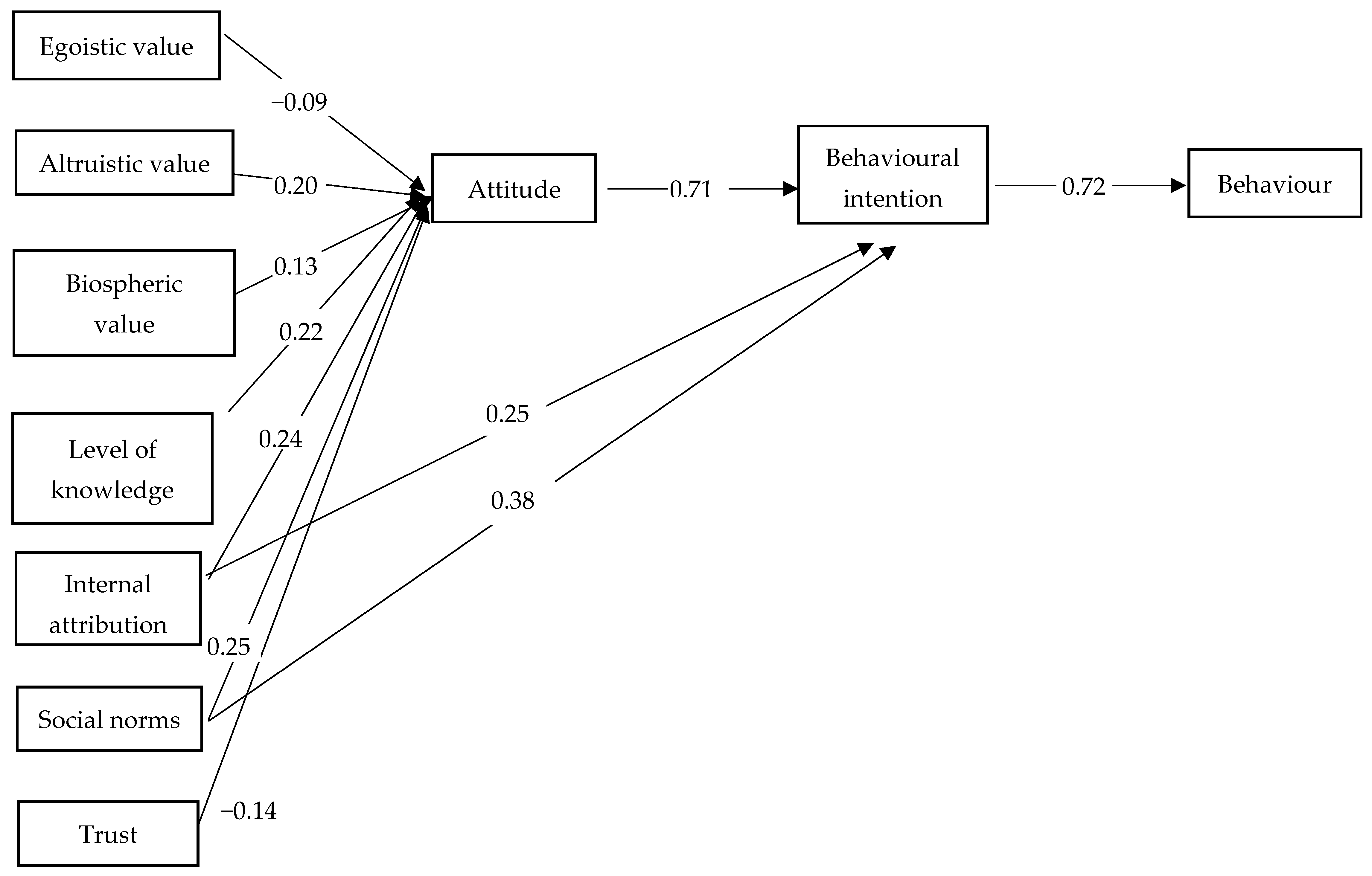
13] validated a psychosocial model predicting MSW separation in Southern Italy, where in recent decades the waste disposal crisis has led to a phenomenon dubbed ‘the Land of Fires’, that is, illegal waste disposal and toxic waste fires that have contaminated the environment. Their model merged the fundamental elements of TPB with De Groot and Steg’s [
14] validated measures of egoistic, altruistic, and biospheric values in an attempt to reconcile the two approaches. Specifically, the model validated in Italy included elements from the TRA, such as level of knowledge, internal attribution, and social norms, which predicted attitudes towards the behaviour, which in turn predicted the behavioural intention, which in turn predicted the actual behaviour. Altruistic and biospheric (but not egoistic) values also predicted the attitudes. As MSW collection is managed by local and governmental authorities, it was expected that perception of trust in different actors of the recycling process, such as the local administration and politicians, would predict attitudes towards MSW separation. Contrary to expectations, the study by Pivetti et al. [
13] revealed that trust in the different actors of the recycling process, such as the local administration, politicians, and waste collectors (e.g., [
15]), negatively predicted attitudes towards MSW separation, indicating the need to choose a different measure that focuses more on MSW separation.
Based on the validation of the model in the Southern Italy sample in the first study by Pivetti et al. [
13], the present paper had two main goals. The first was to test the original model on a more heterogeneous sample, including people from both Northern and Southern Italy, to expand the external validity of the original study and to shed light on the attitudes and behaviours of citizens living in Northern and Southern Italy. Overall, we predicted that the fundamental structure of the model corroborated by Pivetti et al. [
13] in Southern Italy would be confirmed in the new heterogeneous sample as well. Unlike the original model, in this model political trust was operationalized in terms of procedural fairness and outcome unfairness.
The second goal was to test whether the relationships between the variables under investigation differed between people living in the Northern and Southern Italian regions. We are interested in investigating similarities and differences in the psychosocial determinants of MSW separation (e.g., internal attribution) in these regions. From the economic development point of view, the Southern regions of Italy have consistently seen a decrease in their economic weight and in employment levels, as well as the average quality of employment [
16]. As regards MSW separation and waste disposal, large differences emerged between the two macro-regions. Reliable National data on the separate collection rate have shown a disproportionately higher rate in Northern Italy than in Southern Italy (70.97% and 55.67%, respectively [
17]). These differences in the waste separation rate between the two areas could be due to socio-cultural dimensions. For instance, Northern regions proved to be more dynamic and responsive to the Legislative Decree 152/2006, improving the separate waste collection process, while Central and especially Southern regions achieved poorer results in moving to higher separate waste collection rates. Also, the presence of criminal activities and the lack of citizen participation in politics may have hampered policy implementation in the Southern regions [
18]. Along the same lines, provinces belonging to a high institutional quality (North) environment had the highest percentage of separate waste collection rates [
19]. Also, the higher the number of prosecutions for crimes committed against the public administration, average income, expected age, number of people with a diploma or a degree, and the percentage of female municipal administrators, the larger the separate waste collection rate [
20]. From a psychosocial point of view, differences in waste separation between the two areas could be due to differences in their social norms [
21] or dissimilar levels of trust in government. For instance, Odoardi et al. [
22] provided evidence of these spatial effects in the Southern regions but not in the Northern ones, in line with Agovino et al. [
19]. They observed that the pro-environmental behaviours of neighbouring provinces influenced the attitude of others only in the Southern regions, possibly starting with citizens who observed their ‘neighbours’ engaging in recycling behaviours. Scholars have already tested similar models integrating the Value-Belief-Norm theory (VBN) and the Theory of Planned Behavior (TPB) on the entire country (e.g., [
23,
24]) and in Southern Italy (e.g., [
13]), but this is the first work to test the model and its variables across the two samples.
This study thus contributes theoretically by integrating VBN and TRA frameworks in a cross-regional comparison, and practically by providing evidence to guide localized waste management strategies in Italy. Our findings highlight that while knowledge, social norms, and trust consistently shape waste-related attitudes and behaviours, subtle regional differences between Northern and Southern Italy point to the need for differentiated approaches in policy design and communication. For example, in both regions, knowledge and attitudes emerged as direct predictors of waste separation, but in the South, internal attribution played an additional indirect role through behavioural intention. This suggests that communication strategies in Southern Italy should emphasise individual responsibility and empowerment, while in the North, they may be more effective if centred on reinforcing existing knowledge and normative pressure. Likewise, the perception of fairness, in terms of procedures and outcomes, proved to be an important aspect of political trust, indicating that local authorities must not only provide clear information but also ensure that rules are enforced transparently and uniformly. Tailoring engagement strategies to these contextual dynamics can therefore support higher compliance and foster a more socially robust implementation of waste management policies across the country. Taken together, these considerations informed the present study, which aims to test the validated model across Italian regions and to provide evidence on both common and context-specific determinants of waste separation behaviours.
1.1. Waste Separation and Buried Waste Scandals in Italy: An Overview
Italy is first in Europe in terms of waste separation and the circular economy [
18]. However, data from the Italian Institute for Environmental Protection and Research (ISPRA) [
17] revealed large cross-regional differences in the amount of waste production per capita in Italy in 2023. Thus, Northern Italy has a higher separate collection rate (70.97%) than Southern Italy (55.67%), with the highest percentage in Veneto (76.18%) and the lowest in the Sicily region (46.93%).
MSW separation aside, the widespread and illegal disposal of urban, toxic, and industrial waste has been documented in both Northern and Southern Italy [
25]. For example, ‘the Land of Fires’ comprises municipalities in the provinces of Naples and Caserta (Campania region, Southern Italy), where uncontrolled waste sites scattered across the territory are still being searched; the same Italian term for ‘the Land of Fires’ has been used for an area in Northern Italy between Piemonte and Liguria. The territory of Serravalle Scrivia (province of Alessandria) has been home to Ecolibarna, a toxic waste disposal company, since 1983.
When analysing the performance gap in the separate waste collection rate among Italian macro-areas, Musella et al. [
26] pointed out that the South faces a lack of public awareness, a disorganized separate collection system, and poor management of funding. It is possible that the good level of economic well-being in the North could lead to the implementation of more expensive and effective methods of recycling.
1.2. Model and Hypotheses
We begin by reporting the main findings of the original work of Pivetti et al. [
13] (See
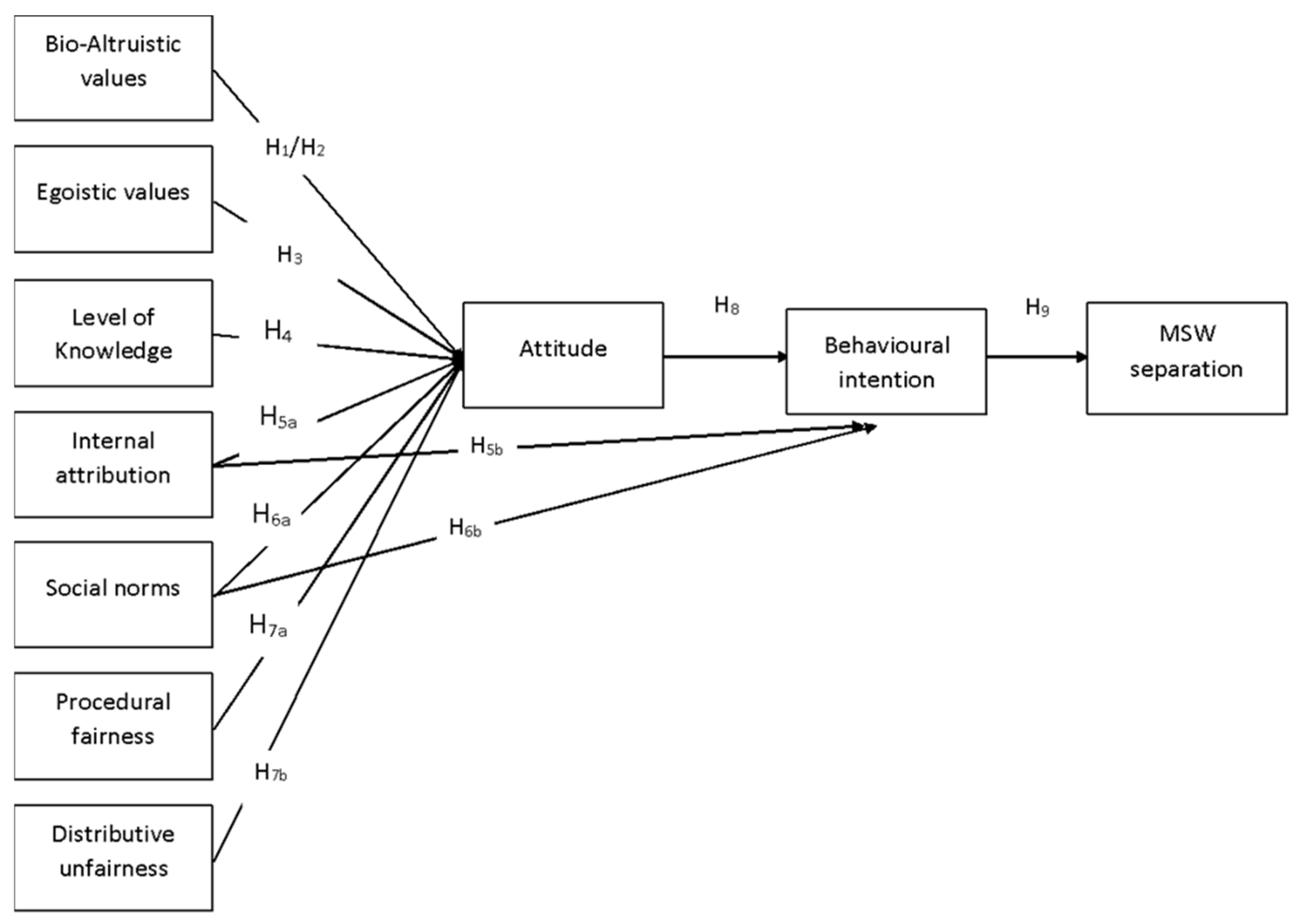
Figure 1), after which, relying on original findings as well as on the relevant literature on MSW separation in the North and South Italy regions, we will formulate our hypotheses (see
Table 1 and
Figure 2).
Several studies have shown that biospheric, altruistic, and egoistic values are relevant for understanding environmental beliefs and actions (e.g., [
27]). Scholars as Steg et al. [
10] have pointed out that individuals with high egoistic values are less likely to have pro-environmental beliefs and norms and to act pro-environmentally, while the opposite is mostly true for those with altruistic or biospheric values. Therefore, in line with the original study, we predicted that biospheric and altruistic values would positively predict attitudes towards MSW separation (H
1 and H
2, respectively), whereas egoistic values would predict it negatively (H
3) (See
Figure 2).
Environmental knowledge and problem awareness are important predictors of environmental concerns (e.g., [
28]). As for environmental knowledge, some studies have found a positive relationship between public awareness and attitudes [
29]. Ruliana et al. [
30] found that information exposure and environmental knowledge were strongly correlated with waste separation in Indonesia. Janmaimool and Khajohnmanee [
31] found the same pattern in Thailand. Interestingly, Liu et al. [
32] showed that while environmental knowledge has no direct effects on pro-environmental behaviours, its effect is fully mediated by environmental attitudes and environmental behavioural intentions. Thus, in line with the original study, we assumed that the level of knowledge concerning waste separation would positively predict attitudes towards MSW separation (H
4).
A review by Gifford and Nilsson [
7] found that internal attribution—that is, feelings of guilt about not engaging in pro-environmental behaviours and feeling responsible for waste (mis)management—relates directly to behavioural intention. Similarly, internal attribution was found to be related to household pro-environmental behaviours in India [
33] and in Sweden [
34]. The latter study also found that locus of control moderates the link between personal values and behaviour, in that people with a low degree of self-transcendence values behave pro-environmentally if they have an internal locus of control. People with a stronger internal locus of control in relation to the environment reported stronger pro-environmental intentions and behaviours in Australia [
35]. On this basis, and in line with the original study, we hypothesized that internal attribution would positively predict attitudes (H
5a) and behavioural intention (H
5b) towards MSW separation.
According to the TRA framework, the influence of others (e.g., family, neighbours, friends) offers guidance in the case of waste separation that can create more positive intentions to recycle and enhance the likelihood of the consequent action, while Razali et al. [
36] found that subjective norms were positively related to waste separation behaviour in Malaysia. The same pattern of results was found in Japan [
37] and in China [
8]. The reviews by Bamberg and Möser [
5] and Kim et al. [
38] found that attitude has a mediating role in the relationship between subjective norm and behavioural intention, as confirmed by some Italian studies (e.g., [
39,
40]). In line with the original study, we predicted that social norms would positively relate to attitudes (H
6a) and behavioural intention (H
6b) towards MSW separation.
Political trust is the tendency of the members of a society to believe in others and institutions, and individual pro-environment behaviour occurs more often in societies with high levels of trust (e.g., [
41,
42,
43]). However, in the original work by Pivetti et al. [
13], trust in institutions unexpectedly related negatively with attitudes towards the behaviour. One possible explanation for this finding may be found in the way that trust was measured—that is, as trust in the local administration, politicians, and government. Perhaps trust in abstract entities such as the government was too psychologically distant from the everyday behaviour of recycling.
A body of research in organizational psychology has been devoted to the study of the role of fair procedures in enhancing cooperation with authorities (e.g., [
44,
45,
46]), such as, in our case, MSW separation. Perception of fairness has been operationalized via two dimensions: (1) procedural fairness and (2) distributive fairness (e.g., [
47]; for a review, see [
48]). In the case of waste management policies, procedural fairness points to the opportunity for citizens to participate in the policy-making process, such as when municipalities try to take into account the public’s opinion when implementing a new system. Distributive fairness refers to the perception that the MSW separation system is fair because those who do not comply with the system are sanctioned. For instance, Ref. [
47] found that Japanese citizens’ support for a new recycling policy was positively influenced by both procedural and distributive fairness. On these bases, we made the following prediction: perception of procedural fairness will positively relate to the attitudes towards the behaviour (H
7), and the perception of outcome unfairness will negatively relate to the attitudes towards the behaviour (H
8).
Finally, we predicted that attitudes towards the behaviour would be related to behavioural intention (H
9), which would in turn predict the waste separation behaviours (H
10), in line with the TRA (e.g., [
49]).
Moreover, we aimed to explore whether these predicted relations, if true, showed any variation between the Northern and Southern samples. From an economic development perspective, the Southern Italian regions have consistently experienced a decline in their economic relevance and employment levels, along with a deterioration in the average quality of jobs [
16]. Regarding MSW separation and waste management, substantial differences have emerged between the two macro-regions. National data on separate collection rates indicate a markedly higher rate in Northern Italy compared to the South (70.97% vs. 55.67%, respectively; [
19]). From a psychosocial standpoint, disparities in waste separation rates between the two areas may stem from differing social norms or varying levels of trust in government [
50]. For instance, Crociata et al. [
21] found a strong social transmission effect in recycling across Italian regions, whereby a province’s recycling rate affected those of neighbouring provinces due to social pressure. They also found that good pro-environmental behaviour continues to produce effects over time, leading to virtuous MSW separation dynamics, while bad behaviour can cause perverse lock-in situations. Odoardi et al. [
22] provided evidence of these spatial effects in the Southern regions but not in the Northern ones, in line with Agovino et al. [
19]. They observed that the pro-environmental behaviours of neighbouring provinces influenced the attitude of others only in the Southern regions, possibly starting with citizens who observed their ‘neighbours’ engaging in recycling behaviours.
2. Methods
2.1. Participants
The sample included 321 participants (of whom 178, or 55.5%, were women) with a mean age of 39.7 (SD = 13.7; range 18–75), of whom 177 (55.1%) lived in the North and 144 (44.9%) in the South of Italy. As for marital status, approximately half of the sample was married or in cohabitation (151, 47%), one third was single (123, 38.3%), and a minority was separated/divorced (16, 5%, missing = 31, 9.7%). As for occupation, participants were mainly employed (125, 38.9%) or self-employed (70, 21.8%), followed by college/university students (72, 22.4%), the unemployed (27, 8.4%), and those who had retired (19, 5.9%, missing = 8, 2.5%).
Inclusion criteria for the study required that participants were older than 18 years old, held Italian citizenship, and had lived in a North or South region for at least two years. We excluded potential participants who had lived in a South/North region for less than two years because they were presumed to be unfamiliar with the region’s MSWS system or similar.
2.2. Procedures
Data were collected between 2017 and 2019 via an online questionnaire (Google Forms), thus avoiding the perturbing effect of the COVID-19 pandemic. Participants were recruited through a convenience sampling strategy that included the snowball procedure, which is a common practice in the social sciences [
51]. The URL of the questionnaire was posted on social media websites and advertised among undergraduate students, research assistants, and distant acquaintances. The survey was introduced as a ‘study on waste separation’. To ensure heterogeneity among sociodemographic factors, candidates were approached across a broad spectrum of opinions relating to the topic of study. The sociodemographic characteristics of the sample, which helped in evaluating sample representativeness (e.g., proportion of females and males, ages of participants, occupation, and marital status), are reported in detail in the Participants section [
52].
The questionnaire took approximately 20 min to complete. No reimbursement was granted for participation. Informed consent was obtained from all subjects involved in the study. The study was conducted in accordance with the ethical principles of the Declaration of Helsinki. The research complied with the Ethics Code of the Italian Psychology Association (AIP) [
53].
The choice of this structural model was motivated by the need to disentangle the relative influence of psychological factors (e.g., trust, norms, knowledge) on waste-related behaviours in a context such as Italy, where waste management is highly politicised and often associated with regional disparities. Structural equation modelling (SEM) was selected because it allows simultaneous testing of multiple relationships between latent variables, capturing the complex interplay of cognitive, normative, and attitudinal dimensions that shape sustainable behaviours. Unlike descriptive or regression-based approaches commonly used in waste behavior studies, SEM enables us to test both direct and indirect effects (e.g., the mediating role of attitudes), thus providing a more comprehensive picture of the mechanisms underlying citizens’ acceptance of waste policies. This analytical logic also reflects the policy relevance of our study: by identifying which drivers (e.g., knowledge vs. trust) exert stronger effects, the model can help policymakers prioritize communication and intervention strategies most effectively.
2.3. Measures
The questionnaire included 47 items divided into ten sections, with one section for each variable under investigation (see
Supplementary Material: S1). Participants completed a set of items and measures borrowed from Pivetti et al. [
13], unless otherwise indicated. Below, we detail when and why measures other than the original ones were used. Descriptive statistics, reliabilities, and correlations between study scales are reported in
Table 2.
The sections were as follows: Municipal Solid Waste (MSW) Separation was measured via seven items (e.g., ‘At home, how often do you divide solid waste?’), on a 4-point scale from 1 = never to 4 = always; Behaviour intention (four items, e.g., ‘Would you be interested in attending public events to get more information on how to do MSWS?’); Attitudes Towards MSW Separation (five items, e.g., ‘Is it difficult for you to run MSW separation at home because of the bad smell and lack of space?’ reverse item); Level of Knowledge (three items, e.g., ‘How informed do you feel you are about the way MSW collection is run in your municipality (for instance, which days, hours, kind of bags, etc.)?’; Internal Attribution (five items, e.g., ‘How responsible do you feel for the waste disposal in your region?’); Social Norms (five items, e.g., ‘In your family, how much attention is paid to waste separation?’); Procedural Fairness (two items, e.g., ‘In the municipality where I live, local government listened adequately to the requests of citizens before implementing the current MSWS’); and Distributive Unfairness (three items, e.g., ‘The MSWS system is unfair, as only honest people make this commitment’) were measured with a 5-point scale ranging from 1 (=not at all) to 5 (=extremely).
Personal Values. Egoistic values were measured via five items, biospheric values via four items, and altruistic values via four items [
14]. The items had been translated previously from English to Italian and back-translated for the original study of Pivetti et al. [
13]. Respondents rated the importance of each egoistic value (e.g., ‘social power’), biospheric value (e.g., ‘safeguard of the environment’) and altruistic value (e.g., ‘social justice’) ‘as a guiding principle in their lives’ on a 7-point scale ranging from 1 (=not important at all) to 7 (=extremely important), in which the higher values indicated a stronger endorsement of each value. After observing very high correlations between items capturing biospheric and altruistic values, we collapsed altruistic and biospheric values into a composite score called Bio-Altruistic values. This practice is consistent with previous studies showing the high correlation of biospheric and altruistic items, which were then collapsed into a single composite score (e.g., [
54,
55]).
Finally, sociodemographic data were obtained from each participant, including age, sex, marital status, education, profession, nationality, and place of residence.
3. Results
3.1. Preliminary Analyses
As shown in
Table 2, attitudes were correlated with all other variables in the expected direction except for egoistic values. Specifically, attitudes were correlated with behavioural intention (r = 0.26,
p < 0.001), which in turn was correlated with MSW separation (r = 0.23,
p < 0.001).
An independent t-test was used to investigate the differences between Northern and Southern participants. The results showed that, compared to those from the South, participants from the North:
- -
had more bio-altruistic values: t (319) = 2.473, p = 0.014 (MNorth = 6.07, MSouth = 5.77);
- -
knew better the modalities for SMW separation and collection: t (319) = 1.987, p = 0.048 (MNorth = 3.42, MSouth = 3.21);
- -
showed stronger social norms in favour of MSW separation: t (319) = 3.405, p = 0.001 (MNorth = 4.27, MSouth = 4.06);
- -
perceived stronger procedural fairness in terms of being part of the policy-making process: t (319) = 2.713, p = 0.007 (MNorth = 3.22, MSouth = 2.93); and
- -
perceived the current MSWS system as being less fair because only some citizens adhered to it: t (319) = −2.347, p = 0.02 (MNorth = 2.88, MSouth = 3.20).
There were no significant differences between Northern and Southern participants in terms of egoistic values, internal attribution, attitudes, and behavioural intention.
3.2. Structural Equation Modelling
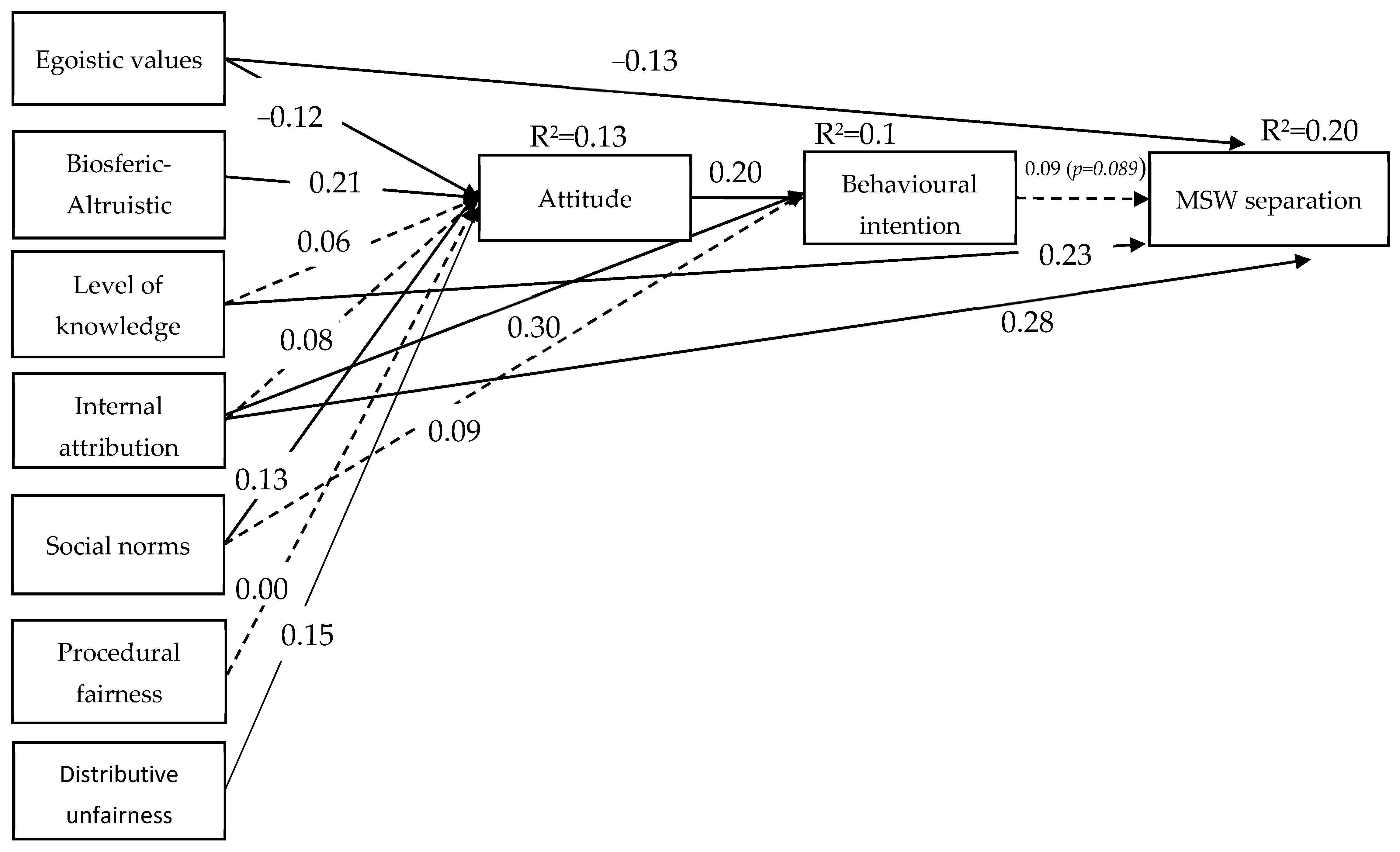
The hypothesised serial mediational model specified in
Figure 2 and tested on the overall sample, including participants from Northern and Southern Italy, provided a poor fit to the data (
S-Bχ2 (13) = 78.765,
p = 0.000,
CFI = 0.827;
RMSEA = 0.126;
AIC = 52.765). However, the Lagrange multiplier test indicated that the model fit could be significantly improved by adding three more paths: (a) from egoistic values to MSW separation, (b) from level of knowledge to MSW separation, and (c) from internal attribution to MSW separation. The final model, the result of including these three paths, fitted the data satisfactorily (
χ2 (10) = 28.118,
p = 0.002,
CFI = 0.956;
RMSEA = 0.075;
AIC = 8.118) and accounted for a significant amount of variance in attitudes (
R2 = 0.13), behavioural intention (
R2 = 0.17) and MSW separation (
R2 = 0.20) (see
Figure 3).
The paths were in the expected direction. Specifically, and in line with the original model, the bio-altruistic values positively predicted attitudes towards MSW separation behaviour (β = 0.21, supporting H1/H2). Participants endorsing biospheric-altruistic values also had the most positive attitude towards the behaviour. Moreover, attitudes were negatively predicted by perception of distributive unfairness (β = −0.15, supporting H7b) and egoistic values (β = −0.12, supporting H3), with the latter result being in line with the original model. Participants who perceived that the MSWS system was unfair (as only some citizens adhered to it) and those endorsing egoistic values had the most negative attitudes towards the behaviour. Finally, social norms positively predicted attitudes (β = 0.13, supporting H6a), with participants having strong social norms in favour of MSW separation behaviour also holding a more positive attitude towards the behaviour.
However, the level of knowledge, internal attribution and perception of procedural fairness did not predict attitudes towards MSW separation (ps > 0.05, not supporting H4, H5a and H6a). Being informed about the modalities for MSW separation and collection, feeling responsible for the environmental problems arising from waste disposal and perceiving that one is a part of the policy-making process regarding MSW did not predict attitudes towards separation.
In line with the original model, behavioural intention was positively predicted by attitudes (β = 0.20, supporting H8) and by internal attribution (β = 0.30, supporting H5b). Participants with more positive attitudes towards MSW separation and those who felt responsible for the environmental problems related to waste disposal had more positive behavioural intentions. However, social norms did not directly predict behavioural intention (p > 0.05, not supporting H6b). In other words, those professing strong social norms did not directly show a more positive behavioural intention. Egoistic values (β = −0.02, p = 0.065), biospheric-altruistic values (β = 0.04, p = 0.009), social norms (β = 0.03, p = 0.057) and distributive unfairness (β = −0.03, p = 0.023) indirectly predicted behavioural intention via the mediation of attitudes.
MSW separation behaviour was directly predicted mainly by internal attribution (β = 0.28) and level of knowledge (β = 0.23), and negatively by egoistic values (β = −0.13). These paths were not present in the original model. Participants who felt responsible for the environmental problems caused by waste disposal and those who were well-informed about the modalities of waste separation and collection were found to perform the separation behaviour more often. Those endorsing egoistic values reported performing the separation behaviour less often. Surprisingly, MSW separation was not significantly predicted by behavioural intention (p > 0.05; not supporting H9); no significant indirect effects were observed on MSW separation.
3.3. Multi-Group Analysis: North and South Groups
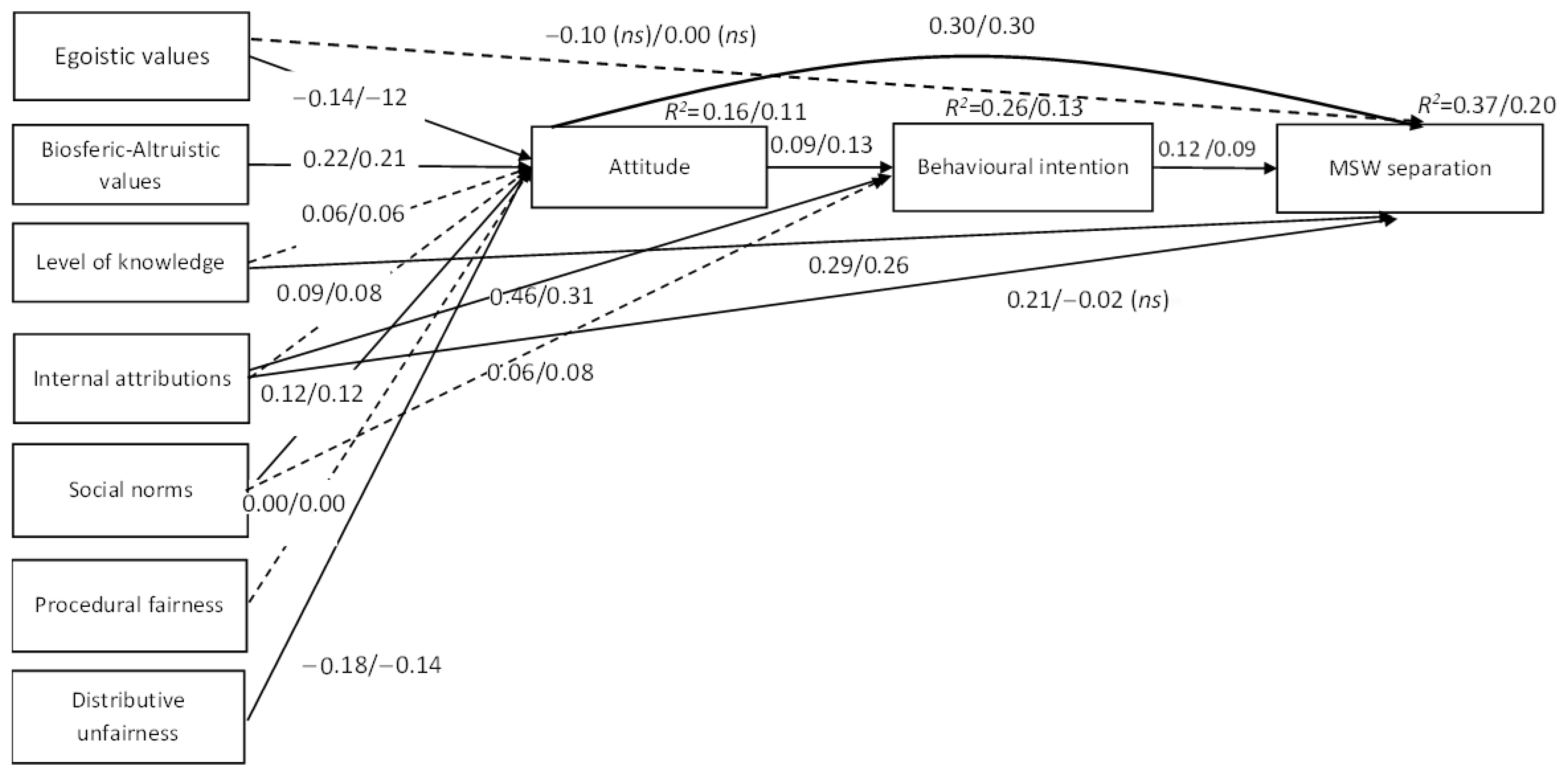
Using multi-group analysis, we attempted to verify whether the final model reported in
Figure 4 would hold equally well for the Northern and Southern samples or whether there were significant differences between the two. The final model in which the path coefficients were constrained to be equal across the two samples provided a poor fit to the data (
S-Bχ2 (34) = 90.920,
p = 0.000,
CFI = 0.875;
RMSEA = 0.102;
AIC = 22.920). However, the Lagrange multiplier test indicated that the model fit could be improved significantly by adding a path from attitudes towards MSW separation and by releasing constraints on the paths from internal attributions to behavioural intention and MSW separation. The final multigroup model fitted the data satisfactorily (
χ2 (31) = 45.059,
p = 0.049,
CFI = 0.969;
RMSEA = 0.053;
AIC = −16.941) and, as indicated by the lower
AIC value, fitted them significantly better than did the single-group model. This indicates the appropriateness of running the analysis for each of the two groups separately, as compared to the whole sample. The final multi-group model accounted for a greater amount of variance in attitudes, behavioural intention and MSW separation in the North sample (
R2 = 0.16, 0.23 and 0.37, respectively) than in the South sample (
R2 = 0.11, 0.13 and 0.20). In other words, while the model holds for both the Northern and Southern samples, it better fits the data from the Northern than the Southern sample.
When comparing the multi-group model in
Figure 4 with the single-group model specified in
Figure 3, it emerged that (a) the path from egoistic values and MSW separation was no longer significant, (b) the path between behavioural intention and MSW separation became significant (
β = 0.12 and 0.09 in the North and South samples, respectively) and (c) the direct link between attitudes and behaviour, which was introduced in this new model, was also significant (
β = 0.30 for both the Northern and Southern samples). These changes in the strength of the links between some of the variables of interest may be a consequence of the significant differences between the North and South samples, as revealed by the multi-group analysis. Specifically, behavioural intention was more strongly predicted by internal attributions in the North sample (
β = 0.46) than in the South sample (
β = 0.31). Similarly, MSW separation was more strongly predicted by internal attributions in the North sample (
β = 0.21) than in the South sample, where the link was close to zero (
β = −0.02,
ns).
All remaining direct links were equivalent in the North and South samples and quite similar in strength, direction, and significance to those found in the final singlegroup model.
In particular, as evidenced by the single-group model, biospheric-altruistic values (β = 0.22 and 0.21 in the Northern and Southern samples, respectively) and social norms (β = 0.12 and 0.12) positively predicted attitude. Moreover, perception of distributive unfairness and egoistic values were negatively related to attitude (β = −0.18 and −0.14 and β = −0.14 and −0.12). Also, the paths from the level of knowledge, internal attribution, and procedural fairness to attitudes were not significant in the North or in the South.
Contrary to our expectations, the structural relationships between social norms and attitudes were non-significant both in the Northern and Southern samples. In other words, for participants living in the North and the South, endorsing a social norm regarding MSW separation was unrelated to attitudes towards the actual behaviour.
Behavioural intention was directly predicted mainly by internal attribution (β = 0.46 and 0.31) and by attitude (β = 0.09 and 0.13). As for indirect effects, in the Northern sample, biospheric-altruistic values (β = 0.02, p = 0.064) and distributive unfairness (β = −0.02; p = 0.083) marginally predicted behavioural intention through the mediation of attitudes. Similarly, in the Southern sample, biospheric-altruistic values (β = 0.03, p = 0.064) and distributive unfairness marginally predicted behavioural intention through the mediation of attitudes (β = −0.02; p = 0.083).
MSW separation was directly predicted mainly by attitudes (β = 0.30 and 0.30), level of knowledge (β = 0.29 and 0.26), behavioural intention (β = 0.12 and 0.09) and, in the Northern sample only, internal attribution (β = 0.21 and −0.02, ns). While participants who felt responsible for waste disposal environmental problems would perform the MSW separation in the Northern sample, this feeling was not related to performing the behaviour in the South. As for indirect effect, in the Northern sample, egoistic values (β = −0.04, p = 0.030), biospheric-altruistic values (β = 0.07, p = 0.001), internal attributions (β = 0.08, p = 0.013), social norms (β = 0.05, p = 0.026) and distributive unfairness (β = −0.05, p = 0.006) indirectly predicted MSW separation via the mediation of attitude and behavioural intention. Similarly, in the South sample, egoistic values (β = −0.04, p = 0.030), biospheric-altruistic values (β = 0.07, p = 0.001), internal attributions (β = 0.05, p = 0.013), social norms (β = 0.04, p = 0.026) and distributive unfairness (β = −0.04, p = 0.006) predicted MSW separation via the mediation of attitude and behavioural intention.
4. Discussion
First, this paper aimed to test a model predicting MSW behaviour validated in Southern Italy by Pivetti et al. [
13] on a more heterogeneous sample involving inhabitants from both Northern and Southern Italy. As predicted, the model’s fundamental structure was corroborated by our data (
χ2 (10) = 28.118,
p = 0.002,
CFI = 0.956;
RMSEA = 0.075;
AIC = 8.118).
As for attitudes towards MSW separation, the more participants endorsed biospheric-altruistic values and professed strong social norms in favour of MSW separation behaviour, the more positive was their attitude towards the behaviour. These results are in line with the original model and with a range of studies showing that biospheric-altruistic values (e.g., [
56,
57,
58]) and social norms (e.g., [
59,
60]) predict attitudes. Also, the more participants endorsed egoistic values, the more negative their attitudes were toward the behavior (e.g., [
61]).
Compared to the original study, one novel finding points to the measures of perceived procedural and distributive fairness. Participants who perceived that the MSW separation system was unfair because only some citizens adhered to this system (i.e., distributive unfairness) expressed more negative attitudes towards the behavior (e.g., [
47,
62]). As for the lack of hypothesized relation between procedural fairness and attitudes [
63], we followed Tyler and Lind’s [
45] relational model of authority, which proposes that the perception of procedural fairness would lead to trust in authority, which would, in turn, favor compliance with policies. However, in this study, we referred to MSW separation behaviour, not to individual support for MSW management policies. Also, the voices of residents concerning MSW management were rarely listened to, and they were not put in a position to affect decisions, as this remained the prerogative of the local governments. Additional research should address the relations between trust in government policies, the procedures used to decide upon them, and the individual citizen’s compliance with rules as measured via actual (referred) behaviours.
Differing from the original model, being informed about the modalities for MSW separation and collection (i.e., level of knowledge), feeling responsible for the environmental problems arising from waste disposal (i.e., internal attribution), and the perception of being part of the policy-making process regarding MSW (i.e., procedural fairness) did not predict attitudes towards separation. As for the non-significant relations between the level of knowledge and attitudes, a minority of studies found similar results (e.g., [
64,
65]). Future studies are needed to clarify this issue.
In line with the original model, intention towards the behaviour was positively predicted by attitudes and internal attribution. Social norms did not have any direct effect on behavioural intention, in line with Aboelmaged [
66] in the case of recycling. However, social norms exerted an indirect effect on behavioural intention via the mediation of attitudes, in line with the results of Nigbur et al. [
59].
As for MSW separation behaviour, it was predicted mainly by three direct paths that were not present in the original model: internal attribution, in line with Antonetti et al. [
67]; level of knowledge, in line with Zakianis et al. [
68]; and (negatively) egoistic values, in line with Whitley et al. [
69]. Surprisingly, behavioral intention did not predict MSW separation, in line with previous studies identifying an intention–behavior gap (e.g., [
70]). Individuals might express an inclination to perform MSW separation but fail to translate their intentions into behaviours. This result seems unproblematic as, following Ajzen [
68] and as specified in the TRA, intentions alone should be sufficient to predict behaviour when the situation affords a person complete control over behavioural performance. If volitional control declines, that is, if the participants felt they had low control over their ability to perform the behaviour or the efficacy of the recycling process, then the relationship between intention and behaviour will be weak [
70]. To further clarify this issue, future research should include measuring perceived behavioural control to predict MSW separation, which could help explain the observed gap between intention and behaviour. Within the theory of planned behaviour [TPB; [
12]], perceived behavioral control reflects the performer’s perceived difficulty or ease in performing a particular task, and encompass factors such as the development of information, willpower, time, and convenience. This dimension has been shown to affect MSW separation behavior in cross-sectional studies like the current one [
71].
Second, to explore similarities and differences in the psychosocial determinants of MSW separation in the Northern and Southern regions of Italy, this study aimed to test whether the relationships between the variables under investigation differed between the people living in these areas. The majority of the direct links were equivalent in the North and South samples and were quite similar in strength, direction, and significance to those found in the final single-group model. In this sense, North–South differences are limited in terms of predicting waste separation.
However, the multi-group model, which distinguished between Northern and Southern participants, fitted the data better than the single-group model (χ2 (31) = 45.059, p = 0.049, CFI = 0.969; RMSEA = 0.053; AIC = −16.941). Moreover, as the amount of variance accounted for in attitudes, behavioural intention, and MSW separation in the Northern sample was greater than in the Southern sample, we could conclude that the model, even if it holds for both samples, explains the Northern data better than the Southern data.
The main novelty introduced by the multi-group model was the direct link between attitudes and behaviour, which was significant in both samples, in line, for instance, with Minelgaitė and Liobikienė [
72]. Also, the path between egoistic values and behaviour became non-significant. Most probably, in light of these changes in the direct predictors of MSW separation behaviour, the path between behavioural intention and MSW separation, although still as weak as in the overall model, became significant for the Northern and Southern samples in line with the prediction of the theory of planned behaviour (TPB) proposed by Ajzen [
73] and with recent research on sorting household waste [
74,
75].
As for the few differences between the Northern and Southern samples, the paths from internal attribution to intention and from intention to MSW separation were stronger in the North than in the South, meaning that internal attribution predicted behaviour more strongly in the Northern than in the Southern sample, both directly and indirectly. Moreover, internal attribution directly predicted MSW separation in the Northern sample and only indirectly and weakly in the Southern sample. While Northern participants who felt responsible for waste disposal–related environmental problems would perform the MSW separation, this same feeling among those in the South was not related directly to performing the behaviour but only via the mediation of behavioural intention. This difference could be related to the individualism dimension described by Hofstede [
76], that is, the motivation to look after only oneself and one’s family. As the northern parts of Italy have an individualistic culture, especially in the big cities, Northern Italians may tend to use dispositional attributions, whereas Southern Italians endorse a more collectivistic approach focused on the family network.
Given that Southern regions achieved poorer results in moving to higher separate waste collection rates, previous studies have suggested that a lack of citizen participation in politics may have hampered effective policy implementation in the South [
18]. In our study, the perception of procedural fairness did not directly predict attitudes towards separation in either the Northern or Southern samples. However, the perception of procedural fairness indirectly predicted MSW separation in the North and the South via the serial mediation of attitudes and intention.
Our results indicate that the structural relations between knowledge, attitudes, and behaviour are consistent across both Northern and Southern Italy, yet notable differences emerge in the strength of specific paths. In the North, where waste management infrastructures are more consolidated and enforcement mechanisms are perceived as stronger, the intention–behaviour link appears more robust. By contrast, in the South, weaker institutional enforcement and infrastructural shortcomings seem to hinder the translation of pro-environmental intentions into actual practices. This finding aligns with previous works [
77,
78], emphasising the role of institutional trust and perceived fairness in shaping compliance with environmental policies. In addition, the comparatively weaker salience of social norms in the Southern sample reflects cultural and historical differences in collective practices and may explain lower behavioural consistency despite positive intentions.
From a theoretical perspective, this study extends the validity of the integrated VBN–TRA model by testing it in two distinct regional contexts within the same country. While the overall structure of the model holds, the varying strengths of the paths highlight the importance of context sensitivity in behavioural models of sustainability. Psychological determinants such as internal attribution, trust, and norms cannot be treated as universal drivers but interact with local institutional and cultural conditions. This contributes to the literature on recycling and pro-environmental behaviour, which has shown that contextual factors, from infrastructure quality [
78] to institutional credibility [
79] shape the predictive power of behavioural models. More broadly, our findings are in line with sustainability transitions research, which emphasises that behavioural and institutional dynamics must be understood together when assessing the diffusion of pro-environmental practices [
80].
4.1. Policy and Practical Implications
Our results carry relevant implications for policy and practice. For municipal administrations, the findings suggest that fostering citizen engagement requires more than regulatory enforcement: strategies should combine transparent communication, participatory initiatives, and clear explanations of both environmental and economic benefits. At the same time, sanctions remain an important complementary tool, but their effectiveness increases when accompanied by trust-building measures and visible examples of fair implementation. Furthermore, the regional comparison between Northern and Southern Italy indicates that a uniform, one-size-fits-all approach may not be sufficient. While the same psychological drivers (knowledge, norms, trust) operate across the country, local cultural dynamics and histories of waste management controversies shape how these drivers are perceived. Policy interventions should therefore be context-sensitive, adapting communication styles, engagement practices, and enforcement mechanisms to regional conditions to secure broad-based and lasting compliance. At the EU level, these findings provide a reminder that even within a single member state, regional heterogeneity can significantly affect behavioural outcomes, and that circular economy policies should be sensitive to such differences when defining targets and monitoring progress.
Beyond the regional case, this study demonstrates that integrating VBN and TRA frameworks can reveal context-specific pathways to pro-environmental behaviour. This extends previous single-region applications of the model and suggests that cultural and institutional diversity within a single country must be accounted for in sustainability transitions. By demonstrating that knowledge and internal attribution are strong predictors of MSW separation and that regional differences significantly affect compliance, our findings highlight the need for locally tailored interventions. For municipalities, this means prioritising citizen engagement strategies in the South and transparency in enforcement in the North. More broadly, the study offers insights into how behavioural models can inform sustainability transitions in countries with regional disparities.
4.2. Limitations
A key limitation of this study is the use of a convenience sample. Within this non-probabilistic sampling technique, data are collected among members of a target population that satisfy certain practical criteria such as accessibility, availability at a given time, and willingness to participate. However, this sampling fails to acknowledge that the target population is not homogenous, and the research results would be different from those obtained by randomized or purposive sampling. Future studies could employ a sampling technique stratified for socio-demographic factors such as age. For instance, younger citizens are more actively involved and, at the same time, more willing to recycle waste compared to older citizens [
81,
82].
Also, the correlational nature of our study did not allow us to clarify the direction of the relations between study variables. More than this, as the means of the two samples differed in terms of, for instance, bio-altruistic values and social norms, we cannot rule out the possibility that differences in the paths between some study variables were not grounded in differences in the mean values across the North and South samples. These limitations suggest caution in generalizing the results.
Future studies could investigate the roles of social norms and internal attribution in affecting attitudes and behaviour towards MSW separation. Specifically, social norms could be broken down into four types of norms, emerging at the intersection between injunctive versus descriptive norms and personal versus societal norms (e.g., [
35,
78]).