Article

Recovery of Valuable Metals from Lead Smelting Slag by Methanesulfonic Acid Leaching: Kinetic Insights and Recycling Potential


by
Juana María Nájera-Ibarra
1,
Francisco Raúl Carrillo-Pedroza
2,*,
Ma. De Jesús Soria-Aguilar
2,*,
Nallely Guadalupe Picazo-Rodríguez
3,*,
Antonia Martínez Luévanos
4,
Simón Alberto Pedroza-Figueroa
1,
Isaías Almaguer-Guzmán
5,
Josué Cháidez-Félix
5 and
Manuel Flores-Favela
5
1
Instituto Tecnológico de la Laguna, Tecnológico Nacional de México, Torreón 27000, Mexico
2
Facultad de Metalurgia, Universidad Autónoma de Coahuila, Monclova 25710, Mexico
3
Instituto Tecnológico Superior de Monclova, Tecnológico Nacional de México, Monclova 25701, Mexico
4
Facultad de Ciencias Químicas, Universidad Autónoma de Coahuila, Saltillo 25280, Mexico
5
Metalúrgica Met Mex Peñoles, Torreón 27370, Mexico
*
Authors to whom correspondence should be addressed.
Recycling 2026, 11(1), 1; https://doi.org/10.3390/recycling11010001
Submission received: 30 October 2025 / Revised: 10 December 2025 / Accepted: 16 December 2025 / Published: 19 December 2025

Abstract

The depletion of natural resources remains a major global challenge, emphasizing the need to develop sustainable processes that enable both metal recovery and waste recycling. This study investigates the leaching of valuable metals from lead smelting slag using methanesulfonic acid (MSA), a biodegradable and environmentally benign reagent. Batch experiments were performed under different MSA concentrations (0.35–1.4 M) and temperatures (22–80 °C). Metal dissolution increased nearly linearly with acid concentration up to 1 M, with maximum recoveries after 60 min of 85% Zn, 64% Pb, 75% Cu, and 68% Fe. Copper dissolution was governed by the oxidation of Cu2S, while Fe leaching was affected by pH variations that promoted re-precipitation. Kinetic modeling indicated mixed chemical–diffusion control mechanisms, with activation energies of 22.6 kJ mol−1 for Zn and 31–33 kJ mol−1 for Pb, Cu, and Fe. Beyond efficient metal extraction, the process generated a leach residue with reduced concentrations of base metals and a mineralogical composition dominated by stable calcium-silicate phases, improving its potential suitability for reuse in construction or mining backfill applications. Overall, methanesulfonic acid proved to be an effective and sustainable lixiviant, combining high metal recovery with the generation of recyclable slag, thereby contributing to circular metallurgical practices.

1. Introduction

In Mexico, the mining-metallurgical sector represents a key component of the national economy, contributing approximately 2.3% to the gross domestic product and supporting multiple industrial production chains [1]. Owing to its favorable geological conditions, a substantial portion of Mexican territory is suitable for mining complex development, positioning the country among the leading global producers of minerals [2].
However, the increasing global demand for minerals has intensified extraction and processing activities, generating large quantities of metallurgical residues such as slags. These by-products vary widely in composition depending on ore type and smelting conditions [3,4,5,6] and often contain valuable metals that may be recovered or reused in diverse applications, including ceramic bricks and construction materials [5,6]. The adoption of circular economy principles has promoted research on material recovery and waste valorization, highlighting efficient resource management and closed-loop approaches in natural and industrial systems [3,7,8,9]. Moreover, numerous studies have evaluated strategies such as flotation, eco-friendly leaching, and deep-eutectic solvents for recovering lead, zinc, and other strategic metals from secondary industrial residues [10,11,12,13,14,15]. Collectively, these efforts highlight a progressive transition from conventional waste disposal toward sustainable resource recovery and valorization within the metallurgical industry.
Lead smelting slags are of particular interest because, despite being considered waste, their metal content makes them potential secondary sources of zinc, one of the most widely used non-ferrous metals after aluminum and copper [16,17,18]. More than 70% of zinc is obtained from sulfide ores [19,20], but decreasing ore quality has intensified efforts to recover Zn from alternative resources, leading to a broad range of studies on slag valorization from environmental and economic perspectives [14,18,21,22]. Hydrometallurgical routes are especially attractive for this purpose due to lower energy consumption, high metal selectivity, and reduced environmental impact compared with pyrometallurgical methods [23,24,25]. Several lixiviants—including organic acids, ammonia-based systems, and alkaline solutions—have been reported for metal recovery under different conditions and kinetic models (Table 1), confirming the diversity of mechanisms and activation energies observed in slag leaching.
Despite its extensive use in industry, sulfuric acid presents limitations due to the low solubility of metal sulfate salts, which may hinder leaching efficiency [33]. For this reason, interest has grown in lixiviants that combine strong acidity with environmental compatibility and high solubility of metal salts. Methanesulfonic acid (MSA) has emerged as one such alternative due to its biodegradability, low toxicity, resistance to oxidation and hydrolysis, and high thermal stability [34,35,36,37]. MSA is a strong acid (pKa = −1.9) that forms highly soluble metal methanesulfonates [34,35,38], does not generate hazardous volatile gases, and enables cleaner hydrometallurgical processing compared with mineral acids [33,39].
Currently, the mining industry is moving toward the implementation of a circular economy model, which involves the valorization of mining and processing residues through their transformation into secondary by-products or strategic raw materials for other productive sectors as the cement industry, where it has been shown that the slag from the lead smelting process used in a moderate amount as a substitute for this material in a filler block, can increase its resistance by up to 16% [40,41]. The quantities of waste generated are so substantial that the full implementation of a circular economy remains a challenge [42]. The management and valorization of metallurgical residues have become an essential research focus aimed at optimizing the recovery of valuable elements and improving process sustainability. Therefore, recent studies should emphasize the recovery and reuse of such residues to achieve both environmental and economic advantages. In this regard, the present work investigates the recovery of valuable metals from lead smelting slag through an environmentally friendly hydrometallurgical process. This slag, unlike others generated during the same process, contains significantly higher concentrations of zinc (Zn), according to the chemical composition reported in some studies [42,43].
Although methanesulfonic acid (MSA) has been studied for the dissolution of specific minerals and certain metallurgical residues, no previous research has applied MSA to primary lead smelting slag, nor has any detailed kinetic analysis been reported for the dissolution of Zn, Pb, Cu, and Fe from this type of multicomponent residue.
It is important to note that the use of MSA in extractive processes is relatively recent. There are few references available because research on MSA has historically been linked to battery recycling and electrodeposition, whereas lead slags have mainly been treated as waste stabilization problems. Their heterogeneous mineralogy, the higher cost of MSA, and the lack of industrial demand have limited academic publications in this field. Most hydrometallurgical research on lead recovery has traditionally focused on recycling battery paste rather than primary lead smelting slags. Primary lead smelting industries have long relied on lime neutralization, sulfuric acid, or alkaline treatments for slag stabilization. It is also important to consider that lead slags are heterogeneous, multiphase materials (glass, silicates, ferrites, sulfates). Their unpredictable mineralogy makes it difficult to generalize leaching studies compared with the relatively uniform composition of battery paste. On the other hand, MSA was introduced into the literature mainly as a “green electrolyte” for electrodeposition and battery paste leaching, so its potential in slag processing was largely overlooked. This article highlights the recycling potential of this type of slag after recovering valuable metals—primarily zinc, due to its high content—while also determining the leachability of Cu, Pb, and Fe in the context of using an environmentally friendly reagent such as MSA.
Therefore, this study aims to investigate the leaching kinetics of these metals from lead smelting slag using MSA, evaluating the effects of temperature and acid concentration on metal dissolution and determining the associated kinetic parameters. The findings provide the first fundamental insight into the applicability of MSA for treating complex lead smelting residues and contribute to the broader understanding of sustainable hydrometallurgical approaches for metallurgical waste valorization.

2. Results and Discussion

2.1. Effect of MSA Concentration

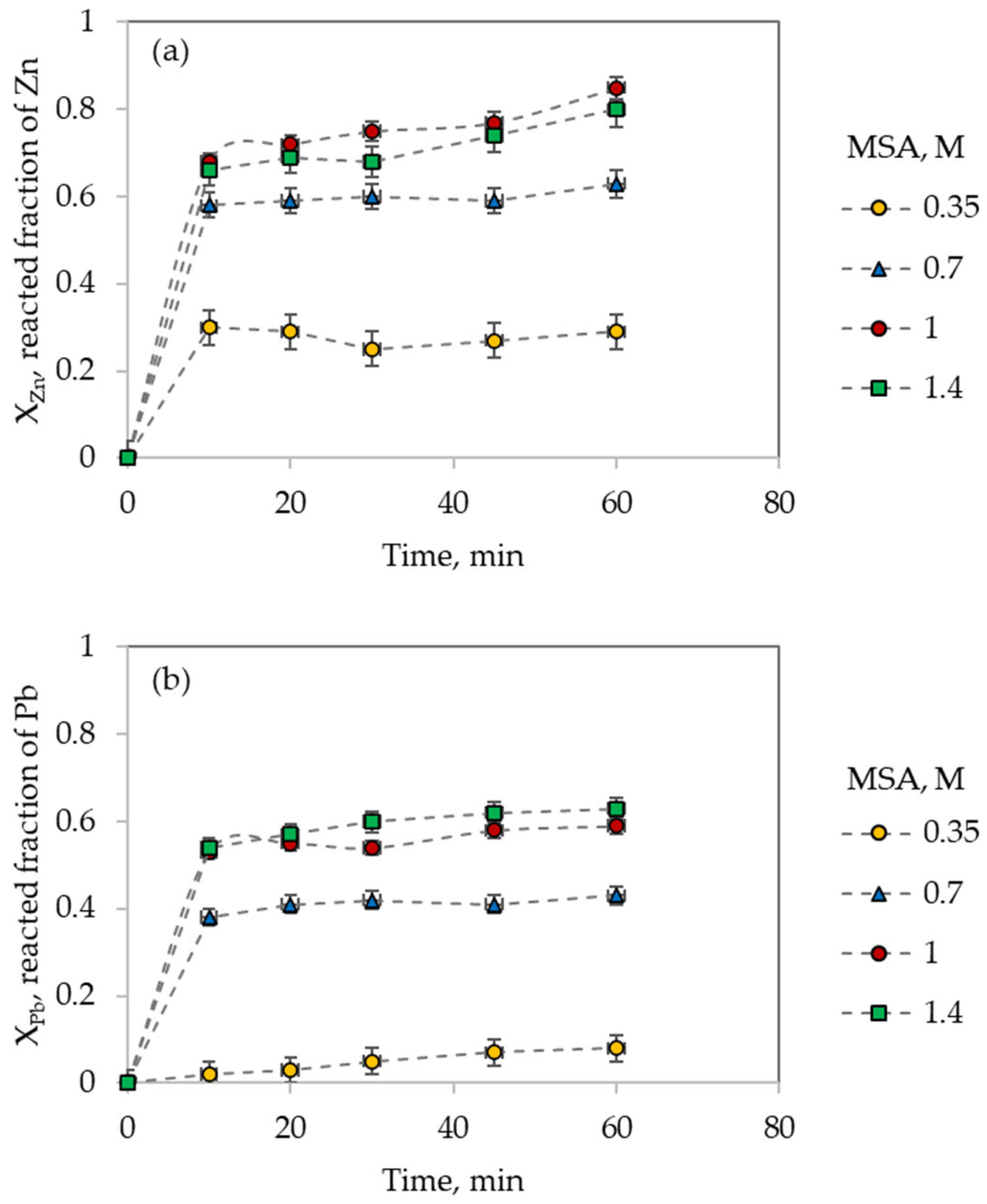
The effect of MSA concentration was studied considering a constant temperature of 40 °C for all cases. Figure 1 shows the behavior of Zn and Pb leaching, in terms of the reacted fraction, with respect to time, for different MSA concentrations. For Zn (Figure 1a), for 0.35 and 0.7 M MSA acid, the extraction fraction of the element increases from 0.3 to 0.6 in the first 10 min and does not increase significantly over time. When the MSA acid concentration increases to 1 M, the extracted fraction is 0.68, continuing to increase to 0.85 at 60 min. The fraction values for Zn extractions are very similar when using 1.4 M.
The leaching results show that Zn dissolution is occurring for the different mineralogical phases of this element; considering that the two species containing the highest amount of zinc are ZnO (39.6% Zn) and ZnS (42.2% Zn), representing almost 82% of the total zinc contained in the slag, leaching with MSA would take place for these species, according to the following reactions:
For zinc oxide, the proposed reaction is as follows [35]:
ZnO + 2CH3SO3H → Zn2+ + 2CH3SO3 + H2O
The zinc ion forms a complex with the reagent to form zinc methanesulfonate, according to the following reaction [35]:
ZnO + 2CH3SO3H → Zn(CH3SO3)2 + H2O
In the case of sulfide, ZnS, the reaction proposed proceeds as follows [44]:
ZnS + 2CH3SO3H → Zn(CH3SO3)2 + H2S
The trend in terms of the effect of MSA is similar for Pb leaching, Figure 1b. The reacted fraction for 0.35 M increases very slowly over time, reaching a fraction of 0.1 (10% extraction). At 0.7 M, a fraction of 0.44 is reached after 60 min. At 0.1 M and 1.4 M, the behavior of the reacted fraction is similar in both cases, reaching 0.6 and 0.64, respectively.
The results indicate that lead dissolution occurs at a rate of up to 64% in 60 min. According to the chemical analysis and mineralogical characterization (see Materials and Methods section), lead is found in the slag mainly as PbSiO3, containing 94.55% of the total lead, and only 5.44% as PbO. Therefore, the chemical reaction that would represent this dissolution would be as follows:
PbSiO3 + 2CH3SO3H → Pb(CH3SO3)2 + H2SiO3
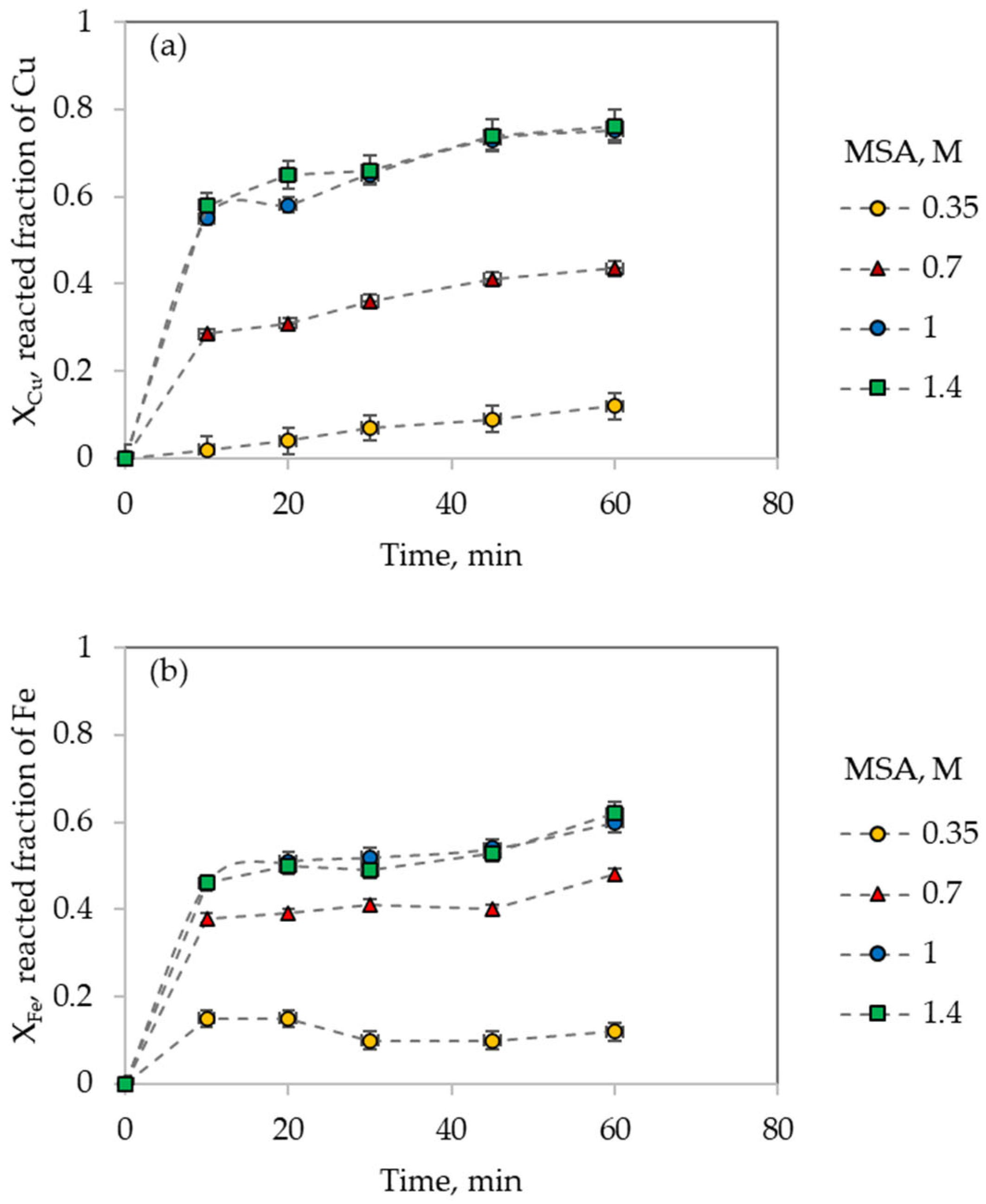
Figure 2 shows the reacted fraction of Cu and Fe over time for different MSA concentrations. For Cu (Figure 2a), the maximum fraction extracted with 0.35 M MSA acid is 0.1 after 60 min. When the concentration is doubled to 0.7 M, the extraction increases to 0.28 in just 10 min and continues rising progressively, reaching 0.42 after 60 min. At 1 M MSA acid, the fraction extracted reaches 0.55 and continues to increase up to 0.75 at 60 min. Similar reacted fractions are obtained with 1.4 M MSA acid.
Considering that practically the only copper species found in the slag is copper sulfide, Cu2S, the dissolution reaction can be represented by the following reaction:
Cu2S + 2CH3SO3H + 1/2O2 → 2Cu(CH3SO3) + H2O
According to this reaction, the dissolution of copper requires the presence of oxygen to take place. This condition is possible, given that the experimental tests were carried out in an open reactor.
In the case of Fe leaching (Figure 2b), the reacted fraction after the first 20 min is 0.15 with 0.35 M MSA, decreasing thereafter to 0.1 at 60 min. This behavior coincides with the pH increase caused by MSA acid consumption, leading to the precipitation of the initially dissolved iron. With 0.7, 1.0, and 1.4 M MSA acid, reacted fractions of 0.38, 0.45, and 0.45, respectively, are obtained after 10 min of reaction. These values remain almost constant up to 30 min. At 60 min, a significant increase is observed, reaching 0.48, 0.60, and 0.68, respectively, indicating that beyond 1.0 M MSA acid, further increases in acid concentration have no additional effect.
The reaction that may be occurring for the dissolution of iron, depending on the main mineralogical species of iron, FeO (containing 80% of the total Fe in the slag), is as follows:
FeO + 2CH3SO3H → Fe(CH3SO3)2 + H2O
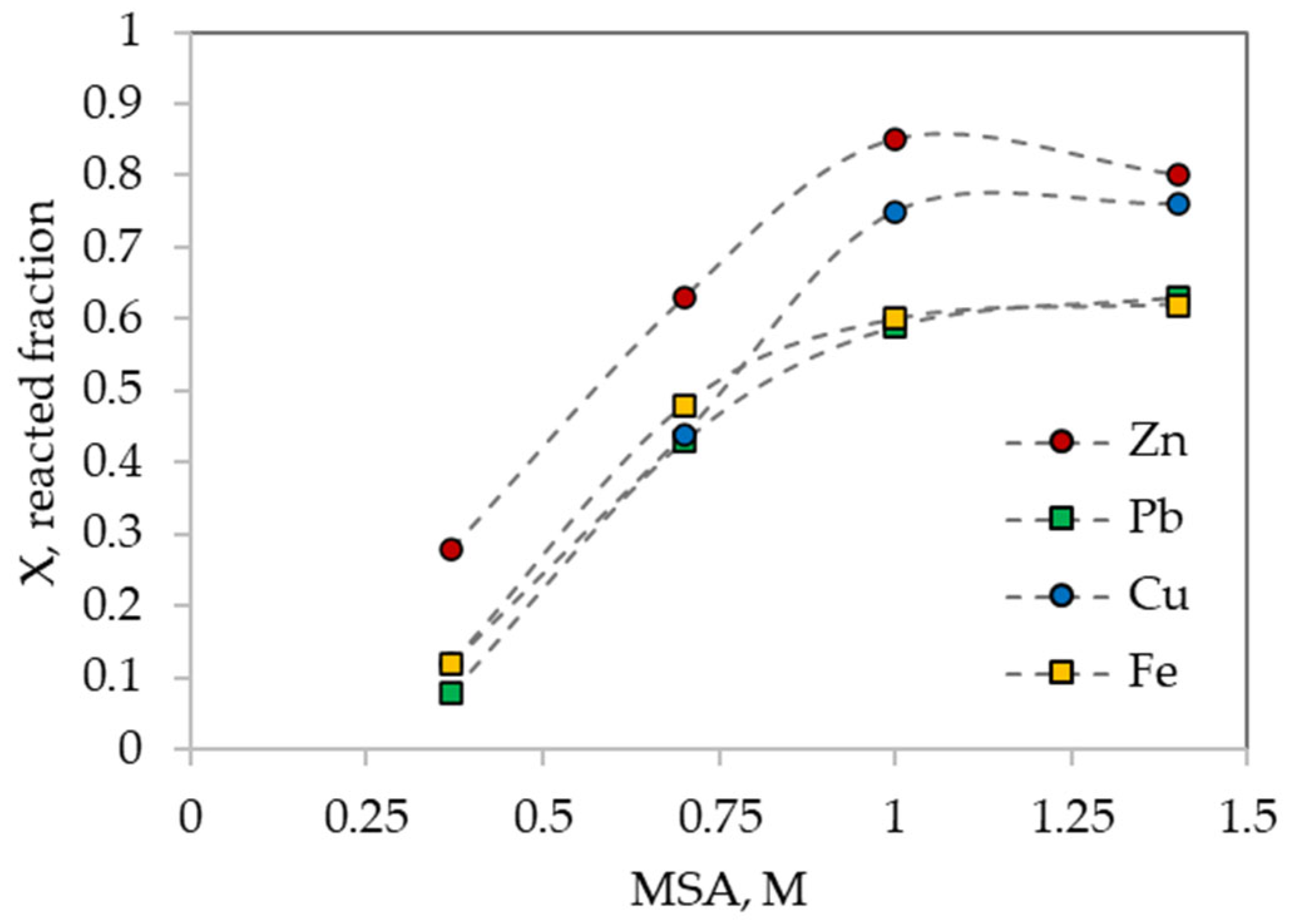
Figure 3 shows a comparison of the effect of MSA concentration on the extraction of the elements of interest after 60 min of reaction. The results show that, as observed in the previous figures, increasing the MSA acid concentration causes an almost linear increase in metal extraction up to a concentration of 1 M. In all cases, the increase from 1 M to 1.4 M has no effect on extraction, so it can be assumed that above 1 M, this factor no longer limits the dissolution process. It is interesting to note that between 0.37 and 1 M, extraction is linear, and the slopes of the lines for all elements are practically the same, so it can be assumed that, in this concentration range, the percentage of dissolution of the metals studied is linear and of the same order of magnitude with respect to the MSA acid concentration.

2.2. Effect of Temperature

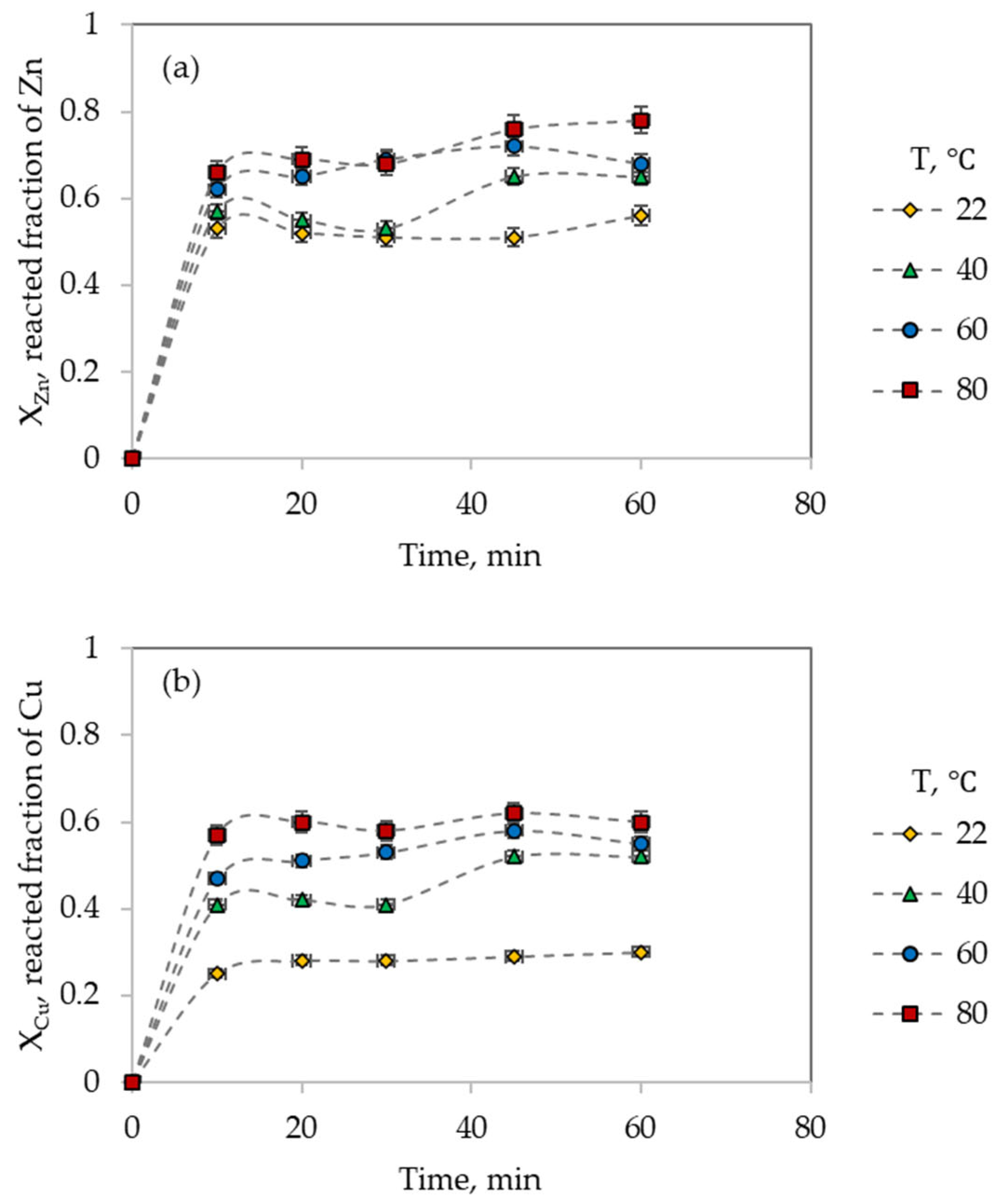
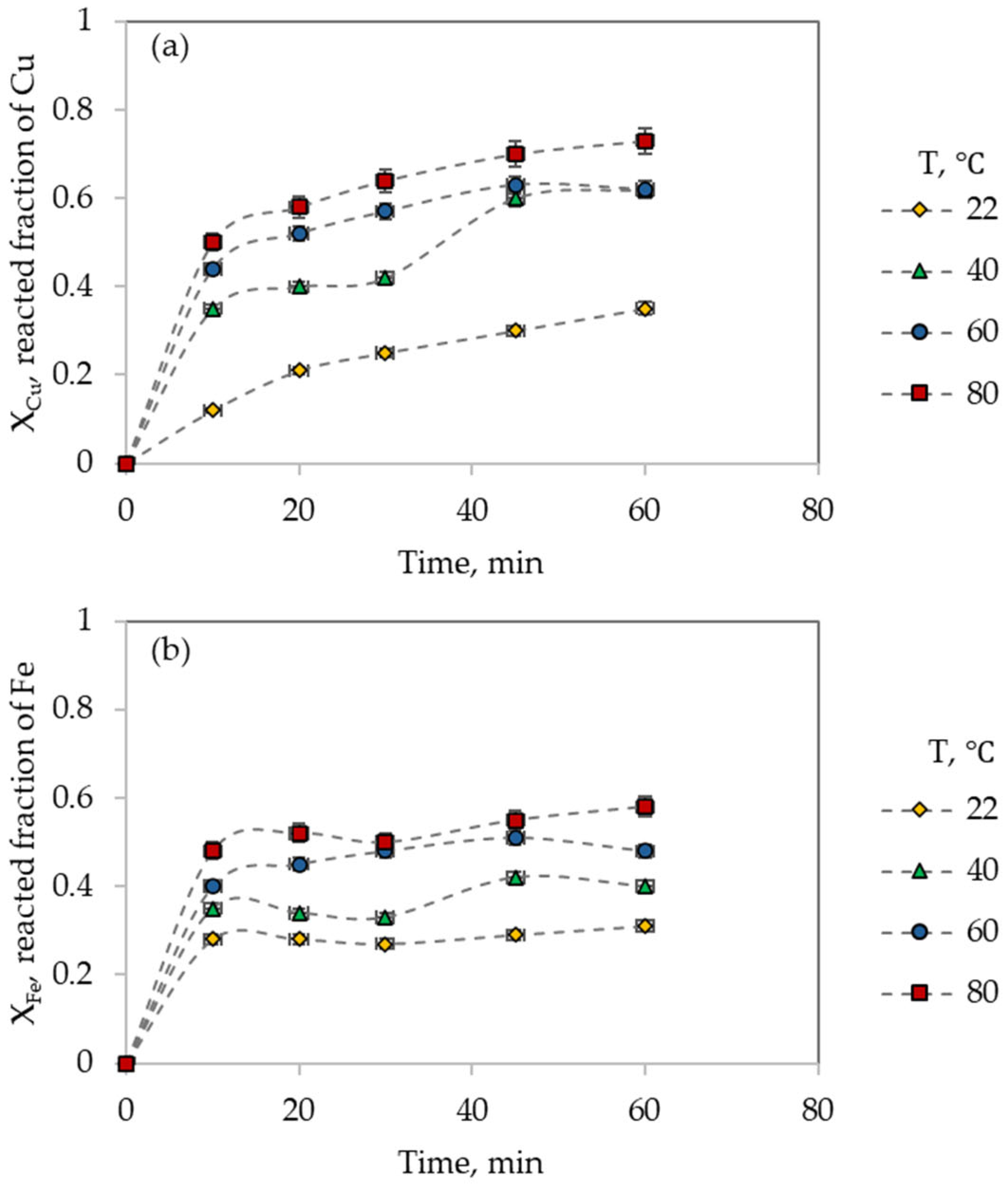
The effect of temperature on the leaching of the metals studied was investigated considering an MSA concentration of 1 M. Figure 4 shows the reacted fractions for (a) Zn and (b) Pb with respect to time and temperature. For Zn, after 10 min of reaction, reacted fractions of 0.52 to 0.66 are obtained; at 22 °C, there is no further increase in this value (0.55) with respect to time. The same behavior is observed for the temperature of 40 °C during the first 30 min; however, at 45 min, an increase from 0.5 to 0.66 is observed, a value that does not change at the end of the one-hour test. For temperatures of 60 and 80 °C, it can be observed that the reacted fraction is practically the same with respect to time; this could indicate that the reaction is less sensitive to temperature and that perhaps the control of the reaction would depend more on diffusion control than on chemical control. This hypothesis will be evaluated later.
In the case of Pb, it is interesting to note in Figure 4b the impact that temperature has in the first 10 min. Practically, with each increase of 20 °C intervals, the reacted fraction increases significantly. Once this initial value for the first 10 min is obtained, the fraction continues to increase slowly and gradually over time, reaching its maximum value at 45 min at all temperatures.
The effect of temperature on the leaching of the studied metals was investigated using an MSA concentration of 1 M. Figure 4 shows the reacted fractions for (a) Zn and (b) Pb as a function of time and temperature. For Zn, after 10 min of reaction, reacted fractions ranging from 0.52 to 0.66 are obtained. At 22 °C, no further increase is observed over time (0.55). A similar behavior is seen at 40 °C during the first 30 min; however, at 45 min, the value increases from 0.50 to 0.66, remaining constant until the end of the one-hour test. At 60 °C and 80 °C, the reacted fraction is practically unchanged over time, suggesting that the reaction is less sensitive to temperature and may be controlled more by diffusion than by chemical kinetics. This hypothesis will be evaluated later.
In the case of Pb (Figure 4b), it is noteworthy that temperature has a clear effect during the first 10 min. With each 20 °C increment, the reacted fraction increases significantly. After this initial stage, the fraction continues to increase slowly and gradually, reaching its maximum value at 45 min at all temperatures.
Figure 5 shows the behavior of Cu and Fe with respect to temperature and reaction time. For Cu, Figure 5a, unlike Zn and Pb, it is interesting to note that the reacted fraction gradually increases with time for the four temperatures evaluated. It can also be seen that after 45 min, the difference in the reacted fraction obtained between temperatures of 40 and 80 °C is relatively small, also indicating that control is possibly by diffusion.
Finally, in the case of Fe, Figure 5b, the behavior is very similar to that observed for Zn and Pb, where a reacted fraction is reached in the first 10 min and then increases slightly over time. It is also observed that the most significant increase occurs when the temperature is increased from 40 to 60 °C, and that increasing it to 80 °C no longer has a noticeable effect on the reacted fraction.
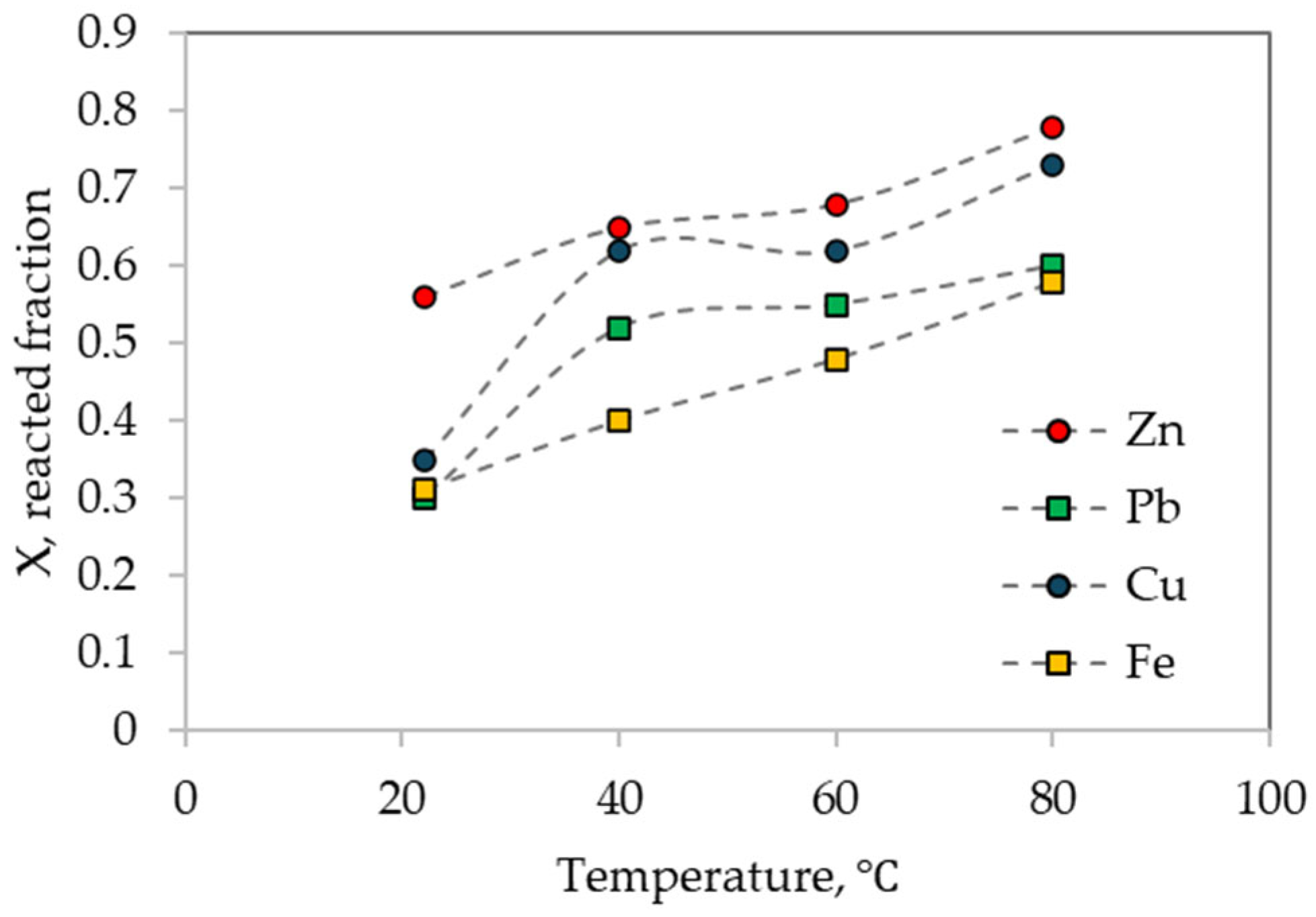
Figure 6 shows the extraction percentages obtained after 60 min of reaction, with respect to temperature. This figure clearly shows an upward trend at different temperatures, with very similar slopes for the four elements. In the case of Zn and Fe, the behavior is almost linear, while with Cu and Pb, between 40 and 60 °C, the extraction is almost the same and then increases when a temperature of 80 °C is used. This stepwise or staggered behavior can be attributed to the fact that, at low temperatures, the thermal increase increases the kinetic energy of the molecules, overcoming the activation barrier and accelerating the leaching reaction; at a certain intermediate temperature range, the speed can stabilize if the system reaches an equilibrium between chemical reaction and diffusion, or if a passivating layer forms that limits the reactant’s access to the mineral. In other words, leaching control can shift from chemical (surface reaction) to diffusional (transport through layers or pores), and then back to chemical if the structural conditions of the ore are modified [44,45,46]. In some minerals, layers of elemental sulfur (which is not the case here), oxides, or intermediate compounds can form that inhibit leaching. At higher temperatures, these layers can thermally decompose or become permeable, allowing a second phase of accelerated dissolution [47].
To determine the activation energy, the Arrhenius equation is used, considering the temperature data and the apparent reaction rate constants obtained from the experimental data. This equation is represented as follows:
k = Ae (−Ea/RT)
where k is the rate constant, A is the pre-exponential factor or collision frequency, Ea is the activation energy (J/mol o kJ/mol), R is the gas constant (8.314 J/mol·K), and T is the absolute temperature (in Kelvin degrees). The activation energy value Ea can be obtained by plotting the natural logarithm of the rate constant versus the inverse of the temperature, with the slope being the value of Ea/R; with the value of R, Ea is calculated.
To obtain k, the rate constant for the leaching process, it is generally considered that the main kinetics models are the core shrinkage or particle shrinkage models; these models are widely used in leaching [45]. The kinetic equations are expressed in terms of the reacted fraction, x, with respect to time, t. Both models consider three important stages that control the leaching process: chemical control, diffusion control in the liquid layer, and diffusion control in the product layer. The equations showing these stages are as follows:
Chemical Control
1 − (1 − x)1/3 = kt
Liquid film diffusion control
1 − (1 − x)2/3 = kt
Product layer diffusion control
(1 − 2/3x) − (1 − x)2/3 = kt
A mixed control can also be considered, assigning a weighting factor to each of the previous stages.
The rate constant k can be obtained by plotting the right side of the equality of these equations with respect to time, and its slope corresponds to the value of the velocity constant, as well as the correlation coefficient R2. The model and equation whose correlation coefficient is greater than the other equations indicates that this equation is the one that best fits the experimental data. And, therefore, it is the step that controls the leaching reaction. Table 2 shows the rate constants obtained from the three limiting stages, considering the decreasing core model, for the different temperatures and elements considered in this study. From these data, it can be inferred that in most cases, the highest correlation coefficient obtained is for the equation, where the limiting or controlling stage is diffusion in the product layer.
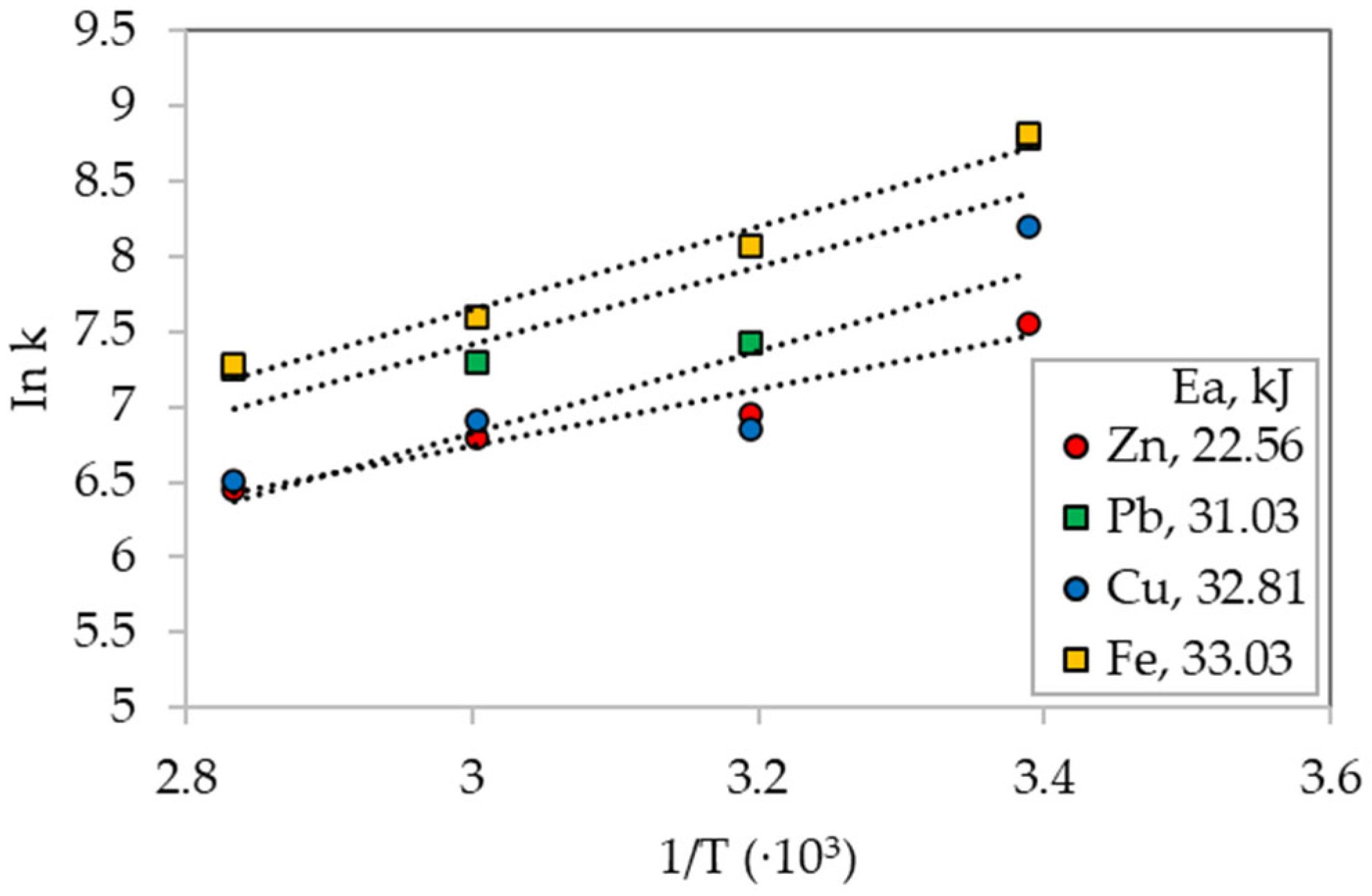
As mentioned above, the activation energy values are obtained by plotting the natural logarithm of the rate constant versus the inverse of the temperature, as shown in Figure 7. From the calculations performed with the values obtained from the slope, it was determined that the activation energy is 22.56 kJ/mol for Zn, 31.03 kJ/mol for Pb, 32.81 kJ/mol for Cu, and 33.03 kJ/mol for Fe.
According to different authors, values between 8 and 30 kJ/mol indicate that the chemical reaction is controlled by diffusion, while at values between 40 and 80 kJ/mol the rate would be limited by chemical control; for intermediate values, between 30 and 40 kJ/mol, the control is mixed [45,48]. Therefore, Zn leaching would be controlled by diffusion in the product layer (possibly due to the formation of elemental sulfur from the oxidation of H2S, a product of the reaction of MSA with ZnS), while for Pb, Cu, and Fe, there would be an initial component of chemical control mainly in the first 10 min of reaction, with diffusion control then predominating (due to energy values closer to 30 kJ/mol).
The activation energy values obtained are like those reported by other authors (see Table 1), even considering that they are different types of slag and different reactants. This suggests that a layer of products is formed or that there are passivating phases that limit the diffusion of the reactants and products. It also suggests that, as these are slags with glassy phases, they act as barriers to the passage of the reactants, making it necessary to increase the liberation of those metallic phases that can be leached or dissolved with the leaching reagents.

2.3. Final Residue After Leaching

Table 3 and Table 4 show the chemical analysis and mineralogical reconstruction of a sample of residue after leaching at MSA 1 M, 60 °C and 60 min, based on analysis by FRX, XRD and SEM.
According to these analyses, it is confirmed that metal oxide phases dissolve more easily than silicate, ferrite, or metal sulfide phases, given that they were the species with the lowest contents. When these phases are leached, the insoluble phases increase (CaSiO3, mainly), as shown in these analyses. Although the metal content is still high, it should be noted that, on the one hand, they may be occluded in the calcium silicate phases or in their most insoluble forms, and that at a given moment, they may undergo further leaching, after finer grinding, which allows the metal phases to be exposed. This further reduces the base metal content.
Another point to consider is the proportion of iron that dissolves with MSA. In terms of mass, it is the metal that dissolves the most, so a purification stage of the solution must be considered, perhaps through Fe precipitation or solvent extraction of Zn and Cu, for the selective recovery of valuable metals.

3. Materials and Methods

3.1. Slag Sampling and Characterization

Lead smelting slag was obtained from an industrial process and prepared for laboratory analysis. The sample was dried, homogenized, and ground before subsequent characterization and leaching tests. Chemical composition was determined using X-ray fluorescence spectroscopy (XRF) with a RIGAKU Primus II instrument (Rigaku, Tokyo, Japan). Mineralogical phases were identified by X-ray diffraction (XRD) using a PANALYTICAL Empyrean diffractometer (Malvern Panalytical, Worcestershire, UK), and microstructural observations were carried out using scanning electron microscopy (SEM) with a FEI Quanta 600 system (FEI Company, Hillsbury, OR, USA).
The resulting chemical composition and mineralogical distribution are presented in Table 5 and Table 6, respectively.

3.2. Leaching Experiments

Leaching experiments were carried out in a 2 L glass batch reactor (Pyrex, Corning Inc., New York, NY, USA) equipped with four internal baffles to prevent swirling and ensure homogeneous mixing of the slurry. An acrylic cover was placed over the reactor to minimize evaporation while allowing gas exchange with the atmosphere. A mechanical overhead stirrer was used to maintain continuous agitation at 700 rpm. This agitation speed was selected based on preliminary observations showing that no significant changes in metal dissolution occurred at higher speeds, indicating that external mass-transfer limitations were minimized under these conditions.
Temperature control during each test was achieved using a Thermolyne Cimarec 2 hotplate/stirrer (Street Woburn, MA, USA). The pH was monitored periodically using a calibrated pH meter (Hanna Instruments, Woonsocket, RI, USA), particularly at lower methanesulfonic acid (MSA) concentrations, where acid consumption by the dissolving slag could shift the pH toward neutral values.
The slag sample was ground and sieved to obtain a particle size of 100%—75 µm. A solid concentration of 10 wt.% was used in all experiments. MSA solutions (reagent grade, Sigma-Aldrich, St. Louis, MO, USA) were prepared at concentrations of 0.35, 0.7, 1.0, and 1.4 M using deionized water.
Since copper dissolution from Cu2S requires the presence of oxygen, the experiments were conducted in an open reactor configuration, allowing continuous contact of the solution with atmospheric oxygen. No additional aeration was supplied, as the open-vessel setup was sufficient to maintain the oxidative conditions necessary for Cu2S dissolution, consistent with reaction (5).
Two sets of experiments were performed. In the first set, the MSA concentration was fixed at 1 M, and temperatures of 22, 40, 60, and 80 °C were applied to assess the influence of thermal conditions on metal dissolution. In the second set, the temperature was fixed at the optimal value obtained from the first series, and the concentration of MSA was varied.
At predetermined time intervals (10, 20, 30, and 45 min), approximately 5 mL aliquots of the slurry were withdrawn and immediately filtered through 0.45 µm membranes to separate the liquid phase. The filtrates were analyzed by inductively coupled plasma optical emission spectroscopy (ICP-OES, PERKIN ELMER Optima 8300, Waltham, MA, USA). Table 7 summarizes the operating conditions evaluated in this study.
Following each experiment, the remaining leaching solutions were neutralized to pH 7–8 with NaOH before disposal, ensuring environmentally responsible handling of the spent solutions. No recycling of the leaching solution was performed.

4. Conclusions

This study demonstrated that methanesulfonic acid (MSA) is an effective and environmentally benign lixiviant for the recovery of Zn, Pb, Cu, and Fe from lead smelting slags, providing both environmental and economic advantages through the valorization of metallurgical residues. Metal extraction increased nearly linearly with MSA concentration up to 1 M, achieving maximum recoveries after 60 min of 85% Zn, 64% Pb, 75% Cu, and 68% Fe. Further increases to 1.4 M had no significant effect, indicating saturation in the dissolution process. Temperature exerted a differentiated influence: Zn and Fe showed limited temperature sensitivity consistent with diffusion control, while Pb and Cu exhibited higher initial dependence before stabilizing under mixed control. Kinetic modeling (R2 > 0.85) confirmed combined chemical–diffusion mechanisms, with activation energies of 22.6 kJ mol−1 for Zn and 31–33 kJ mol−1 for Pb, Cu, and Fe. These results indicate that leaching behavior is governed by both the mineralogical structure of the slag and the physicochemical properties of MSA, such as high solubility and thermal stability. Beyond efficient metal recovery, the process produced a silica- and alumina-more clean (minor content of base metal: 1.71% Zn, 0.53% Pb, 0.21% Cu and 5.9% Fe). The resulting residue is 69% as CaSiO3, mainly; then, this new slag after leaching could be used in construction or mining backfill materials. Therefore, MSA leaching not only enables high extraction yields but also contributes to circular metallurgical practices by value metal recovery (Zn, Cu and Fe, mainly) and converting final slag residue into more recyclable and value-added materials. However, as with any laboratory-scale process, it is necessary to conduct an economic analysis to evaluate the cost–benefit ratio of using MSA based on the recovered metal values and the potential value of the waste.

Author Contributions

Conceptualization, I.A.-G. and F.R.C.-P.; methodology, M.D.J.S.-A. and A.M.L.; software, J.M.N.-I.; validation, F.R.C.-P., M.D.J.S.-A. and S.A.P.-F.; formal analysis, J.M.N.-I. and F.R.C.-P.; investigation, J.M.N.-I. and S.A.P.-F.; resources, I.A.-G., M.F.-F. and J.C.-F.; writing—original draft preparation, J.M.N.-I.; writing—review and editing, N.G.P.-R. and F.R.C.-P.; visualization, S.A.P.-F.; supervision, I.A.-G., M.F.-F. and J.C.-F.; project administration, I.A.-G. and J.C.-F. All authors have read and agreed to the published version of the manuscript.

Funding

This research received no external funding.

Data Availability Statement

The original contributions presented in the study are included in the article; further inquiries can be directed to the corresponding authors.

Acknowledgments

The authors thank Met Mex Peñoles for materials and chemical analysis support.

Conflicts of Interest

Isaías Almaguer-Guzmán, Josué Cháidez-Félix and Manuel Flores-Favela work at Metalúrgica Met Mex Peñoles. The authors declare that the research was conducted in the absence of any commercial or financial relationships that could be construed as a potential conflict of interest.

References

  1. Morales Rodríguez, J.A.; Morales Rodríguez, M.A.; Cervantes Zubirias, G.; Alva Rocha, L.A. Impacto socioeconómico en los minerales industriales en México. Multidiscip. Ing. 2023, 10, 56–68. [Google Scholar] [CrossRef]
  2. Martínez, R.; Bednarek, M.; Zulawska, U. Validation of a sustainable model for the mining-metallurgical industry in Mexico. Proceedings 2019, 38, 12. [Google Scholar]
  3. Hamraoui, L.; Bergani, A.; Ettoumi, M.; Aboulaich, A.; Taha, Y.; Khalil, A.; Neculita, C.M.; Benzaazoua, M. Towards a circular economy in the mining industry: Possible solutions for water recovery through advanced mineral tailings dewatering. Minerals 2024, 14, 319. [Google Scholar] [CrossRef]
  4. Çoruh, S.; Elevli, S.; Ergun, O.N.; Demir, G. Assessment of leaching characteristics of heavy metals from industrial leach waste. Int. J. Miner. Process. 2013, 123, 165–171. [Google Scholar] [CrossRef]
  5. Torres, J.S.; Agredo, J.T. Aprovechamiento de escorias de fundición secundaria de plomo en ladrillos cerámicos. Cienc. Ing. Neogranadina 2019, 29, 7–18. [Google Scholar] [CrossRef]
  6. Nowińska, K.; Kokowska-Pawłowska, M. Mineralogy of zinc and lead metallurgical slags in terms of their impact on the environment: A review. Minerals 2024, 14, 852. [Google Scholar] [CrossRef]
  7. Pérez-García, L.A.; Crespo-Lambert, M.; Leyva-Rodríguez, C.A.; Cuza-Fernández, G. La bioacumulación de metales pesados y el desarrollo de la agricultura urbana en Moa. Miner. Geol. 2023, 39, 174–187. [Google Scholar]
  8. Tirado-Amador, L.R.; González-Martínez, F.D.; Martínez-Hernández, L.J.; Wilches-Vergara, L.A.; Celedón-Suárez, J.N. Niveles de metales pesados en muestras biológicas y su importancia en salud. Rev. Nac. Odontol. 2015, 11, 83–99. [Google Scholar] [CrossRef]
  9. Londoño Franco, L.F.; Londoño-Muñoz, P.T.; Muñoz-García, F.G. Los riesgos de los metales pesados en la salud humana y animal. Biotecnol. Sect. Agropecu. Agroind. 2016, 14, 145–153. [Google Scholar] [CrossRef]
  10. Jomova, K.; Alomar, S.Y.; Nepovimova, E.; Kuca, K.; Valko, M. Heavy metals: Toxicity and human health effects. Arch. Toxicol. 2024, 99, 153–209. [Google Scholar] [CrossRef]
  11. Sinicropi, M.S. Special issue on “heavy metal toxicity: Environmental and human health risk assessment”. Appl. Sci. 2024, 14, 1127. [Google Scholar] [CrossRef]
  12. Akpomie, K.G.; Dawodu, F.A. Treatment of an automobile effluent from heavy metals contamination by an eco-friendly montmorillonite. J. Adv. Res. 2014, 6, 1003–1013. [Google Scholar] [CrossRef]
  13. Moradkhani, D.; Eskandari, S.; Sedaghat, B.; Najafabadi, M.R. A study on heavy metals mobility from zinc plant residues in Iran. Physicochem. Probl. Miner. Process. 2013, 49, 567–574. [Google Scholar]
  14. Ramezani, H.; Kamran Haghighi, H. An innovative process for lead upgrade from Kaldo smelting slag of lead ores: Characterization and flotation. Sci. Rep. 2025, 15, 31423. [Google Scholar] [CrossRef]
  15. Rodriguez, N.; Machiels, L.; Onghena, B.; Spooren, J.; Binnemans, K. Selective recovery of zinc from goethite residue in the zinc industry using deep-eutectic solvents. RSC Adv. 2020, 10, 7328–7335. [Google Scholar] [CrossRef] [PubMed]
  16. Najera Ibarra, J.M.; Soria-Aguilar, M.J.; Martínez-Luevanos, A.; Picazo-Rodriguez, N.G.; Almaguer-Guzman, I.; Chaidez-Felix, J.; Carrillo-Pedroza, F.R. Zinc extraction from primary lead smelting slags by oxidant alkaline leaching. Processes 2024, 12, 1409. [Google Scholar] [CrossRef]
  17. Picazo-Rodríguez, N.G.; Soria-Aguilar, M.J.; Martínez-Luévanos, A.; Almaguer-Guzmán, I.; Chaidez-Félix, J.; Carrillo-Pedroza, F.R. Direct acid leaching of sphalerite: An approach comparative and kinetics analysis. Minerals 2020, 10, 359. [Google Scholar] [CrossRef]
  18. Zheng, X.; Li, J.; Ma, A.; Liu, B. Recovery of zinc from metallurgical slag and dust by ammonium acetate using response surface methodology. Materials 2023, 16, 5132. [Google Scholar] [CrossRef] [PubMed]
  19. Zheng, Y.; Lv, J.; Liu, W.; Qin, W.; Wen, S. An innovative technology for recovery of zinc, lead and silver from zinc leaching residue. Physicochem. Probl. Miner. Process. 2016, 52, 943–954. [Google Scholar]
  20. Irannajad, M.; Meshkini, M.; Azadmehr, A.R. Leaching of zinc from low grade oxide ore using organic acid. Physicochem. Probl. Miner. Process. 2013, 49, 547–555. [Google Scholar]
  21. Ahmed, I.; Nayl, A.; Daoud, J. Leaching and recovery of zinc and copper from brass slag by sulfuric acid. J. Saudi Chem. Soc. 2016, 20, S280–S285. [Google Scholar] [CrossRef]
  22. Zhang, C.; Zhuang, L.; Wang, J.; Bai, J.; Yuan, W. Extraction of zinc from zinc ferrites by alkaline leaching: Enhancing recovery by mechanochemical reduction with metallic iron. J. S. Afr. Inst. Min. Metall. 2016, 116, 1111–1114. [Google Scholar]
  23. Wang, L.; Chen, C.; Li, Z.; Lyu, W.; Liu, X.; Wang, H.; Nie, Y.; Wang, L.; Liu, S.; Xue, N. Recovery of zinc from blast furnace dust via ultrasonic-enhanced crotonic acid leaching: Leaching kinetics and mechanism. Ultrason. Sonochem. 2025, 120, 107489. [Google Scholar] [CrossRef]
  24. Araujo, F.S.M.; Taborda-Llano, I.; Nunes, E.B.; Santos, R.M. Recycling and reuse of mine tailings: A review of advancements and their implications. Geosciences 2022, 12, 319. [Google Scholar] [CrossRef]
  25. Rudnik, E. Hydrometallurgical treatment of EAF by-products for metal recovery: Opportunities and challenges. Metals 2025, 15, 914. [Google Scholar] [CrossRef]
  26. Li, Z.; Xia, Z.; Liu, S.; Ye, L.; Qi, J.; Li, X. Recovery of zinc and lead by simultaneously leaching from lead slag fuming dust with ammonium chloride solution. Trans. Nonferrous Met. Soc. China 2024, 34, 4075–4084. [Google Scholar] [CrossRef]
  27. Silwamba, M.; Ito, M.; Hiroyoshi, N.; Tabelin, C.B.; Hashizume, R.; Fukushima, T.; Park, I.; Jeon, S.; Igarashi, T.; Sato, T.; et al. Alkaline leaching and concurrent cementation of dissolved Pb and Zn from zinc plant leach residues. Minerals 2022, 12, 393. [Google Scholar] [CrossRef]
  28. Rao, S.; Liu, Z.; Wang, D.; Cao, H.; Zhu, W.; Zhang, K.; Tao, J. Hydrometallurgical process for recovery of Zn, Pb, Ga and Ge from Zn refinery residues. Trans. Nonferrous Met. Soc. China 2021, 31, 555–564. [Google Scholar] [CrossRef]
  29. Yang, S.; Zhao, D.; Jie, Y.; Tang, C.; He, J.; Chen, Y. Hydrometallurgical process for zinc recovery from C.Z.O. generated by the steelmaking industry with ammonia–ammonium chloride solution. Metals 2019, 9, 83. [Google Scholar] [CrossRef]
  30. Palimąka, P.; Pietrzyk, S.; Stępień, M.; Ciećko, K.; Nejman, I. Zinc recovery from steelmaking dust by hydrometallurgical methods. Metals 2018, 8, 547. [Google Scholar] [CrossRef]
  31. Abdel-Aal, E.A.; Rashad, M.M.; El-Shazly, A.N.; Ibrahim, I.A.; El-Shahat, M.F. Hydrometallurgical treatment of non-sulfide zinc ore for precipitation of zinc oxide nanoparticles. Physicochem. Probl. Miner. Process. 2016, 52, 729–737. [Google Scholar]
  32. Stefanova, A.; Aromaa, J.; Forsén, O. Alkaline leaching of zinc from argon oxygen decarbonization dust from stainless steel production. Physicochem. Probl. Miner. Process. 2013, 49, 37–46. [Google Scholar]
  33. Binnemans, K.; Jones, P.T. Methanesulfonic acid (MSA) in hydrometallurgy. J. Sustain. Metall. 2022, 9, 26–45. [Google Scholar] [CrossRef]
  34. Wu, Z.; Dreisinger, D.B.; Urch, H.; Fassbender, S. Fundamental study of lead recovery from cerussite concentrate with methanesulfonic acid (MSA). Hydrometallurgy 2014, 142, 23–35. [Google Scholar] [CrossRef]
  35. Binnemans, K.; Jones, P.T. Methanesulfonic acid (MSA) in clean processes and applications: A tutorial review. Green Chem. 2024, 26, 8583–8614. [Google Scholar] [CrossRef]
  36. Brahim, J.A.; Merroune, A.; Boulif, R.; Mounir, E.M.; Beniazza, R. Efficient leaching process of rare earth, alkali and alkaline earth metals from phosphogypsum based on methanesulfonic acid (MSA) as green and eco-friendly lixiviant. RSC Adv. 2022, 12, 30639–30649. [Google Scholar] [CrossRef] [PubMed]
  37. Sirés, I.; Low, C.; Ponce-De-León, C.; Walsh, F. The characterisation of PbO2-coated electrodes prepared from aqueous methanesulfonic acid under controlled deposition conditions. Electrochim. Acta 2009, 55, 2163–2172. [Google Scholar]
  38. Jin, B.; Dreisinger, D.B. A green electrorefining process for production of pure lead from methanesulfonic acid medium. Sep. Purif. Technol. 2016, 170, 199–207. [Google Scholar] [CrossRef]
  39. Finšgar, M.; Milošev, I. Corrosion behaviour of stainless steels in aqueous solutions of methanesulfonic acid. Corros. Sci. 2010, 52, 2430–2438. [Google Scholar] [CrossRef]
  40. Whitworth, A.J.; Forbes, E.; Verster, I.; Jokovic, V.; Awatey, B.; Parbhakar-Fox, A. Review on advances in mineral processing technologies suitable for critical metal recovery from mining and processing wastes. Clean. Eng. Technol. 2022, 7, 100451. [Google Scholar] [CrossRef]
  41. Nwaila, G.T.; Ghorbani, Y.; Zhang, S.E.; Frimmel, H.E.; Tolmay, L.C.; Rose, D.H.; Nwaila, P.C.; Bourdeau, J.E. Valorisation of mine waste—Part I: Characteristics of, and sampling methodology for, consolidated mineralised tailings by using Witwatersrand gold mines (South Africa) as an example. J. Environ. Manag. 2021, 295, 113013. [Google Scholar]
  42. Yao, L.; Liu, D.; Ke, Y.; Li, Y.; Wang, Z.; Fei, J.; Xu, H.; Min, X. Synthesis and hydration characteristic of geopolymer based on lead smelting slag. Int. J. Environ. Res. Public Health 2020, 17, 2762. [Google Scholar]
  43. Yu, L.; Fang, L.; Zhang, P.; Zhao, S.; Jiao, B.; Li, D. The utilization of alkali-activated lead–zinc smelting slag for chromite ore processing residue solidification/stabilization. Int. J. Environ. Res. Public Health 2021, 18, 9960. [Google Scholar] [CrossRef]
  44. Palden, T.; Onghena, B.; Regadío, M.; Binnemans, K. Methanesulfonic acid: A sustainable acidic solvent for recovering metals from jarosite residue of the zinc industry. Green Chem. 2019, 21, 6028–6039. [Google Scholar] [CrossRef]
  45. Faraji, F.; Alizadeh, A.; Rashchi, F.; Mostoufi, N. Kinetics of leaching: A review. Rev. Chem. Eng. 2022, 38, 113–148. [Google Scholar] [CrossRef]
  46. Moreno, L.; Ordóñez, J.I.; Cisternas, L.A. Dissolution model of multiple species: Leaching of highly soluble minerals. Metall. Mater. Trans. B 2017, 48, 1817–1826. [Google Scholar]
  47. Bow, Y.; Prameswara, G.; Gustiana, H.S.E.A.; Rahman, A.; Zainuri, M.; Setiawan, D. Influence of thermal treatment on the kinetics of manganese leaching from laterite ore. Transit. Met. Chem. 2025, 50, 175–182. [Google Scholar] [CrossRef]
  48. Sun, P.; Wang, J.; Li, X.; Zhang, Q.; Liu, Y. Oxygen-pressure leaching kinetics of sphalerite in the H2SO4–Fe2(SO4)3 system. JOM 2025, 77, 1650–1658. [Google Scholar] [CrossRef]
Figure 1. Leaching kinetics of zinc (a) and lead (b) from lead smelting slag at different MSA concentrations (40 °C).
Recycling 11 00001 g001
Figure 2. Leaching kinetics of copper (a) and iron (b) from lead smelting slag at different MSA concentrations.
Recycling 11 00001 g002
Figure 3. Comparison of reacted fraction of Zn, Pb, Cu, and Fe as a function of methanesulfonic acid concentration after 60 min of reaction.
Recycling 11 00001 g003
Figure 4. Effect of temperature on the leaching kinetics of zinc (a) and lead (b) with MSA, 1 M.
Recycling 11 00001 g004
Figure 5. Effect of temperature on the leaching behavior of copper (a) and iron (b) with methanesulfonic acid (1 M).
Recycling 11 00001 g005
Figure 6. Extraction percentages of Zn, Pb, Cu, and Fe after 60 min of leaching with methanesulfonic acid (1 M) at different temperatures.
Recycling 11 00001 g006
Figure 7. Linearized Arrhenius plot used to determine the activation energy of Zn, Pb, Cu, and Fe during leaching with MSA.
Recycling 11 00001 g007
Table 1. Recovery of different metals via the hydrometallurgical route.
AuthorMaterialLeaching AgentConditionsKinetic ModelRecovery, %
[23]
Wang et al. (2025)
Blast furnace dust (PFD)Crotonic acid240 W ultrasonic power, 1:8 g/mL (S/L) ratio, 1 mol/L crotonic acid, 40 °C and 40 minUnder UL conditions, the process shifted to mixed control, Ea = 31.73 kJ/mol92.79% Zn;
15.45% Fe
[26]
Li et al. (2024)
Fuming dust of lead blast furnace slagNH4Cl100 °C, 7 mol/L NH4Cl, L/S 10:1 (mL/g), 450 r/min and 60 min.Shrinking unreacted core model and is controlled
by the internal diffusion Ea = 23.922 kJ/mol Zn, Ea = 19.139 kJ/mol Pb
98.2% Zn;
75.6% Pb
[16]
Nájera et al. (2024)
Lead smelting slagNaOH/NaClO60 °C, 0.22 of NaOH/NaClO ratio, 10% of solids, and a reaction time of 40 min.Model of particle decreasing controlled by diffusion, Ea = 12 to 15 kJ/mol58% Zn
[18]
Zheng et al. (2023)
Metallurgical slag and dust
(MSD)
NH3-CH3COONH3-H2O
(ammonium acetate)
25 °C, 345 r/min, [NH3]/[NH4]+ of 1:1, total ammonia concentration of 4.8 mol/L, l/s 4.3:1, and 46 min./84.64% Zn
[27]
Silwamba et al. (2022)
Zinc plant leach residues (ZPLRs)NaOH2.5 g/50 mL (S/L) of ZPLRs were leached in a 3 M NaOH solution for 30 min./27.1% Zn; 62.2% Pb
[28]
Rao et al.
(2021)
Zinc refinery residuesFirst
Stage H2SO4/second stage HCl
First stage
2 mol/L H2SO4, L/s ratio 10 mL/g, 80 °C, 2 h
Second stage
2 mol/L HCl,
L/s ratio of 20 mL/g, 90 °C for 2 h
/First stage
90% Zn; 99% Ga Second stage
99% Pb;
<2% Ge
[29]
Yang et al. (2019)
Crude zinc oxide (C.Z.O.)NH3–NH4Cl–H2OAgitation speed 250 rpm, concentration of ammonia and ammonium chloride 2.5 mol/L and 5 mol/L, respectively, 30 min, 40 °C, and L/S 6 mL/g/Over 81% Zn
[30]
Palimąka et al. (2018)
Electric arc furnace dustNaOH6 M NaOH solution, 80 °C and the liquid/solid phase ratio of 40/88% Zn
[21]
Ahmed et al. (2016)
Brass slagH2SO4150 rpm, 30% v/v H2SO4, 35 °C, relation L/s (5/1)Shrinking core model under chemically controlled processes Ea = 59 kJ/mol95% Zn; 99% Cu
[31]
Abdel et al. (2016)
Non-sulfide zinc oreH2SO425%—74 μm particle size, 45 °C, 2 h, 1.1 stoichiometric molar ratio of H2SO4 to Zn, 1:3 solid/liquid ratio./90% Zn
[32]
Stefanova et al. (2013)
Argon oxygen decarburization converter dust samples (AOD1 and AOD2) from stainless steel productionNaOH95 °C, 8 M NaOH solution, 400 rpm, L/S ratio of 30./80% Zn (AOD1); 50% Zn (AOD2)
[20]
Irannajad et al. (2013)
Low-grade zinc oxide mining tailingsCitric acid80 °C, 60 min, citric acid concentration of 0.5 mol/L, and solid to
liquid ratio of 1:10
/82% Zn
Table 2. Rate constants and correlation coefficients.
Chemical control
ZnPbCuFe
T, °CkR2kR2kR2kR2
220.002610.4130.001370.5080.002110.9330.001340.464
400.003730.5720.002890.6510.004210.8780.002010.553
600.004060.4900.003060.5410.003940.6980.002600.538
800.005060.6060.003110.4240.005030.7640.003100.562
Product layer diffusion control
ZnPbCuFe
T, °CkR2kR2kR2kR2
220.000520.4490.000150.6270.000270.9950.000150.553
400.000960.6900.000600.8040.001060.9430.000310.667
600.001110.5630.000670.6550.001000.8450.000500.643
800.001580.7450.000710.4670.001500.9220.000690.704
Liquid film diffusion control
ZnPbCuFe
T, °CkR2kR2kR2kR2
220.004600.4070.002580.5010.003910.9220.002510.459
400.006240.5430.005070.6250.007110.8490.003660.540
600.006660.4690.005310.5220.006630.6630.004610.523
800.007910.5570.005350.4160.008060.7110.005360.538
Table 3. Chemical analysis of the lead slag (%), after leaching.
AlCaFeKOPbSSiZnCuMg
2.4224.755.992.4042.40.531.515.741.710.201.56
Table 4. Mineralogical composition of the lead slag (%), after leaching.
Minerals SpeciesComposition, %
ZnO0.23
ZnS0.48
ZnFe2O40.81
Ca2ZnSi2O70.21
PbSiO30.53
PbO0.01
Cu2S0.20
FeO4.11
Fe3O41.88
CaSiO369.29
K2O2.89
Ca2Al2SiO77.07
MgO2.60
Table 5. Chemical analysis of the lead slag (%).
AlCaFeKOPbSSiZnCuMg
1.413.7523.951.3926.51.472.39.111.420.640.9
Table 6. Mineralogical composition of the lead slag (%).
Minerals SpeciesComposition, %
ZnO5.62
ZnS7.18
ZnFe2O45.98
Ca2ZnSi2O72.23
PbSiO31.9
PbO0.09
Cu2S0.8
FeO24.57
Fe3O42.88
CaSiO332.16
K2O1.68
Ca2Al2SiO77.12
MgO1.5
Table 7. Experimental conditions used for the acid leaching with MSA of lead smelting slag in a lab-scale experiment.
Solid (%)T, °CMSA, M
10%201
10%401
10%601
10%801
10%800.35
10%800.70
10%801
10%801.4
Disclaimer/Publisher’s Note: The statements, opinions and data contained in all publications are solely those of the individual author(s) and contributor(s) and not of MDPI and/or the editor(s). MDPI and/or the editor(s) disclaim responsibility for any injury to people or property resulting from any ideas, methods, instructions or products referred to in the content.