

You are currently viewing a new version of our website. To view the old version click .
Recycling
  • Article
  • Open Access

5 December 2025

The Potential for Glass Wool Waste as a Filler in UF Adhesive to Promote Particleboard Strength

,
,
,
,
,
,
and
1
Department of Forest and Wood Sciences, Federal University of Espírito Santo, Jerônimo Monteiro 29550-000, Espírito Santo, Brazil
2
Department of Agrarian Sciences, Center for Exact and Technological Sciences, State University of Montes Claros, Janaúba 39440-000, Minas Gerais, Brazil
3
Products Forests Department, Institute of Forests, Federal Rural University of Rio de Janeiro, Seropédica 23890-000, Rio de Janeiro, Brazil
*
Author to whom correspondence should be addressed.
This article belongs to the Special Issue Celebrating 10 Years of Recycling: Shaping the Future of Waste Management

Abstract

Wastes, biomasses, and nanoparticles have motivated reformulations of adhesives in the wood-based-panel industry. This study investigated the incorporation of glass wool (GW) waste as a filler material in urea–formaldehyde (UF) adhesive, evaluating its effects on the adhesive properties as well as on the physical, mechanical, fire-retardant, and acoustic properties of particleboards. Panels with a target density of 700 kg m−3 were produced with different proportions of glass wool in the adhesive (T1: 0%; T2: 3.34%; T3: 4.93%; T4: 6.52%; T5: 9.49%; T6: 12.35%). The adhesive-coated particle mat was pressed in a hydraulic press at 160 °C under a compression force of 72 tons for 10 min. The panels were subjected to analyses of their physical, mechanical, fire-retardant, and acoustic properties, as well as scanning electron microscopy (SEM) analyses. Statistical analysis involved regression, analysis of variance, and a Scott–Knott test (p < 0.05). The results indicated that adding 3.34% GW to the adhesive improved the modulus of rupture, internal bond strength, screw withdrawal resistance, and acoustic efficiency of the panels. A glass wool content of 12.35% enhanced the hardness and the damping factor. These findings highlight the potential of glass wool as a functional filler material in UF adhesive, promoting the development of stronger and more sustainable particleboards.

1. Introduction

In the reconstituted-wood-panel sector, the production of particleboards offers a versatile alternative for utilizing additives and reformulating synthetic adhesives through the use of fillers, binders, and reinforcements, such as various flours, rice husks, wood dust or bark, and other materials [1,2,3,4], such as paraffin and water repellents. The cost of these panels is directly related to the adhesives used, such as urea–formaldehyde (UF), phenol–formaldehyde (PF), melamine–formaldehyde (MF), and resorcinol–formaldehyde (RF) [5].
Urea–formaldehyde, classified for interior use, has wide industrial applications, accounting for 90% of particleboard production [6,7]. The low cost of urea–formaldehyde makes it economically viable; however, it presents disadvantages such as reduced panel stiffness and mechanical strength, which has contributed to the market’s growing preference for medium-density fiberboard (MDF) panels [8]. These limitations have driven research focused on improving the performance of particleboards [9,10], and studying these adhesive modifications is essential to the development of innovative and sustainable products that meet market demands [11].
Modifications to UF resin aim to reduce formaldehyde emissions and optimize the resin’s technological properties [12], and include partial substitution using tannins [13,14,15]. Among the factors that influence wood bonding, viscosity, gel time, solid content, and adhesive pH are key properties that directly affect bonding performance and the quality of particleboards [16,17].
The viscosity of adhesives, influenced by the solid content and the degree of resin condensation, is crucial for composite performance, as it affects both curing time and adhesion [18,19]. Very low viscosity compromises bonding, while excessively high viscosity hinders flow and uniform application [20], in addition to requiring higher pressures for the spraying systems used in industrial production lines.
Adequate pH control optimizes interfacial properties and promotes more efficient bonding between particles [21]. Conversely, an unsuitable pH can interfere with the cure rate and the adhesive capacity of the resin, compromising its performance [21,22].
In addition to their structural properties, the acoustic performance of particleboards has become increasingly relevant, especially in applications that require sound comfort, such as residential and corporate environments [23,24]. Particle size, porous structure, density, and heterogeneity of the panels contribute to sound absorption [25,26], highlighting the complexity of relating density, mechanical strength, and vibrational damping capacity. Moreover, few studies have investigated the addition of fillers to enhance acoustic performance in particleboards.
Glass wool, widely used for thermal and acoustic insulation in drywall construction, ceilings, and piping, presents significant potential as a reusable industrial waste material [27]. Despite this potential, the application of glass wool in the reconstituted-wood-panel sector remains largely unexplored [28]. Glass wool has demonstrated compatibility with UF, mainly regarding formaldehyde sequestration, which can reach zero depending on the temperature [29]. The mixture also has the potential to reduce fire risk by improving the non-punking properties of the glass wool. Punking can be understood as a slow, flameless burning process that can cause the decomposition of the cured binder and represents a fire hazard for combustible materials [30].
Thus, the objective of this study was to evaluate the effect of adding glass wool waste post-consumer in urea–formaldehyde adhesive, to characterize the technological properties of the reformulated adhesives, and to assess their influence on the mechanical and acoustic properties of particleboards.

2. Results and Discussion

2.1. Wood Density, Moisture Content, and Slenderness Ratio

The average basic density of Pinus sp. wood was 532 kg m−3. According to Maloney [31], species with densities up to 550 kg m−3 are most suitable for particleboard production, as they achieve a compaction ratio between 1.3 and 1.6. In addition, density directly influences panel densification, adhesive impregnation and penetration, as well as anchorage to the polymer matrix [32,33].
The moisture content of the wood particles was 10%, slightly above the ideal range for particleboard production, which is typically between 3% and 6% [34]. According to Iwakiri et al. [35], moisture content affects liquid adhesive absorption by the wood. Therefore, knowing the moisture content of the particles is essential to ensure that excess steam during the pressing process does not negatively impact adhesive bonding. However, the moisture content did not compromise the integrity of the panels produced.
The size and geometry of the particles are characteristics that directly affect panel quality, especially regarding the slenderness ratio, compaction rate, and specific surface area. These factors can compromise the contact area between particles and influence resin consumption [36,37], thereby affecting mechanical strength, surface finish, machinability, and the application of coatings [38]. The slenderness ratio of the wood particles in this study was 18.7, which is consistent with values reported in the literature [39,40].

2.2. Technological Properties of the Adhesives

The average values of pH, solid content, viscosity, and gel time are presented in Table 1. In all analyses of variance performed, the results were significant at the 1% probability level, with p-values less than 0.0001.
Table 1. Average values of pH, solid content, viscosity, and gel time in the adhesives.
The pH values progressively increased with the addition of glass wool to the urea–formaldehyde resin, reflecting the effect of the filler, which was slightly basic, on the resin’s pH. The control resin (T1) showed a pH of 7.91, while the pH of treatments 2 to 6 ranged from 8.15 to 8.59. Although the wood’s acidity is considered high, with a pH below 5, the increase in adhesive pH may have prevented premature curing during pressing. Typically, the amount of hardener used should be sufficient to reduce UF resin pH below 7; however, this was not achieved, as above this level, polycondensation can be hindered and adhesive curing delayed. The amount of catalyst was maintained in proportion to the solid content of the UF adhesive for each treatment.
Studies show that increases in pH values are accompanied by rises in viscosity and gel time, which can compromise physical and mechanical properties [22,41]. To mitigate these effects, longer pressing times are recommended to ensure proper curing of modified resins with a more basic character [21].
The solid content of the adhesives evaluated ranged from 62.88% to 71.85%, mostly within the range reported for urea–formaldehyde-based adhesives (59–66%) [6]. Notably, the treatment with 12.35% glass wool showed a significantly higher average value, highlighting the impact of the filler on the resin formulation.
An increase in solid content can improve stiffness and adhesion, but excessive levels increase viscosity and hinder processing, especially during application [42]. Moslemi et al. [43] attributed the effects of solid content on gel time modification in UF adhesives modified with cellulose nanofibers, emphasizing reagent concentrations.
Gel time ranged from 67.2 to 111.2 s, showing no clear trend with increasing glass wool content in the adhesive formulations. Although the basic nature of glass wool, with lower reactivity, would suggest a progressive increase in gel time, the results indicate the influence of other factors, such as chemical interaction with the adhesive and variations in filler dispersion quality. The reduction in gel time observed can be attributed to the joint action of the catalyst and the high surface area of the glass wool, which at low levels was able to accelerate the condensation of the UF during heating. At an industrial scale, this reduction narrows the operating system and increases the risk of pre-curing, but it can also allow for shorter pressing cycles, contributing to higher productivity and lower energy consumption. Thus, with solid and viscosity levels at slightly higher levels, the behavior of T2 and T4 represents a more reactive system, with the potential for operational gains.
The treatment with 3.34% glass wool did not differ statistically significantly from the control. However, the treatment with 12.35% filler showed significantly higher values. During the study, difficulties were observed in dispersing the adhesives onto the wood particles, highlighting the impracticality of spraying and thus requiring an alternative application method, such as cylinders or rollers.
All treatments exceeded the typical viscosity range for urea–formaldehyde-based adhesives (300 to 1000 cP) according to Albuquerque et al. [6], with the 12.35% treatment even surpassing the upper recommended limit for adhesives used in plywood panels, which ranges from 4000 to 6500 cP [44]. The high viscosity observed (7970.72 cP) in treatment 6 restricts its application in conventional industrial lines that use sprinkler systems, which require lower viscosity to ensure adequate atomization and avoid clogging. However, the good mechanical performance obtained in this study suggests that formulations with a higher fill level may be viable in alternative production routes. Especially in processes that employ direct mechanical application of the adhesive, such as in the manufacture of plywood panels or other pressed composites, where higher viscosities pose no operational limitation.
The use of fillers, such as biomass wastes and metallic or mineral nanoparticles, has proven effective in optimizing resin viscosity, improving adhesive penetration and mechanical performance [45,46]. The increase in viscosity with filler addition is directly related to solid content and molecular interactions during adhesive formulation, also influenced by the phenolic binders present in the glass wool.
Studies evaluating the interaction of UF with silica nanoparticles conclude that low-level additions (up to 2%) can improve internal bonding and minimize excessive adhesive permeation in wood panels [47]. Salari et al. [48] support this idea with regard to the quality of oriented strand board (OSB) panels produced with UF and silica nanoparticles. The authors associate the silanol groups of nano-SiO2 with condensation reactions, forming hydrogen bonds that affect the chemistry of the UF resin.

2.3. Density and Compaction Ratio of the Particleboards

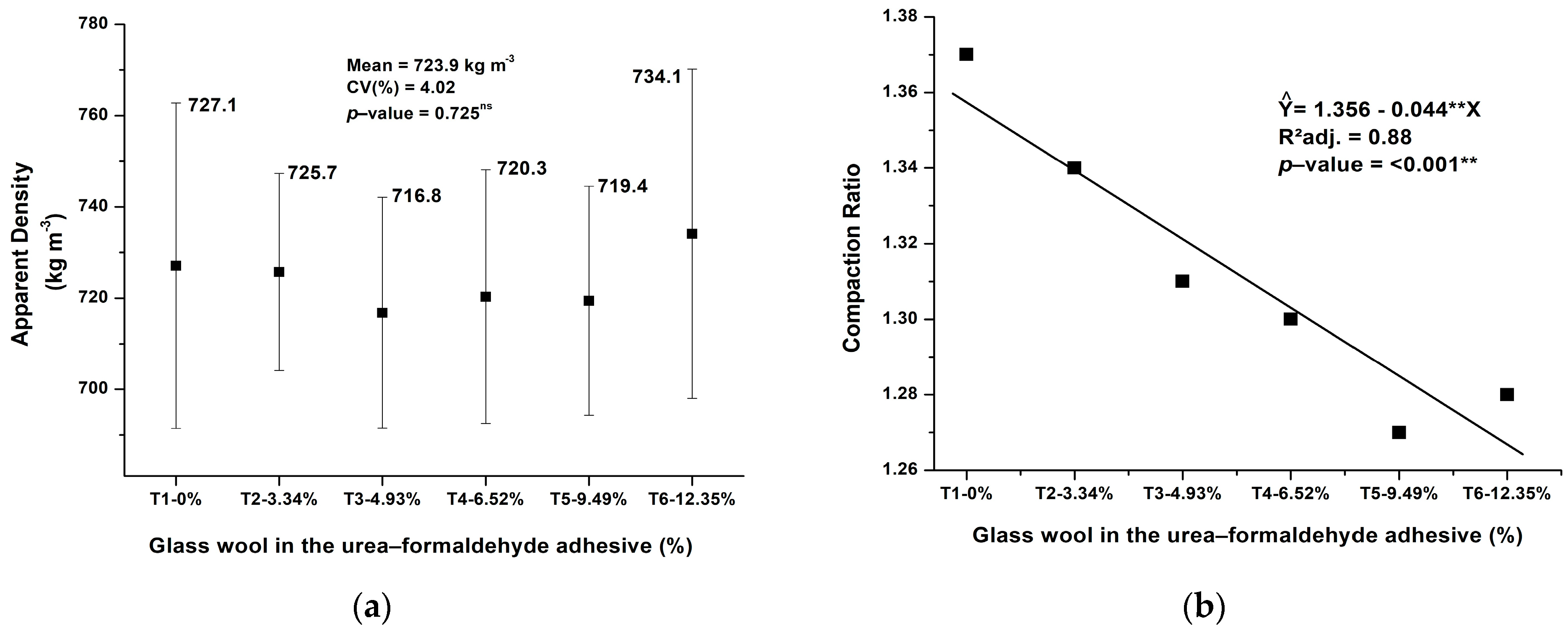
The analysis of variance for the apparent density of the particleboards, across the different glass wool contents, revealed no statistically significant differences (p > 0.05), as confirmed by a Scott–Knott test. The panels were designed for a nominal density of 700 kg m−3, achieving a range between 716.8 and 734.1 kg m−3 among the treatments, representing an increase of up to 4.6% compared to the planned parameter (Figure 1a).
Figure 1. Apparent density (a) and compaction ratio behavior (b) of the panels produced as a function of the percentage of glass wool added to the urea–formaldehyde (UF) adhesive. **: significant at 1% probability; Ŷ: estimated compaction ratio; X: percentage of glass wool added to the urea–formaldehyde adhesive (%); R2adj.: adjusted R-squared; p-value: associated probability; CV: coefficient of variation; ns: not significant.
The compaction ratio of the panels showed a slight decrease as the proportion of glass wool incorporated into the urea–formaldehyde adhesive increased, according to the linear regression (p < 0.01) (Figure 1b).
The average compaction ratio (CR) values ranged from 1.17 to 1.44 (treatments T6 and T1, respectively). Although the regression indicates a decreasing linear trend, the range of variation suggests that the addition of glass wool to the adhesive exerts a moderate influence on this parameter. Even in treatments with higher filler contents, the results remained close to the minimum recommended limit of 1.3 [16,36].
Higher proportions of the filler material reorganize the internal structural elements of the panel and fill spaces, with minimal interference in densification. The higher density of the glass wool particles compared to wood, the low filler content in the final panel composition, and the friable nature of the incorporated material are key factors explaining the compaction performance.

2.4. Mechanical Properties of the Particleboards

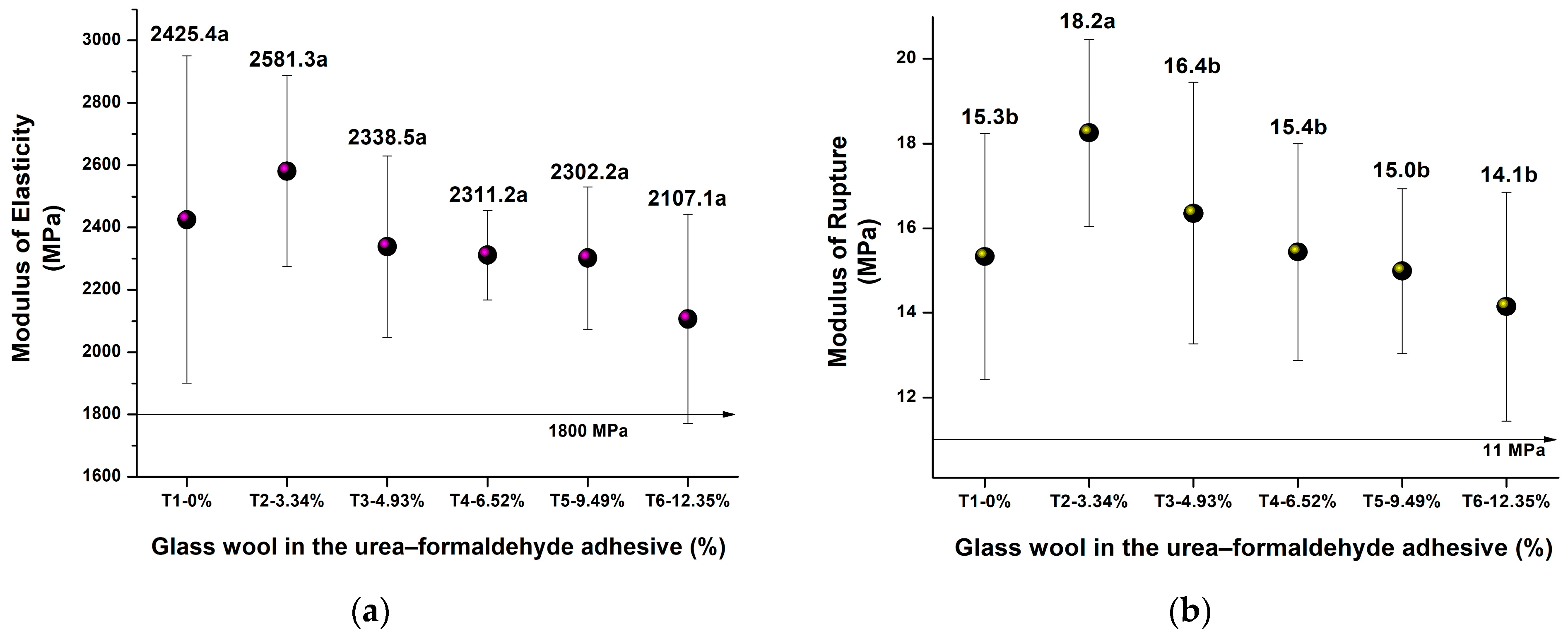
The results for the modulus of elasticity and static bending strength of the panels are presented in Figure 2.
Figure 2. Average values of modulus of elasticity (MOE) (a) and modulus of rupture (MOR) (b) of particleboards as a function of the percentage of glass wool added to the urea–formaldehyde adhesive. Means followed by the same letter do not differ significantly (Scott–Knott, p > 0.05).
The results for the modulus of elasticity (MOE) of the panels indicate that the addition of glass wool to the urea–formaldehyde resin did not cause significant differences among treatments (Figure 2a). The analysis of variance (ANOVA) was significant at a 5% probability level, as was the Scott–Knott test, with a p-value of 0.0169 and a coefficient of variation (CV) of 13.92%. The MOE ranged from 2107.1 MPa to 2581.3 MPa, with the highest performance observed at 3.34% glass wool in the adhesive. Overall, all treatments met the minimum values required by Brazilian standard NBR 14810-2 [49], which is 1800 MPa.
These results can be attributed to the panel production methodology. Manual homogenization of the particles ensured better adhesive distribution and contributed to the uniformity of the mechanical properties of the panels, even those produced with low-viscosity adhesives.
For the modulus of rupture (MOR) test, the analysis of variance (ANOVA) was effective in evaluating statistical variability among treatments at a 1% probability level (p = 0.002) with a critical F value of 3.2626. The average static bending strengths (MOR), grouped by the Scott–Knott test (at 5% and a CV of 16.5%), identified the treatment with 3.34% glass wool as the only statistically significantly different one (Figure 2b).
The best-performing panel showed a significant increase in the modulus of rupture, with an average value of 18.2 MPa. Overall, the average values ranged from 14.1 to 18.2 MPa, exceeding the requirement of Brazilian standard NBR 14810-2 [49], which is 11 MPa. Therefore, the addition of glass wool in reduced proportions increased the stiffness of the panels, while higher amounts did not show a noticeable change in performance.
The results of this study showed higher values of modulus of elasticity and modulus of rupture compared to studies on UF modifications in particleboards [41,50] and MDF [43,51].
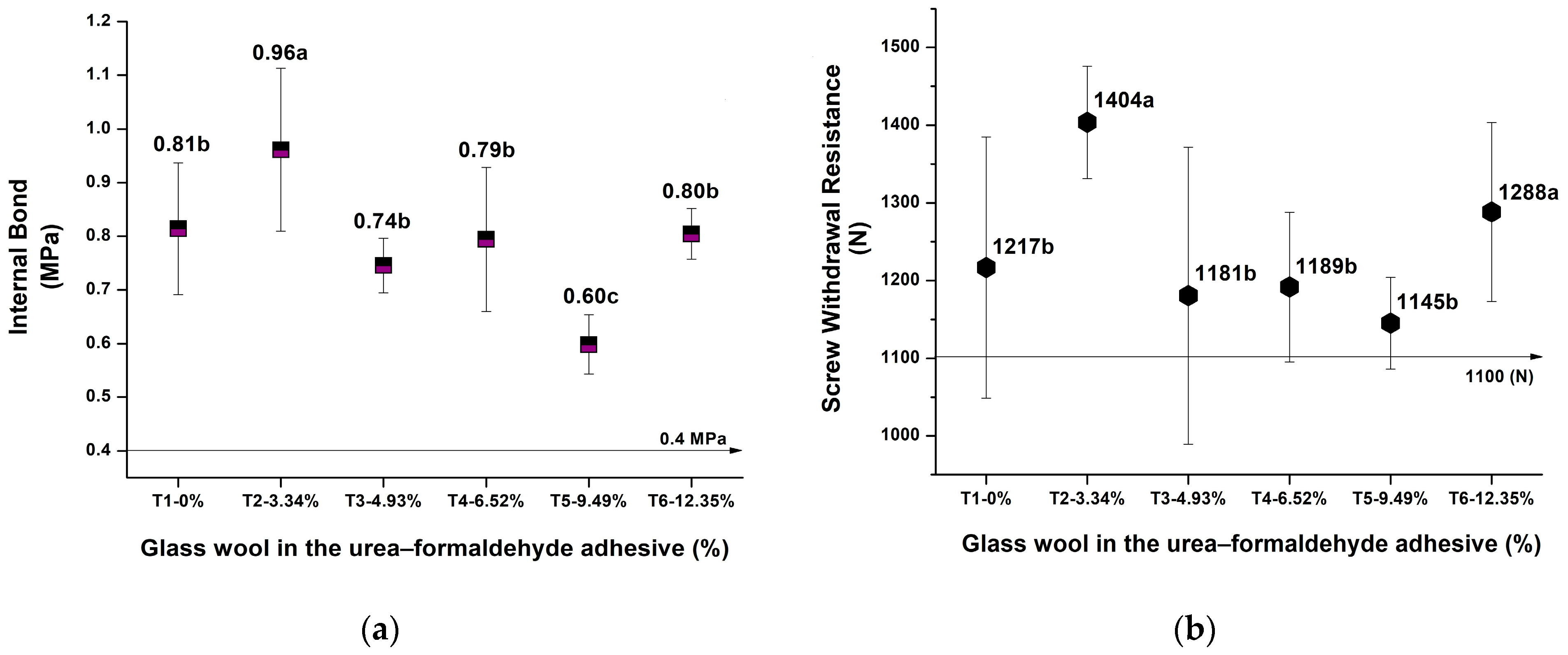
The incorporation of glass wool into the UF adhesive significantly influenced the properties of perpendicular tensile internal bond strength (IB) and screw withdrawal (SW) resistance. Analysis of variance indicated a significant effect of the adhesive composition on IB (p < 0.0001; Fcritical = 3.3778) and SW (p < 0.01). For both properties, the mean comparison test (Scott–Knott, p < 0.05) classified the treatments into distinct groups, revealing similar trends across the results (Figure 3a).
Figure 3. Average values of internal bond strength (a) and surface screw withdrawal resistance (b) of particleboards as a function of the percentage of glass wool added to the urea–formaldehyde adhesive. Means followed by the same letter do not differ significantly (Scott–Knott, p > 0.05).
Internal bond strength (IB) ranged from 0.60 to 0.96 MPa (Figure 3a), exceeding the minimum normative limits established by American National Standard ANSI A208.1, which accepts values between 0.15 and 0.40 MPa [52]. The treatment with 3.34% glass wool showed the best performance; under this condition, the glass wool proved compatible with the urea–formaldehyde matrix, allowing the maintenance of the necessary chemical and mechanical interactions for the structural integrity of the panels.
This property reflects the quality of the bond between particles and adhesive, and its variation is related to the homogeneous distribution of the adhesive and effective interaction at the interface [53,54]. The treatment with 9.49% filler, however, showed a reduction in strength, possibly due to the formation of agglomerates and disruption of the adhesive matrix, which impaired internal cohesion.
Studies indicate that the IB in particleboards varies according to the production method, adhesive formulation, and additives used. For panels with a nominal density of 700 kg m−3, 12% adhesive, and 1.5% paraffin emulsion, Luckman et al. [42] reported a value of 0.61 MPa for the control sample. Meanwhile, for three-layer particleboards with a density of 780 kg m−3, Gumus et al. [55] obtained an average of 0.68 MPa for the control treatment.
The performance of IB in reconstituted wood panels is influenced by the adhesive composition, which interacts with the wood on both sides of the glue line. Therefore, the stresses generated within the wood-glue line system are a determining factor in the performance of the bonded material [6,53,54].
Regarding the screw withdrawal (SW) resistance (Figure 3b), treatments T2 (3.34% glass wool) and T6 (12.35%) stood out as the best-performing panels, grouped as “a” by the Scott–Knott test. However, all treatments met the requirements of the ANSI A208.1 standard [52]. These results are consistent with findings reported by Bansal et al. [56], who compiled various studies on the subject.
Factors influencing SW resistance include the quality of the bond between particles and adhesive, as well as the physical and mechanical characteristics of the panel [57]. On the other hand, Bazzetto et al. [58] highlighted that unsatisfactory results may be related to insufficient adhesive content and low compaction ratios.
Panel density is a key factor in SW resistance, showing a positive linear trend between increased density and mechanical performance [59]. Surfaces with higher density favor screw anchorage [60]. However, the presence of voids or low-quality particles can compromise this relationship, as evidenced by Taquetti et al. [61].
Studies have highlighted limitations in SW resistance when using materials like nanoclay, whose weak interfacial interactions with the biomass did not lead to significant improvements [62,63]. On the other hand, nanomaterials with greater chemical affinity, such as nanocellulose fibers, have shown promising advancements in mechanical fastener resistance [56,60].
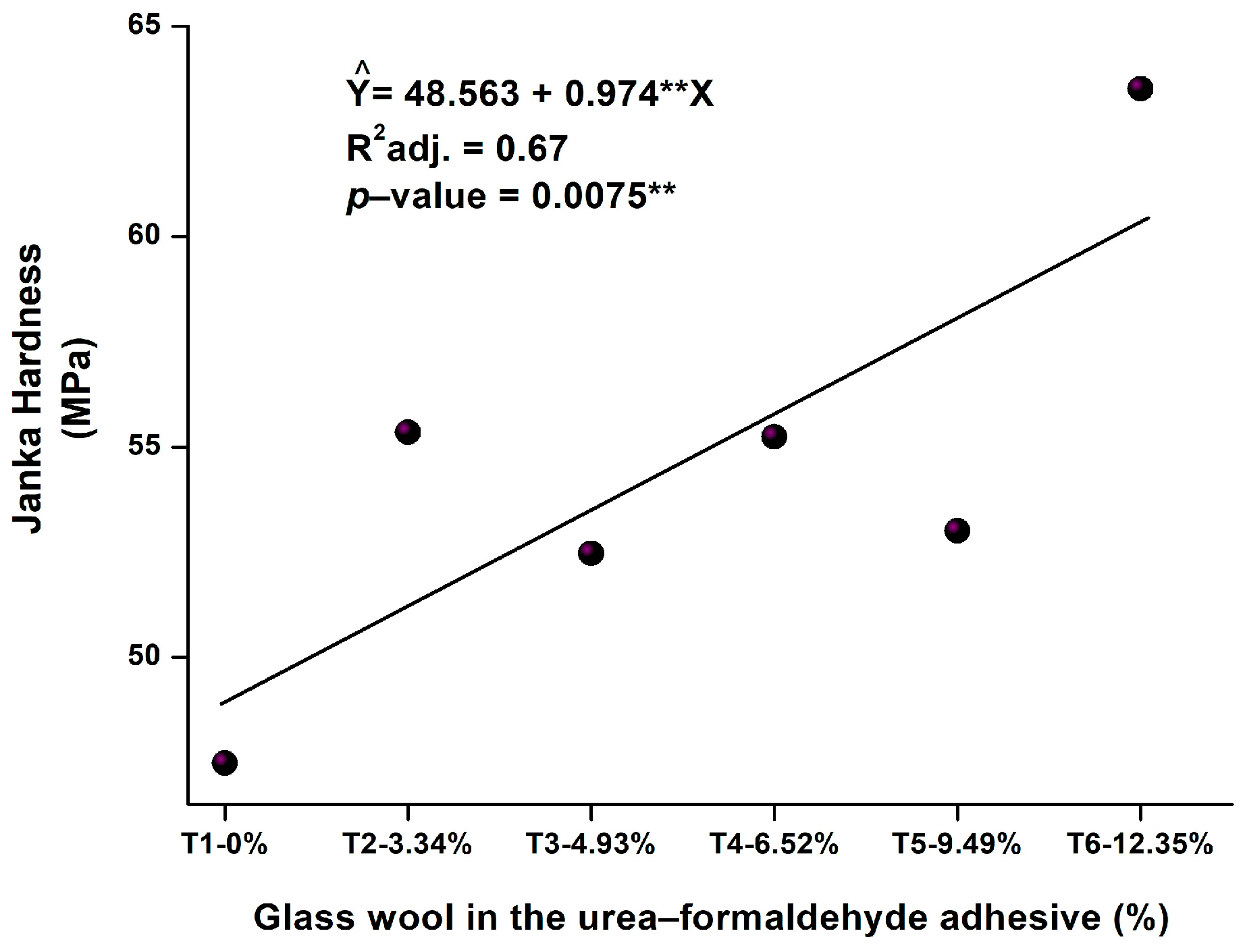
The linear regression analysis of the Janka hardness tests demonstrated that the incorporation of glass wool into the UF adhesive significantly impacted the panels’ performance (p < 0.05). A positive linear trend was observed between glass wool content and hardness values (Figure 4).
Figure 4. Linear regression between the Janka hardness of particleboard panels as a function of the percentage of glass wool added to the urea–formaldehyde adhesive. **: significant at 1% probability; Ŷ: estimated Janka hardness; X: percentage of glass wool added to the urea–formaldehyde adhesive (%); R2adj.: adjusted R-squared; p-value: probability associated with the Janka test.
According to ANSI A208.1 standard [52], which establishes a minimum requirement of 22.7 MPa, all panels met the normative specifications. Although the panels were produced under equal conditions of pressure, temperature, pressing time, and conditioning, a significant increase in hardness was observed with an increase in glass wool in the adhesive formulation, reaching performance 33.8% higher than that of the control treatment.
Janka hardness depends on the pressure and temperature applied during the production process, as well as on the moisture content of the material and the panel density, which is directly related to the compaction ratio [61,64].
This behavior suggests that the presence of the mineral filler contributed to the improvement in the surface structure, likely due to greater efficiency in heat transfer during pressing and local densification promoted by the dispersion of inorganic fibers. As pointed out by Taghiyari et al. [11] and Srivabut et al. [65], matrix homogeneity, void reduction, and strengthening of adhesive–filler interactions favor polymerization and result in more resistant surfaces. The effect of glass wool on material hardness may be attributed to the ability of these particles to promote a more controlled crosslinking rate, contributing to a more uniform and consistent hardening of the resin matrix.
However, considering that an increase in fillers in resin formulations influences adhesive properties, the incorporation of glass wool acted as a filler material capable of preserving structural stiffness, internal bonding, and stress transfer within the composite matrix, as well as enhancing the hardness of the panels.

2.5. Acoustic Properties of the Particleboard Panels

In addition to reproducible data obtained with a decibel meter, the experimental setup used proved sufficient to characterize the elastic moduli, damping, and acoustic performance of the particleboards. The results detail the acoustic properties of the different panel treatments (Table 2), including sound impact insulation (IIS), logarithmic decrement of acoustic damping (Dl), and acoustic conversion efficiency (ACE). Also presented are the average density (ρ) of larger test specimens (40 × 40 cm) and their respective dynamic modulus of elasticity (Edin).
Table 2. Average density, dynamic elastic modulus, logarithmic decrement of acoustic damping, and acoustic conversion efficiency in particleboards as a function of the percentage of glass wool added to the urea–formaldehyde adhesive.
The statistical analysis of the results obtained from the acoustic insulation evaluation of the particleboards using a decibel meter revealed significant differences between the tested treatments (F, p < 0.05). Additionally, the Shapiro–Wilk normality test confirmed the data’s adherence to the normality assumption (W = 0.96954; p = 0.07795), reinforcing the robustness of the results.
These statistical indicators, combined with strict control of experimental variables—such as sound impact power and sample positioning—underscore the acquisition of reproducible and reliable data. However, to validate the efficiency of the proposed methodologies, further testing, adjustments, and correlations with different materials are necessary.
For treatments with higher percentages of glass wool (9.49% and 12.35%), lower average decibel levels were observed, indicating superior acoustic insulation performance. Treatments with 0%, 3.34%, 4.93%, and 6.52% glass wool waste did not show significant differences. This similarity can be explained by the low concentration of glass wool waste, which may not have been sufficient to significantly alter the acoustic properties of the panel compared to the treatment without waste addition.
In this context, the influence of glass wool waste on sound insulation becomes more evident only at higher concentrations. Nonetheless, the use of glass wool waste in the adhesive formulation proved to be an effective strategy for improving the acoustic properties of medium-density particleboard panels.
For density (ρ), statistical analysis revealed no significant differences among the particleboard panels across the different treatments. This result indicates that the observed differences in acoustic properties can be attributed to other factors, such as internal distribution of particles, the adhesive matrix, and panel porosity.
It is important to note that the literature lacks comprehensive studies on the damping factor in particleboards, especially with this type of geometry. However, compaction, porosity, and IB performance in panels are factors that affect the path of sound waves. The natural vibration frequencies of the body are proportional to the elastic moduli, so lower damping rates are expected in denser and stiffer materials [66,67].
The dynamic modulus of elasticity varied significantly among the treatments, with the highest value observed in treatment T2, and the lowest values in treatments T1, T5, and T6, which did not differ statistically significantly. This indicates that the treatment with 3.34% glass wool in the adhesive composition resulted in greater dynamic stiffness and lower damping in the panel, reinforcing the inverse relationship between these parameters.
The lowest damping rate was observed in treatment T2, showing a reduction of 4.79% compared to the control panel. The control treatment did not differ statistically significantly from treatments T5 and T6, indicating that higher glass wool contents in the adhesive did not result in significant changes in the material’s damping behavior. The structure of the particleboard panel justifies the higher values of the logarithmic decrement of acoustic damping when compared to wood and other materials reported in the literature [26,66,68].
The ACE index showed a statistically significant difference only in treatment T2, standing out with the highest value (165.35 m−4 kg−1 s−1), which is 7% higher than the control. This value reflects the panel’s greater efficiency in converting vibrational energy into acoustic energy. On the other hand, the other treatments, including the control, did not differ statistically significantly from each other, suggesting that the increase in glass wool content in the adhesive in all treatments, except for treatment T2, did not significantly impact the acoustic conversion efficiency of the panels. ACE expresses the ratio between the coefficient of acoustic radiation and the internal attenuation of the material; higher values reflect less viscoelastic dissipation and greater sound emission. Thus, the observed increase results directly from the combination of greater dynamic stiffness and less damping. In terms of practical application, this behavior implies inferior performance in insulation functions, but does not compromise typical uses of particleboard panels in furniture, non-acoustic internal partitions, and secondary structural components, where sound transmission does not represent functional impairment and can even contribute to more stable dynamic behavior of the panel.

2.6. Scanning Electron Microscopy (SEM)

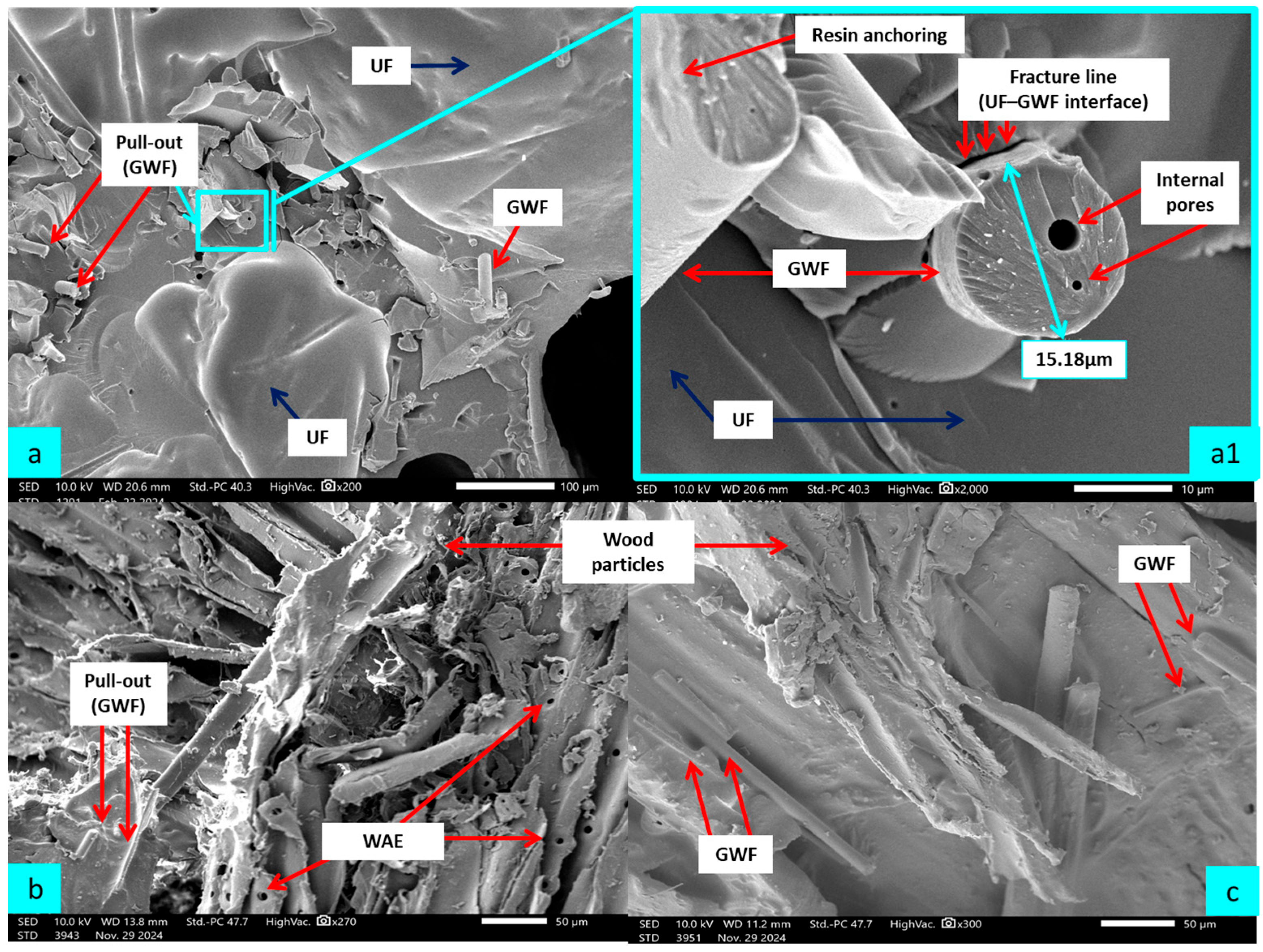
Figure 5 obtained by scanning electron microscopy (SEM) at 200× magnification, highlights the microstructural interaction between the modified urea–formaldehyde adhesive (T6—12% glass wool) and the glass wool fibers. A pull-out phenomenon from glass wool elements is observed, indicating interfacial adhesion, characterized by the partial rupture of fibrils within the adhesive matrix.
Figure 5. Scanning electron microscopy (SEM) images. (a,a1): urea–formaldehyde (UF) resin with glass wool fibers (GWF); (b,c): particleboard panels produced with UF modified with glass wool as filler material; WAEs: wood anatomical elements.
At higher magnification (Figure 5a1), a fracture line is evident, showing a region where the matrix did not fully encapsulate a glass fiber, indicating mechanical anchorage failures at the interfacial compatibility level between the components. This behavior may facilitate fiber slippage within the matrix, promoting reinforcement redistribution and void filling in the particleboard structure.
During the particleboard manufacturing process, the resin’s viscosity reduction under the initial increase in temperature and pressure can accentuate this effect. However, excessive glass wool content interferes with this flowability, potentially accelerating adhesive curing and compromising the uniformity of adhesive interfaces.
Figure 5b,c show the microstructure of the wood particleboard produced with the highest filler content in the modified urea–formaldehyde adhesive. Dispersion of glass microfibrils throughout the particleboard matrix is observed, where the UF resin acts as a binding agent, enveloping and anchoring both the wood particles and the glass wool elements.
With the increased filler content and the resulting larger surface area, reduced mobility, flowability, anchoring, and wetting are expected, leading to flaws in the distribution of components and interfacial interactions. The interaction between these components suggests that the presence of microfibrils can influence the particleboard’s microstructure, thereby affecting the final product’s properties.

3. Material and Methods

3.1. Raw Materials

The raw materials used were wood from Pinus sp., glass wool waste, urea–formaldehyde (UF) adhesive, and ammonium sulfate catalyst. The adhesive and catalyst were purchased from a domestic supplier. The wood was obtained in the form of boards (300 × 25 × 2 cm) from local commerce, cut perpendicularly (9 × 200 × 2 cm), and soaked in water to facilitate the production of flakes (9 × 2 × 0.17 cm). The particles were air-dried, ground in a hammer mill, sieved between 2.0 and 4.0 mm meshes, and dried in a forced-air circulation oven (80 ± 2 °C) until they reached a 7% moisture content. The glass wool waste was collected from discarded refrigerators, fragmented into pieces (10 × 10 mm), and manually cleaned to remove impurities. Next, the appropriate proportions (fragmented glass wool + UF adhesive) were quantified and homogenized in an industrial blender, until no clumps of fiberglass were observed in the adhesive.

3.2. Wood Density and Particle Aspect Ratio

The basic density of Pinus sp. wood was determined according to the water immersion method [69], with five replicates. The aspect ratio was calculated from the length and thickness of 250 wood particles. ImageJ software (Java 8) was used to measure the length and area of the particles from digitized images, while thickness was previously measured using a digital micrometer.
The virgin wood particles were arranged on the surface of a transmitted light scanner (Epson, V750 Pro, Long Beach, CA, USA), ensuring separation between them. An 8-bit grayscale image was captured for each arrangement at 600 dpi against a black background and saved in TIFF format. Color threshold segmentation preceded binarization to ensure analysis accuracy.

3.3. Evaluation of the Technological Properties of the Adhesives

The pH of the adhesives was measured using a digital pH meter (Alfakit, AT-355, Florianópolis, Brazil) at room temperature (≈25 °C). The pH value was recorded after approximately 2 min of electrode contact with the solution.
The solid content (%) of the adhesives was determined based on the ratio of dry weight (g) to wet weight (g) after homogenization. Samples of approximately 2.0 g of adhesive were kept in an oven at 103 ± 2 °C for 12 h.
The viscosity of the adhesives was determined using a digital viscometer (Marte, MVD-8, Santa Rita do Sapucaí, Brazil) with spindle 3 at 30 rpm, and the results are expressed in centipoise (cP).
The gel time of pure urea–formaldehyde resin and resin mixed with filler was determined as described by Brito [70]. Ammonium sulfate catalyst (24% solution) was used at a proportion of 2% based on the solid content of the urea–formaldehyde resin.

3.4. Production of Adhesives and Particleboards

The synthesis of the adhesives was carried out by incorporating glass wool as a filler material into commercial urea–formaldehyde (UF) resin. The proportions of glass wool in the adhesive are shown in Table 3.
Table 3. Percentage of glass wool load in particleboard and adhesive.
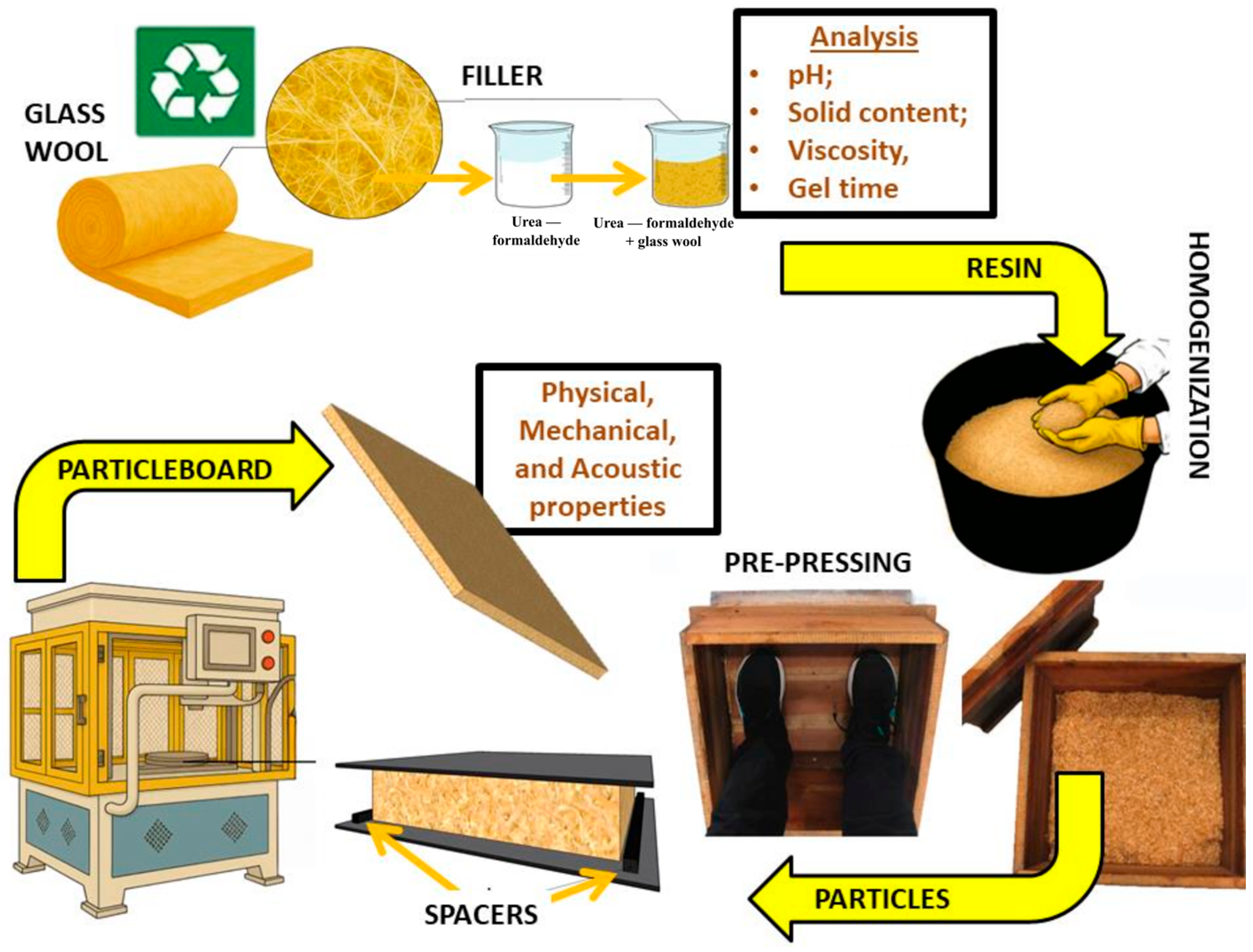
The moisture content of the particles was determined using an infrared moisture analyzer (Laborglas, MOC63u, São Paulo, Brazil). The panel manufacturing process followed the sequence illustrated in Figure 6, including adhesive application and manual homogenization, even distribution of the coated particles in a laboratory mold, and pre-pressing [71,72].
Figure 6. Steps in the process of producing particleboards using the pressing method.
With a fixed adhesive proportion of 12% relative to the dry mass of the particles, the panels were produced by compression molding using a heated platen hydraulic press (Solab, SL12, Piracicaba, Brazil) at a temperature of 160 °C and a pressure of 4.12 MPa for a duration of 10 min. Metal separators were used to limit the thickness of the panels to 1.2 cm. Three replicates were produced for each treatment, totaling 18 panels, which were stored in a climate-controlled room (65 ± 5% relative humidity and 25 ± 3 °C) until equilibrium was reached (minimum 72 h) [49].

3.5. Physical, Mechanical, and Acoustic Tests on the Panels

The tests conducted in the present study and the number of repetitions are presented in Table 4. Mechanical tests were performed using an automated universal testing machine (EMIC, DL10000, São José dos Pinhais, Brazil) with a capacity of 10 tons.
Table 4. Dimensions, number of specimens, and standards associated with each test.
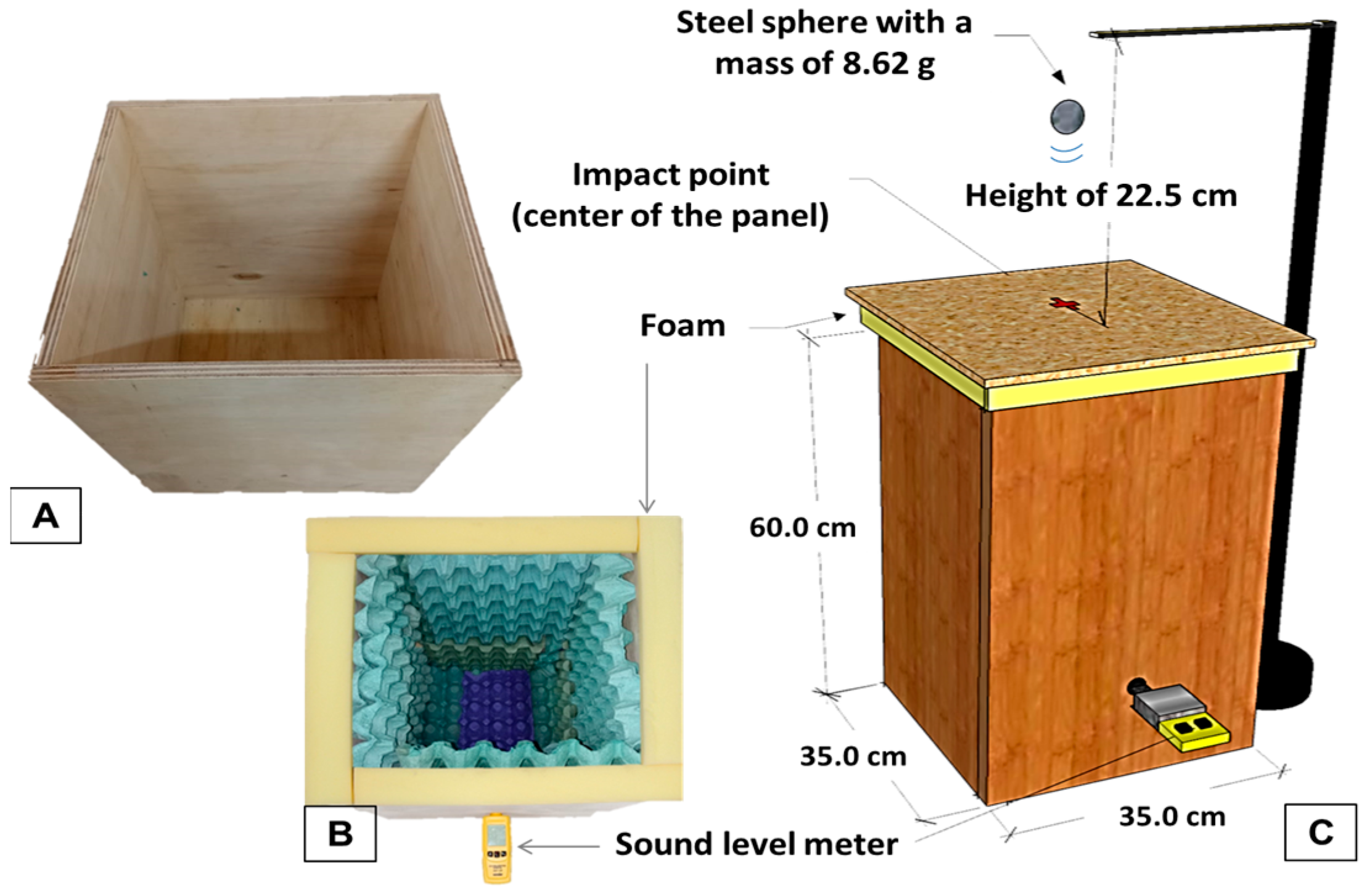
To evaluate the acoustic insulation and vibrational behavior of the produced panels, an experimental acoustic chamber was designed using plywood (60 × 35 × 35 cm). The acoustic chamber design aimed to create an isolated environment for sound measurements, minimizing interference from external noise and internal reflection of sound waves; the internal lining was prepared with porous cardboard-based absorbers (egg holders) to create an anechoic (echo-free) environment within the audible frequency range. This was necessary due to budgetary constraints, which required replacing expensive materials with more affordable alternatives.
The chamber’s top opening allowed for the panels (40 × 40 cm) to be fitted and placed on foam in the upper portion to ensure proper support and sealing. A decibel meter (Vonder, DDV 130, Curitiba, Brazil) was fixed with the microphone positioned inside the chamber, while the display was kept outside for direct reading. The sound impact was generated by the controlled drop of a metal sphere (8.62 g) from a height of 22.5 cm, repeated nine times per treatment (Figure 7). The average sound pressure levels, measured in decibels, were used to compare the acoustic insulation capacity among the treatments.
Figure 7. Sound impact insulation test. (A): plywood box; (B): experimental acoustic chamber with attached decibel meter; (C): schematic of the sound impact insulation test. Source: modified from Fassarella [73].
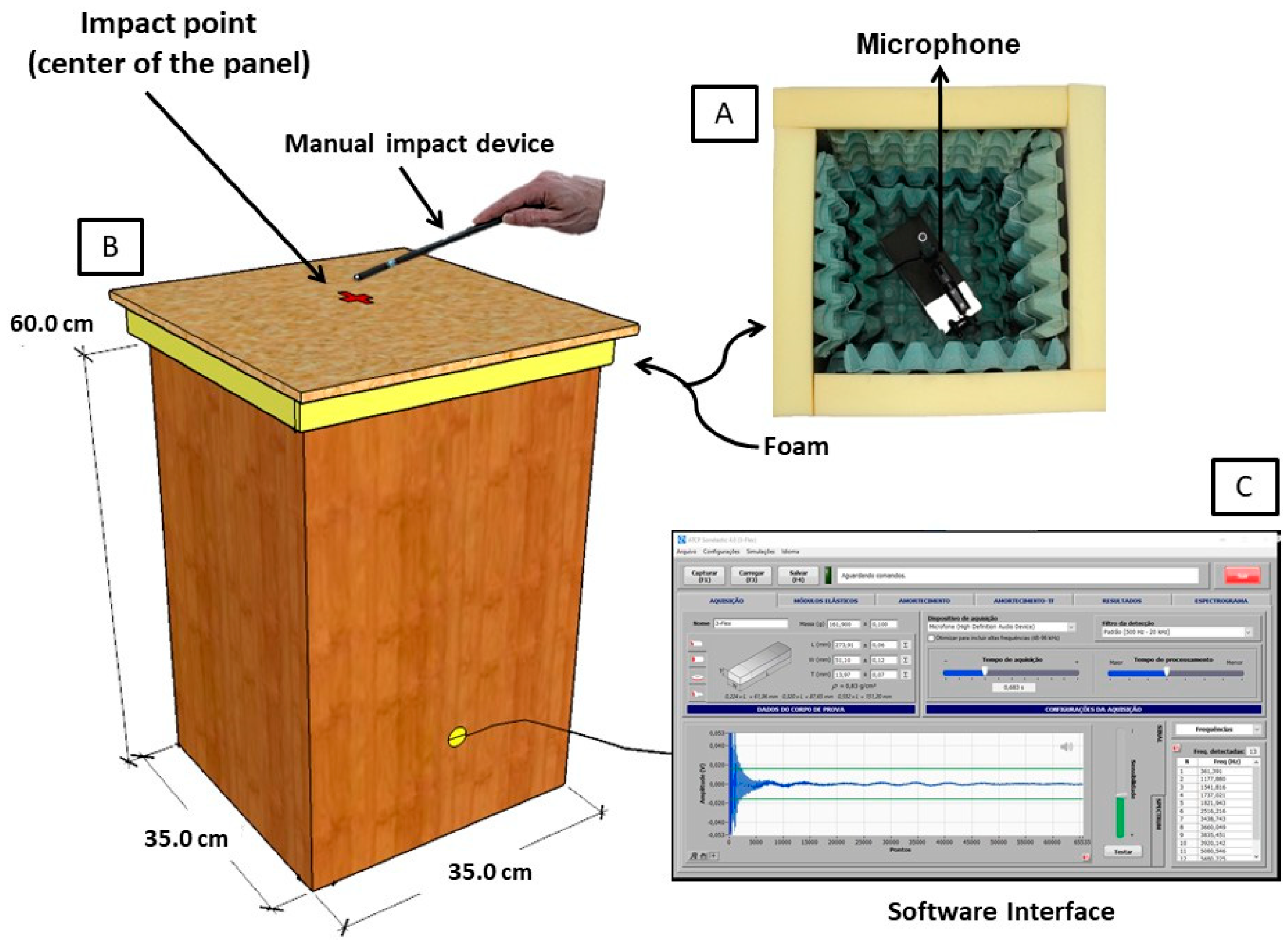
The flexural vibration test was conducted to determine the acoustic conversion efficiency of the particleboards. Three measurements were taken for each panel, totaling nine repetitions per treatment. The experimental acoustic chamber served as the support for the samples.
The transverse vibration test of the panels was performed by applying an impulse to the central area of the panel surface, excited by a light impact using a manual striker (Figure 8). The acoustic response was captured inside the acoustic chamber by a microphone positioned in line with the impact.
Figure 8. Vibration test in experimental apparatus (A, B) to evaluate the modulus of elasticity provided by the Sonelastic® software (C) at the transverse flexural frequency. Source: adapted from Fassarella [73].
The values determined by the software assume the material to be isotropic, and a Poisson’s ratio (μ) of 0.25 was used. Data collection was standardized at the first peak of the transverse flexural frequency, which ranged between 180 and 205 Hz.
The acoustic signals obtained at the frequency peaks were processed using the Sonelastic® software (ATCP, Version 6.0), and based on these natural transverse vibration frequencies, it was possible to determine the dynamic modulus of elasticity of the samples. The software automatically lists the harmonic frequencies and their respective damping factors, calculated using the logarithmic decrement method from the vibration peak amplitude (in the frequency domain), and a viscoelastic damping model was adopted [74].
In addition, secondary acoustic properties were calculated, such as the specific dynamic modulus of elasticity (Eesp) and the acoustic conversion efficiency (ACE), as described by Laudares et al. [68]. The logarithmic decrement of damping describes the dissipation of vibrational energy in the material and reflects the panel’s efficiency in absorbing mechanical vibrations, while the acoustic conversion efficiency (ACE) assesses the material’s potential to transform vibrational energy into acoustic energy [26,68,75].

3.6. Microstructural Behavior by SEM

The microstructure of the panels and the interfacial relationship between the cured UF resin and the glass wool particles were examined using images obtained from a scanning electron microscope (JEOL, JSM-IT200, Tokyo, Japan). The images were generated from backscattered electrons from randomly selected samples with dimensions of 0.5 × 0.5 × 0.5 mm. The specimens were mounted on aluminum sample stubs using double-sided carbon tape and coated with a 2 nm layer of gold for surface analysis.

3.7. Statistics

Statistical analyses were conducted individually for each test by eliminating outliers based on the interquartile range (IQR), calculated from the first and third quartiles using Excel®. Values outside the minimum and maximum limits were considered outliers and excluded.
The analyses followed a completely randomized design. Initially, regression analysis was performed within the variance framework, and since no statistical significance was found (p > 0.05), an analysis of variance was carried out, followed by a Scott–Knott test (p < 0.05).

4. Conclusions

The glass wool waste used a filler material in the urea–formaldehyde resin significantly affected properties such as pH, viscosity, gel time, and solid content, resulting in good performance of the particleboards and exceeding the pre-established normative limits.
The proportion of glass wool fibers (3.34%) incorporated into the adhesive improved the interfacial adhesion between the matrix and the wood, altered the microstructure of the particleboard, and enhanced both the mechanical behavior and acoustic conversion efficiency.
The results obtained reinforce the technical feasibility of incorporating glass wool wastes, indicating that adjustments in the adhesive formulation, especially in viscosity and pH, can optimize the panels’ performance. This approach not only promotes the reuse of industrial waste, aligning with sustainability principles, but also contributes to the development of new materials with potential applications in the reconstituted-wood-panel sector.
However, limitations such as increased viscosity hinder the use of glass wool when added to urea–formaldehyde adhesive, impairing its spraying onto the particles, thus requiring operational research, such as the adoption of other application techniques (cylinders or rollers) or their application in the plywood industry.

Author Contributions

Conceptualization, resources, supervision, project administration, F.G.G.; methodology, M.V.F. and F.G.G.; validation, F.G.G.; formal analysis, investigation, data curation, writing—original draft preparation, M.V.F.; writing—review and editing, F.G.G., P.G.A.S., J.B.P., R.C.C.L., M.P.O., I.L.S.C. and E.S.G.S.; visualization, P.G.A.S., J.B.P., R.C.C.L., M.P.O., I.L.S.C. and E.S.G.S. All authors have read and agreed to the published version of the manuscript.

Funding

The authors thank the Espírito Santo Research and Innovation Foundation (FAPES) for supporting this study through Call Nos. 04/2022 (PROAPEN) and 15/2024 (Process No. 2022-0BHDH, TO No. 179/2022), and the National Council for Scientific and Technological Development (CNPq) for granting us research scholarships (Process No. 303565/2021-7). The APC was funded by the Research Support Fund (FAP) of Line IV - Publication Fee (postgraduate professor at the Federal University of Espírito Santo, UFES).

Data Availability Statement

The original contributions presented in this study are included in the article. Further inquiries can be directed to the corresponding author(s).

Conflicts of Interest

The authors declare no conflicts of interest.

References

  1. Calvez, I.; Garcia, R.; Koubaa, A.; Landry, V.; Cloutier, A. Recent Advances in Bio-Based Adhesives and Formaldehyde-Free Technologies for Wood-Based Panel Manufacturing. Curr. For. Rep. 2024, 10, 386–400. [Google Scholar] [CrossRef] [PubMed]
  2. Réh, R.; Krišťák, Ľ.; Sedliačik, J.; Bekhta, P.; Božiková, M.; Kunecová, D.; Vozárová, V.; Tudor, E.M.; Antov, P.; Savov, V. Utilization of Birch Bark as an Eco-Friendly Filler in Urea-Frrmaldehyde Adhesives for Plywood Manufacturing. Polymers 2021, 13, 511. [Google Scholar] [CrossRef]
  3. Kawalerczyk, J.; Walkiewicz, J.; Sedliačik, J.; Dukarska, D.; Woźniak, M.; Mirski, R. Modified Buckwheat Husk as a Filler for Urea-Formaldehyde Resin in Plywood Production. Polymers 2024, 16, 1350. [Google Scholar] [CrossRef]
  4. Mensah, P.; Melo, R.R.; Mitchual, S.J.; Owusu, F.W.; Mensah, M.A.; Donkoh, M.B.; Paula, E.A.O.; Pedrosa, T.D.; Junior, F.R.; Rusch, F. Ecological Adhesive Based on Cassava Starch: A Sustainable Alternative to Replace Urea-Formaldehyde (UF) in Particleboard Manufacture. Matéria 2024, 29, e202330373. [Google Scholar] [CrossRef]
  5. Gadhave, R.V.I.; Dhawale, P.V. State of Research and Trends in the Development of Polyvinyl Acetate-Based Wood Adhesive. Open J. Polym. Chem. 2022, 12, 13–42. [Google Scholar] [CrossRef]
  6. Albuquerque, C.E.C.; Iwakiri, S.; Júnior, S.K.; Trianoski, R. Adesão e Adesivos. In Painéis de Madeira Reconstituída; Iwakiri, S., Trianoski, R., Eds.; Fupef: Curitiba, PR, Brazil, 2020; pp. 10–36. [Google Scholar]
  7. Furtini, A.C.C.; Santos, C.A.; Miranda, E.H.N.; Villarruel, D.C.V.; Gomes, D.A.C.; Ferreira, G.C.; Silva, M.G.; Mendes, L.M.; Júnior, J.B.G. Using Miriti Petiole to Produce Particleboards. Ambient. Construído 2023, 23, 149–162. [Google Scholar] [CrossRef]
  8. IBA. Brazilian Tree Industry; Annual Report; IBA: Brasília, DF, Brazil, 2024. (In Portuguese) [Google Scholar]
  9. Wang, H.; Wang, H.; Liao, J.; Zhou, X.; Du, G. Technological Properties of a Branched Polyethyleneimine Derivative as a Cross-Linker for Low Molar Ratio Urea-Formaldehyde Resins. Polym. Test. 2023, 118, 107914. [Google Scholar] [CrossRef]
  10. Yildirim, M.; Candan, Z. Performance Properties of Particleboard Panels Modified with Nanocellulose/Boric Acid. BioResources 2021, 16, 1875–1890. [Google Scholar] [CrossRef]
  11. Taghiyari, H.R.; Esmailpour, A.; Majidi, R.; Hassani, V.; Mirzaei, A.; Bibalan, O.F.; Papadopoulos, A.N. The Effect of Silver and Copper Nanoparticles as Resin Fillers on Less-Studied Properties of UF-Based Particleboards. Wood Mater. Sci. Eng. 2022, 17, 317–327. [Google Scholar] [CrossRef]
  12. Zhang, L.; Chen, Y.; Geng, S.; Huang, Z.; Qiu, R.; Chen, T.; Liu, W. Development of Plant Oil-Based Adhesives for Formaldehyde-Free Bamboo Particleboards. Ind. Crops Prod. 2024, 210, 118146. [Google Scholar] [CrossRef]
  13. Martins, R.S.F.; Gonçalves, F.G.; Lelis, R.C.C.; Segundinho, P.G.A.; Nunes, A.M.; Vidaurre, G.B.; Chaves, I.L.S.; Santiago, S.B. Physical Properties and Formaldehyde Emission in Particleboards of Eucalyptus sp. and Lignocellulosic Agro-Industrial Waste. Sci. For. 2020, 48, e2926. [Google Scholar] [CrossRef]
  14. Oktay, S.; Pizzi, A.; Köken, N.; Bengü, B. Tannin-Based Wood Panel Adhesives. Int. J. Adhes. Adhes. 2024, 130, 103621. [Google Scholar] [CrossRef]
  15. Oktay, S.; Kızılcan, N.; Bengü, B. Environment-Friendly Cornstarch and Tannin-Based Wood Adhesives for Interior Particleboard Production as an Alternative to Formaldehyde-Based Wood Adhesives. Pigment Resin Technol. 2024, 53, 173–182. [Google Scholar] [CrossRef]
  16. Brito, F.M.S.; Bortoletto Júnior, G.; Ferreira, G.; Furtini, A.C.C.; Paes, J.B. Painéis Aglomerados: Um Referencial Teórico. In Estudos e Tendências Atuais em Ciências Ambientais e Agrarias; Andrade, J.K.B., Ed.; Licuri: Campina Grande, Brazil, 2023; pp. 90–104. ISBN 9786585562188. [Google Scholar]
  17. Hemmilä, V.; Adamopoulos, S.; Karlsson, O.; Kumar, A. Development of Sustainable Bio-Adhesives for Engineered Wood Panels—A Review. RSC Adv. 2017, 7, 38604–38630. [Google Scholar] [CrossRef]
  18. Su, M.; Wu, J.; Pan, P.; Wang, H. Polyamide-Formaldehyde Resin as a Low-Toxic Adhesive for Wood Bonding. J. Adhes. Sci. Technol. 2022, 36, 1964–1977. [Google Scholar] [CrossRef]
  19. Xiao, J.; Guo, D.; Xia, C.; Li, T.; Lian, H. Application of Nano-SiO2 Reinforced Urea-Formaldehyde Resin and Molecular Dynamics Simulation Study. Materials 2022, 15, 8716. [Google Scholar] [CrossRef] [PubMed]
  20. Liu, J.; Li, Y.; Mo, H.; Xie, E.; Fang, J.; Gan, W. Current Utilization of Waste Biomass as Filler for Wood Adhesives: A Review. J. Ind. Eng. Chem. 2022, 115, 48–61. [Google Scholar] [CrossRef]
  21. Ghani, A.; Ashaari, Z.; Bawon, P.; Lee, S.H. Reducing Formaldehyde Emission of Urea Formaldehyde-Bonded Particleboard by Addition of Amines as Formaldehyde Scavenger. Build. Environ. 2018, 142, 188–194. [Google Scholar] [CrossRef]
  22. Kawalerczyk, J.; Antov, P.; Dziurka, D.; Mirski, R.; Lee, S.H. The Effect of Pressing Parameters and Hardener Content on the Properties of Plywood Bonded with Propylamine-UF Adhesive. Wood Mater. Sci. Eng. 2023, 19, 710–717. [Google Scholar] [CrossRef]
  23. Bertolini, M.S.; Moares, C.A.G.; Christoforo, A.L.; Bertoli, S.R.; Santos, W.N.; Lahr, F.A.R. Acoustic Absorption and Thermal Insulation of Wood Panels: Indluence of Porosity. BioResources 2019, 14, 3746–3757. [Google Scholar] [CrossRef]
  24. Ghofrani, M.; Ashori, A.; Mehrabi, R. Mechanical and Acoustical Properties of Particleboards Made with Date Palm Branches and Vermiculite. Polym. Test. 2017, 60, 153–159. [Google Scholar] [CrossRef]
  25. Ferrandez-Villena, M.; Ferrandez-Garcia, A.; Garcia-Ortuño, T.; Ferrandez-Garcia, M.T. Acoustic and Thermal Properties of Particleboards Made from Mulberry Wood (Morus alba L.) Pruning Residues. Agronomy 2022, 12, 1803. [Google Scholar] [CrossRef]
  26. Zatloukal, P.; Doskočil, T.; Tippner, J. Acoustic Properties of Wood-Based and Non-Wood-Based Materials for Piano—Case Making. Drv. Ind. 2024, 75, 227–236. [Google Scholar] [CrossRef]
  27. Bem, G.; Mulhbauer, M.; La Roche, P.; Matias, A.; Almeida, R.; Kruger, E. Implementation of a Dynamic Thermal and Illuminance Control System in Responsive Facades: Shading Study. Adv. Environ. Eng. Res. 2022, 3, 038. [Google Scholar] [CrossRef]
  28. Ülker, O.; Burdurlu, E. Effect of Glass Wool and Stone Wool Additives on Some Mechanical Properties of Wood Composites. BioResources 2016, 11, 5974–5986. [Google Scholar] [CrossRef]
  29. Kowatsc, S. Mineral Wool Insulation Binders. In Phenolic Resins: A Century of Progress; Pilato, L., Ed.; Springer: Berlin/Heidelberg, Germany, 2010; pp. 209–242. [Google Scholar]
  30. Bennett, T.M.; Allan, J.F.; Garden, J.A.; Shaver, M.P. Low Formaldehyde Binders for Mineral Wool Insulation: A Review. Glob. Chall. 2022, 6, 2100110. [Google Scholar] [CrossRef]
  31. Maloney, T.M. Modern Particleboard and Dry-Process Fiberboard Manufacturing; Miller Freeman Publications: San Francisco, CA, USA, 1993. [Google Scholar]
  32. Miranda, E.H.N.; Gomes, D.A.C.; Furtini, A.C.C.; Villarruel, D.C.V.; Santos, C.A.; Mendes, L.M.; Guimarães Júnior, J.B. Evaluation of Bean Residues in the Produxtion of Agglomerated Panels. Maderas-Ciência Tecnol. 2023, 25, 1–21. [Google Scholar]
  33. Ramesh, M.; Rajeshkumar, L.; Sasikala, G.; Balaji, D.; Saravanakumar, A.; Bhuvaneswari, V.; Bhoopathi, R. A Critical Review on Wood-Based Polymer Composites: Processing, Properties, and Prospects. Polymers 2022, 14, 589. [Google Scholar] [CrossRef]
  34. Cai, Z.; Senalik, C.A.; Ross, R.J. Mechanical Properties of Wood-Based Composite Materials. In Wood Handbook—Wood as an Engineering Material; Departament of Agriculture, Forest Service, Forest Products Laboratory: Madison, WI, USA, 2021; General Technical Report, Chapter 12; p. 15. [Google Scholar]
  35. Iwakiri, S.; Albuquerque, C.E.C.; Mendes, L.M.; Latorraca, J.V.F.; Trianoski, R. Painéis de Madeira Aglomerada. In Painéis de Madeira Reconstituída; Iwakiri, S., Trianoski, R., Eds.; Fupef: Curitiba, PR, Brazil, 2020; pp. 136–177. [Google Scholar]
  36. Araujo, C.K.C.; Campos, C.I.; Camargo, S.K.C.A.; Camargo, B.S. Caracterização Mecânica de Painéis Particulados de Média Densidade Produzidos a Partir de Resíduos de Madeira. Rev. Gestão Ind. 2019, 15, 197–211. [Google Scholar] [CrossRef]
  37. Fehrmann, J.; Belleville, B.; Ozarska, B. Effects of Particle Dimension and Constituent Proportions on Internal Bond Strength of Ultra-Low-Density Hemp Hurd Particleboard. Forests 2022, 13, 1967. [Google Scholar] [CrossRef]
  38. Engehausen, N.; Benthien, J.T.; Lüdtke, J. Influence of Particle Size on the Mechanical Properties of Single-Layer Particleboards. Fibers 2024, 12, 32. [Google Scholar] [CrossRef]
  39. Arabi, M.; Faezipour, M.; Gholizadeh, H. Reducing Resin Content and Board Density without Adversely Affecting the Mechanical Properties of Particleboard through Controlling Particle Size. J. For. Res. 2011, 22, 659–664. [Google Scholar] [CrossRef]
  40. Baldin, T.; Silveira, A.G.; Vidrano, B.R.A.; Cancian, L.C.; Spatt, L.L.; Haselein, C.R. Qualidade de Painéis Aglomerados Produzidos Com Diferentes Proporções de Madeira e Capim-Annoni. Rev. Bras. Cienc. Agrárias 2016, 11, 230–237. [Google Scholar] [CrossRef]
  41. Ghani, A.; Bawon, P.; Lee, S.H.; Ashaari, Z. Physico-Mechanical Properties and Formaldehyde Emission of Rubberwood Particleboard Made with UF Resin Admixed with Ammonium and Aluminium-Based Hardeners. Pertanika J. Sci. Technol. 2019, 27, 473–488. [Google Scholar]
  42. Luckman, S.S.; Cunha, A.B.; Rios, P.D.; Zanatta, P. Influência Da Incorporação de Lignina Kraft à Resina Ureia-Formaldeído Nas Propriedades Tecnológicas de Painéis Aglomerados Convencionais. Sci. For. 2021, 49, e3527. [Google Scholar] [CrossRef]
  43. Moslemi, A.; Zolfagharlou koohi, M.; Behzad, T.; Pizzi, A. Addition of Cellulose Nanofibers Extracted from Rice Straw to Urea Formaldehyde Resin: Effect on the Adhesive Characteristics and Medium Density Fiberboard Properties. Int. J. Adhes. Adhes. 2020, 99, 102582. [Google Scholar] [CrossRef]
  44. Almeida, V.C. Efeito Da Adição de Carga e Extensor Nas Propriedades Do Adesivo Uréia-Formaldeído e Dos Compensados de Pinus e Paricá. Master’s Dissertation, Universidade Federal de Viçosa, Viçosa, MG, Brazil, 2009. Mestrado em Ciência Florestal. [Google Scholar]
  45. Hosseini, S.B.; Asadollahzadeh, M.; Najfai, S.K.; Taherzadeh, M.J. Partial Replacement of Urea-Formaldehyde Adhesive with Fungal Biomass and Soy Flour in Plywood Fabrication. J. Adhes. Sci. Technol. 2020, 34, 1371–1384. [Google Scholar] [CrossRef]
  46. Karagiannidis, E.; Markessini, C.; Athanassiadou, E. Micro-Fibrillated Cellulose in Adhesive Systems for the Production of Wood-Based Panels. Molecules 2020, 25, 4846. [Google Scholar] [CrossRef] [PubMed]
  47. Roumeli, E.; Papadopoulou, E.; Pavlidoua, E.; Vourliasa, G.; Bikiarisc, D.; Paraskevopoulosa, K.M.; Chrissafi, K. Synthesis, Characterization and Thermal Analysis of Urea–Formaldehyde/NanoSiO2 Resins. Thermochim. Acta 2012, 527, 33–39. [Google Scholar] [CrossRef]
  48. Salari, A.; Tabarsa, T.; Khazaeian, A.; Saraeian, A. Improving Some of Applied Properties of Oriented Strand Board (OSB) Made from Underutilized Low Quality Paulownia (Paulownia fortunie) Wood Employing Nano-SiO2. Ind. Crops Prod. 2013, 42, 1–9. [Google Scholar] [CrossRef]
  49. NBR 14810-2; Painéis de Partículas de Média Densidade: Requisitos e Métodos de Ensaio. Associação Brasileira de Normas Técnicas—ABNT: Rio de Janeiro, Brazil, 2024.
  50. Lima, F.O.; Lirya Silva, L.C.; Maia, R.A.; Oliveira, I.R.; Oliveira, C.R.; Favarim, H.R.; Campos, C.I. ZnO Nanoparticle: Production and Use for Particleboard Improvement. Concilium 2023, 23, 420–429. [Google Scholar] [CrossRef]
  51. Lee, H.; Kim, N.K.; Verbeek, C.J.R.; Bhattacharyya, D. Effects of Casein on Flammability and Mechanical Characteristics of Medium Density Fibreboards Based on Formaldehyde-Free Resin System. Mater. Today Proc. 2023, 2023, 2214–7853. [Google Scholar] [CrossRef]
  52. A208.1; Particleboard. ANSI American National Standard Particleboard: Gaithersburg, MD, USA, 1999.
  53. Costa, D.; Serra, J.; Quinteiro, P.; Dias, A.C. Life Cycle Assessment of Wood-Based Panels: A Review. J. Clean. Prod. 2024, 444, 140955. [Google Scholar] [CrossRef]
  54. Lima, A.J.M.; Iwakiri, S.; Satyanarayana, K.G.; Lomelí-Ramírez, M.G. Studies on the Durability of Wood-Cement Particleboards Produced with Residues of Pinus spp., Silica Fume, and Rice Husk Ash. BioResources 2020, 15, 3064–3086. [Google Scholar] [CrossRef]
  55. Gumus, N.; Doganci, E.; Aytac, A. Evaluations of the Effects of Different Flame Retardants Combinations on Particleboards Produced Using Urea-Formaldehyde Resin. Eur. J. Wood Wood Prod. 2024, 82, 747–759. [Google Scholar] [CrossRef]
  56. Bansal, R.; Barshilia, H.C.; Pandey, K.K. Nanotechnology in Wood Science: Innovations and Applications. Int. J. Biol. Macromol. 2024, 262, 130025. [Google Scholar] [CrossRef]
  57. Chaydarreh, K.C.; Lin, X.; Guan, L.; Hu, C. Interaction between Particle Size and Mixing Ratio on Porosity and Properties of Tea Oil Camellia (Camellia oleifera Abel.) Shells-Based Particleboard. J. Wood Sci. 2022, 68, 43. [Google Scholar] [CrossRef]
  58. Bazzetto, J.T.L.; Bortoletto Junior, G.; Brito, F.M.S. Effect of Particle Size on Bamboo Particle Board Properties. Floresta Ambient. 2019, 26, e20170125. [Google Scholar] [CrossRef]
  59. Martins, R.S.F.; Gonçalves, F.G.; Segundinho, P.G.A.; Lelis, R.C.C.; Paes, J.B.; Lopez, Y.M.; Chaves, I.L.S.; Oliveira, R.G.E. Investigation of Agro-Industrial Lignocellulosic Wastes in Fabrication of Particleboard for Construction Use. J. Build. Eng. 2021, 43, 102903. [Google Scholar] [CrossRef]
  60. Leng, W.; Hunt, J.F.; Tajvidi, M. Screw and Nail Withdrawal Strength and Water Soak Properties of Wet-Formed Cellulose Nanofibrils Bonded Particleboard. BioResources 2017, 12, 7692–7710. [Google Scholar] [CrossRef]
  61. Taquetti, V.B.; Silva, V.V.; Chaves, I.L.S.; Oliveira, R.G.E.; Maffioletti, F.D.; Ferreira, G.; Mendonça, J.P.C.; Silva, E.S.G.; Gonçalves, F.G. Performance of Eucalypt Particleboard with the Addition of Farm Waste. Heliyon 2023, 9, e22760. [Google Scholar] [CrossRef] [PubMed]
  62. Gillela, S.; Yadav, S.M.; Sihag, K.; Kelkar, B.U.; Dangtungee, R.; Bhuyar, P. Effects of Addition of Nanoclay in Phenol-Formaldehyde Resins on the Properties of Lantana camara Fibre Composites. J. Trop. For. Sci. 2024, 36, 40–50. [Google Scholar] [CrossRef]
  63. Rafighi, A.; Dorostkar, A.; Madhoush, M. Investigation on Mechanical Properties between of Composite Made of Poplar and Alder Sawdust and High Density Polyethylene. Int. J. Innov. Sci. Eng. Technol. 2014, 1, 134–141. [Google Scholar]
  64. Ulker, O. Surface Roughness of Composite Panels as a Quality Control Tool. Materials 2018, 11, 407. [Google Scholar] [CrossRef] [PubMed]
  65. Srivabut, C.; Ratanawilai, T.; Hiziroglu, S. Effect of Nanoclay, Talcum, and Calcium Carbonate as Filler on Properties of Composites Manufactured from Recycled Polypropylene and Rubberwood Fiber. Constr. Build. Mater. 2018, 162, 450–458. [Google Scholar] [CrossRef]
  66. Carrasco, E.V.M.; Vargas, C.B.; Souza, M.d.F.; Mantilla, J.N.R. Avaliação Das Características Mecânicas Da Madeira Por Meio de Excitação Por Impulso. Rev. Matéria 2017, 22, 11936. [Google Scholar] [CrossRef]
  67. Taghiyari, H.R.; Taheri, A.; Omrani, P. Correlation between Acoustic and Physical–Mechanical Properties of Insulating Composite Boards Made from Sunflower Stalk and Wood Chips. Eur. J. Wood Wood Prod. 2017, 75, 409–418. [Google Scholar] [CrossRef]
  68. Laudares, F.A.L.; Nascimento, A.M.; Oliveira, R.N.; Santos, R.R.; Moura, F.D.G. Avaliação Das Propriedades Acústicas de Mogno Africano (Khaya ivorensis) Submetido a Tratamento Térmico Em Estufa e Autoclave. Rev. Mater. 2023, 28, 20230035. [Google Scholar] [CrossRef]
  69. NBR 11941; Madeira—Determinação Da Densidade Básica. Associação Brasileira de Normas Técnicas—ABNT: Rio de Janeiro, Brazil, 2003.
  70. Brito, E.O. Produção de Chapas de Partículas de Madeira a Partir de Maravalhas de Pinus elliottii Engelm. Var. Elliottii Plantado No Sul Do Brasil. Ph.D. Thesis, Universidade Federal do Paraná, Curitiba, PR, Brazil, 1995. Doutorado em Engenharia Florestal. [Google Scholar]
  71. Dhanapal, S.; Singh, M.; Nagammanavar, U. Influence of Rice Straw and Wood Fiber Combination on Physical and Mechanical Properties of Rice Straw Pulverized Composite Board. Maderas. Cienc. y Tecnol. 2024, 26, 1–14. [Google Scholar] [CrossRef]
  72. Oliveira Júnior, J.N.; Lopes, F.P.D.; Simonassi, N.T.; Oliveira, M.P.; Gonçalves, F.G.; Vieira, C.M.F. Evaluation of Hot Pressing Processing by Physical Properties of Ecofriendly Composites Reinforced by Eucalyptus Sawdust and Chamotte Residues. Polymers 2023, 15, 1931. [Google Scholar] [CrossRef]
  73. Fassarella, M.V. Efeitos Da Adição de Lã de Vidro à Resina Ureia-Formaldeído Nas Propriedades de Painel Aglomerado Homogêneo. Master’s Dissertation, Universidade Federal do Espírito Santo, Jerônimo Monteiro, ES, Brazil, 2025. Mestrado em Ciências Florestais. [Google Scholar]
  74. ATCP. Manual de Instalação e Operação: Sonelastic; ATCP Engenharia Física: Ribeirão Preto, SP, Brazil, 2015. [Google Scholar]
  75. Arunkumar, M.P.; Jagadeesh, M.; Pitchaimani, J.; Gangadharan, K.V.; Babu, M.C.L. Sound Radiation and Transmission Loss Characteristics of a Honeycomb Sandwich Panel with Composite Facings: Effect of Inherent Material Damping. J. Sound Vib. 2016, 383, 221–232. [Google Scholar] [CrossRef]
Disclaimer/Publisher’s Note: The statements, opinions and data contained in all publications are solely those of the individual author(s) and contributor(s) and not of MDPI and/or the editor(s). MDPI and/or the editor(s) disclaim responsibility for any injury to people or property resulting from any ideas, methods, instructions or products referred to in the content.

Article Metrics

Citations

Article Access Statistics

Multiple requests from the same IP address are counted as one view.